Cambridge IGCSE Physics 0625 — 2024 May/June Paper 1 · Variant 1
0625/11/M/J/24 · 40 questions · 40 marks · ≈45 min
The question paper and its mark scheme, free to read here and free to download. This is Cambridge’s own paper, exactly as it was sat.
Question paper16 pages
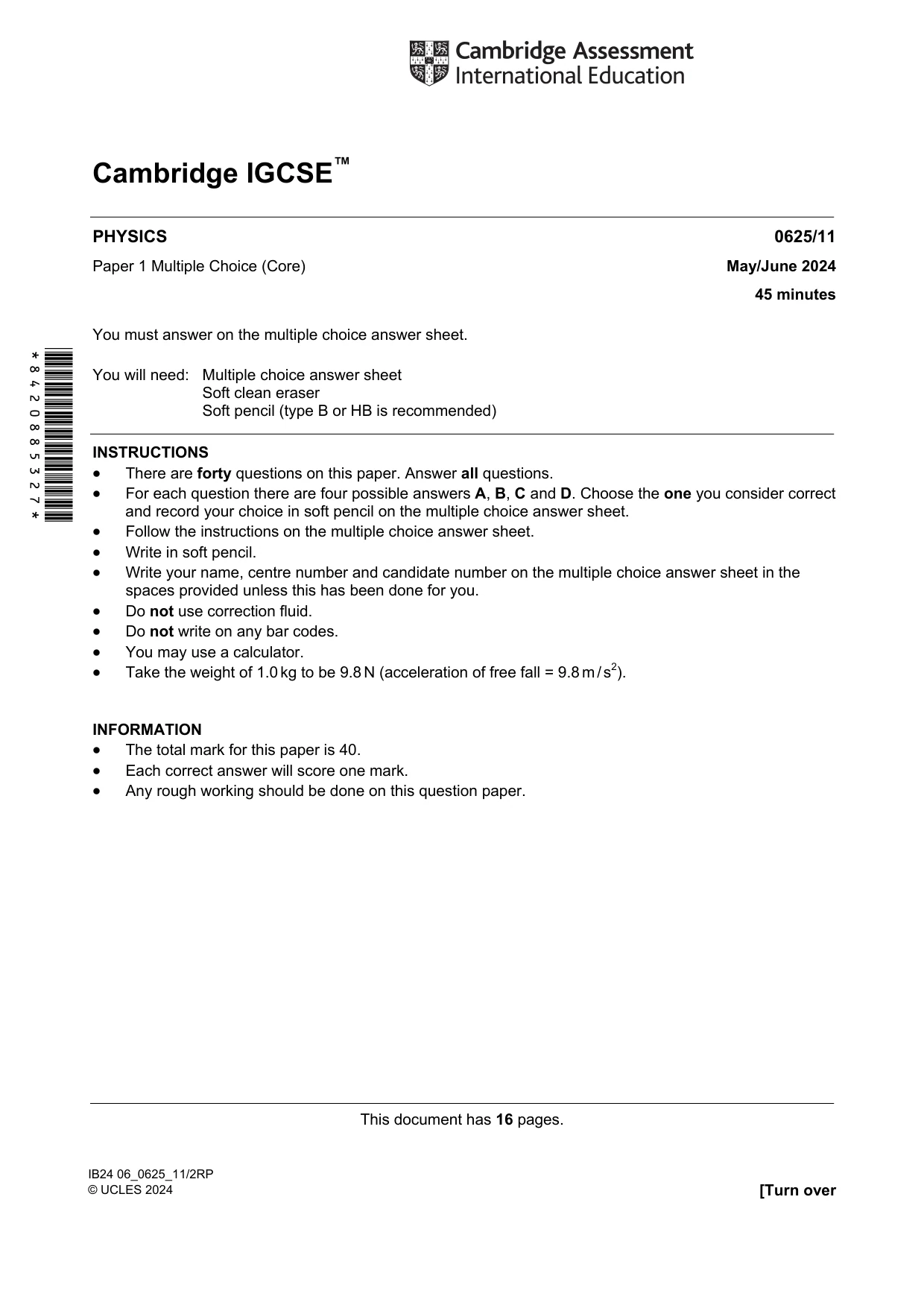
Mark scheme3 pages
Answers below. Sit the paper first if you are practising.
Questions as text
Q1 · The diagram shows an enlarged drawing of the end of a metre ruler
1 The diagram shows an enlarged drawing of the end of a metre ruler. It is being used to measure the length of a small feather. 1 0 2 0 3 0 mm cm 1 2 3 What is the length of the feather? A 19 mm B 29 mm C 19 cm D 29 cm
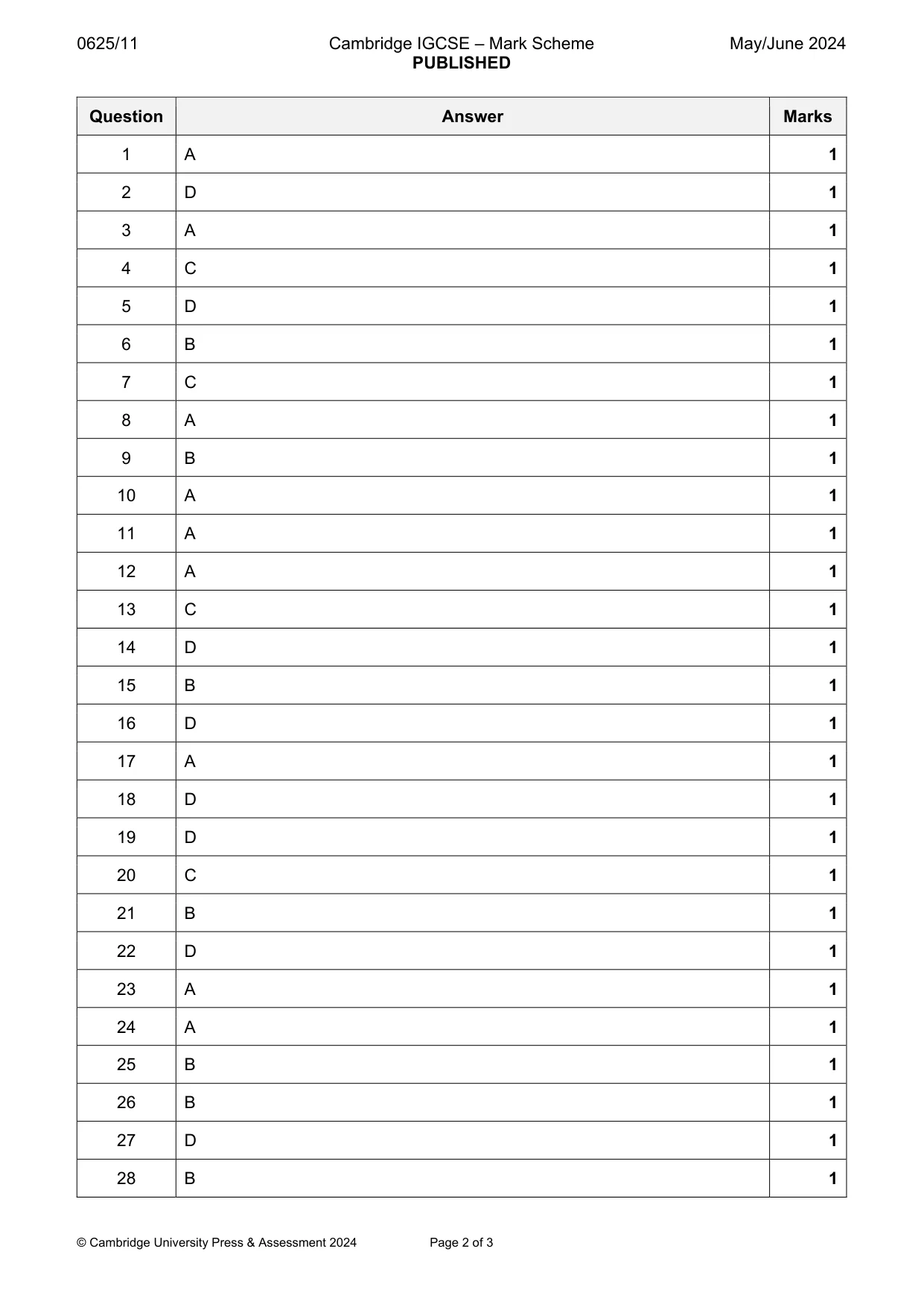
Mark scheme: A
More questions on Physical quantities and measurement techniques
Q2 · The diagram shows two objects, X and Y, suspended from identical springs
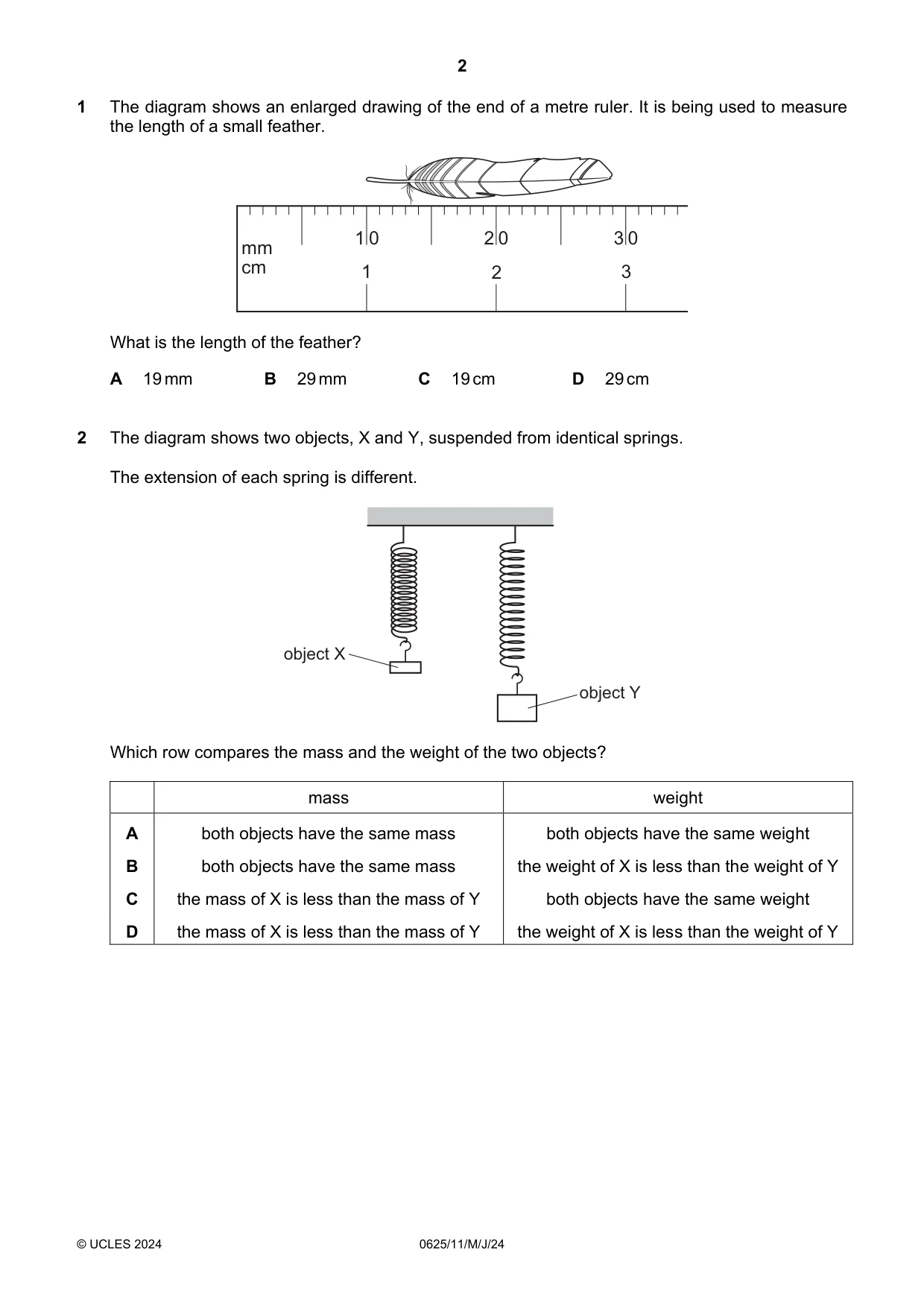
2 The diagram shows two objects, X and Y, suspended from identical springs. The extension of each spring is different. object X object Y Which row compares the mass and the weight of the two objects? mass weight A both objects have the same mass both objects have the same weight B both objects have the same mass the weight of X is less than the weight of Y C the mass of X is less than the mass of Y both objects have the same weight D the mass of X is less than the mass of Y the weight of X is less than the weight of Y
Mark scheme: D
Q3 · A plastic bottle contains 750 cm3 of oil
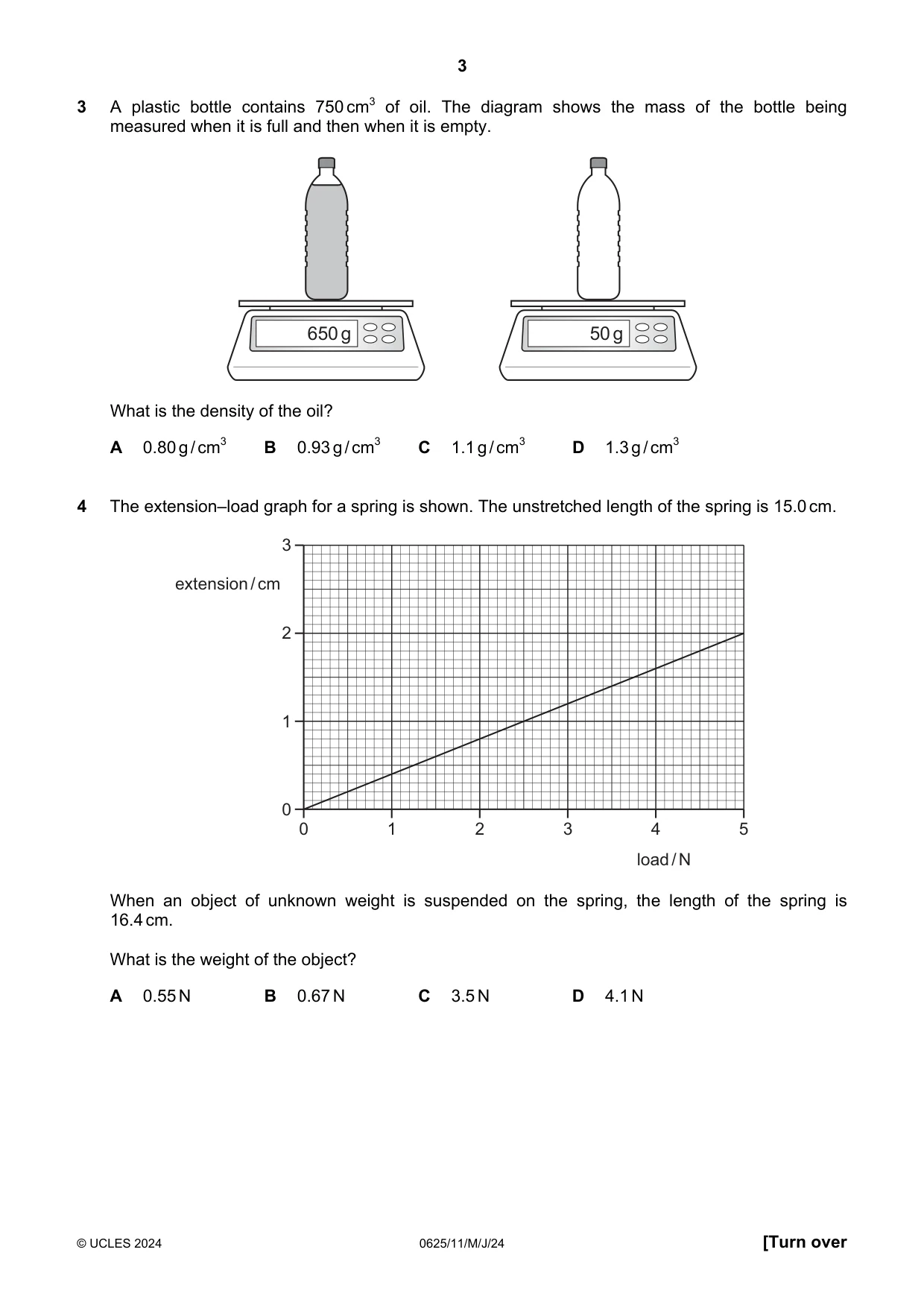
3 A plastic bottle contains 750 cm3 of oil. The diagram shows the mass of the bottle being measured when it is full and then when it is empty. 650 g 50 g What is the density of the oil? A 0.80 g / cm3 B 0.93 g / cm3 C 1.1 g / cm3 D 1.3 g / cm3
Mark scheme: A
Q4 · The extension–load graph for a spring is shown
4 The extension–load graph for a spring is shown. The unstretched length of the spring is 15.0 cm. 3 extension / cm 2 1 0 0 1 2 3 4 5 load / N When an object of unknown weight is suspended on the spring, the length of the spring is 16.4 cm. What is the weight of the object? A 0.55 N B 0.67 N C 3.5 N D 4.1 N
Mark scheme: C
Q5 · A student determines the position of the centre of gravity of a piece of card
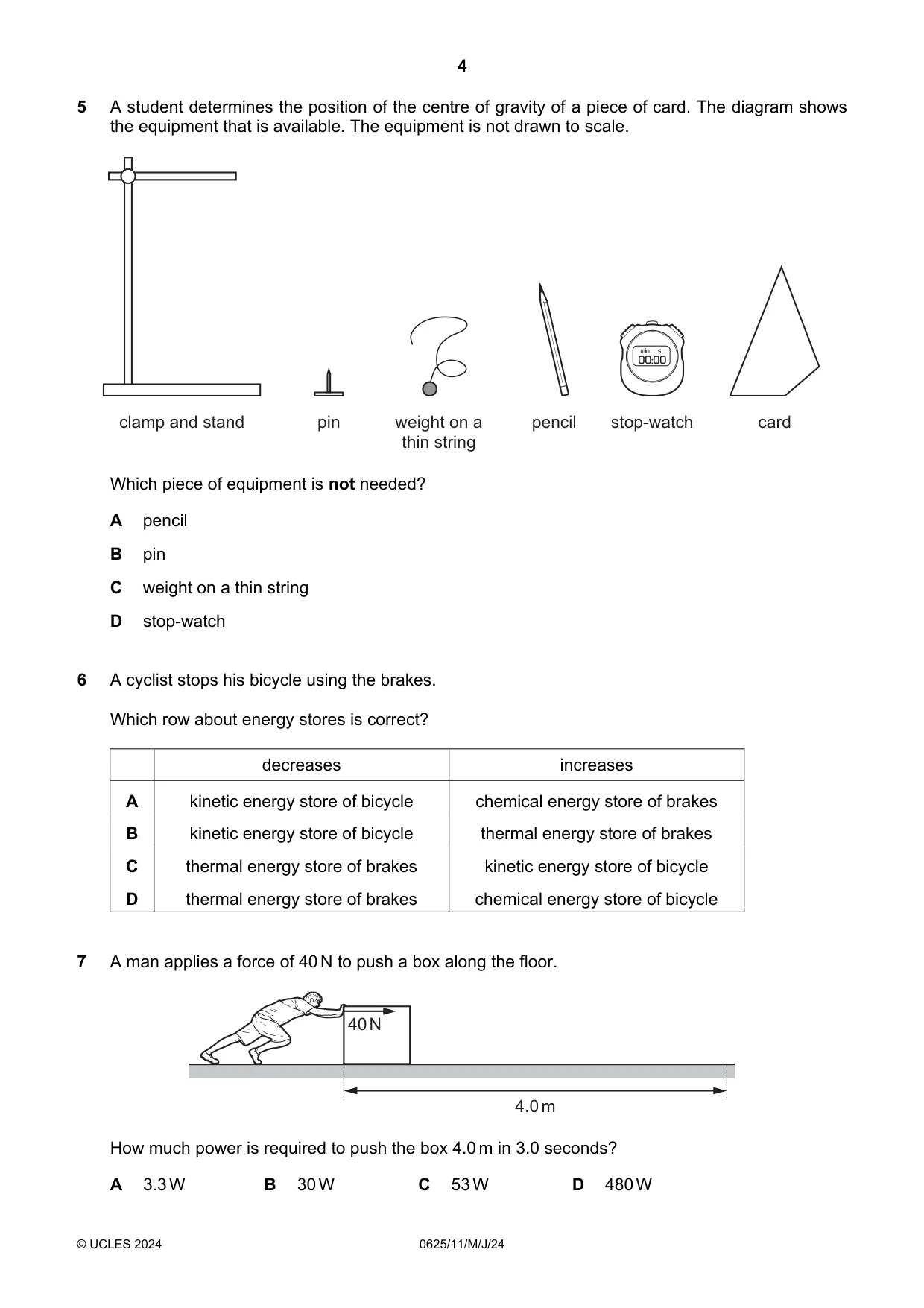
5 A student determines the position of the centre of gravity of a piece of card. The diagram shows the equipment that is available. The equipment is not drawn to scale. clamp and stand pin weight on a pencil stop-watch card thin string Which piece of equipment is not needed? A pencil B pin C weight on a thin string D stop-watch
Mark scheme: D
Q6 · A cyclist stops his bicycle using the brakes
6 A cyclist stops his bicycle using the brakes. Which row about energy stores is correct? decreases increases A kinetic energy store of bicycle chemical energy store of brakes B kinetic energy store of bicycle thermal energy store of brakes C thermal energy store of brakes kinetic energy store of bicycle D thermal energy store of brakes chemical energy store of bicycle
Mark scheme: B
Q7 · A man applies a force of 40 N to push a box along the floor
7 A man applies a force of 40 N to push a box along the floor. 40 N 4.0 m How much power is required to push the box 4.0 m in 3.0 seconds? A 3.3 W B 30 W C 53 W D 480 W
Mark scheme: C
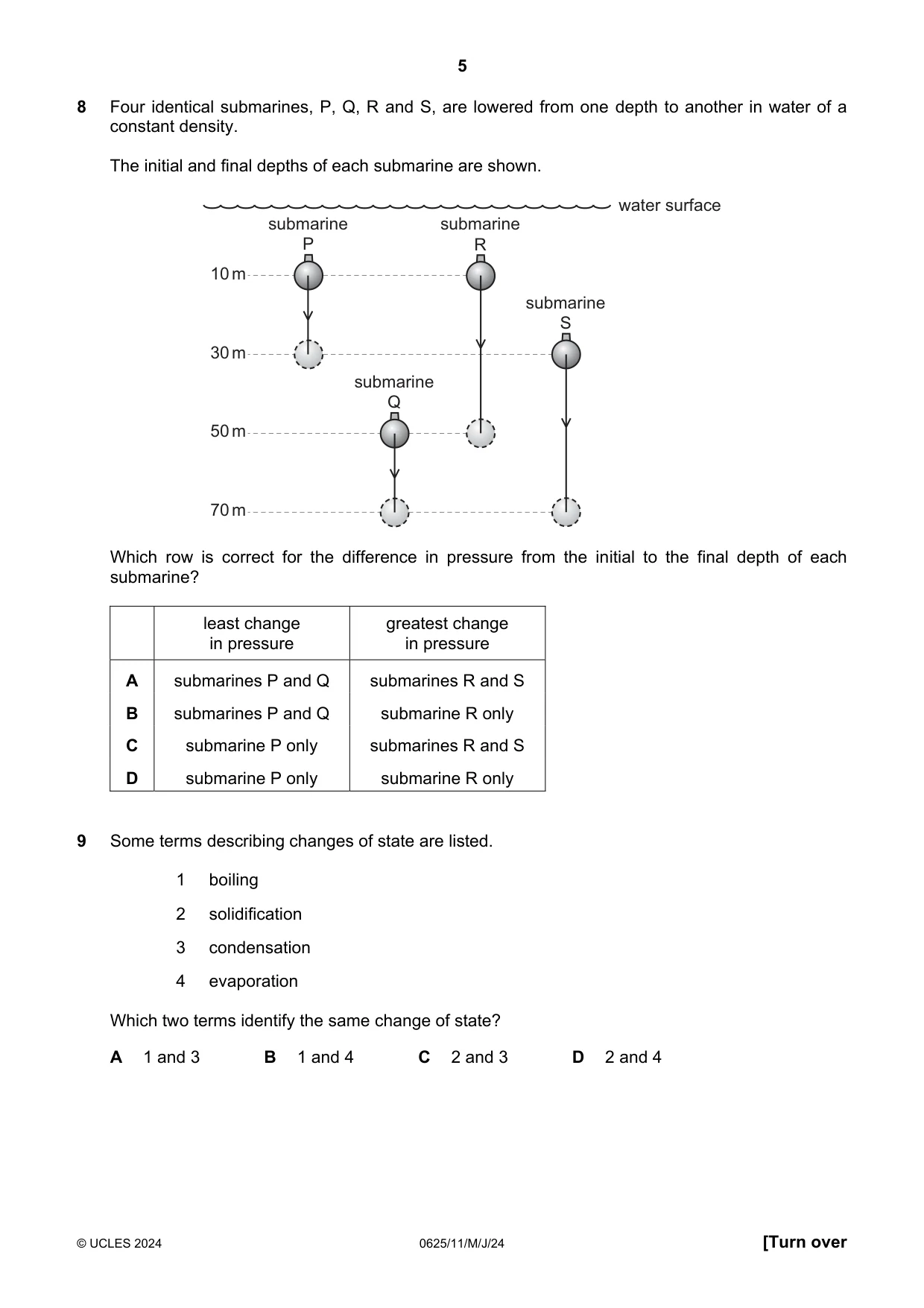
Q8 · Four identical submarines, P, Q, R and S, are lowered from one depth to another in water…
8 Four identical submarines, P, Q, R and S, are lowered from one depth to another in water of a constant density. The initial and final depths of each submarine are shown. water surface submarine submarine P R 10 m submarine S 30 m submarine Q 50 m 70 m Which row is correct for the difference in pressure from the initial to the final depth of each submarine? least change greatest change in pressure in pressure A submarines P and Q submarines R and S B submarines P and Q submarine R only C submarine P only submarines R and S D submarine P only submarine R only
Mark scheme: A
Q9 · Some terms describing changes of state are listed
9 Some terms describing changes of state are listed. 1 boiling 2 solidification 3 condensation 4 evaporation Which two terms identify the same change of state? A 1 and 3 B 1 and 4 C 2 and 3 D 2 and 4
Mark scheme: B
Q10 · Apparatus being used to observe smoke particles
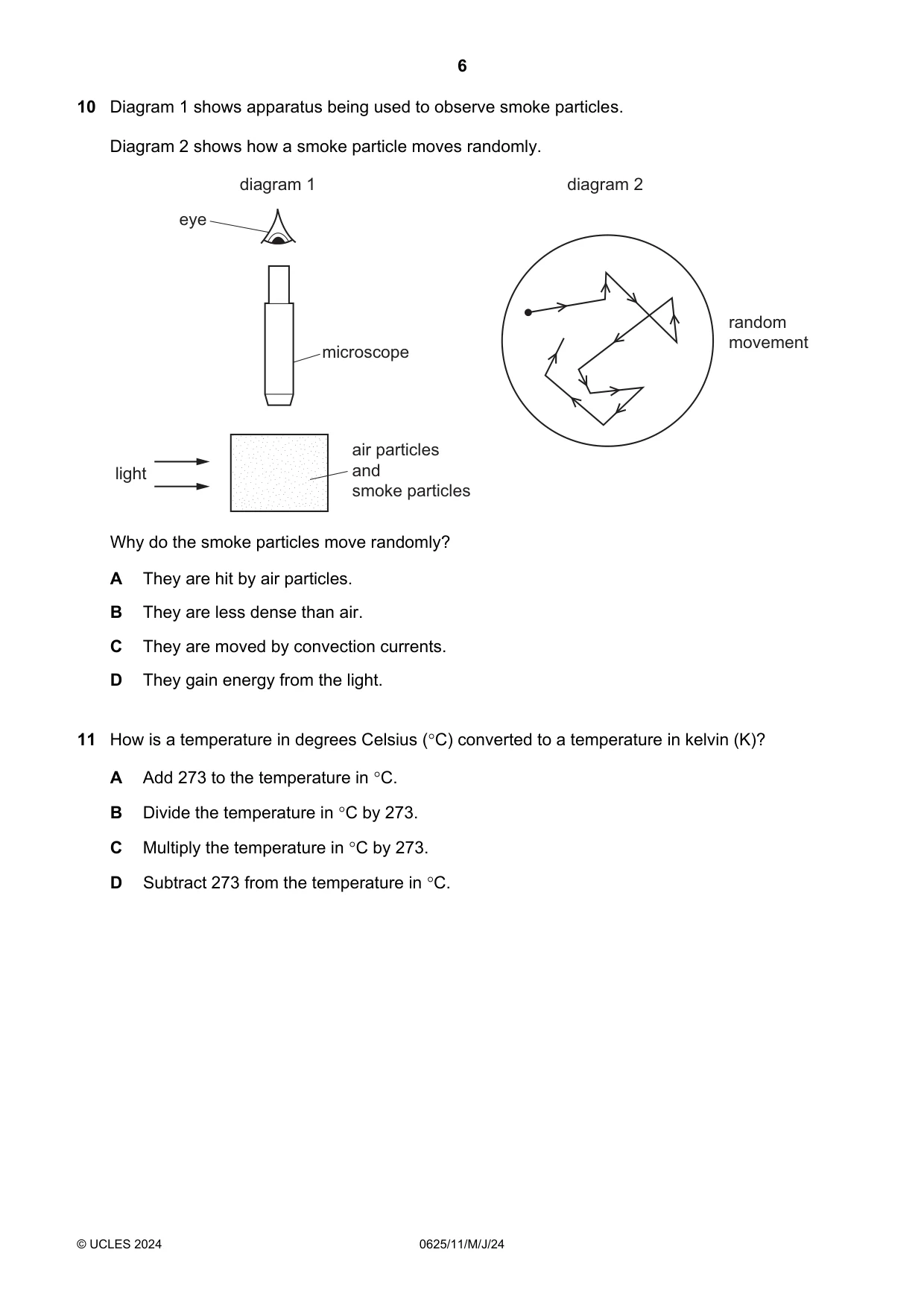
10 Diagram 1 shows apparatus being used to observe smoke particles. Diagram 2 shows how a smoke particle moves randomly. diagram 1 diagram 2 eye random movement microscope air particles light and smoke particles Why do the smoke particles move randomly? A They are hit by air particles. B They are less dense than air. C They are moved by convection currents. D They gain energy from the light.
Mark scheme: A
Q11 · How is a temperature in degrees Celsius (C) converted to a temperature in kelvin (K)?
11 How is a temperature in degrees Celsius (C) converted to a temperature in kelvin (K)? A Add 273 to the temperature in C. B Divide the temperature in C by 273. C Multiply the temperature in C by 273. D Subtract 273 from the temperature in C.
Mark scheme: A
Q12 · The diagram shows a frictionless piston inside a cylinder
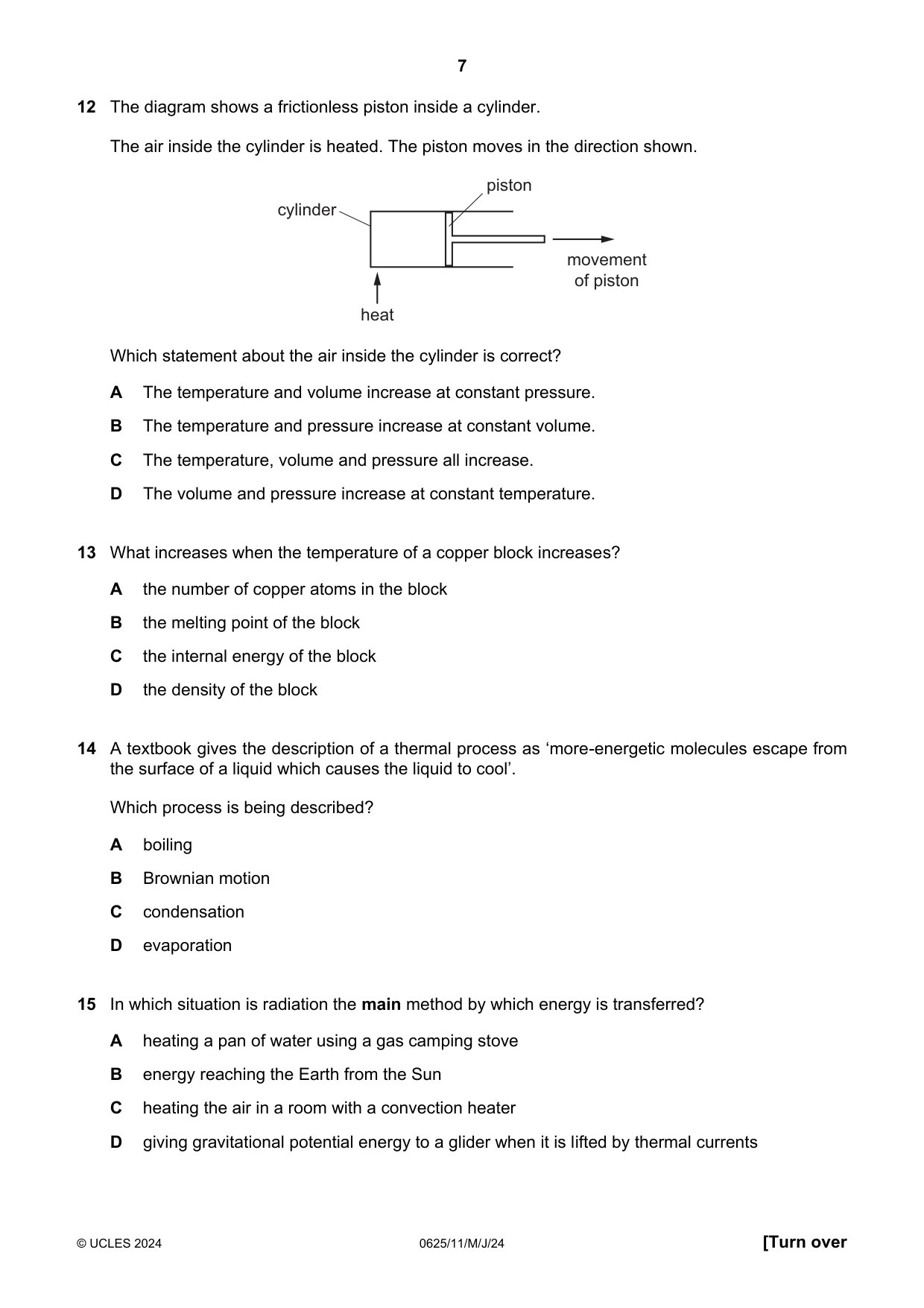
12 The diagram shows a frictionless piston inside a cylinder. The air inside the cylinder is heated. The piston moves in the direction shown. piston cylinder movement of piston heat Which statement about the air inside the cylinder is correct? A The temperature and volume increase at constant pressure. B The temperature and pressure increase at constant volume. C The temperature, volume and pressure all increase. D The volume and pressure increase at constant temperature.
Mark scheme: A
Q13 · What increases when the temperature of a copper block increases?
13 What increases when the temperature of a copper block increases? A the number of copper atoms in the block B the melting point of the block C the internal energy of the block D the density of the block
Mark scheme: C
Q14 · A textbook gives the description of a thermal process as ‘more-energetic molecules escape…
14 A textbook gives the description of a thermal process as ‘more-energetic molecules escape from the surface of a liquid which causes the liquid to cool’. Which process is being described? A boiling B Brownian motion C condensation D evaporation
Mark scheme: D
Q15 · In which situation is radiation the main method by which energy is transferred?
15 In which situation is radiation the main method by which energy is transferred? A heating a pan of water using a gas camping stove B energy reaching the Earth from the Sun C heating the air in a room with a convection heater D giving gravitational potential energy to a glider when it is lifted by thermal currents
Mark scheme: B
Q16 · The diagram represents a wave
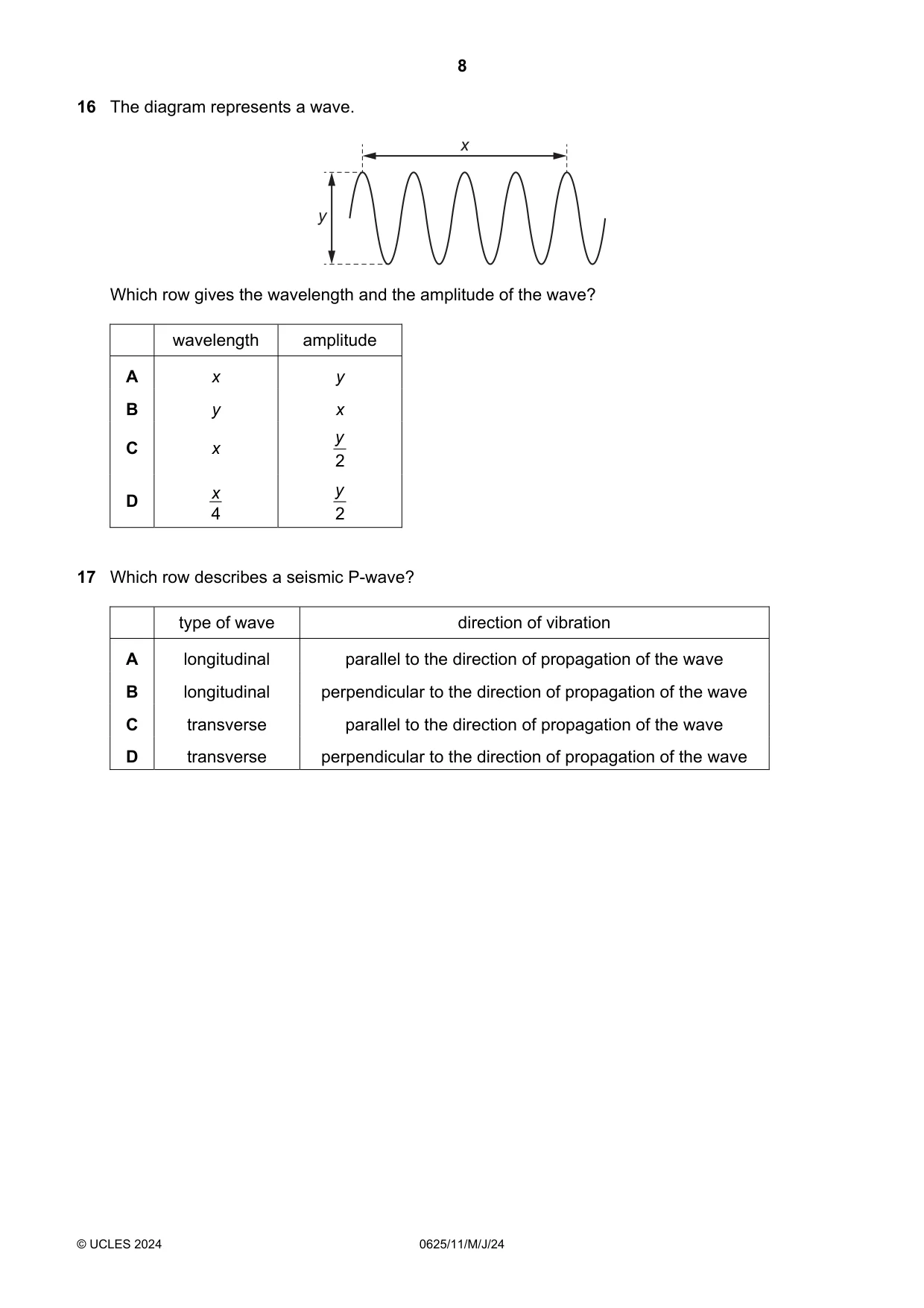
16 The diagram represents a wave. x y Which row gives the wavelength and the amplitude of the wave? wavelength amplitude A x y B y x y C x 2 x y D 4 2
Mark scheme: D
Q17 · Which row describes a seismic P-wave?
17 Which row describes a seismic P-wave? type of wave direction of vibration A longitudinal parallel to the direction of propagation of the wave B longitudinal perpendicular to the direction of propagation of the wave C transverse parallel to the direction of propagation of the wave D transverse perpendicular to the direction of propagation of the wave
Mark scheme: A
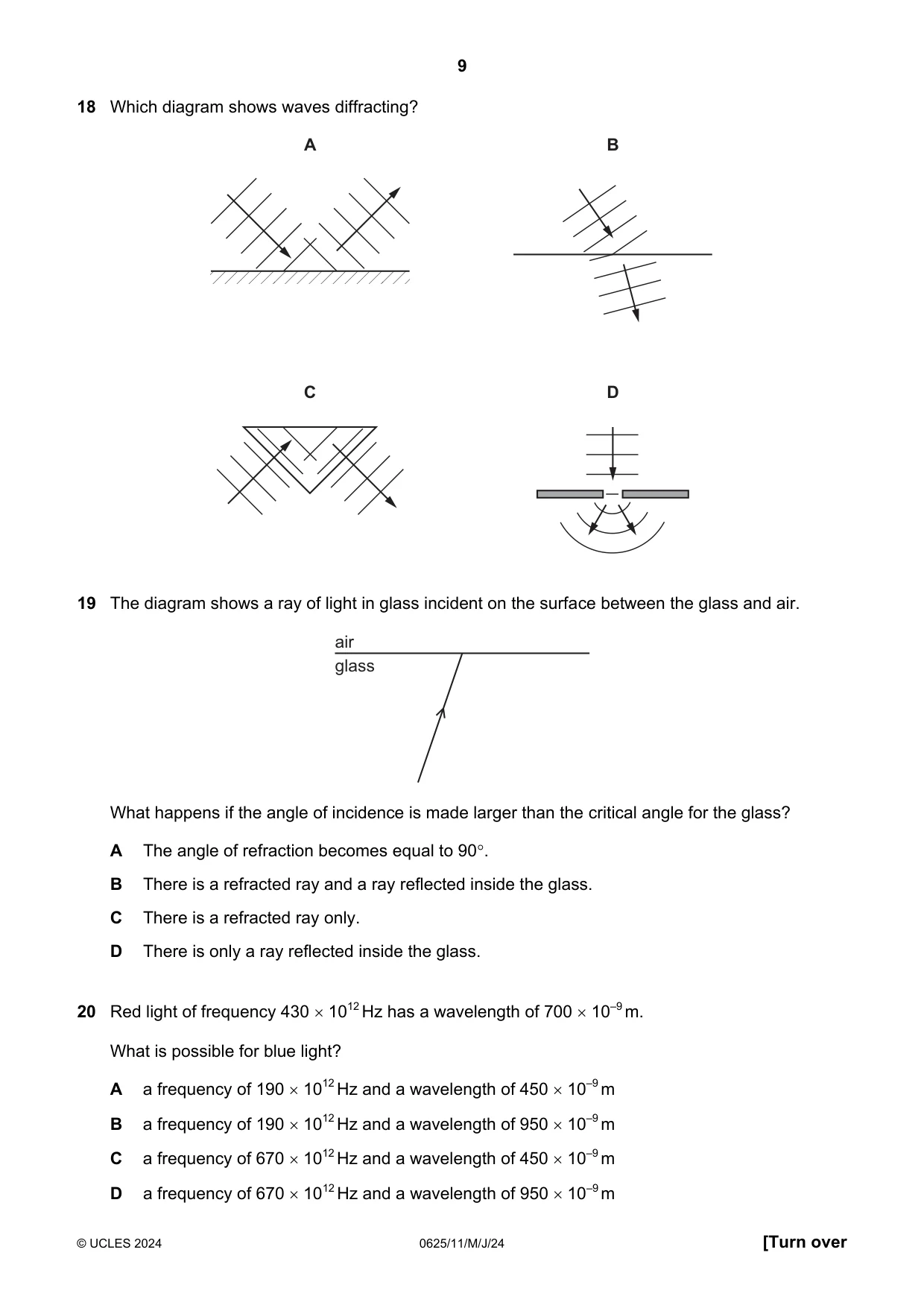
Q18 · Which diagram shows waves diffracting?
18 Which diagram shows waves diffracting? A B C D
Mark scheme: D
Q19 · The diagram shows a ray of light in glass incident on the surface between the glass and…
19 The diagram shows a ray of light in glass incident on the surface between the glass and air. air glass What happens if the angle of incidence is made larger than the critical angle for the glass? A The angle of refraction becomes equal to 90. B There is a refracted ray and a ray reflected inside the glass. C There is a refracted ray only. D There is only a ray reflected inside the glass.
Mark scheme: D
Q20 · Red light of frequency 430 1012 Hz has a wavelength of 700 10–9 m
20 Red light of frequency 430 1012 Hz has a wavelength of 700 10–9 m. What is possible for blue light? A a frequency of 190 1012 Hz and a wavelength of 450 10–9 m B a frequency of 190 1012 Hz and a wavelength of 950 10–9 m C a frequency of 670 1012 Hz and a wavelength of 450 10–9 m D a frequency of 670 1012 Hz and a wavelength of 950 10–9 m
Mark scheme: C
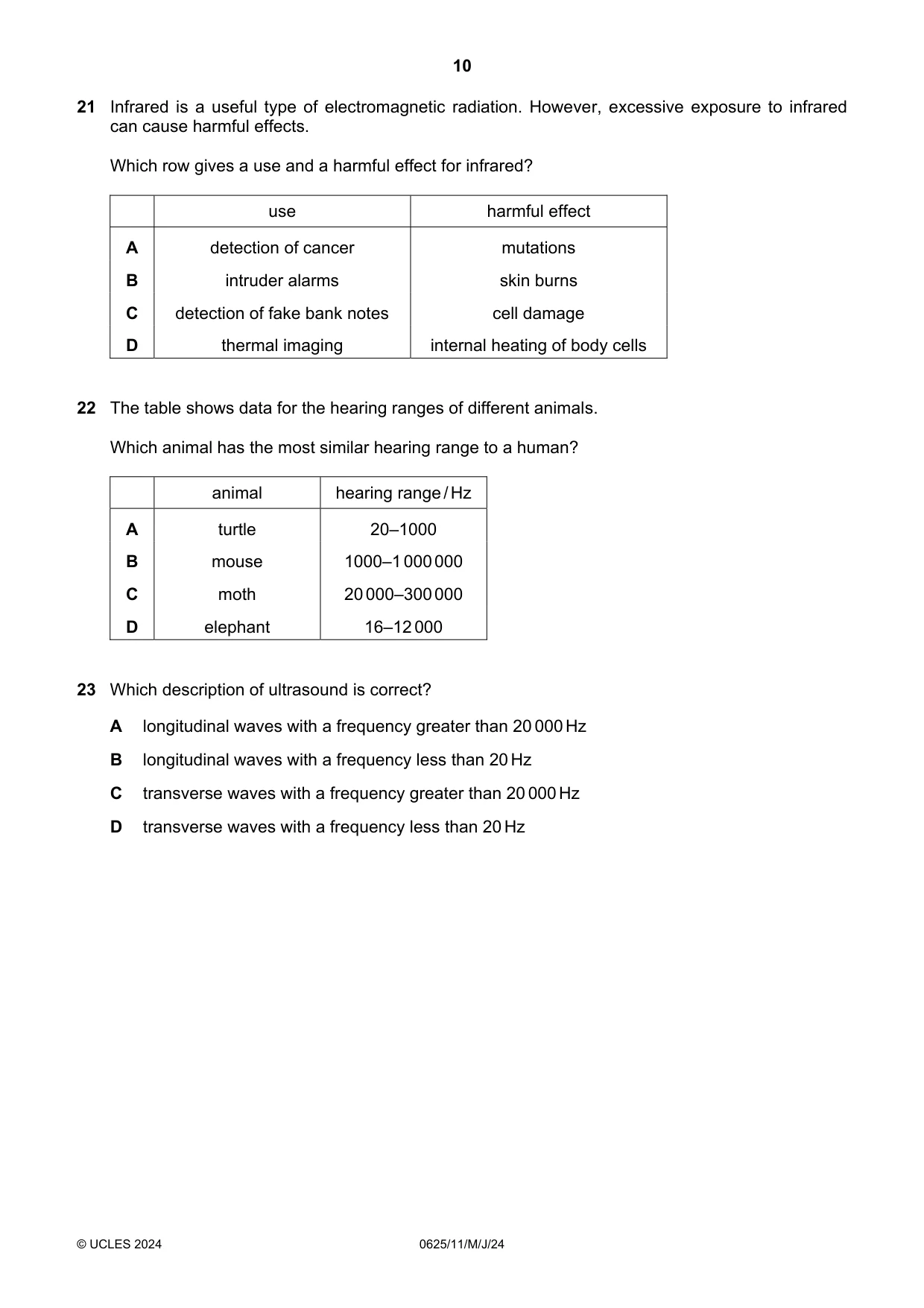
Q21 · Infrared is a useful type of electromagnetic radiation
21 Infrared is a useful type of electromagnetic radiation. However, excessive exposure to infrared can cause harmful effects. Which row gives a use and a harmful effect for infrared? use harmful effect A detection of cancer mutations B intruder alarms skin burns C detection of fake bank notes cell damage D thermal imaging internal heating of body cells
Mark scheme: B
Q22 · The table shows data for the hearing ranges of different animals
22 The table shows data for the hearing ranges of different animals. Which animal has the most similar hearing range to a human? animal hearing range / Hz A turtle 20–1000 B mouse 1000–1 000 000 C moth 20 000–300 000 D elephant 16–12 000
Mark scheme: D
Q23 · Which description of ultrasound is correct?
23 Which description of ultrasound is correct? A longitudinal waves with a frequency greater than 20 000 Hz B longitudinal waves with a frequency less than 20 Hz C transverse waves with a frequency greater than 20 000 Hz D transverse waves with a frequency less than 20 Hz
Mark scheme: A
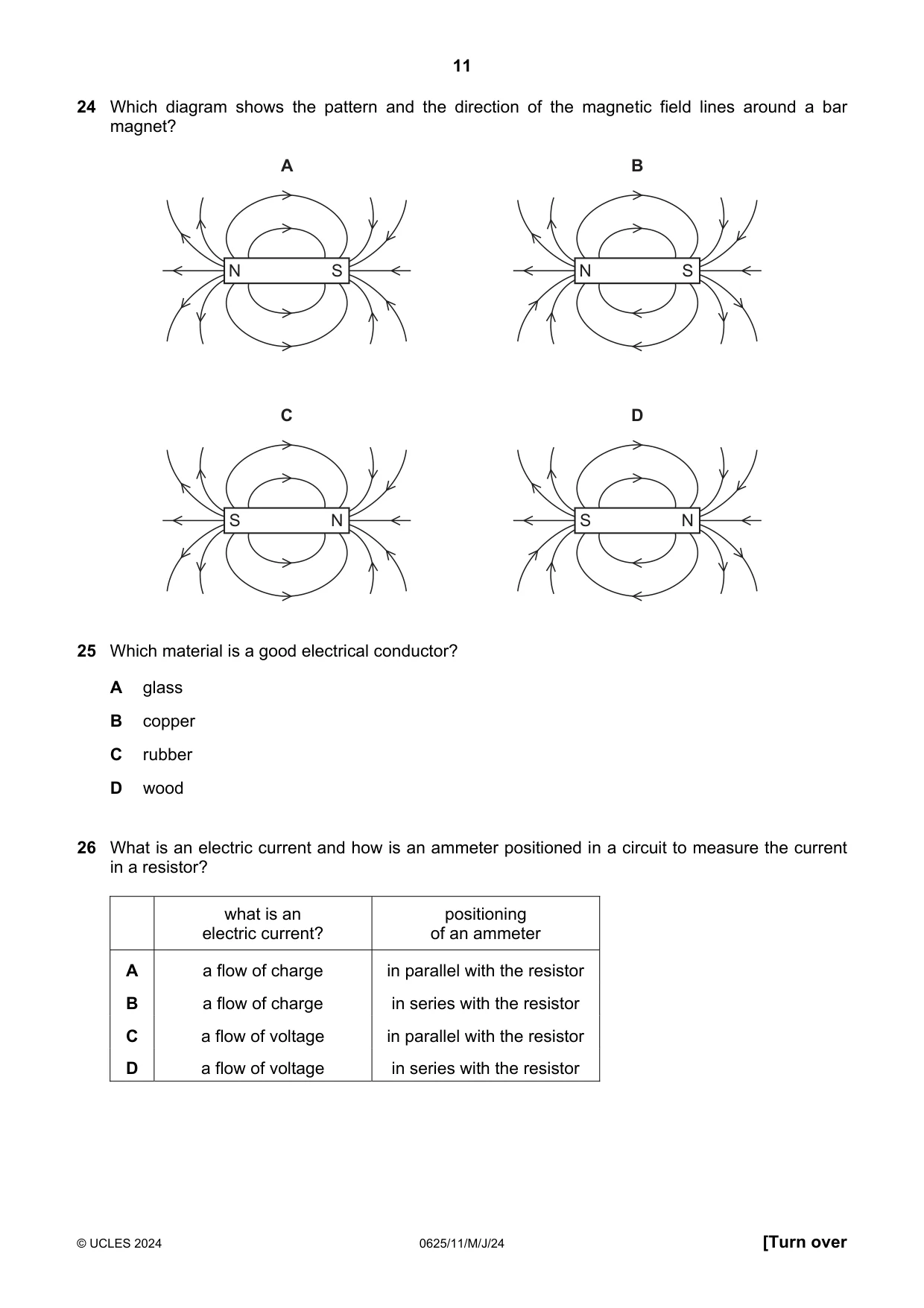
Q24 · Which diagram shows the pattern and the direction of the magnetic field lines around a…
24 Which diagram shows the pattern and the direction of the magnetic field lines around a bar magnet? A B N S N S C D S N S N
Mark scheme: A
Q25 · Which material is a good electrical conductor?
25 Which material is a good electrical conductor? A glass B copper C rubber D wood
Mark scheme: B
Q26 · What is an electric current and how is an ammeter positioned in a circuit to measure the…
26 What is an electric current and how is an ammeter positioned in a circuit to measure the current in a resistor? what is an positioning electric current? of an ammeter A a flow of charge in parallel with the resistor B a flow of charge in series with the resistor C a flow of voltage in parallel with the resistor D a flow of voltage in series with the resistor
Mark scheme: B
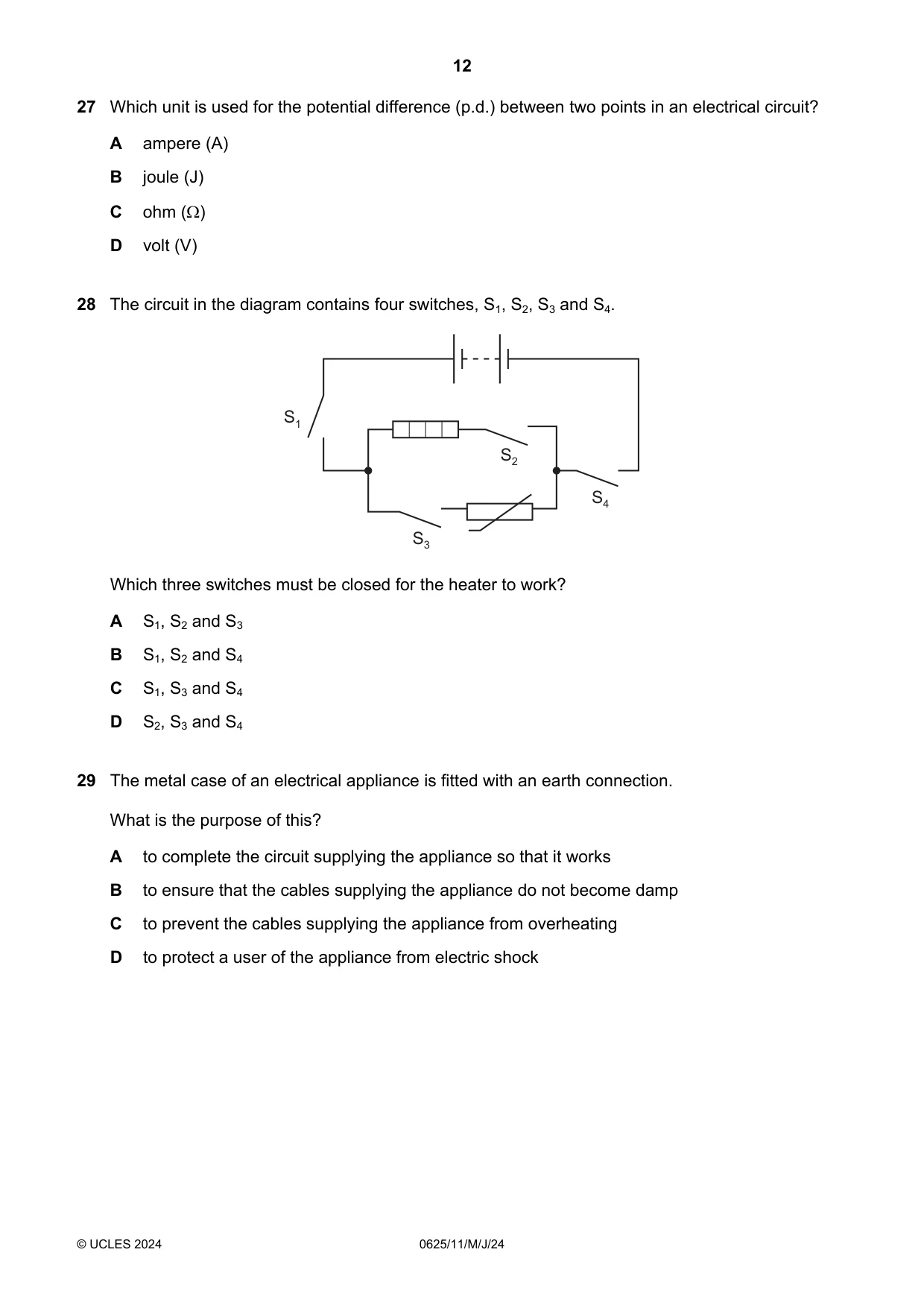
Q27 · Which unit is used for the potential difference (p.d.) between two points in an…
27 Which unit is used for the potential difference (p.d.) between two points in an electrical circuit? A ampere (A) B joule (J) C ohm () D volt (V)
Mark scheme: D
Q28 · The circuit in the diagram contains four switches, S1, S2, S3 and S4
28 The circuit in the diagram contains four switches, S1, S2, S3 and S4. S1 S2 S4 S3 Which three switches must be closed for the heater to work? A S1, S2 and S3 B S1, S2 and S4 C S1, S3 and S4 D S2, S3 and S4
Mark scheme: B
Q29 · The metal case of an electrical appliance is fitted with an earth connection
29 The metal case of an electrical appliance is fitted with an earth connection. What is the purpose of this? A to complete the circuit supplying the appliance so that it works B to ensure that the cables supplying the appliance do not become damp C to prevent the cables supplying the appliance from overheating D to protect a user of the appliance from electric shock
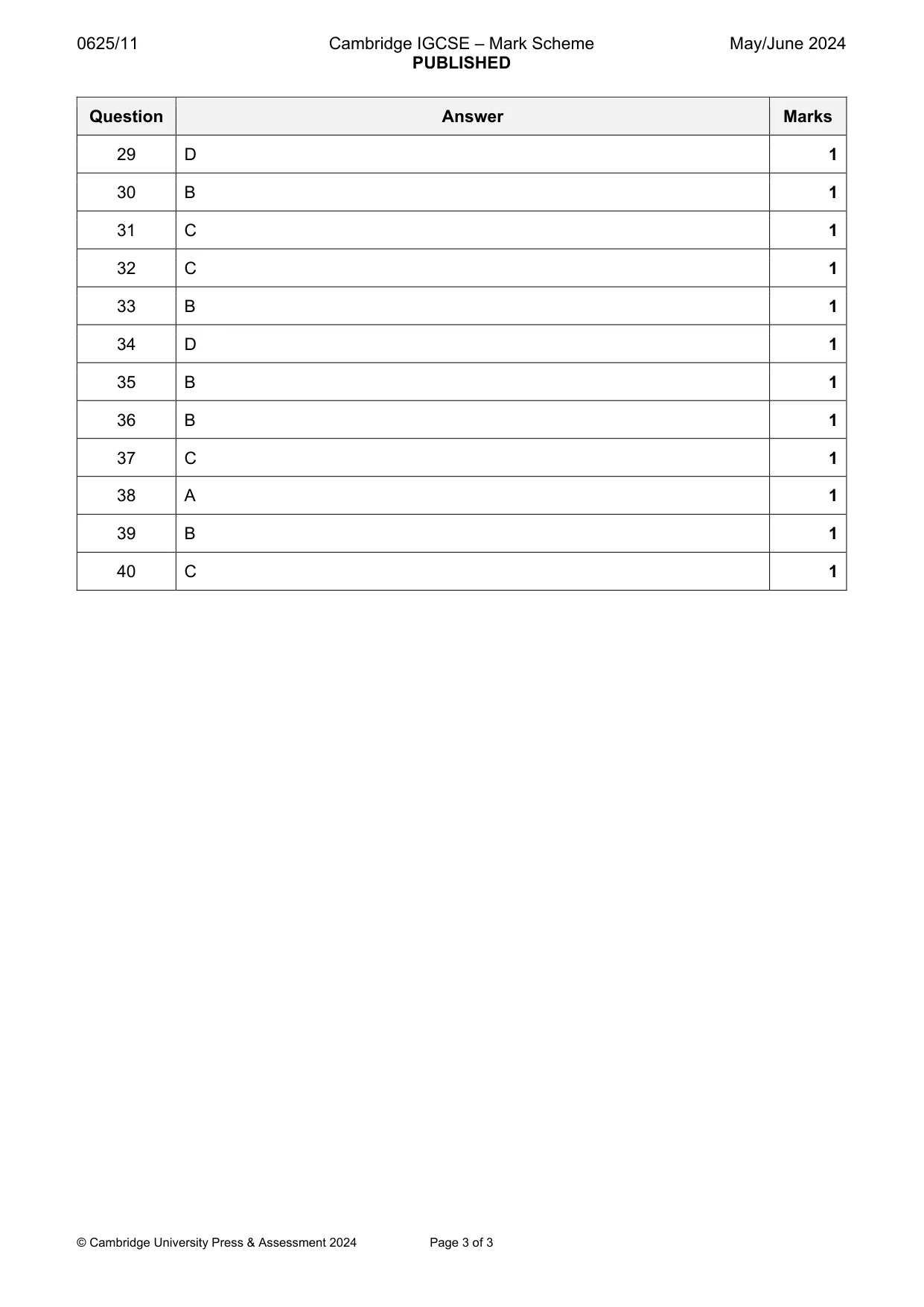
Mark scheme: D
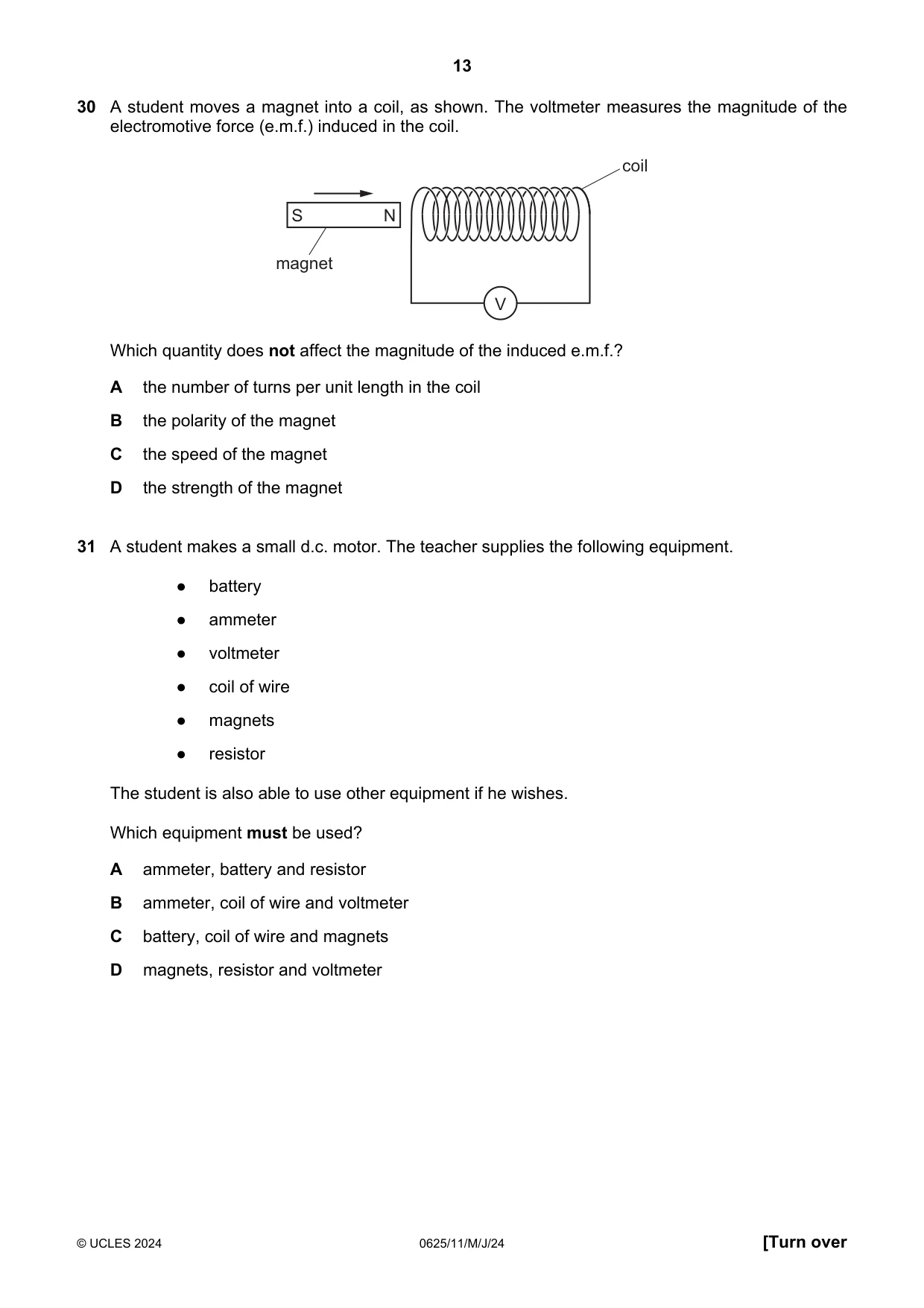
Q30 · A student moves a magnet into a coil, as shown
30 A student moves a magnet into a coil, as shown. The voltmeter measures the magnitude of the electromotive force (e.m.f.) induced in the coil. coil S N magnet V Which quantity does not affect the magnitude of the induced e.m.f.? A the number of turns per unit length in the coil B the polarity of the magnet C the speed of the magnet D the strength of the magnet
Mark scheme: B
Q31 · A student makes a small d.c
31 A student makes a small d.c. motor. The teacher supplies the following equipment. ● battery ● ammeter ● voltmeter ● coil of wire ● magnets ● resistor The student is also able to use other equipment if he wishes. Which equipment must be used? A ammeter, battery and resistor B ammeter, coil of wire and voltmeter C battery, coil of wire and magnets D magnets, resistor and voltmeter
Mark scheme: C
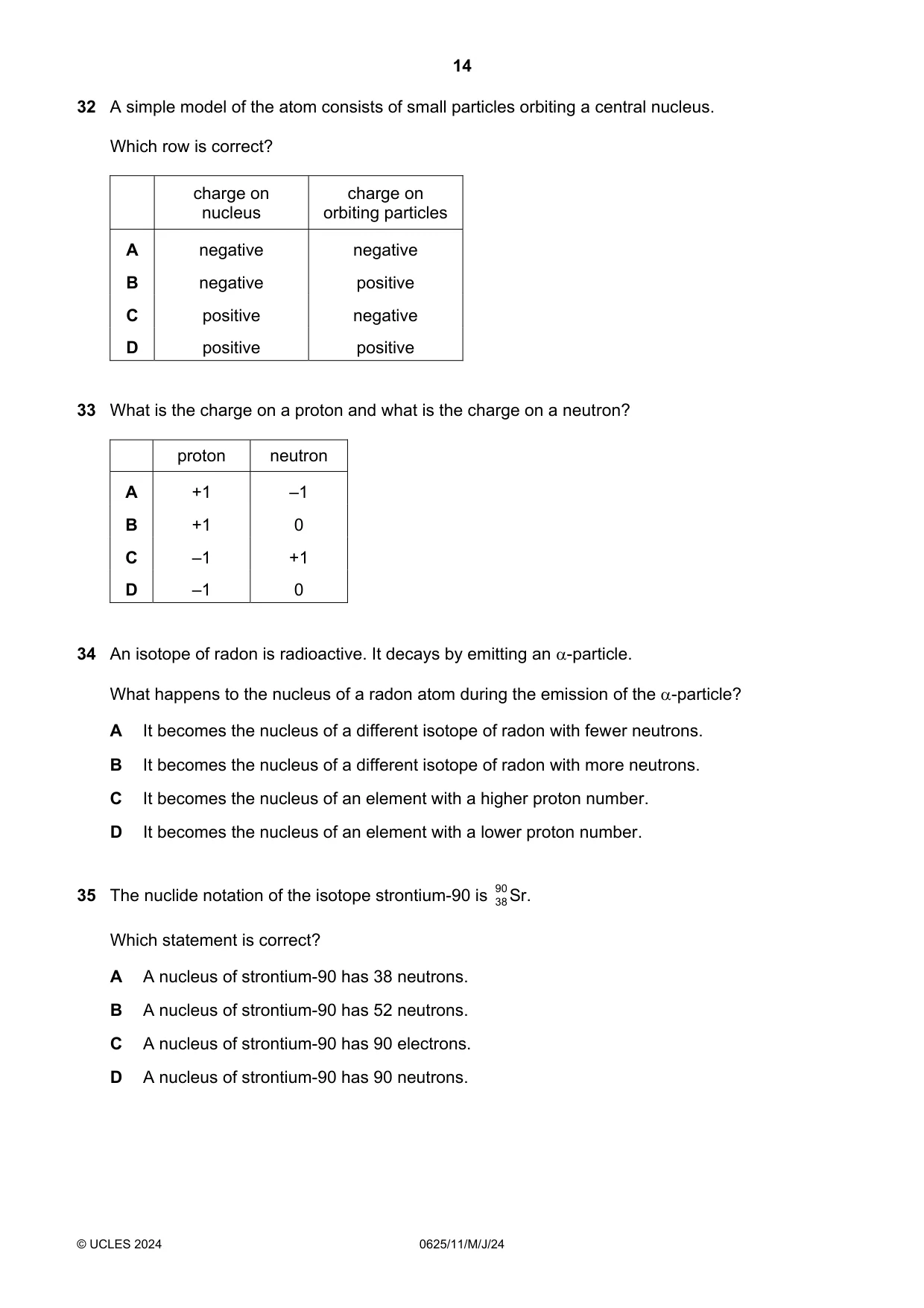
Q32 · A simple model of the atom consists of small particles orbiting a central nucleus
32 A simple model of the atom consists of small particles orbiting a central nucleus. Which row is correct? charge on charge on nucleus orbiting particles A negative negative B negative positive C positive negative D positive positive
Mark scheme: C
Q33 · What is the charge on a proton and what is the charge on a neutron?
33 What is the charge on a proton and what is the charge on a neutron? proton neutron A +1 –1 B +1 0 C –1 +1 D –1 0
Mark scheme: B
Q34 · An isotope of radon is radioactive
34 An isotope of radon is radioactive. It decays by emitting an -particle. What happens to the nucleus of a radon atom during the emission of the -particle? A It becomes the nucleus of a different isotope of radon with fewer neutrons. B It becomes the nucleus of a different isotope of radon with more neutrons. C It becomes the nucleus of an element with a higher proton number. D It becomes the nucleus of an element with a lower proton number.
Mark scheme: D
Q35 · The nuclide notation of the isotope strontium-90 is 90 Sr
35 The nuclide notation of the isotope strontium-90 is 90 Sr. 38 Which statement is correct? A A nucleus of strontium-90 has 38 neutrons. B A nucleus of strontium-90 has 52 neutrons. C A nucleus of strontium-90 has 90 electrons. D A nucleus of strontium-90 has 90 neutrons.
Mark scheme: B
Q36 · A box is used for storing radioactive sources
36 A box is used for storing radioactive sources. What is the best material to use for lining the box to prevent radiation from escaping? A aluminium B lead C paper D plastic
Mark scheme: B
Q37 · The Earth is a planet that orbits the Sun once in approximately 365 days
37 The Earth is a planet that orbits the Sun once in approximately 365 days. What does this enable us to explain? A the cycle of day and night B the cycle of phases of the moon C the periodic nature of the seasons D the apparent daily motion of the Sun
Mark scheme: C
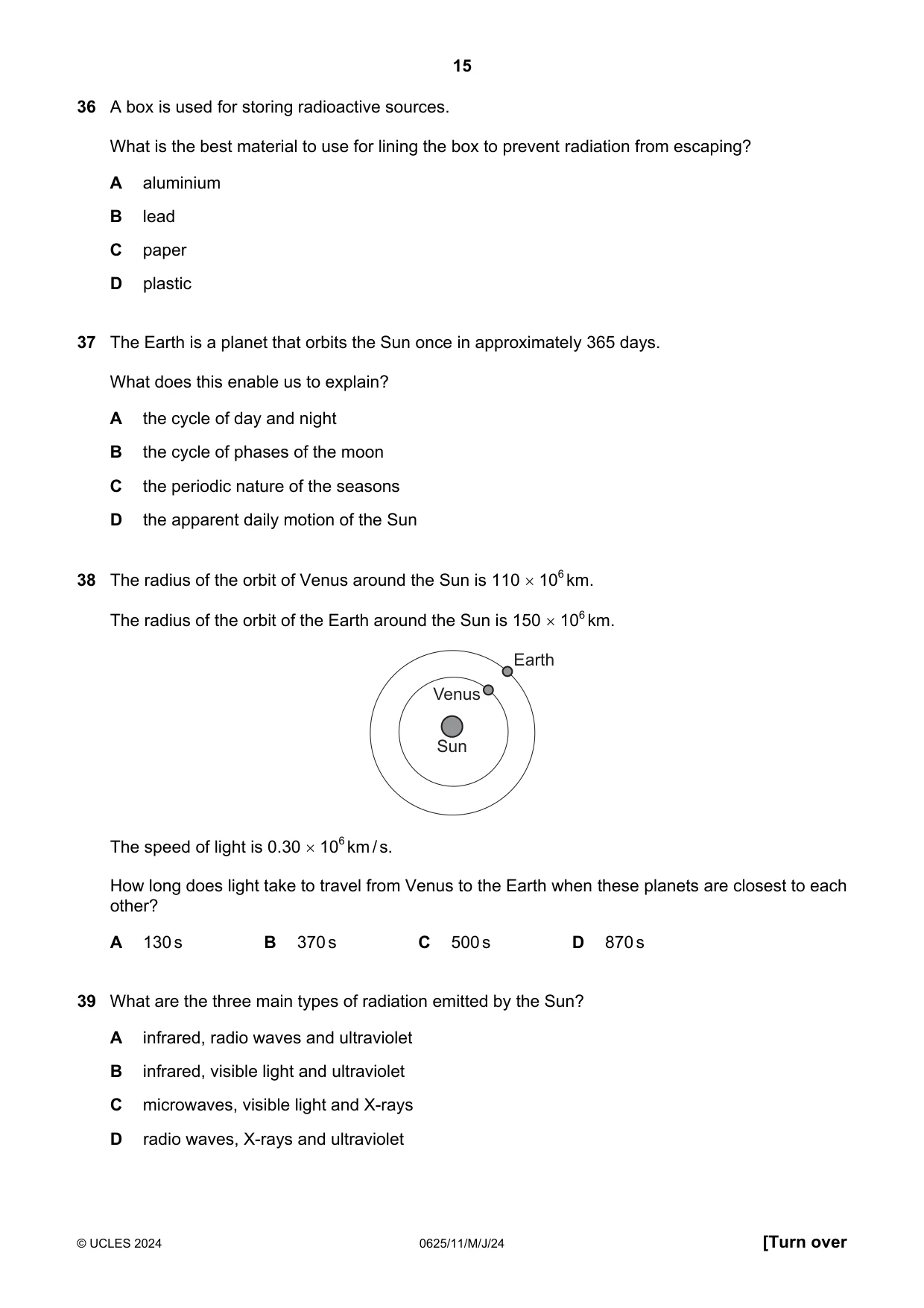
Q38 · The radius of the orbit of Venus around the Sun is 110 106 km
38 The radius of the orbit of Venus around the Sun is 110 106 km. The radius of the orbit of the Earth around the Sun is 150 106 km. Earth Venus Sun The speed of light is 0.30 106 km / s. How long does light take to travel from Venus to the Earth when these planets are closest to each other? A 130 s B 370 s C 500 s D 870 s
Mark scheme: A
Q39 · What are the three main types of radiation emitted by the Sun?
39 What are the three main types of radiation emitted by the Sun? A infrared, radio waves and ultraviolet B infrared, visible light and ultraviolet C microwaves, visible light and X-rays D radio waves, X-rays and ultraviolet
Mark scheme: B
Q40 · What is a light-year?
40 What is a light-year? A the time for light to travel 1 km in space B the time for light to travel from the Sun to the Earth C the distance travelled in space by light in one year D the distance travelled by light from the Sun to the Earth
Mark scheme: C
What was in this paper
The subtopics covered by these 40 questions, and how many questions each got. Open one in a new tab to see every Cambridge question on it.
4General properties of waves3Sound3The nuclear model of the atom3Electric circuits2Electrical quantities2Electromagnetic effects2Electromagnetic spectrum2Energy, work and power2Forces2Radioactivity2The Earth and the Solar System2Thermal properties and temperature2Density1Electrical safety1Light1Mass and weight1Physical quantities and measurement techniques1Pressure1Simple phenomena of magnetism1Stars and the Universe1Transfer of thermal energy1What you needed in this session
Cambridge’s own grade thresholds for 2024 May/June, Paper 1 · Variant 1. A higher threshold means an easier paper — the bar moves with how the cohort did.