Cambridge IGCSE Physics 0625 — 2013 May/June Paper 1 · Variant 3
0625/13/M/J/13 · 40 questions · 40 marks · ≈45 min
The question paper and its mark scheme, free to read here and free to download. This is Cambridge’s own paper, exactly as it was sat.
Question paper20 pages
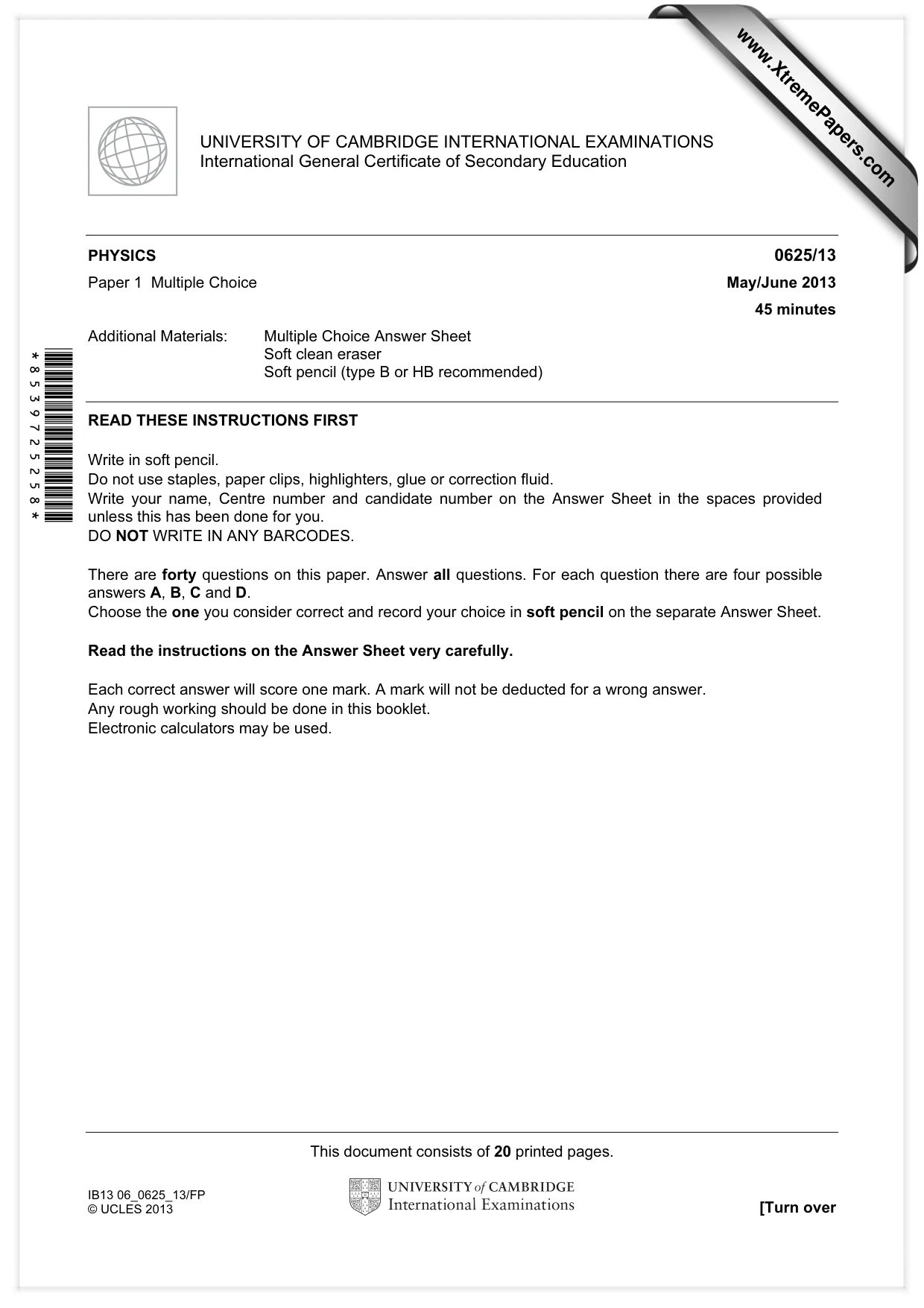
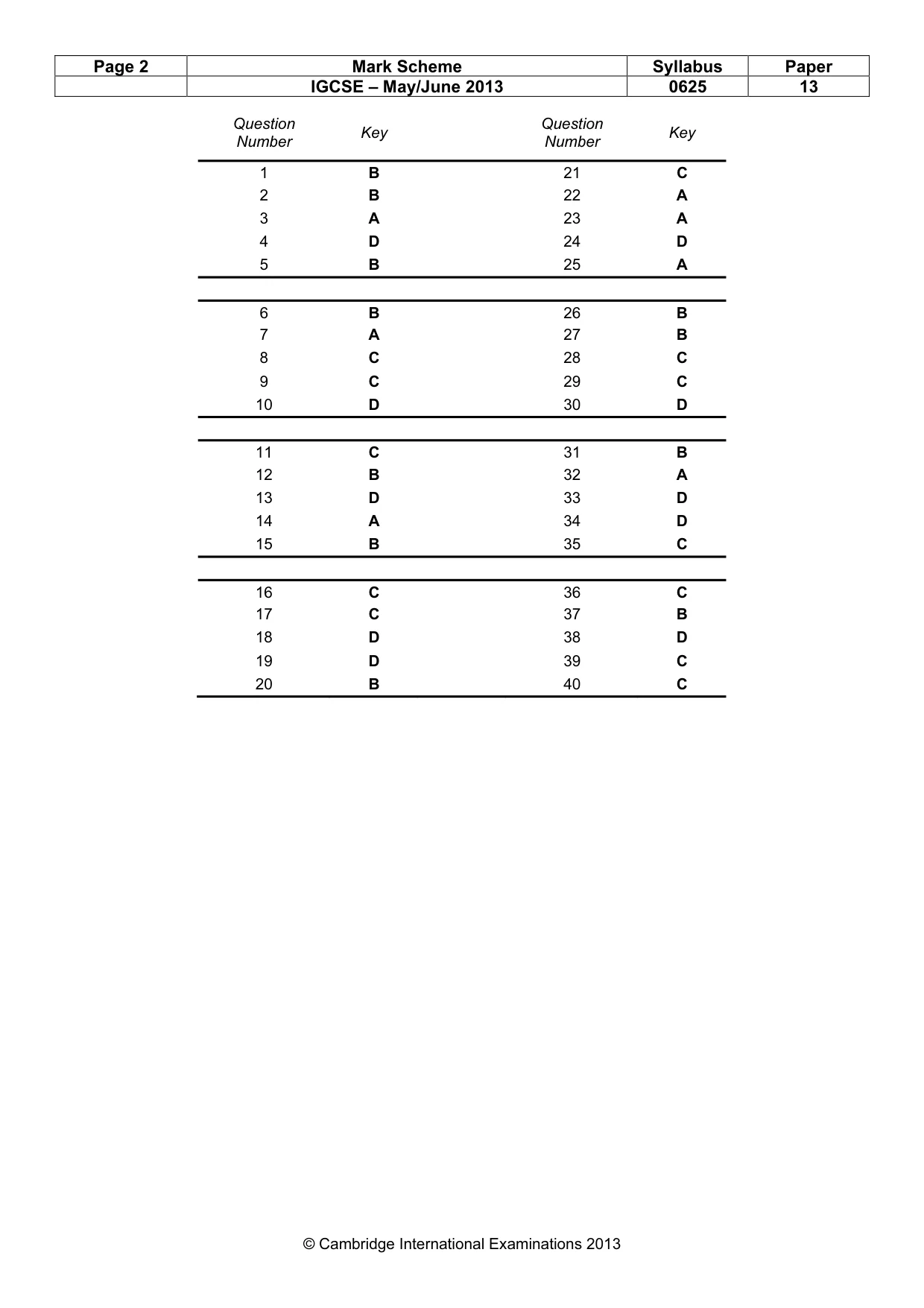
Mark scheme2 pages
Answers below. Sit the paper first if you are practising.
Questions as text
Q1 · The diagrams show the readings on a measuring cylinder before and after a small metal…
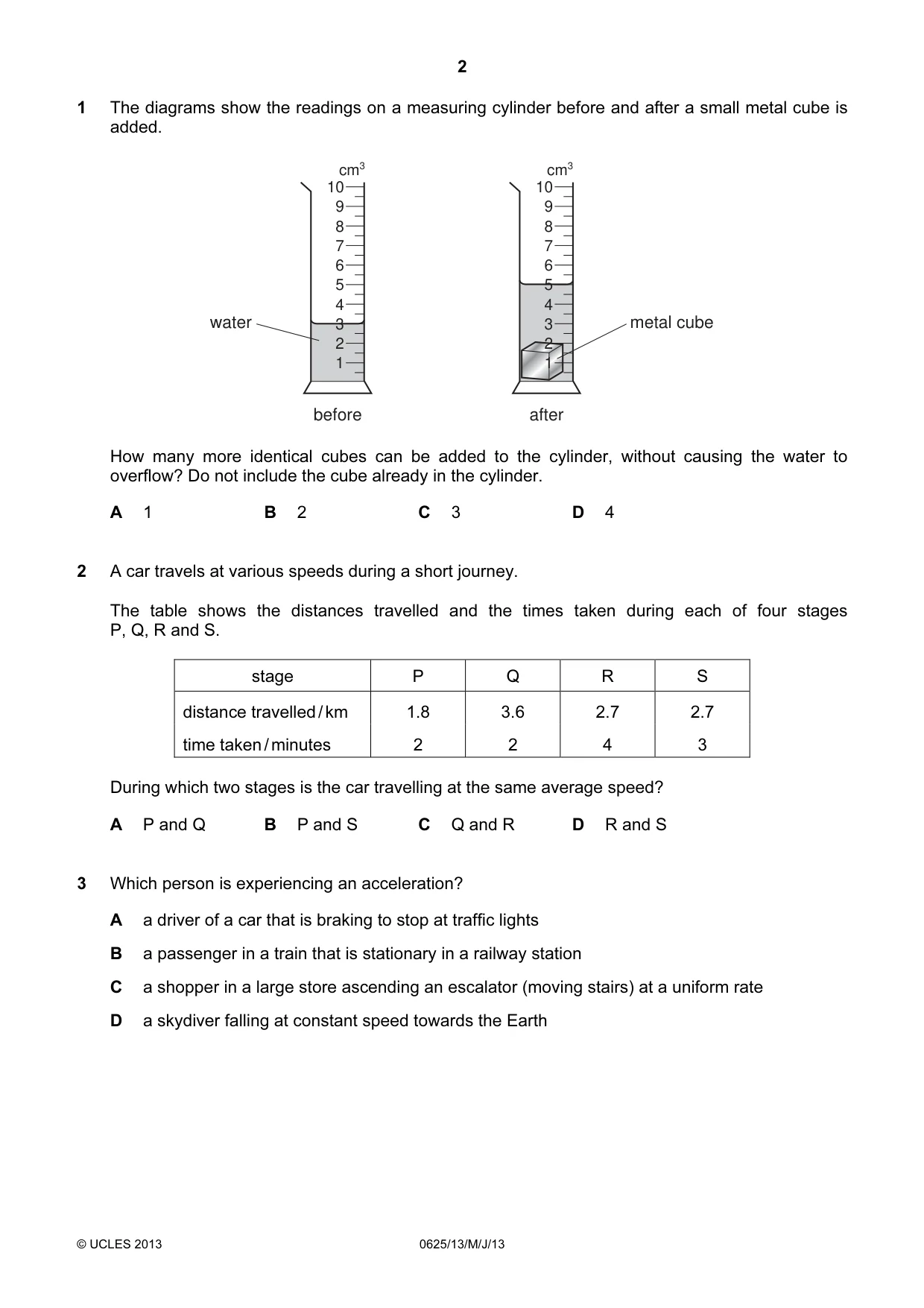
1 The diagrams show the readings on a measuring cylinder before and after a small metal cube is added. cm3 cm3 10 10 9 9 8 8 7 7 6 6 5 5 4 4 water 3 3 metal cube 2 2 1 1 before after How many more identical cubes can be added to the cylinder, without causing the water to overflow? Do not include the cube already in the cylinder. A 1 B 2 C 3 D 4
Mark scheme: B
More questions on Physical quantities and measurement techniques
Q2 · A car travels at various speeds during a short journey
2 A car travels at various speeds during a short journey. The table shows the distances travelled and the times taken during each of four stages P, Q, R and S. stage P Q R S distance travelled / km 1.8 3.6 2.7 2.7 time taken / minutes 2 2 4 3 During which two stages is the car travelling at the same average speed? A P and Q B P and S C Q and R D R and S
Mark scheme: B
Q3 · Which person is experiencing an acceleration?
3 Which person is experiencing an acceleration? A a driver of a car that is braking to stop at traffic lights B a passenger in a train that is stationary in a railway station C a shopper in a large store ascending an escalator (moving stairs) at a uniform rate D a skydiver falling at constant speed towards the Earth
Mark scheme: A
Q4 · A 1 kg sample of aluminium is stored in a laboratory
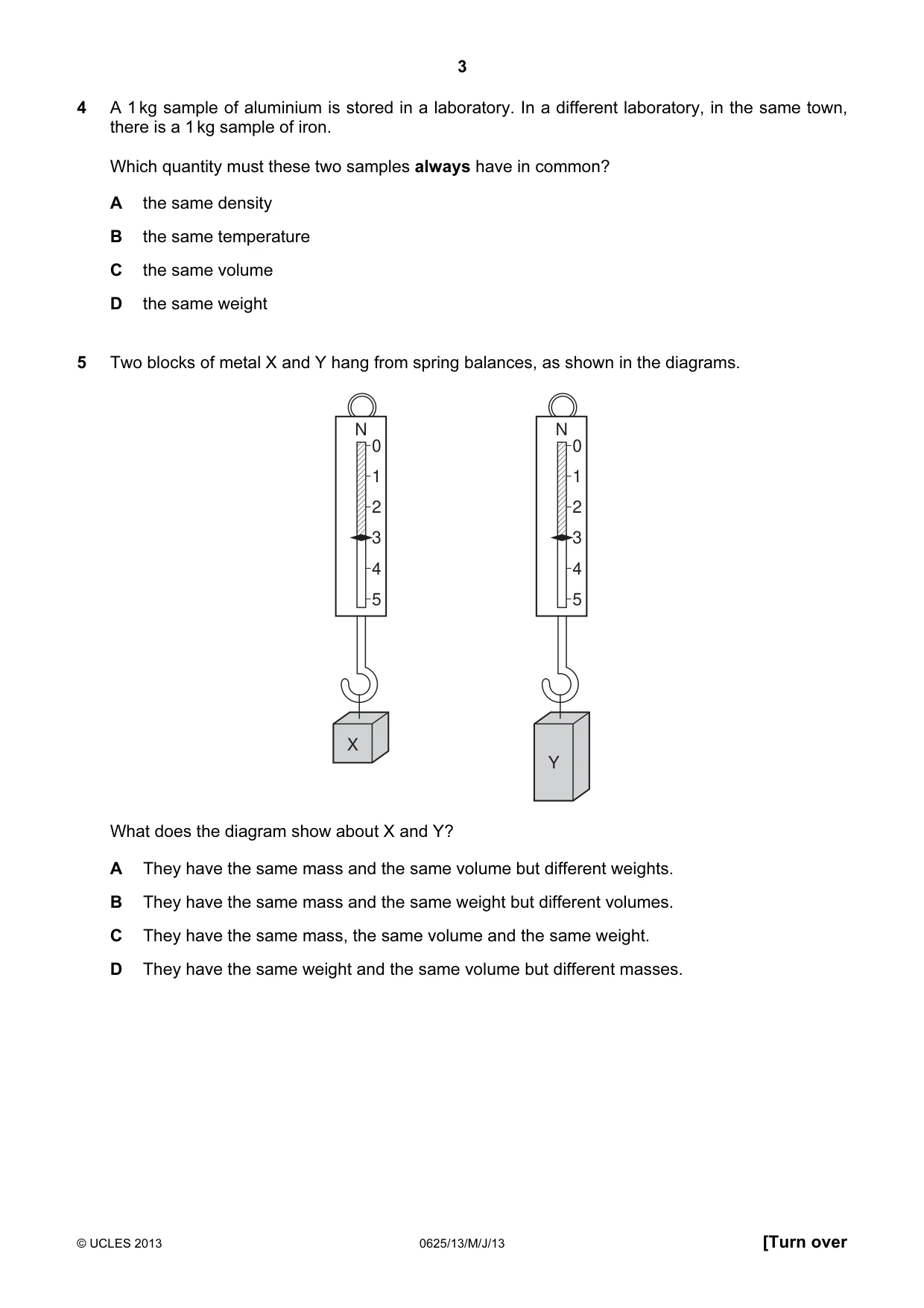
4 A 1 kg sample of aluminium is stored in a laboratory. In a different laboratory, in the same town, there is a 1 kg sample of iron. Which quantity must these two samples always have in common? A the same density B the same temperature C the same volume D the same weight
Mark scheme: D
Q5 · Two blocks of metal X and Y hang from spring balances, as shown in the diagrams
5 Two blocks of metal X and Y hang from spring balances, as shown in the diagrams. N N 0 0 1 1 2 2 3 3 4 4 5 5 X Y What does the diagram show about X and Y? A They have the same mass and the same volume but different weights. B They have the same mass and the same weight but different volumes. C They have the same mass, the same volume and the same weight. D They have the same weight and the same volume but different masses.
Mark scheme: B
Q6 · A car moves along a level road
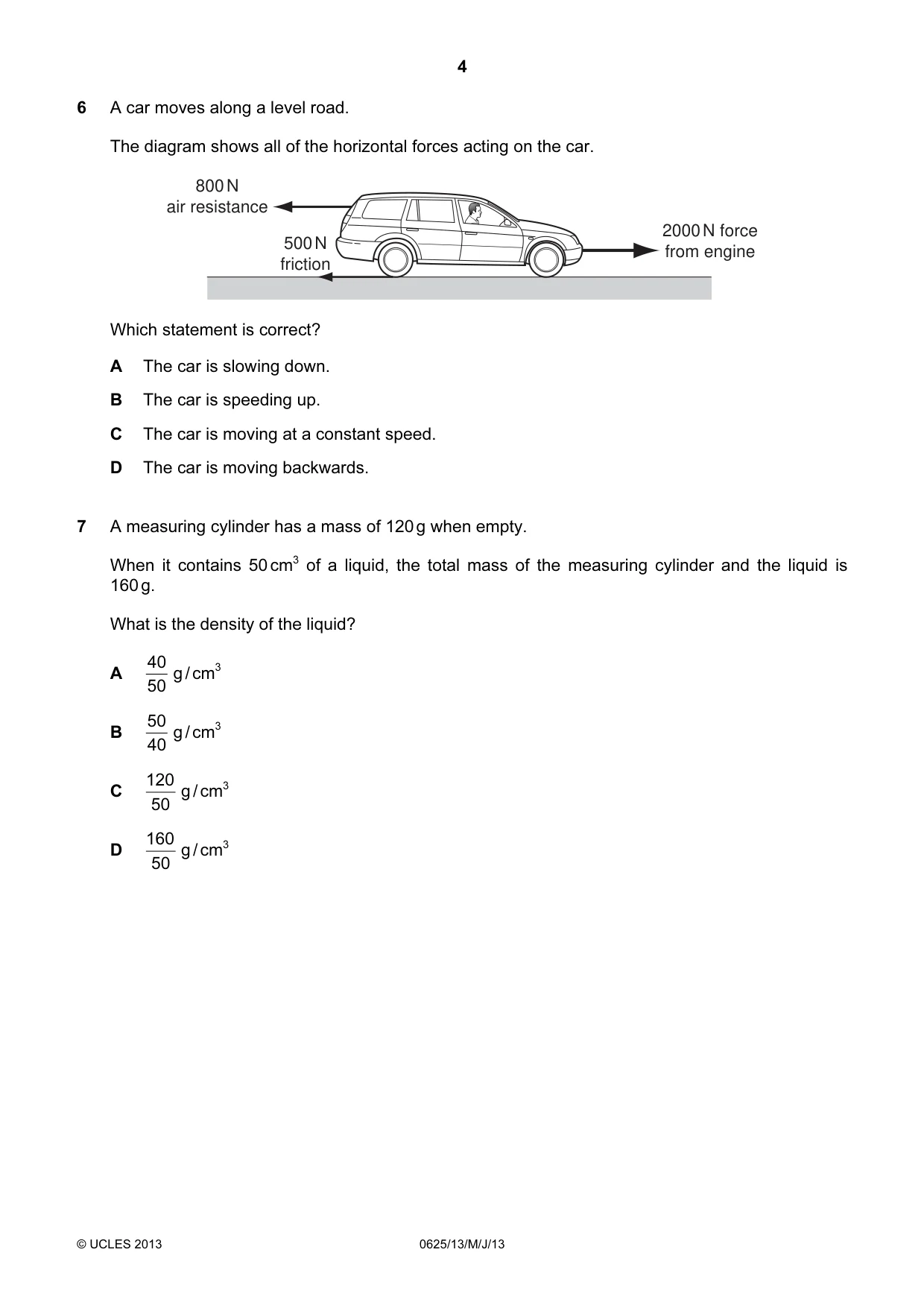
6 A car moves along a level road. The diagram shows all of the horizontal forces acting on the car. 800 N air resistance 2000 N force 500 N from engine friction Which statement is correct? A The car is slowing down. B The car is speeding up. C The car is moving at a constant speed. D The car is moving backwards.
Mark scheme: B
Q7 · A measuring cylinder has a mass of 120 g when empty
7 A measuring cylinder has a mass of 120 g when empty. When it contains 50 cm3 of a liquid, the total mass of the measuring cylinder and the liquid is 160 g. What is the density of the liquid? 40 A g / cm3 50 50 B g / cm3 40 120 C g / cm3 50 160 D g / cm3 50
Mark scheme: A
Q8 · The diagram shows a hydroelectric system
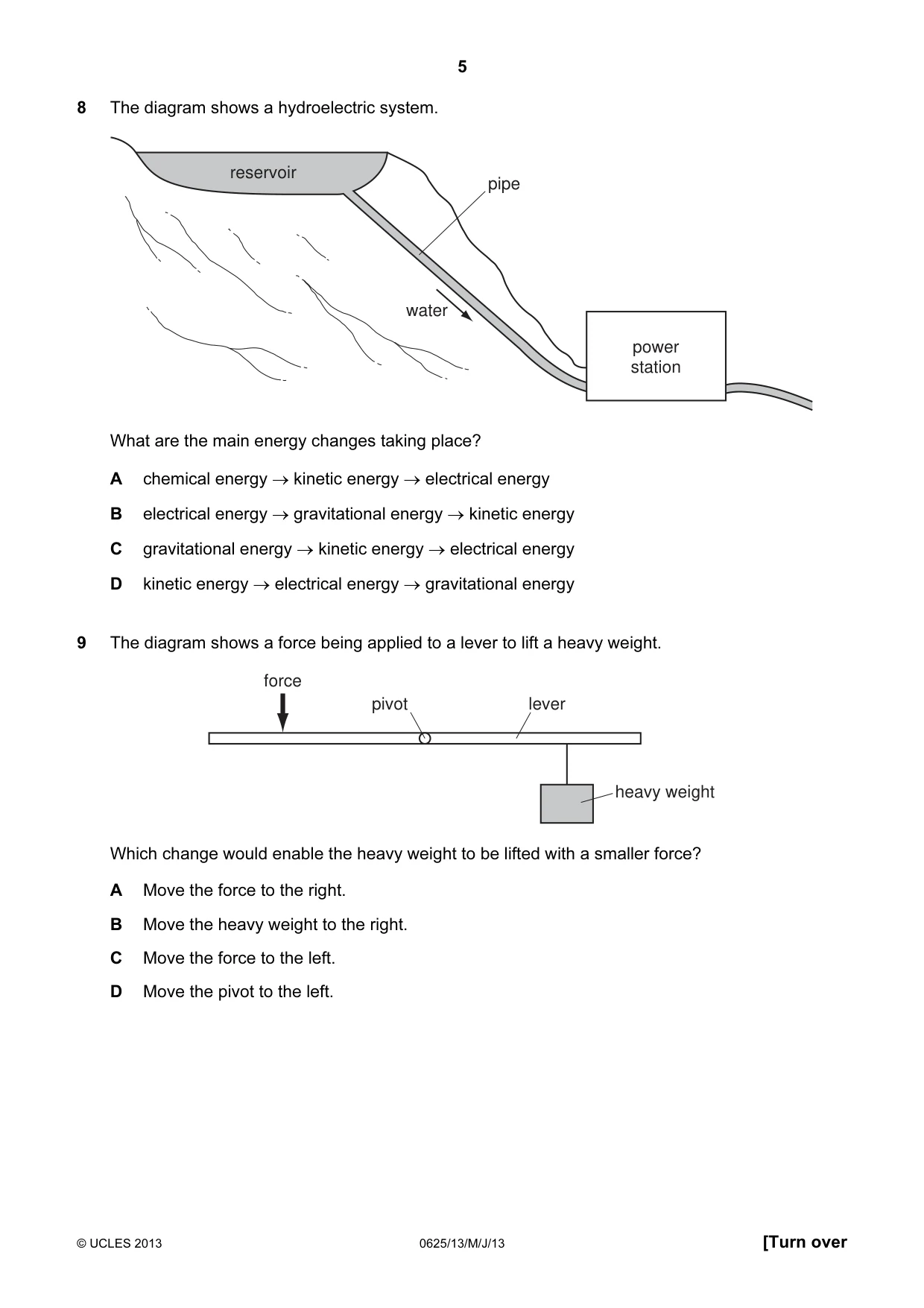
8 The diagram shows a hydroelectric system. reservoir pipe water power station What are the main energy changes taking place? A chemical energy → kinetic energy → electrical energy B electrical energy → gravitational energy → kinetic energy C gravitational energy → kinetic energy → electrical energy D kinetic energy → electrical energy → gravitational energy
Mark scheme: C
Q9 · The diagram shows a force being applied to a lever to lift a heavy weight
9 The diagram shows a force being applied to a lever to lift a heavy weight. force pivot lever heavy weight Which change would enable the heavy weight to be lifted with a smaller force? A Move the force to the right. B Move the heavy weight to the right. C Move the force to the left. D Move the pivot to the left.
Mark scheme: C
Q10 · A man stands on the ground
10 A man stands on the ground. Which action will increase the pressure that the man exerts on the ground? A The man slowly bends his knees. B The man slowly lies down on the ground. C The man slowly raises his arms. D The man slowly raises one foot off the ground.
Mark scheme: D
Q11 · An escalator (moving stairs) and a lift (elevator) are both used to carry passengers from…
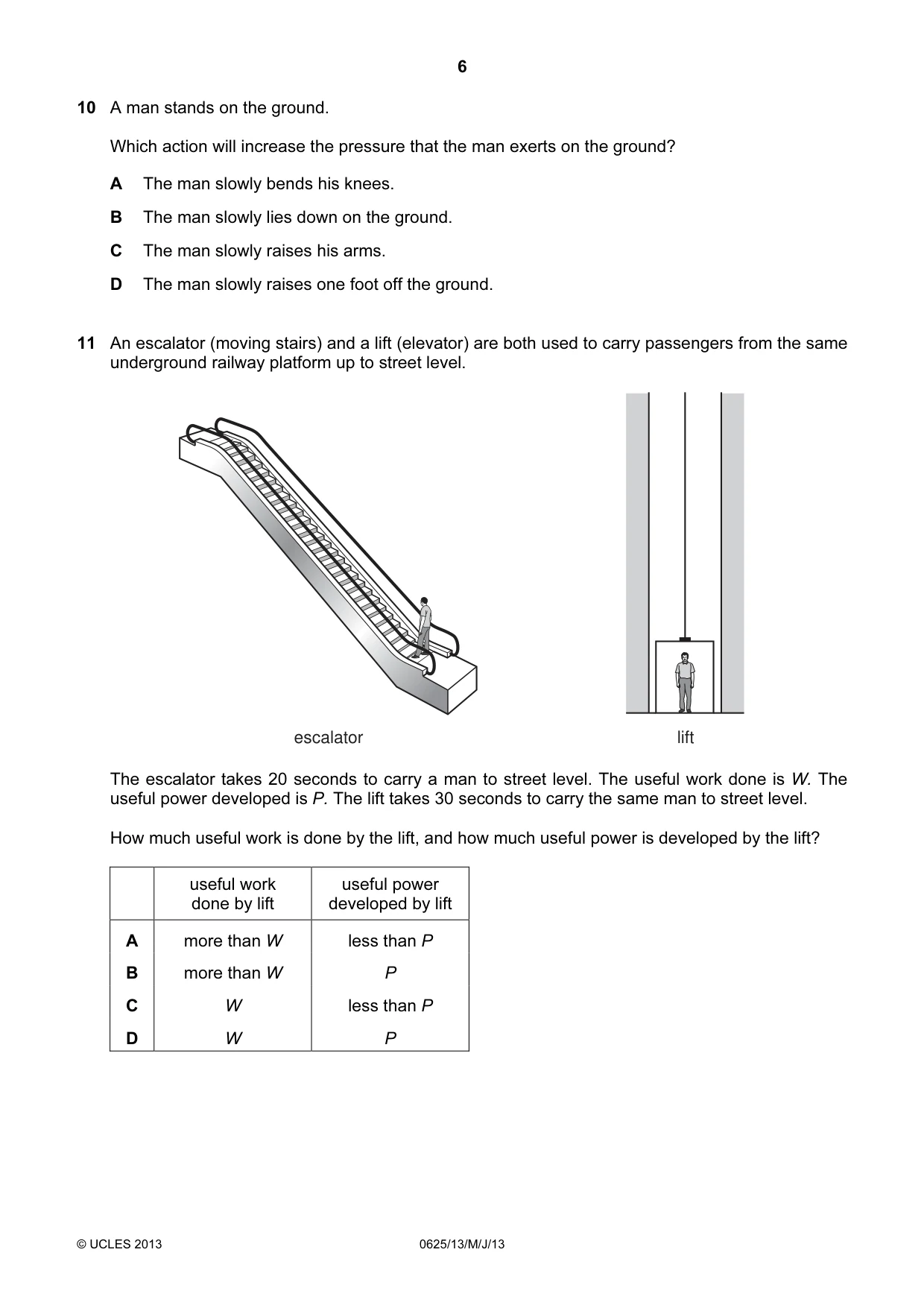
11 An escalator (moving stairs) and a lift (elevator) are both used to carry passengers from the same underground railway platform up to street level. escalator lift The escalator takes 20 seconds to carry a man to street level. The useful work done is W. The useful power developed is P. The lift takes 30 seconds to carry the same man to street level. How much useful work is done by the lift, and how much useful power is developed by the lift? useful work useful power done by lift developed by lift A more than W less than P B more than W P C W less than P D W P
Mark scheme: C
Q12 · The diagram shows a simple mercury barometer
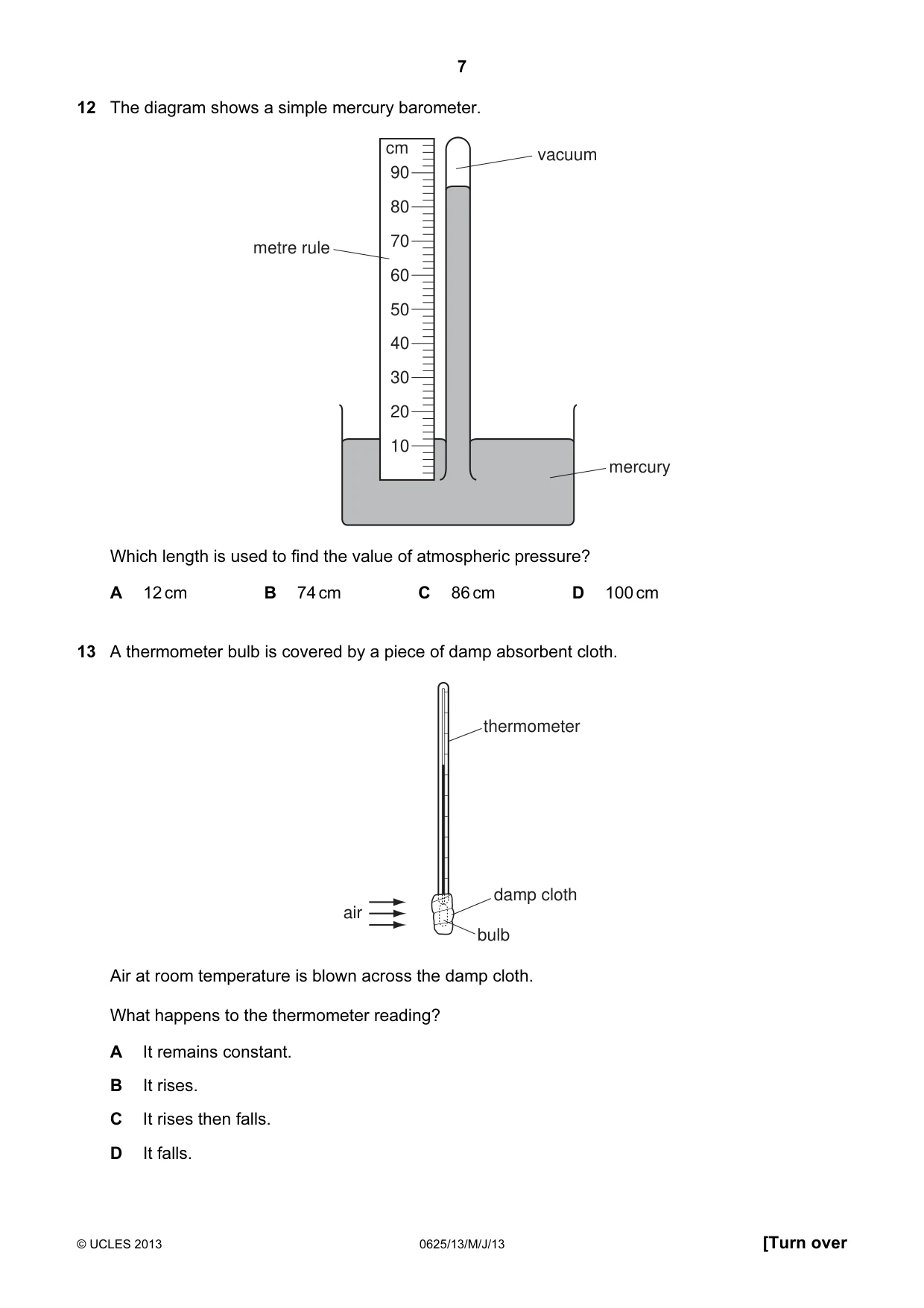
12 The diagram shows a simple mercury barometer. cm vacuum 90 80 metre rule 70 60 50 40 30 20 10 mercury Which length is used to find the value of atmospheric pressure? A 12 cm B 74 cm C 86 cm D 100 cm
Mark scheme: B
Q13 · A thermometer bulb is covered by a piece of damp absorbent cloth
13 A thermometer bulb is covered by a piece of damp absorbent cloth. thermometer damp cloth air bulb Air at room temperature is blown across the damp cloth. What happens to the thermometer reading? A It remains constant. B It rises. C It rises then falls. D It falls.
Mark scheme: D
Q14 · The diagrams show four blocks of steel
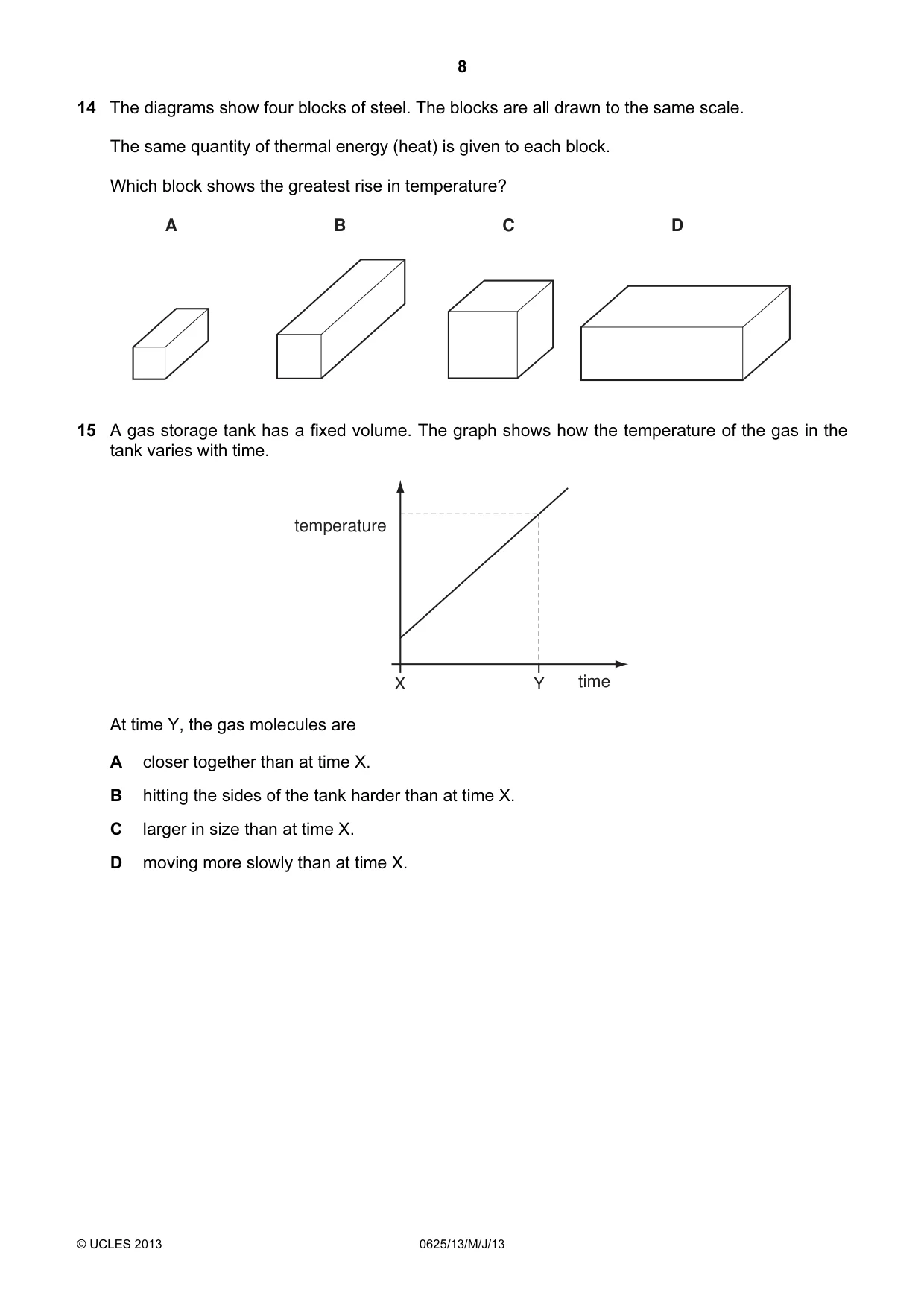
14 The diagrams show four blocks of steel. The blocks are all drawn to the same scale. The same quantity of thermal energy (heat) is given to each block. Which block shows the greatest rise in temperature? A B C D
Mark scheme: A
Q15 · A gas storage tank has a fixed volume
15 A gas storage tank has a fixed volume. The graph shows how the temperature of the gas in the tank varies with time. temperature X Y time At time Y, the gas molecules are A closer together than at time X. B hitting the sides of the tank harder than at time X. C larger in size than at time X. D moving more slowly than at time X.
Mark scheme: B
Q16 · A mercury thermometer with no scale is taped to a ruler as shown
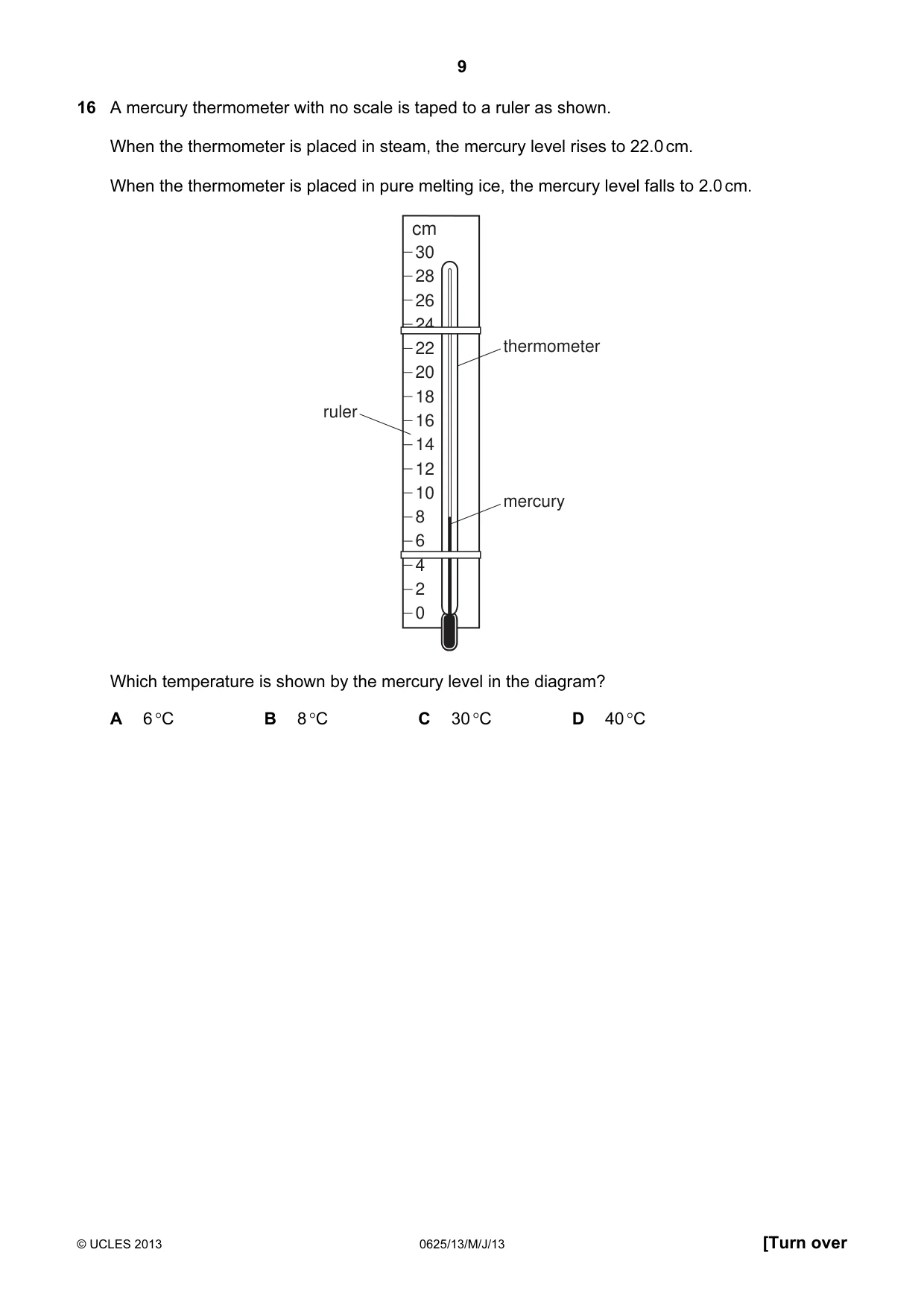
16 A mercury thermometer with no scale is taped to a ruler as shown. When the thermometer is placed in steam, the mercury level rises to 22.0 cm. When the thermometer is placed in pure melting ice, the mercury level falls to 2.0 cm. cm 30 28 26 24 22 thermometer 20 18 ruler 16 14 12 10 mercury 8 6 4 2 0 Which temperature is shown by the mercury level in the diagram? A 6 °C B 8 °C C 30 °C D 40 °C
Mark scheme: C
Q17 · The diagram shows a refrigerator
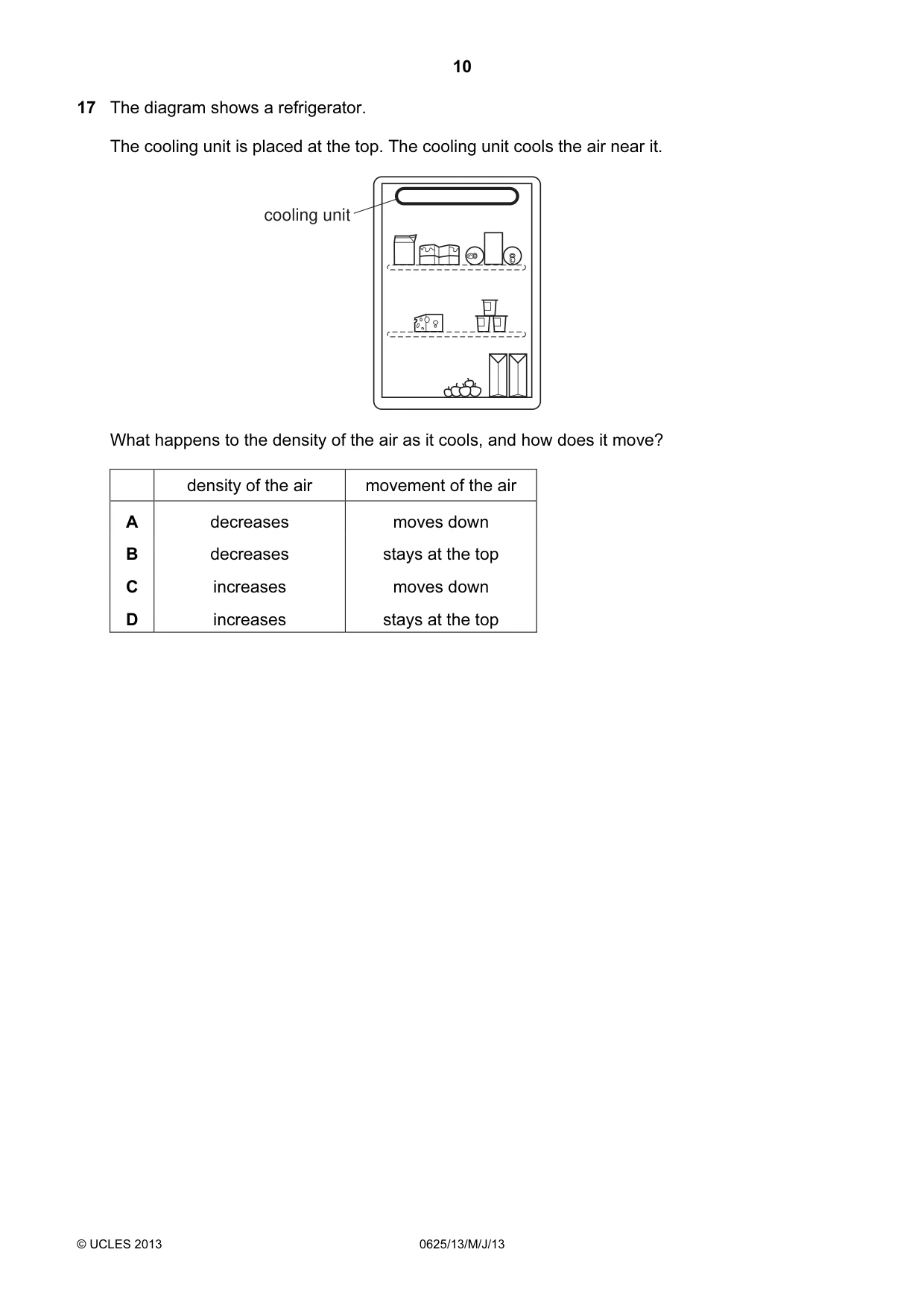
17 The diagram shows a refrigerator. The cooling unit is placed at the top. The cooling unit cools the air near it. cooling unit What happens to the density of the air as it cools, and how does it move? density of the air movement of the air A decreases moves down B decreases stays at the top C increases moves down D increases stays at the top
Mark scheme: C
Q18 · The diagram shows the cross-section of a vacuum flask containing a hot liquid in a cold…
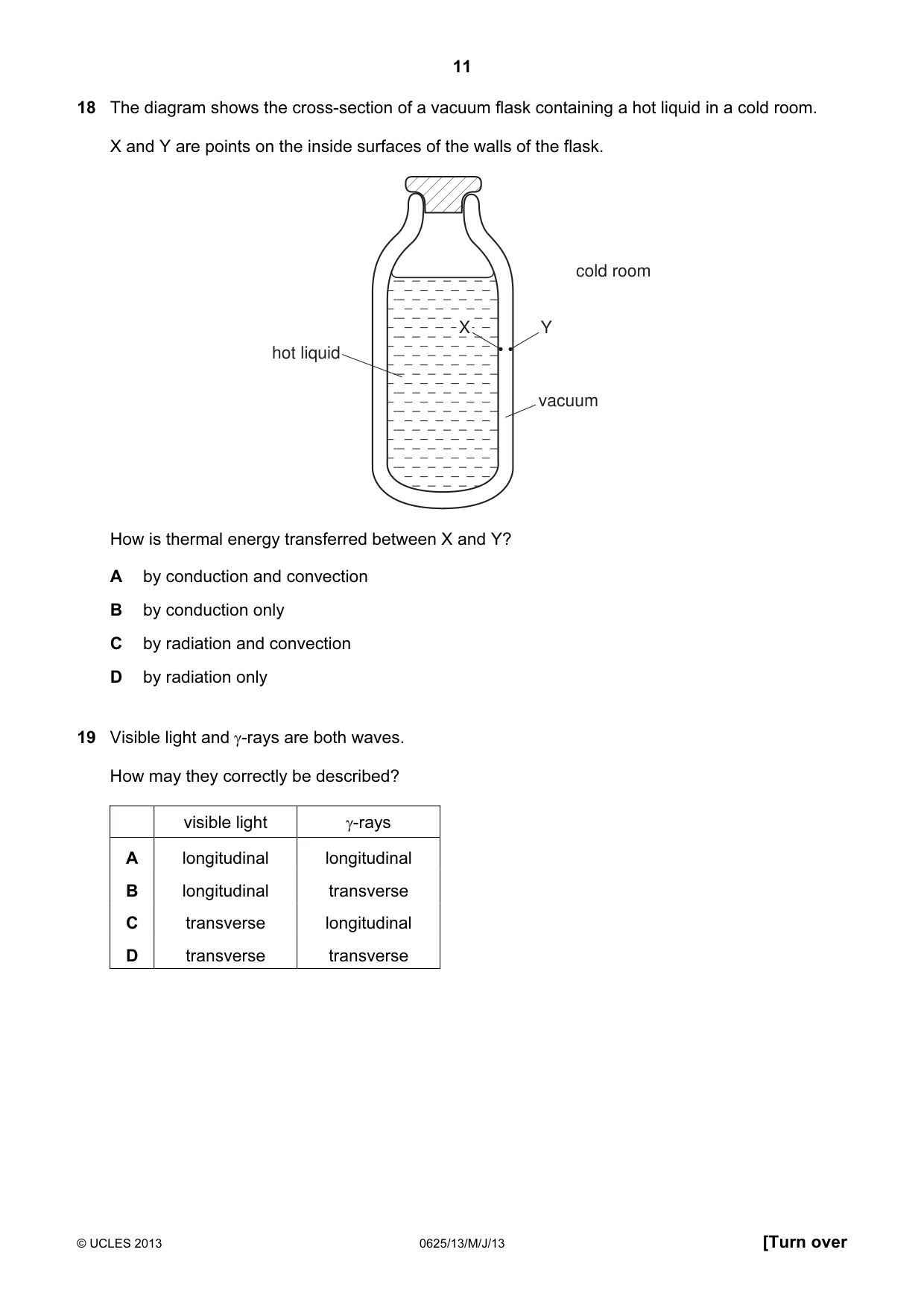
18 The diagram shows the cross-section of a vacuum flask containing a hot liquid in a cold room. X and Y are points on the inside surfaces of the walls of the flask. cold room X Y hot liquid vacuum How is thermal energy transferred between X and Y? A by conduction and convection B by conduction only C by radiation and convection D by radiation only
Mark scheme: D
Q19 · Visible light and γ-rays are both waves
19 Visible light and γ-rays are both waves. How may they correctly be described? visible light γ-rays A longitudinal longitudinal B longitudinal transverse C transverse longitudinal D transverse transverse
Mark scheme: D
Q20 · Different parts of the electromagnetic spectrum are used for different purposes
20 Different parts of the electromagnetic spectrum are used for different purposes. Below are four statements about parts of the spectrum. statement 1: Infra-red waves are used in television remote controllers. statement 2: Radio waves are used to transmit television pictures from satellites to Earth. statement 3: Ultra-violet waves are used for intruder alarms. statement 4: X-rays are used for security checks. Which statements are correct? A 1 and 2 B 1 and 4 C 2 and 3 D 3 and 4
Mark scheme: B
Q21 · The diagram represents a wave
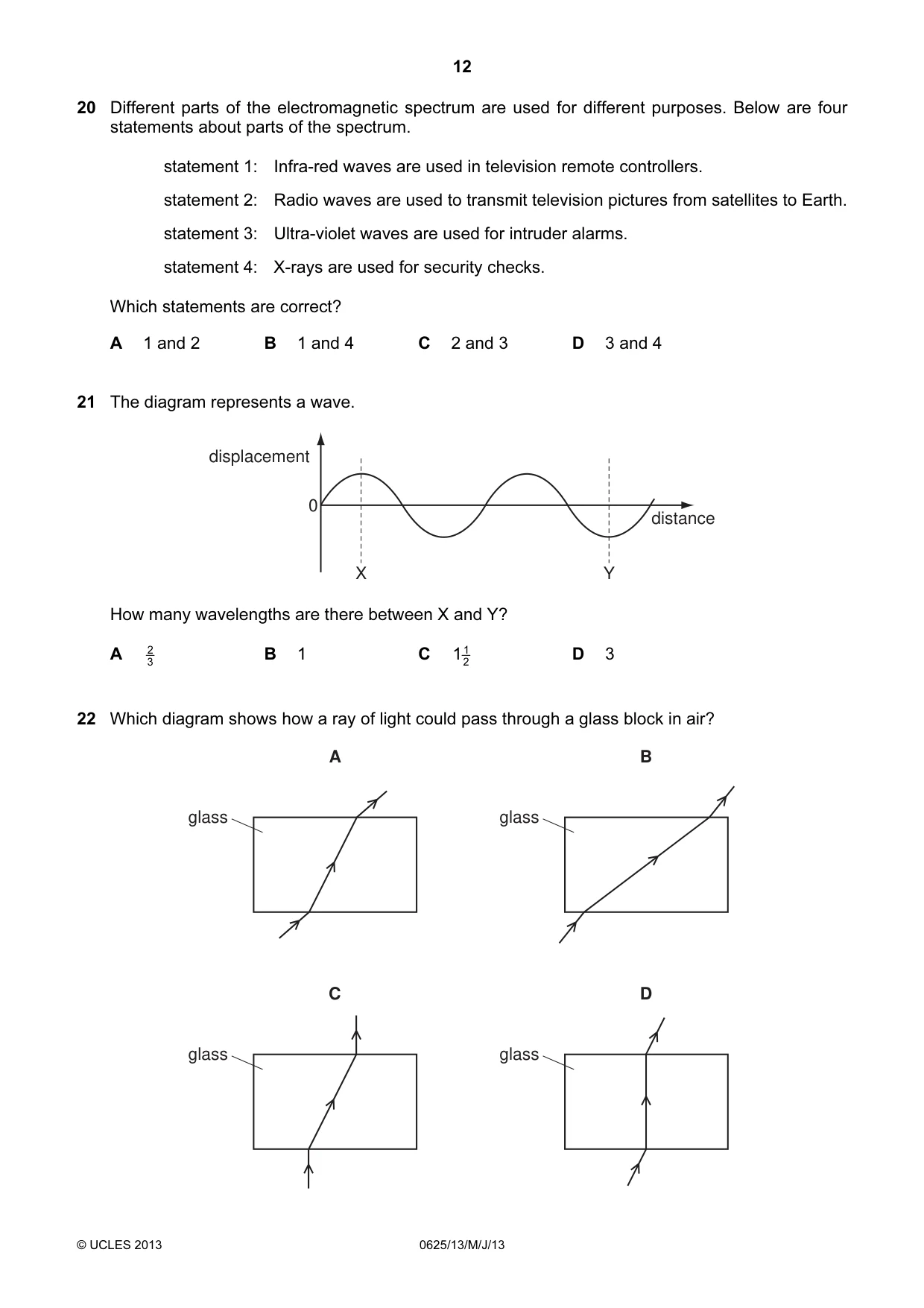
21 The diagram represents a wave. displacement 0 distance X Y How many wavelengths are there between X and Y? A 2 B 1 C 1 1 D 3 3 2
Mark scheme: C
Q22 · Which diagram shows how a ray of light could pass through a glass block in air?
22 Which diagram shows how a ray of light could pass through a glass block in air? A B glass glass C D glass glass
Mark scheme: A
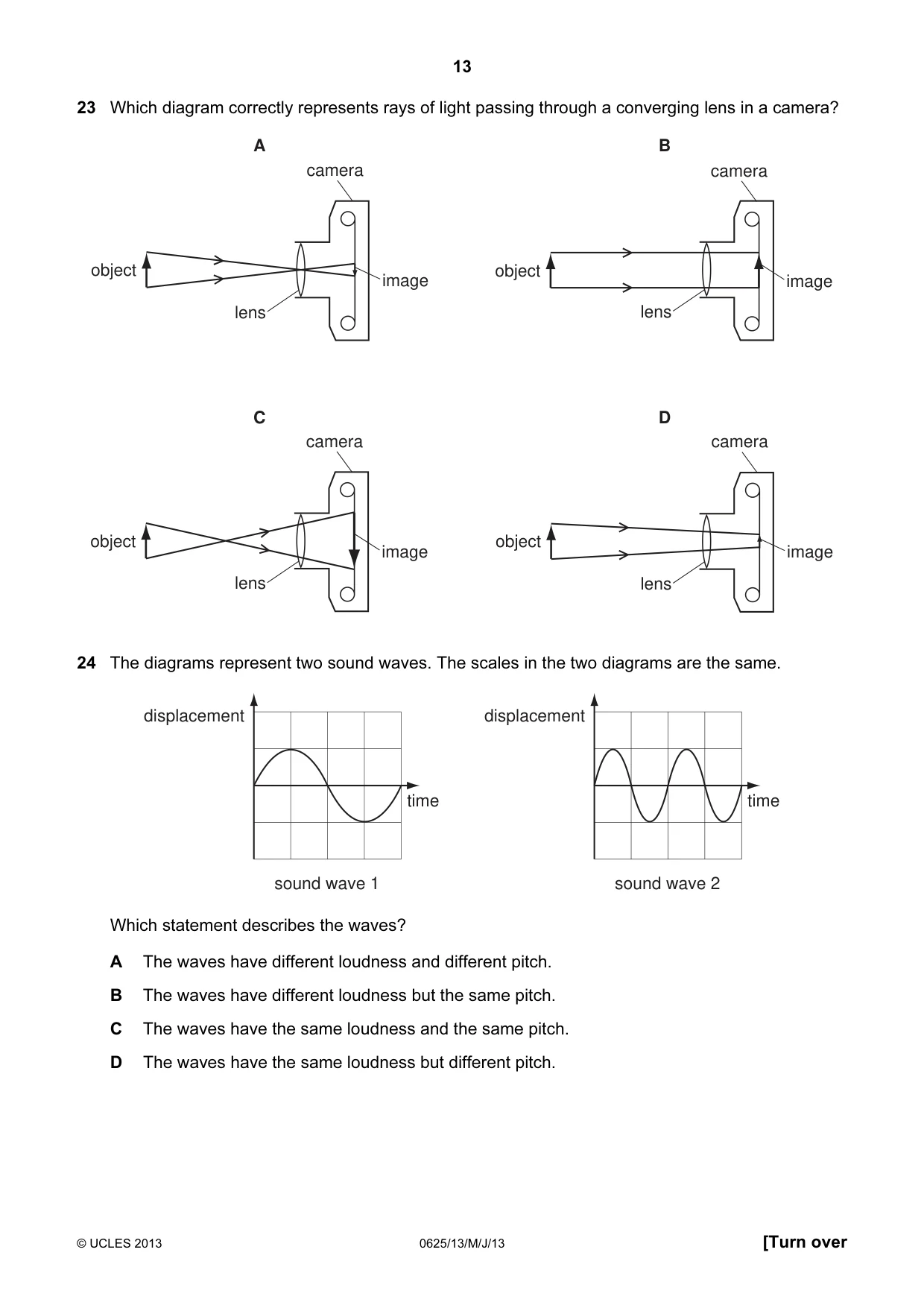
Q23 · Which diagram correctly represents rays of light passing through a converging lens in a…
23 Which diagram correctly represents rays of light passing through a converging lens in a camera? A B camera camera object object image image lens lens C D camera camera object object image image lens lens
Mark scheme: A
Q24 · The diagrams represent two sound waves
24 The diagrams represent two sound waves. The scales in the two diagrams are the same. displacement displacement time time sound wave 1 sound wave 2 Which statement describes the waves? A The waves have different loudness and different pitch. B The waves have different loudness but the same pitch. C The waves have the same loudness and the same pitch. D The waves have the same loudness but different pitch.
Mark scheme: D
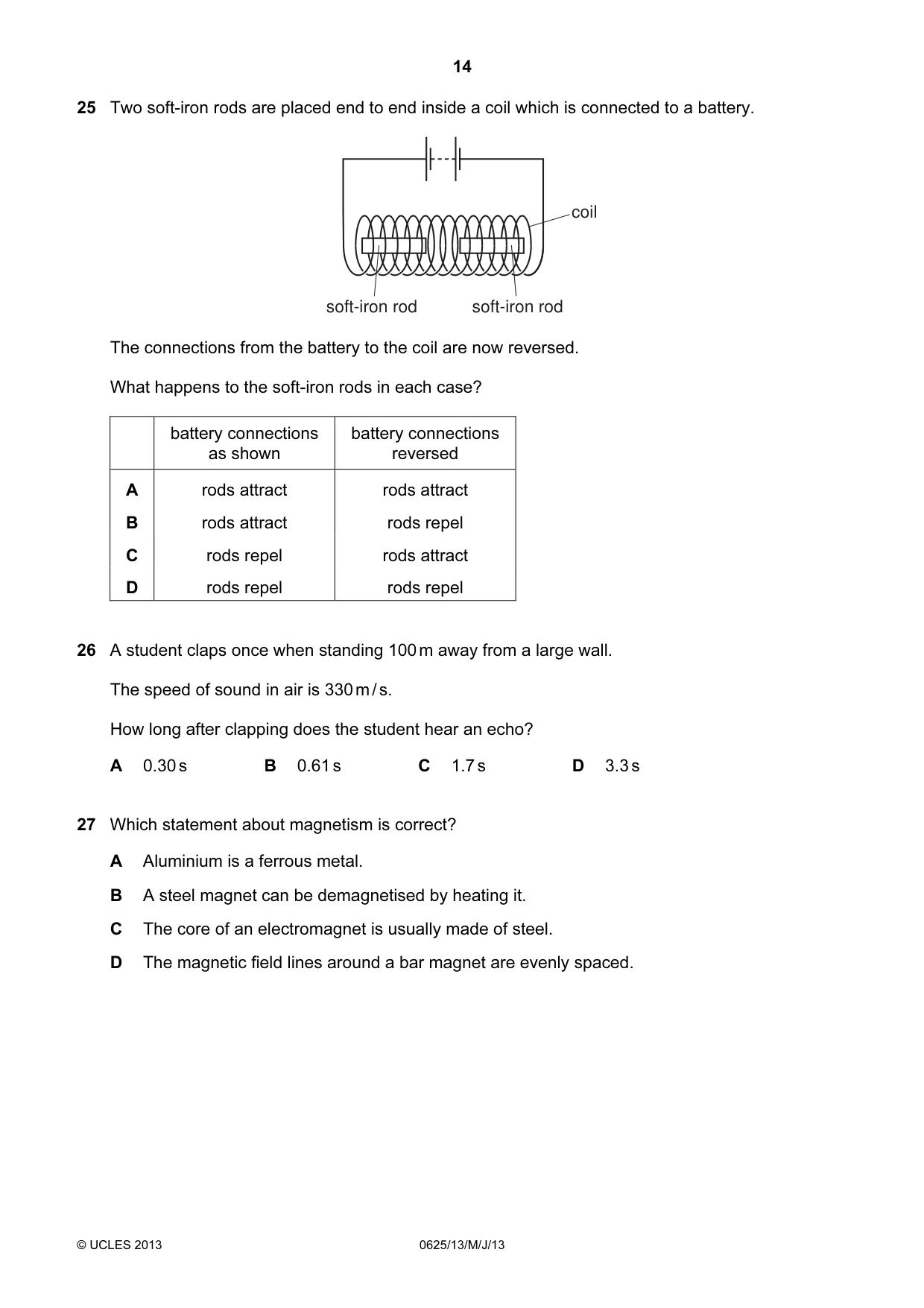
Q25 · Two soft-iron rods are placed end to end inside a coil which is connected to a battery
25 Two soft-iron rods are placed end to end inside a coil which is connected to a battery. coil soft-iron rod soft-iron rod The connections from the battery to the coil are now reversed. What happens to the soft-iron rods in each case? battery connections battery connections as shown reversed A rods attract rods attract B rods attract rods repel C rods repel rods attract D rods repel rods repel
Mark scheme: A
Q26 · A student claps once when standing 100 m away from a large wall
26 A student claps once when standing 100 m away from a large wall. The speed of sound in air is 330 m / s. How long after clapping does the student hear an echo? A 0.30 s B 0.61 s C 1.7 s D 3.3 s
Mark scheme: B
Q27 · Which statement about magnetism is correct?
27 Which statement about magnetism is correct? A Aluminium is a ferrous metal. B A steel magnet can be demagnetised by heating it. C The core of an electromagnet is usually made of steel. D The magnetic field lines around a bar magnet are evenly spaced.
Mark scheme: B
Q28 · Three charged balls, P, Q and R are suspended by insulating threads
28 Three charged balls, P, Q and R are suspended by insulating threads. Ball P is negatively charged. Ball Q is brought close to ball P. insulating thread P – Q Ball Q is now brought close to ball R. Q R What are the charges on ball Q and on ball R? ball Q ball R A positive positive B positive negative C negative positive D negative negative
Mark scheme: C
Q29 · Which copper wire would have the smallest resistance?
29 Which copper wire would have the smallest resistance? A a long, thick wire B a long, thin wire C a short, thick wire D a short, thin wire
Mark scheme: C
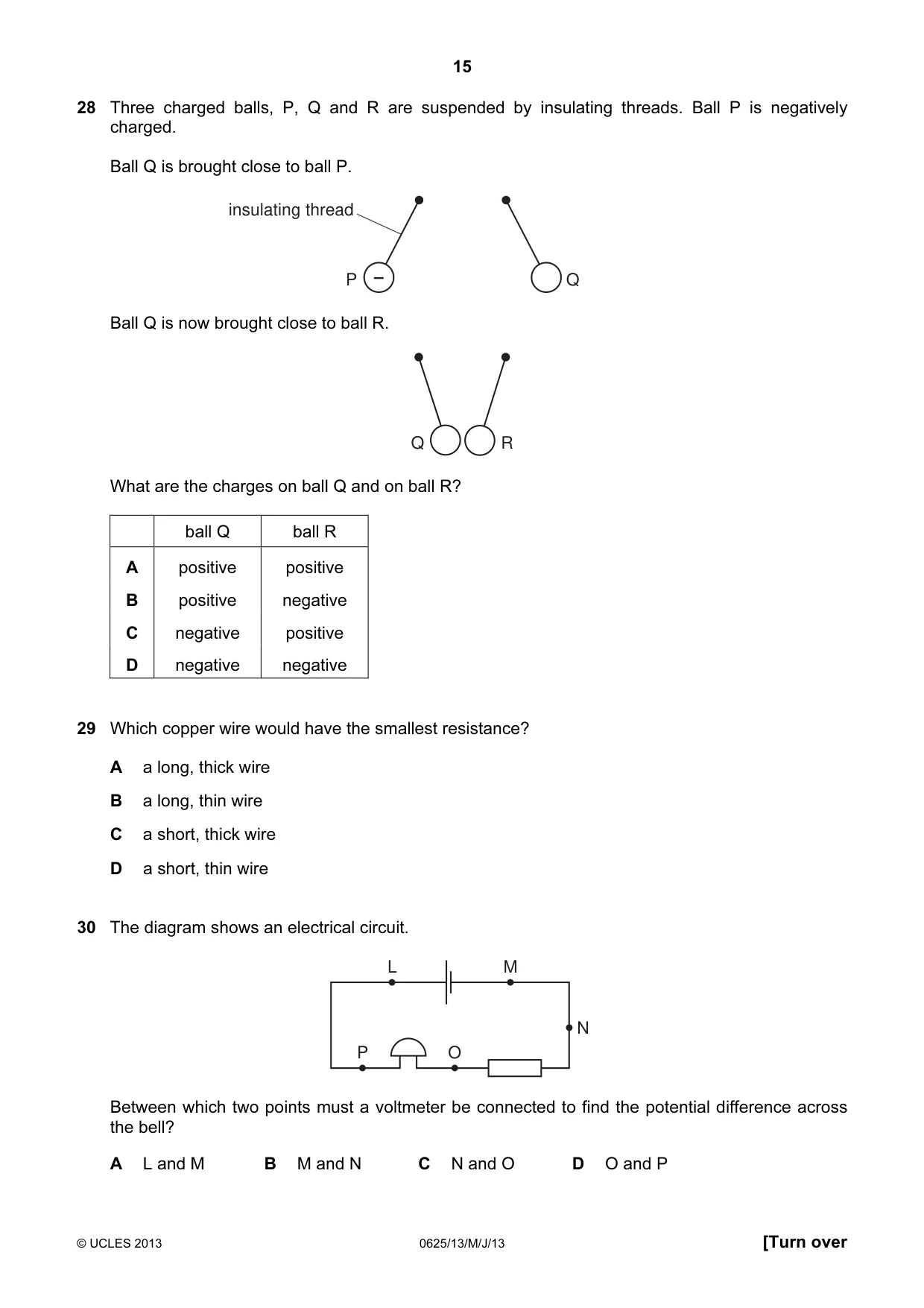
Q30 · The diagram shows an electrical circuit
30 The diagram shows an electrical circuit. L M N P O Between which two points must a voltmeter be connected to find the potential difference across the bell? A L and M B M and N C N and O D O and P
Mark scheme: D
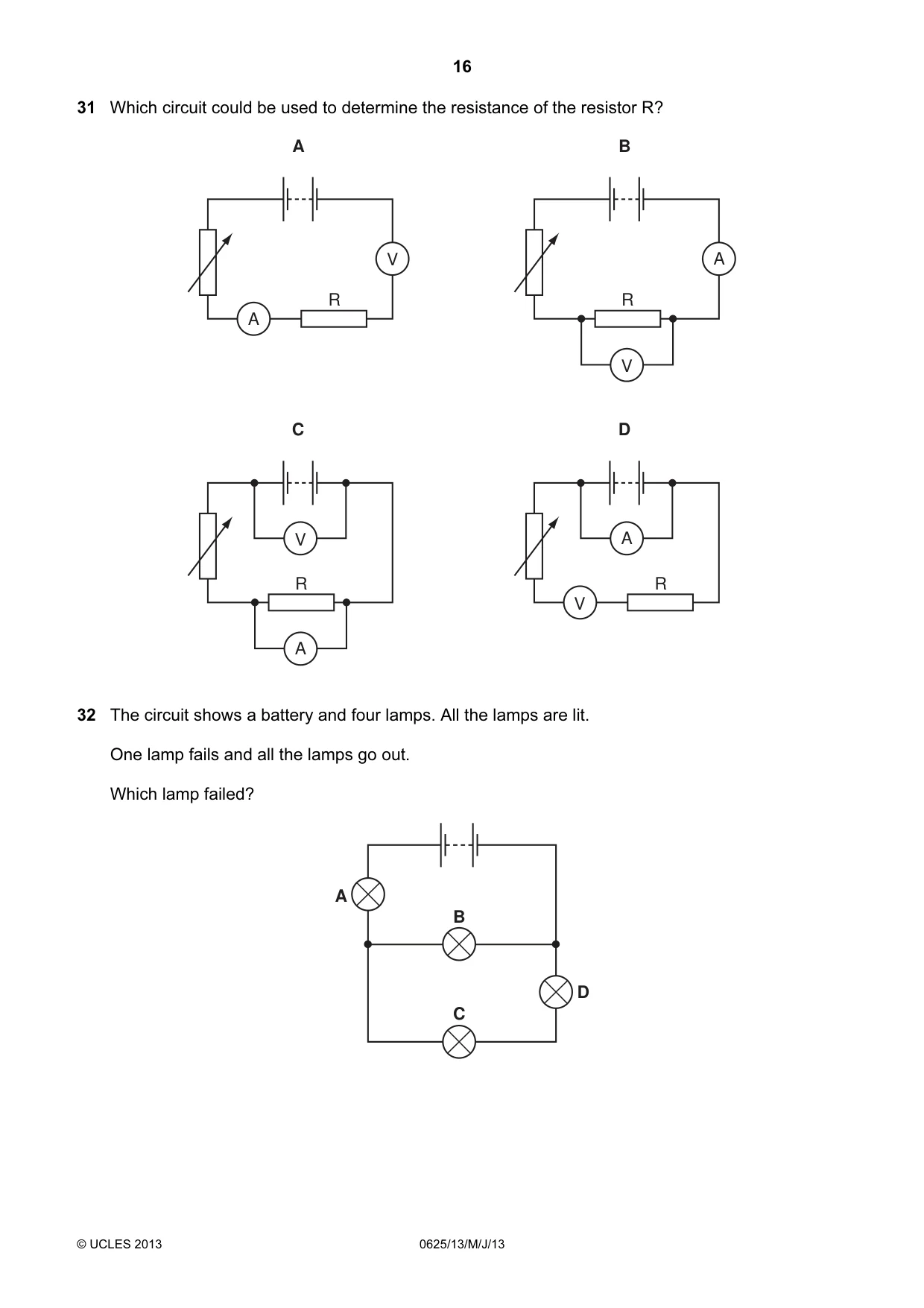
Q31 · Which circuit could be used to determine the resistance of the resistor R?
31 Which circuit could be used to determine the resistance of the resistor R? A B V A R R A V C D V A R R V A
Mark scheme: B
Q32 · The circuit shows a battery and four lamps
32 The circuit shows a battery and four lamps. All the lamps are lit. One lamp fails and all the lamps go out. Which lamp failed? A B D C
Mark scheme: A
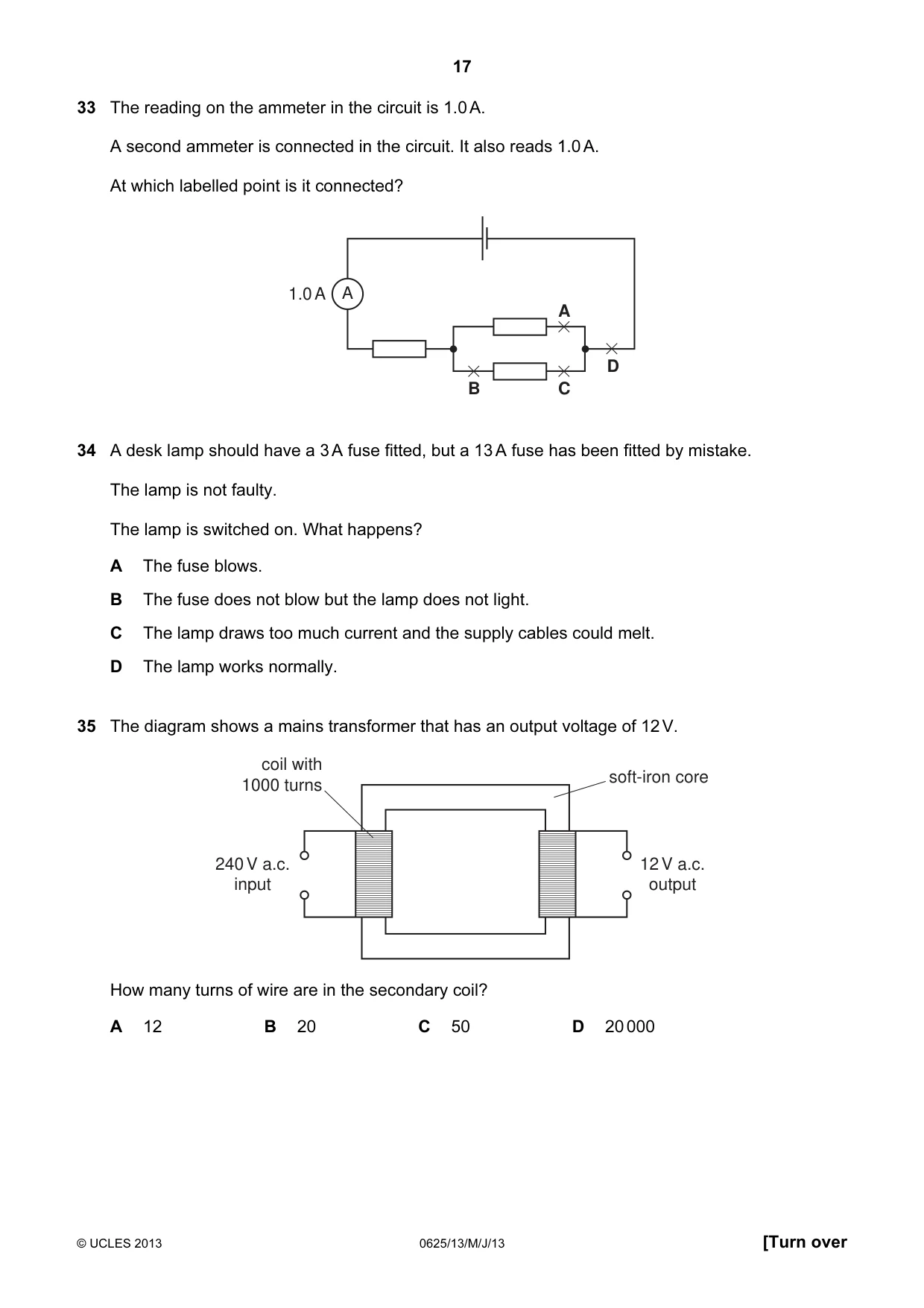
Q33 · The reading on the ammeter in the circuit is 1.0 A
33 The reading on the ammeter in the circuit is 1.0 A. A second ammeter is connected in the circuit. It also reads 1.0 A. At which labelled point is it connected? 1.0 A A A D B C
Mark scheme: D
Q34 · A desk lamp should have a 3 A fuse fitted, but a 13 A fuse has been fitted by mistake
34 A desk lamp should have a 3 A fuse fitted, but a 13 A fuse has been fitted by mistake. The lamp is not faulty. The lamp is switched on. What happens? A The fuse blows. B The fuse does not blow but the lamp does not light. C The lamp draws too much current and the supply cables could melt. D The lamp works normally.
Mark scheme: D
Q35 · The diagram shows a mains transformer that has an output voltage of 12 V
35 The diagram shows a mains transformer that has an output voltage of 12 V. coil with soft-iron core 1000 turns 240 V a.c. 12 V a.c. input output How many turns of wire are in the secondary coil? A 12 B 20 C 50 D 20 000
Mark scheme: C
Q36 · An electric current can produce a heating effect and a magnetic effect
36 An electric current can produce a heating effect and a magnetic effect. Which row shows the effect that a relay uses, together with one application of a relay? effect used by a relay one application of a relay A heating effect allowing a small current to switch on a large current B heating effect changing the voltage of an alternating current C magnetic effect allowing a small current to switch on a large current D magnetic effect changing the voltage of an alternating current
Mark scheme: C
Q37 · In a cathode-ray tube, particles are fired at a screen
37 In a cathode-ray tube, particles are fired at a screen. What are these particles? A α-particles B electrons C neutrons D protons
Mark scheme: B
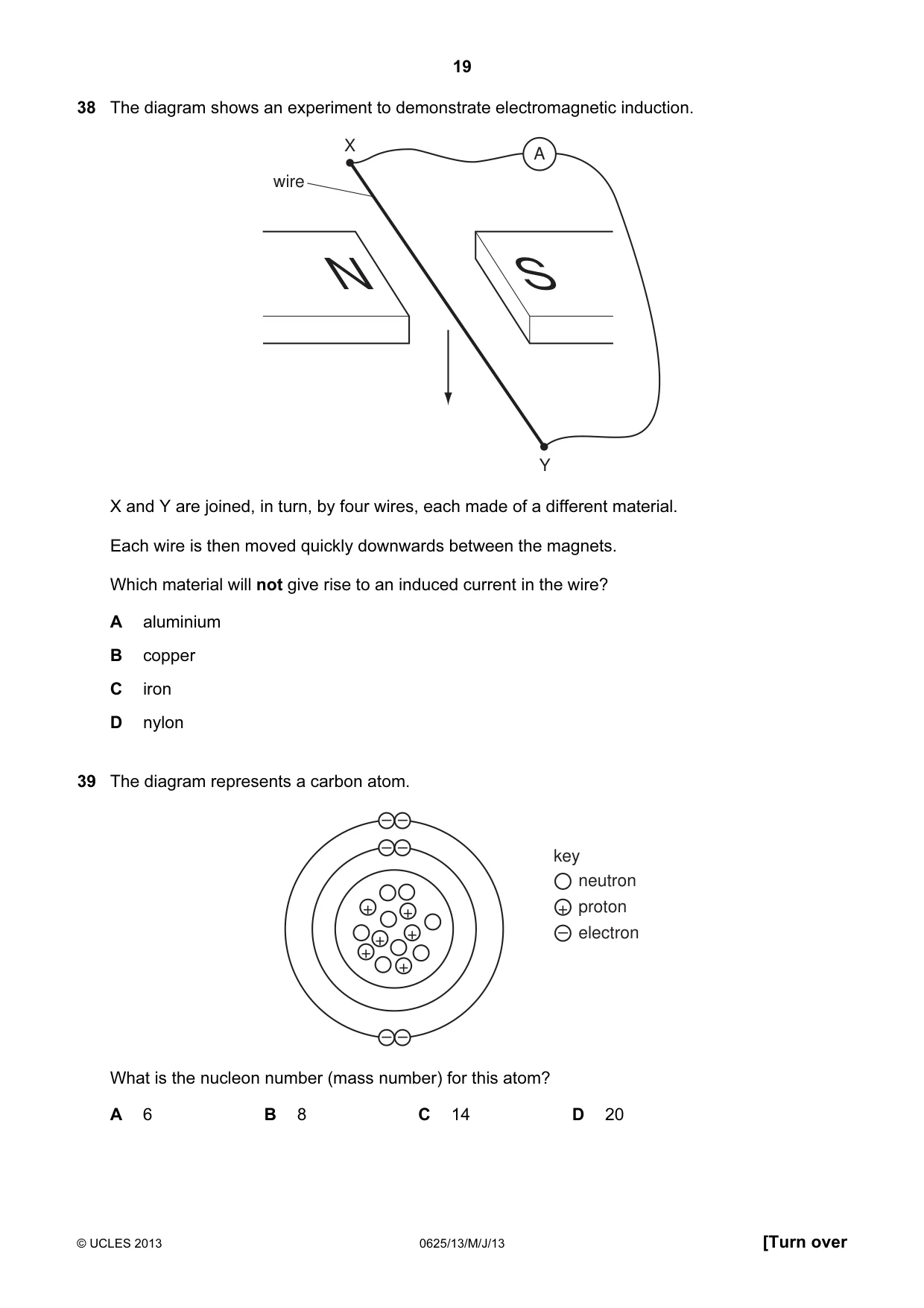
Q38 · The diagram shows an experiment to demonstrate electromagnetic induction
38 The diagram shows an experiment to demonstrate electromagnetic induction. X A wire N S Y X and Y are joined, in turn, by four wires, each made of a different material. Each wire is then moved quickly downwards between the magnets. Which material will not give rise to an induced current in the wire? A aluminium B copper C iron D nylon
Mark scheme: D
Q39 · The diagram represents a carbon atom
39 The diagram represents a carbon atom. – – – – key neutron + + + proton + + – electron + + – – What is the nucleon number (mass number) for this atom? A 6 B 8 C 14 D 20
Mark scheme: C
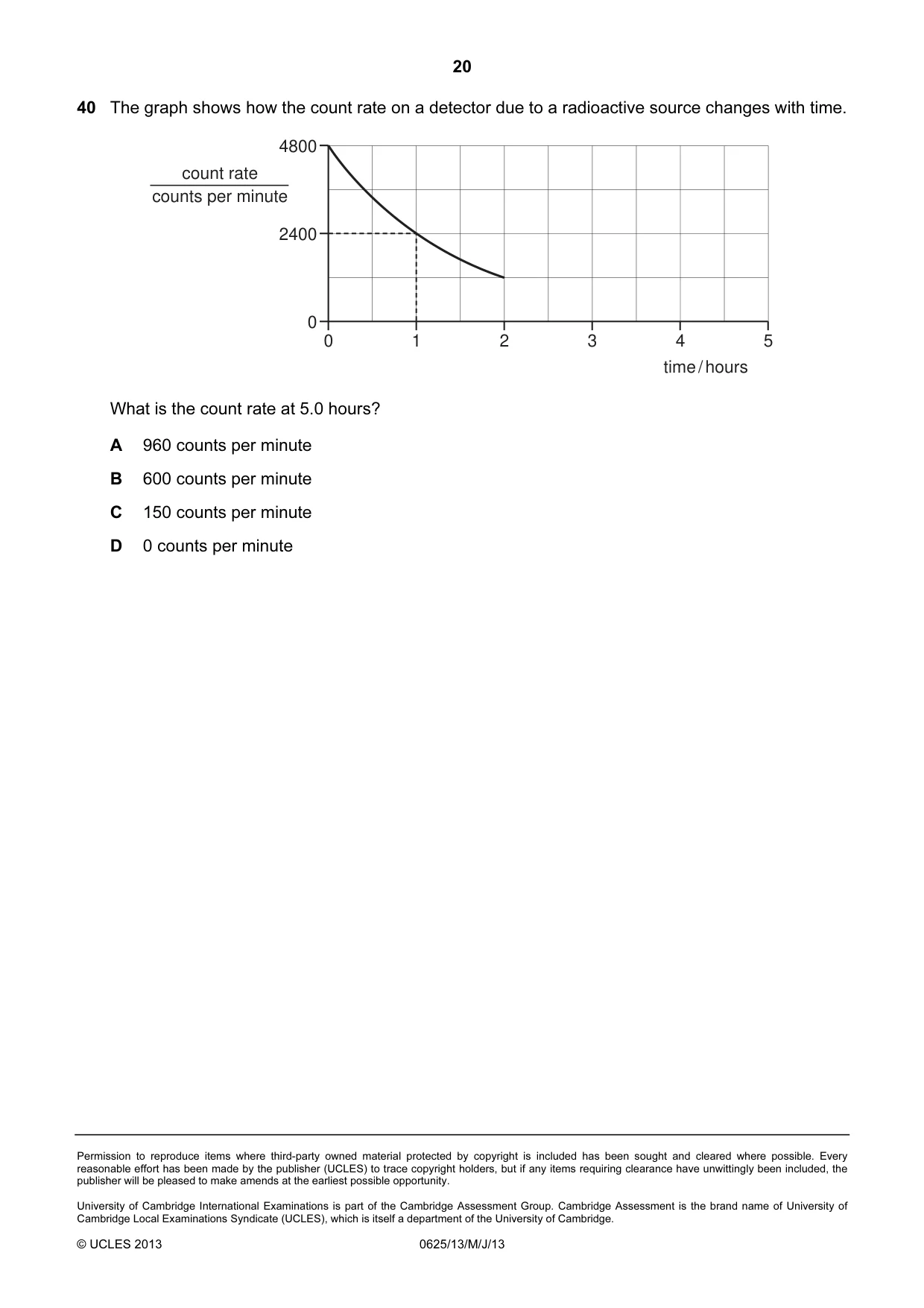
Q40 · The graph shows how the count rate on a detector due to a radioactive source changes with…
40 The graph shows how the count rate on a detector due to a radioactive source changes with time. 4800 count rate counts per minute 2400 0 0 1 2 3 4 5 time / hours What is the count rate at 5.0 hours? A 960 counts per minute B 600 counts per minute C 150 counts per minute D 0 counts per minute
Mark scheme: C
What was in this paper
The subtopics covered by these 40 questions, and how many questions each got. Open one in a new tab to see every Cambridge question on it.
4Electrical quantities3Electromagnetic effects3Energy, work and power2Forces2General properties of waves2Kinetic particle model of matter2Light2Mass and weight2Motion2Pressure2Simple phenomena of magnetism2Sound2Thermal properties and temperature2Transfer of thermal energy2Density1Electrical safety1Electromagnetic spectrum1Physical quantities and measurement techniques1Radioactivity1The nuclear model of the atom1What you needed in this session
Cambridge’s own grade thresholds for 2013 May/June, Paper 1 · Variant 3. A higher threshold means an easier paper — the bar moves with how the cohort did.