Cambridge IGCSE Physics 0625 — 2017 Oct/Nov Paper 1 · Variant 3
0625/13/O/N/17 · 40 questions · 40 marks · ≈45 min
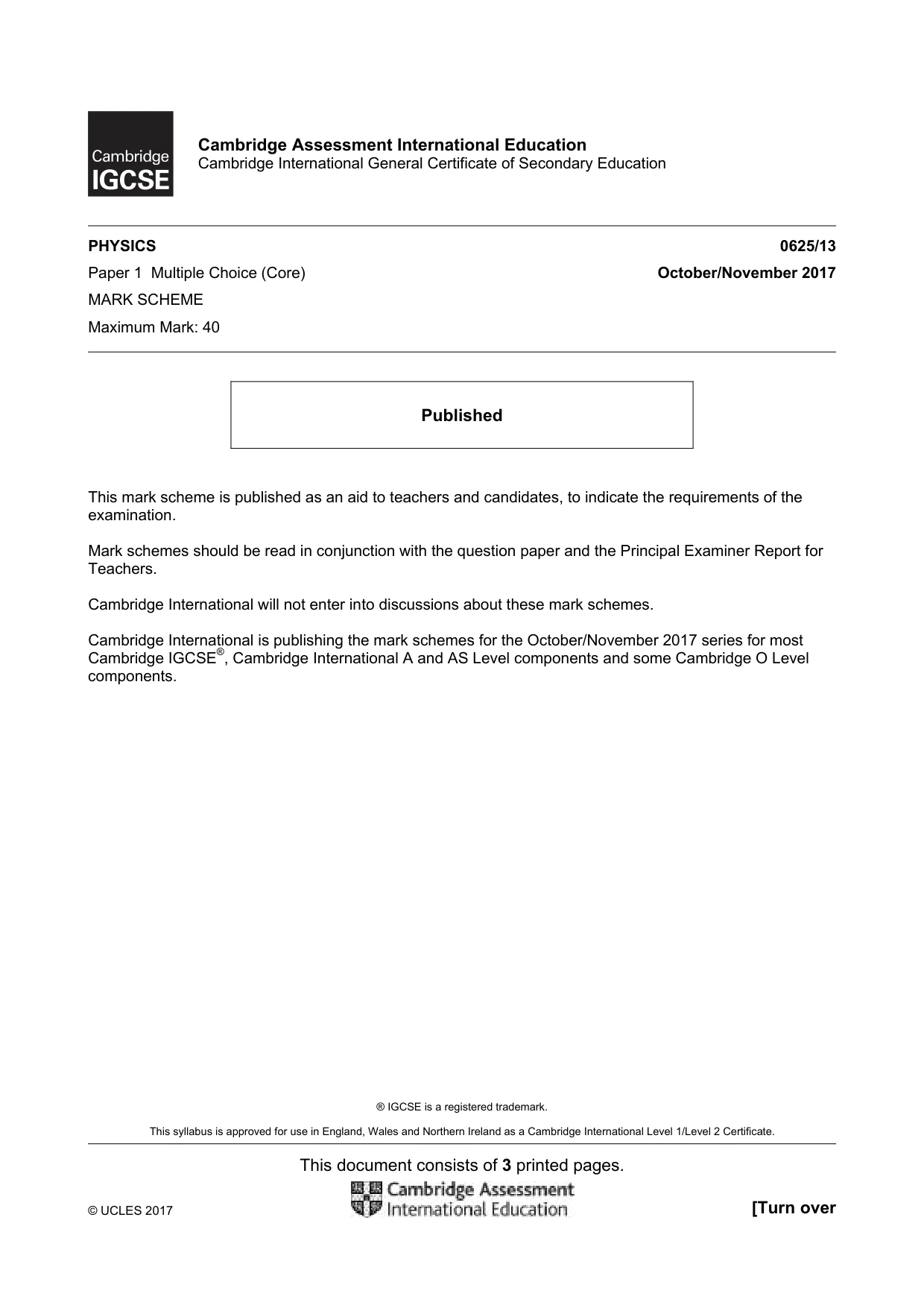
The question paper and its mark scheme, free to read here and free to download. This is Cambridge’s own paper, exactly as it was sat.
Question paper20 pages
Mark scheme3 pages
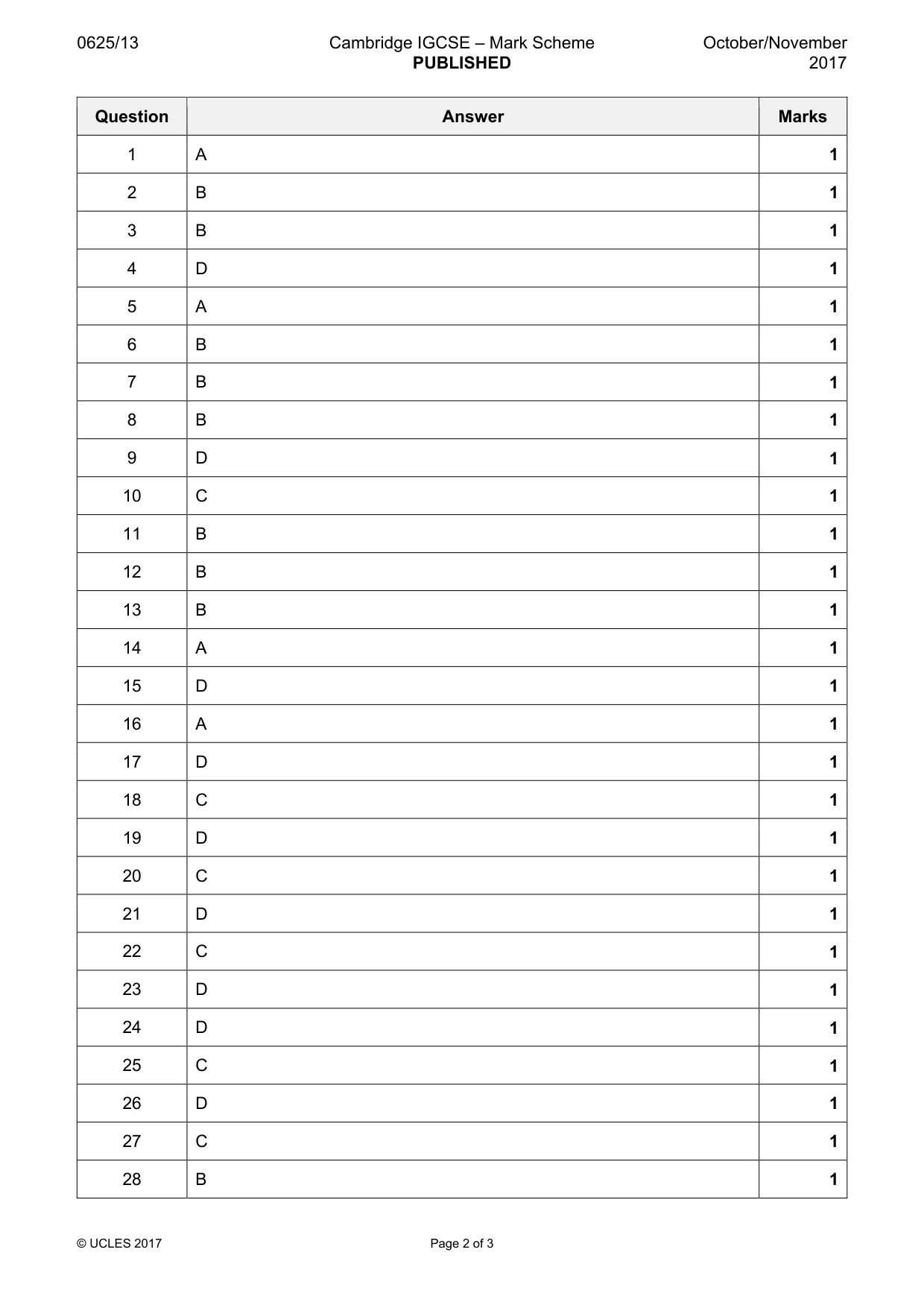
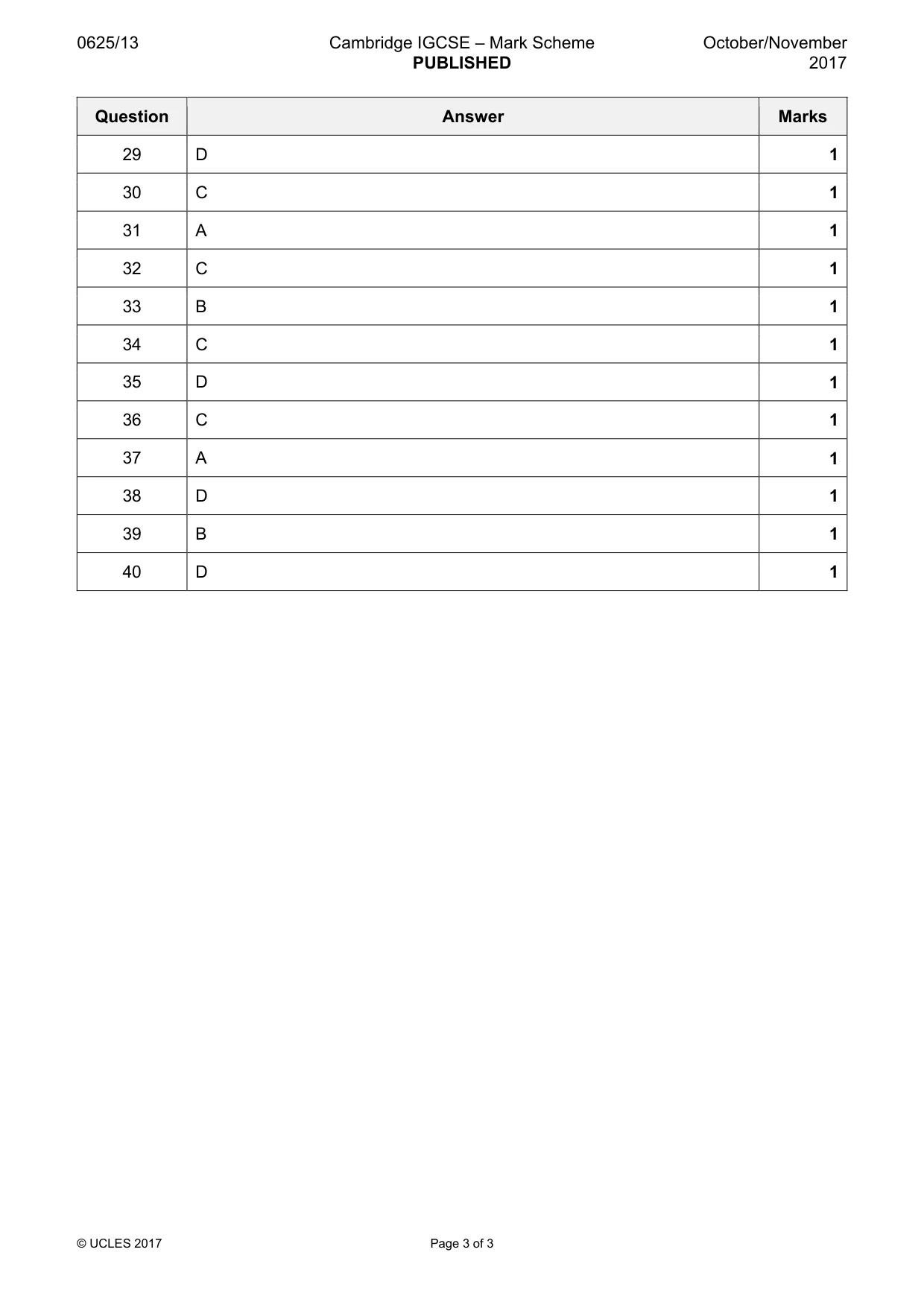
Answers below. Sit the paper first if you are practising.
Questions as text
Q1 · A measuring cylinder contains some water
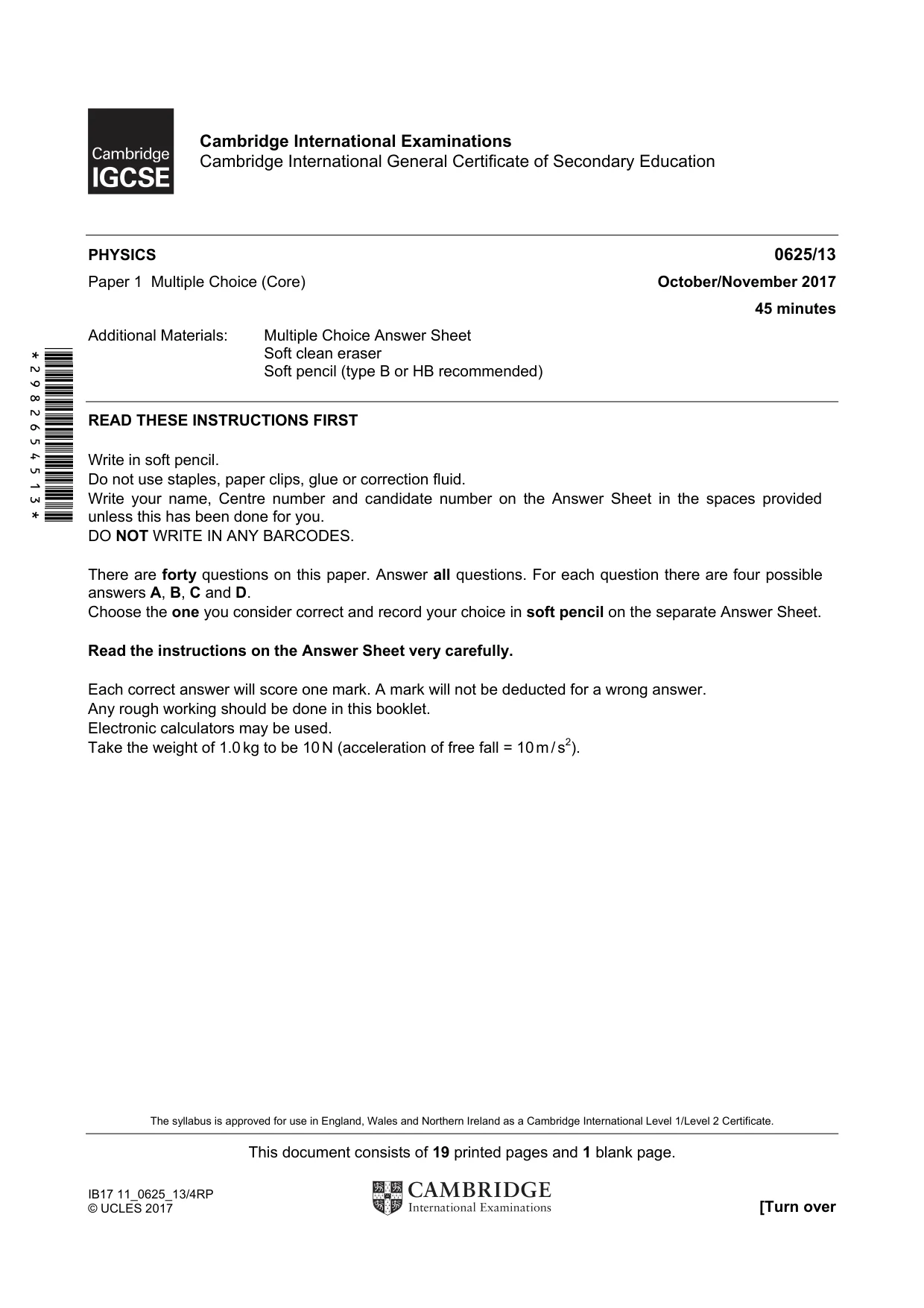
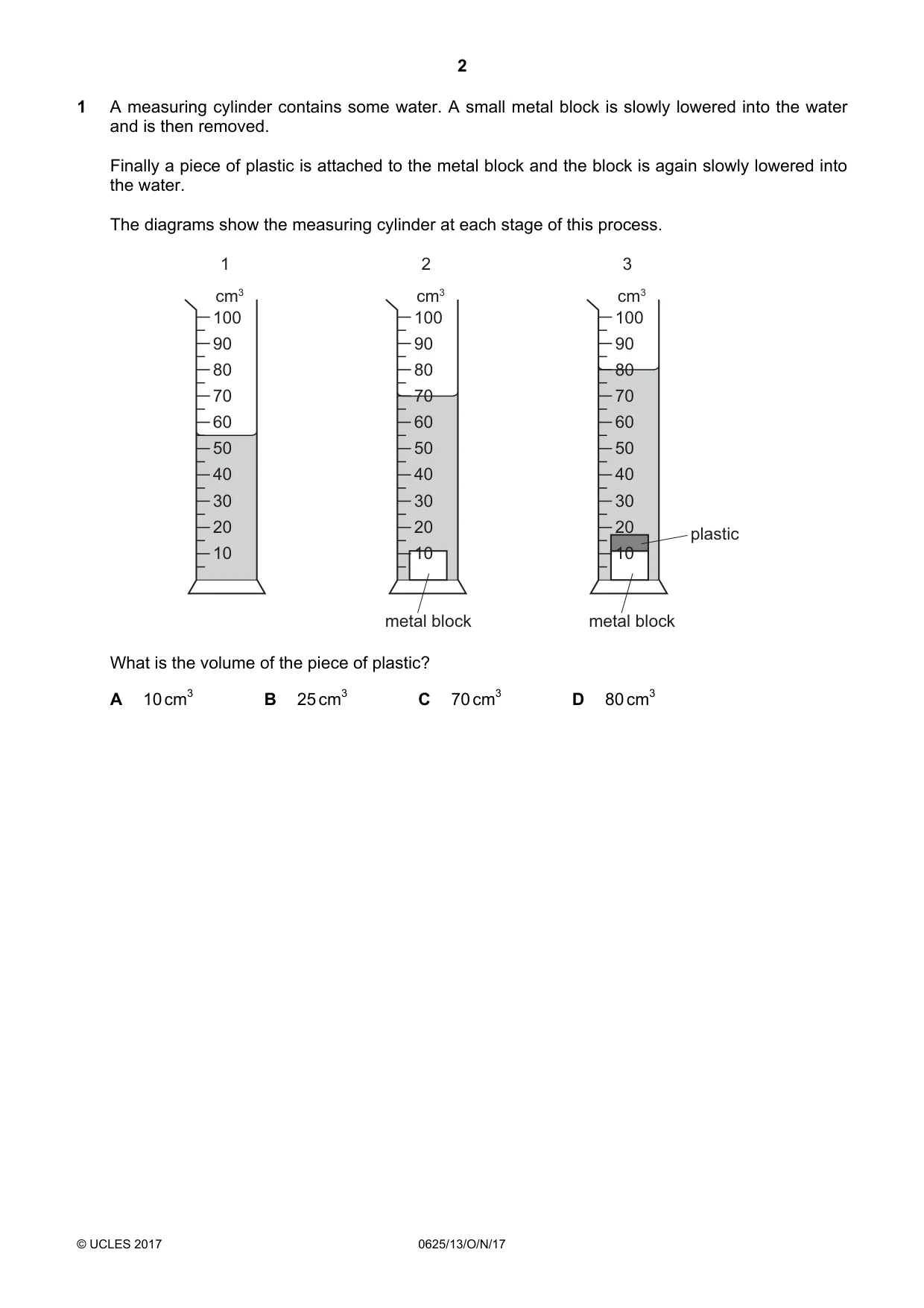
1 A measuring cylinder contains some water. A small metal block is slowly lowered into the water and is then removed. Finally a piece of plastic is attached to the metal block and the block is again slowly lowered into the water. The diagrams show the measuring cylinder at each stage of this process. 1 2 3 cm3 cm3 cm3 100 100 100 90 90 90 80 80 80 70 70 70 60 60 60 50 50 50 40 40 40 30 30 30 20 20 20 plastic 10 10 10 metal block metal block What is the volume of the piece of plastic? A 10 cm3 B 25 cm3 C 70 cm3 D 80 cm3
Mark scheme: A
More questions on Physical quantities and measurement techniques
Q2 · A car accelerates from rest and travels a distance of 100 m in 10 seconds
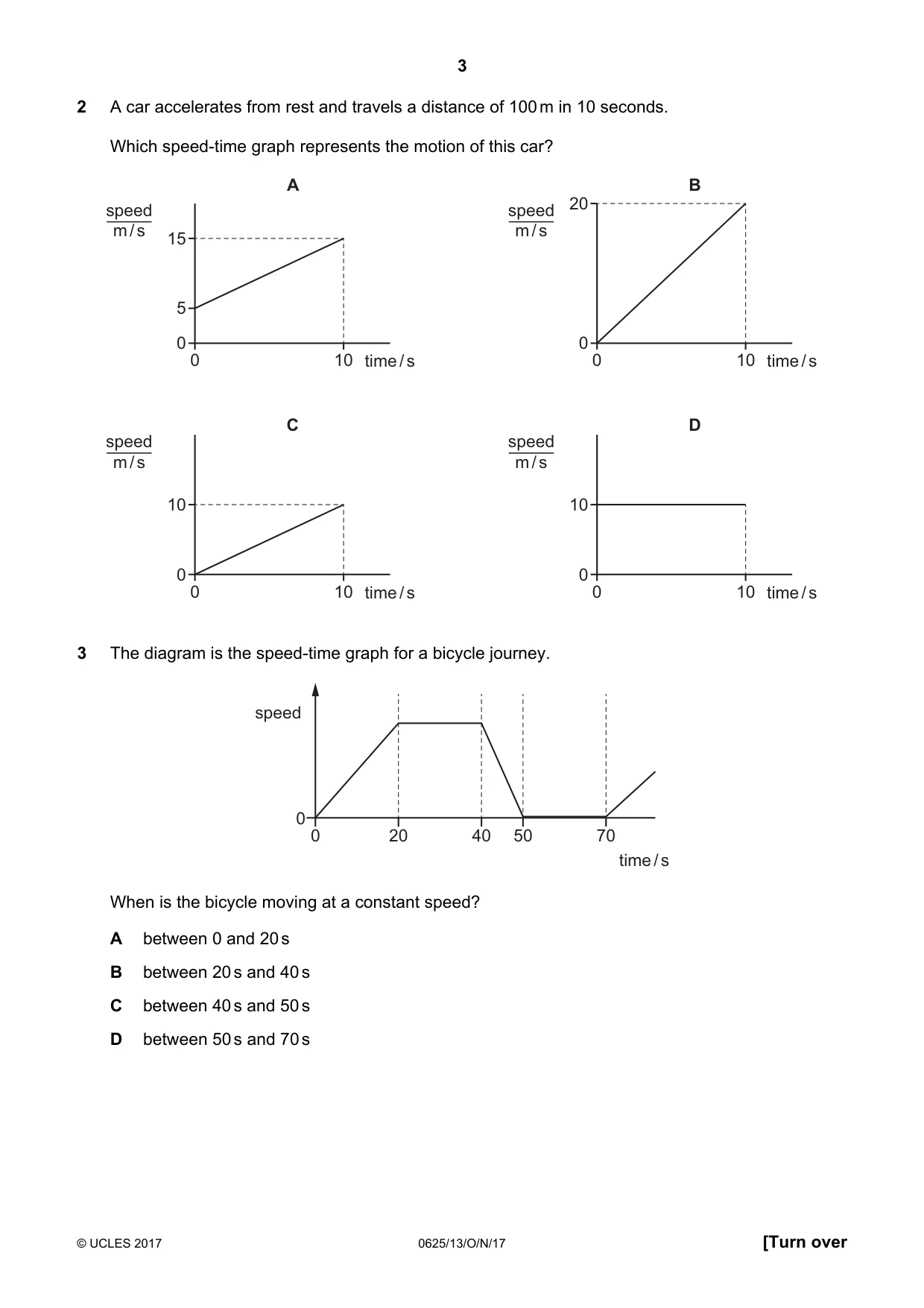
2 A car accelerates from rest and travels a distance of 100 m in 10 seconds. Which speed-time graph represents the motion of this car? A B speed speed 20 m / s m / s 15 5 0 0 0 10 time / s 0 10 time / s C D speed speed m / s m / s 10 10 0 0 0 10 time / s 0 10 time / s
Mark scheme: B
Q3 · The diagram is the speed-time graph for a bicycle journey
3 The diagram is the speed-time graph for a bicycle journey. speed 0 0 20 40 50 70 time / s When is the bicycle moving at a constant speed? A between 0 and 20 s B between 20 s and 40 s C between 40 s and 50 s D between 50 s and 70 s
Mark scheme: B
Q4 · A spring is stretched by hanging a piece of metal from it
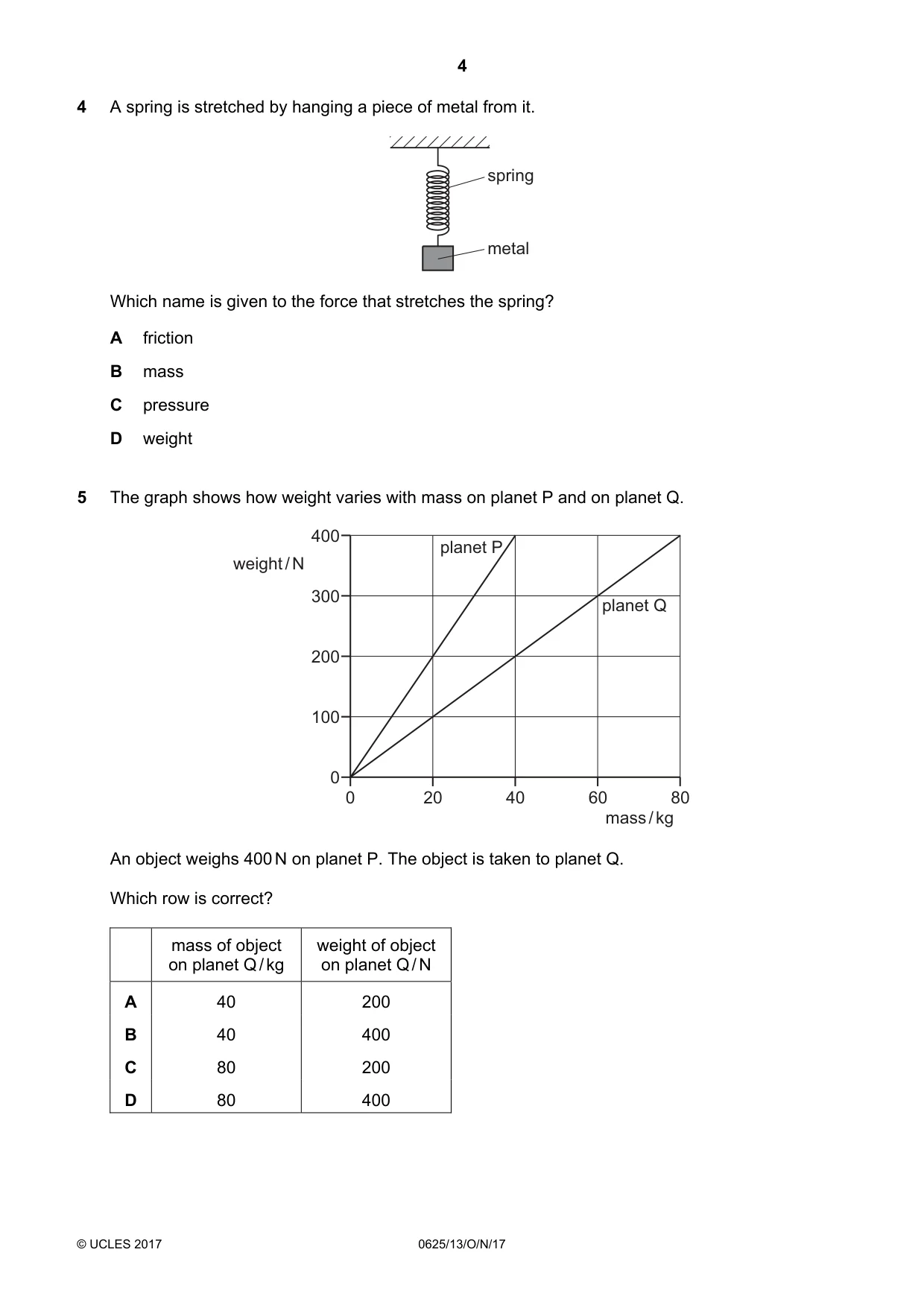
4 A spring is stretched by hanging a piece of metal from it. spring metal Which name is given to the force that stretches the spring? A friction B mass C pressure D weight
Mark scheme: D
Q5 · The graph shows how weight varies with mass on planet P and on planet Q
5 The graph shows how weight varies with mass on planet P and on planet Q. 400 planet P weight / N 300 planet Q 200 100 0 0 20 40 60 80 mass / kg An object weighs 400 N on planet P. The object is taken to planet Q. Which row is correct? mass of object weight of object on planet Q / kg on planet Q / N A 40 200 B 40 400 C 80 200 D 80 400
Mark scheme: A
Q6 · What is needed to determine the density of a regularly shaped block?
6 What is needed to determine the density of a regularly shaped block? A a balance and a beaker B a balance and a ruler C a measuring cylinder and a beaker D a measuring cylinder and a ruler
Mark scheme: B
Q7 · A cart experiences a forward force of 500 N
7 A cart experiences a forward force of 500 N. The cart also experiences a backward force of 200 N. There are no other forward or backward forces on the cart. What is the resultant force on the cart? A 300 N backwards B 300 N forwards C 700 N backwards D 700 N forwards
Mark scheme: B
Q8 · The diagram shows a beam with a pivot, a load P at one end and a load Q at the other end
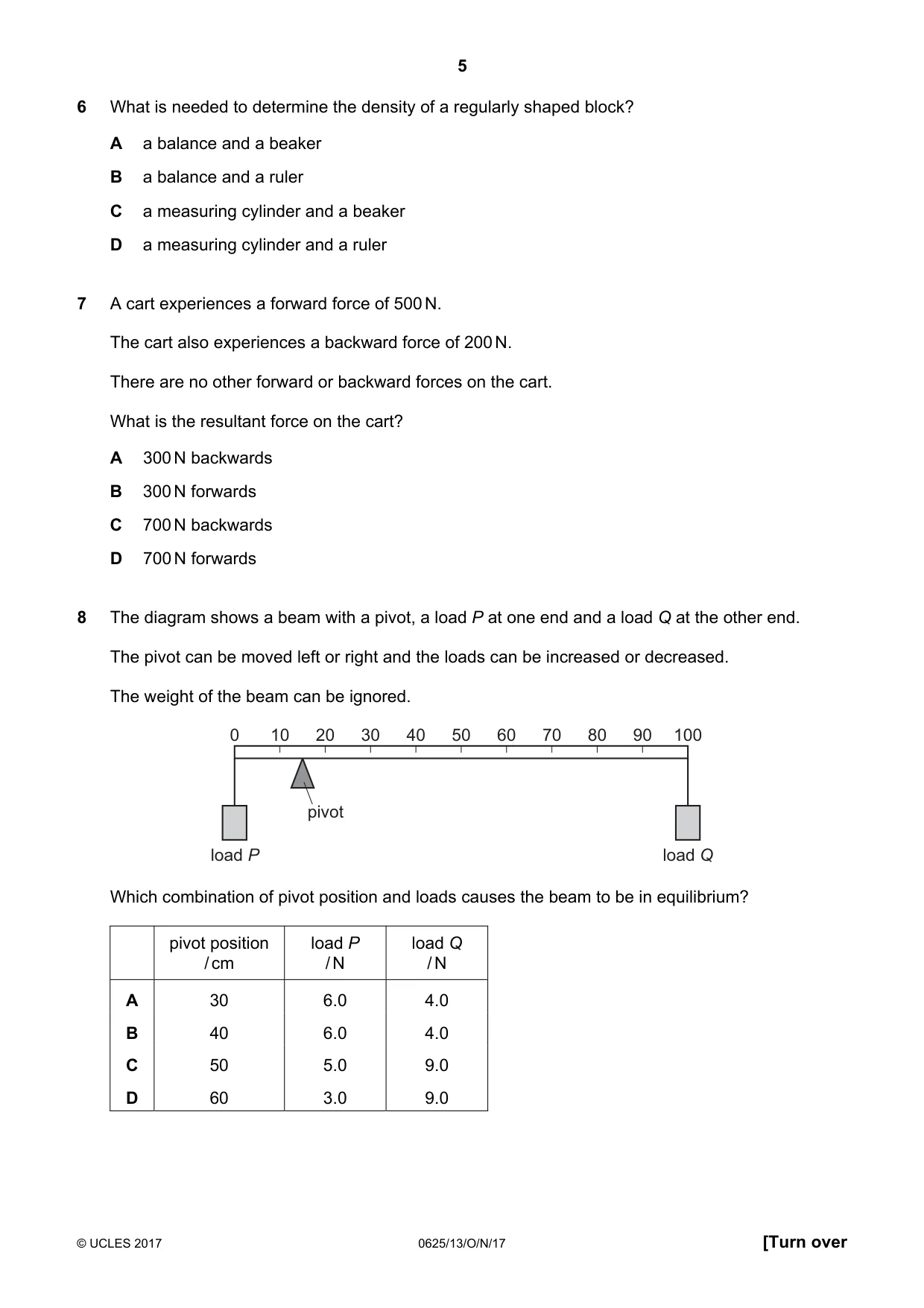
8 The diagram shows a beam with a pivot, a load P at one end and a load Q at the other end. The pivot can be moved left or right and the loads can be increased or decreased. The weight of the beam can be ignored. 0 10 20 30 40 50 60 70 80 90 100 pivot load P load Q Which combination of pivot position and loads causes the beam to be in equilibrium? pivot position load P load Q / cm / N / N A 30 6.0 4.0 B 40 6.0 4.0 C 50 5.0 9.0 D 60 3.0 9.0
Mark scheme: B
Q9 · The lamp in the diagram is not very stable and falls over easily
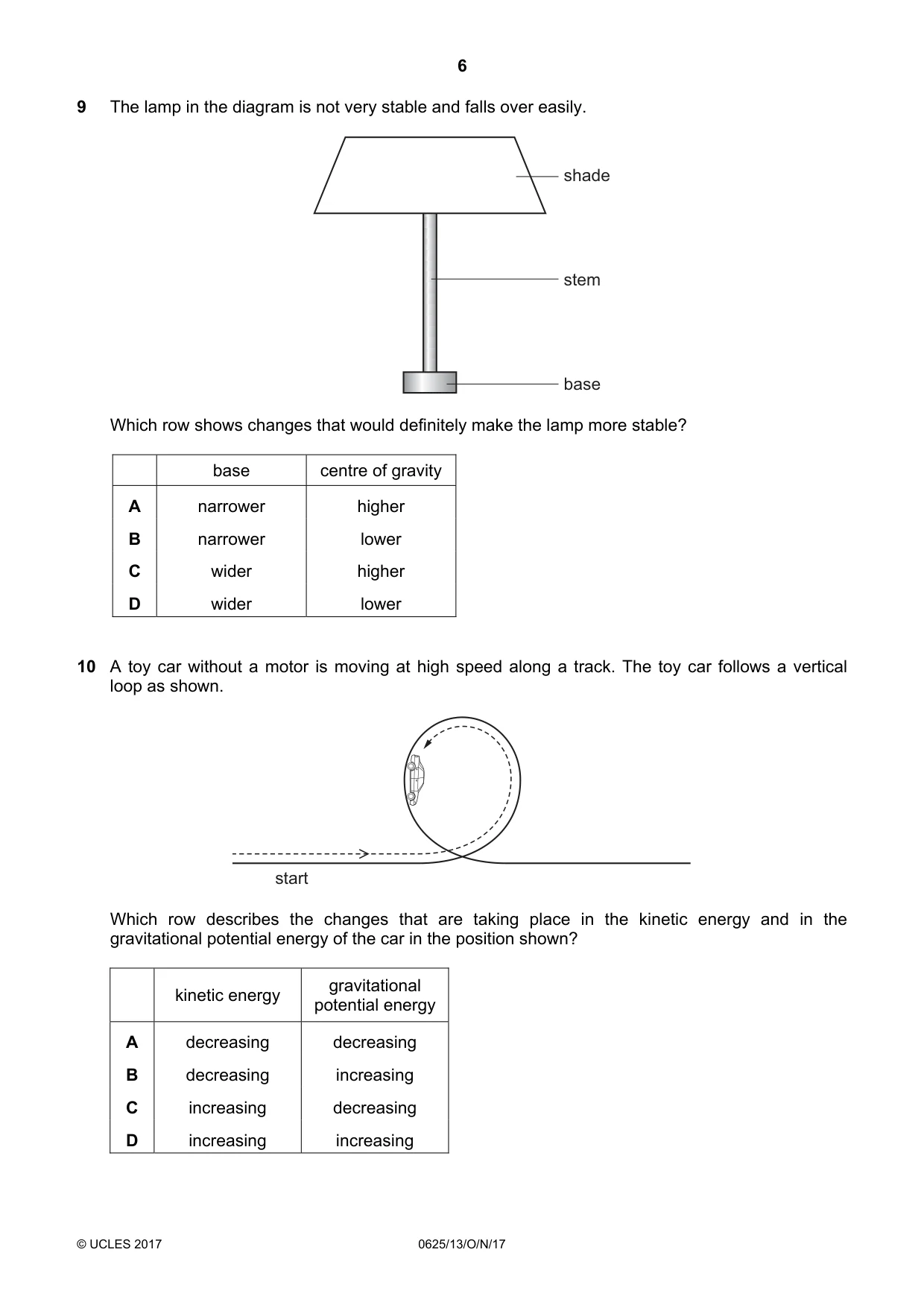
9 The lamp in the diagram is not very stable and falls over easily. shade stem base Which row shows changes that would definitely make the lamp more stable? base centre of gravity A narrower higher B narrower lower C wider higher D wider lower
Mark scheme: D
Q10 · A toy car without a motor is moving at high speed along a track
10 A toy car without a motor is moving at high speed along a track. The toy car follows a vertical loop as shown. start Which row describes the changes that are taking place in the kinetic energy and in the gravitational potential energy of the car in the position shown? gravitational kinetic energy potential energy A decreasing decreasing B decreasing increasing C increasing decreasing D increasing increasing
Mark scheme: C
Q11 · A student runs up a flight of stairs
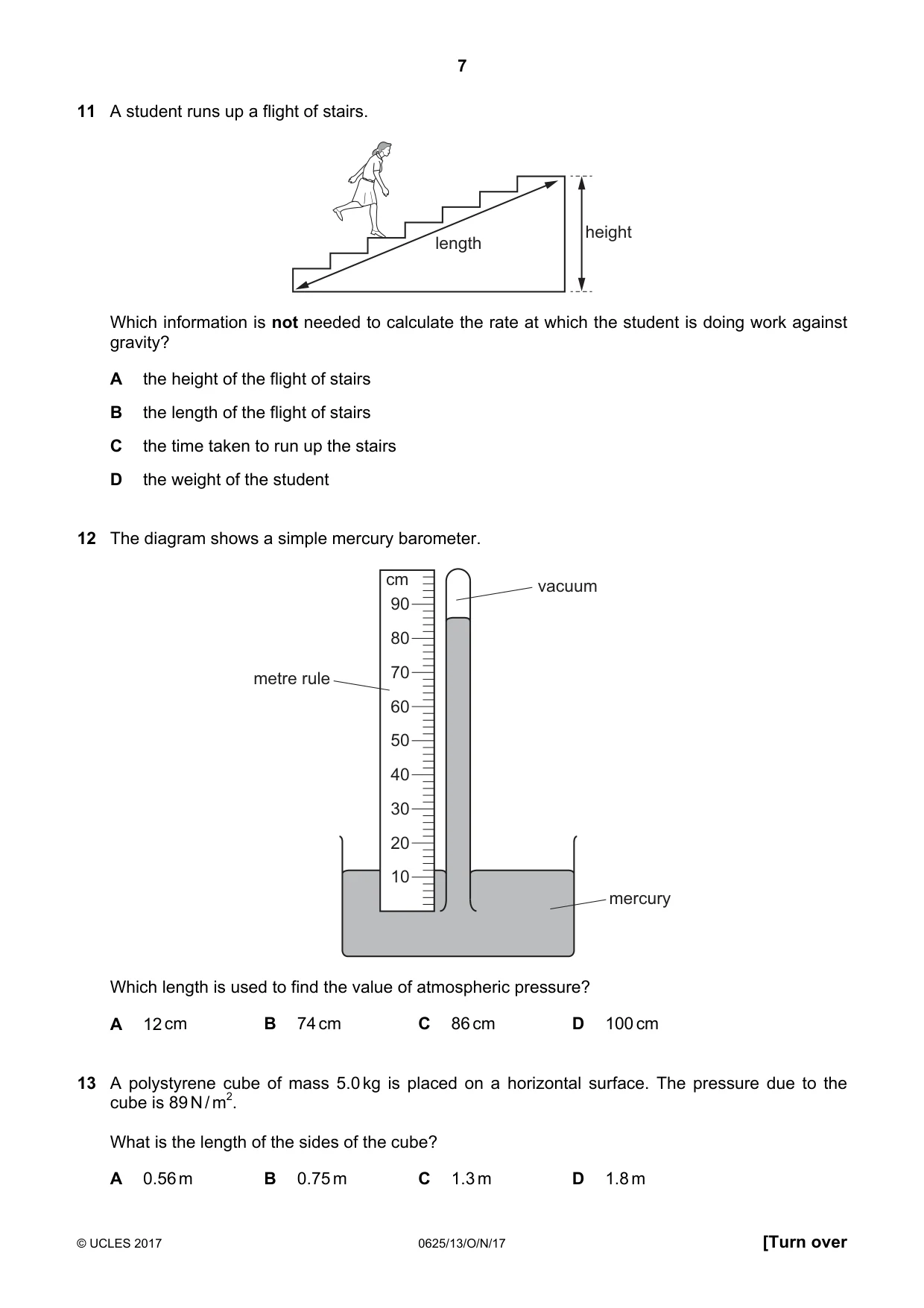
11 A student runs up a flight of stairs. height length Which information is not needed to calculate the rate at which the student is doing work against gravity? A the height of the flight of stairs B the length of the flight of stairs C the time taken to run up the stairs D the weight of the student
Mark scheme: B
Q12 · The diagram shows a simple mercury barometer
12 The diagram shows a simple mercury barometer. cm vacuum 90 80 metre rule 70 60 50 40 30 20 10 mercury Which length is used to find the value of atmospheric pressure? A 12 cm B 74 cm C 86 cm D 100 cm
Mark scheme: B
Q13 · A polystyrene cube of mass 5.0 kg is placed on a horizontal surface
13 A polystyrene cube of mass 5.0 kg is placed on a horizontal surface. The pressure due to the cube is 89 N / m2. What is the length of the sides of the cube? A 0.56 m B 0.75 m C 1.3 m D 1.8 m
Mark scheme: B
Q14 · A pollen grain in a beaker of still water is viewed through a microscope
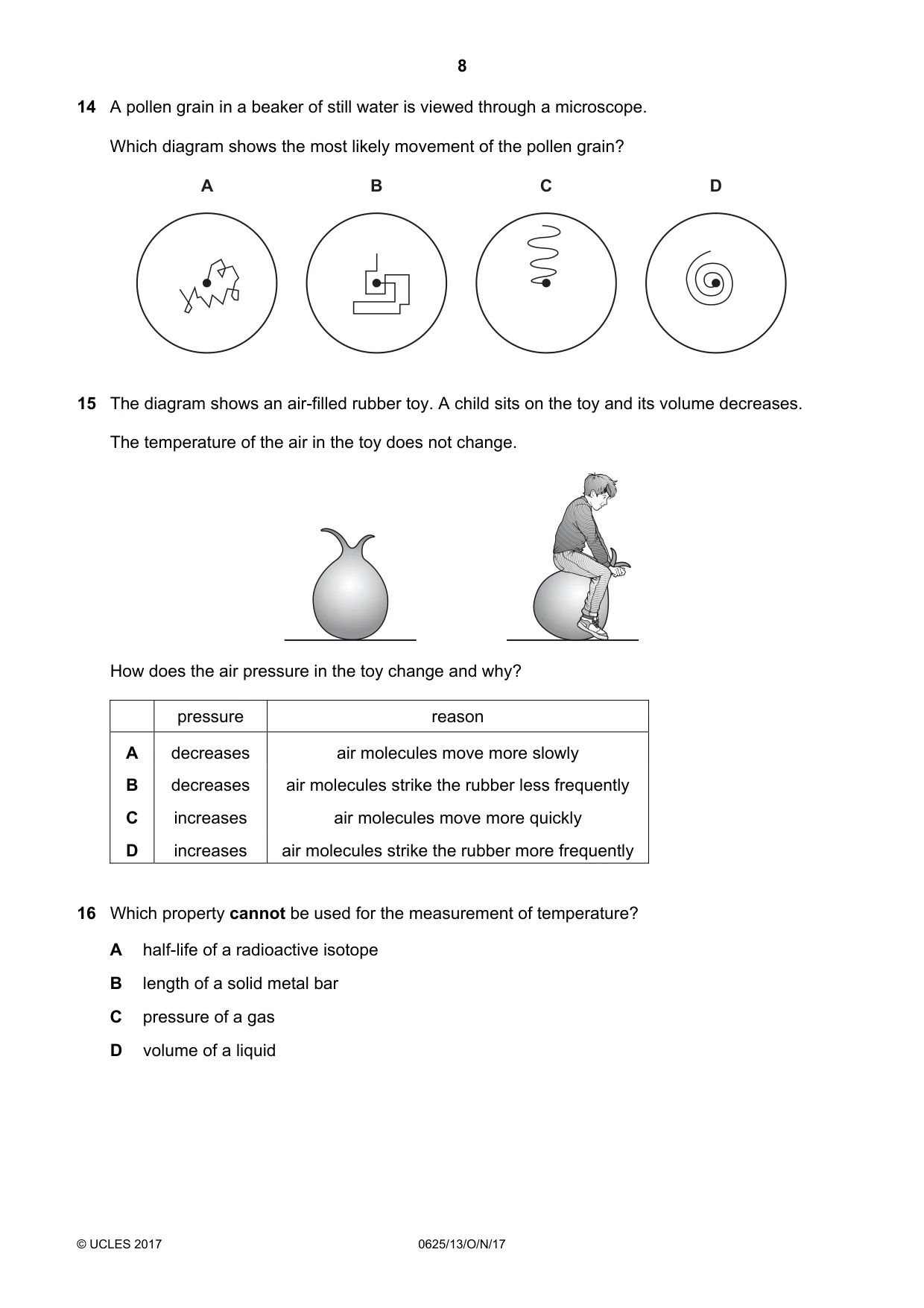
14 A pollen grain in a beaker of still water is viewed through a microscope. Which diagram shows the most likely movement of the pollen grain? A B C D
Mark scheme: A
Q15 · The diagram shows an air-filled rubber toy
15 The diagram shows an air-filled rubber toy. A child sits on the toy and its volume decreases. The temperature of the air in the toy does not change. How does the air pressure in the toy change and why? pressure reason A decreases air molecules move more slowly B decreases air molecules strike the rubber less frequently C increases air molecules move more quickly D increases air molecules strike the rubber more frequently
Mark scheme: D
Q16 · Which property cannot be used for the measurement of temperature?
16 Which property cannot be used for the measurement of temperature? A half-life of a radioactive isotope B length of a solid metal bar C pressure of a gas D volume of a liquid
Mark scheme: A
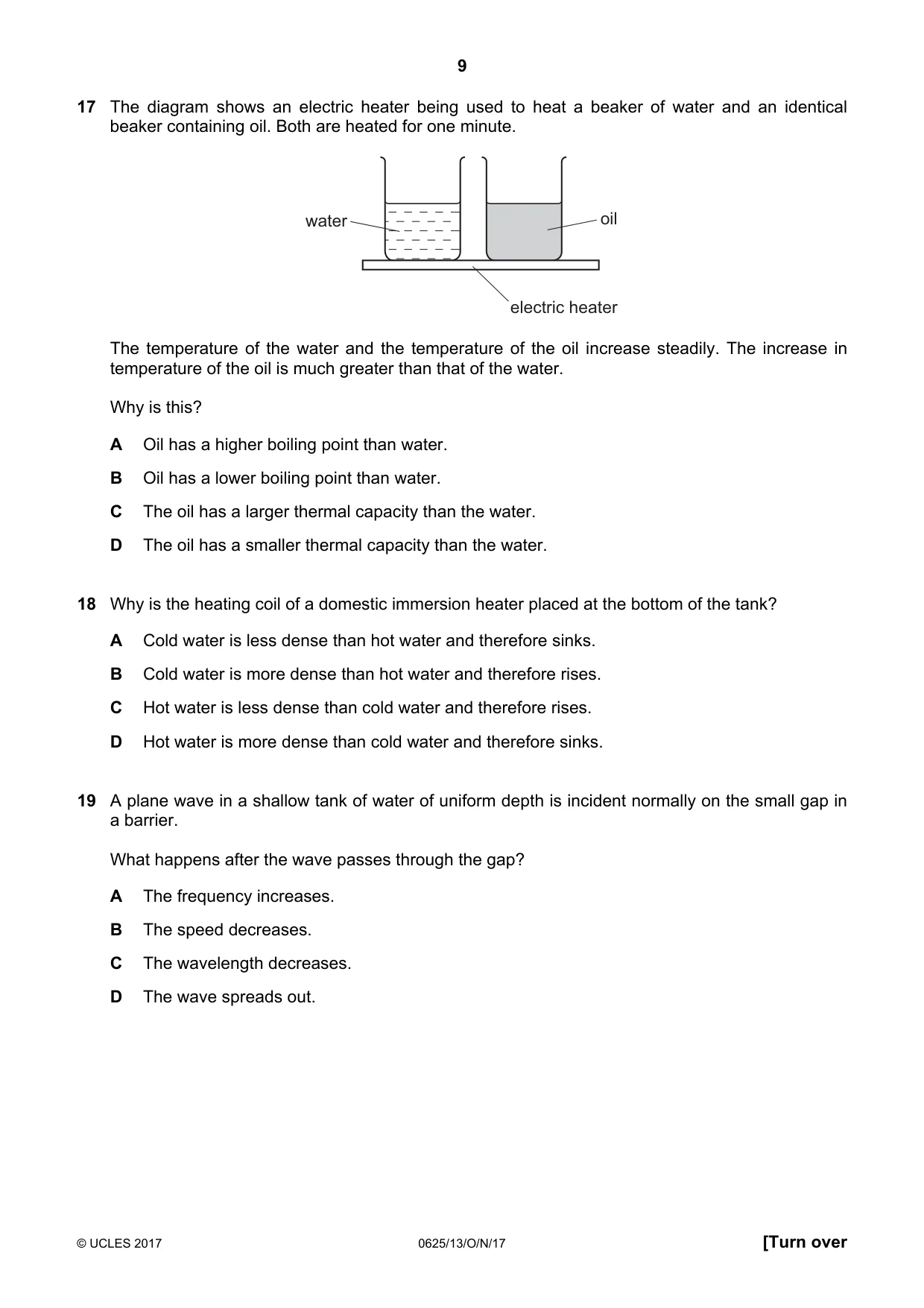
Q17 · The diagram shows an electric heater being used to heat a beaker of water and an…
17 The diagram shows an electric heater being used to heat a beaker of water and an identical beaker containing oil. Both are heated for one minute. water oil electric heater The temperature of the water and the temperature of the oil increase steadily. The increase in temperature of the oil is much greater than that of the water. Why is this? A Oil has a higher boiling point than water. B Oil has a lower boiling point than water. C The oil has a larger thermal capacity than the water. D The oil has a smaller thermal capacity than the water.
Mark scheme: D
Q18 · Why is the heating coil of a domestic immersion heater placed at the bottom of the tank?
18 Why is the heating coil of a domestic immersion heater placed at the bottom of the tank? A Cold water is less dense than hot water and therefore sinks. B Cold water is more dense than hot water and therefore rises. C Hot water is less dense than cold water and therefore rises. D Hot water is more dense than cold water and therefore sinks.
Mark scheme: C
Q19 · A plane wave in a shallow tank of water of uniform depth is incident normally on the…
19 A plane wave in a shallow tank of water of uniform depth is incident normally on the small gap in a barrier. What happens after the wave passes through the gap? A The frequency increases. B The speed decreases. C The wavelength decreases. D The wave spreads out.
Mark scheme: D
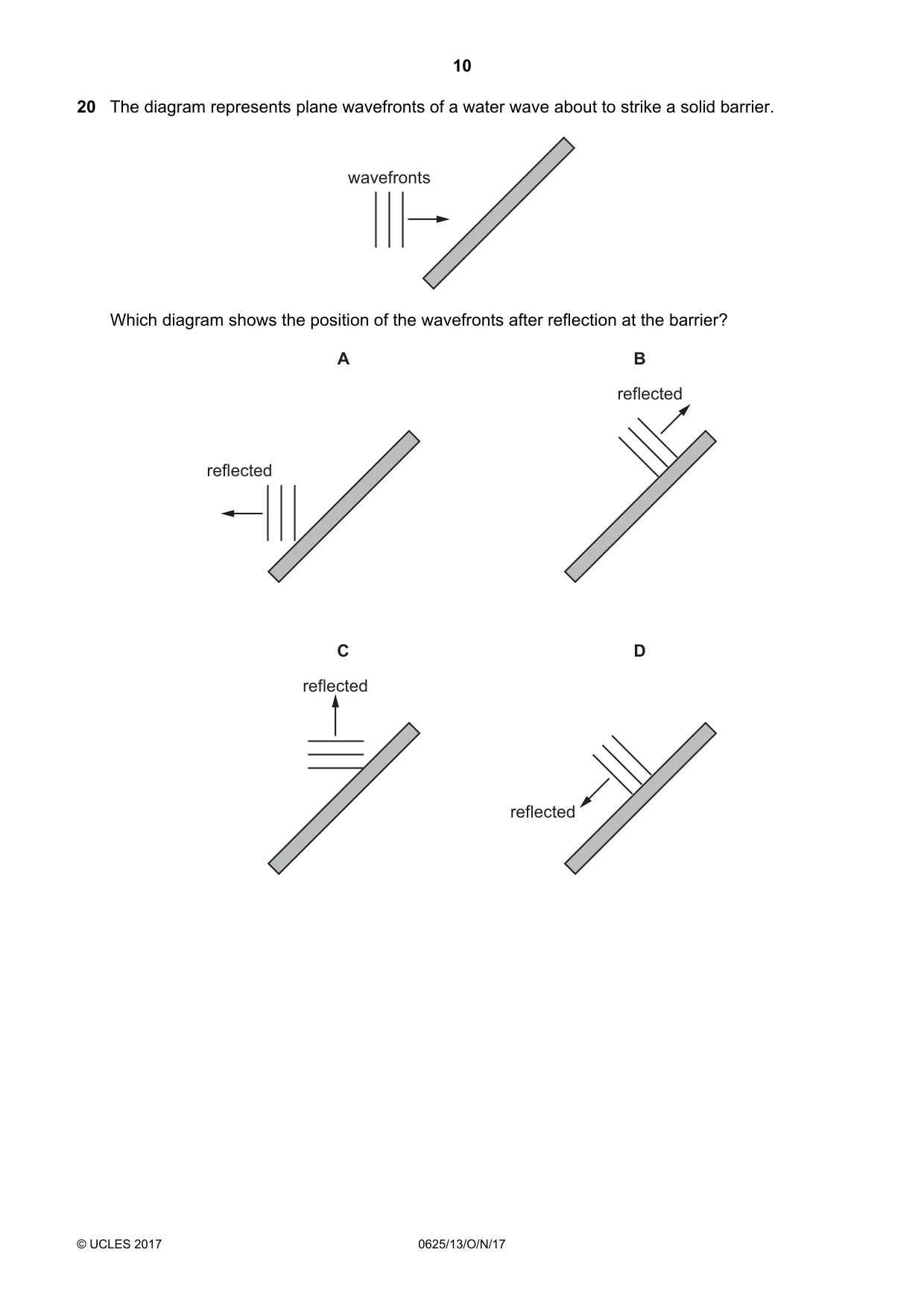
Q20 · The diagram represents plane wavefronts of a water wave about to strike a solid barrier
20 The diagram represents plane wavefronts of a water wave about to strike a solid barrier. wavefronts Which diagram shows the position of the wavefronts after reflection at the barrier? A B reflected reflected C D reflected reflected
Mark scheme: C
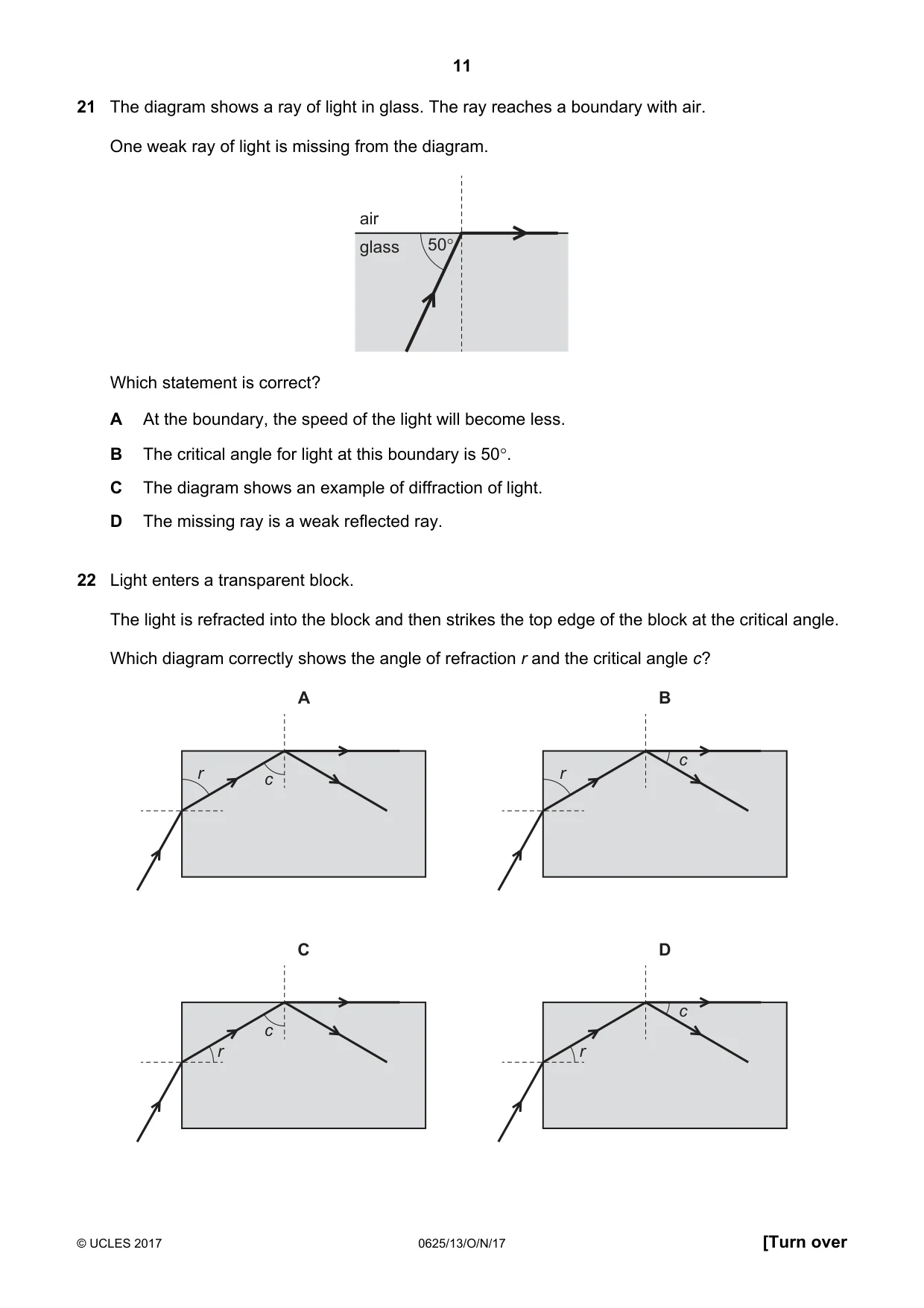
Q21 · The diagram shows a ray of light in glass
21 The diagram shows a ray of light in glass. The ray reaches a boundary with air. One weak ray of light is missing from the diagram. air glass 50° Which statement is correct? A At the boundary, the speed of the light will become less. B The critical angle for light at this boundary is 50°. C The diagram shows an example of diffraction of light. D The missing ray is a weak reflected ray.
Mark scheme: D
Q22 · Light enters a transparent block
22 Light enters a transparent block. The light is refracted into the block and then strikes the top edge of the block at the critical angle. Which diagram correctly shows the angle of refraction r and the critical angle c? A B c r c r C D c c r r
Mark scheme: C
Q23 · Which statement about radio waves is correct?
23 Which statement about radio waves is correct? A They are used in television remote controllers. B They can be detected by the human eye. C They travel as longitudinal waves. D They have the same speed in a vacuum as ultraviolet waves.
Mark scheme: D
Q24 · Which types of thermal energy transfer are due to electromagnetic waves?
24 Which types of thermal energy transfer are due to electromagnetic waves? A conduction and convection B convection and radiation C convection only D radiation only
Mark scheme: D
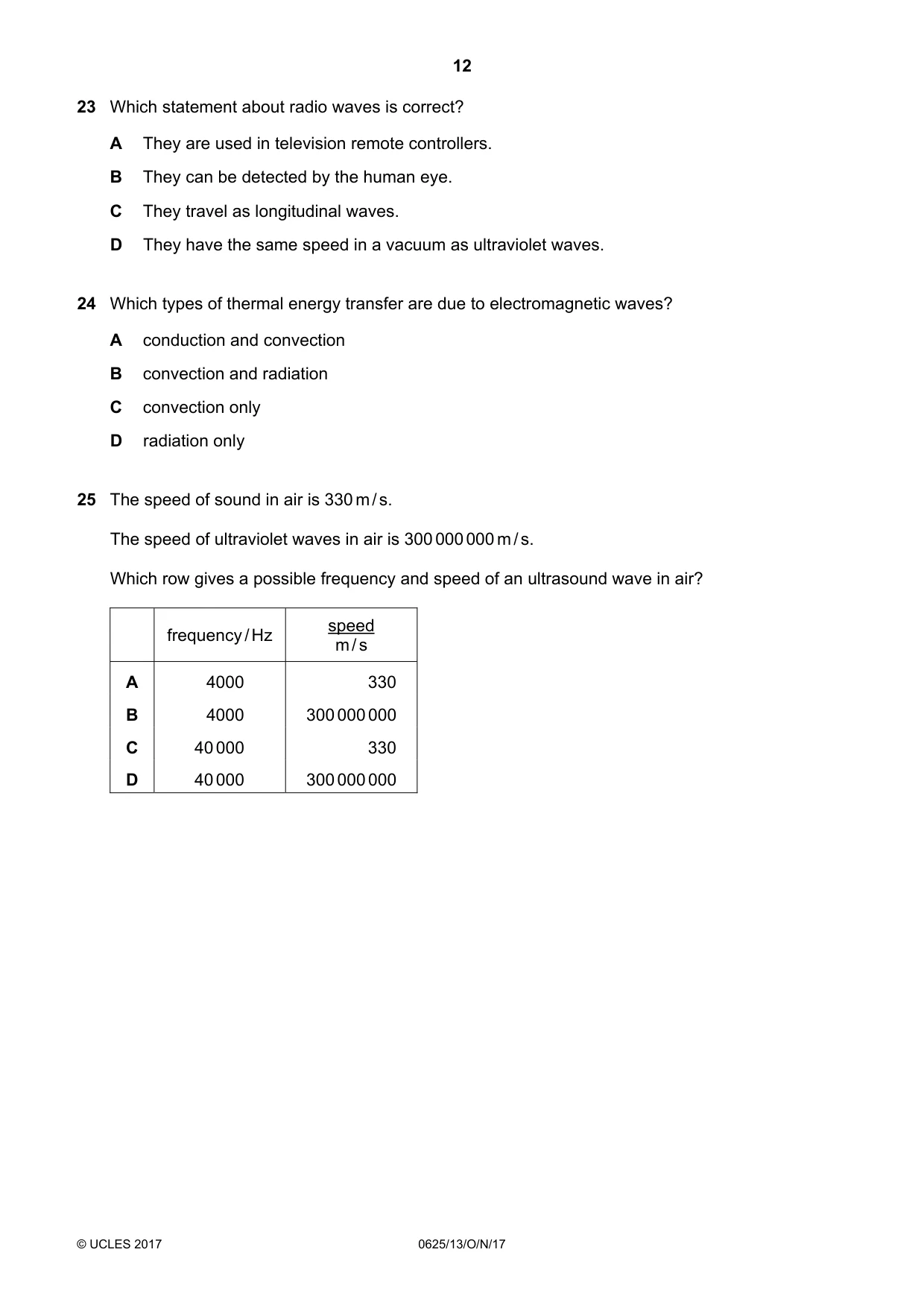
Q25 · The speed of sound in air is 330 m / s
25 The speed of sound in air is 330 m / s. The speed of ultraviolet waves in air is 300 000 000 m / s. Which row gives a possible frequency and speed of an ultrasound wave in air? speed frequency / Hz m / s A 4000 330 B 4000 300 000 000 C 40 000 330 D 40 000 300 000 000
Mark scheme: C
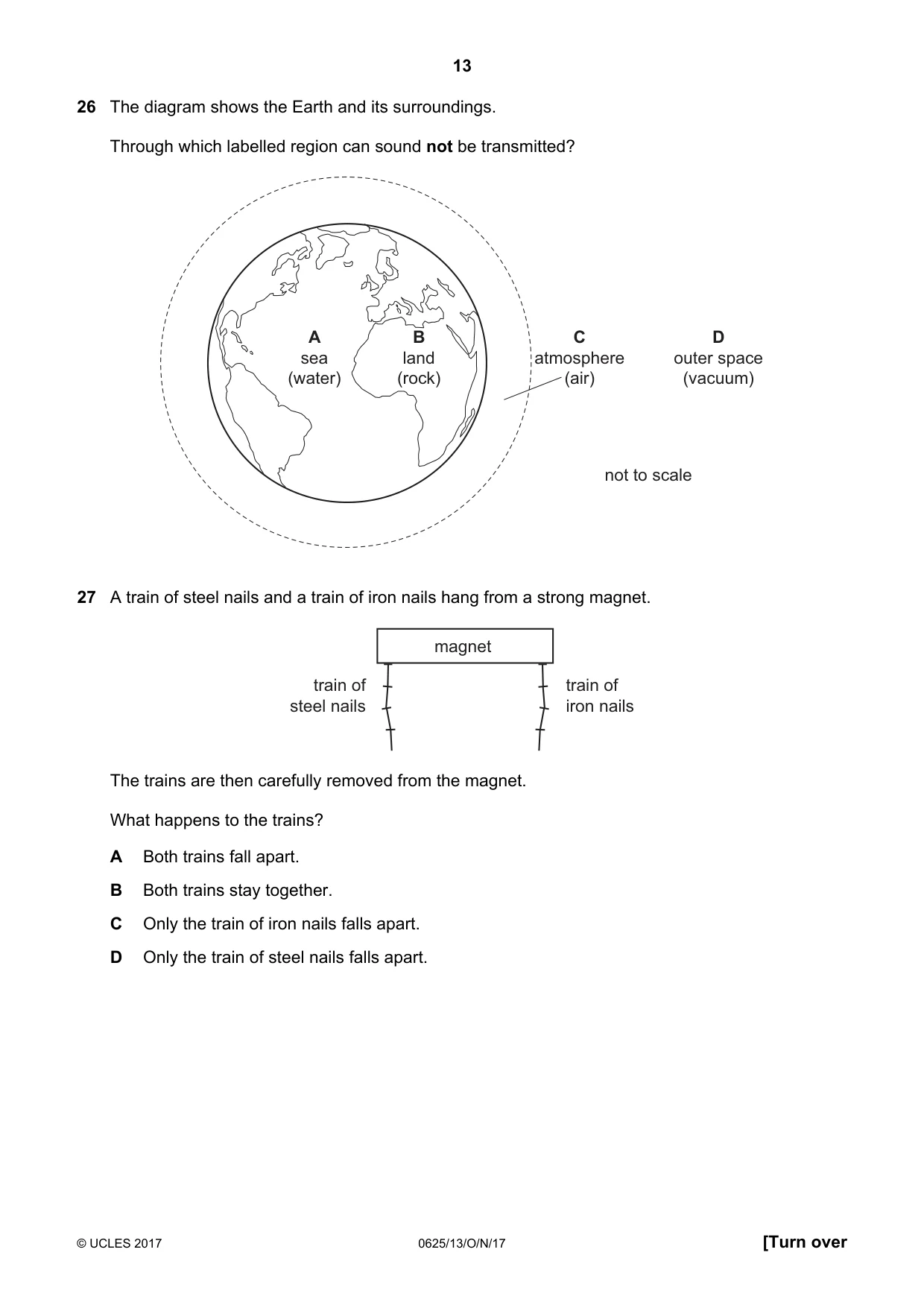
Q26 · The diagram shows the Earth and its surroundings
26 The diagram shows the Earth and its surroundings. Through which labelled region can sound not be transmitted? A B C D sea land atmosphere outer space (water) (rock) (air) (vacuum) not to scale
Mark scheme: D
Q27 · A train of steel nails and a train of iron nails hang from a strong magnet
27 A train of steel nails and a train of iron nails hang from a strong magnet. magnet train of train of steel nails iron nails The trains are then carefully removed from the magnet. What happens to the trains? A Both trains fall apart. B Both trains stay together. C Only the train of iron nails falls apart. D Only the train of steel nails falls apart.
Mark scheme: C
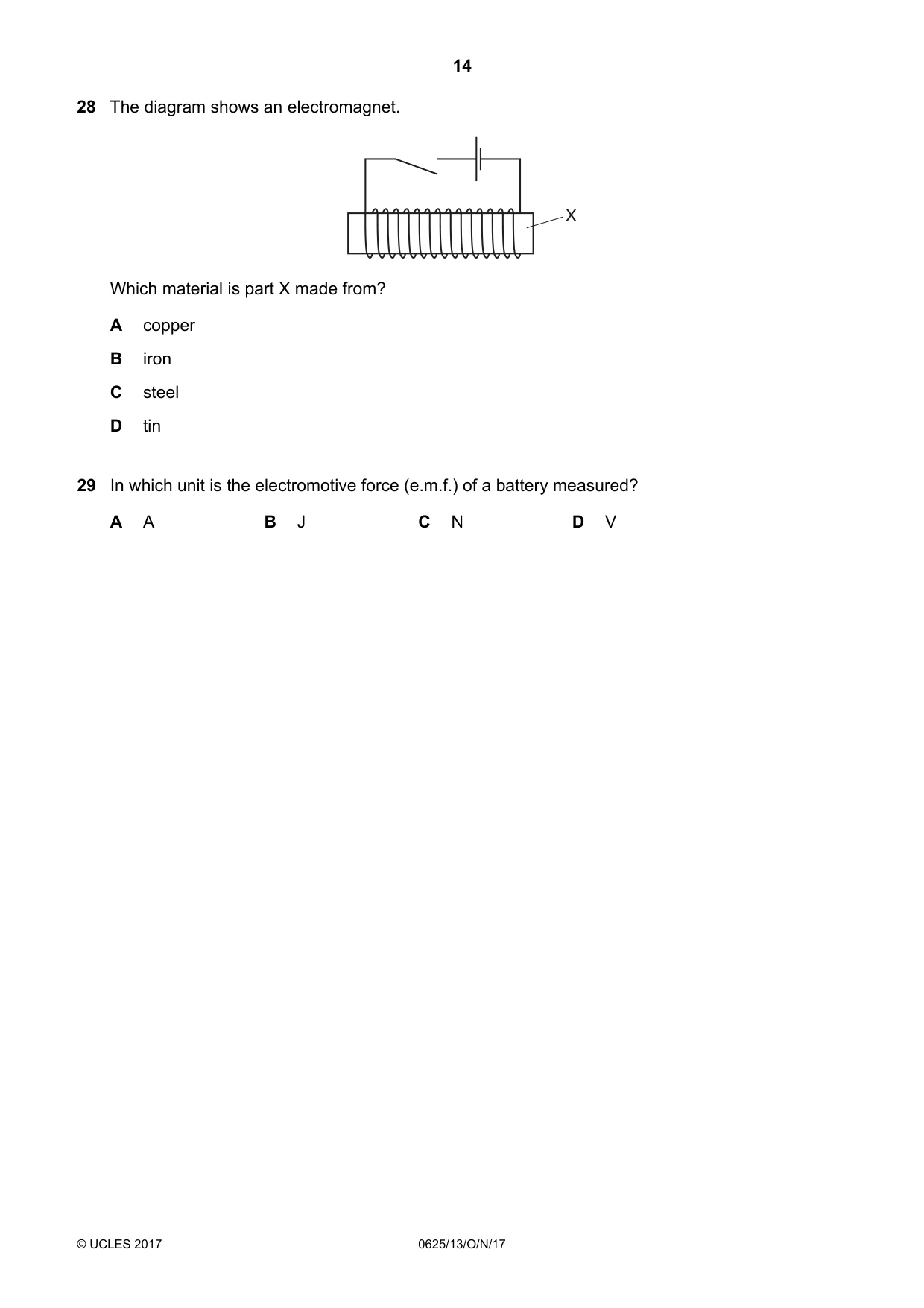
Q28 · The diagram shows an electromagnet
28 The diagram shows an electromagnet. X Which material is part X made from? A copper B iron C steel D tin
Mark scheme: B
Q29 · In which unit is the electromotive force (e.m.f.) of a battery measured?
29 In which unit is the electromotive force (e.m.f.) of a battery measured? A A B J C N D V
Mark scheme: D
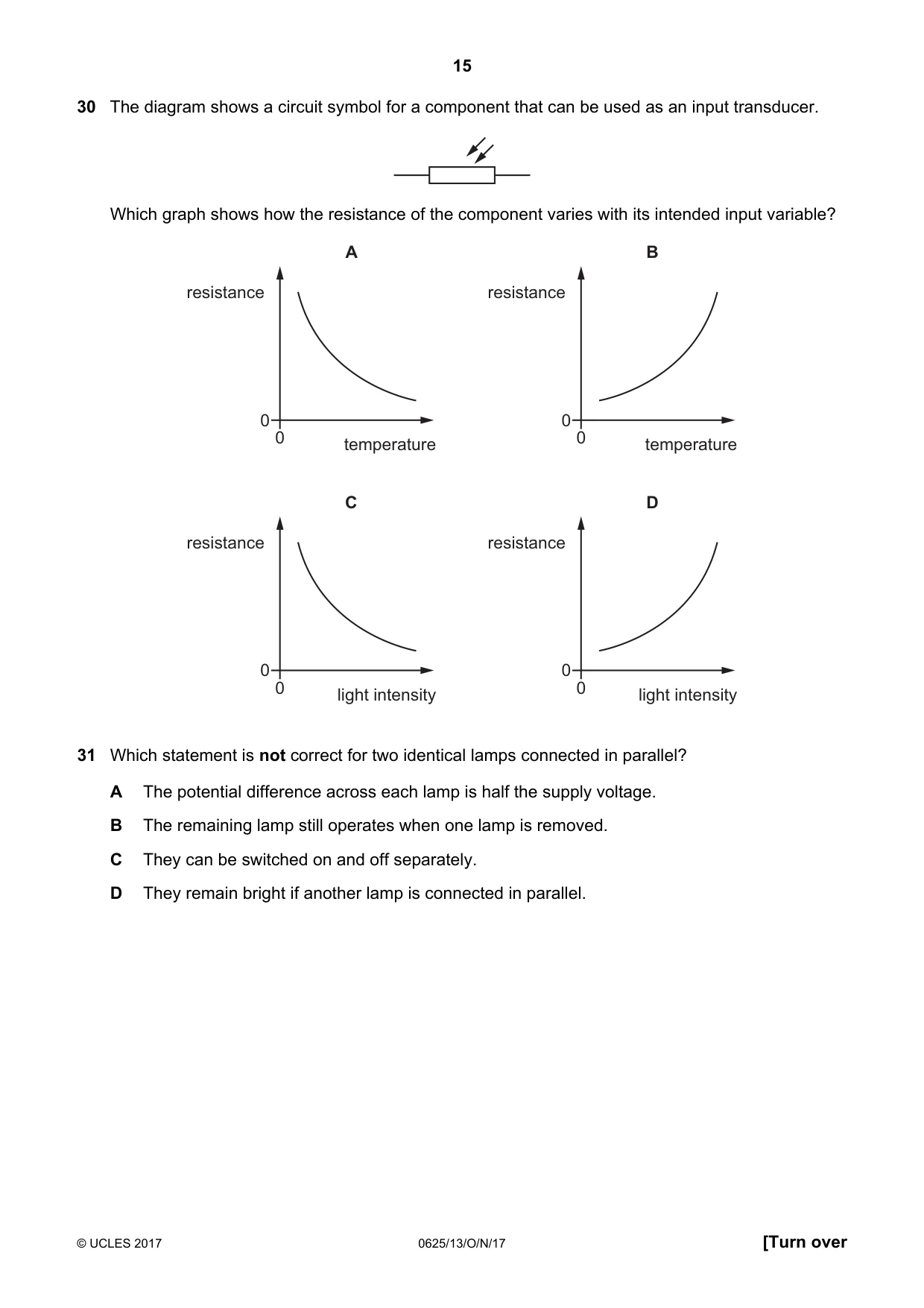
Q30 · The diagram shows a circuit symbol for a component that can be used as an input transducer
30 The diagram shows a circuit symbol for a component that can be used as an input transducer. Which graph shows how the resistance of the component varies with its intended input variable? A B resistance resistance 0 0 0 temperature 0 temperature C D resistance resistance 0 0 0 light intensity 0 light intensity
Mark scheme: C
Q31 · Which statement is not correct for two identical lamps connected in parallel?
31 Which statement is not correct for two identical lamps connected in parallel? A The potential difference across each lamp is half the supply voltage. B The remaining lamp still operates when one lamp is removed. C They can be switched on and off separately. D They remain bright if another lamp is connected in parallel.
Mark scheme: A
Q32 · Only one of the ammeters in the circuit is showing an incorrect reading
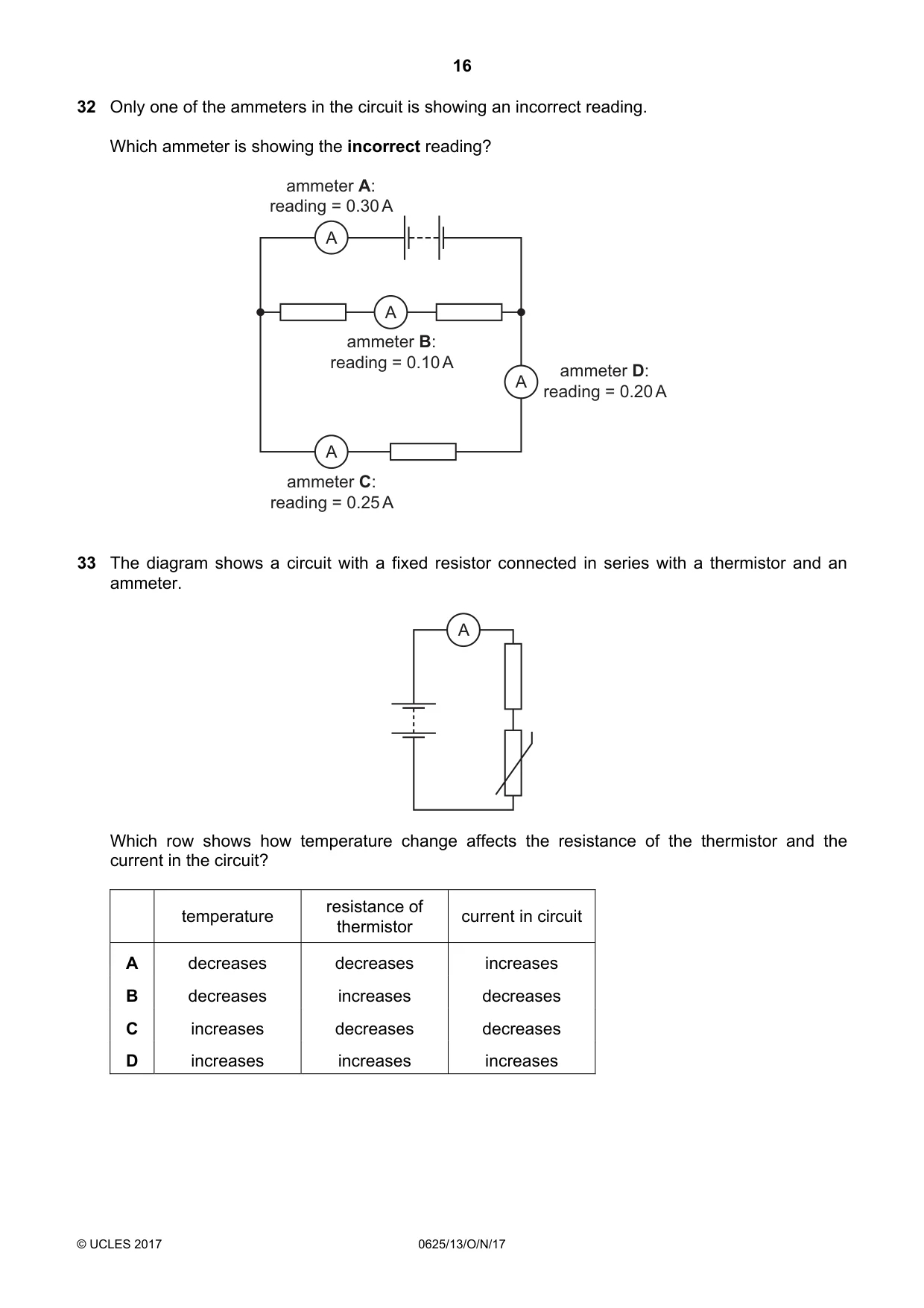
32 Only one of the ammeters in the circuit is showing an incorrect reading. Which ammeter is showing the incorrect reading? ammeter A: reading = 0.30 A A A ammeter B: reading = 0.10 A ammeter D: A reading = 0.20 A A ammeter C: reading = 0.25 A
Mark scheme: C
Q33 · The diagram shows a circuit with a fixed resistor connected in series with a thermistor…
33 The diagram shows a circuit with a fixed resistor connected in series with a thermistor and an ammeter. A Which row shows how temperature change affects the resistance of the thermistor and the current in the circuit? resistance of temperature current in circuit thermistor A decreases decreases increases B decreases increases decreases C increases decreases decreases D increases increases increases
Mark scheme: B
Q34 · An appliance is connected to a mains supply
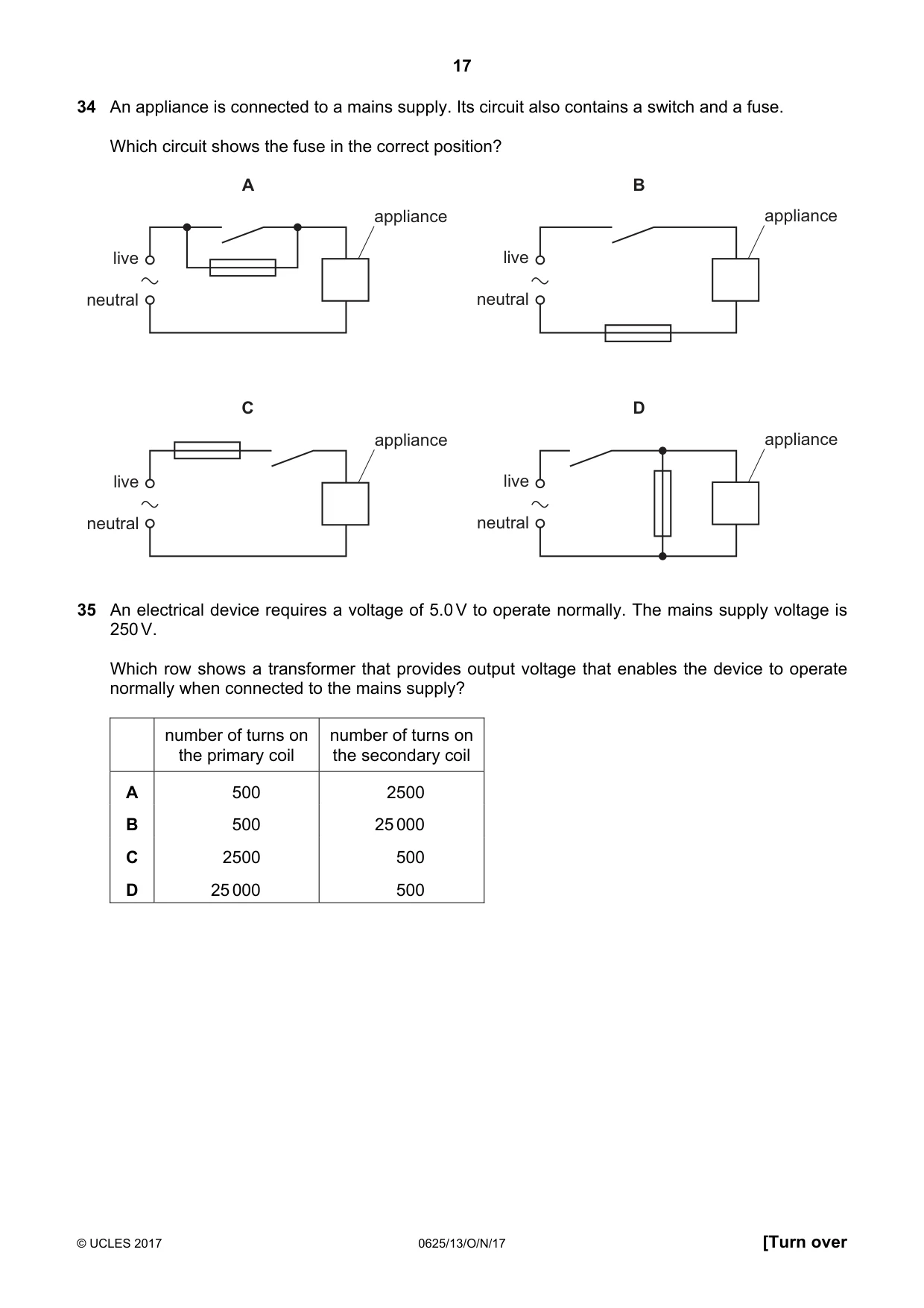
34 An appliance is connected to a mains supply. Its circuit also contains a switch and a fuse. Which circuit shows the fuse in the correct position? A B appliance appliance live live neutral neutral C D appliance appliance live live neutral neutral
Mark scheme: C
Q35 · An electrical device requires a voltage of 5.0 V to operate normally
35 An electrical device requires a voltage of 5.0 V to operate normally. The mains supply voltage is 250 V. Which row shows a transformer that provides output voltage that enables the device to operate normally when connected to the mains supply? number of turns on number of turns on the primary coil the secondary coil A 500 2500 B 500 25 000 C 2500 500 D 25 000 500
Mark scheme: D
Q36 · A straight current-carrying wire has a magnetic field around it
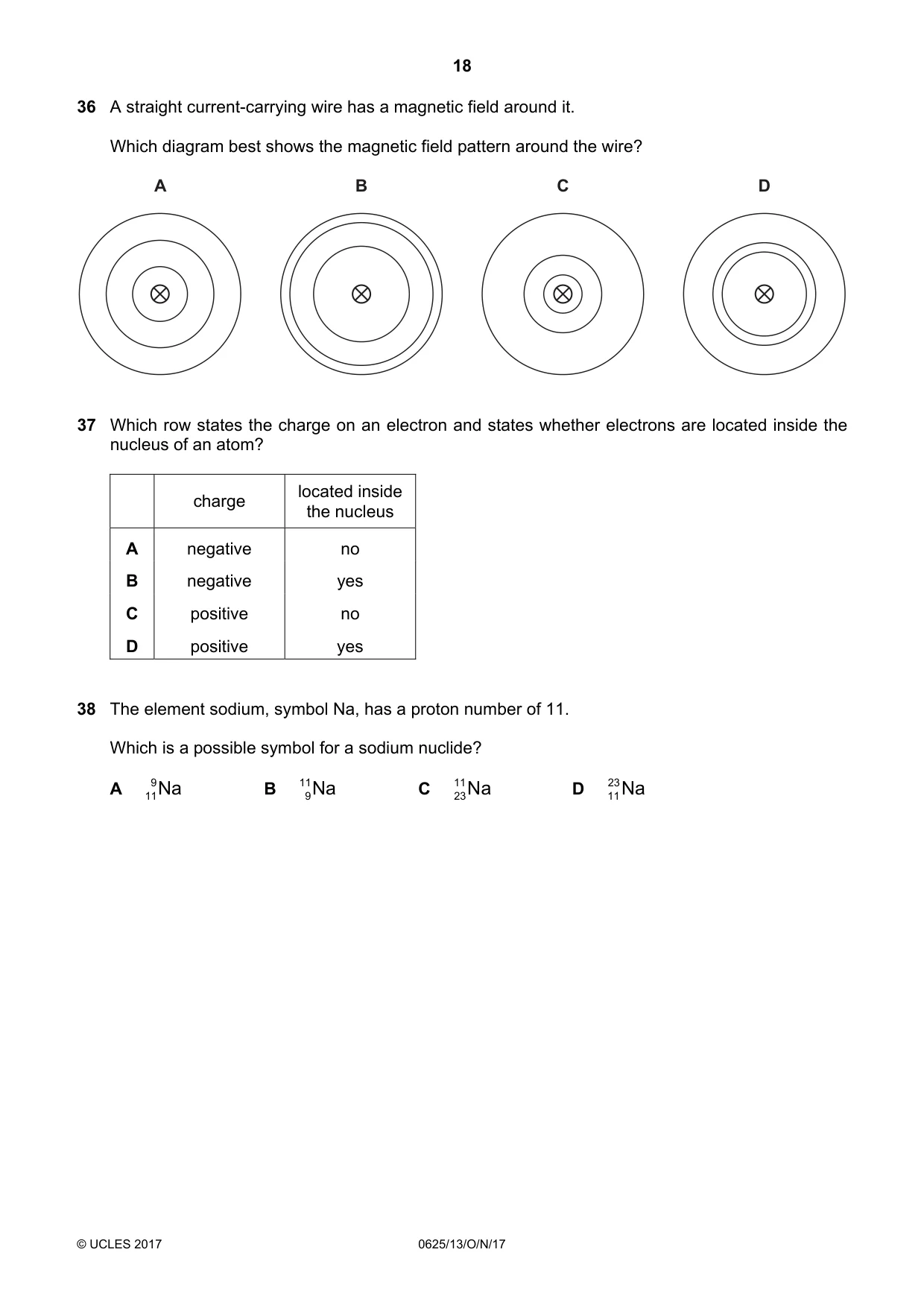
36 A straight current-carrying wire has a magnetic field around it. Which diagram best shows the magnetic field pattern around the wire? A B C D
Mark scheme: C
Q37 · Which row states the charge on an electron and states whether electrons are located…
37 Which row states the charge on an electron and states whether electrons are located inside the nucleus of an atom? located inside charge the nucleus A negative no B negative yes C positive no D positive yes
Mark scheme: A
Q38 · The element sodium, symbol Na, has a proton number of 11
38 The element sodium, symbol Na, has a proton number of 11. Which is a possible symbol for a sodium nuclide? A 9 Na B 11 Na C 11 Na D 23 Na 11 9 23 11
Mark scheme: D
Q39 · A radioactive source emits three types of radiation R, S and T
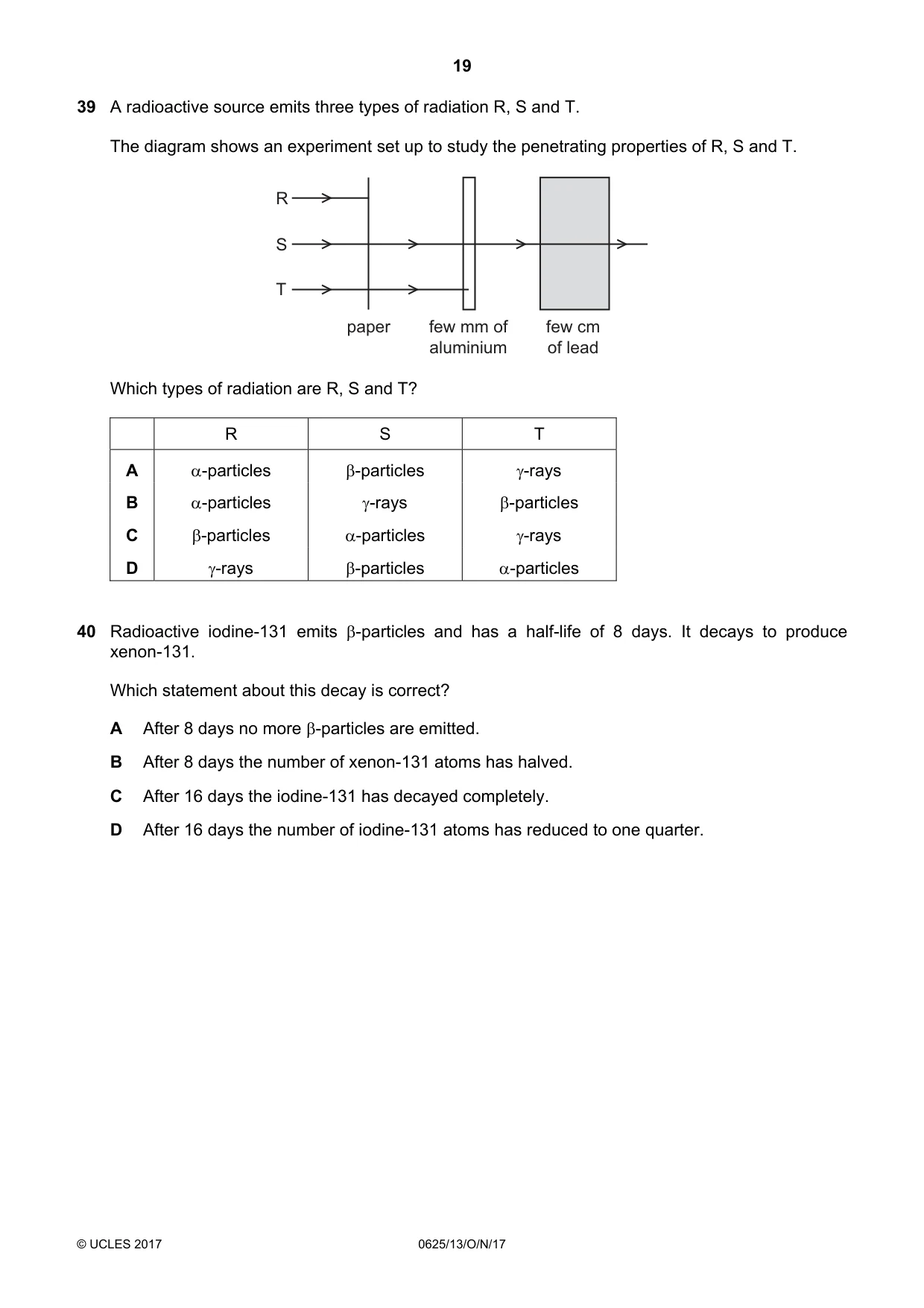
39 A radioactive source emits three types of radiation R, S and T. The diagram shows an experiment set up to study the penetrating properties of R, S and T. R S T paper few mm of few cm aluminium of lead Which types of radiation are R, S and T? R S T A α-particles β-particles γ-rays B α-particles γ-rays β-particles C β-particles α-particles γ-rays D γ-rays β-particles α-particles
Mark scheme: B
Q40 · Radioactive iodine-131 emits β-particles and has a half-life of 8 days
40 Radioactive iodine-131 emits β-particles and has a half-life of 8 days. It decays to produce xenon-131. Which statement about this decay is correct? A After 8 days no more β-particles are emitted. B After 8 days the number of xenon-131 atoms has halved. C After 16 days the iodine-131 has decayed completely. D After 16 days the number of iodine-131 atoms has reduced to one quarter.
Mark scheme: D
What was in this paper
The subtopics covered by these 40 questions, and how many questions each got. Open one in a new tab to see every Cambridge question on it.
4Forces4Electromagnetic effects2Energy, work and power2General properties of waves2Kinetic particle model of matter2Light2Motion2Pressure2Radioactivity2Simple phenomena of magnetism2Sound2The nuclear model of the atom2Thermal properties and temperature2Transfer of thermal energy2Density1Electrical quantities1Electrical safety1Electromagnetic spectrum1Mass and weight1Physical quantities and measurement techniques1What you needed in this session
Cambridge’s own grade thresholds for 2017 Oct/Nov, Paper 1 · Variant 3. A higher threshold means an easier paper — the bar moves with how the cohort did.