Cambridge IGCSE Physics 0625 — 2007 Oct/Nov Paper 1 · Variant 1
0625/11/O/N/07 · 40 questions · 40 marks · ≈45 min
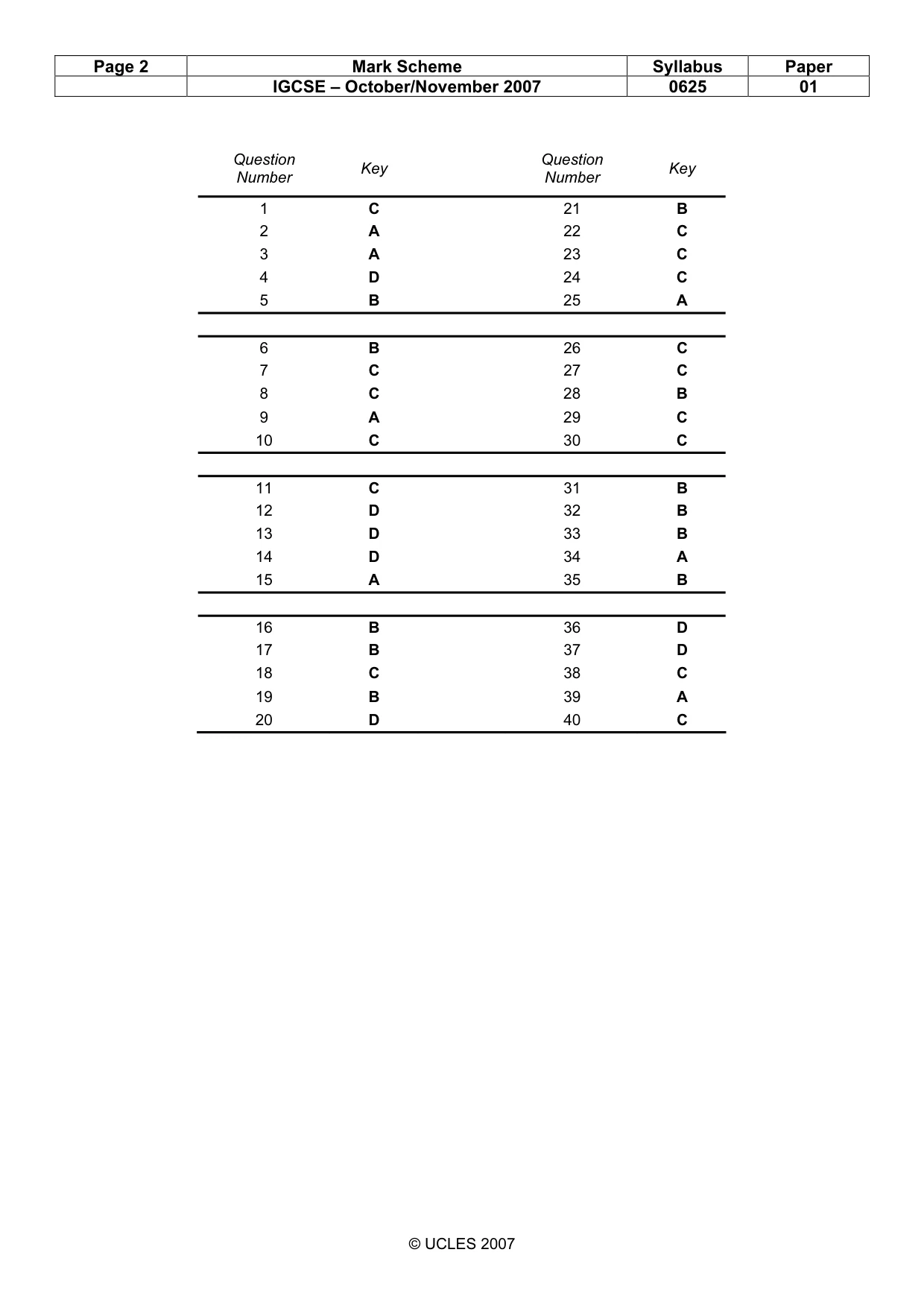
The question paper and its mark scheme, free to read here and free to download. This is Cambridge’s own paper, exactly as it was sat.
Question paper20 pages
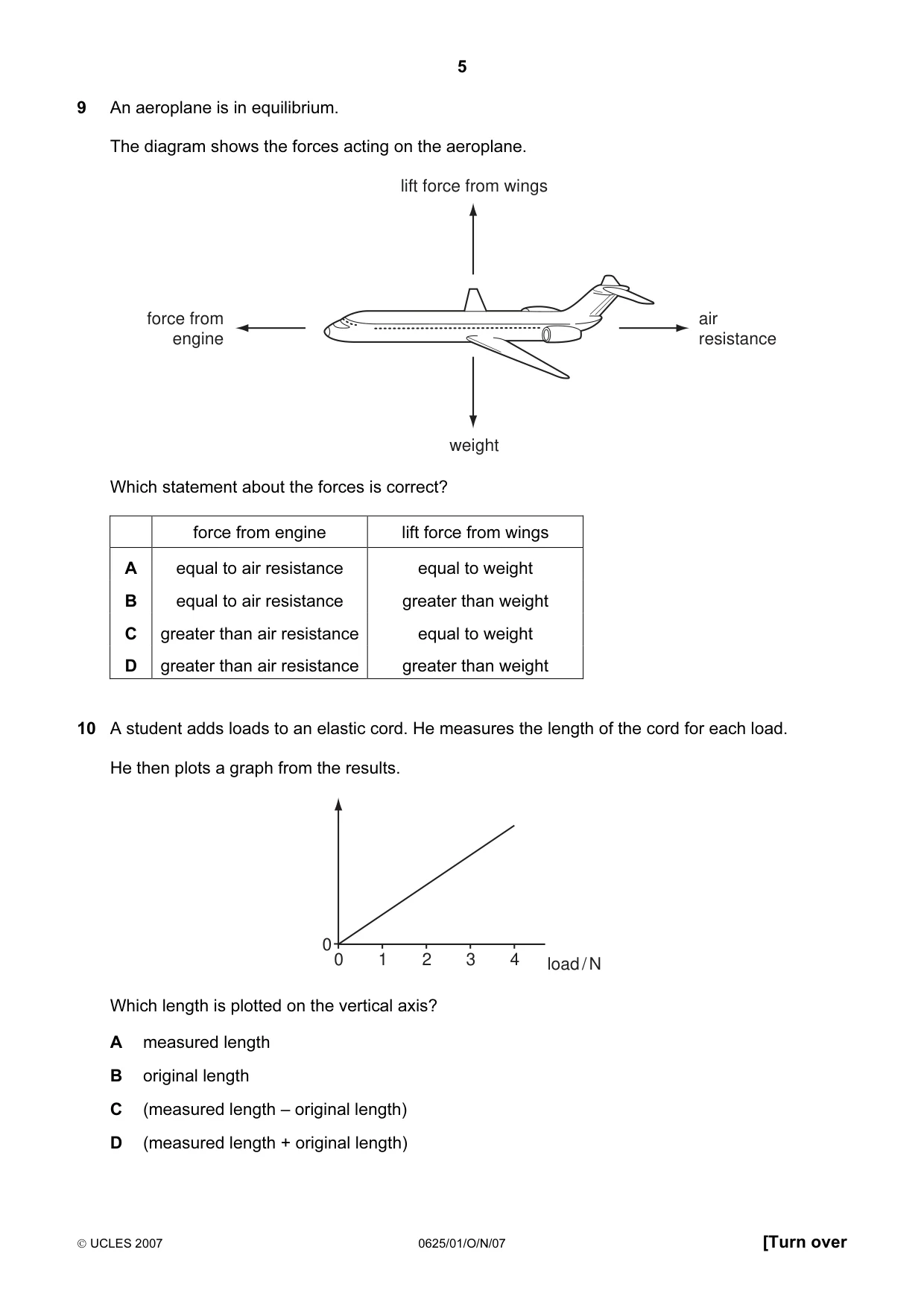
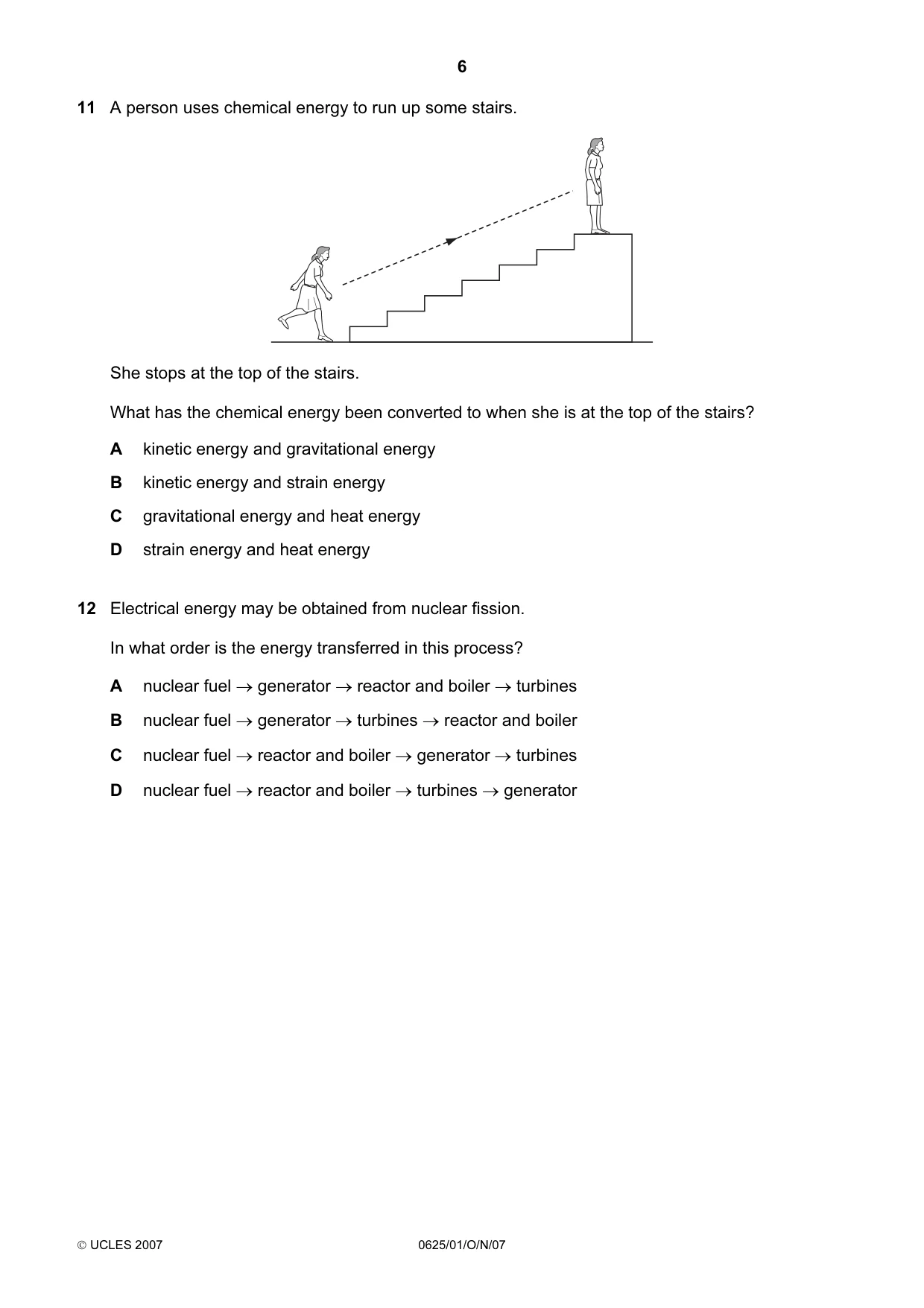
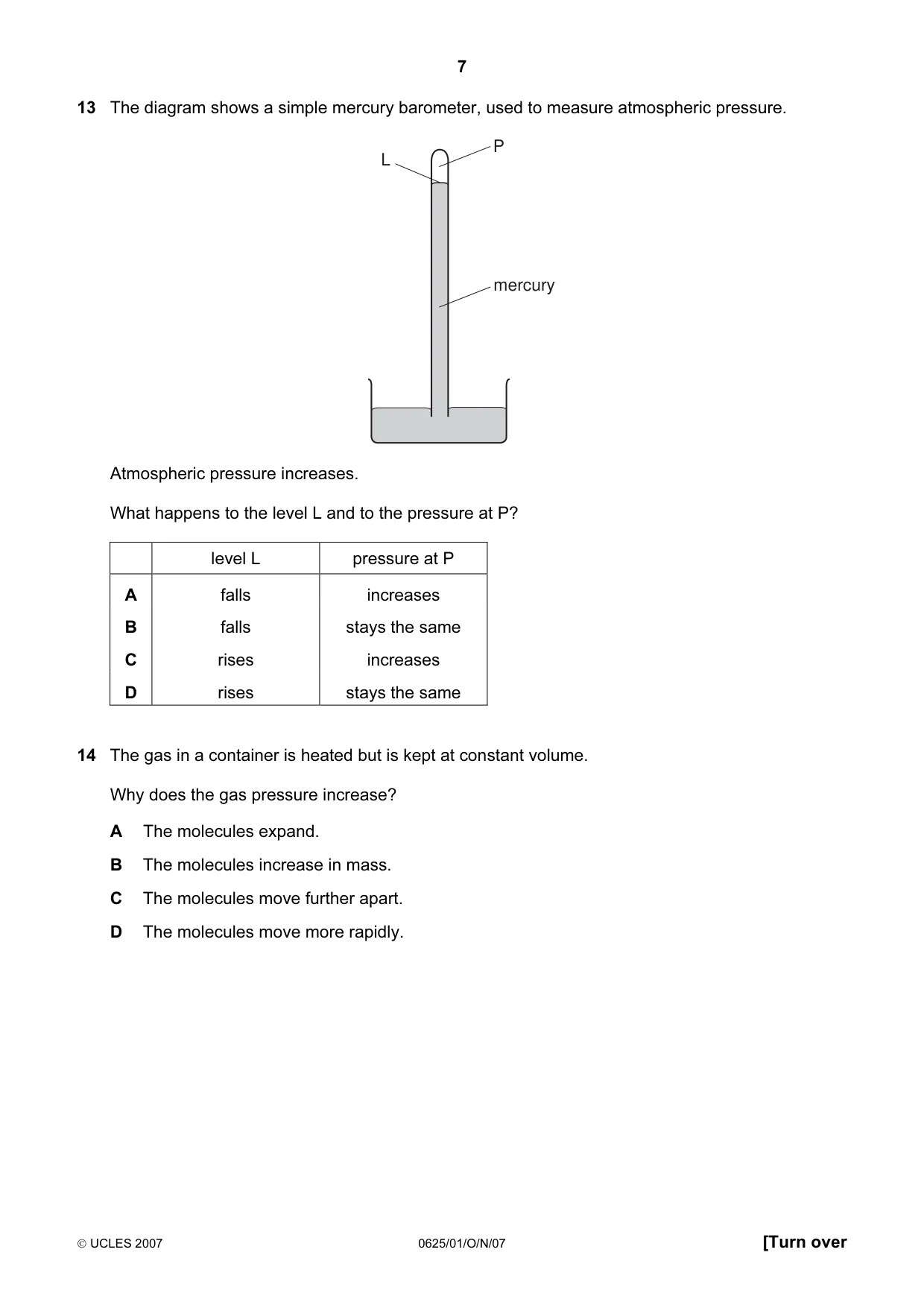
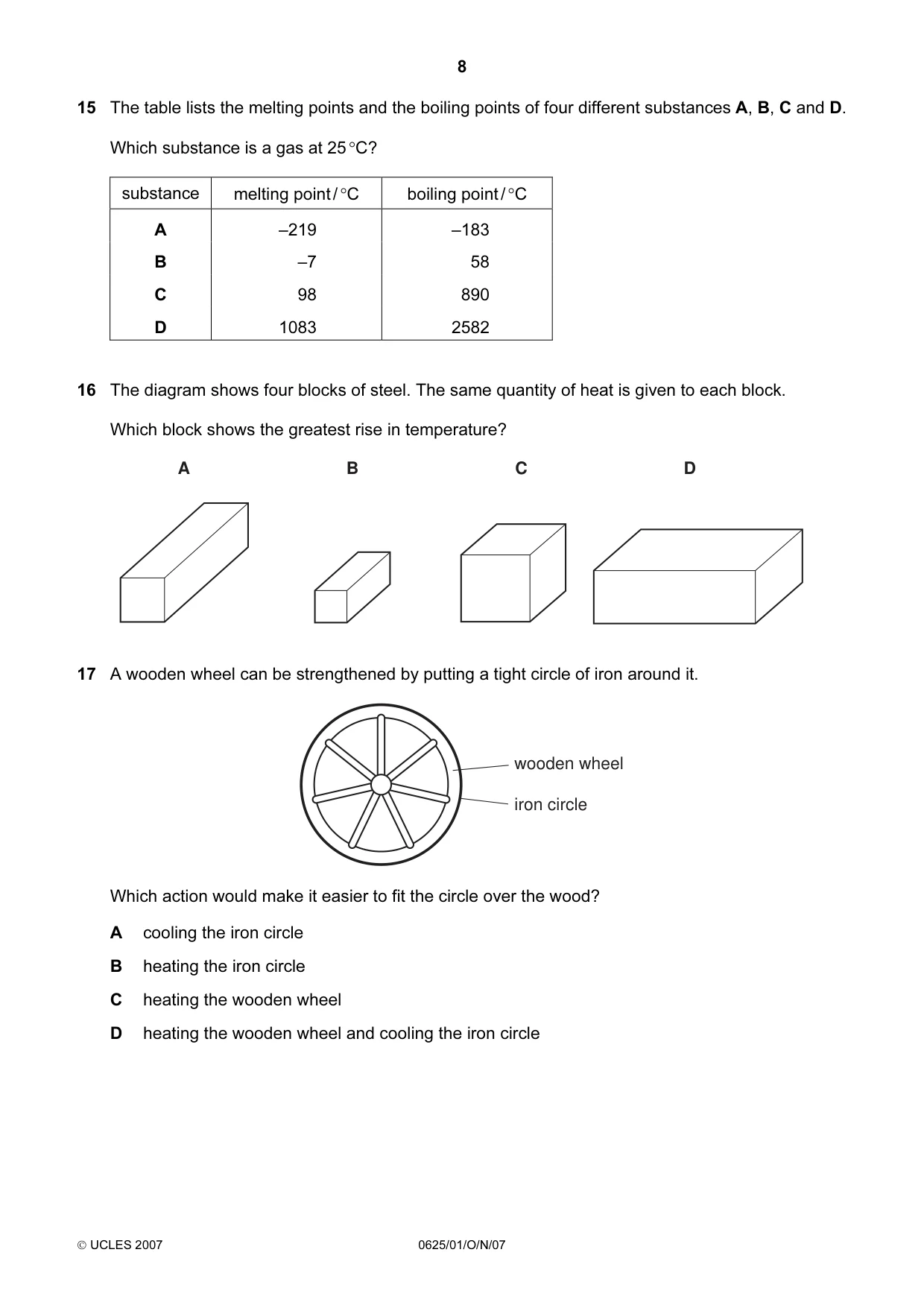

Mark scheme2 pages
Answers below. Sit the paper first if you are practising.
Questions as text
Q1 · Some water is poured into four tubes of different cross-sectional areas
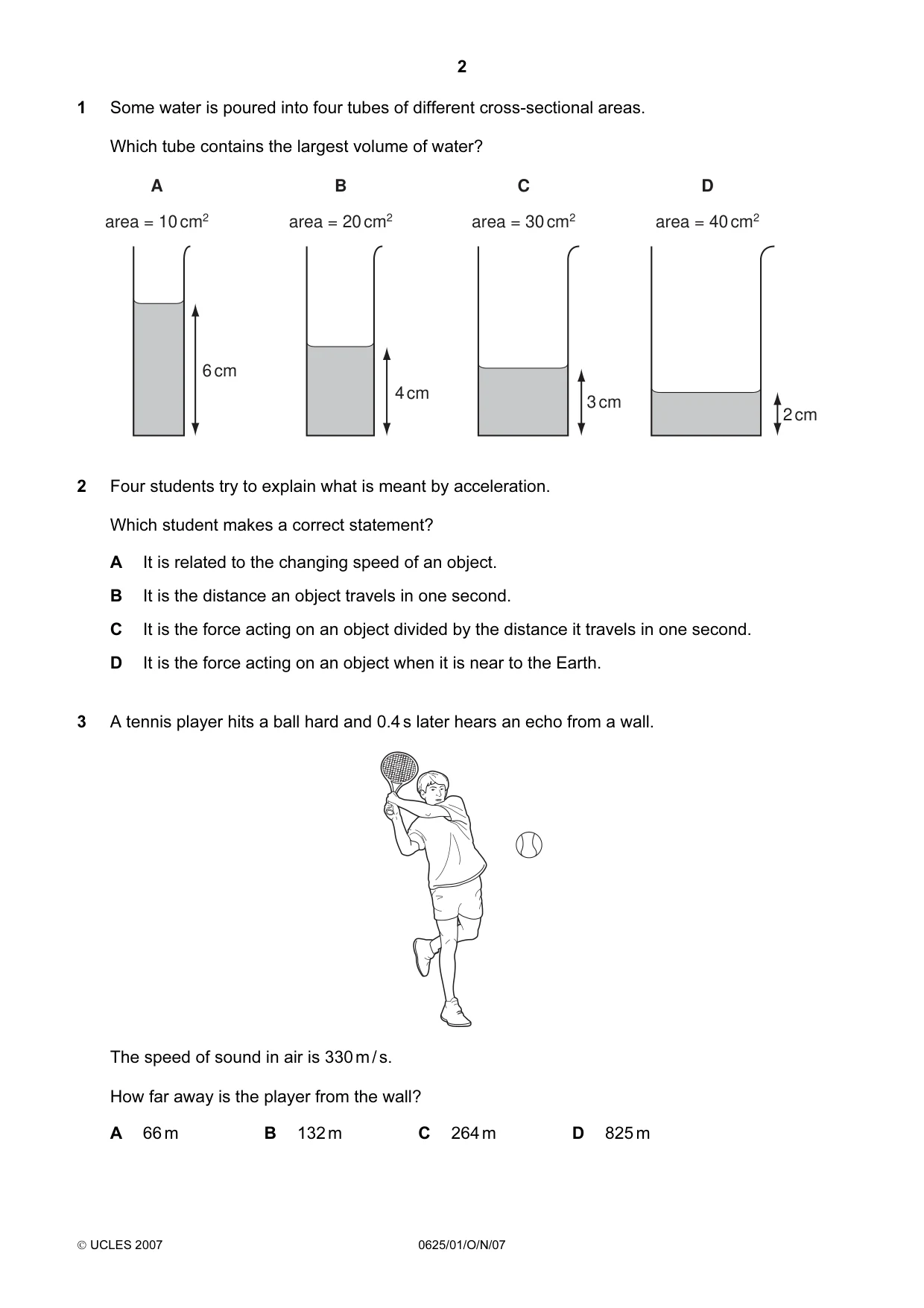
1 Some water is poured into four tubes of different cross-sectional areas. Which tube contains the largest volume of water? A B C D area = 10 cm2 area = 20 cm2 area = 30 cm2 area = 40 cm2 6 cm 4 cm 3 cm 2 cm
Mark scheme: C
More questions on Physical quantities and measurement techniques
Q2 · Four students try to explain what is meant by acceleration
2 Four students try to explain what is meant by acceleration. Which student makes a correct statement? A It is related to the changing speed of an object. B It is the distance an object travels in one second. C It is the force acting on an object divided by the distance it travels in one second. D It is the force acting on an object when it is near to the Earth.
Mark scheme: A
Q3 · A tennis player hits a ball hard and 0.4 s later hears an echo from a wall
3 A tennis player hits a ball hard and 0.4 s later hears an echo from a wall. The speed of sound in air is 330 m / s. How far away is the player from the wall? A 66 m B 132 m C 264 m D 825 m
Mark scheme: A
Q4 · What are the correct units for force and for weight?
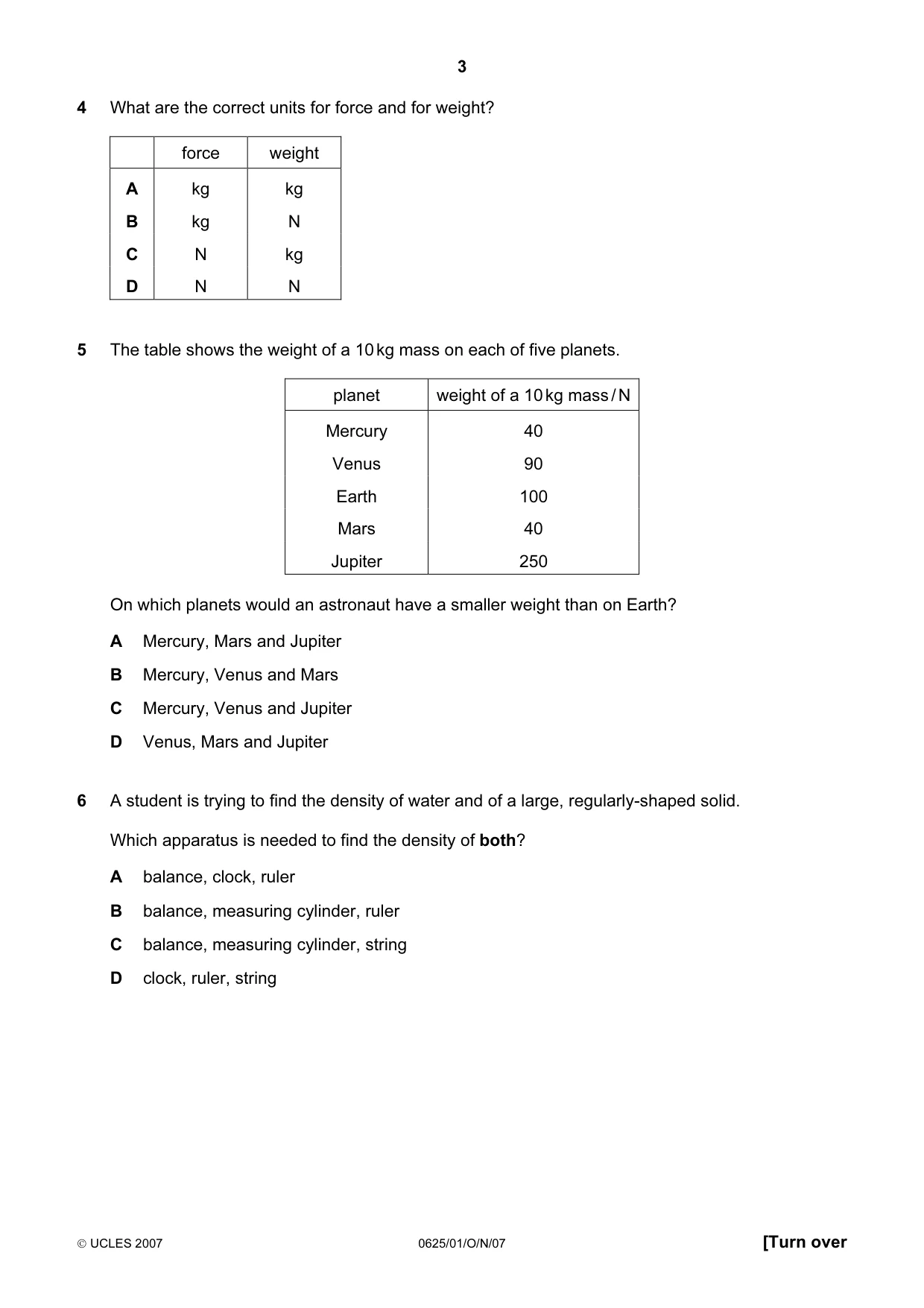
4 What are the correct units for force and for weight? force weight A kg kg B kg N C N kg D N N
Mark scheme: D
Q5 · The table shows the weight of a 10 kg mass on each of five planets
5 The table shows the weight of a 10 kg mass on each of five planets. planet weight of a 10 kg mass / N Mercury 40 Venus 90 Earth 100 Mars 40 Jupiter 250 On which planets would an astronaut have a smaller weight than on Earth? A Mercury, Mars and Jupiter B Mercury, Venus and Mars C Mercury, Venus and Jupiter D Venus, Mars and Jupiter
Mark scheme: B
Q6 · A student is trying to find the density of water and of a large, regularly-shaped solid
6 A student is trying to find the density of water and of a large, regularly-shaped solid. Which apparatus is needed to find the density of both? A balance, clock, ruler B balance, measuring cylinder, ruler C balance, measuring cylinder, string D clock, ruler, string
Mark scheme: B
Q7 · A metal drum has a mass of 200 kg when empty and 1000 kg when filled with 1.0 m3 of…
7 A metal drum has a mass of 200 kg when empty and 1000 kg when filled with 1.0 m3 of methylated spirit. What is the density of methylated spirit? A 0.0050 kg / m3 B 0.11 kg / m3 C 800 kg / m3 D 1000 kg / m3
Mark scheme: C
Q8 · An empty glass is placed on a join between two tables as shown
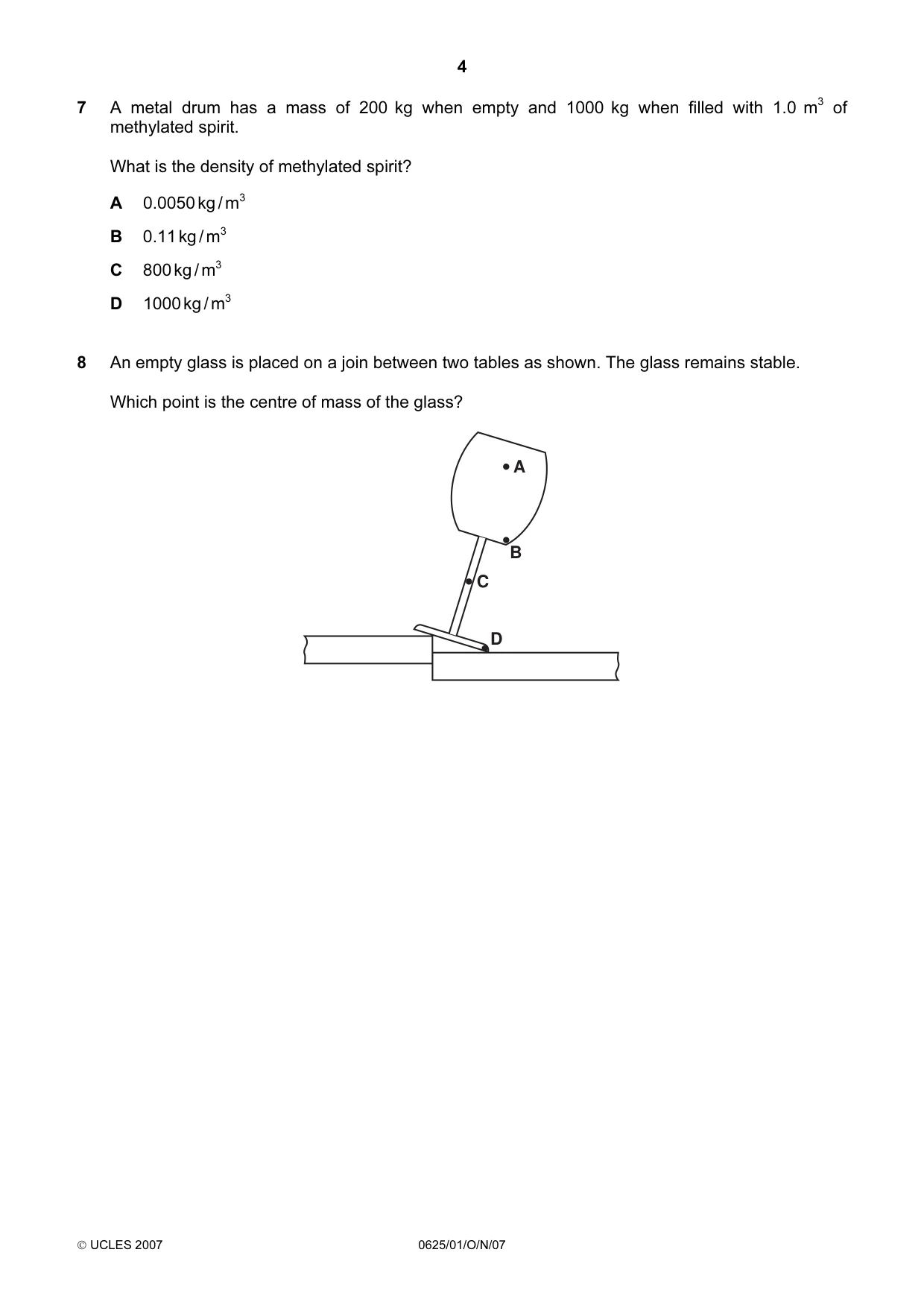
8 An empty glass is placed on a join between two tables as shown. The glass remains stable. Which point is the centre of mass of the glass? A B C D
Mark scheme: C
Q9 · An aeroplane is in equilibrium
9 An aeroplane is in equilibrium. The diagram shows the forces acting on the aeroplane. lift force from wings force from air engine resistance weight Which statement about the forces is correct? force from engine lift force from wings A equal to air resistance equal to weight B equal to air resistance greater than weight C greater than air resistance equal to weight D greater than air resistance greater than weight
Mark scheme: A
Q10 · A student adds loads to an elastic cord
10 A student adds loads to an elastic cord. He measures the length of the cord for each load. He then plots a graph from the results. 0 0 1 2 3 4 load / N Which length is plotted on the vertical axis? A measured length B original length C (measured length – original length) D (measured length + original length)
Mark scheme: C
Q11 · A person uses chemical energy to run up some stairs
11 A person uses chemical energy to run up some stairs. She stops at the top of the stairs. What has the chemical energy been converted to when she is at the top of the stairs? A kinetic energy and gravitational energy B kinetic energy and strain energy C gravitational energy and heat energy D strain energy and heat energy
Mark scheme: C
Q12 · Electrical energy may be obtained from nuclear fission
12 Electrical energy may be obtained from nuclear fission. In what order is the energy transferred in this process? A nuclear fuel → generator → reactor and boiler → turbines B nuclear fuel → generator → turbines → reactor and boiler C nuclear fuel → reactor and boiler → generator → turbines D nuclear fuel → reactor and boiler → turbines → generator
Mark scheme: D
Q13 · The diagram shows a simple mercury barometer, used to measure atmospheric pressure
13 The diagram shows a simple mercury barometer, used to measure atmospheric pressure. P L mercury Atmospheric pressure increases. What happens to the level L and to the pressure at P? level L pressure at P A falls increases B falls stays the same C rises increases D rises stays the same
Mark scheme: D
Q14 · The gas in a container is heated but is kept at constant volume
14 The gas in a container is heated but is kept at constant volume. Why does the gas pressure increase? A The molecules expand. B The molecules increase in mass. C The molecules move further apart. D The molecules move more rapidly.
Mark scheme: D
Q15 · The table lists the melting points and the boiling points of four different substances A…
15 The table lists the melting points and the boiling points of four different substances A, B, C and D. Which substance is a gas at 25 °C? substance melting point / °C boiling point / °C A –219 –183 B –7 58 C 98 890 D 1083 2582
Mark scheme: A
Q16 · The diagram shows four blocks of steel
16 The diagram shows four blocks of steel. The same quantity of heat is given to each block. Which block shows the greatest rise in temperature? A B C D
Mark scheme: B
Q17 · A wooden wheel can be strengthened by putting a tight circle of iron around it
17 A wooden wheel can be strengthened by putting a tight circle of iron around it. wooden wheel iron circle Which action would make it easier to fit the circle over the wood? A cooling the iron circle B heating the iron circle C heating the wooden wheel D heating the wooden wheel and cooling the iron circle
Mark scheme: B
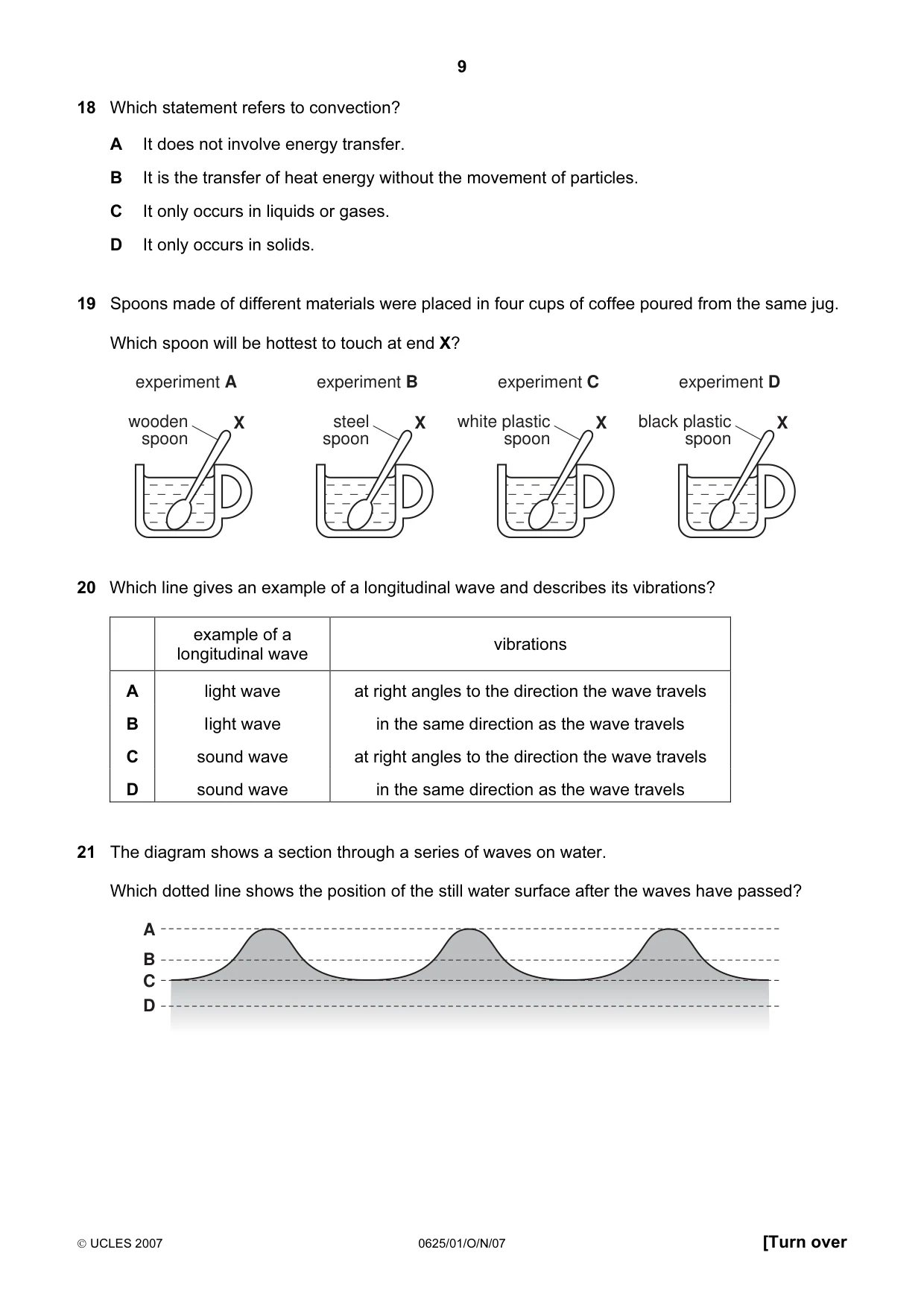
Q18 · Which statement refers to convection?
18 Which statement refers to convection? A It does not involve energy transfer. B It is the transfer of heat energy without the movement of particles. C It only occurs in liquids or gases. D It only occurs in solids.
Mark scheme: C
Q19 · Spoons made of different materials were placed in four cups of coffee poured from the…
19 Spoons made of different materials were placed in four cups of coffee poured from the same jug. Which spoon will be hottest to touch at end X? experiment A experiment B experiment C experiment D wooden X steel X white plastic X black plastic X spoon spoon spoon spoon
Mark scheme: B
Q20 · Which line gives an example of a longitudinal wave and describes its vibrations?
20 Which line gives an example of a longitudinal wave and describes its vibrations? example of a vibrations longitudinal wave A light wave at right angles to the direction the wave travels B Iight wave in the same direction as the wave travels C sound wave at right angles to the direction the wave travels D sound wave in the same direction as the wave travels
Mark scheme: D
Q21 · The diagram shows a section through a series of waves on water
21 The diagram shows a section through a series of waves on water. Which dotted line shows the position of the still water surface after the waves have passed? A B C D
Mark scheme: B
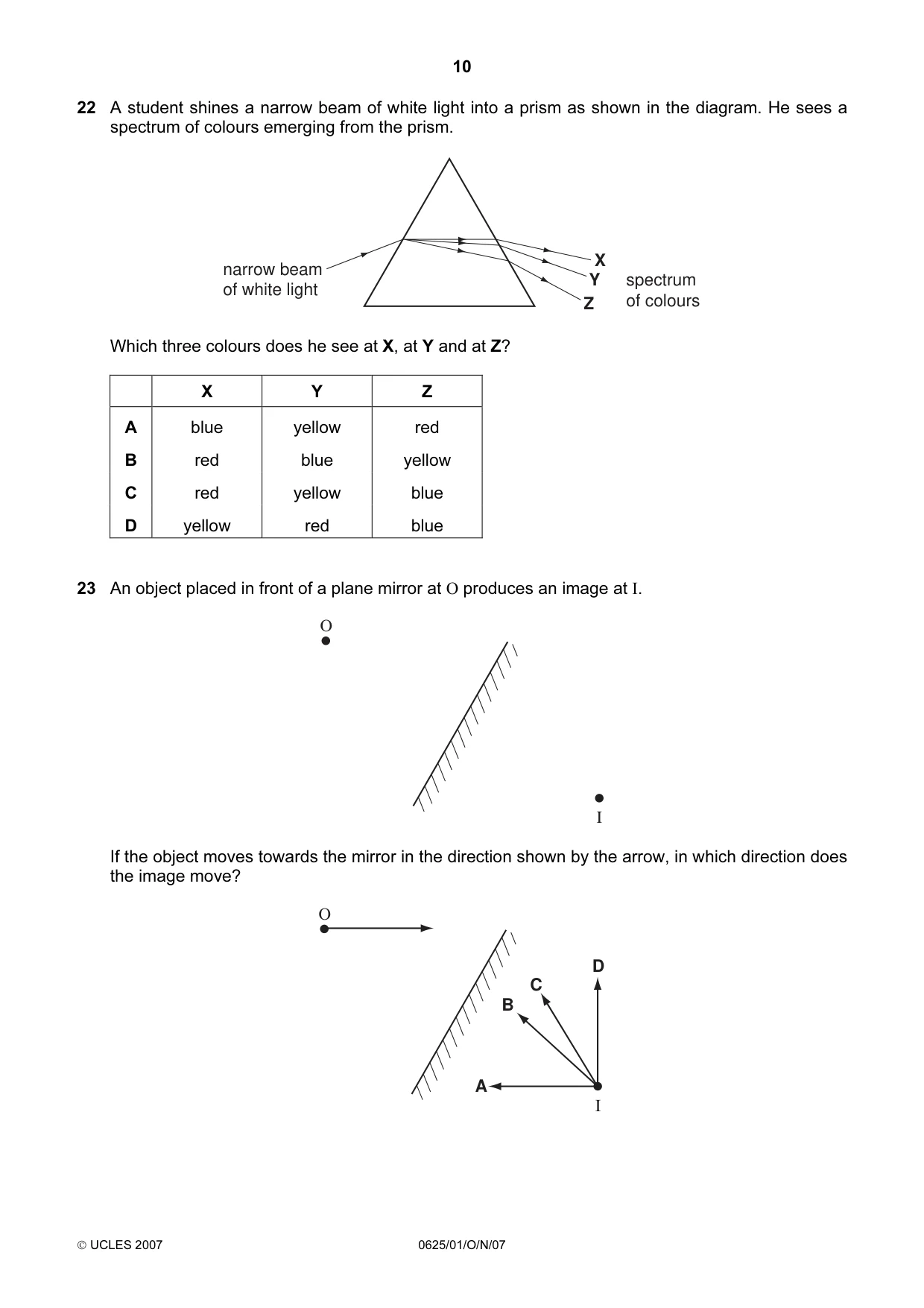
Q22 · A student shines a narrow beam of white light into a prism as shown in the diagram
22 A student shines a narrow beam of white light into a prism as shown in the diagram. He sees a spectrum of colours emerging from the prism. X narrow beam Y spectrum of white light Z of colours Which three colours does he see at X, at Y and at Z? X Y Z A blue yellow red B red blue yellow C red yellow blue D yellow red blue
Mark scheme: C
Q23 · An object placed in front of a plane mirror at O produces an image at I
23 An object placed in front of a plane mirror at O produces an image at I. O I If the object moves towards the mirror in the direction shown by the arrow, in which direction does the image move? O D C B A I
Mark scheme: C
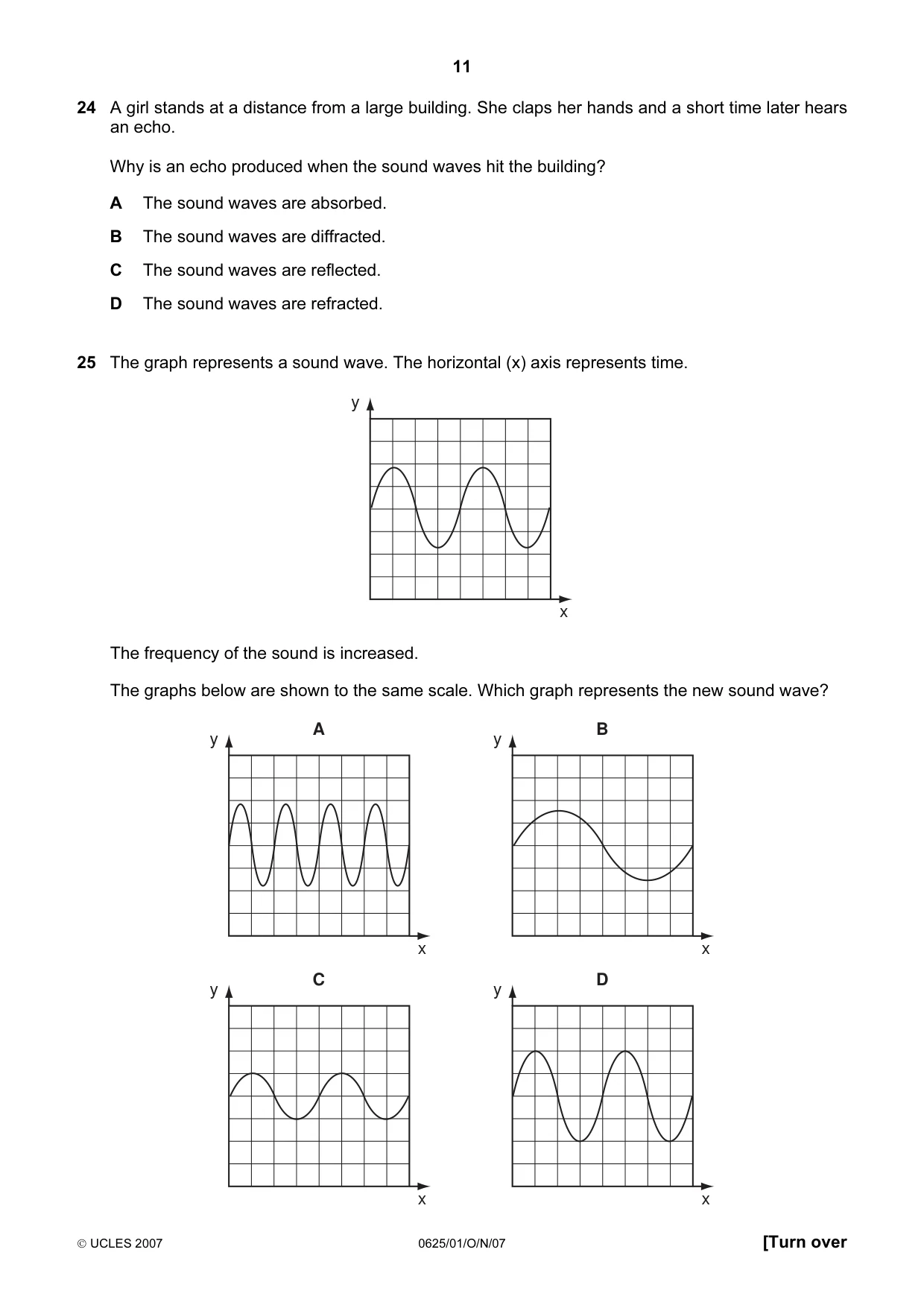
Q24 · A girl stands at a distance from a large building
24 A girl stands at a distance from a large building. She claps her hands and a short time later hears an echo. Why is an echo produced when the sound waves hit the building? A The sound waves are absorbed. B The sound waves are diffracted. C The sound waves are reflected. D The sound waves are refracted.
Mark scheme: C
Q25 · The graph represents a sound wave
25 The graph represents a sound wave. The horizontal (x) axis represents time. y x The frequency of the sound is increased. The graphs below are shown to the same scale. Which graph represents the new sound wave? A B y y x x C D y y x x
Mark scheme: A
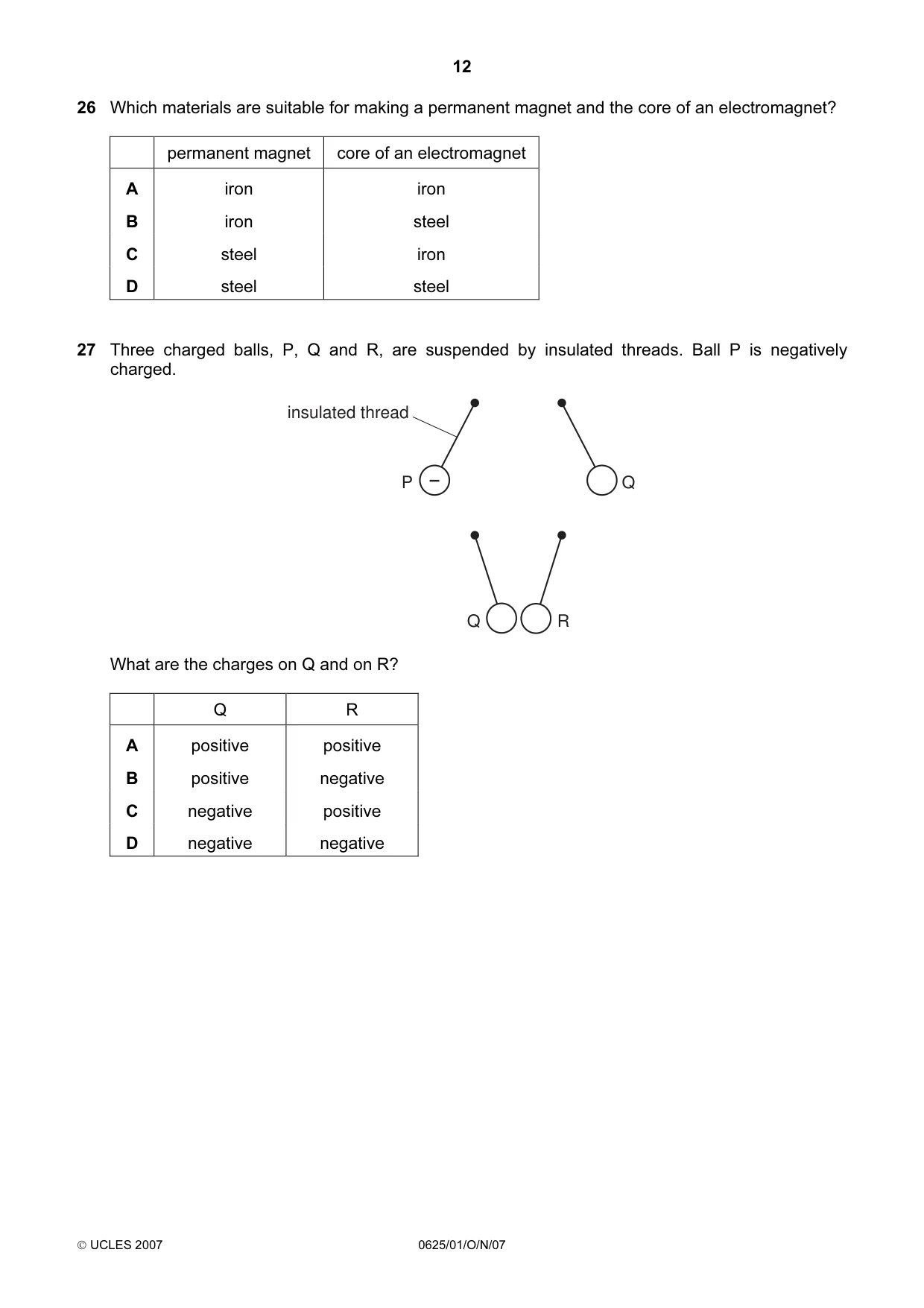
Q26 · Which materials are suitable for making a permanent magnet and the core of an…
26 Which materials are suitable for making a permanent magnet and the core of an electromagnet? permanent magnet core of an electromagnet A iron iron B iron steel C steel iron D steel steel
Mark scheme: C
Q27 · Three charged balls, P, Q and R, are suspended by insulated threads
27 Three charged balls, P, Q and R, are suspended by insulated threads. Ball P is negatively charged. insulated thread P – Q Q R What are the charges on Q and on R? Q R A positive positive B positive negative C negative positive D negative negative
Mark scheme: C
Q28 · The circuit shows a current I in a resistor of resistance R
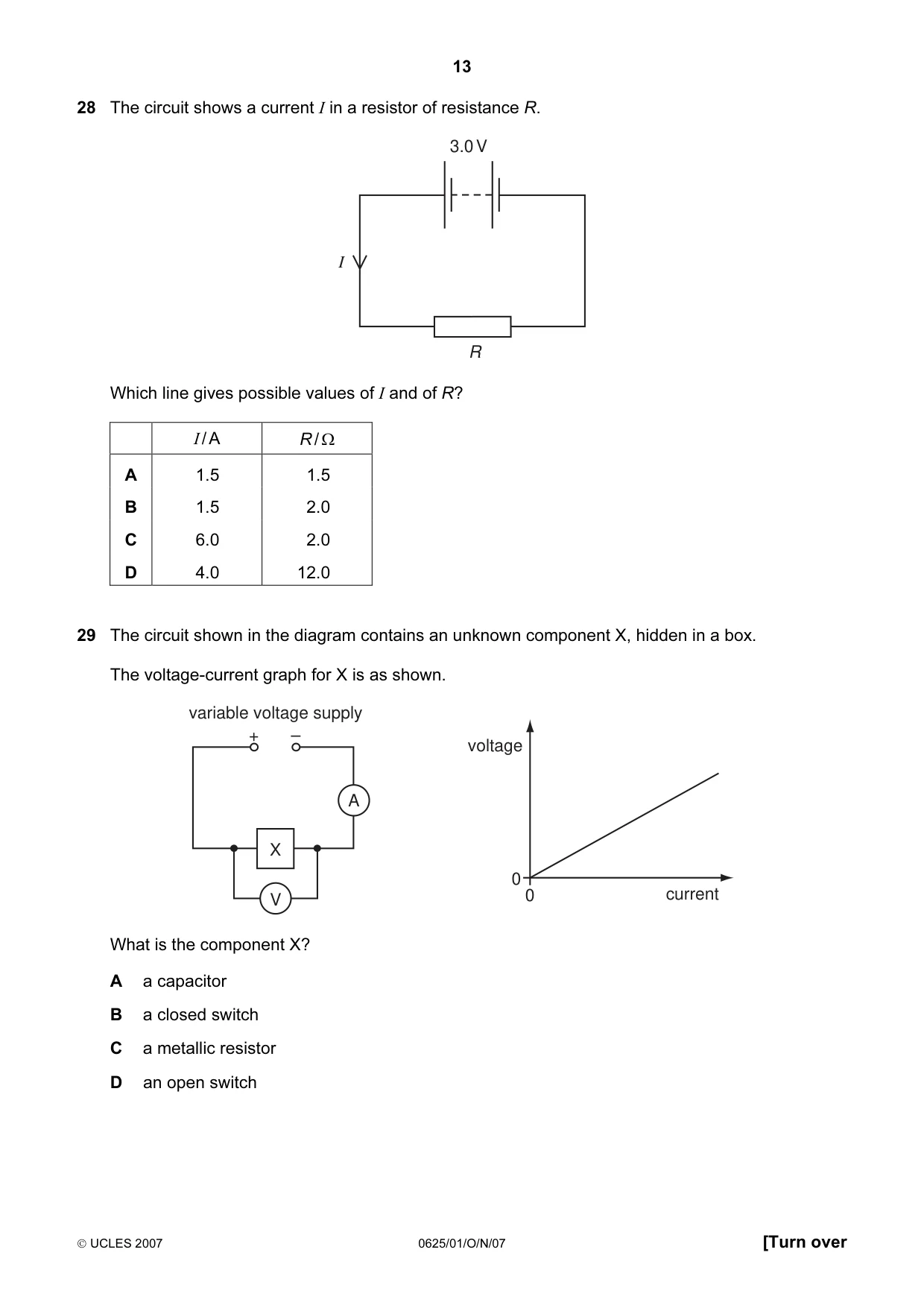
28 The circuit shows a current I in a resistor of resistance R. 3.0 V I R Which line gives possible values of I and of R? I / A R / Ω A 1.5 1.5 B 1.5 2.0 C 6.0 2.0 D 4.0 12.0
Mark scheme: B
Q29 · The circuit shown in the diagram contains an unknown component X, hidden in a box
29 The circuit shown in the diagram contains an unknown component X, hidden in a box. The voltage-current graph for X is as shown. variable voltage supply + – voltage A X 0 V 0 current What is the component X? A a capacitor B a closed switch C a metallic resistor D an open switch
Mark scheme: C
Q30 · Four lamps are connected in a circuit as shown in the diagram
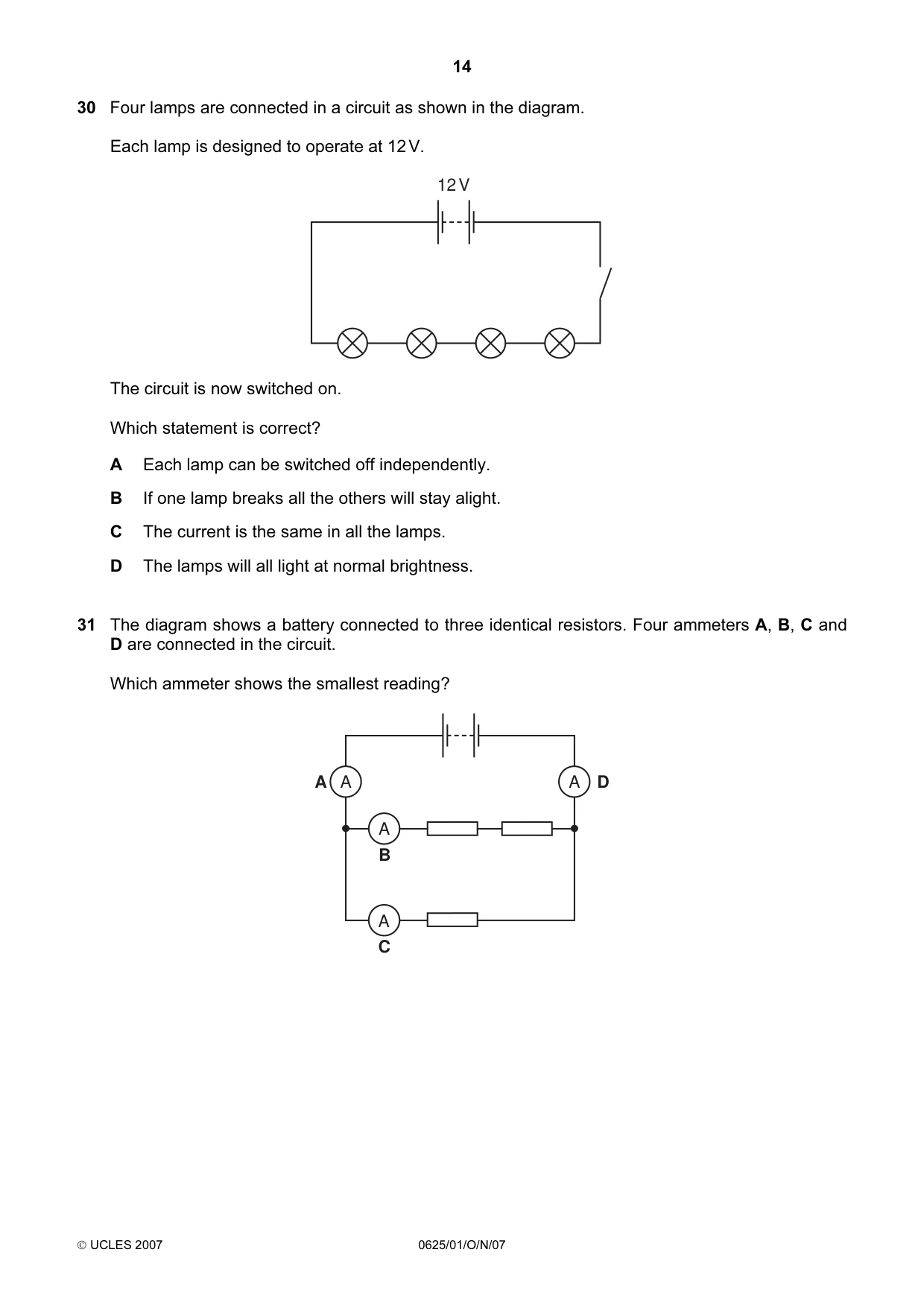
30 Four lamps are connected in a circuit as shown in the diagram. Each lamp is designed to operate at 12 V. 12 V The circuit is now switched on. Which statement is correct? A Each lamp can be switched off independently. B If one lamp breaks all the others will stay alight. C The current is the same in all the lamps. D The lamps will all light at normal brightness.
Mark scheme: C
Q31 · The diagram shows a battery connected to three identical resistors
31 The diagram shows a battery connected to three identical resistors. Four ammeters A, B, C and D are connected in the circuit. Which ammeter shows the smallest reading? A A A D A B A C
Mark scheme: B
Q32 · In the circuit shown, the switch is closed for a long time, then opened
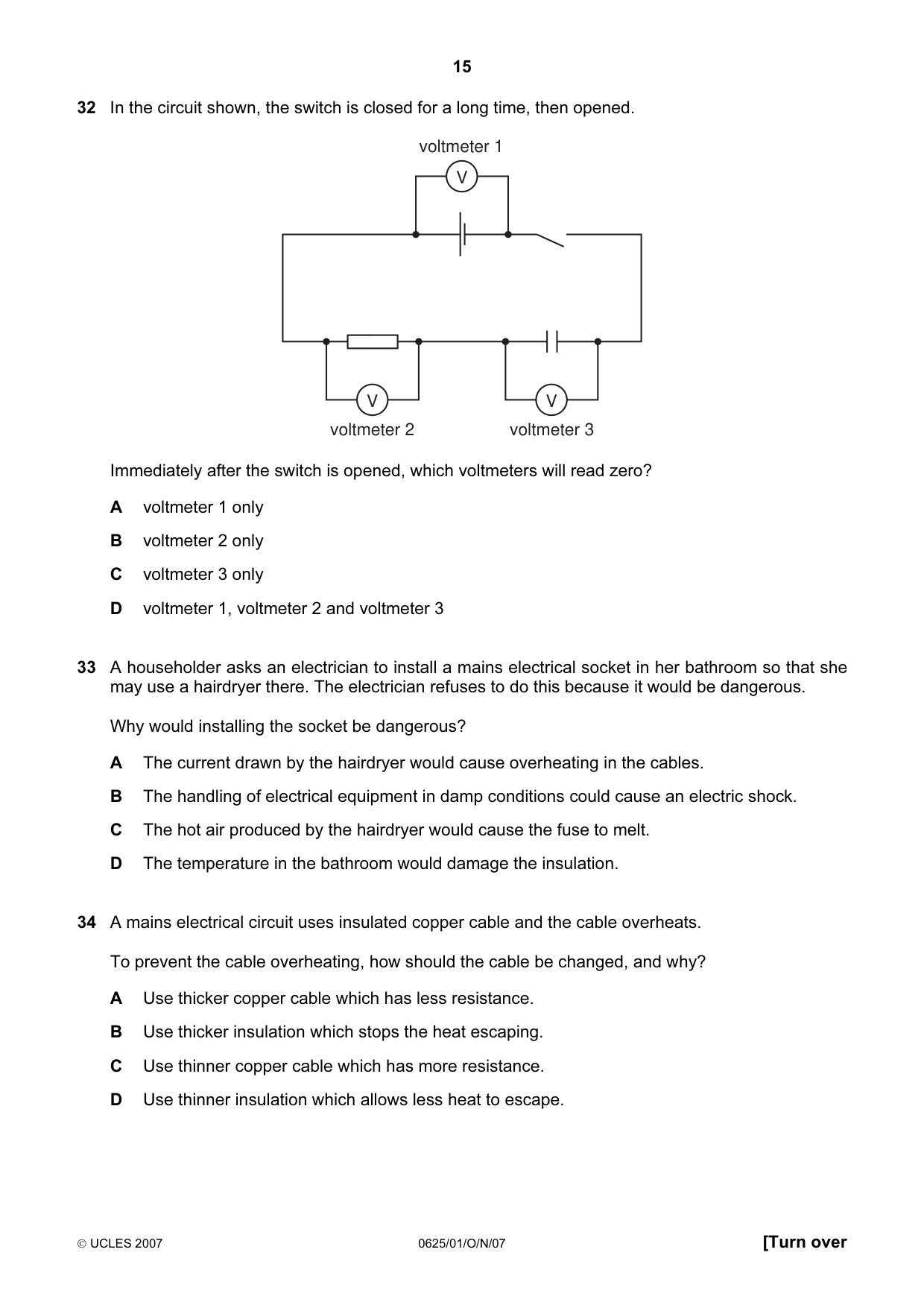
32 In the circuit shown, the switch is closed for a long time, then opened. voltmeter 1 V V V voltmeter 2 voltmeter 3 Immediately after the switch is opened, which voltmeters will read zero? A voltmeter 1 only B voltmeter 2 only C voltmeter 3 only D voltmeter 1, voltmeter 2 and voltmeter 3
Mark scheme: B
Q33 · A householder asks an electrician to install a mains electrical socket in her bathroom so…
33 A householder asks an electrician to install a mains electrical socket in her bathroom so that she may use a hairdryer there. The electrician refuses to do this because it would be dangerous. Why would installing the socket be dangerous? A The current drawn by the hairdryer would cause overheating in the cables. B The handling of electrical equipment in damp conditions could cause an electric shock. C The hot air produced by the hairdryer would cause the fuse to melt. D The temperature in the bathroom would damage the insulation.
Mark scheme: B
Q34 · A mains electrical circuit uses insulated copper cable and the cable overheats
34 A mains electrical circuit uses insulated copper cable and the cable overheats. To prevent the cable overheating, how should the cable be changed, and why? A Use thicker copper cable which has less resistance. B Use thicker insulation which stops the heat escaping. C Use thinner copper cable which has more resistance. D Use thinner insulation which allows less heat to escape.
Mark scheme: A
Q35 · How is electricity transmitted over large distances and why is it transmitted in this way?
35 How is electricity transmitted over large distances and why is it transmitted in this way? how why A at high voltage for safety B at high voltage to reduce energy loss C at low voltage for safety D at low voltage to reduce energy loss
Mark scheme: B
Q36 · Which parts of an a.c
36 Which parts of an a.c. generator slide past each other when the generator is working? A brushes and coil B coil and magnets C magnets and slip rings D slip rings and brushes
Mark scheme: D
Q37 · The diagram shows a cathode-ray tube
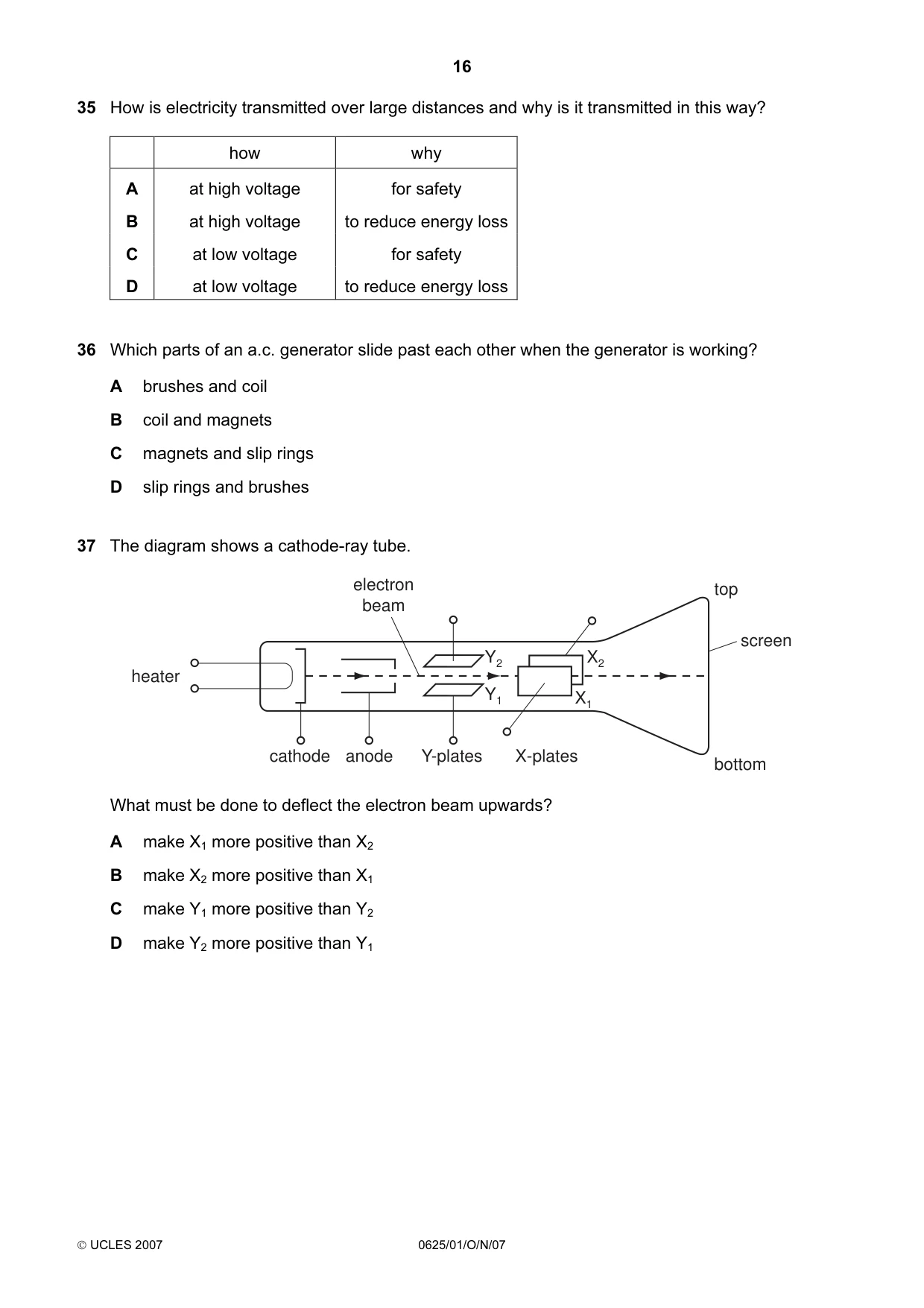
37 The diagram shows a cathode-ray tube. electron top beam screen Y2 X2 heater Y1 X1 cathode anode Y-plates X-plates bottom What must be done to deflect the electron beam upwards? A make X1 more positive than X2 B make X2 more positive than X1 C make Y1 more positive than Y2 D make Y2 more positive than Y1
Mark scheme: D
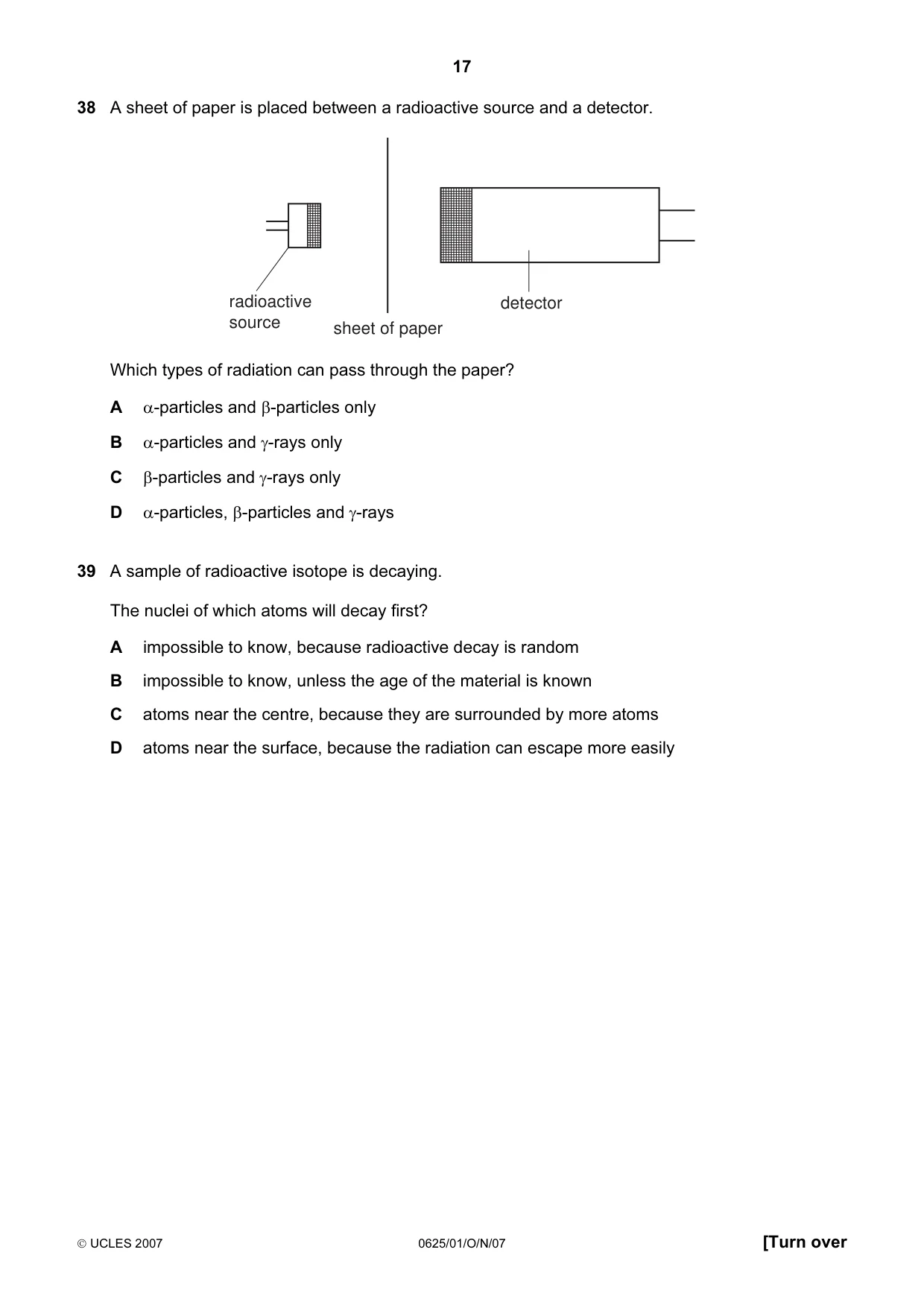
Q38 · A sheet of paper is placed between a radioactive source and a detector
38 A sheet of paper is placed between a radioactive source and a detector. radioactive detector source sheet of paper Which types of radiation can pass through the paper? A α-particles and β-particles only B α-particles and γ-rays only C β-particles and γ-rays only D α-particles, β-particles and γ-rays
Mark scheme: C
Q39 · A sample of radioactive isotope is decaying
39 A sample of radioactive isotope is decaying. The nuclei of which atoms will decay first? A impossible to know, because radioactive decay is random B impossible to know, unless the age of the material is known C atoms near the centre, because they are surrounded by more atoms D atoms near the surface, because the radiation can escape more easily
Mark scheme: A
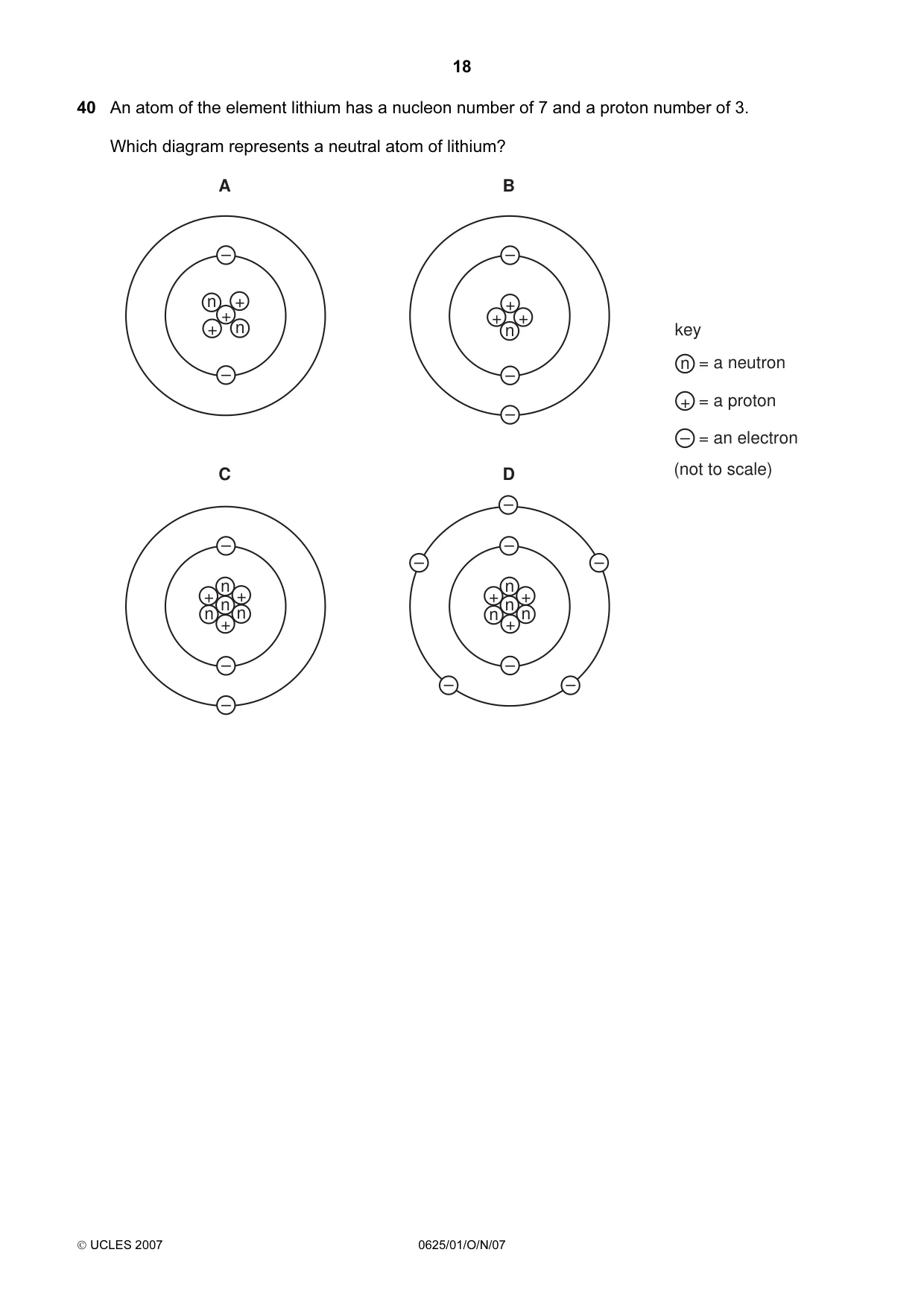
Q40 · An atom of the element lithium has a nucleon number of 7 and a proton number of 3
40 An atom of the element lithium has a nucleon number of 7 and a proton number of 3. Which diagram represents a neutral atom of lithium? A B – – n + + + + + + n n key n = a neutron – – + = a proton – – = an electron C D (not to scale) – – – – – n n + + + + n n n n n n + + – – – – –
Mark scheme: C
What was in this paper
The subtopics covered by these 40 questions, and how many questions each got. Open one in a new tab to see every Cambridge question on it.
4Electric circuits3Forces3Sound3Density2Electrical safety2Electromagnetic effects2Energy, work and power2General properties of waves2Kinetic particle model of matter2Light2Mass and weight2Radioactivity2Thermal properties and temperature2Transfer of thermal energy2Motion1Physical quantities and measurement techniques1Pressure1Simple phenomena of magnetism1The nuclear model of the atom1What you needed in this session
Cambridge’s own grade thresholds for 2007 Oct/Nov, Paper 1 · Variant 1. A higher threshold means an easier paper — the bar moves with how the cohort did.