Cambridge IGCSE Physics 0625 — 2023 May/June Paper 1 · Variant 3
0625/13/M/J/23 · 40 questions · 40 marks · ≈45 min
The question paper and its mark scheme, free to read here and free to download. This is Cambridge’s own paper, exactly as it was sat.
Question paper16 pages

Mark scheme3 pages
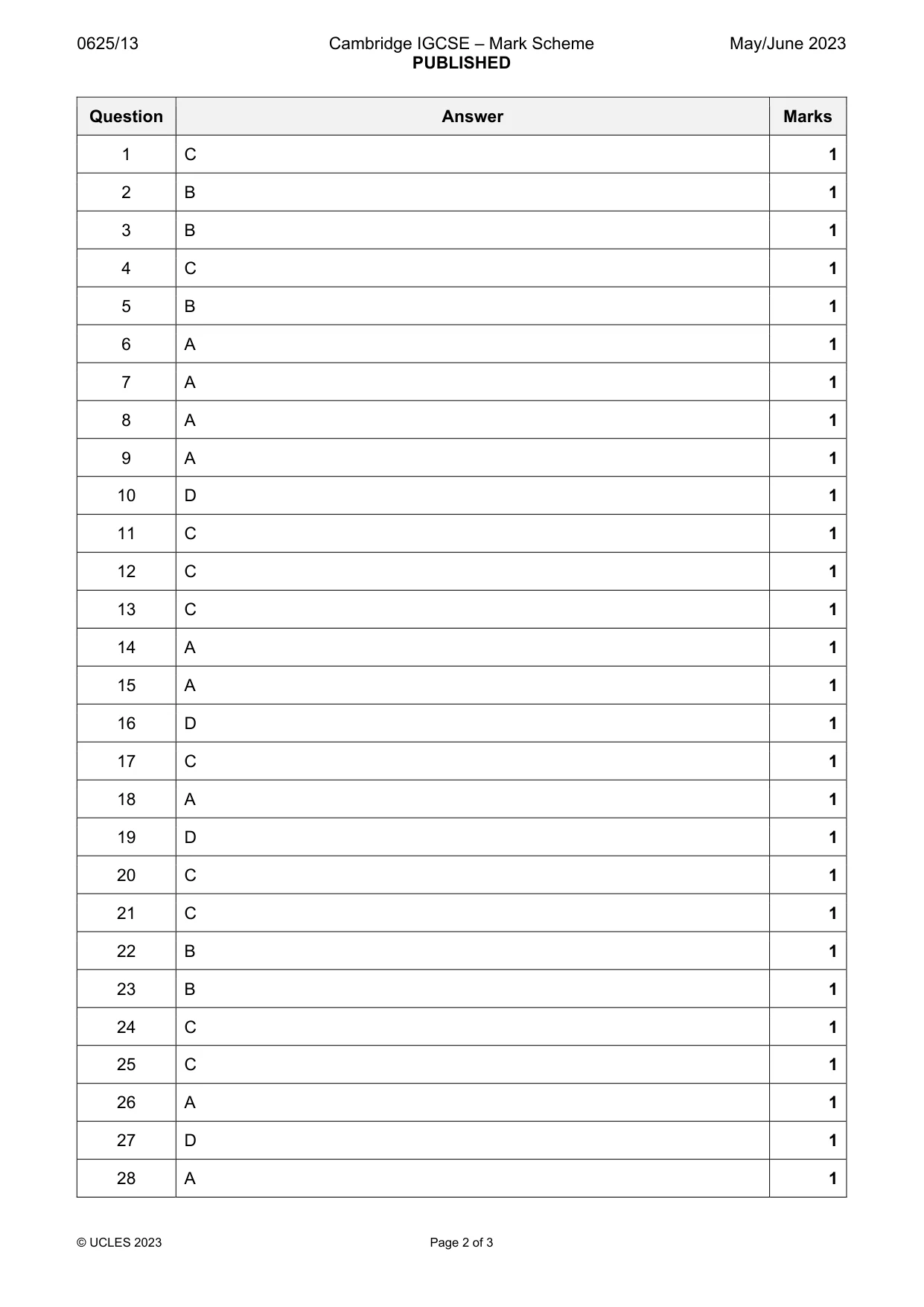
Answers below. Sit the paper first if you are practising.
Questions as text
Q1 · Which piece of apparatus is used to measure the length of a copper rod of length…
1 Which piece of apparatus is used to measure the length of a copper rod of length approximately 2 cm? A digital timer B measuring cylinder C ruler D balance
Mark scheme: C
More questions on Physical quantities and measurement techniques
Q2 · The speed–time graph shows the motion of an object
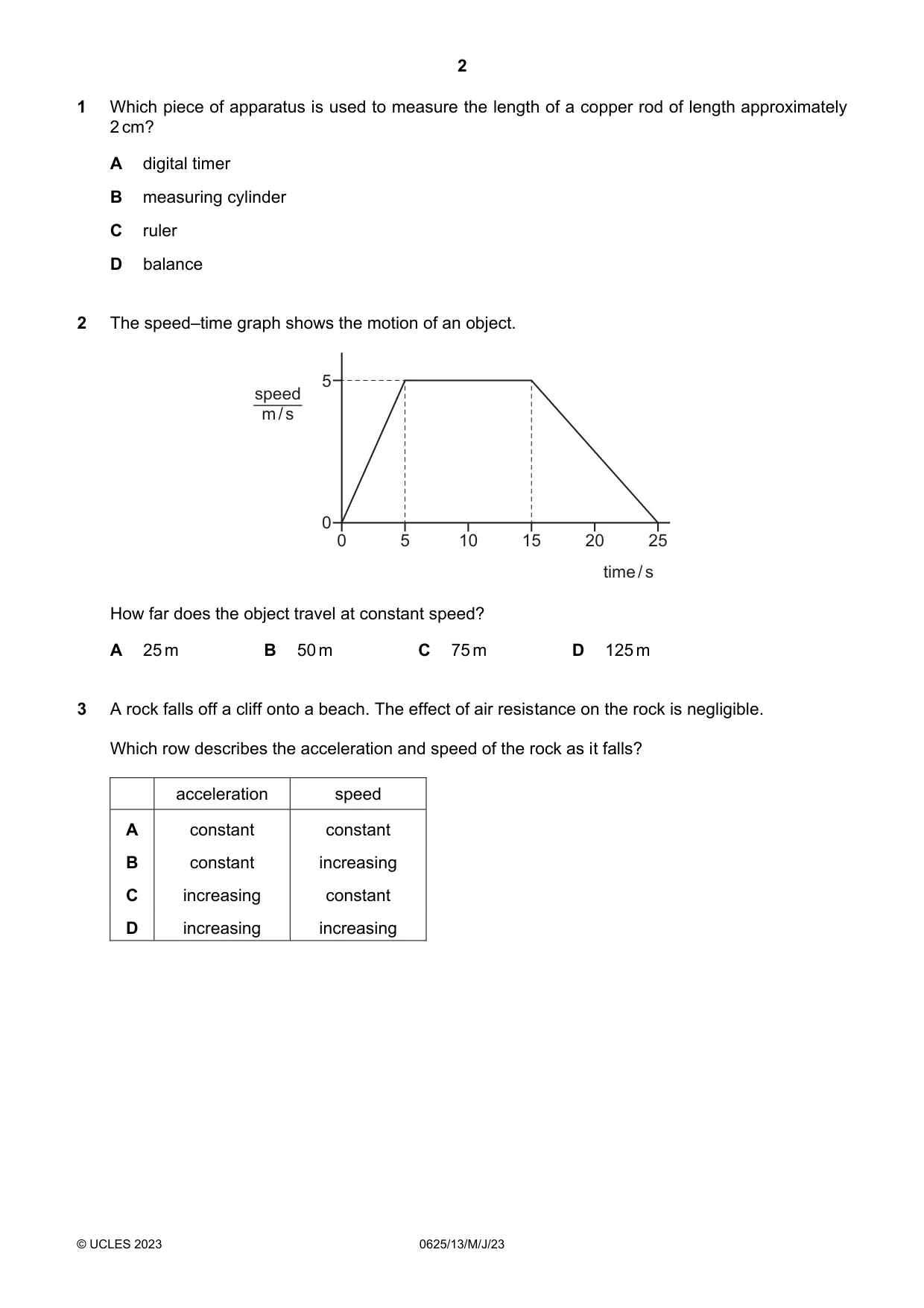
2 The speed–time graph shows the motion of an object. 5 speed m / s 0 0 5 10 15 20 25 time / s How far does the object travel at constant speed? A 25 m B 50 m C 75 m D 125 m
Mark scheme: B
Q3 · A rock falls off a cliff onto a beach
3 A rock falls off a cliff onto a beach. The effect of air resistance on the rock is negligible. Which row describes the acceleration and speed of the rock as it falls? acceleration speed A constant constant B constant increasing C increasing constant D increasing increasing
Mark scheme: B
Q4 · Two rectangular blocks consist of different materials
4 Two rectangular blocks consist of different materials. Four different methods are suggested to compare the two masses. 1 Compare the accelerations with which they fall freely. 2 Compare the values of their lengths breadths heights. 3 Hang each in turn from the same spring. Compare the extensions. 4 Place one in the right-hand pan of a beam balance and the other in the left-hand pan. Which methods give a comparison of the two masses? A 1, 2 and 3 B 1 and 2 only C 3 and 4 only D 4 only
Mark scheme: C
Q5 · A measuring cylinder containing 50 cm3 of water is put on a balance
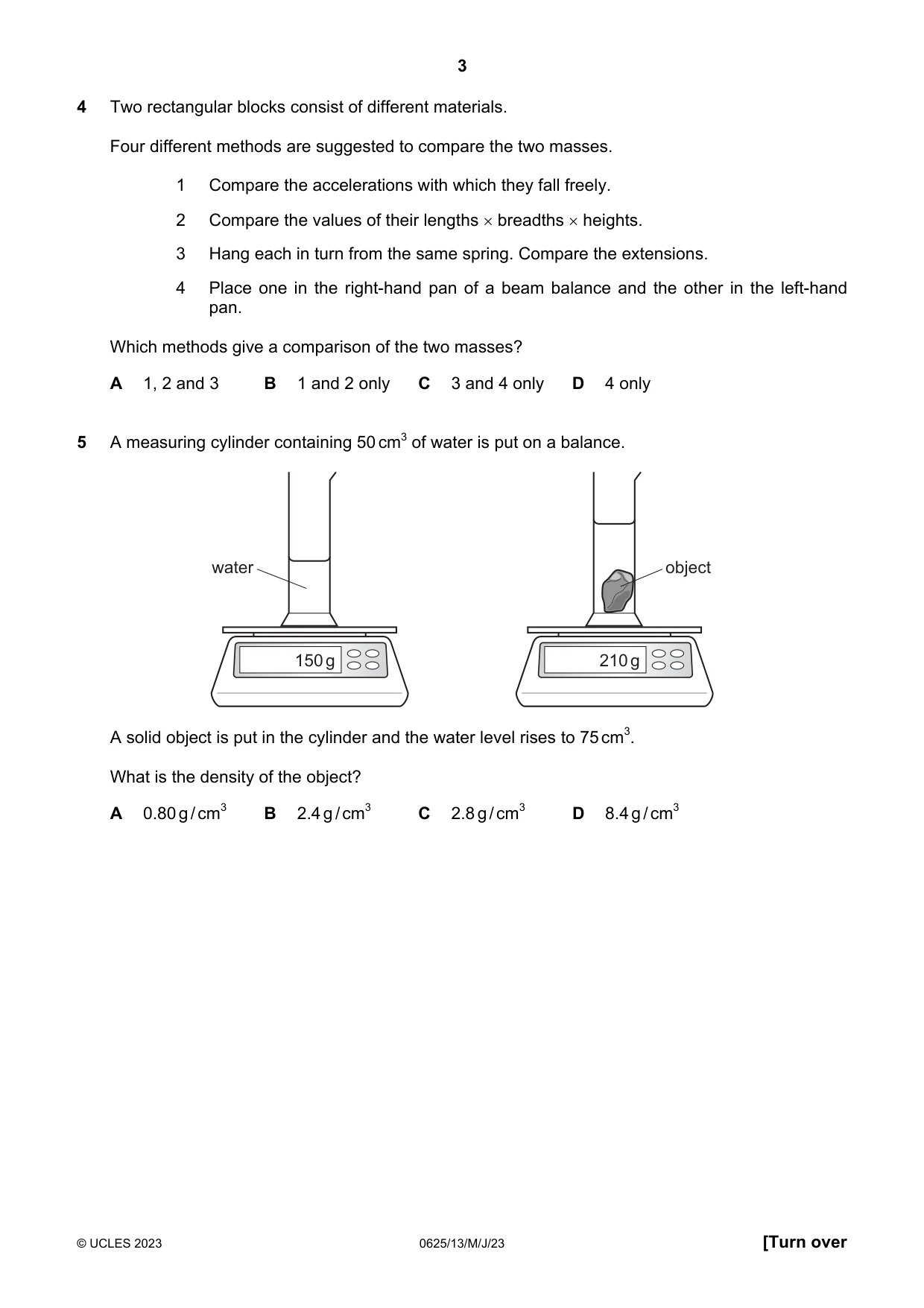
5 A measuring cylinder containing 50 cm3 of water is put on a balance. water object 150 g 210 g A solid object is put in the cylinder and the water level rises to 75 cm3. What is the density of the object? A 0.80 g / cm3 B 2.4 g / cm3 C 2.8 g / cm3 D 8.4 g / cm3
Mark scheme: B
Q6 · A cyclist is travelling in a straight line along a horizontal road at a constant speed
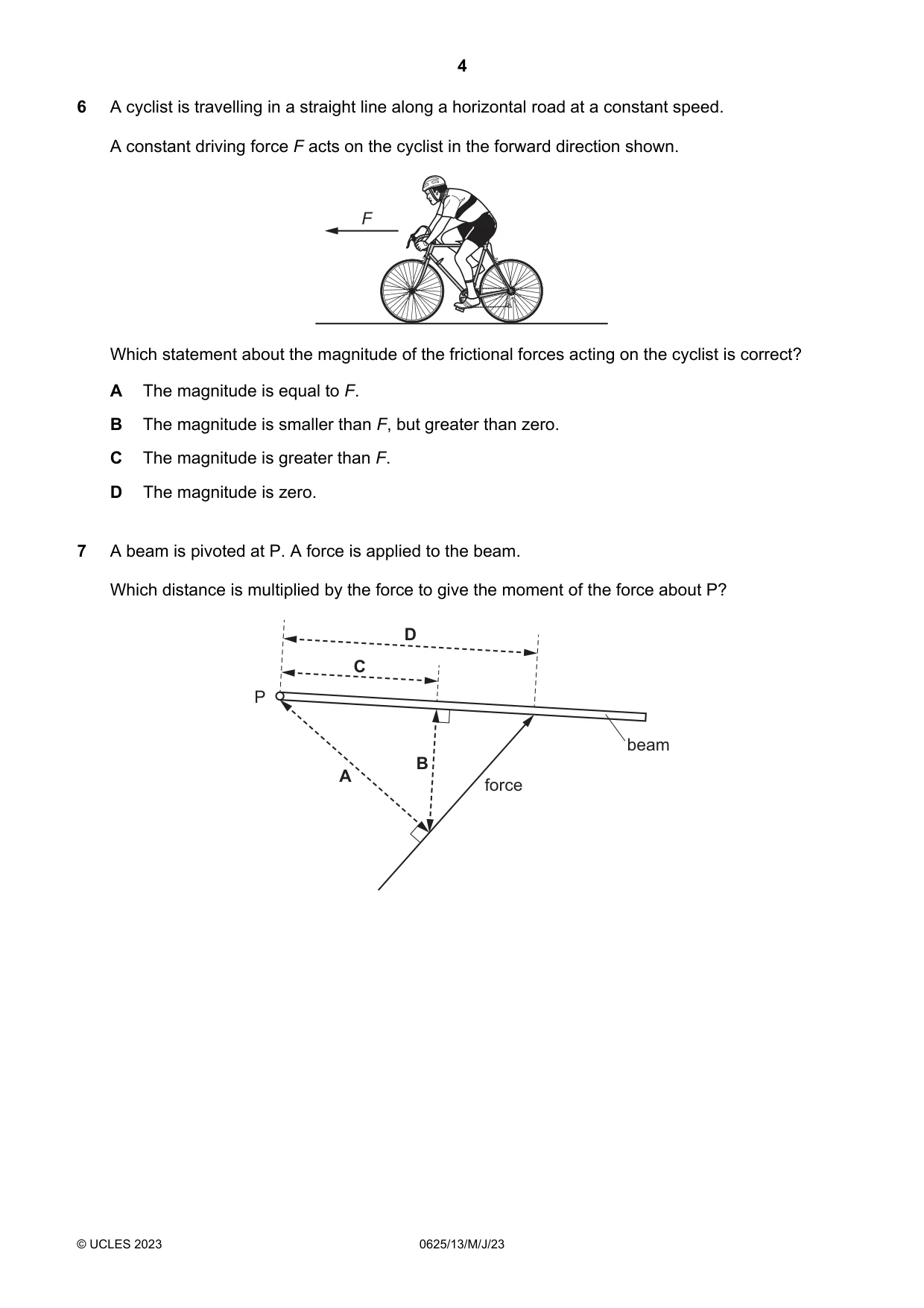
6 A cyclist is travelling in a straight line along a horizontal road at a constant speed. A constant driving force F acts on the cyclist in the forward direction shown. F Which statement about the magnitude of the frictional forces acting on the cyclist is correct? A The magnitude is equal to F. B The magnitude is smaller than F, but greater than zero. C The magnitude is greater than F. D The magnitude is zero.
Mark scheme: A
Q7 · A beam is pivoted at P
7 A beam is pivoted at P. A force is applied to the beam. Which distance is multiplied by the force to give the moment of the force about P? D C P beam B A force
Mark scheme: A
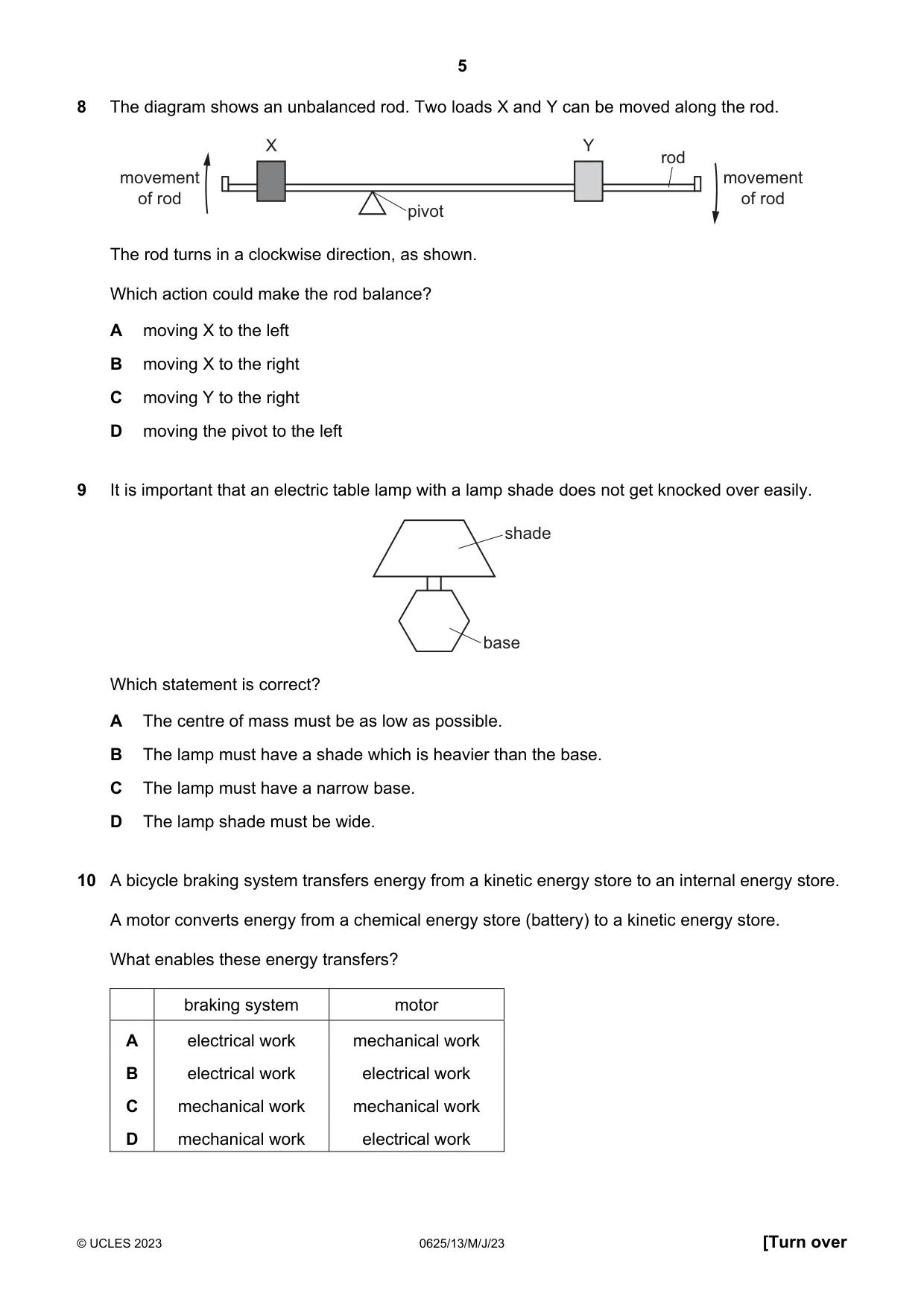
Q8 · The diagram shows an unbalanced rod
8 The diagram shows an unbalanced rod. Two loads X and Y can be moved along the rod. X Y rod movement movement of rod of rod pivot The rod turns in a clockwise direction, as shown. Which action could make the rod balance? A moving X to the left B moving X to the right C moving Y to the right D moving the pivot to the left
Mark scheme: A
Q9 · It is important that an electric table lamp with a lamp shade does not get knocked over…
9 It is important that an electric table lamp with a lamp shade does not get knocked over easily. shade base Which statement is correct? A The centre of mass must be as low as possible. B The lamp must have a shade which is heavier than the base. C The lamp must have a narrow base. D The lamp shade must be wide.
Mark scheme: A
Q10 · A bicycle braking system transfers energy from a kinetic energy store to an internal…
10 A bicycle braking system transfers energy from a kinetic energy store to an internal energy store. A motor converts energy from a chemical energy store (battery) to a kinetic energy store. What enables these energy transfers? braking system motor A electrical work mechanical work B electrical work electrical work C mechanical work mechanical work D mechanical work electrical work
Mark scheme: D
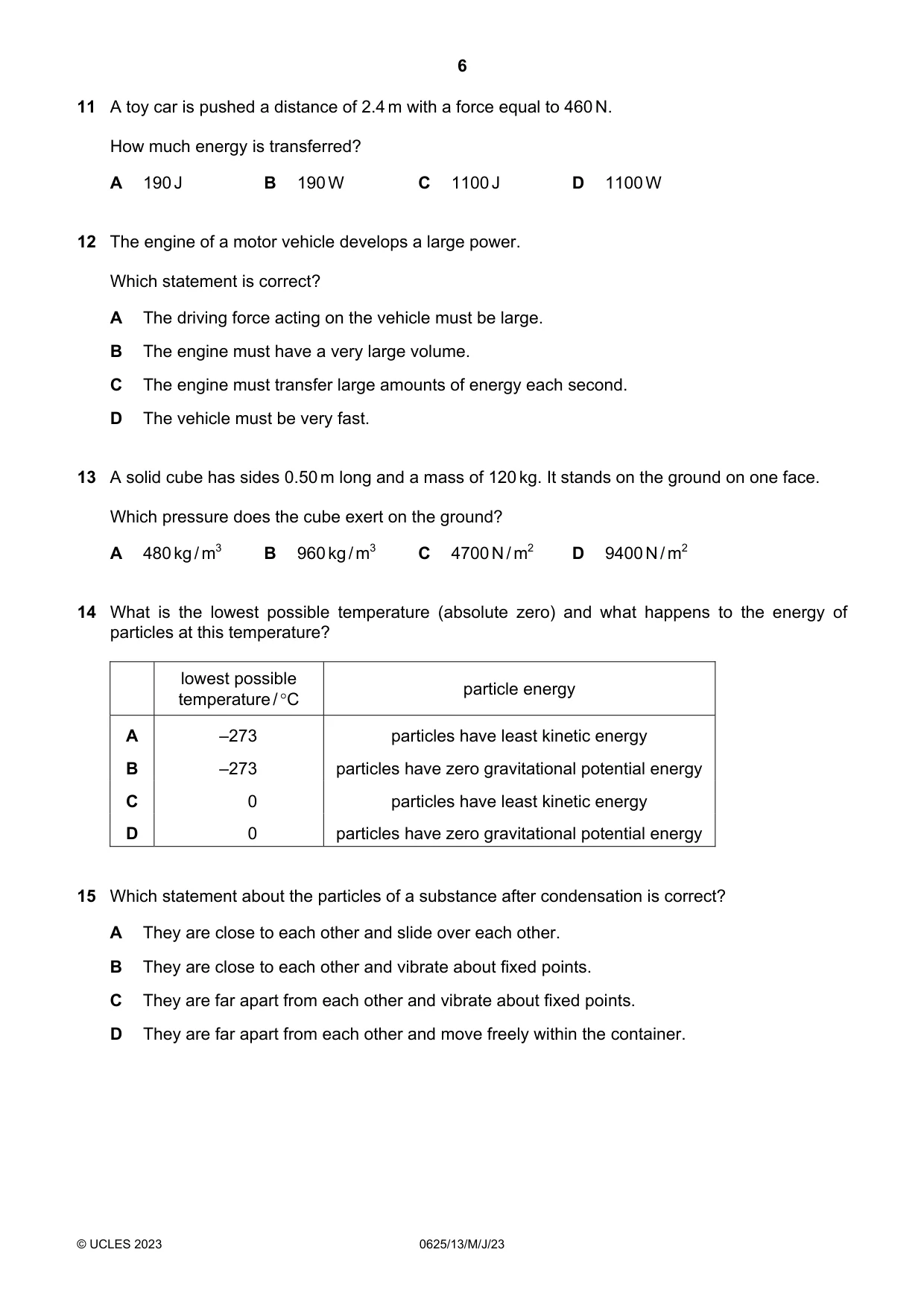
Q11 · A toy car is pushed a distance of 2.4 m with a force equal to 460 N
11 A toy car is pushed a distance of 2.4 m with a force equal to 460 N. How much energy is transferred? A 190 J B 190 W C 1100 J D 1100 W
Mark scheme: C
Q12 · The engine of a motor vehicle develops a large power
12 The engine of a motor vehicle develops a large power. Which statement is correct? A The driving force acting on the vehicle must be large. B The engine must have a very large volume. C The engine must transfer large amounts of energy each second. D The vehicle must be very fast.
Mark scheme: C
Q13 · A solid cube has sides 0.50 m long and a mass of 120 kg
13 A solid cube has sides 0.50 m long and a mass of 120 kg. It stands on the ground on one face. Which pressure does the cube exert on the ground? A 480 kg / m3 B 960 kg / m3 C 4700 N / m2 D 9400 N / m2
Mark scheme: C
Q14 · What is the lowest possible temperature (absolute zero) and what happens to the energy of…
14 What is the lowest possible temperature (absolute zero) and what happens to the energy of particles at this temperature? lowest possible particle energy temperature / C A –273 particles have least kinetic energy B –273 particles have zero gravitational potential energy C 0 particles have least kinetic energy D 0 particles have zero gravitational potential energy
Mark scheme: A
Q15 · Which statement about the particles of a substance after condensation is correct?
15 Which statement about the particles of a substance after condensation is correct? A They are close to each other and slide over each other. B They are close to each other and vibrate about fixed points. C They are far apart from each other and vibrate about fixed points. D They are far apart from each other and move freely within the container.
Mark scheme: A
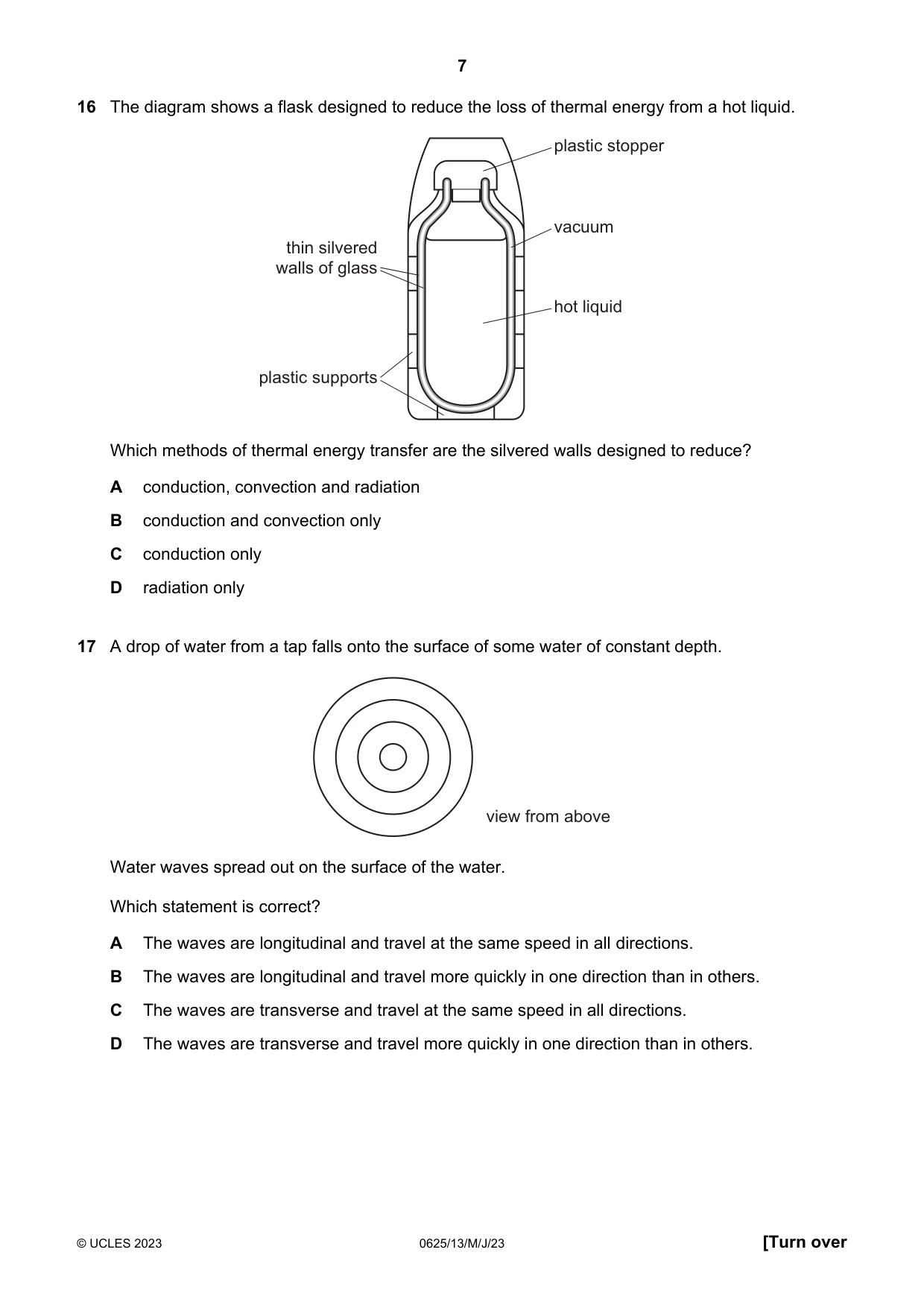
Q16 · The diagram shows a flask designed to reduce the loss of thermal energy from a hot liquid
16 The diagram shows a flask designed to reduce the loss of thermal energy from a hot liquid. plastic stopper vacuum thin silvered walls of glass hot liquid plastic supports Which methods of thermal energy transfer are the silvered walls designed to reduce? A conduction, convection and radiation B conduction and convection only C conduction only D radiation only
Mark scheme: D
Q17 · A drop of water from a tap falls onto the surface of some water of constant depth
17 A drop of water from a tap falls onto the surface of some water of constant depth. view from above Water waves spread out on the surface of the water. Which statement is correct? A The waves are longitudinal and travel at the same speed in all directions. B The waves are longitudinal and travel more quickly in one direction than in others. C The waves are transverse and travel at the same speed in all directions. D The waves are transverse and travel more quickly in one direction than in others.
Mark scheme: C
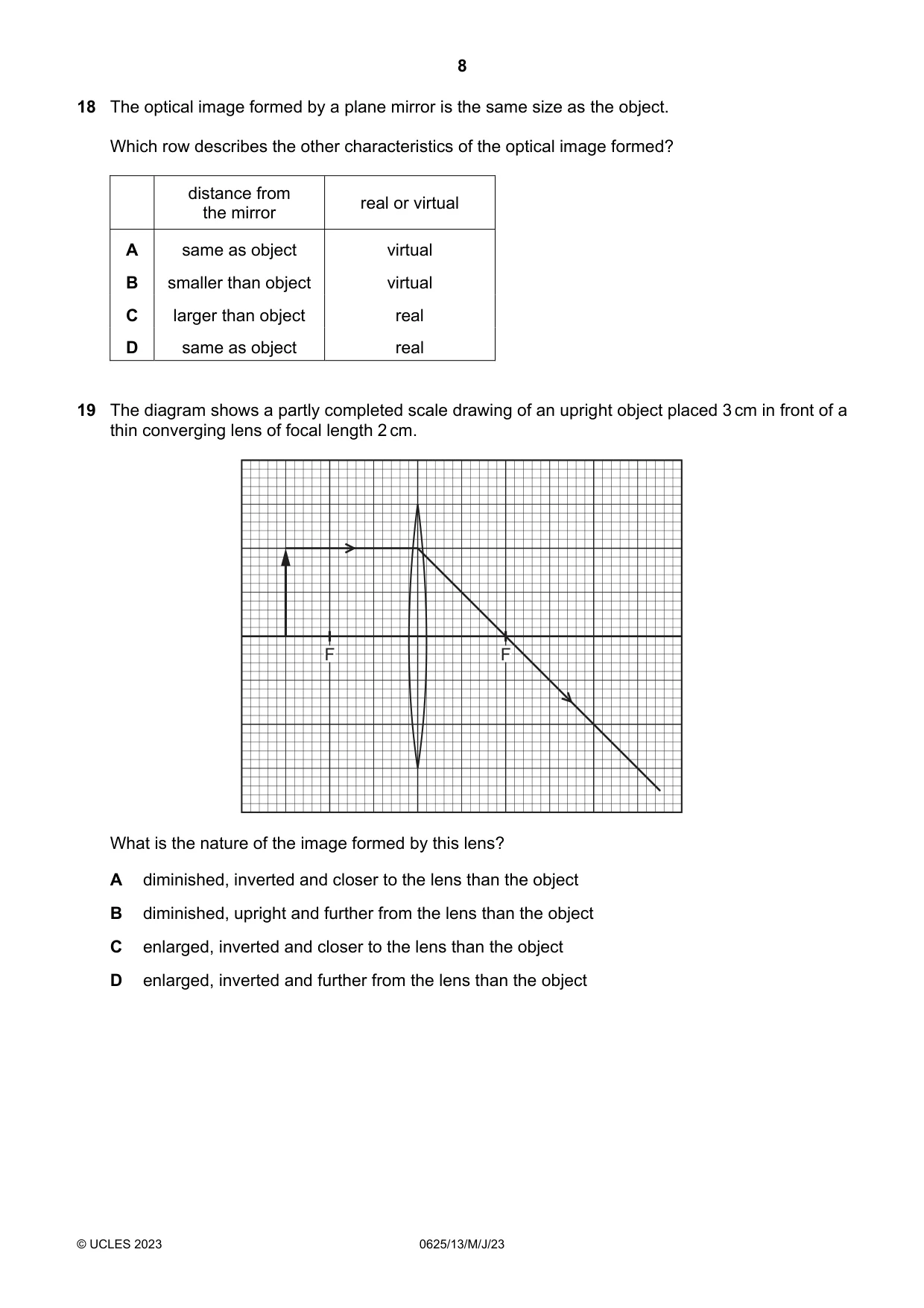
Q18 · The optical image formed by a plane mirror is the same size as the object
18 The optical image formed by a plane mirror is the same size as the object. Which row describes the other characteristics of the optical image formed? distance from real or virtual the mirror A same as object virtual B smaller than object virtual C larger than object real D same as object real
Mark scheme: A
Q19 · The diagram shows a partly completed scale drawing of an upright object placed 3 cm in…
19 The diagram shows a partly completed scale drawing of an upright object placed 3 cm in front of a thin converging lens of focal length 2 cm. F F What is the nature of the image formed by this lens? A diminished, inverted and closer to the lens than the object B diminished, upright and further from the lens than the object C enlarged, inverted and closer to the lens than the object D enlarged, inverted and further from the lens than the object
Mark scheme: D
Q20 · A narrow beam of white light passes through a prism and is dispersed into a spectrum
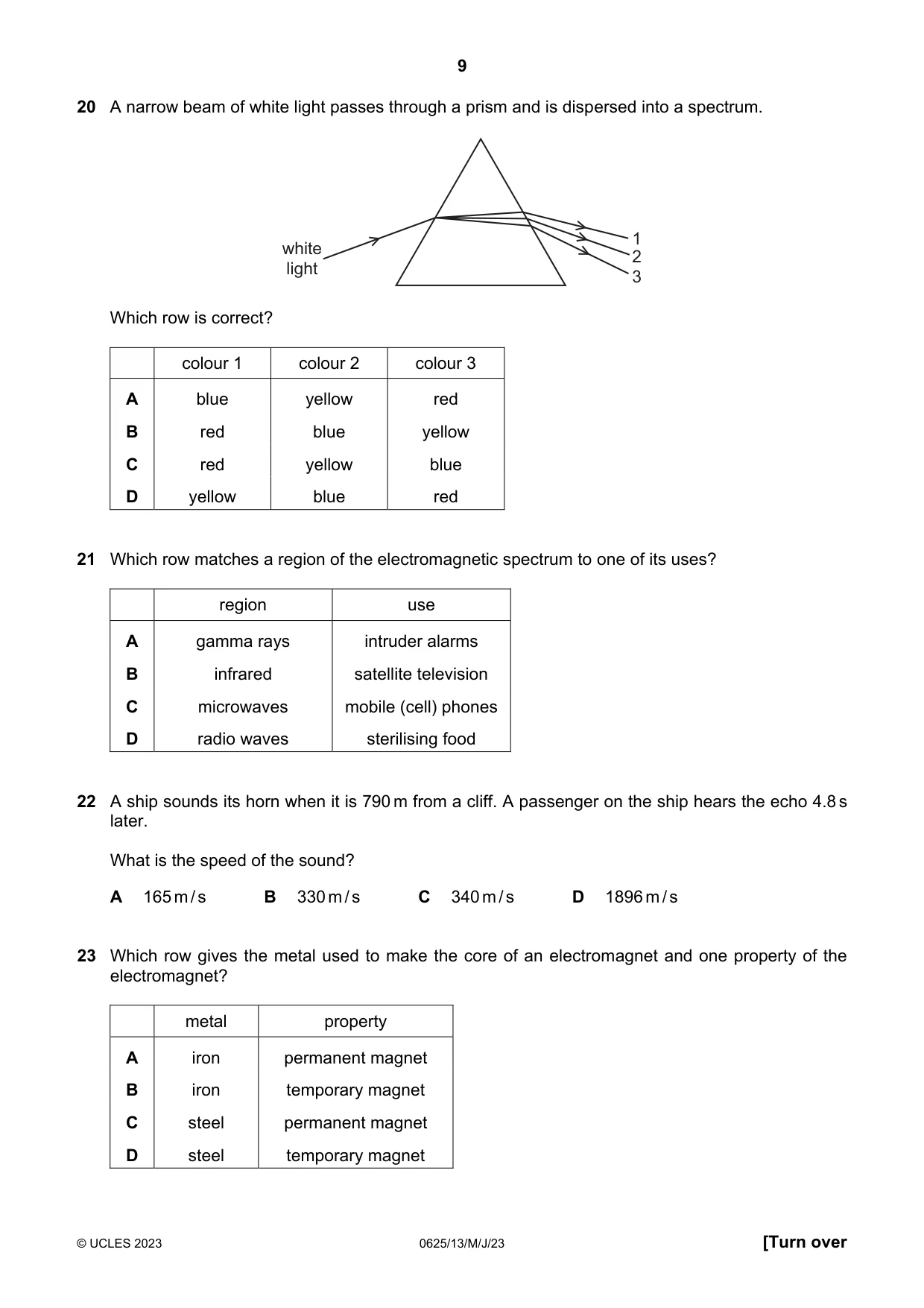
20 A narrow beam of white light passes through a prism and is dispersed into a spectrum. 1 white 2 light 3 Which row is correct? colour 1 colour 2 colour 3 A blue yellow red B red blue yellow C red yellow blue D yellow blue red
Mark scheme: C
Q21 · Which row matches a region of the electromagnetic spectrum to one of its uses?
21 Which row matches a region of the electromagnetic spectrum to one of its uses? region use A gamma rays intruder alarms B infrared satellite television C microwaves mobile (cell) phones D radio waves sterilising food
Mark scheme: C
Q22 · A ship sounds its horn when it is 790 m from a cliff
22 A ship sounds its horn when it is 790 m from a cliff. A passenger on the ship hears the echo 4.8 s later. What is the speed of the sound? A 165 m / s B 330 m / s C 340 m / s D 1896 m / s
Mark scheme: B
Q23 · Which row gives the metal used to make the core of an electromagnet and one property of…
23 Which row gives the metal used to make the core of an electromagnet and one property of the electromagnet? metal property A iron permanent magnet B iron temporary magnet C steel permanent magnet D steel temporary magnet
Mark scheme: B
Q24 · A plastic rod and a dry cloth are uncharged
24 A plastic rod and a dry cloth are uncharged. The rod is now rubbed with the cloth and they both become charged. The rod becomes negatively charged because some charged particles move from the cloth to the rod. What is the charge on the cloth and which particles moved in the charging process? charge particles on cloth that moved A negative electrons B negative neutrons C positive electrons D positive neutrons
Mark scheme: C
Q25 · A power supply of electromotive force (e.m.f.) 12 V is connected across a 3 resistor
25 A power supply of electromotive force (e.m.f.) 12 V is connected across a 3 resistor. Which ammeter is most suitable to measure the current in the resistor? A an ammeter with a range 0–0.5 A B an ammeter with a range 0–1 A C an ammeter with a range 0–5 A D an ammeter with a range 0–50 A
Mark scheme: C
Q26 · The cost of electrical energy is $0.25 for each unit of 1 kW h
26 The cost of electrical energy is $0.25 for each unit of 1 kW h. A 2200 W heater is switched on for 48 minutes. What is the cost of this use? A $0.44 B $0.55 C $26 D $440
Mark scheme: A
Q27 · The diagram shows six different electrical circuit components
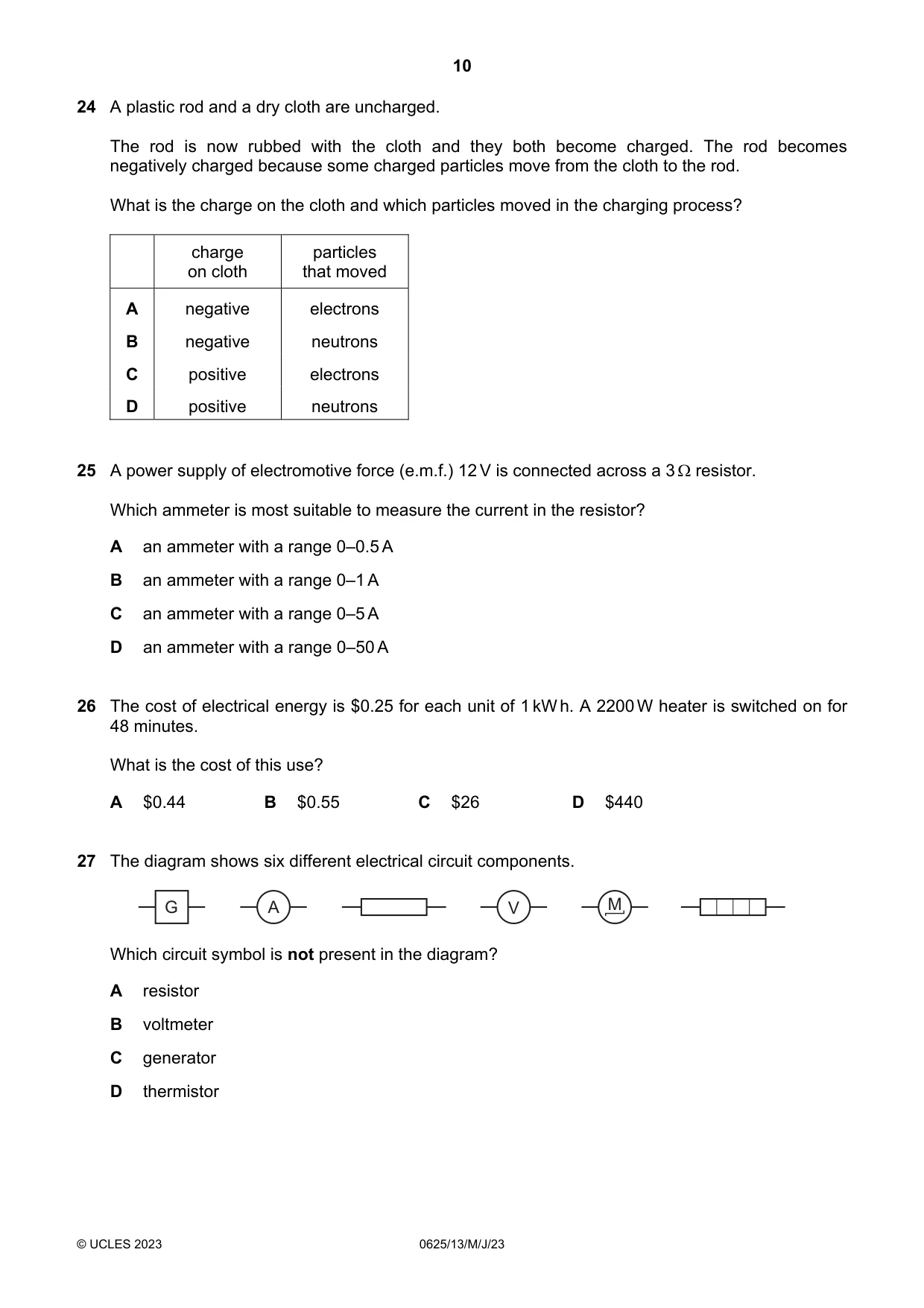
27 The diagram shows six different electrical circuit components. G A V M Which circuit symbol is not present in the diagram? A resistor B voltmeter C generator D thermistor
Mark scheme: D
Q28 · The circuit shown contains three switches and four lamps P, Q, R and S
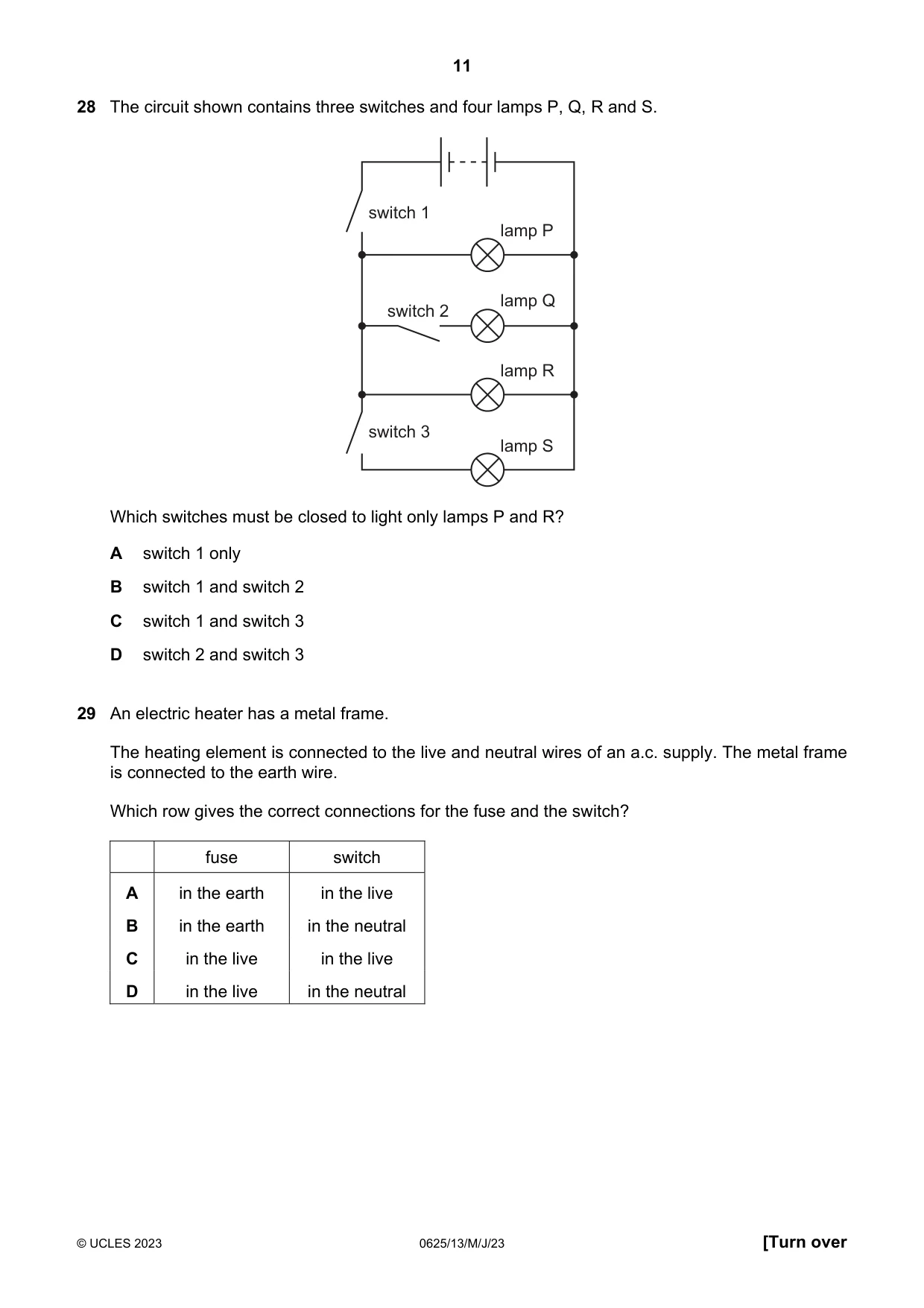
28 The circuit shown contains three switches and four lamps P, Q, R and S. switch 1 lamp P lamp Q switch 2 lamp R switch 3 lamp S Which switches must be closed to light only lamps P and R? A switch 1 only B switch 1 and switch 2 C switch 1 and switch 3 D switch 2 and switch 3
Mark scheme: A
Q29 · An electric heater has a metal frame
29 An electric heater has a metal frame. The heating element is connected to the live and neutral wires of an a.c. supply. The metal frame is connected to the earth wire. Which row gives the correct connections for the fuse and the switch? fuse switch A in the earth in the live B in the earth in the neutral C in the live in the live D in the live in the neutral
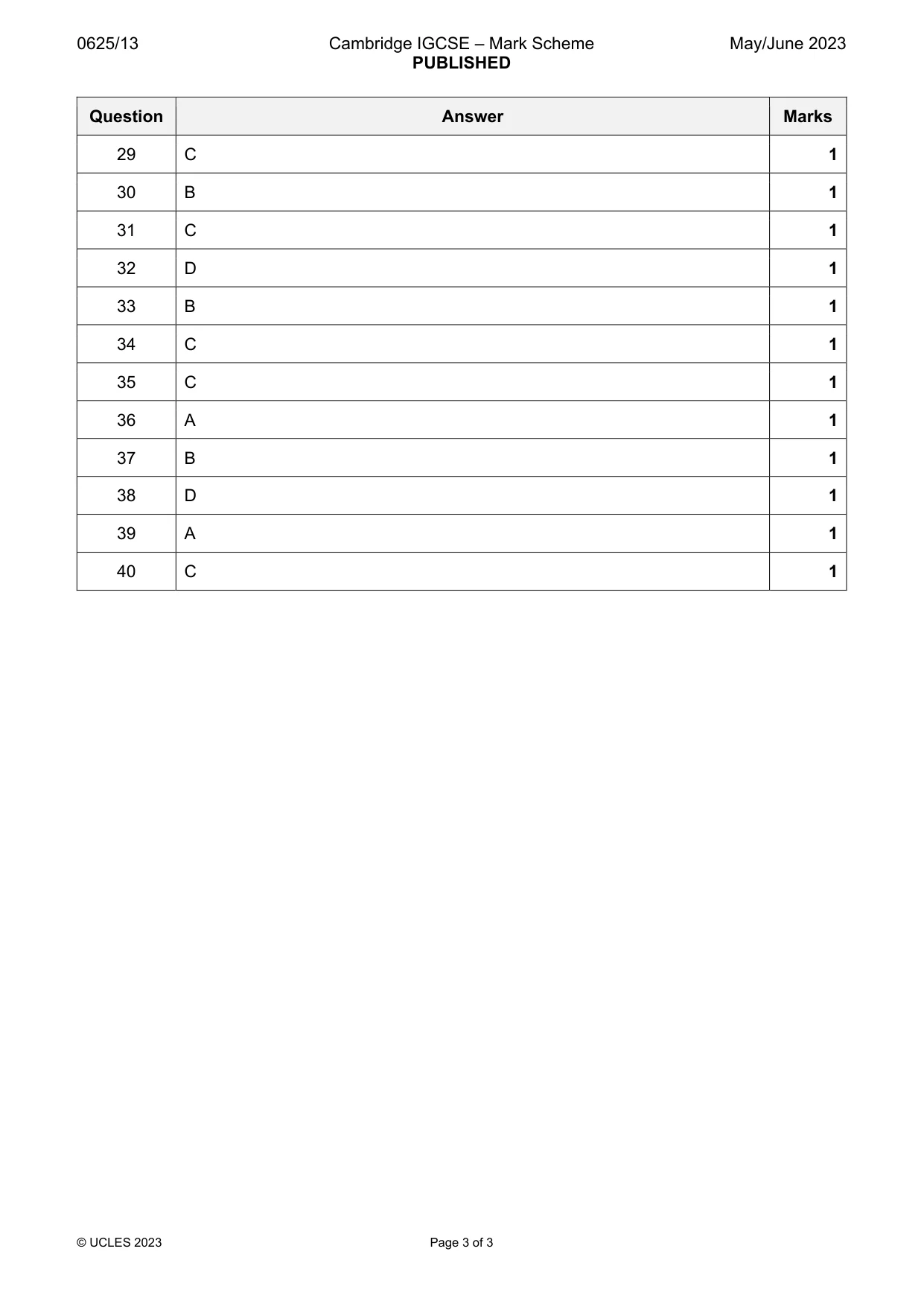
Mark scheme: C
Q30 · Which electrical device uses the turning effect produced by a current-carrying coil in a…
30 Which electrical device uses the turning effect produced by a current-carrying coil in a magnetic field? A a.c. generator B d.c. motor C relay D transformer
Mark scheme: B
Q31 · Four appliances all use an electric current to operate
31 Four appliances all use an electric current to operate. Which appliance uses the magnetic effect of the current? A a heater B a light bulb C a relay D a remote controller
Mark scheme: C
Q32 · A student makes four different types of transformer
32 A student makes four different types of transformer. She counts the number of turns on the primary and secondary coils. She labels each transformer as either step-up or step-down. Which row shows the correct labels? number of number of step-up or turns on the turns on the step-down primary coil secondary coil transformer A 5 5 step-up B 10 5 step-up C 10 20 step-down D 20 10 step-down
Mark scheme: D
Q33 · How is electricity transmitted over large distances and why is it transmitted in this way?
33 How is electricity transmitted over large distances and why is it transmitted in this way? how why A at high voltage for safety B at high voltage to reduce energy loss C at low voltage for safety D at low voltage to reduce energy loss
Mark scheme: B
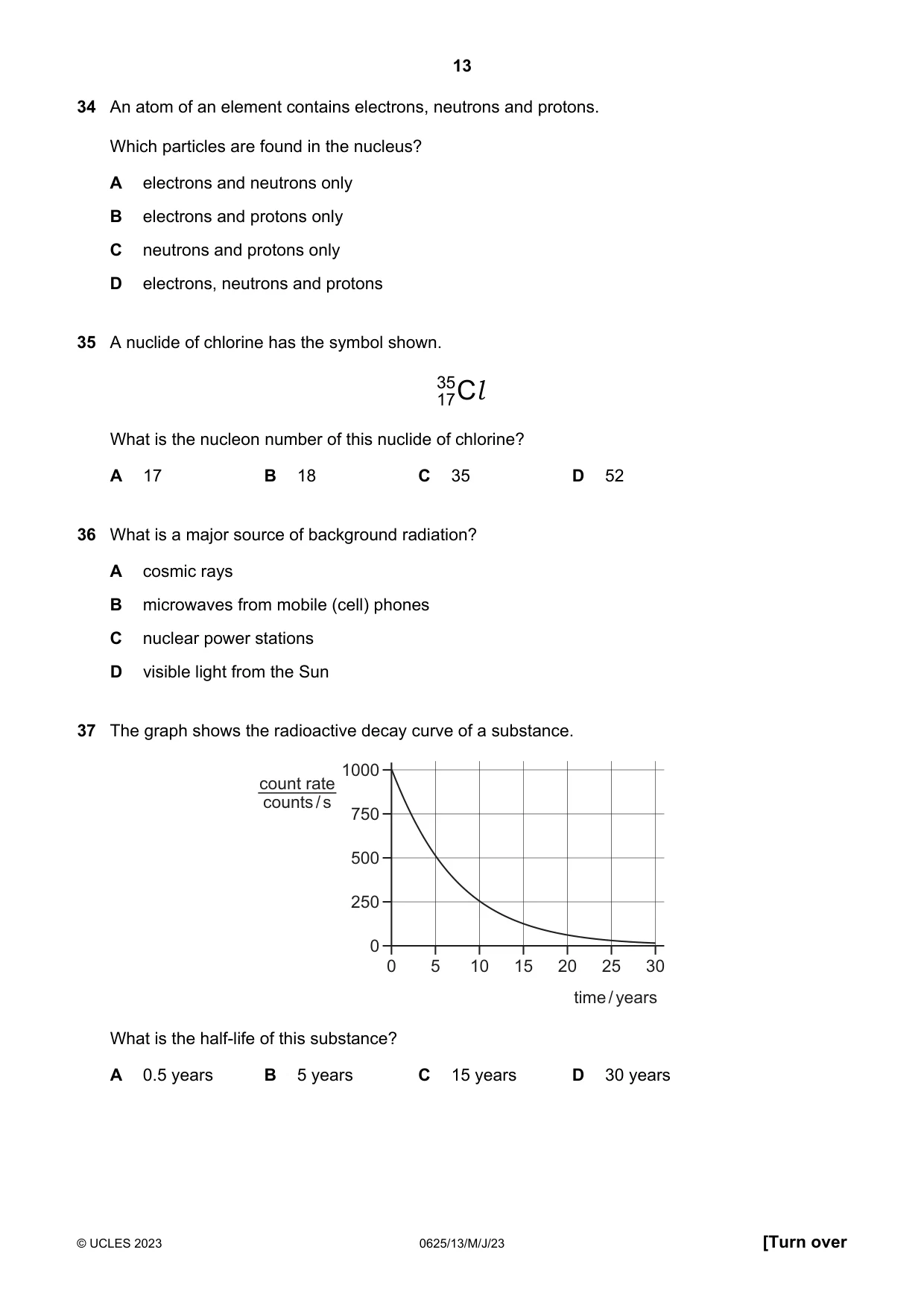
Q34 · An atom of an element contains electrons, neutrons and protons
34 An atom of an element contains electrons, neutrons and protons. Which particles are found in the nucleus? A electrons and neutrons only B electrons and protons only C neutrons and protons only D electrons, neutrons and protons
Mark scheme: C
Q35 · A nuclide of chlorine has the symbol shown
35 A nuclide of chlorine has the symbol shown. 35 C l 17 What is the nucleon number of this nuclide of chlorine? A 17 B 18 C 35 D 52
Mark scheme: C
Q36 · What is a major source of background radiation?
36 What is a major source of background radiation? A cosmic rays B microwaves from mobile (cell) phones C nuclear power stations D visible light from the Sun
Mark scheme: A
Q37 · The graph shows the radioactive decay curve of a substance
37 The graph shows the radioactive decay curve of a substance. 1000 count rate counts / s 750 500 250 0 0 5 10 15 20 25 30 time / years What is the half-life of this substance? A 0.5 years B 5 years C 15 years D 30 years
Mark scheme: B
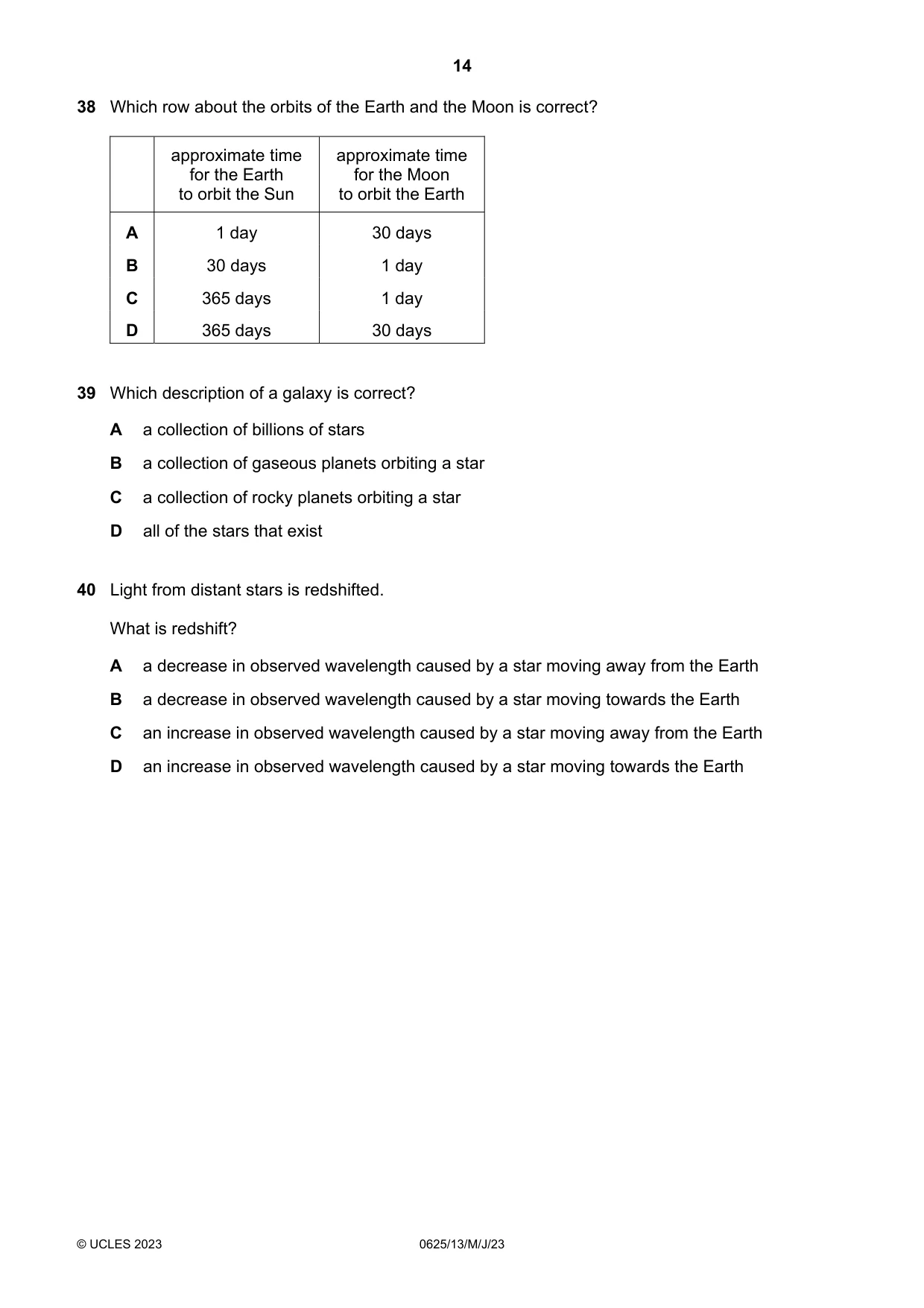
Q38 · Which row about the orbits of the Earth and the Moon is correct?
38 Which row about the orbits of the Earth and the Moon is correct? approximate time approximate time for the Earth for the Moon to orbit the Sun to orbit the Earth A 1 day 30 days B 30 days 1 day C 365 days 1 day D 365 days 30 days
Mark scheme: D
Q39 · Which description of a galaxy is correct?
39 Which description of a galaxy is correct? A a collection of billions of stars B a collection of gaseous planets orbiting a star C a collection of rocky planets orbiting a star D all of the stars that exist
Mark scheme: A
Q40 · Light from distant stars is redshifted
40 Light from distant stars is redshifted. What is redshift? A a decrease in observed wavelength caused by a star moving away from the Earth B a decrease in observed wavelength caused by a star moving towards the Earth C an increase in observed wavelength caused by a star moving away from the Earth D an increase in observed wavelength caused by a star moving towards the Earth
Mark scheme: C
What was in this paper
The subtopics covered by these 40 questions, and how many questions each got. Open one in a new tab to see every Cambridge question on it.
4Forces4Electrical quantities3Energy, work and power3Light3Electric circuits2Kinetic particle model of matter2Motion2Radioactivity2Stars and the Universe2The nuclear model of the atom2Density1Electrical safety1Electromagnetic spectrum1General properties of waves1Mass and weight1Physical quantities and measurement techniques1Pressure1Simple phenomena of magnetism1Sound1The Earth and the Solar System1Transfer of thermal energy1What you needed in this session
Cambridge’s own grade thresholds for 2023 May/June, Paper 1 · Variant 3. A higher threshold means an easier paper — the bar moves with how the cohort did.