Cambridge IGCSE Physics 0625 — 2014 May/June Paper 1 · Variant 2
0625/12/M/J/14 · 40 questions · 40 marks · ≈45 min
The question paper and its mark scheme, free to read here and free to download. This is Cambridge’s own paper, exactly as it was sat.
Question paper20 pages
Mark scheme2 pages
Answers below. Sit the paper first if you are practising.
Questions as text
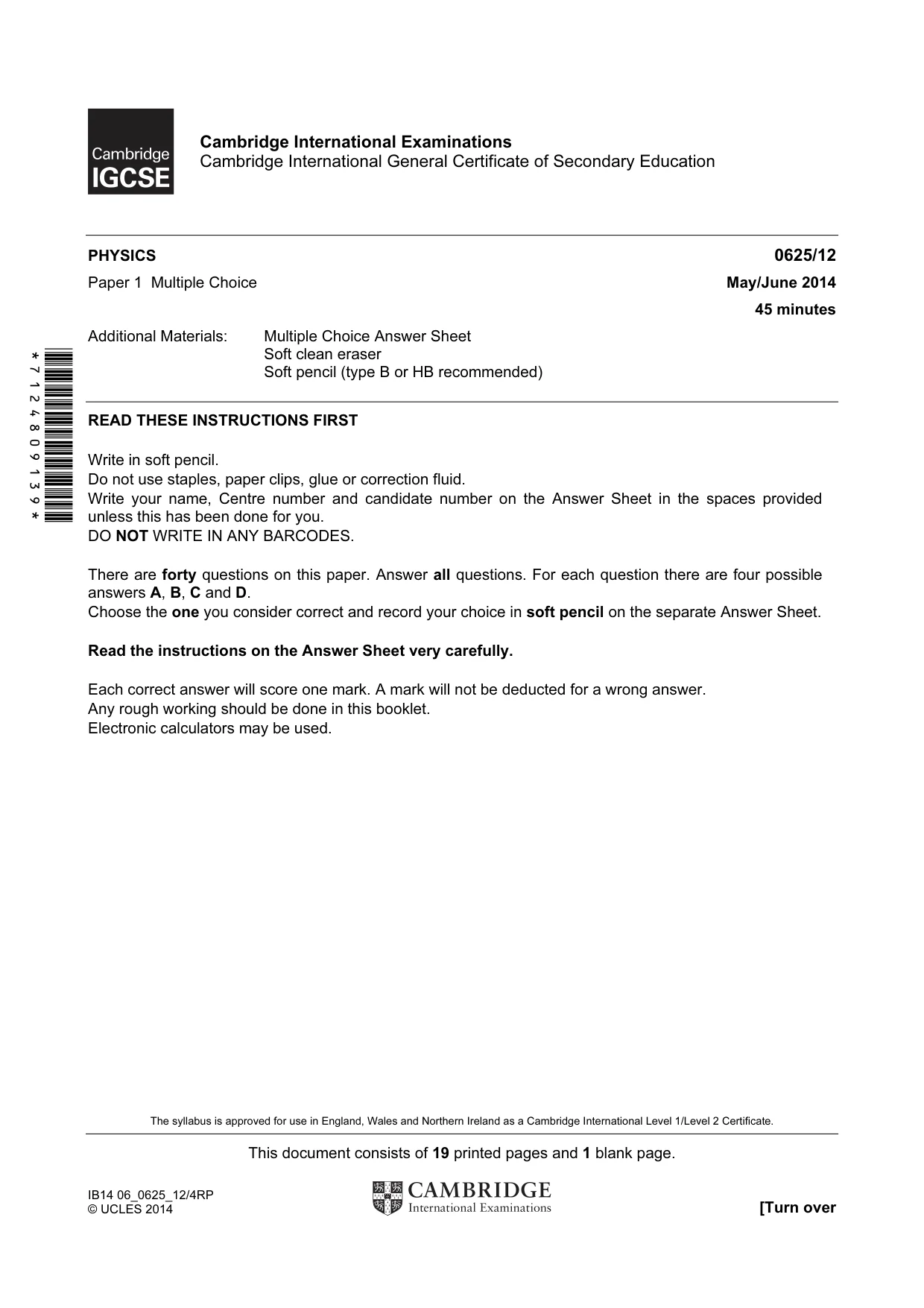
Q1 · The diagram shows part of a ruler
1 The diagram shows part of a ruler. The ruler is used to find the length of a nail. 0 1 2 3 4 cm What is the length of the nail? A 2.2 cm B 2.7 cm C 3.2 cm D 3.7 cm
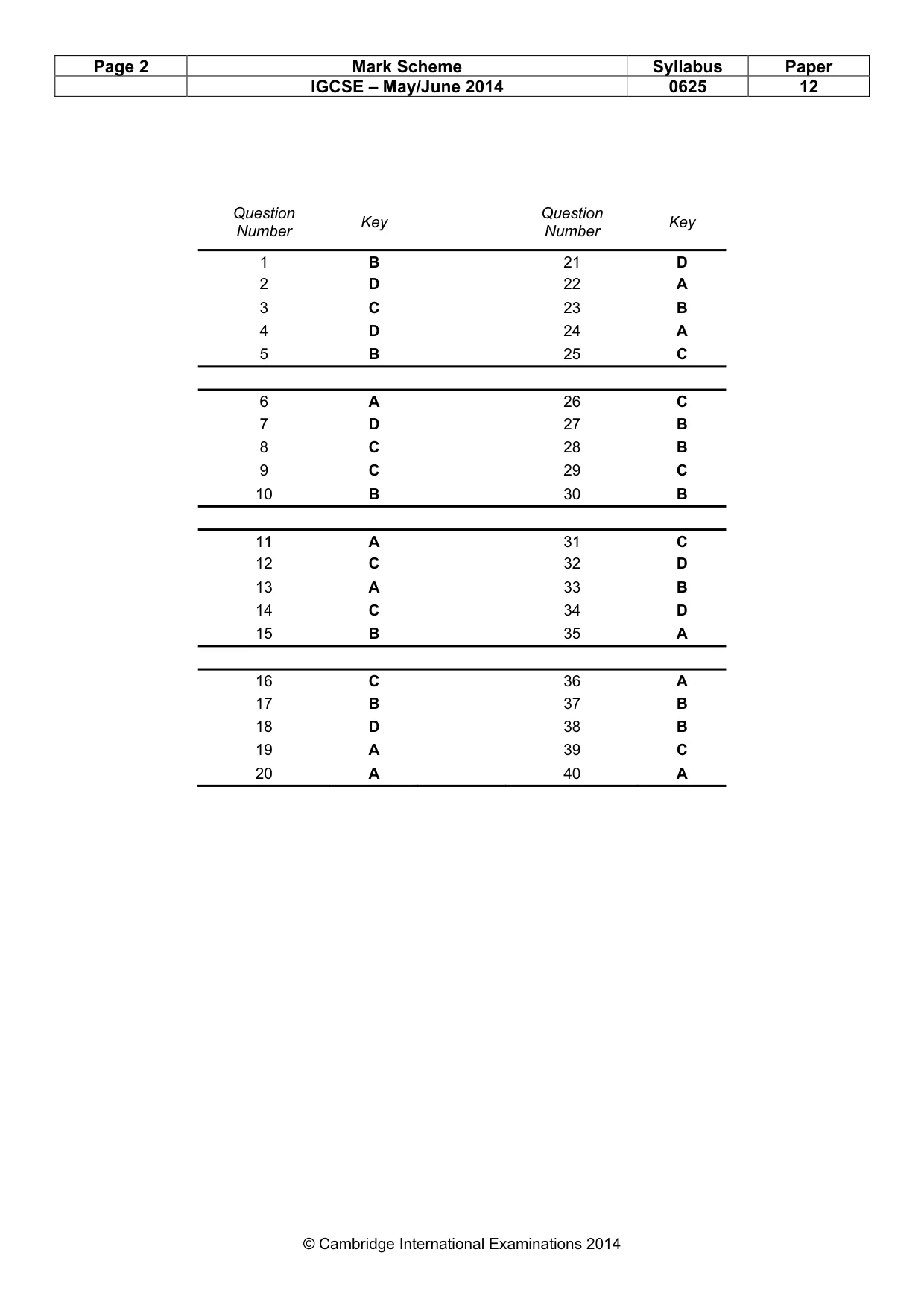
Mark scheme: B
More questions on Physical quantities and measurement techniques
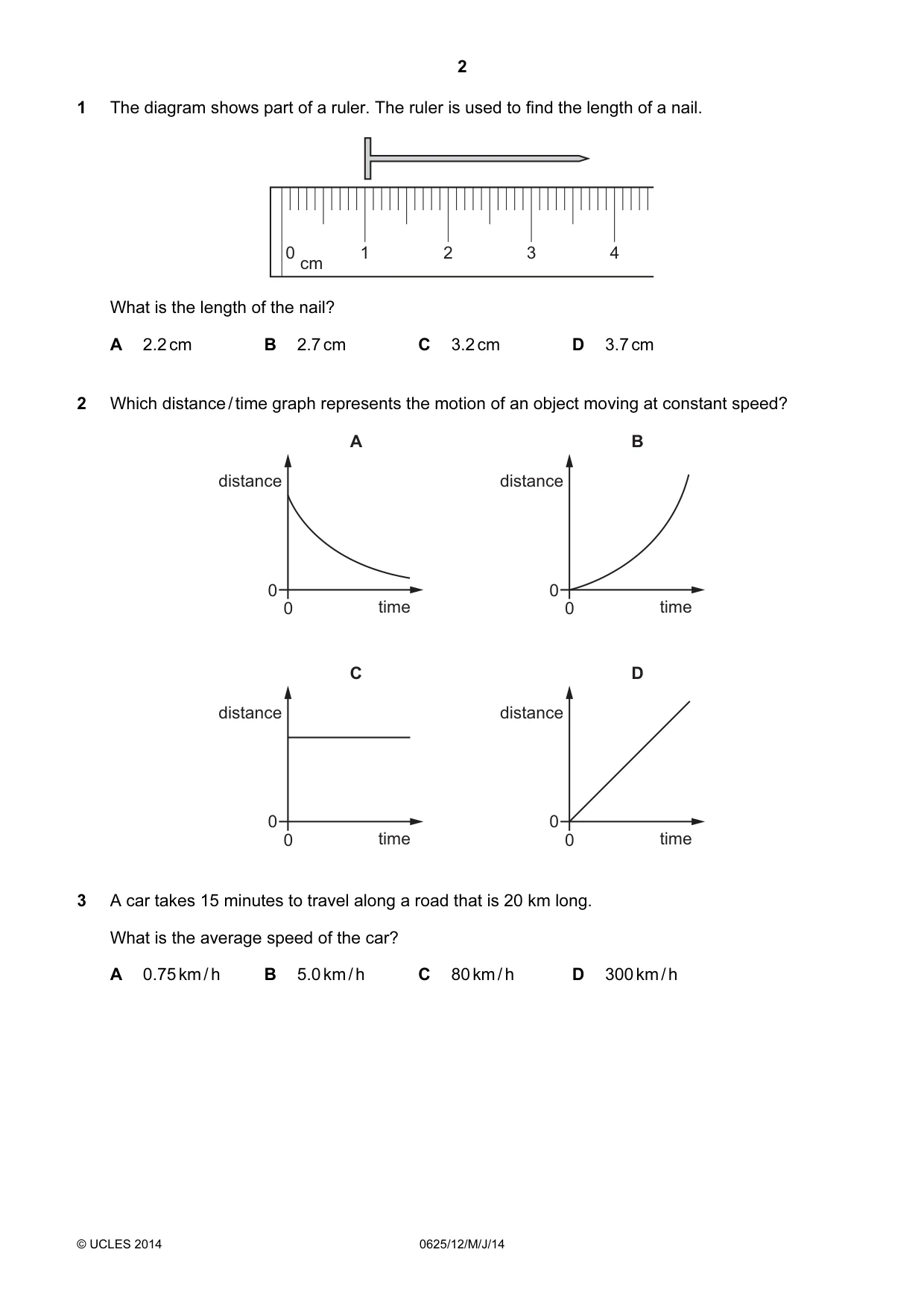
Q2 · Which distance / time graph represents the motion of an object moving at constant speed?
2 Which distance / time graph represents the motion of an object moving at constant speed? A B distance distance 0 0 0 time 0 time C D distance distance 0 0 0 time 0 time
Mark scheme: D
Q3 · A car takes 15 minutes to travel along a road that is 20 km long
3 A car takes 15 minutes to travel along a road that is 20 km long. What is the average speed of the car? A 0.75 km / h B 5.0 km / h C 80 km / h D 300 km / h
Mark scheme: C
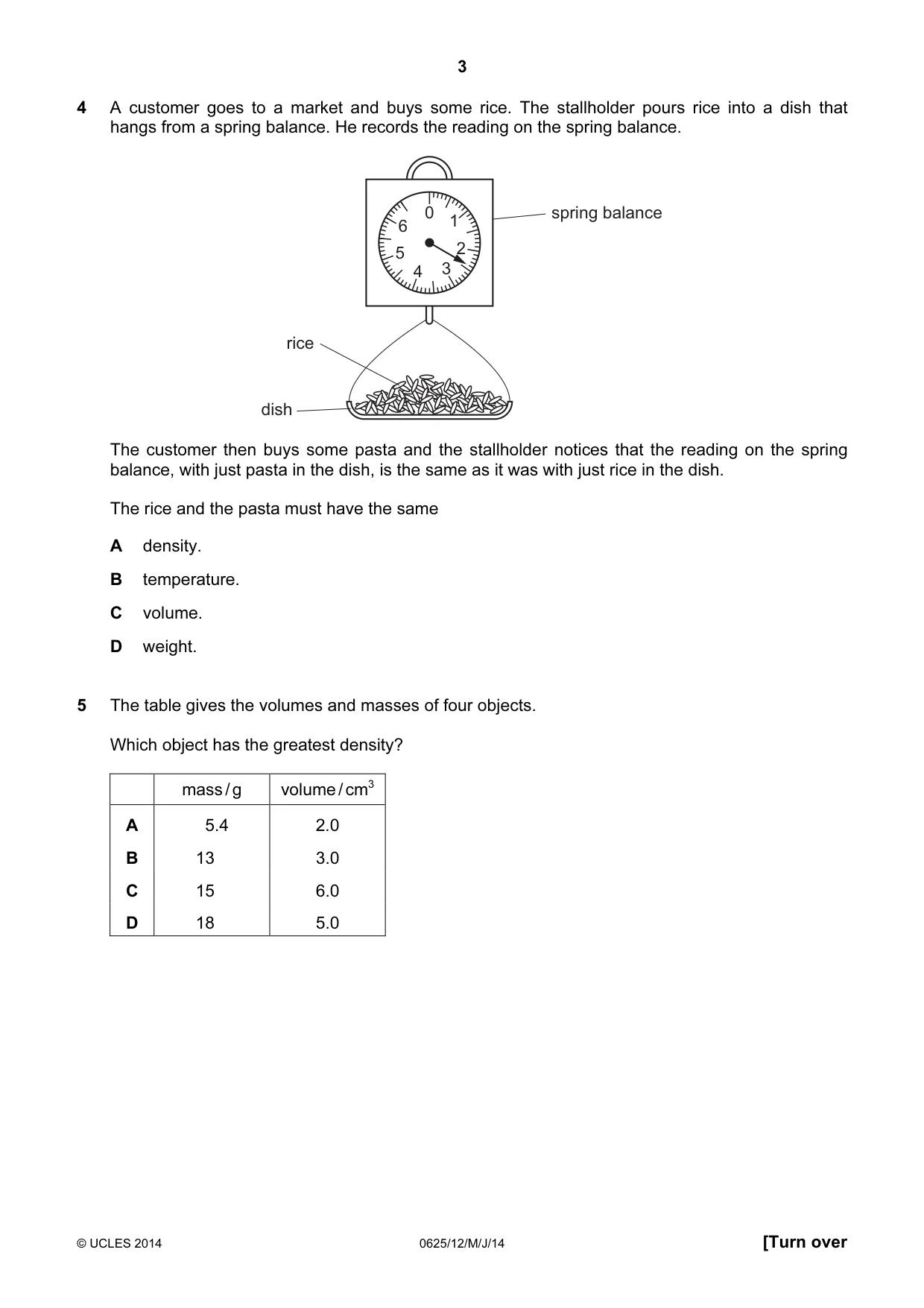
Q4 · A customer goes to a market and buys some rice
4 A customer goes to a market and buys some rice. The stallholder pours rice into a dish that hangs from a spring balance. He records the reading on the spring balance. 0 1 spring balance 6 5 2 4 3 rice dish The customer then buys some pasta and the stallholder notices that the reading on the spring balance, with just pasta in the dish, is the same as it was with just rice in the dish. The rice and the pasta must have the same A density. B temperature. C volume. D weight.
Mark scheme: D
Q5 · The table gives the volumes and masses of four objects
5 The table gives the volumes and masses of four objects. Which object has the greatest density? mass / g volume / cm3 A 5.4 2.0 B 13 3.0 C 15 6.0 D 18 5.0
Mark scheme: B
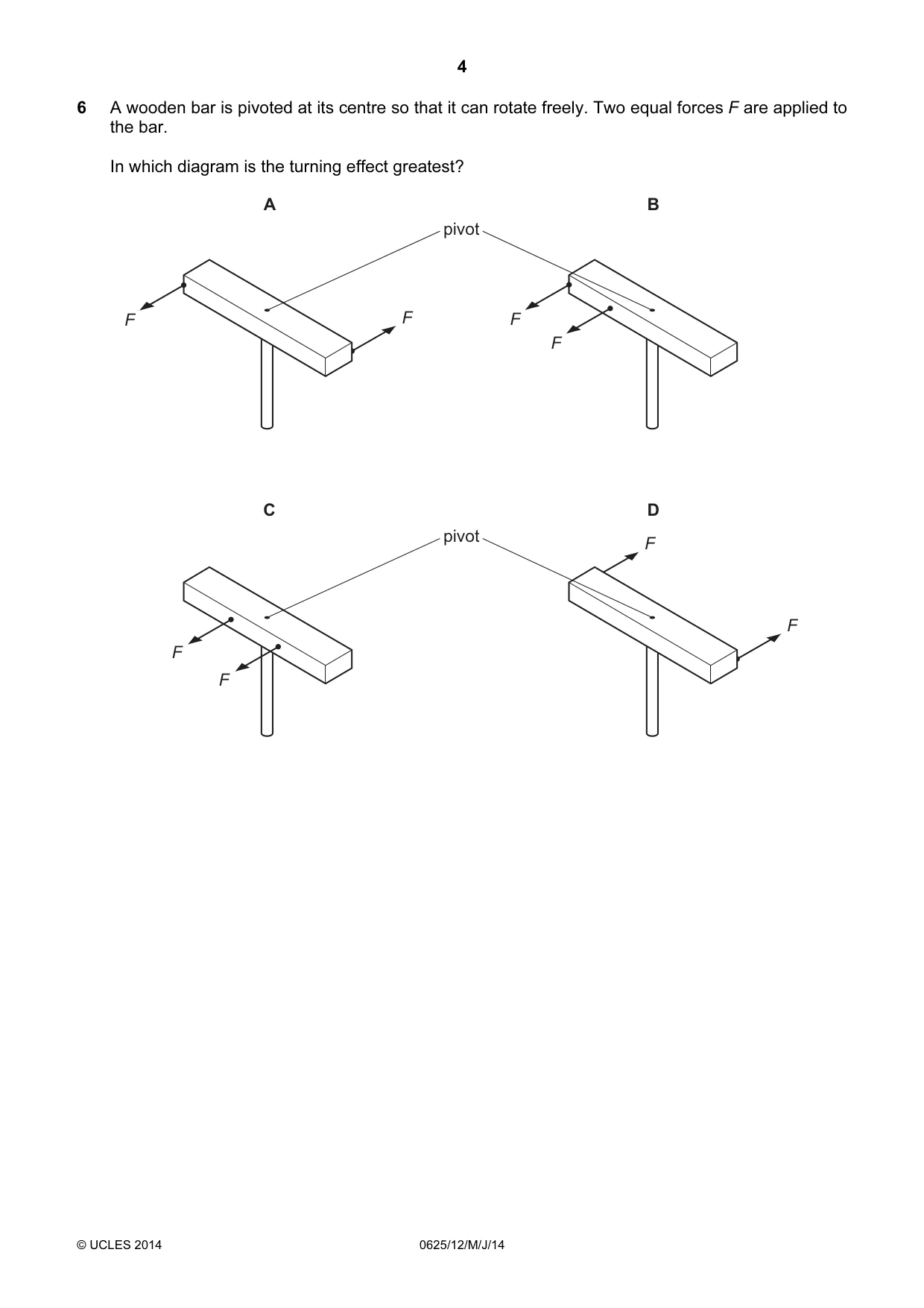
Q6 · A wooden bar is pivoted at its centre so that it can rotate freely
6 A wooden bar is pivoted at its centre so that it can rotate freely. Two equal forces F are applied to the bar. In which diagram is the turning effect greatest? A B pivot F F F F C D pivot F F F F
Mark scheme: A
Q7 · A student adds weights to an elastic cord
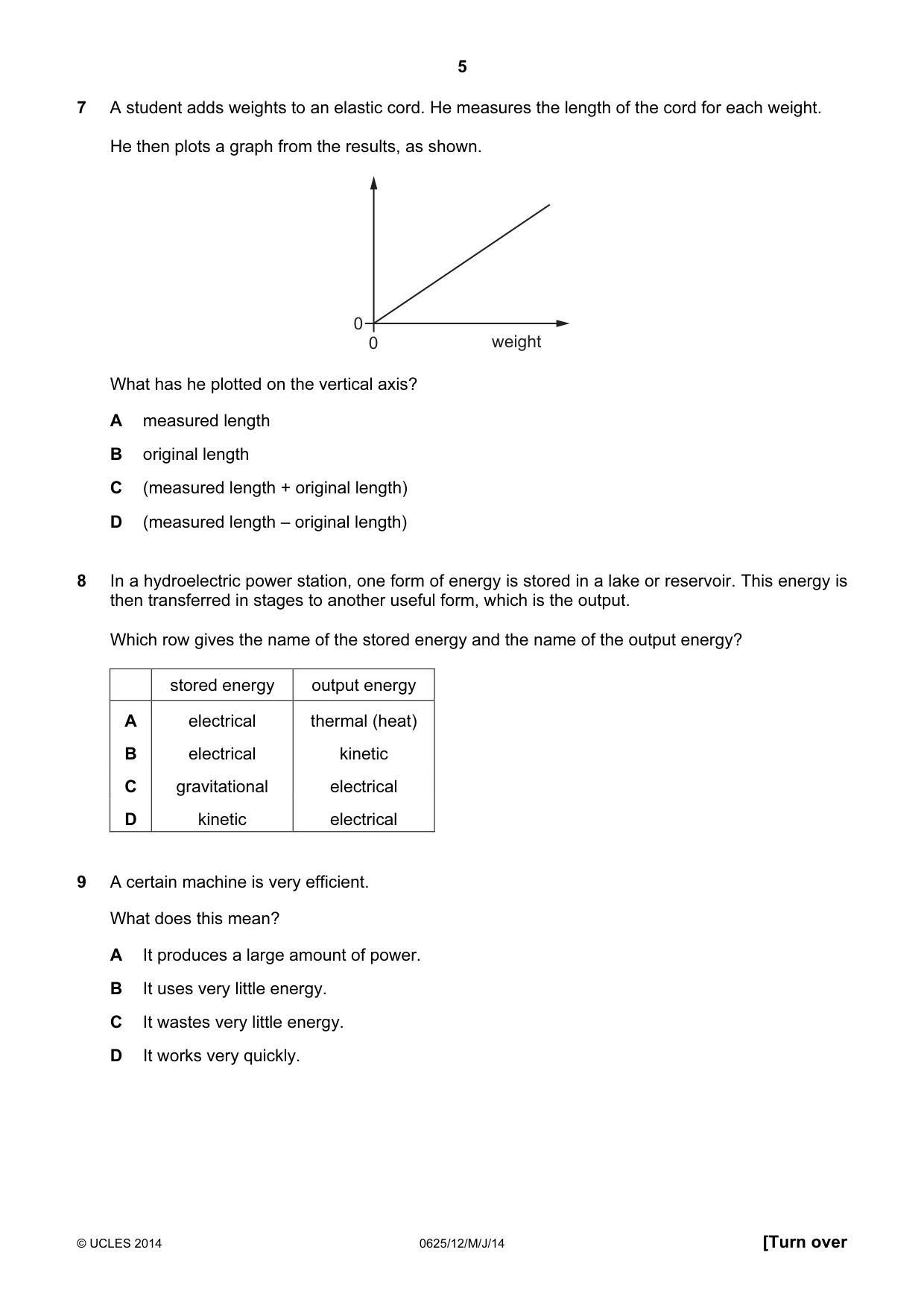
7 A student adds weights to an elastic cord. He measures the length of the cord for each weight. He then plots a graph from the results, as shown. 0 0 weight What has he plotted on the vertical axis? A measured length B original length C (measured length + original length) D (measured length – original length)
Mark scheme: D
Q8 · In a hydroelectric power station, one form of energy is stored in a lake or reservoir
8 In a hydroelectric power station, one form of energy is stored in a lake or reservoir. This energy is then transferred in stages to another useful form, which is the output. Which row gives the name of the stored energy and the name of the output energy? stored energy output energy A electrical thermal (heat) B electrical kinetic C gravitational electrical D kinetic electrical
Mark scheme: C
Q9 · A certain machine is very efficient
9 A certain machine is very efficient. What does this mean? A It produces a large amount of power. B It uses very little energy. C It wastes very little energy. D It works very quickly.
Mark scheme: C
Q10 · The diagram shows a simple mercury barometer
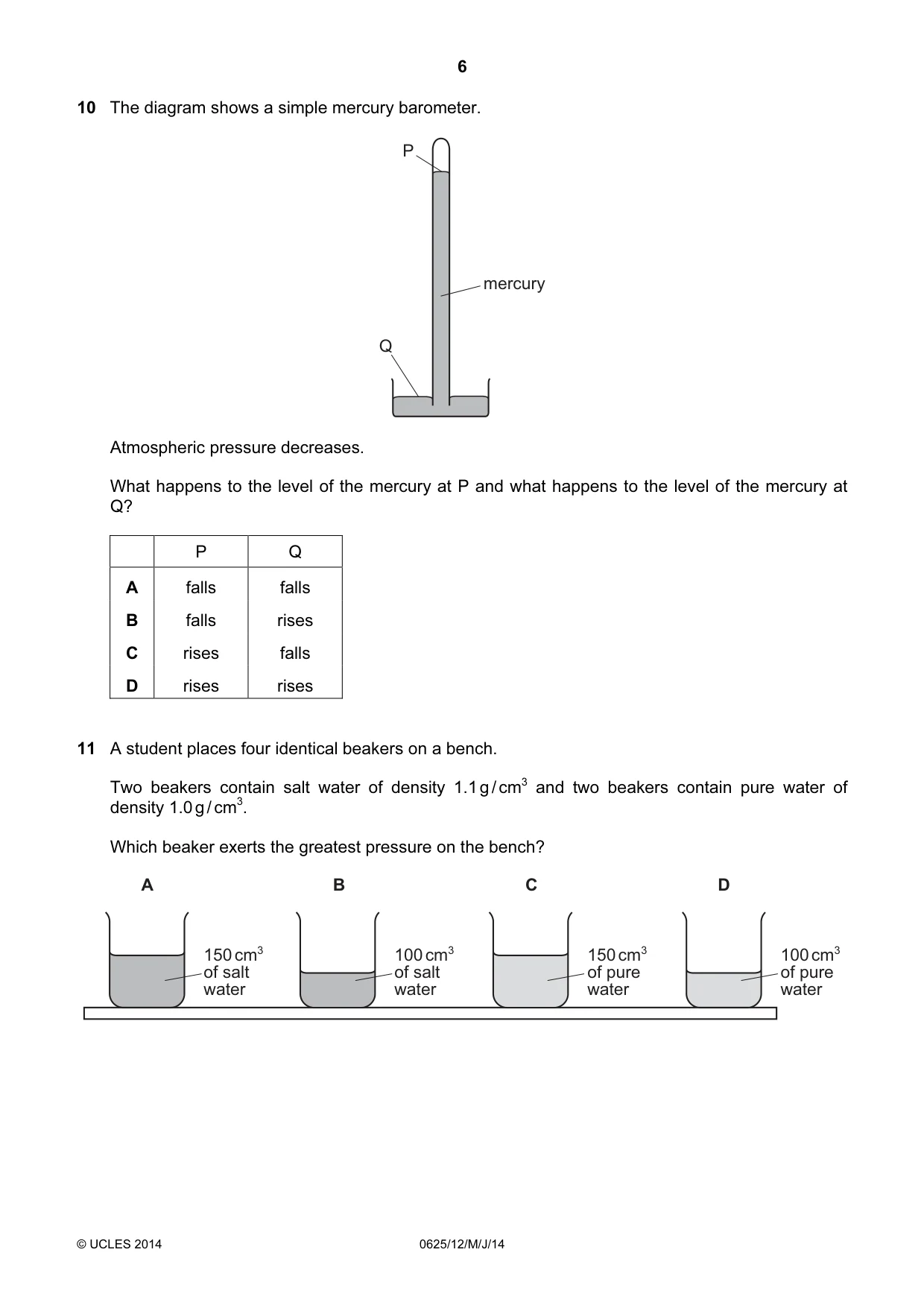
10 The diagram shows a simple mercury barometer. P mercury Q Atmospheric pressure decreases. What happens to the level of the mercury at P and what happens to the level of the mercury at Q? P Q A falls falls B falls rises C rises falls D rises rises
Mark scheme: B
Q11 · A student places four identical beakers on a bench
11 A student places four identical beakers on a bench. Two beakers contain salt water of density 1.1 g / cm3 and two beakers contain pure water of density 1.0 g / cm3. Which beaker exerts the greatest pressure on the bench? A B C D 150 cm3 100 cm3 150 cm3 100 cm3 of salt of salt of pure of pure water water water water
Mark scheme: A
Q12 · A student places his thumb firmly on the outlet of a bicycle pump, to stop the air coming…
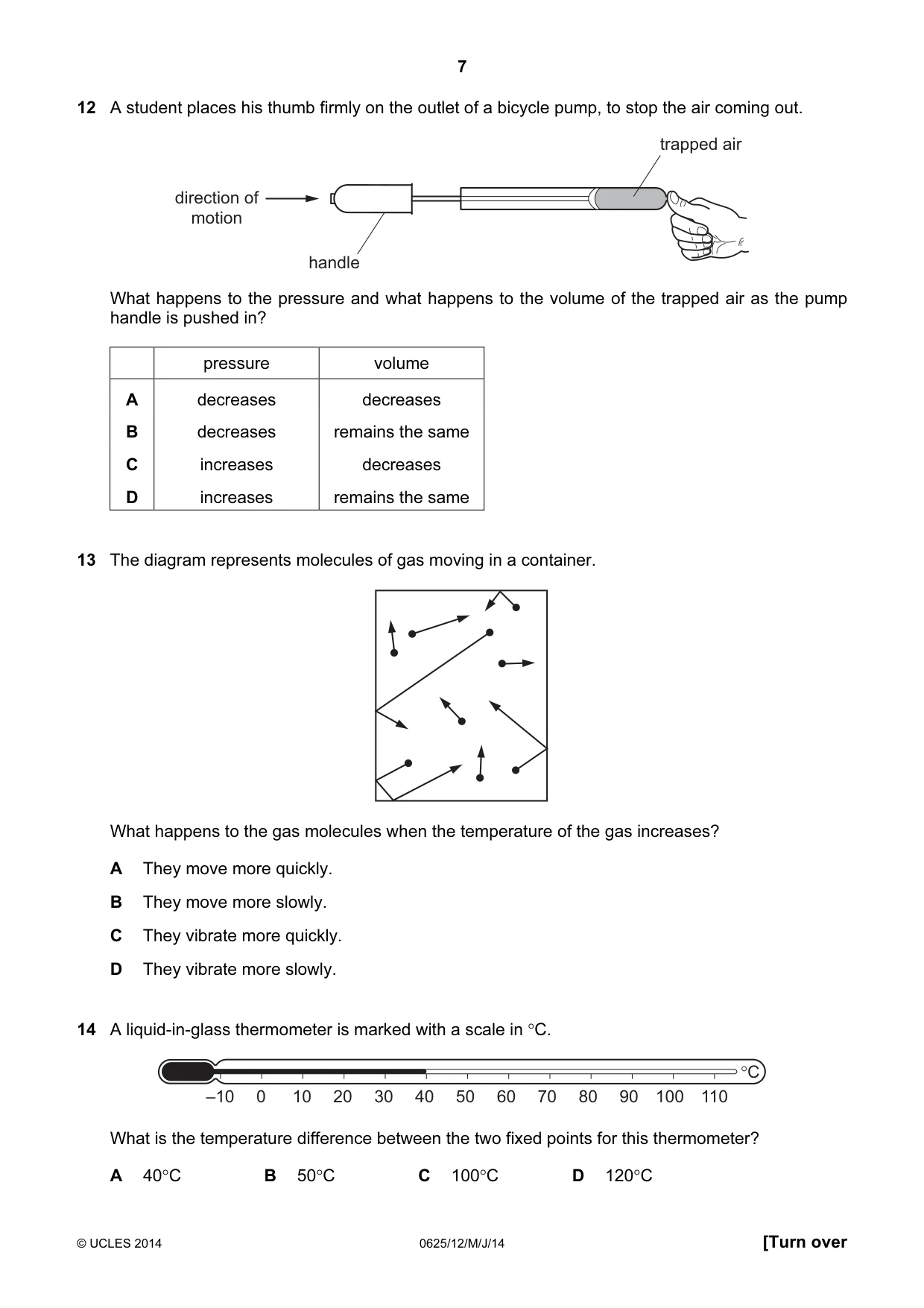
12 A student places his thumb firmly on the outlet of a bicycle pump, to stop the air coming out. trapped air direction of motion handle What happens to the pressure and what happens to the volume of the trapped air as the pump handle is pushed in? pressure volume A decreases decreases B decreases remains the same C increases decreases D increases remains the same
Mark scheme: C
Q13 · The diagram represents molecules of gas moving in a container
13 The diagram represents molecules of gas moving in a container. What happens to the gas molecules when the temperature of the gas increases? A They move more quickly. B They move more slowly. C They vibrate more quickly. D They vibrate more slowly.
Mark scheme: A
Q14 · A liquid-in-glass thermometer is marked with a scale in °C
14 A liquid-in-glass thermometer is marked with a scale in °C. °C –10 0 10 20 30 40 50 60 70 80 90 100 110 What is the temperature difference between the two fixed points for this thermometer? A 40°C B 50°C C 100°C D 120°C
Mark scheme: C
Q15 · Which statement gives the thermal capacity of a solid body?
15 Which statement gives the thermal capacity of a solid body? A the energy needed to melt the body without a change in temperature B the energy per degree Celsius needed to raise the temperature of the body C the increase in the volume of the body when its temperature is raised by one degree Celsius D the total amount of internal energy in the body
Mark scheme: B
Q16 · In an experiment, a thermometer is placed in a test-tube of hot liquid
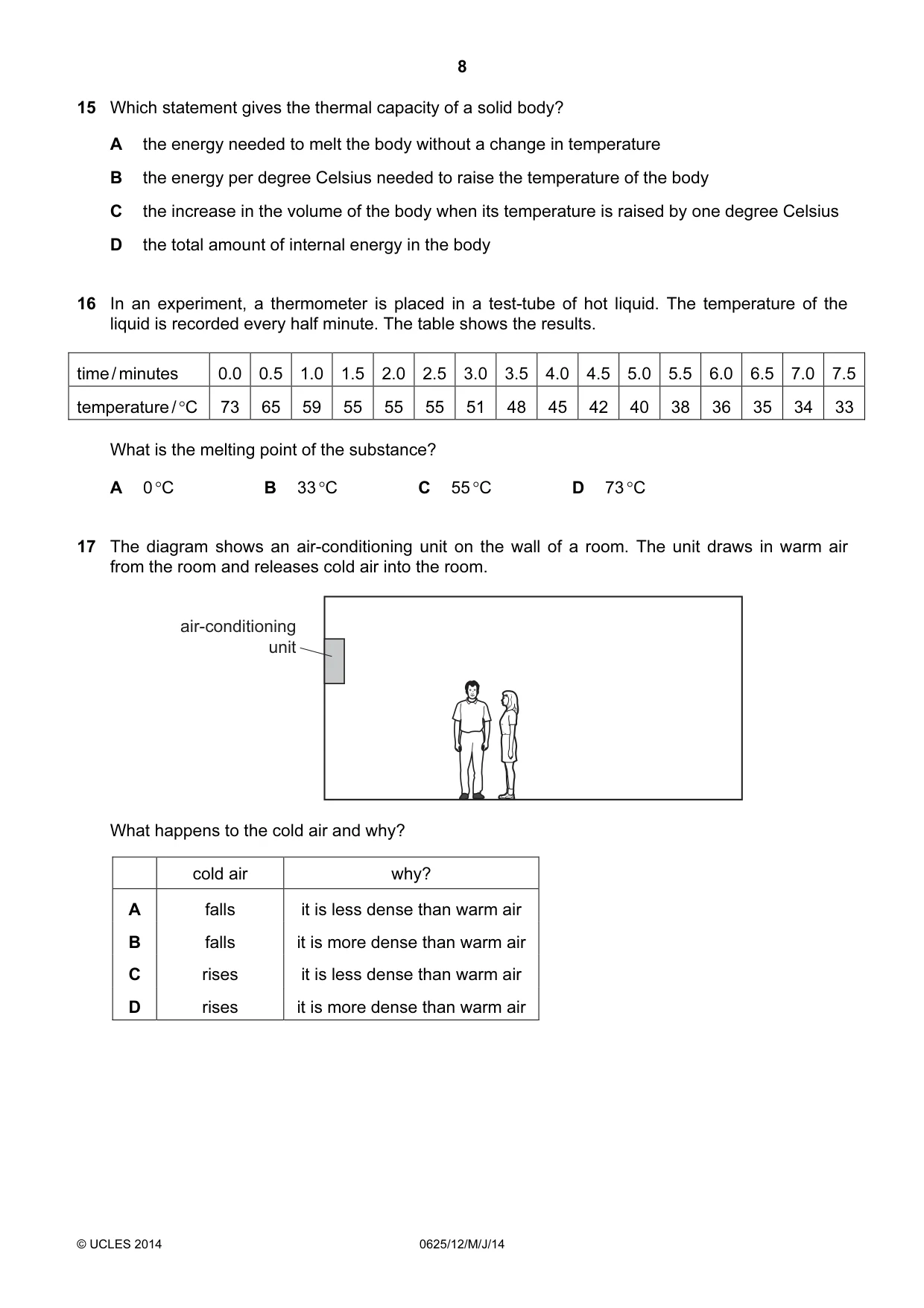
16 In an experiment, a thermometer is placed in a test-tube of hot liquid. The temperature of the liquid is recorded every half minute. The table shows the results. time / minutes 0.0 0.5 1.0 1.5 2.0 2.5 3.0 3.5 4.0 4.5 5.0 5.5 6.0 6.5 7.0 7.5 temperature / °C 73 65 59 55 55 55 51 48 45 42 40 38 36 35 34 33 What is the melting point of the substance? A 0 °C B 33 °C C 55 °C D 73 °C
Mark scheme: C
Q17 · The diagram shows an air-conditioning unit on the wall of a room
17 The diagram shows an air-conditioning unit on the wall of a room. The unit draws in warm air from the room and releases cold air into the room. air-conditioning unit What happens to the cold air and why? cold air why? A falls it is less dense than warm air B falls it is more dense than warm air C rises it is less dense than warm air D rises it is more dense than warm air
Mark scheme: B
Q18 · Which statement about thermal radiation is correct?
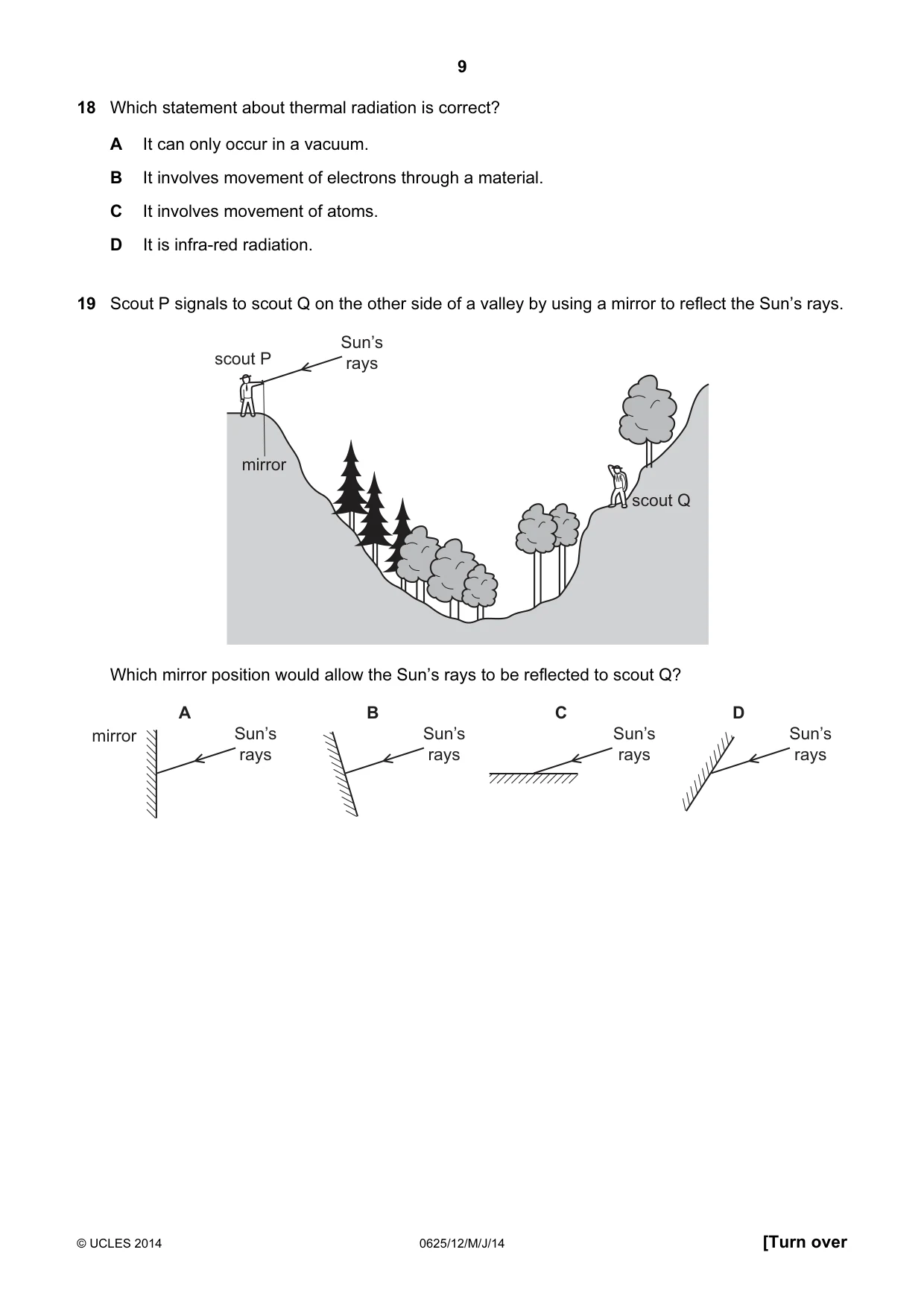
18 Which statement about thermal radiation is correct? A It can only occur in a vacuum. B It involves movement of electrons through a material. C It involves movement of atoms. D It is infra-red radiation.
Mark scheme: D
Q19 · Scout P signals to scout Q on the other side of a valley by using a mirror to reflect the…
19 Scout P signals to scout Q on the other side of a valley by using a mirror to reflect the Sun’s rays. Sun’s scout P rays mirror scout Q Which mirror position would allow the Sun’s rays to be reflected to scout Q? A B C D mirror Sun’s Sun’s Sun’s Sun’s rays rays rays rays
Mark scheme: A
Q20 · A small boat in a harbour is protected from waves on the sea by harbour walls
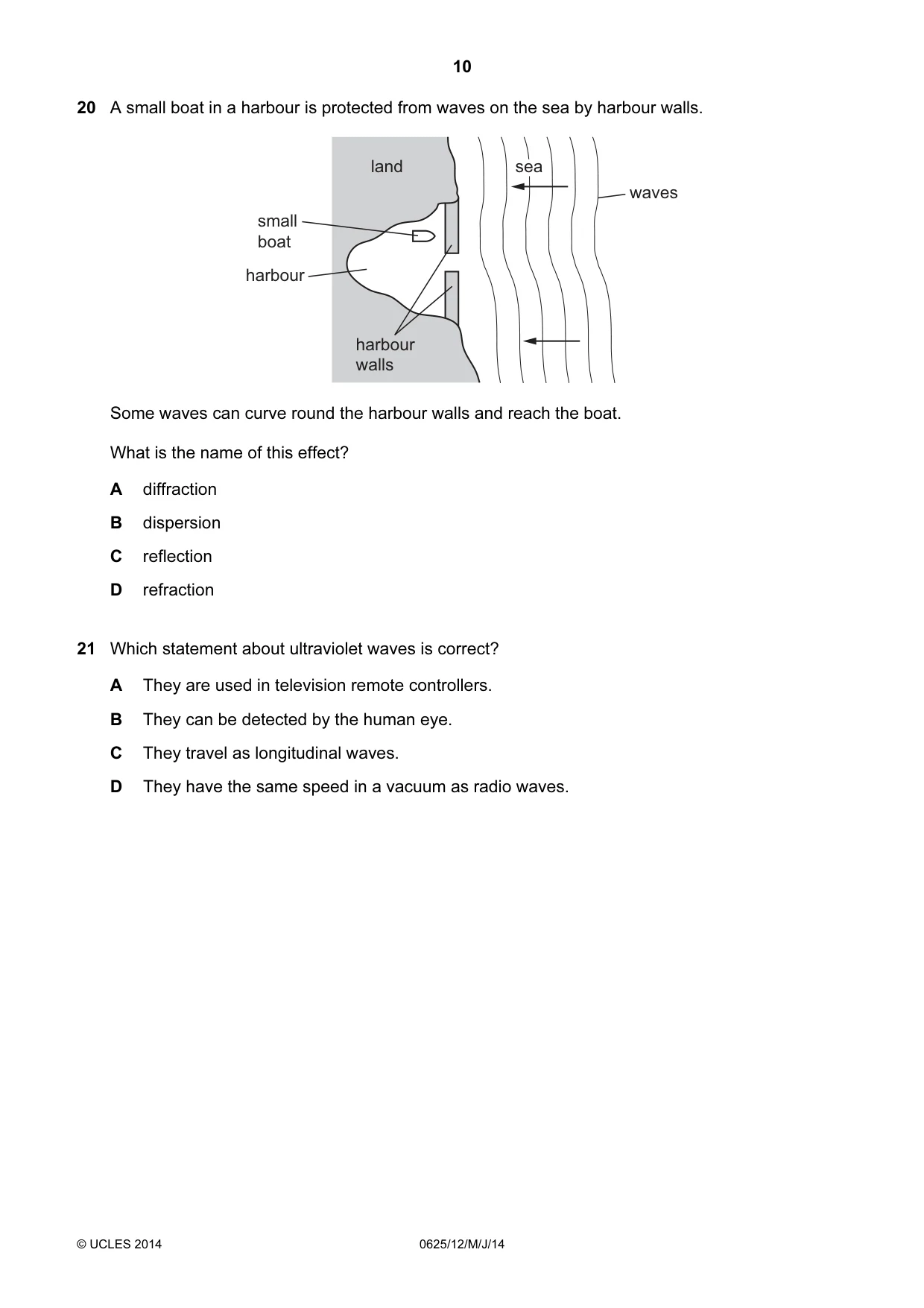
20 A small boat in a harbour is protected from waves on the sea by harbour walls. land sea sea sea waves small boat harbour harbour walls Some waves can curve round the harbour walls and reach the boat. What is the name of this effect? A diffraction B dispersion C reflection D refraction
Mark scheme: A
Q21 · Which statement about ultraviolet waves is correct?
21 Which statement about ultraviolet waves is correct? A They are used in television remote controllers. B They can be detected by the human eye. C They travel as longitudinal waves. D They have the same speed in a vacuum as radio waves.
Mark scheme: D
Q22 · A boy wears a shirt with a letter F on the front
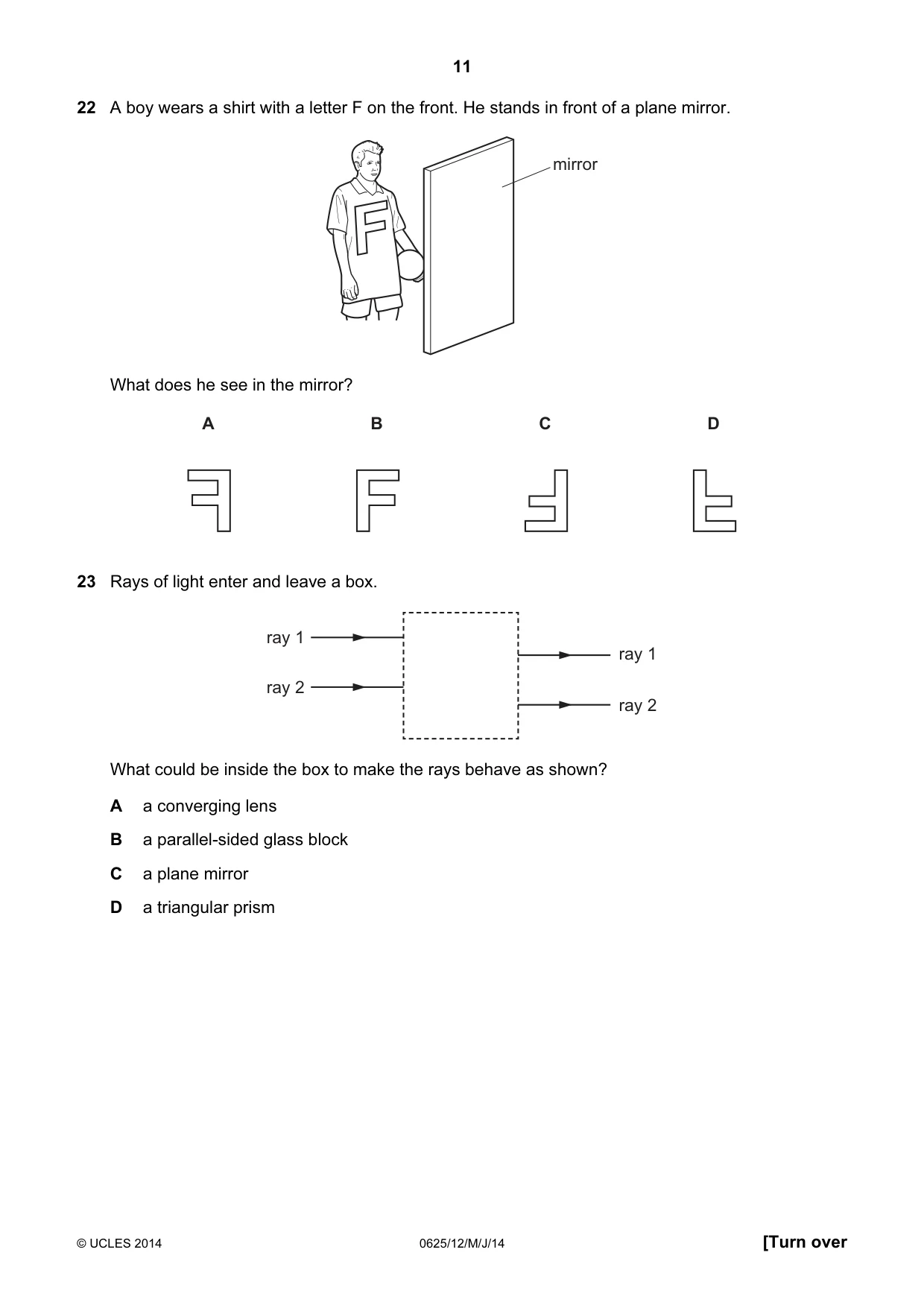
22 A boy wears a shirt with a letter F on the front. He stands in front of a plane mirror. mirror What does he see in the mirror? A B C D
Mark scheme: A
Q23 · Rays of light enter and leave a box
23 Rays of light enter and leave a box. ray 1 ray 1 ray 2 ray 2 What could be inside the box to make the rays behave as shown? A a converging lens B a parallel-sided glass block C a plane mirror D a triangular prism
Mark scheme: B
Q24 · The diagrams show the wave patterns of four sounds shown on a cathode-ray oscilloscope…
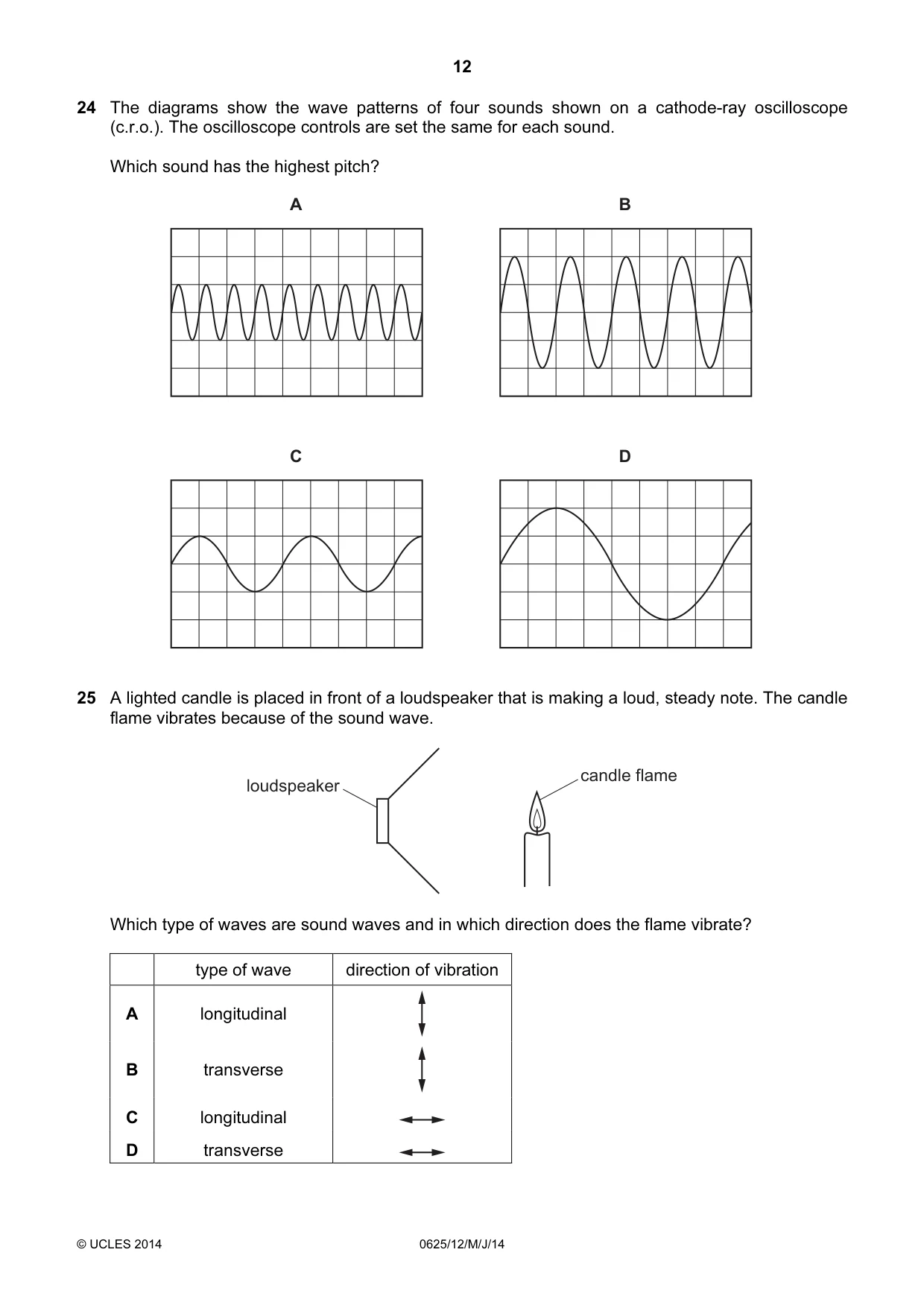
24 The diagrams show the wave patterns of four sounds shown on a cathode-ray oscilloscope (c.r.o.). The oscilloscope controls are set the same for each sound. Which sound has the highest pitch? A B C D
Mark scheme: A
Q25 · A lighted candle is placed in front of a loudspeaker that is making a loud, steady note
25 A lighted candle is placed in front of a loudspeaker that is making a loud, steady note. The candle flame vibrates because of the sound wave. candle flame loudspeaker Which type of waves are sound waves and in which direction does the flame vibrate? type of wave direction of vibration A longitudinal B transverse C longitudinal D transverse
Mark scheme: C
Q26 · Which row correctly shows whether copper and steel are ferrous or non-ferrous?
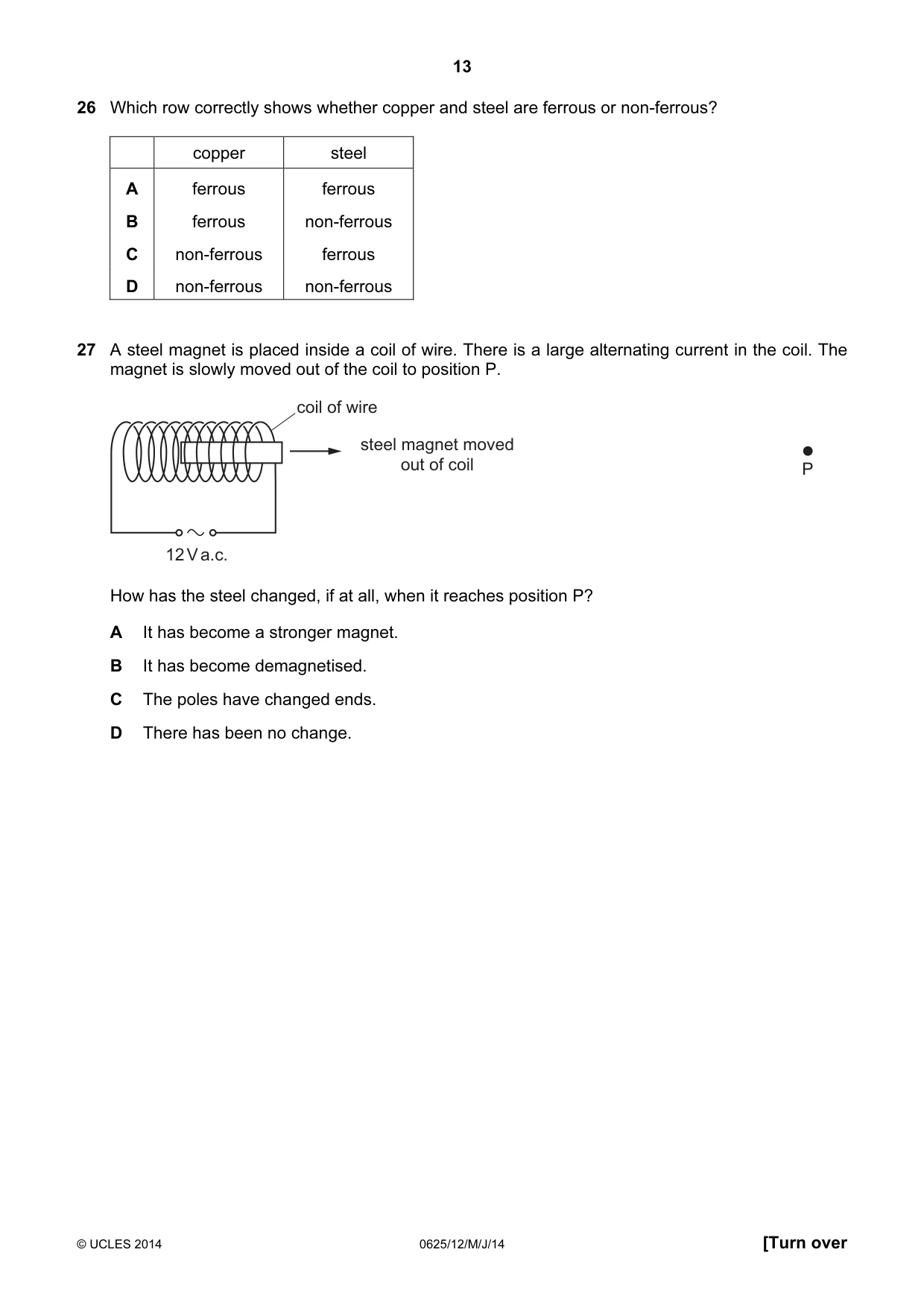
26 Which row correctly shows whether copper and steel are ferrous or non-ferrous? copper steel A ferrous ferrous B ferrous non-ferrous C non-ferrous ferrous D non-ferrous non-ferrous
Mark scheme: C
Q27 · A steel magnet is placed inside a coil of wire
27 A steel magnet is placed inside a coil of wire. There is a large alternating current in the coil. The magnet is slowly moved out of the coil to position P. coil of wire steel magnet moved out of coil P 12 V a.c. How has the steel changed, if at all, when it reaches position P? A It has become a stronger magnet. B It has become demagnetised. C The poles have changed ends. D There has been no change.
Mark scheme: B
Q28 · Two balloons, X and Y, are suspended by insulating threads
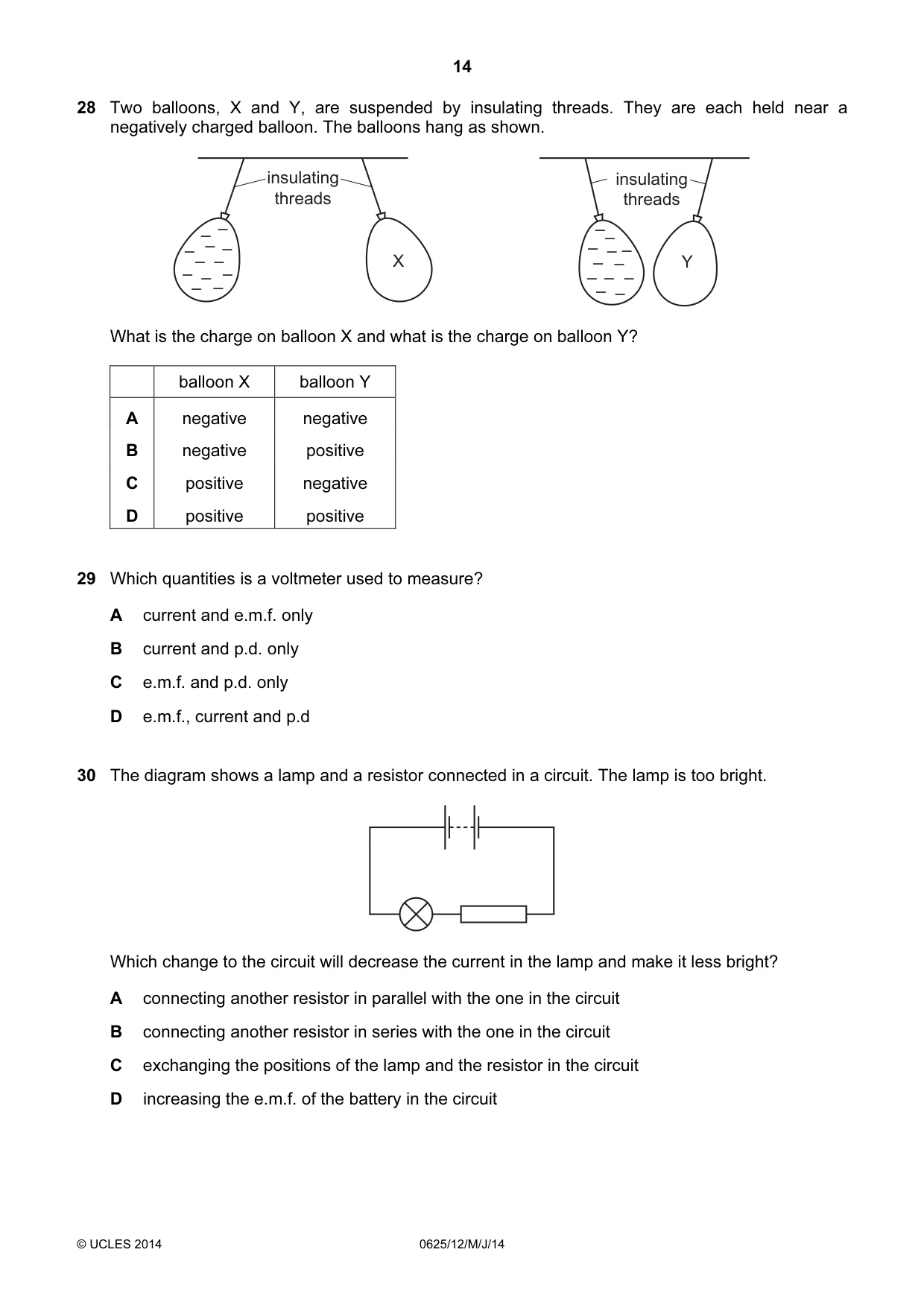
28 Two balloons, X and Y, are suspended by insulating threads. They are each held near a negatively charged balloon. The balloons hang as shown. insulating insulating threads threads – – – – – – – – – – – – – X – – Y ––– – – – – – – What is the charge on balloon X and what is the charge on balloon Y? balloon X balloon Y A negative negative B negative positive C positive negative D positive positive
Mark scheme: B
Q29 · Which quantities is a voltmeter used to measure?
29 Which quantities is a voltmeter used to measure? A current and e.m.f. only B current and p.d. only C e.m.f. and p.d. only D e.m.f., current and p.d
Mark scheme: C
Q30 · The diagram shows a lamp and a resistor connected in a circuit
30 The diagram shows a lamp and a resistor connected in a circuit. The lamp is too bright. Which change to the circuit will decrease the current in the lamp and make it less bright? A connecting another resistor in parallel with the one in the circuit B connecting another resistor in series with the one in the circuit C exchanging the positions of the lamp and the resistor in the circuit D increasing the e.m.f. of the battery in the circuit
Mark scheme: B
Q31 · Which statement is not correct for lamps connected in parallel?
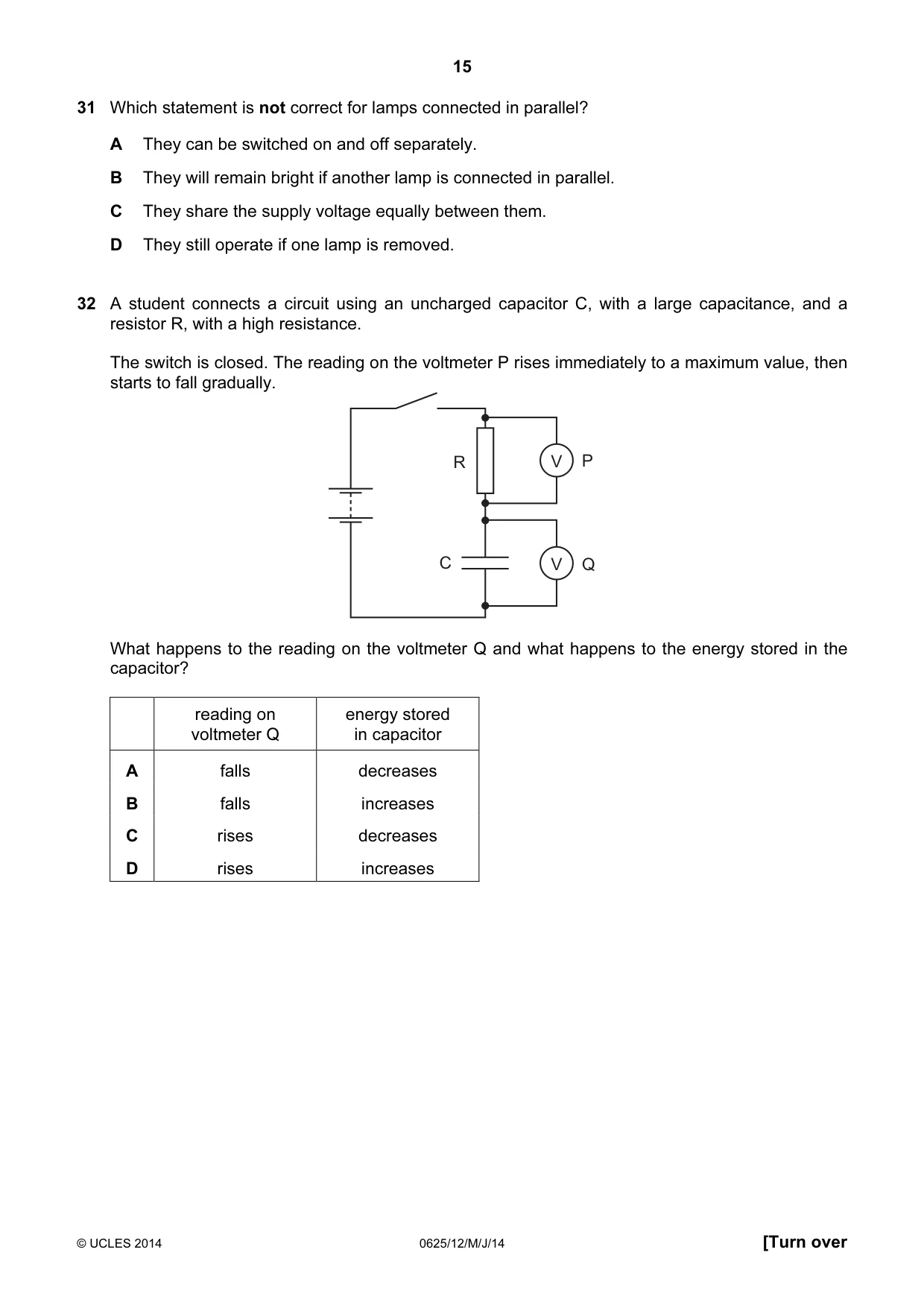
31 Which statement is not correct for lamps connected in parallel? A They can be switched on and off separately. B They will remain bright if another lamp is connected in parallel. C They share the supply voltage equally between them. D They still operate if one lamp is removed.
Mark scheme: C
Q32 · A student connects a circuit using an uncharged capacitor C, with a large capacitance…
32 A student connects a circuit using an uncharged capacitor C, with a large capacitance, and a resistor R, with a high resistance. The switch is closed. The reading on the voltmeter P rises immediately to a maximum value, then starts to fall gradually. R V P C V Q What happens to the reading on the voltmeter Q and what happens to the energy stored in the capacitor? reading on energy stored voltmeter Q in capacitor A falls decreases B falls increases C rises decreases D rises increases
Mark scheme: D
Q33 · Which labelled component in the circuit shown controls the brightness of lamp X?
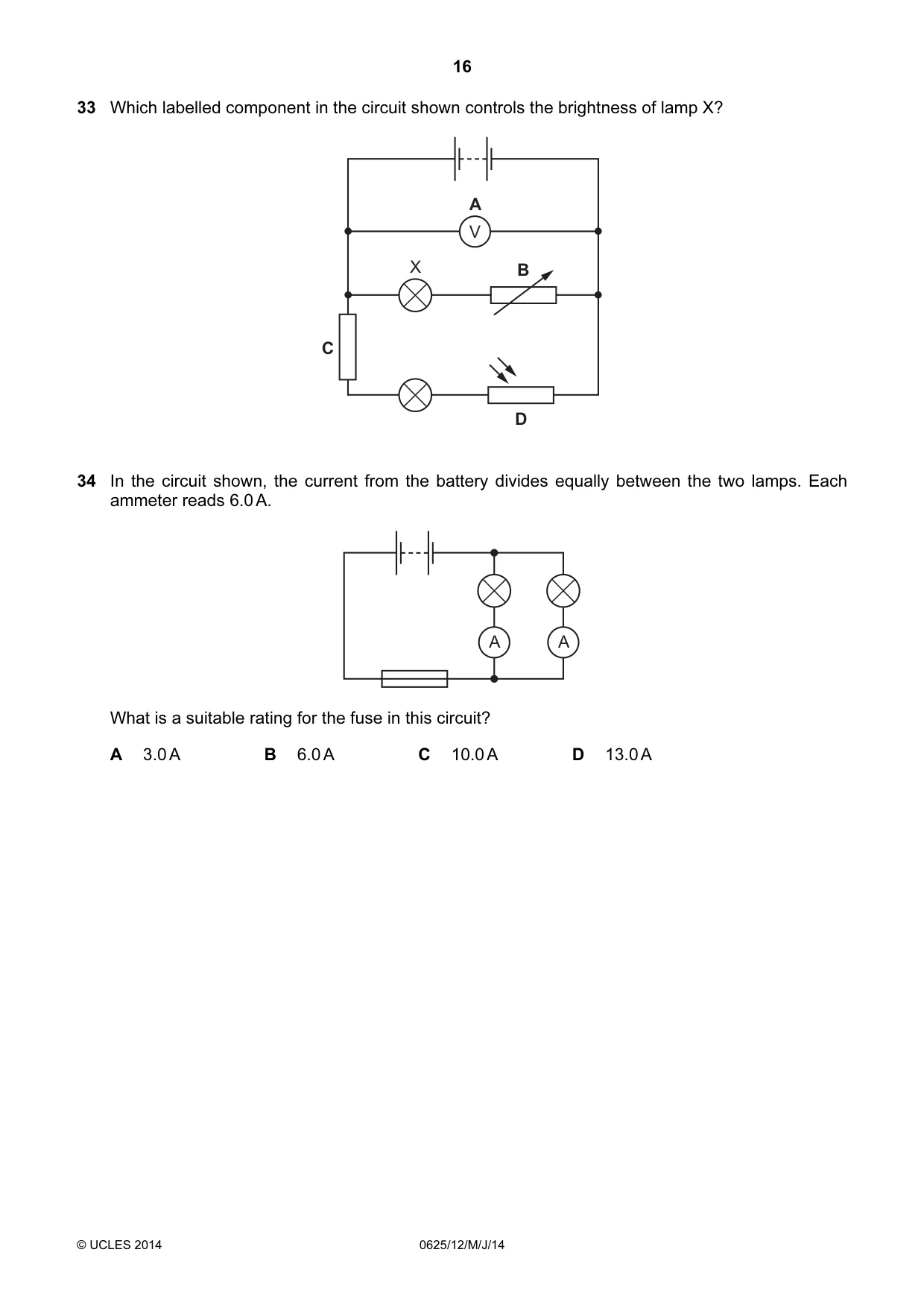
33 Which labelled component in the circuit shown controls the brightness of lamp X? A V X B C D
Mark scheme: B
Q34 · In the circuit shown, the current from the battery divides equally between the two lamps
34 In the circuit shown, the current from the battery divides equally between the two lamps. Each ammeter reads 6.0 A. A A What is a suitable rating for the fuse in this circuit? A 3.0 A B 6.0 A C 10.0 A D 13.0 A
Mark scheme: D
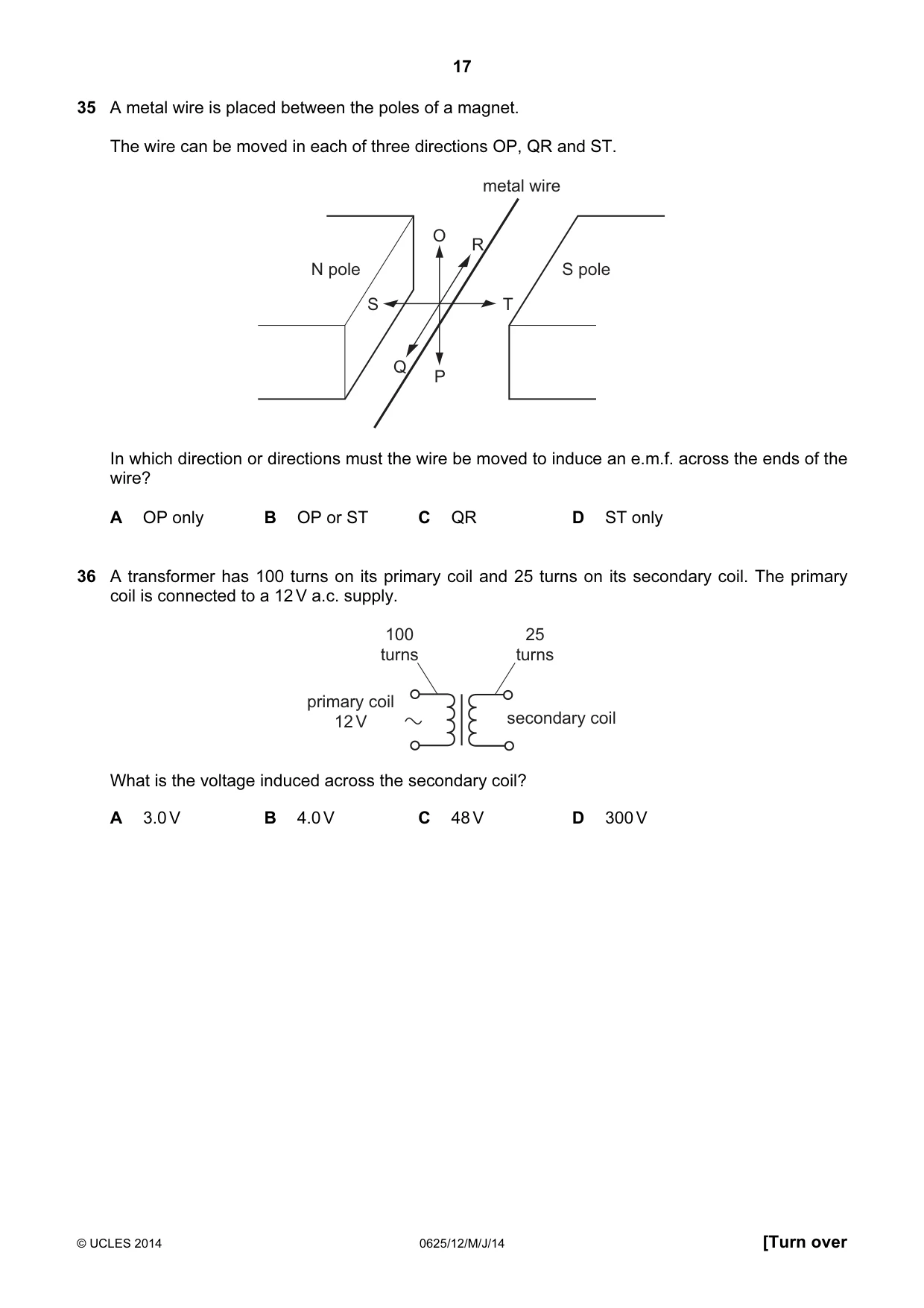
Q35 · A metal wire is placed between the poles of a magnet
35 A metal wire is placed between the poles of a magnet. The wire can be moved in each of three directions OP, QR and ST. metal wire O R N pole S pole S T Q P In which direction or directions must the wire be moved to induce an e.m.f. across the ends of the wire? A OP only B OP or ST C QR D ST only
Mark scheme: A
Q36 · A transformer has 100 turns on its primary coil and 25 turns on its secondary coil
36 A transformer has 100 turns on its primary coil and 25 turns on its secondary coil. The primary coil is connected to a 12 V a.c. supply. 100 25 turns turns primary coil 12 V secondary coil What is the voltage induced across the secondary coil? A 3.0 V B 4.0 V C 48 V D 300 V
Mark scheme: A
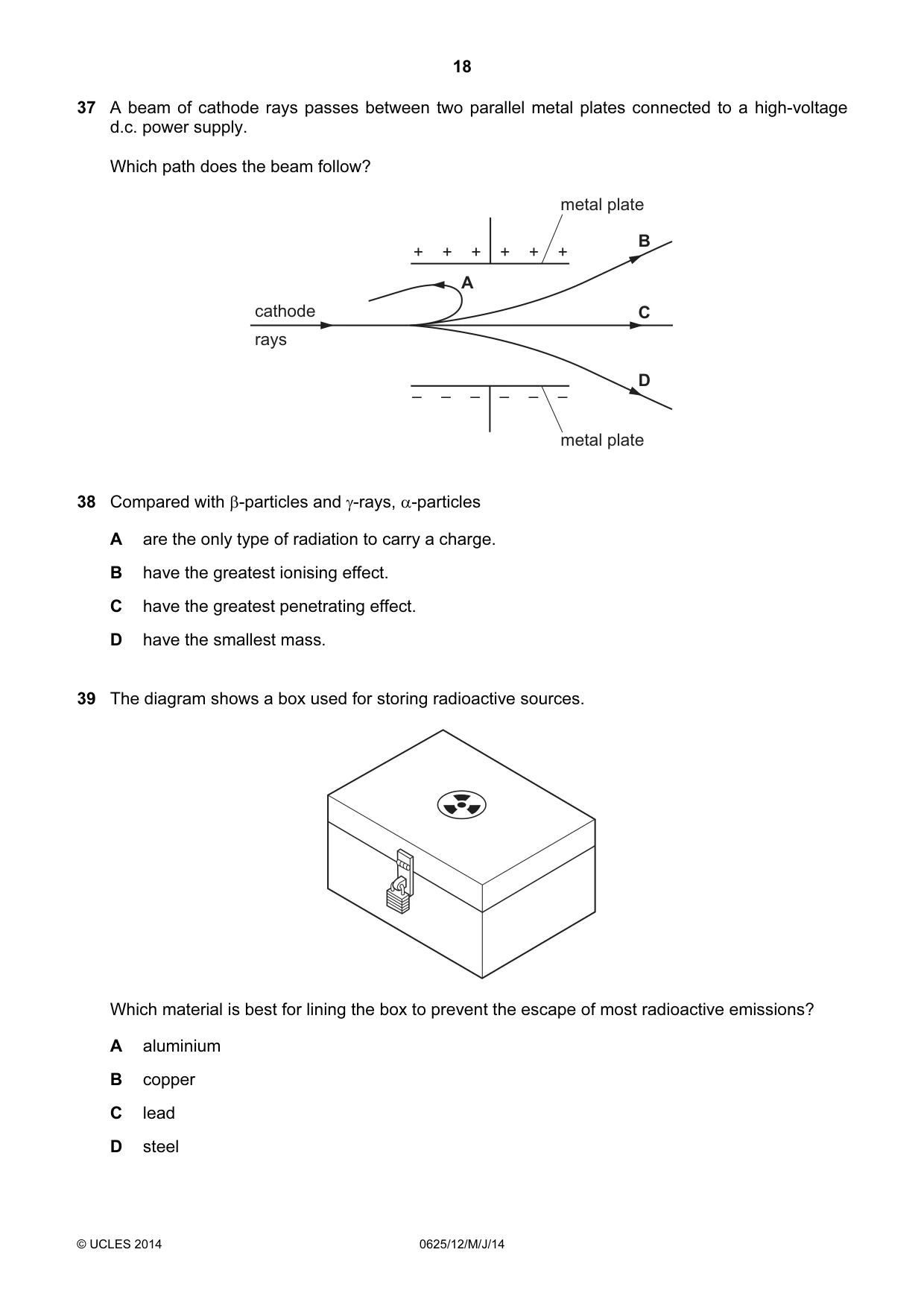
Q37 · A beam of cathode rays passes between two parallel metal plates connected to a…
37 A beam of cathode rays passes between two parallel metal plates connected to a high-voltage d.c. power supply. Which path does the beam follow? metal plate B + + + + + + A cathode C rays D metal plate
Mark scheme: B
Q38 · Compared with β-particles and γ-rays, α-particles A are the only type of radiation to…
38 Compared with β-particles and γ-rays, α-particles A are the only type of radiation to carry a charge. B have the greatest ionising effect. C have the greatest penetrating effect. D have the smallest mass.
Mark scheme: B
Q39 · The diagram shows a box used for storing radioactive sources
39 The diagram shows a box used for storing radioactive sources. Which material is best for lining the box to prevent the escape of most radioactive emissions? A aluminium B copper C lead D steel
Mark scheme: C
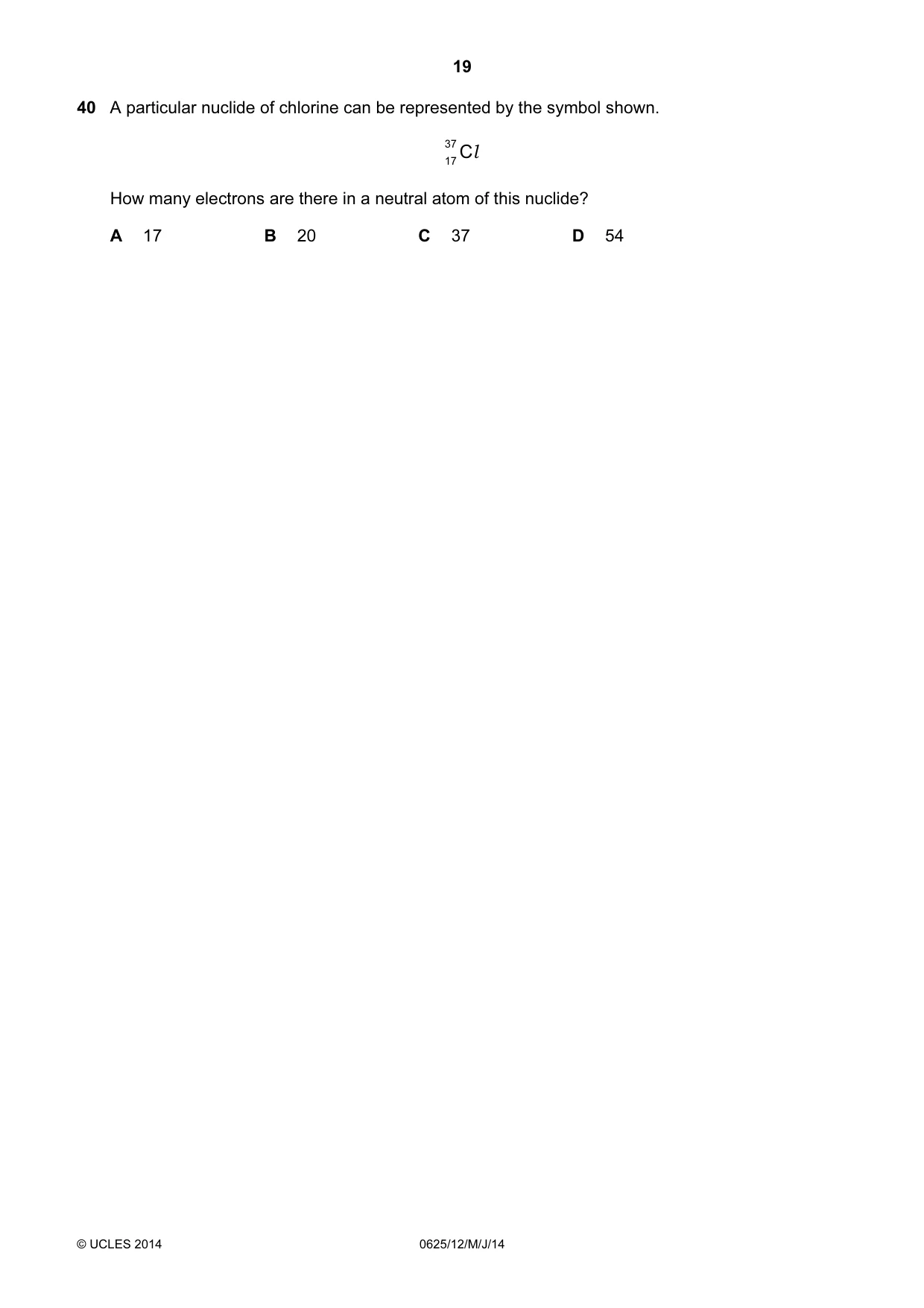
Q40 · A particular nuclide of chlorine can be represented by the symbol shown
40 A particular nuclide of chlorine can be represented by the symbol shown. 37 C l 17 How many electrons are there in a neutral atom of this nuclide? A 17 B 20 C 37 D 54
Mark scheme: A
What was in this paper
The subtopics covered by these 40 questions, and how many questions each got. Open one in a new tab to see every Cambridge question on it.
4Light3Thermal properties and temperature3Electrical quantities2Electromagnetic effects2Energy, work and power2Forces2Kinetic particle model of matter2Motion2Pressure2Radioactivity2Simple phenomena of magnetism2Sound2The nuclear model of the atom2Transfer of thermal energy2Density1Electrical safety1Electromagnetic spectrum1General properties of waves1Mass and weight1Physical quantities and measurement techniques1What you needed in this session
Cambridge’s own grade thresholds for 2014 May/June, Paper 1 · Variant 2. A higher threshold means an easier paper — the bar moves with how the cohort did.