Cambridge IGCSE Physics 0625 — 2016 May/June Paper 1 · Variant 1
0625/11/M/J/16 · 40 questions · 40 marks · ≈45 min
The question paper and its mark scheme, free to read here and free to download. This is Cambridge’s own paper, exactly as it was sat.
Question paper20 pages


Mark scheme2 pages
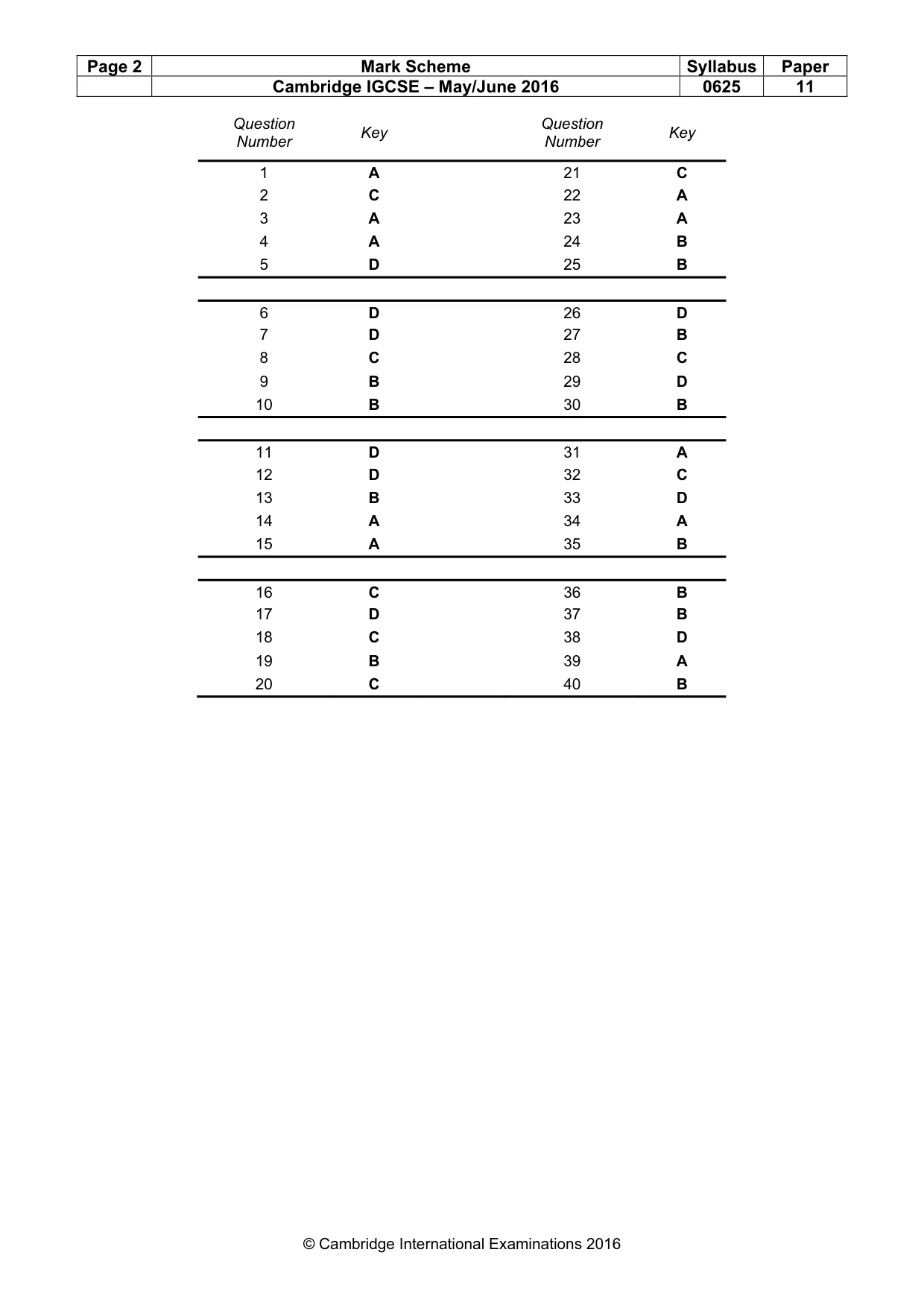
Answers below. Sit the paper first if you are practising.
Questions as text
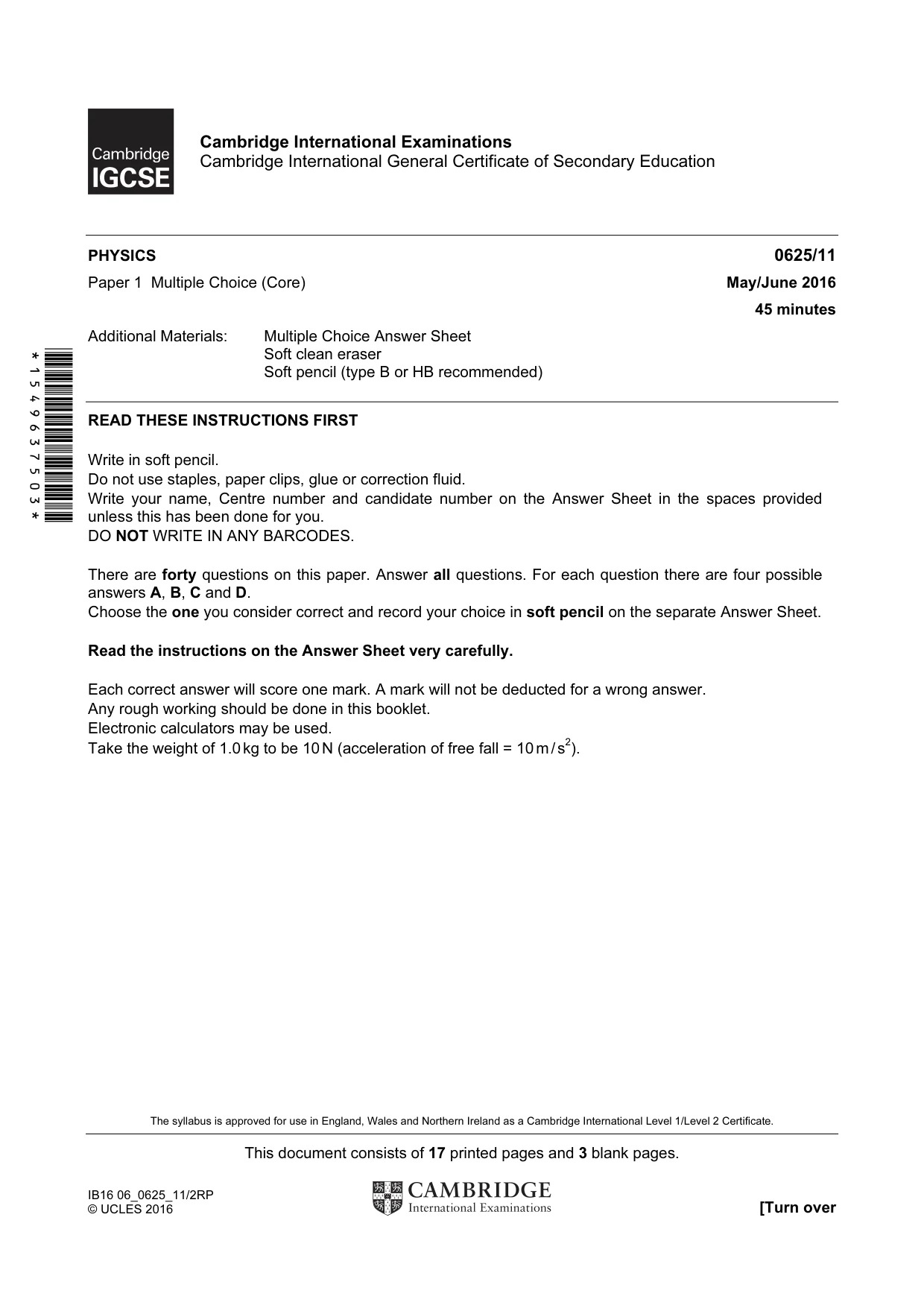
Q1 · The diagram shows an enlarged drawing of the end of a metre rule
1 The diagram shows an enlarged drawing of the end of a metre rule. It is being used to measure the length of a small feather. 1 0 2 0 3 0 mm cm 1 2 3 What is the length of the feather? A 19 mm B 29 mm C 19 cm D 29 cm
Mark scheme: A
More questions on Physical quantities and measurement techniques
Q2 · A train begins a journey from a station and travels 60 km in a time of 20 minutes
2 A train begins a journey from a station and travels 60 km in a time of 20 minutes. What is the average speed of the train? A 3.0 m / s B 5.0 m / s C 50 m / s D 60 m / s
Mark scheme: C
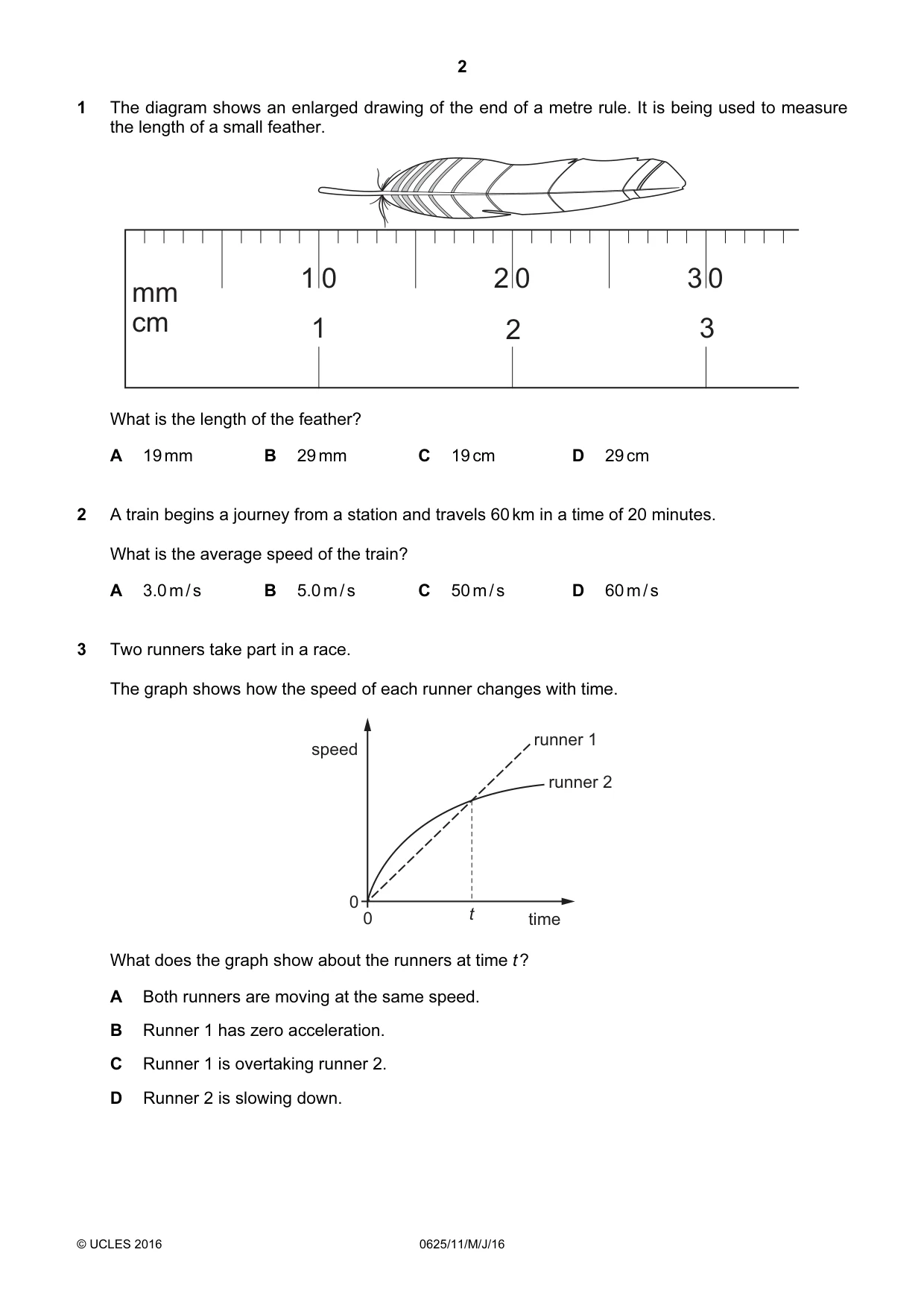
Q3 · Two runners take part in a race
3 Two runners take part in a race. The graph shows how the speed of each runner changes with time. runner 1 speed runner 2 0 0 t time What does the graph show about the runners at time t ? A Both runners are moving at the same speed. B Runner 1 has zero acceleration. C Runner 1 is overtaking runner 2. D Runner 2 is slowing down.
Mark scheme: A
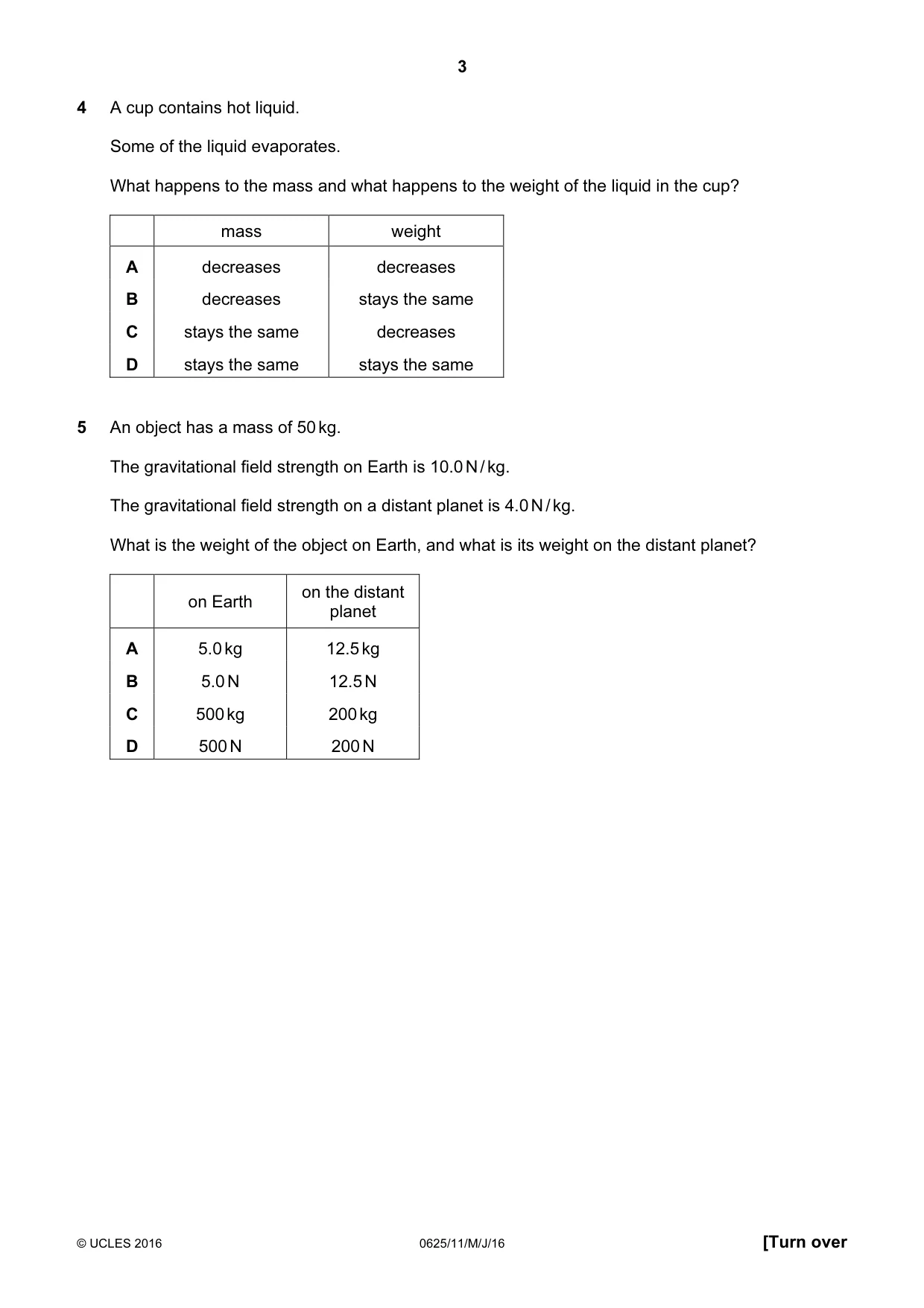
Q4 · A cup contains hot liquid
4 A cup contains hot liquid. Some of the liquid evaporates. What happens to the mass and what happens to the weight of the liquid in the cup? mass weight A decreases decreases B decreases stays the same C stays the same decreases D stays the same stays the same
Mark scheme: A
Q5 · An object has a mass of 50 kg
5 An object has a mass of 50 kg. The gravitational field strength on Earth is 10.0 N / kg. The gravitational field strength on a distant planet is 4.0 N / kg. What is the weight of the object on Earth, and what is its weight on the distant planet? on the distant on Earth planet A 5.0 kg 12.5 kg B 5.0 N 12.5 N C 500 kg 200 kg D 500 N 200 N
Mark scheme: D
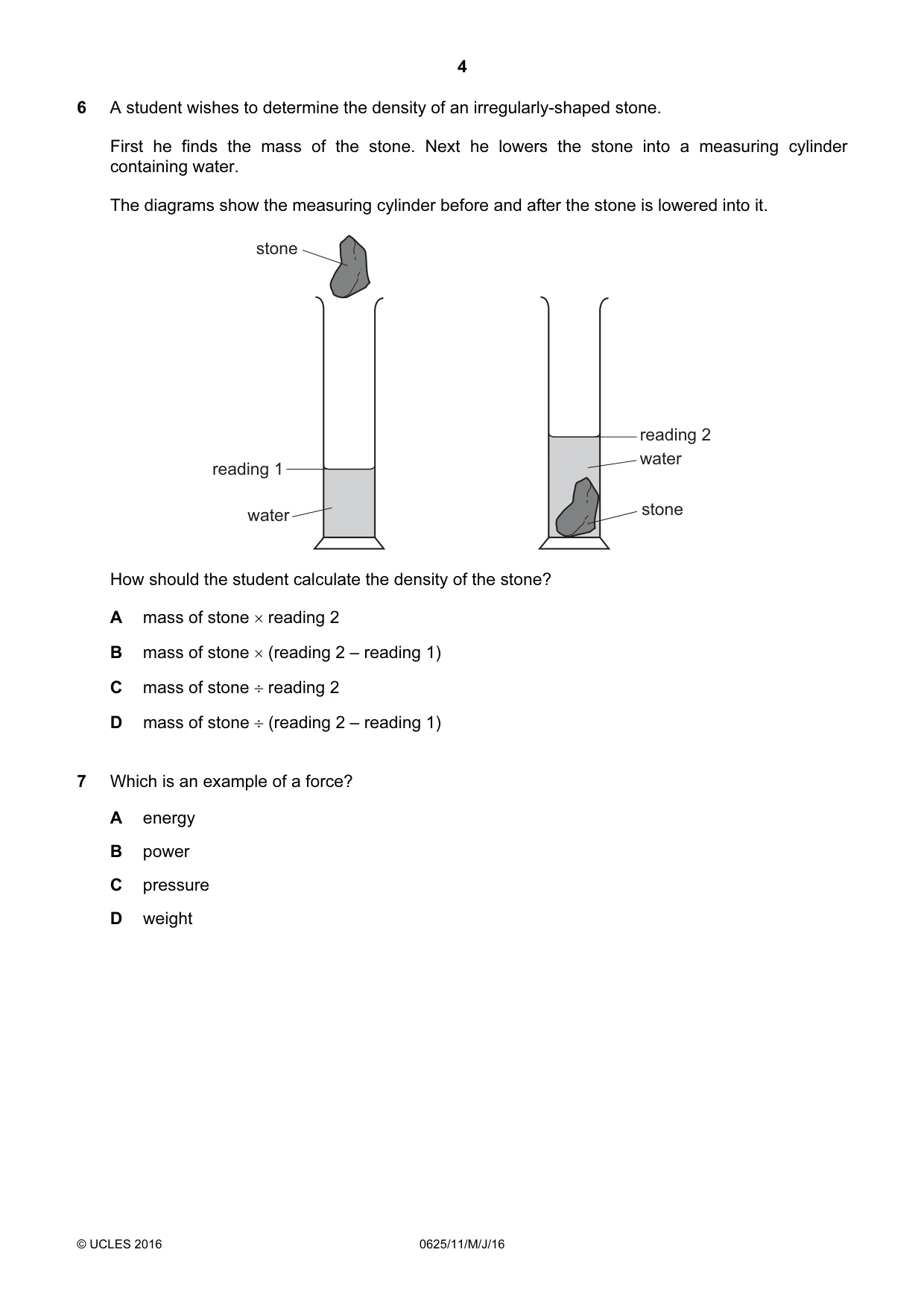
Q6 · A student wishes to determine the density of an irregularly-shaped stone
6 A student wishes to determine the density of an irregularly-shaped stone. First he finds the mass of the stone. Next he lowers the stone into a measuring cylinder containing water. The diagrams show the measuring cylinder before and after the stone is lowered into it. stone reading 2 water reading 1 water stone How should the student calculate the density of the stone? A mass of stone × reading 2 B mass of stone × (reading 2 – reading 1) C mass of stone ÷ reading 2 D mass of stone ÷ (reading 2 – reading 1)
Mark scheme: D
Q7 · Which is an example of a force?
7 Which is an example of a force? A energy B power C pressure D weight
Mark scheme: D
Q8 · The diagram shows an object of weight W and an object of weight Z balanced on a uniform…
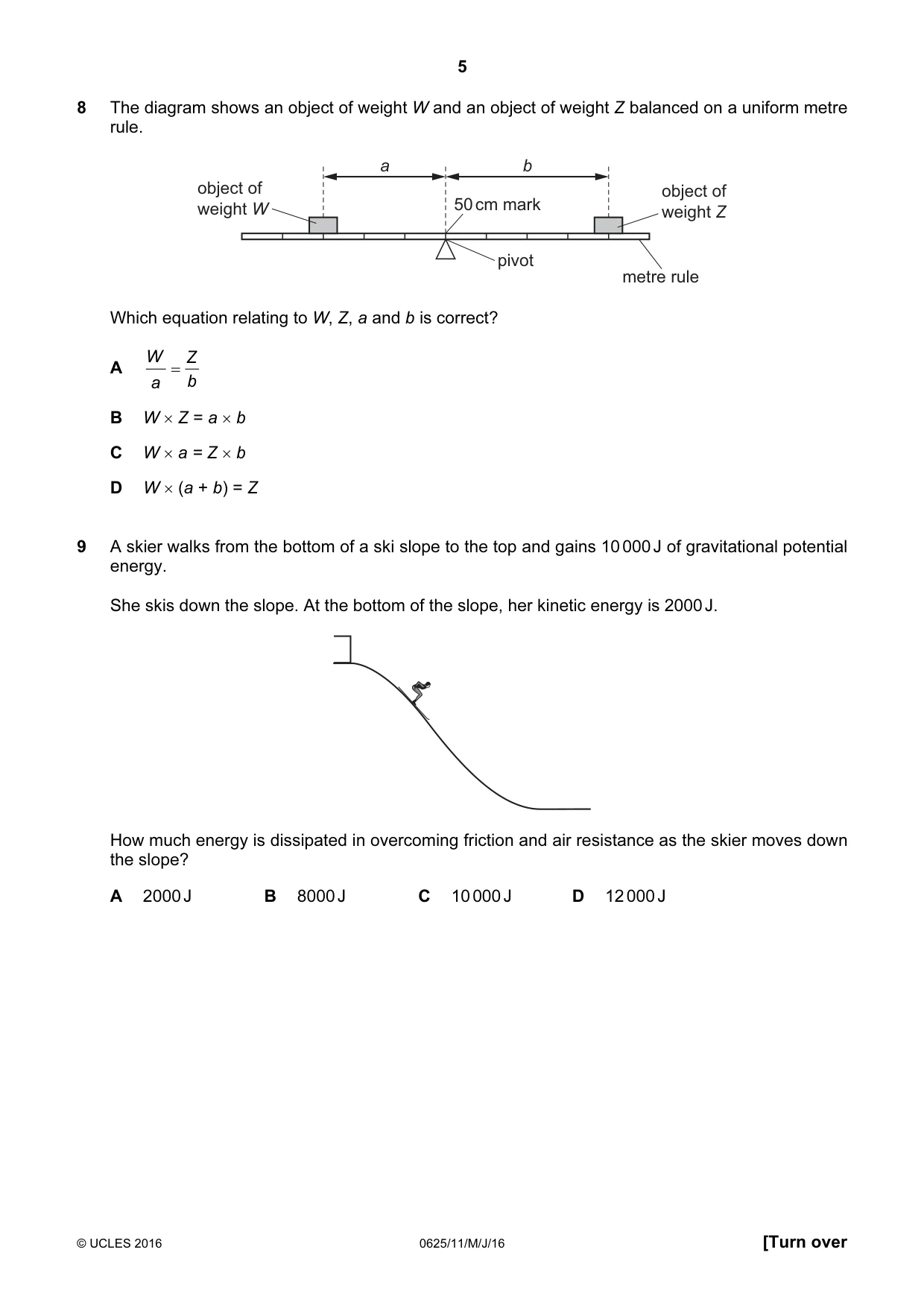
8 The diagram shows an object of weight W and an object of weight Z balanced on a uniform metre rule. a b object of object of weight W 50 cm mark weight Z pivot metre rule Which equation relating to W, Z, a and b is correct? W = Z A a b B W × Z = a × b C W × a = Z × b D W × (a + b) = Z
Mark scheme: C
Q9 · A skier walks from the bottom of a ski slope to the top and gains 10 000 J of…
9 A skier walks from the bottom of a ski slope to the top and gains 10 000 J of gravitational potential energy. She skis down the slope. At the bottom of the slope, her kinetic energy is 2000 J. How much energy is dissipated in overcoming friction and air resistance as the skier moves down the slope? A 2000 J B 8000 J C 10 000 J D 12 000 J
Mark scheme: B
Q10 · A coal-fired power station generates electricity
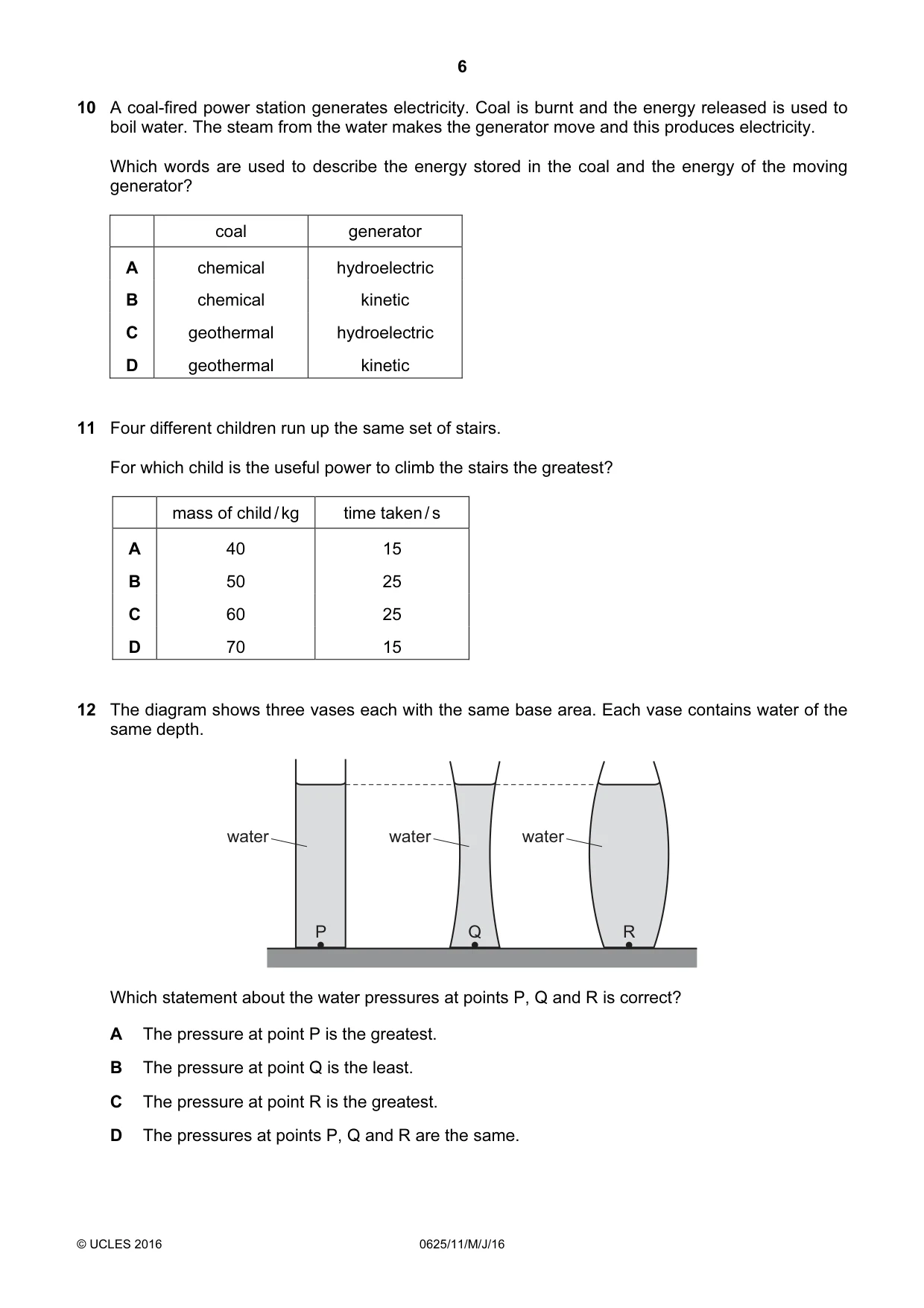
10 A coal-fired power station generates electricity. Coal is burnt and the energy released is used to boil water. The steam from the water makes the generator move and this produces electricity. Which words are used to describe the energy stored in the coal and the energy of the moving generator? coal generator A chemical hydroelectric B chemical kinetic C geothermal hydroelectric D geothermal kinetic
Mark scheme: B
Q11 · Four different children run up the same set of stairs
11 Four different children run up the same set of stairs. For which child is the useful power to climb the stairs the greatest? mass of child / kg time taken / s A 40 15 B 50 25 C 60 25 D 70 15
Mark scheme: D
Q12 · The diagram shows three vases each with the same base area
12 The diagram shows three vases each with the same base area. Each vase contains water of the same depth. water water water P Q R Which statement about the water pressures at points P, Q and R is correct? A The pressure at point P is the greatest. B The pressure at point Q is the least. C The pressure at point R is the greatest. D The pressures at points P, Q and R are the same.
Mark scheme: D
Q13 · The diagram shows a simple mercury barometer
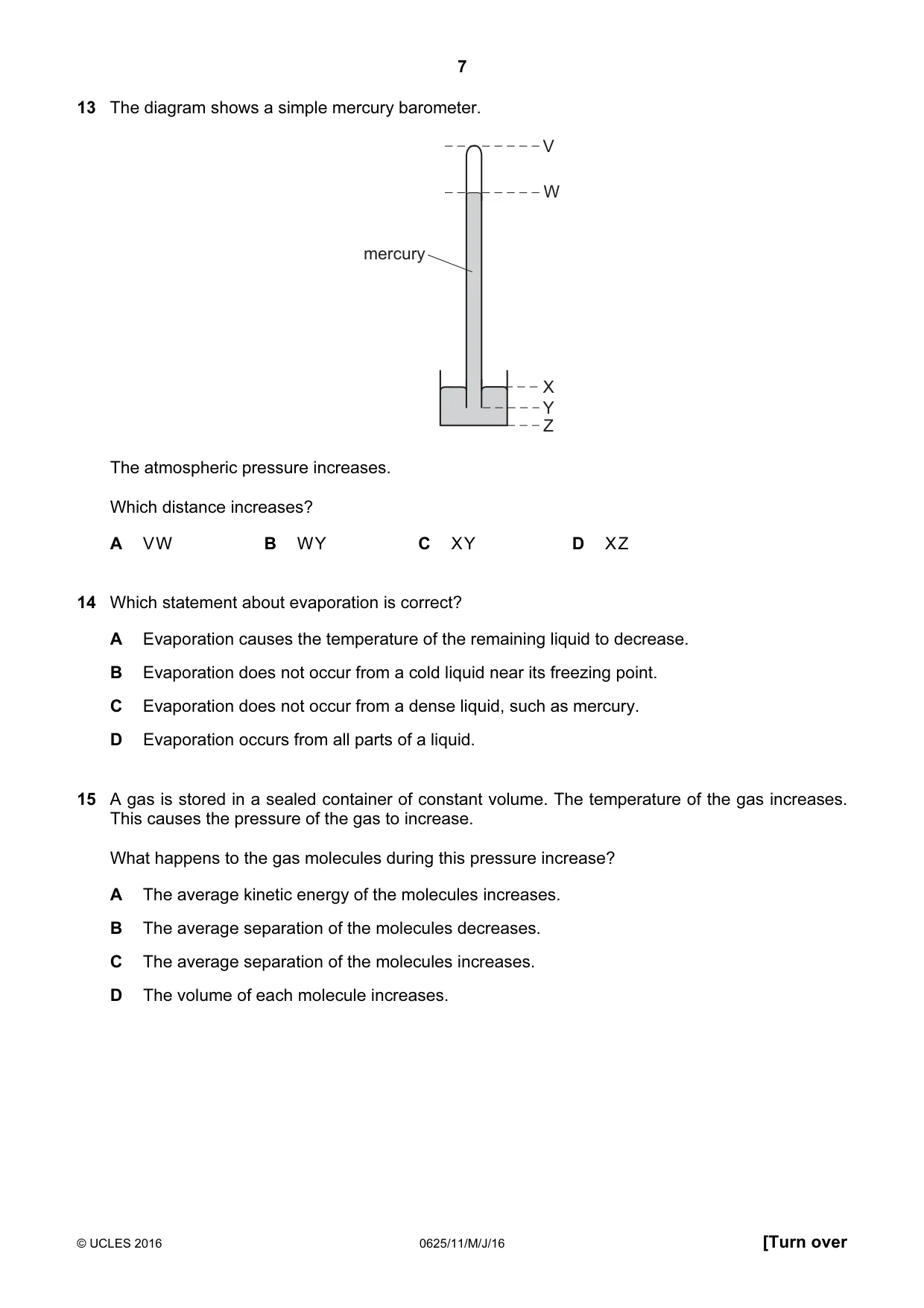
13 The diagram shows a simple mercury barometer. V W mercury X Y Z The atmospheric pressure increases. Which distance increases? A VW B WY C XY D XZ
Mark scheme: B
Q14 · Which statement about evaporation is correct?
14 Which statement about evaporation is correct? A Evaporation causes the temperature of the remaining liquid to decrease. B Evaporation does not occur from a cold liquid near its freezing point. C Evaporation does not occur from a dense liquid, such as mercury. D Evaporation occurs from all parts of a liquid.
Mark scheme: A
Q15 · A gas is stored in a sealed container of constant volume
15 A gas is stored in a sealed container of constant volume. The temperature of the gas increases. This causes the pressure of the gas to increase. What happens to the gas molecules during this pressure increase? A The average kinetic energy of the molecules increases. B The average separation of the molecules decreases. C The average separation of the molecules increases. D The volume of each molecule increases.
Mark scheme: A
Q16 · A substance loses thermal energy (heat) to the surroundings at a steady rate
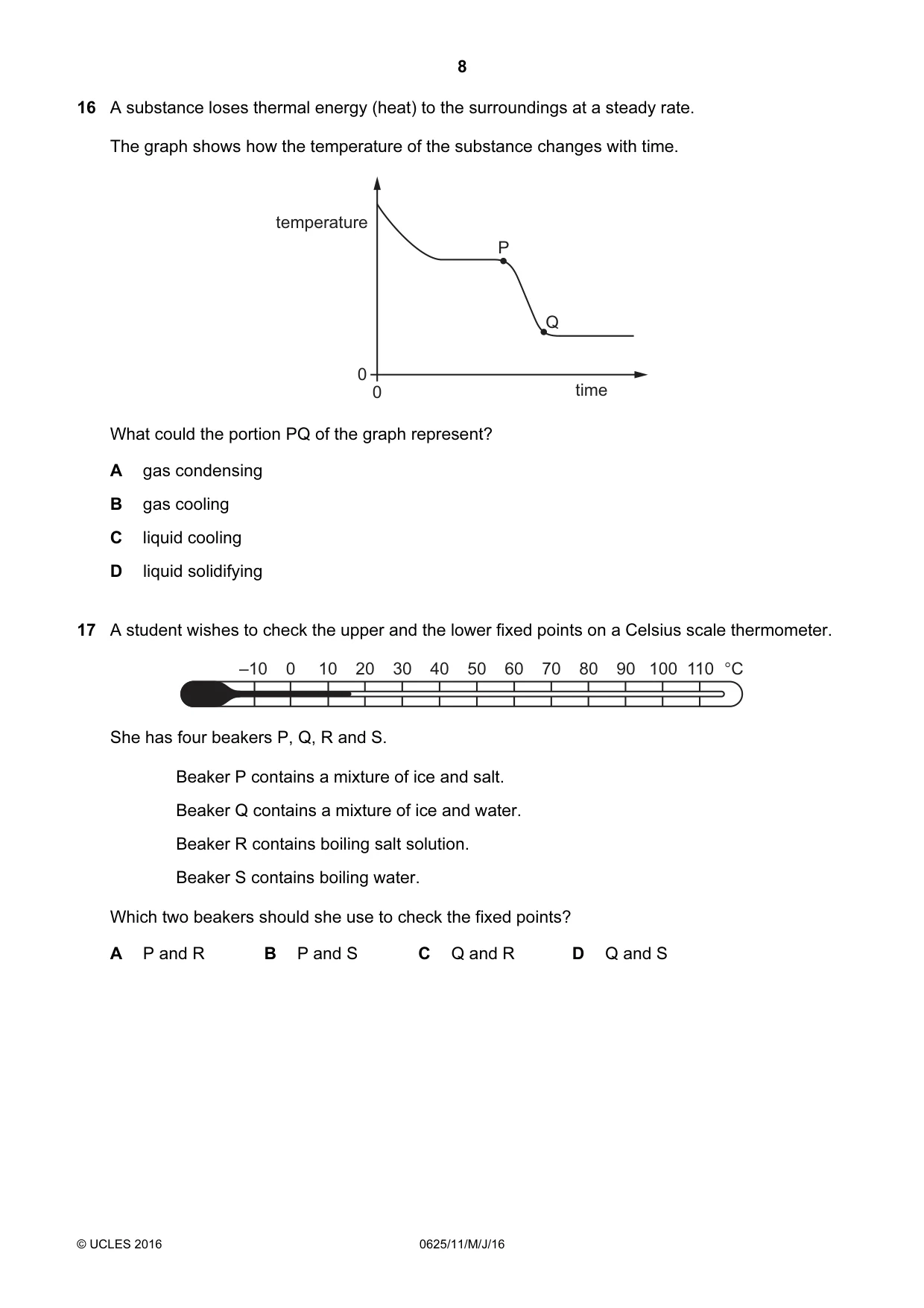
16 A substance loses thermal energy (heat) to the surroundings at a steady rate. The graph shows how the temperature of the substance changes with time. temperature P Q 0 0 time What could the portion PQ of the graph represent? A gas condensing B gas cooling C liquid cooling D liquid solidifying
Mark scheme: C
Q17 · A student wishes to check the upper and the lower fixed points on a Celsius scale…
17 A student wishes to check the upper and the lower fixed points on a Celsius scale thermometer. –10 0 10 20 30 40 50 60 70 80 90 100 110 °C She has four beakers P, Q, R and S. Beaker P contains a mixture of ice and salt. Beaker Q contains a mixture of ice and water. Beaker R contains boiling salt solution. Beaker S contains boiling water. Which two beakers should she use to check the fixed points? A P and R B P and S C Q and R D Q and S
Mark scheme: D
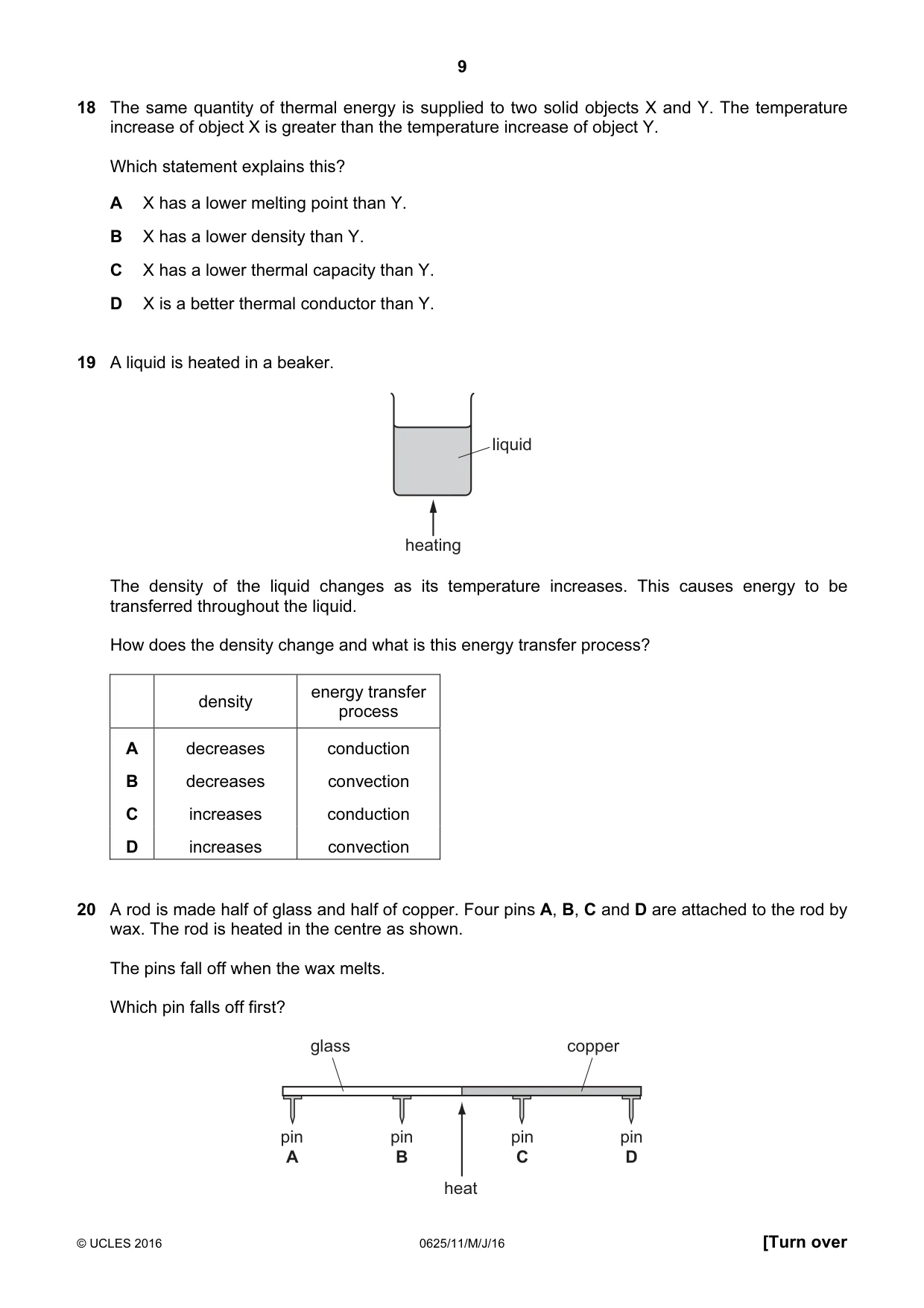
Q18 · The same quantity of thermal energy is supplied to two solid objects X and Y
18 The same quantity of thermal energy is supplied to two solid objects X and Y. The temperature increase of object X is greater than the temperature increase of object Y. Which statement explains this? A X has a lower melting point than Y. B X has a lower density than Y. C X has a lower thermal capacity than Y. D X is a better thermal conductor than Y.
Mark scheme: C
Q19 · A liquid is heated in a beaker
19 A liquid is heated in a beaker. liquid heating The density of the liquid changes as its temperature increases. This causes energy to be transferred throughout the liquid. How does the density change and what is this energy transfer process? energy transfer density process A decreases conduction B decreases convection C increases conduction D increases convection
Mark scheme: B
Q20 · A rod is made half of glass and half of copper
20 A rod is made half of glass and half of copper. Four pins A, B, C and D are attached to the rod by wax. The rod is heated in the centre as shown. The pins fall off when the wax melts. Which pin falls off first? glass copper pin pin pin pin A B C D heat
Mark scheme: C
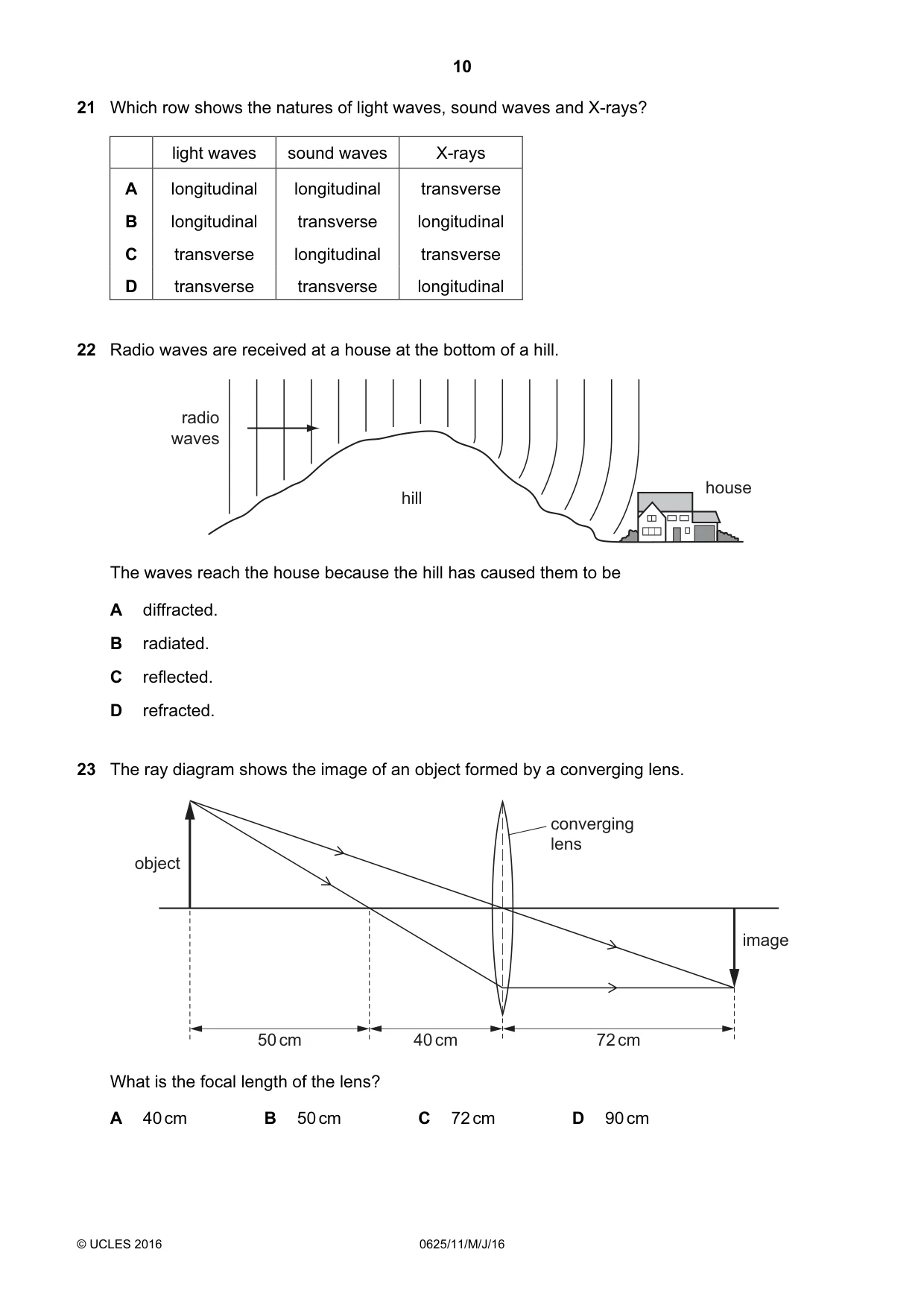
Q21 · Which row shows the natures of light waves, sound waves and X-rays?
21 Which row shows the natures of light waves, sound waves and X-rays? light waves sound waves X-rays A longitudinal longitudinal transverse B longitudinal transverse longitudinal C transverse longitudinal transverse D transverse transverse longitudinal
Mark scheme: C
Q22 · Radio waves are received at a house at the bottom of a hill
22 Radio waves are received at a house at the bottom of a hill. radio waves house hill The waves reach the house because the hill has caused them to be A diffracted. B radiated. C reflected. D refracted.
Mark scheme: A
Q23 · The ray diagram shows the image of an object formed by a converging lens
23 The ray diagram shows the image of an object formed by a converging lens. converging lens object image 50 cm 40 cm 72 cm What is the focal length of the lens? A 40 cm B 50 cm C 72 cm D 90 cm
Mark scheme: A
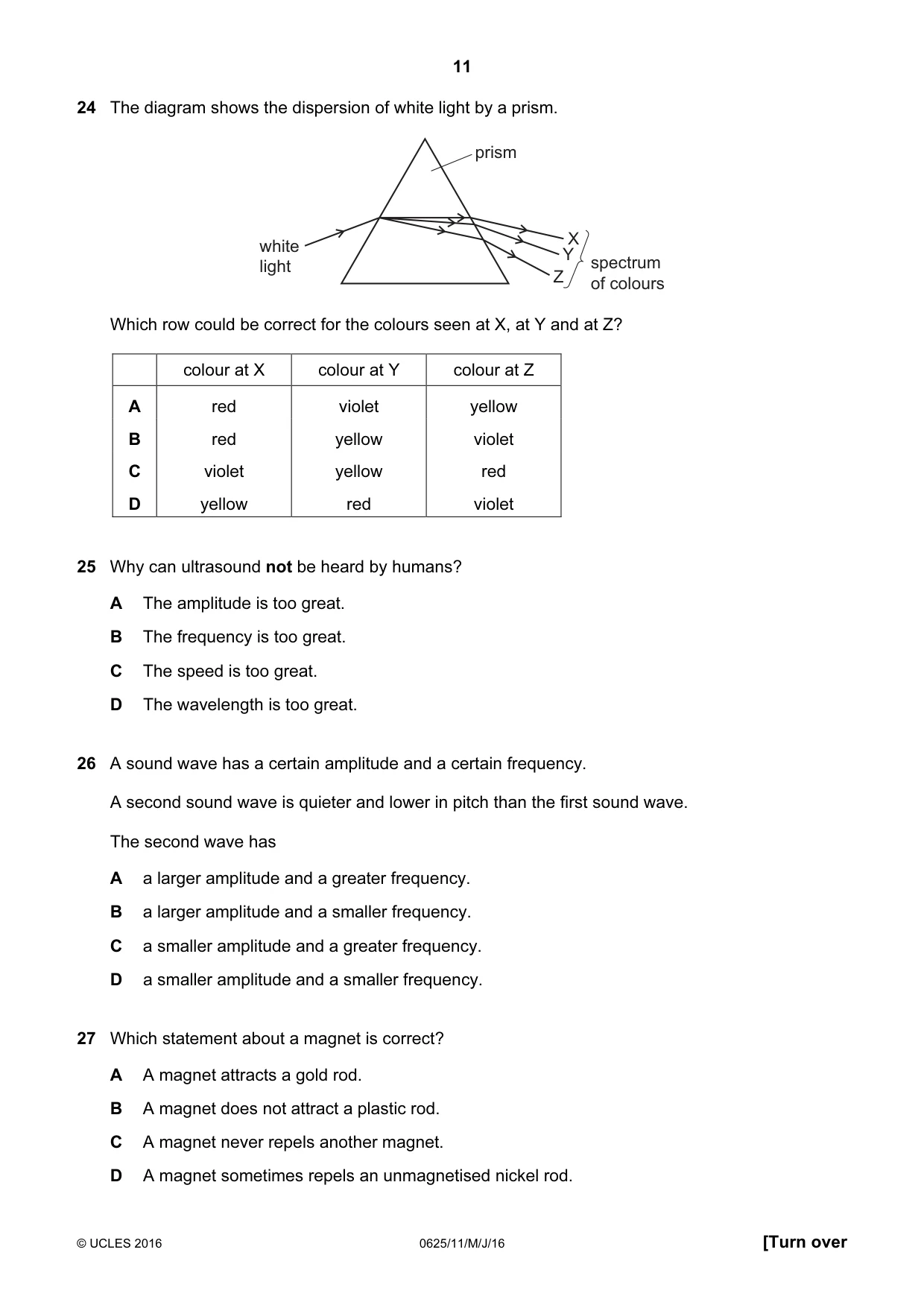
Q24 · The diagram shows the dispersion of white light by a prism
24 The diagram shows the dispersion of white light by a prism. prism white X Y light spectrum Z of colours Which row could be correct for the colours seen at X, at Y and at Z? colour at X colour at Y colour at Z A red violet yellow B red yellow violet C violet yellow red D yellow red violet
Mark scheme: B
Q25 · Why can ultrasound not be heard by humans?
25 Why can ultrasound not be heard by humans? A The amplitude is too great. B The frequency is too great. C The speed is too great. D The wavelength is too great.
Mark scheme: B
Q26 · A sound wave has a certain amplitude and a certain frequency
26 A sound wave has a certain amplitude and a certain frequency. A second sound wave is quieter and lower in pitch than the first sound wave. The second wave has A a larger amplitude and a greater frequency. B a larger amplitude and a smaller frequency. C a smaller amplitude and a greater frequency. D a smaller amplitude and a smaller frequency.
Mark scheme: D
Q27 · Which statement about a magnet is correct?
27 Which statement about a magnet is correct? A A magnet attracts a gold rod. B A magnet does not attract a plastic rod. C A magnet never repels another magnet. D A magnet sometimes repels an unmagnetised nickel rod.
Mark scheme: B
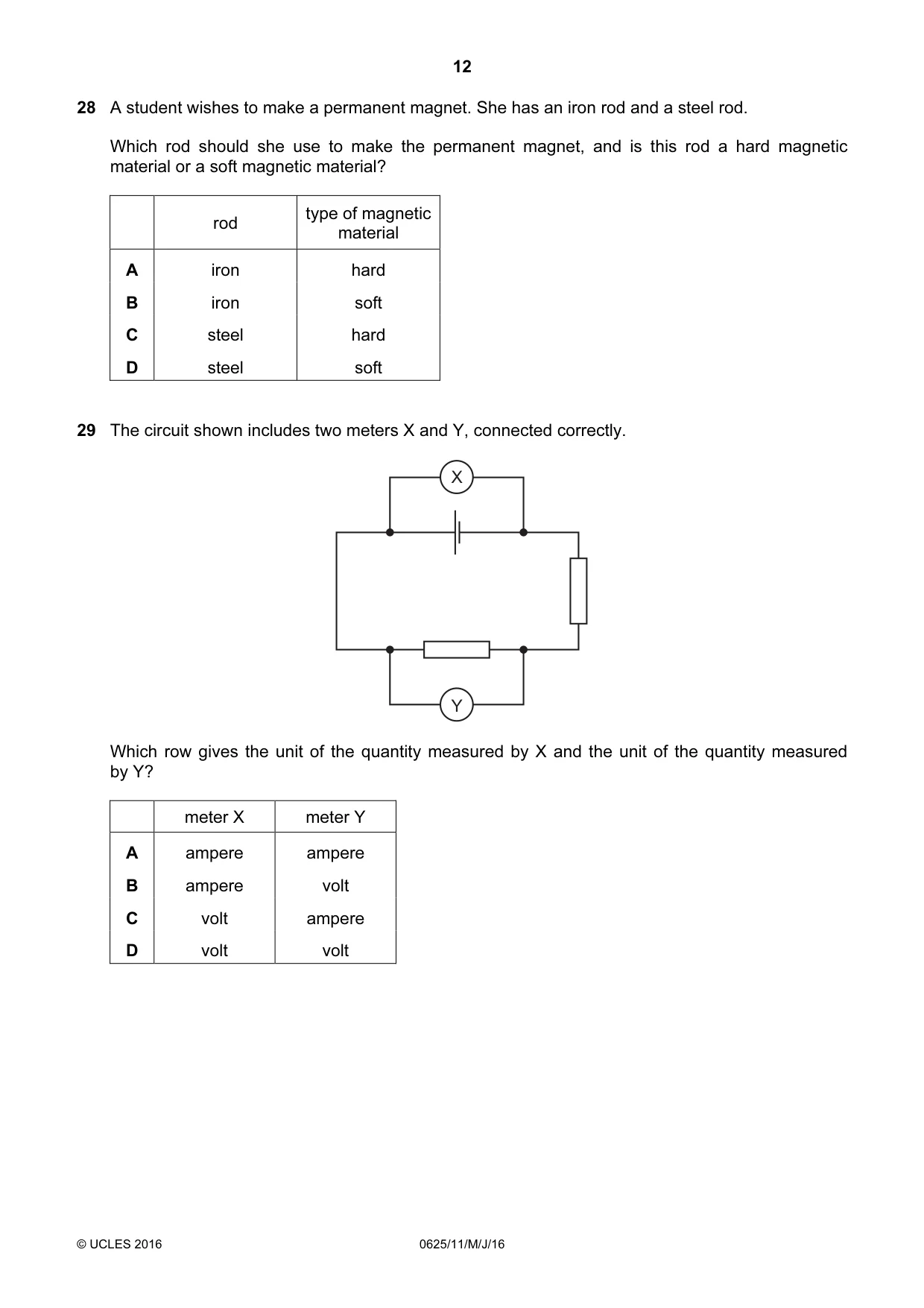
Q28 · A student wishes to make a permanent magnet
28 A student wishes to make a permanent magnet. She has an iron rod and a steel rod. Which rod should she use to make the permanent magnet, and is this rod a hard magnetic material or a soft magnetic material? type of magnetic rod material A iron hard B iron soft C steel hard D steel soft
Mark scheme: C
Q29 · The circuit shown includes two meters X and Y, connected correctly
29 The circuit shown includes two meters X and Y, connected correctly. X Y Which row gives the unit of the quantity measured by X and the unit of the quantity measured by Y? meter X meter Y A ampere ampere B ampere volt C volt ampere D volt volt
Mark scheme: D
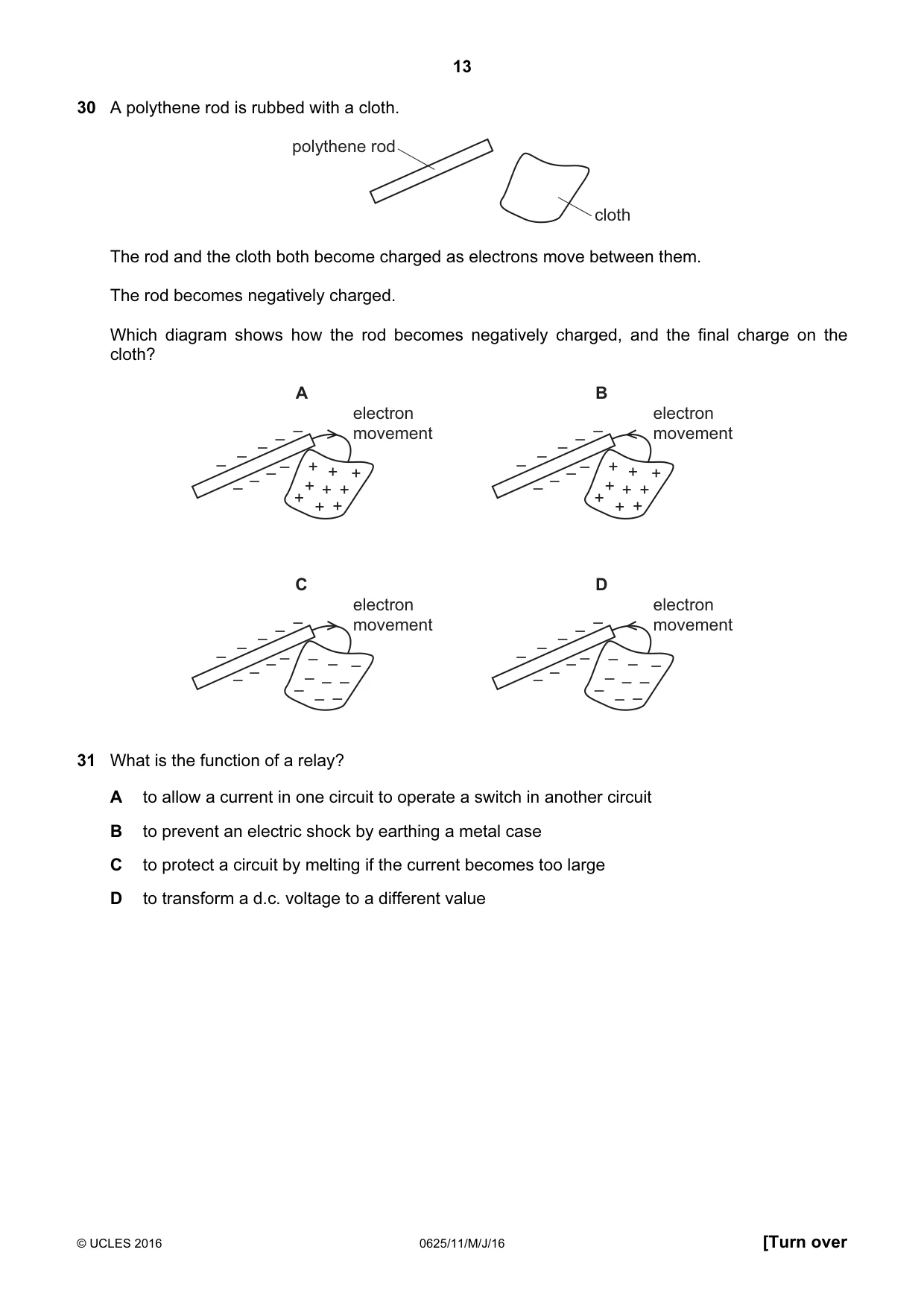
Q30 · A polythene rod is rubbed with a cloth
30 A polythene rod is rubbed with a cloth. polythene rod cloth The rod and the cloth both become charged as electrons move between them. The rod becomes negatively charged. Which diagram shows how the rod becomes negatively charged, and the final charge on the cloth? A B electron electron – – movement – – – movement – – – – – + + – – + + – – + – – + – ++ + + – ++ + + + + + + C D electron electron – – – movement – – – movement – – – – – – – – – – – – – – – – – –– – – – –– – – – – – –
Mark scheme: B
Q31 · What is the function of a relay?
31 What is the function of a relay? A to allow a current in one circuit to operate a switch in another circuit B to prevent an electric shock by earthing a metal case C to protect a circuit by melting if the current becomes too large D to transform a d.c. voltage to a different value
Mark scheme: A
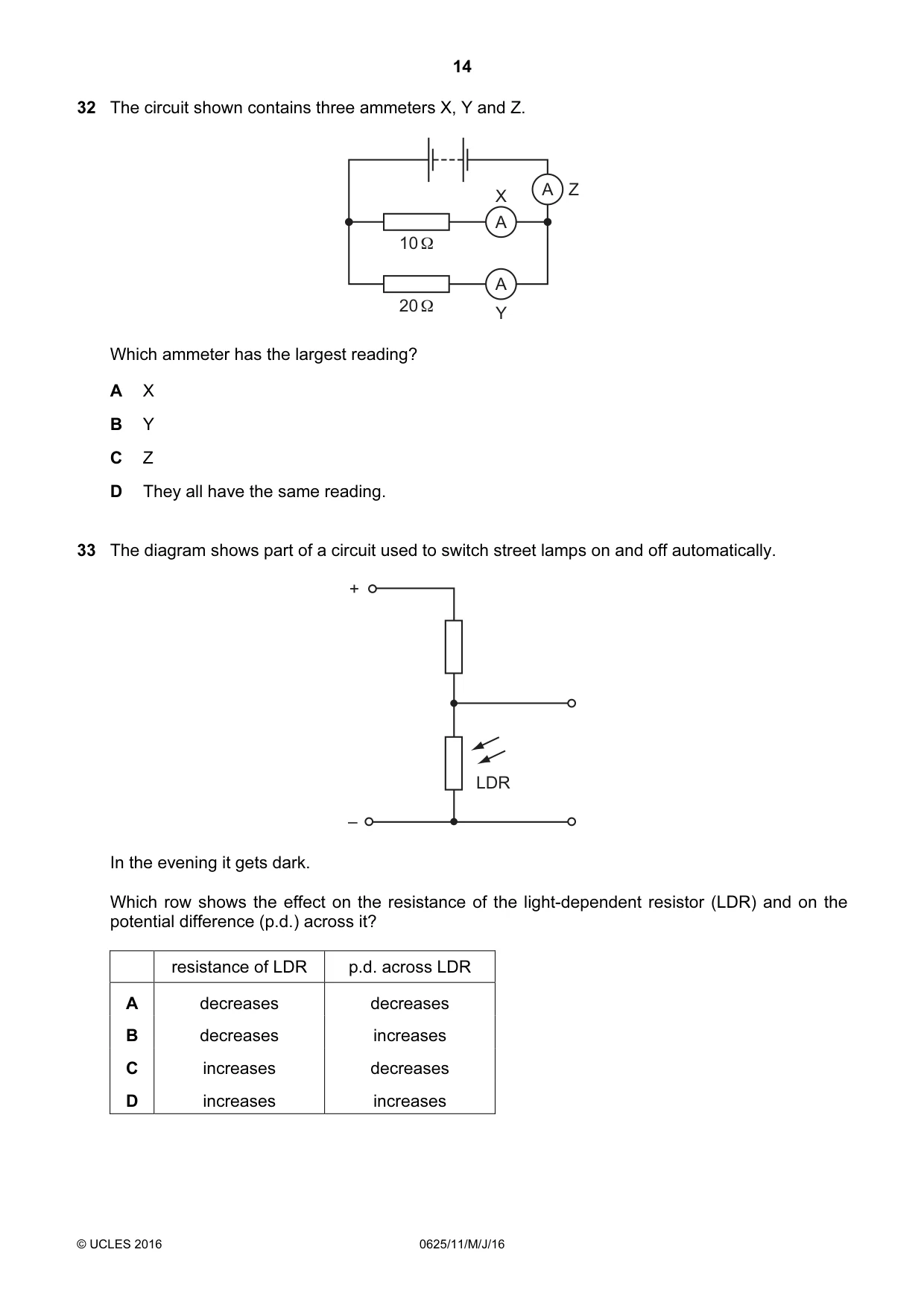
Q32 · The circuit shown contains three ammeters X, Y and Z
32 The circuit shown contains three ammeters X, Y and Z. X A Z A 10 Ω A 20 Ω Y Which ammeter has the largest reading? A X B Y C Z D They all have the same reading.
Mark scheme: C
Q33 · The diagram shows part of a circuit used to switch street lamps on and off automatically
33 The diagram shows part of a circuit used to switch street lamps on and off automatically. + LDR – In the evening it gets dark. Which row shows the effect on the resistance of the light-dependent resistor (LDR) and on the potential difference (p.d.) across it? resistance of LDR p.d. across LDR A decreases decreases B decreases increases C increases decreases D increases increases
Mark scheme: D
Q34 · A domestic circuit includes a 30 A fuse
34 A domestic circuit includes a 30 A fuse. This protects the wiring if there is too much current in the circuit. In which wire is the 30 A fuse positioned, and what does it do when it operates? position operation A live wire disconnects the circuit B live wire reduces the current to 30 A C neutral wire disconnects the circuit D neutral wire reduces the current to 30 A
Mark scheme: A
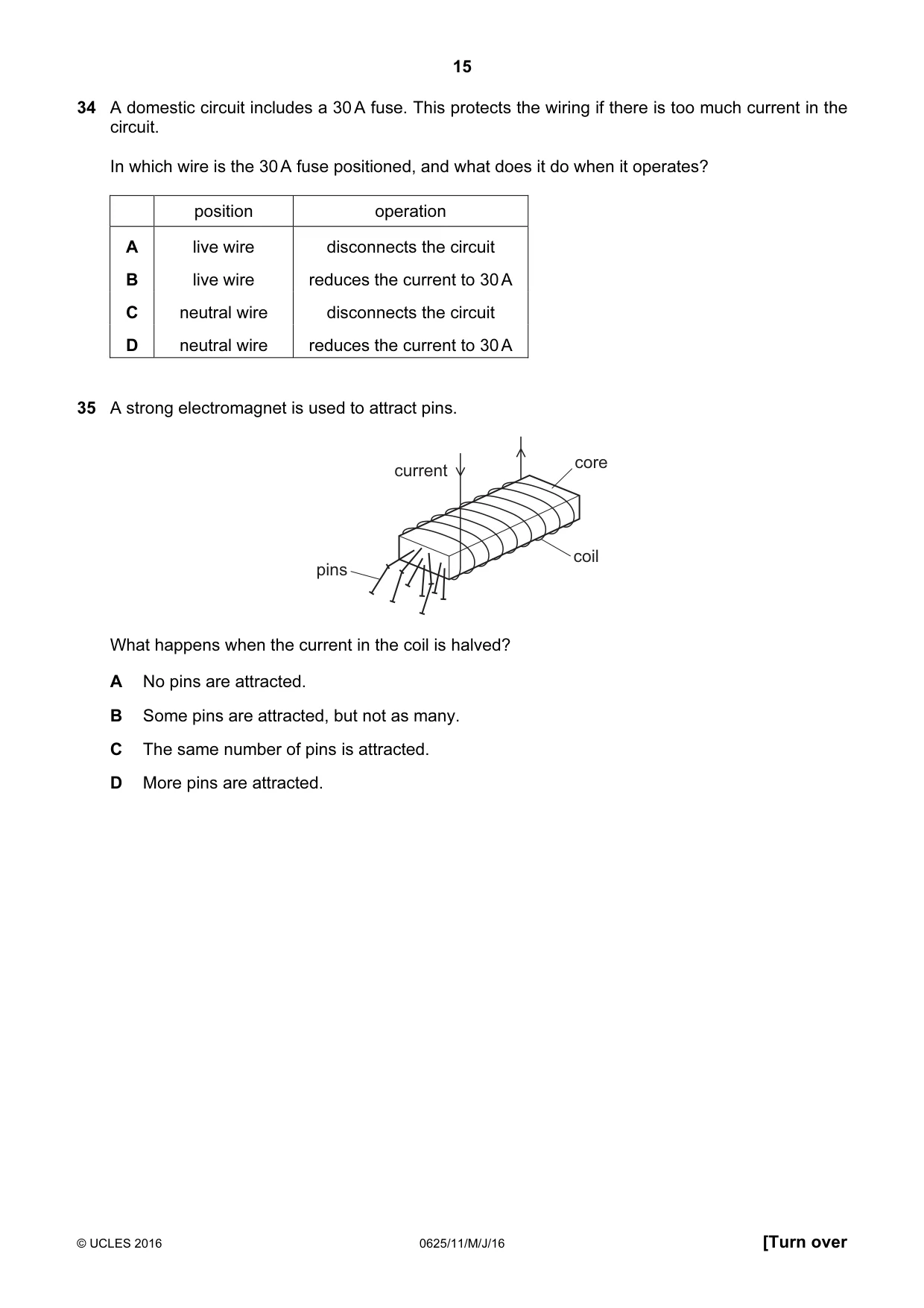
Q35 · A strong electromagnet is used to attract pins
35 A strong electromagnet is used to attract pins. core current coil pins What happens when the current in the coil is halved? A No pins are attracted. B Some pins are attracted, but not as many. C The same number of pins is attracted. D More pins are attracted.
Mark scheme: B
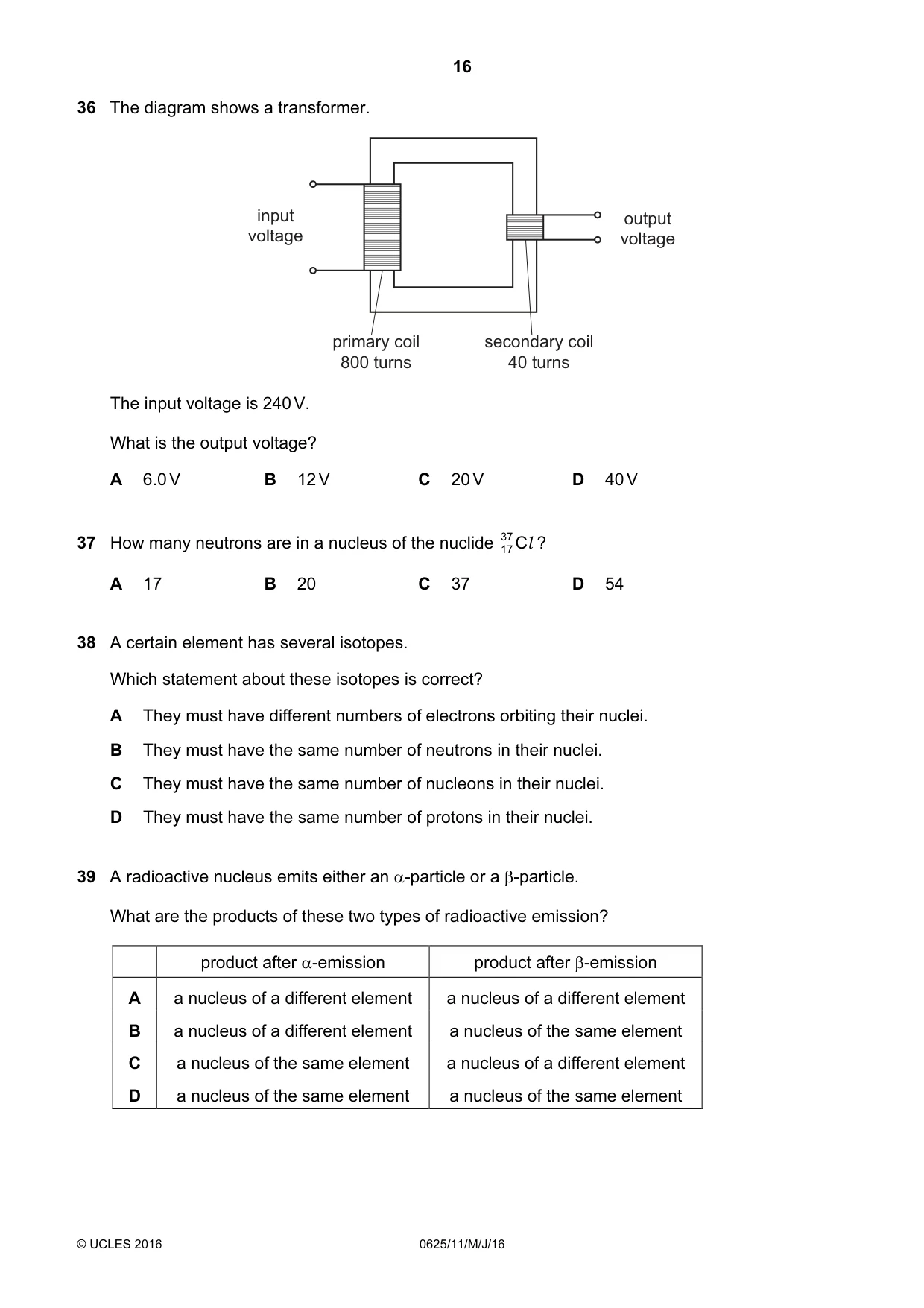
Q36 · The diagram shows a transformer
36 The diagram shows a transformer. input output voltage voltage primary coil secondary coil 800 turns 40 turns The input voltage is 240 V. What is the output voltage? A 6.0 V B 12 V C 20 V D 40 V
Mark scheme: B
Q37 · How many neutrons are in a nucleus of the nuclide 37 C l ?
37 How many neutrons are in a nucleus of the nuclide 37 C l ? 17 A 17 B 20 C 37 D 54
Mark scheme: B
Q38 · A certain element has several isotopes
38 A certain element has several isotopes. Which statement about these isotopes is correct? A They must have different numbers of electrons orbiting their nuclei. B They must have the same number of neutrons in their nuclei. C They must have the same number of nucleons in their nuclei. D They must have the same number of protons in their nuclei.
Mark scheme: D
Q39 · A radioactive nucleus emits either an α-particle or a β-particle
39 A radioactive nucleus emits either an α-particle or a β-particle. What are the products of these two types of radioactive emission? product after α-emission product after β-emission A a nucleus of a different element a nucleus of a different element B a nucleus of a different element a nucleus of the same element C a nucleus of the same element a nucleus of a different element D a nucleus of the same element a nucleus of the same element
Mark scheme: A
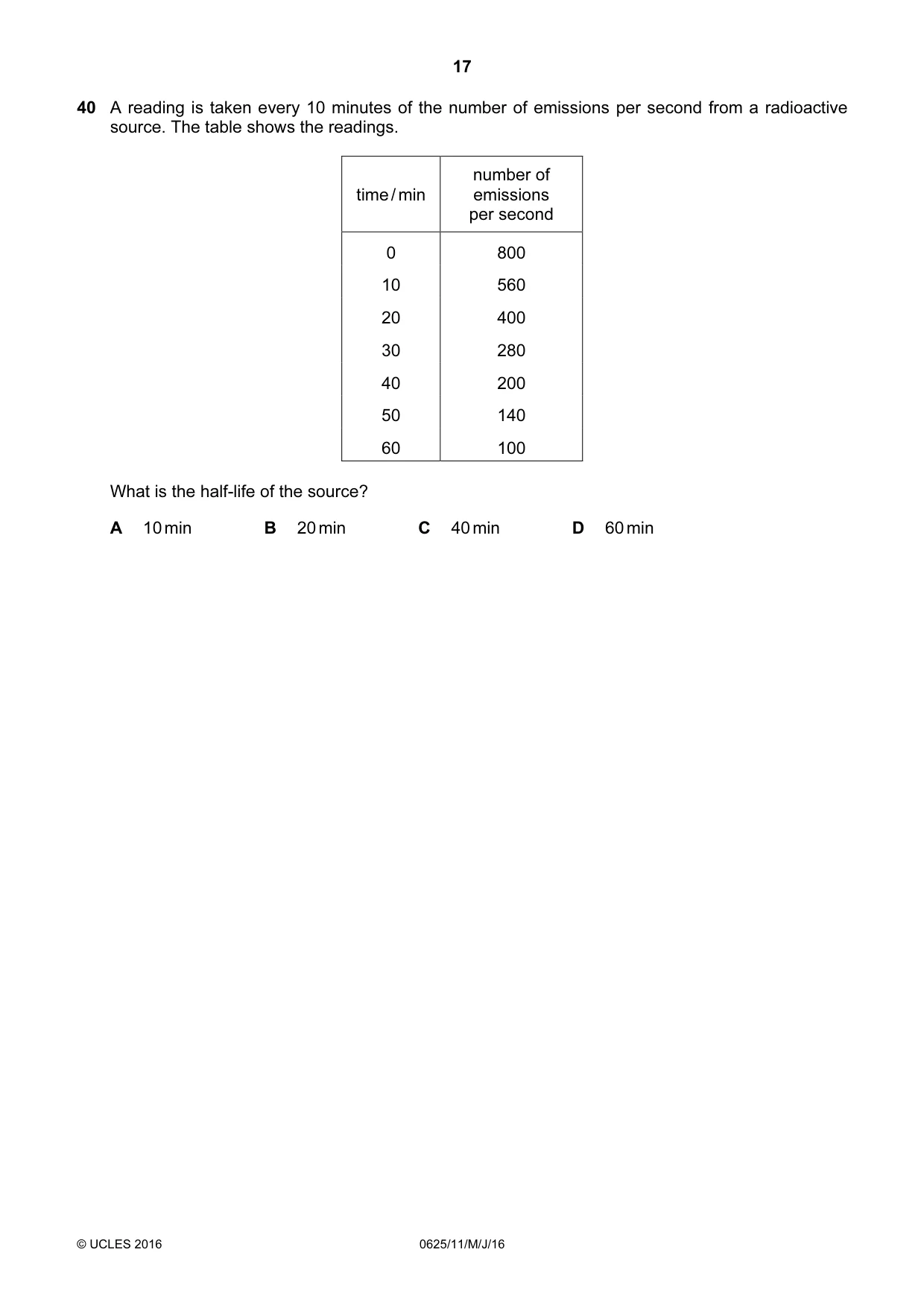
Q40 · A reading is taken every 10 minutes of the number of emissions per second from a…
40 A reading is taken every 10 minutes of the number of emissions per second from a radioactive source. The table shows the readings. number of time / min emissions per second 0 800 10 560 20 400 30 280 40 200 50 140 60 100 What is the half-life of the source? A 10 min B 20 min C 40 min D 60 min
Mark scheme: B
What was in this paper
The subtopics covered by these 40 questions, and how many questions each got. Open one in a new tab to see every Cambridge question on it.
3Energy, work and power3Thermal properties and temperature3Electric circuits2Electrical quantities2Forces2General properties of waves2Kinetic particle model of matter2Light2Mass and weight2Motion2Pressure2Radioactivity2Simple phenomena of magnetism2Sound2The nuclear model of the atom2Transfer of thermal energy2Density1Electrical safety1Physical quantities and measurement techniques1What you needed in this session
Cambridge’s own grade thresholds for 2016 May/June, Paper 1 · Variant 1. A higher threshold means an easier paper — the bar moves with how the cohort did.