Cambridge IGCSE Physics 0625 — 2019 May/June Paper 1 · Variant 3
0625/13/M/J/19 · 40 questions · 40 marks · ≈45 min
The question paper and its mark scheme, free to read here and free to download. This is Cambridge’s own paper, exactly as it was sat.
Question paper20 pages
Mark scheme3 pages
Answers below. Sit the paper first if you are practising.
Questions as text
Q1 · The diagram shows a measuring cylinder containing liquid
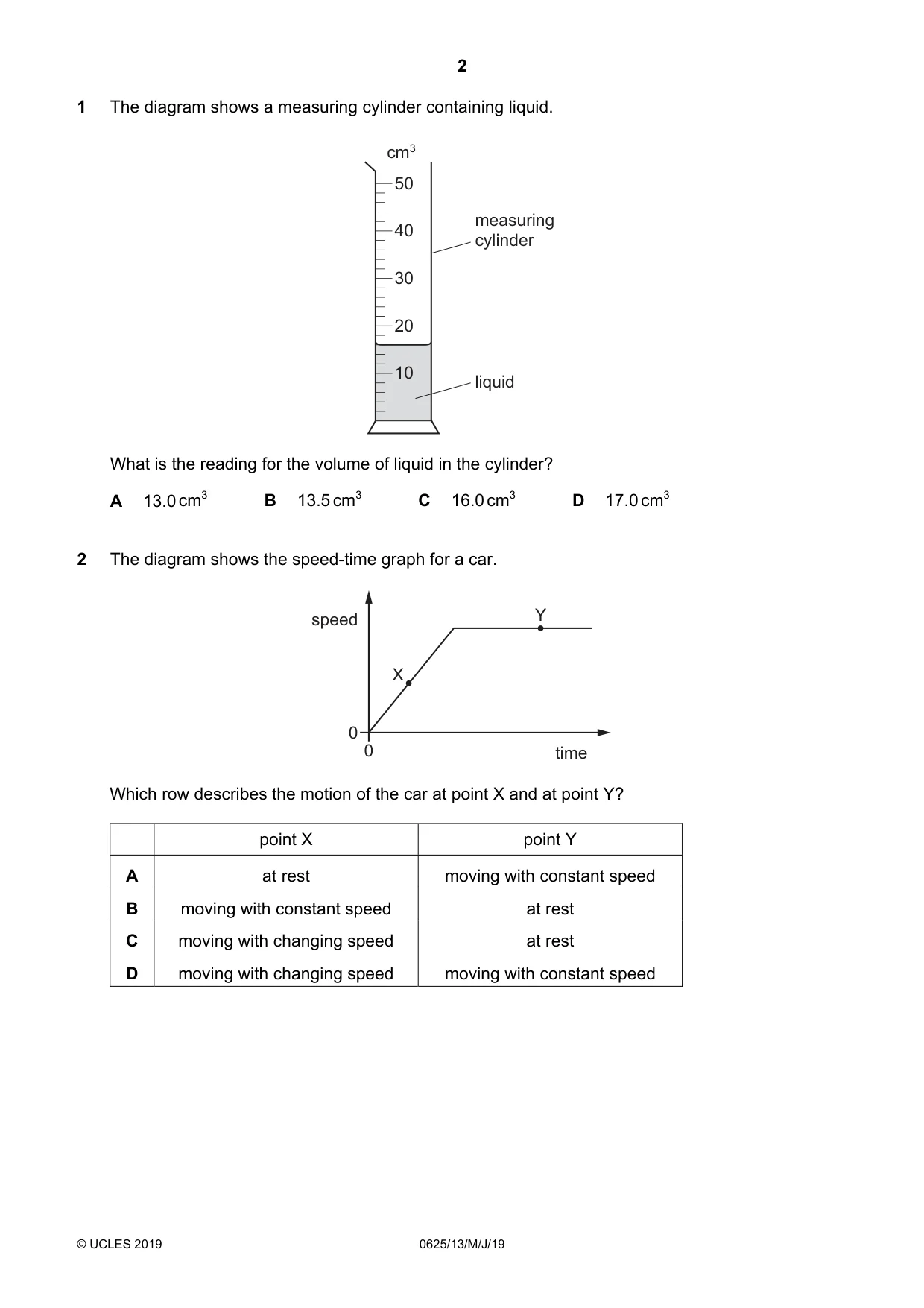
1 The diagram shows a measuring cylinder containing liquid. cm3 50 measuring 40 cylinder 30 20 10 liquid What is the reading for the volume of liquid in the cylinder? A 13.0 cm3 B 13.5 cm3 C 16.0 cm3 D 17.0 cm3
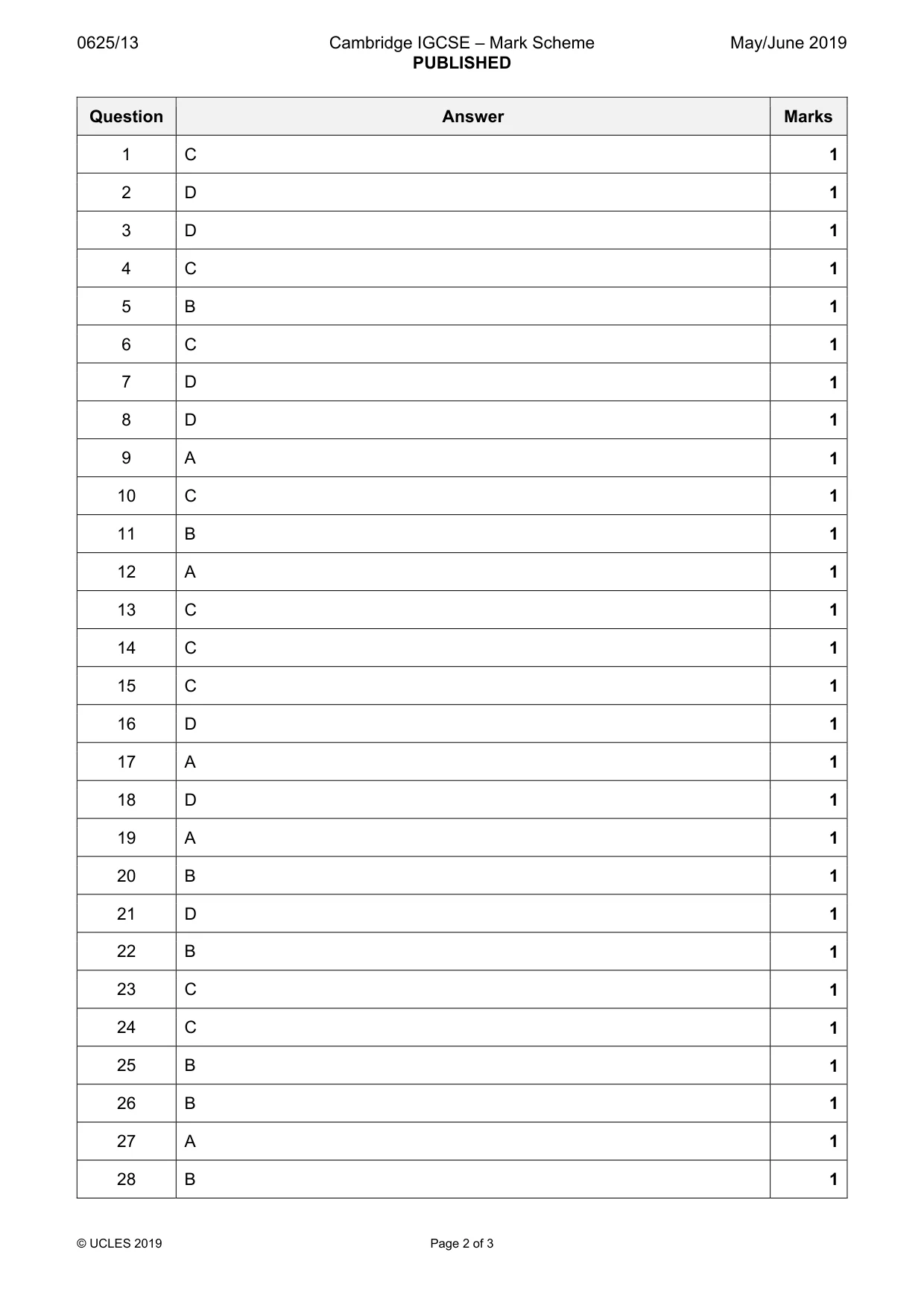
Mark scheme: C
More questions on Physical quantities and measurement techniques
Q2 · The diagram shows the speed-time graph for a car
2 The diagram shows the speed-time graph for a car. speed Y X 0 0 time Which row describes the motion of the car at point X and at point Y? point X point Y A at rest moving with constant speed B moving with constant speed at rest C moving with changing speed at rest D moving with changing speed moving with constant speed
Mark scheme: D
Q3 · A heavy metal ball falls vertically downwards through air past four equally spaced levels…
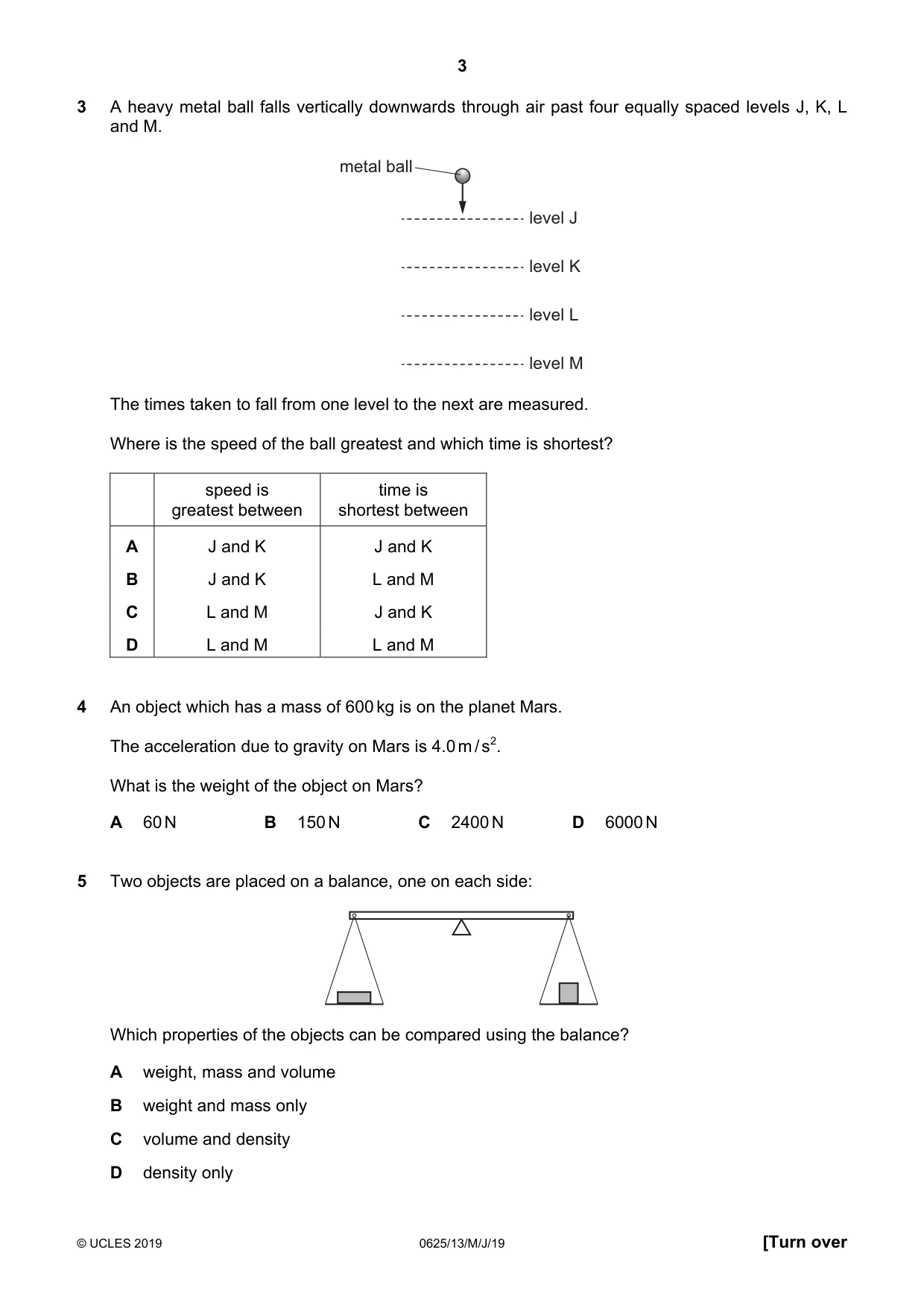
3 A heavy metal ball falls vertically downwards through air past four equally spaced levels J, K, L and M. metal ball level J level K level L level M The times taken to fall from one level to the next are measured. Where is the speed of the ball greatest and which time is shortest? speed is time is greatest between shortest between A J and K J and K B J and K L and M C L and M J and K D L and M L and M
Mark scheme: D
Q4 · An object which has a mass of 600 kg is on the planet Mars
4 An object which has a mass of 600 kg is on the planet Mars. The acceleration due to gravity on Mars is 4.0 m / s2. What is the weight of the object on Mars? A 60 N B 150 N C 2400 N D 6000 N
Mark scheme: C
Q5 · Two objects are placed on a balance, one on each side: Which properties of the objects…
5 Two objects are placed on a balance, one on each side: Which properties of the objects can be compared using the balance? A weight, mass and volume B weight and mass only C volume and density D density only
Mark scheme: B
Q6 · X, Y and Z are three regularly shaped solid objects
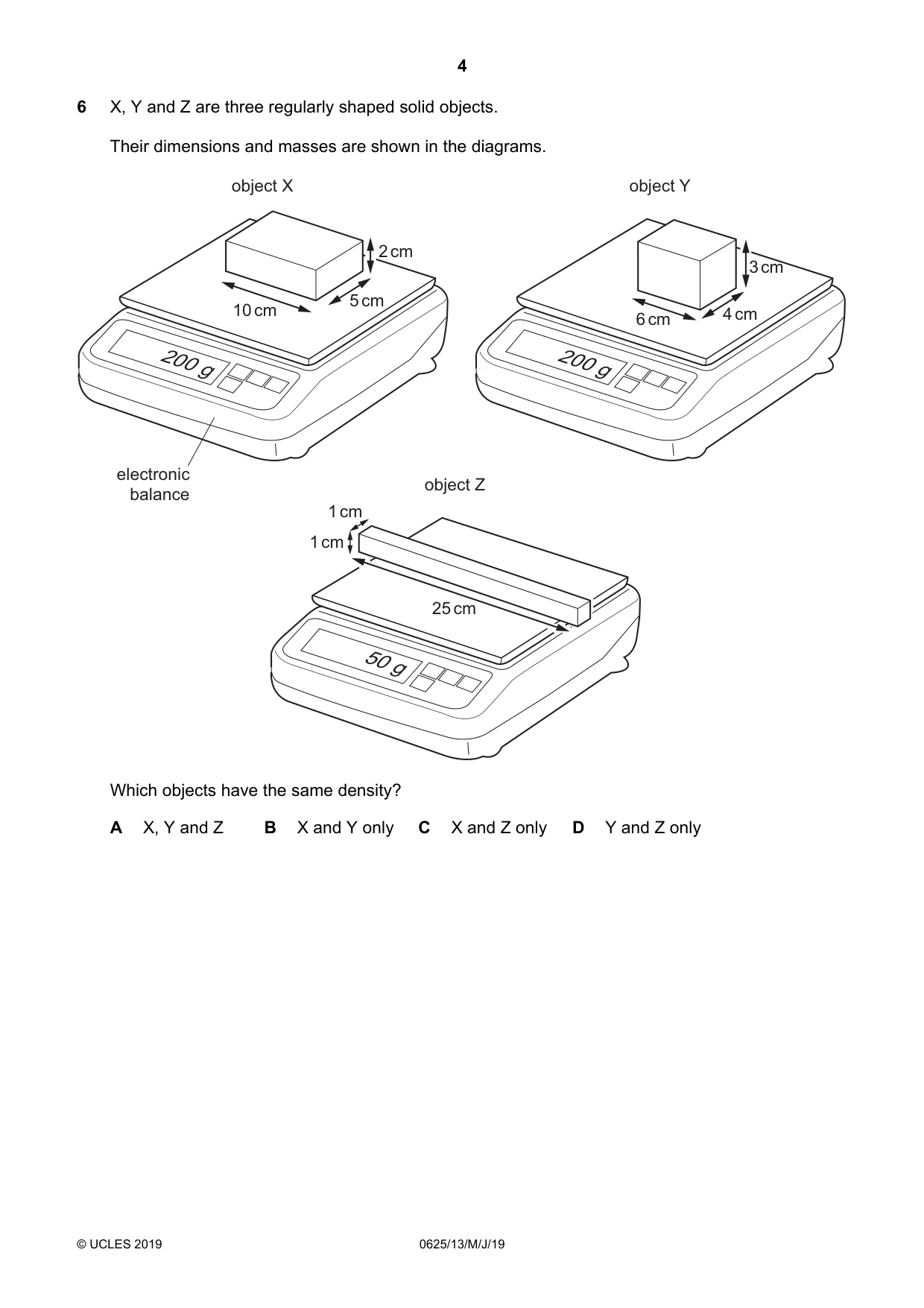
6 X, Y and Z are three regularly shaped solid objects. Their dimensions and masses are shown in the diagrams. object X object Y 2 cm 3 cm 5 cm 10 cm 4 cm 6 cm 200 g 200 g electronic object Z balance 1 cm 1 cm 25 cm 50 g Which objects have the same density? A X, Y and Z B X and Y only C X and Z only D Y and Z only
Mark scheme: C
Q7 · A car is driven from rest on a long straight road
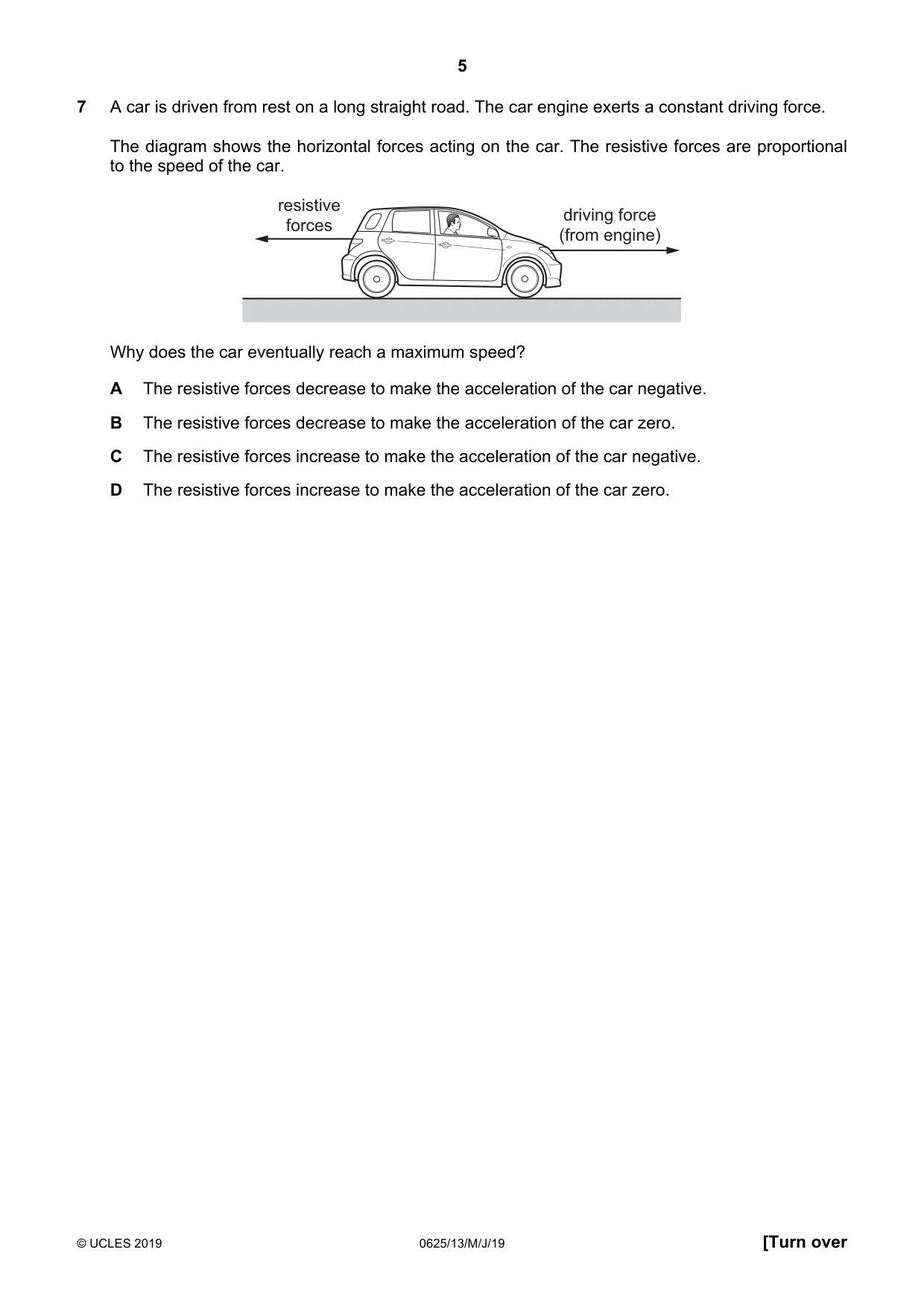
7 A car is driven from rest on a long straight road. The car engine exerts a constant driving force. The diagram shows the horizontal forces acting on the car. The resistive forces are proportional to the speed of the car. resistive driving force forces (from engine) Why does the car eventually reach a maximum speed? A The resistive forces decrease to make the acceleration of the car negative. B The resistive forces decrease to make the acceleration of the car zero. C The resistive forces increase to make the acceleration of the car negative. D The resistive forces increase to make the acceleration of the car zero.
Mark scheme: D
Q8 · A spring is suspended from a stand
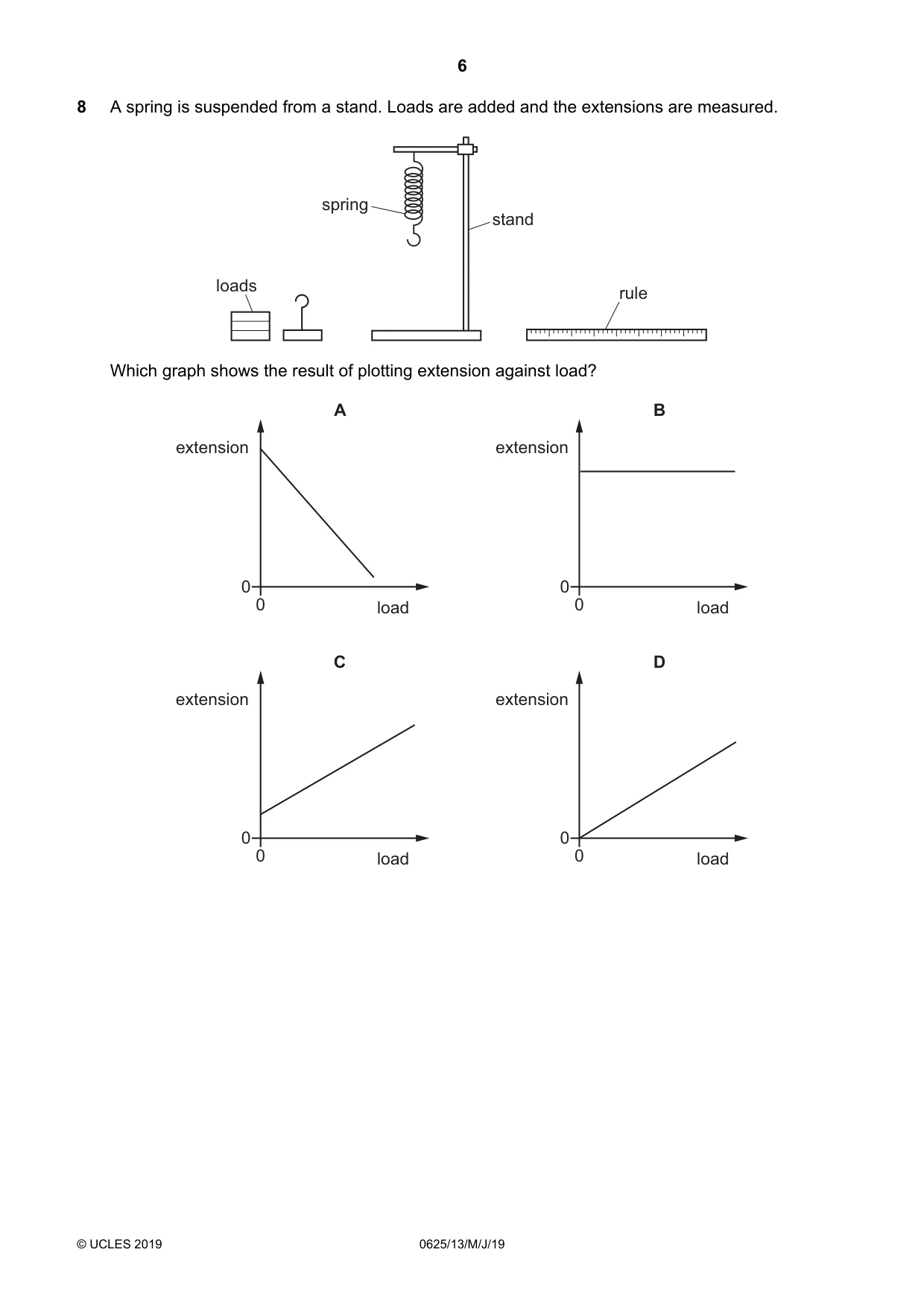
8 A spring is suspended from a stand. Loads are added and the extensions are measured. spring stand loads rule Which graph shows the result of plotting extension against load? A B extension extension 0 0 0 load 0 load C D extension extension 0 0 0 load 0 load
Mark scheme: D
Q9 · A wooden bar is pivoted at its centre so that it can rotate freely
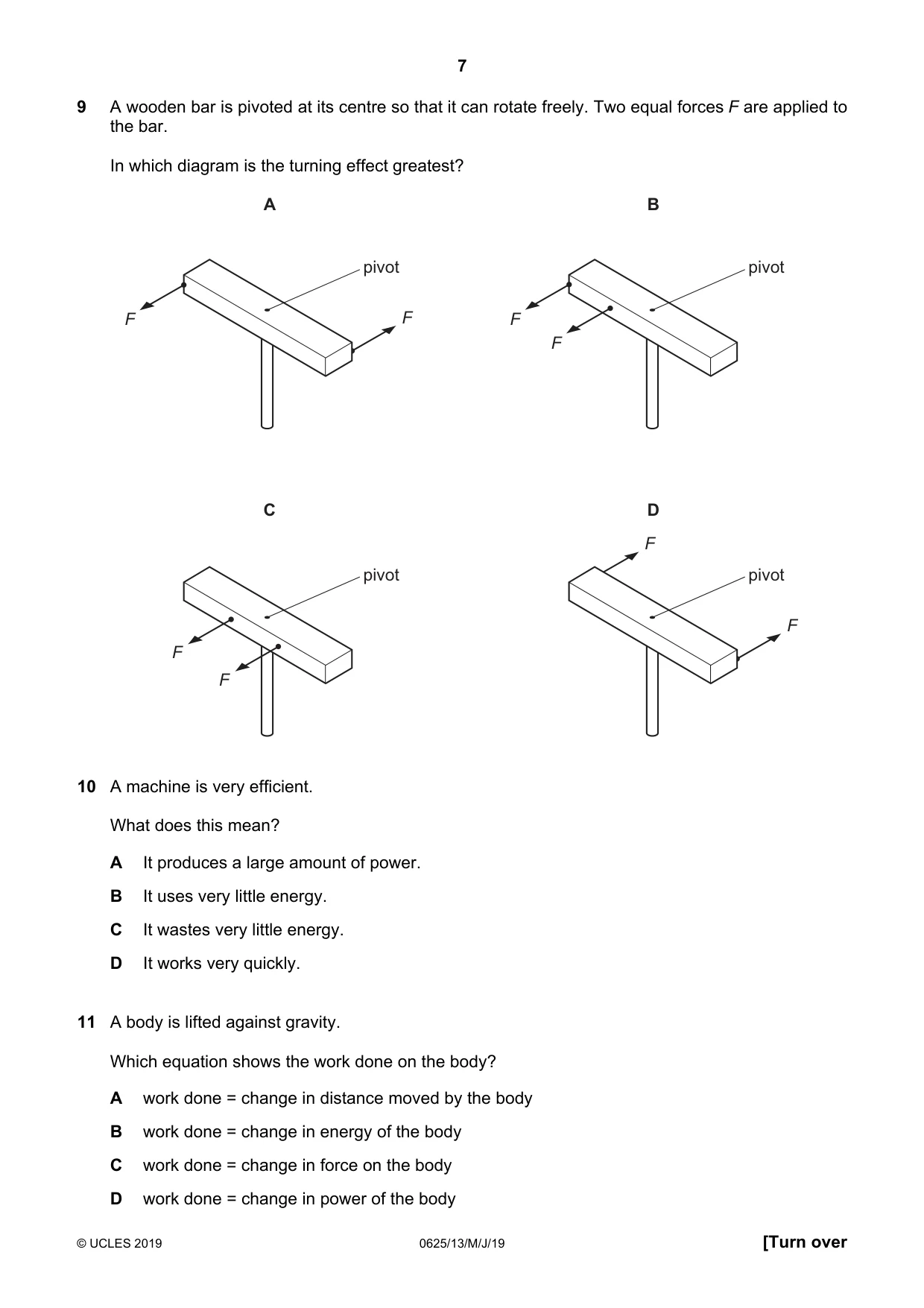
9 A wooden bar is pivoted at its centre so that it can rotate freely. Two equal forces F are applied to the bar. In which diagram is the turning effect greatest? A B pivot pivot F F F F C D F pivot pivot F F F
Mark scheme: A
Q10 · A machine is very efficient
10 A machine is very efficient. What does this mean? A It produces a large amount of power. B It uses very little energy. C It wastes very little energy. D It works very quickly.
Mark scheme: C
Q11 · A body is lifted against gravity
11 A body is lifted against gravity. Which equation shows the work done on the body? A work done = change in distance moved by the body B work done = change in energy of the body C work done = change in force on the body D work done = change in power of the body
Mark scheme: B
Q12 · The diagram shows a simple mercury barometer
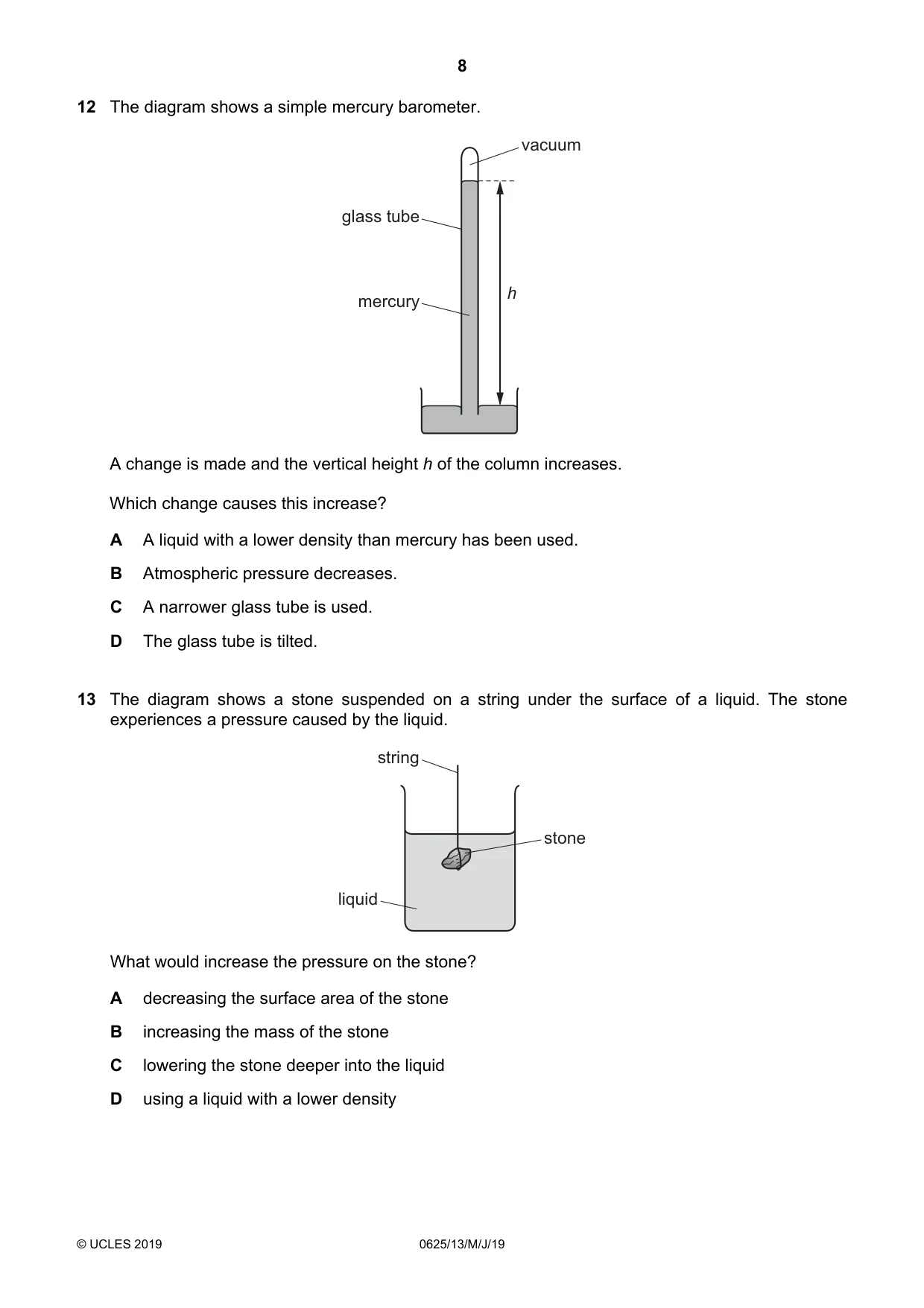
12 The diagram shows a simple mercury barometer. vacuum glass tube h mercury A change is made and the vertical height h of the column increases. Which change causes this increase? A A liquid with a lower density than mercury has been used. B Atmospheric pressure decreases. C A narrower glass tube is used. D The glass tube is tilted.
Mark scheme: A
Q13 · The diagram shows a stone suspended on a string under the surface of a liquid
13 The diagram shows a stone suspended on a string under the surface of a liquid. The stone experiences a pressure caused by the liquid. string stone liquid What would increase the pressure on the stone? A decreasing the surface area of the stone B increasing the mass of the stone C lowering the stone deeper into the liquid D using a liquid with a lower density
Mark scheme: C
Q14 · Which statement is correct?
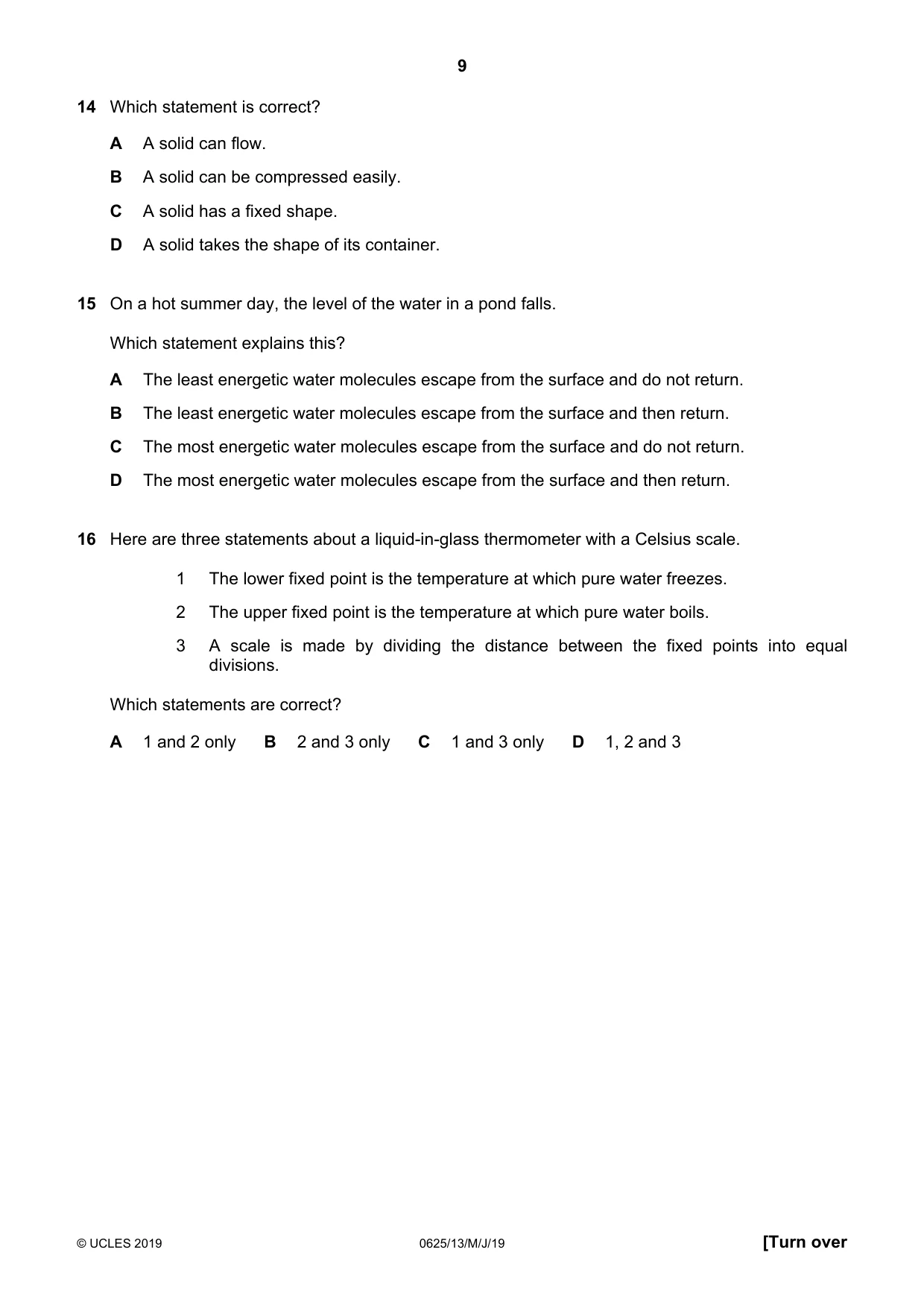
14 Which statement is correct? A A solid can flow. B A solid can be compressed easily. C A solid has a fixed shape. D A solid takes the shape of its container.
Mark scheme: C
Q15 · On a hot summer day, the level of the water in a pond falls
15 On a hot summer day, the level of the water in a pond falls. Which statement explains this? A The least energetic water molecules escape from the surface and do not return. B The least energetic water molecules escape from the surface and then return. C The most energetic water molecules escape from the surface and do not return. D The most energetic water molecules escape from the surface and then return.
Mark scheme: C
Q16 · Here are three statements about a liquid-in-glass thermometer with a Celsius scale
16 Here are three statements about a liquid-in-glass thermometer with a Celsius scale. 1 The lower fixed point is the temperature at which pure water freezes. 2 The upper fixed point is the temperature at which pure water boils. 3 A scale is made by dividing the distance between the fixed points into equal divisions. Which statements are correct? A 1 and 2 only B 2 and 3 only C 1 and 3 only D 1, 2 and 3
Mark scheme: D
Q17 · A night storage heater contains a large block of material that is heated electrically…
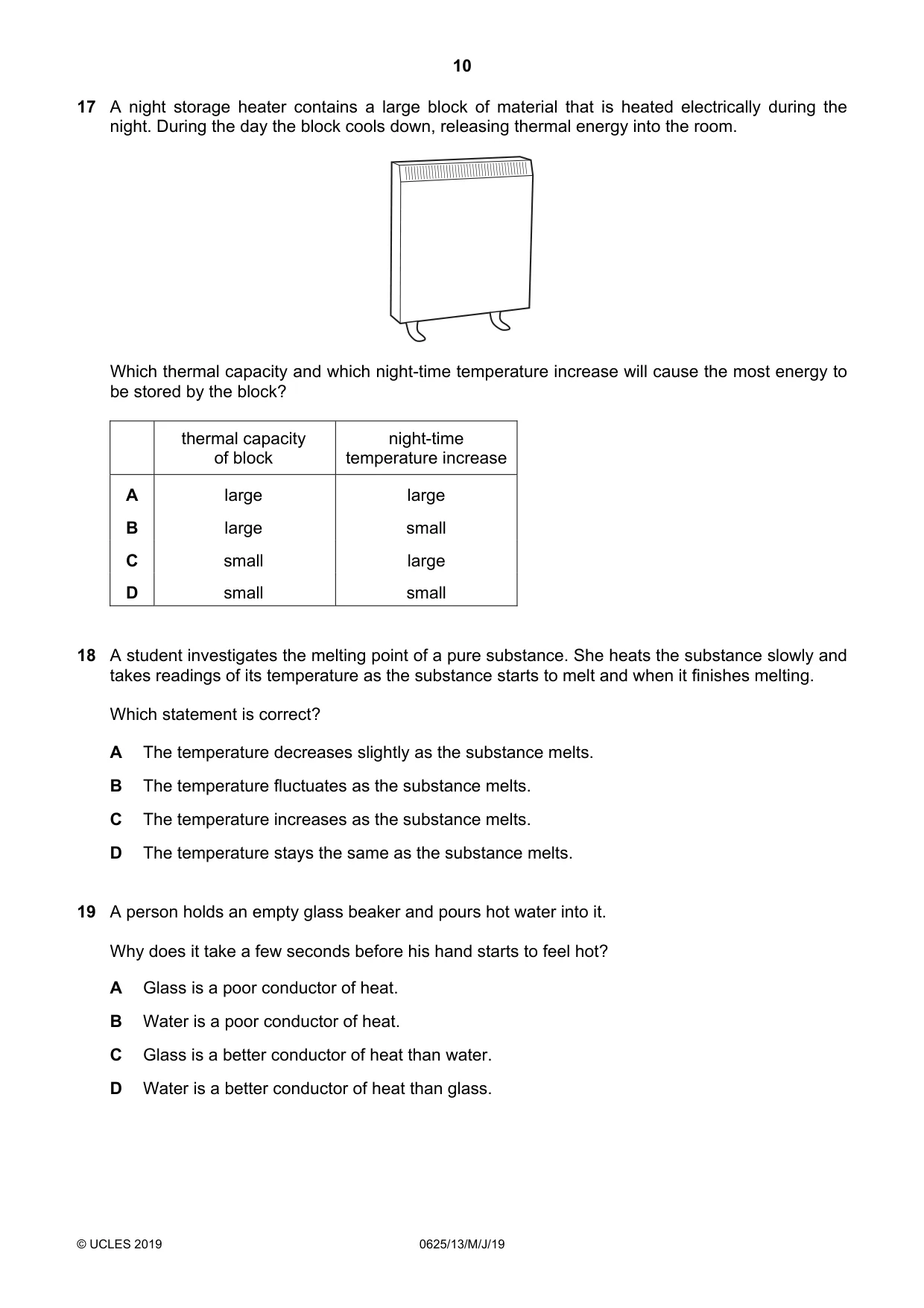
17 A night storage heater contains a large block of material that is heated electrically during the night. During the day the block cools down, releasing thermal energy into the room. Which thermal capacity and which night-time temperature increase will cause the most energy to be stored by the block? thermal capacity night-time of block temperature increase A large large B large small C small large D small small
Mark scheme: A
Q18 · A student investigates the melting point of a pure substance
18 A student investigates the melting point of a pure substance. She heats the substance slowly and takes readings of its temperature as the substance starts to melt and when it finishes melting. Which statement is correct? A The temperature decreases slightly as the substance melts. B The temperature fluctuates as the substance melts. C The temperature increases as the substance melts. D The temperature stays the same as the substance melts.
Mark scheme: D
Q19 · A person holds an empty glass beaker and pours hot water into it
19 A person holds an empty glass beaker and pours hot water into it. Why does it take a few seconds before his hand starts to feel hot? A Glass is a poor conductor of heat. B Water is a poor conductor of heat. C Glass is a better conductor of heat than water. D Water is a better conductor of heat than glass.
Mark scheme: A
Q20 · The metal surface of a kettle is hot
20 The metal surface of a kettle is hot. What happens to the cool air outside the kettle when it comes into contact with the hot kettle? A The density of the air decreases and the air falls. B The density of the air decreases and the air rises. C The density of the air increases and the air falls. D The density of the air increases and the air rises.
Mark scheme: B
Q21 · A student draws a diagram to show two different properties of a water wave
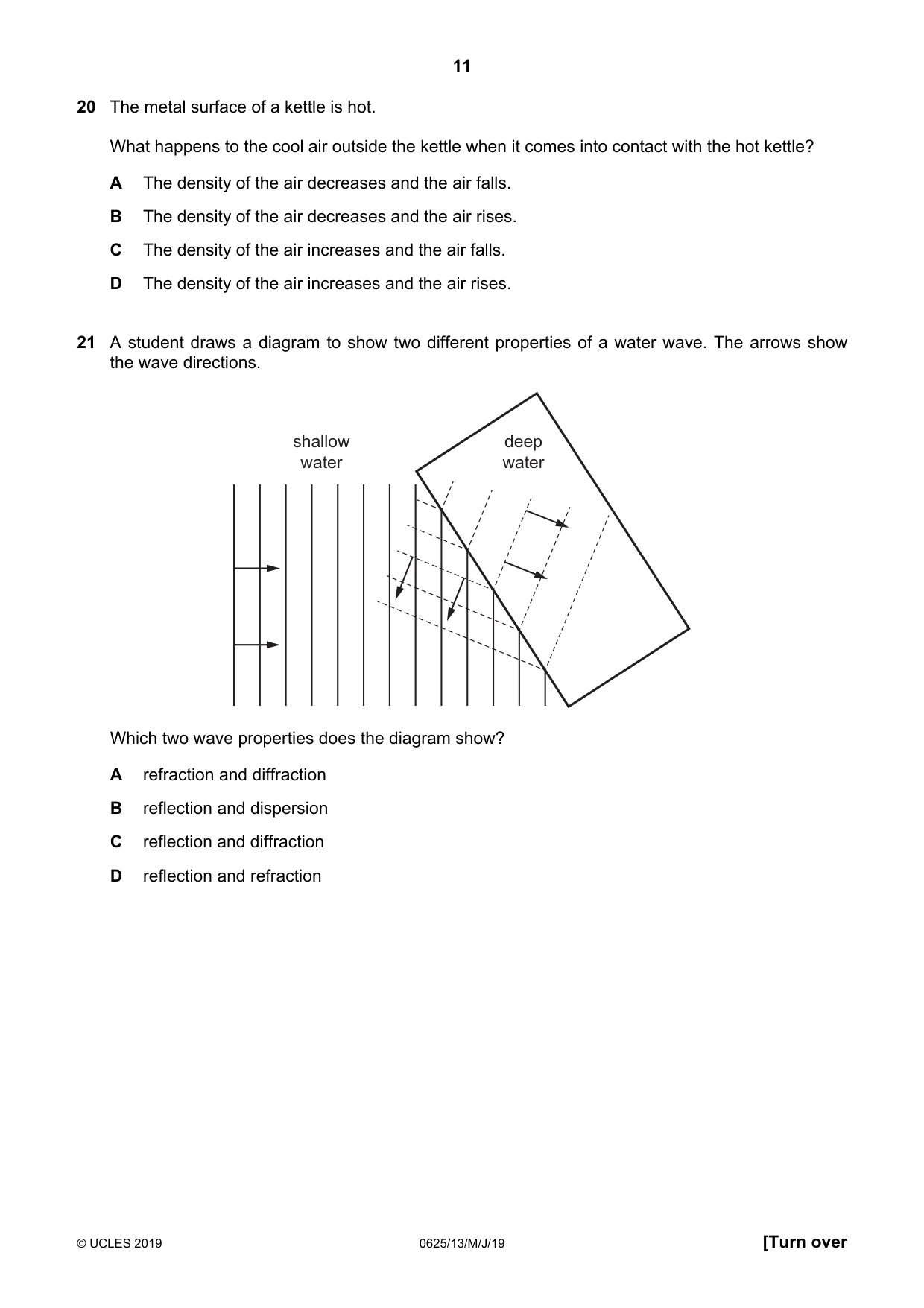
21 A student draws a diagram to show two different properties of a water wave. The arrows show the wave directions. shallow deep water water Which two wave properties does the diagram show? A refraction and diffraction B reflection and dispersion C reflection and diffraction D reflection and refraction
Mark scheme: D
Q22 · The diagram shows a cork with a weight attached so that the cork floats upright in water
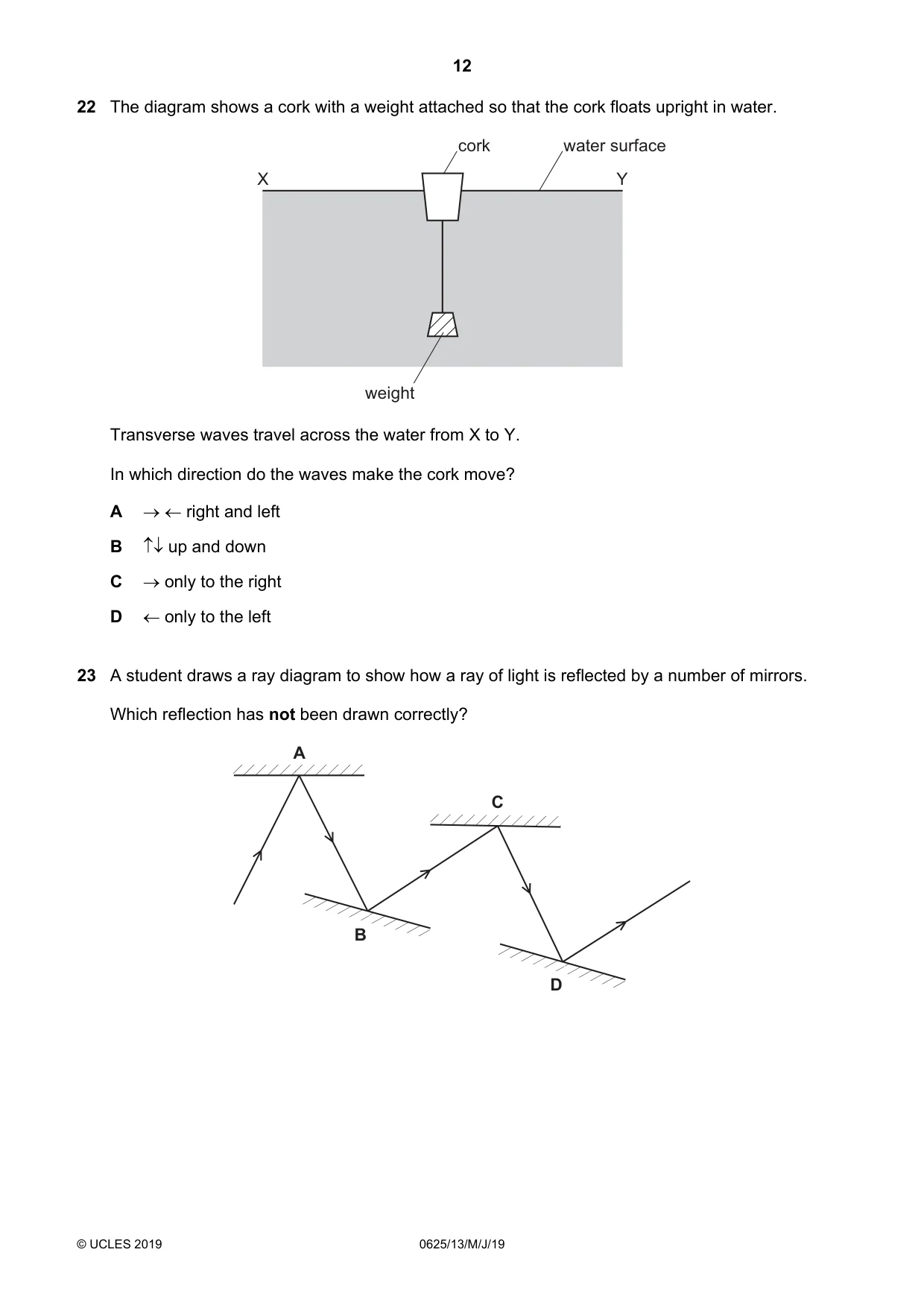
22 The diagram shows a cork with a weight attached so that the cork floats upright in water. cork water surface X Y weight Transverse waves travel across the water from X to Y. In which direction do the waves make the cork move? A → ← right and left B ↑↓ up and down C → only to the right D ← only to the left
Mark scheme: B
Q23 · A student draws a ray diagram to show how a ray of light is reflected by a number of…
23 A student draws a ray diagram to show how a ray of light is reflected by a number of mirrors. Which reflection has not been drawn correctly? A C B D
Mark scheme: C
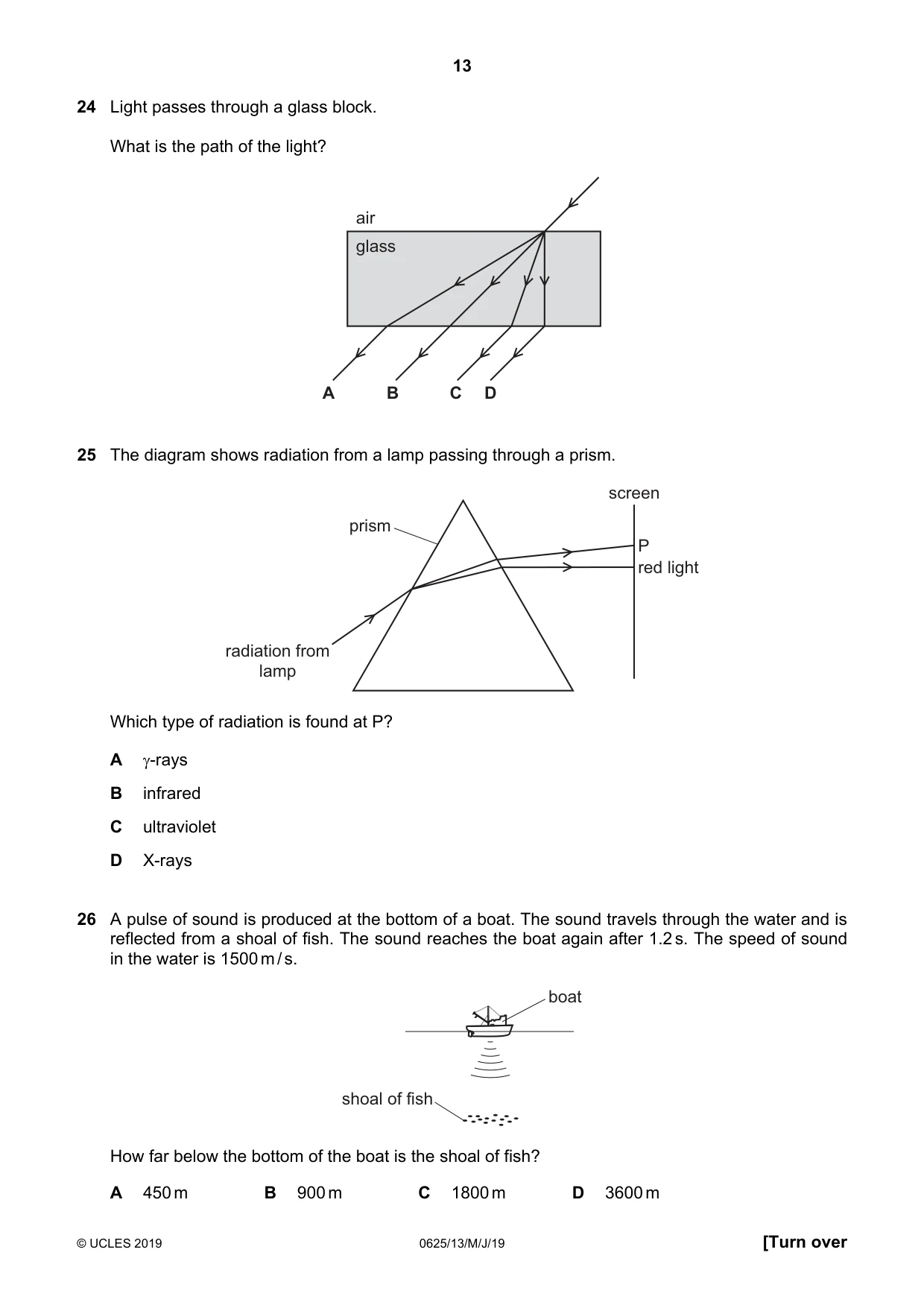
Q24 · Light passes through a glass block
24 Light passes through a glass block. What is the path of the light? air glass A B C D
Mark scheme: C
Q25 · The diagram shows radiation from a lamp passing through a prism
25 The diagram shows radiation from a lamp passing through a prism. screen prism P red light radiation from lamp Which type of radiation is found at P? A γ-rays B infrared C ultraviolet D X-rays
Mark scheme: B
Q26 · A pulse of sound is produced at the bottom of a boat
26 A pulse of sound is produced at the bottom of a boat. The sound travels through the water and is reflected from a shoal of fish. The sound reaches the boat again after 1.2 s. The speed of sound in the water is 1500 m / s. boat shoal of fish How far below the bottom of the boat is the shoal of fish? A 450 m B 900 m C 1800 m D 3600 m
Mark scheme: B
Q27 · Which statement about ultrasound is correct?
27 Which statement about ultrasound is correct? A It has a higher frequency than audible sound, and it is a longitudinal wave. B It has a higher frequency than audible sound, and it is a transverse wave. C It has a lower frequency than audible sound, and it is a longitudinal wave. D It has a lower frequency than audible sound, and it is a transverse wave.
Mark scheme: A
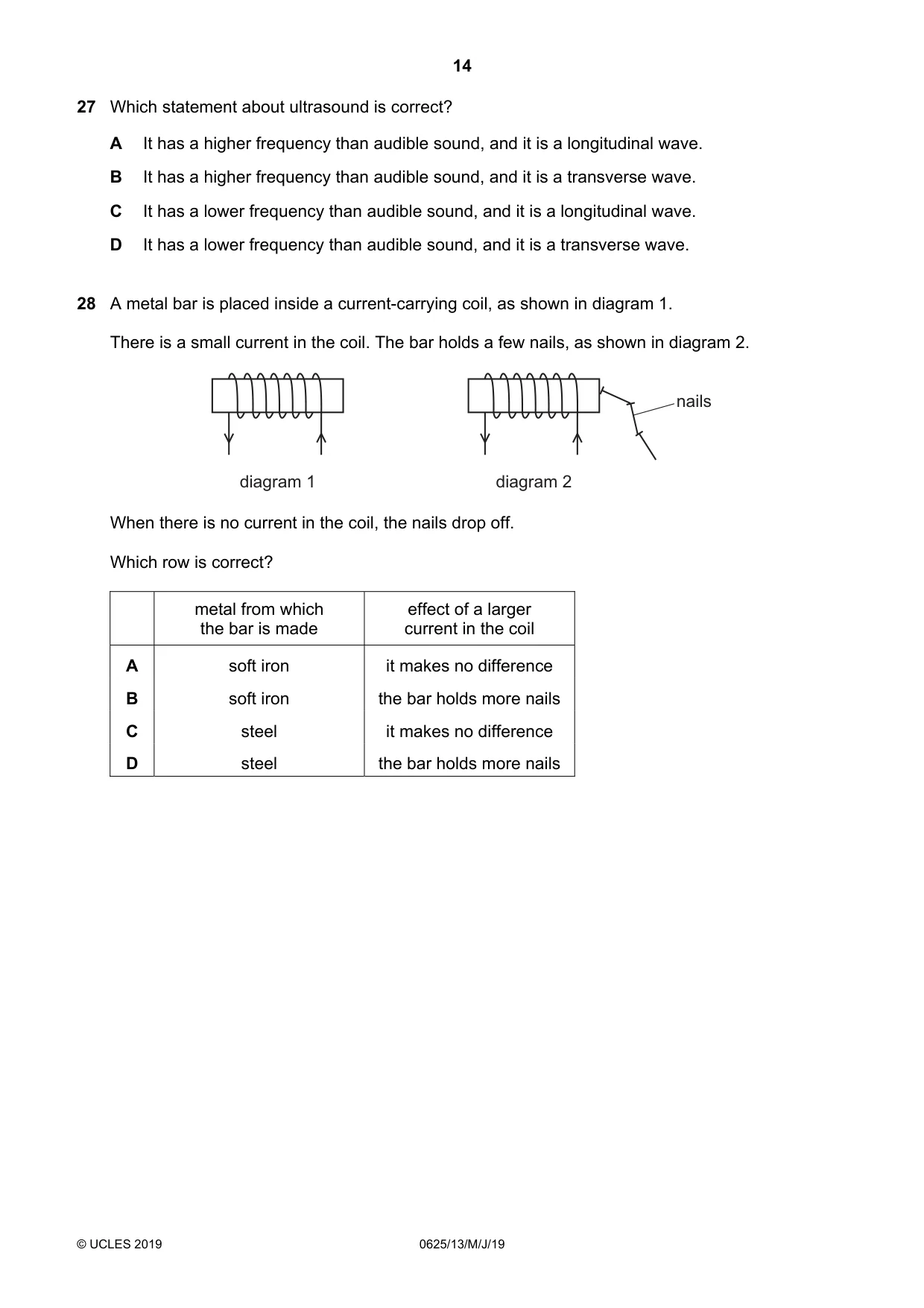
Q28 · A metal bar is placed inside a current-carrying coil, as shown in diagram 1
28 A metal bar is placed inside a current-carrying coil, as shown in diagram 1. There is a small current in the coil. The bar holds a few nails, as shown in diagram 2. nails diagram 1 diagram 2 When there is no current in the coil, the nails drop off. Which row is correct? metal from which effect of a larger the bar is made current in the coil A soft iron it makes no difference B soft iron the bar holds more nails C steel it makes no difference D steel the bar holds more nails
Mark scheme: B
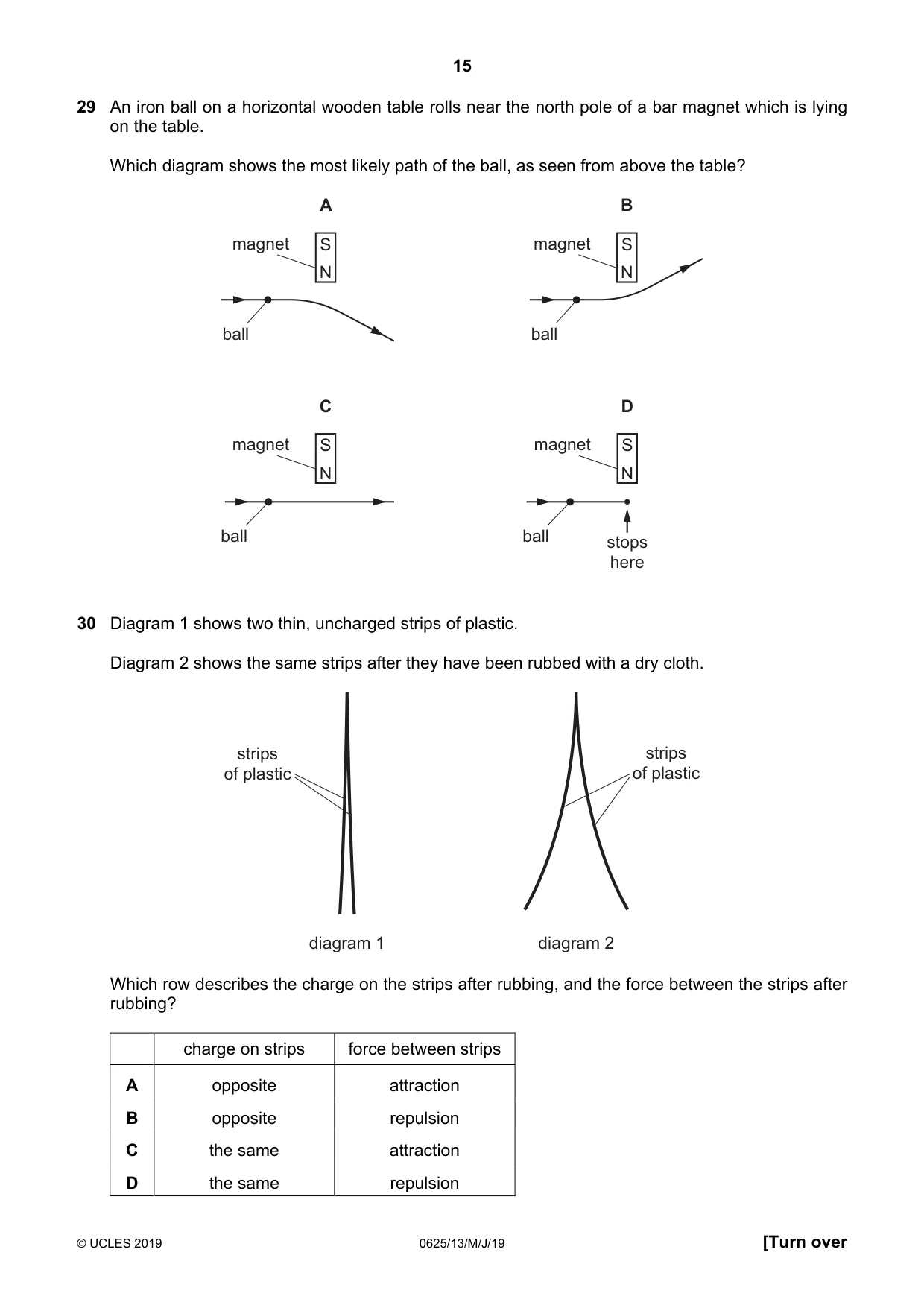
Q29 · An iron ball on a horizontal wooden table rolls near the north pole of a bar magnet which…
29 An iron ball on a horizontal wooden table rolls near the north pole of a bar magnet which is lying on the table. Which diagram shows the most likely path of the ball, as seen from above the table? A B magnet S magnet S N N ball ball C D magnet S magnet S N N ball ball stops here
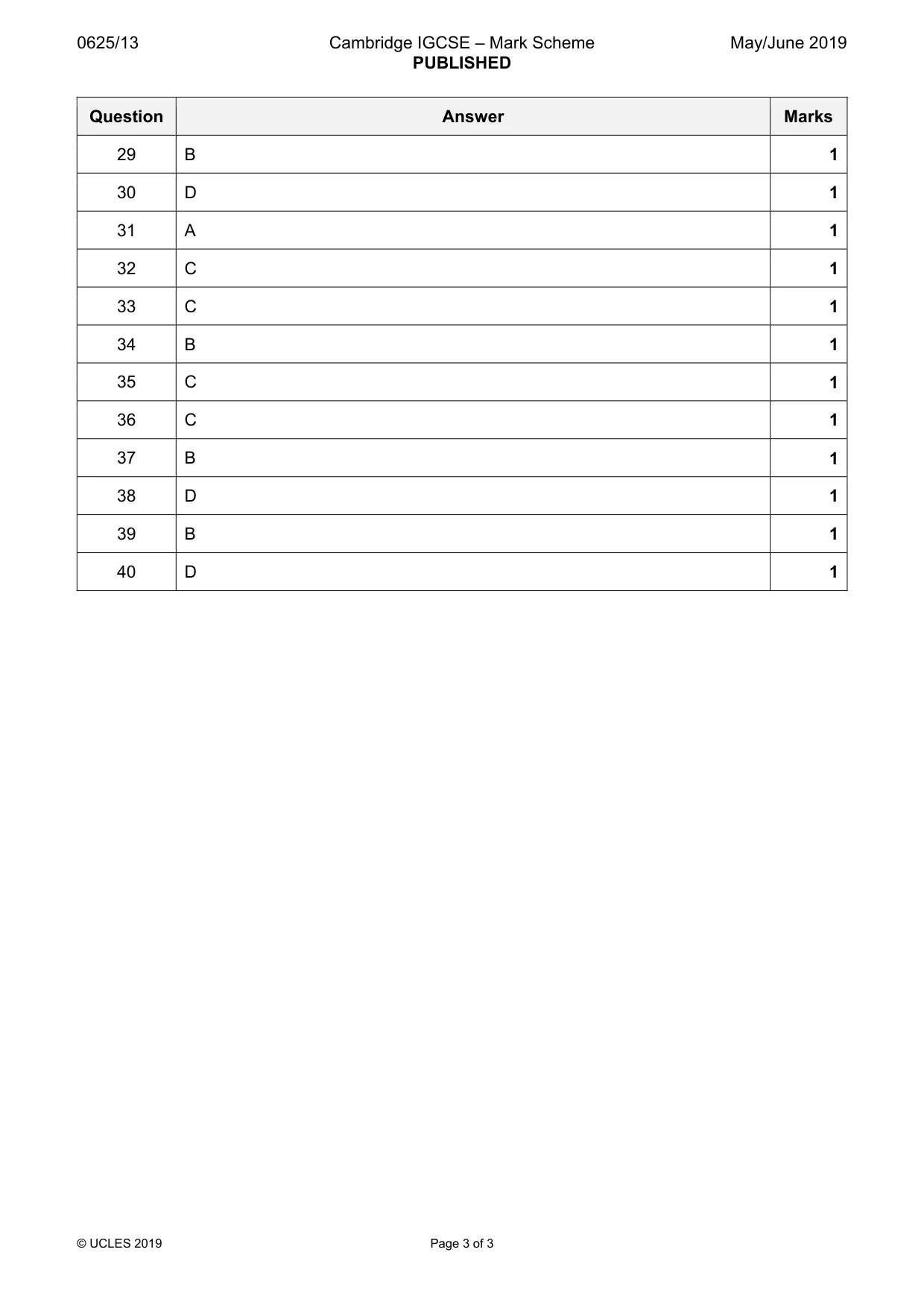
Mark scheme: B
Q30 · Two thin, uncharged strips of plastic
30 Diagram 1 shows two thin, uncharged strips of plastic. Diagram 2 shows the same strips after they have been rubbed with a dry cloth. strips strips of plastic of plastic diagram 1 diagram 2 Which row describes the charge on the strips after rubbing, and the force between the strips after rubbing? charge on strips force between strips A opposite attraction B opposite repulsion C the same attraction D the same repulsion
Mark scheme: D
Q31 · A battery stores chemical potential energy
31 A battery stores chemical potential energy. The battery is connected to a resistor. As the battery runs down, what happens to its chemical energy? The energy is transferred by and ends up as A electrical working internal energy in the resistor B electrical working potential energy in the resistor C mechanical working internal energy in the resistor D mechanical working potential energy in the resistor
Mark scheme: A
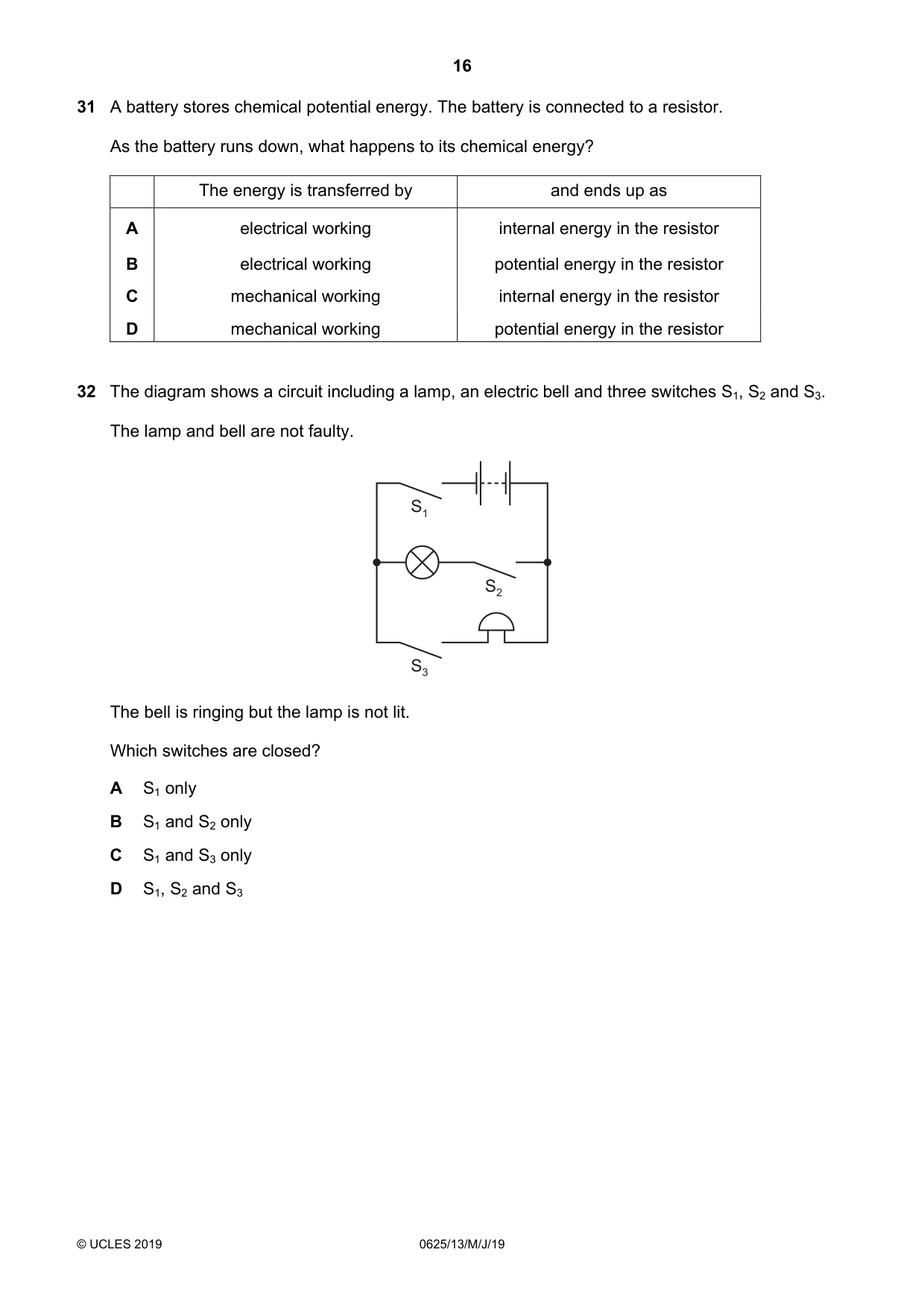
Q32 · The diagram shows a circuit including a lamp, an electric bell and three switches S1, S2…
32 The diagram shows a circuit including a lamp, an electric bell and three switches S1, S2 and S3. The lamp and bell are not faulty. S1 S2 S3 The bell is ringing but the lamp is not lit. Which switches are closed? A S1 only B S1 and S2 only C S1 and S3 only D S1, S2 and S3
Mark scheme: C
Q33 · A student is designing a lighting circuit for a dolls’ house
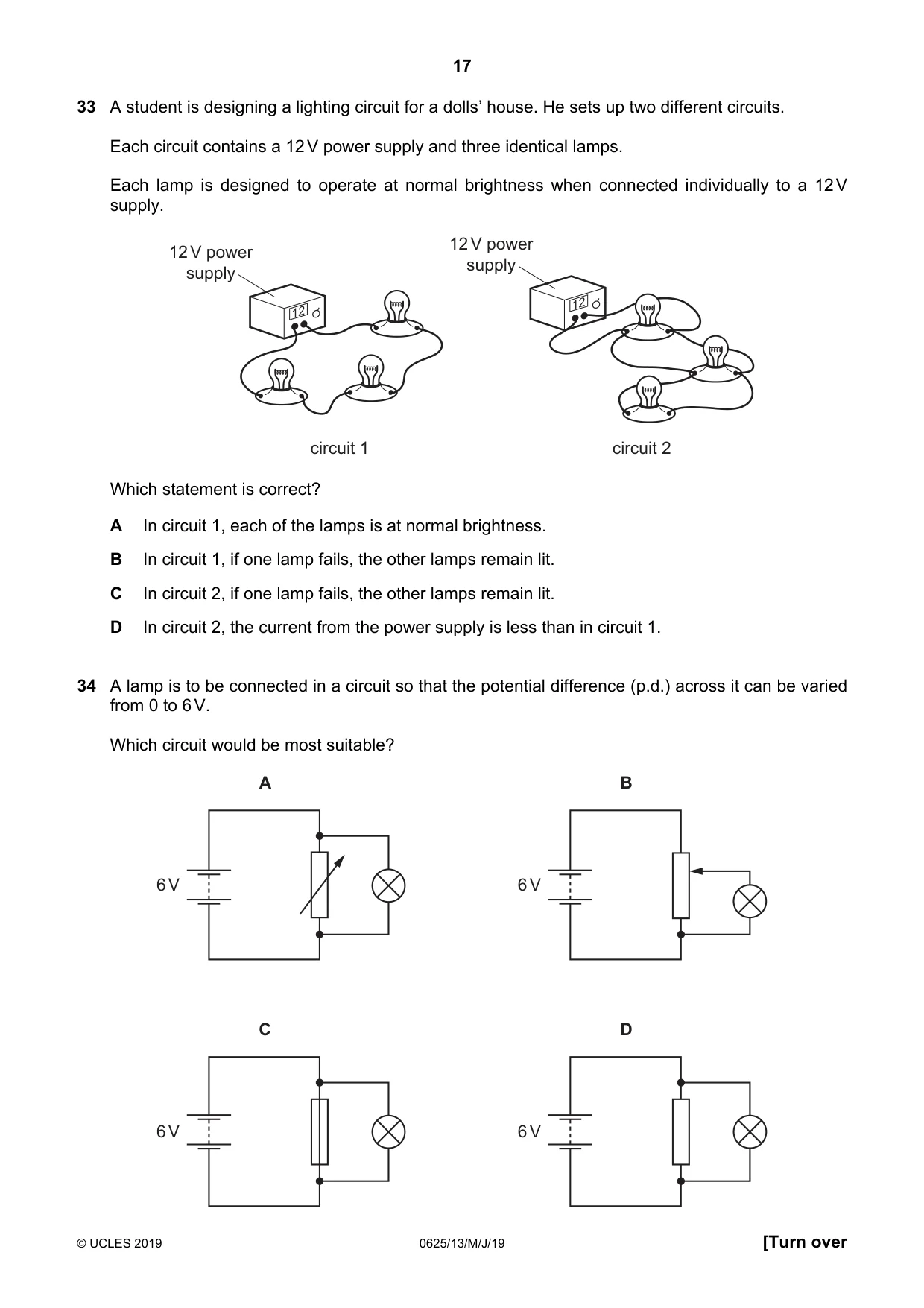
33 A student is designing a lighting circuit for a dolls’ house. He sets up two different circuits. Each circuit contains a 12 V power supply and three identical lamps. Each lamp is designed to operate at normal brightness when connected individually to a 12 V supply. 12 V power 12 V power supply supply 12 12 circuit 1 circuit 2 Which statement is correct? A In circuit 1, each of the lamps is at normal brightness. B In circuit 1, if one lamp fails, the other lamps remain lit. C In circuit 2, if one lamp fails, the other lamps remain lit. D In circuit 2, the current from the power supply is less than in circuit 1.
Mark scheme: C
Q34 · A lamp is to be connected in a circuit so that the potential difference (p.d.) across it…
34 A lamp is to be connected in a circuit so that the potential difference (p.d.) across it can be varied from 0 to 6 V. Which circuit would be most suitable? A B 6 V 6 V C D 6 V 6 V
Mark scheme: B
Q35 · A simple wiring diagram for an electric cooker is shown
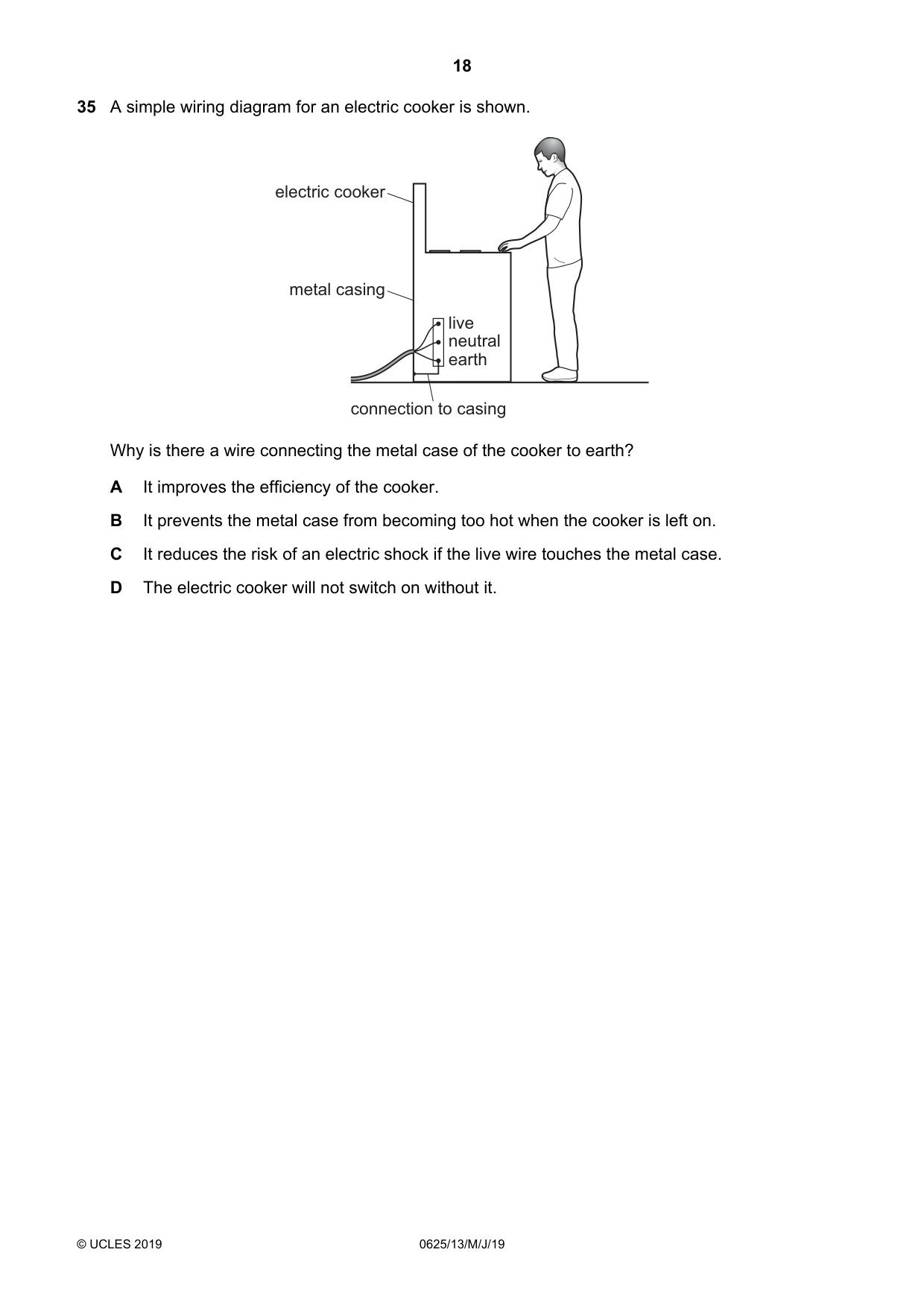
35 A simple wiring diagram for an electric cooker is shown. electric cooker metal casing live neutral earth connection to casing Why is there a wire connecting the metal case of the cooker to earth? A It improves the efficiency of the cooker. B It prevents the metal case from becoming too hot when the cooker is left on. C It reduces the risk of an electric shock if the live wire touches the metal case. D The electric cooker will not switch on without it.
Mark scheme: C
Q36 · In an experiment, a wire is held above a compass needle as shown
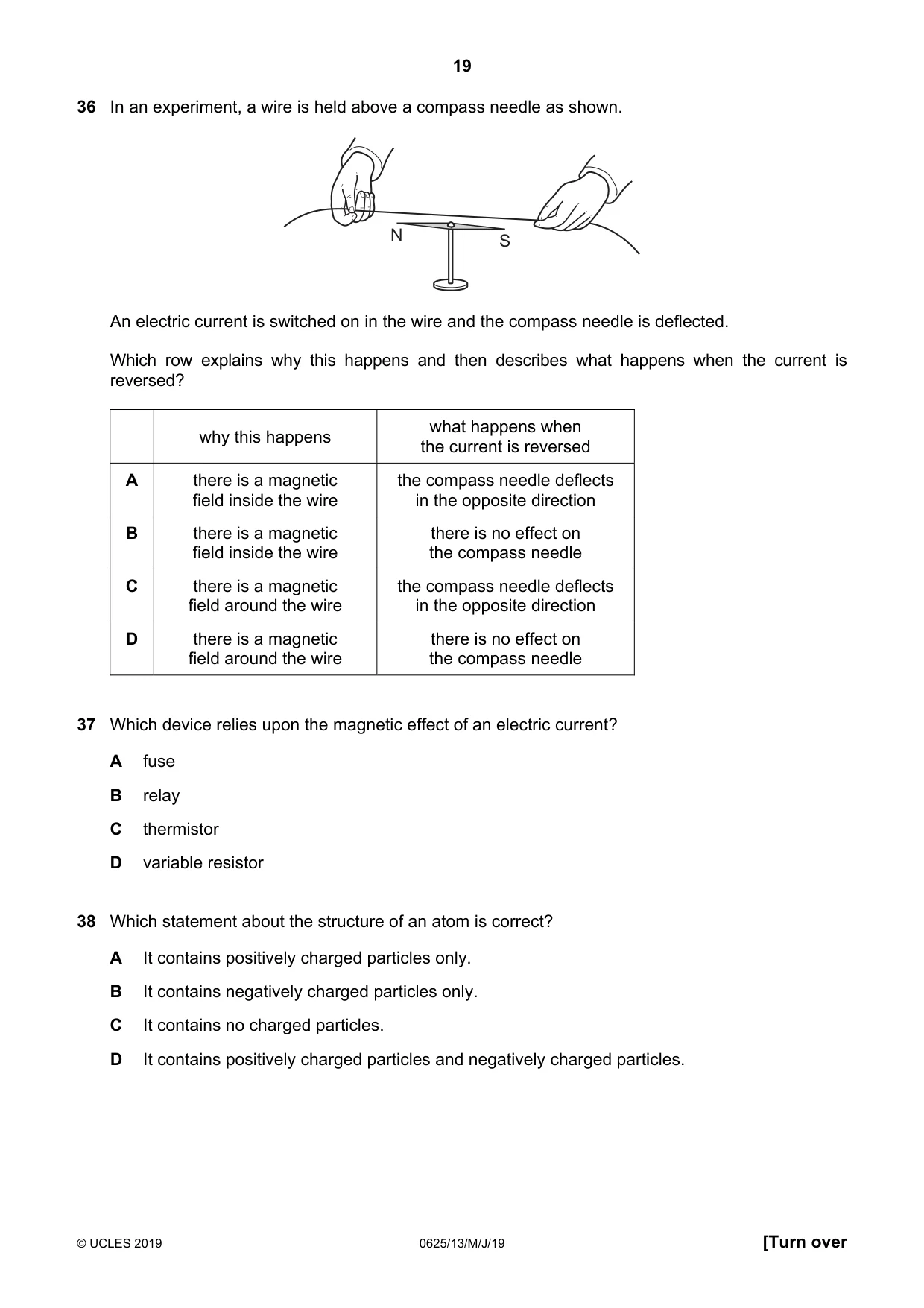
36 In an experiment, a wire is held above a compass needle as shown. N S An electric current is switched on in the wire and the compass needle is deflected. Which row explains why this happens and then describes what happens when the current is reversed? what happens when why this happens the current is reversed A there is a magnetic the compass needle deflects field inside the wire in the opposite direction B there is a magnetic there is no effect on field inside the wire the compass needle C there is a magnetic the compass needle deflects field around the wire in the opposite direction D there is a magnetic there is no effect on field around the wire the compass needle
Mark scheme: C
Q37 · Which device relies upon the magnetic effect of an electric current?
37 Which device relies upon the magnetic effect of an electric current? A fuse B relay C thermistor D variable resistor
Mark scheme: B
Q38 · Which statement about the structure of an atom is correct?
38 Which statement about the structure of an atom is correct? A It contains positively charged particles only. B It contains negatively charged particles only. C It contains no charged particles. D It contains positively charged particles and negatively charged particles.
Mark scheme: D
Q39 · Which statement about γ-radiation is correct?
39 Which statement about γ-radiation is correct? A It consists of very small charged particles. B It is a form of electromagnetic radiation. C It is less penetrating than β-radiation. D It is more highly ionising than α-radiation.
Mark scheme: B
Q40 · A radioactive element undergoes α-decay
40 A radioactive element undergoes α-decay. Which statement is not correct? A A different element is formed. B Radiation is emitted from the nucleus. C The decay is a random process. D The number of particles in the nucleus stays the same.
Mark scheme: D
What was in this paper
The subtopics covered by these 40 questions, and how many questions each got. Open one in a new tab to see every Cambridge question on it.
4Forces3Thermal properties and temperature3Electromagnetic effects2Energy, work and power2General properties of waves2Kinetic particle model of matter2Light2Mass and weight2Motion2Pressure2Radioactivity2Simple phenomena of magnetism2Sound2Transfer of thermal energy2Density1Electrical quantities1Electrical safety1Electromagnetic spectrum1Physical quantities and measurement techniques1The nuclear model of the atom1What you needed in this session
Cambridge’s own grade thresholds for 2019 May/June, Paper 1 · Variant 3. A higher threshold means an easier paper — the bar moves with how the cohort did.