Cambridge IGCSE Physics 0625 — 2010 Oct/Nov Paper 1 · Variant 3
0625/13/O/N/10 · 40 questions · 40 marks · ≈45 min
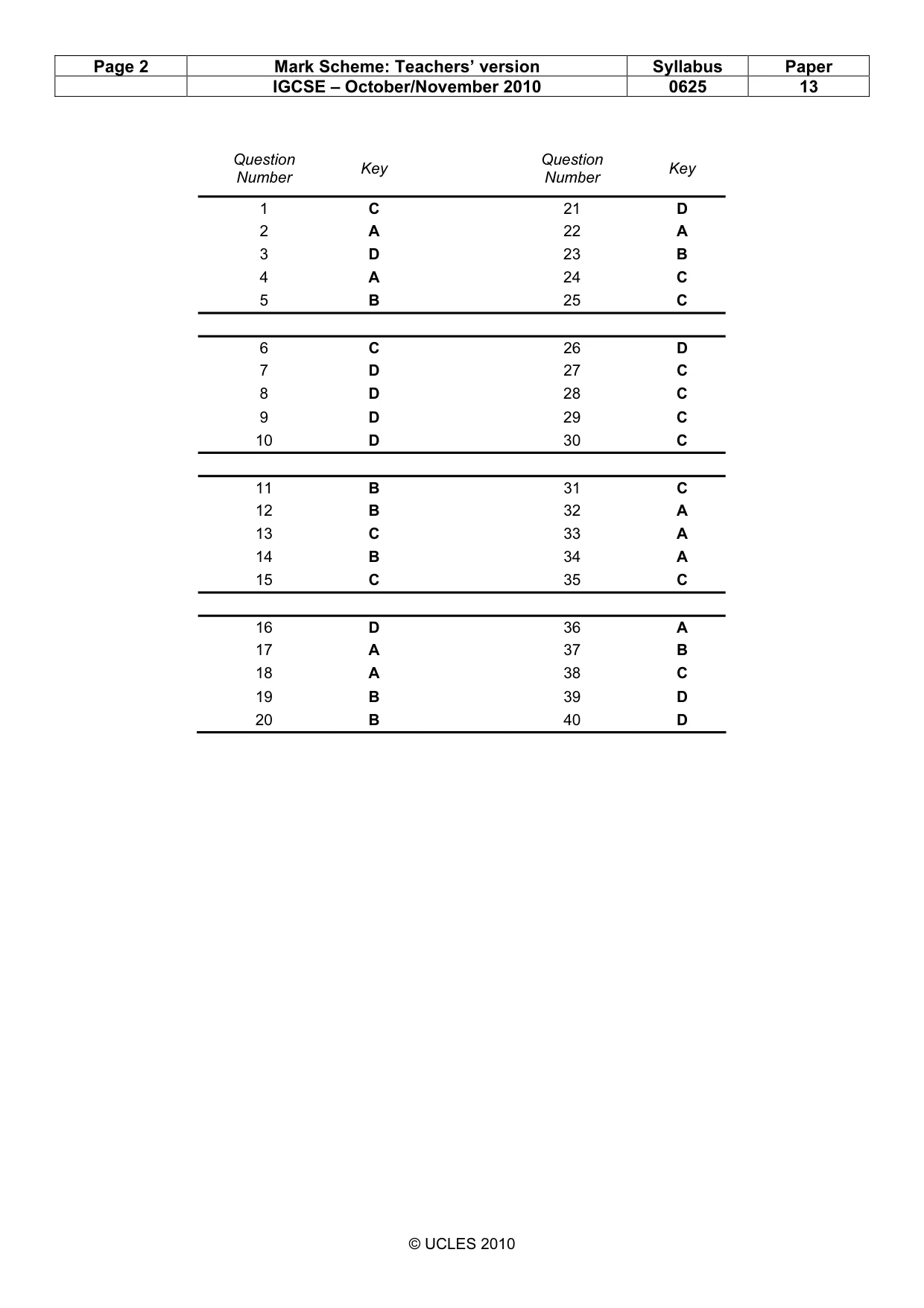
The question paper and its mark scheme, free to read here and free to download. This is Cambridge’s own paper, exactly as it was sat.
Question paper20 pages

Mark scheme2 pages
Answers below. Sit the paper first if you are practising.
Questions as text
Q1 · A student is trying to find the density of water and of a large, regularly shaped…
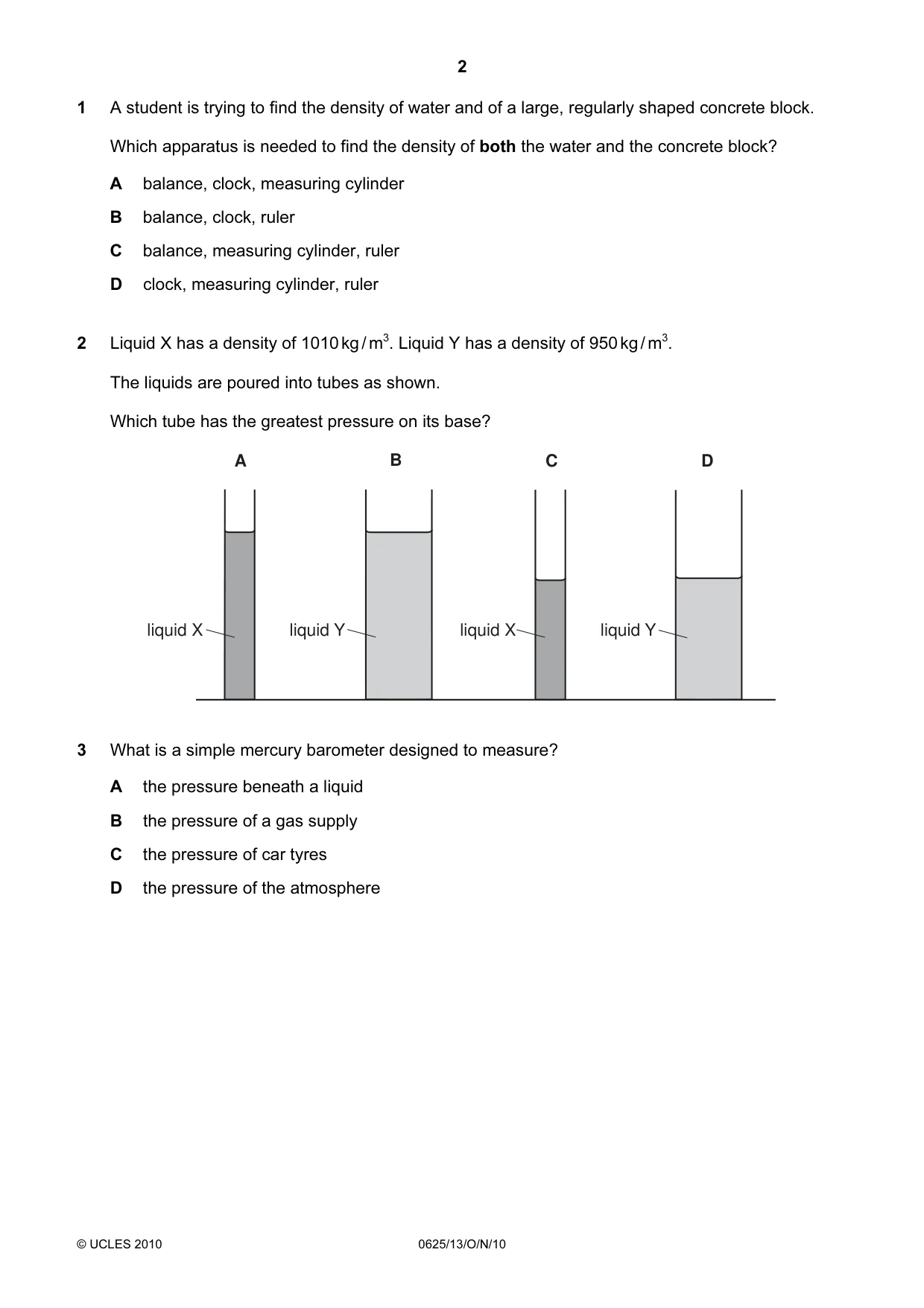
1 A student is trying to find the density of water and of a large, regularly shaped concrete block. Which apparatus is needed to find the density of both the water and the concrete block? A balance, clock, measuring cylinder B balance, clock, ruler C balance, measuring cylinder, ruler D clock, measuring cylinder, ruler
Mark scheme: C
Q2 · Liquid X has a density of 1010 kg / m3
2 Liquid X has a density of 1010 kg / m3. Liquid Y has a density of 950 kg / m3. The liquids are poured into tubes as shown. Which tube has the greatest pressure on its base? A B C D liquid X liquid Y liquid X liquid Y
Mark scheme: A
Q3 · What is a simple mercury barometer designed to measure?
3 What is a simple mercury barometer designed to measure? A the pressure beneath a liquid B the pressure of a gas supply C the pressure of car tyres D the pressure of the atmosphere
Mark scheme: D
Q4 · The diagrams show an experiment to determine the volume of a stone
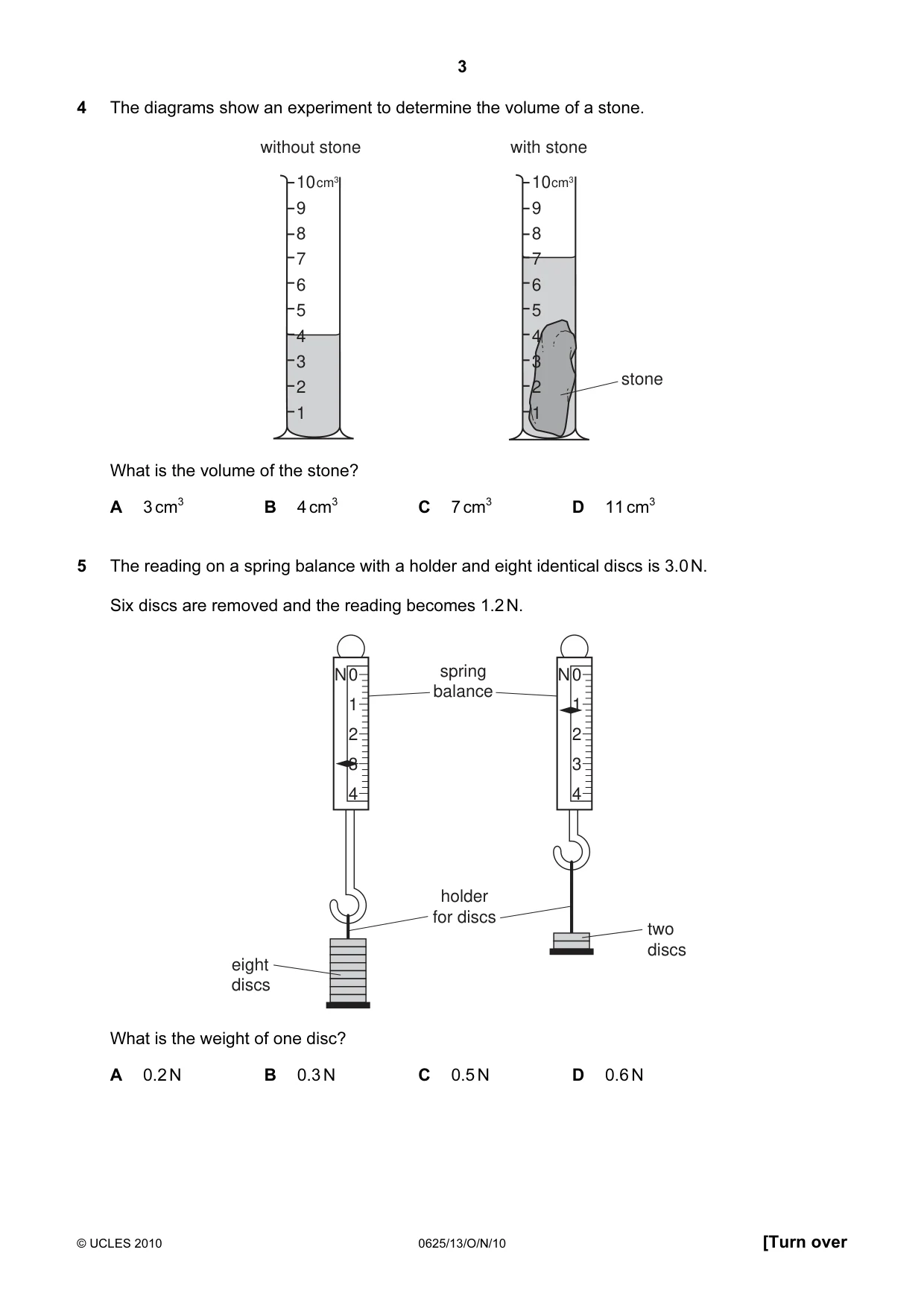
4 The diagrams show an experiment to determine the volume of a stone. without stone with stone 10 cm3 10 cm3 9 9 8 8 7 7 6 6 5 5 4 4 3 3 stone 2 2 1 1 What is the volume of the stone? A 3 cm3 B 4 cm3 C 7 cm3 D 11 cm3
Mark scheme: A
More questions on Physical quantities and measurement techniques
Q5 · The reading on a spring balance with a holder and eight identical discs is 3.0 N
5 The reading on a spring balance with a holder and eight identical discs is 3.0 N. Six discs are removed and the reading becomes 1.2 N. N 0 spring N 0 balance 1 1 2 2 3 3 4 4 holder for discs two discs eight discs What is the weight of one disc? A 0.2 N B 0.3 N C 0.5 N D 0.6 N
Mark scheme: B
Q6 · The extension / load graph for a spring is shown
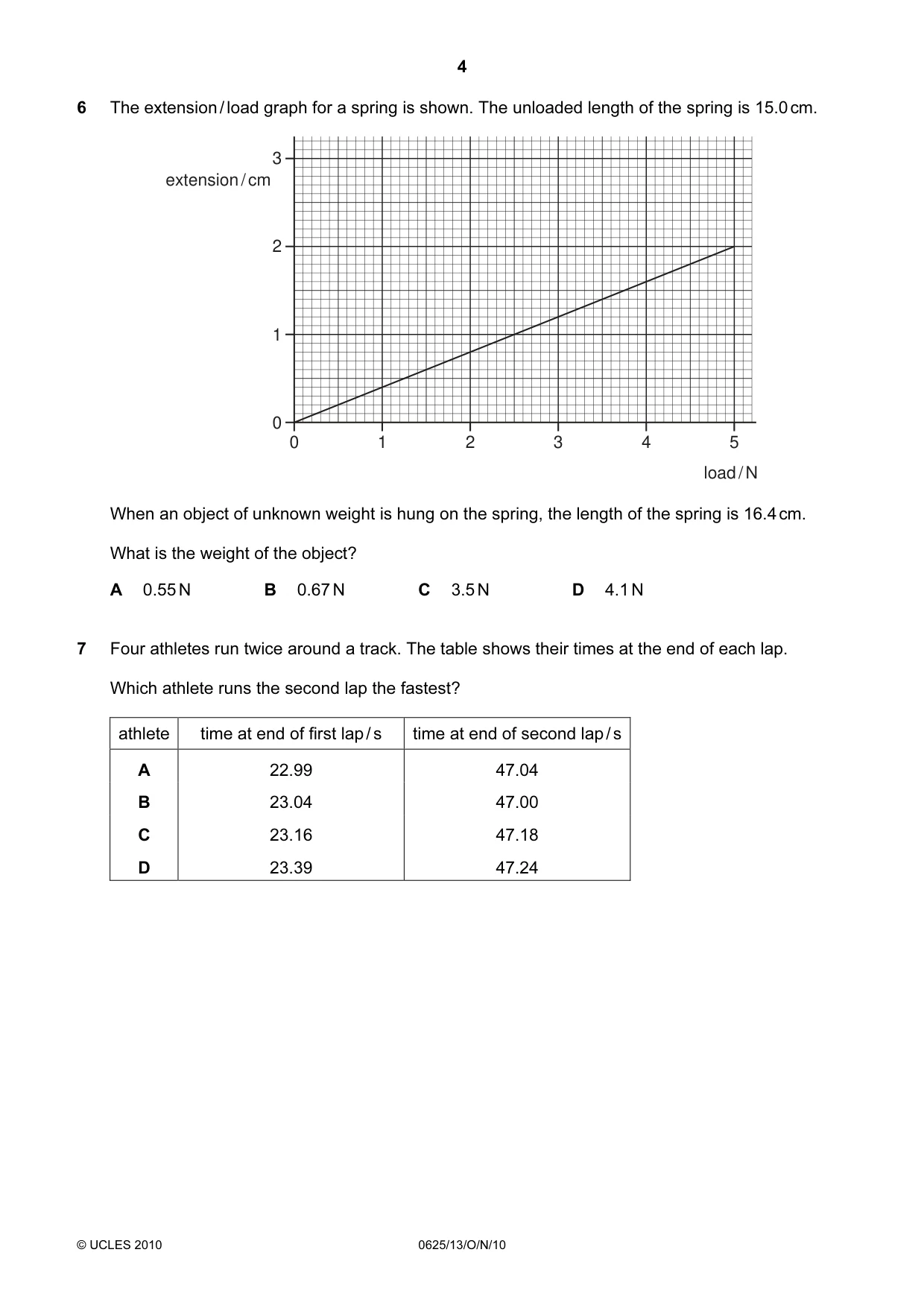
6 The extension / load graph for a spring is shown. The unloaded length of the spring is 15.0 cm. 3 extension / cm 2 1 0 0 1 2 3 4 5 load / N When an object of unknown weight is hung on the spring, the length of the spring is 16.4 cm. What is the weight of the object? A 0.55 N B 0.67 N C 3.5 N D 4.1 N
Mark scheme: C
Q7 · Four athletes run twice around a track
7 Four athletes run twice around a track. The table shows their times at the end of each lap. Which athlete runs the second lap the fastest? athlete time at end of first lap / s time at end of second lap / s A 22.99 47.04 B 23.04 47.00 C 23.16 47.18 D 23.39 47.24
Mark scheme: D
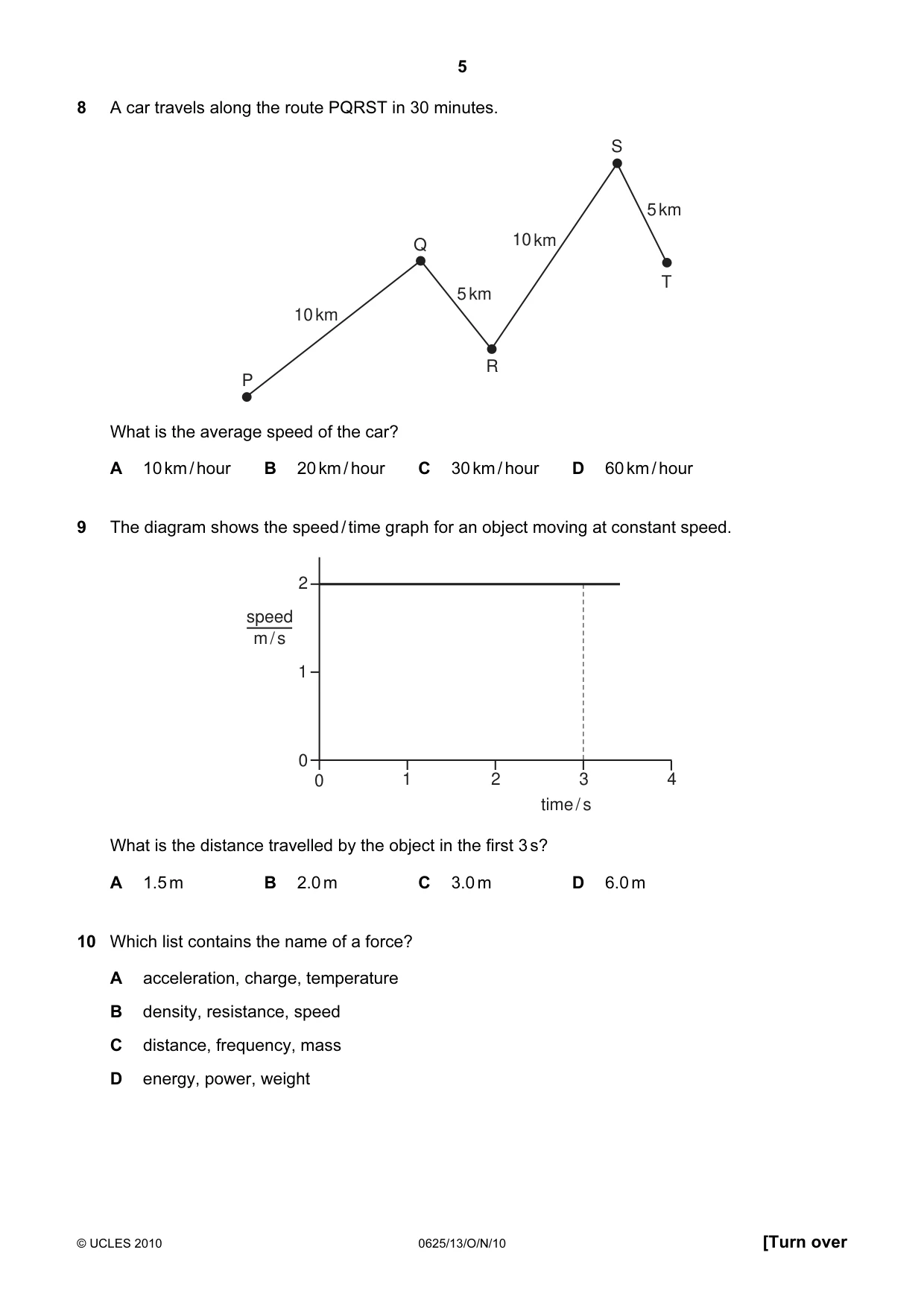
Q8 · A car travels along the route PQRST in 30 minutes
8 A car travels along the route PQRST in 30 minutes. S 5 km Q 10 km T 5 km 10 km R P What is the average speed of the car? A 10 km / hour B 20 km / hour C 30 km / hour D 60 km / hour
Mark scheme: D
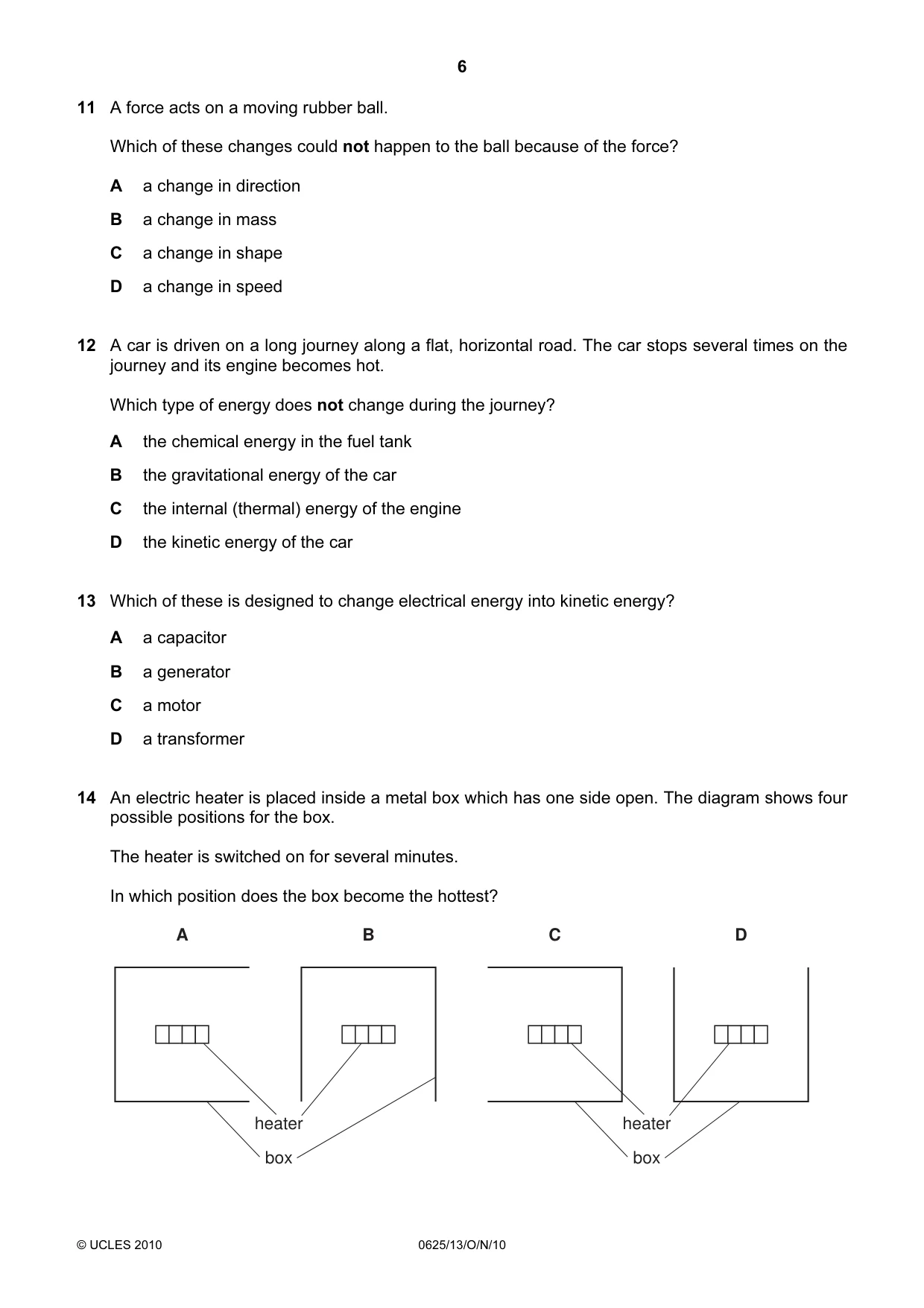
Q9 · The diagram shows the speed / time graph for an object moving at constant speed
9 The diagram shows the speed / time graph for an object moving at constant speed. 2 speed m / s 1 0 0 1 2 3 4 time / s What is the distance travelled by the object in the first 3 s? A 1.5 m B 2.0 m C 3.0 m D 6.0 m
Mark scheme: D
Q10 · Which list contains the name of a force?
10 Which list contains the name of a force? A acceleration, charge, temperature B density, resistance, speed C distance, frequency, mass D energy, power, weight
Mark scheme: D
Q11 · A force acts on a moving rubber ball
11 A force acts on a moving rubber ball. Which of these changes could not happen to the ball because of the force? A a change in direction B a change in mass C a change in shape D a change in speed
Mark scheme: B
Q12 · A car is driven on a long journey along a flat, horizontal road
12 A car is driven on a long journey along a flat, horizontal road. The car stops several times on the journey and its engine becomes hot. Which type of energy does not change during the journey? A the chemical energy in the fuel tank B the gravitational energy of the car C the internal (thermal) energy of the engine D the kinetic energy of the car
Mark scheme: B
Q13 · Which of these is designed to change electrical energy into kinetic energy?
13 Which of these is designed to change electrical energy into kinetic energy? A a capacitor B a generator C a motor D a transformer
Mark scheme: C
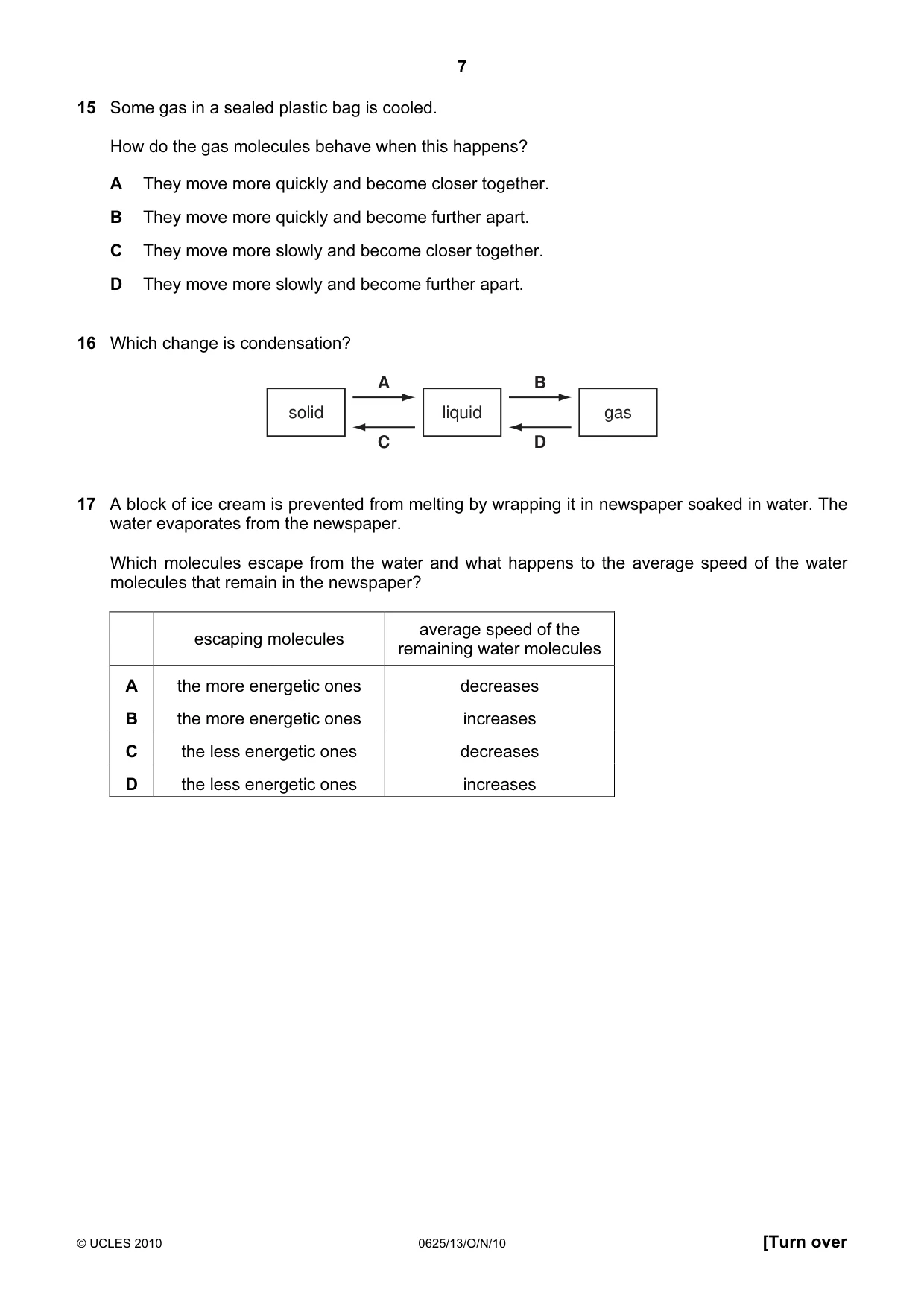
Q14 · An electric heater is placed inside a metal box which has one side open
14 An electric heater is placed inside a metal box which has one side open. The diagram shows four possible positions for the box. The heater is switched on for several minutes. In which position does the box become the hottest? A B C D heater heater box box
Mark scheme: B
Q15 · Some gas in a sealed plastic bag is cooled
15 Some gas in a sealed plastic bag is cooled. How do the gas molecules behave when this happens? A They move more quickly and become closer together. B They move more quickly and become further apart. C They move more slowly and become closer together. D They move more slowly and become further apart.
Mark scheme: C
Q16 · Which change is condensation?
16 Which change is condensation? A B solid liquid gas C D
Mark scheme: D
Q17 · A block of ice cream is prevented from melting by wrapping it in newspaper soaked in water
17 A block of ice cream is prevented from melting by wrapping it in newspaper soaked in water. The water evaporates from the newspaper. Which molecules escape from the water and what happens to the average speed of the water molecules that remain in the newspaper? average speed of the escaping molecules remaining water molecules A the more energetic ones decreases B the more energetic ones increases C the less energetic ones decreases D the less energetic ones increases
Mark scheme: A
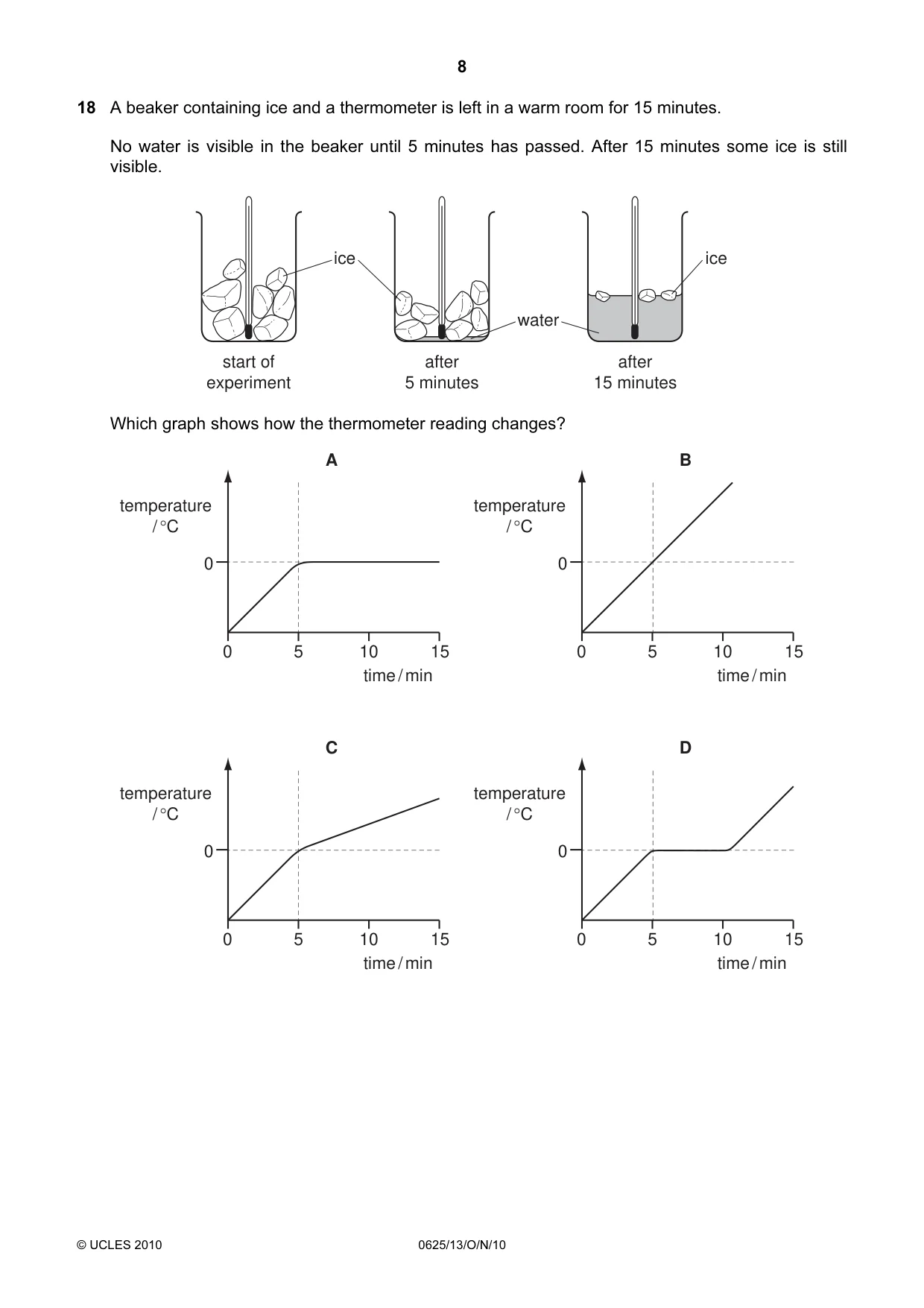
Q18 · A beaker containing ice and a thermometer is left in a warm room for 15 minutes
18 A beaker containing ice and a thermometer is left in a warm room for 15 minutes. No water is visible in the beaker until 5 minutes has passed. After 15 minutes some ice is still visible. ice ice water start of after after experiment 5 minutes 15 minutes Which graph shows how the thermometer reading changes? A B temperature temperature / °C / °C 0 0 0 5 10 15 0 5 10 15 time / min time / min C D temperature temperature / °C / °C 0 0 0 5 10 15 0 5 10 15 time / min time / min
Mark scheme: A
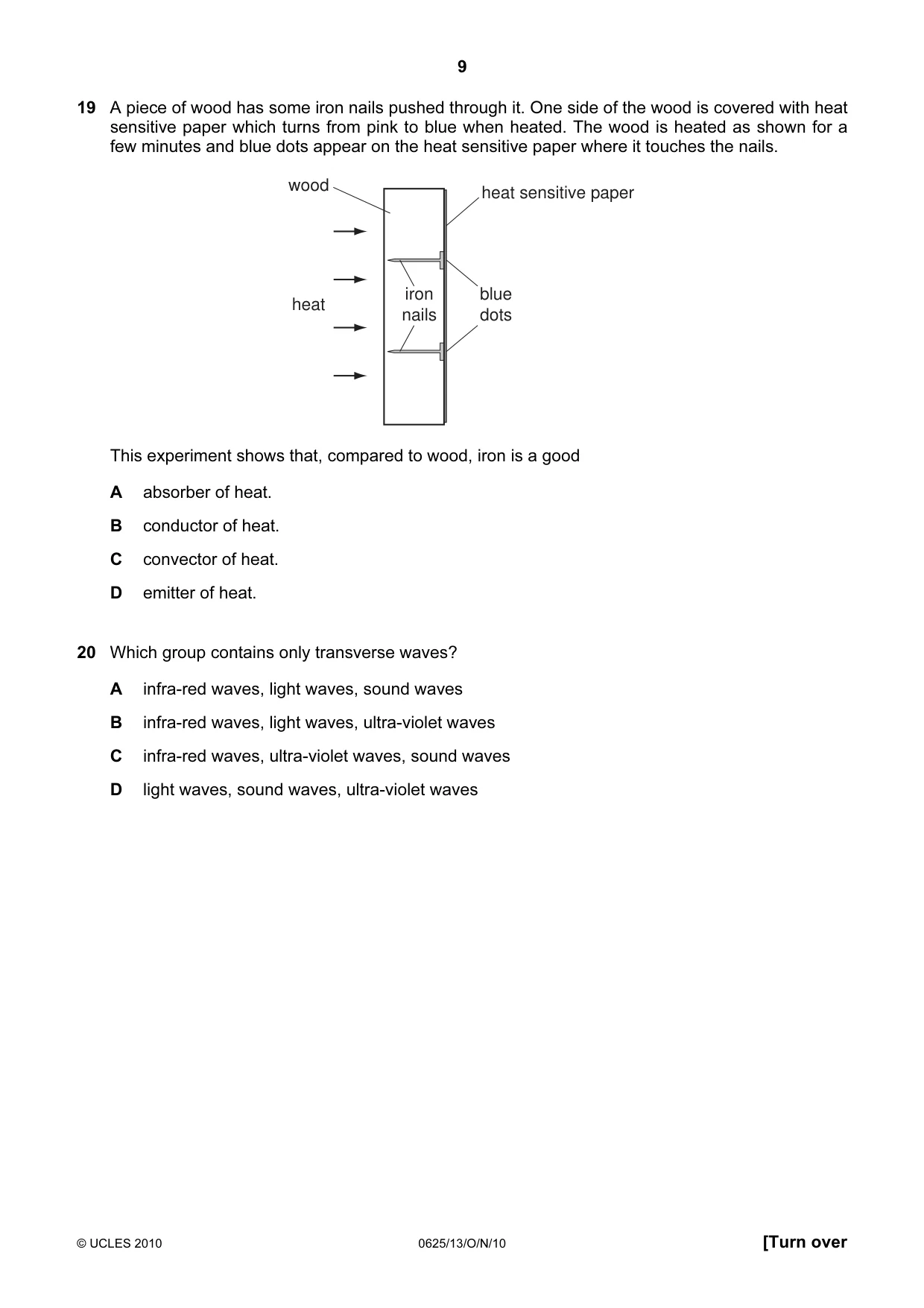
Q19 · A piece of wood has some iron nails pushed through it
19 A piece of wood has some iron nails pushed through it. One side of the wood is covered with heat sensitive paper which turns from pink to blue when heated. The wood is heated as shown for a few minutes and blue dots appear on the heat sensitive paper where it touches the nails. wood heat sensitive paper iron blue heat nails dots This experiment shows that, compared to wood, iron is a good A absorber of heat. B conductor of heat. C convector of heat. D emitter of heat.
Mark scheme: B
Q20 · Which group contains only transverse waves?
20 Which group contains only transverse waves? A infra-red waves, light waves, sound waves B infra-red waves, light waves, ultra-violet waves C infra-red waves, ultra-violet waves, sound waves D light waves, sound waves, ultra-violet waves
Mark scheme: B
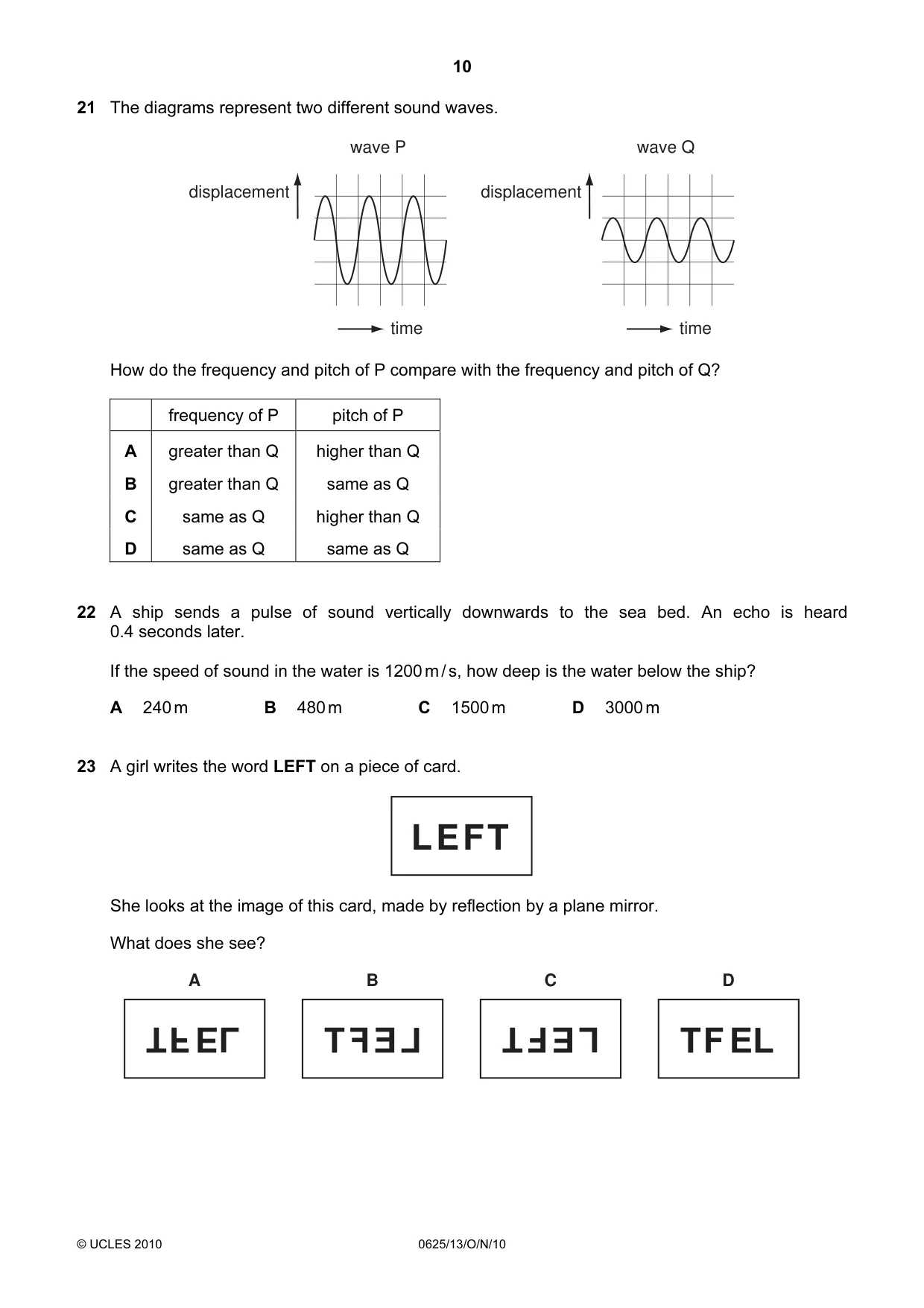
Q21 · The diagrams represent two different sound waves
21 The diagrams represent two different sound waves. wave P wave Q displacement displacement time time How do the frequency and pitch of P compare with the frequency and pitch of Q? frequency of P pitch of P A greater than Q higher than Q B greater than Q same as Q C same as Q higher than Q D same as Q same as Q
Mark scheme: D
Q22 · A ship sends a pulse of sound vertically downwards to the sea bed
22 A ship sends a pulse of sound vertically downwards to the sea bed. An echo is heard 0.4 seconds later. If the speed of sound in the water is 1200 m / s, how deep is the water below the ship? A 240 m B 480 m C 1500 m D 3000 m
Mark scheme: A
Q23 · A girl writes the word LEFT on a piece of card
23 A girl writes the word LEFT on a piece of card. LEFT She looks at the image of this card, made by reflection by a plane mirror. What does she see? A B C D
Mark scheme: B
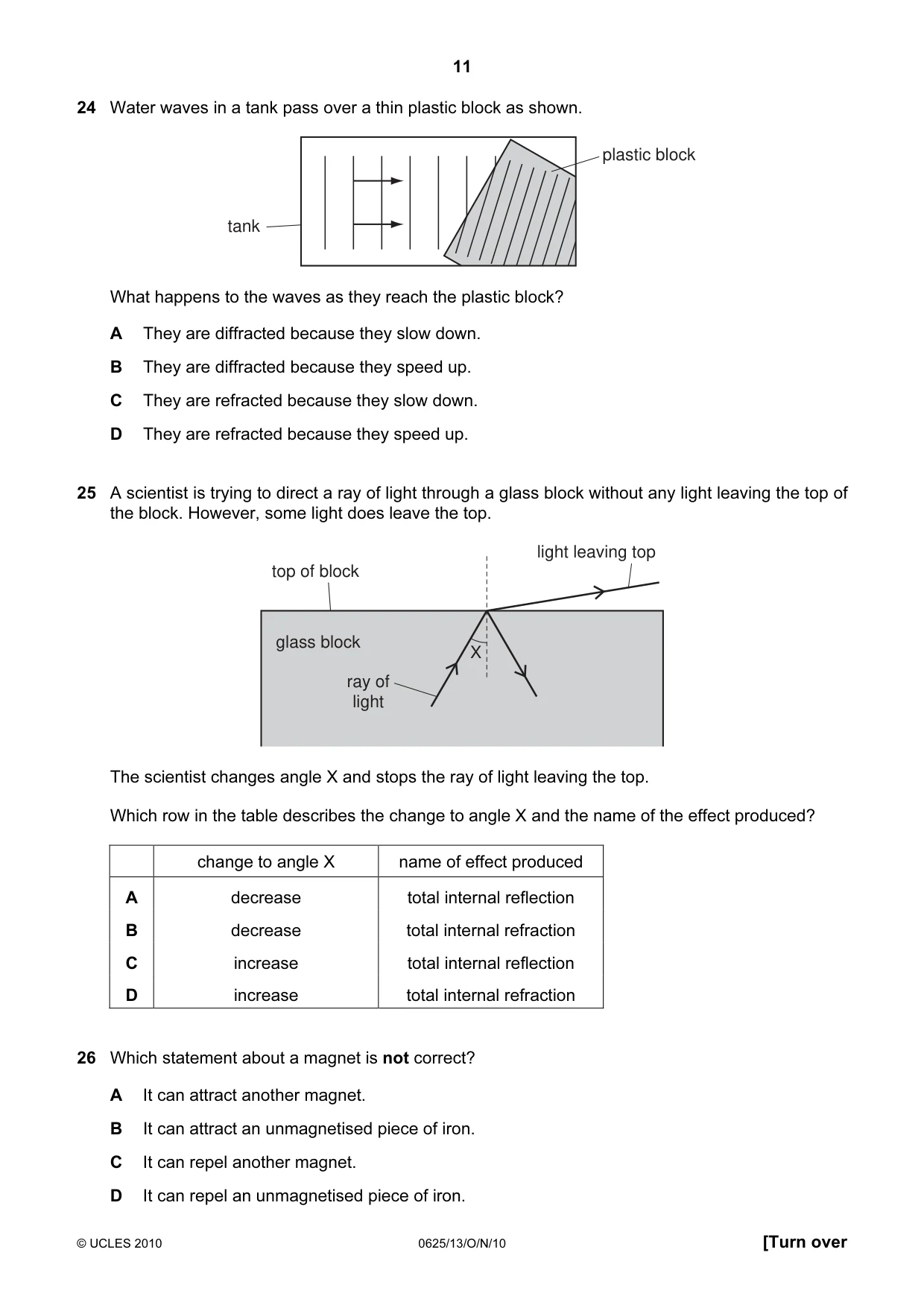
Q24 · Water waves in a tank pass over a thin plastic block as shown
24 Water waves in a tank pass over a thin plastic block as shown. plastic block tank What happens to the waves as they reach the plastic block? A They are diffracted because they slow down. B They are diffracted because they speed up. C They are refracted because they slow down. D They are refracted because they speed up.
Mark scheme: C
Q25 · A scientist is trying to direct a ray of light through a glass block without any light…
25 A scientist is trying to direct a ray of light through a glass block without any light leaving the top of the block. However, some light does leave the top. light leaving top top of block glass block X ray of light The scientist changes angle X and stops the ray of light leaving the top. Which row in the table describes the change to angle X and the name of the effect produced? change to angle X name of effect produced A decrease total internal reflection B decrease total internal refraction C increase total internal reflection D increase total internal refraction
Mark scheme: C
Q26 · Which statement about a magnet is not correct?
26 Which statement about a magnet is not correct? A It can attract another magnet. B It can attract an unmagnetised piece of iron. C It can repel another magnet. D It can repel an unmagnetised piece of iron.
Mark scheme: D
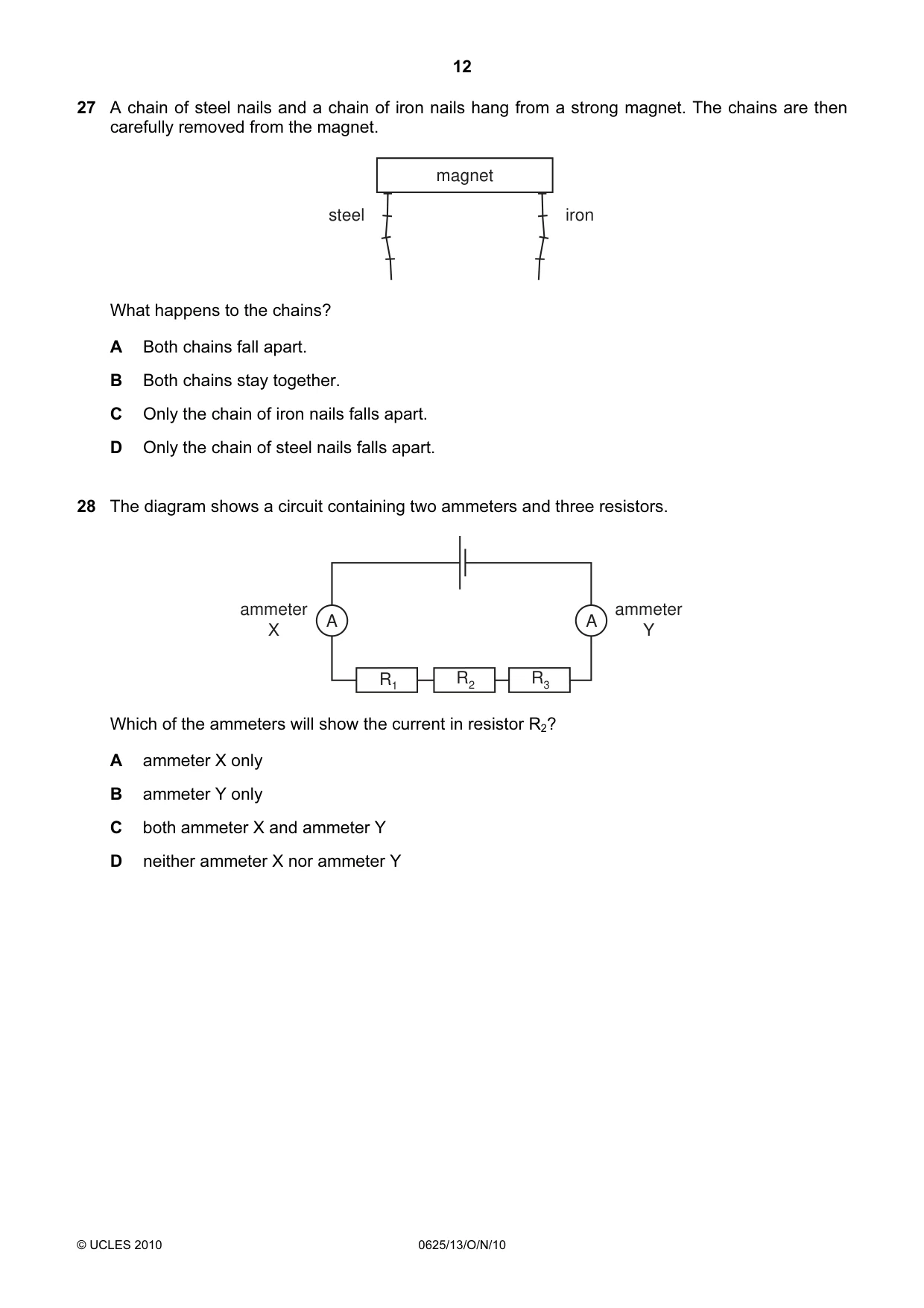
Q27 · A chain of steel nails and a chain of iron nails hang from a strong magnet
27 A chain of steel nails and a chain of iron nails hang from a strong magnet. The chains are then carefully removed from the magnet. magnet steel iron What happens to the chains? A Both chains fall apart. B Both chains stay together. C Only the chain of iron nails falls apart. D Only the chain of steel nails falls apart.
Mark scheme: C
Q28 · The diagram shows a circuit containing two ammeters and three resistors
28 The diagram shows a circuit containing two ammeters and three resistors. ammeter ammeter A A X Y R1 R2 R3 Which of the ammeters will show the current in resistor R2? A ammeter X only B ammeter Y only C both ammeter X and ammeter Y D neither ammeter X nor ammeter Y
Mark scheme: C
Q29 · A circuit contains two resistors connected in parallel with a battery
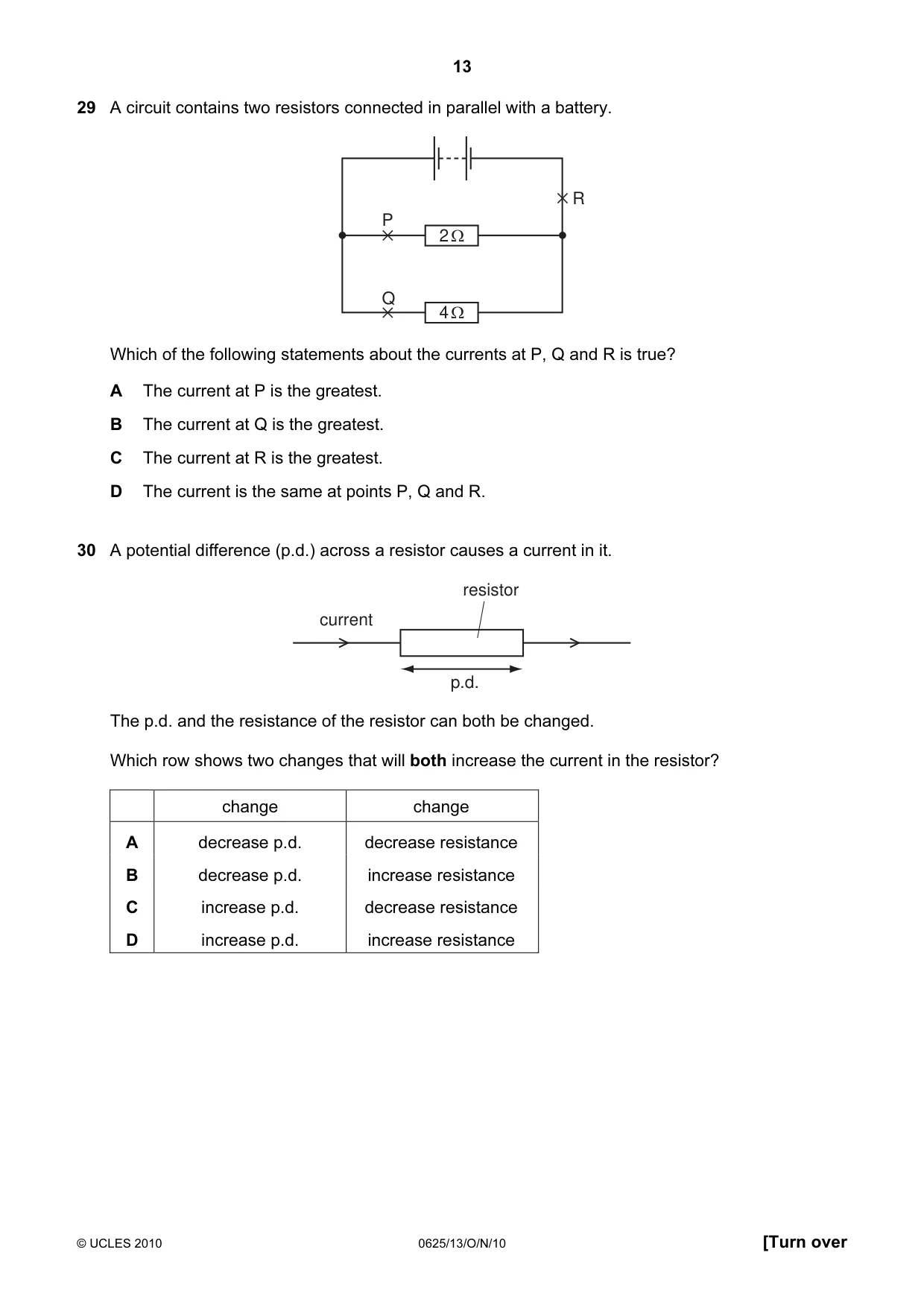
29 A circuit contains two resistors connected in parallel with a battery. R P 2 Ω Q 4 Ω Which of the following statements about the currents at P, Q and R is true? A The current at P is the greatest. B The current at Q is the greatest. C The current at R is the greatest. D The current is the same at points P, Q and R.
Mark scheme: C
Q30 · A potential difference (p.d.) across a resistor causes a current in it
30 A potential difference (p.d.) across a resistor causes a current in it. resistor current p.d. The p.d. and the resistance of the resistor can both be changed. Which row shows two changes that will both increase the current in the resistor? change change A decrease p.d. decrease resistance B decrease p.d. increase resistance C increase p.d. decrease resistance D increase p.d. increase resistance
Mark scheme: C
Q31 · The potential divider shown is connected across a constant 12 V supply
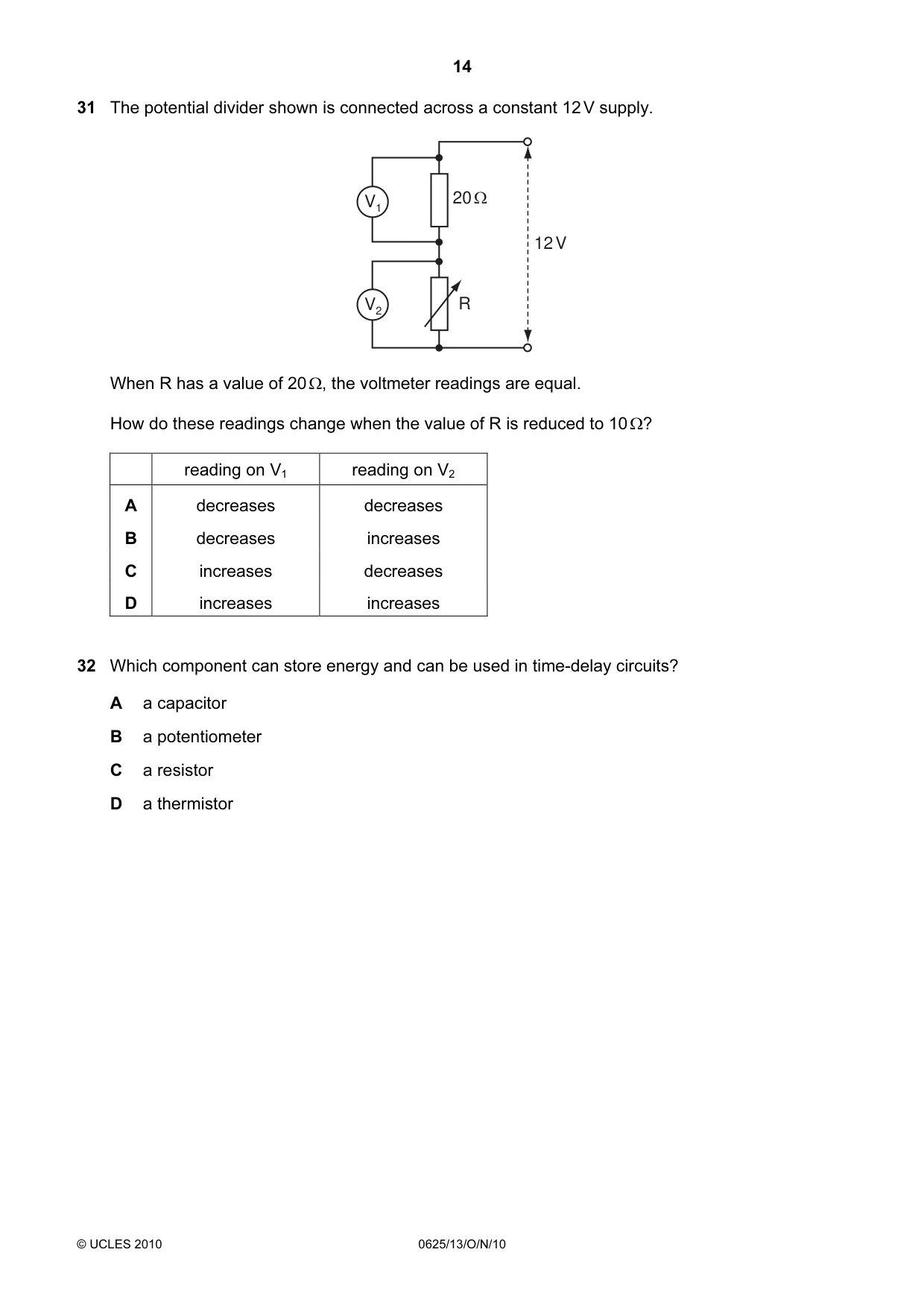
31 The potential divider shown is connected across a constant 12 V supply. V1 20 Ω 12 V V2 R When R has a value of 20 Ω, the voltmeter readings are equal. How do these readings change when the value of R is reduced to 10 Ω? reading on V1 reading on V2 A decreases decreases B decreases increases C increases decreases D increases increases
Mark scheme: C
Q32 · Which component can store energy and can be used in time-delay circuits?
32 Which component can store energy and can be used in time-delay circuits? A a capacitor B a potentiometer C a resistor D a thermistor
Mark scheme: A
Q33 · A coil is rotated steadily between the poles of a magnet
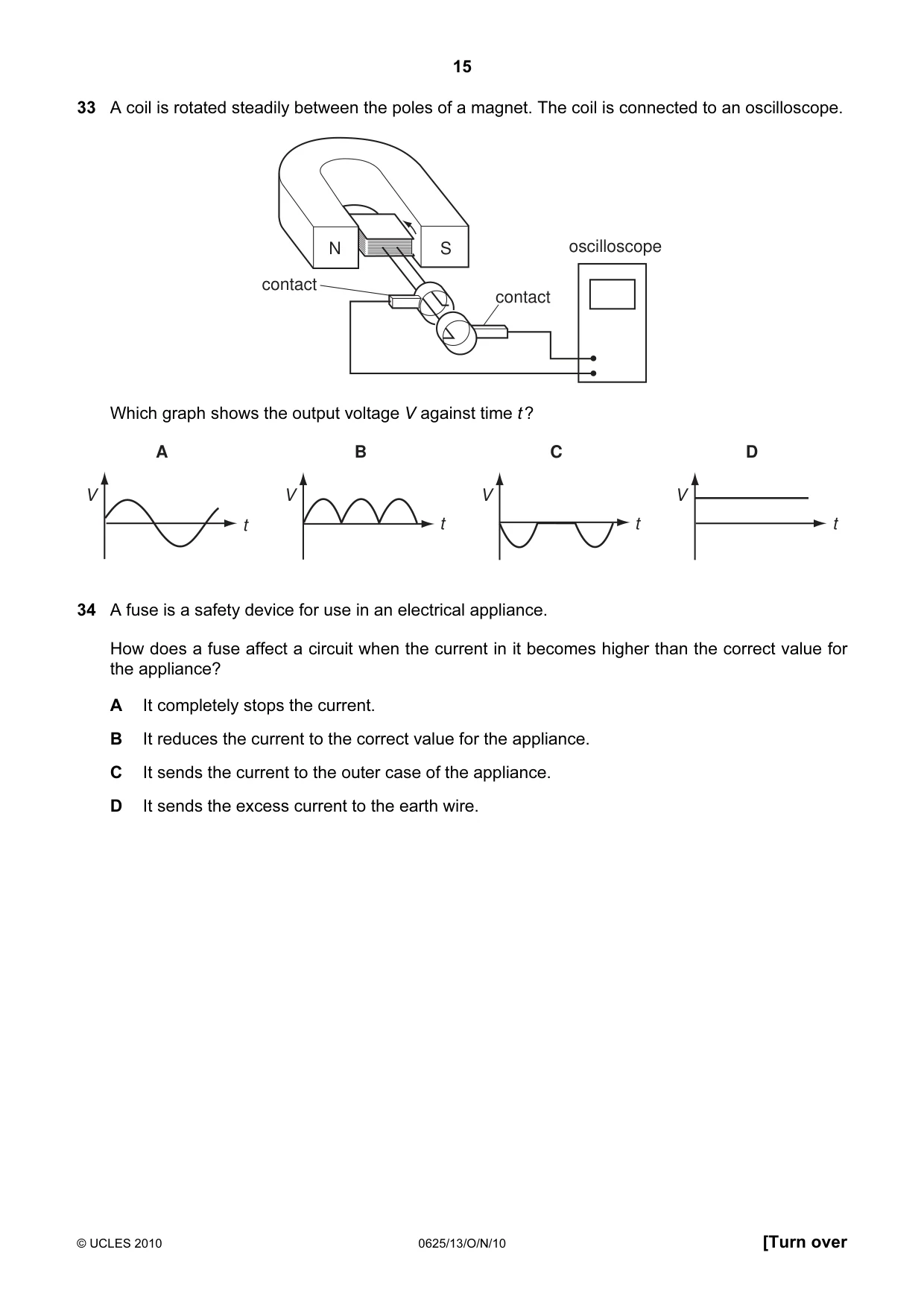
33 A coil is rotated steadily between the poles of a magnet. The coil is connected to an oscilloscope. N S oscilloscope contact contact Which graph shows the output voltage V against time t ? A B C D V V V V t t t t
Mark scheme: A
Q34 · A fuse is a safety device for use in an electrical appliance
34 A fuse is a safety device for use in an electrical appliance. How does a fuse affect a circuit when the current in it becomes higher than the correct value for the appliance? A It completely stops the current. B It reduces the current to the correct value for the appliance. C It sends the current to the outer case of the appliance. D It sends the excess current to the earth wire.
Mark scheme: A
Q35 · Some electrical equipment is connected to a 230 V supply
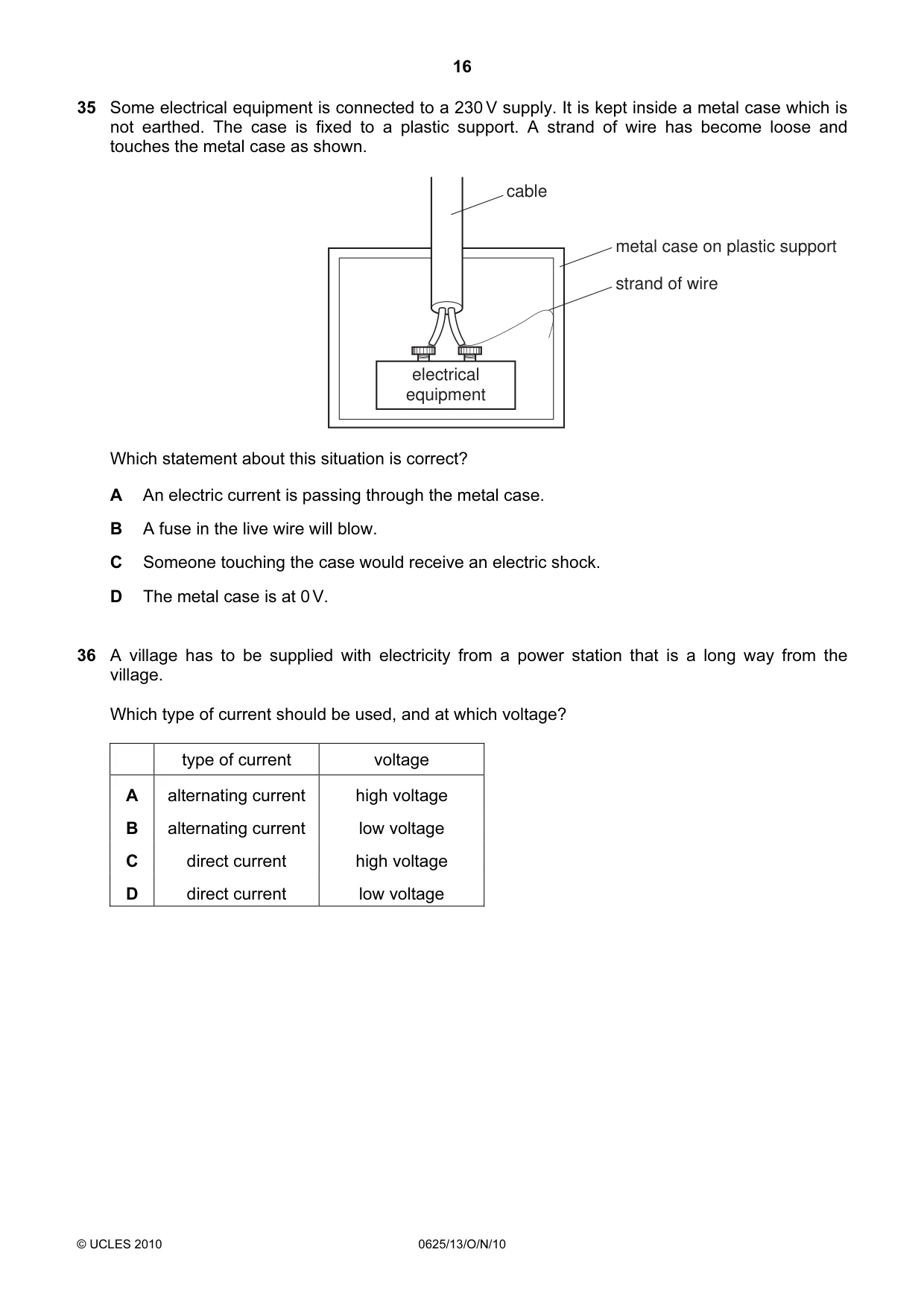
35 Some electrical equipment is connected to a 230 V supply. It is kept inside a metal case which is not earthed. The case is fixed to a plastic support. A strand of wire has become loose and touches the metal case as shown. cable metal case on plastic support strand of wire electrical equipment Which statement about this situation is correct? A An electric current is passing through the metal case. B A fuse in the live wire will blow. C Someone touching the case would receive an electric shock. D The metal case is at 0 V.
Mark scheme: C
Q36 · A village has to be supplied with electricity from a power station that is a long way…
36 A village has to be supplied with electricity from a power station that is a long way from the village. Which type of current should be used, and at which voltage? type of current voltage A alternating current high voltage B alternating current low voltage C direct current high voltage D direct current low voltage
Mark scheme: A
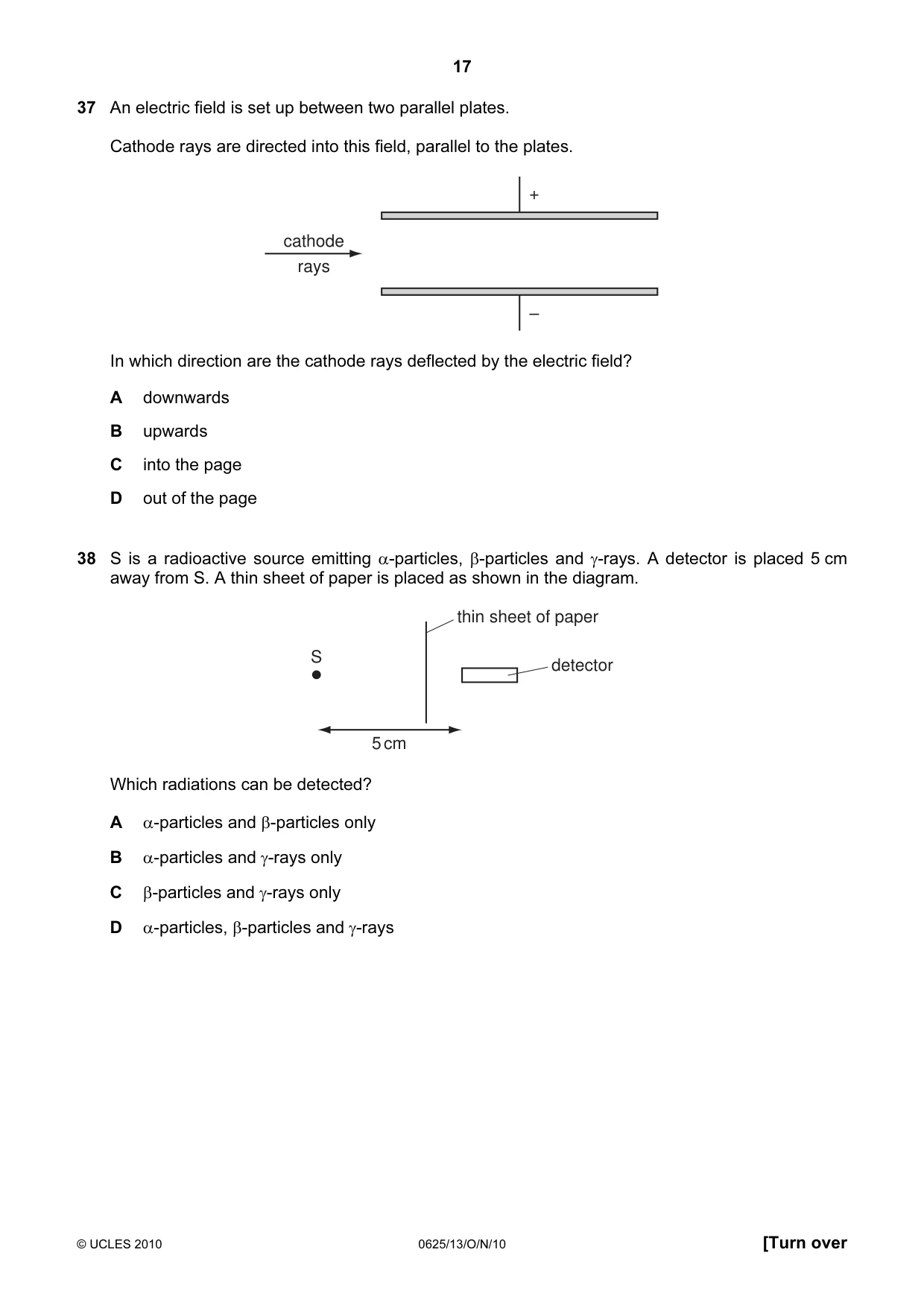
Q37 · An electric field is set up between two parallel plates
37 An electric field is set up between two parallel plates. Cathode rays are directed into this field, parallel to the plates. + cathode rays – In which direction are the cathode rays deflected by the electric field? A downwards B upwards C into the page D out of the page
Mark scheme: B
Q38 · S is a radioactive source emitting α-particles, β-particles and γ-rays
38 S is a radioactive source emitting α-particles, β-particles and γ-rays. A detector is placed 5 cm away from S. A thin sheet of paper is placed as shown in the diagram. thin sheet of paper S detector 5 cm Which radiations can be detected? A α-particles and β-particles only B α-particles and γ-rays only C β-particles and γ-rays only D α-particles, β-particles and γ-rays
Mark scheme: C
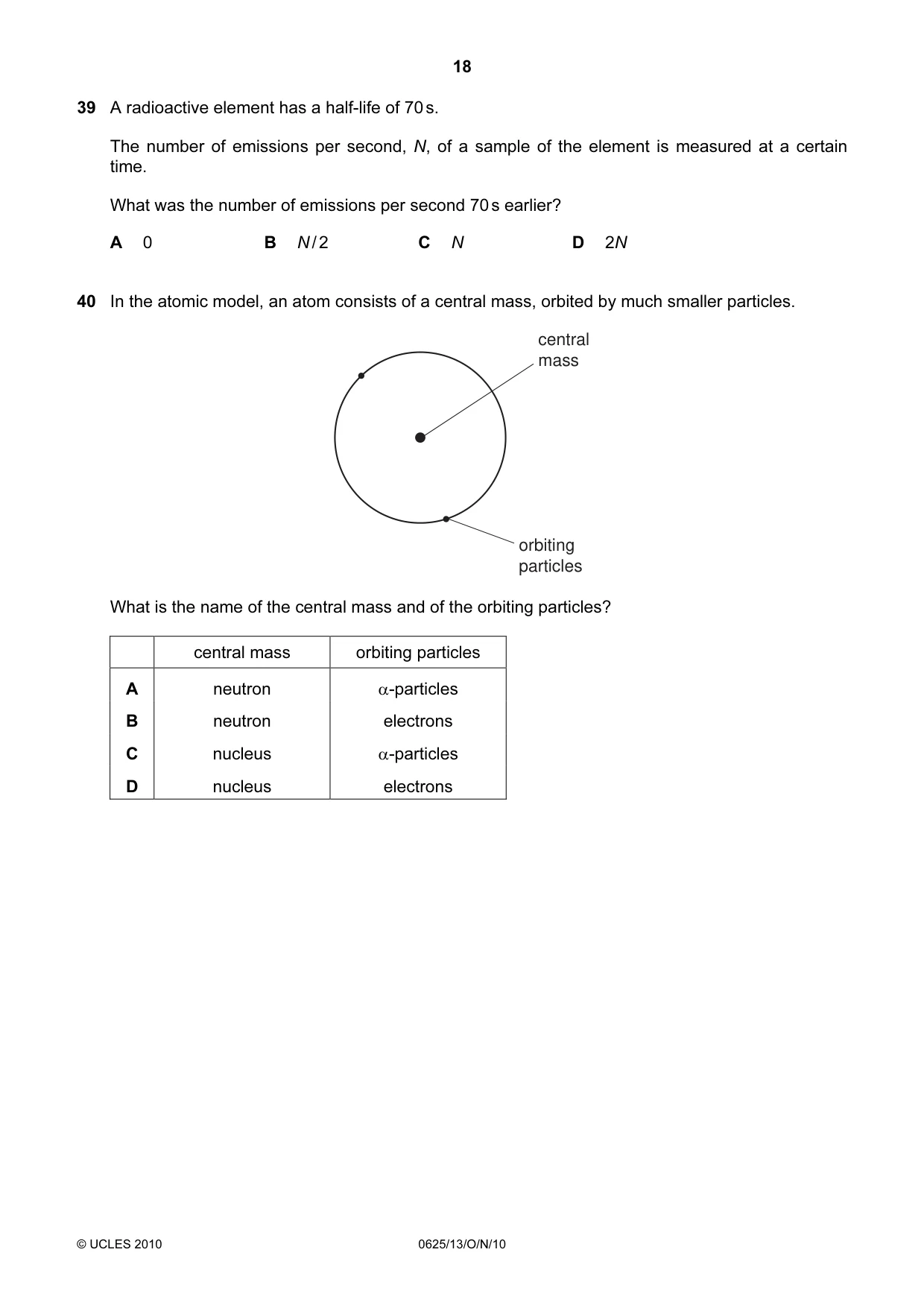
Q39 · A radioactive element has a half-life of 70 s
39 A radioactive element has a half-life of 70 s. The number of emissions per second, N, of a sample of the element is measured at a certain time. What was the number of emissions per second 70 s earlier? A 0 B N / 2 C N D 2N
Mark scheme: D
Q40 · In the atomic model, an atom consists of a central mass, orbited by much smaller particles
40 In the atomic model, an atom consists of a central mass, orbited by much smaller particles. central mass orbiting particles What is the name of the central mass and of the orbiting particles? central mass orbiting particles A neutron α-particles B neutron electrons C nucleus α-particles D nucleus electrons
Mark scheme: D
What was in this paper
The subtopics covered by these 40 questions, and how many questions each got. Open one in a new tab to see every Cambridge question on it.
3Electrical quantities3Forces3Kinetic particle model of matter3Motion3Electrical safety2Electromagnetic effects2Energy, work and power2General properties of waves2Light2Pressure2Radioactivity2Simple phenomena of magnetism2Sound2Transfer of thermal energy2Density1Mass and weight1Physical quantities and measurement techniques1The nuclear model of the atom1Thermal properties and temperature1What you needed in this session
Cambridge’s own grade thresholds for 2010 Oct/Nov, Paper 1 · Variant 3. A higher threshold means an easier paper — the bar moves with how the cohort did.