Cambridge IGCSE Physics 0625 — 2010 May/June Paper 1 · Variant 1
0625/11/M/J/10 · 40 questions · 40 marks · ≈45 min
The question paper and its mark scheme, free to read here and free to download. This is Cambridge’s own paper, exactly as it was sat.
Question paper20 pages
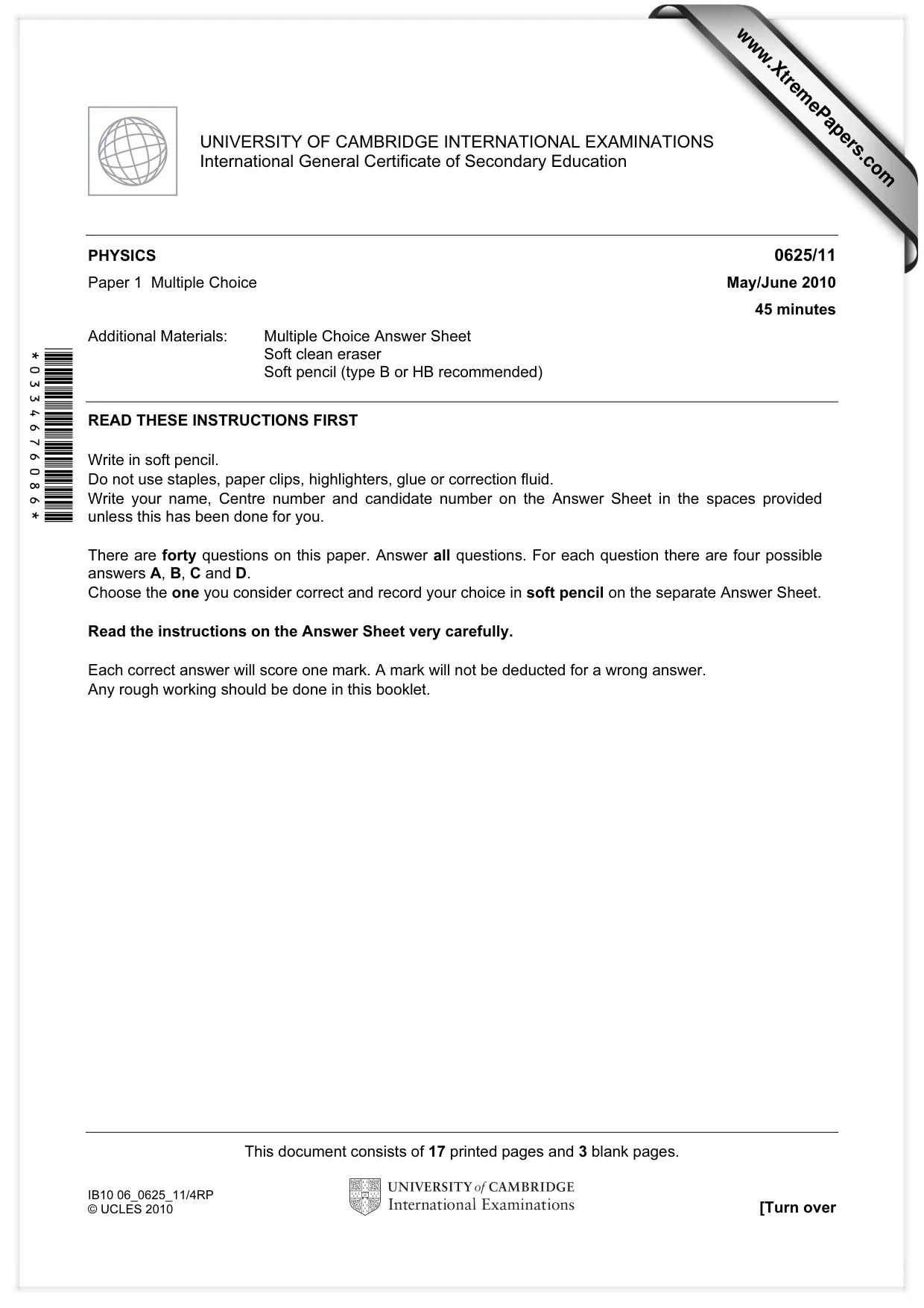
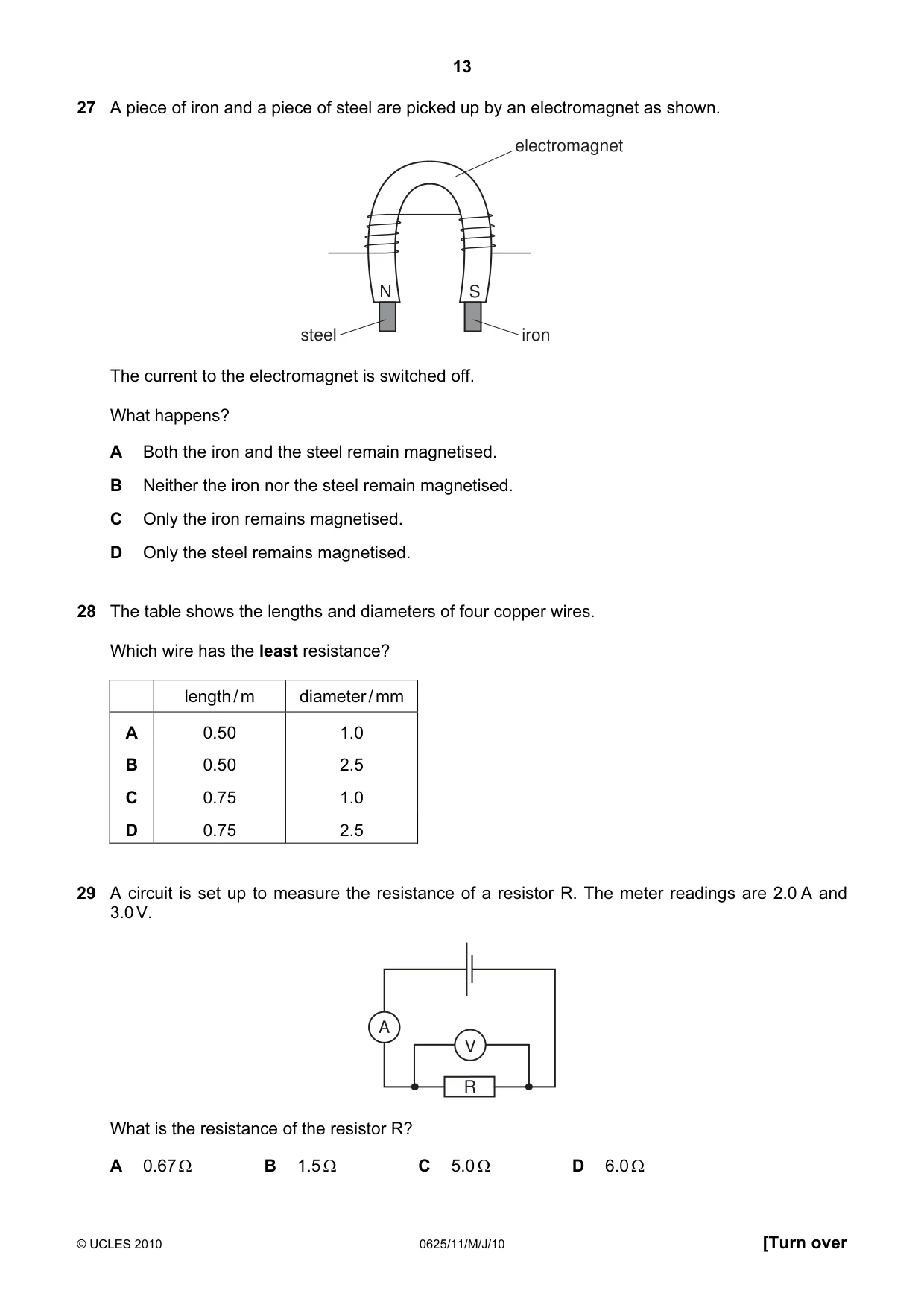
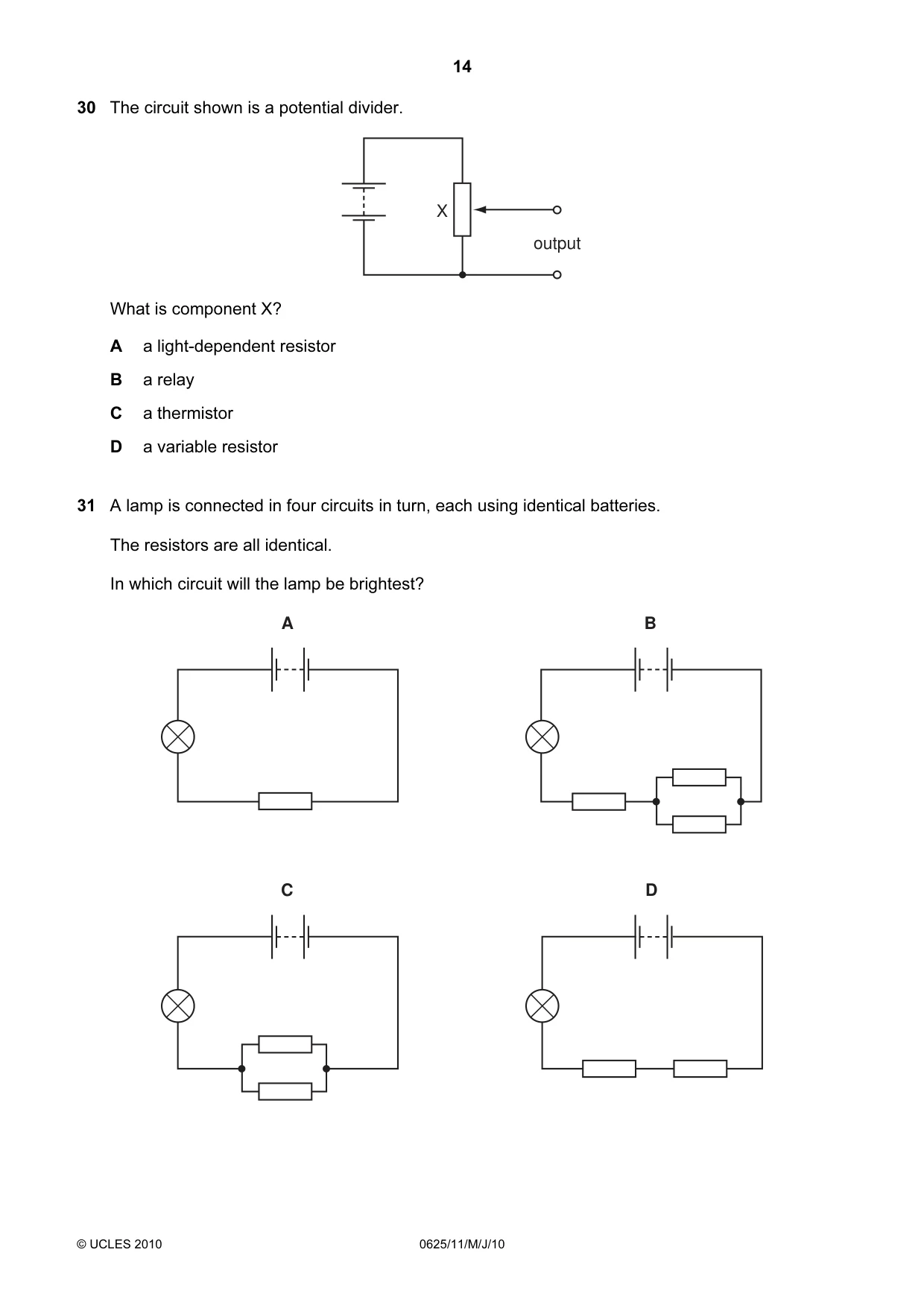
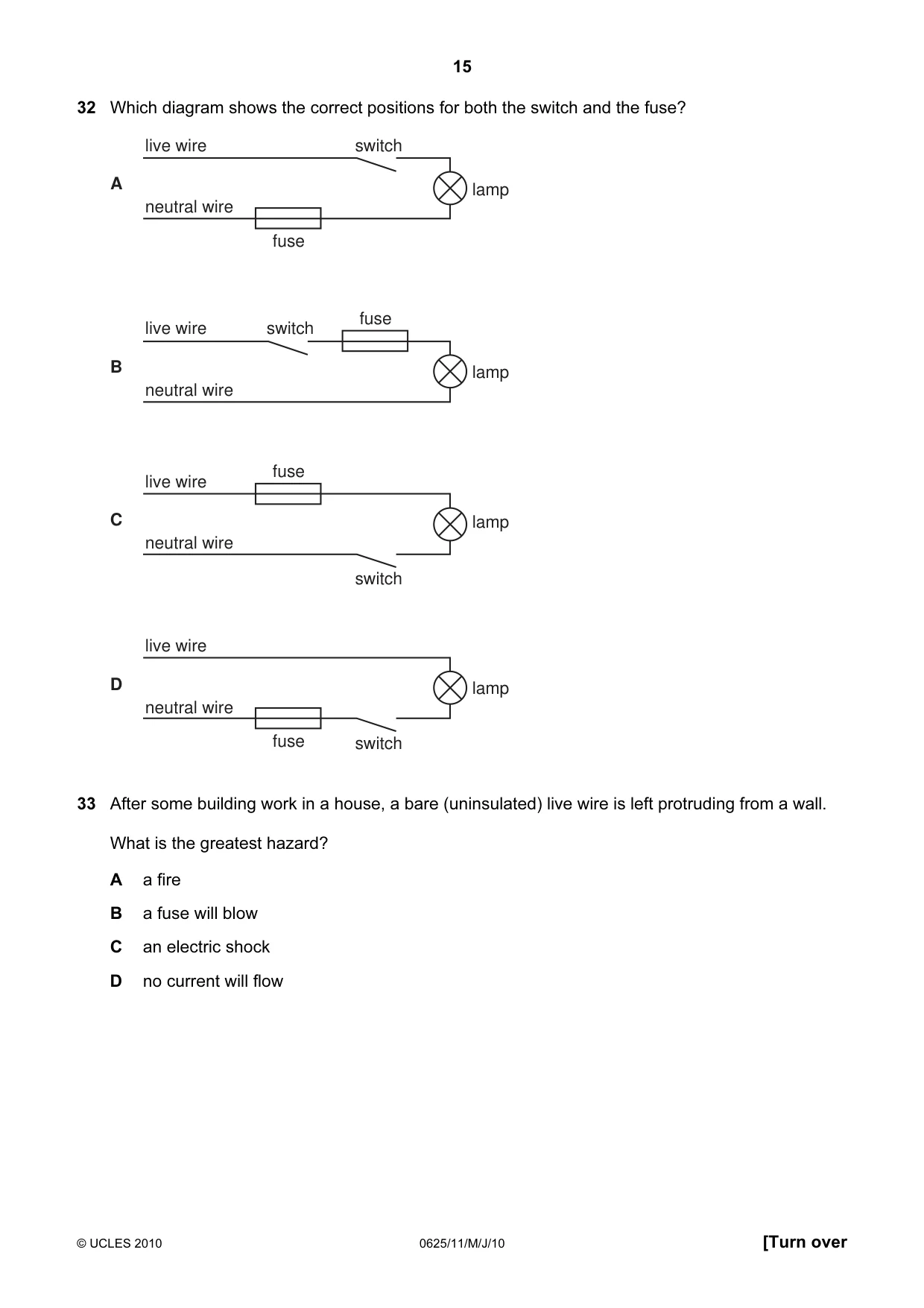
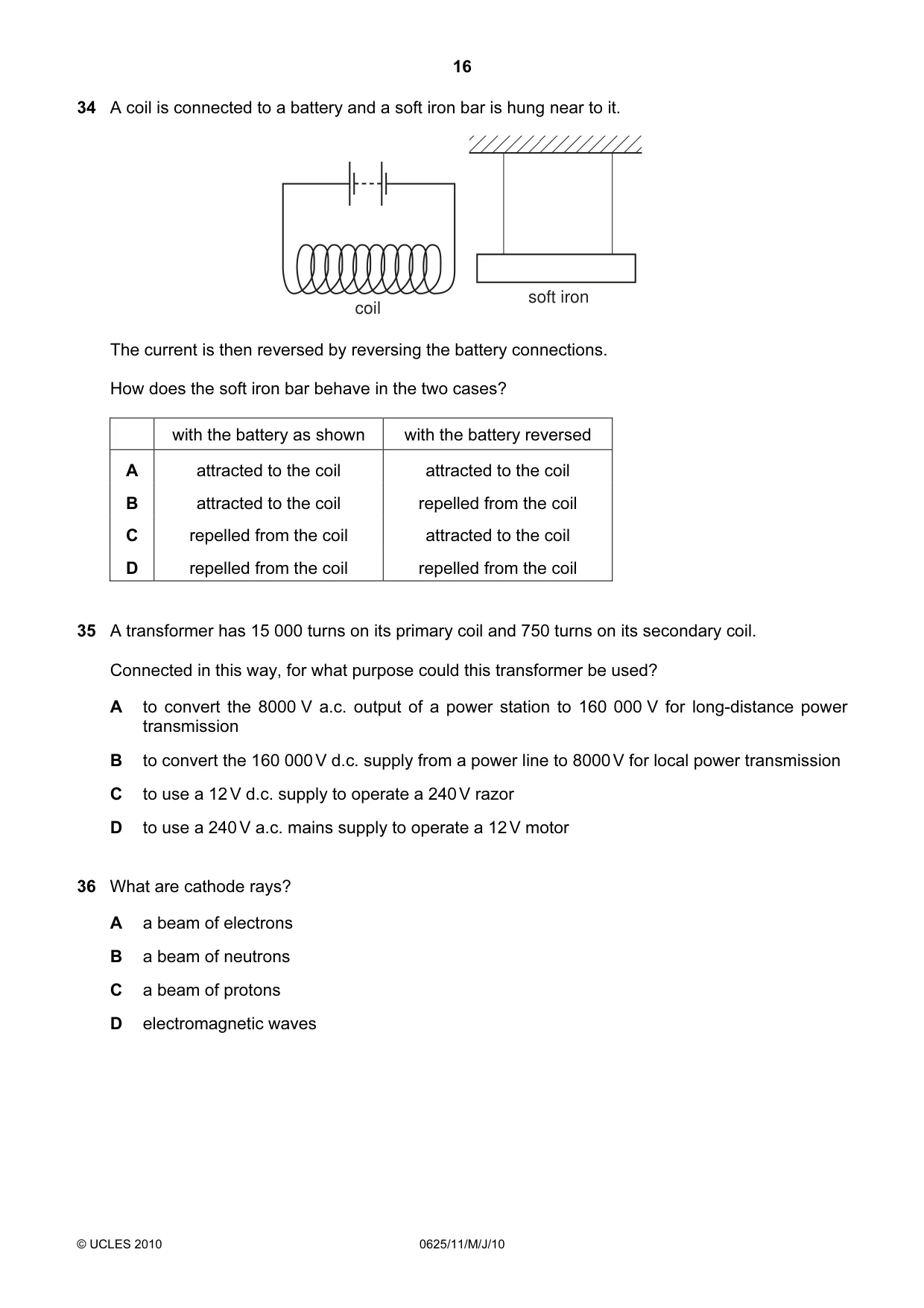
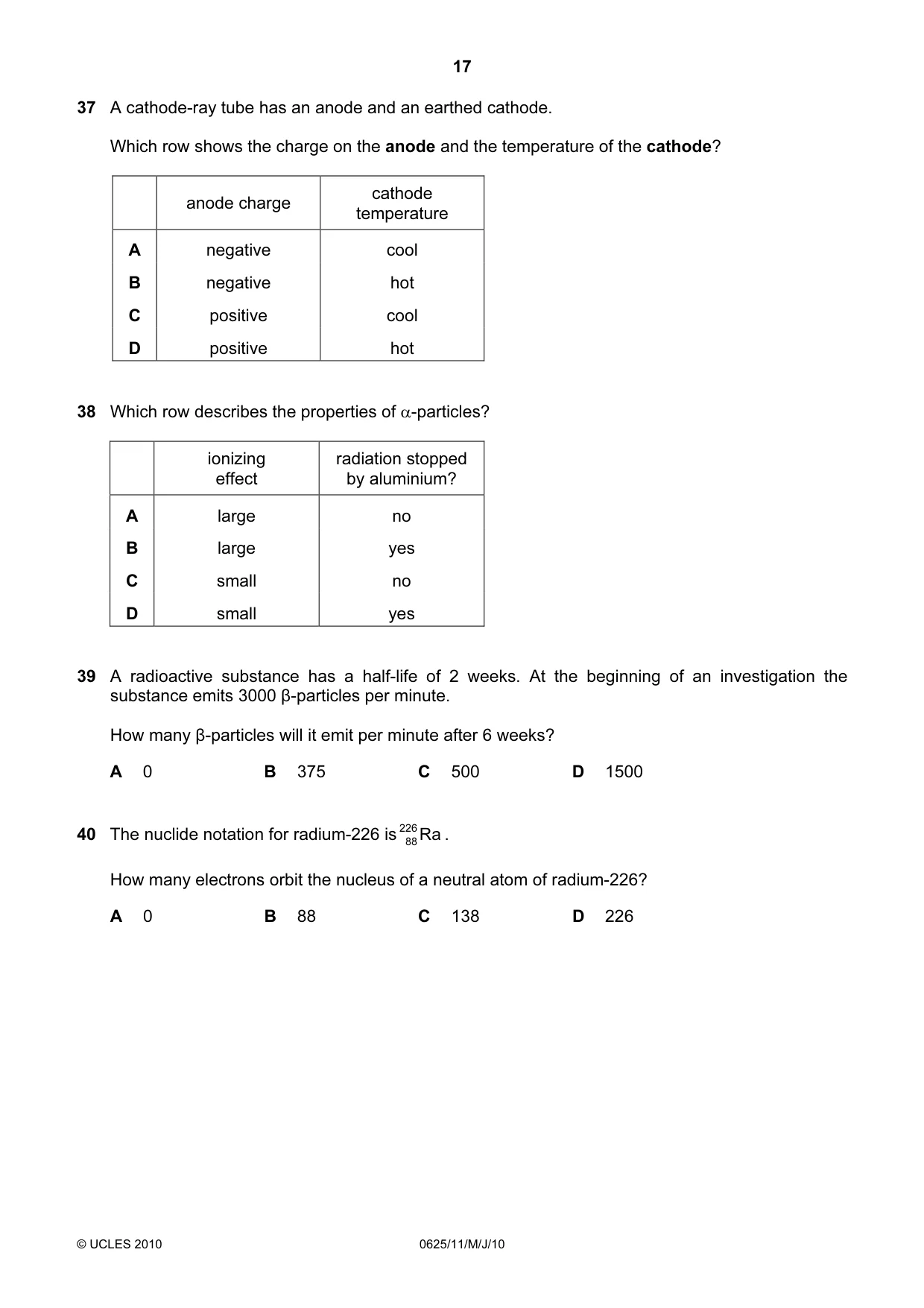


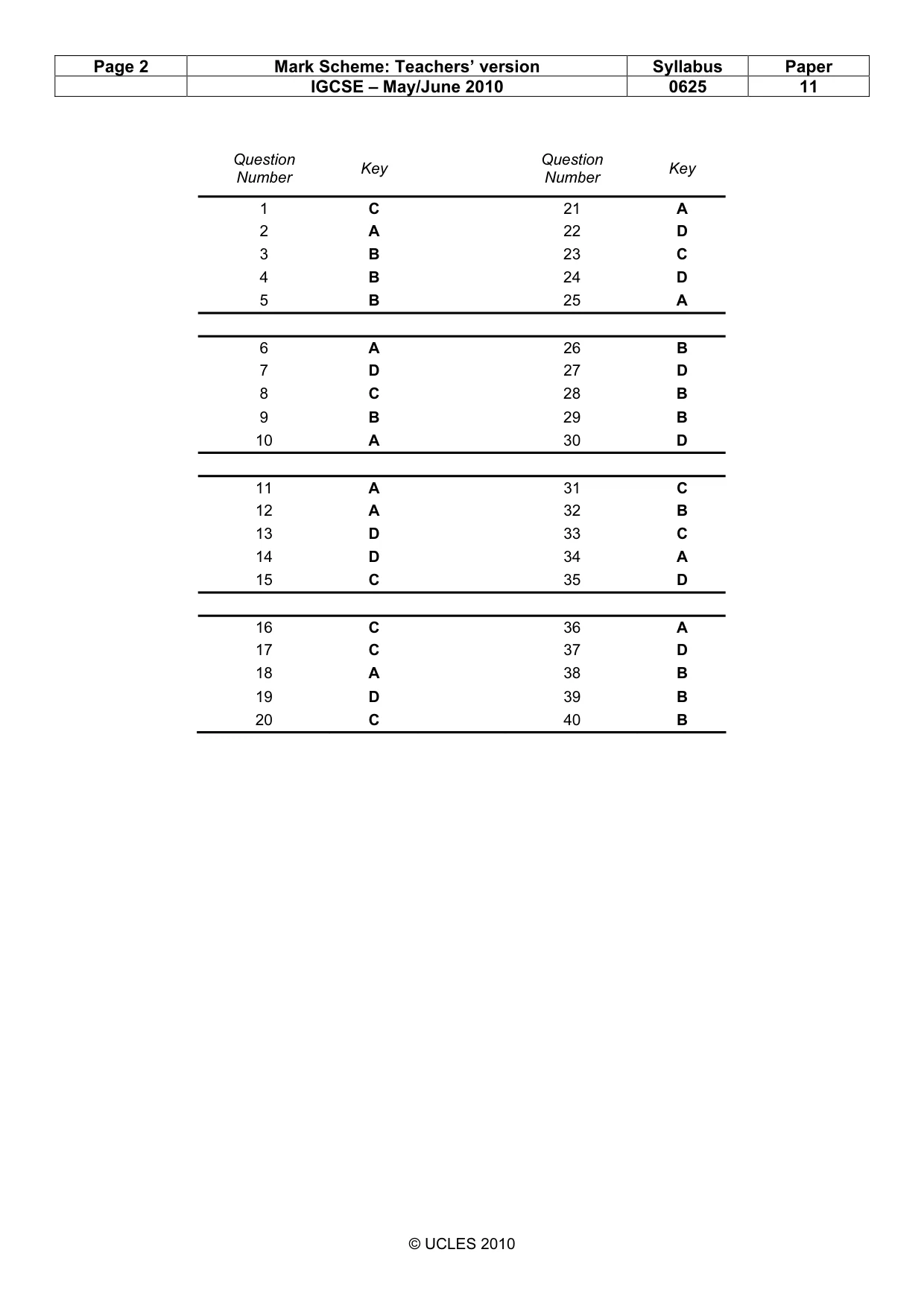
Mark scheme2 pages
Answers below. Sit the paper first if you are practising.
Questions as text
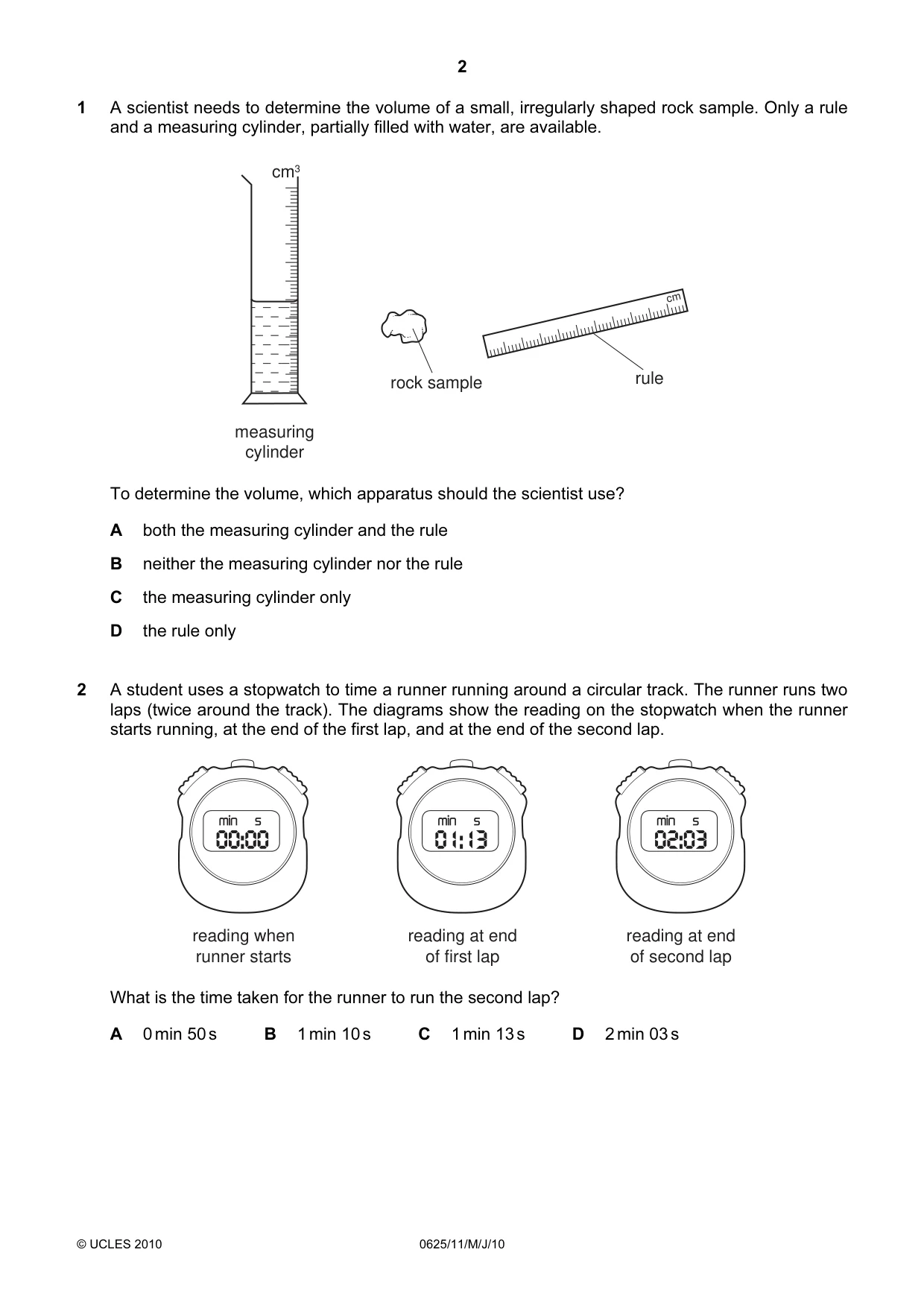
Q1 · A scientist needs to determine the volume of a small, irregularly shaped rock sample
1 A scientist needs to determine the volume of a small, irregularly shaped rock sample. Only a rule and a measuring cylinder, partially filled with water, are available. cm3 cm rock sample rule measuring cylinder To determine the volume, which apparatus should the scientist use? A both the measuring cylinder and the rule B neither the measuring cylinder nor the rule C the measuring cylinder only D the rule only
Mark scheme: C
More questions on Physical quantities and measurement techniques
Q2 · A student uses a stopwatch to time a runner running around a circular track
2 A student uses a stopwatch to time a runner running around a circular track. The runner runs two laps (twice around the track). The diagrams show the reading on the stopwatch when the runner starts running, at the end of the first lap, and at the end of the second lap. reading when reading at end reading at end runner starts of first lap of second lap What is the time taken for the runner to run the second lap? A 0 min 50 s B 1 min 10 s C 1 min 13 s D 2 min 03 s
Mark scheme: A
More questions on Physical quantities and measurement techniques
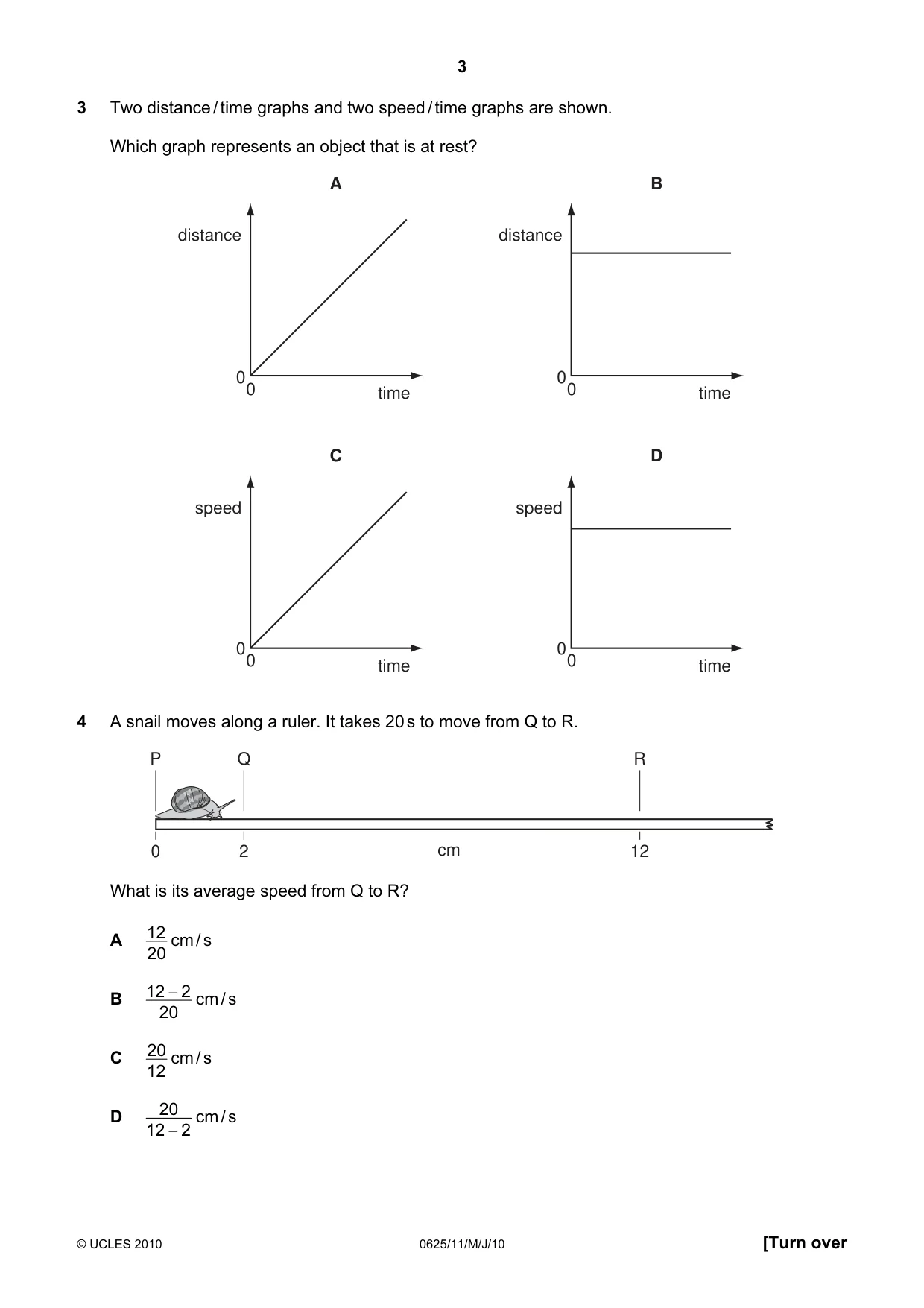
Q3 · Two distance / time graphs and two speed / time graphs are shown
3 Two distance / time graphs and two speed / time graphs are shown. Which graph represents an object that is at rest? A B distance distance 00 00 time time C D speed speed 00 00 time time
Mark scheme: B
Q4 · A snail moves along a ruler
4 A snail moves along a ruler. It takes 20 s to move from Q to R. P Q R 0 2 cm 12 What is its average speed from Q to R? A 12 cm / s 20 B 12 − 2 cm / s 20 C 20 cm / s 12 D 20 cm / s 12 − 2
Mark scheme: B
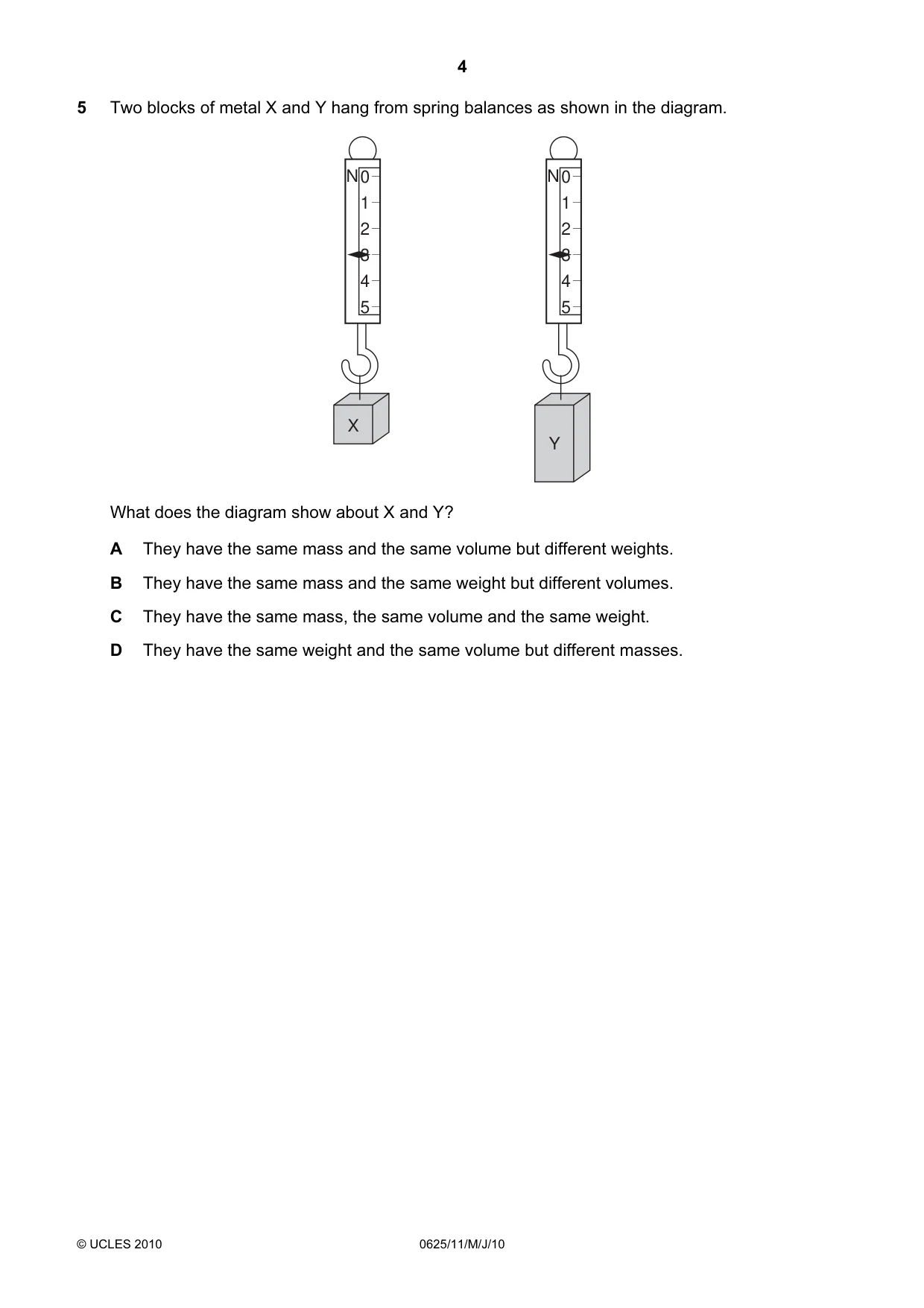
Q5 · Two blocks of metal X and Y hang from spring balances as shown in the diagram
5 Two blocks of metal X and Y hang from spring balances as shown in the diagram. N 0 N 0 1 1 2 2 3 3 4 4 5 5 X Y What does the diagram show about X and Y? A They have the same mass and the same volume but different weights. B They have the same mass and the same weight but different volumes. C They have the same mass, the same volume and the same weight. D They have the same weight and the same volume but different masses.
Mark scheme: B
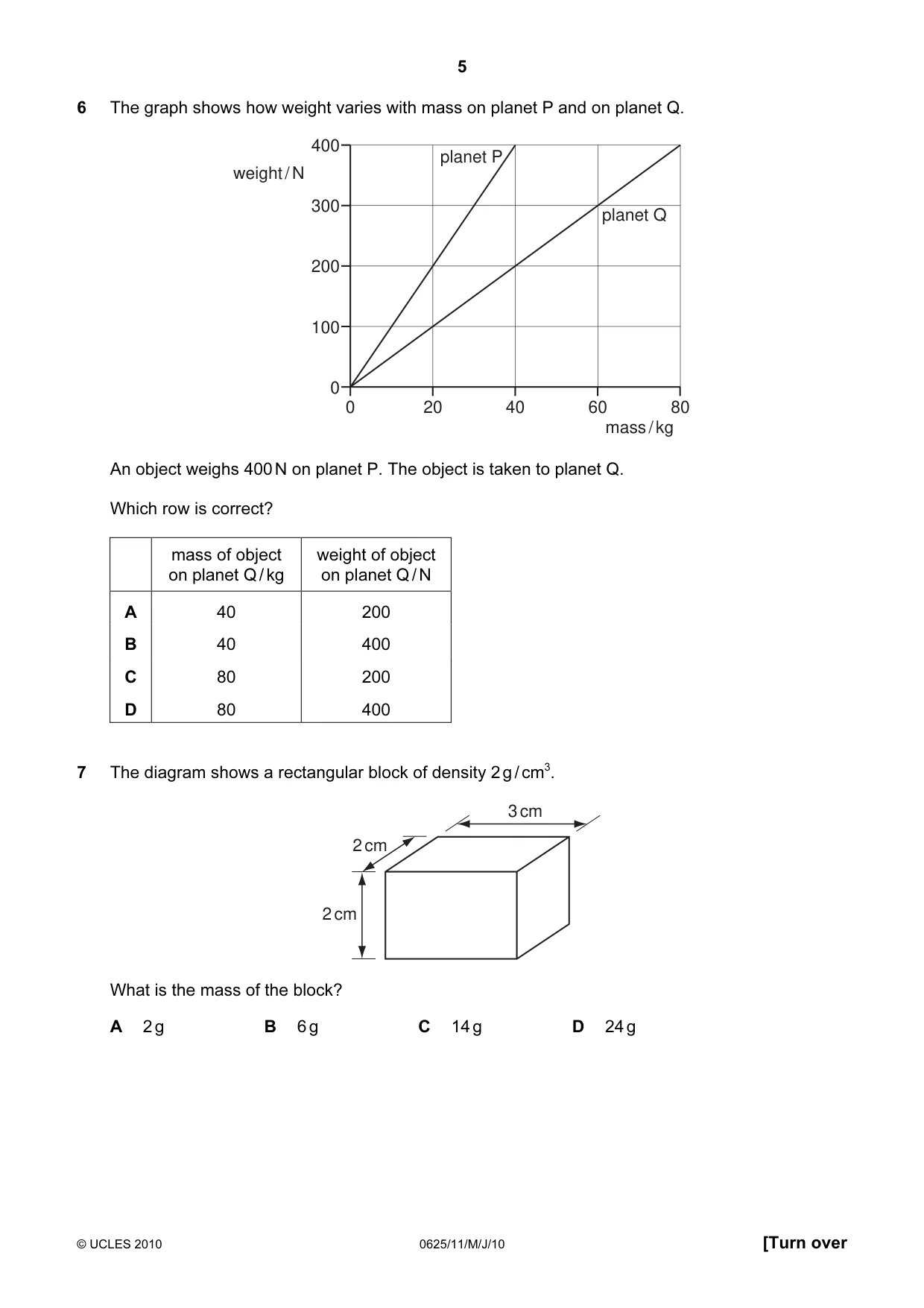
Q6 · The graph shows how weight varies with mass on planet P and on planet Q
6 The graph shows how weight varies with mass on planet P and on planet Q. 400 planet P weight / N 300 planet Q 200 100 0 0 20 40 60 80 mass / kg An object weighs 400 N on planet P. The object is taken to planet Q. Which row is correct? mass of object weight of object on planet Q / kg on planet Q / N A 40 200 B 40 400 C 80 200 D 80 400
Mark scheme: A
Q7 · The diagram shows a rectangular block of density 2 g / cm3
7 The diagram shows a rectangular block of density 2 g / cm3. 3 cm 2 cm 2 cm What is the mass of the block? A 2 g B 6 g C 14 g D 24 g
Mark scheme: D
Q8 · Which statement about a moving object is correct?
8 Which statement about a moving object is correct? A When an object is accelerating, the resultant force acting on it must equal zero. B When an object is moving at a steady speed, the air resistance acting on it must equal zero. C When an object is moving at a steady speed, the resultant force acting on it must equal zero. D When an object is moving, there must be a resultant force acting on it.
Mark scheme: C
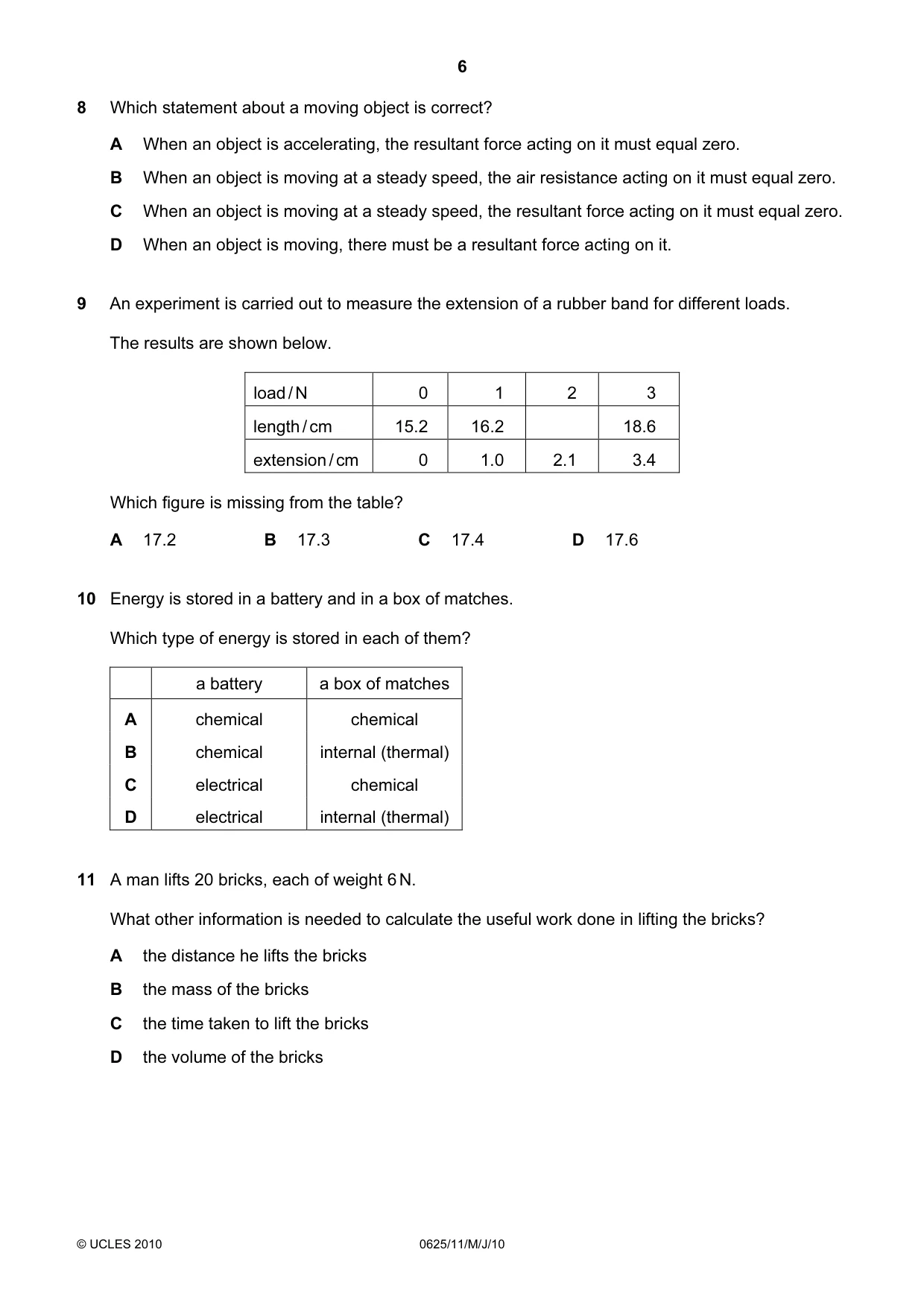
Q9 · An experiment is carried out to measure the extension of a rubber band for different loads
9 An experiment is carried out to measure the extension of a rubber band for different loads. The results are shown below. load / N 0 1 2 3 length / cm 15.2 16.2 18.6 extension / cm 0 1.0 2.1 3.4 Which figure is missing from the table? A 17.2 B 17.3 C 17.4 D 17.6
Mark scheme: B
Q10 · Energy is stored in a battery and in a box of matches
10 Energy is stored in a battery and in a box of matches. Which type of energy is stored in each of them? a battery a box of matches A chemical chemical B chemical internal (thermal) C electrical chemical D electrical internal (thermal)
Mark scheme: A
Q11 · A man lifts 20 bricks, each of weight 6 N
11 A man lifts 20 bricks, each of weight 6 N. What other information is needed to calculate the useful work done in lifting the bricks? A the distance he lifts the bricks B the mass of the bricks C the time taken to lift the bricks D the volume of the bricks
Mark scheme: A
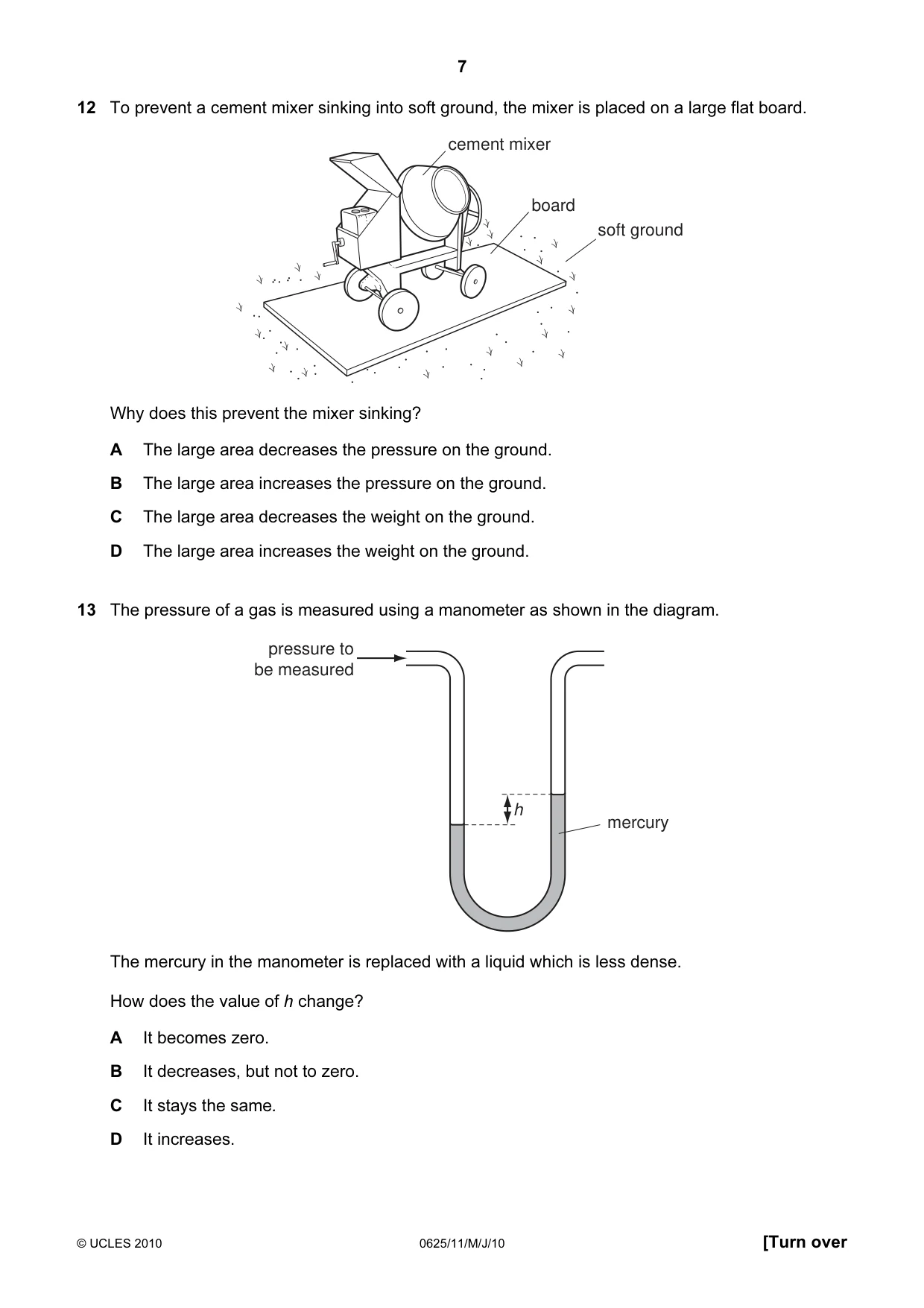
Q12 · To prevent a cement mixer sinking into soft ground, the mixer is placed on a large flat…
12 To prevent a cement mixer sinking into soft ground, the mixer is placed on a large flat board. cement mixer board soft ground Why does this prevent the mixer sinking? A The large area decreases the pressure on the ground. B The large area increases the pressure on the ground. C The large area decreases the weight on the ground. D The large area increases the weight on the ground.
Mark scheme: A
Q13 · The pressure of a gas is measured using a manometer as shown in the diagram
13 The pressure of a gas is measured using a manometer as shown in the diagram. pressure to be measured h mercury The mercury in the manometer is replaced with a liquid which is less dense. How does the value of h change? A It becomes zero. B It decreases, but not to zero. C It stays the same. D It increases.
Mark scheme: D
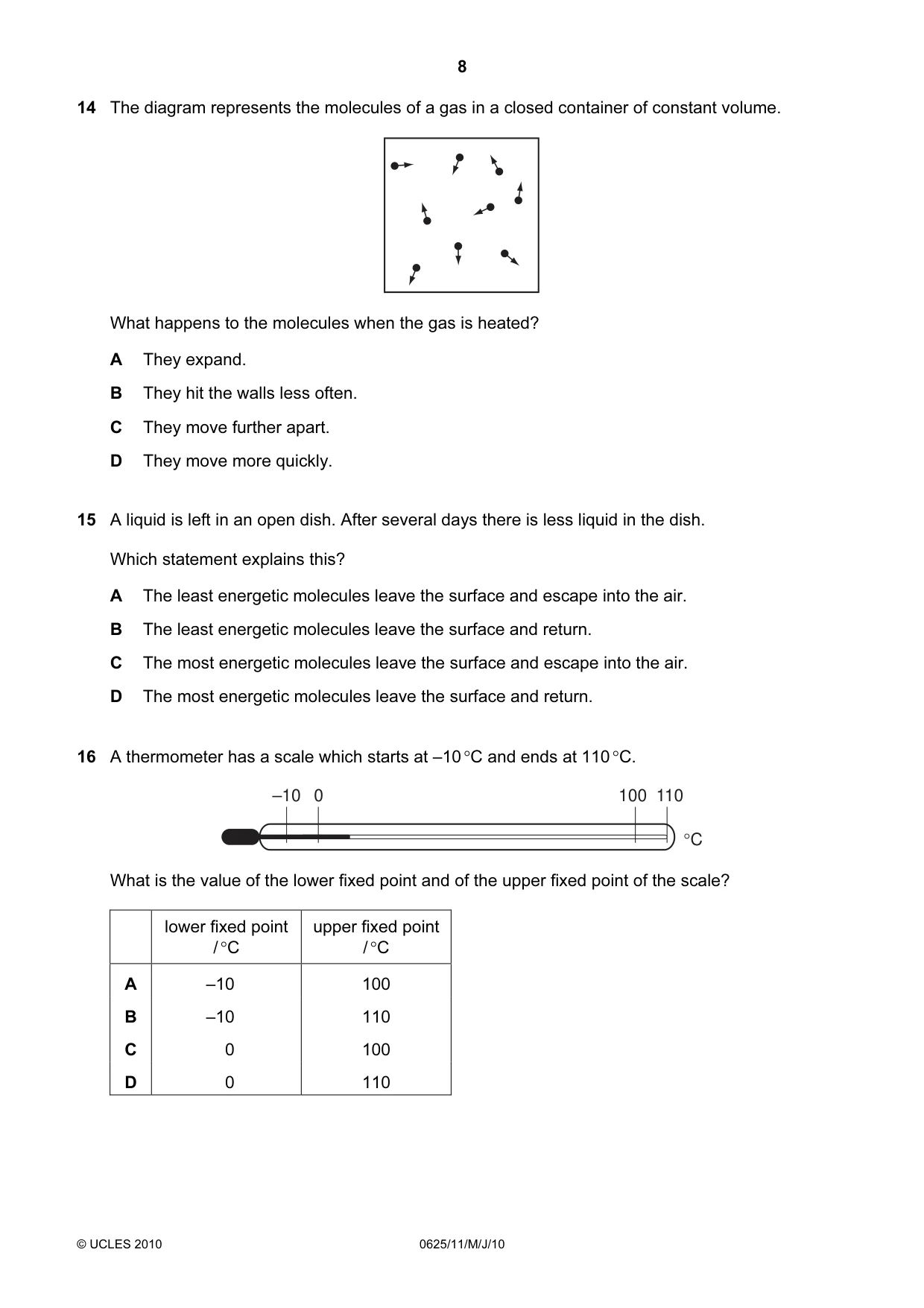
Q14 · The diagram represents the molecules of a gas in a closed container of constant volume
14 The diagram represents the molecules of a gas in a closed container of constant volume. What happens to the molecules when the gas is heated? A They expand. B They hit the walls less often. C They move further apart. D They move more quickly.
Mark scheme: D
Q15 · A liquid is left in an open dish
15 A liquid is left in an open dish. After several days there is less liquid in the dish. Which statement explains this? A The least energetic molecules leave the surface and escape into the air. B The least energetic molecules leave the surface and return. C The most energetic molecules leave the surface and escape into the air. D The most energetic molecules leave the surface and return.
Mark scheme: C
Q16 · A thermometer has a scale which starts at –10 °C and ends at 110 °C
16 A thermometer has a scale which starts at –10 °C and ends at 110 °C. –10 0 100 110 °C What is the value of the lower fixed point and of the upper fixed point of the scale? lower fixed point upper fixed point / °C / °C A –10 100 B –10 110 C 0 100 D 0 110
Mark scheme: C
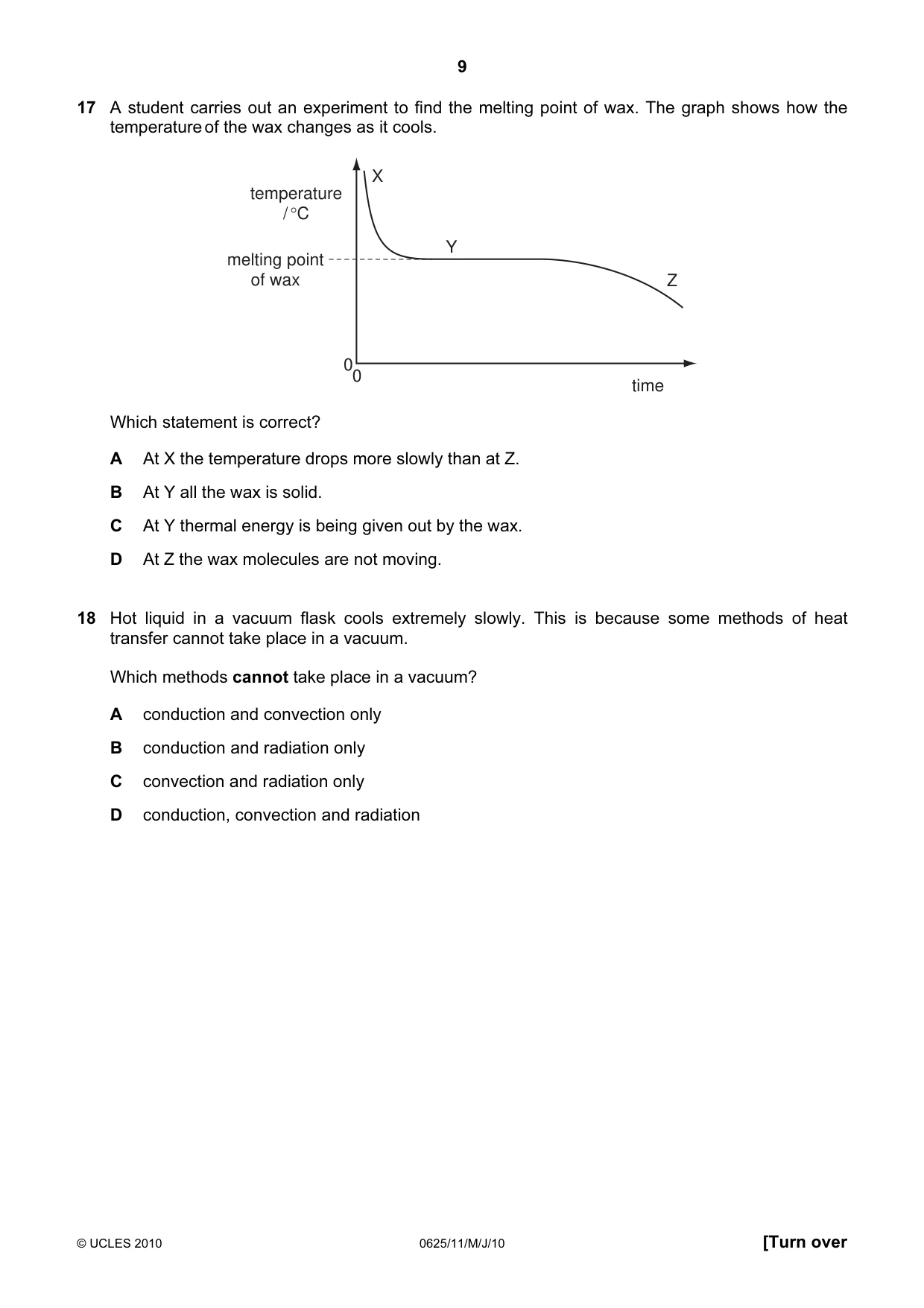
Q17 · A student carries out an experiment to find the melting point of wax
17 A student carries out an experiment to find the melting point of wax. The graph shows how the temperature of the wax changes as it cools. X temperature / °C Y melting point of wax Z 00 time Which statement is correct? A At X the temperature drops more slowly than at Z. B At Y all the wax is solid. C At Y thermal energy is being given out by the wax. D At Z the wax molecules are not moving.
Mark scheme: C
Q18 · Hot liquid in a vacuum flask cools extremely slowly
18 Hot liquid in a vacuum flask cools extremely slowly. This is because some methods of heat transfer cannot take place in a vacuum. Which methods cannot take place in a vacuum? A conduction and convection only B conduction and radiation only C convection and radiation only D conduction, convection and radiation
Mark scheme: A
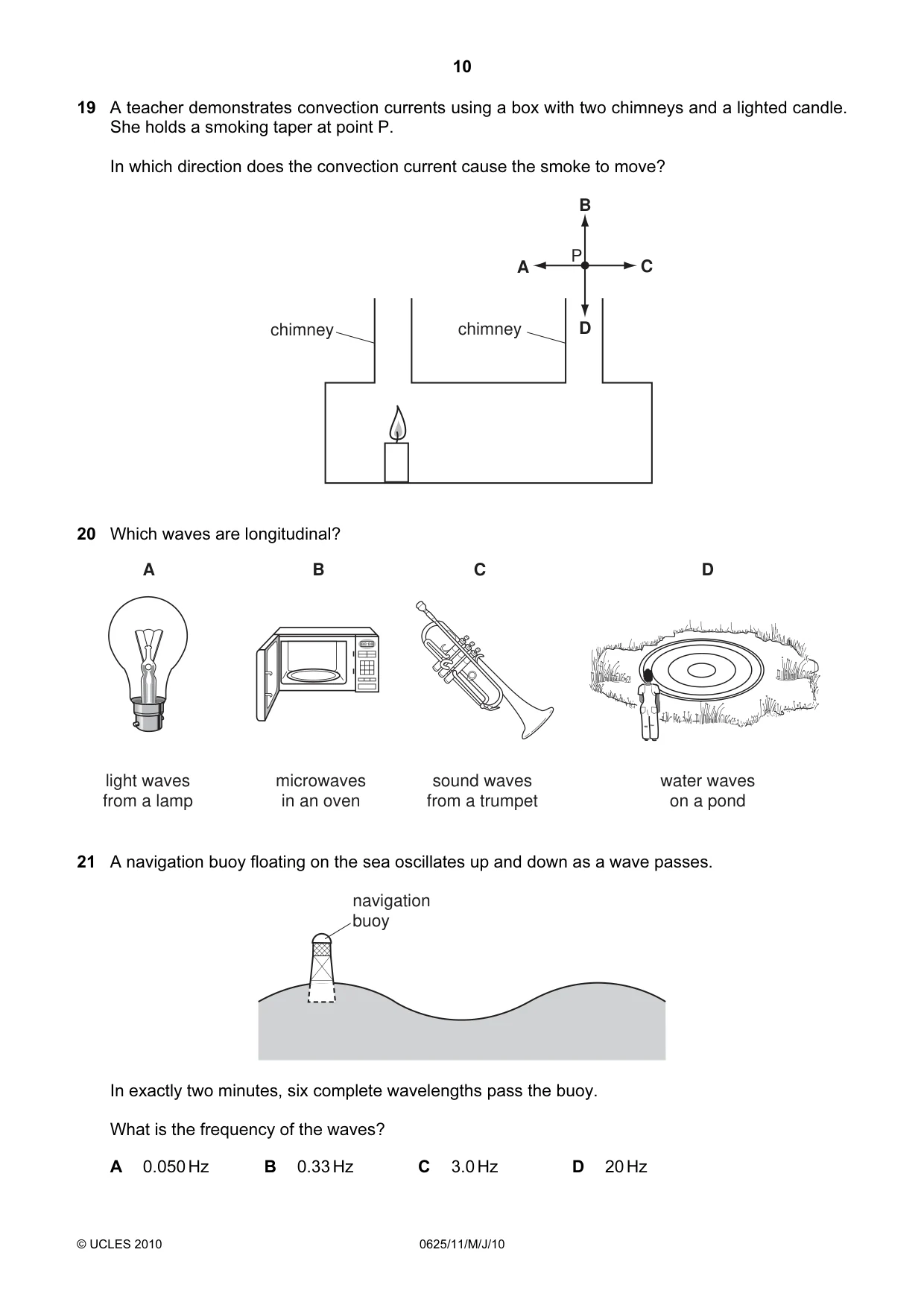
Q19 · A teacher demonstrates convection currents using a box with two chimneys and a lighted…
19 A teacher demonstrates convection currents using a box with two chimneys and a lighted candle. She holds a smoking taper at point P. In which direction does the convection current cause the smoke to move? B P A C chimney chimney D
Mark scheme: D
Q20 · Which waves are longitudinal?
20 Which waves are longitudinal? A B C D 88:88 light waves microwaves sound waves water waves from a lamp in an oven from a trumpet on a pond
Mark scheme: C
Q21 · A navigation buoy floating on the sea oscillates up and down as a wave passes
21 A navigation buoy floating on the sea oscillates up and down as a wave passes. navigation buoy In exactly two minutes, six complete wavelengths pass the buoy. What is the frequency of the waves? A 0.050 Hz B 0.33 Hz C 3.0 Hz D 20 Hz
Mark scheme: A
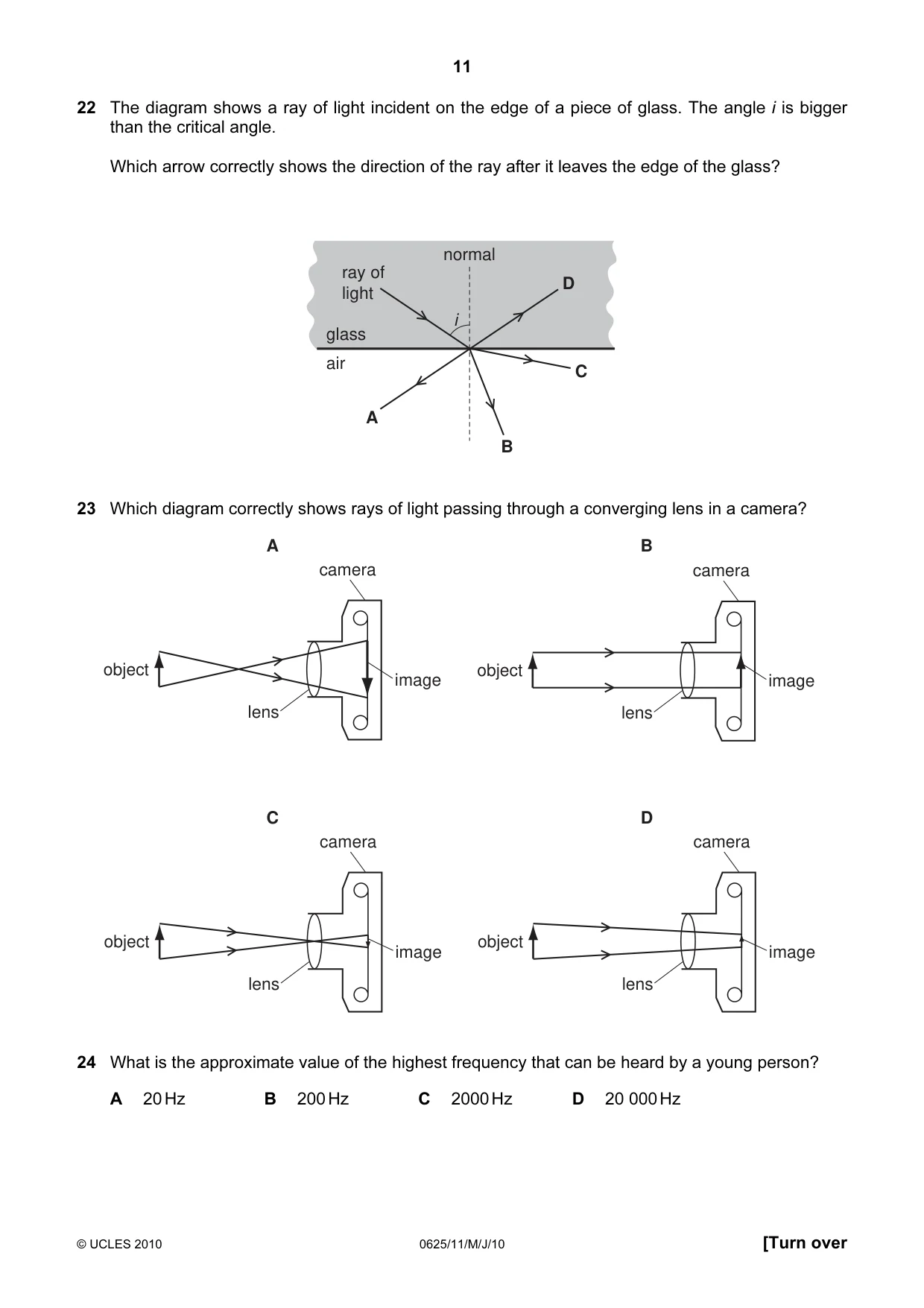
Q22 · The diagram shows a ray of light incident on the edge of a piece of glass
22 The diagram shows a ray of light incident on the edge of a piece of glass. The angle i is bigger than the critical angle. Which arrow correctly shows the direction of the ray after it leaves the edge of the glass? normal ray of D light i glass air C A B
Mark scheme: D
Q23 · Which diagram correctly shows rays of light passing through a converging lens in a camera?
23 Which diagram correctly shows rays of light passing through a converging lens in a camera? A B camera camera object object image image lens lens C D camera camera object object image image lens lens
Mark scheme: C
Q24 · What is the approximate value of the highest frequency that can be heard by a young…
24 What is the approximate value of the highest frequency that can be heard by a young person? A 20 Hz B 200 Hz C 2000 Hz D 20 000 Hz
Mark scheme: D
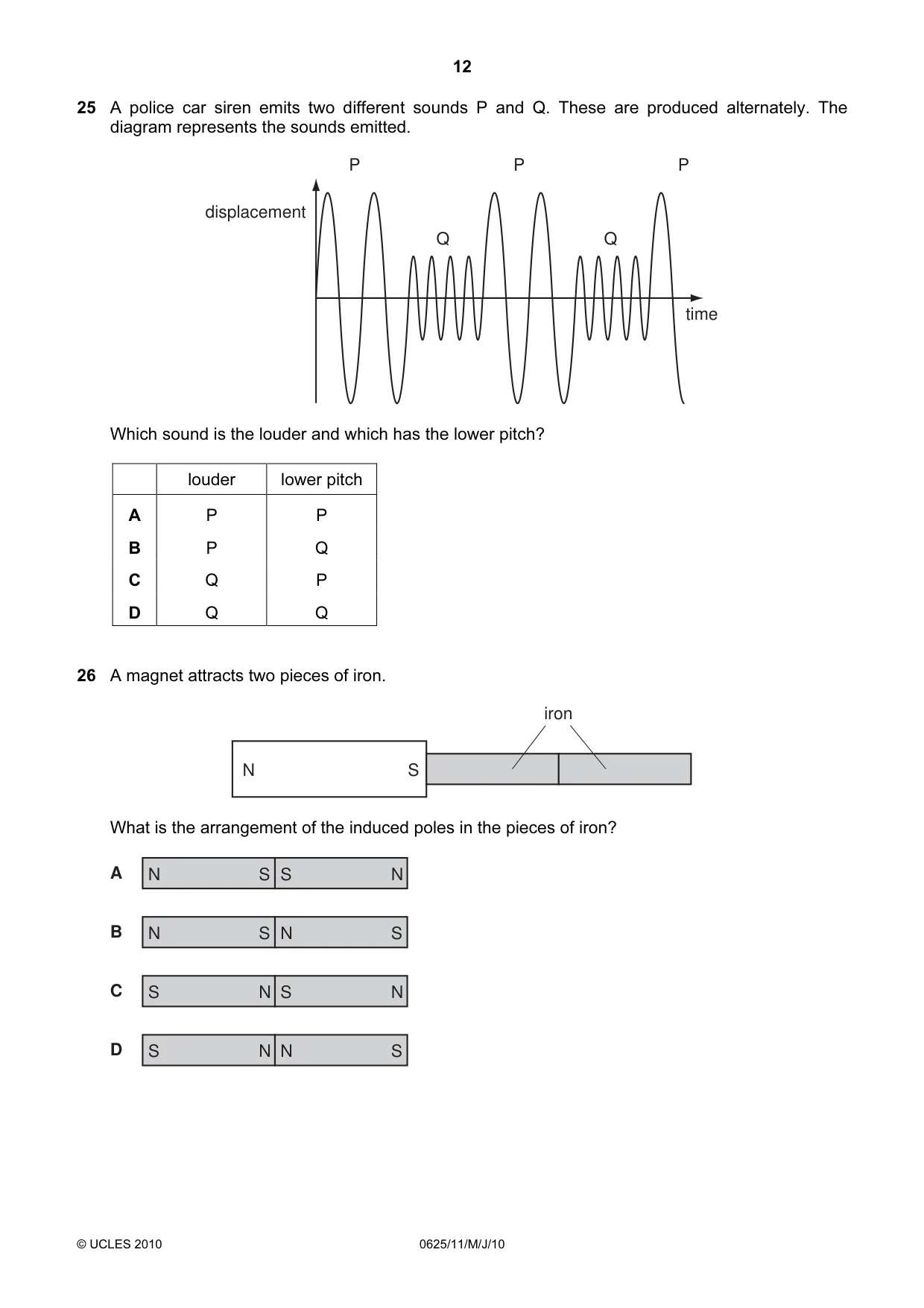
Q25 · A police car siren emits two different sounds P and Q
25 A police car siren emits two different sounds P and Q. These are produced alternately. The diagram represents the sounds emitted. P P P displacement Q Q time Which sound is the louder and which has the lower pitch? louder lower pitch A P P B P Q C Q P D Q Q
Mark scheme: A
Q26 · A magnet attracts two pieces of iron
26 A magnet attracts two pieces of iron. iron N S What is the arrangement of the induced poles in the pieces of iron? A N S S N B N S N S C S N S N D S N N S
Mark scheme: B
Q27 · A piece of iron and a piece of steel are picked up by an electromagnet as shown
27 A piece of iron and a piece of steel are picked up by an electromagnet as shown. electromagnet N S steel iron The current to the electromagnet is switched off. What happens? A Both the iron and the steel remain magnetised. B Neither the iron nor the steel remain magnetised. C Only the iron remains magnetised. D Only the steel remains magnetised.
Mark scheme: D
Q28 · The table shows the lengths and diameters of four copper wires
28 The table shows the lengths and diameters of four copper wires. Which wire has the least resistance? length / m diameter / mm A 0.50 1.0 B 0.50 2.5 C 0.75 1.0 D 0.75 2.5
Mark scheme: B
Q29 · A circuit is set up to measure the resistance of a resistor R
29 A circuit is set up to measure the resistance of a resistor R. The meter readings are 2.0 A and 3.0 V. A V R What is the resistance of the resistor R? A 0.67 Ω B 1.5 Ω C 5.0 Ω D 6.0 Ω
Mark scheme: B
Q30 · The circuit shown is a potential divider
30 The circuit shown is a potential divider. X output What is component X? A a light-dependent resistor B a relay C a thermistor D a variable resistor
Mark scheme: D
Q31 · A lamp is connected in four circuits in turn, each using identical batteries
31 A lamp is connected in four circuits in turn, each using identical batteries. The resistors are all identical. In which circuit will the lamp be brightest? A B C D
Mark scheme: C
Q32 · Which diagram shows the correct positions for both the switch and the fuse?
32 Which diagram shows the correct positions for both the switch and the fuse? live wire switch A lamp neutral wire fuse fuse live wire switch B lamp neutral wire fuse live wire C lamp neutral wire switch live wire D lamp neutral wire fuse switch
Mark scheme: B
Q33 · After some building work in a house, a bare (uninsulated) live wire is left protruding…
33 After some building work in a house, a bare (uninsulated) live wire is left protruding from a wall. What is the greatest hazard? A a fire B a fuse will blow C an electric shock D no current will flow
Mark scheme: C
Q34 · A coil is connected to a battery and a soft iron bar is hung near to it
34 A coil is connected to a battery and a soft iron bar is hung near to it. soft iron coil The current is then reversed by reversing the battery connections. How does the soft iron bar behave in the two cases? with the battery as shown with the battery reversed A attracted to the coil attracted to the coil B attracted to the coil repelled from the coil C repelled from the coil attracted to the coil D repelled from the coil repelled from the coil
Mark scheme: A
Q35 · A transformer has 15 000 turns on its primary coil and 750 turns on its secondary coil
35 A transformer has 15 000 turns on its primary coil and 750 turns on its secondary coil. Connected in this way, for what purpose could this transformer be used? A to convert the 8000 V a.c. output of a power station to 160 000 V for long-distance power transmission B to convert the 160 000 V d.c. supply from a power line to 8000 V for local power transmission C to use a 12 V d.c. supply to operate a 240 V razor D to use a 240 V a.c. mains supply to operate a 12 V motor
Mark scheme: D
Q36 · What are cathode rays?
36 What are cathode rays? A a beam of electrons B a beam of neutrons C a beam of protons D electromagnetic waves
Mark scheme: A
Q37 · A cathode-ray tube has an anode and an earthed cathode
37 A cathode-ray tube has an anode and an earthed cathode. Which row shows the charge on the anode and the temperature of the cathode? cathode anode charge temperature A negative cool B negative hot C positive cool D positive hot
Mark scheme: D
Q38 · Which row describes the properties of α-particles?
38 Which row describes the properties of α-particles? ionizing radiation stopped effect by aluminium? A large no B large yes C small no D small yes
Mark scheme: B
Q39 · A radioactive substance has a half-life of 2 weeks
39 A radioactive substance has a half-life of 2 weeks. At the beginning of an investigation the substance emits 3000 β-particles per minute. How many β-particles will it emit per minute after 6 weeks? A 0 B 375 C 500 D 1500
Mark scheme: B
Q40 · The nuclide notation for radium-226 is 226 Ra
40 The nuclide notation for radium-226 is 226 Ra . 88 How many electrons orbit the nucleus of a neutral atom of radium-226? A 0 B 88 C 138 D 226
Mark scheme: B
What was in this paper
The subtopics covered by these 40 questions, and how many questions each got. Open one in a new tab to see every Cambridge question on it.
3Electric circuits2Electrical quantities2Electrical safety2Electromagnetic effects2Energy, work and power2Forces2General properties of waves2Kinetic particle model of matter2Light2Mass and weight2Motion2Physical quantities and measurement techniques2Pressure2Radioactivity2Simple phenomena of magnetism2Sound2Thermal properties and temperature2Transfer of thermal energy2Density1What you needed in this session
Cambridge’s own grade thresholds for 2010 May/June, Paper 1 · Variant 1. A higher threshold means an easier paper — the bar moves with how the cohort did.