Cambridge IGCSE Physics 0625 — 2018 Oct/Nov Paper 1 · Variant 3
0625/13/O/N/18 · 40 questions · 40 marks · ≈45 min
The question paper and its mark scheme, free to read here and free to download. This is Cambridge’s own paper, exactly as it was sat.
Question paper16 pages
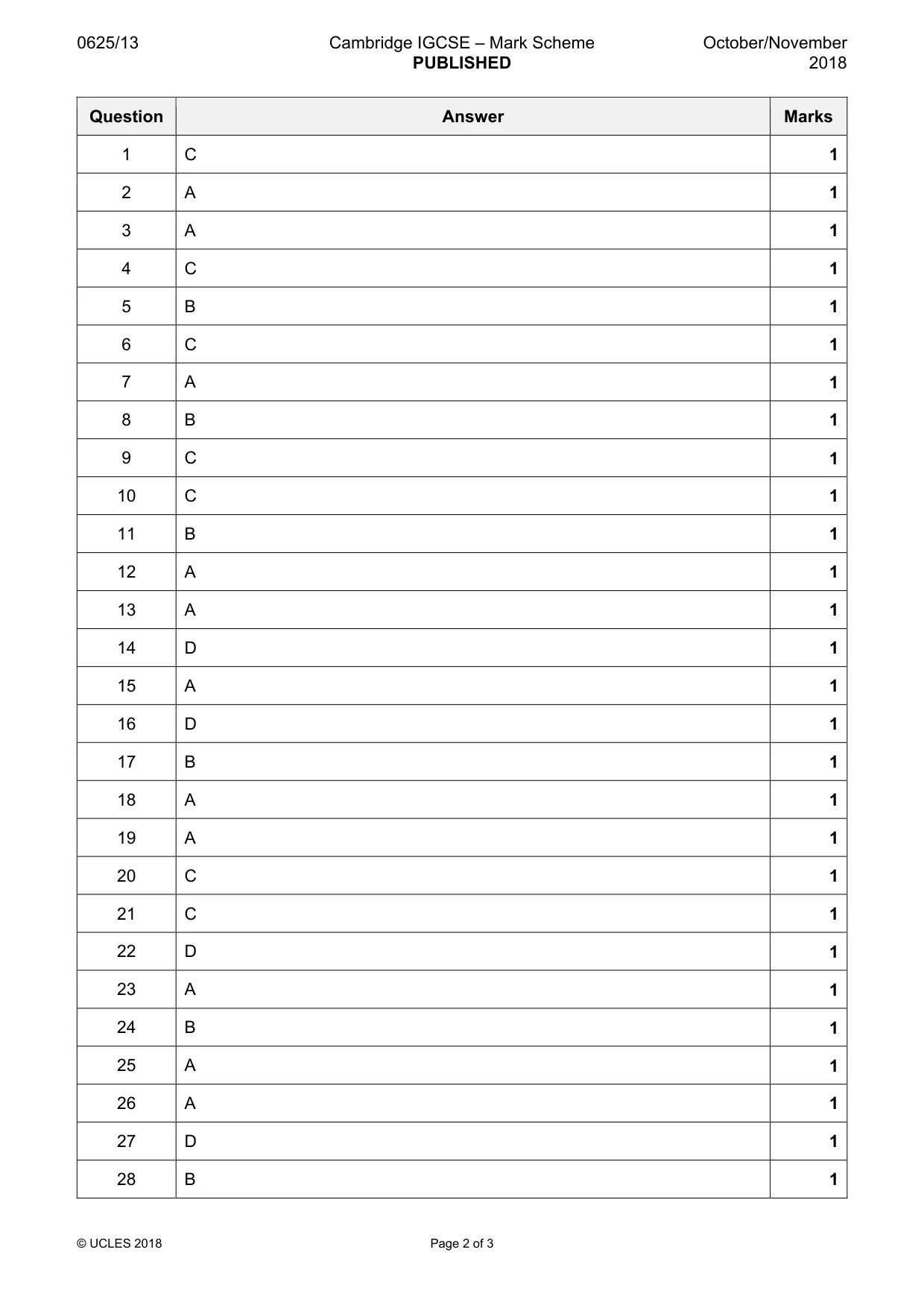
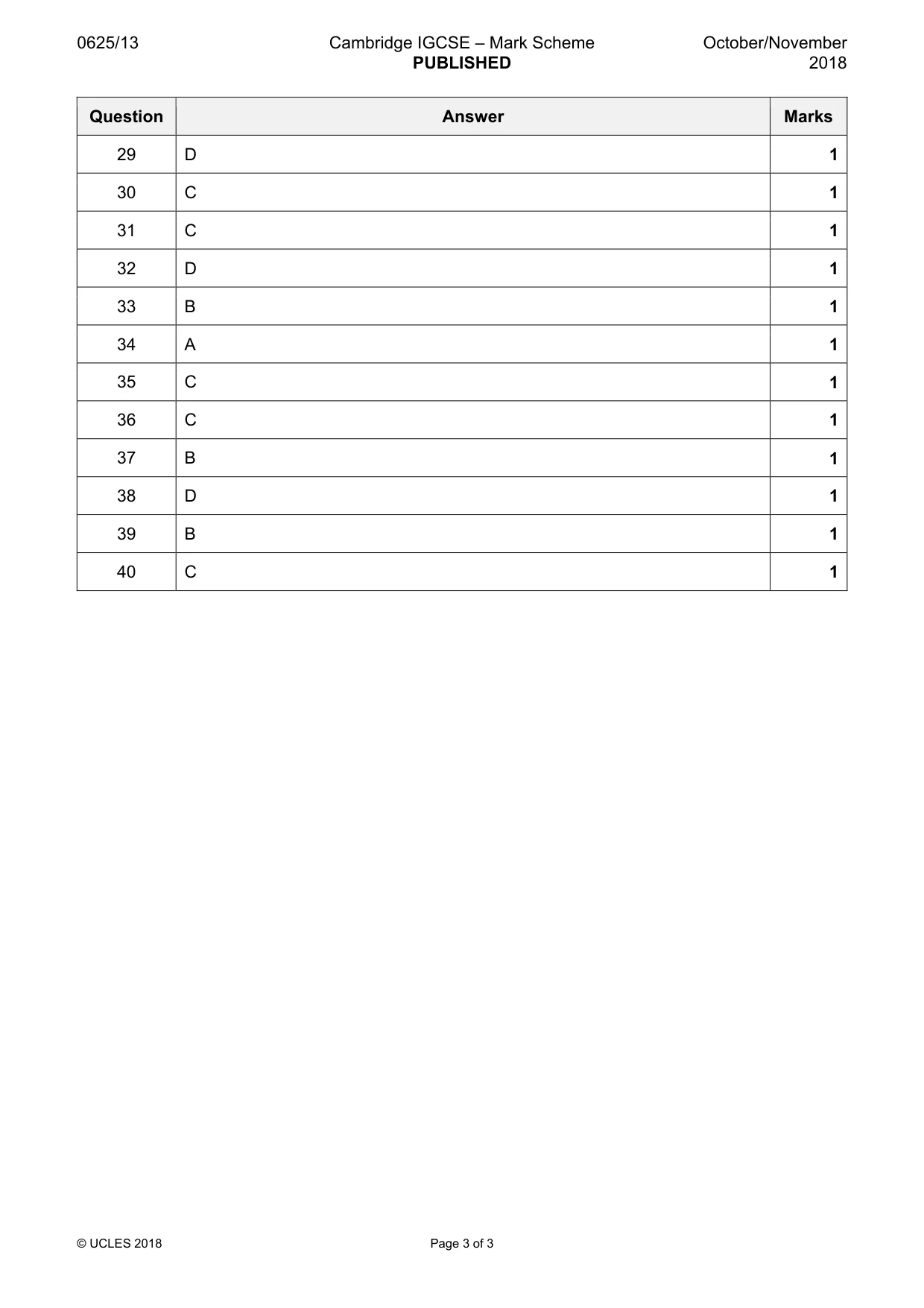
Mark scheme3 pages
Answers below. Sit the paper first if you are practising.
Questions as text
Q1 · A pendulum is set in motion and timed
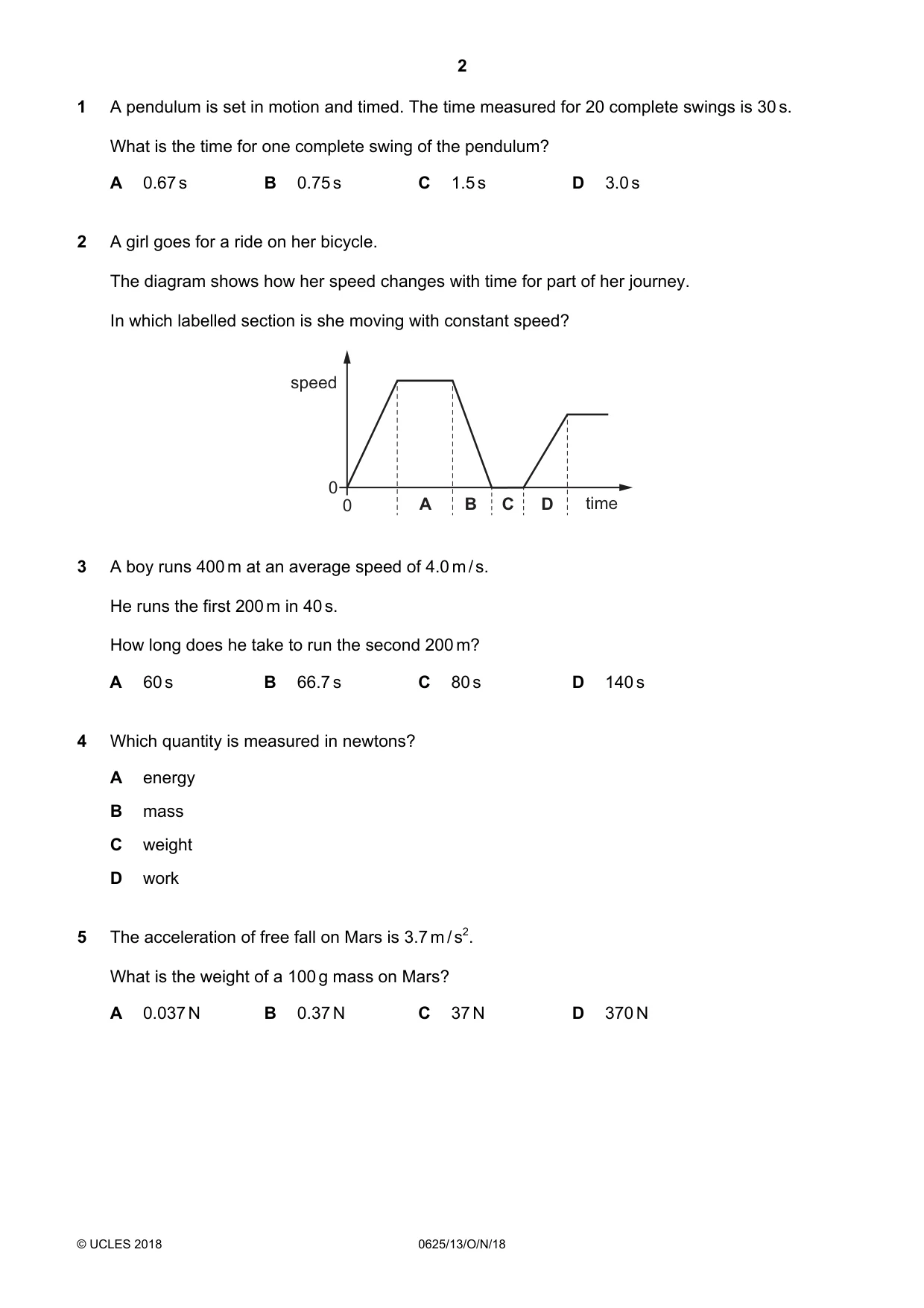
1 A pendulum is set in motion and timed. The time measured for 20 complete swings is 30 s. What is the time for one complete swing of the pendulum? A 0.67 s B 0.75 s C 1.5 s D 3.0 s
Mark scheme: C
More questions on Physical quantities and measurement techniques
Q2 · A girl goes for a ride on her bicycle
2 A girl goes for a ride on her bicycle. The diagram shows how her speed changes with time for part of her journey. In which labelled section is she moving with constant speed? speed 0 0 A B C D time
Mark scheme: A
Q3 · A boy runs 400 m at an average speed of 4.0 m / s
3 A boy runs 400 m at an average speed of 4.0 m / s. He runs the first 200 m in 40 s. How long does he take to run the second 200 m? A 60 s B 66.7 s C 80 s D 140 s
Mark scheme: A
Q4 · Which quantity is measured in newtons?
4 Which quantity is measured in newtons? A energy B mass C weight D work
Mark scheme: C
Q5 · The acceleration of free fall on Mars is 3.7 m / s2
5 The acceleration of free fall on Mars is 3.7 m / s2. What is the weight of a 100 g mass on Mars? A 0.037 N B 0.37 N C 37 N D 370 N
Mark scheme: B
Q6 · A student carries out experiments to find the mass and the volume of four samples of rock
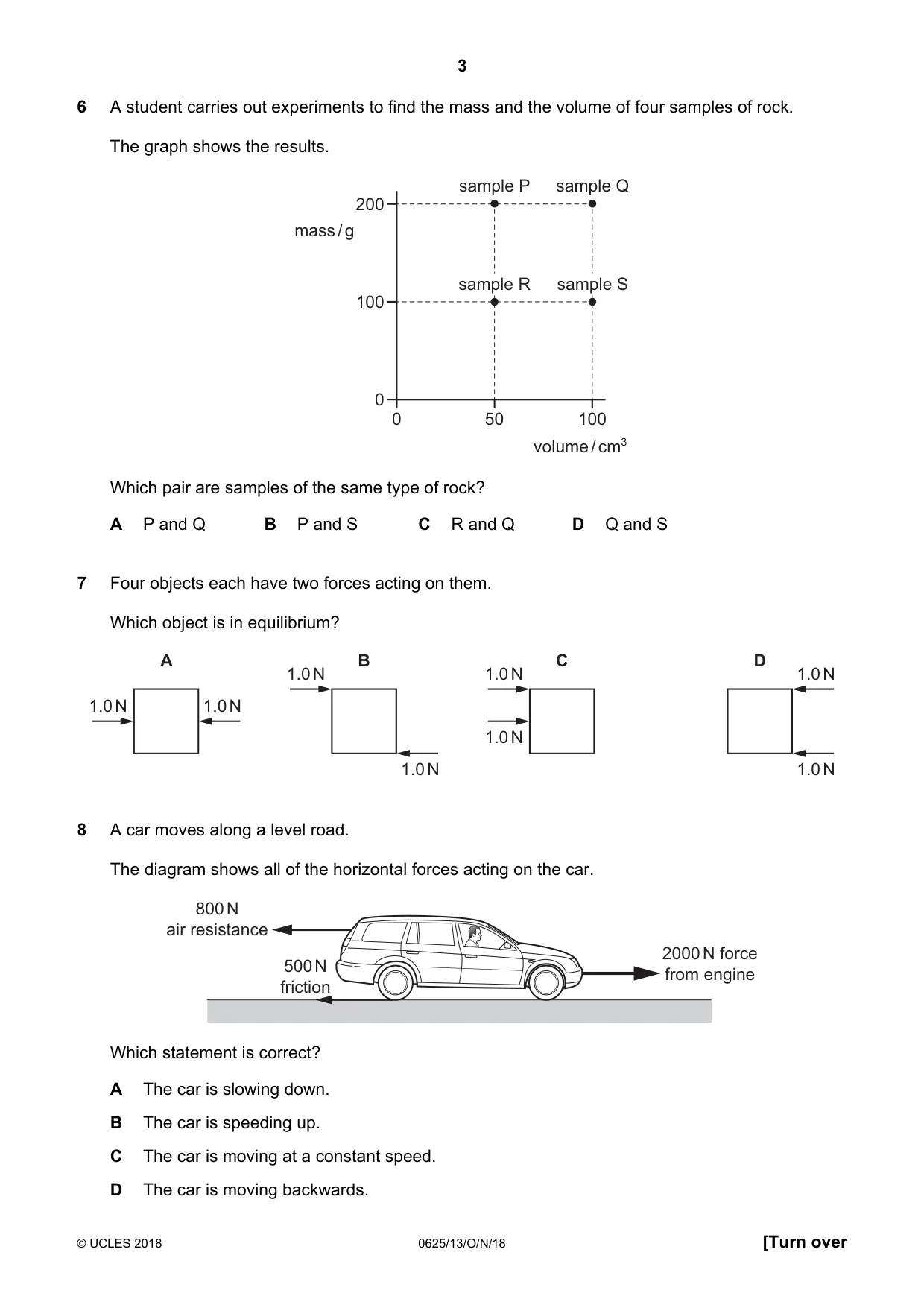
6 A student carries out experiments to find the mass and the volume of four samples of rock. The graph shows the results. sample P sample Q 200 mass / g sample R sample S 100 0 0 50 100 volume / cm3 Which pair are samples of the same type of rock? A P and Q B P and S C R and Q D Q and S
Mark scheme: C
Q7 · Four objects each have two forces acting on them
7 Four objects each have two forces acting on them. Which object is in equilibrium? A B C D 1.0 N 1.0 N 1.0 N 1.0 N 1.0 N 1.0 N 1.0 N 1.0 N
Mark scheme: A
Q8 · A car moves along a level road
8 A car moves along a level road. The diagram shows all of the horizontal forces acting on the car. 800 N air resistance 2000 N force 500 N from engine friction Which statement is correct? A The car is slowing down. B The car is speeding up. C The car is moving at a constant speed. D The car is moving backwards.
Mark scheme: B
Q9 · The diagram shows an aluminium sheet of constant thickness
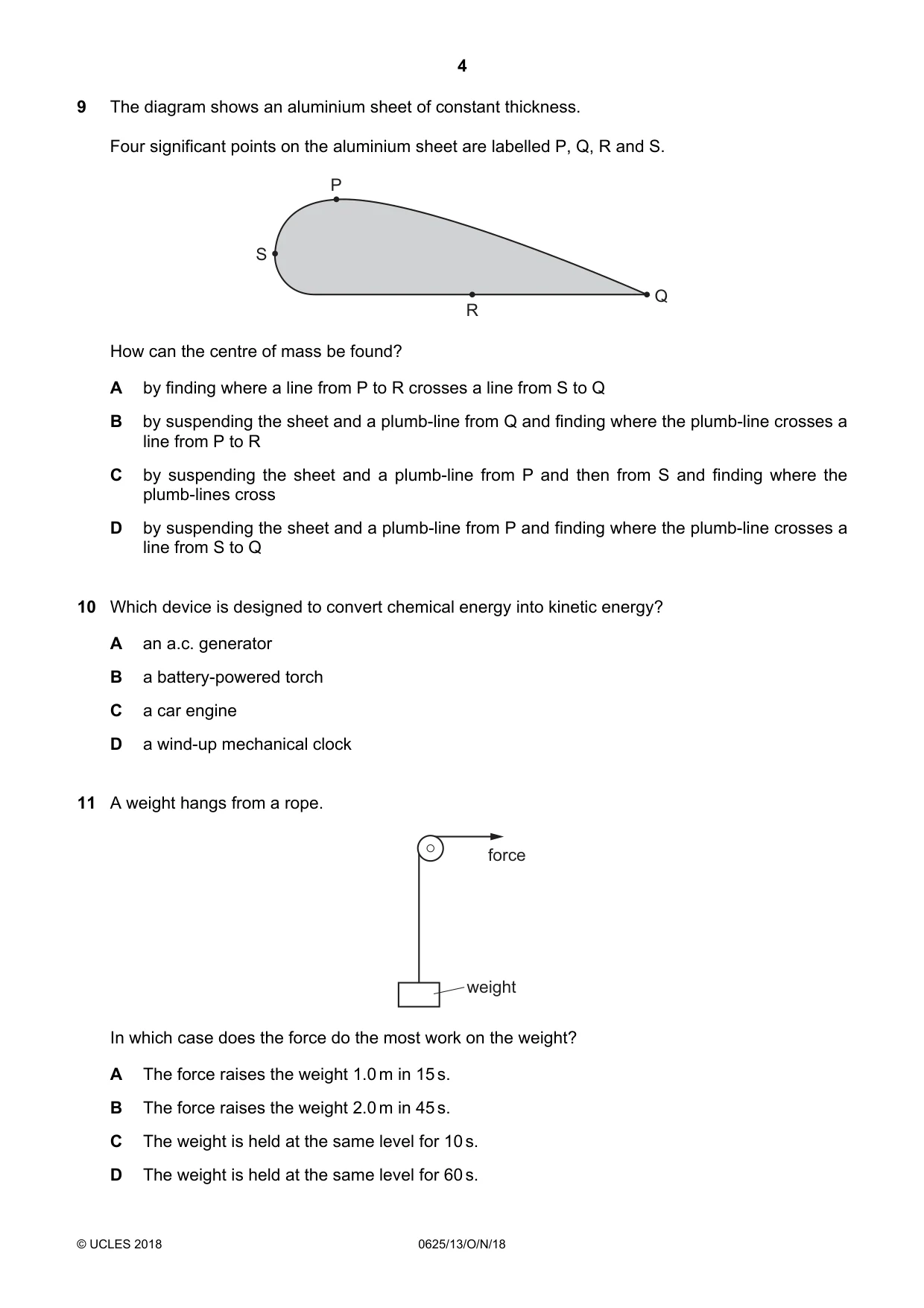
9 The diagram shows an aluminium sheet of constant thickness. Four significant points on the aluminium sheet are labelled P, Q, R and S. P S Q R How can the centre of mass be found? A by finding where a line from P to R crosses a line from S to Q B by suspending the sheet and a plumb-line from Q and finding where the plumb-line crosses a line from P to R C by suspending the sheet and a plumb-line from P and then from S and finding where the plumb-lines cross D by suspending the sheet and a plumb-line from P and finding where the plumb-line crosses a line from S to Q
Mark scheme: C
Q10 · Which device is designed to convert chemical energy into kinetic energy?
10 Which device is designed to convert chemical energy into kinetic energy? A an a.c. generator B a battery-powered torch C a car engine D a wind-up mechanical clock
Mark scheme: C
Q11 · A weight hangs from a rope
11 A weight hangs from a rope. force weight In which case does the force do the most work on the weight? A The force raises the weight 1.0 m in 15 s. B The force raises the weight 2.0 m in 45 s. C The weight is held at the same level for 10 s. D The weight is held at the same level for 60 s.
Mark scheme: B
Q12 · A conical flask containing water
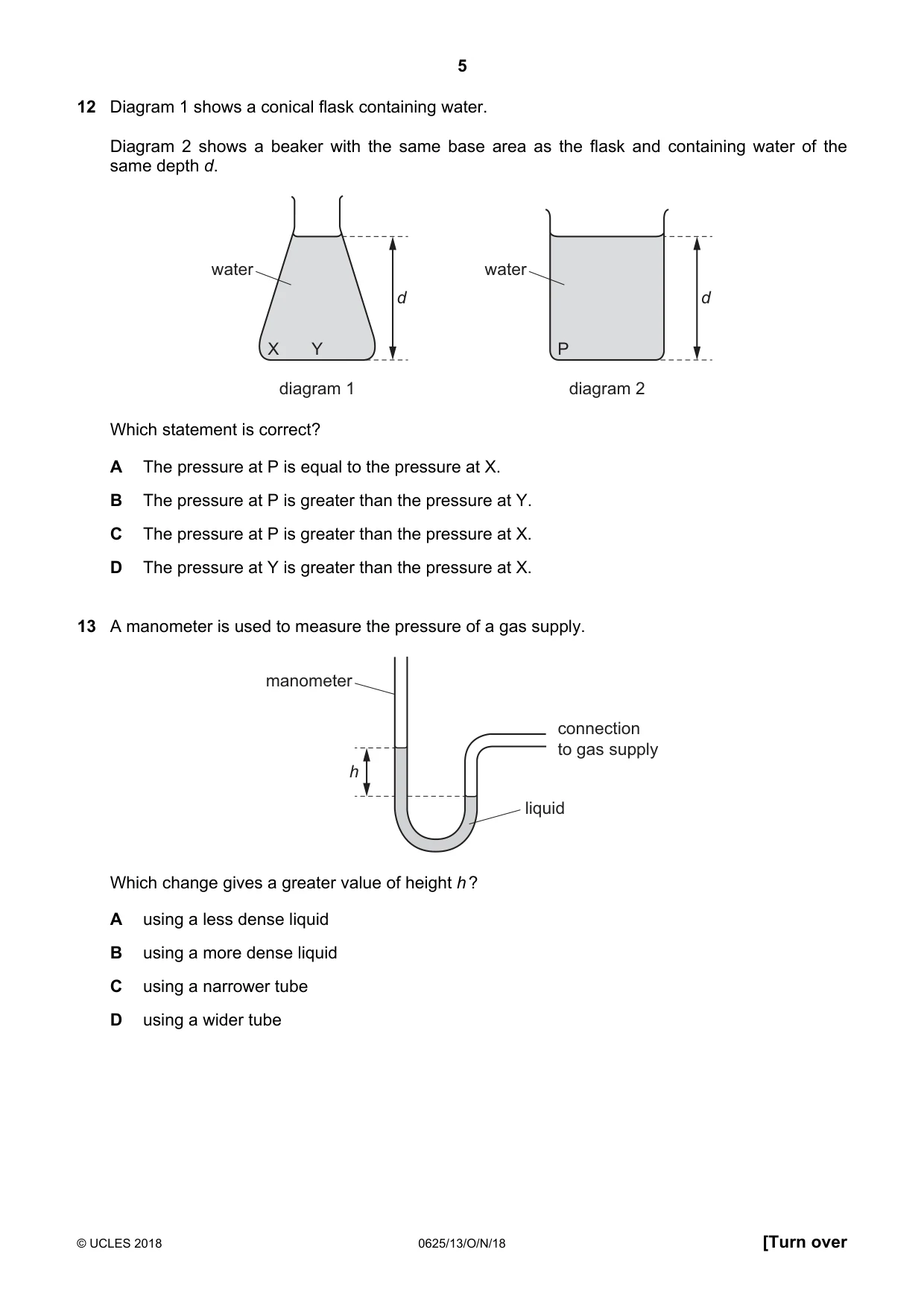
12 Diagram 1 shows a conical flask containing water. Diagram 2 shows a beaker with the same base area as the flask and containing water of the same depth d. water water d d X Y P diagram 1 diagram 2 Which statement is correct? A The pressure at P is equal to the pressure at X. B The pressure at P is greater than the pressure at Y. C The pressure at P is greater than the pressure at X. D The pressure at Y is greater than the pressure at X.
Mark scheme: A
Q13 · A manometer is used to measure the pressure of a gas supply
13 A manometer is used to measure the pressure of a gas supply. manometer connection to gas supply h liquid Which change gives a greater value of height h ? A using a less dense liquid B using a more dense liquid C using a narrower tube D using a wider tube
Mark scheme: A
Q14 · Liquid in a dish evaporates
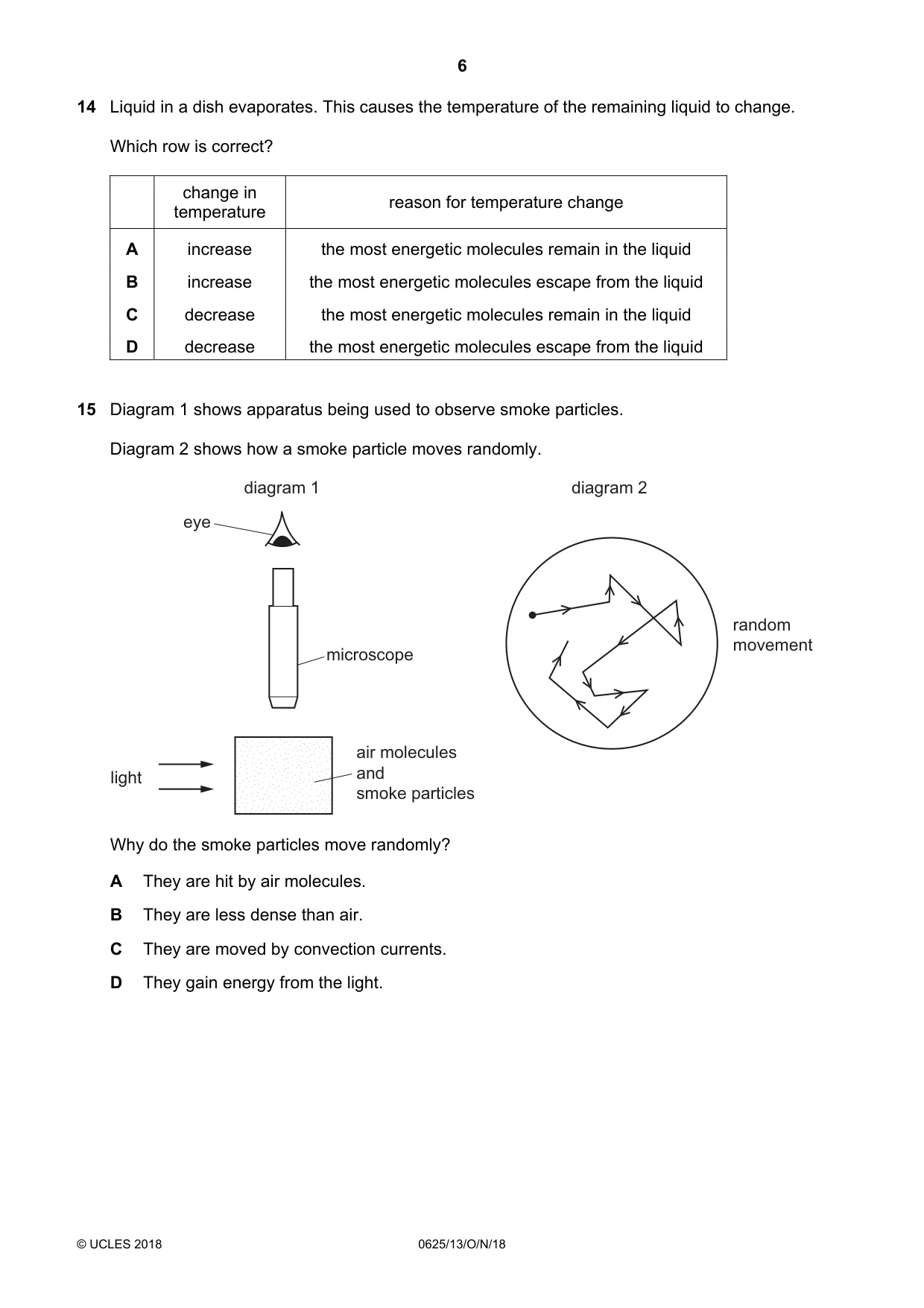
14 Liquid in a dish evaporates. This causes the temperature of the remaining liquid to change. Which row is correct? change in reason for temperature change temperature A increase the most energetic molecules remain in the liquid B increase the most energetic molecules escape from the liquid C decrease the most energetic molecules remain in the liquid D decrease the most energetic molecules escape from the liquid
Mark scheme: D
Q15 · Apparatus being used to observe smoke particles
15 Diagram 1 shows apparatus being used to observe smoke particles. Diagram 2 shows how a smoke particle moves randomly. diagram 1 diagram 2 eye random movement microscope air molecules light and smoke particles Why do the smoke particles move randomly? A They are hit by air molecules. B They are less dense than air. C They are moved by convection currents. D They gain energy from the light.
Mark scheme: A
Q16 · Which row shows the relative order of thermal expansion of solids, liquids and gases?
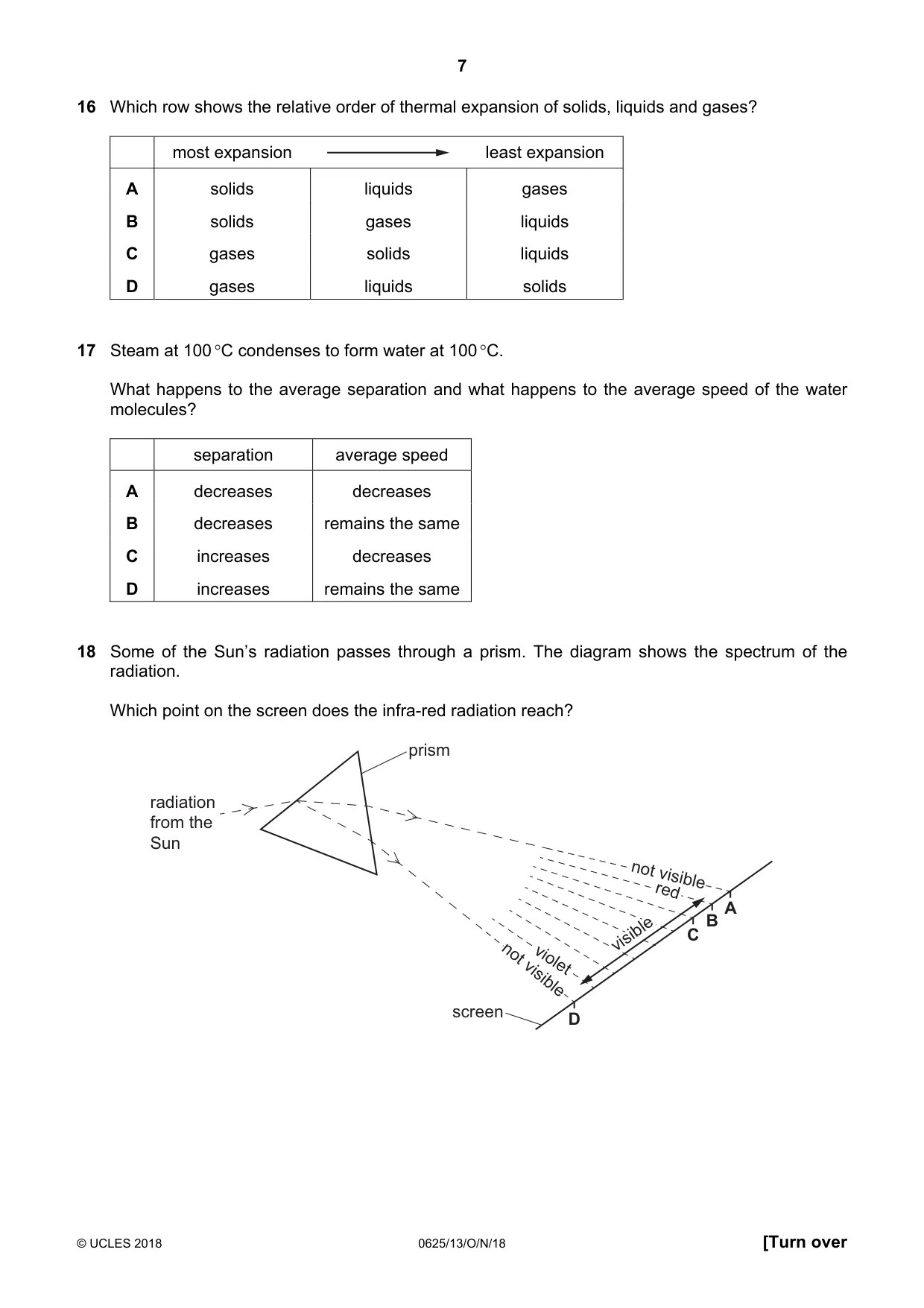
16 Which row shows the relative order of thermal expansion of solids, liquids and gases? most expansion least expansion A solids liquids gases B solids gases liquids C gases solids liquids D gases liquids solids
Mark scheme: D
Q17 · Steam at 100 °C condenses to form water at 100 °C
17 Steam at 100 °C condenses to form water at 100 °C. What happens to the average separation and what happens to the average speed of the water molecules? separation average speed A decreases decreases B decreases remains the same C increases decreases D increases remains the same
Mark scheme: B
Q18 · Some of the Sun’s radiation passes through a prism
18 Some of the Sun’s radiation passes through a prism. The diagram shows the spectrum of the radiation. Which point on the screen does the infra-red radiation reach? prism radiation from the Sun not visible red A visible B C not visible violet screen D
Mark scheme: A
Q19 · One end of a shiny metal rod is heated and the other end quickly gets hot
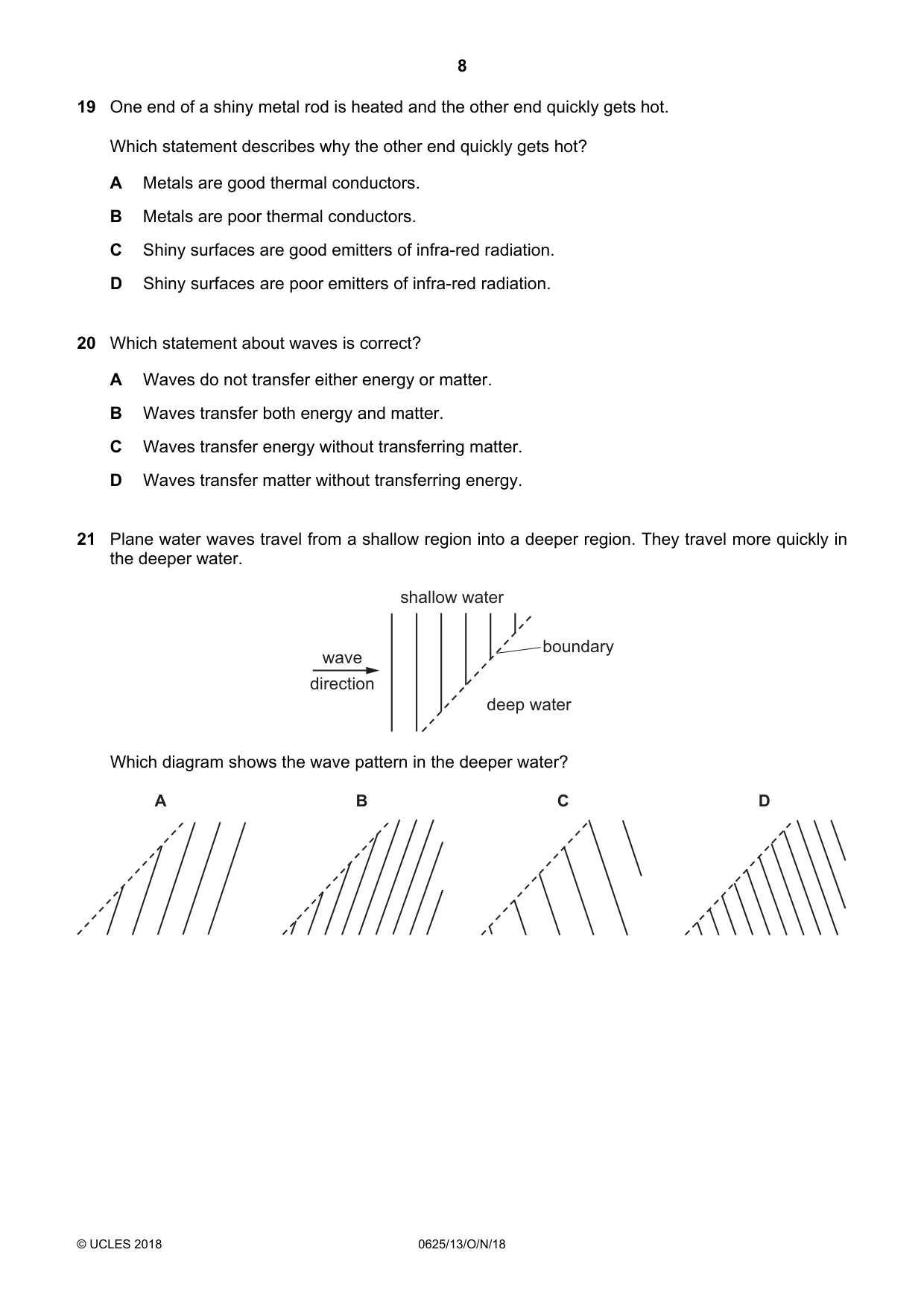
19 One end of a shiny metal rod is heated and the other end quickly gets hot. Which statement describes why the other end quickly gets hot? A Metals are good thermal conductors. B Metals are poor thermal conductors. C Shiny surfaces are good emitters of infra-red radiation. D Shiny surfaces are poor emitters of infra-red radiation.
Mark scheme: A
Q20 · Which statement about waves is correct?
20 Which statement about waves is correct? A Waves do not transfer either energy or matter. B Waves transfer both energy and matter. C Waves transfer energy without transferring matter. D Waves transfer matter without transferring energy.
Mark scheme: C
Q21 · Plane water waves travel from a shallow region into a deeper region
21 Plane water waves travel from a shallow region into a deeper region. They travel more quickly in the deeper water. shallow water boundary wave direction deep water Which diagram shows the wave pattern in the deeper water? A B C D
Mark scheme: C
Q22 · A plane mirror is fixed so that it is at an angle of 45° to a table
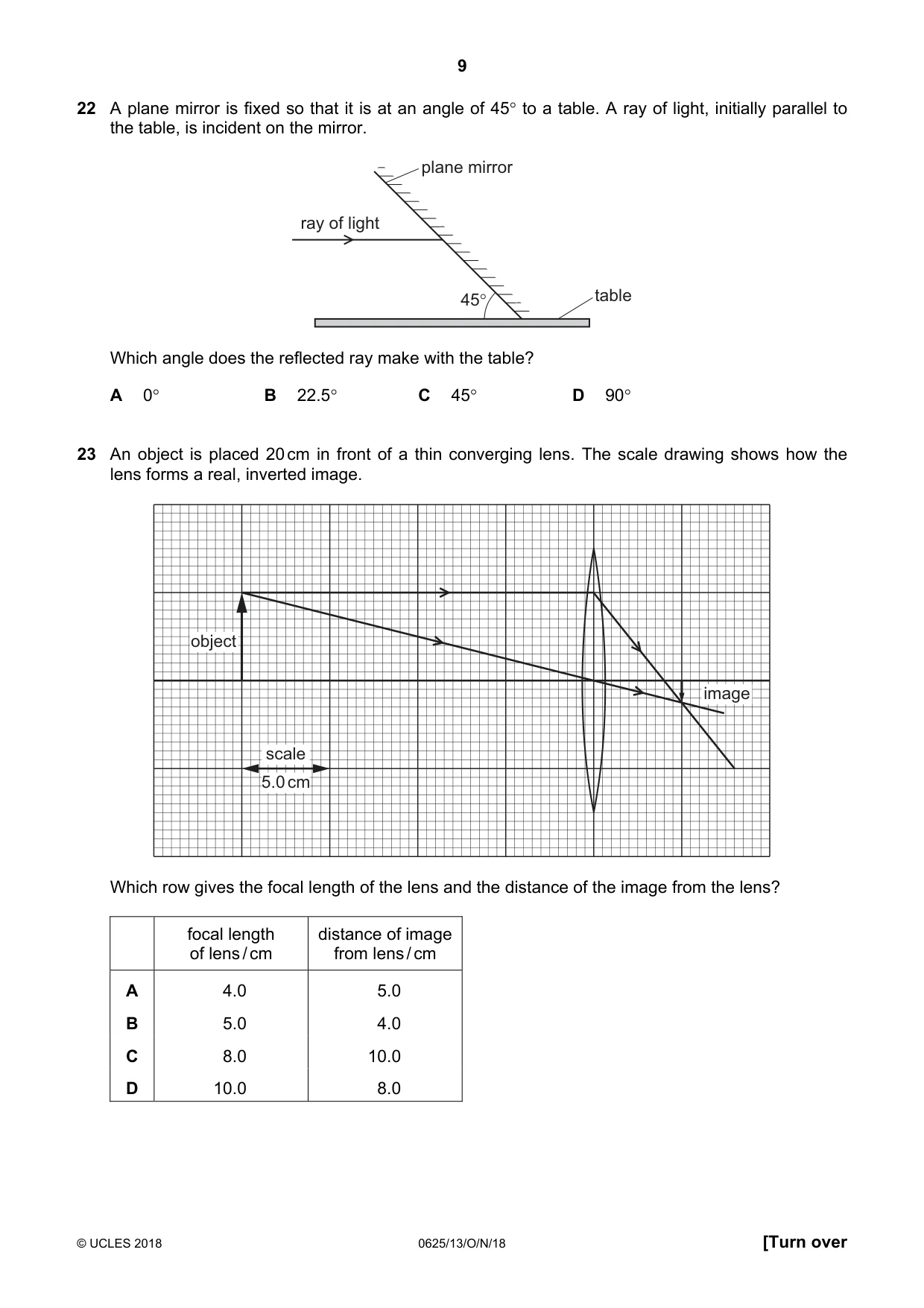
22 A plane mirror is fixed so that it is at an angle of 45° to a table. A ray of light, initially parallel to the table, is incident on the mirror. plane mirror ray of light 45° table Which angle does the reflected ray make with the table? A 0° B 22.5° C 45° D 90°
Mark scheme: D
Q23 · An object is placed 20 cm in front of a thin converging lens
23 An object is placed 20 cm in front of a thin converging lens. The scale drawing shows how the lens forms a real, inverted image. object image scale 5.0 cm Which row gives the focal length of the lens and the distance of the image from the lens? focal length distance of image of lens / cm from lens / cm A 4.0 5.0 B 5.0 4.0 C 8.0 10.0 D 10.0 8.0
Mark scheme: A
Q24 · Different parts of the electromagnetic spectrum are used for different purposes
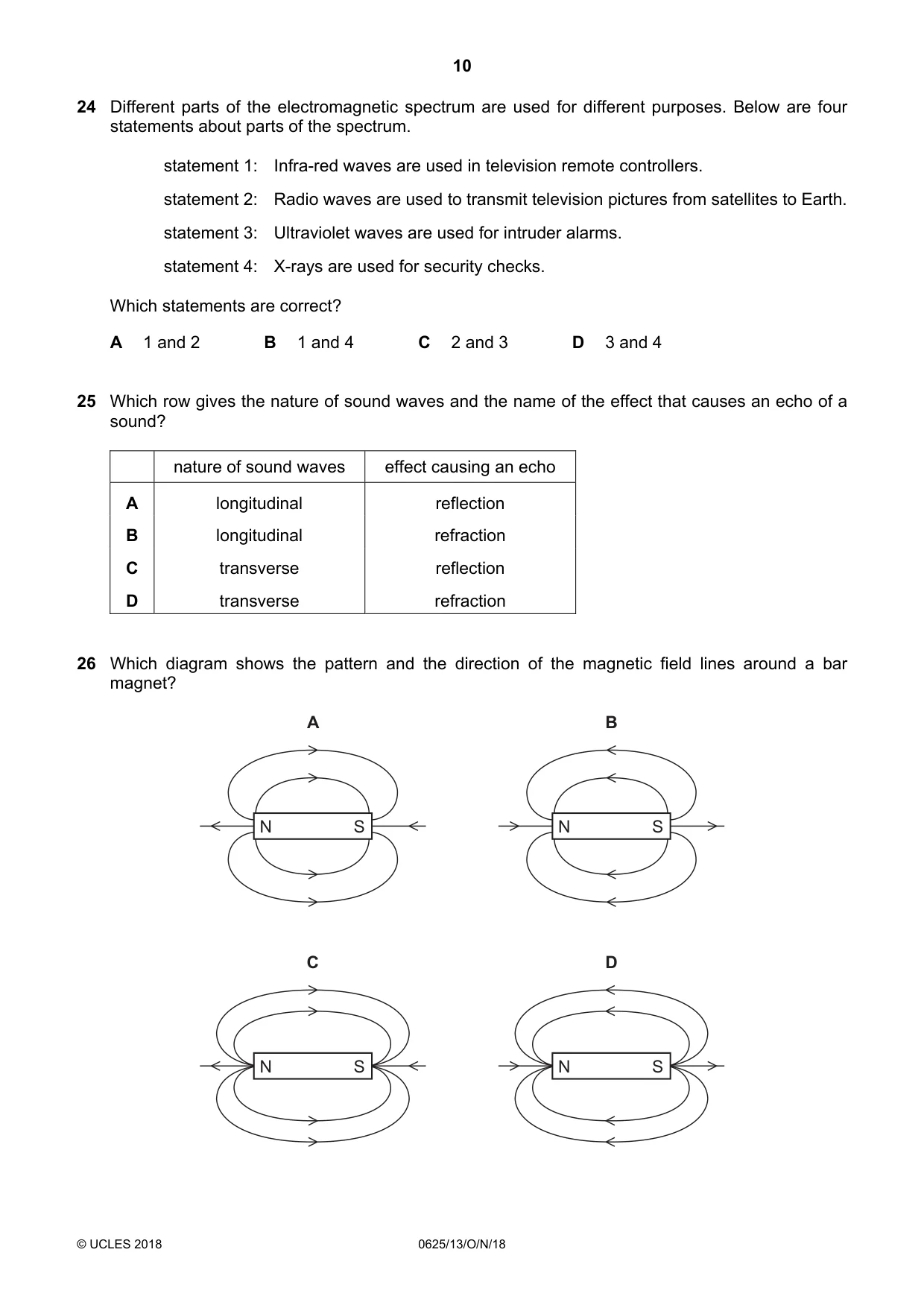
24 Different parts of the electromagnetic spectrum are used for different purposes. Below are four statements about parts of the spectrum. statement 1: Infra-red waves are used in television remote controllers. statement 2: Radio waves are used to transmit television pictures from satellites to Earth. statement 3: Ultraviolet waves are used for intruder alarms. statement 4: X-rays are used for security checks. Which statements are correct? A 1 and 2 B 1 and 4 C 2 and 3 D 3 and 4
Mark scheme: B
Q25 · Which row gives the nature of sound waves and the name of the effect that causes an echo…
25 Which row gives the nature of sound waves and the name of the effect that causes an echo of a sound? nature of sound waves effect causing an echo A longitudinal reflection B longitudinal refraction C transverse reflection D transverse refraction
Mark scheme: A
Q26 · Which diagram shows the pattern and the direction of the magnetic field lines around a…
26 Which diagram shows the pattern and the direction of the magnetic field lines around a bar magnet? A B N S N S C D N S N S
Mark scheme: A
Q27 · The diagram shows part of a circuit which contains an ammeter, a voltmeter and a resistor…
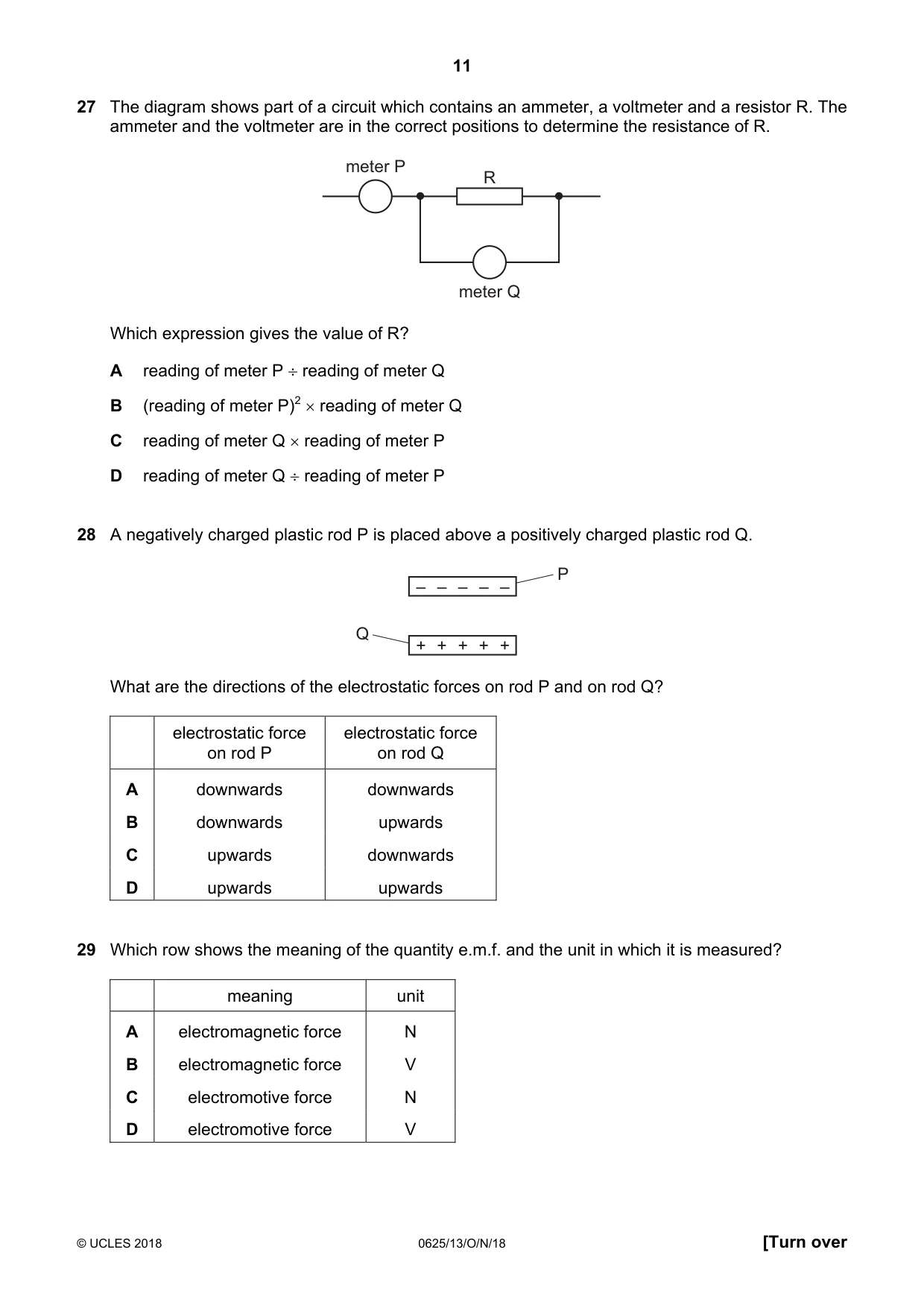
27 The diagram shows part of a circuit which contains an ammeter, a voltmeter and a resistor R. The ammeter and the voltmeter are in the correct positions to determine the resistance of R. meter P R meter Q Which expression gives the value of R? A reading of meter P ÷ reading of meter Q B (reading of meter P)2 × reading of meter Q C reading of meter Q × reading of meter P D reading of meter Q ÷ reading of meter P
Mark scheme: D
Q28 · A negatively charged plastic rod P is placed above a positively charged plastic rod Q
28 A negatively charged plastic rod P is placed above a positively charged plastic rod Q. P – – – – – Q + + + + + What are the directions of the electrostatic forces on rod P and on rod Q? electrostatic force electrostatic force on rod P on rod Q A downwards downwards B downwards upwards C upwards downwards D upwards upwards
Mark scheme: B
Q29 · Which row shows the meaning of the quantity e.m.f
29 Which row shows the meaning of the quantity e.m.f. and the unit in which it is measured? meaning unit A electromagnetic force N B electromagnetic force V C electromotive force N D electromotive force V
Mark scheme: D
Q30 · A voltmeter that is not connected to anything
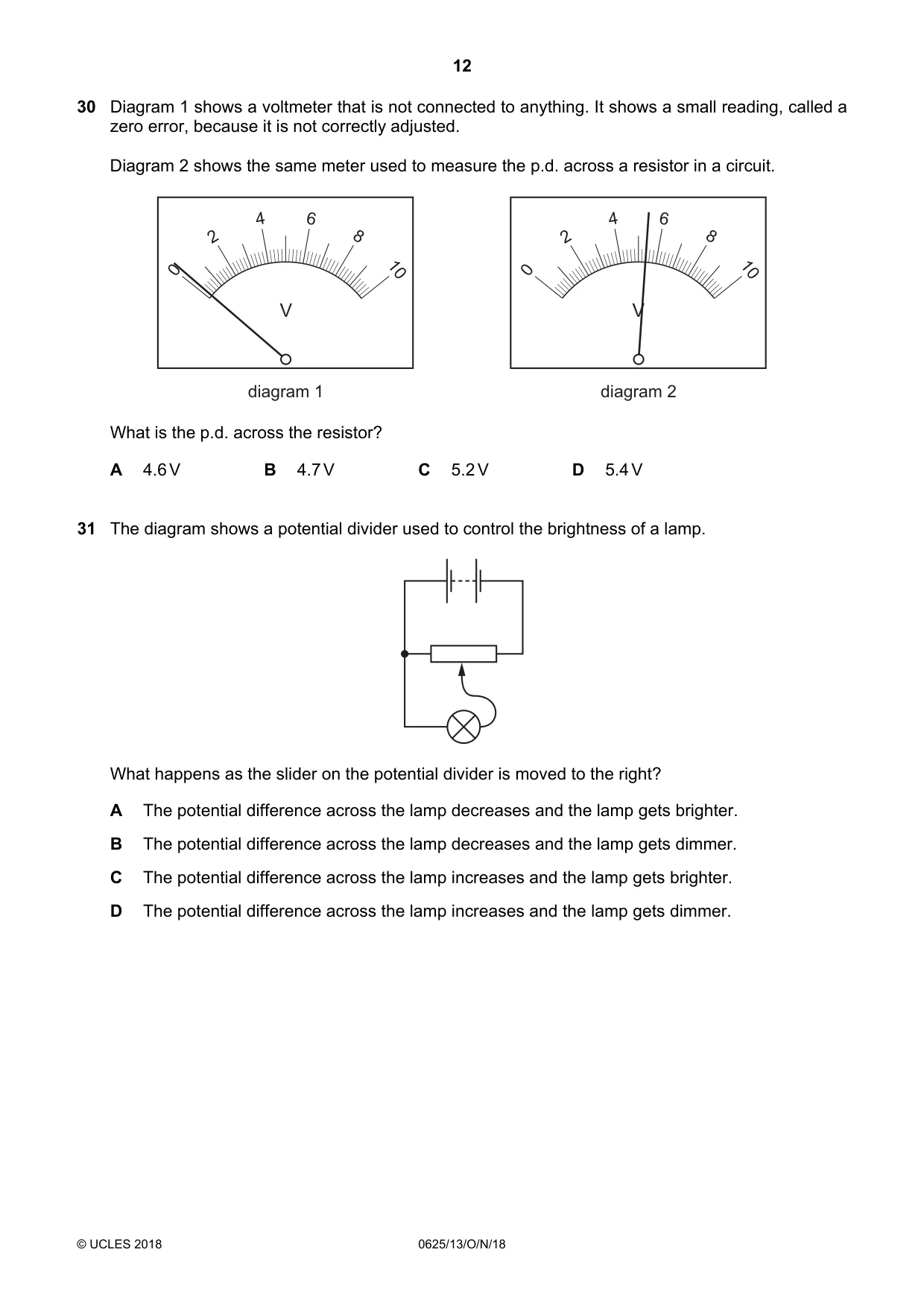
30 Diagram 1 shows a voltmeter that is not connected to anything. It shows a small reading, called a zero error, because it is not correctly adjusted. Diagram 2 shows the same meter used to measure the p.d. across a resistor in a circuit. 4 6 4 6 2 8 2 8 0 10 0 10 V V diagram 1 diagram 2 What is the p.d. across the resistor? A 4.6 V B 4.7 V C 5.2 V D 5.4 V
Mark scheme: C
More questions on Physical quantities and measurement techniques
Q31 · The diagram shows a potential divider used to control the brightness of a lamp
31 The diagram shows a potential divider used to control the brightness of a lamp. What happens as the slider on the potential divider is moved to the right? A The potential difference across the lamp decreases and the lamp gets brighter. B The potential difference across the lamp decreases and the lamp gets dimmer. C The potential difference across the lamp increases and the lamp gets brighter. D The potential difference across the lamp increases and the lamp gets dimmer.
Mark scheme: C
Q32 · The diagram shows three identical resistors connected to a battery
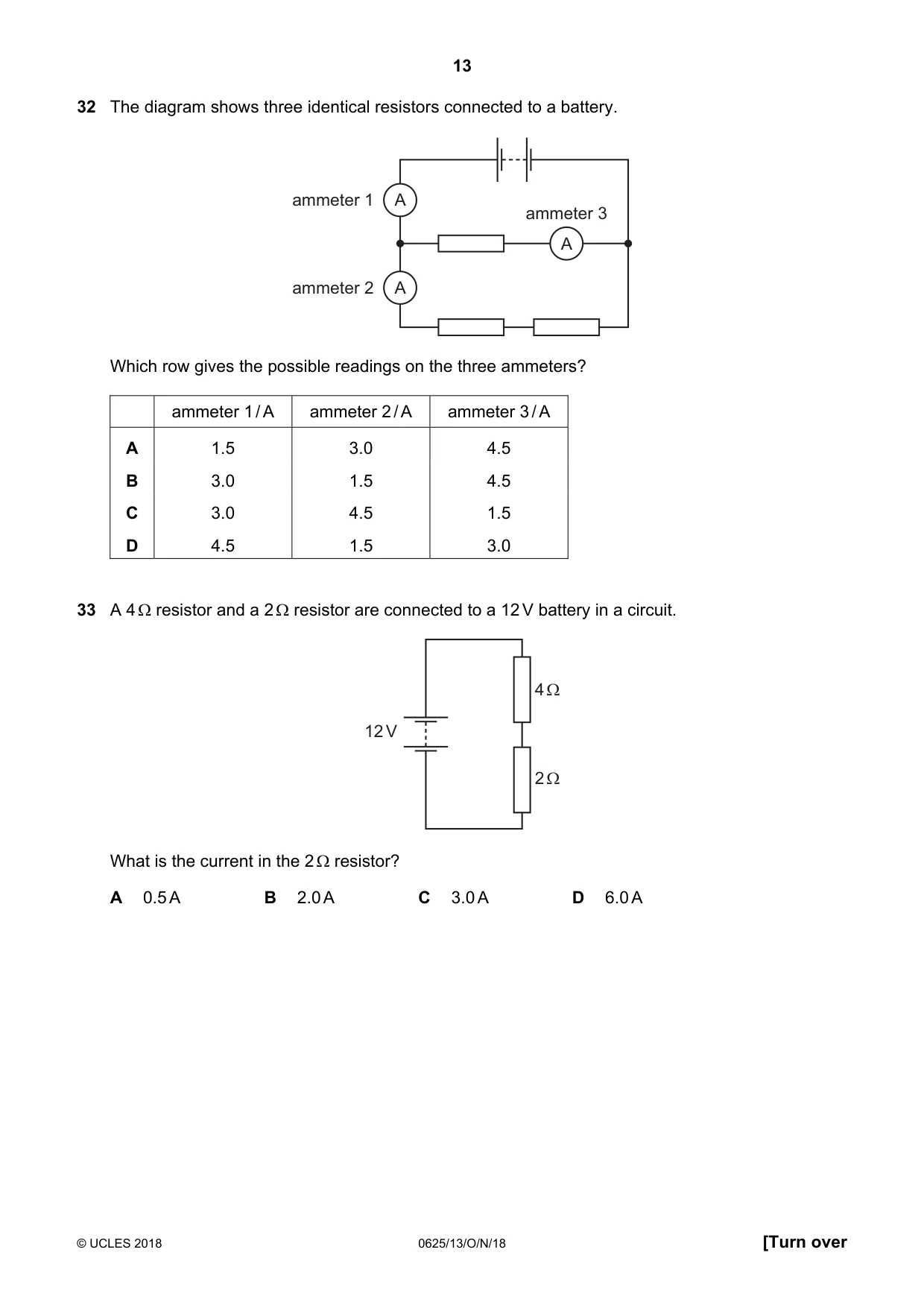
32 The diagram shows three identical resistors connected to a battery. ammeter 1 A ammeter 3 A ammeter 2 A Which row gives the possible readings on the three ammeters? ammeter 1 / A ammeter 2 / A ammeter 3 / A A 1.5 3.0 4.5 B 3.0 1.5 4.5 C 3.0 4.5 1.5 D 4.5 1.5 3.0
Mark scheme: D
Q33 · A 4 Ω resistor and a 2 Ω resistor are connected to a 12 V battery in a circuit
33 A 4 Ω resistor and a 2 Ω resistor are connected to a 12 V battery in a circuit. 4 Ω 12 V 2 Ω What is the current in the 2 Ω resistor? A 0.5 A B 2.0 A C 3.0 A D 6.0 A
Mark scheme: B
Q34 · Either a fuse or a circuit-breaker can be used to protect electrical cables from large…
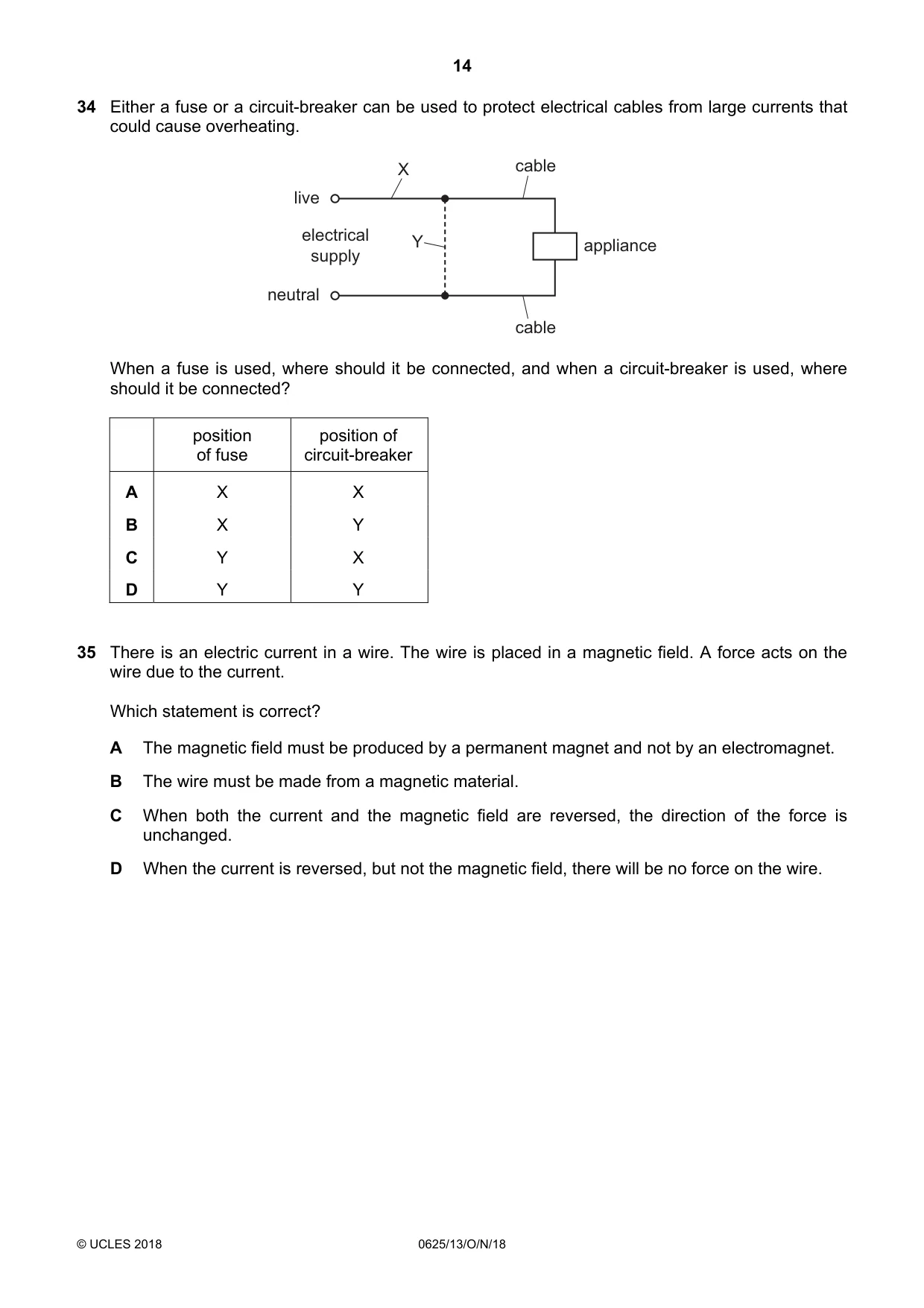
34 Either a fuse or a circuit-breaker can be used to protect electrical cables from large currents that could cause overheating. X cable live electrical Y appliance supply neutral cable When a fuse is used, where should it be connected, and when a circuit-breaker is used, where should it be connected? position position of of fuse circuit-breaker A X X B X Y C Y X D Y Y
Mark scheme: A
Q35 · There is an electric current in a wire
35 There is an electric current in a wire. The wire is placed in a magnetic field. A force acts on the wire due to the current. Which statement is correct? A The magnetic field must be produced by a permanent magnet and not by an electromagnet. B The wire must be made from a magnetic material. C When both the current and the magnetic field are reversed, the direction of the force is unchanged. D When the current is reversed, but not the magnetic field, there will be no force on the wire.
Mark scheme: C
Q36 · Which diagram shows the pattern and direction of the magnetic field due to a current in a…
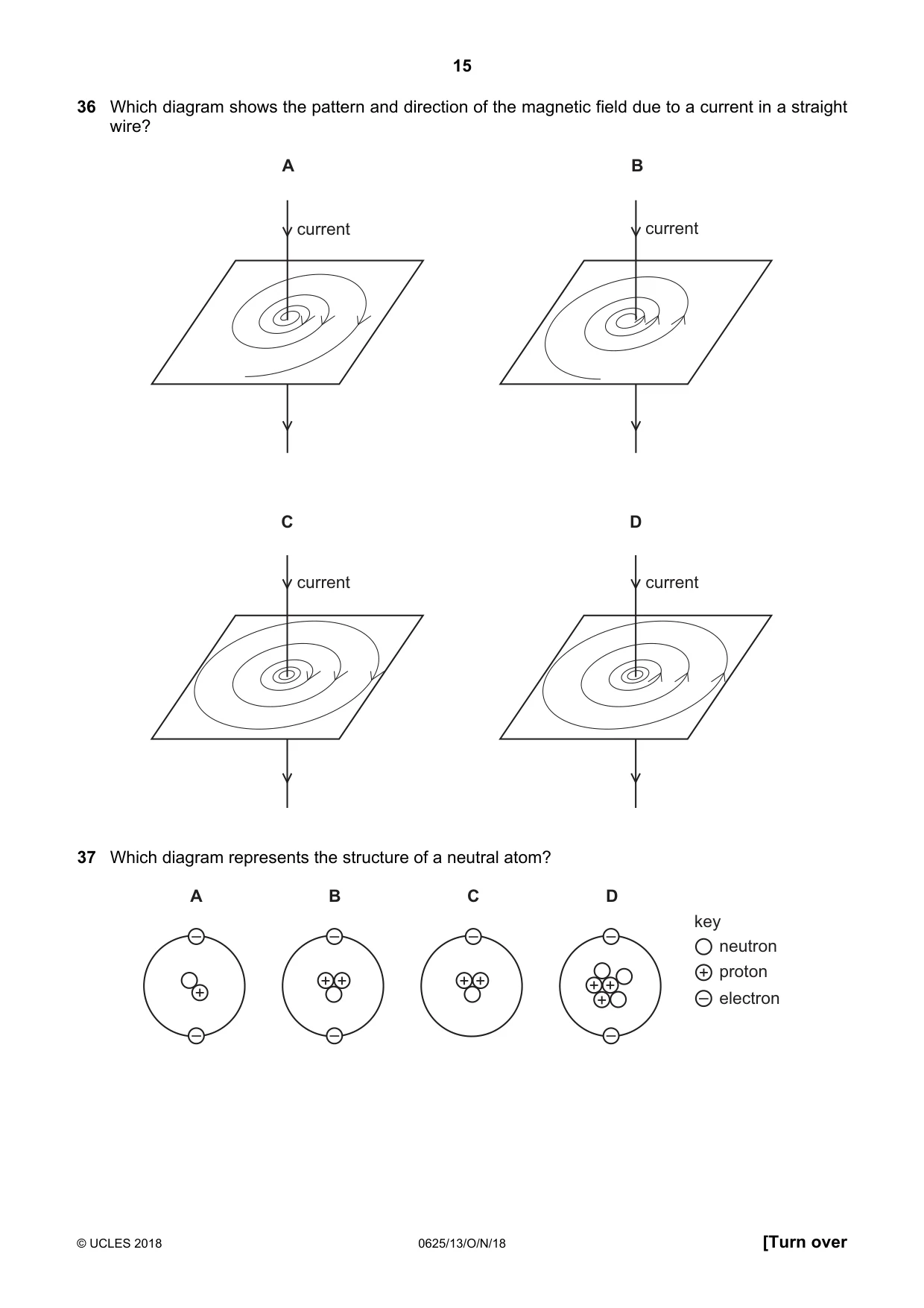
36 Which diagram shows the pattern and direction of the magnetic field due to a current in a straight wire? A B current current C D current current
Mark scheme: C
Q37 · Which diagram represents the structure of a neutral atom?
37 Which diagram represents the structure of a neutral atom? A B C D key – – – – neutron + proton + + + + + + + + – electron – – –
Mark scheme: B
Q38 · What is a carbon nucleus, 12 C , composed of?
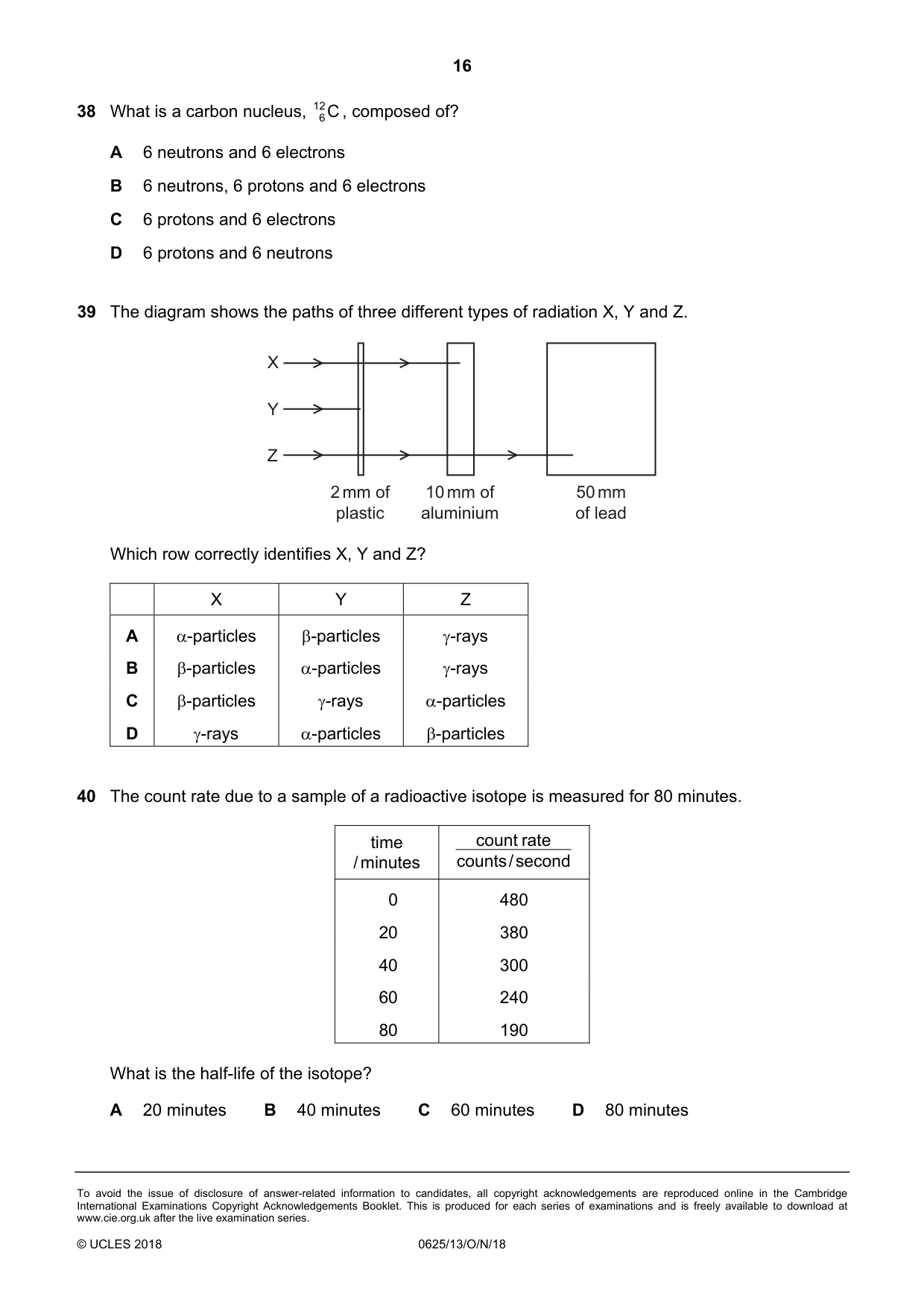
38 What is a carbon nucleus, 12 C , composed of? 6 A 6 neutrons and 6 electrons B 6 neutrons, 6 protons and 6 electrons C 6 protons and 6 electrons D 6 protons and 6 neutrons
Mark scheme: D
Q39 · The diagram shows the paths of three different types of radiation X, Y and Z
39 The diagram shows the paths of three different types of radiation X, Y and Z. X Y Z 2 mm of 10 mm of 50 mm plastic aluminium of lead Which row correctly identifies X, Y and Z? X Y Z A α-particles β-particles γ-rays B β-particles α-particles γ-rays C β-particles γ-rays α-particles D γ-rays α-particles β-particles
Mark scheme: B
Q40 · The count rate due to a sample of a radioactive isotope is measured for 80 minutes
40 The count rate due to a sample of a radioactive isotope is measured for 80 minutes. time count rate / minutes counts / second 0 480 20 380 40 300 60 240 80 190 What is the half-life of the isotope? A 20 minutes B 40 minutes C 60 minutes D 80 minutes
Mark scheme: C
What was in this paper
The subtopics covered by these 40 questions, and how many questions each got. Open one in a new tab to see every Cambridge question on it.
4Electric circuits3Electrical quantities3Kinetic particle model of matter3Electromagnetic effects2Electromagnetic spectrum2Energy, work and power2General properties of waves2Light2Motion2Physical quantities and measurement techniques2Pressure2Radioactivity2The nuclear model of the atom2Density1Electrical safety1Mass and weight1Simple phenomena of magnetism1Sound1Thermal properties and temperature1Transfer of thermal energy1What you needed in this session
Cambridge’s own grade thresholds for 2018 Oct/Nov, Paper 1 · Variant 3. A higher threshold means an easier paper — the bar moves with how the cohort did.