Cambridge IGCSE Physics 0625 — 2025 Feb/March Paper 1 · Variant 2
0625/12/F/M/25 · 40 questions · 40 marks · ≈45 min
The question paper and its mark scheme, free to read here and free to download. This is Cambridge’s own paper, exactly as it was sat.
Question paper16 pages
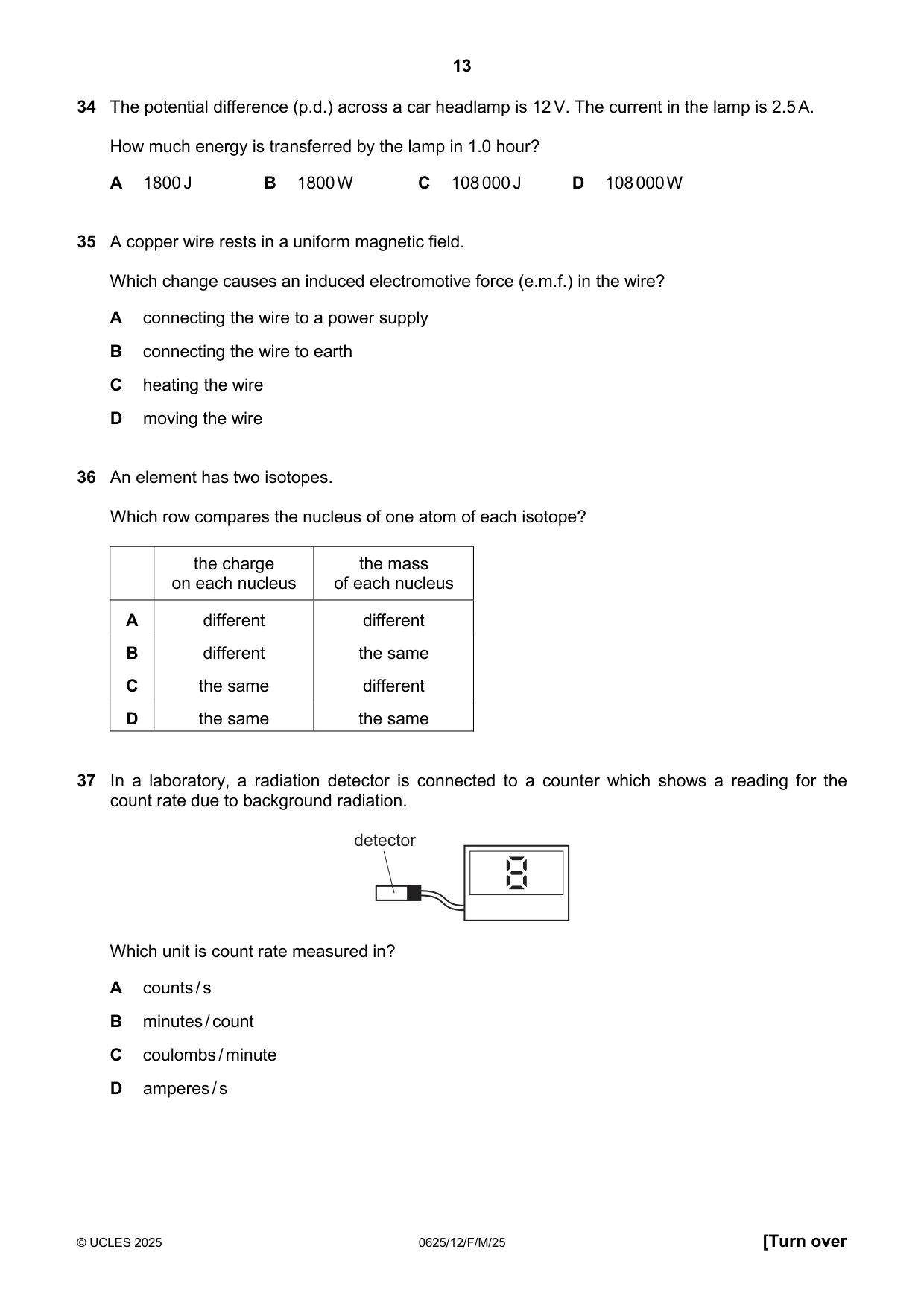
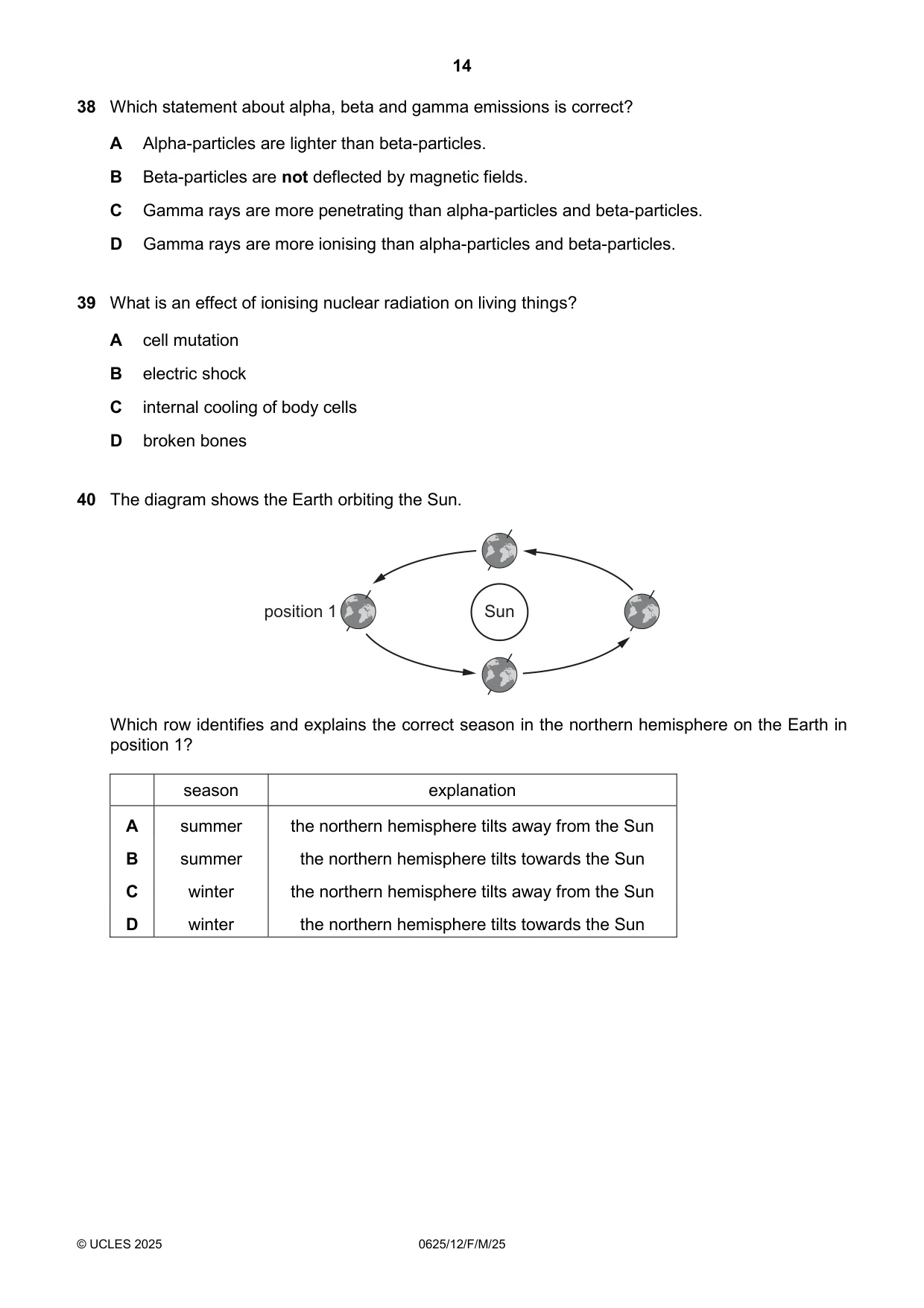

Mark scheme3 pages
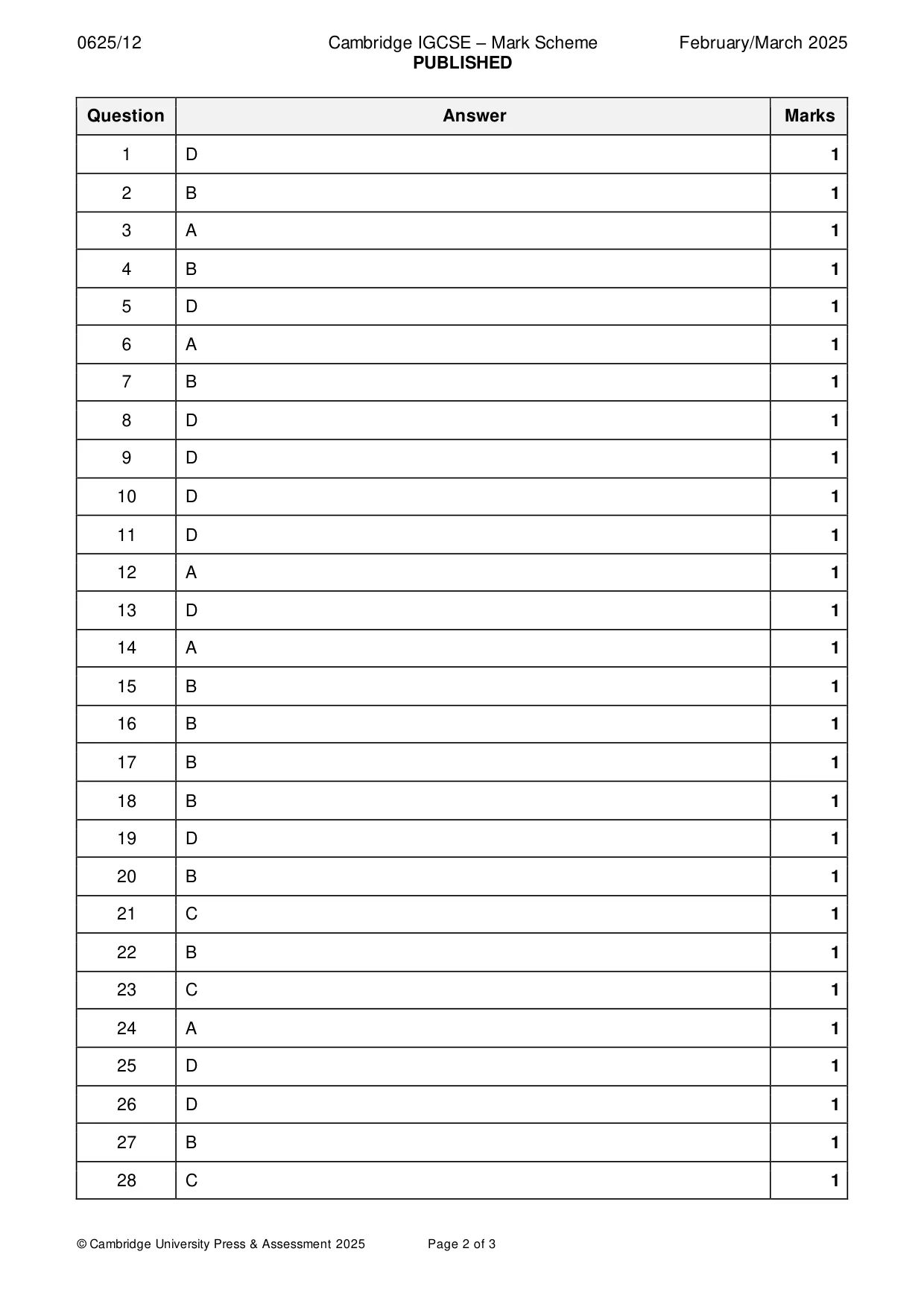
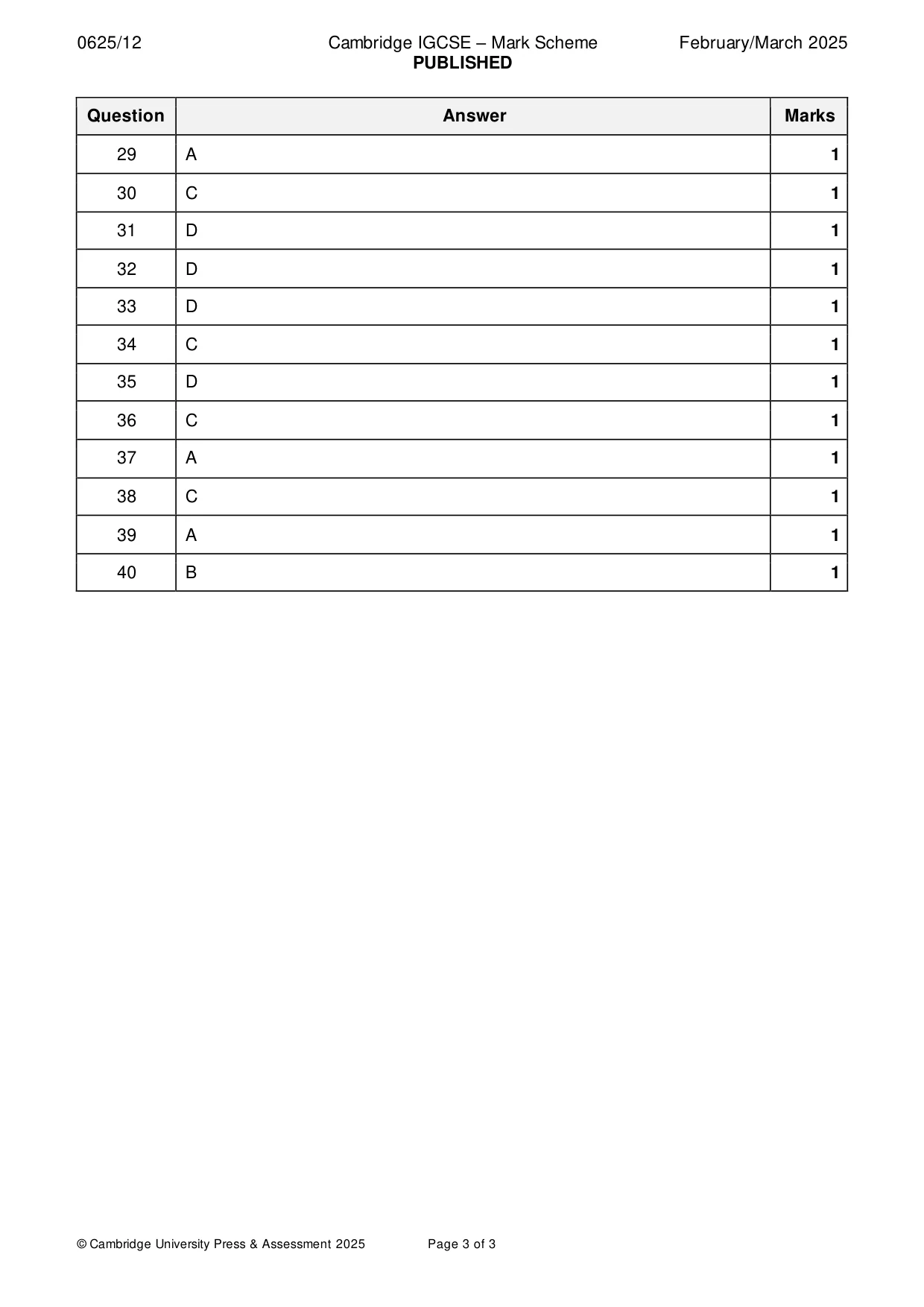
Answers below. Sit the paper first if you are practising.
Questions as text
Q1 · A student is asked to find the volume of a small irregularly shaped piece of rock
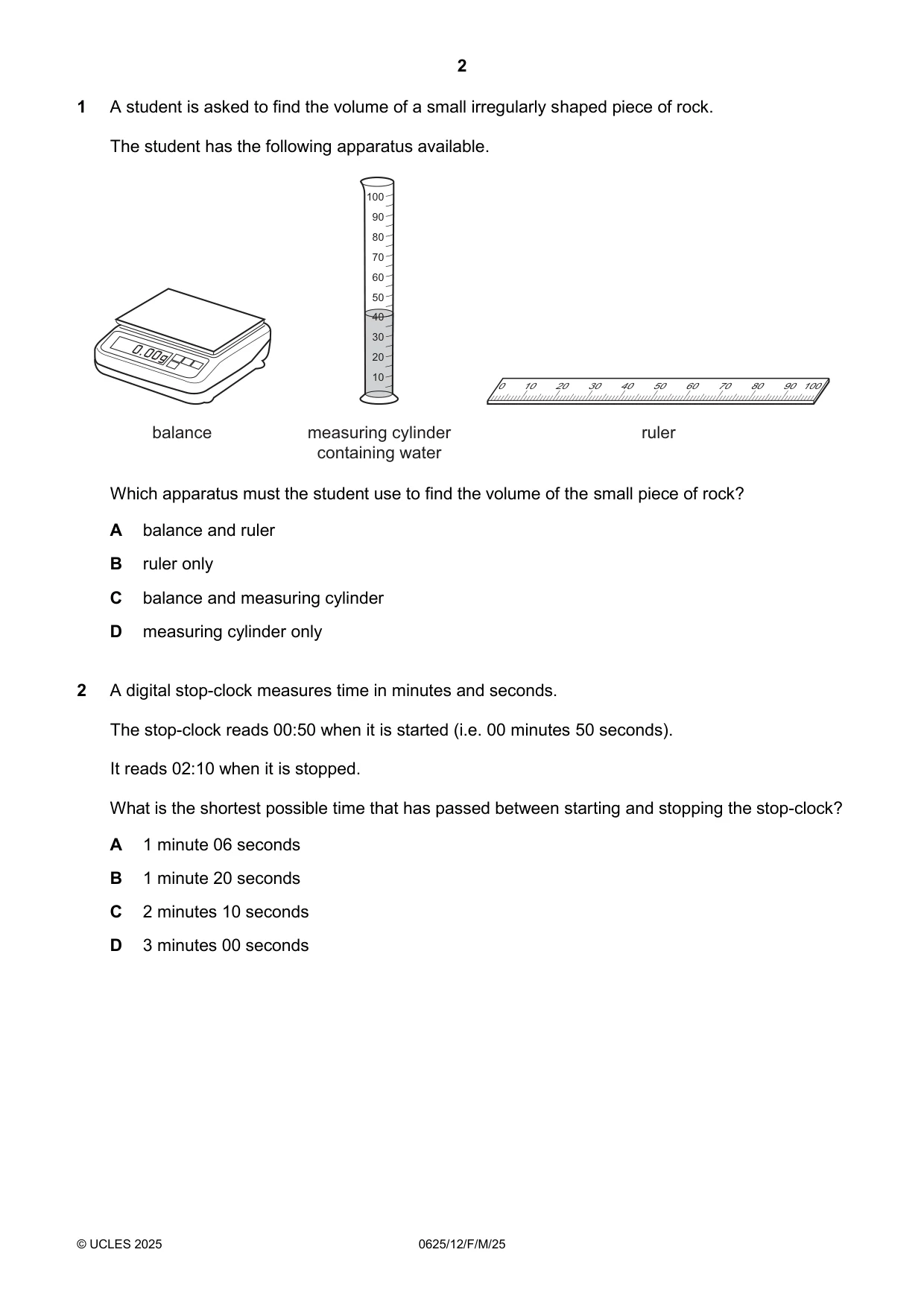
1 A student is asked to find the volume of a small irregularly shaped piece of rock. The student has the following apparatus available. 100 90 80 70 60 50 40 30 20 10 0 10 20 30 40 50 60 70 80 90 100 balance measuring cylinder ruler containing water Which apparatus must the student use to find the volume of the small piece of rock? A balance and ruler B ruler only C balance and measuring cylinder D measuring cylinder only
Mark scheme: D
Q2 · A digital stop-clock measures time in minutes and seconds
2 A digital stop-clock measures time in minutes and seconds. The stop-clock reads 00:50 when it is started (i.e. 00 minutes 50 seconds). It reads 02:10 when it is stopped. What is the shortest possible time that has passed between starting and stopping the stop-clock? A 1 minute 06 seconds B 1 minute 20 seconds C 2 minutes 10 seconds D 3 minutes 00 seconds
Mark scheme: B
More questions on Physical quantities and measurement techniques
Q3 · Four students are instructed to find the time it takes for a ball bearing to fall through…
3 Four students are instructed to find the time it takes for a ball bearing to fall through a vertical height of 1.0 m. Each student uses a different procedure. Which student follows the correct procedure? A The student measures the time taken for the ball to fall 1.0 m five times. He then adds the times taken together and divides by five. B The student measures the time taken for the ball to fall 1.0 m five times. He then multiplies the times taken together and divides by five. C The student measures the time taken for the ball to fall 2.0 m. He then divides the time taken by two. D The student measures the time taken for the ball to fall 2.0 m five times. He then adds the times taken together and divides by ten.
Mark scheme: A
Q4 · The graph shows the motion of a car for a 5-second period
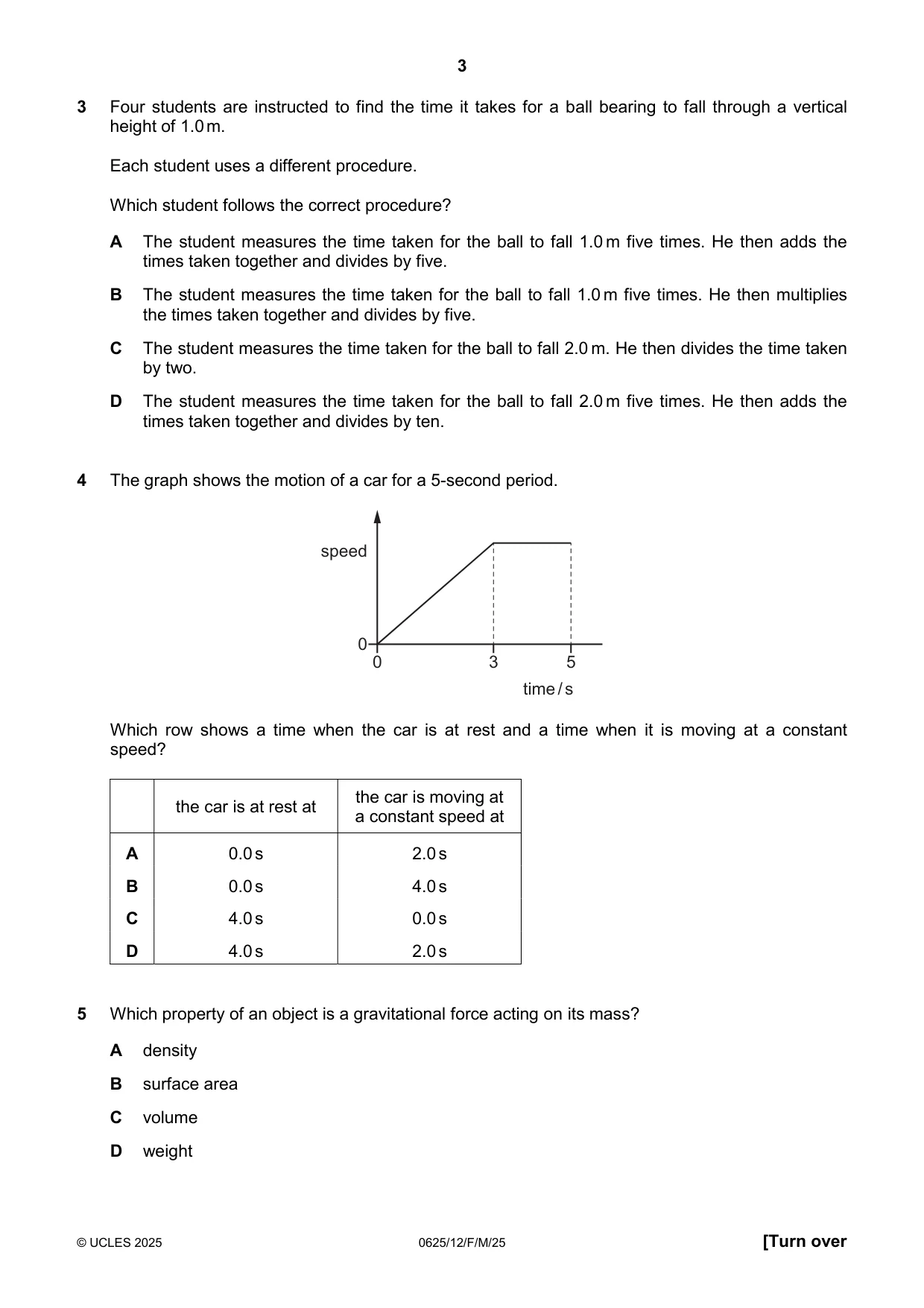
4 The graph shows the motion of a car for a 5-second period. speed 0 0 3 5 time / s Which row shows a time when the car is at rest and a time when it is moving at a constant speed? the car is moving at the car is at rest at a constant speed at A 0.0 s 2.0 s B 0.0 s 4.0 s C 4.0 s 0.0 s D 4.0 s 2.0 s
Mark scheme: B
Q5 · Which property of an object is a gravitational force acting on its mass?
5 Which property of an object is a gravitational force acting on its mass? A density B surface area C volume D weight
Mark scheme: D
Q6 · A stone has a weight of 5.7 N
6 A stone has a weight of 5.7 N. The gravitational field strength g is 9.8 N / kg. What is the mass of the stone? A 0.58 kg B 5.7 kg C 56 kg D 550 kg
Mark scheme: A
Q7 · Which equation is correct?
7 Which equation is correct? accelerati on A mass = force B mass = density volume force C mass = impulse kinetic energy D mass = velocity 2
Mark scheme: B
Q8 · What is meant by the moment of a force?
8 What is meant by the moment of a force? A the magnitude of the force B the work done by the force C the time for which the force acts D the turning effect of the force
Mark scheme: D
Q9 · A mass of 20 kg is held stationary by a rope passing over a frictionless pulley
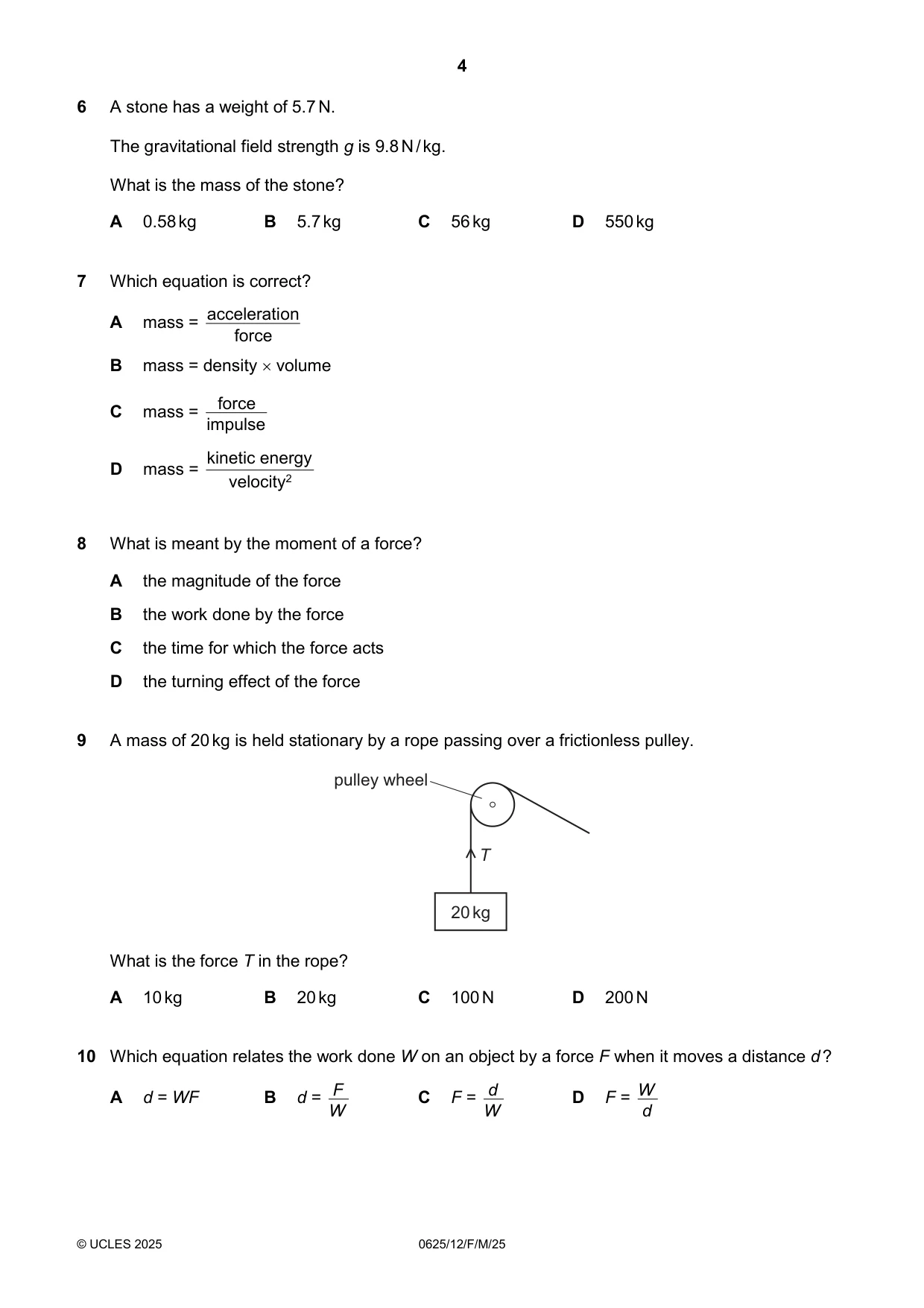
9 A mass of 20 kg is held stationary by a rope passing over a frictionless pulley. pulley wheel T 20 kg What is the force T in the rope? A 10 kg B 20 kg C 100 N D 200 N
Mark scheme: D
Q10 · Which equation relates the work done W on an object by a force F when it moves a distance…
10 Which equation relates the work done W on an object by a force F when it moves a distance d ? F d W A d = WF B d = W C F = W D F = d
Mark scheme: D
Q11 · A boy produces an average useful power output of 60 W as he rides his bicycle for 2.0…
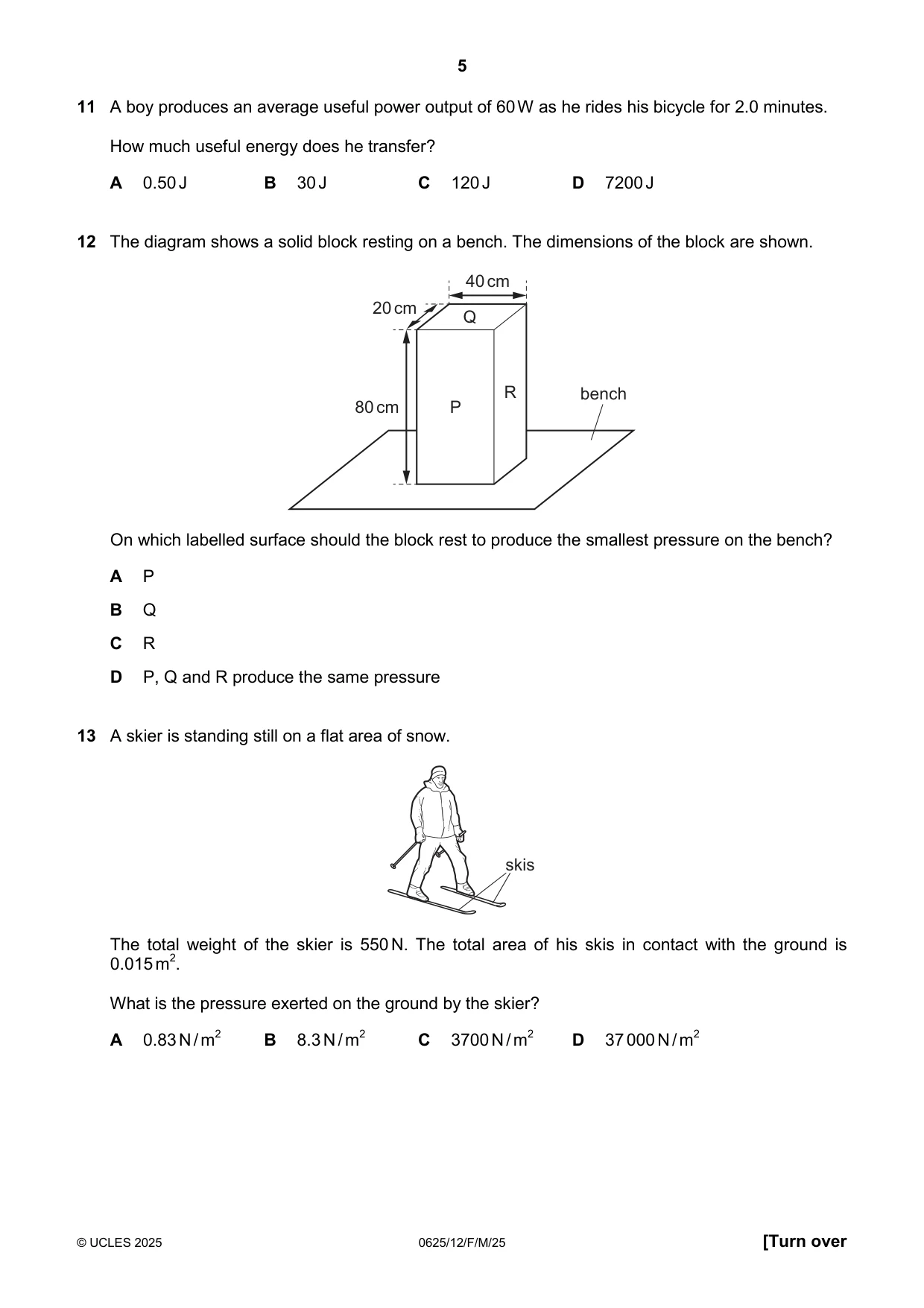
11 A boy produces an average useful power output of 60 W as he rides his bicycle for 2.0 minutes. How much useful energy does he transfer? A 0.50 J B 30 J C 120 J D 7200 J
Mark scheme: D
Q12 · The diagram shows a solid block resting on a bench
12 The diagram shows a solid block resting on a bench. The dimensions of the block are shown. 40 cm 20 cm Q R bench 80 cm P On which labelled surface should the block rest to produce the smallest pressure on the bench? A P B Q C R D P, Q and R produce the same pressure
Mark scheme: A
Q13 · A skier is standing still on a flat area of snow
13 A skier is standing still on a flat area of snow. skis The total weight of the skier is 550 N. The total area of his skis in contact with the ground is 0.015 m2. What is the pressure exerted on the ground by the skier? A 0.83 N / m2 B 8.3 N / m2 C 3700 N / m2 D 37 000 N / m2
Mark scheme: D
Q14 · A force acts on an area to produce a pressure
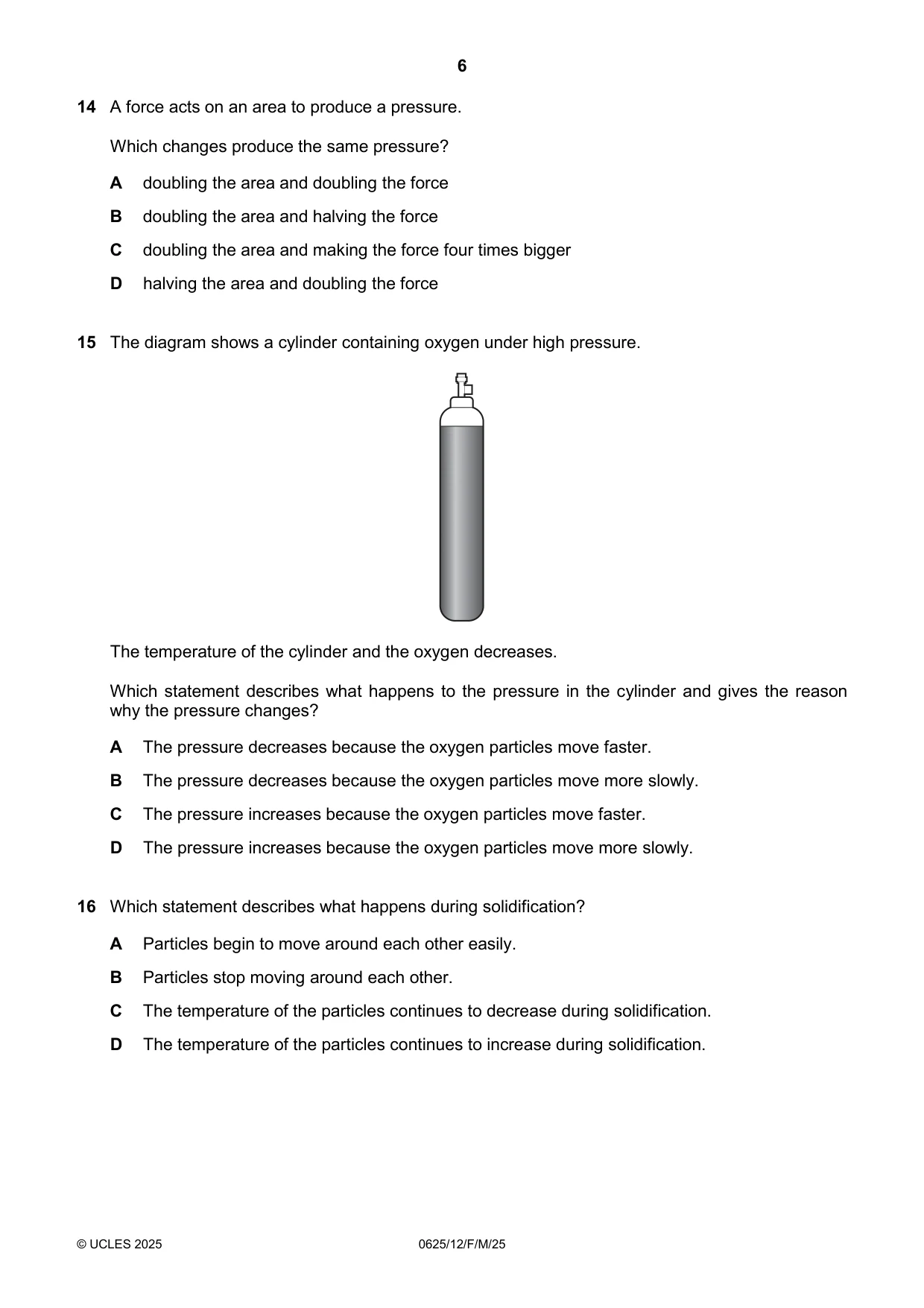
14 A force acts on an area to produce a pressure. Which changes produce the same pressure? A doubling the area and doubling the force B doubling the area and halving the force C doubling the area and making the force four times bigger D halving the area and doubling the force
Mark scheme: A
Q15 · The diagram shows a cylinder containing oxygen under high pressure
15 The diagram shows a cylinder containing oxygen under high pressure. The temperature of the cylinder and the oxygen decreases. Which statement describes what happens to the pressure in the cylinder and gives the reason why the pressure changes? A The pressure decreases because the oxygen particles move faster. B The pressure decreases because the oxygen particles move more slowly. C The pressure increases because the oxygen particles move faster. D The pressure increases because the oxygen particles move more slowly.
Mark scheme: B
Q16 · Which statement describes what happens during solidification?
16 Which statement describes what happens during solidification? A Particles begin to move around each other easily. B Particles stop moving around each other. C The temperature of the particles continues to decrease during solidification. D The temperature of the particles continues to increase during solidification.
Mark scheme: B
Q17 · Solids expand the ......1.....
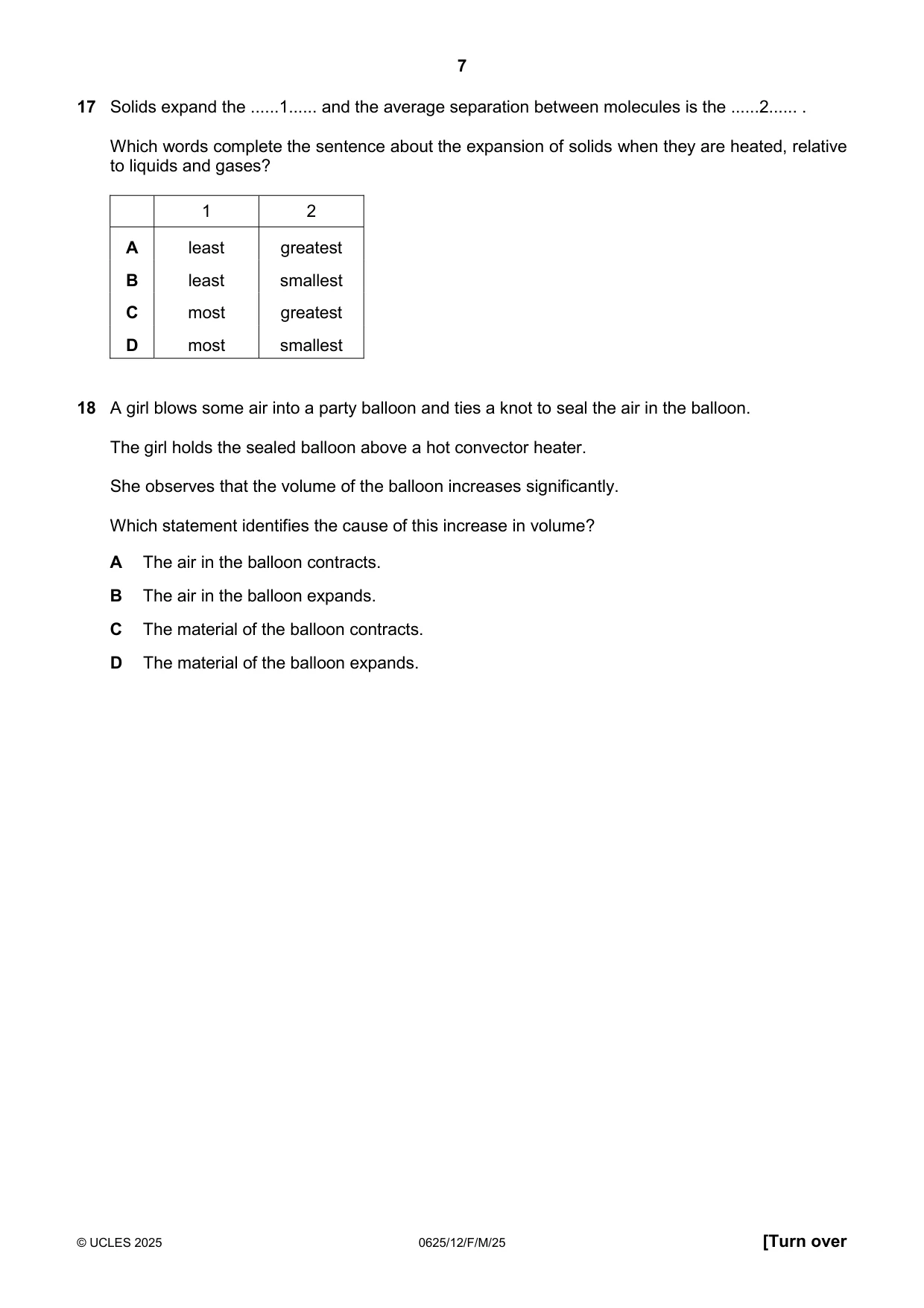
17 Solids expand the ......1...... and the average separation between molecules is the ......2...... . Which words complete the sentence about the expansion of solids when they are heated, relative to liquids and gases? 1 2 A least greatest B least smallest C most greatest D most smallest
Mark scheme: B
Q18 · A girl blows some air into a party balloon and ties a knot to seal the air in the balloon
18 A girl blows some air into a party balloon and ties a knot to seal the air in the balloon. The girl holds the sealed balloon above a hot convector heater. She observes that the volume of the balloon increases significantly. Which statement identifies the cause of this increase in volume? A The air in the balloon contracts. B The air in the balloon expands. C The material of the balloon contracts. D The material of the balloon expands.
Mark scheme: B
Q19 · The graph shows what happens to the density of a substance as its temperature changes…
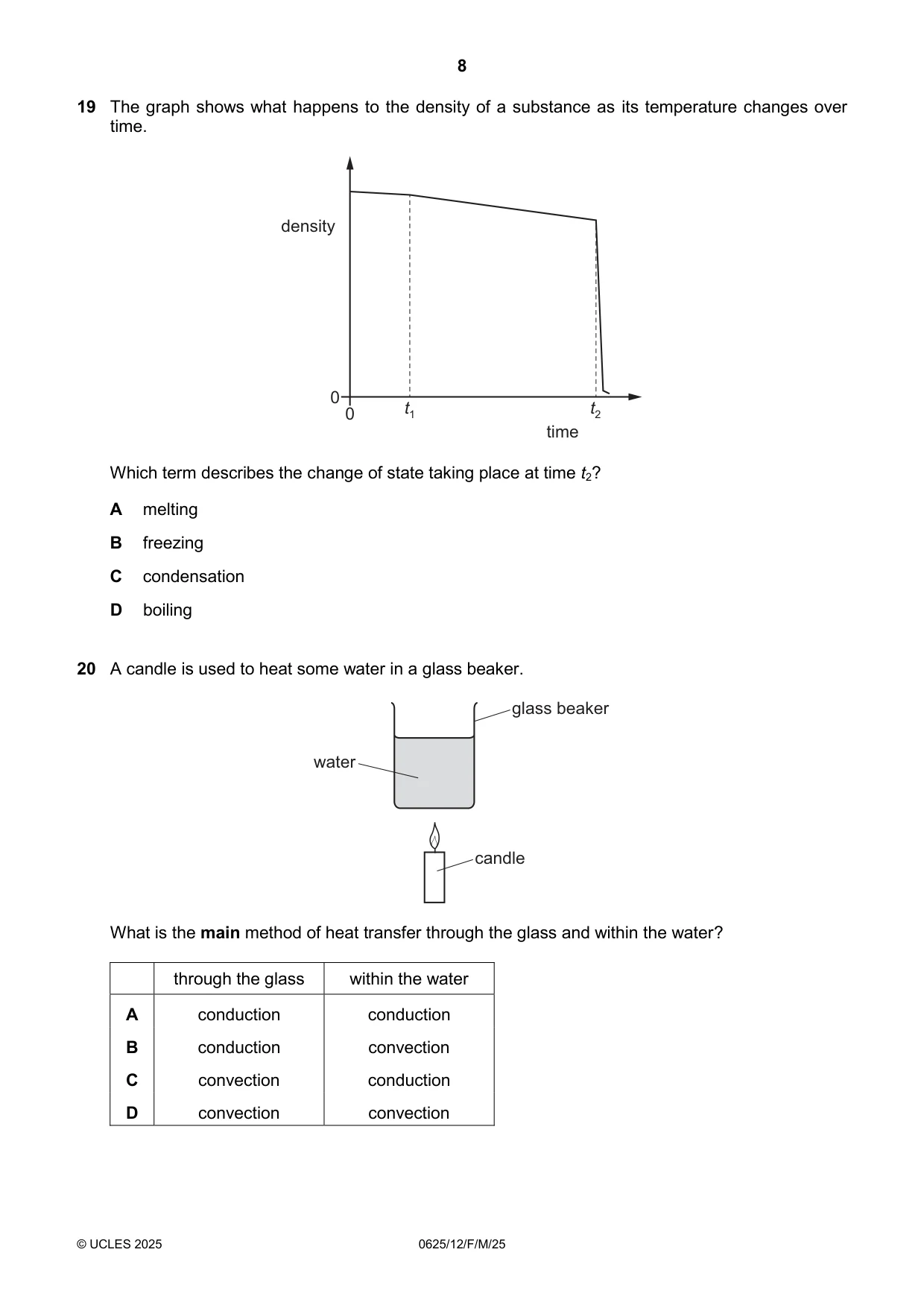
19 The graph shows what happens to the density of a substance as its temperature changes over time. density 0 0 t1 t2 time Which term describes the change of state taking place at time t2? A melting B freezing C condensation D boiling
Mark scheme: D
Q20 · A candle is used to heat some water in a glass beaker
20 A candle is used to heat some water in a glass beaker. glass beaker water candle What is the main method of heat transfer through the glass and within the water? through the glass within the water A conduction conduction B conduction convection C convection conduction D convection convection
Mark scheme: B
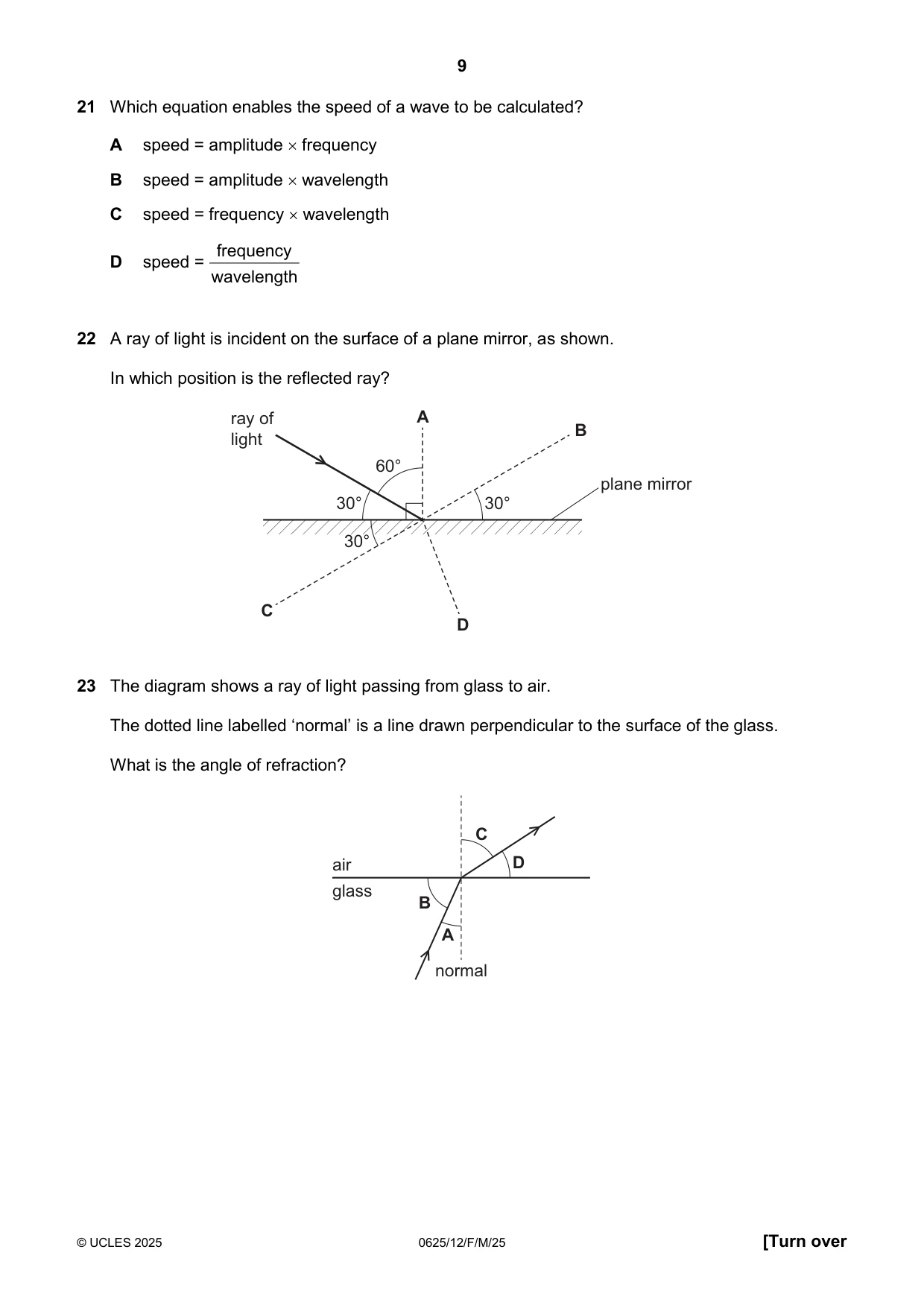
Q21 · Which equation enables the speed of a wave to be calculated?
21 Which equation enables the speed of a wave to be calculated? A speed = amplitude frequency B speed = amplitude wavelength C speed = frequency wavelength frequency D speed = wavelength
Mark scheme: C
Q22 · A ray of light is incident on the surface of a plane mirror, as shown
22 A ray of light is incident on the surface of a plane mirror, as shown. In which position is the reflected ray? ray of A B light 60° plane mirror 30° 30° 30° C D
Mark scheme: B
Q23 · The diagram shows a ray of light passing from glass to air
23 The diagram shows a ray of light passing from glass to air. The dotted line labelled ‘normal’ is a line drawn perpendicular to the surface of the glass. What is the angle of refraction? C air D glass B A normal
Mark scheme: C
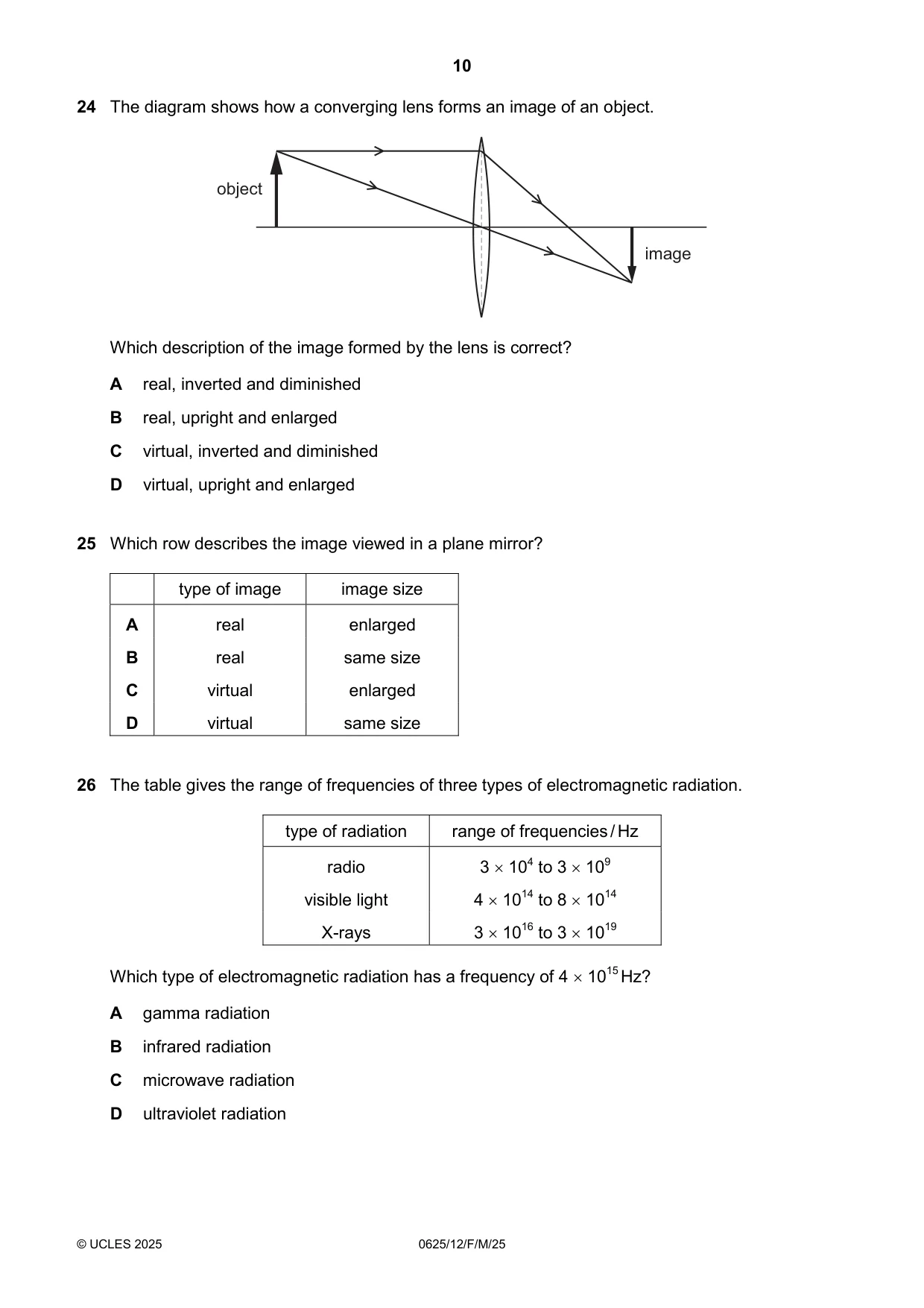
Q24 · The diagram shows how a converging lens forms an image of an object
24 The diagram shows how a converging lens forms an image of an object. object image Which description of the image formed by the lens is correct? A real, inverted and diminished B real, upright and enlarged C virtual, inverted and diminished D virtual, upright and enlarged
Mark scheme: A
Q25 · Which row describes the image viewed in a plane mirror?
25 Which row describes the image viewed in a plane mirror? type of image image size A real enlarged B real same size C virtual enlarged D virtual same size
Mark scheme: D
Q26 · The table gives the range of frequencies of three types of electromagnetic radiation
26 The table gives the range of frequencies of three types of electromagnetic radiation. type of radiation range of frequencies / Hz radio 3 104 to 3 109 visible light 4 1014 to 8 1014 X-rays 3 1016 to 3 1019 Which type of electromagnetic radiation has a frequency of 4 1015 Hz? A gamma radiation B infrared radiation C microwave radiation D ultraviolet radiation
Mark scheme: D
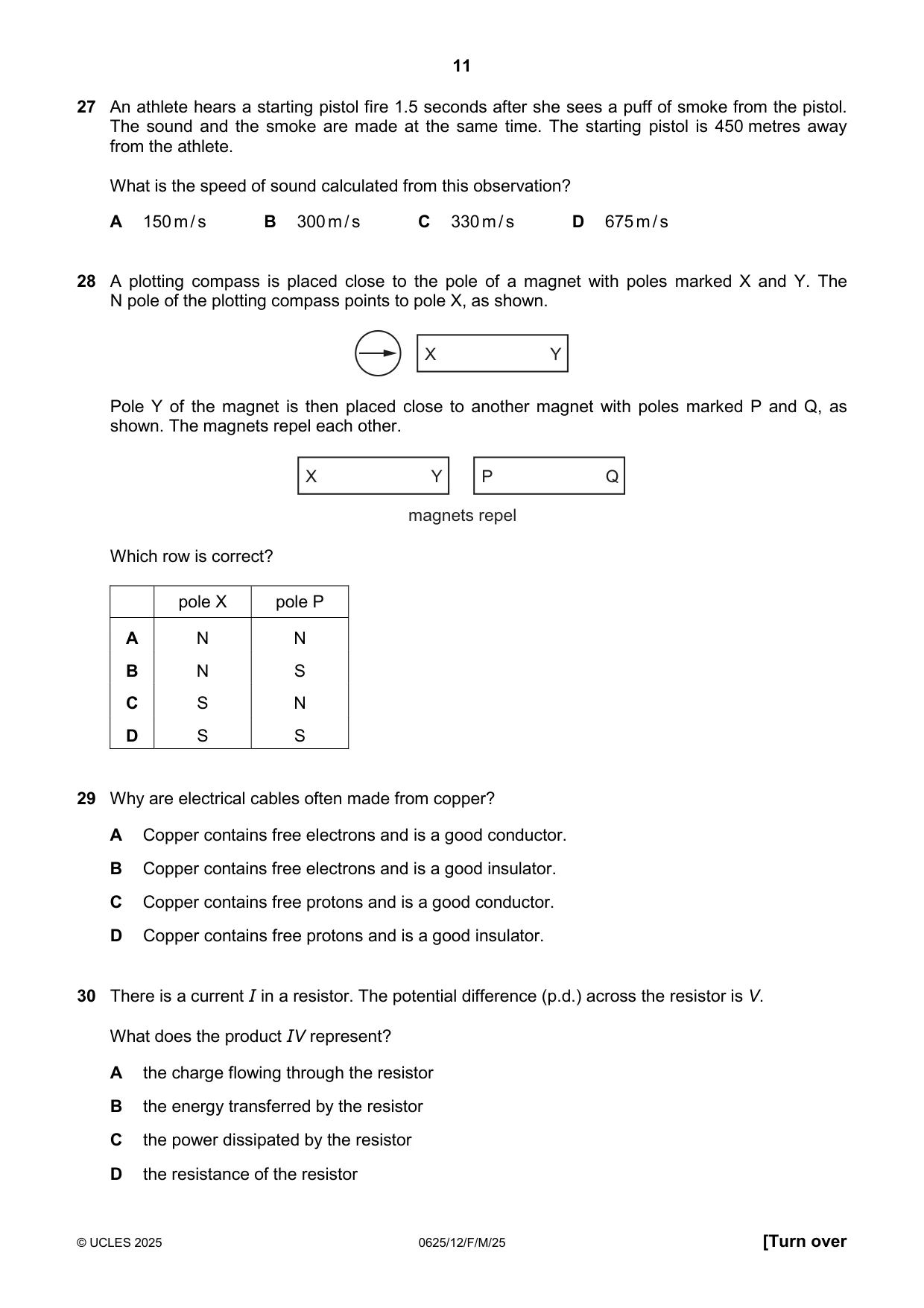
Q27 · An athlete hears a starting pistol fire 1.5 seconds after she sees a puff of smoke from…
27 An athlete hears a starting pistol fire 1.5 seconds after she sees a puff of smoke from the pistol. The sound and the smoke are made at the same time. The starting pistol is 450 metres away from the athlete. What is the speed of sound calculated from this observation? A 150 m / s B 300 m / s C 330 m / s D 675 m / s
Mark scheme: B
Q28 · A plotting compass is placed close to the pole of a magnet with poles marked X and Y
28 A plotting compass is placed close to the pole of a magnet with poles marked X and Y. The N pole of the plotting compass points to pole X, as shown. X Y Pole Y of the magnet is then placed close to another magnet with poles marked P and Q, as shown. The magnets repel each other. X Y P Q magnets repel Which row is correct? pole X pole P A N N B N S C S N D S S
Mark scheme: C
Q29 · Why are electrical cables often made from copper?
29 Why are electrical cables often made from copper? A Copper contains free electrons and is a good conductor. B Copper contains free electrons and is a good insulator. C Copper contains free protons and is a good conductor. D Copper contains free protons and is a good insulator.
Mark scheme: A
Q30 · There is a current I in a resistor
30 There is a current I in a resistor. The potential difference (p.d.) across the resistor is V. What does the product IV represent? A the charge flowing through the resistor B the energy transferred by the resistor C the power dissipated by the resistor D the resistance of the resistor
Mark scheme: C
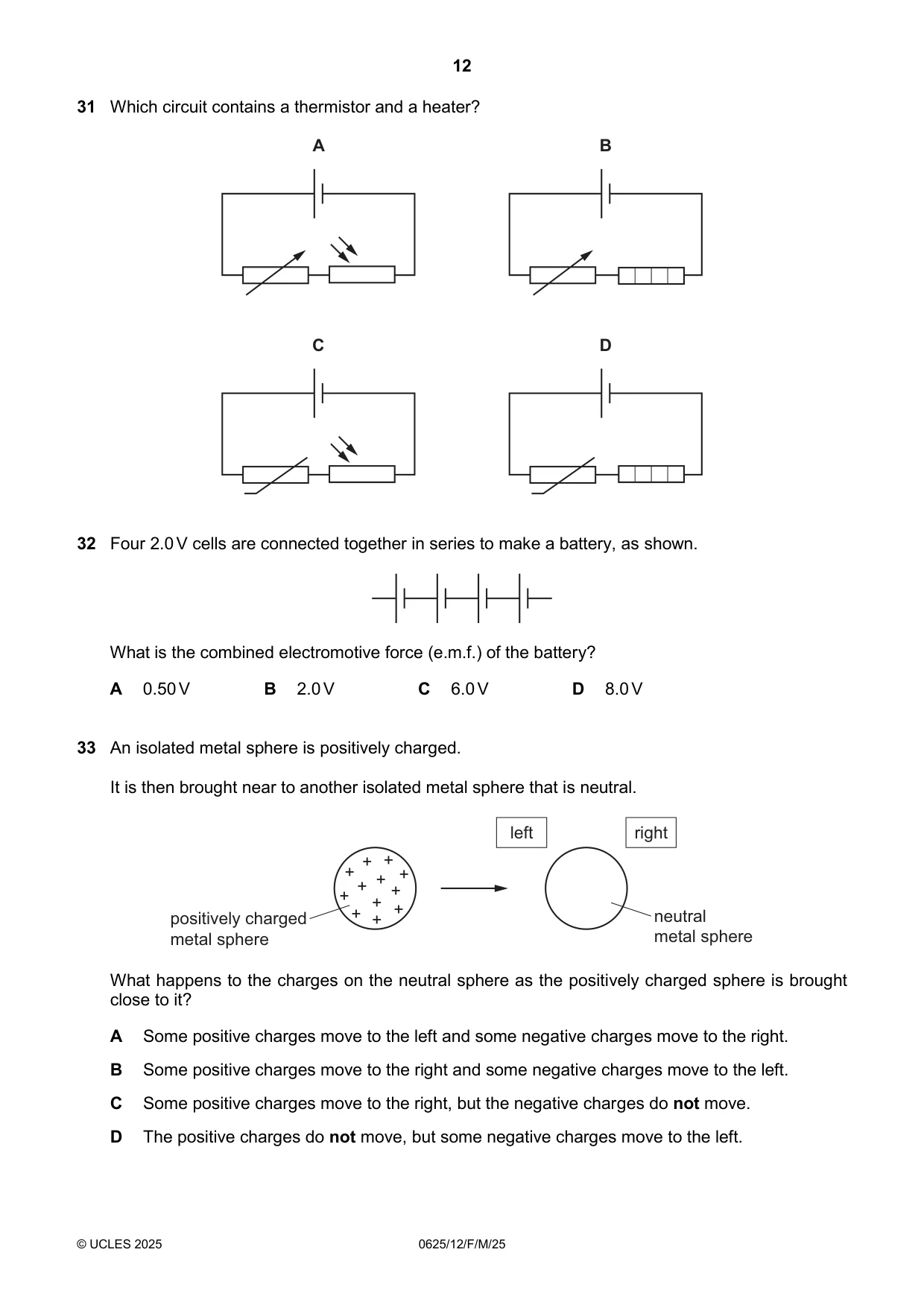
Q31 · Which circuit contains a thermistor and a heater?
31 Which circuit contains a thermistor and a heater? A B C D
Mark scheme: D
Q32 · Four 2.0 V cells are connected together in series to make a battery, as shown
32 Four 2.0 V cells are connected together in series to make a battery, as shown. What is the combined electromotive force (e.m.f.) of the battery? A 0.50 V B 2.0 V C 6.0 V D 8.0 V
Mark scheme: D
Q33 · An isolated metal sphere is positively charged
33 An isolated metal sphere is positively charged. It is then brought near to another isolated metal sphere that is neutral. left right + + + + + + + + + + positively charged + + neutral metal sphere metal sphere What happens to the charges on the neutral sphere as the positively charged sphere is brought close to it? A Some positive charges move to the left and some negative charges move to the right. B Some positive charges move to the right and some negative charges move to the left. C Some positive charges move to the right, but the negative charges do not move. D The positive charges do not move, but some negative charges move to the left.
Mark scheme: D
Q34 · The potential difference (p.d.) across a car headlamp is 12 V
34 The potential difference (p.d.) across a car headlamp is 12 V. The current in the lamp is 2.5 A. How much energy is transferred by the lamp in 1.0 hour? A 1800 J B 1800 W C 108 000 J D 108 000 W
Mark scheme: C
Q35 · A copper wire rests in a uniform magnetic field
35 A copper wire rests in a uniform magnetic field. Which change causes an induced electromotive force (e.m.f.) in the wire? A connecting the wire to a power supply B connecting the wire to earth C heating the wire D moving the wire
Mark scheme: D
Q36 · An element has two isotopes
36 An element has two isotopes. Which row compares the nucleus of one atom of each isotope? the charge the mass on each nucleus of each nucleus A different different B different the same C the same different D the same the same
Mark scheme: C
Q37 · In a laboratory, a radiation detector is connected to a counter which shows a reading for…
37 In a laboratory, a radiation detector is connected to a counter which shows a reading for the count rate due to background radiation. detector Which unit is count rate measured in? A counts / s B minutes / count C coulombs / minute D amperes / s
Mark scheme: A
Q38 · Which statement about alpha, beta and gamma emissions is correct?
38 Which statement about alpha, beta and gamma emissions is correct? A Alpha-particles are lighter than beta-particles. B Beta-particles are not deflected by magnetic fields. C Gamma rays are more penetrating than alpha-particles and beta-particles. D Gamma rays are more ionising than alpha-particles and beta-particles.
Mark scheme: C
Q39 · What is an effect of ionising nuclear radiation on living things?
39 What is an effect of ionising nuclear radiation on living things? A cell mutation B electric shock C internal cooling of body cells D broken bones
Mark scheme: A
Q40 · The diagram shows the Earth orbiting the Sun
40 The diagram shows the Earth orbiting the Sun. position 1 Sun Which row identifies and explains the correct season in the northern hemisphere on the Earth in position 1? season explanation A summer the northern hemisphere tilts away from the Sun B summer the northern hemisphere tilts towards the Sun C winter the northern hemisphere tilts away from the Sun D winter the northern hemisphere tilts towards the Sun
Mark scheme: B
What was in this paper
The subtopics covered by these 40 questions, and how many questions each got. Open one in a new tab to see every Cambridge question on it.
4Light4Electrical quantities3Motion3Pressure3Radioactivity3Electric circuits2Energy, work and power2Forces2Mass and weight2Simple phenomena of magnetism2Density1Electromagnetic effects1Electromagnetic spectrum1General properties of waves1Physical quantities and measurement techniques1Sound1The Earth and the Solar System1The nuclear model of the atom1Thermal properties and temperature1Transfer of thermal energy1What you needed in this session
Cambridge’s own grade thresholds for 2025 Feb/March, Paper 1 · Variant 2. A higher threshold means an easier paper — the bar moves with how the cohort did.