Cambridge IGCSE Physics 0625 — 2021 Oct/Nov Paper 1 · Variant 3
0625/13/O/N/21 · 40 questions · 40 marks · ≈45 min
The question paper and its mark scheme, free to read here and free to download. This is Cambridge’s own paper, exactly as it was sat.
Question paper16 pages
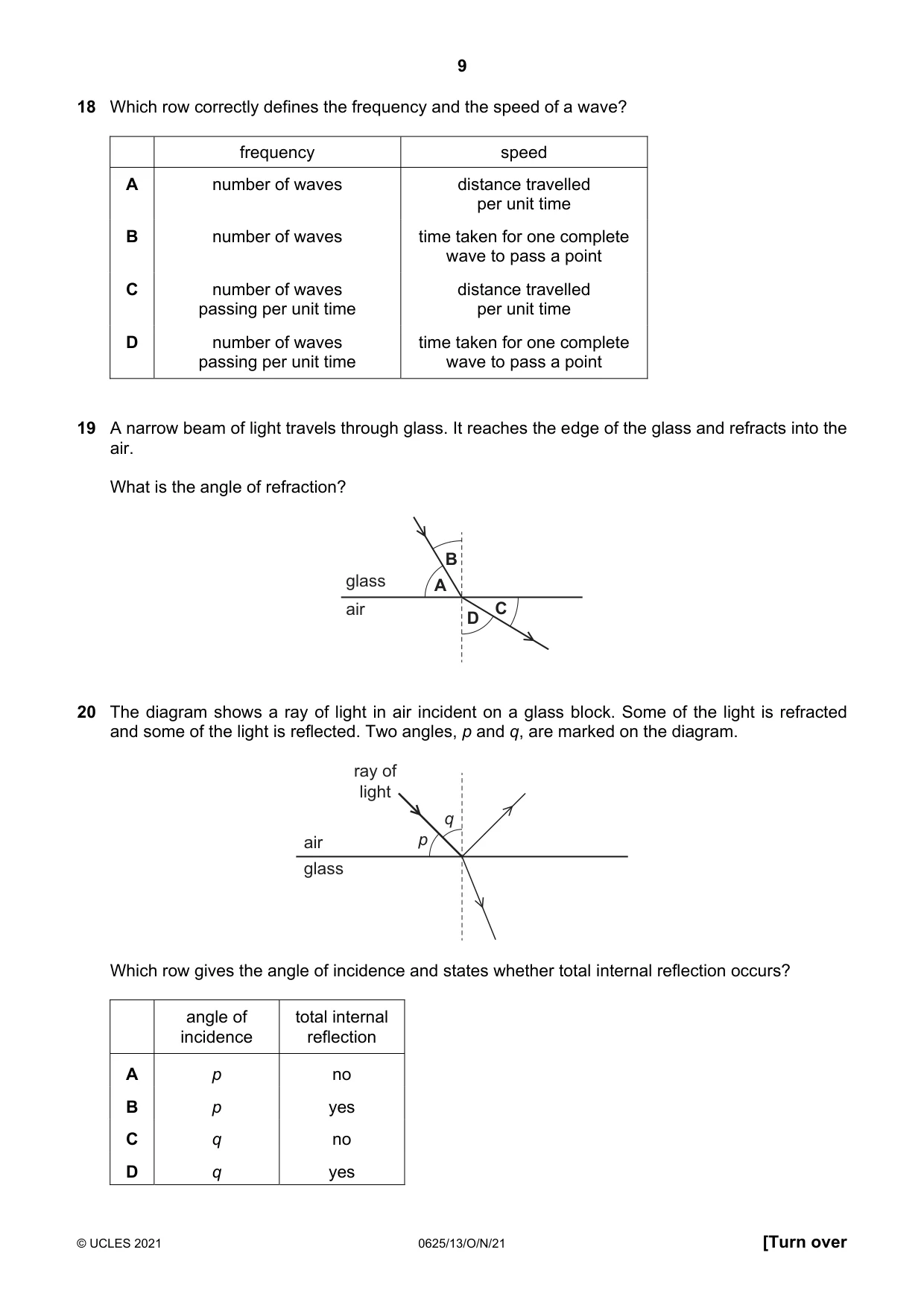
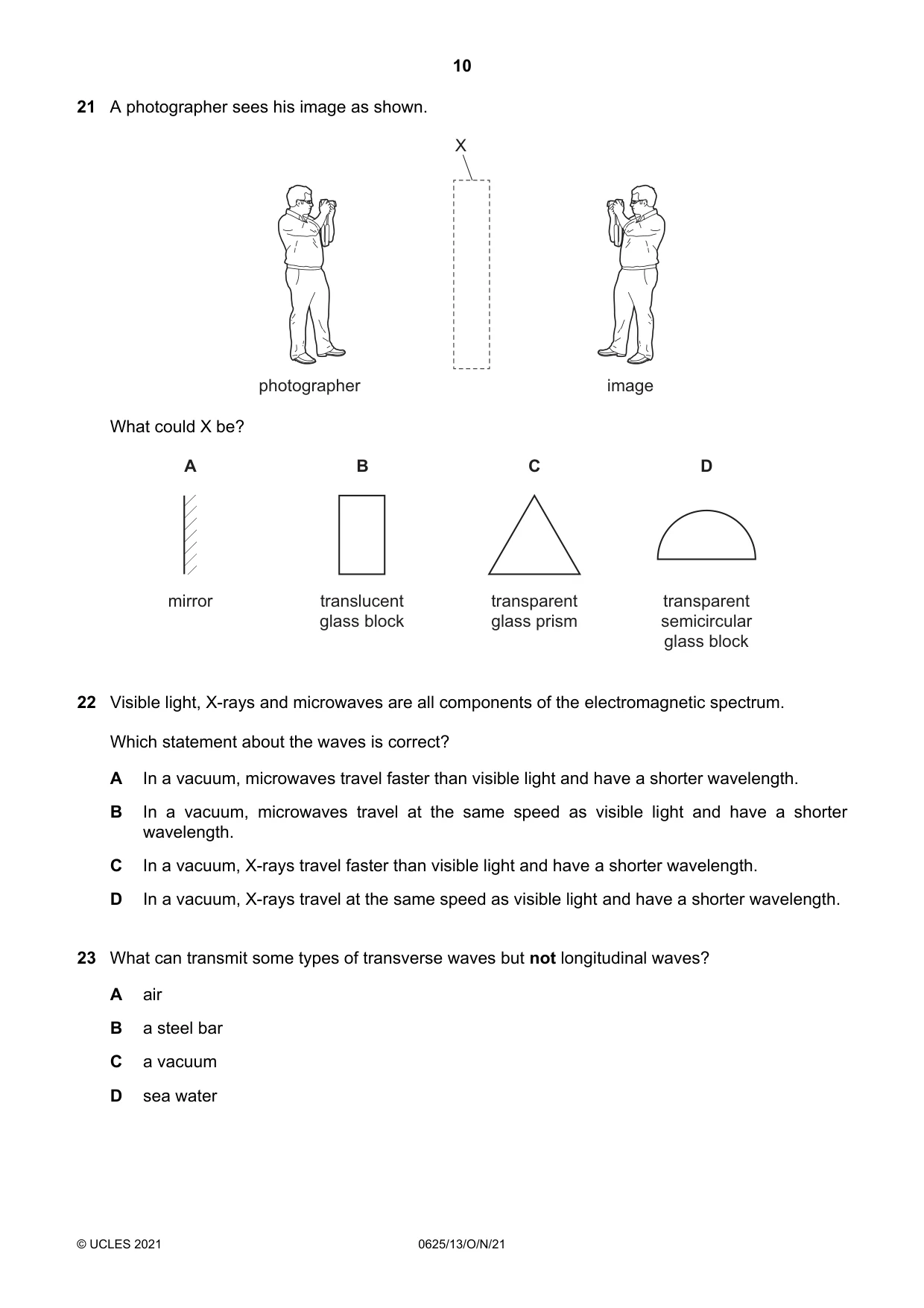
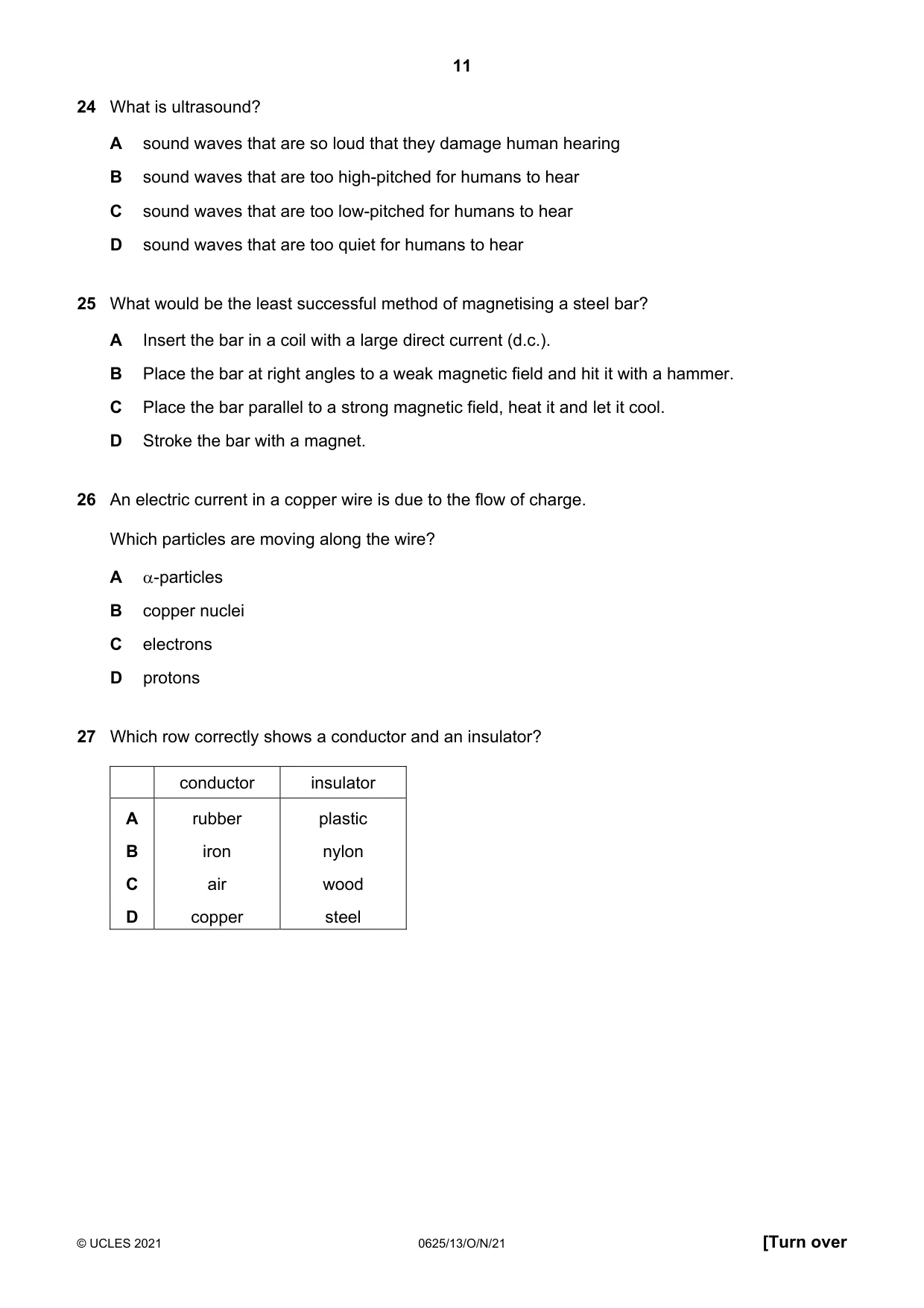
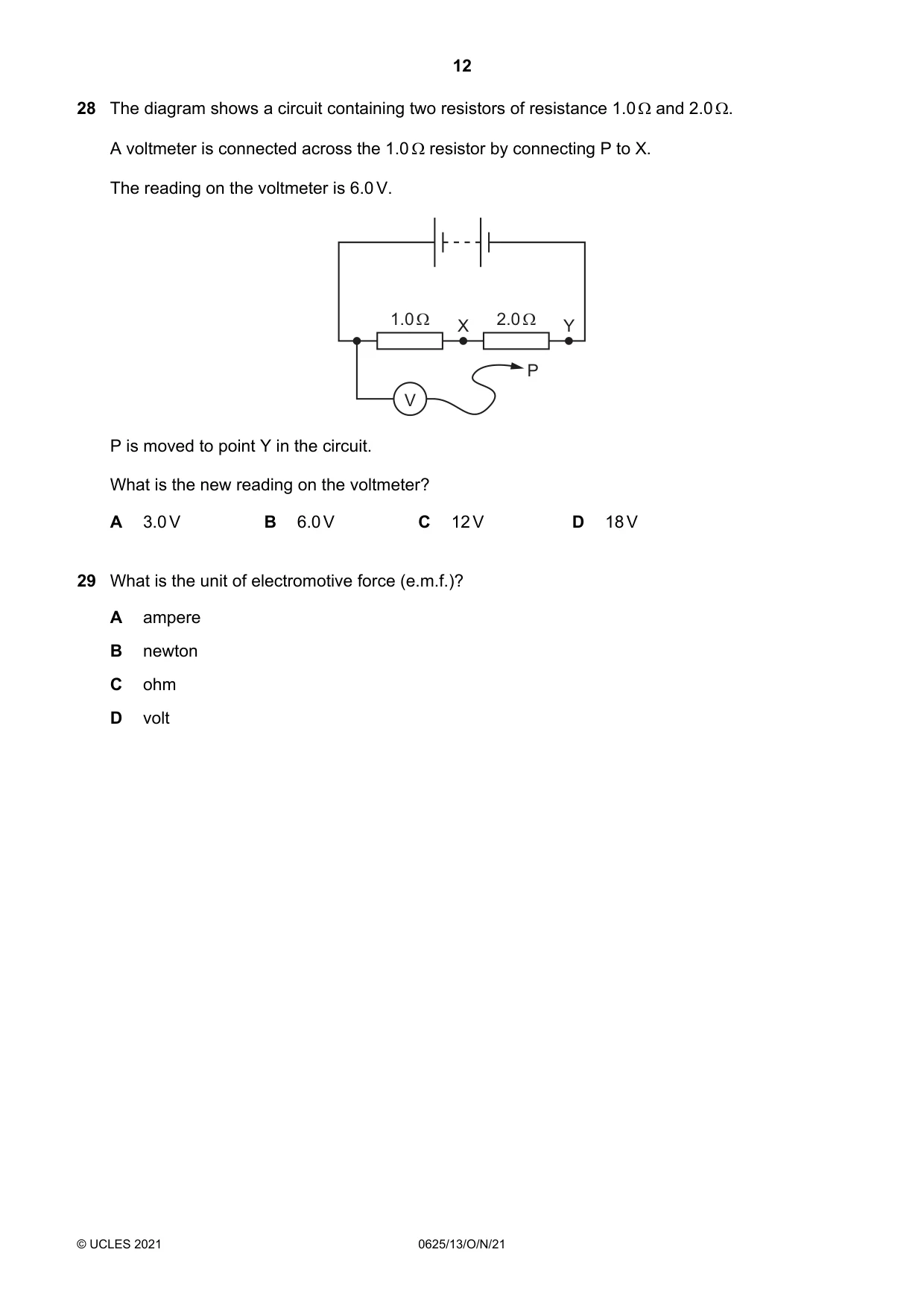
Mark scheme3 pages
Answers below. Sit the paper first if you are practising.
Questions as text
Q1 · A teacher asks a student to measure the volume of a pencil sharpener
1 A teacher asks a student to measure the volume of a pencil sharpener. Which piece of apparatus would not be useful? A beaker B displacement can C balance D measuring cylinder
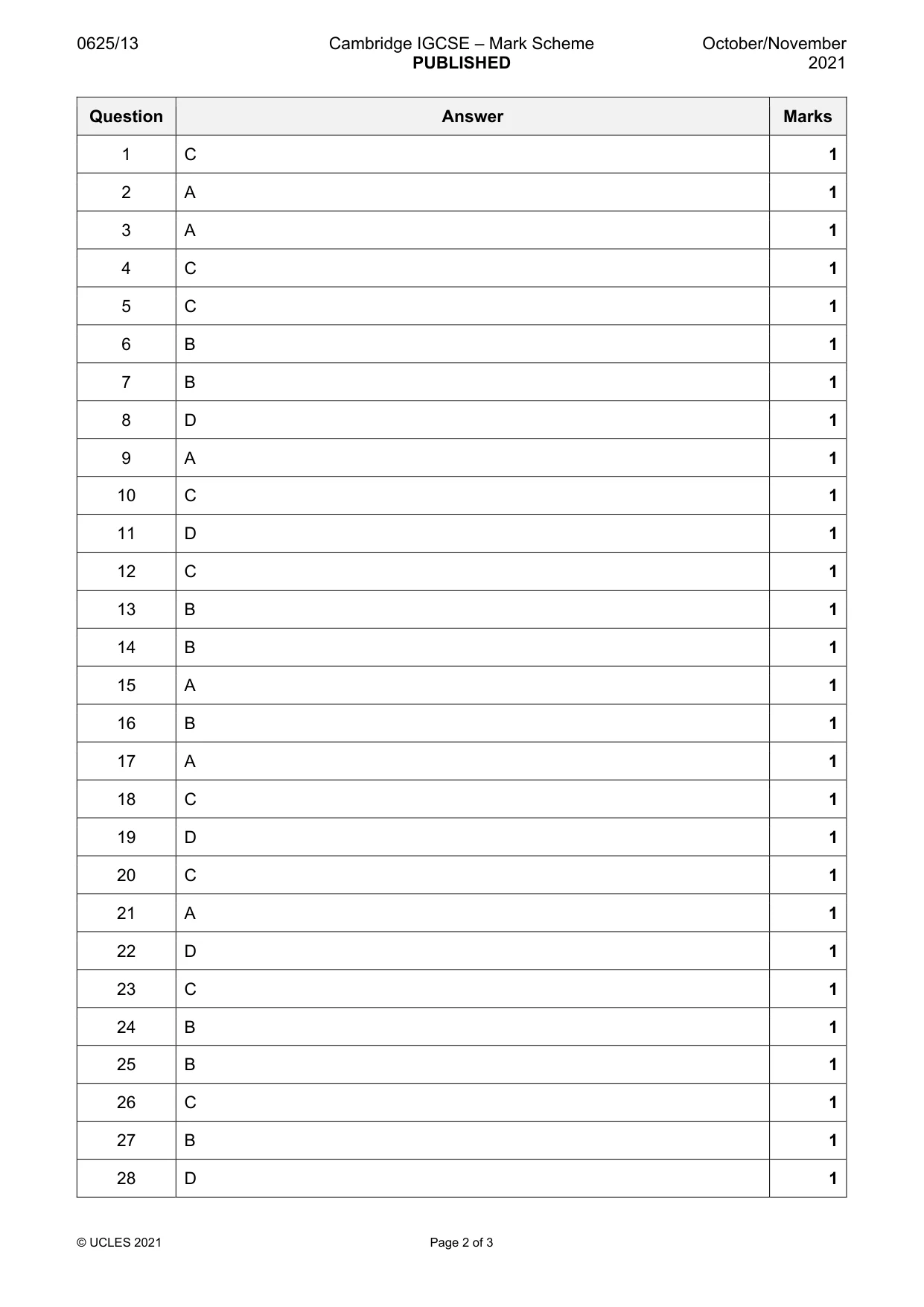
Mark scheme: C
More questions on Physical quantities and measurement techniques
Q2 · The graph shows how the speed of a car varies with time at the start of a journey
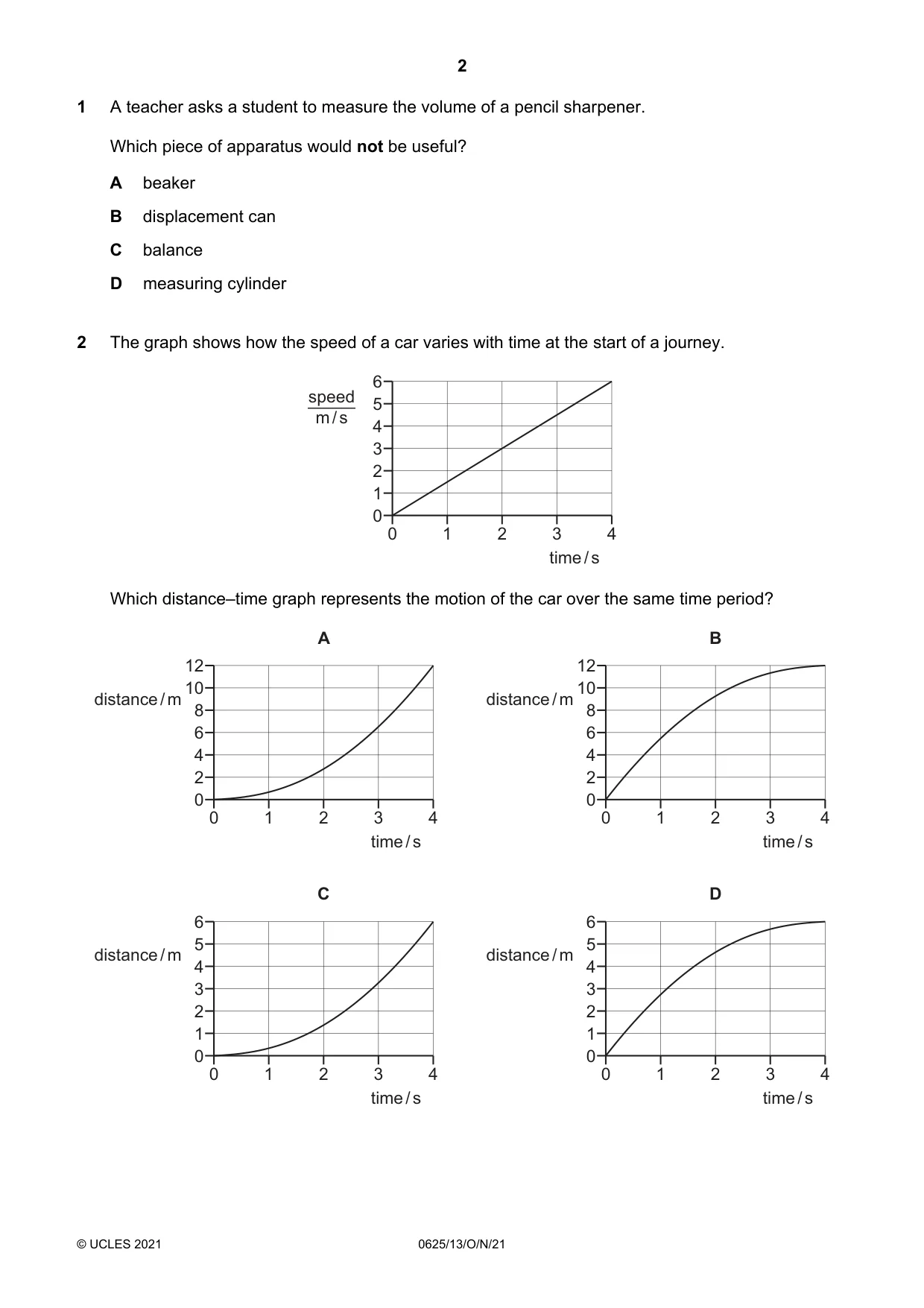
2 The graph shows how the speed of a car varies with time at the start of a journey. 6 speed 5 m / s 4 3 2 1 0 0 1 2 3 4 time / s Which distance–time graph represents the motion of the car over the same time period? A B 12 12 10 10 distance / m distance / m 8 8 6 6 4 4 2 2 0 0 0 1 2 3 4 0 1 2 3 4 time / s time / s C D 6 6 5 5 distance / m distance / m 4 4 3 3 2 2 1 1 0 0 0 1 2 3 4 0 1 2 3 4 time / s time / s
Mark scheme: A
Q3 · A student uses a force meter to measure the weights and a balance to measure the masses…
3 A student uses a force meter to measure the weights and a balance to measure the masses of four different objects. He puts his measurements in a table. Which row is correctly recorded? mass weight A 1 kg 10 N B 5 g 50 N C 10 N 100 kg D 20 kg 2 N
Mark scheme: A
Q4 · Which substance in the table has the lowest density?
4 Which substance in the table has the lowest density? substance mass / g volume / cm3 A nylon 1.2 1.0 B cotton 1.5 1.0 C olive oil 1.8 2.0 D water 2.0 2.0
Mark scheme: C
Q5 · The diagram shows a uniform beam 100 cm long
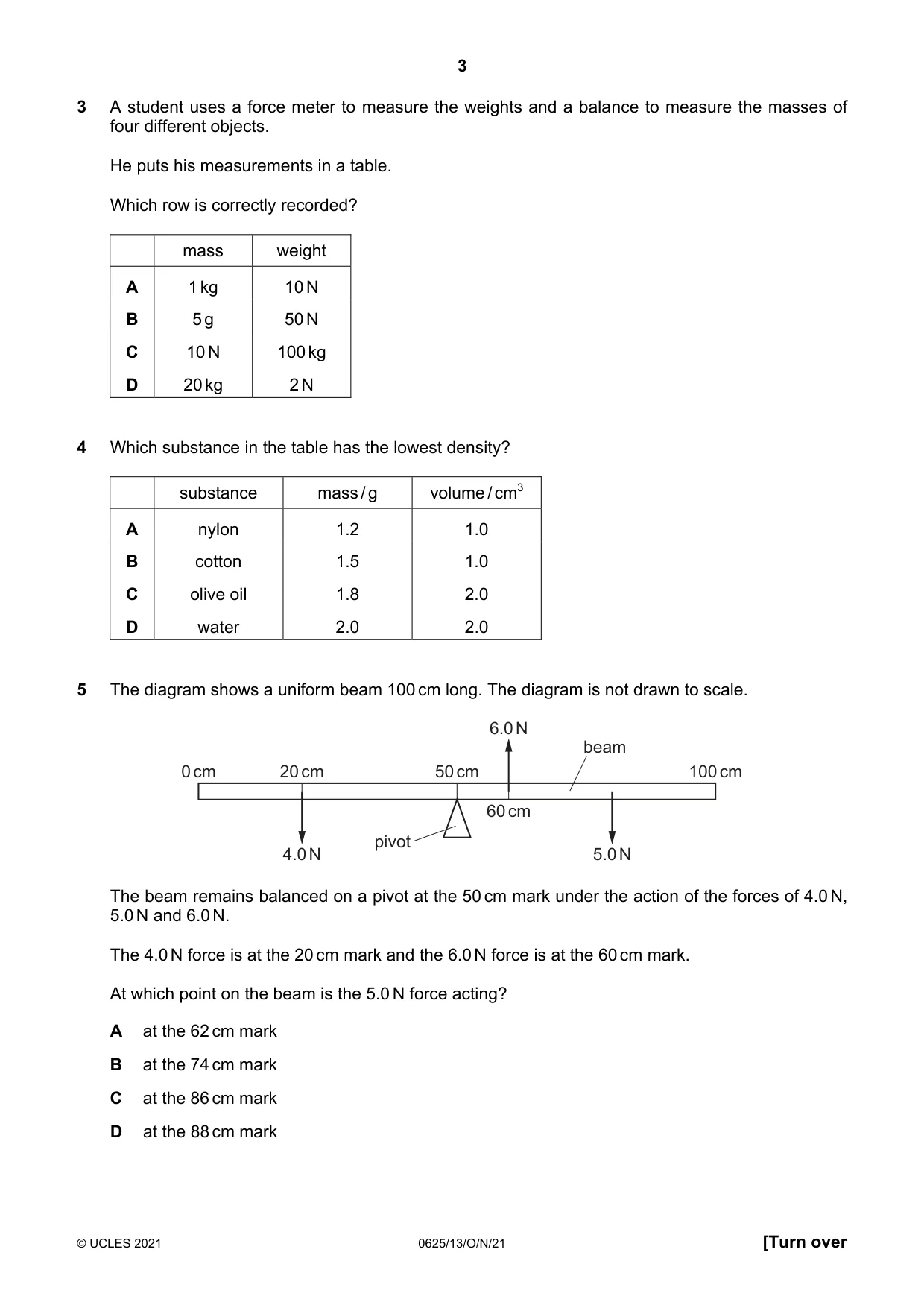
5 The diagram shows a uniform beam 100 cm long. The diagram is not drawn to scale. 6.0 N beam 0 cm 20 cm 50 cm 100 cm 60 cm pivot 4.0 N 5.0 N The beam remains balanced on a pivot at the 50 cm mark under the action of the forces of 4.0 N, 5.0 N and 6.0 N. The 4.0 N force is at the 20 cm mark and the 6.0 N force is at the 60 cm mark. At which point on the beam is the 5.0 N force acting? A at the 62 cm mark B at the 74 cm mark C at the 86 cm mark D at the 88 cm mark
Mark scheme: C
Q6 · A spacecraft is travelling in space with no resultant force and no resultant moment…
6 A spacecraft is travelling in space with no resultant force and no resultant moment acting on it. Which statement about the spacecraft is correct? A Its direction is changing. B It is in equilibrium. C Its speed is decreasing. D Its speed is increasing.
Mark scheme: B
Q7 · A weightlifter picks up a stone ball and places it on a shelf
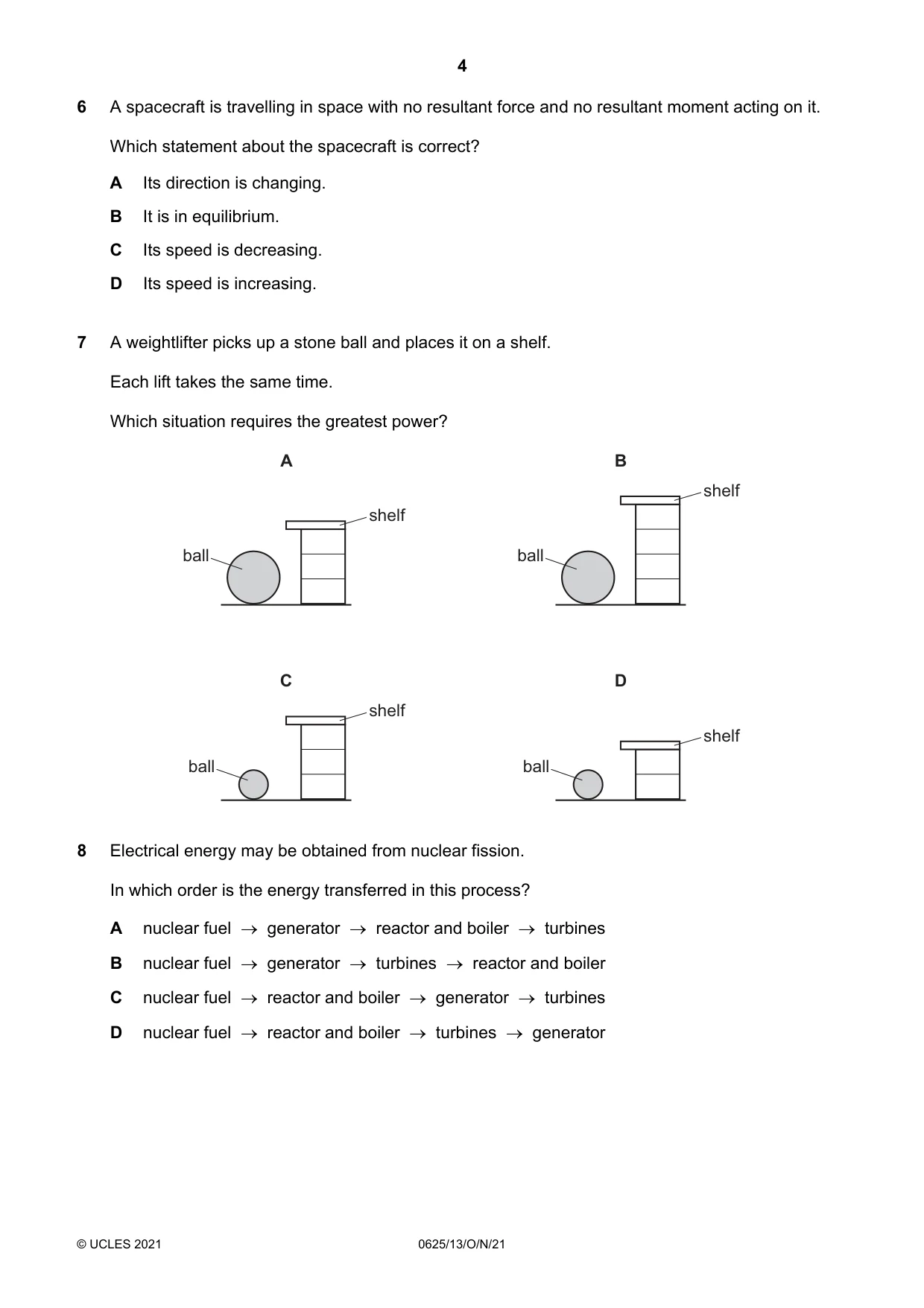
7 A weightlifter picks up a stone ball and places it on a shelf. Each lift takes the same time. Which situation requires the greatest power? A B shelf shelf ball ball C D shelf shelf ball ball
Mark scheme: B
Q8 · Electrical energy may be obtained from nuclear fission
8 Electrical energy may be obtained from nuclear fission. In which order is the energy transferred in this process? A nuclear fuel generator reactor and boiler turbines B nuclear fuel generator turbines reactor and boiler C nuclear fuel reactor and boiler generator turbines D nuclear fuel reactor and boiler turbines generator
Mark scheme: D
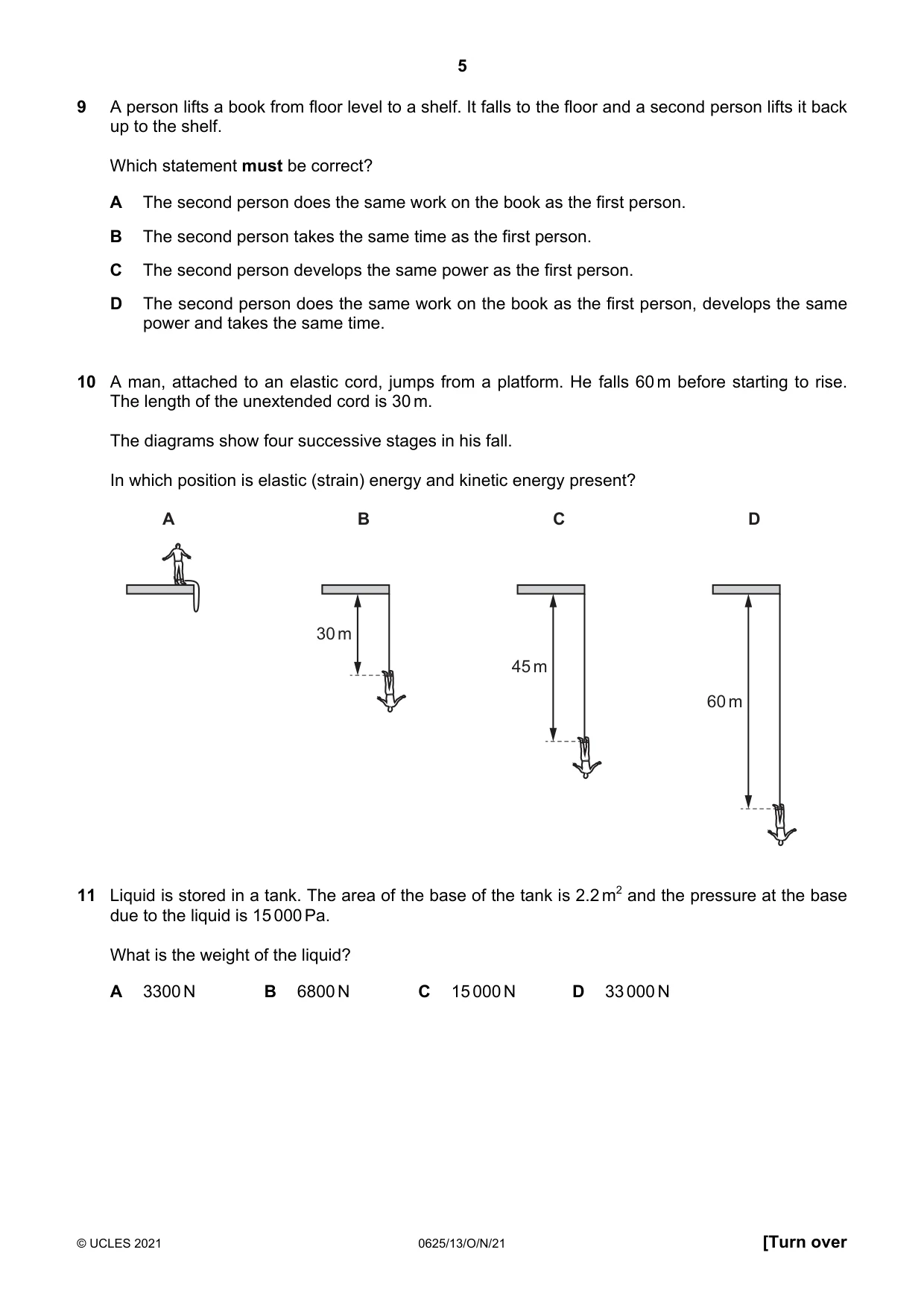
Q9 · A person lifts a book from floor level to a shelf
9 A person lifts a book from floor level to a shelf. It falls to the floor and a second person lifts it back up to the shelf. Which statement must be correct? A The second person does the same work on the book as the first person. B The second person takes the same time as the first person. C The second person develops the same power as the first person. D The second person does the same work on the book as the first person, develops the same power and takes the same time.
Mark scheme: A
Q10 · A man, attached to an elastic cord, jumps from a platform
10 A man, attached to an elastic cord, jumps from a platform. He falls 60 m before starting to rise. The length of the unextended cord is 30 m. The diagrams show four successive stages in his fall. In which position is elastic (strain) energy and kinetic energy present? A B C D 30 m 45 m 60 m
Mark scheme: C
Q11 · Liquid is stored in a tank
11 Liquid is stored in a tank. The area of the base of the tank is 2.2 m2 and the pressure at the base due to the liquid is 15 000 Pa. What is the weight of the liquid? A 3300 N B 6800 N C 15 000 N D 33 000 N
Mark scheme: D
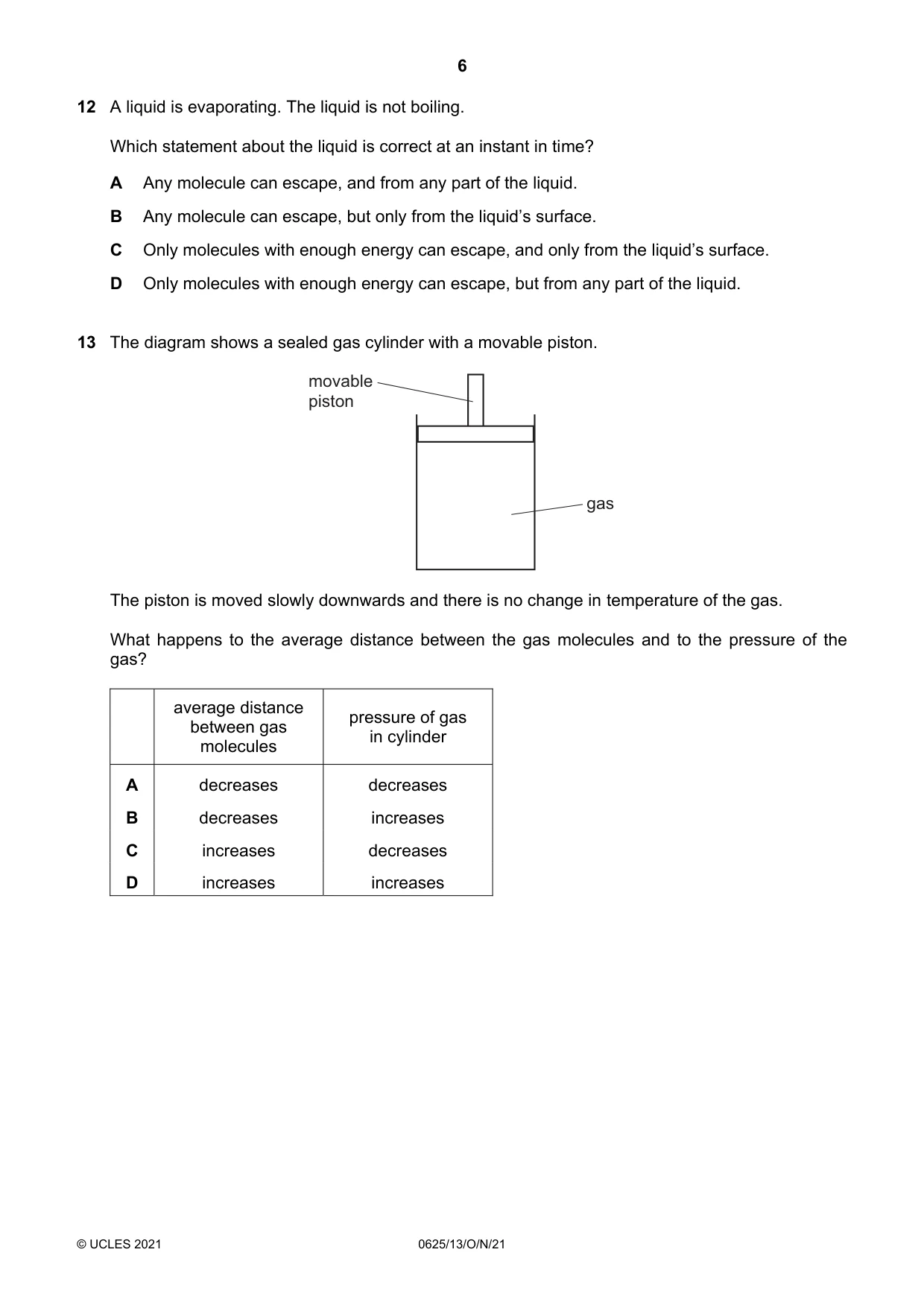
Q12 · A liquid is evaporating
12 A liquid is evaporating. The liquid is not boiling. Which statement about the liquid is correct at an instant in time? A Any molecule can escape, and from any part of the liquid. B Any molecule can escape, but only from the liquid’s surface. C Only molecules with enough energy can escape, and only from the liquid’s surface. D Only molecules with enough energy can escape, but from any part of the liquid.
Mark scheme: C
Q13 · The diagram shows a sealed gas cylinder with a movable piston
13 The diagram shows a sealed gas cylinder with a movable piston. movable piston gas The piston is moved slowly downwards and there is no change in temperature of the gas. What happens to the average distance between the gas molecules and to the pressure of the gas? average distance pressure of gas between gas in cylinder molecules A decreases decreases B decreases increases C increases decreases D increases increases
Mark scheme: B
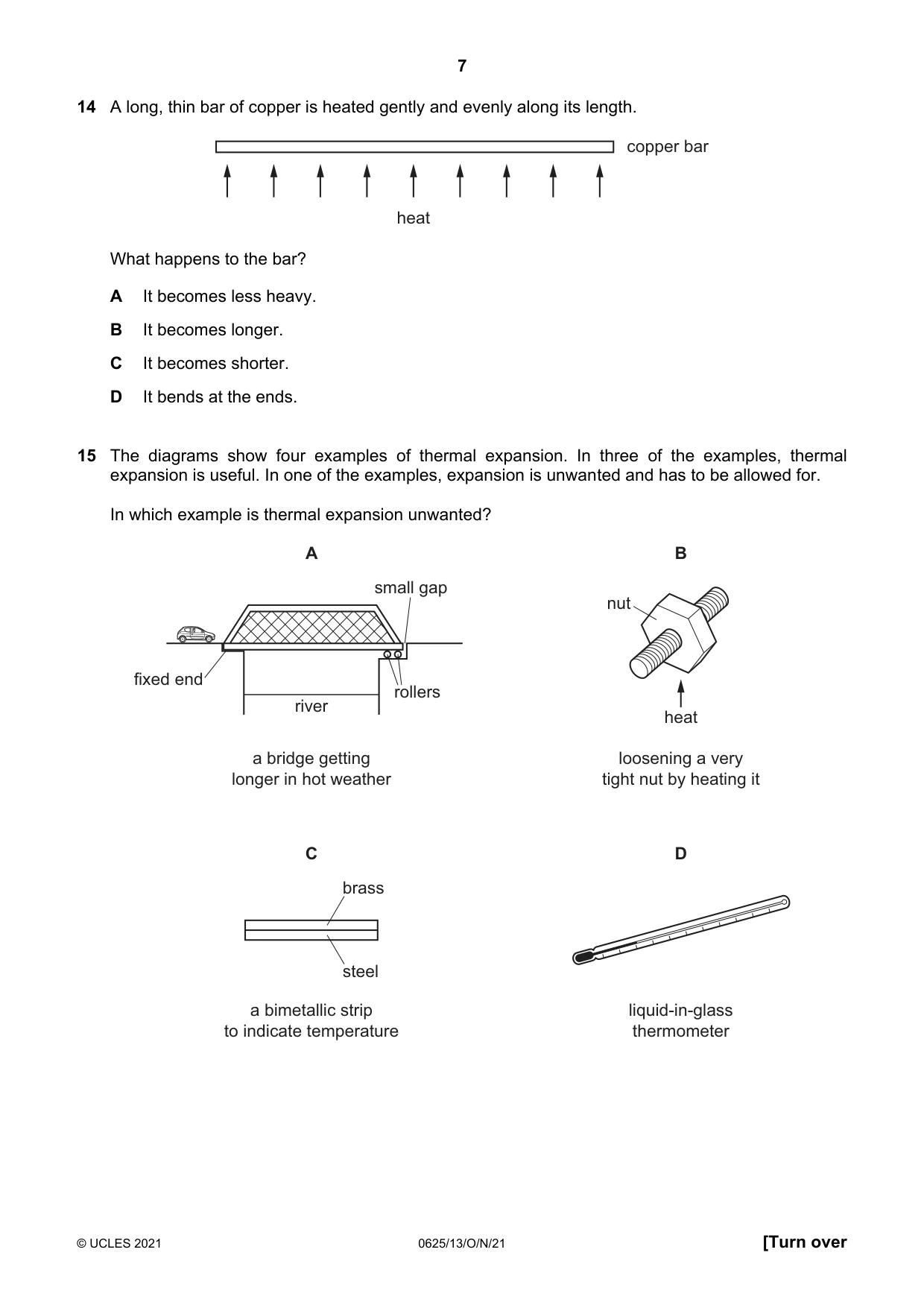
Q14 · A long, thin bar of copper is heated gently and evenly along its length
14 A long, thin bar of copper is heated gently and evenly along its length. copper bar heat What happens to the bar? A It becomes less heavy. B It becomes longer. C It becomes shorter. D It bends at the ends.
Mark scheme: B
Q15 · The diagrams show four examples of thermal expansion
15 The diagrams show four examples of thermal expansion. In three of the examples, thermal expansion is useful. In one of the examples, expansion is unwanted and has to be allowed for. In which example is thermal expansion unwanted? A B small gap nut fixed end rollers river heat a bridge getting loosening a very longer in hot weather tight nut by heating it C D brass steel a bimetallic strip liquid-in-glass to indicate temperature thermometer
Mark scheme: A
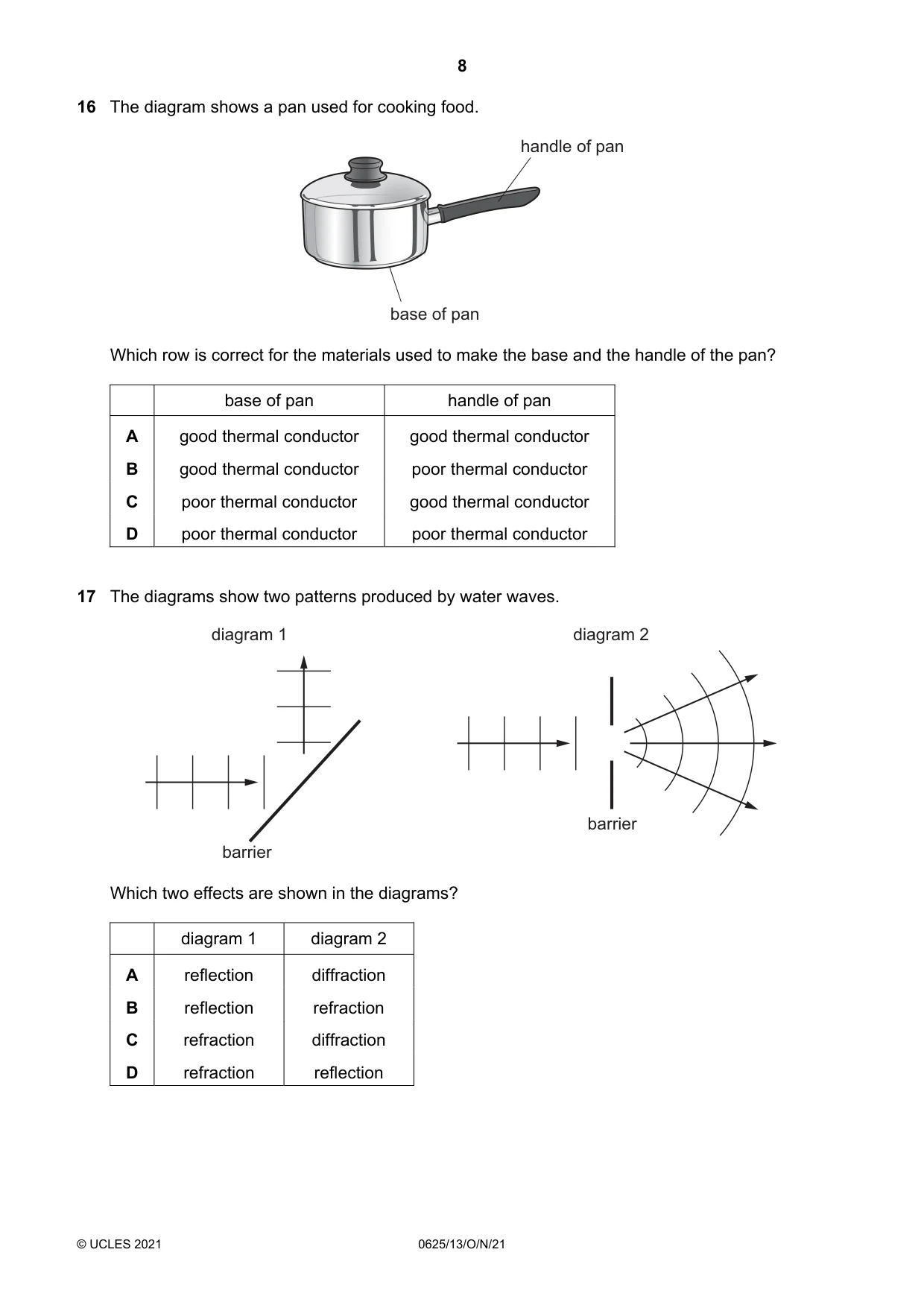
Q16 · The diagram shows a pan used for cooking food
16 The diagram shows a pan used for cooking food. handle of pan base of pan Which row is correct for the materials used to make the base and the handle of the pan? base of pan handle of pan A good thermal conductor good thermal conductor B good thermal conductor poor thermal conductor C poor thermal conductor good thermal conductor D poor thermal conductor poor thermal conductor
Mark scheme: B
Q17 · The diagrams show two patterns produced by water waves
17 The diagrams show two patterns produced by water waves. diagram 1 diagram 2 barrier barrier Which two effects are shown in the diagrams? diagram 1 diagram 2 A reflection diffraction B reflection refraction C refraction diffraction D refraction reflection
Mark scheme: A
Q18 · Which row correctly defines the frequency and the speed of a wave?
18 Which row correctly defines the frequency and the speed of a wave? frequency speed A number of waves distance travelled per unit time B number of waves time taken for one complete wave to pass a point C number of waves distance travelled passing per unit time per unit time D number of waves time taken for one complete passing per unit time wave to pass a point
Mark scheme: C
Q19 · A narrow beam of light travels through glass
19 A narrow beam of light travels through glass. It reaches the edge of the glass and refracts into the air. What is the angle of refraction? B glass A air C D
Mark scheme: D
Q20 · The diagram shows a ray of light in air incident on a glass block
20 The diagram shows a ray of light in air incident on a glass block. Some of the light is refracted and some of the light is reflected. Two angles, p and q, are marked on the diagram. ray of light q air p glass Which row gives the angle of incidence and states whether total internal reflection occurs? angle of total internal incidence reflection A p no B p yes C q no D q yes
Mark scheme: C
Q21 · A photographer sees his image as shown
21 A photographer sees his image as shown. X photographer image What could X be? A B C D mirror translucent transparent transparent glass block glass prism semicircular glass block
Mark scheme: A
Q22 · Visible light, X-rays and microwaves are all components of the electromagnetic spectrum
22 Visible light, X-rays and microwaves are all components of the electromagnetic spectrum. Which statement about the waves is correct? A In a vacuum, microwaves travel faster than visible light and have a shorter wavelength. B In a vacuum, microwaves travel at the same speed as visible light and have a shorter wavelength. C In a vacuum, X-rays travel faster than visible light and have a shorter wavelength. D In a vacuum, X-rays travel at the same speed as visible light and have a shorter wavelength.
Mark scheme: D
Q23 · What can transmit some types of transverse waves but not longitudinal waves?
23 What can transmit some types of transverse waves but not longitudinal waves? A air B a steel bar C a vacuum D sea water
Mark scheme: C
Question 24
24 What is ultrasound? A sound waves that are so loud that they damage human hearing B sound waves that are too high-pitched for humans to hear C sound waves that are too low-pitched for humans to hear D sound waves that are too quiet for humans to hear
Mark scheme: B
Q25 · What would be the least successful method of magnetising a steel bar?
25 What would be the least successful method of magnetising a steel bar? A Insert the bar in a coil with a large direct current (d.c.). B Place the bar at right angles to a weak magnetic field and hit it with a hammer. C Place the bar parallel to a strong magnetic field, heat it and let it cool. D Stroke the bar with a magnet.
Mark scheme: B
Q26 · An electric current in a copper wire is due to the flow of charge
26 An electric current in a copper wire is due to the flow of charge. Which particles are moving along the wire? A -particles B copper nuclei C electrons D protons
Mark scheme: C
Q27 · Which row correctly shows a conductor and an insulator?
27 Which row correctly shows a conductor and an insulator? conductor insulator A rubber plastic B iron nylon C air wood D copper steel
Mark scheme: B
Q28 · The diagram shows a circuit containing two resistors of resistance 1.0 and 2.0
28 The diagram shows a circuit containing two resistors of resistance 1.0 and 2.0 . A voltmeter is connected across the 1.0 resistor by connecting P to X. The reading on the voltmeter is 6.0 V. 1.0 Ω X 2.0 Ω Y P V P is moved to point Y in the circuit. What is the new reading on the voltmeter? A 3.0 V B 6.0 V C 12 V D 18 V
Mark scheme: D
Q29 · What is the unit of electromotive force (e.m.f.)?
29 What is the unit of electromotive force (e.m.f.)? A ampere B newton C ohm D volt
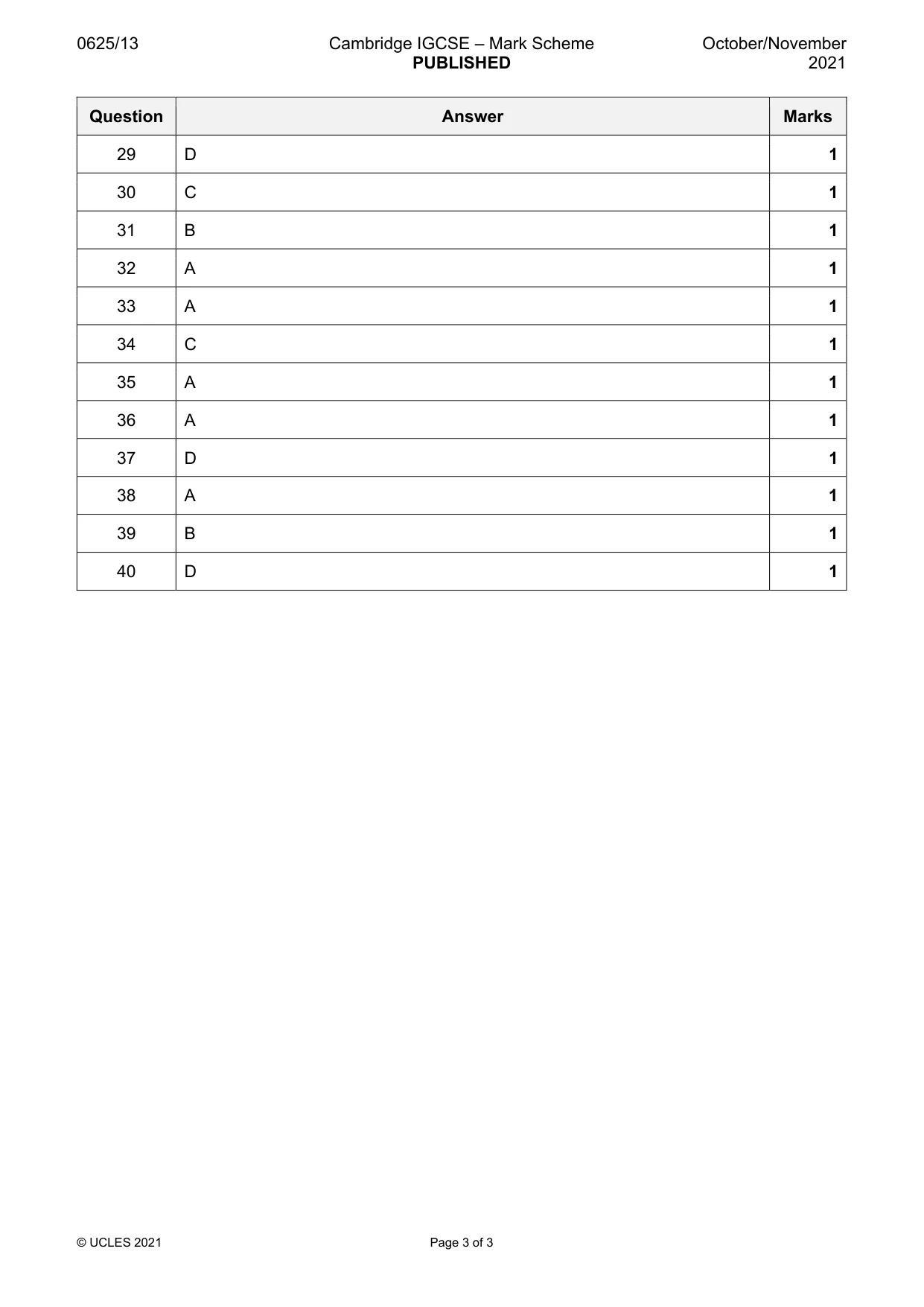
Mark scheme: D
Q30 · Which circuit contains a fuse?
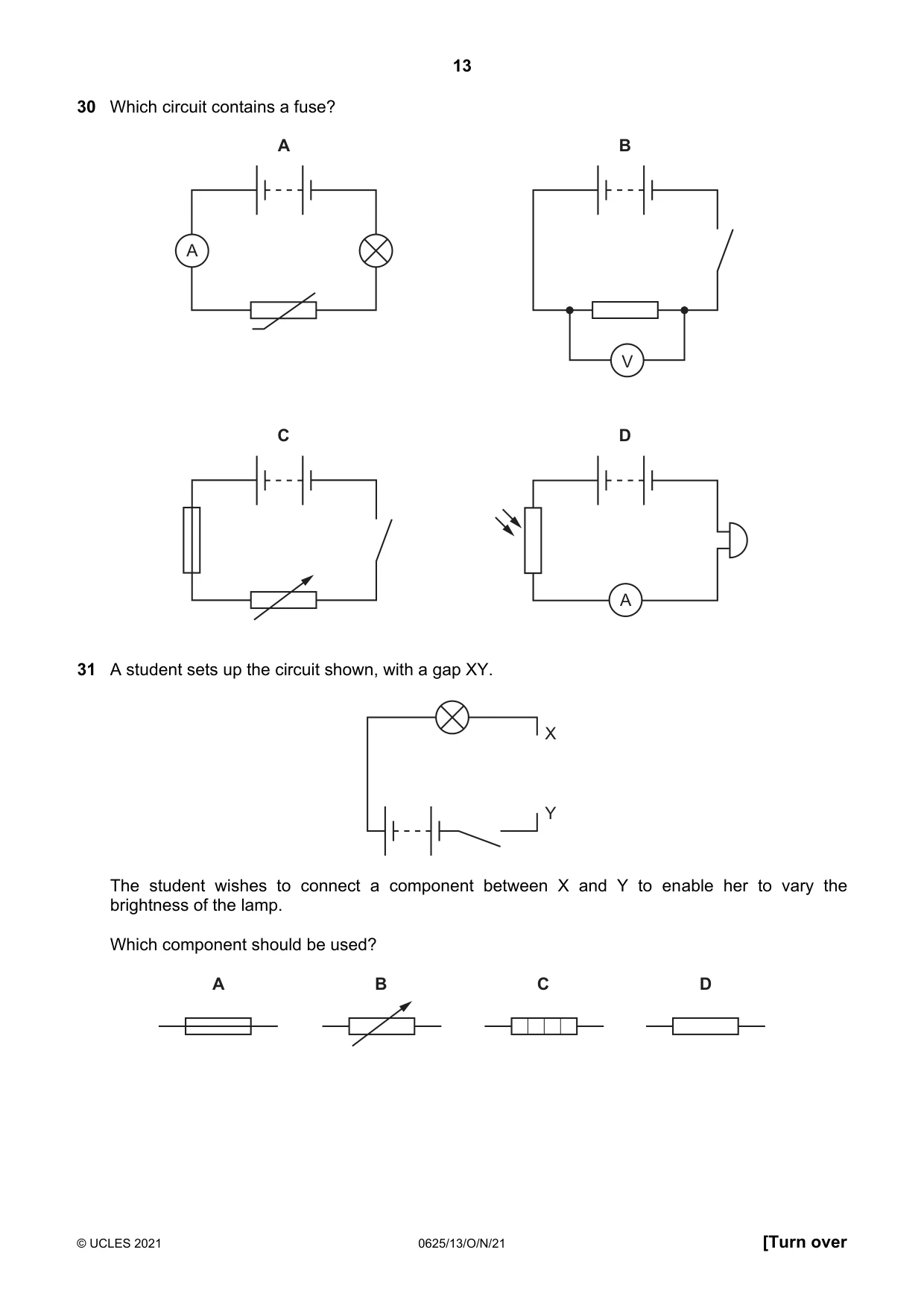
30 Which circuit contains a fuse? A B A V C D A
Mark scheme: C
Q31 · A student sets up the circuit shown, with a gap XY
31 A student sets up the circuit shown, with a gap XY. X Y The student wishes to connect a component between X and Y to enable her to vary the brightness of the lamp. Which component should be used? A B C D
Mark scheme: B
Q32 · Two resistors, with resistances R1 and R2, are connected in parallel
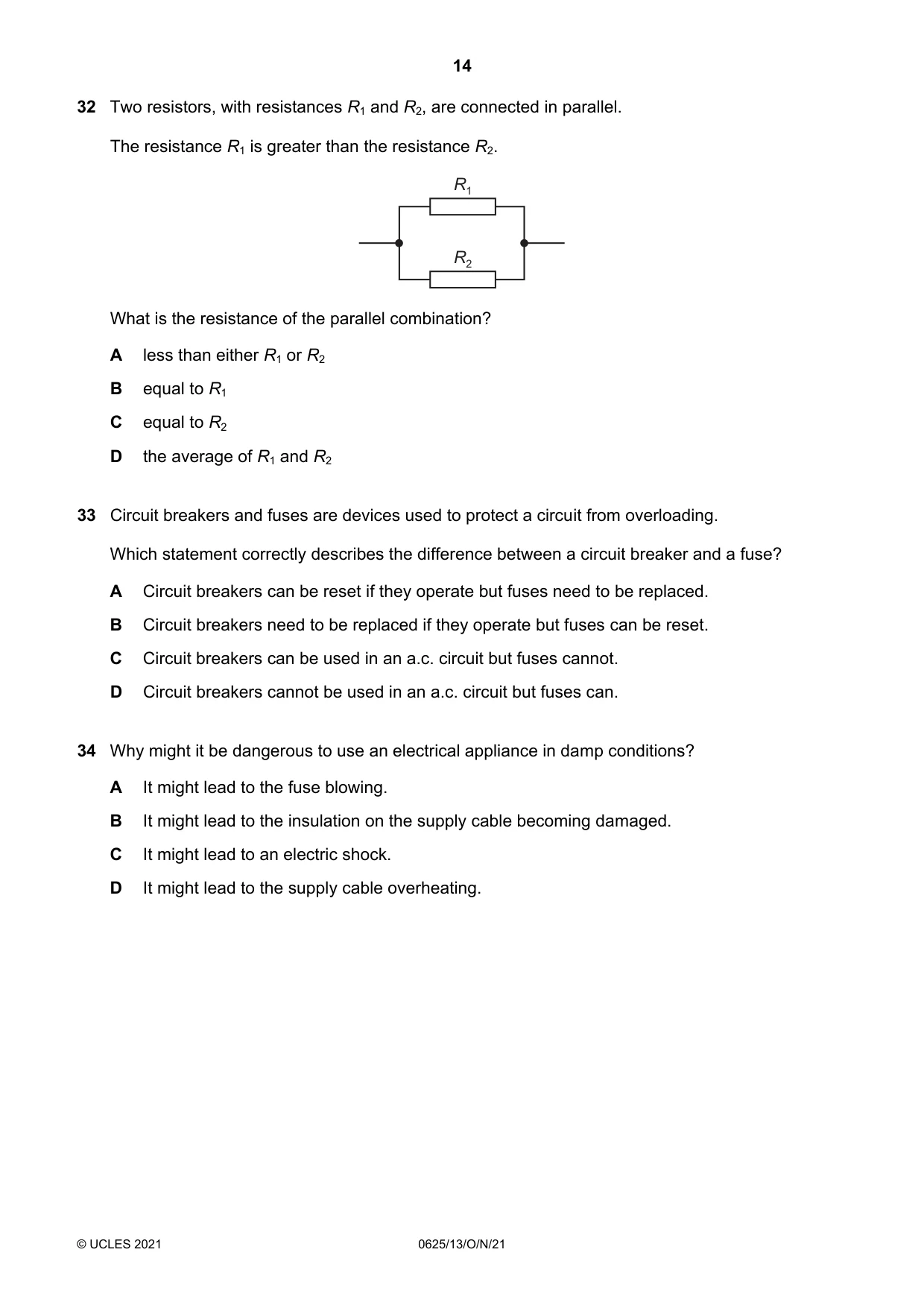
32 Two resistors, with resistances R1 and R2, are connected in parallel. The resistance R1 is greater than the resistance R2. R1 R2 What is the resistance of the parallel combination? A less than either R1 or R2 B equal to R1 C equal to R2 D the average of R1 and R2
Mark scheme: A
Q33 · Circuit breakers and fuses are devices used to protect a circuit from overloading
33 Circuit breakers and fuses are devices used to protect a circuit from overloading. Which statement correctly describes the difference between a circuit breaker and a fuse? A Circuit breakers can be reset if they operate but fuses need to be replaced. B Circuit breakers need to be replaced if they operate but fuses can be reset. C Circuit breakers can be used in an a.c. circuit but fuses cannot. D Circuit breakers cannot be used in an a.c. circuit but fuses can.
Mark scheme: A
Q34 · Why might it be dangerous to use an electrical appliance in damp conditions?
34 Why might it be dangerous to use an electrical appliance in damp conditions? A It might lead to the fuse blowing. B It might lead to the insulation on the supply cable becoming damaged. C It might lead to an electric shock. D It might lead to the supply cable overheating.
Mark scheme: C
Q35 · Which diagram shows the magnetic field around a straight, current-carrying wire?
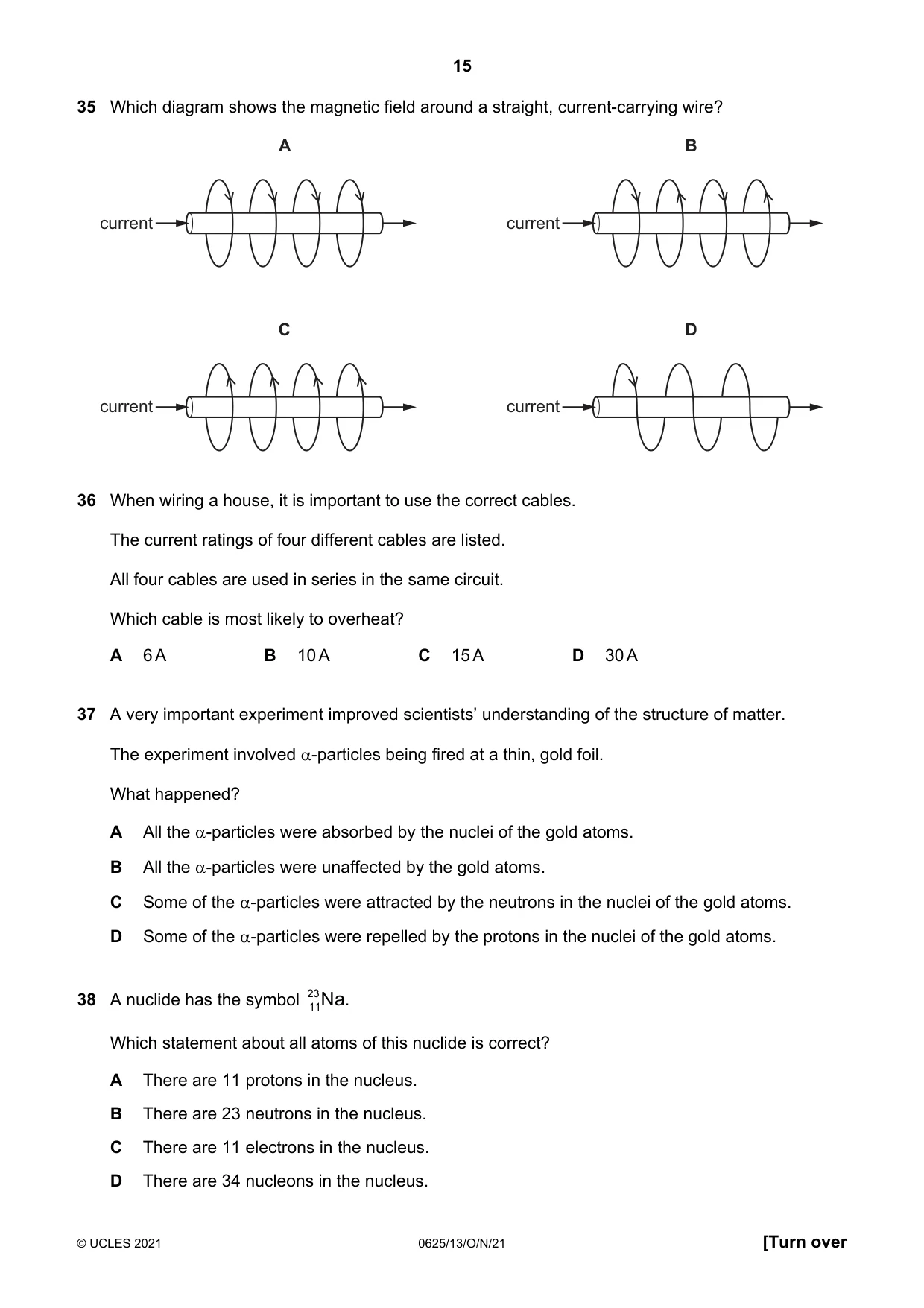
35 Which diagram shows the magnetic field around a straight, current-carrying wire? A B current current C D current current
Mark scheme: A
Q36 · When wiring a house, it is important to use the correct cables
36 When wiring a house, it is important to use the correct cables. The current ratings of four different cables are listed. All four cables are used in series in the same circuit. Which cable is most likely to overheat? A 6 A B 10 A C 15 A D 30 A
Mark scheme: A
Q37 · A very important experiment improved scientists’ understanding of the structure of matter
37 A very important experiment improved scientists’ understanding of the structure of matter. The experiment involved -particles being fired at a thin, gold foil. What happened? A All the -particles were absorbed by the nuclei of the gold atoms. B All the -particles were unaffected by the gold atoms. C Some of the -particles were attracted by the neutrons in the nuclei of the gold atoms. D Some of the -particles were repelled by the protons in the nuclei of the gold atoms.
Mark scheme: D
Q38 · A nuclide has the symbol 23 Na
38 A nuclide has the symbol 23 Na. 11 Which statement about all atoms of this nuclide is correct? A There are 11 protons in the nucleus. B There are 23 neutrons in the nucleus. C There are 11 electrons in the nucleus. D There are 34 nucleons in the nucleus.
Mark scheme: A
Q39 · The half-life for lead-202 is 52 500 years
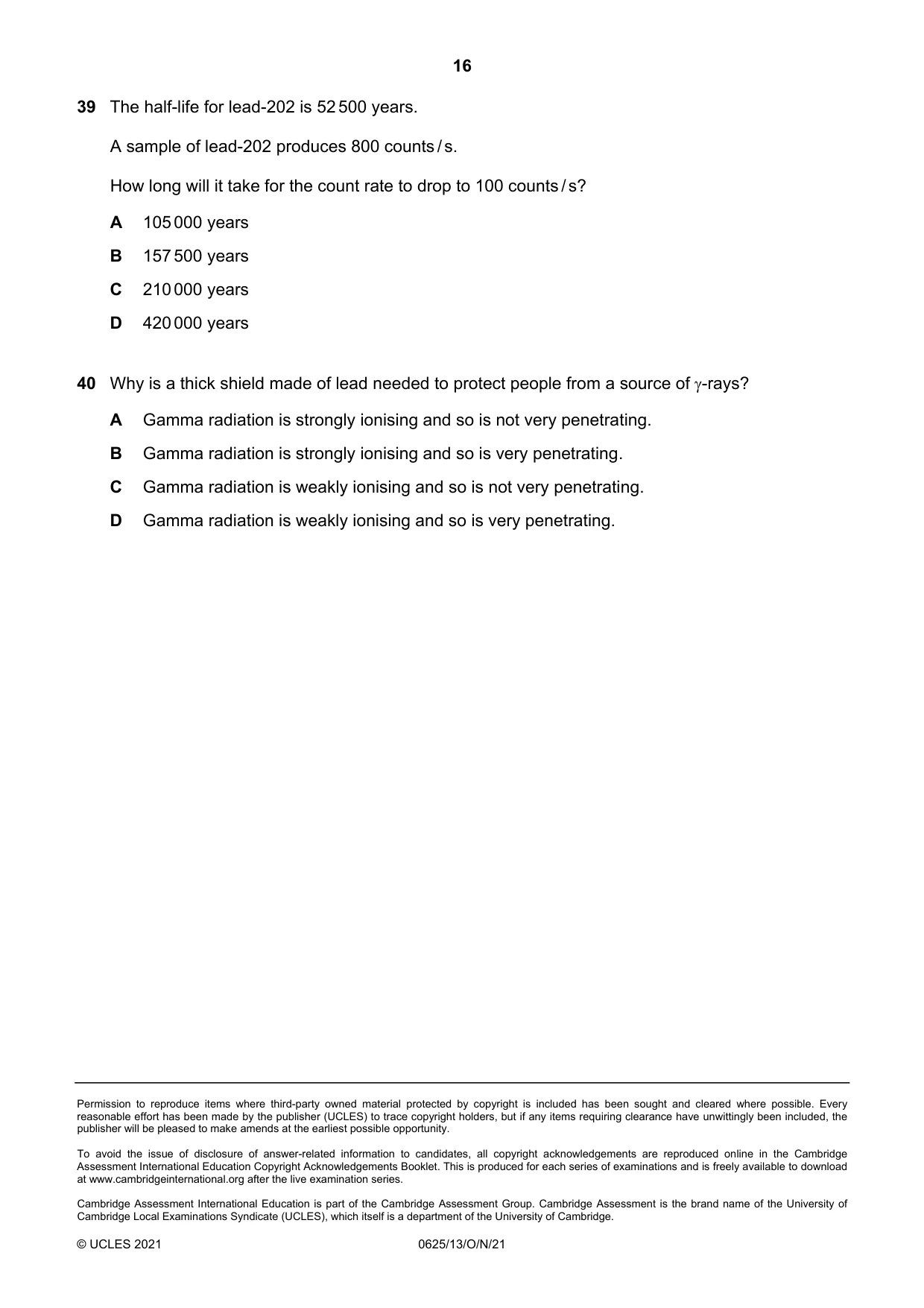
39 The half-life for lead-202 is 52 500 years. A sample of lead-202 produces 800 counts / s. How long will it take for the count rate to drop to 100 counts / s? A 105 000 years B 157 500 years C 210 000 years D 420 000 years
Mark scheme: B
Q40 · Why is a thick shield made of lead needed to protect people from a source of -rays?
40 Why is a thick shield made of lead needed to protect people from a source of -rays? A Gamma radiation is strongly ionising and so is not very penetrating. B Gamma radiation is strongly ionising and so is very penetrating. C Gamma radiation is weakly ionising and so is not very penetrating. D Gamma radiation is weakly ionising and so is very penetrating.
Mark scheme: D
What was in this paper
The subtopics covered by these 40 questions, and how many questions each got. Open one in a new tab to see every Cambridge question on it.
4Energy, work and power4Electrical quantities3Electrical safety3General properties of waves3Light3Forces2Kinetic particle model of matter2Radioactivity2The nuclear model of the atom2Thermal properties and temperature2Density1Electromagnetic effects1Electromagnetic spectrum1Mass and weight1Motion1Physical quantities and measurement techniques1Pressure1Simple phenomena of magnetism1Sound1Transfer of thermal energy1What you needed in this session
Cambridge’s own grade thresholds for 2021 Oct/Nov, Paper 1 · Variant 3. A higher threshold means an easier paper — the bar moves with how the cohort did.