Cambridge IGCSE Physics 0625 — 2020 May/June Paper 1 · Variant 2
0625/12/M/J/20 · 40 questions · 40 marks · ≈45 min
The question paper and its mark scheme, free to read here and free to download. This is Cambridge’s own paper, exactly as it was sat.
Question paper20 pages

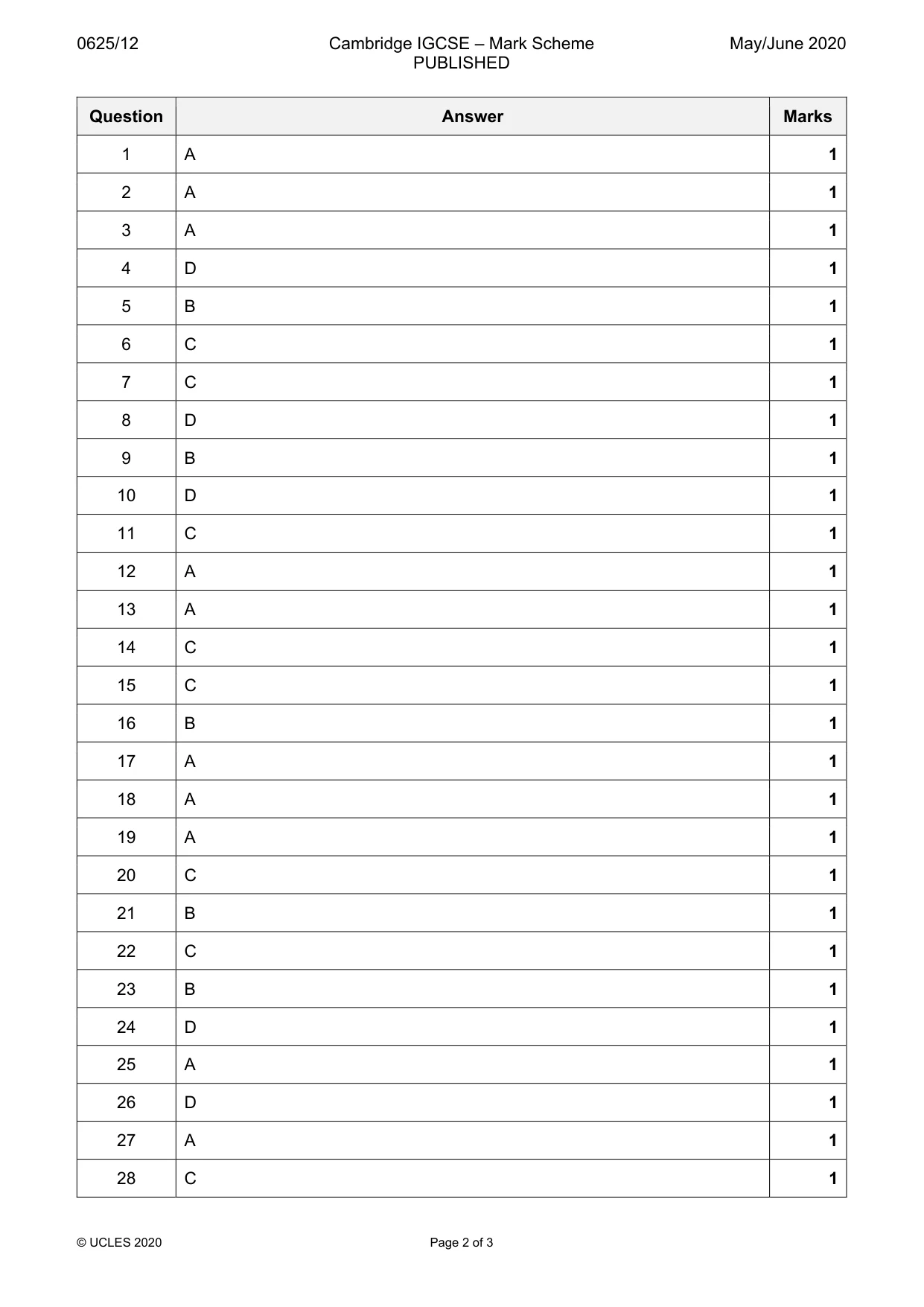
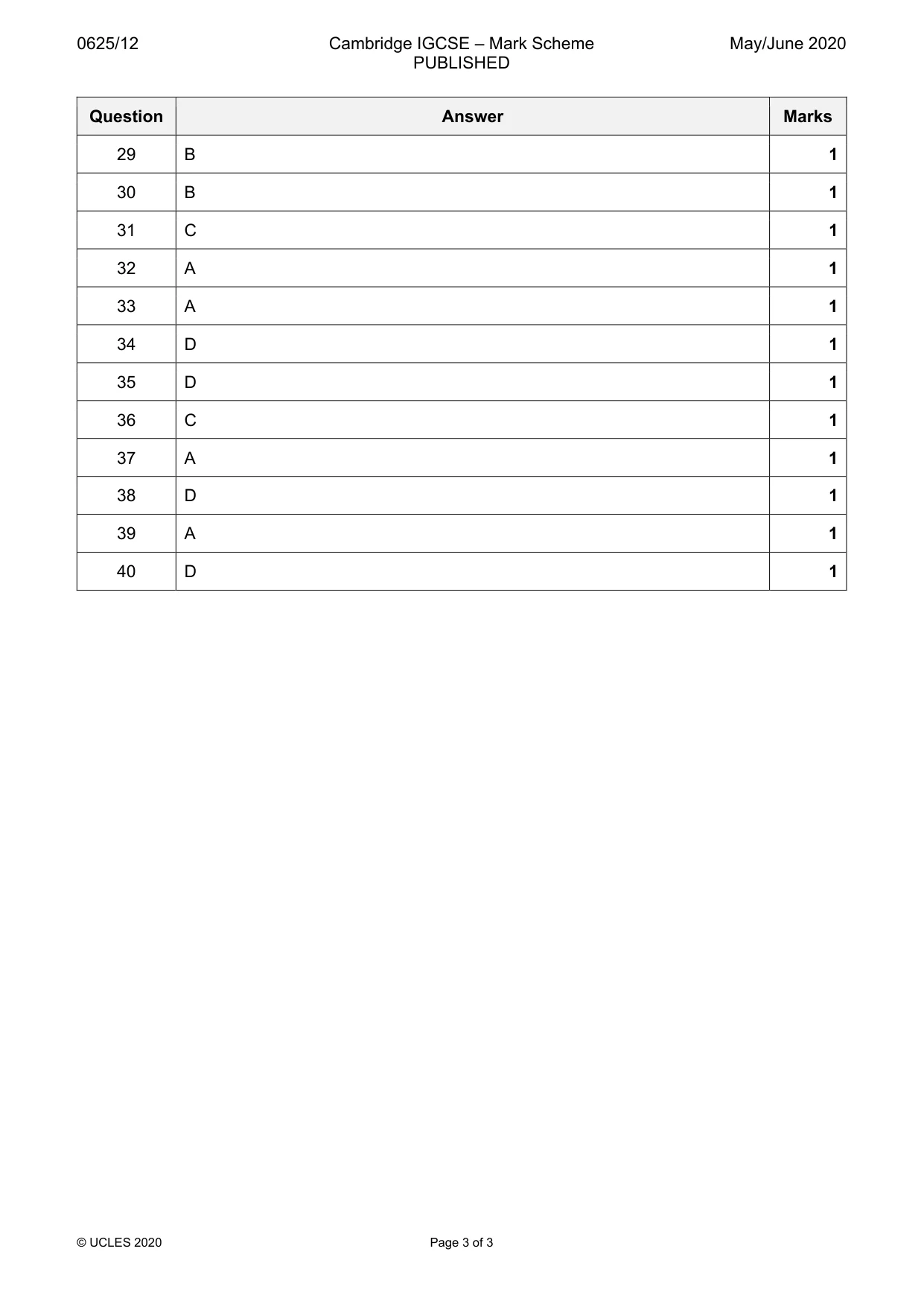
Mark scheme3 pages
Answers below. Sit the paper first if you are practising.
Questions as text
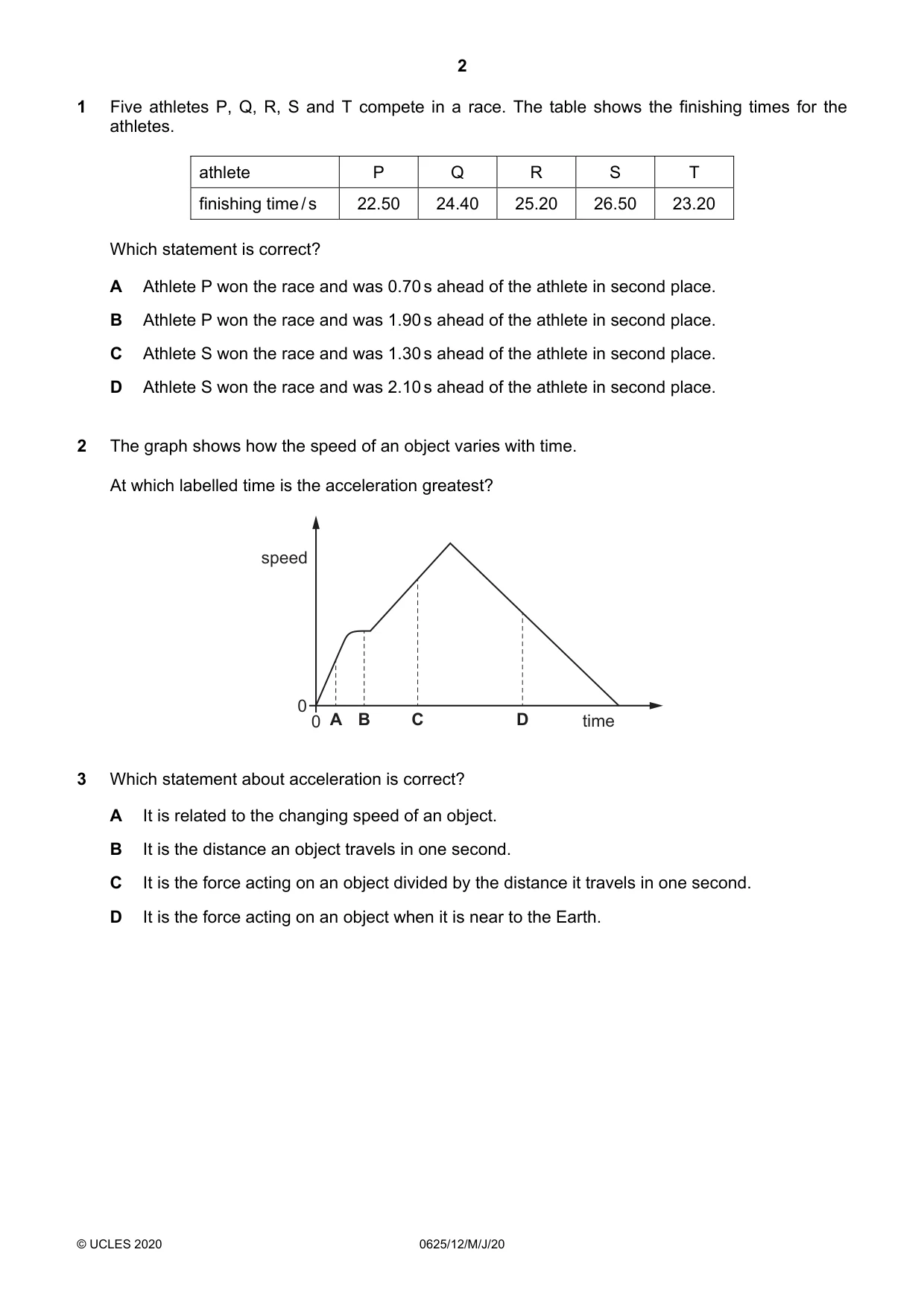
Q1 · Five athletes P, Q, R, S and T compete in a race
1 Five athletes P, Q, R, S and T compete in a race. The table shows the finishing times for the athletes. athlete P Q R S T finishing time / s 22.50 24.40 25.20 26.50 23.20 Which statement is correct? A Athlete P won the race and was 0.70 s ahead of the athlete in second place. B Athlete P won the race and was 1.90 s ahead of the athlete in second place. C Athlete S won the race and was 1.30 s ahead of the athlete in second place. D Athlete S won the race and was 2.10 s ahead of the athlete in second place.
Mark scheme: A
More questions on Physical quantities and measurement techniques
Q2 · The graph shows how the speed of an object varies with time
2 The graph shows how the speed of an object varies with time. At which labelled time is the acceleration greatest? speed 0 0 A B C D time
Mark scheme: A
Q3 · Which statement about acceleration is correct?
3 Which statement about acceleration is correct? A It is related to the changing speed of an object. B It is the distance an object travels in one second. C It is the force acting on an object divided by the distance it travels in one second. D It is the force acting on an object when it is near to the Earth.
Mark scheme: A
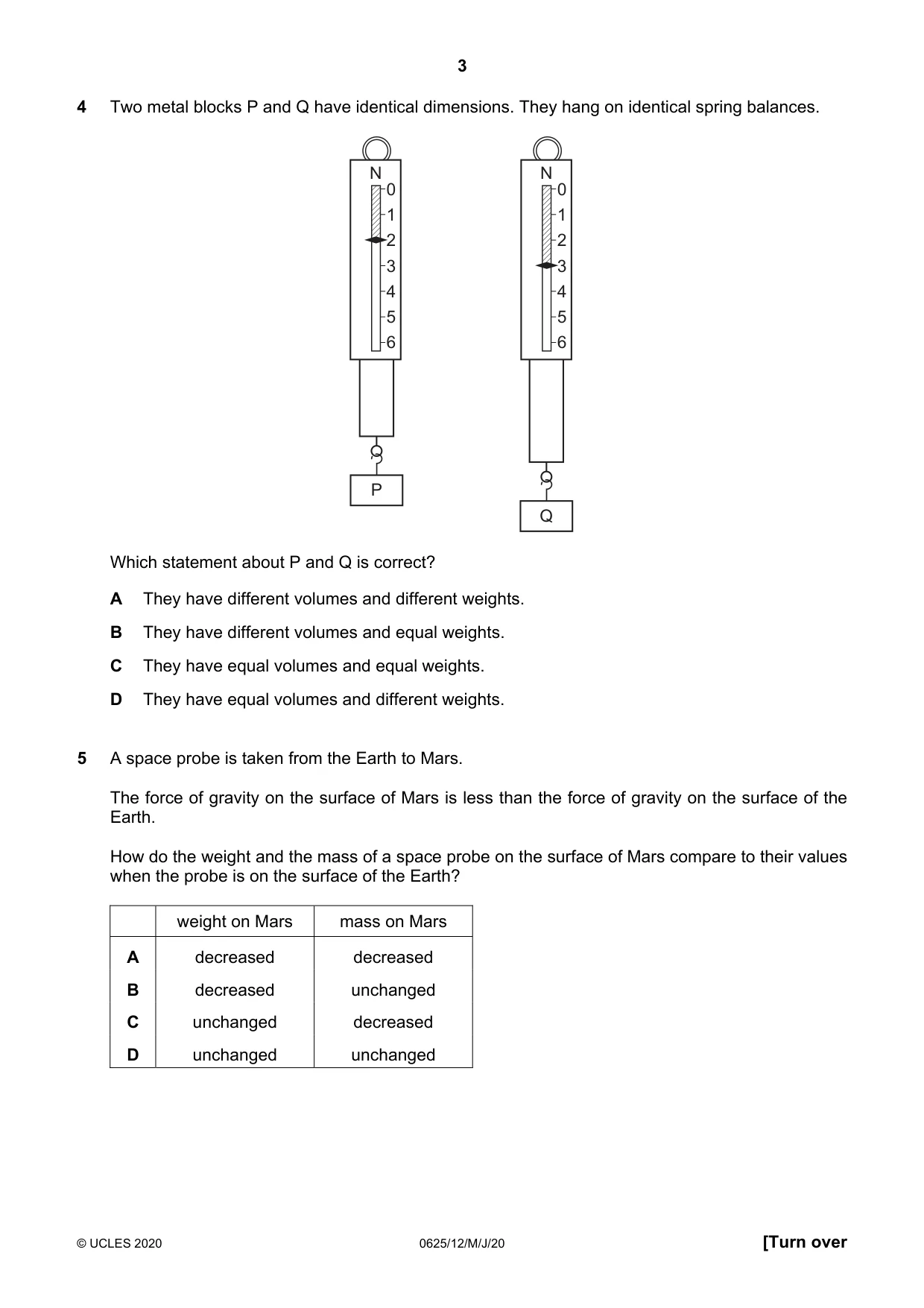
Q4 · Two metal blocks P and Q have identical dimensions
4 Two metal blocks P and Q have identical dimensions. They hang on identical spring balances. N N 0 0 1 1 2 2 3 3 4 4 5 5 6 6 P Q Which statement about P and Q is correct? A They have different volumes and different weights. B They have different volumes and equal weights. C They have equal volumes and equal weights. D They have equal volumes and different weights.
Mark scheme: D
Q5 · A space probe is taken from the Earth to Mars
5 A space probe is taken from the Earth to Mars. The force of gravity on the surface of Mars is less than the force of gravity on the surface of the Earth. How do the weight and the mass of a space probe on the surface of Mars compare to their values when the probe is on the surface of the Earth? weight on Mars mass on Mars A decreased decreased B decreased unchanged C unchanged decreased D unchanged unchanged
Mark scheme: B
Q6 · Water has a density of 1000 kg / m3
6 Water has a density of 1000 kg / m3. A rectangular swimming pool has an average depth of 1.6 m. The length of the pool is 25 m. The width of the pool is 10 m. What is the mass of the water in the swimming pool? A 2.5 kg B 400 kg C 400 000 kg D 800 000 kg
Mark scheme: C
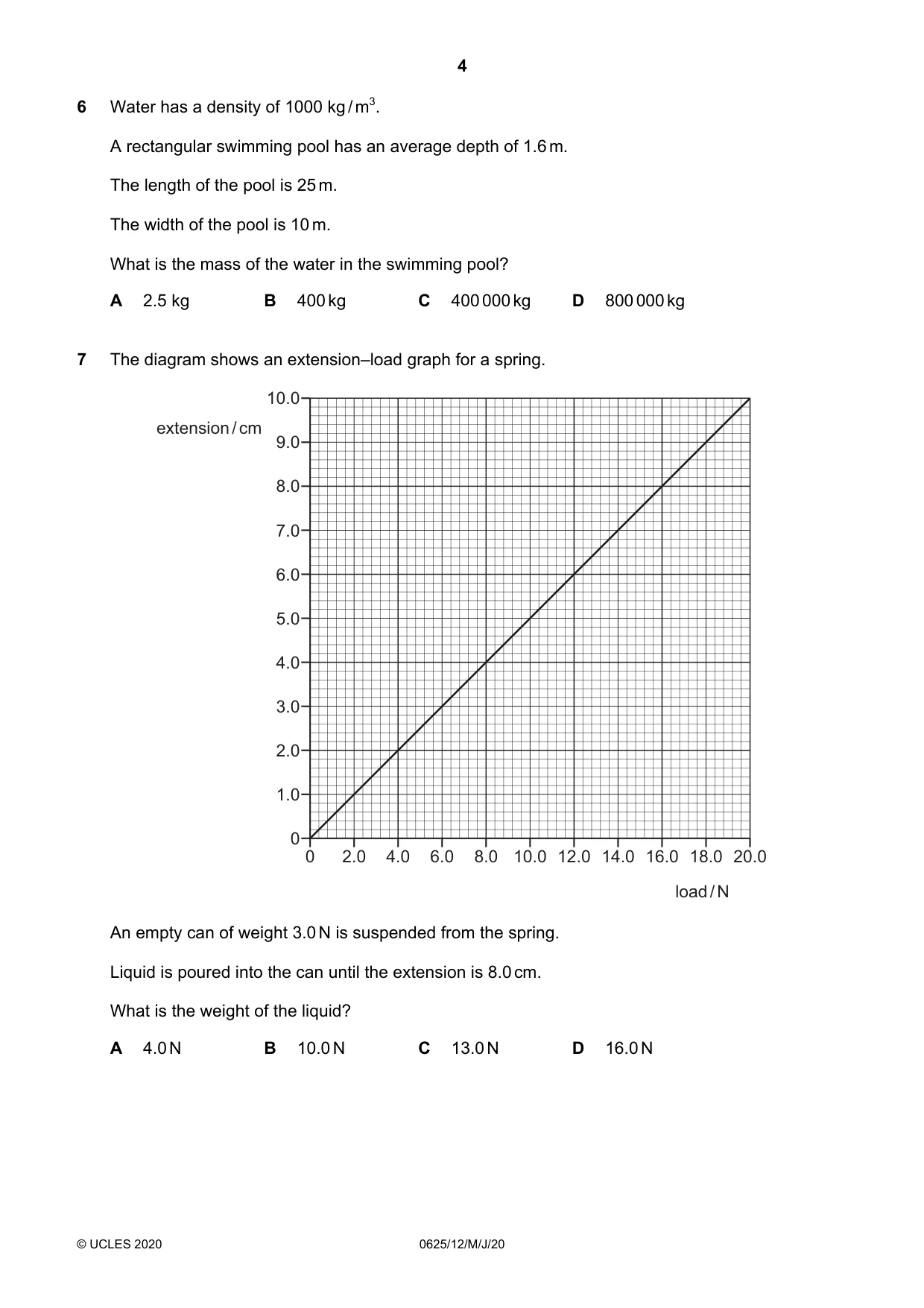
Q7 · The diagram shows an extension–load graph for a spring
7 The diagram shows an extension–load graph for a spring. 10.0 extension / cm 9.0 8.0 7.0 6.0 5.0 4.0 3.0 2.0 1.0 0 0 2.0 4.0 6.0 8.0 10.0 12.0 14.0 16.0 18.0 20.0 load / N An empty can of weight 3.0 N is suspended from the spring. Liquid is poured into the can until the extension is 8.0 cm. What is the weight of the liquid? A 4.0 N B 10.0 N C 13.0 N D 16.0 N
Mark scheme: C
Q8 · What is meant by the moment of a force on an object?
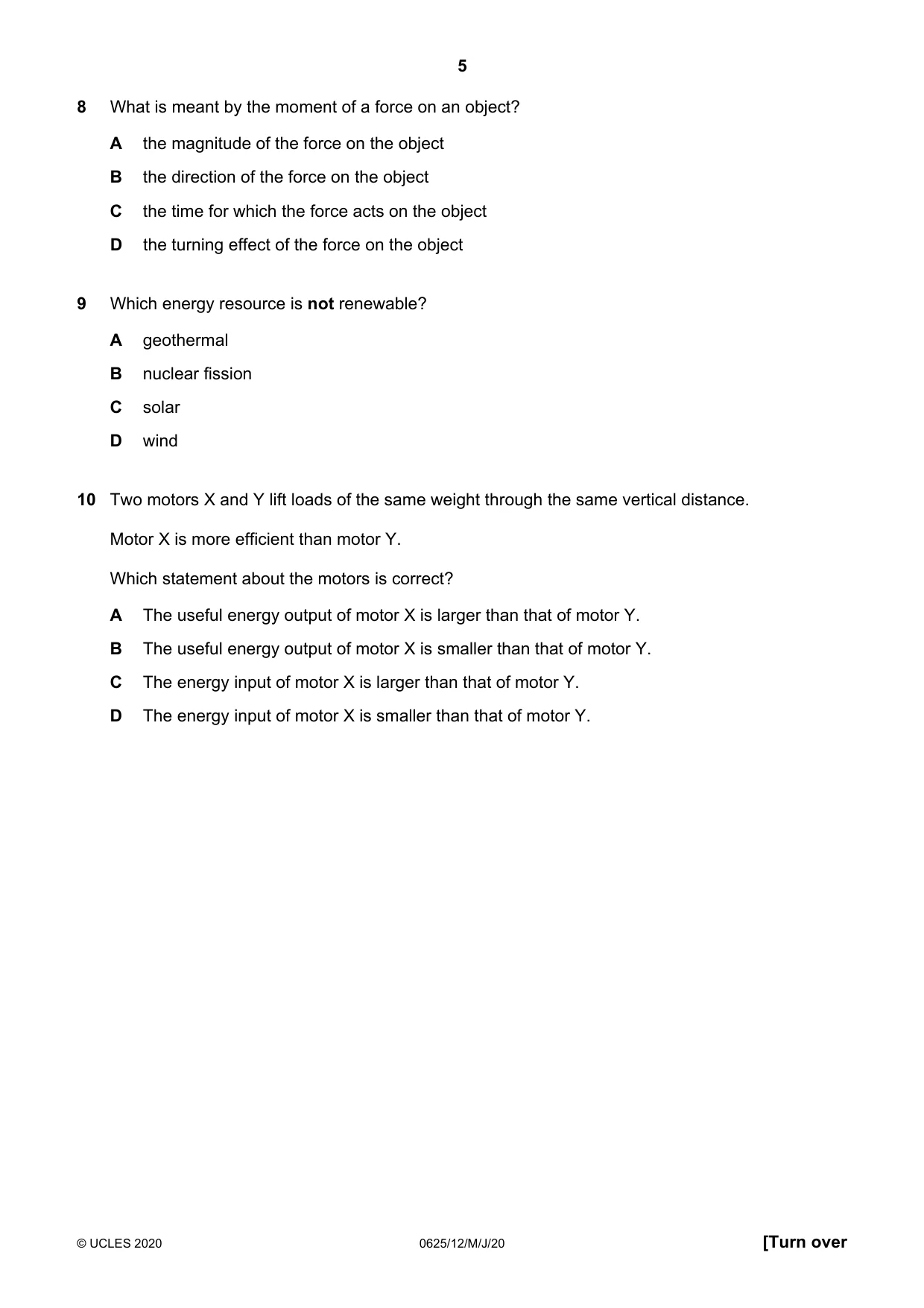
8 What is meant by the moment of a force on an object? A the magnitude of the force on the object B the direction of the force on the object C the time for which the force acts on the object D the turning effect of the force on the object
Mark scheme: D
Q9 · Which energy resource is not renewable?
9 Which energy resource is not renewable? A geothermal B nuclear fission C solar D wind
Mark scheme: B
Q10 · Two motors X and Y lift loads of the same weight through the same vertical distance
10 Two motors X and Y lift loads of the same weight through the same vertical distance. Motor X is more efficient than motor Y. Which statement about the motors is correct? A The useful energy output of motor X is larger than that of motor Y. B The useful energy output of motor X is smaller than that of motor Y. C The energy input of motor X is larger than that of motor Y. D The energy input of motor X is smaller than that of motor Y.
Mark scheme: D
Q11 · A man can either take an escalator or a lift to travel up between two floors in a hotel
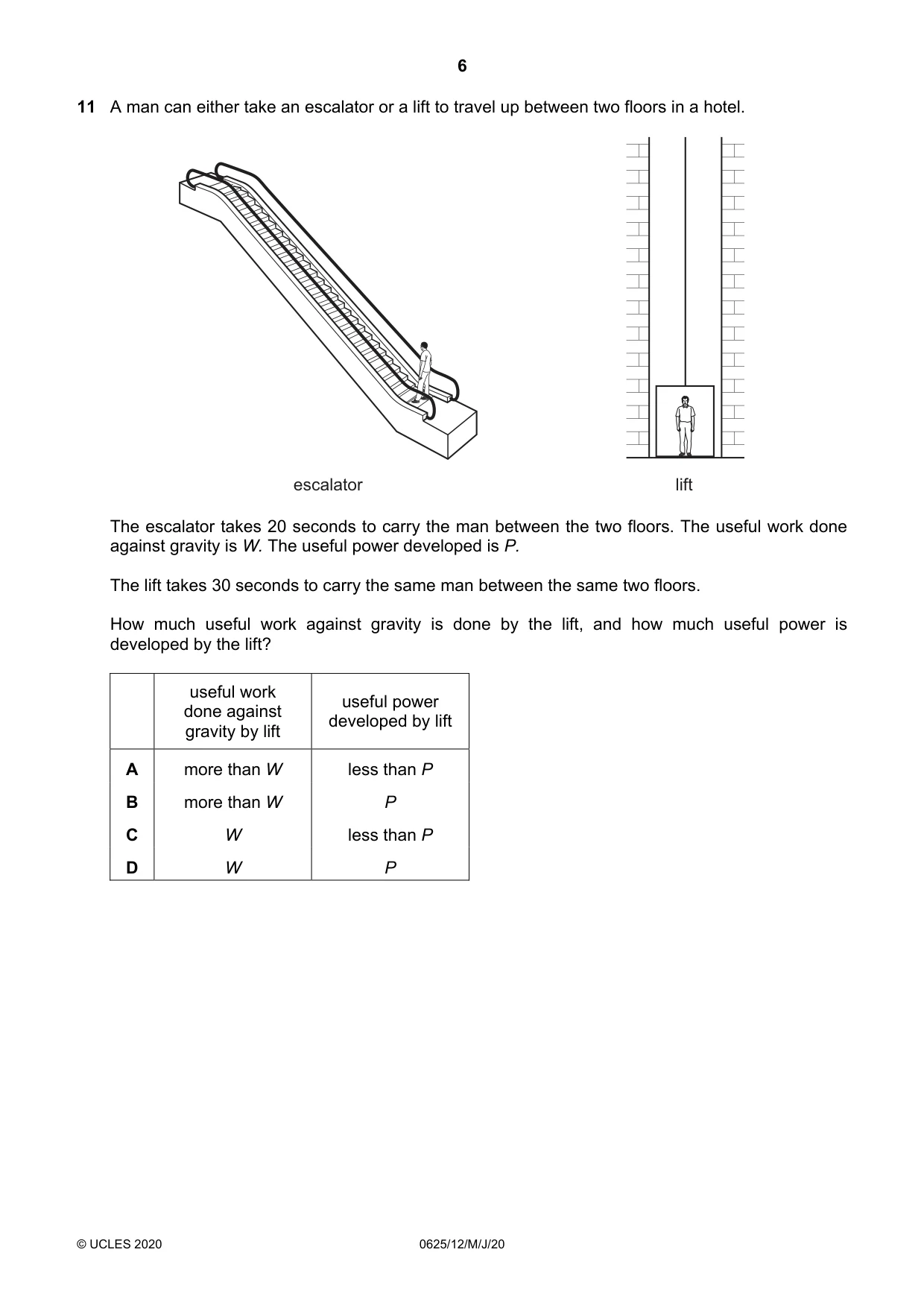
11 A man can either take an escalator or a lift to travel up between two floors in a hotel. escalator lift The escalator takes 20 seconds to carry the man between the two floors. The useful work done against gravity is W. The useful power developed is P. The lift takes 30 seconds to carry the same man between the same two floors. How much useful work against gravity is done by the lift, and how much useful power is developed by the lift? useful work useful power done against developed by lift gravity by lift A more than W less than P B more than W P C W less than P D W P
Mark scheme: C
Q12 · The diagram shows a solid block resting on a bench
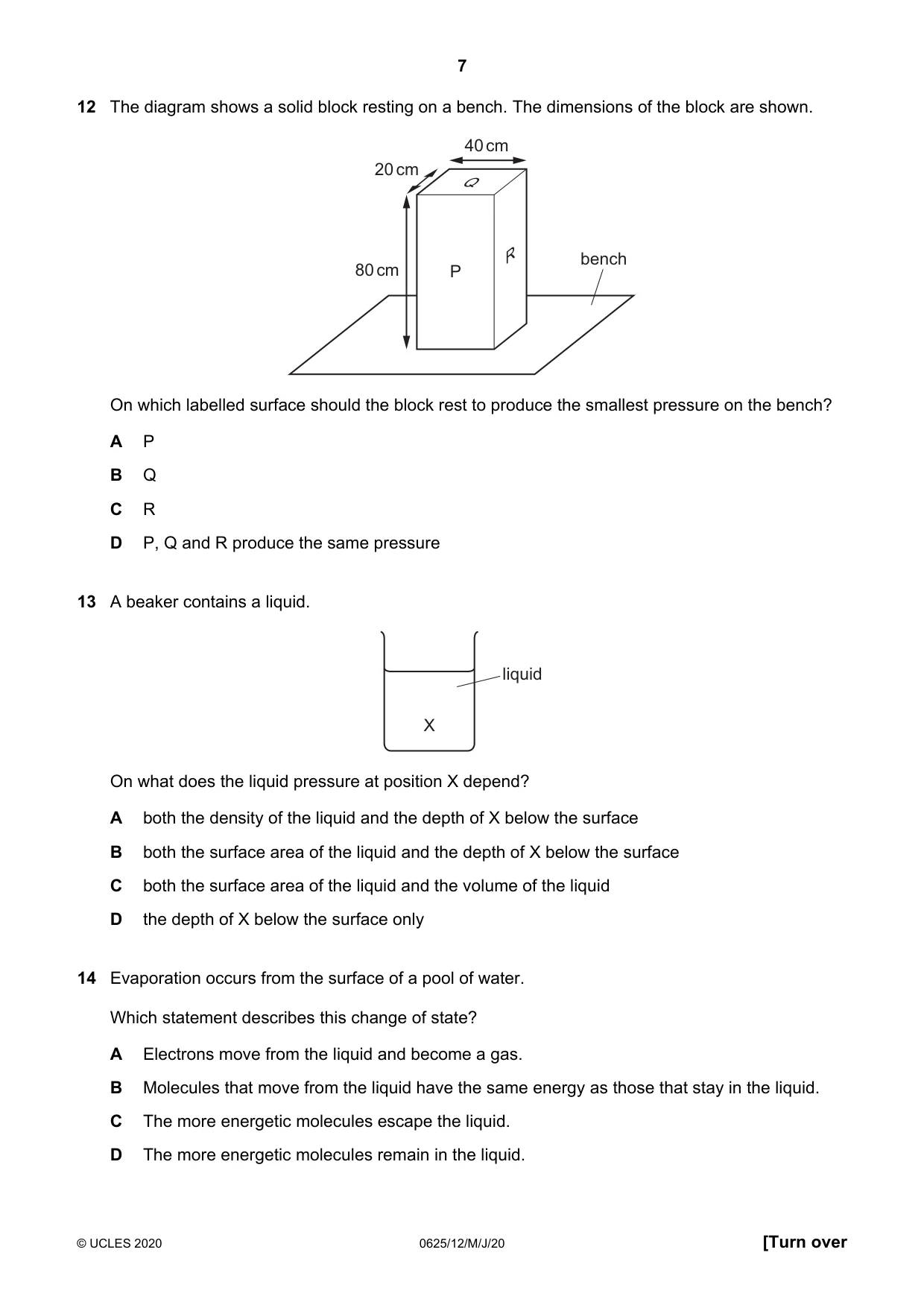
12 The diagram shows a solid block resting on a bench. The dimensions of the block are shown. 40 cm 20 cm Q R bench 80 cm P On which labelled surface should the block rest to produce the smallest pressure on the bench? A P B Q C R D P, Q and R produce the same pressure
Mark scheme: A
Q13 · A beaker contains a liquid
13 A beaker contains a liquid. liquid X On what does the liquid pressure at position X depend? A both the density of the liquid and the depth of X below the surface B both the surface area of the liquid and the depth of X below the surface C both the surface area of the liquid and the volume of the liquid D the depth of X below the surface only
Mark scheme: A
Q14 · Evaporation occurs from the surface of a pool of water
14 Evaporation occurs from the surface of a pool of water. Which statement describes this change of state? A Electrons move from the liquid and become a gas. B Molecules that move from the liquid have the same energy as those that stay in the liquid. C The more energetic molecules escape the liquid. D The more energetic molecules remain in the liquid.
Mark scheme: C
Q15 · A gas, in a sealed container, is compressed slowly so that its temperature does not change
15 A gas, in a sealed container, is compressed slowly so that its temperature does not change. What happens to the molecules of the gas as a result of this compression? A The average speed of the molecules increases. B The average force in a collision between a molecule and the container increases. C There are more frequent collisions between molecules and the container. D The volume of each molecule decreases.
Mark scheme: C
Q16 · The diagram shows a liquid-in-glass thermometer
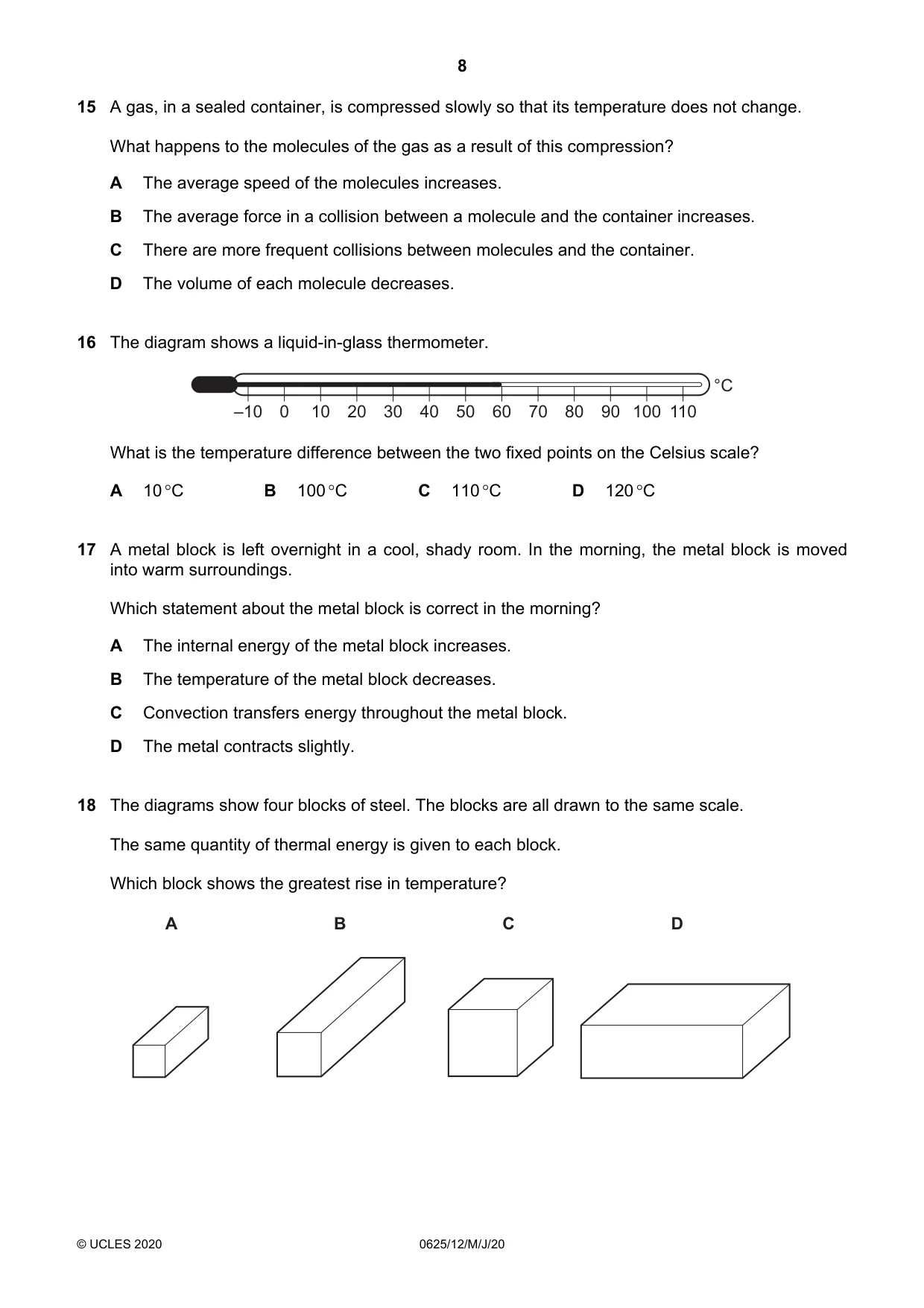
16 The diagram shows a liquid-in-glass thermometer. °C –10 0 10 20 30 40 50 60 70 80 90 100 110 What is the temperature difference between the two fixed points on the Celsius scale? A 10 °C B 100 °C C 110 °C D 120 °C
Mark scheme: B
Q17 · A metal block is left overnight in a cool, shady room
17 A metal block is left overnight in a cool, shady room. In the morning, the metal block is moved into warm surroundings. Which statement about the metal block is correct in the morning? A The internal energy of the metal block increases. B The temperature of the metal block decreases. C Convection transfers energy throughout the metal block. D The metal contracts slightly.
Mark scheme: A
Q18 · The diagrams show four blocks of steel
18 The diagrams show four blocks of steel. The blocks are all drawn to the same scale. The same quantity of thermal energy is given to each block. Which block shows the greatest rise in temperature? A B C D
Mark scheme: A
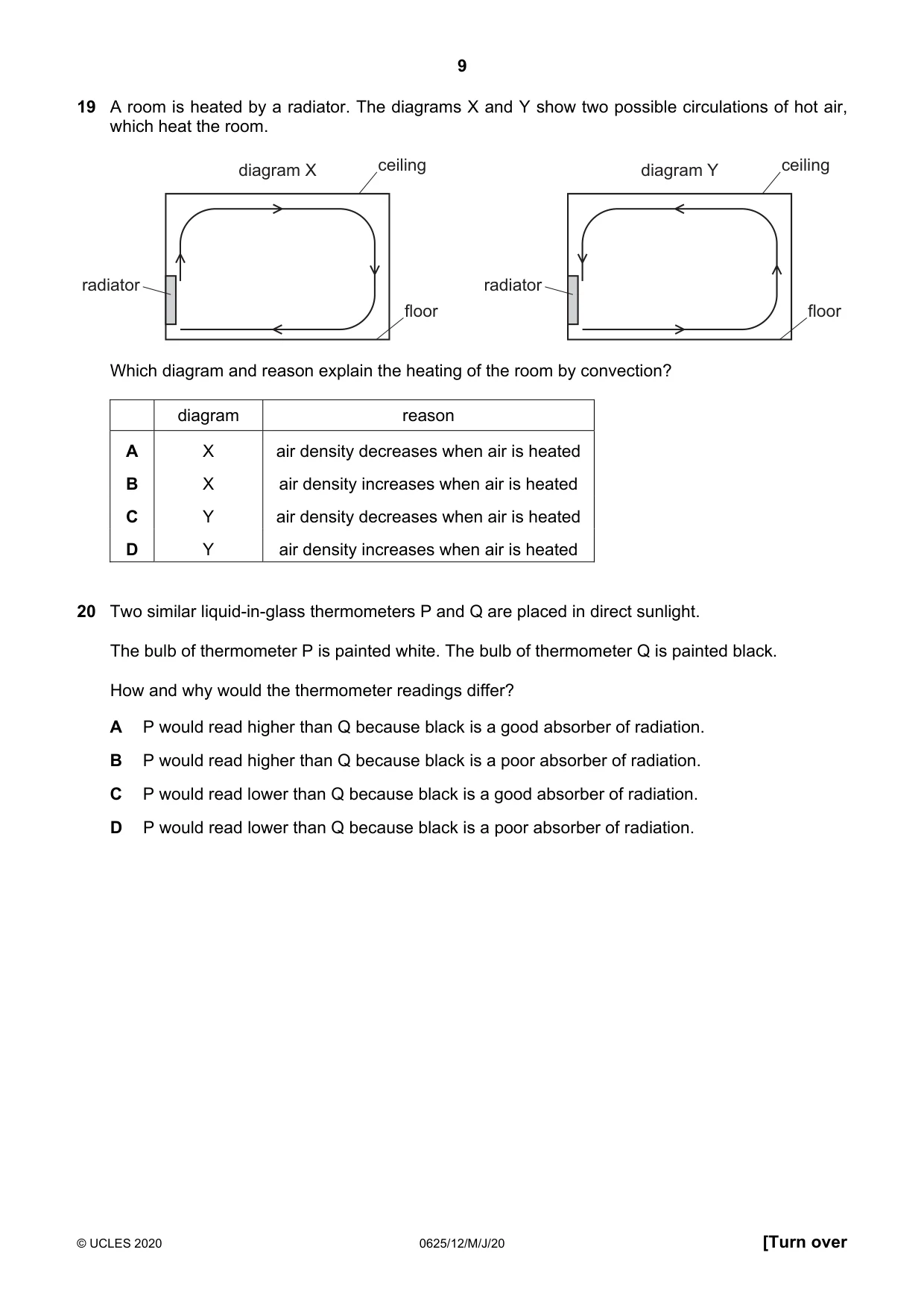
Q19 · A room is heated by a radiator
19 A room is heated by a radiator. The diagrams X and Y show two possible circulations of hot air, which heat the room. diagram X ceiling diagram Y ceiling radiator radiator floor floor Which diagram and reason explain the heating of the room by convection? diagram reason A X air density decreases when air is heated B X air density increases when air is heated C Y air density decreases when air is heated D Y air density increases when air is heated
Mark scheme: A
Q20 · Two similar liquid-in-glass thermometers P and Q are placed in direct sunlight
20 Two similar liquid-in-glass thermometers P and Q are placed in direct sunlight. The bulb of thermometer P is painted white. The bulb of thermometer Q is painted black. How and why would the thermometer readings differ? A P would read higher than Q because black is a good absorber of radiation. B P would read higher than Q because black is a poor absorber of radiation. C P would read lower than Q because black is a good absorber of radiation. D P would read lower than Q because black is a poor absorber of radiation.
Mark scheme: C
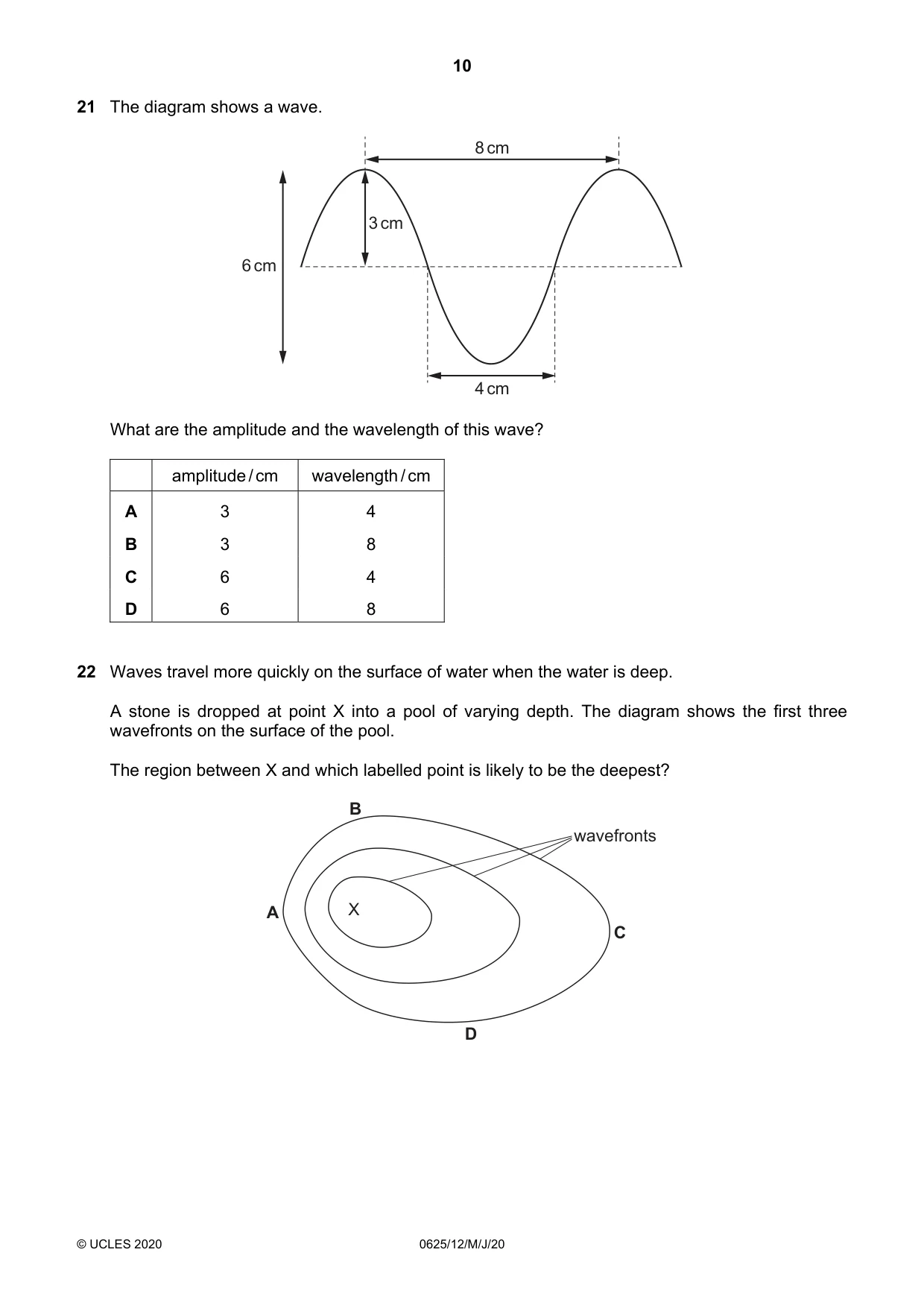
Q21 · The diagram shows a wave
21 The diagram shows a wave. 8 cm 3 cm 6 cm 4 cm What are the amplitude and the wavelength of this wave? amplitude / cm wavelength / cm A 3 4 B 3 8 C 6 4 D 6 8
Mark scheme: B
Q22 · Waves travel more quickly on the surface of water when the water is deep
22 Waves travel more quickly on the surface of water when the water is deep. A stone is dropped at point X into a pool of varying depth. The diagram shows the first three wavefronts on the surface of the pool. The region between X and which labelled point is likely to be the deepest? B wavefronts A X C D
Mark scheme: C
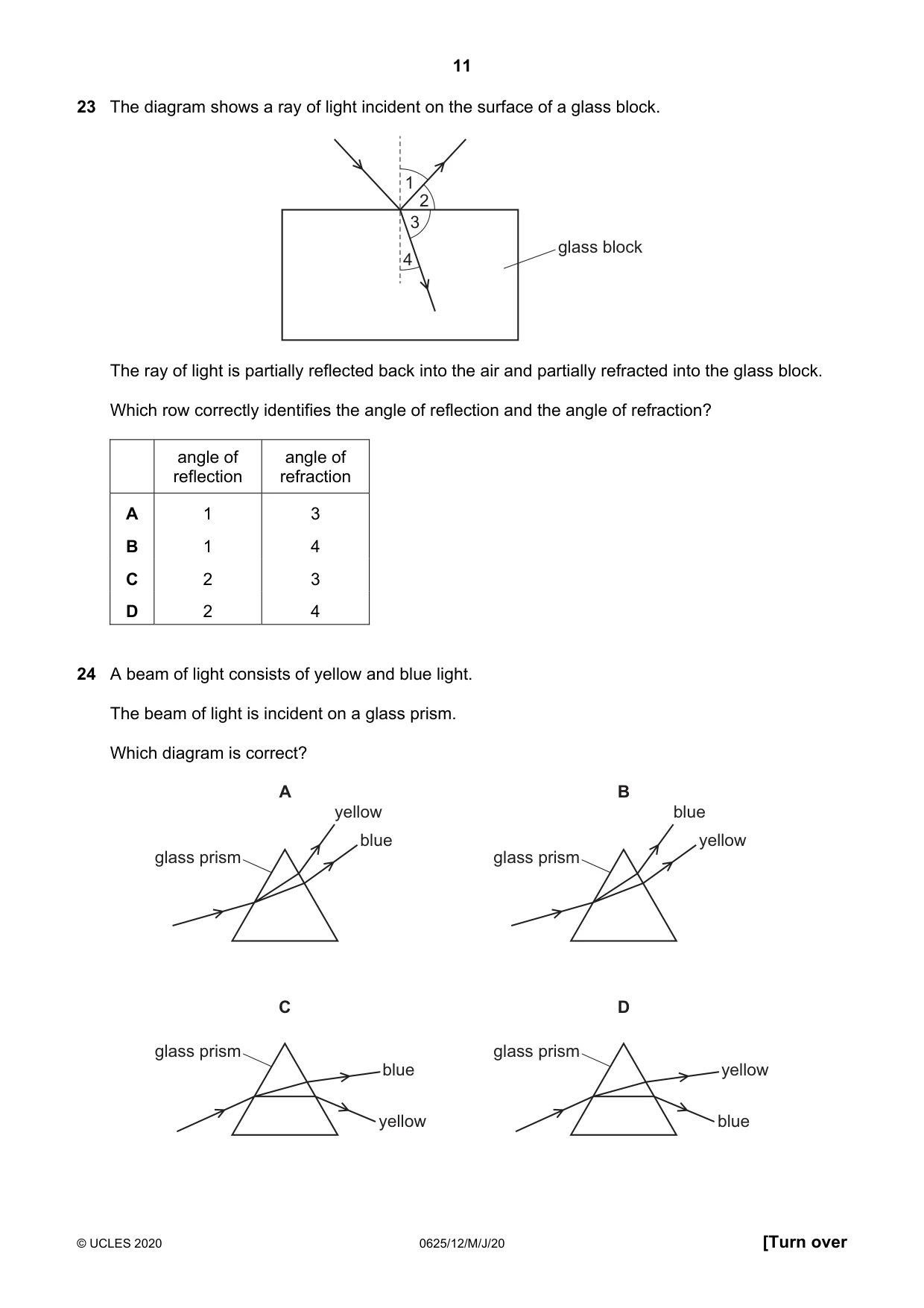
Q23 · The diagram shows a ray of light incident on the surface of a glass block
23 The diagram shows a ray of light incident on the surface of a glass block. 1 2 3 glass block 4 The ray of light is partially reflected back into the air and partially refracted into the glass block. Which row correctly identifies the angle of reflection and the angle of refraction? angle of angle of reflection refraction A 1 3 B 1 4 C 2 3 D 2 4
Mark scheme: B
Q24 · A beam of light consists of yellow and blue light
24 A beam of light consists of yellow and blue light. The beam of light is incident on a glass prism. Which diagram is correct? A B yellow blue blue yellow glass prism glass prism C D glass prism glass prism blue yellow yellow blue
Mark scheme: D
Q25 · An intruder alarm sensor detects that a person is warmer than his surroundings
25 An intruder alarm sensor detects that a person is warmer than his surroundings. Which type of electromagnetic wave does the sensor detect? A infrared B radio C ultraviolet D visible light
Mark scheme: A
Q26 · A dolphin sends out a sound wave
26 A dolphin sends out a sound wave. An echo returns 0.010 s later from a fish which is 7.5 m from the dolphin. What is the speed of the sound wave in water? A 0.075 m / s B 0.15 m / s C 750 m / s D 1500 m / s
Mark scheme: D
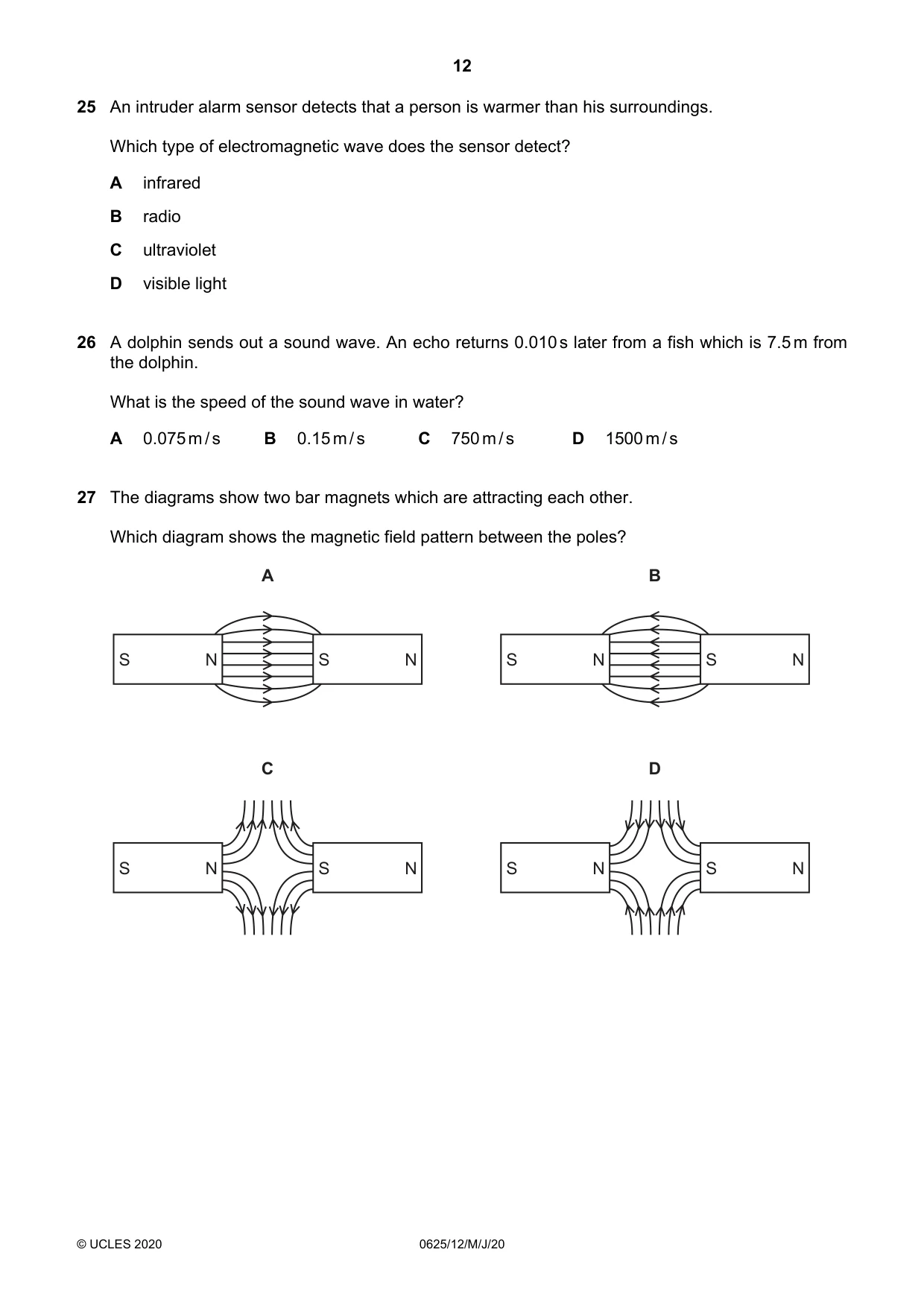
Q27 · The diagrams show two bar magnets which are attracting each other
27 The diagrams show two bar magnets which are attracting each other. Which diagram shows the magnetic field pattern between the poles? A B S N S N S N S N C D S N S N S N S N
Mark scheme: A
Q28 · Four nails A, B, C and D are tested to find which makes the strongest permanent magnet
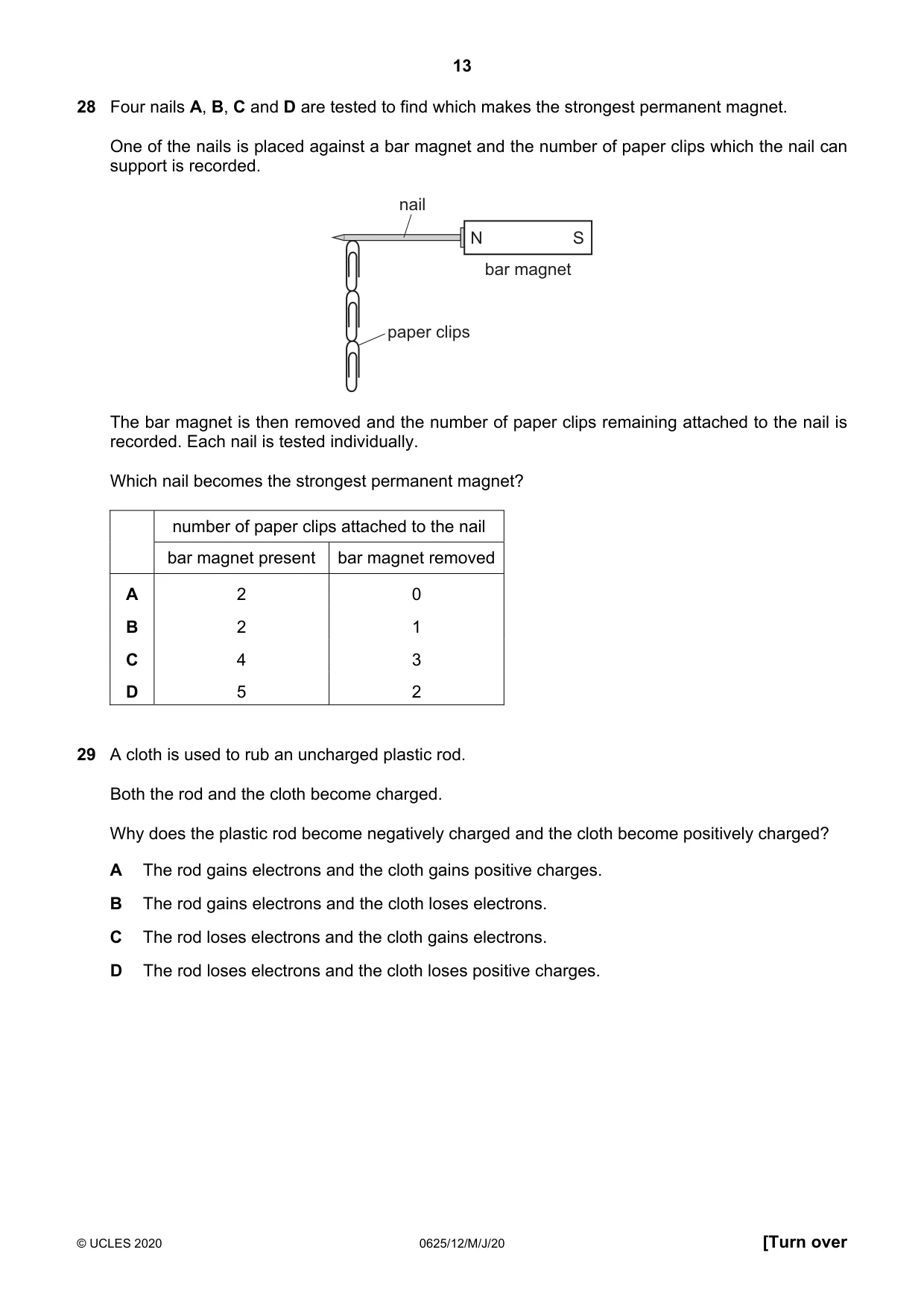
28 Four nails A, B, C and D are tested to find which makes the strongest permanent magnet. One of the nails is placed against a bar magnet and the number of paper clips which the nail can support is recorded. nail N S bar magnet paper clips The bar magnet is then removed and the number of paper clips remaining attached to the nail is recorded. Each nail is tested individually. Which nail becomes the strongest permanent magnet? number of paper clips attached to the nail bar magnet present bar magnet removed A 2 0 B 2 1 C 4 3 D 5 2
Mark scheme: C
Q29 · A cloth is used to rub an uncharged plastic rod
29 A cloth is used to rub an uncharged plastic rod. Both the rod and the cloth become charged. Why does the plastic rod become negatively charged and the cloth become positively charged? A The rod gains electrons and the cloth gains positive charges. B The rod gains electrons and the cloth loses electrons. C The rod loses electrons and the cloth gains electrons. D The rod loses electrons and the cloth loses positive charges.
Mark scheme: B
Q30 · The diagram shows a circuit
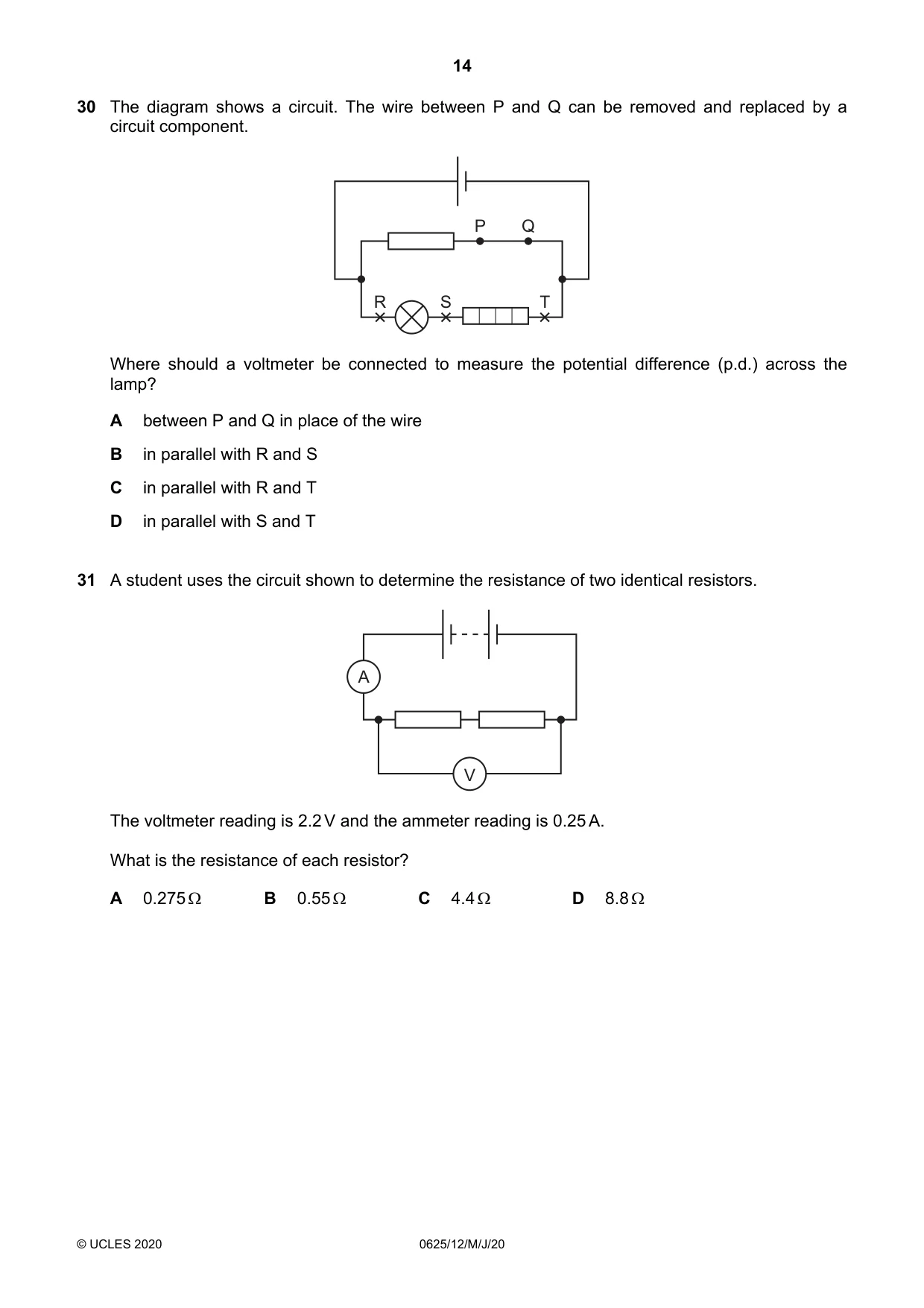
30 The diagram shows a circuit. The wire between P and Q can be removed and replaced by a circuit component. P Q R S T Where should a voltmeter be connected to measure the potential difference (p.d.) across the lamp? A between P and Q in place of the wire B in parallel with R and S C in parallel with R and T D in parallel with S and T
Mark scheme: B
Q31 · A student uses the circuit shown to determine the resistance of two identical resistors
31 A student uses the circuit shown to determine the resistance of two identical resistors. A V The voltmeter reading is 2.2 V and the ammeter reading is 0.25 A. What is the resistance of each resistor? A 0.275 Ω B 0.55 Ω C 4.4 Ω D 8.8 Ω
Mark scheme: C
Q32 · The circuit shown contains five lamps J, K, L, M and N
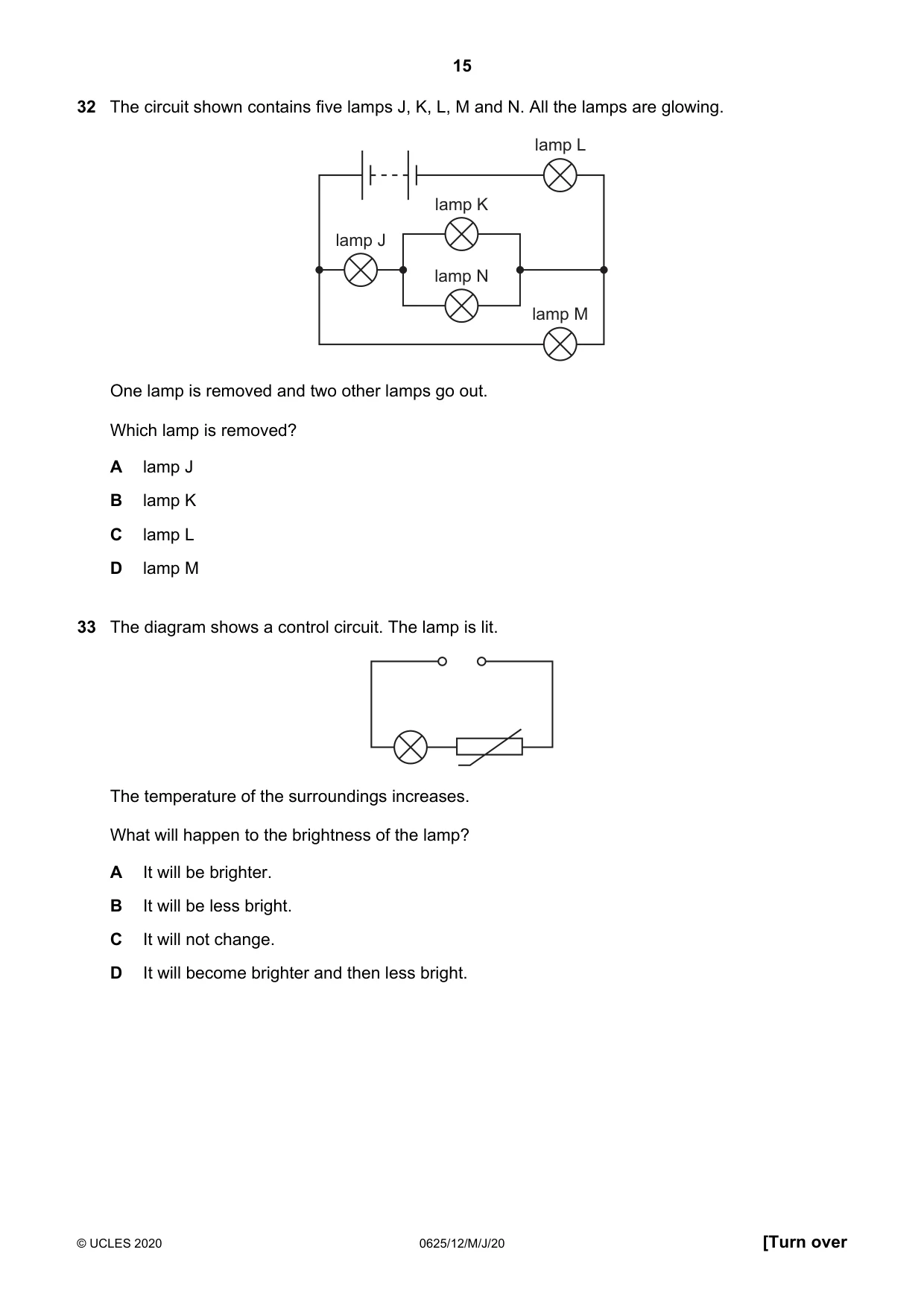
32 The circuit shown contains five lamps J, K, L, M and N. All the lamps are glowing. lamp L lamp K lamp J lamp N lamp M One lamp is removed and two other lamps go out. Which lamp is removed? A lamp J B lamp K C lamp L D lamp M
Mark scheme: A
Q33 · The diagram shows a control circuit
33 The diagram shows a control circuit. The lamp is lit. The temperature of the surroundings increases. What will happen to the brightness of the lamp? A It will be brighter. B It will be less bright. C It will not change. D It will become brighter and then less bright.
Mark scheme: A
Q34 · A student constructs four circuits, each containing a fuse
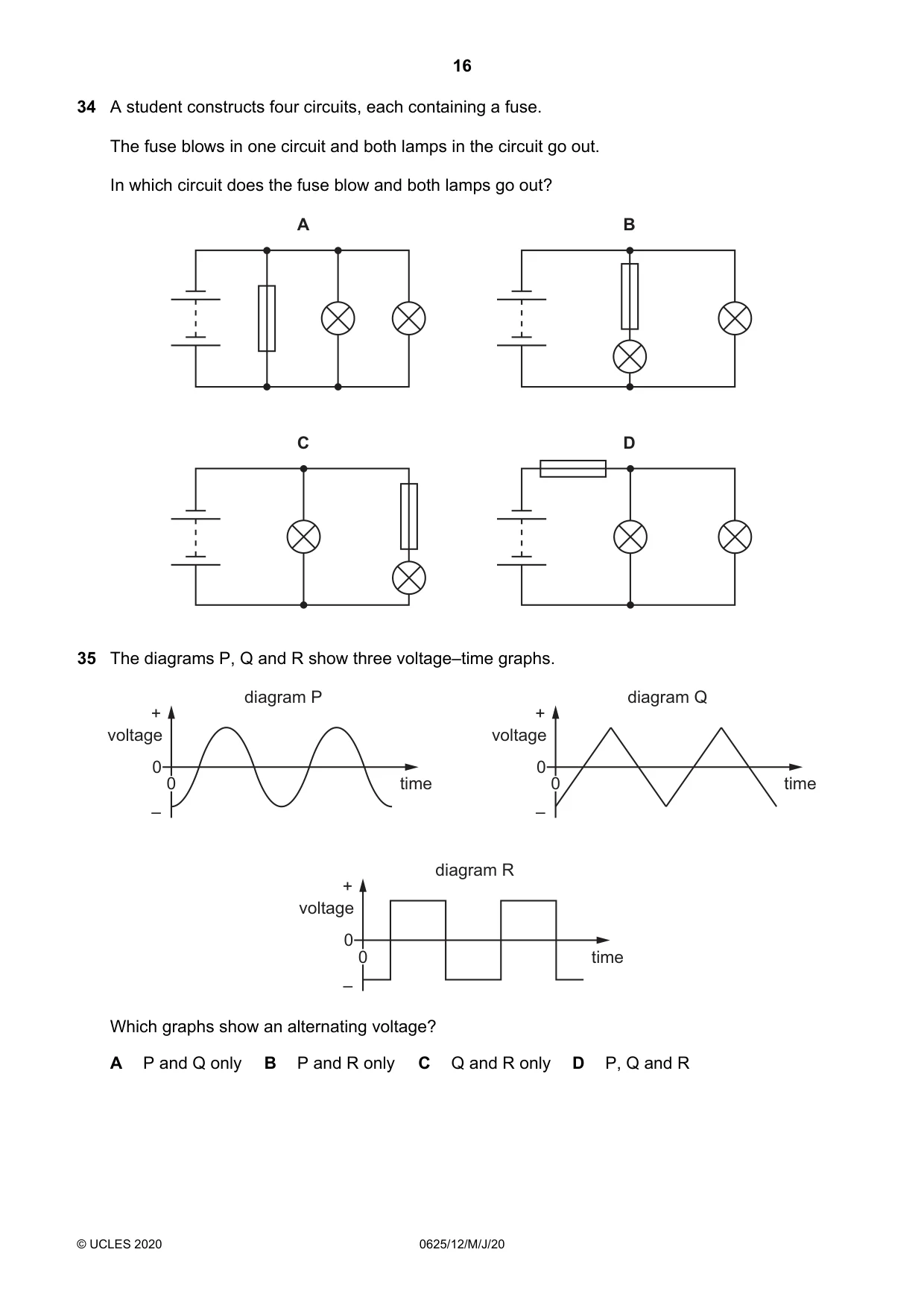
34 A student constructs four circuits, each containing a fuse. The fuse blows in one circuit and both lamps in the circuit go out. In which circuit does the fuse blow and both lamps go out? A B C D
Mark scheme: D
Q35 · The diagrams P, Q and R show three voltage–time graphs
35 The diagrams P, Q and R show three voltage–time graphs. diagram P diagram Q + + voltage voltage 0 0 0 time 0 time – – diagram R + voltage 0 0 time – Which graphs show an alternating voltage? A P and Q only B P and R only C Q and R only D P, Q and R
Mark scheme: D
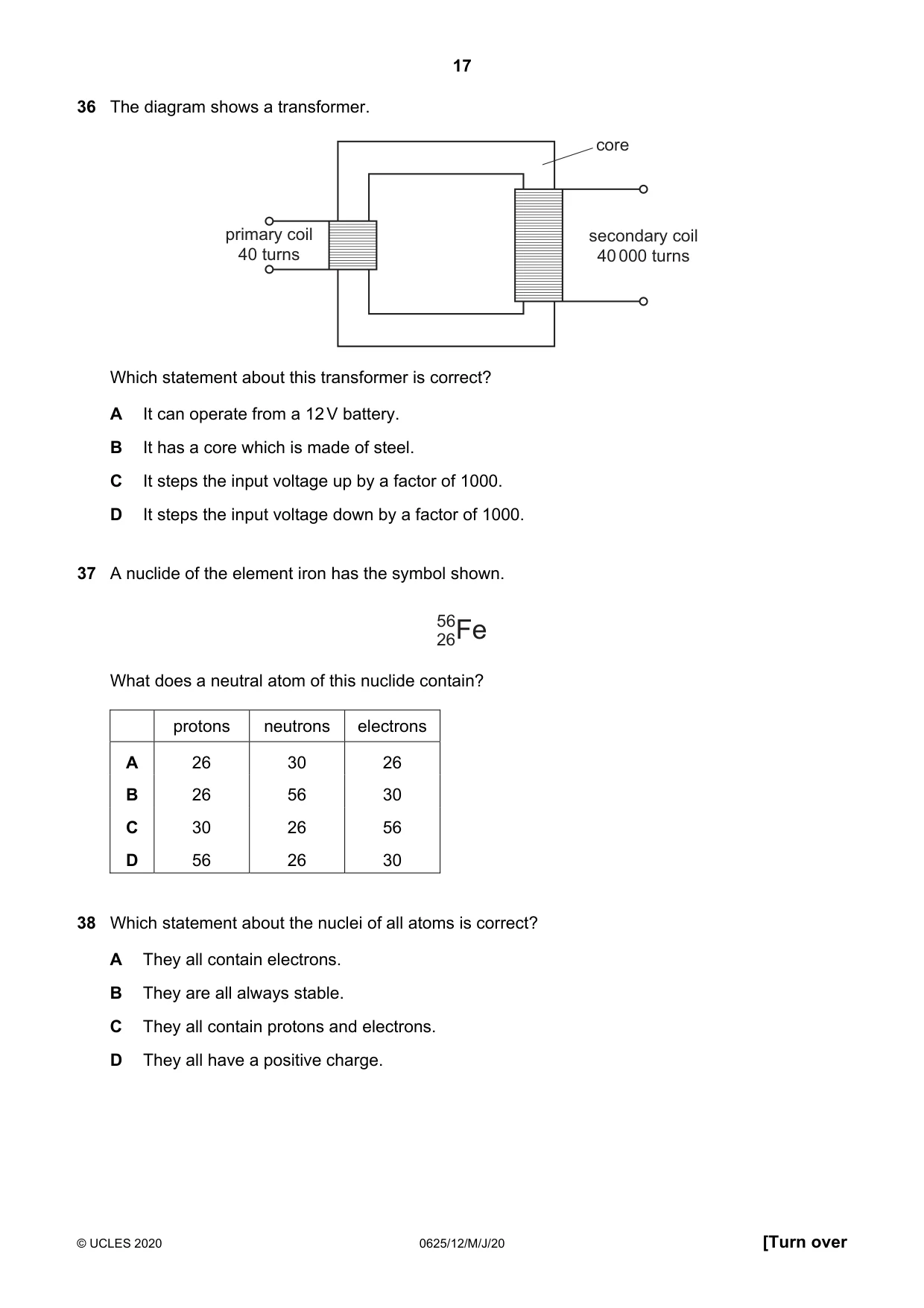
Q36 · The diagram shows a transformer
36 The diagram shows a transformer. core primary coil secondary coil 40 turns 40 000 turns Which statement about this transformer is correct? A It can operate from a 12 V battery. B It has a core which is made of steel. C It steps the input voltage up by a factor of 1000. D It steps the input voltage down by a factor of 1000.
Mark scheme: C
Q37 · A nuclide of the element iron has the symbol shown
37 A nuclide of the element iron has the symbol shown. 56Fe 26 What does a neutral atom of this nuclide contain? protons neutrons electrons A 26 30 26 B 26 56 30 C 30 26 56 D 56 26 30
Mark scheme: A
Q38 · Which statement about the nuclei of all atoms is correct?
38 Which statement about the nuclei of all atoms is correct? A They all contain electrons. B They are all always stable. C They all contain protons and electrons. D They all have a positive charge.
Mark scheme: D
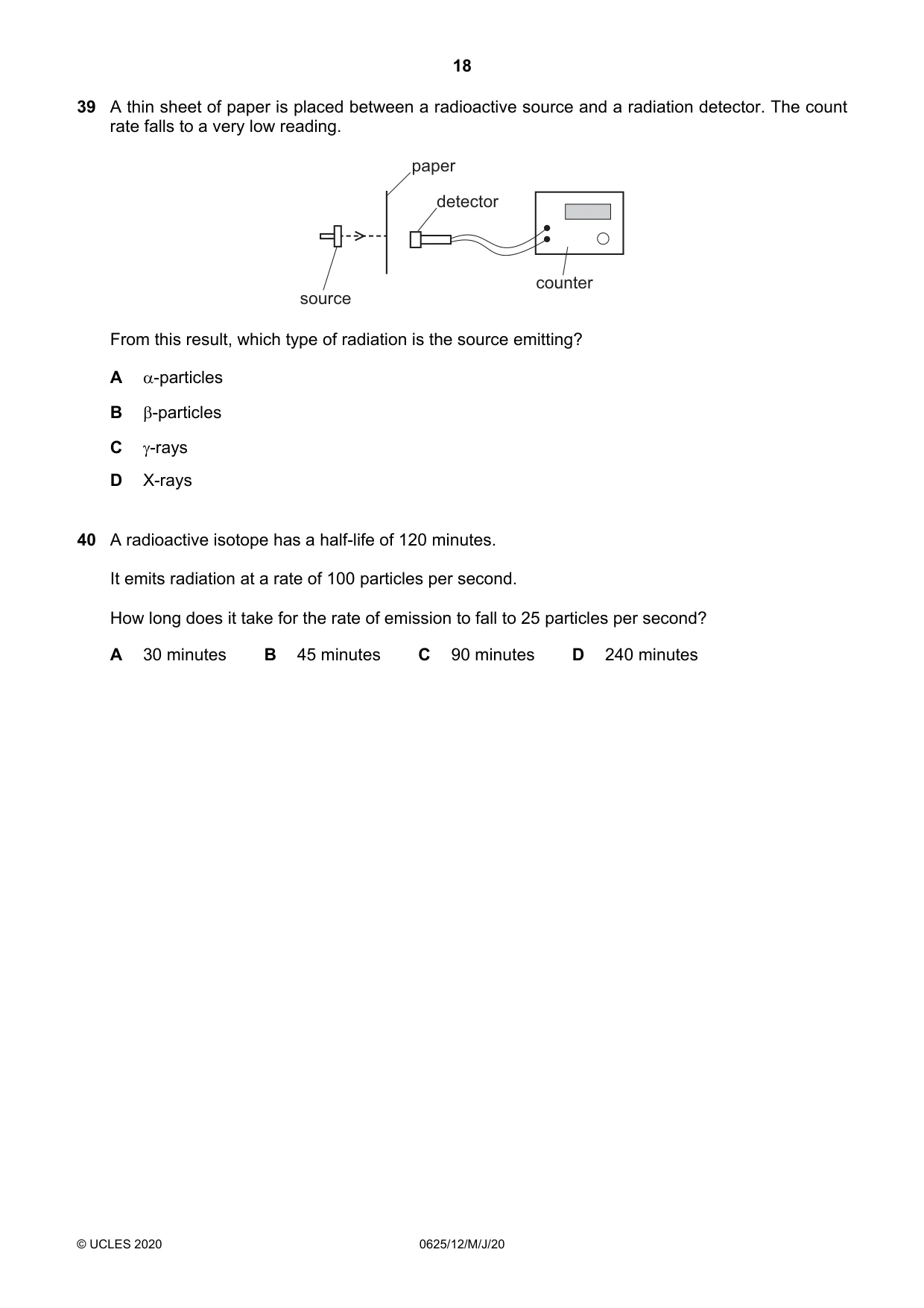
Q39 · A thin sheet of paper is placed between a radioactive source and a radiation detector
39 A thin sheet of paper is placed between a radioactive source and a radiation detector. The count rate falls to a very low reading. paper detector counter source From this result, which type of radiation is the source emitting? A α-particles B β-particles C γ-rays D X-rays
Mark scheme: A
Q40 · A radioactive isotope has a half-life of 120 minutes
40 A radioactive isotope has a half-life of 120 minutes. It emits radiation at a rate of 100 particles per second. How long does it take for the rate of emission to fall to 25 particles per second? A 30 minutes B 45 minutes C 90 minutes D 240 minutes
Mark scheme: D
What was in this paper
The subtopics covered by these 40 questions, and how many questions each got. Open one in a new tab to see every Cambridge question on it.
4Energy, work and power3Thermal properties and temperature3Electromagnetic effects2Forces2General properties of waves2Kinetic particle model of matter2Light2Mass and weight2Motion2Pressure2Radioactivity2Simple phenomena of magnetism2The nuclear model of the atom2Transfer of thermal energy2Density1Electrical quantities1Electrical safety1Electromagnetic spectrum1Physical quantities and measurement techniques1Sound1