Cambridge IGCSE Physics 0625 — 2022 May/June Paper 1 · Variant 3
0625/13/M/J/22 · 40 questions · 40 marks · ≈45 min
The question paper and its mark scheme, free to read here and free to download. This is Cambridge’s own paper, exactly as it was sat.
Question paper20 pages
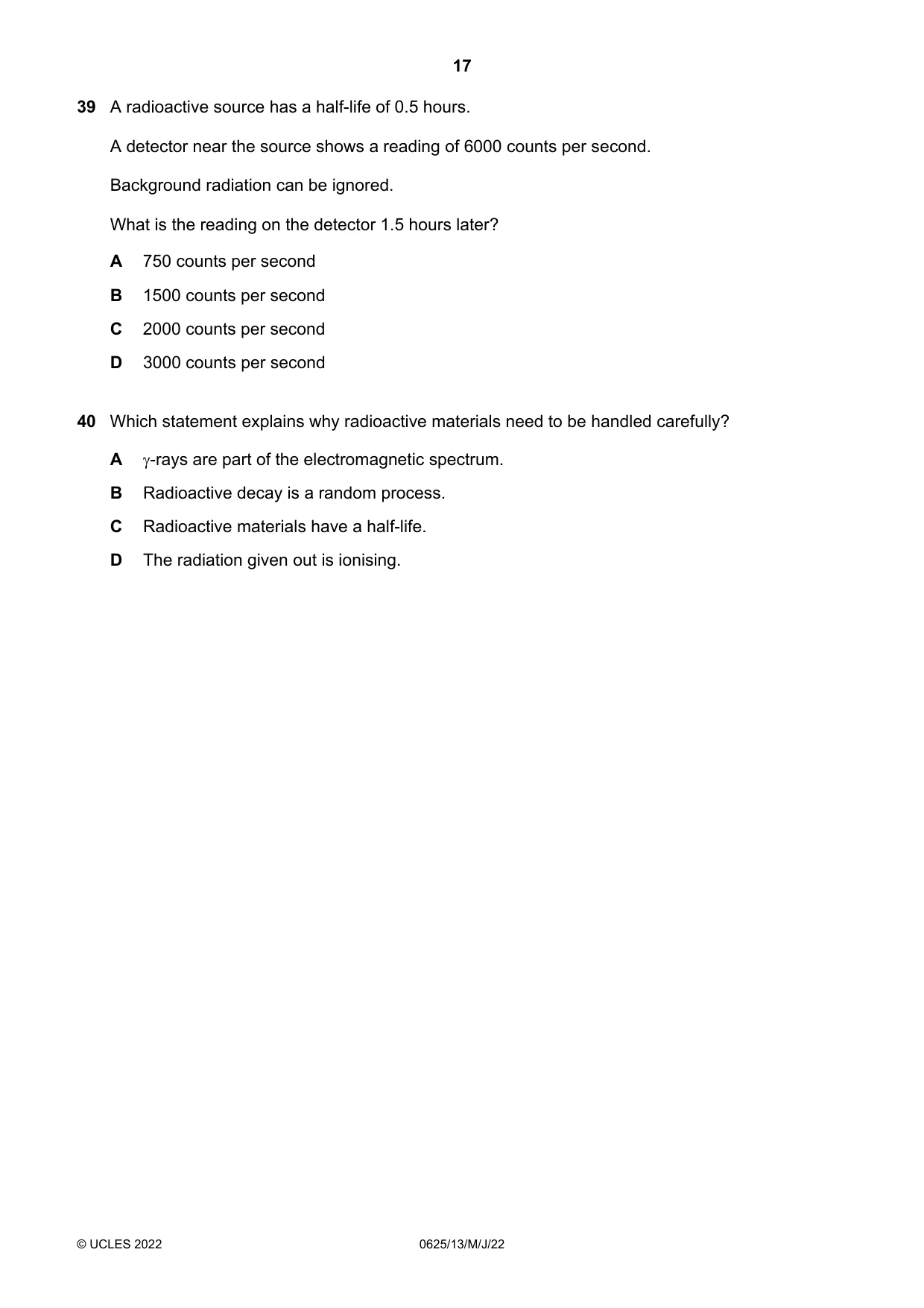


Mark scheme3 pages
Answers below. Sit the paper first if you are practising.
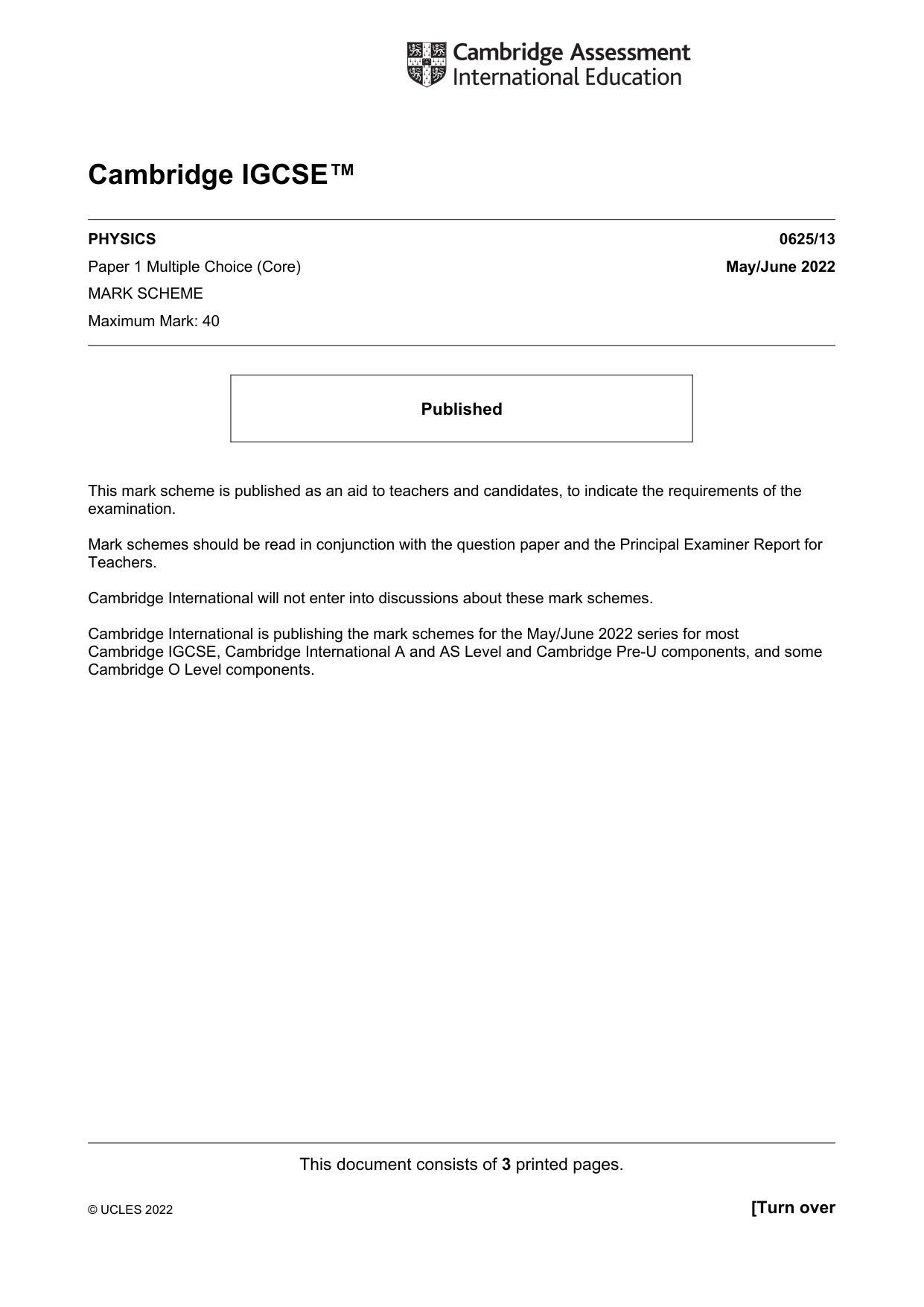
Questions as text
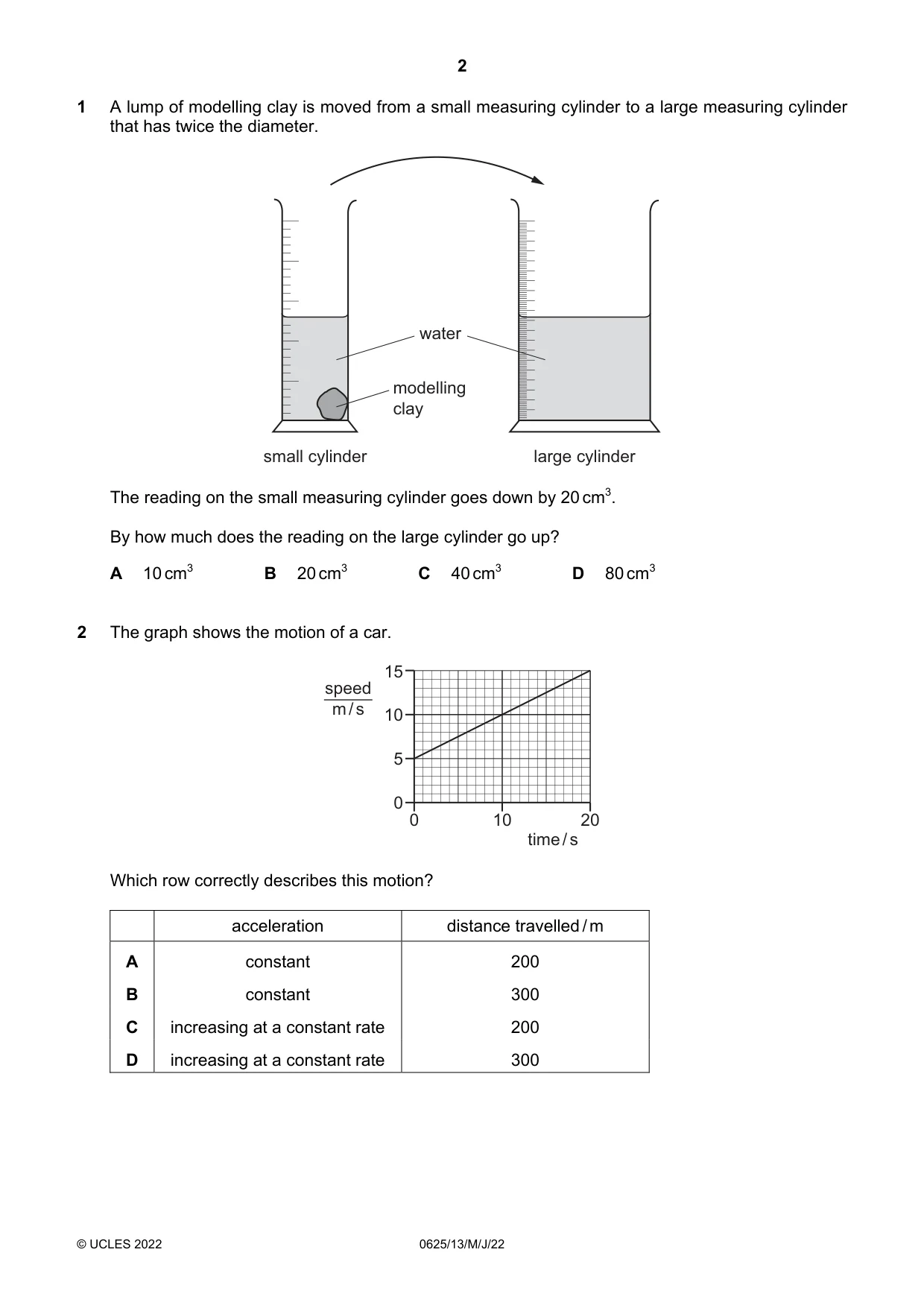
Q1 · A lump of modelling clay is moved from a small measuring cylinder to a large measuring…
1 A lump of modelling clay is moved from a small measuring cylinder to a large measuring cylinder that has twice the diameter. water modelling clay small cylinder large cylinder The reading on the small measuring cylinder goes down by 20 cm3. By how much does the reading on the large cylinder go up? A 10 cm3 B 20 cm3 C 40 cm3 D 80 cm3
Mark scheme: B
More questions on Physical quantities and measurement techniques
Q2 · The graph shows the motion of a car
2 The graph shows the motion of a car. 15 speed m / s 10 5 0 0 10 20 time / s Which row correctly describes this motion? acceleration distance travelled / m A constant 200 B constant 300 C increasing at a constant rate 200 D increasing at a constant rate 300
Mark scheme: A
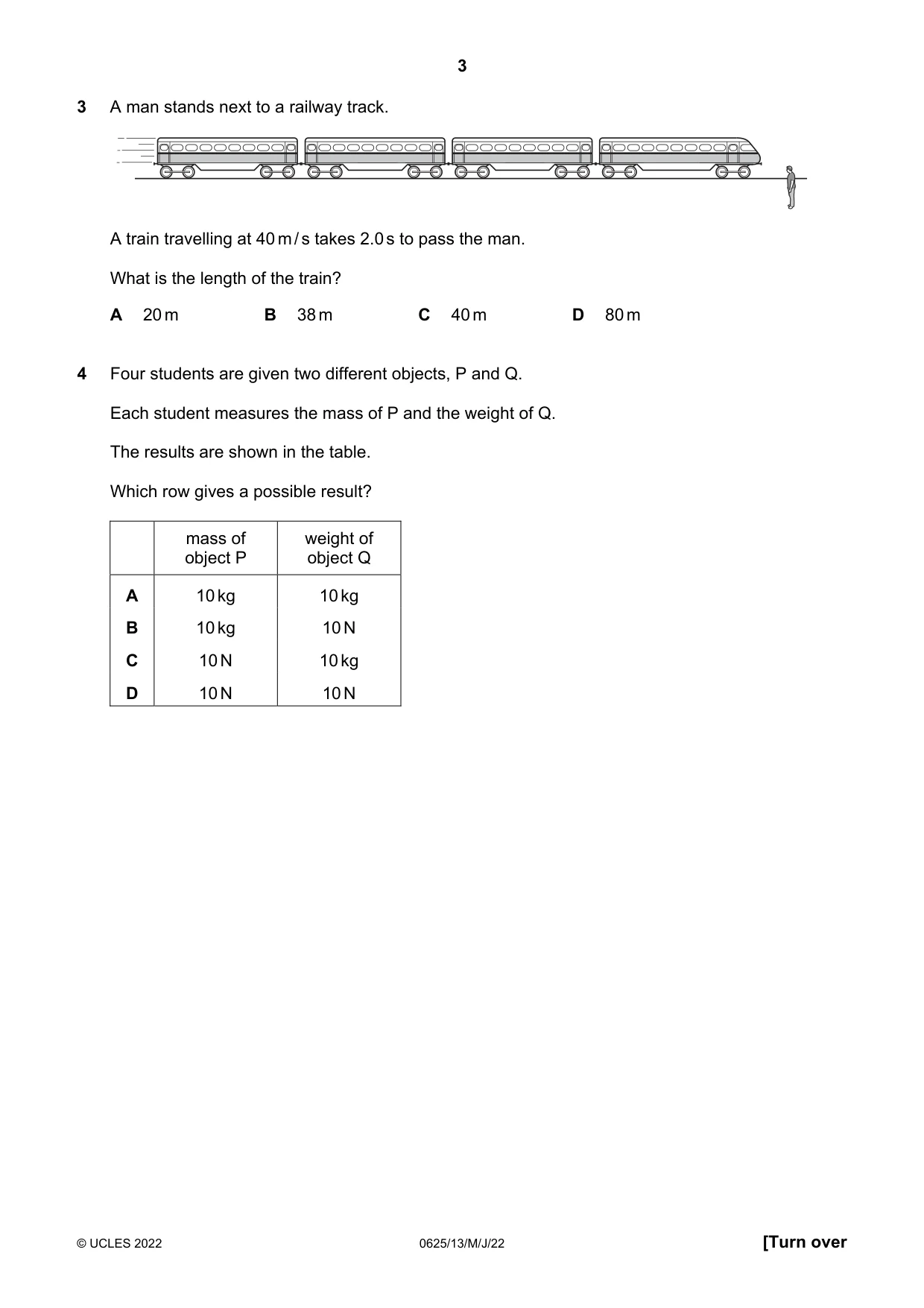
Q3 · A man stands next to a railway track
3 A man stands next to a railway track. A train travelling at 40 m / s takes 2.0 s to pass the man. What is the length of the train? A 20 m B 38 m C 40 m D 80 m
Mark scheme: D
Q4 · Four students are given two different objects, P and Q
4 Four students are given two different objects, P and Q. Each student measures the mass of P and the weight of Q. The results are shown in the table. Which row gives a possible result? mass of weight of object P object Q A 10 kg 10 kg B 10 kg 10 N C 10 N 10 kg D 10 N 10 N
Mark scheme: B
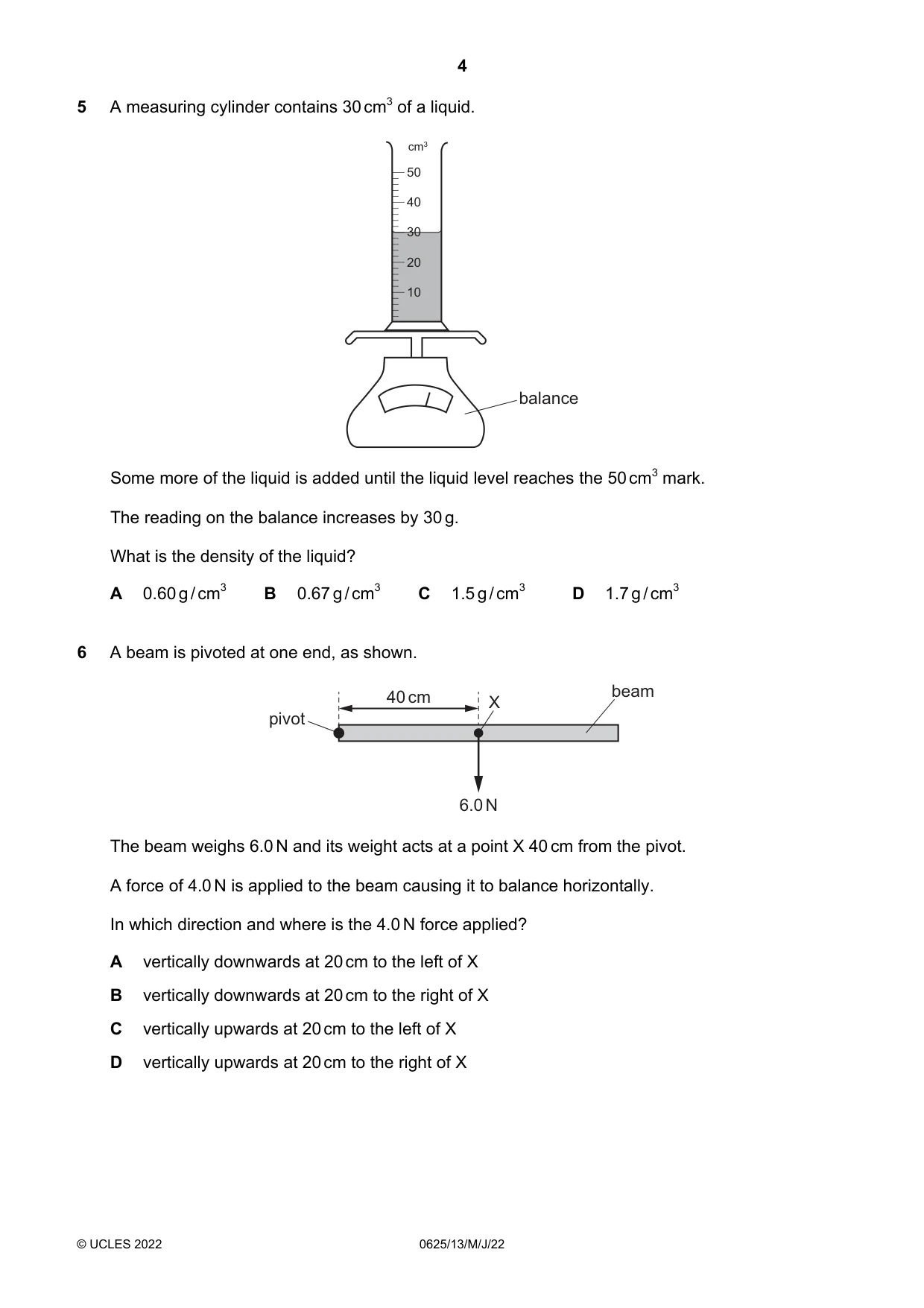
Q5 · A measuring cylinder contains 30 cm3 of a liquid
5 A measuring cylinder contains 30 cm3 of a liquid. cm3 50 40 30 20 10 balance Some more of the liquid is added until the liquid level reaches the 50 cm3 mark. The reading on the balance increases by 30 g. What is the density of the liquid? A 0.60 g / cm3 B 0.67 g / cm3 C 1.5 g / cm3 D 1.7 g / cm3
Mark scheme: C
Q6 · A beam is pivoted at one end, as shown
6 A beam is pivoted at one end, as shown. 40 cm beam X pivot 6.0 N The beam weighs 6.0 N and its weight acts at a point X 40 cm from the pivot. A force of 4.0 N is applied to the beam causing it to balance horizontally. In which direction and where is the 4.0 N force applied? A vertically downwards at 20 cm to the left of X B vertically downwards at 20 cm to the right of X C vertically upwards at 20 cm to the left of X D vertically upwards at 20 cm to the right of X
Mark scheme: D
Q7 · The diagram shows two identical bars of negligible weight
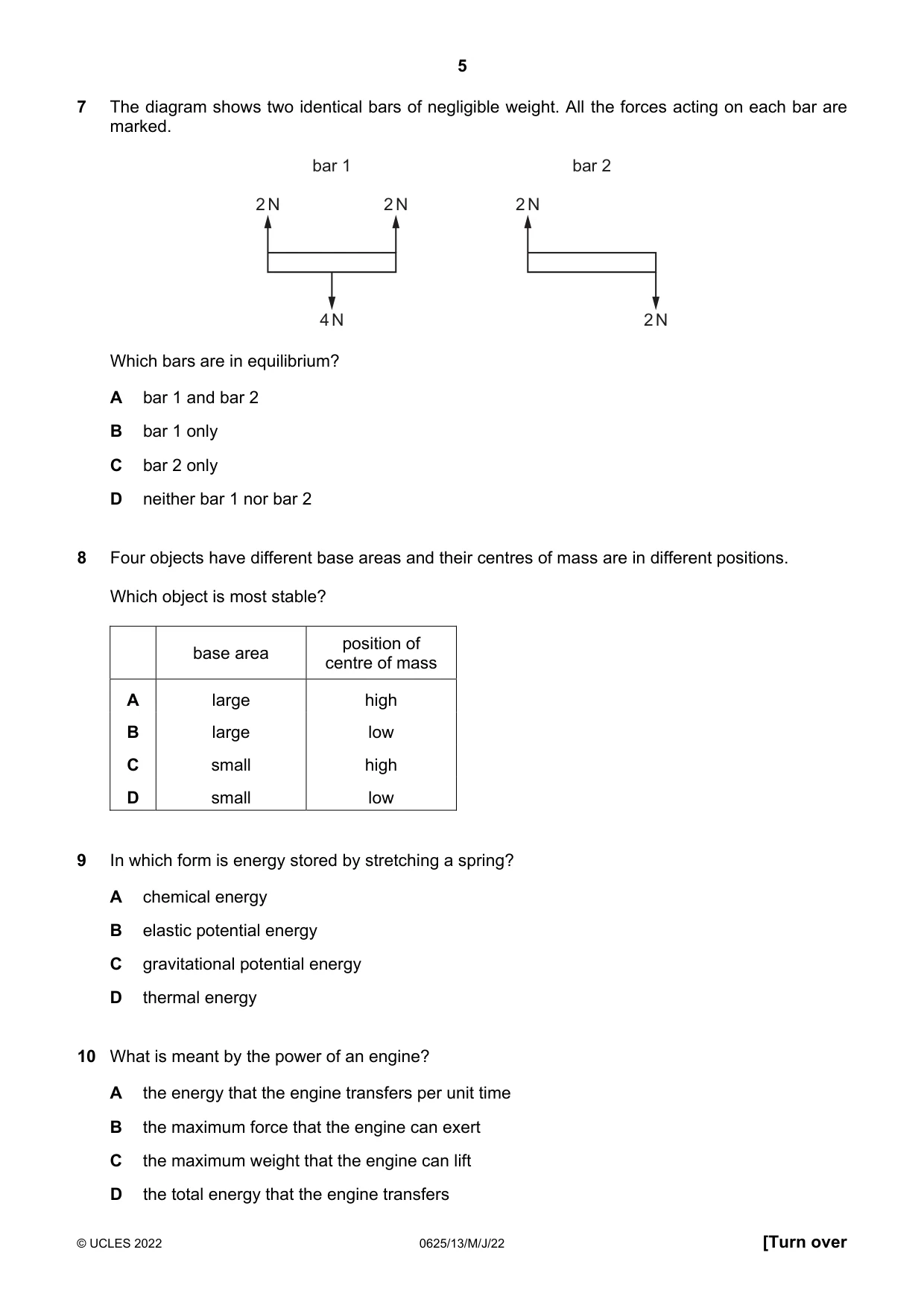
7 The diagram shows two identical bars of negligible weight. All the forces acting on each bar are marked. bar 1 bar 2 2 N 2 N 2 N 4 N 2 N Which bars are in equilibrium? A bar 1 and bar 2 B bar 1 only C bar 2 only D neither bar 1 nor bar 2
Mark scheme: B
Q8 · Four objects have different base areas and their centres of mass are in different…
8 Four objects have different base areas and their centres of mass are in different positions. Which object is most stable? position of base area centre of mass A large high B large low C small high D small low
Mark scheme: B
Q9 · In which form is energy stored by stretching a spring?
9 In which form is energy stored by stretching a spring? A chemical energy B elastic potential energy C gravitational potential energy D thermal energy
Mark scheme: B
Q10 · What is meant by the power of an engine?
10 What is meant by the power of an engine? A the energy that the engine transfers per unit time B the maximum force that the engine can exert C the maximum weight that the engine can lift D the total energy that the engine transfers
Mark scheme: A
Q11 · A force of 14 N is applied to the head of a nail
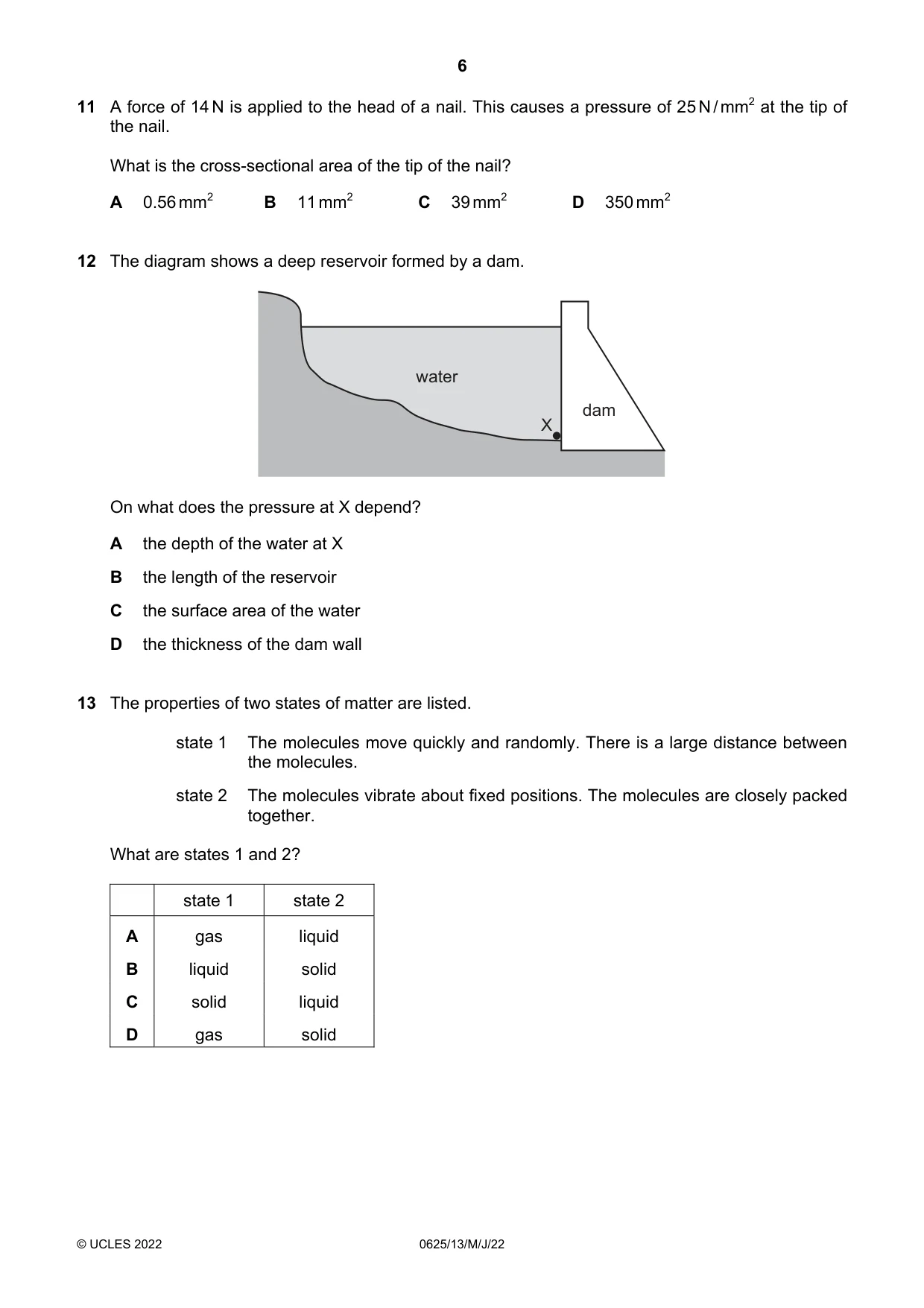
11 A force of 14 N is applied to the head of a nail. This causes a pressure of 25 N / mm2 at the tip of the nail. What is the cross-sectional area of the tip of the nail? A 0.56 mm2 B 11 mm2 C 39 mm2 D 350 mm2
Mark scheme: A
Q12 · The diagram shows a deep reservoir formed by a dam
12 The diagram shows a deep reservoir formed by a dam. water dam X On what does the pressure at X depend? A the depth of the water at X B the length of the reservoir C the surface area of the water D the thickness of the dam wall
Mark scheme: A
Q13 · The properties of two states of matter are listed
13 The properties of two states of matter are listed. state 1 The molecules move quickly and randomly. There is a large distance between the molecules. state 2 The molecules vibrate about fixed positions. The molecules are closely packed together. What are states 1 and 2? state 1 state 2 A gas liquid B liquid solid C solid liquid D gas solid
Mark scheme: D
Q14 · A gas in a container is cooled but the volume of the gas does not change
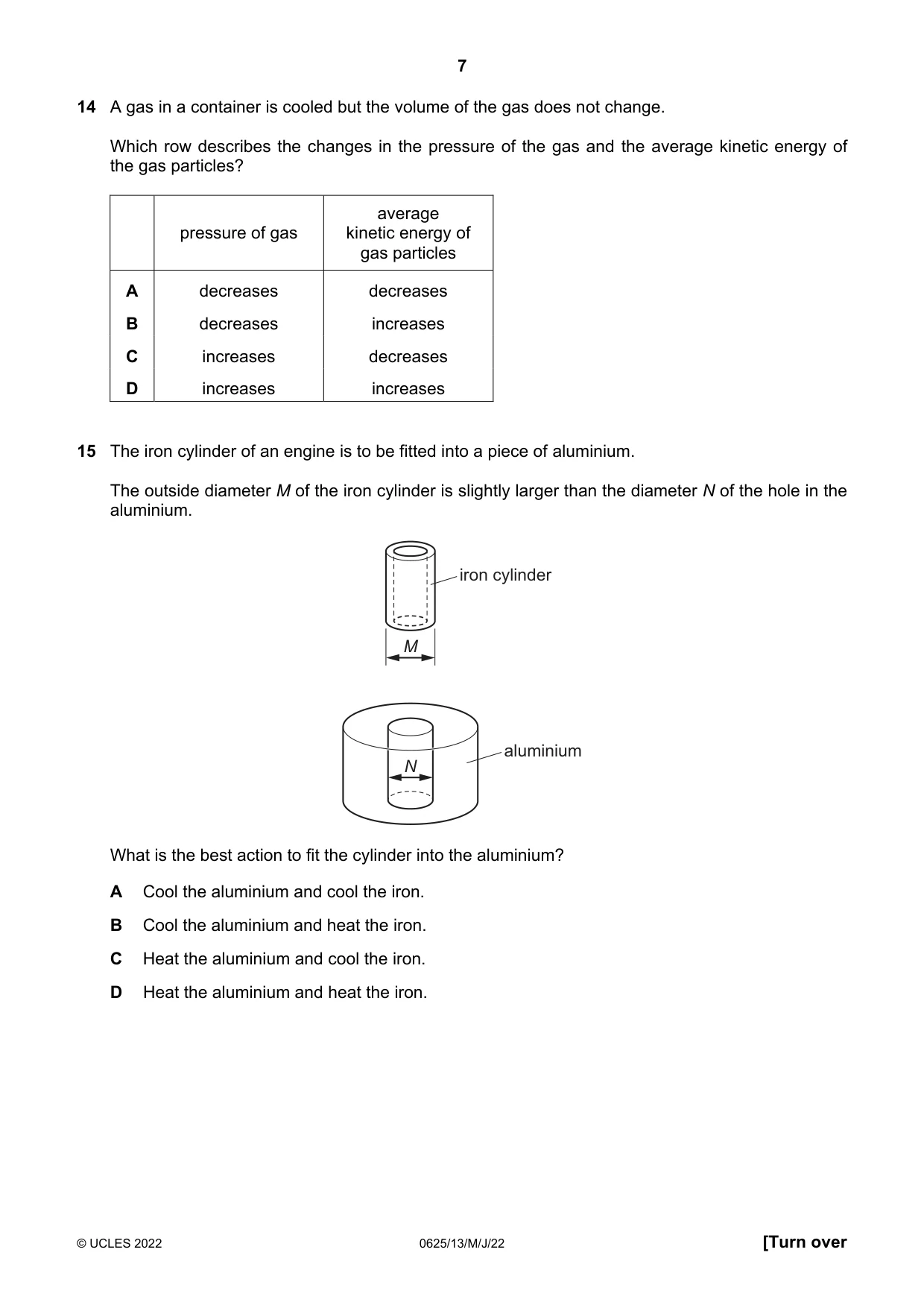
14 A gas in a container is cooled but the volume of the gas does not change. Which row describes the changes in the pressure of the gas and the average kinetic energy of the gas particles? average pressure of gas kinetic energy of gas particles A decreases decreases B decreases increases C increases decreases D increases increases
Mark scheme: A
Q15 · The iron cylinder of an engine is to be fitted into a piece of aluminium
15 The iron cylinder of an engine is to be fitted into a piece of aluminium. The outside diameter M of the iron cylinder is slightly larger than the diameter N of the hole in the aluminium. iron cylinder M aluminium N What is the best action to fit the cylinder into the aluminium? A Cool the aluminium and cool the iron. B Cool the aluminium and heat the iron. C Heat the aluminium and cool the iron. D Heat the aluminium and heat the iron.
Mark scheme: C
Q16 · A solid in a closed container is heated until it completely melts
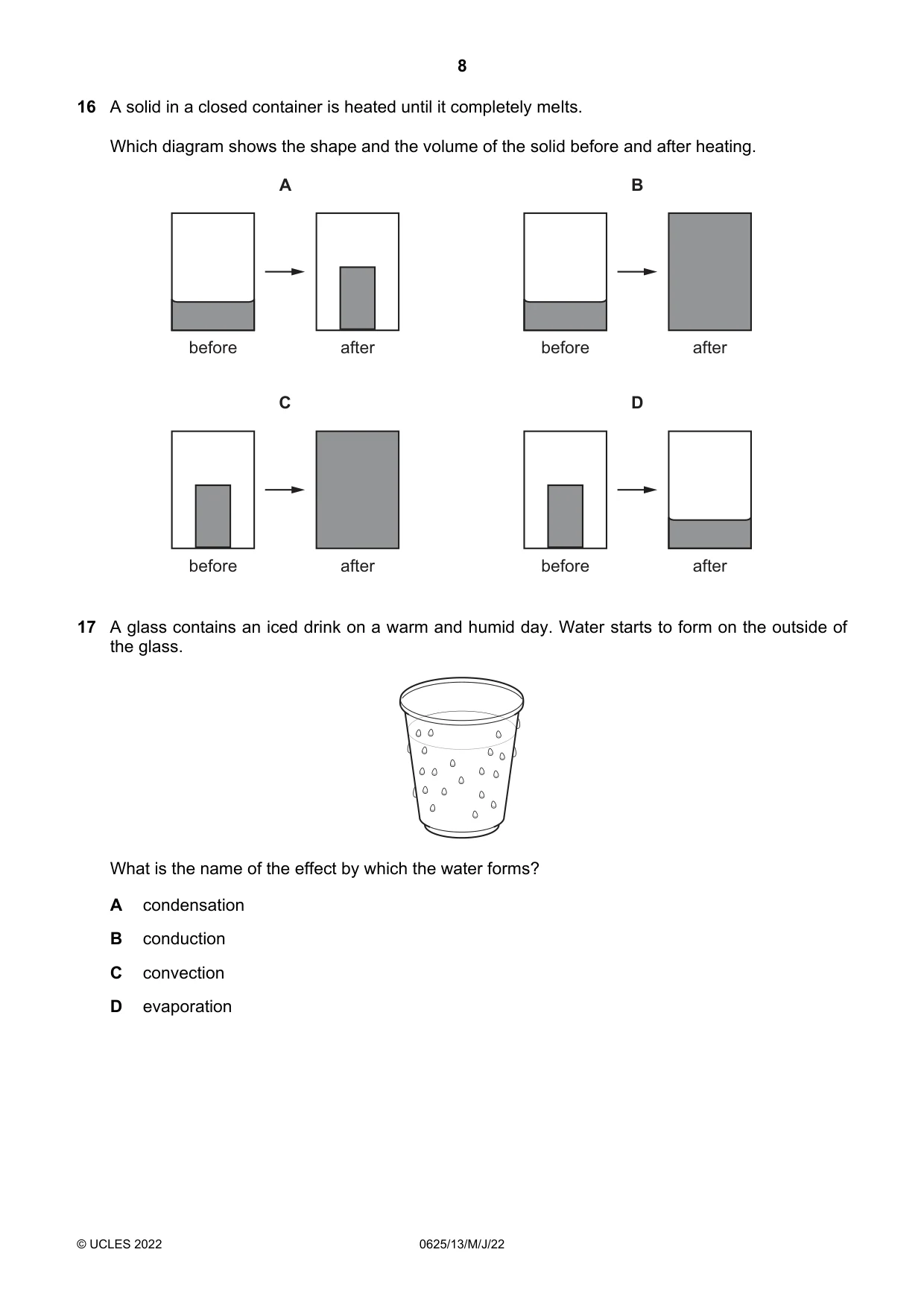
16 A solid in a closed container is heated until it completely melts. Which diagram shows the shape and the volume of the solid before and after heating. A B before after before after C D before after before after
Mark scheme: D
Q17 · A glass contains an iced drink on a warm and humid day
17 A glass contains an iced drink on a warm and humid day. Water starts to form on the outside of the glass. What is the name of the effect by which the water forms? A condensation B conduction C convection D evaporation
Mark scheme: A
Q18 · In which situation is the main transfer of thermal energy by convection?
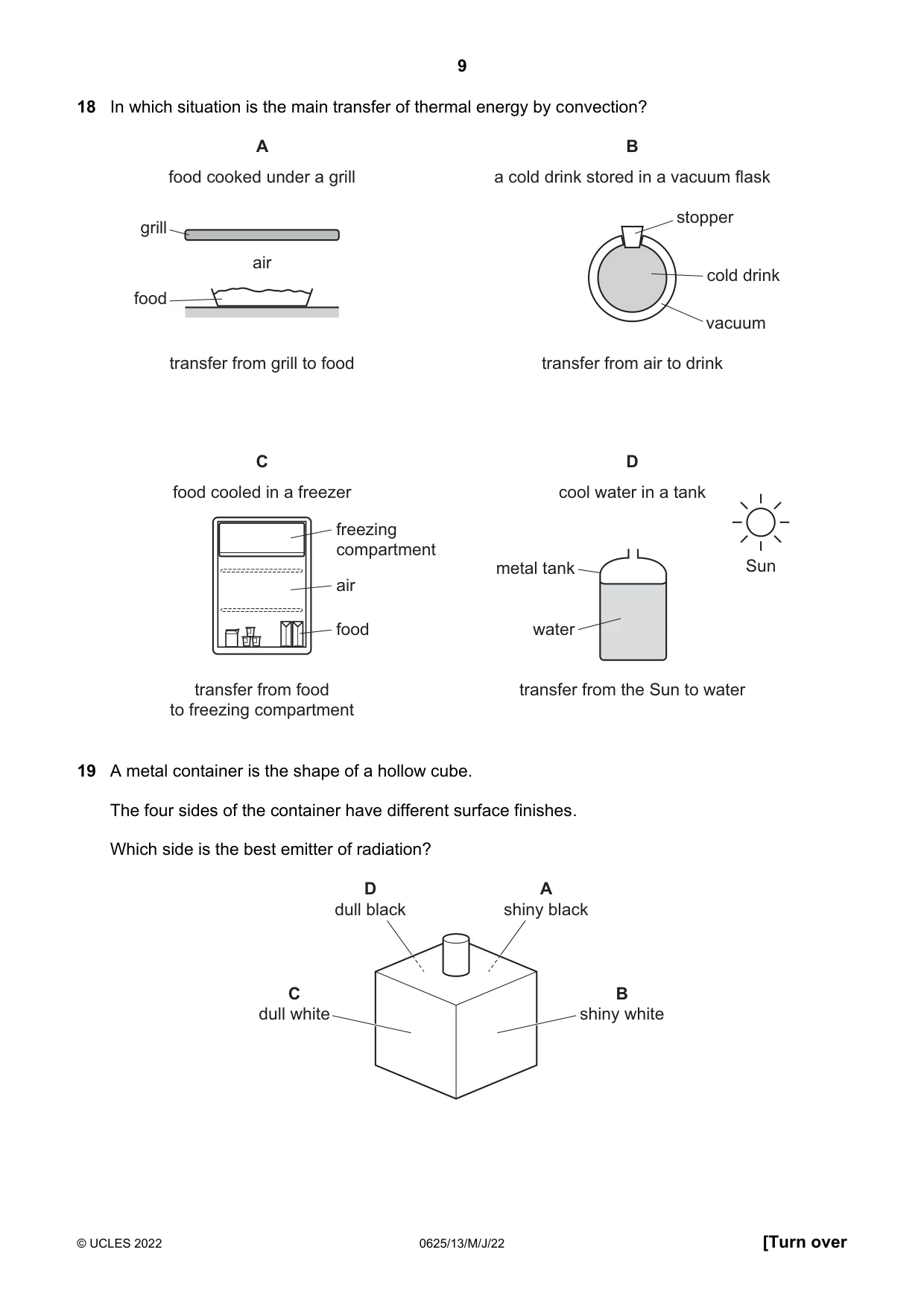
18 In which situation is the main transfer of thermal energy by convection? A B food cooked under a grill a cold drink stored in a vacuum flask stopper grill air cold drink food vacuum transfer from grill to food transfer from air to drink C D food cooled in a freezer cool water in a tank freezing compartment metal tank Sun air food water transfer from food transfer from the Sun to water to freezing compartment
Mark scheme: C
Q19 · A metal container is the shape of a hollow cube
19 A metal container is the shape of a hollow cube. The four sides of the container have different surface finishes. Which side is the best emitter of radiation? D A dull black shiny black C B dull white shiny white
Mark scheme: D
Q20 · The diagram shows a wave
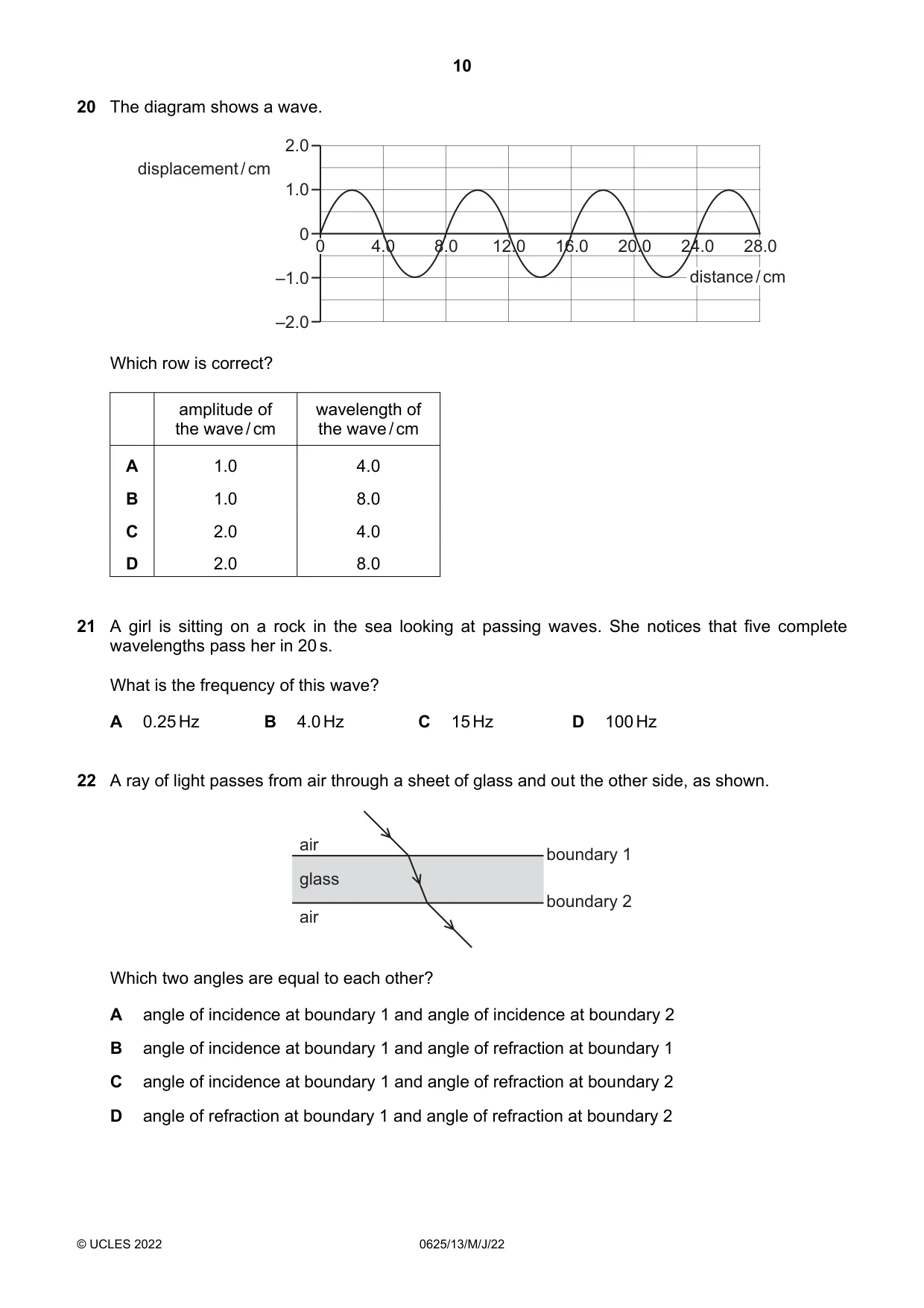
20 The diagram shows a wave. 2.0 displacement / cm 1.0 0 0 4.0 8.0 12.0 16.0 20.0 24.0 28.0 –1.0 distance / cm –2.0 Which row is correct? amplitude of wavelength of the wave / cm the wave / cm A 1.0 4.0 B 1.0 8.0 C 2.0 4.0 D 2.0 8.0
Mark scheme: B
Q21 · A girl is sitting on a rock in the sea looking at passing waves
21 A girl is sitting on a rock in the sea looking at passing waves. She notices that five complete wavelengths pass her in 20 s. What is the frequency of this wave? A 0.25 Hz B 4.0 Hz C 15 Hz D 100 Hz
Mark scheme: A
Q22 · A ray of light passes from air through a sheet of glass and out the other side, as shown
22 A ray of light passes from air through a sheet of glass and out the other side, as shown. air boundary 1 glass boundary 2 air Which two angles are equal to each other? A angle of incidence at boundary 1 and angle of incidence at boundary 2 B angle of incidence at boundary 1 and angle of refraction at boundary 1 C angle of incidence at boundary 1 and angle of refraction at boundary 2 D angle of refraction at boundary 1 and angle of refraction at boundary 2
Mark scheme: C
Q23 · An object is placed in front of a converging lens
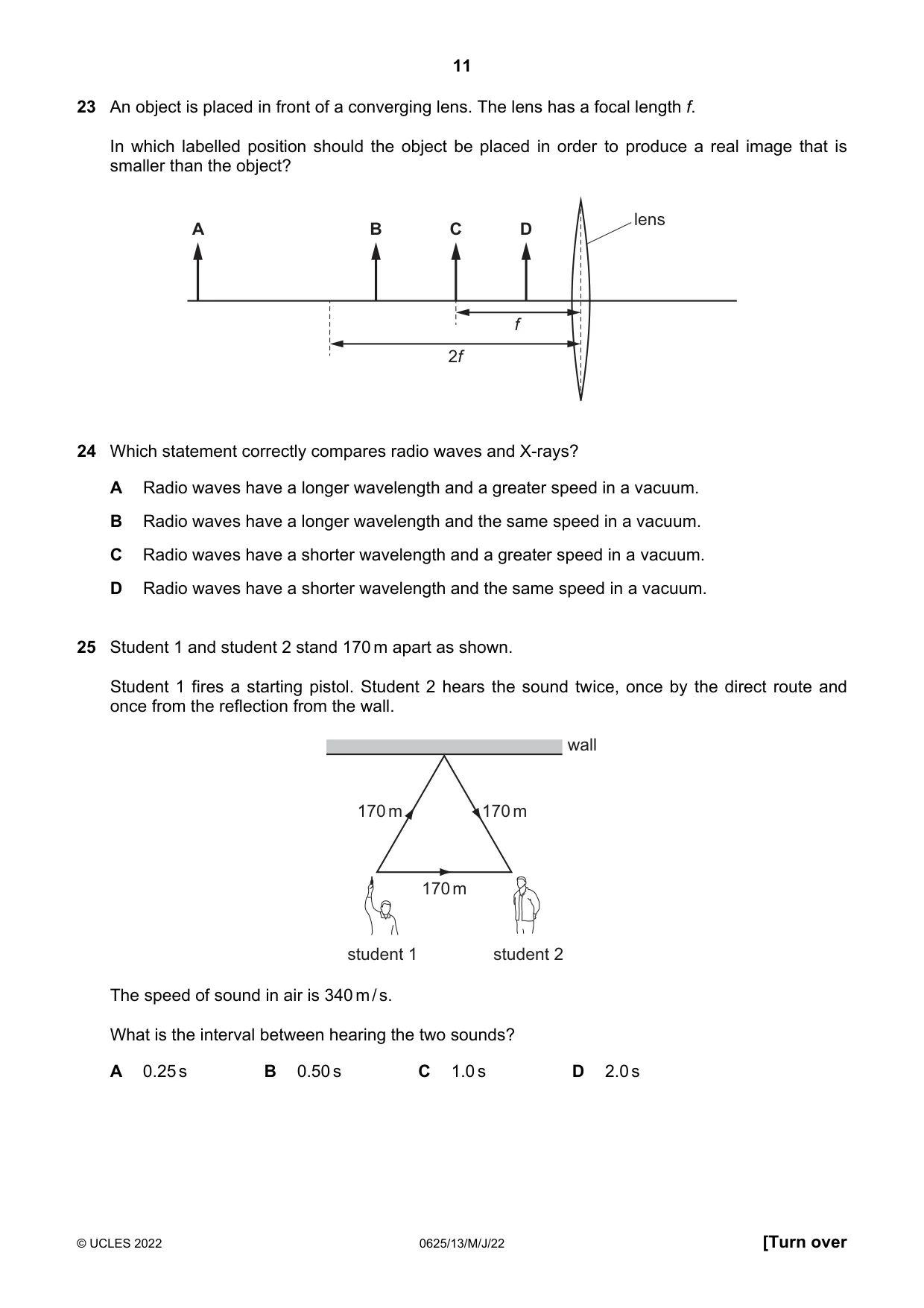
23 An object is placed in front of a converging lens. The lens has a focal length f. In which labelled position should the object be placed in order to produce a real image that is smaller than the object? lens A B C D f 2f
Mark scheme: A
Q24 · Which statement correctly compares radio waves and X-rays?
24 Which statement correctly compares radio waves and X-rays? A Radio waves have a longer wavelength and a greater speed in a vacuum. B Radio waves have a longer wavelength and the same speed in a vacuum. C Radio waves have a shorter wavelength and a greater speed in a vacuum. D Radio waves have a shorter wavelength and the same speed in a vacuum.
Mark scheme: B
Q25 · Student 1 and student 2 stand 170 m apart as shown
25 Student 1 and student 2 stand 170 m apart as shown. Student 1 fires a starting pistol. Student 2 hears the sound twice, once by the direct route and once from the reflection from the wall. wall 170 m 170 m 170 m student 1 student 2 The speed of sound in air is 340 m / s. What is the interval between hearing the two sounds? A 0.25 s B 0.50 s C 1.0 s D 2.0 s
Mark scheme: B
Q26 · A student attempts to make a permanent magnet by hammering metal bars of the same size in…
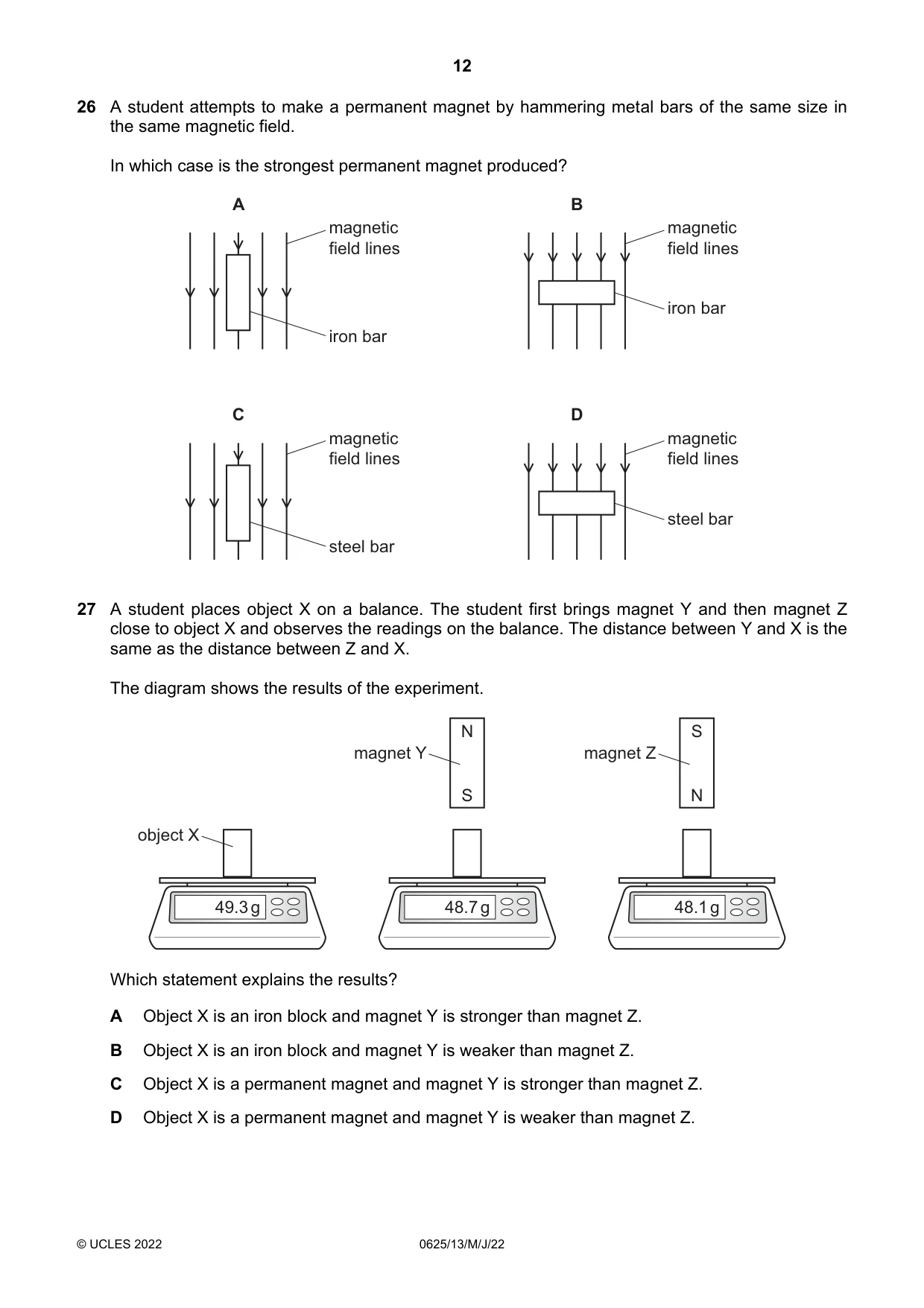
26 A student attempts to make a permanent magnet by hammering metal bars of the same size in the same magnetic field. In which case is the strongest permanent magnet produced? A B magnetic magnetic field lines field lines iron bar iron bar C D magnetic magnetic field lines field lines steel bar steel bar
Mark scheme: C
Q27 · A student places object X on a balance
27 A student places object X on a balance. The student first brings magnet Y and then magnet Z close to object X and observes the readings on the balance. The distance between Y and X is the same as the distance between Z and X. The diagram shows the results of the experiment. N S magnet Y magnet Z S N object X 49.3 g 48.7 g 48.1 g Which statement explains the results? A Object X is an iron block and magnet Y is stronger than magnet Z. B Object X is an iron block and magnet Y is weaker than magnet Z. C Object X is a permanent magnet and magnet Y is stronger than magnet Z. D Object X is a permanent magnet and magnet Y is weaker than magnet Z.
Mark scheme: B
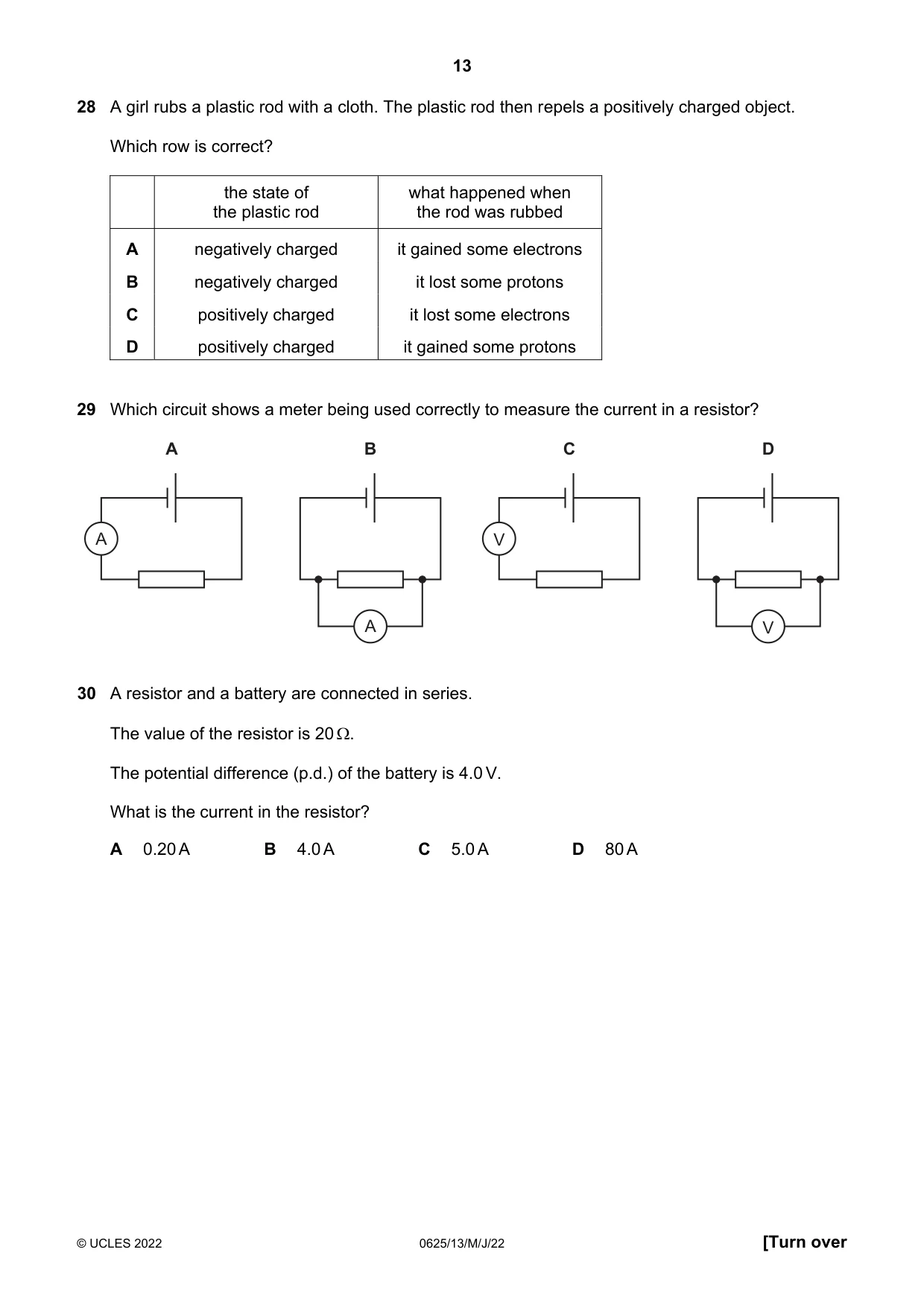
Q28 · A girl rubs a plastic rod with a cloth
28 A girl rubs a plastic rod with a cloth. The plastic rod then repels a positively charged object. Which row is correct? the state of what happened when the plastic rod the rod was rubbed A negatively charged it gained some electrons B negatively charged it lost some protons C positively charged it lost some electrons D positively charged it gained some protons
Mark scheme: C
Q29 · Which circuit shows a meter being used correctly to measure the current in a resistor?
29 Which circuit shows a meter being used correctly to measure the current in a resistor? A B C D A V A V
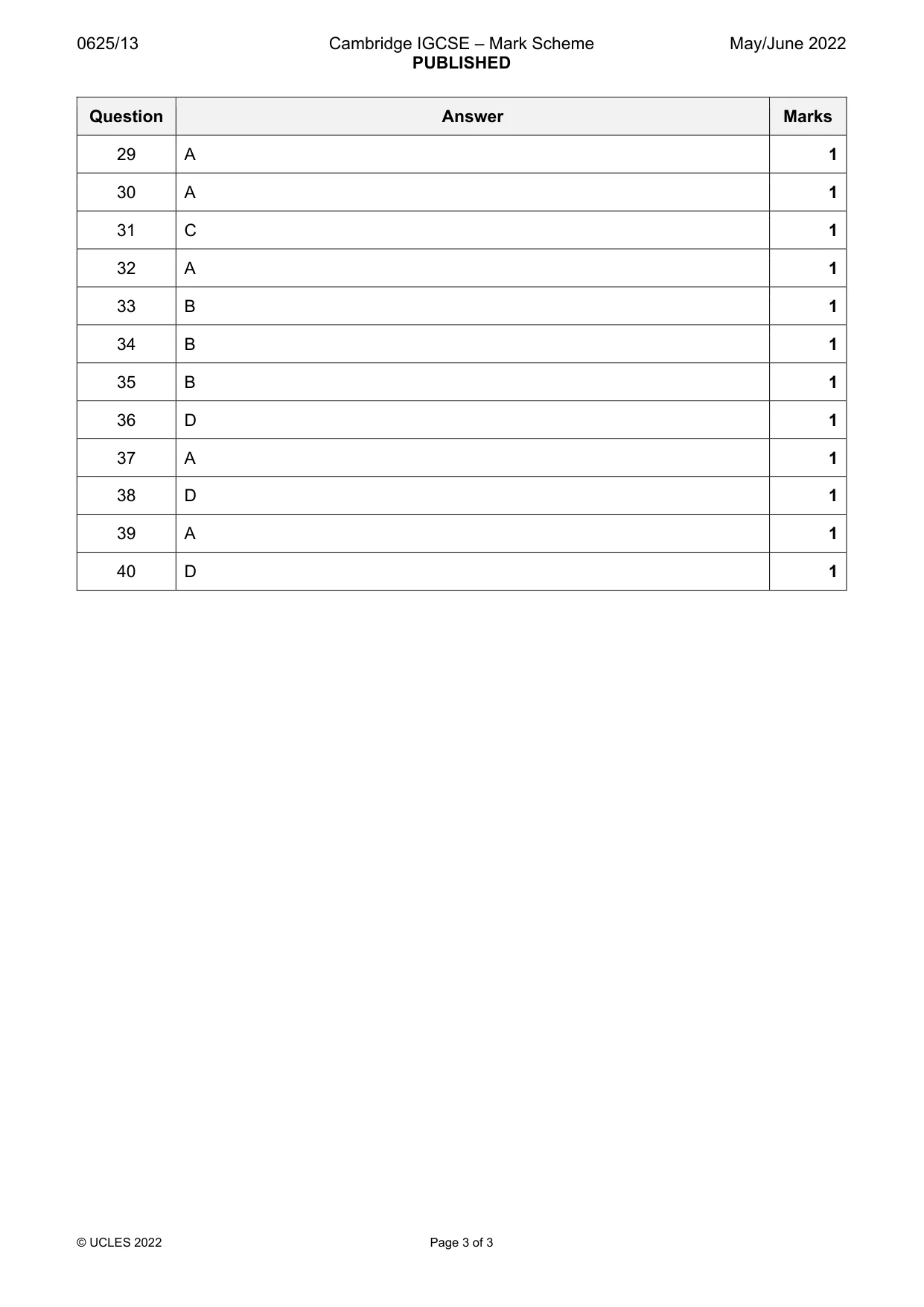
Mark scheme: A
Q30 · A resistor and a battery are connected in series
30 A resistor and a battery are connected in series. The value of the resistor is 20 . The potential difference (p.d.) of the battery is 4.0 V. What is the current in the resistor? A 0.20 A B 4.0 A C 5.0 A D 80 A
Mark scheme: A
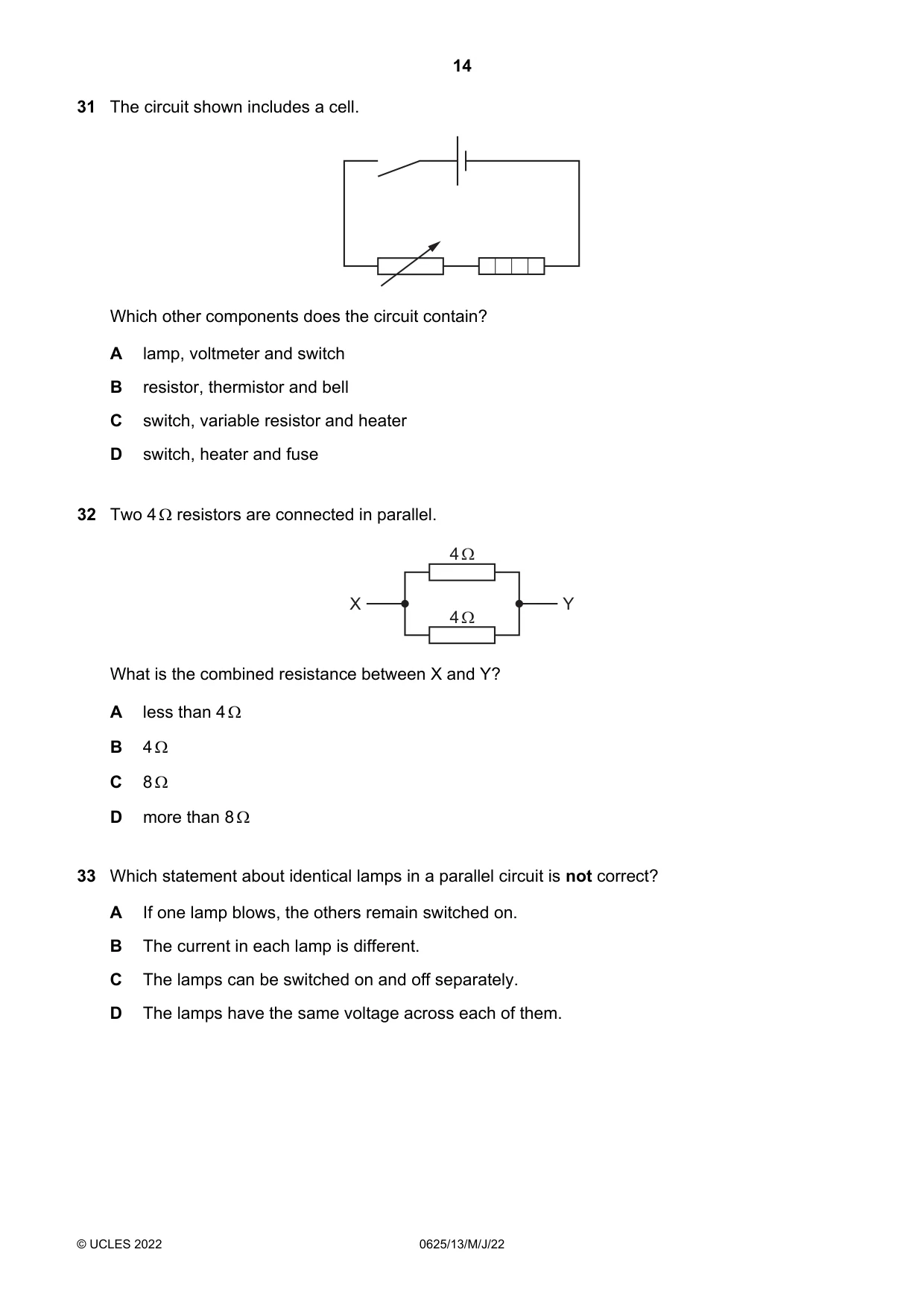
Q31 · The circuit shown includes a cell
31 The circuit shown includes a cell. Which other components does the circuit contain? A lamp, voltmeter and switch B resistor, thermistor and bell C switch, variable resistor and heater D switch, heater and fuse
Mark scheme: C
Q32 · Two 4 resistors are connected in parallel
32 Two 4 resistors are connected in parallel. 4 Ω X Y 4 Ω What is the combined resistance between X and Y? A less than 4 B 4 C 8 D more than 8
Mark scheme: A
Q33 · Which statement about identical lamps in a parallel circuit is not correct?
33 Which statement about identical lamps in a parallel circuit is not correct? A If one lamp blows, the others remain switched on. B The current in each lamp is different. C The lamps can be switched on and off separately. D The lamps have the same voltage across each of them.
Mark scheme: B
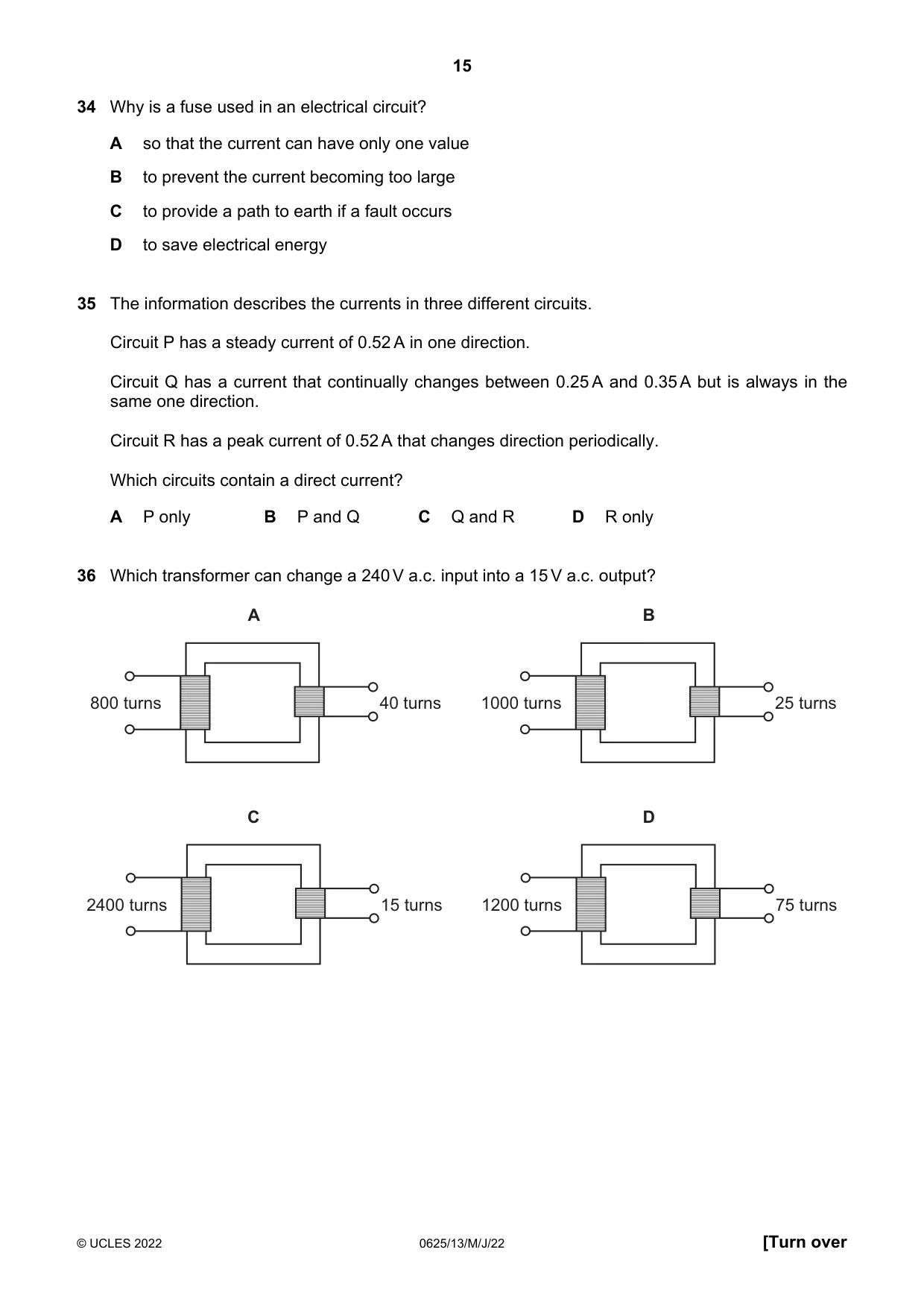
Q34 · Why is a fuse used in an electrical circuit?
34 Why is a fuse used in an electrical circuit? A so that the current can have only one value B to prevent the current becoming too large C to provide a path to earth if a fault occurs D to save electrical energy
Mark scheme: B
Q35 · The information describes the currents in three different circuits
35 The information describes the currents in three different circuits. Circuit P has a steady current of 0.52 A in one direction. Circuit Q has a current that continually changes between 0.25 A and 0.35 A but is always in the same one direction. Circuit R has a peak current of 0.52 A that changes direction periodically. Which circuits contain a direct current? A P only B P and Q C Q and R D R only
Mark scheme: B
Q36 · Which transformer can change a 240 V a.c
36 Which transformer can change a 240 V a.c. input into a 15 V a.c. output? A B 800 turns 40 turns 1000 turns 25 turns C D 2400 turns 15 turns 1200 turns 75 turns
Mark scheme: D
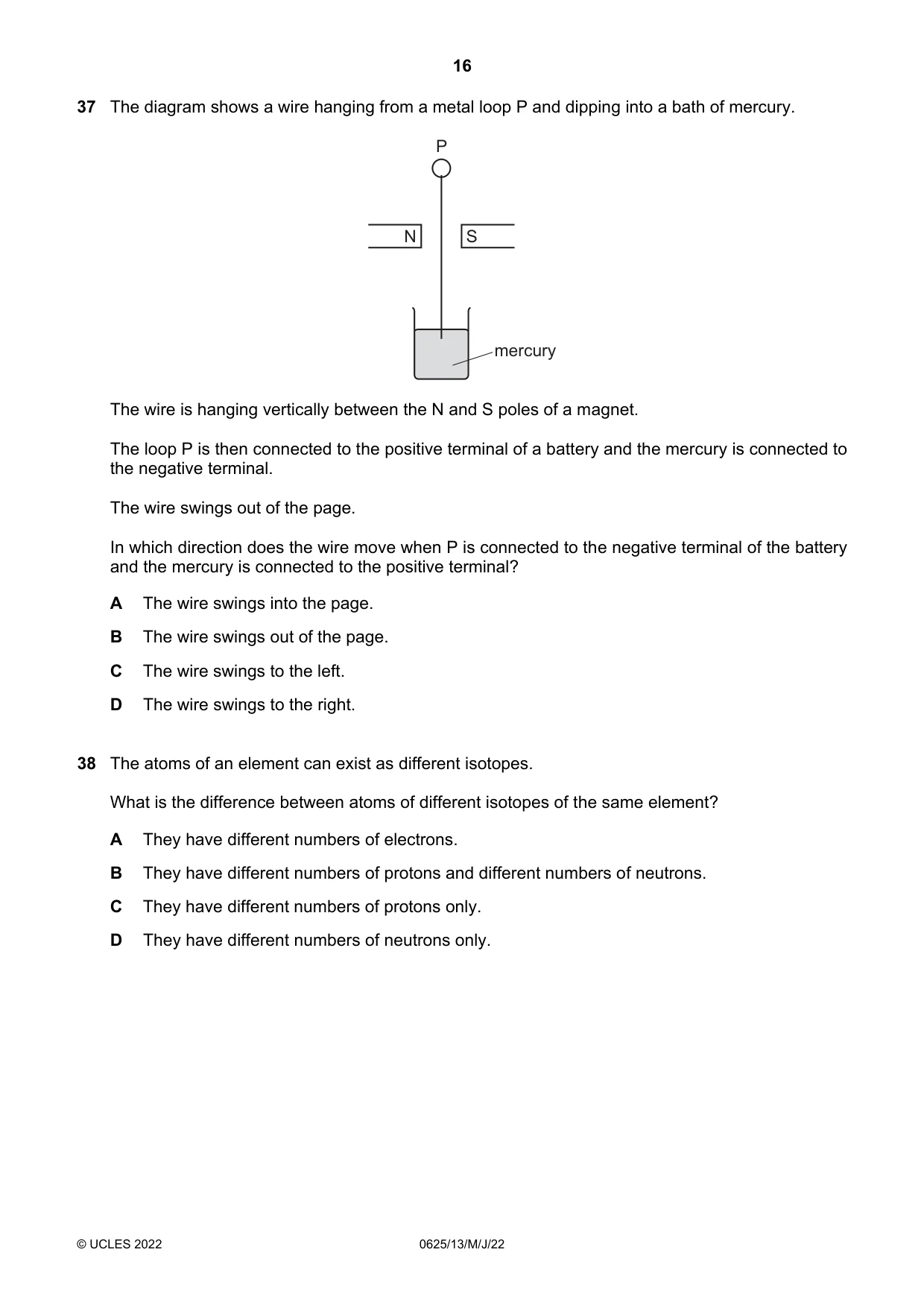
Q37 · The diagram shows a wire hanging from a metal loop P and dipping into a bath of mercury
37 The diagram shows a wire hanging from a metal loop P and dipping into a bath of mercury. P N S mercury The wire is hanging vertically between the N and S poles of a magnet. The loop P is then connected to the positive terminal of a battery and the mercury is connected to the negative terminal. The wire swings out of the page. In which direction does the wire move when P is connected to the negative terminal of the battery and the mercury is connected to the positive terminal? A The wire swings into the page. B The wire swings out of the page. C The wire swings to the left. D The wire swings to the right.
Mark scheme: A
Q38 · The atoms of an element can exist as different isotopes
38 The atoms of an element can exist as different isotopes. What is the difference between atoms of different isotopes of the same element? A They have different numbers of electrons. B They have different numbers of protons and different numbers of neutrons. C They have different numbers of protons only. D They have different numbers of neutrons only.
Mark scheme: D
Q39 · A radioactive source has a half-life of 0.5 hours
39 A radioactive source has a half-life of 0.5 hours. A detector near the source shows a reading of 6000 counts per second. Background radiation can be ignored. What is the reading on the detector 1.5 hours later? A 750 counts per second B 1500 counts per second C 2000 counts per second D 3000 counts per second
Mark scheme: A
Q40 · Which statement explains why radioactive materials need to be handled carefully?
40 Which statement explains why radioactive materials need to be handled carefully? A -rays are part of the electromagnetic spectrum. B Radioactive decay is a random process. C Radioactive materials have a half-life. D The radiation given out is ionising.
Mark scheme: D
What was in this paper
The subtopics covered by these 40 questions, and how many questions each got. Open one in a new tab to see every Cambridge question on it.
4Electrical quantities3Forces3Kinetic particle model of matter3Transfer of thermal energy3Electromagnetic effects2Energy, work and power2General properties of waves2Light2Motion2Pressure2Radioactivity2Simple phenomena of magnetism2Density1Electrical safety1Electromagnetic spectrum1Mass and weight1Physical quantities and measurement techniques1Sound1The nuclear model of the atom1Thermal properties and temperature1What you needed in this session
Cambridge’s own grade thresholds for 2022 May/June, Paper 1 · Variant 3. A higher threshold means an easier paper — the bar moves with how the cohort did.