Cambridge IGCSE Physics 0625 — 2022 Feb/March Paper 1 · Variant 2
0625/12/F/M/22 · 40 questions · 40 marks · ≈45 min
The question paper and its mark scheme, free to read here and free to download. This is Cambridge’s own paper, exactly as it was sat.
Question paper20 pages


Mark scheme3 pages
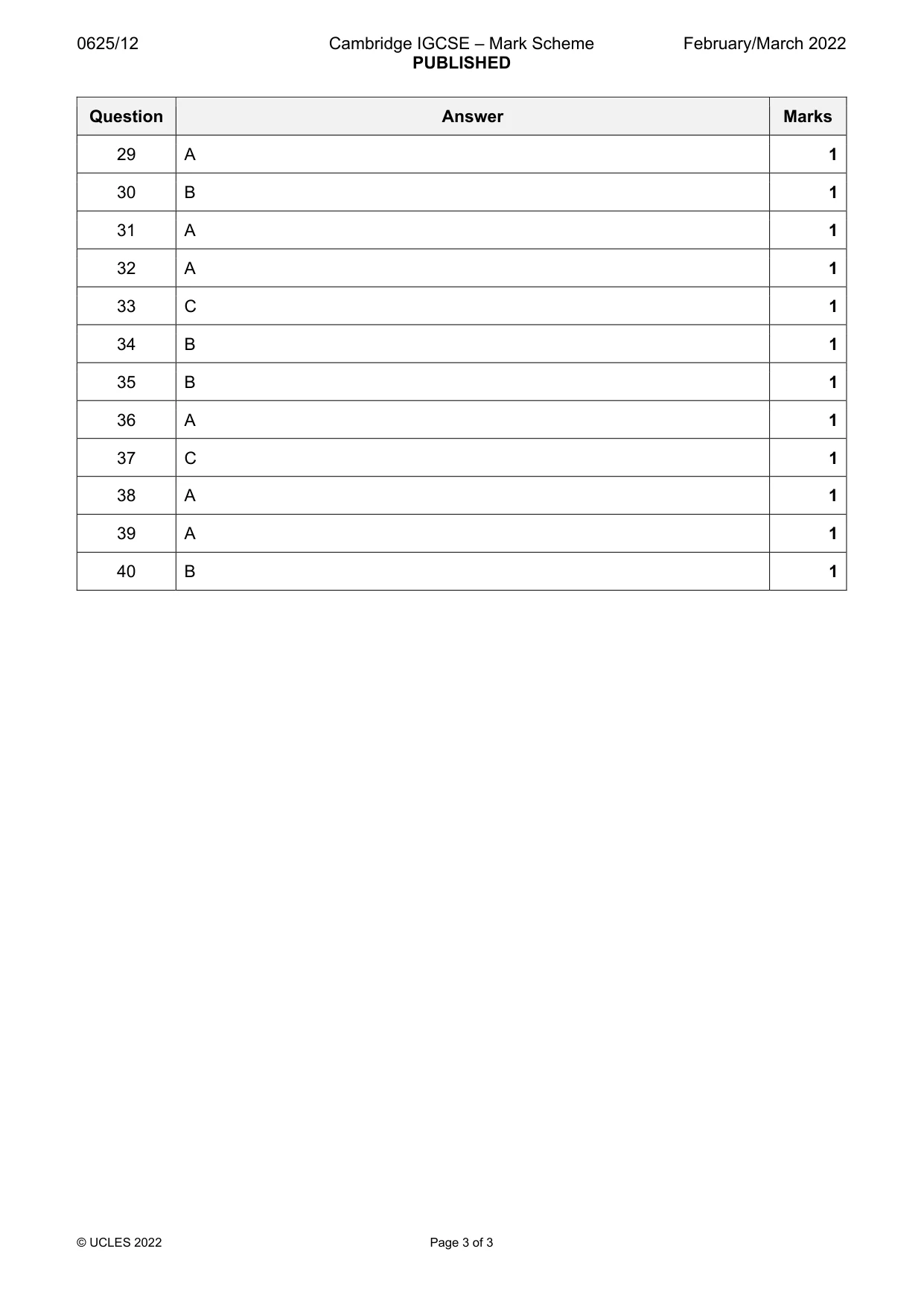
Answers below. Sit the paper first if you are practising.
Questions as text
Q1 · A student investigates a pendulum
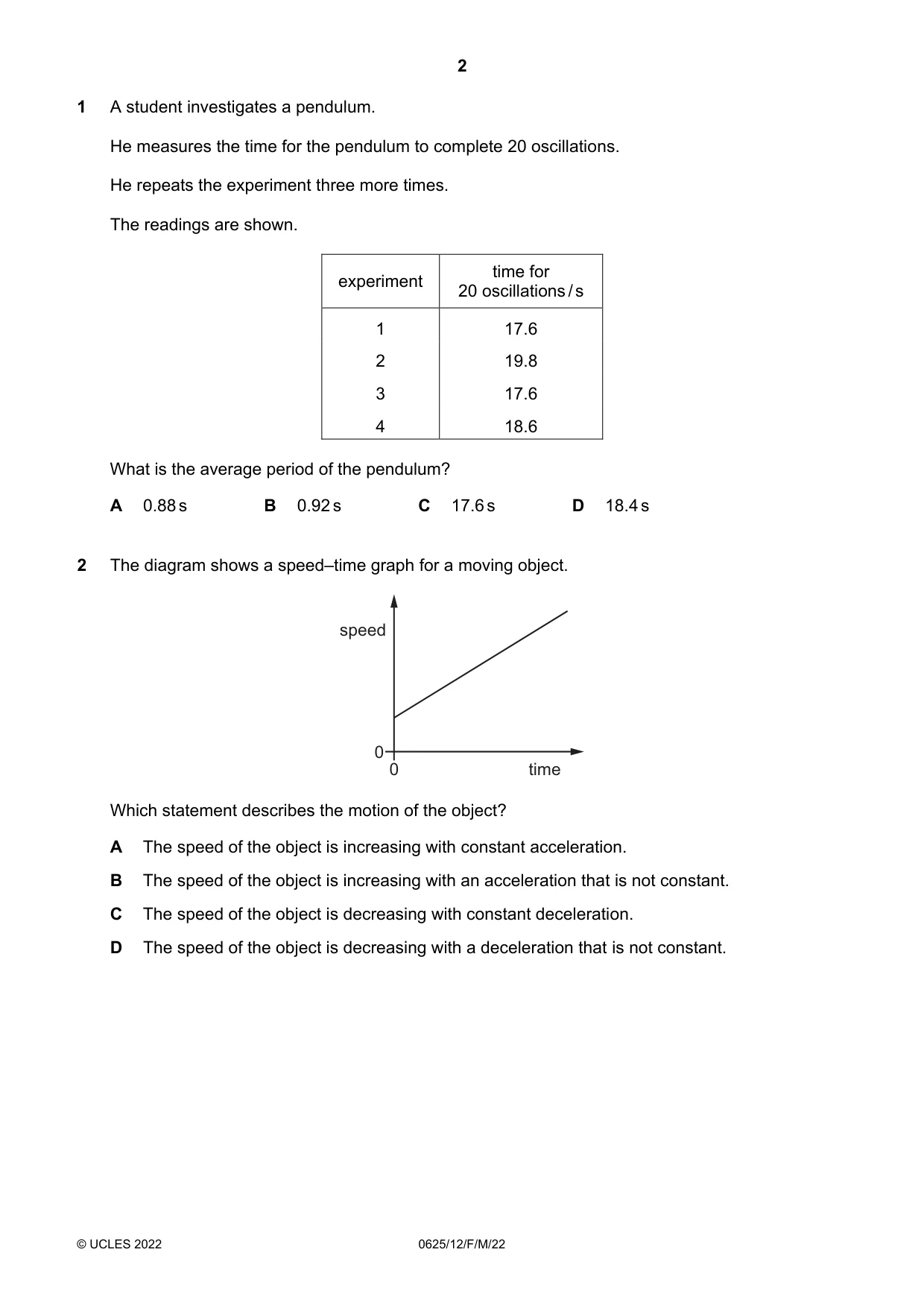
1 A student investigates a pendulum. He measures the time for the pendulum to complete 20 oscillations. He repeats the experiment three more times. The readings are shown. time for experiment 20 oscillations / s 1 17.6 2 19.8 3 17.6 4 18.6 What is the average period of the pendulum? A 0.88 s B 0.92 s C 17.6 s D 18.4 s
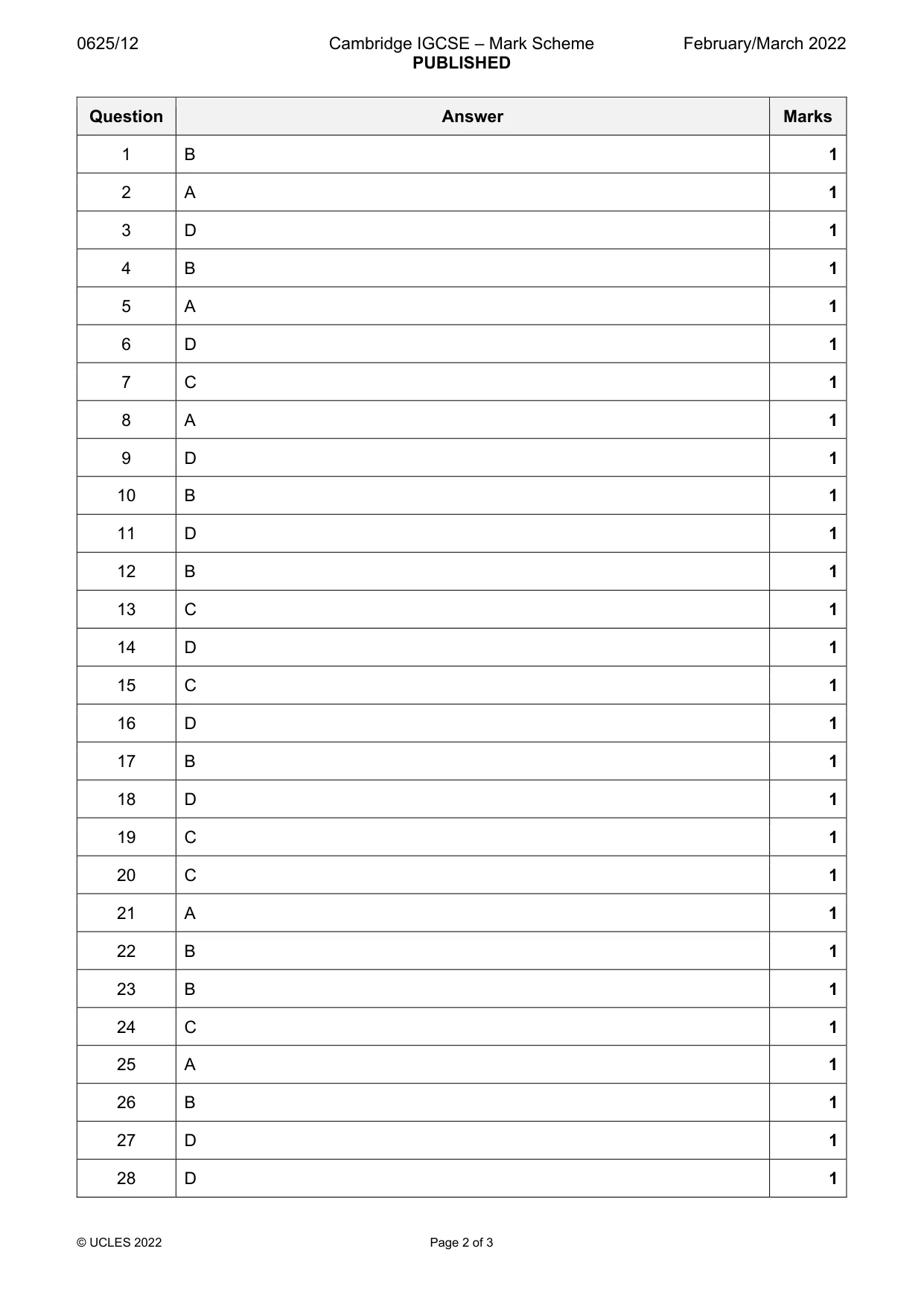
Mark scheme: B
More questions on Physical quantities and measurement techniques
Q2 · The diagram shows a speed–time graph for a moving object
2 The diagram shows a speed–time graph for a moving object. speed 0 0 time Which statement describes the motion of the object? A The speed of the object is increasing with constant acceleration. B The speed of the object is increasing with an acceleration that is not constant. C The speed of the object is decreasing with constant deceleration. D The speed of the object is decreasing with a deceleration that is not constant.
Mark scheme: A
Q3 · A tennis ball falls from the upstairs window of a house
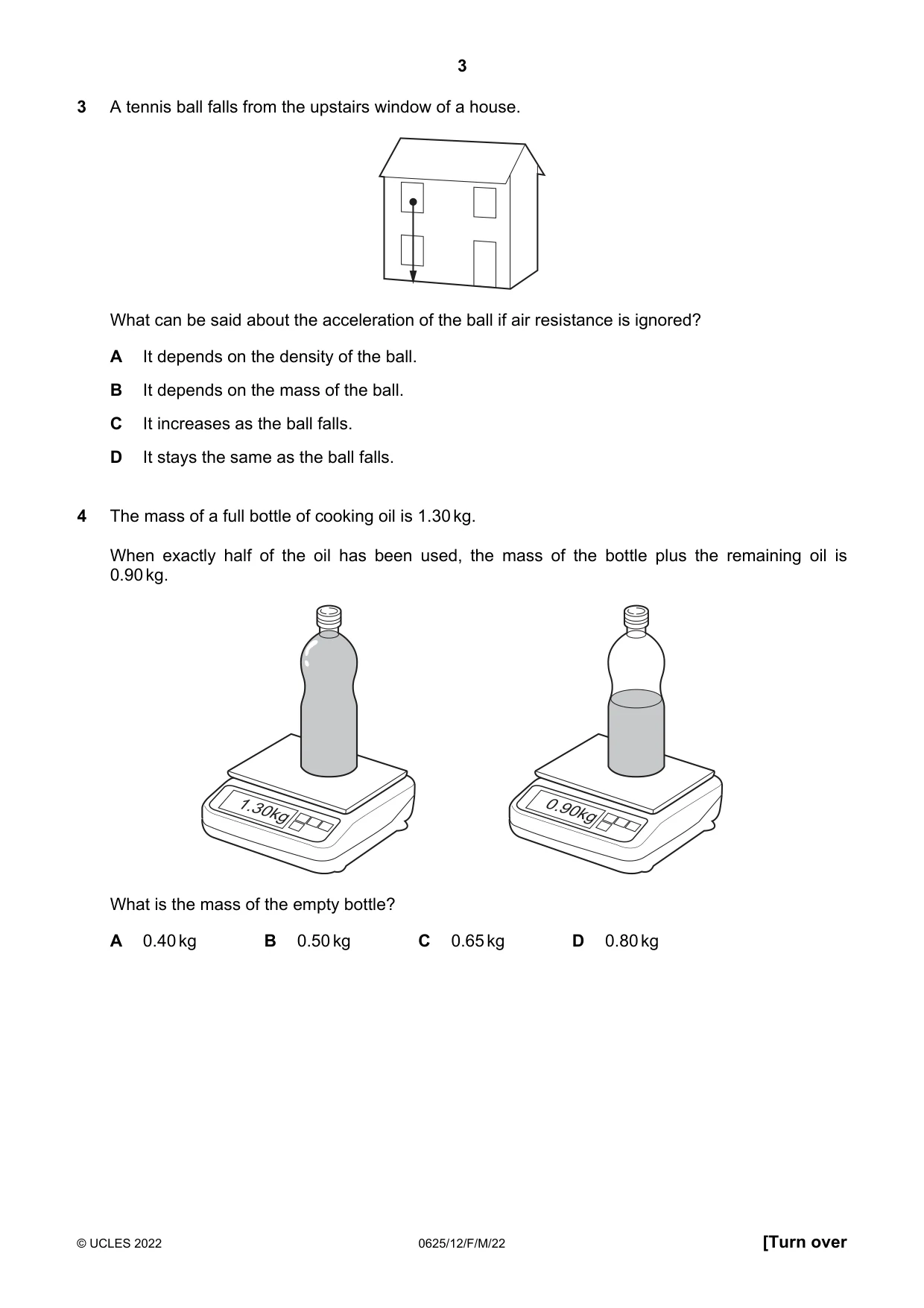
3 A tennis ball falls from the upstairs window of a house. What can be said about the acceleration of the ball if air resistance is ignored? A It depends on the density of the ball. B It depends on the mass of the ball. C It increases as the ball falls. D It stays the same as the ball falls.
Mark scheme: D
Q4 · The mass of a full bottle of cooking oil is 1.30 kg
4 The mass of a full bottle of cooking oil is 1.30 kg. When exactly half of the oil has been used, the mass of the bottle plus the remaining oil is 0.90 kg. 1.30kg 0.90kg What is the mass of the empty bottle? A 0.40 kg B 0.50 kg C 0.65 kg D 0.80 kg
Mark scheme: B
Q5 · A student carries out an experiment to find the density of a rock
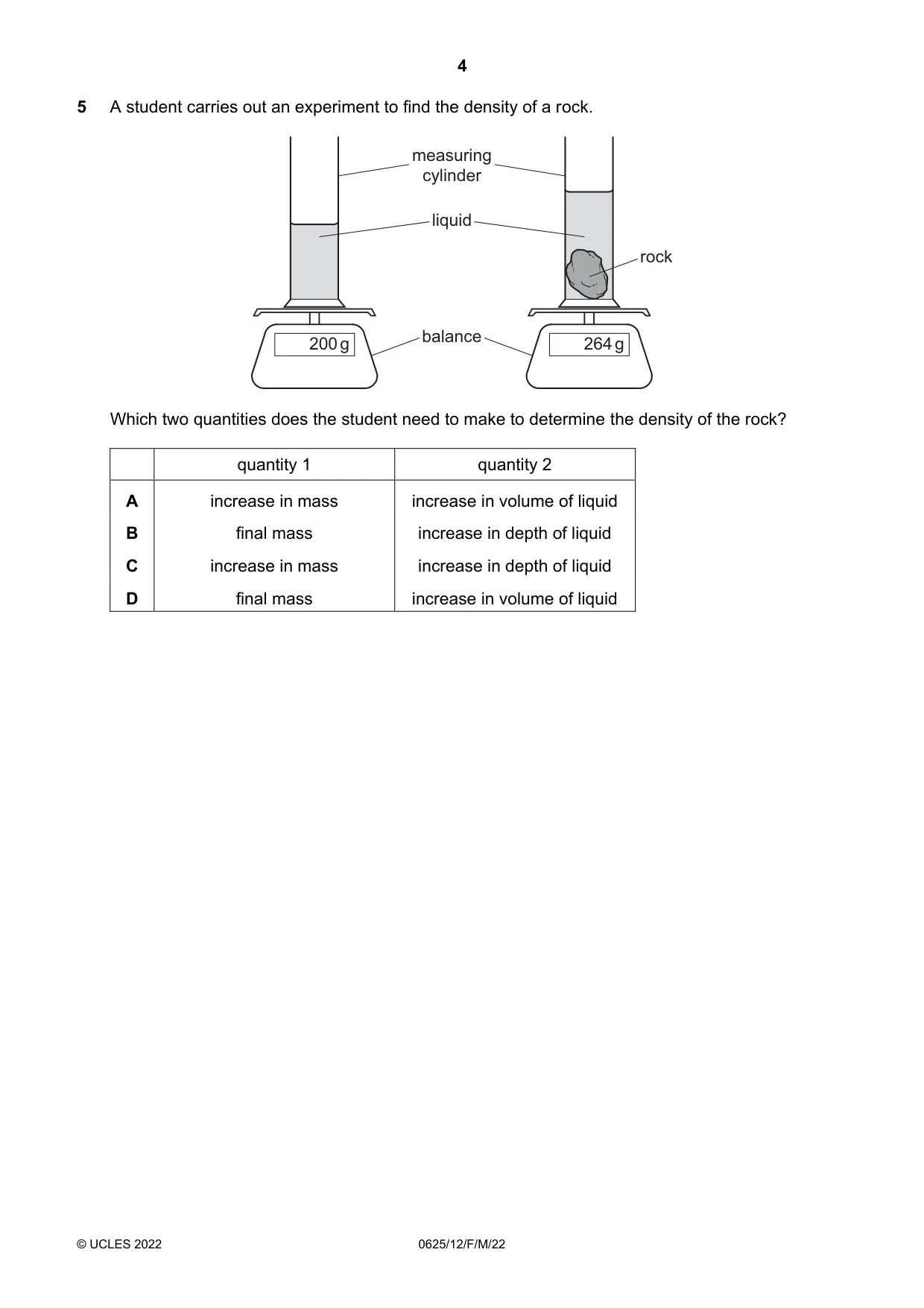
5 A student carries out an experiment to find the density of a rock. measuring cylinder liquid rock 200 g balance 264 g Which two quantities does the student need to make to determine the density of the rock? quantity 1 quantity 2 A increase in mass increase in volume of liquid B final mass increase in depth of liquid C increase in mass increase in depth of liquid D final mass increase in volume of liquid
Mark scheme: A
Q6 · A spring is suspended from a stand
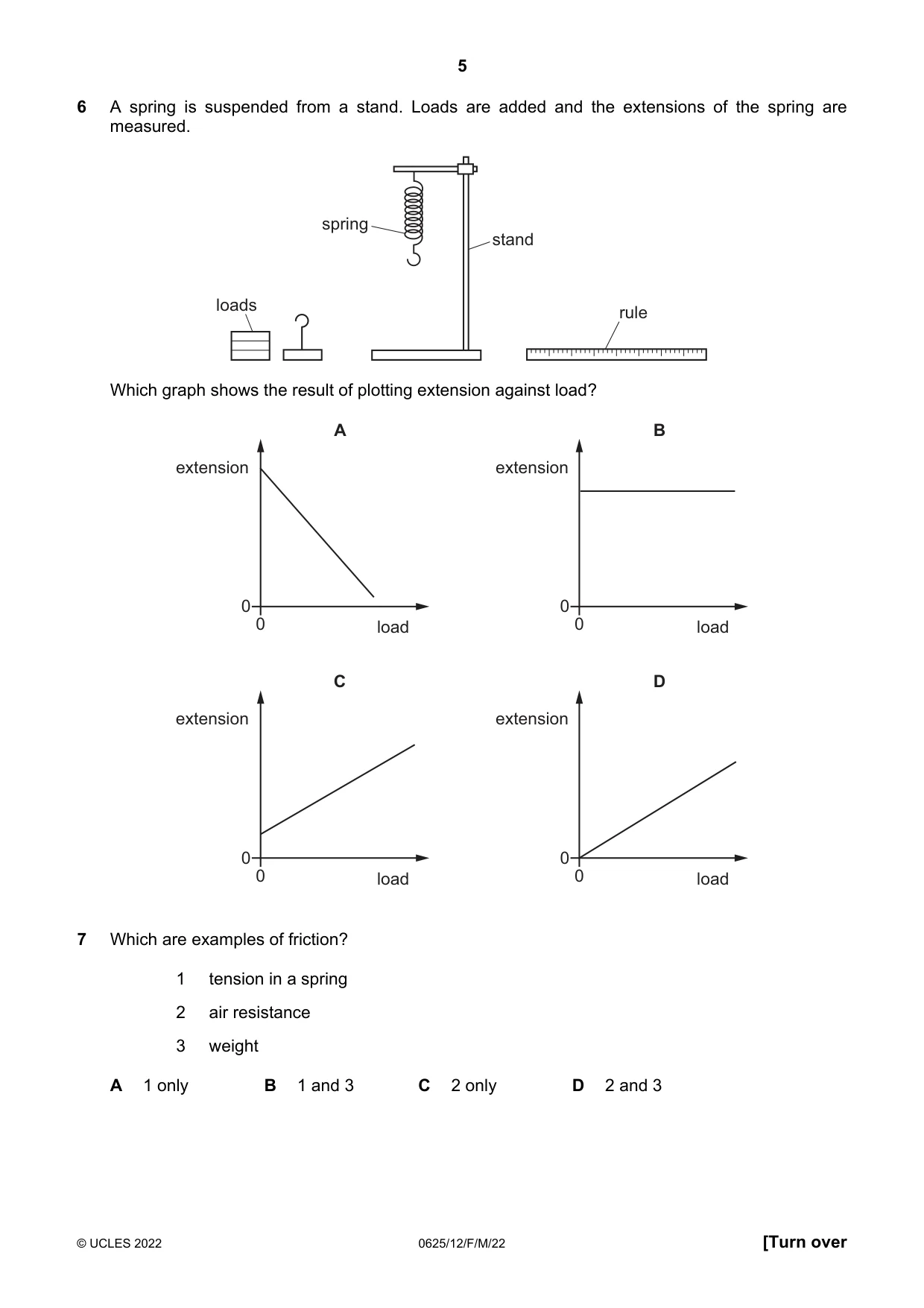
6 A spring is suspended from a stand. Loads are added and the extensions of the spring are measured. spring stand loads rule Which graph shows the result of plotting extension against load? A B extension extension 0 0 0 load 0 load C D extension extension 0 0 0 load 0 load
Mark scheme: D
Q7 · Which are examples of friction?
7 Which are examples of friction? 1 tension in a spring 2 air resistance 3 weight A 1 only B 1 and 3 C 2 only D 2 and 3
Mark scheme: C
Q8 · The diagram shows a nut being turned with a spanner by applying a force F to the spanner
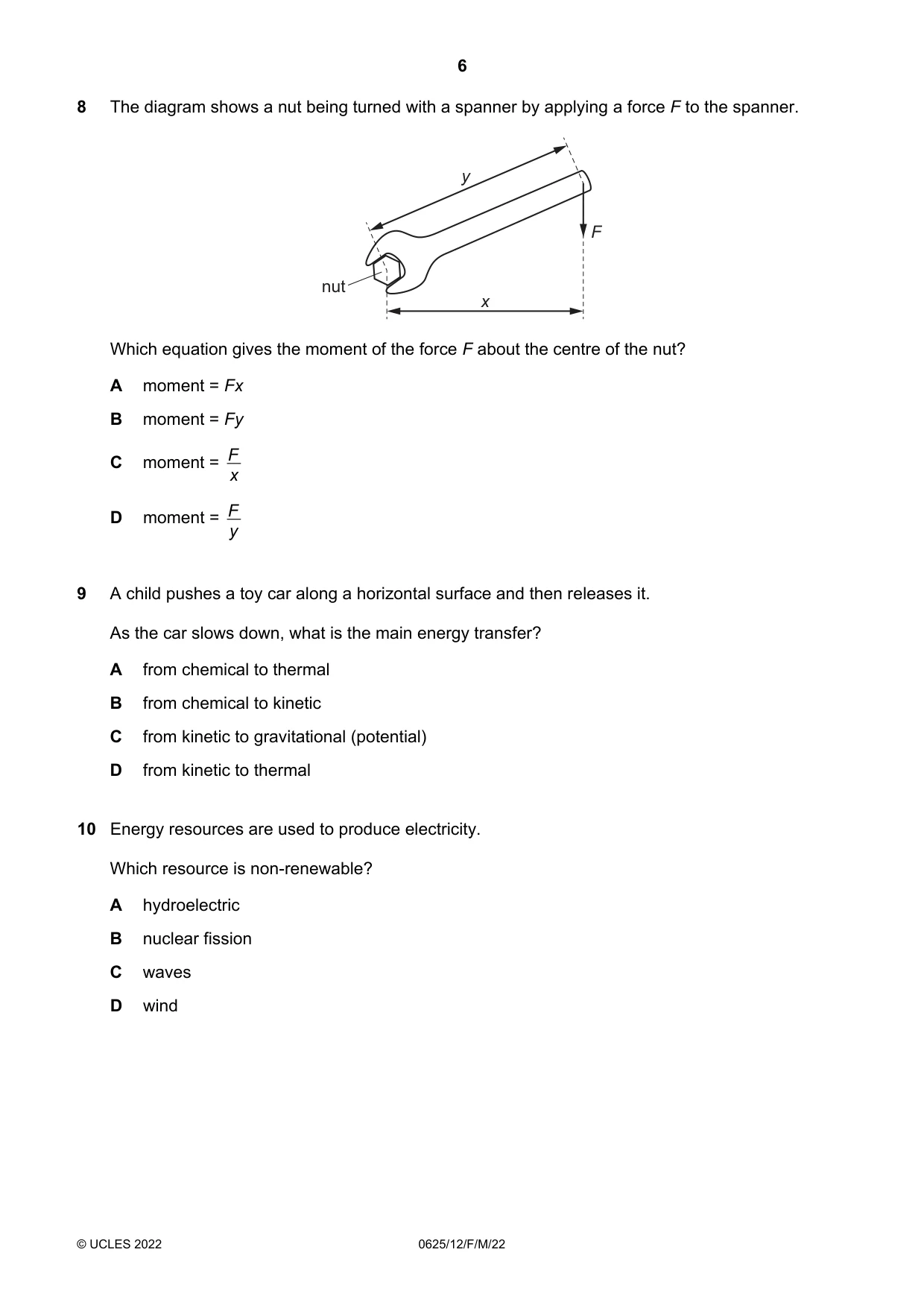
8 The diagram shows a nut being turned with a spanner by applying a force F to the spanner. y F nut x Which equation gives the moment of the force F about the centre of the nut? A moment = Fx B moment = Fy C moment = F x D moment = F y
Mark scheme: A
Q9 · A child pushes a toy car along a horizontal surface and then releases it
9 A child pushes a toy car along a horizontal surface and then releases it. As the car slows down, what is the main energy transfer? A from chemical to thermal B from chemical to kinetic C from kinetic to gravitational (potential) D from kinetic to thermal
Mark scheme: D
Q10 · Energy resources are used to produce electricity
10 Energy resources are used to produce electricity. Which resource is non-renewable? A hydroelectric B nuclear fission C waves D wind
Mark scheme: B
Q11 · The diagrams show four appliances and their power ratings
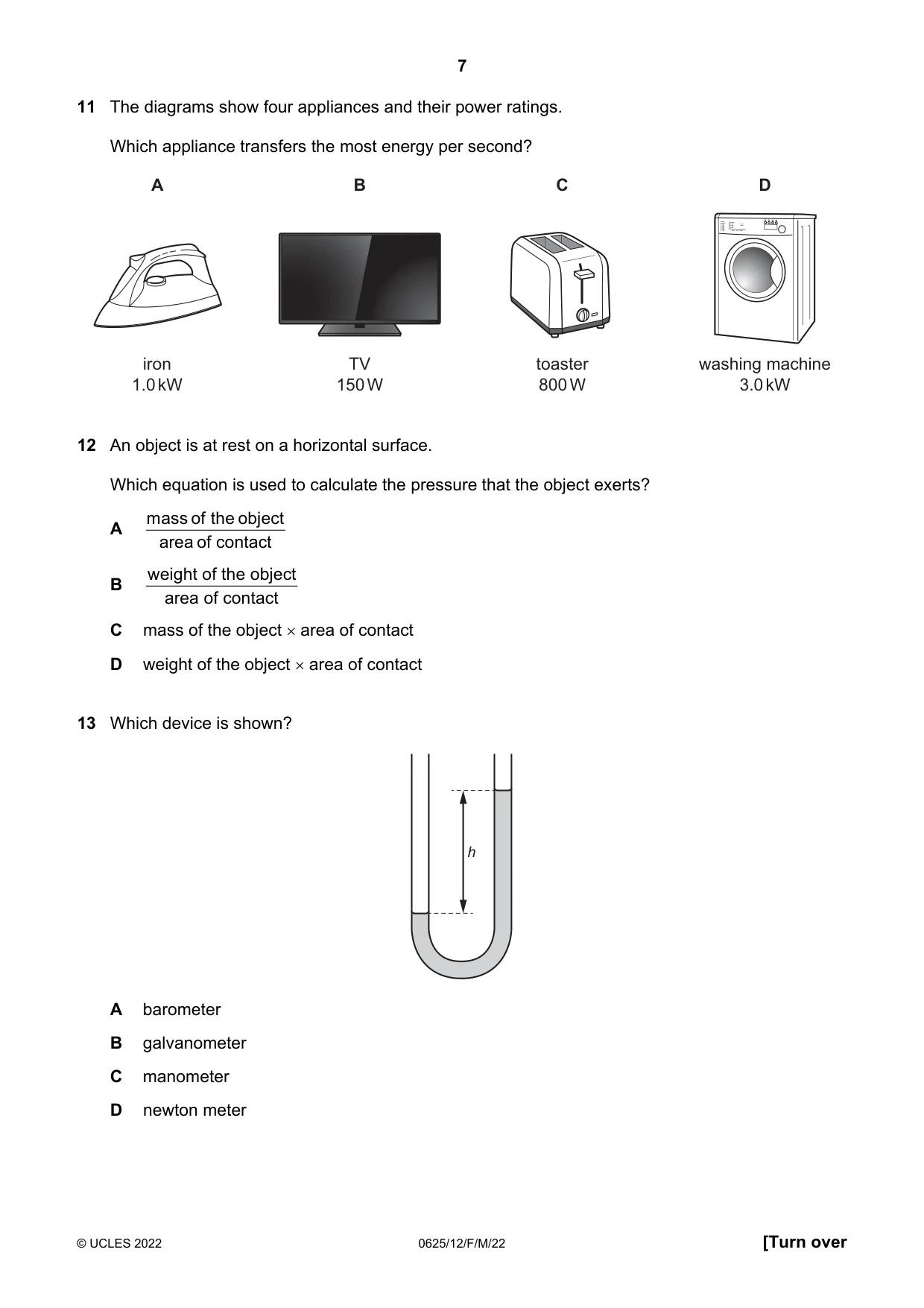
11 The diagrams show four appliances and their power ratings. Which appliance transfers the most energy per second? A B C D iron TV toaster washing machine 1.0 kW 150 W 800 W 3.0 kW
Mark scheme: D
Q12 · An object is at rest on a horizontal surface
12 An object is at rest on a horizontal surface. Which equation is used to calculate the pressure that the object exerts? mass of the object A area of contact weight of the object B area of contact C mass of the object area of contact D weight of the object area of contact
Mark scheme: B
Q13 · Which device is shown?
13 Which device is shown? h A barometer B galvanometer C manometer D newton meter
Mark scheme: C
Q14 · Which properties does a liquid have?
14 Which properties does a liquid have? _ can be definite compressed shape : easily A v v B v x Cc x v D x x key ¥ = has this property X = does not have this property
Mark scheme: D
Q15 · In the diagrams, the black circle represents a smoke particle in air
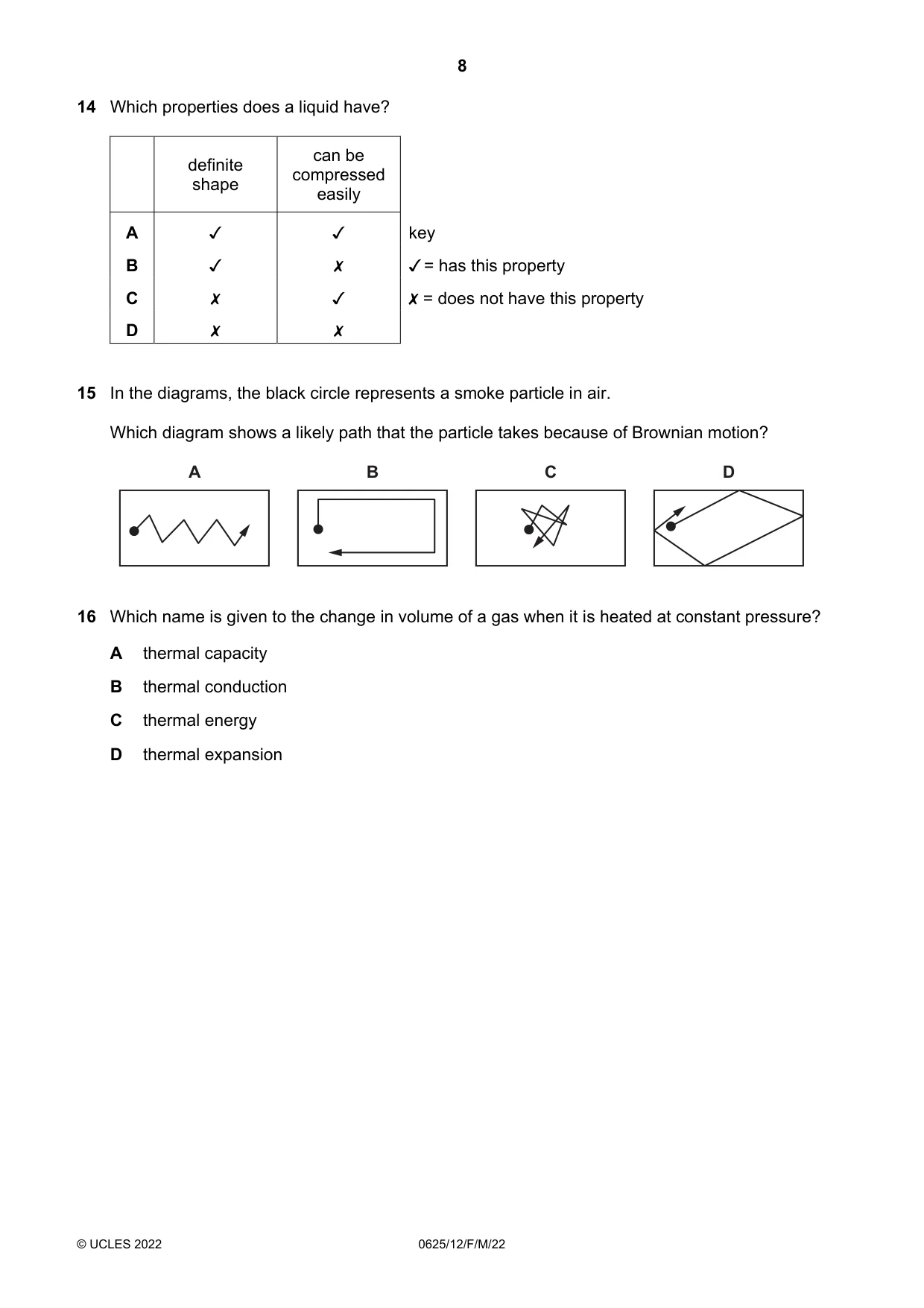
15 In the diagrams, the black circle represents a smoke particle in air. Which diagram shows a likely path that the particle takes because of Brownian motion? A B C D
Mark scheme: C
Q16 · Which name is given to the change in volume of a gas when it is heated at constant…
16 Which name is given to the change in volume of a gas when it is heated at constant pressure? A thermal capacity B thermal conduction C thermal energy D thermal expansion
Mark scheme: D
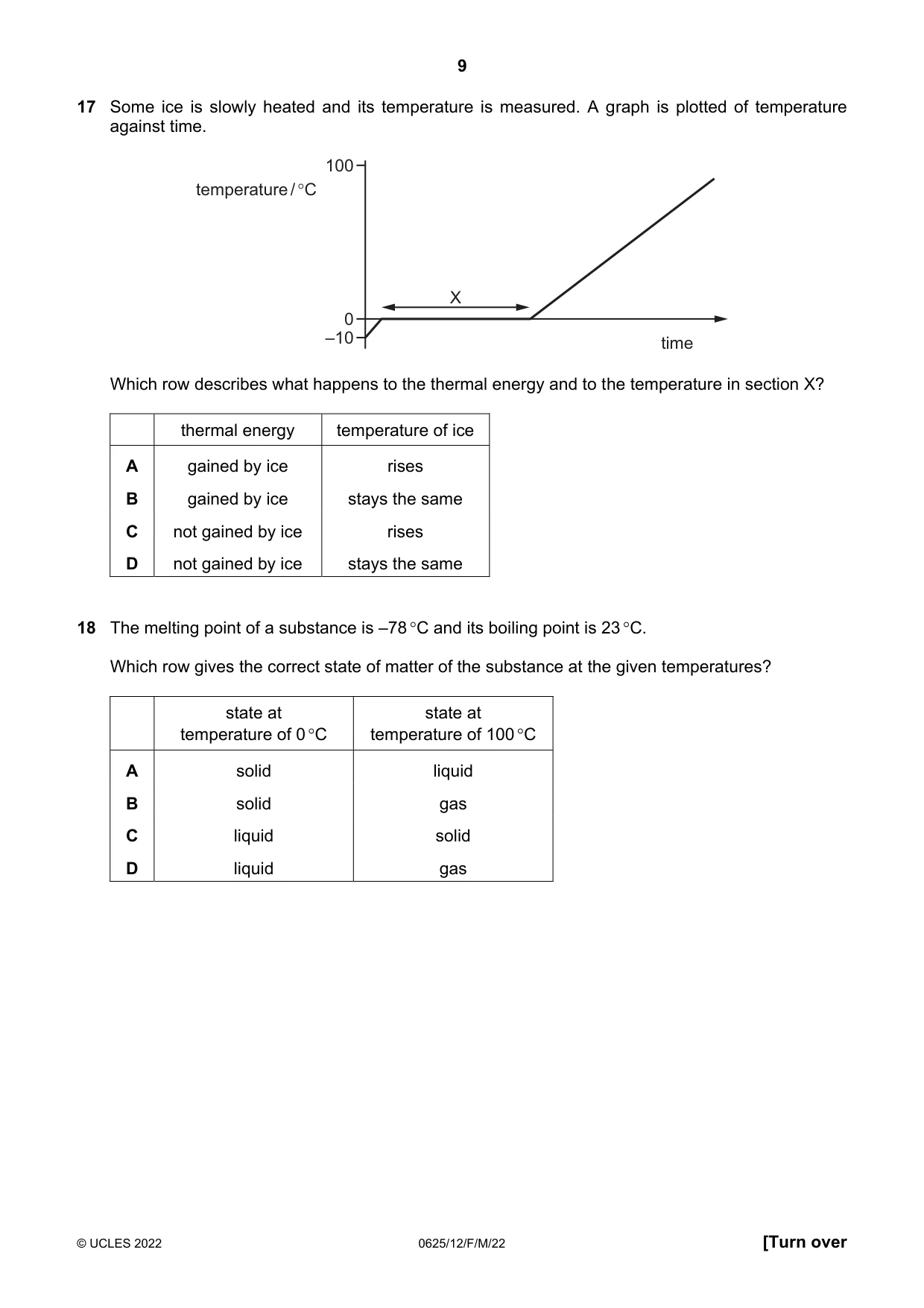
Q17 · Some ice is slowly heated and its temperature is measured
17 Some ice is slowly heated and its temperature is measured. A graph is plotted of temperature against time. 100 temperature /°C «xX , 0 —10 time Which row describes what happens to the thermal energy and to the temperature in section X? thermal energy temperature of ice A gained by ice rises B gained by ice stays the same Cc not gained by ice rises D not gained by ice stays the same
Mark scheme: B
Q18 · The melting point of a substance is –78 C and its boiling point is 23 C
18 The melting point of a substance is –78 C and its boiling point is 23 C. Which row gives the correct state of matter of the substance at the given temperatures? state at state at temperature of 0 C temperature of 100 C A solid liquid B solid gas C liquid solid D liquid gas
Mark scheme: D
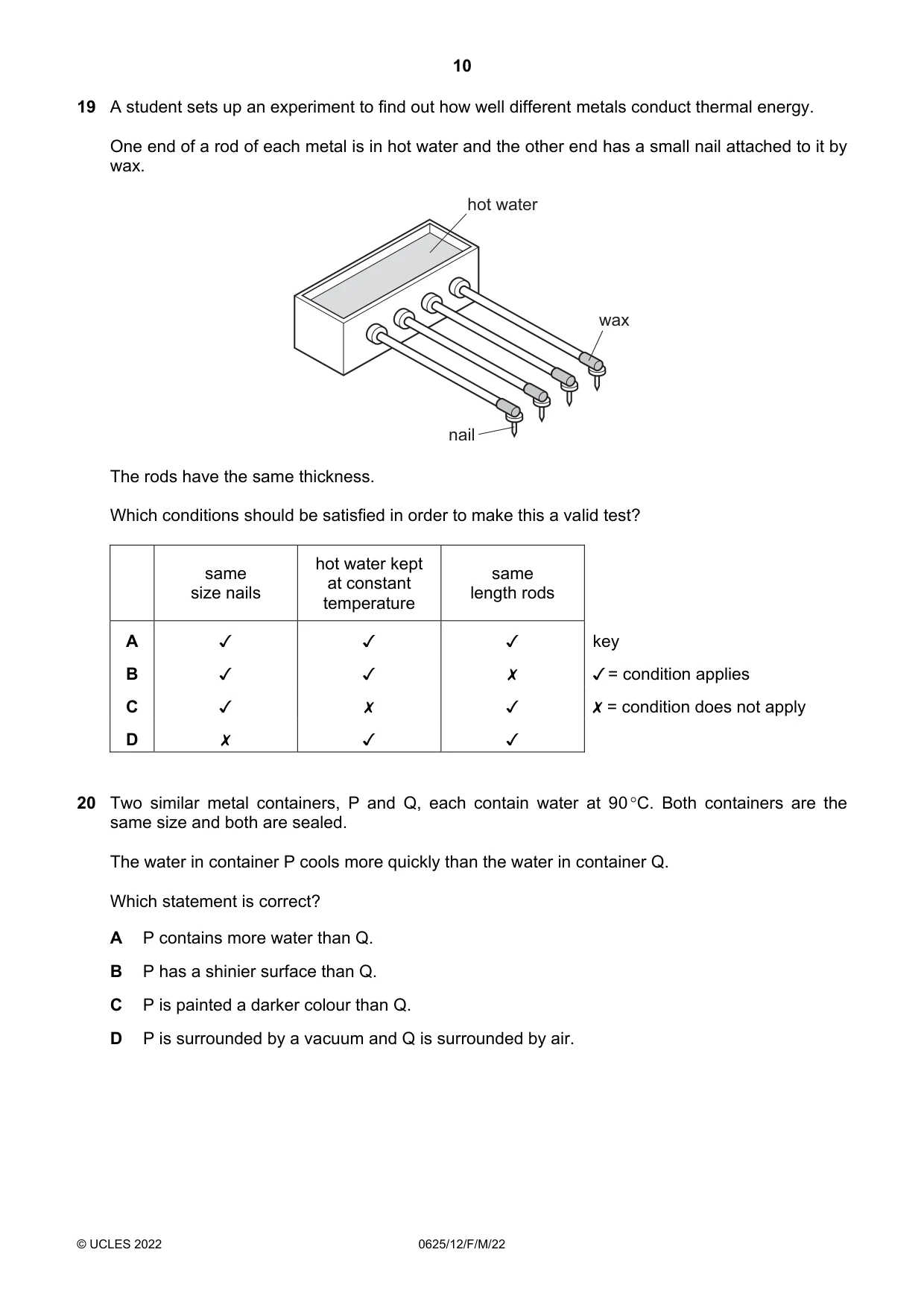
Q19 · Astudent sets up an experiment to find out how well different metals conduct thermal…
19 Astudent sets up an experiment to find out how well different metals conduct thermal energy. One end of a rod of each metal is in hot water and the other end has a small nail attached to it by wax. The rods have the same thickness. hot water nail wax Which conditions should be satisfied in order to make this a valid test? hot water kept same same size nails at constant length rods temperature g A Jv Jv Jv B Jv v x Cc v x Jv D x v Jv key / = condition applies X = condition does not apply
Mark scheme: C
Q20 · Two similar metal containers, P and Q, each contain water at 90 C
20 Two similar metal containers, P and Q, each contain water at 90 C. Both containers are the same size and both are sealed. The water in container P cools more quickly than the water in container Q. Which statement is correct? A P contains more water than Q. B P has a shinier surface than Q. C P is painted a darker colour than Q. D P is surrounded by a vacuum and Q is surrounded by air.
Mark scheme: C
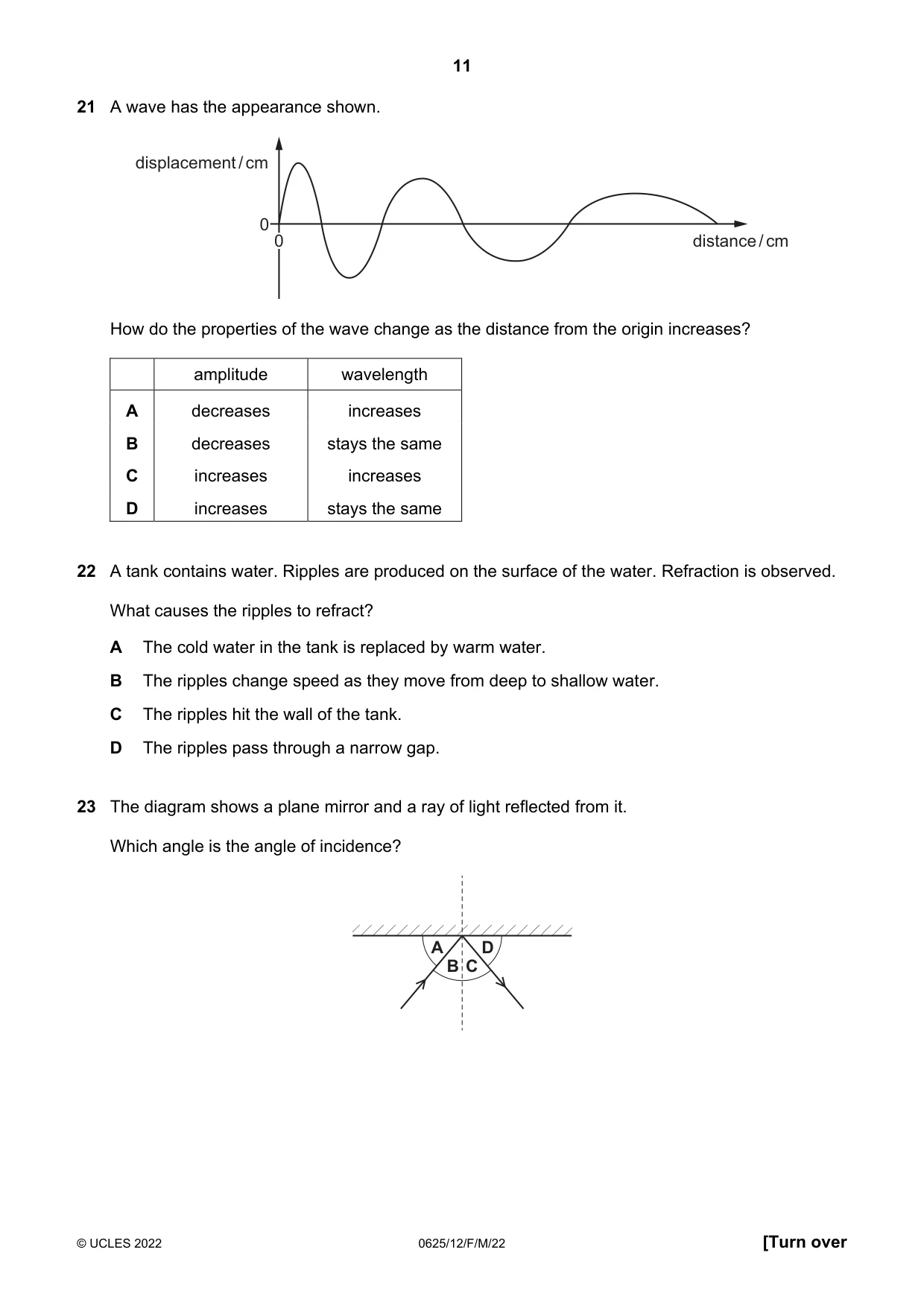
Q21 · A wave has the appearance shown
21 A wave has the appearance shown. displacement / cm 0 0 distance / cm How do the properties of the wave change as the distance from the origin increases? amplitude wavelength A decreases increases B decreases stays the same C increases increases D increases stays the same
Mark scheme: A
Q22 · A tank contains water
22 A tank contains water. Ripples are produced on the surface of the water. Refraction is observed. What causes the ripples to refract? A The cold water in the tank is replaced by warm water. B The ripples change speed as they move from deep to shallow water. C The ripples hit the wall of the tank. D The ripples pass through a narrow gap.
Mark scheme: B
Q23 · The diagram shows a plane mirror and a ray of light reflected from it
23 The diagram shows a plane mirror and a ray of light reflected from it. Which angle is the angle of incidence? A D B C
Mark scheme: B
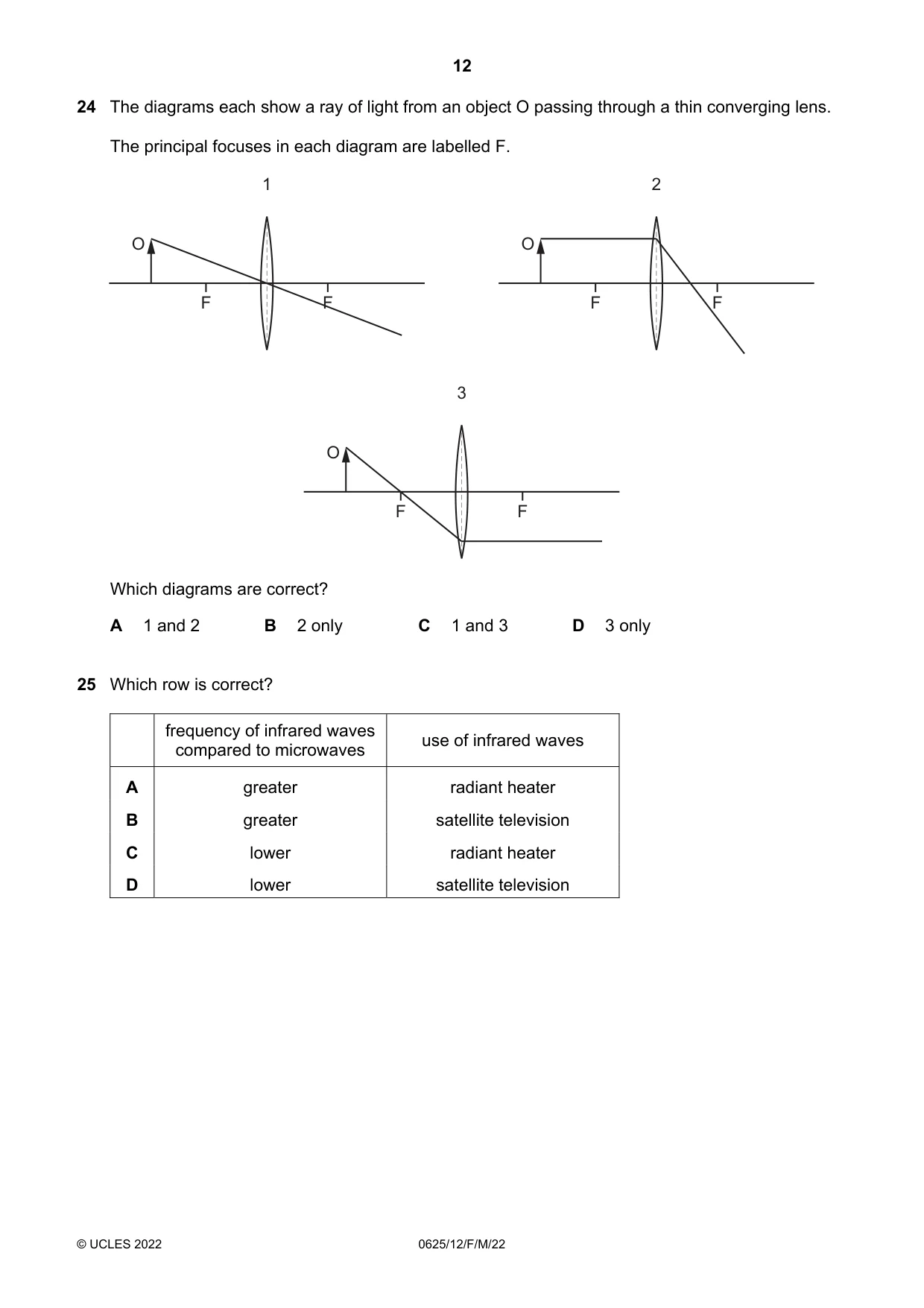
Q24 · The diagrams each show a ray of light from an object O passing through a thin converging…
24 The diagrams each show a ray of light from an object O passing through a thin converging lens. The principal focuses in each diagram are labelled F. 1 2 O O F F F F 3 O F F Which diagrams are correct? A 1 and 2 B 2 only C 1 and 3 D 3 only
Mark scheme: C
Q25 · Which row is correct?
25 Which row is correct? frequency of infrared waves use of infrared waves compared to microwaves A greater radiant heater B greater satellite television C lower radiant heater D lower satellite television
Mark scheme: A
Q26 · A student investigates sound waves from a loudspeaker
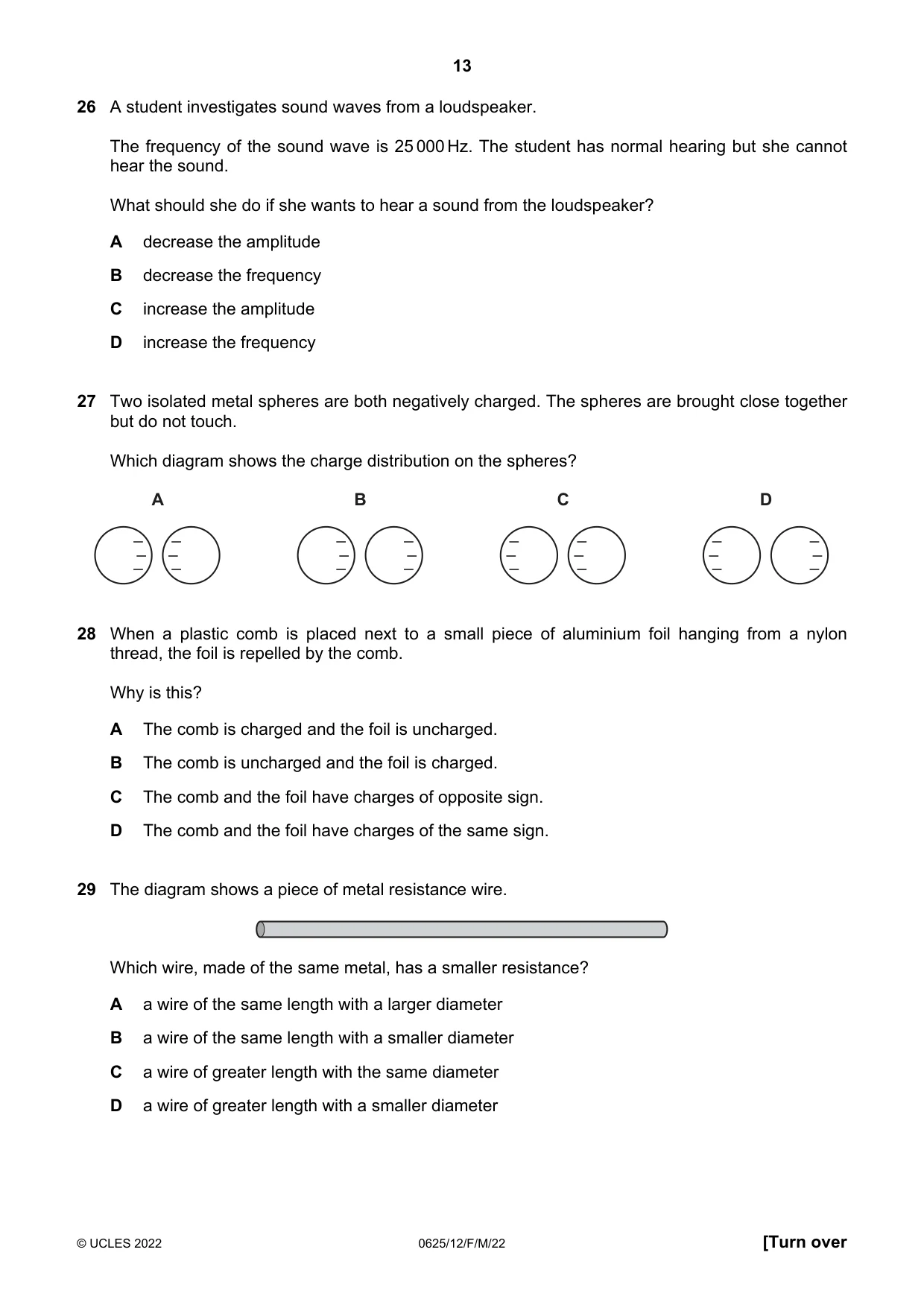
26 A student investigates sound waves from a loudspeaker. The frequency of the sound wave is 25 000 Hz. The student has normal hearing but she cannot hear the sound. What should she do if she wants to hear a sound from the loudspeaker? A decrease the amplitude B decrease the frequency C increase the amplitude D increase the frequency
Mark scheme: B
Q27 · Two isolated metal spheres are both negatively charged
27 Two isolated metal spheres are both negatively charged. The spheres are brought close together but do not touch. Which diagram shows the charge distribution on the spheres? A B C D – – – – – – – – – – – – – – – – – – – – – – – –
Mark scheme: D
Q28 · When a plastic comb is placed next to a small piece of aluminium foil hanging from a…
28 When a plastic comb is placed next to a small piece of aluminium foil hanging from a nylon thread, the foil is repelled by the comb. Why is this? A The comb is charged and the foil is uncharged. B The comb is uncharged and the foil is charged. C The comb and the foil have charges of opposite sign. D The comb and the foil have charges of the same sign.
Mark scheme: D
Q29 · The diagram shows a piece of metal resistance wire
29 The diagram shows a piece of metal resistance wire. Which wire, made of the same metal, has a smaller resistance? A a wire of the same length with a larger diameter B a wire of the same length with a smaller diameter C a wire of greater length with the same diameter D a wire of greater length with a smaller diameter
Mark scheme: A
Q30 · Which labelled component in the circuit shown controls the brightness of lamp X?
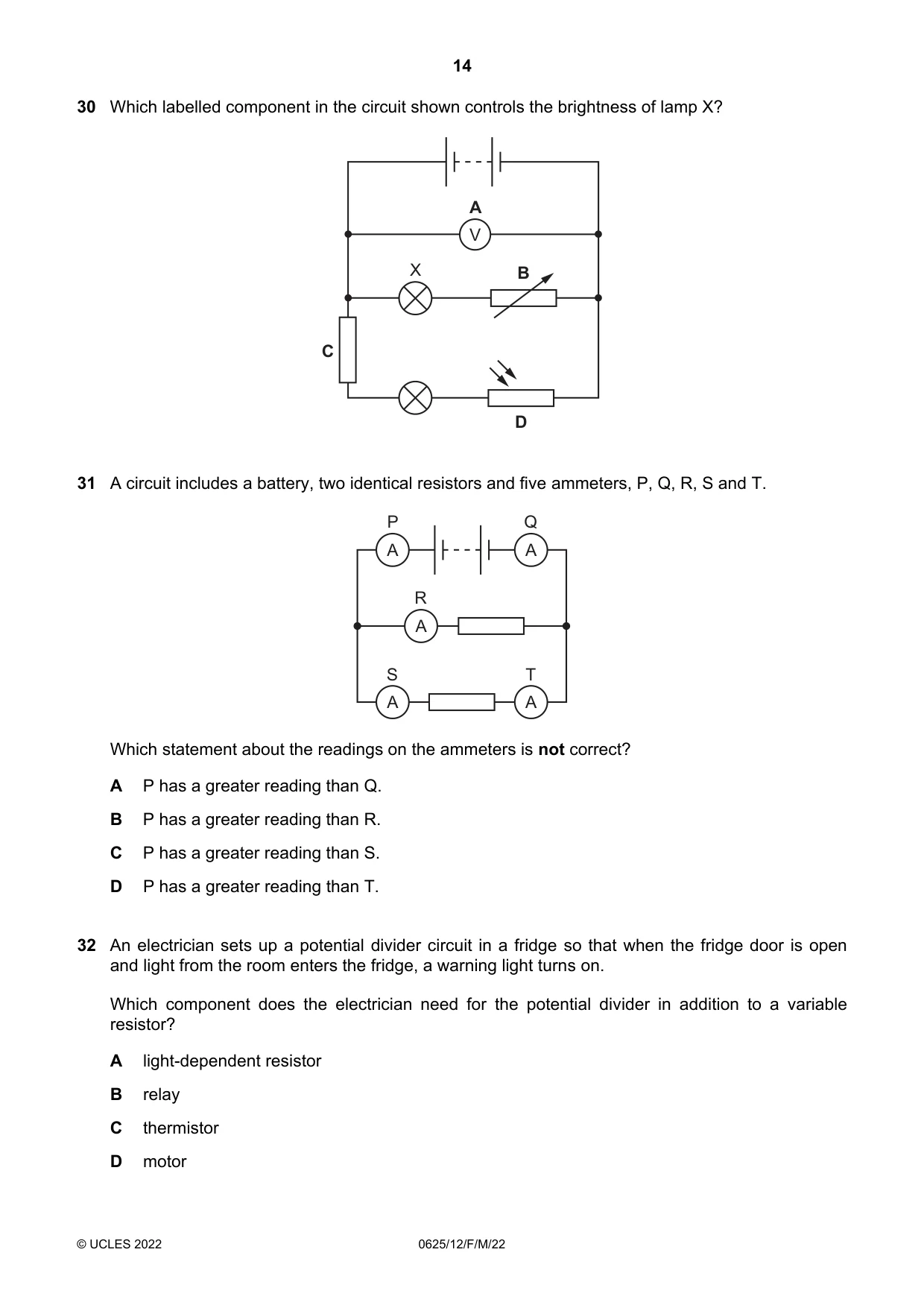
30 Which labelled component in the circuit shown controls the brightness of lamp X? A V X B C D
Mark scheme: B
Q31 · A circuit includes a battery, two identical resistors and five ammeters, P, Q, R, S and T
31 A circuit includes a battery, two identical resistors and five ammeters, P, Q, R, S and T. P Q A A R A S T A A Which statement about the readings on the ammeters is not correct? A P has a greater reading than Q. B P has a greater reading than R. C P has a greater reading than S. D P has a greater reading than T.
Mark scheme: A
Q32 · An electrician sets up a potential divider circuit in a fridge so that when the fridge…
32 An electrician sets up a potential divider circuit in a fridge so that when the fridge door is open and light from the room enters the fridge, a warning light turns on. Which component does the electrician need for the potential divider in addition to a variable resistor? A light-dependent resistor B relay C thermistor D motor
Mark scheme: A
Q33 · A simple wiring diagram for an electric cooker is shown
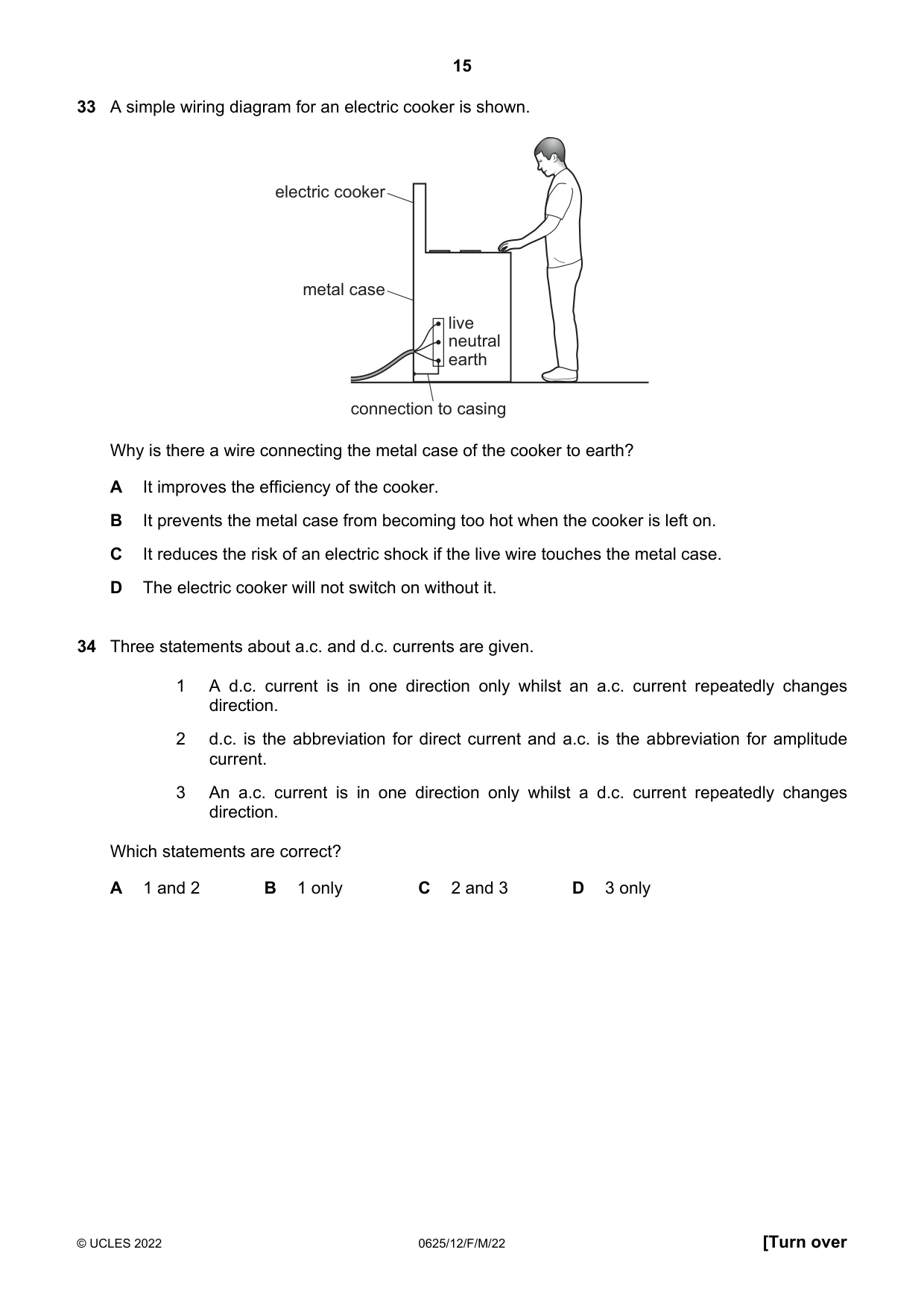
33 A simple wiring diagram for an electric cooker is shown. electric cooker metal case live neutral earth connection to casing Why is there a wire connecting the metal case of the cooker to earth? A It improves the efficiency of the cooker. B It prevents the metal case from becoming too hot when the cooker is left on. C It reduces the risk of an electric shock if the live wire touches the metal case. D The electric cooker will not switch on without it.
Mark scheme: C
Q34 · Three statements about a.c
34 Three statements about a.c. and d.c. currents are given. 1 A d.c. current is in one direction only whilst an a.c. current repeatedly changes direction. 2 d.c. is the abbreviation for direct current and a.c. is the abbreviation for amplitude current. 3 An a.c. current is in one direction only whilst a d.c. current repeatedly changes direction. Which statements are correct? A 1 and 2 B 1 only C 2 and 3 D 3 only
Mark scheme: B
Q35 · Two magnets are placed near a current-carrying coil
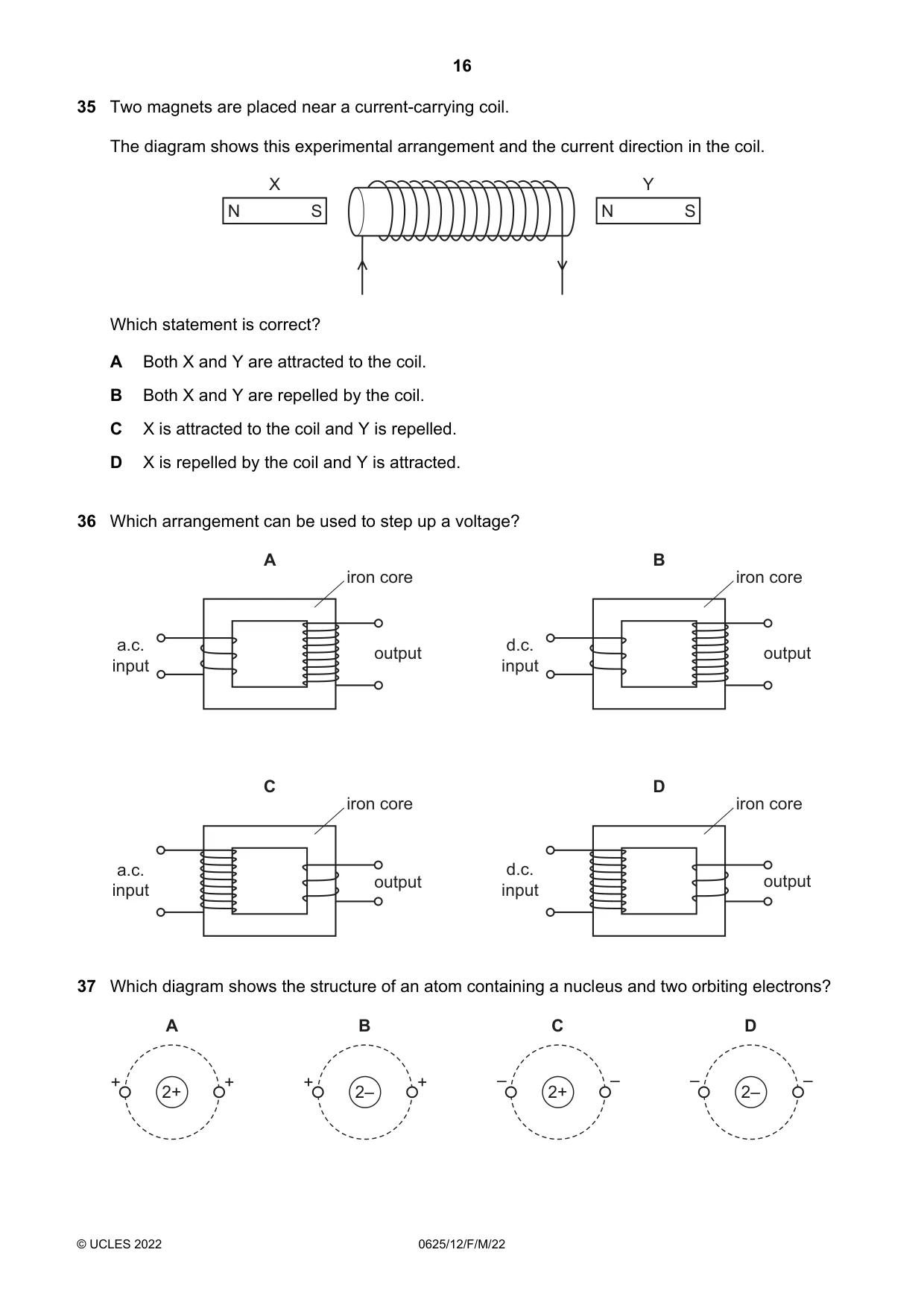
35 Two magnets are placed near a current-carrying coil. The diagram shows this experimental arrangement and the current direction in the coil. X Y N S N S Which statement is correct? A Both X and Y are attracted to the coil. B Both X and Y are repelled by the coil. C X is attracted to the coil and Y is repelled. D X is repelled by the coil and Y is attracted.
Mark scheme: B
Q36 · Which arrangement can be used to step up a voltage?
36 Which arrangement can be used to step up a voltage? A B iron core iron core a.c. d.c. output output input input C D iron core iron core a.c. d.c. output output input input
Mark scheme: A
Q37 · Which diagram shows the structure of an atom containing a nucleus and two orbiting…
37 Which diagram shows the structure of an atom containing a nucleus and two orbiting electrons? A B C D + + + + – – – – 2+ 2– 2+ 2–
Mark scheme: C
Q38 · A nuclide has the symbol 14 C
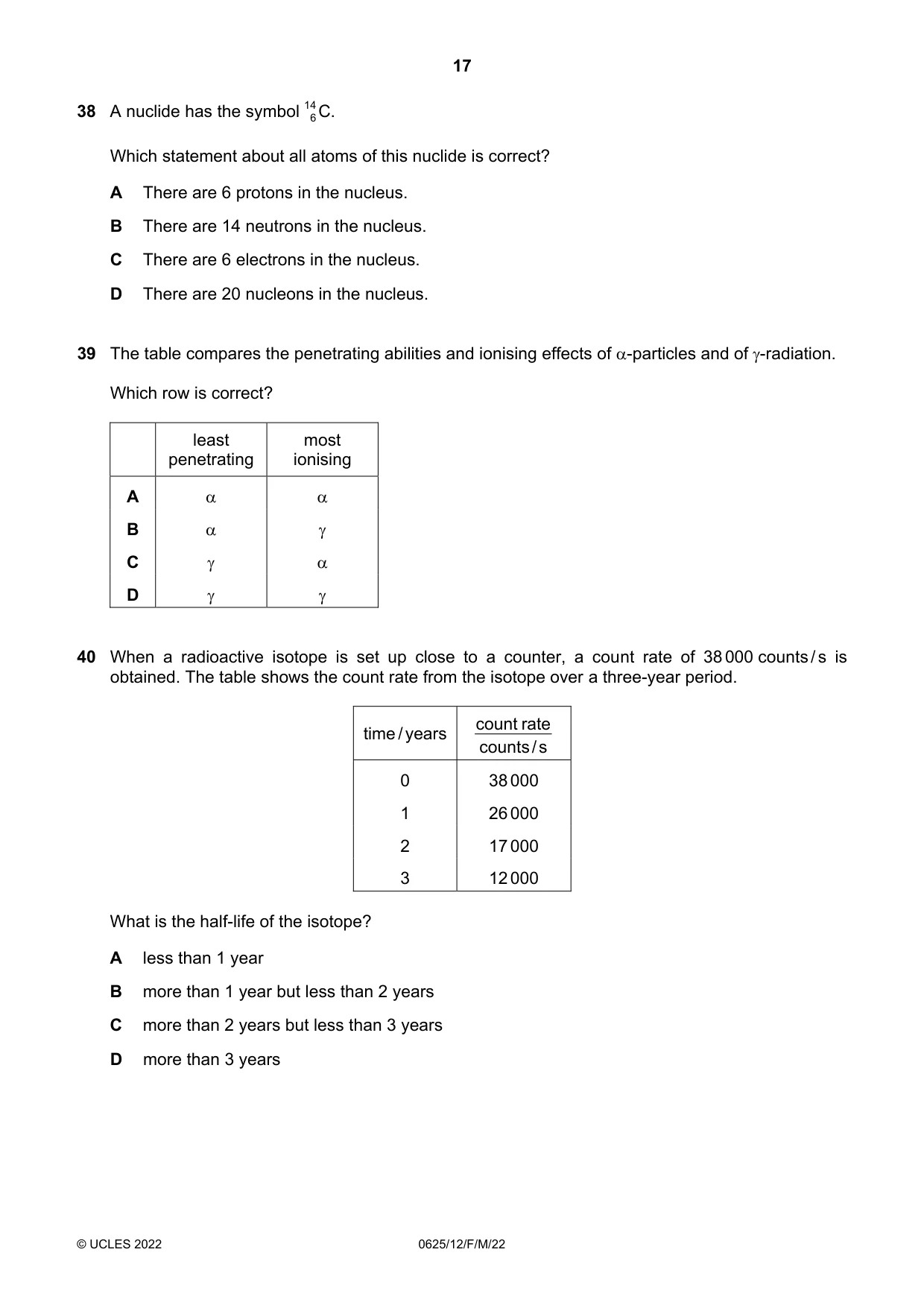
38 A nuclide has the symbol 14 C. 6 Which statement about all atoms of this nuclide is correct? A There are 6 protons in the nucleus. B There are 14 neutrons in the nucleus. C There are 6 electrons in the nucleus. D There are 20 nucleons in the nucleus.
Mark scheme: A
Q39 · The table compares the penetrating abilities and ionising effects of -particles and of…
39 The table compares the penetrating abilities and ionising effects of -particles and of -radiation. Which row is correct? least most penetrating ionising A B C D
Mark scheme: A
Q40 · When a radioactive isotope is set up close to a counter, a count rate of 38 000 counts /…
40 When a radioactive isotope is set up close to a counter, a count rate of 38 000 counts / s is obtained. The table shows the count rate from the isotope over a three-year period. count rate time / years counts / s 0 38 000 1 26 000 2 17 000 3 12 000 What is the half-life of the isotope? A less than 1 year B more than 1 year but less than 2 years C more than 2 years but less than 3 years D more than 3 years
Mark scheme: B
What was in this paper
The subtopics covered by these 40 questions, and how many questions each got. Open one in a new tab to see every Cambridge question on it.
4Energy, work and power3Forces3Thermal properties and temperature3Electromagnetic effects2General properties of waves2Kinetic particle model of matter2Light2Motion2Pressure2Radioactivity2Simple phenomena of magnetism2The nuclear model of the atom2Transfer of thermal energy2Density1Electrical quantities1Electrical safety1Electromagnetic spectrum1Mass and weight1Physical quantities and measurement techniques1Sound1What you needed in this session
Cambridge’s own grade thresholds for 2022 Feb/March, Paper 1 · Variant 2. A higher threshold means an easier paper — the bar moves with how the cohort did.