Cambridge IGCSE Physics 0625 — 2013 May/June Paper 1 · Variant 2
0625/12/M/J/13 · 40 questions · 40 marks · ≈45 min
The question paper and its mark scheme, free to read here and free to download. This is Cambridge’s own paper, exactly as it was sat.
Question paper20 pages
Mark scheme2 pages
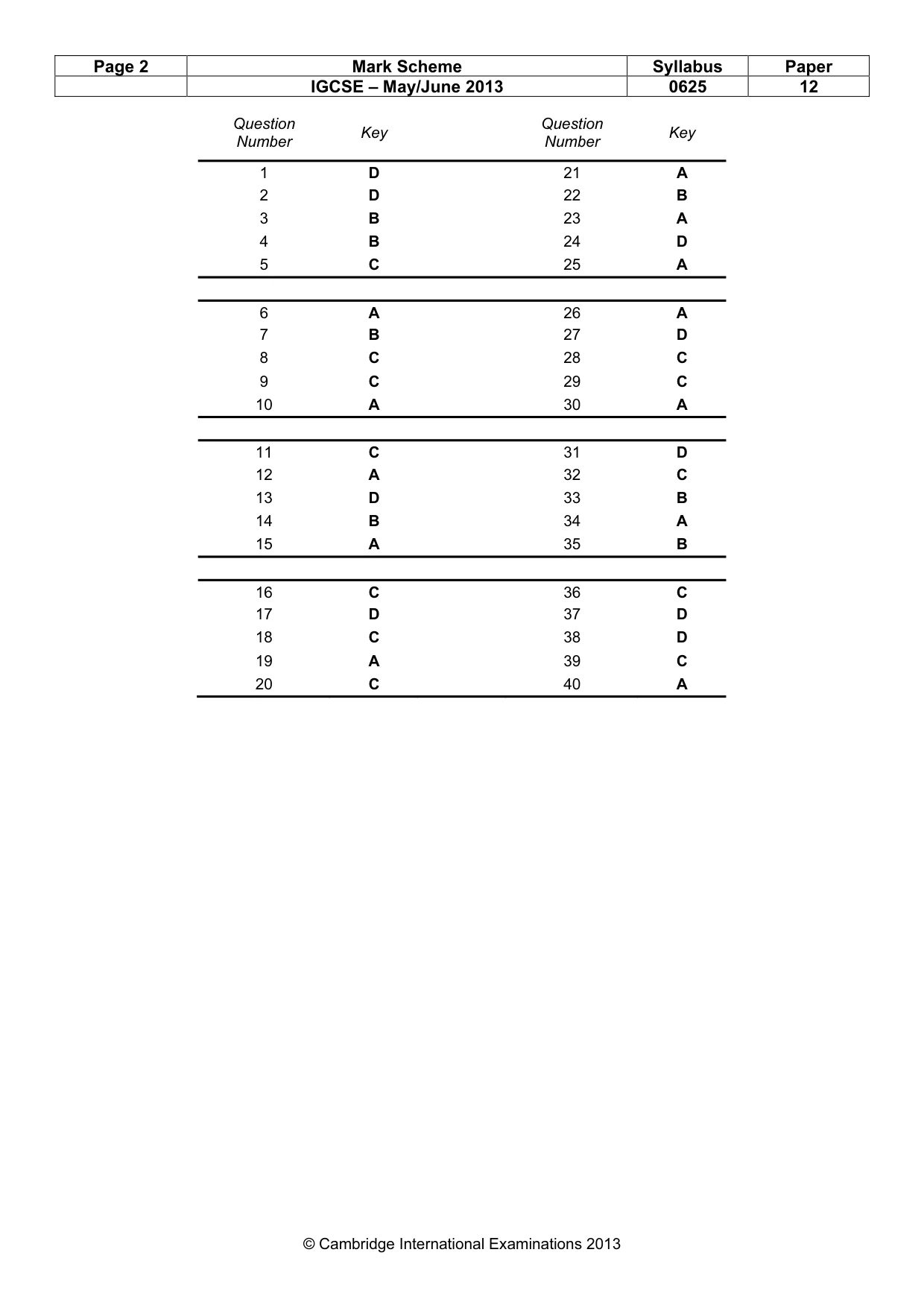
Answers below. Sit the paper first if you are practising.
Questions as text
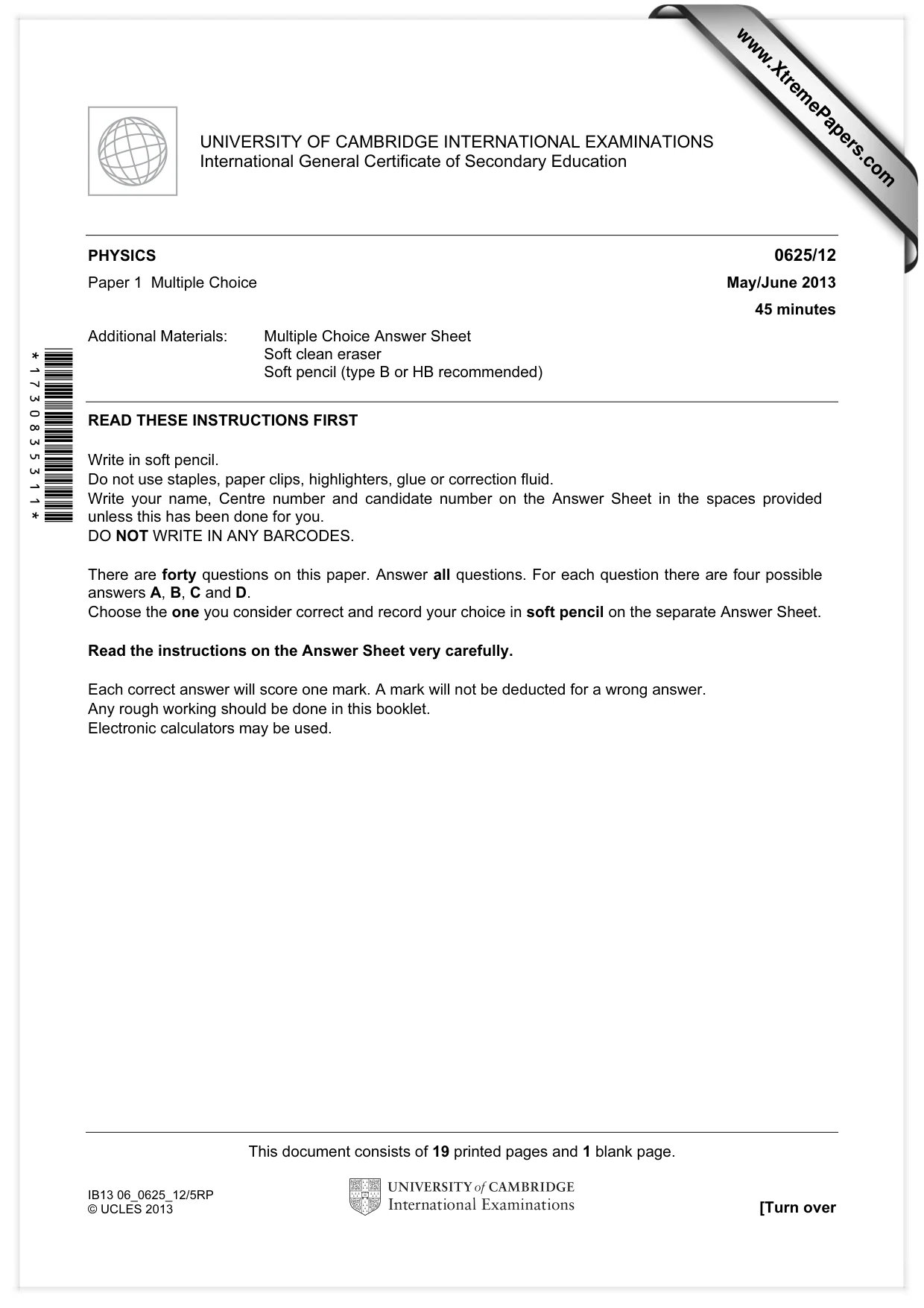
Q1 · A student measures the length of a rod XY by holding it next to a metre rule
1 A student measures the length of a rod XY by holding it next to a metre rule. X Y 99 98 97 96 95 94 cm The student writes down the length as 94.8 cm. Which statement is correct? A The value is correct. B The value is incorrect because it should be 95.2 cm. C The value is incorrect because it should be in millimetres. D The value is incorrect because the student should subtract the reading for end Y from the reading for end X.
Mark scheme: D
More questions on Physical quantities and measurement techniques
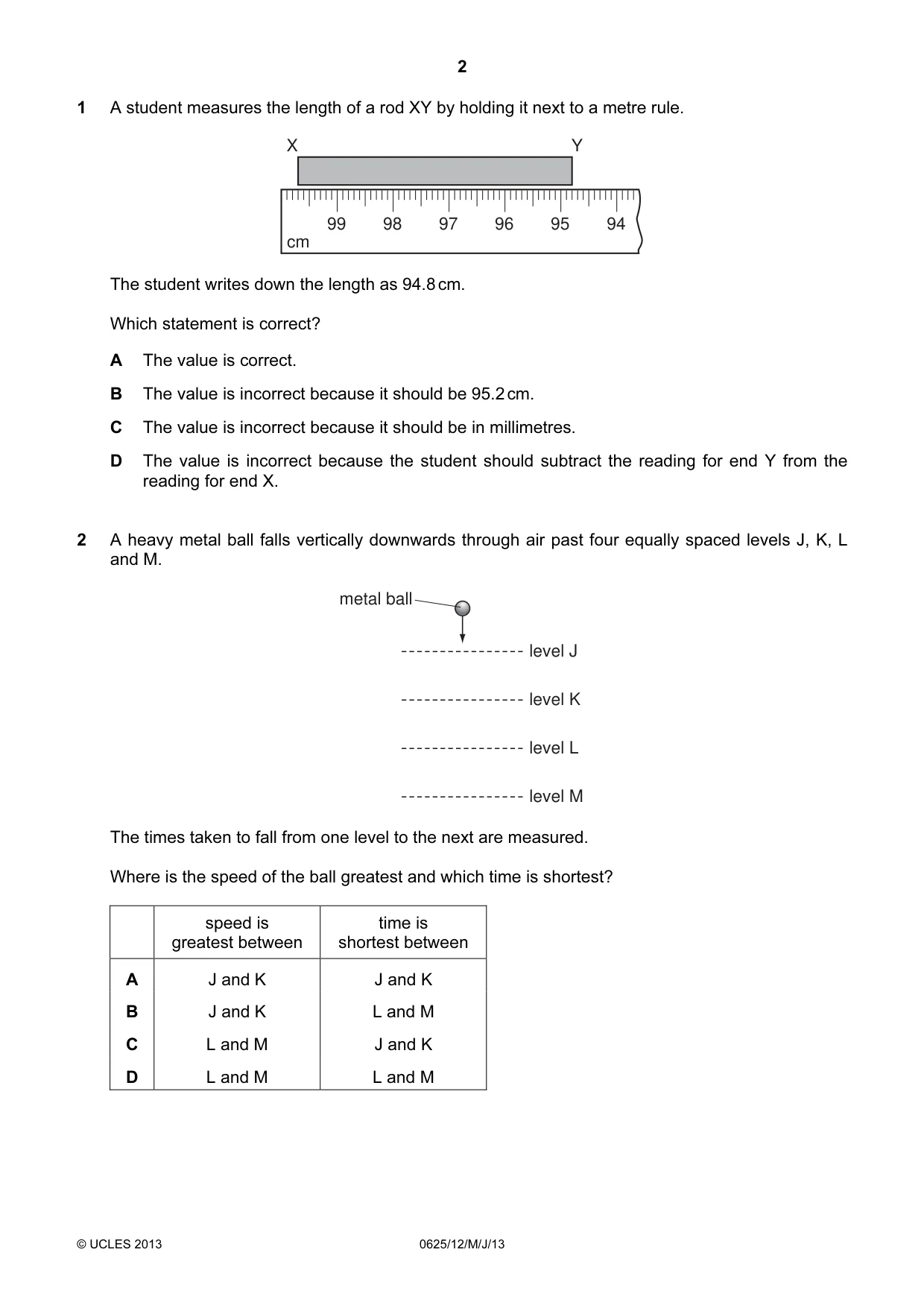
Q2 · A heavy metal ball falls vertically downwards through air past four equally spaced levels…
2 A heavy metal ball falls vertically downwards through air past four equally spaced levels J, K, L and M. metal ball level J level K level L level M The times taken to fall from one level to the next are measured. Where is the speed of the ball greatest and which time is shortest? speed is time is greatest between shortest between A J and K J and K B J and K L and M C L and M J and K D L and M L and M
Mark scheme: D
Q3 · A car travels at various speeds during a short journey
3 A car travels at various speeds during a short journey. The table shows the distances travelled and the times taken during each of four stages P, Q, R and S. stage P Q R S distance travelled / km 1.8 3.6 2.7 2.7 time taken / minutes 2 2 4 3 During which two stages is the car travelling at the same average speed? A P and Q B P and S C Q and R D R and S
Mark scheme: B
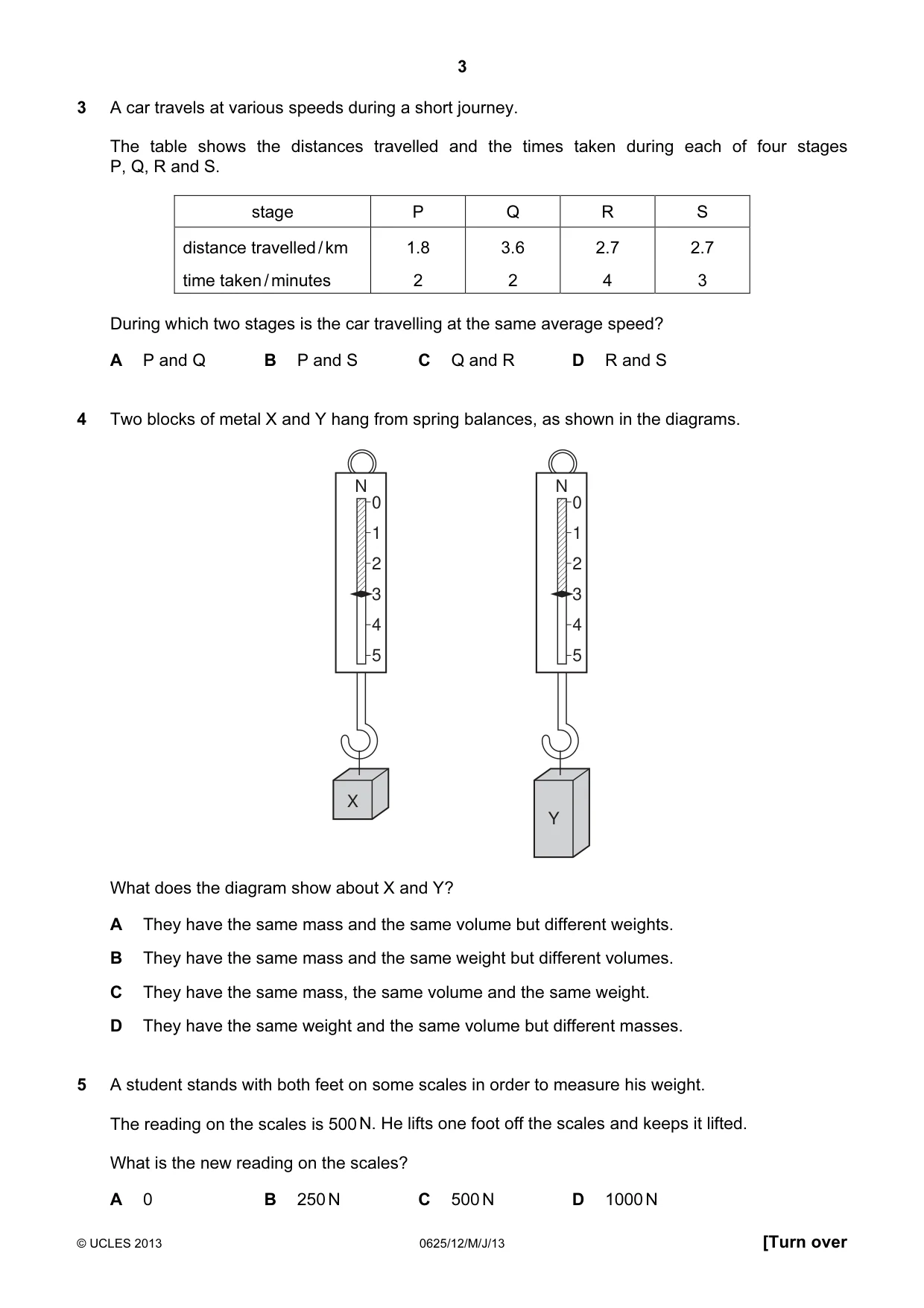
Q4 · Two blocks of metal X and Y hang from spring balances, as shown in the diagrams
4 Two blocks of metal X and Y hang from spring balances, as shown in the diagrams. N N 0 0 1 1 2 2 3 3 4 4 5 5 X Y What does the diagram show about X and Y? A They have the same mass and the same volume but different weights. B They have the same mass and the same weight but different volumes. C They have the same mass, the same volume and the same weight. D They have the same weight and the same volume but different masses.
Mark scheme: B
Q5 · A student stands with both feet on some scales in order to measure his weight
5 A student stands with both feet on some scales in order to measure his weight. The reading on the scales is 500 N. He lifts one foot off the scales and keeps it lifted. What is the new reading on the scales? A 0 B 250 N C 500 N D 1000 N
Mark scheme: C
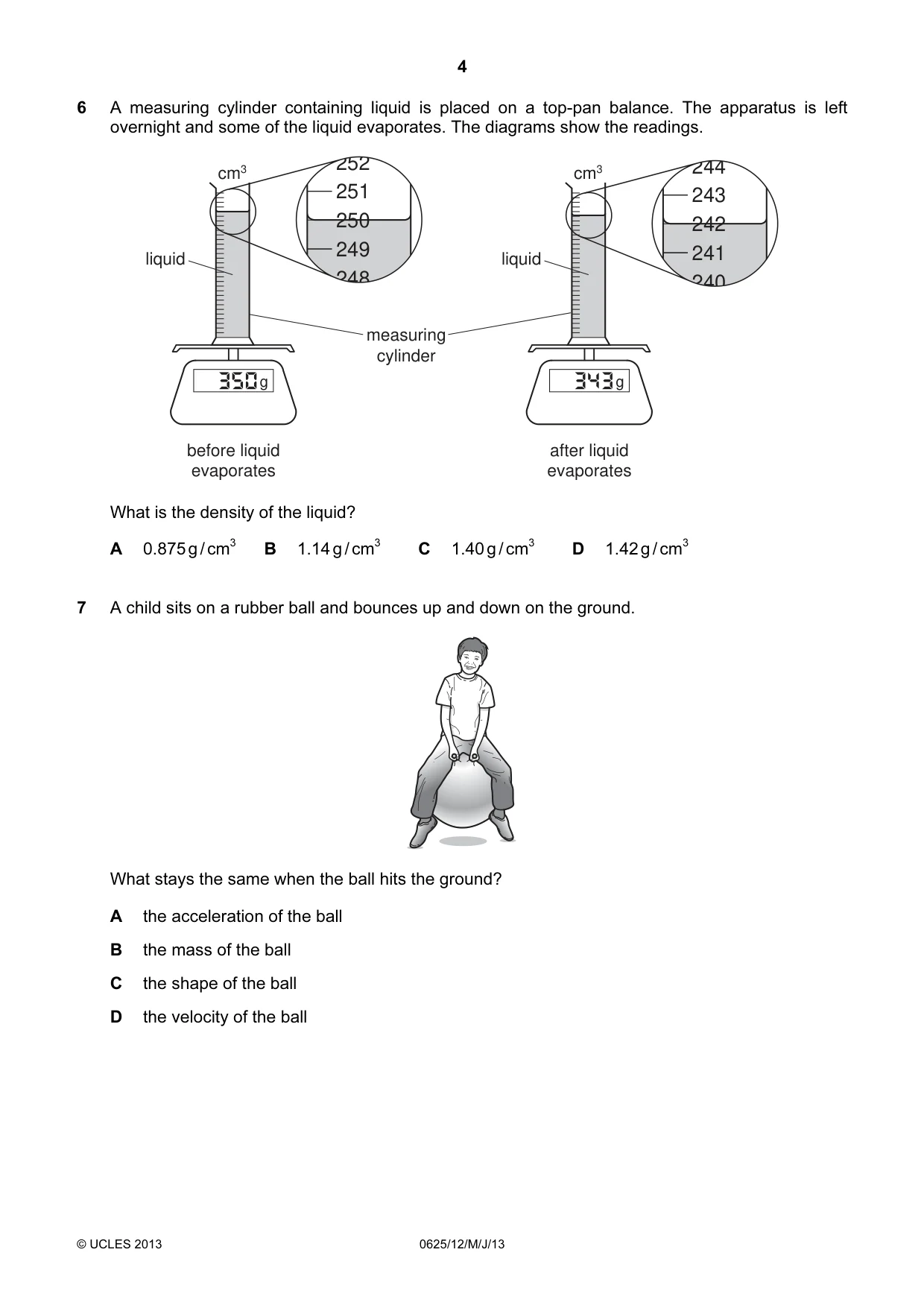
Q6 · A measuring cylinder containing liquid is placed on a top-pan balance
6 A measuring cylinder containing liquid is placed on a top-pan balance. The apparatus is left overnight and some of the liquid evaporates. The diagrams show the readings. 252 244 cm3 cm3 251 243 250 242 249 241 liquid liquid 248 240 measuring cylinder g g before liquid after liquid evaporates evaporates What is the density of the liquid? A 0.875 g / cm3 B 1.14 g / cm3 C 1.40 g / cm3 D 1.42 g / cm3
Mark scheme: A
Q7 · A child sits on a rubber ball and bounces up and down on the ground
7 A child sits on a rubber ball and bounces up and down on the ground. What stays the same when the ball hits the ground? A the acceleration of the ball B the mass of the ball C the shape of the ball D the velocity of the ball
Mark scheme: B
Q8 · The diagrams show different objects, each being acted upon by only the two forces shown
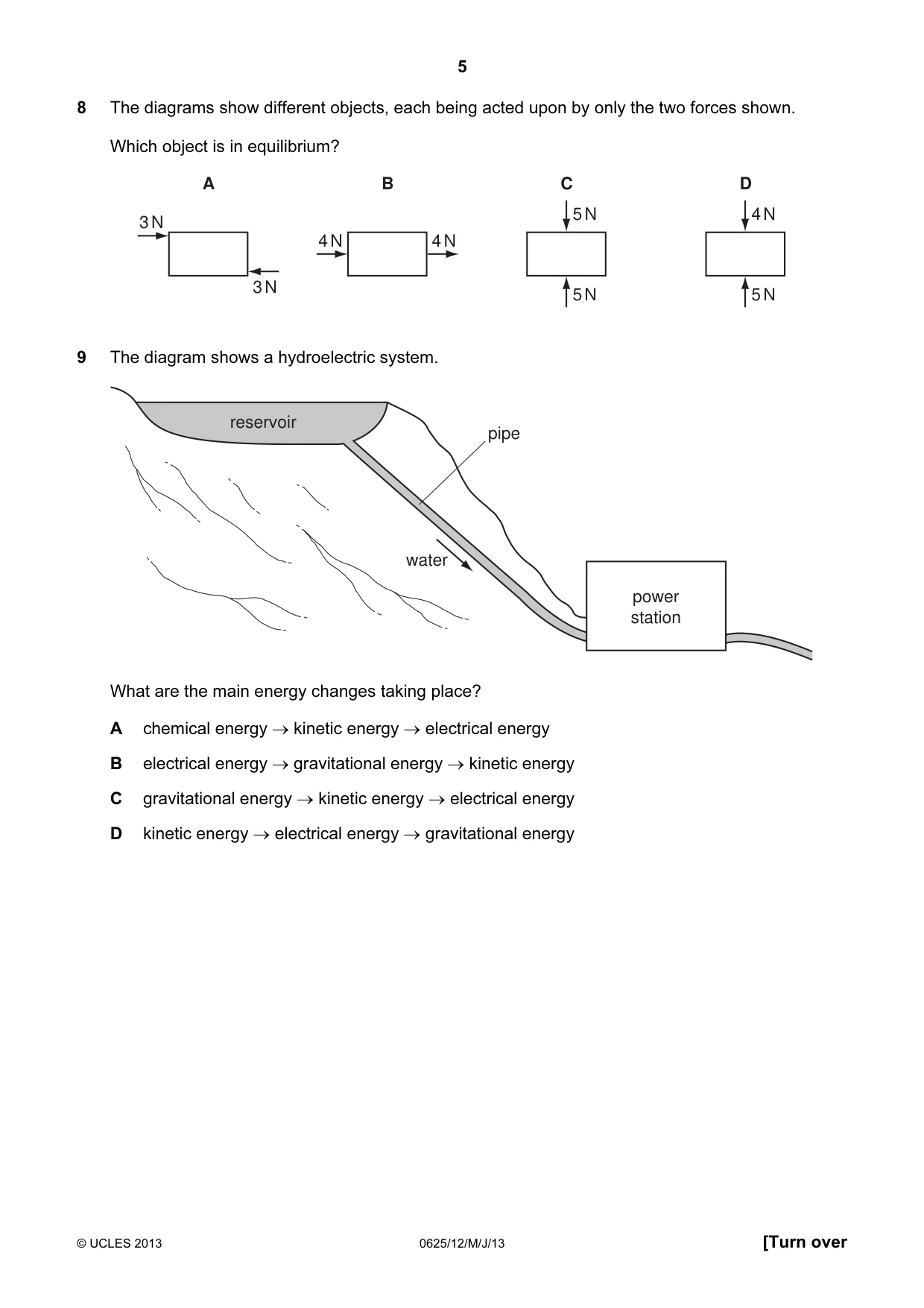
8 The diagrams show different objects, each being acted upon by only the two forces shown. Which object is in equilibrium? A B C D 5 N 4 N 3 N 4 N 4 N 3 N 5 N 5 N
Mark scheme: C
Q9 · The diagram shows a hydroelectric system
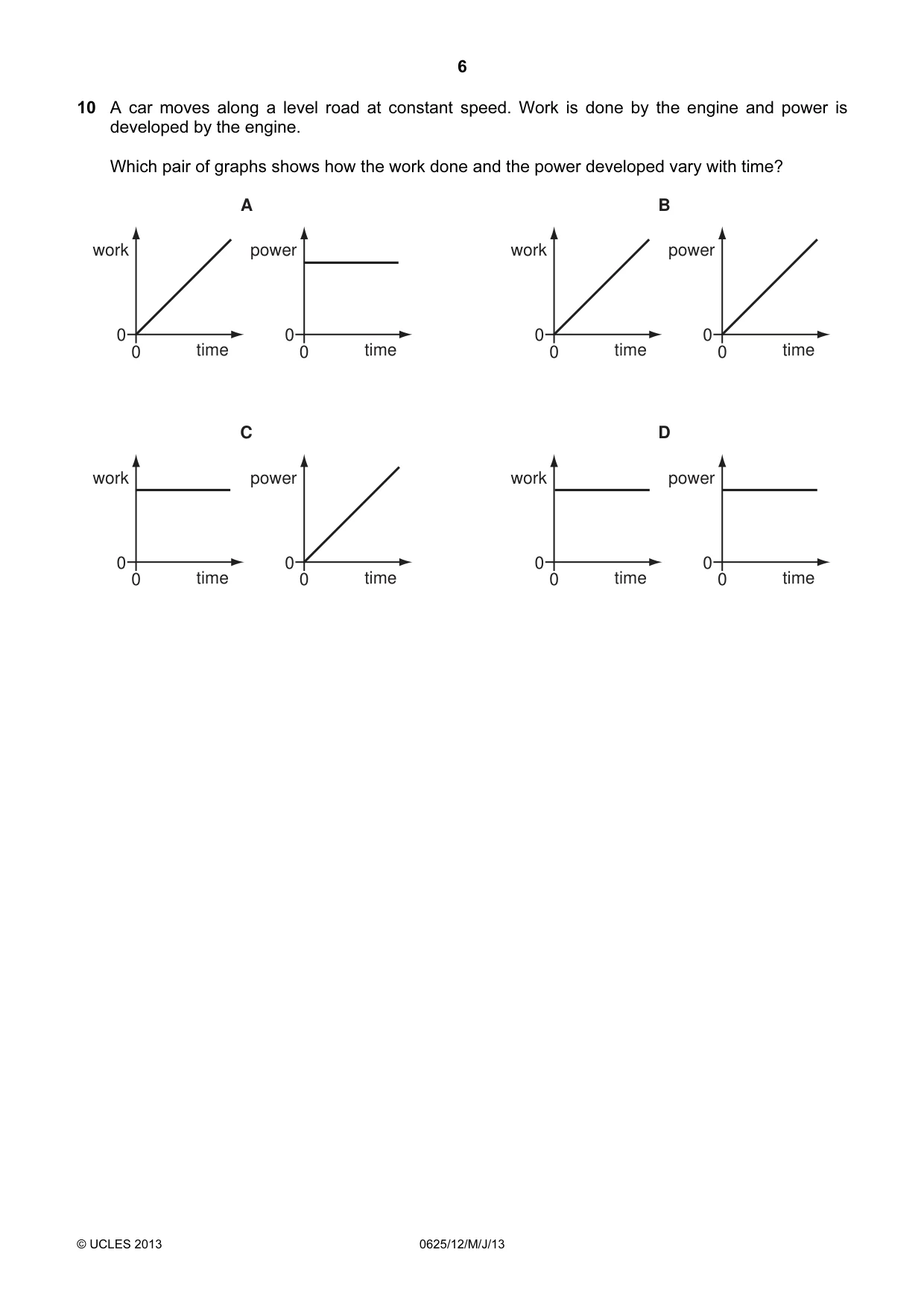
9 The diagram shows a hydroelectric system. reservoir pipe water power station What are the main energy changes taking place? A chemical energy → kinetic energy → electrical energy B electrical energy → gravitational energy → kinetic energy C gravitational energy → kinetic energy → electrical energy D kinetic energy → electrical energy → gravitational energy
Mark scheme: C
Q10 · A car moves along a level road at constant speed
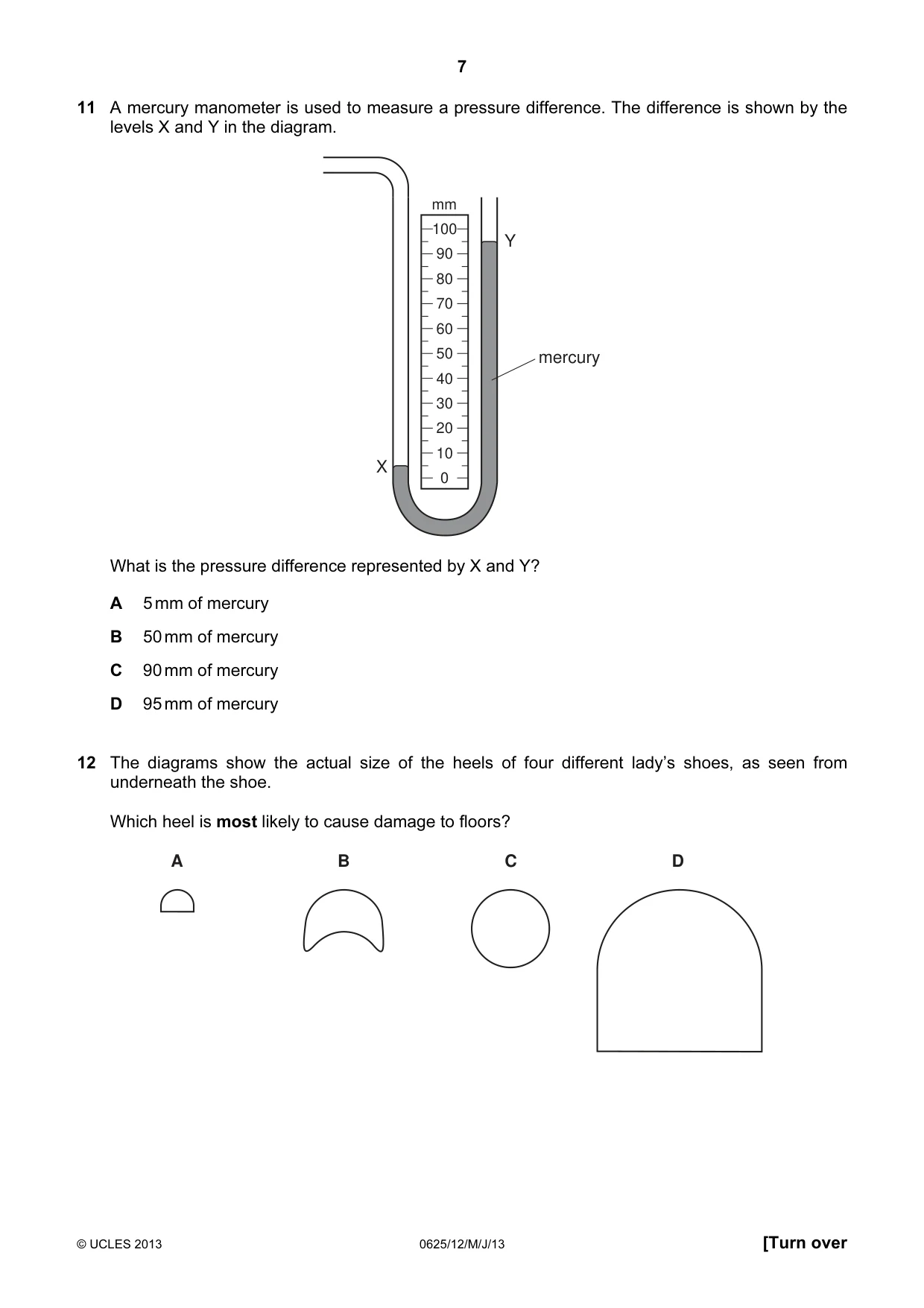
10 A car moves along a level road at constant speed. Work is done by the engine and power is developed by the engine. Which pair of graphs shows how the work done and the power developed vary with time? A B work power work power 0 0 0 0 0 time 0 time 0 time 0 time C D work power work power 0 0 0 0 0 time 0 time 0 time 0 time
Mark scheme: A
Q11 · A mercury manometer is used to measure a pressure difference
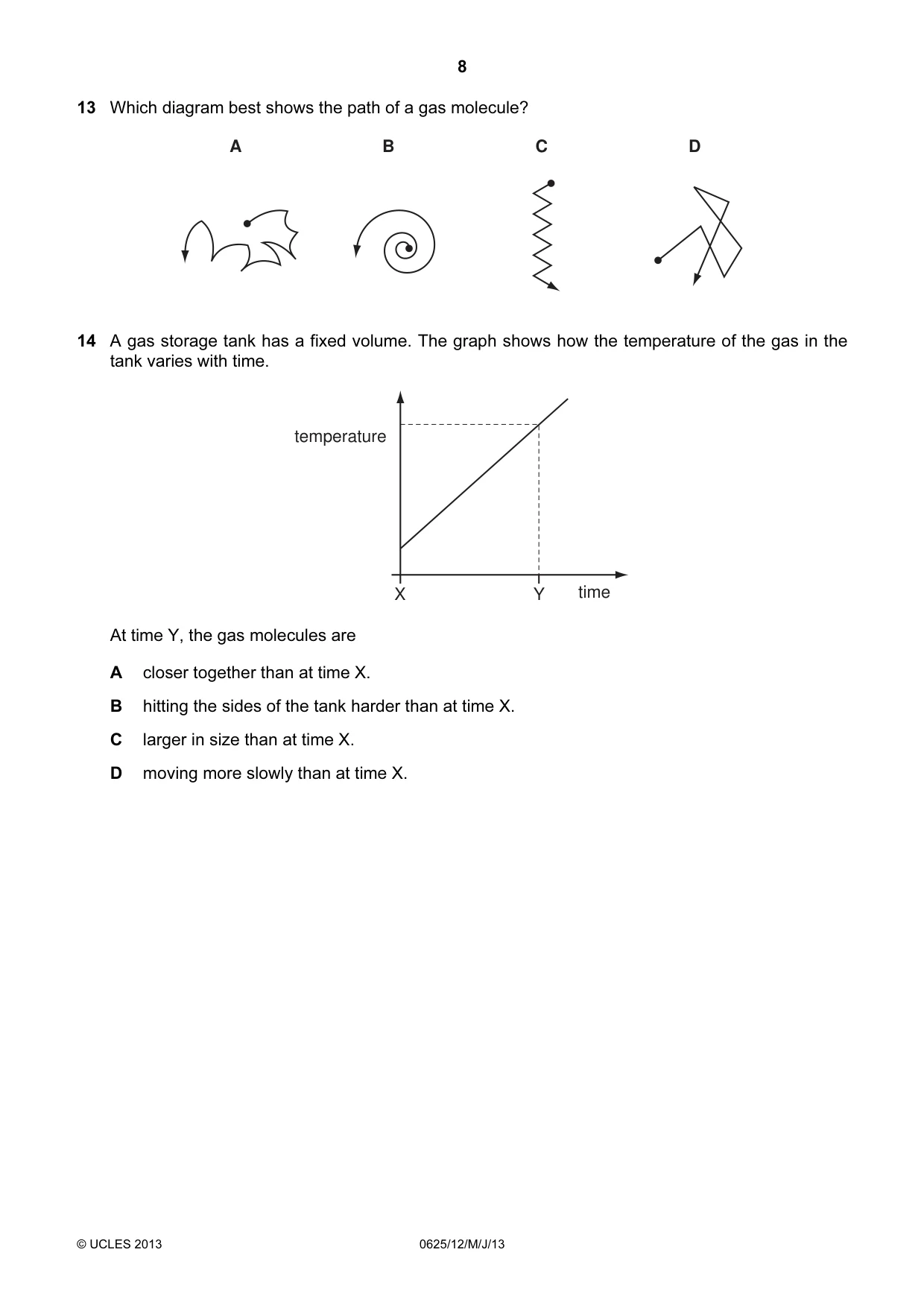
11 A mercury manometer is used to measure a pressure difference. The difference is shown by the levels X and Y in the diagram. mm 100 Y 90 80 70 60 50 mercury 40 30 20 10 X 0 What is the pressure difference represented by X and Y? A 5 mm of mercury B 50 mm of mercury C 90 mm of mercury D 95 mm of mercury
Mark scheme: C
Q12 · The diagrams show the actual size of the heels of four different lady’s shoes, as seen…
12 The diagrams show the actual size of the heels of four different lady’s shoes, as seen from underneath the shoe. Which heel is most likely to cause damage to floors? A B C D
Mark scheme: A
Q13 · Which diagram best shows the path of a gas molecule?
13 Which diagram best shows the path of a gas molecule? A B C D
Mark scheme: D
Q14 · A gas storage tank has a fixed volume
14 A gas storage tank has a fixed volume. The graph shows how the temperature of the gas in the tank varies with time. temperature X Y time At time Y, the gas molecules are A closer together than at time X. B hitting the sides of the tank harder than at time X. C larger in size than at time X. D moving more slowly than at time X.
Mark scheme: B
Q15 · The diagrams show four blocks of steel
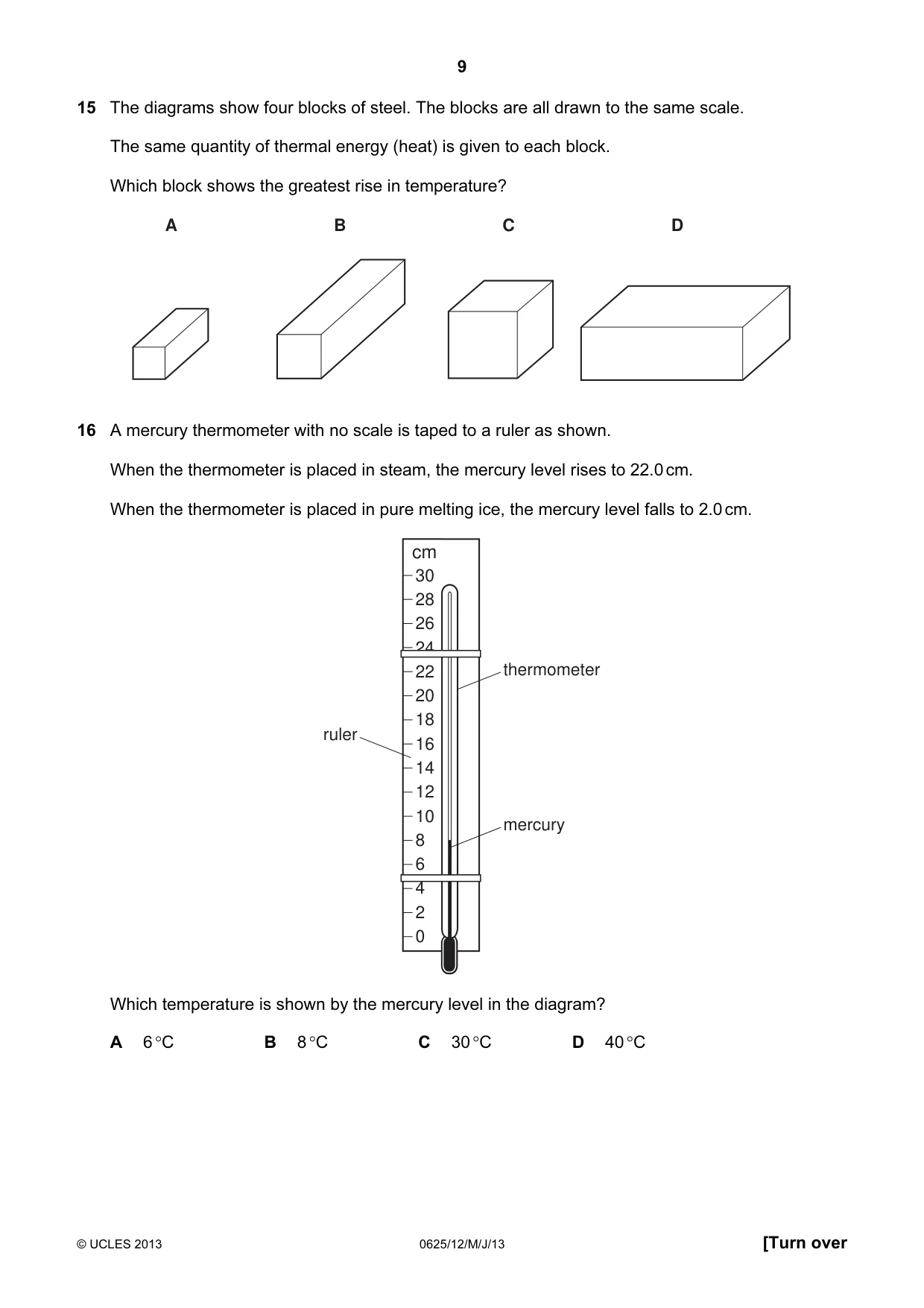
15 The diagrams show four blocks of steel. The blocks are all drawn to the same scale. The same quantity of thermal energy (heat) is given to each block. Which block shows the greatest rise in temperature? A B C D
Mark scheme: A
Q16 · A mercury thermometer with no scale is taped to a ruler as shown
16 A mercury thermometer with no scale is taped to a ruler as shown. When the thermometer is placed in steam, the mercury level rises to 22.0 cm. When the thermometer is placed in pure melting ice, the mercury level falls to 2.0 cm. cm 30 28 26 24 22 thermometer 20 18 ruler 16 14 12 10 mercury 8 6 4 2 0 Which temperature is shown by the mercury level in the diagram? A 6 °C B 8 °C C 30 °C D 40 °C
Mark scheme: C
Q17 · Which statement about the transfer of thermal energy is correct?
17 Which statement about the transfer of thermal energy is correct? A Convection can occur in air, but only when the air is trapped. B Convection can only occur in a gas. C Radiation cannot occur in air. D Radiation can occur in a vacuum, but convection cannot.
Mark scheme: D
Q18 · The diagram shows a refrigerator
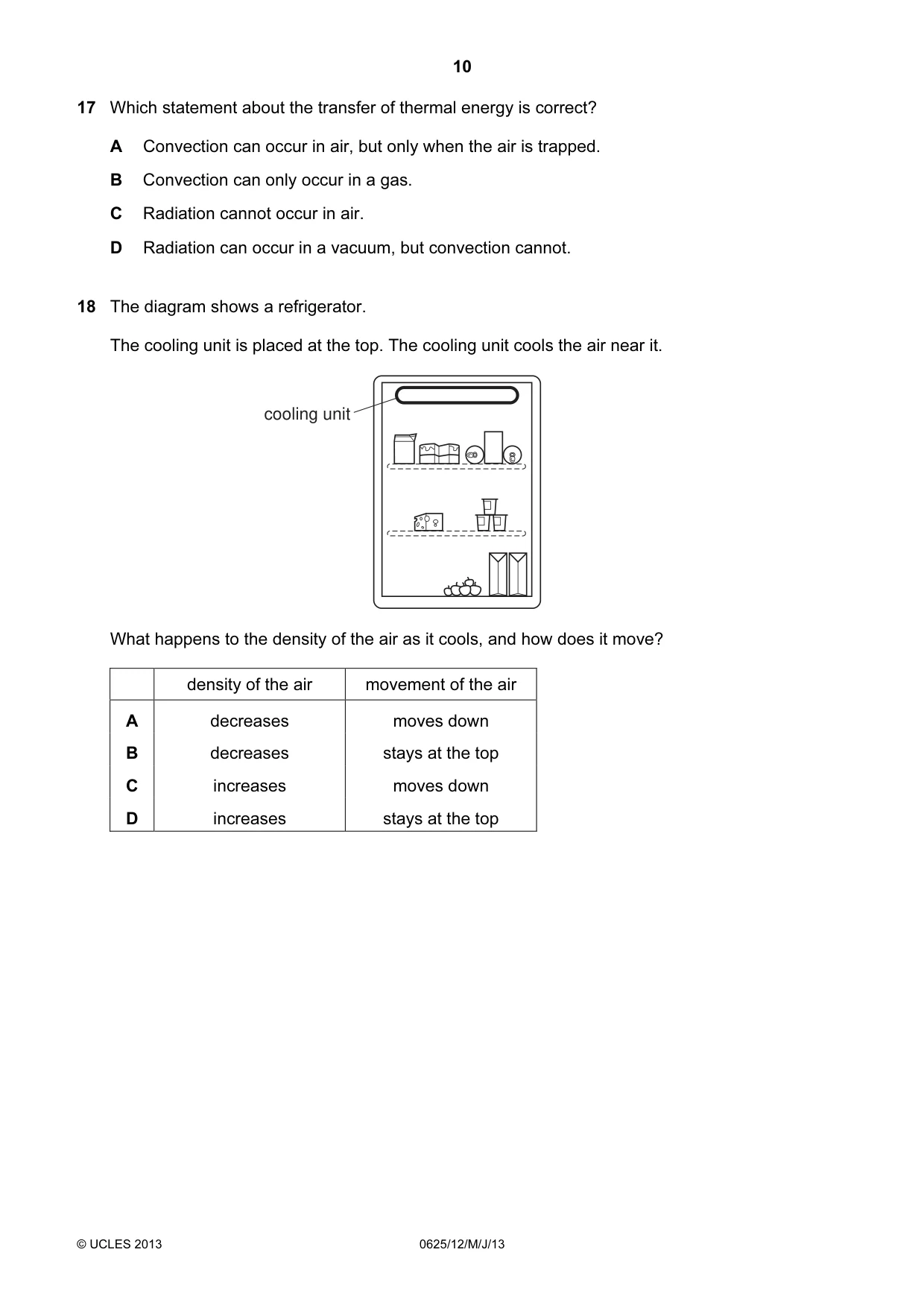
18 The diagram shows a refrigerator. The cooling unit is placed at the top. The cooling unit cools the air near it. cooling unit What happens to the density of the air as it cools, and how does it move? density of the air movement of the air A decreases moves down B decreases stays at the top C increases moves down D increases stays at the top
Mark scheme: C
Q19 · The diagram shows the surface of water in a ripple tank
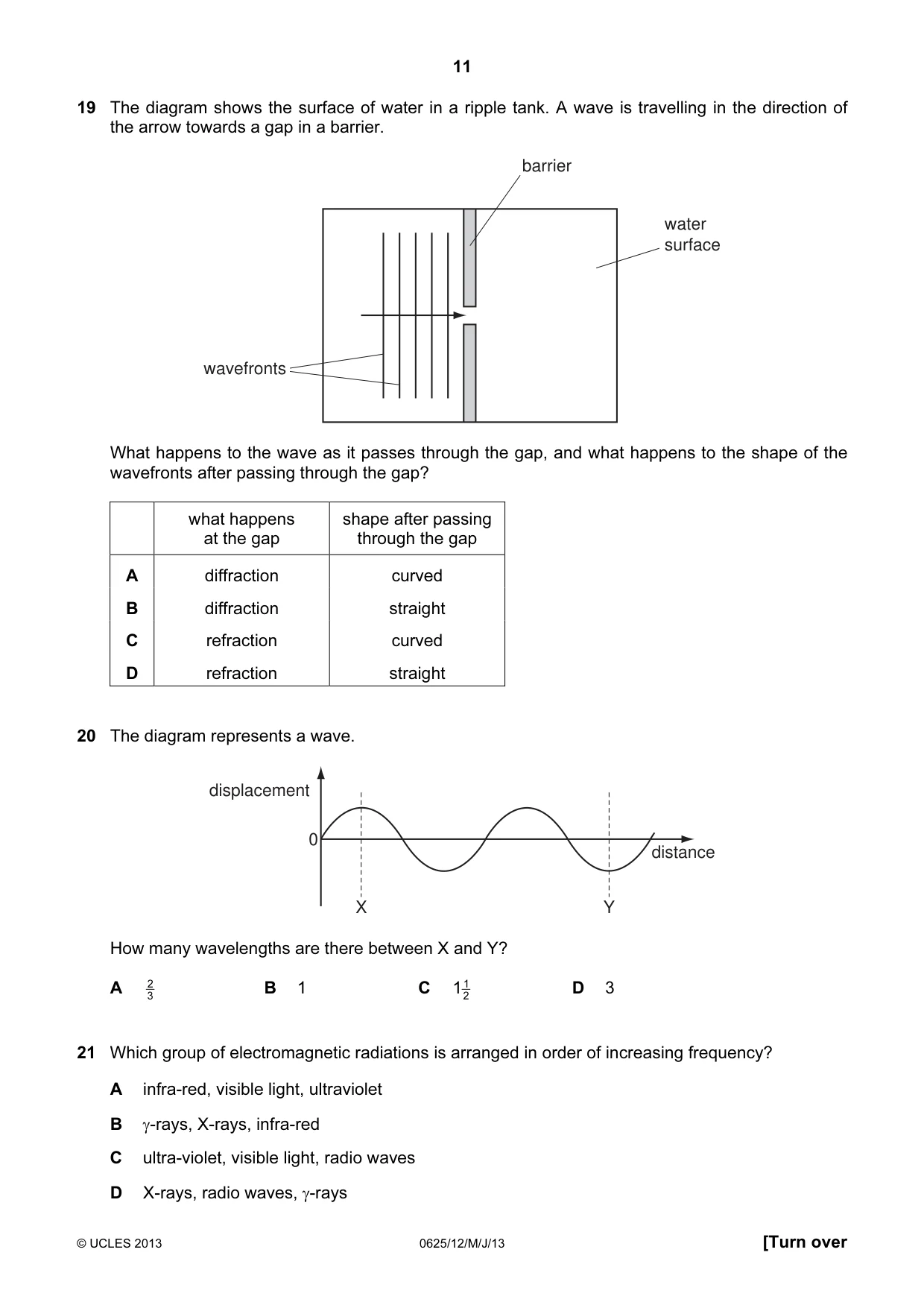
19 The diagram shows the surface of water in a ripple tank. A wave is travelling in the direction of the arrow towards a gap in a barrier. barrier water surface wavefronts What happens to the wave as it passes through the gap, and what happens to the shape of the wavefronts after passing through the gap? what happens shape after passing at the gap through the gap A diffraction curved B diffraction straight C refraction curved D refraction straight
Mark scheme: A
Q20 · The diagram represents a wave
20 The diagram represents a wave. displacement 0 distance X Y How many wavelengths are there between X and Y? A 2 B 1 C 1 1 D 3 3 2
Mark scheme: C
Q21 · Which group of electromagnetic radiations is arranged in order of increasing frequency?
21 Which group of electromagnetic radiations is arranged in order of increasing frequency? A infra-red, visible light, ultraviolet B γ-rays, X-rays, infra-red C ultra-violet, visible light, radio waves D X-rays, radio waves, γ-rays
Mark scheme: A
Q22 · An electronic engineer makes devices which can receive television pictures from satellites
22 An electronic engineer makes devices which can receive television pictures from satellites. Which type of electromagnetic radiation must these devices be able to receive? A infra-red waves B microwaves C radio waves D ultra-violet waves
Mark scheme: B
Q23 · Which diagram correctly represents rays of light passing through a converging lens in a…
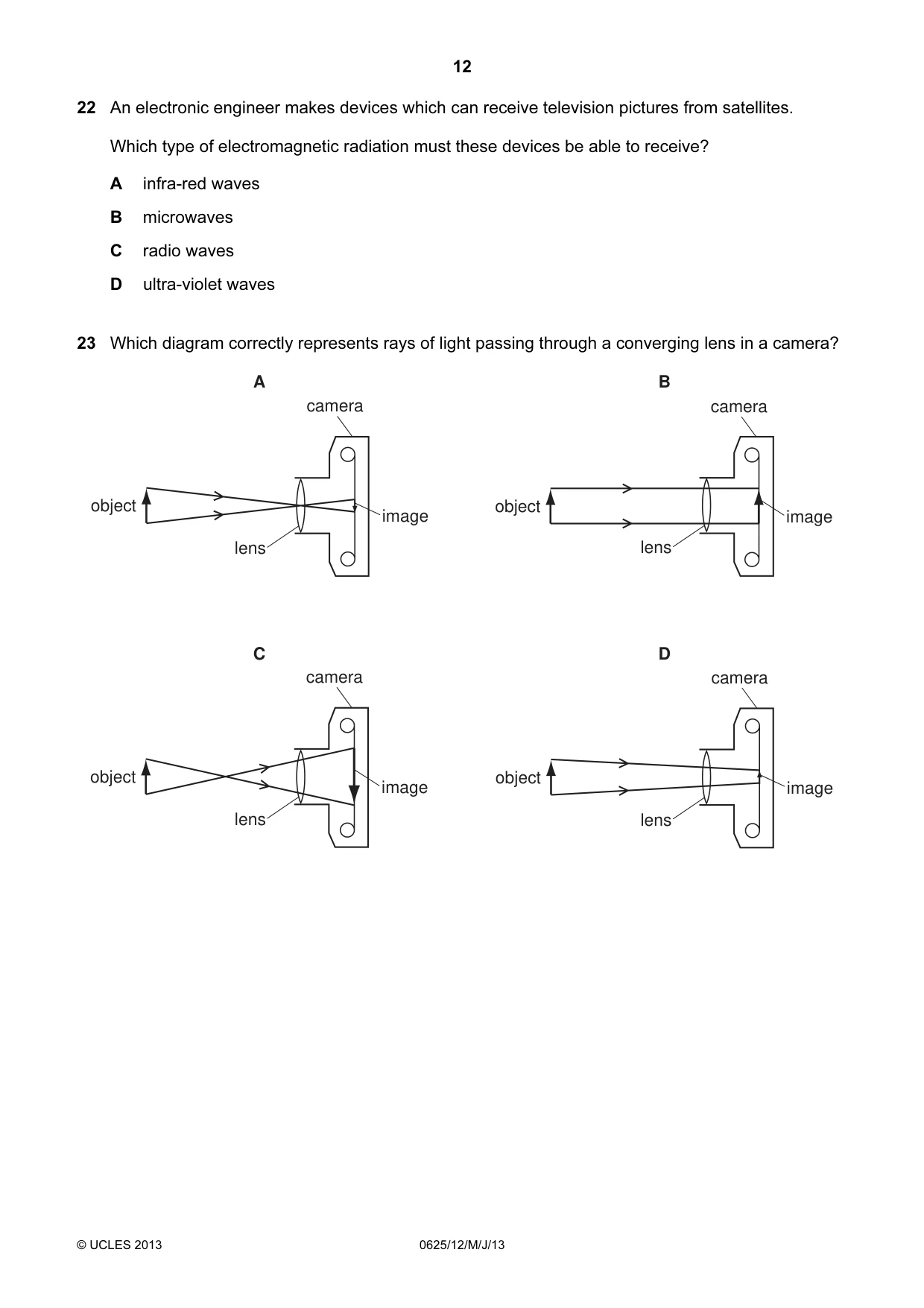
23 Which diagram correctly represents rays of light passing through a converging lens in a camera? A B camera camera object object image image lens lens C D camera camera object object image image lens lens
Mark scheme: A
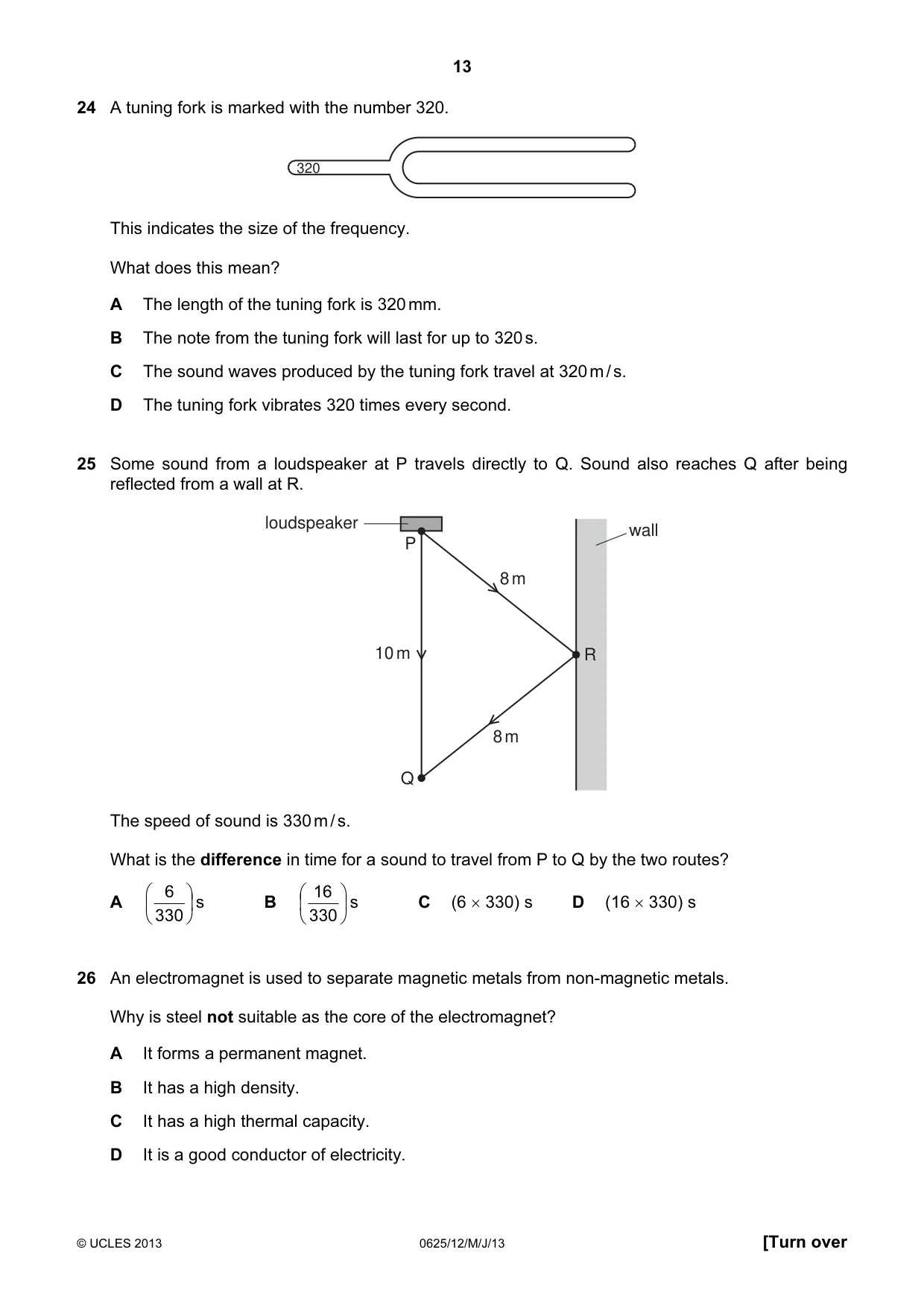
Q24 · A tuning fork is marked with the number 320
24 A tuning fork is marked with the number 320. 320 This indicates the size of the frequency. What does this mean? A The length of the tuning fork is 320 mm. B The note from the tuning fork will last for up to 320 s. C The sound waves produced by the tuning fork travel at 320 m / s. D The tuning fork vibrates 320 times every second.
Mark scheme: D
Q25 · Some sound from a loudspeaker at P travels directly to Q
25 Some sound from a loudspeaker at P travels directly to Q. Sound also reaches Q after being reflected from a wall at R. loudspeaker wall P 8 m 10 m R 8 m Q The speed of sound is 330 m / s. What is the difference in time for a sound to travel from P to Q by the two routes? A 6 s B 16 C D s (6 × 330) s (16 × 330) s 330 330
Mark scheme: A
Q26 · An electromagnet is used to separate magnetic metals from non-magnetic metals
26 An electromagnet is used to separate magnetic metals from non-magnetic metals. Why is steel not suitable as the core of the electromagnet? A It forms a permanent magnet. B It has a high density. C It has a high thermal capacity. D It is a good conductor of electricity.
Mark scheme: A
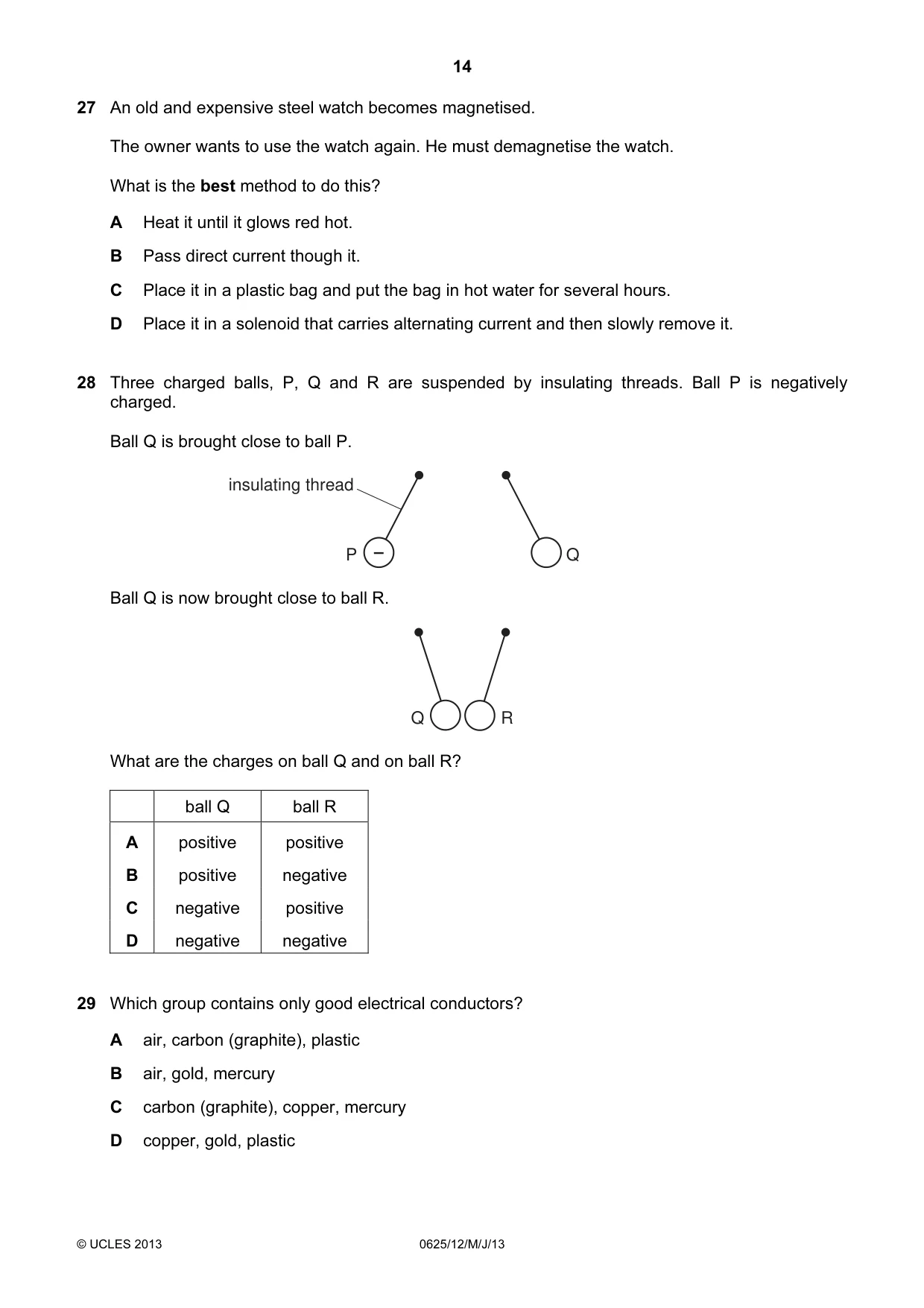
Q27 · An old and expensive steel watch becomes magnetised
27 An old and expensive steel watch becomes magnetised. The owner wants to use the watch again. He must demagnetise the watch. What is the best method to do this? A Heat it until it glows red hot. B Pass direct current though it. C Place it in a plastic bag and put the bag in hot water for several hours. D Place it in a solenoid that carries alternating current and then slowly remove it.
Mark scheme: D
Q28 · Three charged balls, P, Q and R are suspended by insulating threads
28 Three charged balls, P, Q and R are suspended by insulating threads. Ball P is negatively charged. Ball Q is brought close to ball P. insulating thread P – Q Ball Q is now brought close to ball R. Q R What are the charges on ball Q and on ball R? ball Q ball R A positive positive B positive negative C negative positive D negative negative
Mark scheme: C
Q29 · Which group contains only good electrical conductors?
29 Which group contains only good electrical conductors? A air, carbon (graphite), plastic B air, gold, mercury C carbon (graphite), copper, mercury D copper, gold, plastic
Mark scheme: C
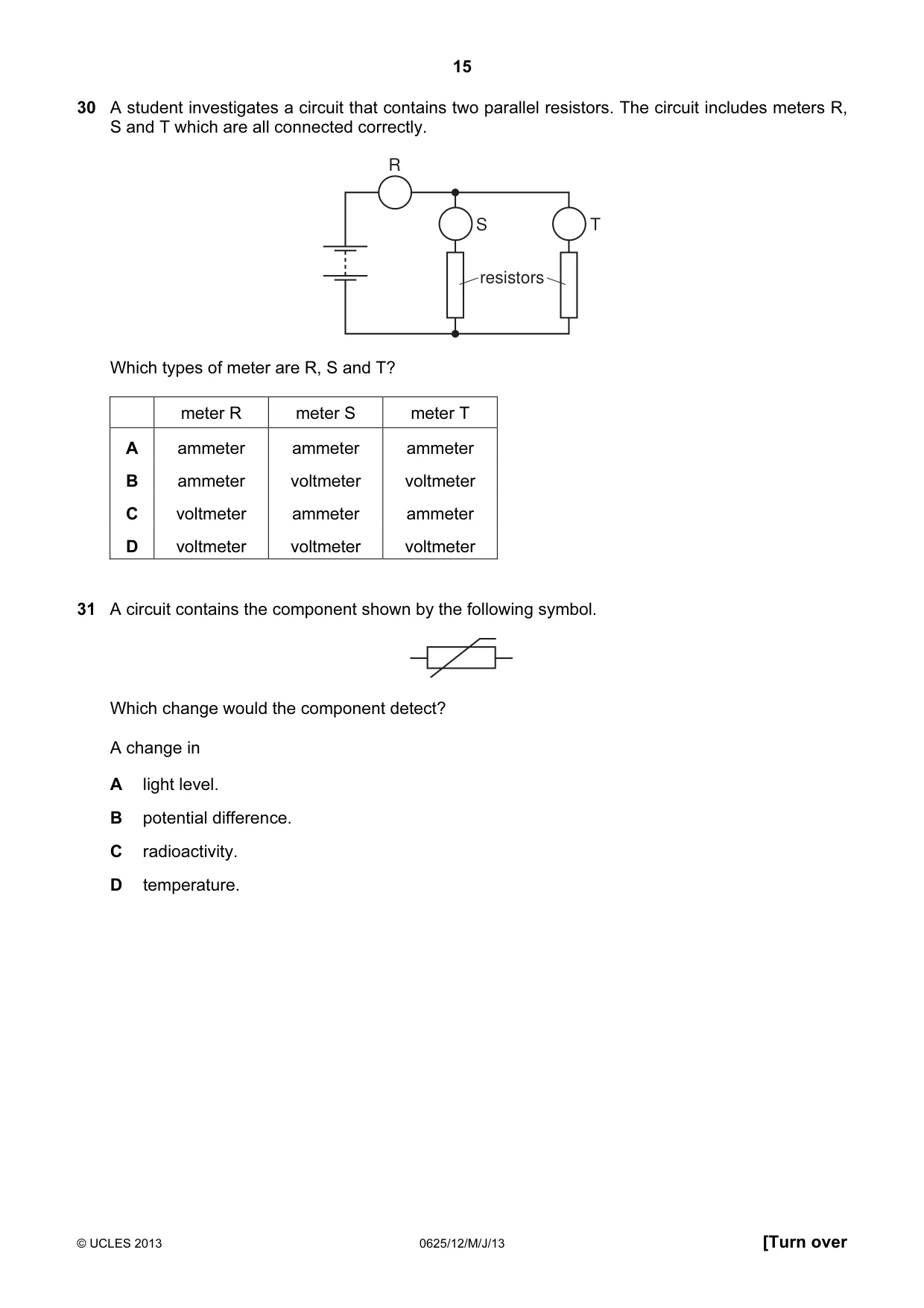
Q30 · A student investigates a circuit that contains two parallel resistors
30 A student investigates a circuit that contains two parallel resistors. The circuit includes meters R, S and T which are all connected correctly. R S T resistors Which types of meter are R, S and T? meter R meter S meter T A ammeter ammeter ammeter B ammeter voltmeter voltmeter C voltmeter ammeter ammeter D voltmeter voltmeter voltmeter
Mark scheme: A
Q31 · A circuit contains the component shown by the following symbol
31 A circuit contains the component shown by the following symbol. Which change would the component detect? A change in A light level. B potential difference. C radioactivity. D temperature.
Mark scheme: D
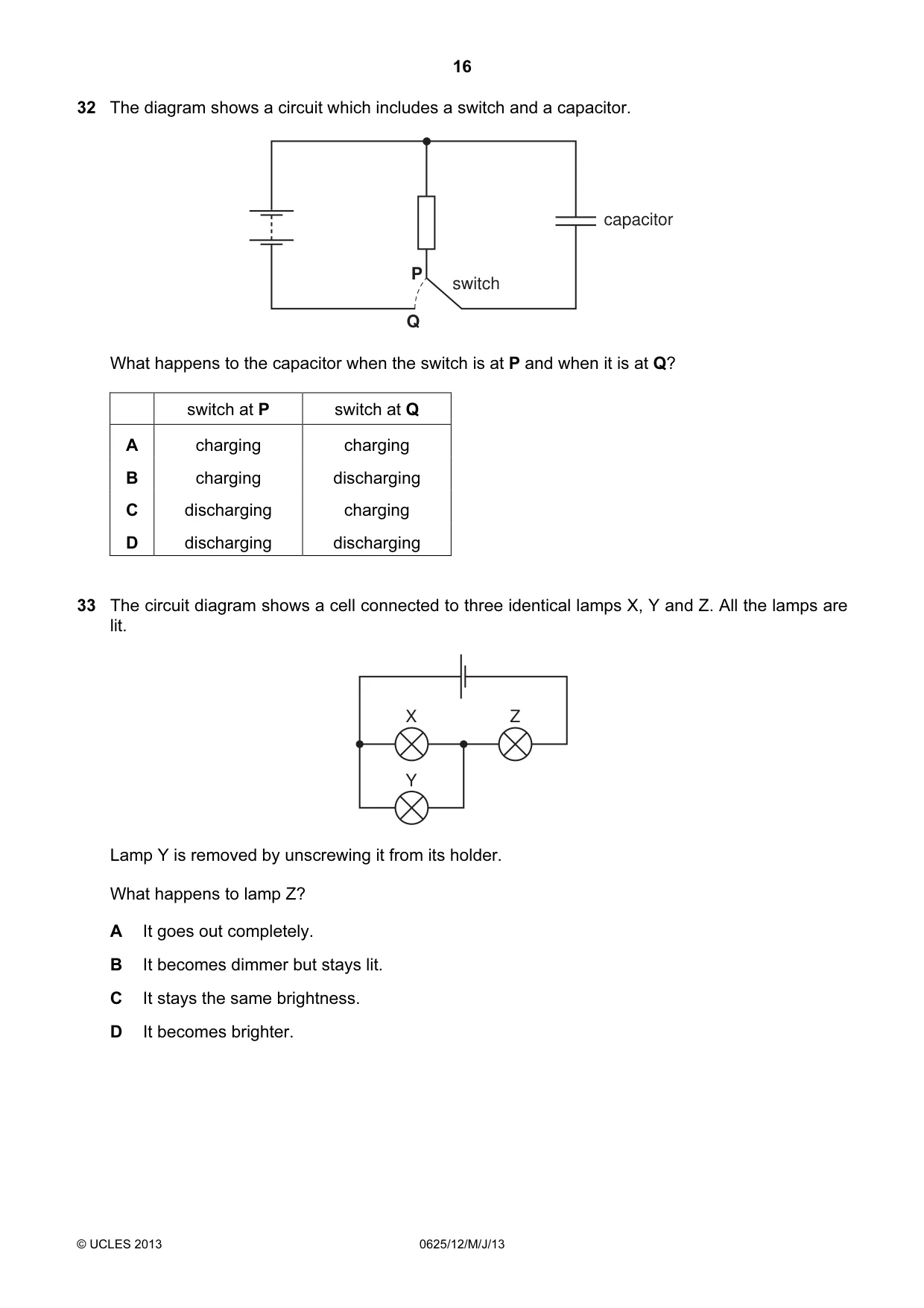
Q32 · The diagram shows a circuit which includes a switch and a capacitor
32 The diagram shows a circuit which includes a switch and a capacitor. capacitor P switch Q What happens to the capacitor when the switch is at P and when it is at Q? switch at P switch at Q A charging charging B charging discharging C discharging charging D discharging discharging
Mark scheme: C
Q33 · The circuit diagram shows a cell connected to three identical lamps X, Y and Z
33 The circuit diagram shows a cell connected to three identical lamps X, Y and Z. All the lamps are lit. X Z Y Lamp Y is removed by unscrewing it from its holder. What happens to lamp Z? A It goes out completely. B It becomes dimmer but stays lit. C It stays the same brightness. D It becomes brighter.
Mark scheme: B
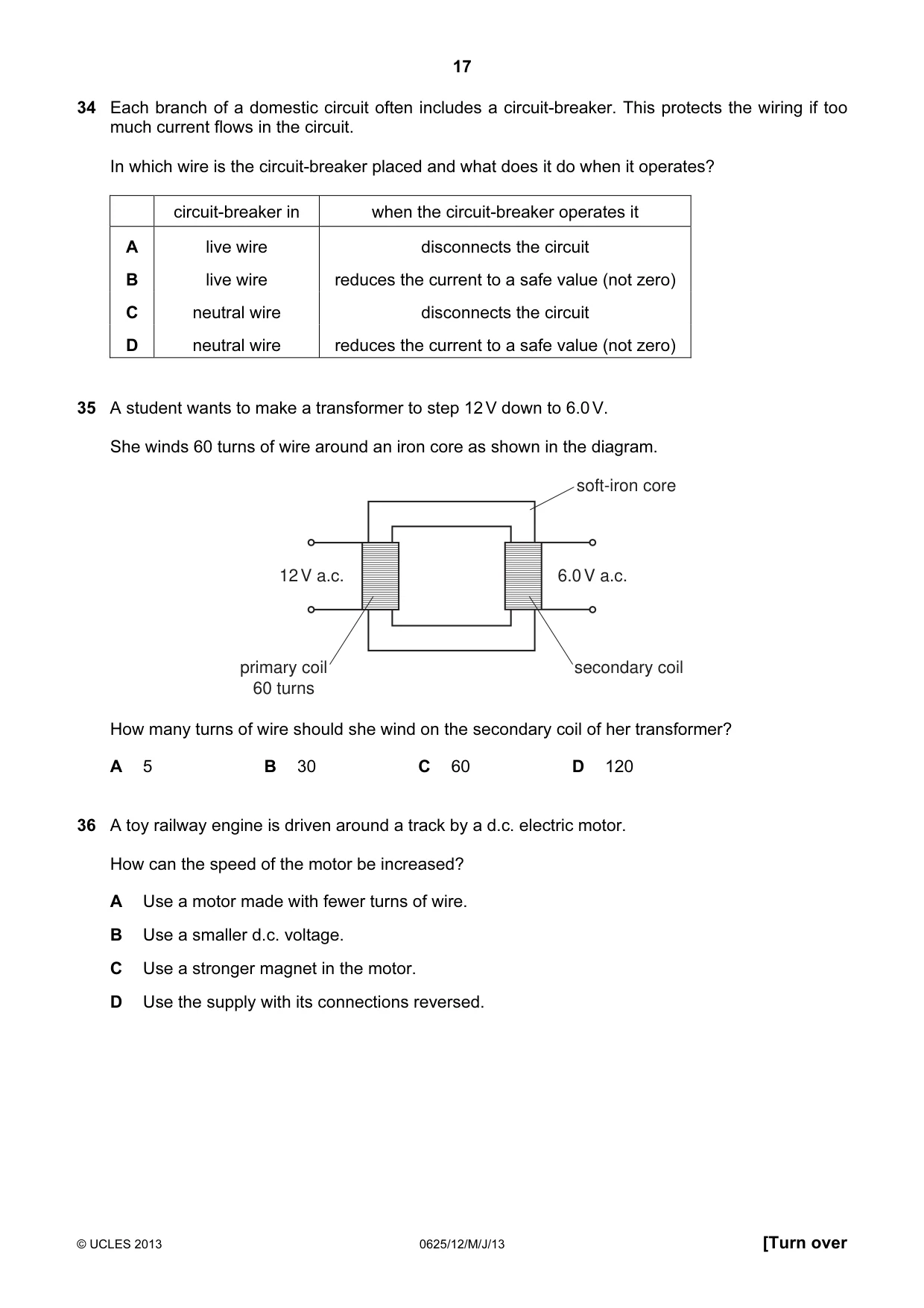
Q34 · Each branch of a domestic circuit often includes a circuit-breaker
34 Each branch of a domestic circuit often includes a circuit-breaker. This protects the wiring if too much current flows in the circuit. In which wire is the circuit-breaker placed and what does it do when it operates? circuit-breaker in when the circuit-breaker operates it A live wire disconnects the circuit B live wire reduces the current to a safe value (not zero) C neutral wire disconnects the circuit D neutral wire reduces the current to a safe value (not zero)
Mark scheme: A
Q35 · A student wants to make a transformer to step 12 V down to 6.0 V
35 A student wants to make a transformer to step 12 V down to 6.0 V. She winds 60 turns of wire around an iron core as shown in the diagram. soft-iron core 12 V a.c. 6.0 V a.c. primary coil secondary coil 60 turns How many turns of wire should she wind on the secondary coil of her transformer? A 5 B 30 C 60 D 120
Mark scheme: B
Q36 · A toy railway engine is driven around a track by a d.c
36 A toy railway engine is driven around a track by a d.c. electric motor. How can the speed of the motor be increased? A Use a motor made with fewer turns of wire. B Use a smaller d.c. voltage. C Use a stronger magnet in the motor. D Use the supply with its connections reversed.
Mark scheme: C
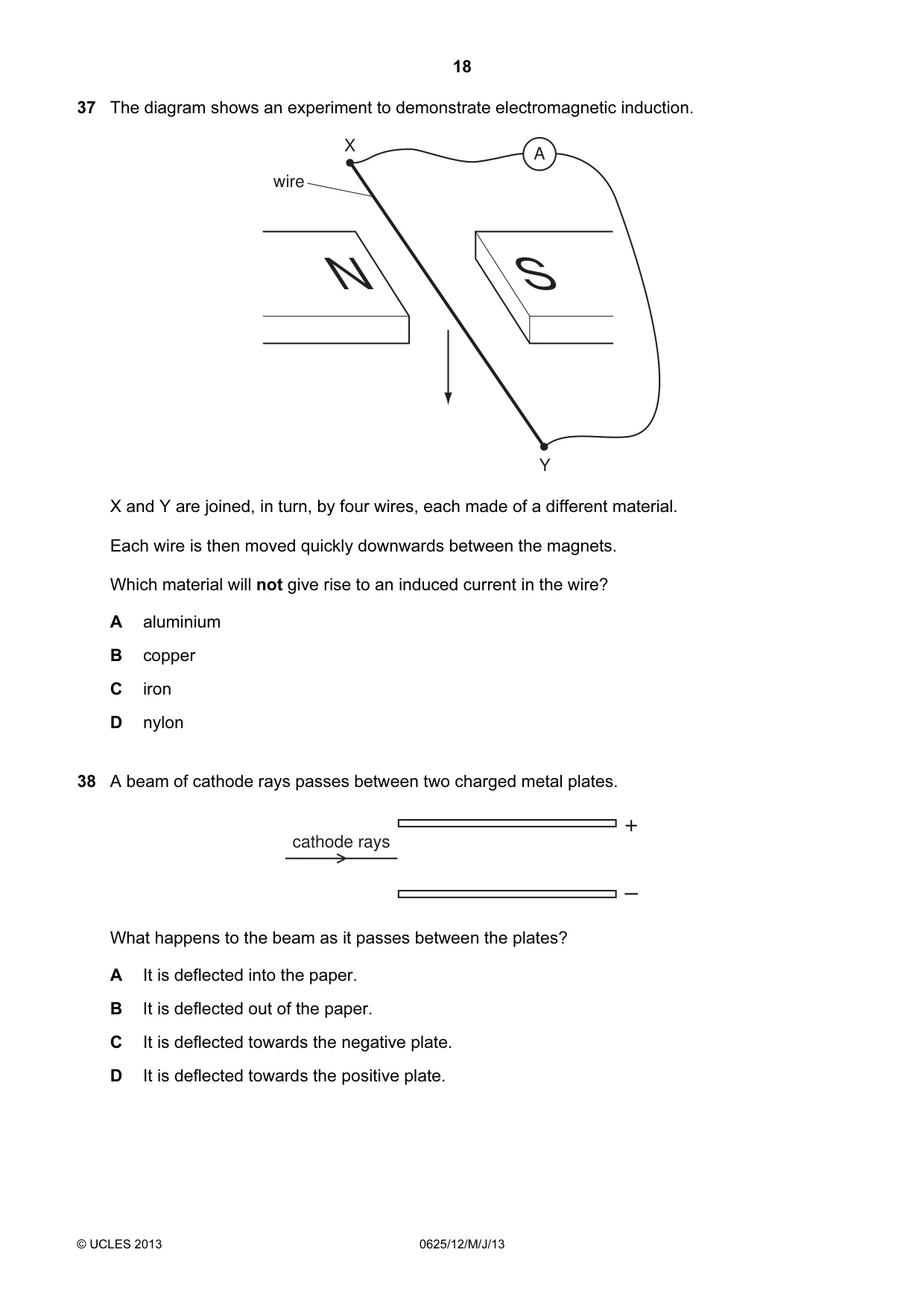
Q37 · The diagram shows an experiment to demonstrate electromagnetic induction
37 The diagram shows an experiment to demonstrate electromagnetic induction. X A wire N S Y X and Y are joined, in turn, by four wires, each made of a different material. Each wire is then moved quickly downwards between the magnets. Which material will not give rise to an induced current in the wire? A aluminium B copper C iron D nylon
Mark scheme: D
Q38 · A beam of cathode rays passes between two charged metal plates
38 A beam of cathode rays passes between two charged metal plates. + cathode rays – What happens to the beam as it passes between the plates? A It is deflected into the paper. B It is deflected out of the paper. C It is deflected towards the negative plate. D It is deflected towards the positive plate.
Mark scheme: D
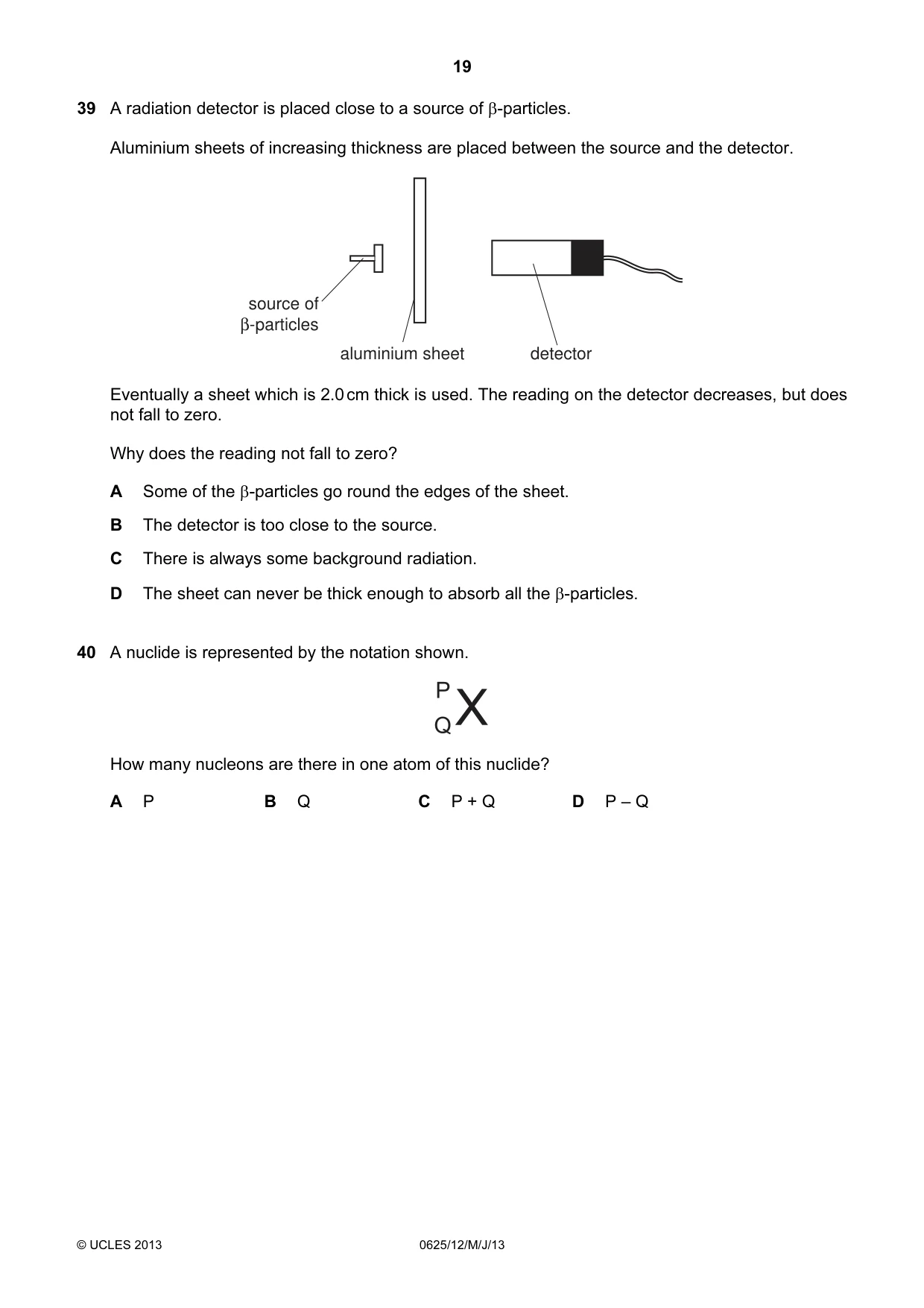
Q39 · A radiation detector is placed close to a source of β-particles
39 A radiation detector is placed close to a source of β-particles. Aluminium sheets of increasing thickness are placed between the source and the detector. source of β-particles aluminium sheet detector Eventually a sheet which is 2.0 cm thick is used. The reading on the detector decreases, but does not fall to zero. Why does the reading not fall to zero? A Some of the β-particles go round the edges of the sheet. B The detector is too close to the source. C There is always some background radiation. D The sheet can never be thick enough to absorb all the β-particles.
Mark scheme: C
Q40 · A nuclide is represented by the notation shown
40 A nuclide is represented by the notation shown. How many nucleons are there in one atom of this nuclide? A P B Q C P + Q D P – Q
Mark scheme: A
What was in this paper
The subtopics covered by these 40 questions, and how many questions each got. Open one in a new tab to see every Cambridge question on it.
4Electrical quantities3Electromagnetic effects3Mass and weight3Electromagnetic spectrum2Energy, work and power2General properties of waves2Kinetic particle model of matter2Motion2Pressure2Simple phenomena of magnetism2Sound2Thermal properties and temperature2Transfer of thermal energy2Density1Electrical safety1Forces1Light1Physical quantities and measurement techniques1Radioactivity1The nuclear model of the atom1What you needed in this session
Cambridge’s own grade thresholds for 2013 May/June, Paper 1 · Variant 2. A higher threshold means an easier paper — the bar moves with how the cohort did.