Cambridge IGCSE Physics 0625 — 2024 Oct/Nov Paper 1 · Variant 1
0625/11/O/N/24 · 40 questions · 40 marks · ≈45 min
The question paper and its mark scheme, free to read here and free to download. This is Cambridge’s own paper, exactly as it was sat.
Question paper16 pages
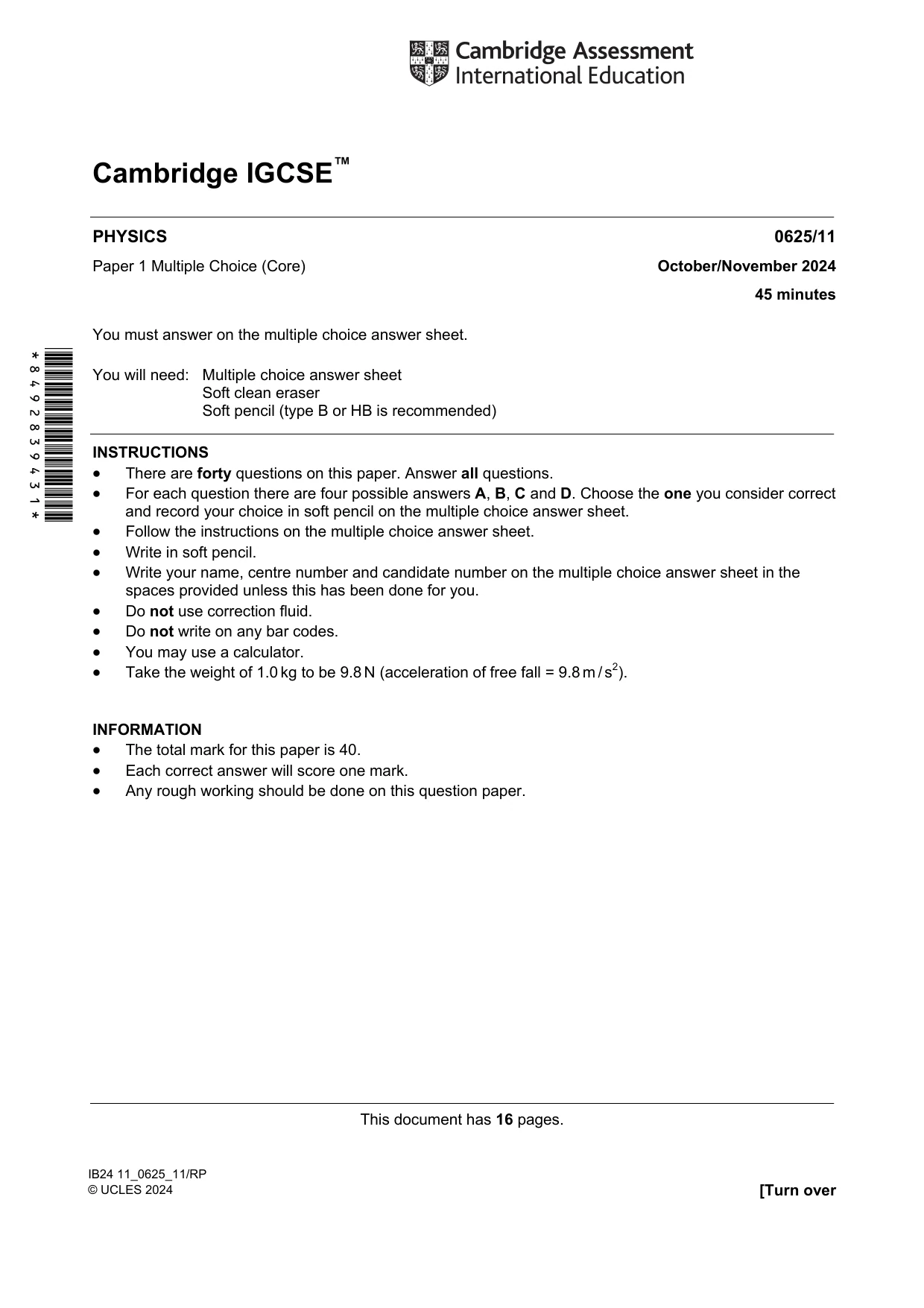
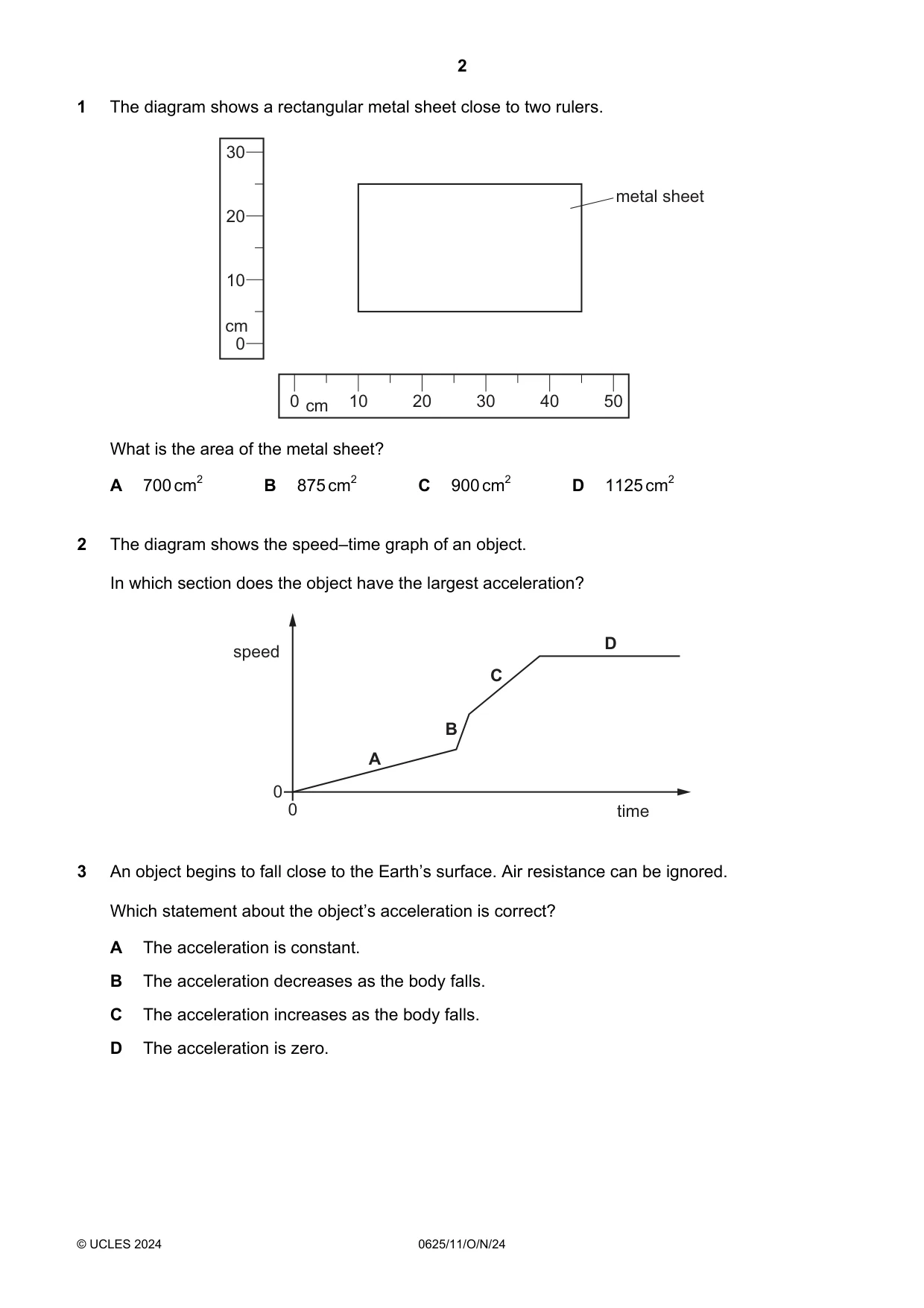
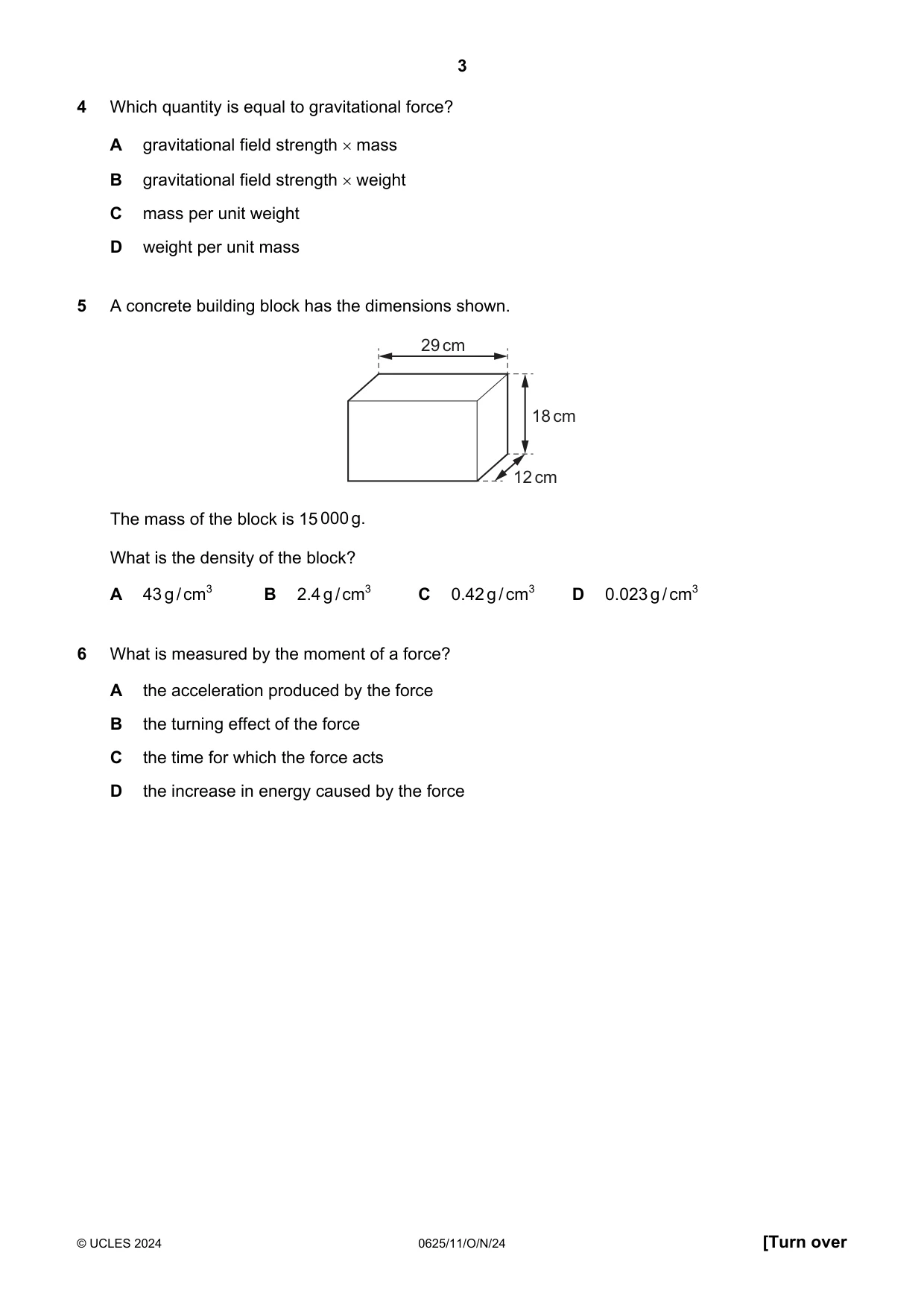
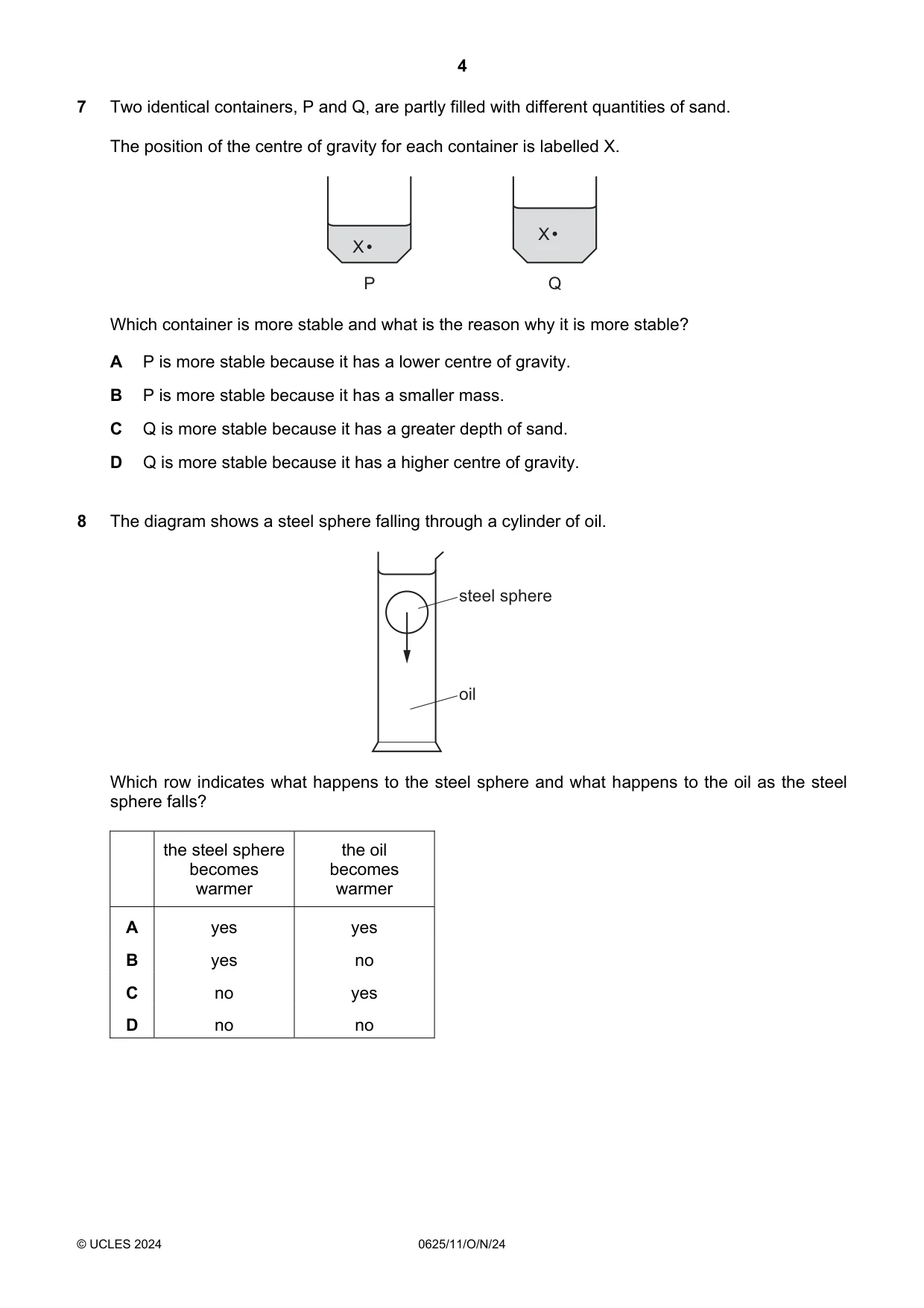
Mark scheme3 pages
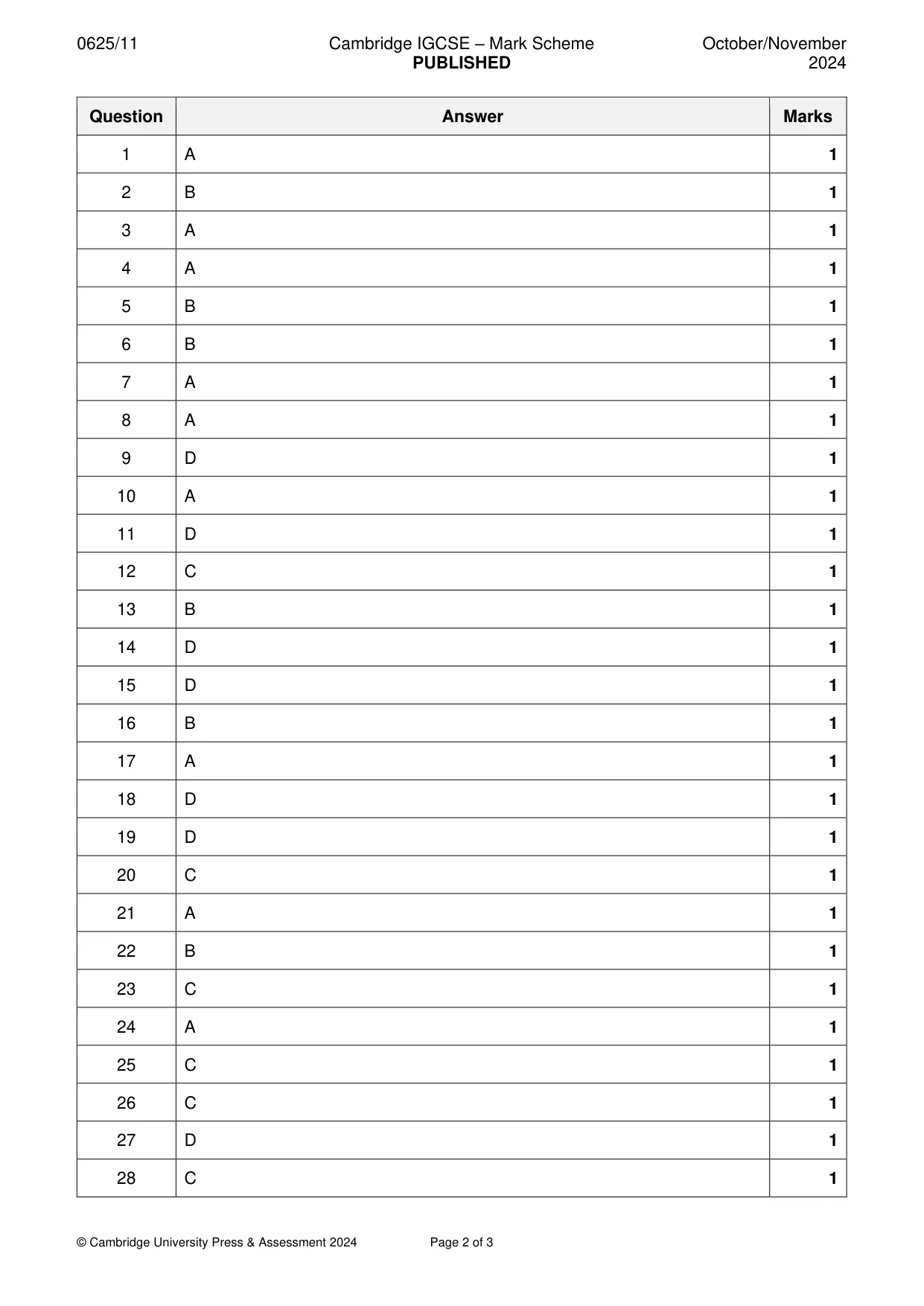
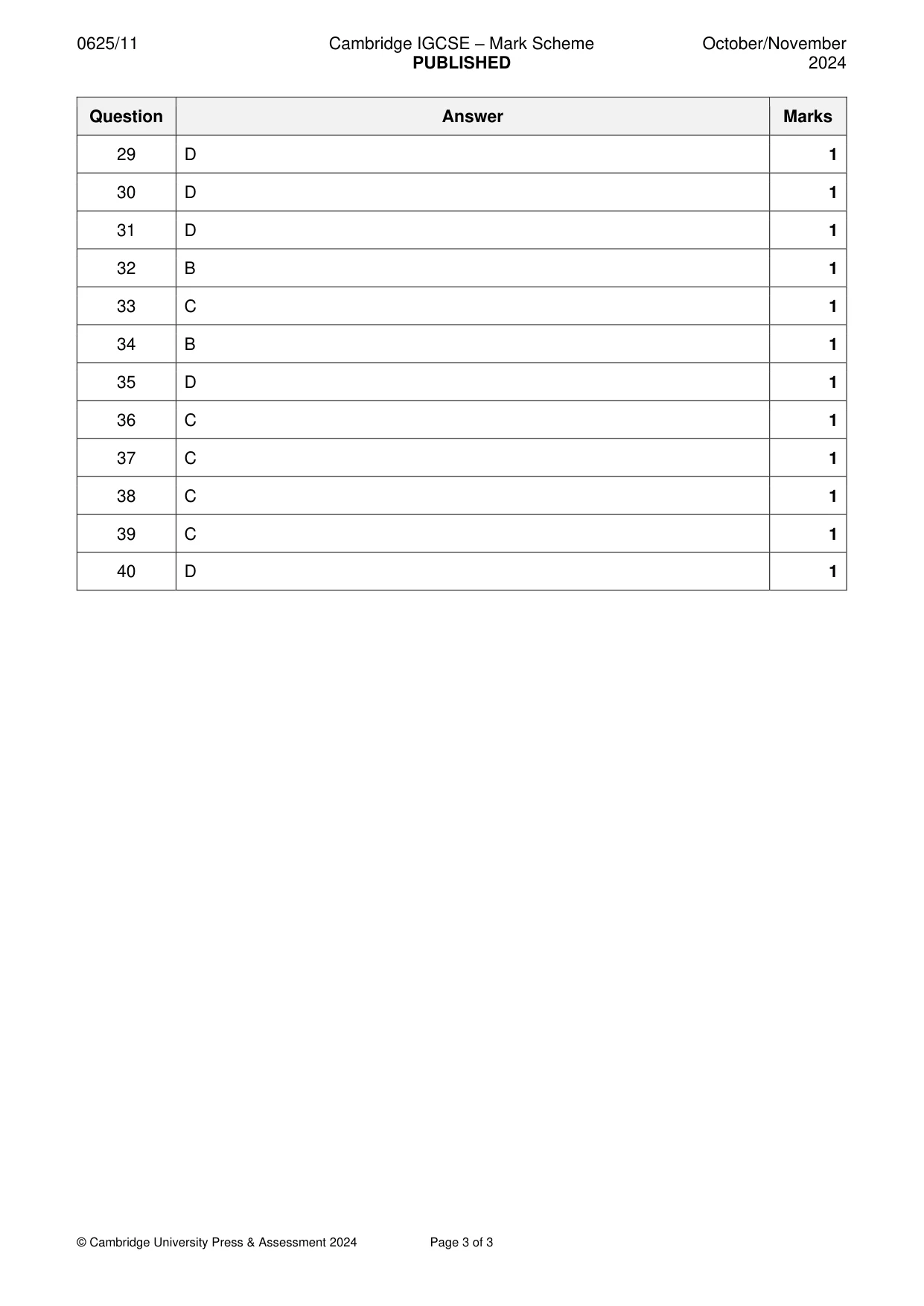
Answers below. Sit the paper first if you are practising.
Questions as text
Q1 · The diagram shows a rectangular metal sheet close to two rulers
1 The diagram shows a rectangular metal sheet close to two rulers. 30 metal sheet 20 10 cm 0 0 cm 10 20 30 40 50 What is the area of the metal sheet? A 700 cm2 B 875 cm2 C 900 cm2 D 1125 cm2
Mark scheme: A
More questions on Physical quantities and measurement techniques
Q2 · The diagram shows the speed–time graph of an object
2 The diagram shows the speed–time graph of an object. In which section does the object have the largest acceleration? D speed C B A 0 0 time
Mark scheme: B
Q3 · An object begins to fall close to the Earth’s surface
3 An object begins to fall close to the Earth’s surface. Air resistance can be ignored. Which statement about the object’s acceleration is correct? A The acceleration is constant. B The acceleration decreases as the body falls. C The acceleration increases as the body falls. D The acceleration is zero.
Mark scheme: A
Q4 · Which quantity is equal to gravitational force?
4 Which quantity is equal to gravitational force? A gravitational field strength mass B gravitational field strength weight C mass per unit weight D weight per unit mass
Mark scheme: A
Q5 · A concrete building block has the dimensions shown
5 A concrete building block has the dimensions shown. 29 cm 18 cm 12 cm The mass of the block is 15 000 g. What is the density of the block? A 43 g / cm3 B 2.4 g / cm3 C 0.42 g / cm3 D 0.023 g / cm3
Mark scheme: B
Q6 · What is measured by the moment of a force?
6 What is measured by the moment of a force? A the acceleration produced by the force B the turning effect of the force C the time for which the force acts D the increase in energy caused by the force
Mark scheme: B
Q7 · Two identical containers, P and Q, are partly filled with different quantities of sand
7 Two identical containers, P and Q, are partly filled with different quantities of sand. The position of the centre of gravity for each container is labelled X. X X P Q Which container is more stable and what is the reason why it is more stable? A P is more stable because it has a lower centre of gravity. B P is more stable because it has a smaller mass. C Q is more stable because it has a greater depth of sand. D Q is more stable because it has a higher centre of gravity.
Mark scheme: A
Q8 · The diagram shows a steel sphere falling through a cylinder of oil
8 The diagram shows a steel sphere falling through a cylinder of oil. steel sphere oil Which row indicates what happens to the steel sphere and what happens to the oil as the steel sphere falls? the steel sphere the oil becomes becomes warmer warmer A yes yes B yes no C no yes D no no
Mark scheme: A
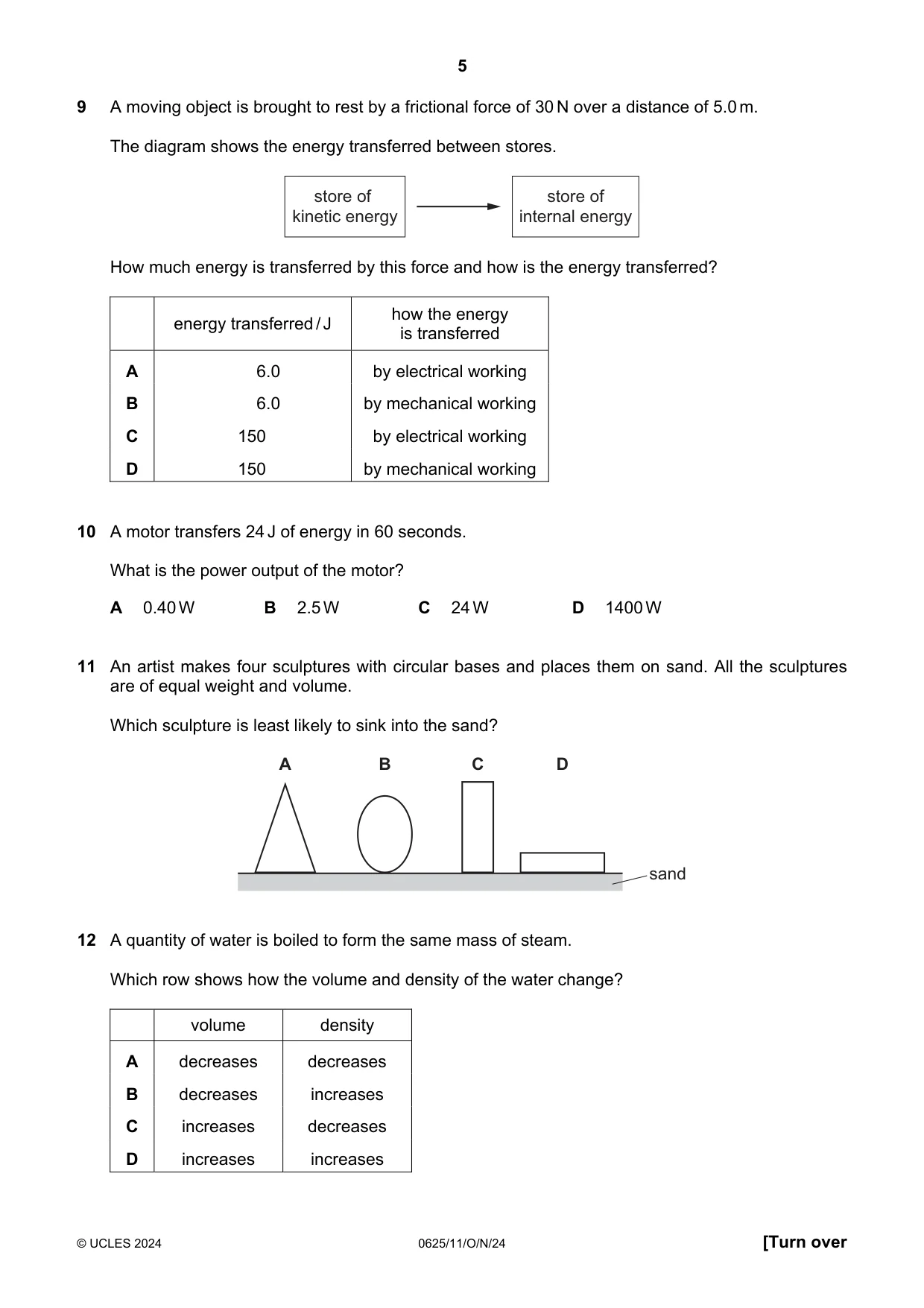
Q9 · A moving object is brought to rest by a frictional force of 30 N over a distance of 5.0 m
9 A moving object is brought to rest by a frictional force of 30 N over a distance of 5.0 m. The diagram shows the energy transferred between stores. store of store of kinetic energy internal energy How much energy is transferred by this force and how is the energy transferred? how the energy energy transferred / J is transferred A 6.0 by electrical working B 6.0 by mechanical working C 150 by electrical working D 150 by mechanical working
Mark scheme: D
Q10 · A motor transfers 24 J of energy in 60 seconds
10 A motor transfers 24 J of energy in 60 seconds. What is the power output of the motor? A 0.40 W B 2.5 W C 24 W D 1400 W
Mark scheme: A
Q11 · An artist makes four sculptures with circular bases and places them on sand
11 An artist makes four sculptures with circular bases and places them on sand. All the sculptures are of equal weight and volume. Which sculpture is least likely to sink into the sand? A B C D sand
Mark scheme: D
Q12 · A quantity of water is boiled to form the same mass of steam
12 A quantity of water is boiled to form the same mass of steam. Which row shows how the volume and density of the water change? volume density A decreases decreases B decreases increases C increases decreases D increases increases
Mark scheme: C
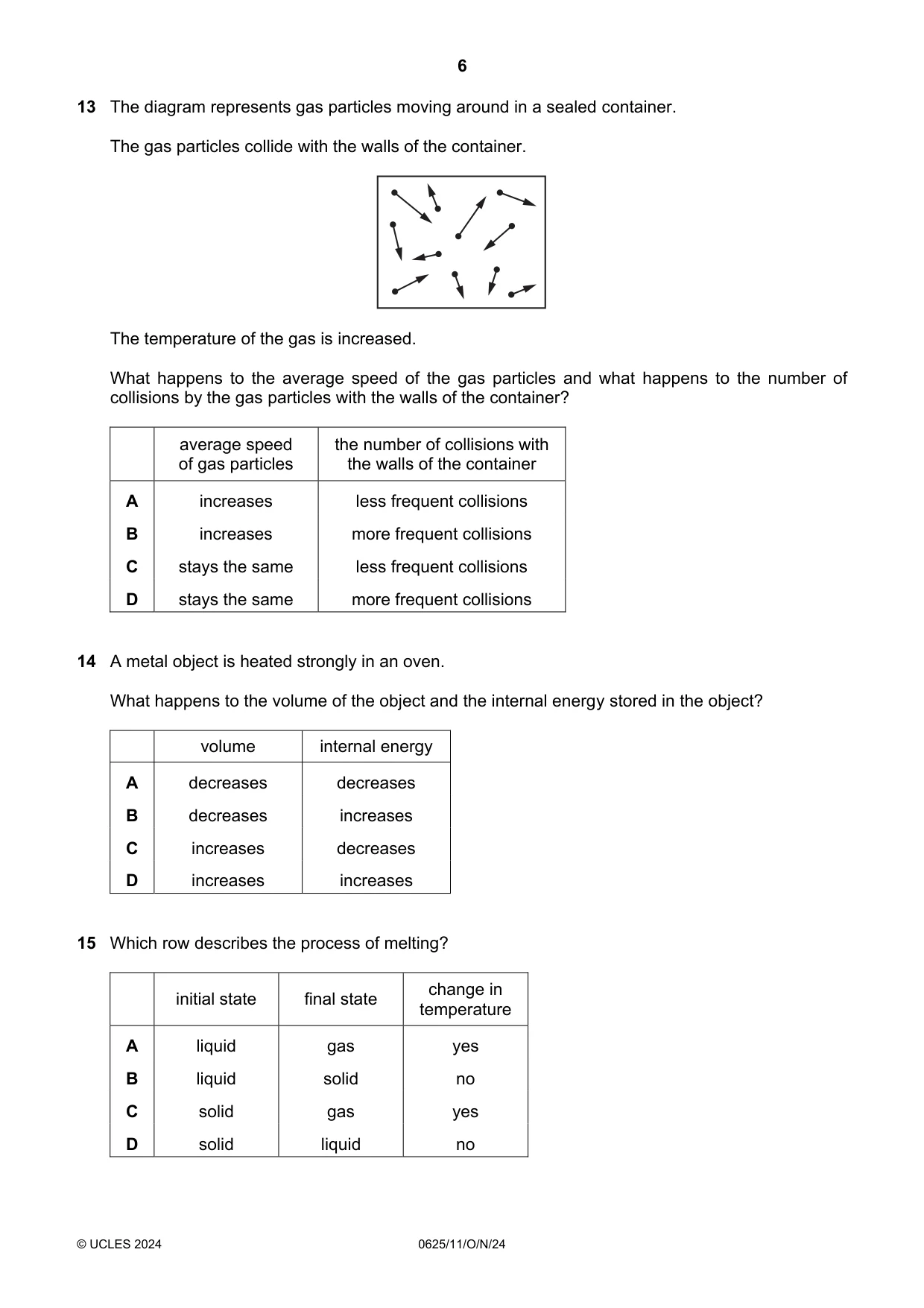
Q13 · The diagram represents gas particles moving around in a sealed container
13 The diagram represents gas particles moving around in a sealed container. The gas particles collide with the walls of the container. The temperature of the gas is increased. What happens to the average speed of the gas particles and what happens to the number of collisions by the gas particles with the walls of the container? average speed the number of collisions with of gas particles the walls of the container A increases less frequent collisions B increases more frequent collisions C stays the same less frequent collisions D stays the same more frequent collisions
Mark scheme: B
Q14 · A metal object is heated strongly in an oven
14 A metal object is heated strongly in an oven. What happens to the volume of the object and the internal energy stored in the object? volume internal energy A decreases decreases B decreases increases C increases decreases D increases increases
Mark scheme: D
Q15 · Which row describes the process of melting?
15 Which row describes the process of melting? change in initial state final state temperature A liquid gas yes B liquid solid no C solid gas yes D solid liquid no
Mark scheme: D
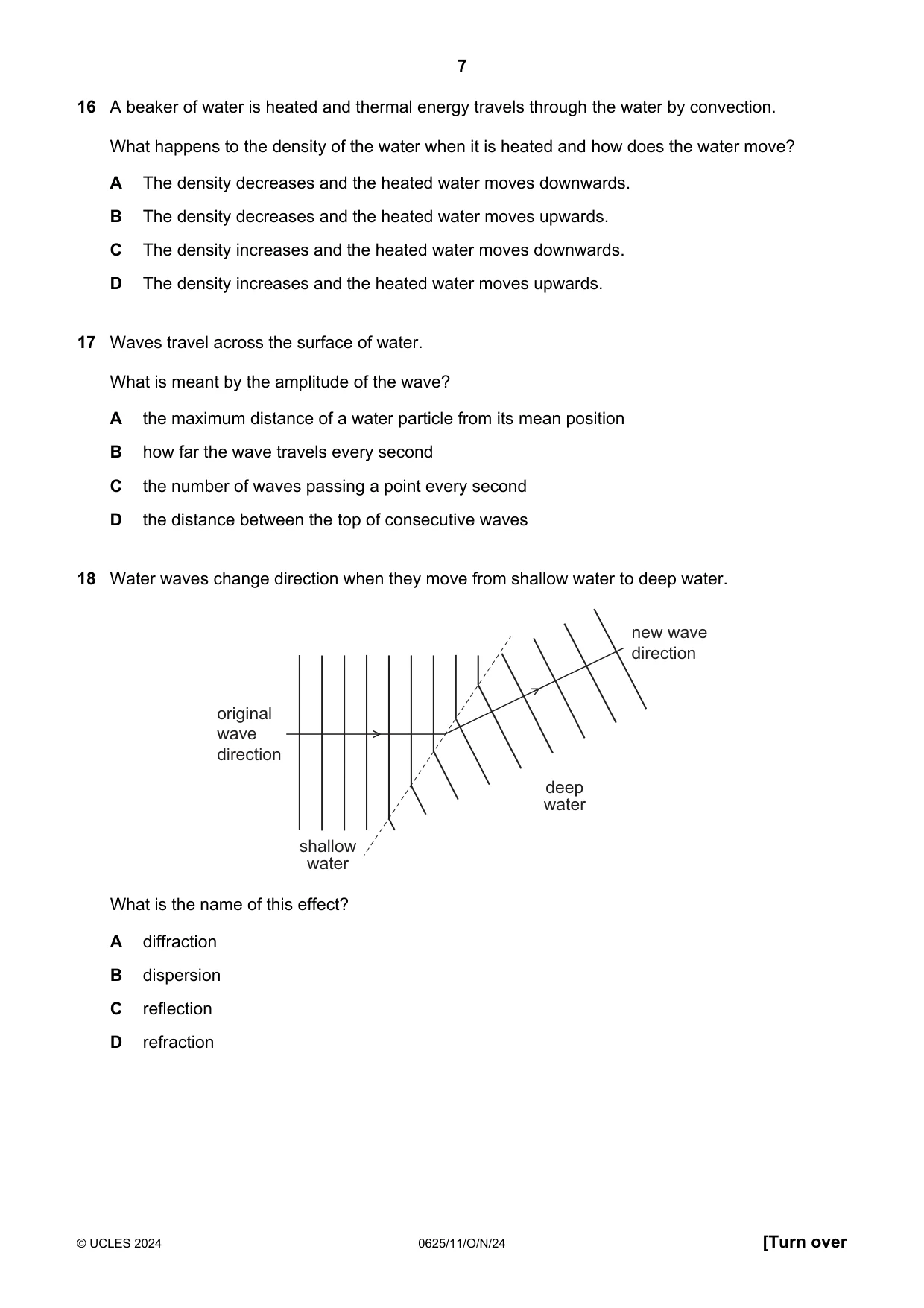
Q16 · A beaker of water is heated and thermal energy travels through the water by convection
16 A beaker of water is heated and thermal energy travels through the water by convection. What happens to the density of the water when it is heated and how does the water move? A The density decreases and the heated water moves downwards. B The density decreases and the heated water moves upwards. C The density increases and the heated water moves downwards. D The density increases and the heated water moves upwards.
Mark scheme: B
Q17 · Waves travel across the surface of water
17 Waves travel across the surface of water. What is meant by the amplitude of the wave? A the maximum distance of a water particle from its mean position B how far the wave travels every second C the number of waves passing a point every second D the distance between the top of consecutive waves
Mark scheme: A
Q18 · Water waves change direction when they move from shallow water to deep water
18 Water waves change direction when they move from shallow water to deep water. new wave direction original wave direction deep water shallow water What is the name of this effect? A diffraction B dispersion C reflection D refraction
Mark scheme: D
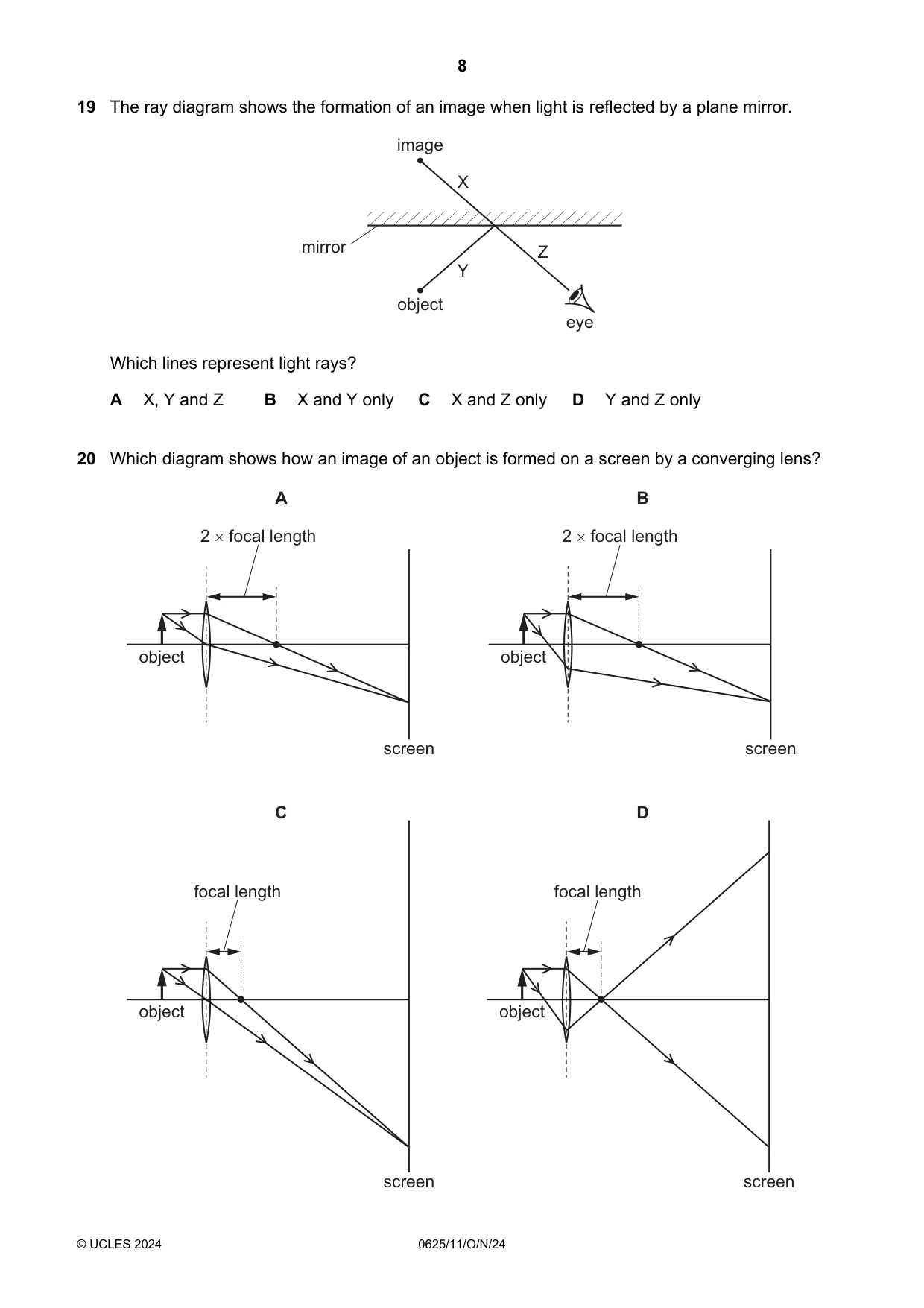
Q19 · The ray diagram shows the formation of an image when light is reflected by a plane mirror
19 The ray diagram shows the formation of an image when light is reflected by a plane mirror. image X mirror Z Y object eye Which lines represent light rays? A X, Y and Z B X and Y only C X and Z only D Y and Z only
Mark scheme: D
Q20 · Which diagram shows how an image of an object is formed on a screen by a converging lens?
20 Which diagram shows how an image of an object is formed on a screen by a converging lens? A B 2 x focal length 2 x focal length screen screen focal length focal length : screen screen
Mark scheme: C
Q21 · Which diagram shows the dispersion of white light by a glass prism?
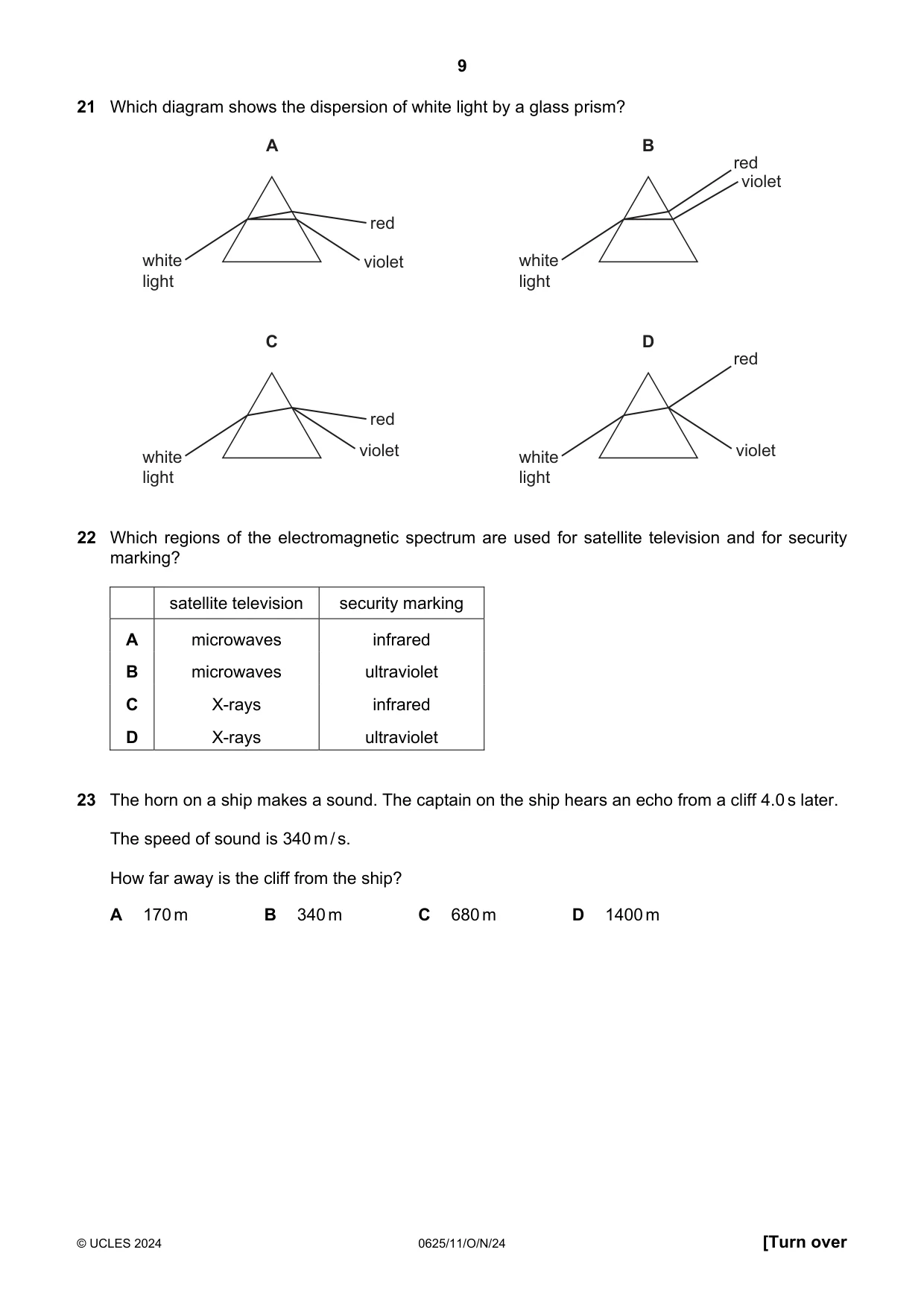
21 Which diagram shows the dispersion of white light by a glass prism? A B red violet red white violet white light light C D red red white violet white violet light light
Mark scheme: A
Q22 · Which regions of the electromagnetic spectrum are used for satellite television and for…
22 Which regions of the electromagnetic spectrum are used for satellite television and for security marking? satellite television security marking A microwaves infrared B microwaves ultraviolet C X-rays infrared D X-rays ultraviolet
Mark scheme: B
Q23 · The horn on a ship makes a sound
23 The horn on a ship makes a sound. The captain on the ship hears an echo from a cliff 4.0 s later. The speed of sound is 340 m / s. How far away is the cliff from the ship? A 170 m B 340 m C 680 m D 1400 m
Mark scheme: C
Q24 · A bar magnet is next to a steel bar
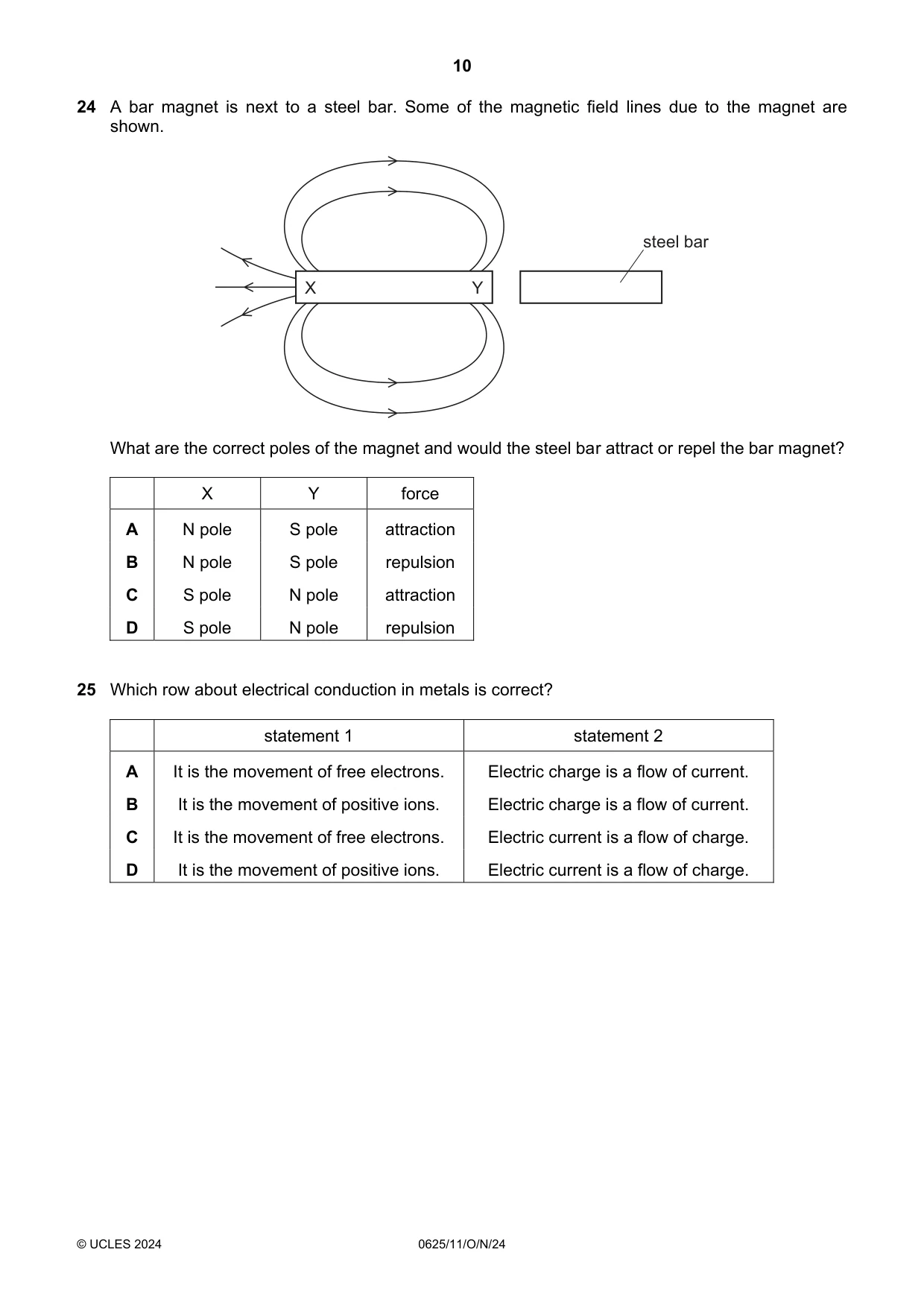
24 A bar magnet is next to a steel bar. Some of the magnetic field lines due to the magnet are shown. steel bar X Y What are the correct poles of the magnet and would the steel bar attract or repel the bar magnet? X Y force A N pole S pole attraction B N pole S pole repulsion C S pole N pole attraction D S pole N pole repulsion
Mark scheme: A
Q25 · Which row about electrical conduction in metals is correct?
25 Which row about electrical conduction in metals is correct? statement 1 statement 2 A It is the movement of free electrons. Electric charge is a flow of current. B It is the movement of positive ions. Electric charge is a flow of current. C It is the movement of free electrons. Electric current is a flow of charge. D It is the movement of positive ions. Electric current is a flow of charge.
Mark scheme: C
Q26 · The diagram shows three wires, P, Q and R
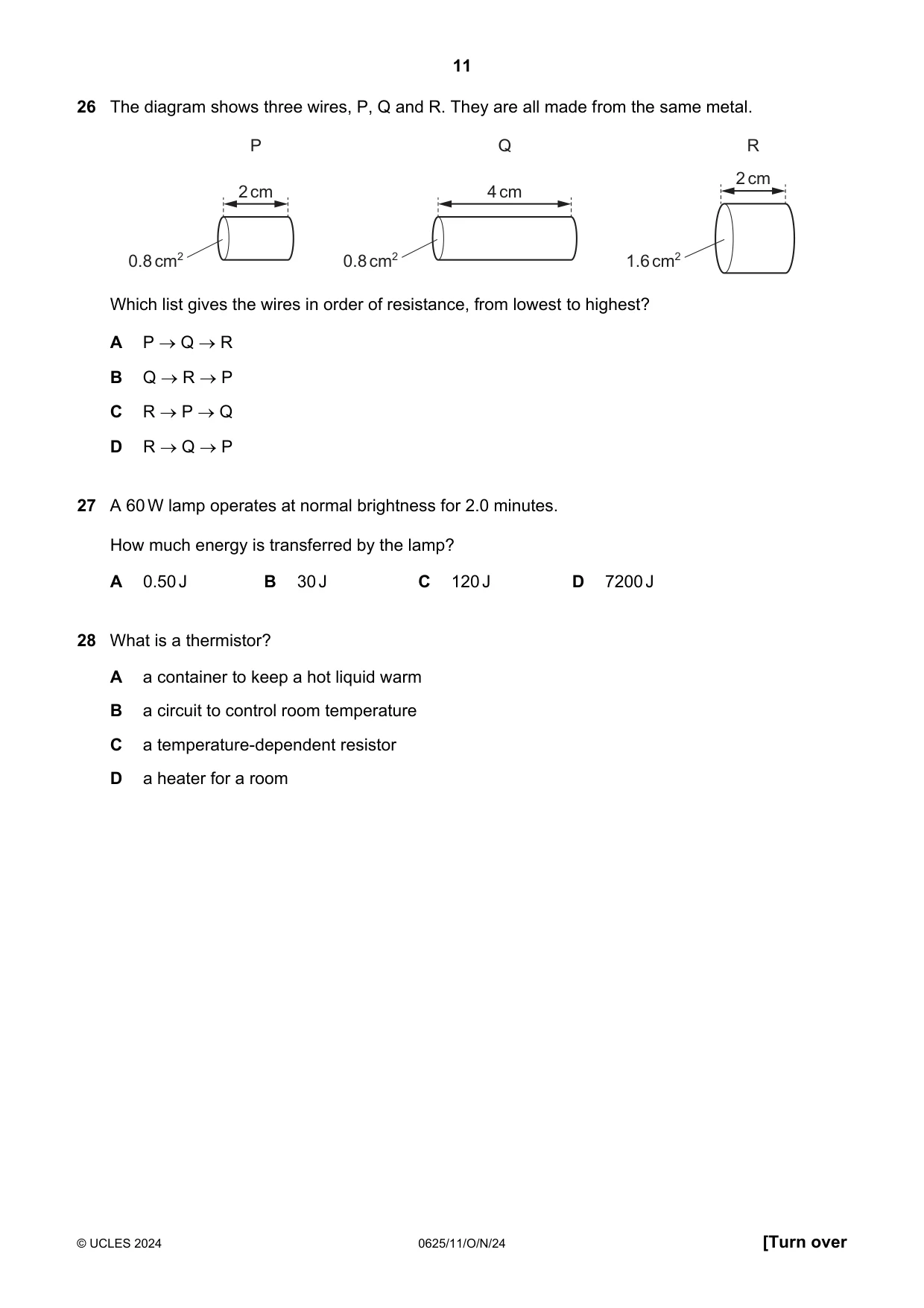
26 The diagram shows three wires, P, Q and R. They are all made from the same metal. P Q R 2 cm 2 cm 4 cm 0.8 cm2 0.8 cm2 1.6 cm2 Which list gives the wires in order of resistance, from lowest to highest? A P Q R B Q R P C R P Q D R Q P
Mark scheme: C
Q27 · A 60 W lamp operates at normal brightness for 2.0 minutes
27 A 60 W lamp operates at normal brightness for 2.0 minutes. How much energy is transferred by the lamp? A 0.50 J B 30 J C 120 J D 7200 J
Mark scheme: D
Q28 · What is a thermistor?
28 What is a thermistor? A a container to keep a hot liquid warm B a circuit to control room temperature C a temperature-dependent resistor D a heater for a room
Mark scheme: C
Q29 · The diagram shows a circuit containing two identical resistors connected to a battery
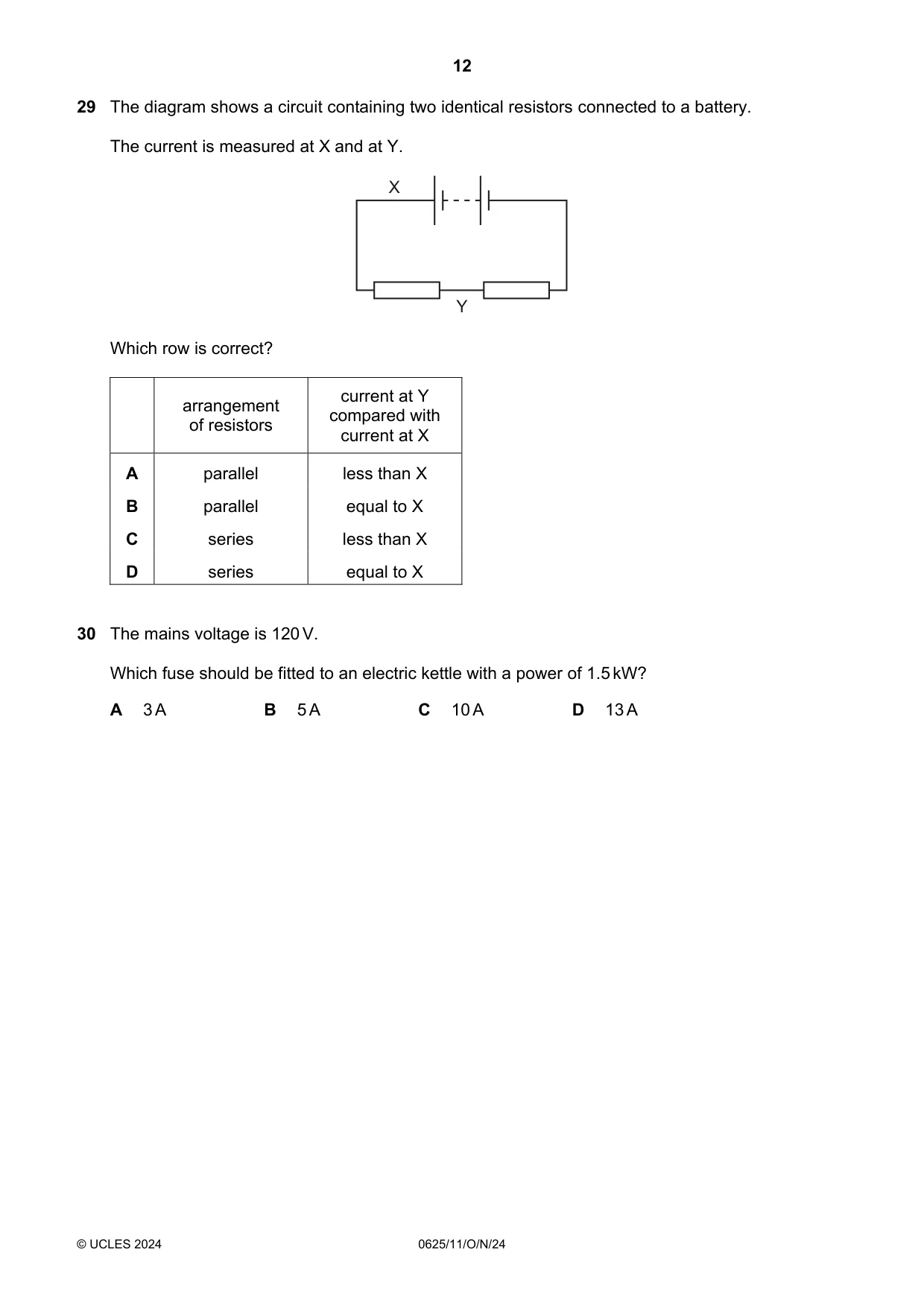
29 The diagram shows a circuit containing two identical resistors connected to a battery. The current is measured at X and at Y. X Y Which row is correct? current at Y arrangement compared with of resistors current at X A parallel less than X B parallel equal to X C series less than X D series equal to X
Mark scheme: D
Q30 · The mains voltage is 120 V
30 The mains voltage is 120 V. Which fuse should be fitted to an electric kettle with a power of 1.5 kW? A 3 A B 5 A C 10 A D 13 A
Mark scheme: D
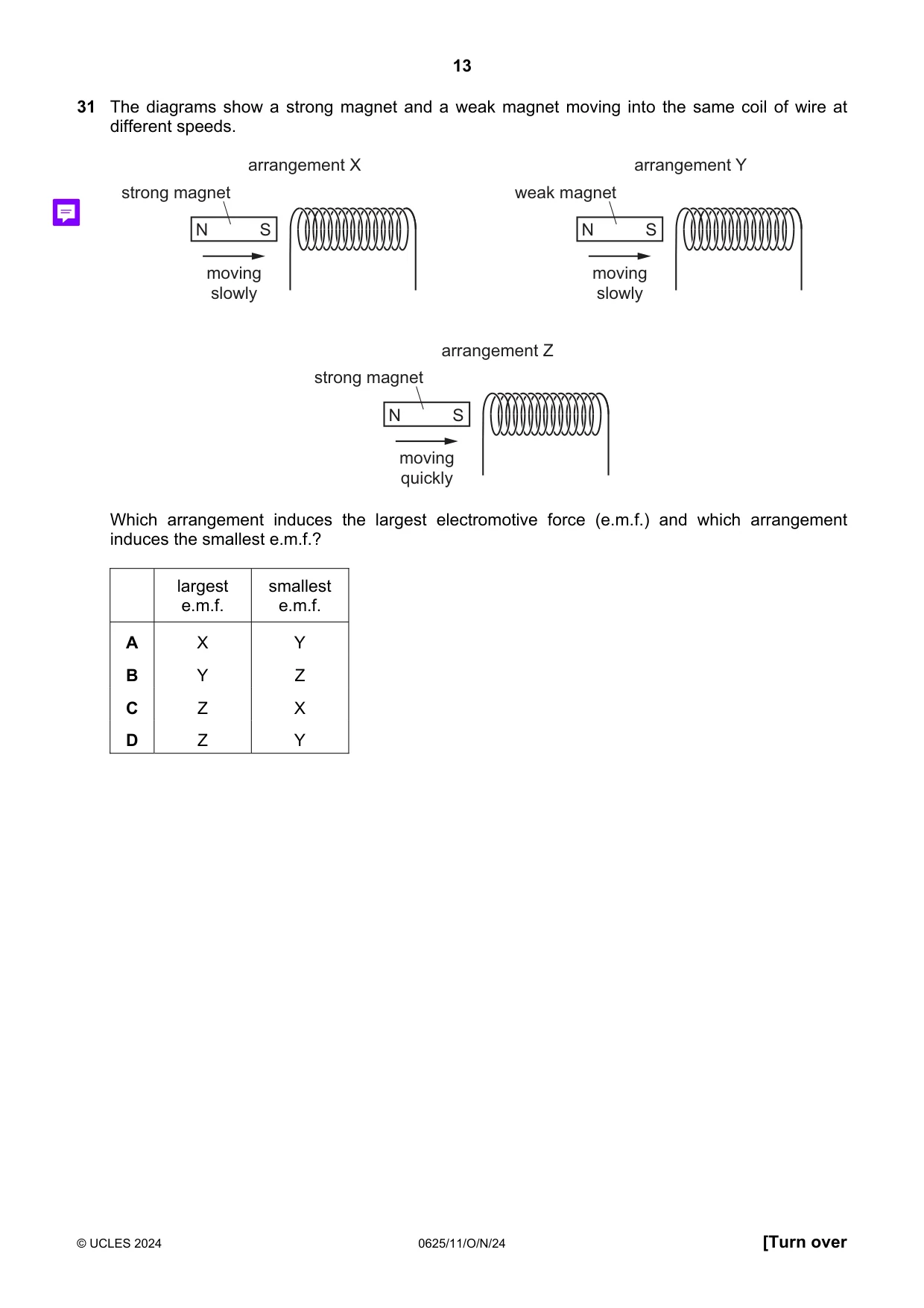
Q31 · The diagrams show a strong magnet and a weak magnet moving into the same coil of wire at…
31 The diagrams show a strong magnet and a weak magnet moving into the same coil of wire at different speeds. arrangement X arrangement Y strong magnet weak magnet N S N S moving moving slowly slowly arrangement Z strong magnet N S moving quickly Which arrangement induces the largest electromotive force (e.m.f.) and which arrangement induces the smallest e.m.f.? largest smallest e.m.f. e.m.f. A X Y B Y Z C Z X D Z Y
Mark scheme: D
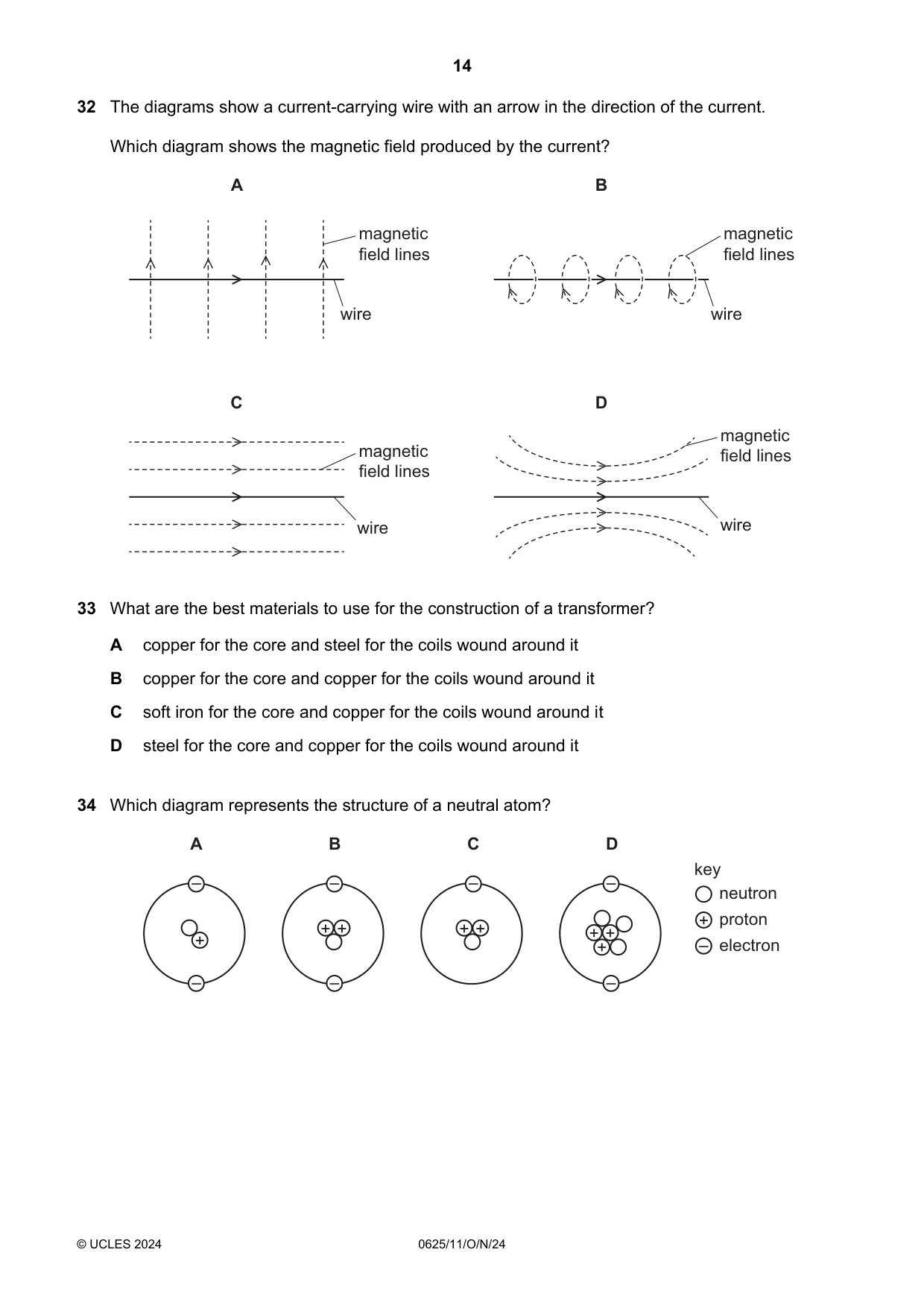
Q32 · The diagrams show a current-carrying wire with an arrow in the direction of the current
32 The diagrams show a current-carrying wire with an arrow in the direction of the current. Which diagram shows the magnetic field produced by the current? A B magnetic magnetic field lines field lines wire wire C D magnetic magnetic field lines field lines wire wire
Mark scheme: B
Q33 · What are the best materials to use for the construction of a transformer?
33 What are the best materials to use for the construction of a transformer? A copper for the core and steel for the coils wound around it B copper for the core and copper for the coils wound around it C soft iron for the core and copper for the coils wound around it D steel for the core and copper for the coils wound around it
Mark scheme: C
Q34 · Which diagram represents the structure of a neutral atom?
34 Which diagram represents the structure of a neutral atom? A B C D key – – – – neutron + proton + + + + + + + + – electron – – –
Mark scheme: B
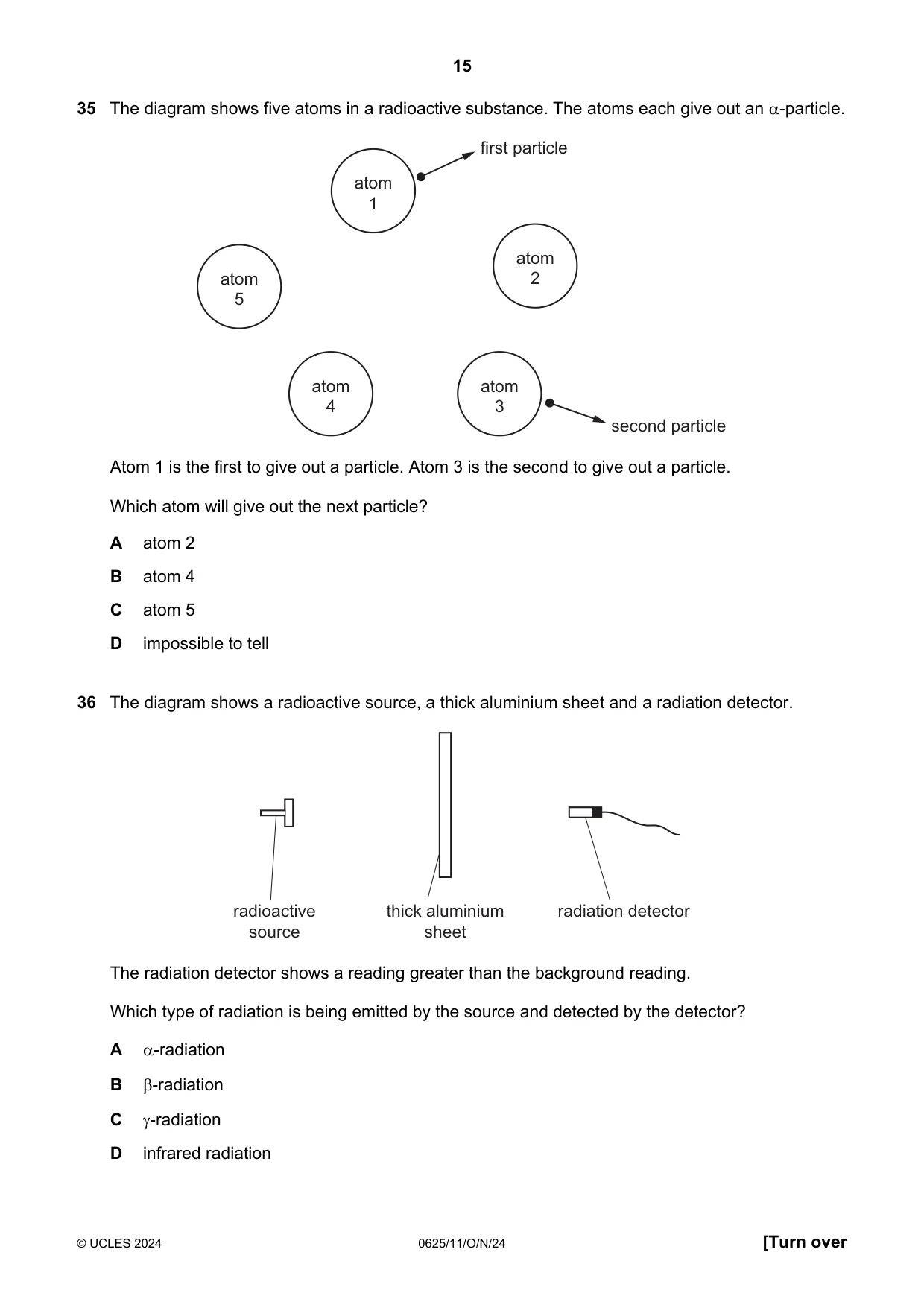
Q35 · The diagram shows five atoms in a radioactive substance
35 The diagram shows five atoms in a radioactive substance. The atoms each give out an -particle. first particle atom 1 atom atom 2 5 atom atom 4 3 second particle Atom 1 is the first to give out a particle. Atom 3 is the second to give out a particle. Which atom will give out the next particle? A atom 2 B atom 4 C atom 5 D impossible to tell
Mark scheme: D
Q36 · The diagram shows a radioactive source, a thick aluminium sheet and a radiation detector
36 The diagram shows a radioactive source, a thick aluminium sheet and a radiation detector. radioactive thick aluminium radiation detector source sheet The radiation detector shows a reading greater than the background reading. Which type of radiation is being emitted by the source and detected by the detector? A -radiation B -radiation C -radiation D infrared radiation
Mark scheme: C
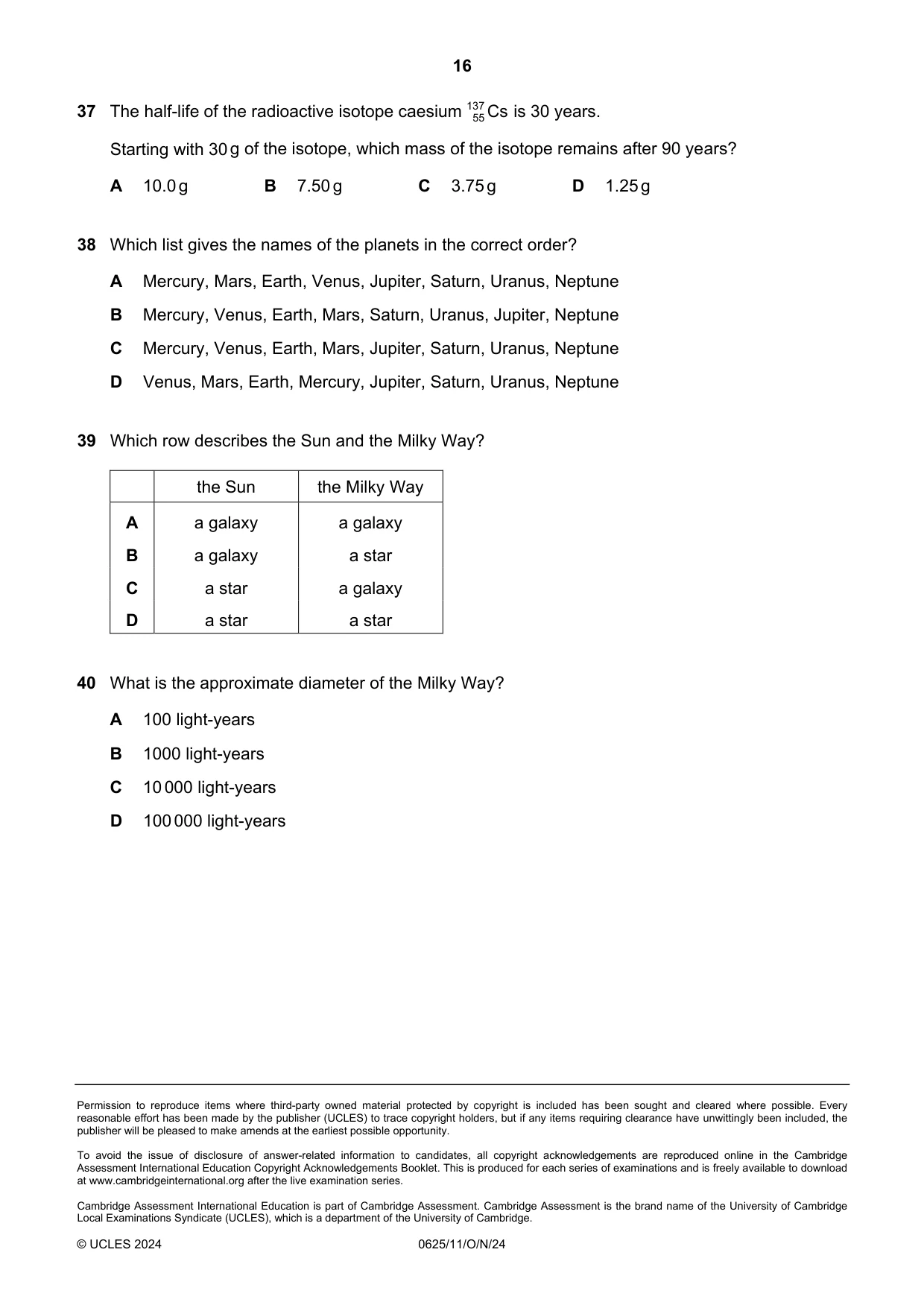
Q37 · The half-life of the radioactive isotope caesium 137 Cs is 30 years
37 The half-life of the radioactive isotope caesium 137 Cs is 30 years. 55 Starting with 30 g of the isotope, which mass of the isotope remains after 90 years? A 10.0 g B 7.50 g C 3.75 g D 1.25 g
Mark scheme: C
Q38 · Which list gives the names of the planets in the correct order?
38 Which list gives the names of the planets in the correct order? A Mercury, Mars, Earth, Venus, Jupiter, Saturn, Uranus, Neptune B Mercury, Venus, Earth, Mars, Saturn, Uranus, Jupiter, Neptune C Mercury, Venus, Earth, Mars, Jupiter, Saturn, Uranus, Neptune D Venus, Mars, Earth, Mercury, Jupiter, Saturn, Uranus, Neptune
Mark scheme: C
Q39 · Which row describes the Sun and the Milky Way?
39 Which row describes the Sun and the Milky Way? the Sun the Milky Way A a galaxy a galaxy B a galaxy a star C a star a galaxy D a star a star
Mark scheme: C
Q40 · What is the approximate diameter of the Milky Way?
40 What is the approximate diameter of the Milky Way? A 100 light-years B 1000 light-years C 10 000 light-years D 100 000 light-years
Mark scheme: D
What was in this paper
The subtopics covered by these 40 questions, and how many questions each got. Open one in a new tab to see every Cambridge question on it.
3Electromagnetic effects3Forces3Light3Radioactivity3Density2Electric circuits2Energy, work and power2General properties of waves2Motion2Stars and the Universe2Thermal properties and temperature2Electrical safety1Electromagnetic spectrum1Kinetic particle model of matter1Mass and weight1Physical quantities and measurement techniques1Pressure1Simple phenomena of magnetism1Sound1The Earth and the Solar System1The nuclear model of the atom1Transfer of thermal energy1What you needed in this session
Cambridge’s own grade thresholds for 2024 Oct/Nov, Paper 1 · Variant 1. A higher threshold means an easier paper — the bar moves with how the cohort did.