Cambridge IGCSE Physics 0625 — 2017 May/June Paper 1 · Variant 2
0625/12/M/J/17 · 40 questions · 40 marks · ≈45 min
The question paper and its mark scheme, free to read here and free to download. This is Cambridge’s own paper, exactly as it was sat.
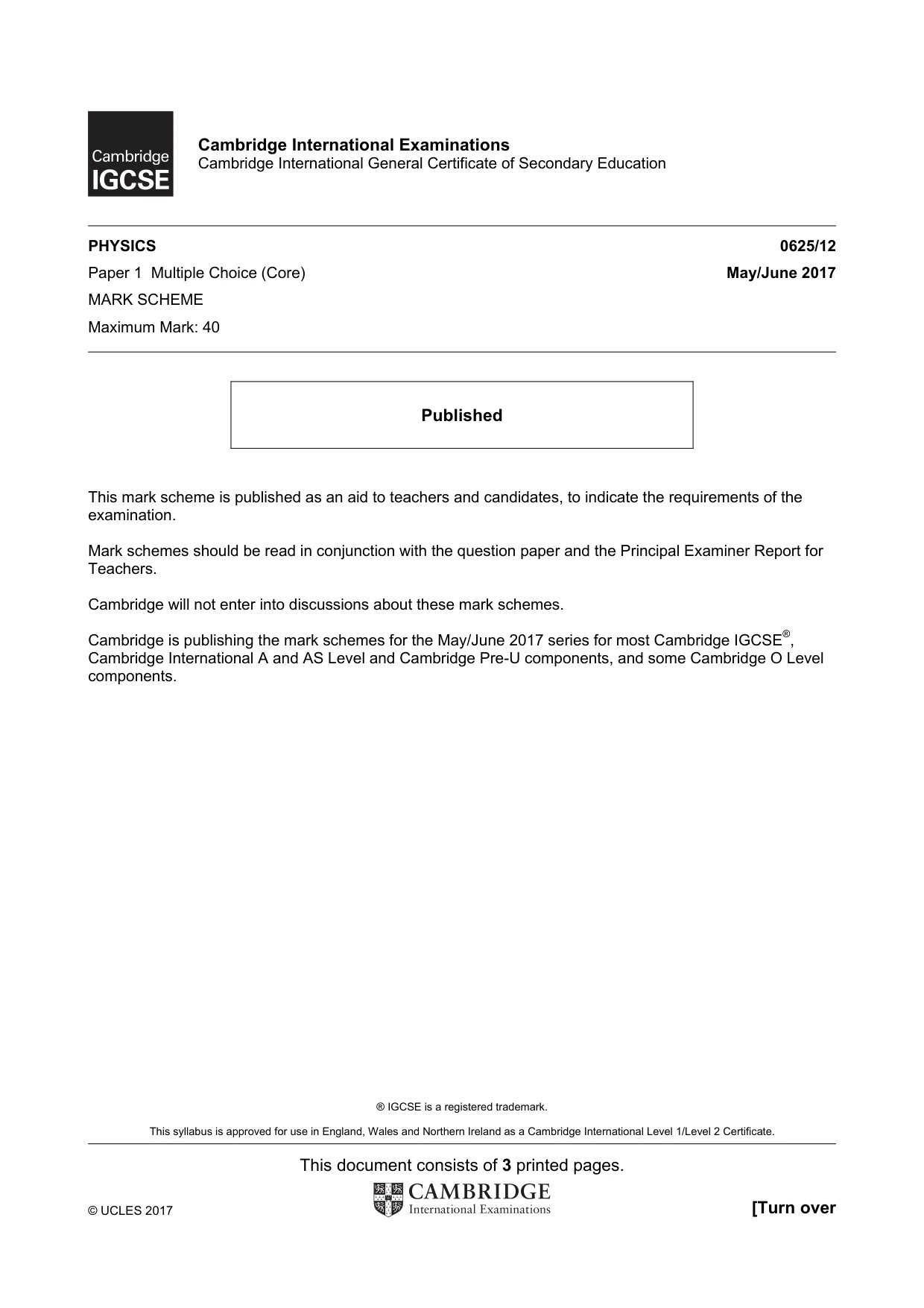
Question paper20 pages
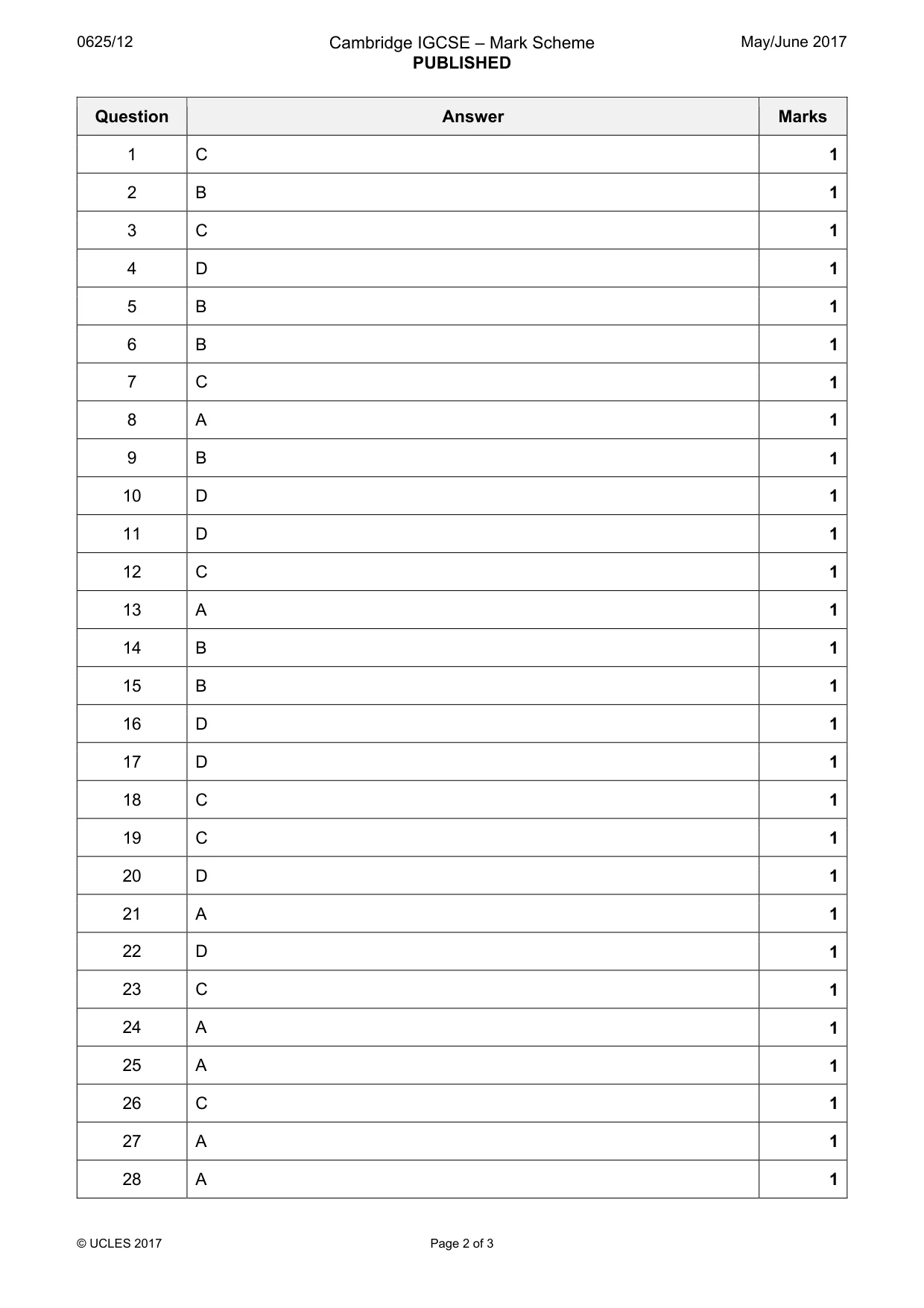
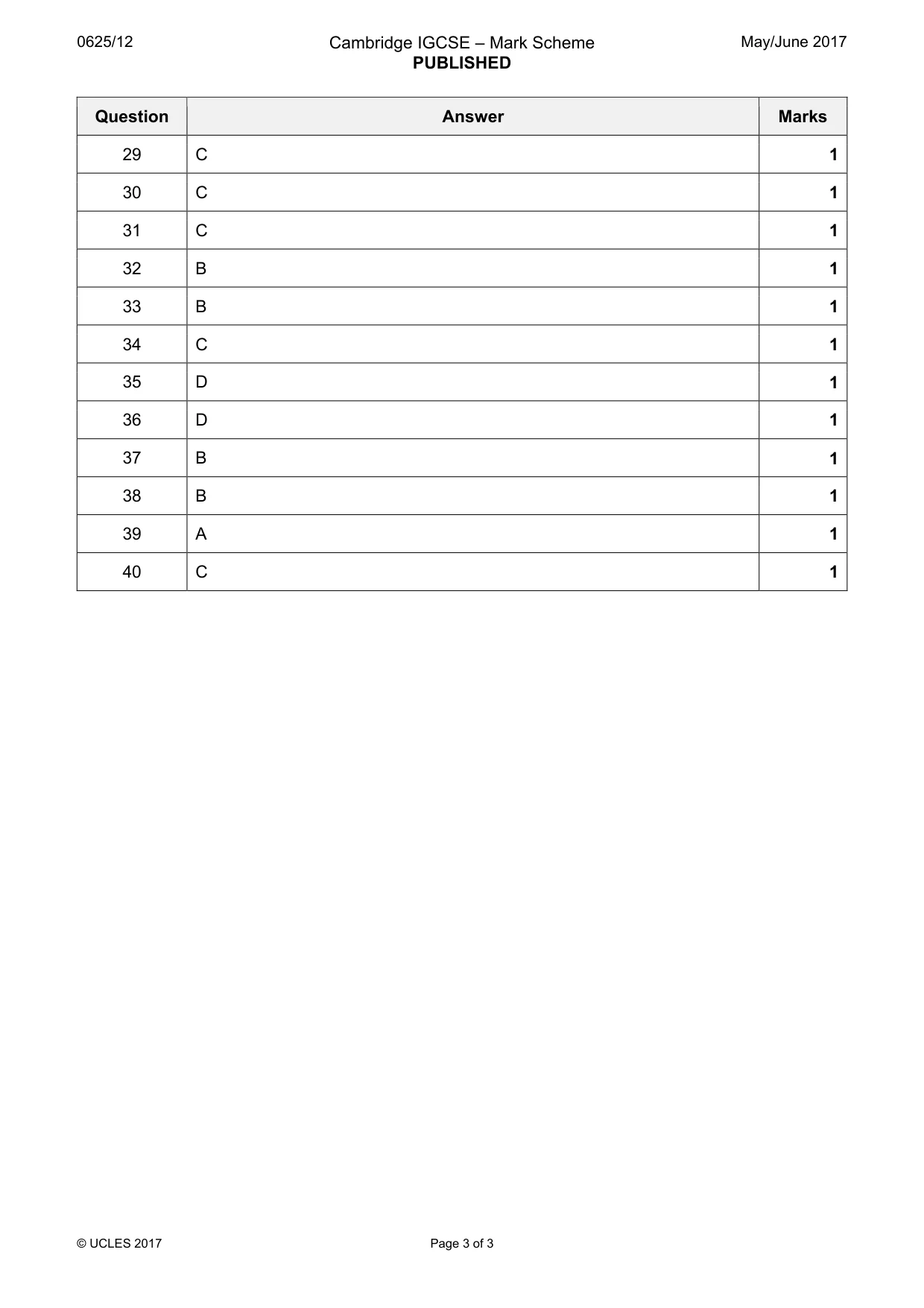
Mark scheme3 pages
Answers below. Sit the paper first if you are practising.
Questions as text
Q1 · Which device is used to measure the time it takes for a 10 cm3 block of ice to melt in a…
1 Which device is used to measure the time it takes for a 10 cm3 block of ice to melt in a laboratory at room temperature? A measuring cylinder B ruler C stopwatch D thermometer
Mark scheme: C
More questions on Physical quantities and measurement techniques
Q2 · A student determines the average speed of a bubble rising through a liquid at constant…
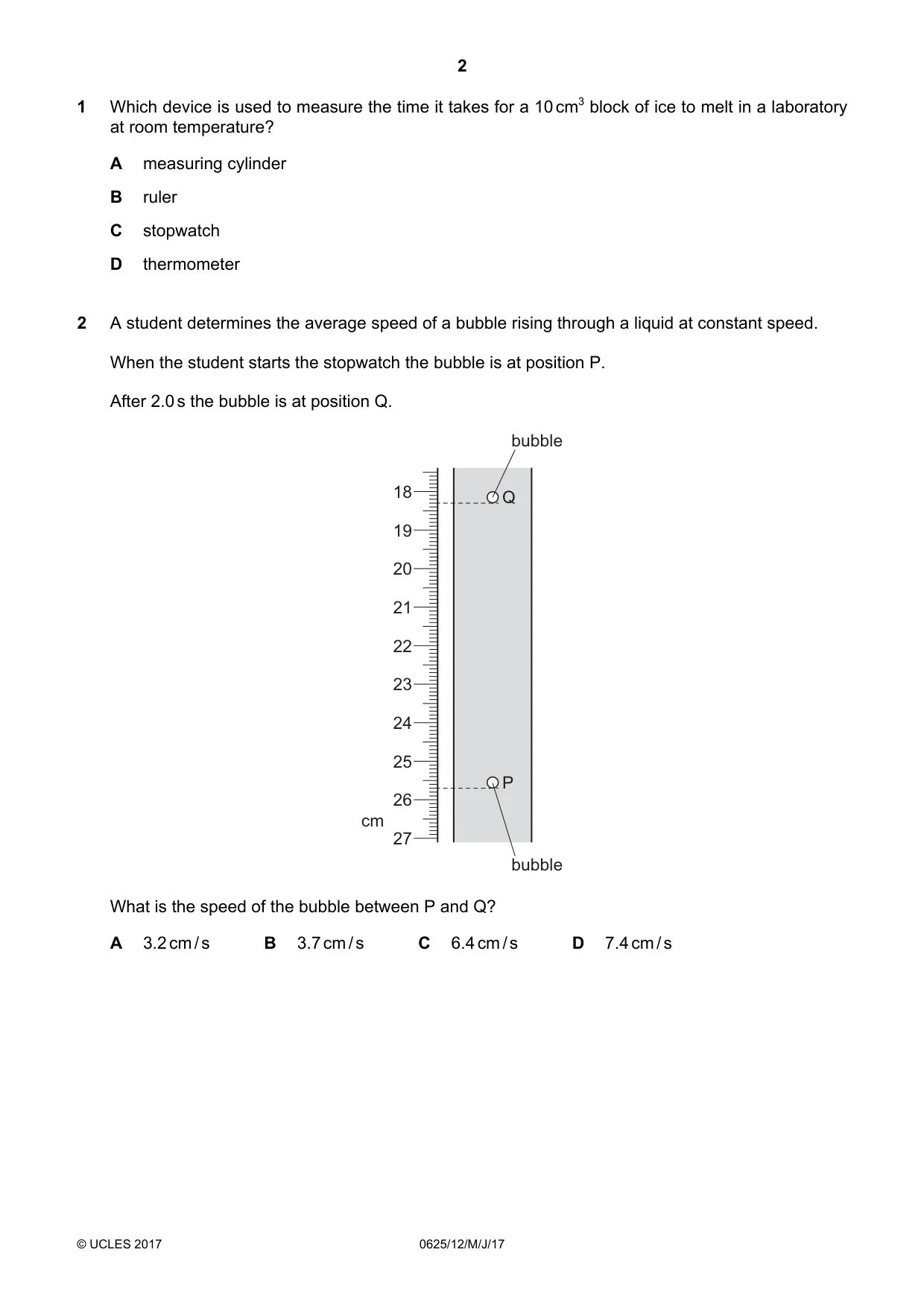
2 A student determines the average speed of a bubble rising through a liquid at constant speed. When the student starts the stopwatch the bubble is at position P. After 2.0 s the bubble is at position Q. bubble 18 Q 19 20 21 22 23 24 25 P 26 cm 27 bubble What is the speed of the bubble between P and Q? A 3.2 cm / s B 3.7 cm / s C 6.4 cm / s D 7.4 cm / s
Mark scheme: B
Q3 · The speed-time graph represents a motorcycle journey
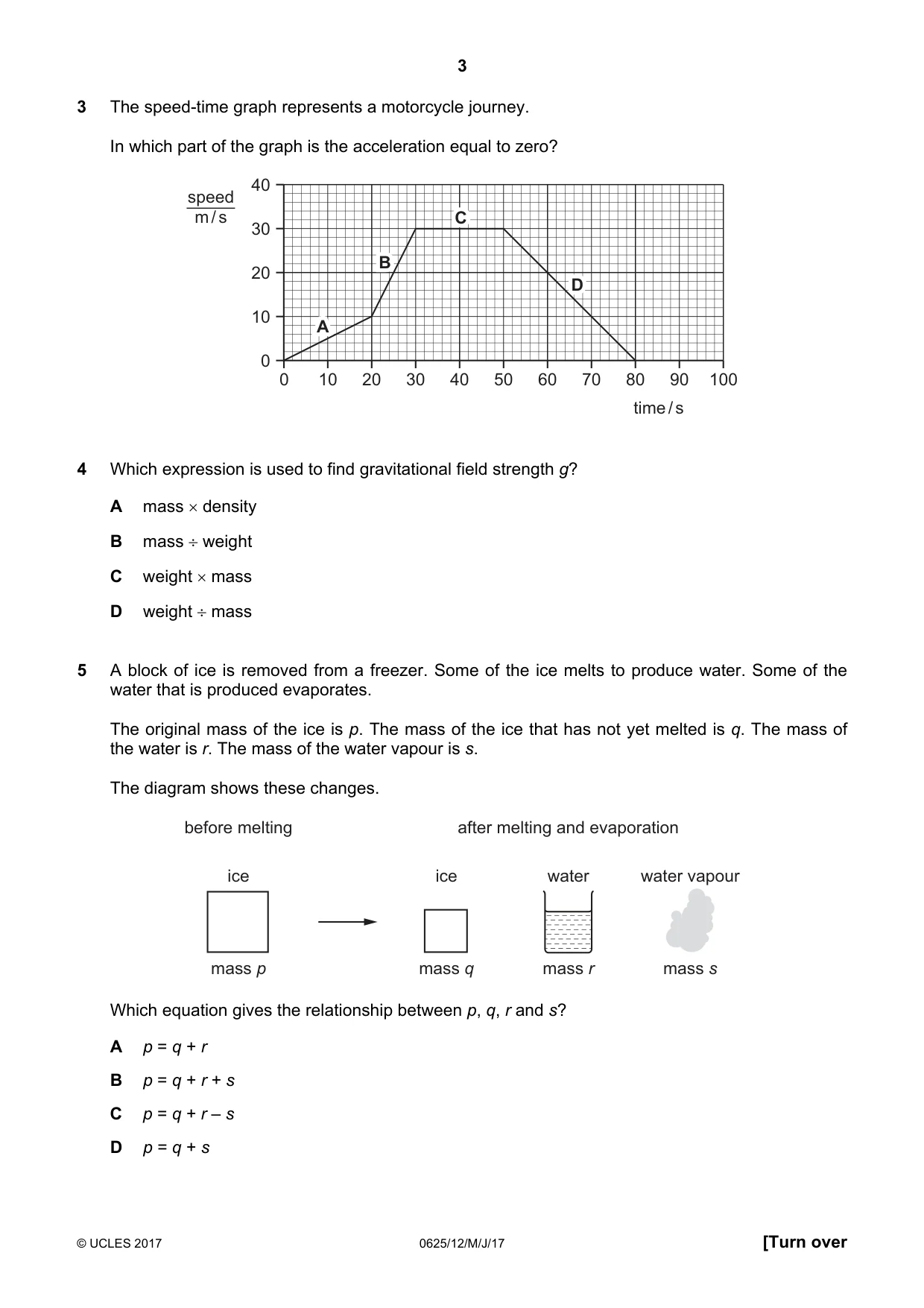
3 The speed-time graph represents a motorcycle journey. In which part of the graph is the acceleration equal to zero? 40 speed m / s C 30 B 20 D 10 A 0 0 10 20 30 40 50 60 70 80 90 100 time / s
Mark scheme: C
Q4 · Which expression is used to find gravitational field strength g?
4 Which expression is used to find gravitational field strength g? A mass × density B mass ÷ weight C weight × mass D weight ÷ mass
Mark scheme: D
Q5 · A block of ice is removed from a freezer
5 A block of ice is removed from a freezer. Some of the ice melts to produce water. Some of the water that is produced evaporates. The original mass of the ice is p. The mass of the ice that has not yet melted is q. The mass of the water is r. The mass of the water vapour is s. The diagram shows these changes. before melting after melting and evaporation ice ice water water vapour mass p mass q mass r mass s Which equation gives the relationship between p, q, r and s? A p = q + r B p = q + r + s C p = q + r – s D p = q + s
Mark scheme: B
Q6 · The masses of a measuring cylinder before and after pouring some liquid into it are shown…
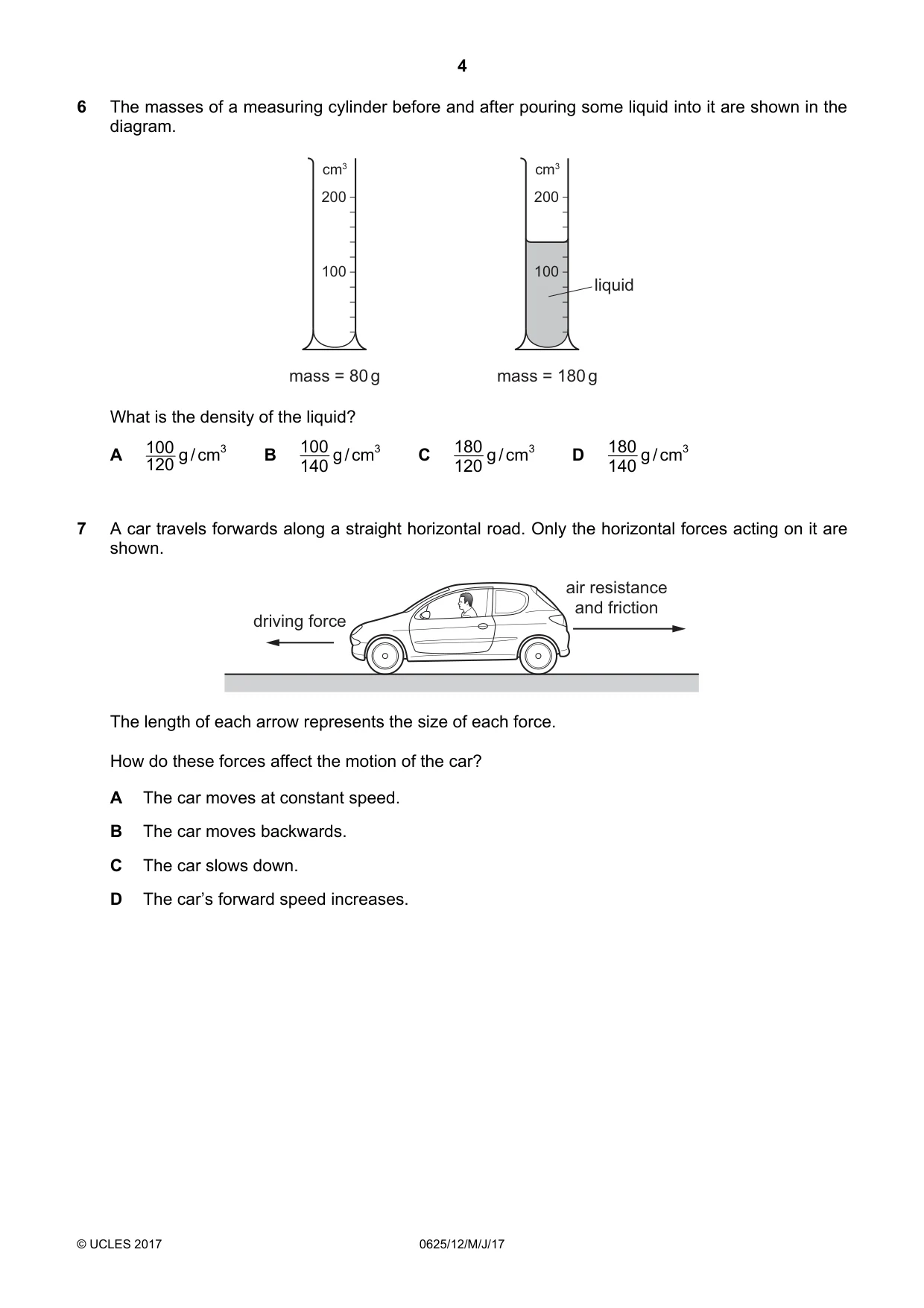
6 The masses of a measuring cylinder before and after pouring some liquid into it are shown in the diagram. cm3 cm3 200 200 100 100 liquid mass = 80 g mass = 180 g What is the density of the liquid? 100 g / cm3 100 g / cm3 180 g / cm3 180 g / cm3 A B C D 120 140 120 140
Mark scheme: B
Q7 · A car travels forwards along a straight horizontal road
7 A car travels forwards along a straight horizontal road. Only the horizontal forces acting on it are shown. air resistance and friction driving force The length of each arrow represents the size of each force. How do these forces affect the motion of the car? A The car moves at constant speed. B The car moves backwards. C The car slows down. D The car’s forward speed increases.
Mark scheme: C
Q8 · The centre of a uniform metre rule rests on a pivot
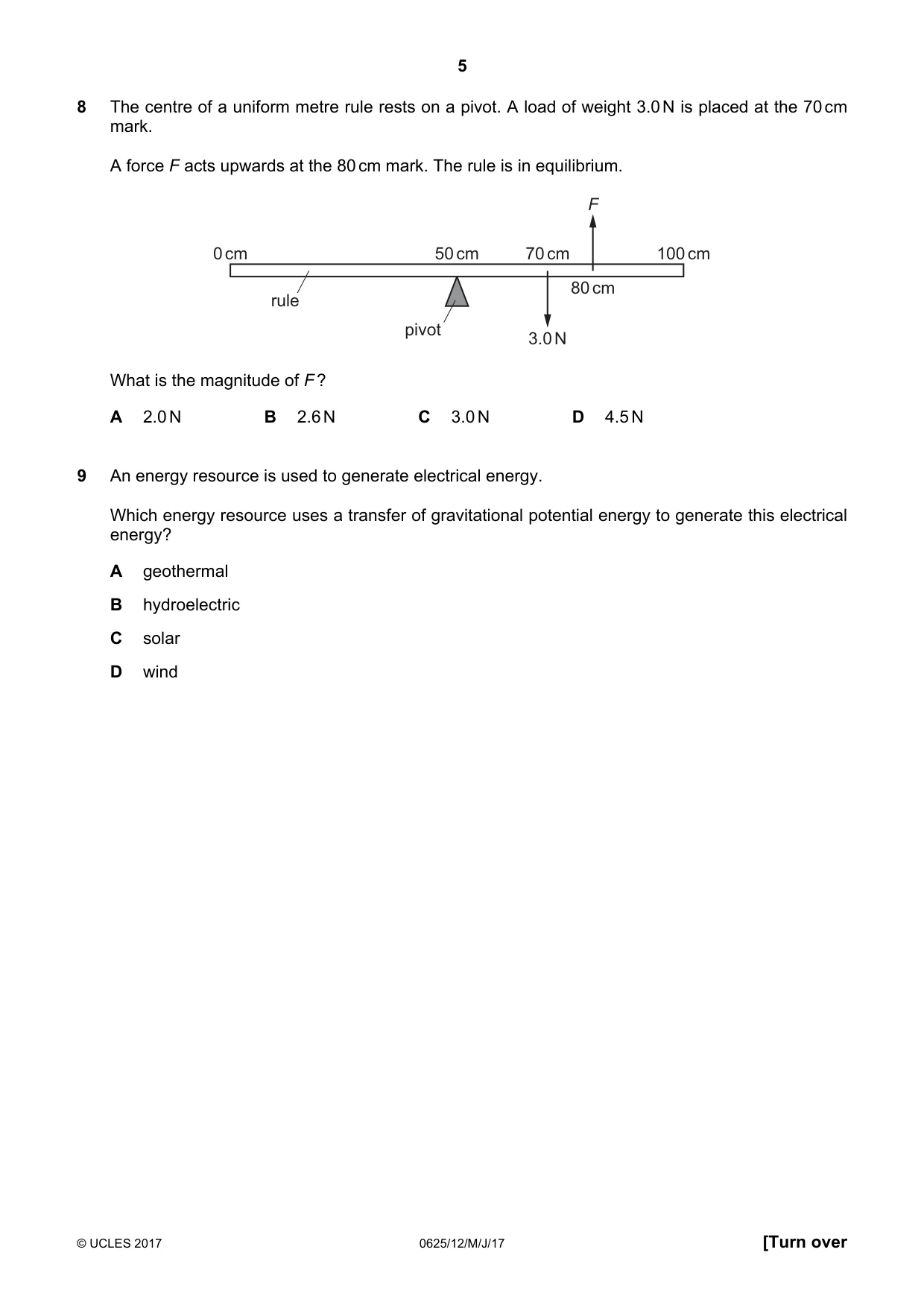
8 The centre of a uniform metre rule rests on a pivot. A load of weight 3.0 N is placed at the 70 cm mark. A force F acts upwards at the 80 cm mark. The rule is in equilibrium. F 0 cm 50 cm 70 cm 100 cm 80 cm rule pivot 3.0 N What is the magnitude of F ? A 2.0 N B 2.6 N C 3.0 N D 4.5 N
Mark scheme: A
Q9 · An energy resource is used to generate electrical energy
9 An energy resource is used to generate electrical energy. Which energy resource uses a transfer of gravitational potential energy to generate this electrical energy? A geothermal B hydroelectric C solar D wind
Mark scheme: B
Q10 · The diagrams show athletes training by stretching springs
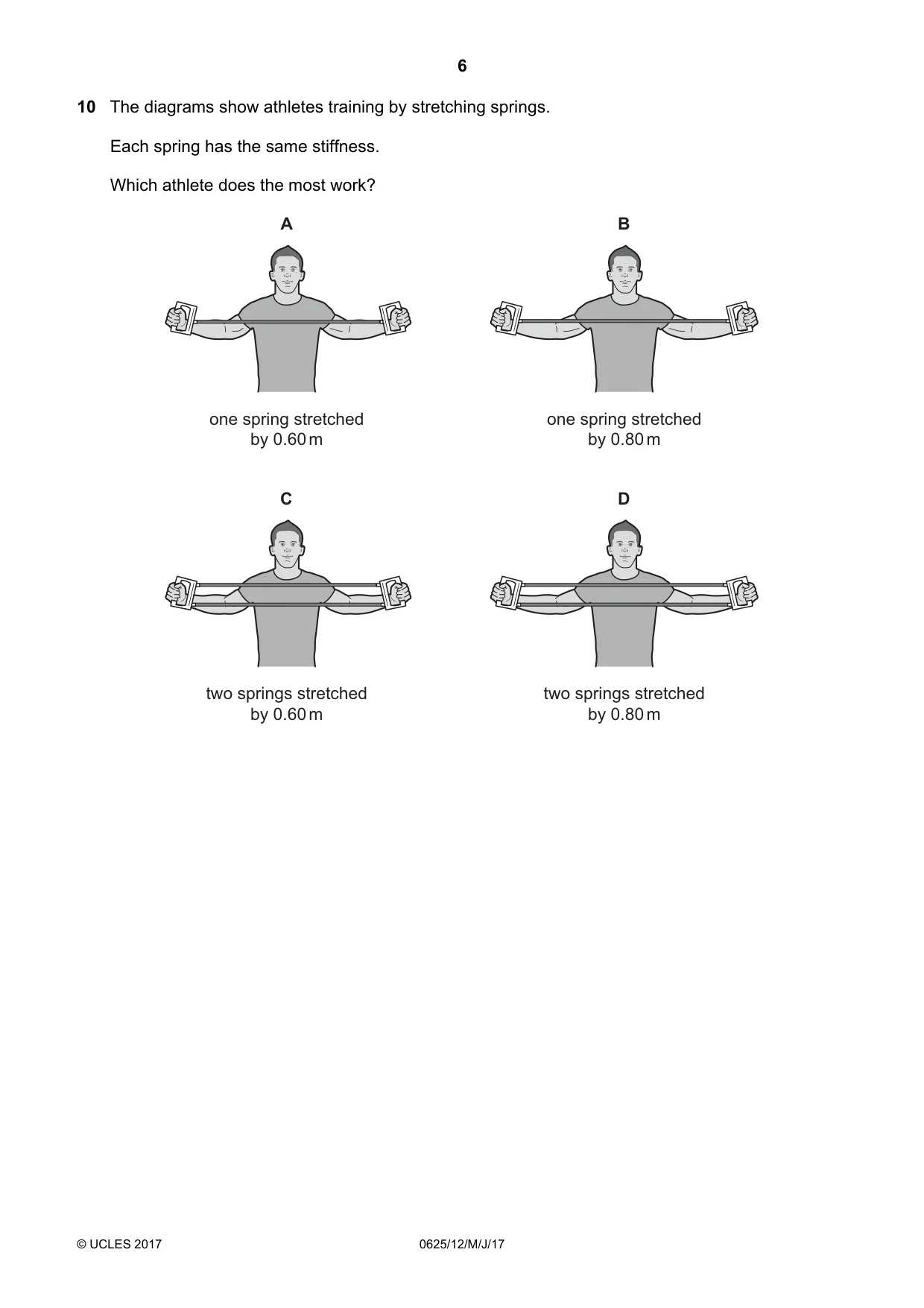
10 The diagrams show athletes training by stretching springs. Each spring has the same stiffness. Which athlete does the most work? A B one spring stretched one spring stretched by 0.60 m by 0.80 m C D two springs stretched two springs stretched by 0.60 m by 0.80 m
Mark scheme: D
Q11 · The diagram shows a conical vessel full of water
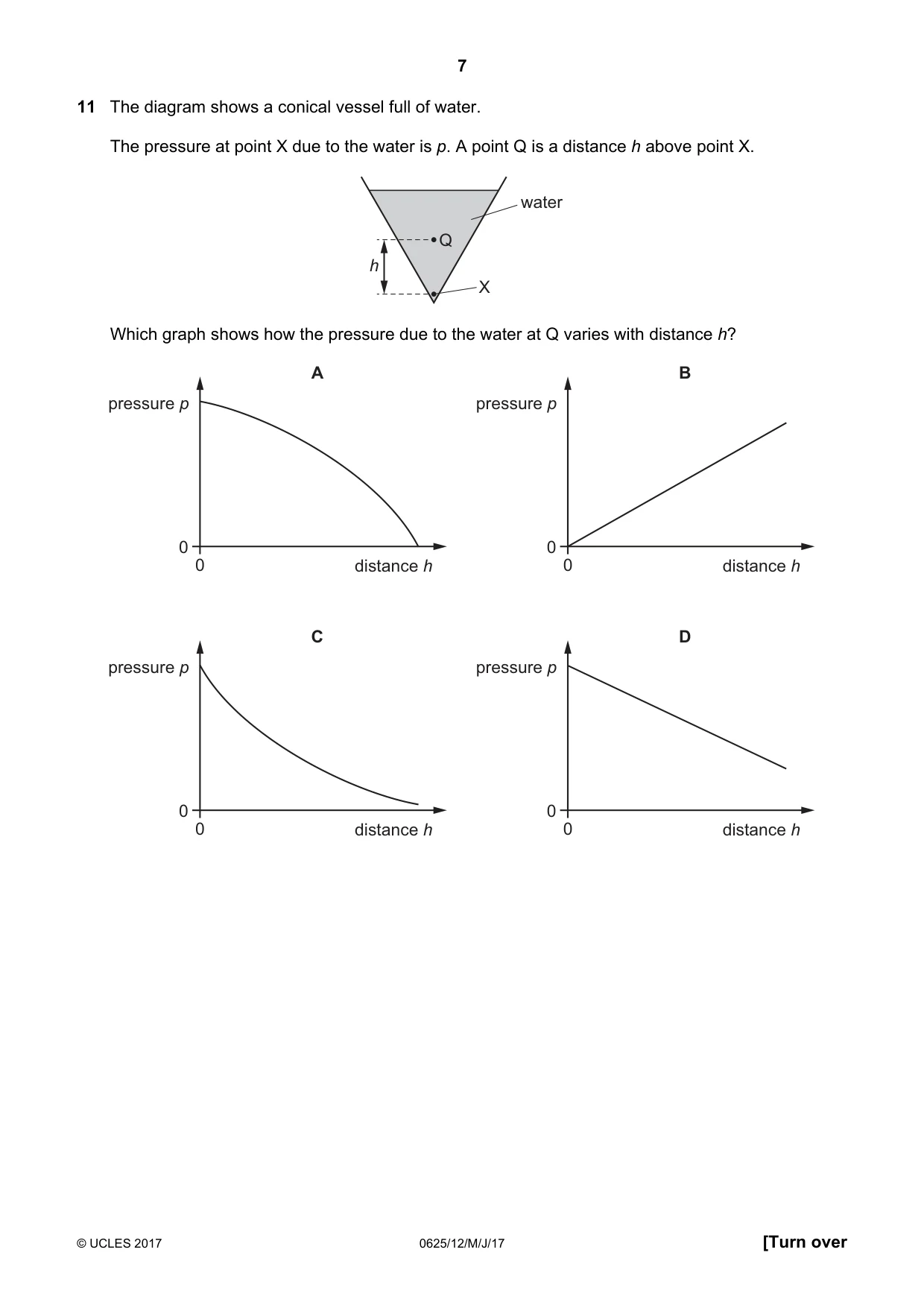
11 The diagram shows a conical vessel full of water. The pressure at point X due to the water is p. A point Q is a distance h above point X. water Q h X Which graph shows how the pressure due to the water at Q varies with distance h? A B pressure p pressure p 0 0 0 distance h 0 distance h C D pressure p pressure p 0 0 0 distance h 0 distance h
Mark scheme: D
Q12 · In diagram 1 a manometer containing mercury (Hg) is connected to a gas tap
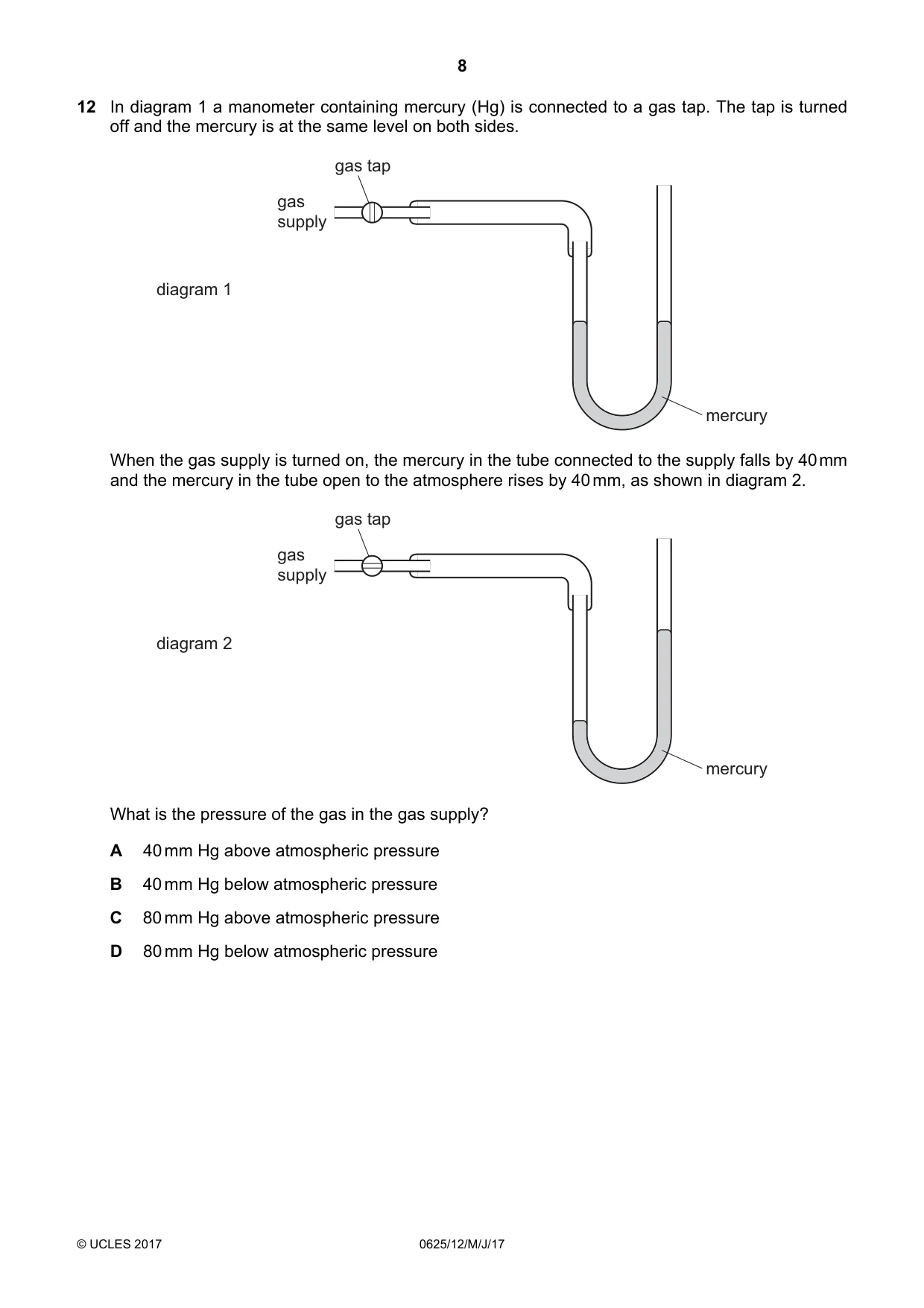
12 In diagram 1 a manometer containing mercury (Hg) is connected to a gas tap. The tap is turned off and the mercury is at the same level on both sides. gas tap gas supply diagram 1 mercury When the gas supply is turned on, the mercury in the tube connected to the supply falls by 40 mm and the mercury in the tube open to the atmosphere rises by 40 mm, as shown in diagram 2. gas tap gas supply diagram 2 mercury What is the pressure of the gas in the gas supply? A 40 mm Hg above atmospheric pressure B 40 mm Hg below atmospheric pressure C 80 mm Hg above atmospheric pressure D 80 mm Hg below atmospheric pressure
Mark scheme: C
Q13 · Brownian motion is observed when using a microscope to look at smoke particles in air
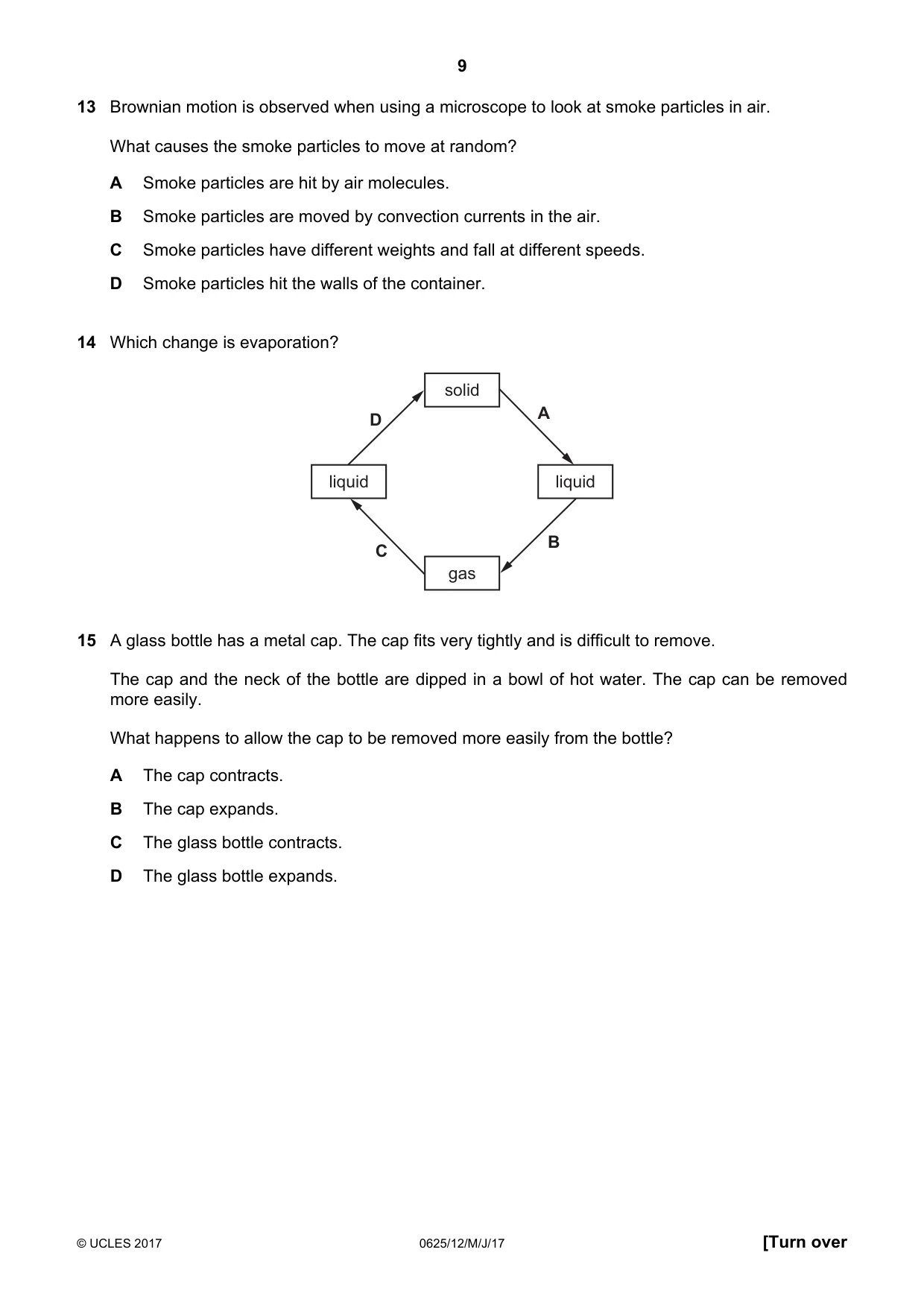
13 Brownian motion is observed when using a microscope to look at smoke particles in air. What causes the smoke particles to move at random? A Smoke particles are hit by air molecules. B Smoke particles are moved by convection currents in the air. C Smoke particles have different weights and fall at different speeds. D Smoke particles hit the walls of the container.
Mark scheme: A
Q14 · Which change is evaporation?
14 Which change is evaporation? solid D A liquid liquid B C gas
Mark scheme: B
Q15 · A glass bottle has a metal cap
15 A glass bottle has a metal cap. The cap fits very tightly and is difficult to remove. The cap and the neck of the bottle are dipped in a bowl of hot water. The cap can be removed more easily. What happens to allow the cap to be removed more easily from the bottle? A The cap contracts. B The cap expands. C The glass bottle contracts. D The glass bottle expands.
Mark scheme: B
Q16 · Equal masses of two different liquids are put into identical beakers
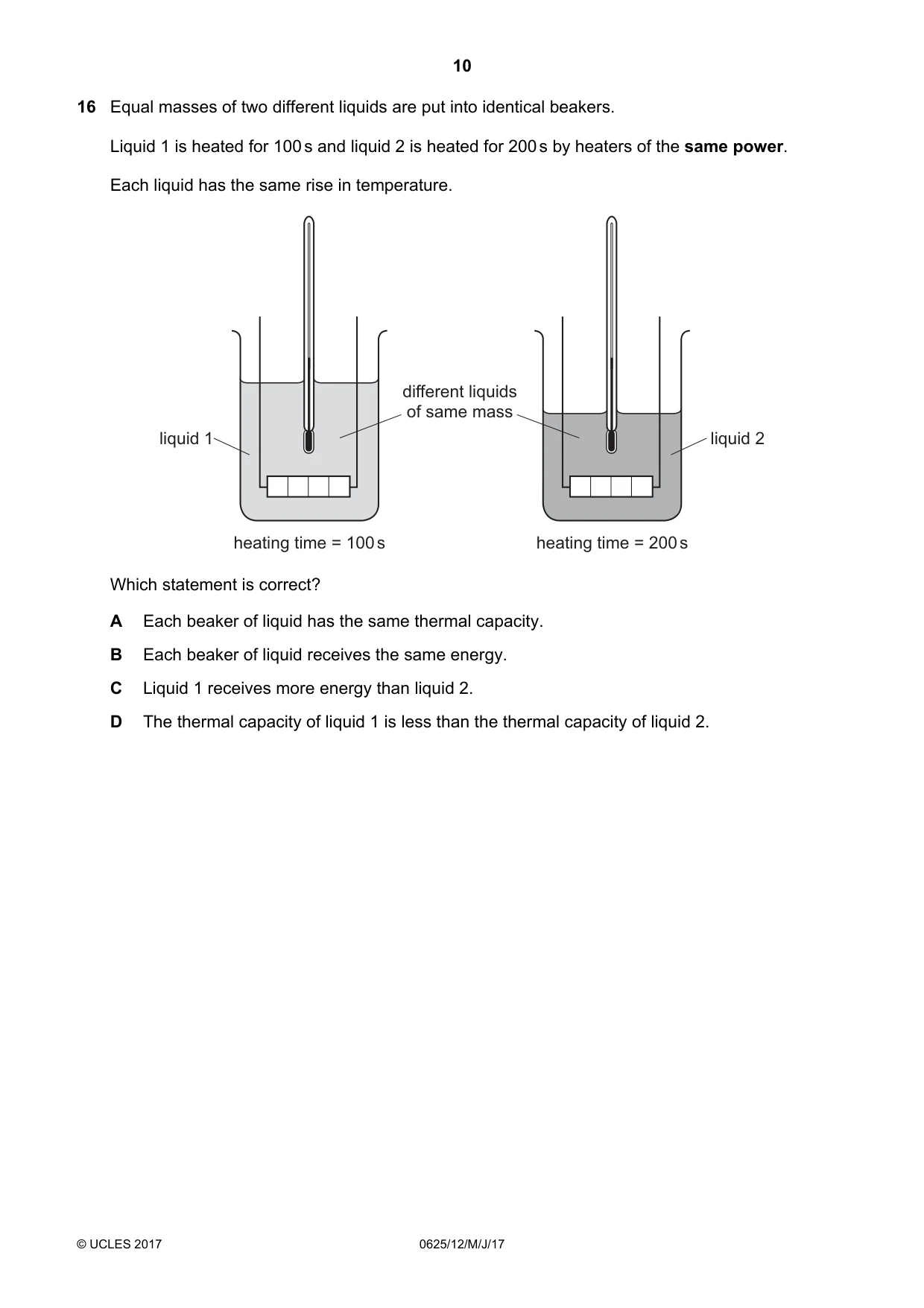
16 Equal masses of two different liquids are put into identical beakers. Liquid 1 is heated for 100 s and liquid 2 is heated for 200 s by heaters of the same power. Each liquid has the same rise in temperature. different liquids of same mass liquid 1 liquid 2 heating time = 100 s heating time = 200 s Which statement is correct? A Each beaker of liquid has the same thermal capacity. B Each beaker of liquid receives the same energy. C Liquid 1 receives more energy than liquid 2. D The thermal capacity of liquid 1 is less than the thermal capacity of liquid 2.
Mark scheme: D
Q17 · A copper bar and a wooden bar are joined
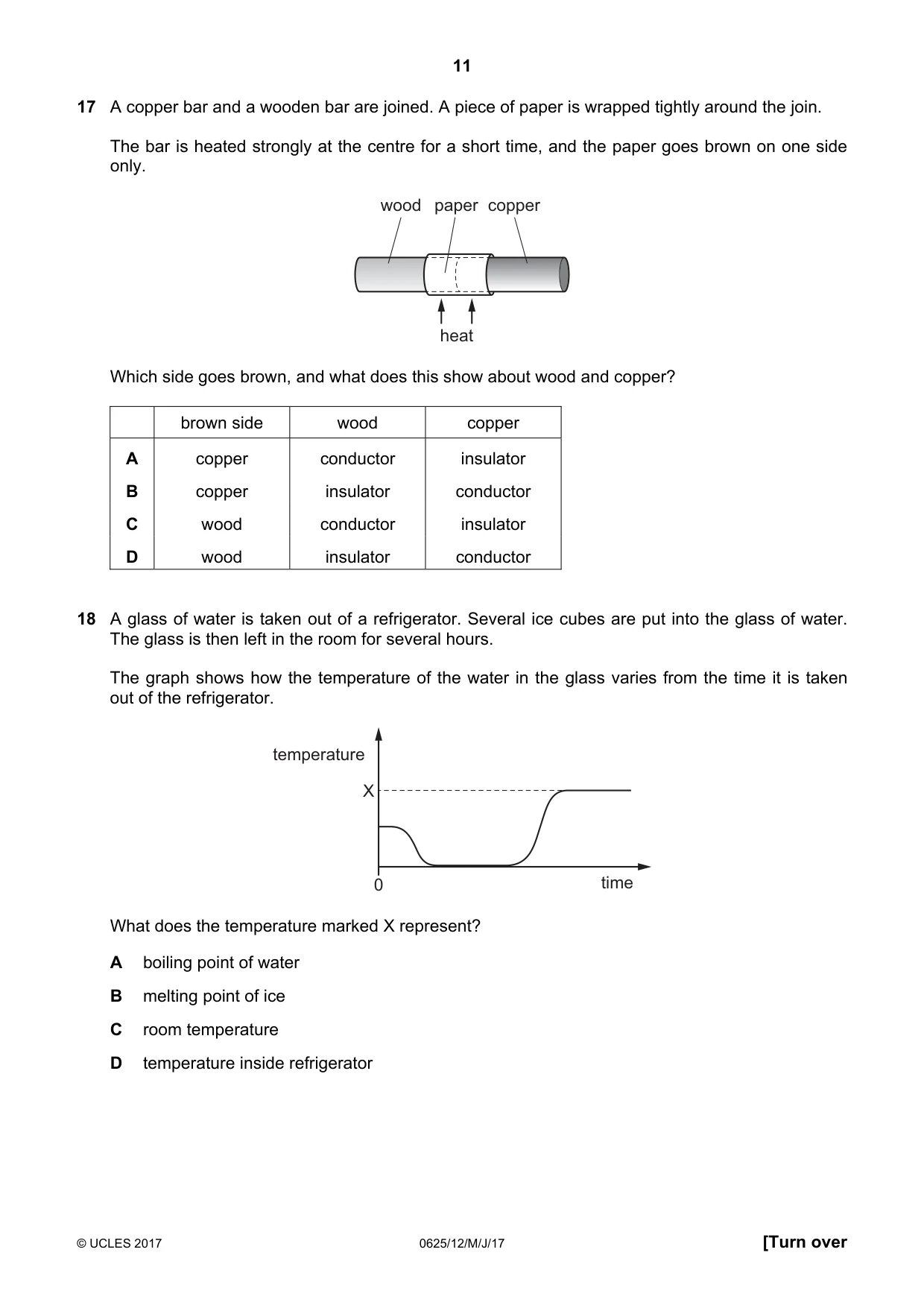
17 A copper bar and a wooden bar are joined. A piece of paper is wrapped tightly around the join. The bar is heated strongly at the centre for a short time, and the paper goes brown on one side only. wood paper copper heat Which side goes brown, and what does this show about wood and copper? brown side wood copper A copper conductor insulator B copper insulator conductor C wood conductor insulator D wood insulator conductor
Mark scheme: D
Q18 · A glass of water is taken out of a refrigerator
18 A glass of water is taken out of a refrigerator. Several ice cubes are put into the glass of water. The glass is then left in the room for several hours. The graph shows how the temperature of the water in the glass varies from the time it is taken out of the refrigerator. temperature X 0 time What does the temperature marked X represent? A boiling point of water B melting point of ice C room temperature D temperature inside refrigerator
Mark scheme: C
Q19 · A hollow aluminium cube is filled with very hot water
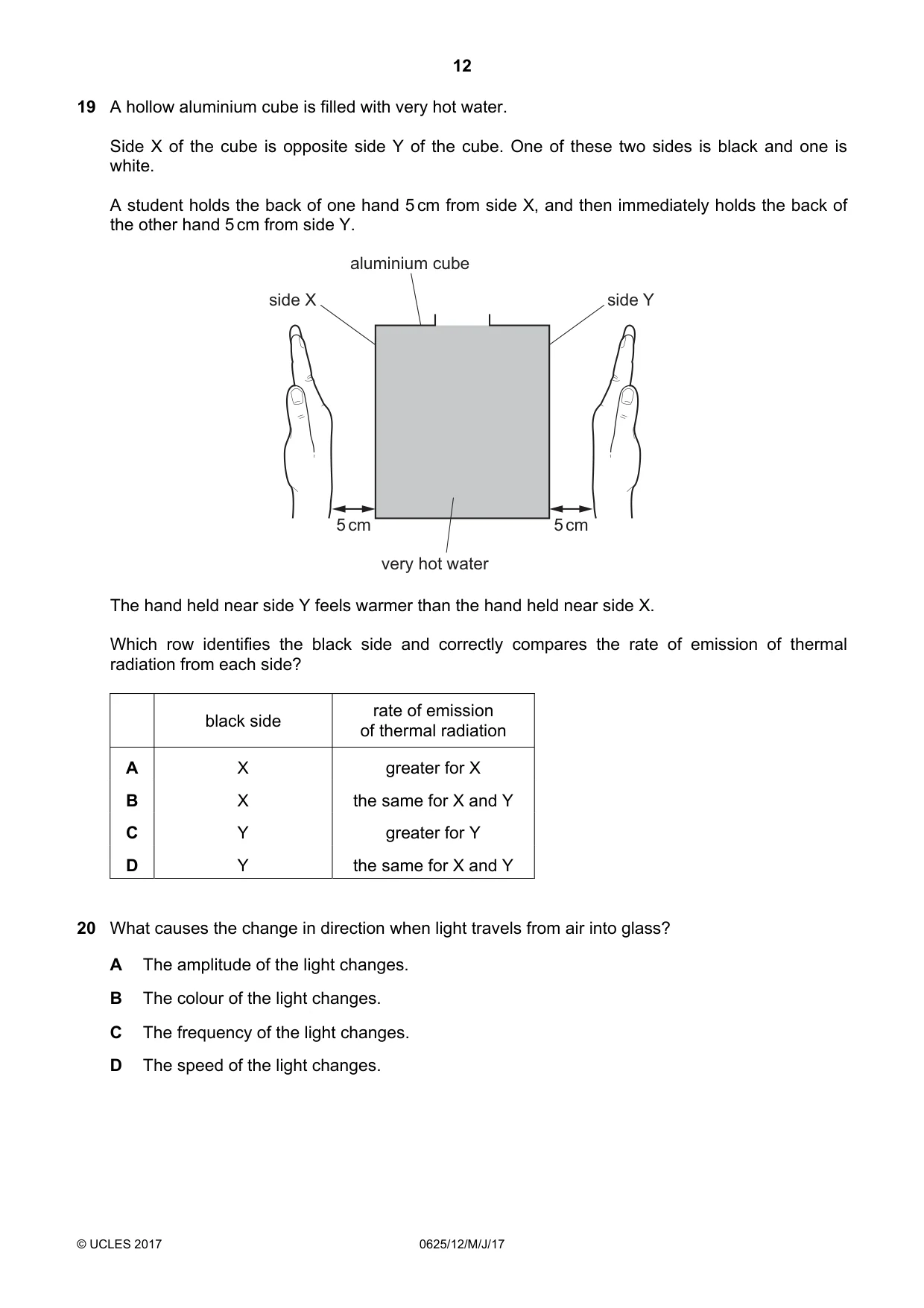
19 A hollow aluminium cube is filled with very hot water. Side X of the cube is opposite side Y of the cube. One of these two sides is black and one is white. A student holds the back of one hand 5 cm from side X, and then immediately holds the back of the other hand 5 cm from side Y. aluminium cube side X side Y 5 cm 5 cm very hot water The hand held near side Y feels warmer than the hand held near side X. Which row identifies the black side and correctly compares the rate of emission of thermal radiation from each side? rate of emission black side of thermal radiation A X greater for X B X the same for X and Y C Y greater for Y D Y the same for X and Y
Mark scheme: C
Q20 · What causes the change in direction when light travels from air into glass?
20 What causes the change in direction when light travels from air into glass? A The amplitude of the light changes. B The colour of the light changes. C The frequency of the light changes. D The speed of the light changes.
Mark scheme: D
Q21 · Light passes into a glass block
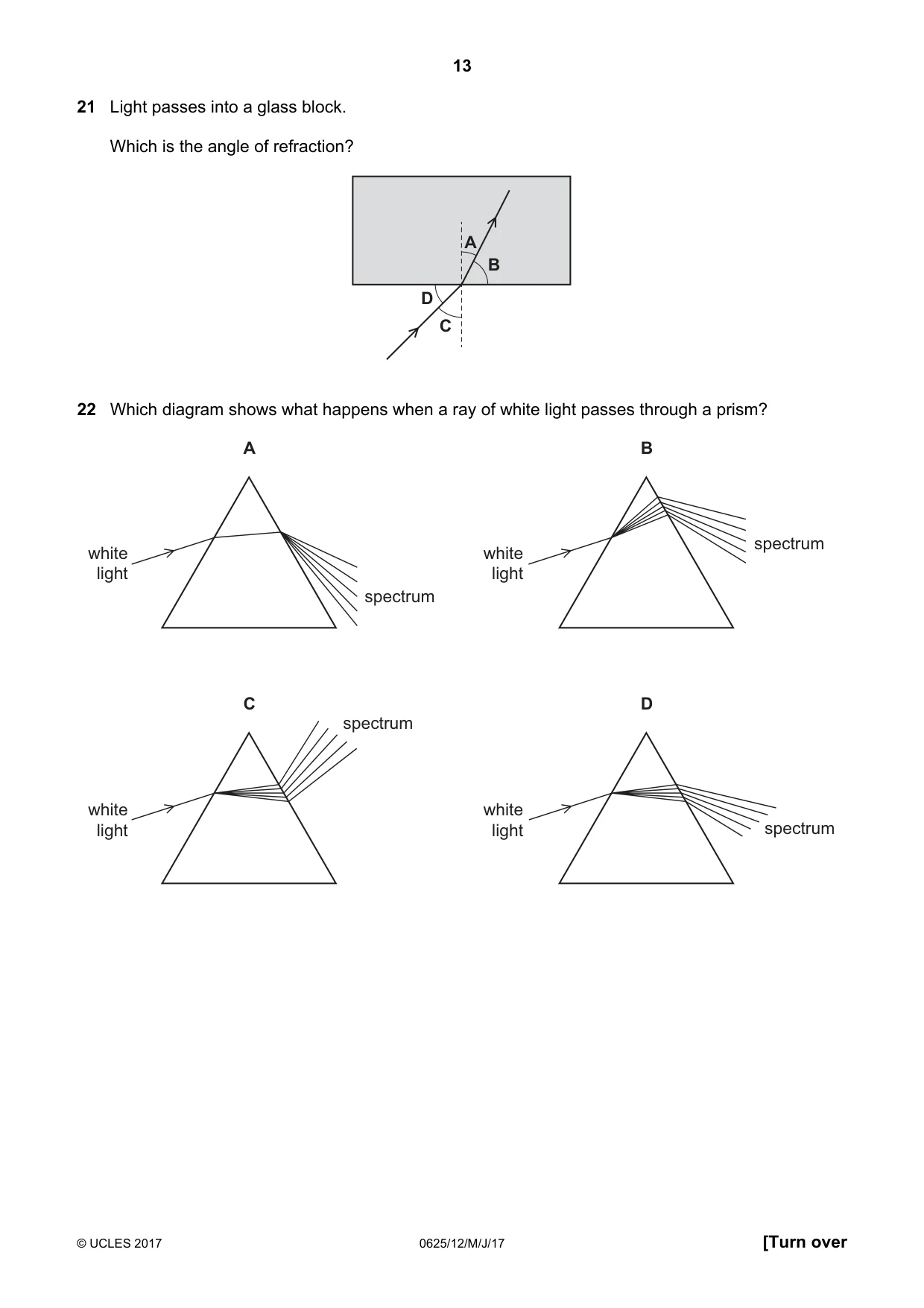
21 Light passes into a glass block. Which is the angle of refraction? A B D C
Mark scheme: A
Q22 · Which diagram shows what happens when a ray of white light passes through a prism?
22 Which diagram shows what happens when a ray of white light passes through a prism? A B spectrum white white light light spectrum C D spectrum white white light light spectrum
Mark scheme: D
Q23 · The diagrams show four sources of waves
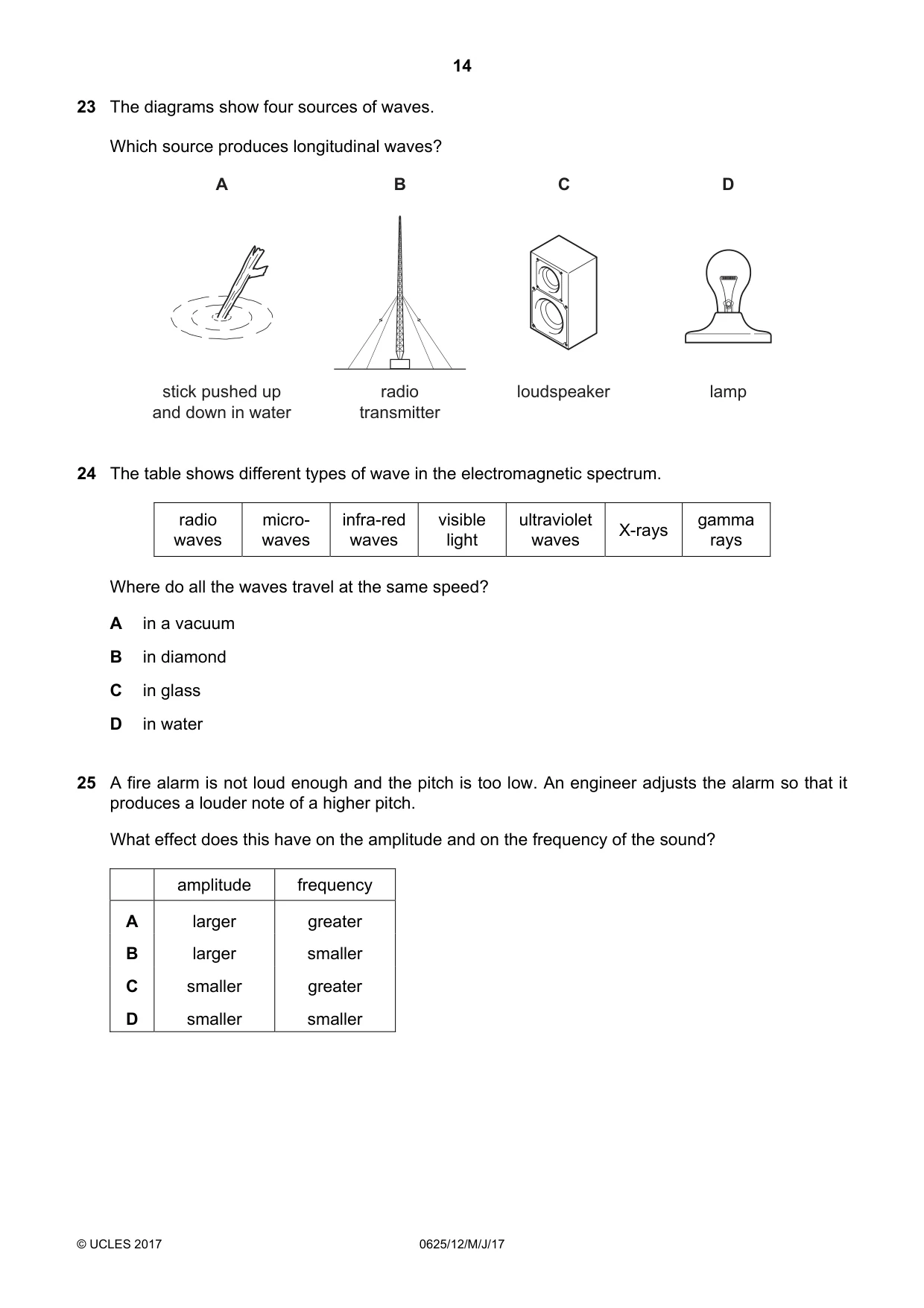
23 The diagrams show four sources of waves. Which source produces longitudinal waves? A B C D stick pushed up radio loudspeaker lamp and down in water transmitter
Mark scheme: C
Q24 · The table shows different types of wave in the electromagnetic spectrum
24 The table shows different types of wave in the electromagnetic spectrum. radio micro- infra-red visible ultraviolet gamma X-rays waves waves waves light waves rays Where do all the waves travel at the same speed? A in a vacuum B in diamond C in glass D in water
Mark scheme: A
Q25 · A fire alarm is not loud enough and the pitch is too low
25 A fire alarm is not loud enough and the pitch is too low. An engineer adjusts the alarm so that it produces a louder note of a higher pitch. What effect does this have on the amplitude and on the frequency of the sound? amplitude frequency A larger greater B larger smaller C smaller greater D smaller smaller
Mark scheme: A
Q26 · What is wrong with this labelled diagram of a permanent magnet?
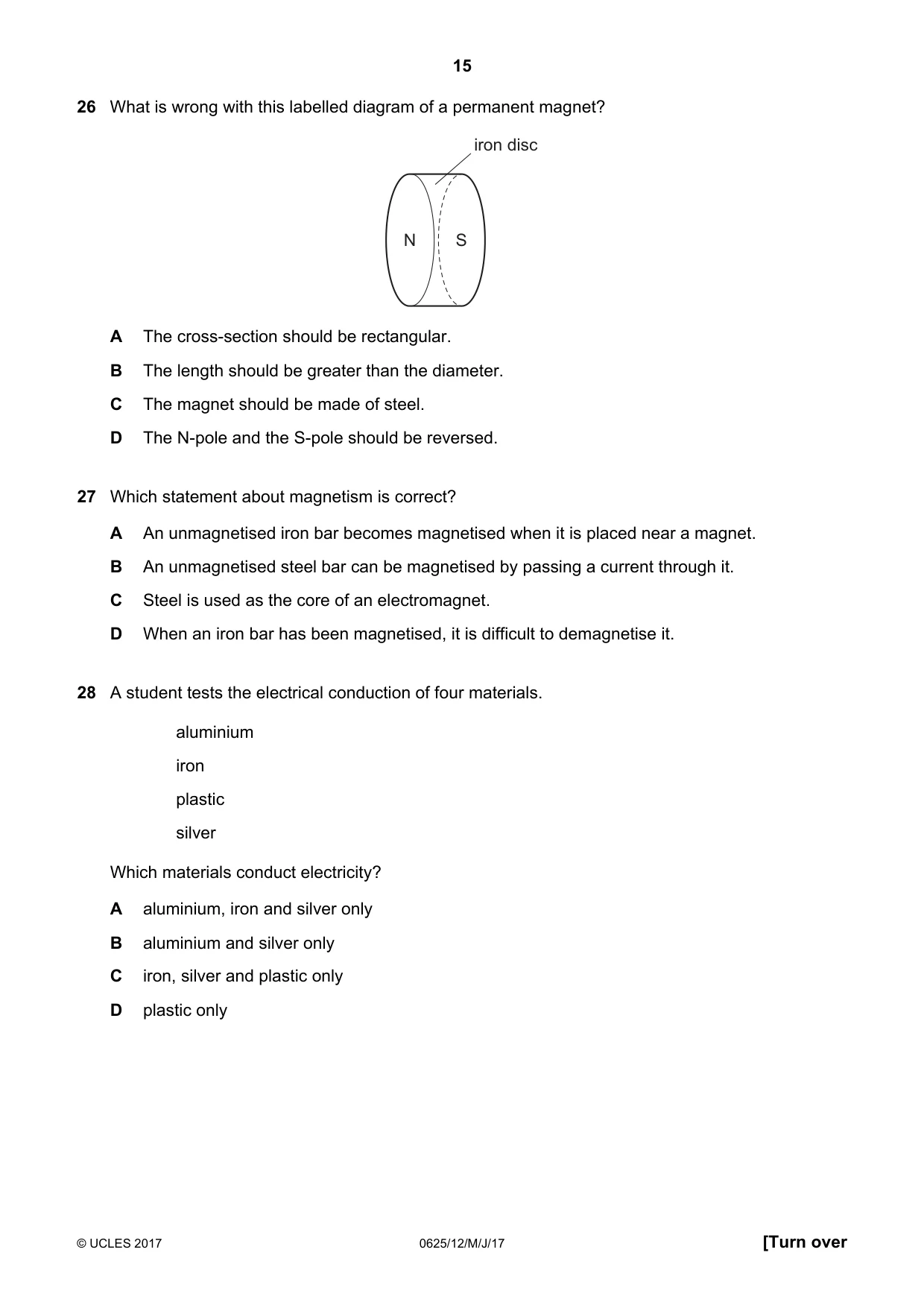
26 What is wrong with this labelled diagram of a permanent magnet? iron disc N S A The cross-section should be rectangular. B The length should be greater than the diameter. C The magnet should be made of steel. D The N-pole and the S-pole should be reversed.
Mark scheme: C
Q27 · Which statement about magnetism is correct?
27 Which statement about magnetism is correct? A An unmagnetised iron bar becomes magnetised when it is placed near a magnet. B An unmagnetised steel bar can be magnetised by passing a current through it. C Steel is used as the core of an electromagnet. D When an iron bar has been magnetised, it is difficult to demagnetise it.
Mark scheme: A
Q28 · A student tests the electrical conduction of four materials
28 A student tests the electrical conduction of four materials. aluminium iron plastic silver Which materials conduct electricity? A aluminium, iron and silver only B aluminium and silver only C iron, silver and plastic only D plastic only
Mark scheme: A
Q29 · The circuit diagram shows three resistors connected in series across a 6.0 V supply
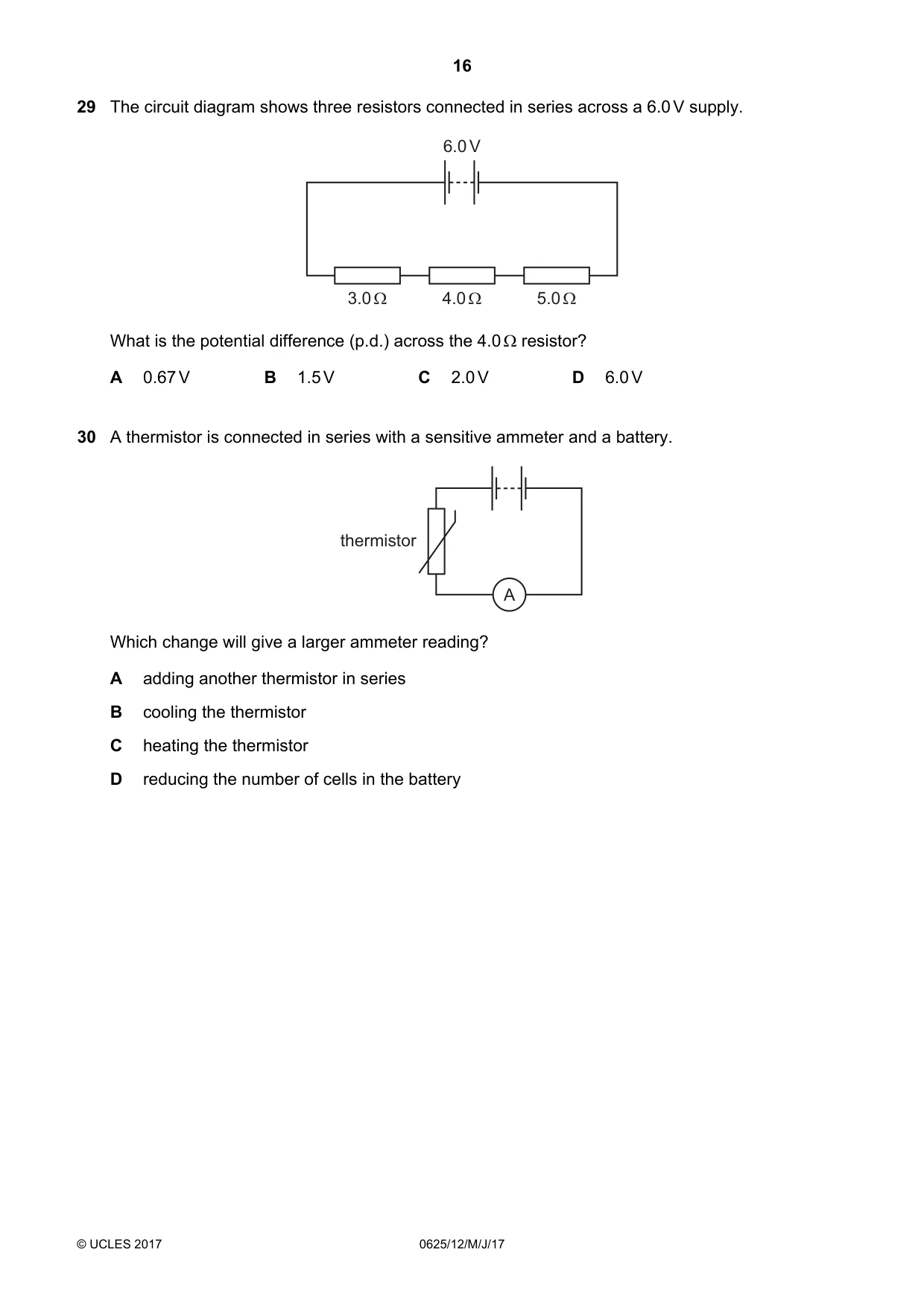
29 The circuit diagram shows three resistors connected in series across a 6.0 V supply. 6.0 V 3.0 Ω 4.0 Ω 5.0 Ω What is the potential difference (p.d.) across the 4.0 Ω resistor? A 0.67 V B 1.5 V C 2.0 V D 6.0 V
Mark scheme: C
Q30 · A thermistor is connected in series with a sensitive ammeter and a battery
30 A thermistor is connected in series with a sensitive ammeter and a battery. thermistor A Which change will give a larger ammeter reading? A adding another thermistor in series B cooling the thermistor C heating the thermistor D reducing the number of cells in the battery
Mark scheme: C
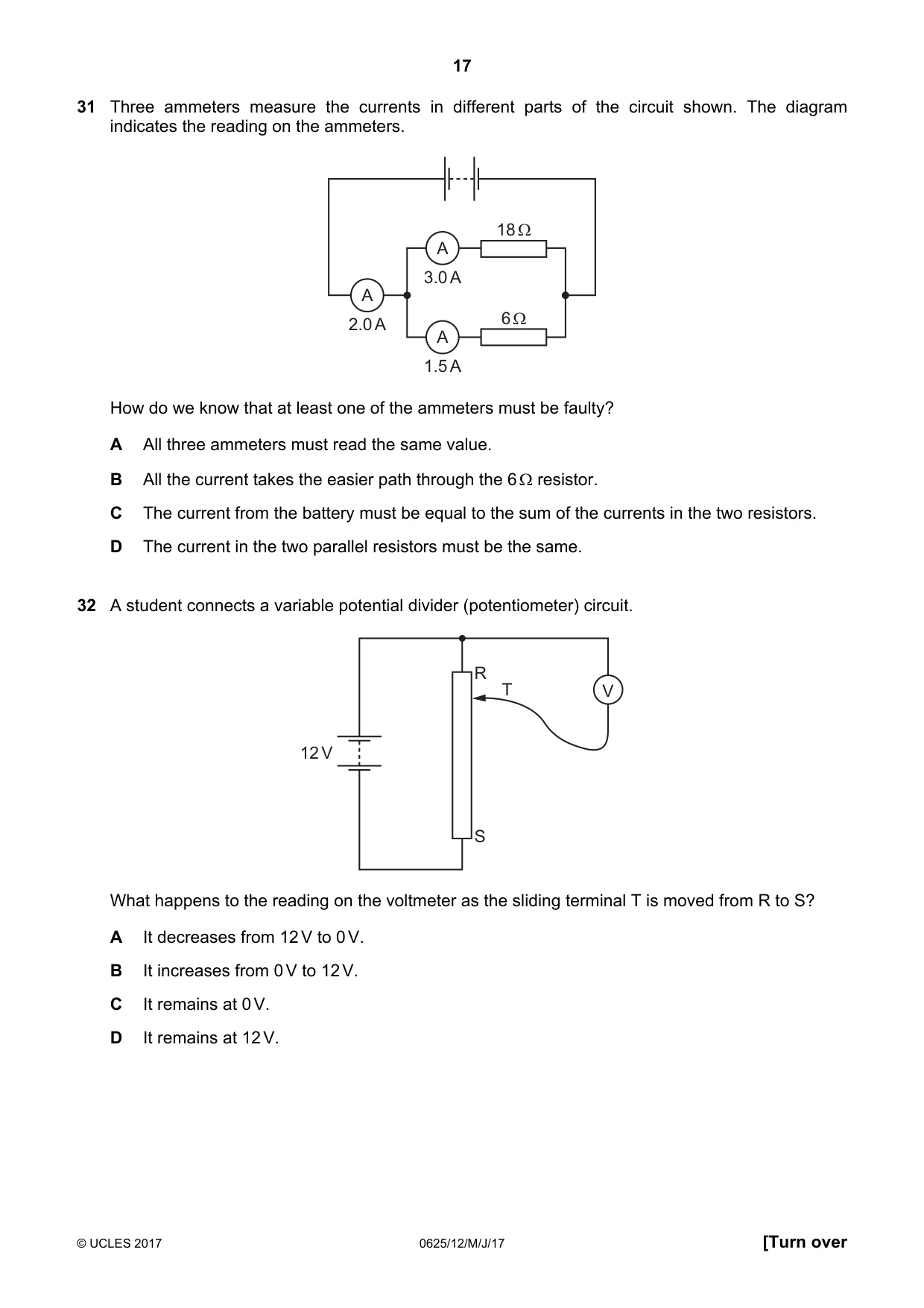
Q31 · Three ammeters measure the currents in different parts of the circuit shown
31 Three ammeters measure the currents in different parts of the circuit shown. The diagram indicates the reading on the ammeters. 18 Ω A 3.0 A A 2.0 A 6 Ω A 1.5 A How do we know that at least one of the ammeters must be faulty? A All three ammeters must read the same value. B All the current takes the easier path through the 6 Ω resistor. C The current from the battery must be equal to the sum of the currents in the two resistors. D The current in the two parallel resistors must be the same.
Mark scheme: C
Q32 · A student connects a variable potential divider (potentiometer) circuit
32 A student connects a variable potential divider (potentiometer) circuit. R T V 12 V S What happens to the reading on the voltmeter as the sliding terminal T is moved from R to S? A It decreases from 12 V to 0 V. B It increases from 0 V to 12 V. C It remains at 0 V. D It remains at 12 V.
Mark scheme: B
Q33 · The diagram shows an electric circuit
33 The diagram shows an electric circuit. 20 Ω 0.40 A 10 Ω What is the potential difference (p.d.) across the LDR? A 4.0 V B 8.0 V C 25 V D 50 V
Mark scheme: B
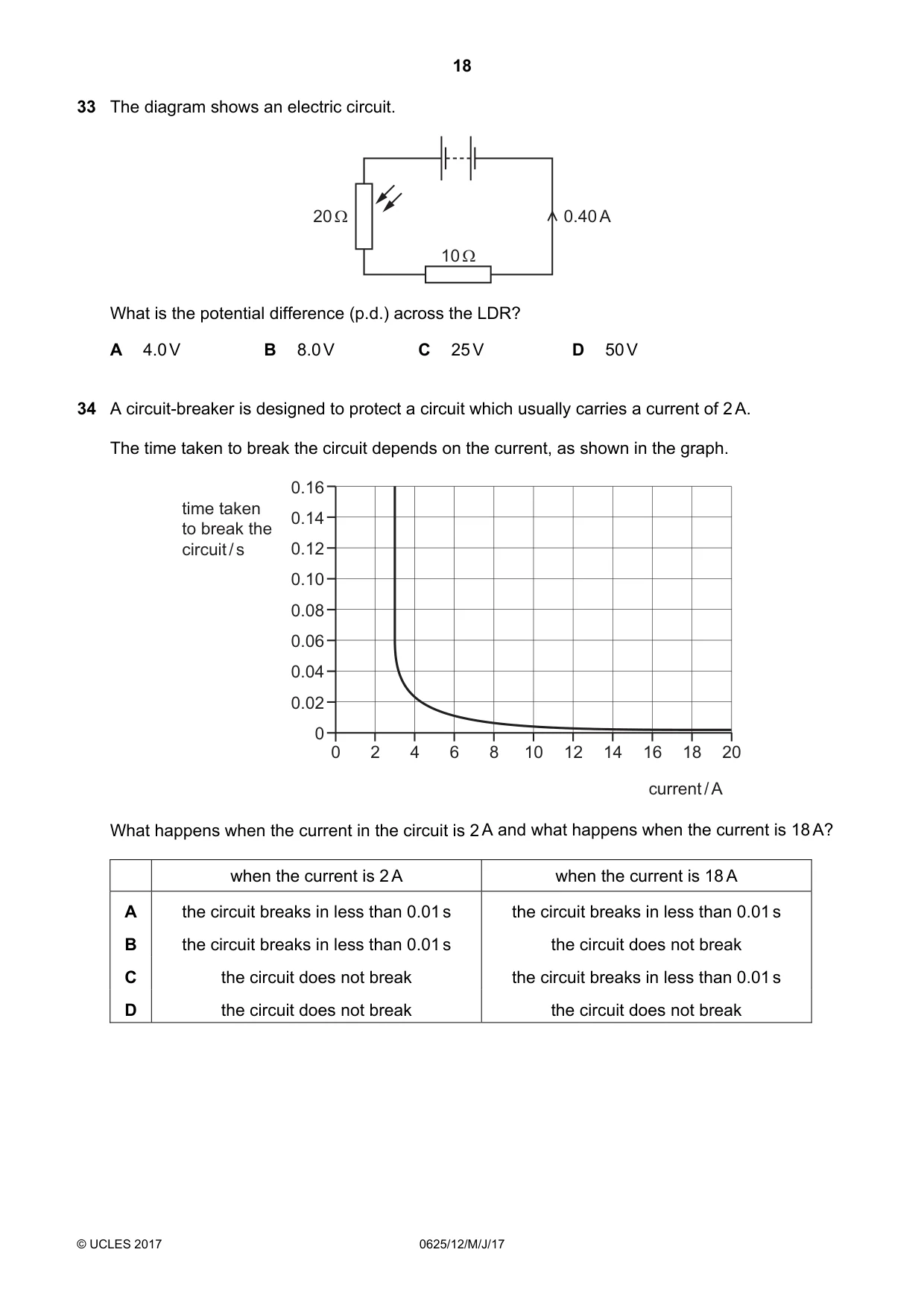
Q34 · A circuit-breaker is designed to protect a circuit which usually carries a current of 2 A
34 A circuit-breaker is designed to protect a circuit which usually carries a current of 2 A. The time taken to break the circuit depends on the current, as shown in the graph. 0.16 time taken 0.14 to break the circuit / s 0.12 0.10 0.08 0.06 0.04 0.02 0 0 2 4 6 8 10 12 14 16 18 20 current / A What happens when the current in the circuit is 2 A and what happens when the current is 18 A? when the current is 2 A when the current is 18 A A the circuit breaks in less than 0.01 s the circuit breaks in less than 0.01 s B the circuit breaks in less than 0.01 s the circuit does not break C the circuit does not break the circuit breaks in less than 0.01 s D the circuit does not break the circuit does not break
Mark scheme: C
Q35 · What is the purpose of a relay?
35 What is the purpose of a relay? A to change a large voltage into a small voltage B to change a small voltage into a large voltage C to use a large current to switch on a small current D to use a small current to switch on a large current
Mark scheme: D
Q36 · A coil of four loops of wire is placed in a magnetic field
36 A coil of four loops of wire is placed in a magnetic field. When there is a current, the coil experiences a turning effect. Some extra loops of wire are wound on the coil but the current is unchanged. How does this affect the turning effect? A It is unchanged. B Its direction changes. C It decreases. D It increases.
Mark scheme: D
Q37 · Which particle has a negative charge?
37 Which particle has a negative charge? A an alpha particle B an electron C a neutron D a proton
Mark scheme: B
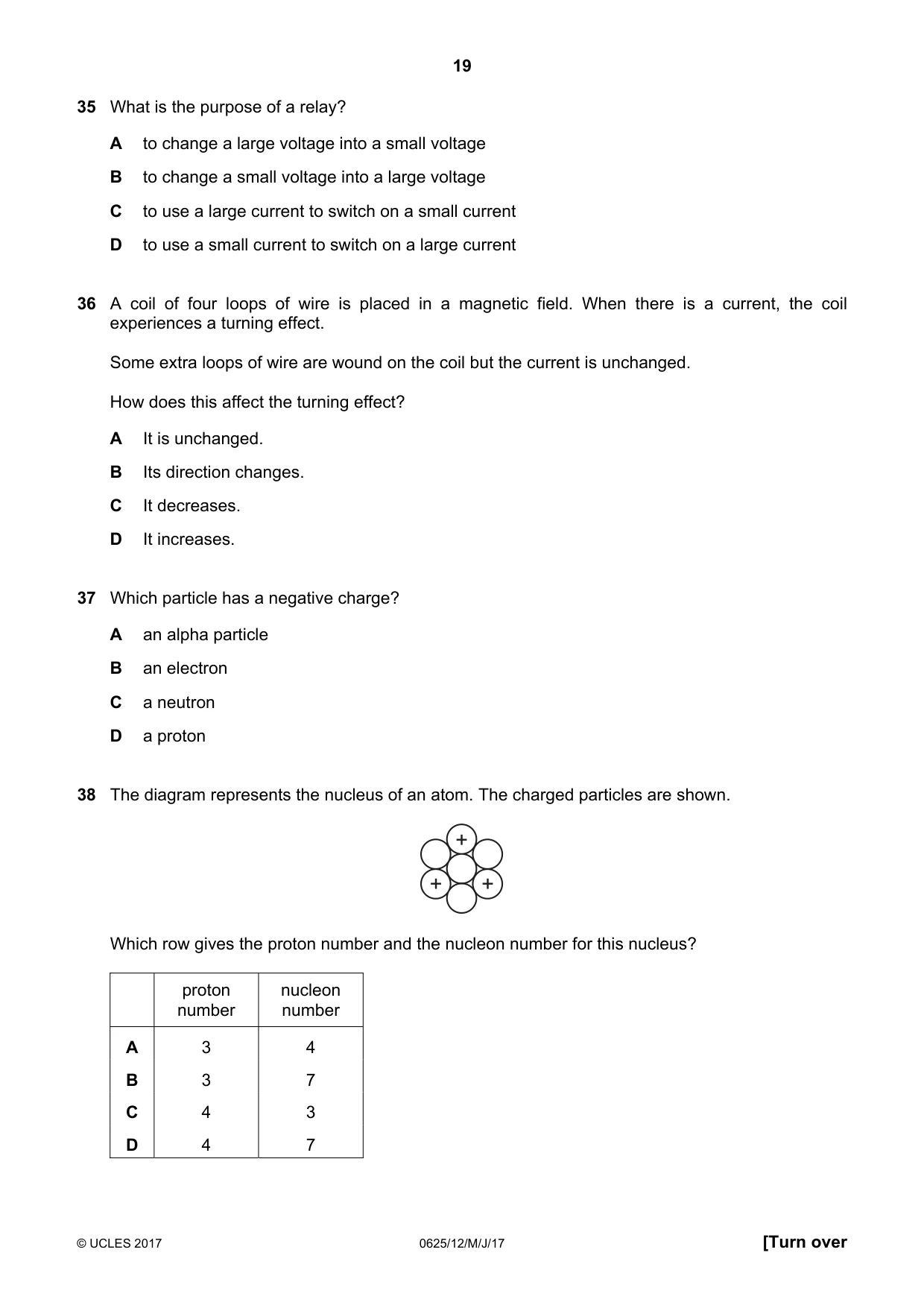
Q38 · The diagram represents the nucleus of an atom
38 The diagram represents the nucleus of an atom. The charged particles are shown. + + + Which row gives the proton number and the nucleon number for this nucleus? proton nucleon number number A 3 4 B 3 7 C 4 3 D 4 7
Mark scheme: B
Q39 · A sample of radioactive isotope is decaying
39 A sample of radioactive isotope is decaying. The nuclei of which atoms will decay first? A It is impossible to know because radioactive decay is random. B It is impossible to know unless the age of the material is known. C The atoms near the centre will decay first because they are surrounded by more atoms. D The atoms near the surface will decay first because the radiation can escape more easily.
Mark scheme: A
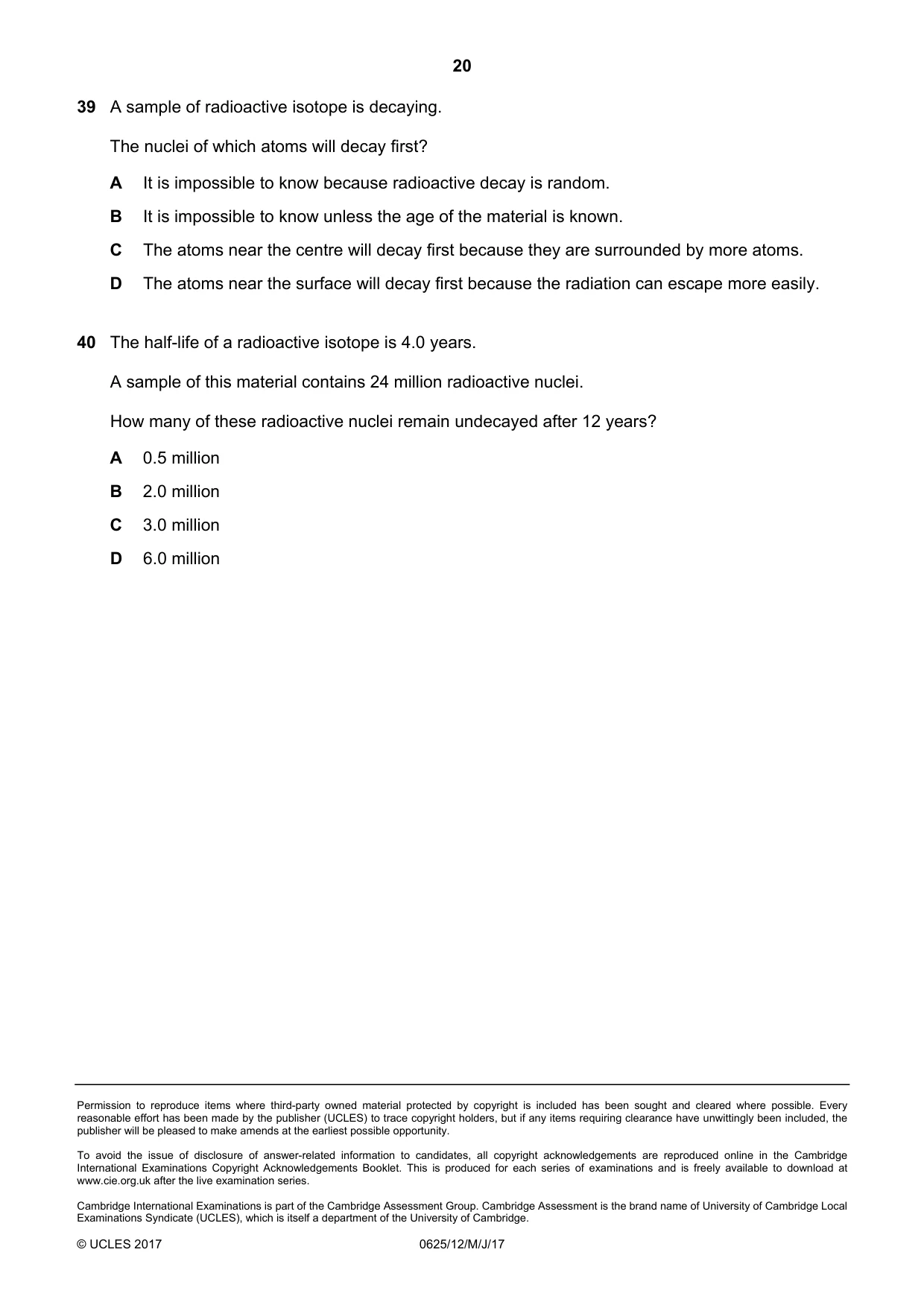
Q40 · The half-life of a radioactive isotope is 4.0 years
40 The half-life of a radioactive isotope is 4.0 years. A sample of this material contains 24 million radioactive nuclei. How many of these radioactive nuclei remain undecayed after 12 years? A 0.5 million B 2.0 million C 3.0 million D 6.0 million
Mark scheme: C
What was in this paper
The subtopics covered by these 40 questions, and how many questions each got. Open one in a new tab to see every Cambridge question on it.
5Light3Thermal properties and temperature3Electromagnetic effects2Energy, work and power2Forces2Kinetic particle model of matter2Mass and weight2Motion2Pressure2Radioactivity2Simple phenomena of magnetism2The nuclear model of the atom2Transfer of thermal energy2Density1Electrical quantities1Electrical safety1Electromagnetic spectrum1General properties of waves1Physical quantities and measurement techniques1Sound1What you needed in this session
Cambridge’s own grade thresholds for 2017 May/June, Paper 1 · Variant 2. A higher threshold means an easier paper — the bar moves with how the cohort did.