Cambridge IGCSE Physics 0625 — 2022 Oct/Nov Paper 1 · Variant 3
0625/13/O/N/22 · 40 questions · 40 marks · ≈45 min
The question paper and its mark scheme, free to read here and free to download. This is Cambridge’s own paper, exactly as it was sat.
Question paper20 pages
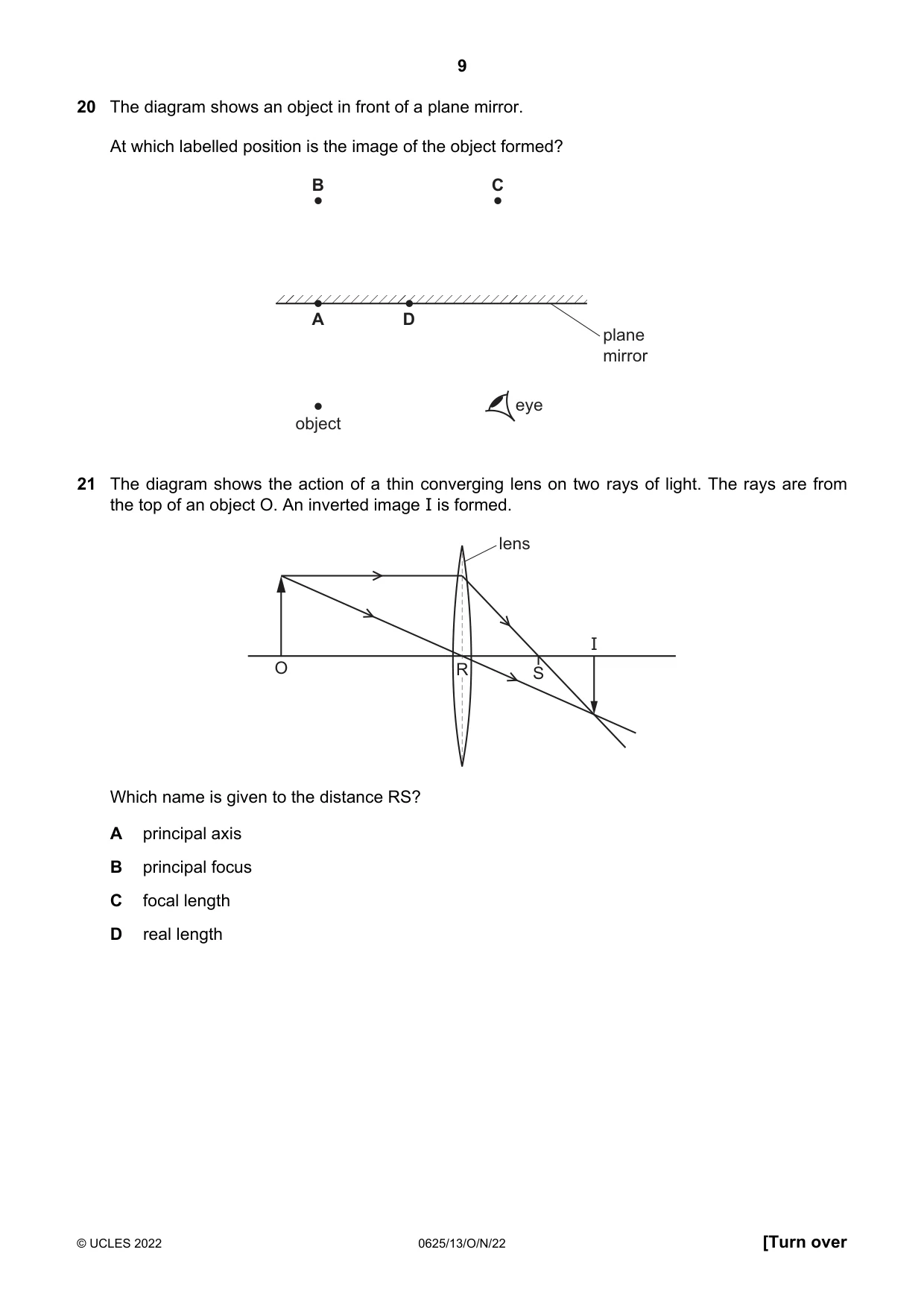
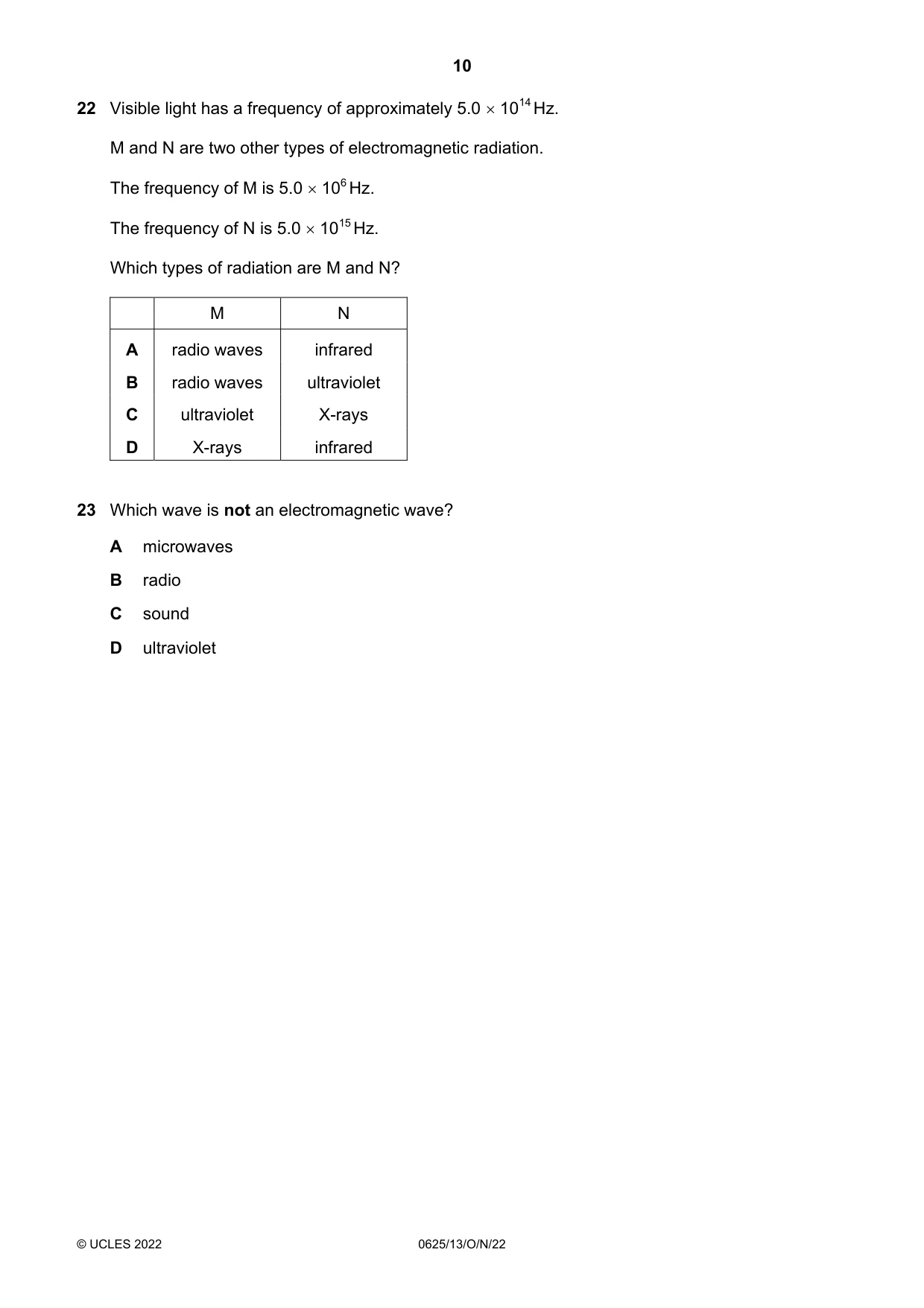
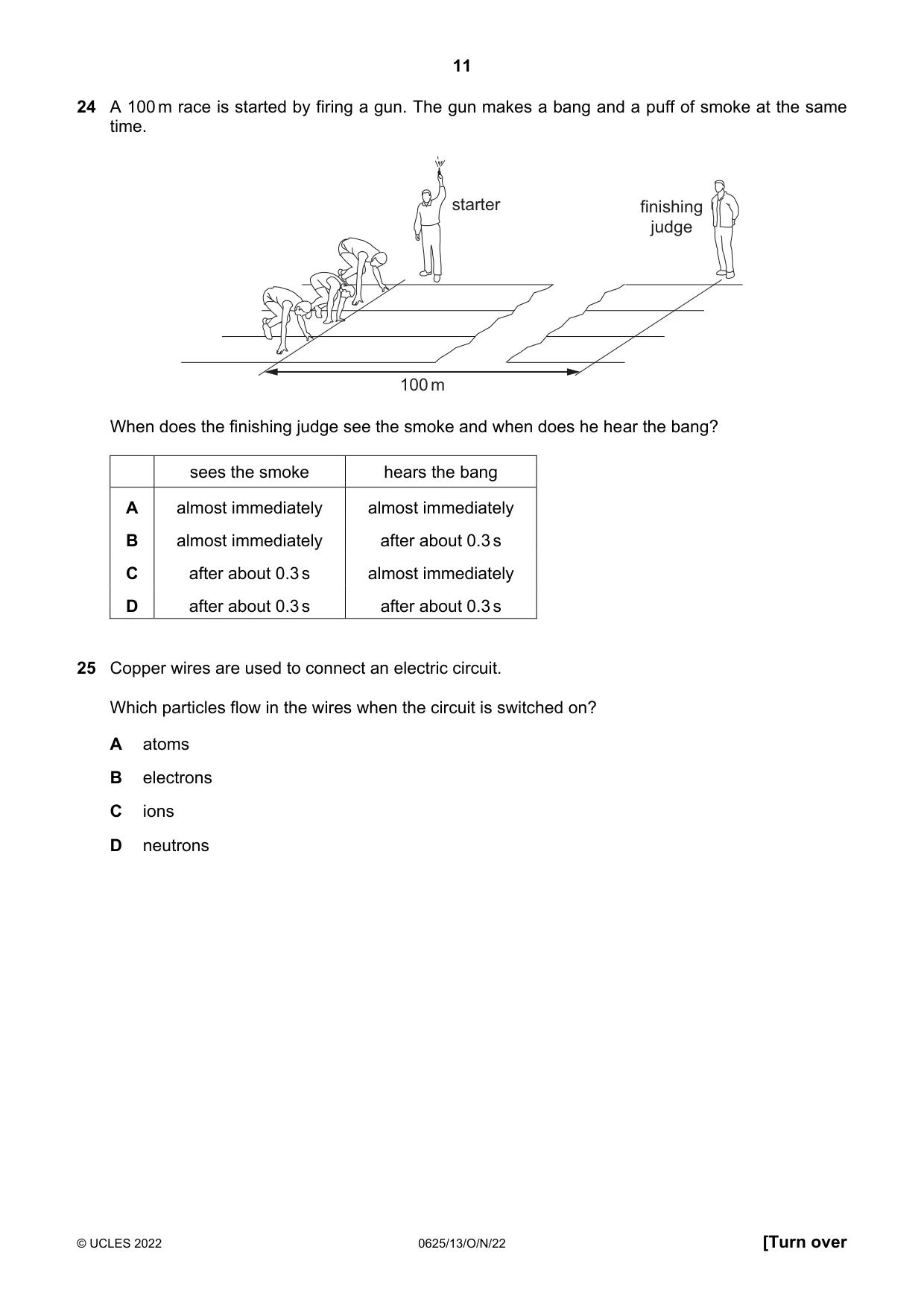
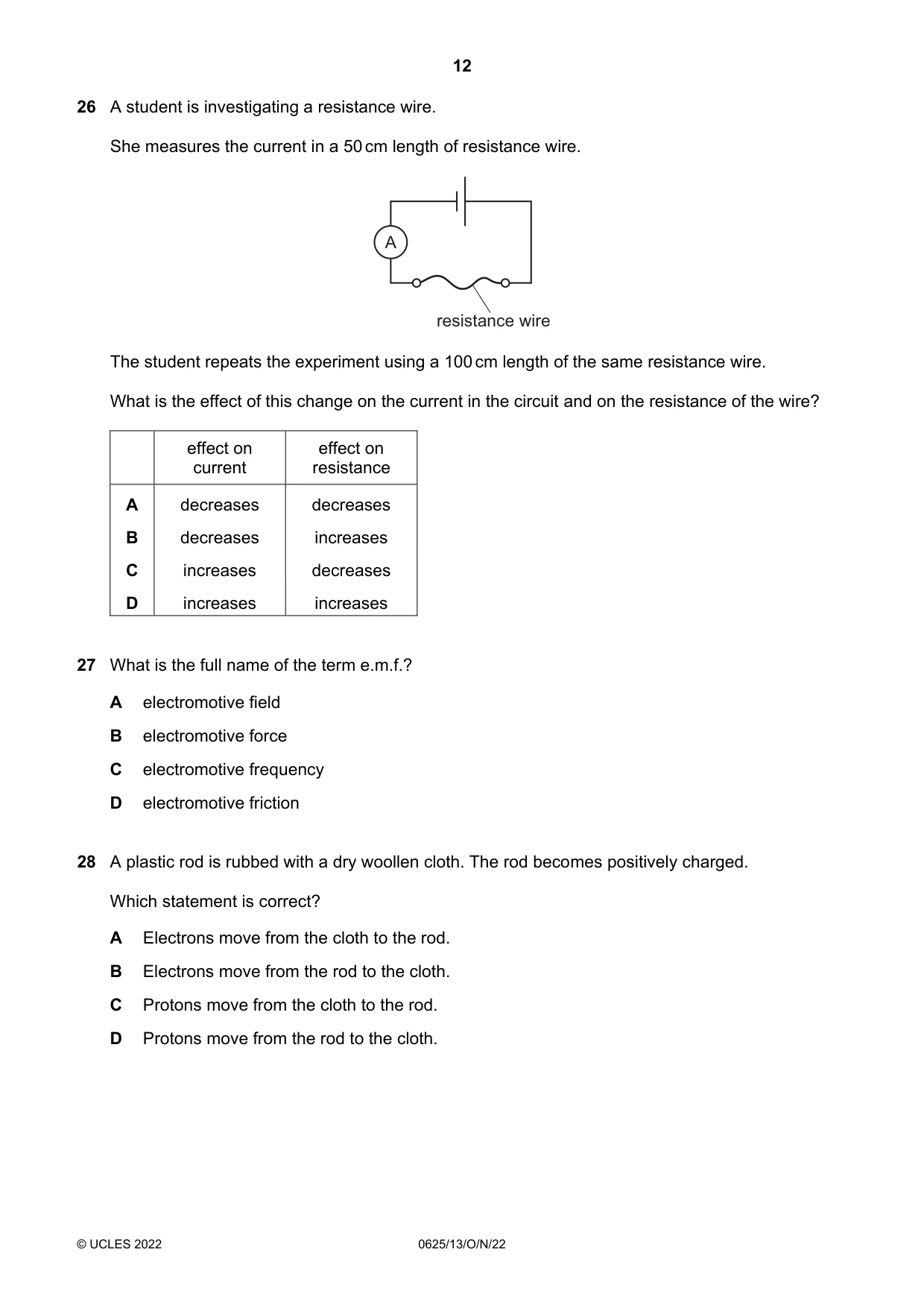


Mark scheme3 pages
Answers below. Sit the paper first if you are practising.
Questions as text
Q1 · A student uses a ruler to measure the length of a spring
1 A student uses a ruler to measure the length of a spring. His results are shown. 14.9 cm 14.8 cm 14.8 cm 14.7 cm What is the average length of the spring to three significant figures? A 14.8 cm B 14.9 cm C 15.0 cm D 15 cm
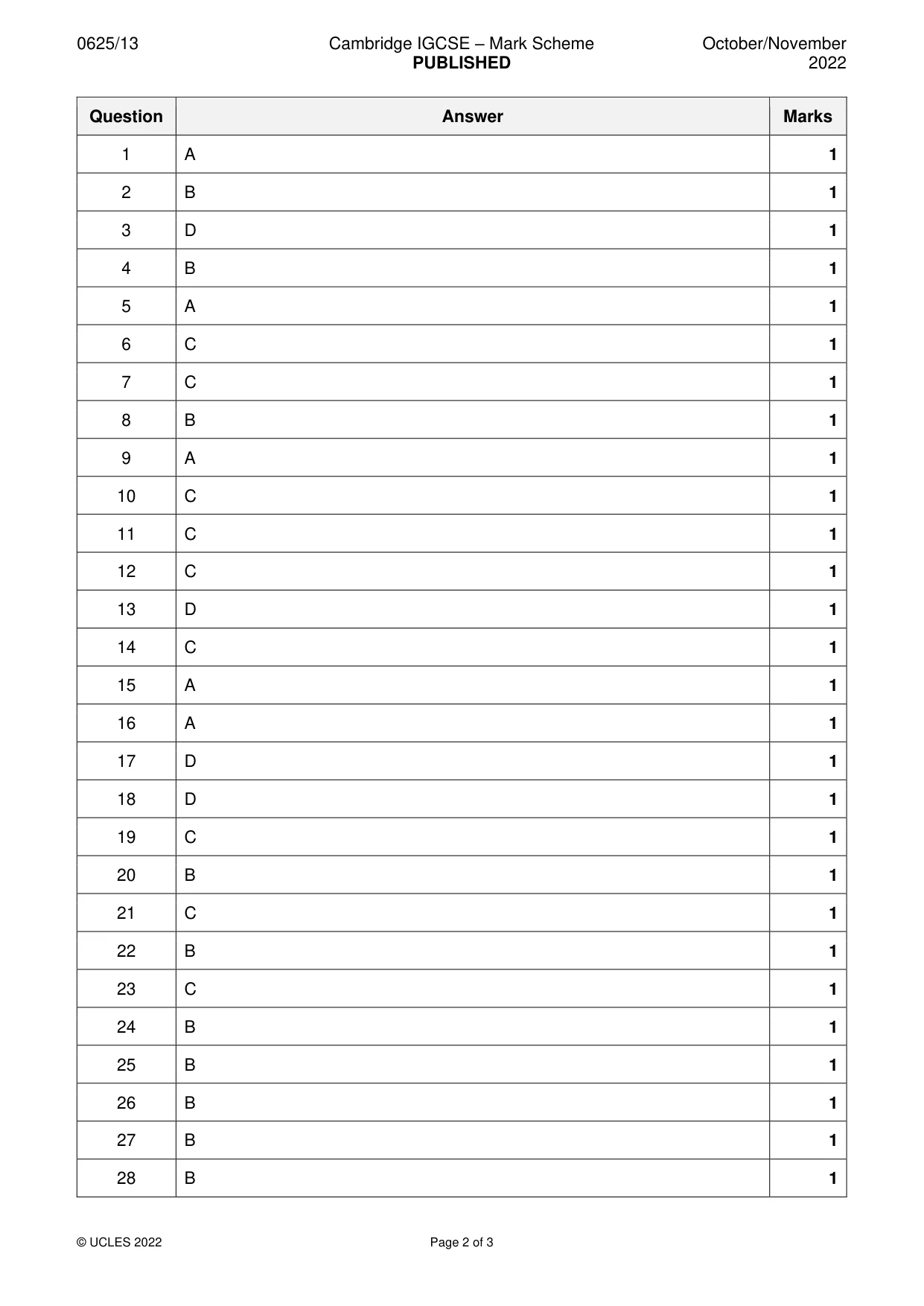
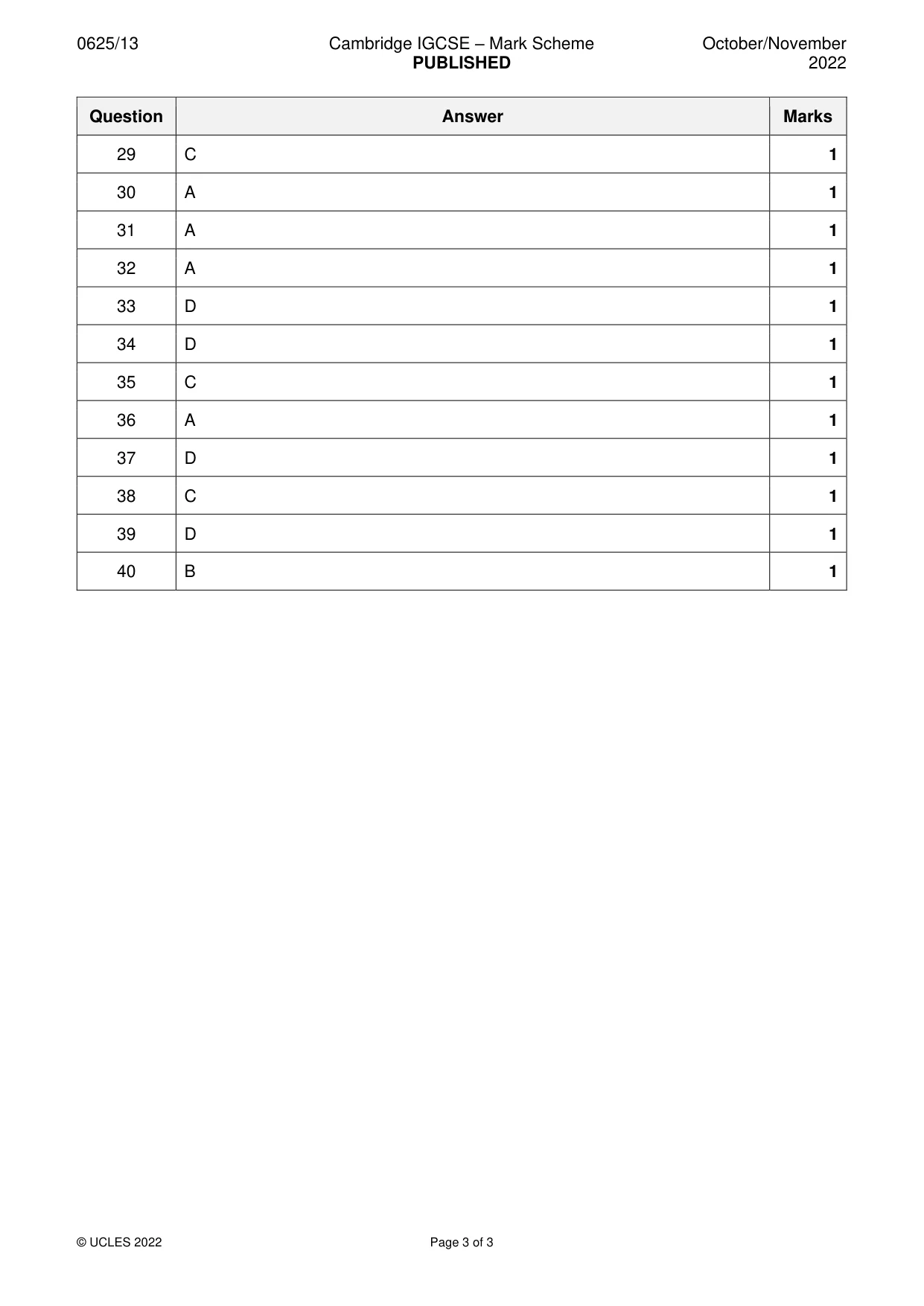
Mark scheme: A
More questions on Physical quantities and measurement techniques
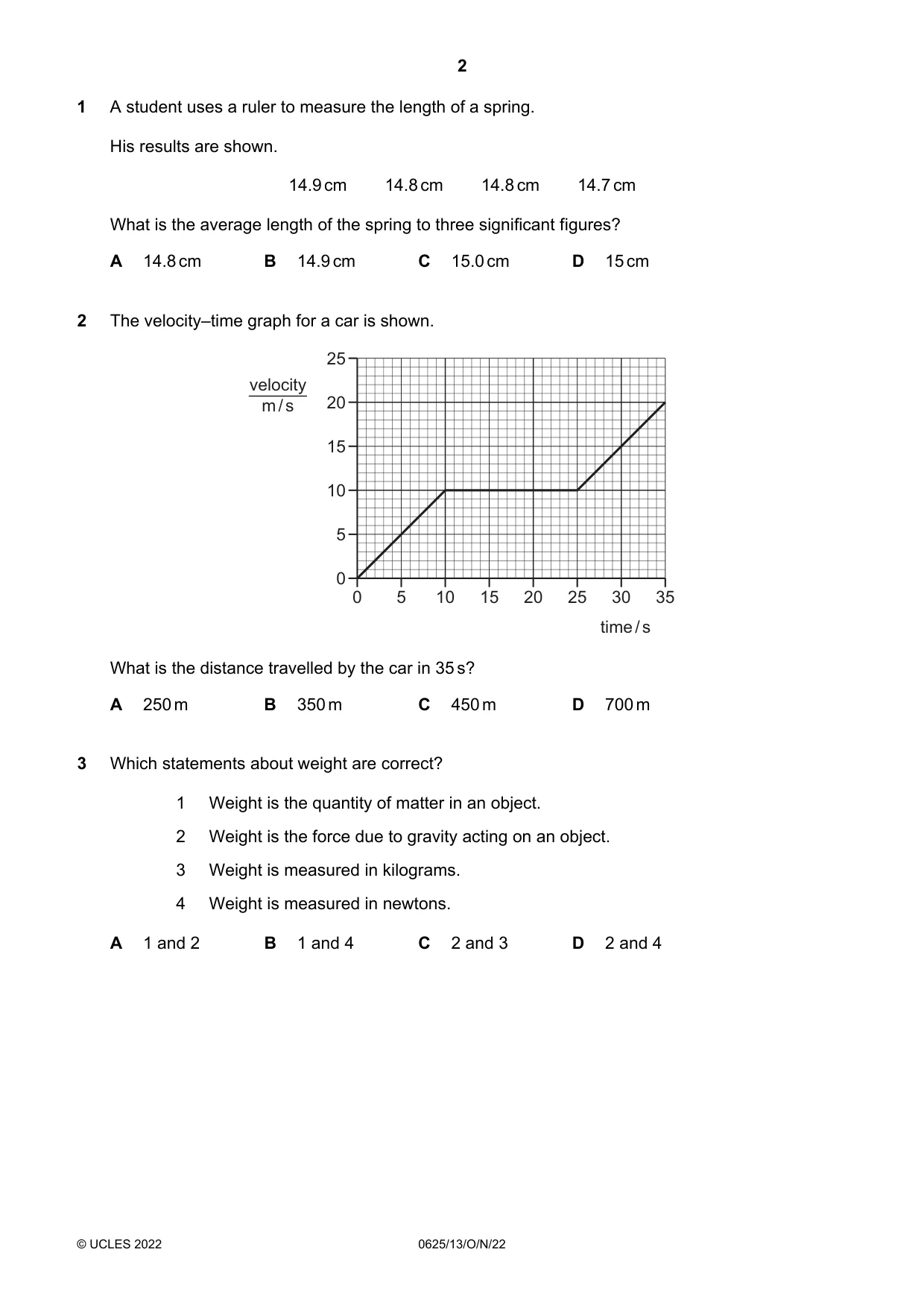
Q2 · The velocity–time graph for a car is shown
2 The velocity–time graph for a car is shown. 25 velocity m / s 20 15 10 5 0 0 5 10 15 20 25 30 35 time / s What is the distance travelled by the car in 35 s? A 250 m B 350 m C 450 m D 700 m
Mark scheme: B
Q3 · Which statements about weight are correct?
3 Which statements about weight are correct? 1 Weight is the quantity of matter in an object. 2 Weight is the force due to gravity acting on an object. 3 Weight is measured in kilograms. 4 Weight is measured in newtons. A 1 and 2 B 1 and 4 C 2 and 3 D 2 and 4
Mark scheme: D
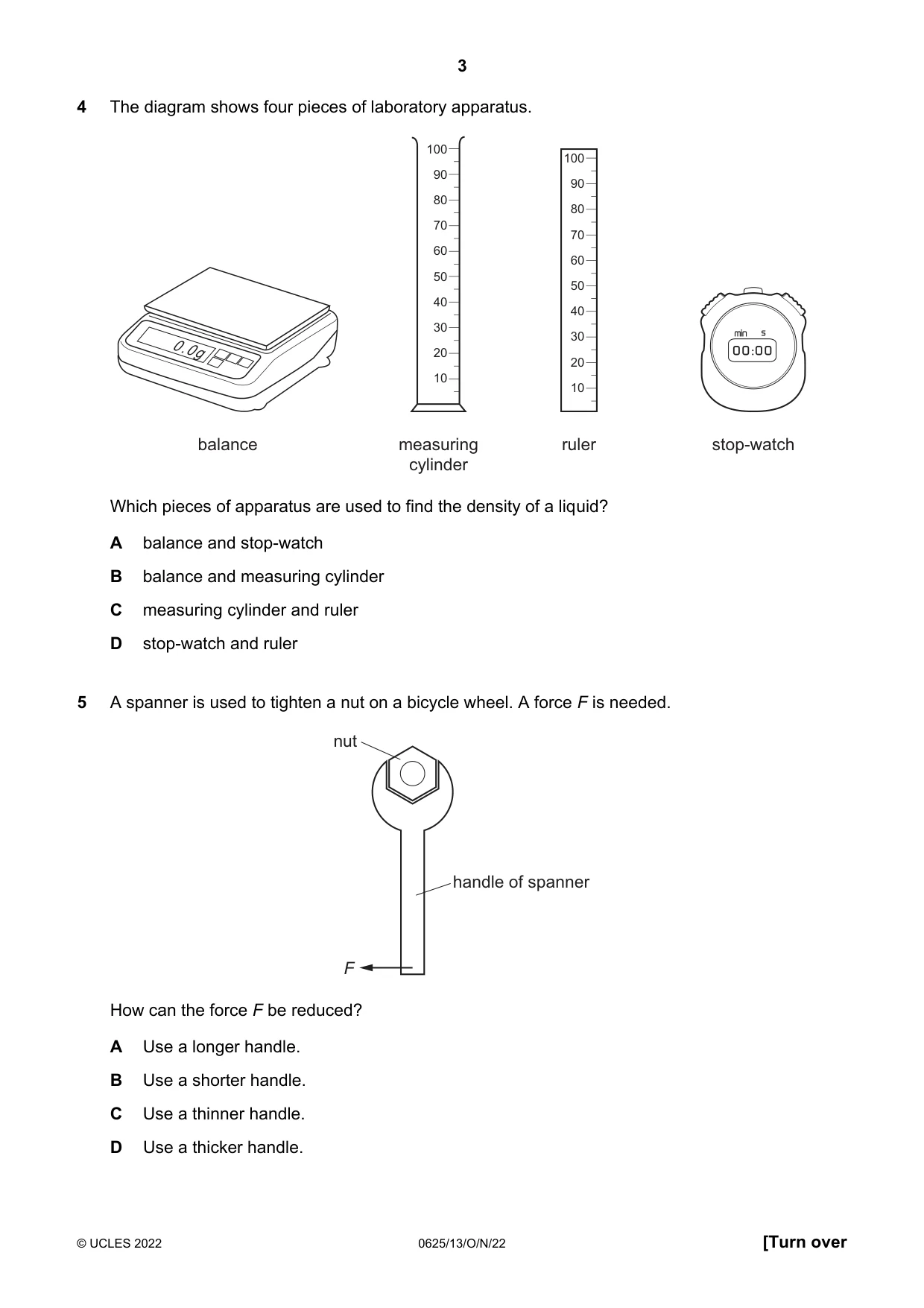
Q4 · The diagram shows four pieces of laboratory apparatus
4 The diagram shows four pieces of laboratory apparatus. 100 100 90 90 80 80 70 70 60 60 50 50 40 40 30 0.0g 30 20 20 10 10 balance measuring ruler stop-watch cylinder Which pieces of apparatus are used to find the density of a liquid? A balance and stop-watch B balance and measuring cylinder C measuring cylinder and ruler D stop-watch and ruler
Mark scheme: B
Q5 · A spanner is used to tighten a nut on a bicycle wheel
5 A spanner is used to tighten a nut on a bicycle wheel. A force F is needed. nut handle of spanner F How can the force F be reduced? A Use a longer handle. B Use a shorter handle. C Use a thinner handle. D Use a thicker handle.
Mark scheme: A
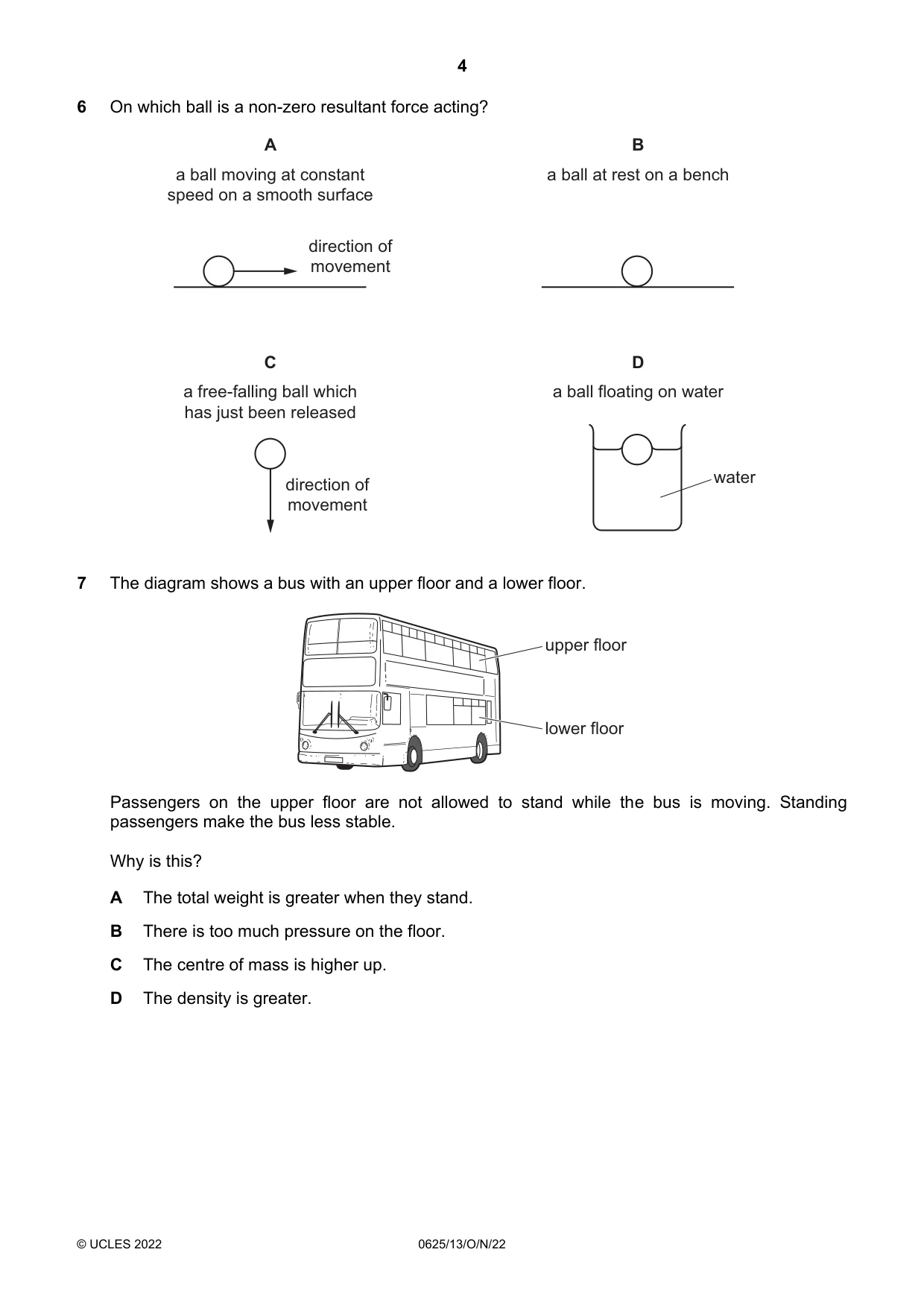
Q6 · On which ball is a non-zero resultant force acting?
6 On which ball is a non-zero resultant force acting? A B a ball moving at constant a ball at rest on a bench speed on a smooth surface direction of movement C D a free-falling ball which a ball floating on water has just been released direction of water movement
Mark scheme: C
Q7 · The diagram shows a bus with an upper floor and a lower floor
7 The diagram shows a bus with an upper floor and a lower floor. upper floor lower floor Passengers on the upper floor are not allowed to stand while the bus is moving. Standing passengers make the bus less stable. Why is this? A The total weight is greater when they stand. B There is too much pressure on the floor. C The centre of mass is higher up. D The density is greater.
Mark scheme: C
Q8 · An object falls towards the Earth’s surface
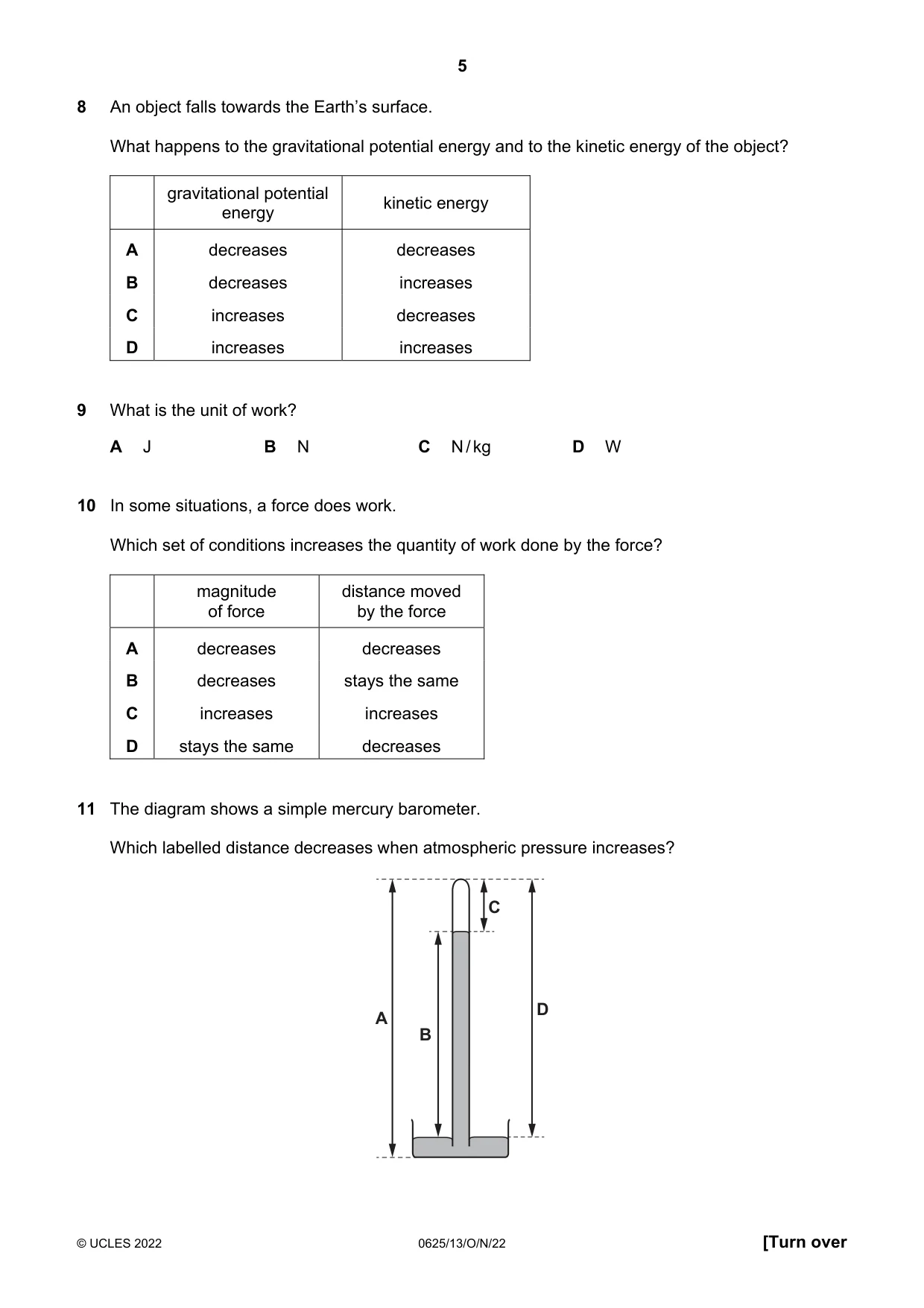
8 An object falls towards the Earth’s surface. What happens to the gravitational potential energy and to the kinetic energy of the object? gravitational potential kinetic energy energy A decreases decreases B decreases increases C increases decreases D increases increases
Mark scheme: B
Q9 · What is the unit of work?
9 What is the unit of work? A J B N C N / kg D W
Mark scheme: A
Q10 · In some situations, a force does work
10 In some situations, a force does work. Which set of conditions increases the quantity of work done by the force? magnitude distance moved of force by the force A decreases decreases B decreases stays the same C increases increases D stays the same decreases
Mark scheme: C
Q11 · The diagram shows a simple mercury barometer
11 The diagram shows a simple mercury barometer. Which labelled distance decreases when atmospheric pressure increases? C D A B
Mark scheme: C
Q12 · The pressure of a fixed mass of gas in a cylinder is measured
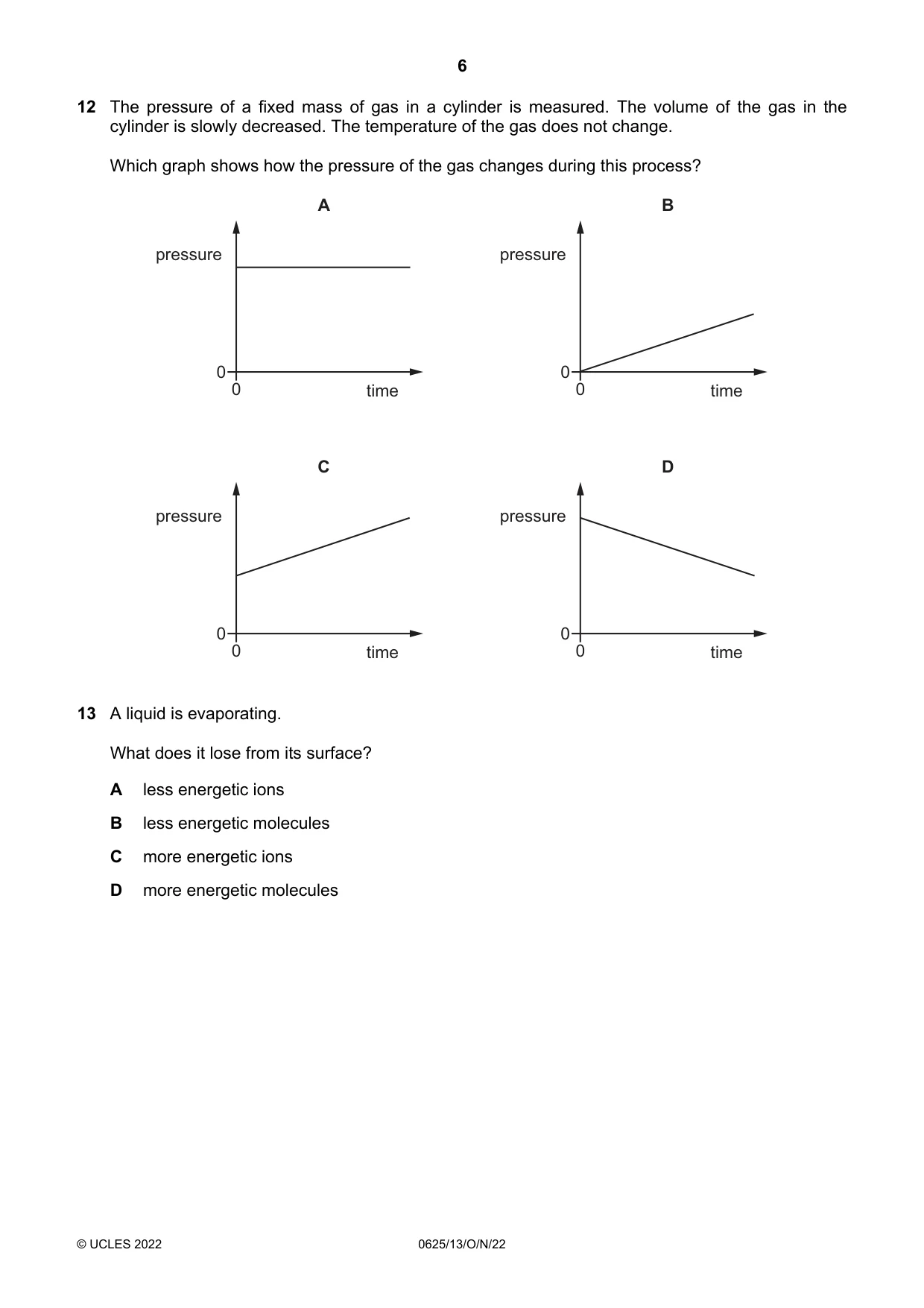
12 The pressure of a fixed mass of gas in a cylinder is measured. The volume of the gas in the cylinder is slowly decreased. The temperature of the gas does not change. Which graph shows how the pressure of the gas changes during this process? A B pressure pressure 0 0 0 time 0 time C D pressure pressure 0 0 0 time 0 time
Mark scheme: C
Q13 · A liquid is evaporating
13 A liquid is evaporating. What does it lose from its surface? A less energetic ions B less energetic molecules C more energetic ions D more energetic molecules
Mark scheme: D
Q14 · The diagram shows a thermometer calibrated in degrees Celsius
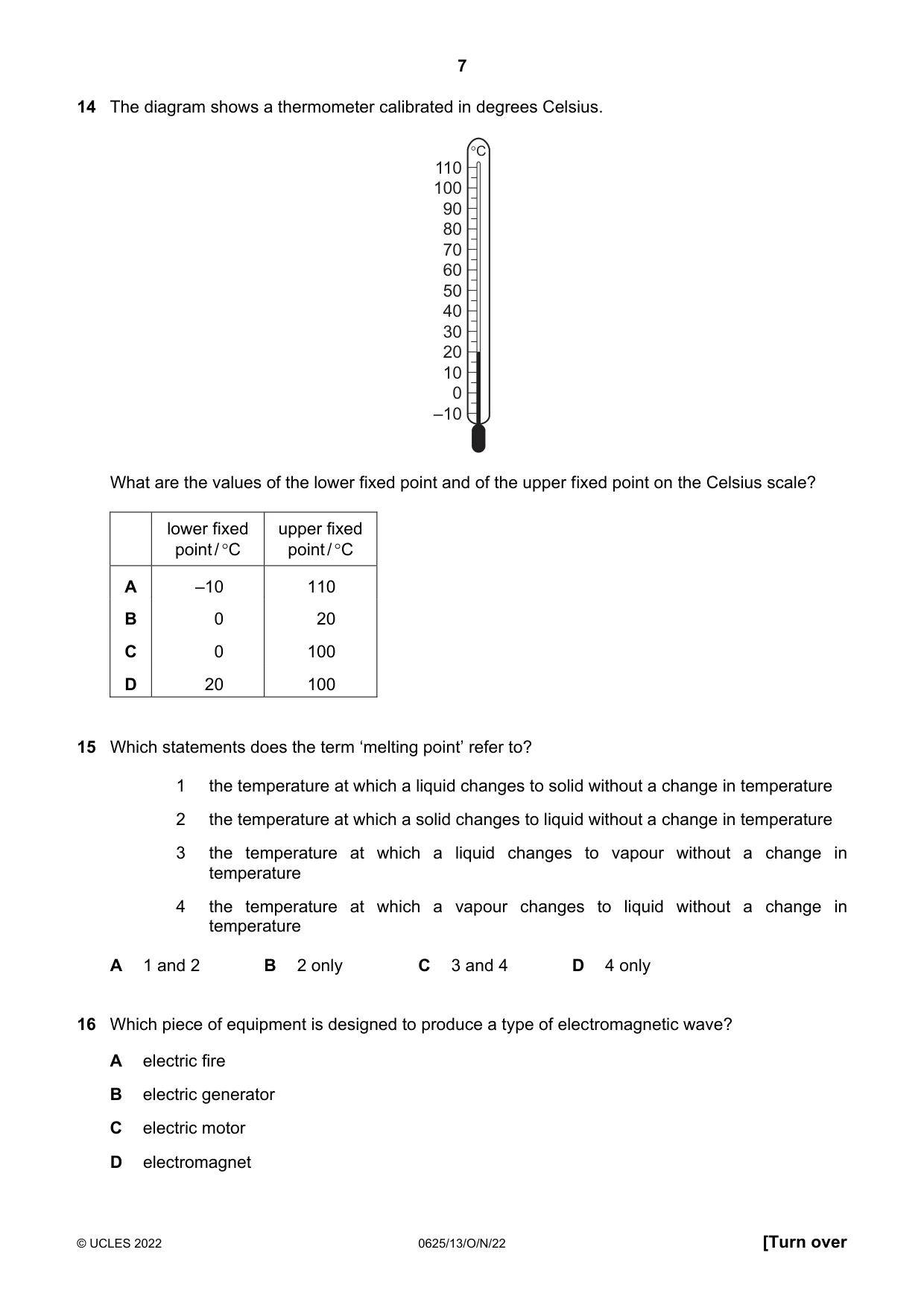
14 The diagram shows a thermometer calibrated in degrees Celsius. 110 100 90 80 70 60 50 40 30 20 10 0 -10 What are the values of the lower fixed point and of the upper fixed point on the Celsius scale? lower fixed upper fixed point/°C point/°C A -10 110 B 0 20 Cc 0 100 D 20 100
Mark scheme: C
Q15 · Which statements does the term ‘melting point’ refer to?
15 Which statements does the term ‘melting point’ refer to? 1 the temperature at which a liquid changes to solid without a change in temperature 2 the temperature at which a solid changes to liquid without a change in temperature 3 the temperature at which a liquid changes to vapour without a change in temperature 4 the temperature at which a vapour changes to liquid without a change in temperature A 1 and 2 B 2 only C 3 and 4 D 4 only
Mark scheme: A
Q16 · Which piece of equipment is designed to produce a type of electromagnetic wave?
16 Which piece of equipment is designed to produce a type of electromagnetic wave? A electric fire B electric generator C electric motor D electromagnet
Mark scheme: A
Q17 · How is energy transferred from the Sun to the Earth?
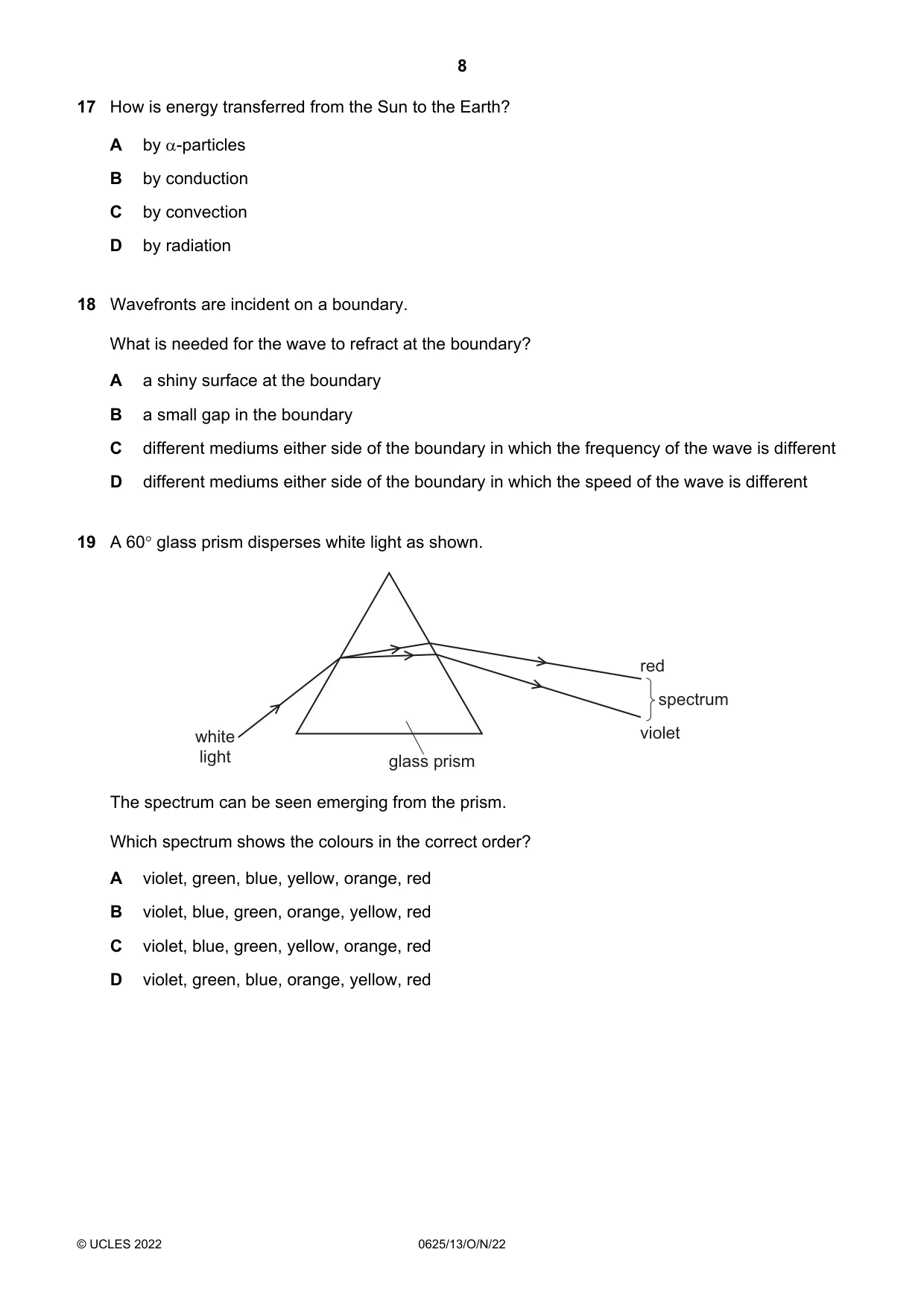
17 How is energy transferred from the Sun to the Earth? A by -particles B by conduction C by convection D by radiation
Mark scheme: D
Q18 · Wavefronts are incident on a boundary
18 Wavefronts are incident on a boundary. What is needed for the wave to refract at the boundary? A a shiny surface at the boundary B a small gap in the boundary C different mediums either side of the boundary in which the frequency of the wave is different D different mediums either side of the boundary in which the speed of the wave is different
Mark scheme: D
Q19 · A 60 glass prism disperses white light as shown
19 A 60 glass prism disperses white light as shown. red spectrum white violet light glass prism The spectrum can be seen emerging from the prism. Which spectrum shows the colours in the correct order? A violet, green, blue, yellow, orange, red B violet, blue, green, orange, yellow, red C violet, blue, green, yellow, orange, red D violet, green, blue, orange, yellow, red
Mark scheme: C
Q20 · The diagram shows an object in front of a plane mirror
20 The diagram shows an object in front of a plane mirror. At which labelled position is the image of the object formed? B C A D plane mirror eye object
Mark scheme: B
Q21 · The diagram shows the action of a thin converging lens on two rays of light
21 The diagram shows the action of a thin converging lens on two rays of light. The rays are from the top of an object O. An inverted image I is formed. lens I O R S Which name is given to the distance RS? A principal axis B principal focus C focal length D real length
Mark scheme: C
Q22 · Visible light has a frequency of approximately 5.0 1014 Hz
22 Visible light has a frequency of approximately 5.0 1014 Hz. M and N are two other types of electromagnetic radiation. The frequency of M is 5.0 106 Hz. The frequency of N is 5.0 1015 Hz. Which types of radiation are M and N? M N A radio waves infrared B radio waves ultraviolet C ultraviolet X-rays D X-rays infrared
Mark scheme: B
Q23 · Which wave is not an electromagnetic wave?
23 Which wave is not an electromagnetic wave? A microwaves B radio C sound D ultraviolet
Mark scheme: C
Q24 · A 100 m race is started by firing a gun
24 A 100 m race is started by firing a gun. The gun makes a bang and a puff of smoke at the same time. starter finishing judge 100 m When does the finishing judge see the smoke and when does he hear the bang? sees the smoke hears the bang A almost immediately almost immediately B almost immediately after about 0.3 s C after about 0.3 s almost immediately D after about 0.3 s after about 0.3 s
Mark scheme: B
Q25 · Copper wires are used to connect an electric circuit
25 Copper wires are used to connect an electric circuit. Which particles flow in the wires when the circuit is switched on? A atoms B electrons C ions D neutrons
Mark scheme: B
Q26 · A student is investigating a resistance wire
26 A student is investigating a resistance wire. She measures the current in a 50 cm length of resistance wire. A resistance wire The student repeats the experiment using a 100 cm length of the same resistance wire. What is the effect of this change on the current in the circuit and on the resistance of the wire? effect on effect on current resistance A decreases decreases B decreases increases C increases decreases D increases increases
Mark scheme: B
Q27 · What is the full name of the term e.m.f.?
27 What is the full name of the term e.m.f.? A electromotive field B electromotive force C electromotive frequency D electromotive friction
Mark scheme: B
Q28 · A plastic rod is rubbed with a dry woollen cloth
28 A plastic rod is rubbed with a dry woollen cloth. The rod becomes positively charged. Which statement is correct? A Electrons move from the cloth to the rod. B Electrons move from the rod to the cloth. C Protons move from the cloth to the rod. D Protons move from the rod to the cloth.
Mark scheme: B
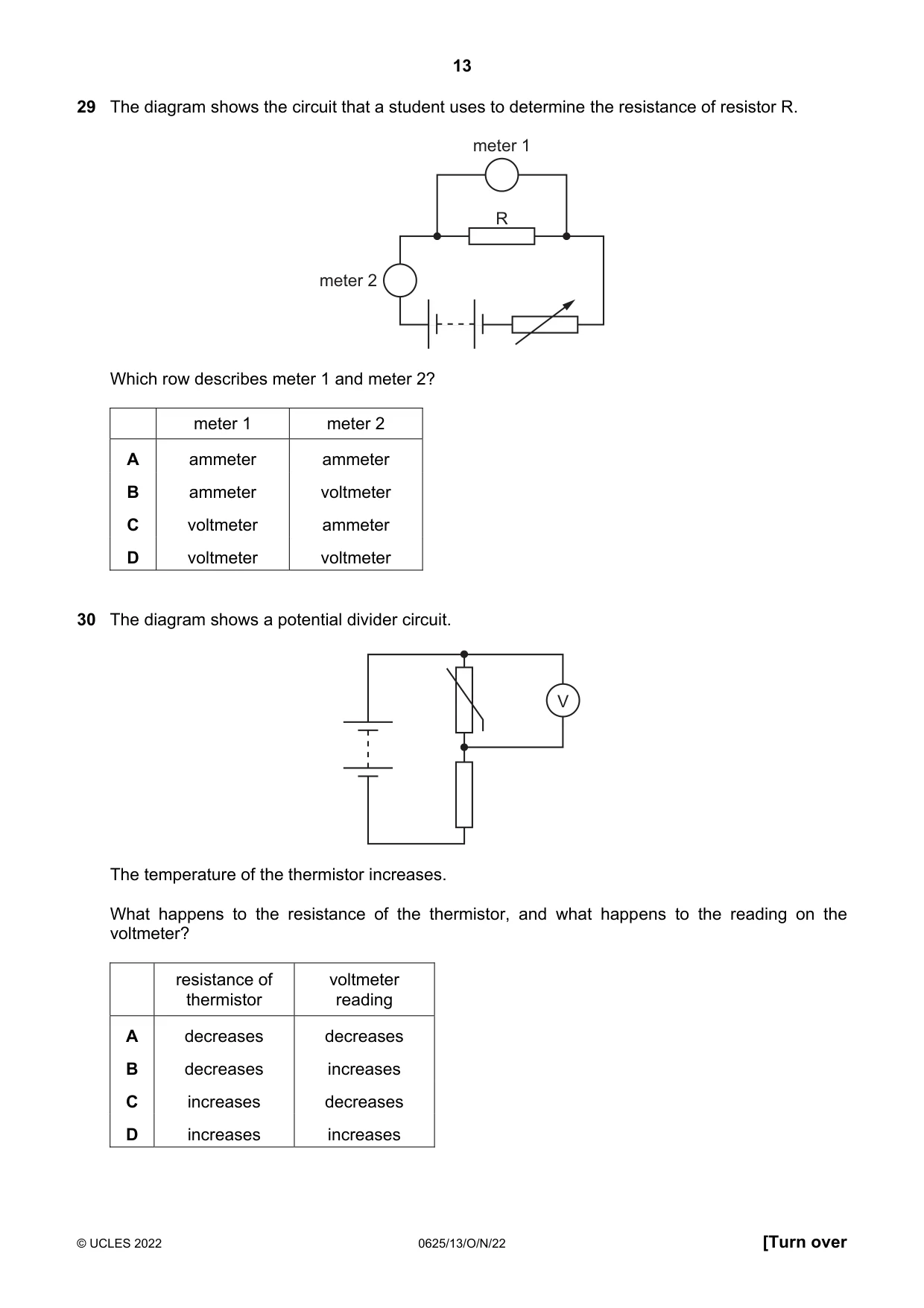
Q29 · The diagram shows the circuit that a student uses to determine the resistance of resistor…
29 The diagram shows the circuit that a student uses to determine the resistance of resistor R. meter 1 R meter 2 Which row describes meter 1 and meter 2? meter 1 meter 2 A ammeter ammeter B ammeter voltmeter C voltmeter ammeter D voltmeter voltmeter
Mark scheme: C
Q30 · The diagram shows a potential divider circuit
30 The diagram shows a potential divider circuit. V The temperature of the thermistor increases. What happens to the resistance of the thermistor, and what happens to the reading on the voltmeter? resistance of voltmeter thermistor reading A decreases decreases B decreases increases C increases decreases D increases increases
Mark scheme: A
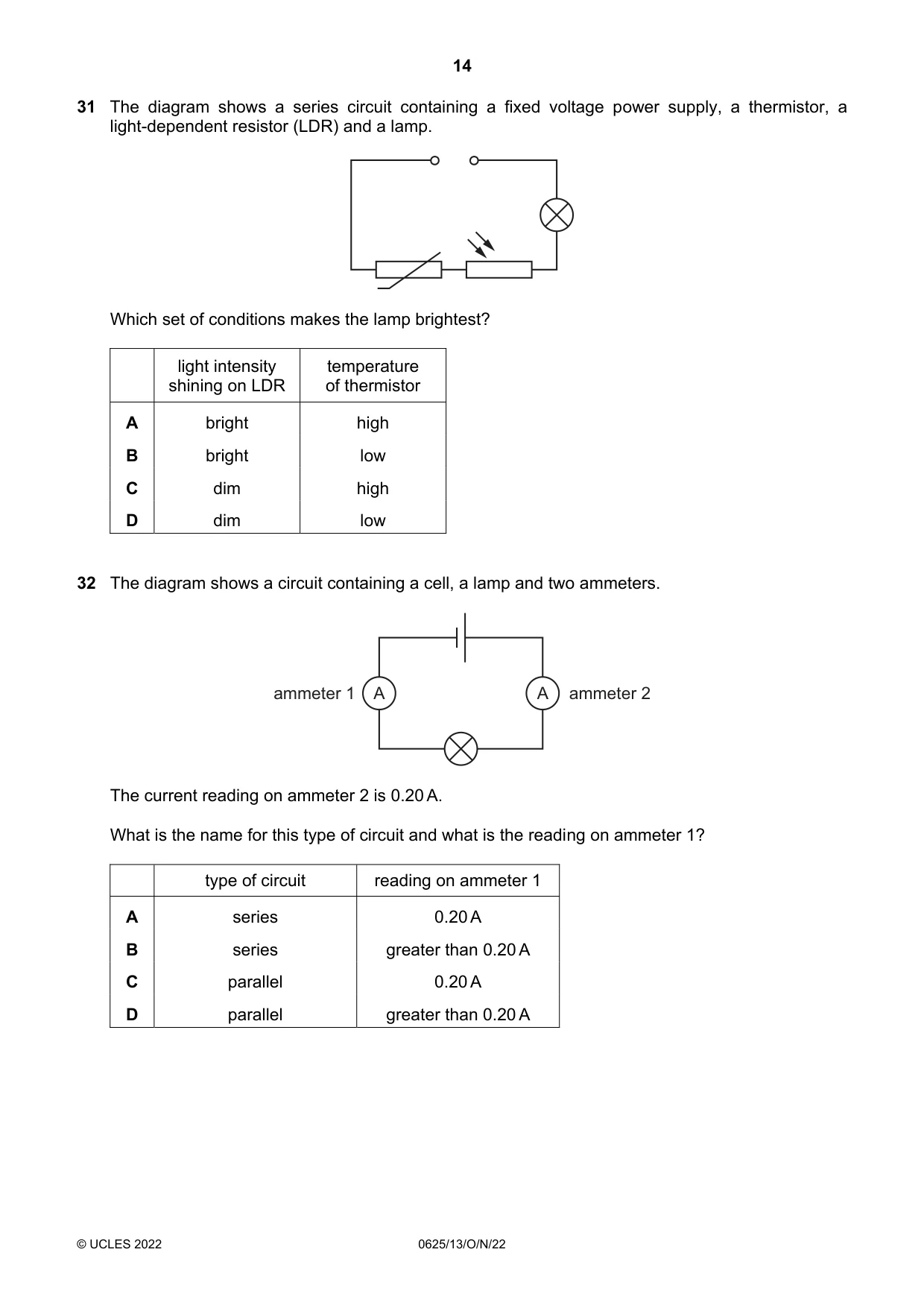
Q31 · The diagram shows a series circuit containing a fixed voltage power supply, a thermistor…
31 The diagram shows a series circuit containing a fixed voltage power supply, a thermistor, a light-dependent resistor (LDR) and a lamp. Which set of conditions makes the lamp brightest? light intensity temperature shining on LDR of thermistor A bright high B bright low C dim high D dim low
Mark scheme: A
Q32 · The diagram shows a circuit containing a cell, a lamp and two ammeters
32 The diagram shows a circuit containing a cell, a lamp and two ammeters. ammeter 1 A A ammeter 2 The current reading on ammeter 2 is 0.20 A. What is the name for this type of circuit and what is the reading on ammeter 1? type of circuit reading on ammeter 1 A series 0.20 A B series greater than 0.20 A C parallel 0.20 A D parallel greater than 0.20 A
Mark scheme: A
Q33 · The circuit connecting a room heater to the mains electricity supply has a fuse in it
33 The circuit connecting a room heater to the mains electricity supply has a fuse in it. The fuse melts and switches off the circuit. Why does the wire in the fuse melt? A The air in the room becomes too damp. B The air in the room reaches its required temperature. C The insulation around the circuit wire becomes damaged. D The current in the circuit becomes too large.
Mark scheme: D
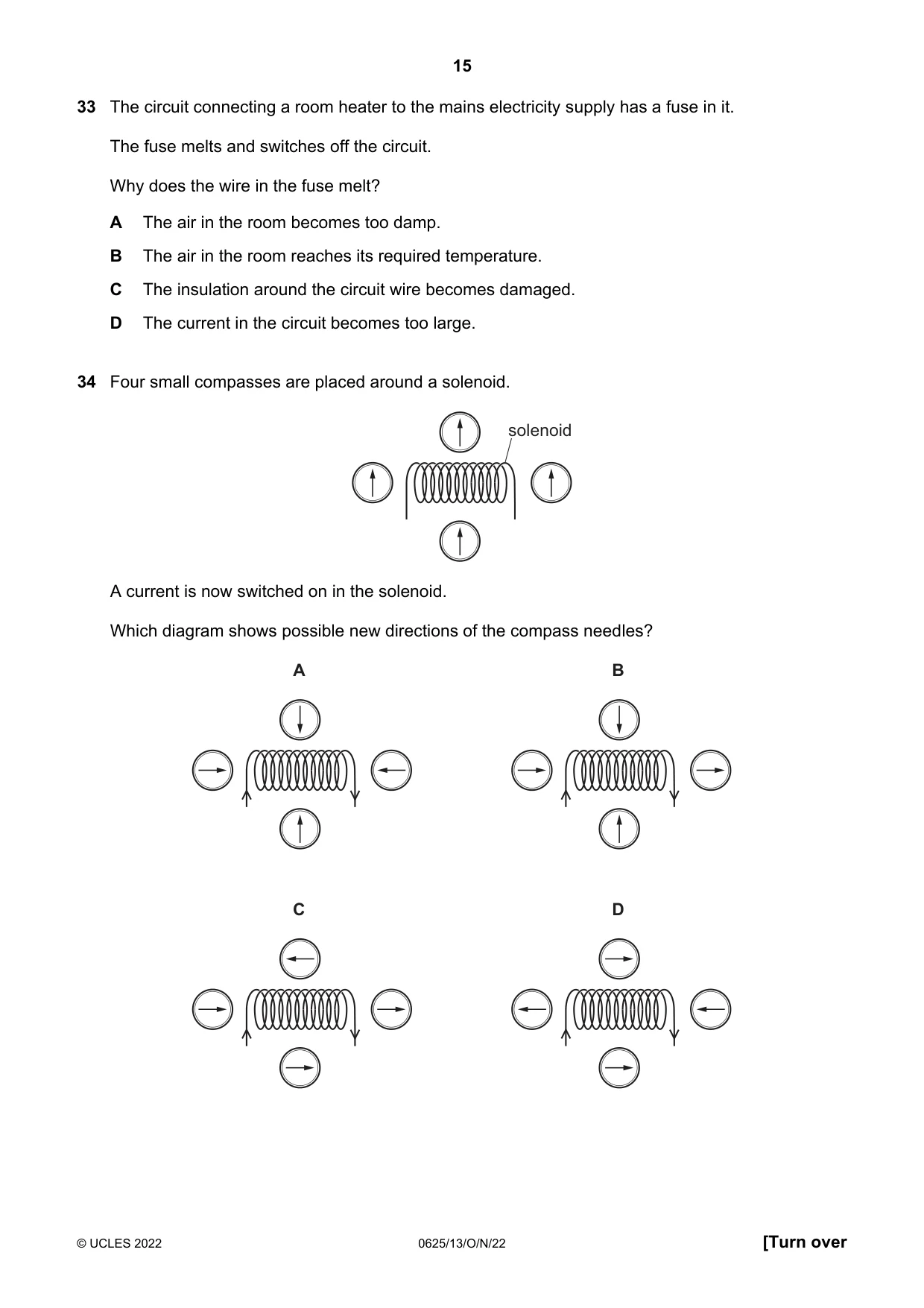
Q34 · Four small compasses are placed around a solenoid
34 Four small compasses are placed around a solenoid. solenoid A current is now switched on in the solenoid. Which diagram shows possible new directions of the compass needles? A B C D
Mark scheme: D
Q35 · Which metal is used for the core of a transformer?
35 Which metal is used for the core of a transformer? A aluminium B copper C soft iron D steel
Mark scheme: C
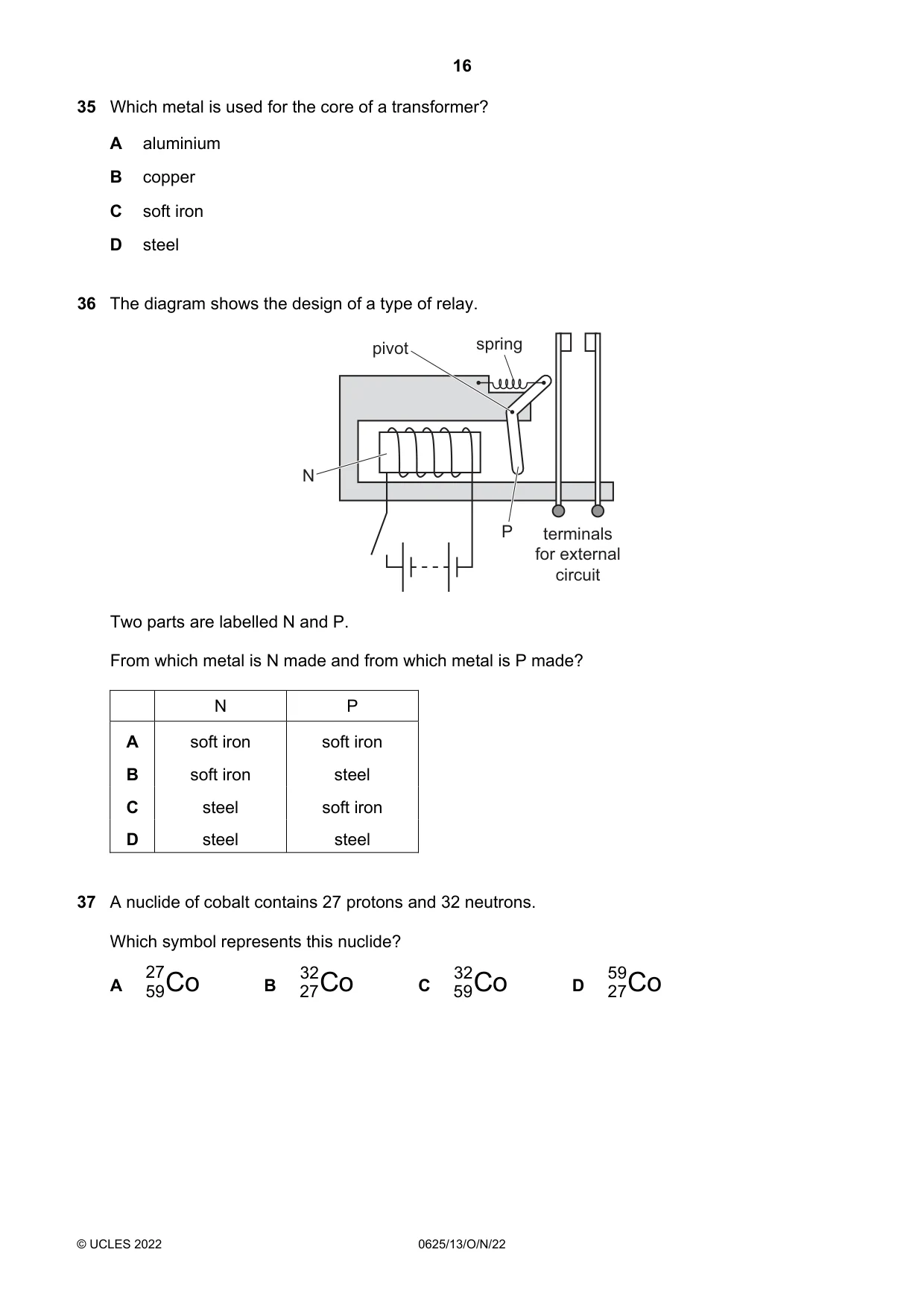
Q36 · The diagram shows the design of a type of relay
36 The diagram shows the design of a type of relay. pivot spring N P terminals for external circuit Two parts are labelled N and P. From which metal is N made and from which metal is P made? N P A soft iron soft iron B soft iron steel C steel soft iron D steel steel
Mark scheme: A
Q37 · A nuclide of cobalt contains 27 protons and 32 neutrons
37 A nuclide of cobalt contains 27 protons and 32 neutrons. Which symbol represents this nuclide? 27 59Co 27Co 32 59Co 32 59 27Co A B C D
Mark scheme: D
Q38 · In the processes shown, X and Y are elements
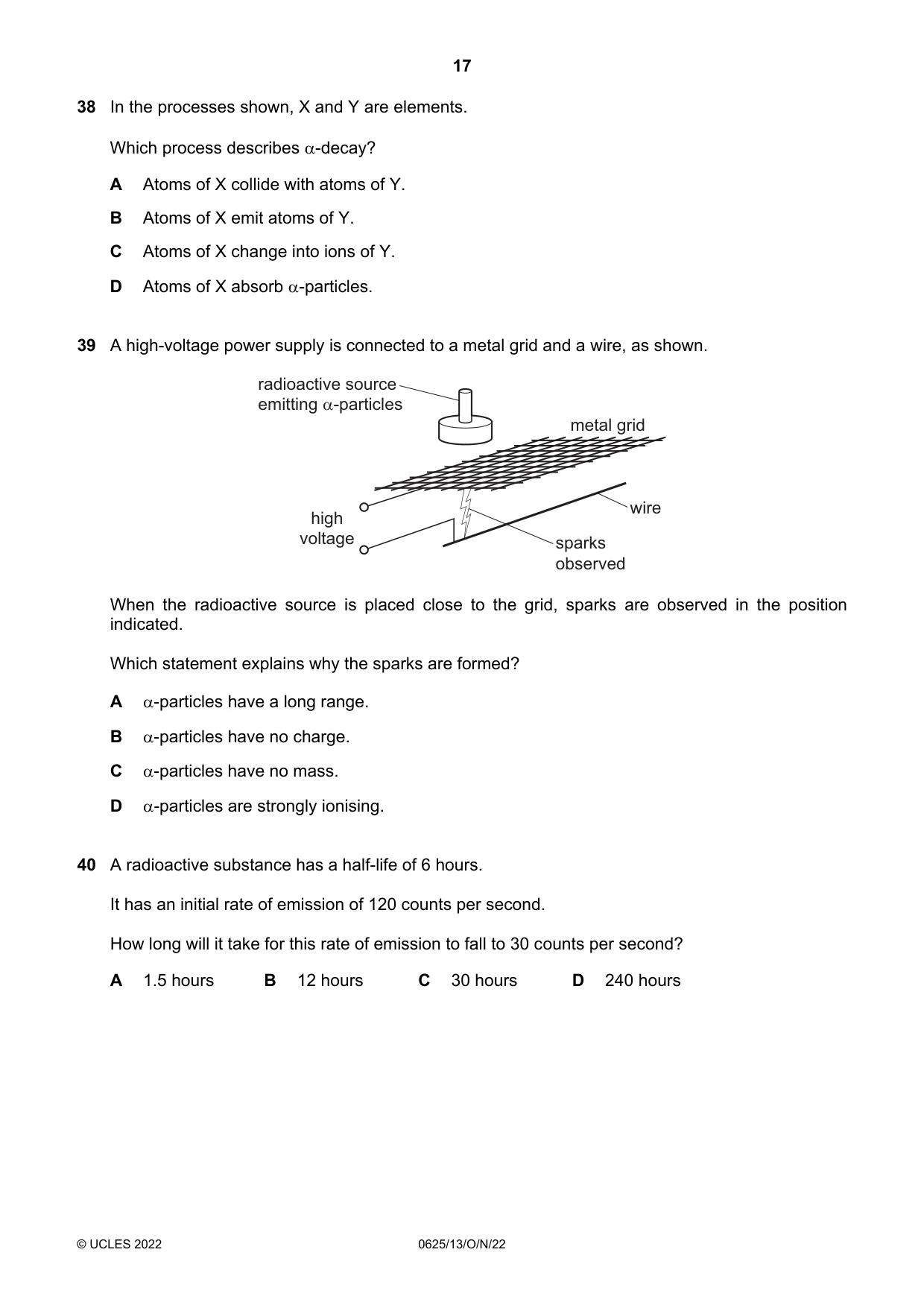
38 In the processes shown, X and Y are elements. Which process describes -decay? A Atoms of X collide with atoms of Y. B Atoms of X emit atoms of Y. C Atoms of X change into ions of Y. D Atoms of X absorb -particles.
Mark scheme: C
Q39 · A high-voltage power supply is connected to a metal grid and a wire, as shown
39 A high-voltage power supply is connected to a metal grid and a wire, as shown. radioactive source emitting a-particles metal grid high voltage observed When the radioactive source is placed close to the grid, sparks are observed in the position indicated. Which statement explains why the sparks are formed? A a-particles have a long range. B~ a-particles have no charge. C_ a-particles have no mass. D a-particles are strongly ionising.
Mark scheme: D
Q40 · A radioactive substance has a half-life of 6 hours
40 A radioactive substance has a half-life of 6 hours. It has an initial rate of emission of 120 counts per second. How long will it take for this rate of emission to fall to 30 counts per second? A 1.5 hours B 12 hours C 30 hours D 240 hours
Mark scheme: B
What was in this paper
The subtopics covered by these 40 questions, and how many questions each got. Open one in a new tab to see every Cambridge question on it.
4Electrical quantities3Electromagnetic spectrum3Energy, work and power3Forces3Light3Radioactivity3Electromagnetic effects2Kinetic particle model of matter2Simple phenomena of magnetism2Thermal properties and temperature2Density1Electrical safety1General properties of waves1Mass and weight1Motion1Physical quantities and measurement techniques1Pressure1Sound1The nuclear model of the atom1Transfer of thermal energy1What you needed in this session
Cambridge’s own grade thresholds for 2022 Oct/Nov, Paper 1 · Variant 3. A higher threshold means an easier paper — the bar moves with how the cohort did.