Cambridge IGCSE Physics 0625 — 2012 Oct/Nov Paper 1 · Variant 1
0625/11/O/N/12 · 40 questions · 40 marks · ≈45 min
The question paper and its mark scheme, free to read here and free to download. This is Cambridge’s own paper, exactly as it was sat.
Question paper20 pages


Mark scheme2 pages
Answers below. Sit the paper first if you are practising.
Questions as text
Q1 · A pendulum is set in motion and timed
1 A pendulum is set in motion and timed. The time measured for 20 complete swings is 30 s. What is the time for one complete swing of the pendulum? A 0.67 s B 0.75 s C 1.5 s D 3.0 s
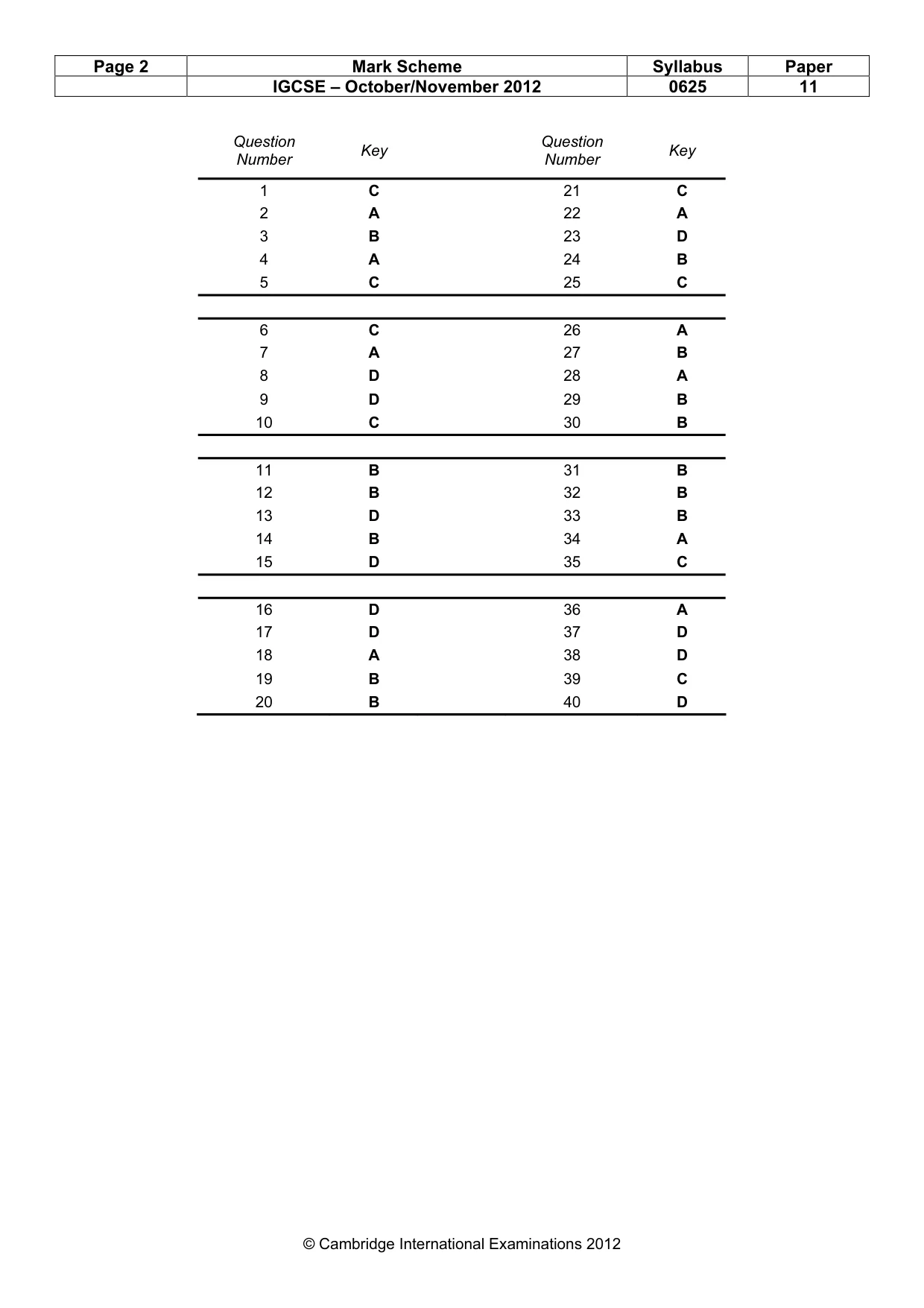
Mark scheme: C
More questions on Physical quantities and measurement techniques
Q2 · Two stones of different weight fall at the same time from a table
2 Two stones of different weight fall at the same time from a table. Air resistance may be ignored. What will happen and why? what will happen why A both stones hit the floor at the same time acceleration of free fall is constant B both stones hit the floor at the same time they fall at constant speed C the heavier stone hits the floor first acceleration increases with weight D the heavier stone hits the floor first speed increases with weight
Mark scheme: A
Q3 · The speed-time graph shown is for a bus travelling between stops
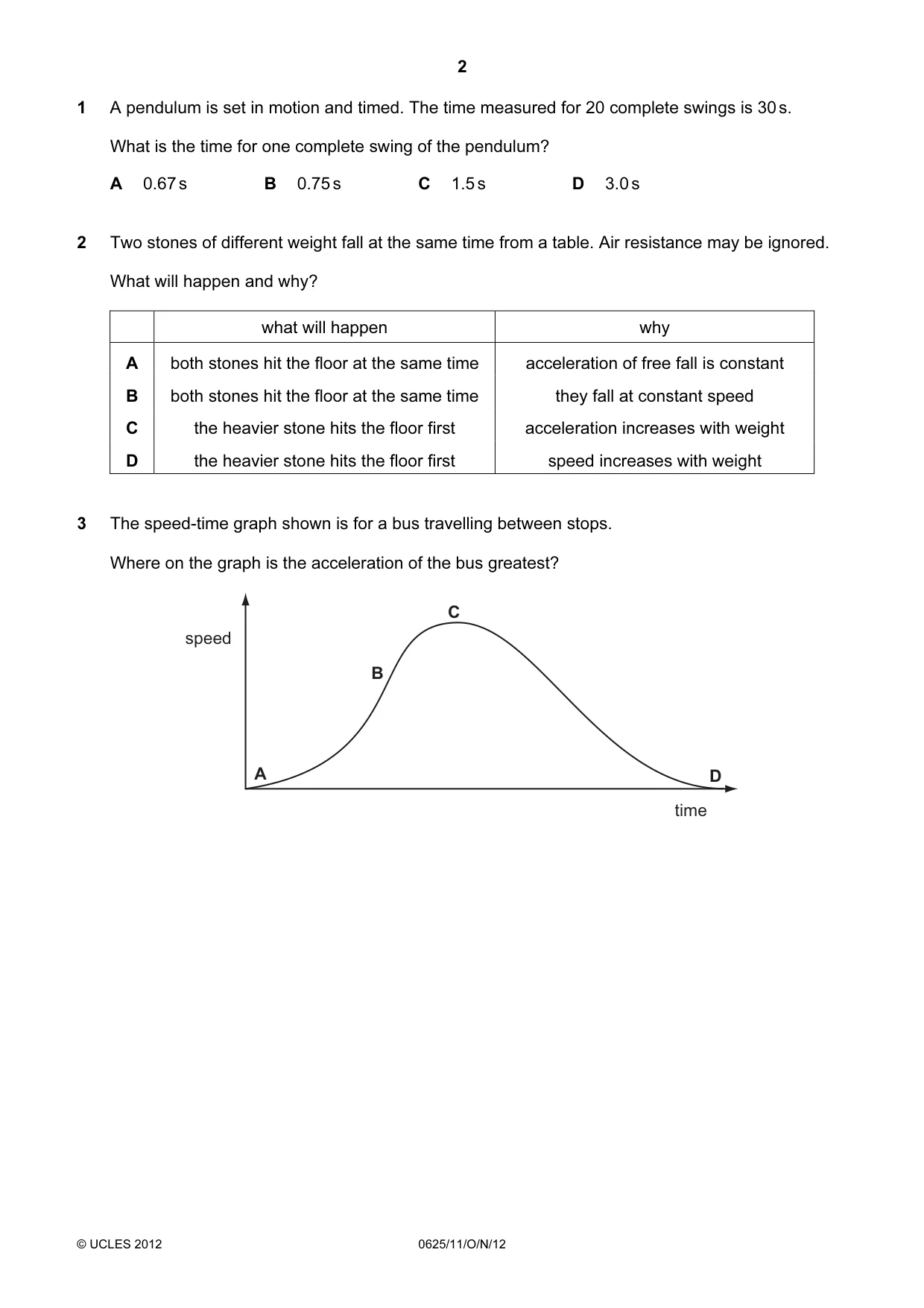
3 The speed-time graph shown is for a bus travelling between stops. Where on the graph is the acceleration of the bus greatest? C speed B A D time
Mark scheme: B
Q4 · A large bag of feathers and a steel block balance each other on some scales
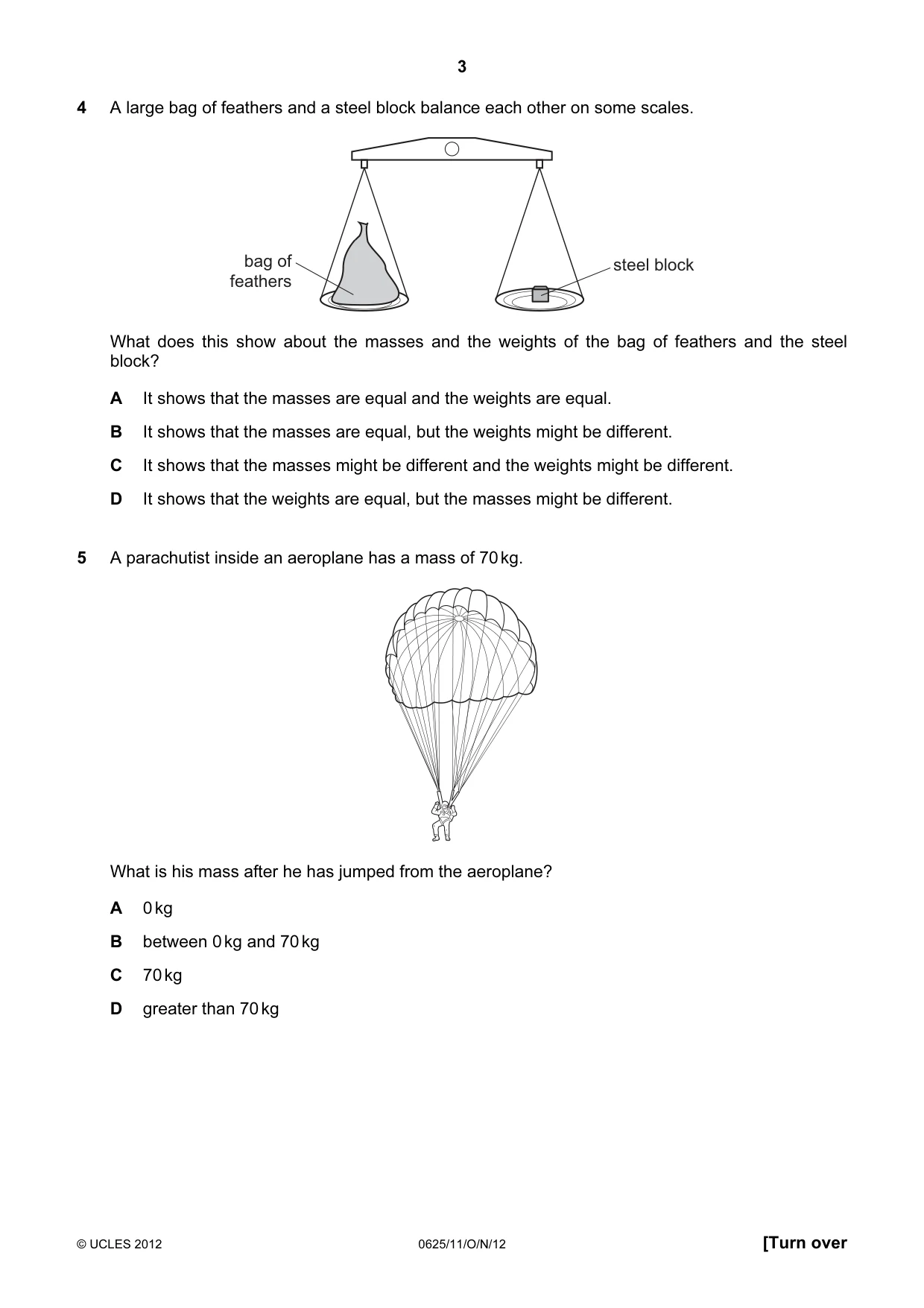
4 A large bag of feathers and a steel block balance each other on some scales. bag of steel block feathers What does this show about the masses and the weights of the bag of feathers and the steel block? A It shows that the masses are equal and the weights are equal. B It shows that the masses are equal, but the weights might be different. C It shows that the masses might be different and the weights might be different. D It shows that the weights are equal, but the masses might be different.
Mark scheme: A
Q5 · A parachutist inside an aeroplane has a mass of 70 kg
5 A parachutist inside an aeroplane has a mass of 70 kg. What is his mass after he has jumped from the aeroplane? A 0 kg B between 0 kg and 70 kg C 70 kg D greater than 70 kg
Mark scheme: C
Q6 · A liquid has a density of 0.80 g / cm3
6 A liquid has a density of 0.80 g / cm3. Which could be the volume and mass of this liquid? volume / cm3 mass / g A 2.0 16 B 8.0 10 C 10 8.0 D 16 2.0
Mark scheme: C
Q7 · The diagram shows sections of four objects of equal mass
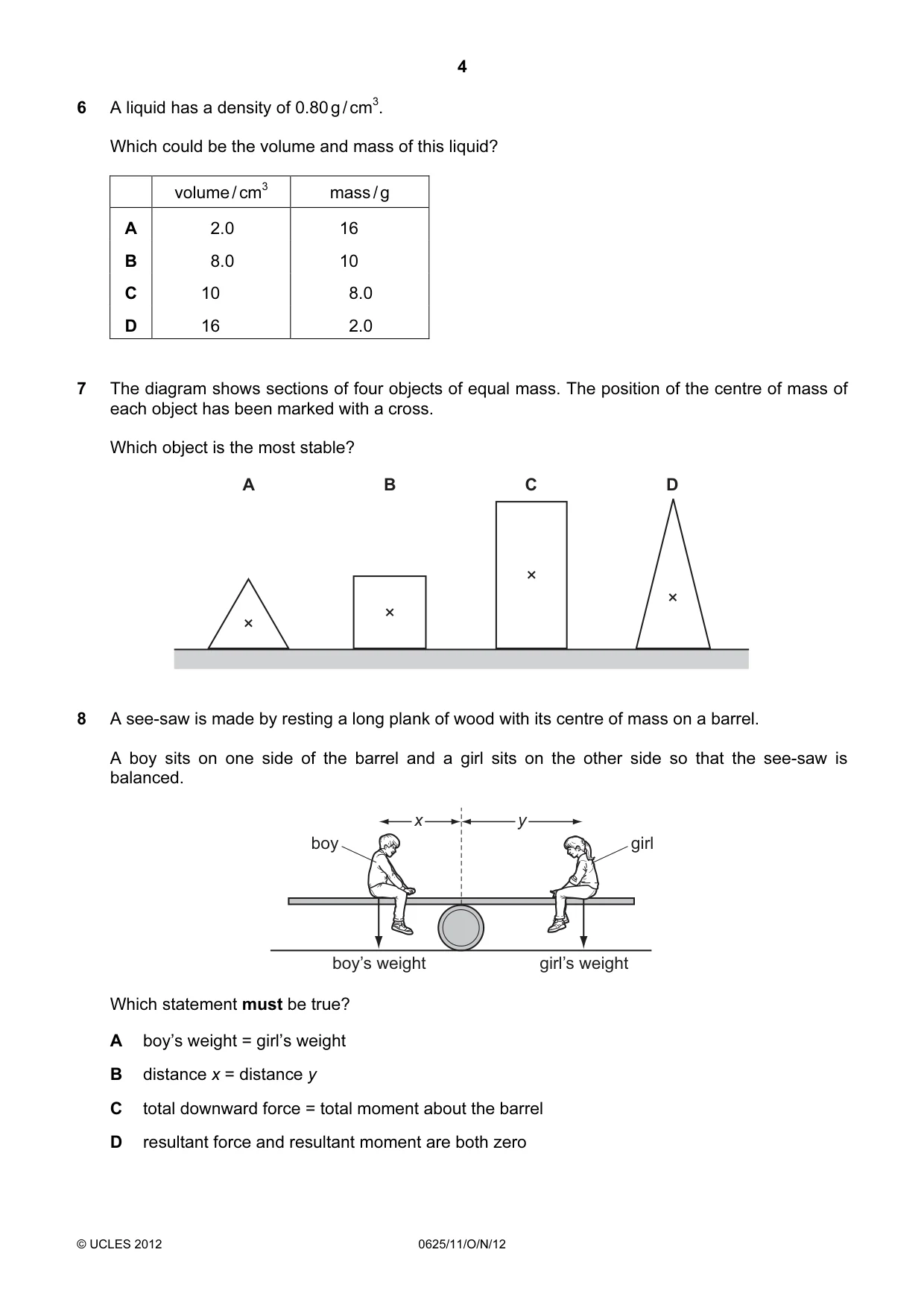
7 The diagram shows sections of four objects of equal mass. The position of the centre of mass of each object has been marked with a cross. Which object is the most stable? A B C D
Mark scheme: A
Q8 · A see-saw is made by resting a long plank of wood with its centre of mass on a barrel
8 A see-saw is made by resting a long plank of wood with its centre of mass on a barrel. A boy sits on one side of the barrel and a girl sits on the other side so that the see-saw is balanced. x y boy girl boy’s weight girl’s weight Which statement must be true? A boy’s weight = girl’s weight B distance x = distance y C total downward force = total moment about the barrel D resultant force and resultant moment are both zero
Mark scheme: D
Q9 · A power station uses nuclear fission to obtain energy
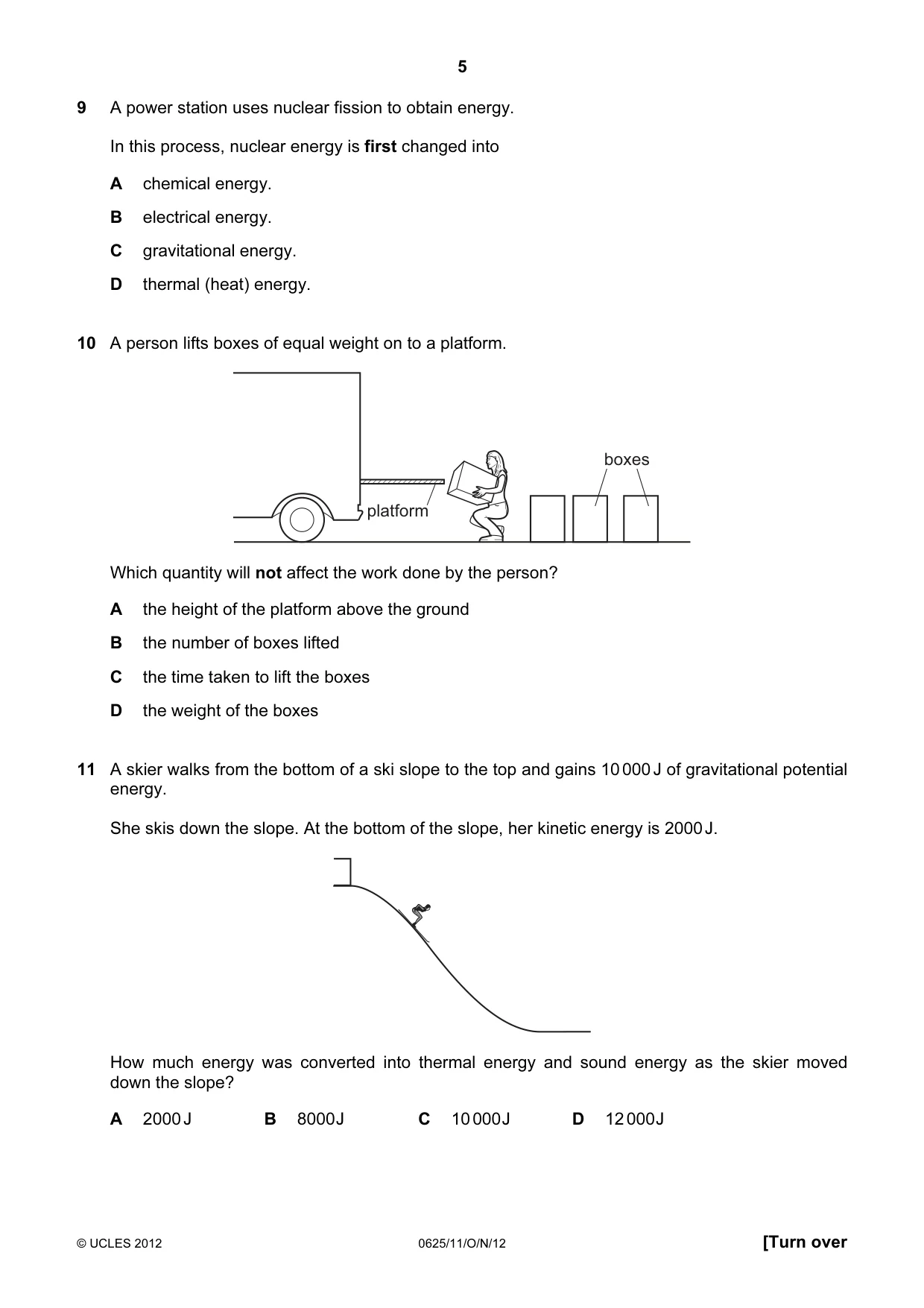
9 A power station uses nuclear fission to obtain energy. In this process, nuclear energy is first changed into A chemical energy. B electrical energy. C gravitational energy. D thermal (heat) energy.
Mark scheme: D
Q10 · A person lifts boxes of equal weight on to a platform
10 A person lifts boxes of equal weight on to a platform. boxes platform Which quantity will not affect the work done by the person? A the height of the platform above the ground B the number of boxes lifted C the time taken to lift the boxes D the weight of the boxes
Mark scheme: C
Q11 · A skier walks from the bottom of a ski slope to the top and gains 10 000 J of…
11 A skier walks from the bottom of a ski slope to the top and gains 10 000 J of gravitational potential energy. She skis down the slope. At the bottom of the slope, her kinetic energy is 2000 J. How much energy was converted into thermal energy and sound energy as the skier moved down the slope? A 2000 J B 8000 J C 10 000 J D 12 000 J
Mark scheme: B
Q12 · The diagram shows a mercury barometer
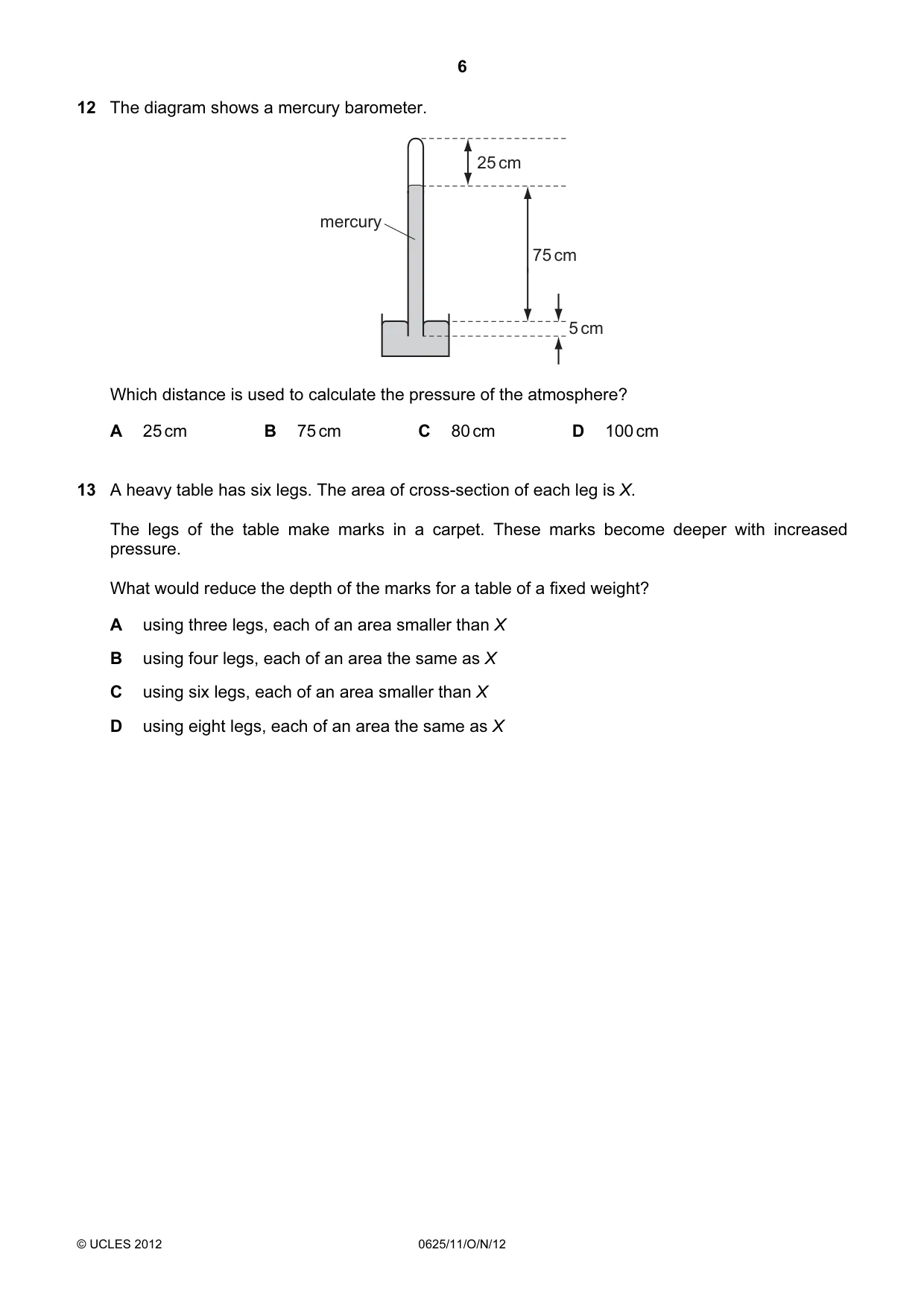
12 The diagram shows a mercury barometer. 25 cm mercury 75 cm 5 cm Which distance is used to calculate the pressure of the atmosphere? A 25 cm B 75 cm C 80 cm D 100 cm
Mark scheme: B
Q13 · A heavy table has six legs
13 A heavy table has six legs. The area of cross-section of each leg is X. The legs of the table make marks in a carpet. These marks become deeper with increased pressure. What would reduce the depth of the marks for a table of a fixed weight? A using three legs, each of an area smaller than X B using four legs, each of an area the same as X C using six legs, each of an area smaller than X D using eight legs, each of an area the same as X
Mark scheme: D
Q14 · Very small pollen grains are suspended in water
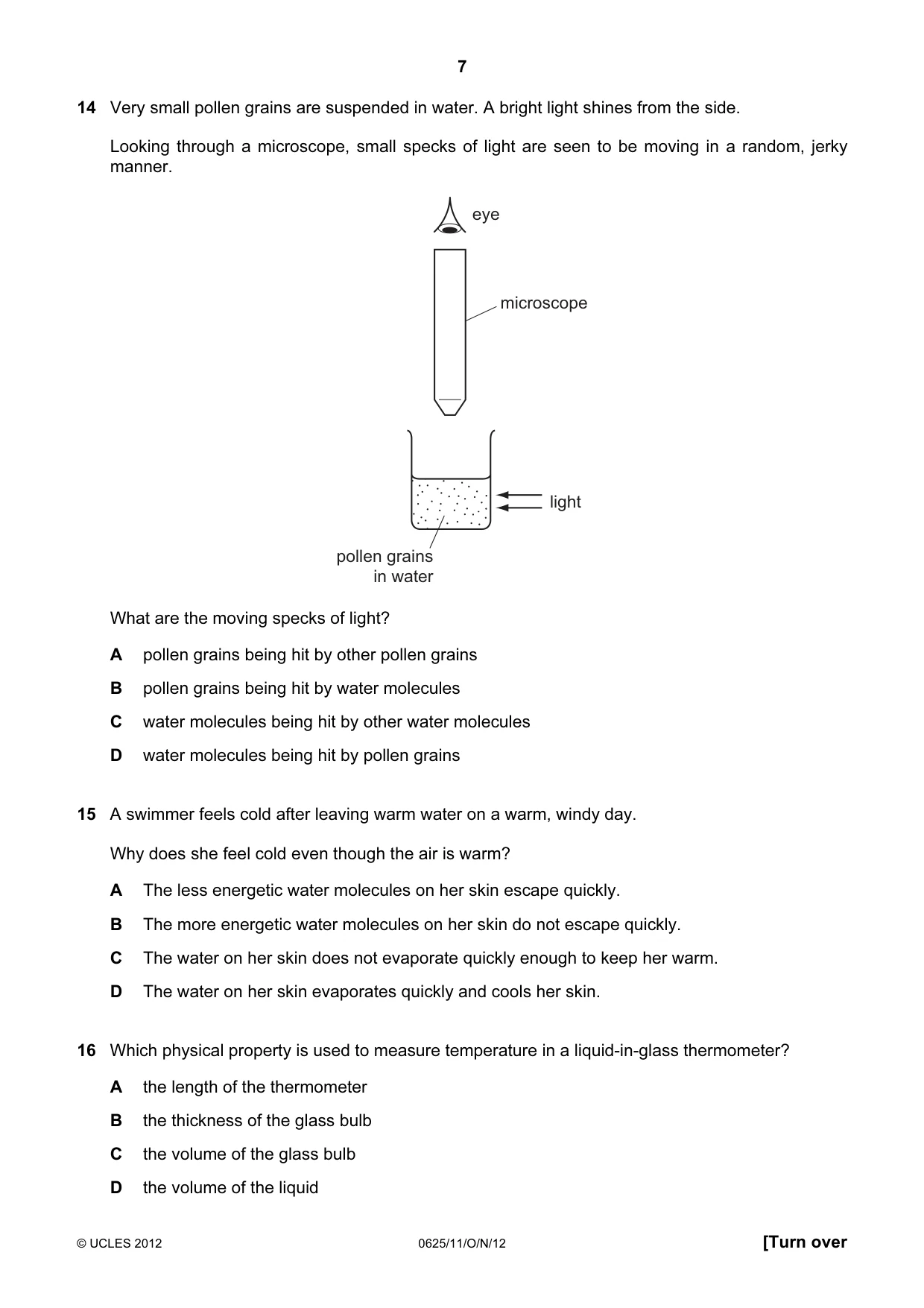
14 Very small pollen grains are suspended in water. A bright light shines from the side. Looking through a microscope, small specks of light are seen to be moving in a random, jerky manner. eye microscope light pollen grains in water What are the moving specks of light? A pollen grains being hit by other pollen grains B pollen grains being hit by water molecules C water molecules being hit by other water molecules D water molecules being hit by pollen grains
Mark scheme: B
Q15 · A swimmer feels cold after leaving warm water on a warm, windy day
15 A swimmer feels cold after leaving warm water on a warm, windy day. Why does she feel cold even though the air is warm? A The less energetic water molecules on her skin escape quickly. B The more energetic water molecules on her skin do not escape quickly. C The water on her skin does not evaporate quickly enough to keep her warm. D The water on her skin evaporates quickly and cools her skin.
Mark scheme: D
Q16 · Which physical property is used to measure temperature in a liquid-in-glass thermometer?
16 Which physical property is used to measure temperature in a liquid-in-glass thermometer? A the length of the thermometer B the thickness of the glass bulb C the volume of the glass bulb D the volume of the liquid
Mark scheme: D
Q17 · The graph shows the temperature of a substance as it is heated steadily
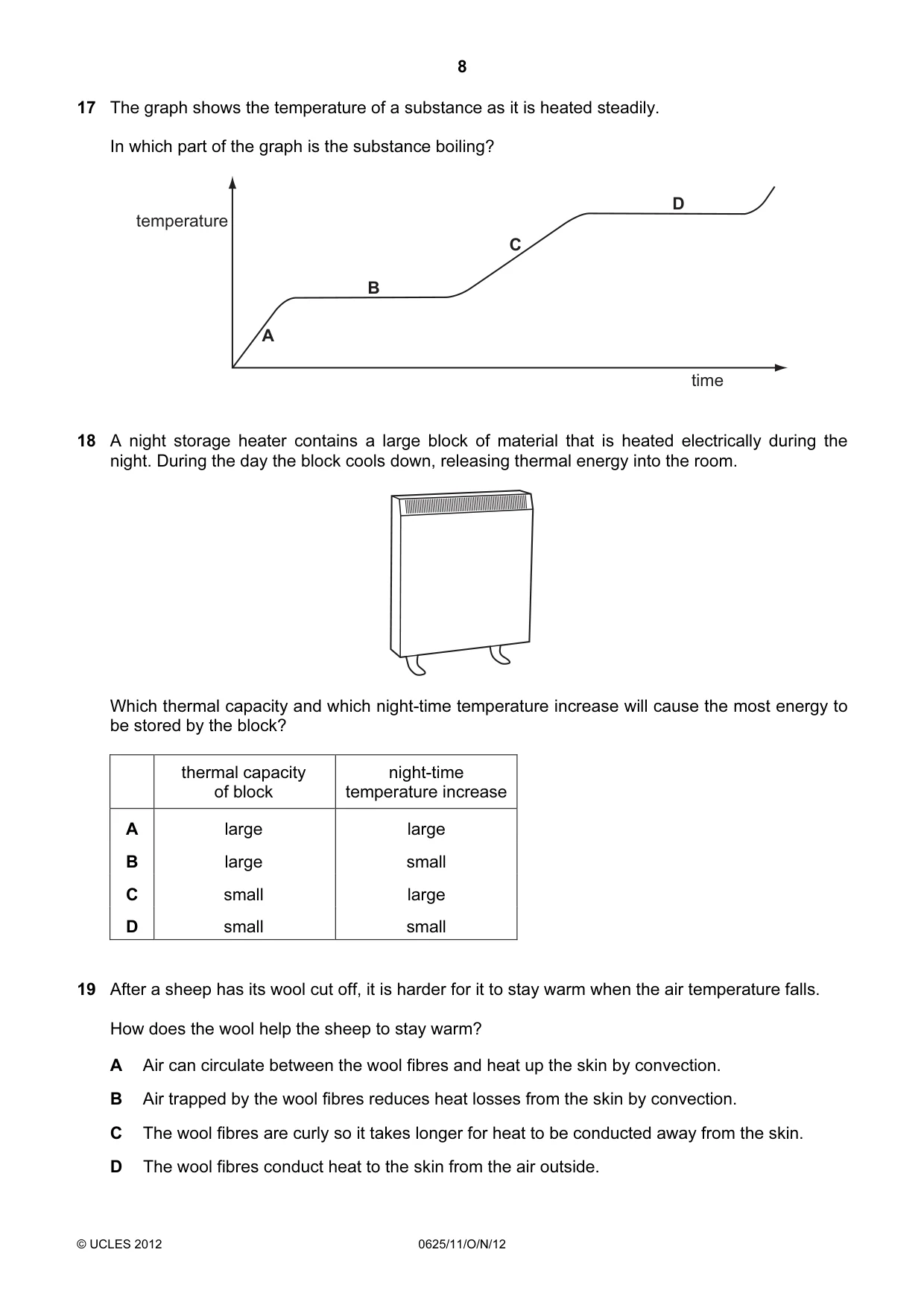
17 The graph shows the temperature of a substance as it is heated steadily. In which part of the graph is the substance boiling? D temperature C B A time
Mark scheme: D
Q18 · A night storage heater contains a large block of material that is heated electrically…
18 A night storage heater contains a large block of material that is heated electrically during the night. During the day the block cools down, releasing thermal energy into the room. Which thermal capacity and which night-time temperature increase will cause the most energy to be stored by the block? thermal capacity night-time of block temperature increase A large large B large small C small large D small small
Mark scheme: A
Q19 · After a sheep has its wool cut off, it is harder for it to stay warm when the air…
19 After a sheep has its wool cut off, it is harder for it to stay warm when the air temperature falls. How does the wool help the sheep to stay warm? A Air can circulate between the wool fibres and heat up the skin by convection. B Air trapped by the wool fibres reduces heat losses from the skin by convection. C The wool fibres are curly so it takes longer for heat to be conducted away from the skin. D The wool fibres conduct heat to the skin from the air outside.
Mark scheme: B
Q20 · A boy sits near a campfire
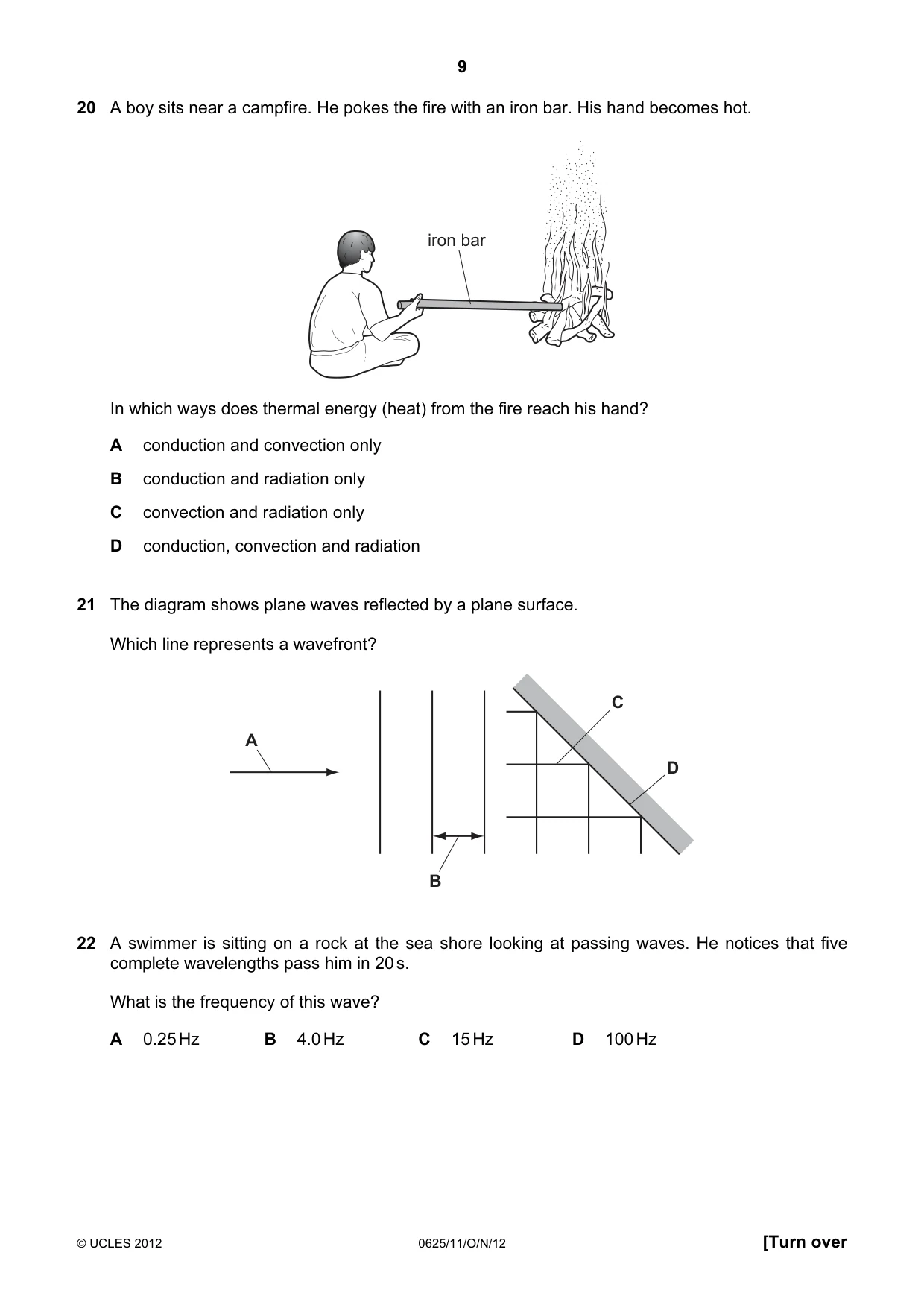
20 A boy sits near a campfire. He pokes the fire with an iron bar. His hand becomes hot. iron bar In which ways does thermal energy (heat) from the fire reach his hand? A conduction and convection only B conduction and radiation only C convection and radiation only D conduction, convection and radiation
Mark scheme: B
Q21 · The diagram shows plane waves reflected by a plane surface
21 The diagram shows plane waves reflected by a plane surface. Which line represents a wavefront? C A D B
Mark scheme: C
Q22 · A swimmer is sitting on a rock at the sea shore looking at passing waves
22 A swimmer is sitting on a rock at the sea shore looking at passing waves. He notices that five complete wavelengths pass him in 20 s. What is the frequency of this wave? A 0.25 Hz B 4.0 Hz C 15 Hz D 100 Hz
Mark scheme: A
Q23 · A thin converging lens forms an image
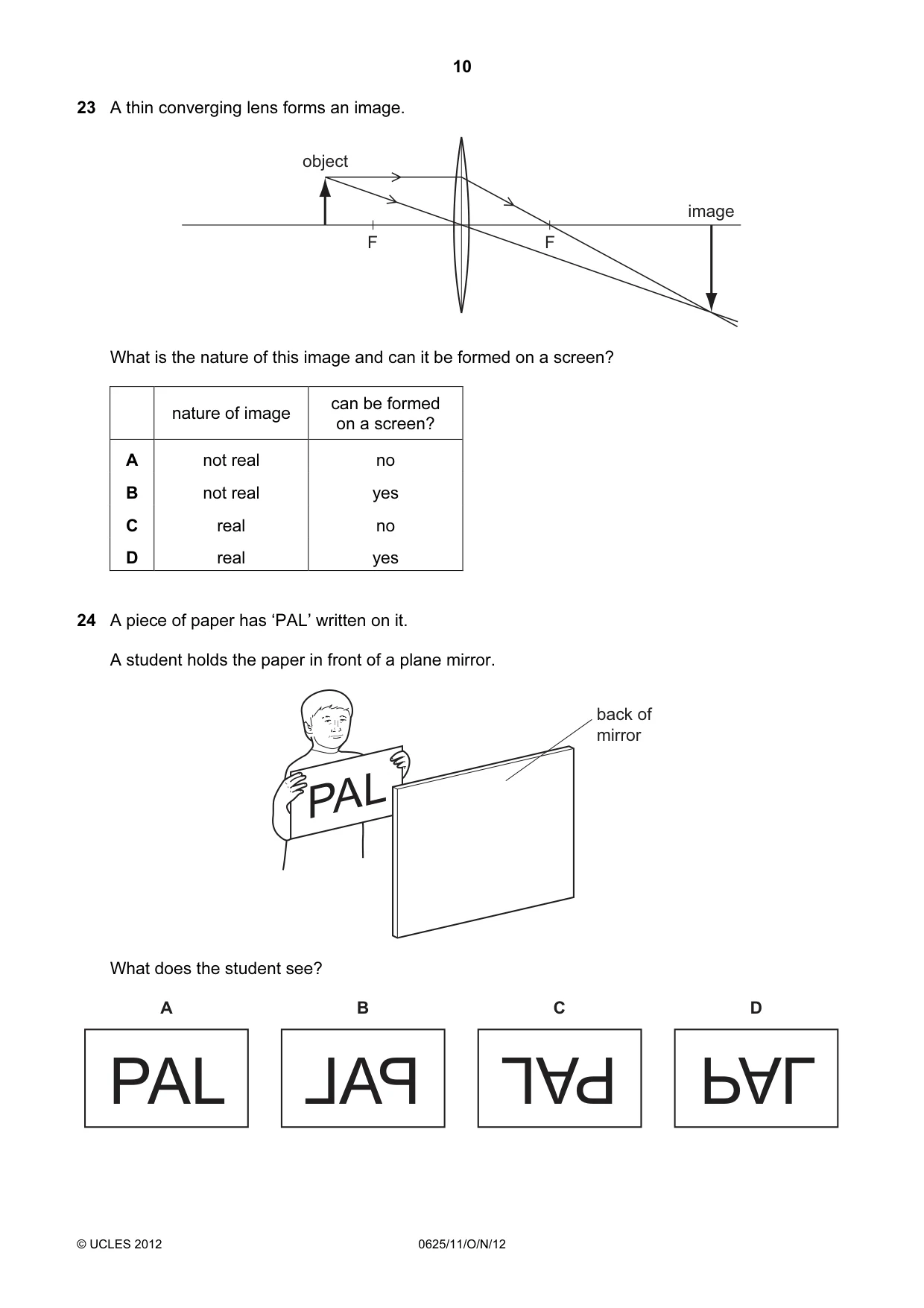
23 A thin converging lens forms an image. object image F F What is the nature of this image and can it be formed on a screen? can be formed nature of image on a screen? A not real no B not real yes C real no D real yes
Mark scheme: D
Q24 · A piece of paper has ‘PAL’ written on it
24 A piece of paper has ‘PAL’ written on it. A student holds the paper in front of a plane mirror. back of mirror PAL What does the student see? A B PAL C D PAL PAL PAL
Mark scheme: B
Q25 · A girl notices that when she shouts into a cave she hears an echo
25 A girl notices that when she shouts into a cave she hears an echo. Which wave property causes the echo? A diffraction B dispersion C reflection D refraction
Mark scheme: C
Q26 · In a test, a car horn is found to be too loud and the pitch of the note is too high
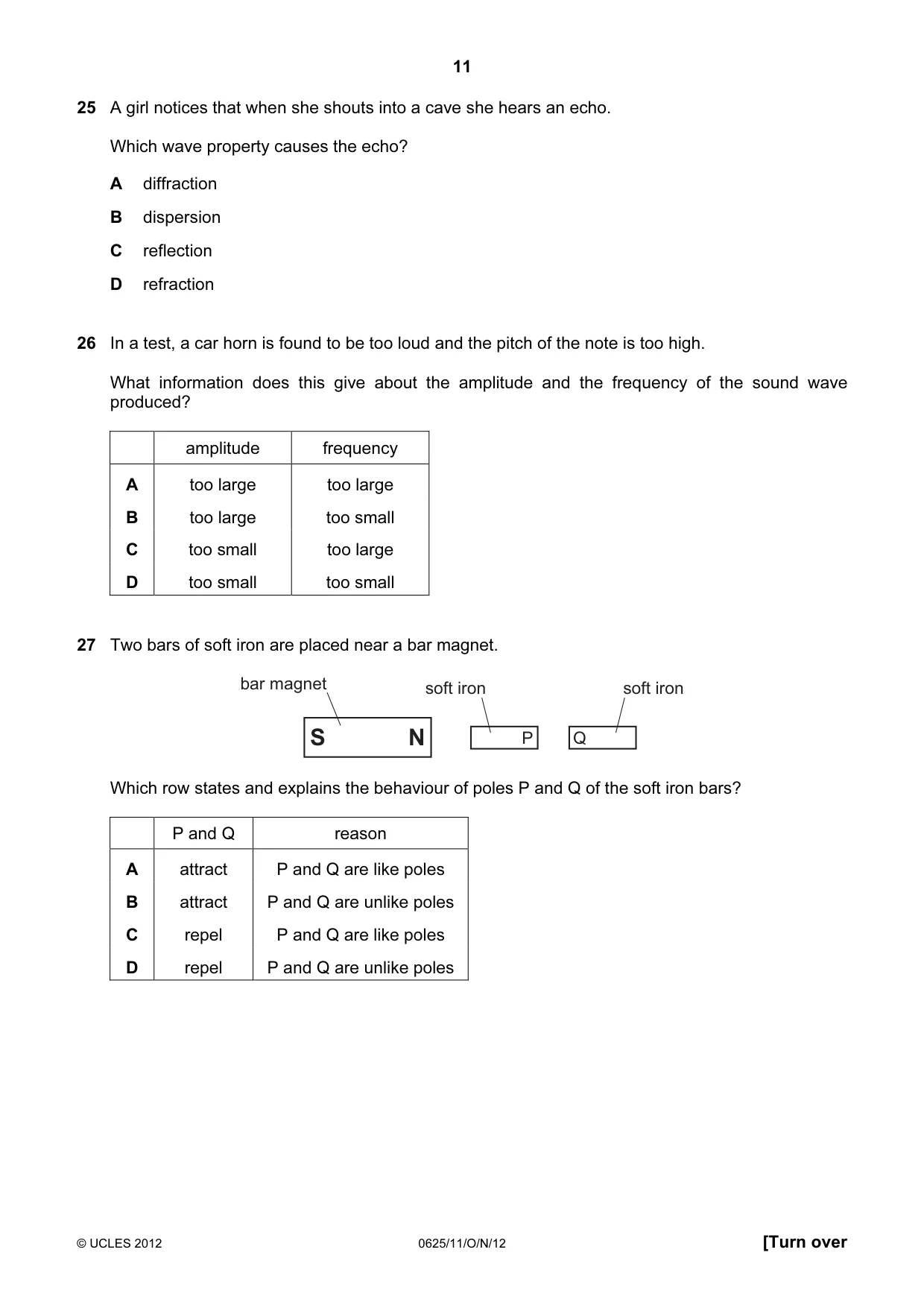
26 In a test, a car horn is found to be too loud and the pitch of the note is too high. What information does this give about the amplitude and the frequency of the sound wave produced? amplitude frequency A too large too large B too large too small C too small too large D too small too small
Mark scheme: A
Q27 · Two bars of soft iron are placed near a bar magnet
27 Two bars of soft iron are placed near a bar magnet. bar magnet soft iron soft iron S N P Q Which row states and explains the behaviour of poles P and Q of the soft iron bars? P and Q reason A attract P and Q are like poles B attract P and Q are unlike poles C repel P and Q are like poles D repel P and Q are unlike poles
Mark scheme: B
Q28 · Some electrical devices require a magnet which may be switched on and off many times in a…
28 Some electrical devices require a magnet which may be switched on and off many times in a second. Which type of magnet may be used? A an electromagnet only B a permanent magnet only C either a permanent magnet or an electromagnet D neither a permanent magnet nor an electromagnet
Mark scheme: A
Q29 · Which of these is an electric current?
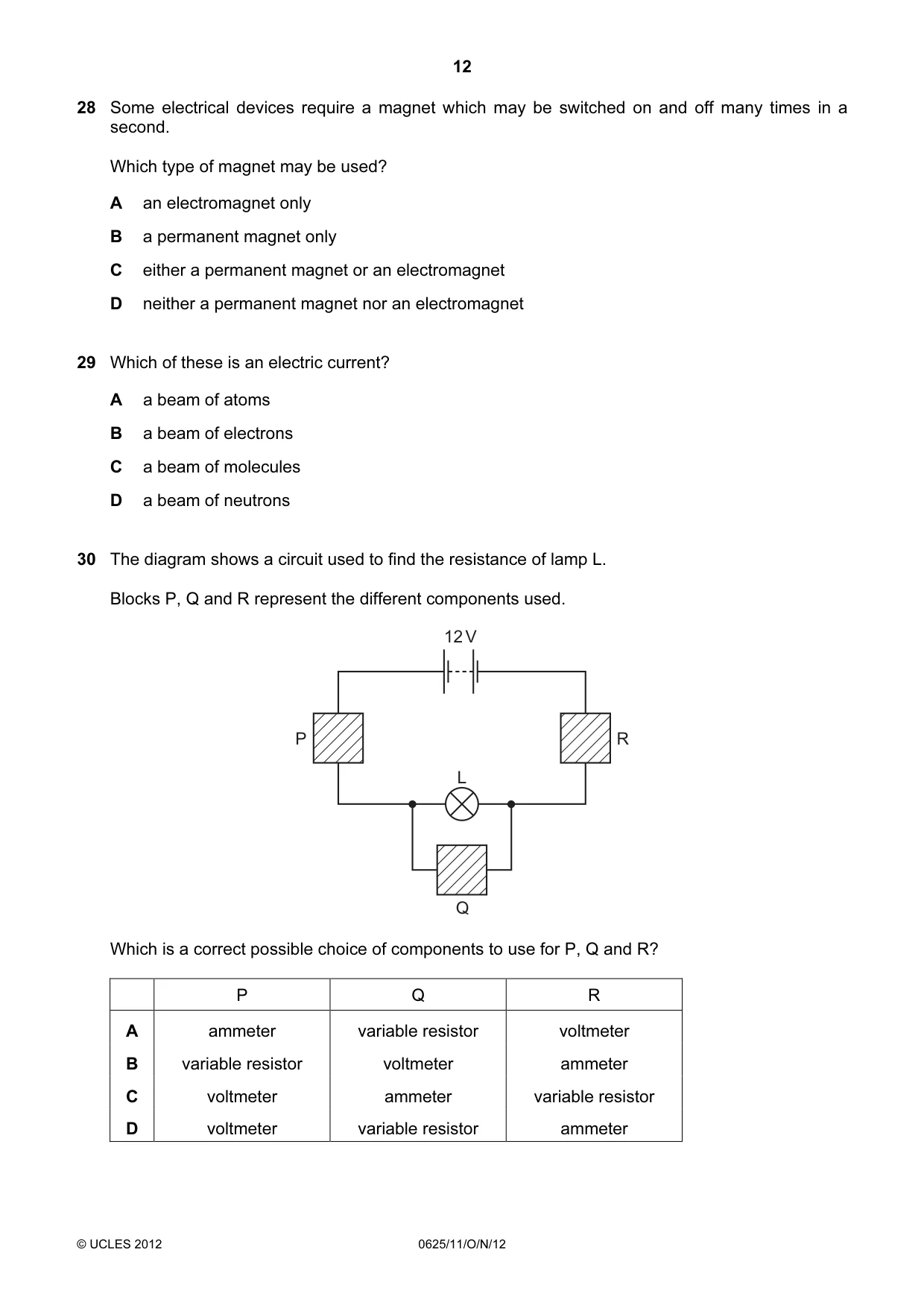
29 Which of these is an electric current? A a beam of atoms B a beam of electrons C a beam of molecules D a beam of neutrons
Mark scheme: B
Q30 · The diagram shows a circuit used to find the resistance of lamp L
30 The diagram shows a circuit used to find the resistance of lamp L. Blocks P, Q and R represent the different components used. 12 V P R L Q Which is a correct possible choice of components to use for P, Q and R? P Q R A ammeter variable resistor voltmeter B variable resistor voltmeter ammeter C voltmeter ammeter variable resistor D voltmeter variable resistor ammeter
Mark scheme: B
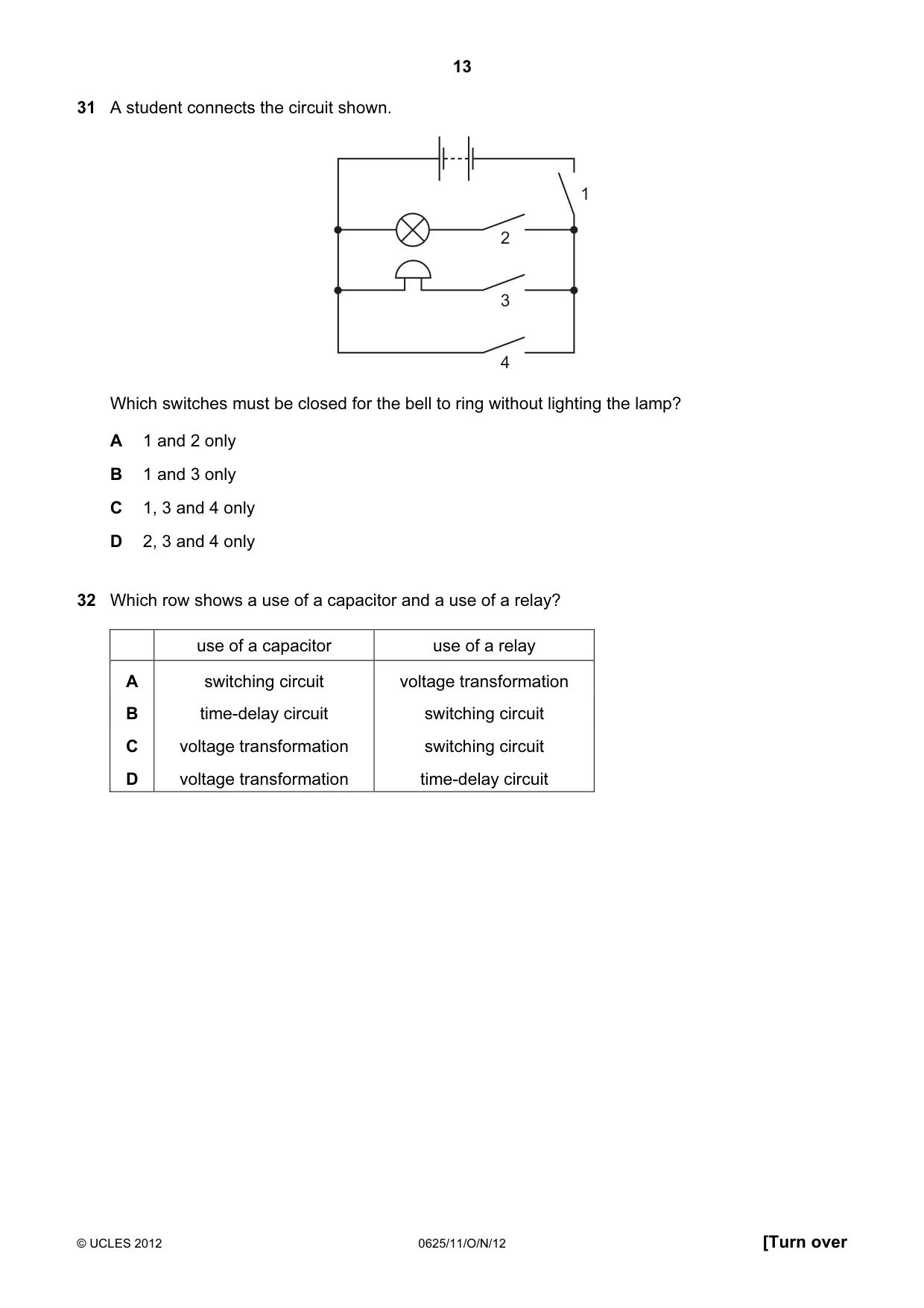
Q31 · A student connects the circuit shown
31 A student connects the circuit shown. 1 2 3 4 Which switches must be closed for the bell to ring without lighting the lamp? A 1 and 2 only B 1 and 3 only C 1, 3 and 4 only D 2, 3 and 4 only
Mark scheme: B
Q32 · Which row shows a use of a capacitor and a use of a relay?
32 Which row shows a use of a capacitor and a use of a relay? use of a capacitor use of a relay A switching circuit voltage transformation B time-delay circuit switching circuit C voltage transformation switching circuit D voltage transformation time-delay circuit
Mark scheme: B
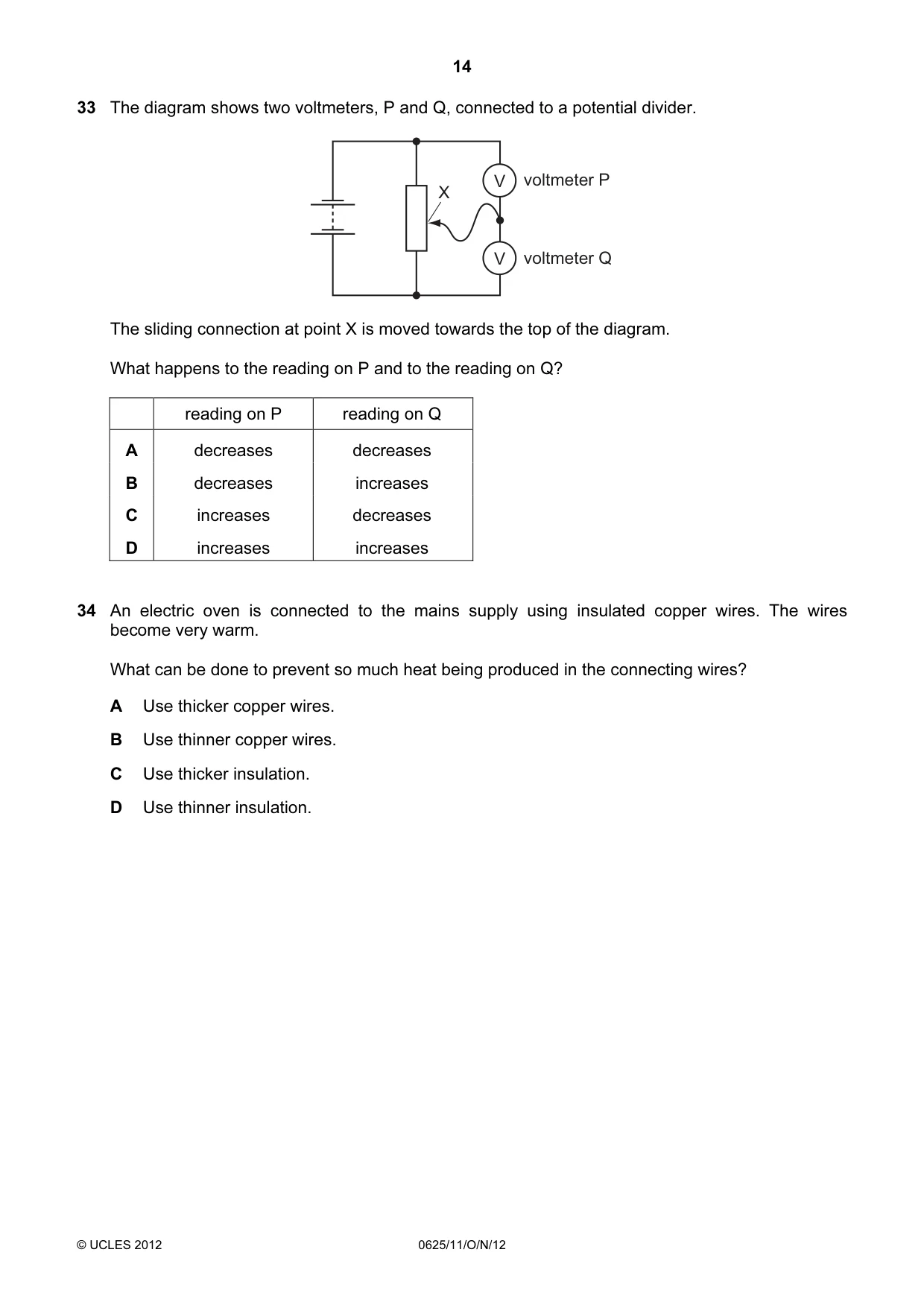
Q33 · The diagram shows two voltmeters, P and Q, connected to a potential divider
33 The diagram shows two voltmeters, P and Q, connected to a potential divider. V voltmeter P X V voltmeter Q The sliding connection at point X is moved towards the top of the diagram. What happens to the reading on P and to the reading on Q? reading on P reading on Q A decreases decreases B decreases increases C increases decreases D increases increases
Mark scheme: B
Q34 · An electric oven is connected to the mains supply using insulated copper wires
34 An electric oven is connected to the mains supply using insulated copper wires. The wires become very warm. What can be done to prevent so much heat being produced in the connecting wires? A Use thicker copper wires. B Use thinner copper wires. C Use thicker insulation. D Use thinner insulation.
Mark scheme: A
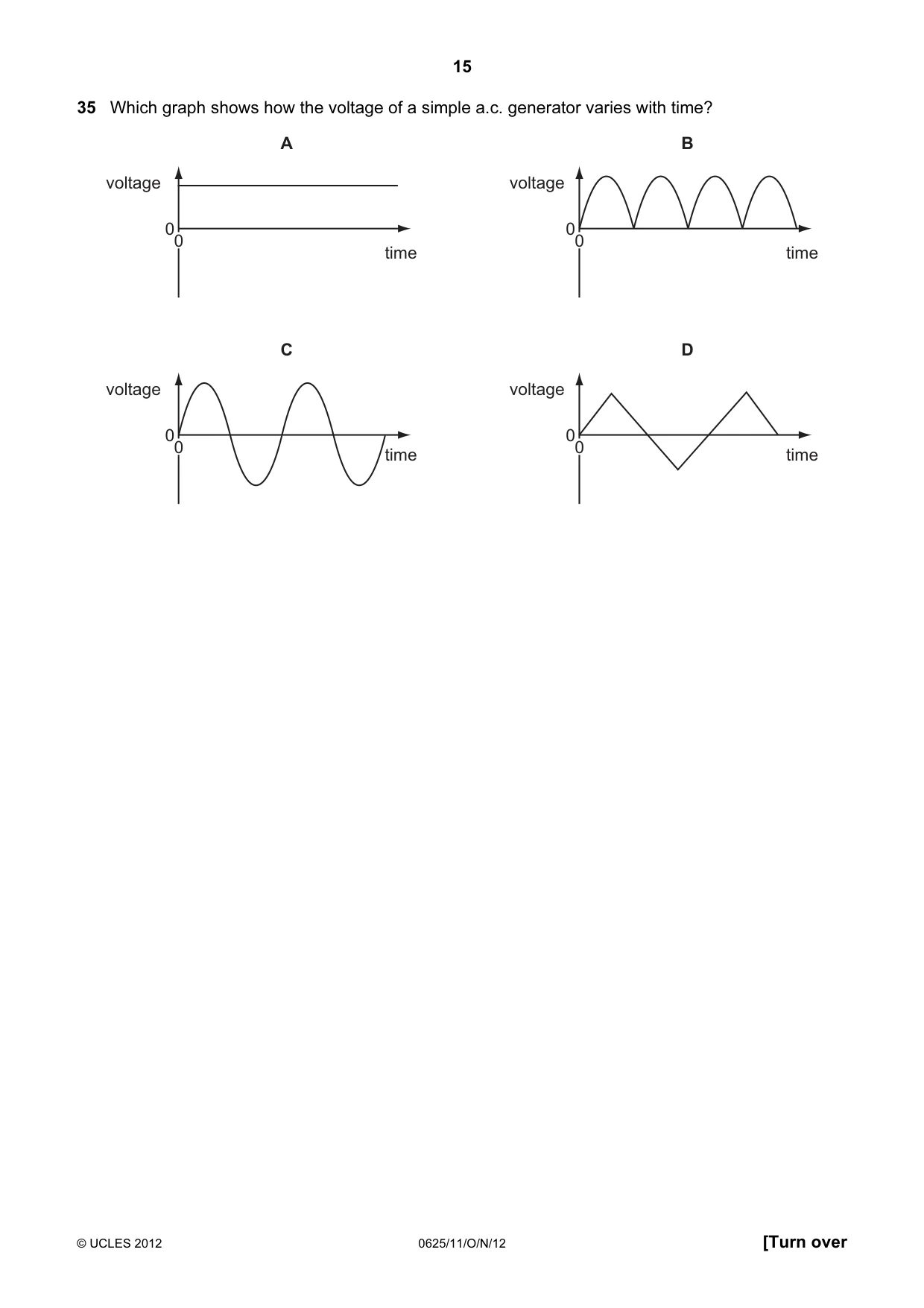
Q35 · Which graph shows how the voltage of a simple a.c
35 Which graph shows how the voltage of a simple a.c. generator varies with time? A B voltage voltage 0 0 0 0 time time C D voltage voltage 0 0 0 0 time time
Mark scheme: C
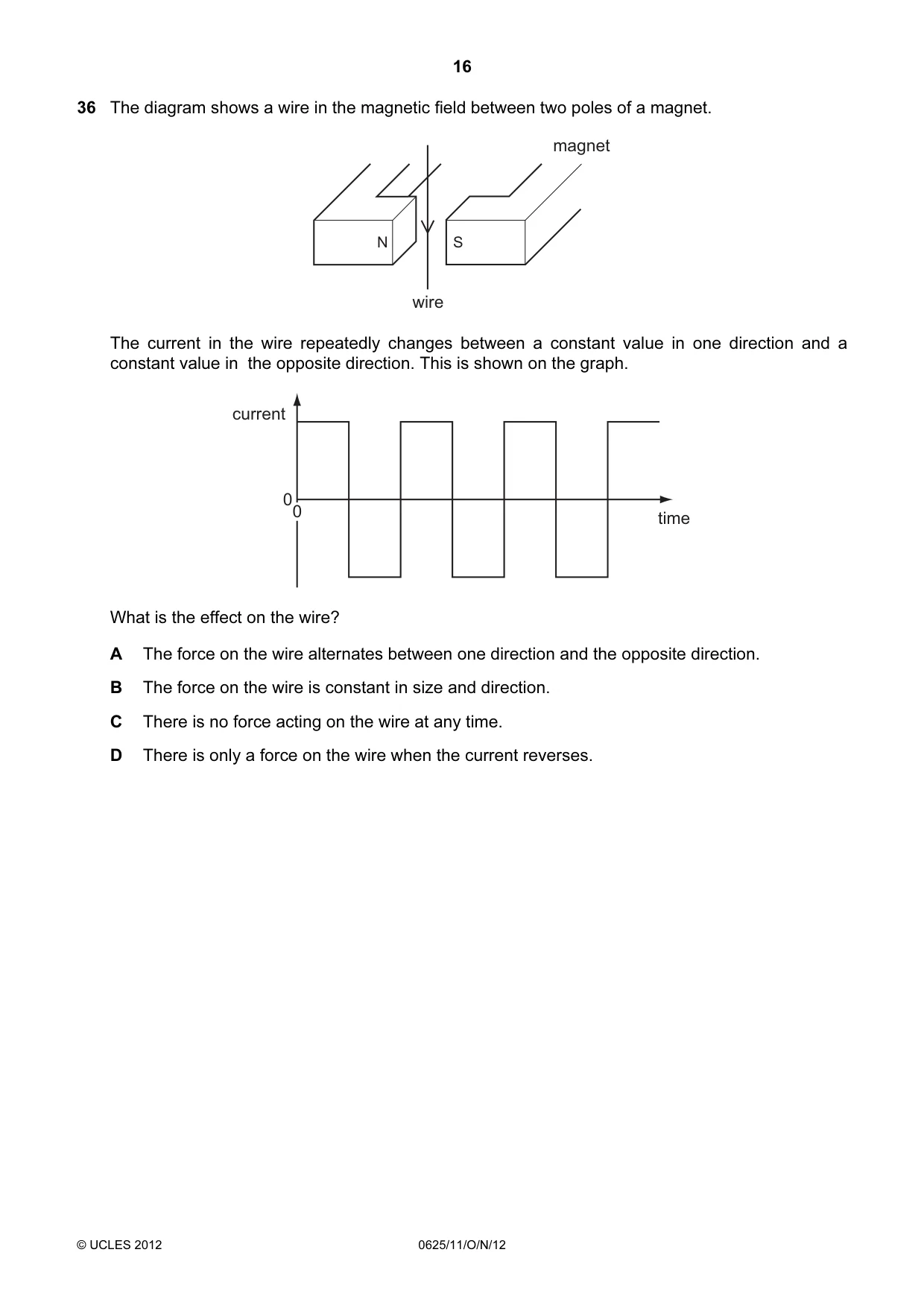
Q36 · The diagram shows a wire in the magnetic field between two poles of a magnet
36 The diagram shows a wire in the magnetic field between two poles of a magnet. magnet N S wire The current in the wire repeatedly changes between a constant value in one direction and a constant value in the opposite direction. This is shown on the graph. current 00 time What is the effect on the wire? A The force on the wire alternates between one direction and the opposite direction. B The force on the wire is constant in size and direction. C There is no force acting on the wire at any time. D There is only a force on the wire when the current reverses.
Mark scheme: A
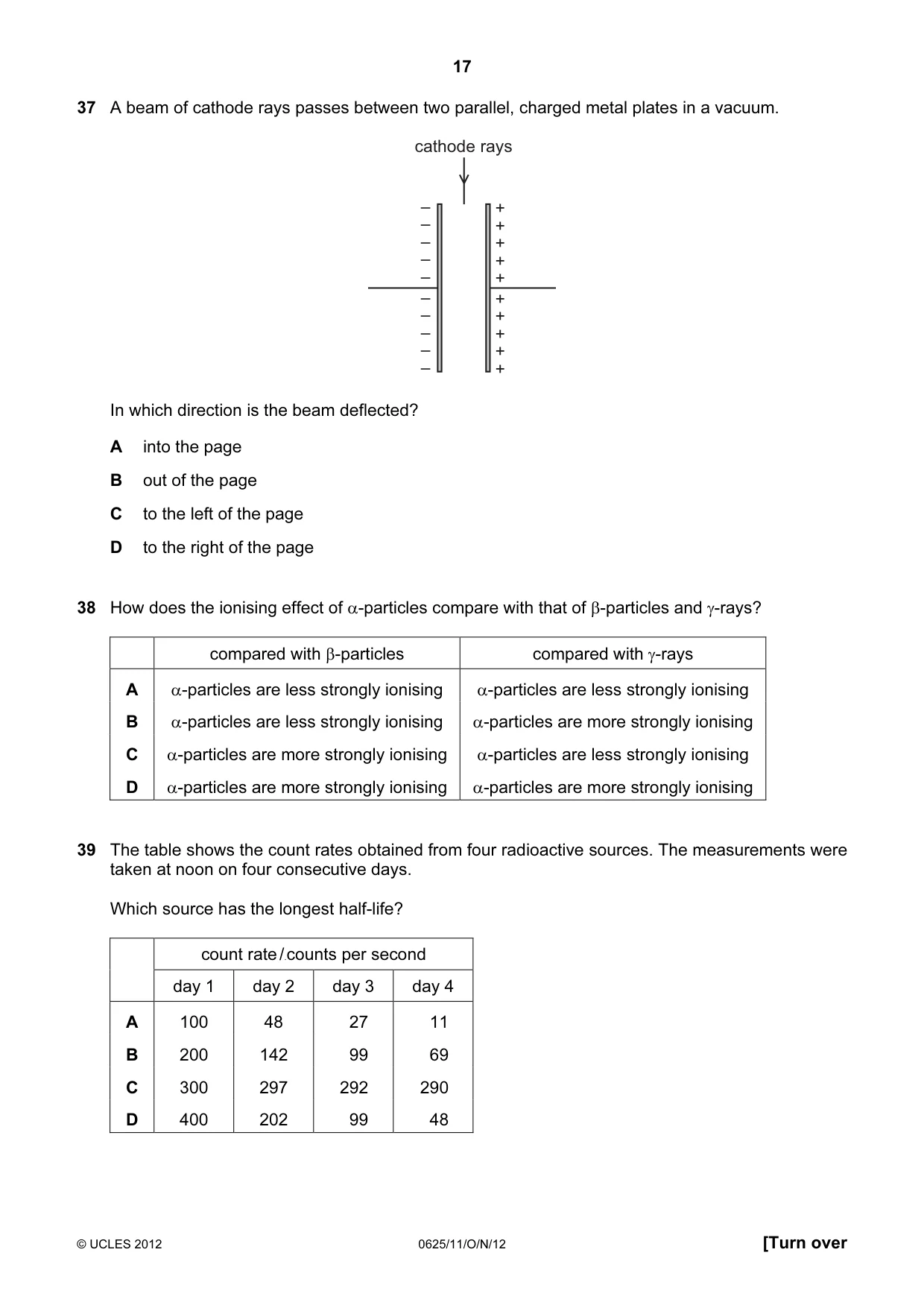
Q37 · A beam of cathode rays passes between two parallel, charged metal plates in a vacuum
37 A beam of cathode rays passes between two parallel, charged metal plates in a vacuum. cathode rays – + – + – + – + – + – + – + – + – + – + In which direction is the beam deflected? A into the page B out of the page C to the left of the page D to the right of the page
Mark scheme: D
Q38 · How does the ionising effect of α-particles compare with that of β-particles and γ-rays?
38 How does the ionising effect of α-particles compare with that of β-particles and γ-rays? compared with β-particles compared with γ-rays A α-particles are less strongly ionising α-particles are less strongly ionising B α-particles are less strongly ionising α-particles are more strongly ionising C α-particles are more strongly ionising α-particles are less strongly ionising D α-particles are more strongly ionising α-particles are more strongly ionising
Mark scheme: D
Q39 · The table shows the count rates obtained from four radioactive sources
39 The table shows the count rates obtained from four radioactive sources. The measurements were taken at noon on four consecutive days. Which source has the longest half-life? count rate /.counts per second day 1 day 2 day 3 day 4 A 100 48 27 11 B 200 142 99 69 C 300 297 292 290 D 400 202 99 48
Mark scheme: C
Q40 · Which statement about a carbon nucleus represented by 14 C is correct?
40 Which statement about a carbon nucleus represented by 14 C is correct? 6 A It contains 6 neutrons. B It contains 6 electrons. C It contains 8 protons. D It contains 14 nucleons.
Mark scheme: D
What was in this paper
The subtopics covered by these 40 questions, and how many questions each got. Open one in a new tab to see every Cambridge question on it.
4Energy, work and power3Thermal properties and temperature3Electrical quantities2Electromagnetic effects2Forces2General properties of waves2Kinetic particle model of matter2Light2Mass and weight2Motion2Pressure2Radioactivity2Simple phenomena of magnetism2Sound2The nuclear model of the atom2Transfer of thermal energy2Density1Physical quantities and measurement techniques1What you needed in this session
Cambridge’s own grade thresholds for 2012 Oct/Nov, Paper 1 · Variant 1. A higher threshold means an easier paper — the bar moves with how the cohort did.