Cambridge IGCSE Physics 0625 — 2015 Feb/March Paper 1 · Variant 2
0625/12/F/M/15 · 40 questions · 40 marks · ≈45 min
The question paper and its mark scheme, free to read here and free to download. This is Cambridge’s own paper, exactly as it was sat.
Question paper20 pages
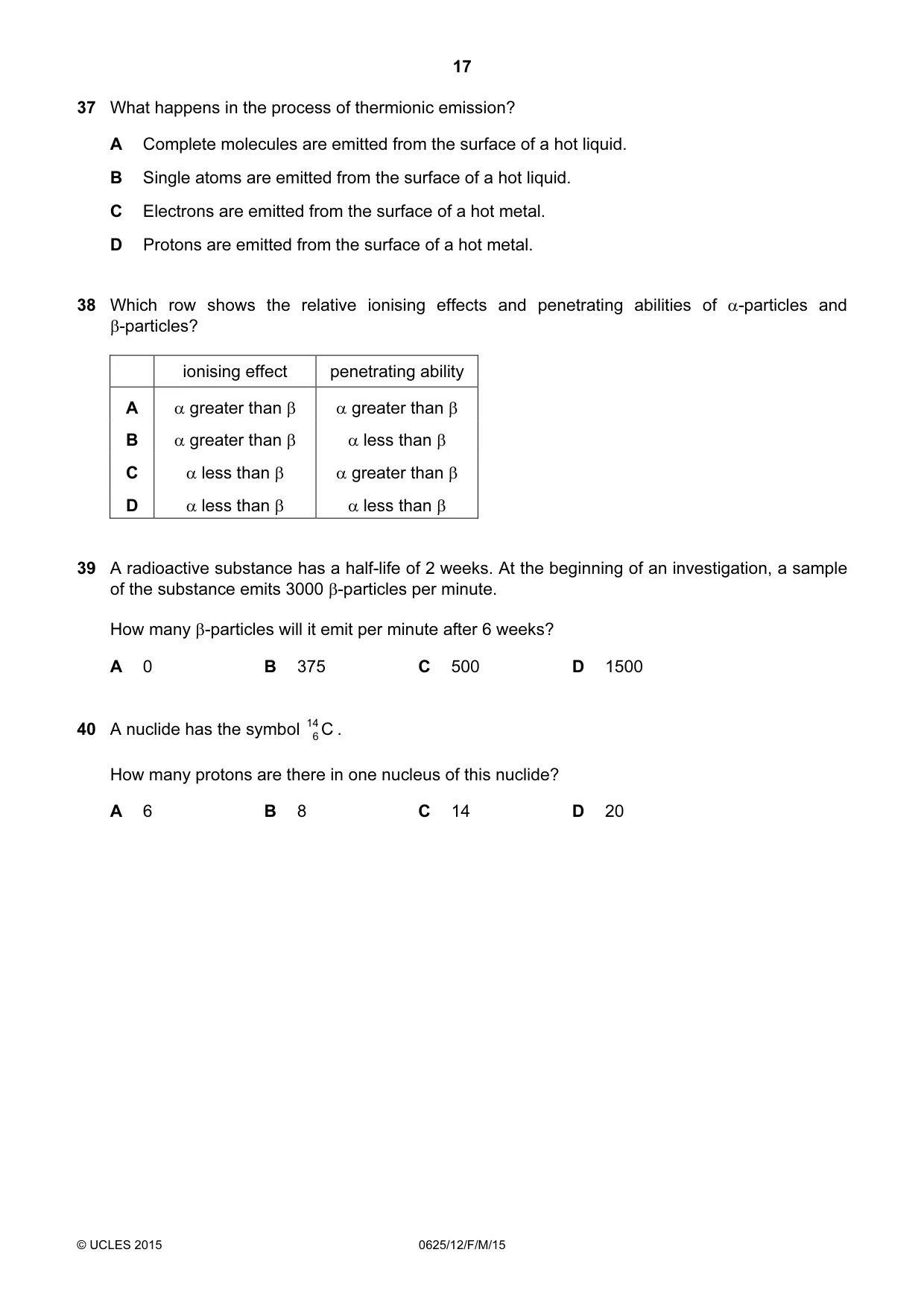


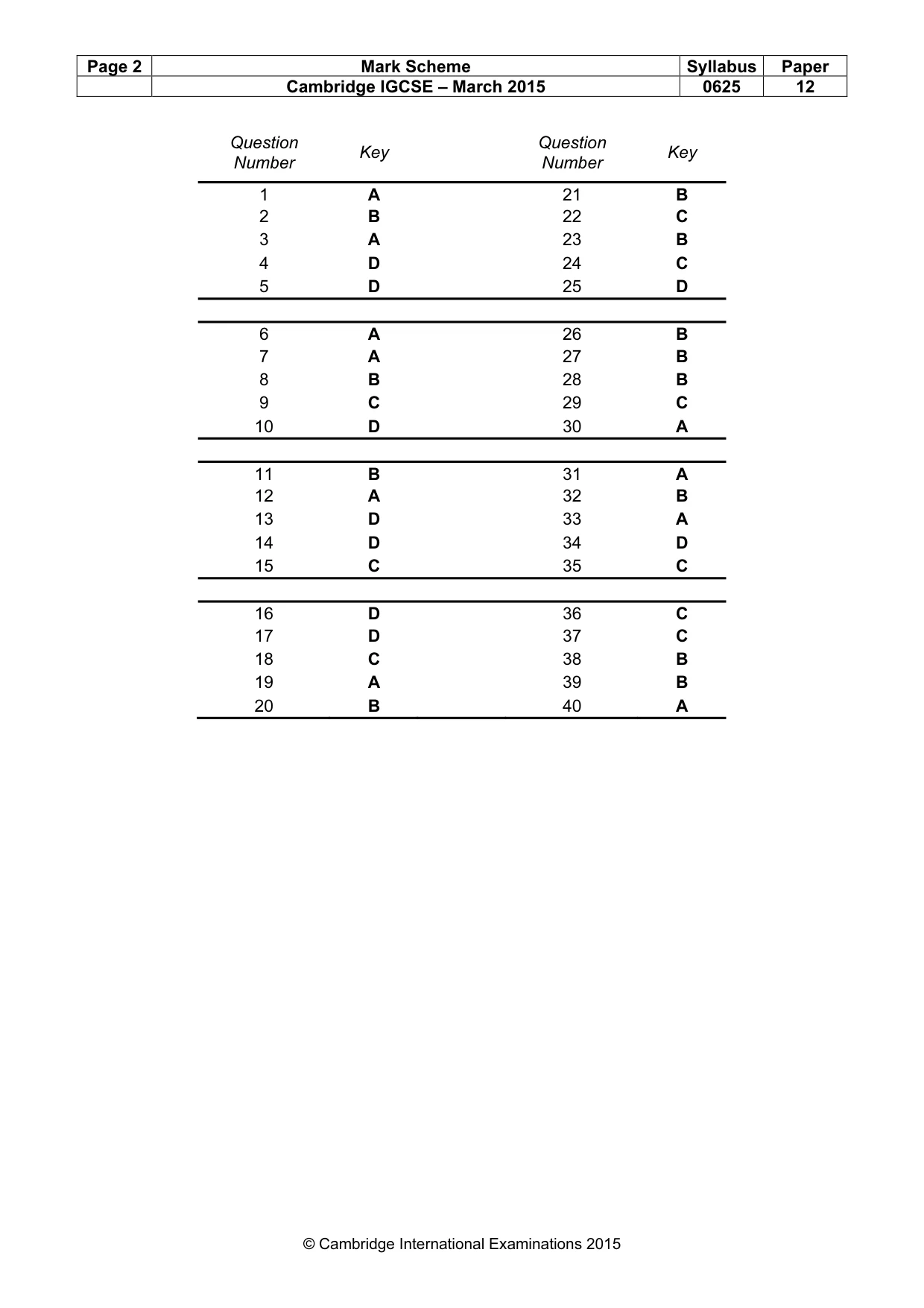
Mark scheme2 pages
Answers below. Sit the paper first if you are practising.
Questions as text
Q1 · A student uses a measuring cylinder to measure the volume of some water
1 A student uses a measuring cylinder to measure the volume of some water. The diagram shows part of the measuring cylinder. The top and bottom of the meniscus are labelled. cm3 50 top of meniscus 45 bottom of meniscus 40 What is the volume of the water? A 47.0 cm3 B 47.5 cm3 C 49.0 cm3 D 49.5 cm3
Mark scheme: A
More questions on Physical quantities and measurement techniques
Q2 · The graph represents the motion of a train travelling between two stations
2 The graph represents the motion of a train travelling between two stations. 20 speed m / s 10 0 0 100 200 300 400 500 600 700 800 900 time / s Which statement about the train is correct? A Its acceleration takes a longer time than its deceleration. B It travels at constant speed for less than half of its journey time. C It travels 2000 m in the first 100 s. D It travels 10 000 m at constant speed.
Mark scheme: B
Q3 · A car travels 6.0 km along a main road in 6.0 minutes
3 A car travels 6.0 km along a main road in 6.0 minutes. It then travels 2.0 km along a minor road in 6.0 minutes. minor road 6.0 km 2.0 km 6.0 minutes 6.0 minutes main road Which calculation of average speed for the whole journey is correct? A 8.0 ÷ 12.0 = 0.67 km / minute B 12.0 ÷ 8.0 = 1.5 km / minute C 8.0 + 12.0 = 20 km / minute D 8.0 × 12.0 = 96 km / minute
Mark scheme: A
Q4 · Two metal blocks P and Q have identical dimensions
4 Two metal blocks P and Q have identical dimensions. They hang on identical spring balances. N N 0 0 1 1 2 2 3 3 4 4 5 5 6 6 P Q What can be deduced about P and Q? A They have different volumes and different weights. B They have different volumes, but equal masses. C They have equal volumes and equal weights. D They have equal volumes, but different masses.
Mark scheme: D
Q5 · A person measures the length, width, height and mass of a metal block with rectangular…
5 A person measures the length, width, height and mass of a metal block with rectangular sides. Which of these measurements must be used in order to calculate the density of the metal? A mass only B height and mass only C length, width and height only D length, width, height and mass
Mark scheme: D
Q6 · The diagram shows the only three forces acting on an object
6 The diagram shows the only three forces acting on an object. 3.0 N 5.0 N 2.0 N What is the resultant force on the object? A 0 N B 5.0 N towards the left C 5.0 N towards the right D 10.0 N towards the right
Mark scheme: A
Q7 · A uniform rod rests on a pivot at its centre
7 A uniform rod rests on a pivot at its centre. The rod is not attached to the pivot. Forces are then applied to the rod in four different ways, as shown. The weight of the rod can be ignored. Which diagram shows the rod in equilibrium? A B 100 N 100 N 100 N 100 N C D 100 N 100 N 100 N 100 N 100 N
Mark scheme: A
Q8 · A helicopter takes off from the ground and rises vertically
8 A helicopter takes off from the ground and rises vertically. It then hovers at a constant height above the ground. Which sequence of energy changes takes place during the gain in height? A chemical → gravitational potential → kinetic B chemical → kinetic → gravitational potential C gravitational potential → chemical → kinetic D kinetic → chemical → gravitational potential
Mark scheme: B
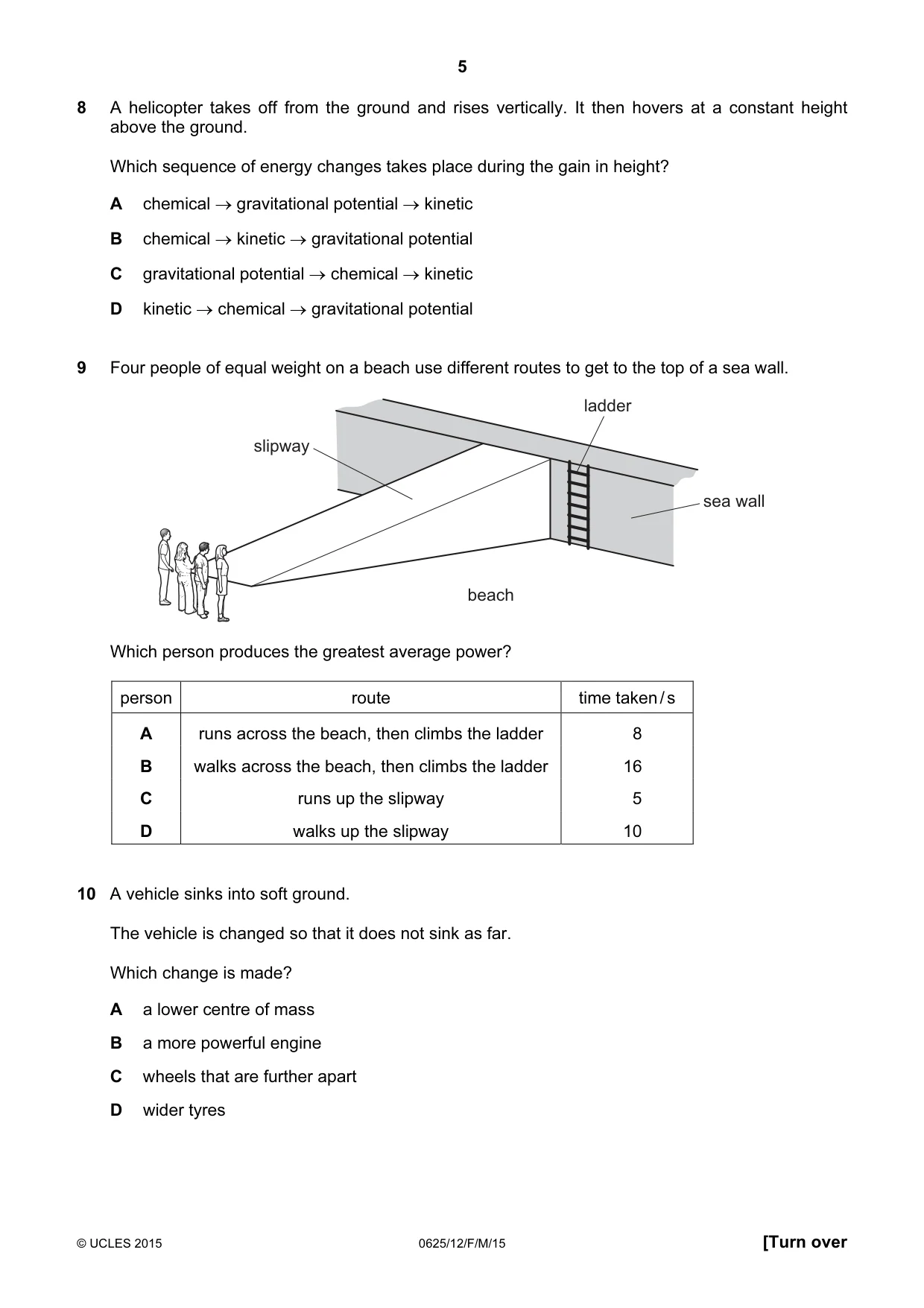
Q9 · Four people of equal weight on a beach use different routes to get to the top of a sea…
9 Four people of equal weight on a beach use different routes to get to the top of a sea wall. ladder slipway sea wall beach Which person produces the greatest average power? person route time taken / s A runs across the beach, then climbs the ladder 8 B walks across the beach, then climbs the ladder 16 C runs up the slipway 5 D walks up the slipway 10
Mark scheme: C
Q10 · A vehicle sinks into soft ground
10 A vehicle sinks into soft ground. The vehicle is changed so that it does not sink as far. Which change is made? A a lower centre of mass B a more powerful engine C wheels that are further apart D wider tyres
Mark scheme: D
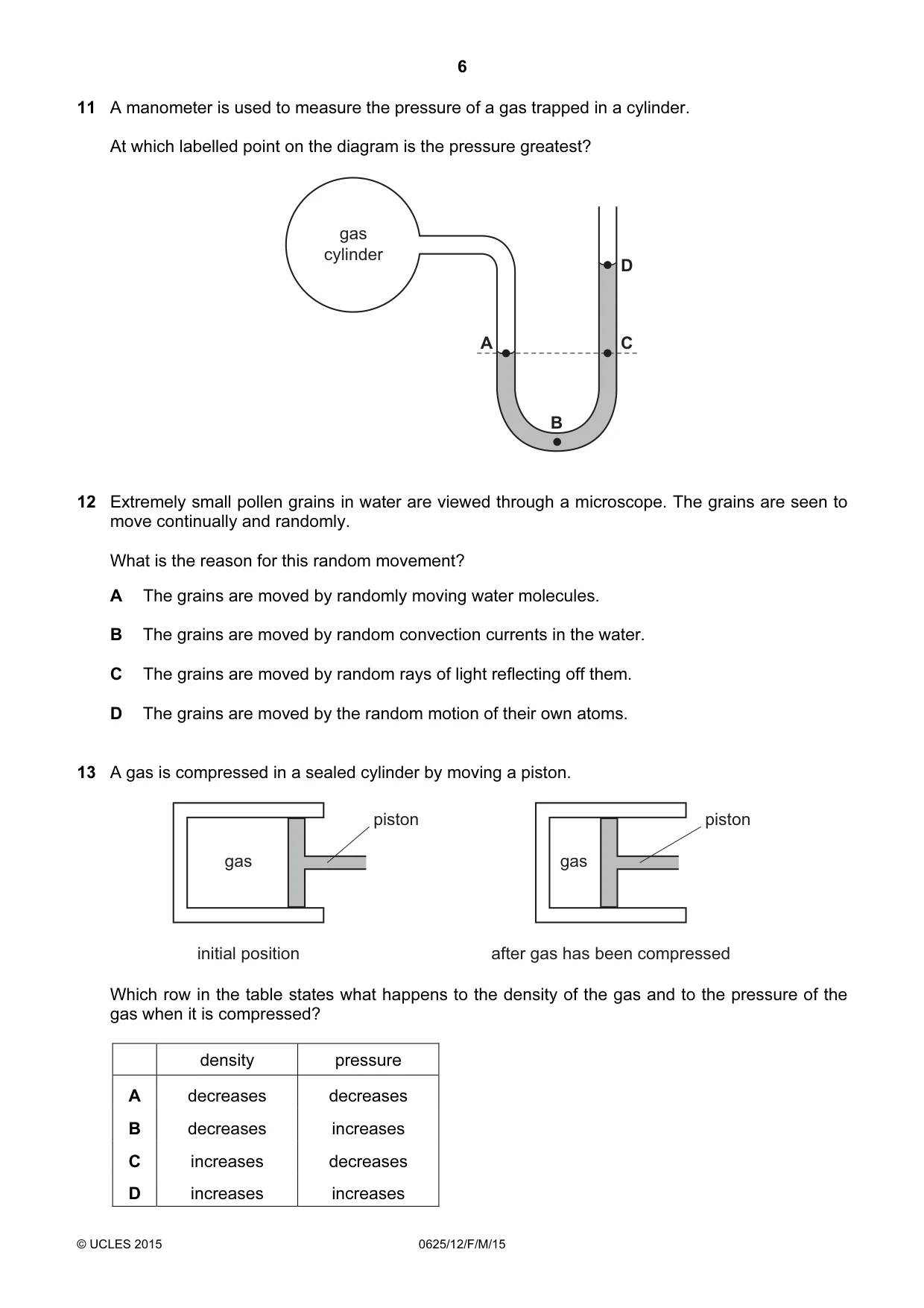
Q11 · A manometer is used to measure the pressure of a gas trapped in a cylinder
11 A manometer is used to measure the pressure of a gas trapped in a cylinder. At which labelled point on the diagram is the pressure greatest? gas cylinder D A C B
Mark scheme: B
Q12 · Extremely small pollen grains in water are viewed through a microscope
12 Extremely small pollen grains in water are viewed through a microscope. The grains are seen to move continually and randomly. What is the reason for this random movement? A The grains are moved by randomly moving water molecules. B The grains are moved by random convection currents in the water. C The grains are moved by random rays of light reflecting off them. D The grains are moved by the random motion of their own atoms.
Mark scheme: A
Q13 · A gas is compressed in a sealed cylinder by moving a piston
13 A gas is compressed in a sealed cylinder by moving a piston. piston piston gas gas initial position after gas has been compressed Which row in the table states what happens to the density of the gas and to the pressure of the gas when it is compressed? density pressure A decreases decreases B decreases increases C increases decreases D increases increases
Mark scheme: D
Q14 · When steam condenses it becomes liquid water
14 When steam condenses it becomes liquid water. When liquid water solidifies it becomes ice. What happens to the temperature of steam while it is condensing, and what happens to the temperature of water while it is solidifying? temperature of steam temperature of water while it is condensing while it is solidifying A decreases decreases B decreases stays the same C stays the same decreases D stays the same stays the same
Mark scheme: D
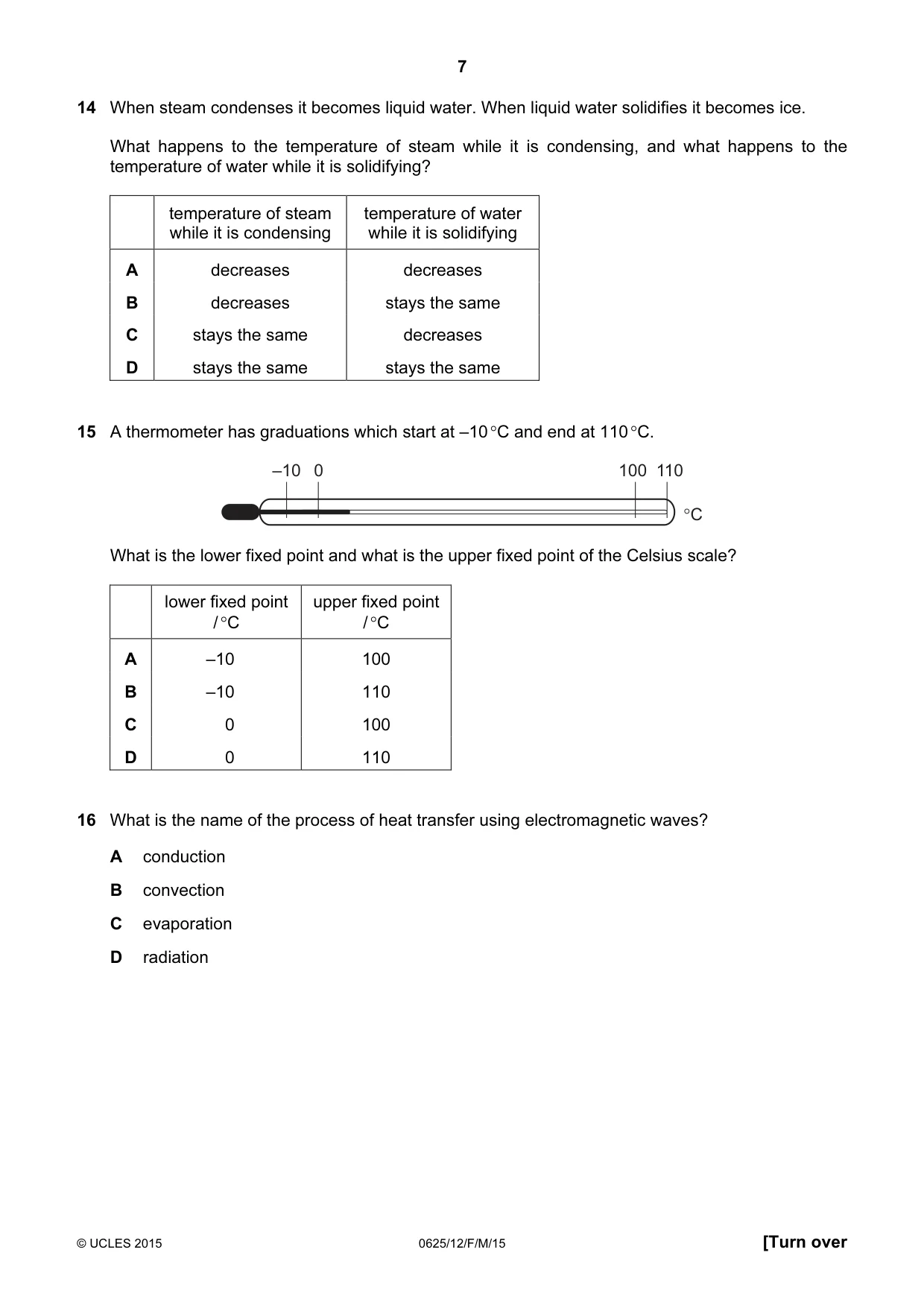
Q15 · A thermometer has graduations which start at –10 °C and end at 110 °C
15 A thermometer has graduations which start at –10 °C and end at 110 °C. –10 0 100 110 °C What is the lower fixed point and what is the upper fixed point of the Celsius scale? lower fixed point upper fixed point / °C / °C A –10 100 B –10 110 C 0 100 D 0 110
Mark scheme: C
Q16 · What is the name of the process of heat transfer using electromagnetic waves?
16 What is the name of the process of heat transfer using electromagnetic waves? A conduction B convection C evaporation D radiation
Mark scheme: D
Q17 · Ice is trapped by a metal gauze at the bottom of a tube containing water
17 Ice is trapped by a metal gauze at the bottom of a tube containing water. The water is heated strongly at the top, but the ice only melts very slowly. water boiling metal gauze heat ice Why does the ice melt so slowly? A Heat energy always travels upwards. B Hot water is more dense than cold water. C Metal gauze does not allow heat to pass through. D Water is a poor conductor of heat.
Mark scheme: D
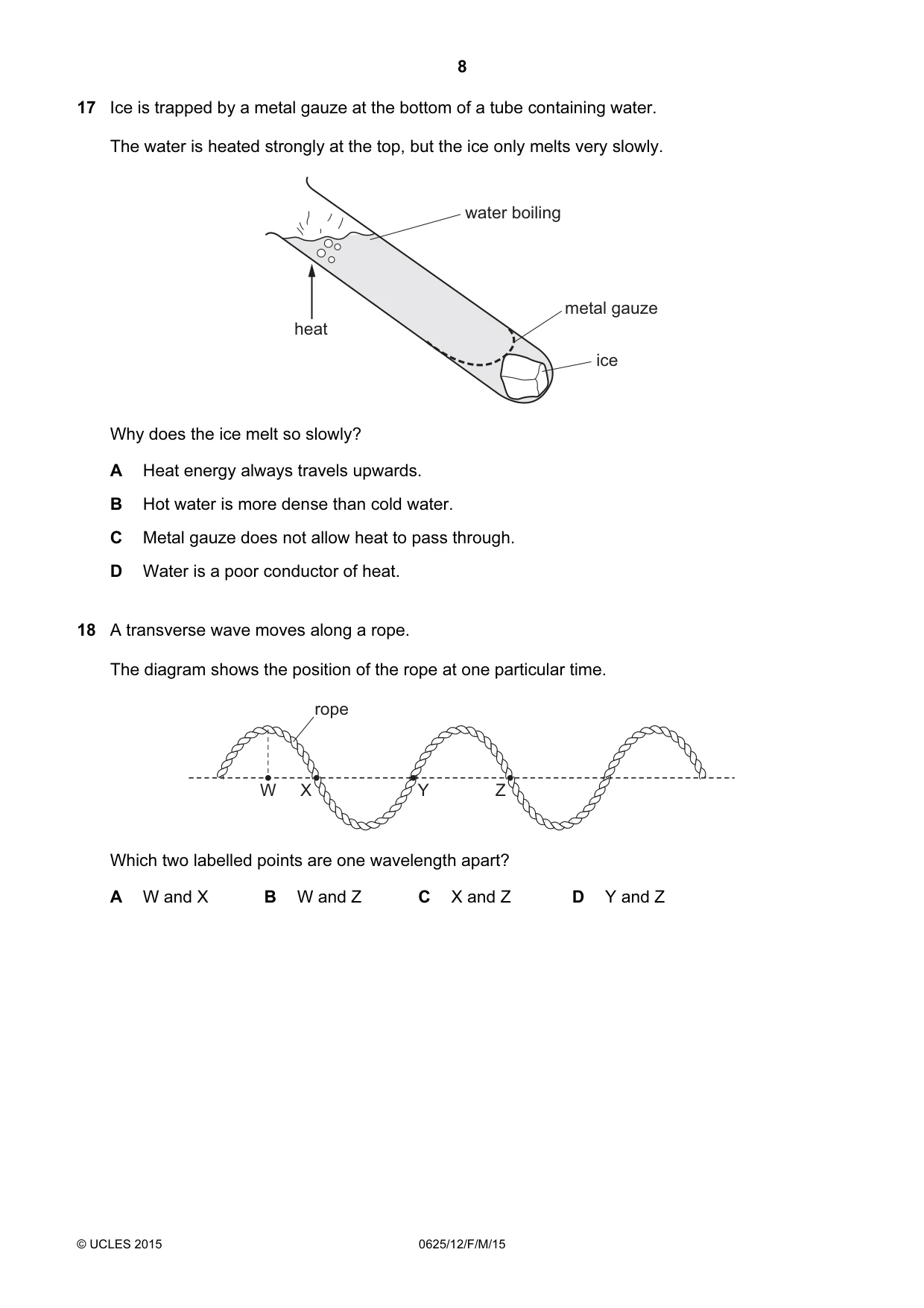
Q18 · A transverse wave moves along a rope
18 A transverse wave moves along a rope. The diagram shows the position of the rope at one particular time. rope W X Y Z Which two labelled points are one wavelength apart? A W and X B W and Z C X and Z D Y and Z
Mark scheme: C
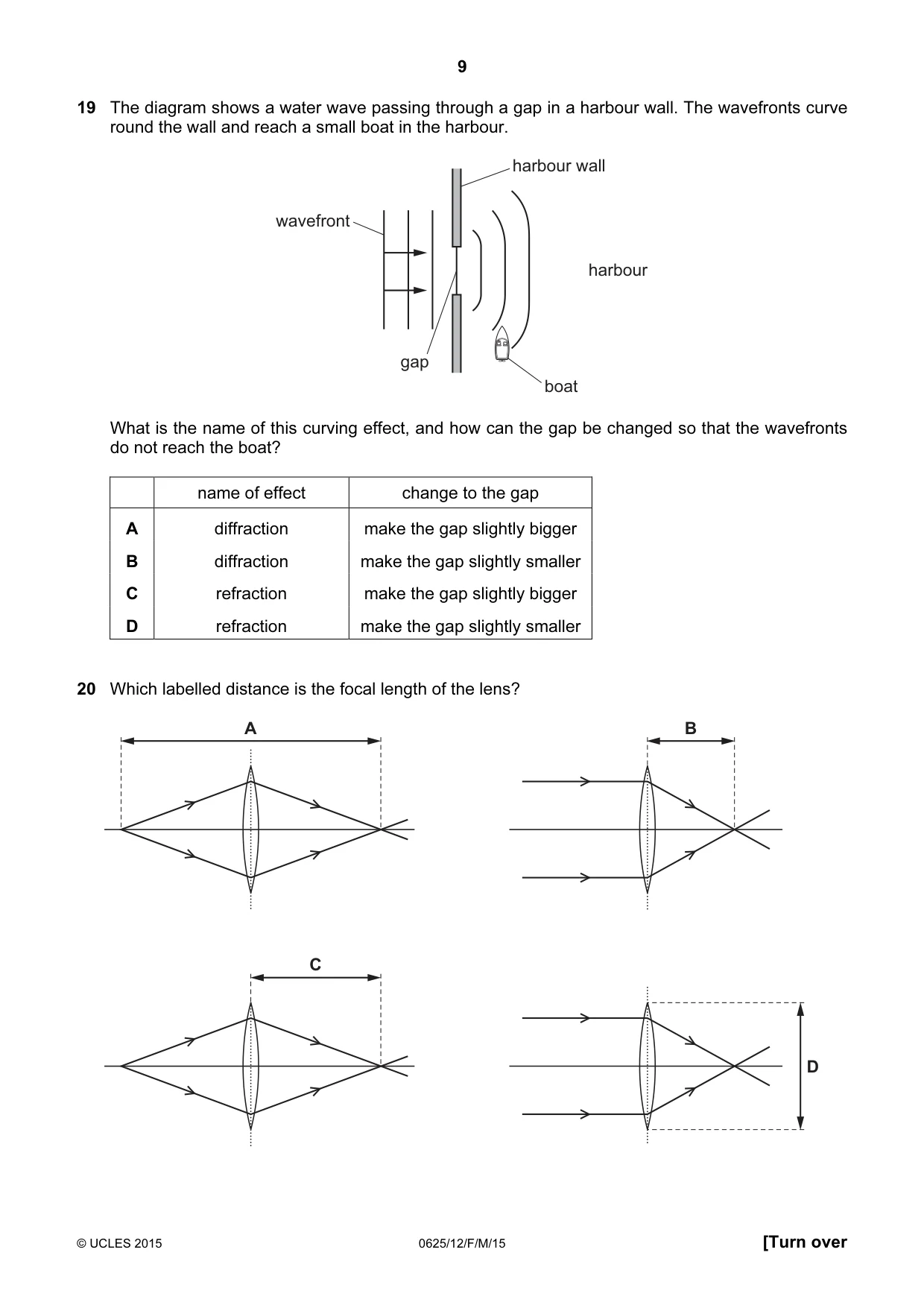
Q19 · The diagram shows a water wave passing through a gap in a harbour wall
19 The diagram shows a water wave passing through a gap in a harbour wall. The wavefronts curve round the wall and reach a small boat in the harbour. harbour wall wavefront harbour gap boat What is the name of this curving effect, and how can the gap be changed so that the wavefronts do not reach the boat? name of effect change to the gap A diffraction make the gap slightly bigger B diffraction make the gap slightly smaller C refraction make the gap slightly bigger D refraction make the gap slightly smaller
Mark scheme: A
Q20 · Which labelled distance is the focal length of the lens?
20 Which labelled distance is the focal length of the lens? A B C D
Mark scheme: B
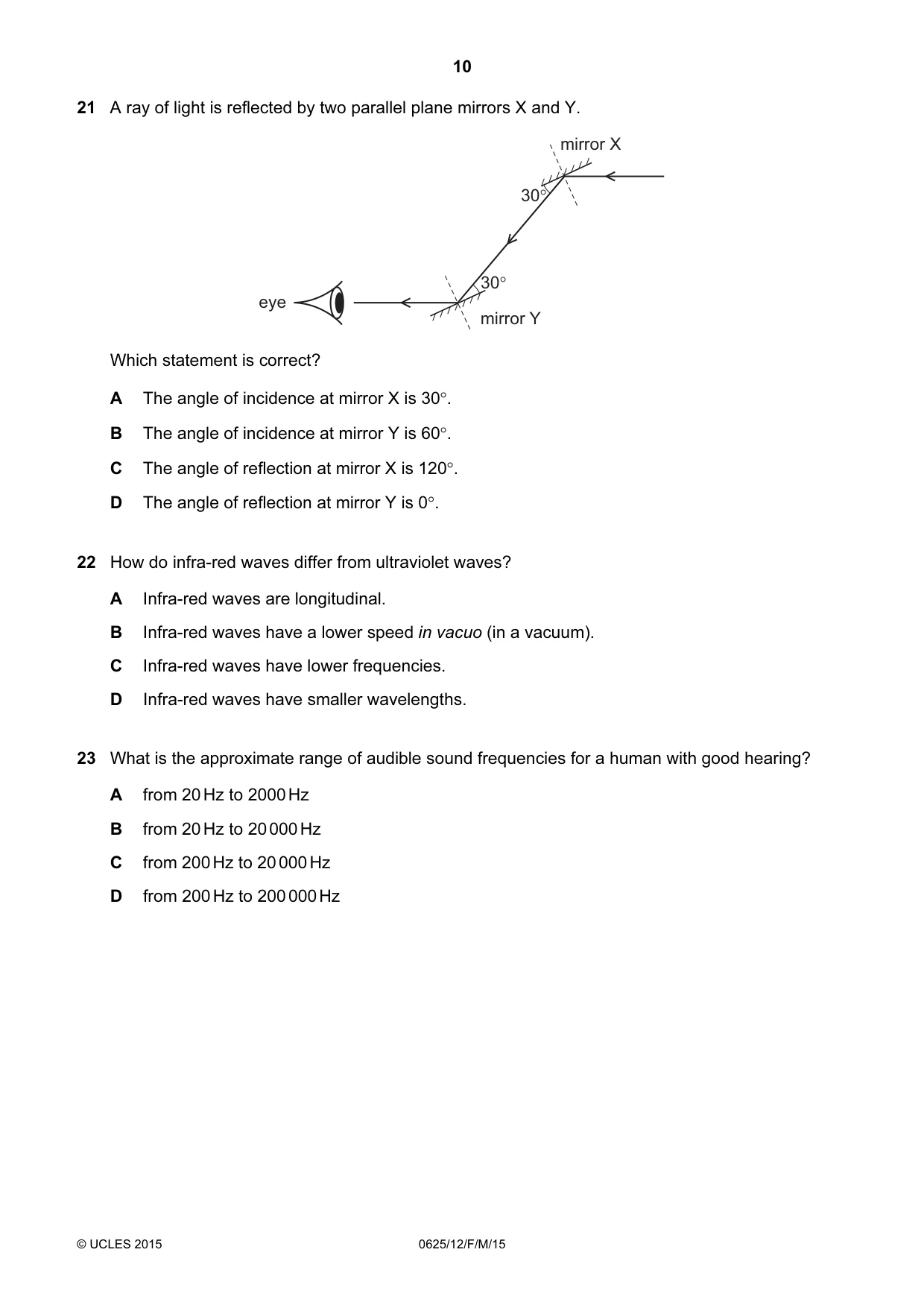
Q21 · A ray of light is reflected by two parallel plane mirrors X and Y
21 A ray of light is reflected by two parallel plane mirrors X and Y. mirror X 30° 30° eye mirror Y Which statement is correct? A The angle of incidence at mirror X is 30°. B The angle of incidence at mirror Y is 60°. C The angle of reflection at mirror X is 120°. D The angle of reflection at mirror Y is 0°.
Mark scheme: B
Q22 · How do infra-red waves differ from ultraviolet waves?
22 How do infra-red waves differ from ultraviolet waves? A Infra-red waves are longitudinal. B Infra-red waves have a lower speed in vacuo (in a vacuum). C Infra-red waves have lower frequencies. D Infra-red waves have smaller wavelengths.
Mark scheme: C
Q23 · What is the approximate range of audible sound frequencies for a human with good hearing?
23 What is the approximate range of audible sound frequencies for a human with good hearing? A from 20 Hz to 2000 Hz B from 20 Hz to 20 000 Hz C from 200 Hz to 20 000 Hz D from 200 Hz to 200 000 Hz
Mark scheme: B
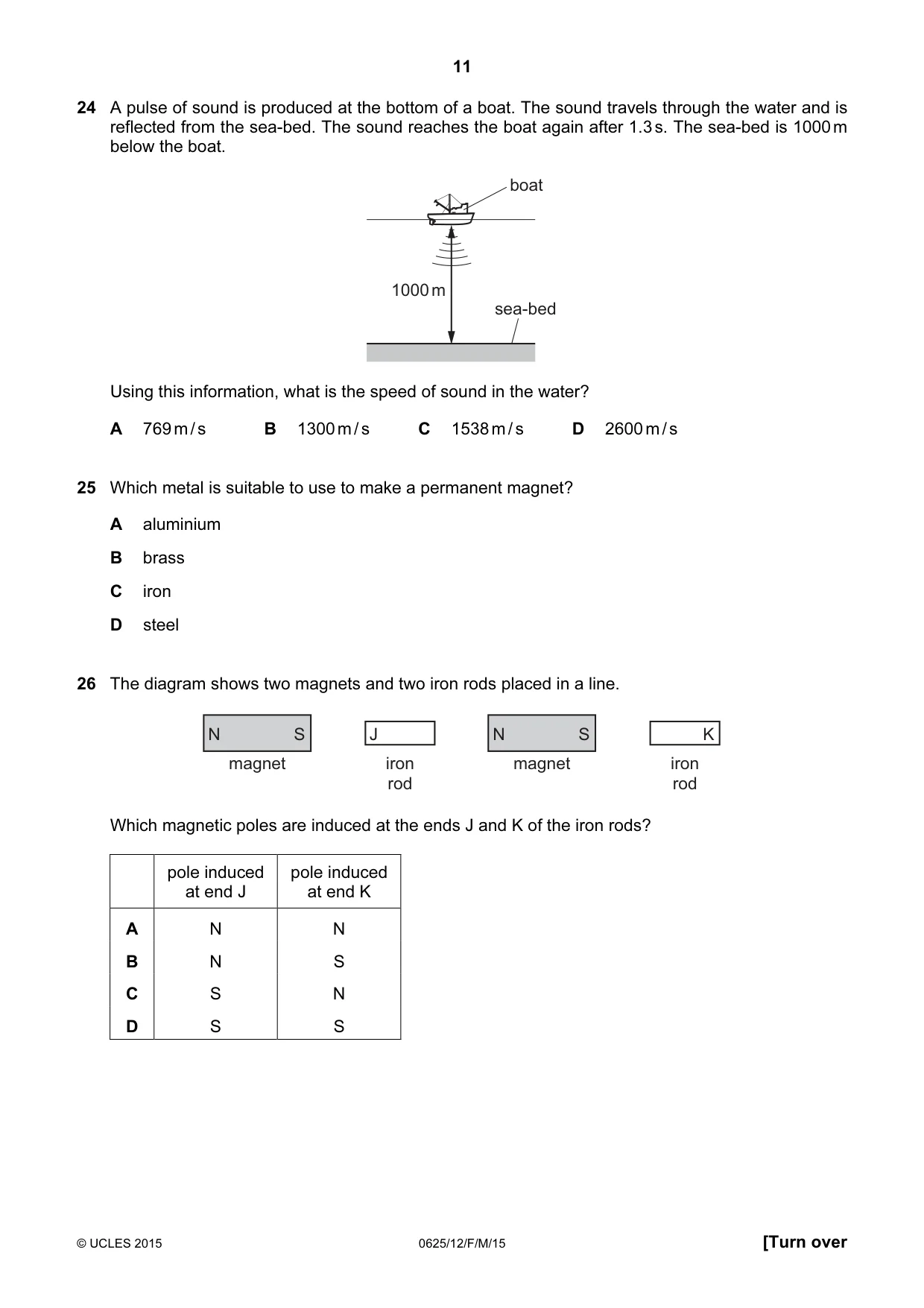
Q24 · A pulse of sound is produced at the bottom of a boat
24 A pulse of sound is produced at the bottom of a boat. The sound travels through the water and is reflected from the sea-bed. The sound reaches the boat again after 1.3 s. The sea-bed is 1000 m below the boat. boat 1000 m sea-bed Using this information, what is the speed of sound in the water? A 769 m / s B 1300 m / s C 1538 m / s D 2600 m / s
Mark scheme: C
Q25 · Which metal is suitable to use to make a permanent magnet?
25 Which metal is suitable to use to make a permanent magnet? A aluminium B brass C iron D steel
Mark scheme: D
Q26 · The diagram shows two magnets and two iron rods placed in a line
26 The diagram shows two magnets and two iron rods placed in a line. N S J N S K magnet iron magnet iron rod rod Which magnetic poles are induced at the ends J and K of the iron rods? pole induced pole induced at end J at end K A N N B N S C S N D S S
Mark scheme: B
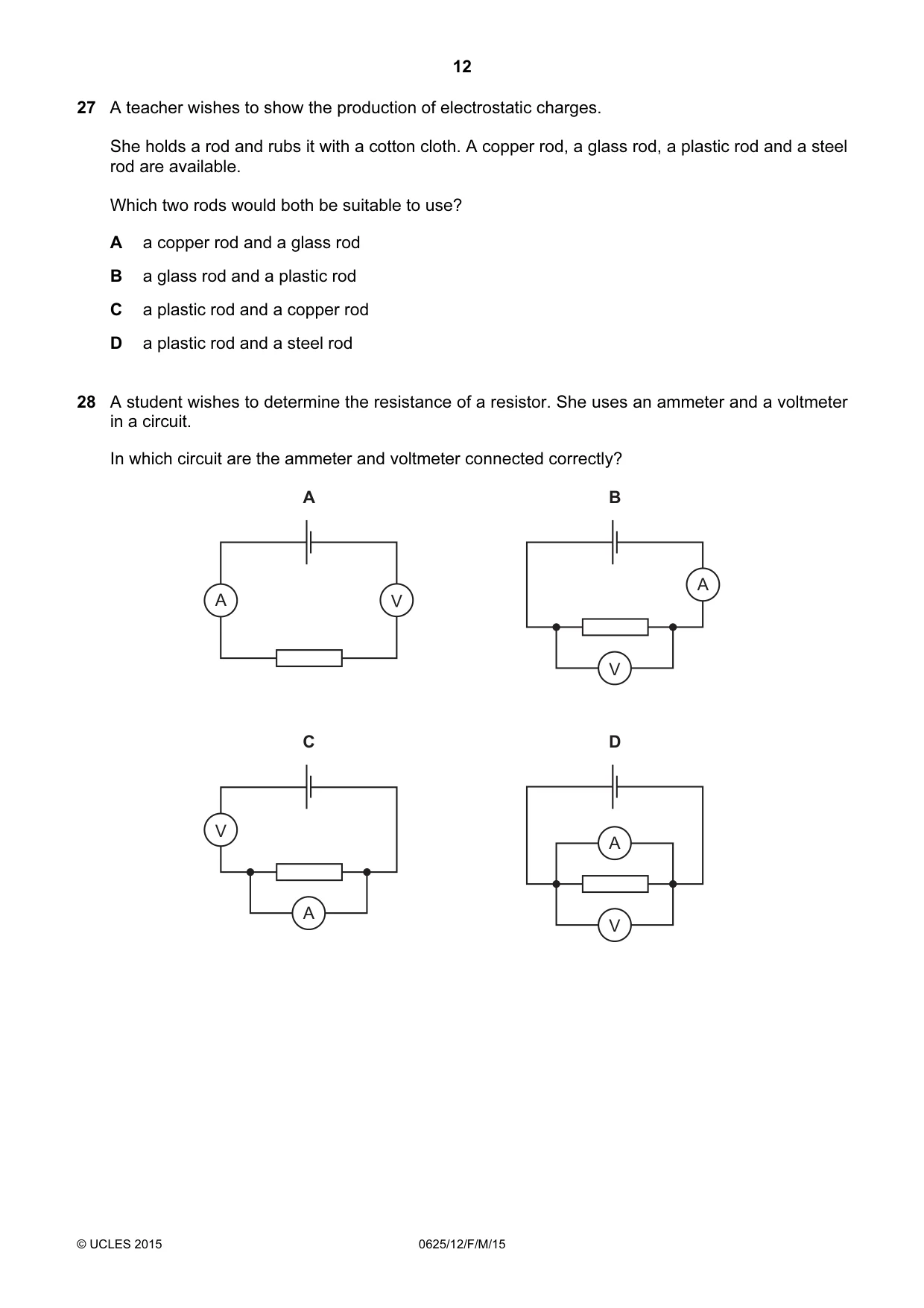
Q27 · A teacher wishes to show the production of electrostatic charges
27 A teacher wishes to show the production of electrostatic charges. She holds a rod and rubs it with a cotton cloth. A copper rod, a glass rod, a plastic rod and a steel rod are available. Which two rods would both be suitable to use? A a copper rod and a glass rod B a glass rod and a plastic rod C a plastic rod and a copper rod D a plastic rod and a steel rod
Mark scheme: B
Q28 · A student wishes to determine the resistance of a resistor
28 A student wishes to determine the resistance of a resistor. She uses an ammeter and a voltmeter in a circuit. In which circuit are the ammeter and voltmeter connected correctly? A B A A V V C D V A A V
Mark scheme: B
Q29 · A battery is connected to two crocodile clips and a lamp
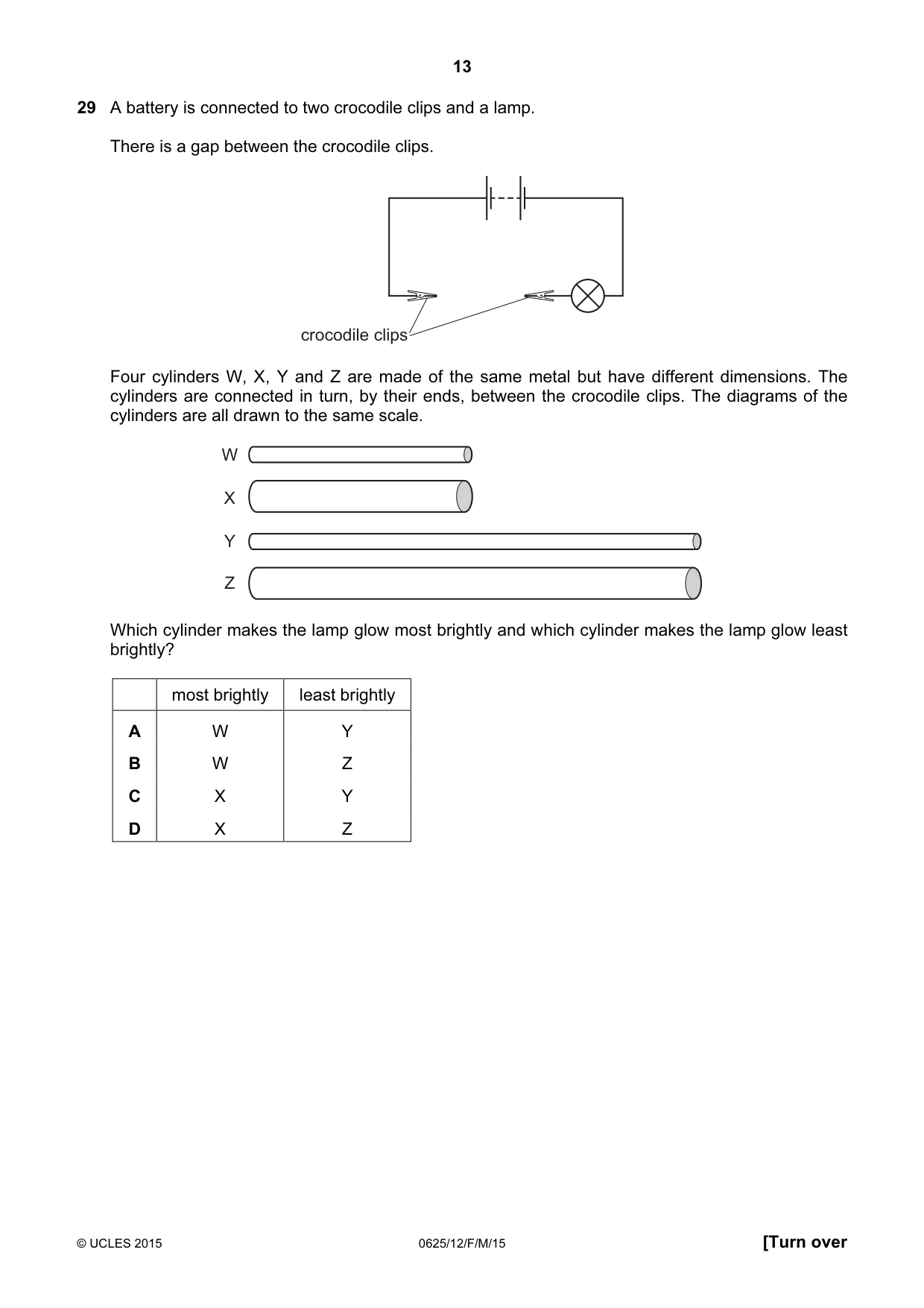
29 A battery is connected to two crocodile clips and a lamp. There is a gap between the crocodile clips. crocodile clips Four cylinders W, X, Y and Z are made of the same metal but have different dimensions. The cylinders are connected in turn, by their ends, between the crocodile clips. The diagrams of the cylinders are all drawn to the same scale. W X Y Z Which cylinder makes the lamp glow most brightly and which cylinder makes the lamp glow least brightly? most brightly least brightly A W Y B W Z C X Y D X Z
Mark scheme: C
Q30 · In which circuit can the lamps be switched on and off independently?
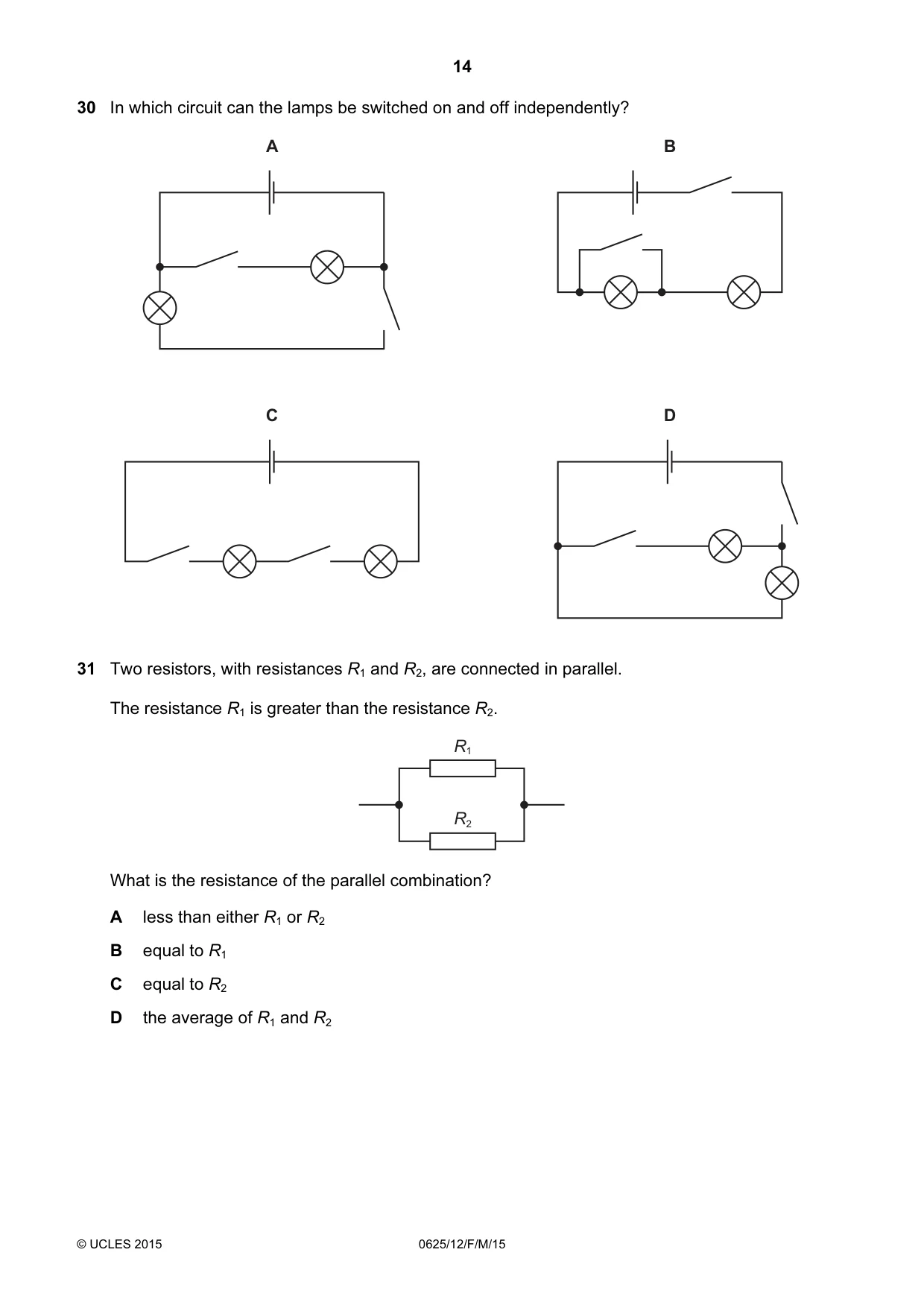
30 In which circuit can the lamps be switched on and off independently? A B C D
Mark scheme: A
Q31 · Two resistors, with resistances R1 and R2, are connected in parallel
31 Two resistors, with resistances R1 and R2, are connected in parallel. The resistance R1 is greater than the resistance R2. R1 R2 What is the resistance of the parallel combination? A less than either R1 or R2 B equal to R1 C equal to R2 D the average of R1 and R2
Mark scheme: A
Q32 · In the circuit shown, the switch is closed for a long time, then opened
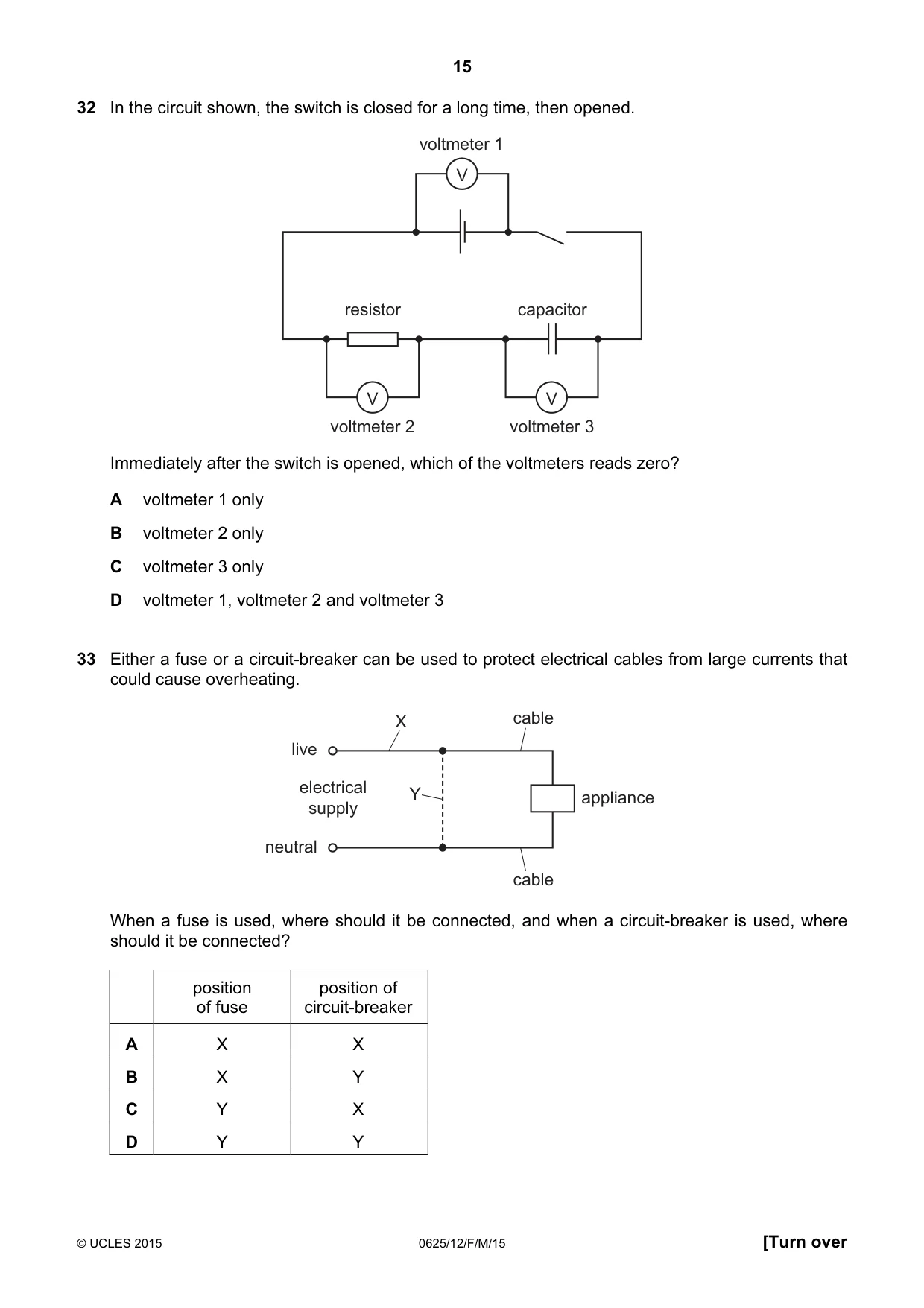
32 In the circuit shown, the switch is closed for a long time, then opened. voltmeter 1 V resistor capacitor V V voltmeter 2 voltmeter 3 Immediately after the switch is opened, which of the voltmeters reads zero? A voltmeter 1 only B voltmeter 2 only C voltmeter 3 only D voltmeter 1, voltmeter 2 and voltmeter 3
Mark scheme: B
Q33 · Either a fuse or a circuit-breaker can be used to protect electrical cables from large…
33 Either a fuse or a circuit-breaker can be used to protect electrical cables from large currents that could cause overheating. X cable live electrical Y appliance supply neutral cable When a fuse is used, where should it be connected, and when a circuit-breaker is used, where should it be connected? position position of of fuse circuit-breaker A X X B X Y C Y X D Y Y
Mark scheme: A
Q34 · Which device uses slip rings?
34 Which device uses slip rings? A a d.c. electric motor B a relay C a transformer D an a.c. generator
Mark scheme: D
Q35 · The diagram shows a coil of wire connected to a voltmeter
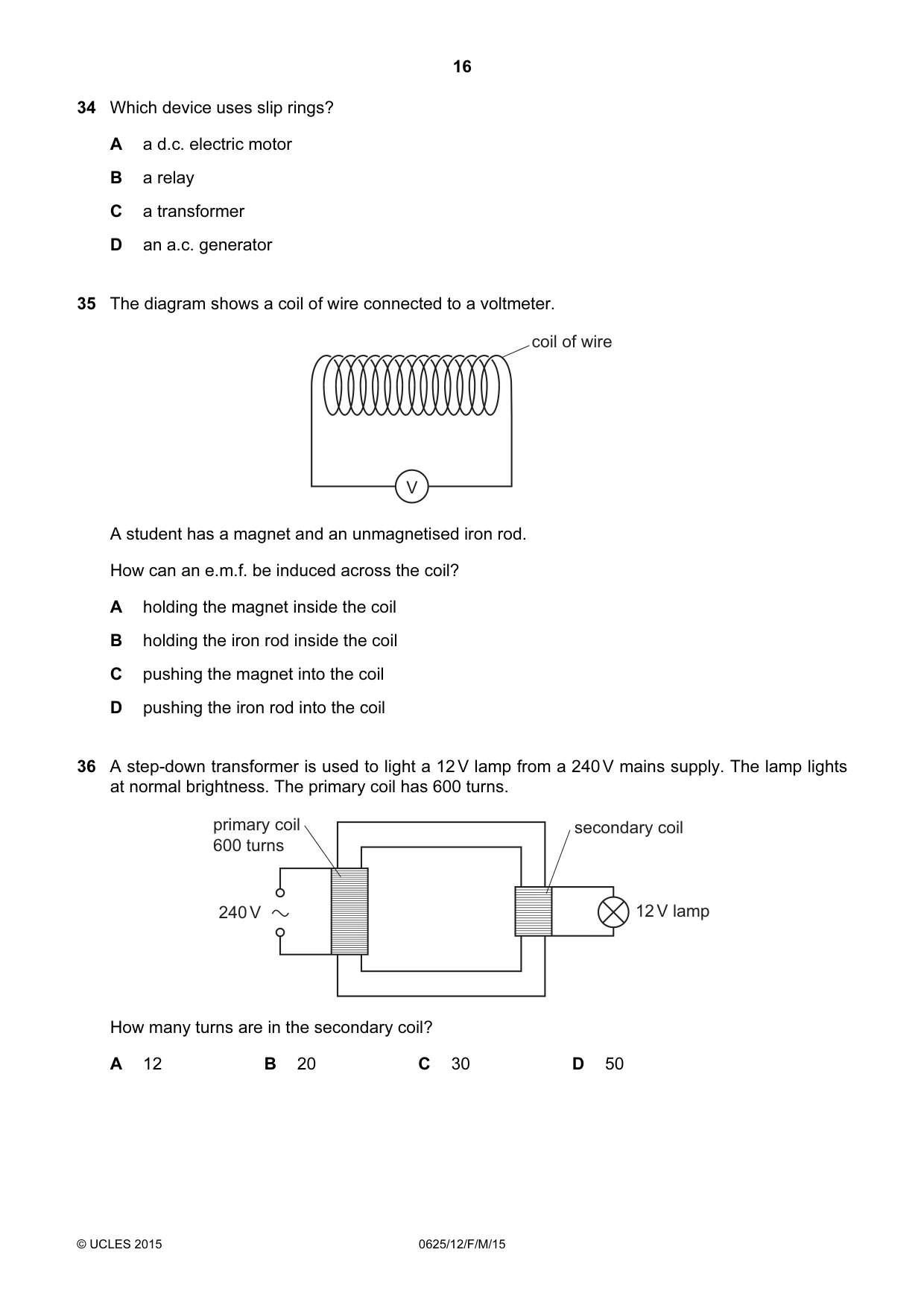
35 The diagram shows a coil of wire connected to a voltmeter. coil of wire V A student has a magnet and an unmagnetised iron rod. How can an e.m.f. be induced across the coil? A holding the magnet inside the coil B holding the iron rod inside the coil C pushing the magnet into the coil D pushing the iron rod into the coil
Mark scheme: C
Q36 · A step-down transformer is used to light a 12 V lamp from a 240 V mains supply
36 A step-down transformer is used to light a 12 V lamp from a 240 V mains supply. The lamp lights at normal brightness. The primary coil has 600 turns. primary coil secondary coil 600 turns 240 V 12 V lamp How many turns are in the secondary coil? A 12 B 20 C 30 D 50
Mark scheme: C
Q37 · What happens in the process of thermionic emission?
37 What happens in the process of thermionic emission? A Complete molecules are emitted from the surface of a hot liquid. B Single atoms are emitted from the surface of a hot liquid. C Electrons are emitted from the surface of a hot metal. D Protons are emitted from the surface of a hot metal.
Mark scheme: C
Q38 · Which row shows the relative ionising effects and penetrating abilities of α-particles…
38 Which row shows the relative ionising effects and penetrating abilities of α-particles and β-particles? ionising effect penetrating ability A α greater than β α greater than β B α greater than β α less than β C α less than β α greater than β D α less than β α less than β
Mark scheme: B
Q39 · A radioactive substance has a half-life of 2 weeks
39 A radioactive substance has a half-life of 2 weeks. At the beginning of an investigation, a sample of the substance emits 3000 β-particles per minute. How many β-particles will it emit per minute after 6 weeks? A 0 B 375 C 500 D 1500
Mark scheme: B
Q40 · A nuclide has the symbol 14 C
40 A nuclide has the symbol 14 C . 6 How many protons are there in one nucleus of this nuclide? A 6 B 8 C 14 D 20
Mark scheme: A
What was in this paper
The subtopics covered by these 40 questions, and how many questions each got. Open one in a new tab to see every Cambridge question on it.
4Electrical quantities3Electromagnetic effects3Energy, work and power2Forces2General properties of waves2Kinetic particle model of matter2Light2Motion2Pressure2Radioactivity2Simple phenomena of magnetism2Sound2Thermal properties and temperature2Transfer of thermal energy2Density1Electrical safety1Electromagnetic spectrum1Mass and weight1Physical quantities and measurement techniques1The nuclear model of the atom1What you needed in this session
Cambridge’s own grade thresholds for 2015 Feb/March, Paper 1 · Variant 2. A higher threshold means an easier paper — the bar moves with how the cohort did.