Cambridge IGCSE Physics 0625 — 2012 Oct/Nov Paper 1 · Variant 3
0625/13/O/N/12 · 40 questions · 40 marks · ≈45 min
The question paper and its mark scheme, free to read here and free to download. This is Cambridge’s own paper, exactly as it was sat.
Question paper20 pages
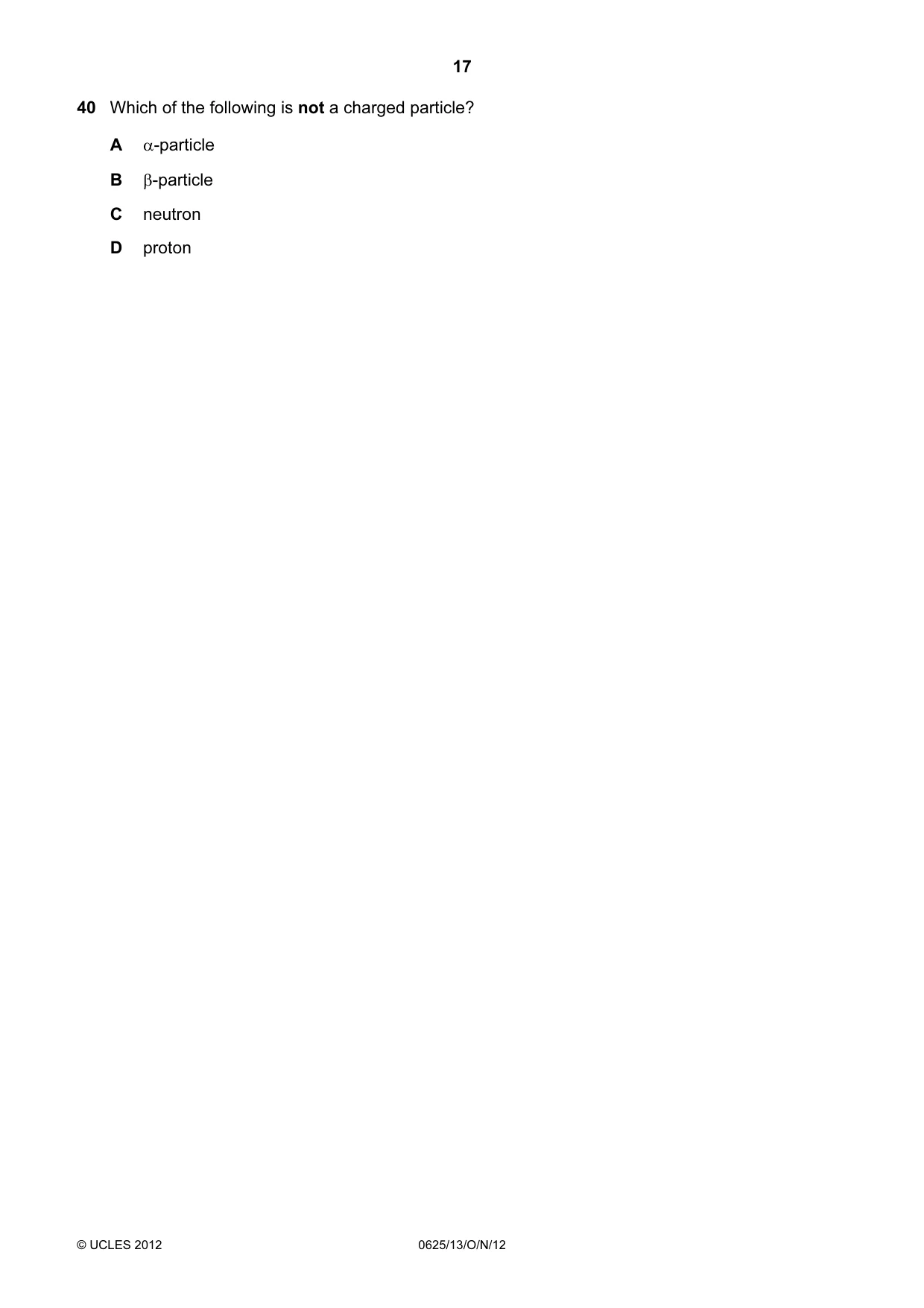


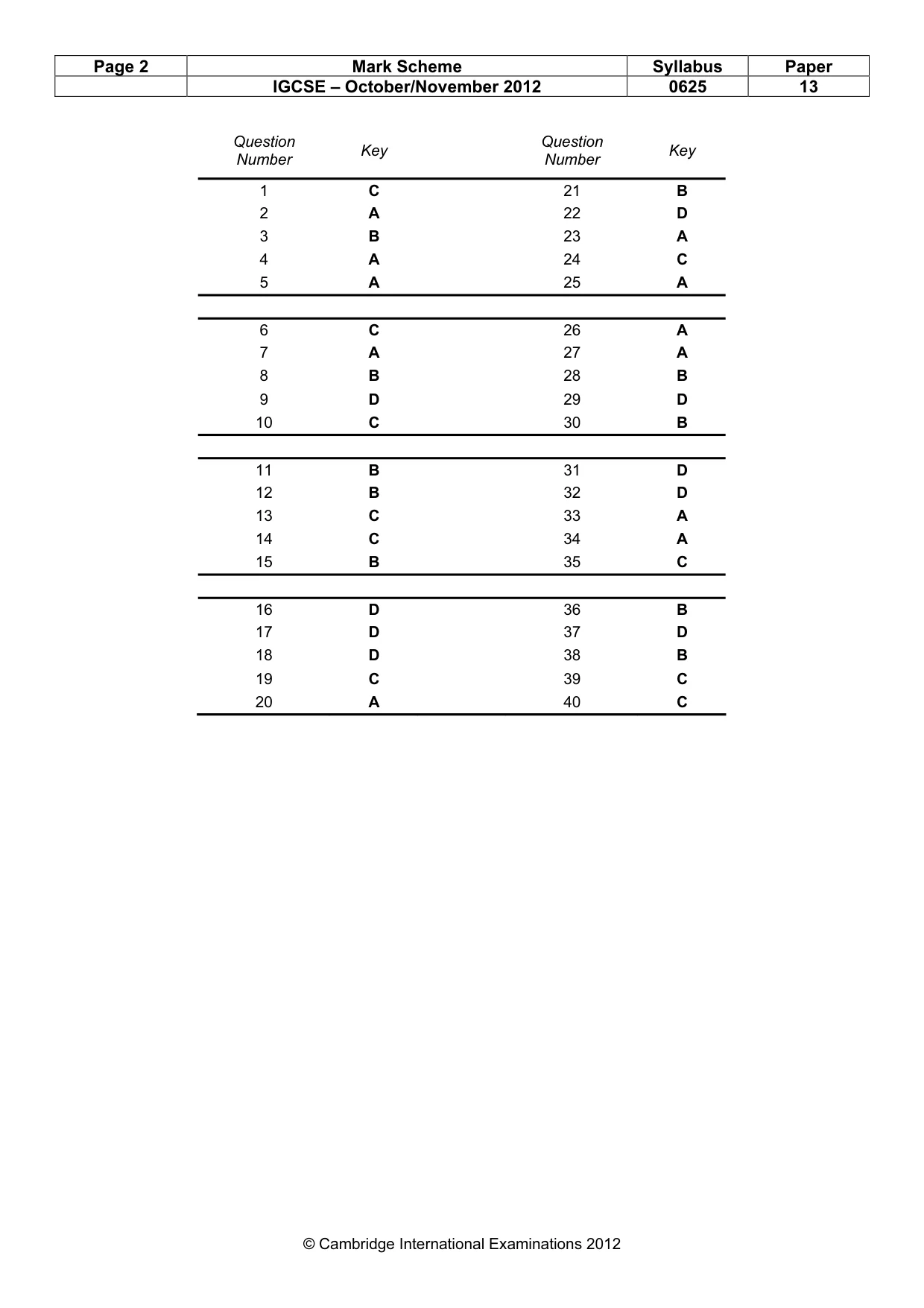
Mark scheme2 pages
Answers below. Sit the paper first if you are practising.
Questions as text
Q1 · A pendulum is set in motion and timed
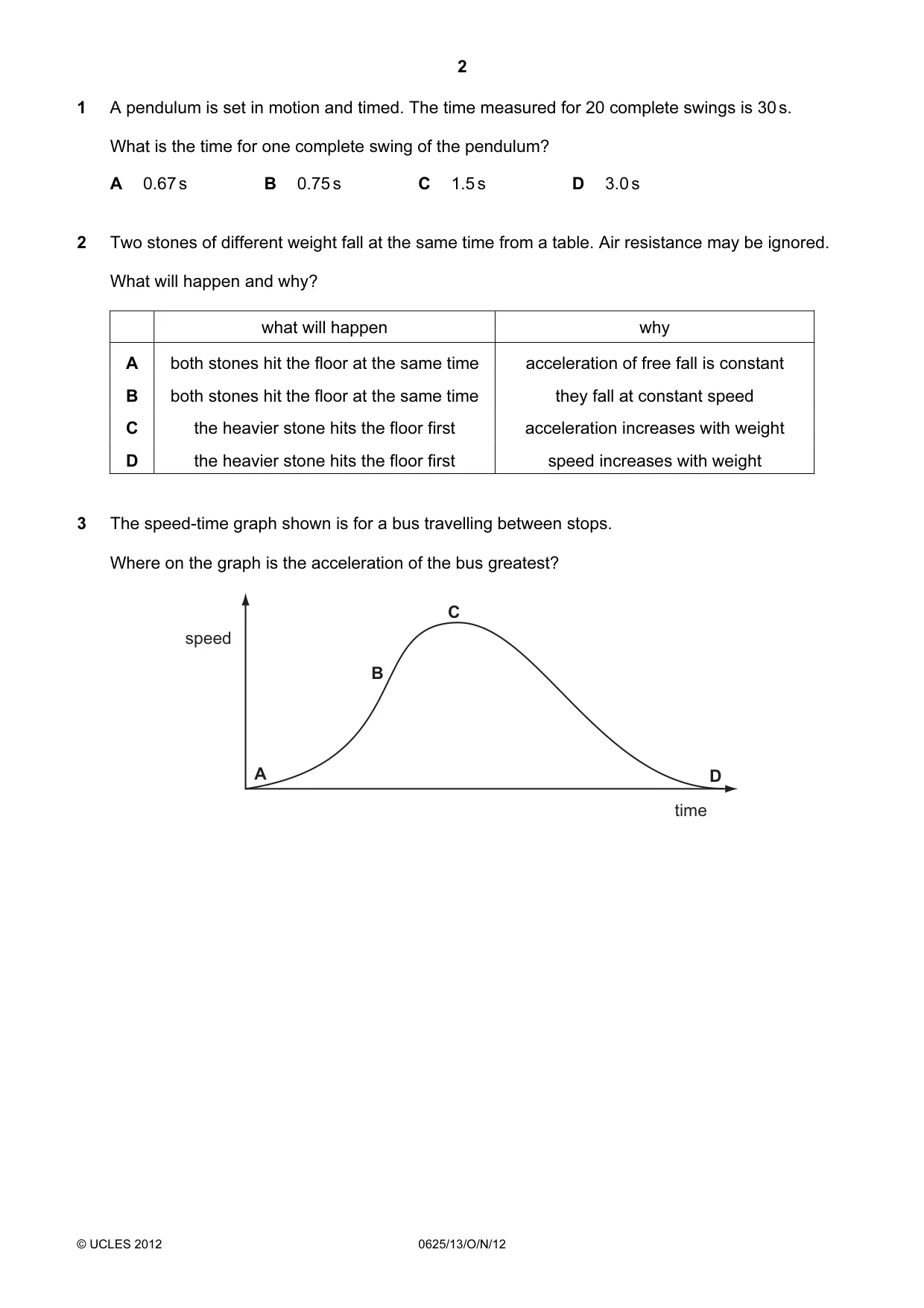
1 A pendulum is set in motion and timed. The time measured for 20 complete swings is 30 s. What is the time for one complete swing of the pendulum? A 0.67 s B 0.75 s C 1.5 s D 3.0 s
Mark scheme: C
More questions on Physical quantities and measurement techniques
Q2 · Two stones of different weight fall at the same time from a table
2 Two stones of different weight fall at the same time from a table. Air resistance may be ignored. What will happen and why? what will happen why A both stones hit the floor at the same time acceleration of free fall is constant B both stones hit the floor at the same time they fall at constant speed C the heavier stone hits the floor first acceleration increases with weight D the heavier stone hits the floor first speed increases with weight
Mark scheme: A
Q3 · The speed-time graph shown is for a bus travelling between stops
3 The speed-time graph shown is for a bus travelling between stops. Where on the graph is the acceleration of the bus greatest? C speed B A D time
Mark scheme: B
Q4 · A large bag of feathers and a steel block balance each other on some scales
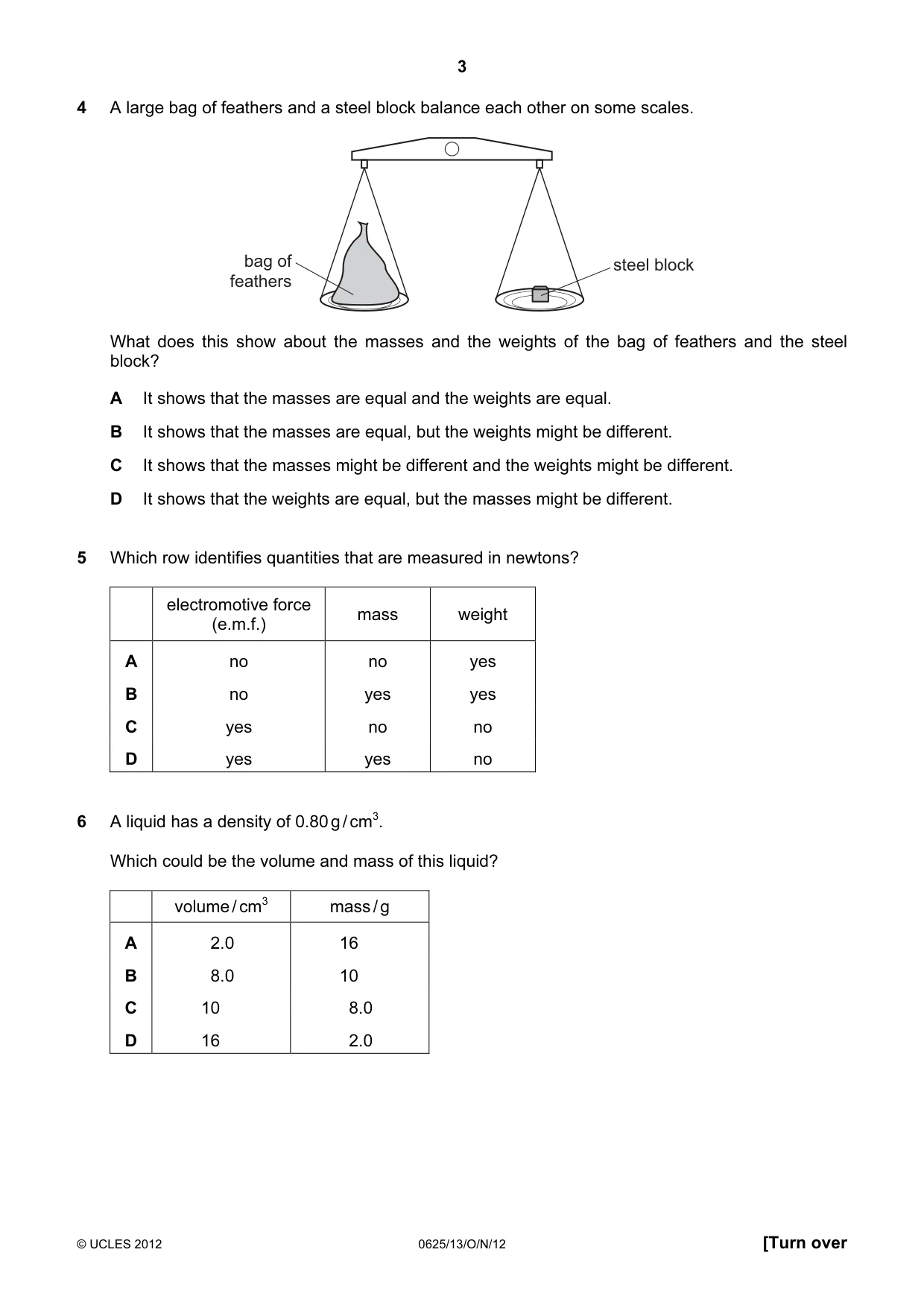
4 A large bag of feathers and a steel block balance each other on some scales. bag of steel block feathers What does this show about the masses and the weights of the bag of feathers and the steel block? A It shows that the masses are equal and the weights are equal. B It shows that the masses are equal, but the weights might be different. C It shows that the masses might be different and the weights might be different. D It shows that the weights are equal, but the masses might be different.
Mark scheme: A
Q5 · Which row identifies quantities that are measured in newtons?
5 Which row identifies quantities that are measured in newtons? electromotive force mass weight (e.m.f.) A no no yes B no yes yes C yes no no D yes yes no
Mark scheme: A
Q6 · A liquid has a density of 0.80 g / cm3
6 A liquid has a density of 0.80 g / cm3. Which could be the volume and mass of this liquid? volume / cm3 mass / g A 2.0 16 B 8.0 10 C 10 8.0 D 16 2.0
Mark scheme: C
Q7 · The diagram shows sections of four objects of equal mass
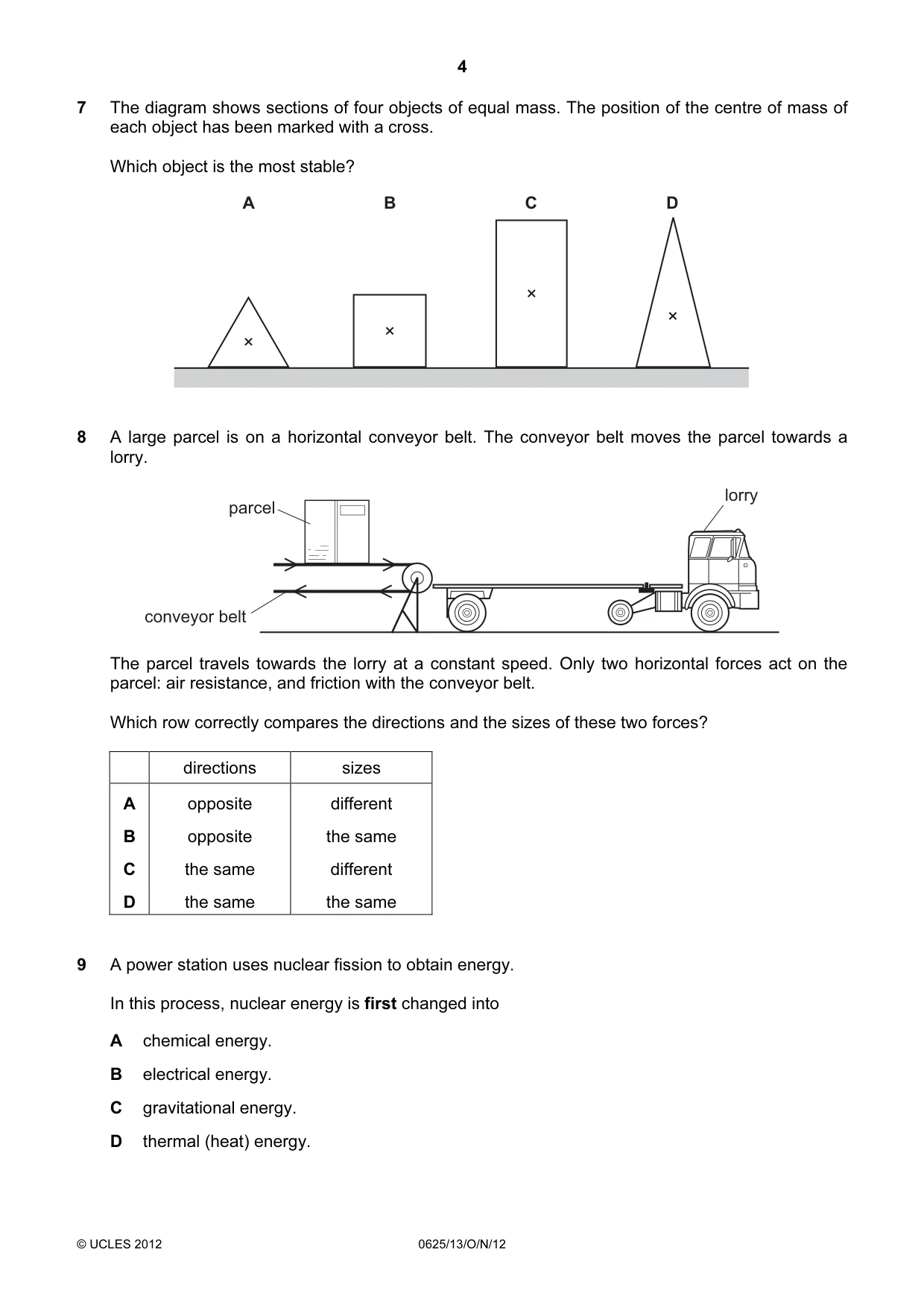
7 The diagram shows sections of four objects of equal mass. The position of the centre of mass of each object has been marked with a cross. Which object is the most stable? A B C D
Mark scheme: A
Q8 · A large parcel is on a horizontal conveyor belt
8 A large parcel is on a horizontal conveyor belt. The conveyor belt moves the parcel towards a lorry. lorry parcel conveyor belt The parcel travels towards the lorry at a constant speed. Only two horizontal forces act on the parcel: air resistance, and friction with the conveyor belt. Which row correctly compares the directions and the sizes of these two forces? directions sizes A opposite different B opposite the same C the same different D the same the same
Mark scheme: B
Q9 · A power station uses nuclear fission to obtain energy
9 A power station uses nuclear fission to obtain energy. In this process, nuclear energy is first changed into A chemical energy. B electrical energy. C gravitational energy. D thermal (heat) energy.
Mark scheme: D
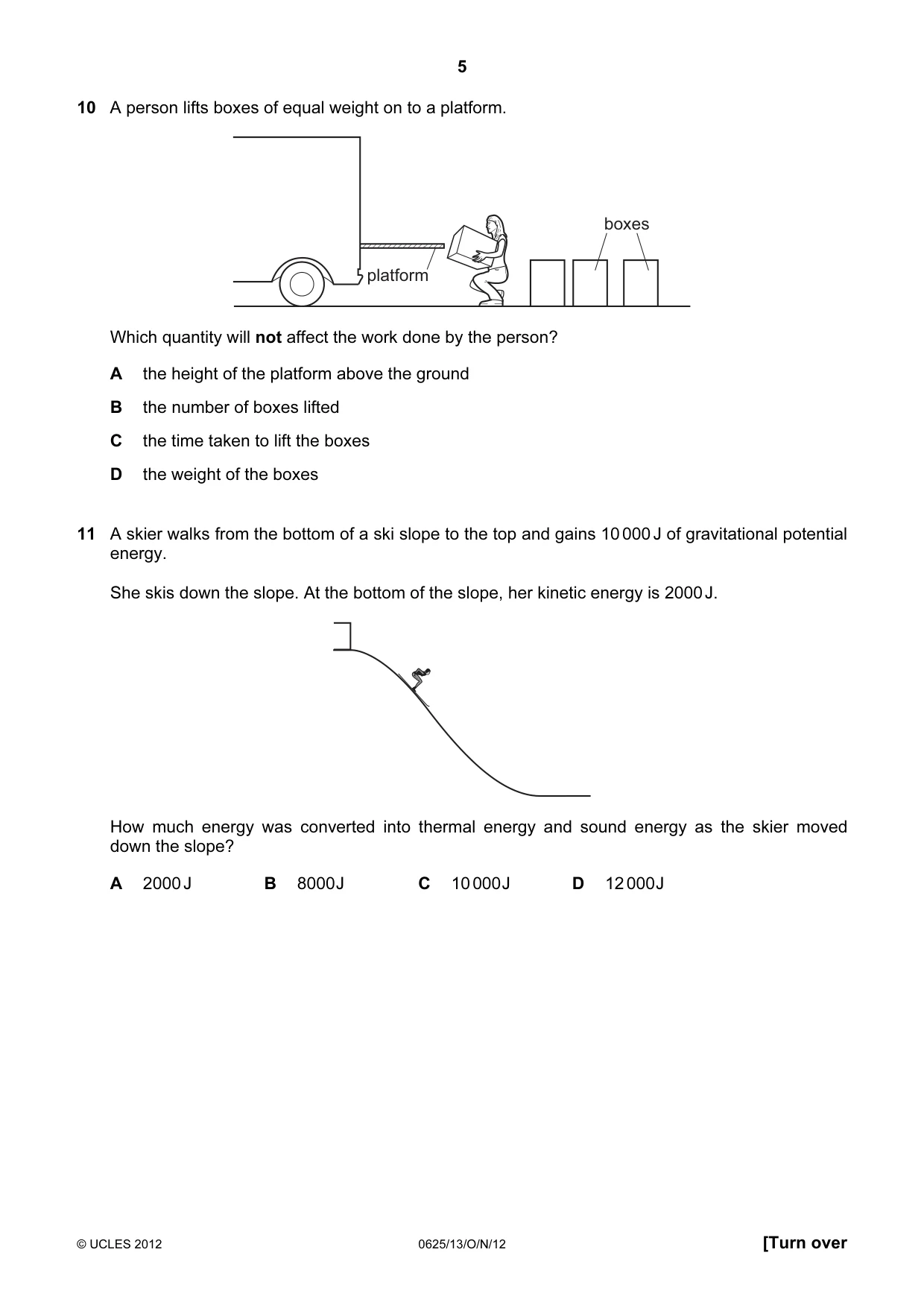
Q10 · A person lifts boxes of equal weight on to a platform
10 A person lifts boxes of equal weight on to a platform. boxes platform Which quantity will not affect the work done by the person? A the height of the platform above the ground B the number of boxes lifted C the time taken to lift the boxes D the weight of the boxes
Mark scheme: C
Q11 · A skier walks from the bottom of a ski slope to the top and gains 10 000 J of…
11 A skier walks from the bottom of a ski slope to the top and gains 10 000 J of gravitational potential energy. She skis down the slope. At the bottom of the slope, her kinetic energy is 2000 J. How much energy was converted into thermal energy and sound energy as the skier moved down the slope? A 2000 J B 8000 J C 10 000 J D 12 000 J
Mark scheme: B
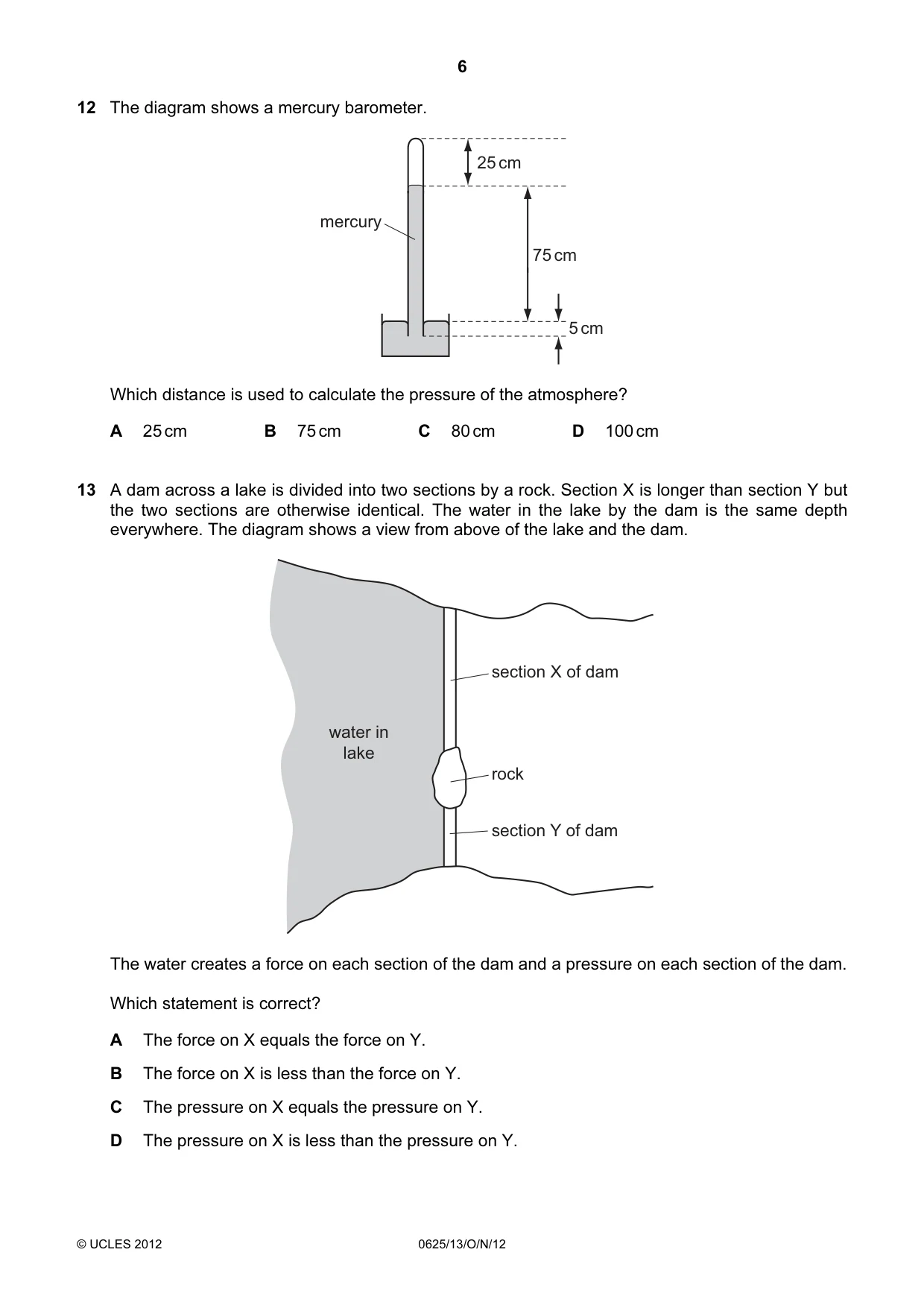
Q12 · The diagram shows a mercury barometer
12 The diagram shows a mercury barometer. 25 cm mercury 75 cm 5 cm Which distance is used to calculate the pressure of the atmosphere? A 25 cm B 75 cm C 80 cm D 100 cm
Mark scheme: B
Q13 · A dam across a lake is divided into two sections by a rock
13 A dam across a lake is divided into two sections by a rock. Section X is longer than section Y but the two sections are otherwise identical. The water in the lake by the dam is the same depth everywhere. The diagram shows a view from above of the lake and the dam. section X of dam water in lake rock section Y of dam The water creates a force on each section of the dam and a pressure on each section of the dam. Which statement is correct? A The force on X equals the force on Y. B The force on X is less than the force on Y. C The pressure on X equals the pressure on Y. D The pressure on X is less than the pressure on Y.
Mark scheme: C
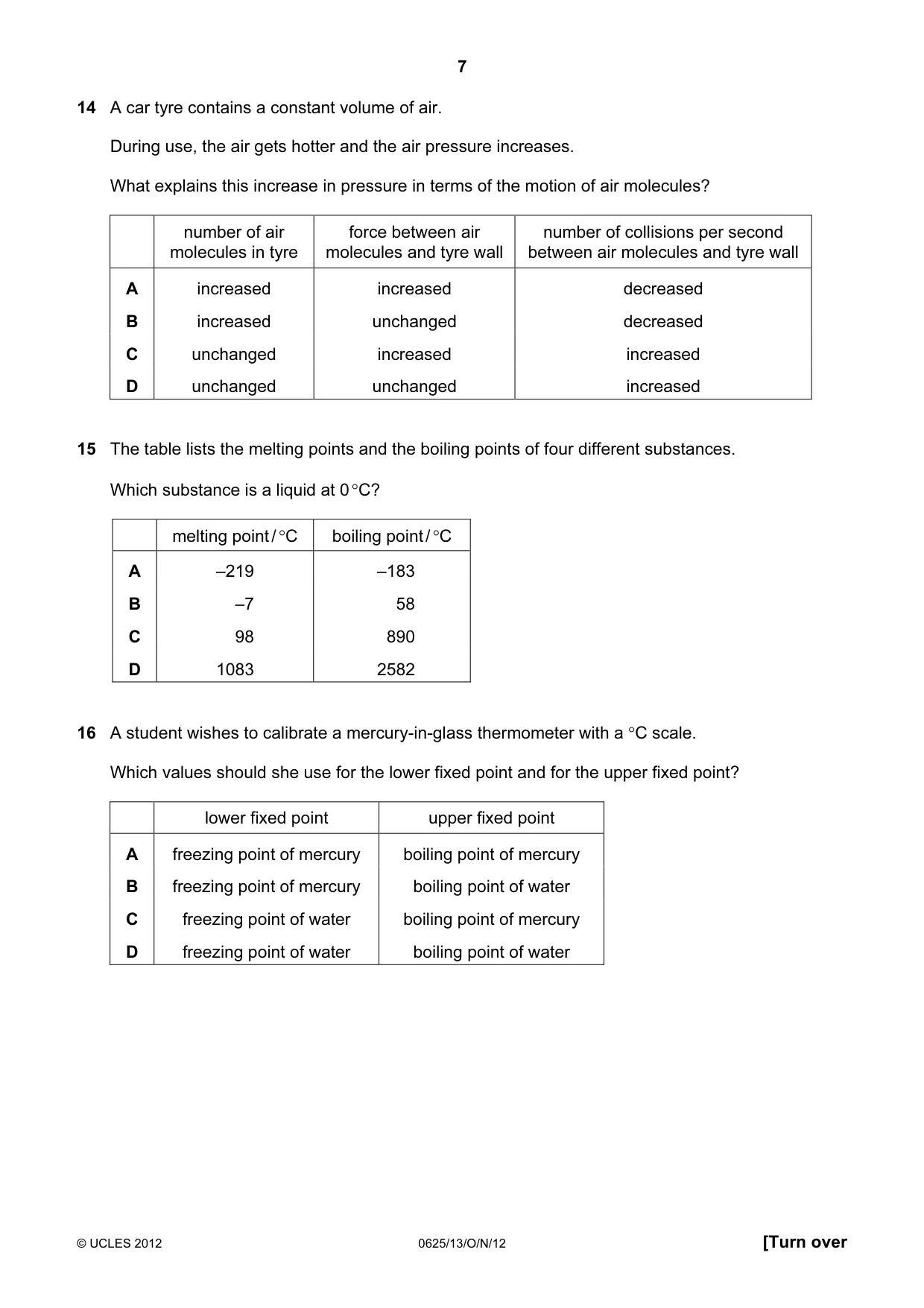
Q14 · A car tyre contains a constant volume of air
14 A car tyre contains a constant volume of air. During use, the air gets hotter and the air pressure increases. What explains this increase in pressure in terms of the motion of air molecules? number of air force between air number of collisions per second molecules in tyre molecules and tyre wall between air molecules and tyre wall A increased increased decreased B increased unchanged decreased C unchanged increased increased D unchanged unchanged increased
Mark scheme: C
Q15 · The table lists the melting points and the boiling points of four different substances
15 The table lists the melting points and the boiling points of four different substances. Which substance is a liquid at 0 °C? melting point / °C boiling point / °C A –219 –183 B –7 58 C 98 890 D 1083 2582
Mark scheme: B
Q16 · A student wishes to calibrate a mercury-in-glass thermometer with a °C scale
16 A student wishes to calibrate a mercury-in-glass thermometer with a °C scale. Which values should she use for the lower fixed point and for the upper fixed point? lower fixed point upper fixed point A freezing point of mercury boiling point of mercury B freezing point of mercury boiling point of water C freezing point of water boiling point of mercury D freezing point of water boiling point of water
Mark scheme: D
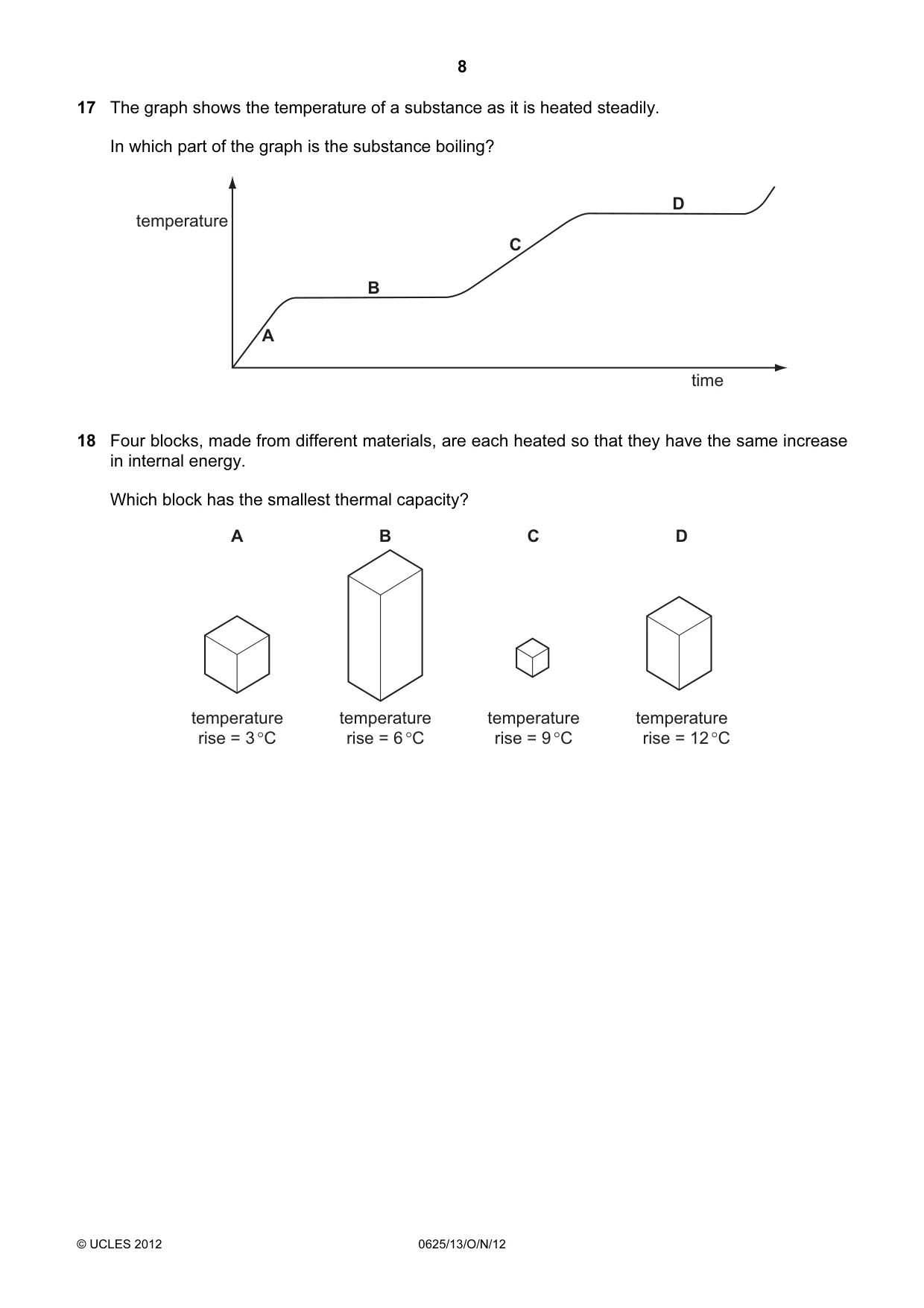
Q17 · The graph shows the temperature of a substance as it is heated steadily
17 The graph shows the temperature of a substance as it is heated steadily. In which part of the graph is the substance boiling? D temperature C B A time
Mark scheme: D
Q18 · Four blocks, made from different materials, are each heated so that they have the same…
18 Four blocks, made from different materials, are each heated so that they have the same increase in internal energy. Which block has the smallest thermal capacity? A B C D temperature temperature temperature temperature rise = 3 °C rise = 6 °C rise = 9 °C rise = 12 °C
Mark scheme: D
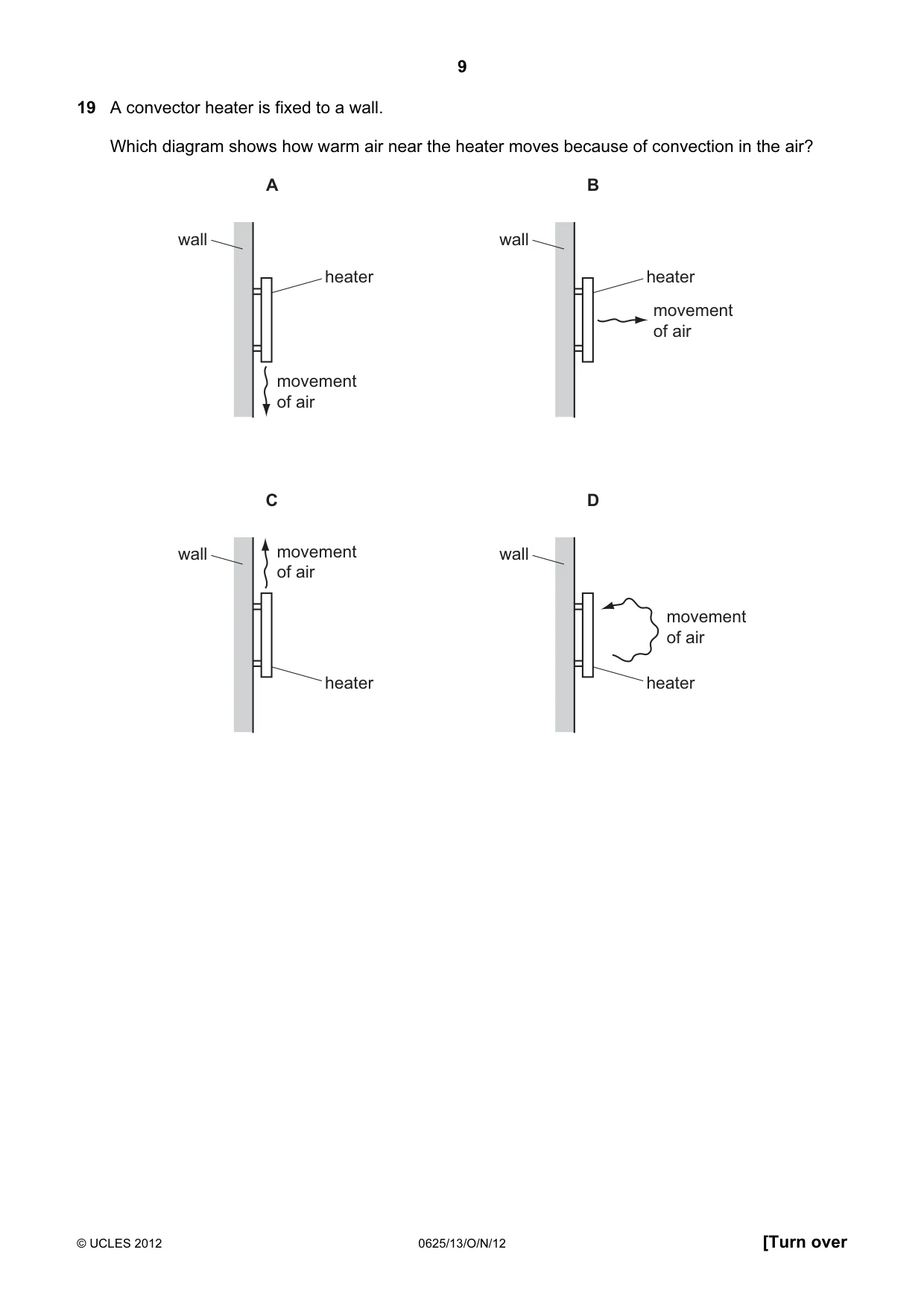
Q19 · A convector heater is fixed to a wall
19 A convector heater is fixed to a wall. Which diagram shows how warm air near the heater moves because of convection in the air? A B wall wall heater heater movement of air movement of air C D wall movement wall of air movement of air heater heater
Mark scheme: C
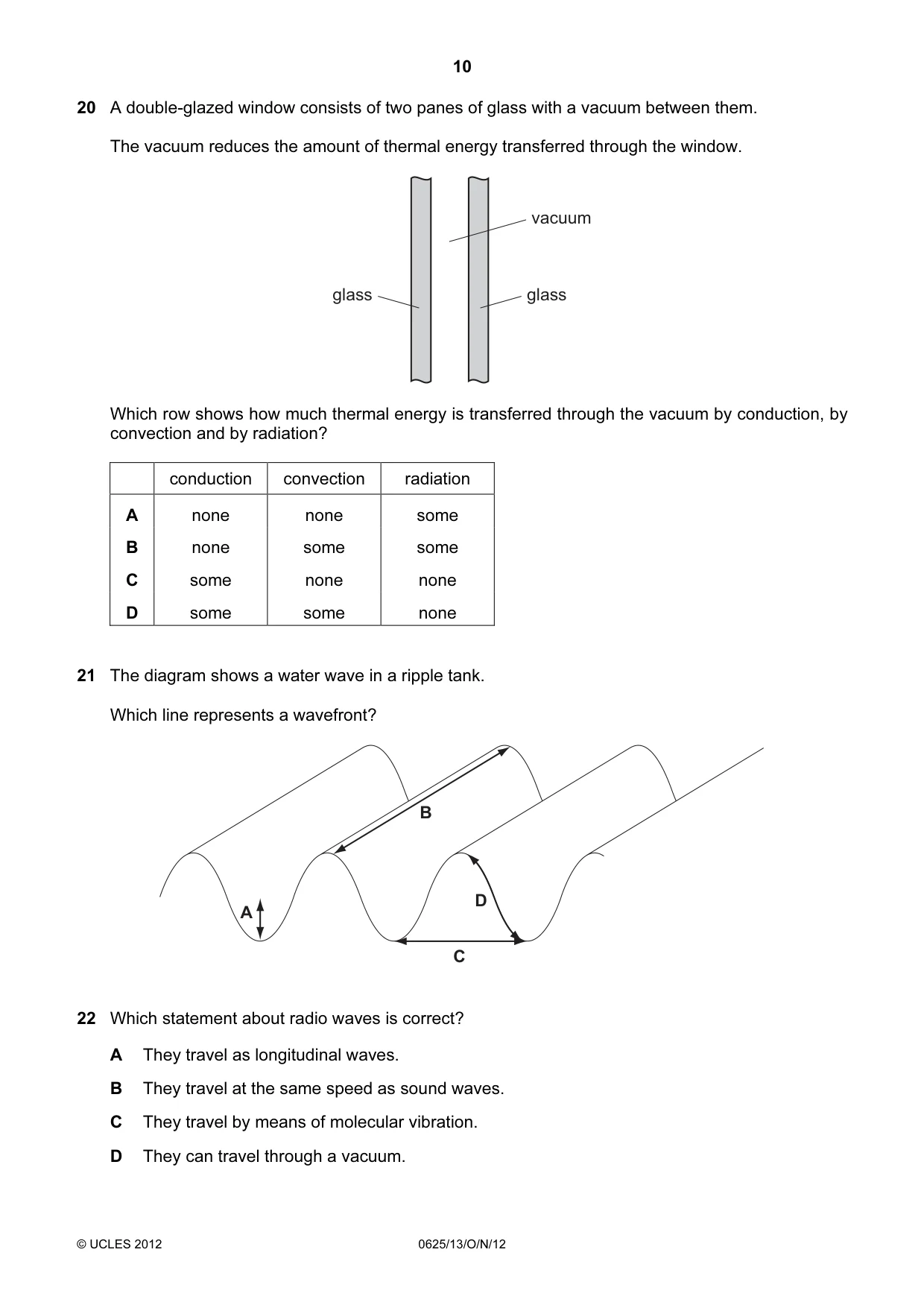
Q20 · A double-glazed window consists of two panes of glass with a vacuum between them
20 A double-glazed window consists of two panes of glass with a vacuum between them. The vacuum reduces the amount of thermal energy transferred through the window. vacuum glass glass Which row shows how much thermal energy is transferred through the vacuum by conduction, by convection and by radiation? conduction convection radiation A none none some B none some some C some none none D some some none
Mark scheme: A
Q21 · The diagram shows a water wave in a ripple tank
21 The diagram shows a water wave in a ripple tank. Which line represents a wavefront? B D A C
Mark scheme: B
Q22 · Which statement about radio waves is correct?
22 Which statement about radio waves is correct? A They travel as longitudinal waves. B They travel at the same speed as sound waves. C They travel by means of molecular vibration. D They can travel through a vacuum.
Mark scheme: D
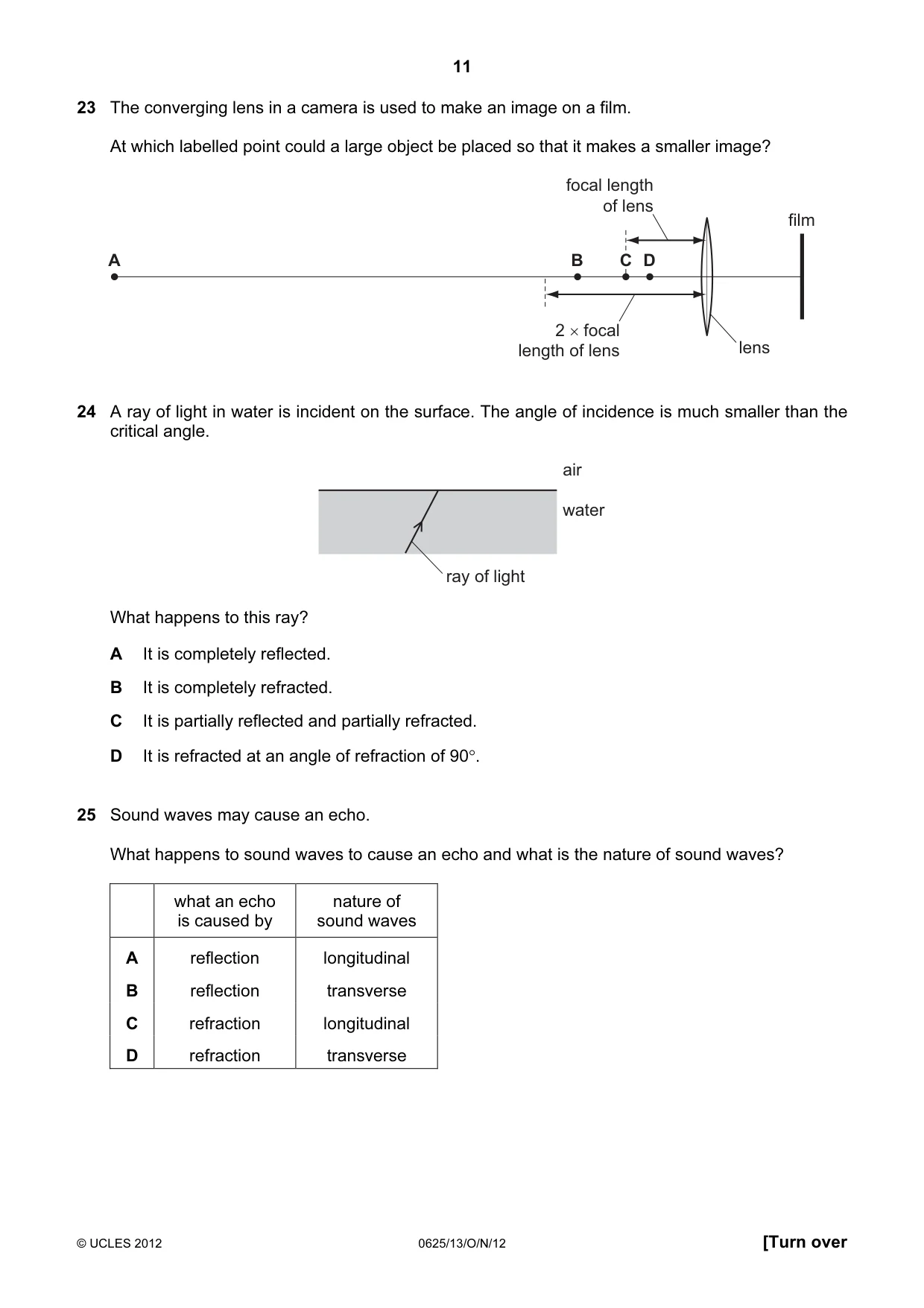
Q23 · The converging lens in a camera is used to make an image on a film
23 The converging lens in a camera is used to make an image on a film. At which labelled point could a large object be placed so that it makes a smaller image? focal length of lens film A B C D 2 × focal length of lens lens
Mark scheme: A
Q24 · A ray of light in water is incident on the surface
24 A ray of light in water is incident on the surface. The angle of incidence is much smaller than the critical angle. air water ray of light What happens to this ray? A It is completely reflected. B It is completely refracted. C It is partially reflected and partially refracted. D It is refracted at an angle of refraction of 90°.
Mark scheme: C
Q25 · Sound waves may cause an echo
25 Sound waves may cause an echo. What happens to sound waves to cause an echo and what is the nature of sound waves? what an echo nature of is caused by sound waves A reflection longitudinal B reflection transverse C refraction longitudinal D refraction transverse
Mark scheme: A
Q26 · In a test, a car horn is found to be too loud and the pitch of the note is too high
26 In a test, a car horn is found to be too loud and the pitch of the note is too high. What information does this give about the amplitude and the frequency of the sound wave produced? amplitude frequency A too large too large B too large too small C too small too large D too small too small
Mark scheme: A
Q27 · Which row shows whether iron and steel are ferrous or non-ferrous?
27 Which row shows whether iron and steel are ferrous or non-ferrous? iron steel A ferrous ferrous B ferrous non-ferrous C non-ferrous ferrous D non-ferrous non-ferrous
Mark scheme: A
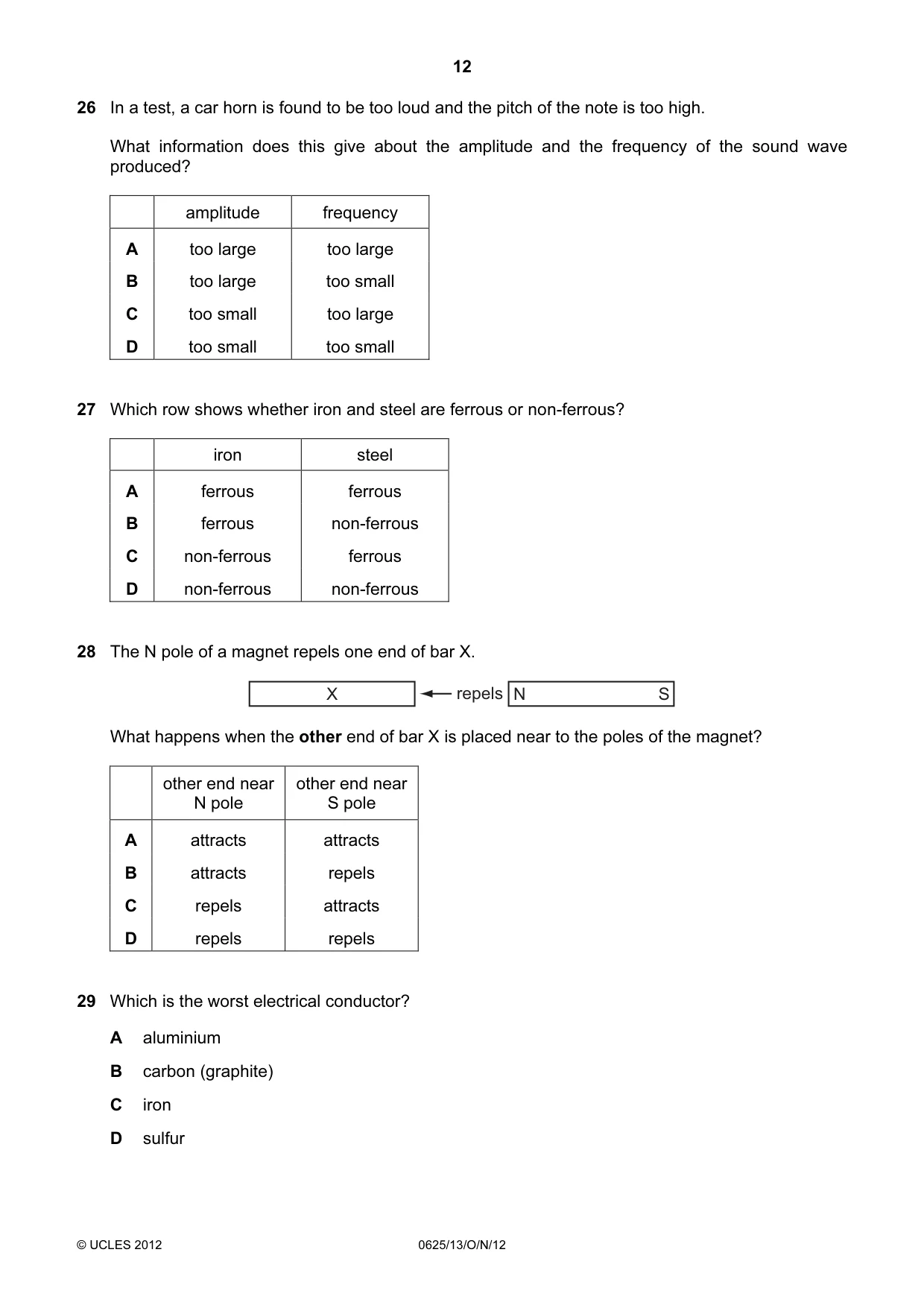
Q28 · The N pole of a magnet repels one end of bar X
28 The N pole of a magnet repels one end of bar X. X repels N S What happens when the other end of bar X is placed near to the poles of the magnet? other end near other end near N pole S pole A attracts attracts B attracts repels C repels attracts D repels repels
Mark scheme: B
Q29 · Which is the worst electrical conductor?
29 Which is the worst electrical conductor? A aluminium B carbon (graphite) C iron D sulfur
Mark scheme: D
Q30 · The circuit shows a 24 V battery connected to two resistors in series
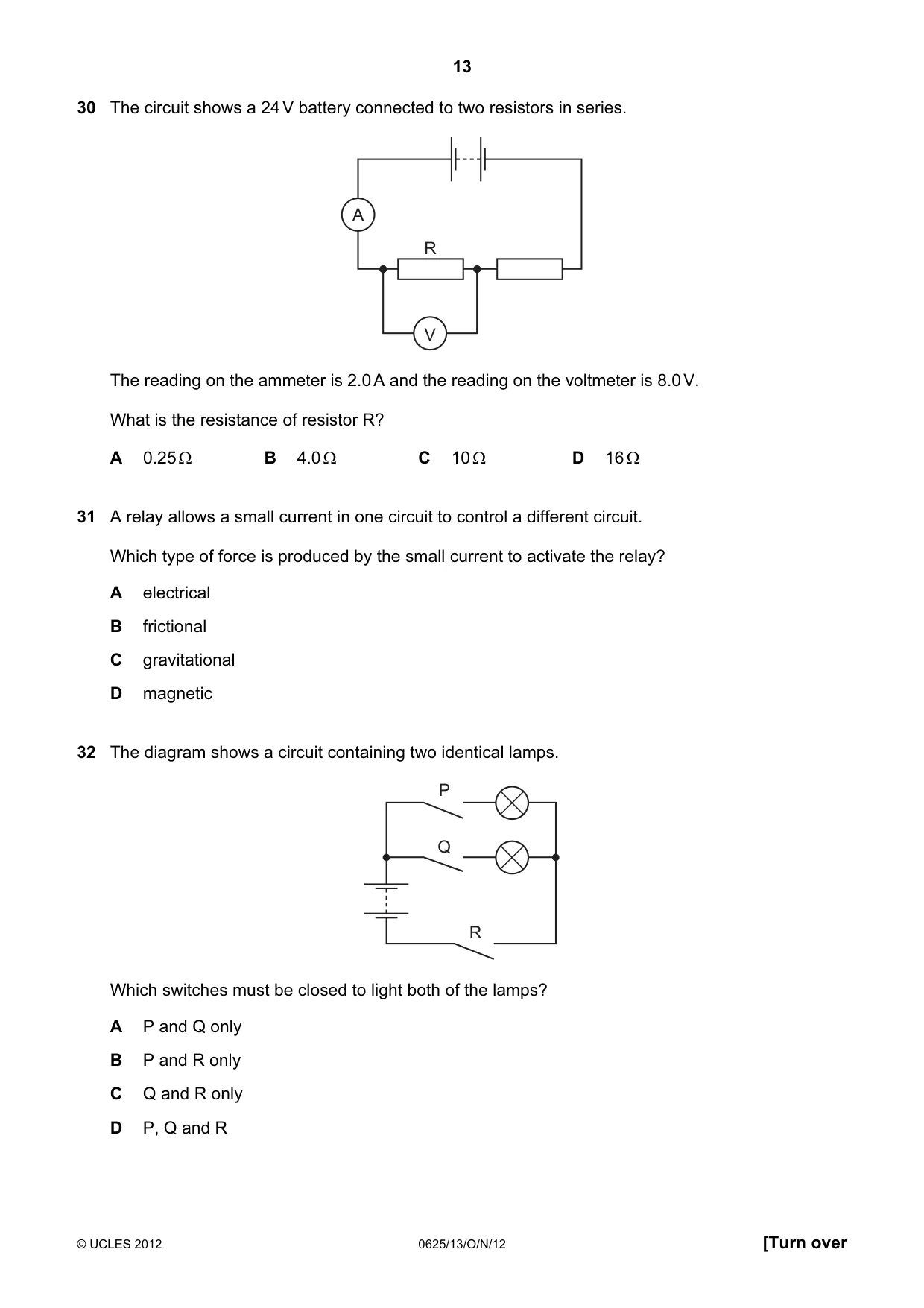
30 The circuit shows a 24 V battery connected to two resistors in series. A R V The reading on the ammeter is 2.0 A and the reading on the voltmeter is 8.0 V. What is the resistance of resistor R? A 0.25 Ω B 4.0 Ω C 10 Ω D 16 Ω
Mark scheme: B
Q31 · A relay allows a small current in one circuit to control a different circuit
31 A relay allows a small current in one circuit to control a different circuit. Which type of force is produced by the small current to activate the relay? A electrical B frictional C gravitational D magnetic
Mark scheme: D
Q32 · The diagram shows a circuit containing two identical lamps
32 The diagram shows a circuit containing two identical lamps. P Q R Which switches must be closed to light both of the lamps? A P and Q only B P and R only C Q and R only D P, Q and R
Mark scheme: D
Q33 · The diagram shows a potential divider circuit
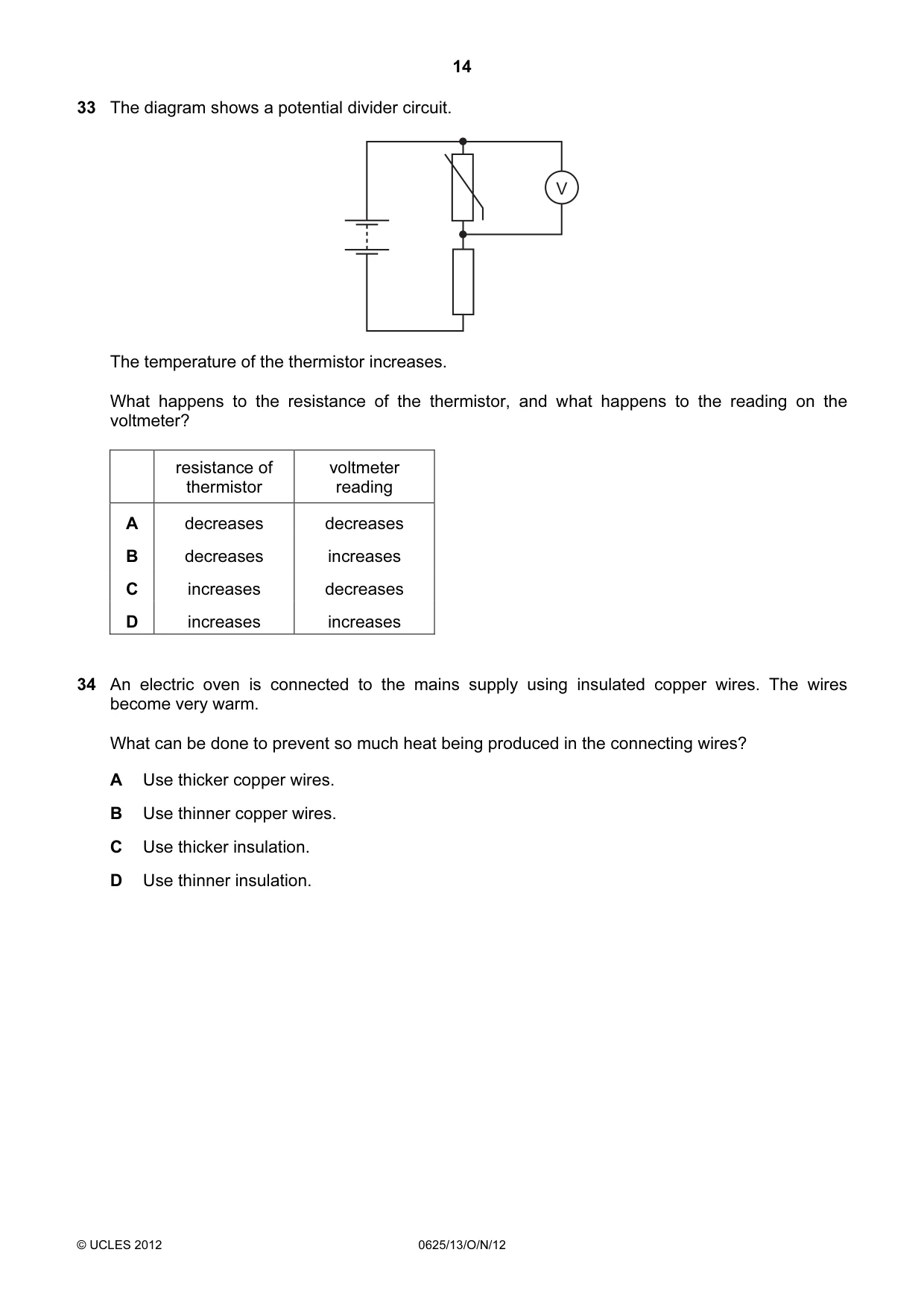
33 The diagram shows a potential divider circuit. V The temperature of the thermistor increases. What happens to the resistance of the thermistor, and what happens to the reading on the voltmeter? resistance of voltmeter thermistor reading A decreases decreases B decreases increases C increases decreases D increases increases
Mark scheme: A
Q34 · An electric oven is connected to the mains supply using insulated copper wires
34 An electric oven is connected to the mains supply using insulated copper wires. The wires become very warm. What can be done to prevent so much heat being produced in the connecting wires? A Use thicker copper wires. B Use thinner copper wires. C Use thicker insulation. D Use thinner insulation.
Mark scheme: A
Q35 · Which graph shows how the voltage of a simple a.c
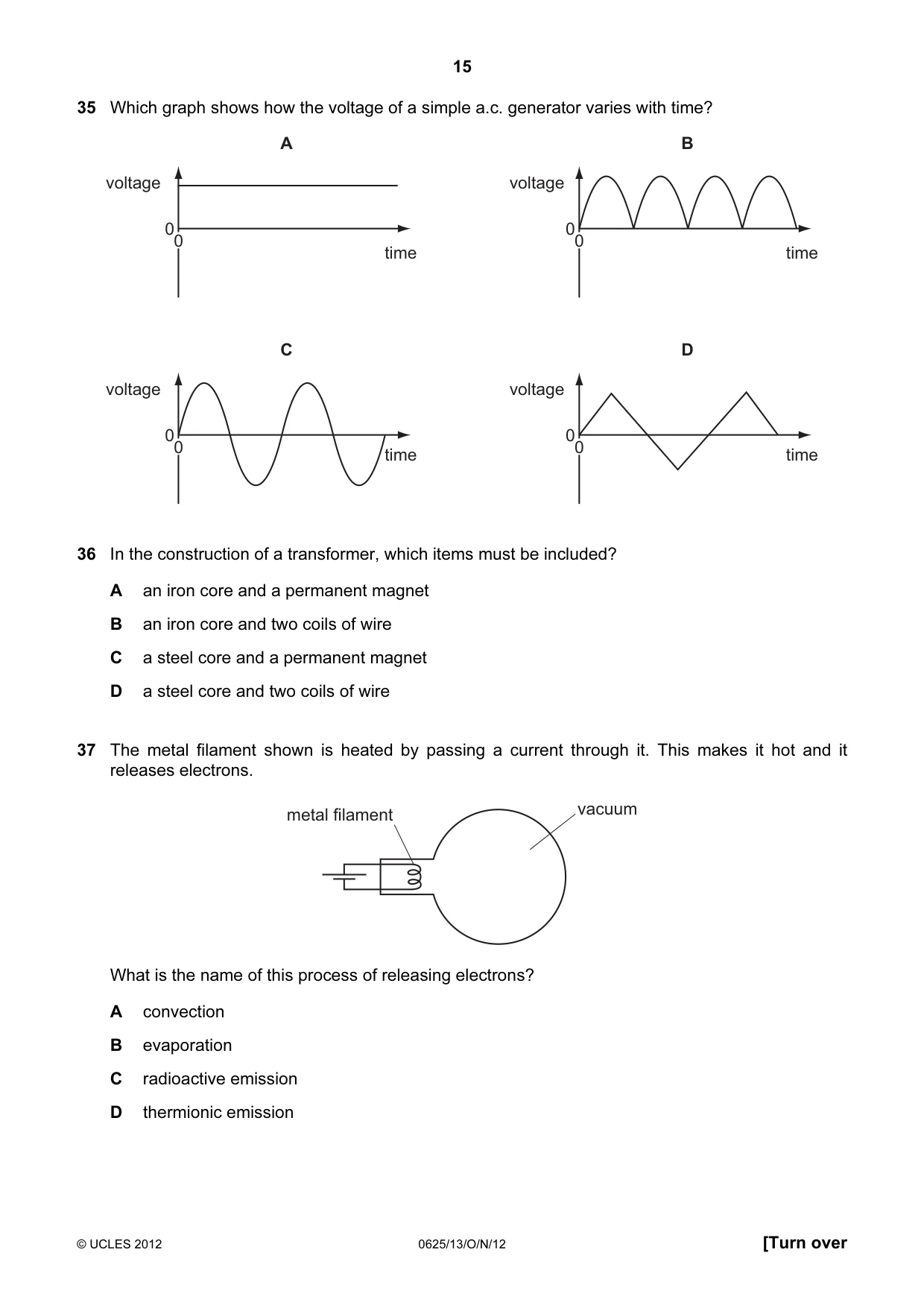
35 Which graph shows how the voltage of a simple a.c. generator varies with time? A B voltage voltage 0 0 0 0 time time C D voltage voltage 0 0 0 0 time time
Mark scheme: C
Q36 · In the construction of a transformer, which items must be included?
36 In the construction of a transformer, which items must be included? A an iron core and a permanent magnet B an iron core and two coils of wire C a steel core and a permanent magnet D a steel core and two coils of wire
Mark scheme: B
Q37 · The metal filament shown is heated by passing a current through it
37 The metal filament shown is heated by passing a current through it. This makes it hot and it releases electrons. metal filament vacuum What is the name of this process of releasing electrons? A convection B evaporation C radioactive emission D thermionic emission
Mark scheme: D
Q38 · How do the ionising effect and the penetrating ability of α-particles compare with those…
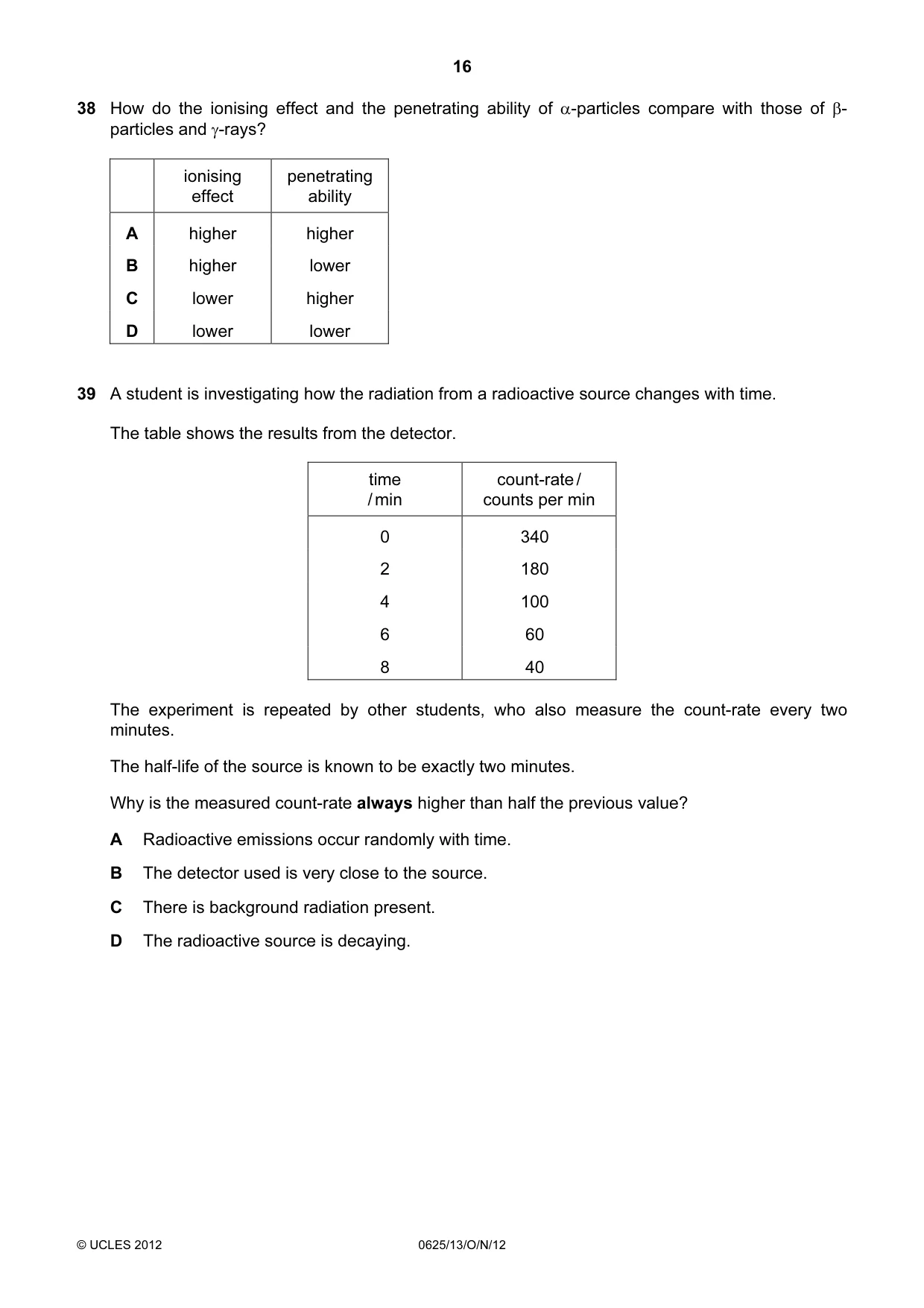
38 How do the ionising effect and the penetrating ability of α-particles compare with those of β- particles and γ-rays? ionising penetrating effect ability A higher higher B higher lower C lower higher D lower lower
Mark scheme: B
Q39 · A student is investigating how the radiation from a radioactive source changes with time
39 A student is investigating how the radiation from a radioactive source changes with time. The table shows the results from the detector. time count-rate / / min counts per min 0 340 2 180 4 100 6 60 8 40 The experiment is repeated by other students, who also measure the count-rate every two minutes. The half-life of the source is known to be exactly two minutes. Why is the measured count-rate always higher than half the previous value? A Radioactive emissions occur randomly with time. B The detector used is very close to the source. C There is background radiation present. D The radioactive source is decaying.
Mark scheme: C
Q40 · Which of the following is not a charged particle?
40 Which of the following is not a charged particle? A α-particle B β-particle C neutron D proton
Mark scheme: C
What was in this paper
The subtopics covered by these 40 questions, and how many questions each got. Open one in a new tab to see every Cambridge question on it.
4Electric circuits3Electromagnetic effects3Energy, work and power3Electrical quantities2Forces2Light2Mass and weight2Motion2Pressure2Radioactivity2Simple phenomena of magnetism2Sound2The nuclear model of the atom2Transfer of thermal energy2Density1Electromagnetic spectrum1General properties of waves1Kinetic particle model of matter1Physical quantities and measurement techniques1What you needed in this session
Cambridge’s own grade thresholds for 2012 Oct/Nov, Paper 1 · Variant 3. A higher threshold means an easier paper — the bar moves with how the cohort did.