Cambridge IGCSE Physics 0625 — 2019 Oct/Nov Paper 1 · Variant 3
0625/13/O/N/19 · 40 questions · 40 marks · ≈45 min
The question paper and its mark scheme, free to read here and free to download. This is Cambridge’s own paper, exactly as it was sat.
Question paper16 pages
Mark scheme3 pages
Answers below. Sit the paper first if you are practising.
Questions as text
Q1 · A student uses a ruler to find the volume of water in a tank
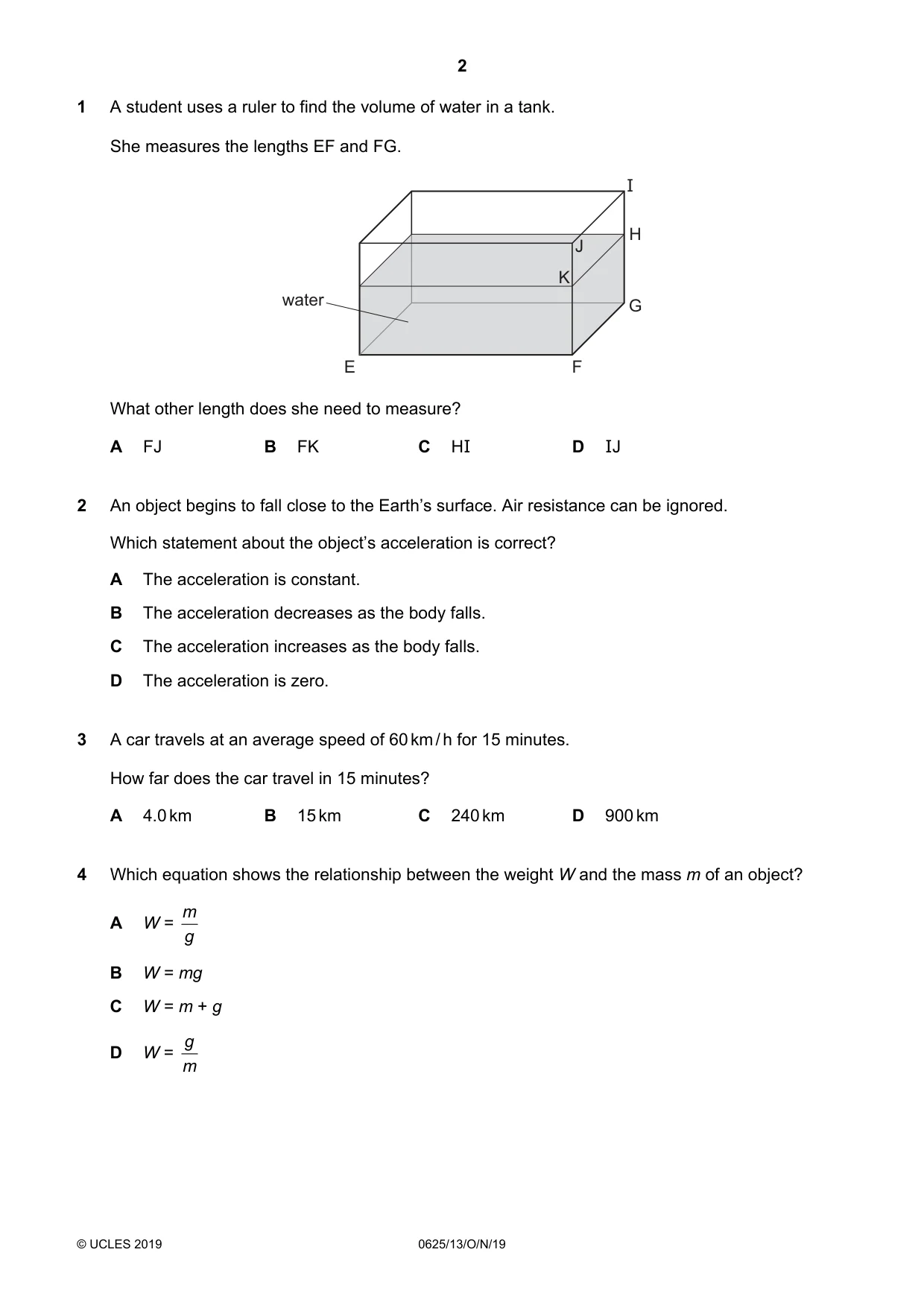
1 A student uses a ruler to find the volume of water in a tank. She measures the lengths EF and FG. I H J K water G E F What other length does she need to measure? A FJ B FK C HI D IJ
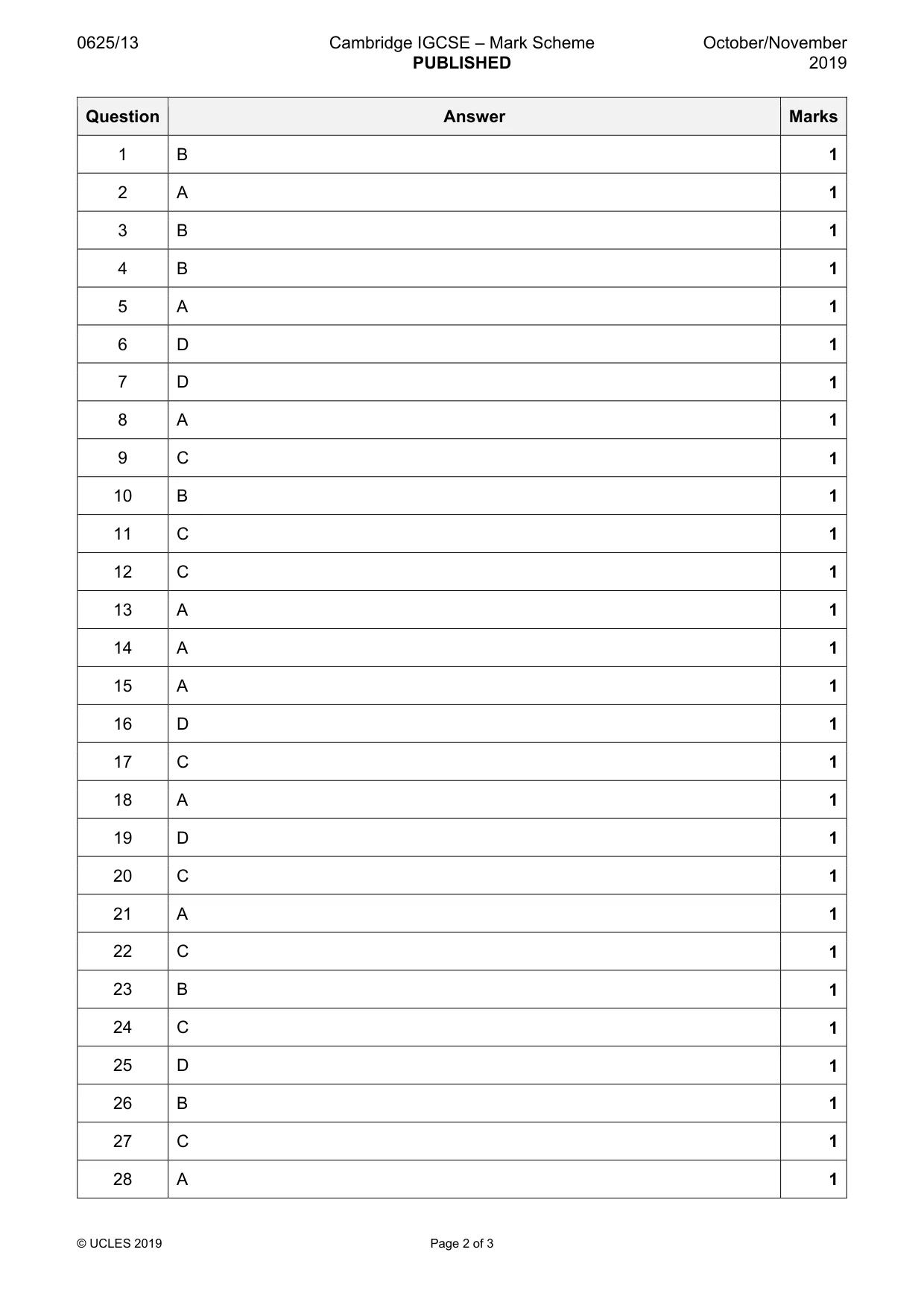
Mark scheme: B
More questions on Physical quantities and measurement techniques
Q2 · An object begins to fall close to the Earth’s surface
2 An object begins to fall close to the Earth’s surface. Air resistance can be ignored. Which statement about the object’s acceleration is correct? A The acceleration is constant. B The acceleration decreases as the body falls. C The acceleration increases as the body falls. D The acceleration is zero.
Mark scheme: A
Q3 · A car travels at an average speed of 60 km / h for 15 minutes
3 A car travels at an average speed of 60 km / h for 15 minutes. How far does the car travel in 15 minutes? A 4.0 km B 15 km C 240 km D 900 km
Mark scheme: B
Q4 · Which equation shows the relationship between the weight W and the mass m of an object?
4 Which equation shows the relationship between the weight W and the mass m of an object? W = m A g B W = mg C W = m + g W = g D m
Mark scheme: B
Q5 · Four hollow glass spheres P, Q, R and S each have a mass of 72 g
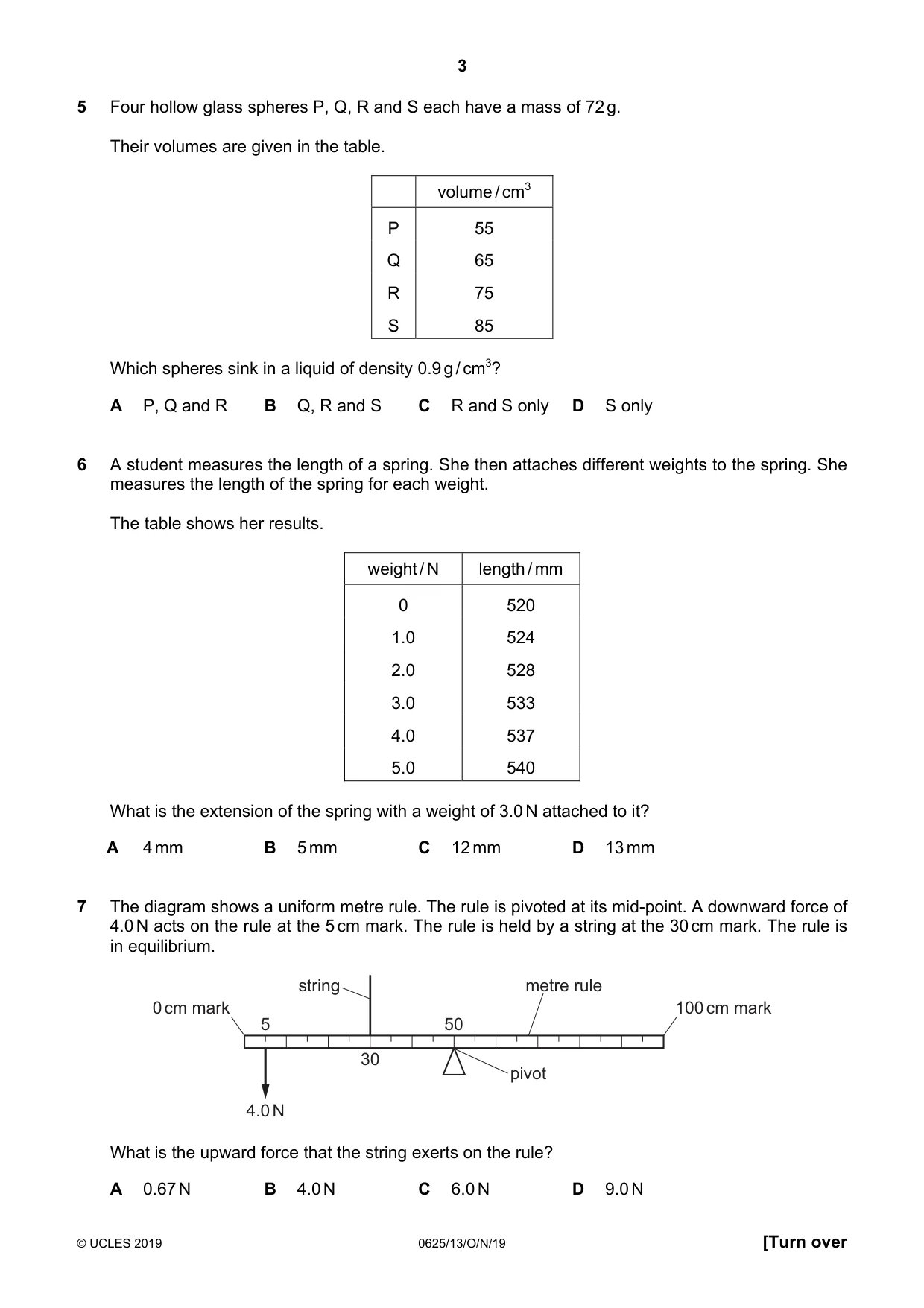
5 Four hollow glass spheres P, Q, R and S each have a mass of 72 g. Their volumes are given in the table. volume / cm3 P 55 Q 65 R 75 S 85 Which spheres sink in a liquid of density 0.9 g / cm3? A P, Q and R B Q, R and S C R and S only D S only
Mark scheme: A
Q6 · A student measures the length of a spring
6 A student measures the length of a spring. She then attaches different weights to the spring. She measures the length of the spring for each weight. The table shows her results. weight / N length / mm 0 520 1.0 524 2.0 528 3.0 533 4.0 537 5.0 540 What is the extension of the spring with a weight of 3.0 N attached to it? A 4 mm B 5 mm C 12 mm D 13 mm
Mark scheme: D
Q7 · The diagram shows a uniform metre rule
7 The diagram shows a uniform metre rule. The rule is pivoted at its mid-point. A downward force of 4.0 N acts on the rule at the 5 cm mark. The rule is held by a string at the 30 cm mark. The rule is in equilibrium. string metre rule 0 cm mark 100 cm mark 5 50 30 pivot 4.0 N What is the upward force that the string exerts on the rule? A 0.67 N B 4.0 N C 6.0 N D 9.0 N
Mark scheme: D
Q8 · The diagrams represent the only two forces acting on an object
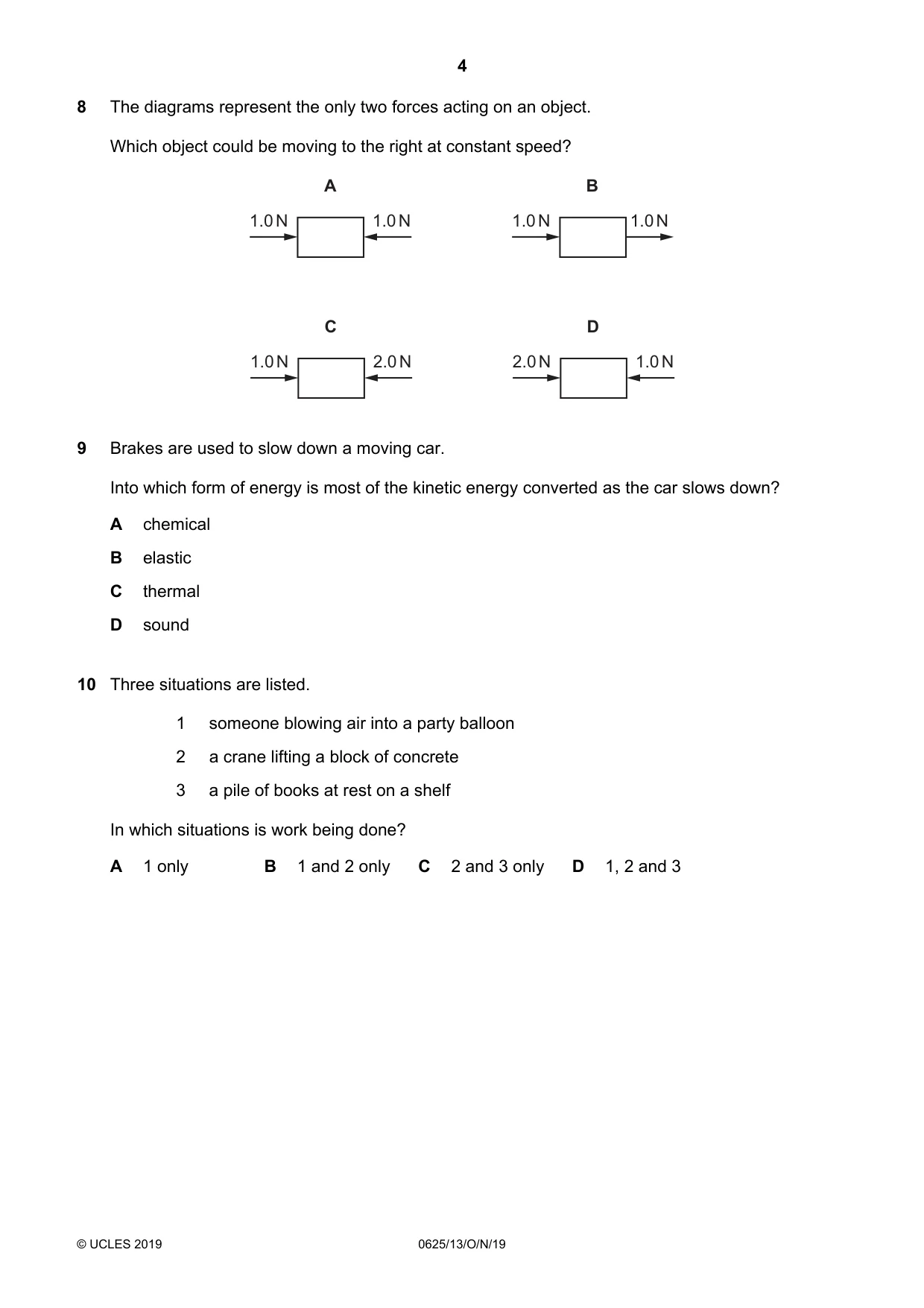
8 The diagrams represent the only two forces acting on an object. Which object could be moving to the right at constant speed? A B 1.0 N 1.0 N 1.0 N 1.0 N C D 1.0 N 2.0 N 2.0 N 1.0 N
Mark scheme: A
Q9 · Brakes are used to slow down a moving car
9 Brakes are used to slow down a moving car. Into which form of energy is most of the kinetic energy converted as the car slows down? A chemical B elastic C thermal D sound
Mark scheme: C
Q10 · Three situations are listed
10 Three situations are listed. 1 someone blowing air into a party balloon 2 a crane lifting a block of concrete 3 a pile of books at rest on a shelf In which situations is work being done? A 1 only B 1 and 2 only C 2 and 3 only D 1, 2 and 3
Mark scheme: B
Q11 · A boy lifts a brick from the ground and places it at rest on a higher shelf
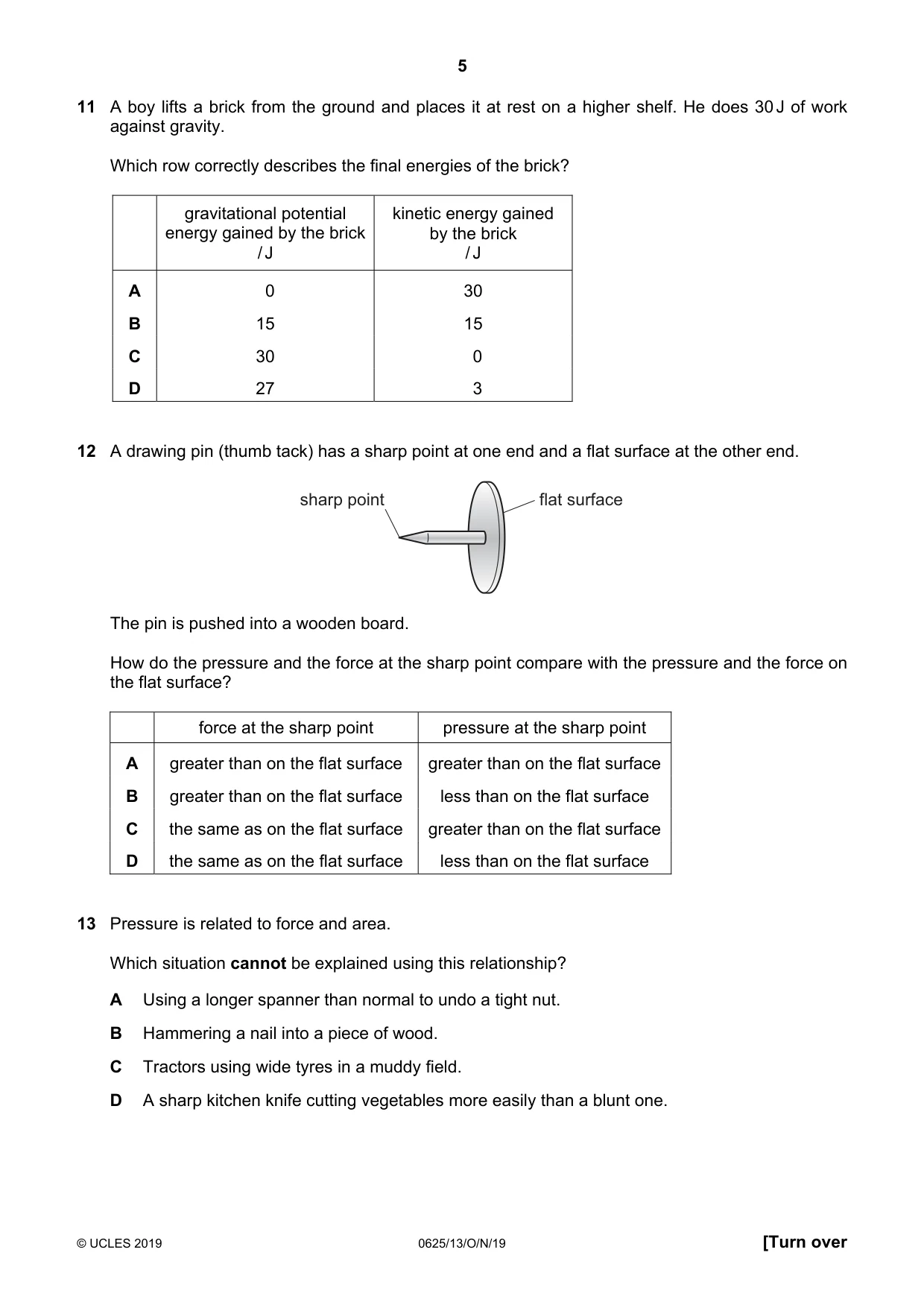
11 A boy lifts a brick from the ground and places it at rest on a higher shelf. He does 30 J of work against gravity. Which row correctly describes the final energies of the brick? gravitational potential kinetic energy gained energy gained by the brick by the brick / J / J A 0 30 B 15 15 C 30 0 D 27 3
Mark scheme: C
Q12 · A drawing pin (thumb tack) has a sharp point at one end and a flat surface at the other…
12 A drawing pin (thumb tack) has a sharp point at one end and a flat surface at the other end. sharp point flat surface The pin is pushed into a wooden board. How do the pressure and the force at the sharp point compare with the pressure and the force on the flat surface? force at the sharp point pressure at the sharp point A greater than on the flat surface greater than on the flat surface B greater than on the flat surface less than on the flat surface C the same as on the flat surface greater than on the flat surface D the same as on the flat surface less than on the flat surface
Mark scheme: C
Q13 · Pressure is related to force and area
13 Pressure is related to force and area. Which situation cannot be explained using this relationship? A Using a longer spanner than normal to undo a tight nut. B Hammering a nail into a piece of wood. C Tractors using wide tyres in a muddy field. D A sharp kitchen knife cutting vegetables more easily than a blunt one.
Mark scheme: A
Q14 · Which row compares the separation and the motion of the molecules of a hot gas with those…
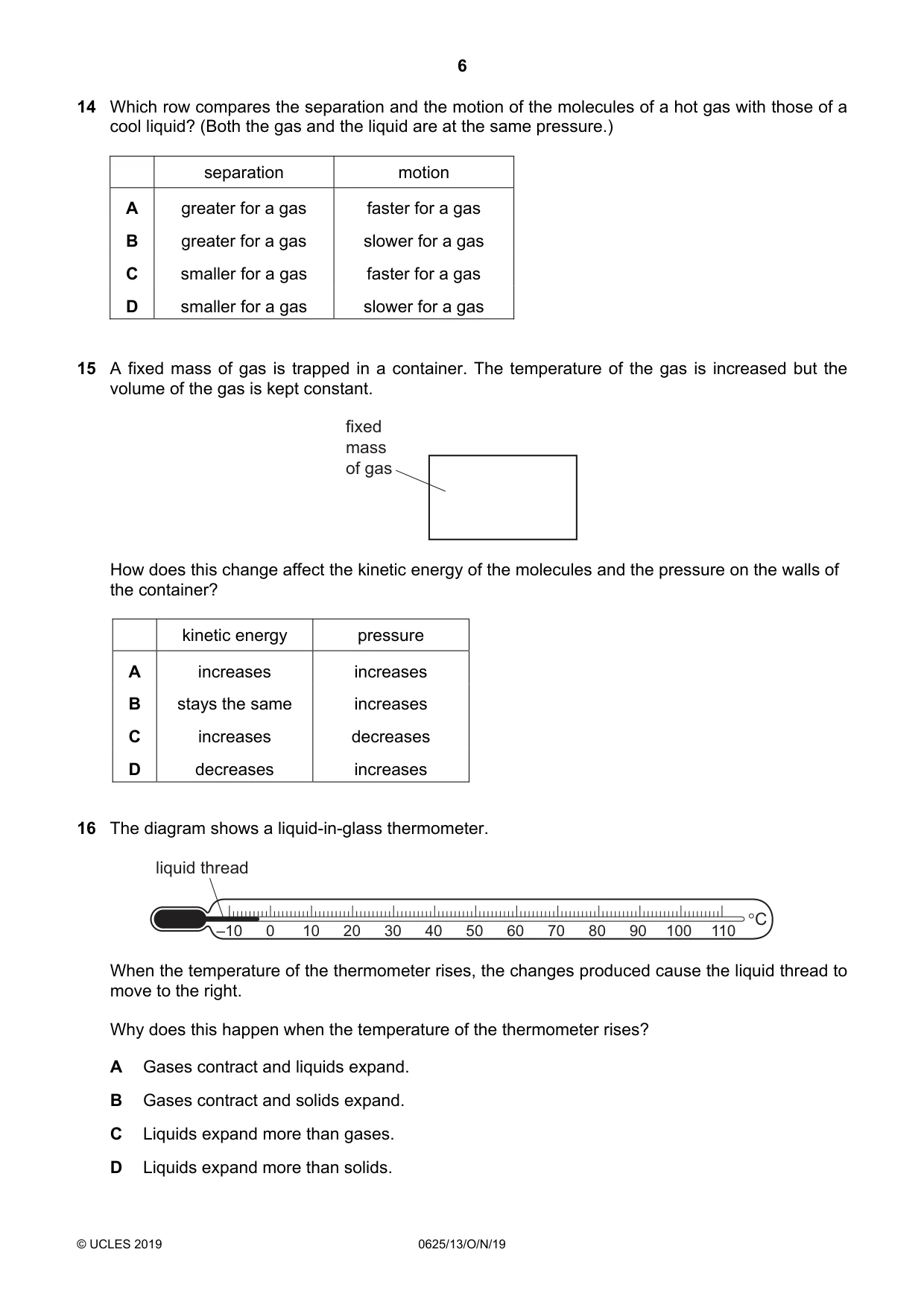
14 Which row compares the separation and the motion of the molecules of a hot gas with those of a cool liquid? (Both the gas and the liquid are at the same pressure.) separation motion A greater for a gas faster for a gas B greater for a gas slower for a gas C smaller for a gas faster for a gas D smaller for a gas slower for a gas
Mark scheme: A
Q15 · A fixed mass of gas is trapped in a container
15 A fixed mass of gas is trapped in a container. The temperature of the gas is increased but the volume of the gas is kept constant. fixed mass of gas How does this change affect the kinetic energy of the molecules and the pressure on the walls of the container? kinetic energy pressure A increases increases B stays the same increases C increases decreases D decreases increases
Mark scheme: A
Q16 · The diagram shows a liquid-in-glass thermometer
16 The diagram shows a liquid-in-glass thermometer. liquid thread 110 °C –10 0 10 20 30 40 50 60 70 80 90 100 When the temperature of the thermometer rises, the changes produced cause the liquid thread to move to the right. Why does this happen when the temperature of the thermometer rises? A Gases contract and liquids expand. B Gases contract and solids expand. C Liquids expand more than gases. D Liquids expand more than solids.
Mark scheme: D
Q17 · A liquid-in-glass thermometer has a range from –10 °C to 110 °C
17 A liquid-in-glass thermometer has a range from –10 °C to 110 °C. What are the fixed point temperatures used when calibrating this thermometer in °C? A –10 °C and 0 °C B –10 °C and 110 °C C 0 °C and 100 °C D 0 °C and 110 °C
Mark scheme: C
Q18 · The diagram shows four labelled changes of state between solid, liquid and gas
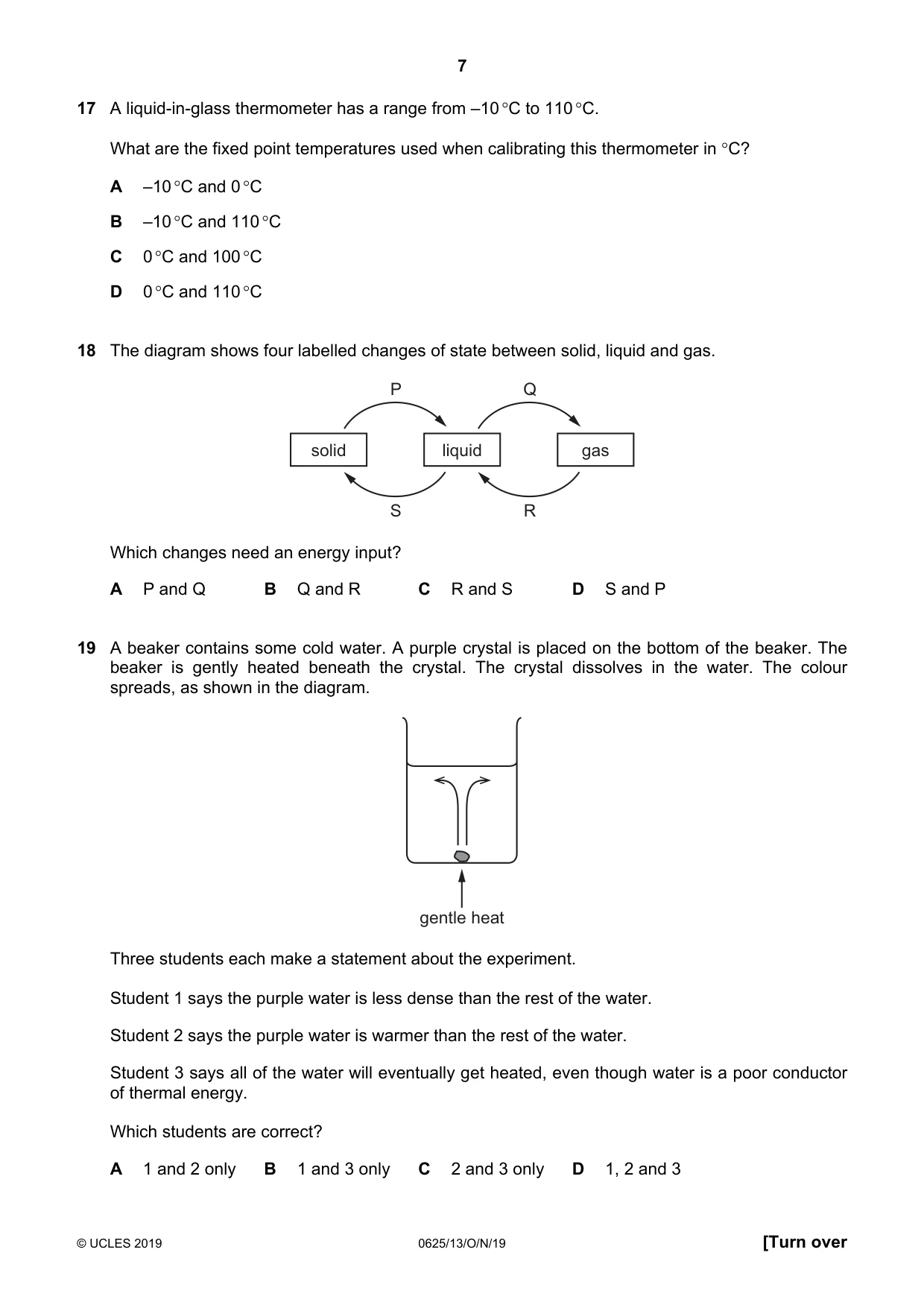
18 The diagram shows four labelled changes of state between solid, liquid and gas. P Q solid liquid gas S R Which changes need an energy input? A P and Q B Q and R C R and S D S and P
Mark scheme: A
Q19 · A beaker contains some cold water
19 A beaker contains some cold water. A purple crystal is placed on the bottom of the beaker. The beaker is gently heated beneath the crystal. The crystal dissolves in the water. The colour spreads, as shown in the diagram. gentle heat Three students each make a statement about the experiment. Student 1 says the purple water is less dense than the rest of the water. Student 2 says the purple water is warmer than the rest of the water. Student 3 says all of the water will eventually get heated, even though water is a poor conductor of thermal energy. Which students are correct? A 1 and 2 only B 1 and 3 only C 2 and 3 only D 1, 2 and 3
Mark scheme: D
Q20 · Why are the outside walls of houses often painted white in very hot countries?
20 Why are the outside walls of houses often painted white in very hot countries? A White surfaces are good absorbers of infrared radiation. B White surfaces are good emitters of infrared radiation. C White surfaces are poor absorbers of infrared radiation. D White surfaces are poor reflectors of infrared radiation.
Mark scheme: C
Q21 · Which type of wave is not an example of a transverse wave?
21 Which type of wave is not an example of a transverse wave? A sound wave B microwave C infrared wave D radio wave
Mark scheme: A
Q22 · Plane water waves approach a narrow gap in a barrier
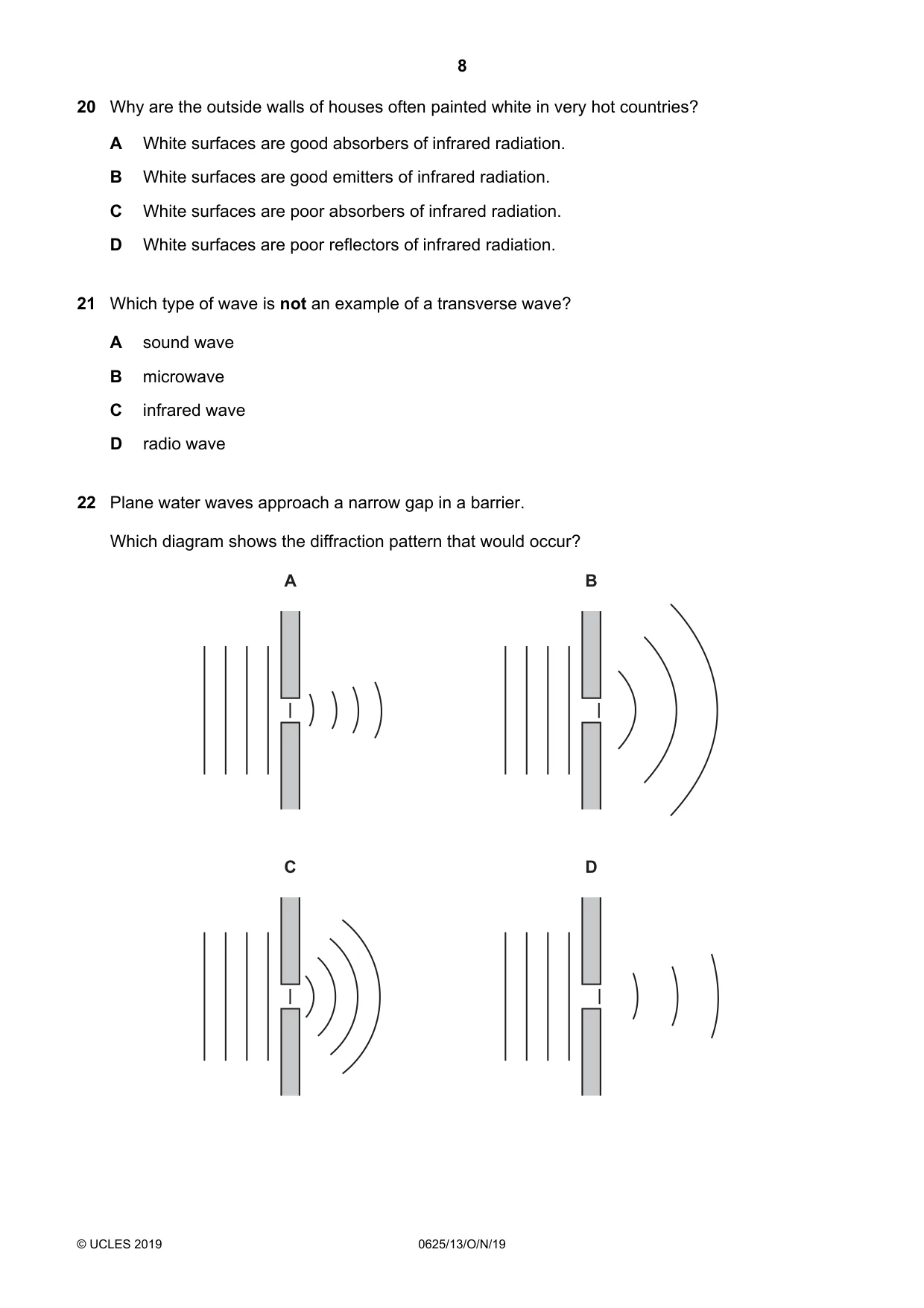
22 Plane water waves approach a narrow gap in a barrier. Which diagram shows the diffraction pattern that would occur? A B C D
Mark scheme: C
Q23 · A person stands 1.0 m in front of a plane mirror
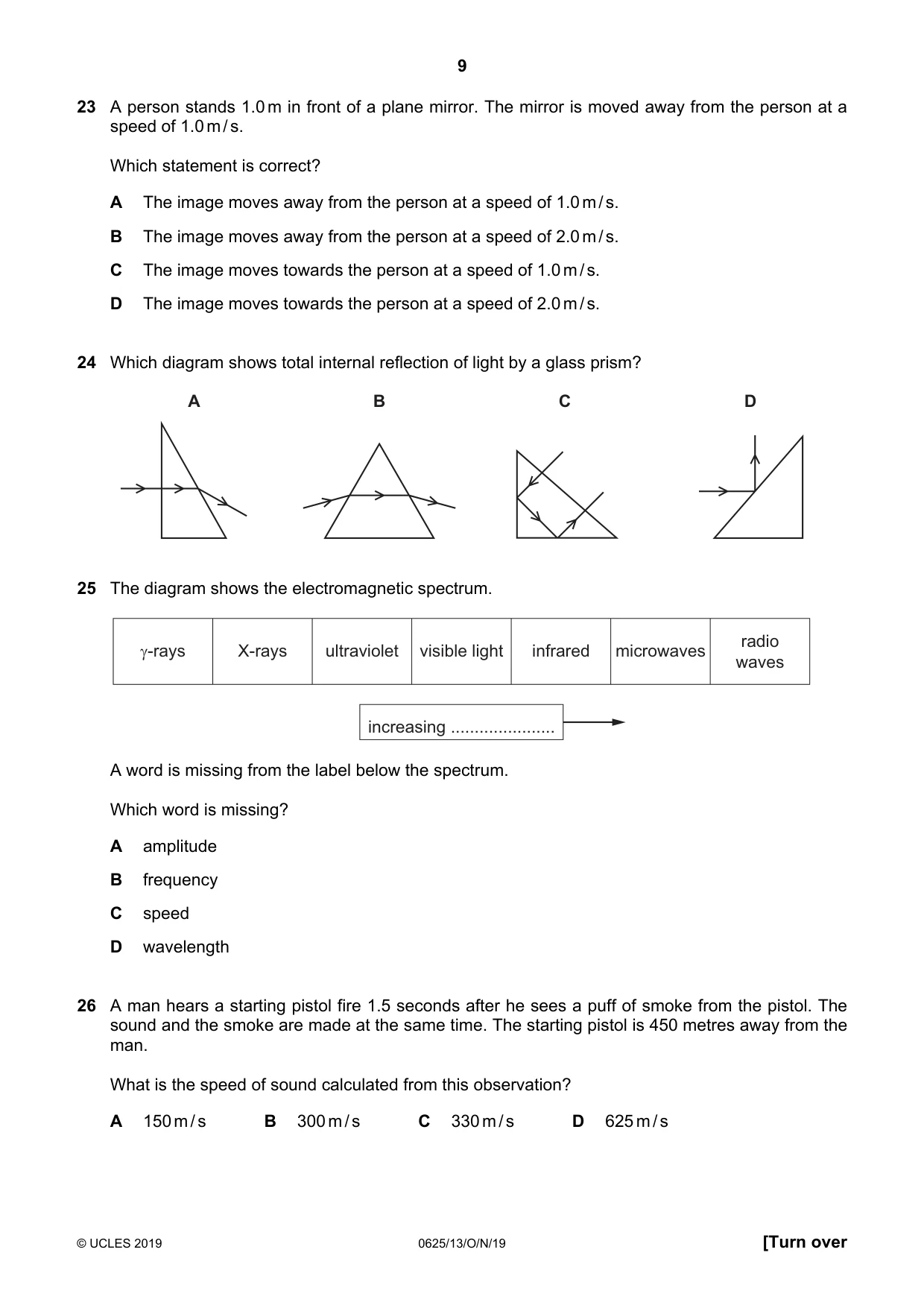
23 A person stands 1.0 m in front of a plane mirror. The mirror is moved away from the person at a speed of 1.0 m / s. Which statement is correct? A The image moves away from the person at a speed of 1.0 m / s. B The image moves away from the person at a speed of 2.0 m / s. C The image moves towards the person at a speed of 1.0 m / s. D The image moves towards the person at a speed of 2.0 m / s.
Mark scheme: B
Q24 · Which diagram shows total internal reflection of light by a glass prism?
24 Which diagram shows total internal reflection of light by a glass prism? A B C D
Mark scheme: C
Q25 · The diagram shows the electromagnetic spectrum
25 The diagram shows the electromagnetic spectrum. radio γ-rays X-rays ultraviolet visible light infrared microwaves waves increasing ...................... A word is missing from the label below the spectrum. Which word is missing? A amplitude B frequency C speed D wavelength
Mark scheme: D
Q26 · A man hears a starting pistol fire 1.5 seconds after he sees a puff of smoke from the…
26 A man hears a starting pistol fire 1.5 seconds after he sees a puff of smoke from the pistol. The sound and the smoke are made at the same time. The starting pistol is 450 metres away from the man. What is the speed of sound calculated from this observation? A 150 m / s B 300 m / s C 330 m / s D 625 m / s
Mark scheme: B
Q27 · The diagram represents a magnetic field
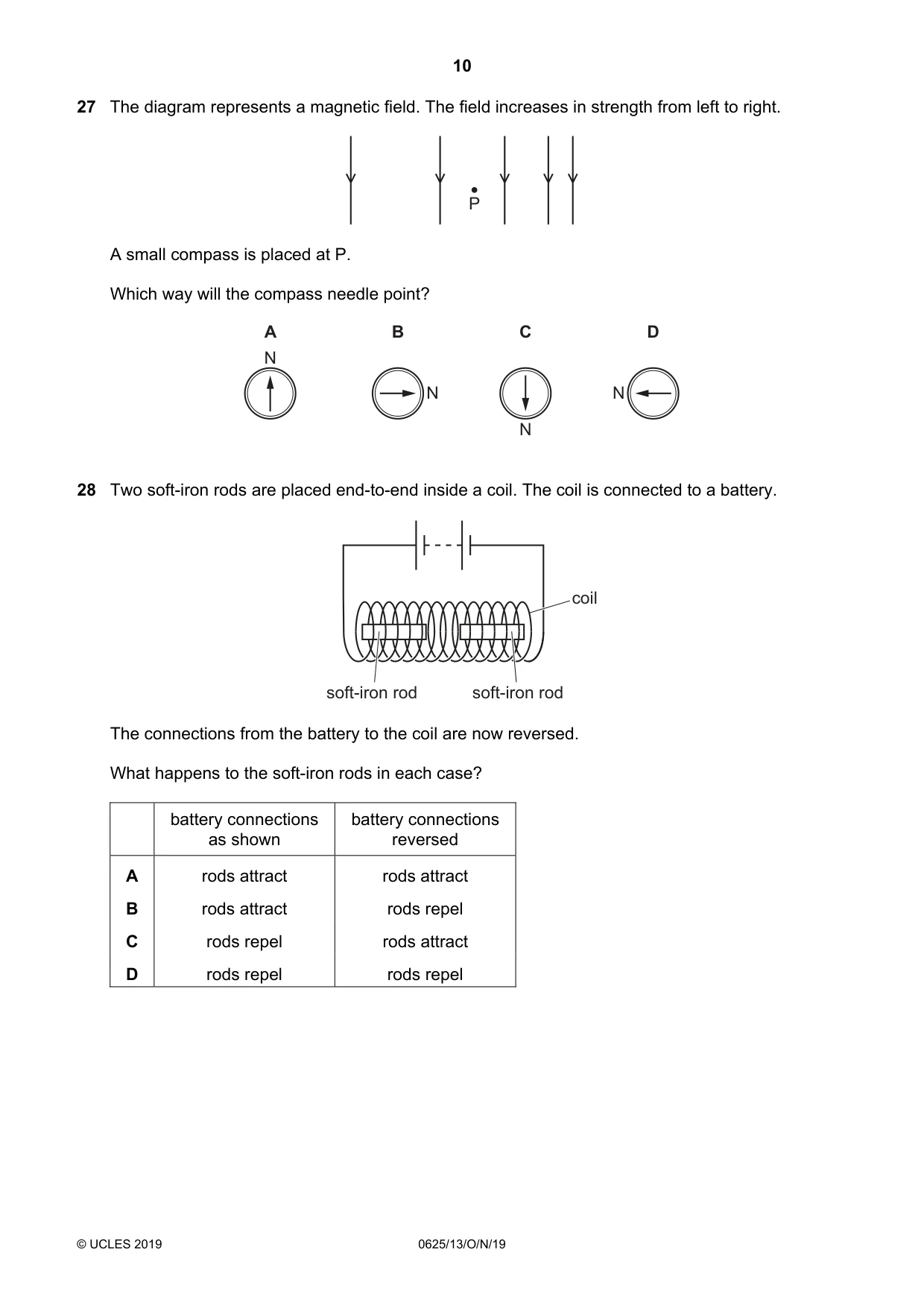
27 The diagram represents a magnetic field. The field increases in strength from left to right. P A small compass is placed at P. Which way will the compass needle point? A B C D N N N N
Mark scheme: C
Q28 · Two soft-iron rods are placed end-to-end inside a coil
28 Two soft-iron rods are placed end-to-end inside a coil. The coil is connected to a battery. coil soft-iron rod soft-iron rod The connections from the battery to the coil are now reversed. What happens to the soft-iron rods in each case? battery connections battery connections as shown reversed A rods attract rods attract B rods attract rods repel C rods repel rods attract D rods repel rods repel
Mark scheme: A
Q29 · A plastic rod is rubbed with a dry cloth
29 A plastic rod is rubbed with a dry cloth. The rod becomes positively charged. Why has the rod become positively charged? A It has gained electrons. B It has gained neutrons. C It has lost electrons. D It has lost neutrons.
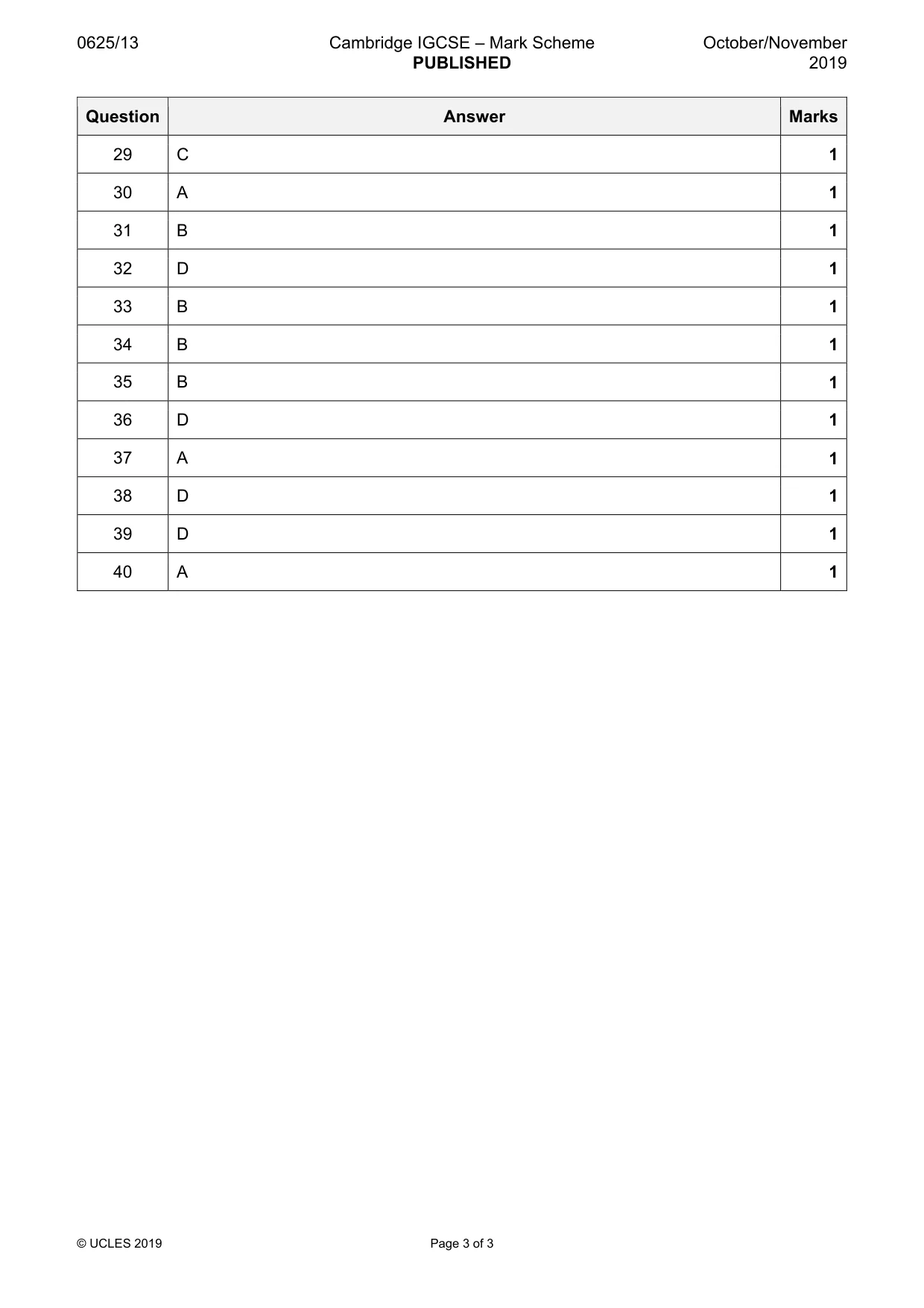
Mark scheme: C
Q30 · A resistor is connected to a battery
30 A resistor is connected to a battery. There is a current in the resistor. What is the main energy change? A Chemical energy is converted into thermal energy. B Chemical energy is converted into gravitational potential energy. C Nuclear energy is converted into thermal energy. D Nuclear energy is converted into gravitational potential energy.
Mark scheme: A
Q31 · Lamps X and Y are designed to operate at normal brightness when each are connected to a…
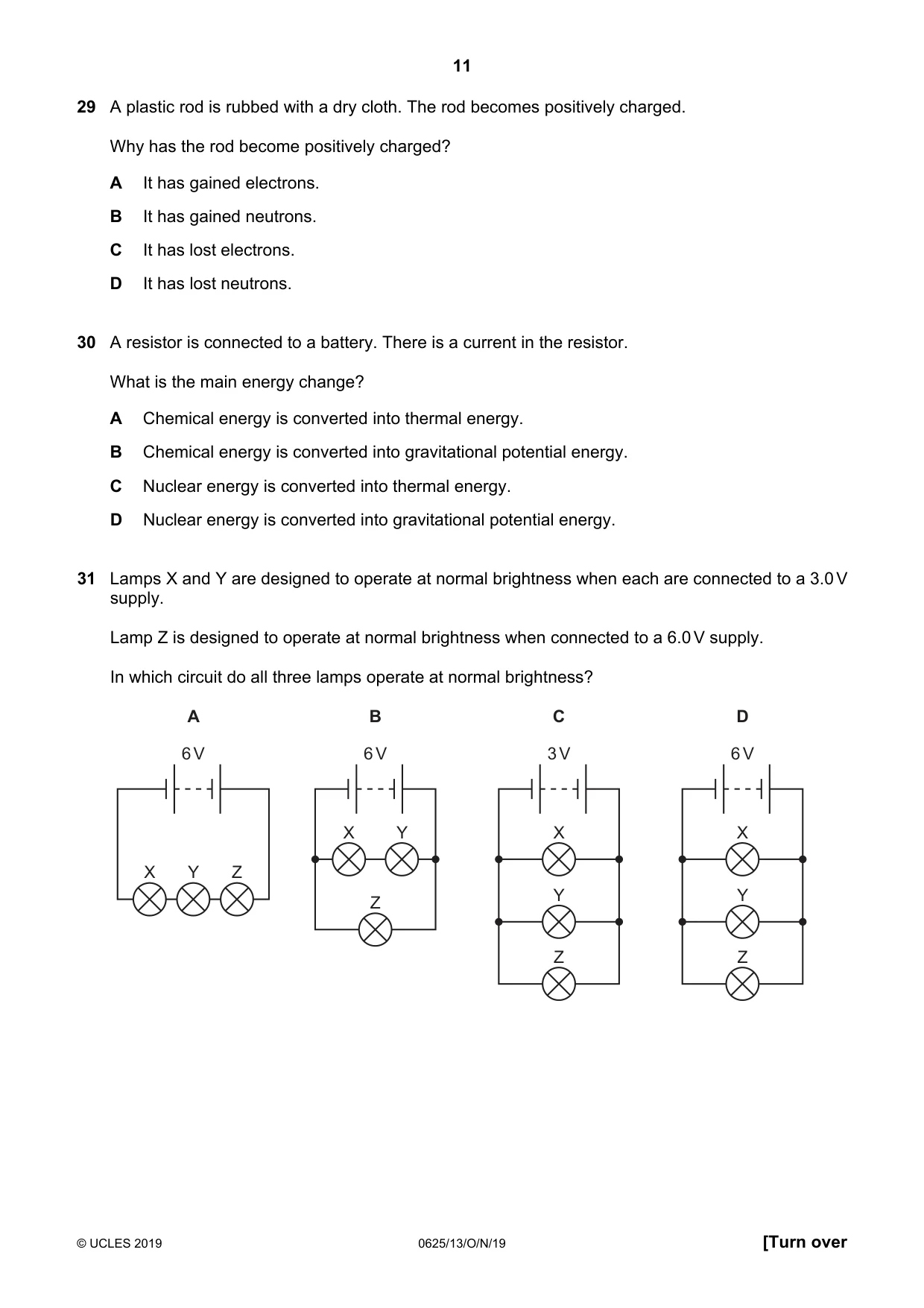
31 Lamps X and Y are designed to operate at normal brightness when each are connected to a 3.0 V supply. Lamp Z is designed to operate at normal brightness when connected to a 6.0 V supply. In which circuit do all three lamps operate at normal brightness? A B C D 6 V 6 V 3 V 6 V X Y X X X Y Z Y Y Z Z Z
Mark scheme: B
Q32 · Identical resistors are connected together to form arrangements X, Y and Z
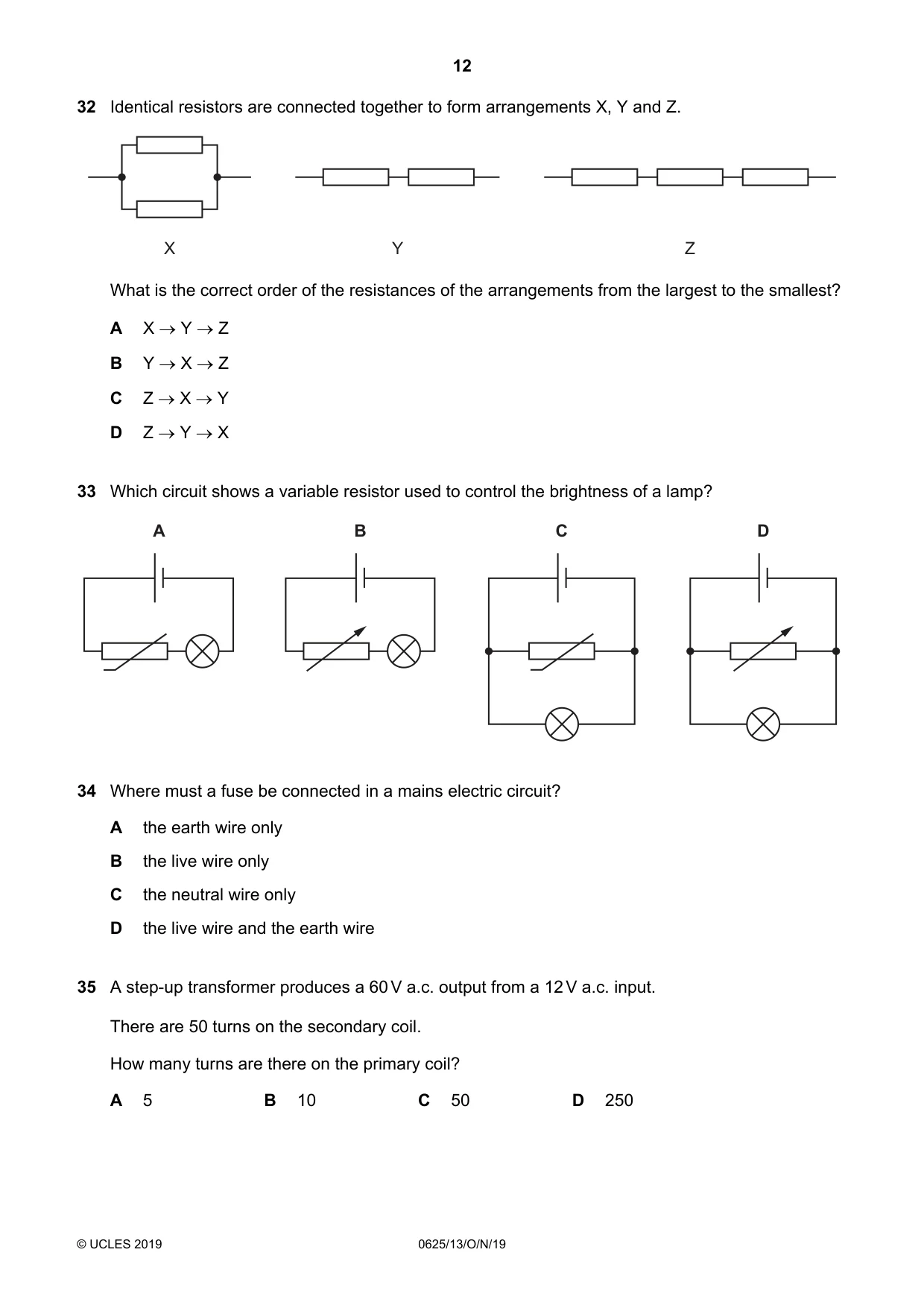
32 Identical resistors are connected together to form arrangements X, Y and Z. X Y Z What is the correct order of the resistances of the arrangements from the largest to the smallest? A X → Y → Z B Y → X → Z C Z → X → Y D Z → Y → X
Mark scheme: D
Q33 · Which circuit shows a variable resistor used to control the brightness of a lamp?
33 Which circuit shows a variable resistor used to control the brightness of a lamp? A B C D
Mark scheme: B
Q34 · Where must a fuse be connected in a mains electric circuit?
34 Where must a fuse be connected in a mains electric circuit? A the earth wire only B the live wire only C the neutral wire only D the live wire and the earth wire
Mark scheme: B
Q35 · A step-up transformer produces a 60 V a.c
35 A step-up transformer produces a 60 V a.c. output from a 12 V a.c. input. There are 50 turns on the secondary coil. How many turns are there on the primary coil? A 5 B 10 C 50 D 250
Mark scheme: B
Q36 · A student uses a balance, a magnet and a power supply to determine the force on a wire in…
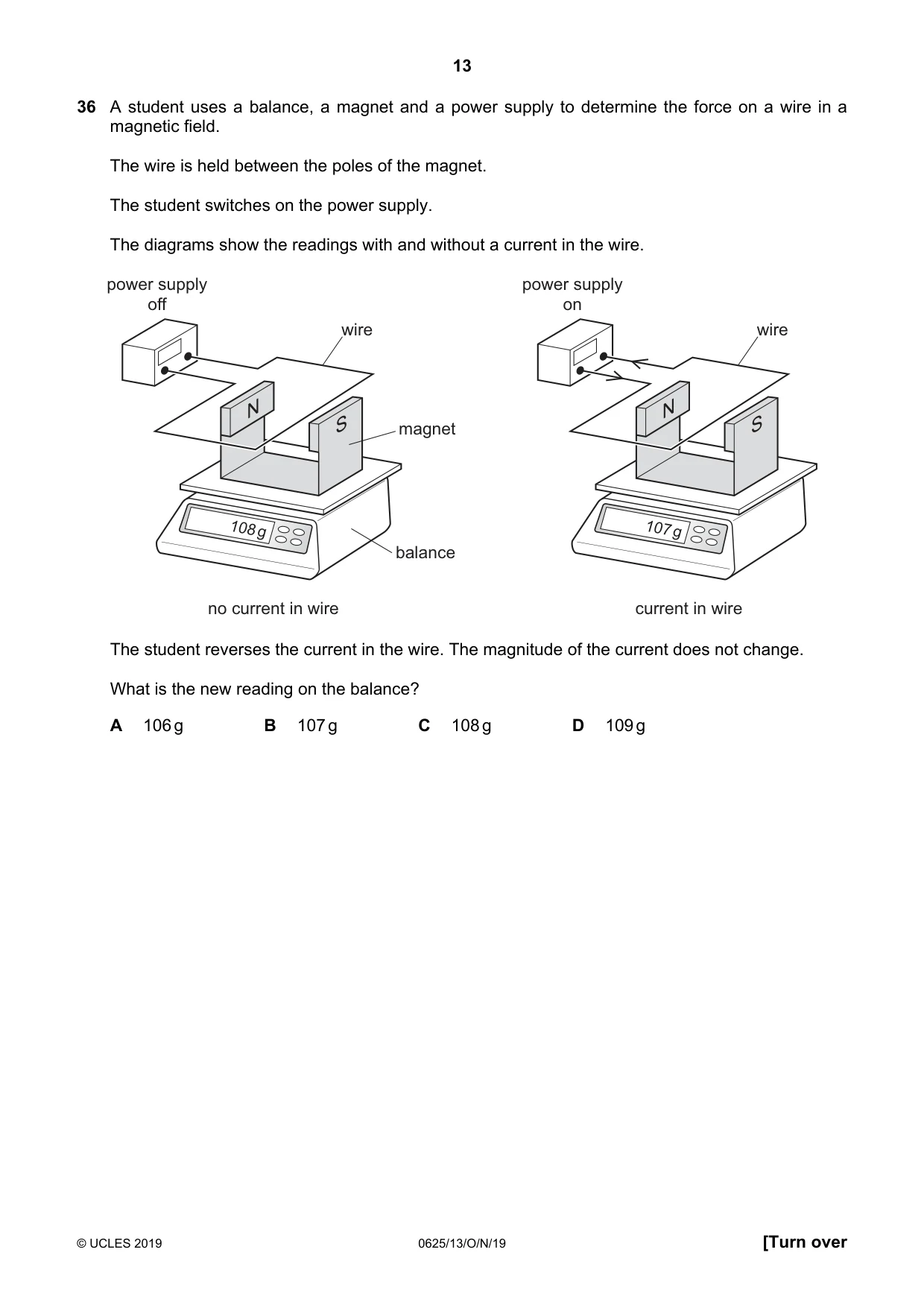
36 A student uses a balance, a magnet and a power supply to determine the force on a wire in a magnetic field. The wire is held between the poles of the magnet. The student switches on the power supply. The diagrams show the readings with and without a current in the wire. power supply power supply off on wire wire N N S S magnet 108 g 107 g balance no current in wire current in wire The student reverses the current in the wire. The magnitude of the current does not change. What is the new reading on the balance? A 106 g B 107 g C 108 g D 109 g
Mark scheme: D
Q37 · The diagram represents a neutral atom
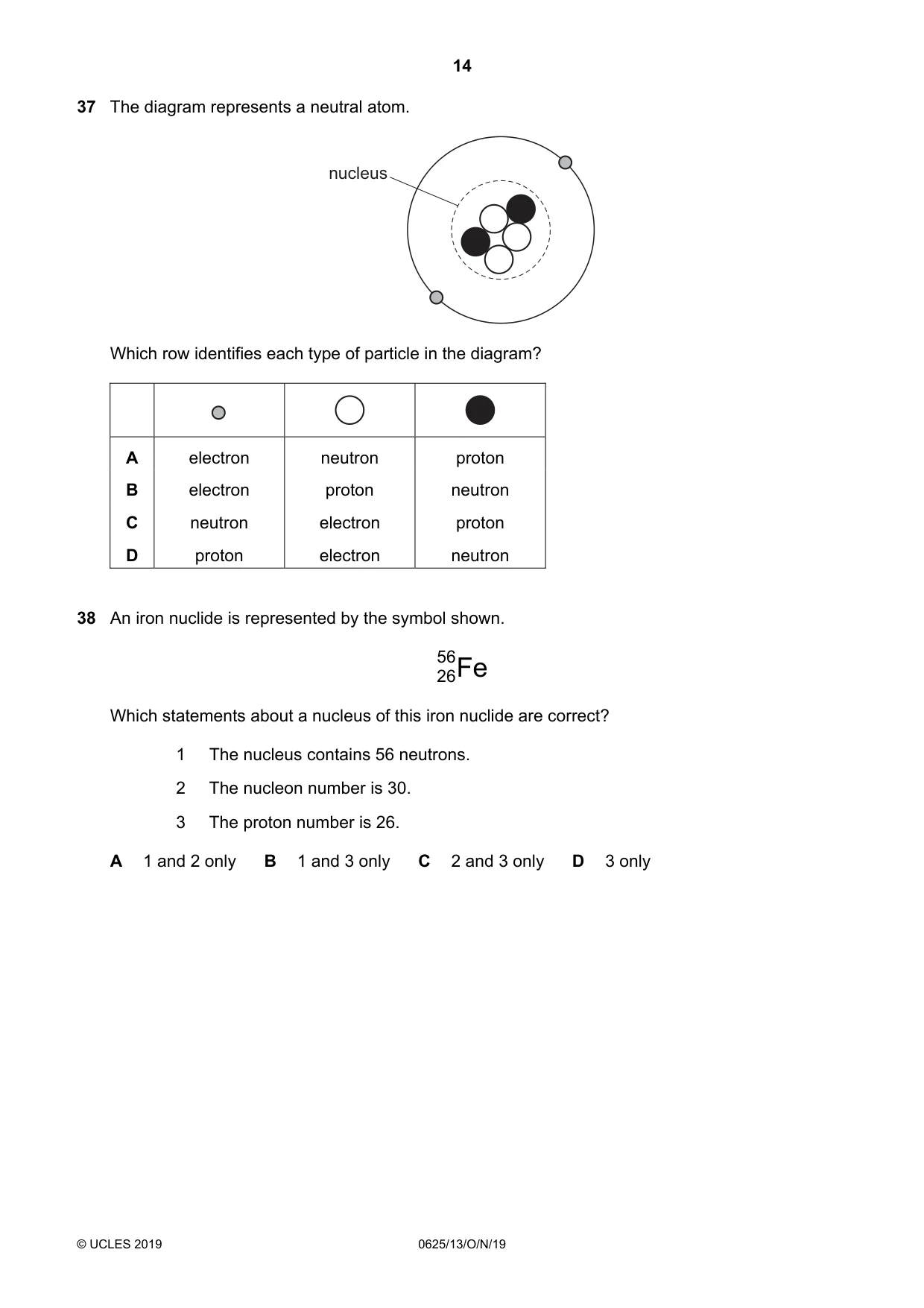
37 The diagram represents a neutral atom. nucleus Which row identifies each type of particle in the diagram? A electron neutron proton B electron proton neutron C neutron electron proton D proton electron neutron
Mark scheme: A
Q38 · An iron nuclide is represented by the symbol shown
38 An iron nuclide is represented by the symbol shown. 56 26Fe Which statements about a nucleus of this iron nuclide are correct? 1 The nucleus contains 56 neutrons. 2 The nucleon number is 30. 3 The proton number is 26. A 1 and 2 only B 1 and 3 only C 2 and 3 only D 3 only
Mark scheme: D
Q39 · Three types of radiation that can cause ionisation are α-, β- and γ-radiation
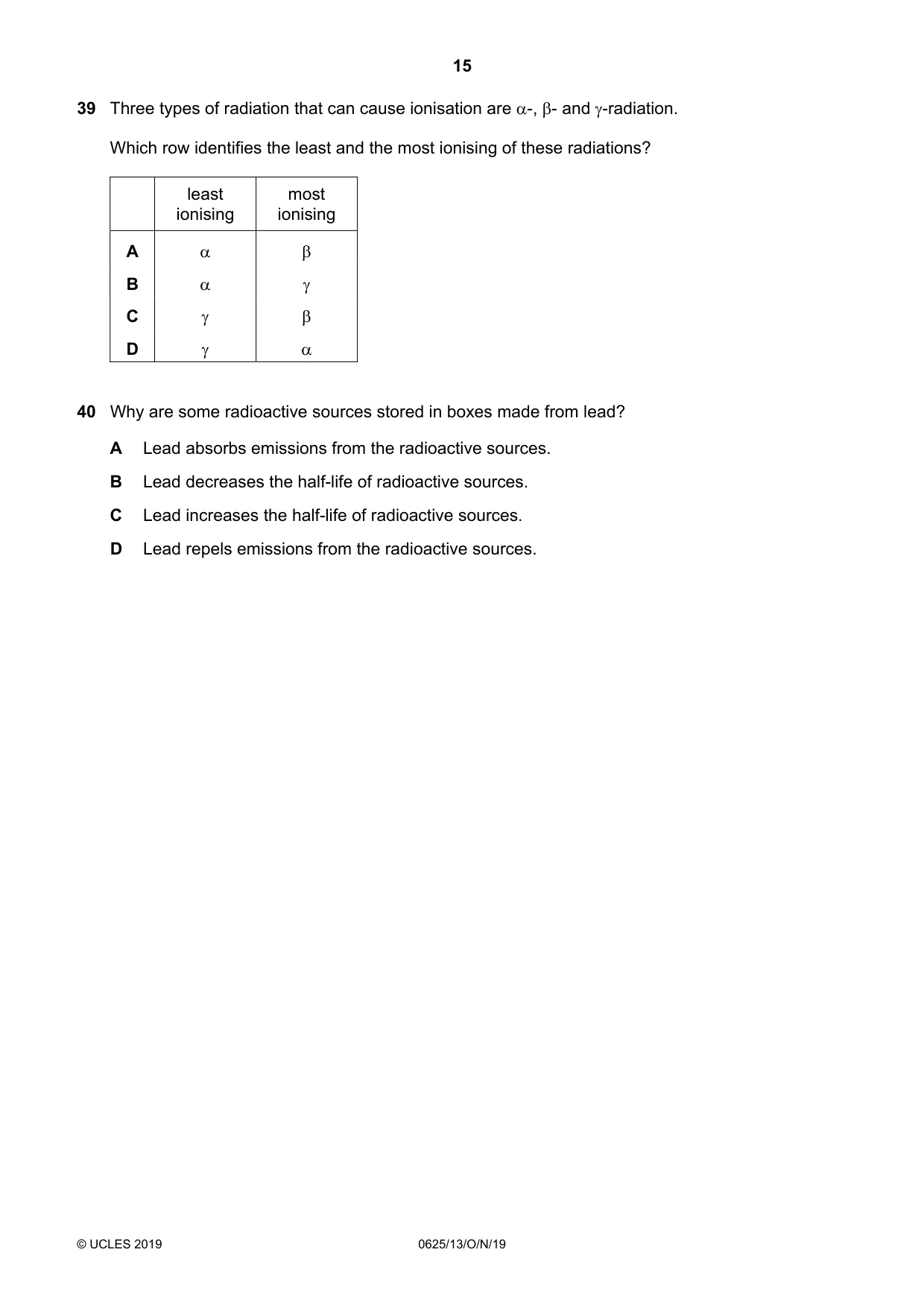
39 Three types of radiation that can cause ionisation are α-, β- and γ-radiation. Which row identifies the least and the most ionising of these radiations? least most ionising ionising A α β B α γ C γ β D γ α
Mark scheme: D
Q40 · Why are some radioactive sources stored in boxes made from lead?
40 Why are some radioactive sources stored in boxes made from lead? A Lead absorbs emissions from the radioactive sources. B Lead decreases the half-life of radioactive sources. C Lead increases the half-life of radioactive sources. D Lead repels emissions from the radioactive sources.
Mark scheme: A
What was in this paper
The subtopics covered by these 40 questions, and how many questions each got. Open one in a new tab to see every Cambridge question on it.
4Energy, work and power3Forces3Kinetic particle model of matter3Electromagnetic effects2General properties of waves2Light2Motion2Pressure2Radioactivity2Simple phenomena of magnetism2The nuclear model of the atom2Thermal properties and temperature2Transfer of thermal energy2Density1Electrical quantities1Electrical safety1Electromagnetic spectrum1Mass and weight1Physical quantities and measurement techniques1Sound1What you needed in this session
Cambridge’s own grade thresholds for 2019 Oct/Nov, Paper 1 · Variant 3. A higher threshold means an easier paper — the bar moves with how the cohort did.