Cambridge IGCSE Physics 0625 — 2023 Oct/Nov Paper 1 · Variant 2
0625/12/O/N/23 · 40 questions · 40 marks · ≈45 min
The question paper and its mark scheme, free to read here and free to download. This is Cambridge’s own paper, exactly as it was sat.
Question paper16 pages
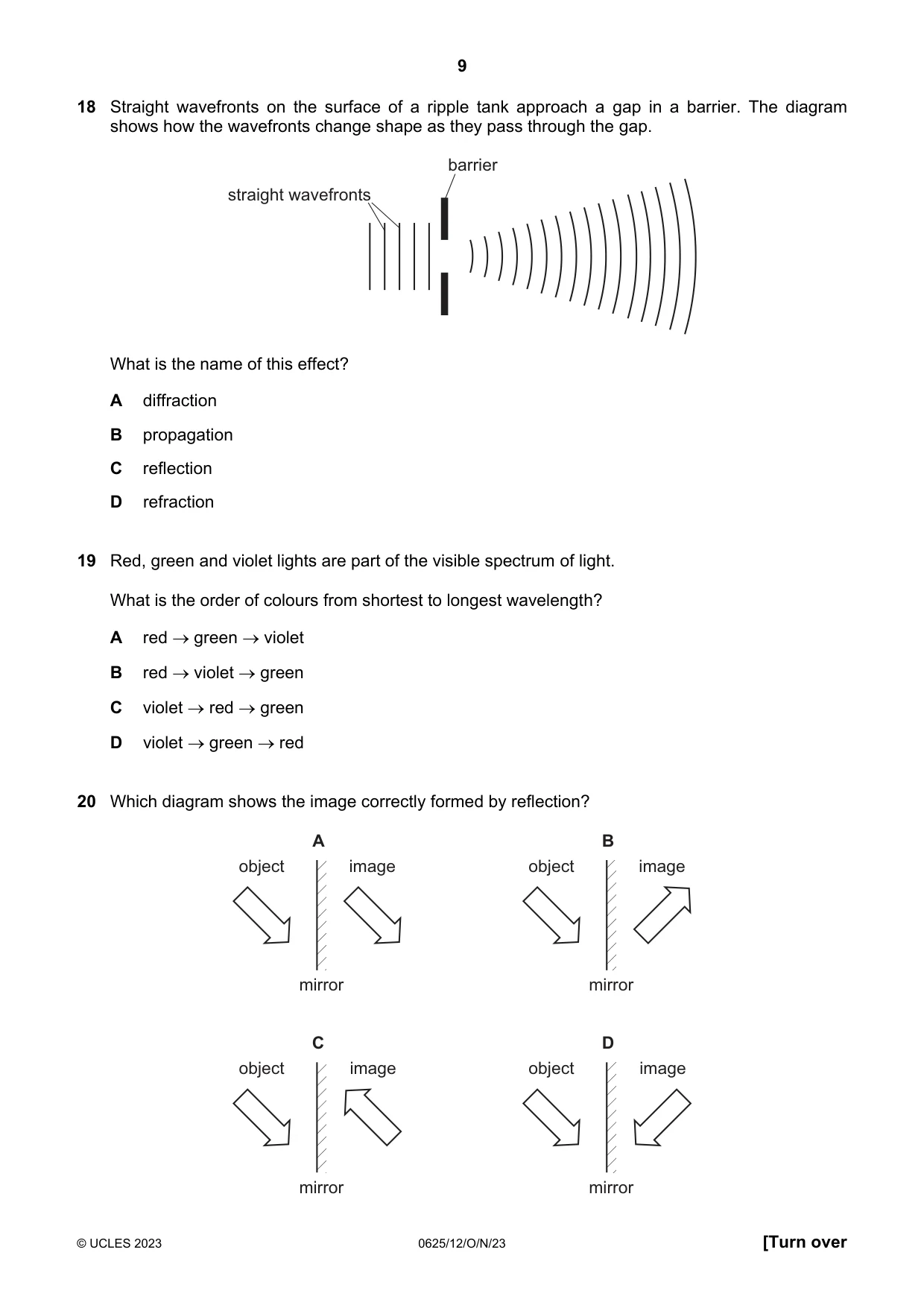
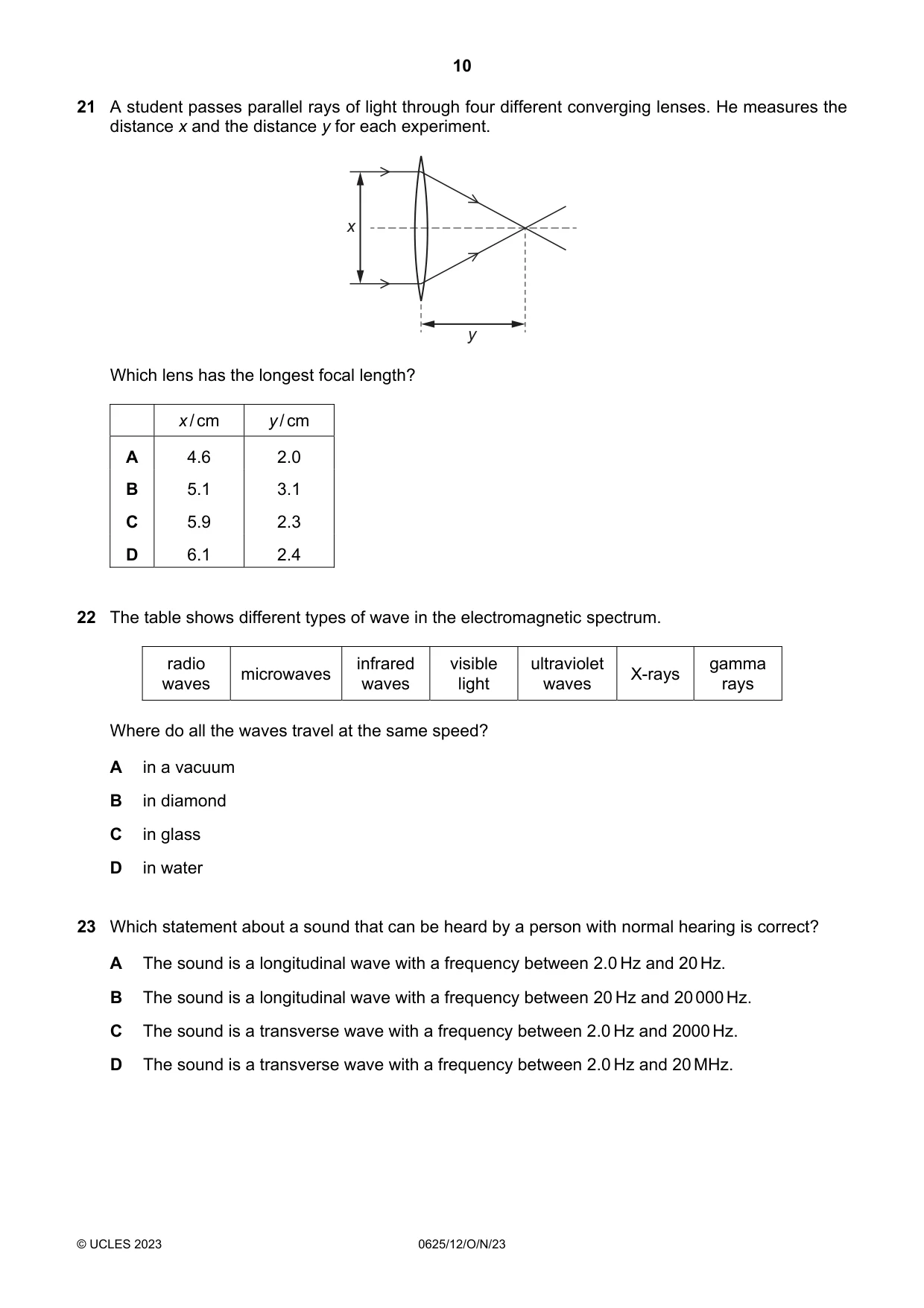
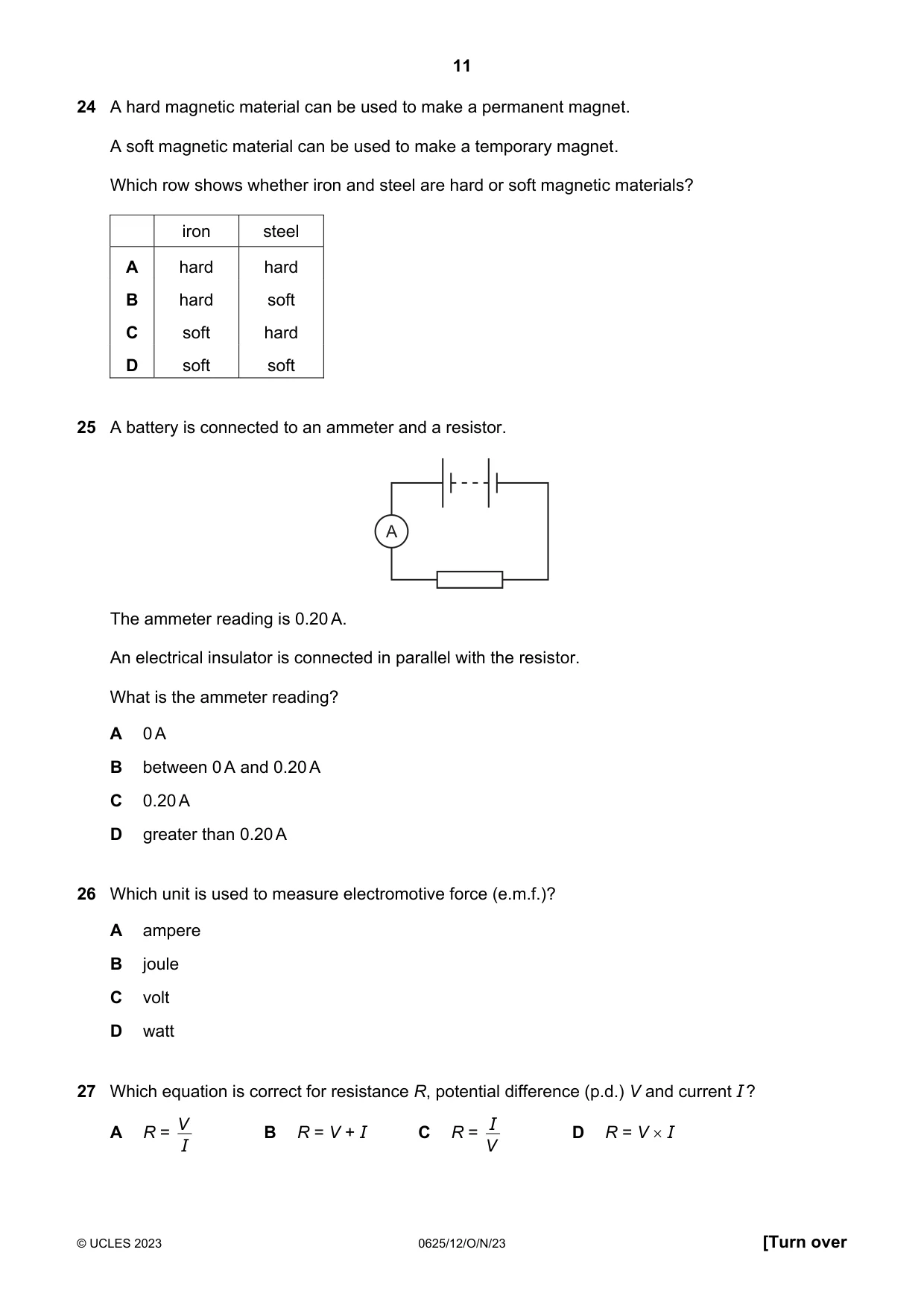
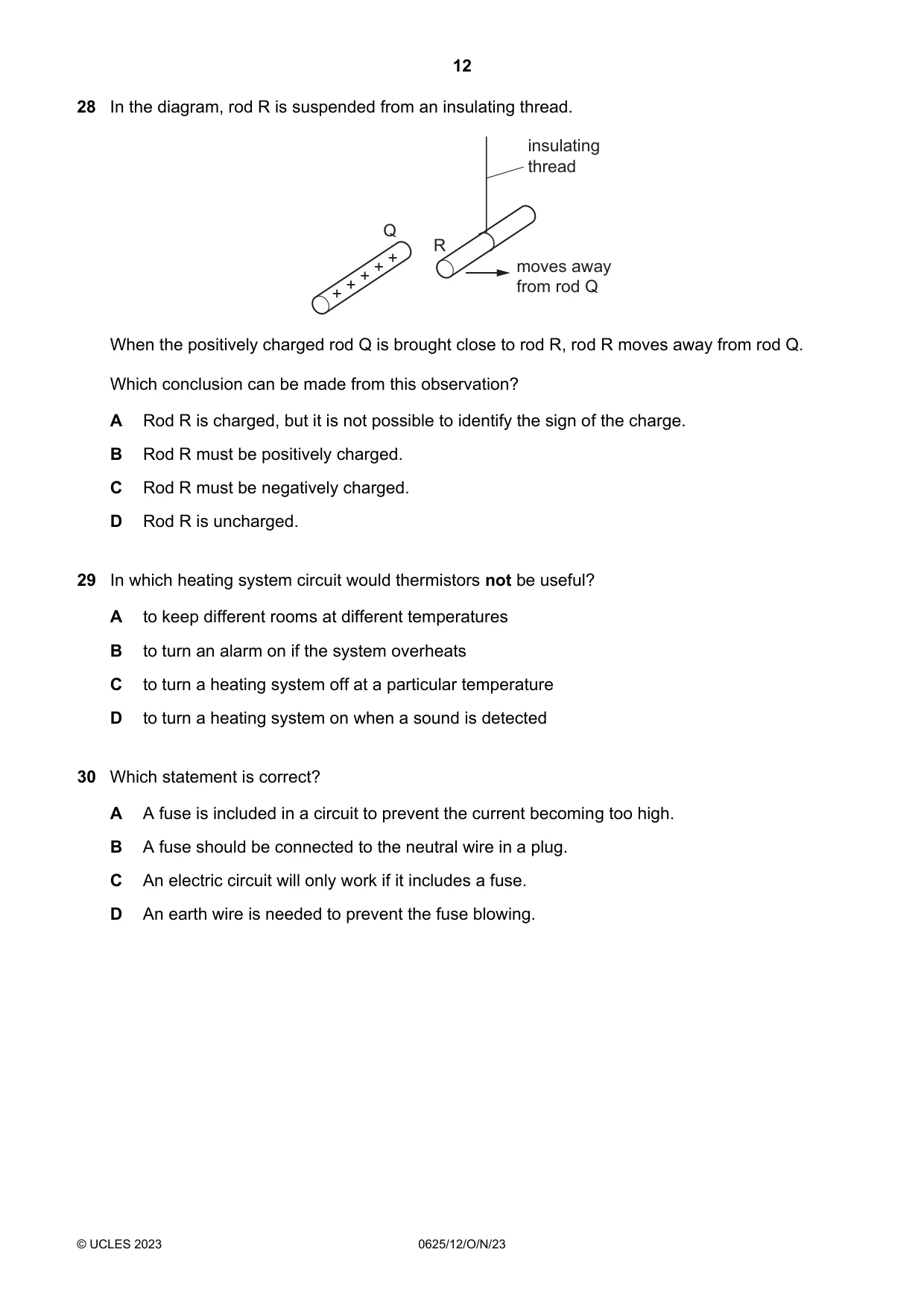
Mark scheme3 pages
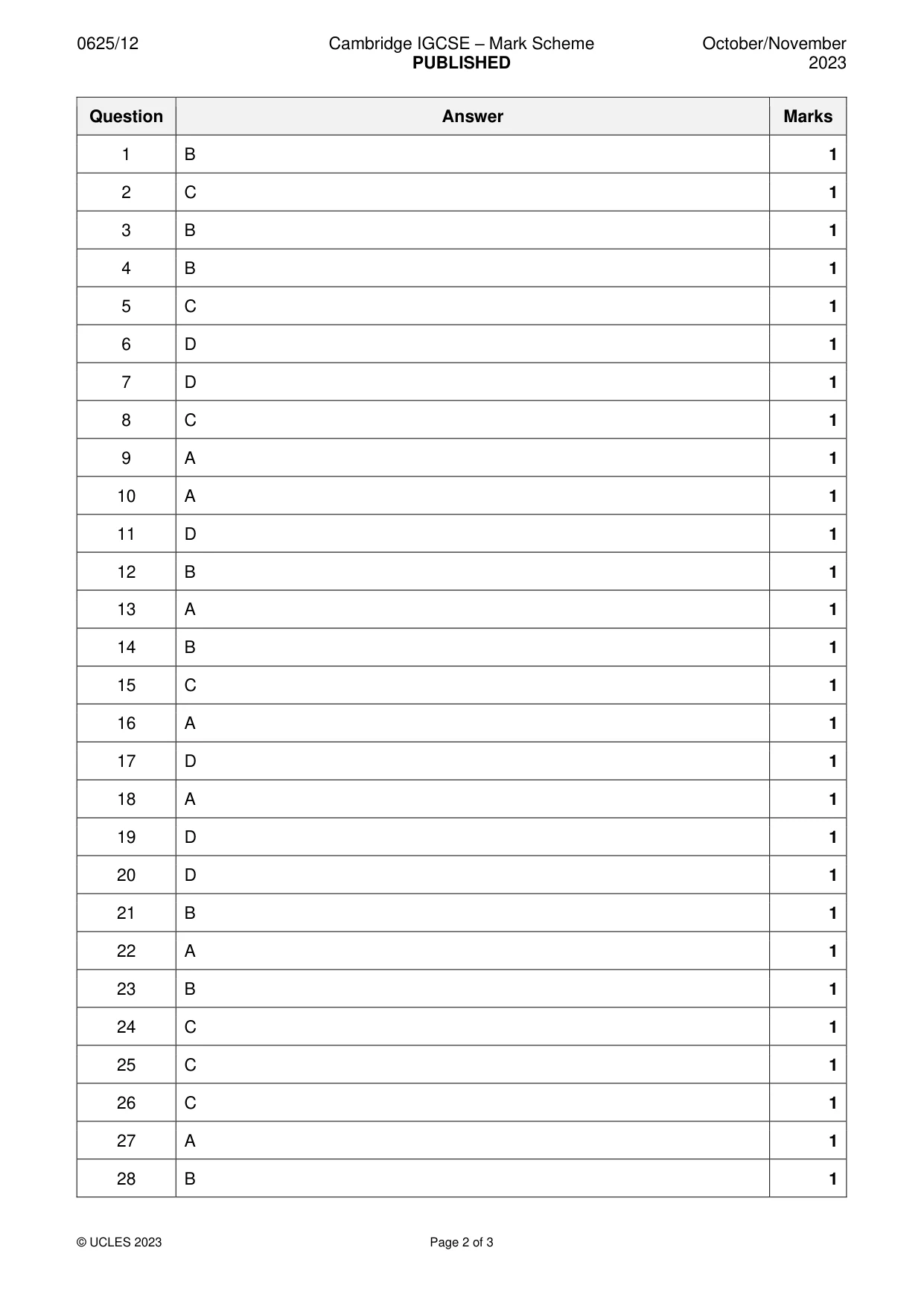
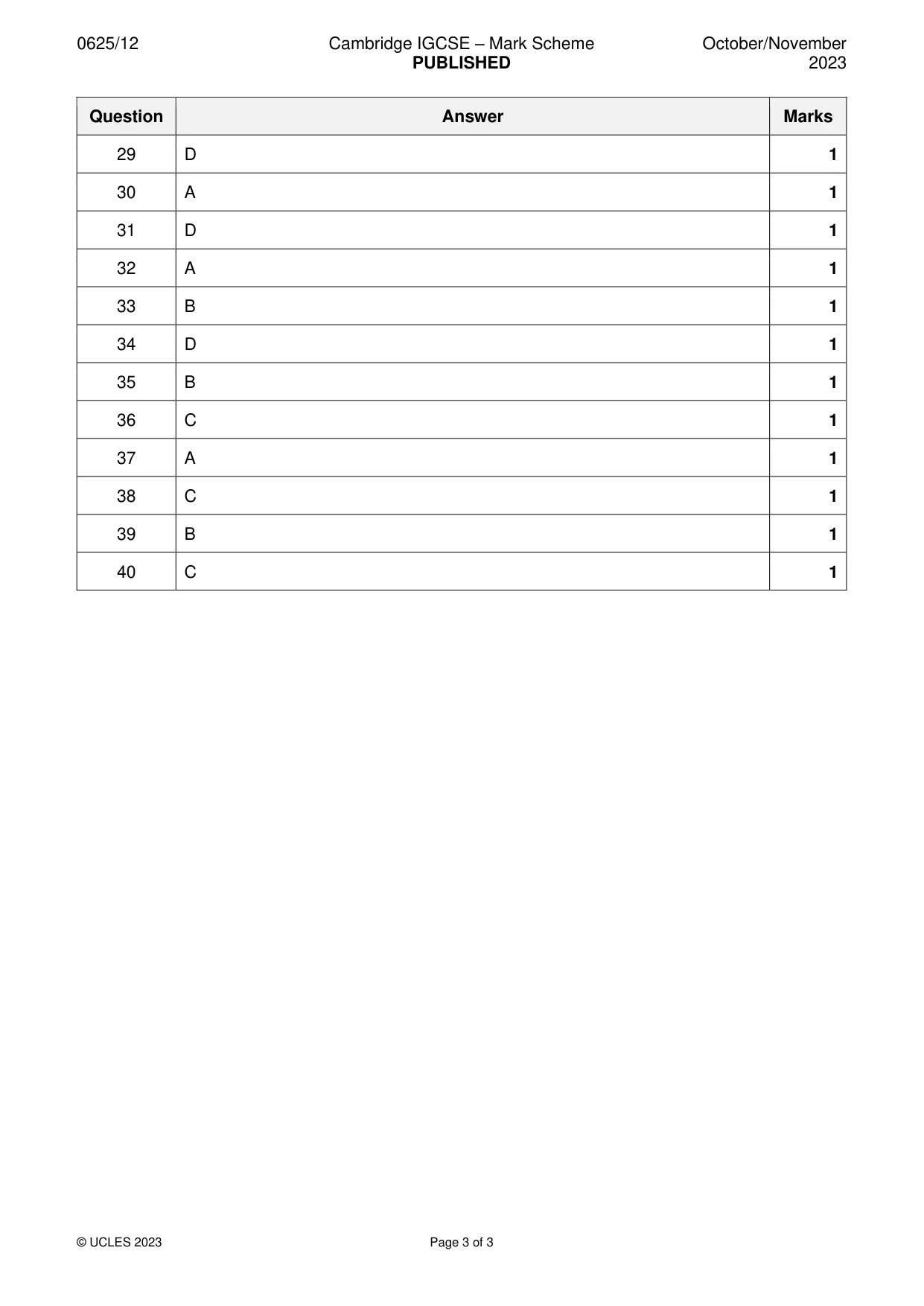
Answers below. Sit the paper first if you are practising.
Questions as text
Q1 · A student investigates the oscillation of a mass suspended from a spring
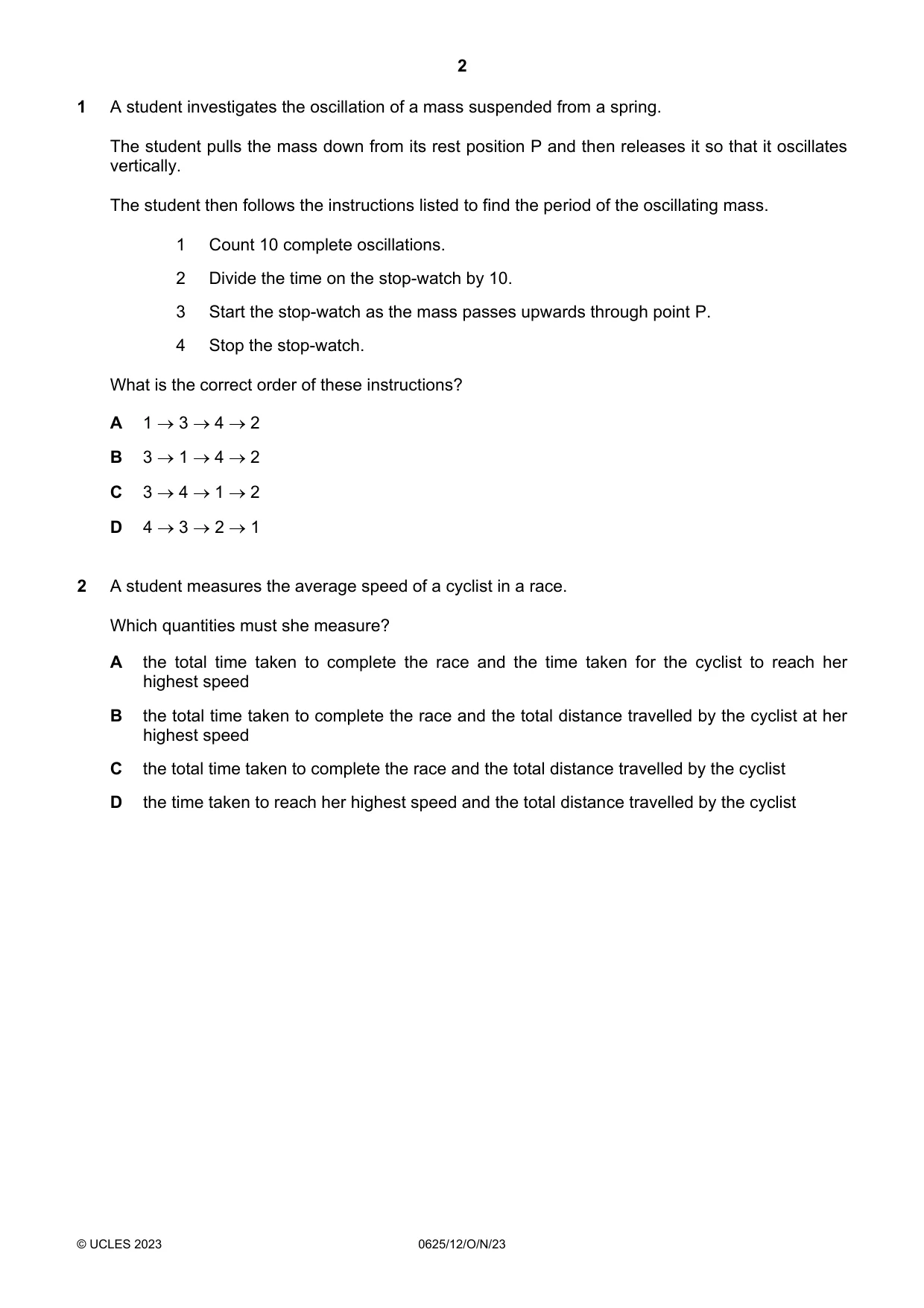
1 A student investigates the oscillation of a mass suspended from a spring. The student pulls the mass down from its rest position P and then releases it so that it oscillates vertically. The student then follows the instructions listed to find the period of the oscillating mass. 1 Count 10 complete oscillations. 2 Divide the time on the stop-watch by 10. 3 Start the stop-watch as the mass passes upwards through point P. 4 Stop the stop-watch. What is the correct order of these instructions? A 1 3 4 2 B 3 1 4 2 C 3 4 1 2 D 4 3 2 1
Mark scheme: B
More questions on Physical quantities and measurement techniques
Q2 · A student measures the average speed of a cyclist in a race
2 A student measures the average speed of a cyclist in a race. Which quantities must she measure? A the total time taken to complete the race and the time taken for the cyclist to reach her highest speed B the total time taken to complete the race and the total distance travelled by the cyclist at her highest speed C the total time taken to complete the race and the total distance travelled by the cyclist D the time taken to reach her highest speed and the total distance travelled by the cyclist
Mark scheme: C
Q3 · The graph shows the motion of a sprinter
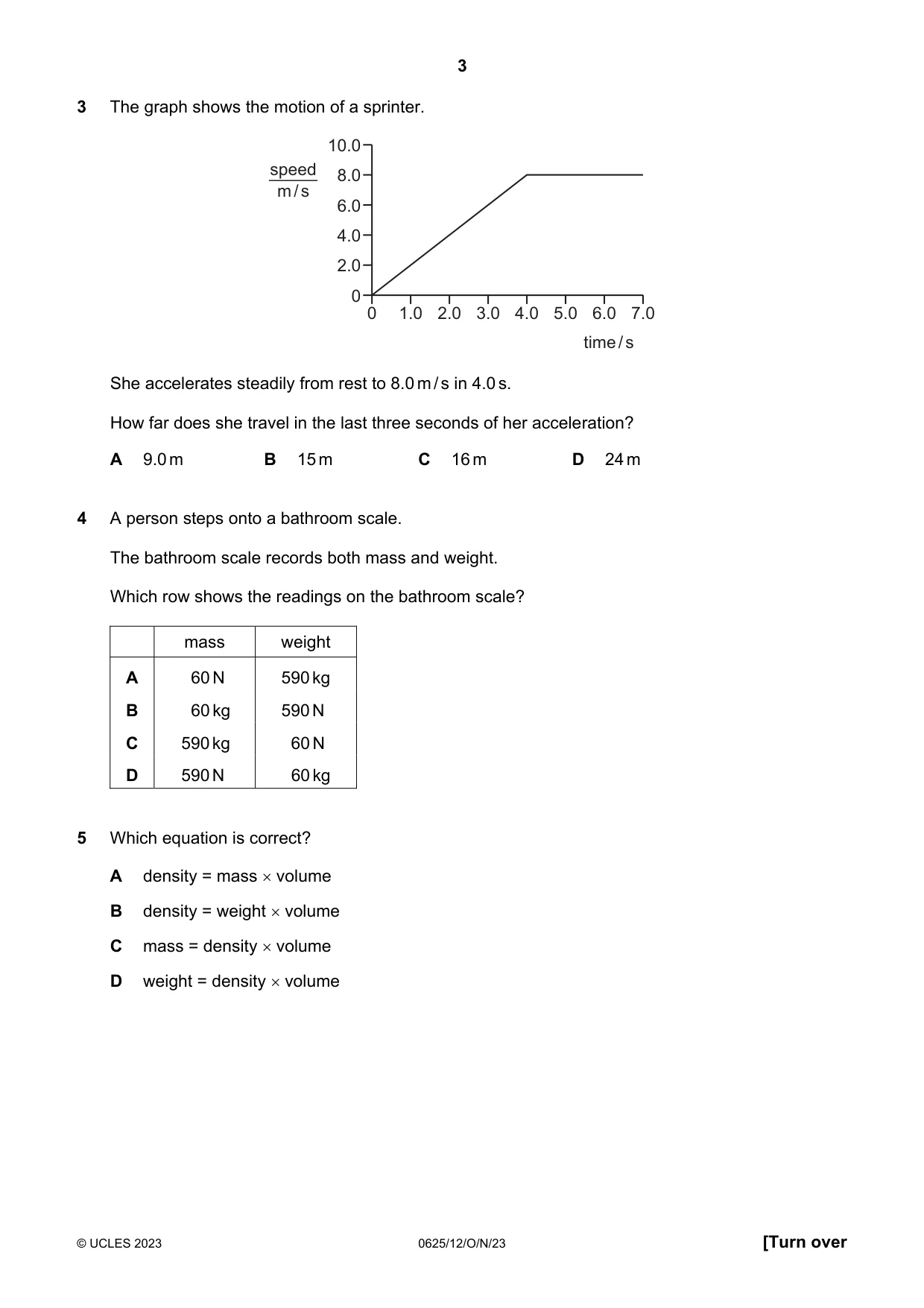
3 The graph shows the motion of a sprinter. 10.0 speed 8.0 m / s 6.0 4.0 2.0 0 0 1.0 2.0 3.0 4.0 5.0 6.0 7.0 time / s She accelerates steadily from rest to 8.0 m / s in 4.0 s. How far does she travel in the last three seconds of her acceleration? A 9.0 m B 15 m C 16 m D 24 m
Mark scheme: B
Q4 · A person steps onto a bathroom scale
4 A person steps onto a bathroom scale. The bathroom scale records both mass and weight. Which row shows the readings on the bathroom scale? mass weight A 60 N 590 kg B 60 kg 590 N C 590 kg 60 N D 590 N 60 kg
Mark scheme: B
Q5 · Which equation is correct?
5 Which equation is correct? A density = mass volume B density = weight volume C mass = density volume D weight = density volume
Mark scheme: C
Q6 · The diagrams show four identical objects
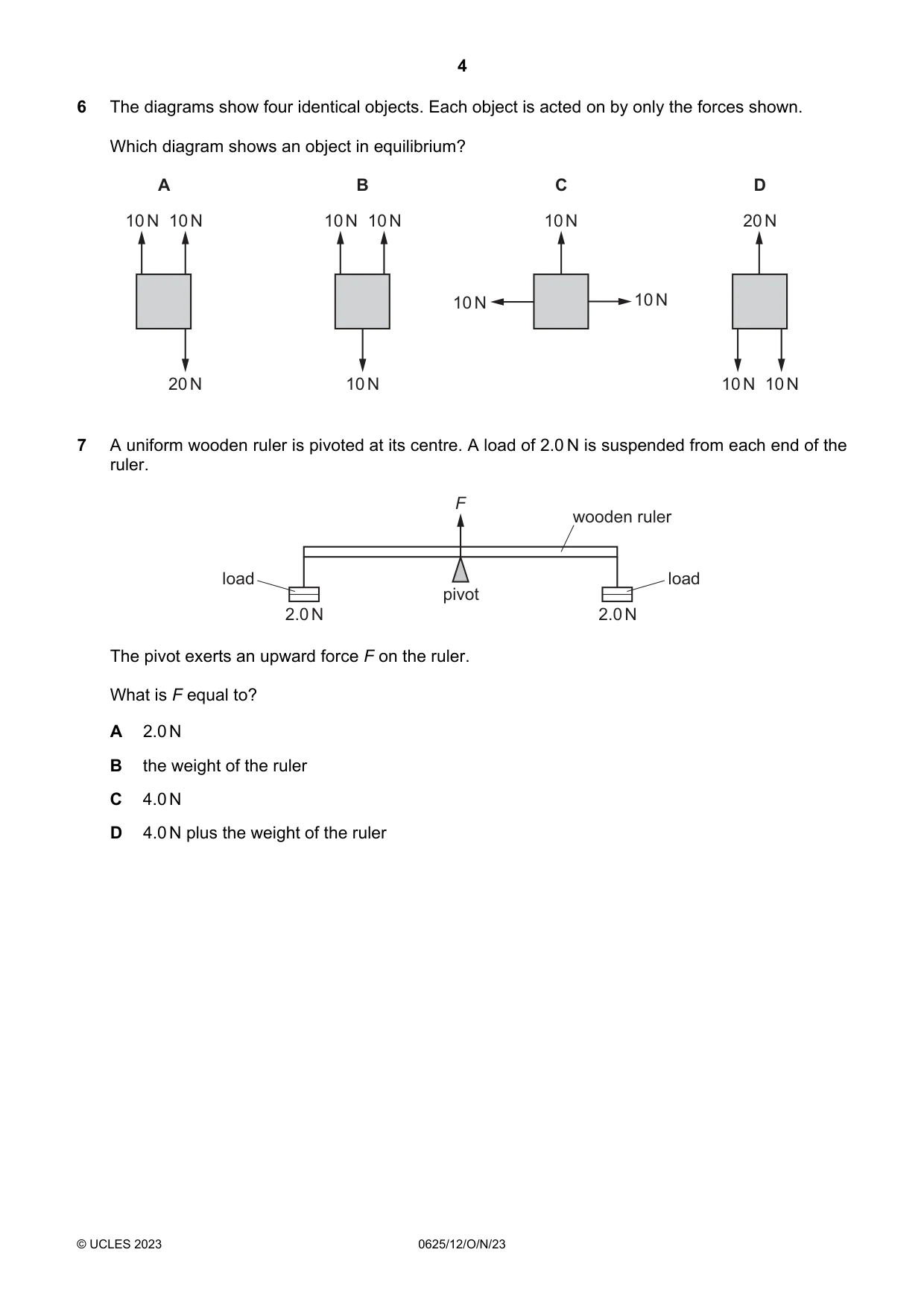
6 The diagrams show four identical objects. Each object is acted on by only the forces shown. Which diagram shows an object in equilibrium? A B C D 10 N 10 N 10 N 10 N 10 N 20 N 10 N 10 N 20 N 10 N 10 N 10 N
Mark scheme: D
Q7 · A uniform wooden ruler is pivoted at its centre
7 A uniform wooden ruler is pivoted at its centre. A load of 2.0 N is suspended from each end of the ruler. F wooden ruler load load pivot 2.0 N 2.0 N The pivot exerts an upward force F on the ruler. What is F equal to? A 2.0 N B the weight of the ruler C 4.0 N D 4.0 N plus the weight of the ruler
Mark scheme: D
Q8 · The diagram shows part of a rollercoaster ride with the car at different positions
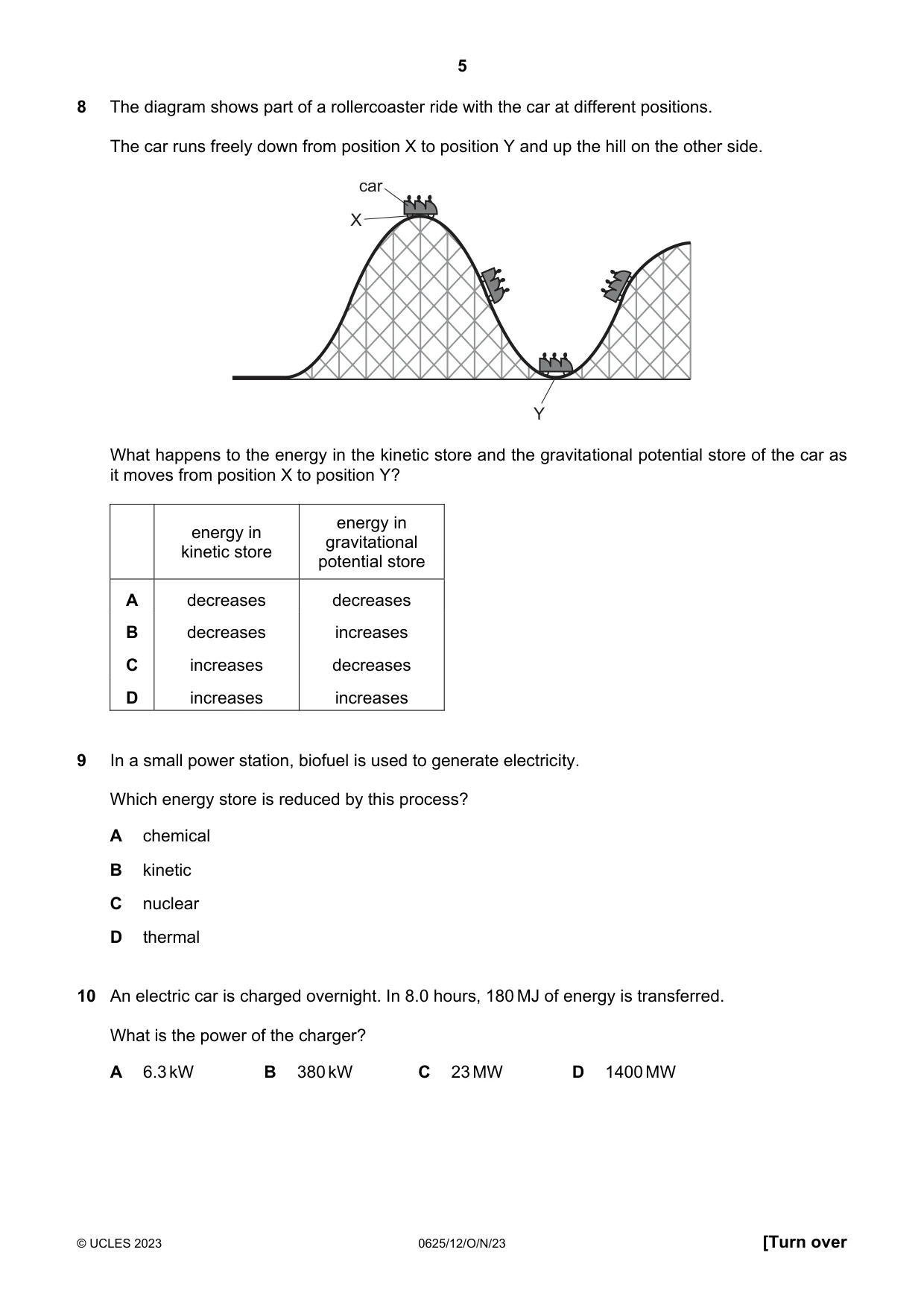
8 The diagram shows part of a rollercoaster ride with the car at different positions. The car runs freely down from position X to position Y and up the hill on the other side. car X Y What happens to the energy in the kinetic store and the gravitational potential store of the car as it moves from position X to position Y? energy in energy in gravitational kinetic store potential store A decreases decreases B decreases increases C increases decreases D increases increases
Mark scheme: C
Q9 · In a small power station, biofuel is used to generate electricity
9 In a small power station, biofuel is used to generate electricity. Which energy store is reduced by this process? A chemical B kinetic C nuclear D thermal
Mark scheme: A
Q10 · An electric car is charged overnight
10 An electric car is charged overnight. In 8.0 hours, 180 MJ of energy is transferred. What is the power of the charger? A 6.3 kW B 380 kW C 23 MW D 1400 MW
Mark scheme: A
Q11 · Tractors have large tyres
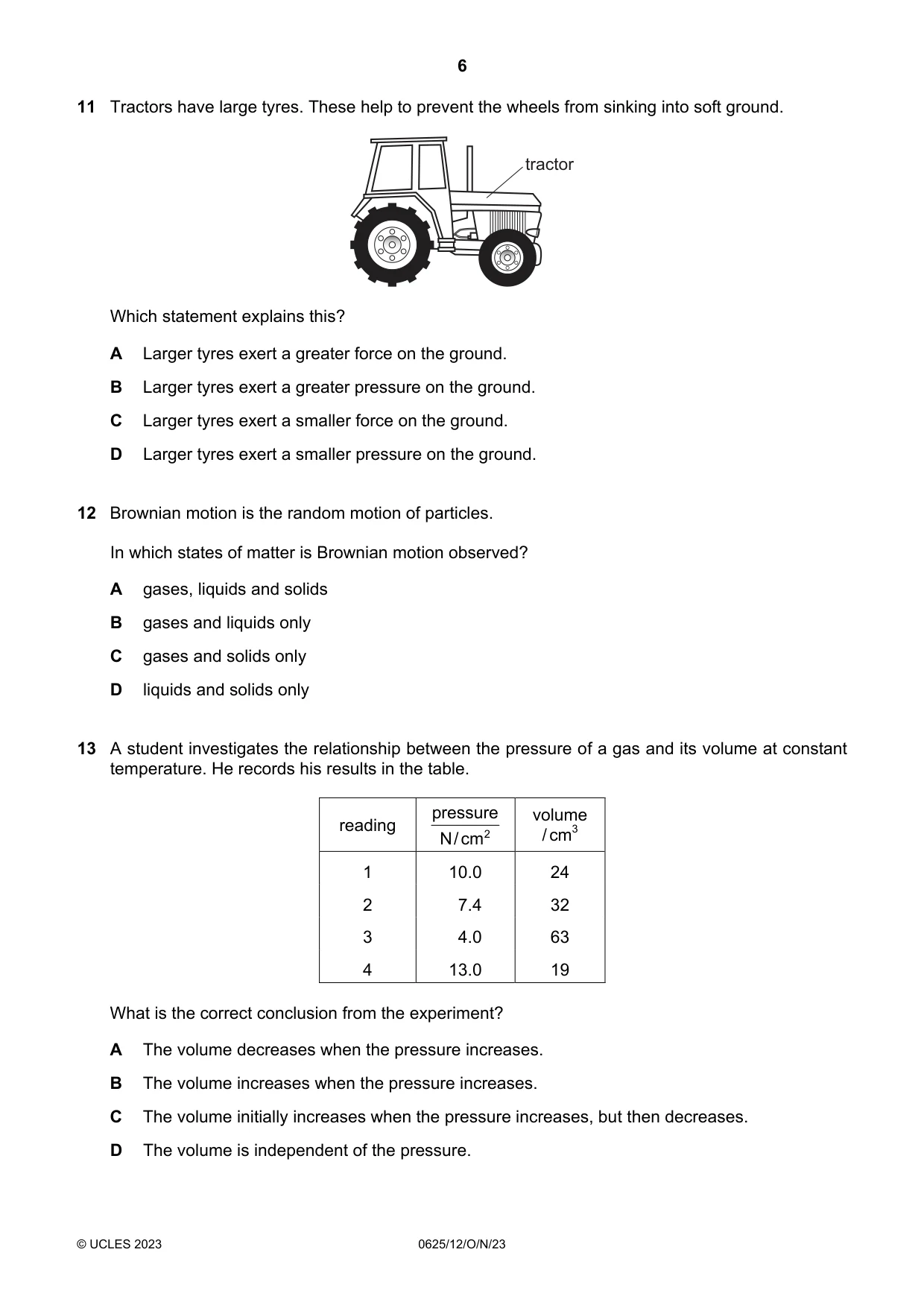
11 Tractors have large tyres. These help to prevent the wheels from sinking into soft ground. tractor Which statement explains this? A Larger tyres exert a greater force on the ground. B Larger tyres exert a greater pressure on the ground. C Larger tyres exert a smaller force on the ground. D Larger tyres exert a smaller pressure on the ground.
Mark scheme: D
Q12 · Brownian motion is the random motion of particles
12 Brownian motion is the random motion of particles. In which states of matter is Brownian motion observed? A gases, liquids and solids B gases and liquids only C gases and solids only D liquids and solids only
Mark scheme: B
Q13 · A student investigates the relationship between the pressure of a gas and its volume at…
13 A student investigates the relationship between the pressure of a gas and its volume at constant temperature. He records his results in the table. pressure volume reading / cm3 N cm / 2 1 10.0 24 2 7.4 32 3 4.0 63 4 13.0 19 What is the correct conclusion from the experiment? A The volume decreases when the pressure increases. B The volume increases when the pressure increases. C The volume initially increases when the pressure increases, but then decreases. D The volume is independent of the pressure.
Mark scheme: A
Q14 · A wooden wheel can be strengthened by putting a tight circle of iron around it
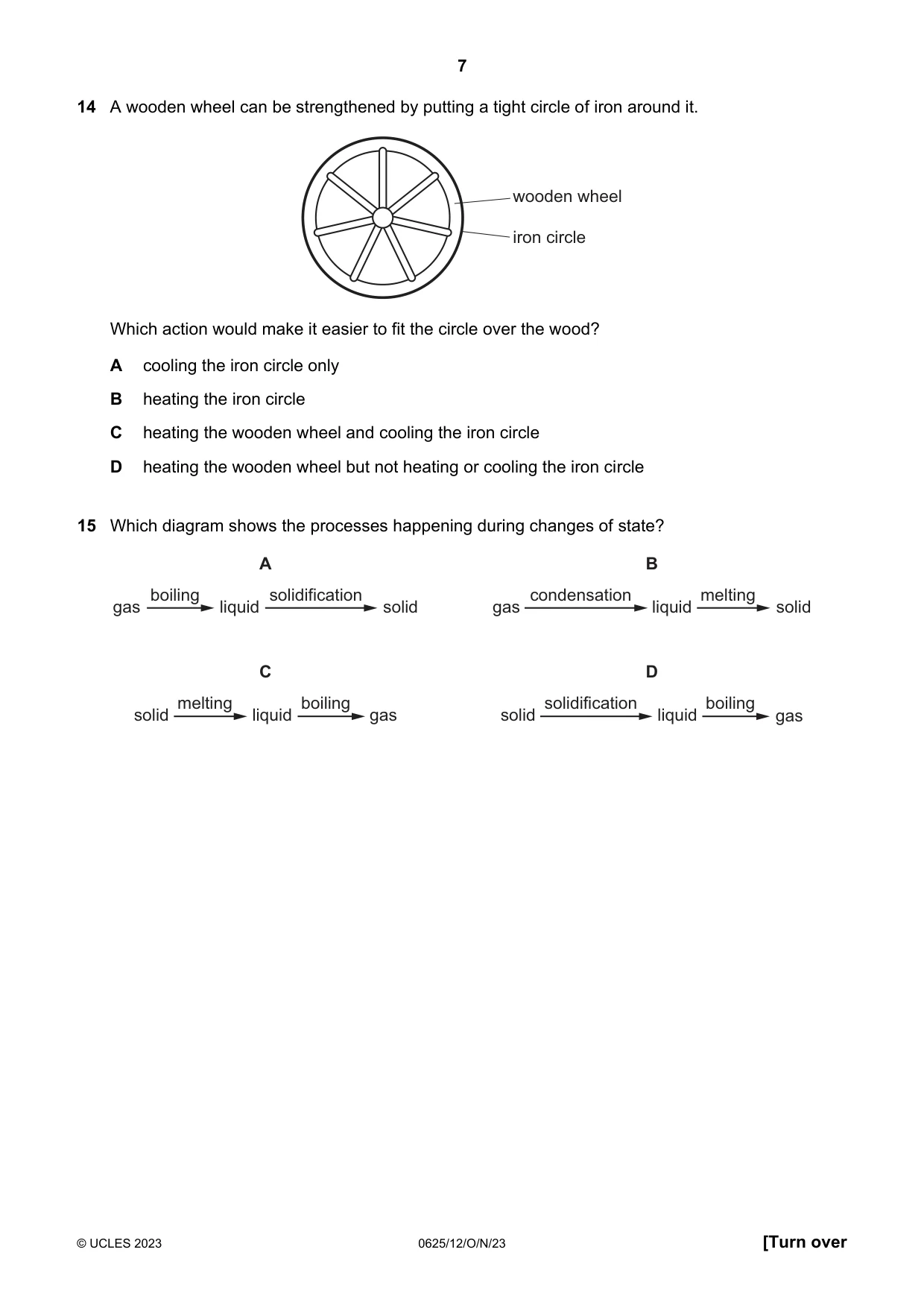
14 A wooden wheel can be strengthened by putting a tight circle of iron around it. wooden wheel iron circle Which action would make it easier to fit the circle over the wood? A cooling the iron circle only B heating the iron circle C heating the wooden wheel and cooling the iron circle D heating the wooden wheel but not heating or cooling the iron circle
Mark scheme: B
Q15 · Which diagram shows the processes happening during changes of state?
15 Which diagram shows the processes happening during changes of state? A B boiling solidification condensation melting gas liquid solid gas liquid solid C D melting boiling solidification boiling solid liquid gas solid liquid gas
Mark scheme: C
Q16 · A room is heated by a radiator
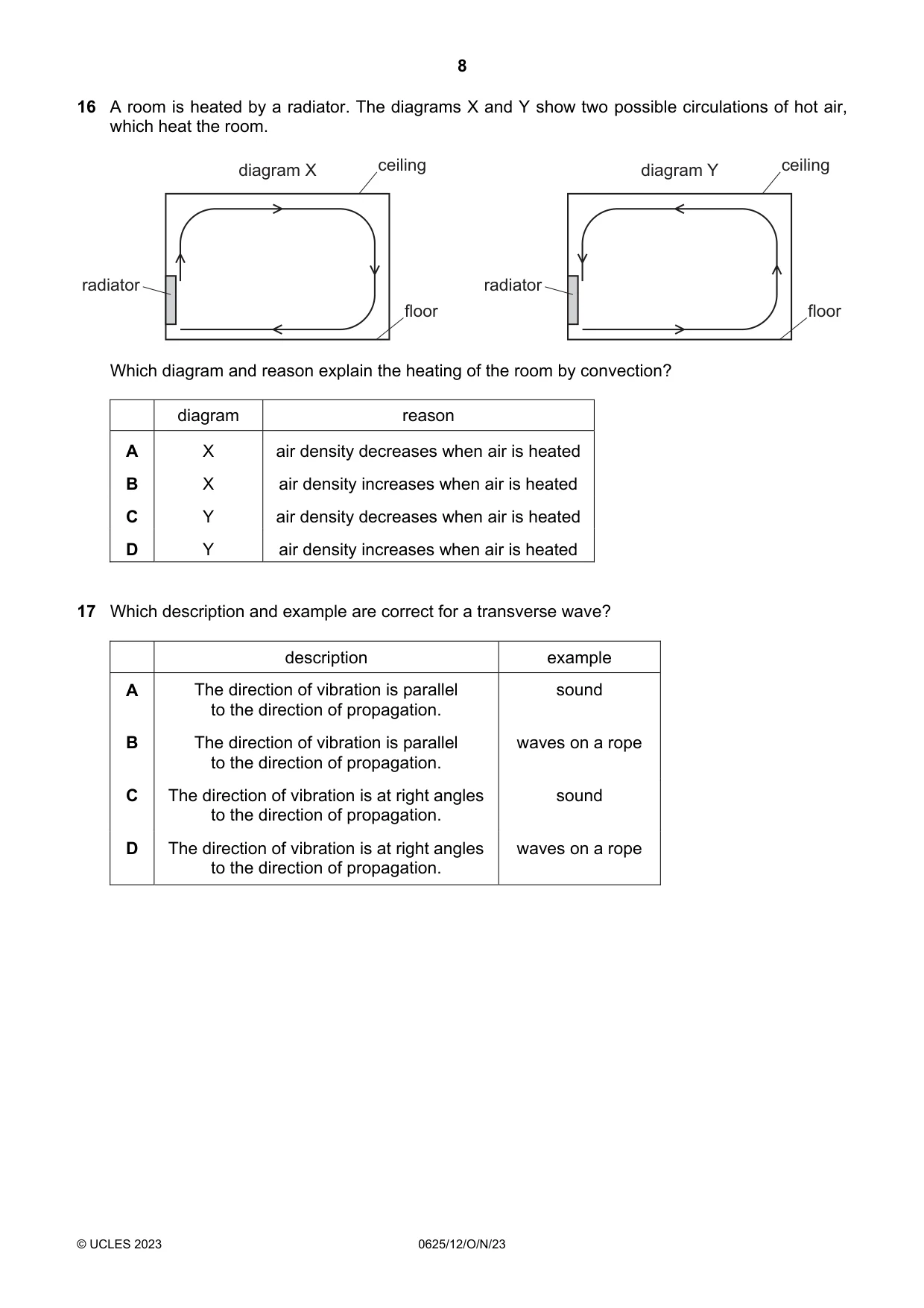
16 A room is heated by a radiator. The diagrams X and Y show two possible circulations of hot air, which heat the room. diagram X ceiling diagram Y ceiling radiator radiator floor floor Which diagram and reason explain the heating of the room by convection? diagram reason A X air density decreases when air is heated B X air density increases when air is heated C Y air density decreases when air is heated D Y air density increases when air is heated
Mark scheme: A
Q17 · Which description and example are correct for a transverse wave?
17 Which description and example are correct for a transverse wave? description example A The direction of vibration is parallel sound to the direction of propagation. B The direction of vibration is parallel waves on a rope to the direction of propagation. C The direction of vibration is at right angles sound to the direction of propagation. D The direction of vibration is at right angles waves on a rope to the direction of propagation.
Mark scheme: D
Q18 · Straight wavefronts on the surface of a ripple tank approach a gap in a barrier
18 Straight wavefronts on the surface of a ripple tank approach a gap in a barrier. The diagram shows how the wavefronts change shape as they pass through the gap. barrier straight wavefronts What is the name of this effect? A diffraction B propagation C reflection D refraction
Mark scheme: A
Q19 · Red, green and violet lights are part of the visible spectrum of light
19 Red, green and violet lights are part of the visible spectrum of light. What is the order of colours from shortest to longest wavelength? A red green violet B red violet green C violet red green D violet green red
Mark scheme: D
Q20 · Which diagram shows the image correctly formed by reflection?
20 Which diagram shows the image correctly formed by reflection? A B object image object image mirror mirror C D object image object image mirror mirror
Mark scheme: D
Q21 · A student passes parallel rays of light through four different converging lenses
21 A student passes parallel rays of light through four different converging lenses. He measures the distance x and the distance y for each experiment. x y Which lens has the longest focal length? x / cm y / cm A 4.6 2.0 B 5.1 3.1 C 5.9 2.3 D 6.1 2.4
Mark scheme: B
Q22 · The table shows different types of wave in the electromagnetic spectrum
22 The table shows different types of wave in the electromagnetic spectrum. radio infrared visible ultraviolet gamma microwaves X-rays waves waves light waves rays Where do all the waves travel at the same speed? A in a vacuum B in diamond C in glass D in water
Mark scheme: A
Q23 · Which statement about a sound that can be heard by a person with normal hearing is…
23 Which statement about a sound that can be heard by a person with normal hearing is correct? A The sound is a longitudinal wave with a frequency between 2.0 Hz and 20 Hz. B The sound is a longitudinal wave with a frequency between 20 Hz and 20 000 Hz. C The sound is a transverse wave with a frequency between 2.0 Hz and 2000 Hz. D The sound is a transverse wave with a frequency between 2.0 Hz and 20 MHz.
Mark scheme: B
Q24 · A hard magnetic material can be used to make a permanent magnet
24 A hard magnetic material can be used to make a permanent magnet. A soft magnetic material can be used to make a temporary magnet. Which row shows whether iron and steel are hard or soft magnetic materials? iron steel A hard hard B hard soft C soft hard D soft soft
Mark scheme: C
Q25 · A battery is connected to an ammeter and a resistor
25 A battery is connected to an ammeter and a resistor. A The ammeter reading is 0.20 A. An electrical insulator is connected in parallel with the resistor. What is the ammeter reading? A 0 A B between 0 A and 0.20 A C 0.20 A D greater than 0.20 A
Mark scheme: C
Q26 · Which unit is used to measure electromotive force (e.m.f.)?
26 Which unit is used to measure electromotive force (e.m.f.)? A ampere B joule C volt D watt
Mark scheme: C
Q27 · Which equation is correct for resistance R, potential difference (p.d.) V and current I ?
27 Which equation is correct for resistance R, potential difference (p.d.) V and current I ? V I A R = I B R = V + I C R = V D R = V I
Mark scheme: A
Q28 · In the diagram, rod R is suspended from an insulating thread
28 In the diagram, rod R is suspended from an insulating thread. insulating thread Q R + + + + + moves away from rod Q When the positively charged rod Q is brought close to rod R, rod R moves away from rod Q. Which conclusion can be made from this observation? A Rod R is charged, but it is not possible to identify the sign of the charge. B Rod R must be positively charged. C Rod R must be negatively charged. D Rod R is uncharged.
Mark scheme: B
Q29 · In which heating system circuit would thermistors not be useful?
29 In which heating system circuit would thermistors not be useful? A to keep different rooms at different temperatures B to turn an alarm on if the system overheats C to turn a heating system off at a particular temperature D to turn a heating system on when a sound is detected
Mark scheme: D
Q30 · Which statement is correct?
30 Which statement is correct? A A fuse is included in a circuit to prevent the current becoming too high. B A fuse should be connected to the neutral wire in a plug. C An electric circuit will only work if it includes a fuse. D An earth wire is needed to prevent the fuse blowing.
Mark scheme: A
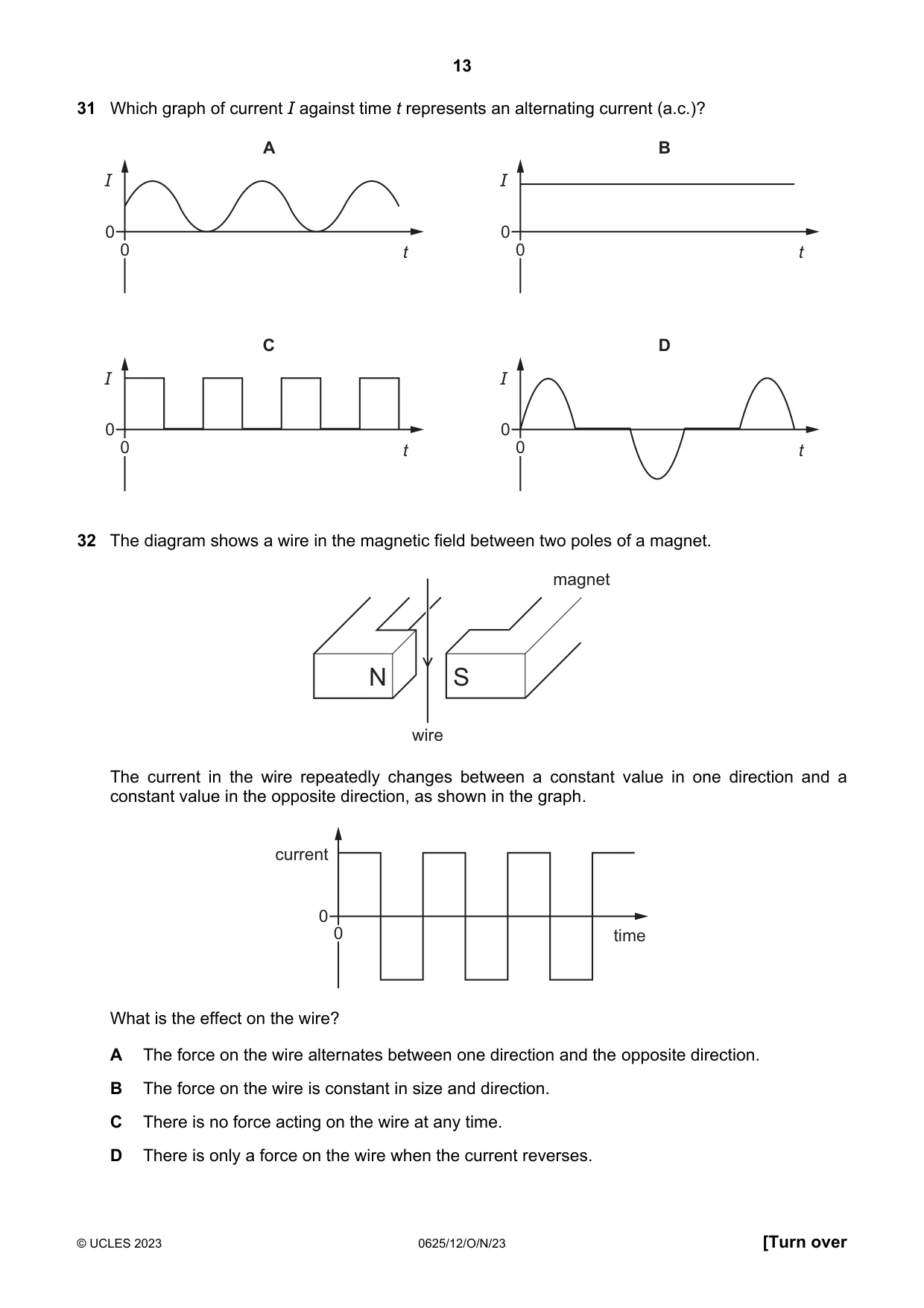
Q31 · Which graph of current I against time t represents an alternating current (a.c.)?
31 Which graph of current I against time t represents an alternating current (a.c.)? A B I I 0 0 0 t 0 t C D I I 0 0 0 t 0 t
Mark scheme: D
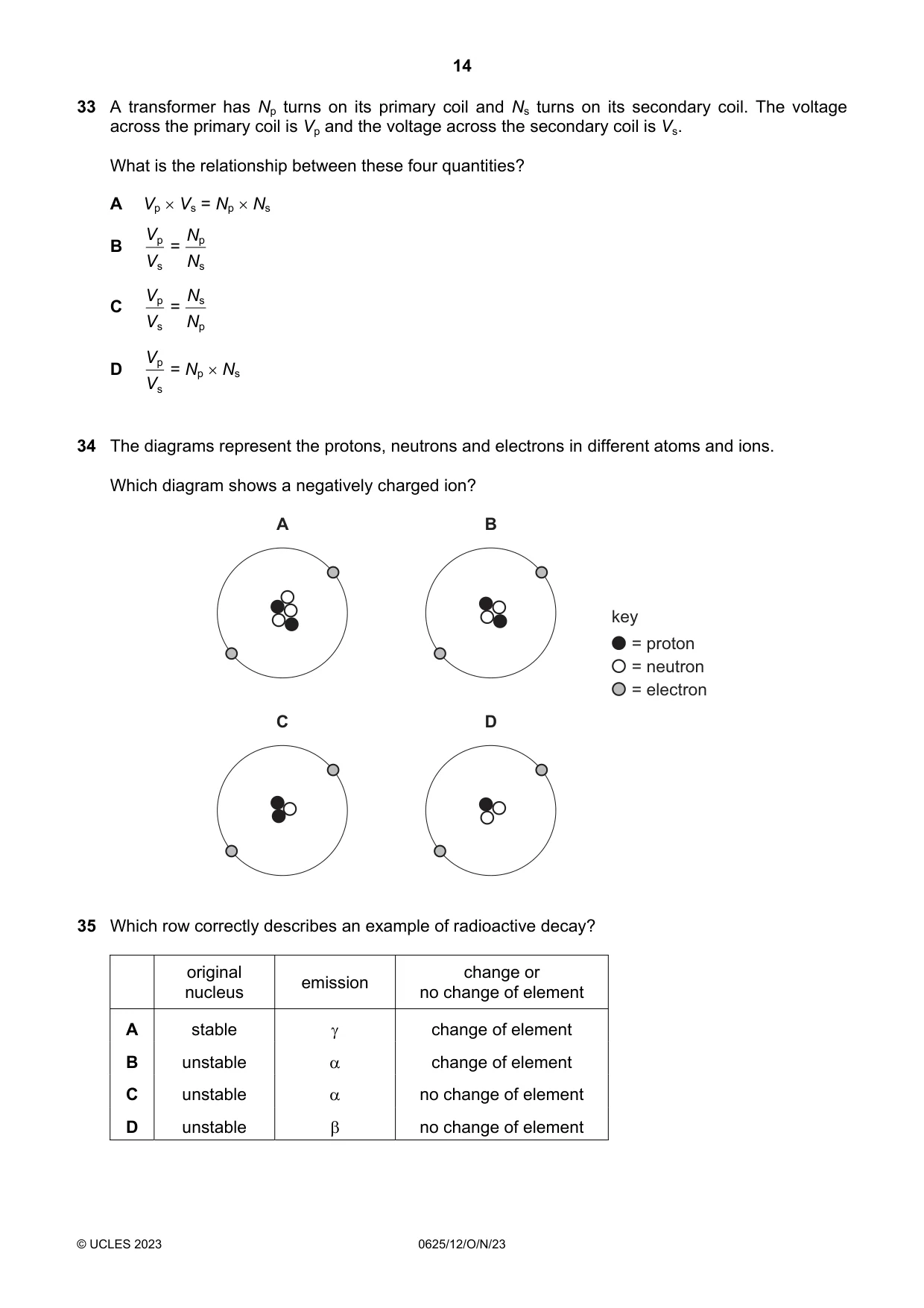
Q32 · The diagram shows a wire in the magnetic field between two poles of a magnet
32 The diagram shows a wire in the magnetic field between two poles of a magnet. magnet N S wire The current in the wire repeatedly changes between a constant value in one direction and a constant value in the opposite direction, as shown in the graph. current 0 0 time What is the effect on the wire? A The force on the wire alternates between one direction and the opposite direction. B The force on the wire is constant in size and direction. C There is no force acting on the wire at any time. D There is only a force on the wire when the current reverses.
Mark scheme: A
Q33 · A transformer has Np turns on its primary coil and Ns turns on its secondary coil
33 A transformer has Np turns on its primary coil and Ns turns on its secondary coil. The voltage across the primary coil is Vp and the voltage across the secondary coil is Vs. What is the relationship between these four quantities? A Vp Vs = Np Ns V N B p = p V N s s V N C p = s V N s p V D p = Np Ns V s
Mark scheme: B
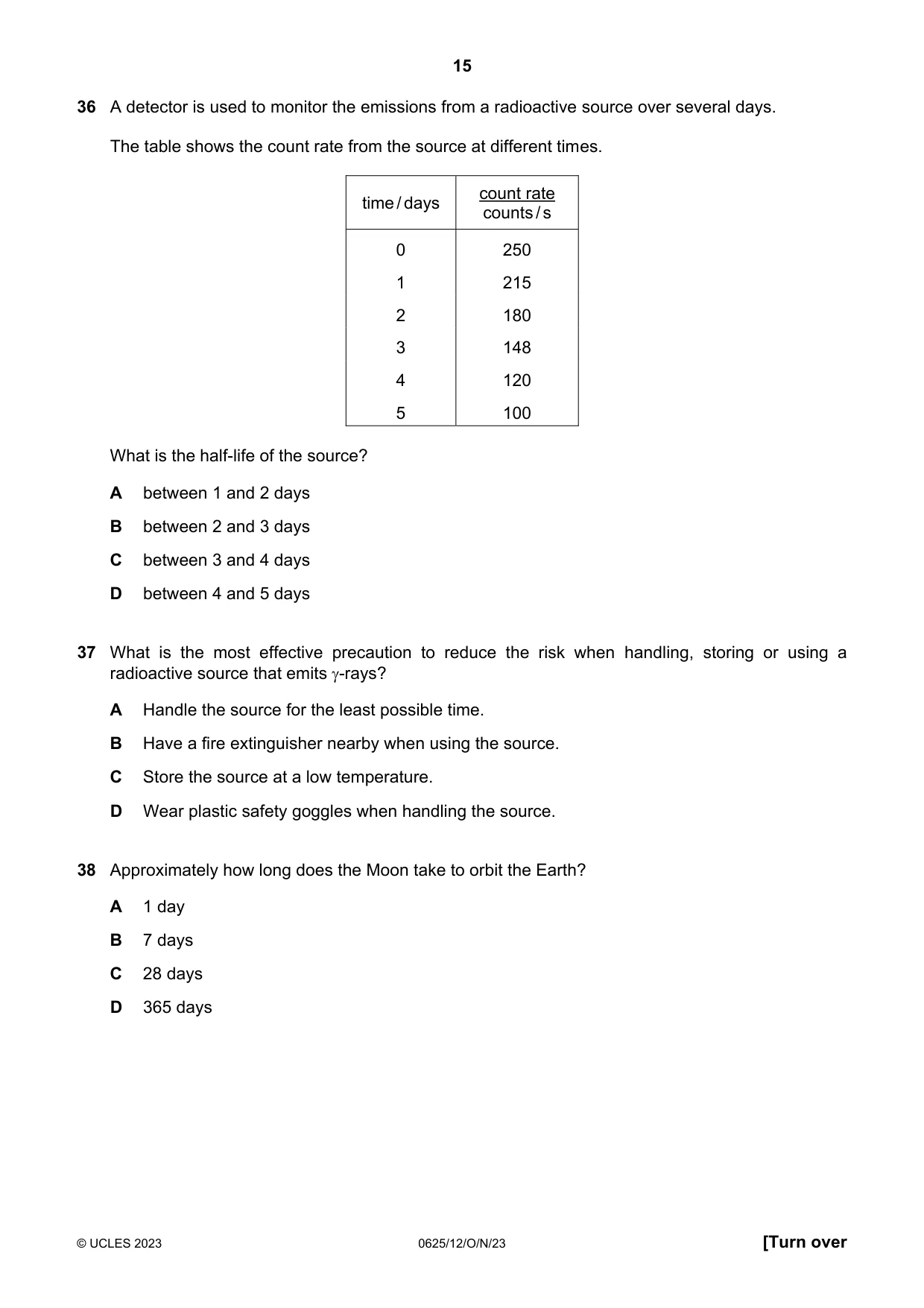
Q34 · The diagrams represent the protons, neutrons and electrons in different atoms and ions
34 The diagrams represent the protons, neutrons and electrons in different atoms and ions. Which diagram shows a negatively charged ion? A B key = proton = neutron = electron C D
Mark scheme: D
Q35 · Which row correctly describes an example of radioactive decay?
35 Which row correctly describes an example of radioactive decay? original change or emission nucleus no change of element A stable change of element B unstable change of element C unstable no change of element D unstable no change of element
Mark scheme: B
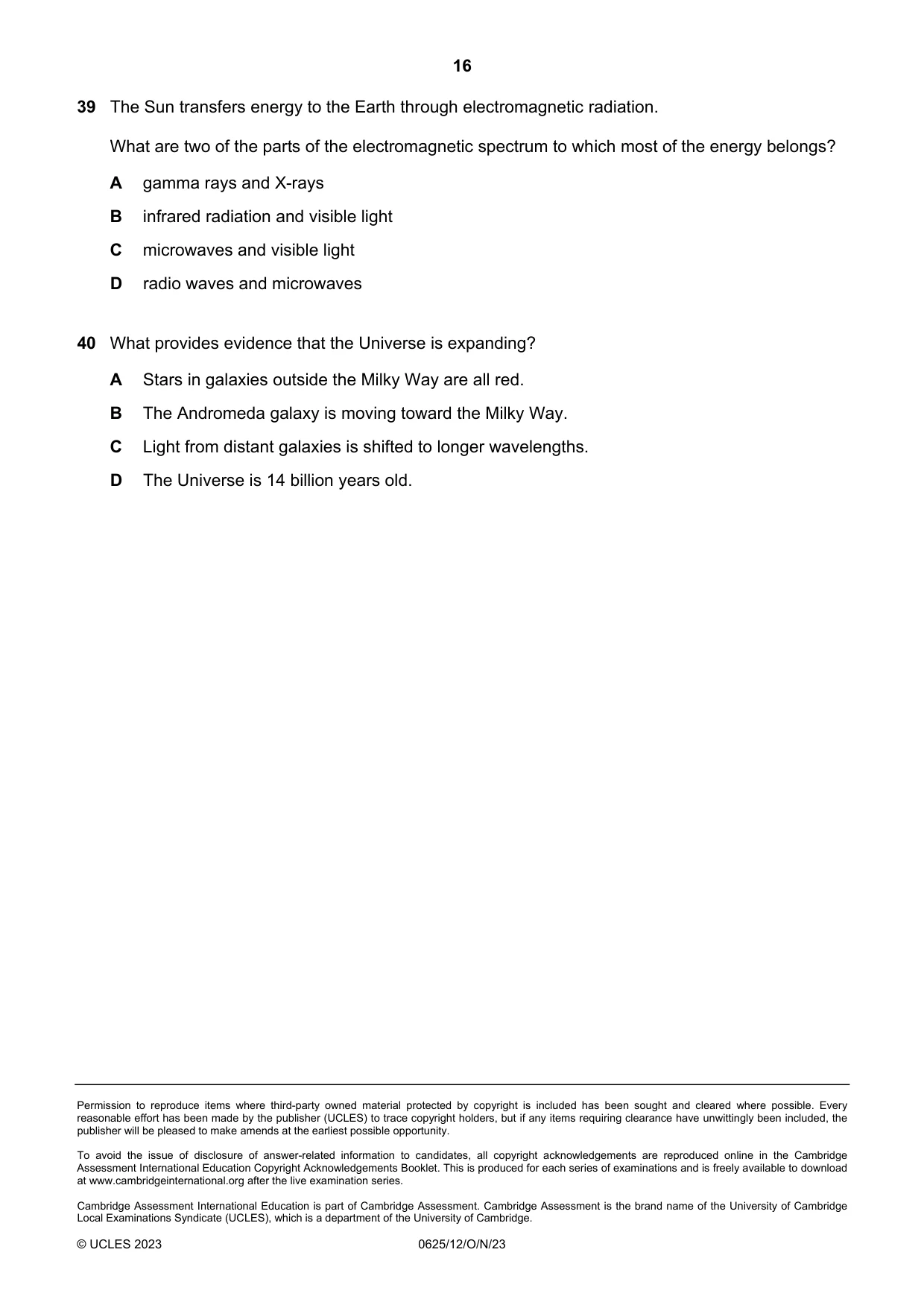
Q36 · A detector is used to monitor the emissions from a radioactive source over several days
36 A detector is used to monitor the emissions from a radioactive source over several days. The table shows the count rate from the source at different times. count rate time / days counts / s 0 250 1 215 2 180 3 148 4 120 5 100 What is the half-life of the source? A between 1 and 2 days B between 2 and 3 days C between 3 and 4 days D between 4 and 5 days
Mark scheme: C
Q37 · What is the most effective precaution to reduce the risk when handling, storing or using…
37 What is the most effective precaution to reduce the risk when handling, storing or using a radioactive source that emits -rays? A Handle the source for the least possible time. B Have a fire extinguisher nearby when using the source. C Store the source at a low temperature. D Wear plastic safety goggles when handling the source.
Mark scheme: A
Q38 · Approximately how long does the Moon take to orbit the Earth?
38 Approximately how long does the Moon take to orbit the Earth? A 1 day B 7 days C 28 days D 365 days
Mark scheme: C
Q39 · The Sun transfers energy to the Earth through electromagnetic radiation
39 The Sun transfers energy to the Earth through electromagnetic radiation. What are two of the parts of the electromagnetic spectrum to which most of the energy belongs? A gamma rays and X-rays B infrared radiation and visible light C microwaves and visible light D radio waves and microwaves
Mark scheme: B
Q40 · What provides evidence that the Universe is expanding?
40 What provides evidence that the Universe is expanding? A Stars in galaxies outside the Milky Way are all red. B The Andromeda galaxy is moving toward the Milky Way. C Light from distant galaxies is shifted to longer wavelengths. D The Universe is 14 billion years old.
Mark scheme: C
What was in this paper
The subtopics covered by these 40 questions, and how many questions each got. Open one in a new tab to see every Cambridge question on it.
3Electromagnetic spectrum3Energy, work and power3Radioactivity3Electrical quantities2Electromagnetic effects2Forces2General properties of waves2Light2Motion2Pressure2Simple phenomena of magnetism2Thermal properties and temperature2Density1Electrical safety1Kinetic particle model of matter1Mass and weight1Physical quantities and measurement techniques1Sound1Stars and the Universe1The Earth and the Solar System1The nuclear model of the atom1Transfer of thermal energy1What you needed in this session
Cambridge’s own grade thresholds for 2023 Oct/Nov, Paper 1 · Variant 2. A higher threshold means an easier paper — the bar moves with how the cohort did.