Cambridge IGCSE Physics 0625 — 2008 May/June Paper 1 · Variant 1
0625/11/M/J/08 · 40 questions · 40 marks · ≈45 min
The question paper and its mark scheme, free to read here and free to download. This is Cambridge’s own paper, exactly as it was sat.
Question paper20 pages

Mark scheme2 pages
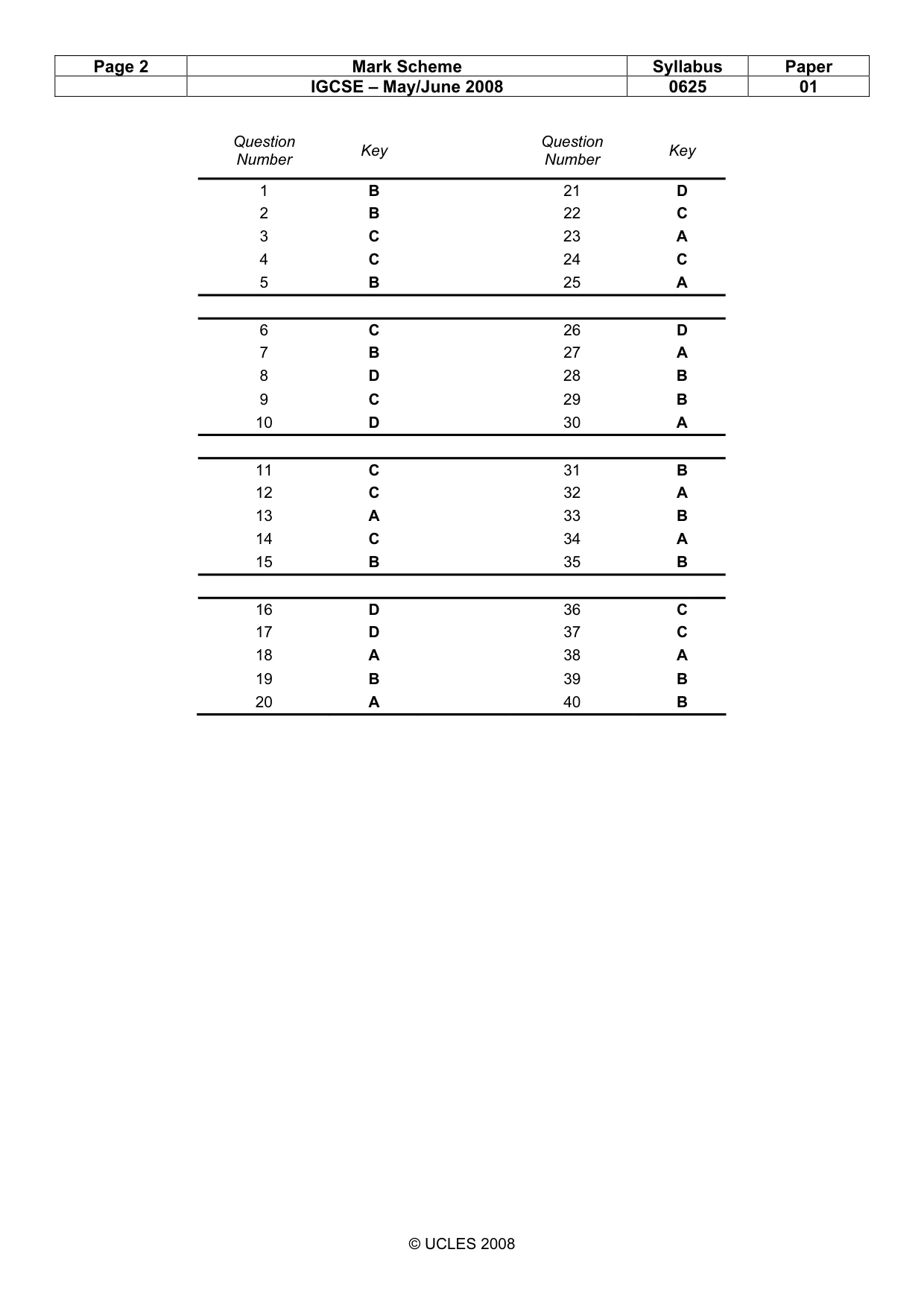
Answers below. Sit the paper first if you are practising.
Questions as text
Q1 · Some liquid is heated in a flask
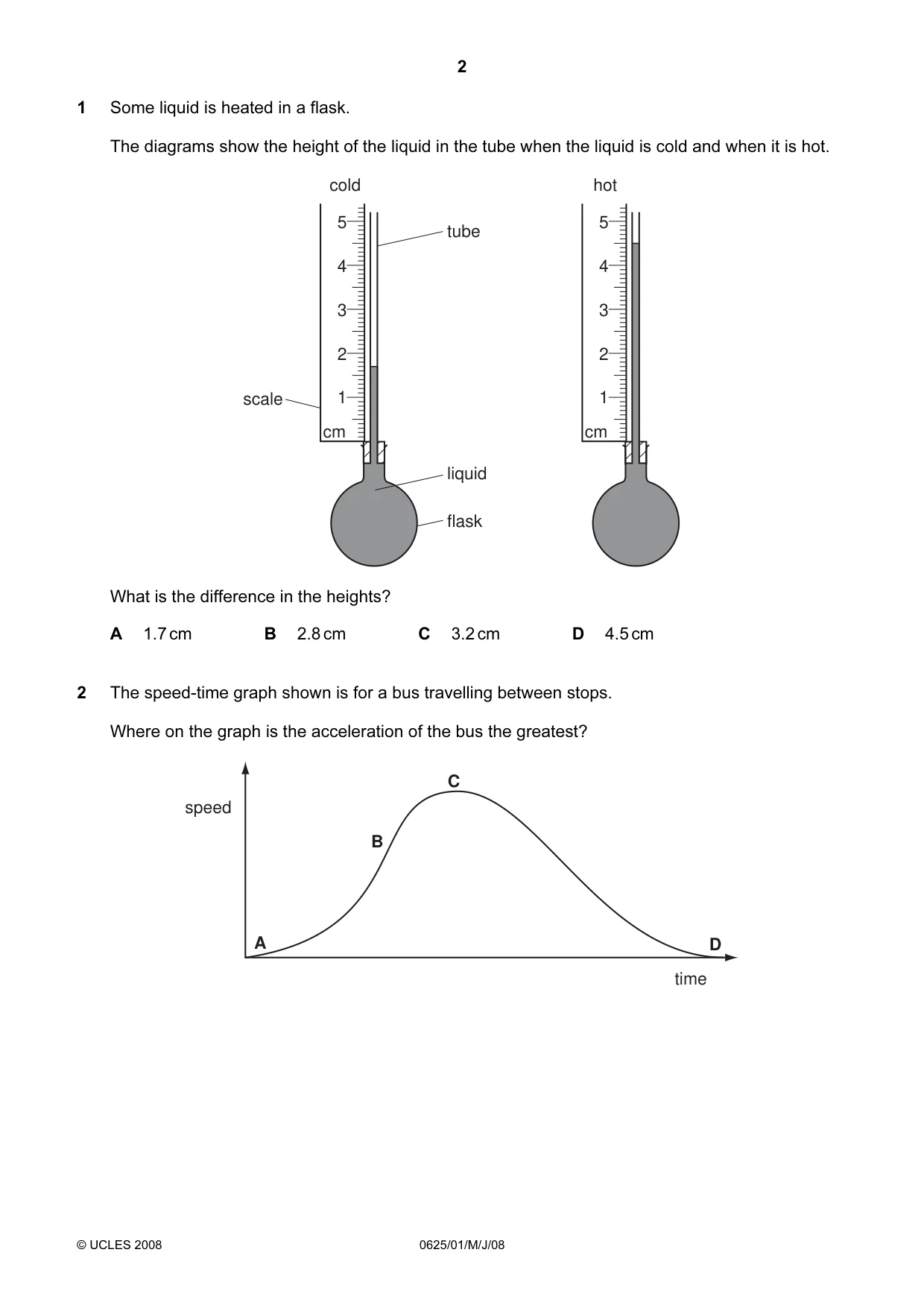
1 Some liquid is heated in a flask. The diagrams show the height of the liquid in the tube when the liquid is cold and when it is hot. cold hot 5 5 tube 4 4 3 3 2 2 scale 1 1 cm cm liquid flask What is the difference in the heights? A 1.7 cm B 2.8 cm C 3.2 cm D 4.5 cm
Mark scheme: B
More questions on Physical quantities and measurement techniques
Q2 · The speed-time graph shown is for a bus travelling between stops
2 The speed-time graph shown is for a bus travelling between stops. Where on the graph is the acceleration of the bus the greatest? C speed B A D time
Mark scheme: B
Q3 · The circuit of a motor racing track is 3 km in length
3 The circuit of a motor racing track is 3 km in length. In a race, a car goes 25 times round the circuit in 30 minutes. What is the average speed of the car? A 75 km / hour B 90 km / hour C 150 km / hour D 750 km / hour
Mark scheme: C
Q4 · The force of gravity acting on an astronaut in an orbiting spacecraft is less than when…
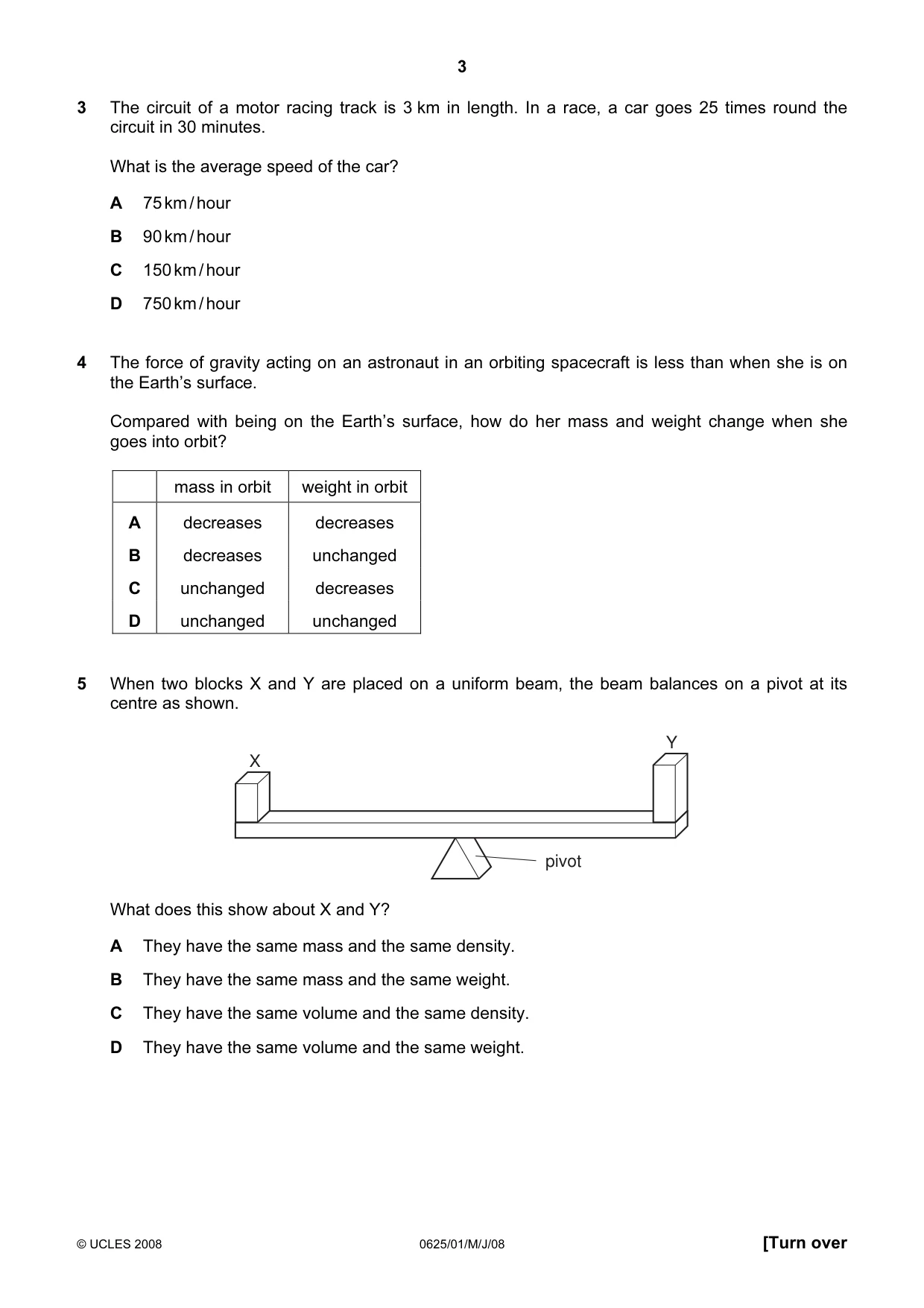
4 The force of gravity acting on an astronaut in an orbiting spacecraft is less than when she is on the Earth’s surface. Compared with being on the Earth’s surface, how do her mass and weight change when she goes into orbit? mass in orbit weight in orbit A decreases decreases B decreases unchanged C unchanged decreases D unchanged unchanged
Mark scheme: C
Q5 · When two blocks X and Y are placed on a uniform beam, the beam balances on a pivot at its…
5 When two blocks X and Y are placed on a uniform beam, the beam balances on a pivot at its centre as shown. Y X pivot What does this show about X and Y? A They have the same mass and the same density. B They have the same mass and the same weight. C They have the same volume and the same density. D They have the same volume and the same weight.
Mark scheme: B
Q6 · The diagram shows a rectangular metal block measuring 10 cm × 5.0 cm × 2.0 cm
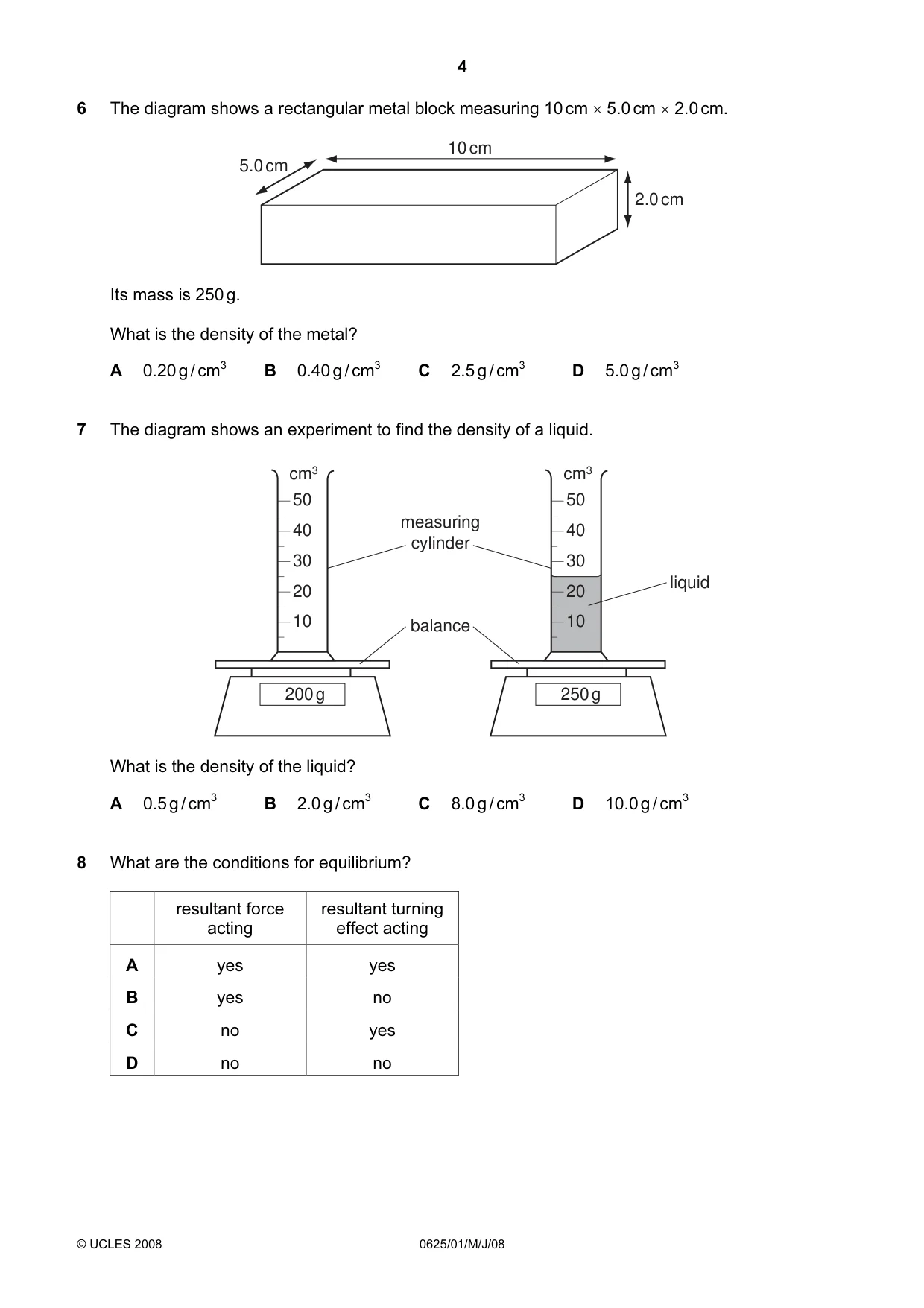
6 The diagram shows a rectangular metal block measuring 10 cm × 5.0 cm × 2.0 cm. 10 cm 5.0 cm 2.0 cm Its mass is 250 g. What is the density of the metal? A 0.20 g / cm3 B 0.40 g / cm3 C 2.5 g / cm3 D 5.0 g / cm3
Mark scheme: C
Q7 · The diagram shows an experiment to find the density of a liquid
7 The diagram shows an experiment to find the density of a liquid. cm3 cm3 50 50 measuring 40 40 cylinder 30 30 liquid 20 20 10 balance 10 200 g 250 g What is the density of the liquid? A 0.5 g / cm3 B 2.0 g / cm3 C 8.0 g / cm3 D 10.0 g / cm3
Mark scheme: B
Q8 · What are the conditions for equilibrium?
8 What are the conditions for equilibrium? resultant force resultant turning acting effect acting A yes yes B yes no C no yes D no no
Mark scheme: D
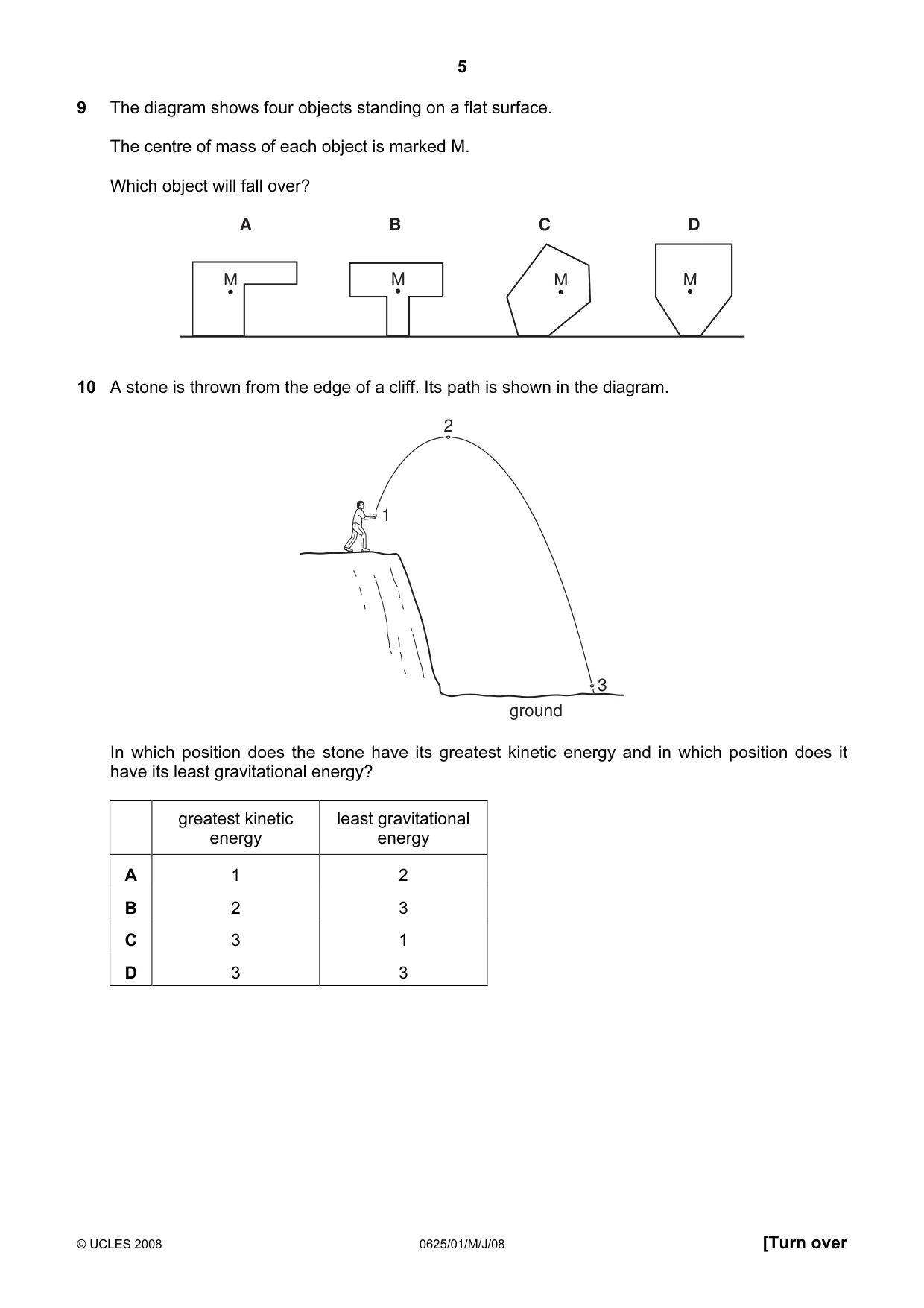
Q9 · The diagram shows four objects standing on a flat surface
9 The diagram shows four objects standing on a flat surface. The centre of mass of each object is marked M. Which object will fall over? A B C D M M M M
Mark scheme: C
Q10 · A stone is thrown from the edge of a cliff
10 A stone is thrown from the edge of a cliff. Its path is shown in the diagram. 2 1 3 ground In which position does the stone have its greatest kinetic energy and in which position does it have its least gravitational energy? greatest kinetic least gravitational energy energy A 1 2 B 2 3 C 3 1 D 3 3
Mark scheme: D
Q11 · A worker is lifting boxes of identical weight from the ground onto a moving belt
11 A worker is lifting boxes of identical weight from the ground onto a moving belt. At first, it takes him 2 s to lift each box. Later in the day, it takes him 3 s. Which statement is correct? A Later in the day, less work is done in lifting each box. B Later in the day, more work is done in lifting each box. C Later in the day, less power is developed in lifting each box. D Later in the day, more power is developed in lifting each box.
Mark scheme: C
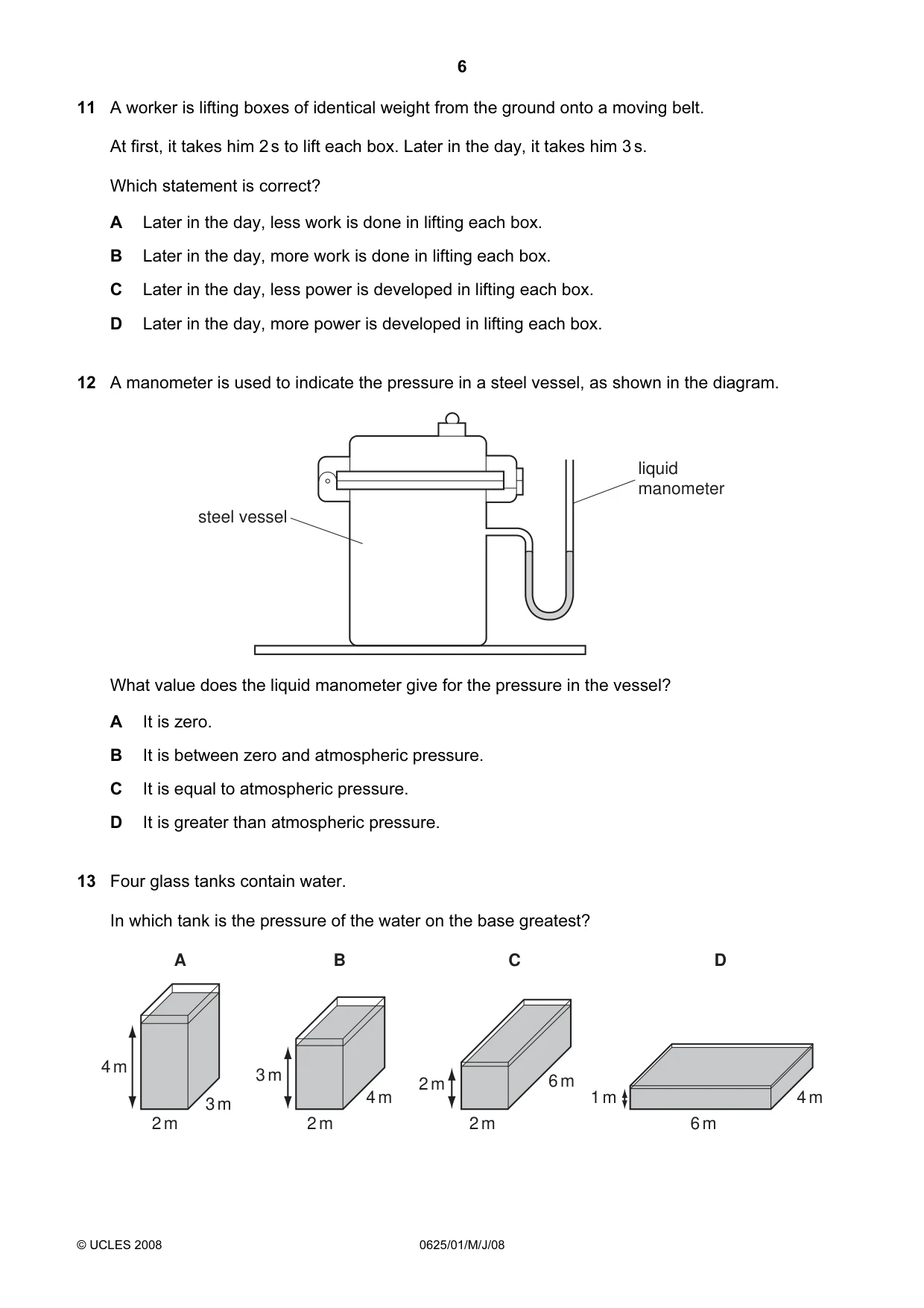
Q12 · A manometer is used to indicate the pressure in a steel vessel, as shown in the diagram
12 A manometer is used to indicate the pressure in a steel vessel, as shown in the diagram. liquid manometer steel vessel What value does the liquid manometer give for the pressure in the vessel? A It is zero. B It is between zero and atmospheric pressure. C It is equal to atmospheric pressure. D It is greater than atmospheric pressure.
Mark scheme: C
Q13 · Four glass tanks contain water
13 Four glass tanks contain water. In which tank is the pressure of the water on the base greatest? A B C D 4 m 3 m 6 m 2 m 3 m 4 m 1 m 4 m 2 m 2 m 2 m 6 m
Mark scheme: A
Q14 · Which line in the table describes the properties of solids and of liquids at a fixed…
14 Which line in the table describes the properties of solids and of liquids at a fixed temperature? solids liquids A definite volume and definite shape no definite volume but definite shape B no definite volume but definite shape definite volume and definite shape C definite volume and definite shape definite volume but no definite shape D no definite volume but definite shape no definite volume and no definite shape
Mark scheme: C
Q15 · Air is pumped slowly into a car tyre to increase the pressure
15 Air is pumped slowly into a car tyre to increase the pressure. The temperature of the air does not change. Which line in the table is correct? number of molecules hitting 1 cm2 of the average speed at which molecules hit the tyre tyre each second A increases increases B increases unchanged C unchanged increases D unchanged unchanged
Mark scheme: B
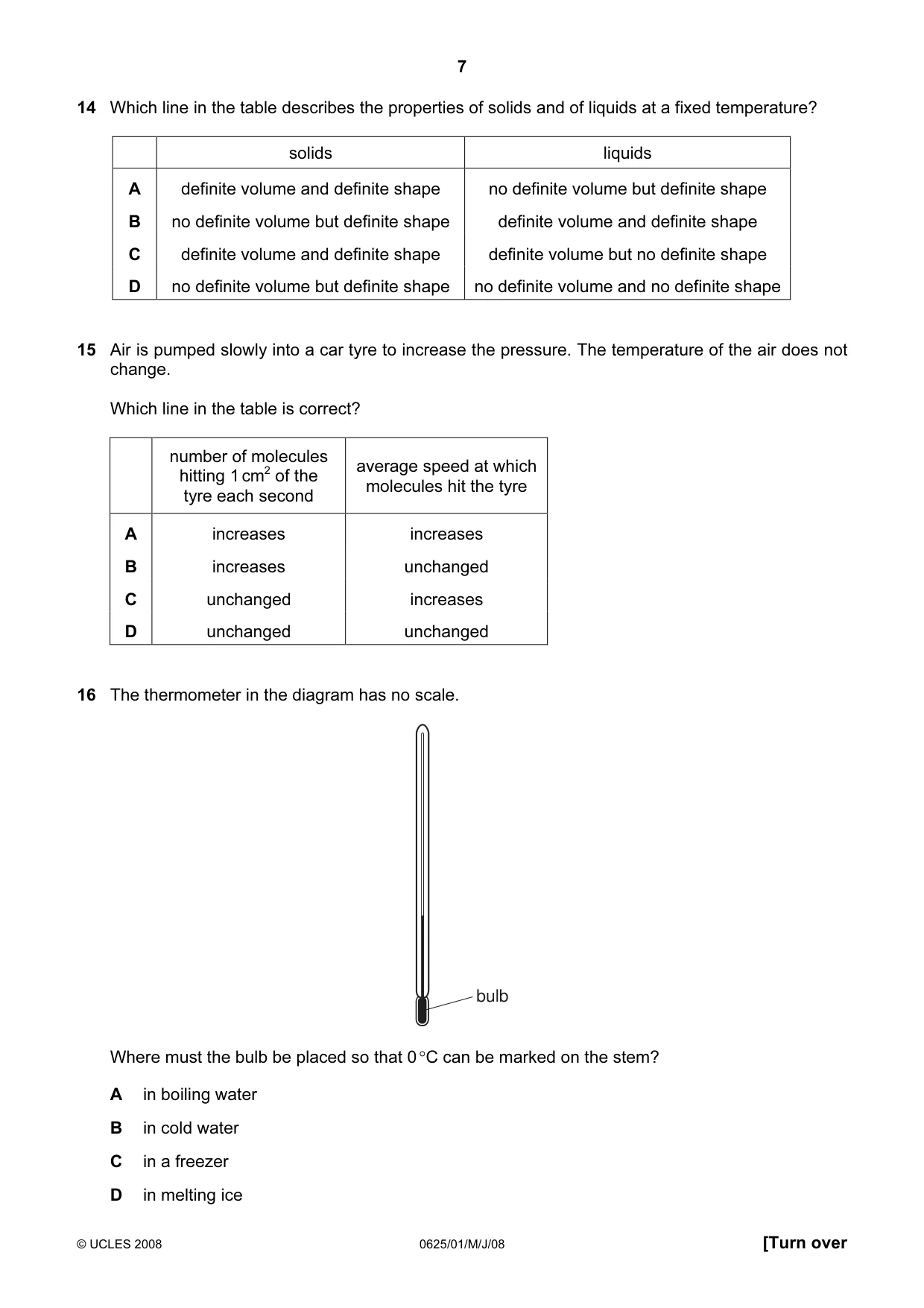
Q16 · The thermometer in the diagram has no scale
16 The thermometer in the diagram has no scale. bulb Where must the bulb be placed so that 0 °C can be marked on the stem? A in boiling water B in cold water C in a freezer D in melting ice
Mark scheme: D
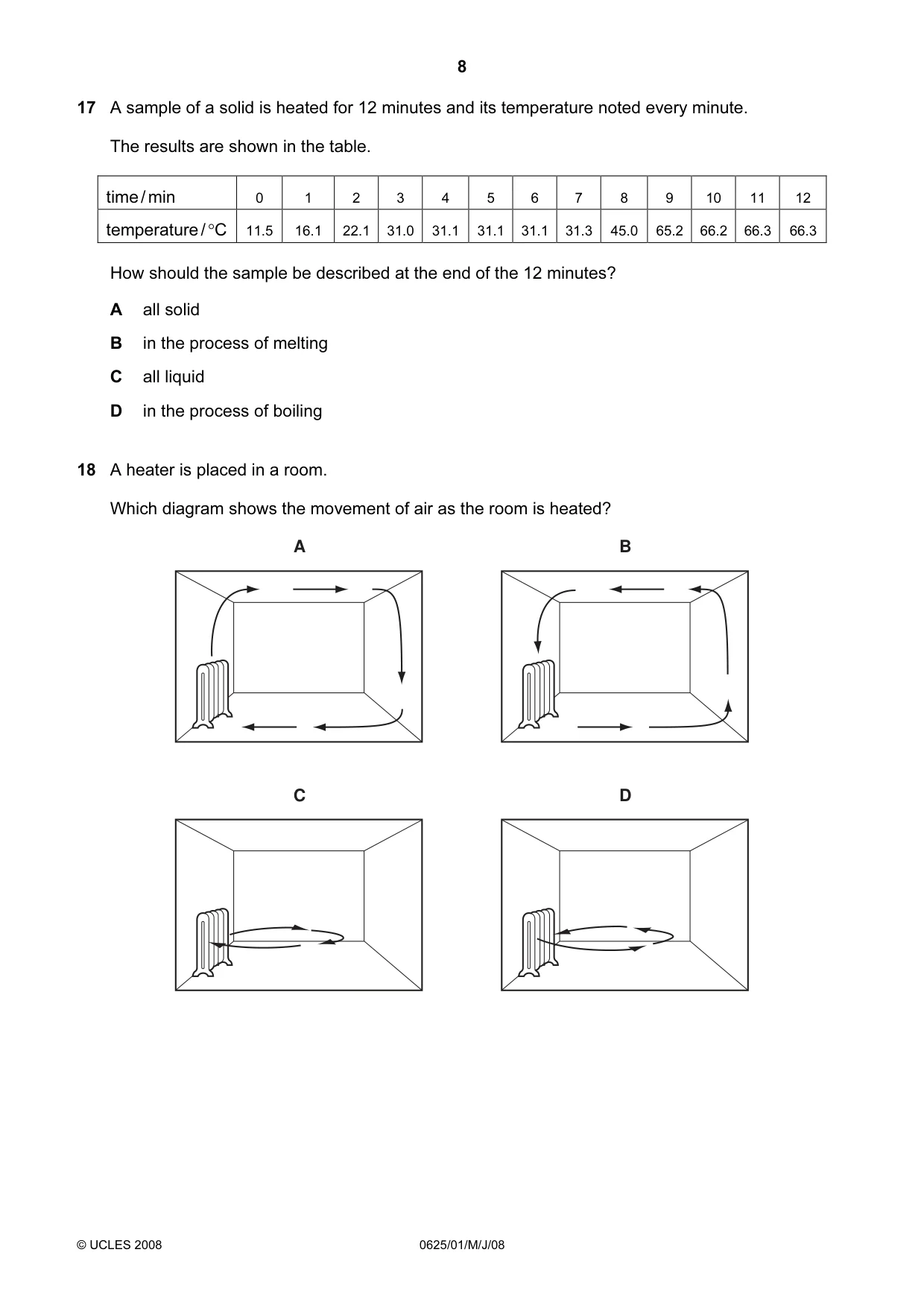
Q17 · A sample of a solid is heated for 12 minutes and its temperature noted every minute
17 A sample of a solid is heated for 12 minutes and its temperature noted every minute. The results are shown in the table. time / min 0 1 2 3 4 5 6 7 8 9 10 11 12 temperature / °C 11.5 16.1 22.1 31.0 31.1 31.1 31.1 31.3 45.0 65.2 66.2 66.3 66.3 How should the sample be described at the end of the 12 minutes? A all solid B in the process of melting C all liquid D in the process of boiling
Mark scheme: D
Q18 · A heater is placed in a room
18 A heater is placed in a room. Which diagram shows the movement of air as the room is heated? A B C D
Mark scheme: A
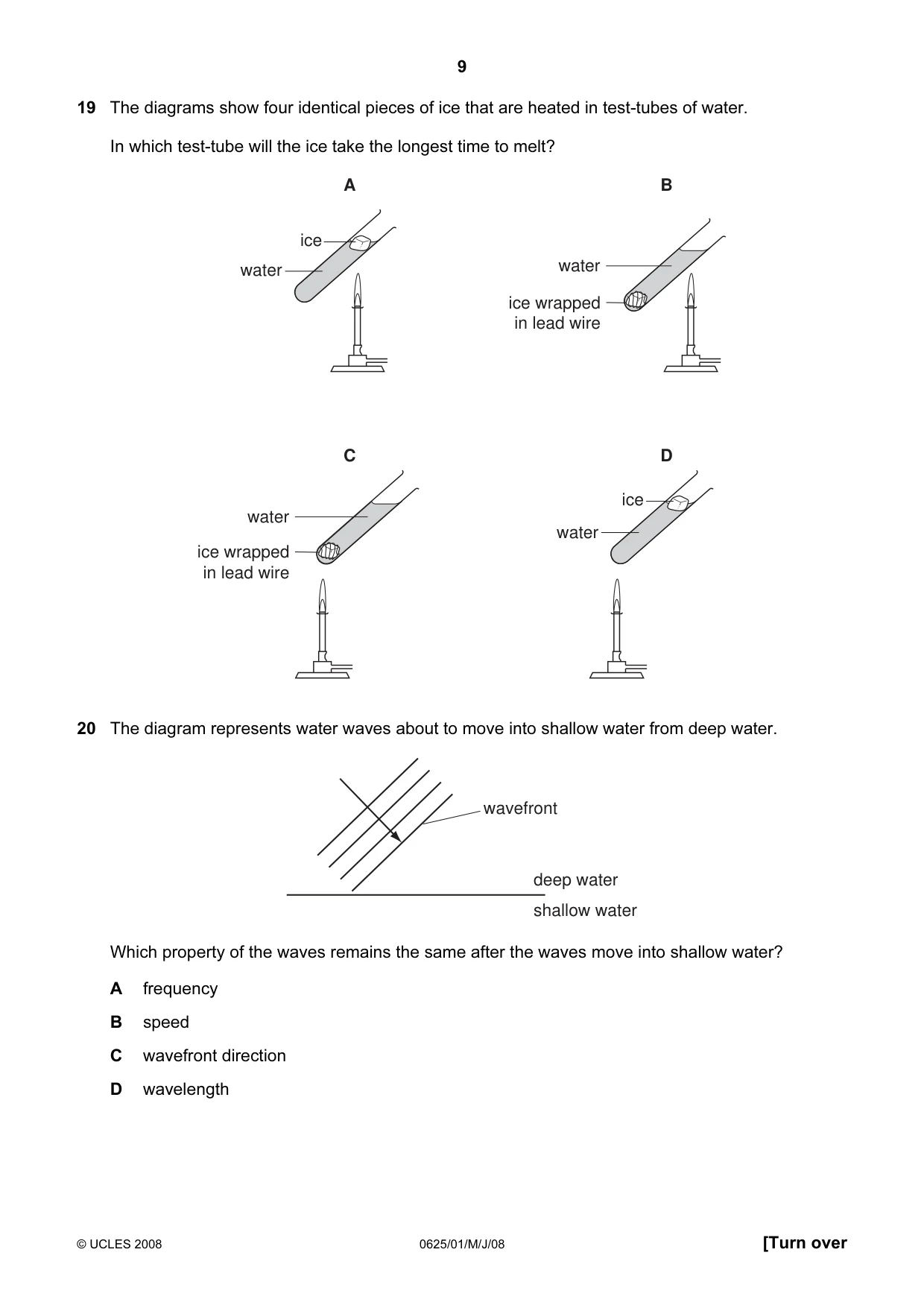
Q19 · The diagrams show four identical pieces of ice that are heated in test-tubes of water
19 The diagrams show four identical pieces of ice that are heated in test-tubes of water. In which test-tube will the ice take the longest time to melt? A B ice water water ice wrapped in lead wire C D ice water water ice wrapped in lead wire
Mark scheme: B
Q20 · The diagram represents water waves about to move into shallow water from deep water
20 The diagram represents water waves about to move into shallow water from deep water. wavefront deep water shallow water Which property of the waves remains the same after the waves move into shallow water? A frequency B speed C wavefront direction D wavelength
Mark scheme: A
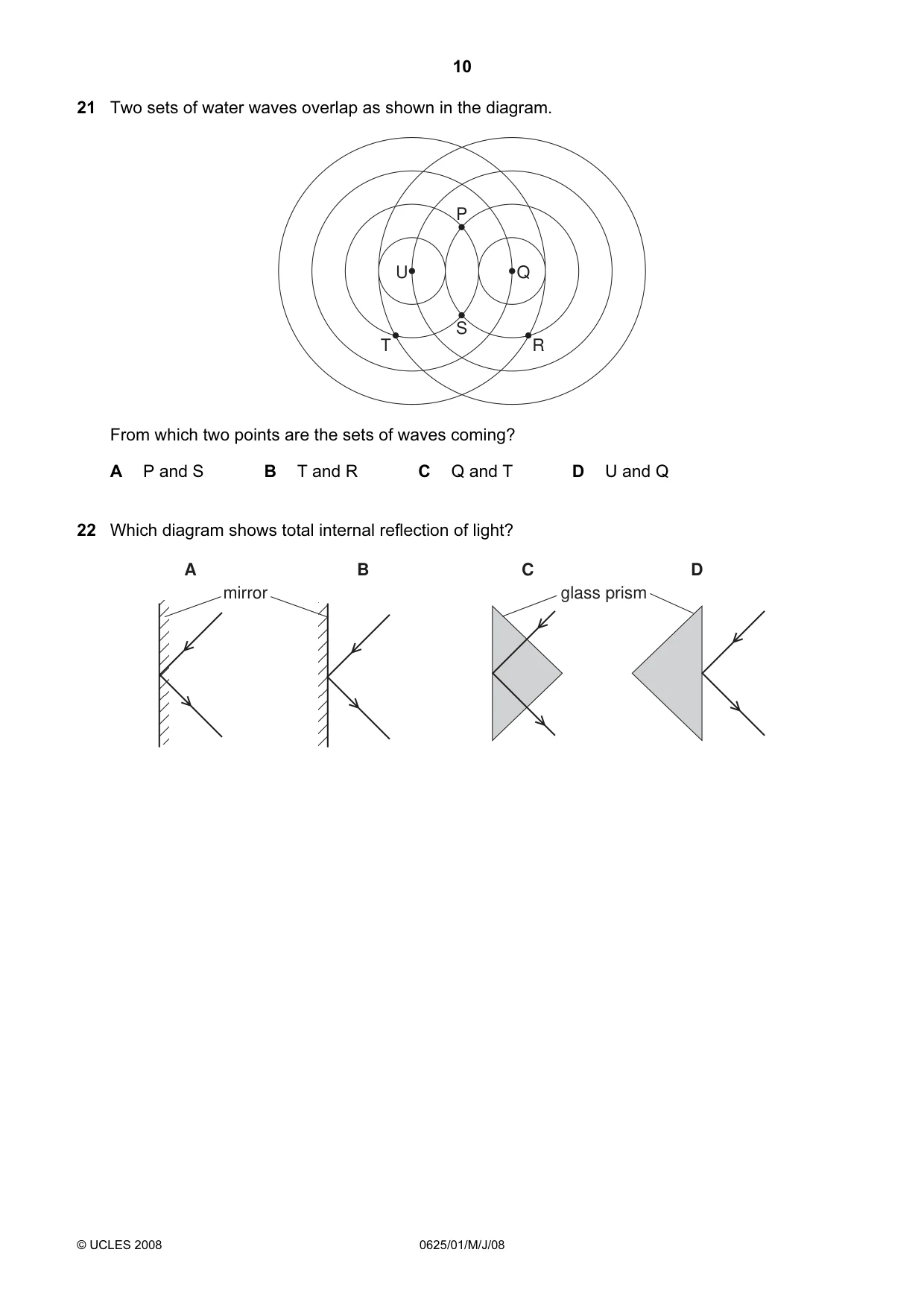
Q21 · Two sets of water waves overlap as shown in the diagram
21 Two sets of water waves overlap as shown in the diagram. P U Q S T R From which two points are the sets of waves coming? A P and S B T and R C Q and T D U and Q
Mark scheme: D
Q22 · Which diagram shows total internal reflection of light?
22 Which diagram shows total internal reflection of light? A B C D mirror glass prism
Mark scheme: C
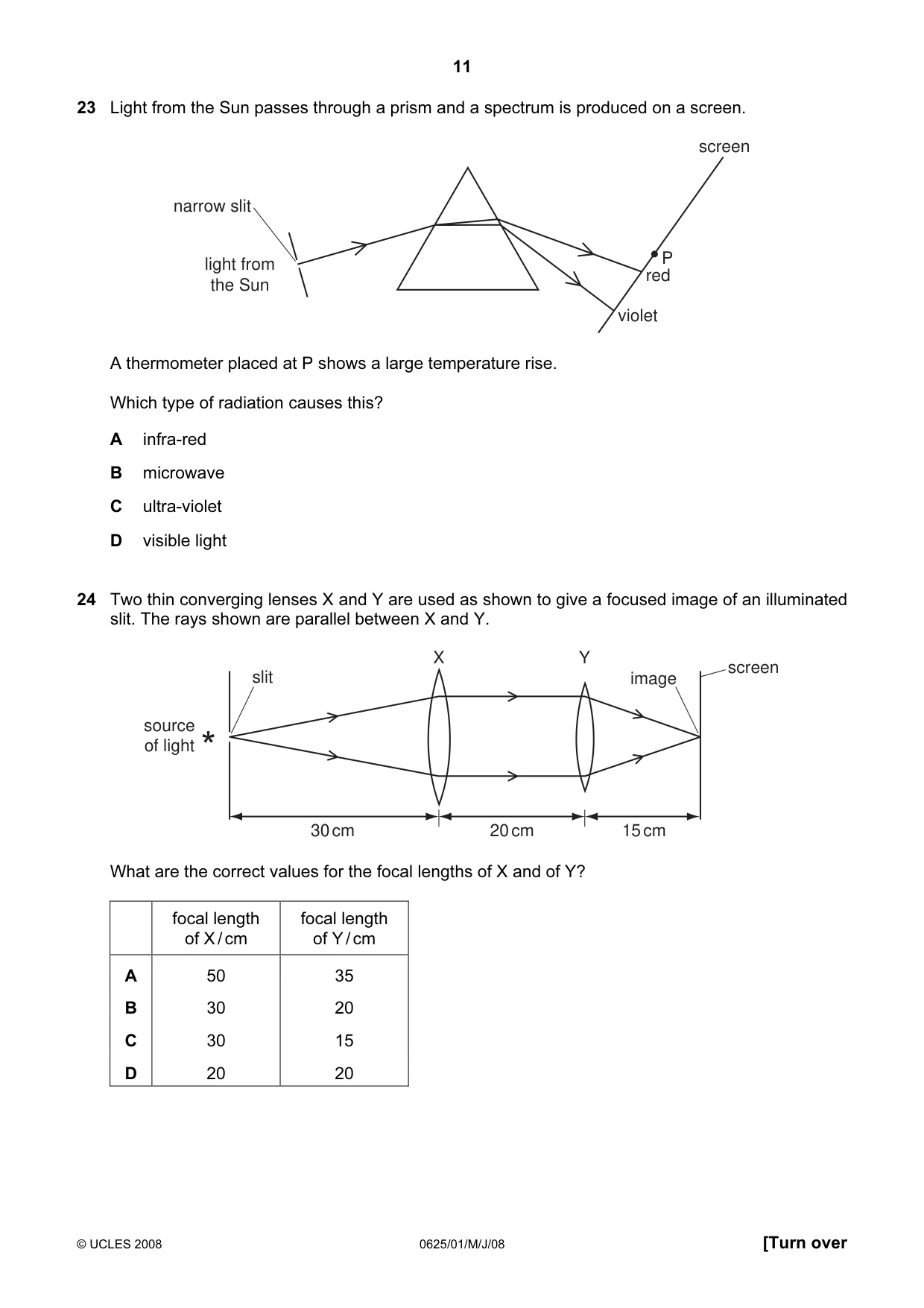
Q23 · Light from the Sun passes through a prism and a spectrum is produced on a screen
23 Light from the Sun passes through a prism and a spectrum is produced on a screen. screen narrow slit light from P red the Sun violet A thermometer placed at P shows a large temperature rise. Which type of radiation causes this? A infra-red B microwave C ultra-violet D visible light
Mark scheme: A
Q24 · Two thin converging lenses X and Y are used as shown to give a focused image of an…
24 Two thin converging lenses X and Y are used as shown to give a focused image of an illuminated slit. The rays shown are parallel between X and Y. X Y screen slit image source of light 30 cm 20 cm 15 cm What are the correct values for the focal lengths of X and of Y? focal length focal length of X / cm of Y / cm A 50 35 B 30 20 C 30 15 D 20 20
Mark scheme: C
Q25 · Which equation can be used to calculate the speed of sound?
25 Which equation can be used to calculate the speed of sound? distance A speed = time B speed = distance × time time C speed = distance D speed = time + distance
Mark scheme: A
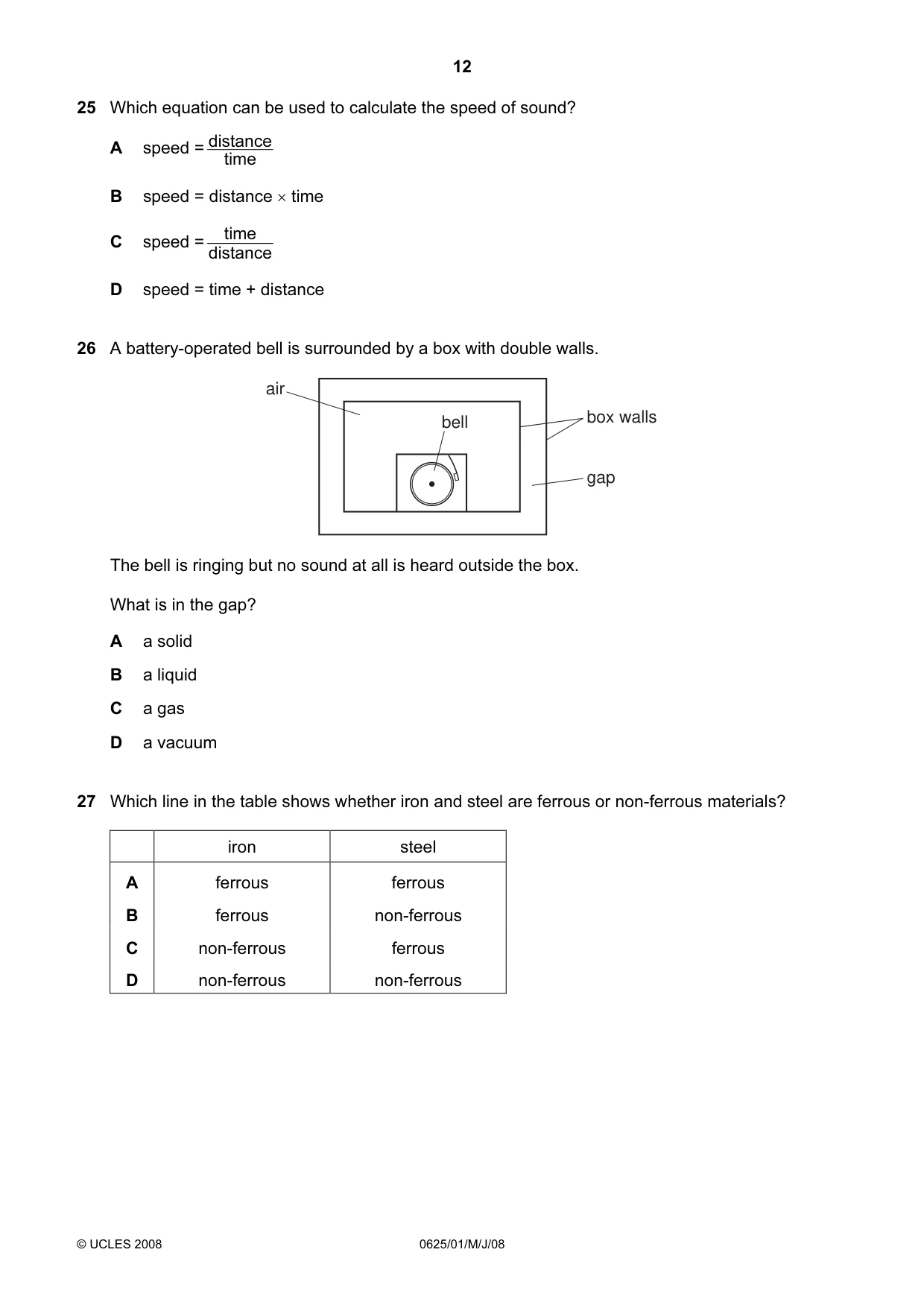
Q26 · A battery-operated bell is surrounded by a box with double walls
26 A battery-operated bell is surrounded by a box with double walls. air bell box walls gap The bell is ringing but no sound at all is heard outside the box. What is in the gap? A a solid B a liquid C a gas D a vacuum
Mark scheme: D
Q27 · Which line in the table shows whether iron and steel are ferrous or non-ferrous materials?
27 Which line in the table shows whether iron and steel are ferrous or non-ferrous materials? iron steel A ferrous ferrous B ferrous non-ferrous C non-ferrous ferrous D non-ferrous non-ferrous
Mark scheme: A
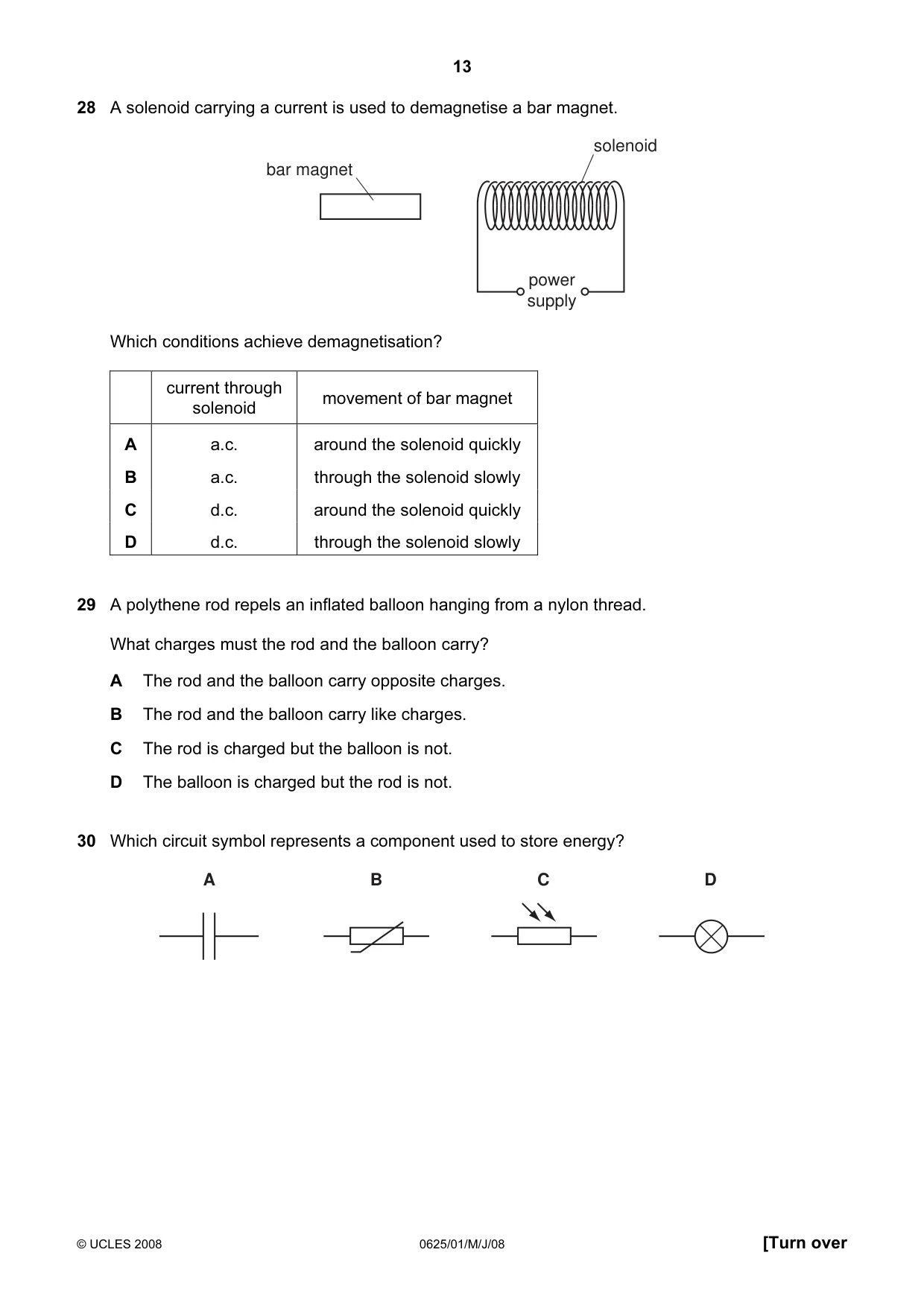
Q28 · A solenoid carrying a current is used to demagnetise a bar magnet
28 A solenoid carrying a current is used to demagnetise a bar magnet. solenoid bar magnet power supply Which conditions achieve demagnetisation? current through movement of bar magnet solenoid A a.c. around the solenoid quickly B a.c. through the solenoid slowly C d.c. around the solenoid quickly D d.c. through the solenoid slowly
Mark scheme: B
Q29 · A polythene rod repels an inflated balloon hanging from a nylon thread
29 A polythene rod repels an inflated balloon hanging from a nylon thread. What charges must the rod and the balloon carry? A The rod and the balloon carry opposite charges. B The rod and the balloon carry like charges. C The rod is charged but the balloon is not. D The balloon is charged but the rod is not.
Mark scheme: B
Q30 · Which circuit symbol represents a component used to store energy?
30 Which circuit symbol represents a component used to store energy? A B C D
Mark scheme: A
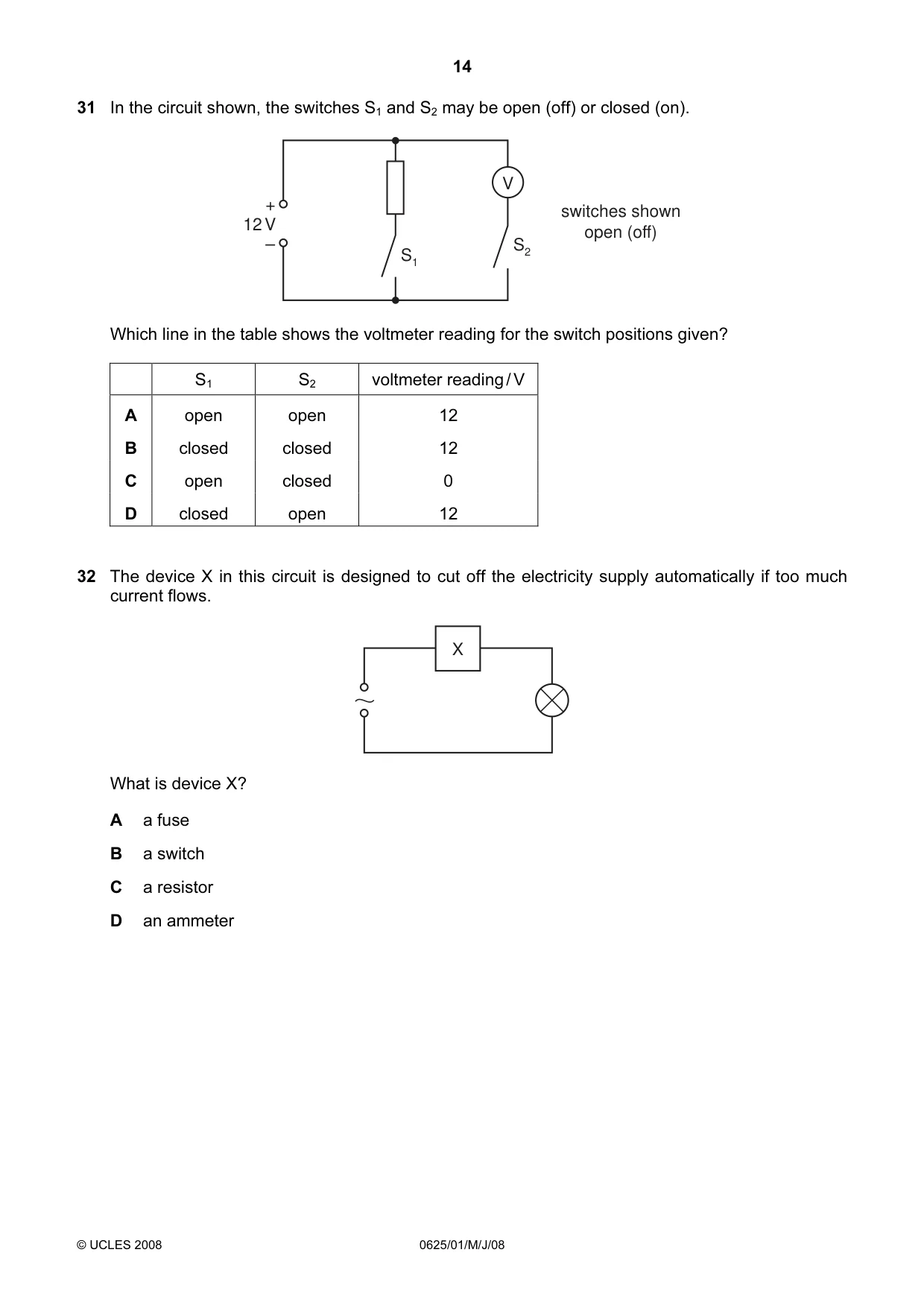
Q31 · In the circuit shown, the switches S1 and S2 may be open (off) or closed (on)
31 In the circuit shown, the switches S1 and S2 may be open (off) or closed (on). V + switches shown 12 V open (off) – S2 S1 Which line in the table shows the voltmeter reading for the switch positions given? S1 S2 voltmeter reading / V A open open 12 B closed closed 12 C open closed 0 D closed open 12
Mark scheme: B
Q32 · The device X in this circuit is designed to cut off the electricity supply automatically…
32 The device X in this circuit is designed to cut off the electricity supply automatically if too much current flows. X What is device X? A a fuse B a switch C a resistor D an ammeter
Mark scheme: A
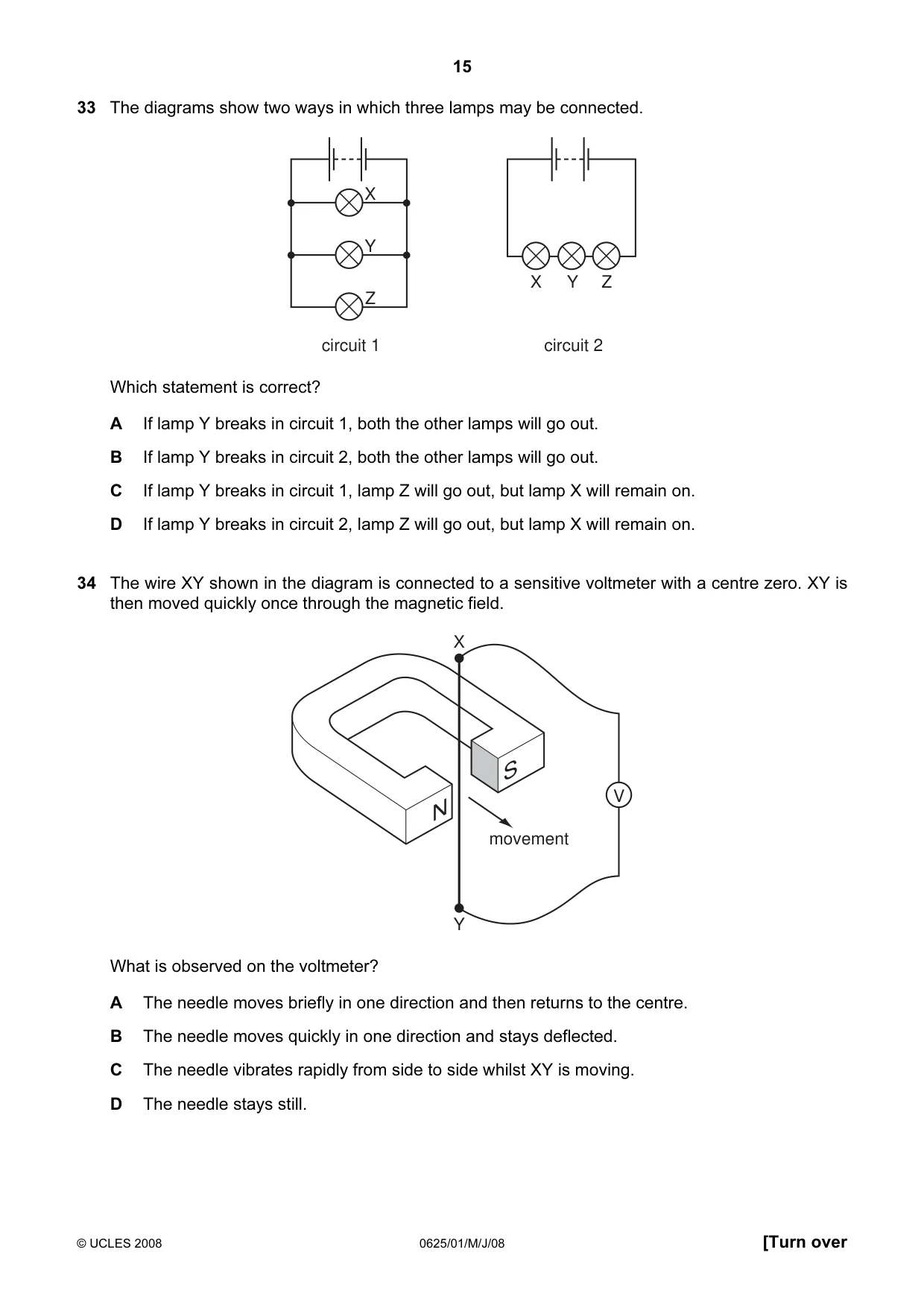
Q33 · The diagrams show two ways in which three lamps may be connected
33 The diagrams show two ways in which three lamps may be connected. X Y X Y Z Z circuit 1 circuit 2 Which statement is correct? A If lamp Y breaks in circuit 1, both the other lamps will go out. B If lamp Y breaks in circuit 2, both the other lamps will go out. C If lamp Y breaks in circuit 1, lamp Z will go out, but lamp X will remain on. D If lamp Y breaks in circuit 2, lamp Z will go out, but lamp X will remain on.
Mark scheme: B
Q34 · The wire XY shown in the diagram is connected to a sensitive voltmeter with a centre zero
34 The wire XY shown in the diagram is connected to a sensitive voltmeter with a centre zero. XY is then moved quickly once through the magnetic field. X S N V movement Y What is observed on the voltmeter? A The needle moves briefly in one direction and then returns to the centre. B The needle moves quickly in one direction and stays deflected. C The needle vibrates rapidly from side to side whilst XY is moving. D The needle stays still.
Mark scheme: A
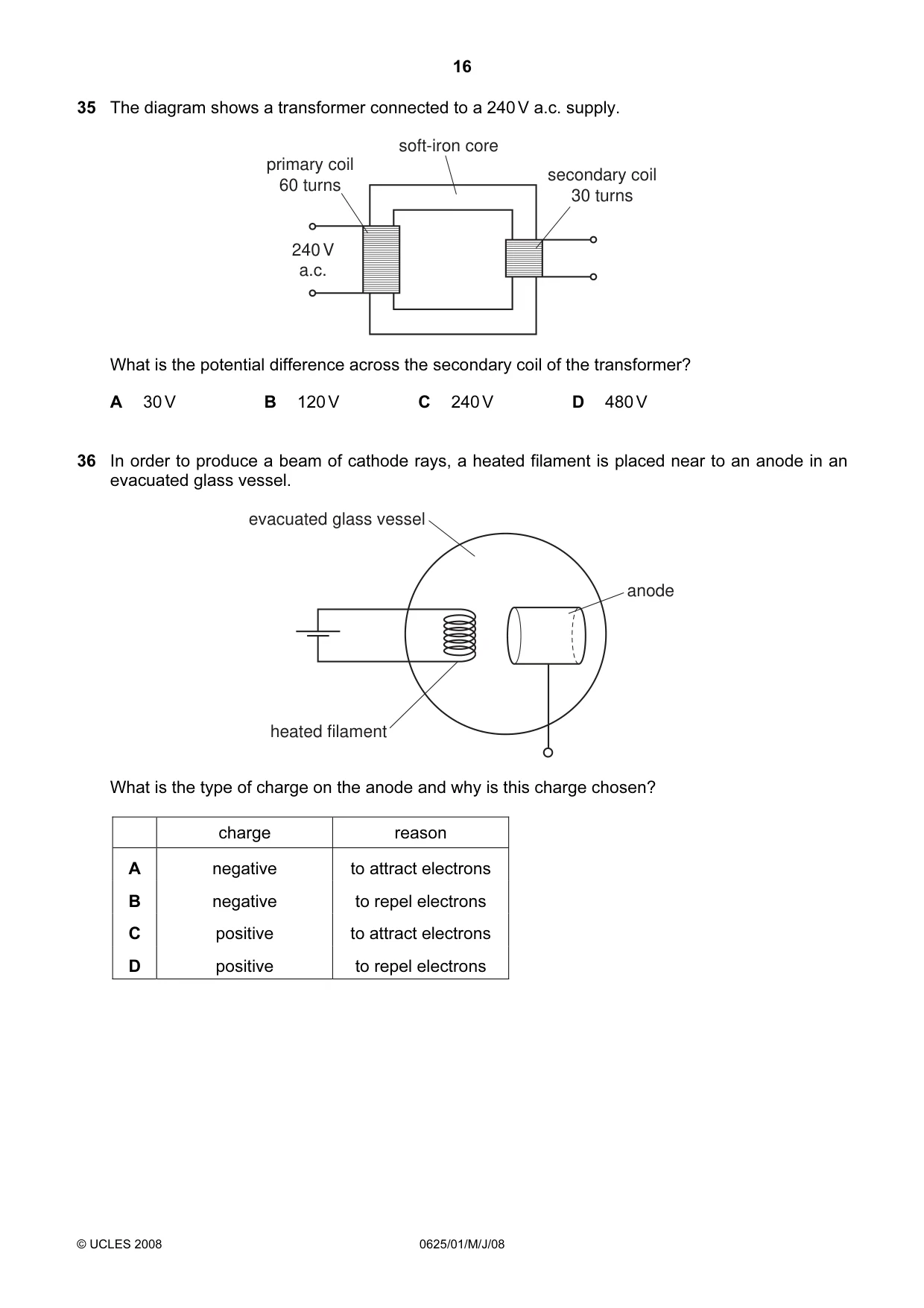
Q35 · The diagram shows a transformer connected to a 240 V a.c
35 The diagram shows a transformer connected to a 240 V a.c. supply. soft-iron core primary coil secondary coil 60 turns 30 turns 240 V a.c. What is the potential difference across the secondary coil of the transformer? A 30 V B 120 V C 240 V D 480 V
Mark scheme: B
Q36 · In order to produce a beam of cathode rays, a heated filament is placed near to an anode…
36 In order to produce a beam of cathode rays, a heated filament is placed near to an anode in an evacuated glass vessel. evacuated glass vessel anode heated filament What is the type of charge on the anode and why is this charge chosen? charge reason A negative to attract electrons B negative to repel electrons C positive to attract electrons D positive to repel electrons
Mark scheme: C
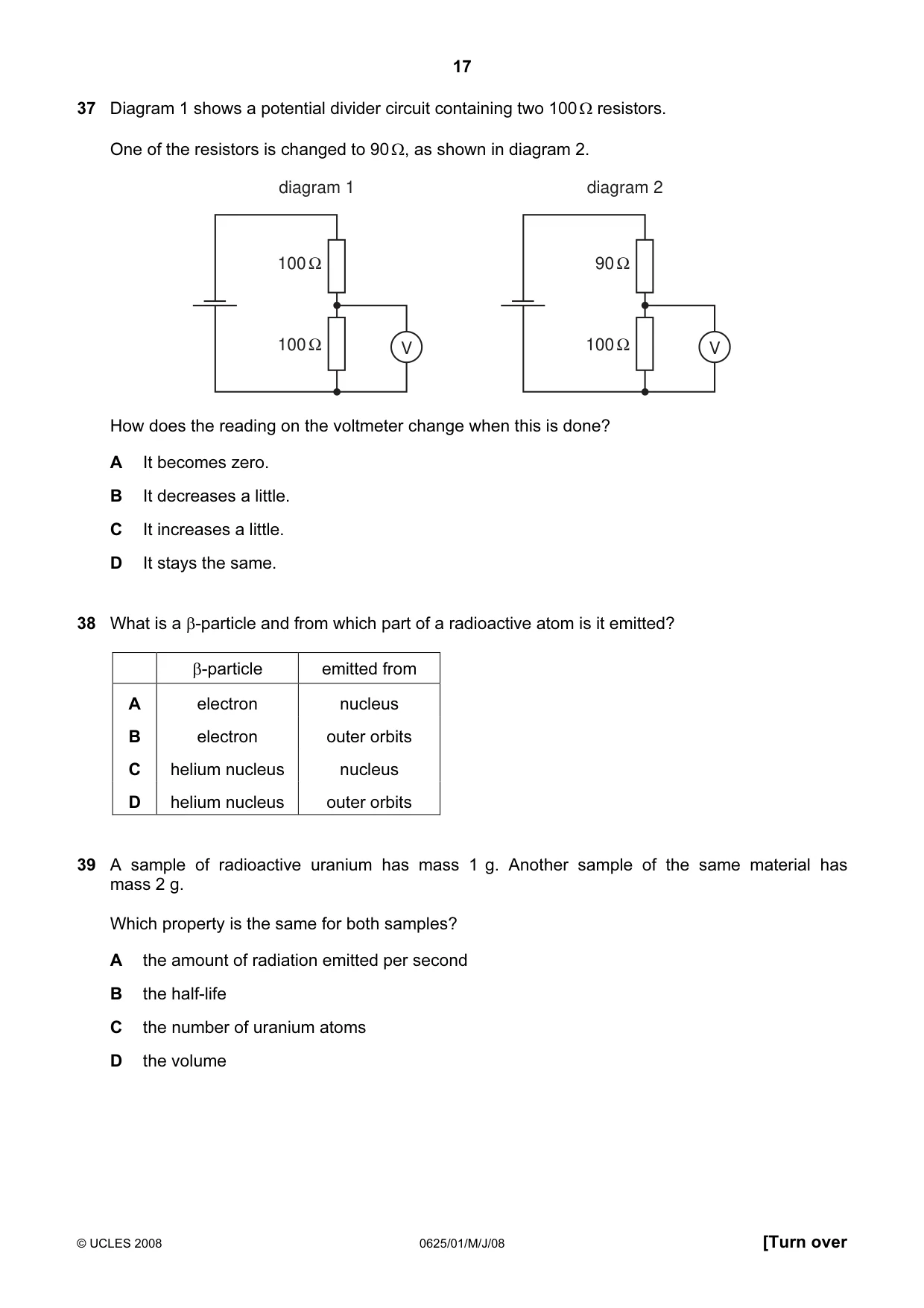
Q37 · A potential divider circuit containing two 100 Ω resistors
37 Diagram 1 shows a potential divider circuit containing two 100 Ω resistors. One of the resistors is changed to 90 Ω, as shown in diagram 2. diagram 1 diagram 2 100 Ω 90 Ω 100 Ω V 100 Ω V How does the reading on the voltmeter change when this is done? A It becomes zero. B It decreases a little. C It increases a little. D It stays the same.
Mark scheme: C
Q38 · What is a β-particle and from which part of a radioactive atom is it emitted?
38 What is a β-particle and from which part of a radioactive atom is it emitted? β-particle emitted from A electron nucleus B electron outer orbits C helium nucleus nucleus D helium nucleus outer orbits
Mark scheme: A
Q39 · A sample of radioactive uranium has mass 1 g
39 A sample of radioactive uranium has mass 1 g. Another sample of the same material has mass 2 g. Which property is the same for both samples? A the amount of radiation emitted per second B the half-life C the number of uranium atoms D the volume
Mark scheme: B
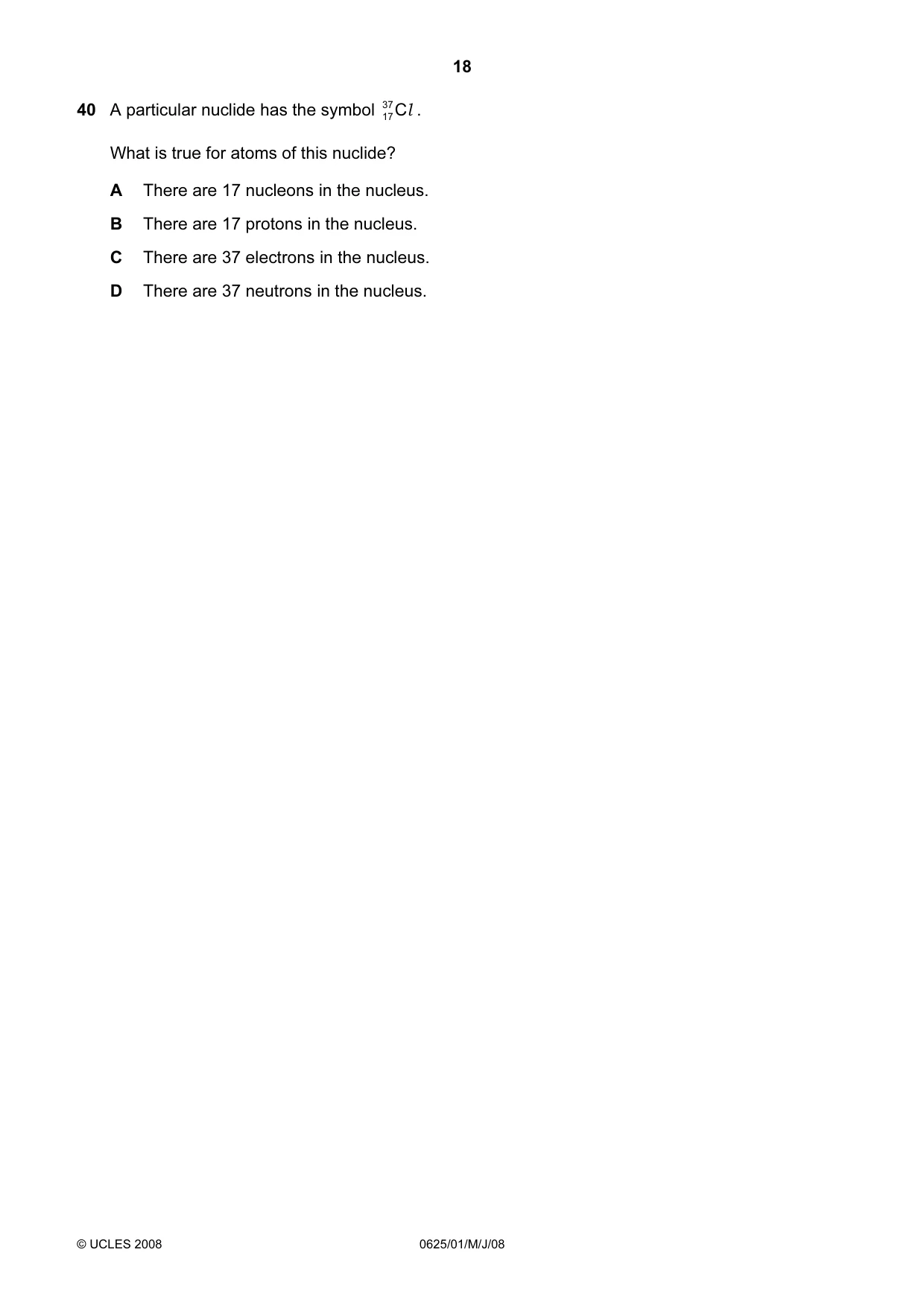
Q40 · A particular nuclide has the symbol 37 17Cl
40 A particular nuclide has the symbol 37 17Cl . What is true for atoms of this nuclide? A There are 17 nucleons in the nucleus. B There are 17 protons in the nucleus. C There are 37 electrons in the nucleus. D There are 37 neutrons in the nucleus.
Mark scheme: B
What was in this paper
The subtopics covered by these 40 questions, and how many questions each got. Open one in a new tab to see every Cambridge question on it.
4Forces3Density2Electromagnetic effects2Energy, work and power2General properties of waves2Kinetic particle model of matter2Light2Motion2Pressure2Radioactivity2Simple phenomena of magnetism2Sound2The nuclear model of the atom2Thermal properties and temperature2Transfer of thermal energy2Electrical quantities1Electrical safety1Electromagnetic spectrum1Mass and weight1Physical quantities and measurement techniques1What you needed in this session
Cambridge’s own grade thresholds for 2008 May/June, Paper 1 · Variant 1. A higher threshold means an easier paper — the bar moves with how the cohort did.