Cambridge IGCSE Physics 0625 — 2018 May/June Paper 1 · Variant 3
0625/13/M/J/18 · 40 questions · 40 marks · ≈45 min
The question paper and its mark scheme, free to read here and free to download. This is Cambridge’s own paper, exactly as it was sat.
Question paper16 pages
Mark scheme3 pages
Answers below. Sit the paper first if you are practising.
Questions as text
Q1 · A length of cotton is measured between two points on a ruler
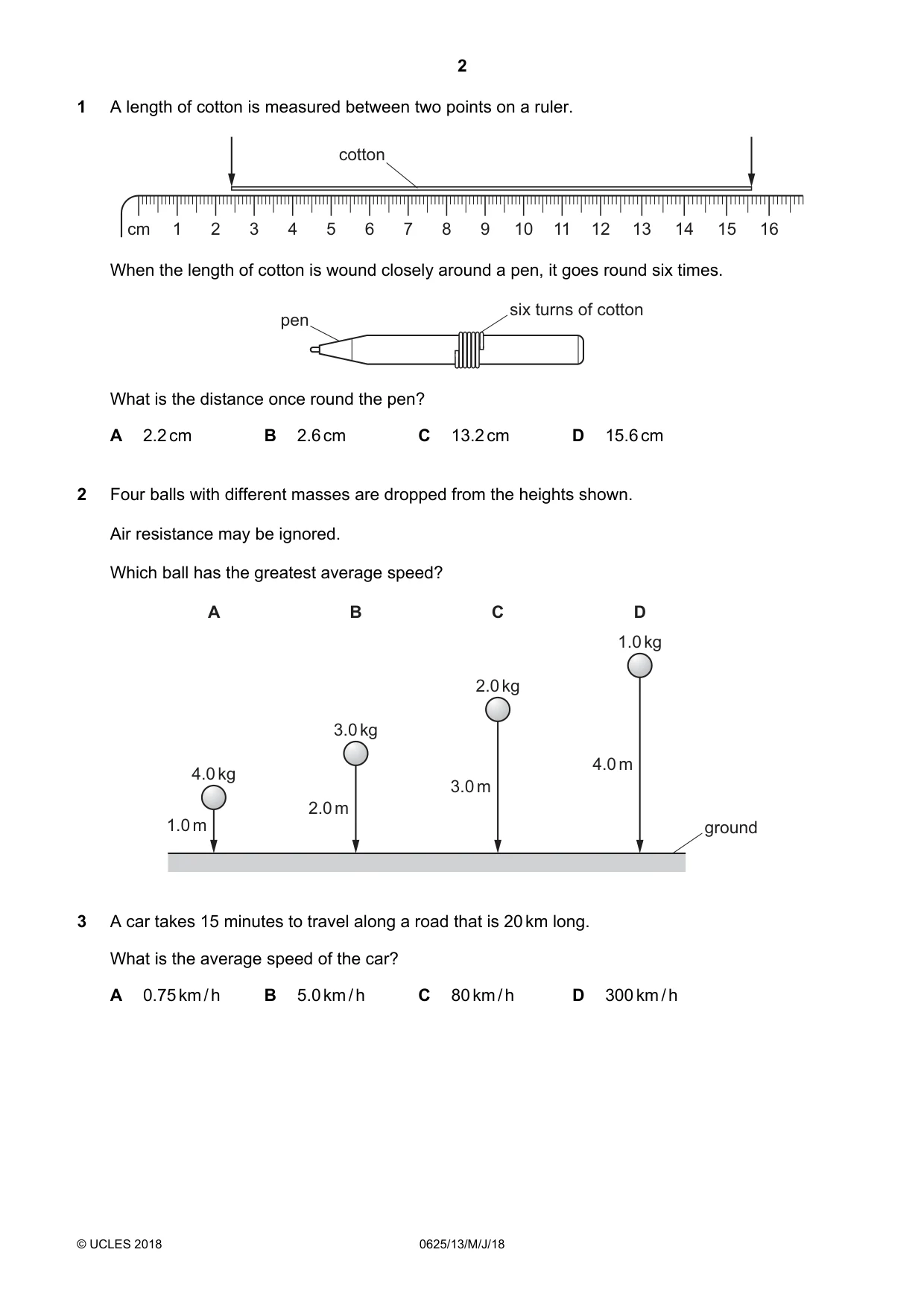
1 A length of cotton is measured between two points on a ruler. cotton cm 1 2 3 4 5 6 7 8 9 10 11 12 13 14 15 16 When the length of cotton is wound closely around a pen, it goes round six times. six turns of cotton pen What is the distance once round the pen? A 2.2 cm B 2.6 cm C 13.2 cm D 15.6 cm
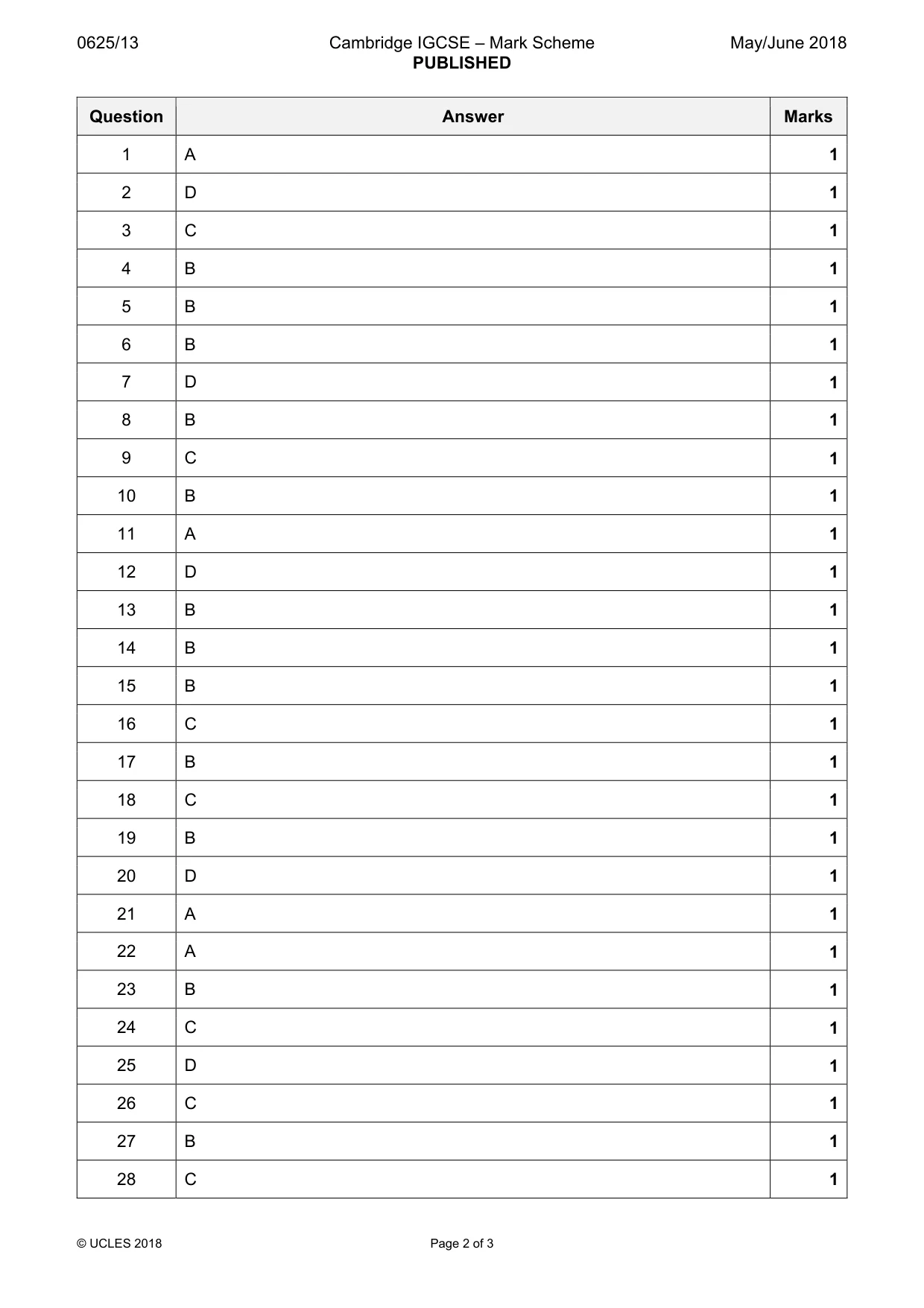
Mark scheme: A
More questions on Physical quantities and measurement techniques
Q2 · Four balls with different masses are dropped from the heights shown
2 Four balls with different masses are dropped from the heights shown. Air resistance may be ignored. Which ball has the greatest average speed? A B C D 1.0 kg 2.0 kg 3.0 kg 4.0 m 4.0 kg 3.0 m 2.0 m 1.0 m ground
Mark scheme: D
Q3 · A car takes 15 minutes to travel along a road that is 20 km long
3 A car takes 15 minutes to travel along a road that is 20 km long. What is the average speed of the car? A 0.75 km / h B 5.0 km / h C 80 km / h D 300 km / h
Mark scheme: C
Q4 · A person steps onto a bathroom scales
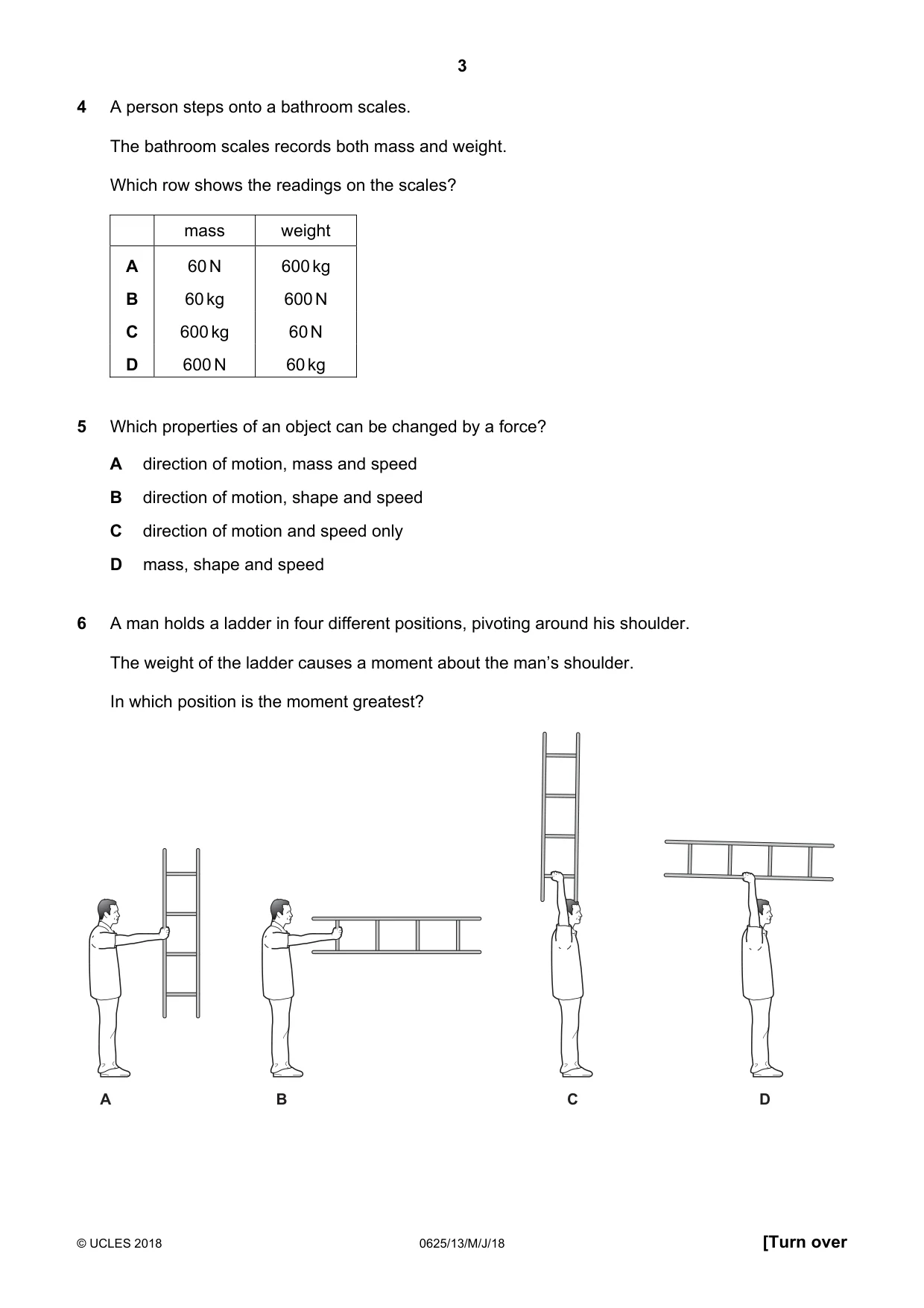
4 A person steps onto a bathroom scales. The bathroom scales records both mass and weight. Which row shows the readings on the scales? mass weight A 60 N 600 kg B 60 kg 600 N C 600 kg 60 N D 600 N 60 kg
Mark scheme: B
Q5 · Which properties of an object can be changed by a force?
5 Which properties of an object can be changed by a force? A direction of motion, mass and speed B direction of motion, shape and speed C direction of motion and speed only D mass, shape and speed
Mark scheme: B
Q6 · A man holds a ladder in four different positions, pivoting around his shoulder
6 A man holds a ladder in four different positions, pivoting around his shoulder. The weight of the ladder causes a moment about the man’s shoulder. In which position is the moment greatest? A B C D
Mark scheme: B
Q7 · A hole is drilled in a square tile
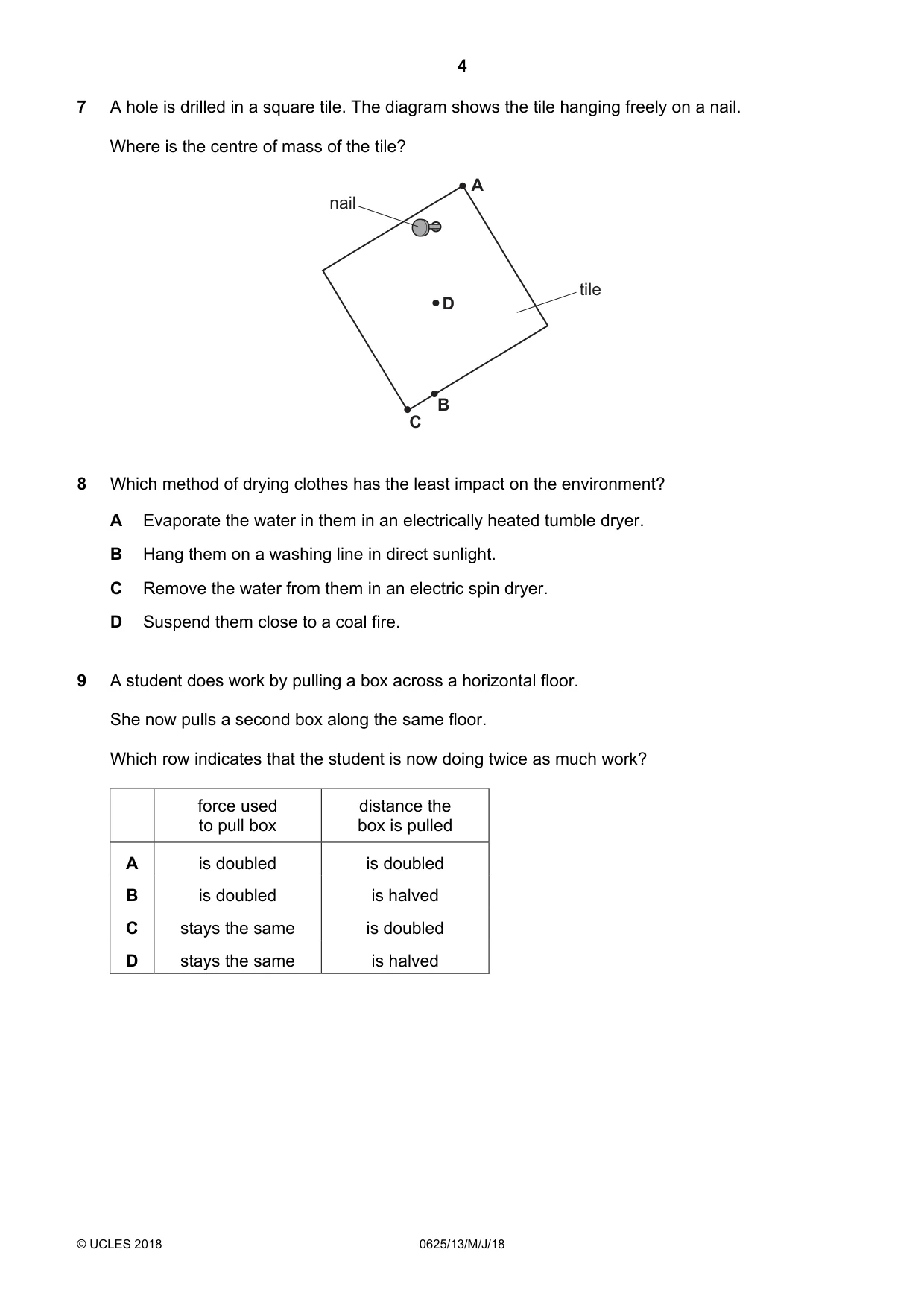
7 A hole is drilled in a square tile. The diagram shows the tile hanging freely on a nail. Where is the centre of mass of the tile? A nail tile D B C
Mark scheme: D
Q8 · Which method of drying clothes has the least impact on the environment?
8 Which method of drying clothes has the least impact on the environment? A Evaporate the water in them in an electrically heated tumble dryer. B Hang them on a washing line in direct sunlight. C Remove the water from them in an electric spin dryer. D Suspend them close to a coal fire.
Mark scheme: B
Q9 · A student does work by pulling a box across a horizontal floor
9 A student does work by pulling a box across a horizontal floor. She now pulls a second box along the same floor. Which row indicates that the student is now doing twice as much work? force used distance the to pull box box is pulled A is doubled is doubled B is doubled is halved C stays the same is doubled D stays the same is halved
Mark scheme: C
Q10 · A simple barometer includes a column of mercury
10 A simple barometer includes a column of mercury. Which property of this column of mercury is used to give a measurement of atmospheric pressure? A its cross-sectional area B its height C its temperature D its thermal capacity
Mark scheme: B
Q11 · The diagram shows some liquid in a measuring cylinder
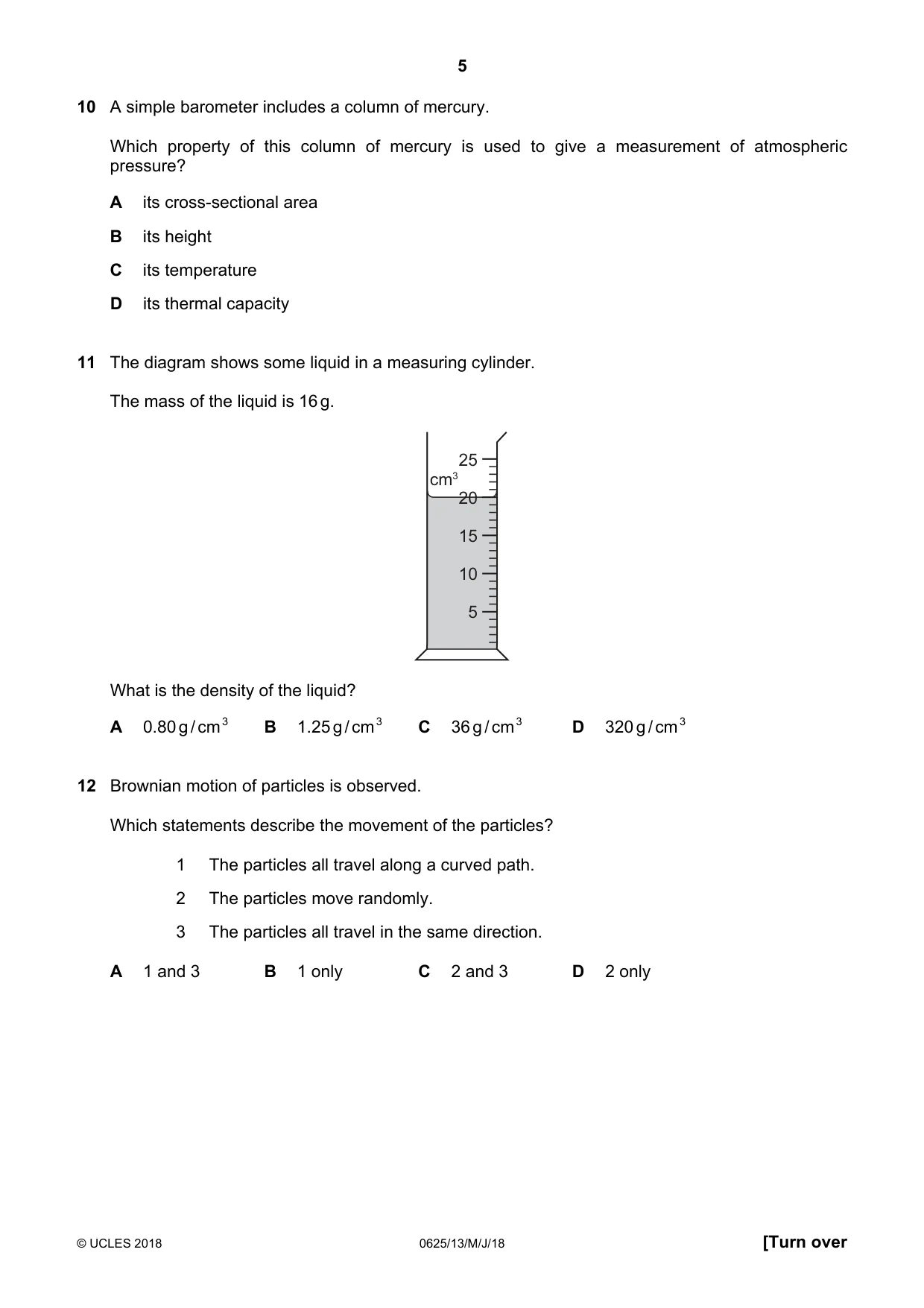
11 The diagram shows some liquid in a measuring cylinder. The mass of the liquid is 16 g. 25 cm3 20 15 10 5 What is the density of the liquid? A 0.80 g / cm 3 B 1.25 g / cm 3 C 36 g / cm 3 D 320 g / cm 3
Mark scheme: A
Q12 · Brownian motion of particles is observed
12 Brownian motion of particles is observed. Which statements describe the movement of the particles? 1 The particles all travel along a curved path. 2 The particles move randomly. 3 The particles all travel in the same direction. A 1 and 3 B 1 only C 2 and 3 D 2 only
Mark scheme: D
Q13 · A pure liquid is left in an open beaker and some of the liquid molecules escape by…
13 A pure liquid is left in an open beaker and some of the liquid molecules escape by evaporation. Which statement about this process is correct? A None of the escaping molecules return to the liquid. B The escaping molecules are generally the more energetic ones. C The rate of escape of the molecules can be increased by increasing the depth of the liquid in the beaker. D The temperature of the remaining liquid is unaffected by the escape of the molecules.
Mark scheme: B
Q14 · A wooden wheel can be strengthened by putting a tight circle of iron around it
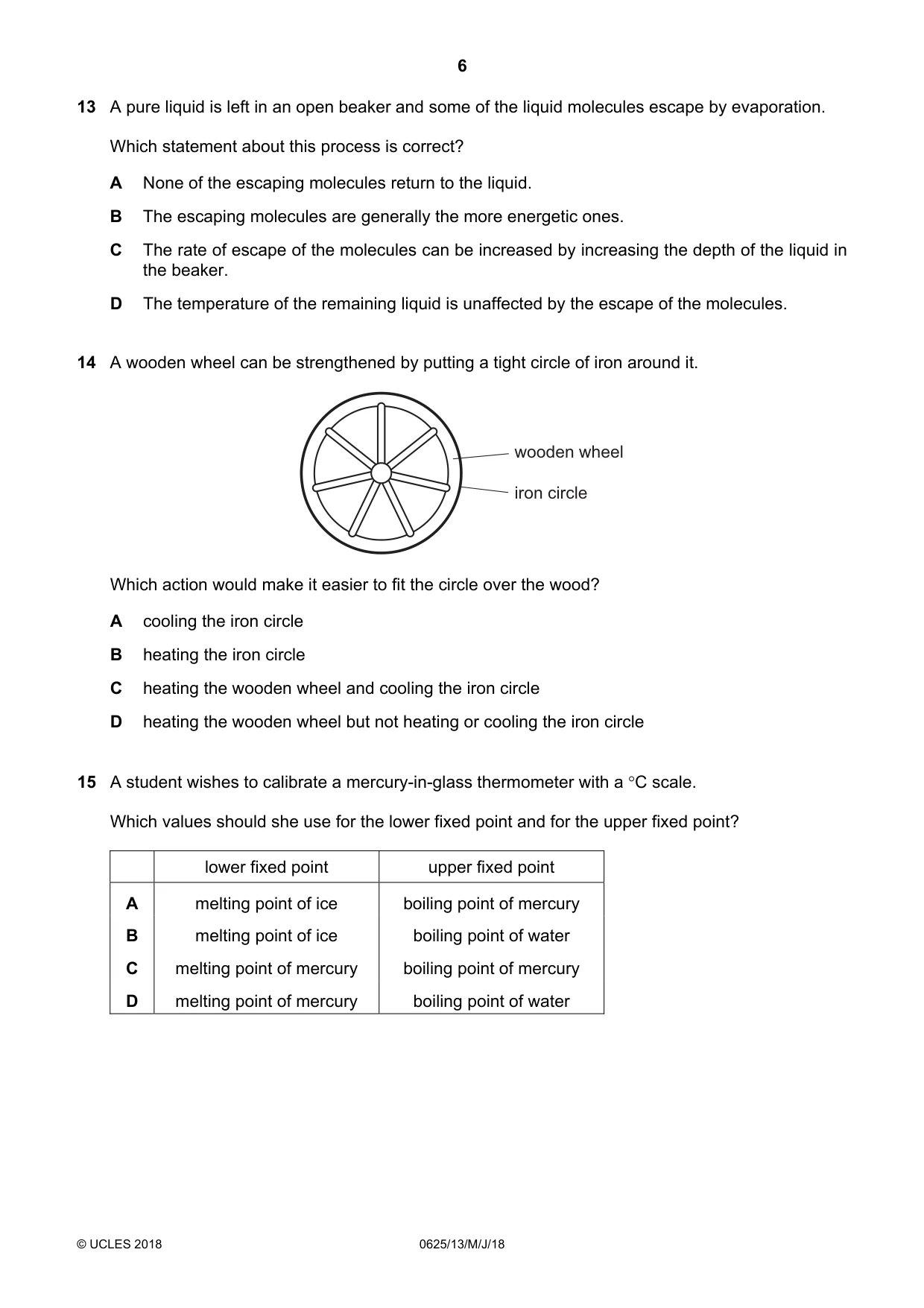
14 A wooden wheel can be strengthened by putting a tight circle of iron around it. wooden wheel iron circle Which action would make it easier to fit the circle over the wood? A cooling the iron circle B heating the iron circle C heating the wooden wheel and cooling the iron circle D heating the wooden wheel but not heating or cooling the iron circle
Mark scheme: B
Q15 · A student wishes to calibrate a mercury-in-glass thermometer with a °C scale
15 A student wishes to calibrate a mercury-in-glass thermometer with a °C scale. Which values should she use for the lower fixed point and for the upper fixed point? lower fixed point upper fixed point A melting point of ice boiling point of mercury B melting point of ice boiling point of water C melting point of mercury boiling point of mercury D melting point of mercury boiling point of water
Mark scheme: B
Q16 · Which diagram shows how the thermal capacity of a silver object depends on its mass?
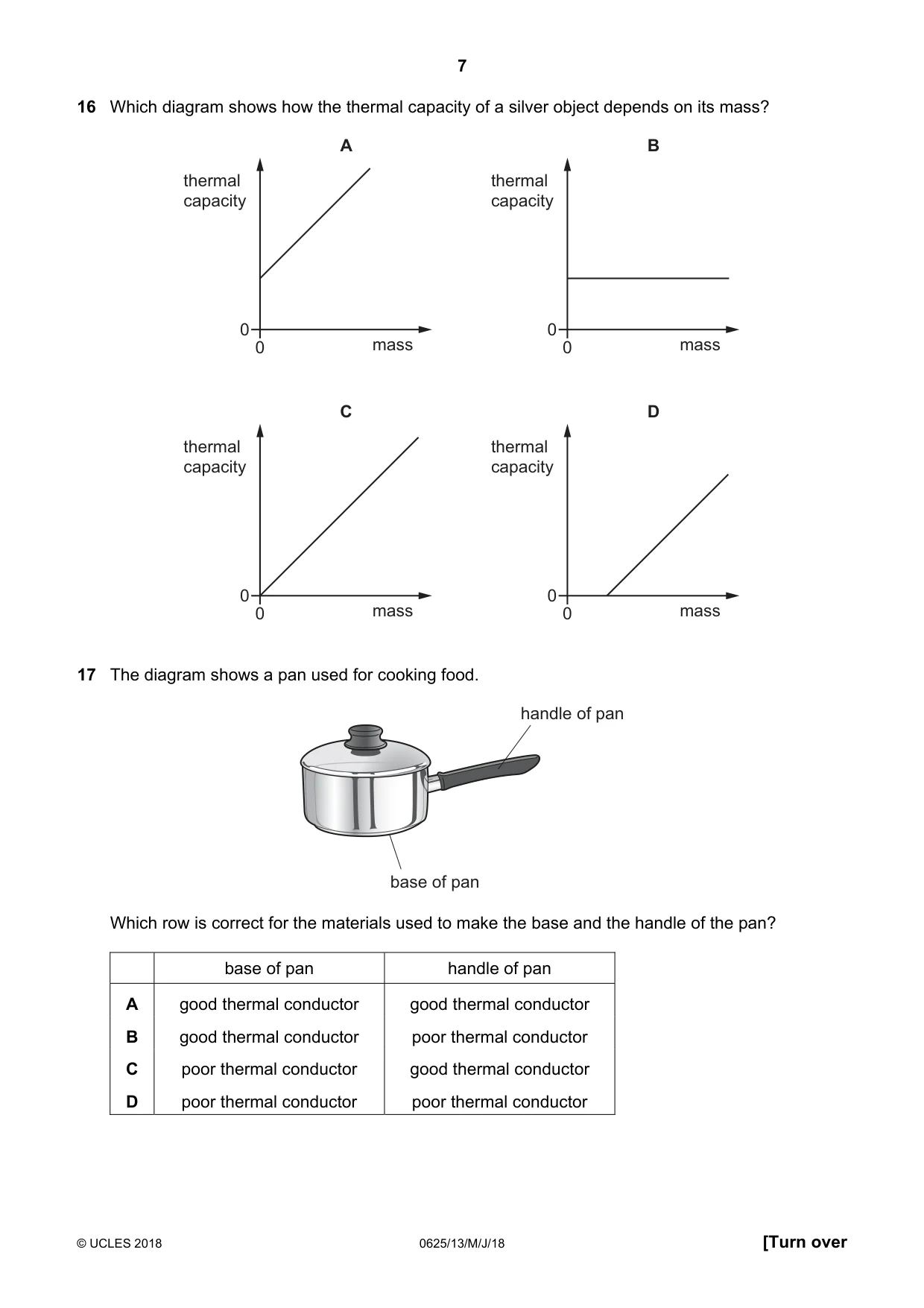
16 Which diagram shows how the thermal capacity of a silver object depends on its mass? A B thermal thermal capacity capacity 0 0 0 mass 0 mass C D thermal thermal capacity capacity 0 0 0 mass 0 mass
Mark scheme: C
Q17 · The diagram shows a pan used for cooking food
17 The diagram shows a pan used for cooking food. handle of pan base of pan Which row is correct for the materials used to make the base and the handle of the pan? base of pan handle of pan A good thermal conductor good thermal conductor B good thermal conductor poor thermal conductor C poor thermal conductor good thermal conductor D poor thermal conductor poor thermal conductor
Mark scheme: B
Q18 · A saucepan of water is heated from its base on an electric hob
18 A saucepan of water is heated from its base on an electric hob. After five minutes the water near the top of the saucepan is becoming hot. What is the main process of heat transfer within the water? A condensation B conduction C convection D radiation
Mark scheme: C
Q19 · The diagram shows a wave
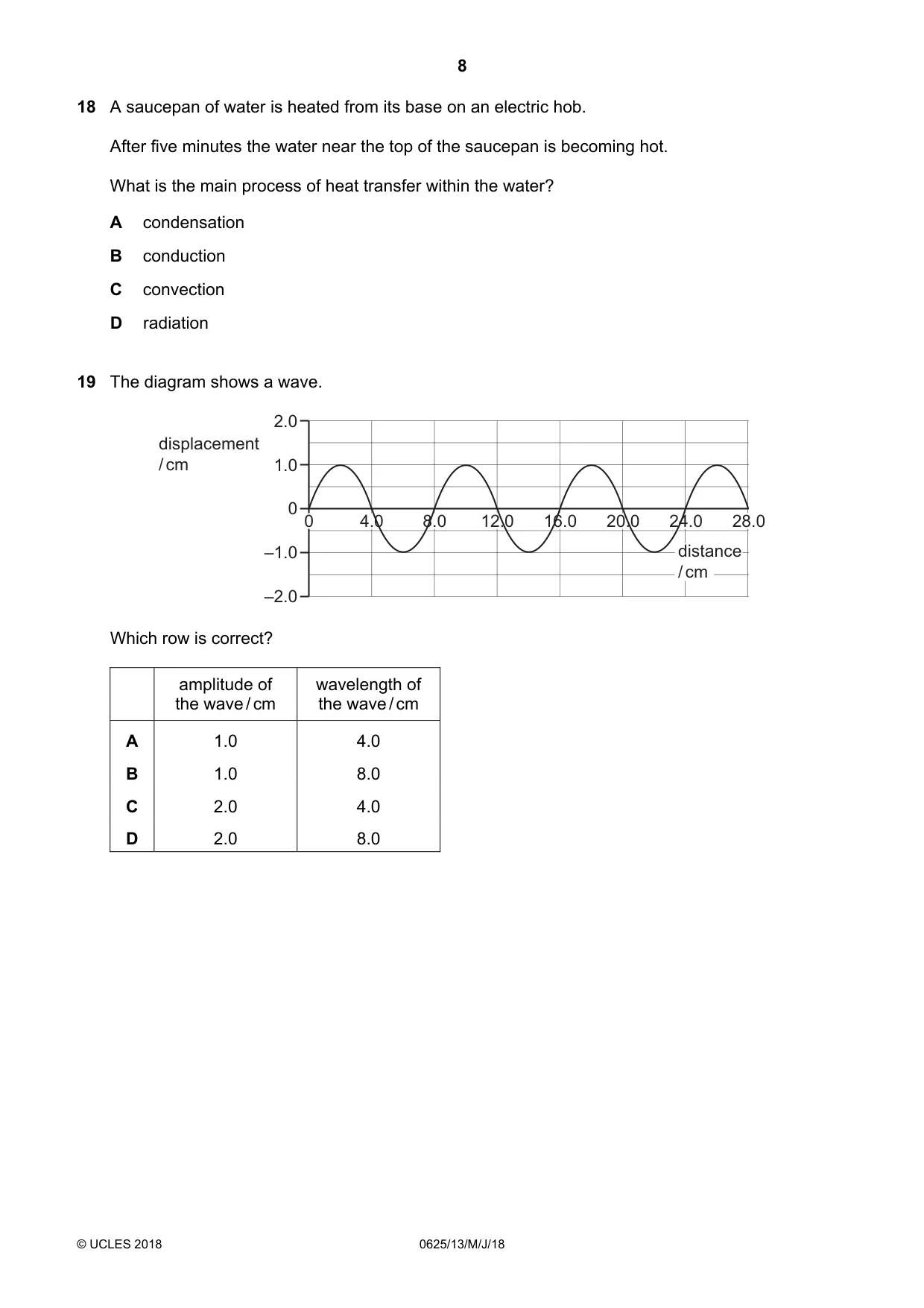
19 The diagram shows a wave. 2.0 displacement / cm 1.0 0 0 4.0 8.0 12.0 16.0 20.0 24.0 28.0 –1.0 distance / cm –2.0 Which row is correct? amplitude of wavelength of the wave / cm the wave / cm A 1.0 4.0 B 1.0 8.0 C 2.0 4.0 D 2.0 8.0
Mark scheme: B
Q20 · The diagram shows a ray of light passing from glass to air, at the critical angle
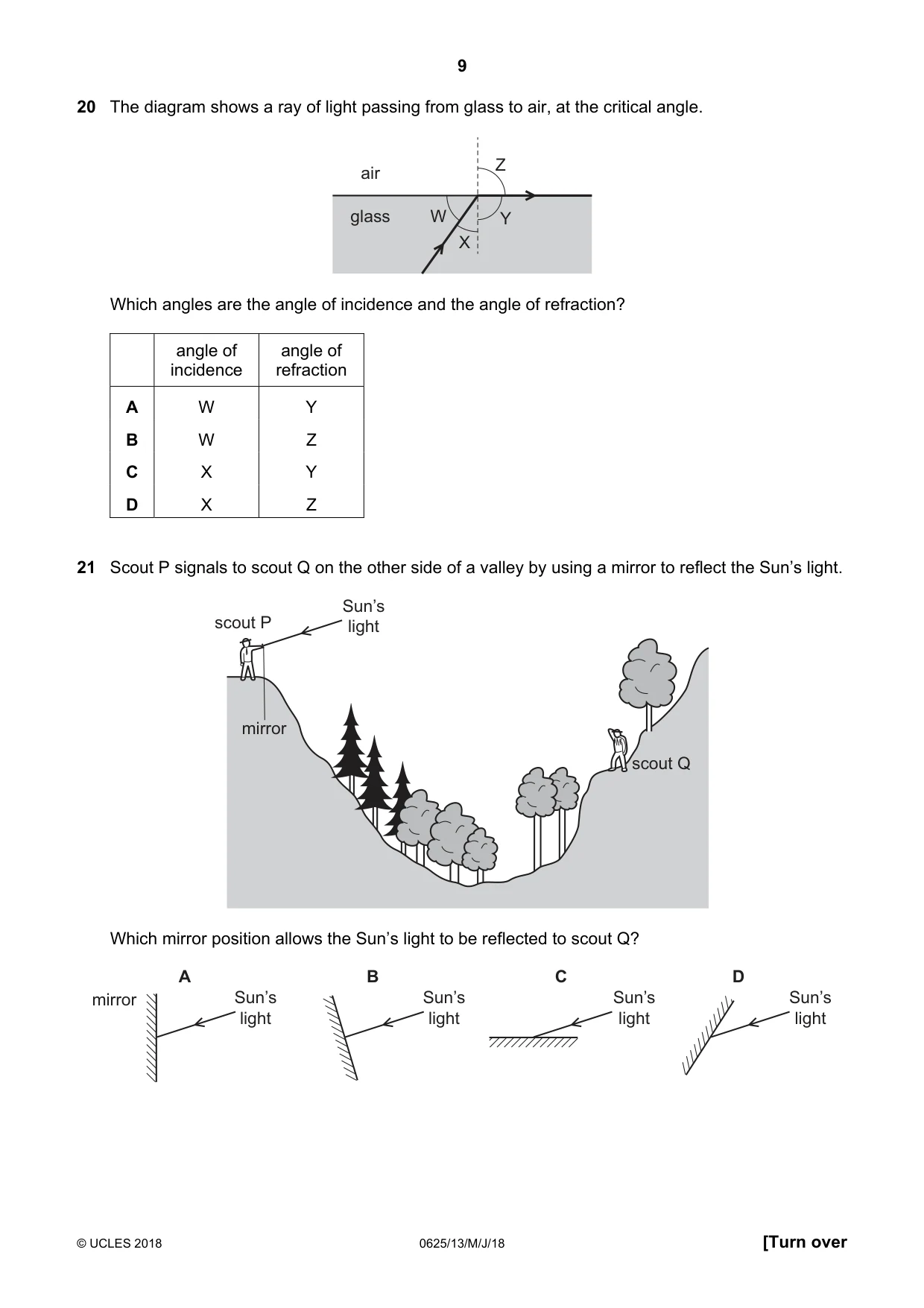
20 The diagram shows a ray of light passing from glass to air, at the critical angle. Z air glass W Y X Which angles are the angle of incidence and the angle of refraction? angle of angle of incidence refraction A W Y B W Z C X Y D X Z
Mark scheme: D
Q21 · Scout P signals to scout Q on the other side of a valley by using a mirror to reflect the…
21 Scout P signals to scout Q on the other side of a valley by using a mirror to reflect the Sun’s light. Sun’s scout P light mirror scout Q Which mirror position allows the Sun’s light to be reflected to scout Q? A B C D mirror Sun’s Sun’s Sun’s Sun’s light light light light
Mark scheme: A
Q22 · It takes 0.24 seconds for a microwave signal to travel from a transmitting station on…
22 It takes 0.24 seconds for a microwave signal to travel from a transmitting station on Earth to a satellite and then back to the station on Earth. Microwaves travel at 3.0 × 10⁸ m / s. How far is the transmitting station from the satellite? A 36 000 km B 72 000 km C 36 000 000 km D 72 000 000 km
Mark scheme: A
Q23 · The diagram shows the ranges of human hearing and of ultrasound waves
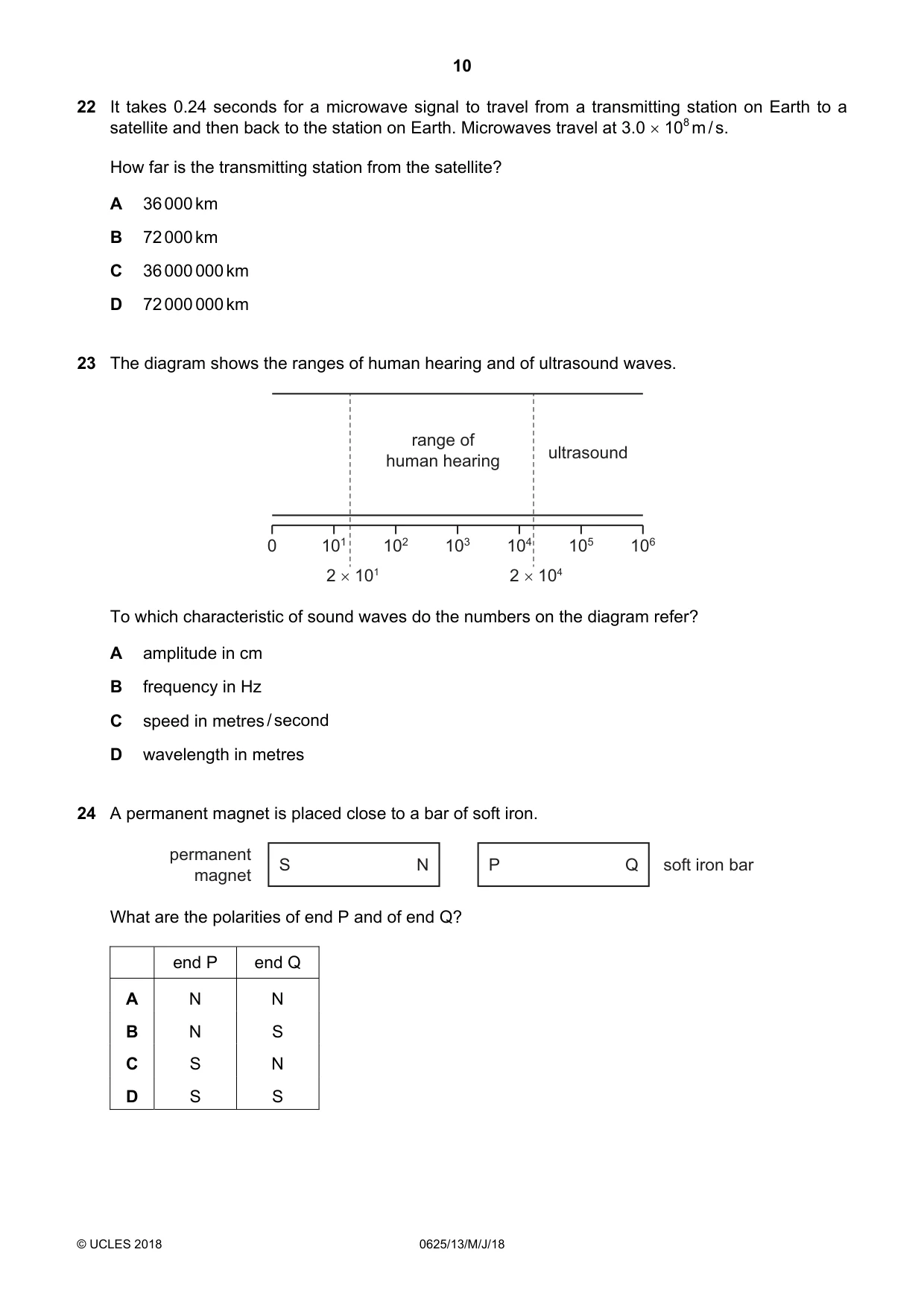
23 The diagram shows the ranges of human hearing and of ultrasound waves. range of ultrasound human hearing 0 101 102 103 104 105 106 2 × 101 2 × 10⁴ To which characteristic of sound waves do the numbers on the diagram refer? A amplitude in cm B frequency in Hz C speed in metres / second D wavelength in metres
Mark scheme: B
Q24 · A permanent magnet is placed close to a bar of soft iron
24 A permanent magnet is placed close to a bar of soft iron. permanent S N P Q soft iron bar magnet What are the polarities of end P and of end Q? end P end Q A N N B N S C S N D S S
Mark scheme: C
Q25 · The diagram shows a permanent bar magnet placed on a wooden table
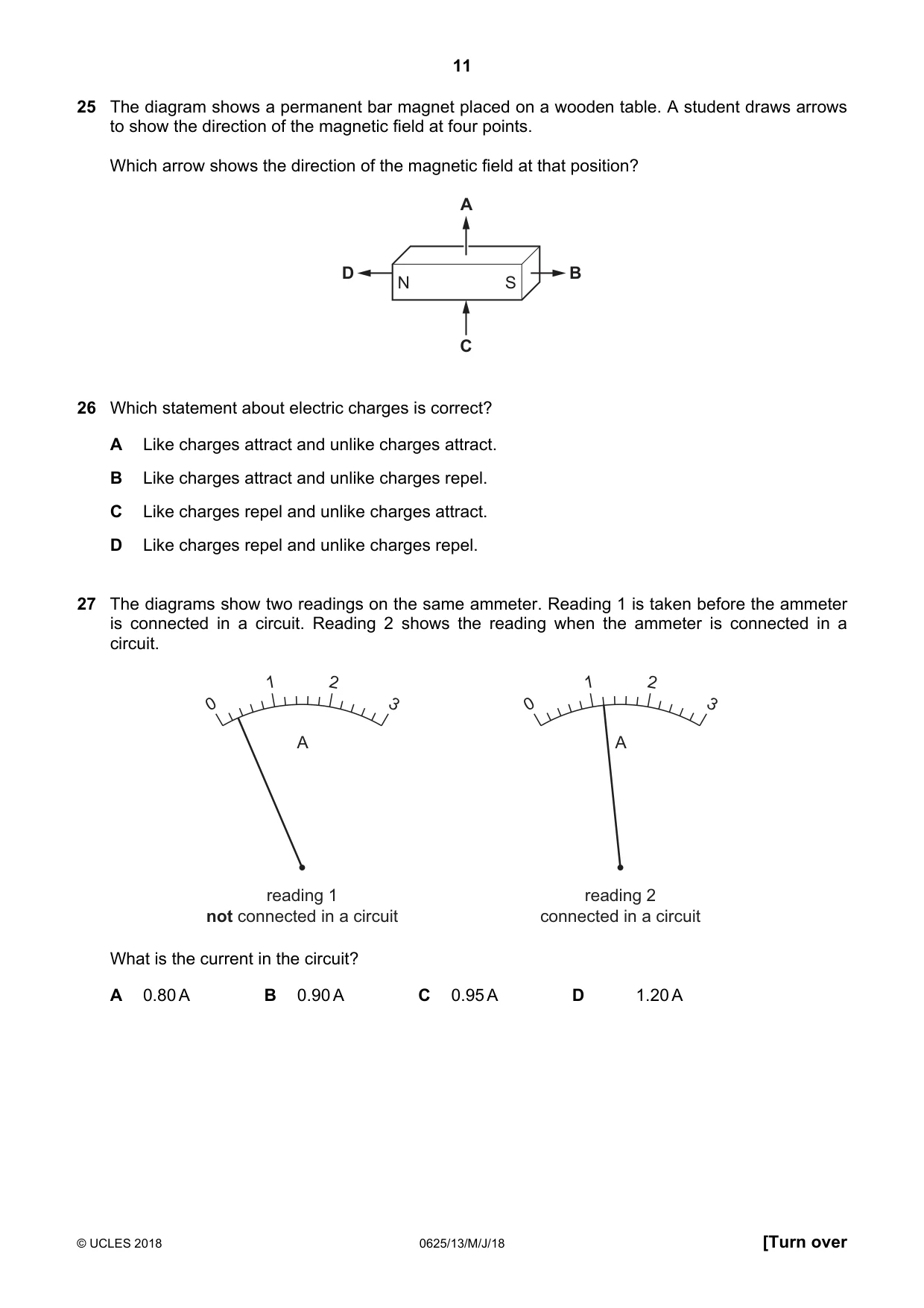
25 The diagram shows a permanent bar magnet placed on a wooden table. A student draws arrows to show the direction of the magnetic field at four points. Which arrow shows the direction of the magnetic field at that position? A D B N S C
Mark scheme: D
Q26 · Which statement about electric charges is correct?
26 Which statement about electric charges is correct? A Like charges attract and unlike charges attract. B Like charges attract and unlike charges repel. C Like charges repel and unlike charges attract. D Like charges repel and unlike charges repel.
Mark scheme: C
Q27 · The diagrams show two readings on the same ammeter
27 The diagrams show two readings on the same ammeter. Reading 1 is taken before the ammeter is connected in a circuit. Reading 2 shows the reading when the ammeter is connected in a circuit. 1 2 1 2 0 3 0 3 A A reading 1 reading 2 not connected in a circuit connected in a circuit What is the current in the circuit? A 0.80 A B 0.90 A C 0.95 A D 1.20 A
Mark scheme: B
Q28 · A student measures the potential difference across a device and the current in the device
28 A student measures the potential difference across a device and the current in the device. Which calculation gives the resistance of the device? A current + potential difference B current ÷ potential difference C potential difference ÷ current D potential difference × current
Mark scheme: C
Q29 · A battery in an electric circuit is connected to a lamp
29 A battery in an electric circuit is connected to a lamp. Chemical energy in the battery is transferred to which other types of energy? A internal energy only B kinetic energy and sound energy C light energy and thermal energy D light energy only
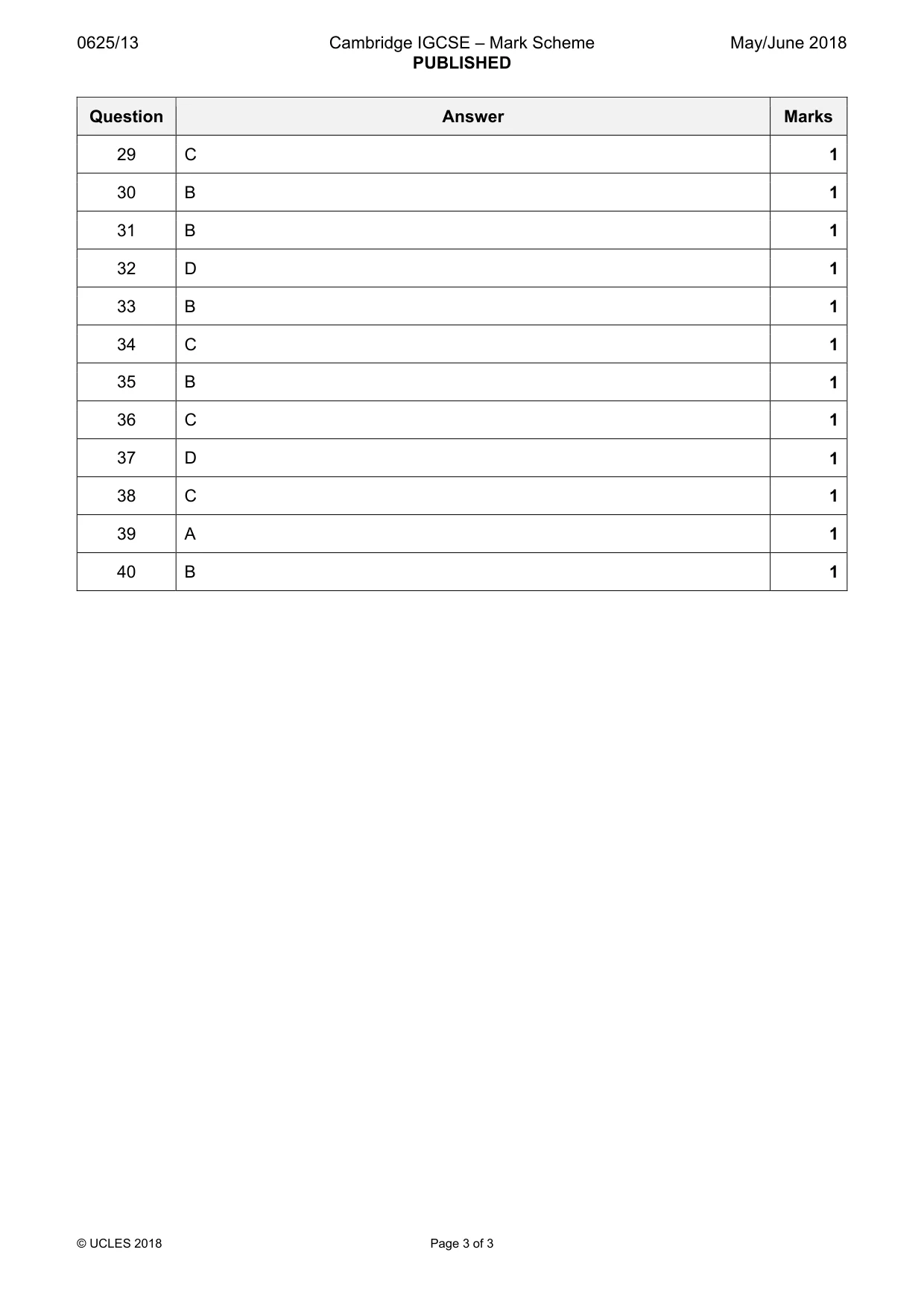
Mark scheme: C
Q30 · Which component is represented by the symbol shown?
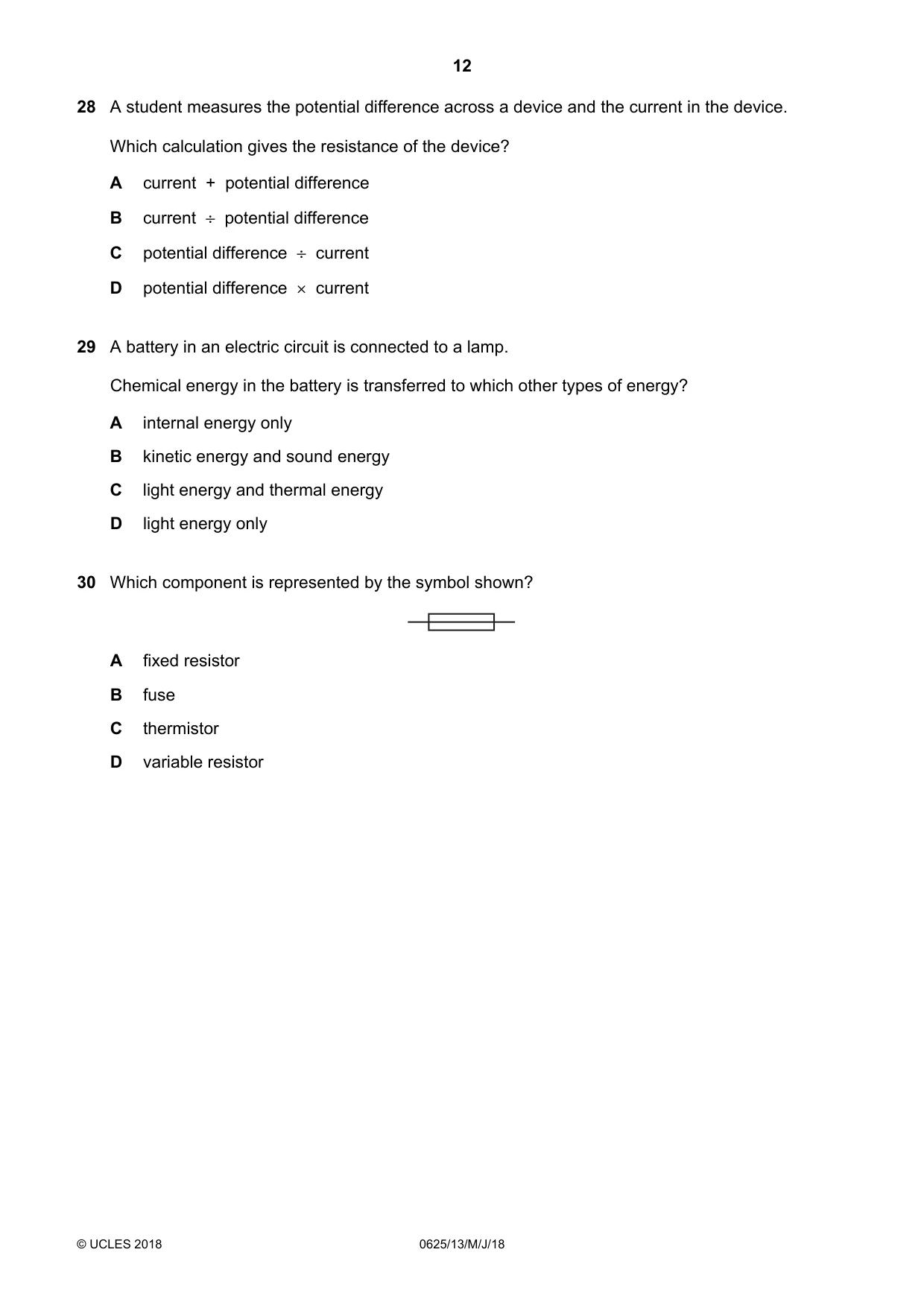
30 Which component is represented by the symbol shown? A fixed resistor B fuse C thermistor D variable resistor
Mark scheme: B
Q31 · A student sets up a circuit which she calls circuit 1
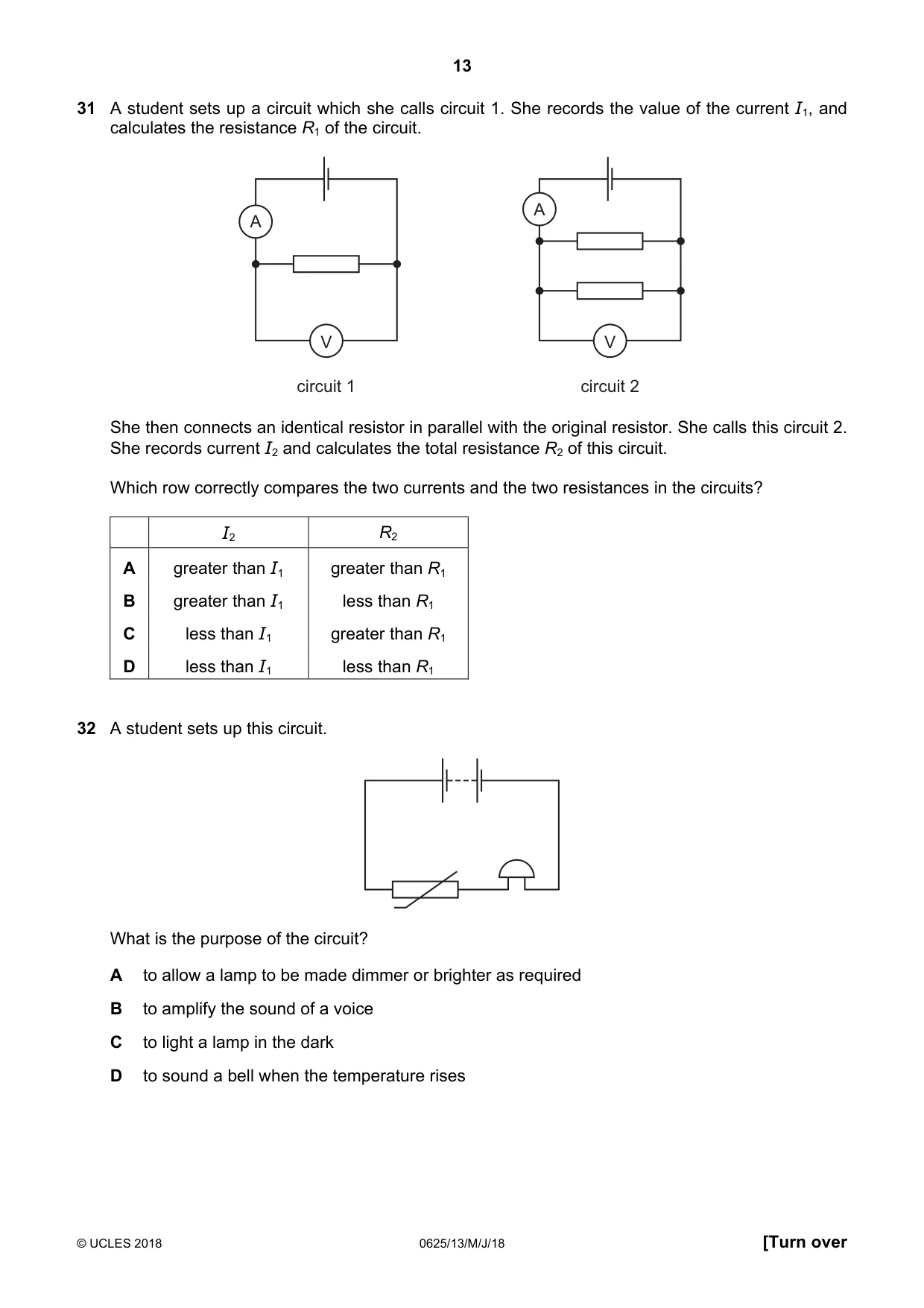
31 A student sets up a circuit which she calls circuit 1. She records the value of the current I1, and calculates the resistance R1 of the circuit. A A V V circuit 1 circuit 2 She then connects an identical resistor in parallel with the original resistor. She calls this circuit 2. She records current I2 and calculates the total resistance R2 of this circuit. Which row correctly compares the two currents and the two resistances in the circuits? I2 R2 A greater than I1 greater than R1 B greater than I1 less than R1 C less than I1 greater than R1 D less than I1 less than R1
Mark scheme: B
Q32 · A student sets up this circuit
32 A student sets up this circuit. What is the purpose of the circuit? A to allow a lamp to be made dimmer or brighter as required B to amplify the sound of a voice C to light a lamp in the dark D to sound a bell when the temperature rises
Mark scheme: D
Q33 · The diagram shows two voltmeters P and Q connected to a potential divider
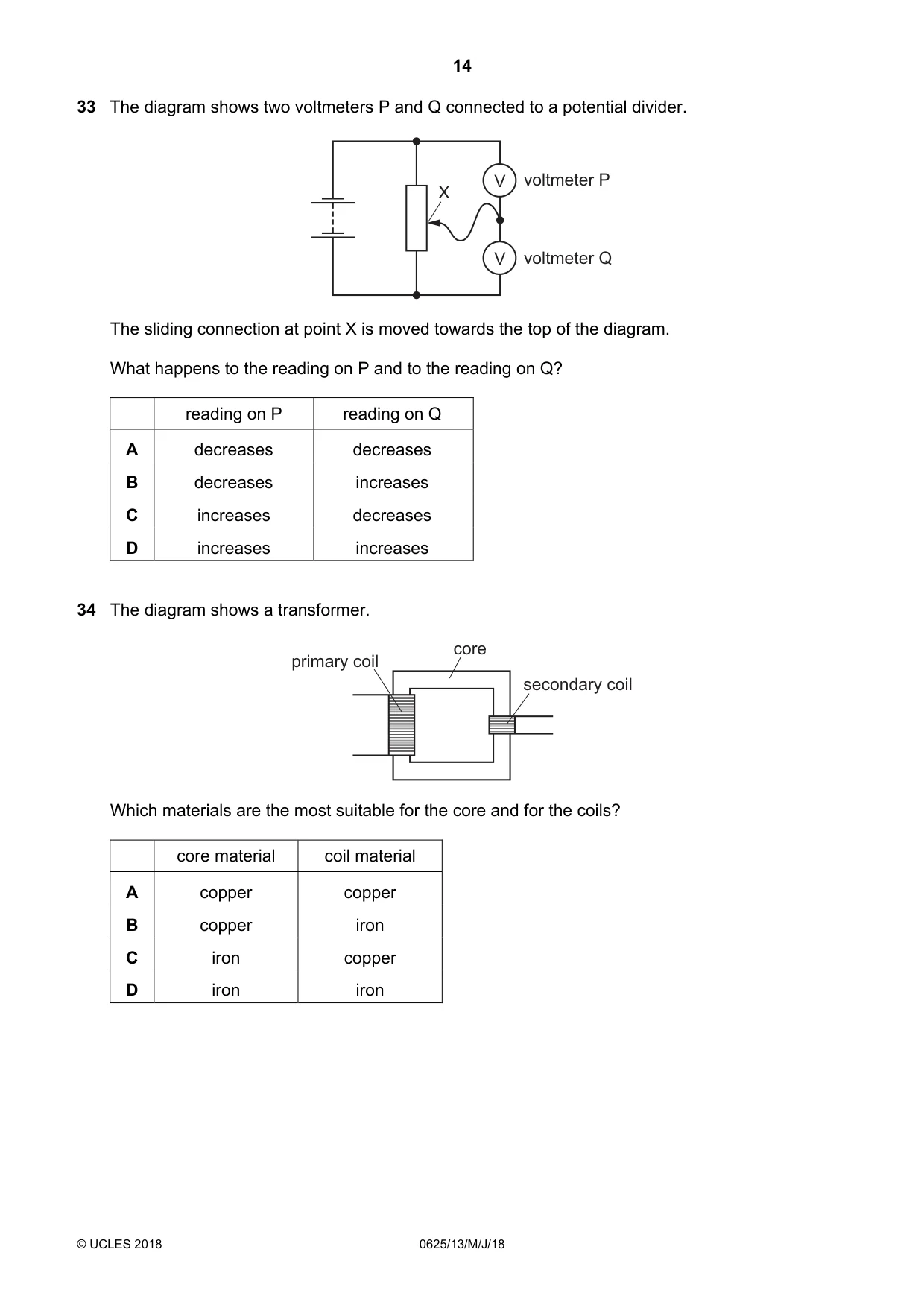
33 The diagram shows two voltmeters P and Q connected to a potential divider. V voltmeter P X V voltmeter Q The sliding connection at point X is moved towards the top of the diagram. What happens to the reading on P and to the reading on Q? reading on P reading on Q A decreases decreases B decreases increases C increases decreases D increases increases
Mark scheme: B
Q34 · The diagram shows a transformer
34 The diagram shows a transformer. core primary coil secondary coil Which materials are the most suitable for the core and for the coils? core material coil material A copper copper B copper iron C iron copper D iron iron
Mark scheme: C
Q35 · A current-carrying conductor placed in a magnetic field experiences a force
35 A current-carrying conductor placed in a magnetic field experiences a force. Which changes result in reversing the direction of the force? A Decrease the current, keeping the field direction constant. B Increase the current and reverse the field direction. C Increase the current, keeping the field direction constant. D Reverse the current and reverse the field direction.
Mark scheme: B
Q36 · A solenoid is connected to a battery
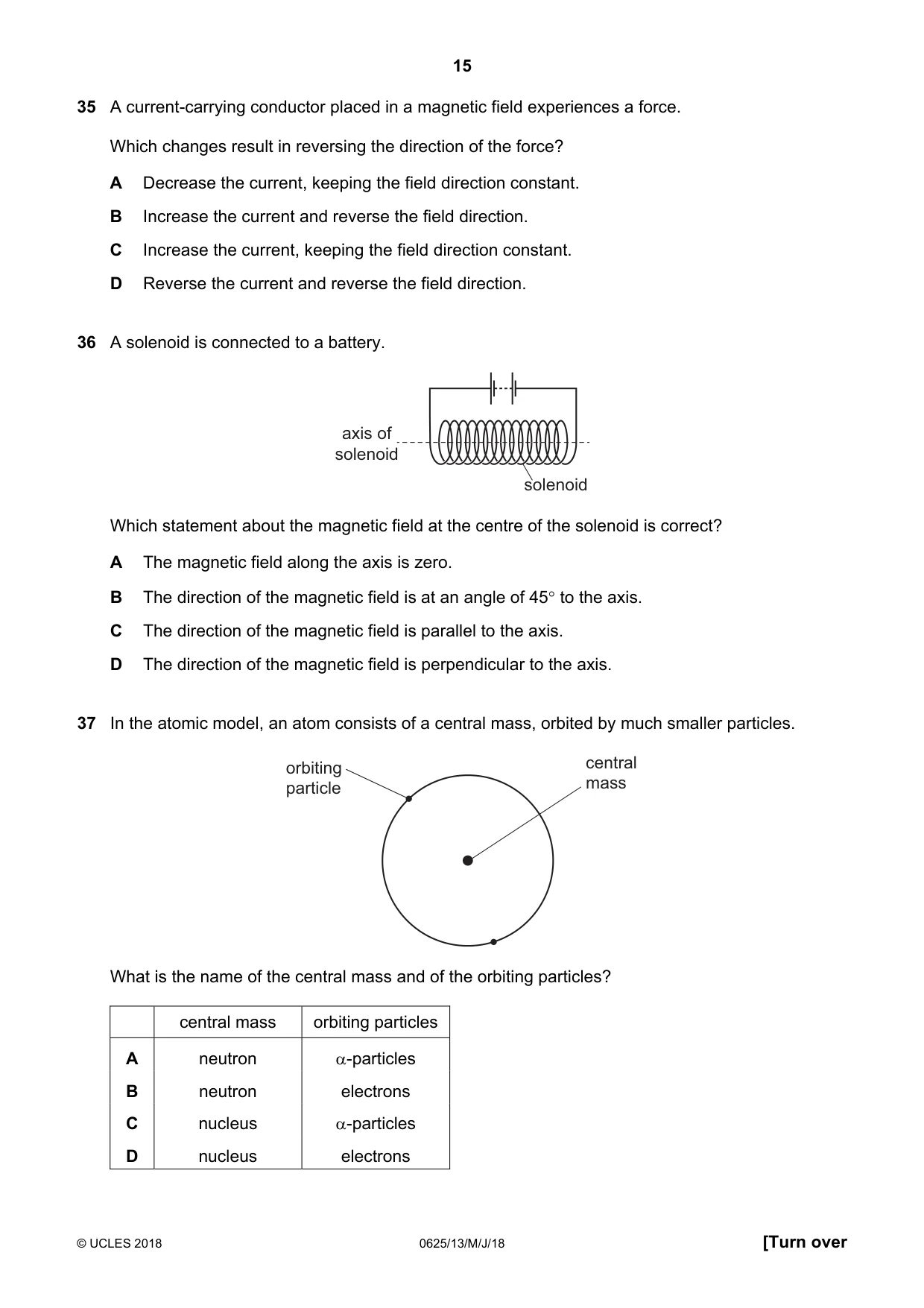
36 A solenoid is connected to a battery. axis of solenoid solenoid Which statement about the magnetic field at the centre of the solenoid is correct? A The magnetic field along the axis is zero. B The direction of the magnetic field is at an angle of 45° to the axis. C The direction of the magnetic field is parallel to the axis. D The direction of the magnetic field is perpendicular to the axis.
Mark scheme: C
Q37 · In the atomic model, an atom consists of a central mass, orbited by much smaller particles
37 In the atomic model, an atom consists of a central mass, orbited by much smaller particles. orbiting central particle mass What is the name of the central mass and of the orbiting particles? central mass orbiting particles A neutron α-particles B neutron electrons C nucleus α-particles D nucleus electrons
Mark scheme: D
Q38 · One isotope of lead is represented by the nuclide symbol 214 82Pb
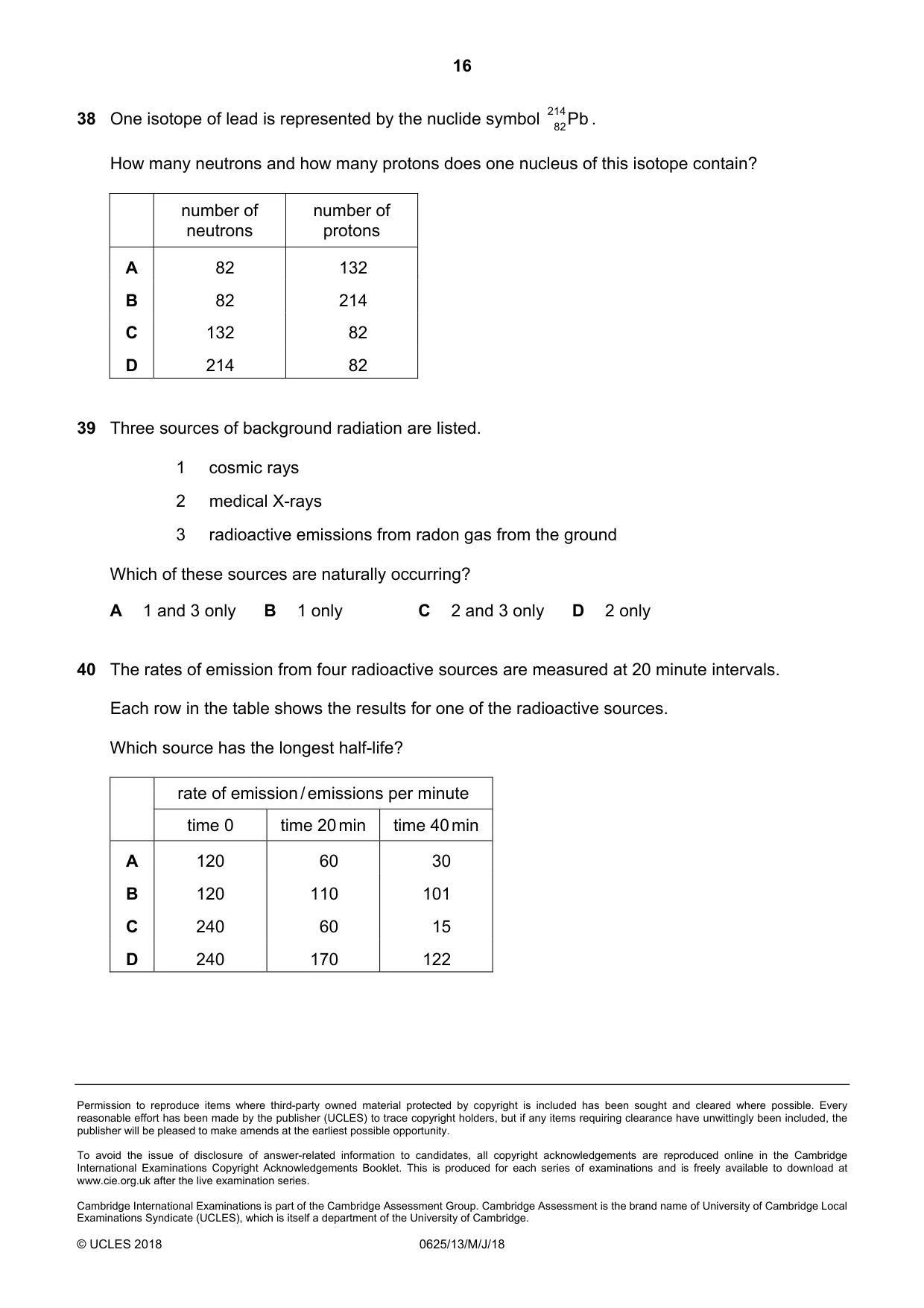
38 One isotope of lead is represented by the nuclide symbol 214 82Pb . How many neutrons and how many protons does one nucleus of this isotope contain? number of number of neutrons protons A 82 132 B 82 214 C 132 82 D 214 82
Mark scheme: C
Q39 · Three sources of background radiation are listed
39 Three sources of background radiation are listed. 1 cosmic rays 2 medical X-rays 3 radioactive emissions from radon gas from the ground Which of these sources are naturally occurring? A 1 and 3 only B 1 only C 2 and 3 only D 2 only
Mark scheme: A
Q40 · The rates of emission from four radioactive sources are measured at 20 minute intervals
40 The rates of emission from four radioactive sources are measured at 20 minute intervals. Each row in the table shows the results for one of the radioactive sources. Which source has the longest half-life? rate of emission / emissions per minute time 0 time 20 min time 40 min A 120 60 30 B 120 110 101 C 240 60 15 D 240 170 122
Mark scheme: B
What was in this paper
The subtopics covered by these 40 questions, and how many questions each got. Open one in a new tab to see every Cambridge question on it.
5Electrical quantities3Electromagnetic effects3Forces3Thermal properties and temperature3Energy, work and power2Kinetic particle model of matter2Light2Motion2Radioactivity2Simple phenomena of magnetism2The nuclear model of the atom2Transfer of thermal energy2Density1Electromagnetic spectrum1General properties of waves1Mass and weight1Physical quantities and measurement techniques1Pressure1Sound1What you needed in this session
Cambridge’s own grade thresholds for 2018 May/June, Paper 1 · Variant 3. A higher threshold means an easier paper — the bar moves with how the cohort did.