Questions as text
Q1 · In which pair are both materials magnetic? 0625/22 Feb/March 2016
26 In which pair are both materials magnetic? A aluminium and copper B copper and iron C iron and steel D steel and aluminium
1 marks
Answer: C
This question in 0625/22 Feb/March 2016
Q2 · Which methods could be used to demagnetise a magnet? 0625/22 Feb/March 2016
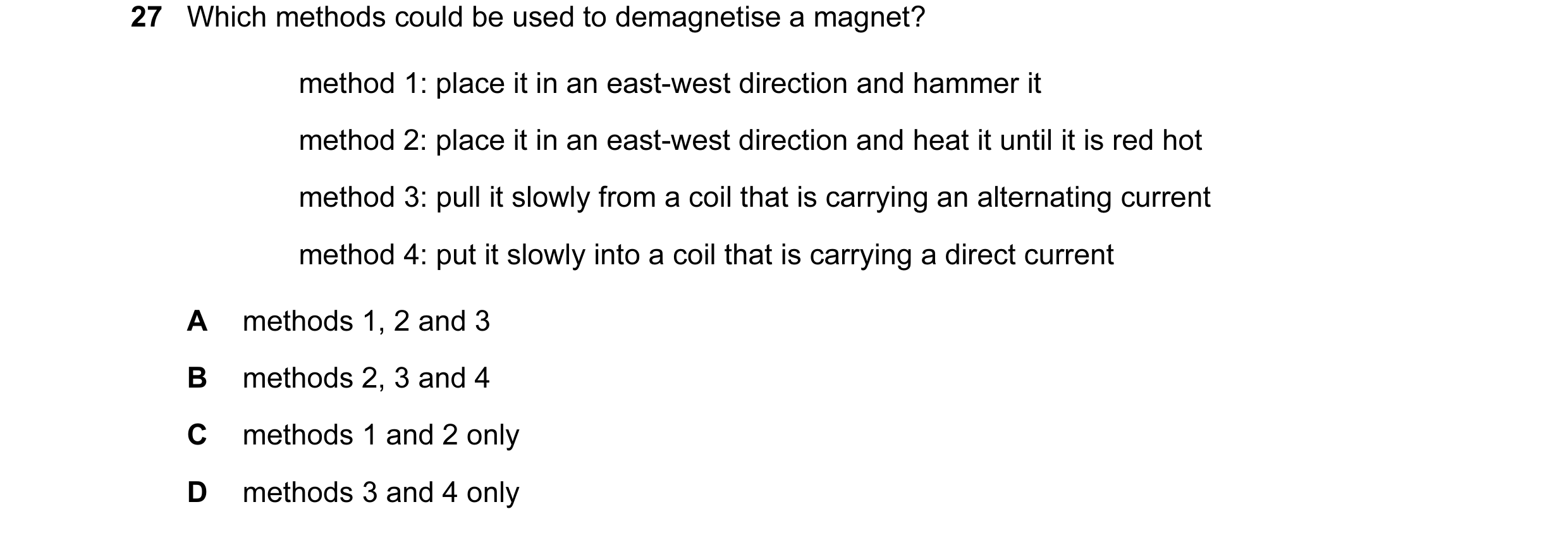
27 Which methods could be used to demagnetise a magnet? method 1: place it in an east-west direction and hammer it method 2: place it in an east-west direction and heat it until it is red hot method 3: pull it slowly from a coil that is carrying an alternating current method 4: put it slowly into a coil that is carrying a direct current A methods 1, 2 and 3 B methods 2, 3 and 4 C methods 1 and 2 only D methods 3 and 4 only
1 marks
Answer: A
This question in 0625/22 Feb/March 2016
Q3 · A strong electromagnet is used to attract pins 0625/21 May/June 2016
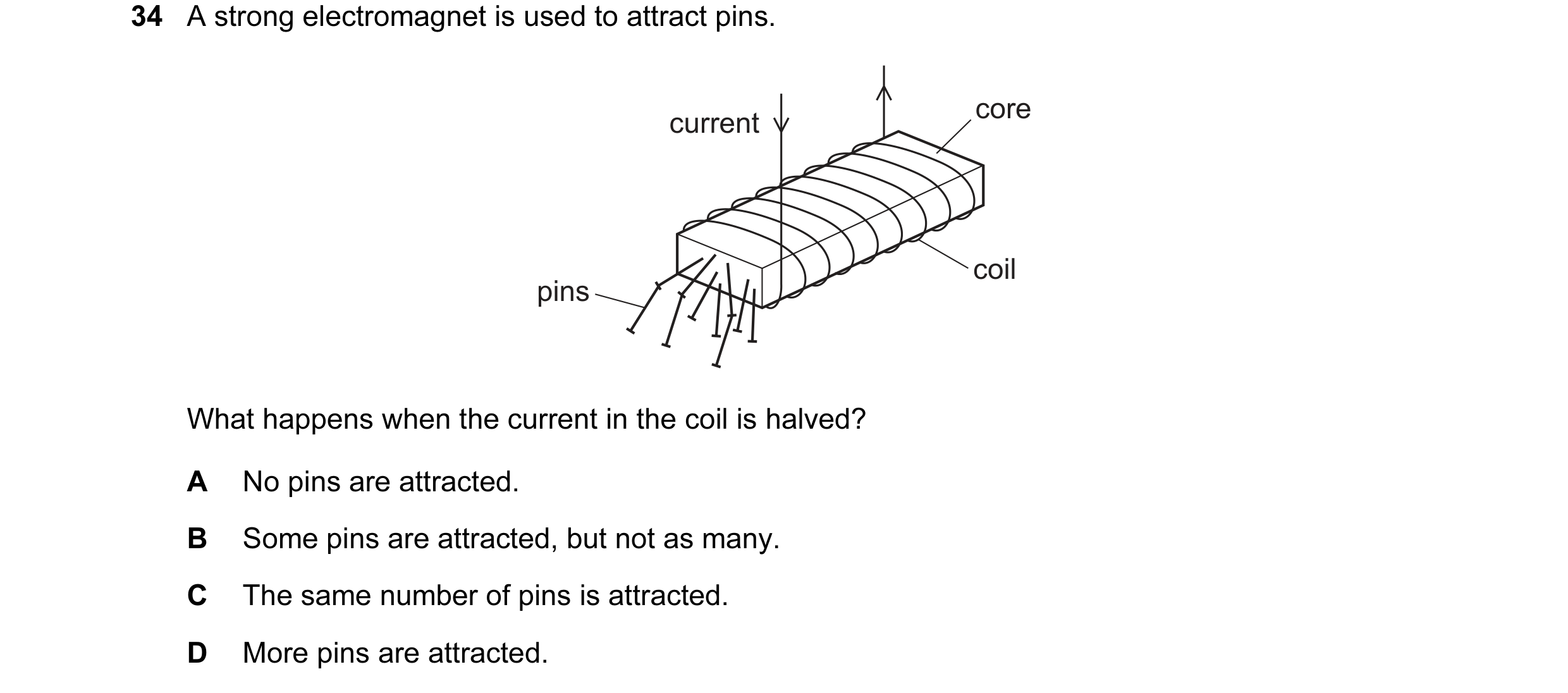
34 A strong electromagnet is used to attract pins. core current coil pins What happens when the current in the coil is halved? A No pins are attracted. B Some pins are attracted, but not as many. C The same number of pins is attracted. D More pins are attracted.
1 marks
Answer: B
This question in 0625/21 May/June 2016
Q4 · A strong electromagnet is used to attract pins 0625/22 May/June 2016
34 A strong electromagnet is used to attract pins. core current coil pins What happens when the current in the coil is halved? A No pins are attracted. B Some pins are attracted, but not as many. C The same number of pins is attracted. D More pins are attracted.
1 marks
Answer: B
This question in 0625/22 May/June 2016
Q5 · A strong electromagnet is used to attract pins 0625/23 May/June 2016
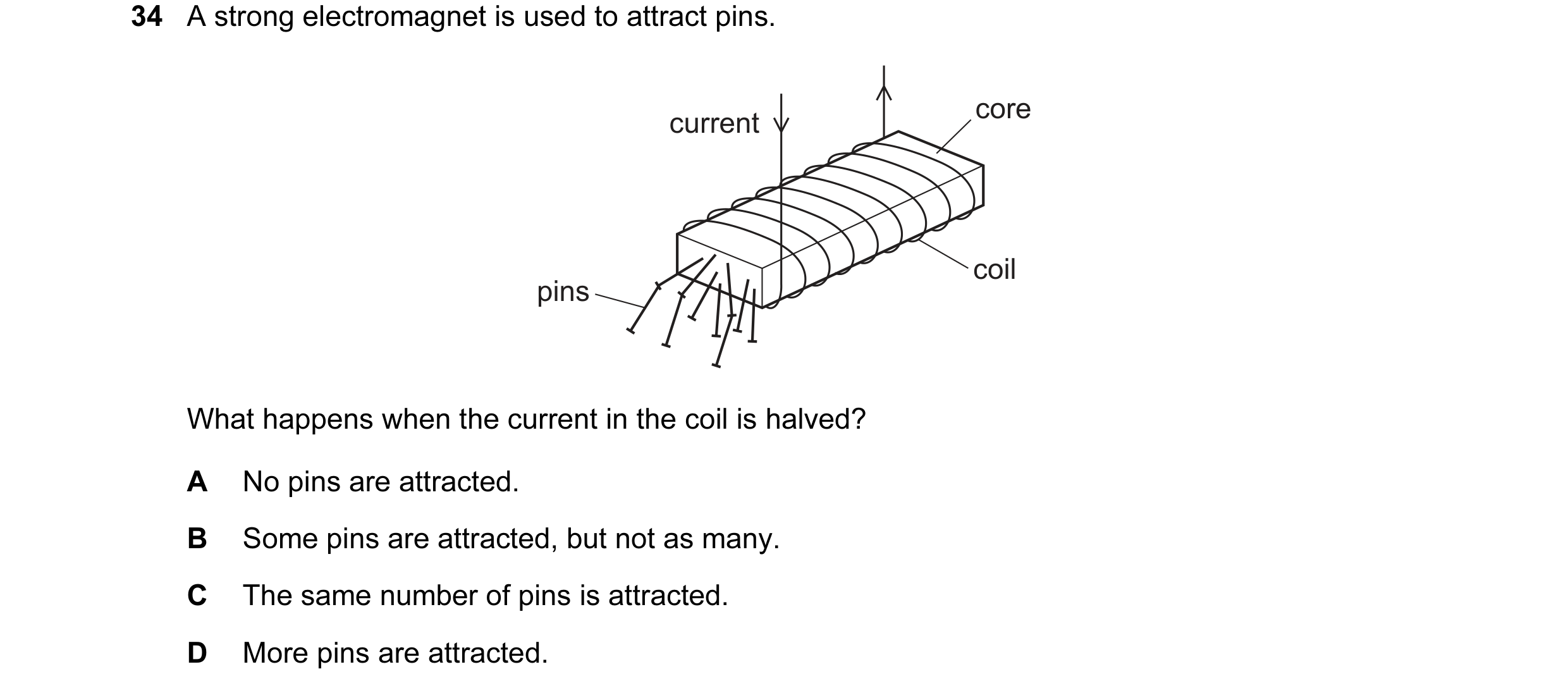
34 A strong electromagnet is used to attract pins. core current coil pins What happens when the current in the coil is halved? A No pins are attracted. B Some pins are attracted, but not as many. C The same number of pins is attracted. D More pins are attracted.
1 marks
Answer: B
This question in 0625/23 May/June 2016
Q6 · A student suggests three methods for demagnetising a piece of steel 0625/21 Oct/Nov 2016
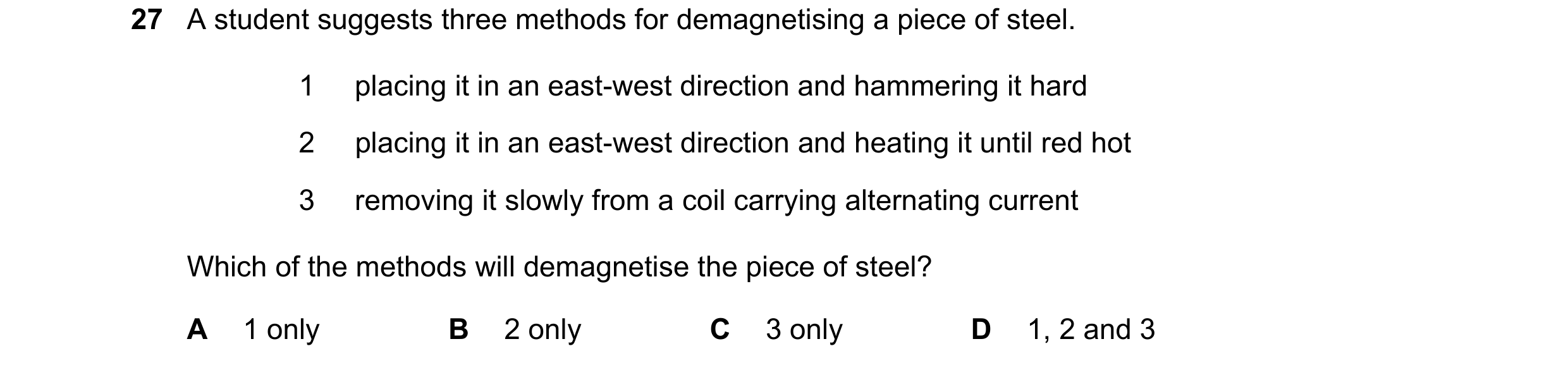
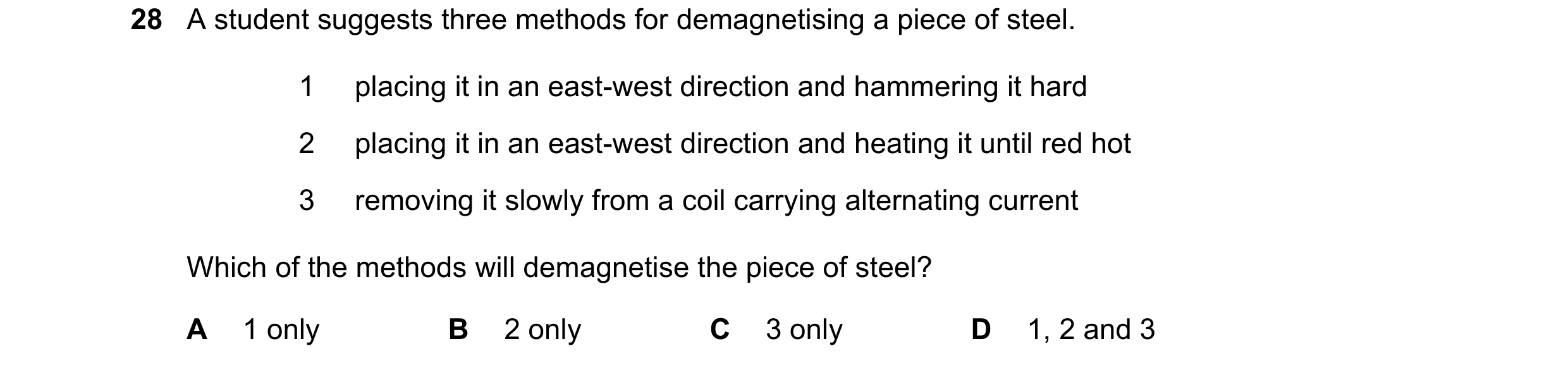
27 A student suggests three methods for demagnetising a piece of steel. 1 placing it in an east-west direction and hammering it hard 2 placing it in an east-west direction and heating it until red hot 3 removing it slowly from a coil carrying alternating current Which of the methods will demagnetise the piece of steel? A 1 only B 2 only C 3 only D 1, 2 and 3
1 marks
Answer: D
This question in 0625/21 Oct/Nov 2016
Q7 · In two separate experiments, a magnet is brought near to an unmagnetised iron bar 0625/21 Oct/Nov 2016
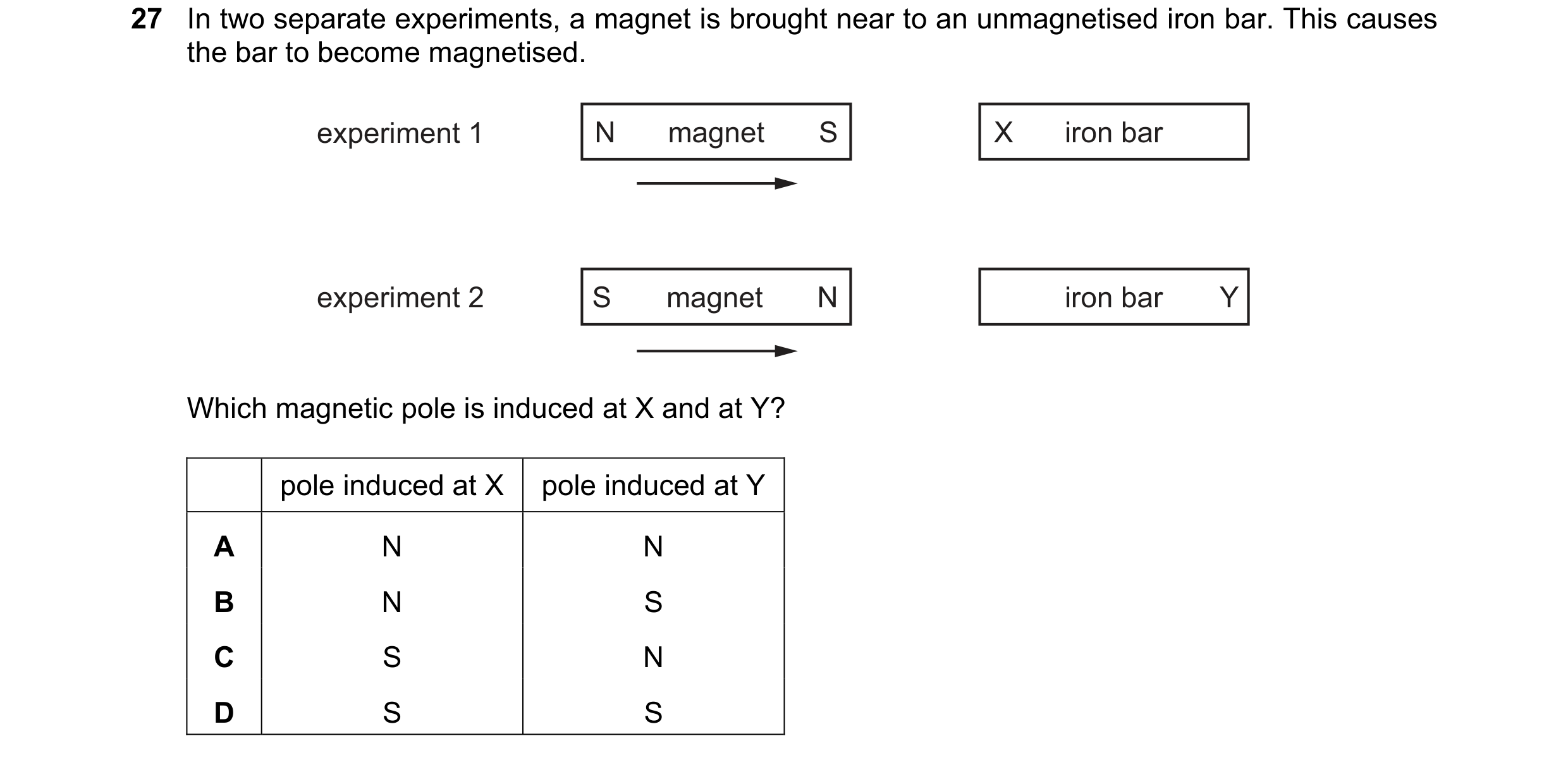
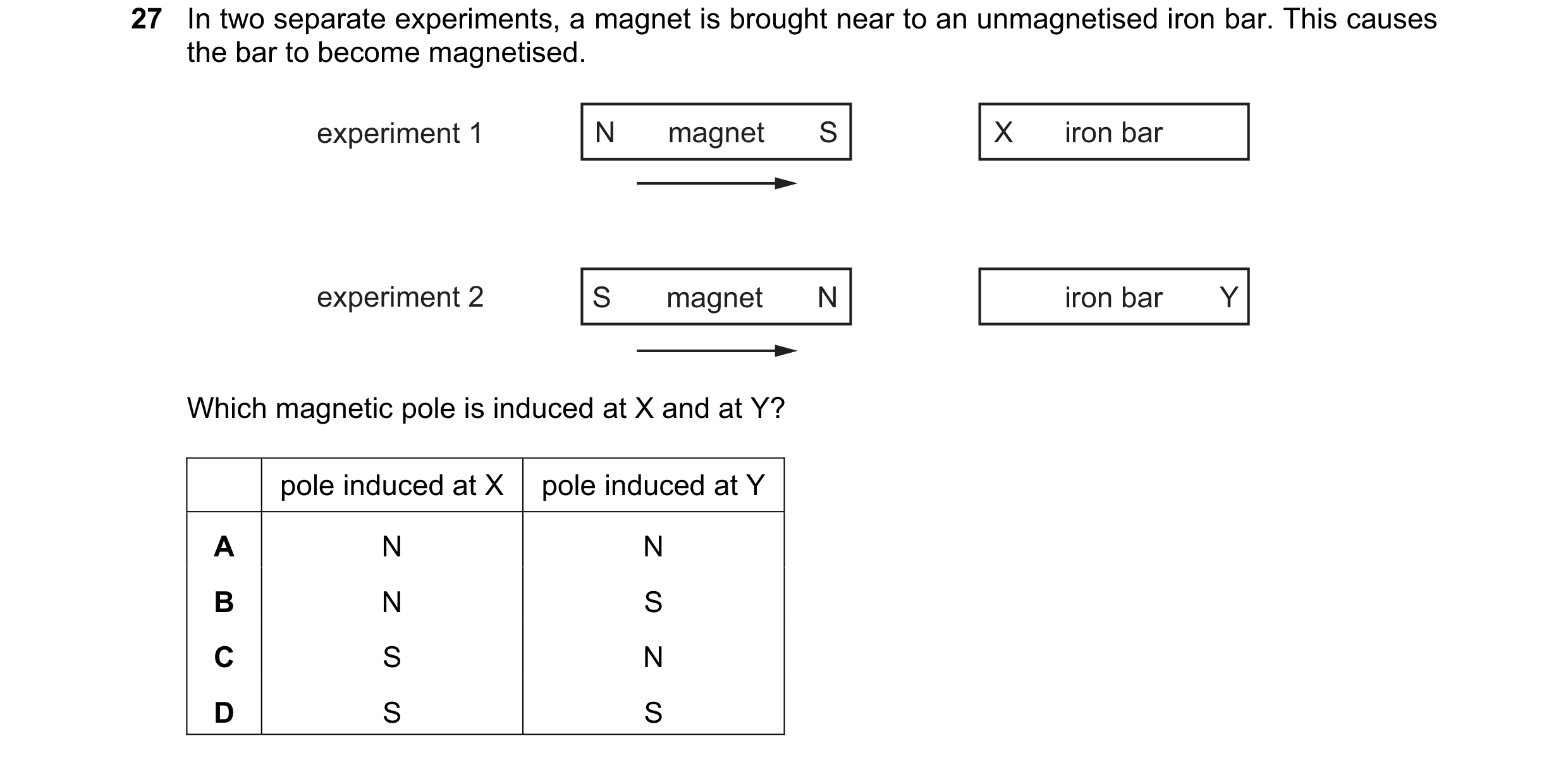
28 In two separate experiments, a magnet is brought near to an unmagnetised iron bar. This causes the bar to become magnetised. experiment 1 N magnet S X iron bar experiment 2 S magnet N iron bar Y Which magnetic pole is induced at X and at Y? pole induced at X pole induced at Y A N N B N S C S N D S S
1 marks
Answer: A
This question in 0625/21 Oct/Nov 2016
Q8 · In two separate experiments, a magnet is brought near to an unmagnetised iron bar 0625/22 Oct/Nov 2016
27 In two separate experiments, a magnet is brought near to an unmagnetised iron bar. This causes the bar to become magnetised. experiment 1 N magnet S X iron bar experiment 2 S magnet N iron bar Y Which magnetic pole is induced at X and at Y? pole induced at X pole induced at Y A N N B N S C S N D S S
1 marks
Answer: A
This question in 0625/22 Oct/Nov 2016
Q9 · A student suggests three methods for demagnetising a piece of steel 0625/22 Oct/Nov 2016
28 A student suggests three methods for demagnetising a piece of steel. 1 placing it in an east-west direction and hammering it hard 2 placing it in an east-west direction and heating it until red hot 3 removing it slowly from a coil carrying alternating current Which of the methods will demagnetise the piece of steel? A 1 only B 2 only C 3 only D 1, 2 and 3
1 marks
Answer: D
This question in 0625/22 Oct/Nov 2016
Q10 · A student suggests three methods for demagnetising a piece of steel 0625/23 Oct/Nov 2016
26 A student suggests three methods for demagnetising a piece of steel. 1 placing it in an east-west direction and hammering it hard 2 placing it in an east-west direction and heating it until red hot 3 removing it slowly from a coil carrying alternating current Which of the methods will demagnetise the piece of steel? A 1 only B 2 only C 3 only D 1, 2 and 3
1 marks
Answer: D
This question in 0625/23 Oct/Nov 2016
Q11 · In two separate experiments, a magnet is brought near to an unmagnetised iron bar 0625/23 Oct/Nov 2016
27 In two separate experiments, a magnet is brought near to an unmagnetised iron bar. This causes the bar to become magnetised. experiment 1 N magnet S X iron bar experiment 2 S magnet N iron bar Y Which magnetic pole is induced at X and at Y? pole induced at X pole induced at Y A N N B N S C S N D S S
1 marks
Answer: A
This question in 0625/23 Oct/Nov 2016
Q12 · A small compass is placed close to a strong bar magnet, the same distance from each end 0625/22 Feb/March 2017
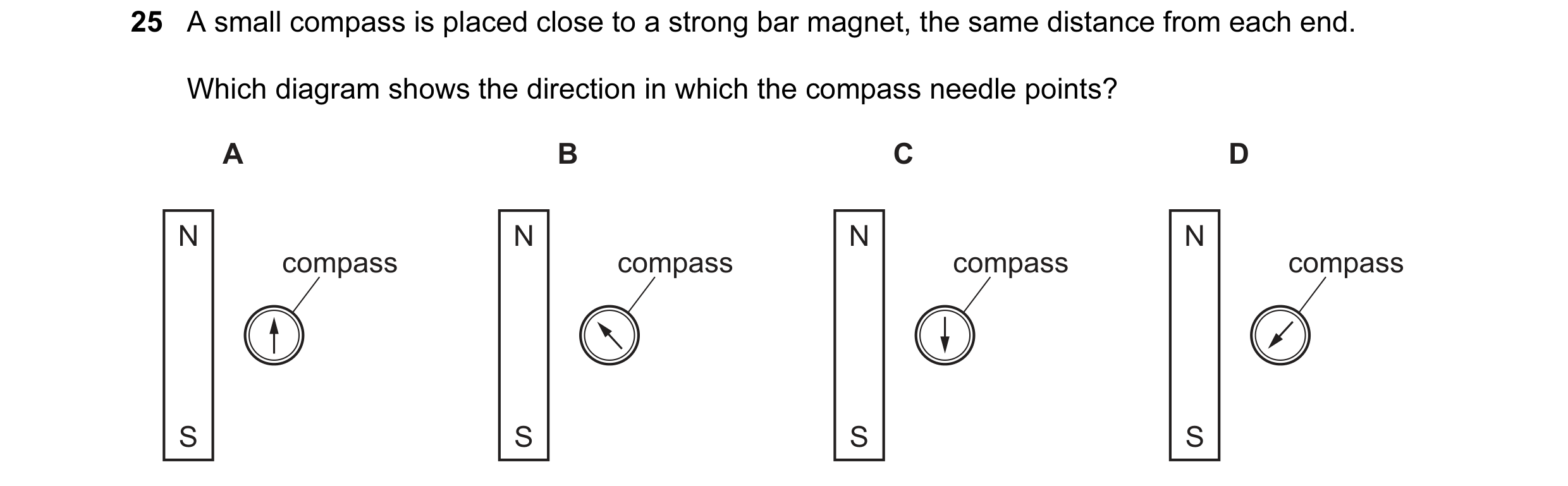
25 A small compass is placed close to a strong bar magnet, the same distance from each end. Which diagram shows the direction in which the compass needle points? A B C D N N N N compass compass compass compass S S S S
1 marks
Answer: C
This question in 0625/22 Feb/March 2017
Q13 · A bar magnet can be demagnetised by hammering it for a long time or by slowly removing it… 0625/22 Feb/March 2017
26 A bar magnet can be demagnetised by hammering it for a long time or by slowly removing it from a coil connected to a power supply. Which row completes the descriptions of how these processes are carried out? hammering bar magnet slowly removing bar magnet for a long time with from a coil connected to A magnet aligned E-W a d.c. power supply B magnet aligned E-W an a.c. power supply C magnet aligned N-S a d.c. power supply D magnet aligned N-S an a.c. power supply
1 marks
Answer: B
This question in 0625/22 Feb/March 2017
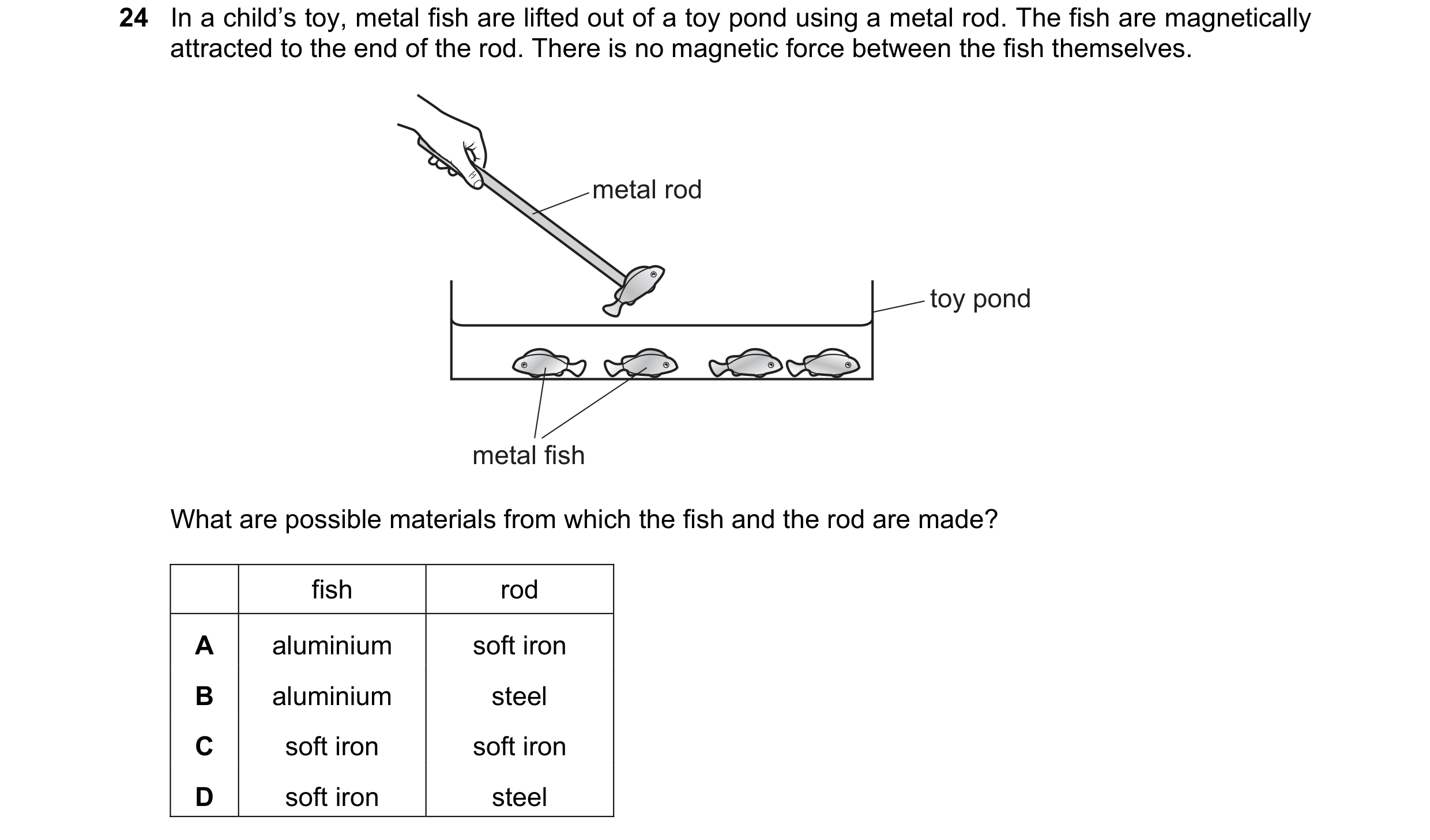
Q14 · In a child’s toy, metal fish are lifted out of a toy pond using a metal rod 0625/21 May/June 2017
24 In a child’s toy, metal fish are lifted out of a toy pond using a metal rod. The fish are magnetically attracted to the end of the rod. There is no magnetic force between the fish themselves. metal rod toy pond metal fish What are possible materials from which the fish and the rod are made? fish rod A aluminium soft iron B aluminium steel C soft iron soft iron D soft iron steel
1 marks
Answer: D
This question in 0625/21 May/June 2017
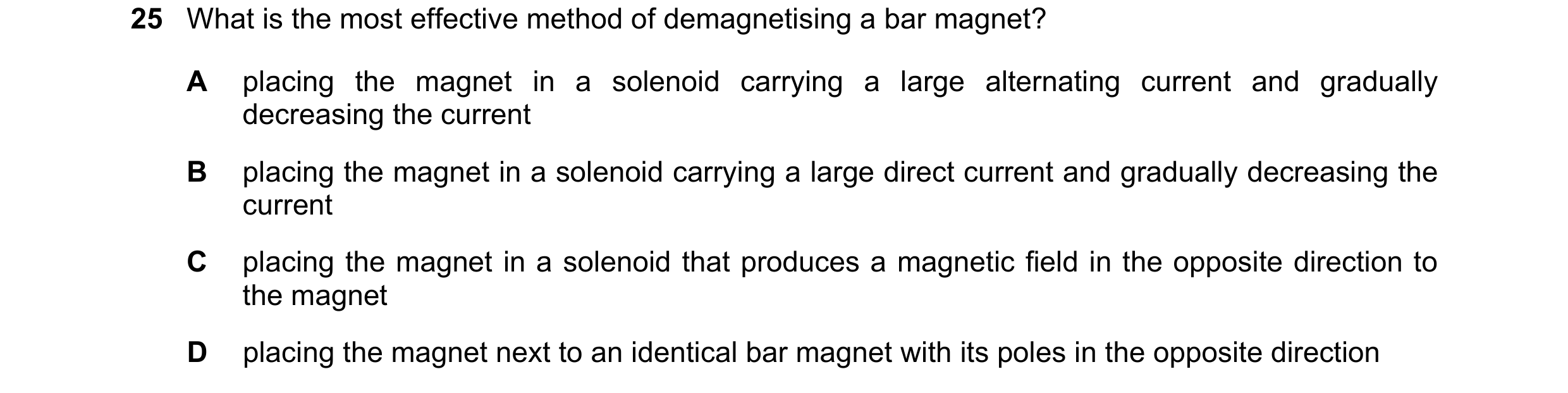
Q15 · What is the most effective method of demagnetising a bar magnet? 0625/21 May/June 2017
25 What is the most effective method of demagnetising a bar magnet? A placing the magnet in a solenoid carrying a large alternating current and gradually decreasing the current B placing the magnet in a solenoid carrying a large direct current and gradually decreasing the current C placing the magnet in a solenoid that produces a magnetic field in the opposite direction to the magnet D placing the magnet next to an identical bar magnet with its poles in the opposite direction
1 marks
Answer: A
This question in 0625/21 May/June 2017
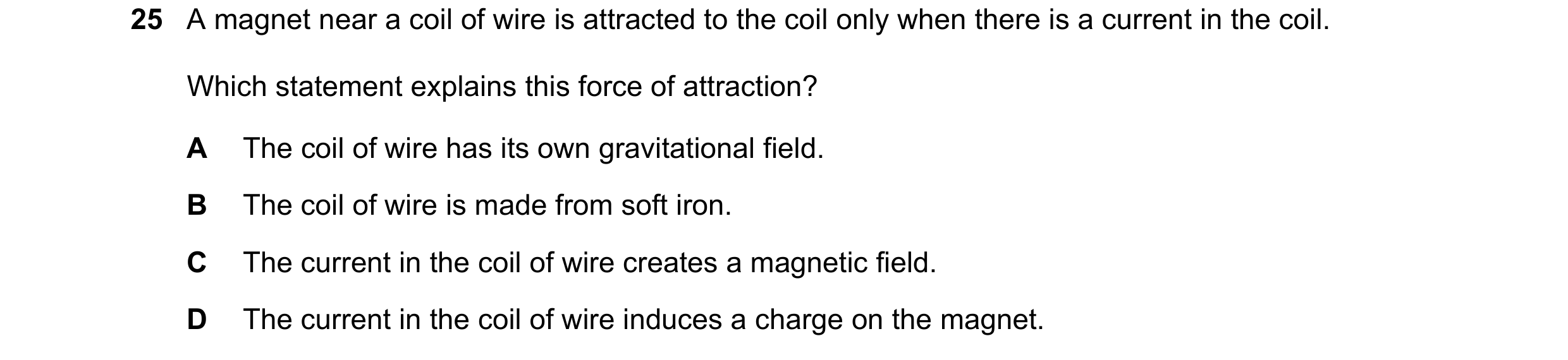
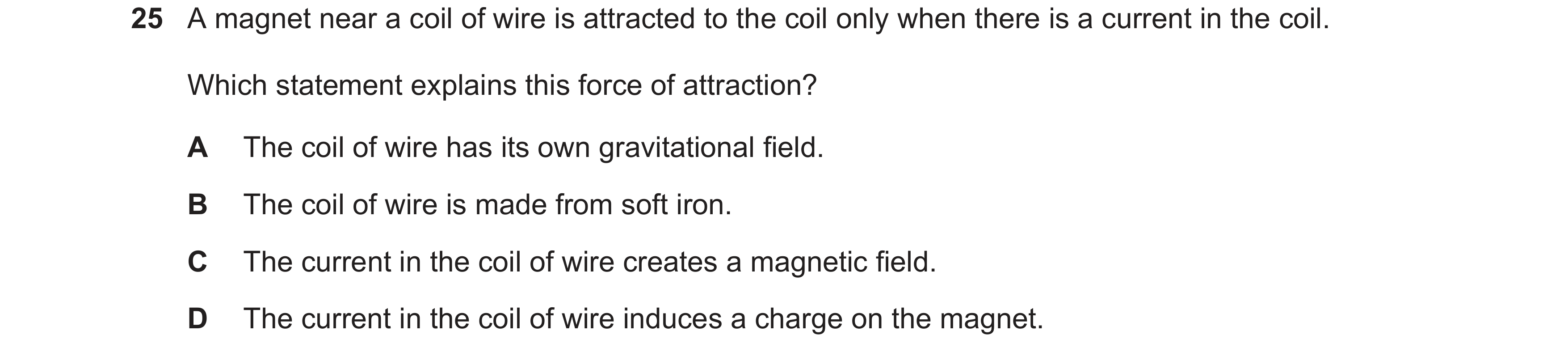
Q16 · A magnet near a coil of wire is attracted to the coil only when there is a current in the… 0625/21 May/June 2017
26 A magnet near a coil of wire is attracted to the coil only when there is a current in the coil. Which statement explains this force of attraction? A The coil of wire has its own gravitational field. B The coil of wire is made from soft iron. C The current in the coil of wire creates a magnetic field. D The current in the coil of wire induces a charge on the magnet.
1 marks
Answer: C
This question in 0625/21 May/June 2017
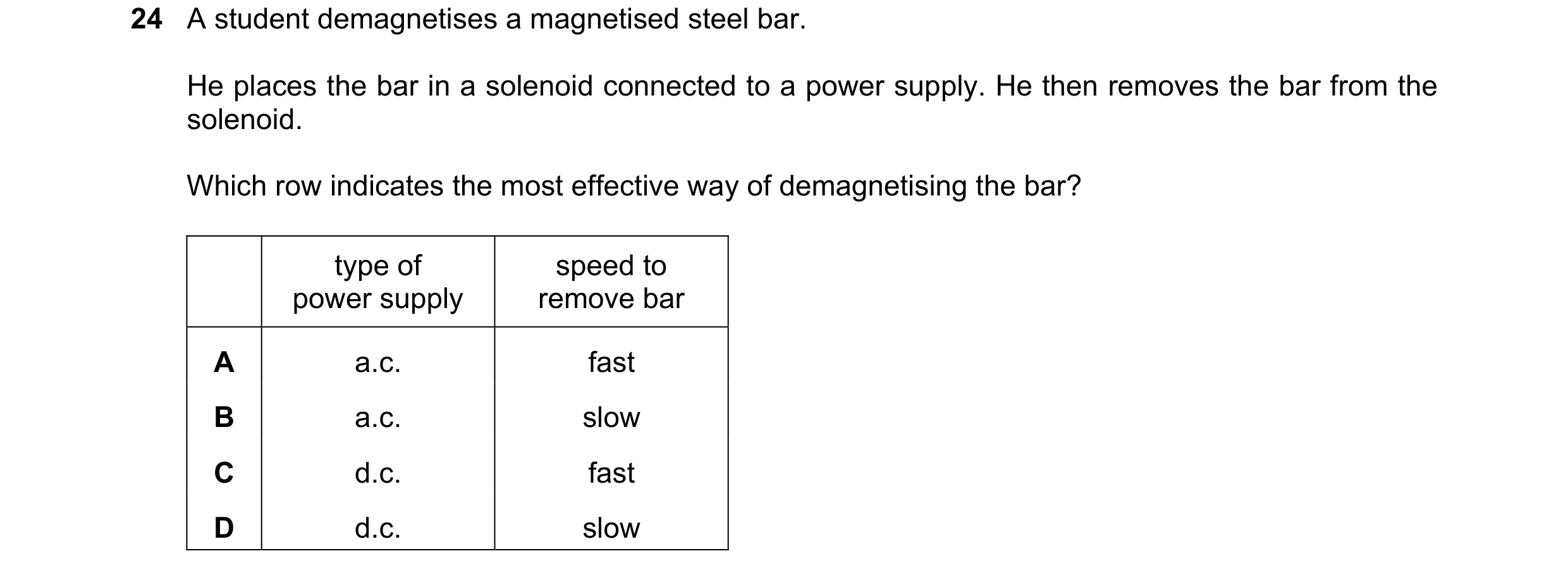
Q17 · A student demagnetises a magnetised steel bar 0625/22 May/June 2017
24 A student demagnetises a magnetised steel bar. He places the bar in a solenoid connected to a power supply. He then removes the bar from the solenoid. Which row indicates the most effective way of demagnetising the bar? type of speed to power supply remove bar A a.c. fast B a.c. slow C d.c. fast D d.c. slow
1 marks
Answer: B
This question in 0625/22 May/June 2017
Q18 · A magnet near a coil of wire is attracted to the coil only when there is a current in the… 0625/22 May/June 2017
25 A magnet near a coil of wire is attracted to the coil only when there is a current in the coil. Which statement explains this force of attraction? A The coil of wire has its own gravitational field. B The coil of wire is made from soft iron. C The current in the coil of wire creates a magnetic field. D The current in the coil of wire induces a charge on the magnet.
1 marks
Answer: C
This question in 0625/22 May/June 2017
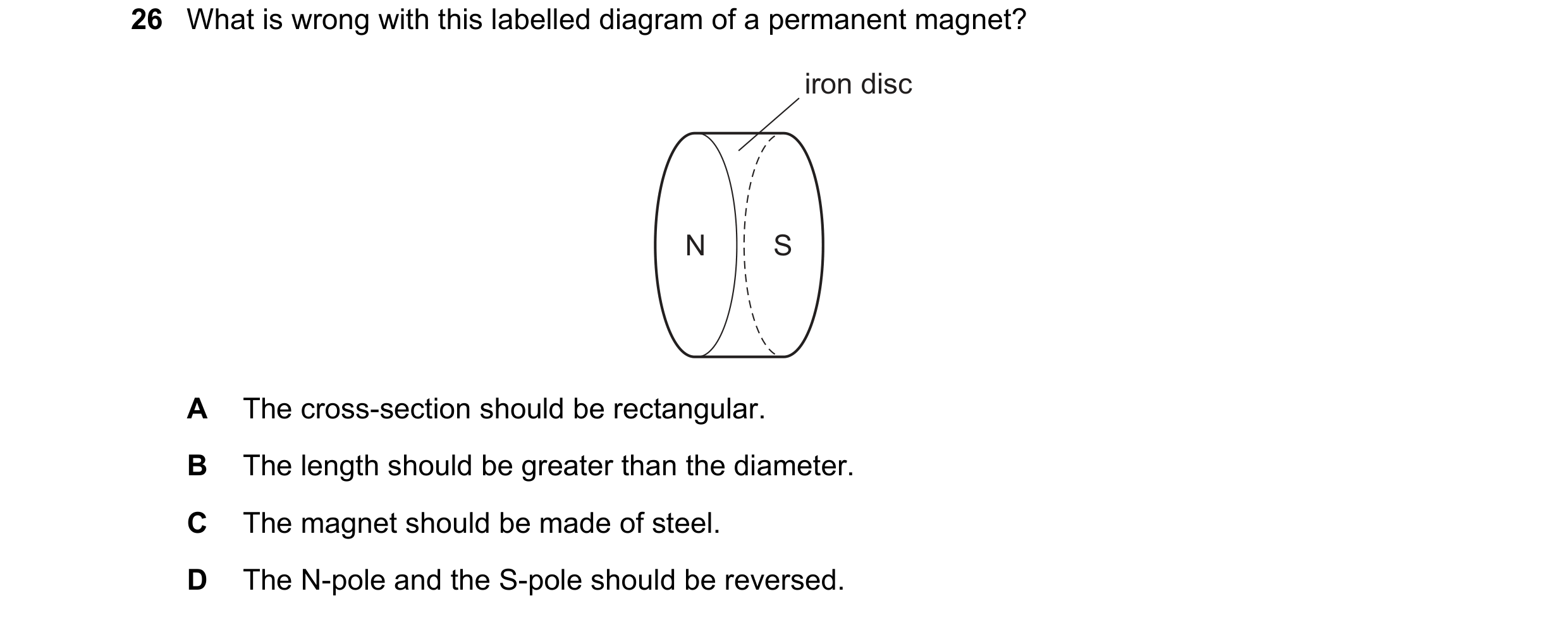
Q19 · What is wrong with this labelled diagram of a permanent magnet? 0625/22 May/June 2017
26 What is wrong with this labelled diagram of a permanent magnet? iron disc N S A The cross-section should be rectangular. B The length should be greater than the diameter. C The magnet should be made of steel. D The N-pole and the S-pole should be reversed.
1 marks
Answer: C
This question in 0625/22 May/June 2017
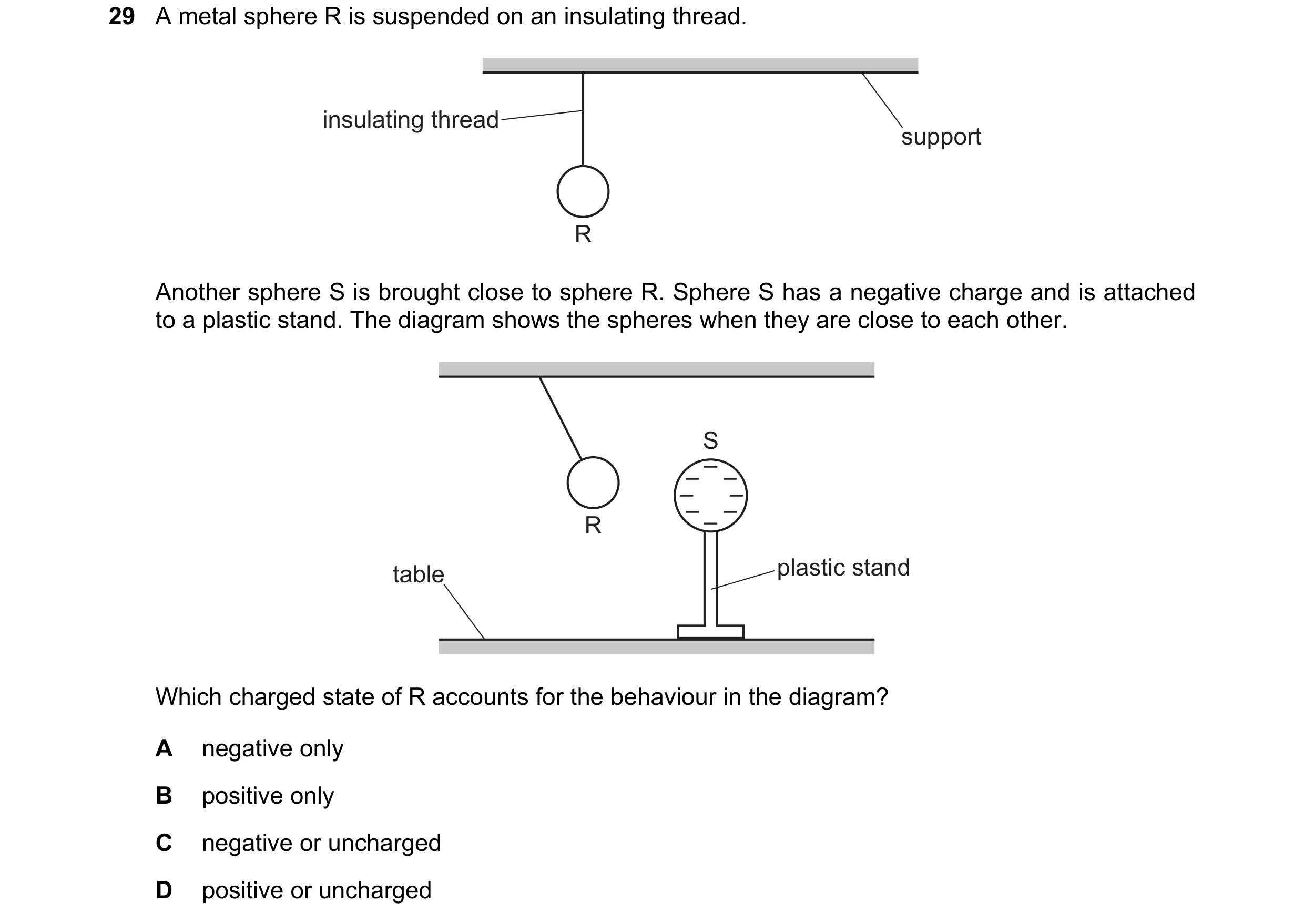
Q20 · An isolated metal sphere is positively charged 0625/22 May/June 2017
29 An isolated metal sphere is positively charged. It is then brought near to another isolated metal sphere that is neutral. + + + + + + + + + + positively charged + + neutral metal sphere metal sphere What happens to the charges on the neutral sphere as the positively charged sphere is brought close to it? A Some positive charges move to the left and some negative charges move to the right. B Some positive charges move to the right and some negative charges move to the left. C Some positive charges move to the right, but the negative charges do not move. D The positive charges do not move, but some negative charges move to the left.
1 marks
Answer: D
This question in 0625/22 May/June 2017
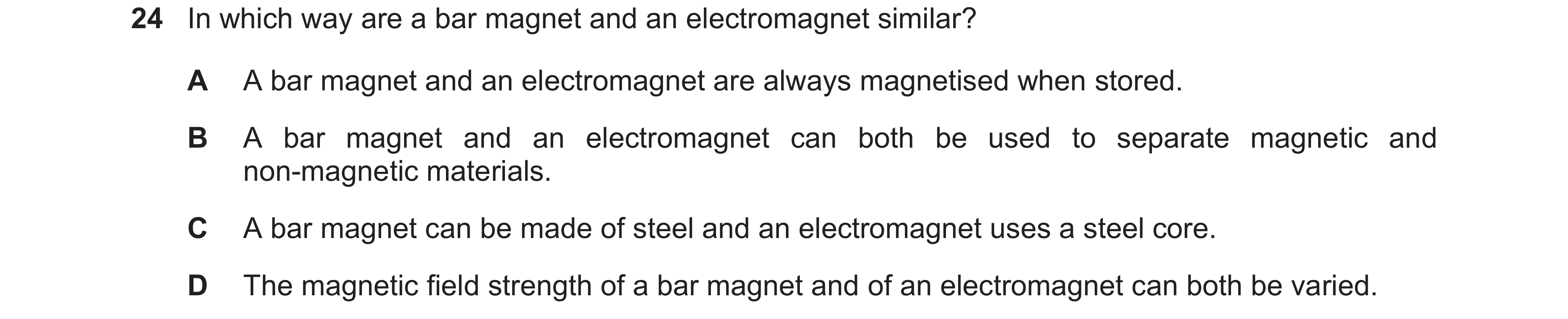
Q21 · In which way are a bar magnet and an electromagnet similar? 0625/23 May/June 2017
24 In which way are a bar magnet and an electromagnet similar? A A bar magnet and an electromagnet are always magnetised when stored. B A bar magnet and an electromagnet can both be used to separate magnetic and non-magnetic materials. C A bar magnet can be made of steel and an electromagnet uses a steel core. D The magnetic field strength of a bar magnet and of an electromagnet can both be varied.
1 marks
Answer: B
This question in 0625/23 May/June 2017
Q22 · A magnet near a coil of wire is attracted to the coil only when there is a current in the… 0625/23 May/June 2017
25 A magnet near a coil of wire is attracted to the coil only when there is a current in the coil. Which statement explains this force of attraction? A The coil of wire has its own gravitational field. B The coil of wire is made from soft iron. C The current in the coil of wire creates a magnetic field. D The current in the coil of wire induces a charge on the magnet.
1 marks
Answer: C
This question in 0625/23 May/June 2017
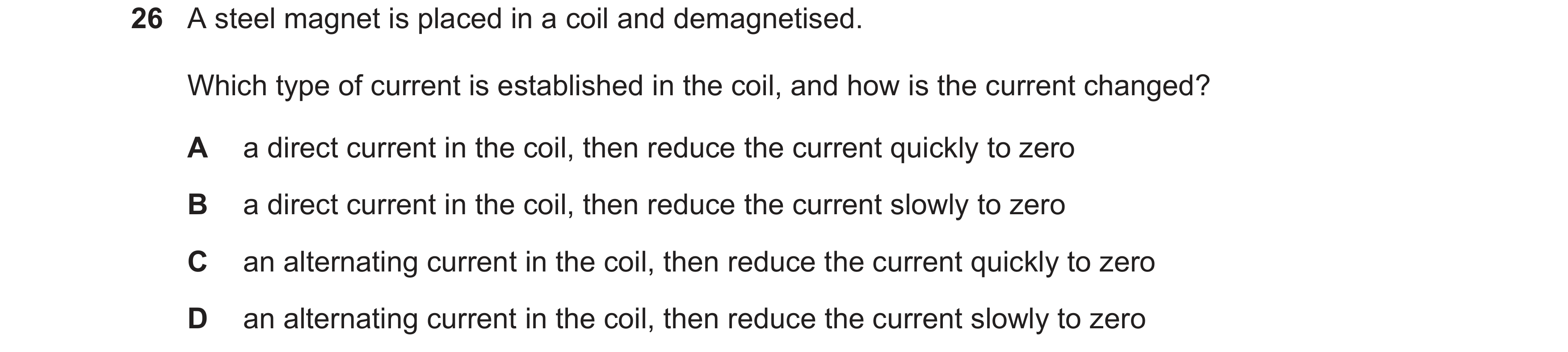
Q23 · A steel magnet is placed in a coil and demagnetised 0625/23 May/June 2017
26 A steel magnet is placed in a coil and demagnetised. Which type of current is established in the coil, and how is the current changed? A a direct current in the coil, then reduce the current quickly to zero B a direct current in the coil, then reduce the current slowly to zero C an alternating current in the coil, then reduce the current quickly to zero D an alternating current in the coil, then reduce the current slowly to zero
1 marks
Answer: D
This question in 0625/23 May/June 2017
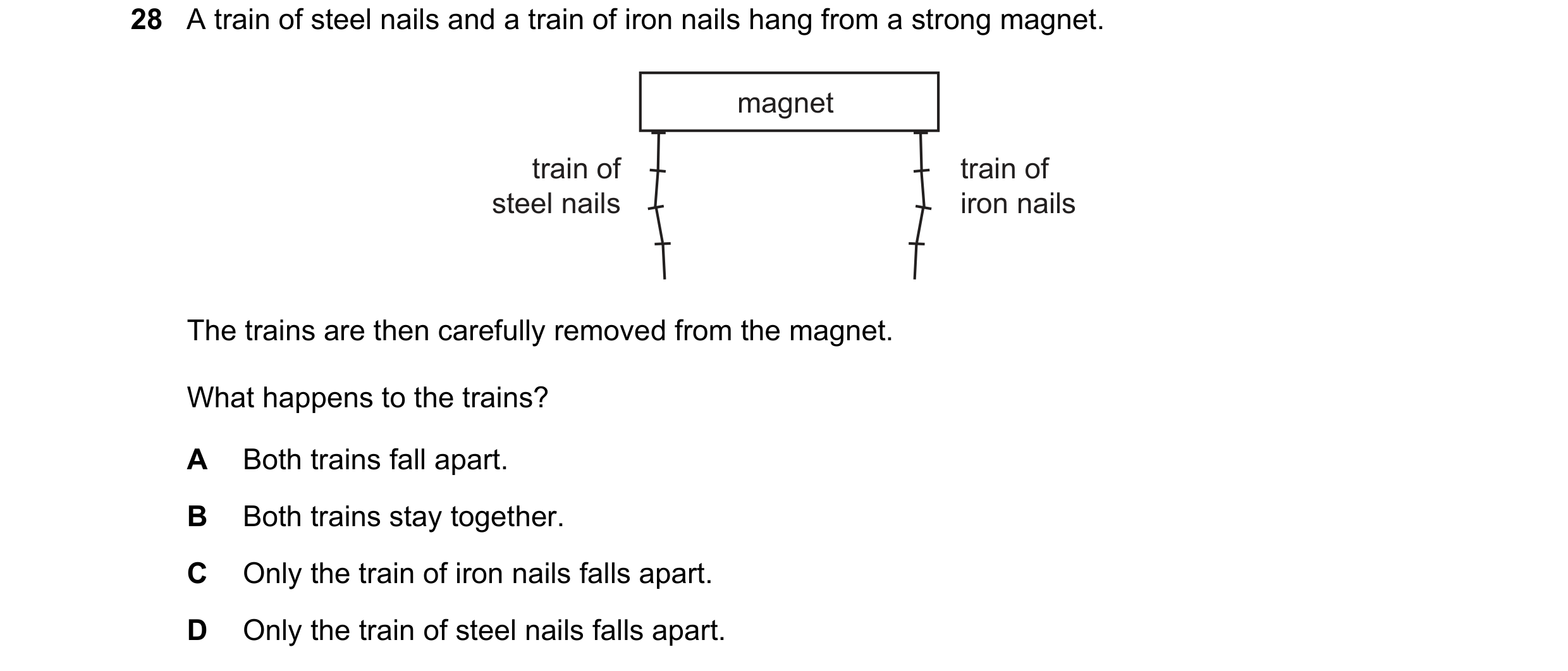
Q24 · A train of steel nails and a train of iron nails hang from a strong magnet 0625/21 Oct/Nov 2017
28 A train of steel nails and a train of iron nails hang from a strong magnet. magnet train of train of steel nails iron nails The trains are then carefully removed from the magnet. What happens to the trains? A Both trains fall apart. B Both trains stay together. C Only the train of iron nails falls apart. D Only the train of steel nails falls apart.
1 marks
Answer: C
This question in 0625/21 Oct/Nov 2017
Q25 · How can a permanent magnet be demagnetised? 0625/21 Oct/Nov 2017
29 How can a permanent magnet be demagnetised? A Cool the magnet for a long time. B Place it next to another magnet. C Slowly pull it out of a coil connected to an a.c. supply. D Slowly pull it out of a coil connected to a d.c. supply.
1 marks
Answer: C
This question in 0625/21 Oct/Nov 2017
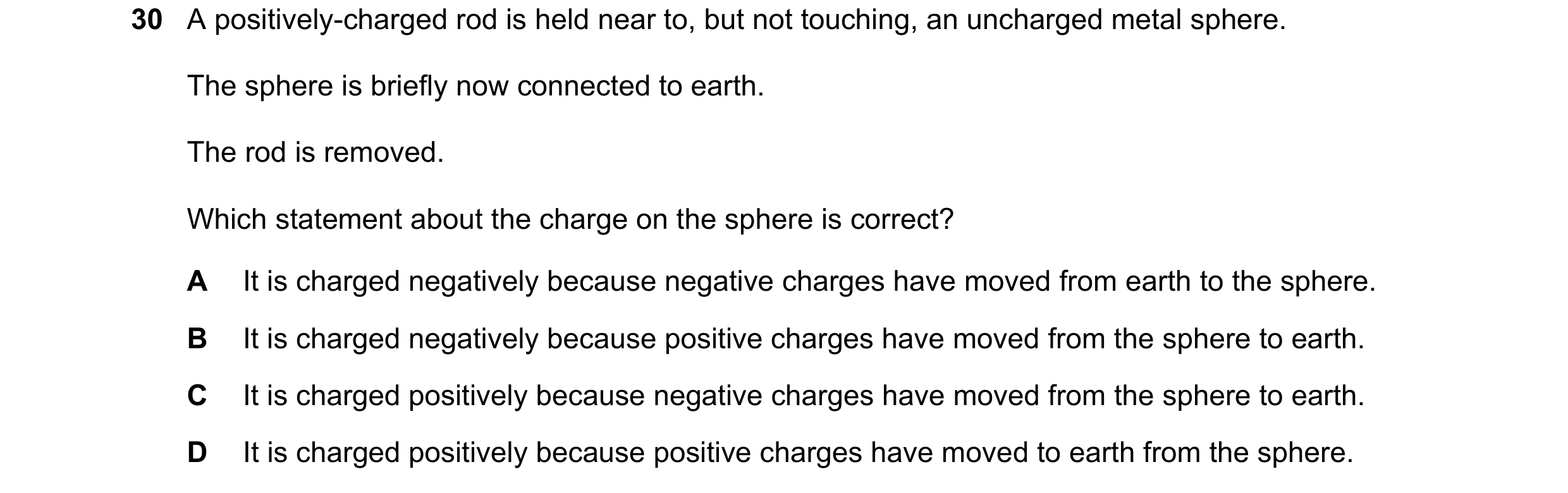
Q26 · A positively-charged rod is held near to, but not touching, an uncharged metal sphere 0625/21 Oct/Nov 2017
30 A positively-charged rod is held near to, but not touching, an uncharged metal sphere. The sphere is briefly now connected to earth. The rod is removed. Which statement about the charge on the sphere is correct? A It is charged negatively because negative charges have moved from earth to the sphere. B It is charged negatively because positive charges have moved from the sphere to earth. C It is charged positively because negative charges have moved from the sphere to earth. D It is charged positively because positive charges have moved to earth from the sphere.
1 marks
Answer: A
This question in 0625/21 Oct/Nov 2017
Q27 · Emissions X and Y from radioactive material are passed through a magnetic field 0625/21 Oct/Nov 2017
38 Emissions X and Y from radioactive material are passed through a magnetic field. The diagram shows the direction of the emissions, the direction of the magnetic field and the effect on the emissions. emission X magnetic field emission Y into the page Which type of emission is X, and which type of emission is Y? emission X emission Y A α-particles β-particles B α-particles γ-rays C β-particles α-particles D β-particles γ-rays
1 marks
Answer: A
This question in 0625/21 Oct/Nov 2017
Q28 · A train of steel nails and a train of iron nails hang from a strong magnet 0625/22 Oct/Nov 2017
28 A train of steel nails and a train of iron nails hang from a strong magnet. magnet train of train of steel nails iron nails The trains are then carefully removed from the magnet. What happens to the trains? A Both trains fall apart. B Both trains stay together. C Only the train of iron nails falls apart. D Only the train of steel nails falls apart.
1 marks
Answer: C
This question in 0625/22 Oct/Nov 2017
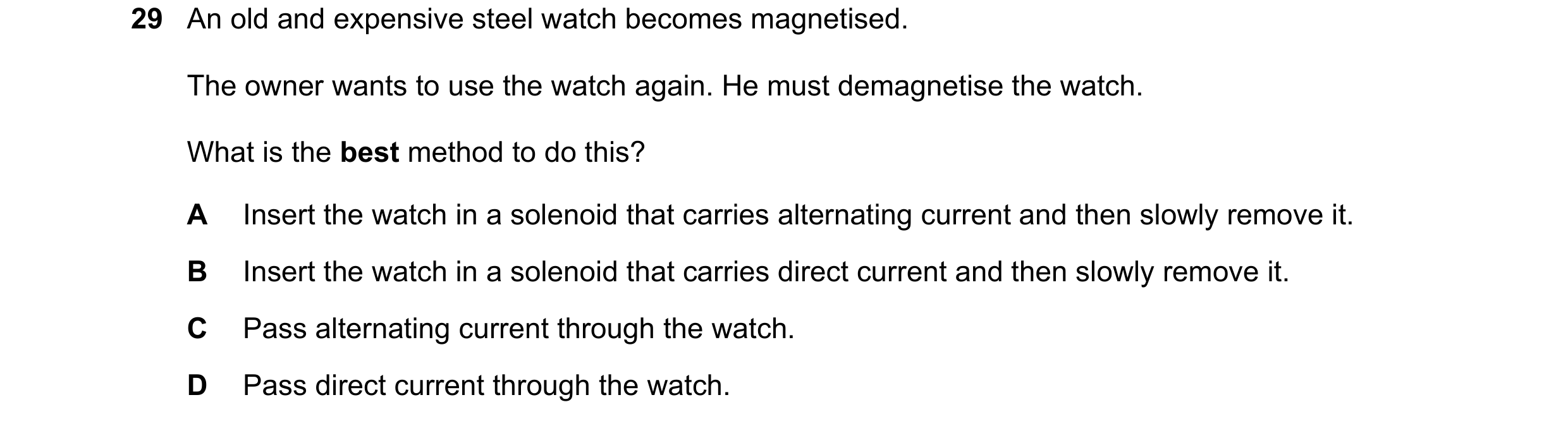
Q29 · An old and expensive steel watch becomes magnetised 0625/22 Oct/Nov 2017
29 An old and expensive steel watch becomes magnetised. The owner wants to use the watch again. He must demagnetise the watch. What is the best method to do this? A Insert the watch in a solenoid that carries alternating current and then slowly remove it. B Insert the watch in a solenoid that carries direct current and then slowly remove it. C Pass alternating current through the watch. D Pass direct current through the watch.
1 marks
Answer: A
This question in 0625/22 Oct/Nov 2017
Q30 · A train of steel nails and a train of iron nails hang from a strong magnet 0625/23 Oct/Nov 2017
28 A train of steel nails and a train of iron nails hang from a strong magnet. magnet train of train of steel nails iron nails The trains are then carefully removed from the magnet. What happens to the trains? A Both trains fall apart. B Both trains stay together. C Only the train of iron nails falls apart. D Only the train of steel nails falls apart.
1 marks
Answer: C
This question in 0625/23 Oct/Nov 2017
Q31 · What is the best method to demagnetise a steel rod? 0625/23 Oct/Nov 2017
29 What is the best method to demagnetise a steel rod? A Pass the rod through a coil connected to an a.c. supply. B Pass the rod through a coil connected to a d.c. supply. C Place the rod next to another magnet. D Stroke the rod with another magnet.
1 marks
Answer: A
This question in 0625/23 Oct/Nov 2017
Q32 · A permanent magnet is placed close to a bar of soft iron 0625/21 May/June 2018
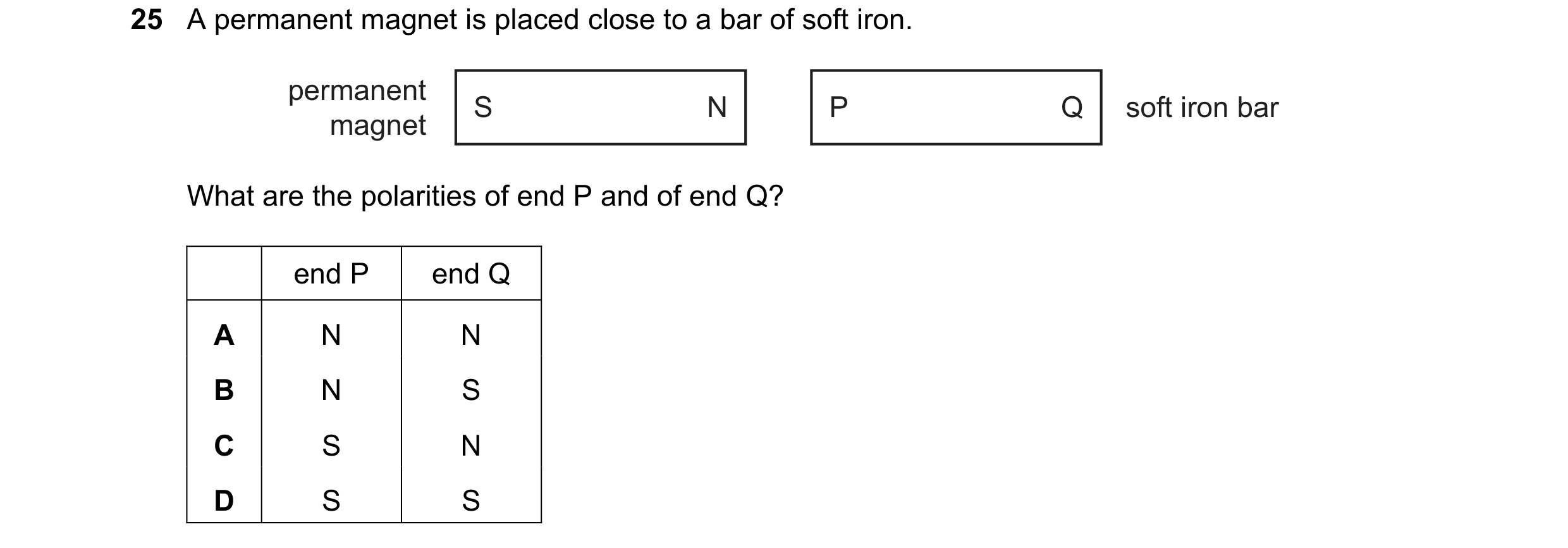
25 A permanent magnet is placed close to a bar of soft iron. permanent S N P Q soft iron bar magnet What are the polarities of end P and of end Q? end P end Q A N N B N S C S N D S S
1 marks
Answer: C
This question in 0625/21 May/June 2018
Q33 · A steel magnet is placed inside a coil of wire 0625/21 May/June 2018
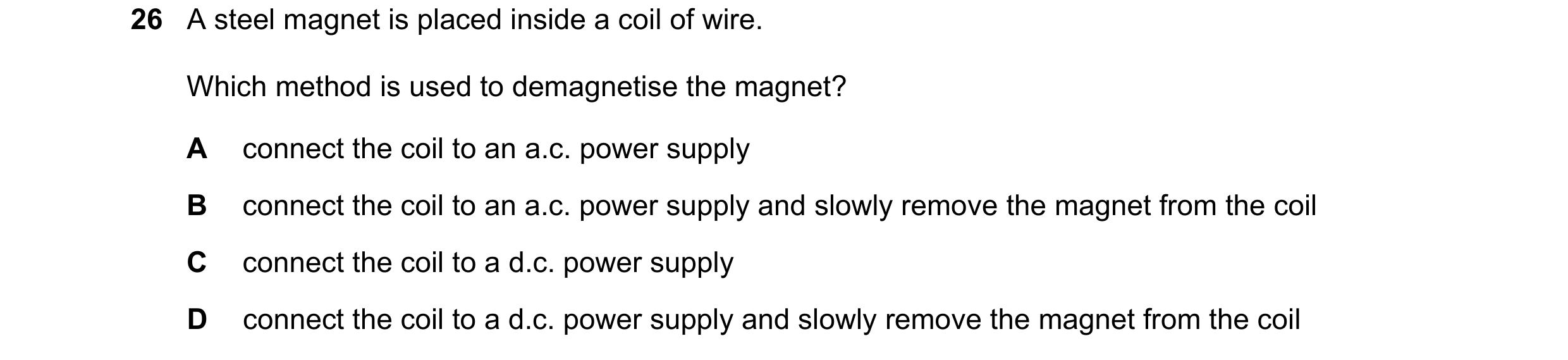
26 A steel magnet is placed inside a coil of wire. Which method is used to demagnetise the magnet? A connect the coil to an a.c. power supply B connect the coil to an a.c. power supply and slowly remove the magnet from the coil C connect the coil to a d.c. power supply D connect the coil to a d.c. power supply and slowly remove the magnet from the coil
1 marks
Answer: B
This question in 0625/21 May/June 2018
Q34 · A permanent magnet is placed close to a bar of soft iron 0625/22 May/June 2018
25 A permanent magnet is placed close to a bar of soft iron. permanent S N P Q soft iron bar magnet What are the polarities of end P and of end Q? end P end Q A N N B N S C S N D S S
1 marks
Answer: C
This question in 0625/22 May/June 2018
Q35 · Which method is used to demagnetise a bar magnet? 0625/22 May/June 2018
26 Which method is used to demagnetise a bar magnet? A lower it into water B heat it with a Bunsen burner C place it in a metal box D suspend it in a sling
1 marks
Answer: B
This question in 0625/22 May/June 2018
Q36 · A permanent magnet is placed close to a bar of soft iron 0625/23 May/June 2018
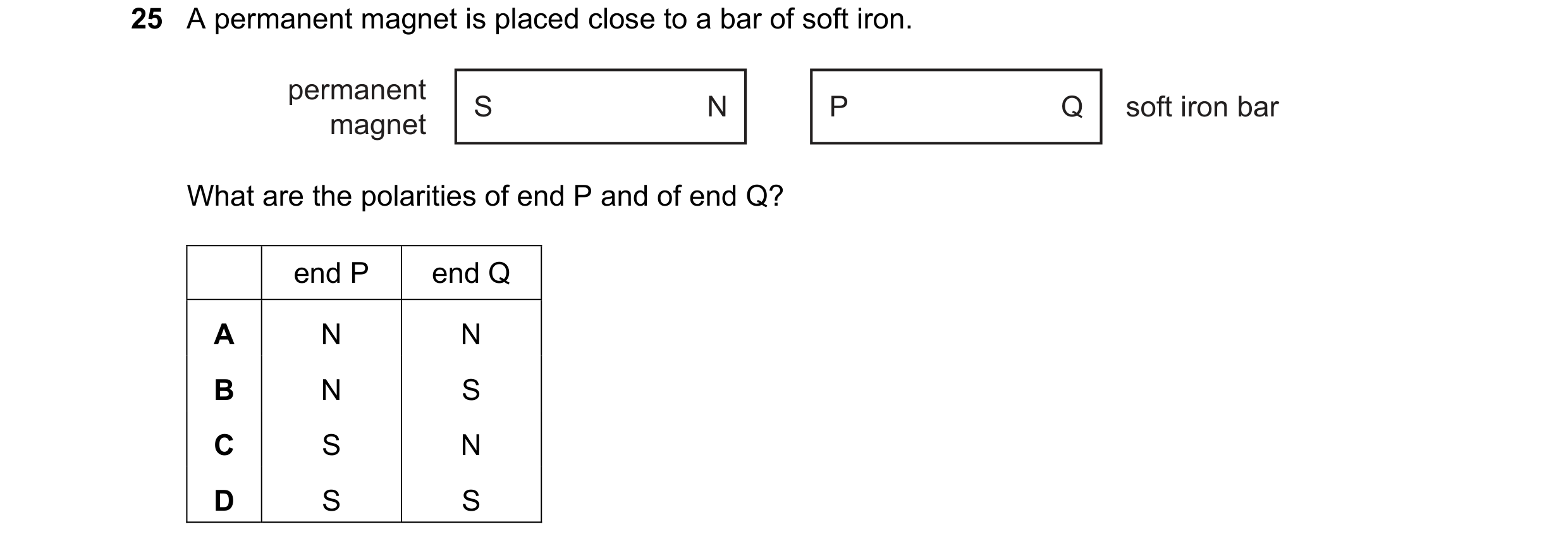
25 A permanent magnet is placed close to a bar of soft iron. permanent S N P Q soft iron bar magnet What are the polarities of end P and of end Q? end P end Q A N N B N S C S N D S S
1 marks
Answer: C
This question in 0625/23 May/June 2018
Q37 · Which method is used to demagnetise a magnet? 0625/23 May/June 2018
26 Which method is used to demagnetise a magnet? A cool it in a freezer B drop it into a beaker of water C place it inside a coil carrying a direct current D strike it with a hammer
1 marks
Answer: D
This question in 0625/23 May/June 2018
Q38 · A solenoid is connected to a battery 0625/23 May/June 2018
36 A solenoid is connected to a battery. axis of solenoid solenoid Which statement about the magnetic field at the centre of the solenoid is correct? A The magnetic field along the axis is zero. B The direction of the magnetic field is at an angle of 45° to the axis. C The direction of the magnetic field is parallel to the axis. D The direction of the magnetic field is perpendicular to the axis.
1 marks
Answer: C
This question in 0625/23 May/June 2018
Q39 · Iron is used for the core of a transformer and steel is used to make a bar magnet 0625/21 Oct/Nov 2018
25 Iron is used for the core of a transformer and steel is used to make a bar magnet. Which statement explains these uses of iron and of steel? A Iron is a magnetic material and steel is a non-magnetic material. B Iron is a permanent magnetic material and steel is a temporary magnetic material. C Iron is a temporary magnetic material and steel is a permanent magnetic material. D Iron is a non-magnetic material and steel is a magnetic material.
1 marks
Answer: C
This question in 0625/21 Oct/Nov 2018
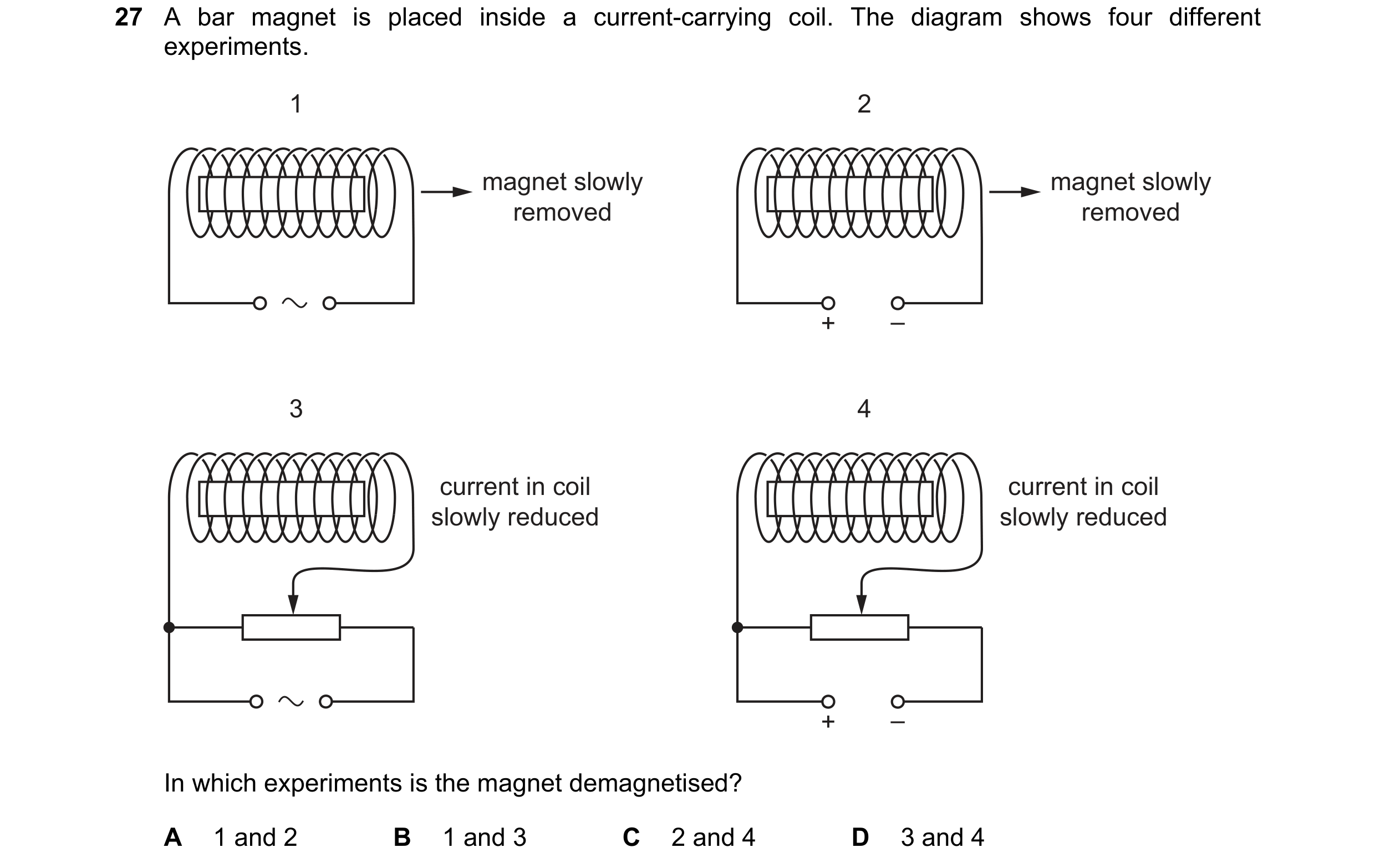
Q40 · A bar magnet is placed inside a current-carrying coil 0625/21 Oct/Nov 2018
27 A bar magnet is placed inside a current-carrying coil. The diagram shows four different experiments. 1 2 magnet slowly magnet slowly removed removed + – 3 4 current in coil current in coil slowly reduced slowly reduced + – In which experiments is the magnet demagnetised? A 1 and 2 B 1 and 3 C 2 and 4 D 3 and 4
1 marks
Answer: B
This question in 0625/21 Oct/Nov 2018
Q41 · The diagram shows a bar magnet at rest on a smooth horizontal surface 0625/22 Oct/Nov 2018
26 The diagram shows a bar magnet at rest on a smooth horizontal surface. A length of soft-iron wire is held parallel to the magnet. N soft-iron wire magnet S The wire is released. What happens? A The wire moves away from the magnet. B The wire moves towards the magnet. C The wire’s centre stays in its present position and the wire rotates through 90° in a clockwise direction. D The wire’s centre stays in its present position and the wire rotates through 90° in an anticlockwise direction.
1 marks
Answer: B
This question in 0625/22 Oct/Nov 2018
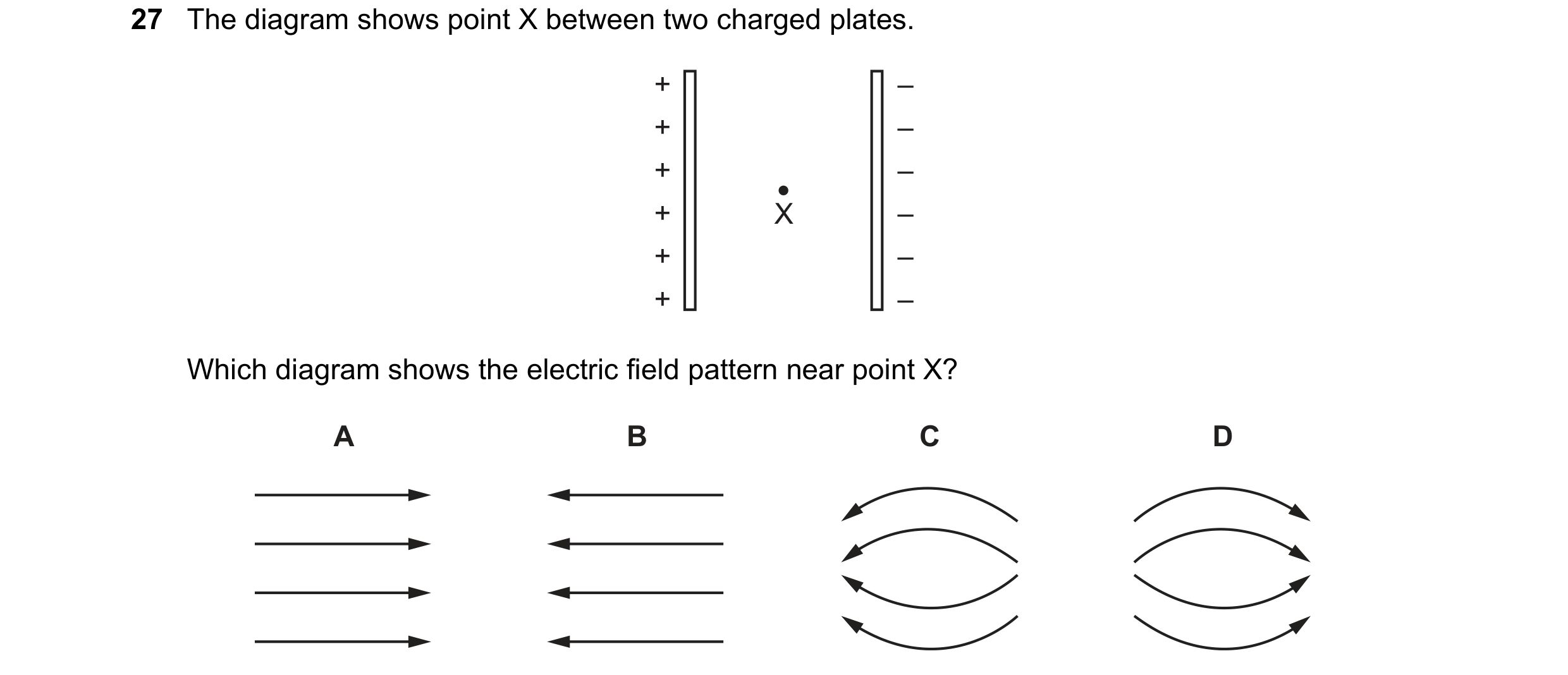
Q42 · The diagram shows point X between two charged plates 0625/22 Oct/Nov 2018
27 The diagram shows point X between two charged plates. + – + – + – + X – + – + – Which diagram shows the electric field pattern near point X? A B C D
1 marks
Answer: A
This question in 0625/22 Oct/Nov 2018
Q43 · A bar magnet is placed inside a current-carrying coil 0625/22 Oct/Nov 2018
28 A bar magnet is placed inside a current-carrying coil. The diagram shows four different experiments. 1 2 magnet slowly magnet slowly removed removed + – 3 4 current in coil current in coil slowly reduced slowly reduced + – In which experiments is the magnet demagnetised? A 1 and 2 B 1 and 3 C 2 and 4 D 3 and 4
1 marks
Answer: B
This question in 0625/22 Oct/Nov 2018
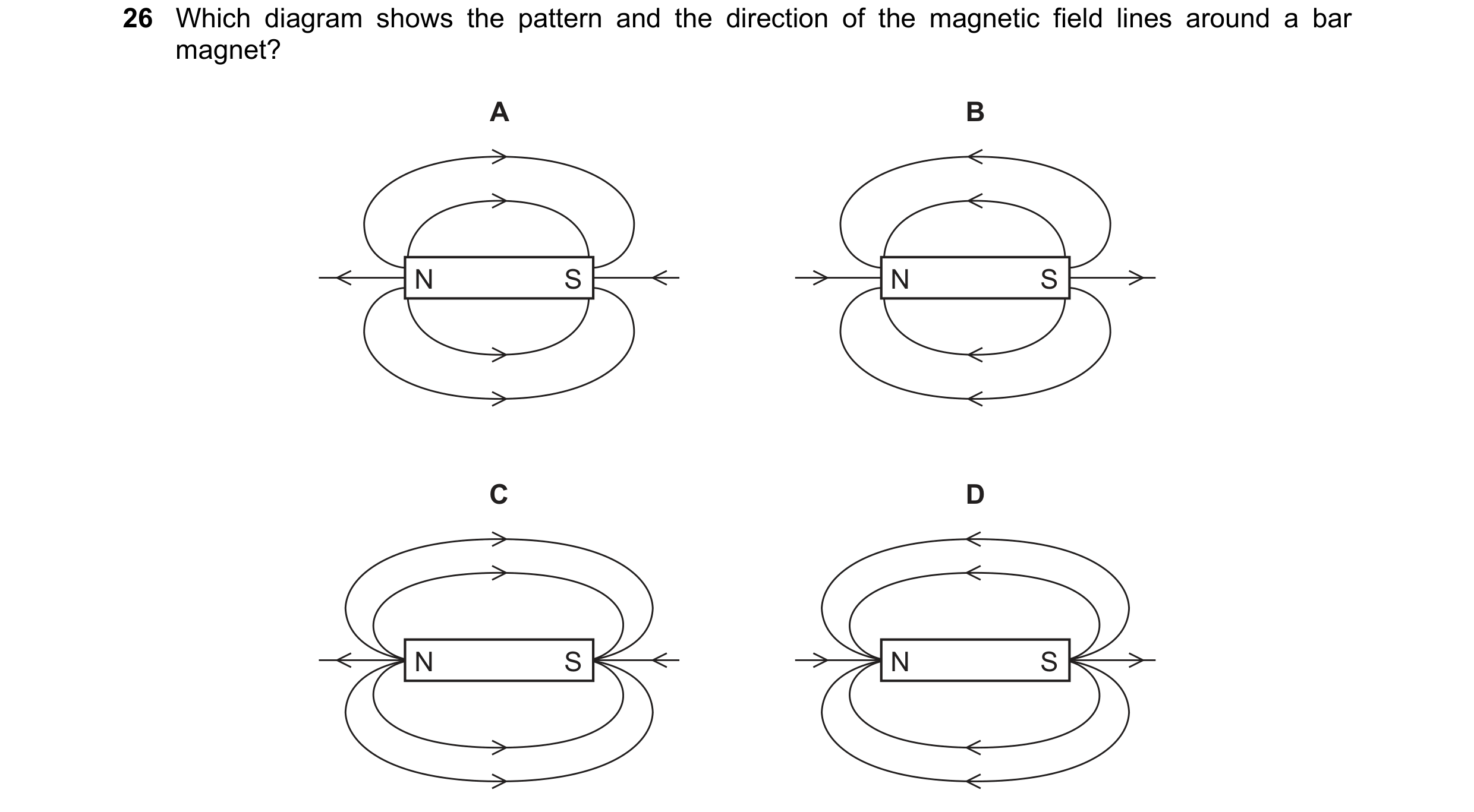
Q44 · Which diagram shows the pattern and the direction of the magnetic field lines around a… 0625/23 Oct/Nov 2018
26 Which diagram shows the pattern and the direction of the magnetic field lines around a bar magnet? A B N S N S C D N S N S
1 marks
Answer: A
This question in 0625/23 Oct/Nov 2018
Q45 · A bar magnet is placed inside a current-carrying coil 0625/23 Oct/Nov 2018
27 A bar magnet is placed inside a current-carrying coil. The diagram shows four different experiments. 1 2 magnet slowly magnet slowly removed removed + – 3 4 current in coil current in coil slowly reduced slowly reduced + – In which experiments is the magnet demagnetised? A 1 and 2 B 1 and 3 C 2 and 4 D 3 and 4
1 marks
Answer: B
This question in 0625/23 Oct/Nov 2018
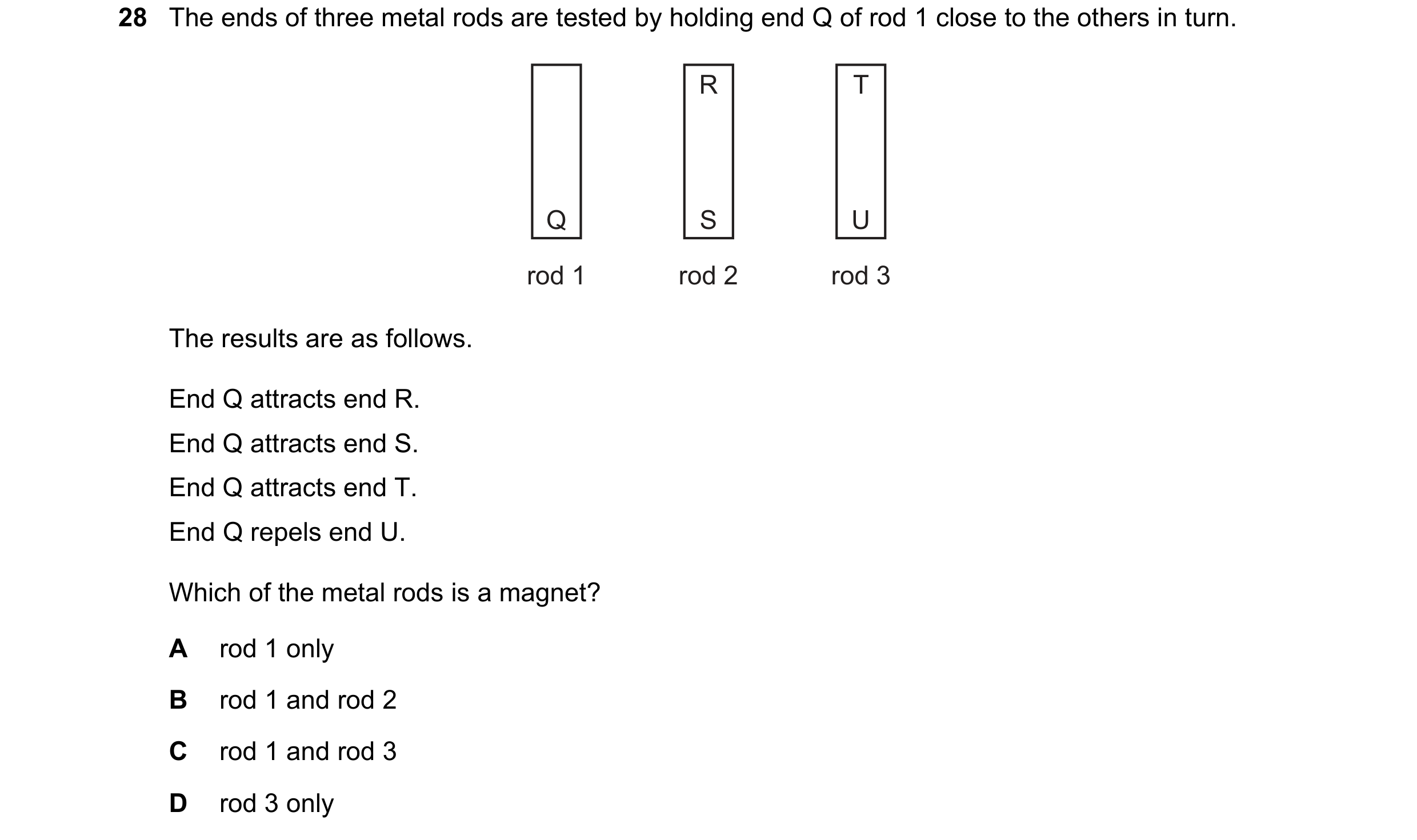
Q46 · The ends of three metal rods are tested by holding end Q of rod 1 close to the others in… 0625/22 Feb/March 2019
28 The ends of three metal rods are tested by holding end Q of rod 1 close to the others in turn. R T Q S U rod 1 rod 2 rod 3 The results are as follows. End Q attracts end R. End Q attracts end S. End Q attracts end T. End Q repels end U. Which of the metal rods is a magnet? A rod 1 only B rod 1 and rod 2 C rod 1 and rod 3 D rod 3 only
1 marks
Answer: C
This question in 0625/22 Feb/March 2019
Q47 · A metal sphere is charged by induction 0625/22 Feb/March 2019
29 A metal sphere is charged by induction. There are four stages W, X, Y and Z in this process. W a charged rod is brought near to the sphere X the sphere is earthed Y the charged rod is taken away from the sphere Z the earth connection is removed In which order are the four stages carried out? A W → X → Y → Z B W → X → Z → Y C Z → W → X → Y D X → Z → W → Y
1 marks
Answer: B
This question in 0625/22 Feb/March 2019
Q48 · Which statement about the direction of a magnetic field at a point is correct? 0625/22 Feb/March 2019
36 Which statement about the direction of a magnetic field at a point is correct? A It is the direction of the force on a north pole placed at that point. B It is the direction of the force on a south pole placed at that point. C It is the direction of the force on a positive charge placed at that point. D It is the direction of the force on a negative charge placed at that point.
1 marks
Answer: A
This question in 0625/22 Feb/March 2019
Q49 · Why is soft iron used for the core of an electromagnet? 0625/21 May/June 2019
26 Why is soft iron used for the core of an electromagnet? A Soft iron easily becomes a permanent magnet. B Soft iron is a good electrical conductor. C Soft iron is a poor thermal conductor. D Soft iron loses its magnetism when the current in the coil is switched off.
1 marks
Answer: D
This question in 0625/21 May/June 2019
Q50 · A soft iron bar is a long way from any magnetic field 0625/22 May/June 2019
26 A soft iron bar is a long way from any magnetic field. How can the material of the bar be described? A It is magnetic and strongly magnetised. B It is magnetic and unmagnetised. C It is non-magnetic and strongly magnetised. D It is non-magnetic and unmagnetised.
1 marks
Answer: B
This question in 0625/22 May/June 2019
Q51 · A metal bar is placed inside a current-carrying coil, as shown in diagram 1 0625/23 May/June 2019
26 A metal bar is placed inside a current-carrying coil, as shown in diagram 1. There is a small current in the coil. The bar holds a few nails, as shown in diagram 2. nails diagram 1 diagram 2 When there is no current in the coil, the nails drop off. Which row is correct? metal from which effect of a larger the bar is made current in the coil A soft iron it makes no difference B soft iron the bar holds more nails C steel it makes no difference D steel the bar holds more nails
1 marks
Answer: B
This question in 0625/23 May/June 2019
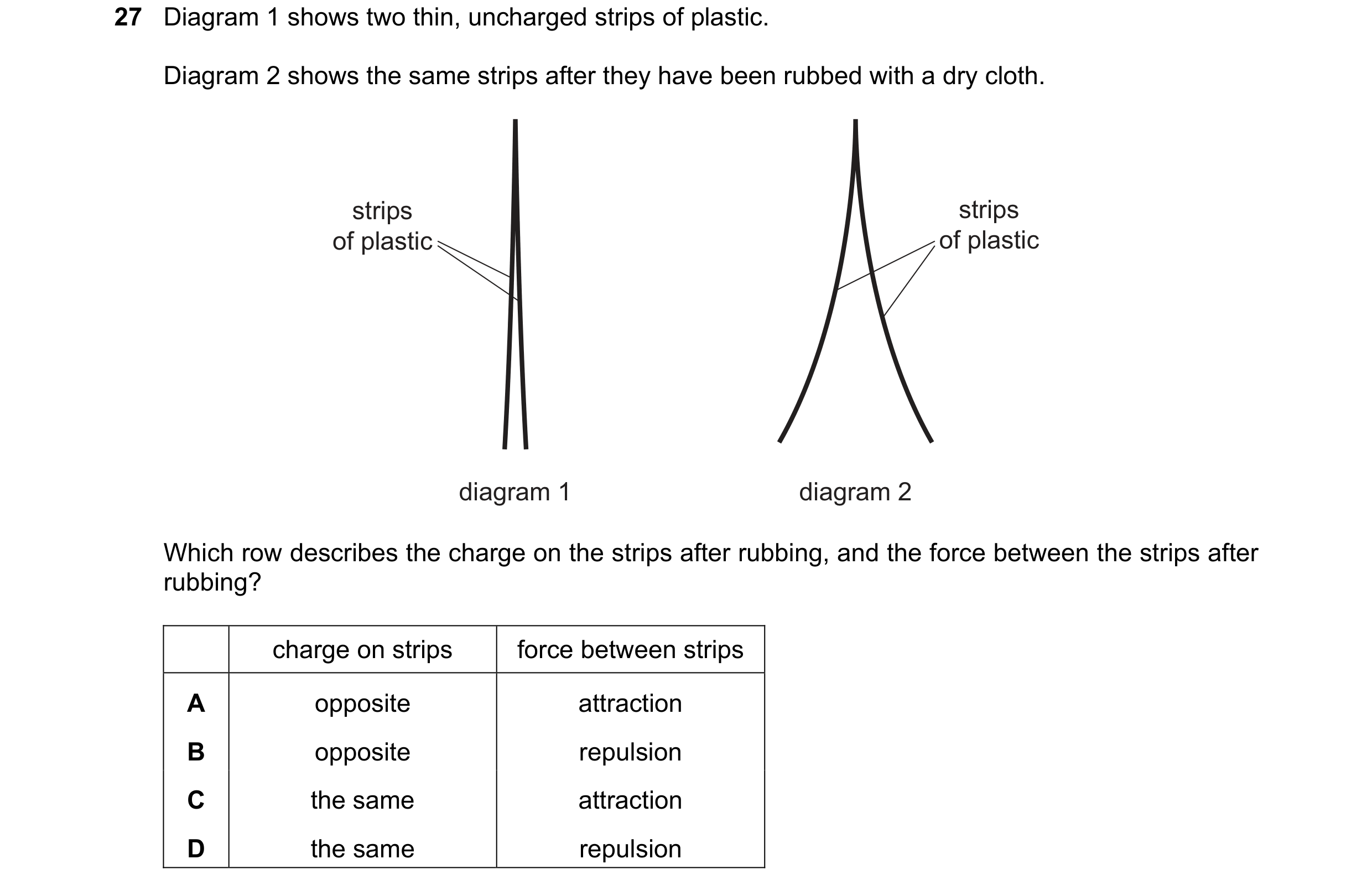
Q52 · Two thin, uncharged strips of plastic 0625/23 May/June 2019
27 Diagram 1 shows two thin, uncharged strips of plastic. Diagram 2 shows the same strips after they have been rubbed with a dry cloth. strips strips of plastic of plastic diagram 1 diagram 2 Which row describes the charge on the strips after rubbing, and the force between the strips after rubbing? charge on strips force between strips A opposite attraction B opposite repulsion C the same attraction D the same repulsion
1 marks
Answer: D
This question in 0625/23 May/June 2019
Q53 · A conductor carrying a current is placed in a magnetic field 0625/23 May/June 2019
37 A conductor carrying a current is placed in a magnetic field. In which direction does the force on the conductor act? current A D B N S C
1 marks
Answer: A
This question in 0625/23 May/June 2019
Q54 · A steel bar is placed in an East-West direction for it to be demagnetised 0625/21 Oct/Nov 2019
26 A steel bar is placed in an East-West direction for it to be demagnetised. No other magnet is nearby. Which method is not suitable? A Hammering the bar. B Heating the bar to a very high temperature. C Slowly taking the bar out of a coil that carries an alternating current. D Slowly taking the bar out of a coil that carries a direct current.
1 marks
Answer: D
This question in 0625/21 Oct/Nov 2019
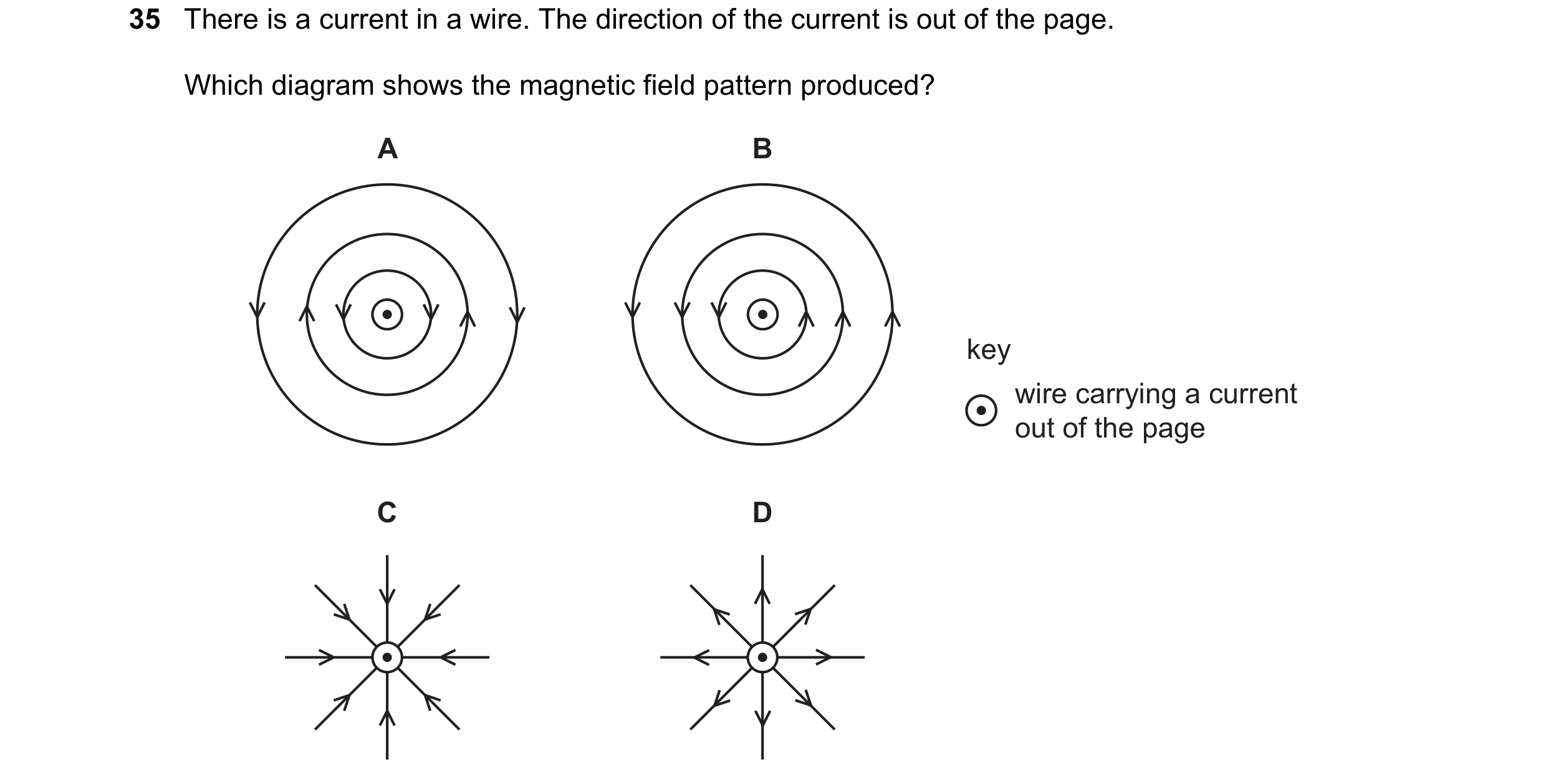
Q55 · There is a current in a wire 0625/21 Oct/Nov 2019
35 There is a current in a wire. The direction of the current is out of the page. Which diagram shows the magnetic field pattern produced? A B key wire carrying a current out of the page C D
1 marks
Answer: B
This question in 0625/21 Oct/Nov 2019
Q56 · A steel bar is placed in an East-West direction for it to be demagnetised 0625/22 Oct/Nov 2019
27 A steel bar is placed in an East-West direction for it to be demagnetised. No other magnet is nearby. Which method is not suitable? A Hammering the bar. B Heating the bar to a very high temperature. C Slowly taking the bar out of a coil that carries an alternating current. D Slowly taking the bar out of a coil that carries a direct current.
1 marks
Answer: D
This question in 0625/22 Oct/Nov 2019
Q57 · A steel bar is placed in an East-West direction for it to be demagnetised 0625/23 Oct/Nov 2019
26 A steel bar is placed in an East-West direction for it to be demagnetised. No other magnet is nearby. Which method is not suitable? A Hammering the bar. B Heating the bar to a very high temperature. C Slowly taking the bar out of a coil that carries an alternating current. D Slowly taking the bar out of a coil that carries a direct current.
1 marks
Answer: D
This question in 0625/23 Oct/Nov 2019
Q58 · A plastic rod is rubbed with a dry cloth 0625/23 Oct/Nov 2019
27 A plastic rod is rubbed with a dry cloth. The rod becomes positively charged. Why has the rod become positively charged? A It has gained electrons. B It has gained neutrons. C It has lost electrons. D It has lost neutrons.
1 marks
Answer: C
This question in 0625/23 Oct/Nov 2019
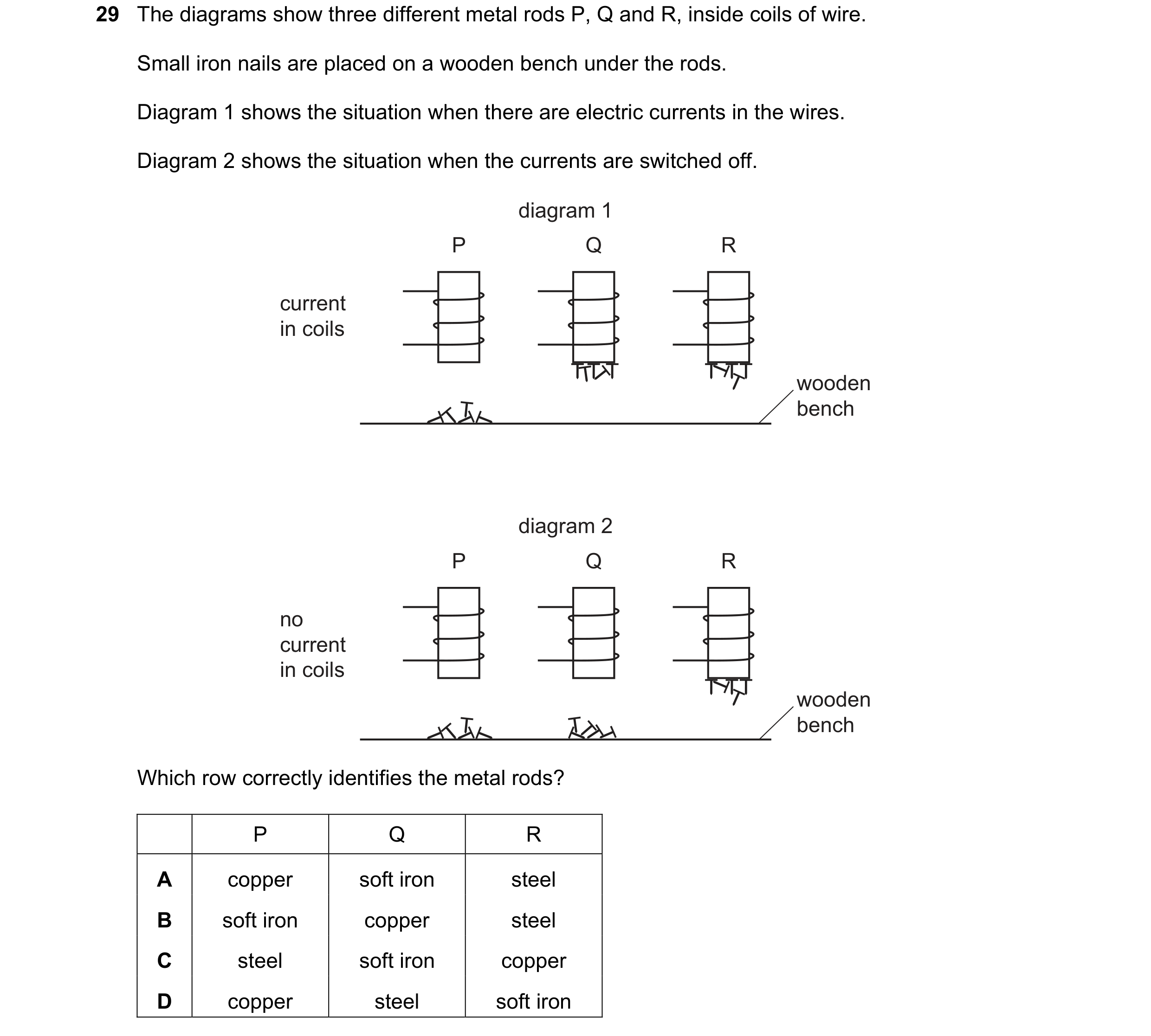
Q59 · The diagrams show three different metal rods P, Q and R, inside coils of wire 0625/22 Feb/March 2020
29 The diagrams show three different metal rods P, Q and R, inside coils of wire. Small iron nails are placed on a wooden bench under the rods. Diagram 1 shows the situation when there are electric currents in the wires. Diagram 2 shows the situation when the currents are switched off. diagram 1 P Q R current in coils wooden bench diagram 2 P Q R no current in coils wooden bench Which row correctly identifies the metal rods? P Q R A copper soft iron steel B soft iron copper steel C steel soft iron copper D copper steel soft iron
1 marks
Answer: A
This question in 0625/22 Feb/March 2020
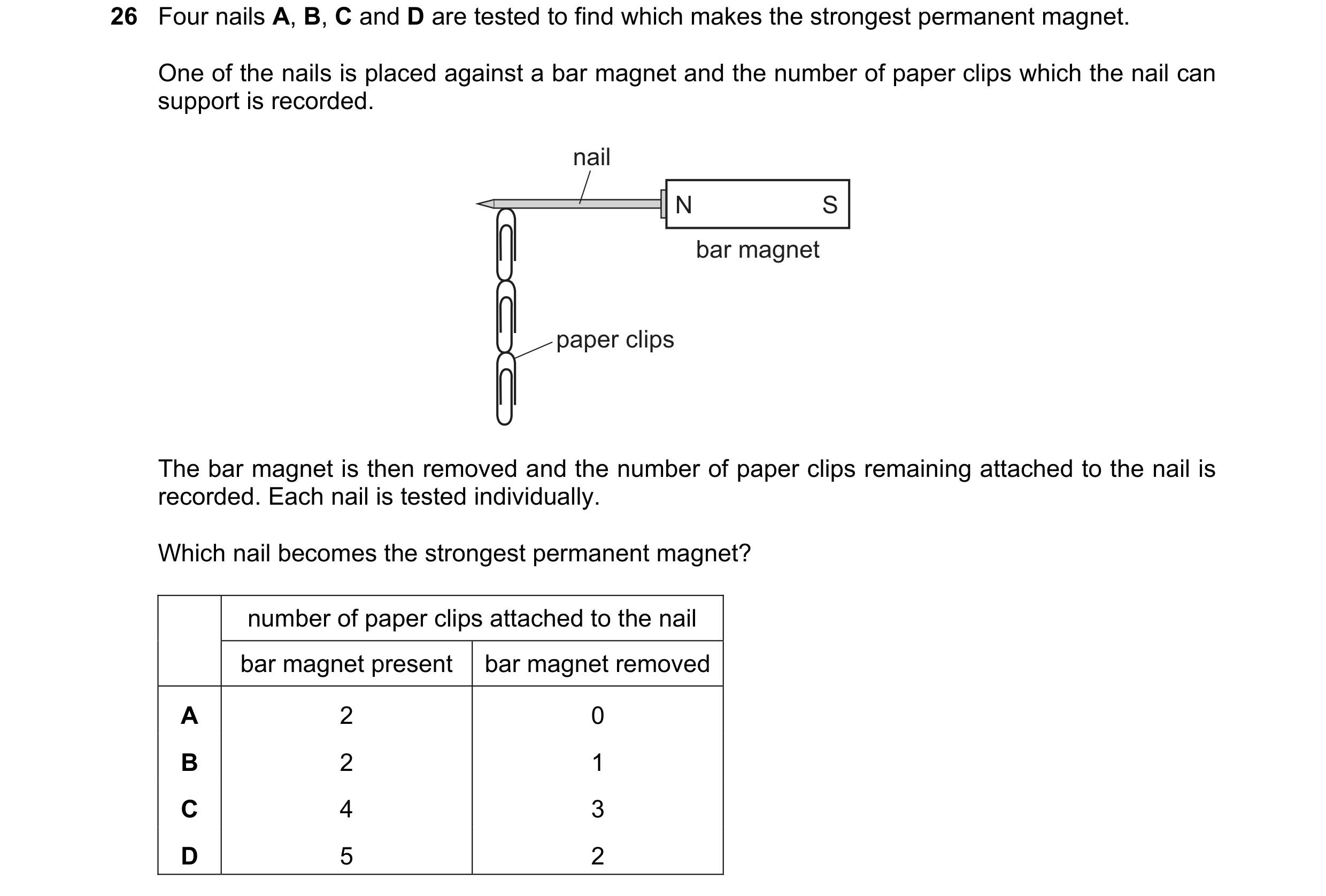
Q60 · Four nails A, B, C and D are tested to find which makes the strongest permanent magnet 0625/21 May/June 2020
26 Four nails A, B, C and D are tested to find which makes the strongest permanent magnet. One of the nails is placed against a bar magnet and the number of paper clips which the nail can support is recorded. nail N S bar magnet paper clips The bar magnet is then removed and the number of paper clips remaining attached to the nail is recorded. Each nail is tested individually. Which nail becomes the strongest permanent magnet? number of paper clips attached to the nail bar magnet present bar magnet removed A 2 0 B 2 1 C 4 3 D 5 2
1 marks
Answer: C
This question in 0625/21 May/June 2020
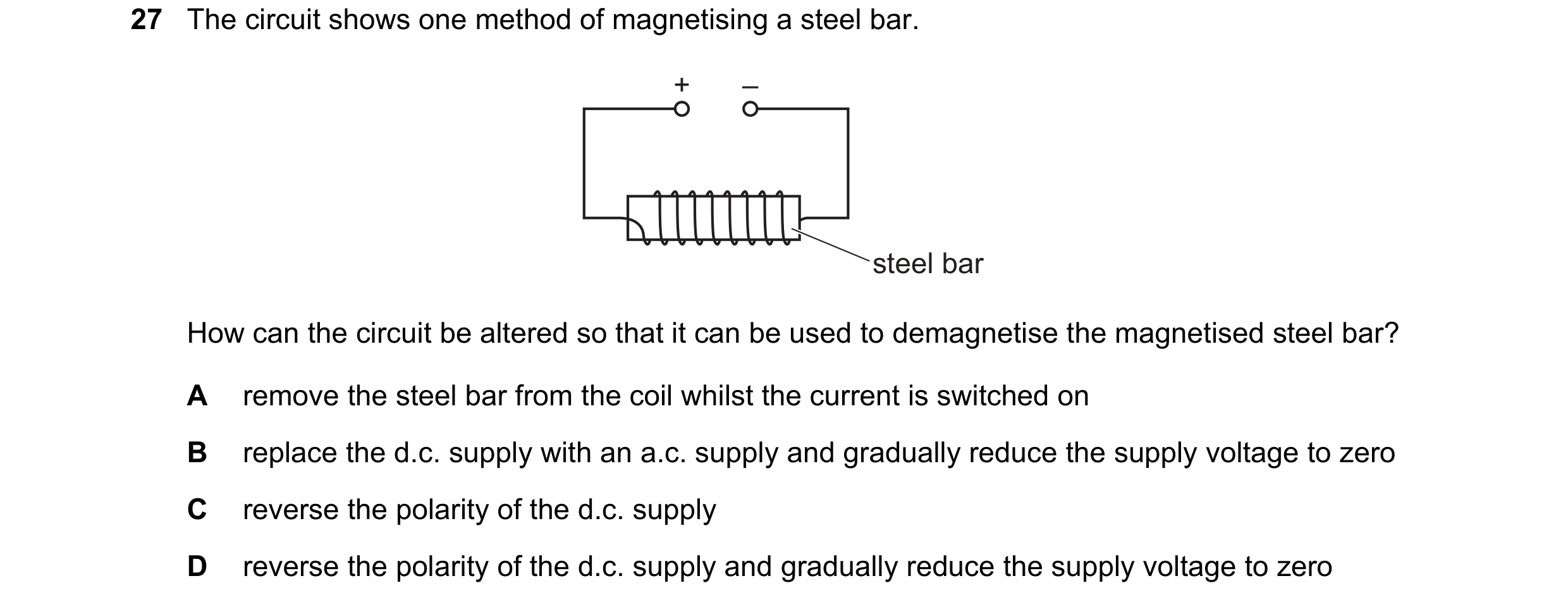
Q61 · The circuit shows one method of magnetising a steel bar 0625/21 May/June 2020
27 The circuit shows one method of magnetising a steel bar. + – steel bar How can the circuit be altered so that it can be used to demagnetise the magnetised steel bar? A remove the steel bar from the coil whilst the current is switched on B replace the d.c. supply with an a.c. supply and gradually reduce the supply voltage to zero C reverse the polarity of the d.c. supply D reverse the polarity of the d.c. supply and gradually reduce the supply voltage to zero
1 marks
Answer: B
This question in 0625/21 May/June 2020
Q62 · Four nails A, B, C and D are tested to find which makes the strongest permanent magnet 0625/22 May/June 2020
26 Four nails A, B, C and D are tested to find which makes the strongest permanent magnet. One of the nails is placed against a bar magnet and the number of paper clips which the nail can support is recorded. nail N S bar magnet paper clips The bar magnet is then removed and the number of paper clips remaining attached to the nail is recorded. Each nail is tested individually. Which nail becomes the strongest permanent magnet? number of paper clips attached to the nail bar magnet present bar magnet removed A 2 0 B 2 1 C 4 3 D 5 2
1 marks
Answer: C
This question in 0625/22 May/June 2020
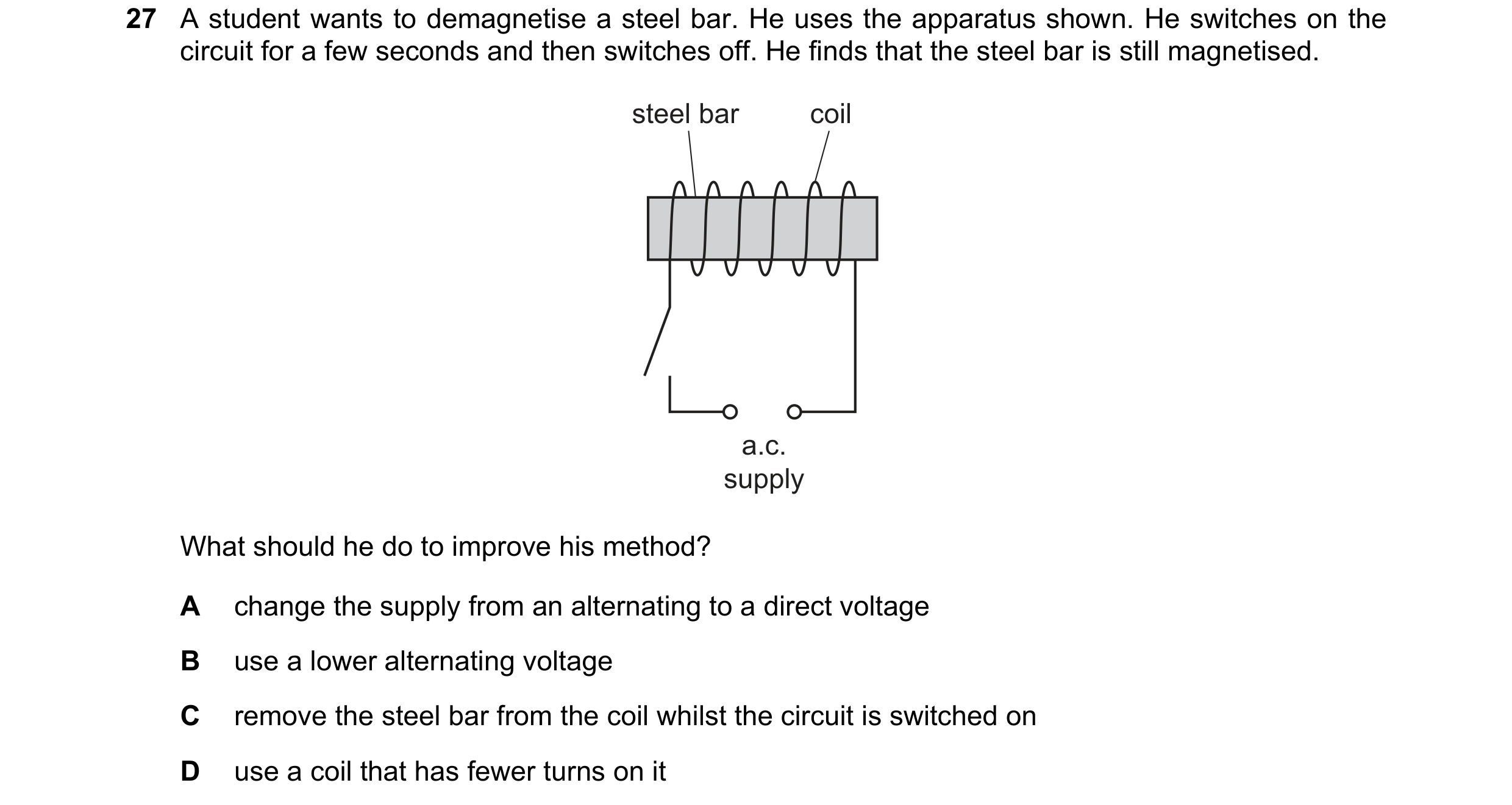
Q63 · A student wants to demagnetise a steel bar 0625/22 May/June 2020
27 A student wants to demagnetise a steel bar. He uses the apparatus shown. He switches on the circuit for a few seconds and then switches off. He finds that the steel bar is still magnetised. steel bar coil a.c. supply What should he do to improve his method? A change the supply from an alternating to a direct voltage B use a lower alternating voltage C remove the steel bar from the coil whilst the circuit is switched on D use a coil that has fewer turns on it
1 marks
Answer: C
This question in 0625/22 May/June 2020
Q64 · The diagram shows the magnetic field due to a current in a solenoid 0625/22 May/June 2020
35 The diagram shows the magnetic field due to a current in a solenoid. Where is the magnetic field the strongest? A D B C
1 marks
Answer: C
This question in 0625/22 May/June 2020
Q65 · Four nails A, B, C and D are tested to find which makes the strongest permanent magnet 0625/23 May/June 2020
26 Four nails A, B, C and D are tested to find which makes the strongest permanent magnet. One of the nails is placed against a bar magnet and the number of paper clips which the nail can support is recorded. nail N S bar magnet paper clips The bar magnet is then removed and the number of paper clips remaining attached to the nail is recorded. Each nail is tested individually. Which nail becomes the strongest permanent magnet? number of paper clips attached to the nail bar magnet present bar magnet removed A 2 0 B 2 1 C 4 3 D 5 2
1 marks
Answer: C
This question in 0625/23 May/June 2020
Q66 · The diagrams show a magnetised steel rod inside a solenoid connected to a potentiometer 0625/23 May/June 2020
27 The diagrams show a magnetised steel rod inside a solenoid connected to a potentiometer. In diagram 1, the potentiometer is connected to a d.c. power supply. In diagram 2, the potentiometer is connected to an a.c. power supply. magnetised magnetised steel steel P Q R S d.c. a.c. diagram 1 diagram 2 Which action would demagnetise the piece of steel? A In diagram 1, move the potentiometer slide from P to Q. B In diagram 1, move the potentiometer slide from Q to P. C In diagram 2, move the potentiometer slide from R to S. D In diagram 2, move the potentiometer slide from S to R.
1 marks
Answer: D
This question in 0625/23 May/June 2020
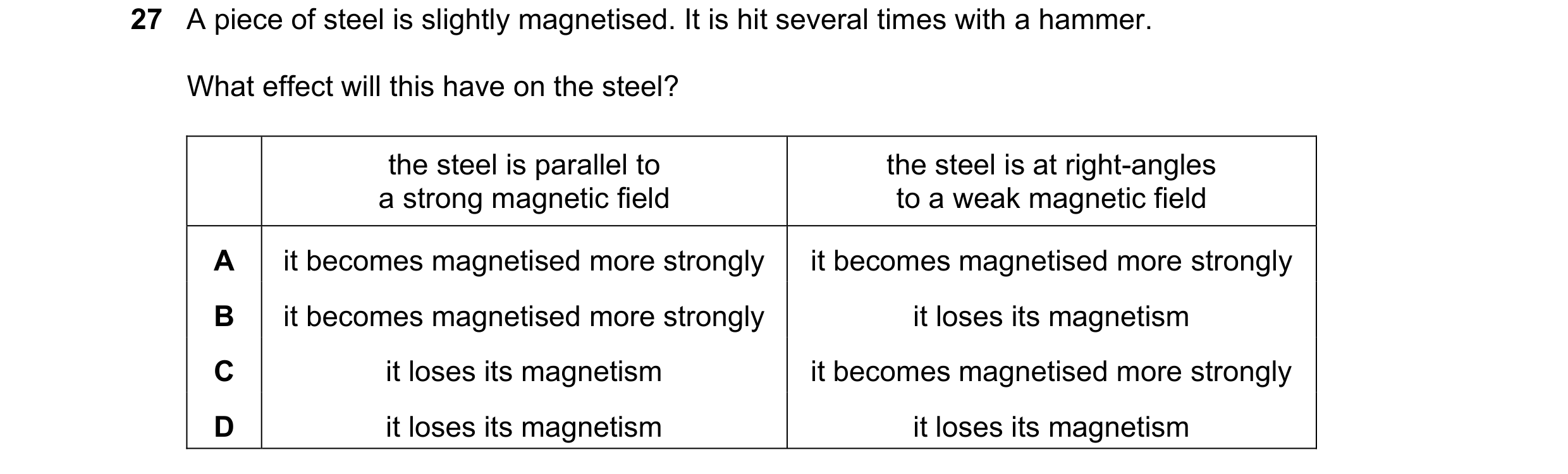
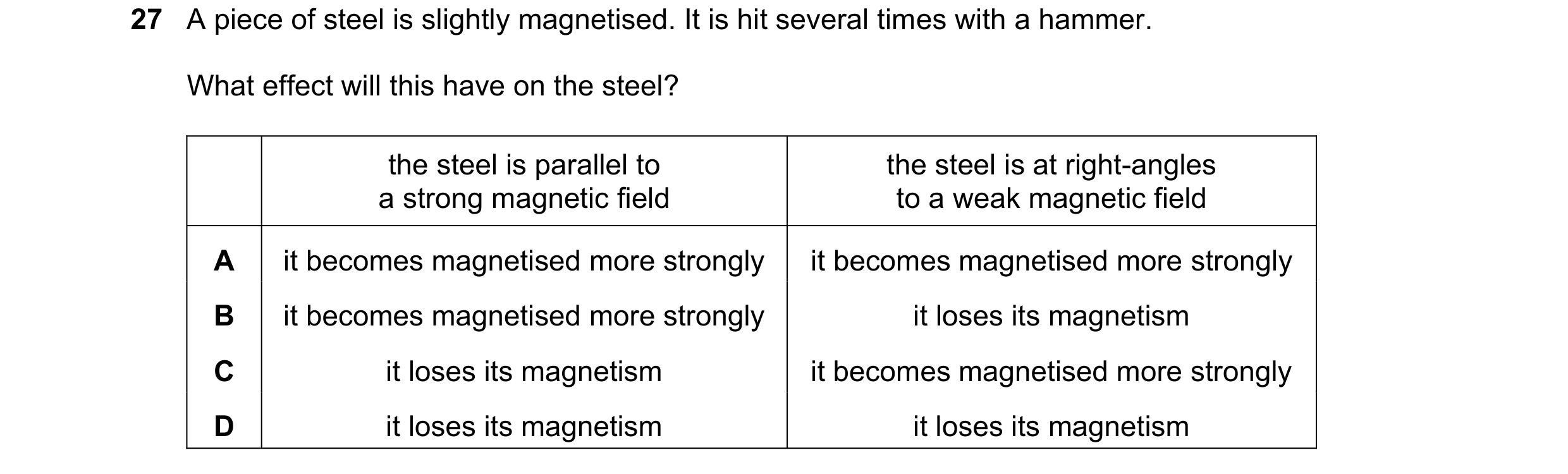
Q67 · A piece of steel is slightly magnetised 0625/21 Oct/Nov 2020
27 A piece of steel is slightly magnetised. It is hit several times with a hammer. What effect will this have on the steel? the steel is parallel to the steel is at right-angles a strong magnetic field to a weak magnetic field A it becomes magnetised more strongly it becomes magnetised more strongly B it becomes magnetised more strongly it loses its magnetism C it loses its magnetism it becomes magnetised more strongly D it loses its magnetism it loses its magnetism
1 marks
Answer: B
This question in 0625/21 Oct/Nov 2020
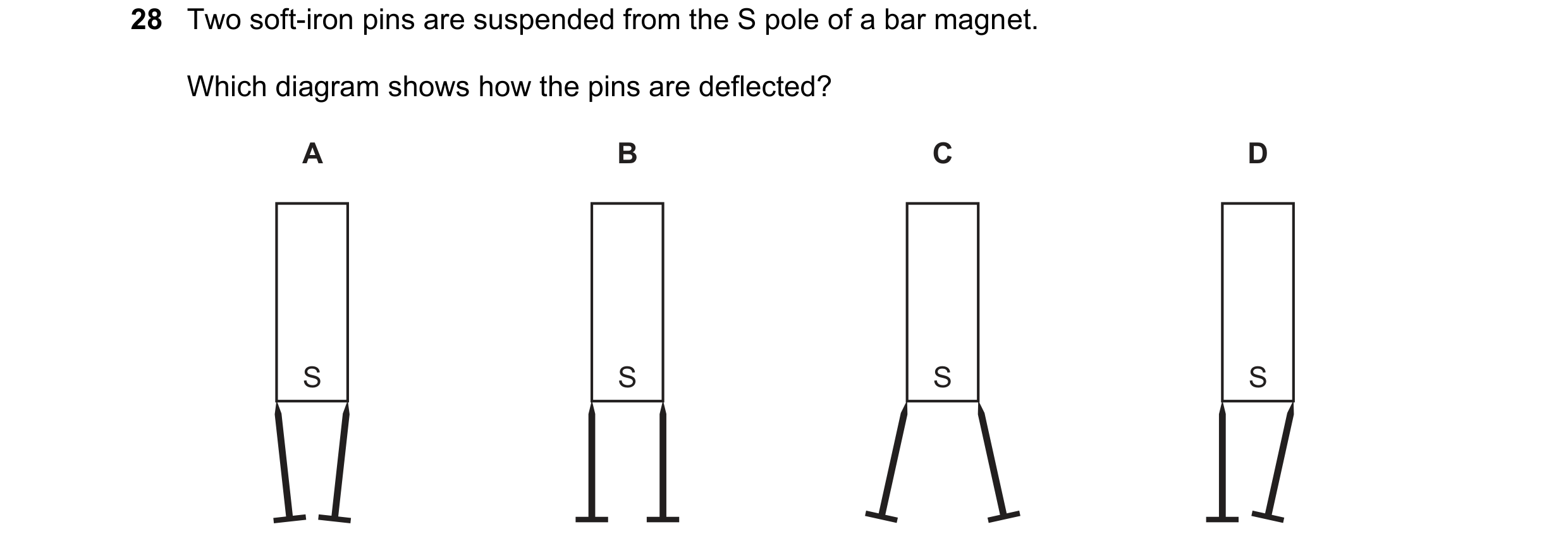
Q68 · Two soft-iron pins are suspended from the S pole of a bar magnet 0625/21 Oct/Nov 2020
28 Two soft-iron pins are suspended from the S pole of a bar magnet. Which diagram shows how the pins are deflected? A B C D S S S S
1 marks
Answer: C
This question in 0625/21 Oct/Nov 2020
Q69 · The diagram shows part of a long current-carrying conductor 0625/21 Oct/Nov 2020
36 The diagram shows part of a long current-carrying conductor. At which point is the magnetic field strongest? A C D B
1 marks
Answer: C
This question in 0625/21 Oct/Nov 2020
Q70 · A piece of steel is slightly magnetised 0625/22 Oct/Nov 2020
27 A piece of steel is slightly magnetised. It is hit several times with a hammer. What effect will this have on the steel? the steel is parallel to the steel is at right-angles a strong magnetic field to a weak magnetic field A it becomes magnetised more strongly it becomes magnetised more strongly B it becomes magnetised more strongly it loses its magnetism C it loses its magnetism it becomes magnetised more strongly D it loses its magnetism it loses its magnetism
1 marks
Answer: B
This question in 0625/22 Oct/Nov 2020
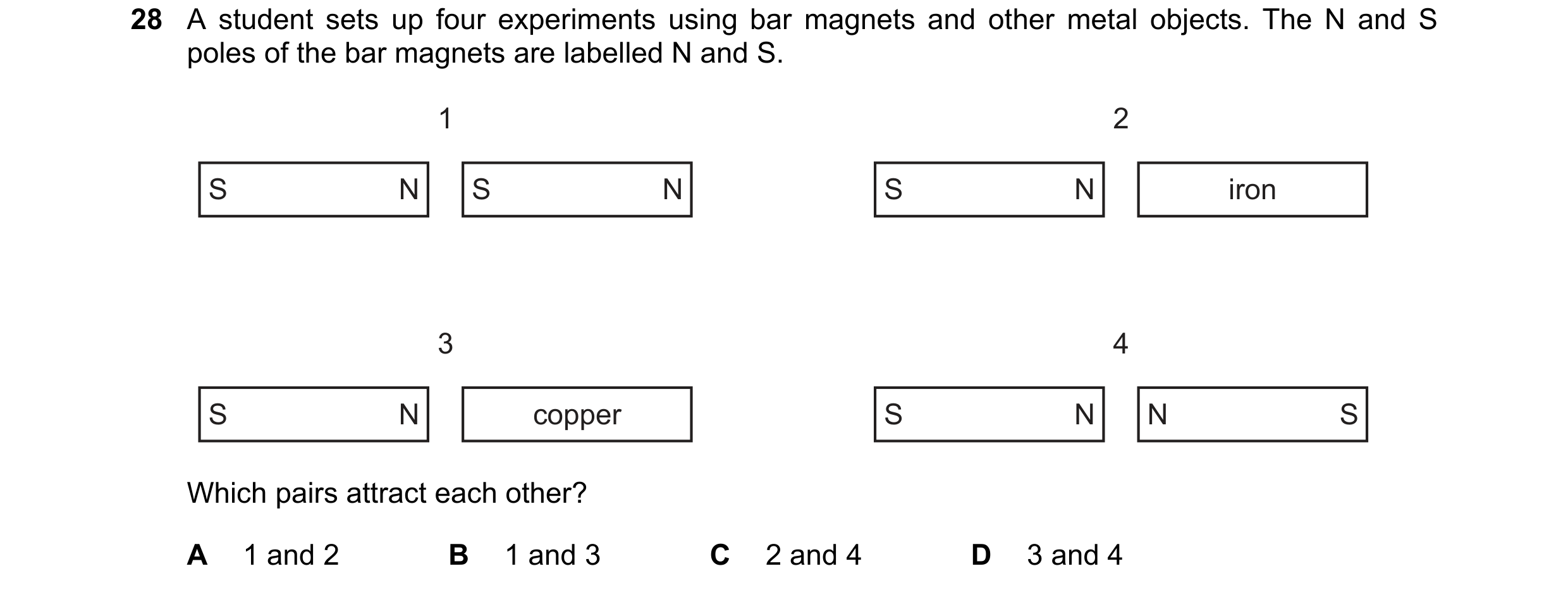
Q71 · A student sets up four experiments using bar magnets and other metal objects 0625/22 Oct/Nov 2020
28 A student sets up four experiments using bar magnets and other metal objects. The N and S poles of the bar magnets are labelled N and S. 1 2 S N S N S N iron 3 4 S N copper S N N S Which pairs attract each other? A 1 and 2 B 1 and 3 C 2 and 4 D 3 and 4
1 marks
Answer: A
This question in 0625/22 Oct/Nov 2020
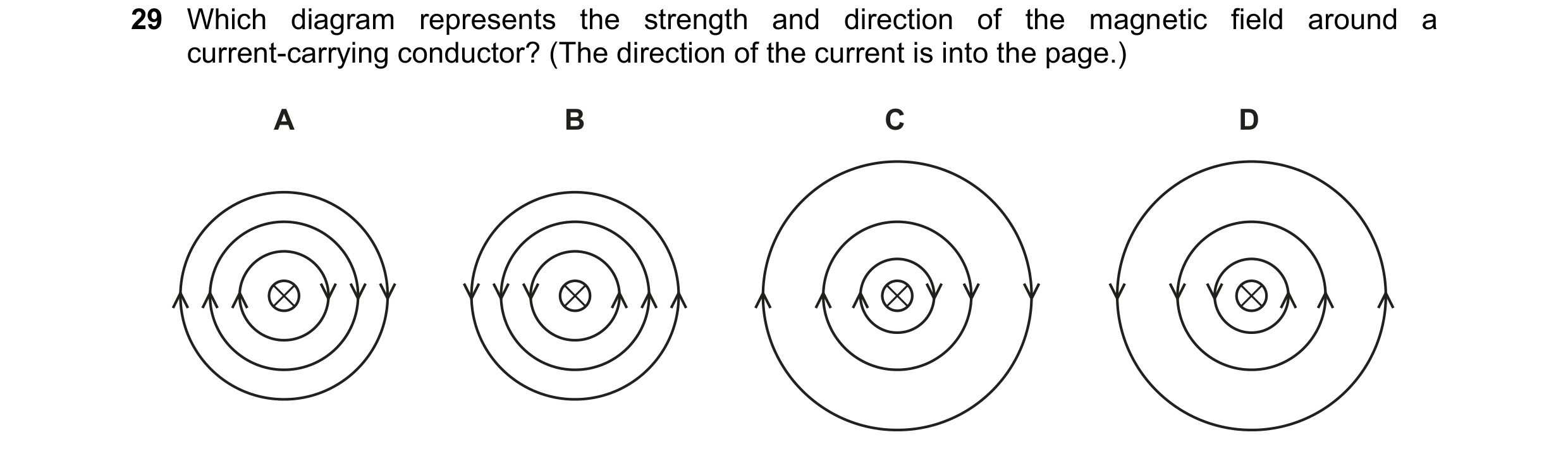
Q72 · Which diagram represents the strength and direction of the magnetic field around a… 0625/22 Oct/Nov 2020
29 Which diagram represents the strength and direction of the magnetic field around a current-carrying conductor? (The direction of the current is into the page.) A B C D
1 marks
Answer: C
This question in 0625/22 Oct/Nov 2020
Q73 · The diagram shows a coil of wire wrapped around a soft-iron rod 0625/22 Oct/Nov 2020
36 The diagram shows a coil of wire wrapped around a soft-iron rod. The wire is connected to a d.c. power supply as indicated. The apparatus is in a region which is totally shielded from the Earth’s magnetic field. + – soft-iron rod P A small compass needle is placed at point P. In which direction does the N pole of the compass needle point? A towards the bottom of the page B towards the left of the page C towards the right of the page D towards the top of the page
1 marks
Answer: C
This question in 0625/22 Oct/Nov 2020
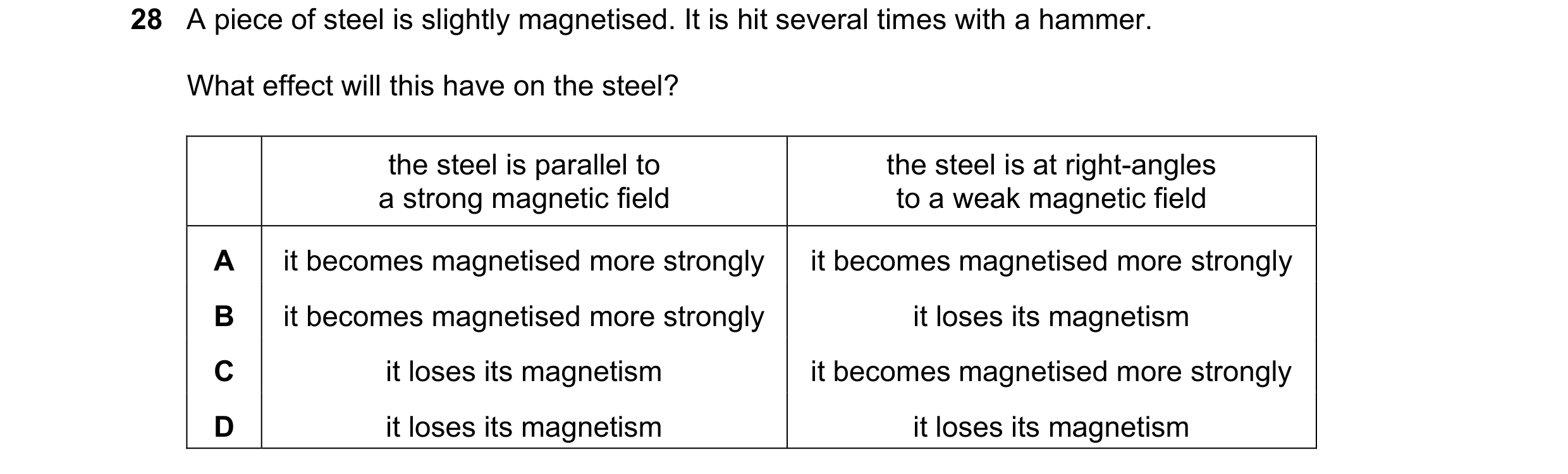
Q74 · A piece of steel is slightly magnetised 0625/23 Oct/Nov 2020
28 A piece of steel is slightly magnetised. It is hit several times with a hammer. What effect will this have on the steel? the steel is parallel to the steel is at right-angles a strong magnetic field to a weak magnetic field A it becomes magnetised more strongly it becomes magnetised more strongly B it becomes magnetised more strongly it loses its magnetism C it loses its magnetism it becomes magnetised more strongly D it loses its magnetism it loses its magnetism
1 marks
Answer: B
This question in 0625/23 Oct/Nov 2020
Q75 · A negatively charged cloud passes over a tall steel-framed building 0625/23 Oct/Nov 2020
29 A negatively charged cloud passes over a tall steel-framed building. A charge is induced on the building by the cloud because charges flow through the building. cloud – – –– – – – tall building earth What charge is induced on the building and in which direction do the charge carriers move? charge induced direction of charge flow on building A positive from the building to earth B positive from earth to the building C negative from the building to earth D negative from earth to the building
1 marks
Answer: A
This question in 0625/23 Oct/Nov 2020
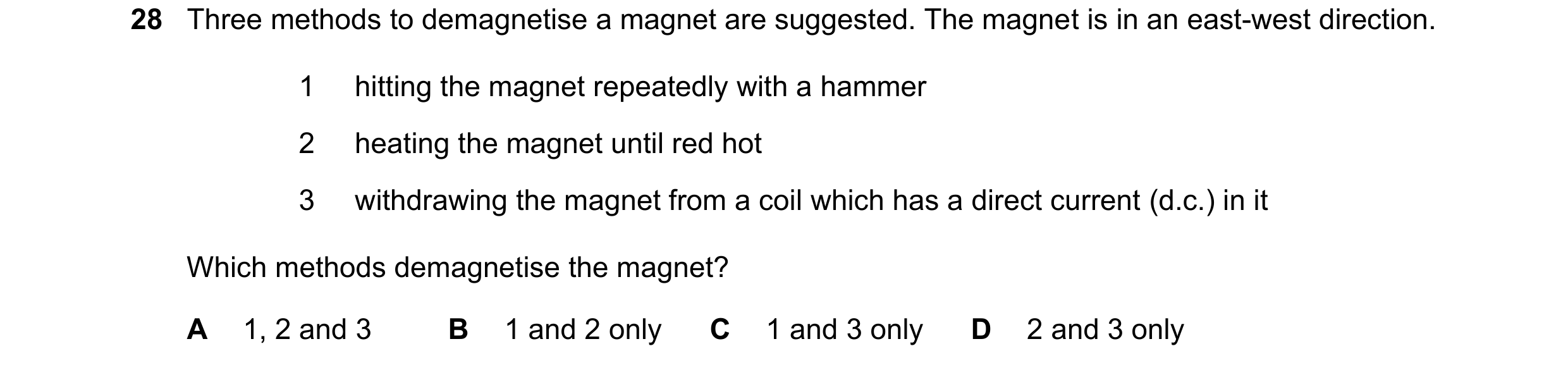
Q76 · Three methods to demagnetise a magnet are suggested 0625/22 Feb/March 2021
28 Three methods to demagnetise a magnet are suggested. The magnet is in an east-west direction. 1 hitting the magnet repeatedly with a hammer 2 heating the magnet until red hot 3 withdrawing the magnet from a coil which has a direct current (d.c.) in it Which methods demagnetise the magnet? A 1, 2 and 3 B 1 and 2 only C 1 and 3 only D 2 and 3 only
1 marks
Answer: B
This question in 0625/22 Feb/March 2021
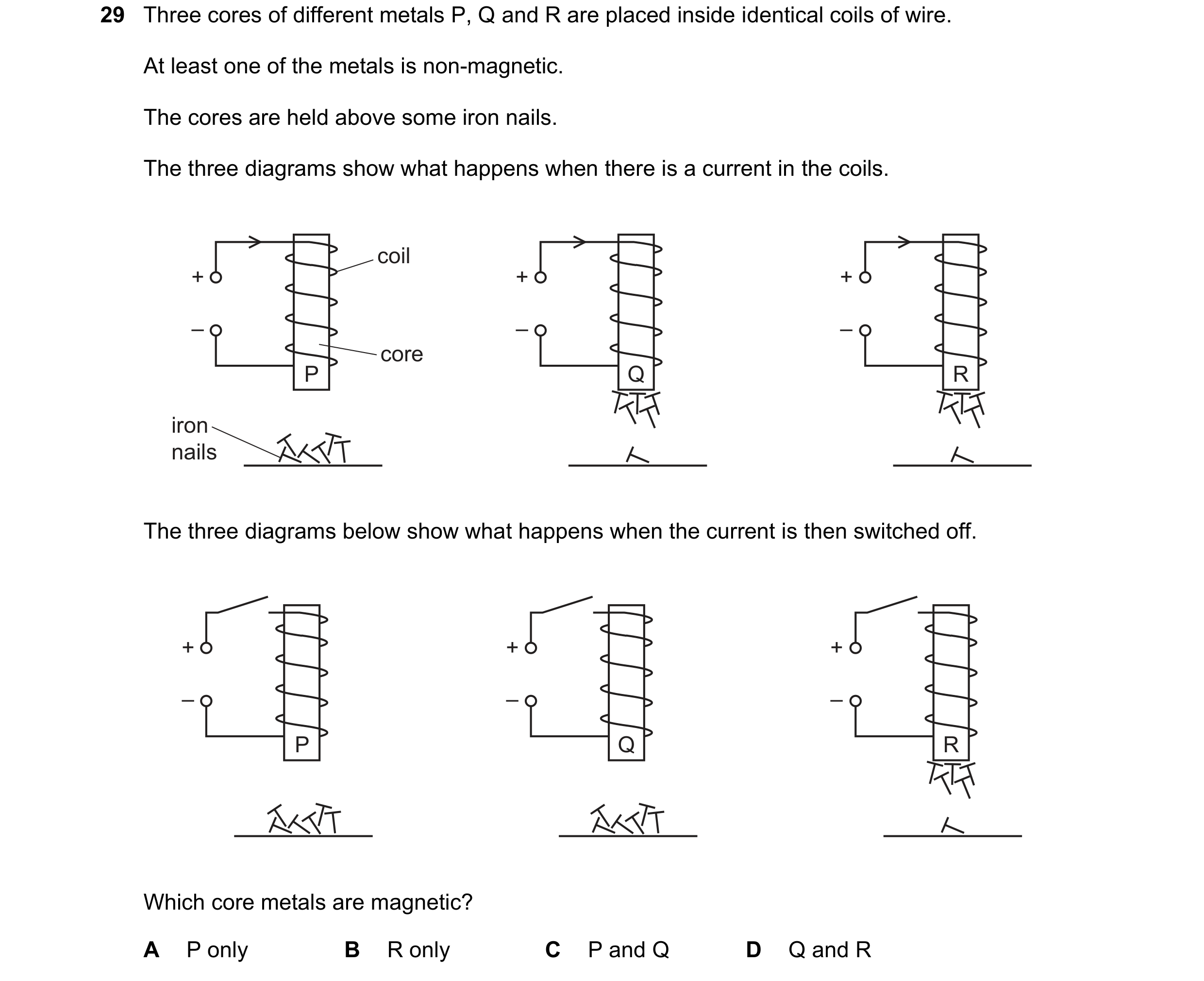
Q77 · Three cores of different metals P, Q and R are placed inside identical coils of wire 0625/22 Feb/March 2021
29 Three cores of different metals P, Q and R are placed inside identical coils of wire. At least one of the metals is non-magnetic. The cores are held above some iron nails. The three diagrams show what happens when there is a current in the coils. coil + + + – – – core P Q R iron nails The three diagrams below show what happens when the current is then switched off. + + + – – – P Q R Which core metals are magnetic? A P only B R only C P and Q D Q and R
1 marks
Answer: D
This question in 0625/22 Feb/March 2021
Q78 · Two uncharged metal spheres X and Y rest on insulating stands and touch each other 0625/22 Feb/March 2021
30 Two uncharged metal spheres X and Y rest on insulating stands and touch each other. A negatively charged plastic rod is brought near to sphere X. metal spheres negatively – – charged rod – – X Y – – insulating stand insulating stand Using the insulating stand, sphere Y is moved away from sphere X. What are the signs and the relative magnitudes of the charges induced on X and Y? relative magnitudes charge on X charge on Y of charges A negative negative equal B negative positive different C positive negative equal D positive positive different
1 marks
Answer: C
This question in 0625/22 Feb/March 2021
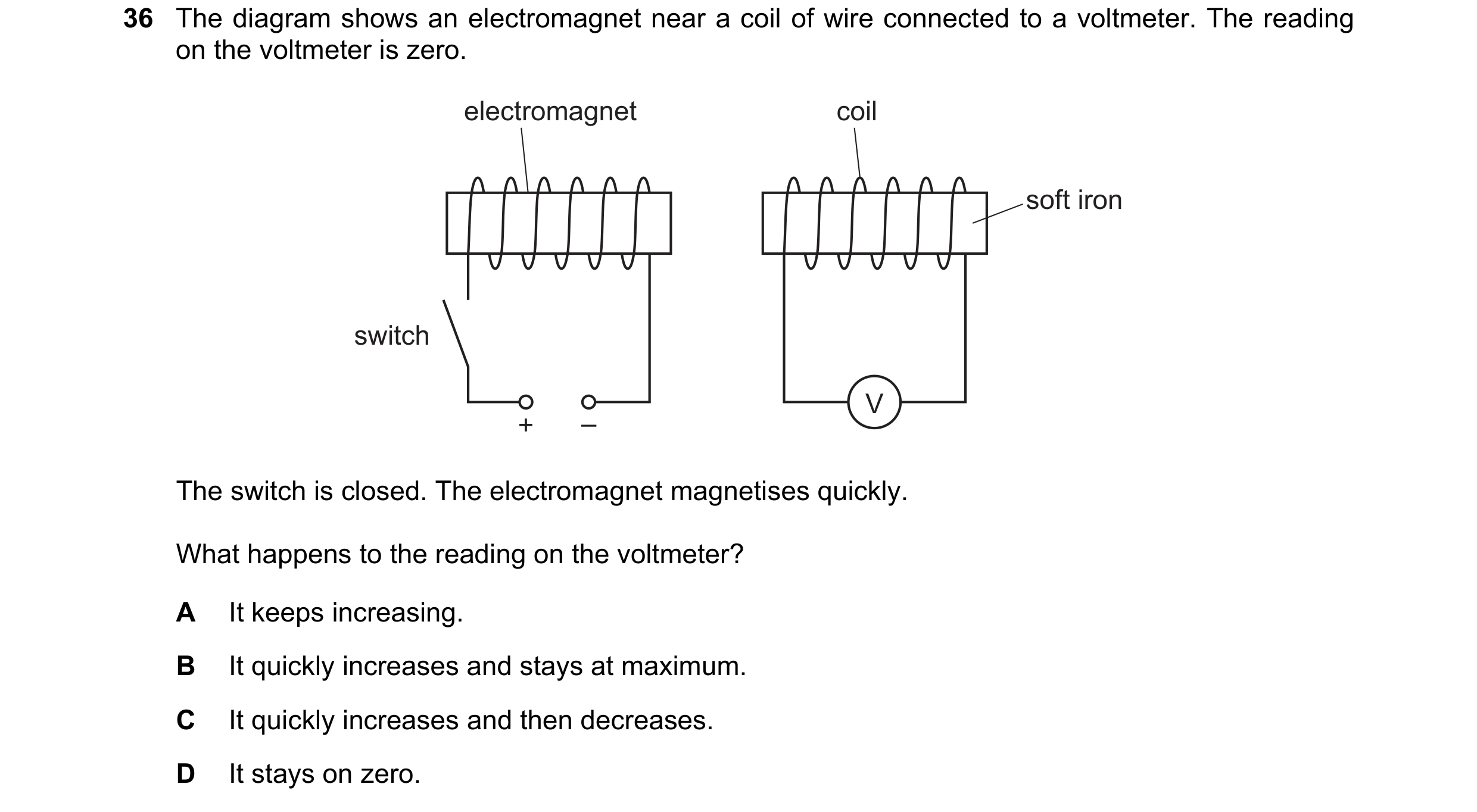
Q79 · The diagram shows an electromagnet near a coil of wire connected to a voltmeter 0625/22 Feb/March 2021
36 The diagram shows an electromagnet near a coil of wire connected to a voltmeter. The reading on the voltmeter is zero. electromagnet coil soft iron switch V + – The switch is closed. The electromagnet magnetises quickly. What happens to the reading on the voltmeter? A It keeps increasing. B It quickly increases and stays at maximum. C It quickly increases and then decreases. D It stays on zero.
1 marks
Answer: C
This question in 0625/22 Feb/March 2021
Q80 · Which method does not demagnetise a bar magnet? 0625/22 May/June 2021
27 Which method does not demagnetise a bar magnet? A Heat the bar magnet and place it in the east-west direction to cool. B Place the bar magnet in the east-west direction and hammer it. C Place the bar magnet in a coil connected to an a.c. supply and slowly withdraw it. D Place the bar magnet in a coil connected to a d.c. supply and slowly withdraw it.
1 marks
Answer: D
This question in 0625/22 May/June 2021
Q81 · Three piles of small nails, P, Q and R, are placed on a bench below three electromagnets 0625/22 May/June 2021
28 Three piles of small nails, P, Q and R, are placed on a bench below three electromagnets. One set of nails is made of copper, one of soft iron and one of steel. Diagram 1 shows the situation when the electromagnets are switched on. Diagram 2 shows the situation when the electromagnets are then switched off. diagram 1 the switches are closed Q R P bench small nails diagram 2 the switches are open small nails R bench P Q Which row correctly identifies the materials from which the nails are made? copper soft iron steel A P Q R B P R Q C Q P R D Q R P
1 marks
Answer: A
This question in 0625/22 May/June 2021
Q82 · A magnet is suspended by a cotton thread 0625/22 May/June 2021
29 A magnet is suspended by a cotton thread. The magnet is displaced then allowed to swing freely until it comes to rest. Why does the magnet always come to rest pointing in the same direction? A because of the interaction between the electric field of the magnet and the electric field of the Earth B because of the interaction between the electric field of the magnet and the magnetic field of the Earth C because of the interaction between the magnetic field of the magnet and the gravitational field of the Earth D because of the interaction between the magnetic field of the magnet and the magnetic field of the Earth
1 marks
Answer: D
This question in 0625/22 May/June 2021
Q83 · A solenoid is connected to a very sensitive ammeter 0625/22 May/June 2021
35 A solenoid is connected to a very sensitive ammeter. A rod is inserted into one end of the solenoid. The ammeter shows that there is a small electric current in the solenoid while the rod is moving. solenoid rod A Which rod is being inserted? A a heated copper rod B a magnetised steel rod C an uncharged nylon rod D a radioactive uranium rod
1 marks
Answer: B
This question in 0625/22 May/June 2021
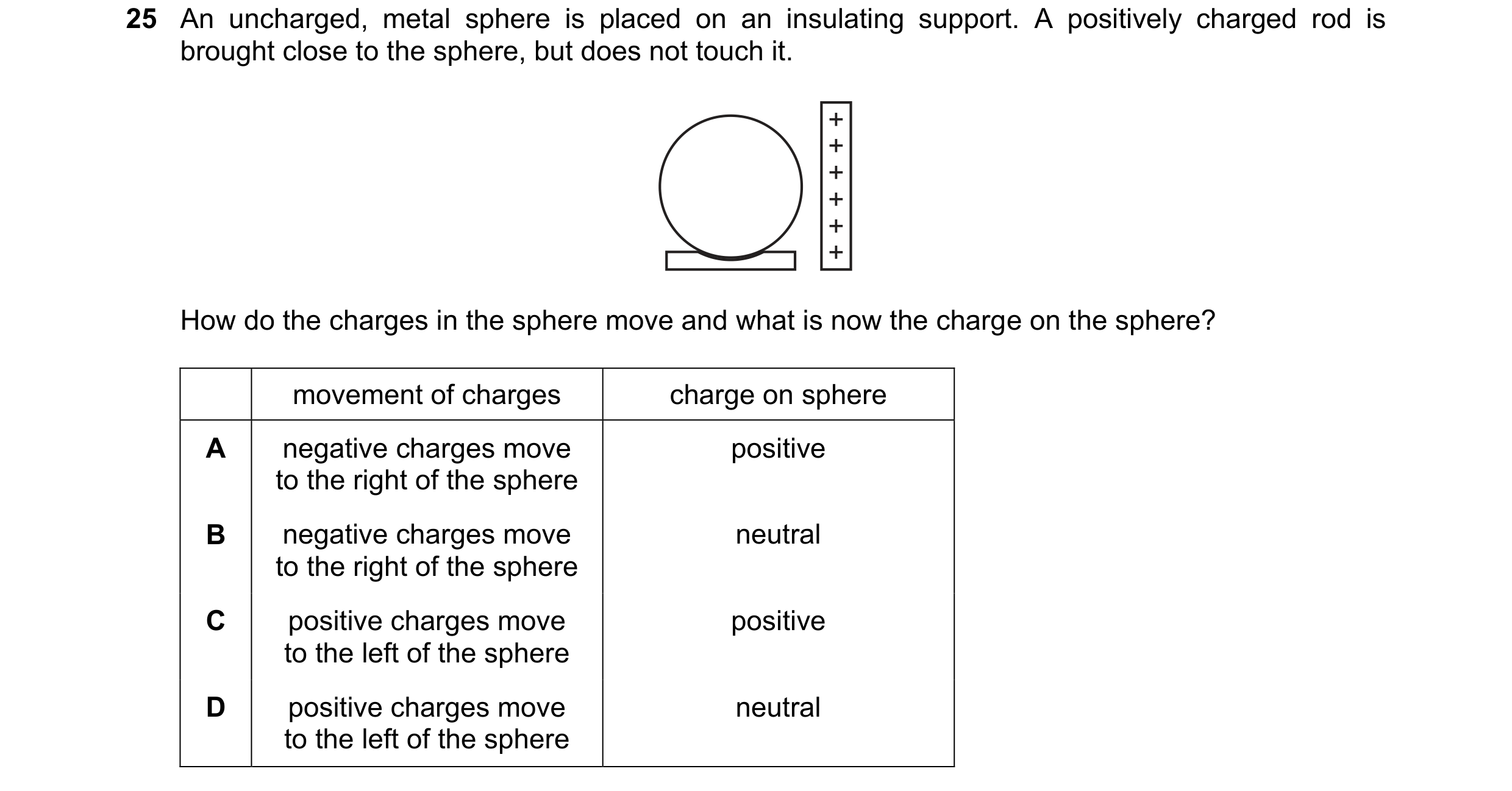
Q84 · An uncharged, metal sphere is placed on an insulating support 0625/21 Oct/Nov 2021
25 An uncharged, metal sphere is placed on an insulating support. A positively charged rod is brought close to the sphere, but does not touch it. + + + + + + How do the charges in the sphere move and what is now the charge on the sphere? movement of charges charge on sphere A negative charges move positive to the right of the sphere B negative charges move neutral to the right of the sphere C positive charges move positive to the left of the sphere D positive charges move neutral to the left of the sphere
1 marks
Answer: B
This question in 0625/21 Oct/Nov 2021
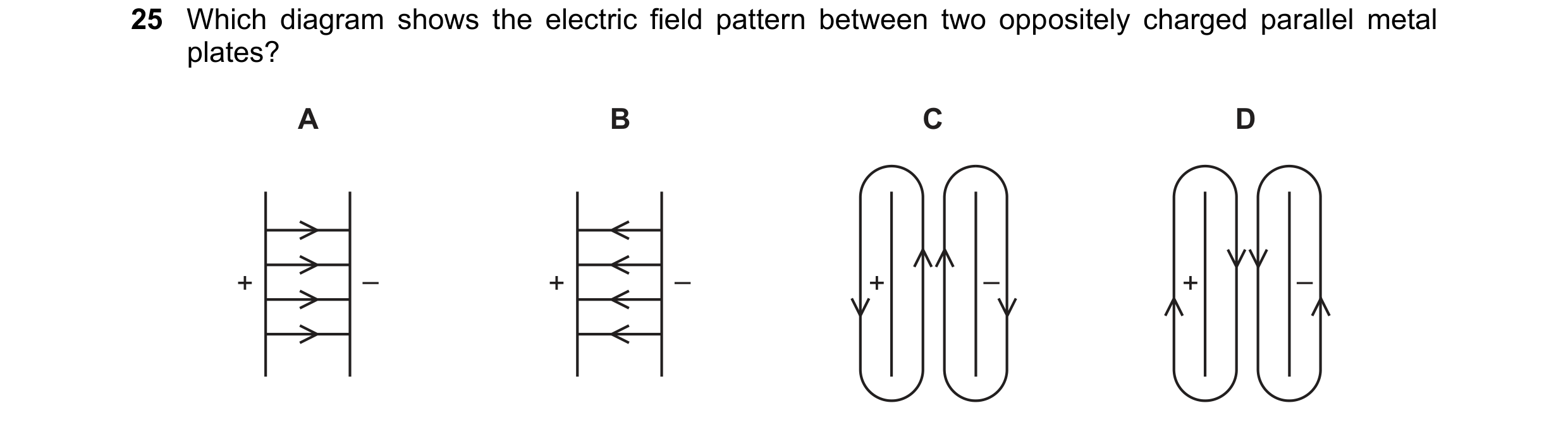
Q85 · Which diagram shows the electric field pattern between two oppositely charged parallel… 0625/22 Oct/Nov 2021
25 Which diagram shows the electric field pattern between two oppositely charged parallel metal plates? A B C D + – + – + – + –
1 marks
Answer: A
This question in 0625/22 Oct/Nov 2021
Q86 · The diagram shows the magnetic field due to a current in a solenoid 0625/22 Oct/Nov 2021
36 The diagram shows the magnetic field due to a current in a solenoid. direction of current The direction of the current is reversed. Which row describes the effect that this has on the magnitude and on the direction of the magnetic field? magnitude of direction of magnetic field magnetic field A increases changes B increases unchanged C unchanged changes D unchanged unchanged
1 marks
Answer: C
This question in 0625/22 Oct/Nov 2021
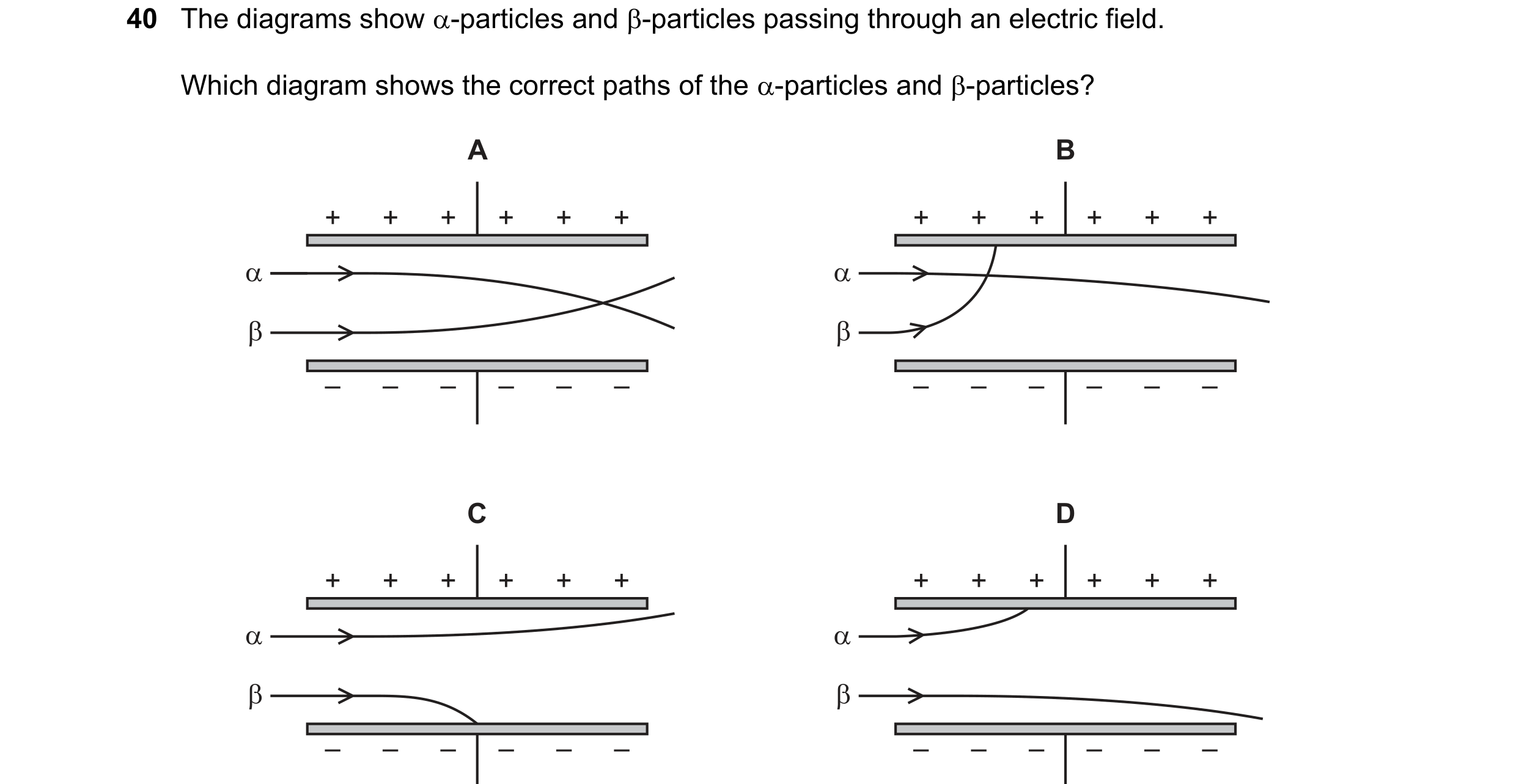
Q87 · The diagrams show a-particles and B-particles passing through an electric field 0625/22 Oct/Nov 2021
40 The diagrams show a-particles and B-particles passing through an electric field.
Which diagram shows the correct paths of the a-particles and B-particles?
1 marks
Answer: B
This question in 0625/22 Oct/Nov 2021
Q88 · A stationary, charged particle is in a field 0625/23 Oct/Nov 2021
25 A stationary, charged particle is in a field. Which fields can cause there to be a force on this particle due to its charge? 1 gravitational field 2 magnetic field 3 electric field A 1 and 2 B 1 only C 2 and 3 D 3 only
1 marks
Answer: D
This question in 0625/23 Oct/Nov 2021
Q89 · Which diagram shows the magnetic field around a straight, current-carrying wire? 0625/23 Oct/Nov 2021
35 Which diagram shows the magnetic field around a straight, current-carrying wire? A B current current C D current current
1 marks
Answer: A
This question in 0625/23 Oct/Nov 2021
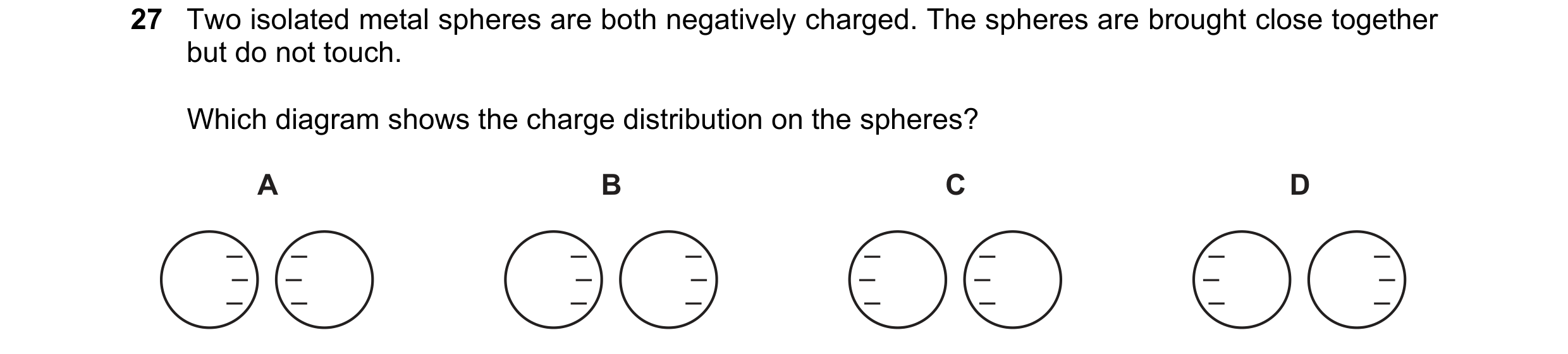
Q90 · Two isolated metal spheres are both negatively charged 0625/22 Feb/March 2022
27 Two isolated metal spheres are both negatively charged. The spheres are brought close together but do not touch. Which diagram shows the charge distribution on the spheres? A B C D – – – – – – – – – – – – – – – – – – – – – – – –
1 marks
Answer: D
This question in 0625/22 Feb/March 2022
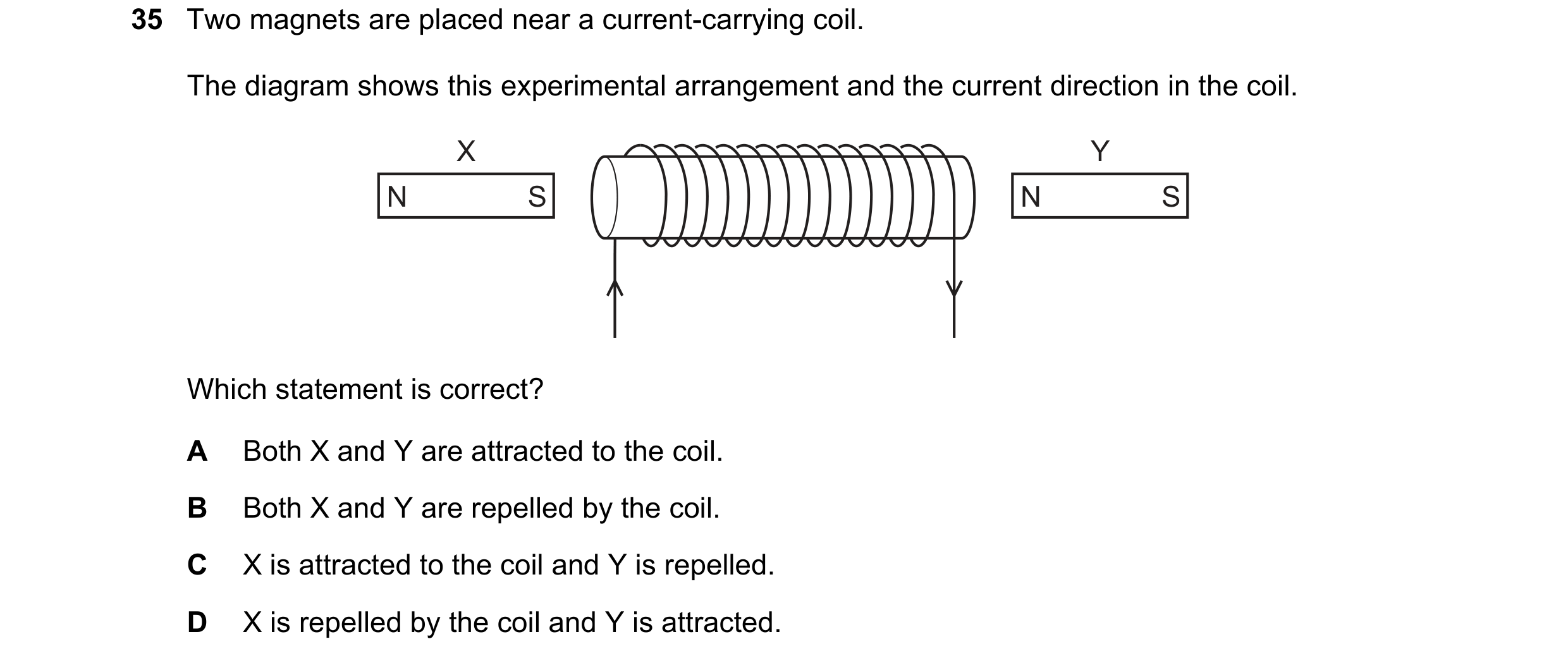
Q91 · Two magnets are placed near a current-carrying coil 0625/22 Feb/March 2022
35 Two magnets are placed near a current-carrying coil. The diagram shows this experimental arrangement and the current direction in the coil. X Y N S N S Which statement is correct? A Both X and Y are attracted to the coil. B Both X and Y are repelled by the coil. C X is attracted to the coil and Y is repelled. D X is repelled by the coil and Y is attracted.
1 marks
Answer: B
This question in 0625/22 Feb/March 2022
Q92 · A student counts how many iron pins an electromagnet picks up when its power supply is… 0625/21 May/June 2022
28 A student counts how many iron pins an electromagnet picks up when its power supply is switched on. Then, she counts how many pins are picked up when the power supply is switched off. core d.c. power d.c. power supply on supply off iron pins She repeats the experiment using cores made of different materials. The results are shown. Which core is made out of soft iron? pins picked up with pins picked up with the power supply on the power supply off A 0 0 B 2 7 C 8 5 D 12 0
1 marks
Answer: D
This question in 0625/21 May/June 2022
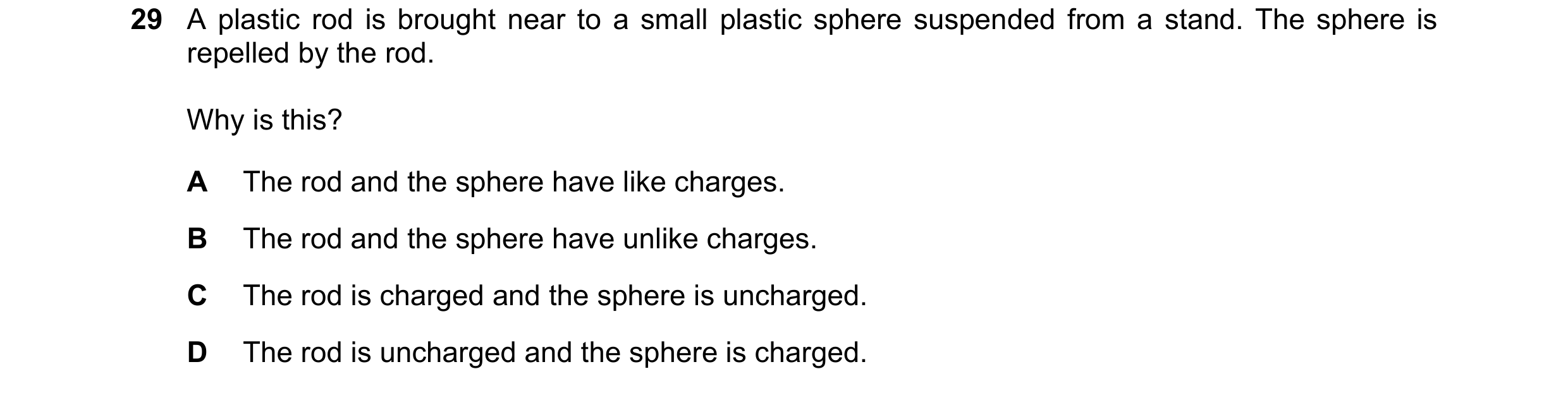
Q93 · A plastic rod is brought near to a small plastic sphere suspended from a stand 0625/21 May/June 2022
29 A plastic rod is brought near to a small plastic sphere suspended from a stand. The sphere is repelled by the rod. Why is this? A The rod and the sphere have like charges. B The rod and the sphere have unlike charges. C The rod is charged and the sphere is uncharged. D The rod is uncharged and the sphere is charged.
1 marks
Answer: A
This question in 0625/21 May/June 2022
Q94 · The diagram shows the magnetic fields around three objects, P, Q and R, placed close to… 0625/22 May/June 2022
28 The diagram shows the magnetic fields around three objects, P, Q and R, placed close to each other. P Q R Which row shows the nature of each of the objects? P Q R permanent magnet permanent magnet A copper rod N S N S permanent magnet permanent magnet B copper rod N S S N permanent magnet permanent magnet C iron rod N S N S permanent magnet permanent magnet D iron rod N S S N
1 marks
Answer: B
This question in 0625/22 May/June 2022
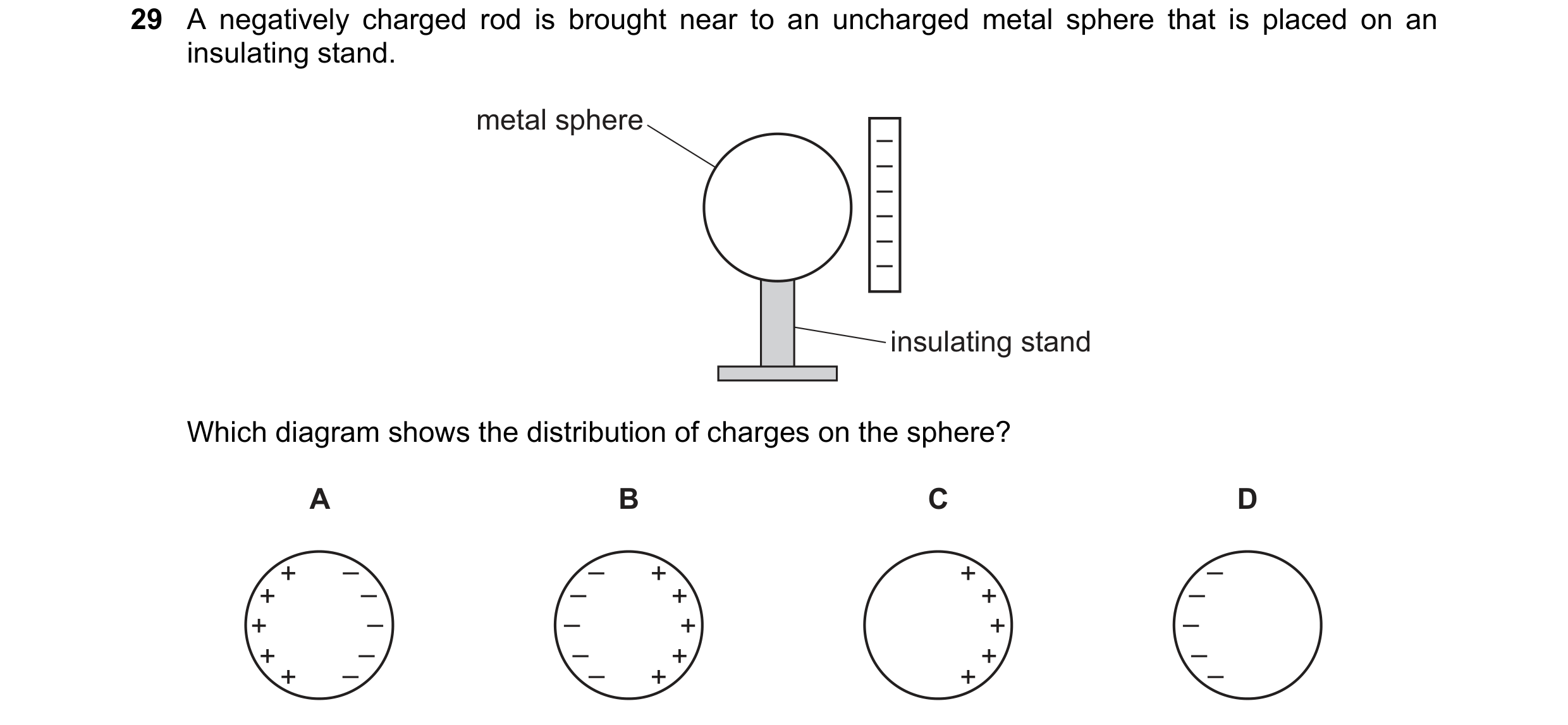
Q95 · A negatively charged rod is brought near to an uncharged metal sphere that is placed on… 0625/22 May/June 2022
29 A negatively charged rod is brought near to an uncharged metal sphere that is placed on an insulating stand. metal sphere – – – – – – insulating stand Which diagram shows the distribution of charges on the sphere? A B C D + – – + + – + – – + + – + – – + + – + –– –– + + –– + + +
1 marks
Answer: B
This question in 0625/22 May/June 2022
Q96 · A student attempts to make a permanent magnet by hammering metal bars of the same size in… 0625/23 May/June 2022
28 A student attempts to make a permanent magnet by hammering metal bars of the same size in the same magnetic field. In which case is the strongest permanent magnet produced? A B magnetic magnetic field lines field lines iron bar iron bar C D magnetic magnetic field lines field lines steel bar steel bar
1 marks
Answer: C
This question in 0625/23 May/June 2022
Q97 · A metal sphere R is suspended on an insulating thread 0625/23 May/June 2022
29 A metal sphere R is suspended on an insulating thread. insulating thread support R Another sphere S is brought close to sphere R. Sphere S has a negative charge and is attached to a plastic stand. The diagram shows the spheres when they are close to each other. S – – – – – – – R – table plastic stand Which charged state of R accounts for the behaviour in the diagram? A negative only B positive only C negative or uncharged D positive or uncharged
1 marks
Answer: D
This question in 0625/23 May/June 2022
Q98 · Which statement is not a method for magnetising an iron bar? 0625/21 Oct/Nov 2022
25 Which statement is not a method for magnetising an iron bar? A Place the bar next to a magnet and hammer the bar. B Place the bar inside a solenoid. Switch on an alternating current (a.c.) in the coil and gradually reduce the current. C Place the bar inside a solenoid. Switch on a direct current (d.c.) in the coil and gradually reduce the current. D Stroke the bar repeatedly with a magnet.
1 marks
Answer: B
This question in 0625/21 Oct/Nov 2022
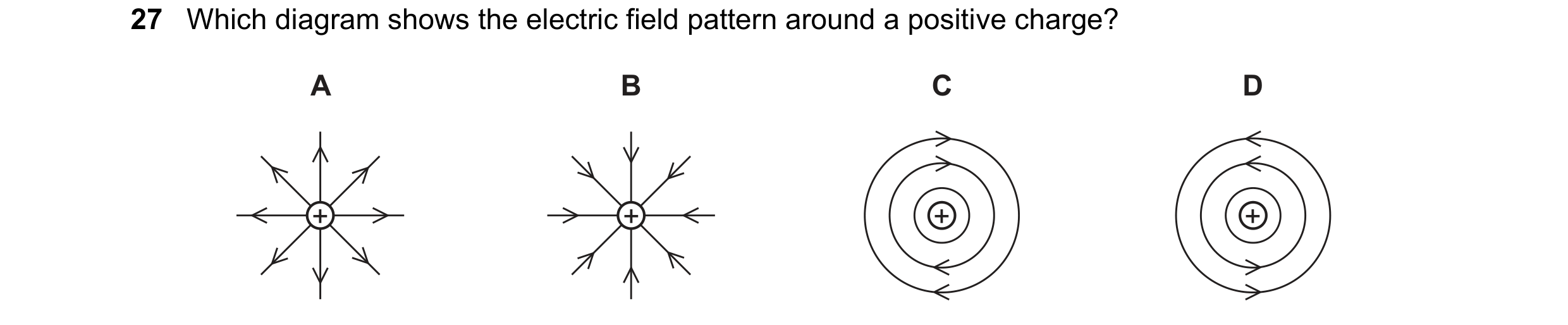
Q99 · Which diagram shows the electric field pattern around a positive charge? 0625/21 Oct/Nov 2022
27 Which diagram shows the electric field pattern around a positive charge? A B C D + + + +
1 marks
Answer: A
This question in 0625/21 Oct/Nov 2022
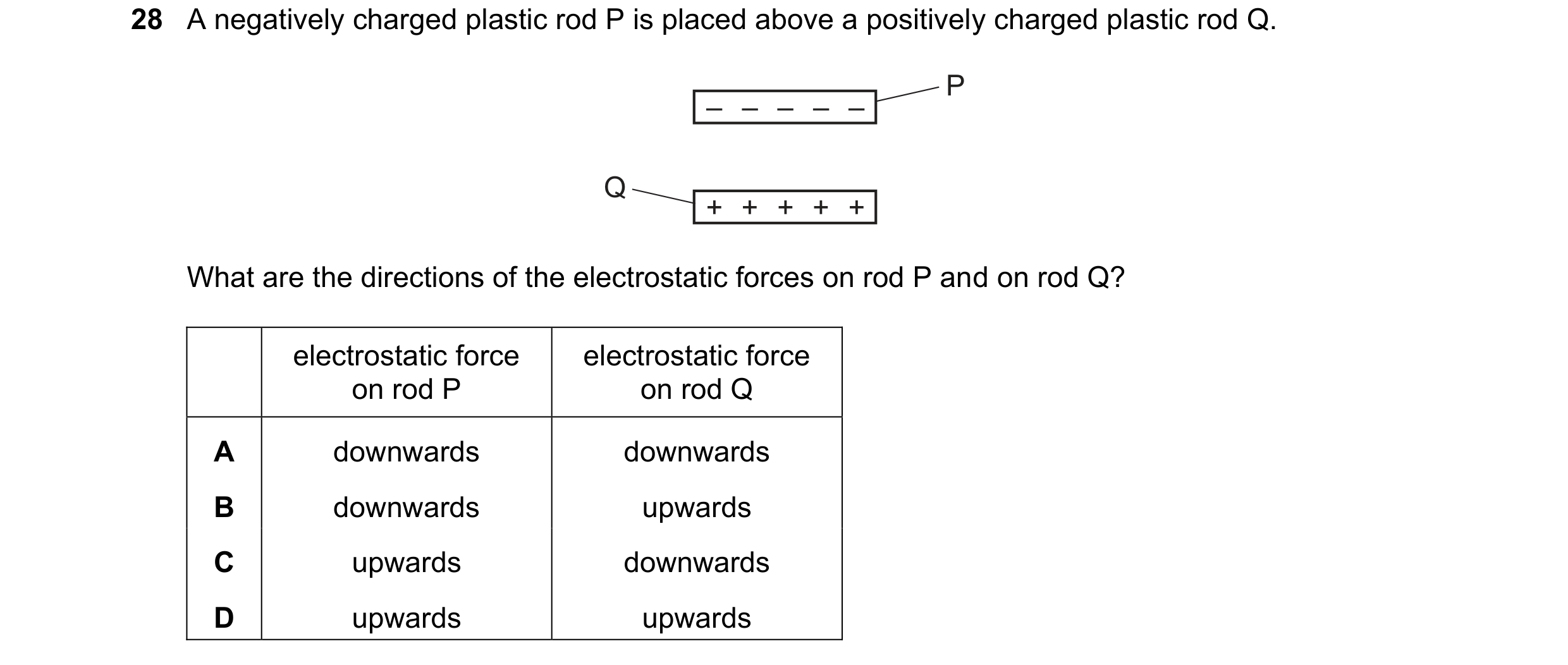
Q100 · A negatively charged plastic rod P is placed above a positively charged plastic rod Q 0625/21 Oct/Nov 2022
28 A negatively charged plastic rod P is placed above a positively charged plastic rod Q. P – – – – – Q + + + + + What are the directions of the electrostatic forces on rod P and on rod Q? electrostatic force electrostatic force on rod P on rod Q A downwards downwards B downwards upwards C upwards downwards D upwards upwards
1 marks
Answer: B
This question in 0625/21 Oct/Nov 2022
Q101 · The diagrams show the magnetic field lines around a wire carrying a current, I 0625/21 Oct/Nov 2022
35 The diagrams show the magnetic field lines around a wire carrying a current, I. 1 2 I I 3 4 I I Which diagrams are correct? A 1 only B 2 and 3 C 4 only D 1 and 3
1 marks
Answer: D
This question in 0625/21 Oct/Nov 2022
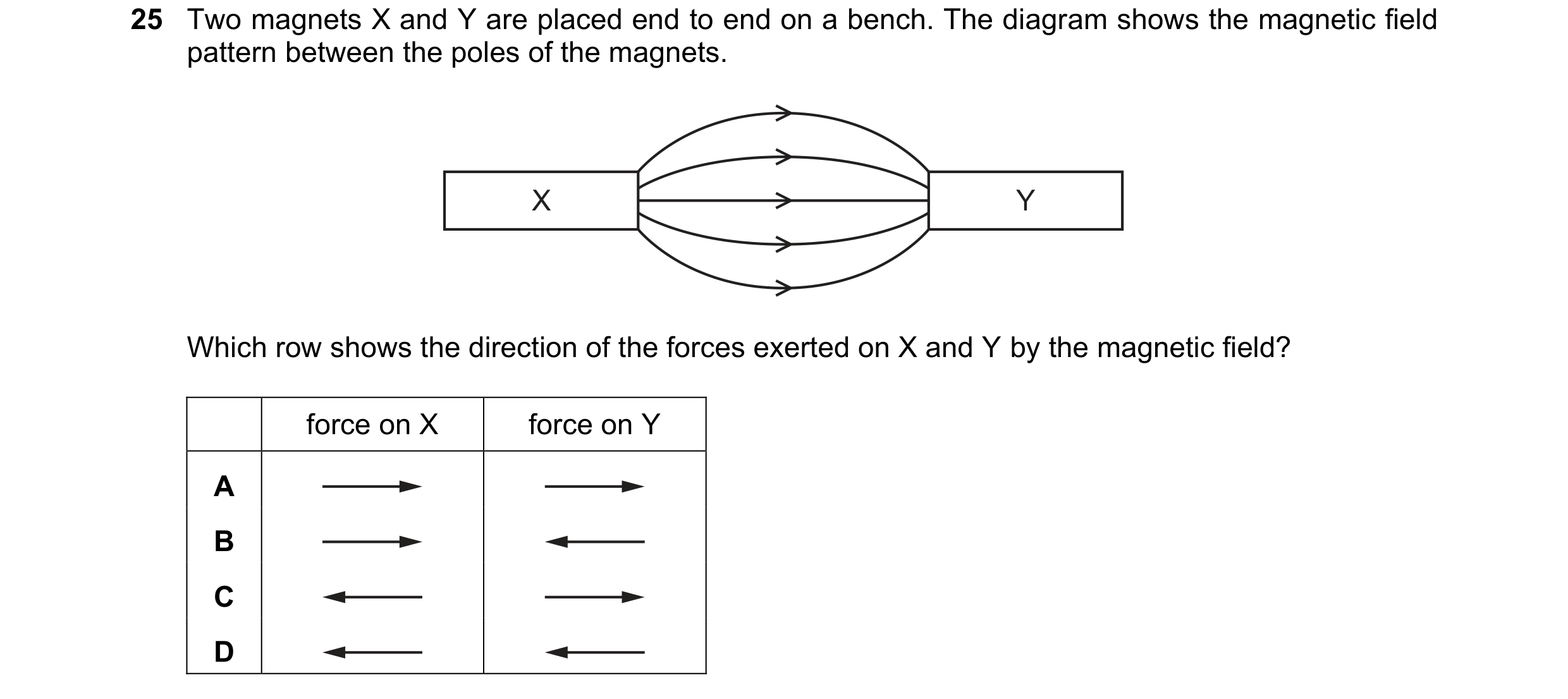
Q102 · Two magnets X and Y are placed end to end on a bench 0625/22 Oct/Nov 2022
25 Two magnets X and Y are placed end to end on a bench. The diagram shows the magnetic field pattern between the poles of the magnets. X Y Which row shows the direction of the forces exerted on X and Y by the magnetic field? force on X force on Y A B C D
1 marks
Answer: B
This question in 0625/22 Oct/Nov 2022
Q103 · Four small compasses are placed around a solenoid 0625/22 Oct/Nov 2022
34 Four small compasses are placed around a solenoid. solenoid A current is now switched on in the solenoid. Which diagram shows possible new directions of the compass needles? A B C D
1 marks
Answer: D
This question in 0625/22 Oct/Nov 2022
Q104 · A student is to demagnetise a bar magnet 0625/23 Oct/Nov 2022
25 A student is to demagnetise a bar magnet. She tries four different ways. 1 hammering the magnet 2 heating the magnet 3 passing direct current through the magnet 4 placing the magnet in water Which methods will demagnetise the magnet? A 1, 2 and 3 B 1 and 2 only C 1 and 4 D 2 and 3 only
1 marks
Answer: B
This question in 0625/23 Oct/Nov 2022
Q105 · Four small compasses are placed around a solenoid 0625/23 Oct/Nov 2022
34 Four small compasses are placed around a solenoid. solenoid A current is now switched on in the solenoid. Which diagram shows possible new directions of the compass needles? A B C D
1 marks
Answer: D
This question in 0625/23 Oct/Nov 2022
Q106 · Which metal is used for the core of a transformer? 0625/23 Oct/Nov 2022
35 Which metal is used for the core of a transformer? A aluminium B copper C soft iron D steel
1 marks
Answer: C
This question in 0625/23 Oct/Nov 2022
Q107 · The diagram shows a bar magnet at rest on a smooth horizontal surface 0625/22 Feb/March 2023
24 The diagram shows a bar magnet at rest on a smooth horizontal surface. A length of soft-iron wire is held parallel to the magnet. N soft-iron wire magnet S The wire is released. What happens? A The wire moves away from the magnet. B The wire moves towards the magnet. C The wire’s centre stays in its present position and the wire rotates through 90° in a clockwise direction. D The wire’s centre stays in its present position and the wire rotates through 90° in an anticlockwise direction.
1 marks
Answer: B
This question in 0625/22 Feb/March 2023
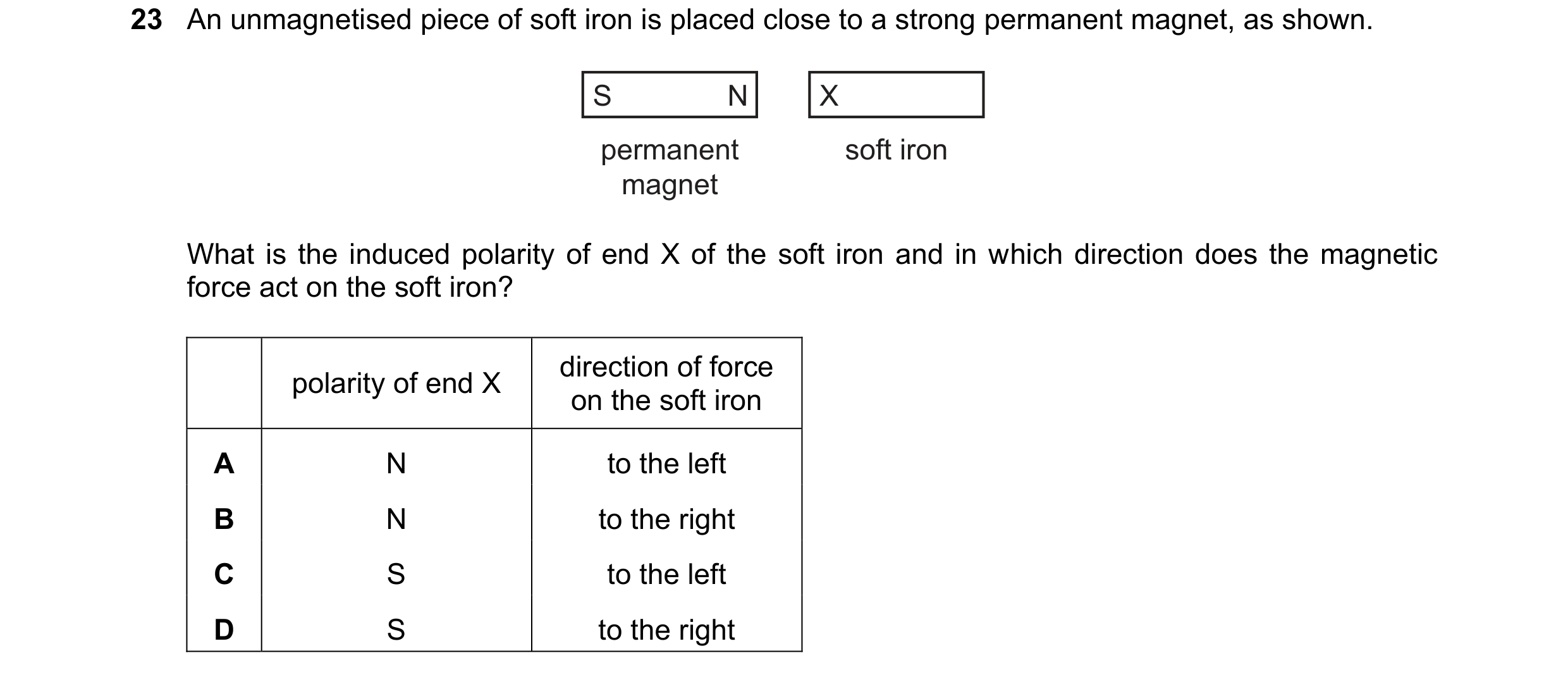
Q108 · An unmagnetised piece of soft iron is placed close to a strong permanent magnet, as shown 0625/21 May/June 2023
23 An unmagnetised piece of soft iron is placed close to a strong permanent magnet, as shown. S N X permanent soft iron magnet What is the induced polarity of end X of the soft iron and in which direction does the magnetic force act on the soft iron? direction of force polarity of end X on the soft iron A N to the left B N to the right C S to the left D S to the right
1 marks
Answer: C
This question in 0625/21 May/June 2023
Q109 · The magnetic field of a bar magnet can be represented by magnetic field lines 0625/22 May/June 2023
23 The magnetic field of a bar magnet can be represented by magnetic field lines. Which diagram shows two magnetic field lines correctly? A B C D N S N S N S N S
1 marks
Answer: A
This question in 0625/22 May/June 2023
Q110 · The diagram shows the pattern of the magnetic field due to the current I in a straight… 0625/22 May/June 2023
31 The diagram shows the pattern of the magnetic field due to the current I in a straight wire. I Y Q P X Which row is correct? relative direction of field strength of field A X greater at P than Q B Y greater at P than Q C X greater at Q than P D Y greater at Q than P
1 marks
Answer: D
This question in 0625/22 May/June 2023
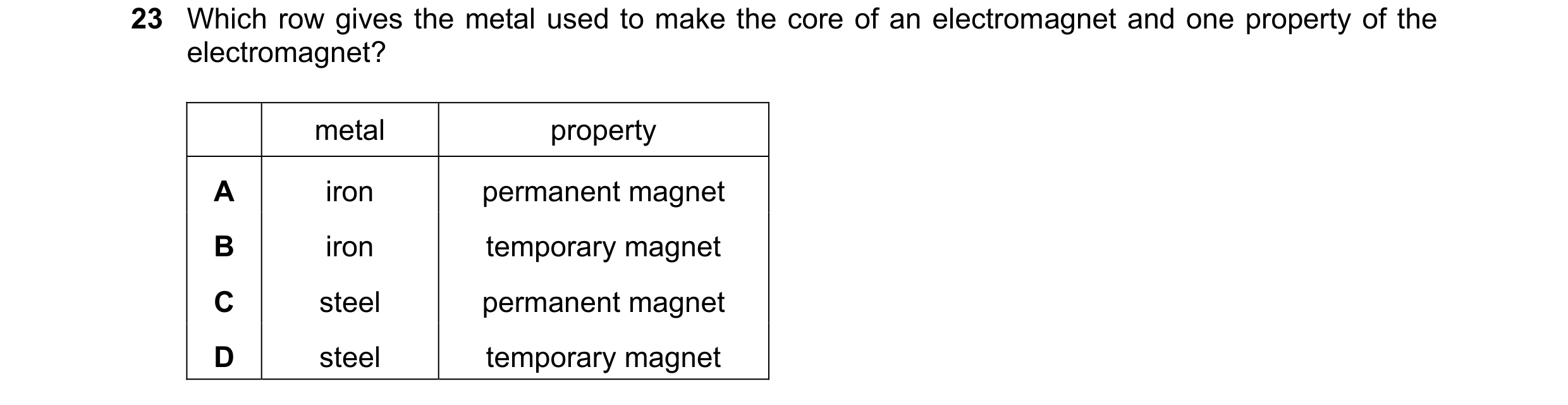
Q111 · Which row gives the metal used to make the core of an electromagnet and one property of… 0625/23 May/June 2023
23 Which row gives the metal used to make the core of an electromagnet and one property of the electromagnet? metal property A iron permanent magnet B iron temporary magnet C steel permanent magnet D steel temporary magnet
1 marks
Answer: B
This question in 0625/23 May/June 2023
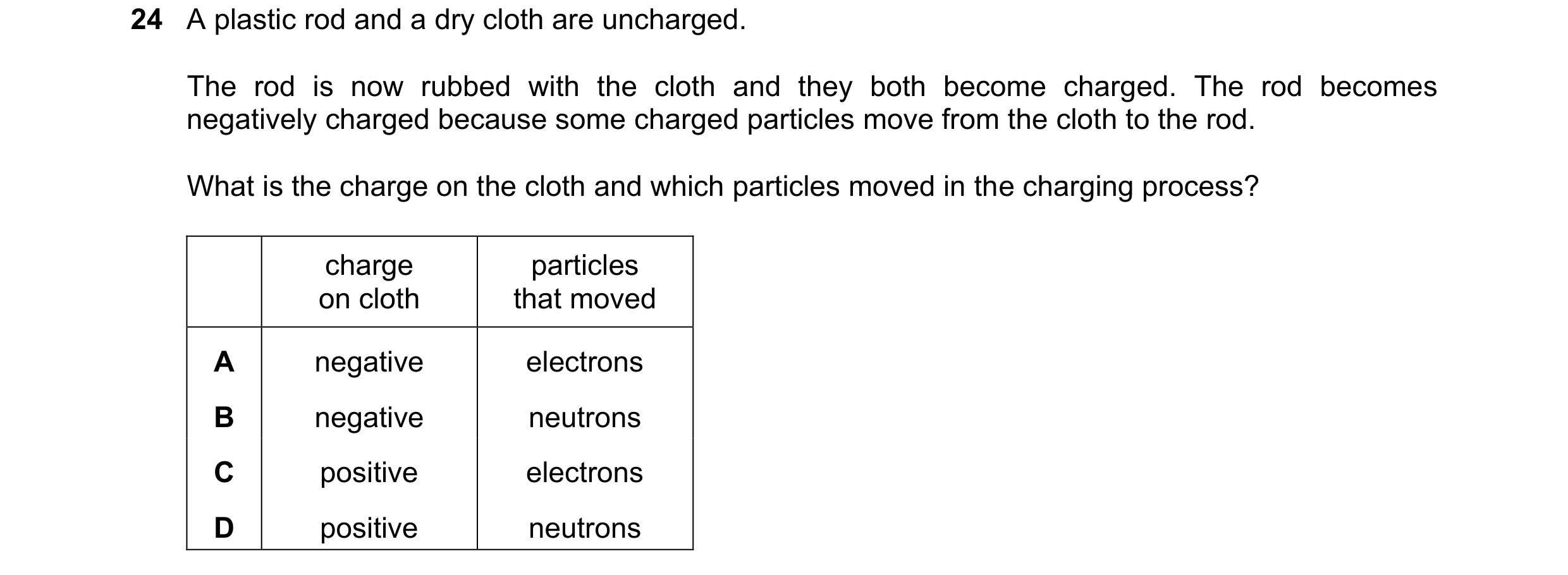
Q112 · A plastic rod and a dry cloth are uncharged 0625/23 May/June 2023
24 A plastic rod and a dry cloth are uncharged. The rod is now rubbed with the cloth and they both become charged. The rod becomes negatively charged because some charged particles move from the cloth to the rod. What is the charge on the cloth and which particles moved in the charging process? charge particles on cloth that moved A negative electrons B negative neutrons C positive electrons D positive neutrons
1 marks
Answer: C
This question in 0625/23 May/June 2023
Q113 · The diagram shows the magnetic field around a solenoid carrying an electric current 0625/23 May/June 2023
29 The diagram shows the magnetic field around a solenoid carrying an electric current. magnetic field What happens to the strength of the magnetic field and the distance between the field lines when the current is increased? strength of distance between magnetic field field lines A decreases decreases B decreases increases C increases decreases D increases increases
1 marks
Answer: C
This question in 0625/23 May/June 2023
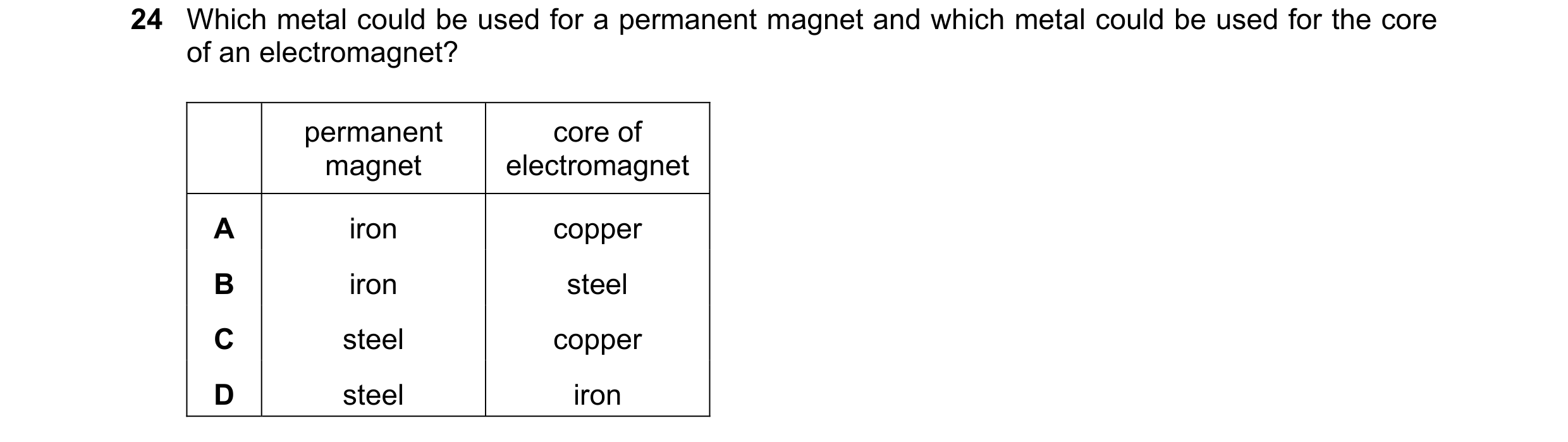
Q114 · Which metal could be used for a permanent magnet and which metal could be used for the… 0625/21 Oct/Nov 2023
24 Which metal could be used for a permanent magnet and which metal could be used for the core of an electromagnet? permanent core of magnet electromagnet A iron copper B iron steel C steel copper D steel iron
1 marks
Answer: D
This question in 0625/21 Oct/Nov 2023
Q115 · Which statement describes the direction of an electric field at a point? 0625/21 Oct/Nov 2023
25 Which statement describes the direction of an electric field at a point? A the direction of the force on a negative charge B the direction of the force on an N pole C the direction of the force on a positive charge D the direction of the force on an S pole
1 marks
Answer: C
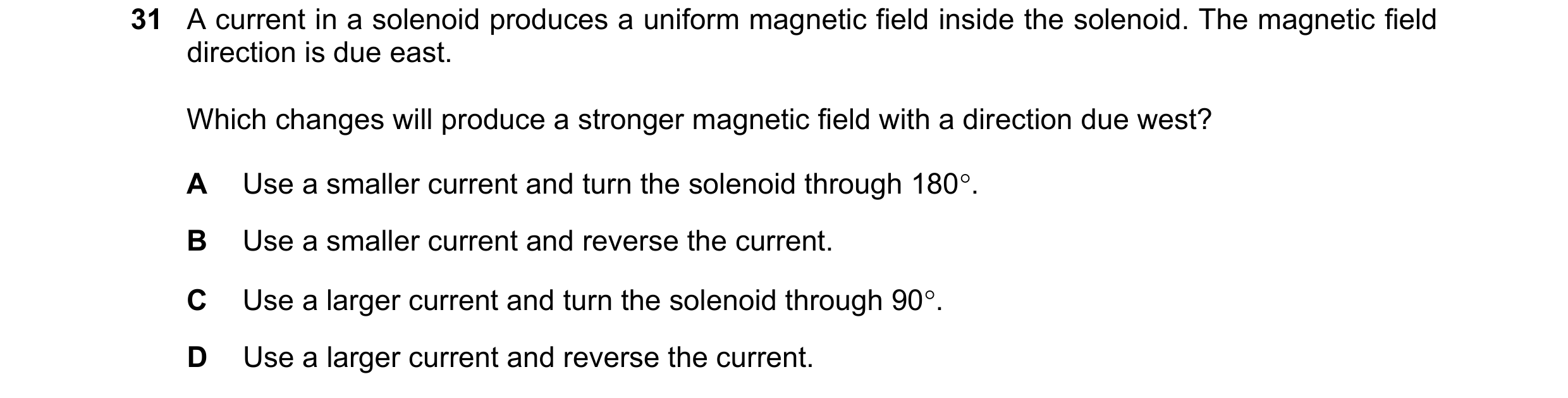
This question in 0625/21 Oct/Nov 2023
Q116 · A current in a solenoid produces a uniform magnetic field inside the solenoid 0625/21 Oct/Nov 2023
31 A current in a solenoid produces a uniform magnetic field inside the solenoid. The magnetic field direction is due east. Which changes will produce a stronger magnetic field with a direction due west? A Use a smaller current and turn the solenoid through 180. B Use a smaller current and reverse the current. C Use a larger current and turn the solenoid through 90. D Use a larger current and reverse the current.
1 marks
Answer: D
This question in 0625/21 Oct/Nov 2023
Q117 · A hard magnetic material can be used to make a permanent magnet 0625/22 Oct/Nov 2023
24 A hard magnetic material can be used to make a permanent magnet. A soft magnetic material can be used to make a temporary magnet. Which row shows whether iron and steel are hard or soft magnetic materials? iron steel A hard hard B hard soft C soft hard D soft soft
1 marks
Answer: C
This question in 0625/22 Oct/Nov 2023
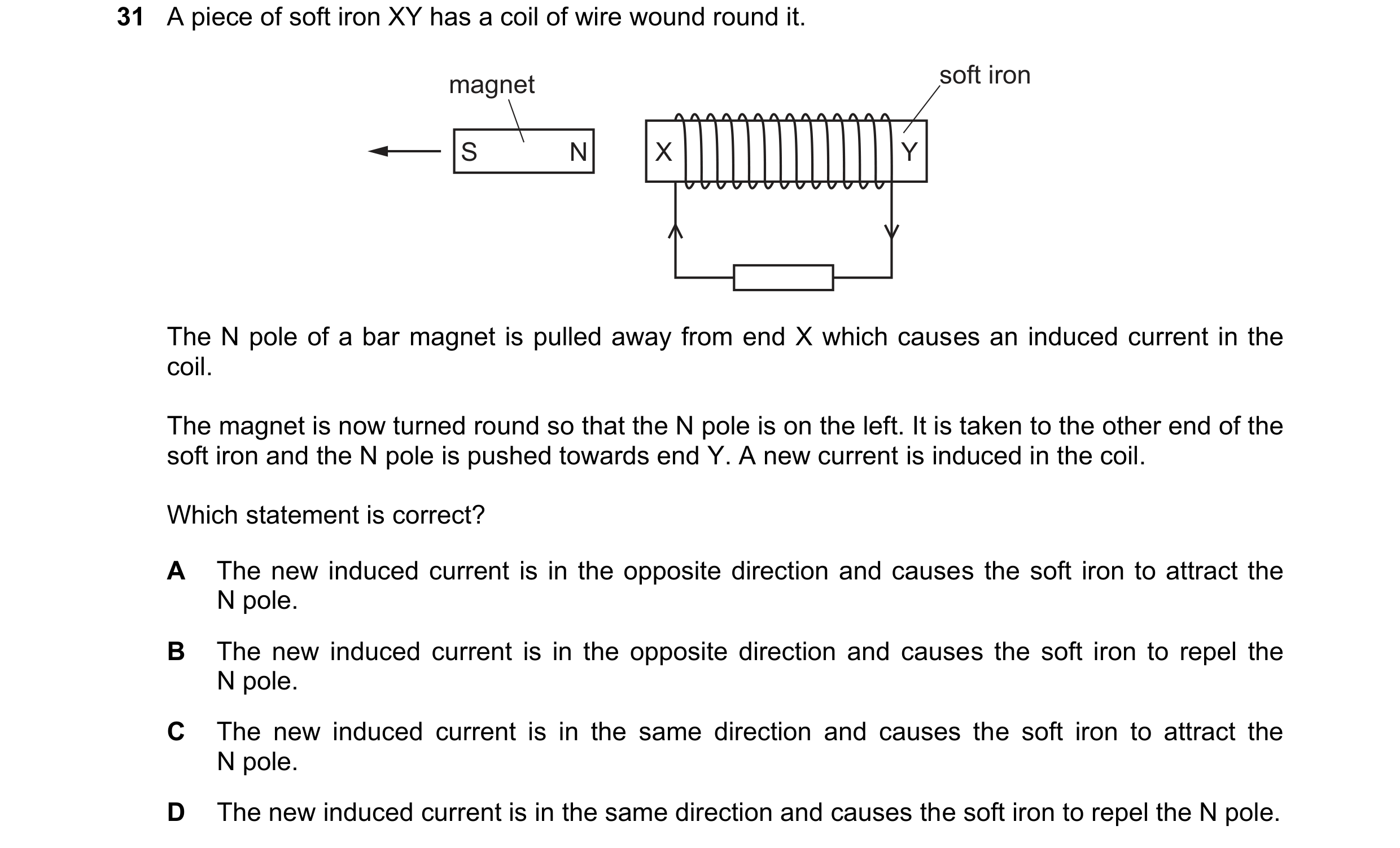
Q118 · A piece of soft iron XY has a coil of wire wound round it 0625/22 Oct/Nov 2023
31 A piece of soft iron XY has a coil of wire wound round it. magnet soft iron S N X Y The N pole of a bar magnet is pulled away from end X which causes an induced current in the coil. The magnet is now turned round so that the N pole is on the left. It is taken to the other end of the soft iron and the N pole is pushed towards end Y. A new current is induced in the coil. Which statement is correct? A The new induced current is in the opposite direction and causes the soft iron to attract the N pole. B The new induced current is in the opposite direction and causes the soft iron to repel the N pole. C The new induced current is in the same direction and causes the soft iron to attract the N pole. D The new induced current is in the same direction and causes the soft iron to repel the N pole.
1 marks
Answer: D
This question in 0625/22 Oct/Nov 2023
Q119 · Which metal can be attracted by a magnet? 0625/23 Oct/Nov 2023
24 Which metal can be attracted by a magnet? A zinc B lead C iron D copper
1 marks
Answer: C
This question in 0625/23 Oct/Nov 2023
Q120 · A teacher wishes to show the production of electrostatic charges 0625/23 Oct/Nov 2023
28 A teacher wishes to show the production of electrostatic charges. She holds a rod and rubs it with a cotton cloth. A copper rod, a glass rod, a plastic rod and a steel rod are available. Which two rods would both be suitable to use? A a copper rod and a glass rod B a glass rod and a plastic rod C a plastic rod and a copper rod D a plastic rod and a steel rod
1 marks
Answer: B
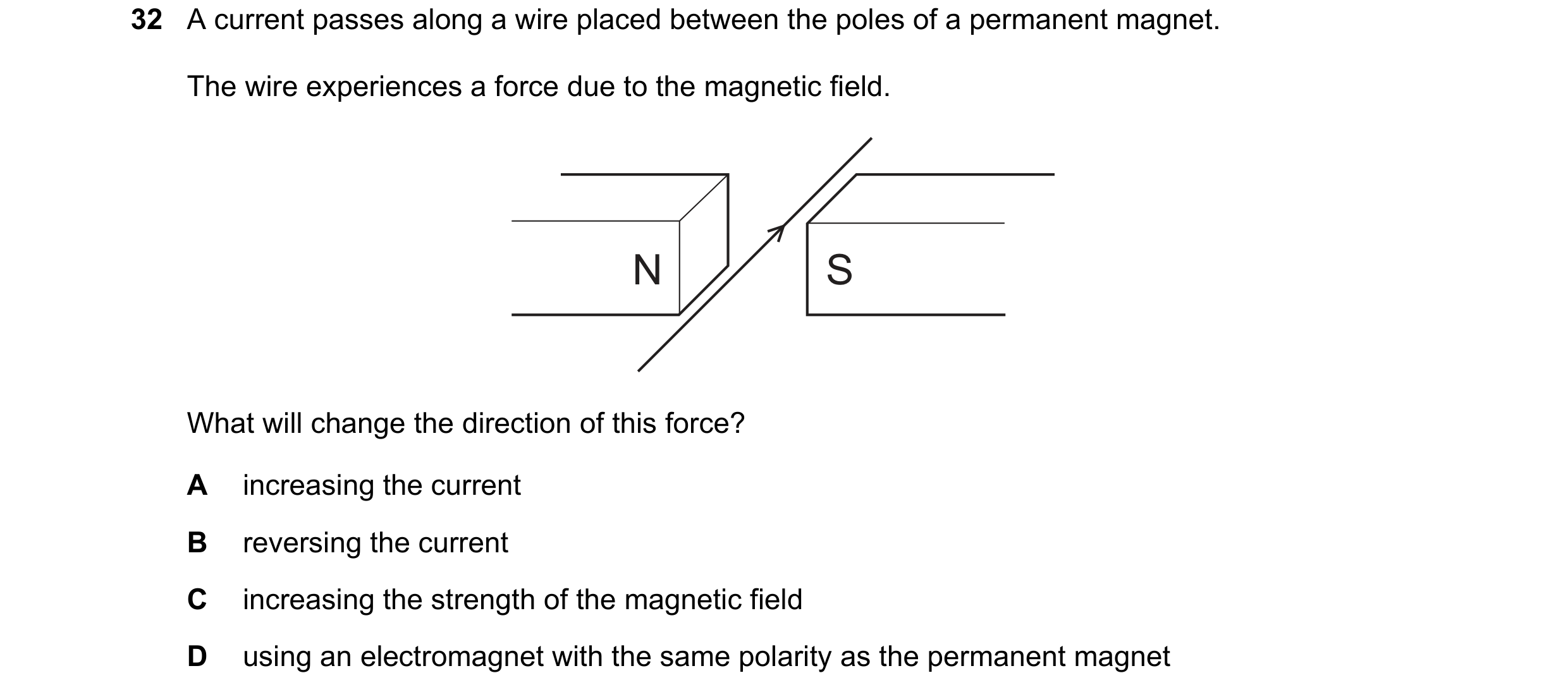
This question in 0625/23 Oct/Nov 2023
Q121 · A current passes along a wire placed between the poles of a permanent magnet 0625/23 Oct/Nov 2023
32 A current passes along a wire placed between the poles of a permanent magnet. The wire experiences a force due to the magnetic field. N S What will change the direction of this force? A increasing the current B reversing the current C increasing the strength of the magnetic field D using an electromagnet with the same polarity as the permanent magnet
1 marks
Answer: B
This question in 0625/23 Oct/Nov 2023
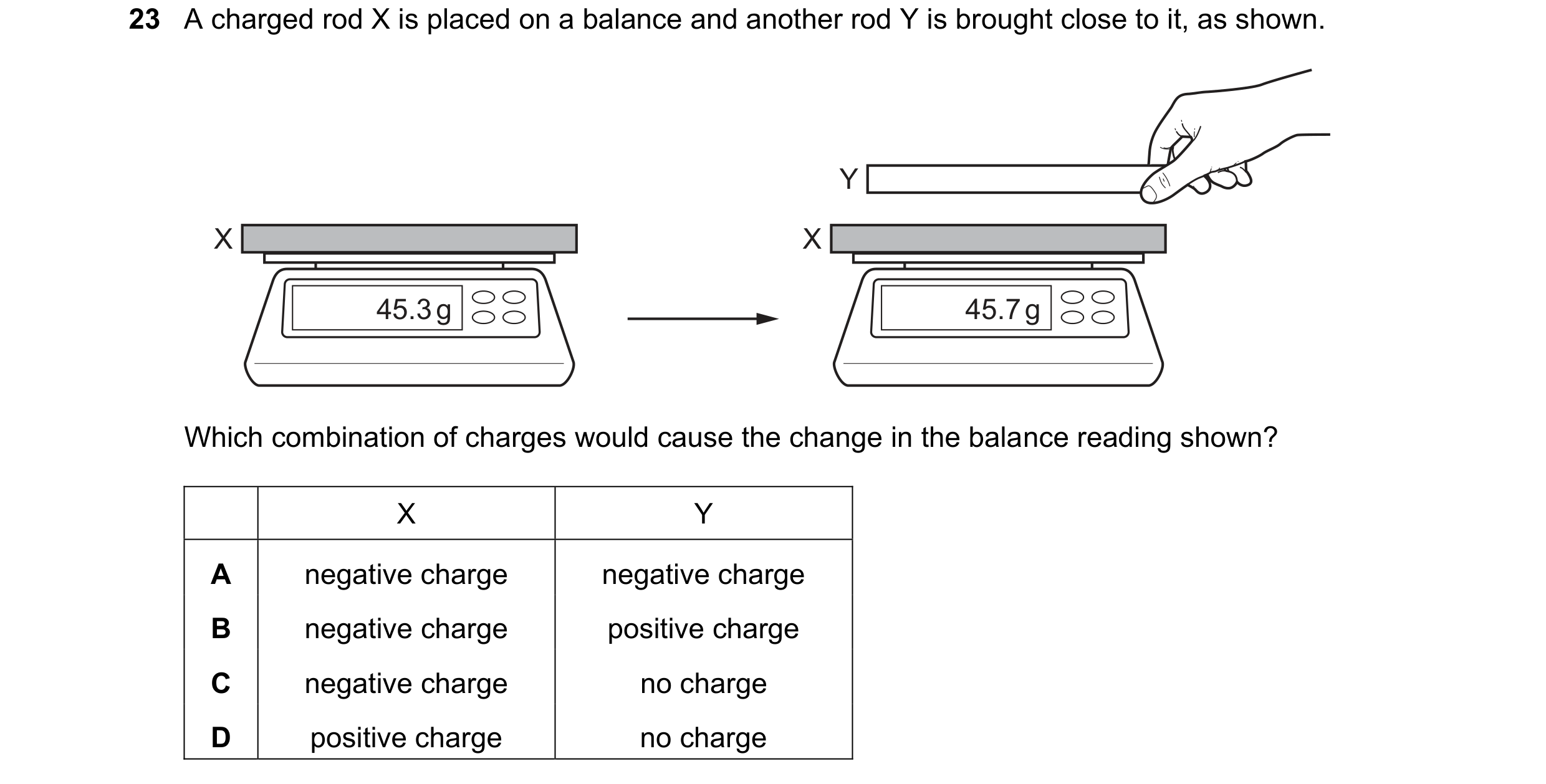
Q122 · A charged rod X is placed on a balance and another rod Y is brought close to it, as shown 0625/22 Feb/March 2024
23 A charged rod X is placed on a balance and another rod Y is brought close to it, as shown. Y X X 45.3 g 45.7 g Which combination of charges would cause the change in the balance reading shown? X Y A negative charge negative charge B negative charge positive charge C negative charge no charge D positive charge no charge
1 marks
Answer: A
This question in 0625/22 Feb/March 2024
Q123 · The diagrams show two arrangements of a pair of identical bar magnets 0625/22 Feb/March 2024
26 The diagrams show two arrangements of a pair of identical bar magnets. P diagram 1 S N N S Q R diagram 2 S N S N Three points, P, Q and R, are shown. At which point is the magnetic field due to the magnets weakest and at which point is it strongest? weakest strongest magnetic field magnetic field A P Q B P R C Q P D Q R
1 marks
Answer: B
This question in 0625/22 Feb/March 2024
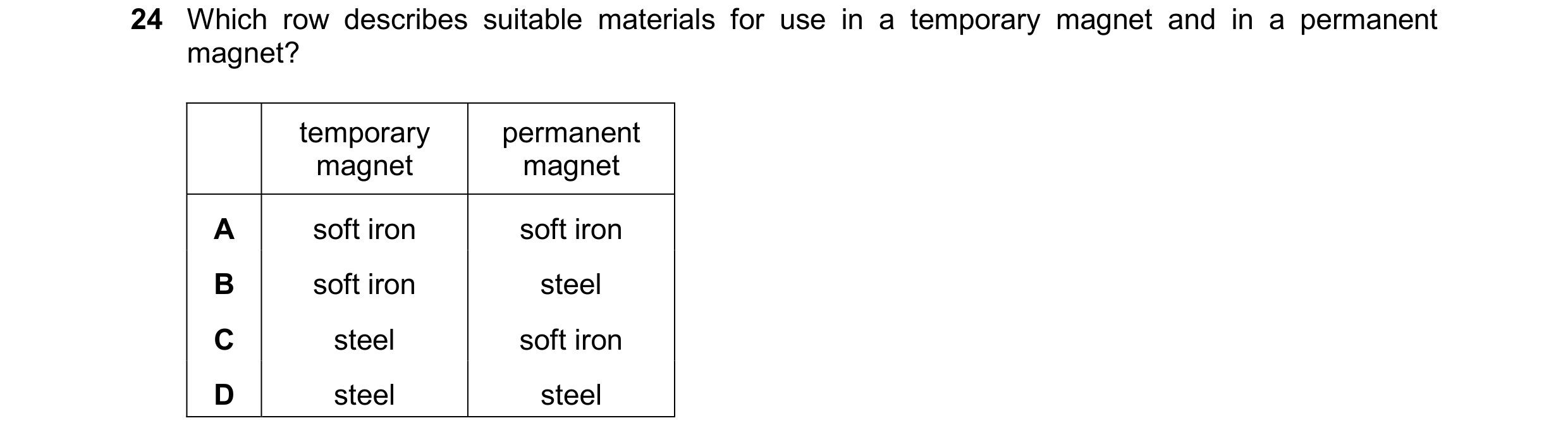
Q124 · Which row describes suitable materials for use in a temporary magnet and in a permanent… 0625/21 May/June 2024
24 Which row describes suitable materials for use in a temporary magnet and in a permanent magnet? temporary permanent magnet magnet A soft iron soft iron B soft iron steel C steel soft iron D steel steel
1 marks
Answer: B
This question in 0625/21 May/June 2024
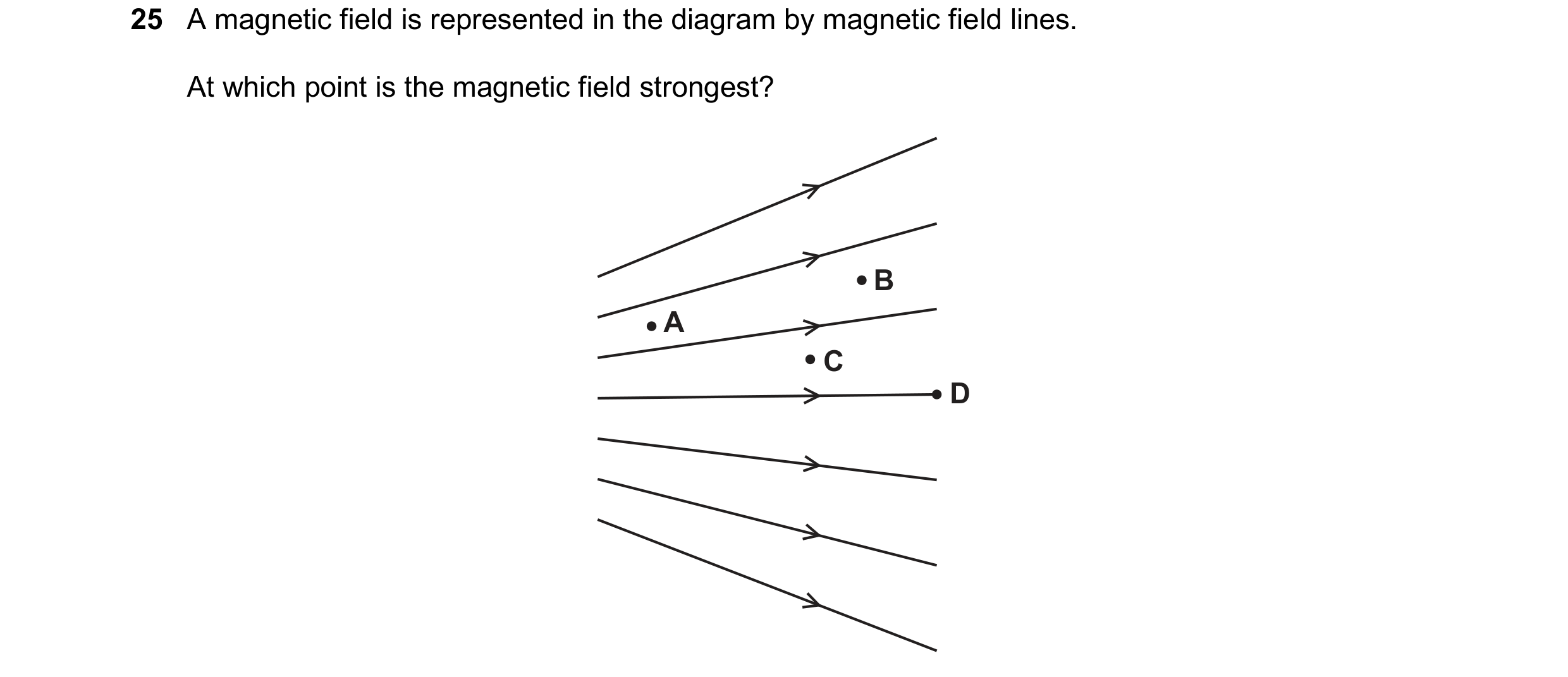
Q125 · A magnetic field is represented in the diagram by magnetic field lines 0625/21 May/June 2024
25 A magnetic field is represented in the diagram by magnetic field lines. At which point is the magnetic field strongest? B A C D
1 marks
Answer: A
This question in 0625/21 May/June 2024
Q126 · The diagram shows a solenoid carrying an electric current 0625/21 May/June 2024
29 The diagram shows a solenoid carrying an electric current. X X Y Y Z Z Which row compares the strength of the magnetic field due to the solenoid at points Y and Z with the strength of the magnetic field at point X? magnetic field magnetic field strength at Y strength at Z A equal to X less than X B equal to X greater than X C greater than X less than X D greater than X greater than X
1 marks
Answer: A
This question in 0625/21 May/June 2024
Q127 · Which statement about the direction of a magnetic field at a point is correct? 0625/22 May/June 2024
25 Which statement about the direction of a magnetic field at a point is correct? A It is the direction of the force on an N pole placed at that point. B It is the direction of the force on an S pole placed at that point. C It is the direction of the force on a positive charge placed at that point. D It is the direction of the force on a negative charge placed at that point.
1 marks
Answer: A
This question in 0625/22 May/June 2024
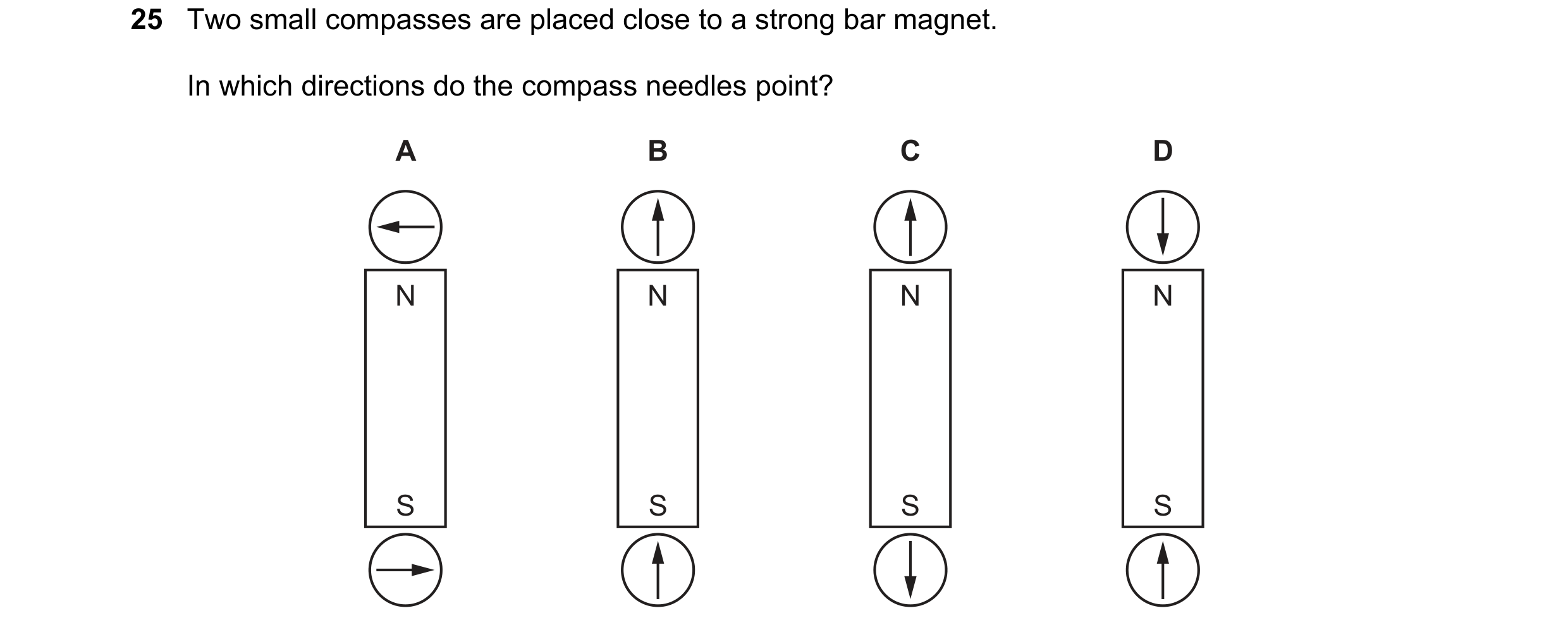
Q128 · Two small compasses are placed close to a strong bar magnet 0625/23 May/June 2024
25 Two small compasses are placed close to a strong bar magnet. In which directions do the compass needles point? A B C D N N N N S S S S
1 marks
Answer: B
This question in 0625/23 May/June 2024
Q129 · Students are asked for a statement about magnetic fields 0625/23 May/June 2024
26 Students are asked for a statement about magnetic fields. Three statements are listed. 1 A magnetic field is described as a region in which a stationary electric charge experiences a force. 2 The direction of a magnetic field at a point is the direction of the force on an S pole at that point. 3 The relative strength of a magnetic field is shown by the spacing of the magnetic field lines. Which statements are correct for magnetic fields? A 1, 2 and 3 B 1 and 2 only C 2 and 3 only D 3 only
1 marks
Answer: D
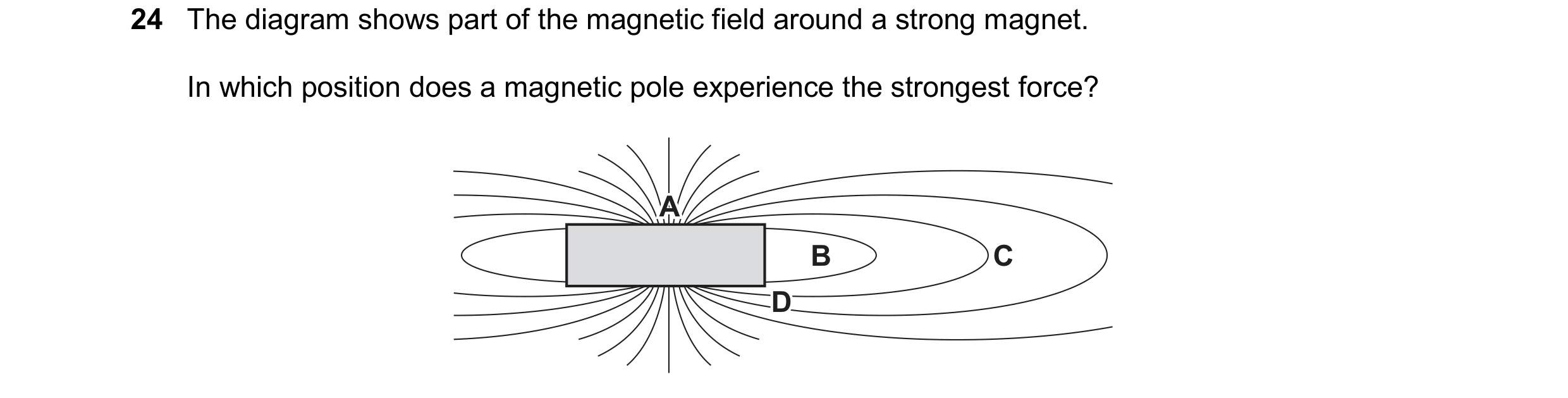
This question in 0625/23 May/June 2024
Q130 · The diagram shows part of the magnetic field around a strong magnet 0625/21 Oct/Nov 2024
24 The diagram shows part of the magnetic field around a strong magnet. In which position does a magnetic pole experience the strongest force? A B C D
1 marks
Answer: A
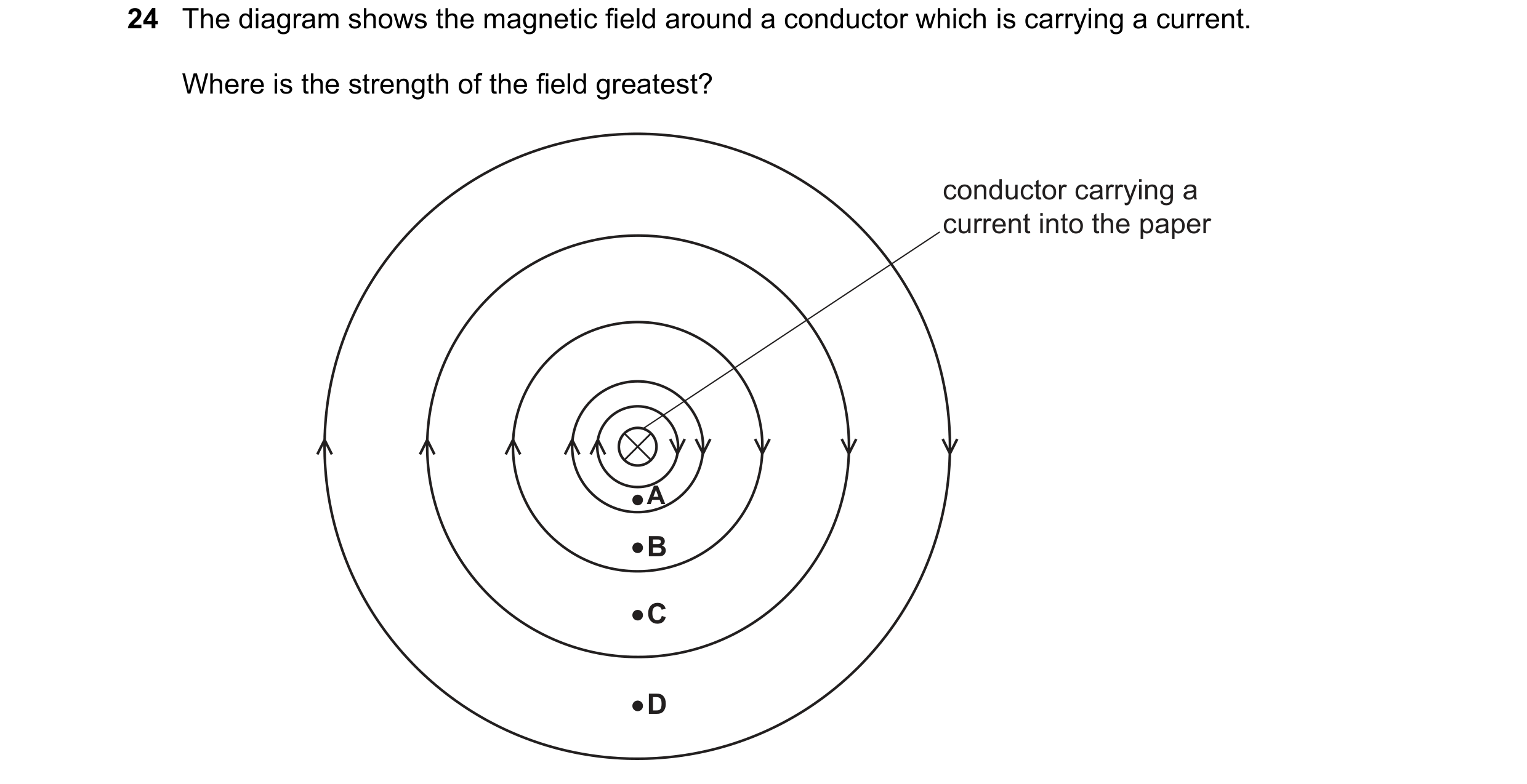
This question in 0625/21 Oct/Nov 2024
Q131 · The diagram shows the magnetic field around a conductor which is carrying a current 0625/22 Oct/Nov 2024
24 The diagram shows the magnetic field around a conductor which is carrying a current. Where is the strength of the field greatest? conductor carrying a current into the paper A B C D
1 marks
Answer: A
This question in 0625/22 Oct/Nov 2024
Q132 · The diagram shows the magnetic field of a bar magnet 0625/23 Oct/Nov 2024
24 The diagram shows the magnetic field of a bar magnet. R Q P S N How does the strength of the magnetic field vary with position along the dotted path PRQ? A It is constant along the path PRQ. B It is strong at P and reduces in strength along the path PRQ. C It is weak at P and increases in strength along the path PRQ. D It is strong at P, decreases to a minimum at R and then increases towards Q.
1 marks
Answer: D
This question in 0625/23 Oct/Nov 2024
Q133 · A negatively charged rod is brought near to a metal sphere 0625/22 Feb/March 2025
24 A negatively charged rod is brought near to a metal sphere. A positive charge develops on the surface of the metal sphere closest to the negatively charged rod. Why is this? A Electrons in the sphere are attracted by the negatively charged rod. B Electrons in the sphere are repelled by the negatively charged rod. C Positive charges in the sphere are attracted by the negatively charged rod. D Positive charges in the sphere are repelled by the negatively charged rod.
1 marks
Answer: B
This question in 0625/22 Feb/March 2025
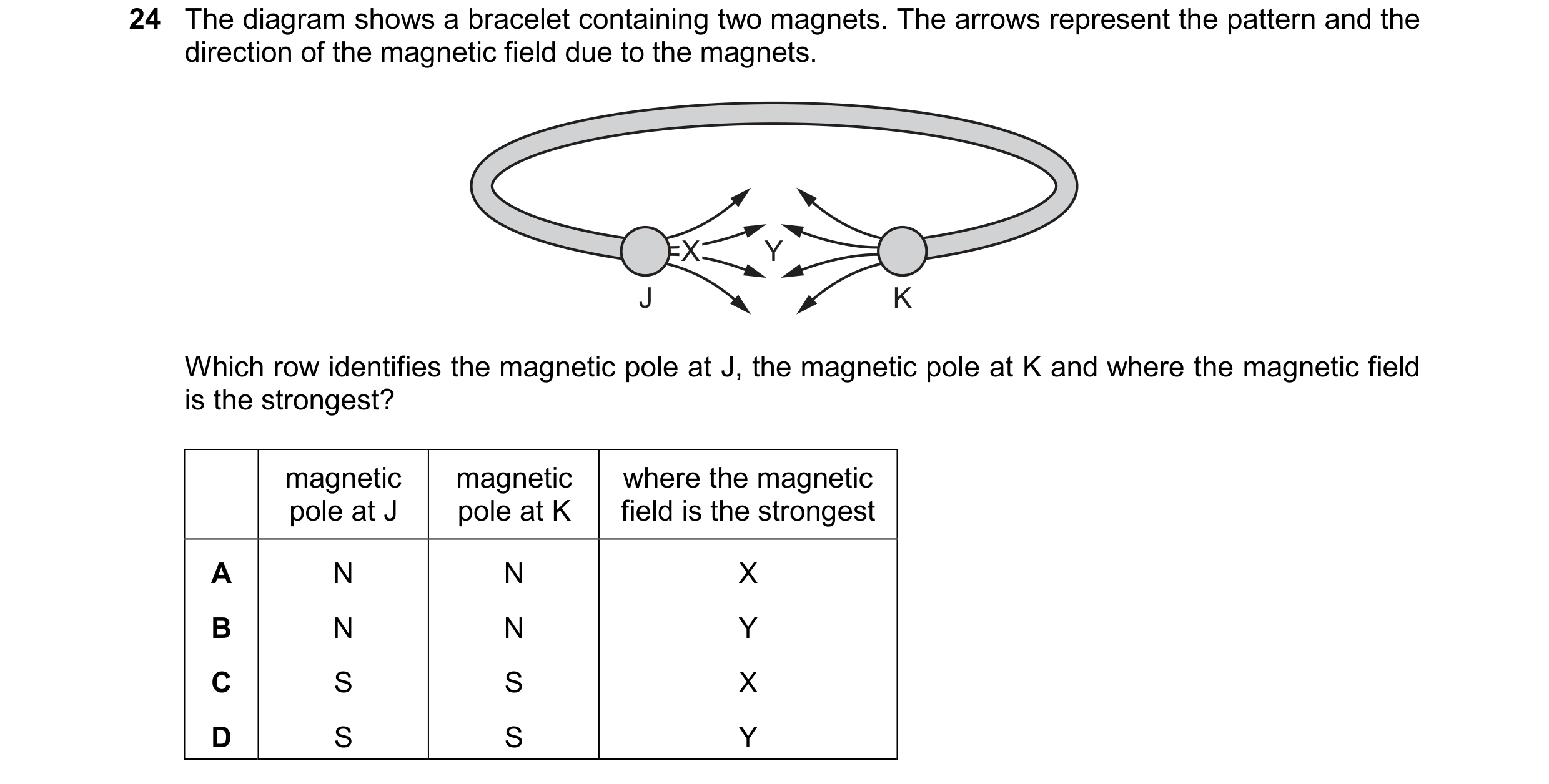
Q134 · The diagram shows a bracelet containing two magnets 0625/21 May/June 2025
24 The diagram shows a bracelet containing two magnets. The arrows represent the pattern and the direction of the magnetic field due to the magnets. X Y J K Which row identifies the magnetic pole at J, the magnetic pole at K and where the magnetic field is the strongest? magnetic magnetic where the magnetic pole at J pole at K field is the strongest A N N X B N N Y C S S X D S S Y
1 marks
Answer: A
This question in 0625/21 May/June 2025
Q135 · There is a current in a straight metal wire in the direction shown 0625/21 May/June 2025
31 There is a current in a straight metal wire in the direction shown. direction of current Which row describes the direction and the pattern of the magnetic field due to the wire when looking from vertically above the wire? direction pattern A anticlockwise circular B left to right parallel lines C clockwise circular D right to left parallel lines
1 marks
Answer: A
This question in 0625/21 May/June 2025
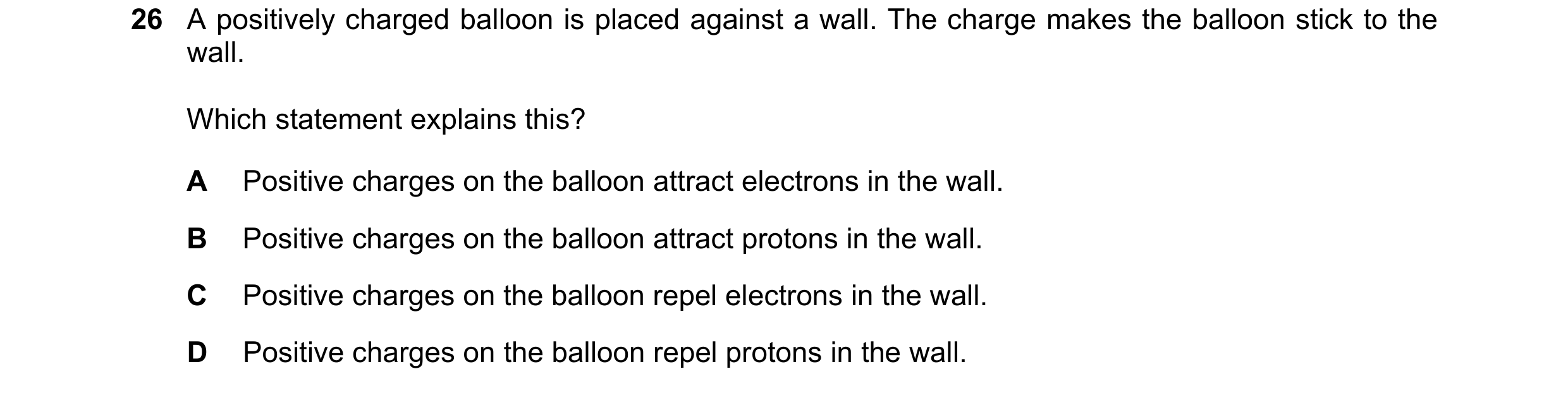
Q136 · A positively charged balloon is placed against a wall 0625/22 May/June 2025
26 A positively charged balloon is placed against a wall. The charge makes the balloon stick to the wall. Which statement explains this? A Positive charges on the balloon attract electrons in the wall. B Positive charges on the balloon attract protons in the wall. C Positive charges on the balloon repel electrons in the wall. D Positive charges on the balloon repel protons in the wall.
1 marks
Answer: A
This question in 0625/22 May/June 2025
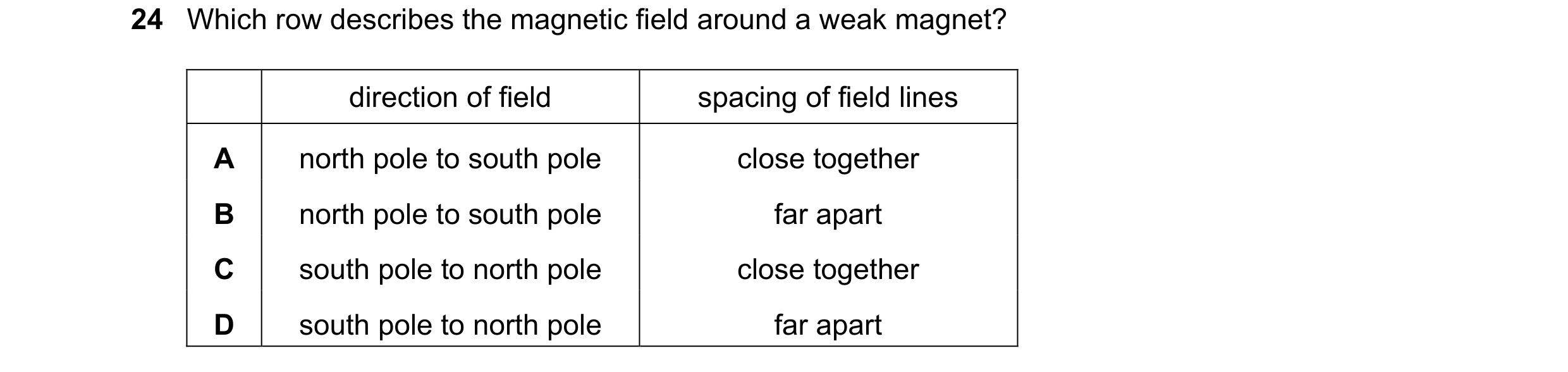
Q137 · Which row describes the magnetic field around a weak magnet? 0625/23 May/June 2025
24 Which row describes the magnetic field around a weak magnet? direction of field spacing of field lines A north pole to south pole close together B north pole to south pole far apart C south pole to north pole close together D south pole to north pole far apart
1 marks
Answer: B
This question in 0625/23 May/June 2025
Q138 · The diagram shows part of the magnetic field around two magnets 0625/21 Oct/Nov 2025
24 The diagram shows part of the magnetic field around two magnets. Q P P S N R N S Which list gives the order of magnetic field strengths at the positions P, Q and R, from weakest to strongest? A P Q R B P R Q C Q P R D R Q P
1 marks
Answer: D
This question in 0625/21 Oct/Nov 2025
Q139 · Which statements about magnets are correct? 0625/22 Oct/Nov 2025
24 Which statements about magnets are correct? 1 Permanent magnets are made of steel. 2 Electromagnets are temporary magnets. 3 A magnet can be used to induce magnetism in an iron bar. A 1, 2 and 3 B 1 and 2 only C 1 and 3 only D 2 and 3 only
1 marks
Answer: A
This question in 0625/22 Oct/Nov 2025
Q140 · The diagram shows the magnetic field due to a current in a solenoid 0625/23 Oct/Nov 2025
24 The diagram shows the magnetic field due to a current in a solenoid. X Y Z current direction Which graph represents the strength of the magnetic field at positions X, Y and Z? A B strength of strength of magnetic field Z magnetic field X Z Y X Y position position C D strength of strength of magnetic field Y magnetic field X X Y Z Z position position
1 marks
Answer: C
This question in 0625/23 Oct/Nov 2025
Q141 · Why does a plastic rod become negatively charged when it is rubbed with a cloth? 0625/23 Oct/Nov 2025
25 Why does a plastic rod become negatively charged when it is rubbed with a cloth? A The rod gains electrons. B The rod gains protons. C The rod loses electrons. D The rod loses protons.
1 marks
Answer: A
This question in 0625/23 Oct/Nov 2025
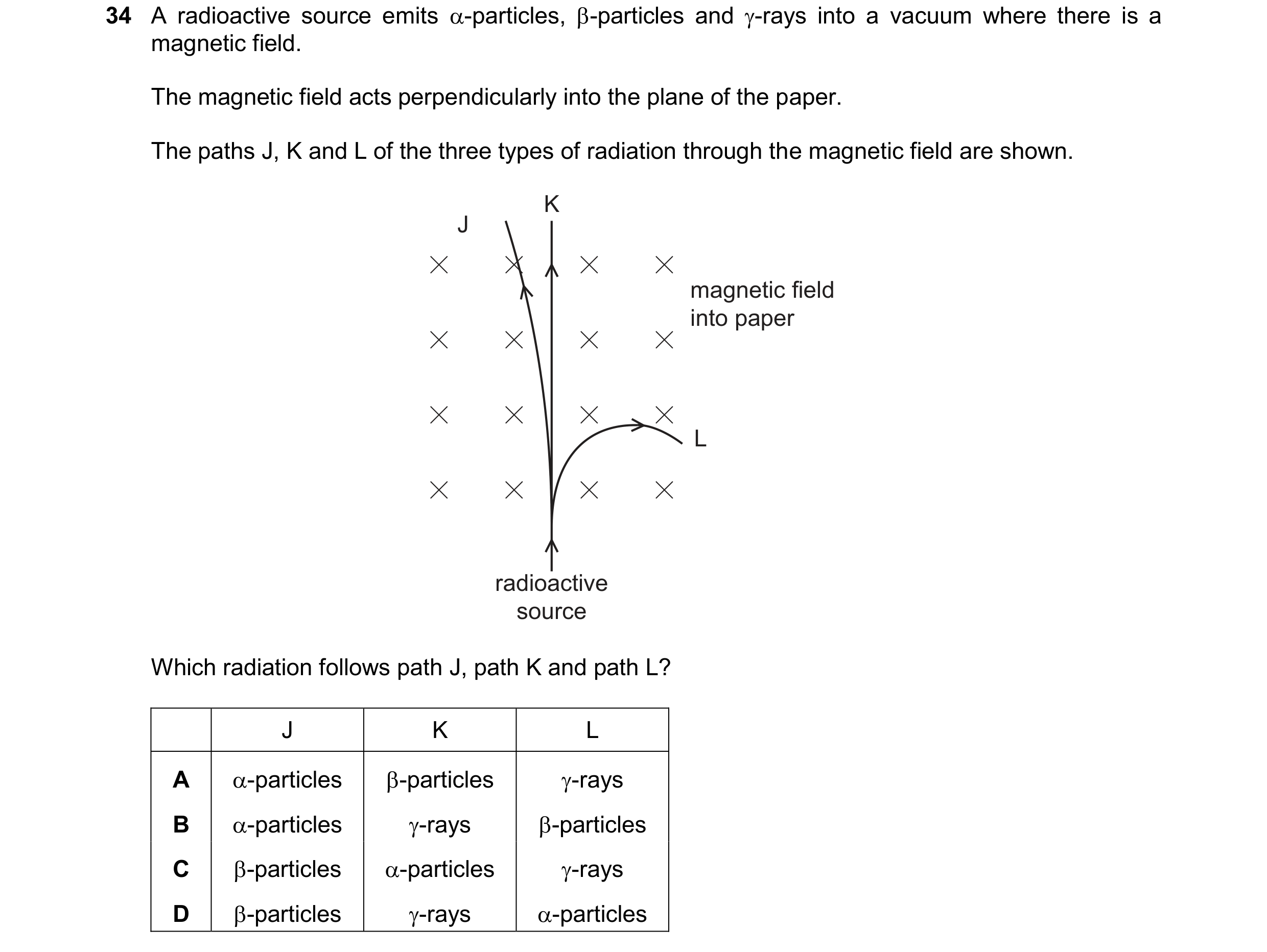
Q142 · A radioactive source emits -particles, -particles and -rays into a vacuum where there… 0625/23 Oct/Nov 2025
34 A radioactive source emits -particles, -particles and -rays into a vacuum where there is a magnetic field. The magnetic field acts perpendicularly into the plane of the paper. The paths J, K and L of the three types of radiation through the magnetic field are shown. K J magnetic field into paper L radioactive source Which radiation follows path J, path K and path L? J K L A -particles -particles -rays B -particles -rays -particles C -particles -particles -rays D -particles -rays -particles
1 marks
Answer: B
This question in 0625/23 Oct/Nov 2025

 1 / 52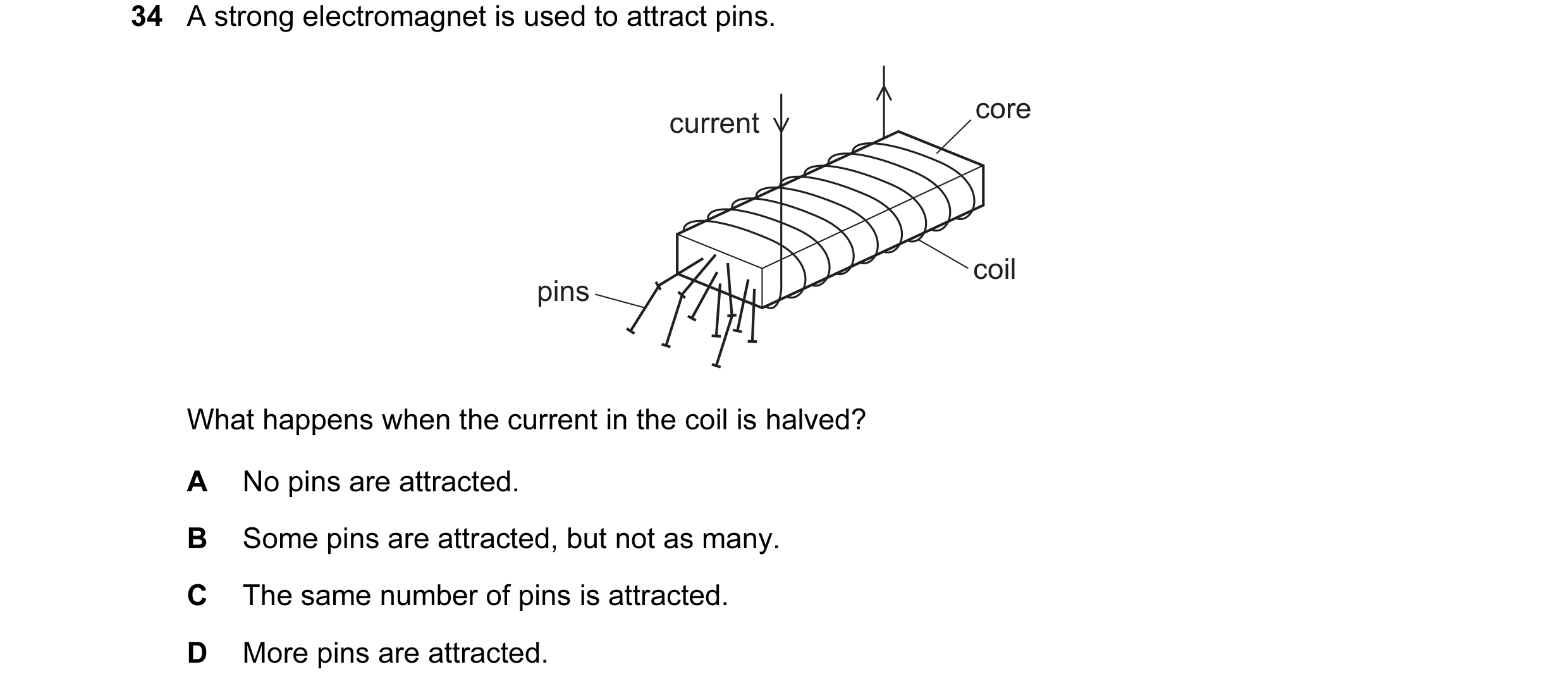
 2 / 52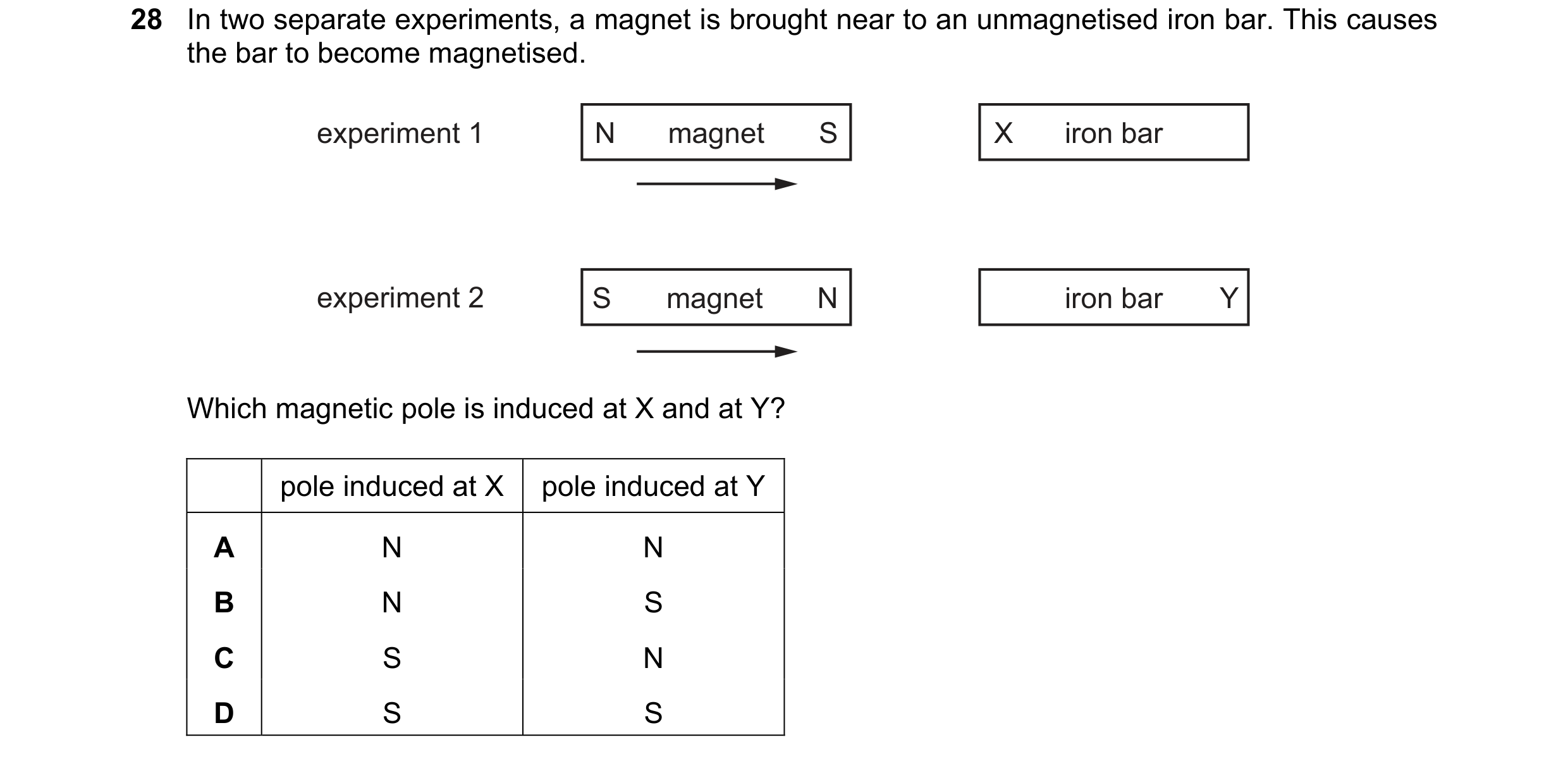
 3 / 52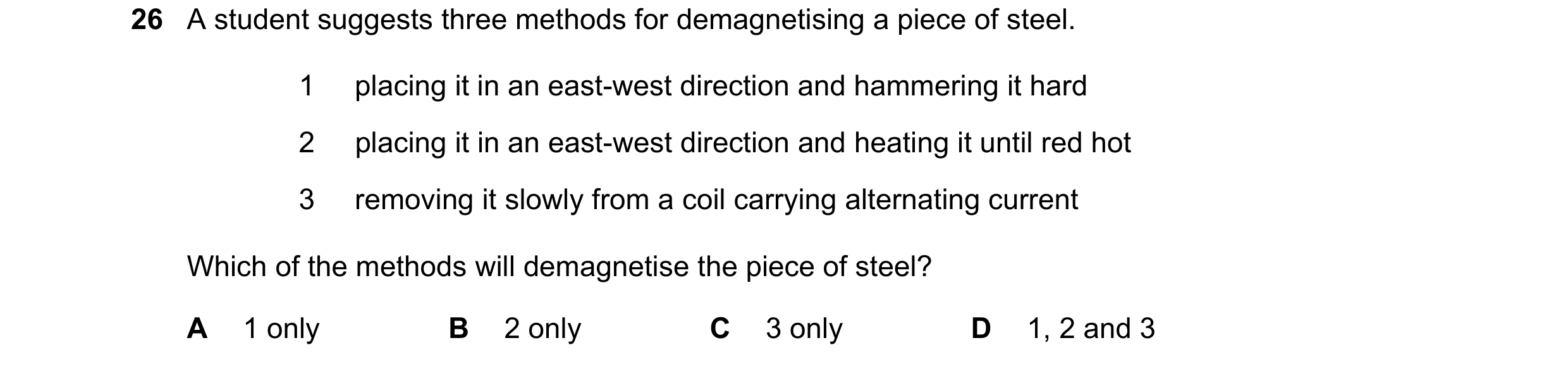
 4 / 52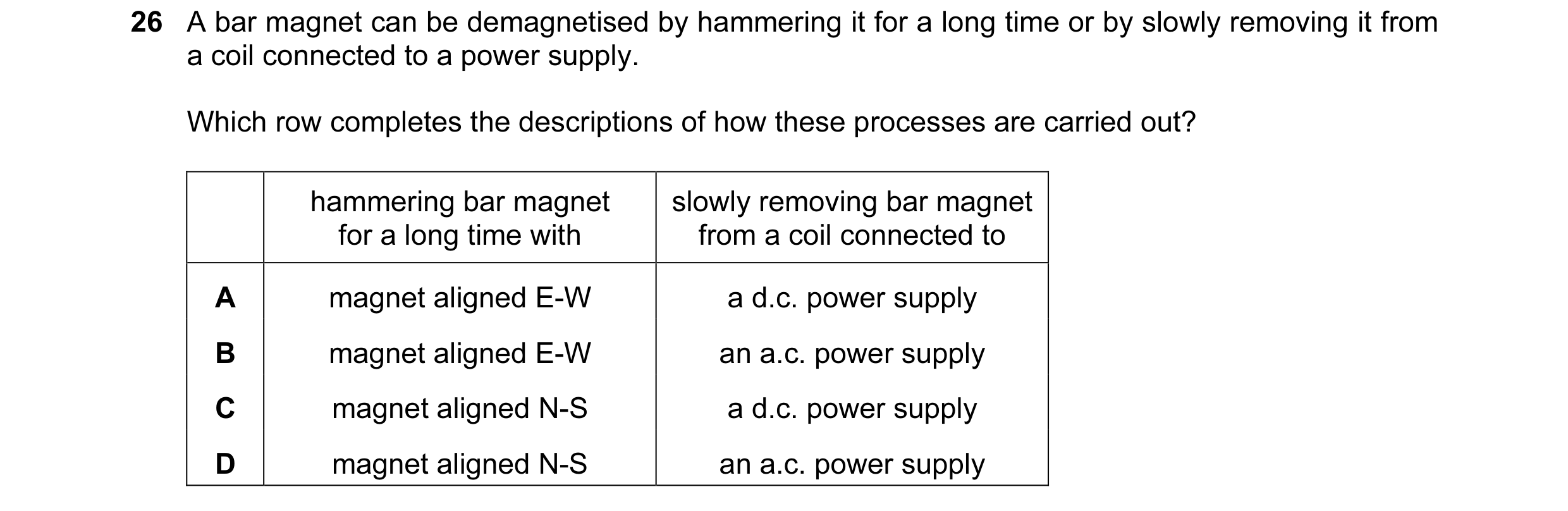
 5 / 52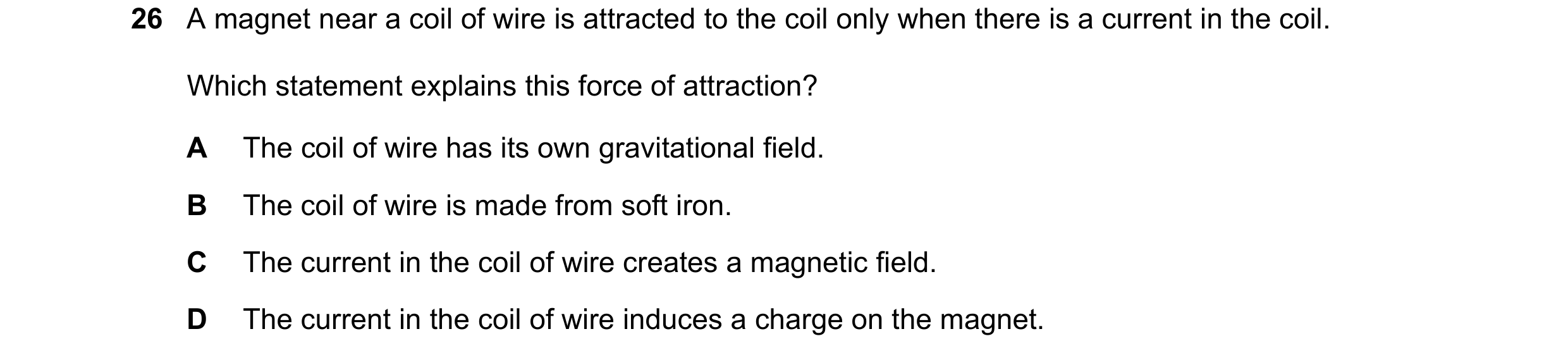
 6 / 52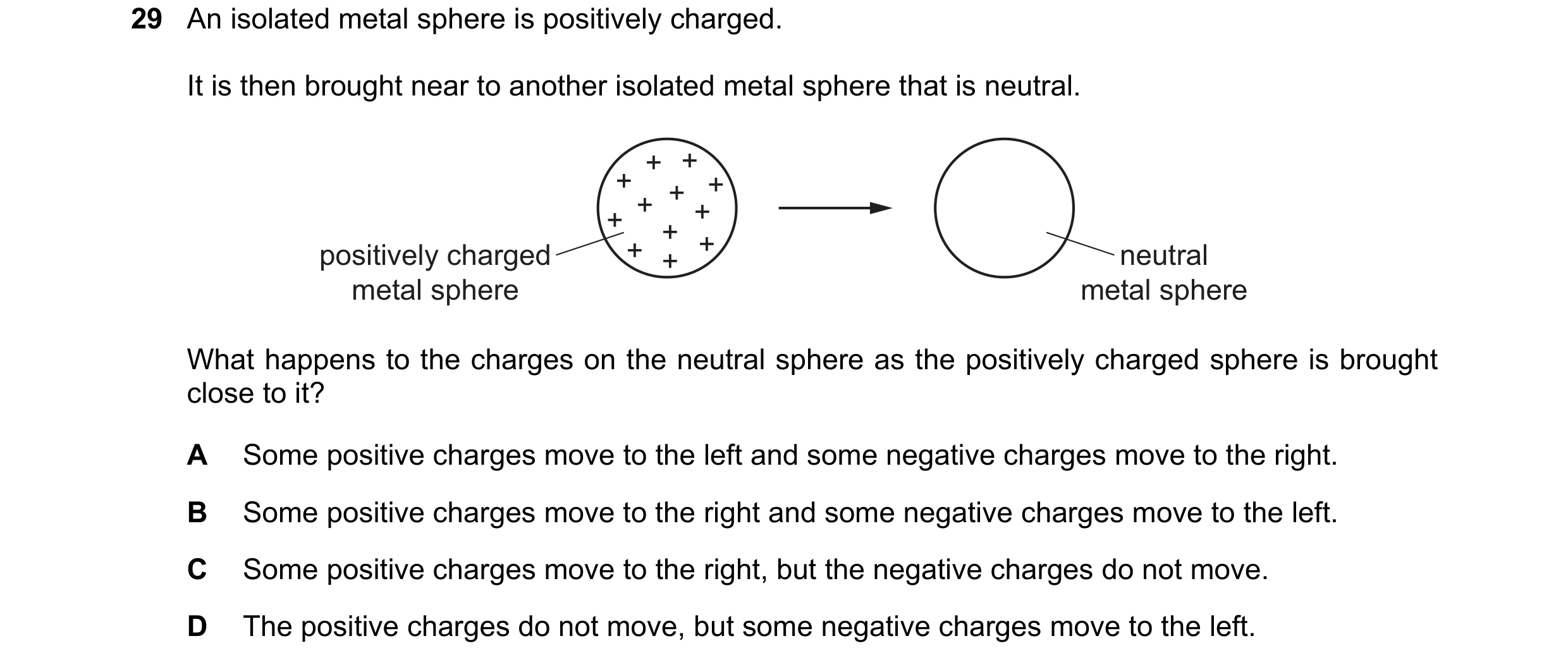
 7 / 52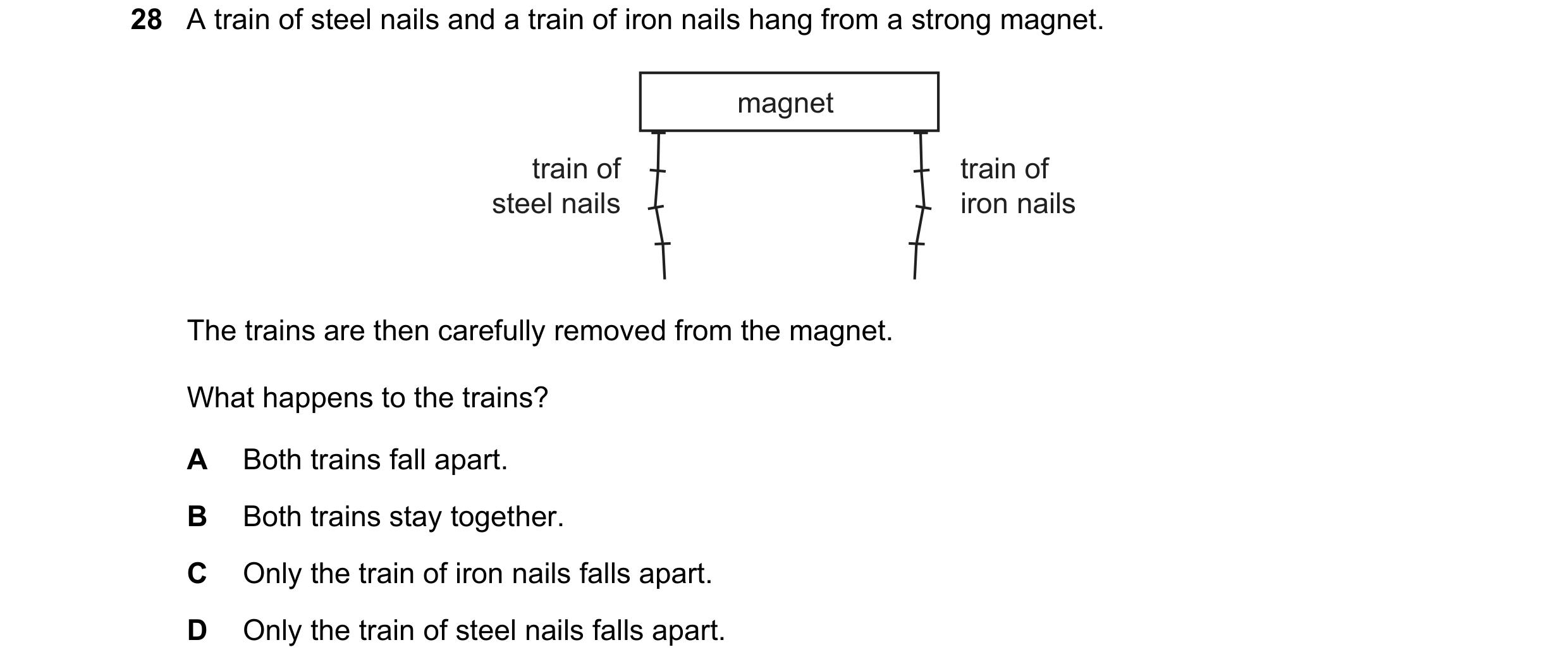

 8 / 52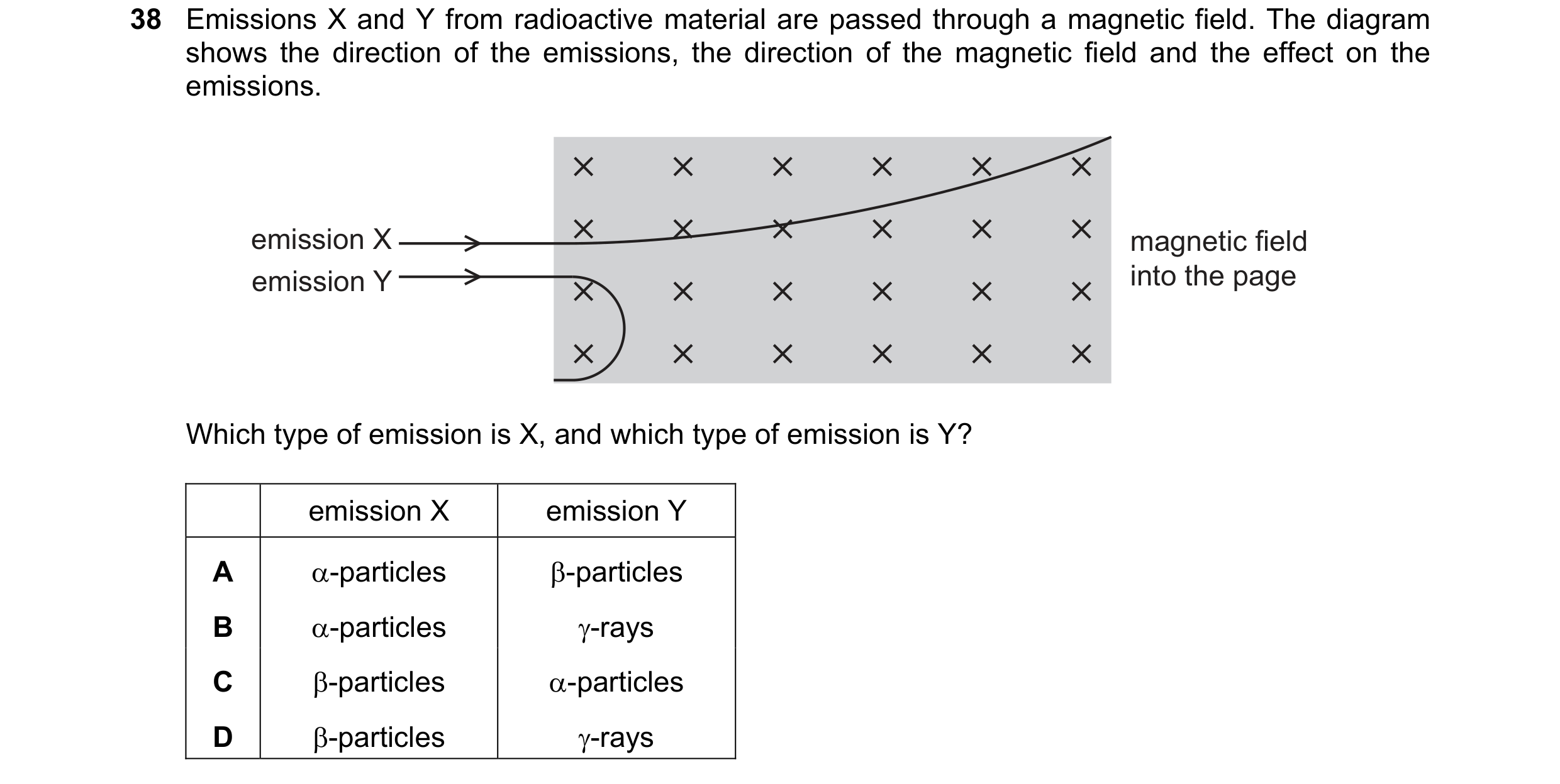
 9 / 52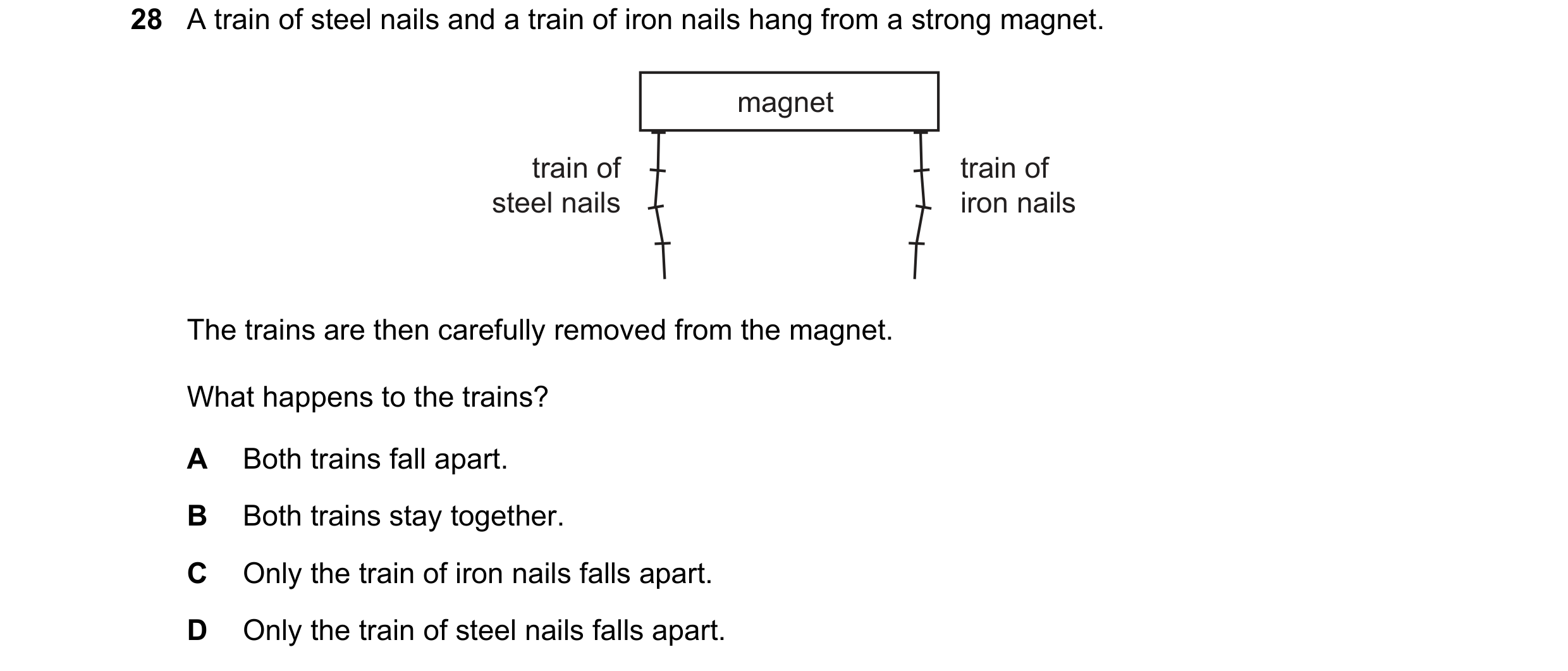

 10 / 52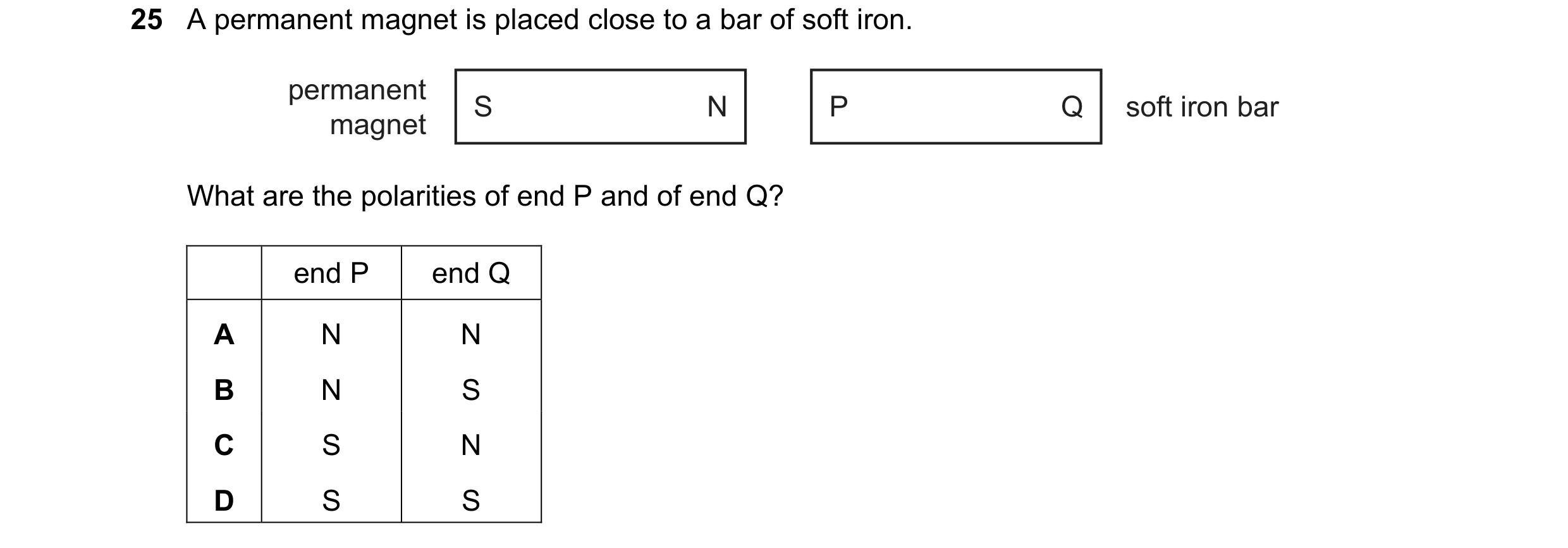

 11 / 52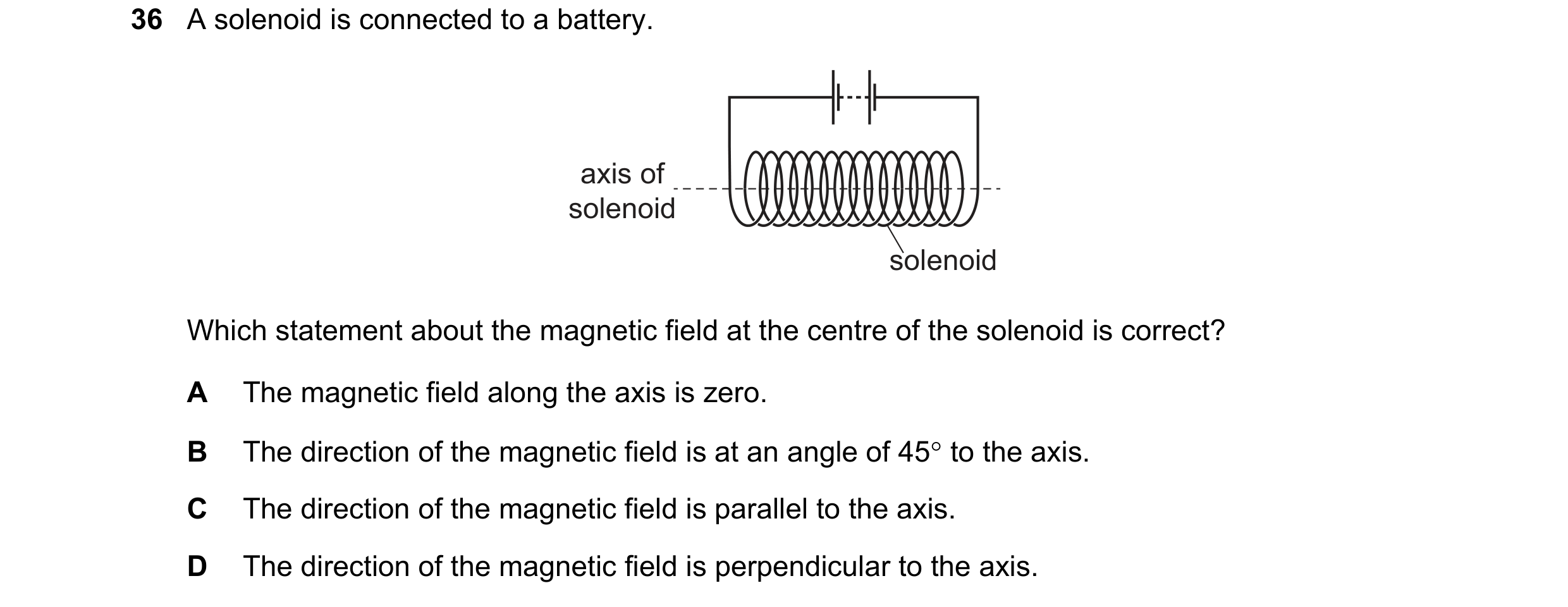
 12 / 52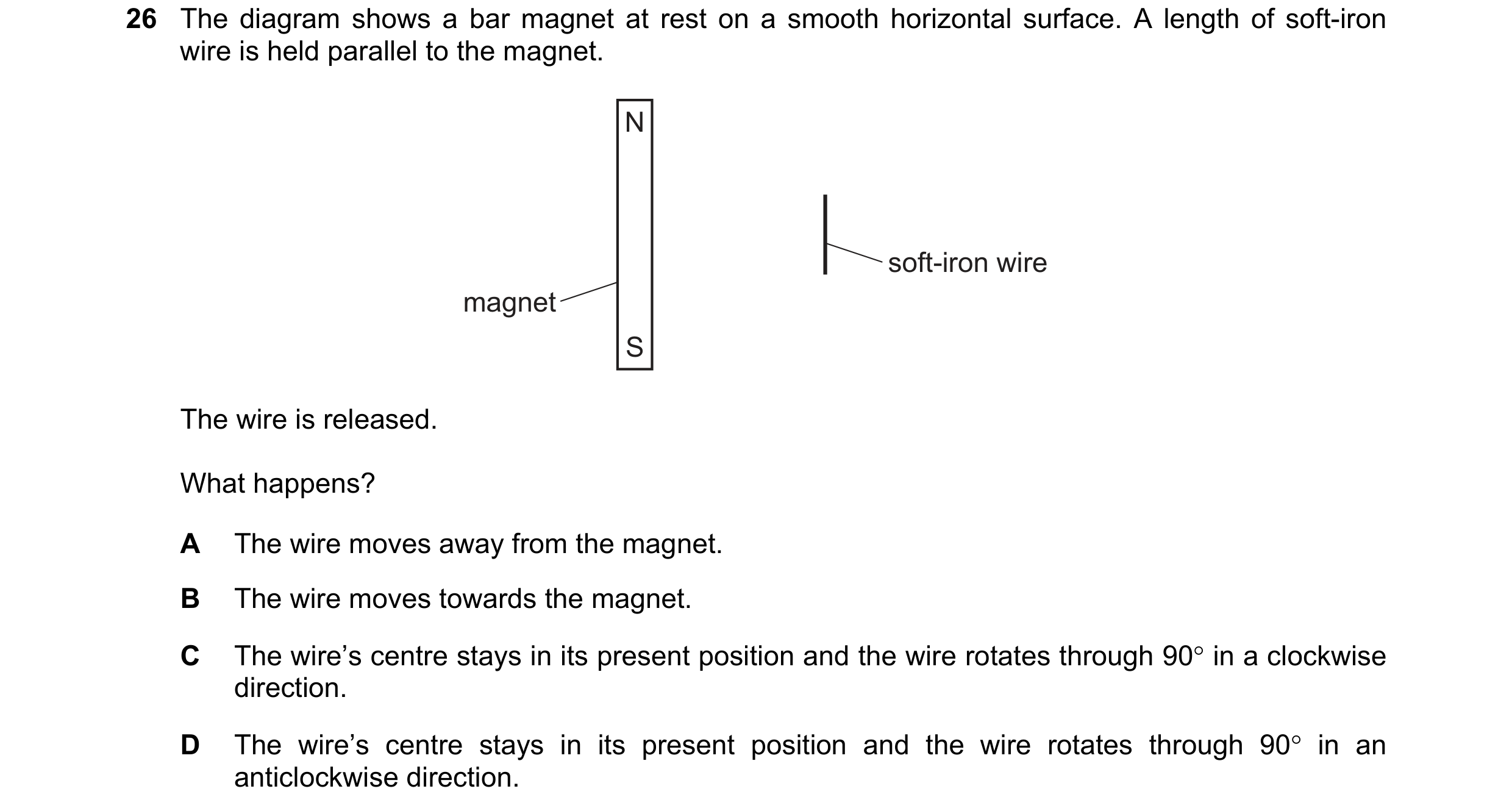
 13 / 52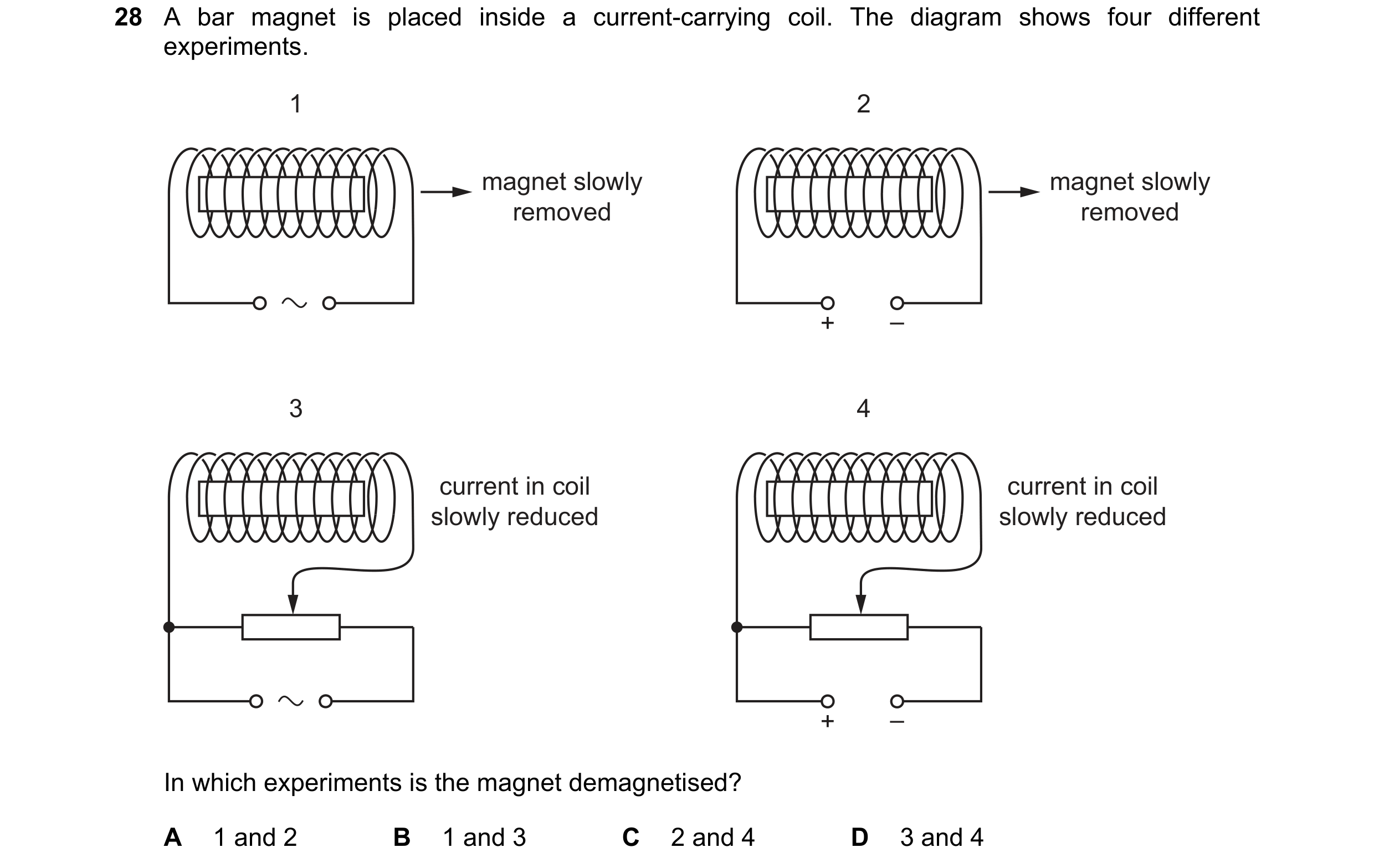
 14 / 52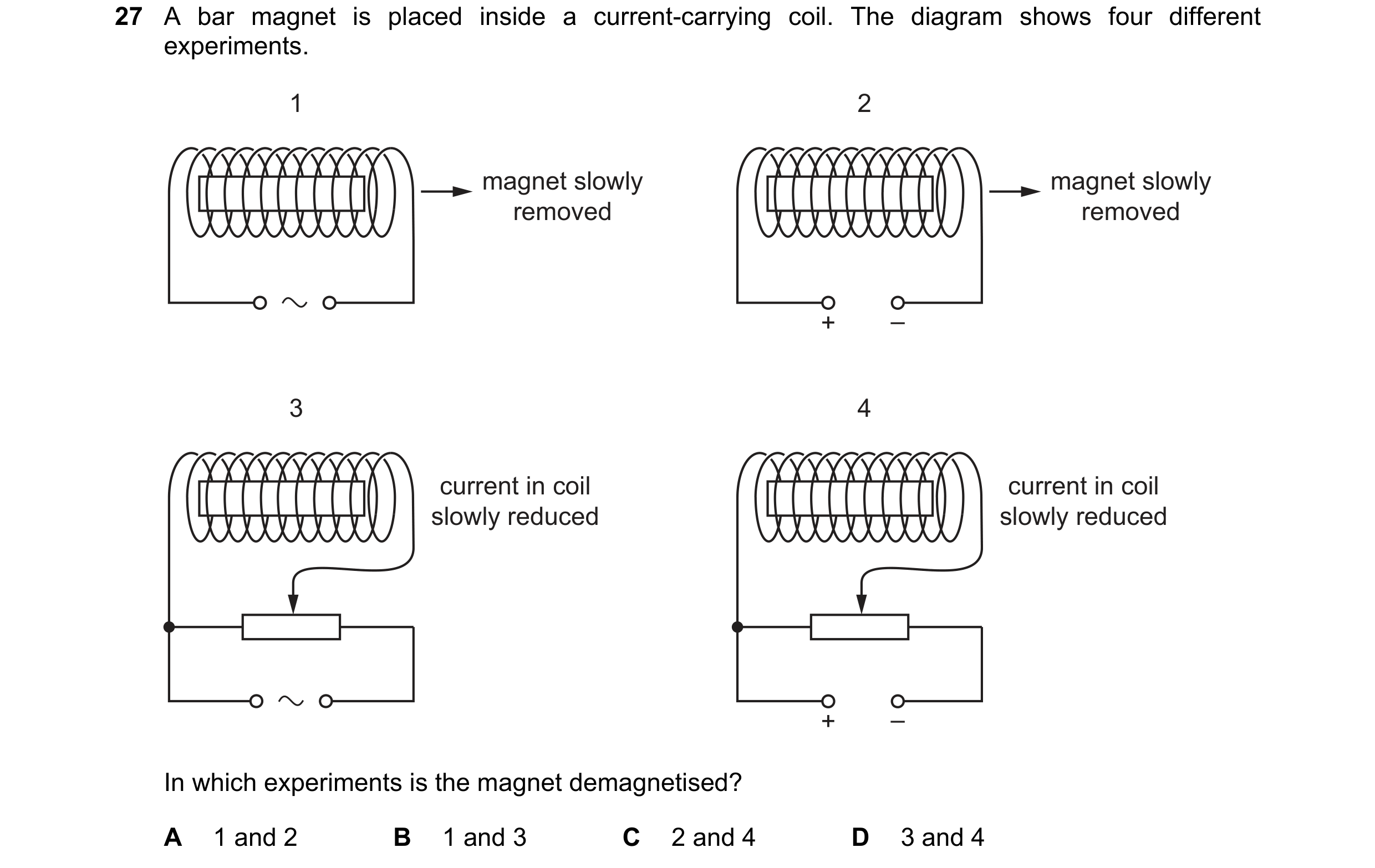
 15 / 52


 16 / 52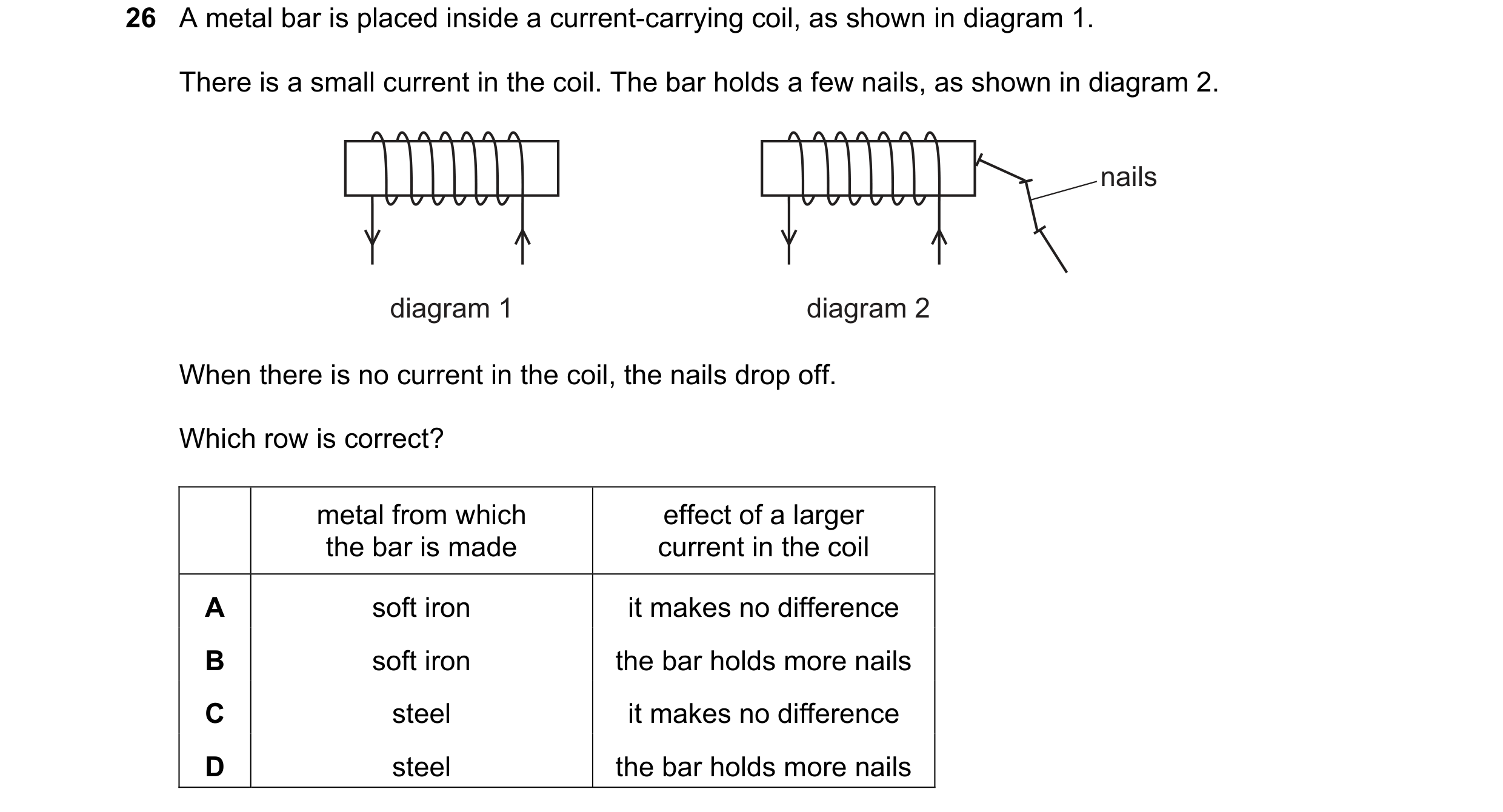
 17 / 52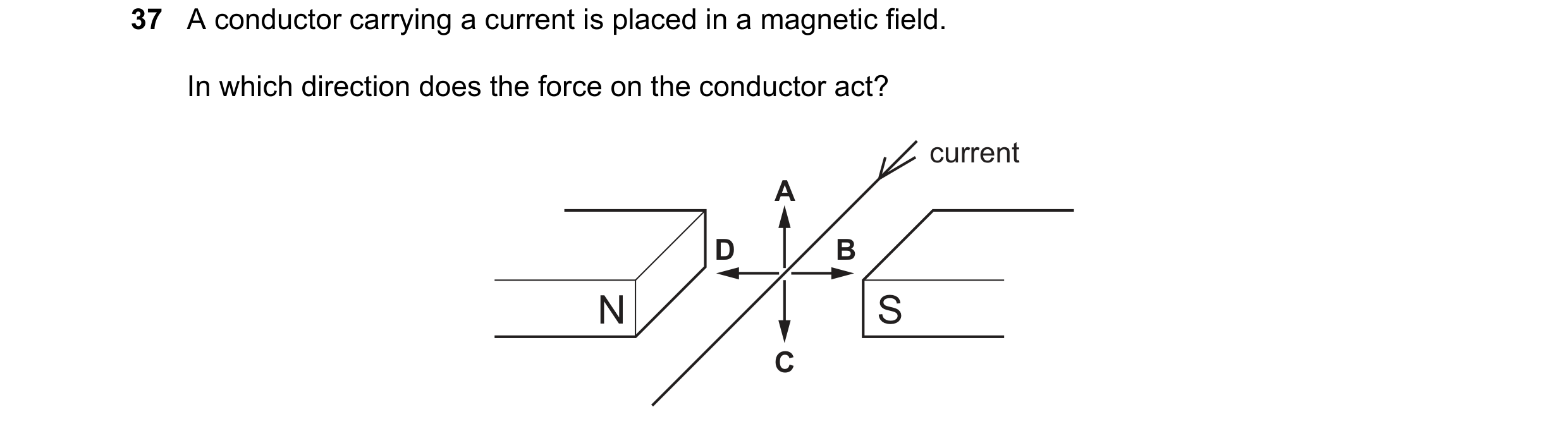
 18 / 52
 19 / 52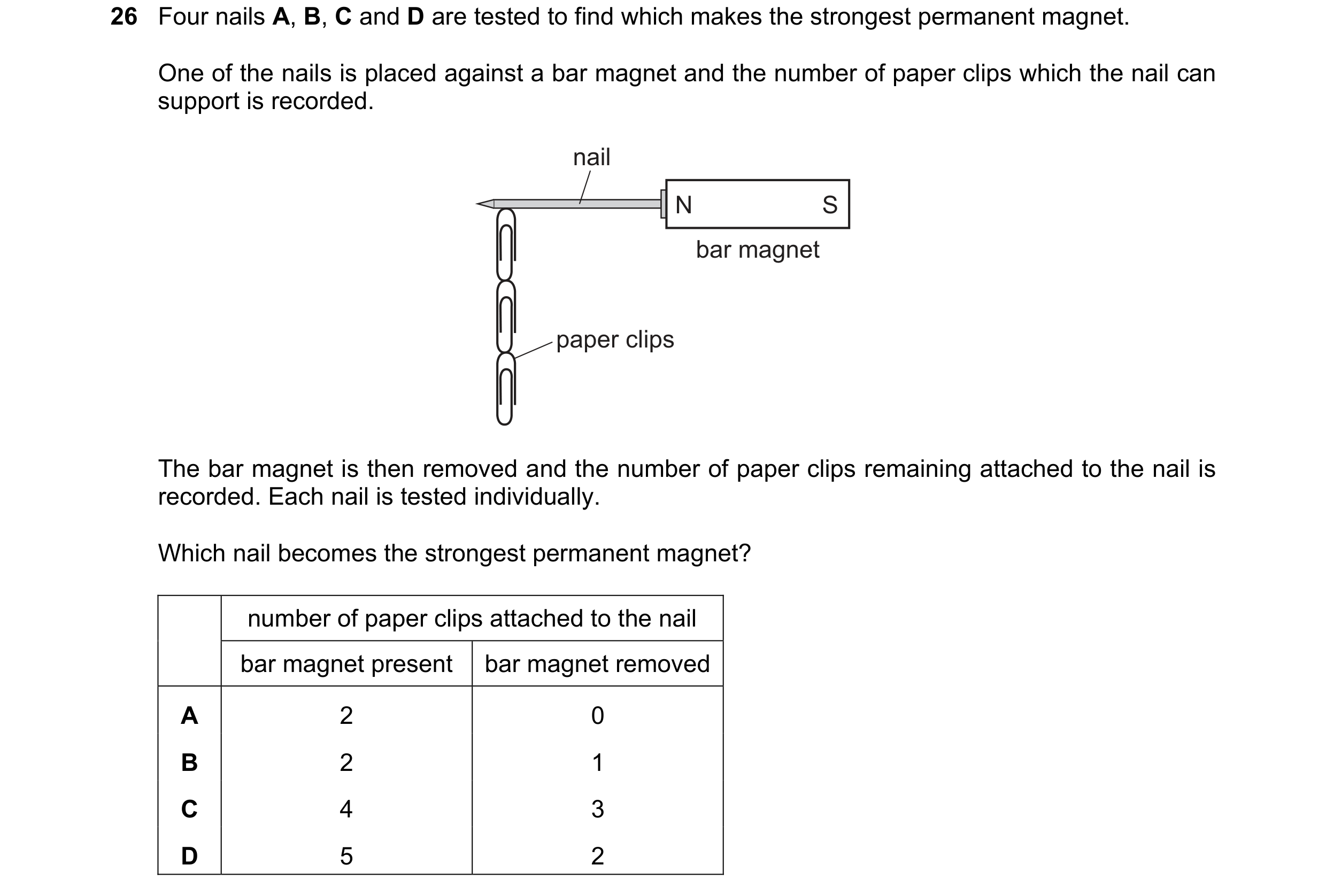
 20 / 52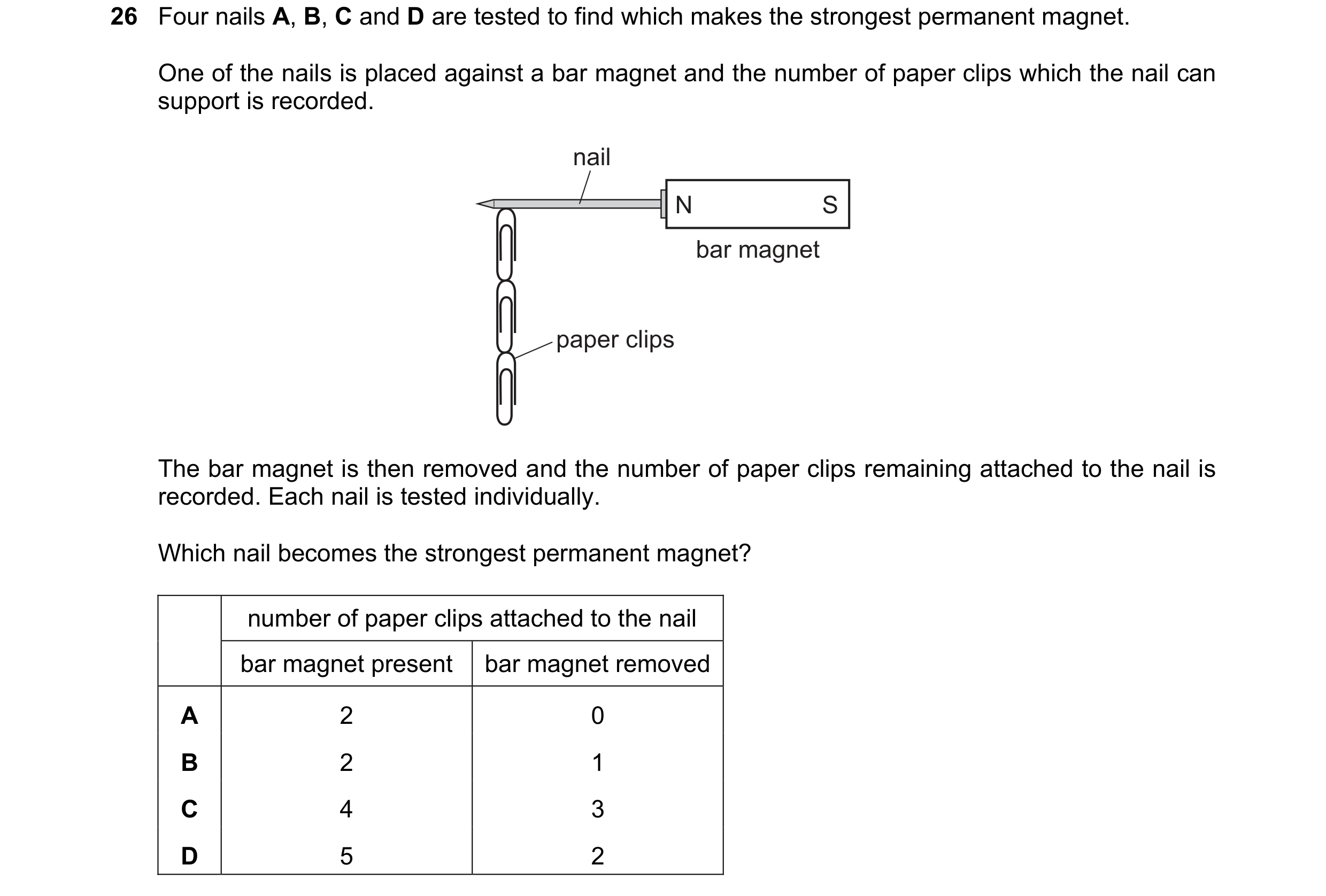
 21 / 52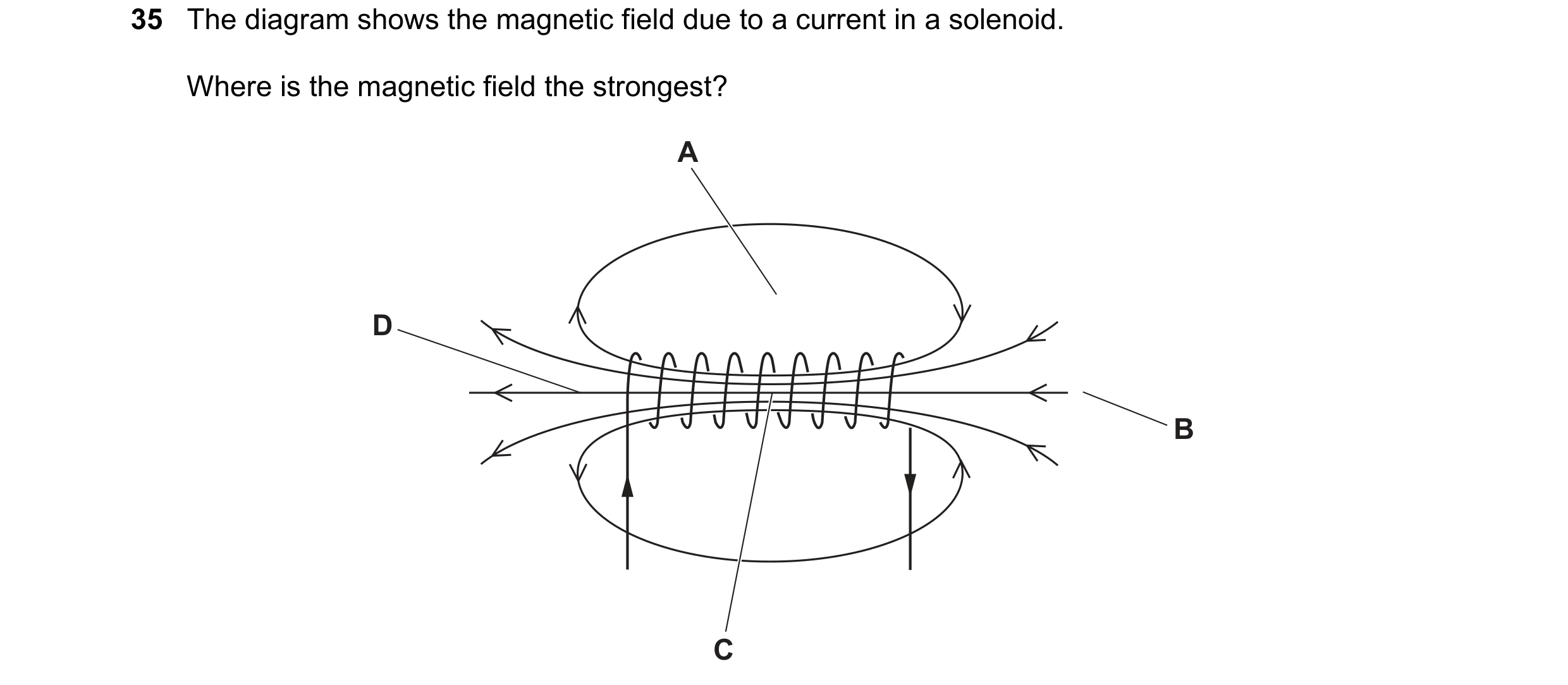
 22 / 52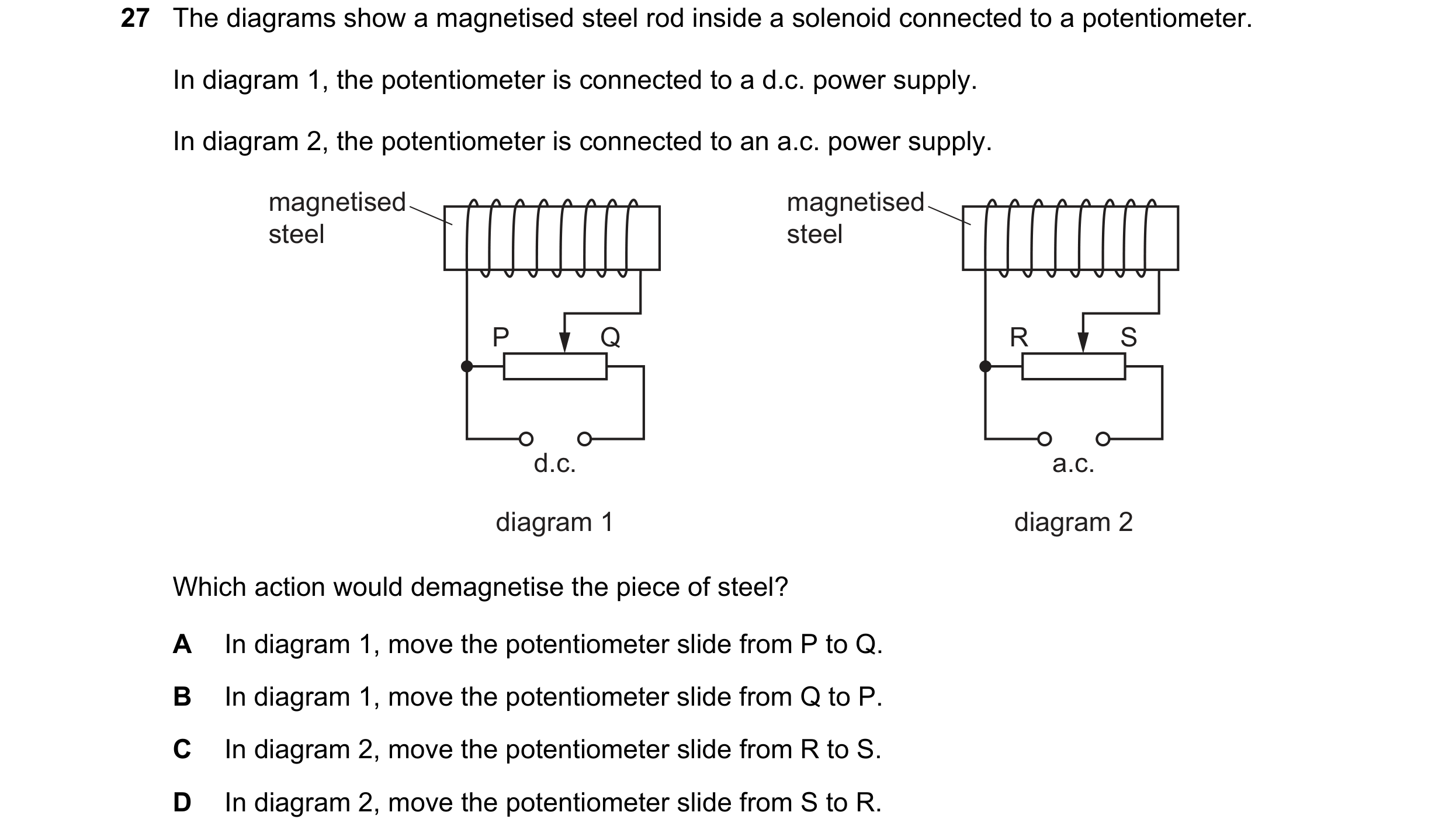
 23 / 52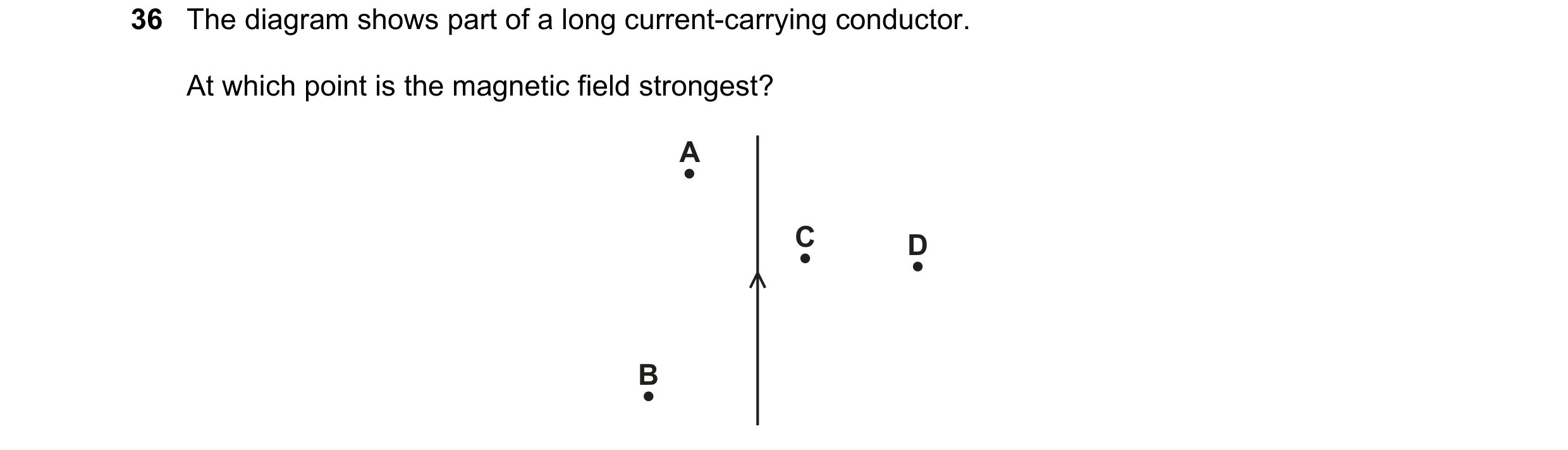
 24 / 52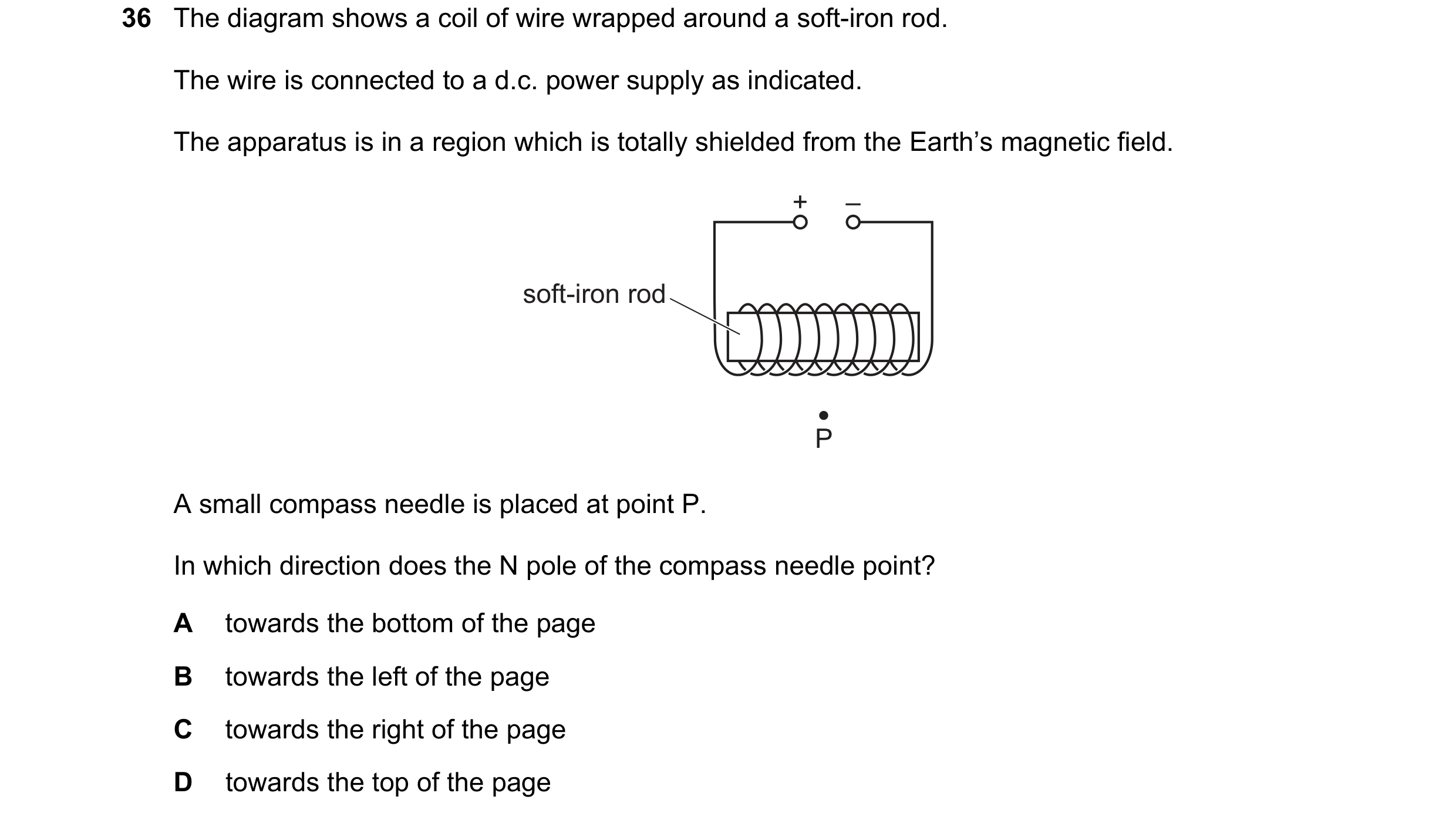
 25 / 52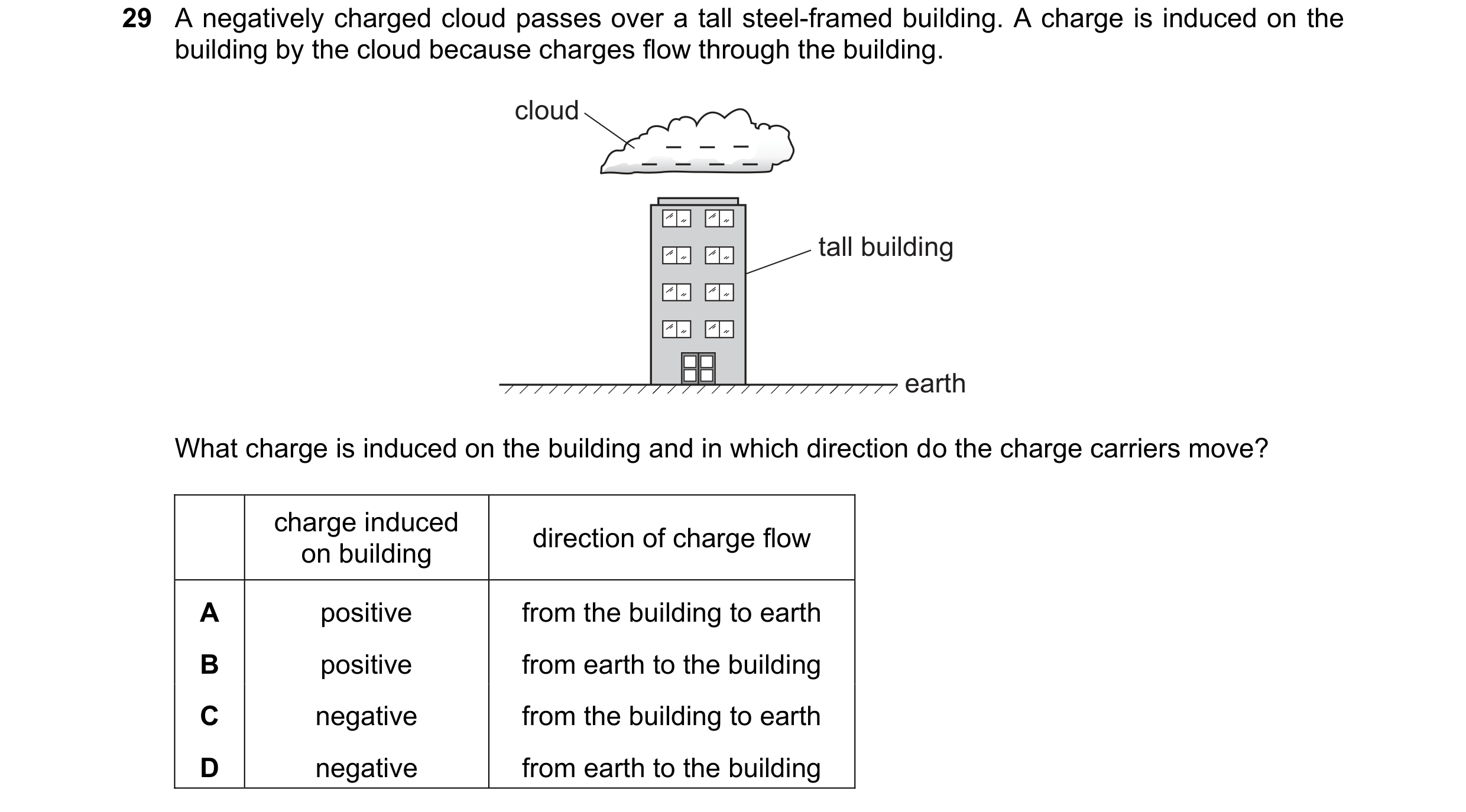
 26 / 52
 27 / 52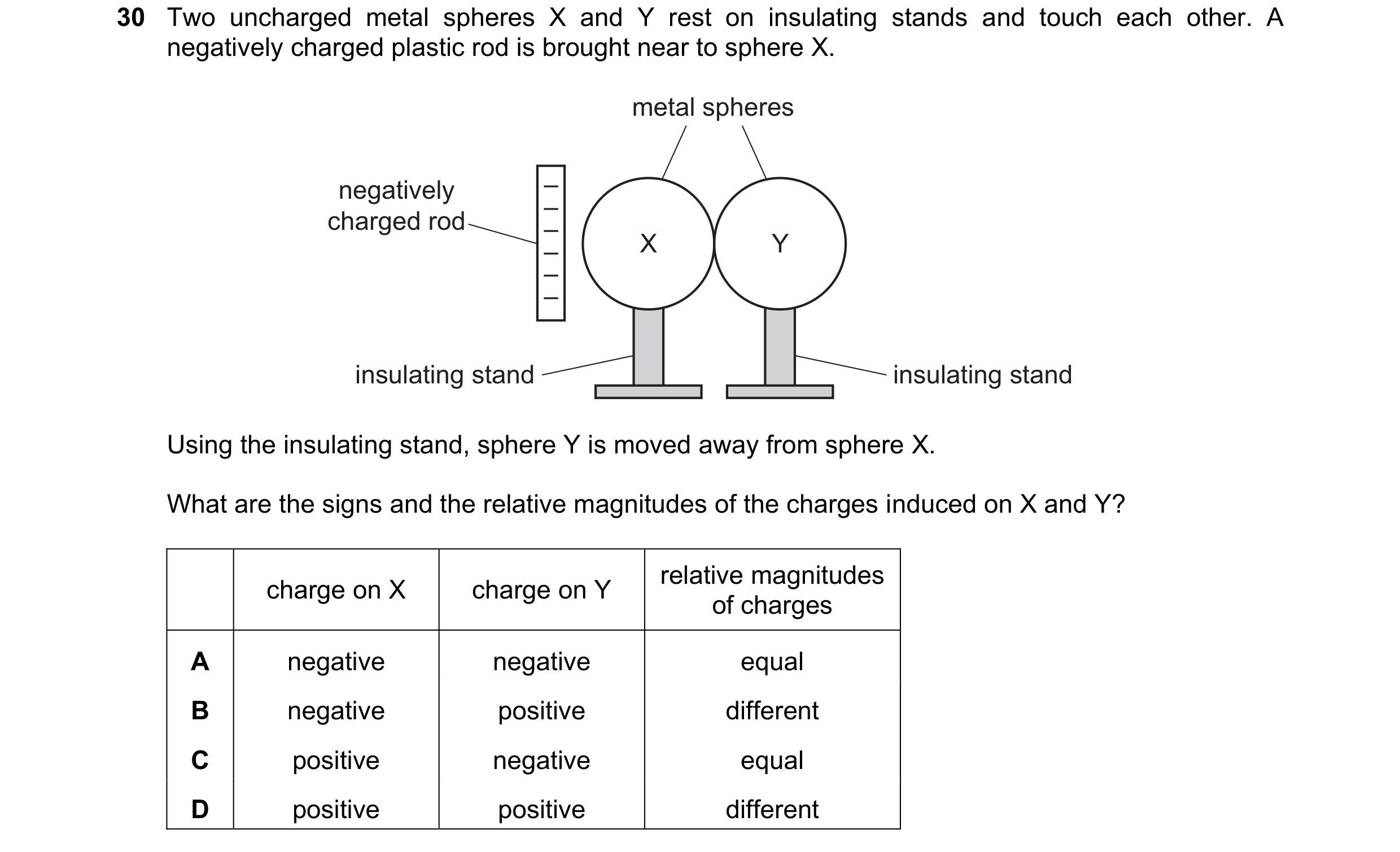
 28 / 52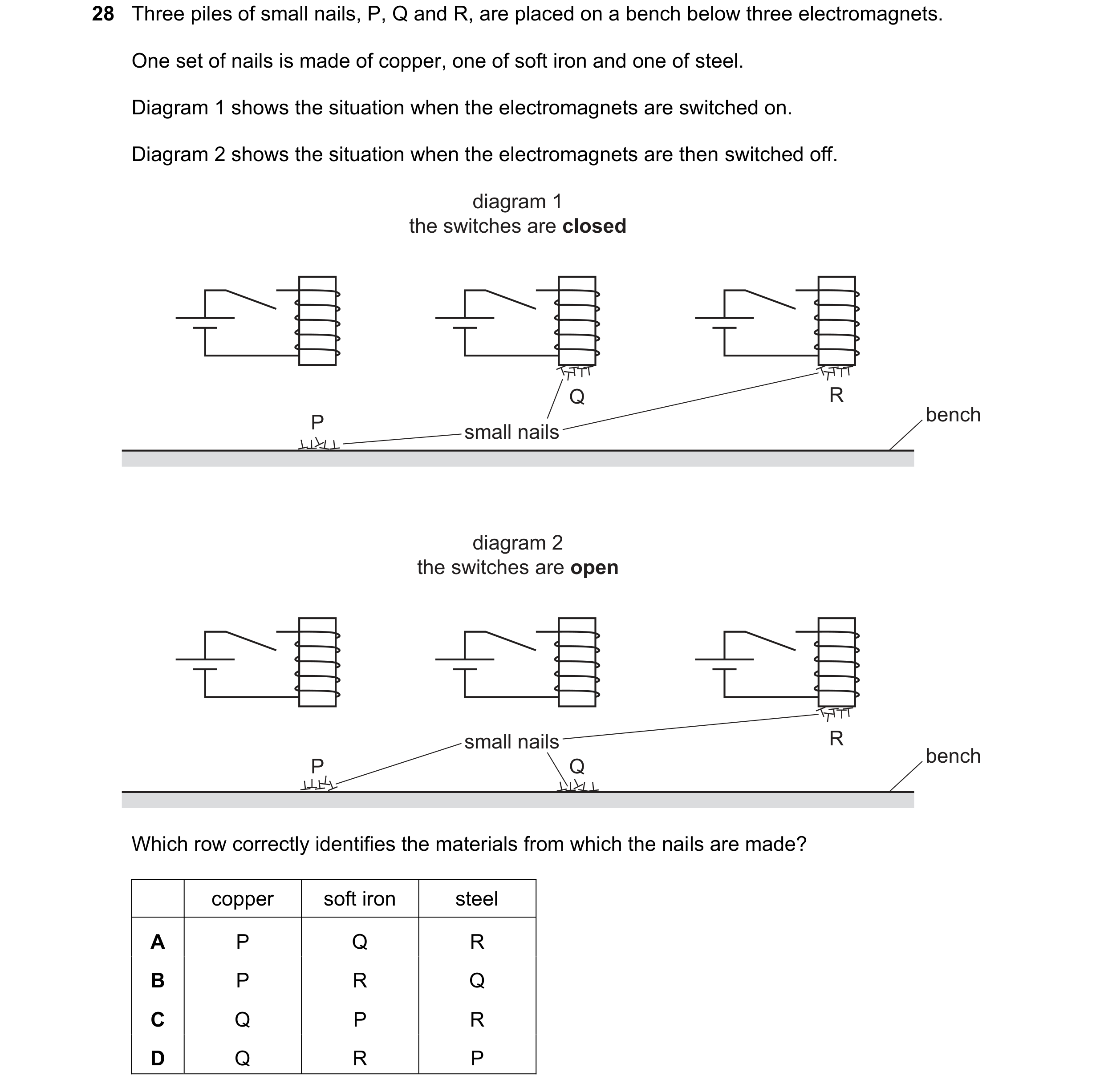
 29 / 52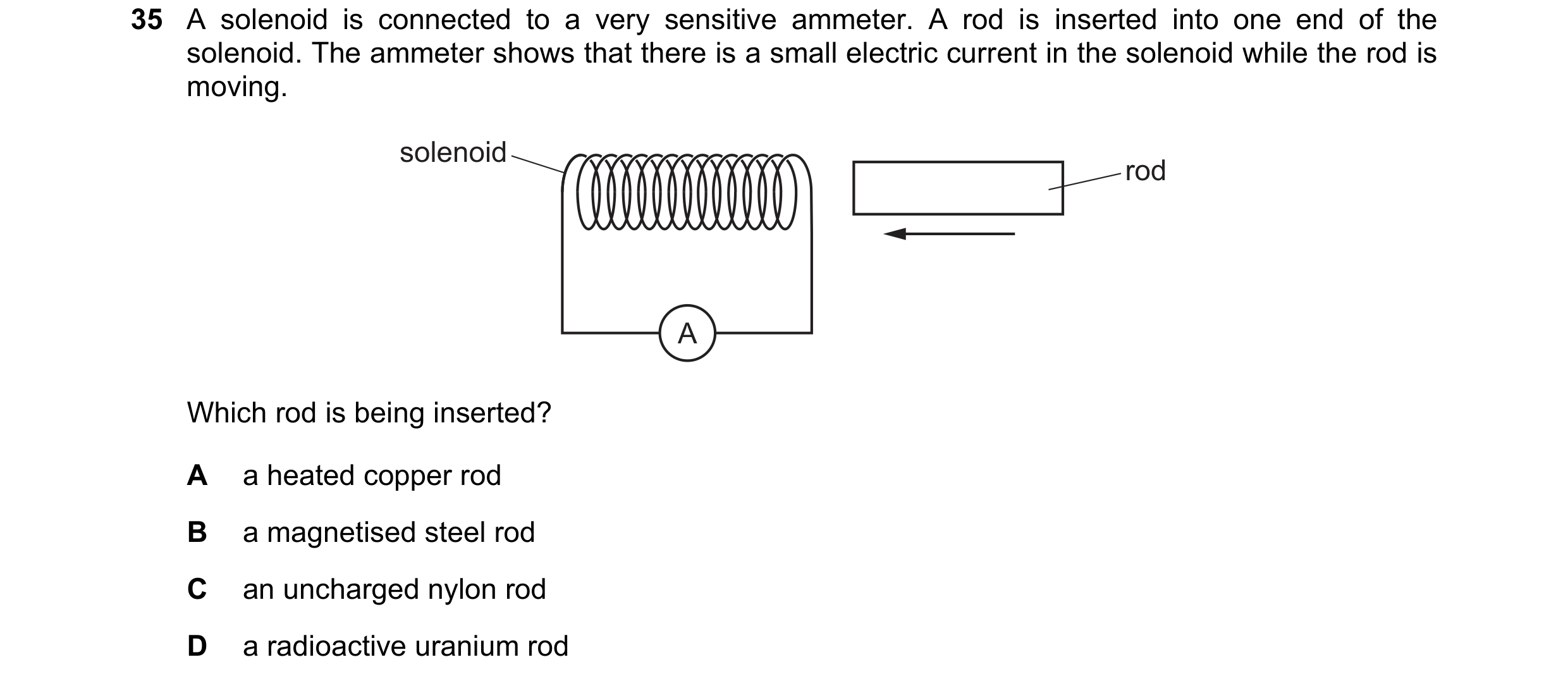
 30 / 52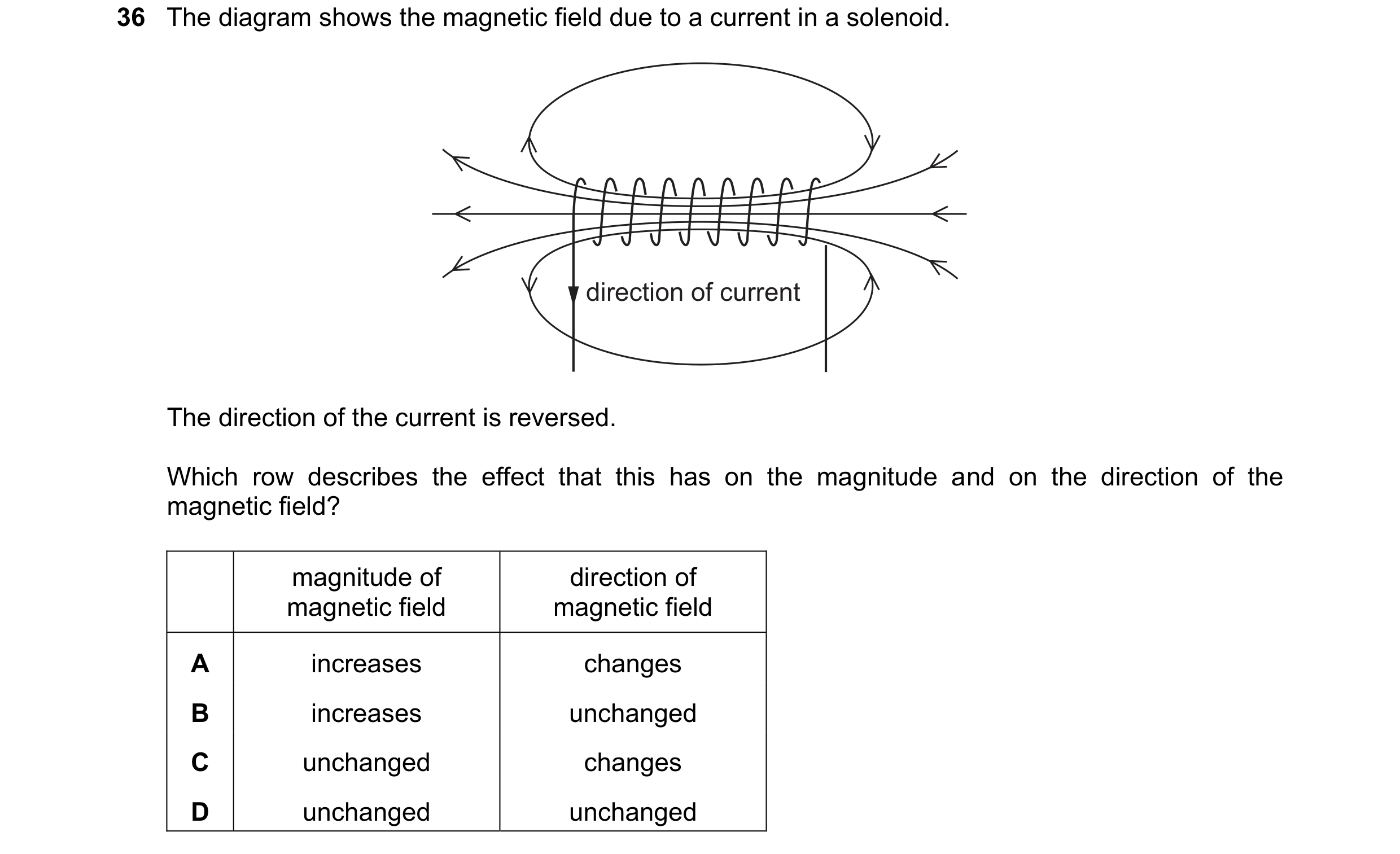
 31 / 52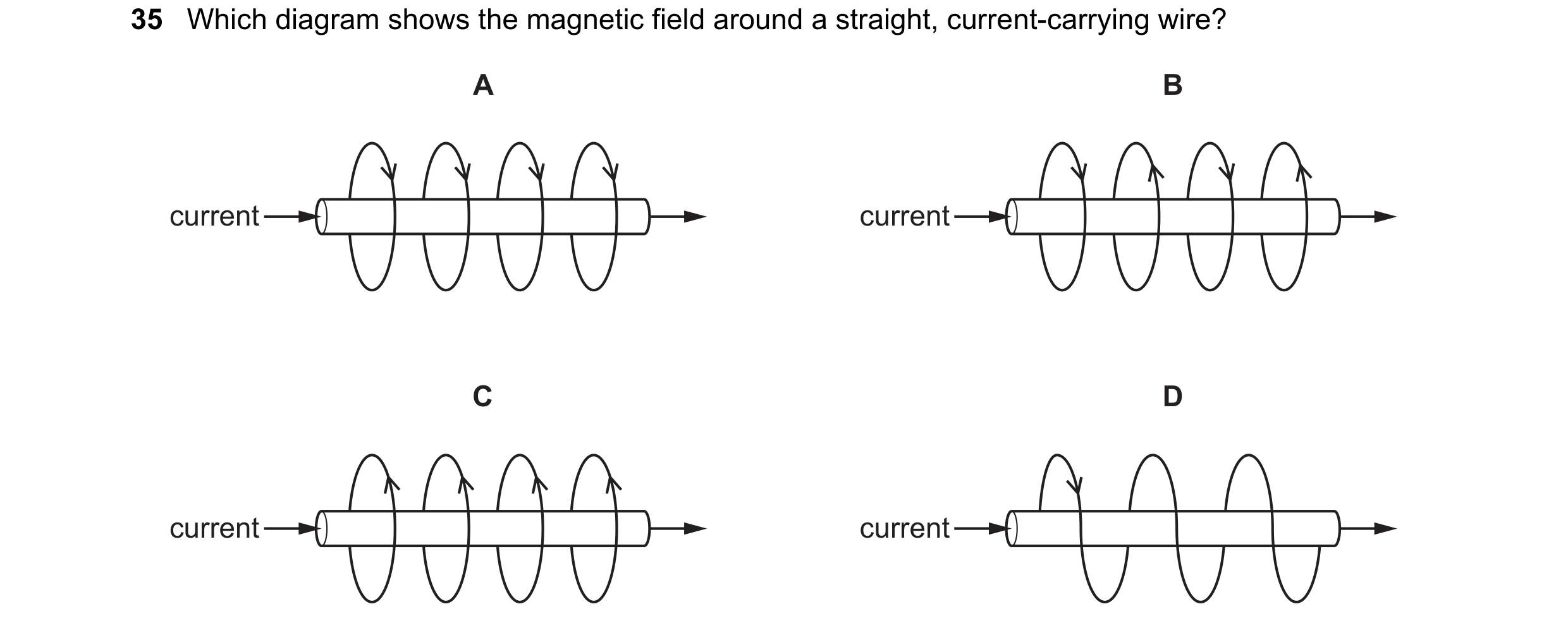
 32 / 52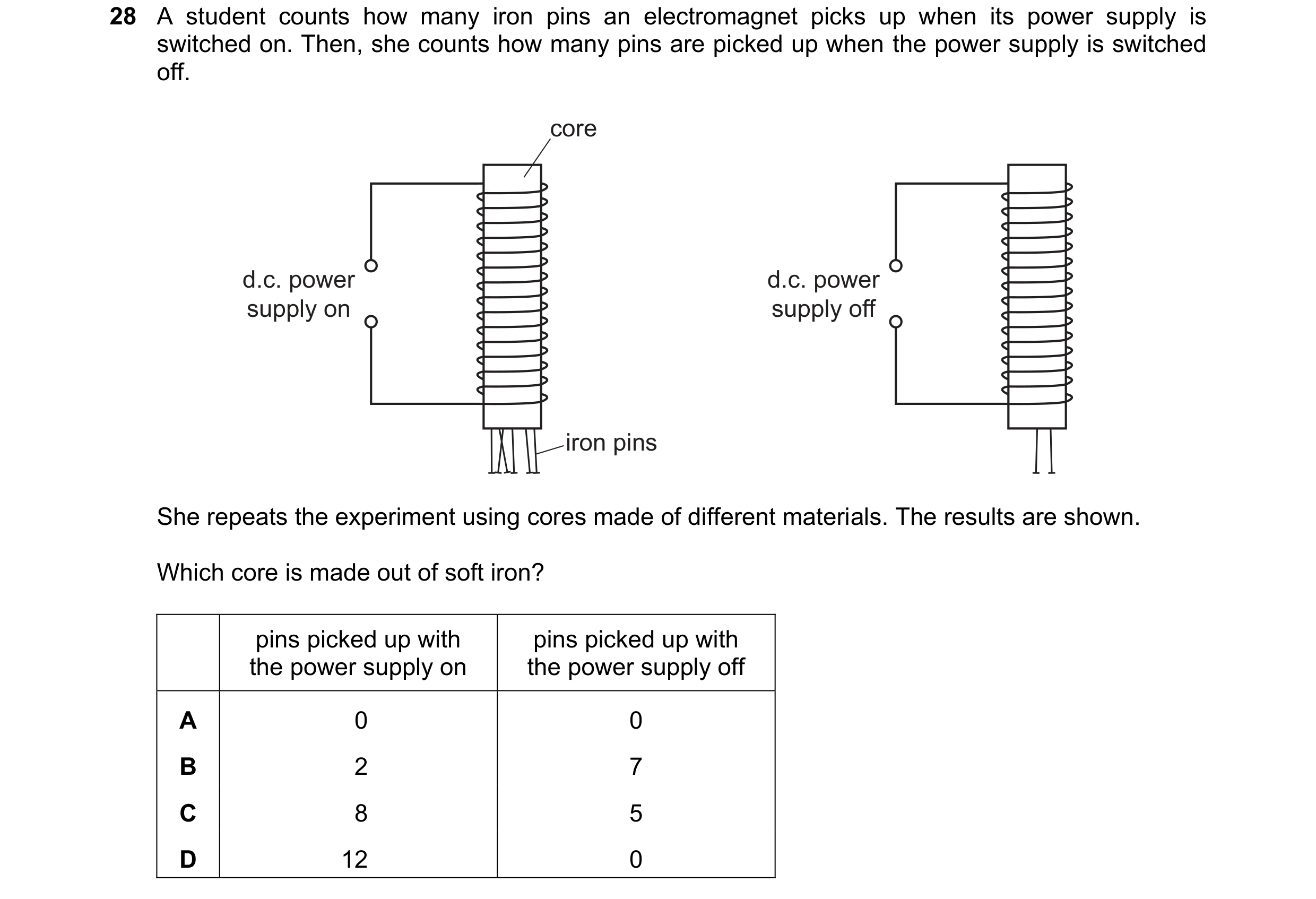
 33 / 52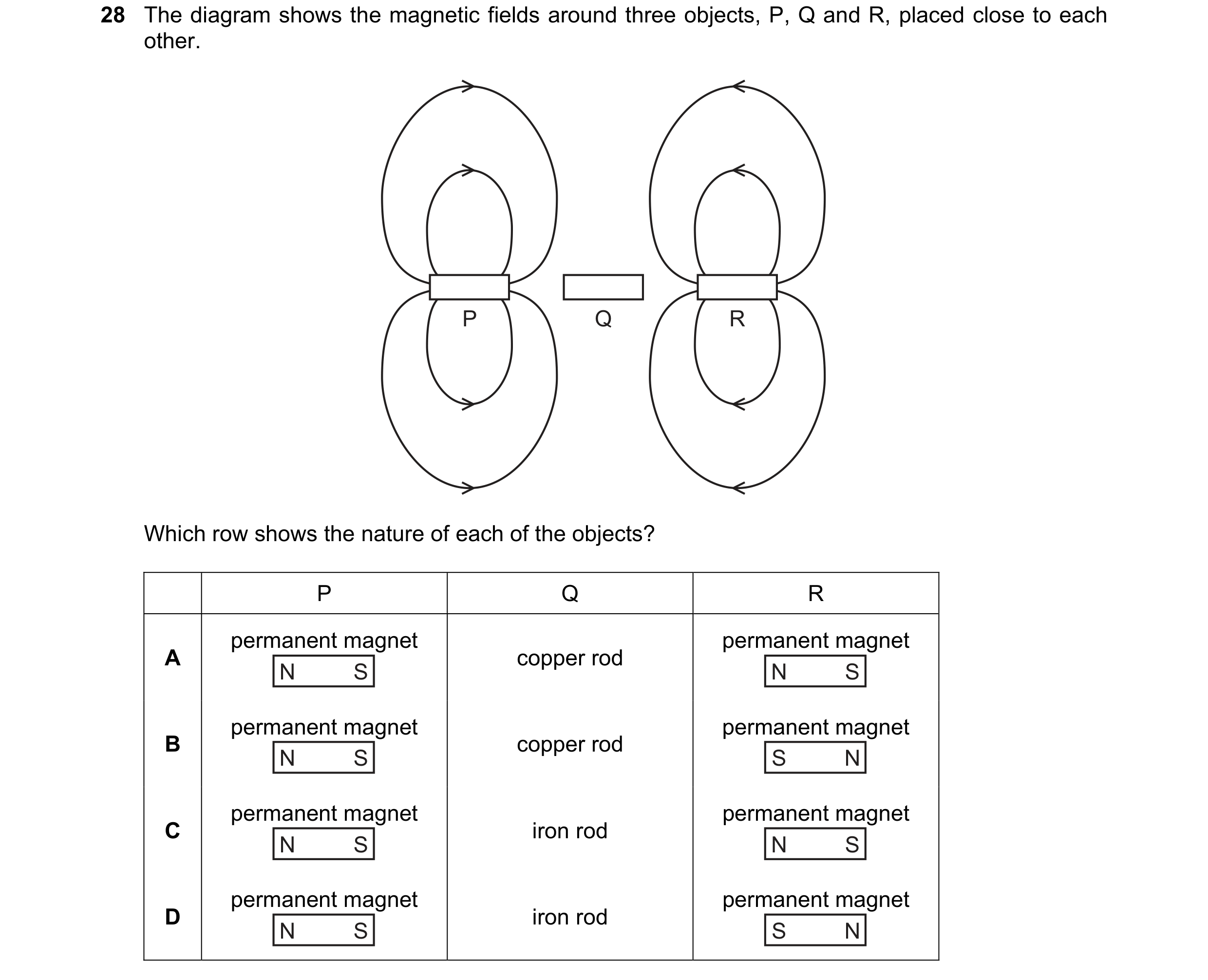
 34 / 52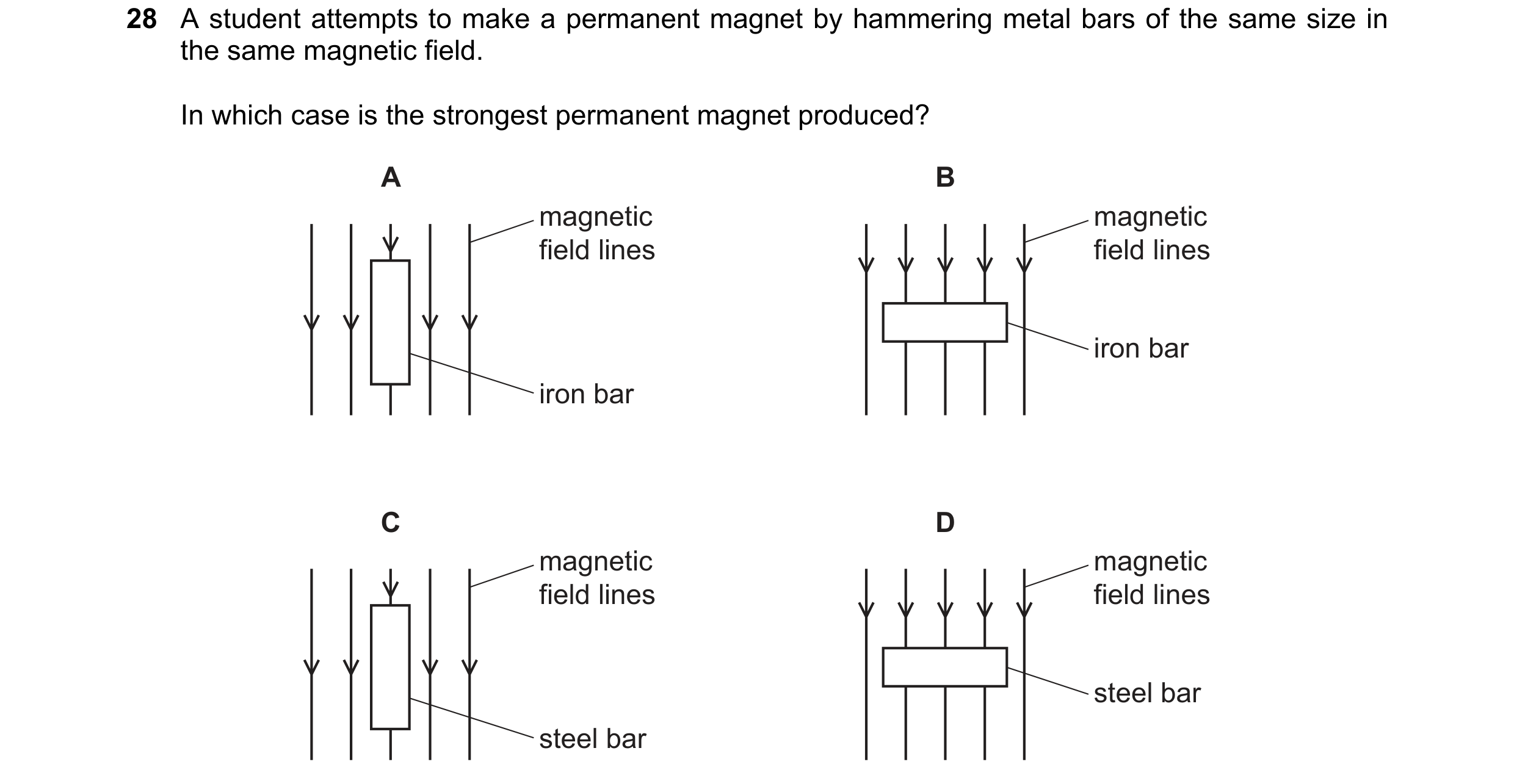
 35 / 52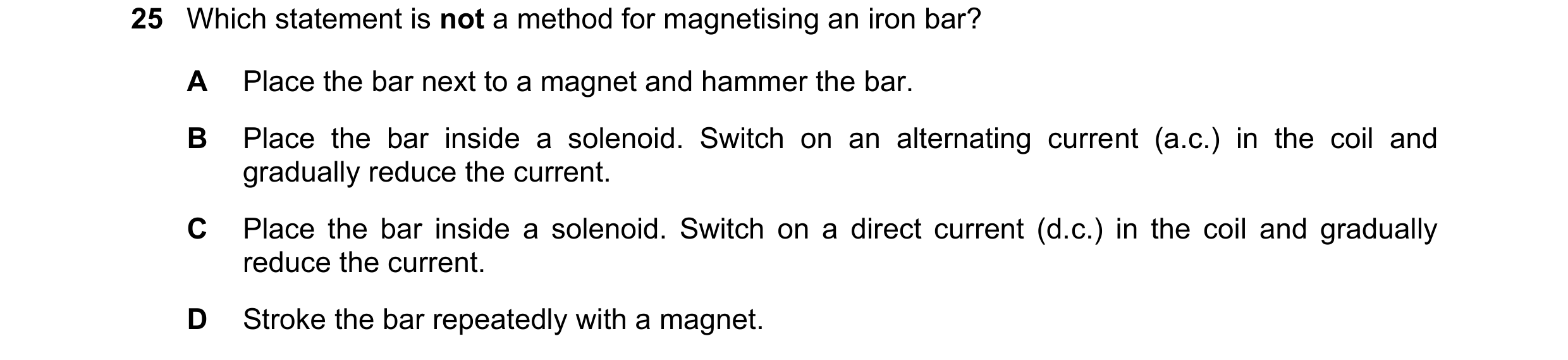
 36 / 52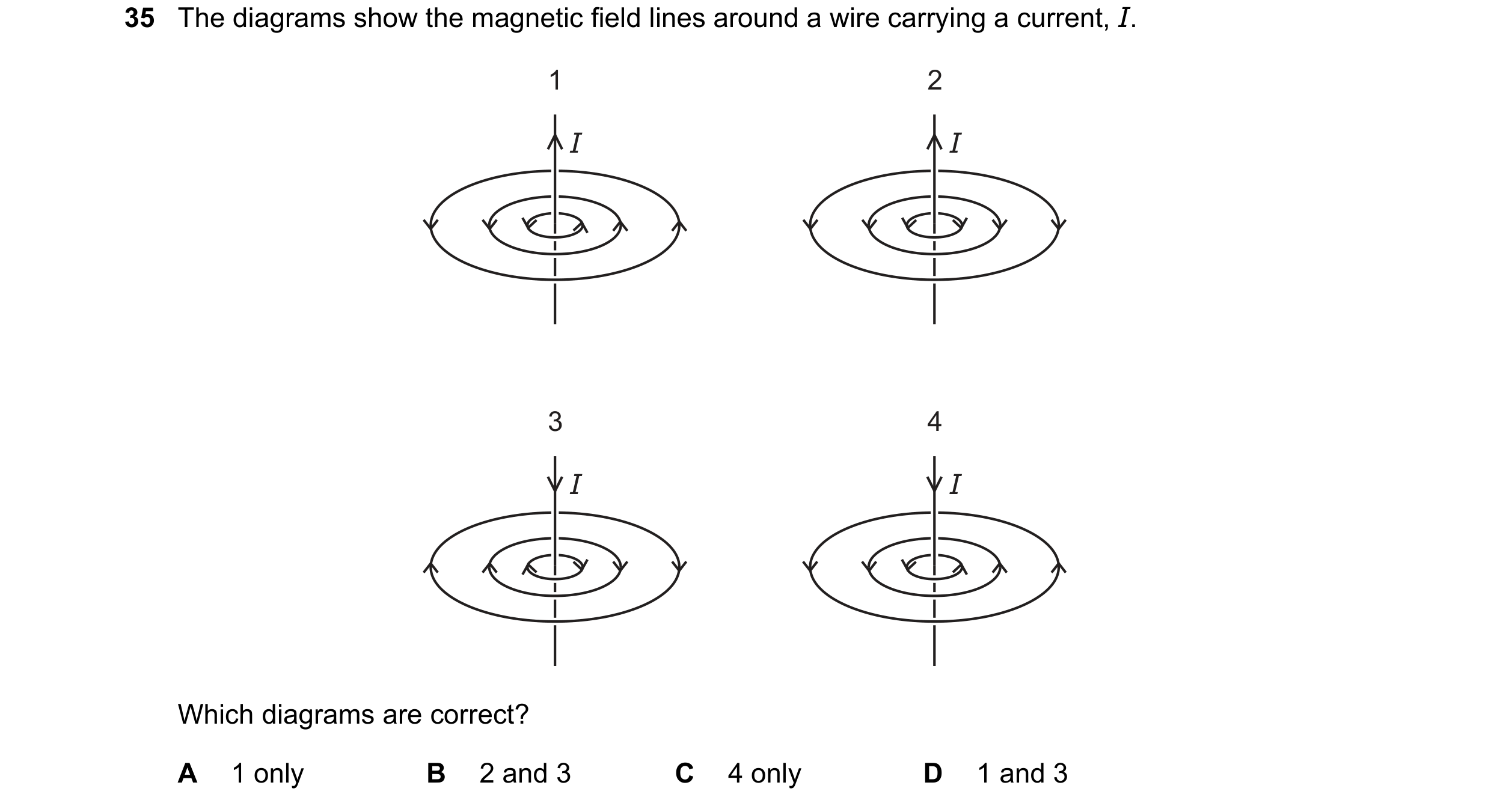
 37 / 52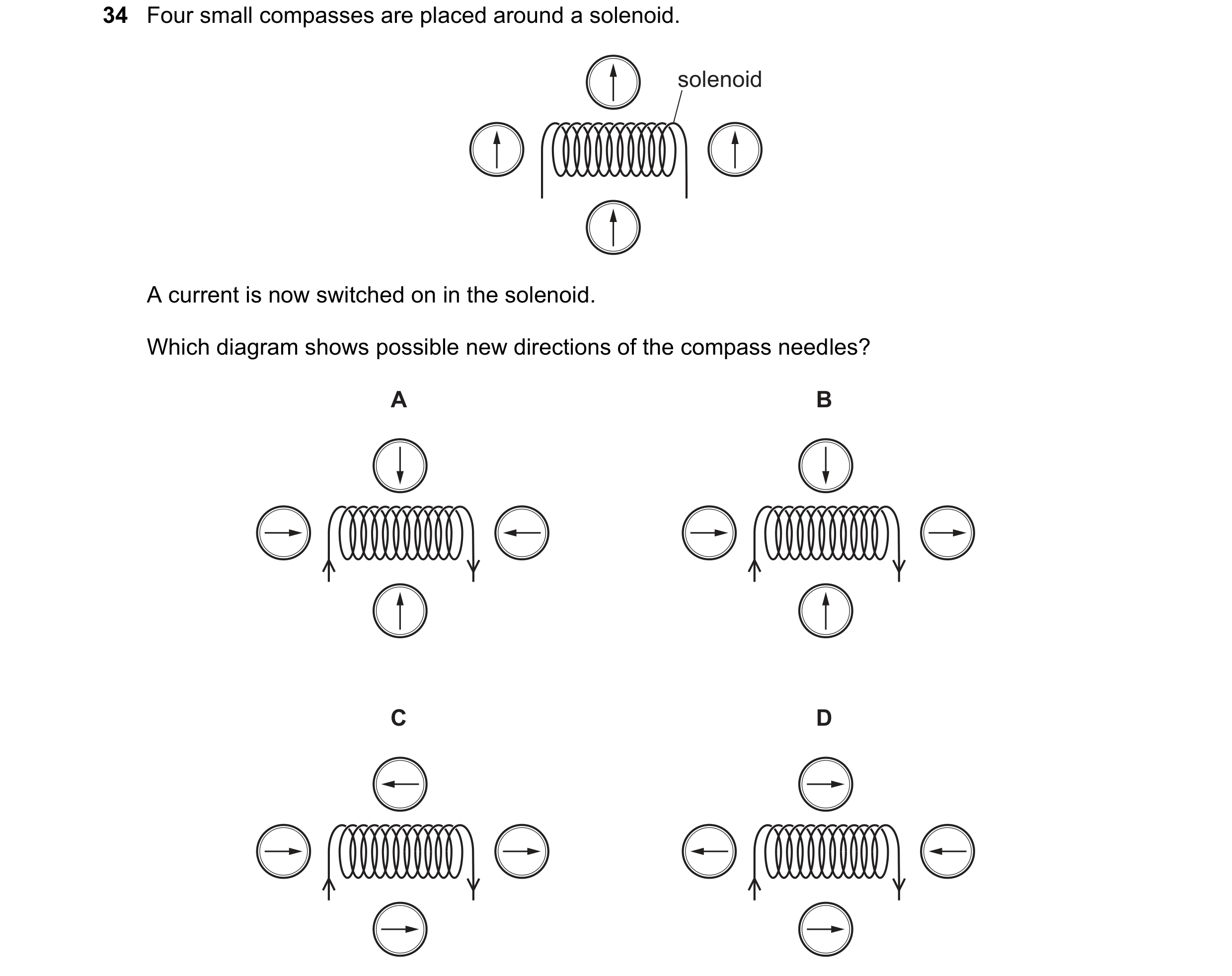
 38 / 52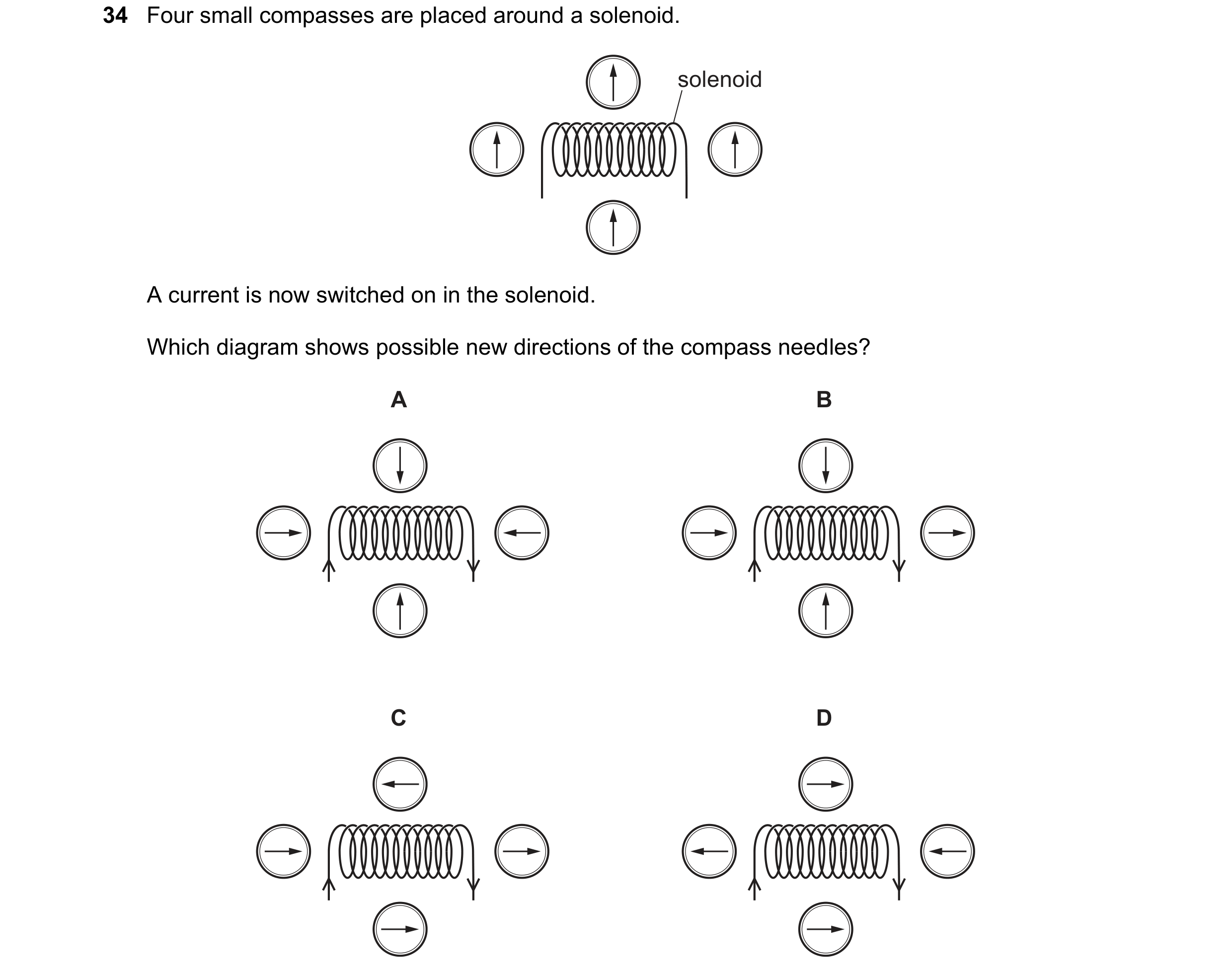
 39 / 52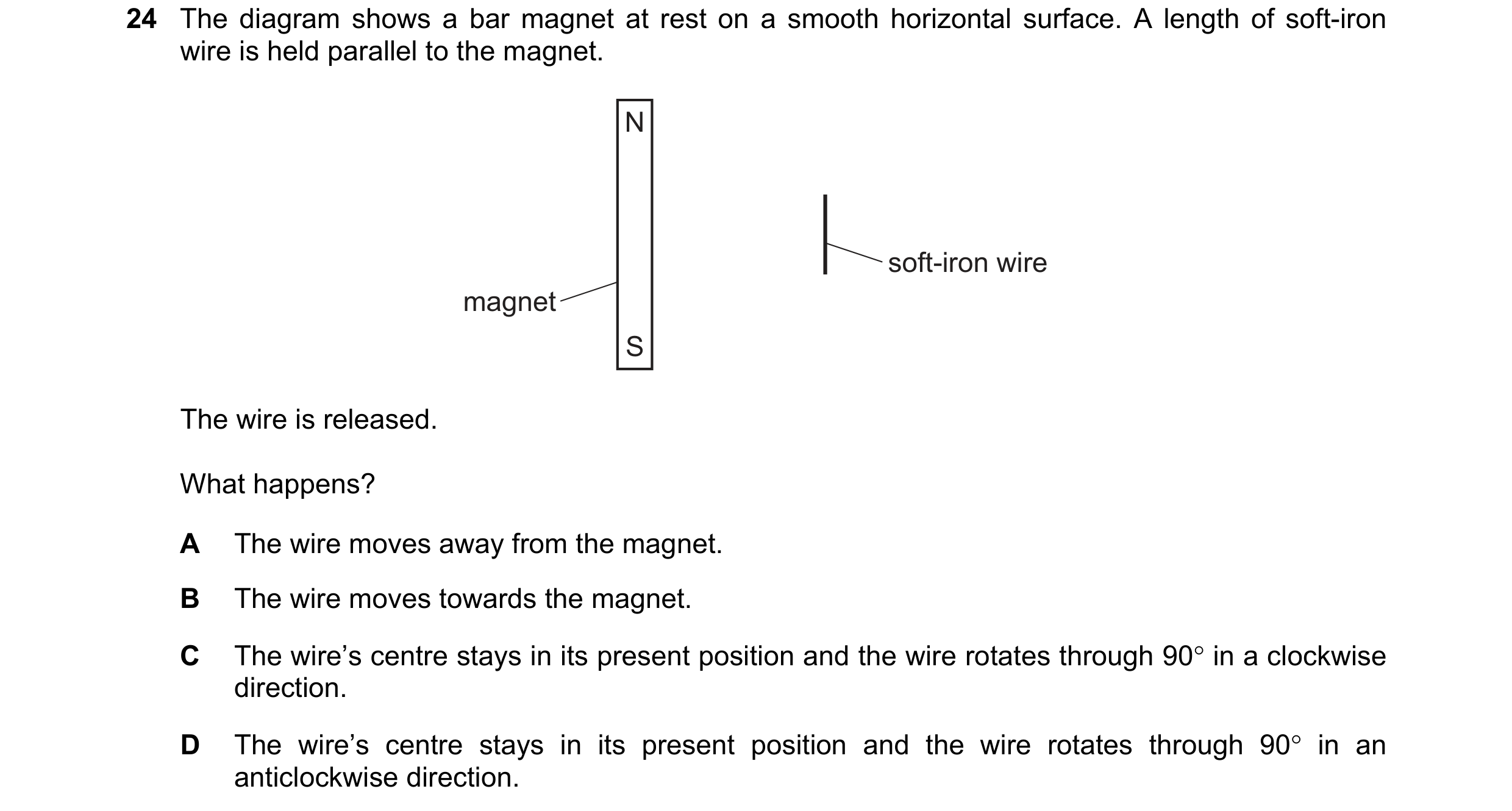
 40 / 52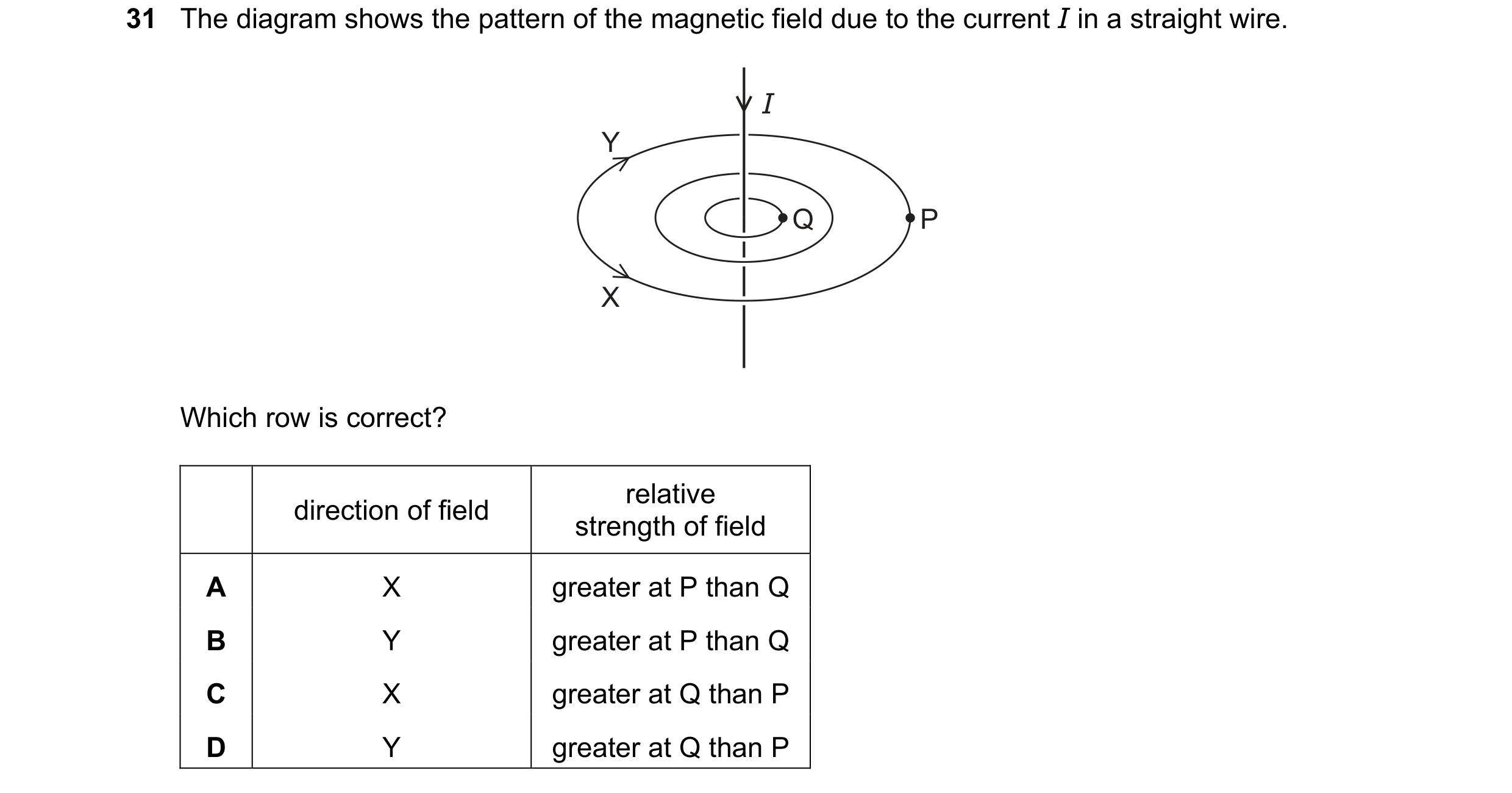
 41 / 52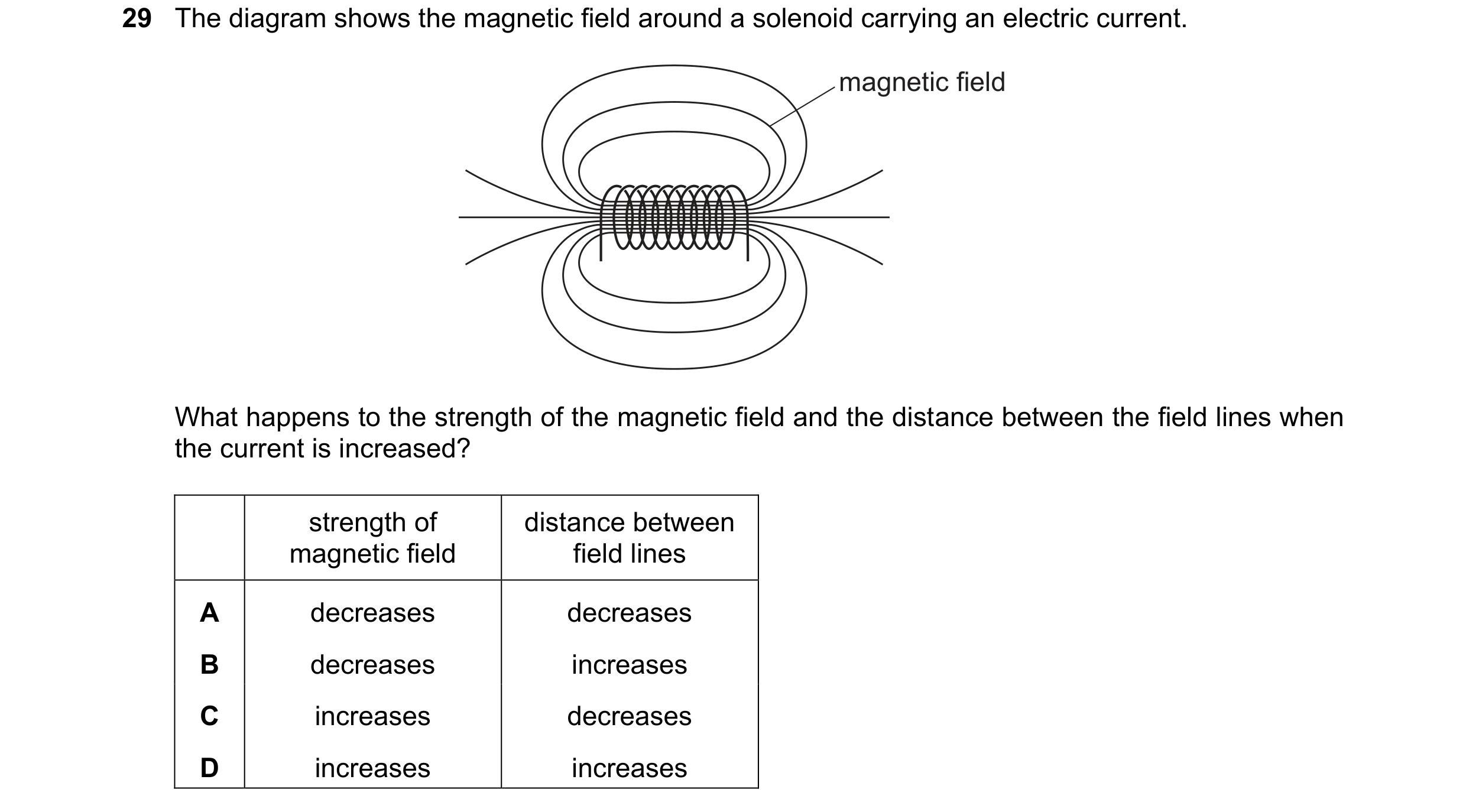

 42 / 52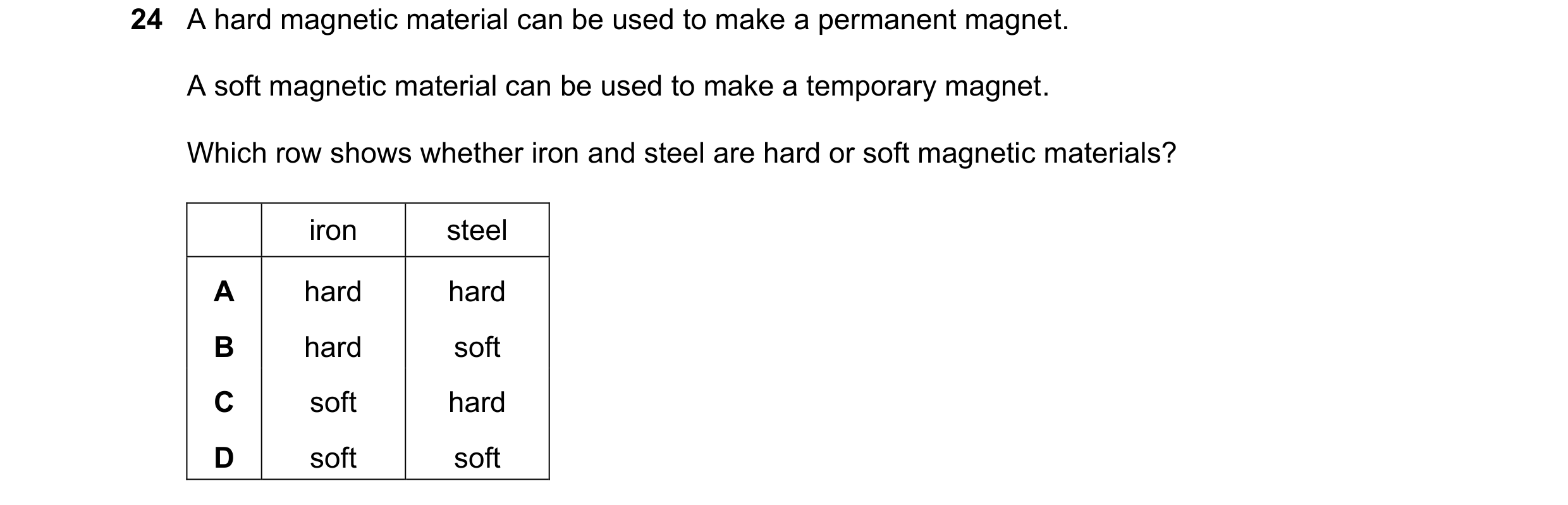
 43 / 52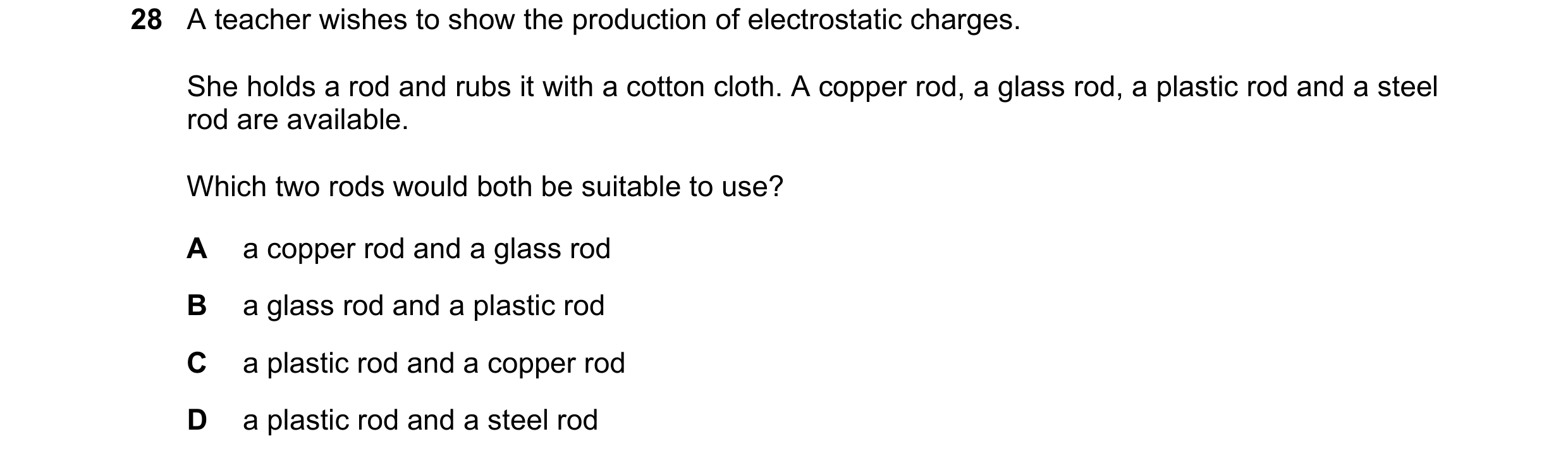
 44 / 52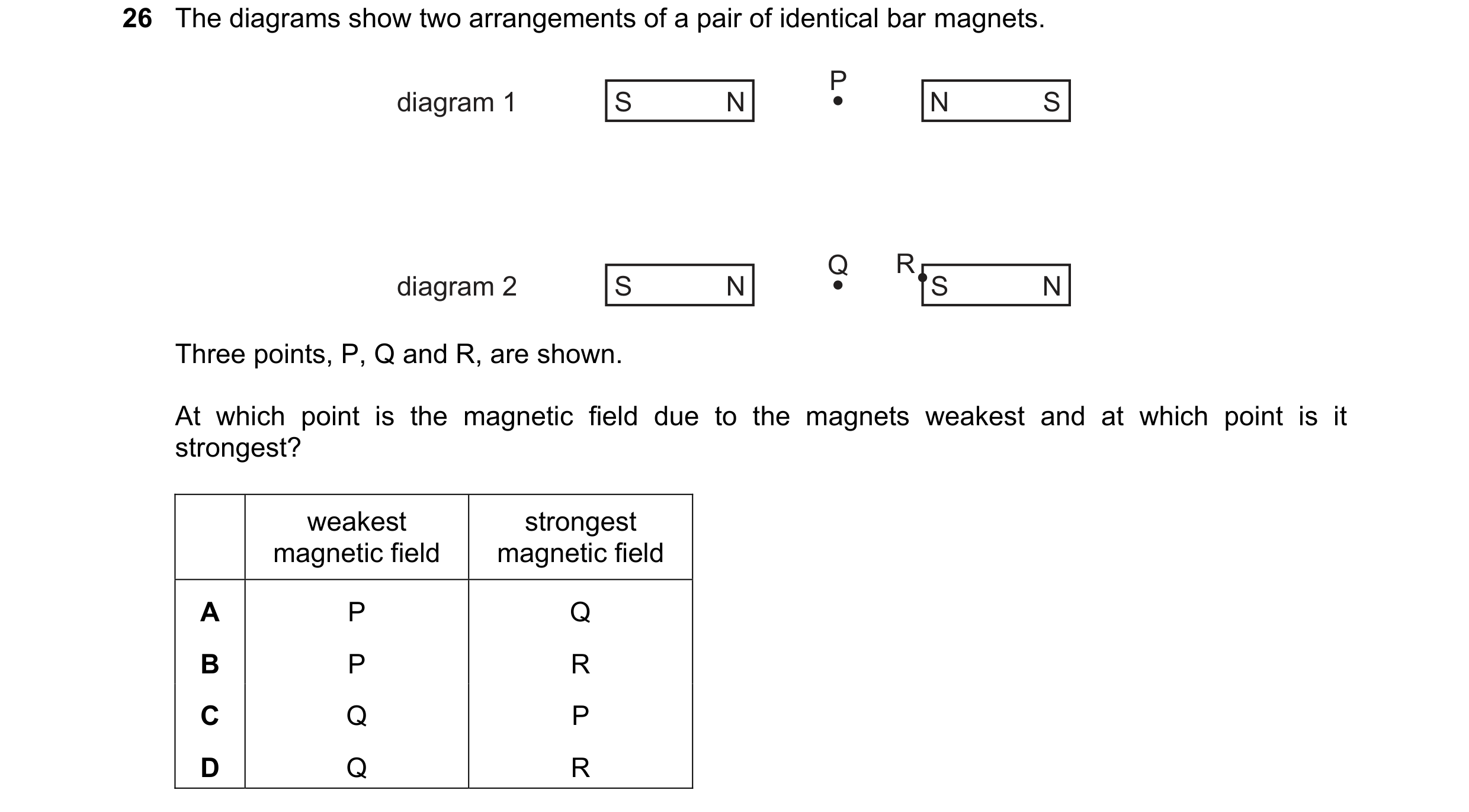
 45 / 52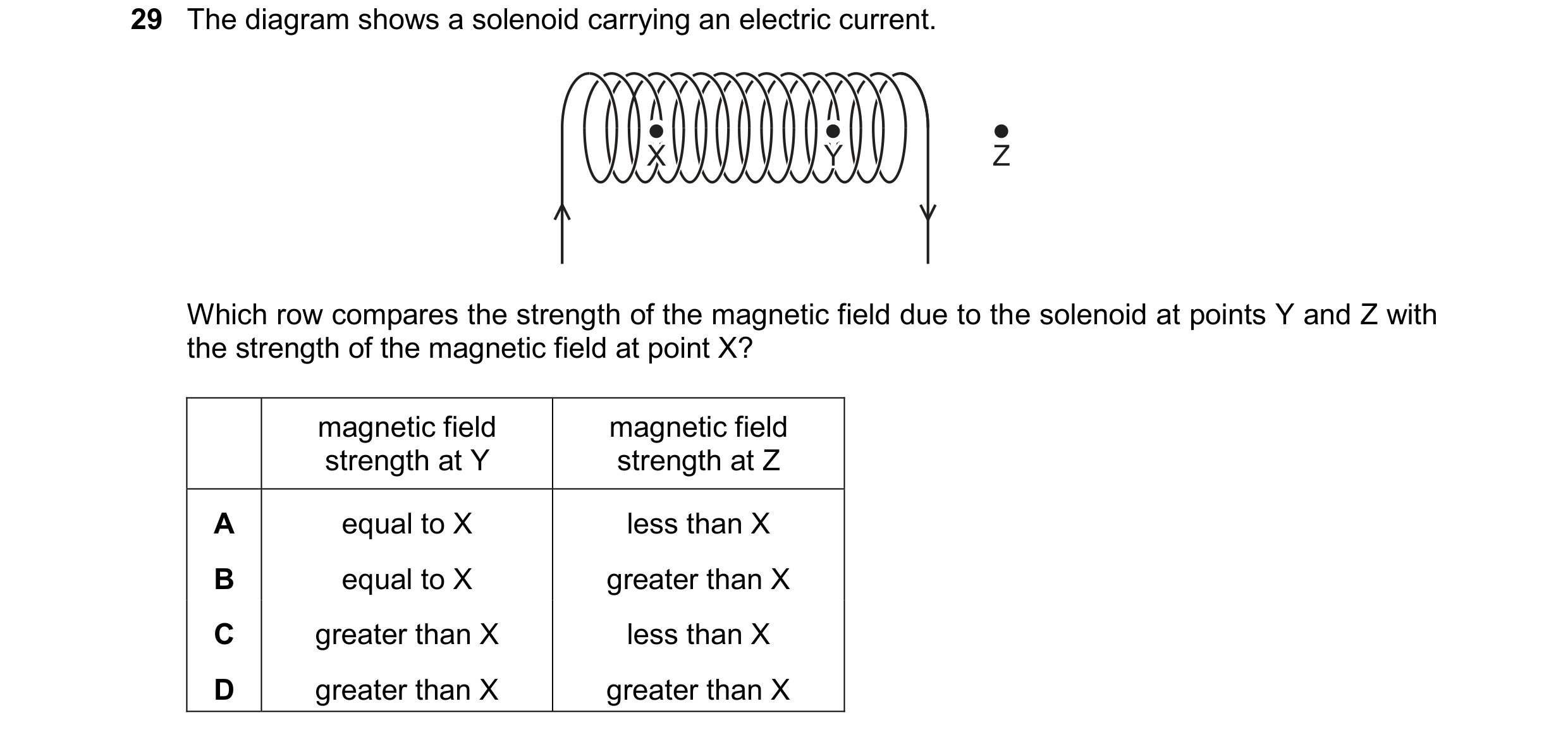

 46 / 52
 47 / 52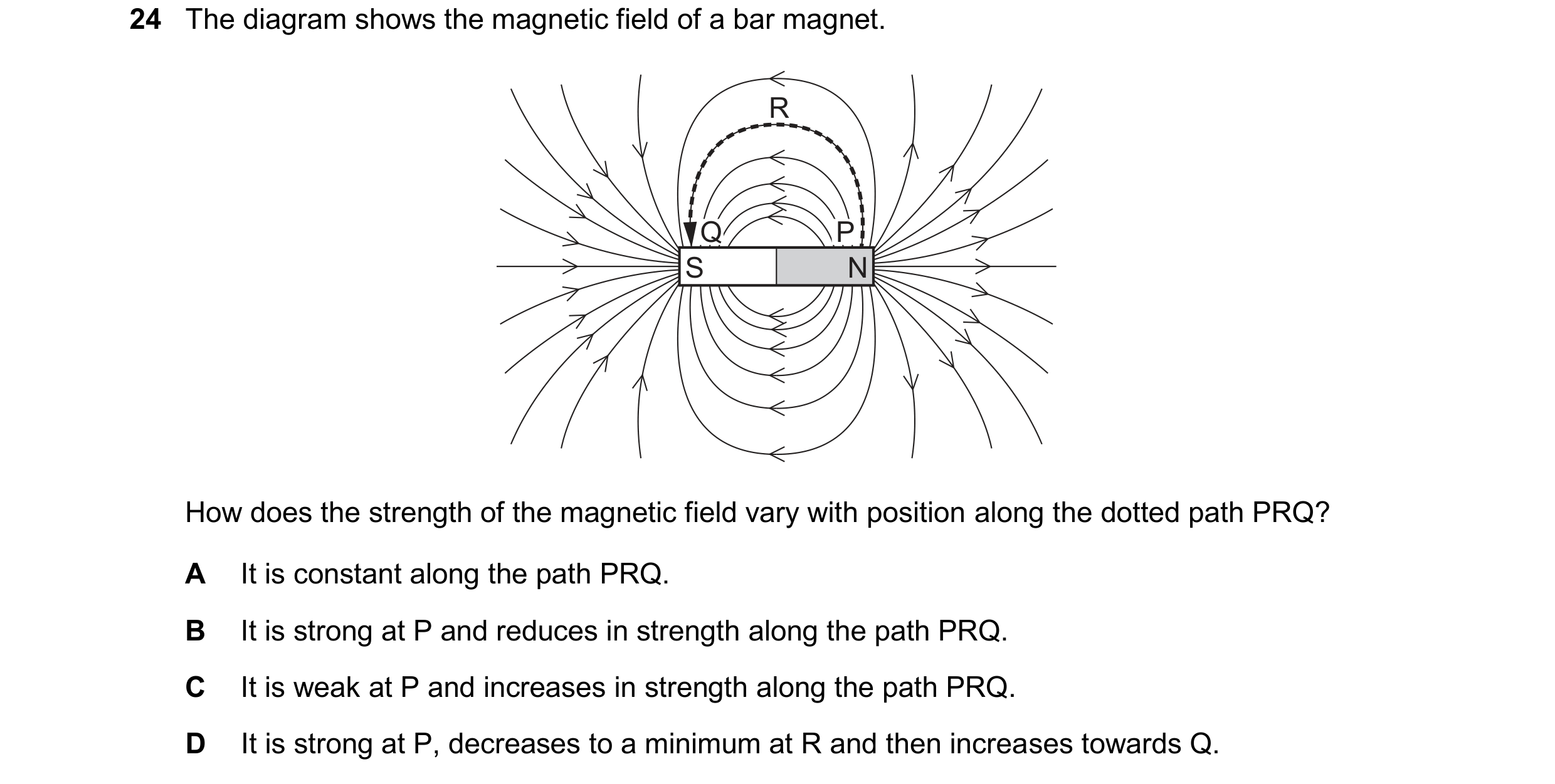
 48 / 52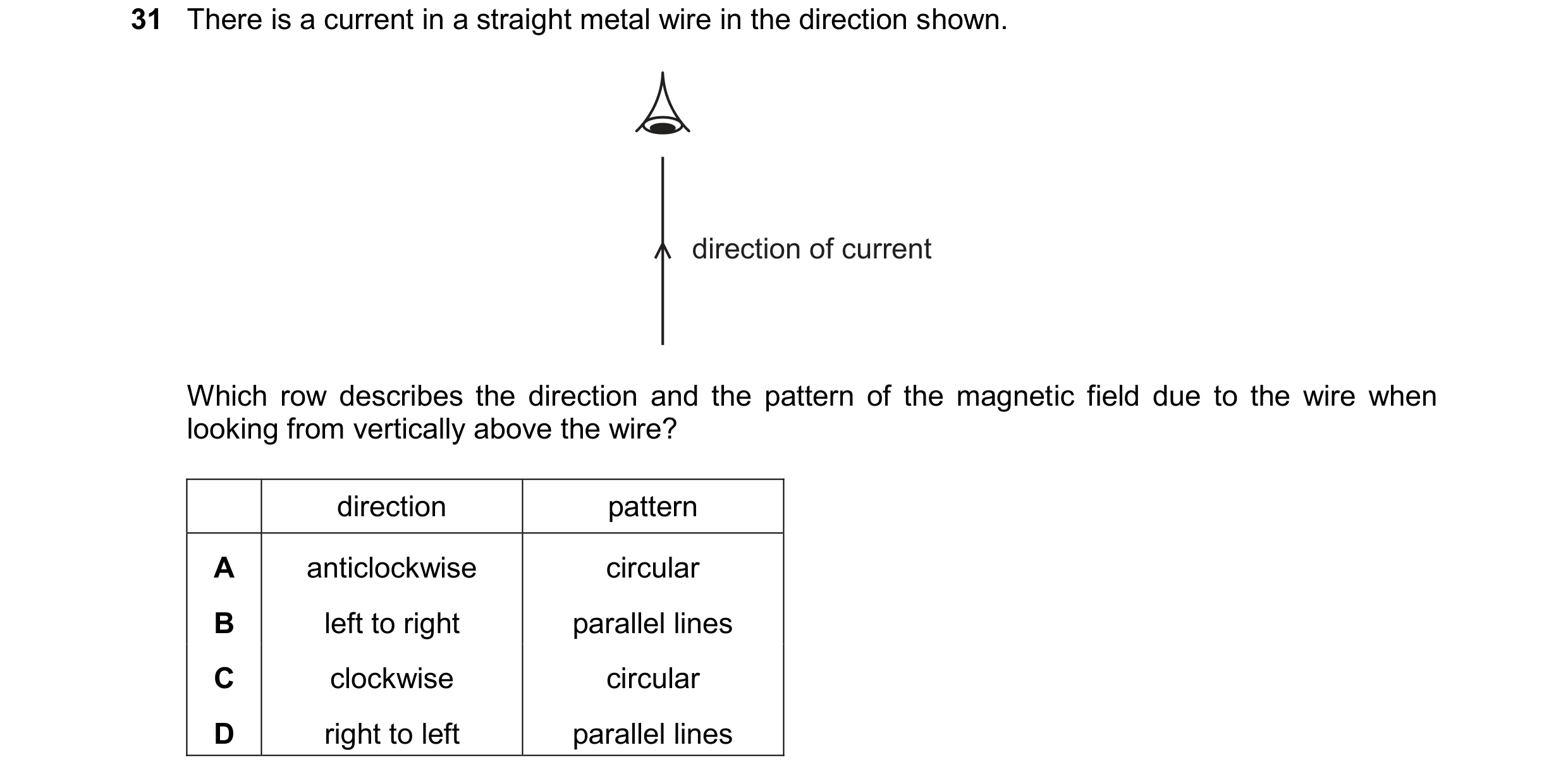
 49 / 52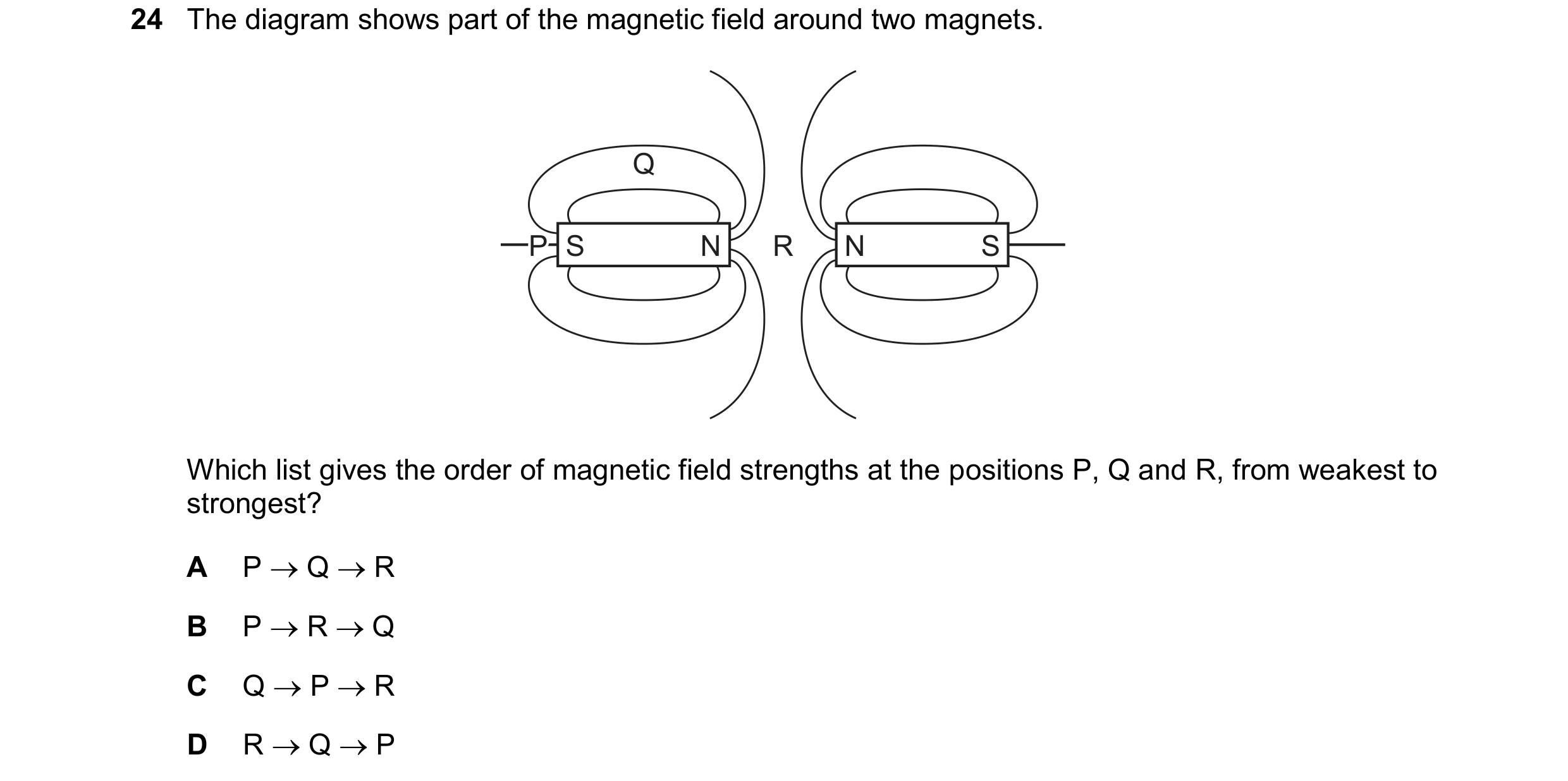
 50 / 52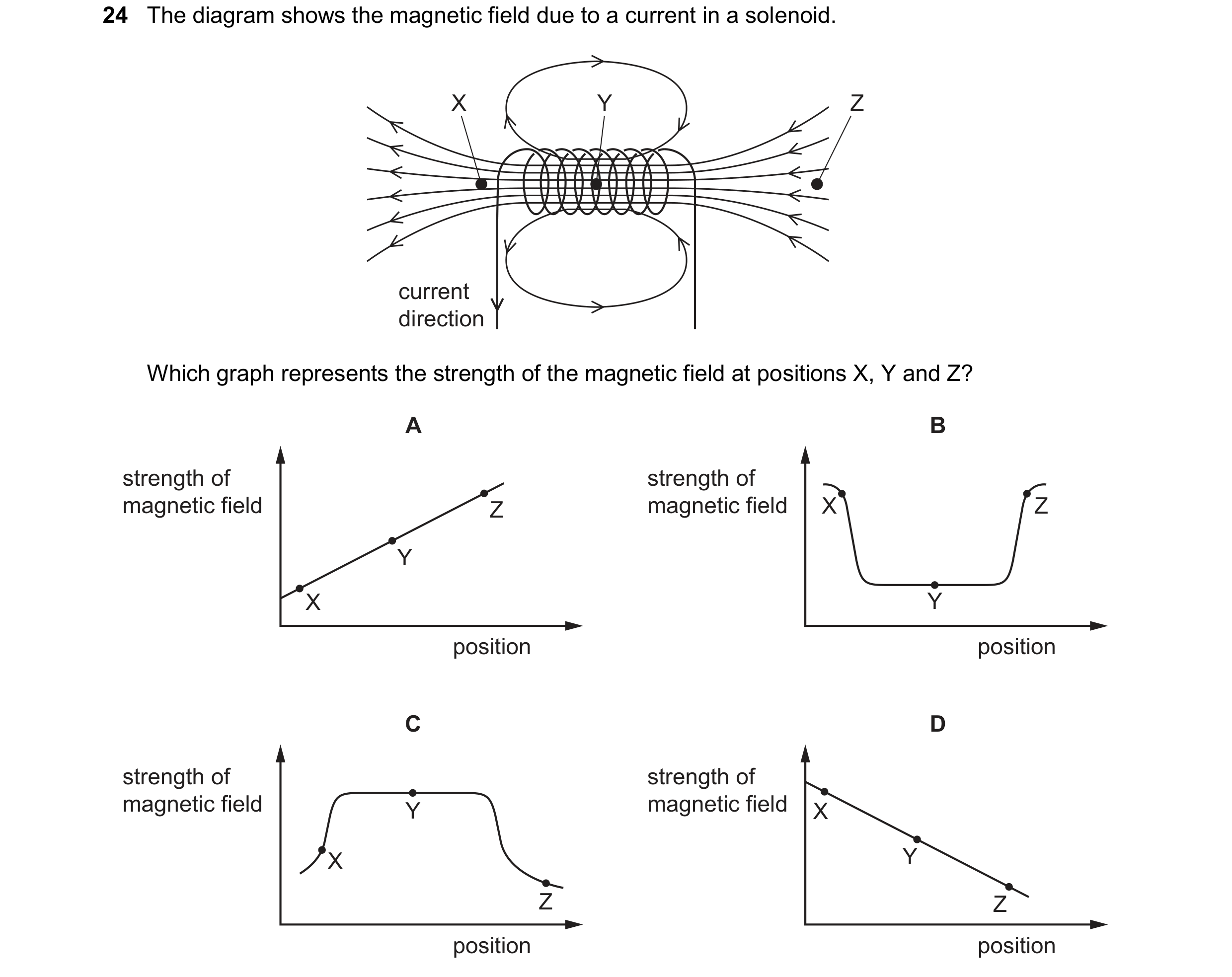
 51 / 52
 52 / 52