Cambridge IGCSE Physics 0625 — 2016 Oct/Nov Paper 1 · Variant 3
0625/13/O/N/16 · 40 questions · 40 marks · ≈45 min
The question paper and its mark scheme, free to read here and free to download. This is Cambridge’s own paper, exactly as it was sat.
Question paper20 pages
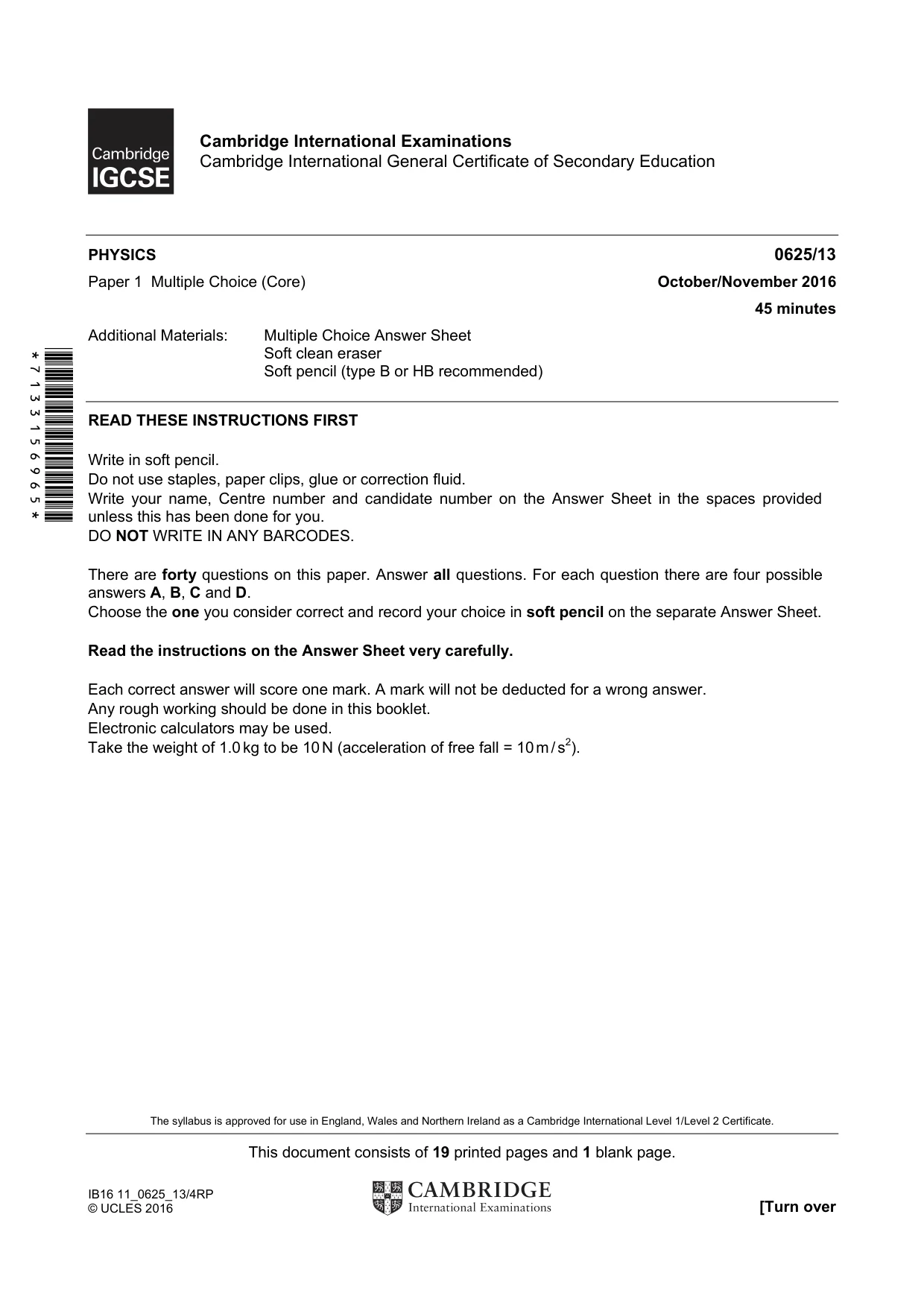
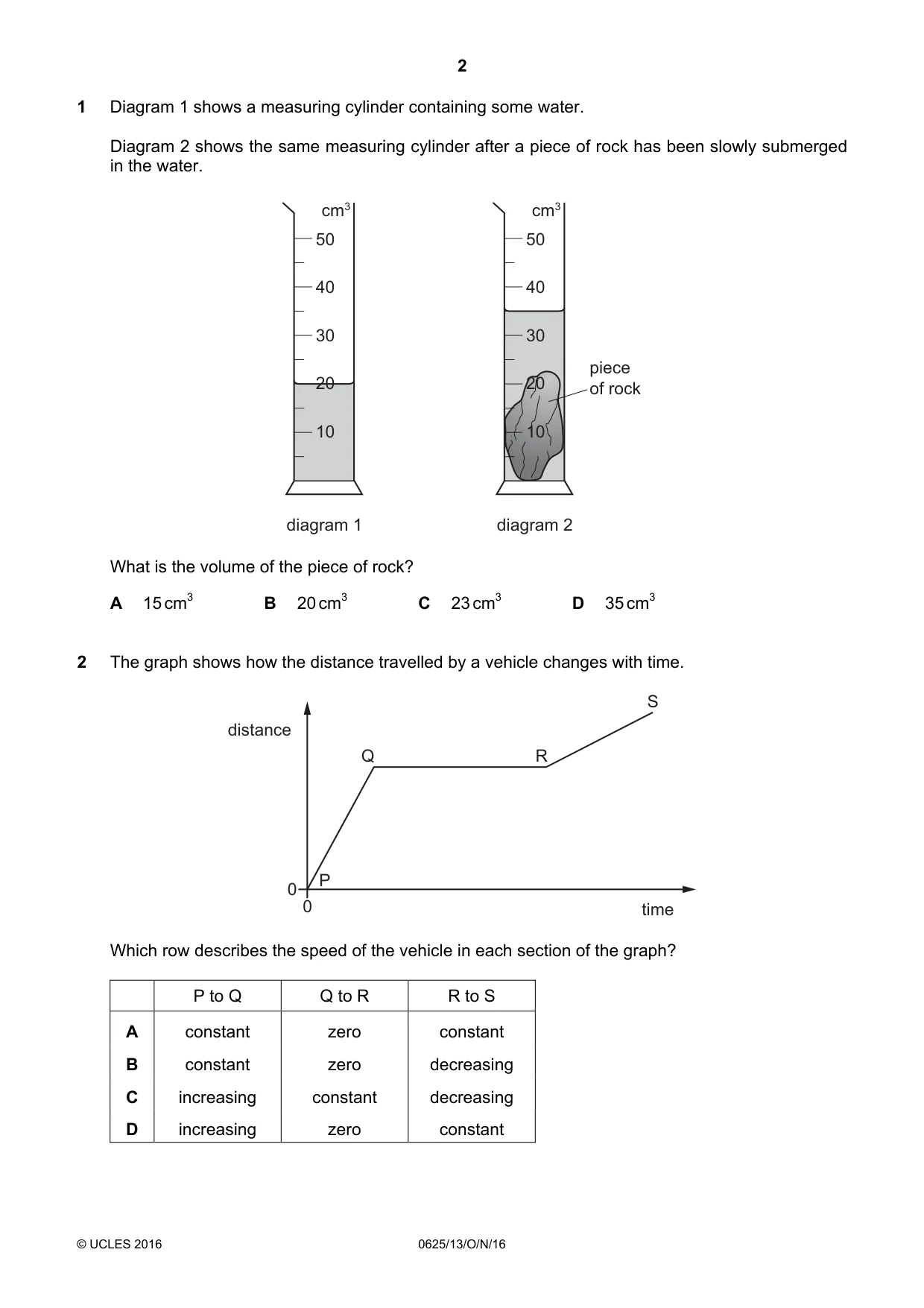
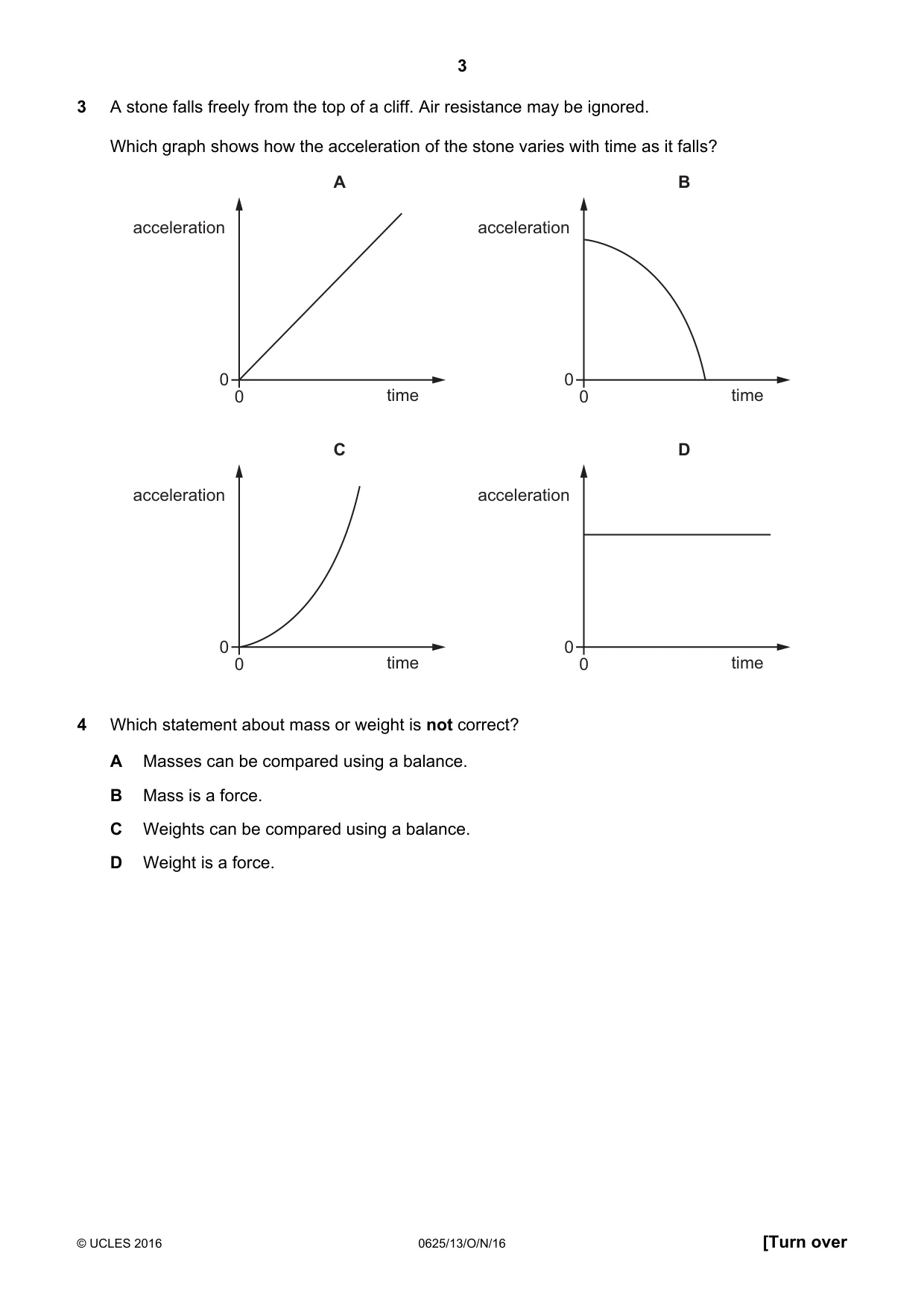
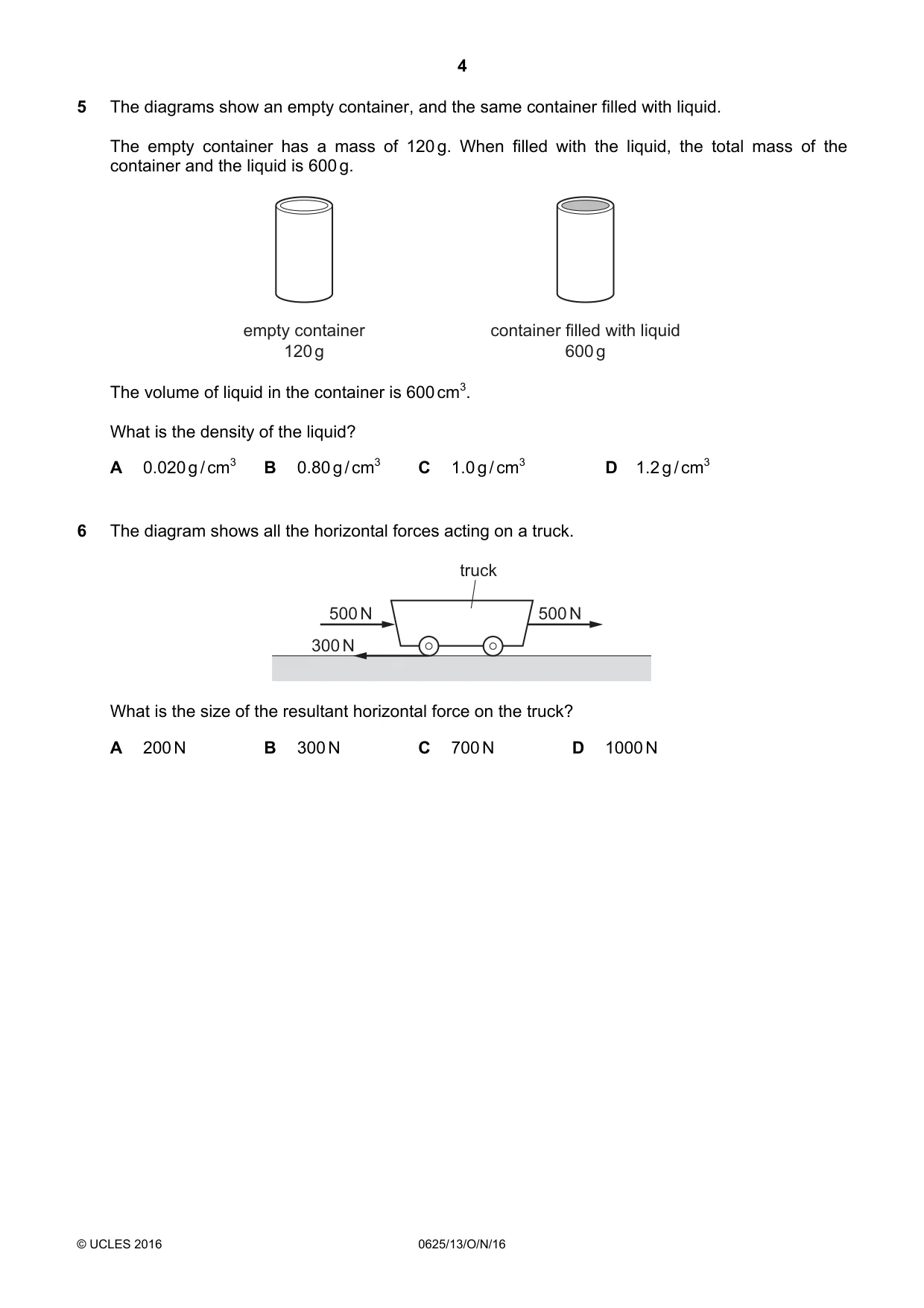
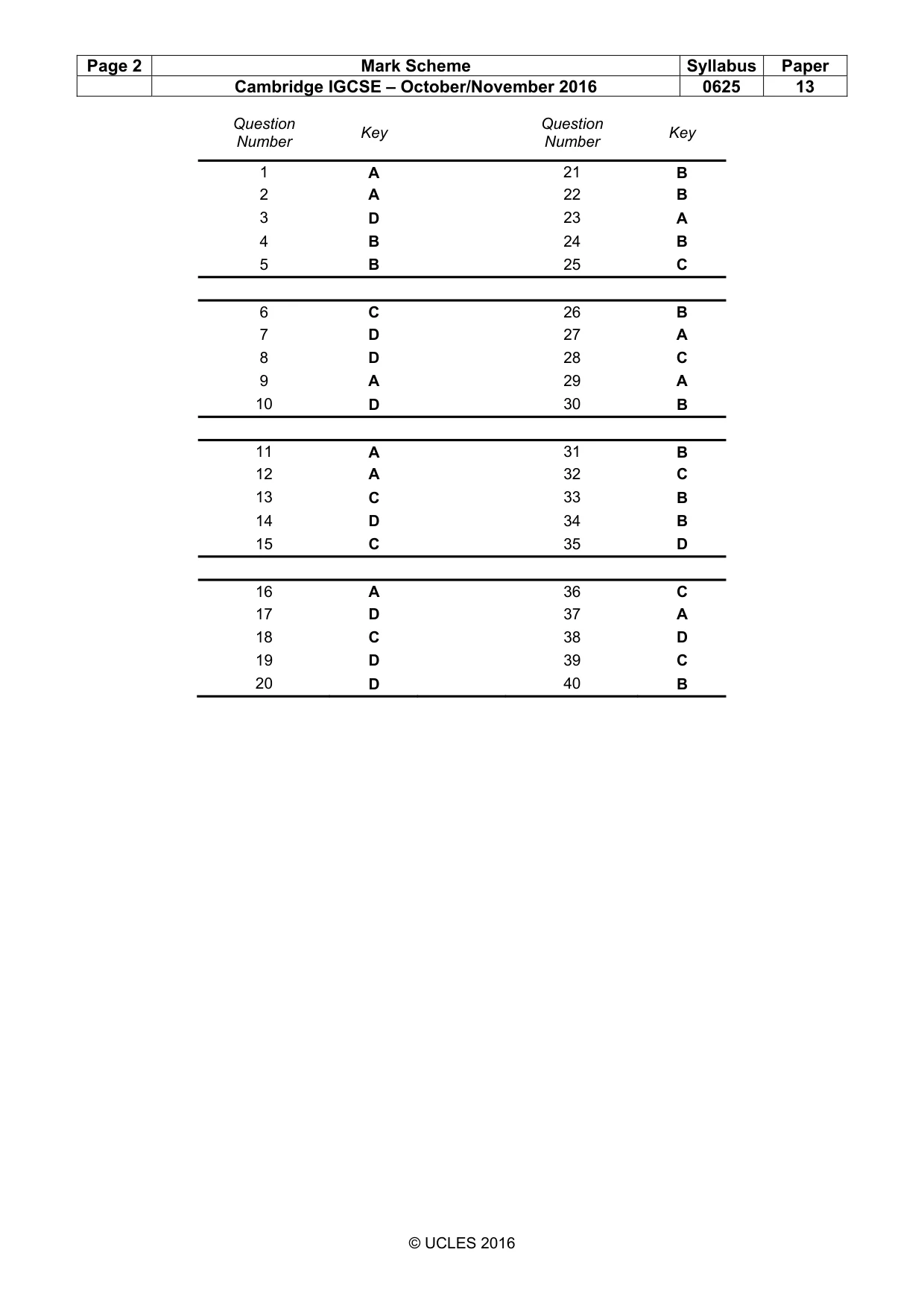
Mark scheme2 pages
Answers below. Sit the paper first if you are practising.
Questions as text
Q1 · A measuring cylinder containing some water
1 Diagram 1 shows a measuring cylinder containing some water. Diagram 2 shows the same measuring cylinder after a piece of rock has been slowly submerged in the water. cm3 cm3 50 50 40 40 30 30 piece 20 20 of rock 10 10 diagram 1 diagram 2 What is the volume of the piece of rock? A 15 cm3 B 20 cm3 C 23 cm3 D 35 cm3
Mark scheme: A
More questions on Physical quantities and measurement techniques
Q2 · The graph shows how the distance travelled by a vehicle changes with time
2 The graph shows how the distance travelled by a vehicle changes with time. S distance Q R P 0 0 time Which row describes the speed of the vehicle in each section of the graph? P to Q Q to R R to S A constant zero constant B constant zero decreasing C increasing constant decreasing D increasing zero constant
Mark scheme: A
Q3 · A stone falls freely from the top of a cliff
3 A stone falls freely from the top of a cliff. Air resistance may be ignored. Which graph shows how the acceleration of the stone varies with time as it falls? A B acceleration acceleration 0 0 0 time 0 time C D acceleration acceleration 0 0 0 time 0 time
Mark scheme: D
Q4 · Which statement about mass or weight is not correct?
4 Which statement about mass or weight is not correct? A Masses can be compared using a balance. B Mass is a force. C Weights can be compared using a balance. D Weight is a force.
Mark scheme: B
Q5 · The diagrams show an empty container, and the same container filled with liquid
5 The diagrams show an empty container, and the same container filled with liquid. The empty container has a mass of 120 g. When filled with the liquid, the total mass of the container and the liquid is 600 g. empty container container filled with liquid 120 g 600 g The volume of liquid in the container is 600 cm3. What is the density of the liquid? A 0.020 g / cm3 B 0.80 g / cm3 C 1.0 g / cm3 D 1.2 g / cm3
Mark scheme: B
Q6 · The diagram shows all the horizontal forces acting on a truck
6 The diagram shows all the horizontal forces acting on a truck. truck 500 N 500 N 300 N What is the size of the resultant horizontal force on the truck? A 200 N B 300 N C 700 N D 1000 N
Mark scheme: C
Q7 · Different loads are hung on a spring
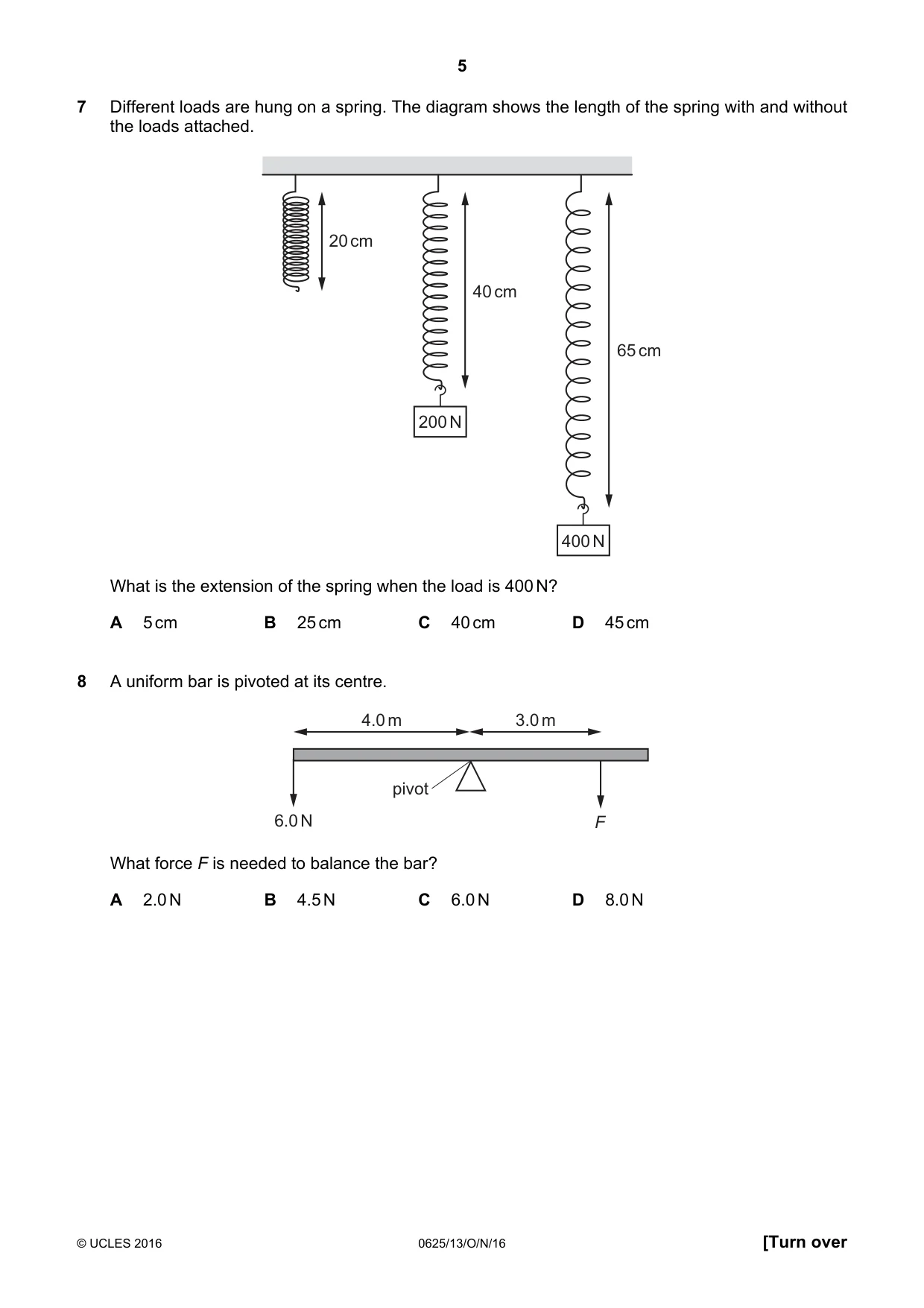
7 Different loads are hung on a spring. The diagram shows the length of the spring with and without the loads attached. 20 cm 40 cm 65 cm 200 N 400 N What is the extension of the spring when the load is 400 N? A 5 cm B 25 cm C 40 cm D 45 cm
Mark scheme: D
Q8 · A uniform bar is pivoted at its centre
8 A uniform bar is pivoted at its centre. 4.0 m 3.0 m pivot 6.0 N F What force F is needed to balance the bar? A 2.0 N B 4.5 N C 6.0 N D 8.0 N
Mark scheme: D
Q9 · A ball is released from point X on a rough semicircular track
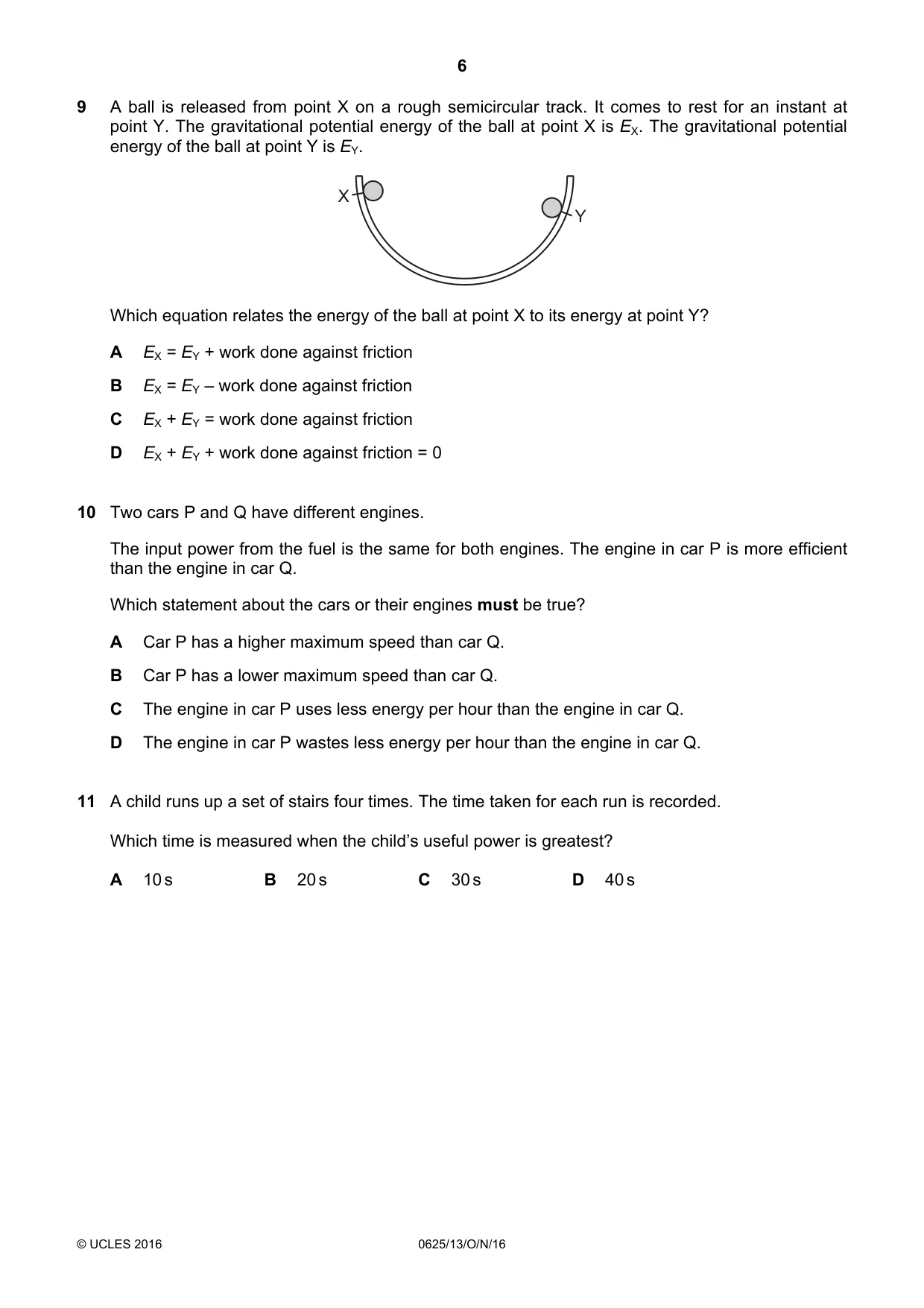
9 A ball is released from point X on a rough semicircular track. It comes to rest for an instant at point Y. The gravitational potential energy of the ball at point X is EX. The gravitational potential energy of the ball at point Y is EY. X Y Which equation relates the energy of the ball at point X to its energy at point Y? A EX = EY + work done against friction B EX = EY – work done against friction C EX + EY = work done against friction D EX + EY + work done against friction = 0
Mark scheme: A
Q10 · Two cars P and Q have different engines
10 Two cars P and Q have different engines. The input power from the fuel is the same for both engines. The engine in car P is more efficient than the engine in car Q. Which statement about the cars or their engines must be true? A Car P has a higher maximum speed than car Q. B Car P has a lower maximum speed than car Q. C The engine in car P uses less energy per hour than the engine in car Q. D The engine in car P wastes less energy per hour than the engine in car Q.
Mark scheme: D
Q11 · A child runs up a set of stairs four times
11 A child runs up a set of stairs four times. The time taken for each run is recorded. Which time is measured when the child’s useful power is greatest? A 10 s B 20 s C 30 s D 40 s
Mark scheme: A
Q12 · The diagrams show the actual sizes of the heels of four different shoes, as seen from…
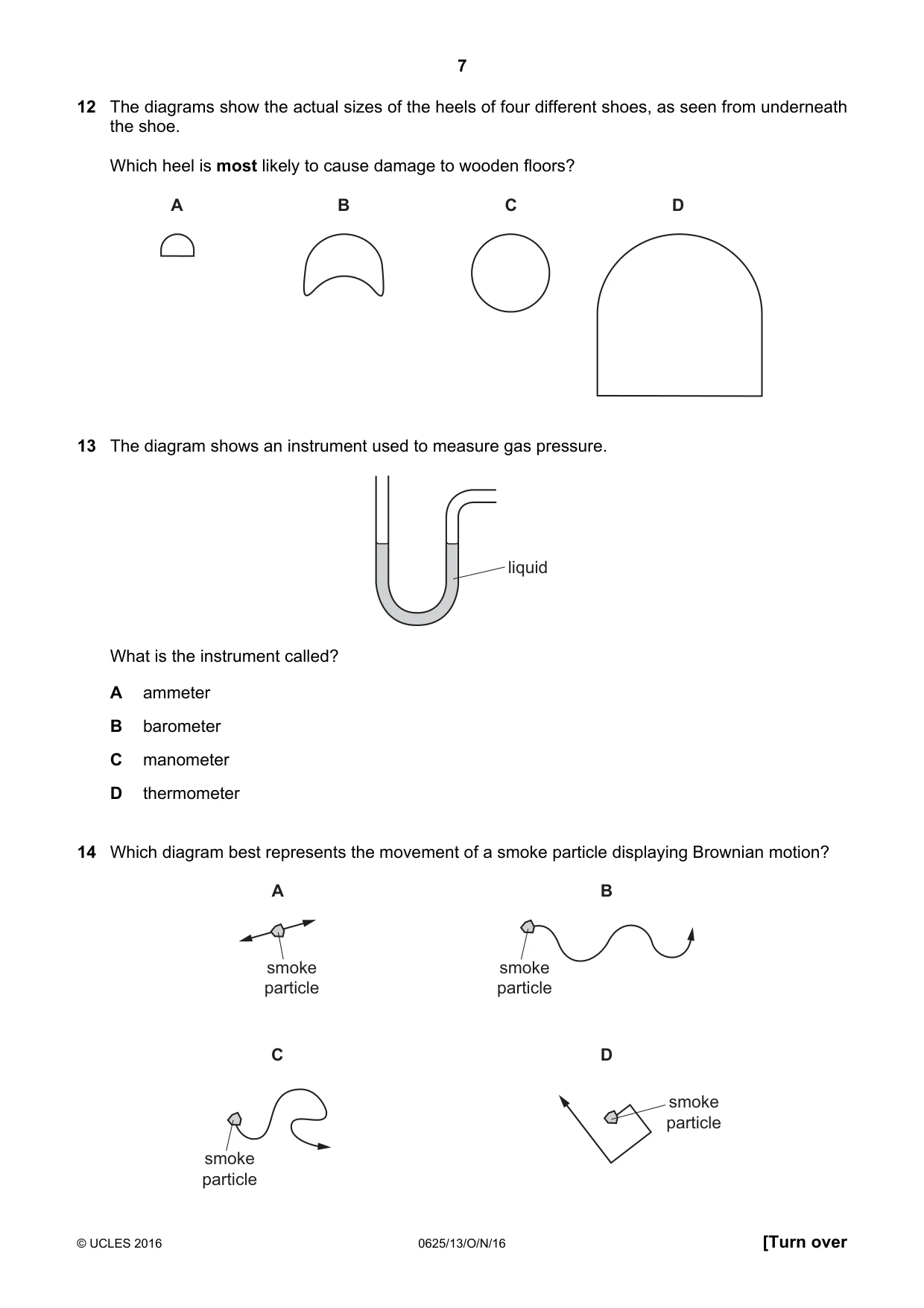
12 The diagrams show the actual sizes of the heels of four different shoes, as seen from underneath the shoe. Which heel is most likely to cause damage to wooden floors? A B C D
Mark scheme: A
Q13 · The diagram shows an instrument used to measure gas pressure
13 The diagram shows an instrument used to measure gas pressure. liquid What is the instrument called? A ammeter B barometer C manometer D thermometer
Mark scheme: C
Q14 · Which diagram best represents the movement of a smoke particle displaying Brownian motion?
14 Which diagram best represents the movement of a smoke particle displaying Brownian motion? A B smoke smoke particle particle C D smoke particle smoke particle
Mark scheme: D
Q15 · A cylinder containing trapped air is put into a freezer
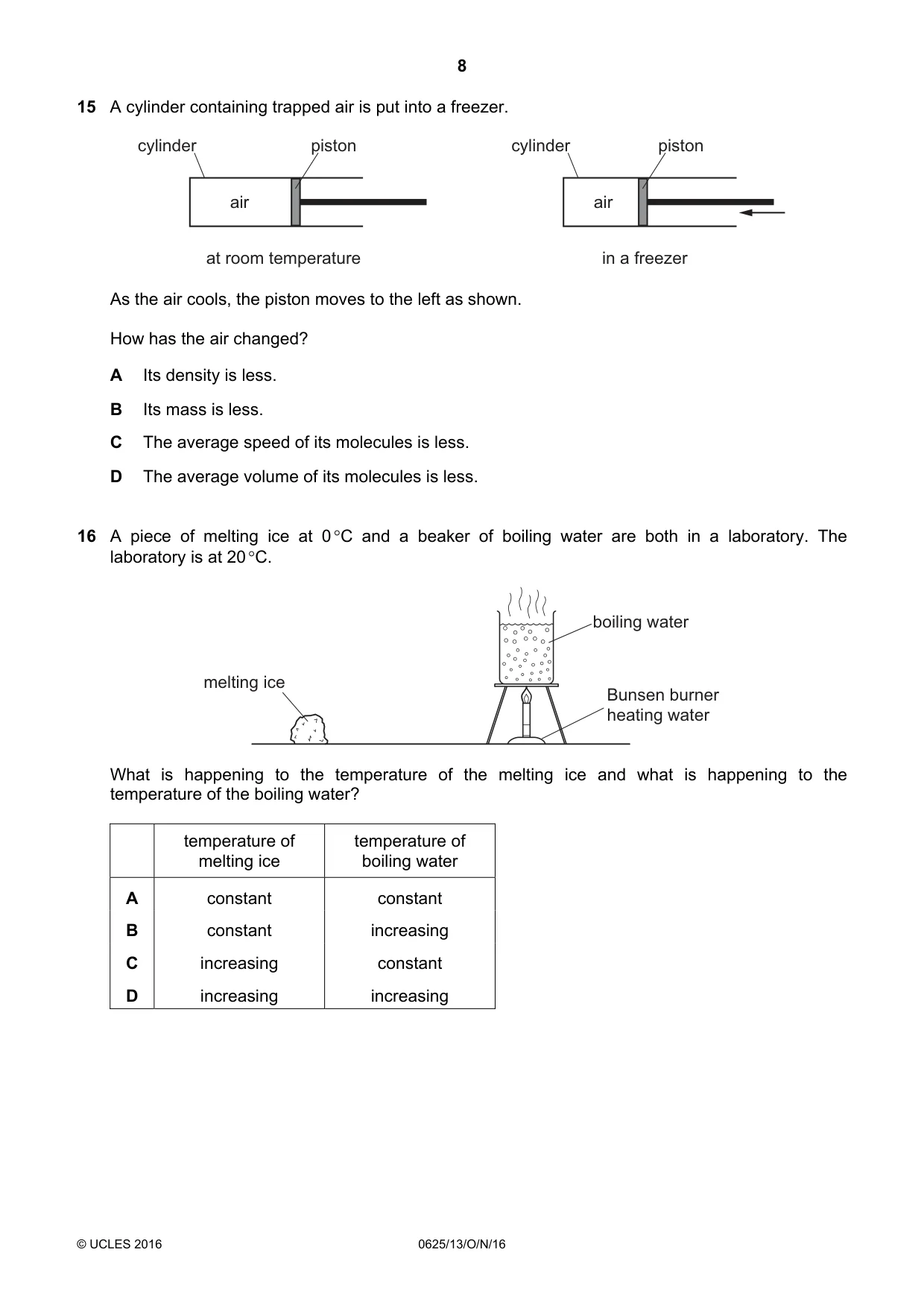
15 A cylinder containing trapped air is put into a freezer. cylinder piston cylinder piston air air at room temperature in a freezer As the air cools, the piston moves to the left as shown. How has the air changed? A Its density is less. B Its mass is less. C The average speed of its molecules is less. D The average volume of its molecules is less.
Mark scheme: C
Q16 · A piece of melting ice at 0 °C and a beaker of boiling water are both in a laboratory
16 A piece of melting ice at 0 °C and a beaker of boiling water are both in a laboratory. The laboratory is at 20 °C. boiling water melting ice Bunsen burner heating water What is happening to the temperature of the melting ice and what is happening to the temperature of the boiling water? temperature of temperature of melting ice boiling water A constant constant B constant increasing C increasing constant D increasing increasing
Mark scheme: A
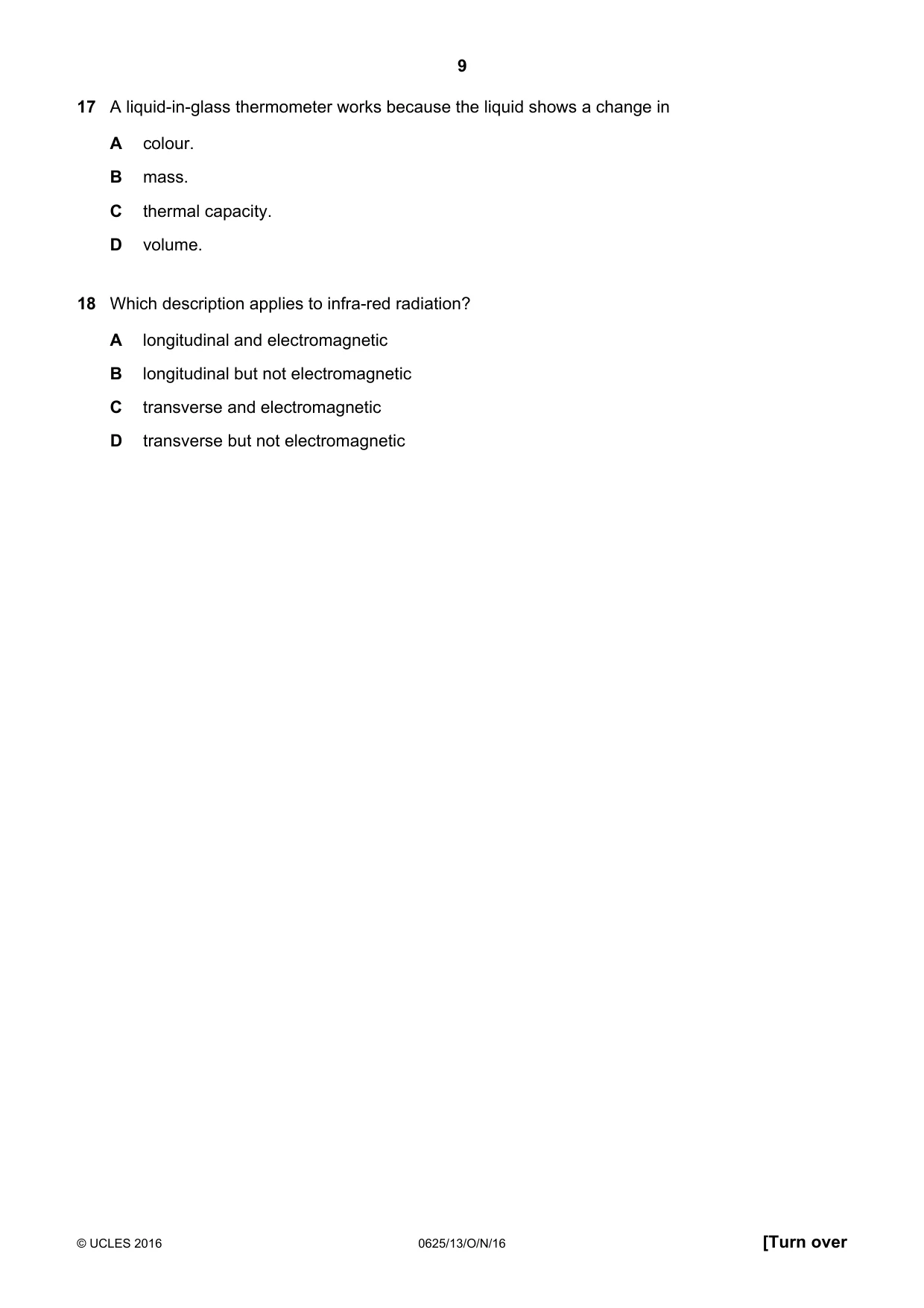
Q17 · A liquid-in-glass thermometer works because the liquid shows a change in A colour
17 A liquid-in-glass thermometer works because the liquid shows a change in A colour. B mass. C thermal capacity. D volume.
Mark scheme: D
Q18 · Which description applies to infra-red radiation?
18 Which description applies to infra-red radiation? A longitudinal and electromagnetic B longitudinal but not electromagnetic C transverse and electromagnetic D transverse but not electromagnetic
Mark scheme: C
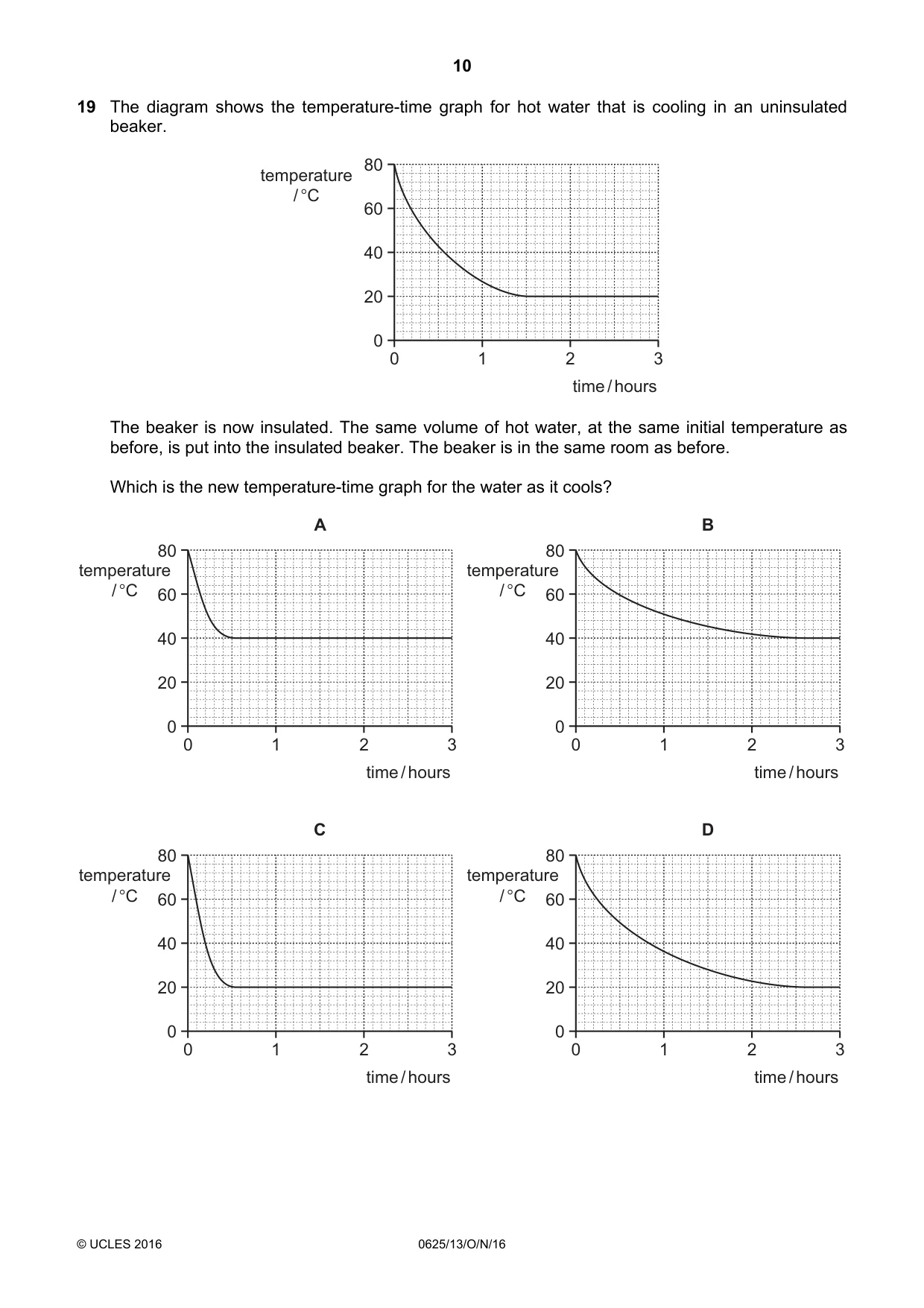
Q19 · The diagram shows the temperature-time graph for hot water that is cooling in an…
19 The diagram shows the temperature-time graph for hot water that is cooling in an uninsulated beaker. 80 temperature / °C 60 40 20 0 0 1 2 3 time / hours The beaker is now insulated. The same volume of hot water, at the same initial temperature as before, is put into the insulated beaker. The beaker is in the same room as before. Which is the new temperature-time graph for the water as it cools? A B 80 80 temperature temperature / °C 60 / °C 60 40 40 20 20 0 0 0 1 2 3 0 1 2 3 time / hours time / hours C D 80 80 temperature temperature / °C 60 / °C 60 40 40 20 20 0 0 0 1 2 3 0 1 2 3 time / hours time / hours
Mark scheme: D
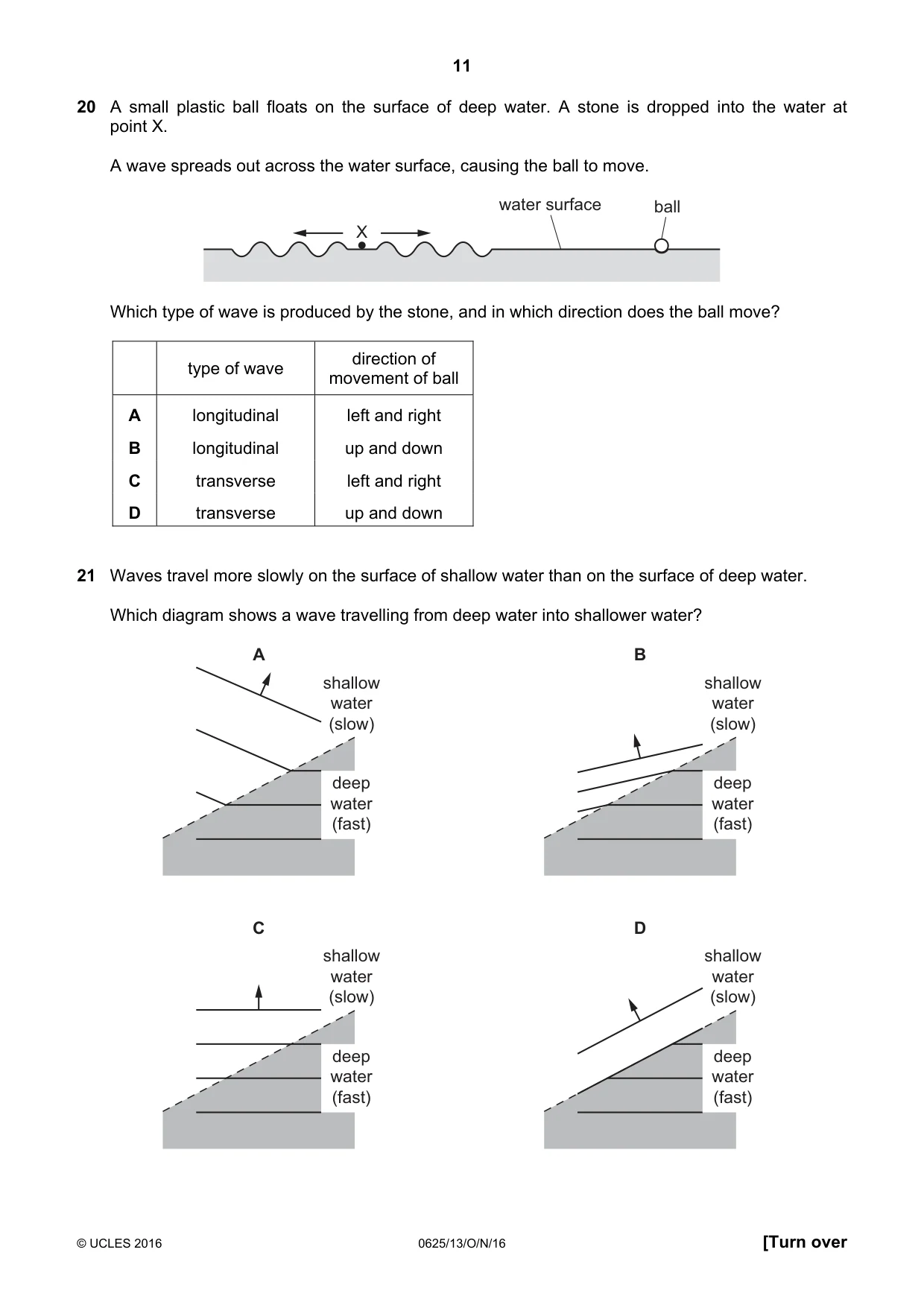
Q20 · A small plastic ball floats on the surface of deep water
20 A small plastic ball floats on the surface of deep water. A stone is dropped into the water at point X. A wave spreads out across the water surface, causing the ball to move. water surface ball X Which type of wave is produced by the stone, and in which direction does the ball move? direction of type of wave movement of ball A longitudinal left and right B longitudinal up and down C transverse left and right D transverse up and down
Mark scheme: D
Q21 · Waves travel more slowly on the surface of shallow water than on the surface of deep water
21 Waves travel more slowly on the surface of shallow water than on the surface of deep water. Which diagram shows a wave travelling from deep water into shallower water? A B shallow shallow water water (slow) (slow) deep deep water water (fast) (fast) C D shallow shallow water water (slow) (slow) deep deep water water (fast) (fast)
Mark scheme: B
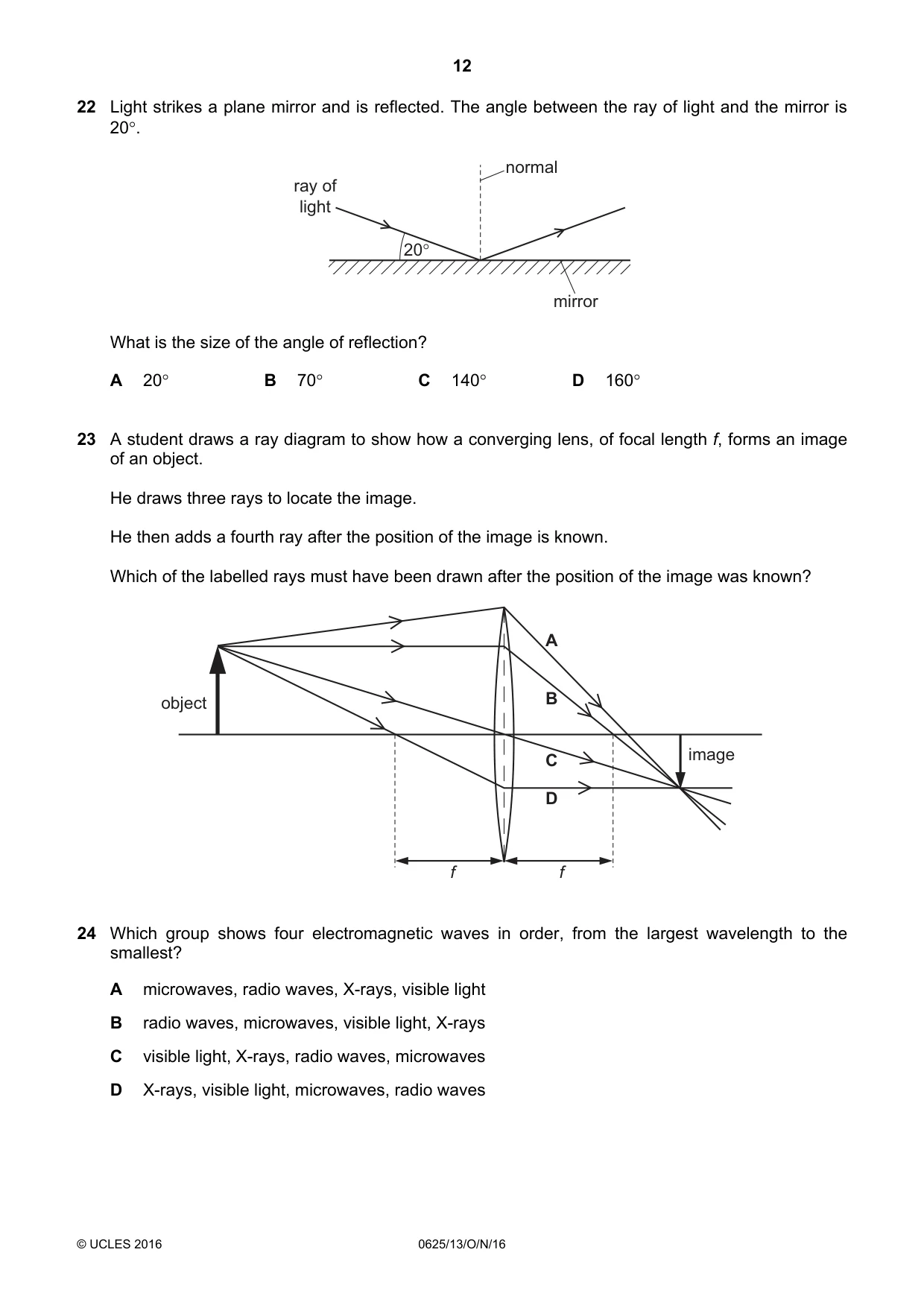
Q22 · Light strikes a plane mirror and is reflected
22 Light strikes a plane mirror and is reflected. The angle between the ray of light and the mirror is 20°. normal ray of light 20° mirror What is the size of the angle of reflection? A 20° B 70° C 140° D 160°
Mark scheme: B
Q23 · A student draws a ray diagram to show how a converging lens, of focal length f, forms an…
23 A student draws a ray diagram to show how a converging lens, of focal length f, forms an image of an object. He draws three rays to locate the image. He then adds a fourth ray after the position of the image is known. Which of the labelled rays must have been drawn after the position of the image was known? A object B C image D f f
Mark scheme: A
Q24 · Which group shows four electromagnetic waves in order, from the largest wavelength to the…
24 Which group shows four electromagnetic waves in order, from the largest wavelength to the smallest? A microwaves, radio waves, X-rays, visible light B radio waves, microwaves, visible light, X-rays C visible light, X-rays, radio waves, microwaves D X-rays, visible light, microwaves, radio waves
Mark scheme: B
Q25 · A girl notices that, when she shouts into a cave, she hears an echo
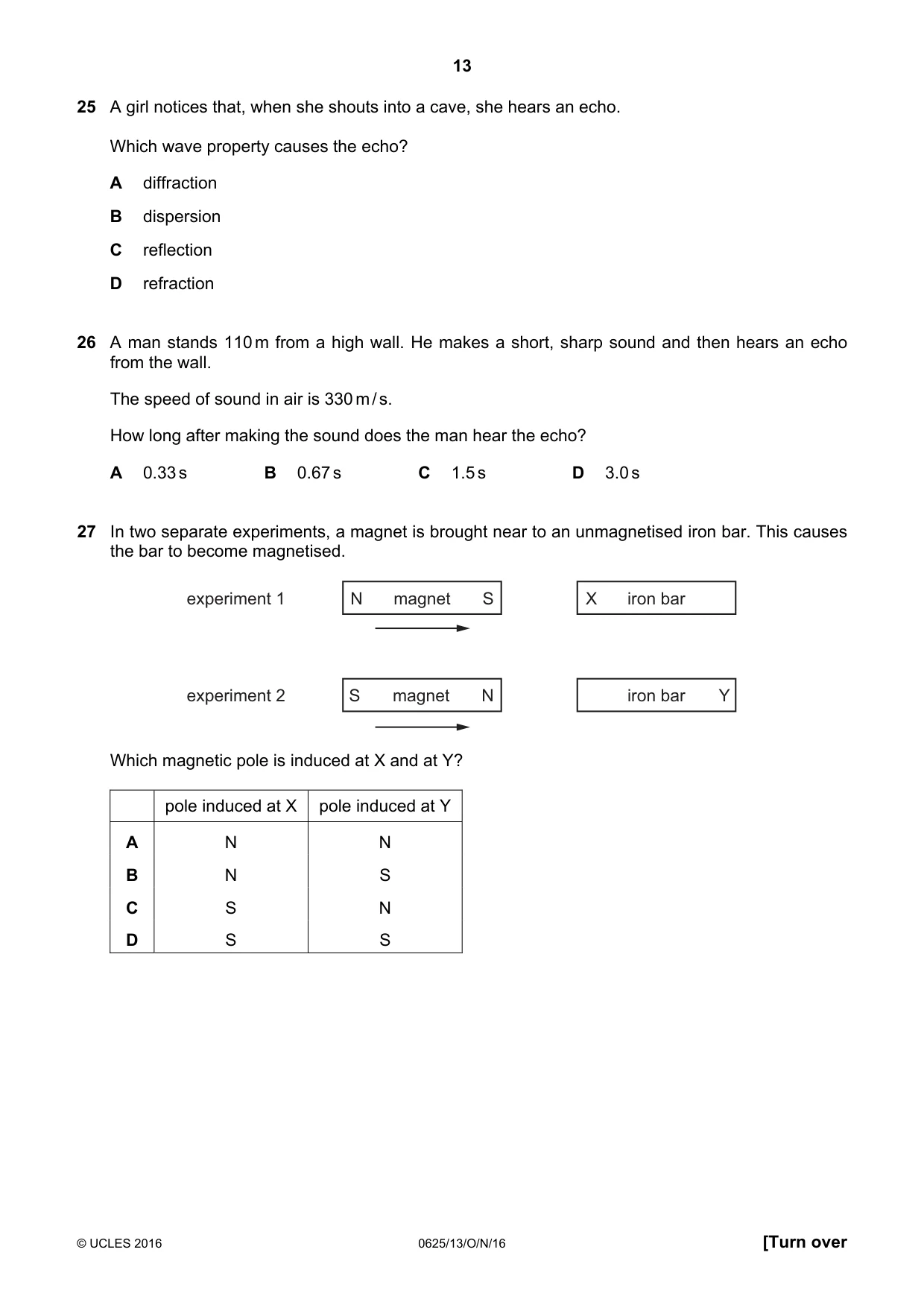
25 A girl notices that, when she shouts into a cave, she hears an echo. Which wave property causes the echo? A diffraction B dispersion C reflection D refraction
Mark scheme: C
Q26 · A man stands 110 m from a high wall
26 A man stands 110 m from a high wall. He makes a short, sharp sound and then hears an echo from the wall. The speed of sound in air is 330 m / s. How long after making the sound does the man hear the echo? A 0.33 s B 0.67 s C 1.5 s D 3.0 s
Mark scheme: B
Q27 · In two separate experiments, a magnet is brought near to an unmagnetised iron bar
27 In two separate experiments, a magnet is brought near to an unmagnetised iron bar. This causes the bar to become magnetised. experiment 1 N magnet S X iron bar experiment 2 S magnet N iron bar Y Which magnetic pole is induced at X and at Y? pole induced at X pole induced at Y A N N B N S C S N D S S
Mark scheme: A
Q28 · A student holds a rod in his hand
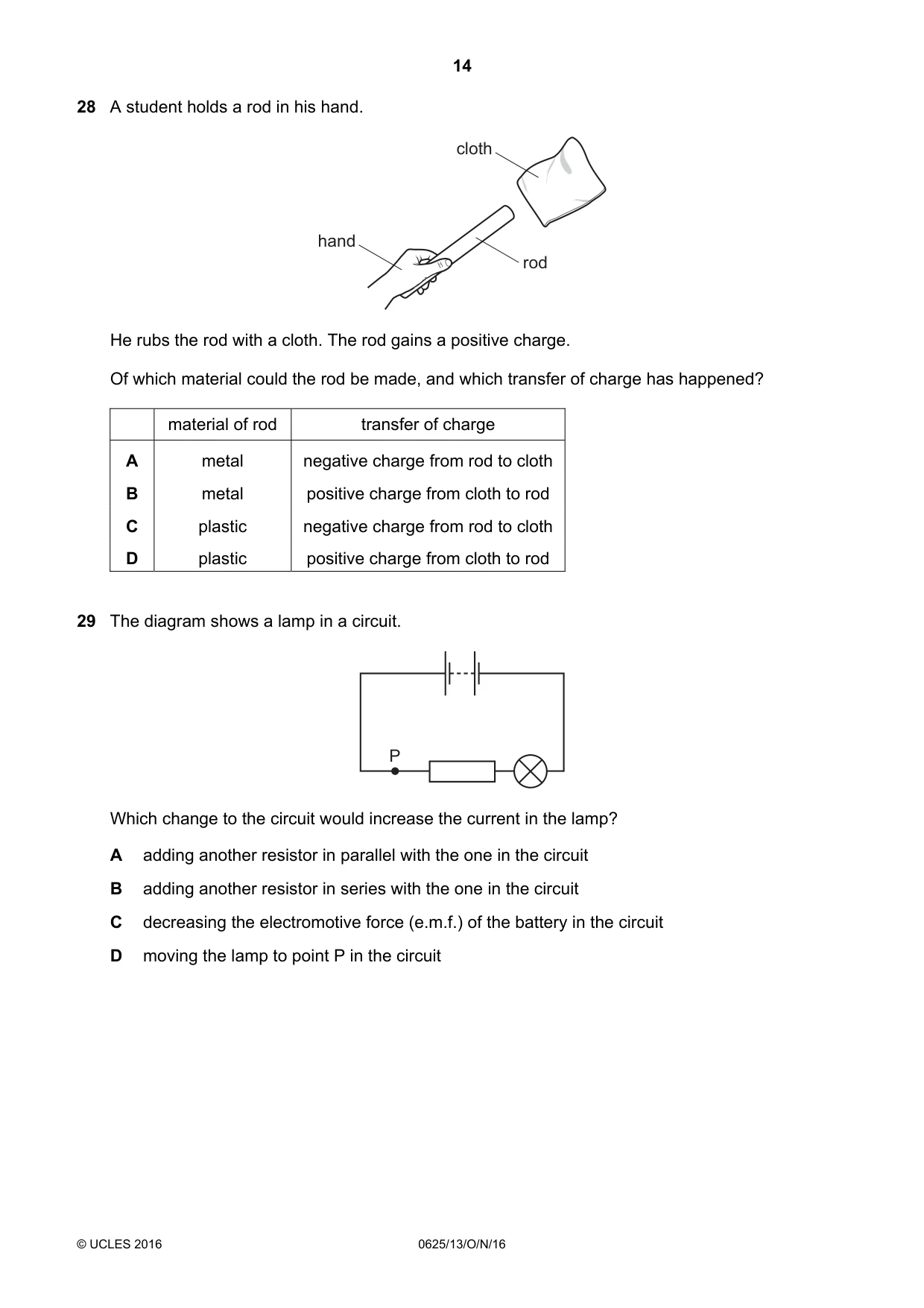
28 A student holds a rod in his hand. cloth hand rod He rubs the rod with a cloth. The rod gains a positive charge. Of which material could the rod be made, and which transfer of charge has happened? material of rod transfer of charge A metal negative charge from rod to cloth B metal positive charge from cloth to rod C plastic negative charge from rod to cloth D plastic positive charge from cloth to rod
Mark scheme: C
Q29 · The diagram shows a lamp in a circuit
29 The diagram shows a lamp in a circuit. P Which change to the circuit would increase the current in the lamp? A adding another resistor in parallel with the one in the circuit B adding another resistor in series with the one in the circuit C decreasing the electromotive force (e.m.f.) of the battery in the circuit D moving the lamp to point P in the circuit
Mark scheme: A
Q30 · An ammeter and an 18 Ω resistor are connected in series with a battery
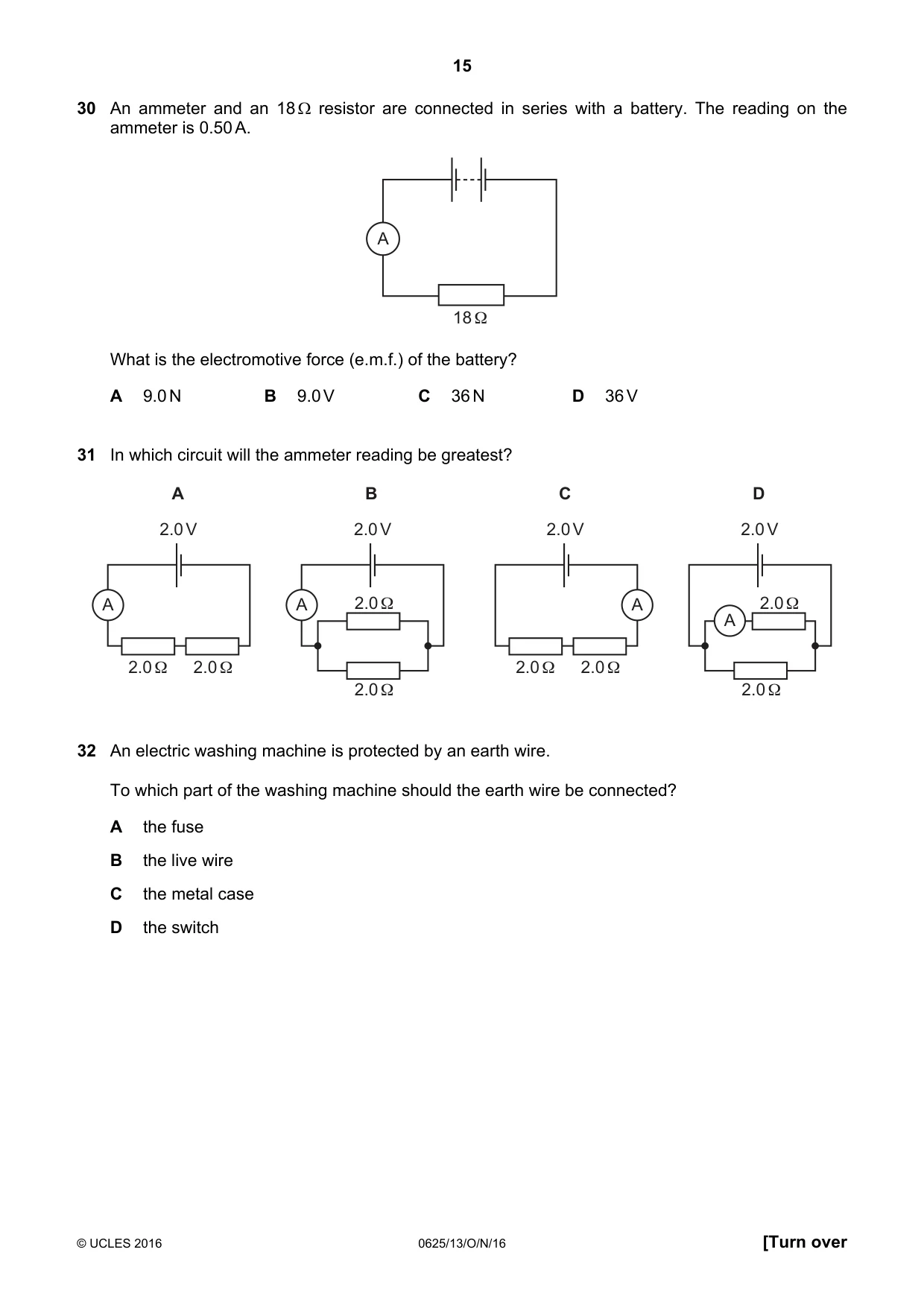
30 An ammeter and an 18 Ω resistor are connected in series with a battery. The reading on the ammeter is 0.50 A. A 18 Ω What is the electromotive force (e.m.f.) of the battery? A 9.0 N B 9.0 V C 36 N D 36 V
Mark scheme: B
Q31 · In which circuit will the ammeter reading be greatest?
31 In which circuit will the ammeter reading be greatest? A B C D 2.0 V 2.0 V 2.0 V 2.0 V A A 2.0 Ω A 2.0 Ω A 2.0 Ω 2.0 Ω 2.0 Ω 2.0 Ω 2.0 Ω 2.0 Ω
Mark scheme: B
Q32 · An electric washing machine is protected by an earth wire
32 An electric washing machine is protected by an earth wire. To which part of the washing machine should the earth wire be connected? A the fuse B the live wire C the metal case D the switch
Mark scheme: C
Q33 · The diagram shows a potential divider
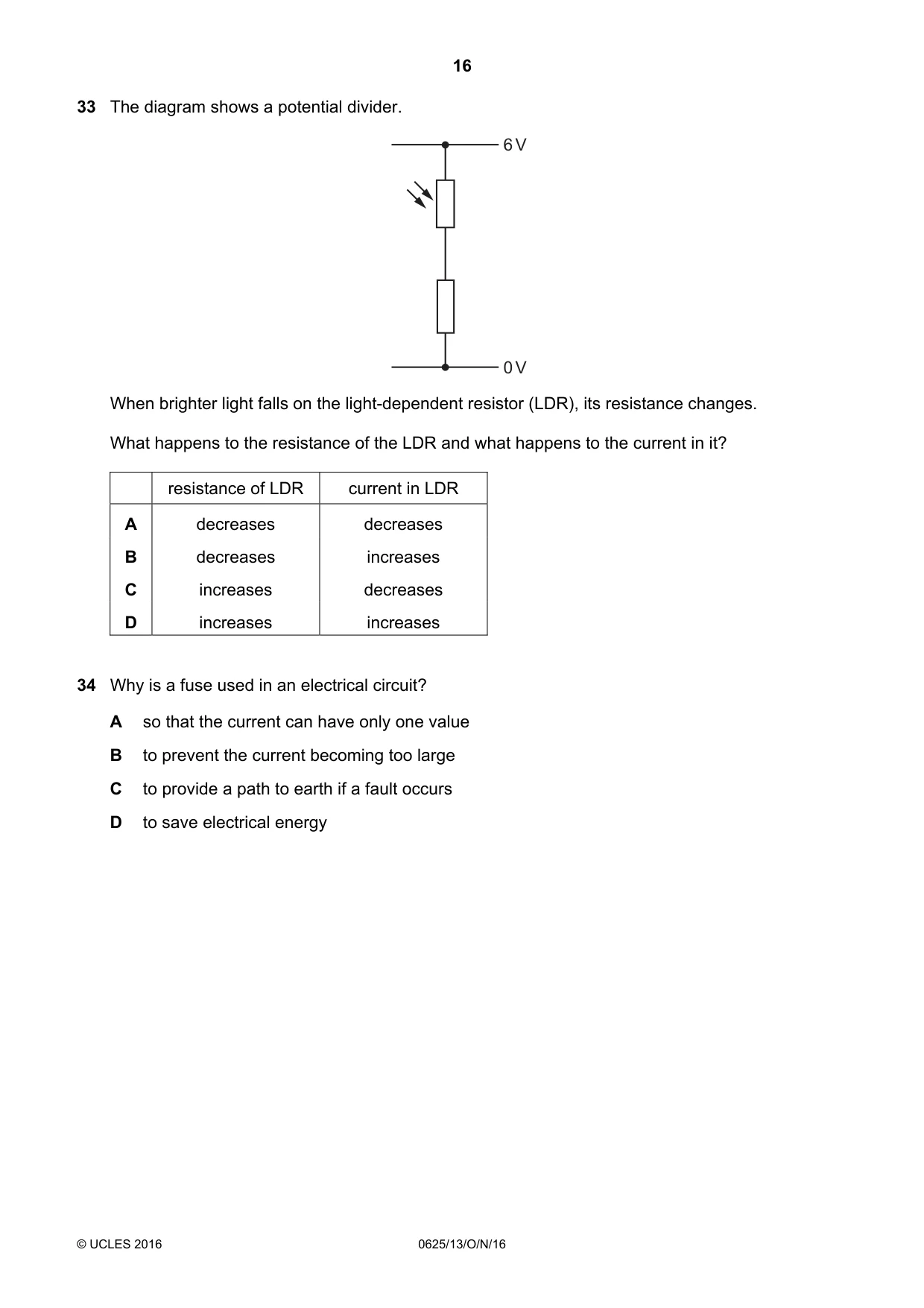
33 The diagram shows a potential divider. 6 V 0 V When brighter light falls on the light-dependent resistor (LDR), its resistance changes. What happens to the resistance of the LDR and what happens to the current in it? resistance of LDR current in LDR A decreases decreases B decreases increases C increases decreases D increases increases
Mark scheme: B
Q34 · Why is a fuse used in an electrical circuit?
34 Why is a fuse used in an electrical circuit? A so that the current can have only one value B to prevent the current becoming too large C to provide a path to earth if a fault occurs D to save electrical energy
Mark scheme: B
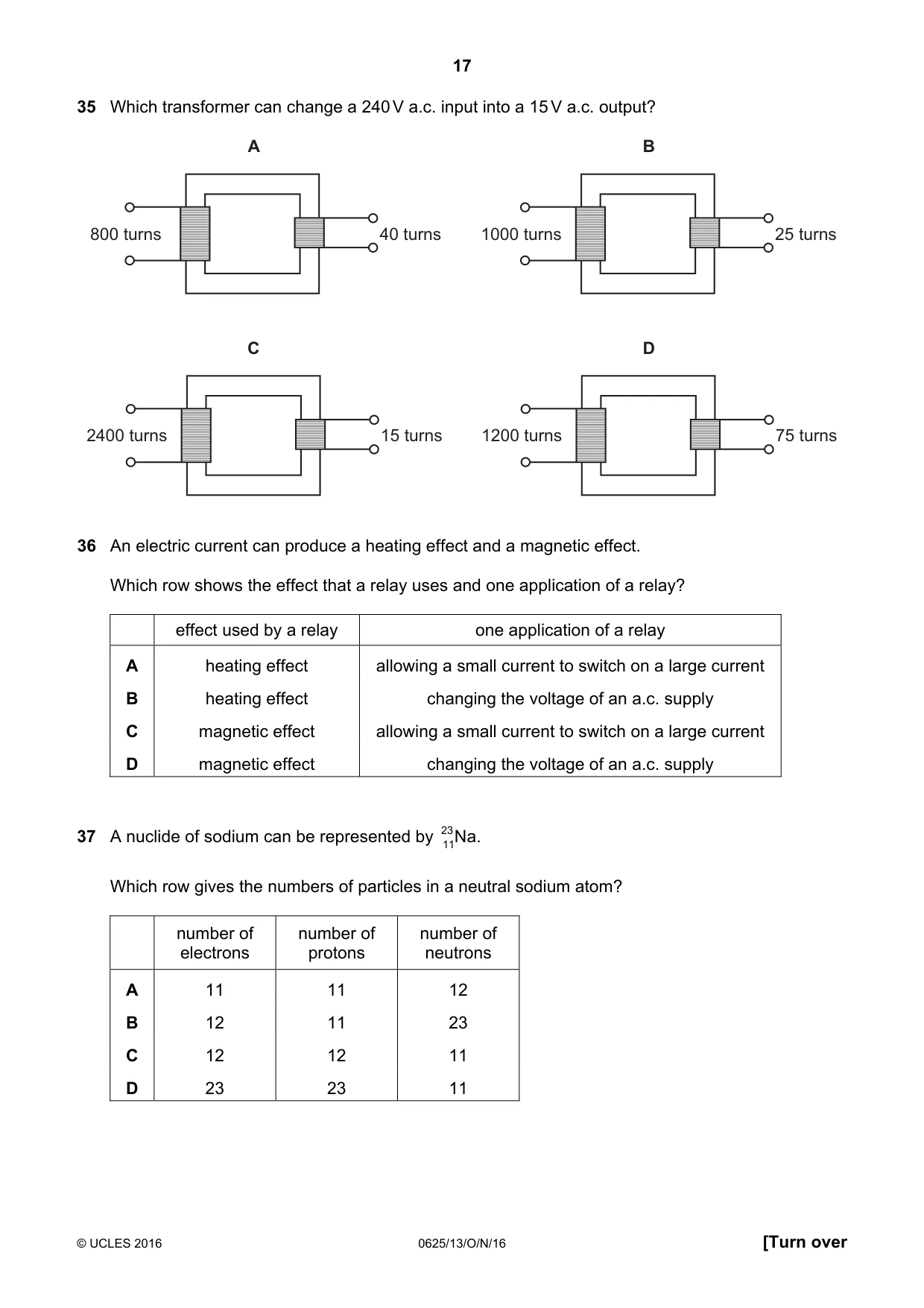
Q35 · Which transformer can change a 240 V a.c
35 Which transformer can change a 240 V a.c. input into a 15 V a.c. output? A B 800 turns 40 turns 1000 turns 25 turns C D 2400 turns 15 turns 1200 turns 75 turns
Mark scheme: D
Q36 · An electric current can produce a heating effect and a magnetic effect
36 An electric current can produce a heating effect and a magnetic effect. Which row shows the effect that a relay uses and one application of a relay? effect used by a relay one application of a relay A heating effect allowing a small current to switch on a large current B heating effect changing the voltage of an a.c. supply C magnetic effect allowing a small current to switch on a large current D magnetic effect changing the voltage of an a.c. supply
Mark scheme: C
Q37 · A nuclide of sodium can be represented by 23 Na
37 A nuclide of sodium can be represented by 23 Na. 11 Which row gives the numbers of particles in a neutral sodium atom? number of number of number of electrons protons neutrons A 11 11 12 B 12 11 23 C 12 12 11 D 23 23 11
Mark scheme: A
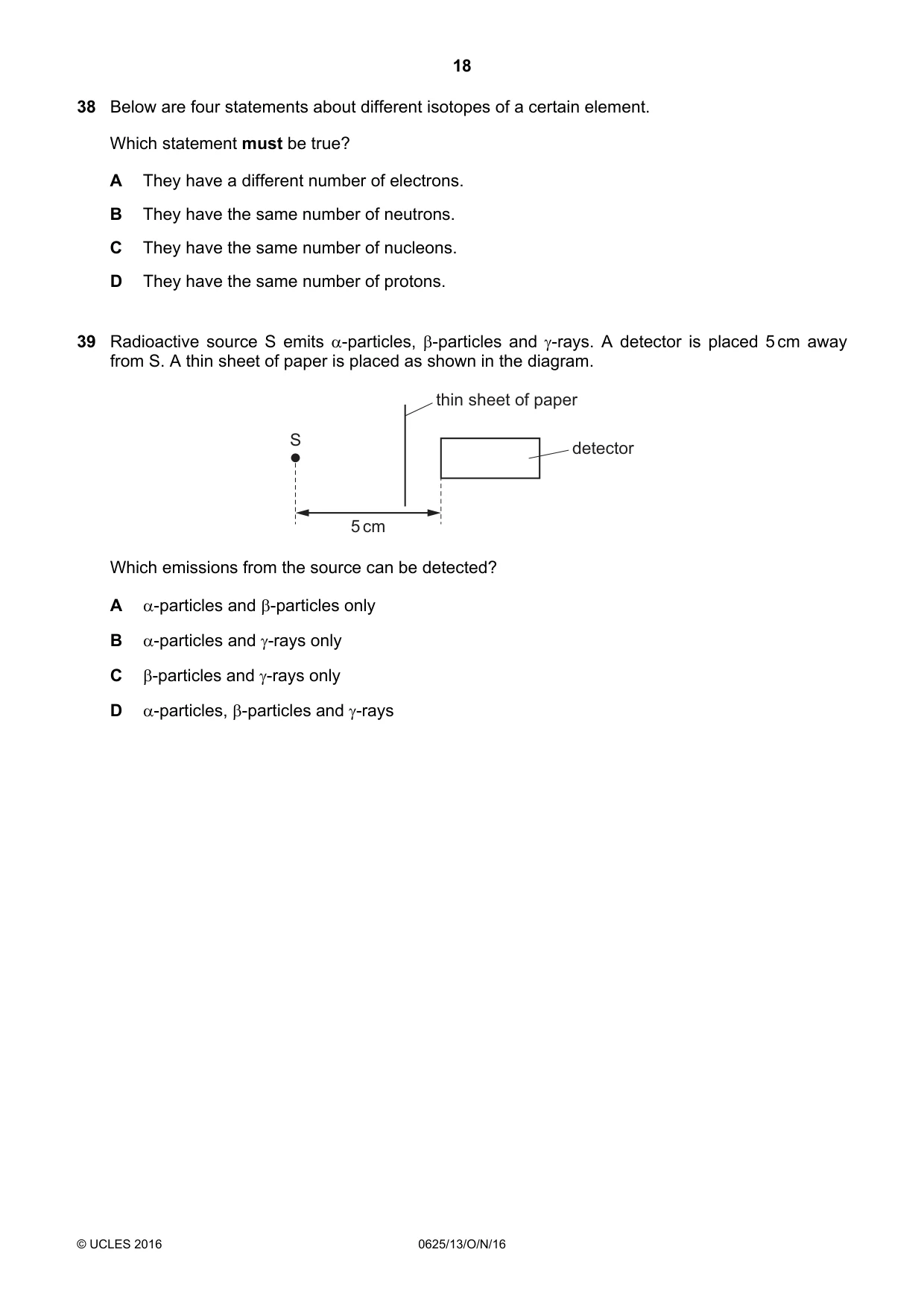
Q38 · Below are four statements about different isotopes of a certain element
38 Below are four statements about different isotopes of a certain element. Which statement must be true? A They have a different number of electrons. B They have the same number of neutrons. C They have the same number of nucleons. D They have the same number of protons.
Mark scheme: D
Q39 · Radioactive source S emits α-particles, β-particles and γ-rays
39 Radioactive source S emits α-particles, β-particles and γ-rays. A detector is placed 5 cm away from S. A thin sheet of paper is placed as shown in the diagram. thin sheet of paper S detector 5 cm Which emissions from the source can be detected? A α-particles and β-particles only B α-particles and γ-rays only C β-particles and γ-rays only D α-particles, β-particles and γ-rays
Mark scheme: C
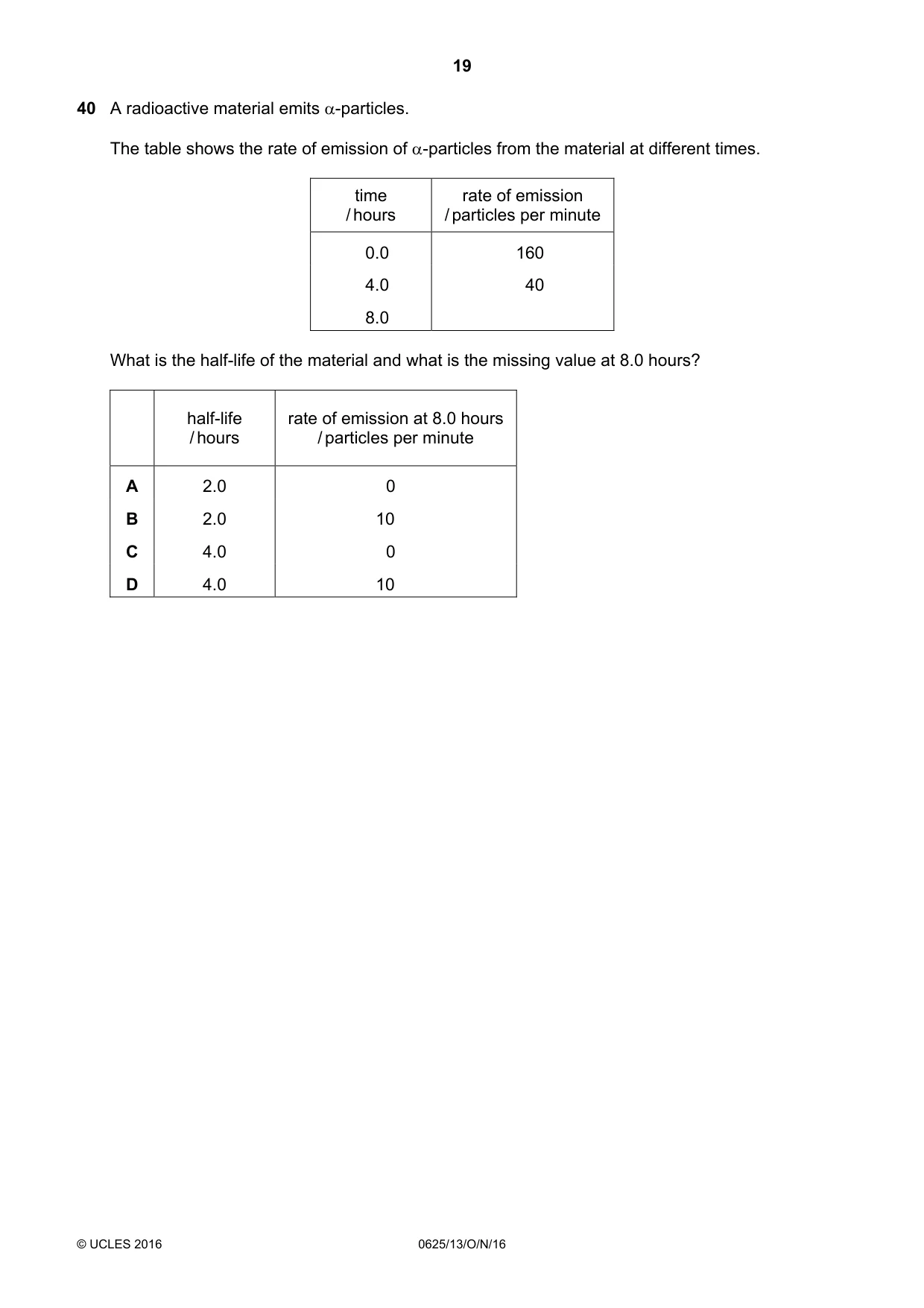
Q40 · A radioactive material emits α-particles
40 A radioactive material emits α-particles. The table shows the rate of emission of α-particles from the material at different times. time rate of emission / hours / particles per minute 0.0 160 4.0 40 8.0 What is the half-life of the material and what is the missing value at 8.0 hours? half-life rate of emission at 8.0 hours / hours / particles per minute A 2.0 0 B 2.0 10 C 4.0 0 D 4.0 10
Mark scheme: B
What was in this paper
The subtopics covered by these 40 questions, and how many questions each got. Open one in a new tab to see every Cambridge question on it.
3Energy, work and power3Forces3Electrical quantities2Electrical safety2Electromagnetic effects2Electromagnetic spectrum2General properties of waves2Kinetic particle model of matter2Light2Motion2Pressure2Radioactivity2Sound2The nuclear model of the atom2Thermal properties and temperature2Density1Mass and weight1Physical quantities and measurement techniques1Simple phenomena of magnetism1Transfer of thermal energy1What you needed in this session
Cambridge’s own grade thresholds for 2016 Oct/Nov, Paper 1 · Variant 3. A higher threshold means an easier paper — the bar moves with how the cohort did.