Cambridge IGCSE Physics 0625 — 2017 May/June Paper 1 · Variant 3
0625/13/M/J/17 · 40 questions · 40 marks · ≈45 min
The question paper and its mark scheme, free to read here and free to download. This is Cambridge’s own paper, exactly as it was sat.
Question paper20 pages
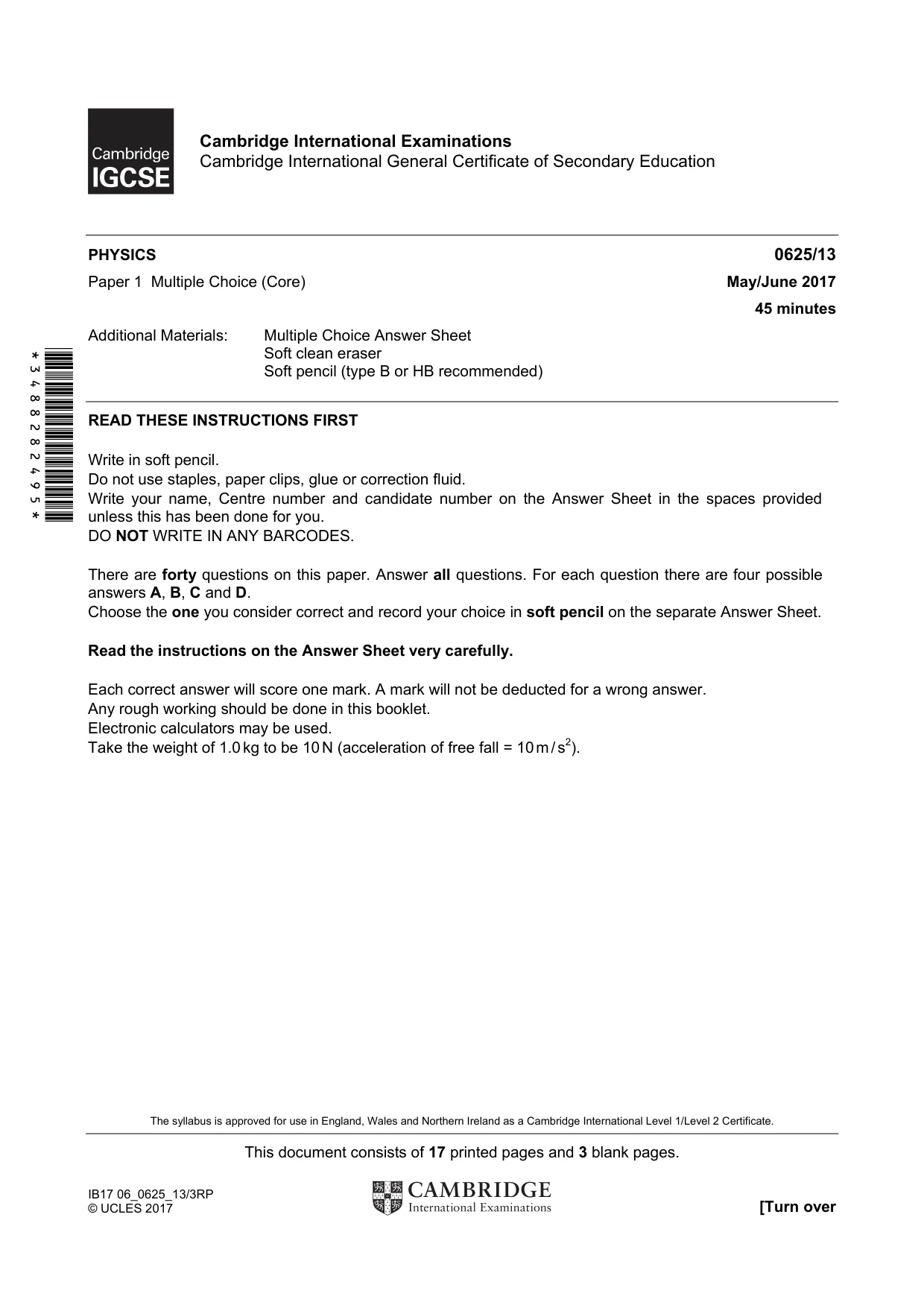


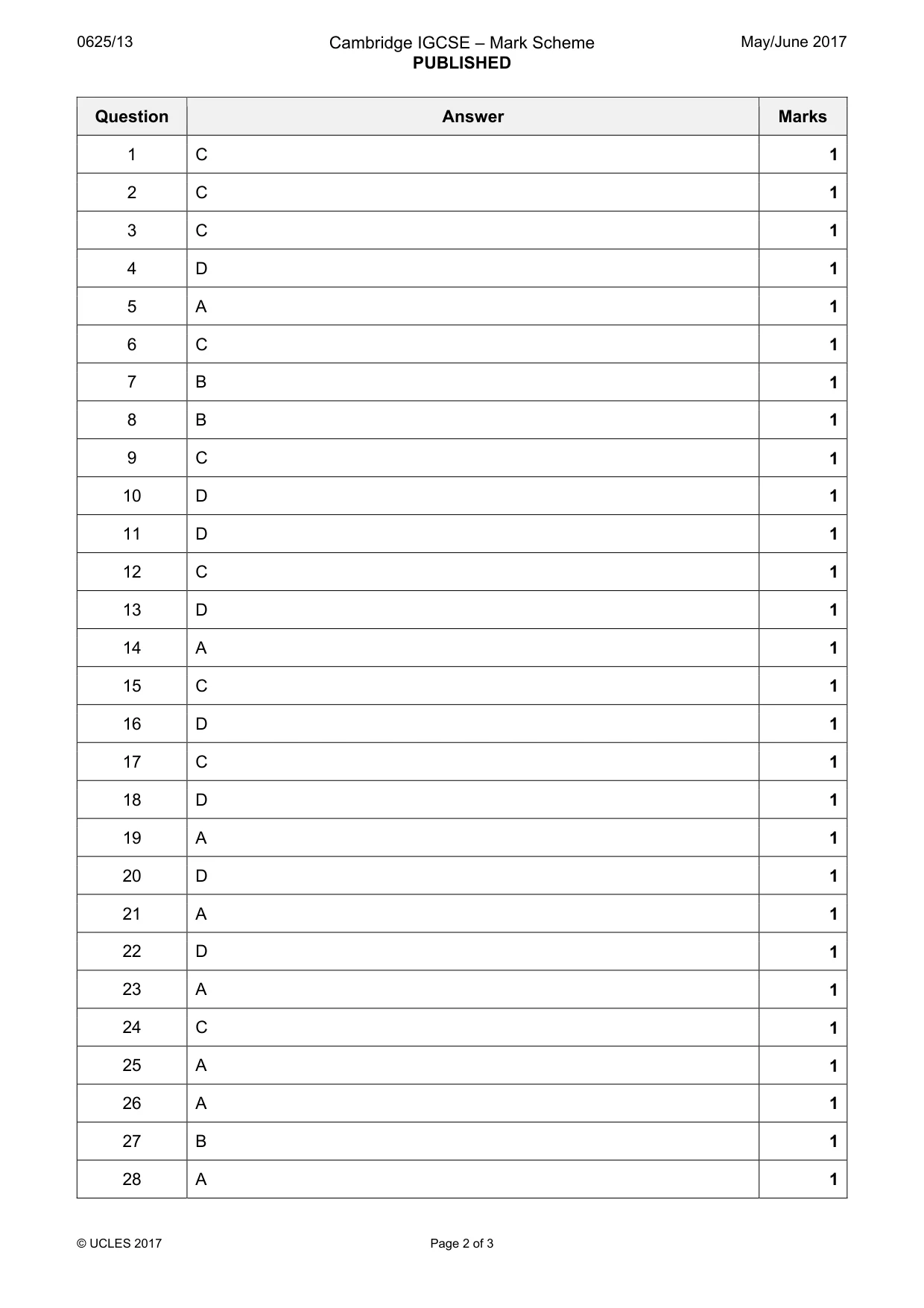
Mark scheme3 pages
Answers below. Sit the paper first if you are practising.
Questions as text
Q1 · A candle burns evenly
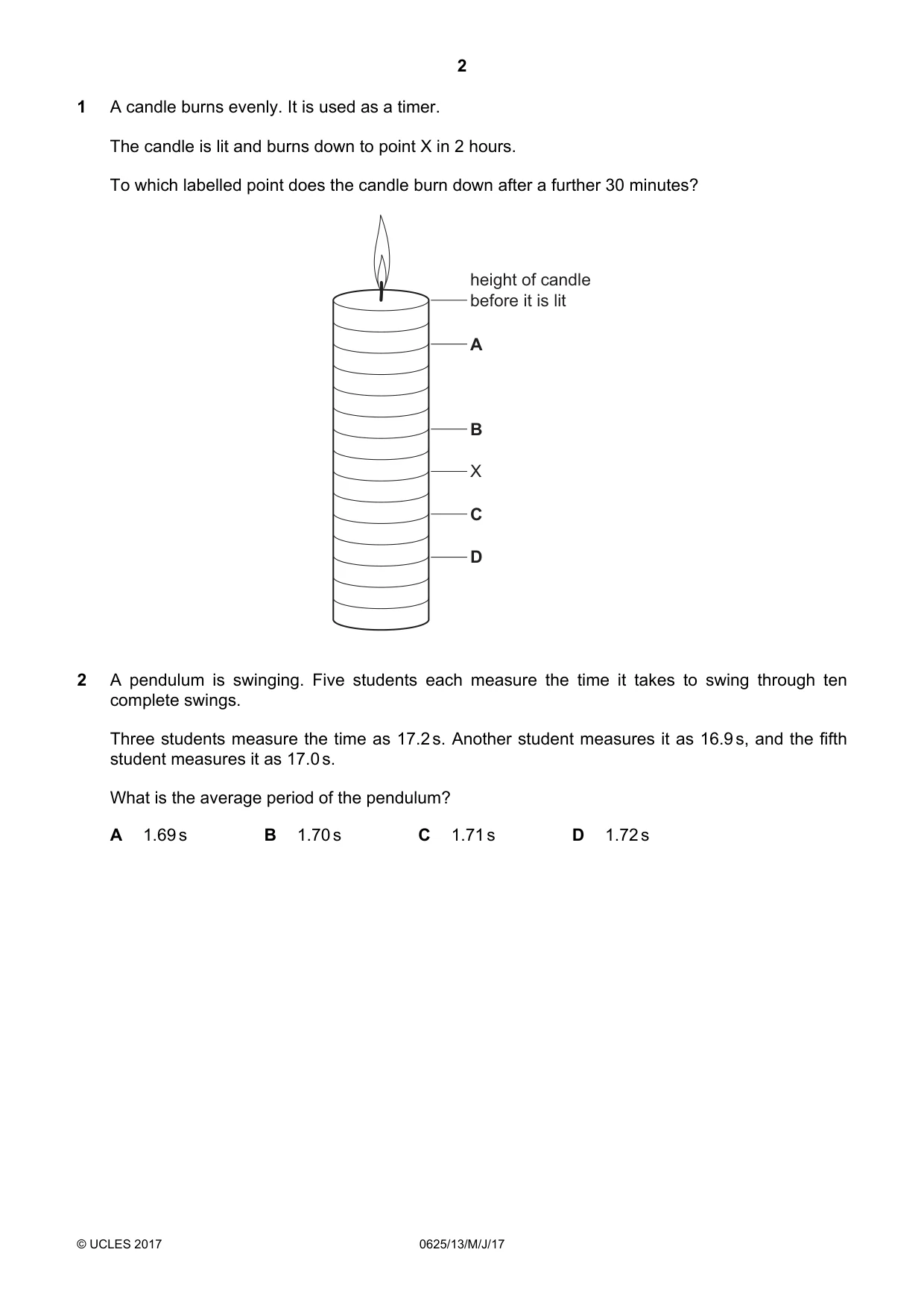
1 A candle burns evenly. It is used as a timer. The candle is lit and burns down to point X in 2 hours. To which labelled point does the candle burn down after a further 30 minutes? height of candle before it is lit A B X C D
Mark scheme: C
More questions on Physical quantities and measurement techniques
Q2 · A pendulum is swinging
2 A pendulum is swinging. Five students each measure the time it takes to swing through ten complete swings. Three students measure the time as 17.2 s. Another student measures it as 16.9 s, and the fifth student measures it as 17.0 s. What is the average period of the pendulum? A 1.69 s B 1.70 s C 1.71 s D 1.72 s
Mark scheme: C
More questions on Physical quantities and measurement techniques
Q3 · The speed-time graph represents a motorcycle journey
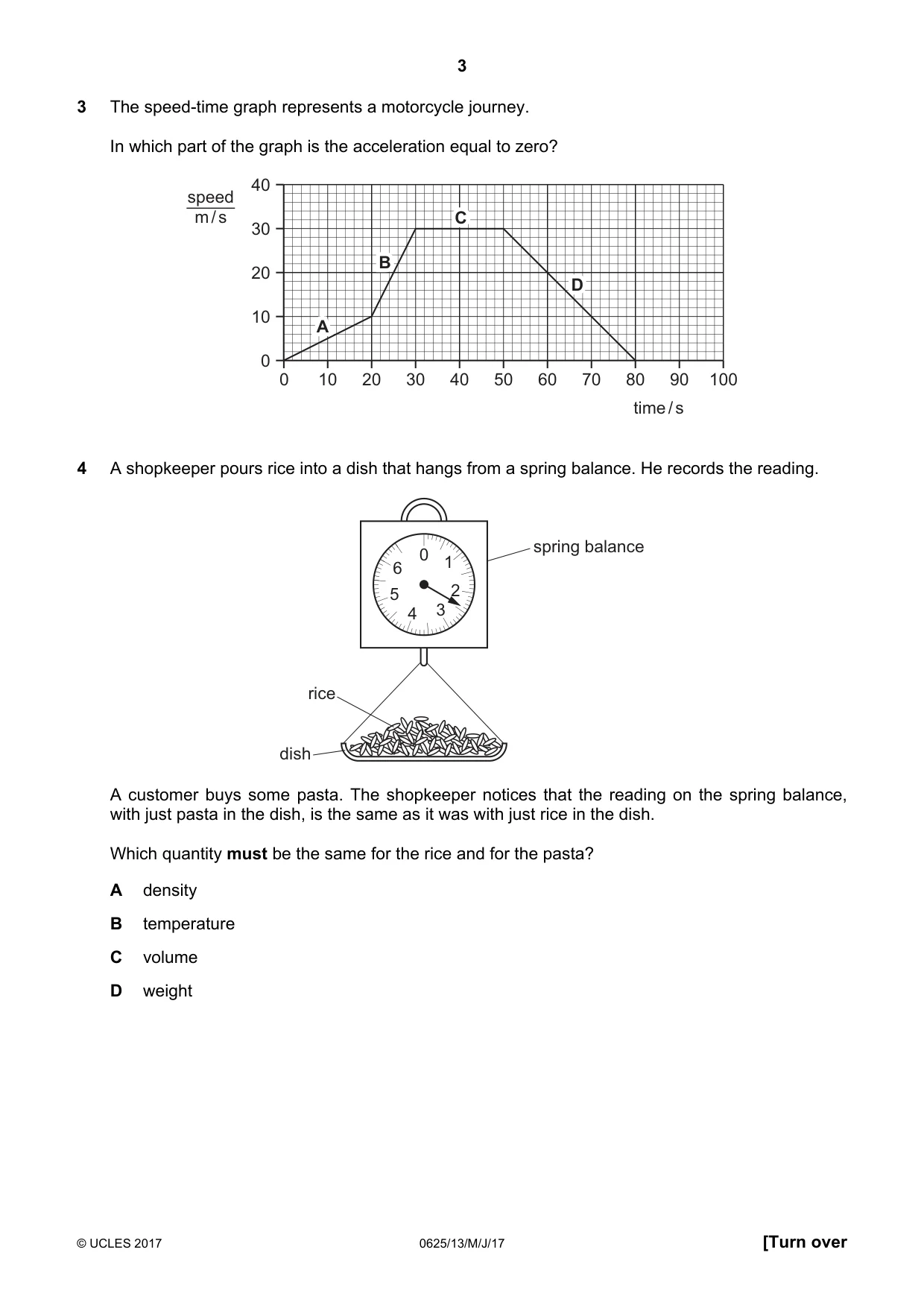
3 The speed-time graph represents a motorcycle journey. In which part of the graph is the acceleration equal to zero? 40 speed m / s C 30 B 20 D 10 A 0 0 10 20 30 40 50 60 70 80 90 100 time / s
Mark scheme: C
Q4 · A shopkeeper pours rice into a dish that hangs from a spring balance
4 A shopkeeper pours rice into a dish that hangs from a spring balance. He records the reading. 0 spring balance 6 1 5 2 4 3 rice dish A customer buys some pasta. The shopkeeper notices that the reading on the spring balance, with just pasta in the dish, is the same as it was with just rice in the dish. Which quantity must be the same for the rice and for the pasta? A density B temperature C volume D weight
Mark scheme: D
Q5 · Four identical steel blocks weigh 120 N in total
5 Four identical steel blocks weigh 120 N in total. The gravitational field strength g is 10 N / kg. What is the mass of one steel block? A 3.0 kg B 12 kg C 30 kg D 48 kg
Mark scheme: A
Q6 · A steel ball bearing has a mass of 24 g and a density of 8.0 g / cm3
6 A steel ball bearing has a mass of 24 g and a density of 8.0 g / cm3. It is lowered into a measuring cylinder containing 12 cm3 of water. What is the new water level in the cylinder? A 3.0 cm3 B 4.0 cm3 C 15 cm3 D 16 cm3
Mark scheme: C
Q7 · The diagram shows an object being acted upon by two forces
7 The diagram shows an object being acted upon by two forces. 6.0 N 3.0 N What is the size of the resultant force on the object? A 2.0 N B 3.0 N C 9.0 N D 18 N
Mark scheme: B
Q8 · A student is asked to investigate the extension of a spring using the apparatus shown in…
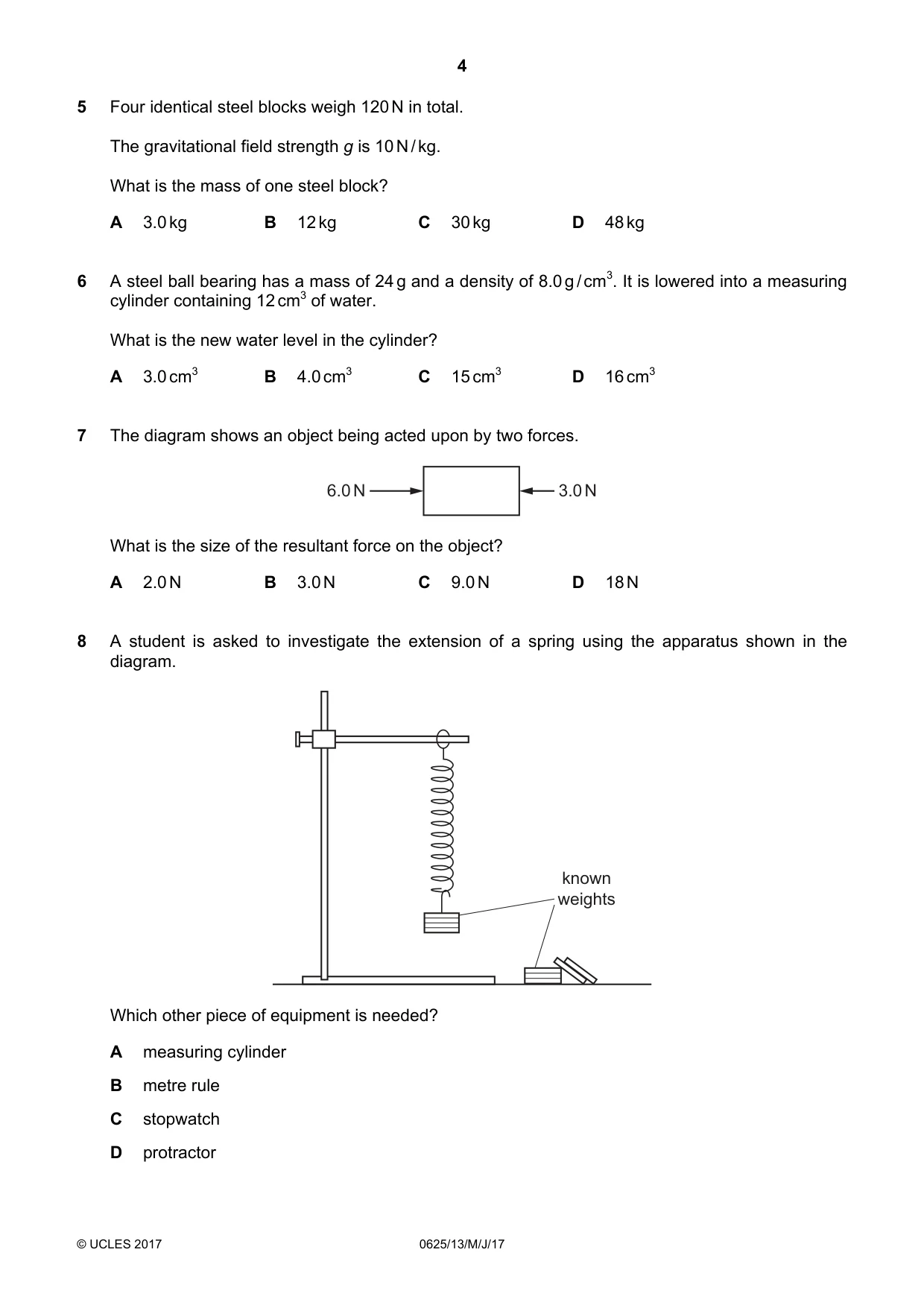
8 A student is asked to investigate the extension of a spring using the apparatus shown in the diagram. known weights Which other piece of equipment is needed? A measuring cylinder B metre rule C stopwatch D protractor
Mark scheme: B
Q9 · In which power station are atoms of one element changed to atoms of other lighter…
9 In which power station are atoms of one element changed to atoms of other lighter elements? A a coal-fired power station B a hydroelectric power station C a nuclear power station D a solar power station
Mark scheme: C
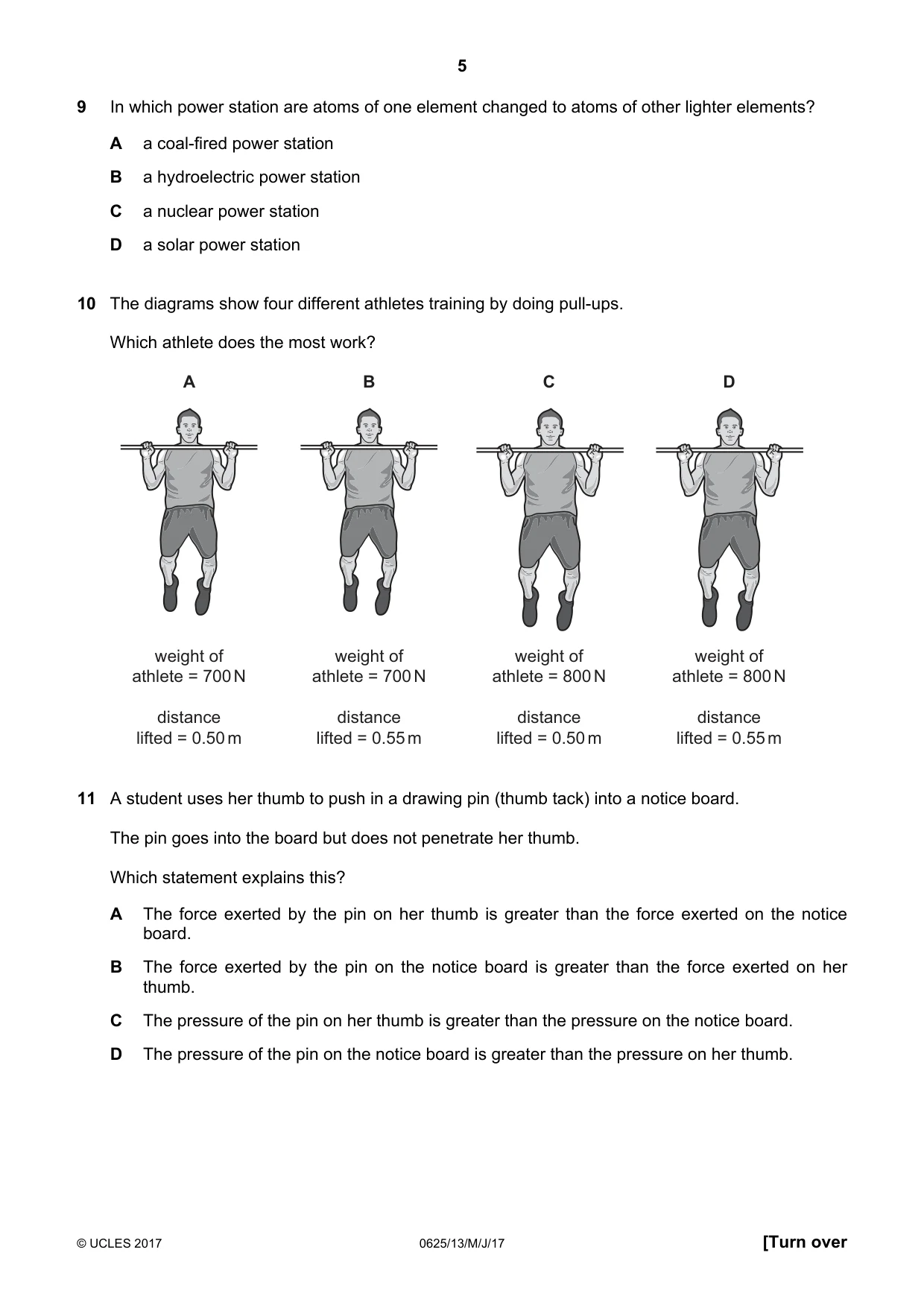
Q10 · The diagrams show four different athletes training by doing pull-ups
10 The diagrams show four different athletes training by doing pull-ups. Which athlete does the most work? A B C D weight of weight of weight of weight of athlete = 700 N athlete = 700 N athlete = 800 N athlete = 800 N distance distance distance distance lifted = 0.50 m lifted = 0.55 m lifted = 0.50 m lifted = 0.55 m
Mark scheme: D
Q11 · A student uses her thumb to push in a drawing pin (thumb tack) into a notice board
11 A student uses her thumb to push in a drawing pin (thumb tack) into a notice board. The pin goes into the board but does not penetrate her thumb. Which statement explains this? A The force exerted by the pin on her thumb is greater than the force exerted on the notice board. B The force exerted by the pin on the notice board is greater than the force exerted on her thumb. C The pressure of the pin on her thumb is greater than the pressure on the notice board. D The pressure of the pin on the notice board is greater than the pressure on her thumb.
Mark scheme: D
Q12 · A solid cube has sides 0.50 m long and a mass of 120 kg
12 A solid cube has sides 0.50 m long and a mass of 120 kg. It stands on the ground on one face. What pressure does the cube exert on the ground? A 480 kg / m3 B 960 kg / m3 C 4800 N / m2 D 9600 N / m2
Mark scheme: C
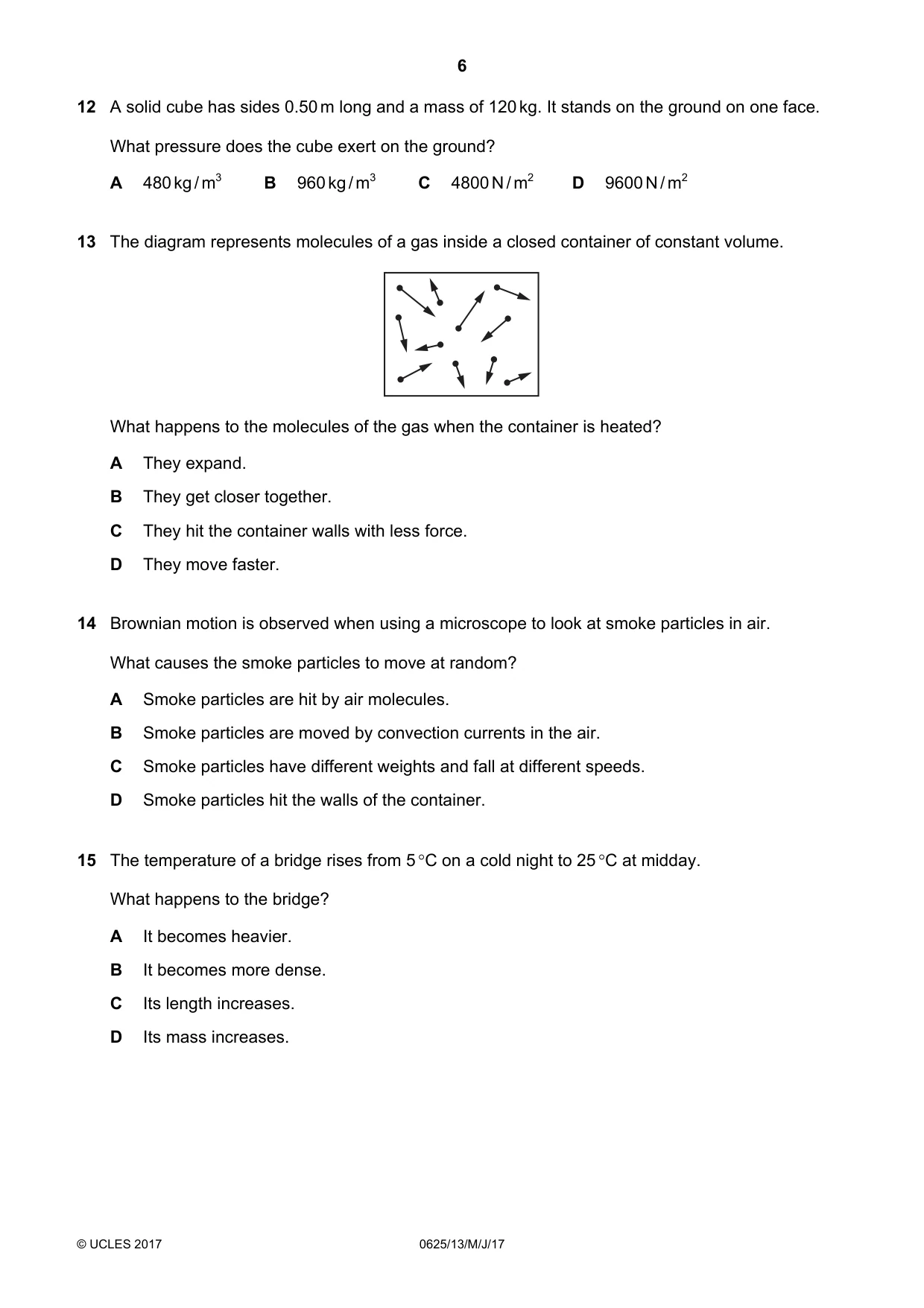
Q13 · The diagram represents molecules of a gas inside a closed container of constant volume
13 The diagram represents molecules of a gas inside a closed container of constant volume. What happens to the molecules of the gas when the container is heated? A They expand. B They get closer together. C They hit the container walls with less force. D They move faster.
Mark scheme: D
Q14 · Brownian motion is observed when using a microscope to look at smoke particles in air
14 Brownian motion is observed when using a microscope to look at smoke particles in air. What causes the smoke particles to move at random? A Smoke particles are hit by air molecules. B Smoke particles are moved by convection currents in the air. C Smoke particles have different weights and fall at different speeds. D Smoke particles hit the walls of the container.
Mark scheme: A
Q15 · The temperature of a bridge rises from 5 °C on a cold night to 25 °C at midday
15 The temperature of a bridge rises from 5 °C on a cold night to 25 °C at midday. What happens to the bridge? A It becomes heavier. B It becomes more dense. C Its length increases. D Its mass increases.
Mark scheme: C
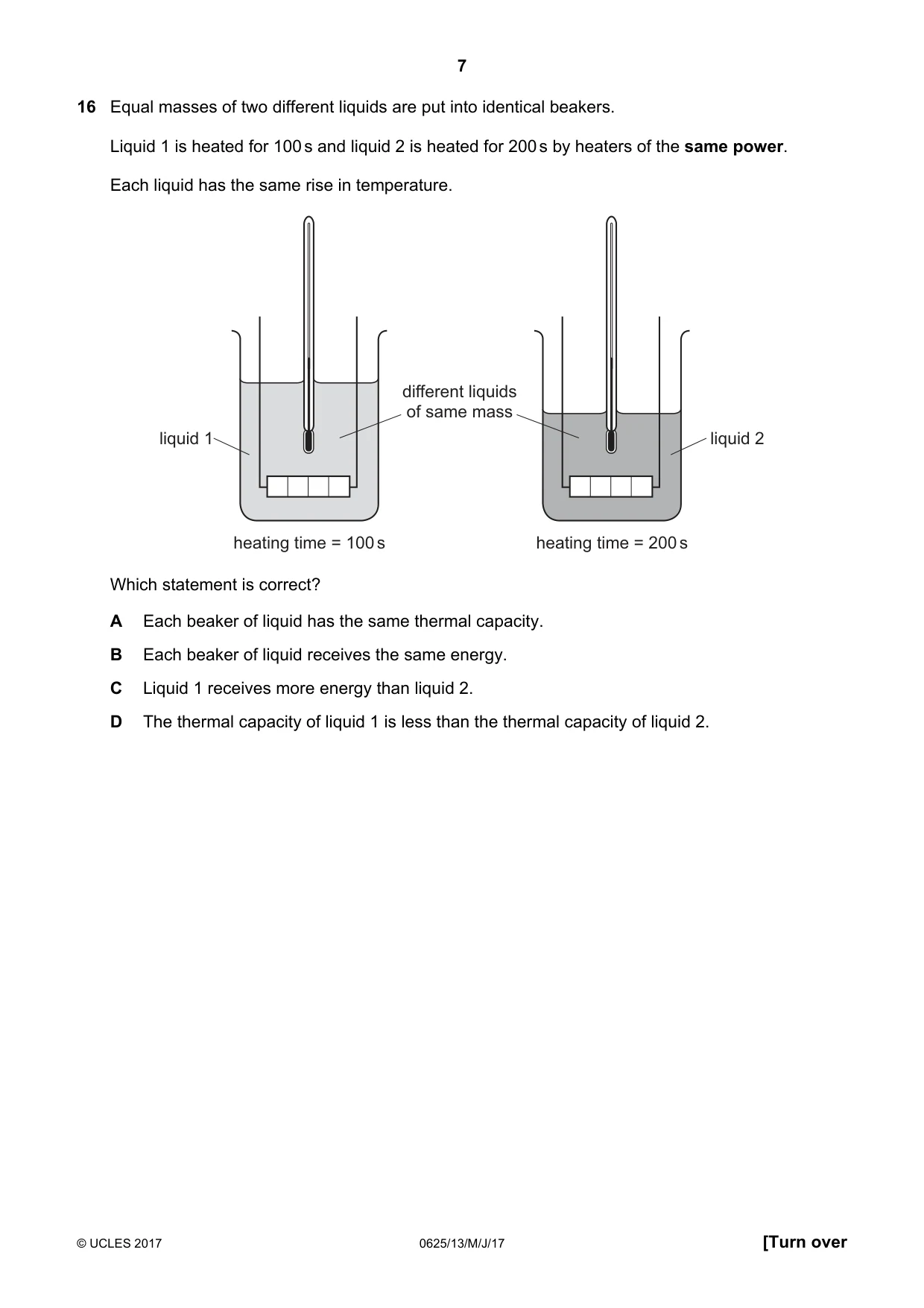
Q16 · Equal masses of two different liquids are put into identical beakers
16 Equal masses of two different liquids are put into identical beakers. Liquid 1 is heated for 100 s and liquid 2 is heated for 200 s by heaters of the same power. Each liquid has the same rise in temperature. different liquids of same mass liquid 1 liquid 2 heating time = 100 s heating time = 200 s Which statement is correct? A Each beaker of liquid has the same thermal capacity. B Each beaker of liquid receives the same energy. C Liquid 1 receives more energy than liquid 2. D The thermal capacity of liquid 1 is less than the thermal capacity of liquid 2.
Mark scheme: D
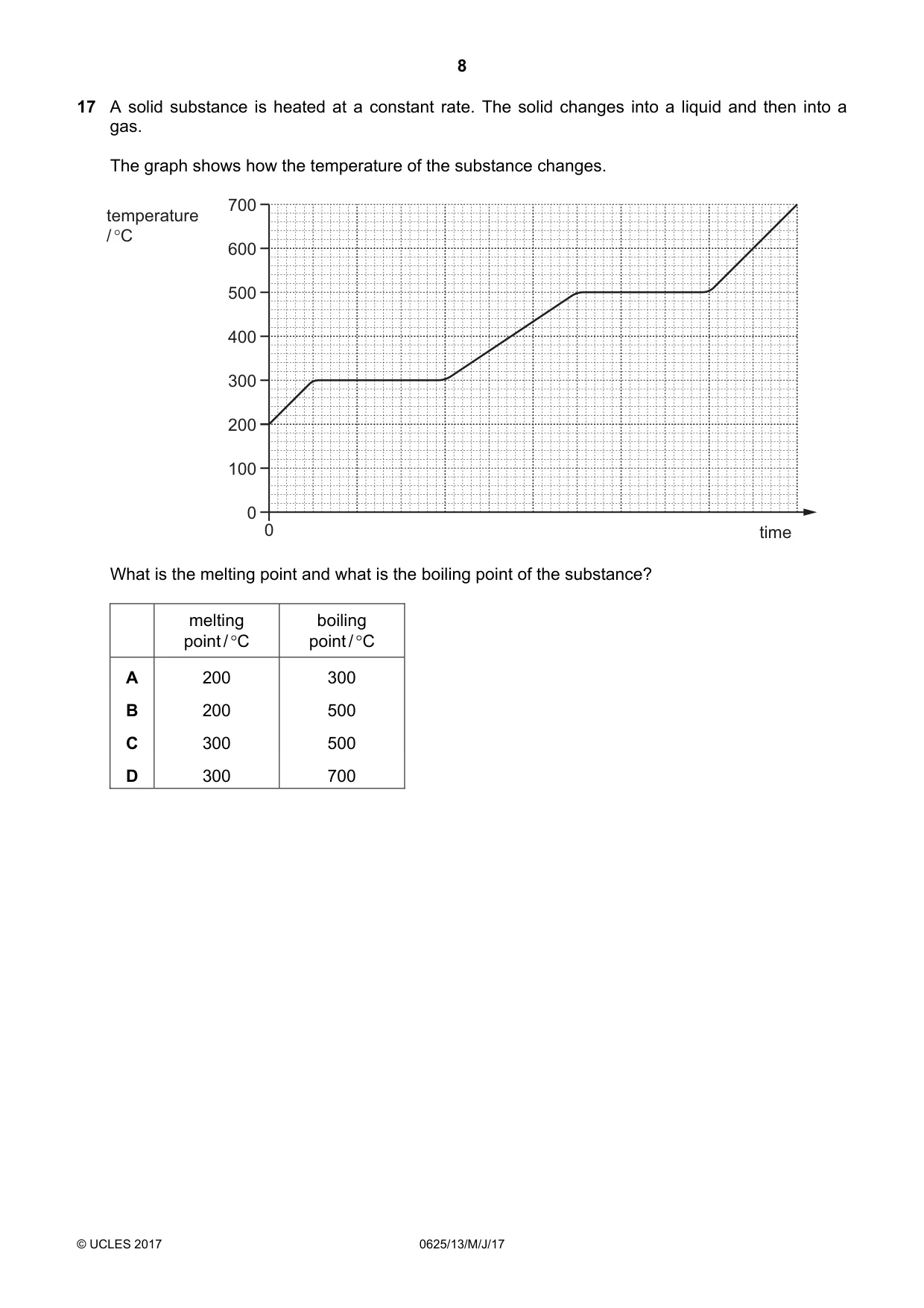
Q17 · A solid substance is heated at a constant rate
17 A solid substance is heated at a constant rate. The solid changes into a liquid and then into a gas. The graph shows how the temperature of the substance changes. 700 temperature / °C 600 500 400 300 200 100 0 0 time What is the melting point and what is the boiling point of the substance? melting boiling point / °C point / °C A 200 300 B 200 500 C 300 500 D 300 700
Mark scheme: C
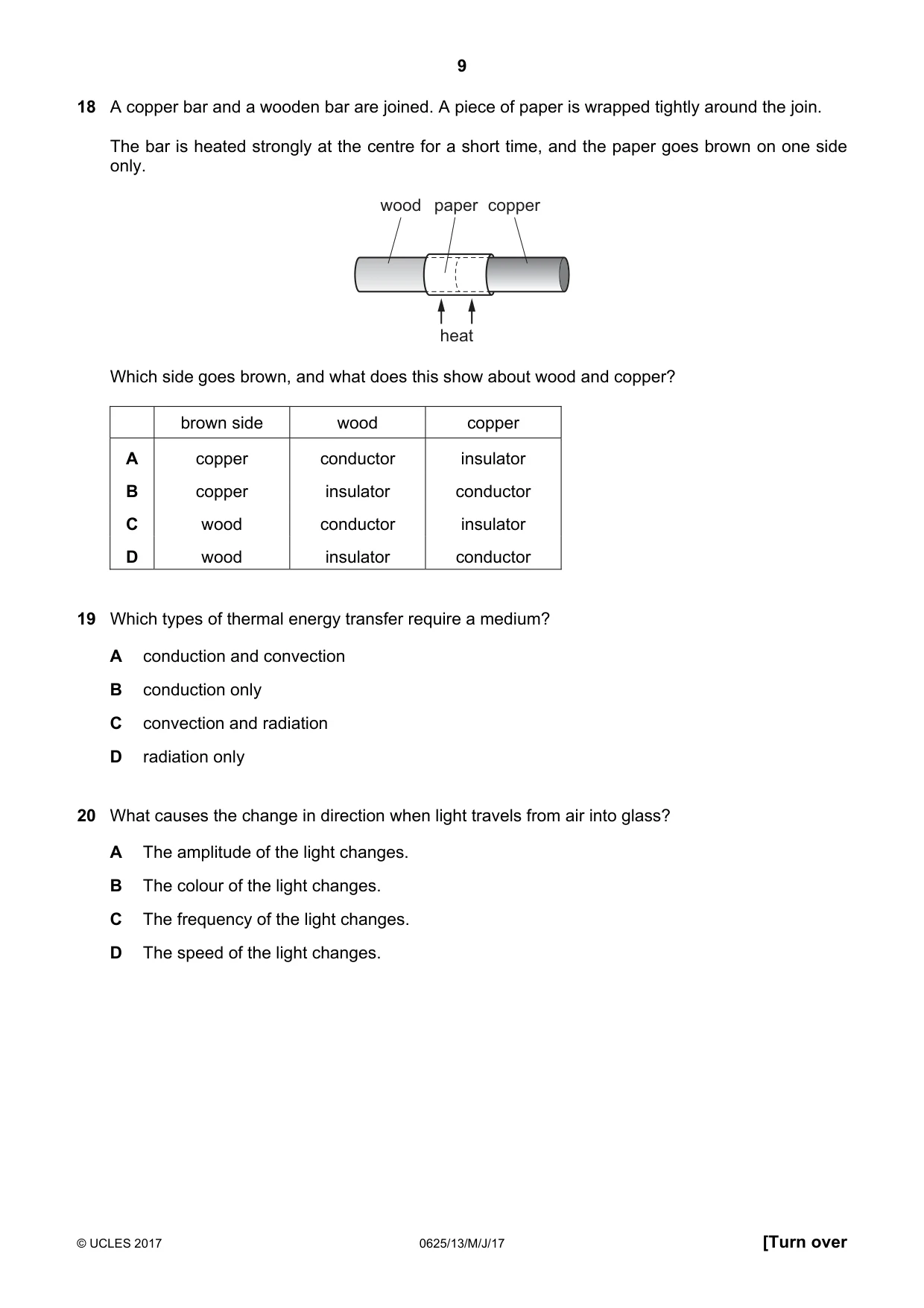
Q18 · A copper bar and a wooden bar are joined
18 A copper bar and a wooden bar are joined. A piece of paper is wrapped tightly around the join. The bar is heated strongly at the centre for a short time, and the paper goes brown on one side only. wood paper copper heat Which side goes brown, and what does this show about wood and copper? brown side wood copper A copper conductor insulator B copper insulator conductor C wood conductor insulator D wood insulator conductor
Mark scheme: D
Q19 · Which types of thermal energy transfer require a medium?
19 Which types of thermal energy transfer require a medium? A conduction and convection B conduction only C convection and radiation D radiation only
Mark scheme: A
Q20 · What causes the change in direction when light travels from air into glass?
20 What causes the change in direction when light travels from air into glass? A The amplitude of the light changes. B The colour of the light changes. C The frequency of the light changes. D The speed of the light changes.
Mark scheme: D
Q21 · Which diagram shows how a converging lens forms a real image of an object O?
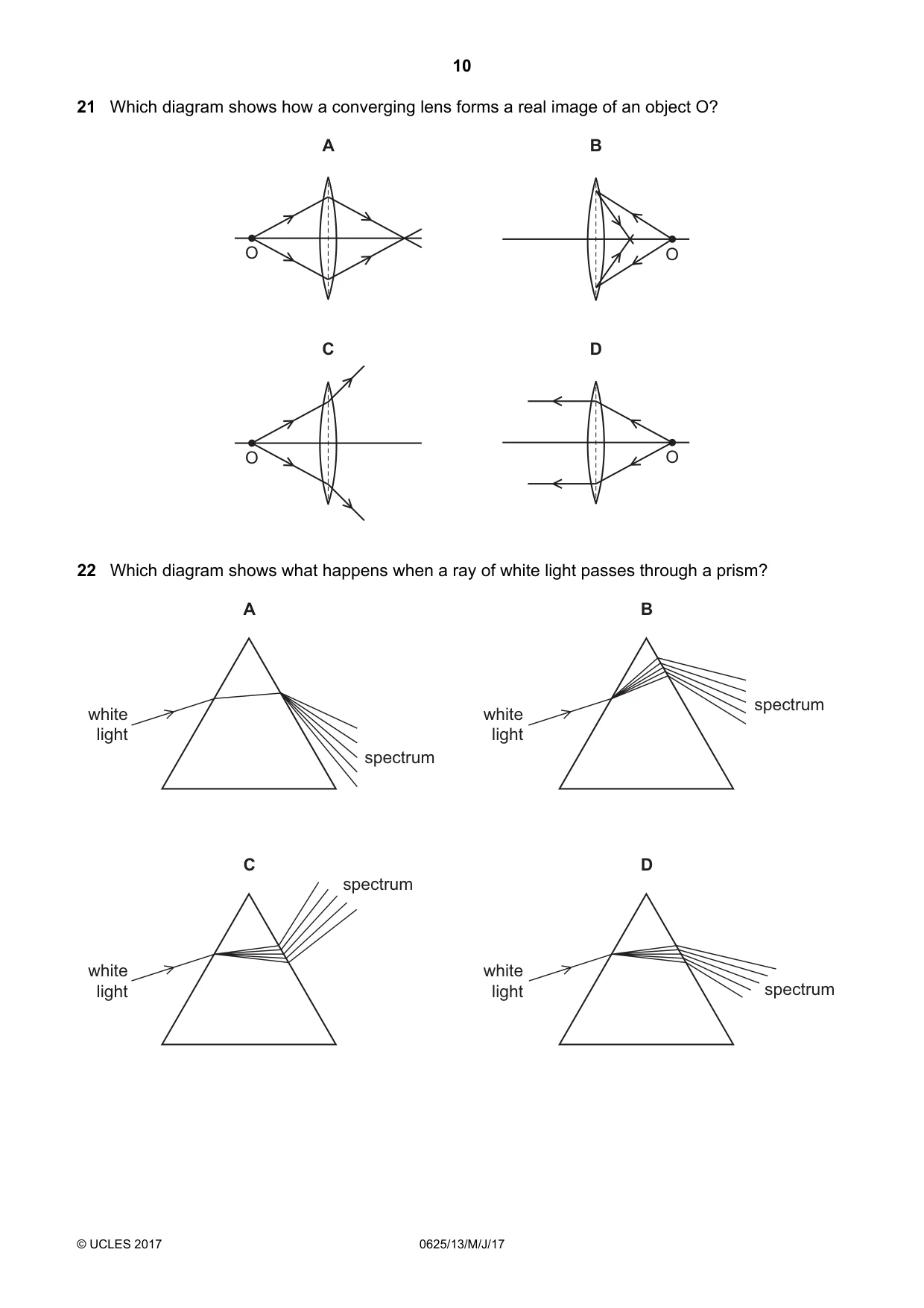
21 Which diagram shows how a converging lens forms a real image of an object O? A B O O C D O O
Mark scheme: A
Q22 · Which diagram shows what happens when a ray of white light passes through a prism?
22 Which diagram shows what happens when a ray of white light passes through a prism? A B spectrum white white light light spectrum C D spectrum white white light light spectrum
Mark scheme: D
Q23 · The table shows different types of wave in the electromagnetic spectrum
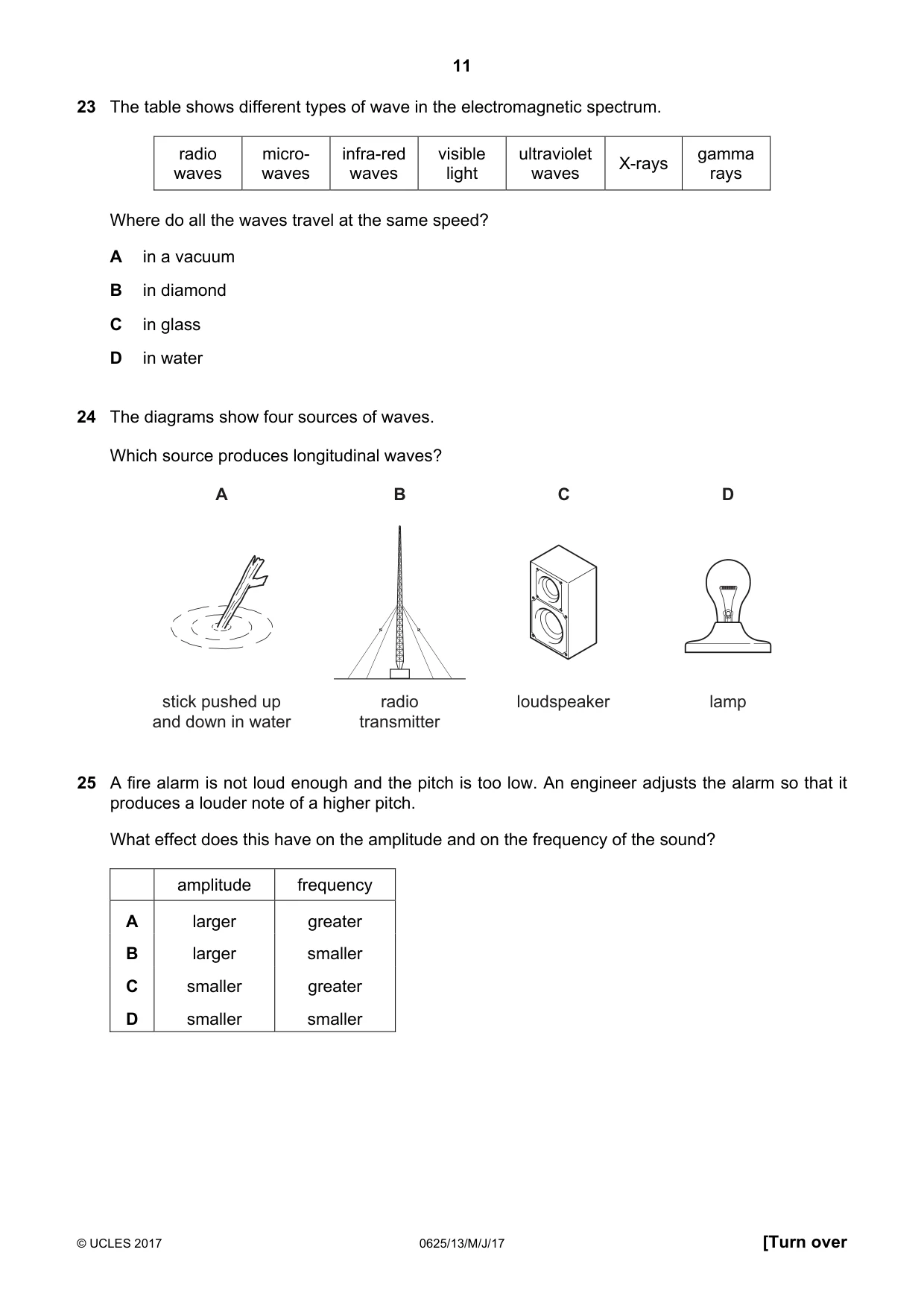
23 The table shows different types of wave in the electromagnetic spectrum. radio micro- infra-red visible ultraviolet gamma X-rays waves waves waves light waves rays Where do all the waves travel at the same speed? A in a vacuum B in diamond C in glass D in water
Mark scheme: A
Q24 · The diagrams show four sources of waves
24 The diagrams show four sources of waves. Which source produces longitudinal waves? A B C D stick pushed up radio loudspeaker lamp and down in water transmitter
Mark scheme: C
Q25 · A fire alarm is not loud enough and the pitch is too low
25 A fire alarm is not loud enough and the pitch is too low. An engineer adjusts the alarm so that it produces a louder note of a higher pitch. What effect does this have on the amplitude and on the frequency of the sound? amplitude frequency A larger greater B larger smaller C smaller greater D smaller smaller
Mark scheme: A
Q26 · From which materials are the coil and the core of an electromagnet made?
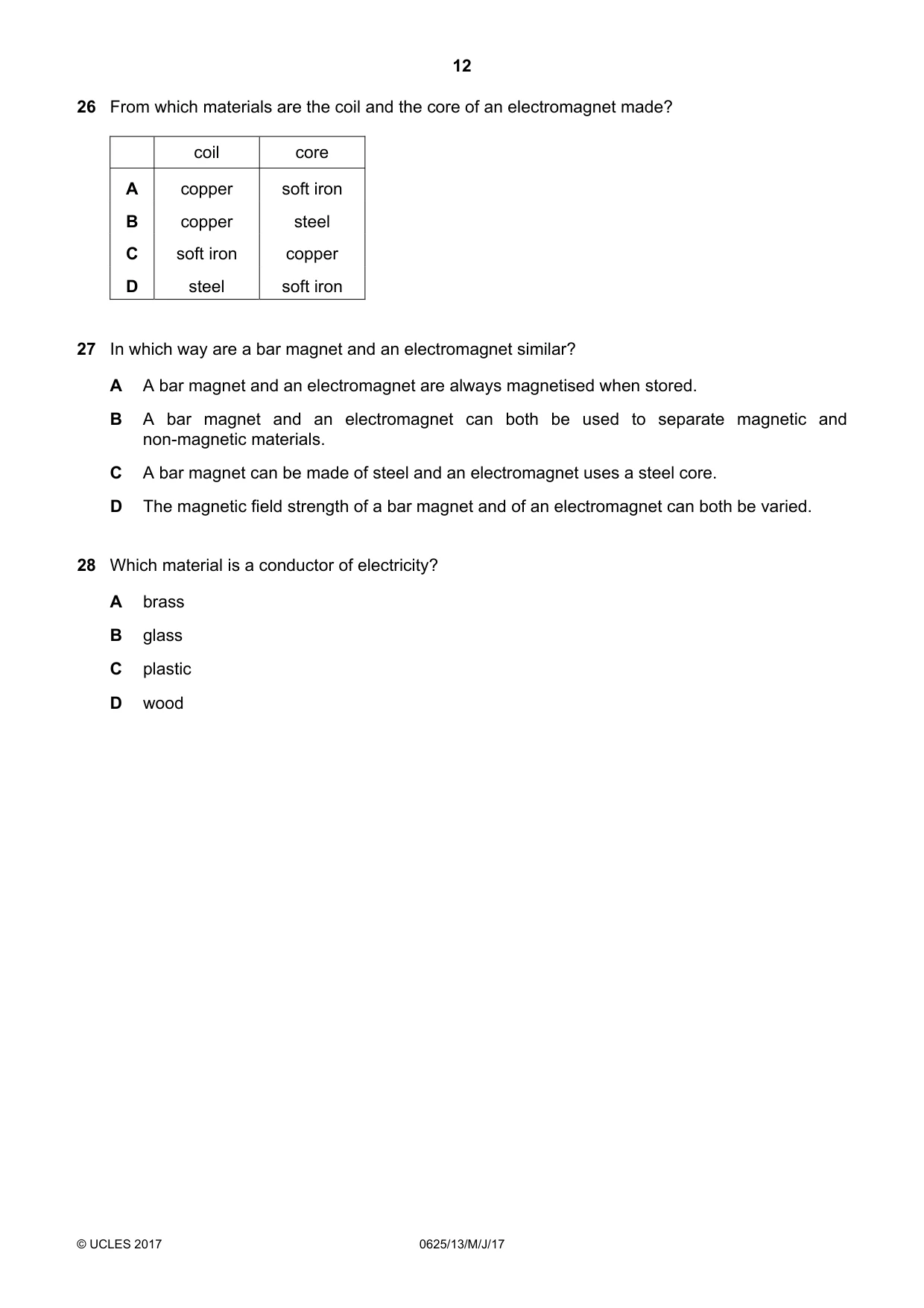
26 From which materials are the coil and the core of an electromagnet made? coil core A copper soft iron B copper steel C soft iron copper D steel soft iron
Mark scheme: A
Q27 · In which way are a bar magnet and an electromagnet similar?
27 In which way are a bar magnet and an electromagnet similar? A A bar magnet and an electromagnet are always magnetised when stored. B A bar magnet and an electromagnet can both be used to separate magnetic and non-magnetic materials. C A bar magnet can be made of steel and an electromagnet uses a steel core. D The magnetic field strength of a bar magnet and of an electromagnet can both be varied.
Mark scheme: B
Q28 · Which material is a conductor of electricity?
28 Which material is a conductor of electricity? A brass B glass C plastic D wood
Mark scheme: A
Q29 · The diagram shows a circuit containing two resistors of resistance 1.0 Ω and 2.0 Ω
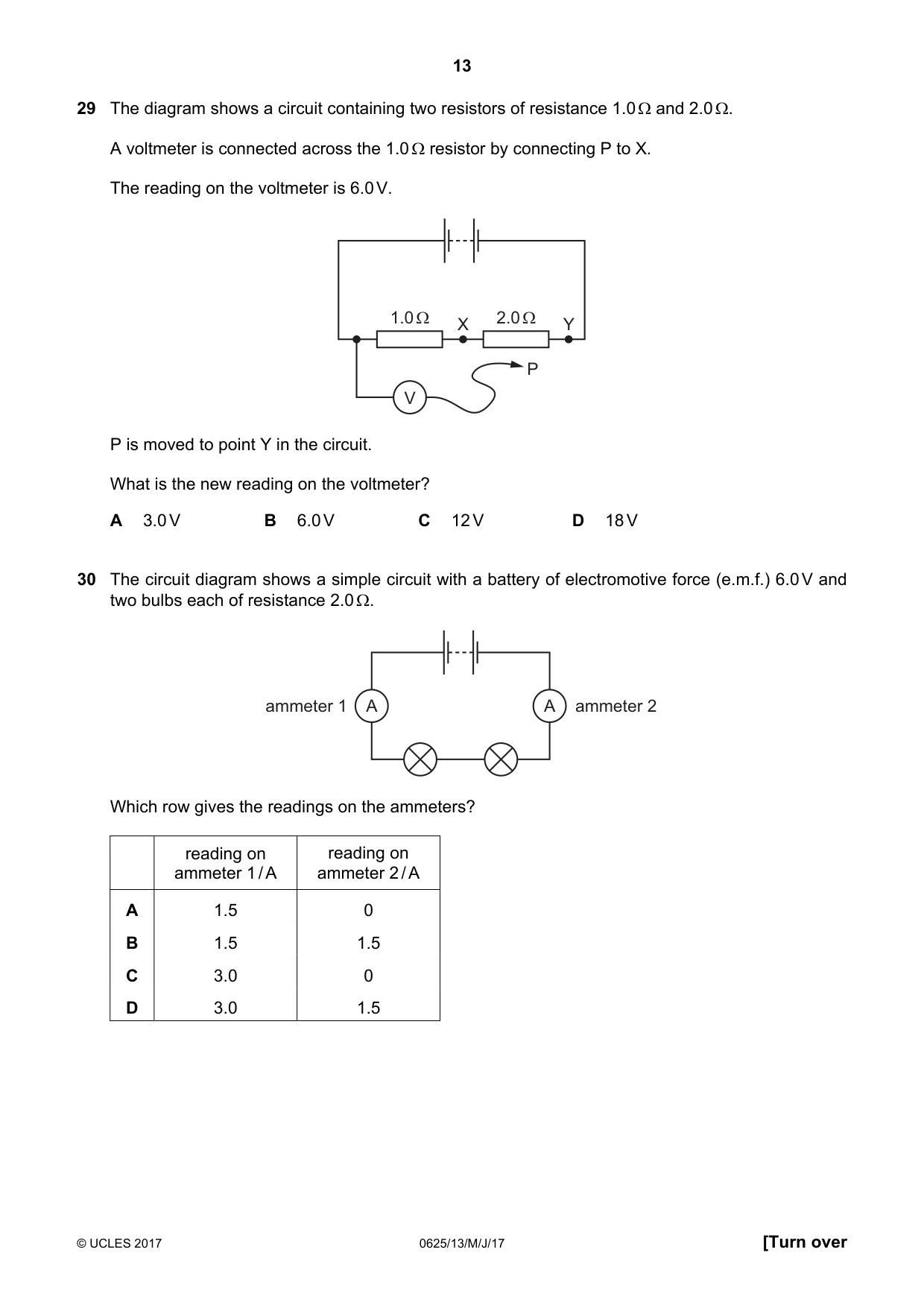
29 The diagram shows a circuit containing two resistors of resistance 1.0 Ω and 2.0 Ω. A voltmeter is connected across the 1.0 Ω resistor by connecting P to X. The reading on the voltmeter is 6.0 V. 1.0 Ω X 2.0 Ω Y P V P is moved to point Y in the circuit. What is the new reading on the voltmeter? A 3.0 V B 6.0 V C 12 V D 18 V
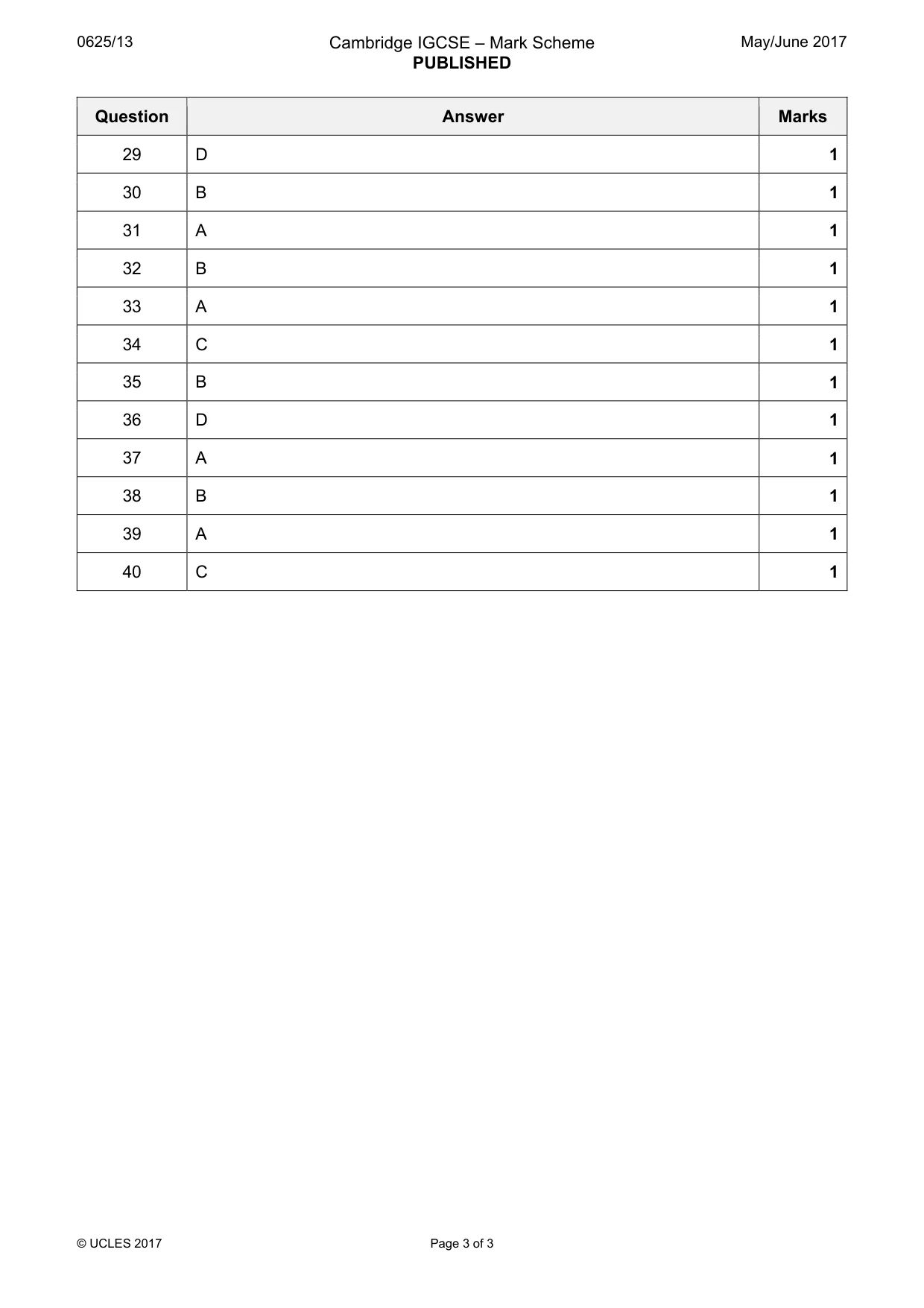
Mark scheme: D
Q30 · The circuit diagram shows a simple circuit with a battery of electromotive force (e.m.f.)…
30 The circuit diagram shows a simple circuit with a battery of electromotive force (e.m.f.) 6.0 V and two bulbs each of resistance 2.0 Ω. ammeter 1 A A ammeter 2 Which row gives the readings on the ammeters? reading on reading on ammeter 1 / A ammeter 2 / A A 1.5 0 B 1.5 1.5 C 3.0 0 D 3.0 1.5
Mark scheme: B
Q31 · The diagram shows three identical heating elements connected to a power supply
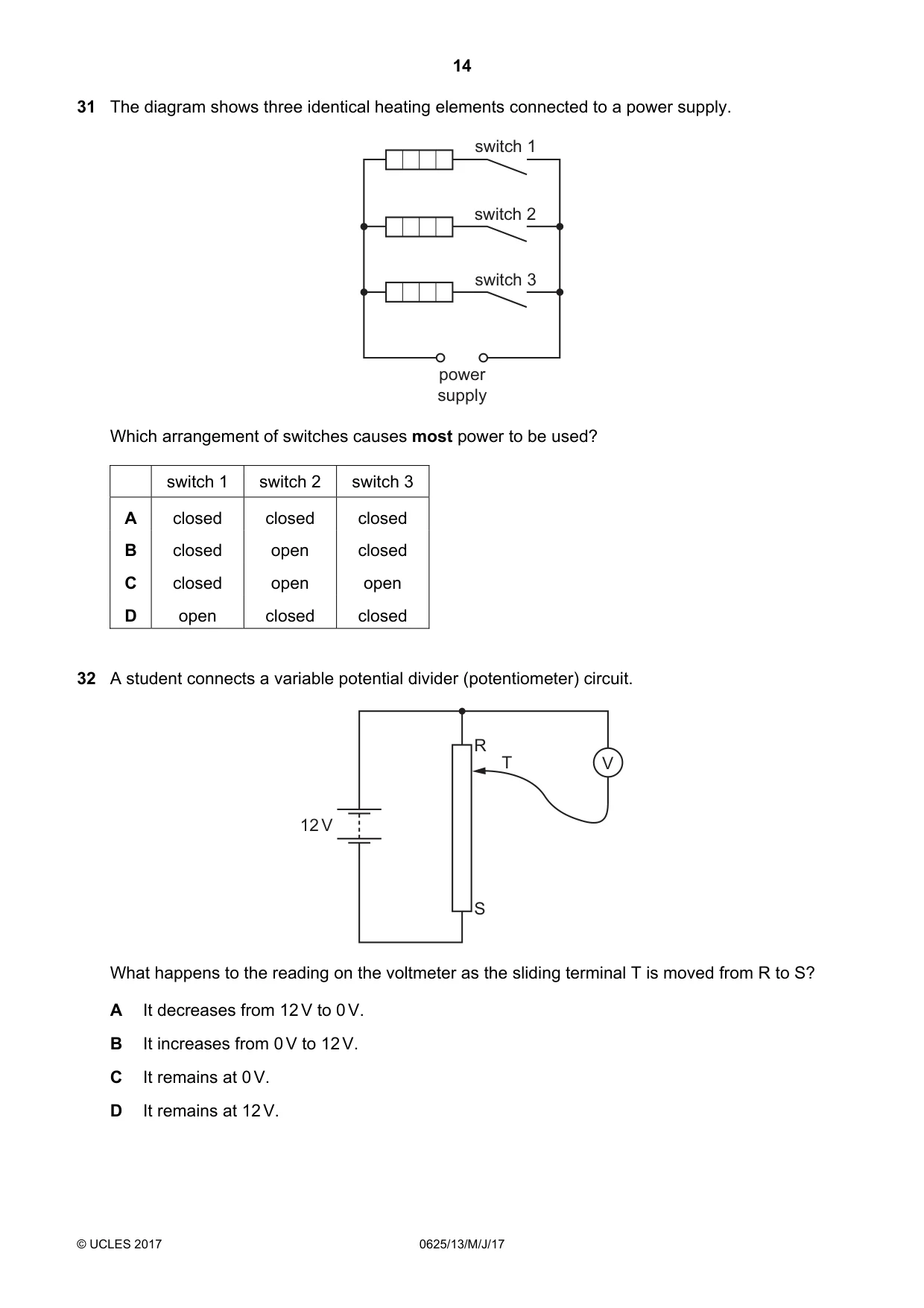
31 The diagram shows three identical heating elements connected to a power supply. switch 1 switch 2 switch 3 power supply Which arrangement of switches causes most power to be used? switch 1 switch 2 switch 3 A closed closed closed B closed open closed C closed open open D open closed closed
Mark scheme: A
Q32 · A student connects a variable potential divider (potentiometer) circuit
32 A student connects a variable potential divider (potentiometer) circuit. R T V 12 V S What happens to the reading on the voltmeter as the sliding terminal T is moved from R to S? A It decreases from 12 V to 0 V. B It increases from 0 V to 12 V. C It remains at 0 V. D It remains at 12 V.
Mark scheme: B
Q33 · The diagram shows a circuit used to make a light detector
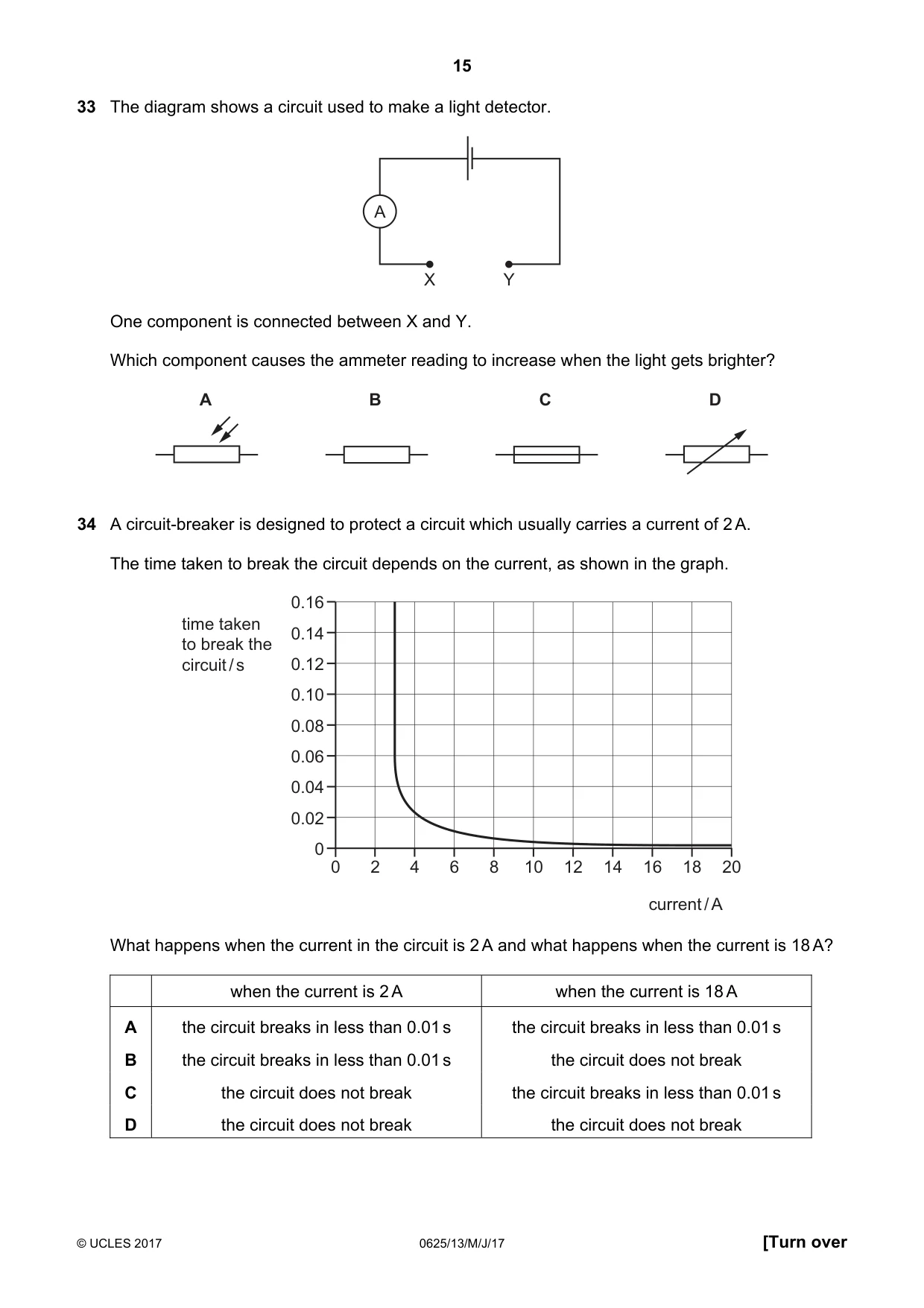
33 The diagram shows a circuit used to make a light detector. A X Y One component is connected between X and Y. Which component causes the ammeter reading to increase when the light gets brighter? A B C D
Mark scheme: A
Q34 · A circuit-breaker is designed to protect a circuit which usually carries a current of 2 A
34 A circuit-breaker is designed to protect a circuit which usually carries a current of 2 A. The time taken to break the circuit depends on the current, as shown in the graph. 0.16 time taken 0.14 to break the circuit / s 0.12 0.10 0.08 0.06 0.04 0.02 0 0 2 4 6 8 10 12 14 16 18 20 current / A What happens when the current in the circuit is 2 A and what happens when the current is 18 A? when the current is 2 A when the current is 18 A A the circuit breaks in less than 0.01 s the circuit breaks in less than 0.01 s B the circuit breaks in less than 0.01 s the circuit does not break C the circuit does not break the circuit breaks in less than 0.01 s D the circuit does not break the circuit does not break
Mark scheme: C
Q35 · A wire moves in the direction shown between the poles of a magnet
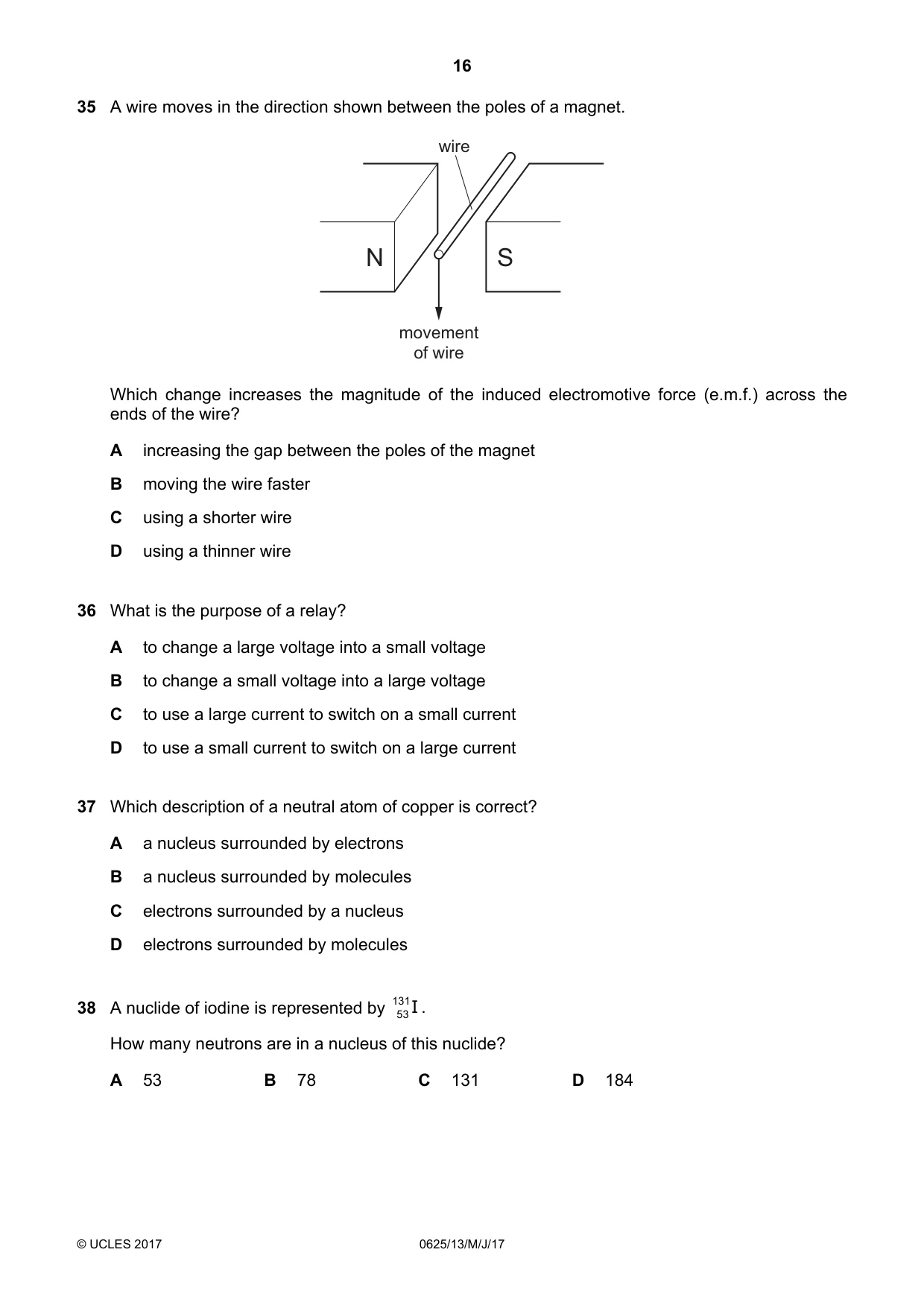
35 A wire moves in the direction shown between the poles of a magnet. wire N S movement of wire Which change increases the magnitude of the induced electromotive force (e.m.f.) across the ends of the wire? A increasing the gap between the poles of the magnet B moving the wire faster C using a shorter wire D using a thinner wire
Mark scheme: B
Q36 · What is the purpose of a relay?
36 What is the purpose of a relay? A to change a large voltage into a small voltage B to change a small voltage into a large voltage C to use a large current to switch on a small current D to use a small current to switch on a large current
Mark scheme: D
Q37 · Which description of a neutral atom of copper is correct?
37 Which description of a neutral atom of copper is correct? A a nucleus surrounded by electrons B a nucleus surrounded by molecules C electrons surrounded by a nucleus D electrons surrounded by molecules
Mark scheme: A
Q38 · A nuclide of iodine is represented by 131 53
38 A nuclide of iodine is represented by 131 53 . I How many neutrons are in a nucleus of this nuclide? A 53 B 78 C 131 D 184
Mark scheme: B
Q39 · A sample of radioactive isotope is decaying
39 A sample of radioactive isotope is decaying. The nuclei of which atoms will decay first? A It is impossible to know because radioactive decay is random. B It is impossible to know unless the age of the material is known. C The atoms near the centre will decay first because they are surrounded by more atoms. D The atoms near the surface will decay first because the radiation can escape more easily.
Mark scheme: A
Q40 · The diagram shows a decay curve for a radioactive substance
40 The diagram shows a decay curve for a radioactive substance. 50 count rate 45 counts / s 40 35 30 25 20 15 10 5 0 0 time According to the curve shown, what is the background radiation count? A 40 counts / s B 20 counts / s C 5 counts / s D 0 counts / s
Mark scheme: C
What was in this paper
The subtopics covered by these 40 questions, and how many questions each got. Open one in a new tab to see every Cambridge question on it.
5Light3Thermal properties and temperature3Electromagnetic effects2Energy, work and power2Forces2Kinetic particle model of matter2Mass and weight2Physical quantities and measurement techniques2Pressure2Radioactivity2Simple phenomena of magnetism2The nuclear model of the atom2Transfer of thermal energy2Density1Electrical quantities1Electrical safety1Electromagnetic spectrum1General properties of waves1Motion1Sound1What you needed in this session
Cambridge’s own grade thresholds for 2017 May/June, Paper 1 · Variant 3. A higher threshold means an easier paper — the bar moves with how the cohort did.