Cambridge IGCSE Physics 0625 — 2005 Oct/Nov Paper 1 · Variant 1
0625/11/O/N/05 · 40 questions · 40 marks · ≈45 min
The question paper and its mark scheme, free to read here and free to download. This is Cambridge’s own paper, exactly as it was sat.
Question paper20 pages


Mark scheme2 pages
Answers below. Sit the paper first if you are practising.
Questions as text
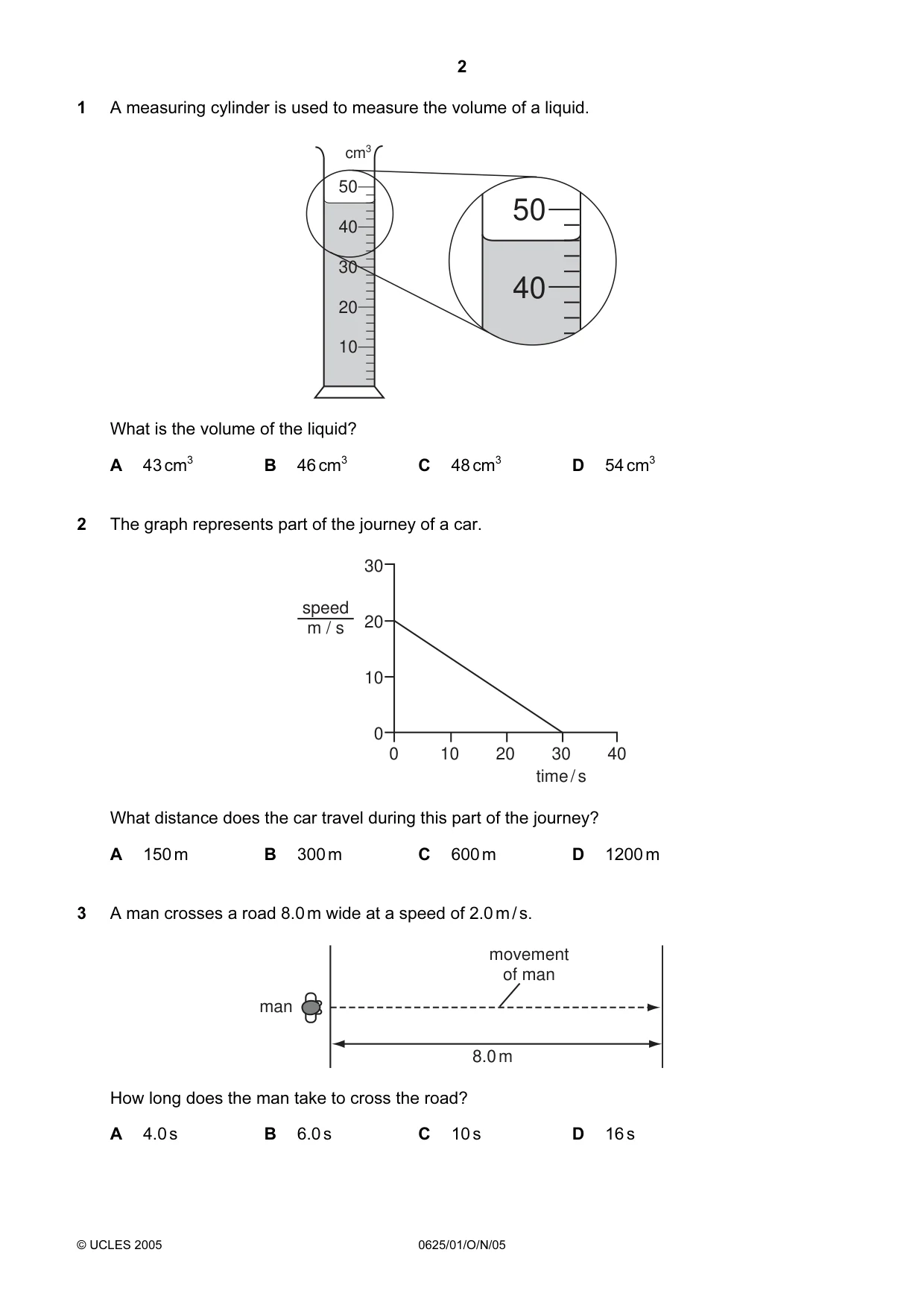
Q1 · A measuring cylinder is used to measure the volume of a liquid
1 A measuring cylinder is used to measure the volume of a liquid. cm3 50 50 40 30 40 20 10 What is the volume of the liquid? A 43 cm3 B 46 cm3 C 48 cm3 D 54 cm3
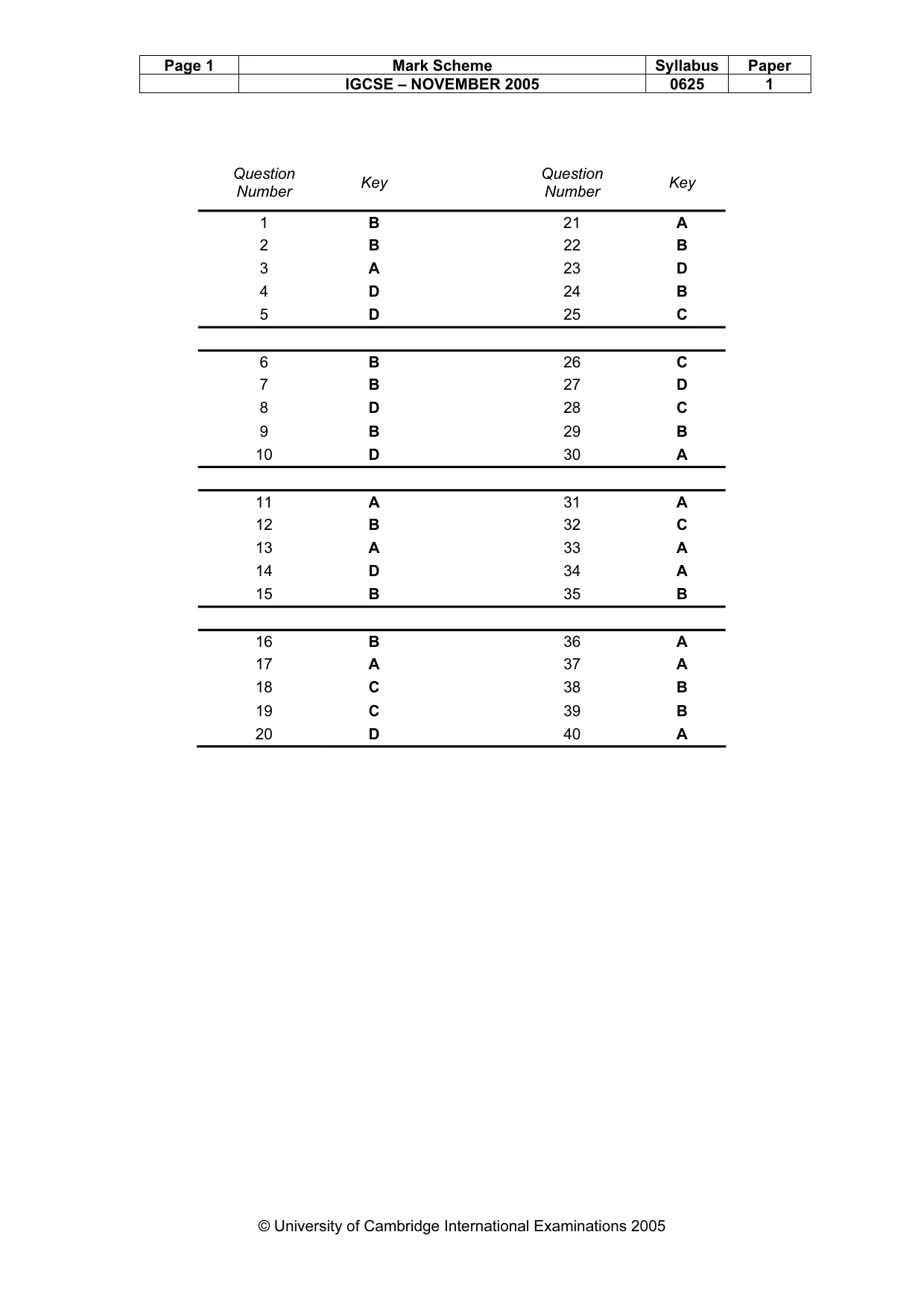
Mark scheme: B
More questions on Physical quantities and measurement techniques
Q2 · The graph represents part of the journey of a car
2 The graph represents part of the journey of a car. 30 speed m / s 20 10 0 0 10 20 30 40 time / s What distance does the car travel during this part of the journey? A 150 m B 300 m C 600 m D 1200 m
Mark scheme: B
Q3 · A man crosses a road 8.0 m wide at a speed of 2.0 m / s
3 A man crosses a road 8.0 m wide at a speed of 2.0 m / s. movement of man man 8.0 m How long does the man take to cross the road? A 4.0 s B 6.0 s C 10 s D 16 s
Mark scheme: A
Q4 · What is the gravitational force that the Earth exerts on an object?
4 What is the gravitational force that the Earth exerts on an object? A the density of the object B the mass of the object C the volume of the object D the weight of the object
Mark scheme: D
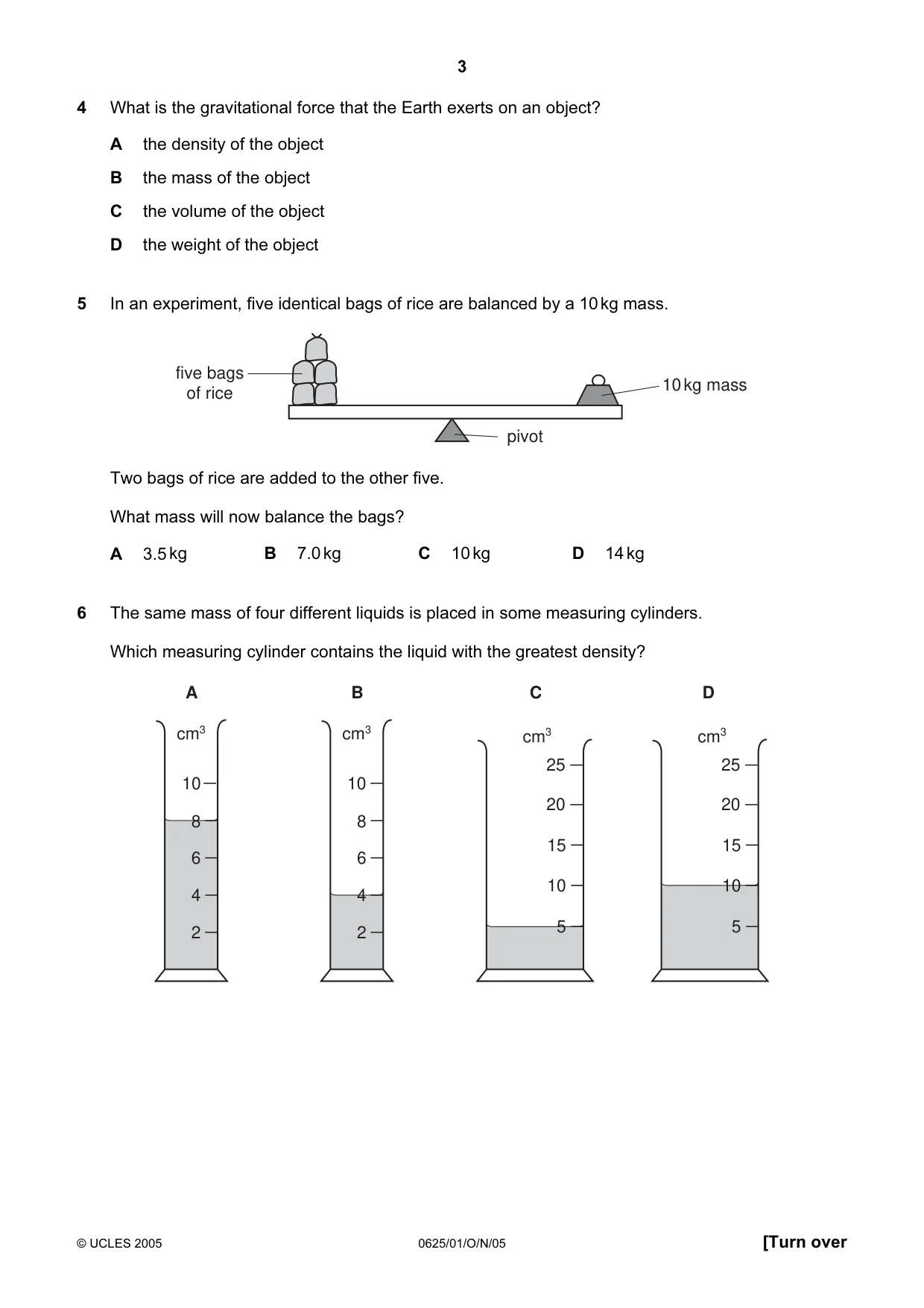
Q5 · In an experiment, five identical bags of rice are balanced by a 10 kg mass
5 In an experiment, five identical bags of rice are balanced by a 10 kg mass. five bags 10 kg mass of rice pivot Two bags of rice are added to the other five. What mass will now balance the bags? A 3.5 kg B 7.0 kg C 10 kg D 14 kg
Mark scheme: D
Q6 · The same mass of four different liquids is placed in some measuring cylinders
6 The same mass of four different liquids is placed in some measuring cylinders. Which measuring cylinder contains the liquid with the greatest density? A B C D cm3 cm3 cm3 cm3 25 25 10 10 20 20 8 8 15 15 6 6 10 10 4 4 2 2 5 5
Mark scheme: B
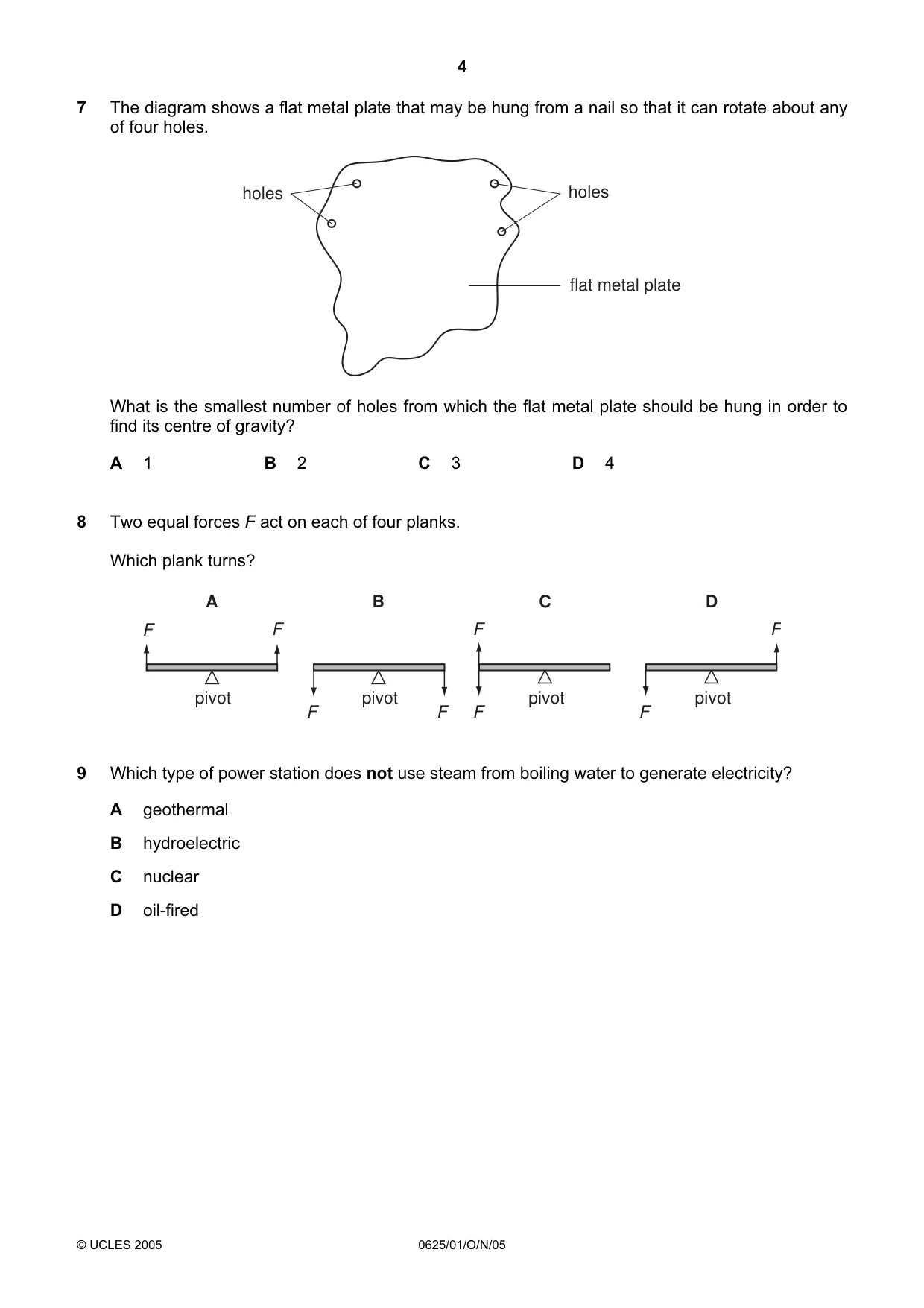
Q7 · The diagram shows a flat metal plate that may be hung from a nail so that it can rotate…
7 The diagram shows a flat metal plate that may be hung from a nail so that it can rotate about any of four holes. holes holes flat metal plate What is the smallest number of holes from which the flat metal plate should be hung in order to find its centre of gravity? A 1 B 2 C 3 D 4
Mark scheme: B
Q8 · Two equal forces F act on each of four planks
8 Two equal forces F act on each of four planks. Which plank turns? A B C D F F F F pivot pivot pivot pivot F F F F
Mark scheme: D
Q9 · Which type of power station does not use steam from boiling water to generate electricity?
9 Which type of power station does not use steam from boiling water to generate electricity? A geothermal B hydroelectric C nuclear D oil-fired
Mark scheme: B
Q10 · A man standing at the top of a cliff throws a stone
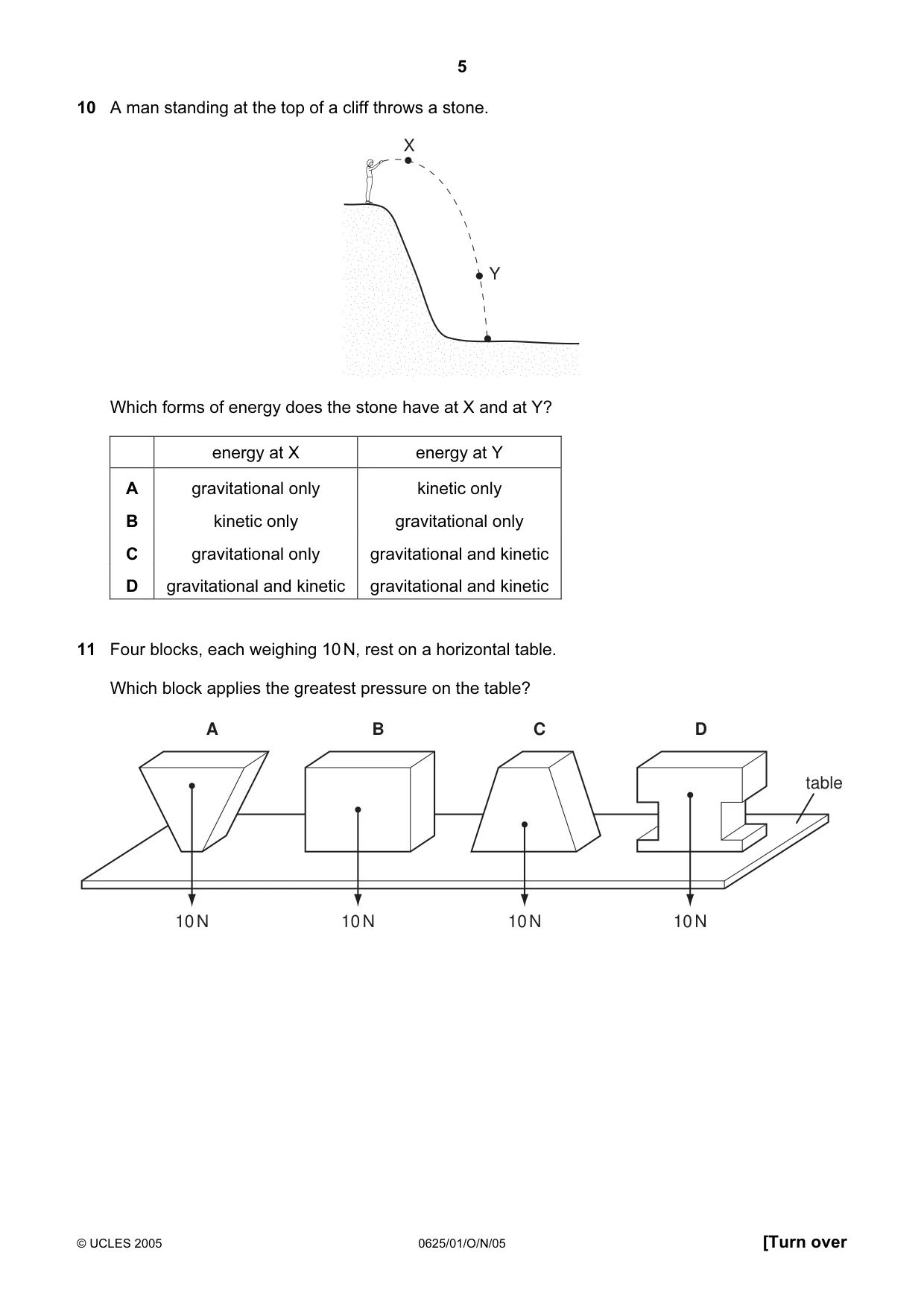
10 A man standing at the top of a cliff throws a stone. X Y Which forms of energy does the stone have at X and at Y? energy at X energy at Y A gravitational only kinetic only B kinetic only gravitational only C gravitational only gravitational and kinetic D gravitational and kinetic gravitational and kinetic
Mark scheme: D
Q11 · Four blocks, each weighing 10 N, rest on a horizontal table
11 Four blocks, each weighing 10 N, rest on a horizontal table. Which block applies the greatest pressure on the table? A B C D table 10 N 10 N 10 N 10 N
Mark scheme: A
Q12 · The diagram shows a mercury barometer
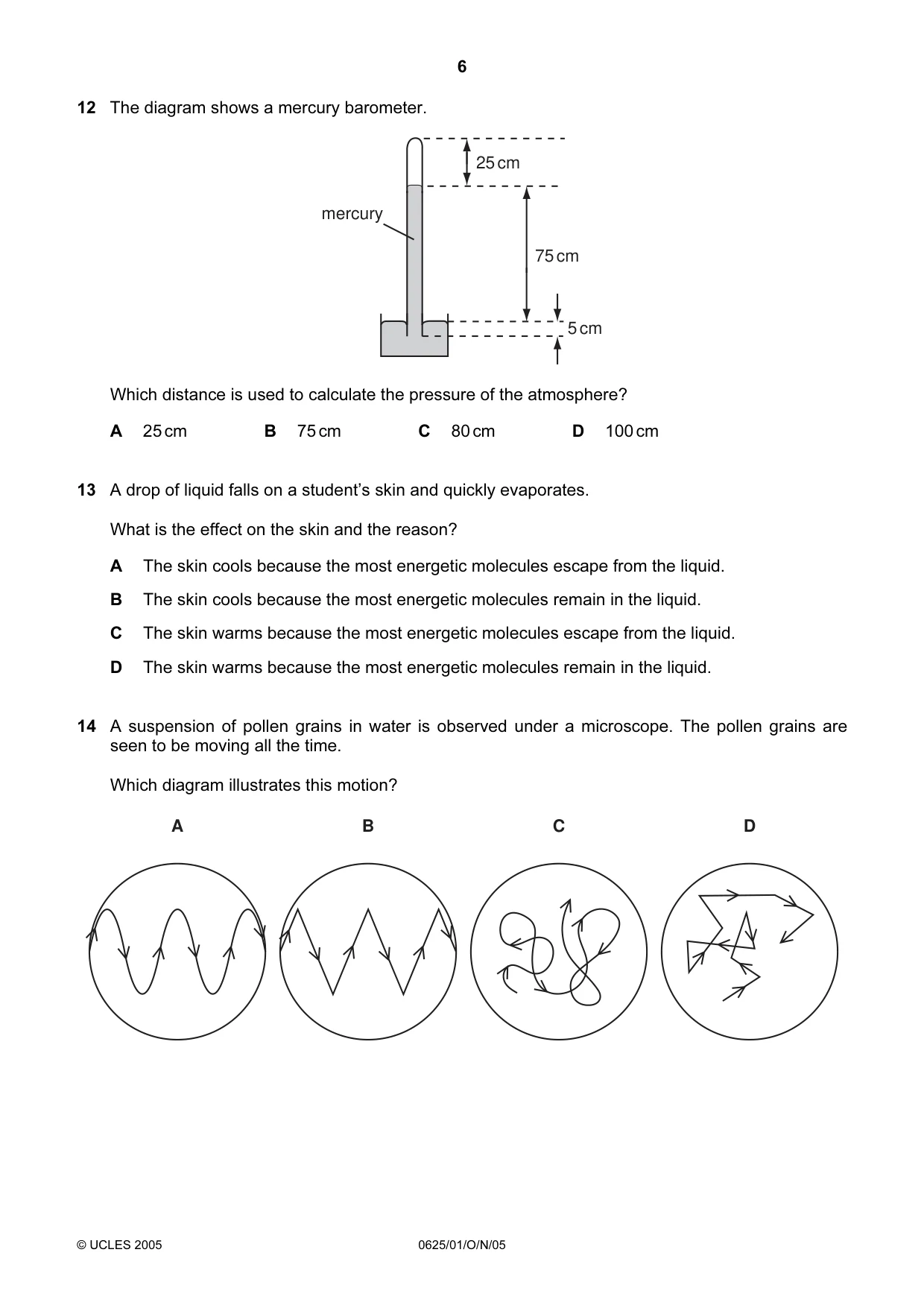
12 The diagram shows a mercury barometer. 25 cm mercury 75 cm 5 cm Which distance is used to calculate the pressure of the atmosphere? A 25 cm B 75 cm C 80 cm D 100 cm
Mark scheme: B
Q13 · A drop of liquid falls on a student’s skin and quickly evaporates
13 A drop of liquid falls on a student’s skin and quickly evaporates. What is the effect on the skin and the reason? A The skin cools because the most energetic molecules escape from the liquid. B The skin cools because the most energetic molecules remain in the liquid. C The skin warms because the most energetic molecules escape from the liquid. D The skin warms because the most energetic molecules remain in the liquid.
Mark scheme: A
Q14 · A suspension of pollen grains in water is observed under a microscope
14 A suspension of pollen grains in water is observed under a microscope. The pollen grains are seen to be moving all the time. Which diagram illustrates this motion? A B C D
Mark scheme: D
Q15 · A knife is being sharpened on a rotating sharpening-stone
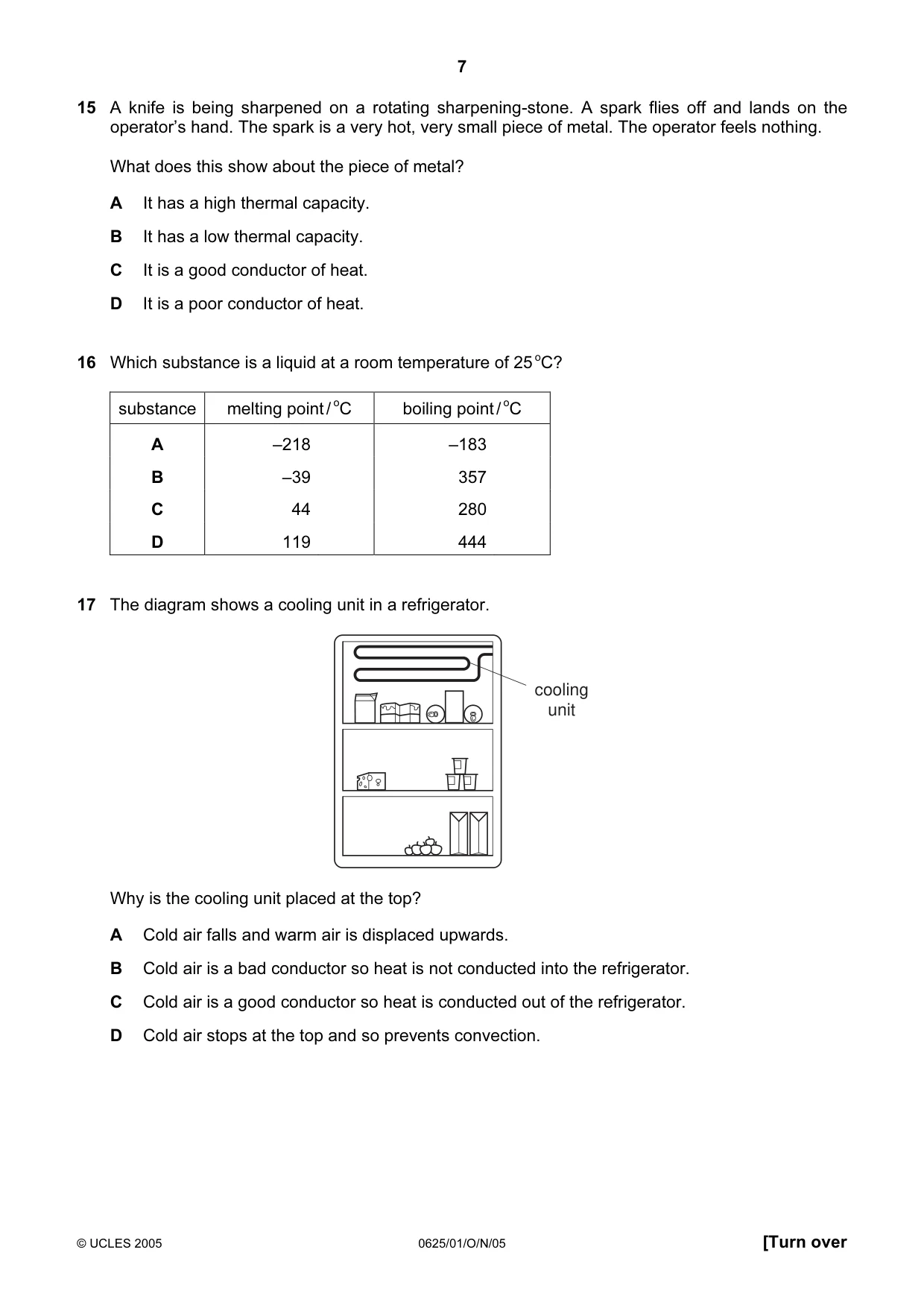
15 A knife is being sharpened on a rotating sharpening-stone. A spark flies off and lands on the operator’s hand. The spark is a very hot, very small piece of metal. The operator feels nothing. What does this show about the piece of metal? A It has a high thermal capacity. B It has a low thermal capacity. C It is a good conductor of heat. D It is a poor conductor of heat.
Mark scheme: B
Q16 · Which substance is a liquid at a room temperature of 25 oC?
16 Which substance is a liquid at a room temperature of 25 oC? substance melting point / oC boiling point / oC A –218 –183 B –39 357 C 44 280 D 119 444
Mark scheme: B
Q17 · The diagram shows a cooling unit in a refrigerator
17 The diagram shows a cooling unit in a refrigerator. cooling unit Why is the cooling unit placed at the top? A Cold air falls and warm air is displaced upwards. B Cold air is a bad conductor so heat is not conducted into the refrigerator. C Cold air is a good conductor so heat is conducted out of the refrigerator. D Cold air stops at the top and so prevents convection.
Mark scheme: A
Q18 · How does heat from the Sun reach the Earth?
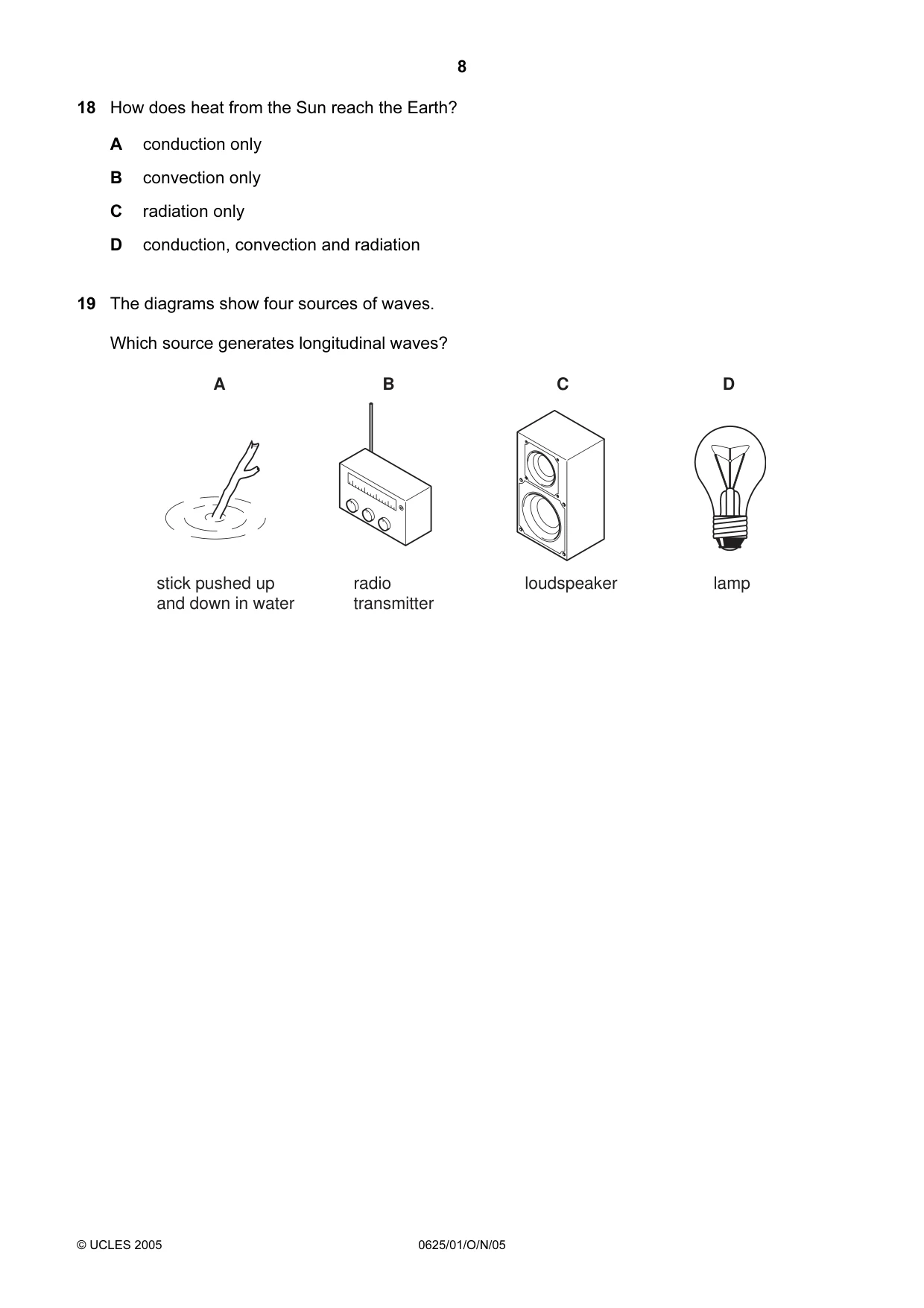
18 How does heat from the Sun reach the Earth? A conduction only B convection only C radiation only D conduction, convection and radiation
Mark scheme: C
Q19 · The diagrams show four sources of waves
19 The diagrams show four sources of waves. Which source generates longitudinal waves? A B C D stick pushed up radio loudspeaker lamp and down in water transmitter
Mark scheme: C
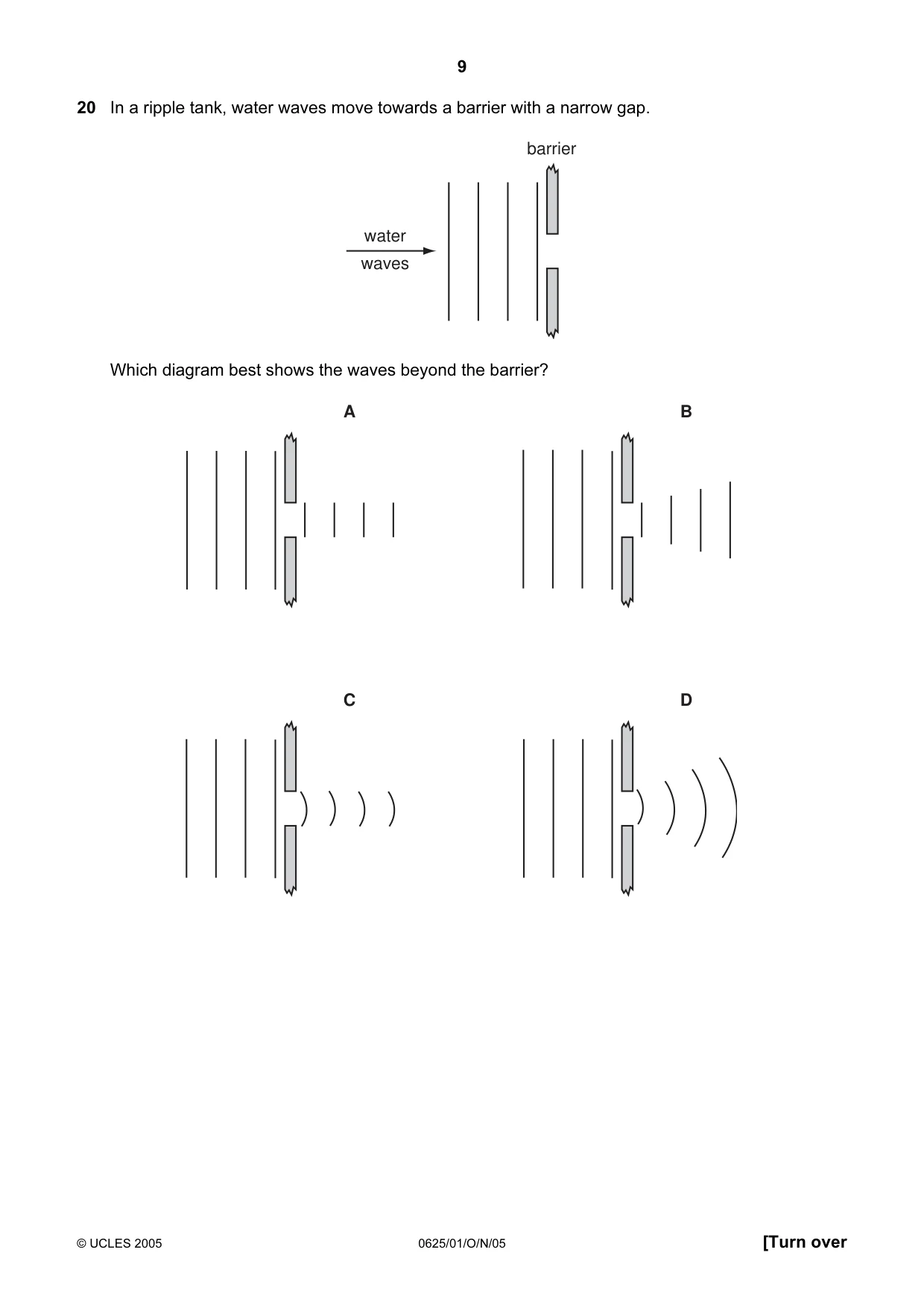
Q20 · In a ripple tank, water waves move towards a barrier with a narrow gap
20 In a ripple tank, water waves move towards a barrier with a narrow gap. barrier water waves Which diagram best shows the waves beyond the barrier? A B C D
Mark scheme: D
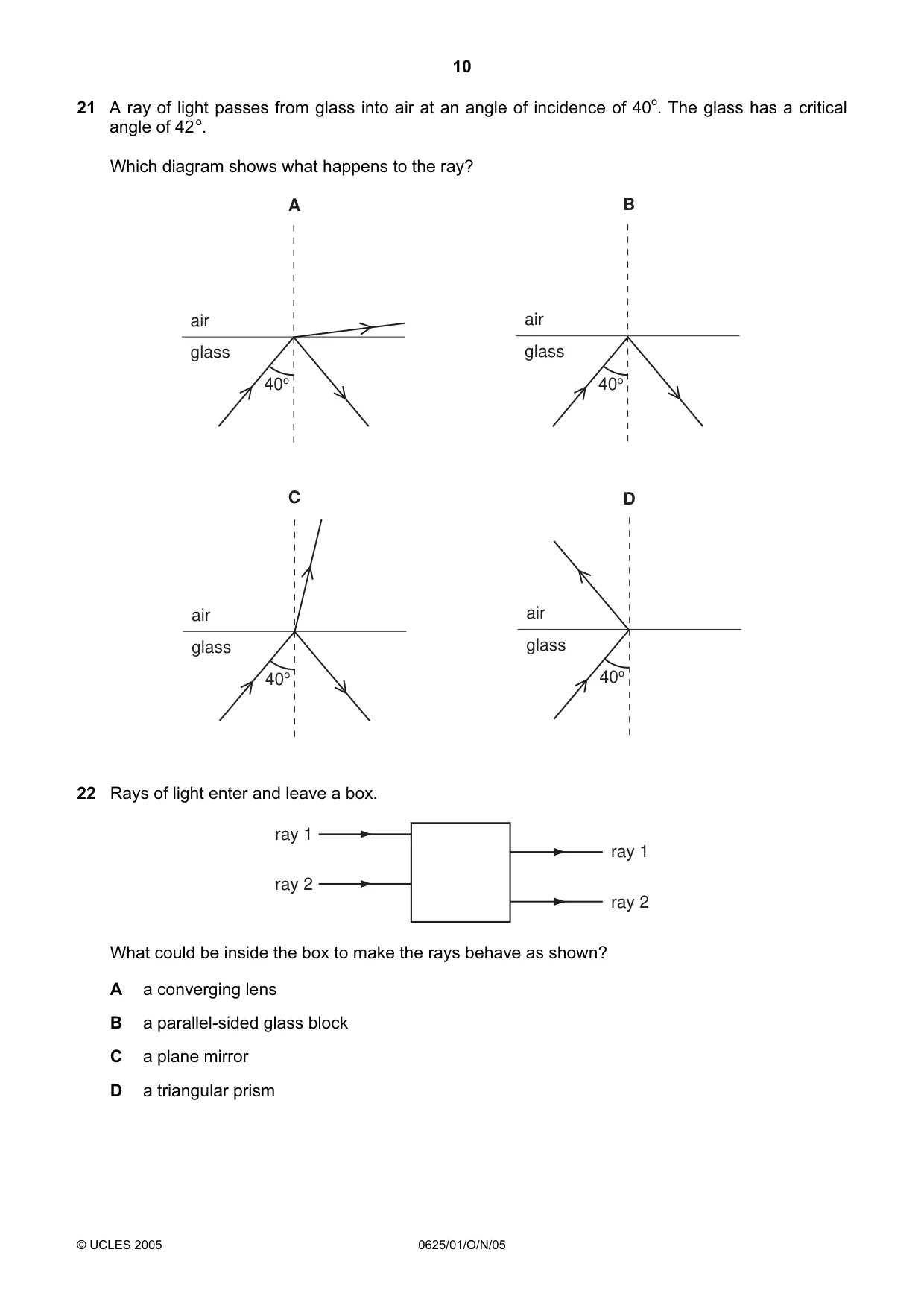
Q21 · A ray of light passes from glass into air at an angle of incidence of 40o
21 A ray of light passes from glass into air at an angle of incidence of 40o. The glass has a critical angle of 42 o. Which diagram shows what happens to the ray? A B air air glass glass 40o 40o C D air air glass glass 40o 40o
Mark scheme: A
Q22 · Rays of light enter and leave a box
22 Rays of light enter and leave a box. ray 1 ray 1 ray 2 ray 2 What could be inside the box to make the rays behave as shown? A a converging lens B a parallel-sided glass block C a plane mirror D a triangular prism
Mark scheme: B
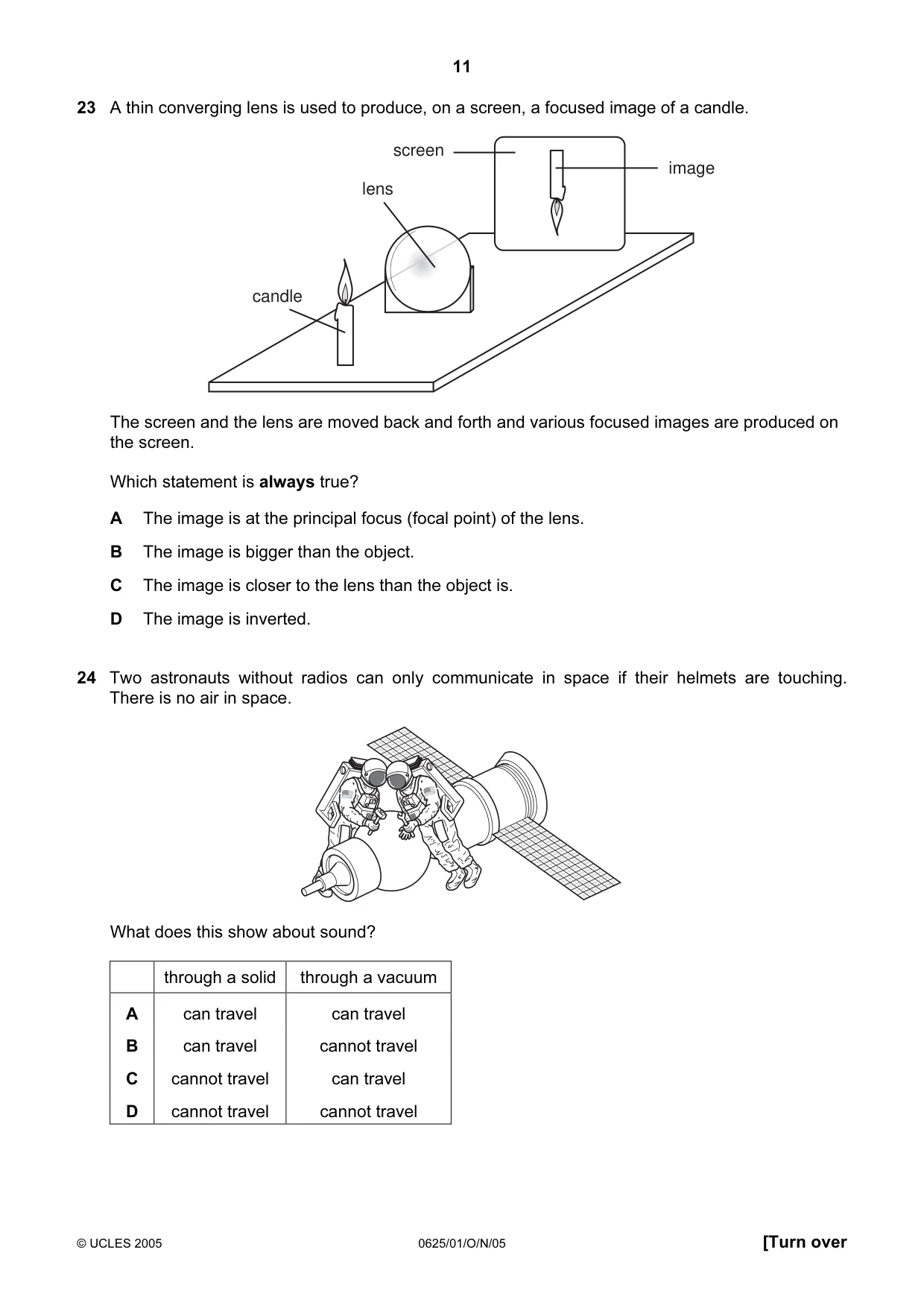
Q23 · A thin converging lens is used to produce, on a screen, a focused image of a candle
23 A thin converging lens is used to produce, on a screen, a focused image of a candle. screen image lens candle The screen and the lens are moved back and forth and various focused images are produced on the screen. Which statement is always true? A The image is at the principal focus (focal point) of the lens. B The image is bigger than the object. C The image is closer to the lens than the object is. D The image is inverted.
Mark scheme: D
Q24 · Two astronauts without radios can only communicate in space if their helmets are touching
24 Two astronauts without radios can only communicate in space if their helmets are touching. There is no air in space. What does this show about sound? through a solid through a vacuum A can travel can travel B can travel cannot travel C cannot travel can travel D cannot travel cannot travel
Mark scheme: B
Q25 · When the horn on a ship is sounded, the passengers hear an echo from a cliff after 4.0 s
25 When the horn on a ship is sounded, the passengers hear an echo from a cliff after 4.0 s. If the speed of sound is 340 m / s, how far away is the cliff? A 170 m B 340 m C 680 m D 1360 m
Mark scheme: C
Q26 · How many of the following methods could be used to demagnetise a piece of steel?
26 How many of the following methods could be used to demagnetise a piece of steel? heating it until it is red hot pulling it from a coil that is carrying an alternating current placing it in an east-west direction and hammering it putting it in a coil which is carrying a direct current A 1 B 2 C 3 D 4
Mark scheme: C
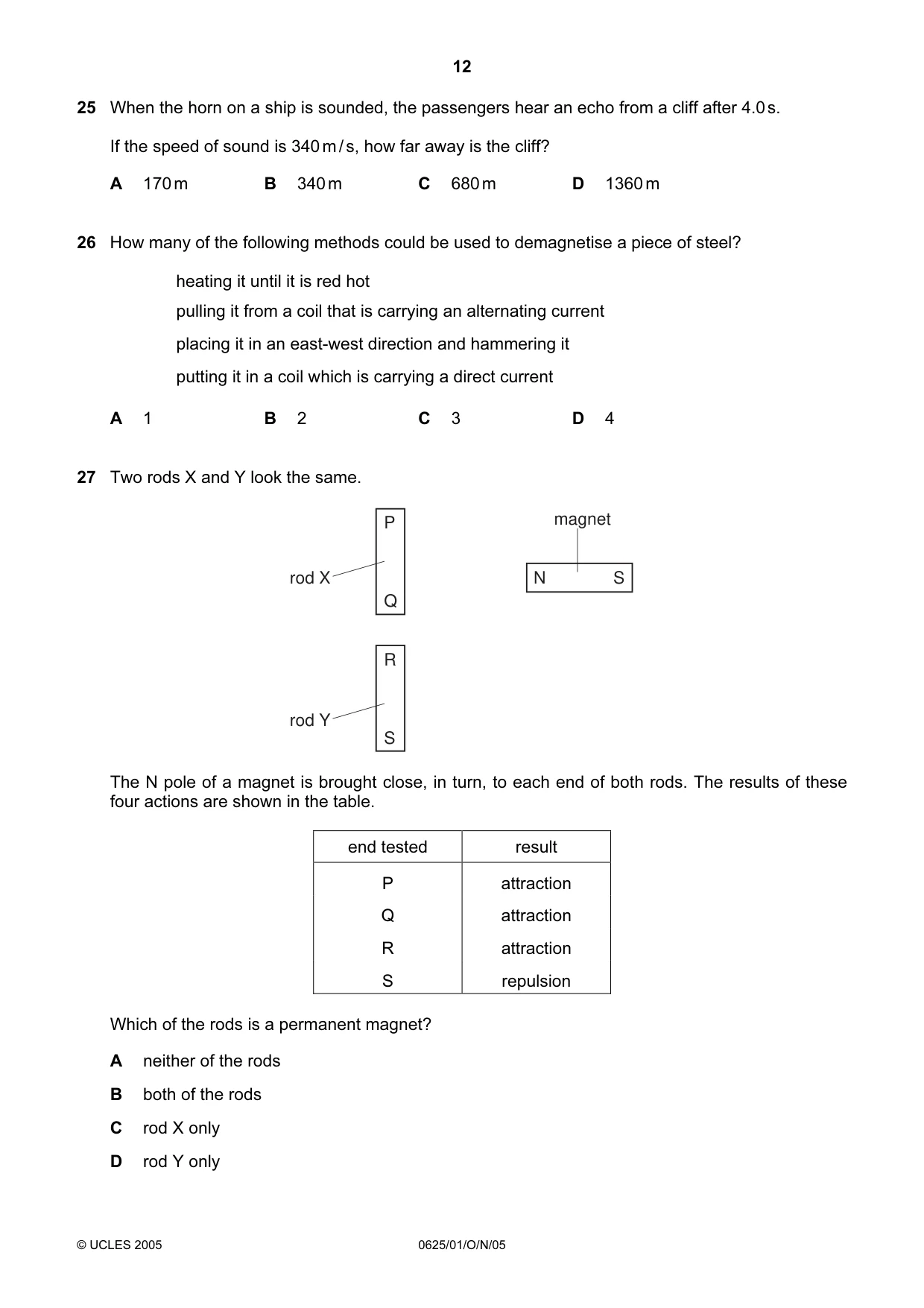
Q27 · Two rods X and Y look the same
27 Two rods X and Y look the same. P magnet rod X N S Q R rod Y S The N pole of a magnet is brought close, in turn, to each end of both rods. The results of these four actions are shown in the table. end tested result P attraction Q attraction R attraction S repulsion Which of the rods is a permanent magnet? A neither of the rods B both of the rods C rod X only D rod Y only
Mark scheme: D
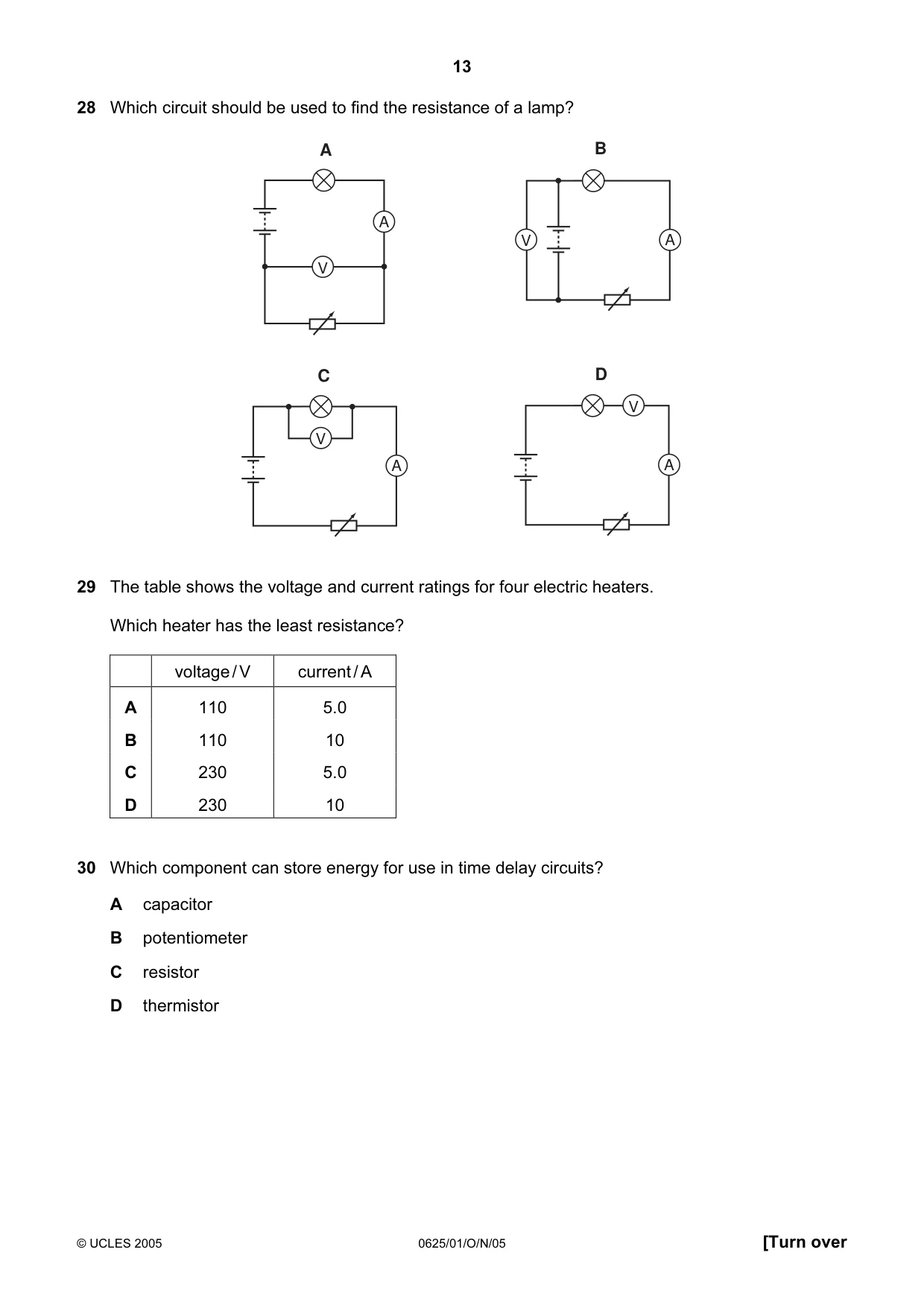
Q28 · Which circuit should be used to find the resistance of a lamp?
28 Which circuit should be used to find the resistance of a lamp? A B A V A V C D V V A A
Mark scheme: C
Q29 · The table shows the voltage and current ratings for four electric heaters
29 The table shows the voltage and current ratings for four electric heaters. Which heater has the least resistance? voltage / V current / A A 110 5.0 B 110 10 C 230 5.0 D 230 10
Mark scheme: B
Q30 · Which component can store energy for use in time delay circuits?
30 Which component can store energy for use in time delay circuits? A capacitor B potentiometer C resistor D thermistor
Mark scheme: A
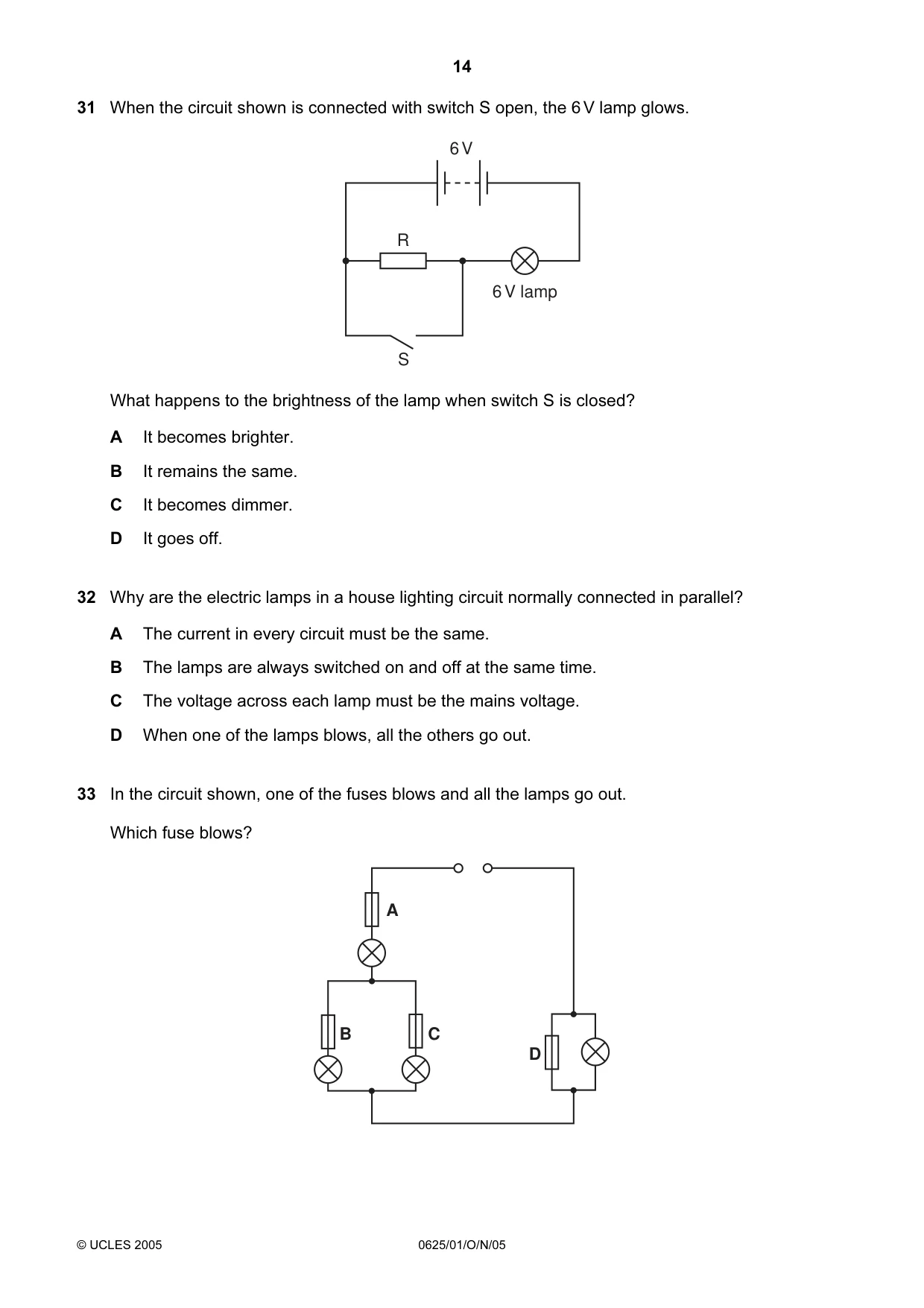
Q31 · When the circuit shown is connected with switch S open, the 6 V lamp glows
31 When the circuit shown is connected with switch S open, the 6 V lamp glows. 6 V R 6 V lamp S What happens to the brightness of the lamp when switch S is closed? A It becomes brighter. B It remains the same. C It becomes dimmer. D It goes off.
Mark scheme: A
Q32 · Why are the electric lamps in a house lighting circuit normally connected in parallel?
32 Why are the electric lamps in a house lighting circuit normally connected in parallel? A The current in every circuit must be the same. B The lamps are always switched on and off at the same time. C The voltage across each lamp must be the mains voltage. D When one of the lamps blows, all the others go out.
Mark scheme: C
Q33 · In the circuit shown, one of the fuses blows and all the lamps go out
33 In the circuit shown, one of the fuses blows and all the lamps go out. Which fuse blows? A B C D
Mark scheme: A
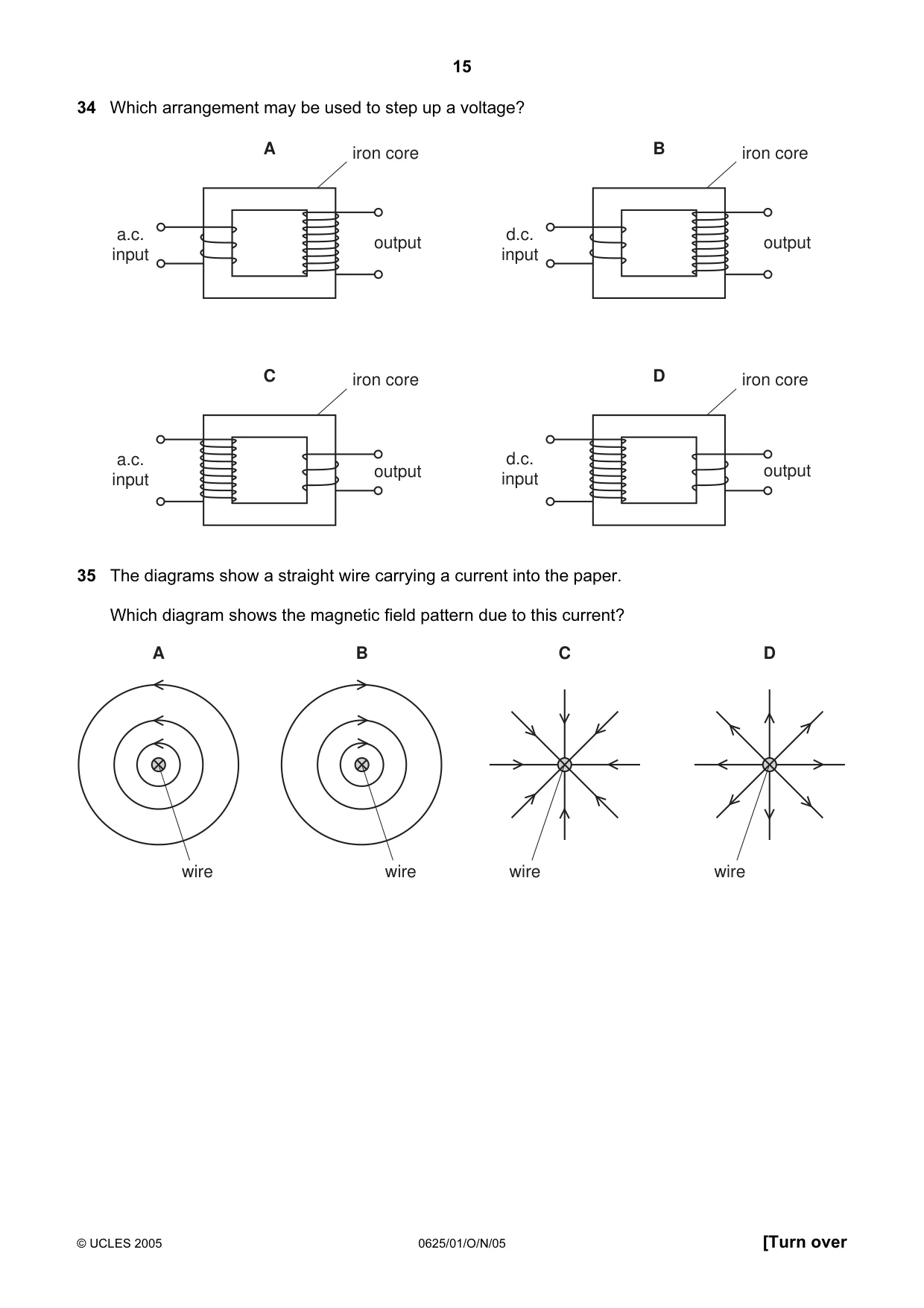
Q34 · Which arrangement may be used to step up a voltage?
34 Which arrangement may be used to step up a voltage? A iron core B iron core a.c. d.c. output output input input C iron core D iron core a.c. d.c. output output input input
Mark scheme: A
Q35 · The diagrams show a straight wire carrying a current into the paper
35 The diagrams show a straight wire carrying a current into the paper. Which diagram shows the magnetic field pattern due to this current? A B C D wire wire wire wire
Mark scheme: B
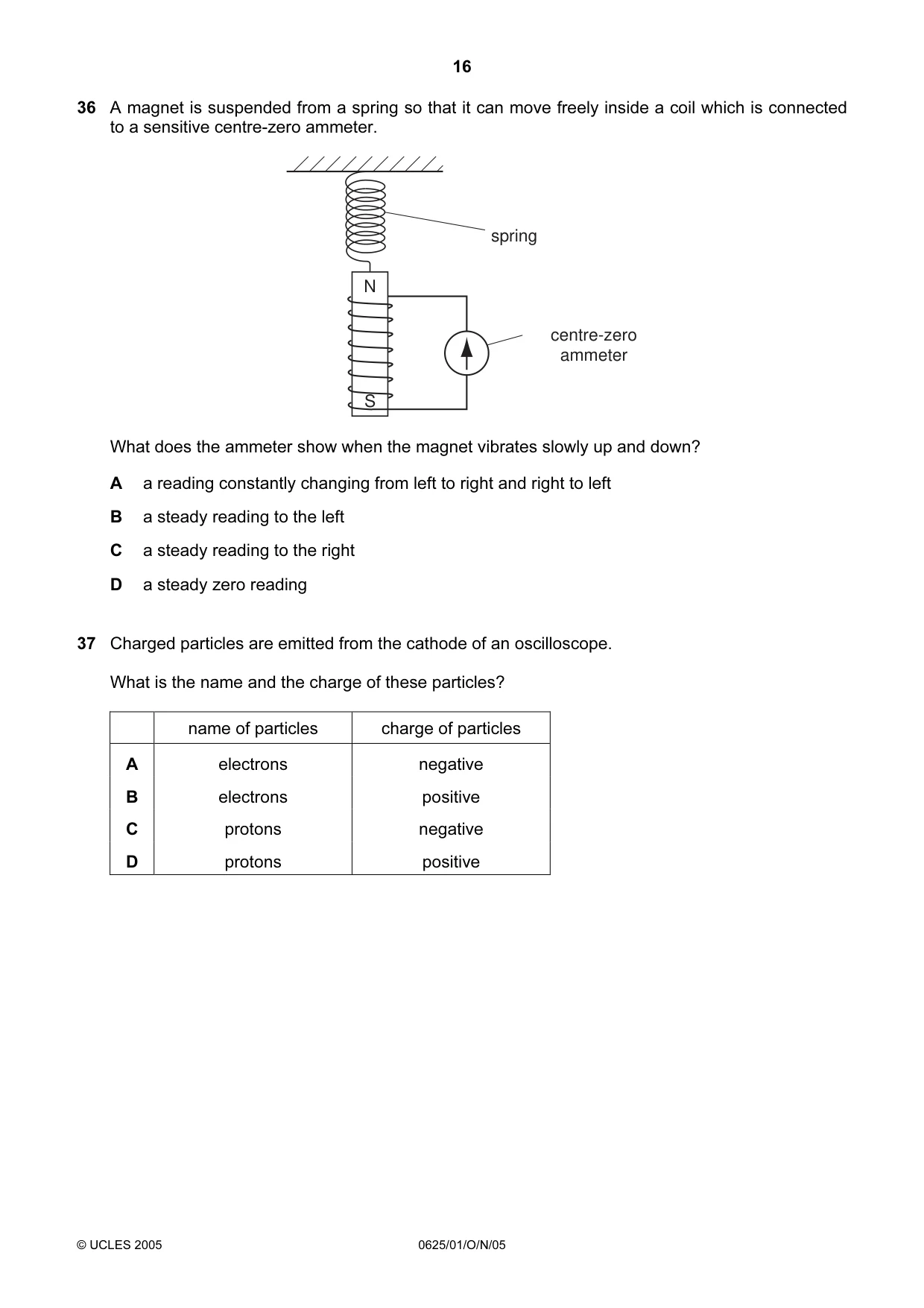
Q36 · A magnet is suspended from a spring so that it can move freely inside a coil which is…
36 A magnet is suspended from a spring so that it can move freely inside a coil which is connected to a sensitive centre-zero ammeter. spring N centre-zero ammeter S What does the ammeter show when the magnet vibrates slowly up and down? A a reading constantly changing from left to right and right to left B a steady reading to the left C a steady reading to the right D a steady zero reading
Mark scheme: A
Q37 · Charged particles are emitted from the cathode of an oscilloscope
37 Charged particles are emitted from the cathode of an oscilloscope. What is the name and the charge of these particles? name of particles charge of particles A electrons negative B electrons positive C protons negative D protons positive
Mark scheme: A
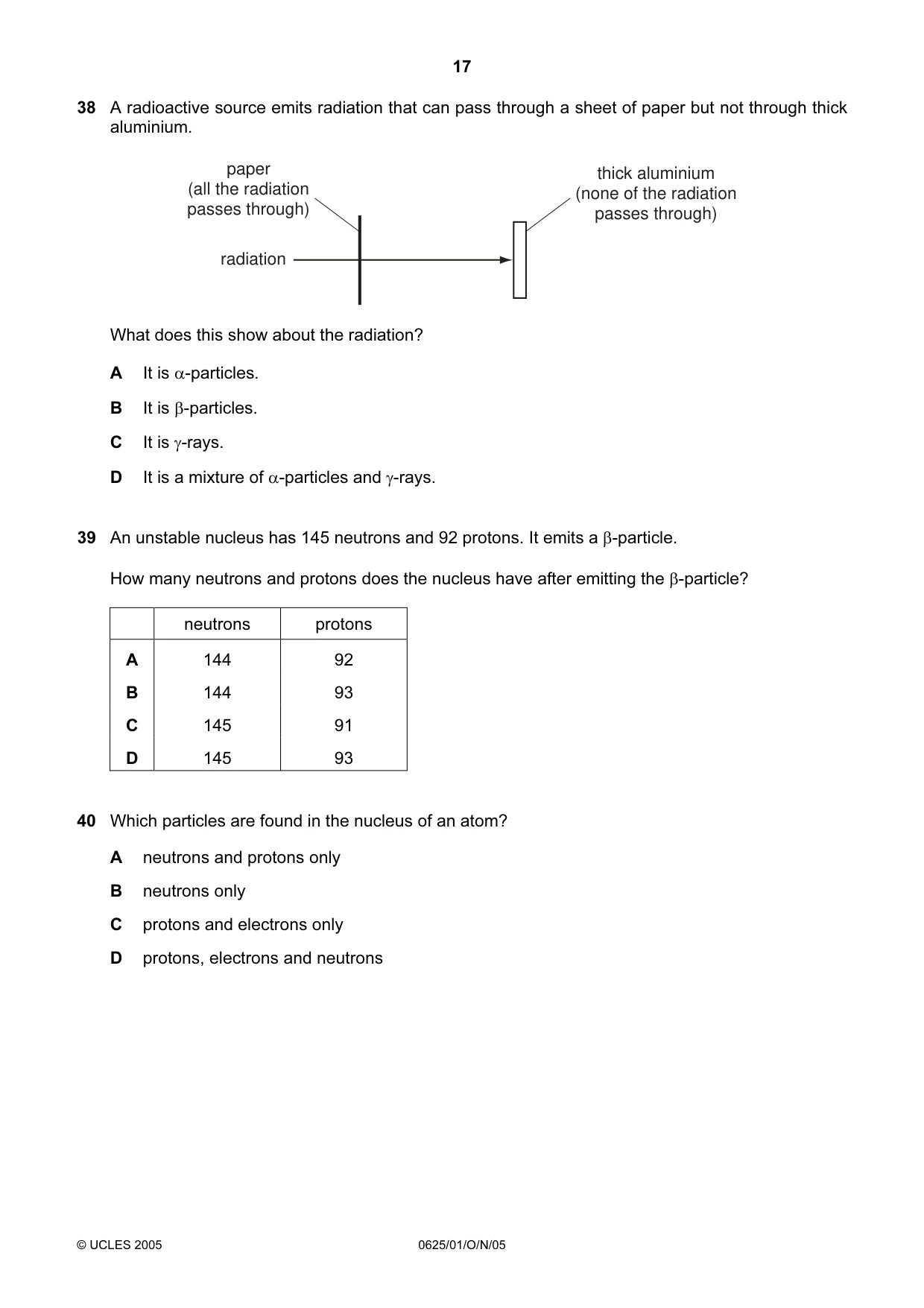
Q38 · A radioactive source emits radiation that can pass through a sheet of paper but not…
38 A radioactive source emits radiation that can pass through a sheet of paper but not through thick aluminium. paper thick aluminium (all the radiation (none of the radiation passes through) passes through) radiation What does this show about the radiation? A It is α-particles. B It is β-particles. C It is γ-rays. D It is a mixture of α-particles and γ-rays.
Mark scheme: B
Q39 · An unstable nucleus has 145 neutrons and 92 protons
39 An unstable nucleus has 145 neutrons and 92 protons. It emits a β-particle. How many neutrons and protons does the nucleus have after emitting the β-particle? neutrons protons A 144 92 B 144 93 C 145 91 D 145 93
Mark scheme: B
Q40 · Which particles are found in the nucleus of an atom?
40 Which particles are found in the nucleus of an atom? A neutrons and protons only B neutrons only C protons and electrons only D protons, electrons and neutrons
Mark scheme: A
What was in this paper
The subtopics covered by these 40 questions, and how many questions each got. Open one in a new tab to see every Cambridge question on it.
5Electromagnetic effects3Light3Energy, work and power2Forces2General properties of waves2Kinetic particle model of matter2Mass and weight2Motion2Pressure2Radioactivity2Simple phenomena of magnetism2Sound2The nuclear model of the atom2Thermal properties and temperature2Transfer of thermal energy2Density1Electrical quantities1Physical quantities and measurement techniques1