Cambridge IGCSE Physics 0625 — 2007 May/June Paper 1 · Variant 1
0625/11/M/J/07 · 40 questions · 40 marks · ≈45 min
The question paper and its mark scheme, free to read here and free to download. This is Cambridge’s own paper, exactly as it was sat.
Question paper20 pages

Mark scheme2 pages
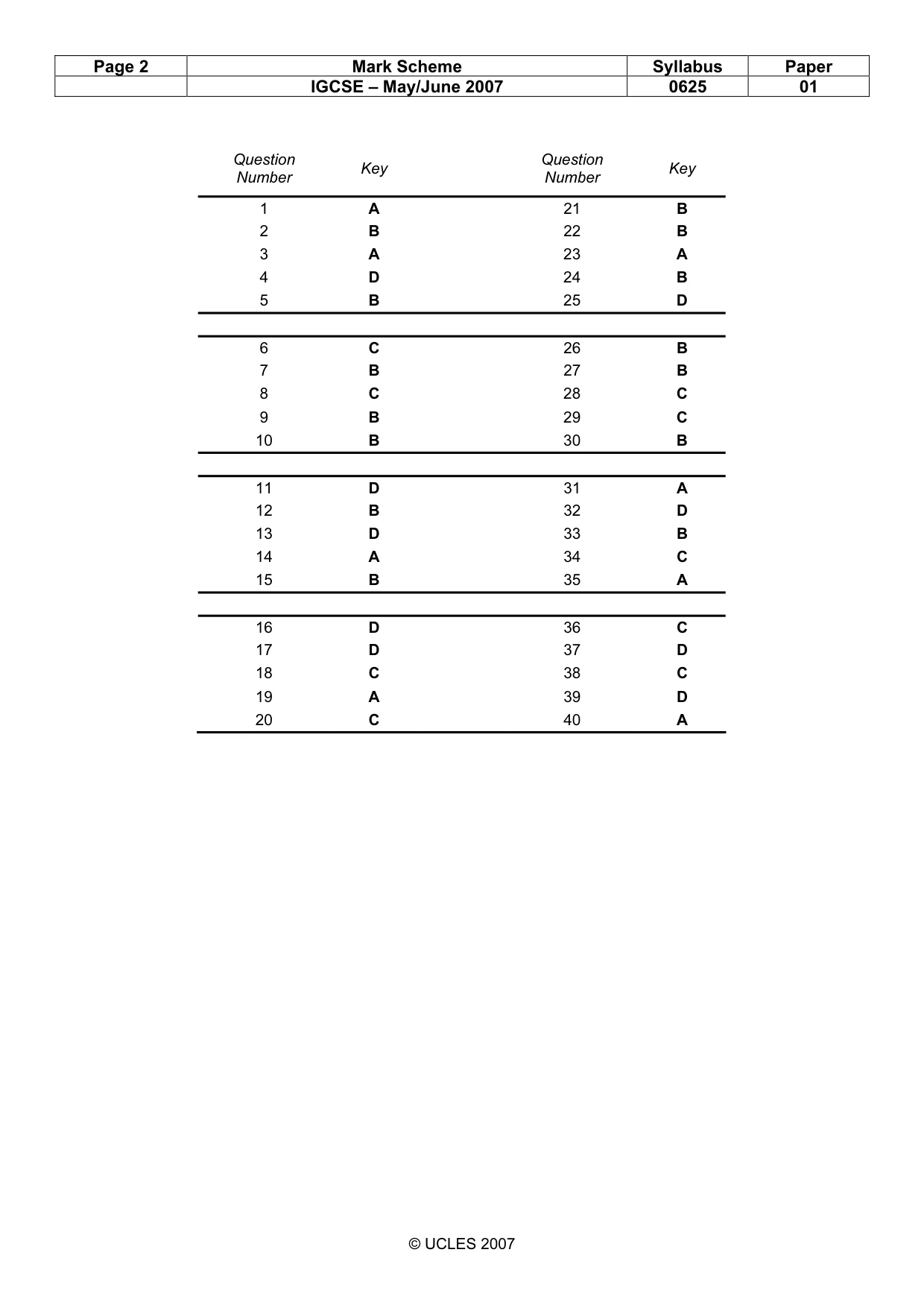
Answers below. Sit the paper first if you are practising.
Questions as text
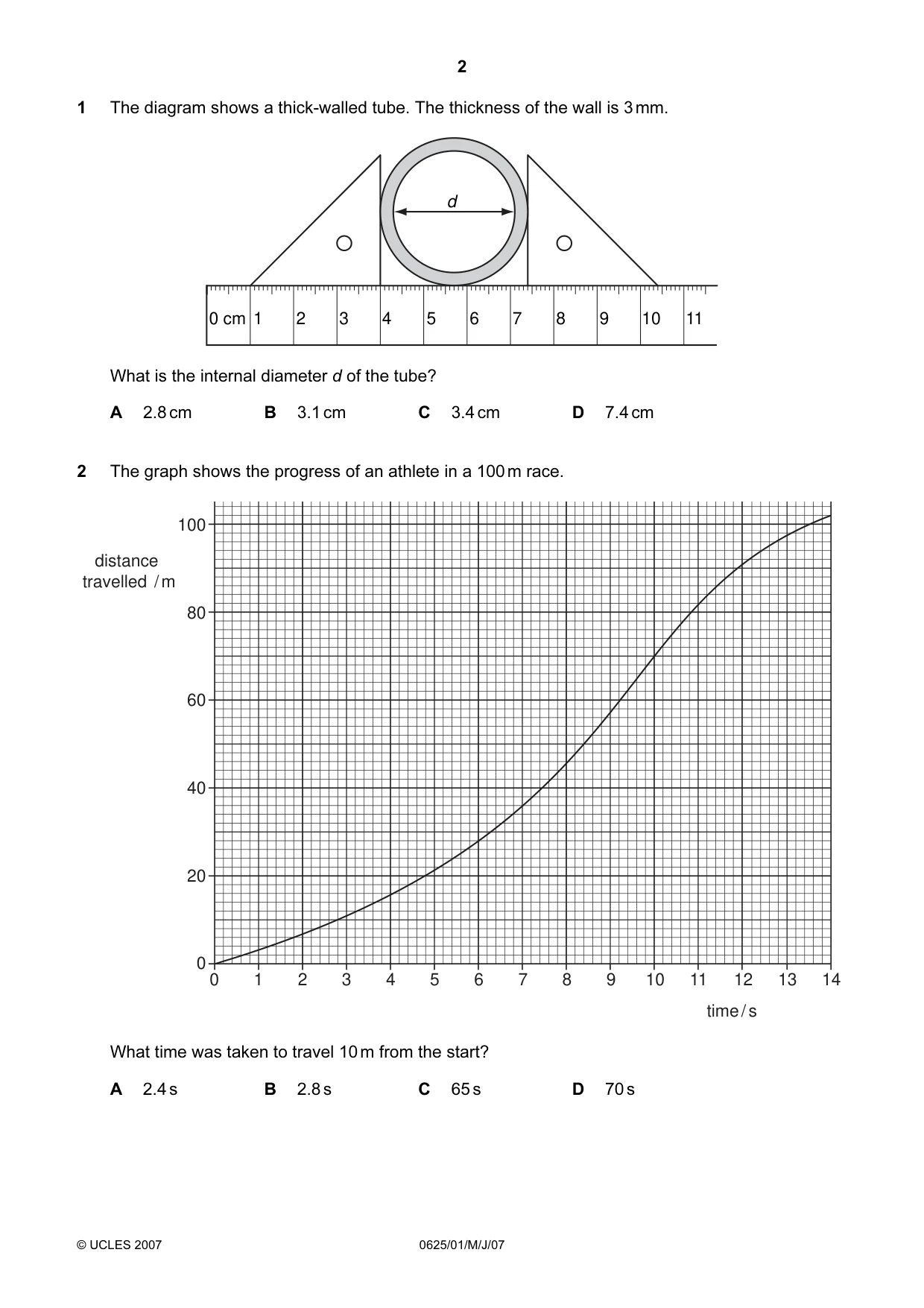
Q1 · The diagram shows a thick-walled tube
1 The diagram shows a thick-walled tube. The thickness of the wall is 3 mm. d 0 cm 1 2 3 4 5 6 7 8 9 10 11 What is the internal diameter d of the tube? A 2.8 cm B 3.1 cm C 3.4 cm D 7.4 cm
Mark scheme: A
More questions on Physical quantities and measurement techniques
Q2 · The graph shows the progress of an athlete in a 100 m race
2 The graph shows the progress of an athlete in a 100 m race. 100 distance travelled / m 80 60 40 20 0 0 1 2 3 4 5 6 7 8 9 10 11 12 13 14 time / s What time was taken to travel 10 m from the start? A 2.4 s B 2.8 s C 65 s D 70 s
Mark scheme: B
Q3 · Two stones of different weight fall at the same time from a table
3 Two stones of different weight fall at the same time from a table. Air resistance may be ignored. What will happen and why? what will happen why A both stones hit the floor at the same time the acceleration of free fall is constant B both stones hit the floor at the same time they fall at constant speed C the heavier stone hits the floor first acceleration increases with weight D the heavier stone hits the floor first speed increases with weight
Mark scheme: A
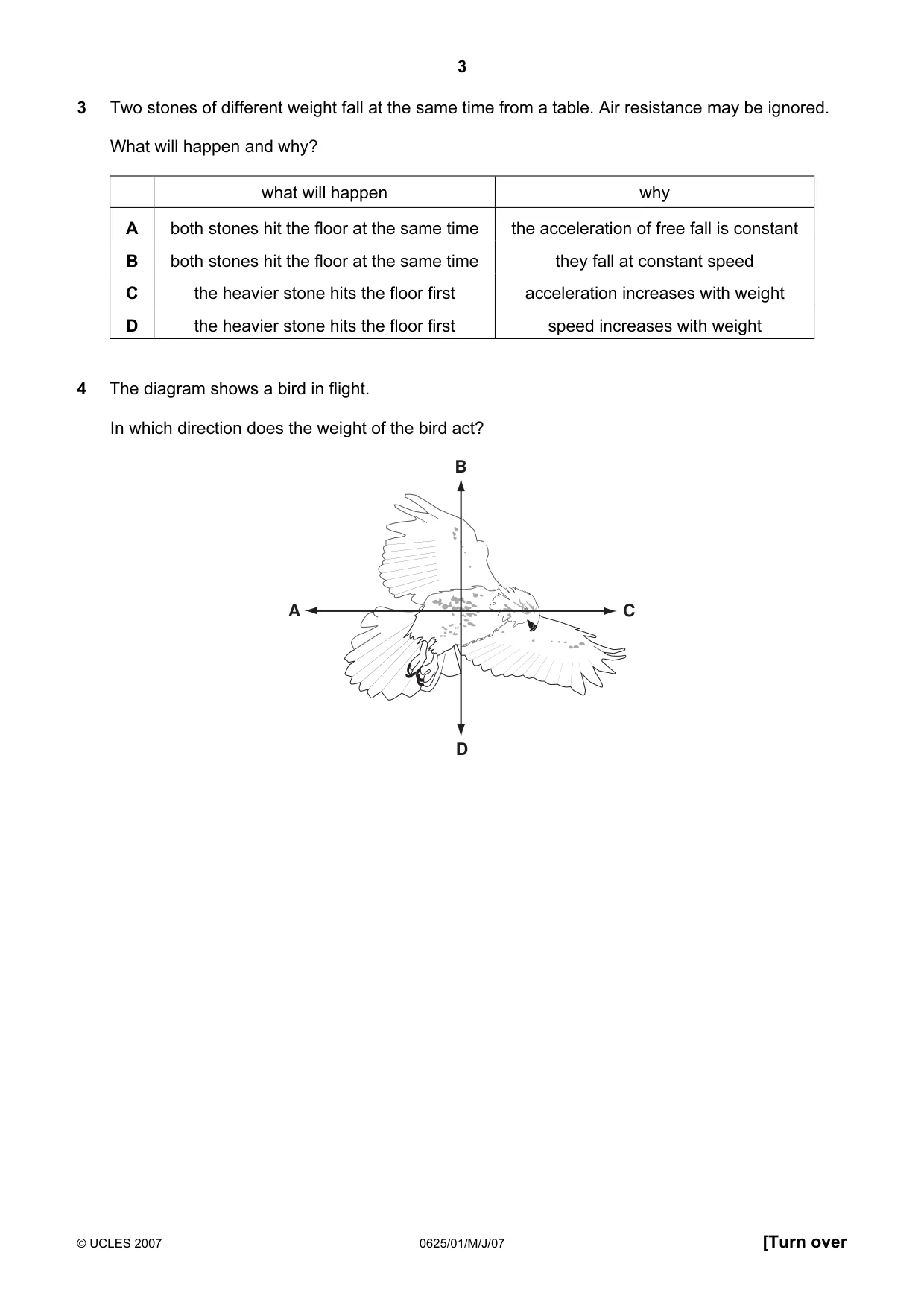
Q4 · The diagram shows a bird in flight
4 The diagram shows a bird in flight. In which direction does the weight of the bird act? B A C D
Mark scheme: D
Q5 · The mass of a full bottle of cooking oil is 1.30 kg
5 The mass of a full bottle of cooking oil is 1.30 kg. When exactly half of the oil has been used, the mass of the bottle plus the remaining oil is 0.90 kg. What is the mass of the empty bottle? A 0.40 kg B 0.50 kg C 0.65 kg D 0.80 kg
Mark scheme: B
Q6 · Which of the following is a unit of density?
6 Which of the following is a unit of density? A cm3 / g B g / cm2 C g / cm3 D kg / m2
Mark scheme: C
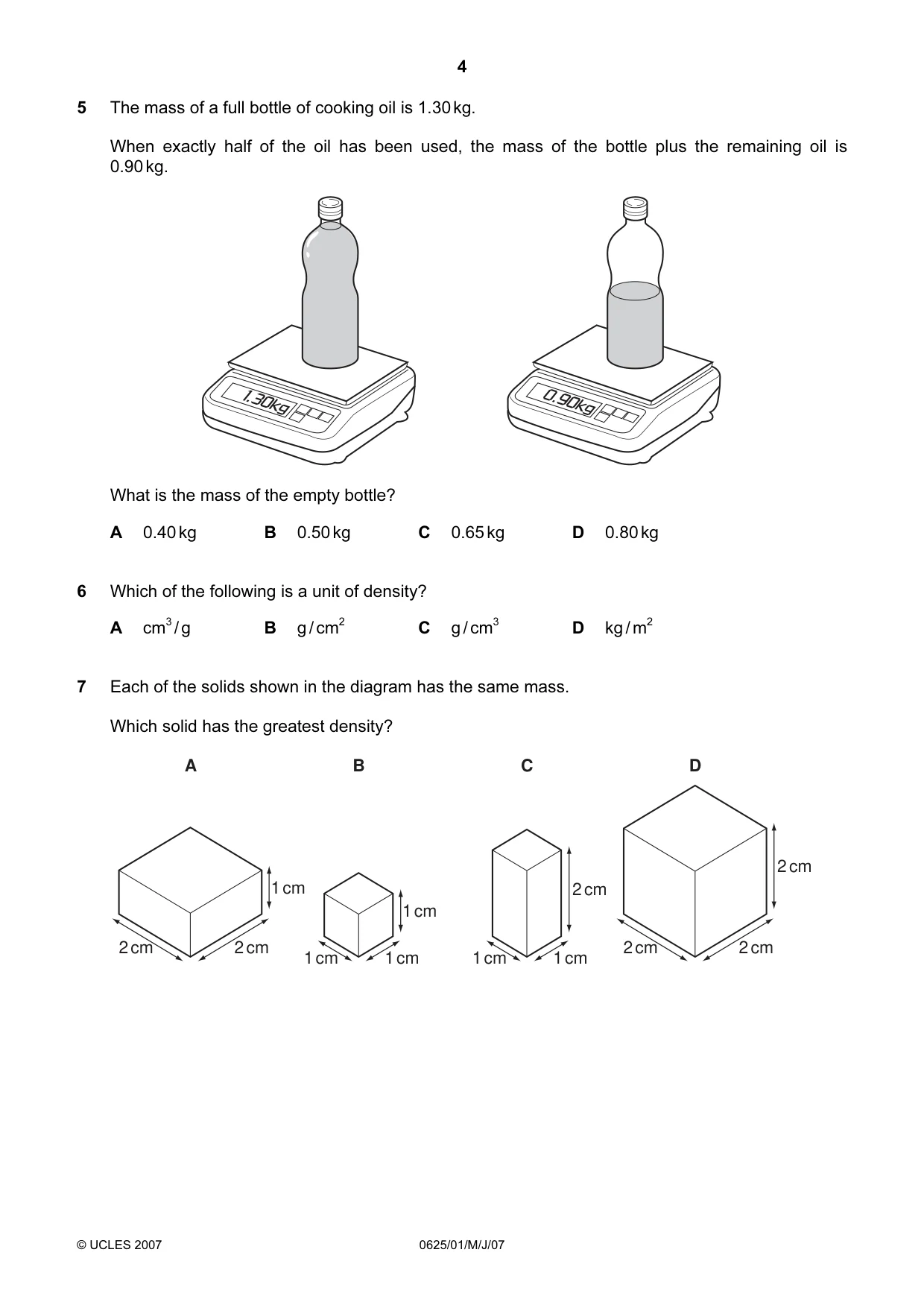
Q7 · Each of the solids shown in the diagram has the same mass
7 Each of the solids shown in the diagram has the same mass. Which solid has the greatest density? A B C D 2 cm 1 cm 2 cm 1 cm 2 cm 2 cm 2 cm 2 cm 1 cm 1 cm 1 cm 1 cm
Mark scheme: B
Q8 · A force acts on a moving rubber ball
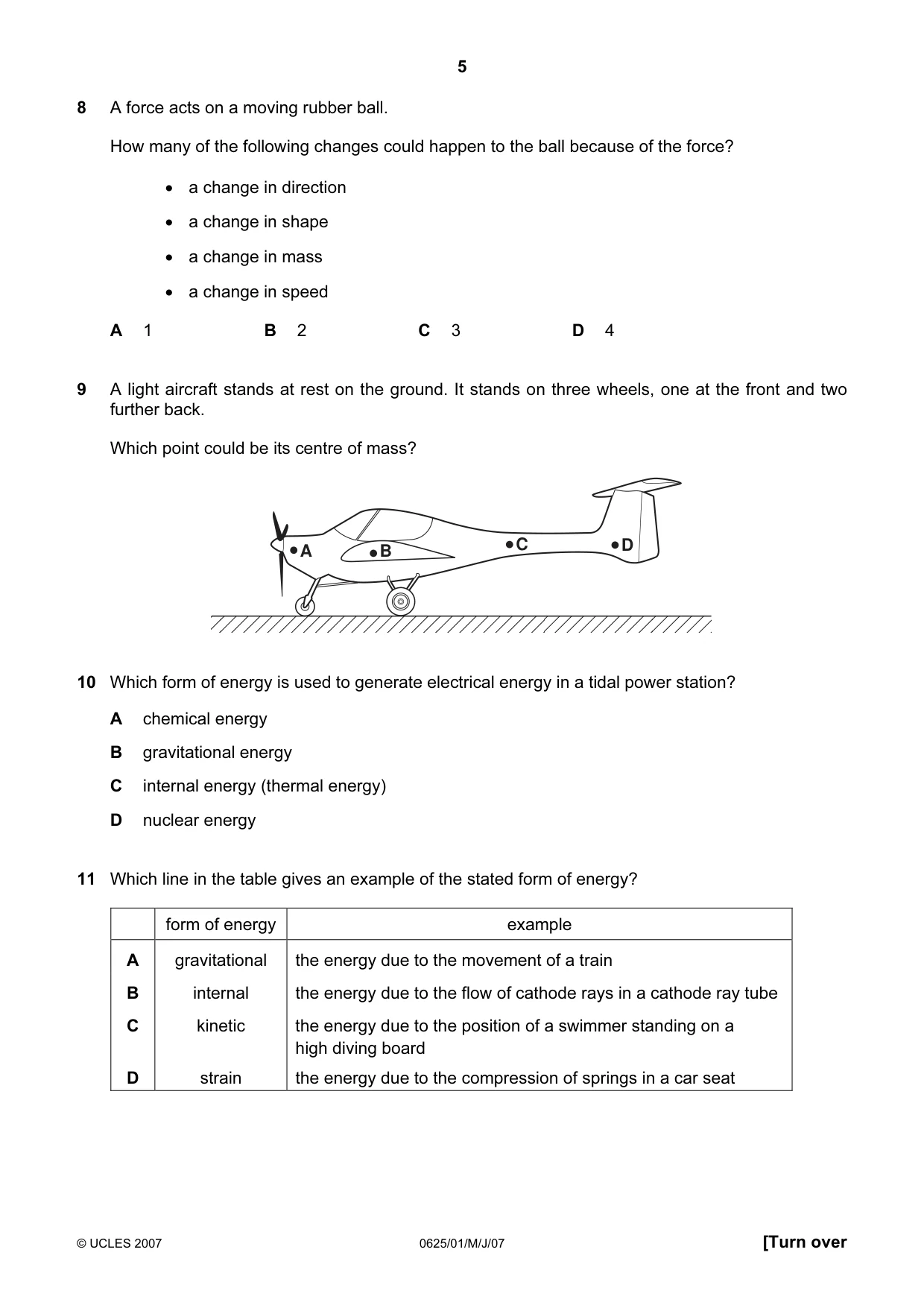
8 A force acts on a moving rubber ball. How many of the following changes could happen to the ball because of the force? • a change in direction • a change in shape • a change in mass • a change in speed A 1 B 2 C 3 D 4
Mark scheme: C
Q9 · A light aircraft stands at rest on the ground
9 A light aircraft stands at rest on the ground. It stands on three wheels, one at the front and two further back. Which point could be its centre of mass? A B C D
Mark scheme: B
Q10 · Which form of energy is used to generate electrical energy in a tidal power station?
10 Which form of energy is used to generate electrical energy in a tidal power station? A chemical energy B gravitational energy C internal energy (thermal energy) D nuclear energy
Mark scheme: B
Q11 · Which line in the table gives an example of the stated form of energy?
11 Which line in the table gives an example of the stated form of energy? form of energy example A gravitational the energy due to the movement of a train B internal the energy due to the flow of cathode rays in a cathode ray tube C kinetic the energy due to the position of a swimmer standing on a high diving board D strain the energy due to the compression of springs in a car seat
Mark scheme: D
Q12 · A pressure is measured using a manometer as shown in the diagram
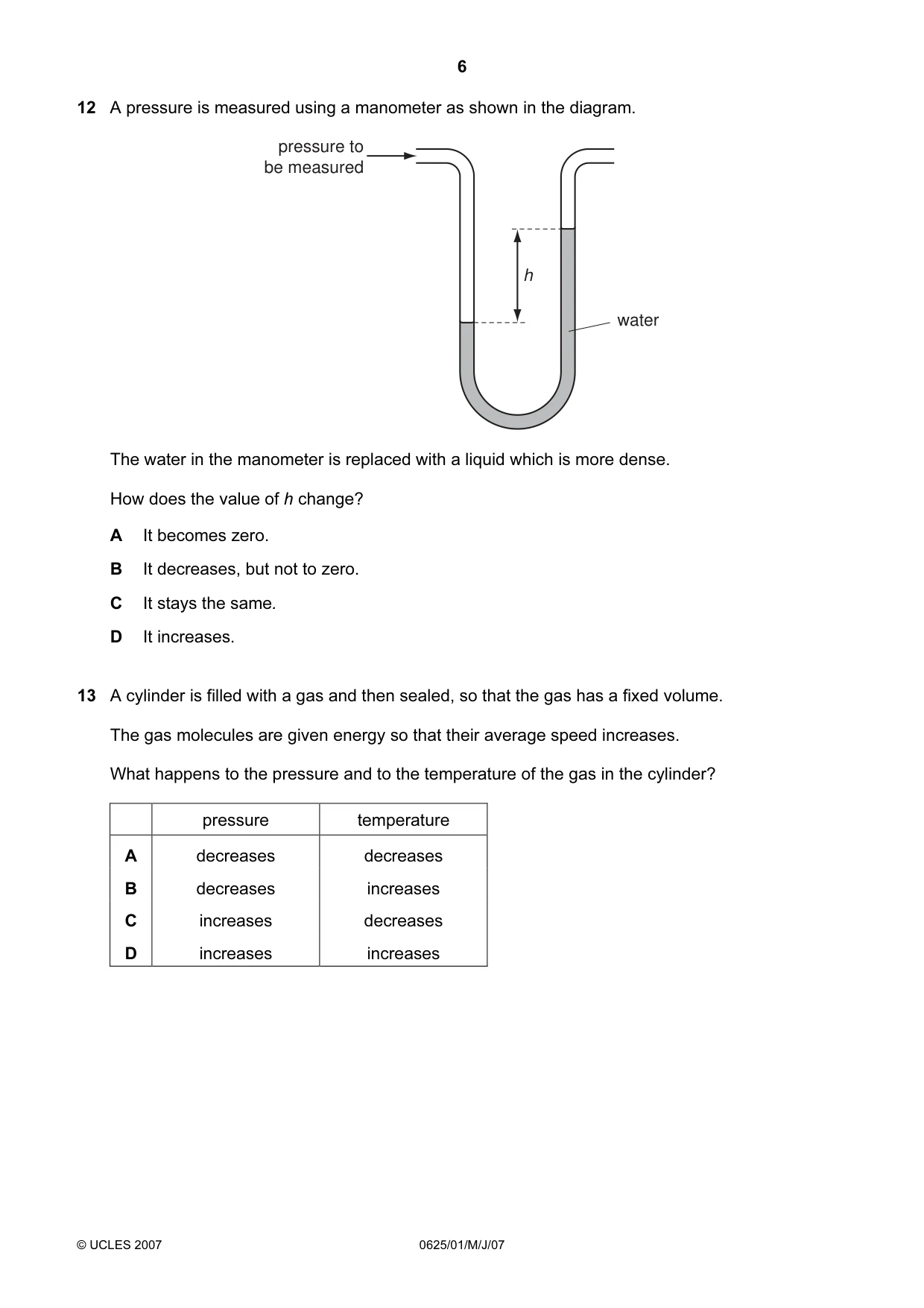
12 A pressure is measured using a manometer as shown in the diagram. pressure to be measured h water The water in the manometer is replaced with a liquid which is more dense. How does the value of h change? A It becomes zero. B It decreases, but not to zero. C It stays the same. D It increases.
Mark scheme: B
Q13 · A cylinder is filled with a gas and then sealed, so that the gas has a fixed volume
13 A cylinder is filled with a gas and then sealed, so that the gas has a fixed volume. The gas molecules are given energy so that their average speed increases. What happens to the pressure and to the temperature of the gas in the cylinder? pressure temperature A decreases decreases B decreases increases C increases decreases D increases increases
Mark scheme: D
Q14 · Apparatus being used to observe smoke particles
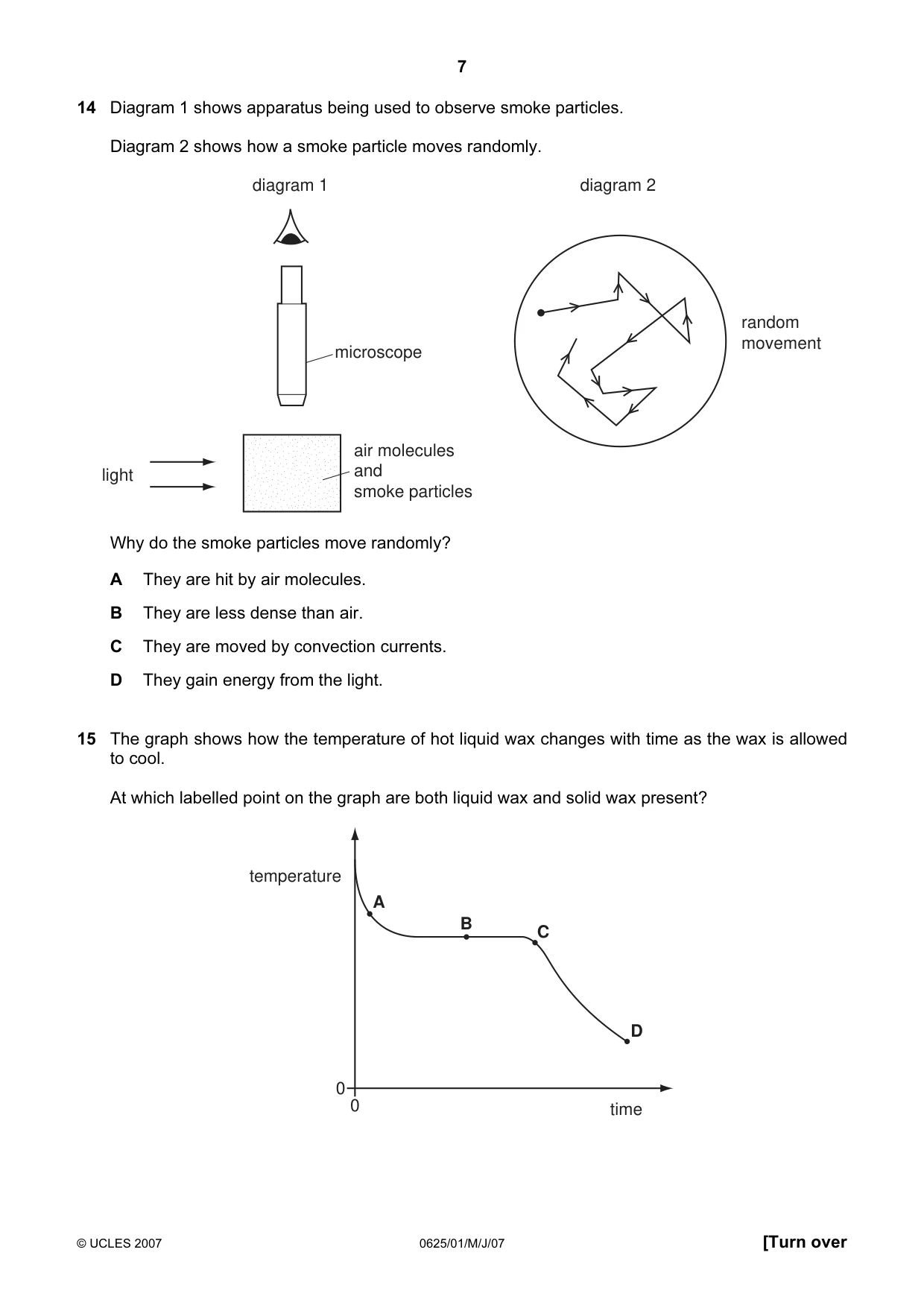
14 Diagram 1 shows apparatus being used to observe smoke particles. Diagram 2 shows how a smoke particle moves randomly. diagram 1 diagram 2 random movement microscope air molecules light and smoke particles Why do the smoke particles move randomly? A They are hit by air molecules. B They are less dense than air. C They are moved by convection currents. D They gain energy from the light.
Mark scheme: A
Q15 · The graph shows how the temperature of hot liquid wax changes with time as the wax is…
15 The graph shows how the temperature of hot liquid wax changes with time as the wax is allowed to cool. At which labelled point on the graph are both liquid wax and solid wax present? temperature A B C D 0 0 time
Mark scheme: B
Q16 · 1 kg of water and 1 kg of aluminium are heated to the same temperature and then allowed…
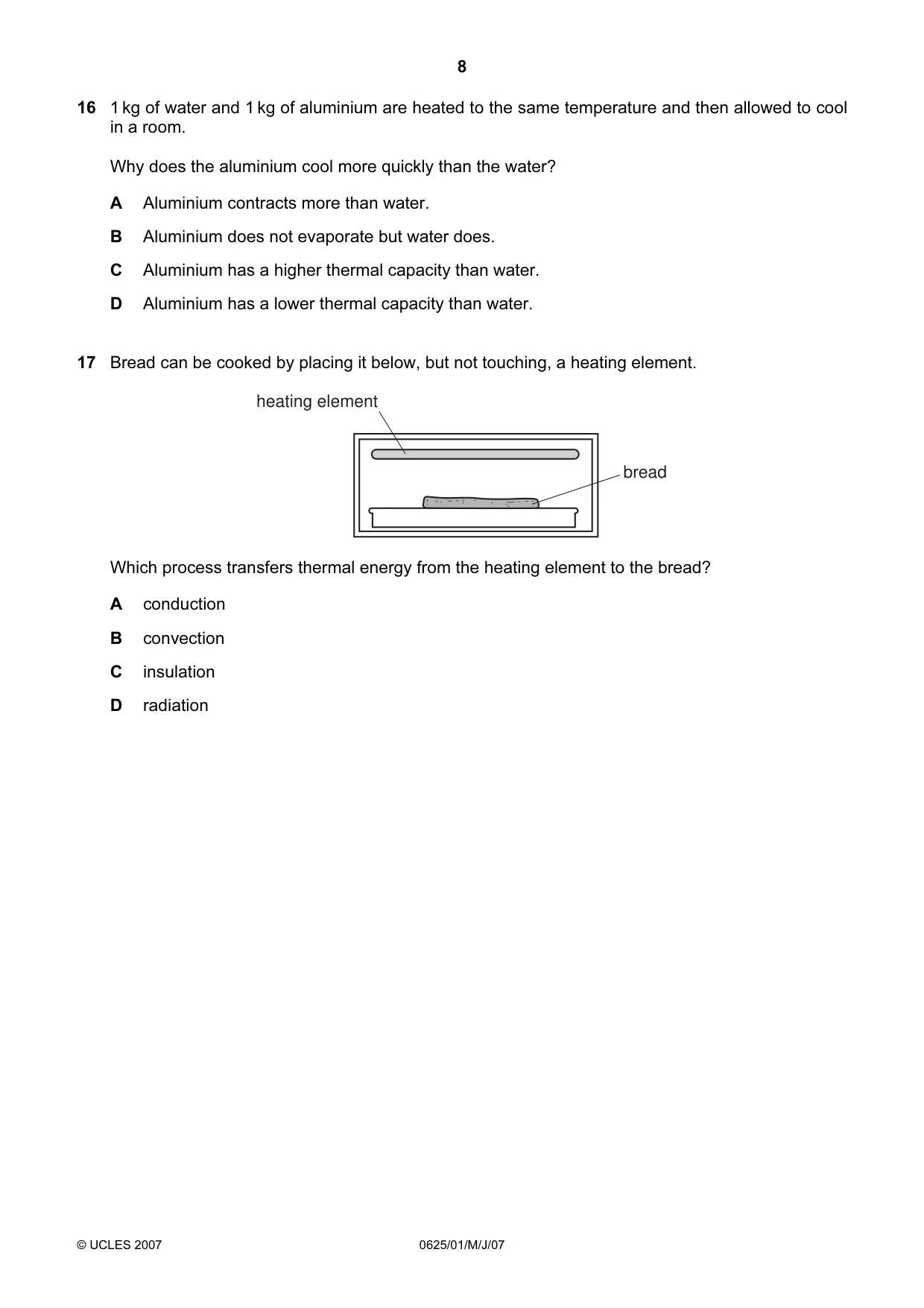
16 1 kg of water and 1 kg of aluminium are heated to the same temperature and then allowed to cool in a room. Why does the aluminium cool more quickly than the water? A Aluminium contracts more than water. B Aluminium does not evaporate but water does. C Aluminium has a higher thermal capacity than water. D Aluminium has a lower thermal capacity than water.
Mark scheme: D
Q17 · Bread can be cooked by placing it below, but not touching, a heating element
17 Bread can be cooked by placing it below, but not touching, a heating element. heating element bread Which process transfers thermal energy from the heating element to the bread? A conduction B convection C insulation D radiation
Mark scheme: D
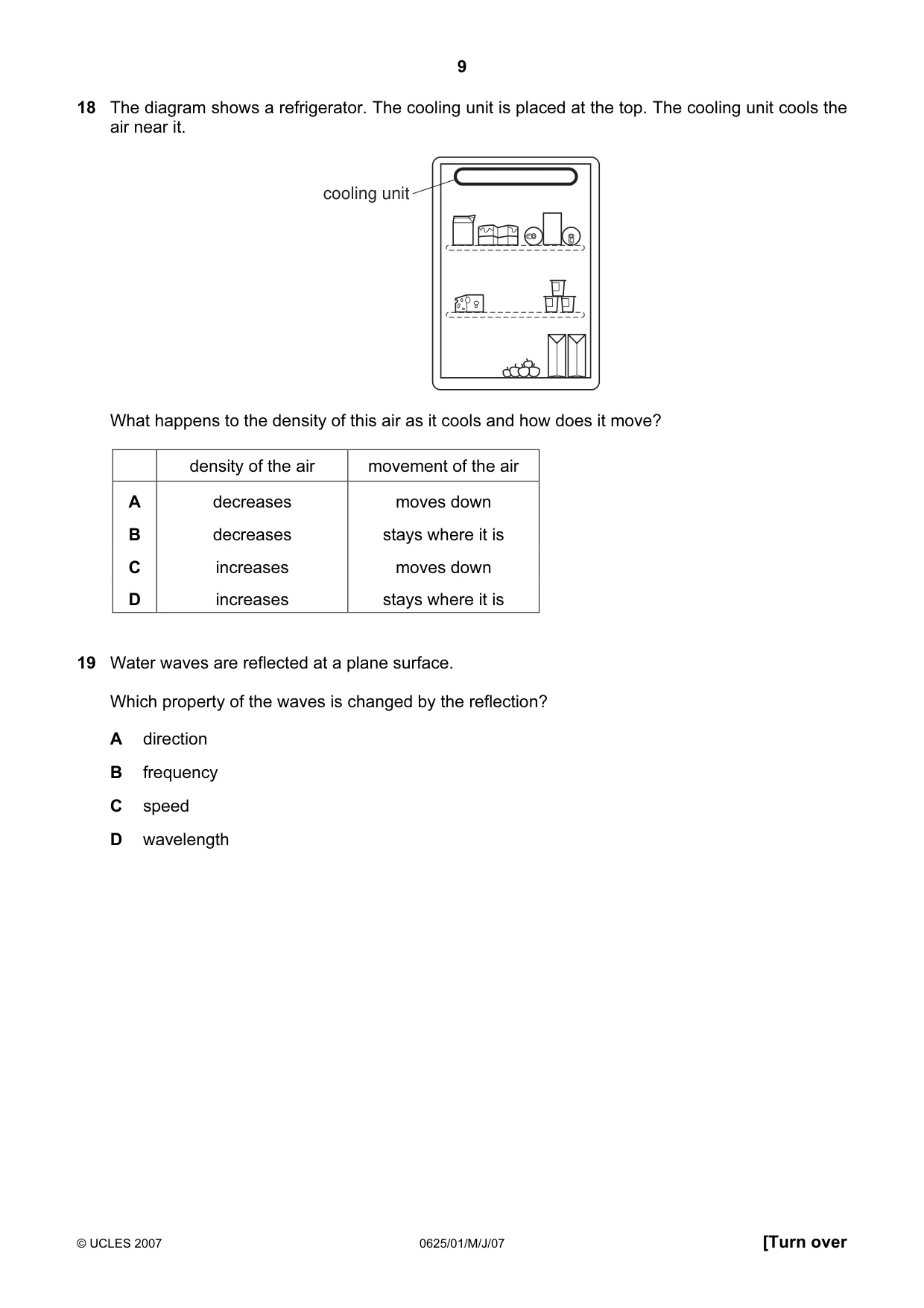
Q18 · The diagram shows a refrigerator
18 The diagram shows a refrigerator. The cooling unit is placed at the top. The cooling unit cools the air near it. cooling unit What happens to the density of this air as it cools and how does it move? density of the air movement of the air A decreases moves down B decreases stays where it is C increases moves down D increases stays where it is
Mark scheme: C
Q19 · Water waves are reflected at a plane surface
19 Water waves are reflected at a plane surface. Which property of the waves is changed by the reflection? A direction B frequency C speed D wavelength
Mark scheme: A
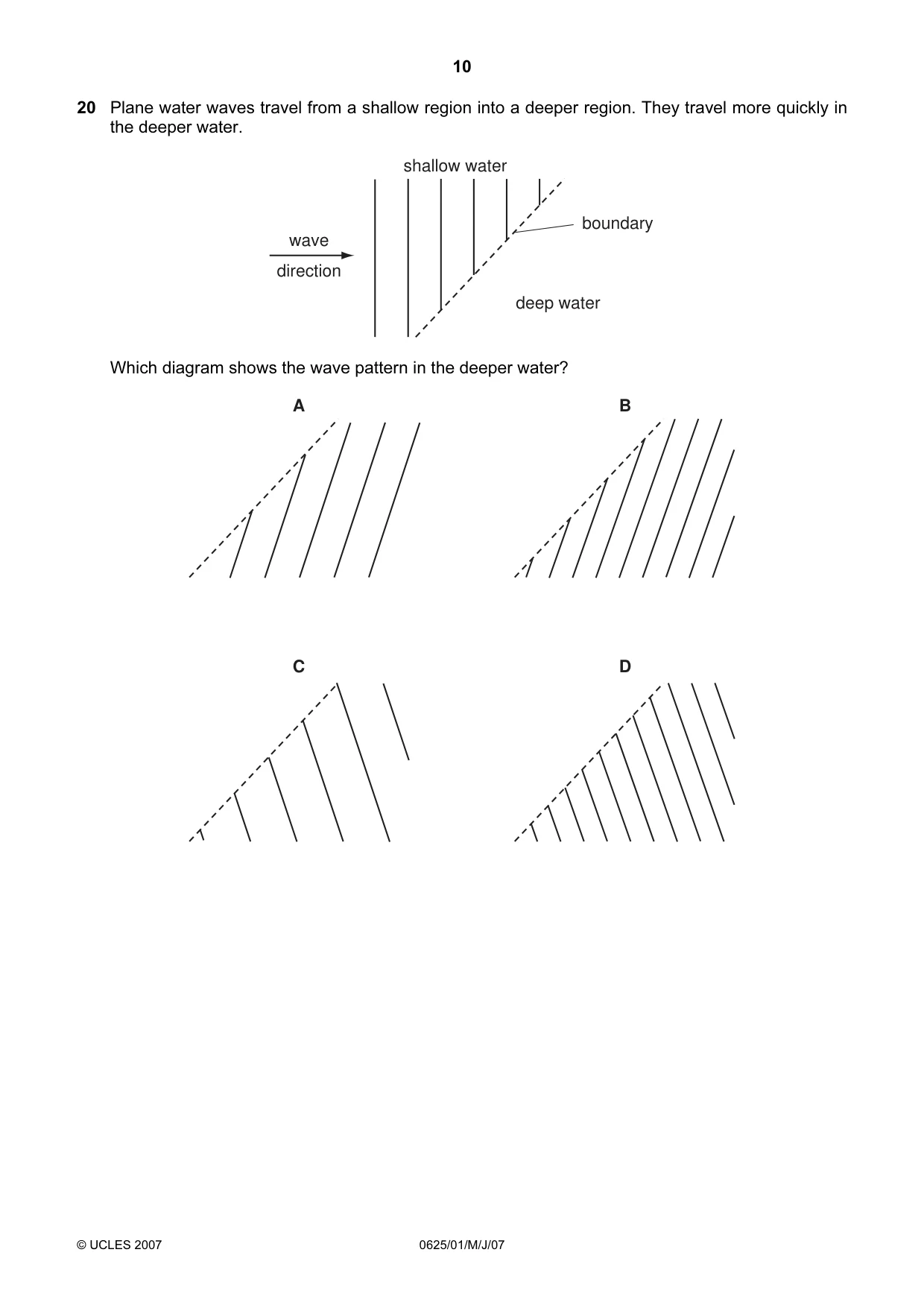
Q20 · Plane water waves travel from a shallow region into a deeper region
20 Plane water waves travel from a shallow region into a deeper region. They travel more quickly in the deeper water. shallow water boundary wave direction deep water Which diagram shows the wave pattern in the deeper water? A B C D
Mark scheme: C
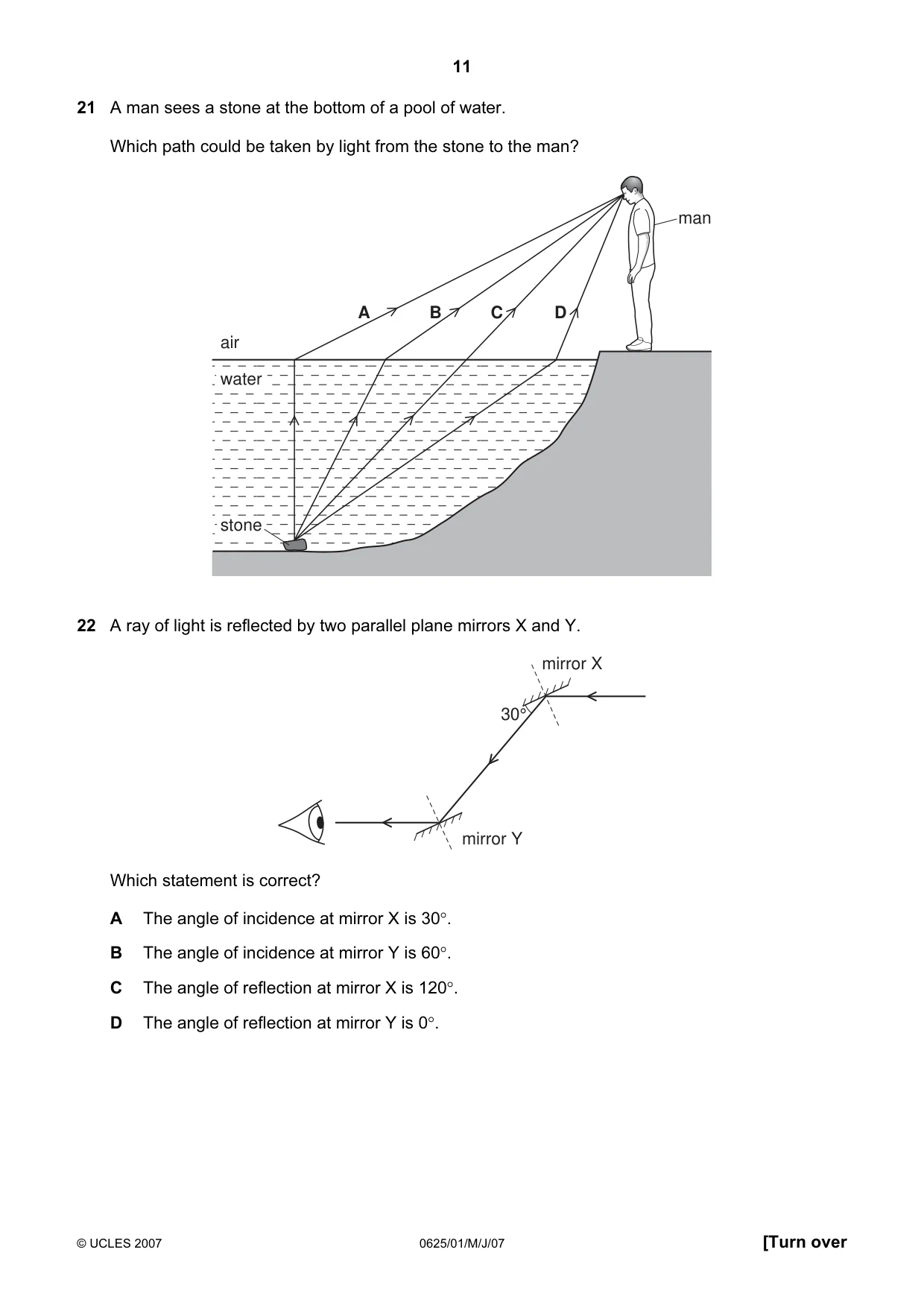
Q21 · A man sees a stone at the bottom of a pool of water
21 A man sees a stone at the bottom of a pool of water. Which path could be taken by light from the stone to the man? man A B C D air water stone
Mark scheme: B
Q22 · A ray of light is reflected by two parallel plane mirrors X and Y
22 A ray of light is reflected by two parallel plane mirrors X and Y. mirror X 30° mirror Y Which statement is correct? A The angle of incidence at mirror X is 30°. B The angle of incidence at mirror Y is 60°. C The angle of reflection at mirror X is 120°. D The angle of reflection at mirror Y is 0°.
Mark scheme: B
Q23 · Music is produced by the loudspeaker of a radio
23 Music is produced by the loudspeaker of a radio. Which property of the sound wave increases when the music is made louder? A amplitude B frequency C speed D wavelength
Mark scheme: A
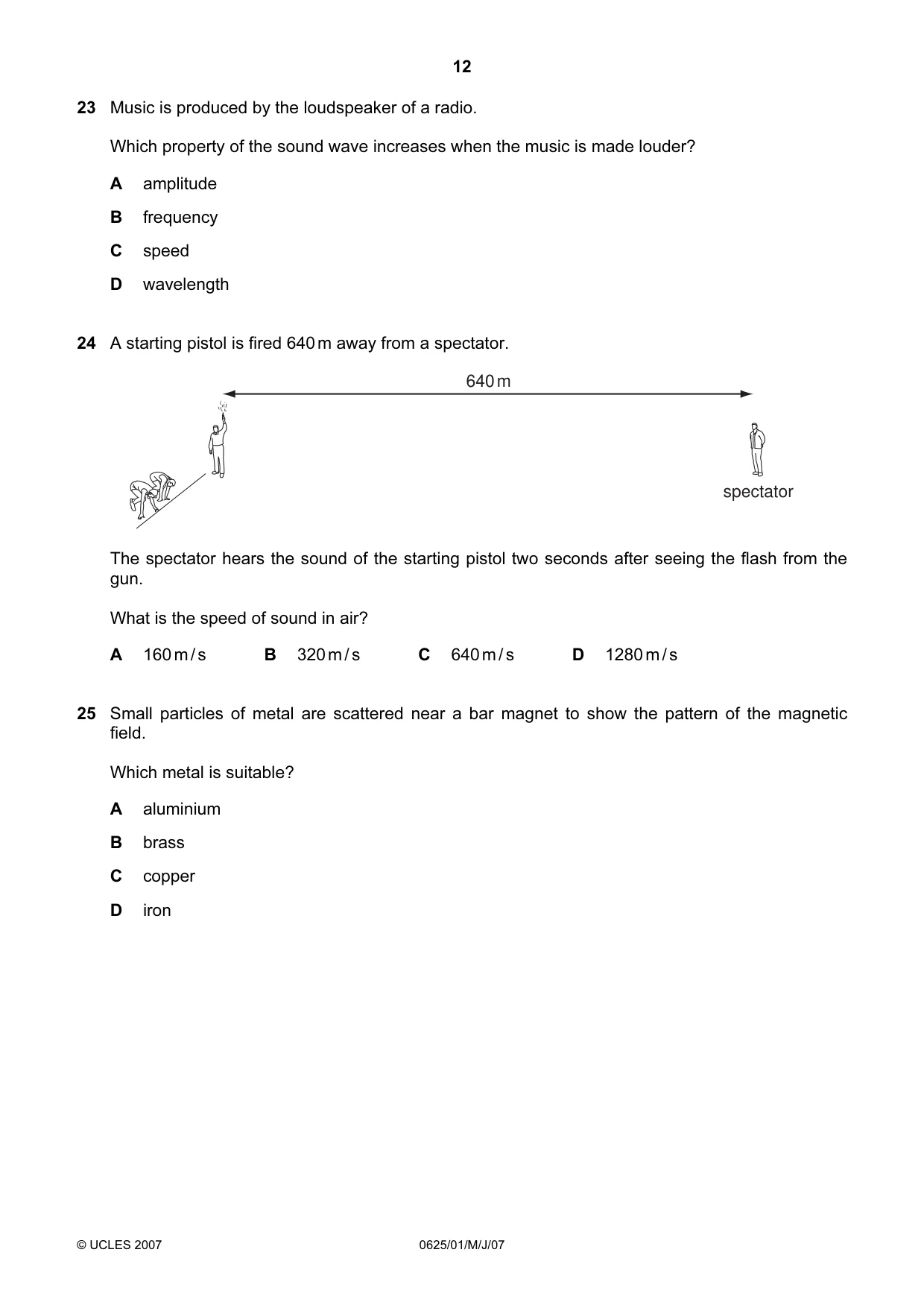
Q24 · A starting pistol is fired 640 m away from a spectator
24 A starting pistol is fired 640 m away from a spectator. 640 m spectator The spectator hears the sound of the starting pistol two seconds after seeing the flash from the gun. What is the speed of sound in air? A 160 m / s B 320 m / s C 640 m / s D 1280 m / s
Mark scheme: B
Q25 · Small particles of metal are scattered near a bar magnet to show the pattern of the…
25 Small particles of metal are scattered near a bar magnet to show the pattern of the magnetic field. Which metal is suitable? A aluminium B brass C copper D iron
Mark scheme: D
Q26 · A strong electromagnet is used to attract pins
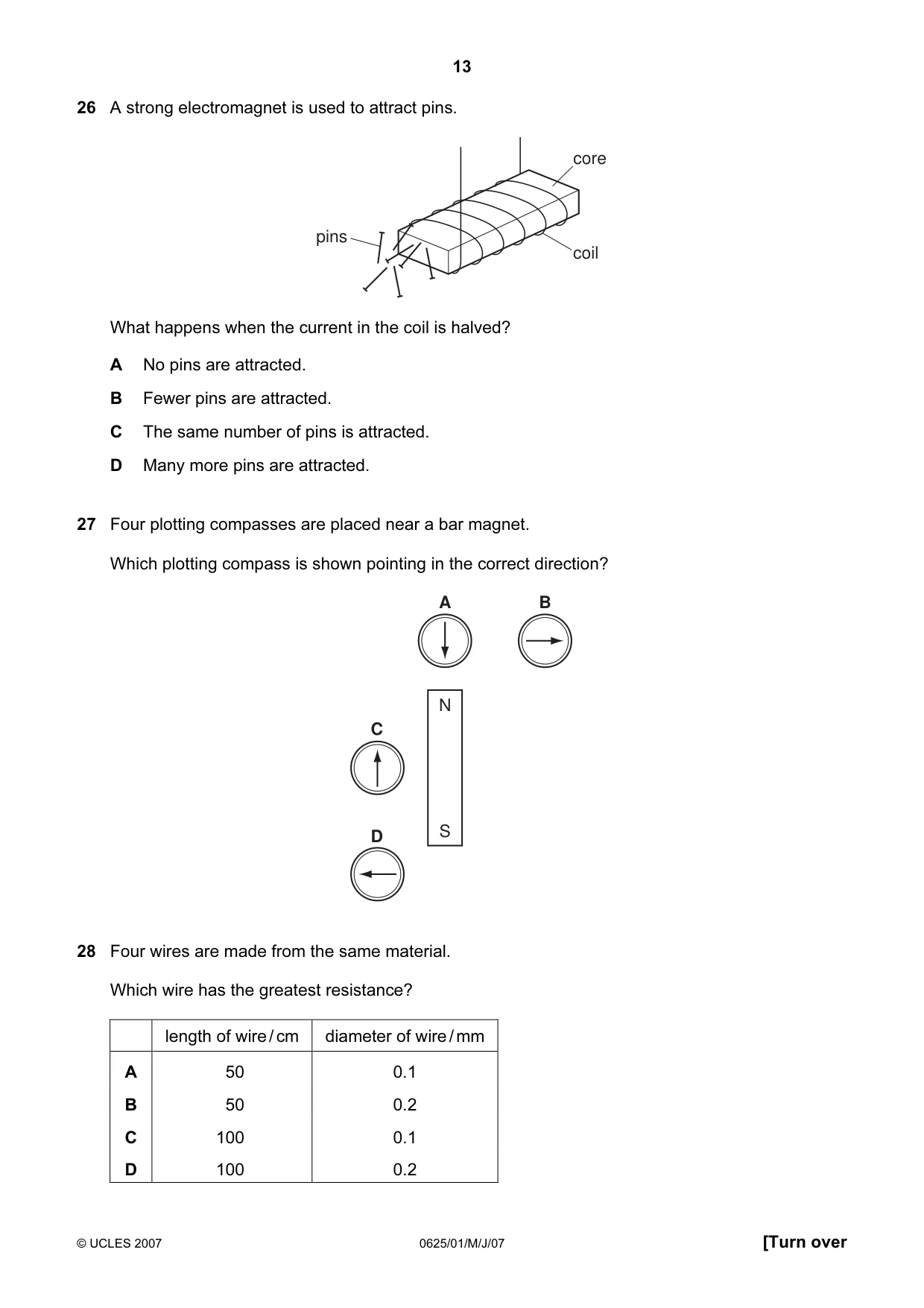
26 A strong electromagnet is used to attract pins. core pins coil What happens when the current in the coil is halved? A No pins are attracted. B Fewer pins are attracted. C The same number of pins is attracted. D Many more pins are attracted.
Mark scheme: B
Q27 · Four plotting compasses are placed near a bar magnet
27 Four plotting compasses are placed near a bar magnet. Which plotting compass is shown pointing in the correct direction? A B N C D S
Mark scheme: B
Q28 · Four wires are made from the same material
28 Four wires are made from the same material. Which wire has the greatest resistance? length of wire / cm diameter of wire / mm A 50 0.1 B 50 0.2 C 100 0.1 D 100 0.2
Mark scheme: C
Q29 · A plastic rod is rubbed with a dry cloth and becomes positively charged
29 A plastic rod is rubbed with a dry cloth and becomes positively charged. Why has the rod become positively charged? A It has gained electrons. B It has gained neutrons. C It has lost electrons. D It has lost neutrons.
Mark scheme: C
Q30 · Which circuit is a variable potential divider (potentiometer)?
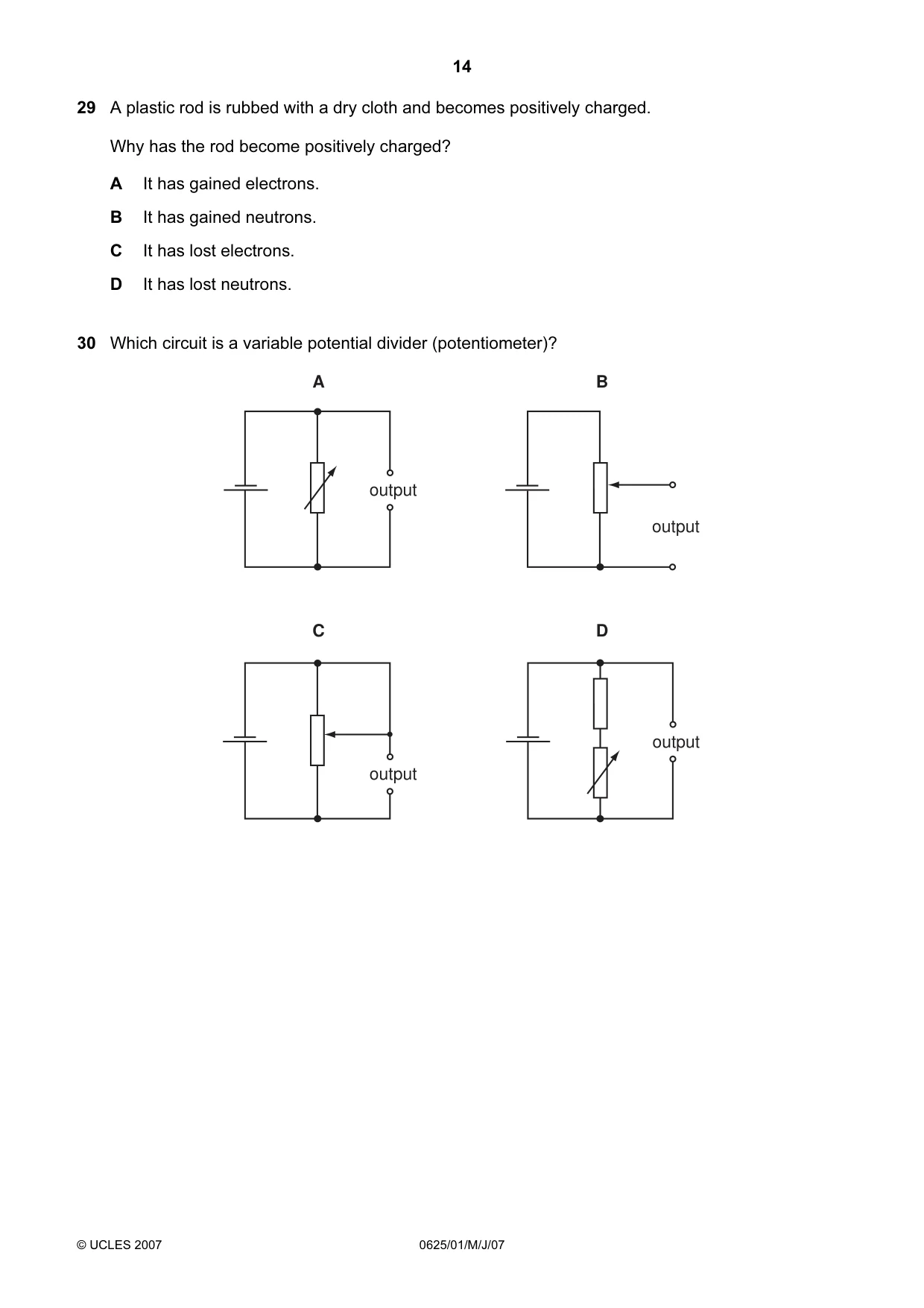
30 Which circuit is a variable potential divider (potentiometer)? A B output output C D output output
Mark scheme: B
Q31 · The circuit contains a relay
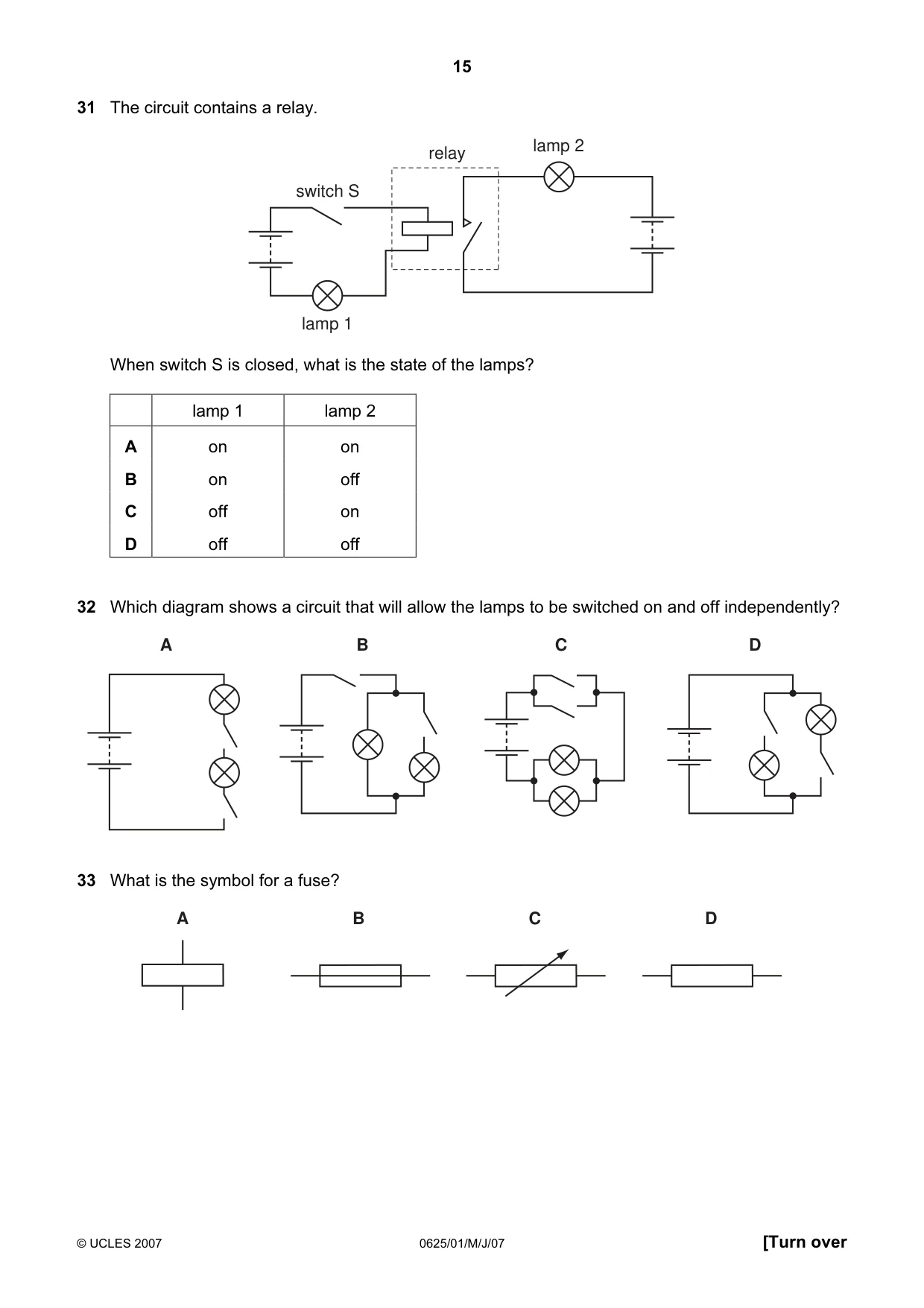
31 The circuit contains a relay. relay lamp 2 switch S lamp 1 When switch S is closed, what is the state of the lamps? lamp 1 lamp 2 A on on B on off C off on D off off
Mark scheme: A
Q32 · Which diagram shows a circuit that will allow the lamps to be switched on and off…
32 Which diagram shows a circuit that will allow the lamps to be switched on and off independently? A B C D
Mark scheme: D
Q33 · What is the symbol for a fuse?
33 What is the symbol for a fuse? A B C D
Mark scheme: B
Q34 · A cable in a house is carrying too much current
34 A cable in a house is carrying too much current. What is the greatest danger? A appliances not working B electric shock C fire D low power
Mark scheme: C
Q35 · A coil is rotated steadily between the poles of a magnet
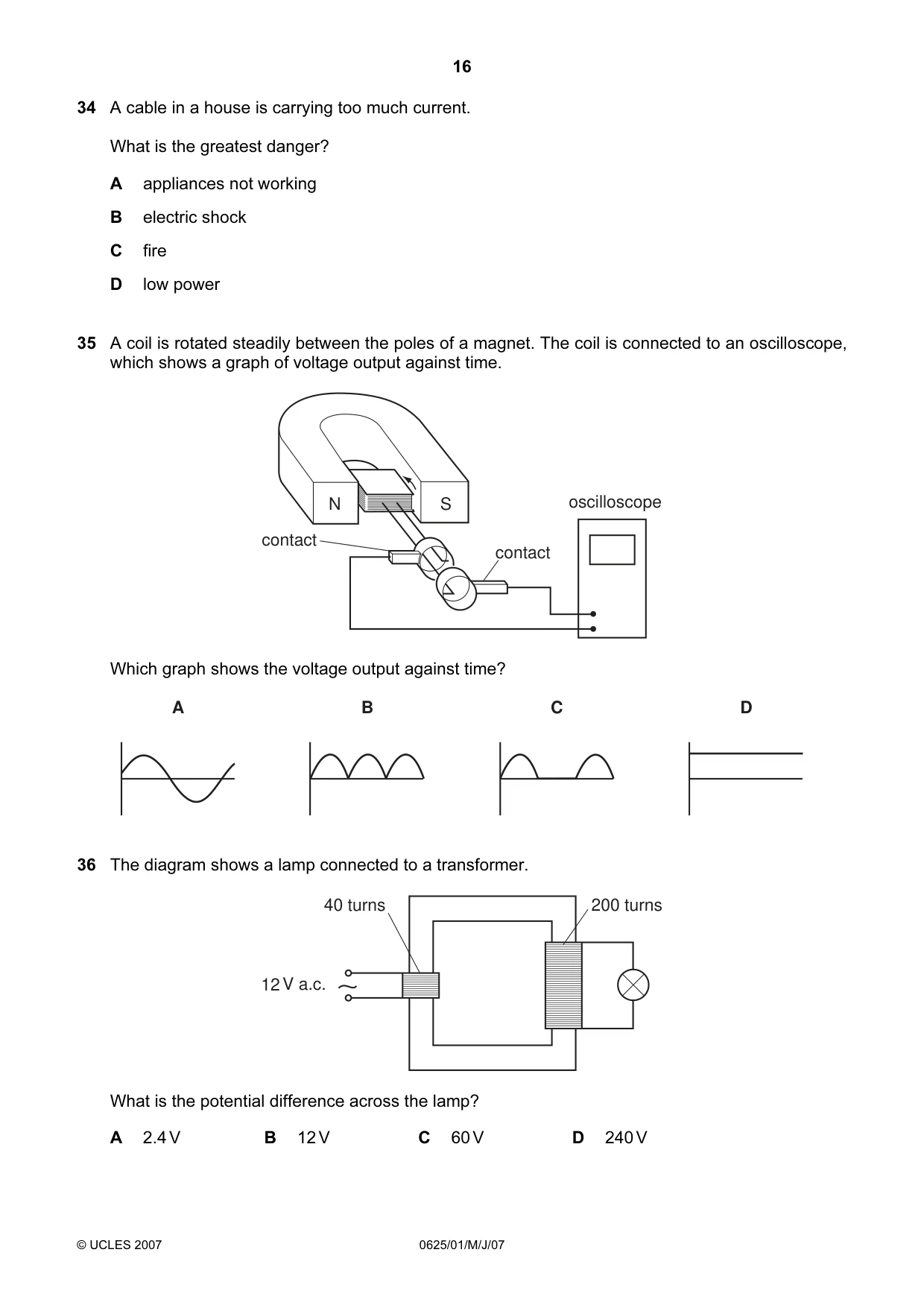
35 A coil is rotated steadily between the poles of a magnet. The coil is connected to an oscilloscope, which shows a graph of voltage output against time. N S oscilloscope contact contact Which graph shows the voltage output against time? A B C D
Mark scheme: A
Q36 · The diagram shows a lamp connected to a transformer
36 The diagram shows a lamp connected to a transformer. 40 turns 200 turns 12 V a.c. What is the potential difference across the lamp? A 2.4 V B 12 V C 60 V D 240 V
Mark scheme: C
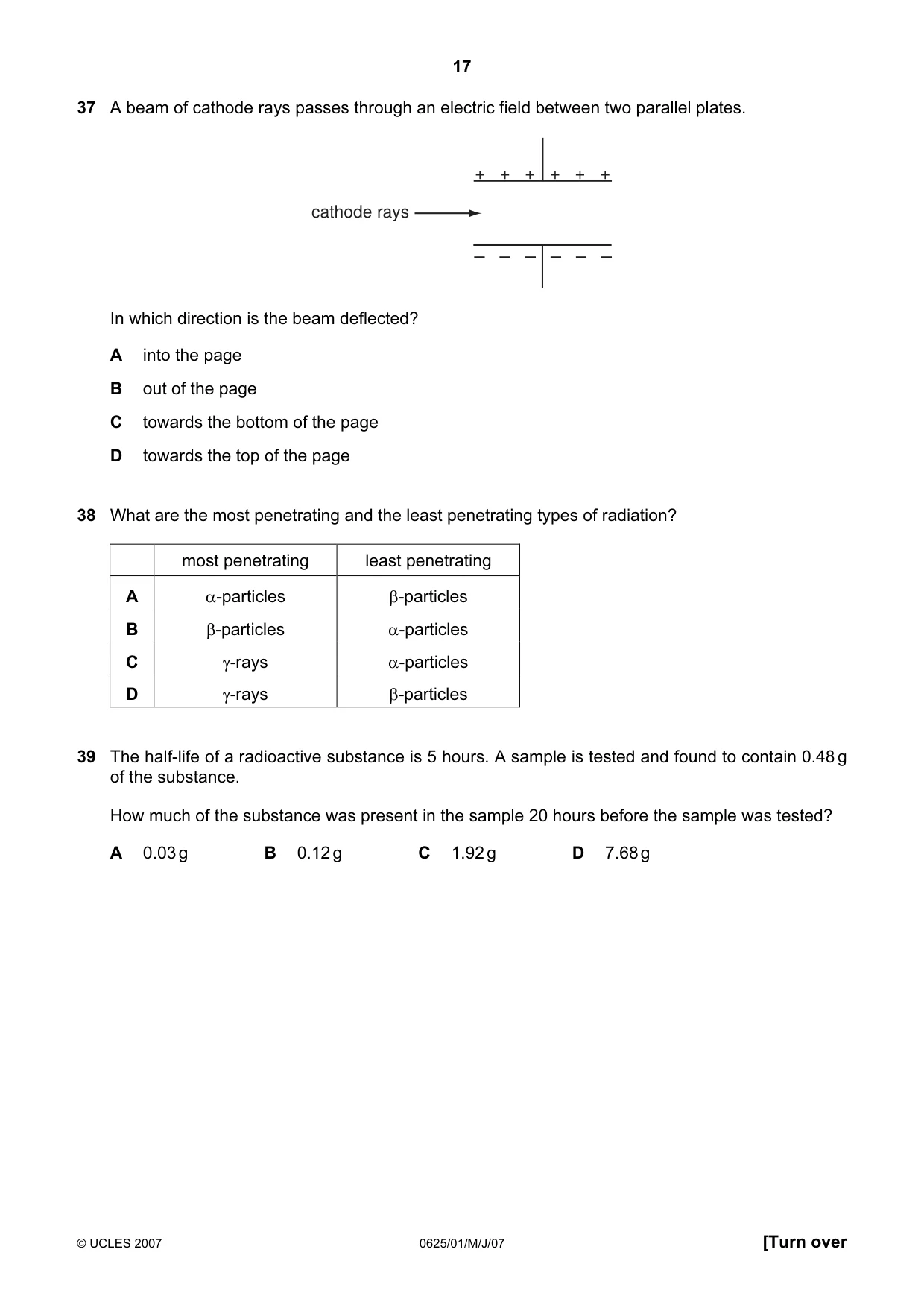
Q37 · A beam of cathode rays passes through an electric field between two parallel plates
37 A beam of cathode rays passes through an electric field between two parallel plates. + + + + + + cathode rays – – – – – – In which direction is the beam deflected? A into the page B out of the page C towards the bottom of the page D towards the top of the page
Mark scheme: D
Q38 · What are the most penetrating and the least penetrating types of radiation?
38 What are the most penetrating and the least penetrating types of radiation? most penetrating least penetrating A α-particles β-particles B β-particles α-particles C γ-rays α-particles D γ-rays β-particles
Mark scheme: C
Q39 · The half-life of a radioactive substance is 5 hours
39 The half-life of a radioactive substance is 5 hours. A sample is tested and found to contain 0.48 g of the substance. How much of the substance was present in the sample 20 hours before the sample was tested? A 0.03 g B 0.12 g C 1.92 g D 7.68 g
Mark scheme: D
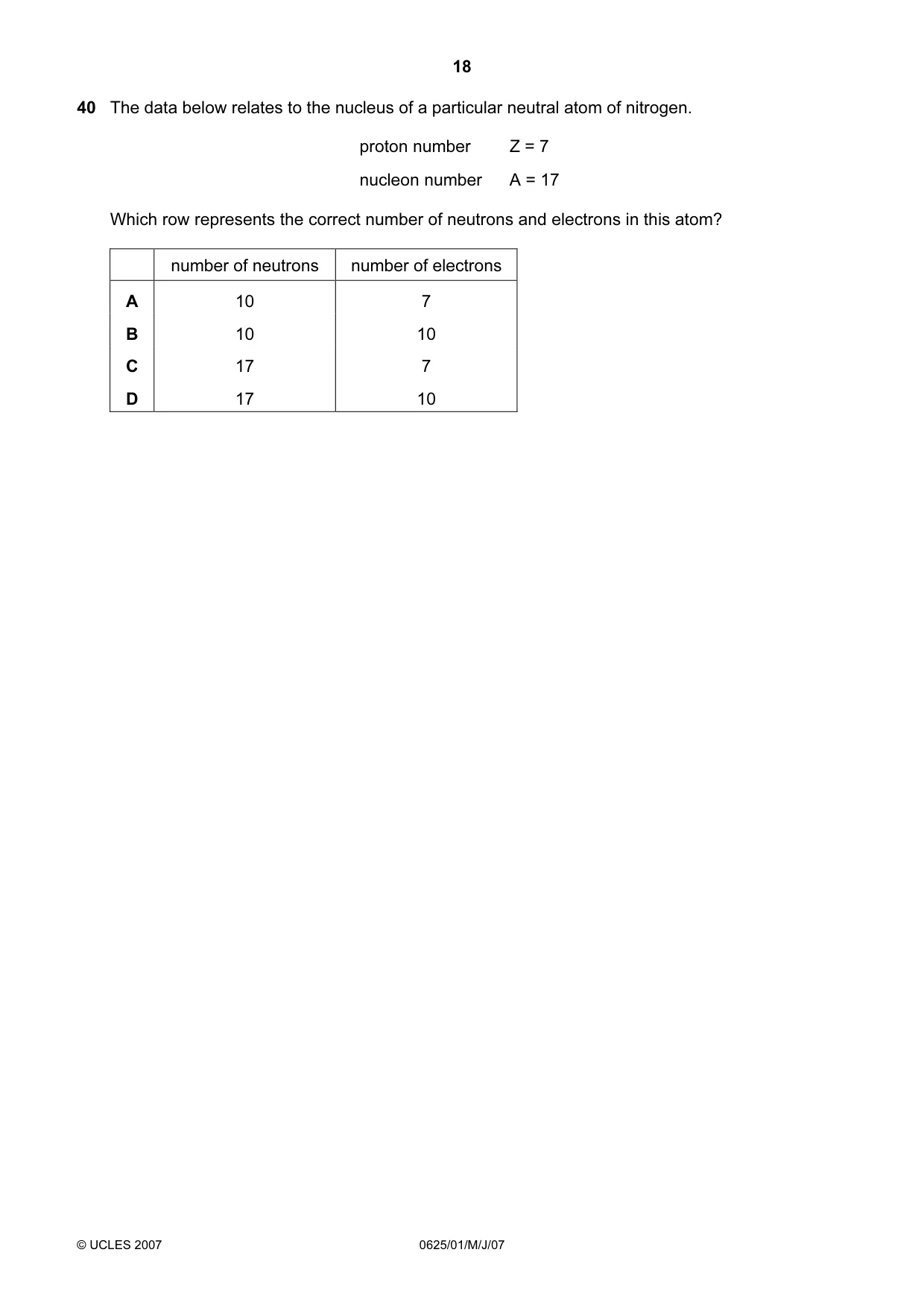
Q40 · The data below relates to the nucleus of a particular neutral atom of nitrogen
40 The data below relates to the nucleus of a particular neutral atom of nitrogen. proton number Z = 7 nucleon number A = 17 Which row represents the correct number of neutrons and electrons in this atom? number of neutrons number of electrons A 10 7 B 10 10 C 17 7 D 17 10
Mark scheme: A
What was in this paper
The subtopics covered by these 40 questions, and how many questions each got. Open one in a new tab to see every Cambridge question on it.
3Electrical quantities3Simple phenomena of magnetism3Density2Electrical safety2Electromagnetic effects2Energy, work and power2Forces2General properties of waves2Kinetic particle model of matter2Light2Mass and weight2Motion2Radioactivity2Sound2Thermal properties and temperature2Transfer of thermal energy2Physical quantities and measurement techniques1Pressure1The nuclear model of the atom1What you needed in this session
Cambridge’s own grade thresholds for 2007 May/June, Paper 1 · Variant 1. A higher threshold means an easier paper — the bar moves with how the cohort did.