Cambridge IGCSE Physics 0625 — 2025 Oct/Nov Paper 1 · Variant 2
0625/12/O/N/25 · 40 questions · 40 marks · ≈45 min
The question paper and its mark scheme, free to read here and free to download. This is Cambridge’s own paper, exactly as it was sat.
Question paper16 pages
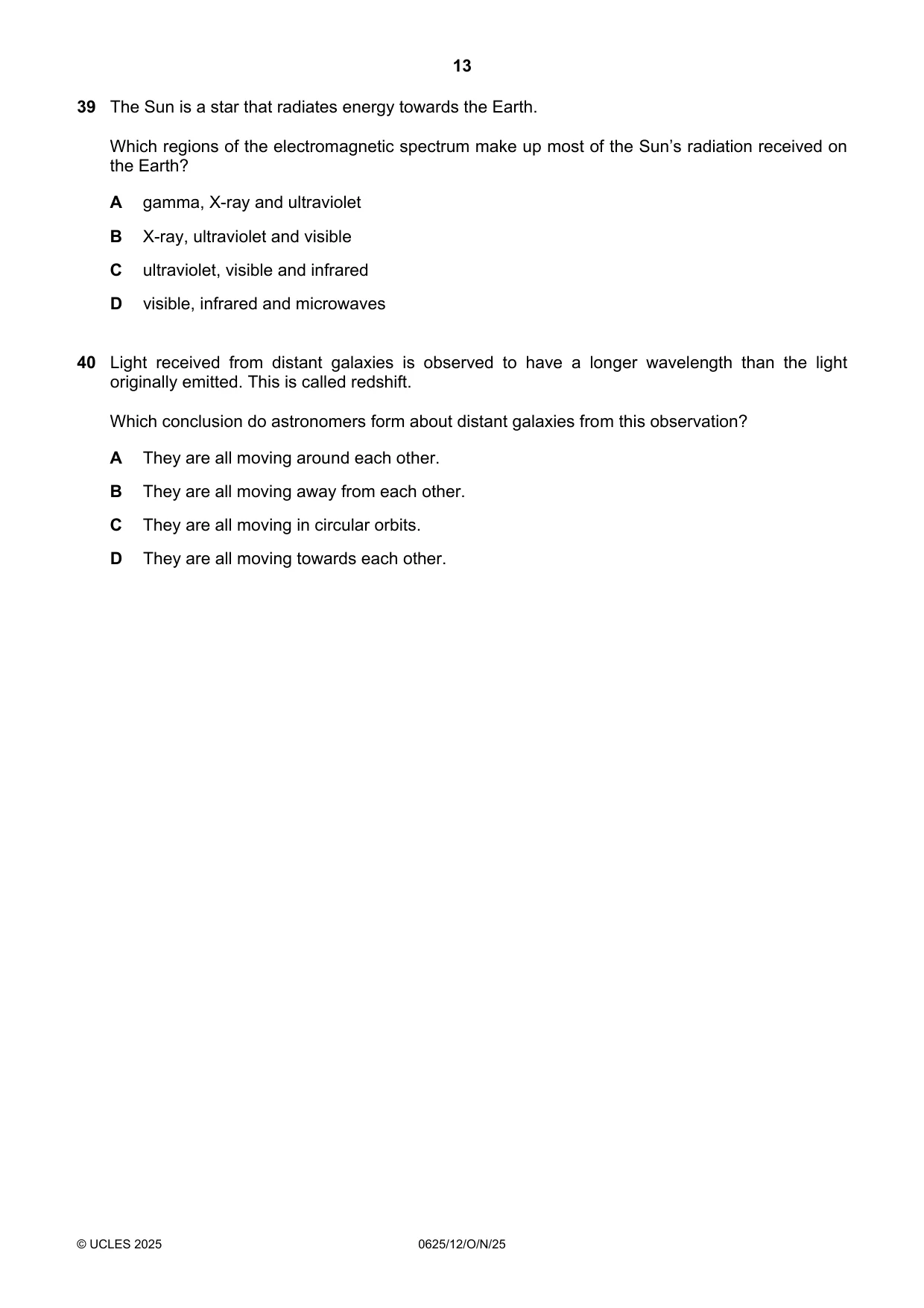


Mark scheme3 pages
Answers below. Sit the paper first if you are practising.
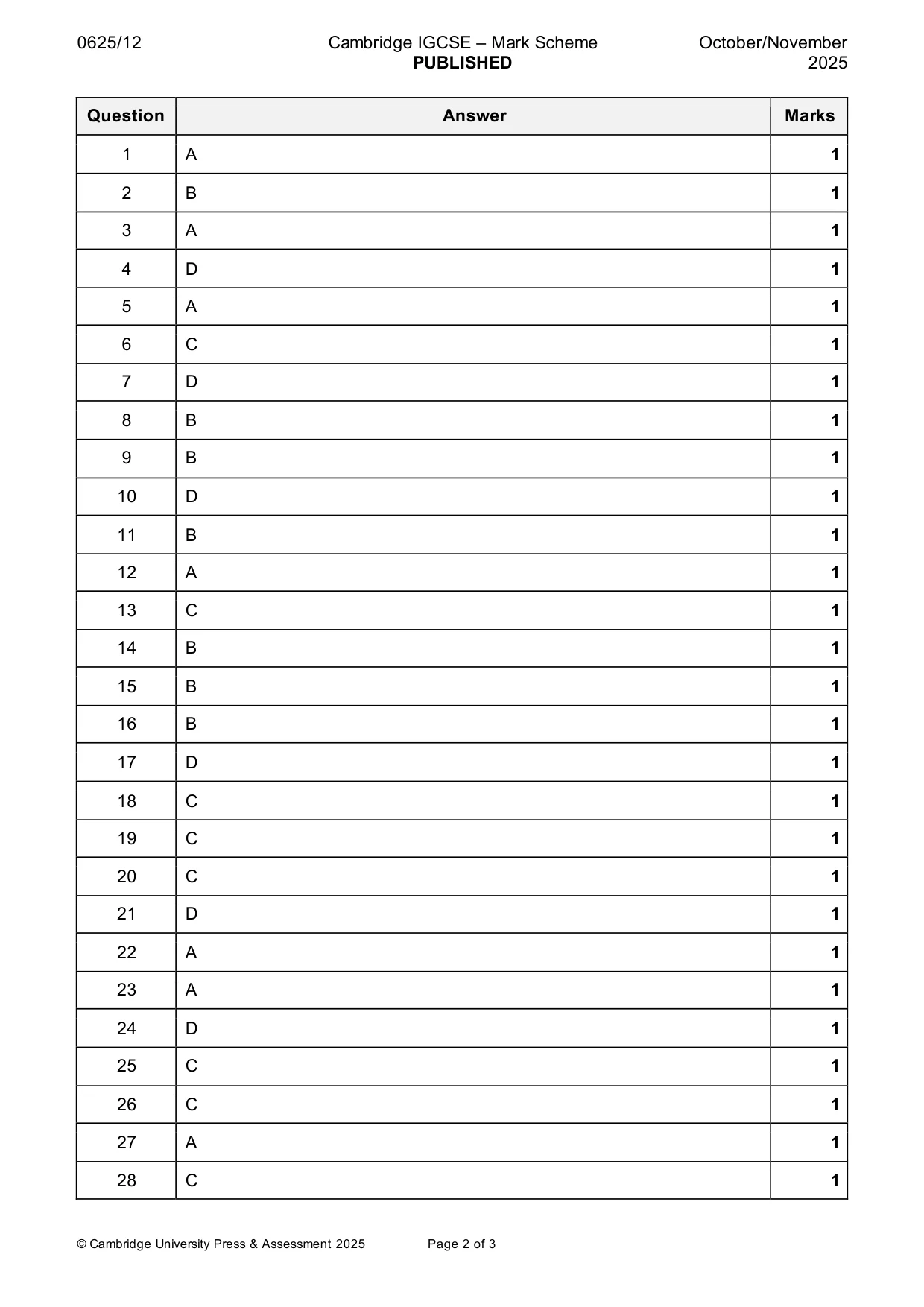
Questions as text
Q1 · An athlete runs around a circular track
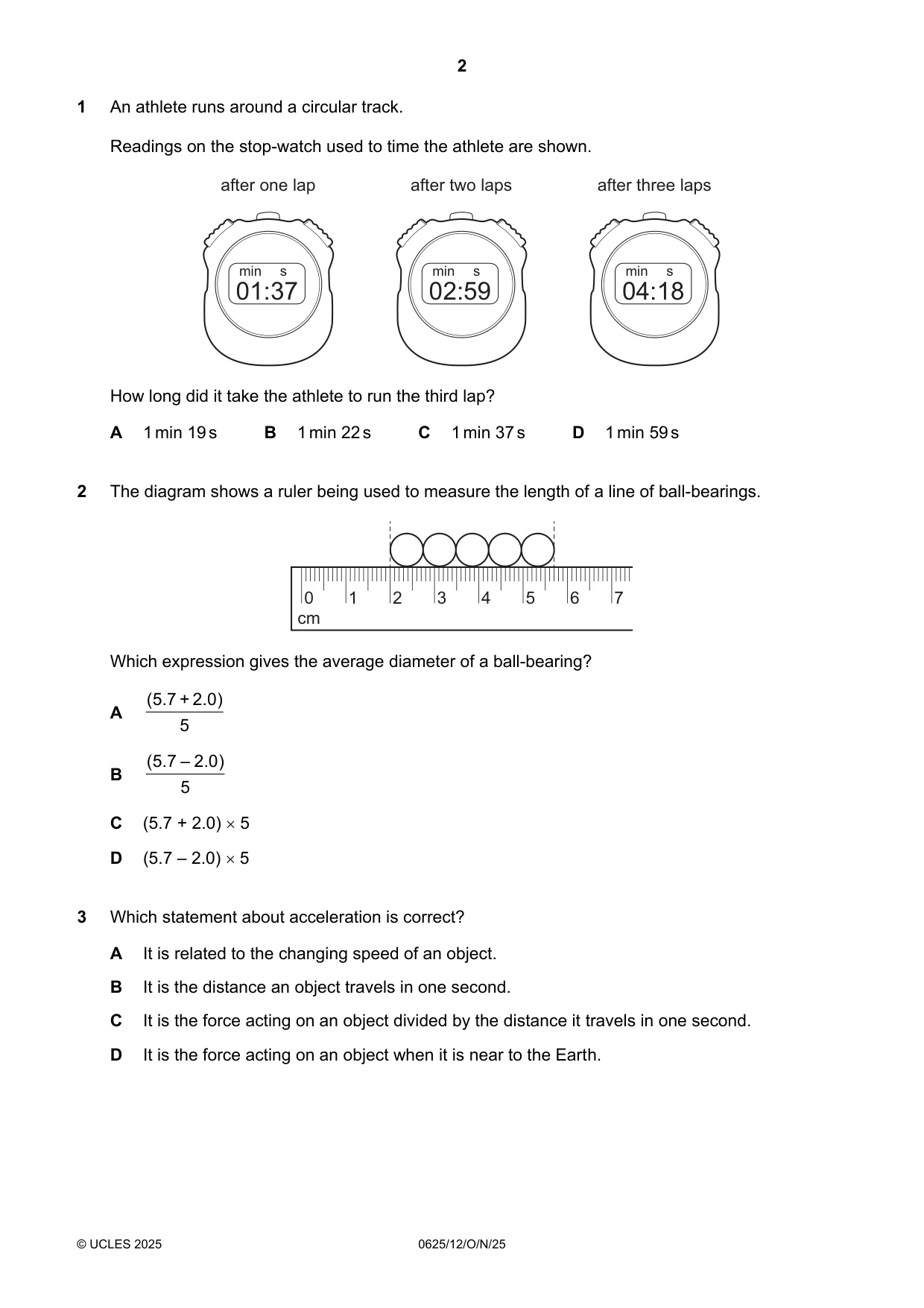
1 An athlete runs around a circular track. Readings on the stop-watch used to time the athlete are shown. after one lap after two laps after three laps min s min s min s 01:37 02:59 04:18 How long did it take the athlete to run the third lap? A 1 min 19 s B 1 min 22 s C 1 min 37 s D 1 min 59 s
Mark scheme: A
More questions on Physical quantities and measurement techniques
Q2 · The diagram shows a ruler being used to measure the length of a line of ball-bearings
2 The diagram shows a ruler being used to measure the length of a line of ball-bearings. 0 1 2 3 4 5 6 7 cm Which expression gives the average diameter of a ball-bearing? ( 5 . 7 + 2 . 0 ) A 5 ( 5 . 7 – 2 . 0 ) B 5 C (5.7 + 2.0) 5 D (5.7 – 2.0) 5
Mark scheme: B
More questions on Physical quantities and measurement techniques
Q3 · Which statement about acceleration is correct?
3 Which statement about acceleration is correct? A It is related to the changing speed of an object. B It is the distance an object travels in one second. C It is the force acting on an object divided by the distance it travels in one second. D It is the force acting on an object when it is near to the Earth.
Mark scheme: A
Q4 · An object with a mass of 6.0 kg rests on the surface of a planet
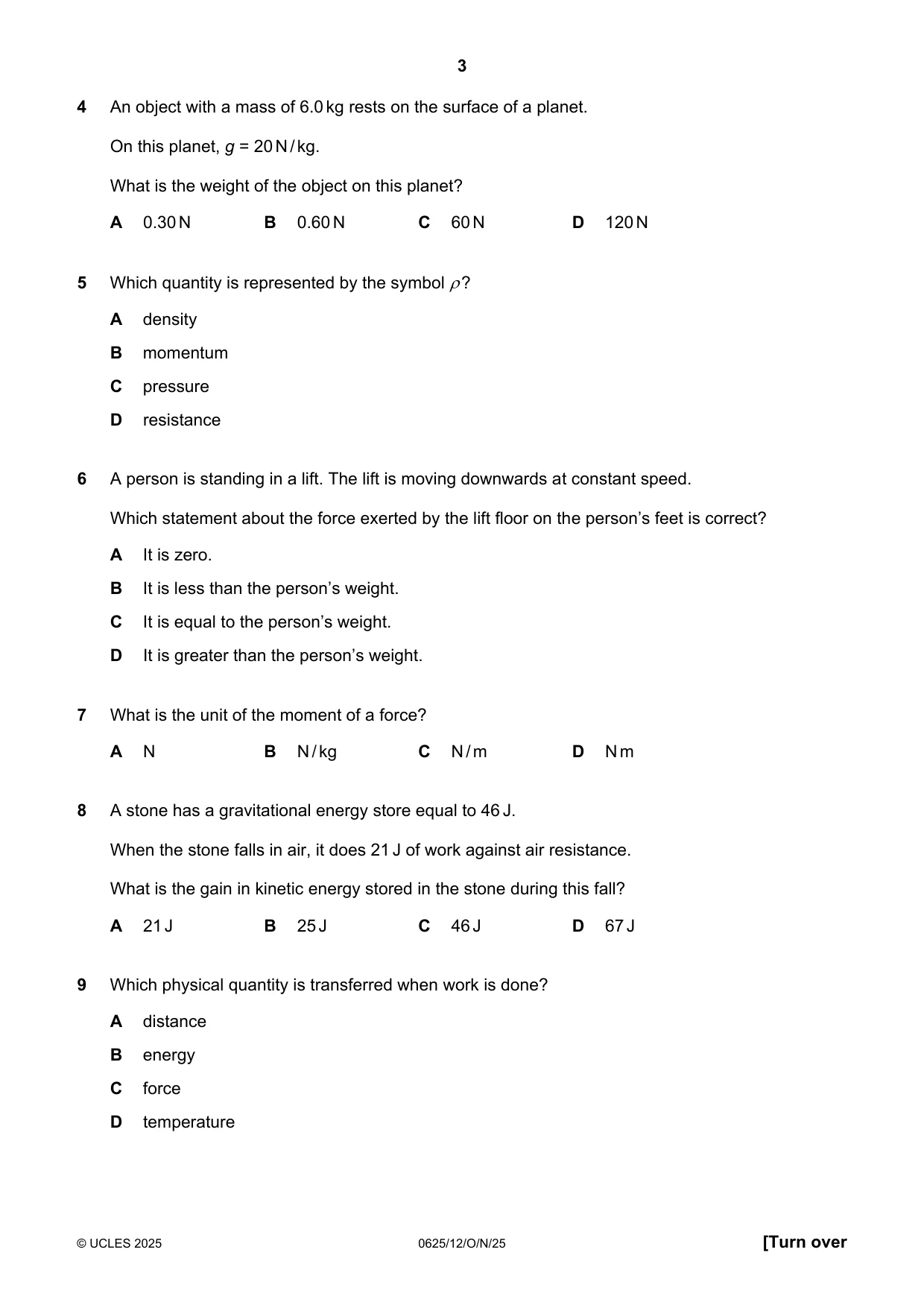
4 An object with a mass of 6.0 kg rests on the surface of a planet. On this planet, g = 20 N / kg. What is the weight of the object on this planet? A 0.30 N B 0.60 N C 60 N D 120 N
Mark scheme: D
Q5 · Which quantity is represented by the symbol ?
5 Which quantity is represented by the symbol ? A density B momentum C pressure D resistance
Mark scheme: A
Q6 · A person is standing in a lift
6 A person is standing in a lift. The lift is moving downwards at constant speed. Which statement about the force exerted by the lift floor on the person’s feet is correct? A It is zero. B It is less than the person’s weight. C It is equal to the person’s weight. D It is greater than the person’s weight.
Mark scheme: C
Q7 · What is the unit of the moment of a force?
7 What is the unit of the moment of a force? A N B N / kg C N / m D N m
Mark scheme: D
Q8 · A stone has a gravitational energy store equal to 46 J
8 A stone has a gravitational energy store equal to 46 J. When the stone falls in air, it does 21 J of work against air resistance. What is the gain in kinetic energy stored in the stone during this fall? A 21 J B 25 J C 46 J D 67 J
Mark scheme: B
Q9 · Which physical quantity is transferred when work is done?
9 Which physical quantity is transferred when work is done? A distance B energy C force D temperature
Mark scheme: B
Q10 · Which unit is a unit of pressure?
10 Which unit is a unit of pressure? A kg / m2 B kg / m3 C N m D N / m2
Mark scheme: D
Q11 · A kettle of boiling water converts water to steam at 100 °C
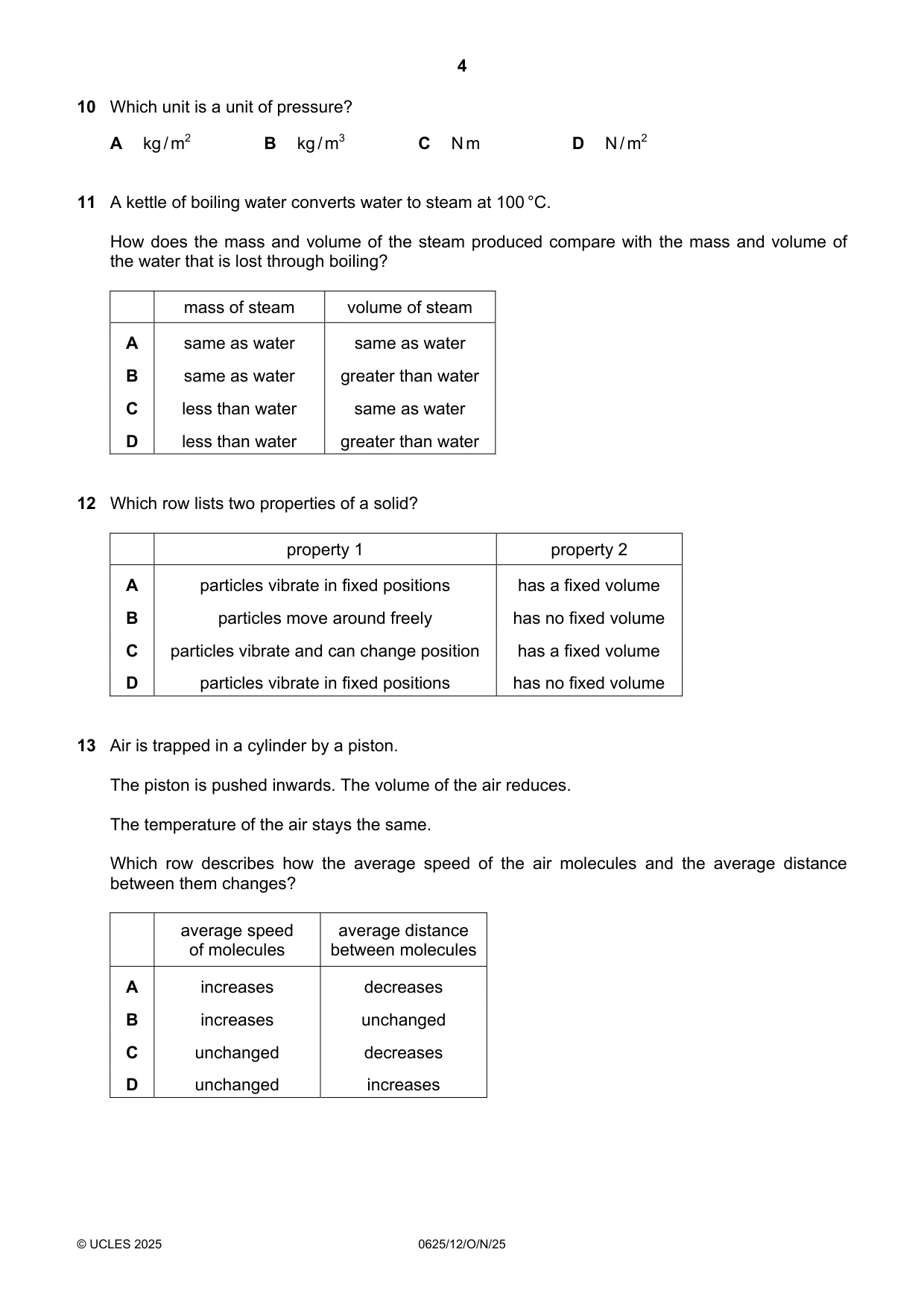
11 A kettle of boiling water converts water to steam at 100 °C. How does the mass and volume of the steam produced compare with the mass and volume of the water that is lost through boiling? mass of steam volume of steam A same as water same as water B same as water greater than water C less than water same as water D less than water greater than water
Mark scheme: B
Q12 · Which row lists two properties of a solid?
12 Which row lists two properties of a solid? property 1 property 2 A particles vibrate in fixed positions has a fixed volume B particles move around freely has no fixed volume C particles vibrate and can change position has a fixed volume D particles vibrate in fixed positions has no fixed volume
Mark scheme: A
Q13 · Air is trapped in a cylinder by a piston
13 Air is trapped in a cylinder by a piston. The piston is pushed inwards. The volume of the air reduces. The temperature of the air stays the same. Which row describes how the average speed of the air molecules and the average distance between them changes? average speed average distance of molecules between molecules A increases decreases B increases unchanged C unchanged decreases D unchanged increases
Mark scheme: C
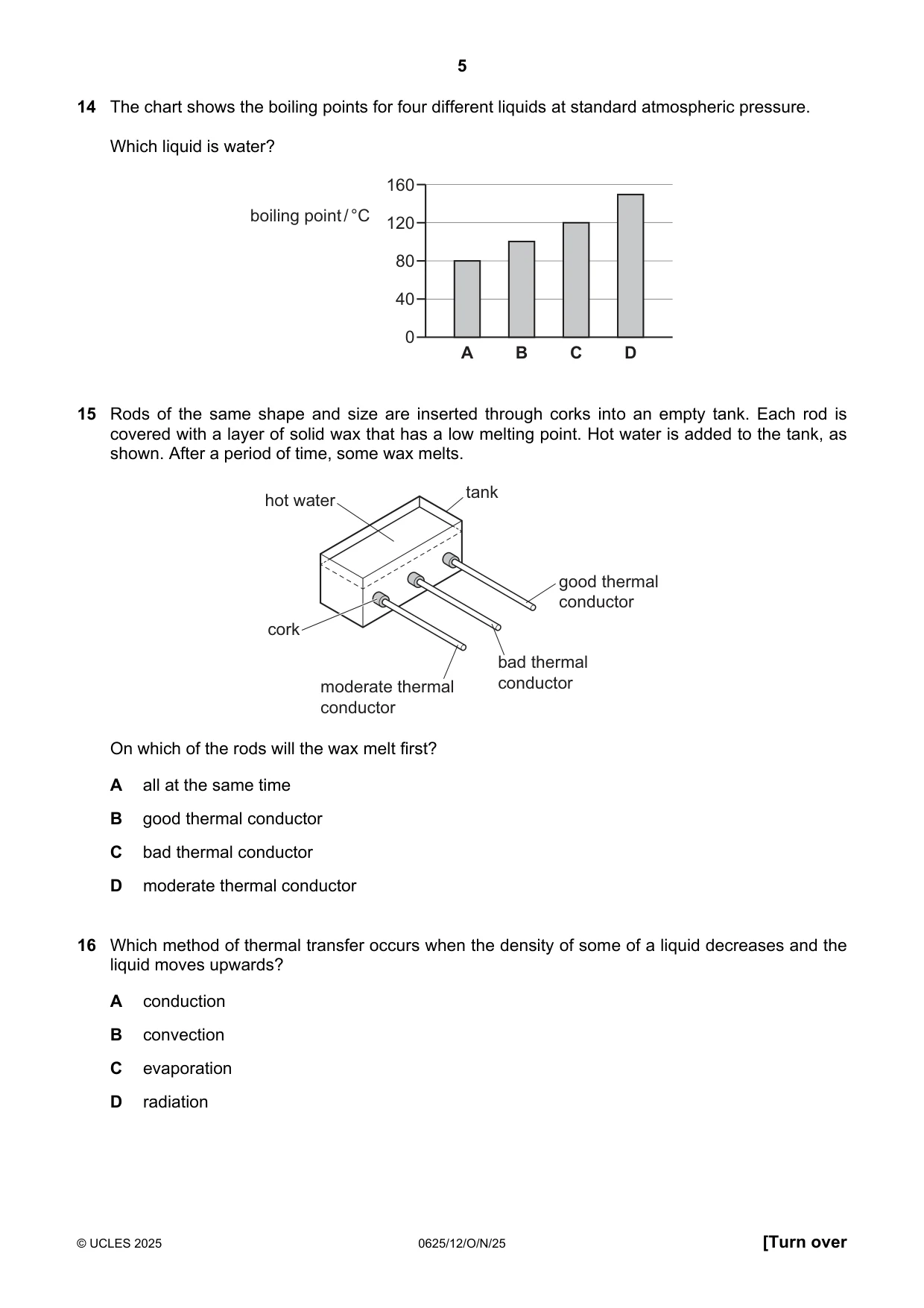
Q14 · The chart shows the boiling points for four different liquids at standard atmospheric…
14 The chart shows the boiling points for four different liquids at standard atmospheric pressure. Which liquid is water? 160 boiling point / °C 120 80 40 0 A B C D
Mark scheme: B
Q15 · Rods of the same shape and size are inserted through corks into an empty tank
15 Rods of the same shape and size are inserted through corks into an empty tank. Each rod is covered with a layer of solid wax that has a low melting point. Hot water is added to the tank, as shown. After a period of time, some wax melts. tank hot water good thermal conductor cork bad thermal moderate thermal conductor conductor On which of the rods will the wax melt first? A all at the same time B good thermal conductor C bad thermal conductor D moderate thermal conductor
Mark scheme: B
Q16 · Which method of thermal transfer occurs when the density of some of a liquid decreases…
16 Which method of thermal transfer occurs when the density of some of a liquid decreases and the liquid moves upwards? A conduction B convection C evaporation D radiation
Mark scheme: B
Q17 · Which surface is the best reflector of infrared radiation?
17 Which surface is the best reflector of infrared radiation? A dull and black B dull and white C shiny and black D shiny and white
Mark scheme: D
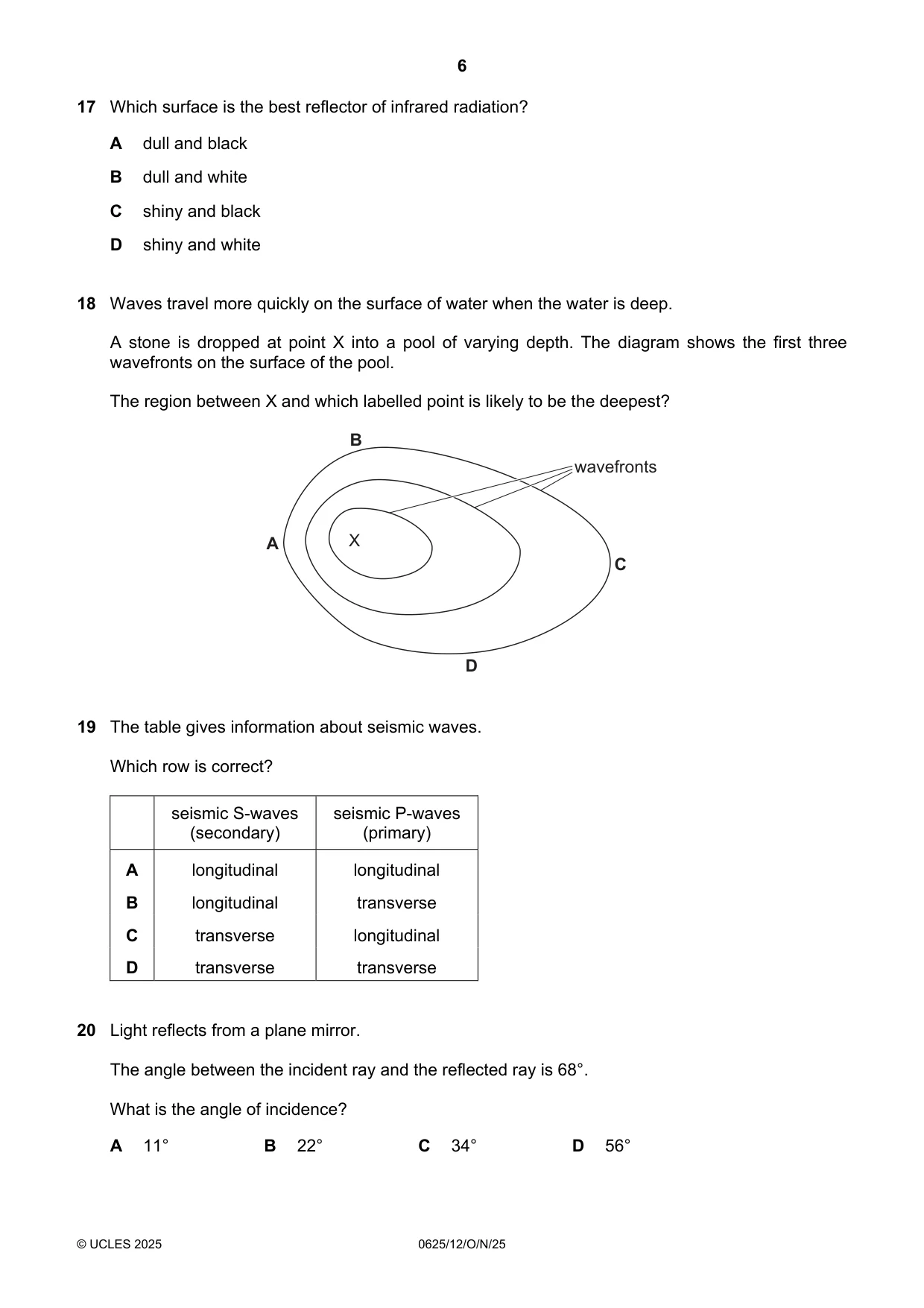
Q18 · Waves travel more quickly on the surface of water when the water is deep
18 Waves travel more quickly on the surface of water when the water is deep. A stone is dropped at point X into a pool of varying depth. The diagram shows the first three wavefronts on the surface of the pool. The region between X and which labelled point is likely to be the deepest? B wavefronts A X C D
Mark scheme: C
Q19 · The table gives information about seismic waves
19 The table gives information about seismic waves. Which row is correct? seismic S-waves seismic P-waves (secondary) (primary) A longitudinal longitudinal B longitudinal transverse C transverse longitudinal D transverse transverse
Mark scheme: C
Q20 · Light reflects from a plane mirror
20 Light reflects from a plane mirror. The angle between the incident ray and the reflected ray is 68°. What is the angle of incidence? A 11° B 22° C 34° D 56°
Mark scheme: C
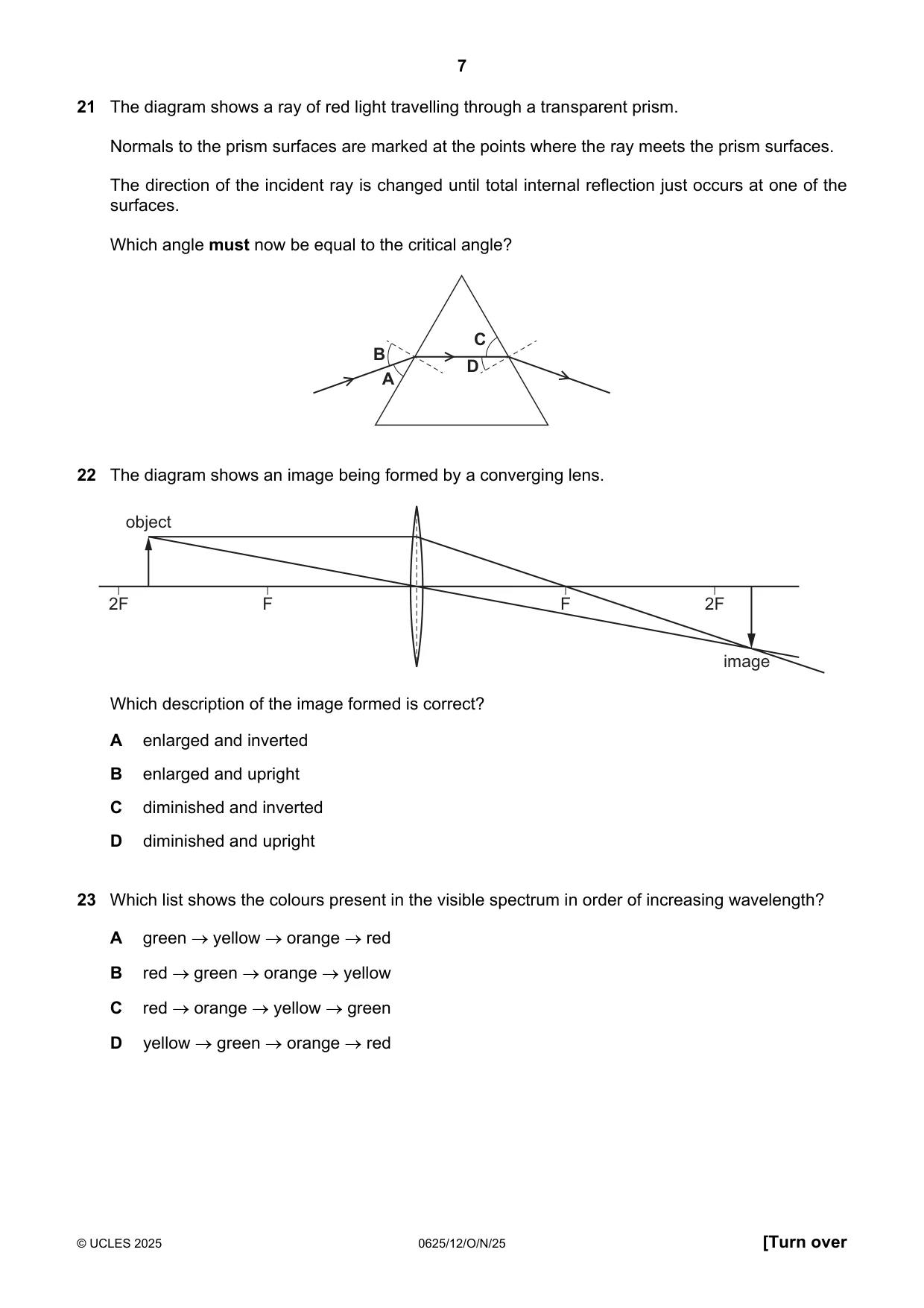
Q21 · The diagram shows a ray of red light travelling through a transparent prism
21 The diagram shows a ray of red light travelling through a transparent prism. Normals to the prism surfaces are marked at the points where the ray meets the prism surfaces. The direction of the incident ray is changed until total internal reflection just occurs at one of the surfaces. Which angle must now be equal to the critical angle? C B D A
Mark scheme: D
Q22 · The diagram shows an image being formed by a converging lens
22 The diagram shows an image being formed by a converging lens. object 2F F F 2F image Which description of the image formed is correct? A enlarged and inverted B enlarged and upright C diminished and inverted D diminished and upright
Mark scheme: A
Q23 · Which list shows the colours present in the visible spectrum in order of increasing…
23 Which list shows the colours present in the visible spectrum in order of increasing wavelength? A green yellow orange red B red green orange yellow C red orange yellow green D yellow green orange red
Mark scheme: A
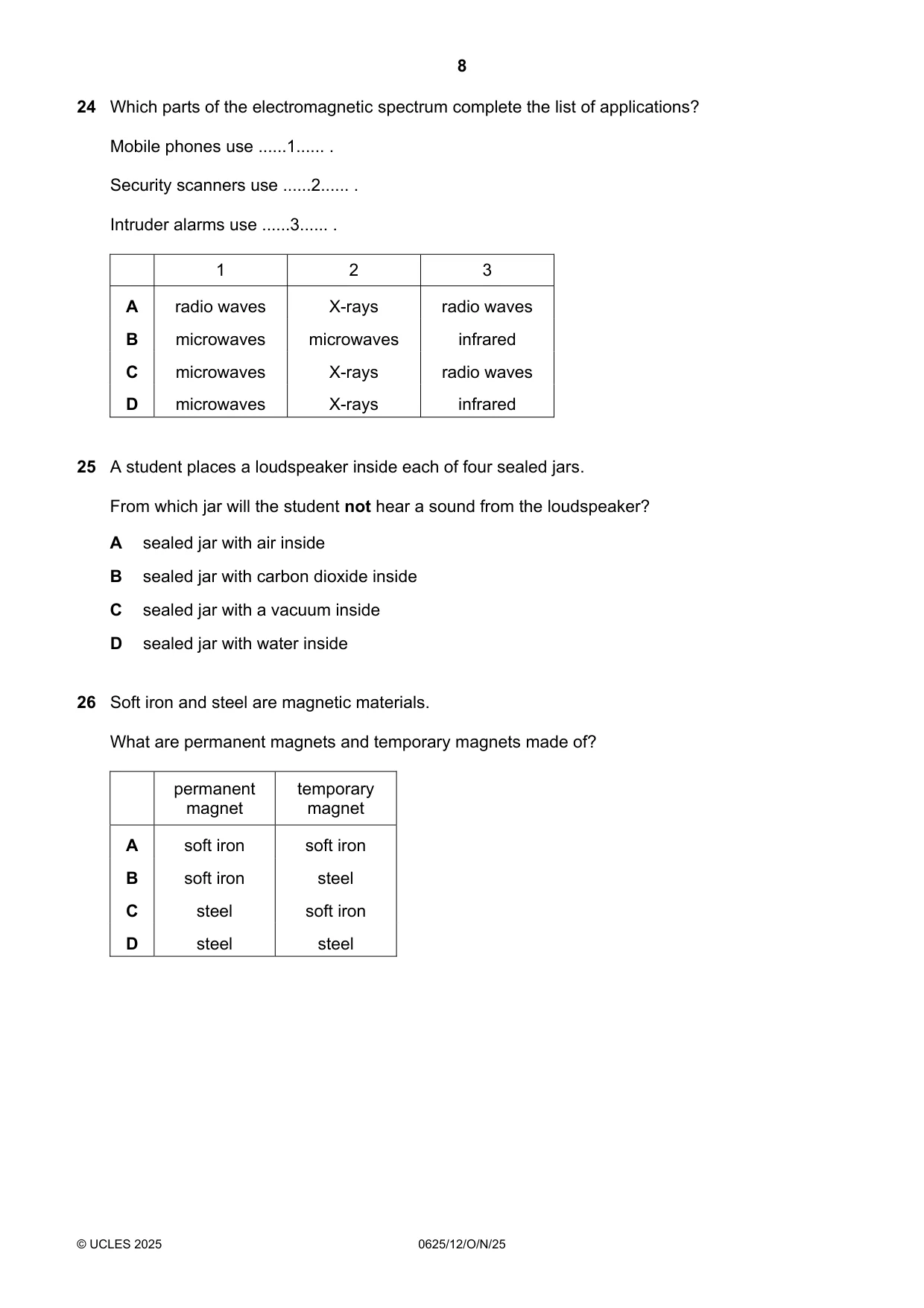
Q24 · Which parts of the electromagnetic spectrum complete the list of applications?
24 Which parts of the electromagnetic spectrum complete the list of applications? Mobile phones use ......1...... . Security scanners use ......2...... . Intruder alarms use ......3...... . 1 2 3 A radio waves X-rays radio waves B microwaves microwaves infrared C microwaves X-rays radio waves D microwaves X-rays infrared
Mark scheme: D
Q25 · A student places a loudspeaker inside each of four sealed jars
25 A student places a loudspeaker inside each of four sealed jars. From which jar will the student not hear a sound from the loudspeaker? A sealed jar with air inside B sealed jar with carbon dioxide inside C sealed jar with a vacuum inside D sealed jar with water inside
Mark scheme: C
Q26 · Soft iron and steel are magnetic materials
26 Soft iron and steel are magnetic materials. What are permanent magnets and temporary magnets made of? permanent temporary magnet magnet A soft iron soft iron B soft iron steel C steel soft iron D steel steel
Mark scheme: C
Q27 · A negatively charged plastic rod is brought near to an isolated, uncharged metal sphere…
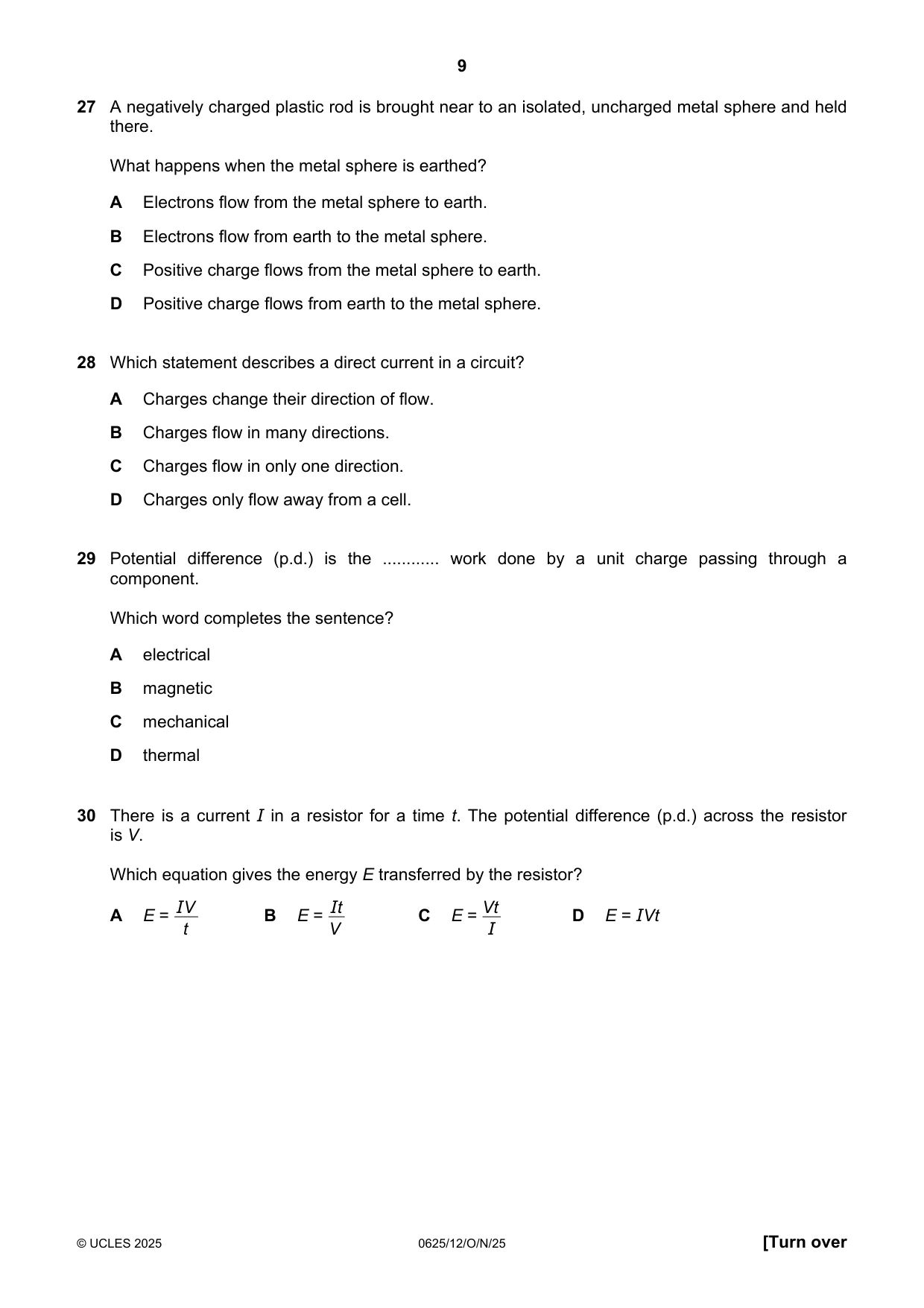
27 A negatively charged plastic rod is brought near to an isolated, uncharged metal sphere and held there. What happens when the metal sphere is earthed? A Electrons flow from the metal sphere to earth. B Electrons flow from earth to the metal sphere. C Positive charge flows from the metal sphere to earth. D Positive charge flows from earth to the metal sphere.
Mark scheme: A
Q28 · Which statement describes a direct current in a circuit?
28 Which statement describes a direct current in a circuit? A Charges change their direction of flow. B Charges flow in many directions. C Charges flow in only one direction. D Charges only flow away from a cell.
Mark scheme: C
Q29 · Potential difference (p.d.) is the ...........
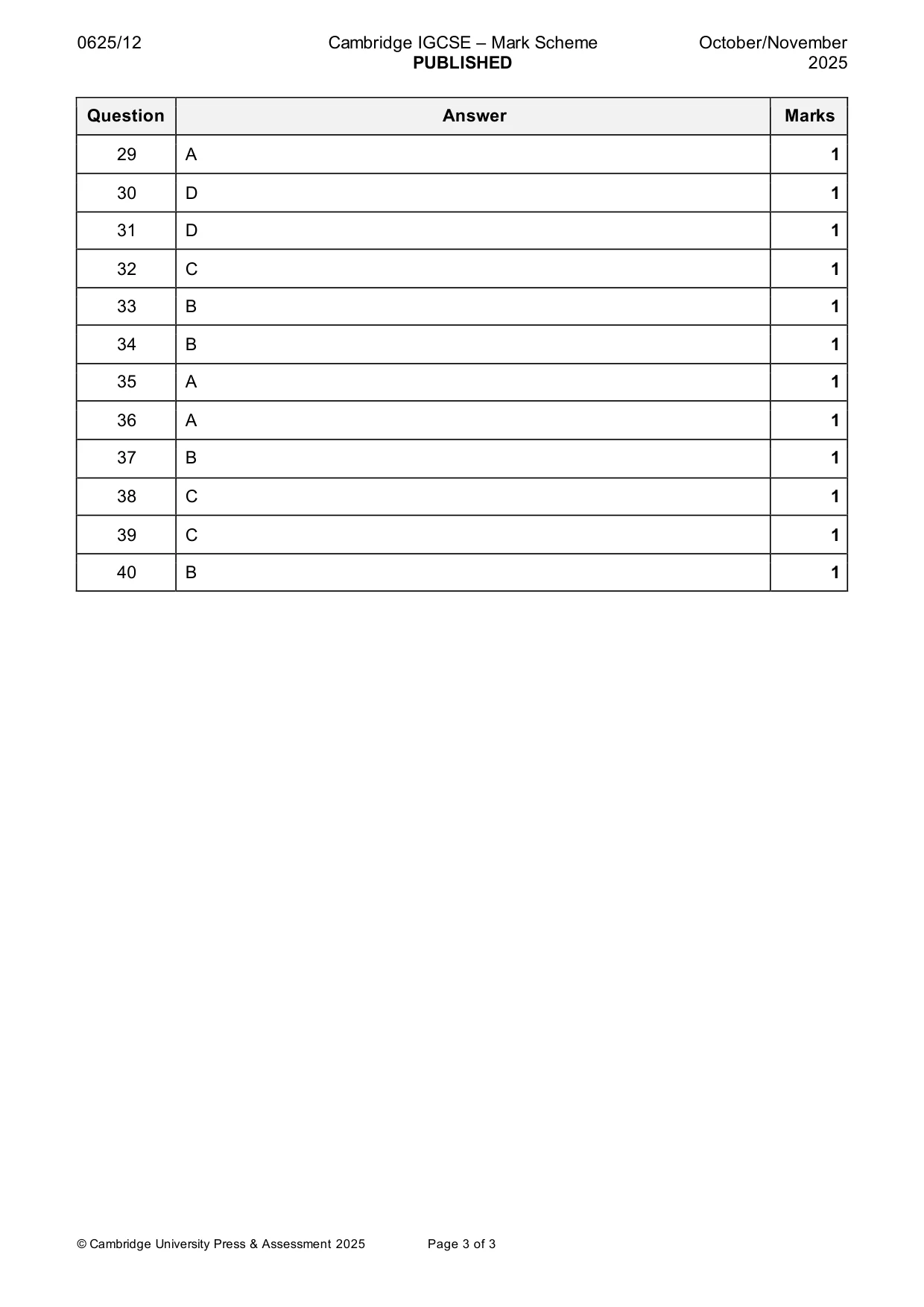
29 Potential difference (p.d.) is the ............ work done by a unit charge passing through a component. Which word completes the sentence? A electrical B magnetic C mechanical D thermal
Mark scheme: A
Q30 · There is a current I in a resistor for a time t
30 There is a current I in a resistor for a time t. The potential difference (p.d.) across the resistor is V. Which equation gives the energy E transferred by the resistor? I V tI Vt A E = t B E = V C E = I D E = IVt
Mark scheme: D
Q31 · A student constructs four circuits, each containing a fuse
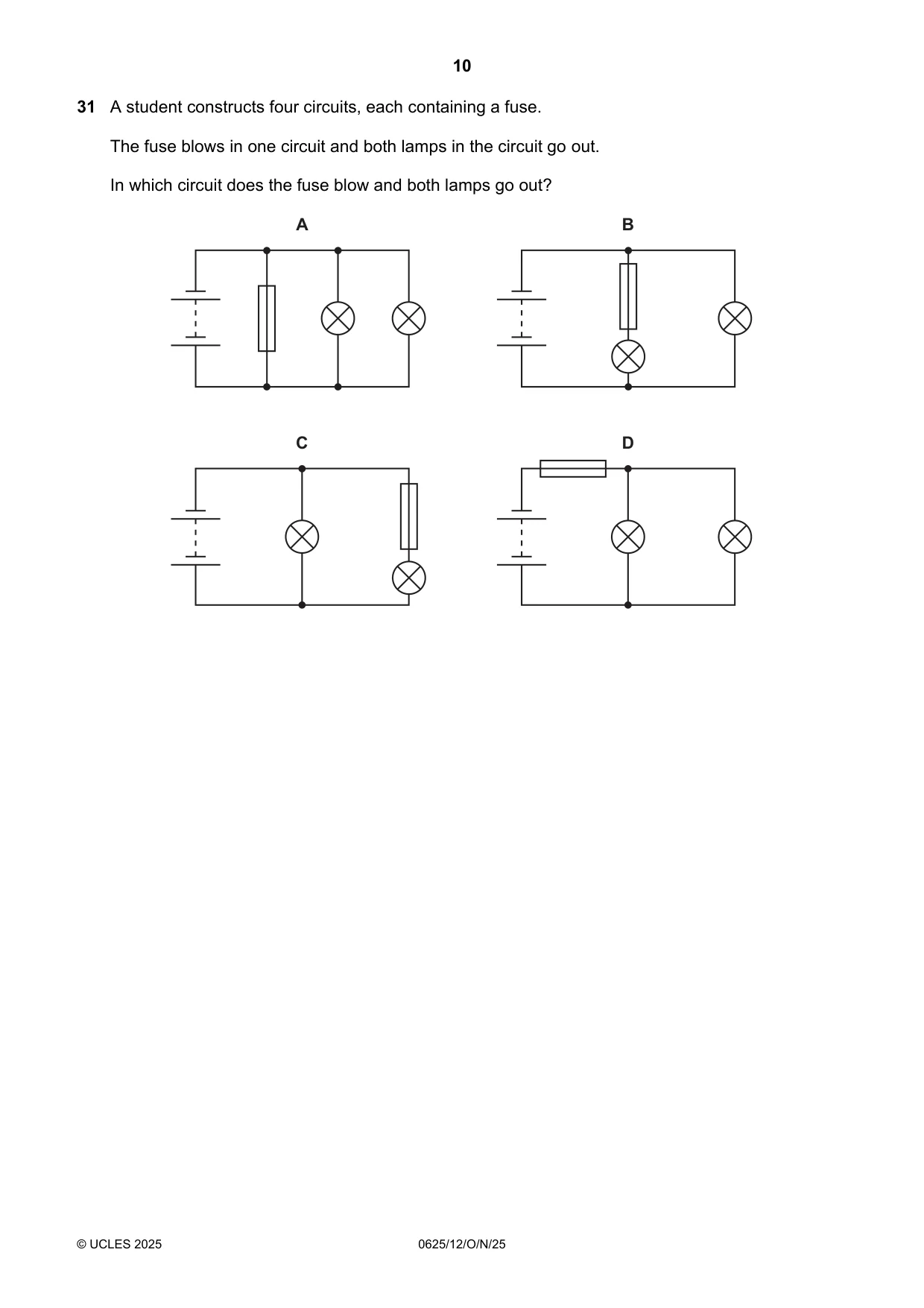
31 A student constructs four circuits, each containing a fuse. The fuse blows in one circuit and both lamps in the circuit go out. In which circuit does the fuse blow and both lamps go out? A B C D
Mark scheme: D
Q32 · The diagram shows a coil of insulated wire wrapped around a soft-iron rod
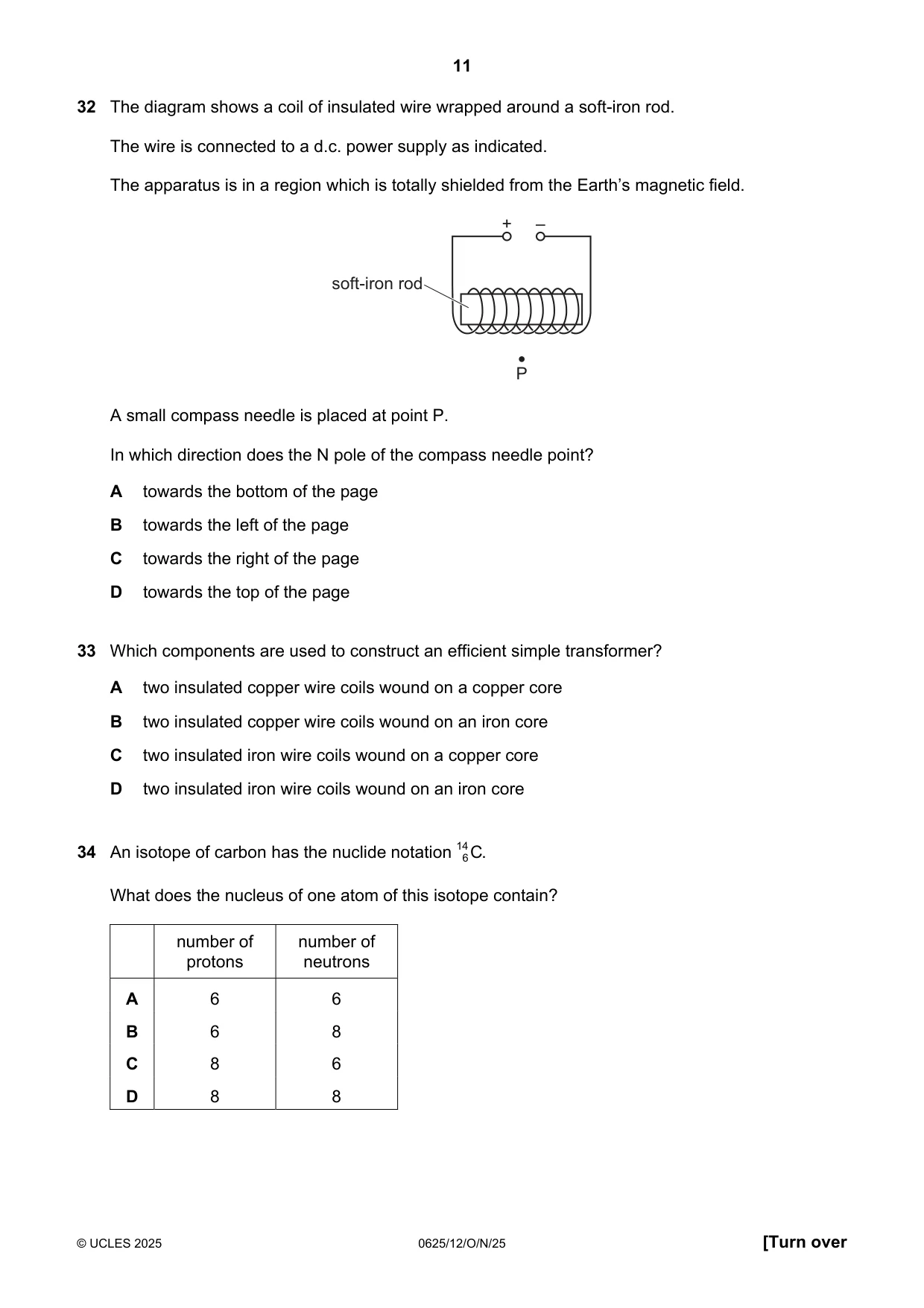
32 The diagram shows a coil of insulated wire wrapped around a soft-iron rod. The wire is connected to a d.c. power supply as indicated. The apparatus is in a region which is totally shielded from the Earth’s magnetic field. + – soft-iron rod P A small compass needle is placed at point P. In which direction does the N pole of the compass needle point? A towards the bottom of the page B towards the left of the page C towards the right of the page D towards the top of the page
Mark scheme: C
Q33 · Which components are used to construct an efficient simple transformer?
33 Which components are used to construct an efficient simple transformer? A two insulated copper wire coils wound on a copper core B two insulated copper wire coils wound on an iron core C two insulated iron wire coils wound on a copper core D two insulated iron wire coils wound on an iron core
Mark scheme: B
Q34 · An isotope of carbon has the nuclide notation 14 C
34 An isotope of carbon has the nuclide notation 14 C . 6 What does the nucleus of one atom of this isotope contain? number of number of protons neutrons A 6 6 B 6 8 C 8 6 D 8 8
Mark scheme: B
Q35 · When the count rate from a radioactive source is measured, background radiation is taken…
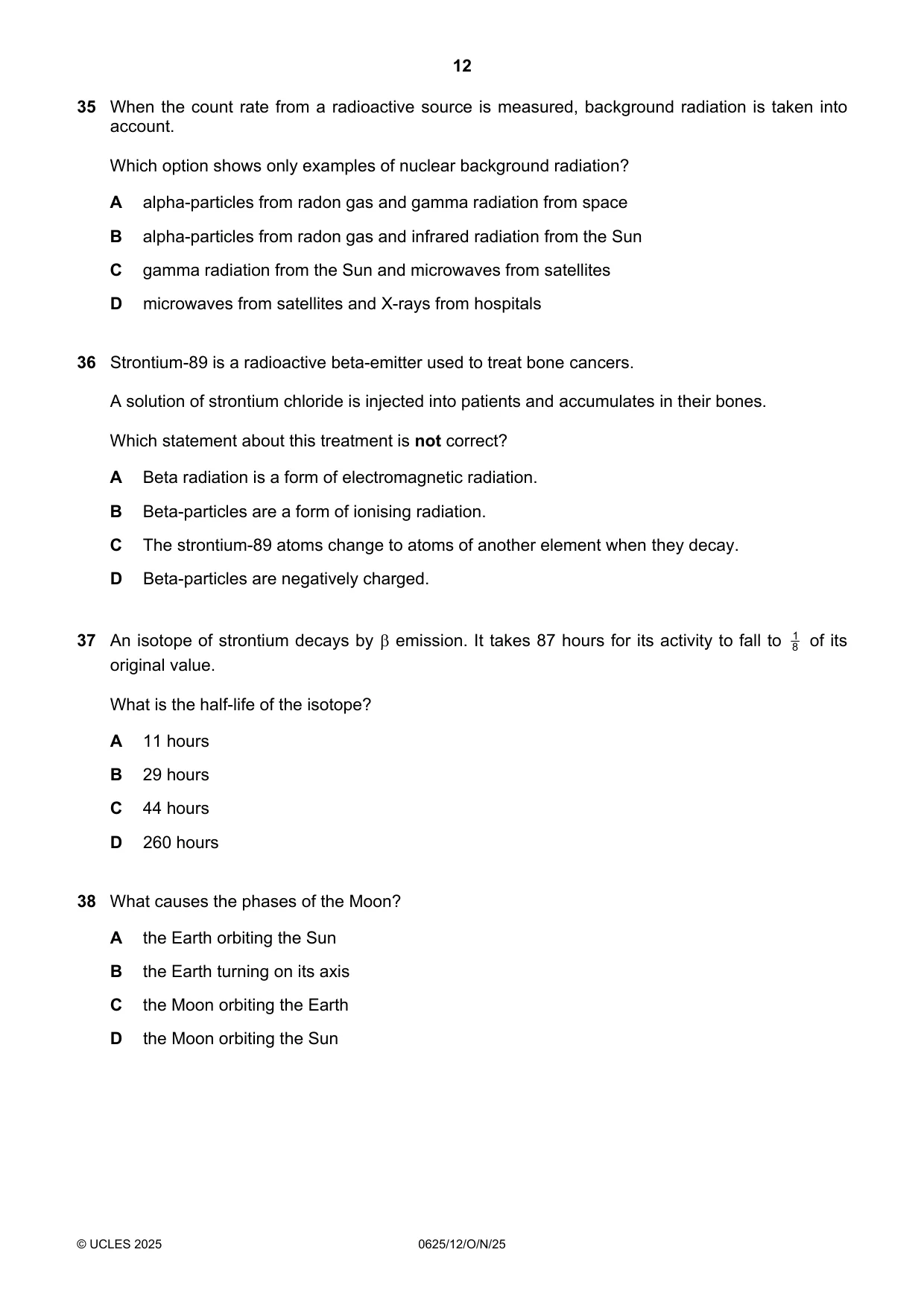
35 When the count rate from a radioactive source is measured, background radiation is taken into account. Which option shows only examples of nuclear background radiation? A alpha-particles from radon gas and gamma radiation from space B alpha-particles from radon gas and infrared radiation from the Sun C gamma radiation from the Sun and microwaves from satellites D microwaves from satellites and X-rays from hospitals
Mark scheme: A
Q36 · Strontium-89 is a radioactive beta-emitter used to treat bone cancers
36 Strontium-89 is a radioactive beta-emitter used to treat bone cancers. A solution of strontium chloride is injected into patients and accumulates in their bones. Which statement about this treatment is not correct? A Beta radiation is a form of electromagnetic radiation. B Beta-particles are a form of ionising radiation. C The strontium-89 atoms change to atoms of another element when they decay. D Beta-particles are negatively charged.
Mark scheme: A
Q37 · An isotope of strontium decays by emission
37 An isotope of strontium decays by emission. It takes 87 hours for its activity to fall to 8 1 of its original value. What is the half-life of the isotope? A 11 hours B 29 hours C 44 hours D 260 hours
Mark scheme: B
Q38 · What causes the phases of the Moon?
38 What causes the phases of the Moon? A the Earth orbiting the Sun B the Earth turning on its axis C the Moon orbiting the Earth D the Moon orbiting the Sun
Mark scheme: C
Q39 · The Sun is a star that radiates energy towards the Earth
39 The Sun is a star that radiates energy towards the Earth. Which regions of the electromagnetic spectrum make up most of the Sun’s radiation received on the Earth? A gamma, X-ray and ultraviolet B X-ray, ultraviolet and visible C ultraviolet, visible and infrared D visible, infrared and microwaves
Mark scheme: C
Q40 · Light received from distant galaxies is observed to have a longer wavelength than the…
40 Light received from distant galaxies is observed to have a longer wavelength than the light originally emitted. This is called redshift. Which conclusion do astronomers form about distant galaxies from this observation? A They are all moving around each other. B They are all moving away from each other. C They are all moving in circular orbits. D They are all moving towards each other.
Mark scheme: B
What was in this paper
The subtopics covered by these 40 questions, and how many questions each got. Open one in a new tab to see every Cambridge question on it.
3Kinetic particle model of matter3Light3Radioactivity3Transfer of thermal energy3Electromagnetic effects2Electromagnetic spectrum2Energy, work and power2Forces2General properties of waves2Physical quantities and measurement techniques2Simple phenomena of magnetism2Stars and the Universe2Density1Electrical safety1Mass and weight1Motion1Pressure1Sound1The Earth and the Solar System1The nuclear model of the atom1Thermal properties and temperature1What you needed in this session
Cambridge’s own grade thresholds for 2025 Oct/Nov, Paper 1 · Variant 2. A higher threshold means an easier paper — the bar moves with how the cohort did.