Cambridge IGCSE Physics 0625 — 2021 May/June Paper 1 · Variant 2
0625/12/M/J/21 · 40 questions · 40 marks · ≈45 min
The question paper and its mark scheme, free to read here and free to download. This is Cambridge’s own paper, exactly as it was sat.
Question paper20 pages
Mark scheme3 pages
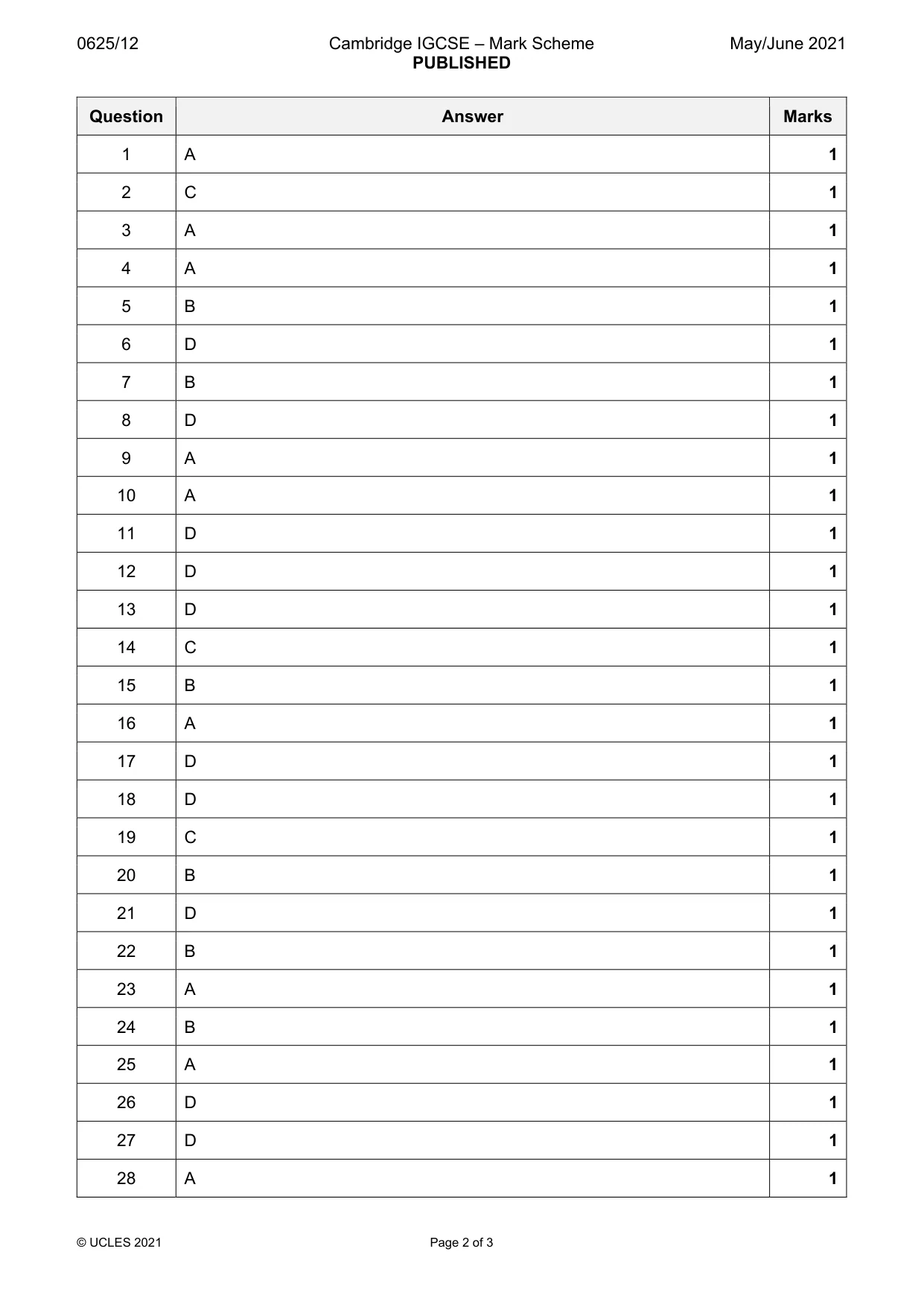
Answers below. Sit the paper first if you are practising.
Questions as text
Q1 · Which piece of apparatus is the most suitable for measuring the mass of a pencil…
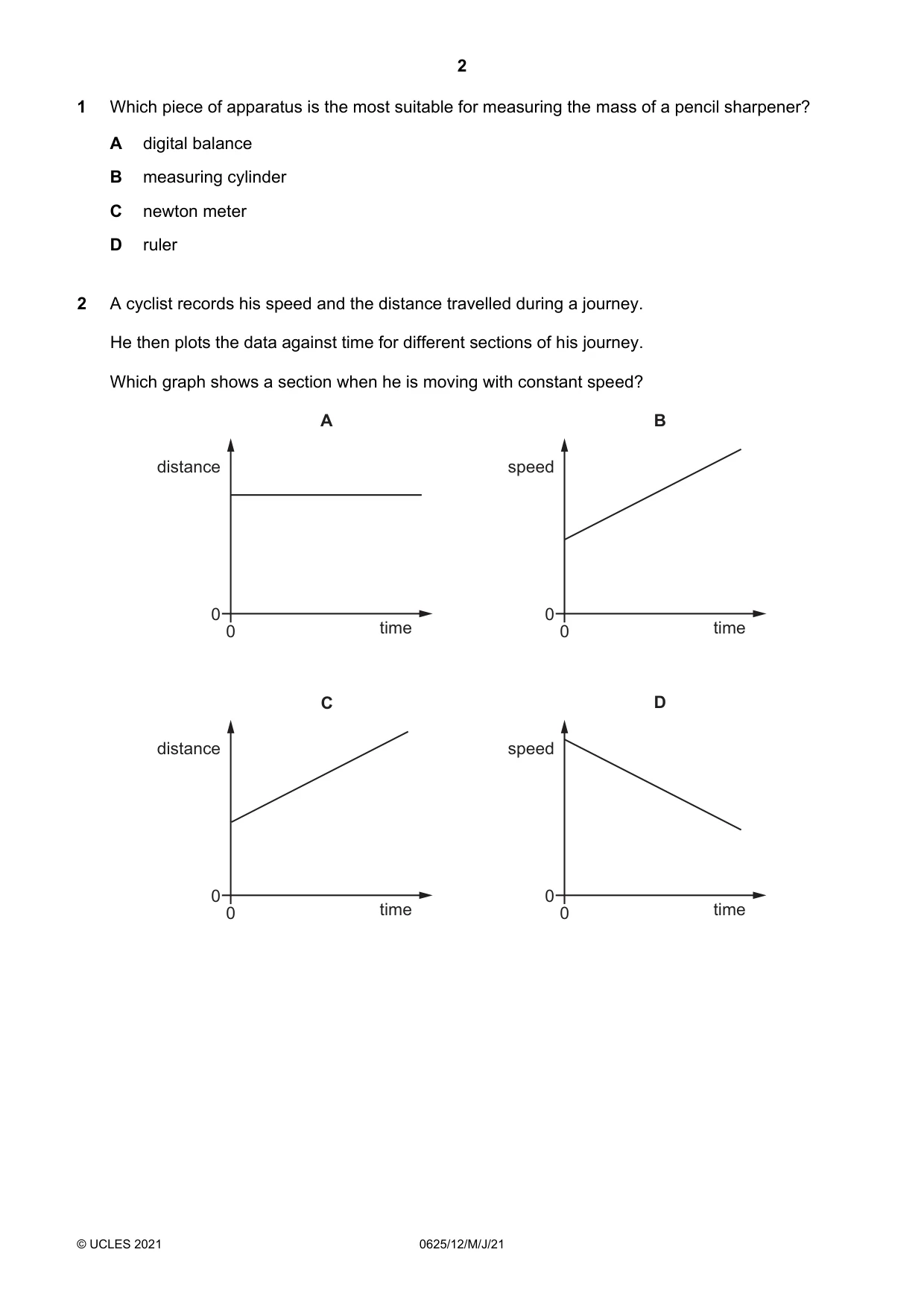
1 Which piece of apparatus is the most suitable for measuring the mass of a pencil sharpener? A digital balance B measuring cylinder C newton meter D ruler
Mark scheme: A
More questions on Physical quantities and measurement techniques
Q2 · A cyclist records his speed and the distance travelled during a journey
2 A cyclist records his speed and the distance travelled during a journey. He then plots the data against time for different sections of his journey. Which graph shows a section when he is moving with constant speed? A B distance speed 0 0 0 time 0 time C D distance speed 0 0 0 time 0 time
Mark scheme: C
Q3 · Two stones of different weights fall at the same time from a table
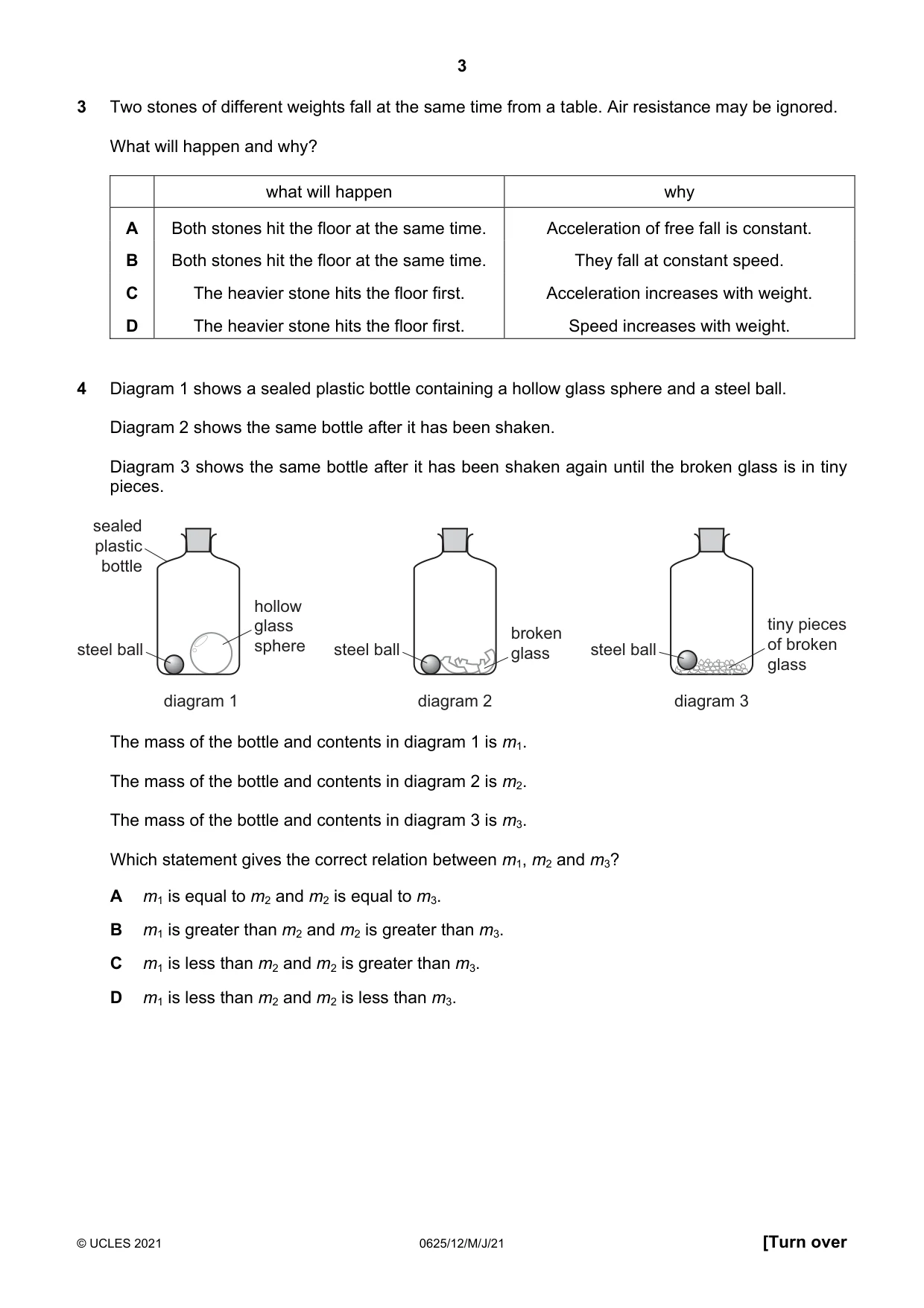
3 Two stones of different weights fall at the same time from a table. Air resistance may be ignored. What will happen and why? what will happen why A Both stones hit the floor at the same time. Acceleration of free fall is constant. B Both stones hit the floor at the same time. They fall at constant speed. C The heavier stone hits the floor first. Acceleration increases with weight. D The heavier stone hits the floor first. Speed increases with weight.
Mark scheme: A
Q4 · A sealed plastic bottle containing a hollow glass sphere and a steel ball
4 Diagram 1 shows a sealed plastic bottle containing a hollow glass sphere and a steel ball. Diagram 2 shows the same bottle after it has been shaken. Diagram 3 shows the same bottle after it has been shaken again until the broken glass is in tiny pieces. sealed plastic bottle hollow glass tiny pieces broken steel ball sphere steel ball steel ball of broken glass glass diagram 1 diagram 2 diagram 3 The mass of the bottle and contents in diagram 1 is m1. The mass of the bottle and contents in diagram 2 is m2. The mass of the bottle and contents in diagram 3 is m3. Which statement gives the correct relation between m1, m2 and m3? A m1 is equal to m2 and m2 is equal to m3. B m1 is greater than m2 and m2 is greater than m3. C m1 is less than m2 and m2 is greater than m3. D m1 is less than m2 and m2 is less than m3.
Mark scheme: A
Q5 · An astronaut wants to know how much she would weigh on different moons
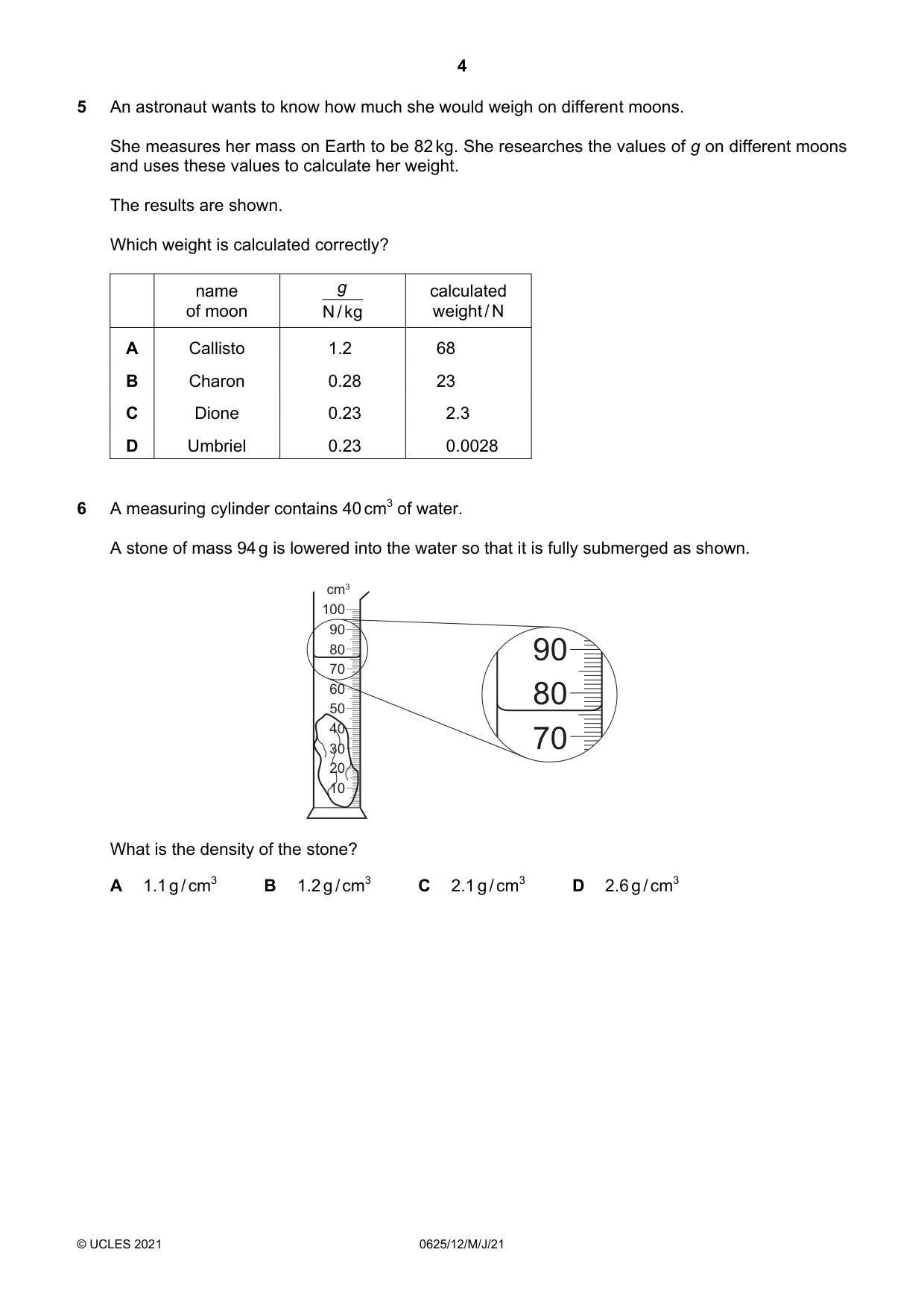
5 An astronaut wants to know how much she would weigh on different moons. She measures her mass on Earth to be 82 kg. She researches the values of g on different moons and uses these values to calculate her weight. The results are shown. Which weight is calculated correctly? name g calculated of moon N/kg weight / N A Callisto 1.2 68 B Charon 0.28 23 C Dione 0.23 2.3 D Umbriel 0.23 0.0028
Mark scheme: B
Q6 · A measuring cylinder contains 40 cm3 of water
6 A measuring cylinder contains 40 cm3 of water. A stone of mass 94 g is lowered into the water so that it is fully submerged as shown. cm3 100 90 80 90 70 60 80 50 40 70 30 20 10 What is the density of the stone? A 1.1 g / cm3 B 1.2 g / cm3 C 2.1 g / cm3 D 2.6 g / cm3
Mark scheme: D
Q7 · A toy car travels down a sloping ramp at constant speed
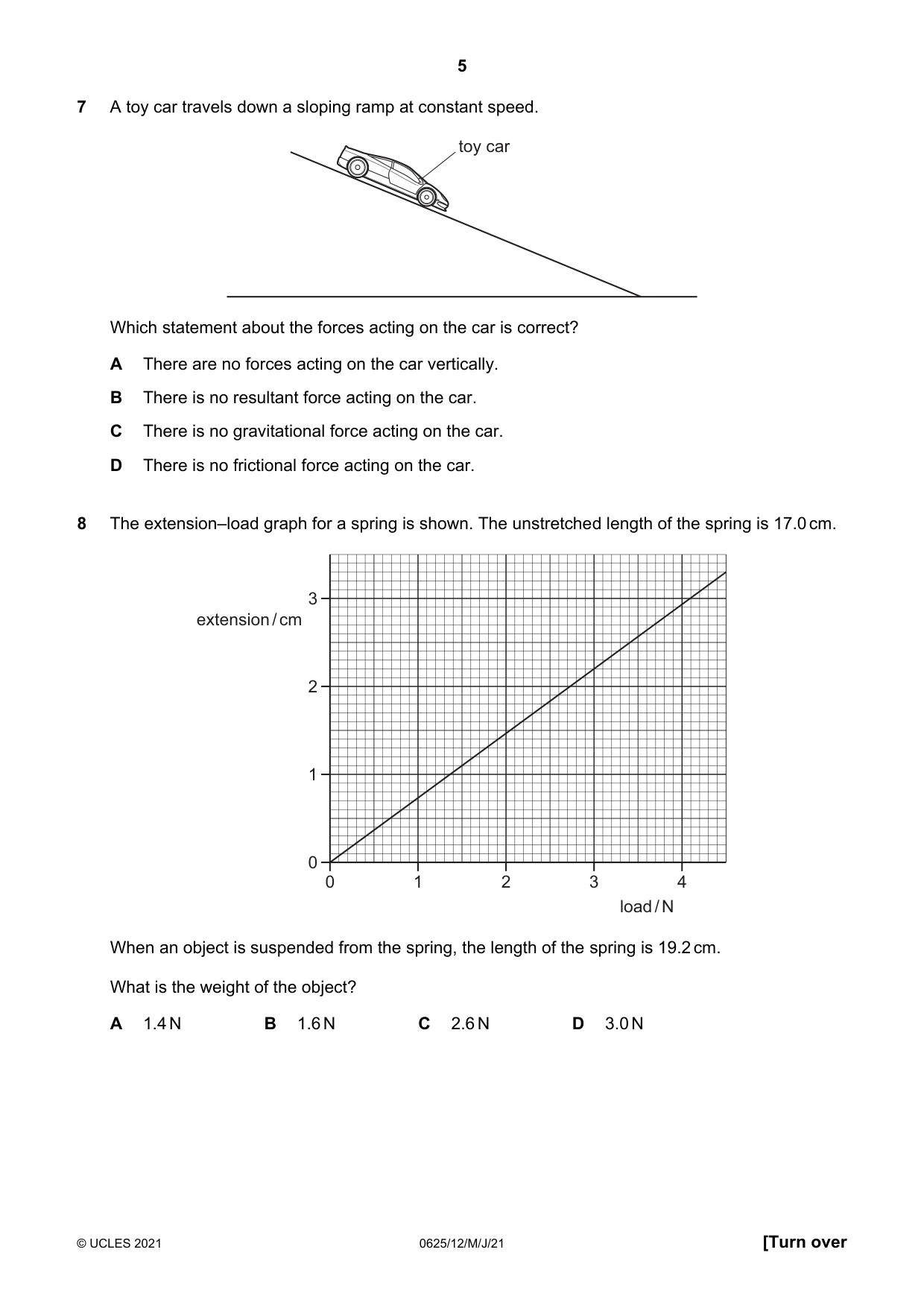
7 A toy car travels down a sloping ramp at constant speed. toy car Which statement about the forces acting on the car is correct? A There are no forces acting on the car vertically. B There is no resultant force acting on the car. C There is no gravitational force acting on the car. D There is no frictional force acting on the car.
Mark scheme: B
Q8 · The extension–load graph for a spring is shown
8 The extension–load graph for a spring is shown. The unstretched length of the spring is 17.0 cm. 3 extension / cm 2 1 0 0 1 2 3 4 load / N When an object is suspended from the spring, the length of the spring is 19.2 cm. What is the weight of the object? A 1.4 N B 1.6 N C 2.6 N D 3.0 N
Mark scheme: D
Q9 · An object is falling through a vacuum
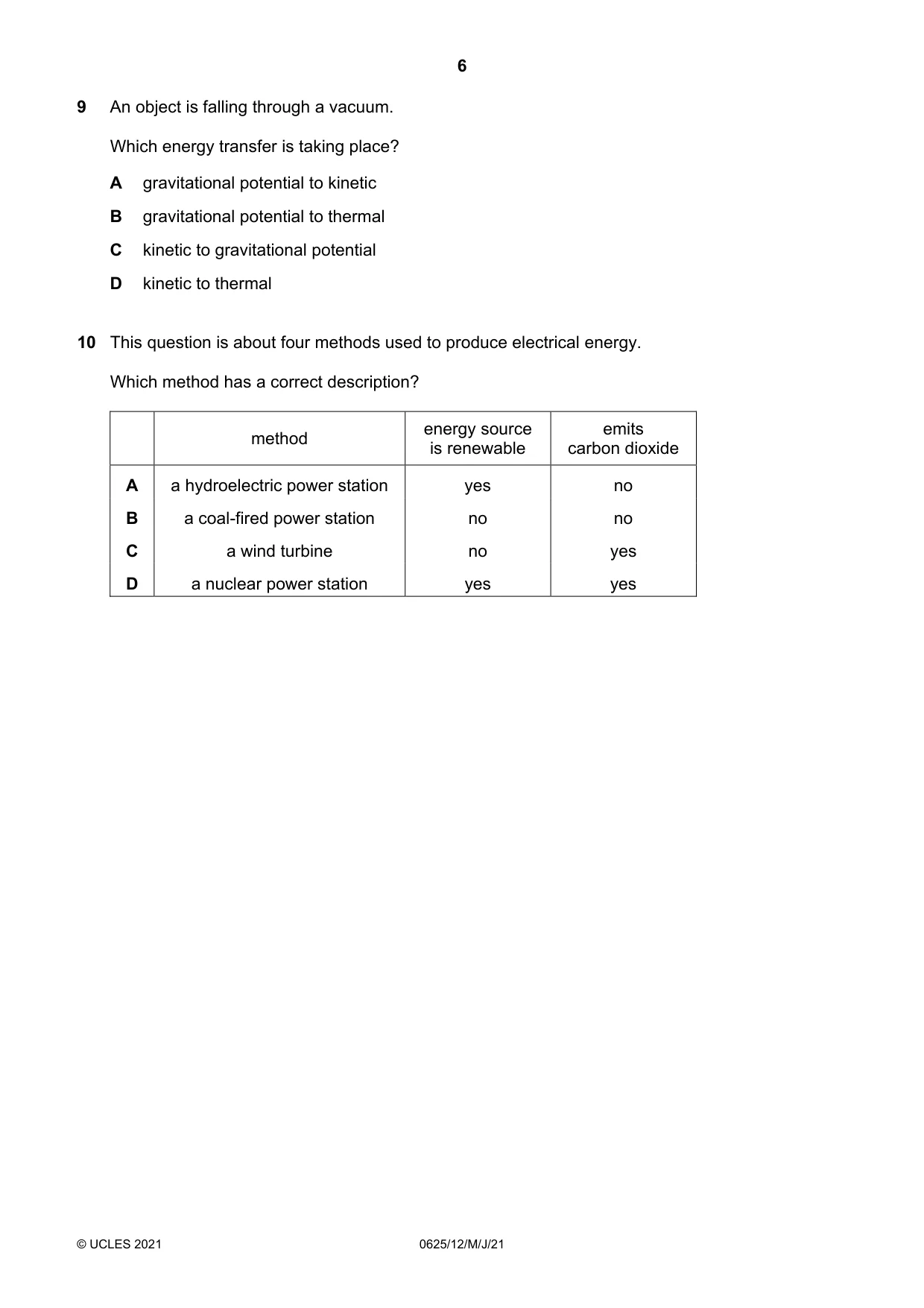
9 An object is falling through a vacuum. Which energy transfer is taking place? A gravitational potential to kinetic B gravitational potential to thermal C kinetic to gravitational potential D kinetic to thermal
Mark scheme: A
Q10 · This question is about four methods used to produce electrical energy
10 This question is about four methods used to produce electrical energy. Which method has a correct description? energy source emits method is renewable carbon dioxide A a hydroelectric power station yes no B a coal-fired power station no no C a wind turbine no yes D a nuclear power station yes yes
Mark scheme: A
Q11 · Two men, X and Y, try to move identical heavy boxes, P and Q
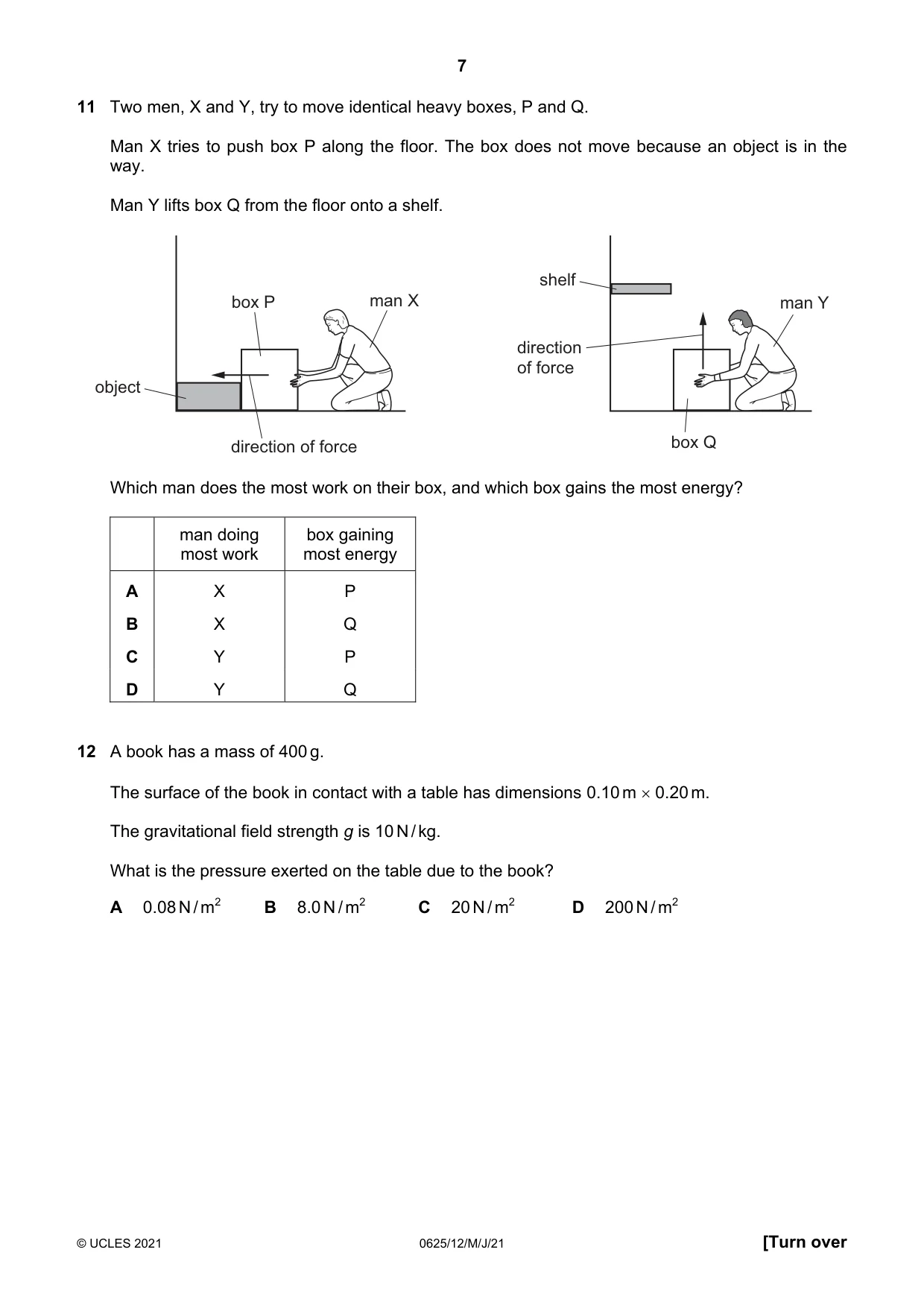
11 Two men, X and Y, try to move identical heavy boxes, P and Q. Man X tries to push box P along the floor. The box does not move because an object is in the way. Man Y lifts box Q from the floor onto a shelf. shelf box P man X man Y direction of force object direction of force box Q Which man does the most work on their box, and which box gains the most energy? man doing box gaining most work most energy A X P B X Q C Y P D Y Q
Mark scheme: D
Q12 · A book has a mass of 400 g
12 A book has a mass of 400 g. The surface of the book in contact with a table has dimensions 0.10 m 0.20 m. The gravitational field strength g is 10 N / kg. What is the pressure exerted on the table due to the book? A 0.08 N / m2 B 8.0 N / m2 C 20 N / m2 D 200 N / m2
Mark scheme: D
Q13 · The diagrams show three containers, P, Q and R
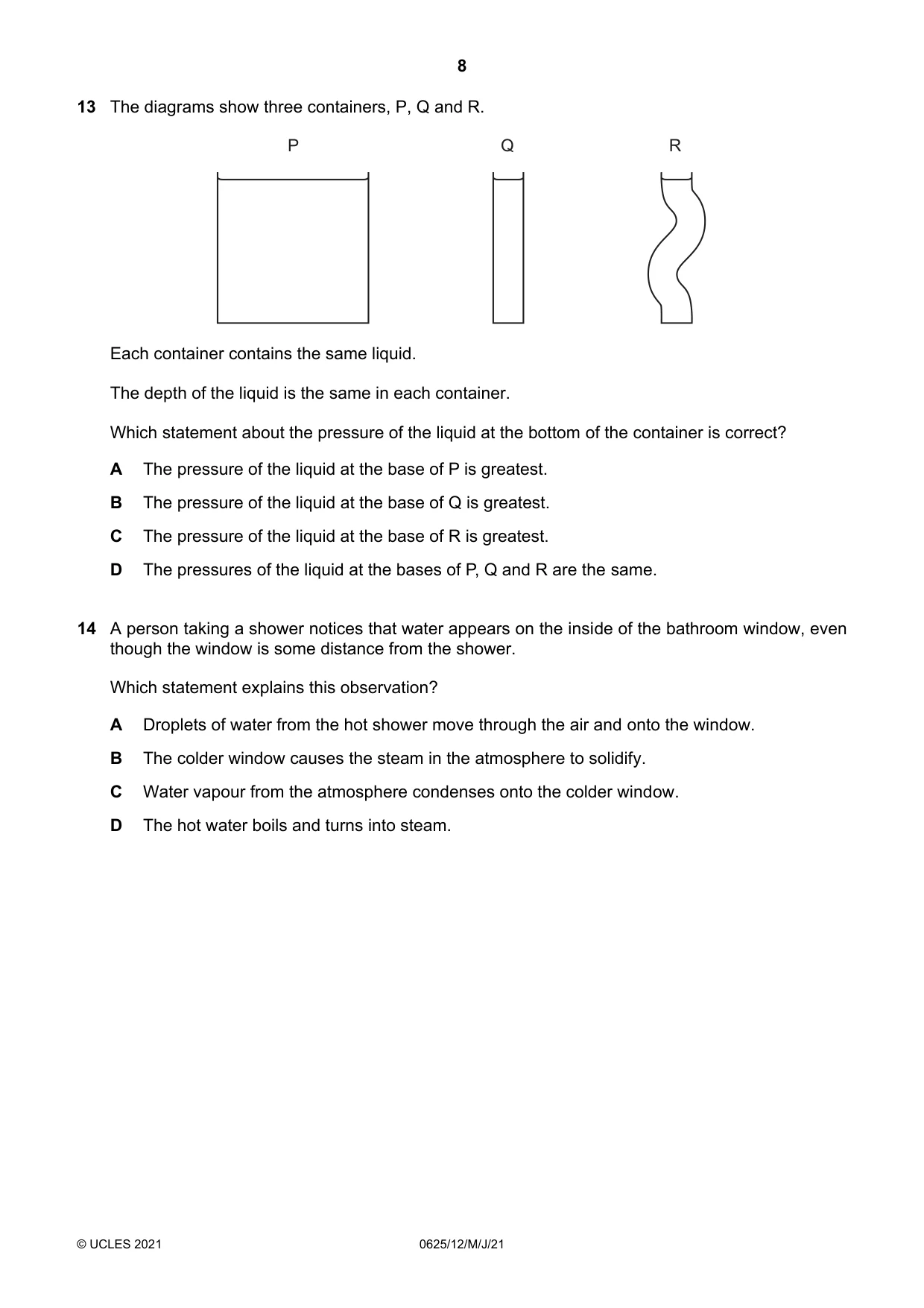
13 The diagrams show three containers, P, Q and R. P Q R Each container contains the same liquid. The depth of the liquid is the same in each container. Which statement about the pressure of the liquid at the bottom of the container is correct? A The pressure of the liquid at the base of P is greatest. B The pressure of the liquid at the base of Q is greatest. C The pressure of the liquid at the base of R is greatest. D The pressures of the liquid at the bases of P, Q and R are the same.
Mark scheme: D
Q14 · A person taking a shower notices that water appears on the inside of the bathroom window…
14 A person taking a shower notices that water appears on the inside of the bathroom window, even though the window is some distance from the shower. Which statement explains this observation? A Droplets of water from the hot shower move through the air and onto the window. B The colder window causes the steam in the atmosphere to solidify. C Water vapour from the atmosphere condenses onto the colder window. D The hot water boils and turns into steam.
Mark scheme: C
Q15 · Very small pollen grains are suspended in water
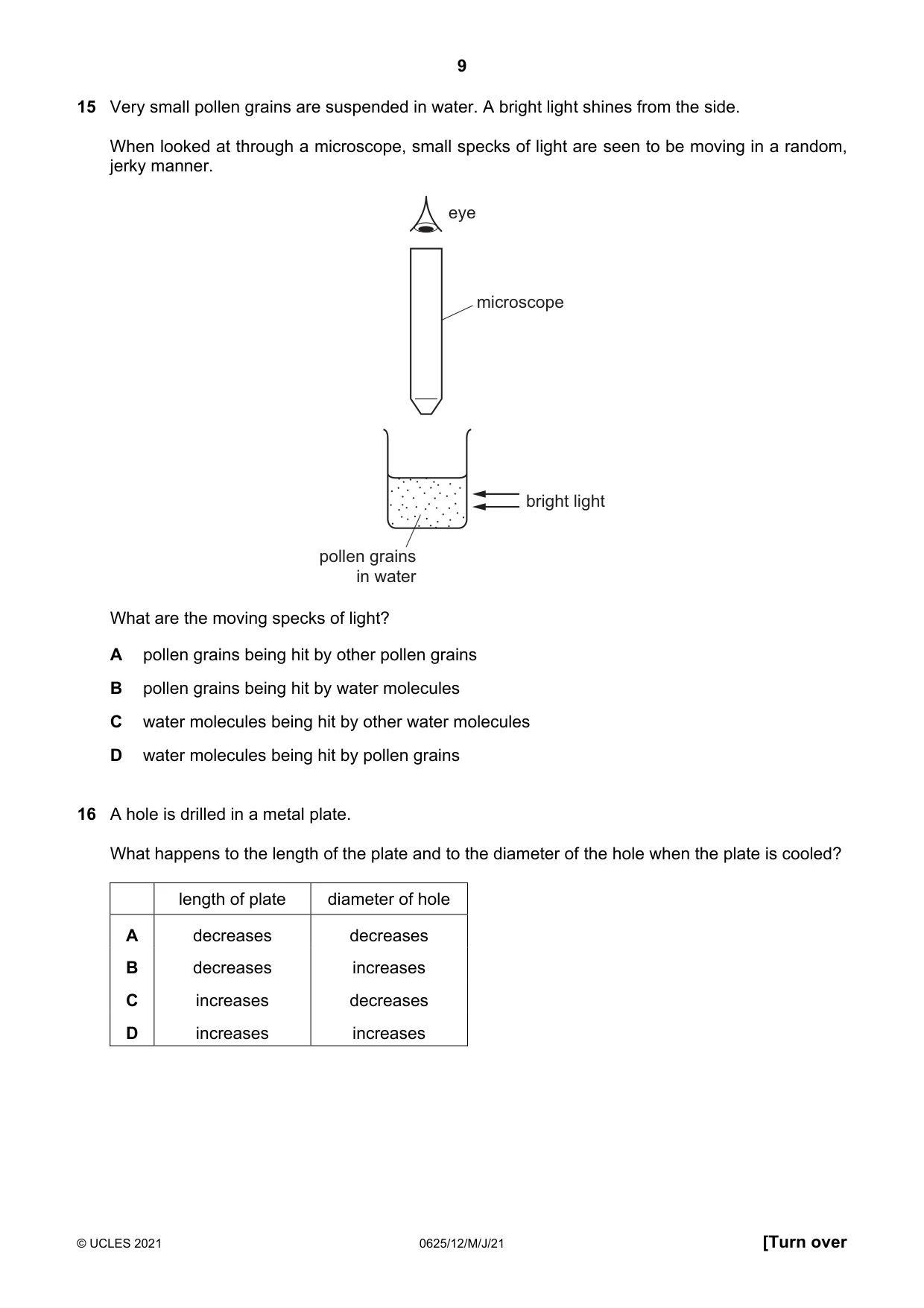
15 Very small pollen grains are suspended in water. A bright light shines from the side. When looked at through a microscope, small specks of light are seen to be moving in a random, jerky manner. eye microscope bright light pollen grains in water What are the moving specks of light? A pollen grains being hit by other pollen grains B pollen grains being hit by water molecules C water molecules being hit by other water molecules D water molecules being hit by pollen grains
Mark scheme: B
Q16 · A hole is drilled in a metal plate
16 A hole is drilled in a metal plate. What happens to the length of the plate and to the diameter of the hole when the plate is cooled? length of plate diameter of hole A decreases decreases B decreases increases C increases decreases D increases increases
Mark scheme: A
Q17 · A liquid-in-glass thermometer uses alcohol as its liquid
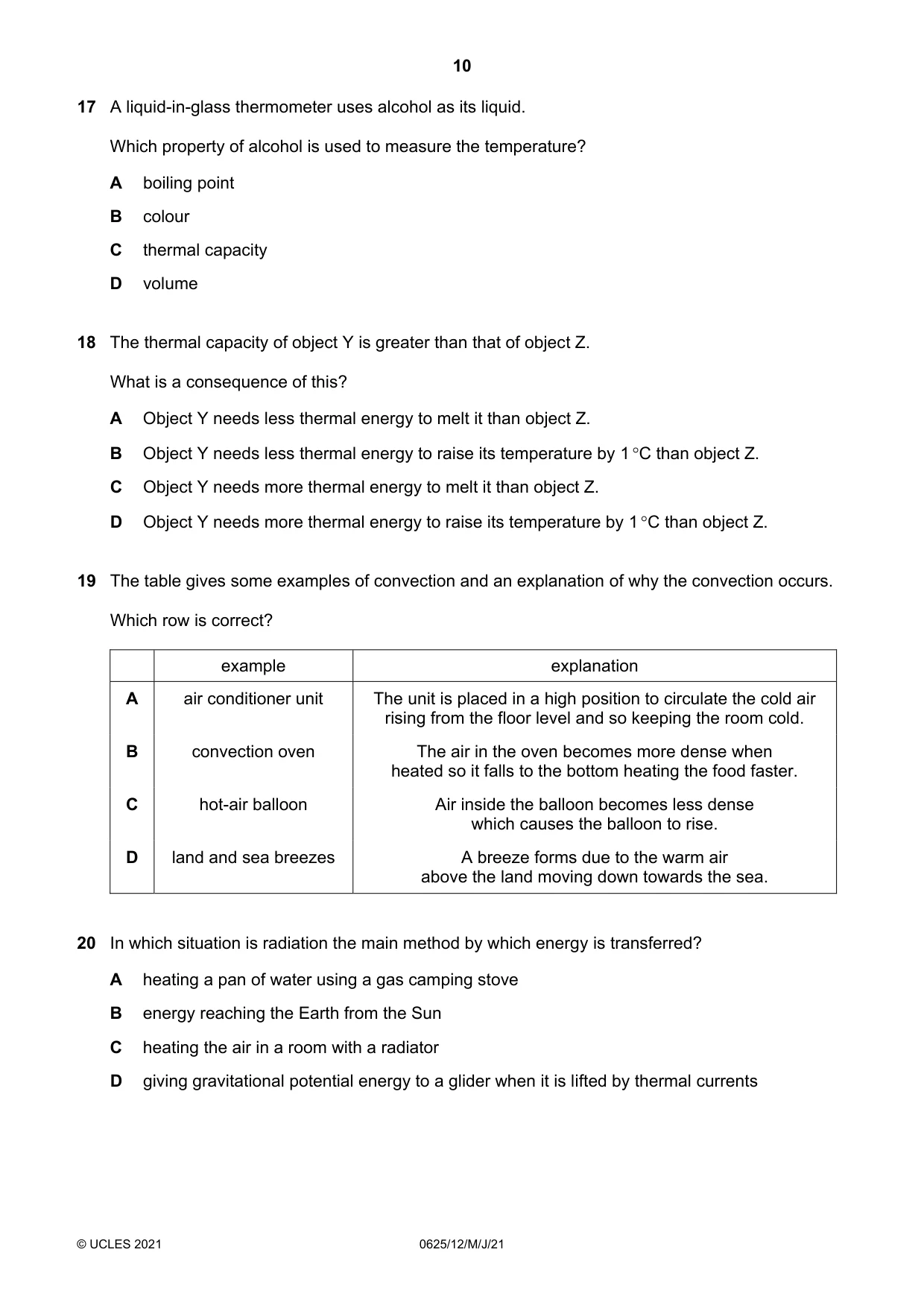
17 A liquid-in-glass thermometer uses alcohol as its liquid. Which property of alcohol is used to measure the temperature? A boiling point B colour C thermal capacity D volume
Mark scheme: D
Q18 · The thermal capacity of object Y is greater than that of object Z
18 The thermal capacity of object Y is greater than that of object Z. What is a consequence of this? A Object Y needs less thermal energy to melt it than object Z. B Object Y needs less thermal energy to raise its temperature by 1 C than object Z. C Object Y needs more thermal energy to melt it than object Z. D Object Y needs more thermal energy to raise its temperature by 1 C than object Z.
Mark scheme: D
Q19 · The table gives some examples of convection and an explanation of why the convection…
19 The table gives some examples of convection and an explanation of why the convection occurs. Which row is correct? example explanation A air conditioner unit The unit is placed in a high position to circulate the cold air rising from the floor level and so keeping the room cold. B convection oven The air in the oven becomes more dense when heated so it falls to the bottom heating the food faster. C hot-air balloon Air inside the balloon becomes less dense which causes the balloon to rise. D land and sea breezes A breeze forms due to the warm air above the land moving down towards the sea.
Mark scheme: C
Q20 · In which situation is radiation the main method by which energy is transferred?
20 In which situation is radiation the main method by which energy is transferred? A heating a pan of water using a gas camping stove B energy reaching the Earth from the Sun C heating the air in a room with a radiator D giving gravitational potential energy to a glider when it is lifted by thermal currents
Mark scheme: B
Q21 · Which diagram shows waves diffracting?
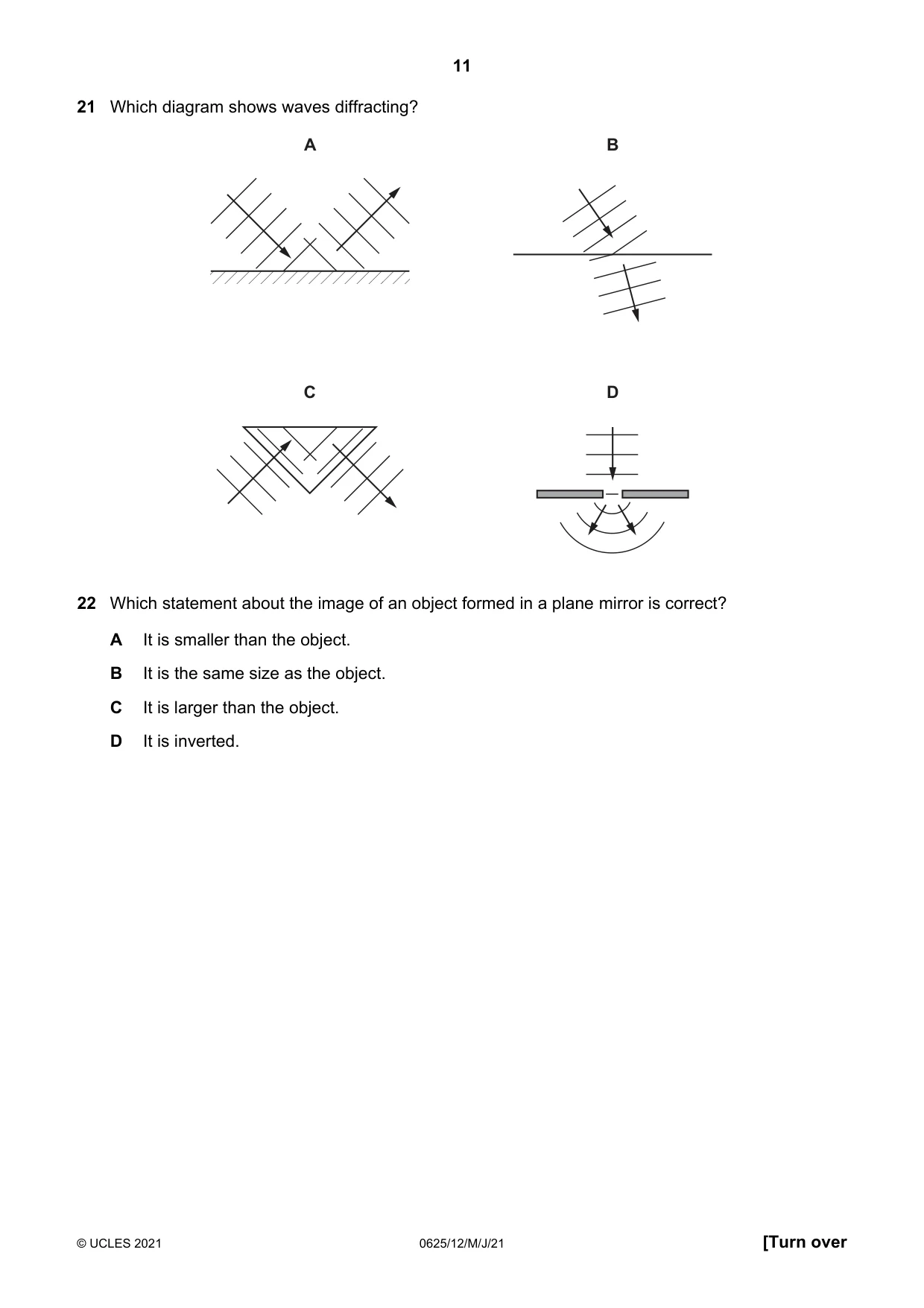
21 Which diagram shows waves diffracting? A B C D
Mark scheme: D
Q22 · Which statement about the image of an object formed in a plane mirror is correct?
22 Which statement about the image of an object formed in a plane mirror is correct? A It is smaller than the object. B It is the same size as the object. C It is larger than the object. D It is inverted.
Mark scheme: B
Q23 · An object is placed in front of a thin converging lens
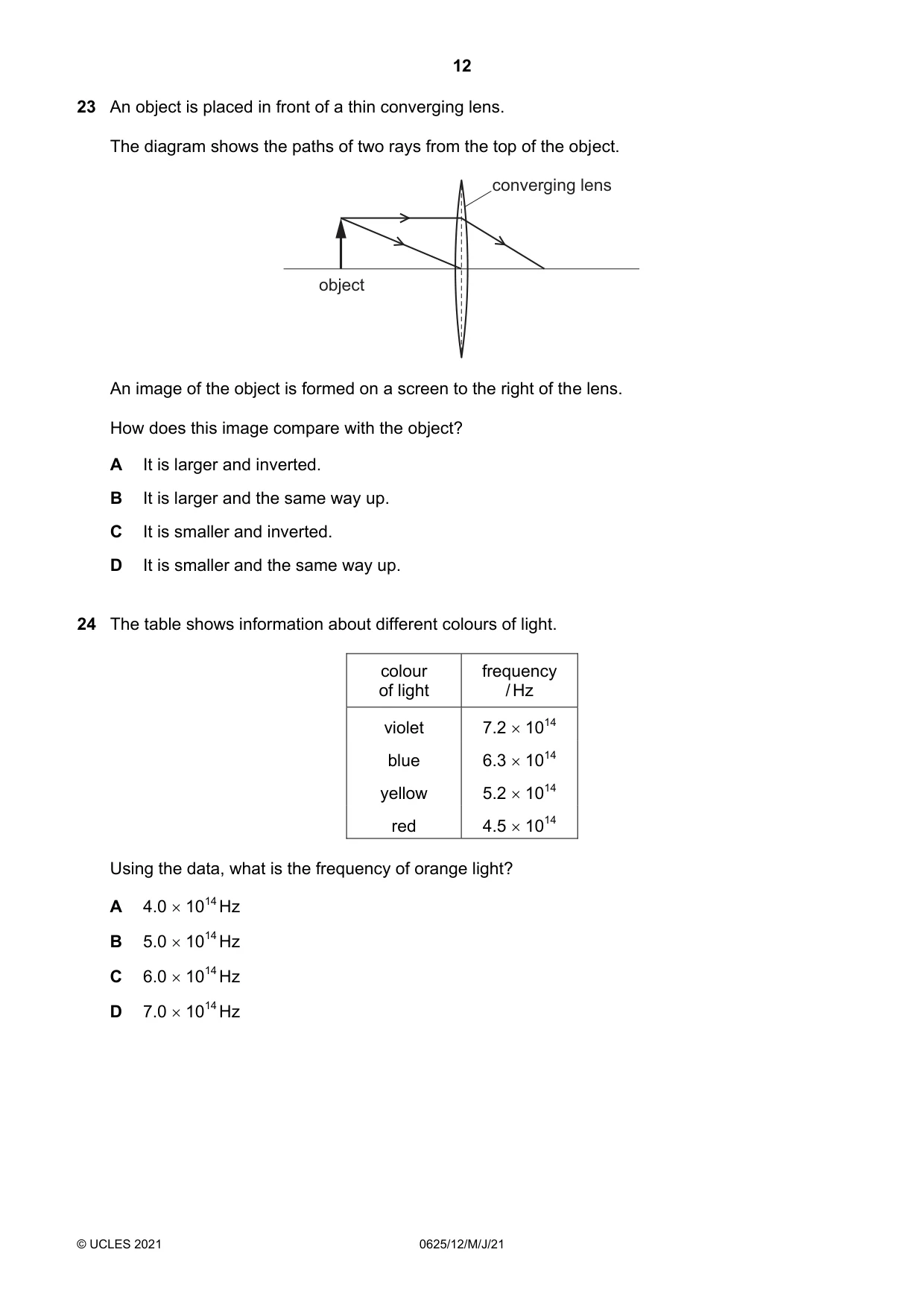
23 An object is placed in front of a thin converging lens. The diagram shows the paths of two rays from the top of the object. converging lens object An image of the object is formed on a screen to the right of the lens. How does this image compare with the object? A It is larger and inverted. B It is larger and the same way up. C It is smaller and inverted. D It is smaller and the same way up.
Mark scheme: A
Q24 · The table shows information about different colours of light
24 The table shows information about different colours of light. colour frequency of light / Hz violet 7.2 1014 blue 6.3 1014 yellow 5.2 1014 red 4.5 1014 Using the data, what is the frequency of orange light? A 4.0 1014 Hz B 5.0 1014 Hz C 6.0 1014 Hz D 7.0 1014 Hz
Mark scheme: B
Q25 · Sound is a transfer of energy from an oscillating source
25 Sound is a transfer of energy from an oscillating source. Which statement describes how sound energy is transferred? A a longitudinal wave with the oscillation parallel to the direction in which energy is transferred B a longitudinal wave with the oscillation perpendicular to the direction in which energy is transferred C a transverse wave with the oscillation parallel to the direction in which energy is transferred D a transverse wave with the oscillation perpendicular to the direction in which energy is transferred
Mark scheme: A
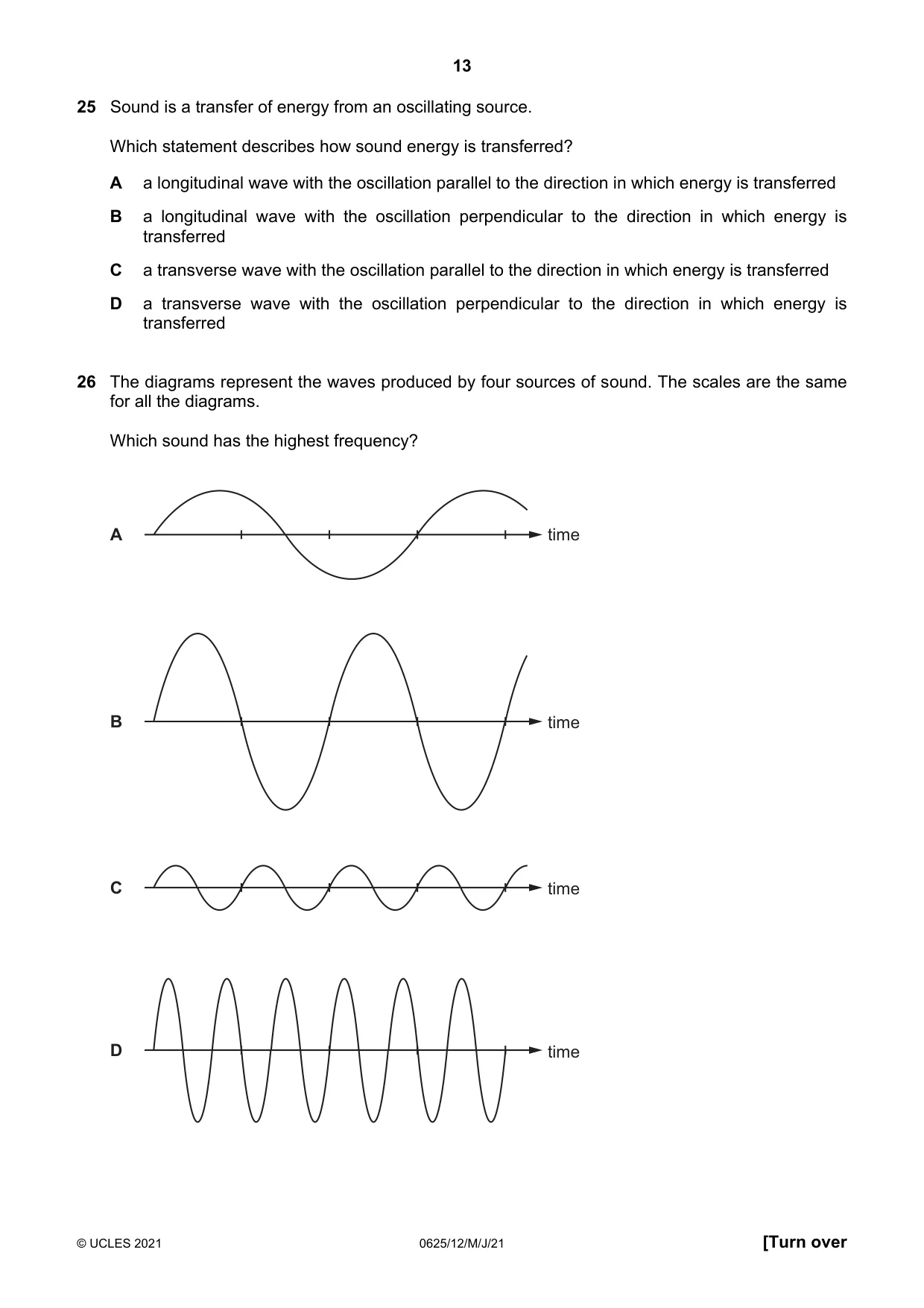
Q26 · The diagrams represent the waves produced by four sources of sound
26 The diagrams represent the waves produced by four sources of sound. The scales are the same for all the diagrams. Which sound has the highest frequency? A time B time C time D time
Mark scheme: D
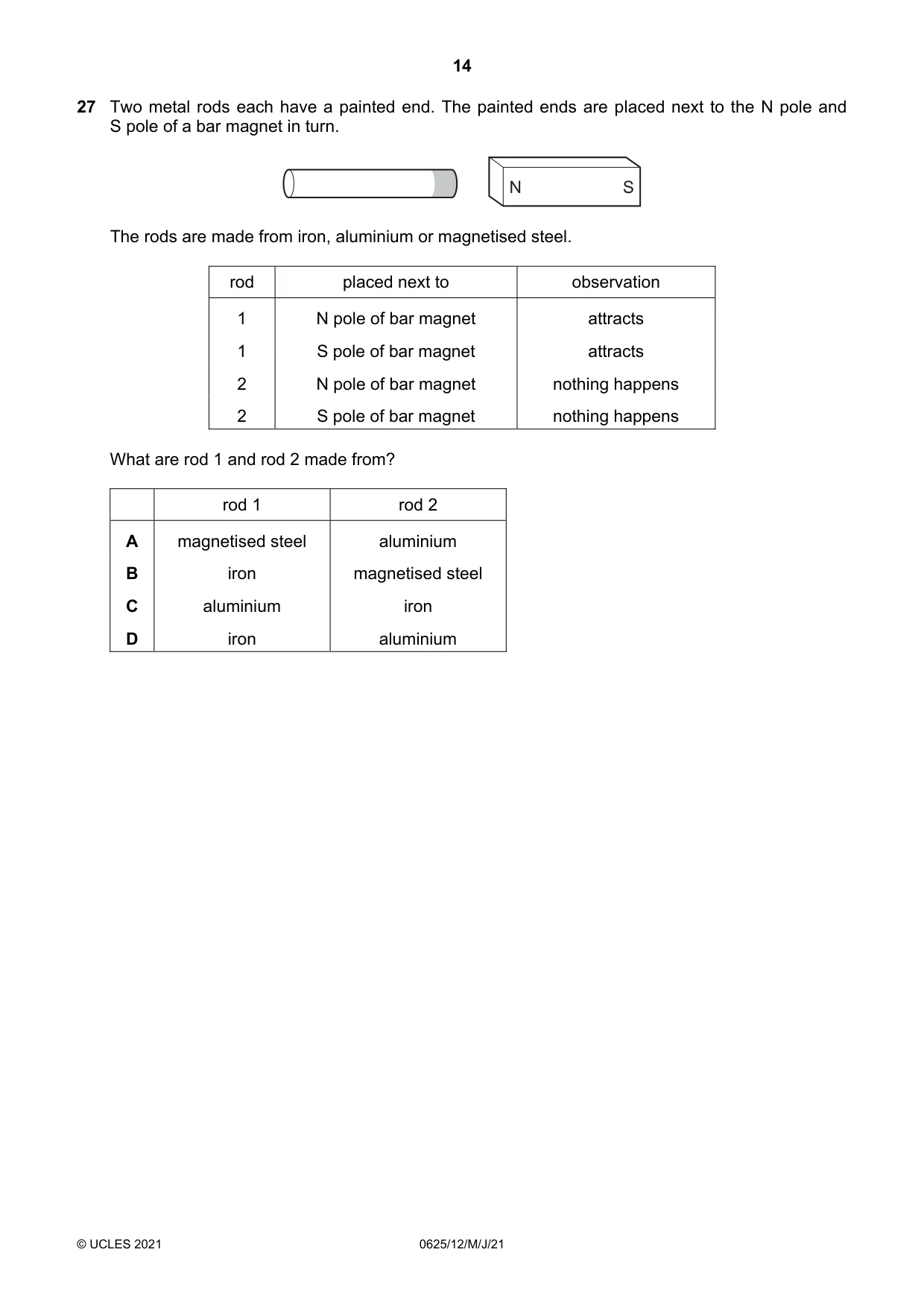
Q27 · Two metal rods each have a painted end
27 Two metal rods each have a painted end. The painted ends are placed next to the N pole and S pole of a bar magnet in turn. N S The rods are made from iron, aluminium or magnetised steel. rod placed next to observation 1 N pole of bar magnet attracts 1 S pole of bar magnet attracts 2 N pole of bar magnet nothing happens 2 S pole of bar magnet nothing happens What are rod 1 and rod 2 made from? rod 1 rod 2 A magnetised steel aluminium B iron magnetised steel C aluminium iron D iron aluminium
Mark scheme: D
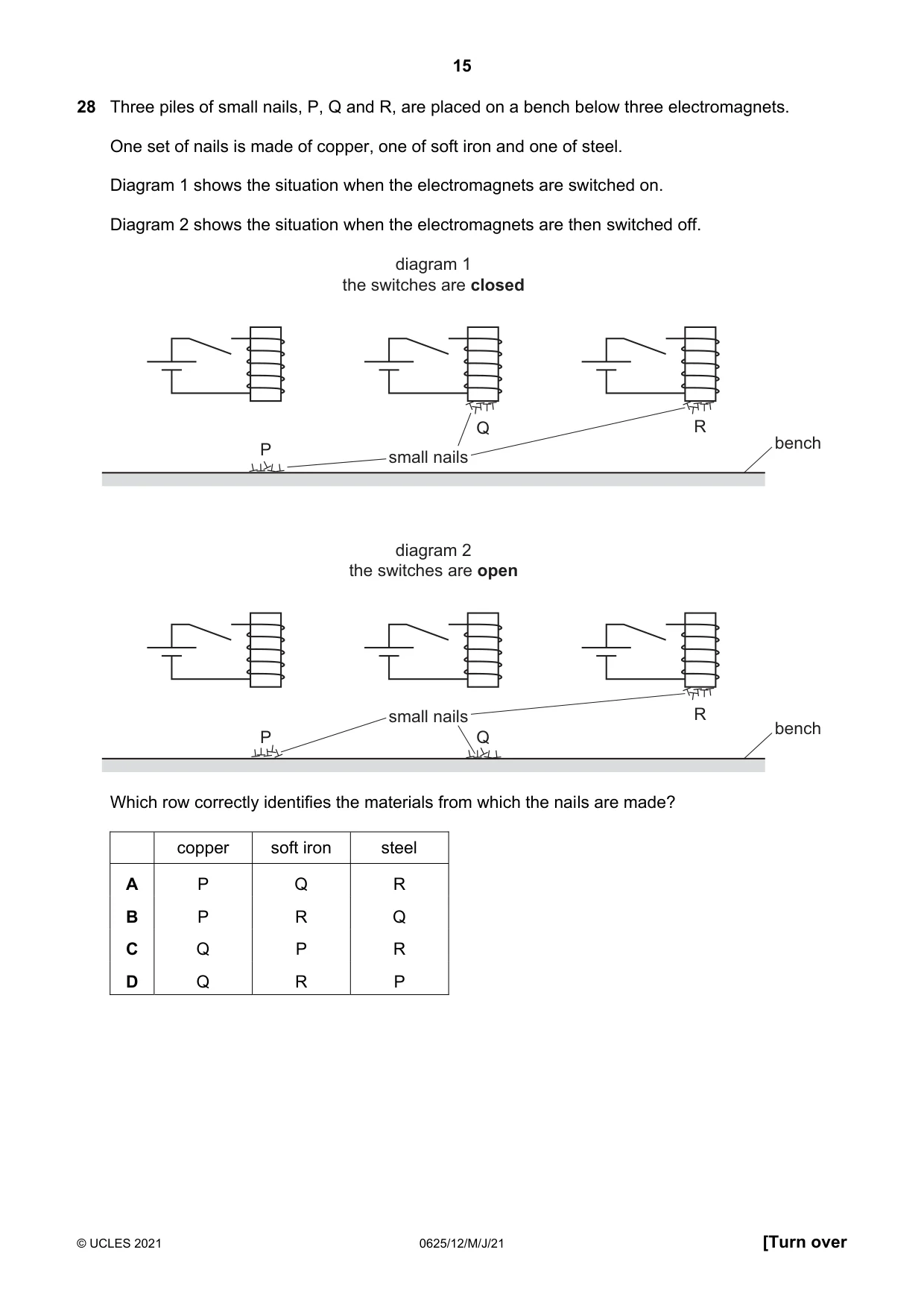
Q28 · Three piles of small nails, P, Q and R, are placed on a bench below three electromagnets
28 Three piles of small nails, P, Q and R, are placed on a bench below three electromagnets. One set of nails is made of copper, one of soft iron and one of steel. Diagram 1 shows the situation when the electromagnets are switched on. Diagram 2 shows the situation when the electromagnets are then switched off. diagram 1 the switches are closed Q R P bench small nails diagram 2 the switches are open small nails R bench P Q Which row correctly identifies the materials from which the nails are made? copper soft iron steel A P Q R B P R Q C Q P R D Q R P
Mark scheme: A
Q29 · A student rubs a plastic rod with a cloth
29 A student rubs a plastic rod with a cloth. The rod becomes positively charged. What has happened to the rod? A It has gained electrons. B It has gained protons. C It has lost electrons. D It has lost protons.
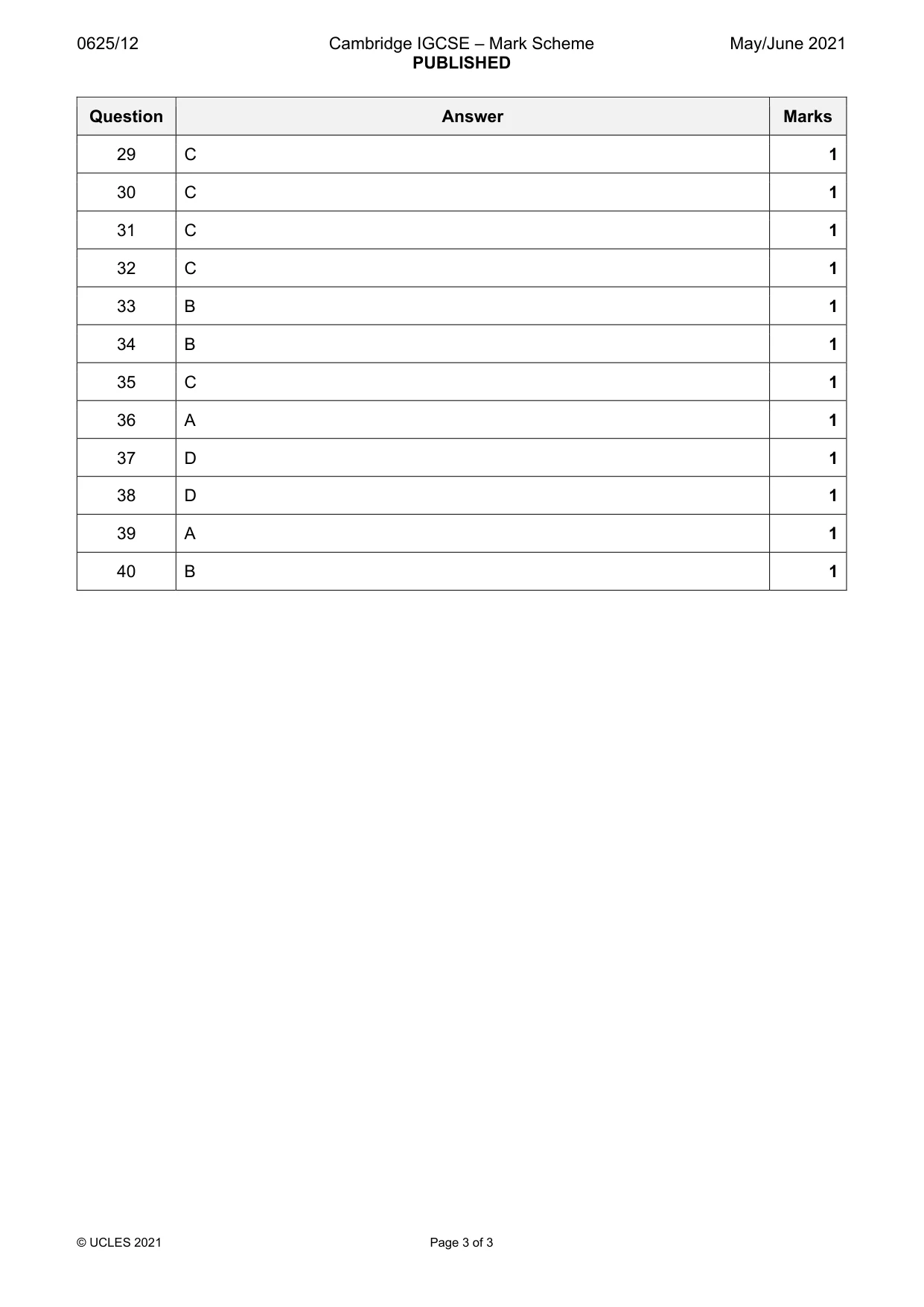
Mark scheme: C
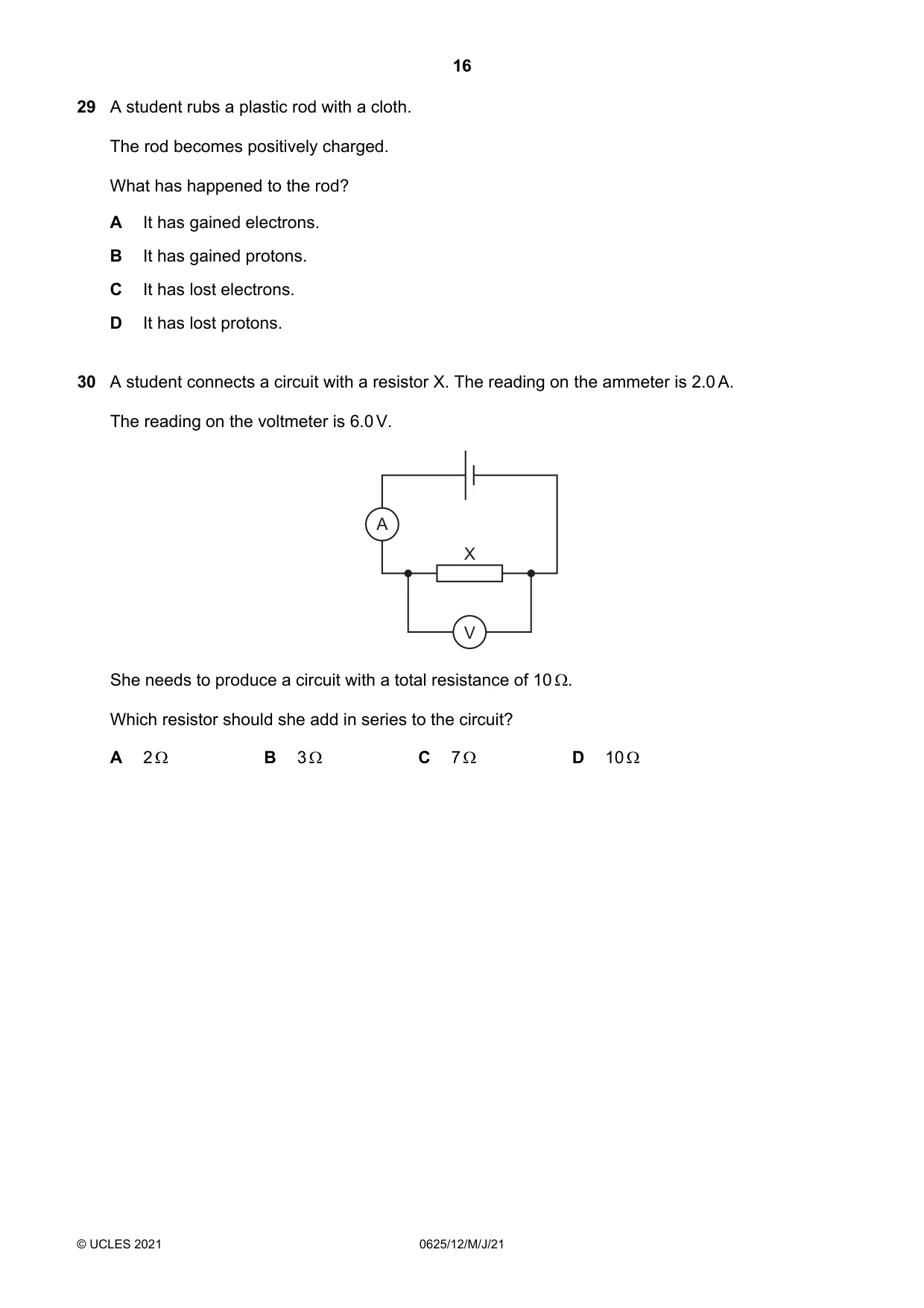
Q30 · A student connects a circuit with a resistor X
30 A student connects a circuit with a resistor X. The reading on the ammeter is 2.0 A. The reading on the voltmeter is 6.0 V. A X V She needs to produce a circuit with a total resistance of 10 . Which resistor should she add in series to the circuit? A 2 B 3 C 7 D 10
Mark scheme: C
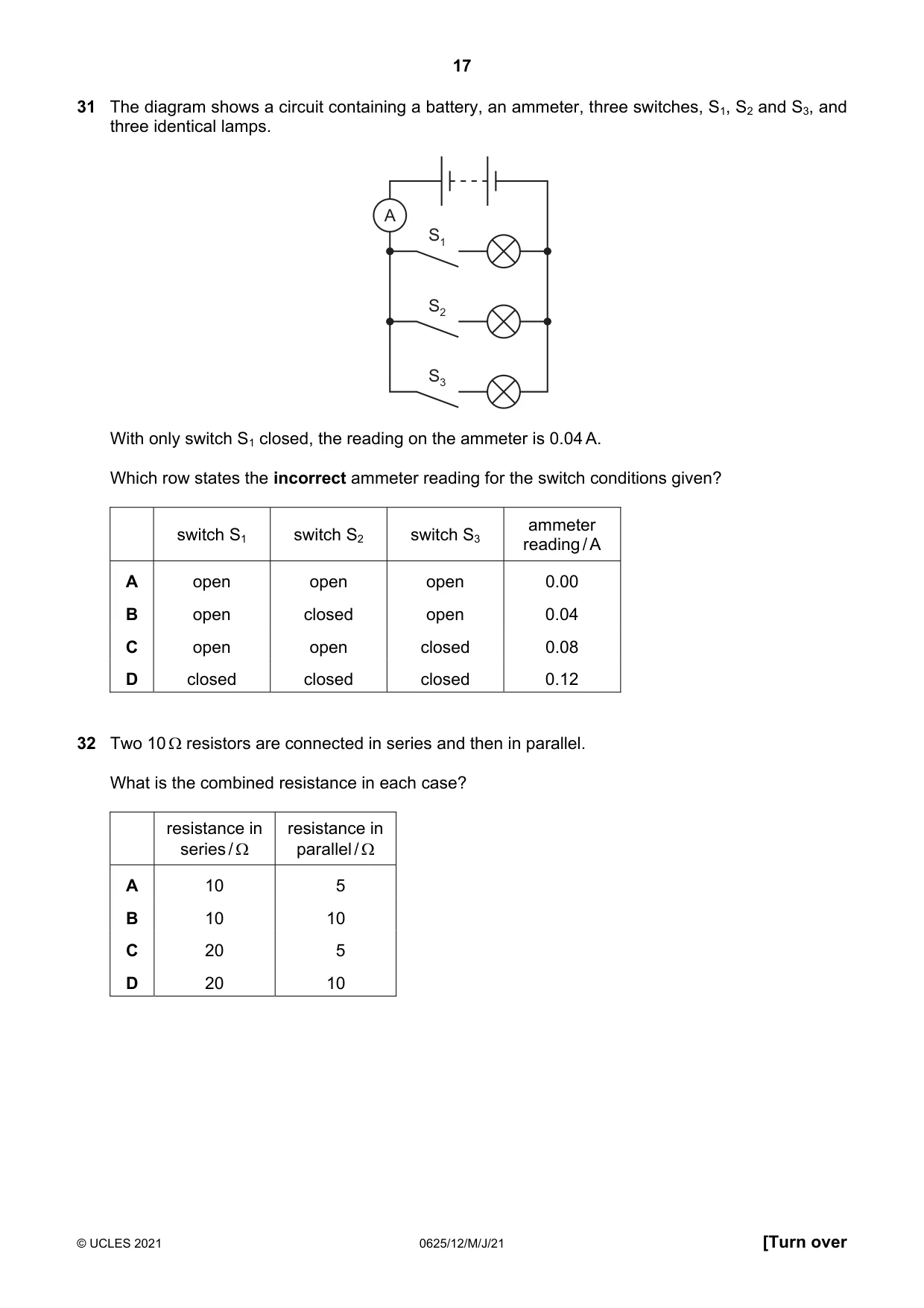
Q31 · The diagram shows a circuit containing a battery, an ammeter, three switches, S1, S2 and…
31 The diagram shows a circuit containing a battery, an ammeter, three switches, S1, S2 and S3, and three identical lamps. A S1 S2 S3 With only switch S1 closed, the reading on the ammeter is 0.04 A. Which row states the incorrect ammeter reading for the switch conditions given? ammeter switch S1 switch S2 switch S3 reading / A A open open open 0.00 B open closed open 0.04 C open open closed 0.08 D closed closed closed 0.12
Mark scheme: C
Q32 · Two 10 resistors are connected in series and then in parallel
32 Two 10 resistors are connected in series and then in parallel. What is the combined resistance in each case? resistance in resistance in series / parallel / A 10 5 B 10 10 C 20 5 D 20 10
Mark scheme: C
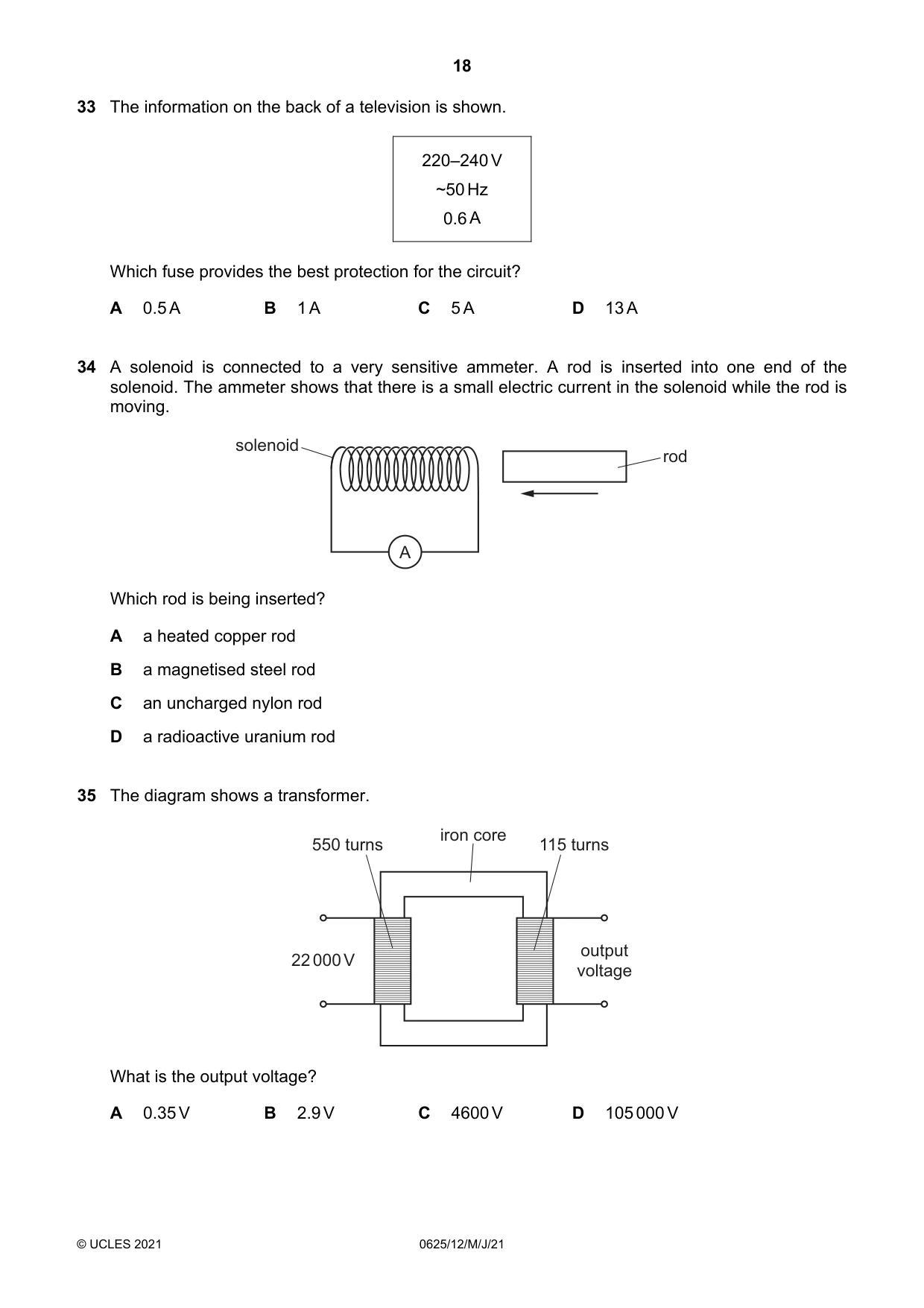
Q33 · The information on the back of a television is shown
33 The information on the back of a television is shown. 220–240 V ~50 Hz 0.6 A Which fuse provides the best protection for the circuit? A 0.5 A B 1 A C 5 A D 13 A
Mark scheme: B
Q34 · A solenoid is connected to a very sensitive ammeter
34 A solenoid is connected to a very sensitive ammeter. A rod is inserted into one end of the solenoid. The ammeter shows that there is a small electric current in the solenoid while the rod is moving. solenoid rod A Which rod is being inserted? A a heated copper rod B a magnetised steel rod C an uncharged nylon rod D a radioactive uranium rod
Mark scheme: B
Q35 · The diagram shows a transformer
35 The diagram shows a transformer. iron core 550 turns 115 turns output 22 000 V voltage What is the output voltage? A 0.35 V B 2.9 V C 4600 V D 105 000 V
Mark scheme: C
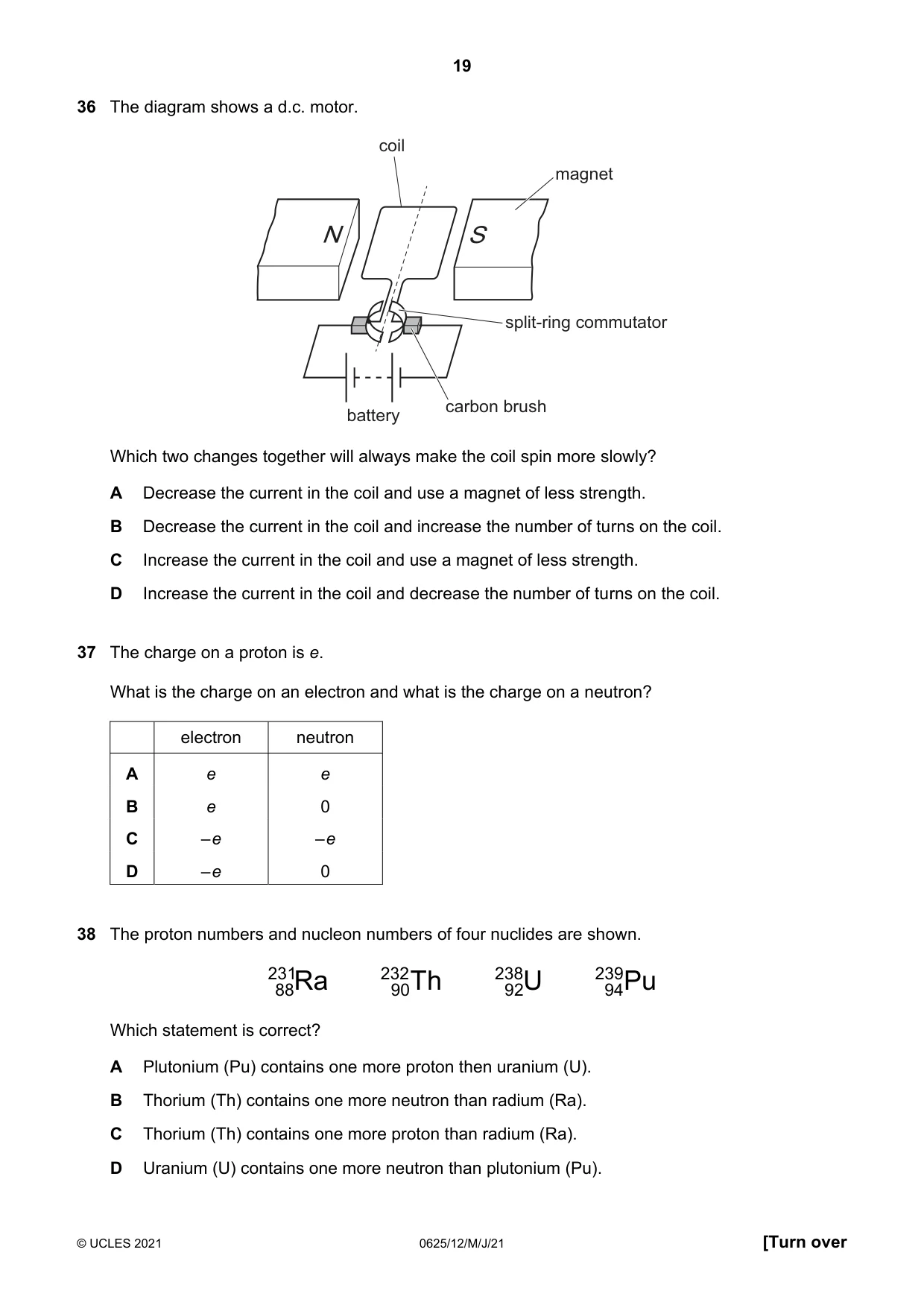
Q36 · The diagram shows a d.c
36 The diagram shows a d.c. motor. coil magnet N S split-ring commutator carbon brush battery Which two changes together will always make the coil spin more slowly? A Decrease the current in the coil and use a magnet of less strength. B Decrease the current in the coil and increase the number of turns on the coil. C Increase the current in the coil and use a magnet of less strength. D Increase the current in the coil and decrease the number of turns on the coil.
Mark scheme: A
Q37 · The charge on a proton is e
37 The charge on a proton is e. What is the charge on an electron and what is the charge on a neutron? electron neutron A e e B e 0 C – e – e D – e 0
Mark scheme: D
Q38 · The proton numbers and nucleon numbers of four nuclides are shown
38 The proton numbers and nucleon numbers of four nuclides are shown. 231 88Ra 232 90Th 238 92U 239 94Pu Which statement is correct? A Plutonium (Pu) contains one more proton then uranium (U). B Thorium (Th) contains one more neutron than radium (Ra). C Thorium (Th) contains one more proton than radium (Ra). D Uranium (U) contains one more neutron than plutonium (Pu).
Mark scheme: D
Q39 · A radioactive atom decays by emission of a -particle
39 A radioactive atom decays by emission of a -particle. Which row is correct? what decays what happens to the atom A the nucleus of the atom it becomes a different element B the nucleus of the atom it becomes a lighter version of the same element C the outer layers of the atom it becomes a different element D the outer layers of the atom it becomes a lighter version of the same element
Mark scheme: A
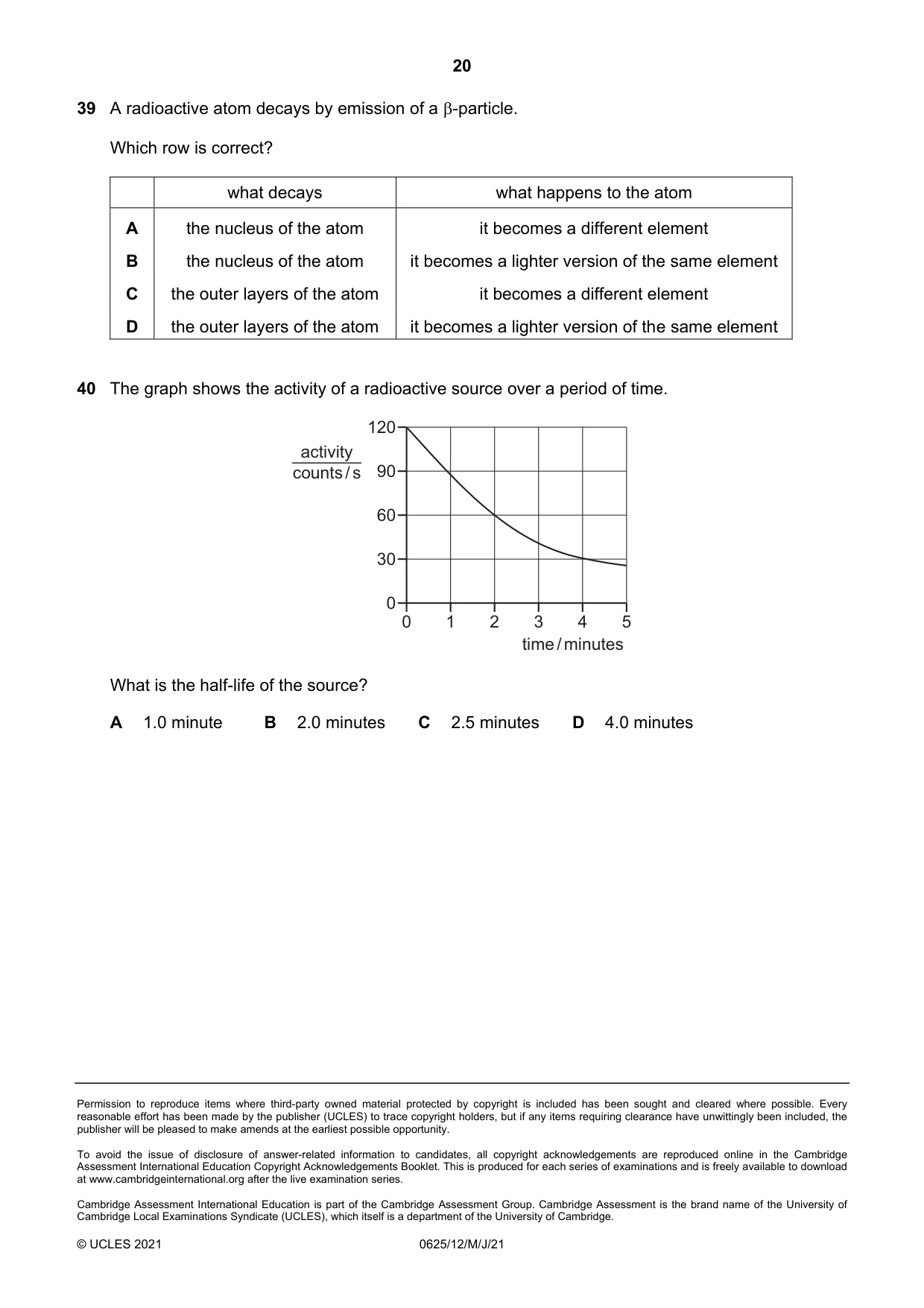
Q40 · The graph shows the activity of a radioactive source over a period of time
40 The graph shows the activity of a radioactive source over a period of time. 120 activity counts / s 90 60 30 0 0 1 2 3 4 5 time / minutes What is the half-life of the source? A 1.0 minute B 2.0 minutes C 2.5 minutes D 4.0 minutes
Mark scheme: B
What was in this paper
The subtopics covered by these 40 questions, and how many questions each got. Open one in a new tab to see every Cambridge question on it.
4Electric circuits3Energy, work and power3The nuclear model of the atom3Thermal properties and temperature3Forces2Kinetic particle model of matter2Light2Mass and weight2Motion2Pressure2Radioactivity2Sound2Transfer of thermal energy2Density1Electrical safety1Electromagnetic spectrum1General properties of waves1Physical quantities and measurement techniques1Simple phenomena of magnetism1What you needed in this session
Cambridge’s own grade thresholds for 2021 May/June, Paper 1 · Variant 2. A higher threshold means an easier paper — the bar moves with how the cohort did.