Cambridge IGCSE Physics 0625 — 2017 Feb/March Paper 1 · Variant 2
0625/12/F/M/17 · 40 questions · 40 marks · ≈45 min
The question paper and its mark scheme, free to read here and free to download. This is Cambridge’s own paper, exactly as it was sat.
Question paper20 pages
Mark scheme3 pages
Answers below. Sit the paper first if you are practising.
Questions as text
Q1 · The diagram shows the height of a stack of identical coins
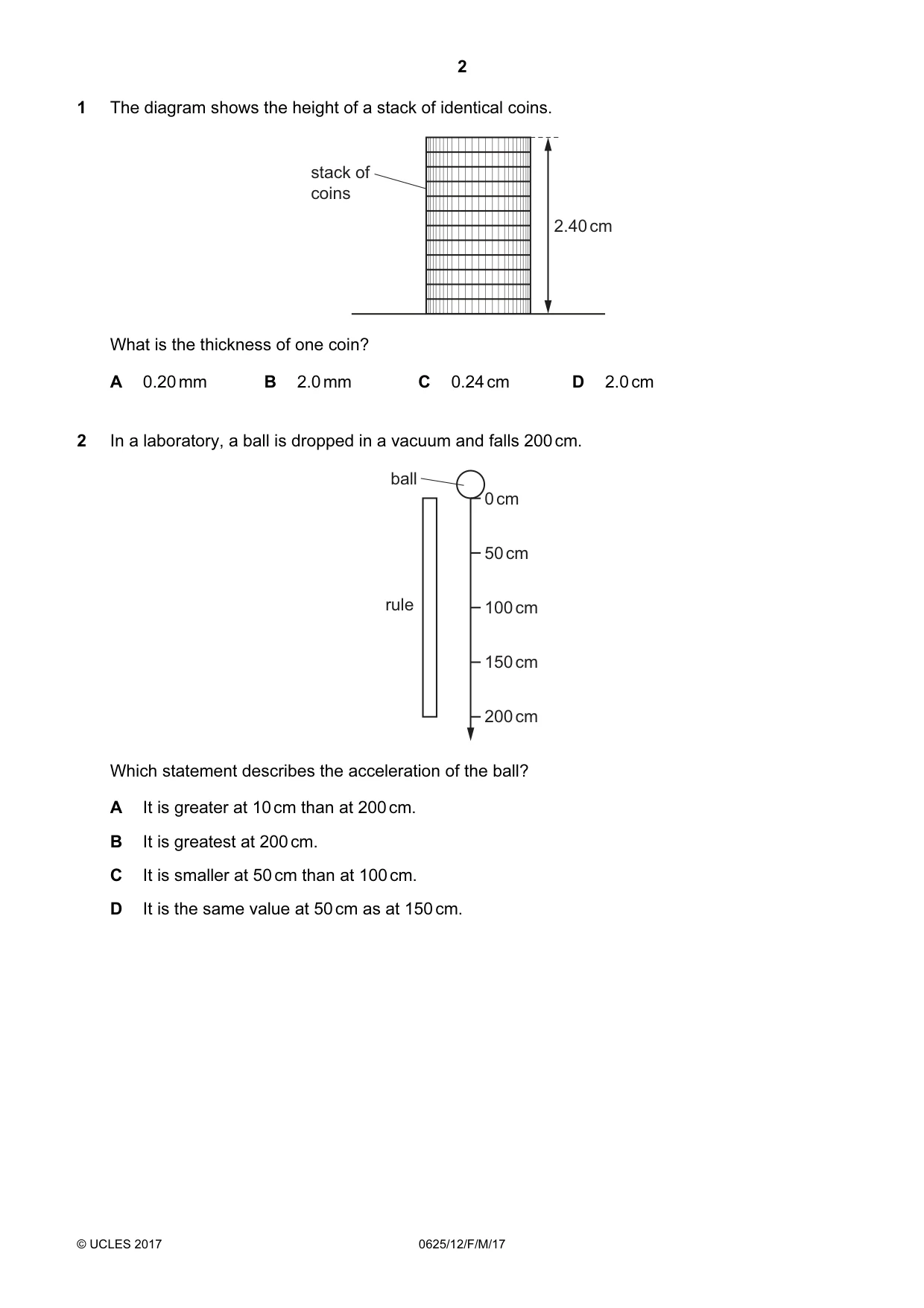
1 The diagram shows the height of a stack of identical coins. stack of coins 2.40 cm What is the thickness of one coin? A 0.20 mm B 2.0 mm C 0.24 cm D 2.0 cm
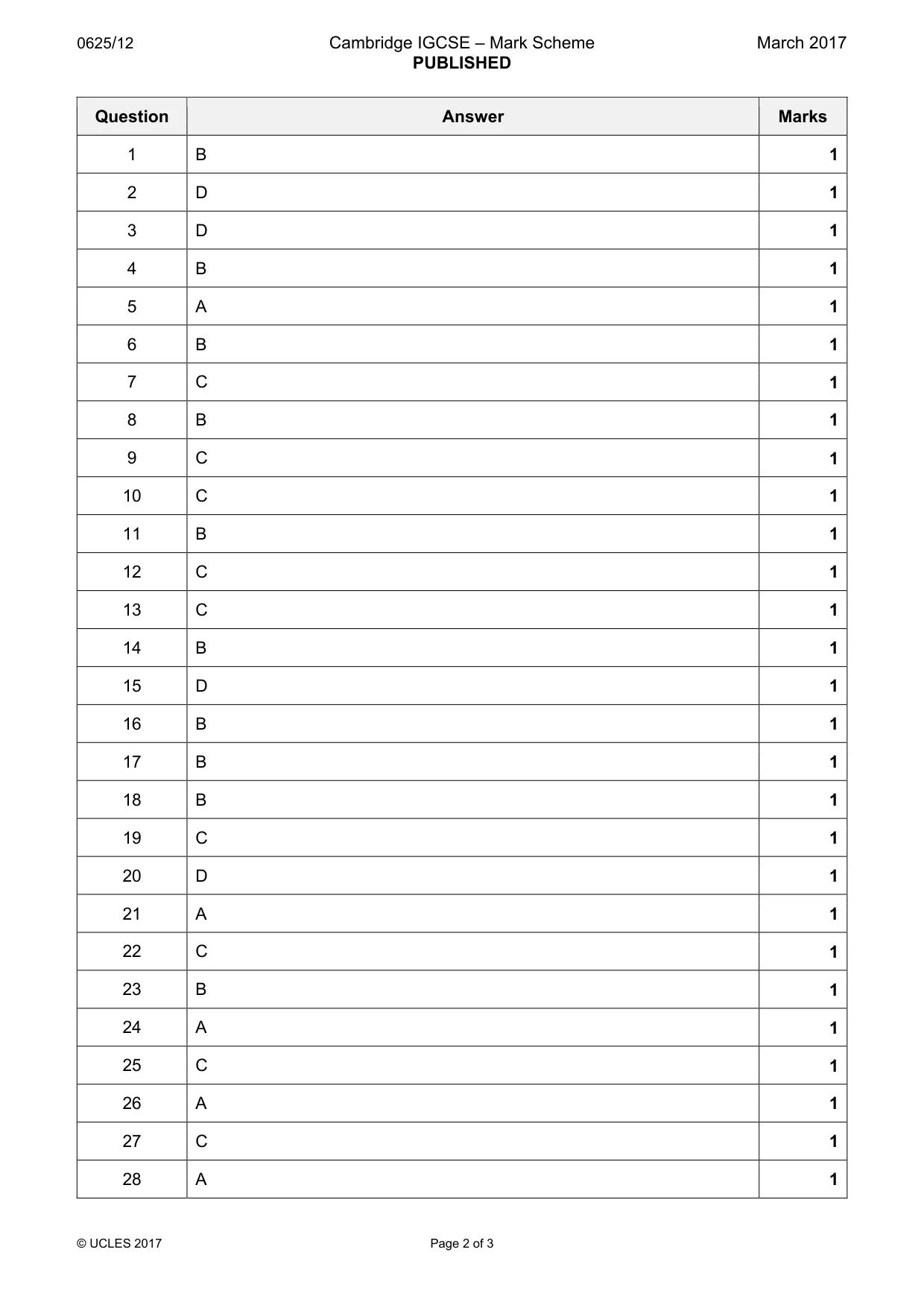
Mark scheme: B
More questions on Physical quantities and measurement techniques
Q2 · In a laboratory, a ball is dropped in a vacuum and falls 200 cm
2 In a laboratory, a ball is dropped in a vacuum and falls 200 cm. ball 0 cm 50 cm rule 100 cm 150 cm 200 cm Which statement describes the acceleration of the ball? A It is greater at 10 cm than at 200 cm. B It is greatest at 200 cm. C It is smaller at 50 cm than at 100 cm. D It is the same value at 50 cm as at 150 cm.
Mark scheme: D
Q3 · A man stands by a railway track
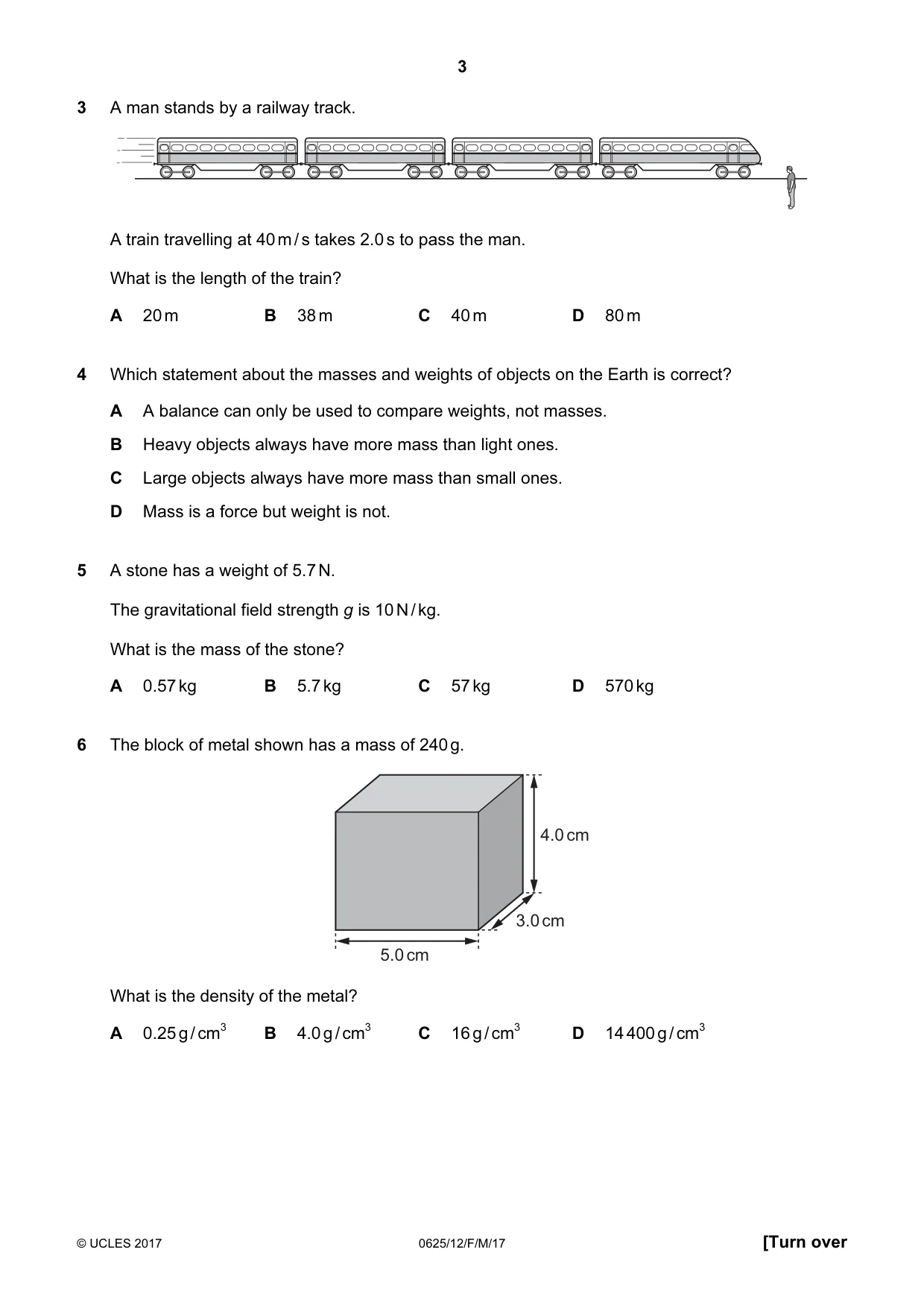
3 A man stands by a railway track. A train travelling at 40 m / s takes 2.0 s to pass the man. What is the length of the train? A 20 m B 38 m C 40 m D 80 m
Mark scheme: D
Q4 · Which statement about the masses and weights of objects on the Earth is correct?
4 Which statement about the masses and weights of objects on the Earth is correct? A A balance can only be used to compare weights, not masses. B Heavy objects always have more mass than light ones. C Large objects always have more mass than small ones. D Mass is a force but weight is not.
Mark scheme: B
Q5 · A stone has a weight of 5.7 N
5 A stone has a weight of 5.7 N. The gravitational field strength g is 10 N / kg. What is the mass of the stone? A 0.57 kg B 5.7 kg C 57 kg D 570 kg
Mark scheme: A
Q6 · The block of metal shown has a mass of 240 g
6 The block of metal shown has a mass of 240 g. 4.0 cm 3.0 cm 5.0 cm What is the density of the metal? A 0.25 g / cm3 B 4.0 g / cm3 C 16 g / cm3 D 14 400 g / cm3
Mark scheme: B
Q7 · A car engine causes a forward force of 100 kN to act on the car
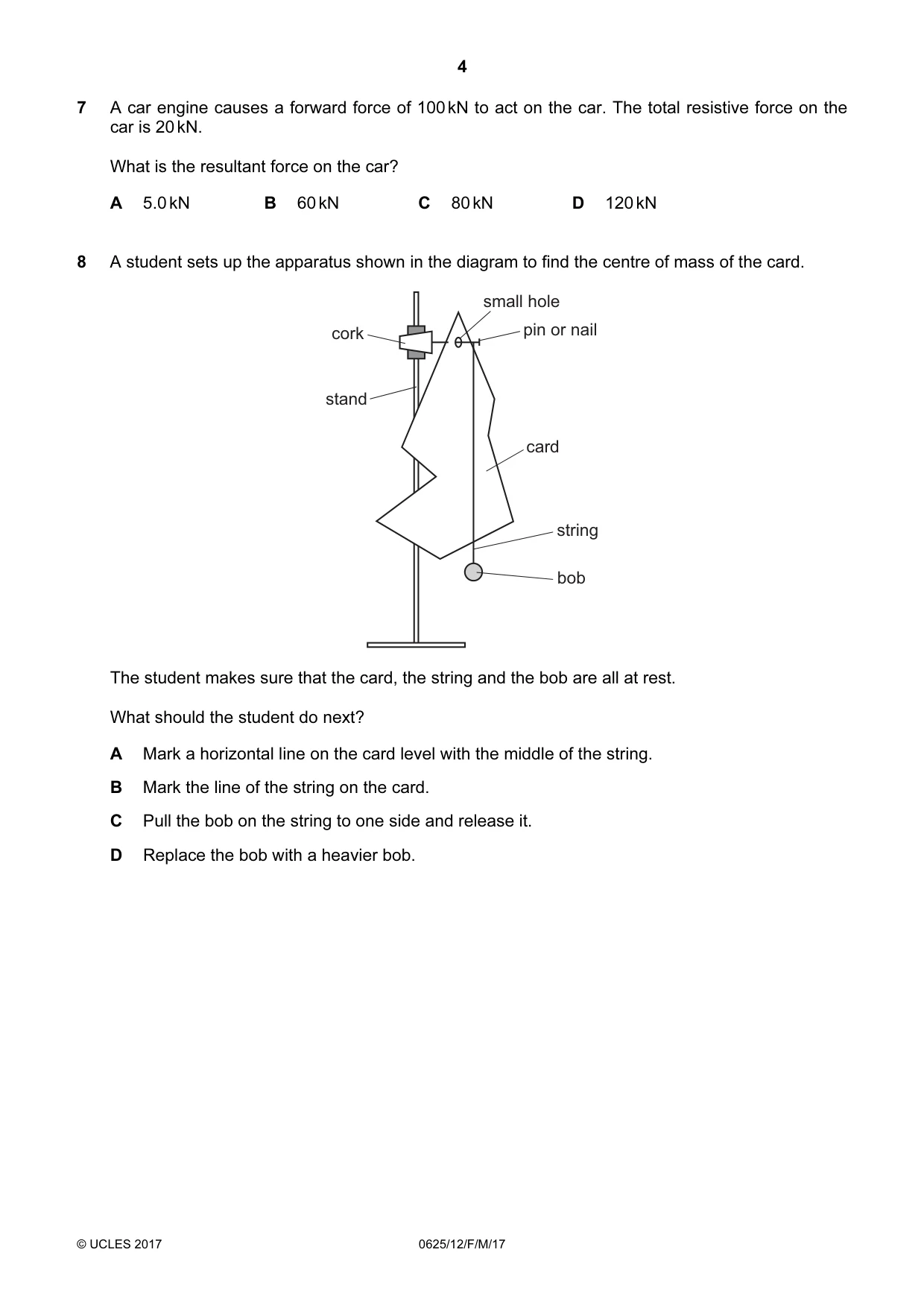
7 A car engine causes a forward force of 100 kN to act on the car. The total resistive force on the car is 20 kN. What is the resultant force on the car? A 5.0 kN B 60 kN C 80 kN D 120 kN
Mark scheme: C
Q8 · A student sets up the apparatus shown in the diagram to find the centre of mass of the…
8 A student sets up the apparatus shown in the diagram to find the centre of mass of the card. small hole cork pin or nail stand card string bob The student makes sure that the card, the string and the bob are all at rest. What should the student do next? A Mark a horizontal line on the card level with the middle of the string. B Mark the line of the string on the card. C Pull the bob on the string to one side and release it. D Replace the bob with a heavier bob.
Mark scheme: B
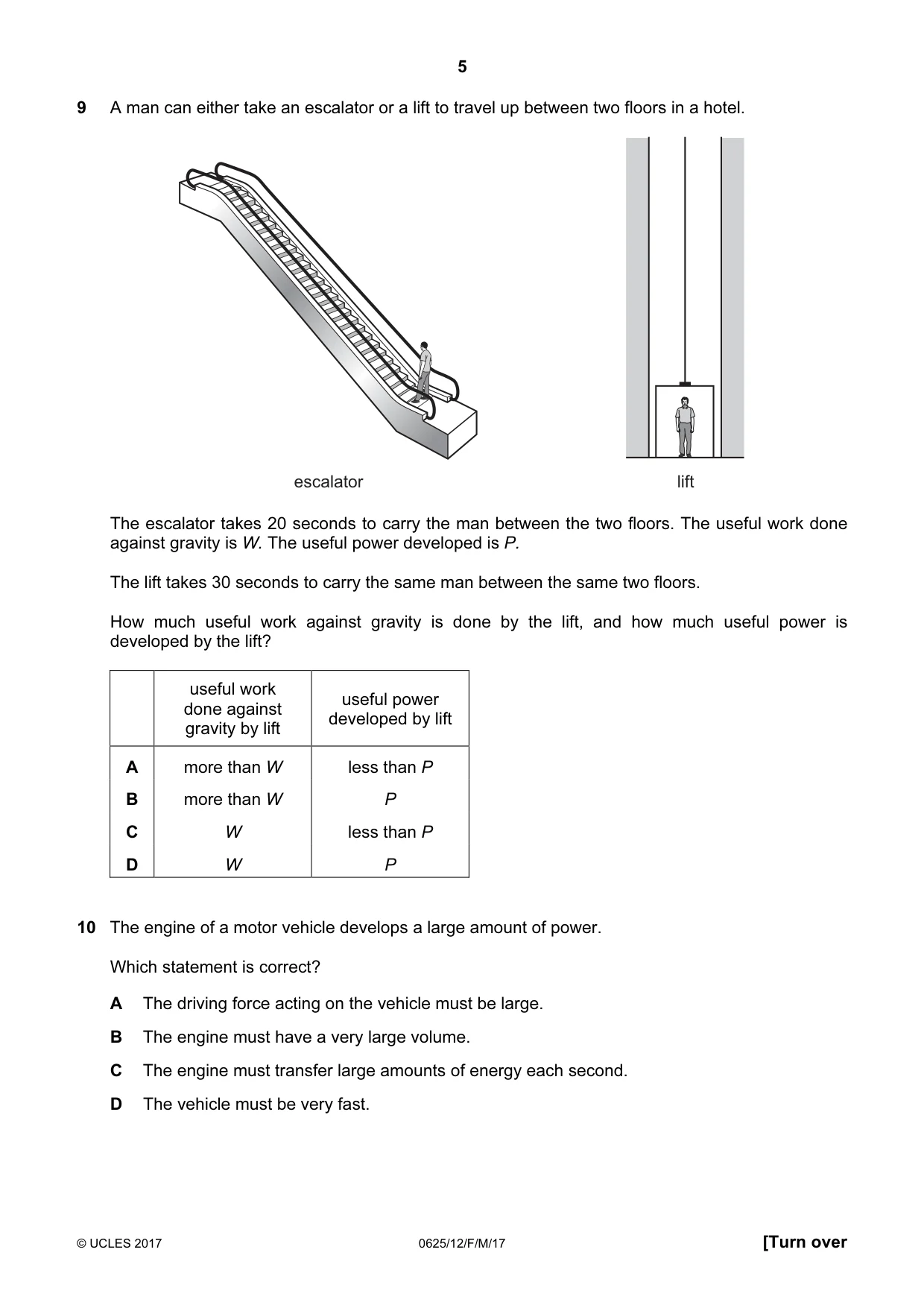
Q9 · A man can either take an escalator or a lift to travel up between two floors in a hotel
9 A man can either take an escalator or a lift to travel up between two floors in a hotel. escalator lift The escalator takes 20 seconds to carry the man between the two floors. The useful work done against gravity is W. The useful power developed is P. The lift takes 30 seconds to carry the same man between the same two floors. How much useful work against gravity is done by the lift, and how much useful power is developed by the lift? useful work useful power done against developed by lift gravity by lift A more than W less than P B more than W P C W less than P D W P
Mark scheme: C
Q10 · The engine of a motor vehicle develops a large amount of power
10 The engine of a motor vehicle develops a large amount of power. Which statement is correct? A The driving force acting on the vehicle must be large. B The engine must have a very large volume. C The engine must transfer large amounts of energy each second. D The vehicle must be very fast.
Mark scheme: C
Q11 · The diagrams show two mercury barometers
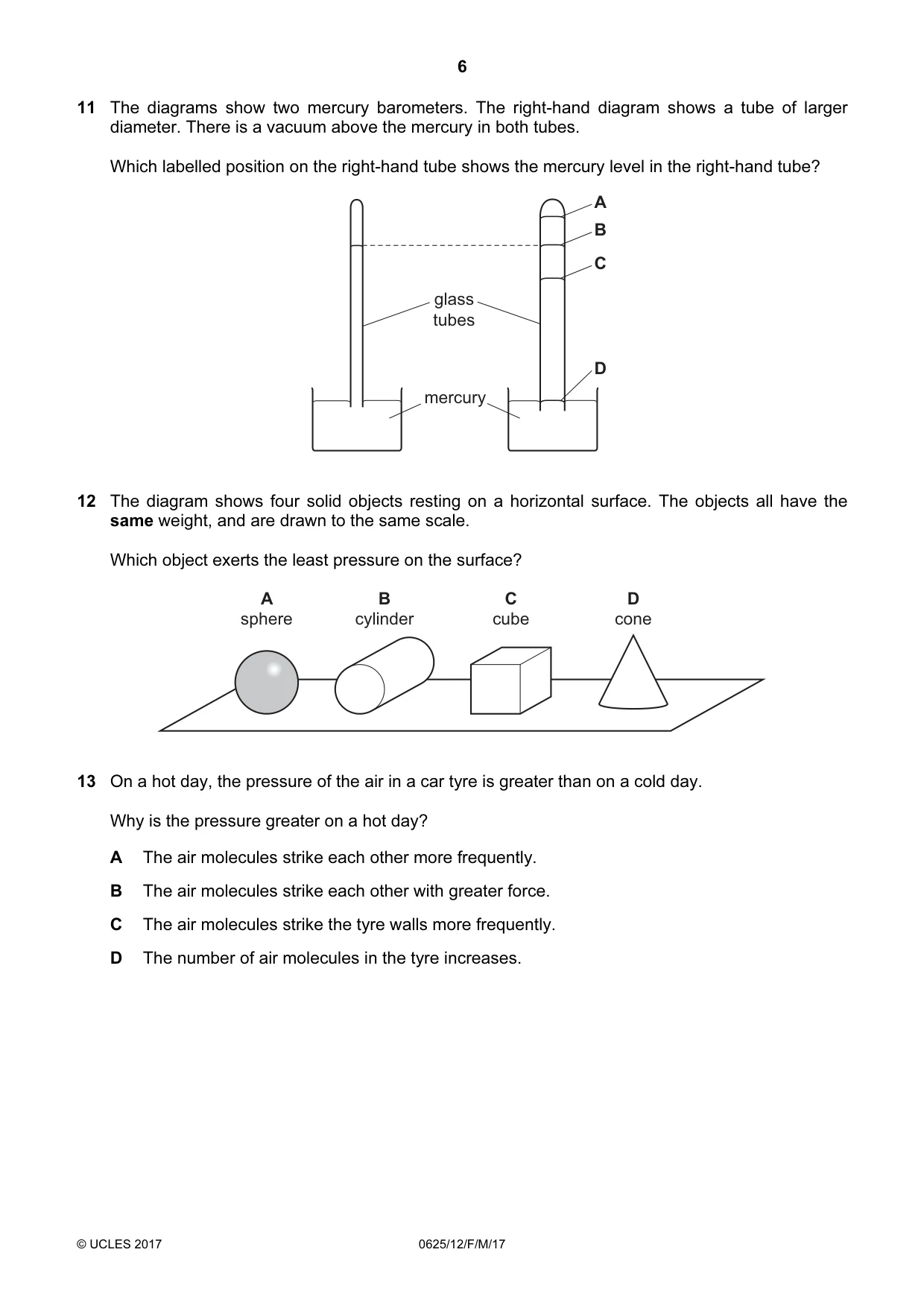
11 The diagrams show two mercury barometers. The right-hand diagram shows a tube of larger diameter. There is a vacuum above the mercury in both tubes. Which labelled position on the right-hand tube shows the mercury level in the right-hand tube? A B C glass tubes D mercury
Mark scheme: B
Q12 · The diagram shows four solid objects resting on a horizontal surface
12 The diagram shows four solid objects resting on a horizontal surface. The objects all have the same weight, and are drawn to the same scale. Which object exerts the least pressure on the surface? A B C D sphere cylinder cube cone
Mark scheme: C
Q13 · On a hot day, the pressure of the air in a car tyre is greater than on a cold day
13 On a hot day, the pressure of the air in a car tyre is greater than on a cold day. Why is the pressure greater on a hot day? A The air molecules strike each other more frequently. B The air molecules strike each other with greater force. C The air molecules strike the tyre walls more frequently. D The number of air molecules in the tyre increases.
Mark scheme: C
Q14 · Very small pollen grains are suspended in water
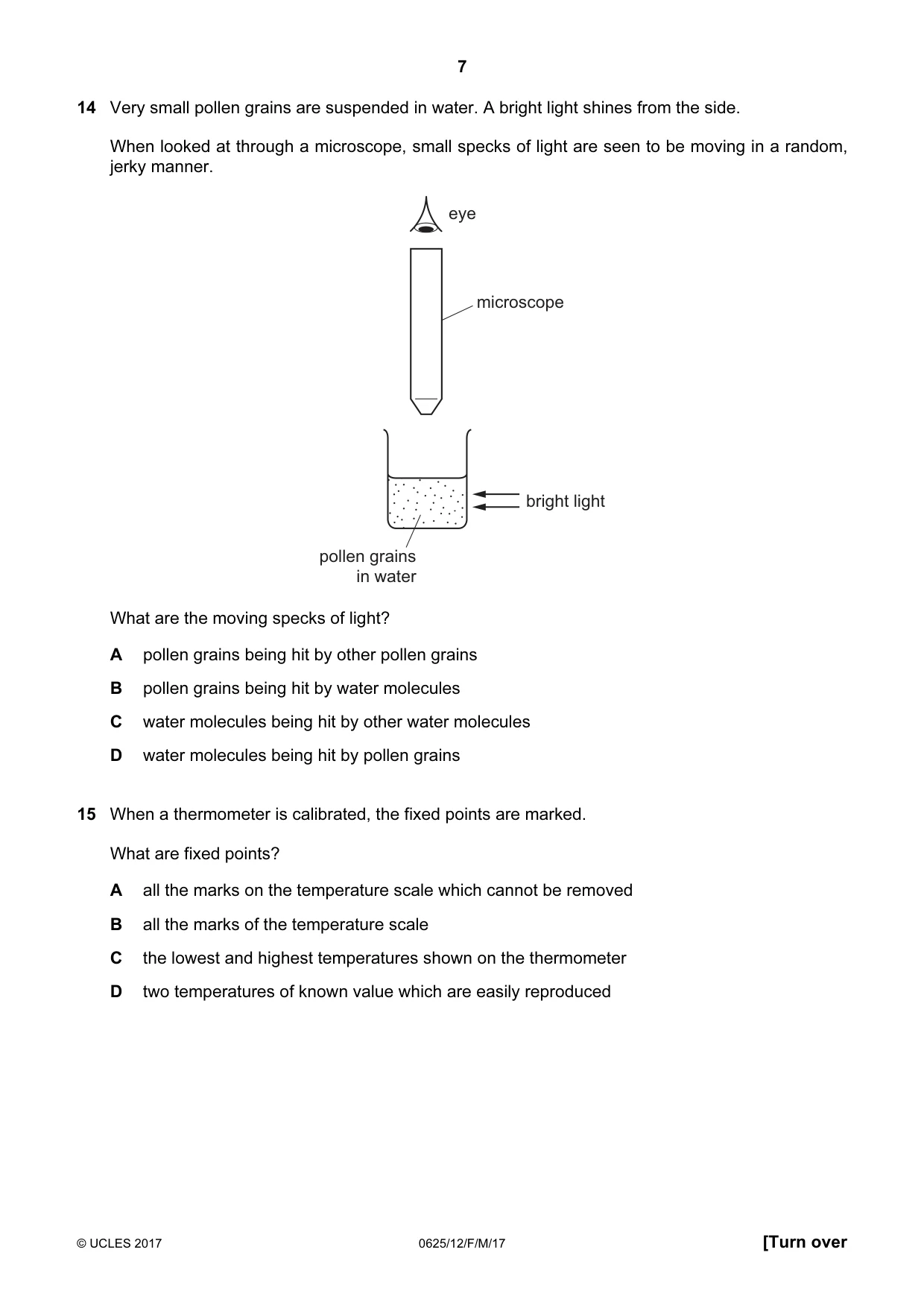
14 Very small pollen grains are suspended in water. A bright light shines from the side. When looked at through a microscope, small specks of light are seen to be moving in a random, jerky manner. eye microscope bright light pollen grains in water What are the moving specks of light? A pollen grains being hit by other pollen grains B pollen grains being hit by water molecules C water molecules being hit by other water molecules D water molecules being hit by pollen grains
Mark scheme: B
Q15 · When a thermometer is calibrated, the fixed points are marked
15 When a thermometer is calibrated, the fixed points are marked. What are fixed points? A all the marks on the temperature scale which cannot be removed B all the marks of the temperature scale C the lowest and highest temperatures shown on the thermometer D two temperatures of known value which are easily reproduced
Mark scheme: D
Q16 · Which statement defines the thermal capacity (heat capacity) of a solid body?
16 Which statement defines the thermal capacity (heat capacity) of a solid body? A the energy needed to melt the body without a change in temperature B the energy needed to raise the temperature of the body by one degree Celsius C the increase in the volume of the body when its temperature is raised by one degree Celsius D the total amount of internal energy in the body
Mark scheme: B
Q17 · A substance can exist in three different states: solid, liquid or gas
17 A substance can exist in three different states: solid, liquid or gas. Each of the two statements below describes a change of state. change 1 Molecules move closer together but continue to travel throughout the substance. change 2 Molecules stop travelling throughout the substance and just vibrate about fixed positions. Which changes of state do these statements describe? change 1 change 2 A condensation melting B condensation solidification C solidification condensation D solidification melting
Mark scheme: B
Q18 · The diagram shows the gap between a hot surface and a cold surface
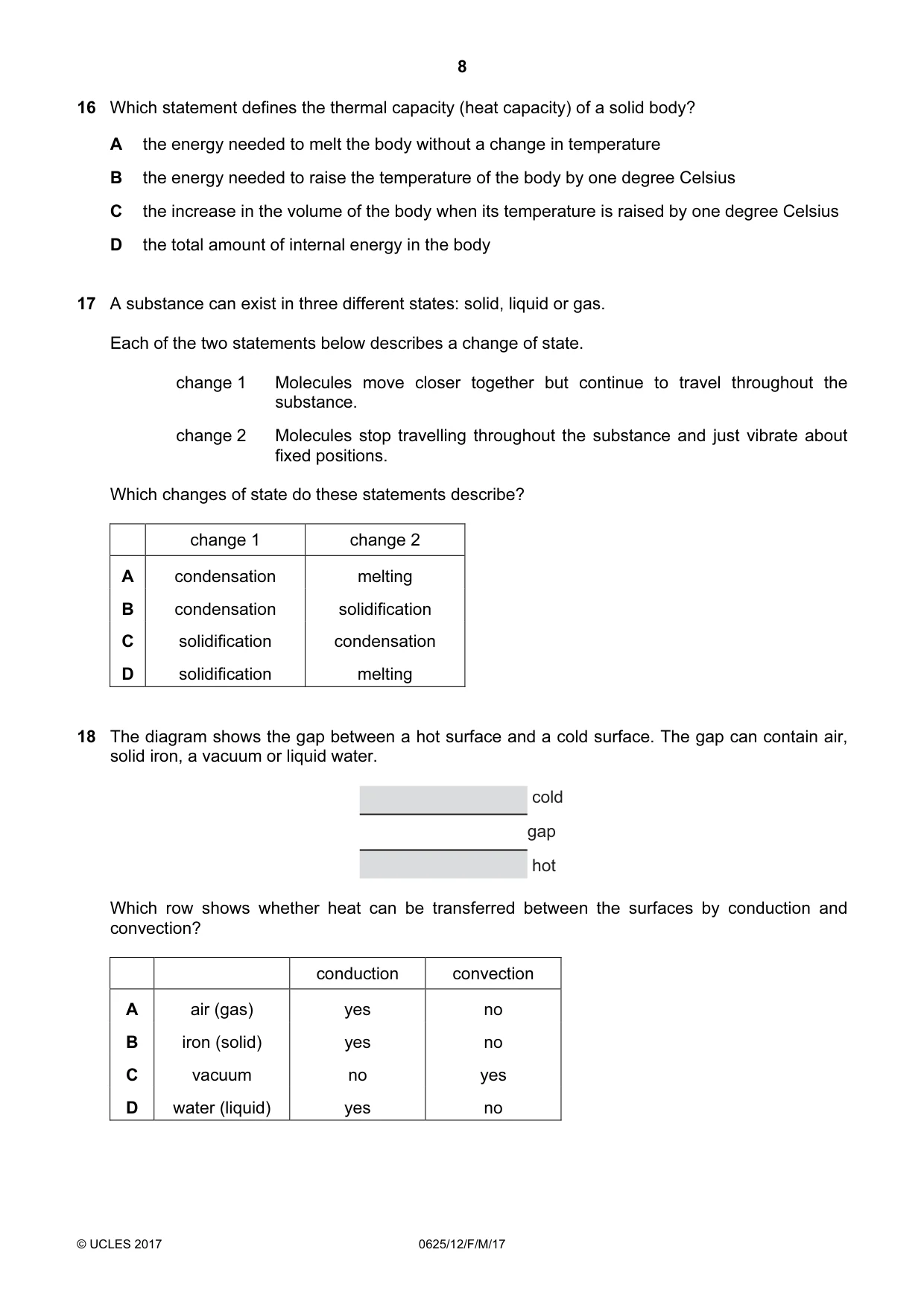
18 The diagram shows the gap between a hot surface and a cold surface. The gap can contain air, solid iron, a vacuum or liquid water. cold gap hot Which row shows whether heat can be transferred between the surfaces by conduction and convection? conduction convection A air (gas) yes no B iron (solid) yes no C vacuum no yes D water (liquid) yes no
Mark scheme: B
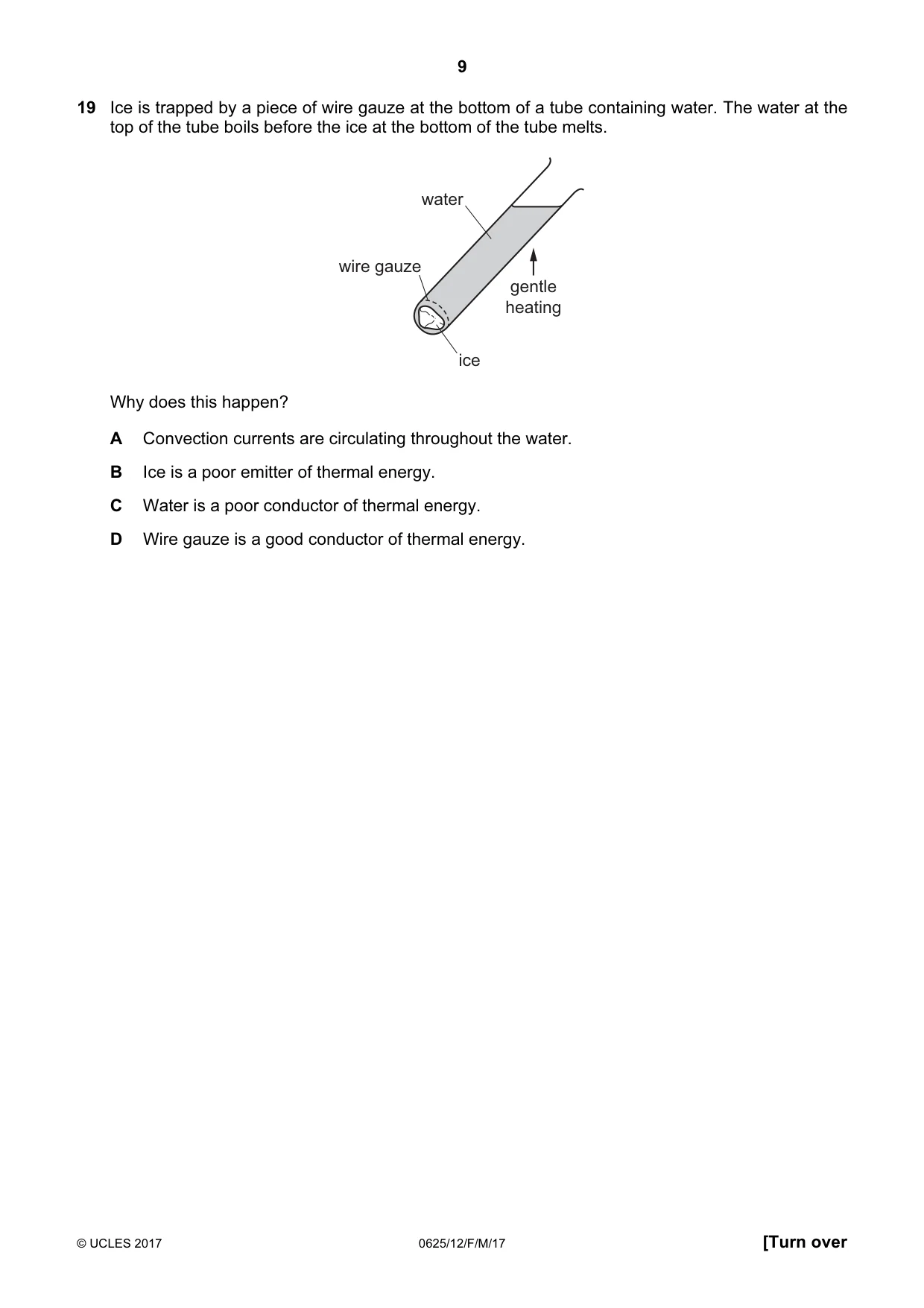
Q19 · Ice is trapped by a piece of wire gauze at the bottom of a tube containing water
19 Ice is trapped by a piece of wire gauze at the bottom of a tube containing water. The water at the top of the tube boils before the ice at the bottom of the tube melts. water wire gauze gentle heating ice Why does this happen? A Convection currents are circulating throughout the water. B Ice is a poor emitter of thermal energy. C Water is a poor conductor of thermal energy. D Wire gauze is a good conductor of thermal energy.
Mark scheme: C
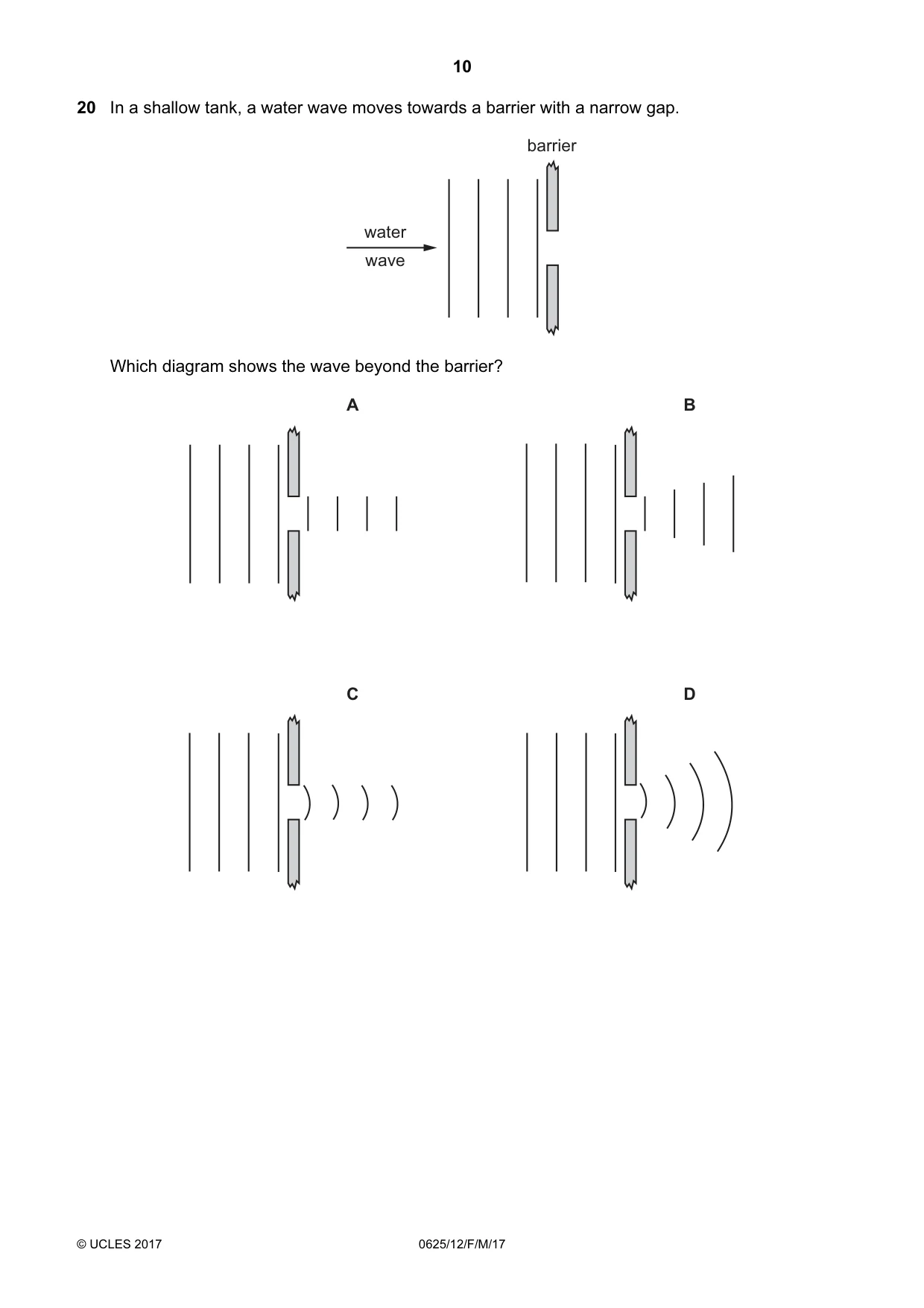
Q20 · In a shallow tank, a water wave moves towards a barrier with a narrow gap
20 In a shallow tank, a water wave moves towards a barrier with a narrow gap. barrier water wave Which diagram shows the wave beyond the barrier? A B C D
Mark scheme: D
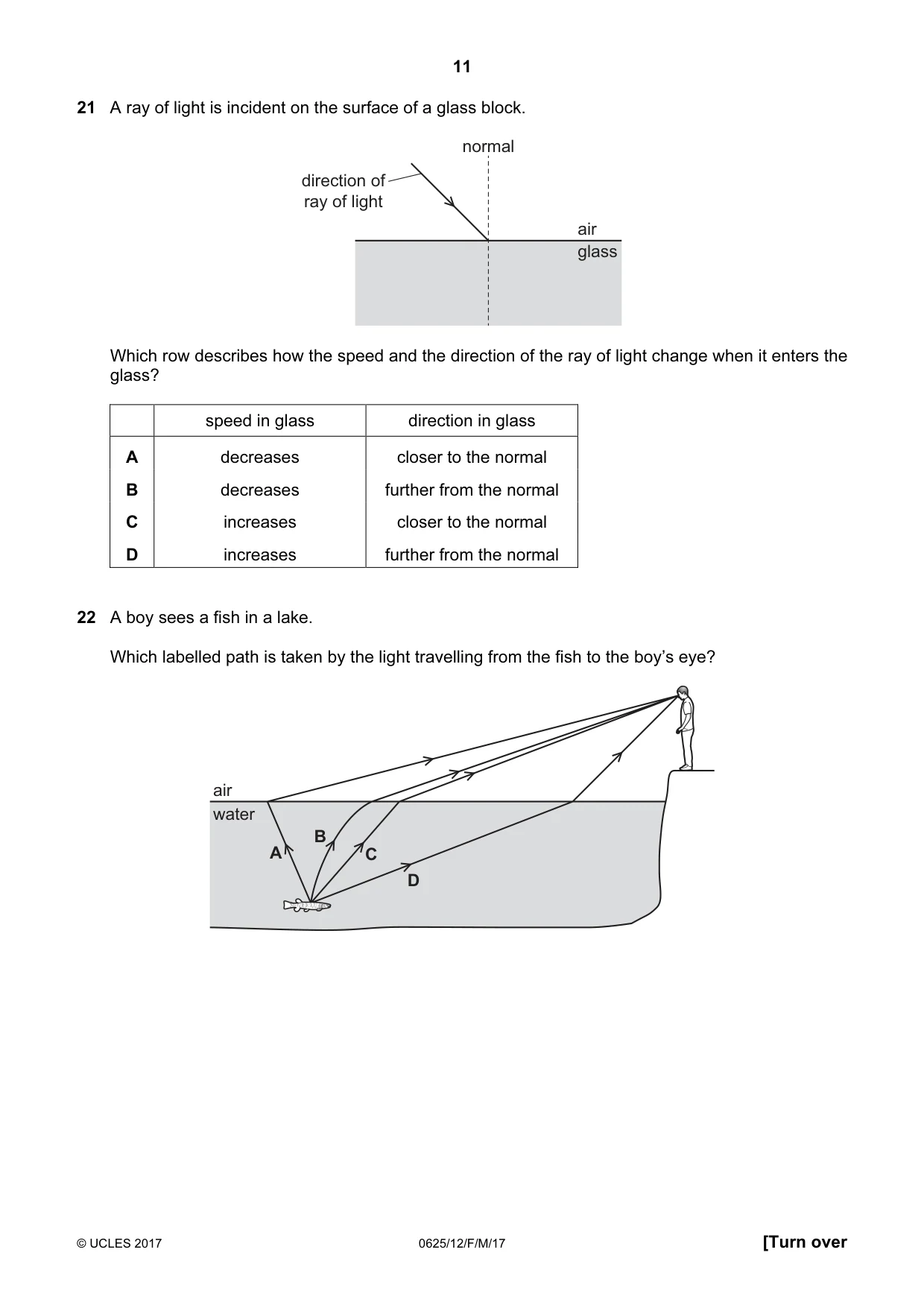
Q21 · A ray of light is incident on the surface of a glass block
21 A ray of light is incident on the surface of a glass block. normal direction of ray of light air glass Which row describes how the speed and the direction of the ray of light change when it enters the glass? speed in glass direction in glass A decreases closer to the normal B decreases further from the normal C increases closer to the normal D increases further from the normal
Mark scheme: A
Q22 · A boy sees a fish in a lake
22 A boy sees a fish in a lake. Which labelled path is taken by the light travelling from the fish to the boy’s eye? air water B A C D
Mark scheme: C
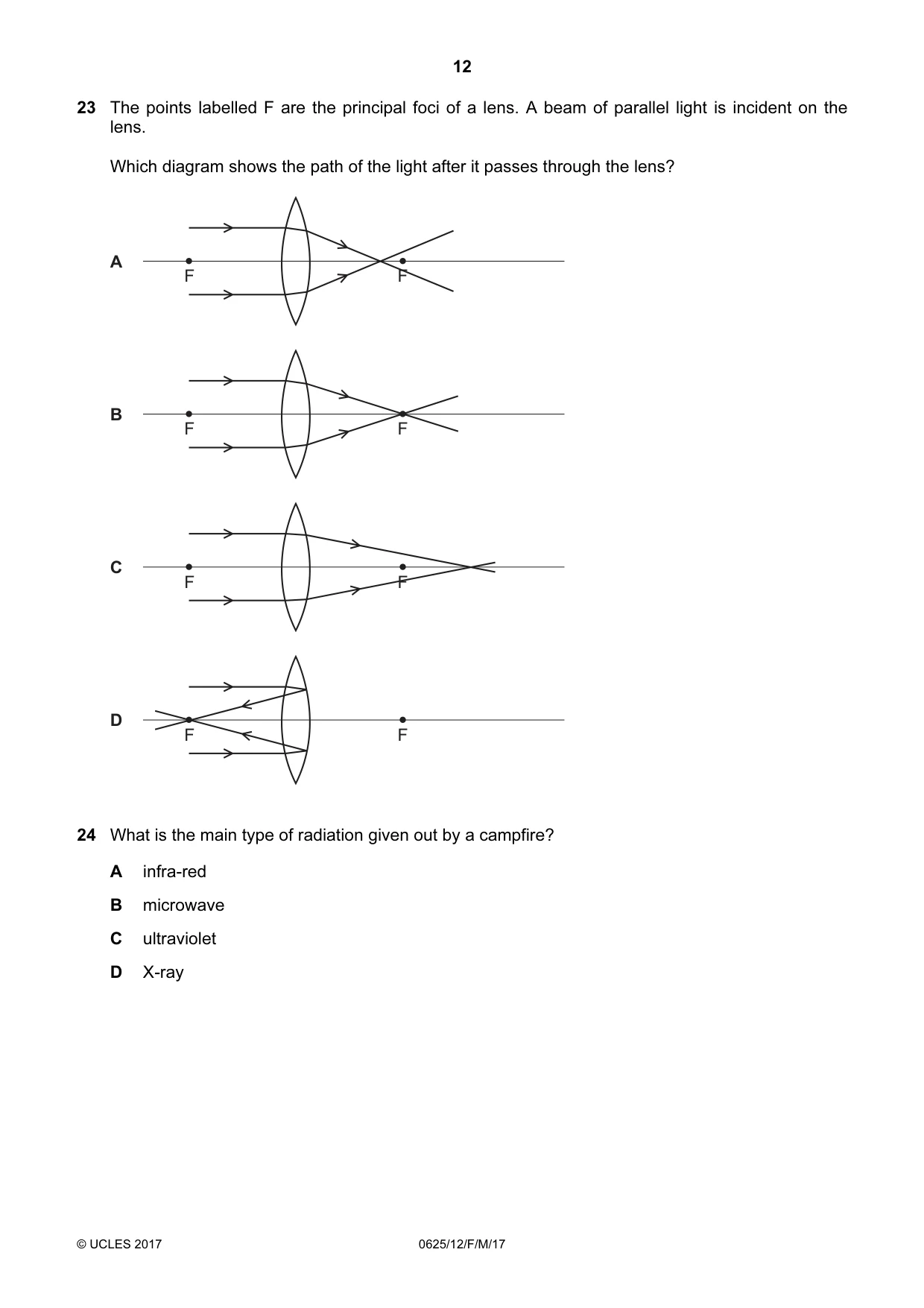
Q23 · The points labelled F are the principal foci of a lens
23 The points labelled F are the principal foci of a lens. A beam of parallel light is incident on the lens. Which diagram shows the path of the light after it passes through the lens? A F F B F F C F F D F F
Mark scheme: B
Q24 · What is the main type of radiation given out by a campfire?
24 What is the main type of radiation given out by a campfire? A infra-red B microwave C ultraviolet D X-ray
Mark scheme: A
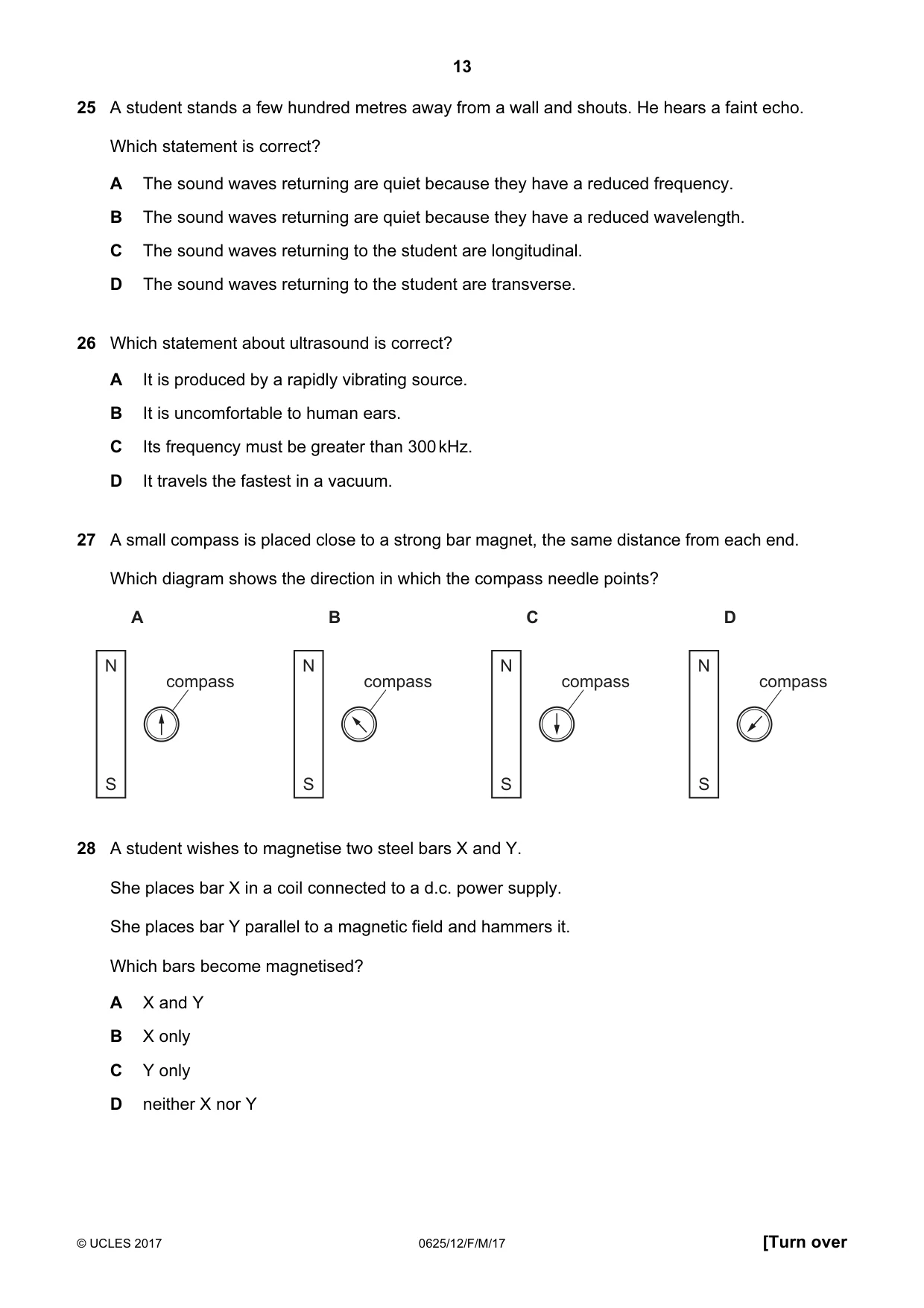
Q25 · A student stands a few hundred metres away from a wall and shouts
25 A student stands a few hundred metres away from a wall and shouts. He hears a faint echo. Which statement is correct? A The sound waves returning are quiet because they have a reduced frequency. B The sound waves returning are quiet because they have a reduced wavelength. C The sound waves returning to the student are longitudinal. D The sound waves returning to the student are transverse.
Mark scheme: C
Q26 · Which statement about ultrasound is correct?
26 Which statement about ultrasound is correct? A It is produced by a rapidly vibrating source. B It is uncomfortable to human ears. C Its frequency must be greater than 300 kHz. D It travels the fastest in a vacuum.
Mark scheme: A
Q27 · A small compass is placed close to a strong bar magnet, the same distance from each end
27 A small compass is placed close to a strong bar magnet, the same distance from each end. Which diagram shows the direction in which the compass needle points? A B C D N N N N compass compass compass compass S S S S
Mark scheme: C
Q28 · A student wishes to magnetise two steel bars X and Y
28 A student wishes to magnetise two steel bars X and Y. She places bar X in a coil connected to a d.c. power supply. She places bar Y parallel to a magnetic field and hammers it. Which bars become magnetised? A X and Y B X only C Y only D neither X nor Y
Mark scheme: A
Q29 · Which particles move in a metal to cause an electric current?
29 Which particles move in a metal to cause an electric current? A electrons B neutrons C nucleons D protons
Mark scheme: A
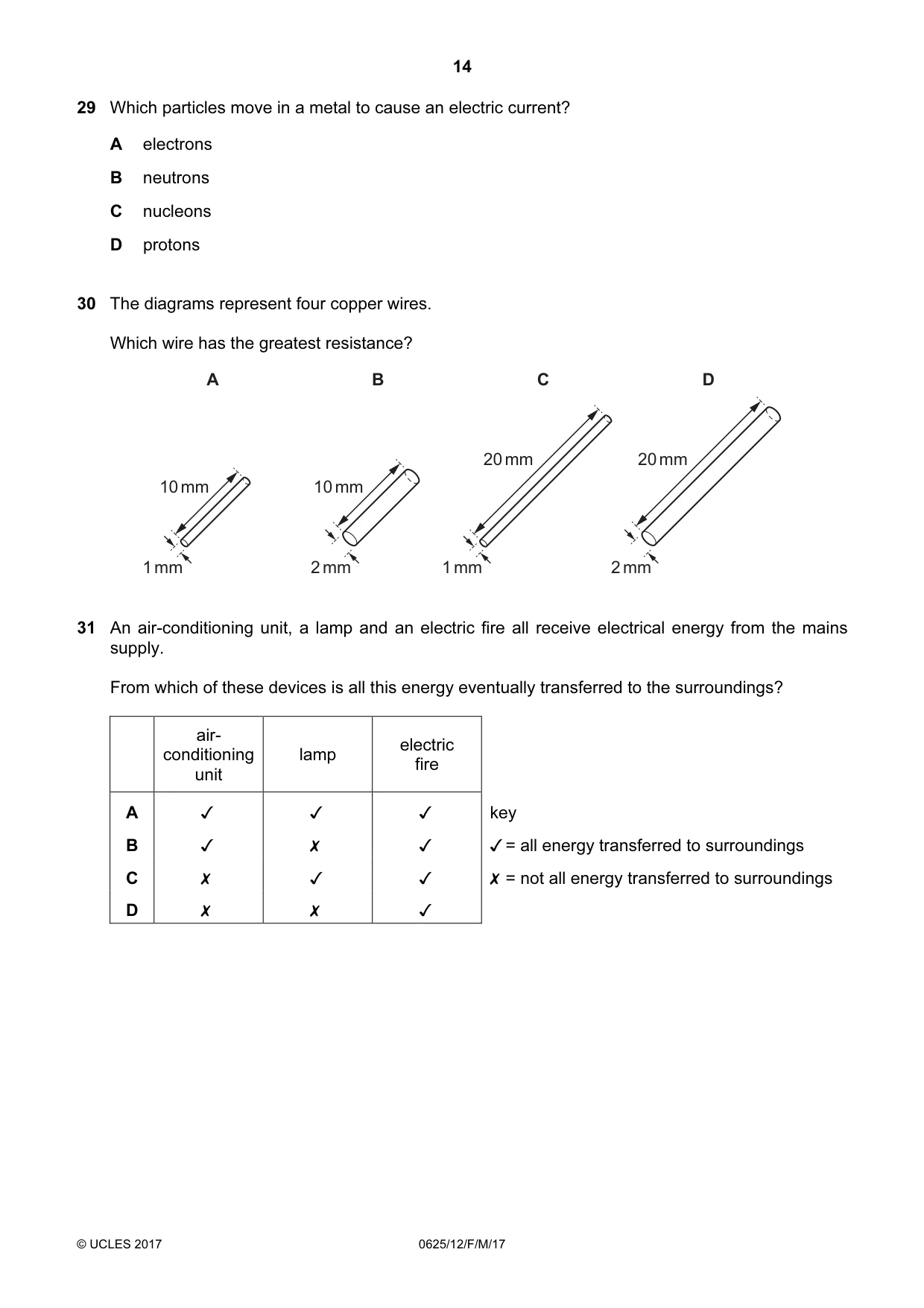
Q30 · The diagrams represent four copper wires
30 The diagrams represent four copper wires. Which wire has the greatest resistance? A B C D 20 mm 20 mm 10 mm 10 mm 1 mm 2 mm 1 mm 2 mm
Mark scheme: C
Q31 · An air-conditioning unit, a lamp and an electric fire all receive electrical energy from…
31. An air-conditioning unit, a lamp and an electric fire all receive electrical energy from the mains supply. From which of these devices is all this energy eventually transferred to the surroundings? air- conditioning unit electric lamp fire J key ¥ = all energy transferred to surroundings X = not all energy transferred to surroundings v x x
Mark scheme: A
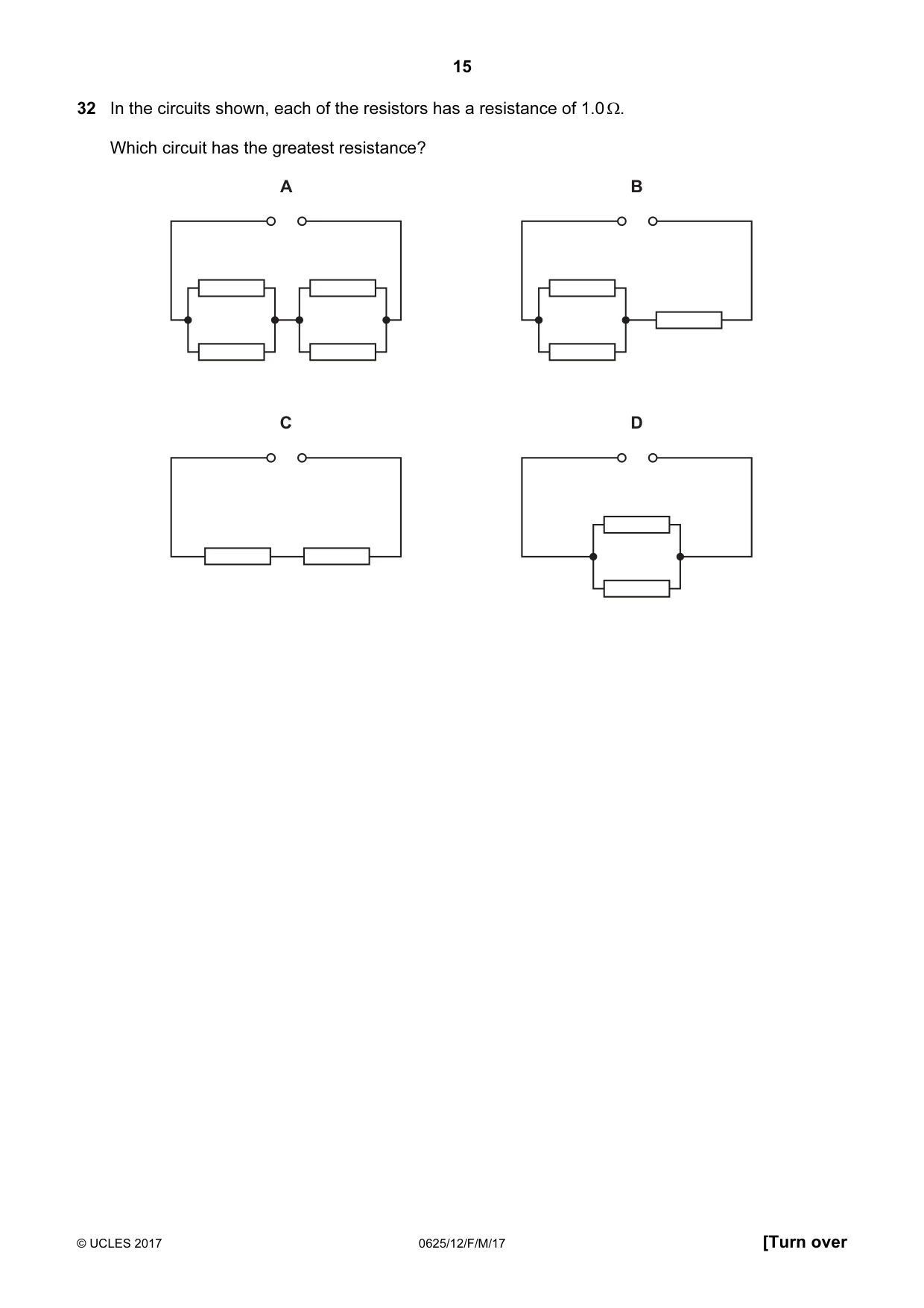
Q32 · In the circuits shown, each of the resistors has a resistance of 1.0 Ω
32 In the circuits shown, each of the resistors has a resistance of 1.0 Ω. Which circuit has the greatest resistance? A B C D
Mark scheme: C
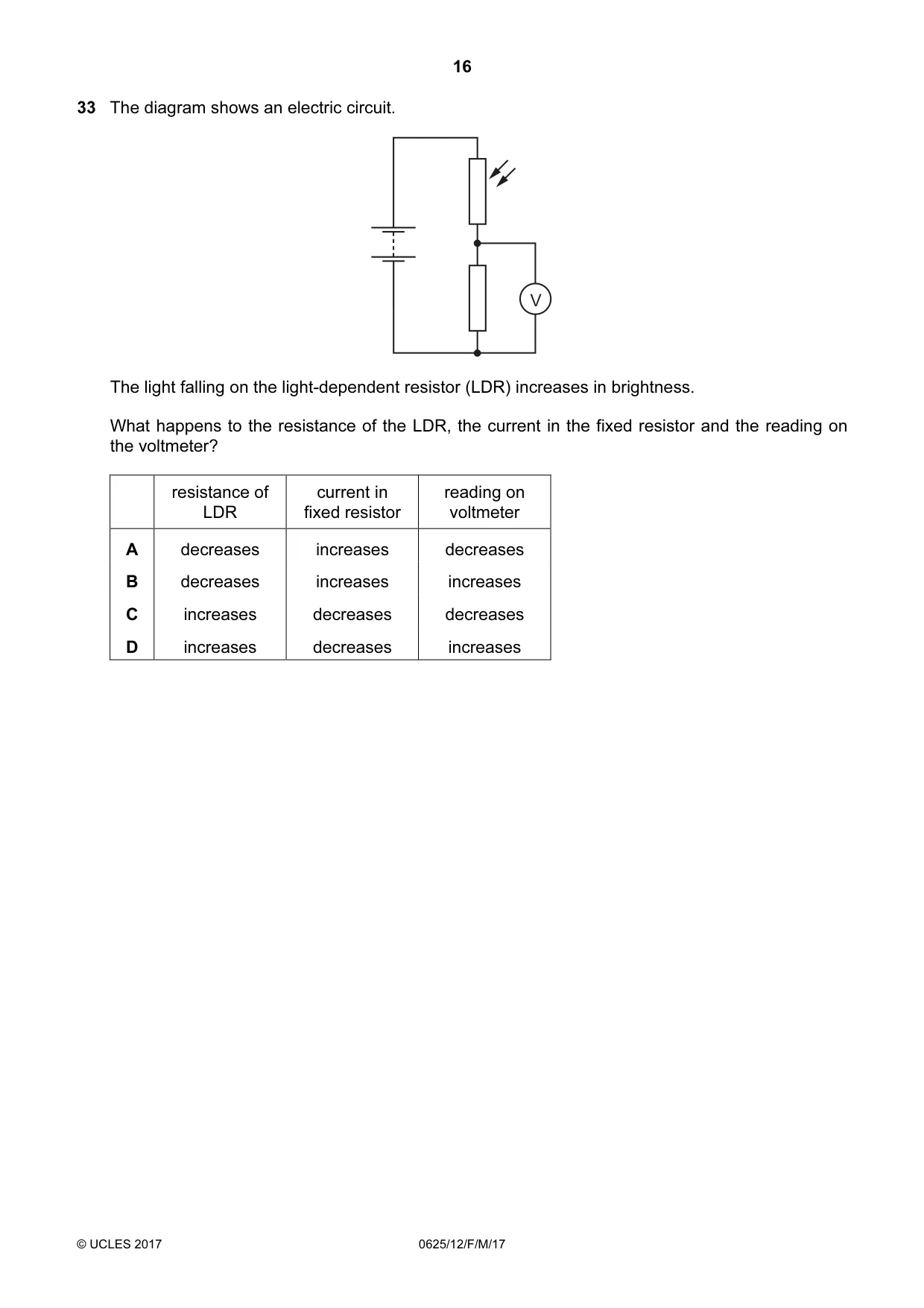
Q33 · The diagram shows an electric circuit
33 The diagram shows an electric circuit. V The light falling on the light-dependent resistor (LDR) increases in brightness. What happens to the resistance of the LDR, the current in the fixed resistor and the reading on the voltmeter? resistance of current in reading on LDR fixed resistor voltmeter A decreases increases decreases B decreases increases increases C increases decreases decreases D increases decreases increases
Mark scheme: B
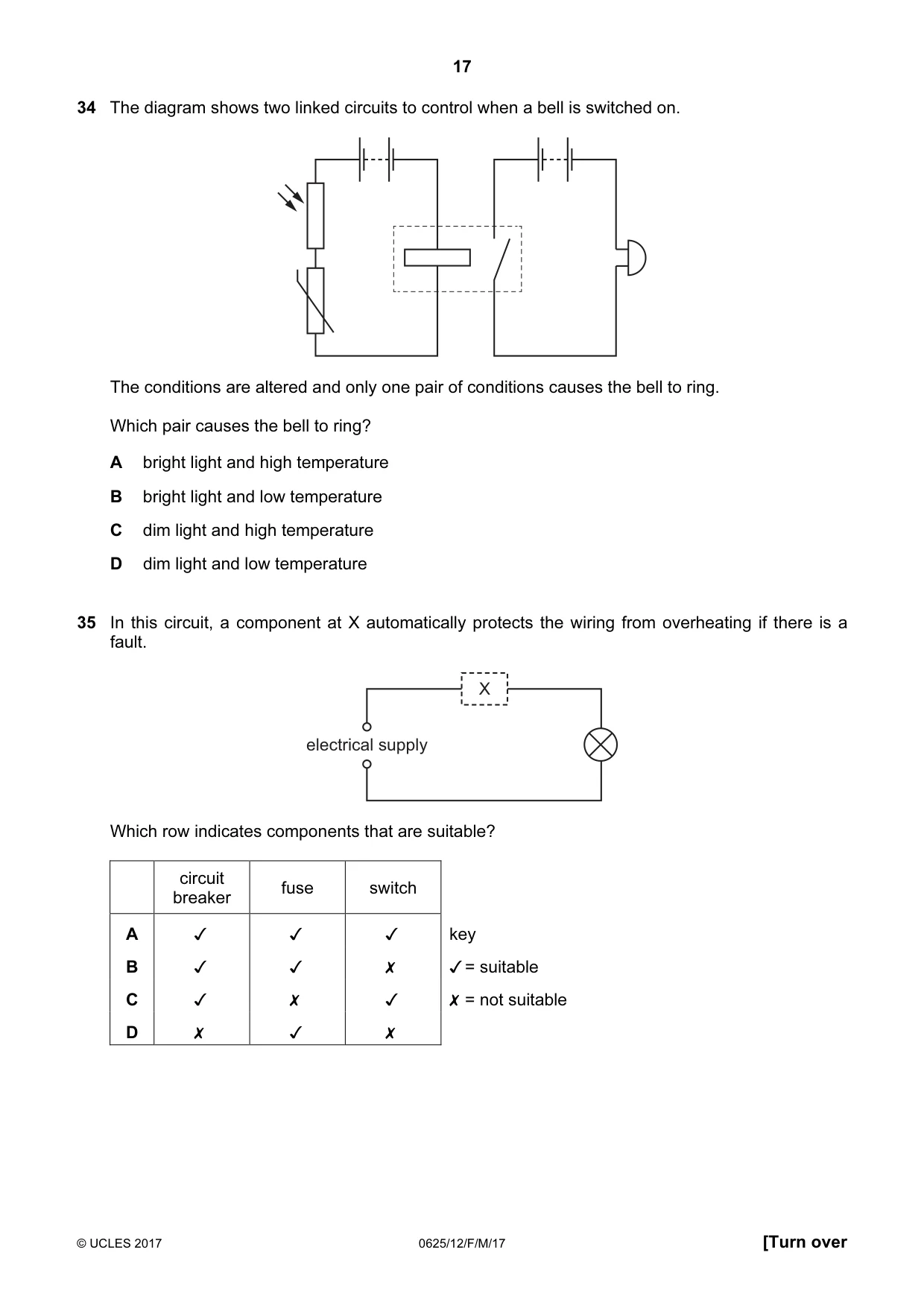
Q34 · The diagram shows two linked circuits to control when a bell is switched on
34 The diagram shows two linked circuits to control when a bell is switched on. The conditions are altered and only one pair of conditions causes the bell to ring. Which pair causes the bell to ring? A bright light and high temperature B bright light and low temperature C dim light and high temperature D dim light and low temperature
Mark scheme: A
Q35 · In this circuit, a component at X automatically protects the wiring from overheating if…
35 In this circuit, a component at X automatically protects the wiring from overheating if there is a fault. electrical supply Which row indicates components that are suitable? circuit . breaker fuse switch JV key JY = suitable X = not suitable 0 ONO DW > ~~ KOM Kk 4 4 ~*~ {Kw K&
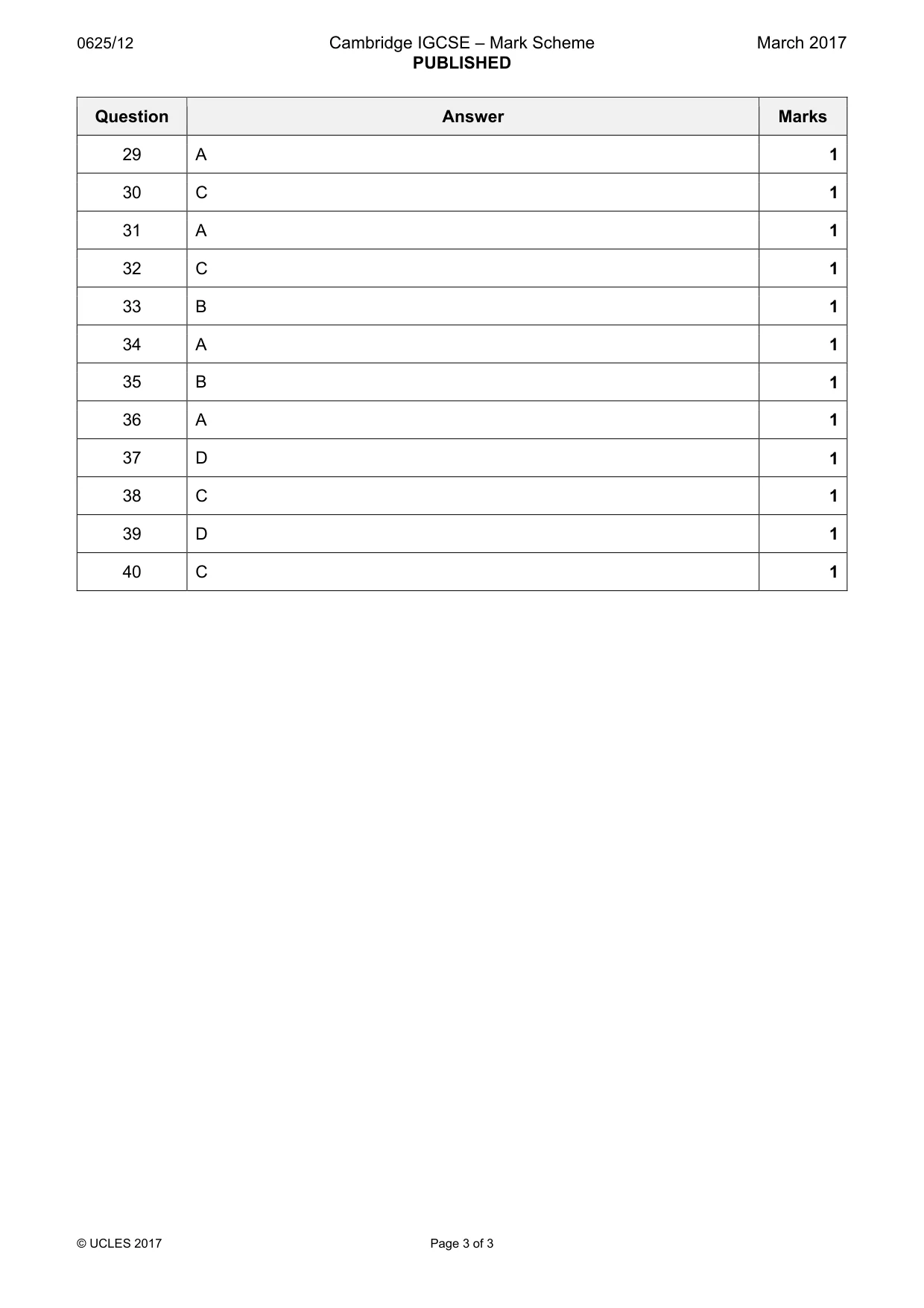
Mark scheme: B
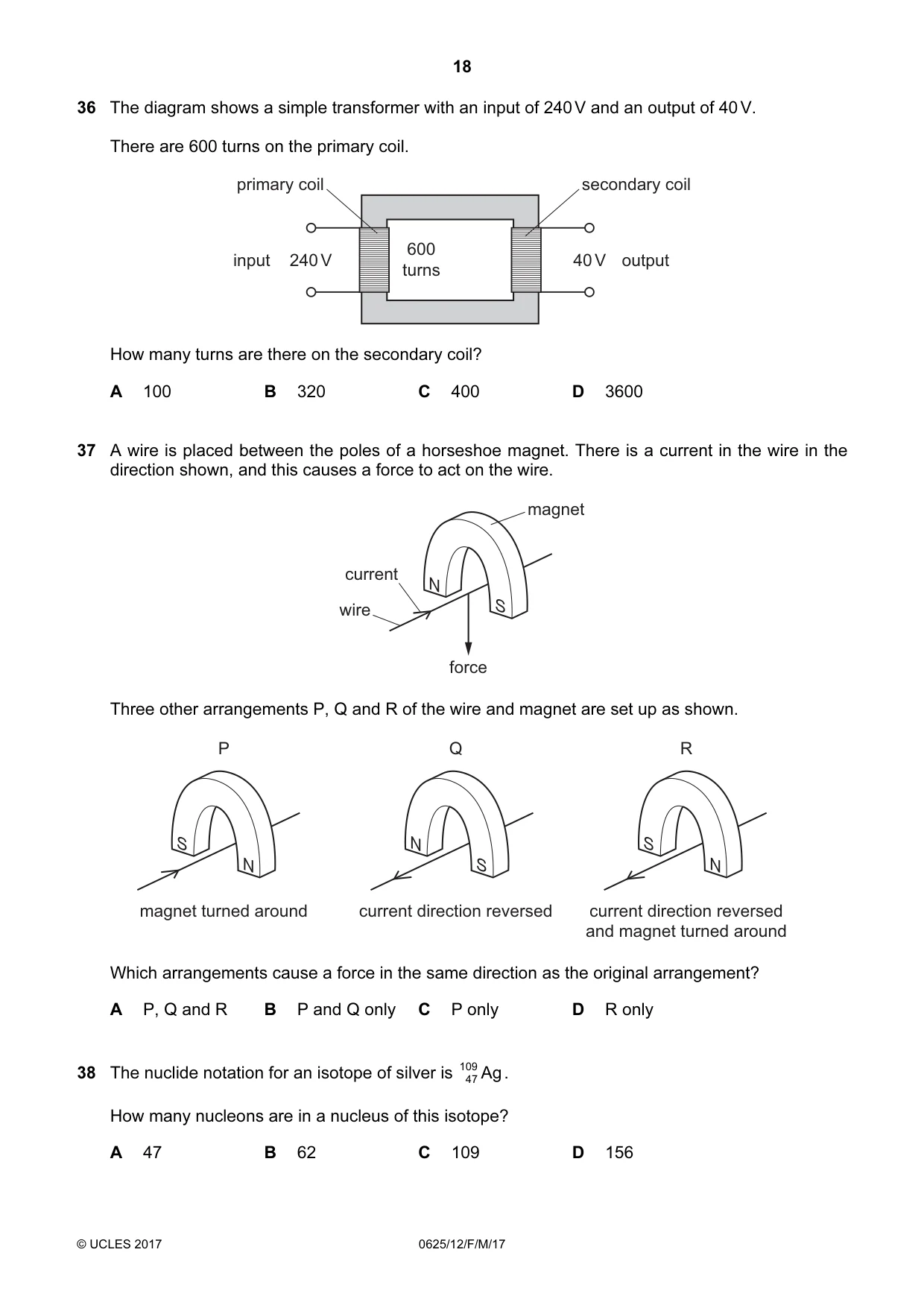
Q36 · The diagram shows a simple transformer with an input of 240 V and an output of 40 V
36 The diagram shows a simple transformer with an input of 240 V and an output of 40 V. There are 600 turns on the primary coil. primary coil secondary coil 600 input 240 V 40 V output turns How many turns are there on the secondary coil? A 100 B 320 C 400 D 3600
Mark scheme: A
Q37 · A wire is placed between the poles of a horseshoe magnet
37 A wire is placed between the poles of a horseshoe magnet. There is a current in the wire in the direction shown, and this causes a force to act on the wire. magnet current N wire S force Three other arrangements P, Q and R of the wire and magnet are set up as shown. P Q R S N S N S N magnet turned around current direction reversed current direction reversed and magnet turned around Which arrangements cause a force in the same direction as the original arrangement? A P, Q and R B P and Q only C P only D R only
Mark scheme: D
Q38 · The nuclide notation for an isotope of silver is 109 Ag
38 The nuclide notation for an isotope of silver is 109 Ag . 47 How many nucleons are in a nucleus of this isotope? A 47 B 62 C 109 D 156
Mark scheme: C
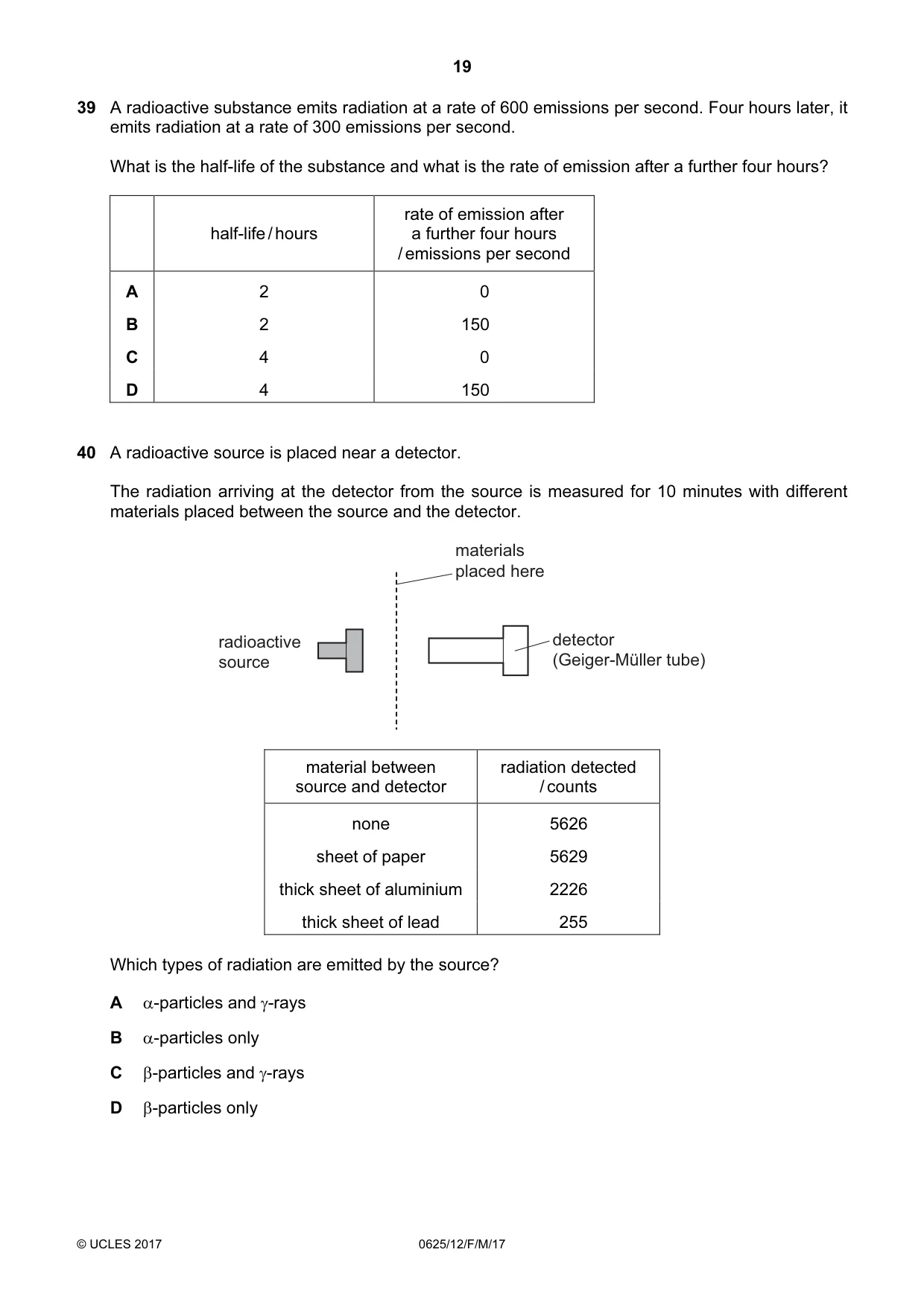
Q39 · A radioactive substance emits radiation at a rate of 600 emissions per second
39 A radioactive substance emits radiation at a rate of 600 emissions per second. Four hours later, it emits radiation at a rate of 300 emissions per second. What is the half-life of the substance and what is the rate of emission after a further four hours? rate of emission after half-life / hours a further four hours / emissions per second A 2 0 B 2 150 C 4 0 D 4 150
Mark scheme: D
Q40 · A radioactive source is placed near a detector
40 A radioactive source is placed near a detector. The radiation arriving at the detector from the source is measured for 10 minutes with different materials placed between the source and the detector. materials placed here radioactive detector source (Geiger-Müller tube) material between radiation detected source and detector / counts none 5626 sheet of paper 5629 thick sheet of aluminium 2226 thick sheet of lead 255 Which types of radiation are emitted by the source? A α-particles and γ-rays B α-particles only C β-particles and γ-rays D β-particles only
Mark scheme: C
What was in this paper
The subtopics covered by these 40 questions, and how many questions each got. Open one in a new tab to see every Cambridge question on it.
3Energy, work and power3Kinetic particle model of matter3Light3Electrical quantities2Electromagnetic effects2Forces2Mass and weight2Motion2Pressure2Radioactivity2Simple phenomena of magnetism2Sound2Thermal properties and temperature2Transfer of thermal energy2Density1Electrical safety1Electromagnetic spectrum1General properties of waves1Physical quantities and measurement techniques1The nuclear model of the atom1What you needed in this session
Cambridge’s own grade thresholds for 2017 Feb/March, Paper 1 · Variant 2. A higher threshold means an easier paper — the bar moves with how the cohort did.