Cambridge IGCSE Physics 0625 — 2016 Feb/March Paper 1 · Variant 2
0625/12/F/M/16 · 40 questions · 40 marks · ≈45 min
The question paper and its mark scheme, free to read here and free to download. This is Cambridge’s own paper, exactly as it was sat.
Question paper20 pages


Mark scheme2 pages
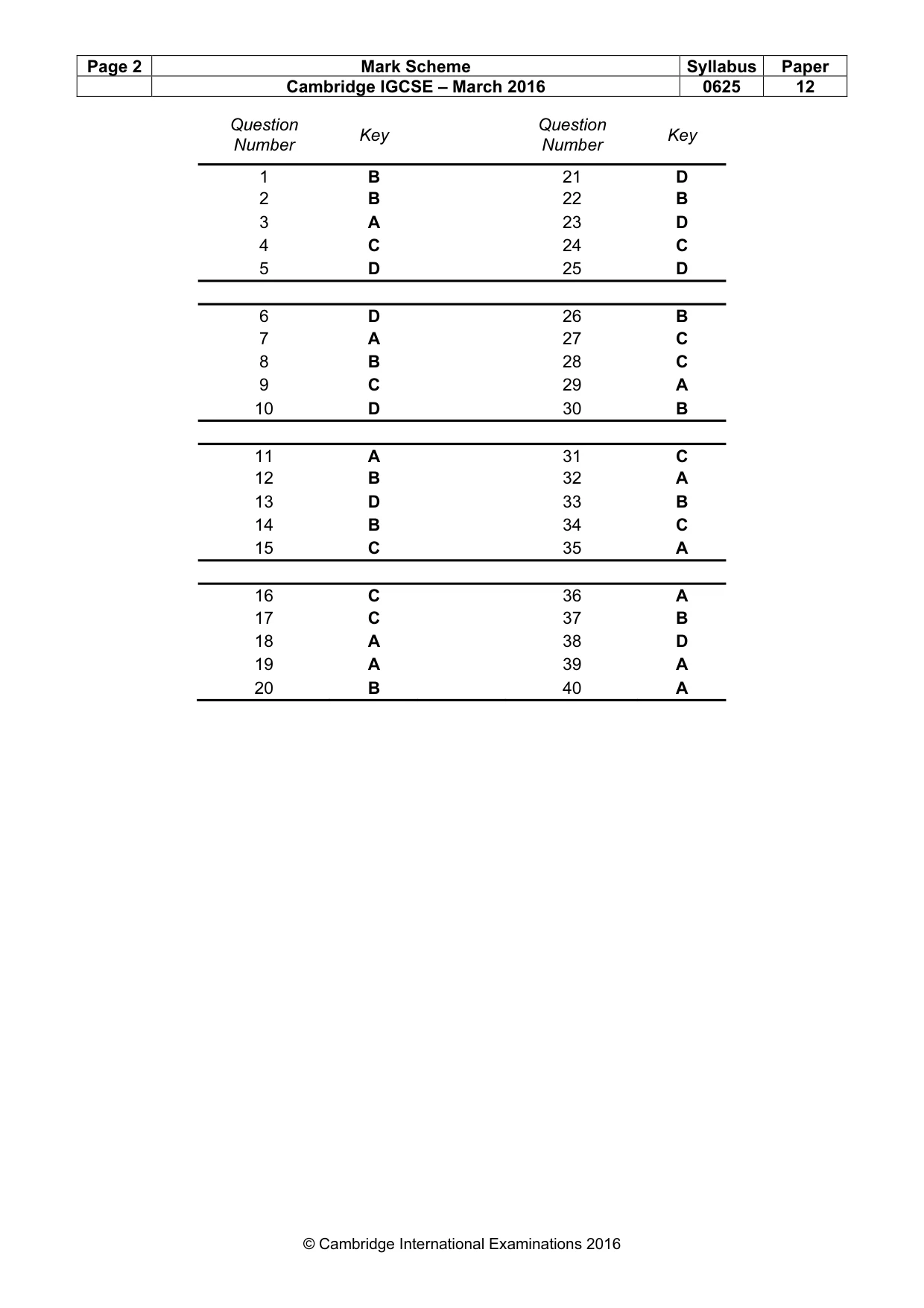
Answers below. Sit the paper first if you are practising.
Questions as text
Q1 · A student wishes to find the volume of a small, irregularly-shaped stone
1 A student wishes to find the volume of a small, irregularly-shaped stone. stone A ruler and a measuring cylinder containing some water are available. Which apparatus is needed? A neither the ruler nor the measuring cylinder B the measuring cylinder only C the ruler and the measuring cylinder D the ruler only
Mark scheme: B
More questions on Physical quantities and measurement techniques
Q2 · A ball is dropped from a table-top
2 A ball is dropped from a table-top. Air resistance may be ignored. X Which row describes the velocity and the acceleration of the ball at point X? acceleration velocity A constant constant B constant increasing C increasing constant D increasing increasing
Mark scheme: B
Q3 · The diagram shows the speed-time graph for a car
3 The diagram shows the speed-time graph for a car. speed Y X 0 0 time Which area represents the distance travelled while the car is accelerating? A X B X + Y C Y D Y – X
Mark scheme: A
Q4 · Which quantities are measured in the same unit?
4 Which quantities are measured in the same unit? A energy, power and work B energy and power, but not work C energy and work, but not power D power and work, but not energy
Mark scheme: C
Q5 · Five identical bags of rice are balanced on a uniform beam by an object of mass 10 kg
5 Five identical bags of rice are balanced on a uniform beam by an object of mass 10 kg. five bags of rice 10 kg pivot Two more identical bags of rice are added to the other five. The average position of the bags on the beam does not change. What mass now balances the bags? A 3.5 kg B 7.0 kg C 12 kg D 14 kg
Mark scheme: D
Q6 · The diagram shows a cuboid block made from a metal of density 2.5 g / cm3
6 The diagram shows a cuboid block made from a metal of density 2.5 g / cm3. 2.0 cm 10 cm 2.0 cm What is the mass of the block? A 8.0 g B 16 g C 50 g D 100 g
Mark scheme: D
Q7 · The diagram shows an unbalanced rod
7 The diagram shows an unbalanced rod. Two loads X and Y can be moved along the rod. X Y rod movement movement of rod of rod pivot The rod turns in a clockwise direction as shown. Which action could make the rod balance? A moving X to the left B moving X to the right C moving Y to the right D moving the pivot to the left
Mark scheme: A
Q8 · A box is being lifted by a fork-lift truck
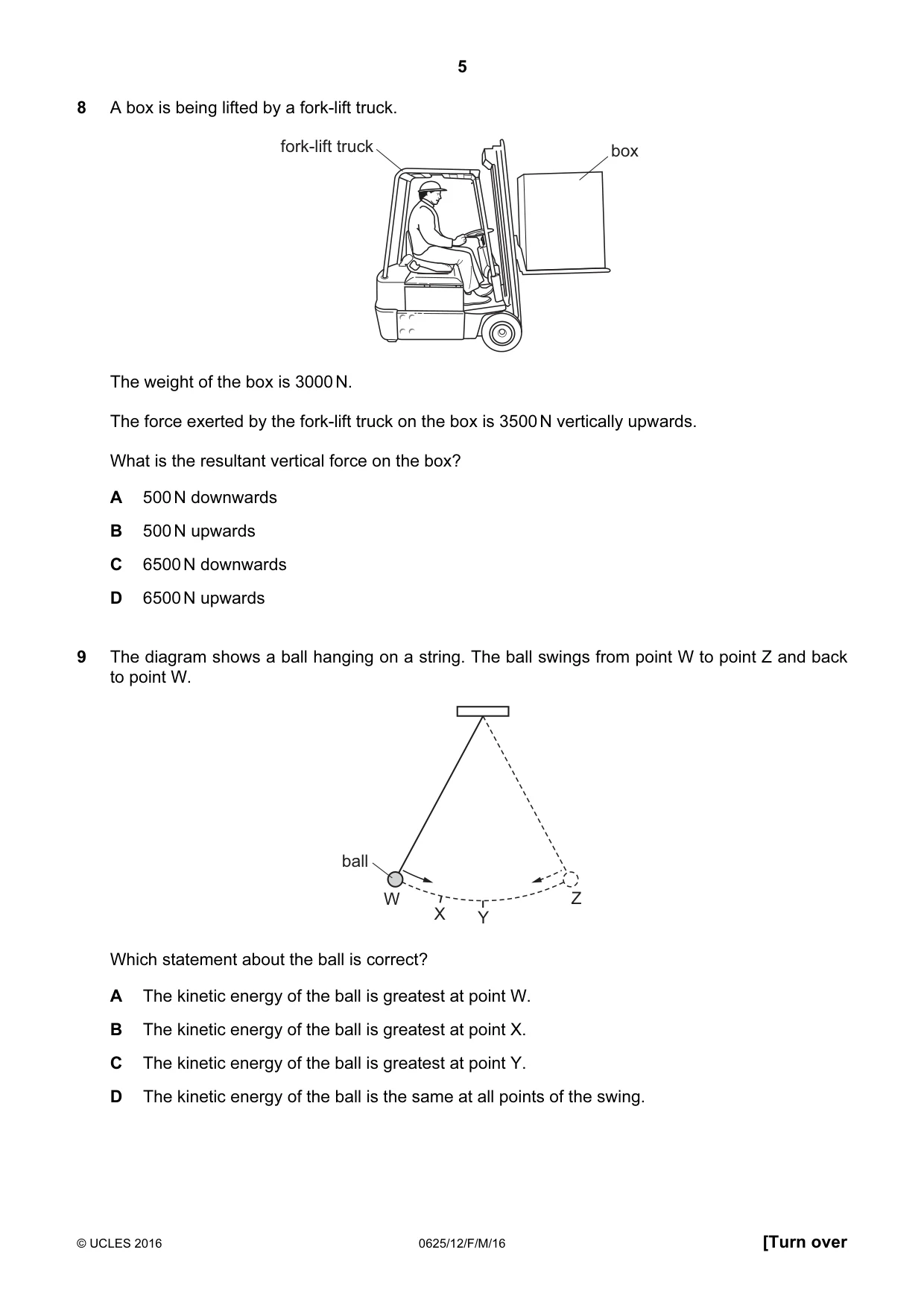
8 A box is being lifted by a fork-lift truck. fork-lift truck box The weight of the box is 3000 N. The force exerted by the fork-lift truck on the box is 3500 N vertically upwards. What is the resultant vertical force on the box? A 500 N downwards B 500 N upwards C 6500 N downwards D 6500 N upwards
Mark scheme: B
Q9 · The diagram shows a ball hanging on a string
9 The diagram shows a ball hanging on a string. The ball swings from point W to point Z and back to point W. ball W Z X Y Which statement about the ball is correct? A The kinetic energy of the ball is greatest at point W. B The kinetic energy of the ball is greatest at point X. C The kinetic energy of the ball is greatest at point Y. D The kinetic energy of the ball is the same at all points of the swing.
Mark scheme: C
Q10 · A person in a factory has to lift a box on to a shelf
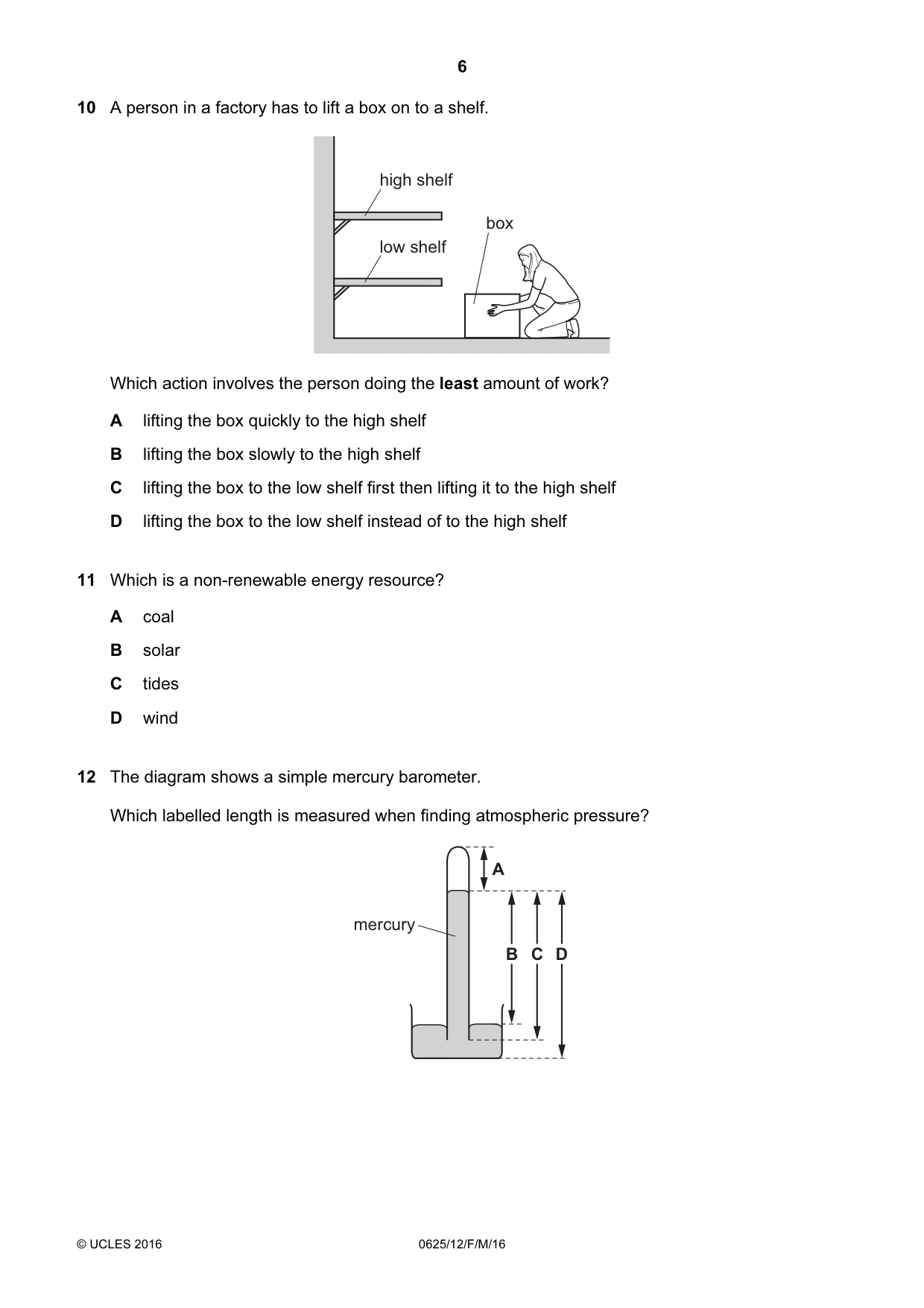
10 A person in a factory has to lift a box on to a shelf. high shelf box low shelf Which action involves the person doing the least amount of work? A lifting the box quickly to the high shelf B lifting the box slowly to the high shelf C lifting the box to the low shelf first then lifting it to the high shelf D lifting the box to the low shelf instead of to the high shelf
Mark scheme: D
Q11 · Which is a non-renewable energy resource?
11 Which is a non-renewable energy resource? A coal B solar C tides D wind
Mark scheme: A
Q12 · The diagram shows a simple mercury barometer
12 The diagram shows a simple mercury barometer. Which labelled length is measured when finding atmospheric pressure? A mercury B C D
Mark scheme: B
Q13 · Identical toy bricks are placed one on top of another to make a tower on a table
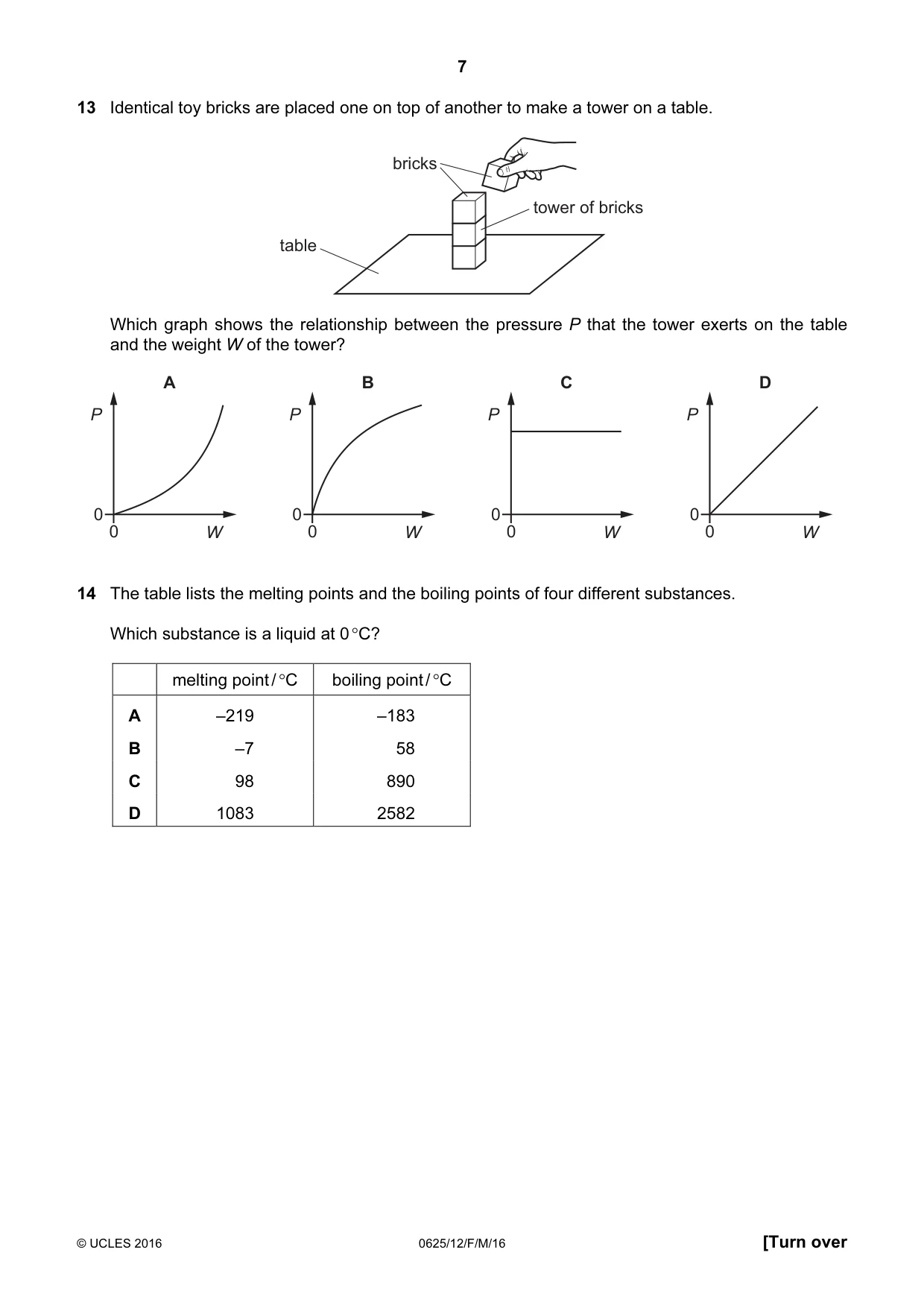
13 Identical toy bricks are placed one on top of another to make a tower on a table. bricks tower of bricks table Which graph shows the relationship between the pressure P that the tower exerts on the table and the weight W of the tower? A B C D P P P P 0 0 0 0 0 W 0 W 0 W 0 W
Mark scheme: D
Q14 · The table lists the melting points and the boiling points of four different substances
14 The table lists the melting points and the boiling points of four different substances. Which substance is a liquid at 0 °C? melting point / °C boiling point / °C A –219 –183 B –7 58 C 98 890 D 1083 2582
Mark scheme: B
Q15 · Air in a sealed syringe is slowly compressed by moving the piston
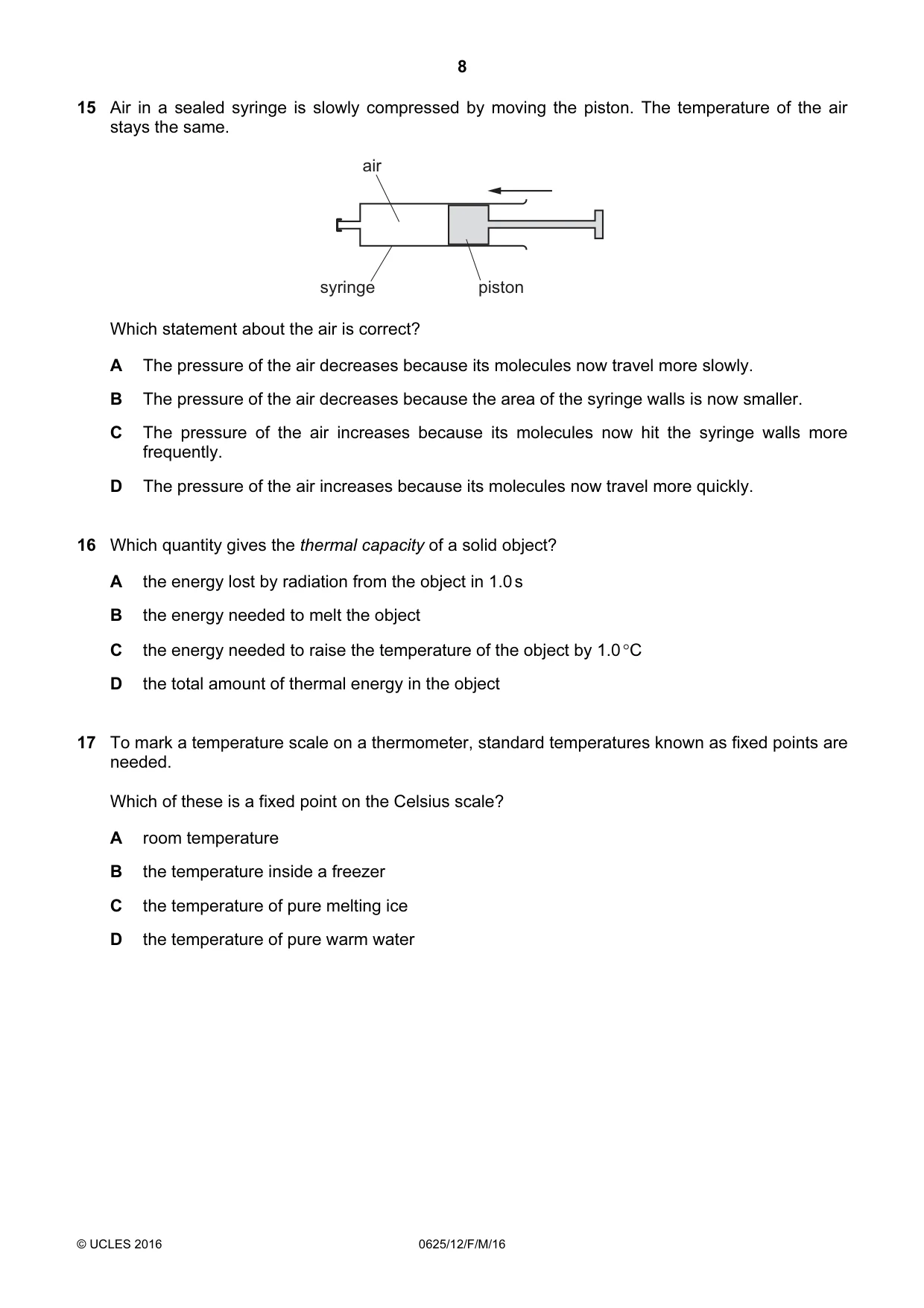
15 Air in a sealed syringe is slowly compressed by moving the piston. The temperature of the air stays the same. air syringe piston Which statement about the air is correct? A The pressure of the air decreases because its molecules now travel more slowly. B The pressure of the air decreases because the area of the syringe walls is now smaller. C The pressure of the air increases because its molecules now hit the syringe walls more frequently. D The pressure of the air increases because its molecules now travel more quickly.
Mark scheme: C
Q16 · Which quantity gives the thermal capacity of a solid object?
16 Which quantity gives the thermal capacity of a solid object? A the energy lost by radiation from the object in 1.0 s B the energy needed to melt the object C the energy needed to raise the temperature of the object by 1.0 °C D the total amount of thermal energy in the object
Mark scheme: C
Q17 · To mark a temperature scale on a thermometer, standard temperatures known as fixed points…
17 To mark a temperature scale on a thermometer, standard temperatures known as fixed points are needed. Which of these is a fixed point on the Celsius scale? A room temperature B the temperature inside a freezer C the temperature of pure melting ice D the temperature of pure warm water
Mark scheme: C
Q18 · The diagram shows electricity cables being put up on a warm day
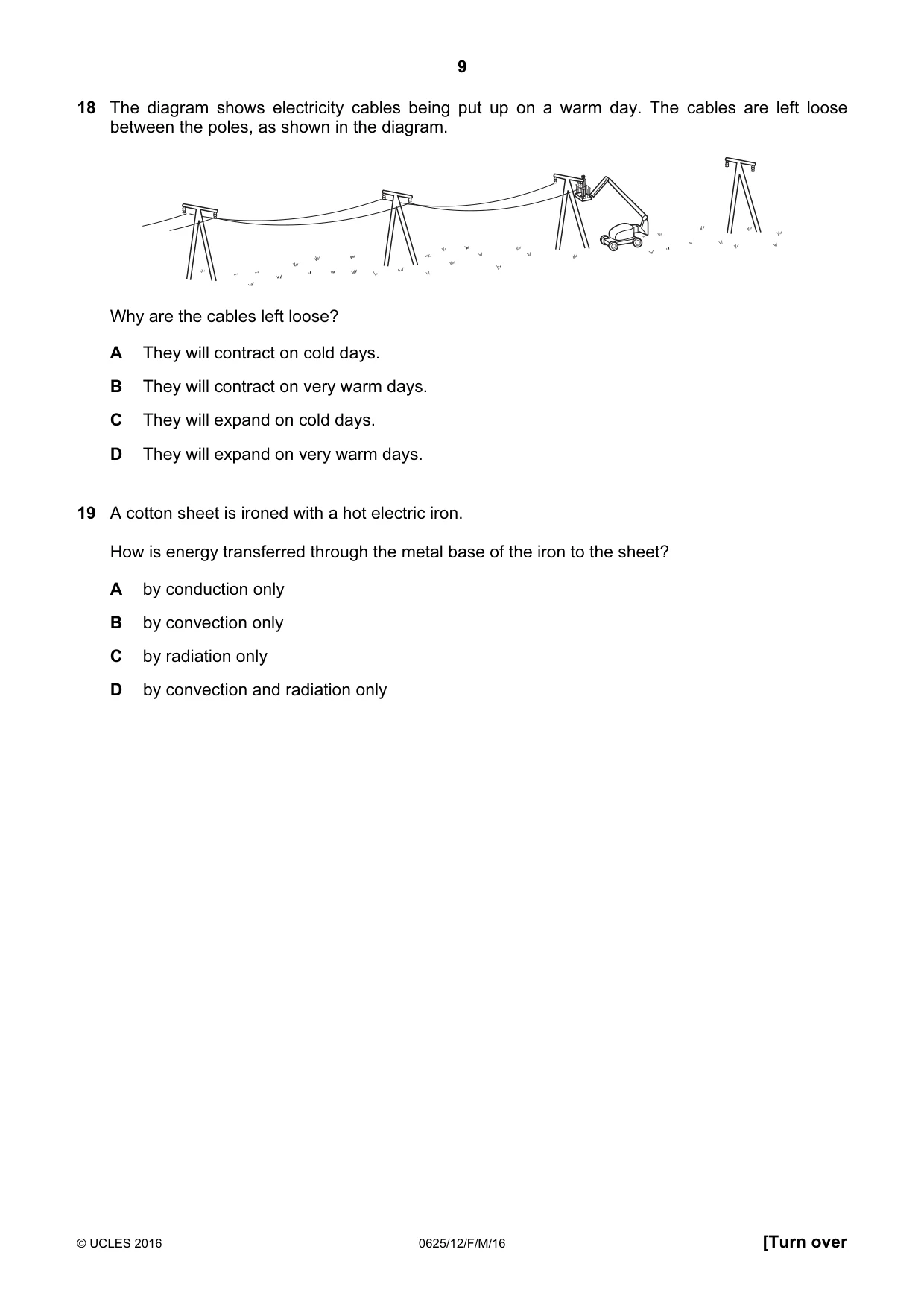
18 The diagram shows electricity cables being put up on a warm day. The cables are left loose between the poles, as shown in the diagram. Why are the cables left loose? A They will contract on cold days. B They will contract on very warm days. C They will expand on cold days. D They will expand on very warm days.
Mark scheme: A
Q19 · A cotton sheet is ironed with a hot electric iron
19 A cotton sheet is ironed with a hot electric iron. How is energy transferred through the metal base of the iron to the sheet? A by conduction only B by convection only C by radiation only D by convection and radiation only
Mark scheme: A
Q20 · Two plastic cups are placed one inside the other
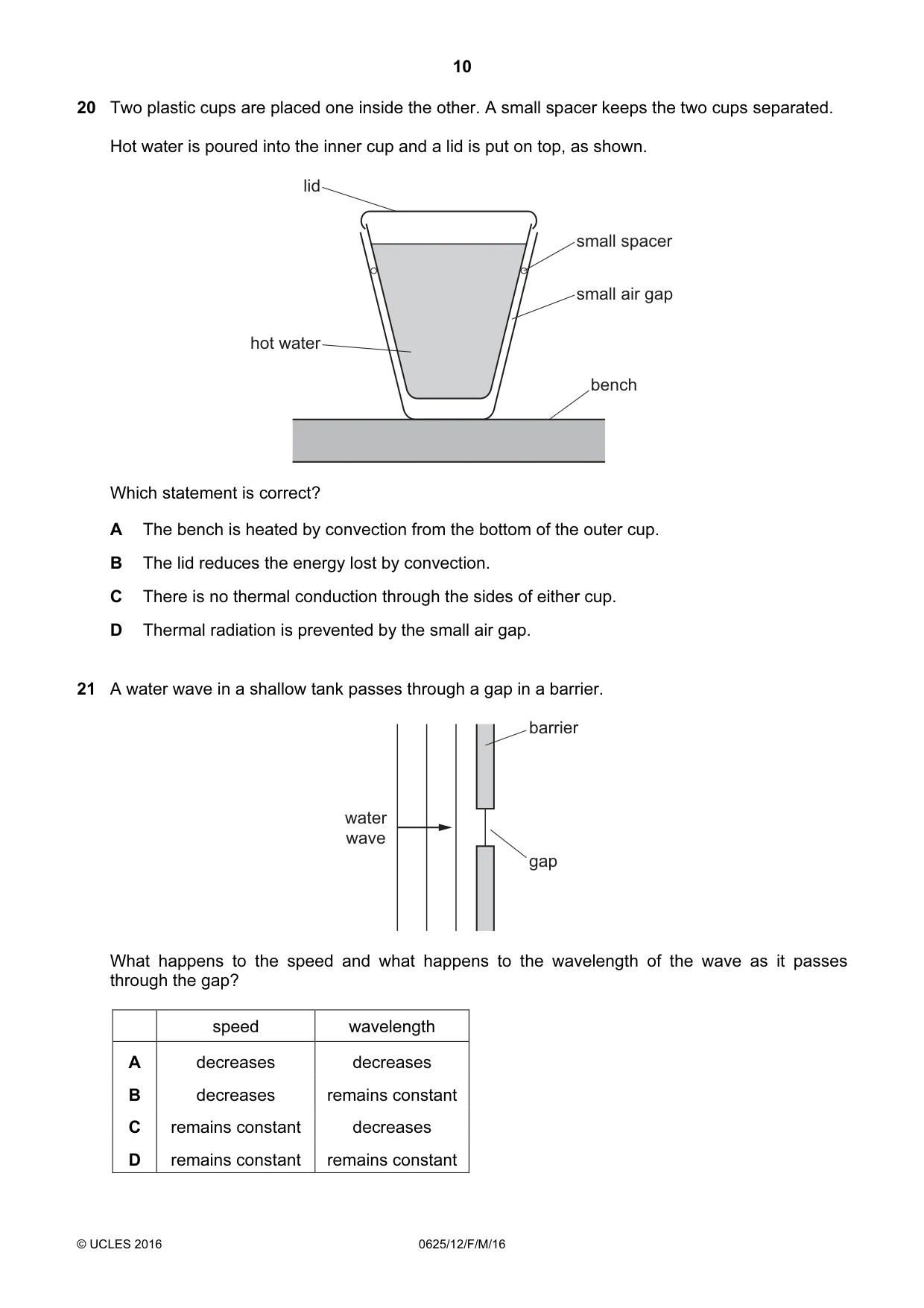
20 Two plastic cups are placed one inside the other. A small spacer keeps the two cups separated. Hot water is poured into the inner cup and a lid is put on top, as shown. lid small spacer small air gap hot water bench Which statement is correct? A The bench is heated by convection from the bottom of the outer cup. B The lid reduces the energy lost by convection. C There is no thermal conduction through the sides of either cup. D Thermal radiation is prevented by the small air gap.
Mark scheme: B
Q21 · A water wave in a shallow tank passes through a gap in a barrier
21 A water wave in a shallow tank passes through a gap in a barrier. barrier water wave gap What happens to the speed and what happens to the wavelength of the wave as it passes through the gap? speed wavelength A decreases decreases B decreases remains constant C remains constant decreases D remains constant remains constant
Mark scheme: D
Q22 · Which is a unit of wavelength?
22 Which is a unit of wavelength? A hertz B metre C metre per second D second
Mark scheme: B
Q23 · Which diagram correctly shows a ray of light reflected by a plane mirror?
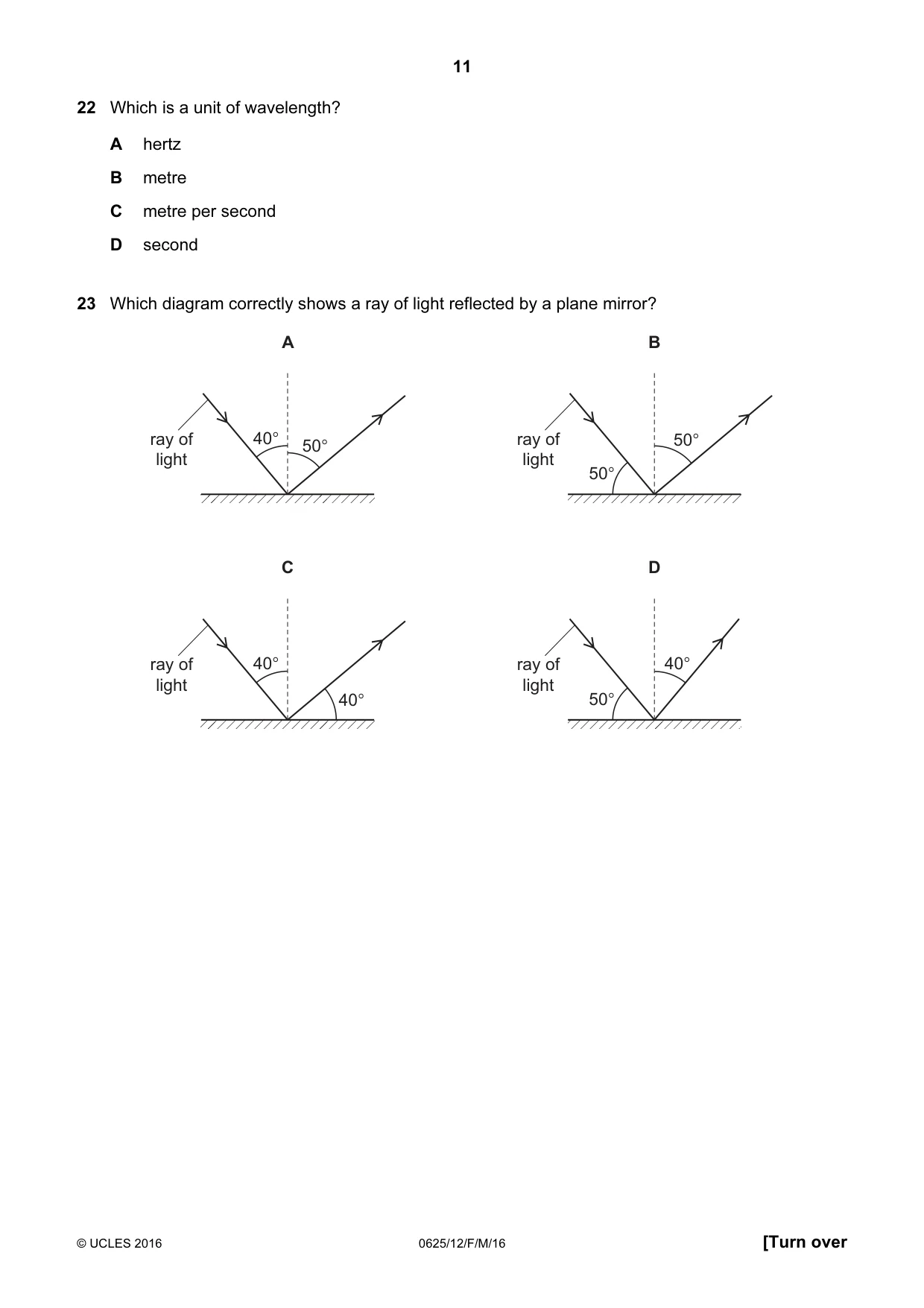
23 Which diagram correctly shows a ray of light reflected by a plane mirror? A B ray of 40° 50° ray of 50° light light 50° C D ray of 40° ray of 40° light light 40° 50°
Mark scheme: D
Q24 · A ray of white light is incident on a glass prism
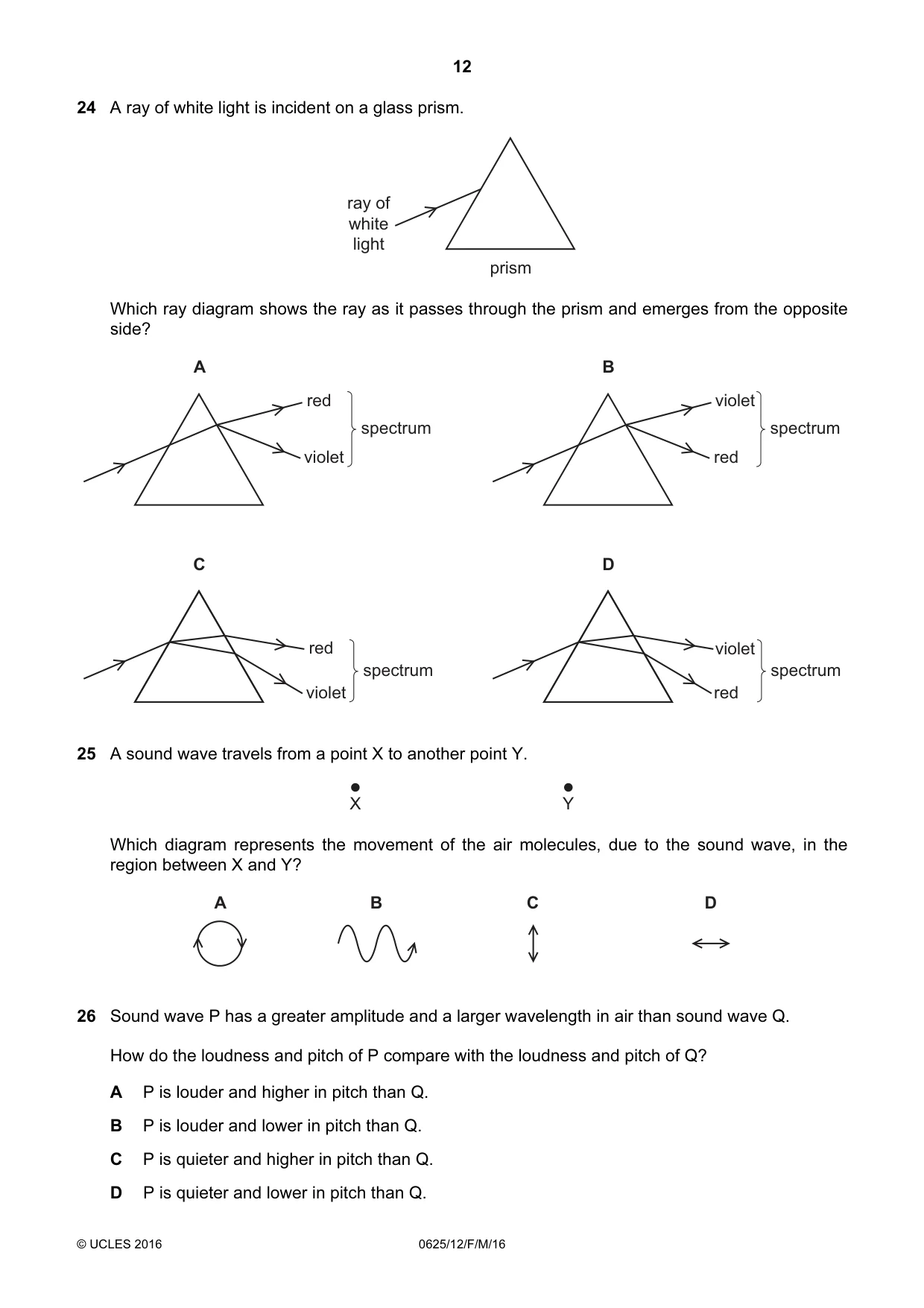
24 A ray of white light is incident on a glass prism. ray of white light prism Which ray diagram shows the ray as it passes through the prism and emerges from the opposite side? A B red violet spectrum spectrum violet red C D red violet spectrum spectrum violet red
Mark scheme: C
Q25 · A sound wave travels from a point X to another point Y
25 A sound wave travels from a point X to another point Y. X Y Which diagram represents the movement of the air molecules, due to the sound wave, in the region between X and Y? A B C D
Mark scheme: D
Q26 · Sound wave P has a greater amplitude and a larger wavelength in air than sound wave Q
26 Sound wave P has a greater amplitude and a larger wavelength in air than sound wave Q. How do the loudness and pitch of P compare with the loudness and pitch of Q? A P is louder and higher in pitch than Q. B P is louder and lower in pitch than Q. C P is quieter and higher in pitch than Q. D P is quieter and lower in pitch than Q.
Mark scheme: B
Q27 · In which pair are both materials magnetic?
27 In which pair are both materials magnetic? A aluminium and copper B copper and iron C iron and steel D steel and aluminium
Mark scheme: C
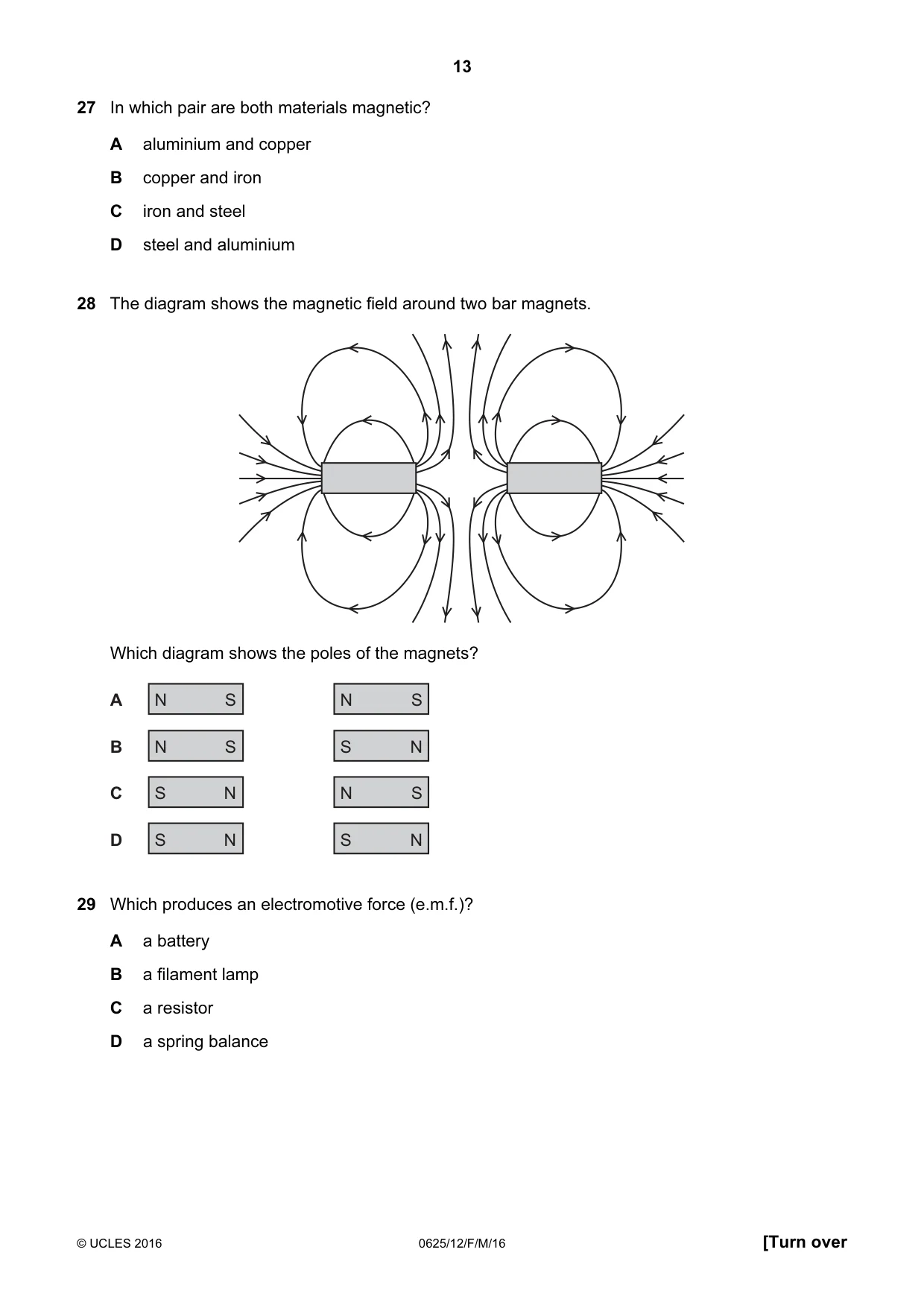
Q28 · The diagram shows the magnetic field around two bar magnets
28 The diagram shows the magnetic field around two bar magnets. Which diagram shows the poles of the magnets? A N S N S B N S S N C S N N S D S N S N
Mark scheme: C
Q29 · Which produces an electromotive force (e.m.f.)?
29 Which produces an electromotive force (e.m.f.)? A a battery B a filament lamp C a resistor D a spring balance
Mark scheme: A
Q30 · The table describes four different resistance wires
30 The table describes four different resistance wires. They are all made from the same metal. Which wire has the smallest resistance? length of diameter of wire / m wire / mm A 2.0 1.0 B 2.0 1.5 C 3.0 1.0 D 3.0 1.5
Mark scheme: B
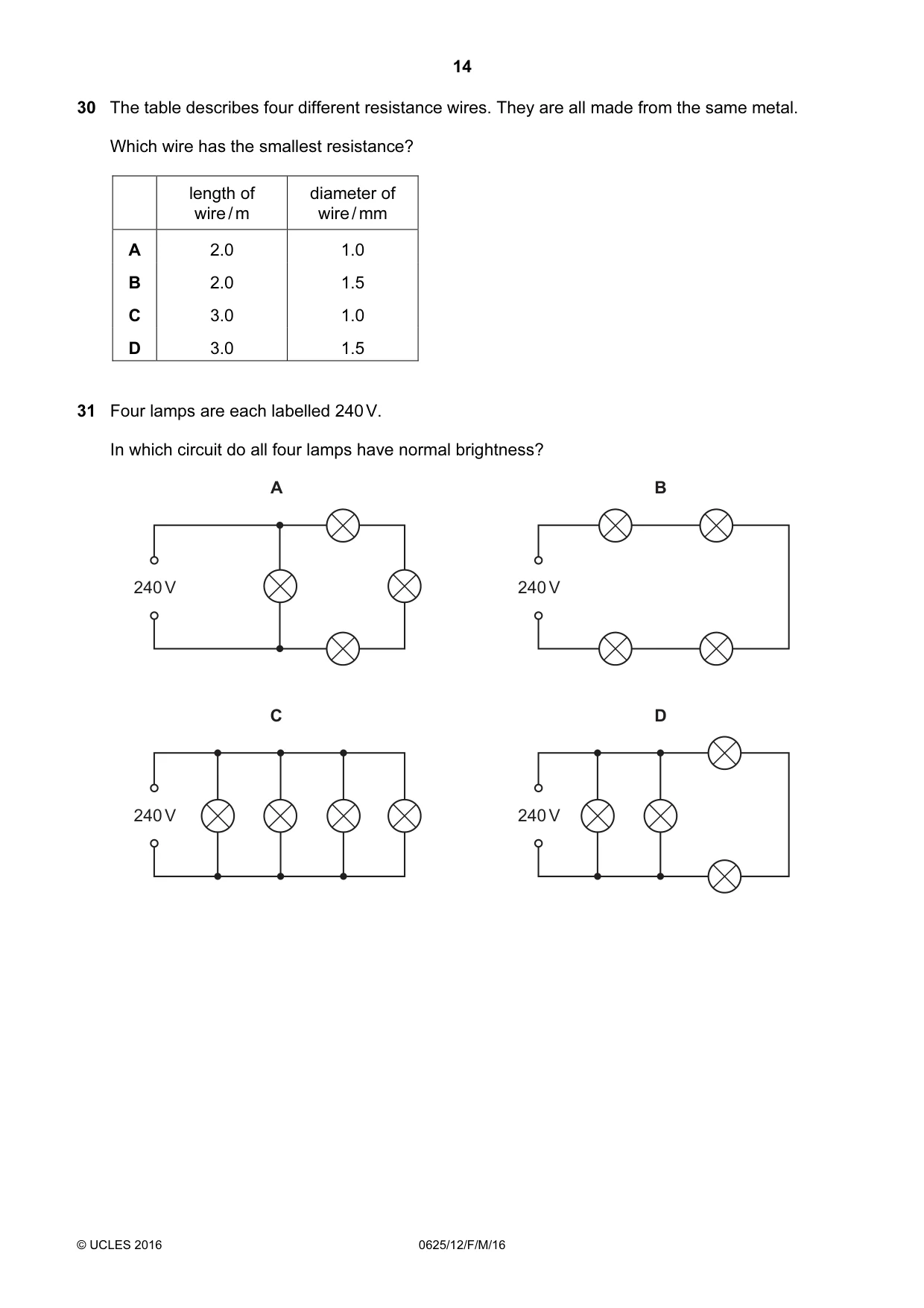
Q31 · Four lamps are each labelled 240 V
31 Four lamps are each labelled 240 V. In which circuit do all four lamps have normal brightness? A B 240 V 240 V C D 240 V 240 V
Mark scheme: C
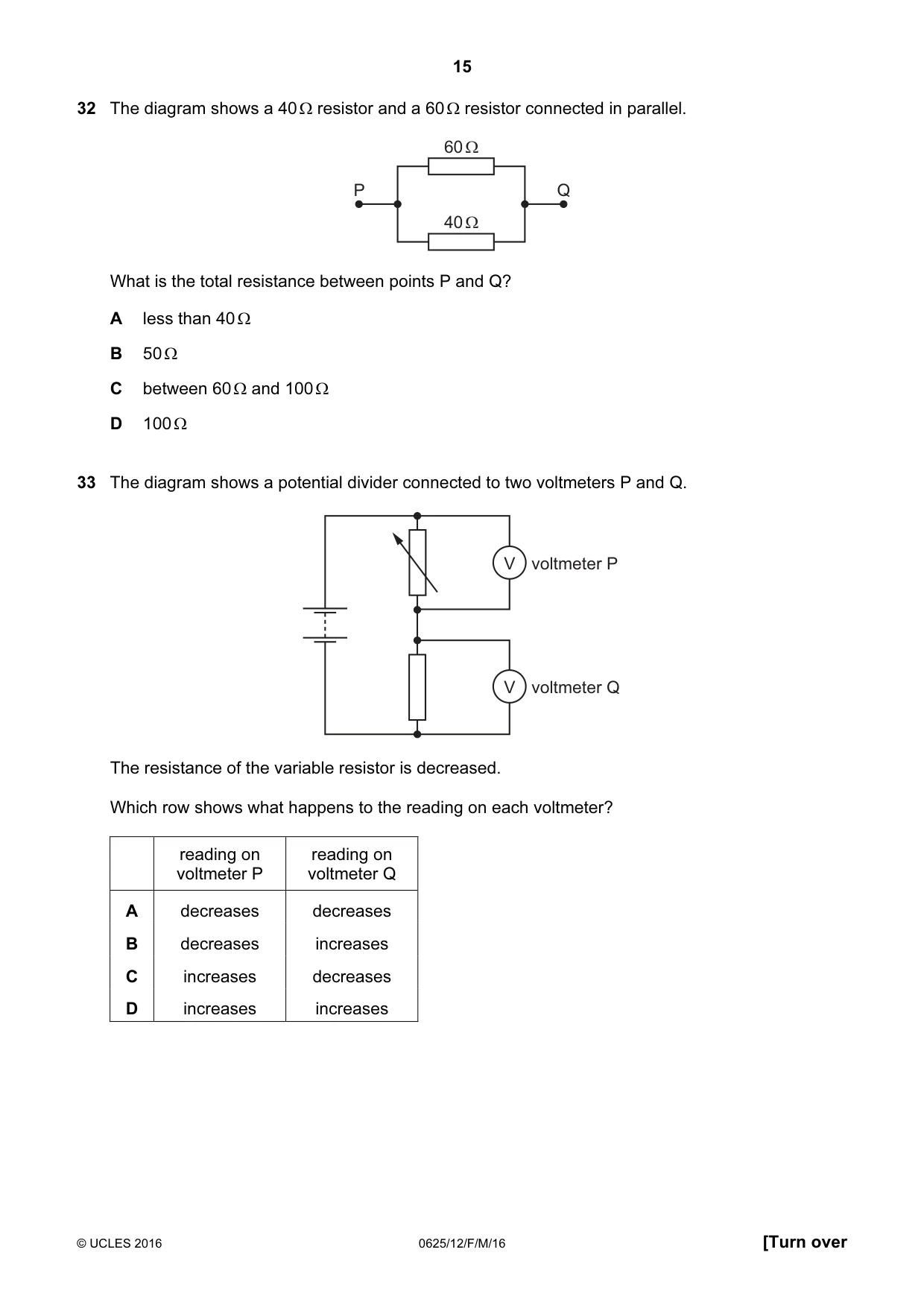
Q32 · The diagram shows a 40 Ω resistor and a 60 Ω resistor connected in parallel
32 The diagram shows a 40 Ω resistor and a 60 Ω resistor connected in parallel. 60 Ω P Q 40 Ω What is the total resistance between points P and Q? A less than 40 Ω B 50 Ω C between 60 Ω and 100 Ω D 100 Ω
Mark scheme: A
Q33 · The diagram shows a potential divider connected to two voltmeters P and Q
33 The diagram shows a potential divider connected to two voltmeters P and Q. V voltmeter P V voltmeter Q The resistance of the variable resistor is decreased. Which row shows what happens to the reading on each voltmeter? reading on reading on voltmeter P voltmeter Q A decreases decreases B decreases increases C increases decreases D increases increases
Mark scheme: B
Q34 · After some building work in a house, a bare (uninsulated) live wire is left protruding…
34 After some building work in a house, a bare (uninsulated) live wire is left protruding from a wall. What is the greatest hazard? A a fire B a fuse blows C an electric shock D no current flows
Mark scheme: C
Q35 · A coil carries a current in a magnetic field
35 A coil carries a current in a magnetic field. The coil experiences a turning effect. Which device uses this effect? A a d.c. motor B an electromagnet C a relay D a transformer
Mark scheme: A
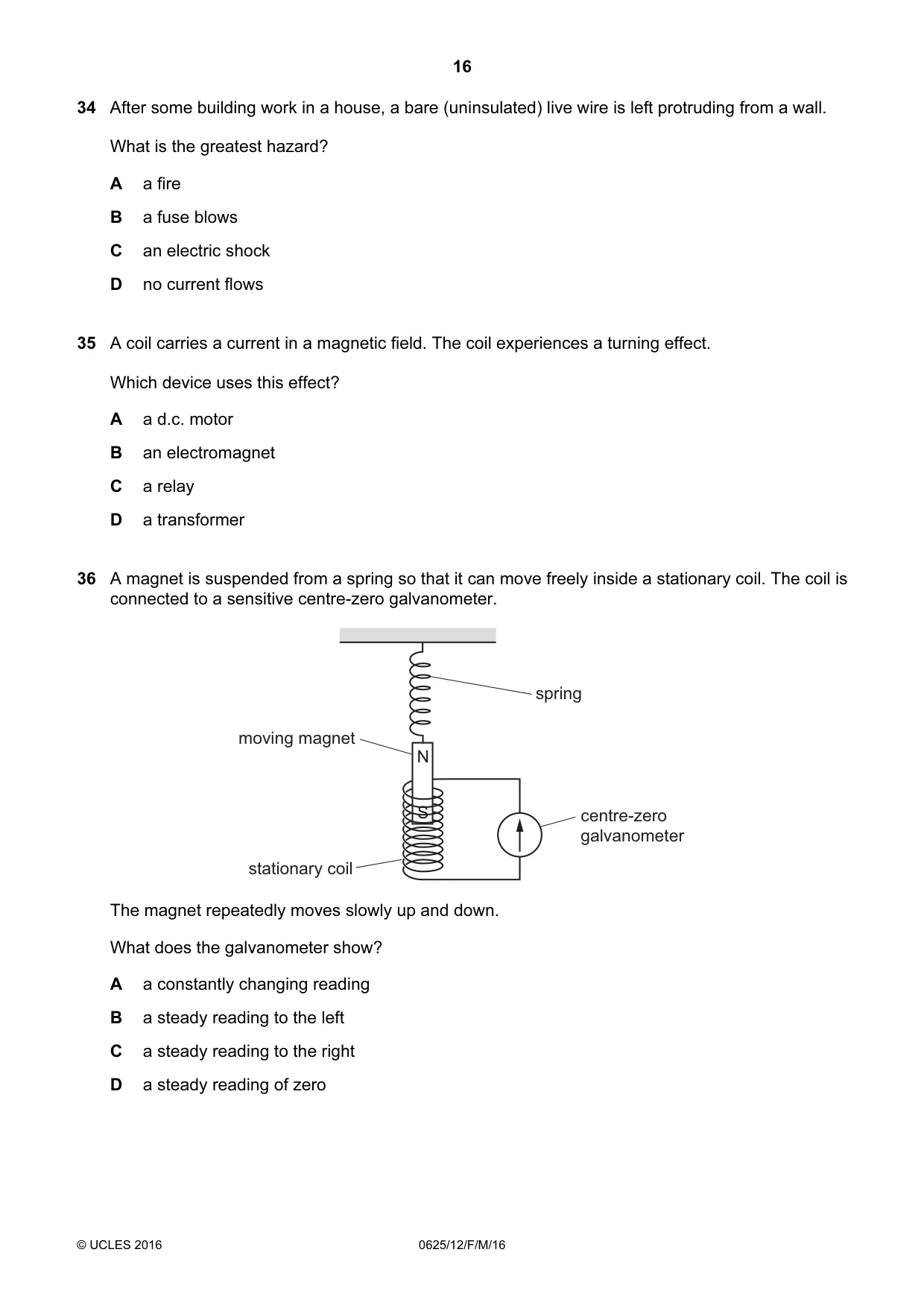
Q36 · A magnet is suspended from a spring so that it can move freely inside a stationary coil
36 A magnet is suspended from a spring so that it can move freely inside a stationary coil. The coil is connected to a sensitive centre-zero galvanometer. spring moving magnet N S centre-zero galvanometer stationary coil The magnet repeatedly moves slowly up and down. What does the galvanometer show? A a constantly changing reading B a steady reading to the left C a steady reading to the right D a steady reading of zero
Mark scheme: A
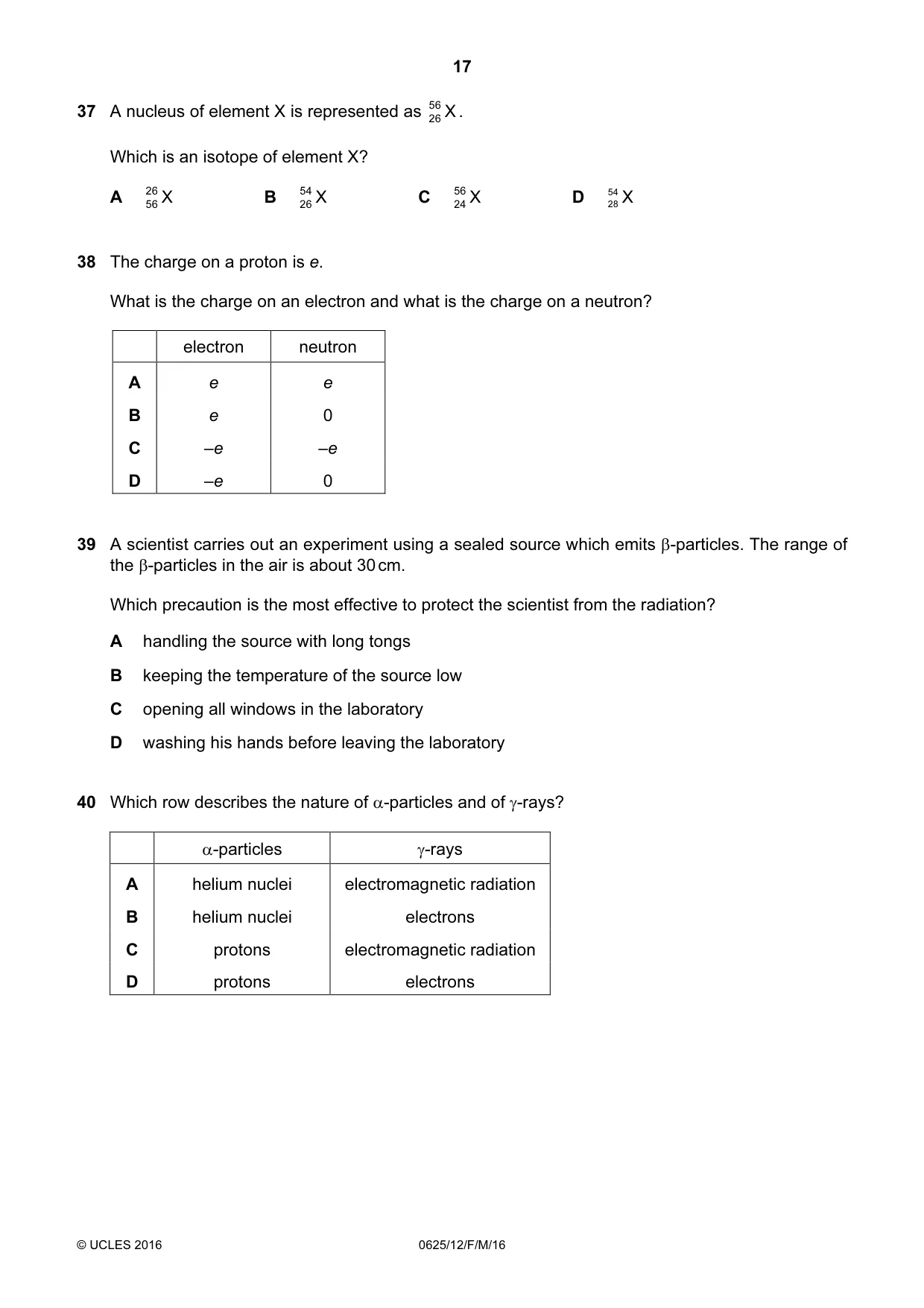
Q37 · A nucleus of element X is represented as 56 X
37 A nucleus of element X is represented as 56 X . 26 Which is an isotope of element X? A 26 X B 54 X C 56 X D 54 X 56 26 24 28
Mark scheme: B
Q38 · The charge on a proton is e
38 The charge on a proton is e. What is the charge on an electron and what is the charge on a neutron? electron neutron A e e B e 0 C –e –e D –e 0
Mark scheme: D
Q39 · A scientist carries out an experiment using a sealed source which emits β-particles
39 A scientist carries out an experiment using a sealed source which emits β-particles. The range of the β-particles in the air is about 30 cm. Which precaution is the most effective to protect the scientist from the radiation? A handling the source with long tongs B keeping the temperature of the source low C opening all windows in the laboratory D washing his hands before leaving the laboratory
Mark scheme: A
Q40 · Which row describes the nature of α-particles and of γ-rays?
40 Which row describes the nature of α-particles and of γ-rays? α-particles γ-rays A helium nuclei electromagnetic radiation B helium nuclei electrons C protons electromagnetic radiation D protons electrons
Mark scheme: A
What was in this paper
The subtopics covered by these 40 questions, and how many questions each got. Open one in a new tab to see every Cambridge question on it.
4Thermal properties and temperature4Electric circuits3Forces3Electrical quantities2Electromagnetic effects2General properties of waves2Light2Motion2Pressure2Radioactivity2Simple phenomena of magnetism2Sound2The nuclear model of the atom2Transfer of thermal energy2Density1Electrical safety1Kinetic particle model of matter1Physical quantities and measurement techniques1What you needed in this session
Cambridge’s own grade thresholds for 2016 Feb/March, Paper 1 · Variant 2. A higher threshold means an easier paper — the bar moves with how the cohort did.