Cambridge IGCSE Physics 0625 — 2015 May/June Paper 1 · Variant 2
0625/12/M/J/15 · 40 questions · 40 marks · ≈45 min
The question paper and its mark scheme, free to read here and free to download. This is Cambridge’s own paper, exactly as it was sat.
Question paper20 pages
Mark scheme2 pages
Answers below. Sit the paper first if you are practising.
Questions as text
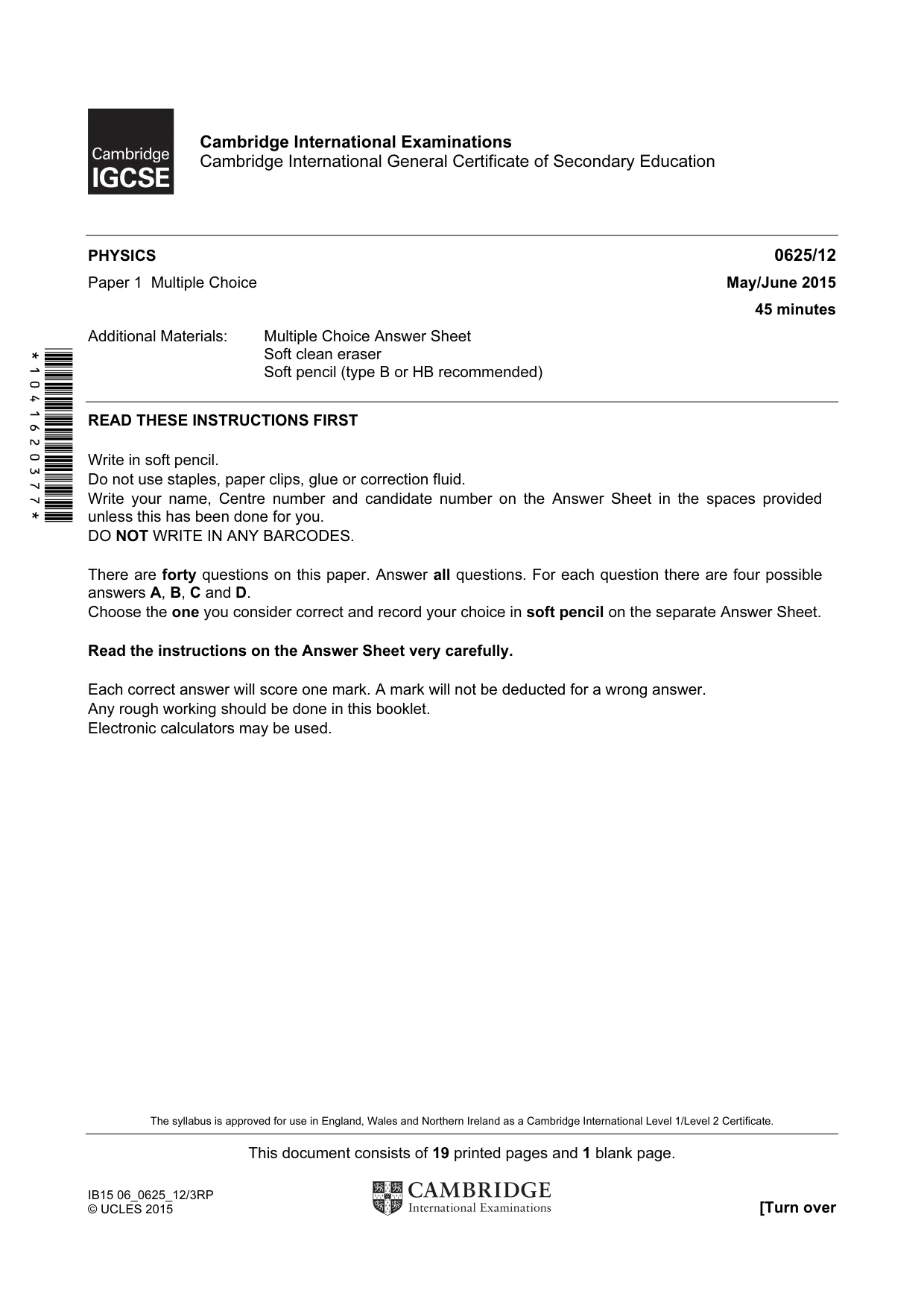
Q1 · The diagram shows four identical spheres placed between two wooden blocks on a ruler
1 The diagram shows four identical spheres placed between two wooden blocks on a ruler. sphere wooden block 0 5 10 15 cm What is the diameter of one sphere? A 1.0 cm B 2.0 cm C 3.0 cm D 4.0 cm
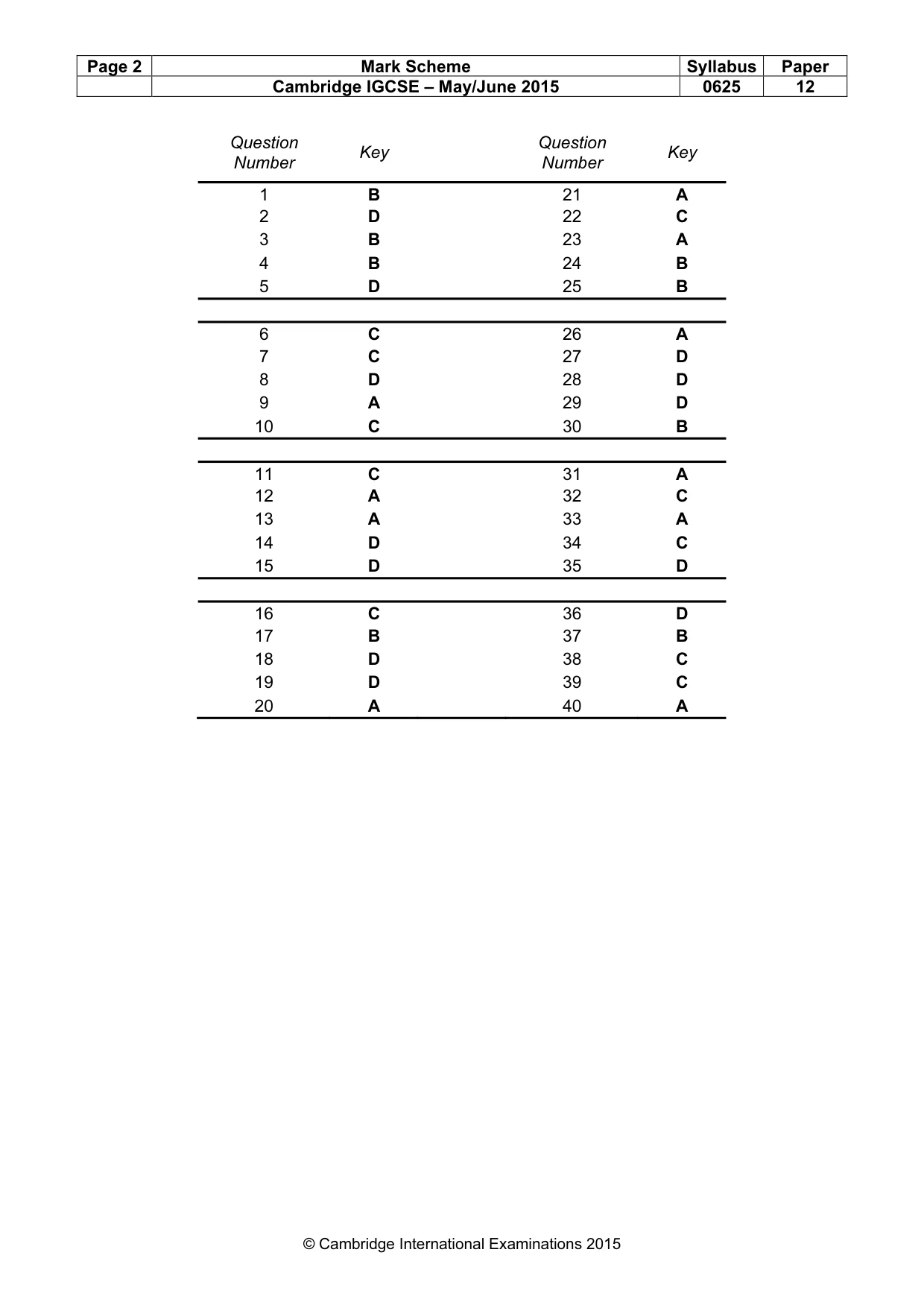
Mark scheme: B
More questions on Physical quantities and measurement techniques
Q2 · What does the area under a speed-time graph represent?
2 What does the area under a speed-time graph represent? A acceleration B average speed C deceleration D distance travelled
Mark scheme: D
Q3 · A car travels 100 km
3 A car travels 100 km. The journey takes two hours. The highest speed of the car is 80 km / h, and the lowest speed is 40 km / h. What is the average speed for the journey? A 40 km / h B 50 km / h C 60 km / h D 120 km / h
Mark scheme: B
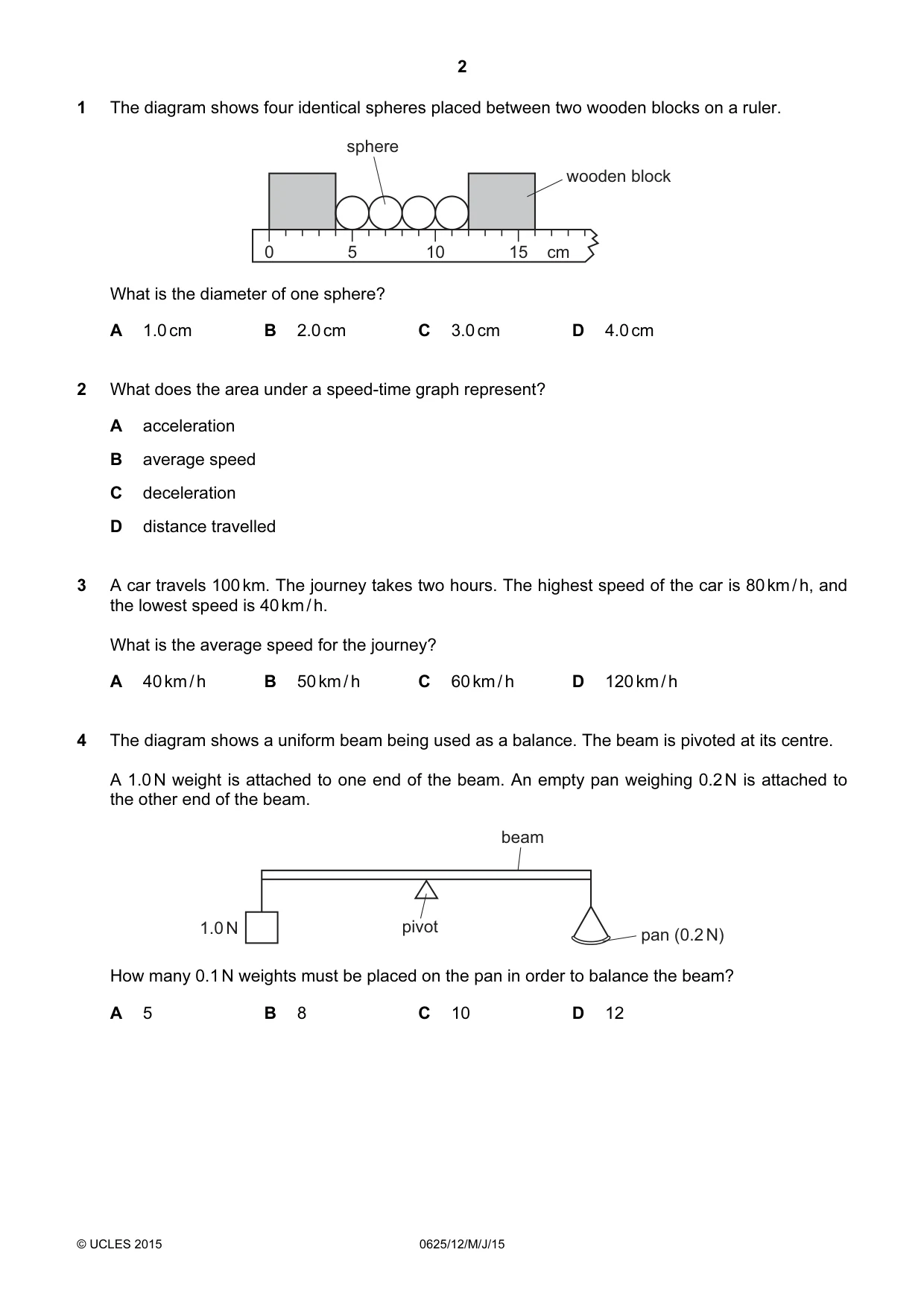
Q4 · The diagram shows a uniform beam being used as a balance
4 The diagram shows a uniform beam being used as a balance. The beam is pivoted at its centre. A 1.0 N weight is attached to one end of the beam. An empty pan weighing 0.2 N is attached to the other end of the beam. beam 1.0 N pivot pan (0.2 N) How many 0.1 N weights must be placed on the pan in order to balance the beam? A 5 B 8 C 10 D 12
Mark scheme: B
Q5 · A metal block has the dimensions shown
5 A metal block has the dimensions shown. Its mass is 1000 g. 5 cm 10 cm 2 cm What is the density of the metal? 5 × 10 A g / cm3 1000 × 2 2 × 5 × 10 B g / cm3 1000 1000 × 2 C g / cm3 5 × 10 1000 D g / cm3 2 × 5 × 10
Mark scheme: D
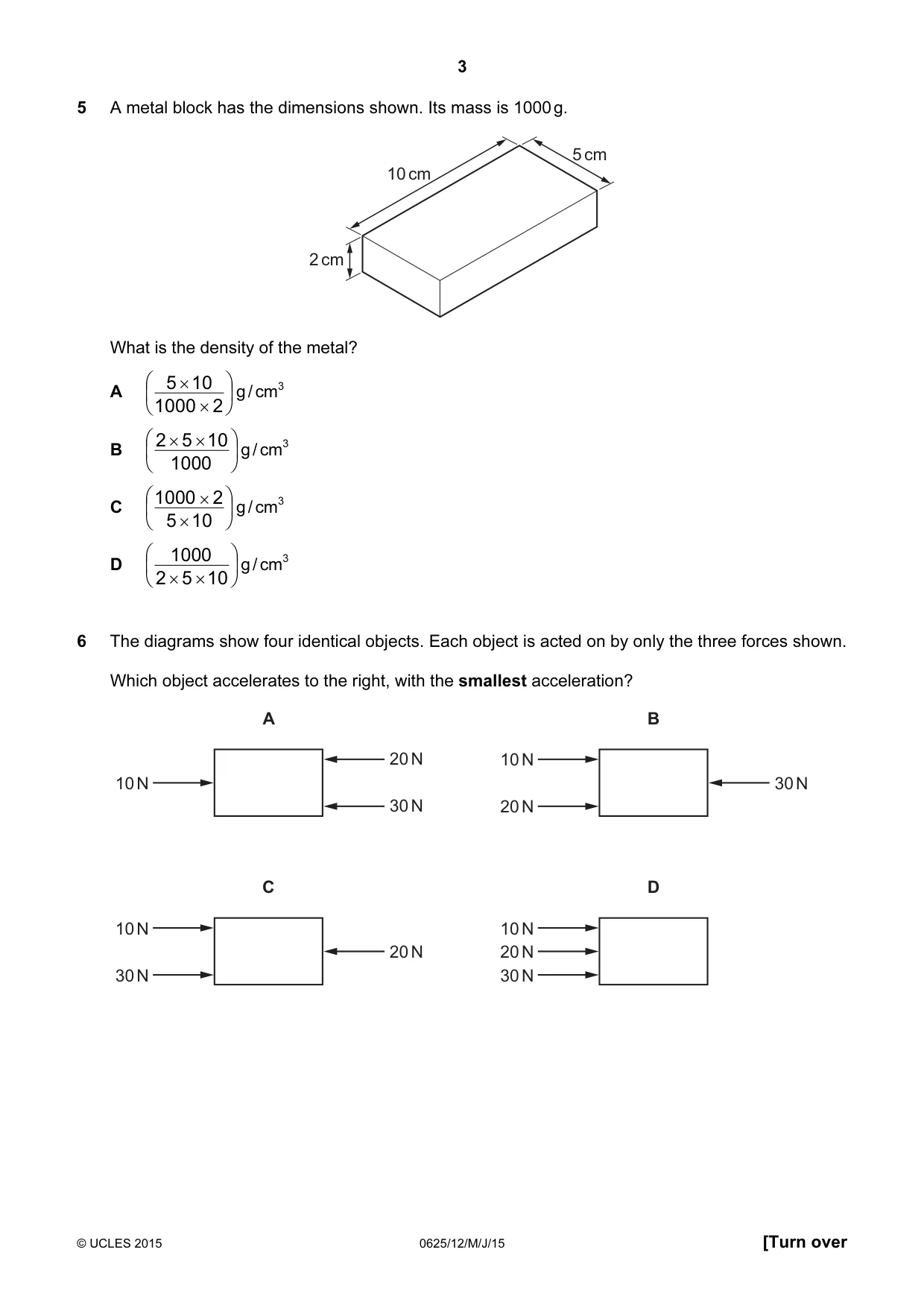
Q6 · The diagrams show four identical objects
6 The diagrams show four identical objects. Each object is acted on by only the three forces shown. Which object accelerates to the right, with the smallest acceleration? A B 20 N 10 N 10 N 30 N 30 N 20 N C D 10 N 10 N 20 N 20 N 30 N 30 N
Mark scheme: C
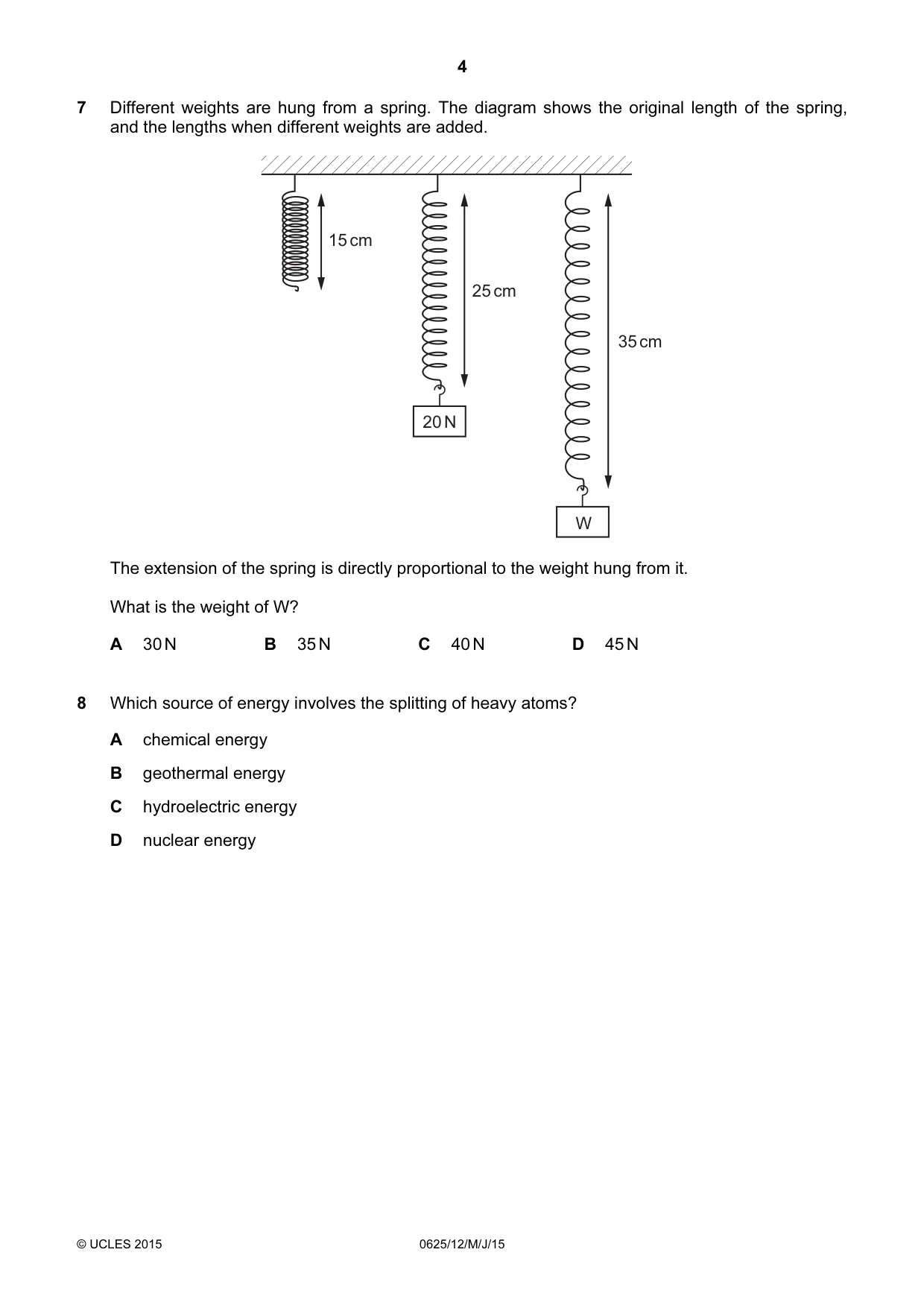
Q7 · Different weights are hung from a spring
7 Different weights are hung from a spring. The diagram shows the original length of the spring, and the lengths when different weights are added. 15 cm 25 cm 35 cm 20 N W The extension of the spring is directly proportional to the weight hung from it. What is the weight of W? A 30 N B 35 N C 40 N D 45 N
Mark scheme: C
Q8 · Which source of energy involves the splitting of heavy atoms?
8 Which source of energy involves the splitting of heavy atoms? A chemical energy B geothermal energy C hydroelectric energy D nuclear energy
Mark scheme: D
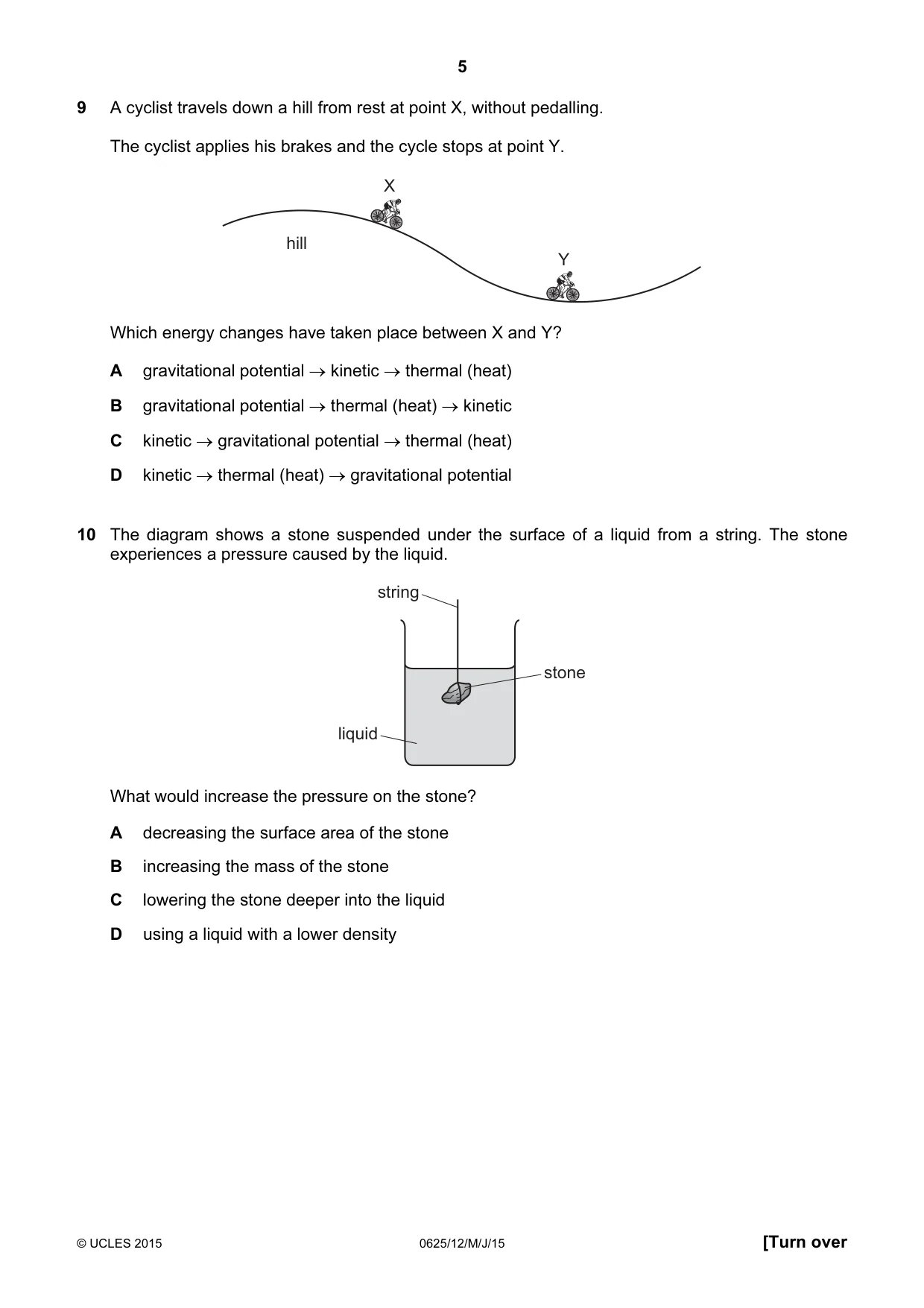
Q9 · A cyclist travels down a hill from rest at point X, without pedalling
9 A cyclist travels down a hill from rest at point X, without pedalling. The cyclist applies his brakes and the cycle stops at point Y. X hill Y Which energy changes have taken place between X and Y? A gravitational potential → kinetic → thermal (heat) B gravitational potential → thermal (heat) → kinetic C kinetic → gravitational potential → thermal (heat) D kinetic → thermal (heat) → gravitational potential
Mark scheme: A
Q10 · The diagram shows a stone suspended under the surface of a liquid from a string
10 The diagram shows a stone suspended under the surface of a liquid from a string. The stone experiences a pressure caused by the liquid. string stone liquid What would increase the pressure on the stone? A decreasing the surface area of the stone B increasing the mass of the stone C lowering the stone deeper into the liquid D using a liquid with a lower density
Mark scheme: C
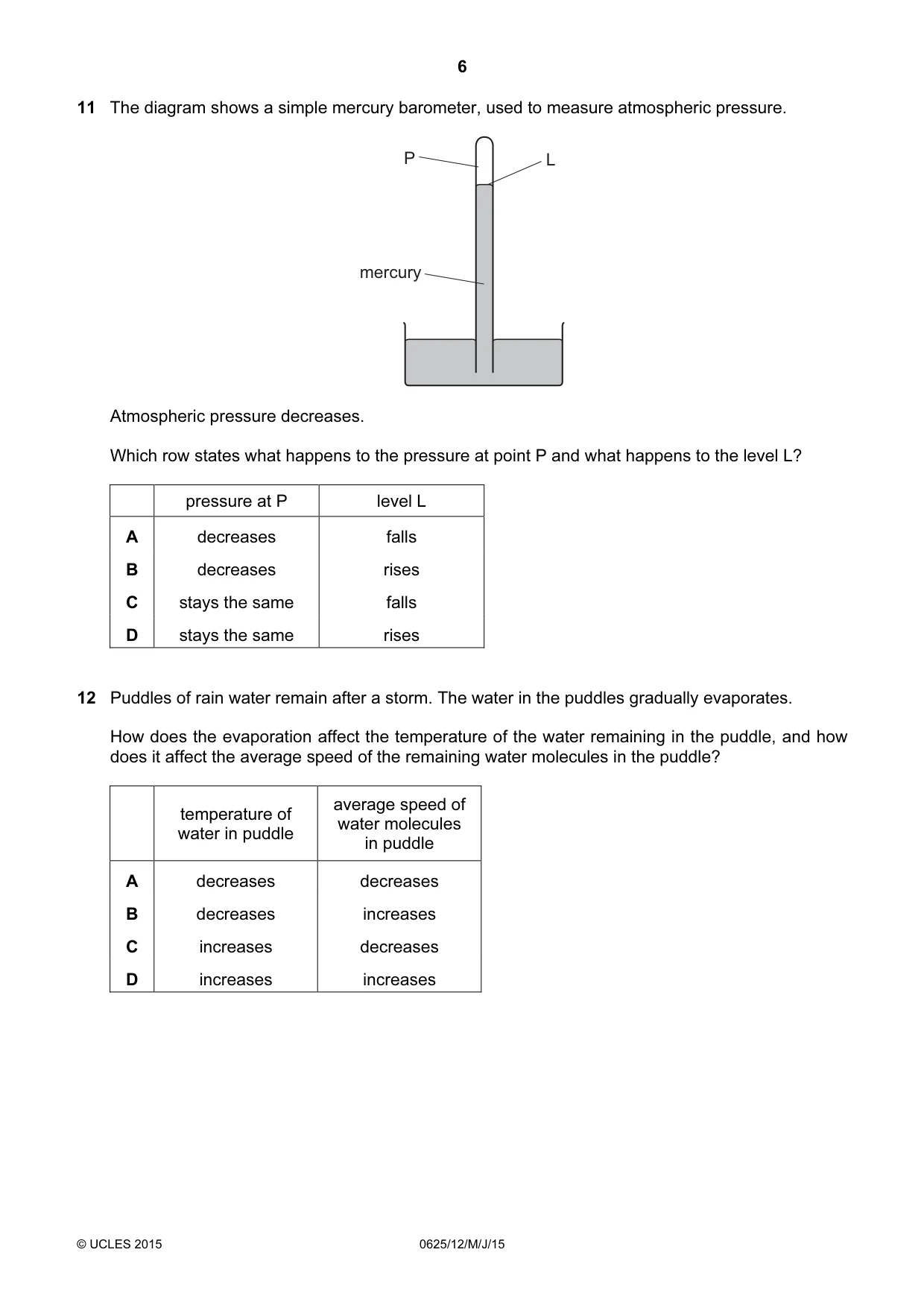
Q11 · The diagram shows a simple mercury barometer, used to measure atmospheric pressure
11 The diagram shows a simple mercury barometer, used to measure atmospheric pressure. P L mercury Atmospheric pressure decreases. Which row states what happens to the pressure at point P and what happens to the level L? pressure at P level L A decreases falls B decreases rises C stays the same falls D stays the same rises
Mark scheme: C
Q12 · Puddles of rain water remain after a storm
12 Puddles of rain water remain after a storm. The water in the puddles gradually evaporates. How does the evaporation affect the temperature of the water remaining in the puddle, and how does it affect the average speed of the remaining water molecules in the puddle? average speed of temperature of water molecules water in puddle in puddle A decreases decreases B decreases increases C increases decreases D increases increases
Mark scheme: A
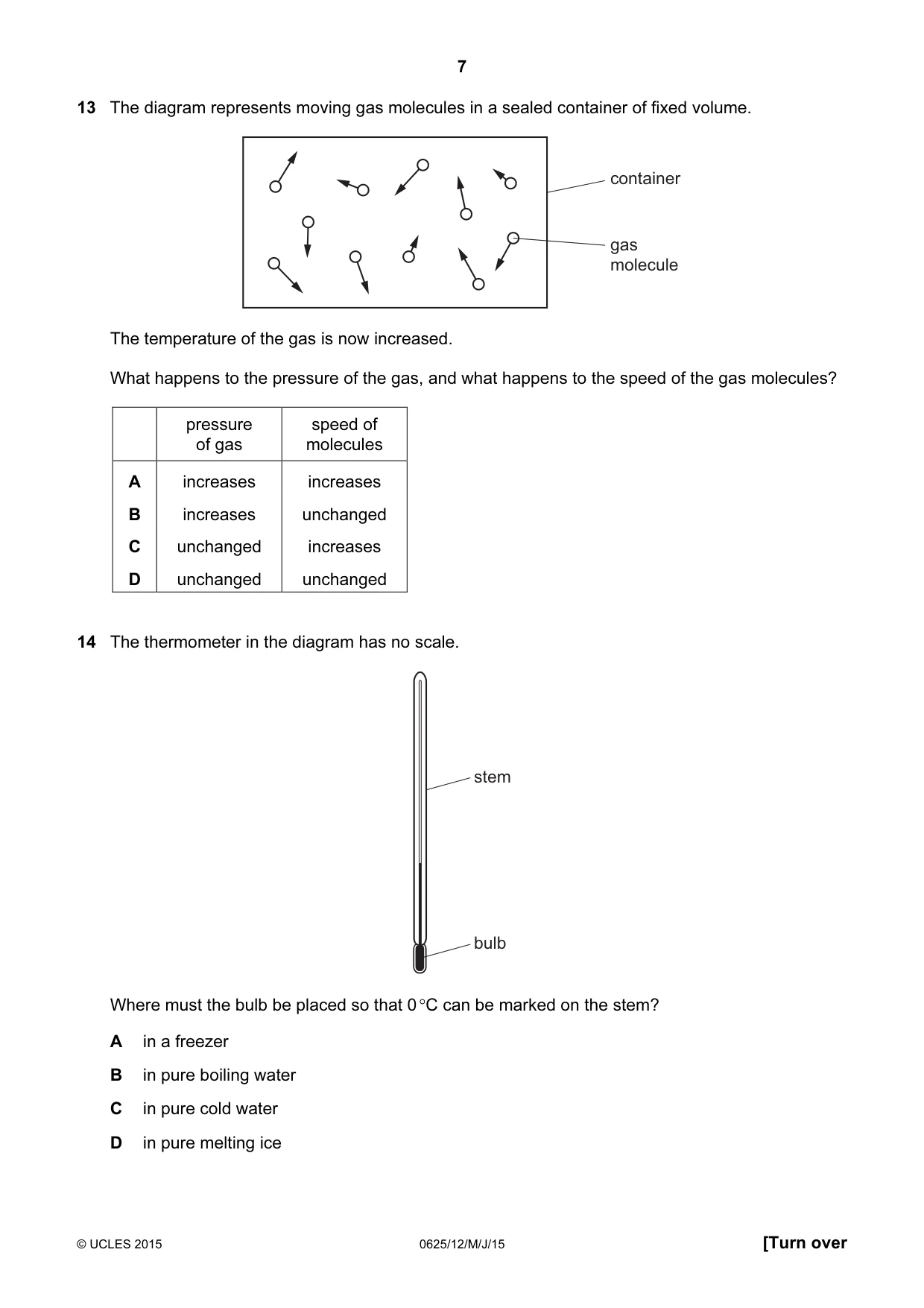
Q13 · The diagram represents moving gas molecules in a sealed container of fixed volume
13 The diagram represents moving gas molecules in a sealed container of fixed volume. container gas molecule The temperature of the gas is now increased. What happens to the pressure of the gas, and what happens to the speed of the gas molecules? pressure speed of of gas molecules A increases increases B increases unchanged C unchanged increases D unchanged unchanged
Mark scheme: A
Q14 · The thermometer in the diagram has no scale
14 The thermometer in the diagram has no scale. stem bulb Where must the bulb be placed so that 0 °C can be marked on the stem? A in a freezer B in pure boiling water C in pure cold water D in pure melting ice
Mark scheme: D
Q15 · Two metal blocks X and Y are at room temperature
15 Two metal blocks X and Y are at room temperature. Each block is heated so that its temperature rises by 10 °C. The blocks are now allowed to cool back to room temperature. Block Y has a greater thermal capacity than block X. Which block needs more thermal (heat) energy to heat it up by 10 °C and which block loses more thermal (heat) energy as it cools back to room temperature? more energy heating cooling A X X B X Y C Y X D Y Y
Mark scheme: D
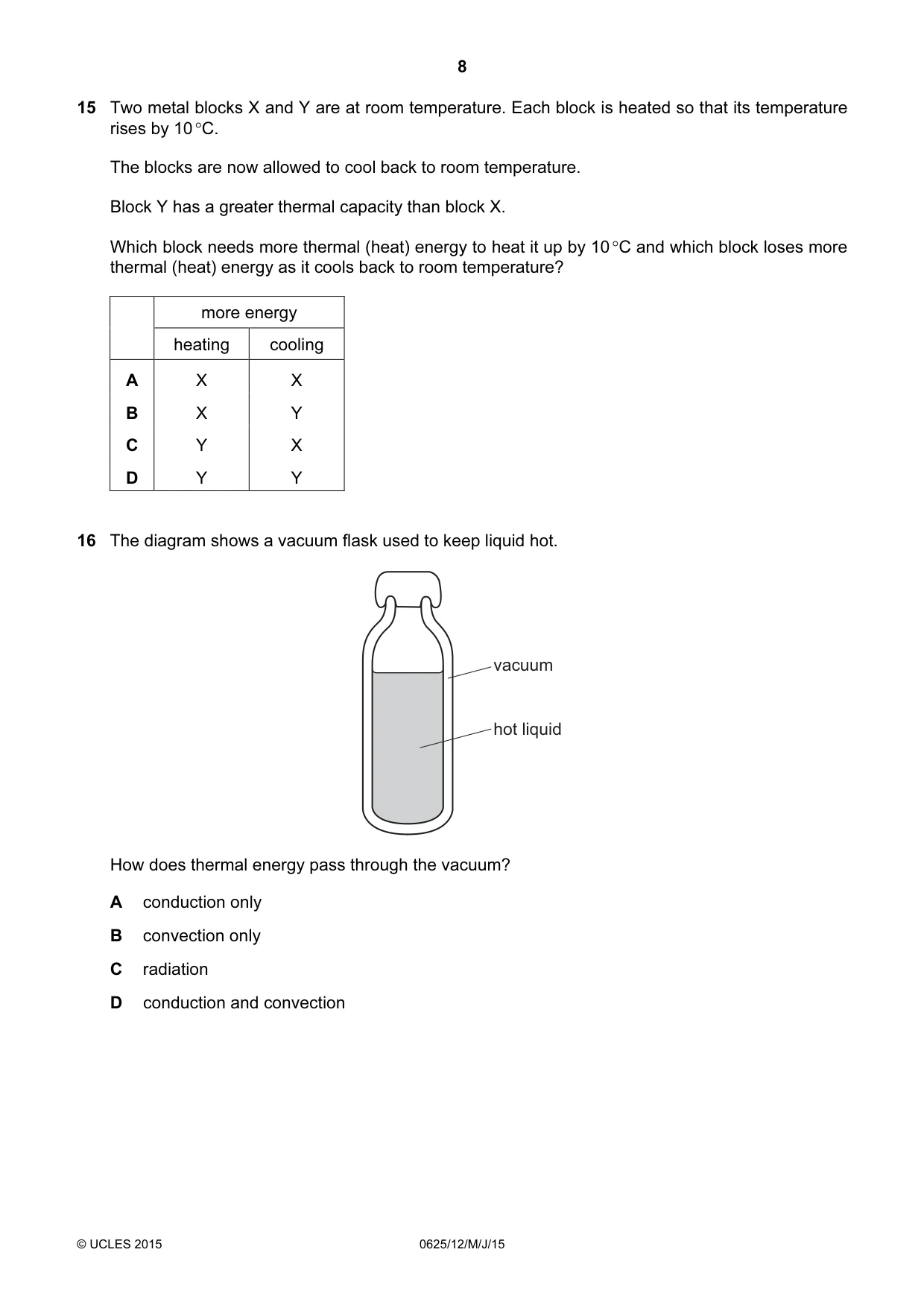
Q16 · The diagram shows a vacuum flask used to keep liquid hot
16 The diagram shows a vacuum flask used to keep liquid hot. vacuum hot liquid How does thermal energy pass through the vacuum? A conduction only B convection only C radiation D conduction and convection
Mark scheme: C
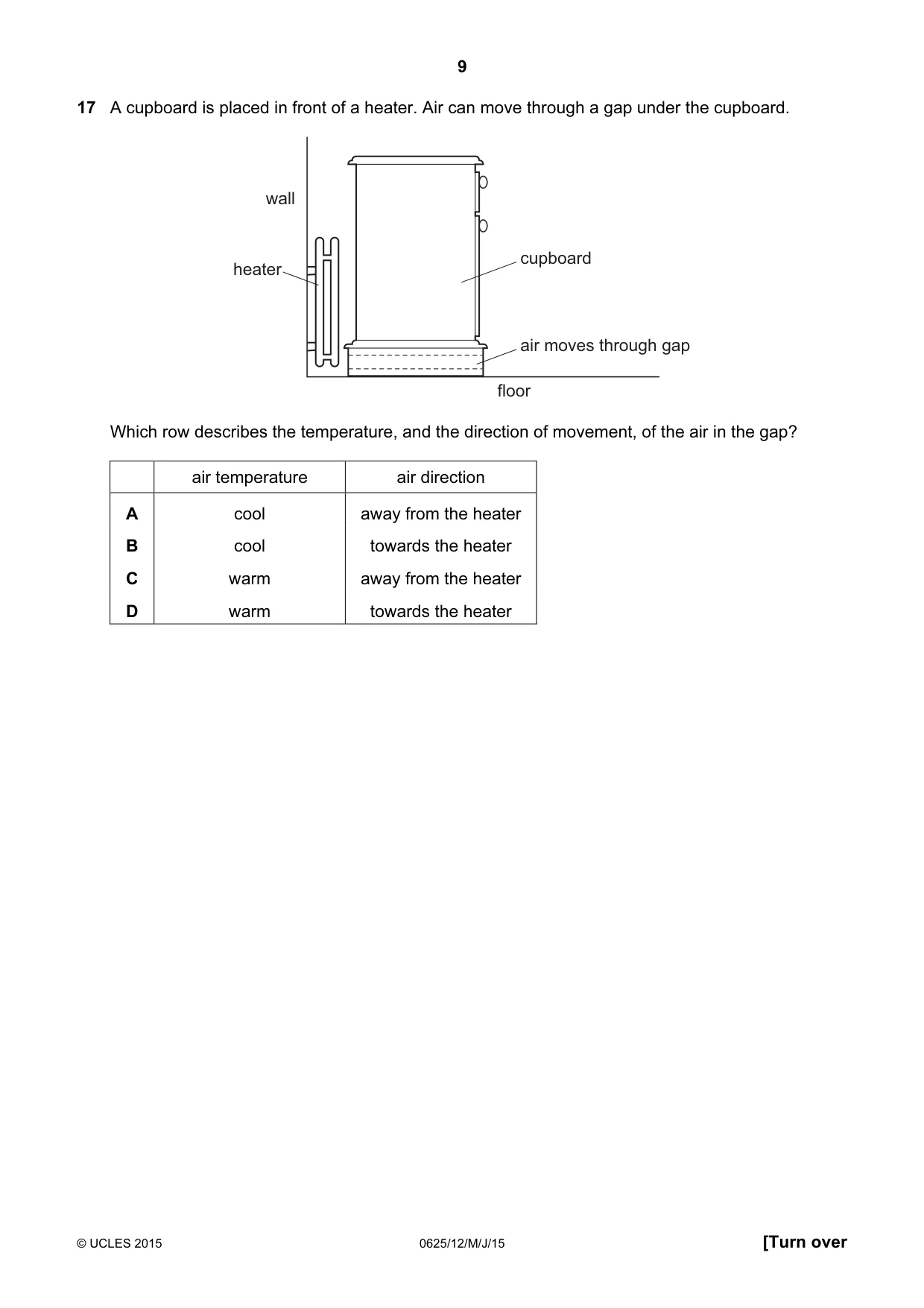
Q17 · A cupboard is placed in front of a heater
17 A cupboard is placed in front of a heater. Air can move through a gap under the cupboard. wall cupboard heater air moves through gap floor Which row describes the temperature, and the direction of movement, of the air in the gap? air temperature air direction A cool away from the heater B cool towards the heater C warm away from the heater D warm towards the heater
Mark scheme: B
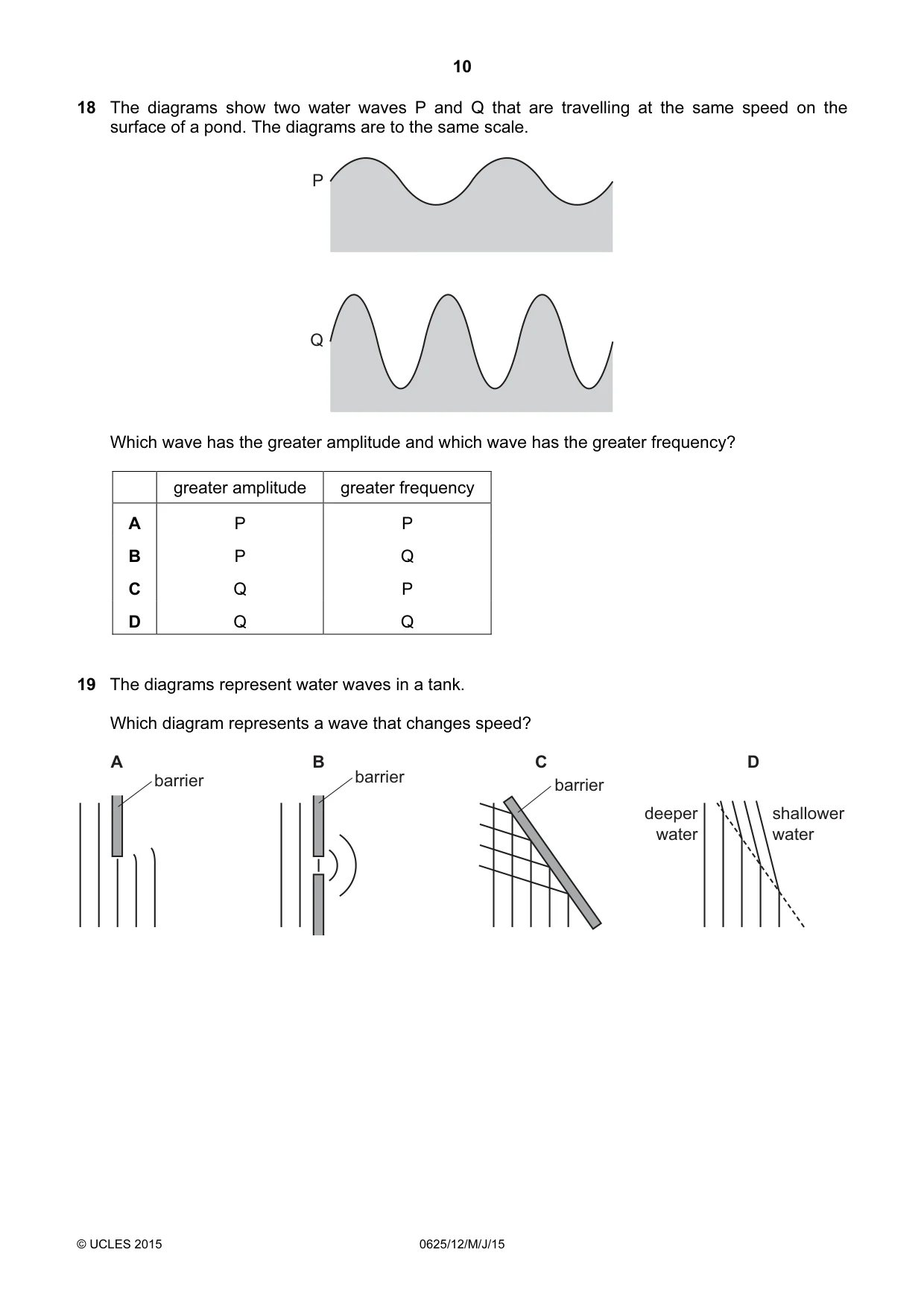
Q18 · The diagrams show two water waves P and Q that are travelling at the same speed on the…
18 The diagrams show two water waves P and Q that are travelling at the same speed on the surface of a pond. The diagrams are to the same scale. P Q Which wave has the greater amplitude and which wave has the greater frequency? greater amplitude greater frequency A P P B P Q C Q P D Q Q
Mark scheme: D
Q19 · The diagrams represent water waves in a tank
19 The diagrams represent water waves in a tank. Which diagram represents a wave that changes speed? A B C D barrier barrier barrier deeper shallower water water
Mark scheme: D
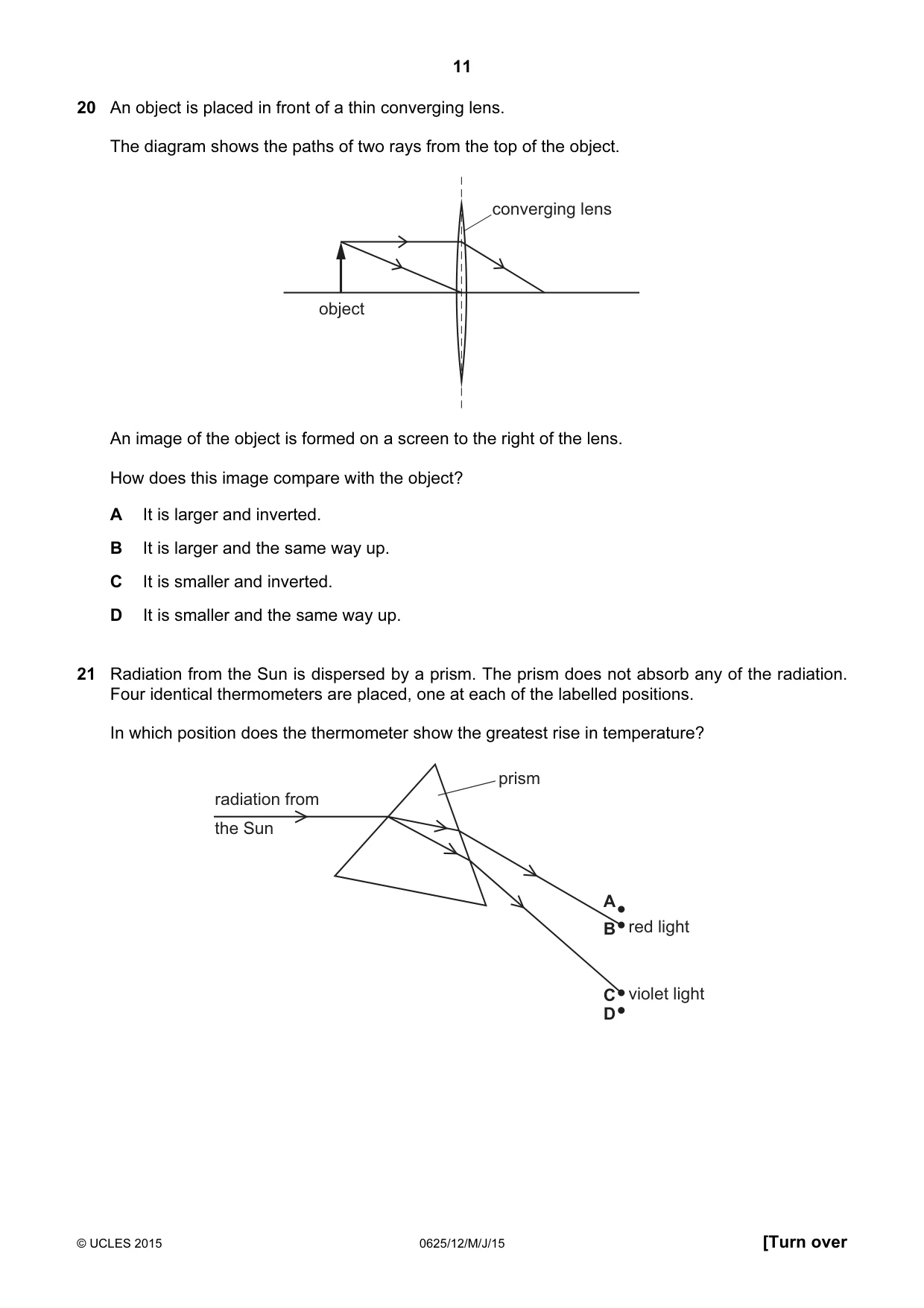
Q20 · An object is placed in front of a thin converging lens
20 An object is placed in front of a thin converging lens. The diagram shows the paths of two rays from the top of the object. converging lens object An image of the object is formed on a screen to the right of the lens. How does this image compare with the object? A It is larger and inverted. B It is larger and the same way up. C It is smaller and inverted. D It is smaller and the same way up.
Mark scheme: A
Q21 · Radiation from the Sun is dispersed by a prism
21 Radiation from the Sun is dispersed by a prism. The prism does not absorb any of the radiation. Four identical thermometers are placed, one at each of the labelled positions. In which position does the thermometer show the greatest rise in temperature? prism radiation from the Sun A B red light C violet light D
Mark scheme: A
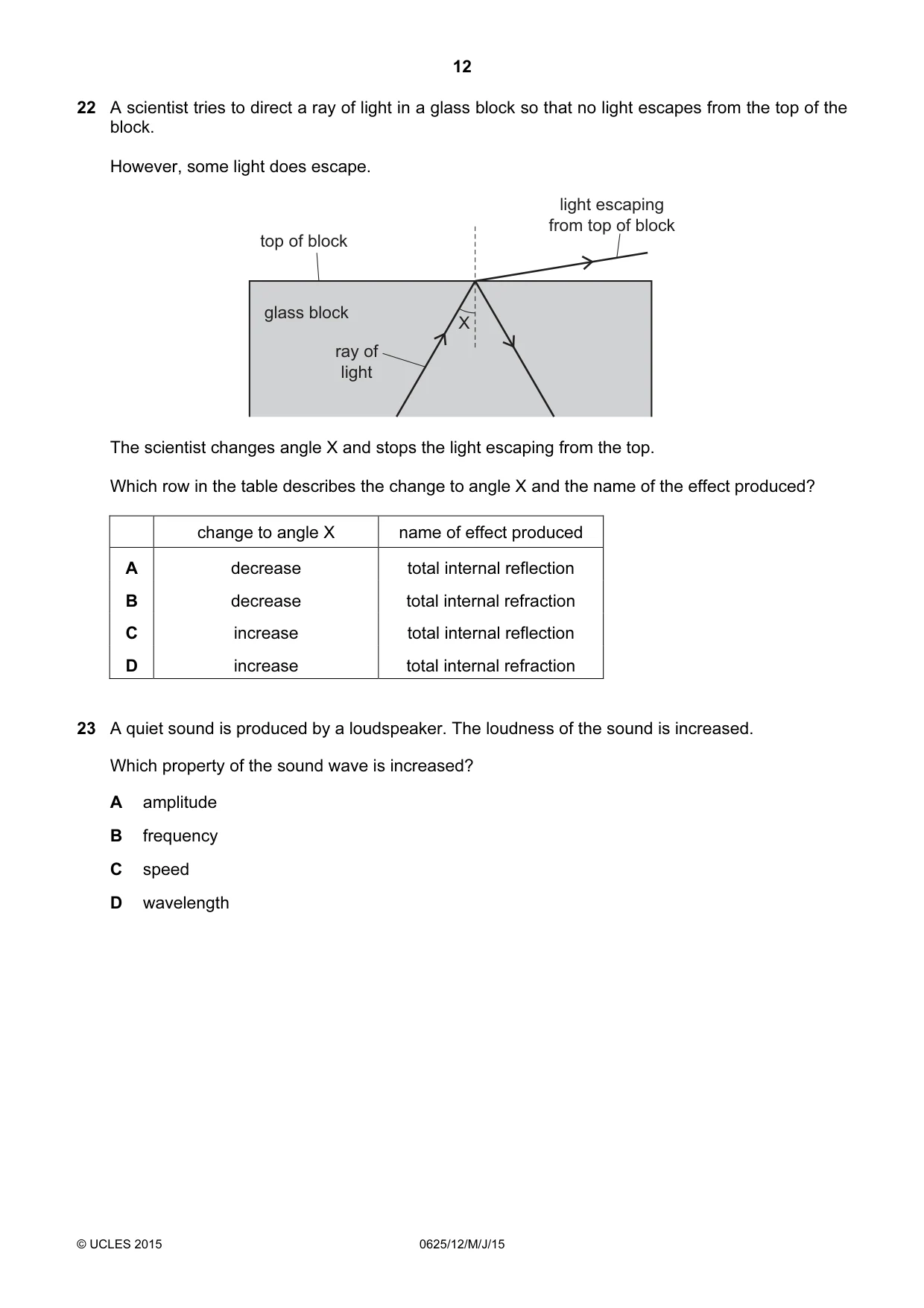
Q22 · A scientist tries to direct a ray of light in a glass block so that no light escapes from…
22 A scientist tries to direct a ray of light in a glass block so that no light escapes from the top of the block. However, some light does escape. light escaping from top of block top of block glass block X ray of light The scientist changes angle X and stops the light escaping from the top. Which row in the table describes the change to angle X and the name of the effect produced? change to angle X name of effect produced A decrease total internal reflection B decrease total internal refraction C increase total internal reflection D increase total internal refraction
Mark scheme: C
Q23 · A quiet sound is produced by a loudspeaker
23 A quiet sound is produced by a loudspeaker. The loudness of the sound is increased. Which property of the sound wave is increased? A amplitude B frequency C speed D wavelength
Mark scheme: A
Q24 · A man holding a starting pistol stands 640 m away from a spectator
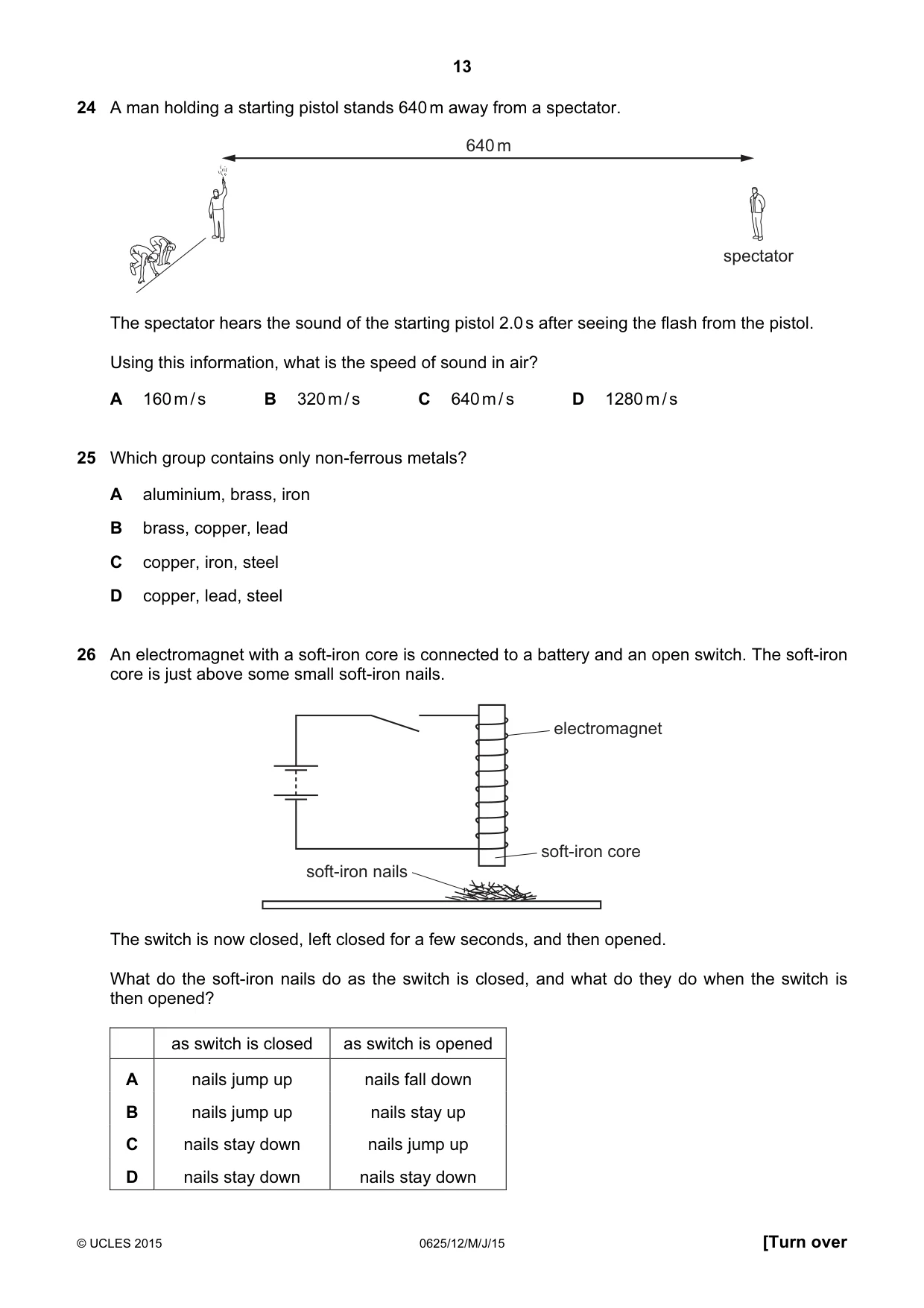
24 A man holding a starting pistol stands 640 m away from a spectator. 640 m spectator The spectator hears the sound of the starting pistol 2.0 s after seeing the flash from the pistol. Using this information, what is the speed of sound in air? A 160 m / s B 320 m / s C 640 m / s D 1280 m / s
Mark scheme: B
Q25 · Which group contains only non-ferrous metals?
25 Which group contains only non-ferrous metals? A aluminium, brass, iron B brass, copper, lead C copper, iron, steel D copper, lead, steel
Mark scheme: B
Q26 · An electromagnet with a soft-iron core is connected to a battery and an open switch
26 An electromagnet with a soft-iron core is connected to a battery and an open switch. The soft-iron core is just above some small soft-iron nails. electromagnet soft-iron core soft-iron nails The switch is now closed, left closed for a few seconds, and then opened. What do the soft-iron nails do as the switch is closed, and what do they do when the switch is then opened? as switch is closed as switch is opened A nails jump up nails fall down B nails jump up nails stay up C nails stay down nails jump up D nails stay down nails stay down
Mark scheme: A
Q27 · A student has wires of different lengths and different diameters
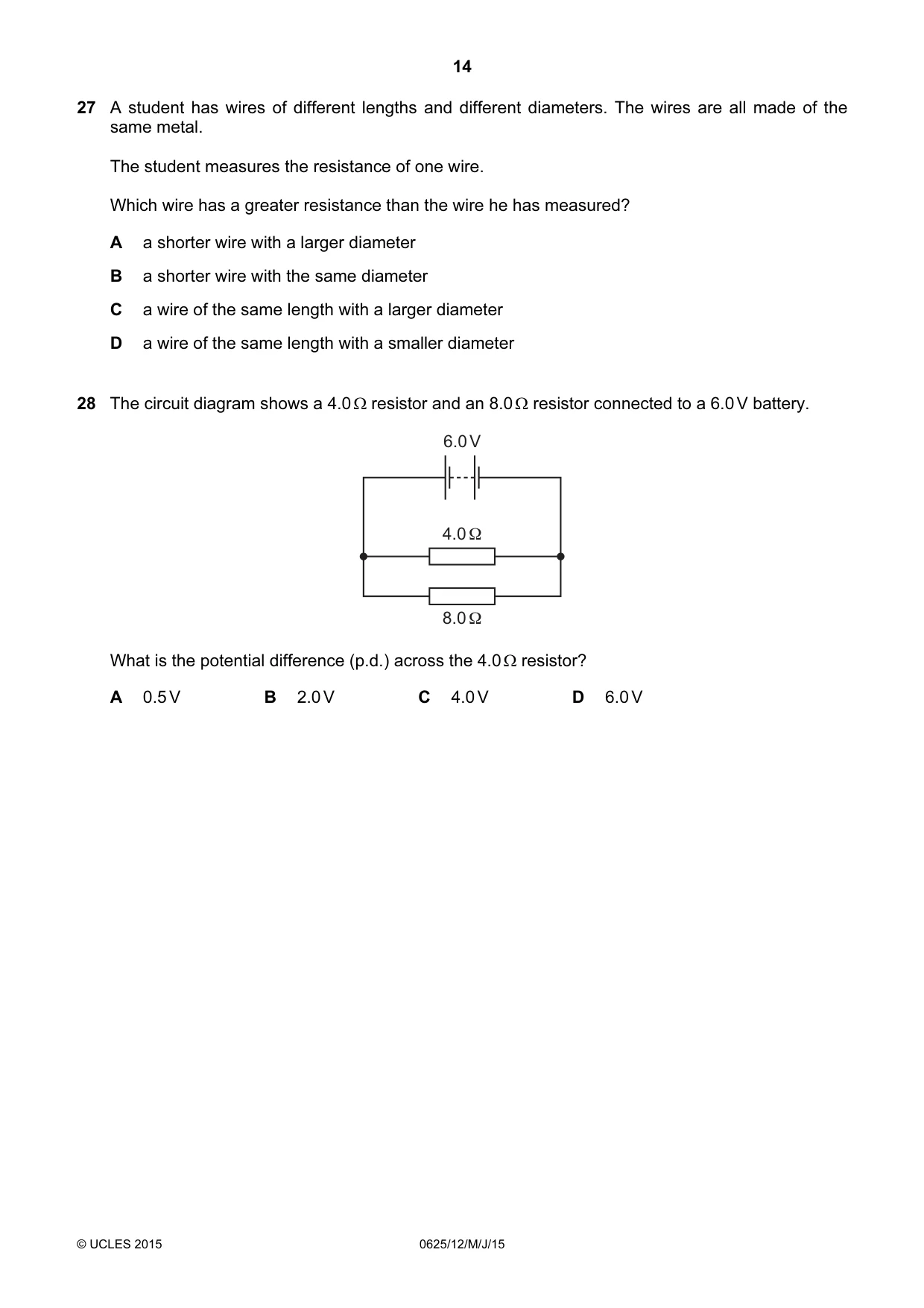
27 A student has wires of different lengths and different diameters. The wires are all made of the same metal. The student measures the resistance of one wire. Which wire has a greater resistance than the wire he has measured? A a shorter wire with a larger diameter B a shorter wire with the same diameter C a wire of the same length with a larger diameter D a wire of the same length with a smaller diameter
Mark scheme: D
Q28 · The circuit diagram shows a 4.0 Ω resistor and an 8.0 Ω resistor connected to a 6.0 V…
28 The circuit diagram shows a 4.0 Ω resistor and an 8.0 Ω resistor connected to a 6.0 V battery. 6.0 V 4.0 Ω 8.0 Ω What is the potential difference (p.d.) across the 4.0 Ω resistor? A 0.5 V B 2.0 V C 4.0 V D 6.0 V
Mark scheme: D
Q29 · Two thin, uncharged strips of plastic
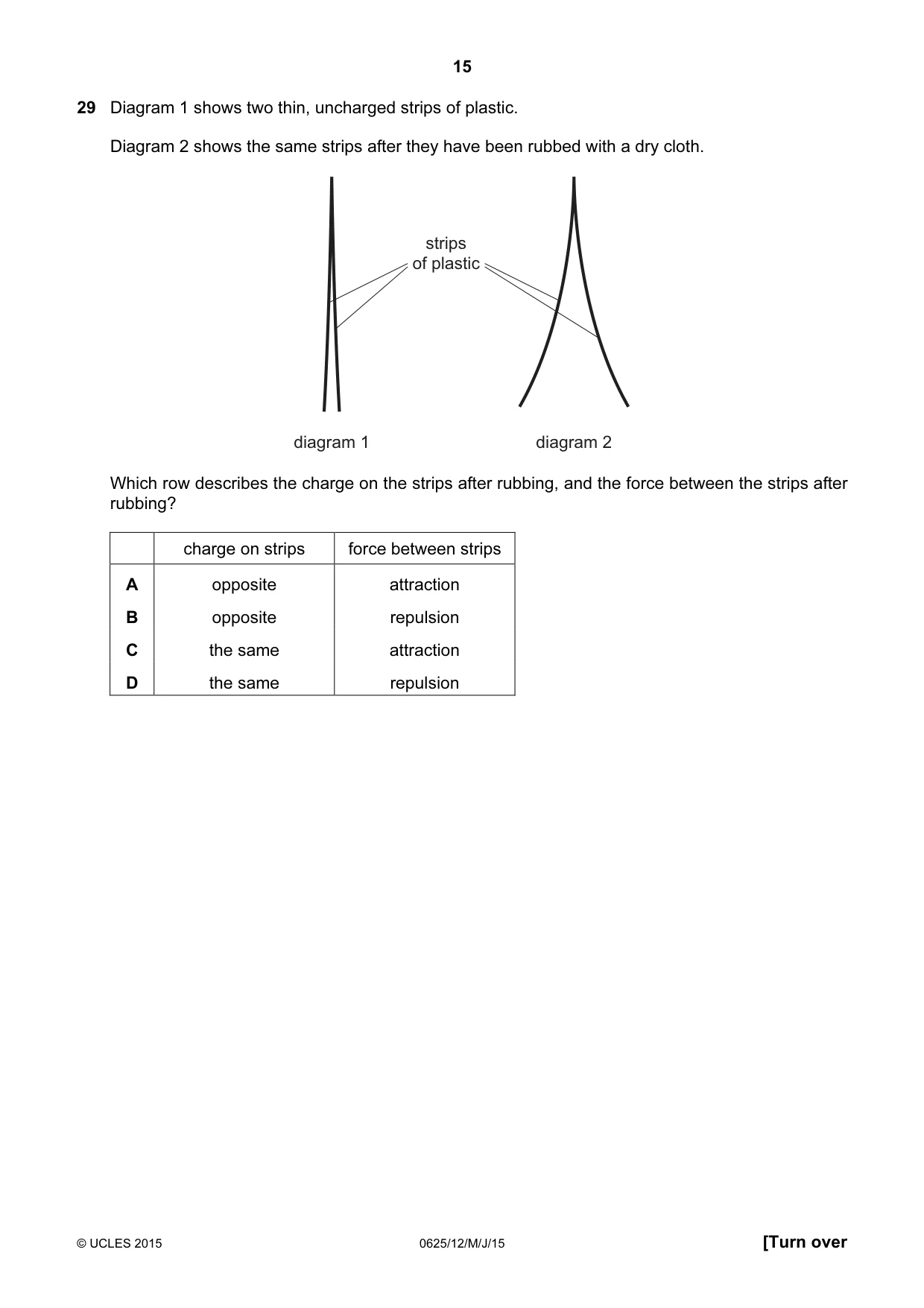
29 Diagram 1 shows two thin, uncharged strips of plastic. Diagram 2 shows the same strips after they have been rubbed with a dry cloth. strips of plastic diagram 1 diagram 2 Which row describes the charge on the strips after rubbing, and the force between the strips after rubbing? charge on strips force between strips A opposite attraction B opposite repulsion C the same attraction D the same repulsion
Mark scheme: D
Q30 · The diagram shows a circuit which includes an uncharged capacitor and a switch
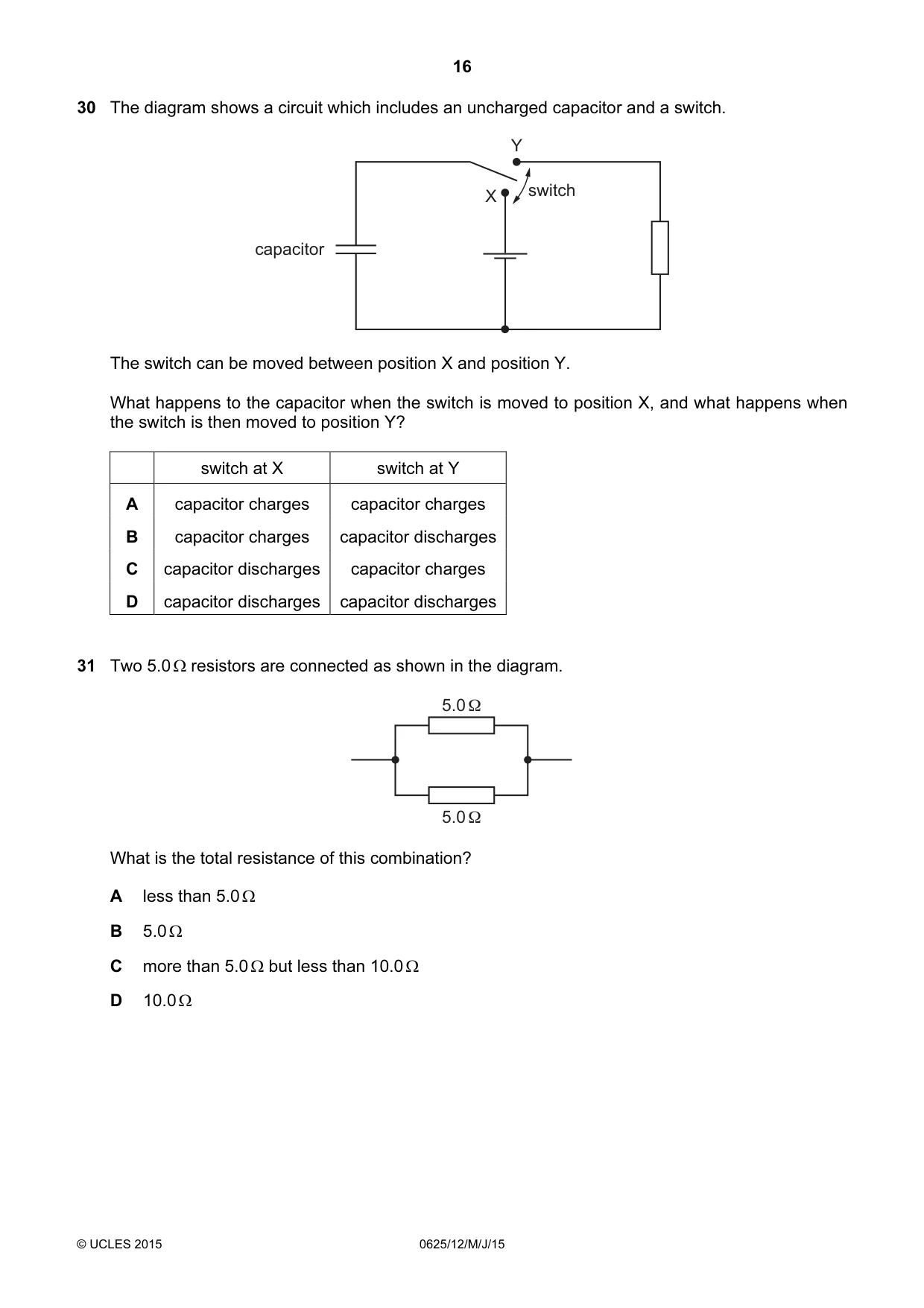
30 The diagram shows a circuit which includes an uncharged capacitor and a switch. Y X switch capacitor The switch can be moved between position X and position Y. What happens to the capacitor when the switch is moved to position X, and what happens when the switch is then moved to position Y? switch at X switch at Y A capacitor charges capacitor charges B capacitor charges capacitor discharges C capacitor discharges capacitor charges D capacitor discharges capacitor discharges
Mark scheme: B
Q31 · Two 5.0 Ω resistors are connected as shown in the diagram
31 Two 5.0 Ω resistors are connected as shown in the diagram. 5.0 Ω 5.0 Ω What is the total resistance of this combination? A less than 5.0 Ω B 5.0 Ω C more than 5.0 Ω but less than 10.0 Ω D 10.0 Ω
Mark scheme: A
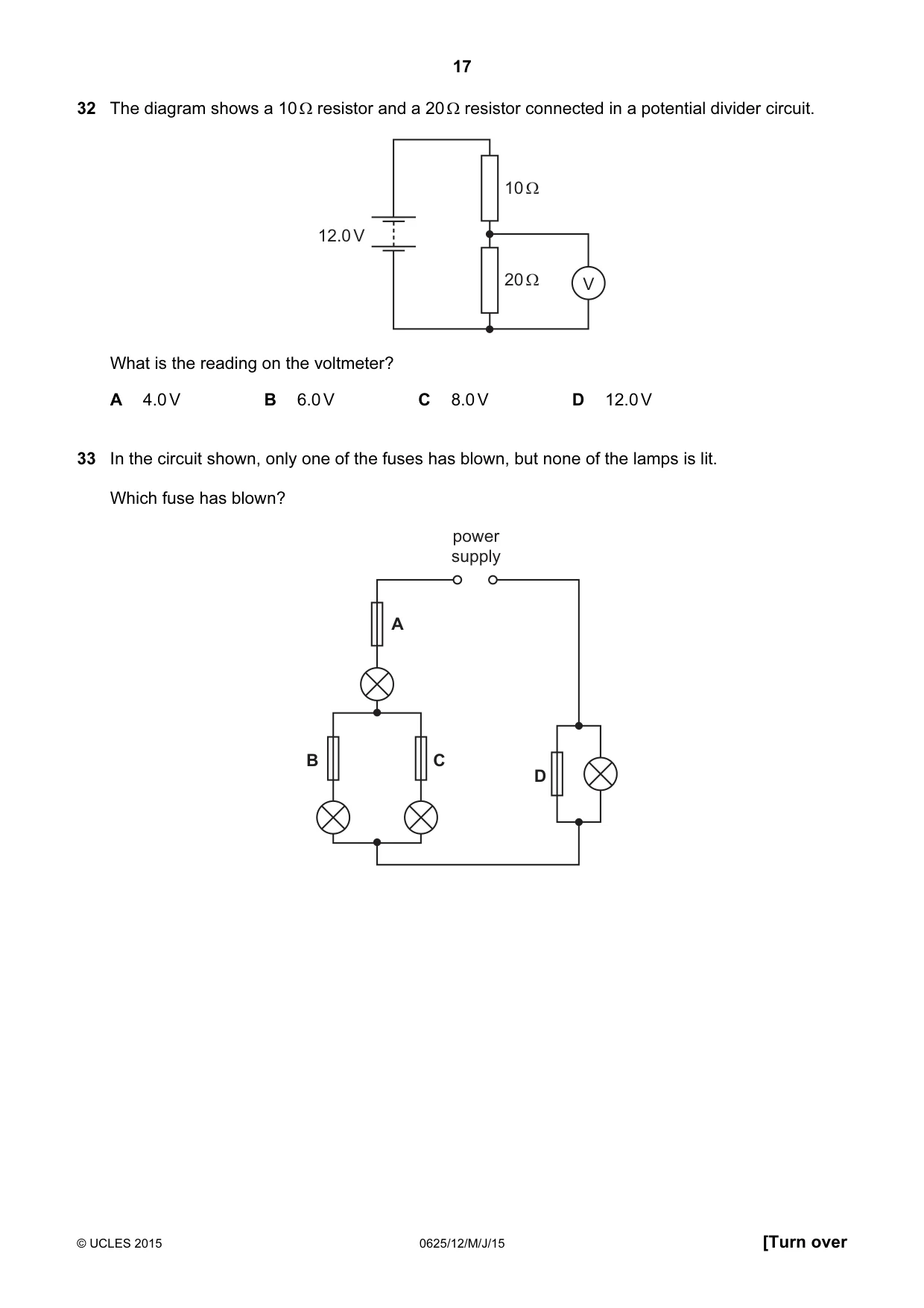
Q32 · The diagram shows a 10 Ω resistor and a 20 Ω resistor connected in a potential divider…
32 The diagram shows a 10 Ω resistor and a 20 Ω resistor connected in a potential divider circuit. 10 Ω 12.0 V 20 Ω V What is the reading on the voltmeter? A 4.0 V B 6.0 V C 8.0 V D 12.0 V
Mark scheme: C
Q33 · In the circuit shown, only one of the fuses has blown, but none of the lamps is lit
33 In the circuit shown, only one of the fuses has blown, but none of the lamps is lit. Which fuse has blown? power supply A B C D
Mark scheme: A
Question 34
34 An e.m.f. is induced across a wire when it moves through the magnetic field between the poles of a magnet. Which electrical device operates because of this effect? A a battery B a cathode-ray tube C a generator D a motor
Mark scheme: C
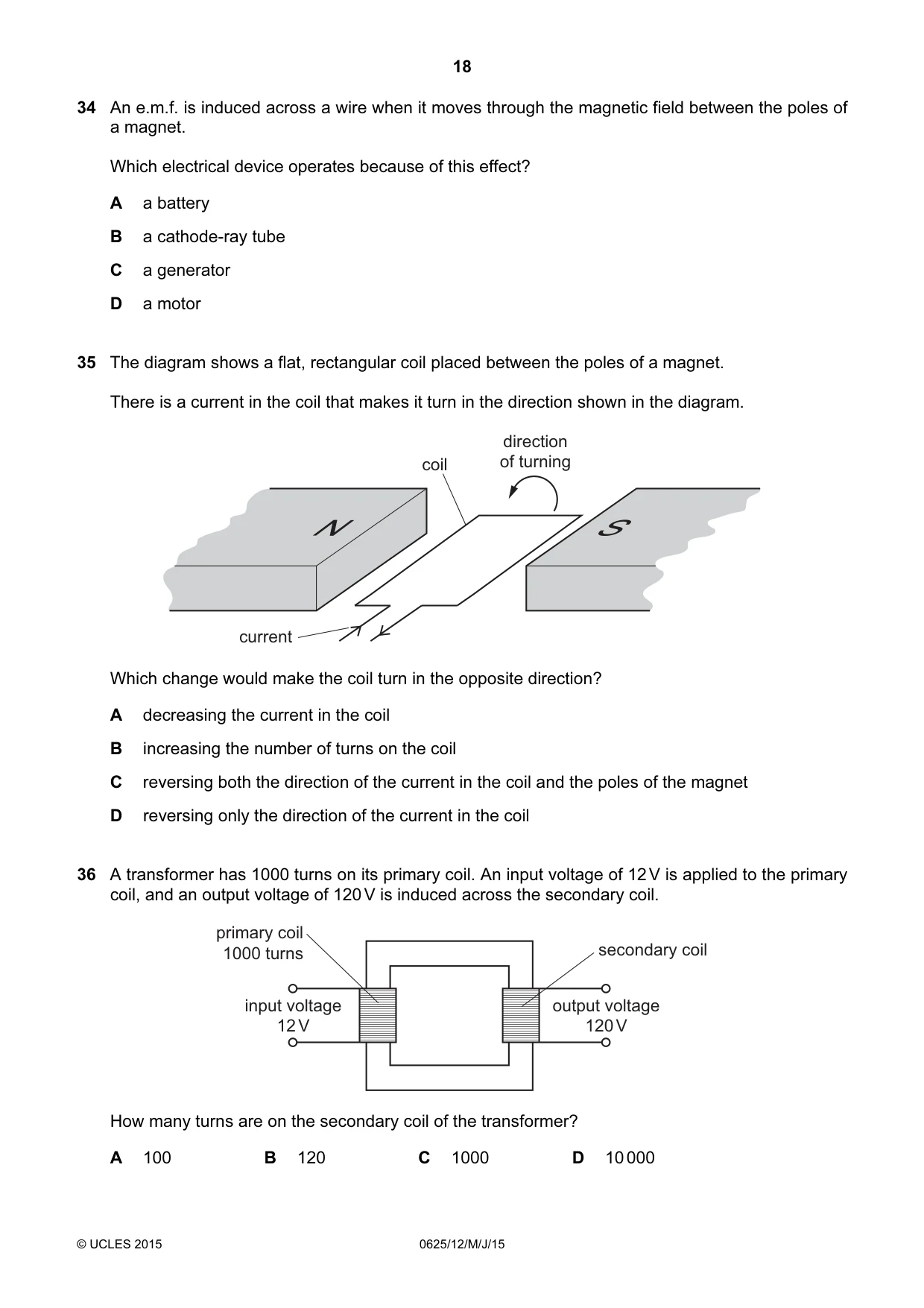
Q35 · The diagram shows a flat, rectangular coil placed between the poles of a magnet
35 The diagram shows a flat, rectangular coil placed between the poles of a magnet. There is a current in the coil that makes it turn in the direction shown in the diagram. direction coil of turning N S current Which change would make the coil turn in the opposite direction? A decreasing the current in the coil B increasing the number of turns on the coil C reversing both the direction of the current in the coil and the poles of the magnet D reversing only the direction of the current in the coil
Mark scheme: D
Q36 · A transformer has 1000 turns on its primary coil
36 A transformer has 1000 turns on its primary coil. An input voltage of 12 V is applied to the primary coil, and an output voltage of 120 V is induced across the secondary coil. primary coil 1000 turns secondary coil input voltage output voltage 12 V 120 V How many turns are on the secondary coil of the transformer? A 100 B 120 C 1000 D 10 000
Mark scheme: D
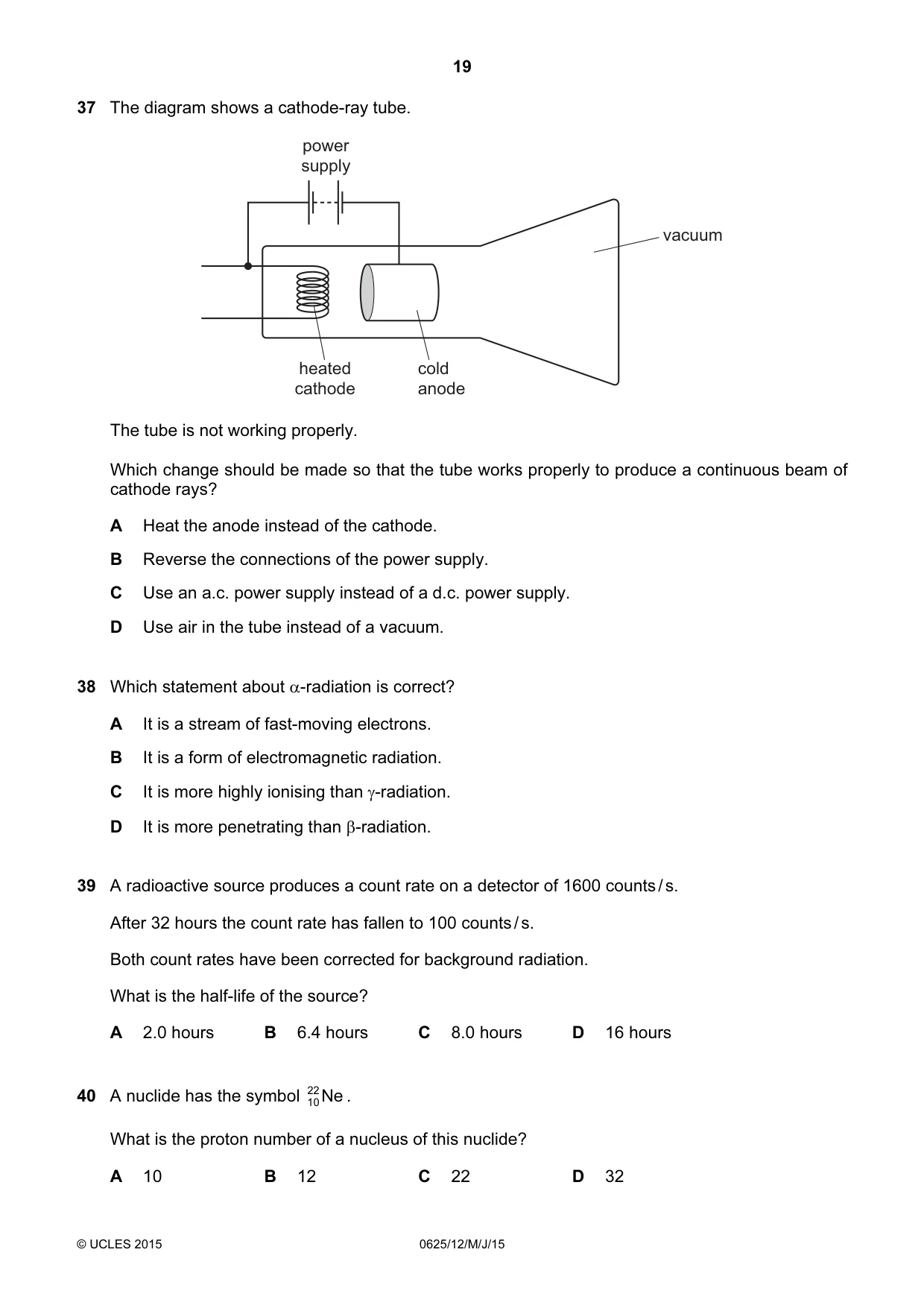
Q37 · The diagram shows a cathode-ray tube
37 The diagram shows a cathode-ray tube. power supply vacuum heated cold cathode anode The tube is not working properly. Which change should be made so that the tube works properly to produce a continuous beam of cathode rays? A Heat the anode instead of the cathode. B Reverse the connections of the power supply. C Use an a.c. power supply instead of a d.c. power supply. D Use air in the tube instead of a vacuum.
Mark scheme: B
Q38 · Which statement about α-radiation is correct?
38 Which statement about α-radiation is correct? A It is a stream of fast-moving electrons. B It is a form of electromagnetic radiation. C It is more highly ionising than γ-radiation. D It is more penetrating than β-radiation.
Mark scheme: C
Q39 · A radioactive source produces a count rate on a detector of 1600 counts / s
39 A radioactive source produces a count rate on a detector of 1600 counts / s. After 32 hours the count rate has fallen to 100 counts / s. Both count rates have been corrected for background radiation. What is the half-life of the source? A 2.0 hours B 6.4 hours C 8.0 hours D 16 hours
Mark scheme: C
Q40 · A nuclide has the symbol 22 Ne
40 A nuclide has the symbol 22 Ne . 10 What is the proton number of a nucleus of this nuclide? A 10 B 12 C 22 D 32
Mark scheme: A
What was in this paper
The subtopics covered by these 40 questions, and how many questions each got. Open one in a new tab to see every Cambridge question on it.
5Electrical quantities3Electromagnetic effects3Forces3Energy, work and power2General properties of waves2Kinetic particle model of matter2Light2Motion2Pressure2Radioactivity2Simple phenomena of magnetism2Sound2Thermal properties and temperature2Transfer of thermal energy2Density1Electromagnetic spectrum1Physical quantities and measurement techniques1The nuclear model of the atom1What you needed in this session
Cambridge’s own grade thresholds for 2015 May/June, Paper 1 · Variant 2. A higher threshold means an easier paper — the bar moves with how the cohort did.