Cambridge IGCSE Physics 0625 — 2022 Oct/Nov Paper 1 · Variant 2
0625/12/O/N/22 · 40 questions · 40 marks · ≈45 min
The question paper and its mark scheme, free to read here and free to download. This is Cambridge’s own paper, exactly as it was sat.
Question paper20 pages

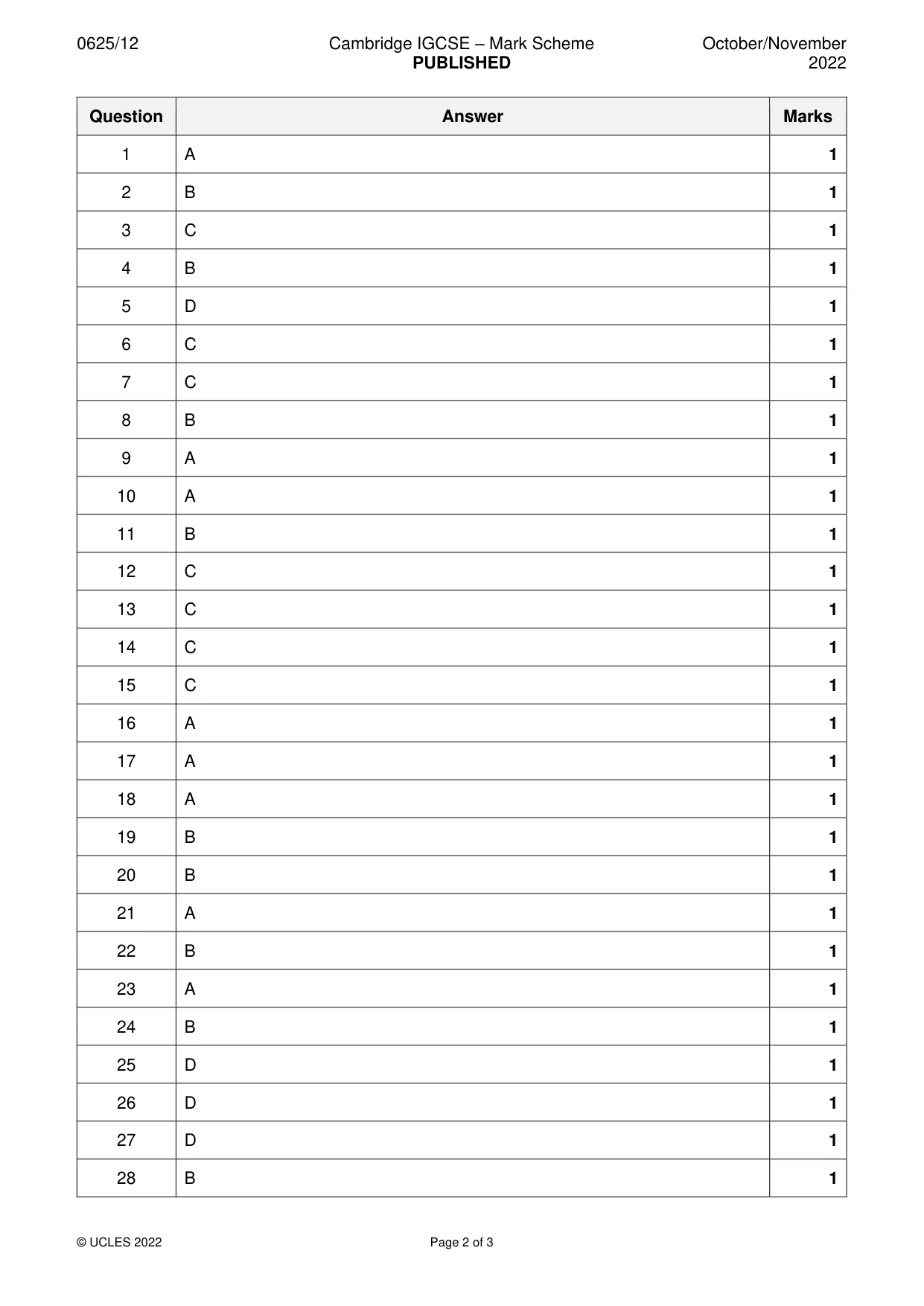
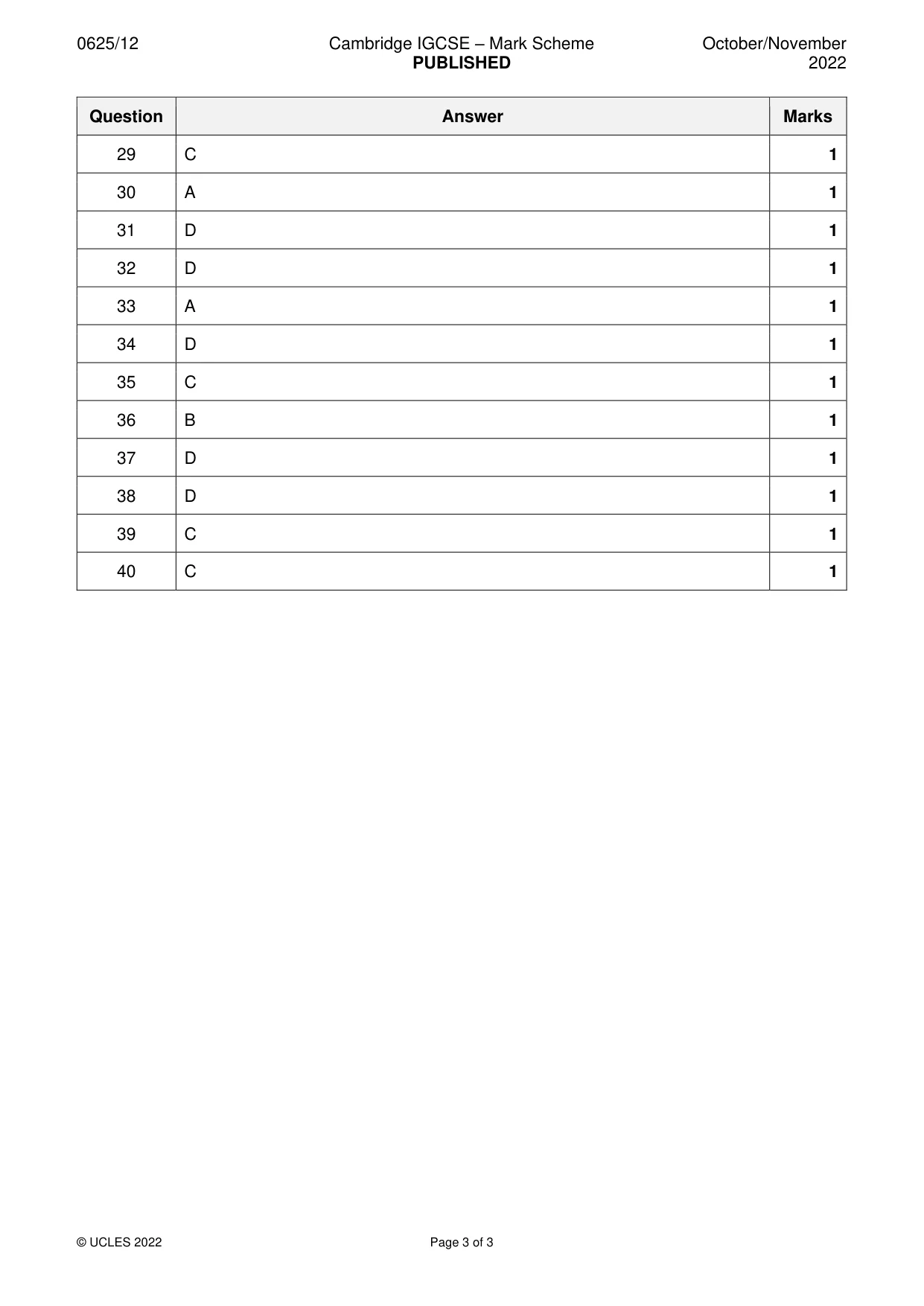
Mark scheme3 pages
Answers below. Sit the paper first if you are practising.
Questions as text
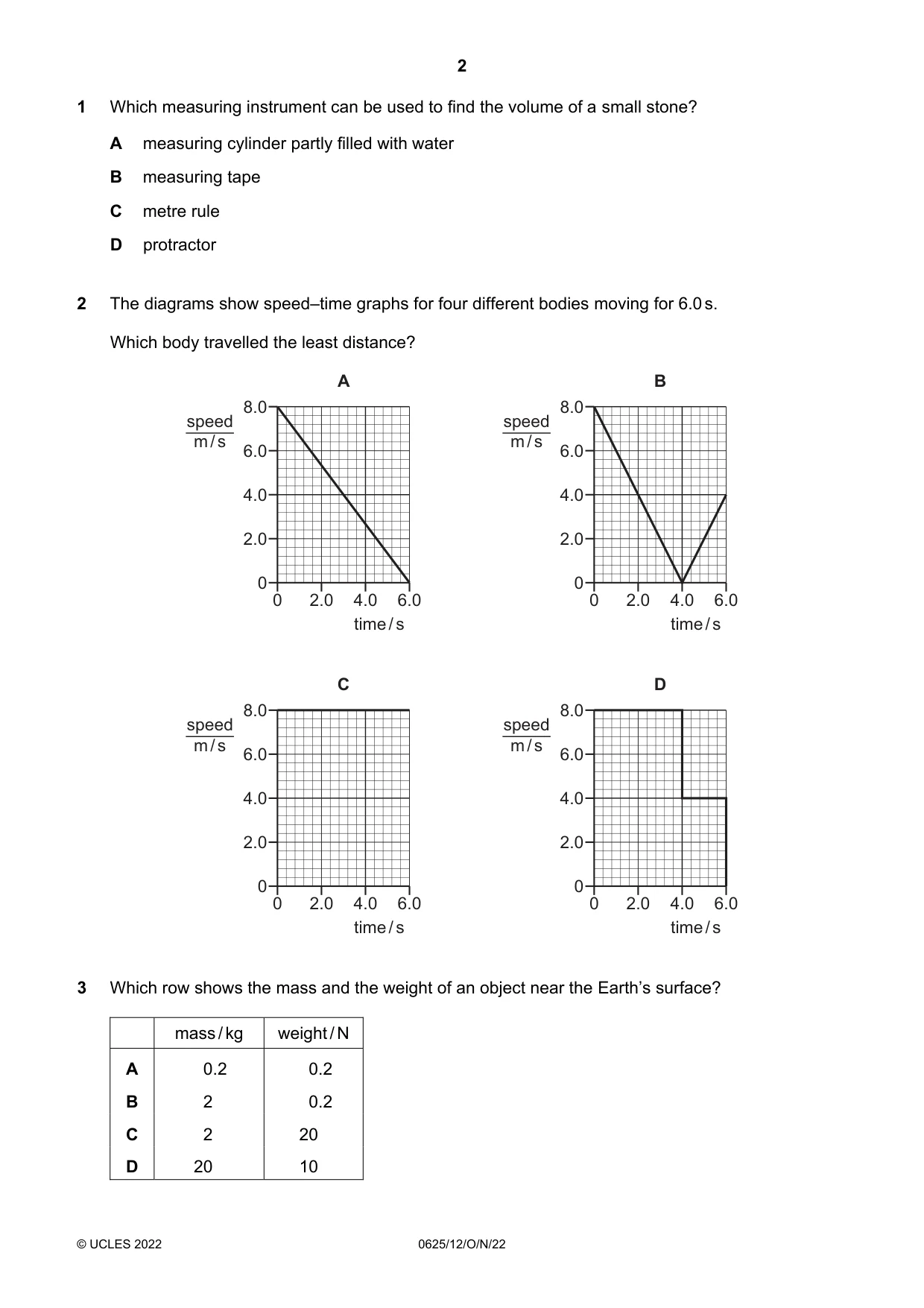
Q1 · Which measuring instrument can be used to find the volume of a small stone?
1 Which measuring instrument can be used to find the volume of a small stone? A measuring cylinder partly filled with water B measuring tape C metre rule D protractor
Mark scheme: A
More questions on Physical quantities and measurement techniques
Q2 · The diagrams show speed–time graphs for four different bodies moving for 6.0 s
2 The diagrams show speed–time graphs for four different bodies moving for 6.0 s. Which body travelled the least distance? A B 8.0 8.0 speed speed m / s m / s 6.0 6.0 4.0 4.0 2.0 2.0 0 0 0 2.0 4.0 6.0 0 2.0 4.0 6.0 time / s time / s C D 8.0 8.0 speed speed m / s m / s 6.0 6.0 4.0 4.0 2.0 2.0 0 0 0 2.0 4.0 6.0 0 2.0 4.0 6.0 time / s time / s
Mark scheme: B
Q3 · Which row shows the mass and the weight of an object near the Earth’s surface?
3 Which row shows the mass and the weight of an object near the Earth’s surface? mass / kg weight / N A 0.2 0.2 B 2 0.2 C 2 20 D 20 10
Mark scheme: C
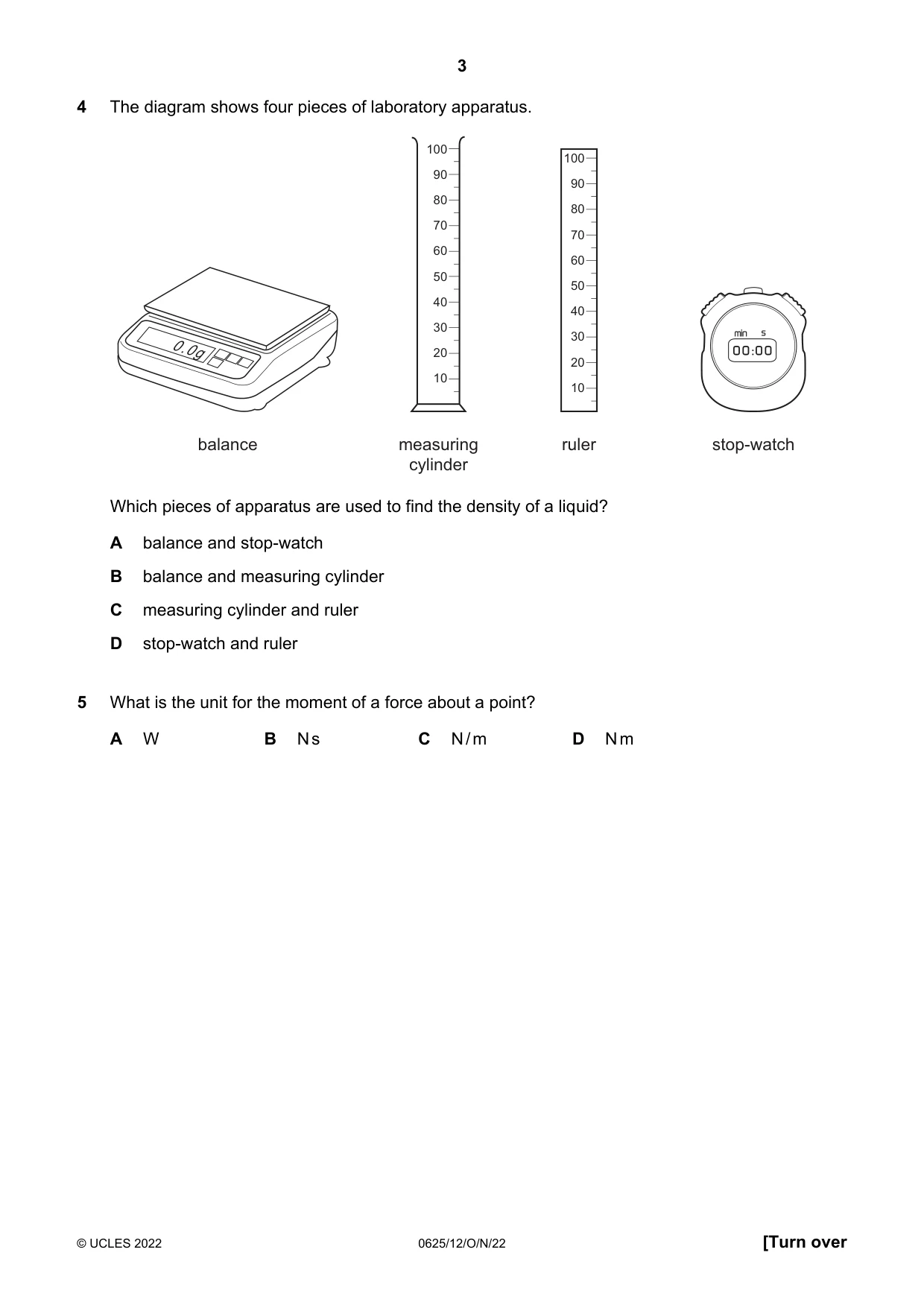
Q4 · The diagram shows four pieces of laboratory apparatus
4 The diagram shows four pieces of laboratory apparatus. 100 100 90 90 80 80 70 70 60 60 50 50 40 40 30 0.0g 30 20 20 10 10 balance measuring ruler stop-watch cylinder Which pieces of apparatus are used to find the density of a liquid? A balance and stop-watch B balance and measuring cylinder C measuring cylinder and ruler D stop-watch and ruler
Mark scheme: B
Q5 · What is the unit for the moment of a force about a point?
5 What is the unit for the moment of a force about a point? A W B N s C N / m D N m
Mark scheme: D
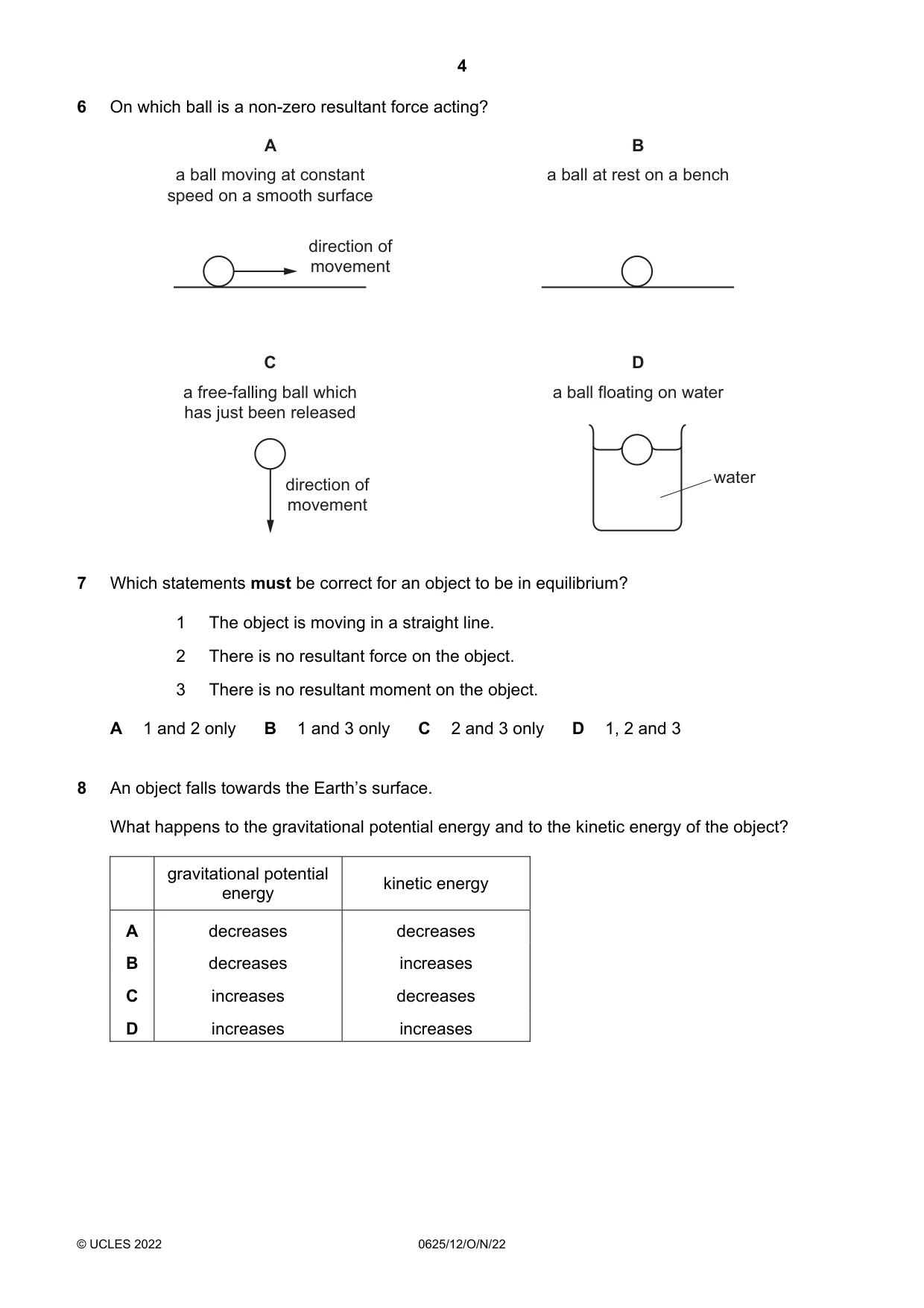
Q6 · On which ball is a non-zero resultant force acting?
6 On which ball is a non-zero resultant force acting? A B a ball moving at constant a ball at rest on a bench speed on a smooth surface direction of movement C D a free-falling ball which a ball floating on water has just been released direction of water movement
Mark scheme: C
Q7 · Which statements must be correct for an object to be in equilibrium?
7 Which statements must be correct for an object to be in equilibrium? 1 The object is moving in a straight line. 2 There is no resultant force on the object. 3 There is no resultant moment on the object. A 1 and 2 only B 1 and 3 only C 2 and 3 only D 1, 2 and 3
Mark scheme: C
Q8 · An object falls towards the Earth’s surface
8 An object falls towards the Earth’s surface. What happens to the gravitational potential energy and to the kinetic energy of the object? gravitational potential kinetic energy energy A decreases decreases B decreases increases C increases decreases D increases increases
Mark scheme: B
Q9 · Which source of energy is not currently used to generate electrical energy?
9 Which source of energy is not currently used to generate electrical energy? A nuclear fusion B solar C tidal D waves
Mark scheme: A
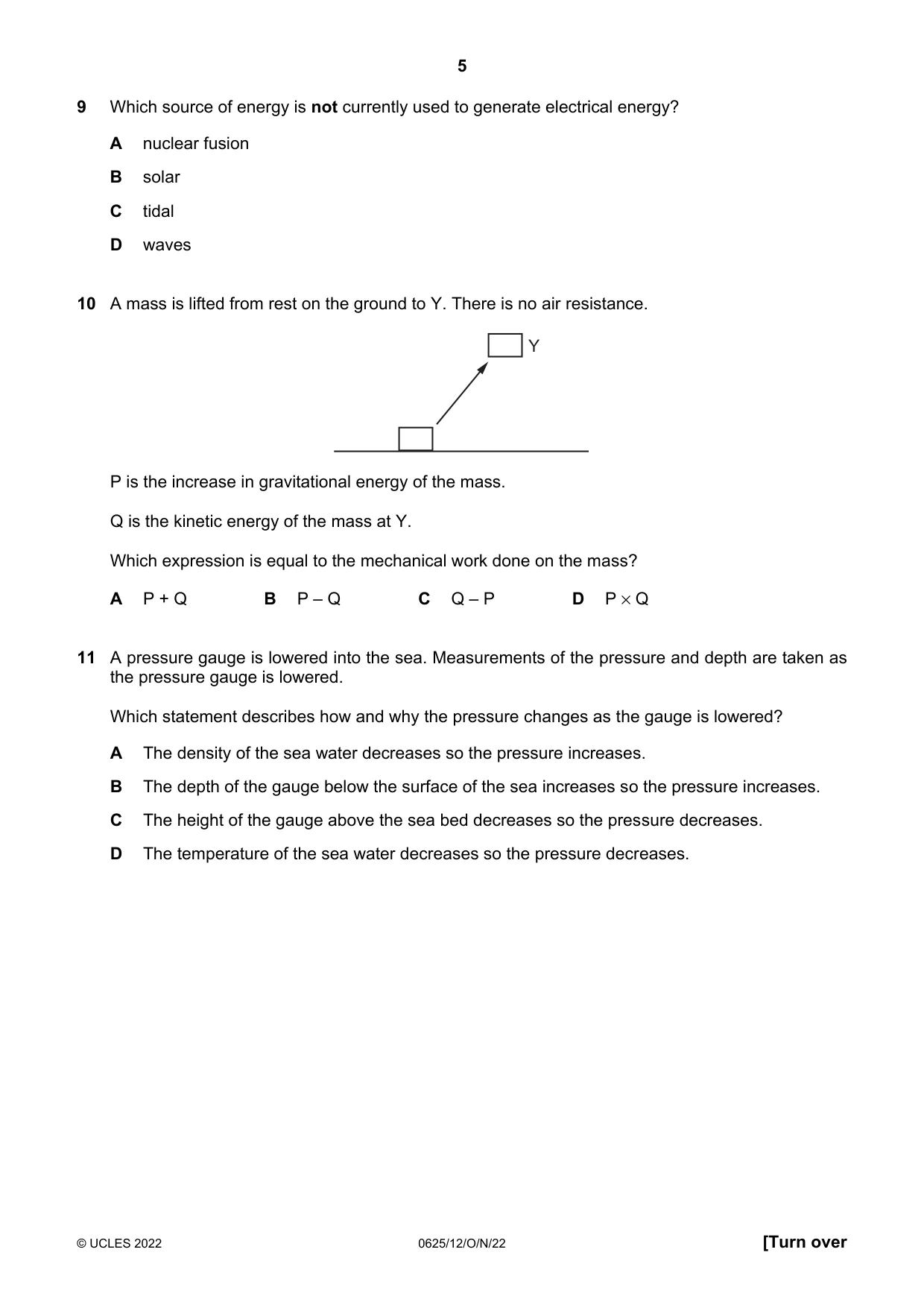
Q10 · A mass is lifted from rest on the ground to Y
10 A mass is lifted from rest on the ground to Y. There is no air resistance. Y P is the increase in gravitational energy of the mass. Q is the kinetic energy of the mass at Y. Which expression is equal to the mechanical work done on the mass? A P + Q B P – Q C Q – P D P × Q
Mark scheme: A
Q11 · A pressure gauge is lowered into the sea
11 A pressure gauge is lowered into the sea. Measurements of the pressure and depth are taken as the pressure gauge is lowered. Which statement describes how and why the pressure changes as the gauge is lowered? A The density of the sea water decreases so the pressure increases. B The depth of the gauge below the surface of the sea increases so the pressure increases. C The height of the gauge above the sea bed decreases so the pressure decreases. D The temperature of the sea water decreases so the pressure decreases.
Mark scheme: B
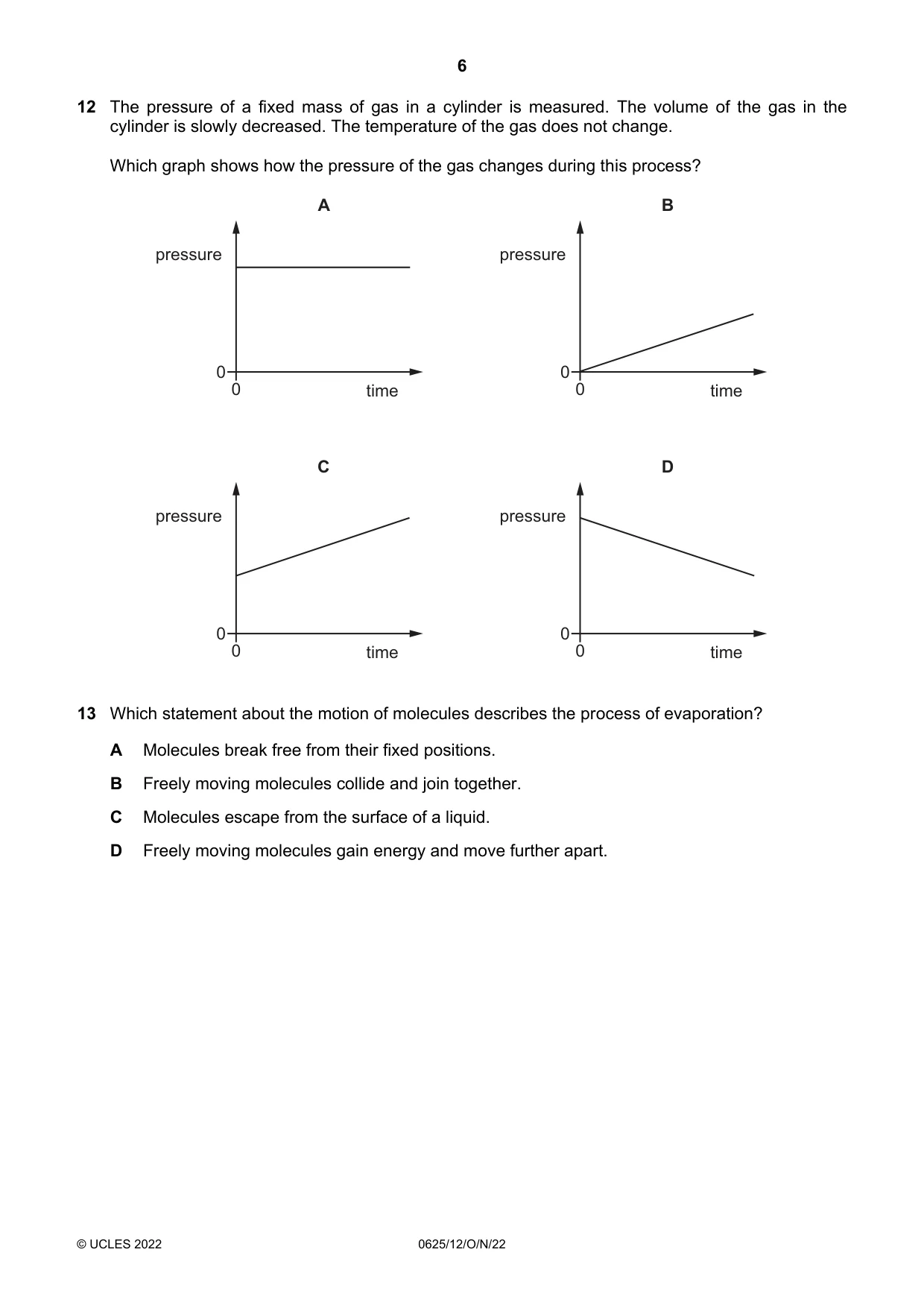
Q12 · The pressure of a fixed mass of gas in a cylinder is measured
12 The pressure of a fixed mass of gas in a cylinder is measured. The volume of the gas in the cylinder is slowly decreased. The temperature of the gas does not change. Which graph shows how the pressure of the gas changes during this process? A B pressure pressure 0 0 0 time 0 time C D pressure pressure 0 0 0 time 0 time
Mark scheme: C
Q13 · Which statement about the motion of molecules describes the process of evaporation?
13 Which statement about the motion of molecules describes the process of evaporation? A Molecules break free from their fixed positions. B Freely moving molecules collide and join together. C Molecules escape from the surface of a liquid. D Freely moving molecules gain energy and move further apart.
Mark scheme: C
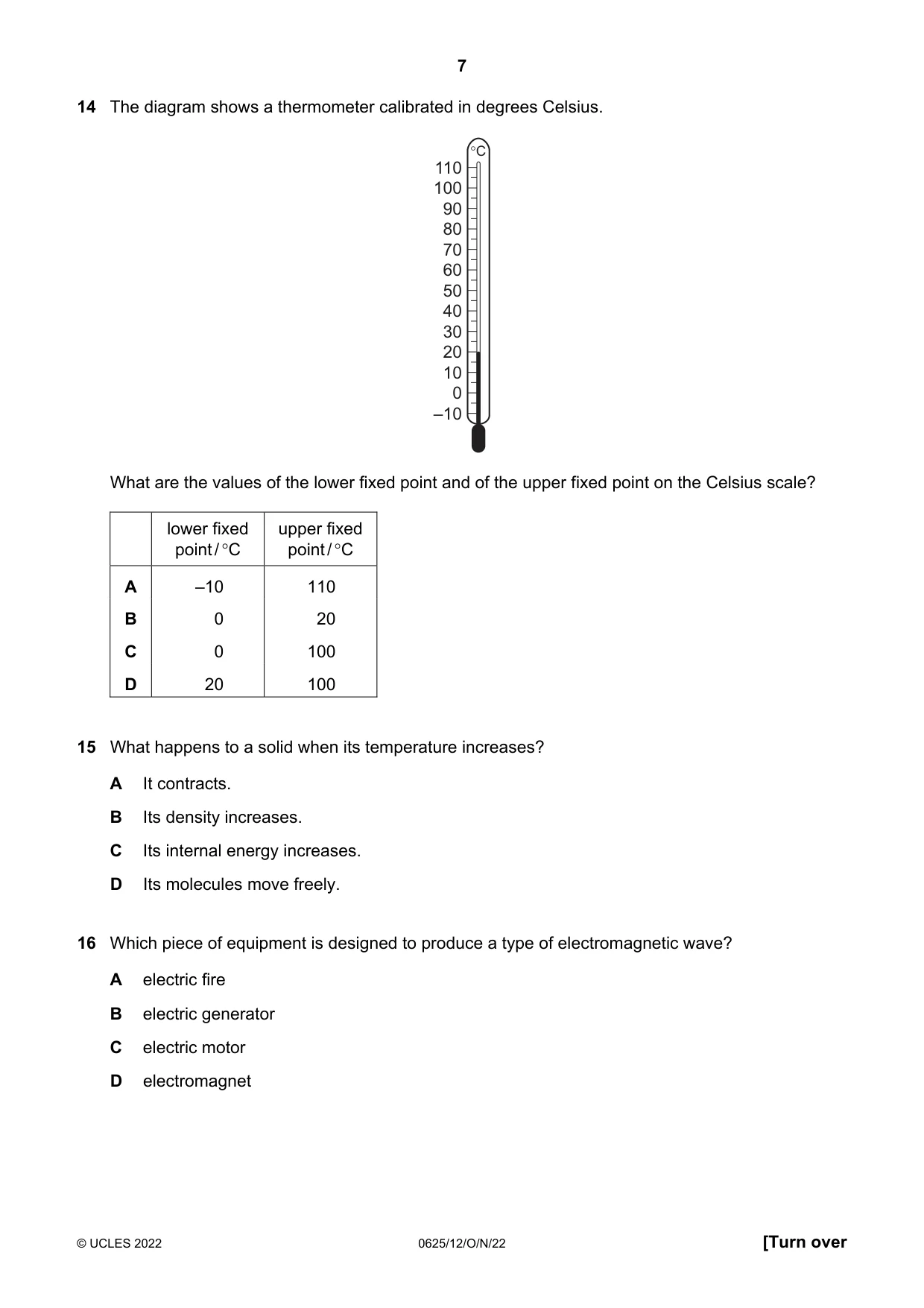
Q14 · The diagram shows a thermometer calibrated in degrees Celsius
14 The diagram shows a thermometer calibrated in degrees Celsius. 110 100 90 80 70 60 50 40 30 20 10 0 -10 What are the values of the lower fixed point and of the upper fixed point on the Celsius scale? lower fixed upper fixed point/°C point/°C A -10 110 B 0 20 Cc 0 100 D 20 100
Mark scheme: C
Q15 · What happens to a solid when its temperature increases?
15 What happens to a solid when its temperature increases? A It contracts. B Its density increases. C Its internal energy increases. D Its molecules move freely.
Mark scheme: C
Q16 · Which piece of equipment is designed to produce a type of electromagnetic wave?
16 Which piece of equipment is designed to produce a type of electromagnetic wave? A electric fire B electric generator C electric motor D electromagnet
Mark scheme: A
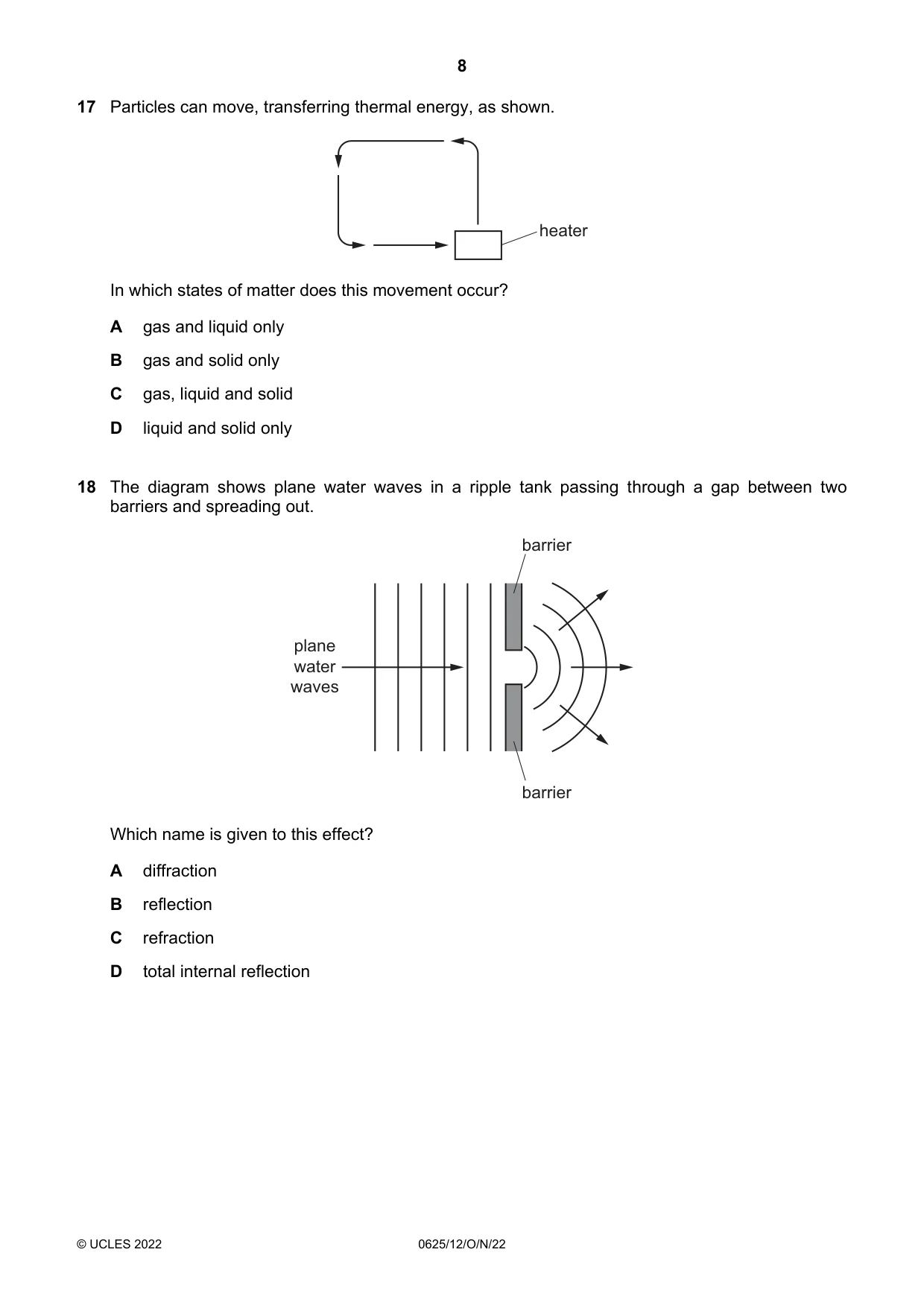
Q17 · Particles can move, transferring thermal energy, as shown
17 Particles can move, transferring thermal energy, as shown. heater In which states of matter does this movement occur? A gas and liquid only B gas and solid only C gas, liquid and solid D liquid and solid only
Mark scheme: A
Q18 · The diagram shows plane water waves in a ripple tank passing through a gap between two…
18 The diagram shows plane water waves in a ripple tank passing through a gap between two barriers and spreading out. barrier plane water waves barrier Which name is given to this effect? A diffraction B reflection C refraction D total internal reflection
Mark scheme: A
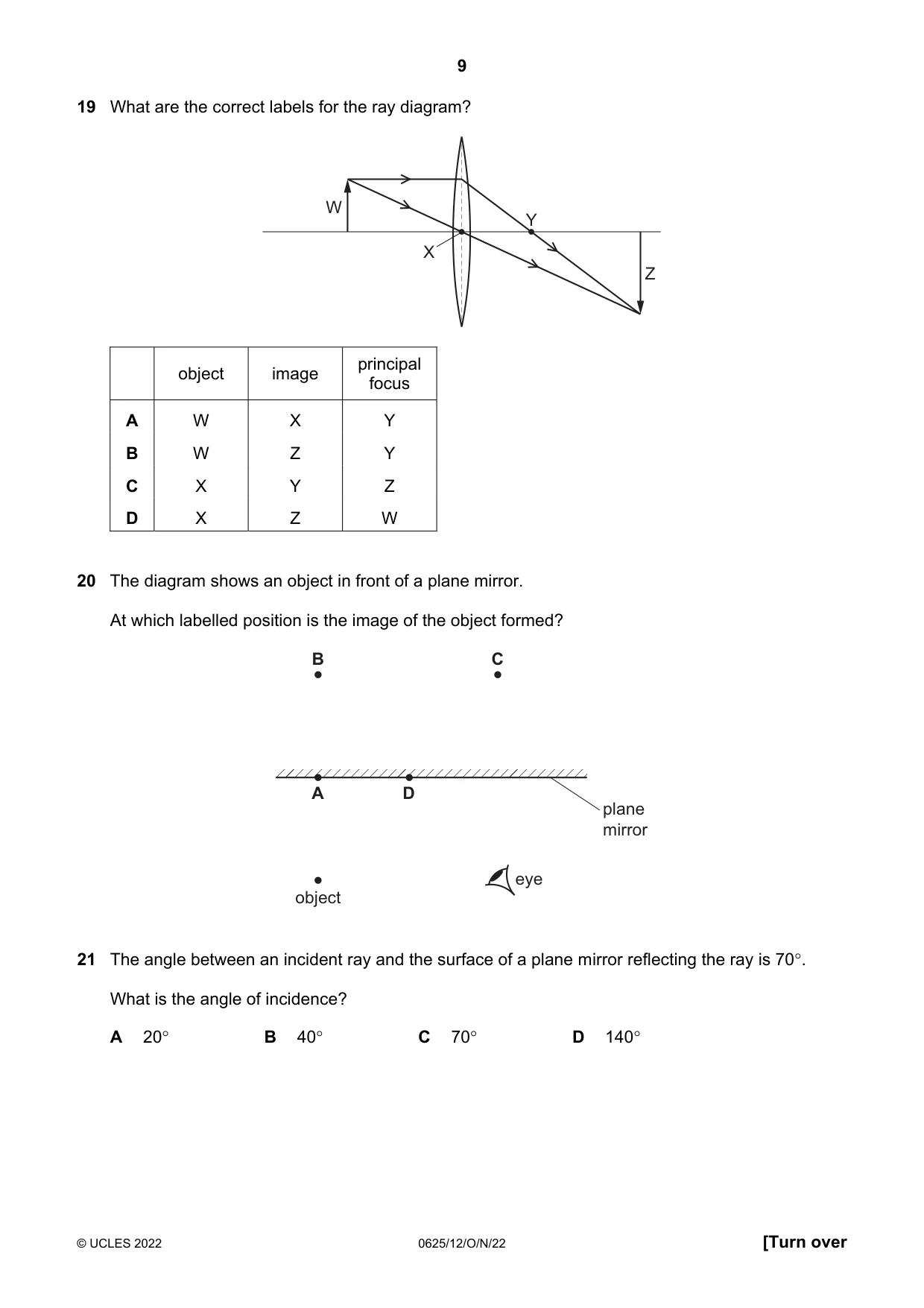
Q19 · What are the correct labels for the ray diagram?
19 What are the correct labels for the ray diagram? W Y X Z principal object image focus A W X Y B W Z Y C X Y Z D X Z W
Mark scheme: B
Q20 · The diagram shows an object in front of a plane mirror
20 The diagram shows an object in front of a plane mirror. At which labelled position is the image of the object formed? B C A D plane mirror eye object
Mark scheme: B
Q21 · The angle between an incident ray and the surface of a plane mirror reflecting the ray is…
21 The angle between an incident ray and the surface of a plane mirror reflecting the ray is 70°. What is the angle of incidence? A 20° B 40° C 70° D 140°
Mark scheme: A
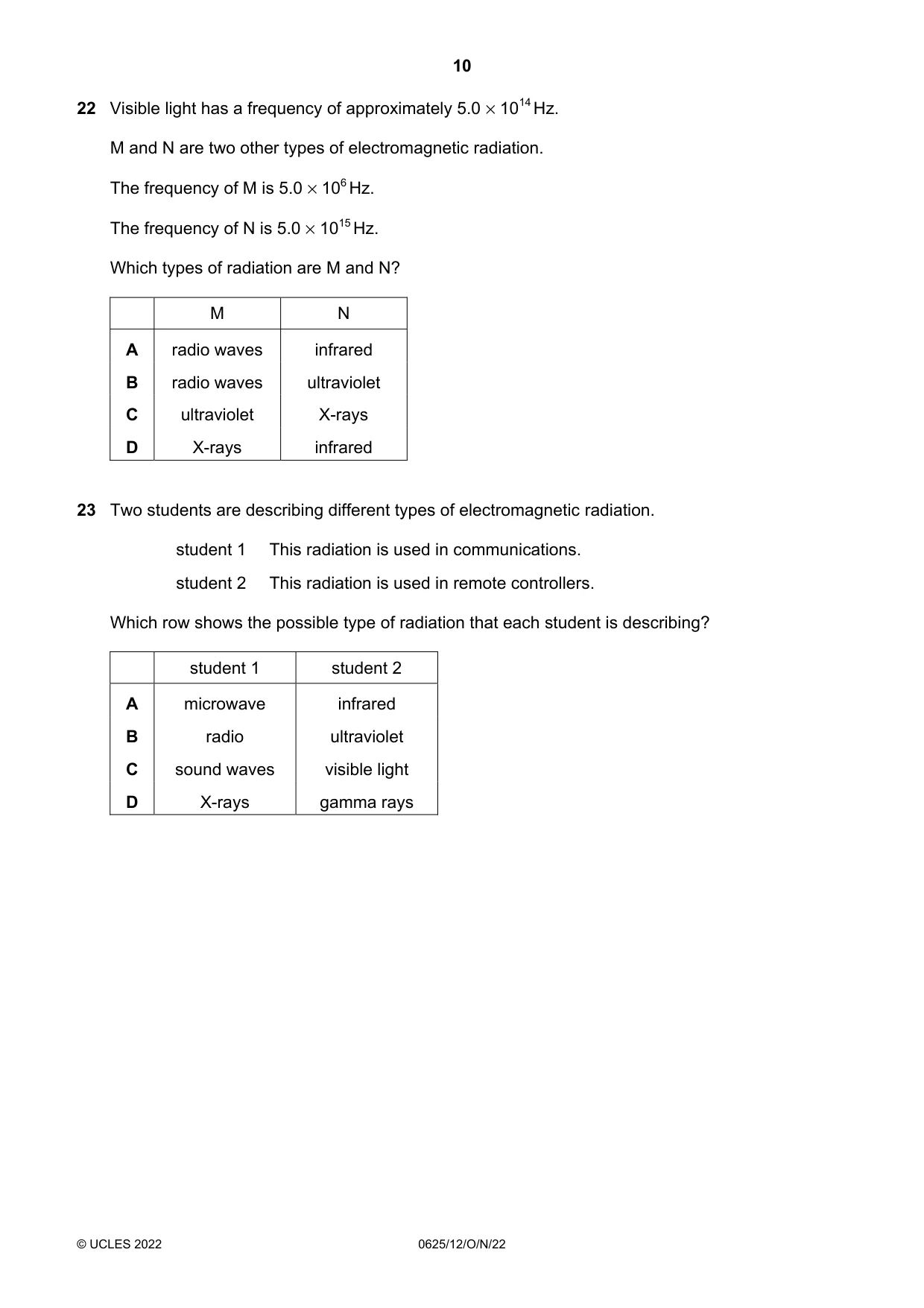
Q22 · Visible light has a frequency of approximately 5.0 × 10¹⁴ Hz
22 Visible light has a frequency of approximately 5.0 × 10¹⁴ Hz. M and N are two other types of electromagnetic radiation. The frequency of M is 5.0 × 10⁶ Hz. The frequency of N is 5.0 × 10¹⁵ Hz. Which types of radiation are M and N? M N A radio waves infrared B radio waves ultraviolet C ultraviolet X-rays D X-rays infrared
Mark scheme: B
Q23 · Two students are describing different types of electromagnetic radiation
23 Two students are describing different types of electromagnetic radiation. student 1 This radiation is used in communications. student 2 This radiation is used in remote controllers. Which row shows the possible type of radiation that each student is describing? student 1 student 2 A microwave infrared B radio ultraviolet C sound waves visible light D X-rays gamma rays
Mark scheme: A
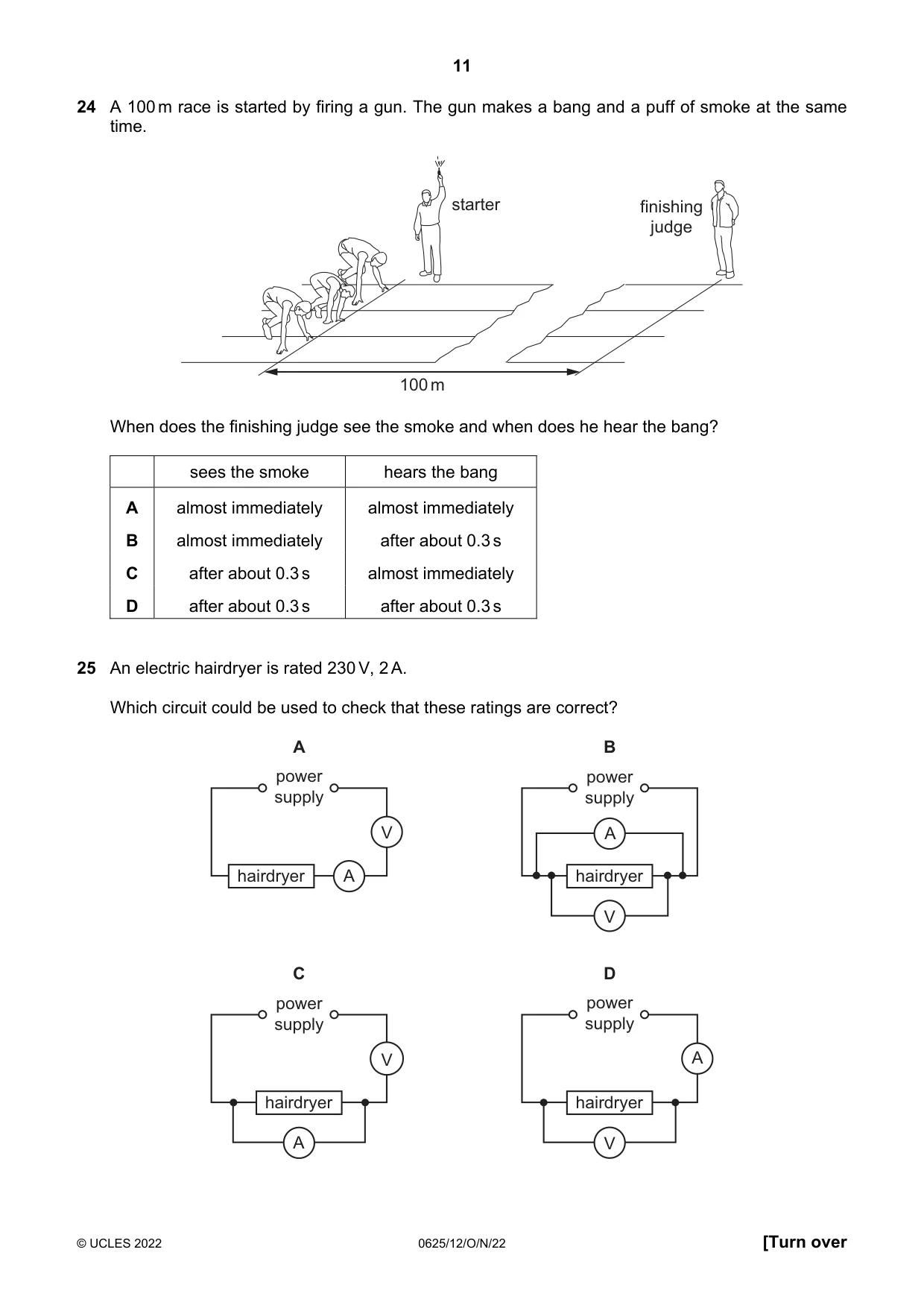
Q24 · A 100 m race is started by firing a gun
24 A 100 m race is started by firing a gun. The gun makes a bang and a puff of smoke at the same time. starter finishing judge 100 m When does the finishing judge see the smoke and when does he hear the bang? sees the smoke hears the bang A almost immediately almost immediately B almost immediately after about 0.3 s C after about 0.3 s almost immediately D after about 0.3 s after about 0.3 s
Mark scheme: B
Q25 · An electric hairdryer is rated 230 V, 2 A
25 An electric hairdryer is rated 230 V, 2 A. Which circuit could be used to check that these ratings are correct? A B power power supply supply V A hairdryer A hairdryer V C D power power supply supply V A hairdryer hairdryer A V
Mark scheme: D
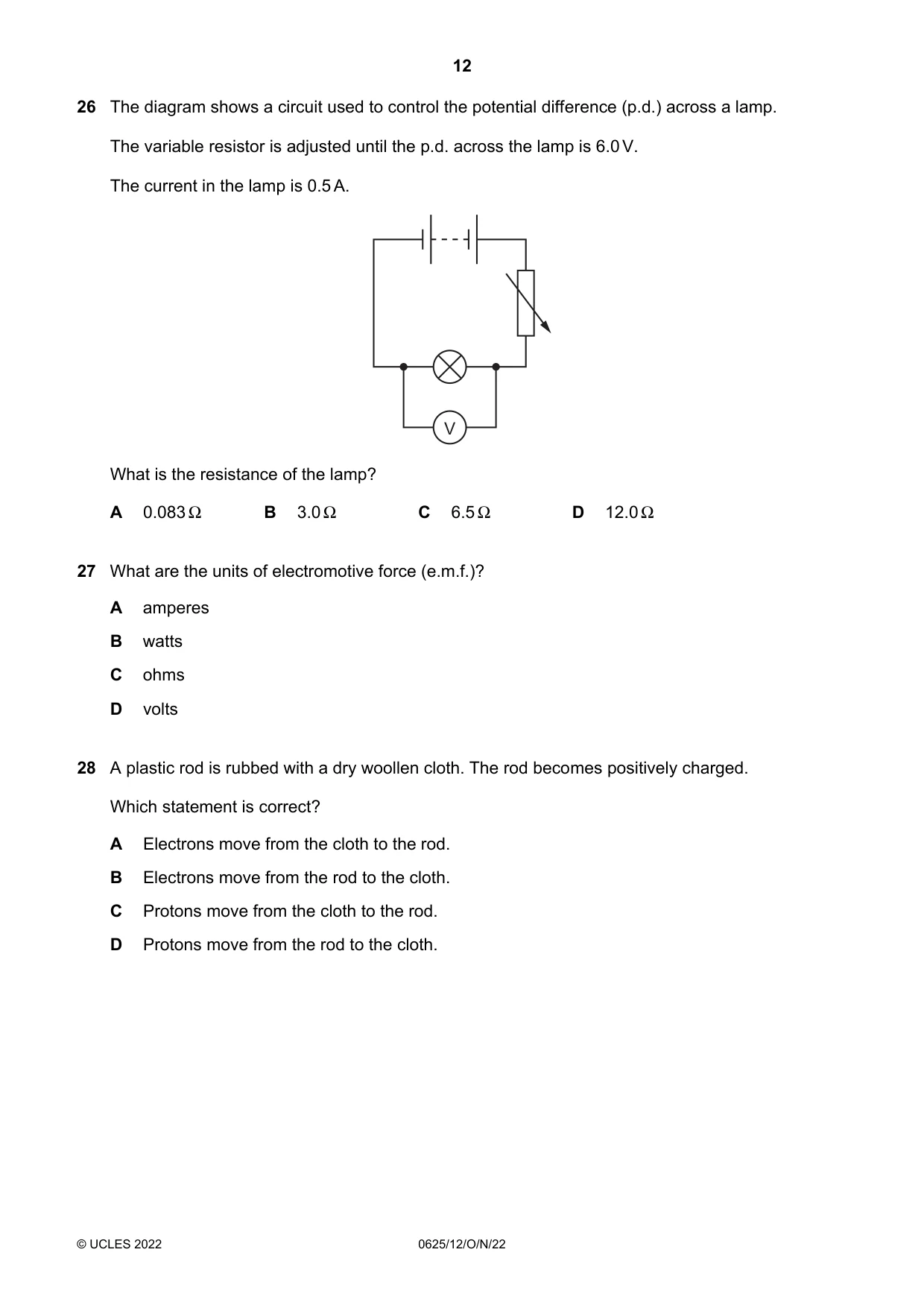
Q26 · The diagram shows a circuit used to control the potential difference (p.d.) across a lamp
26 The diagram shows a circuit used to control the potential difference (p.d.) across a lamp. The variable resistor is adjusted until the p.d. across the lamp is 6.0 V. The current in the lamp is 0.5 A. V What is the resistance of the lamp? A 0.083 Ω B 3.0 Ω C 6.5 Ω D 12.0 Ω
Mark scheme: D
Q27 · What are the units of electromotive force (e.m.f.)?
27 What are the units of electromotive force (e.m.f.)? A amperes B watts C ohms D volts
Mark scheme: D
Q28 · A plastic rod is rubbed with a dry woollen cloth
28 A plastic rod is rubbed with a dry woollen cloth. The rod becomes positively charged. Which statement is correct? A Electrons move from the cloth to the rod. B Electrons move from the rod to the cloth. C Protons move from the cloth to the rod. D Protons move from the rod to the cloth.
Mark scheme: B
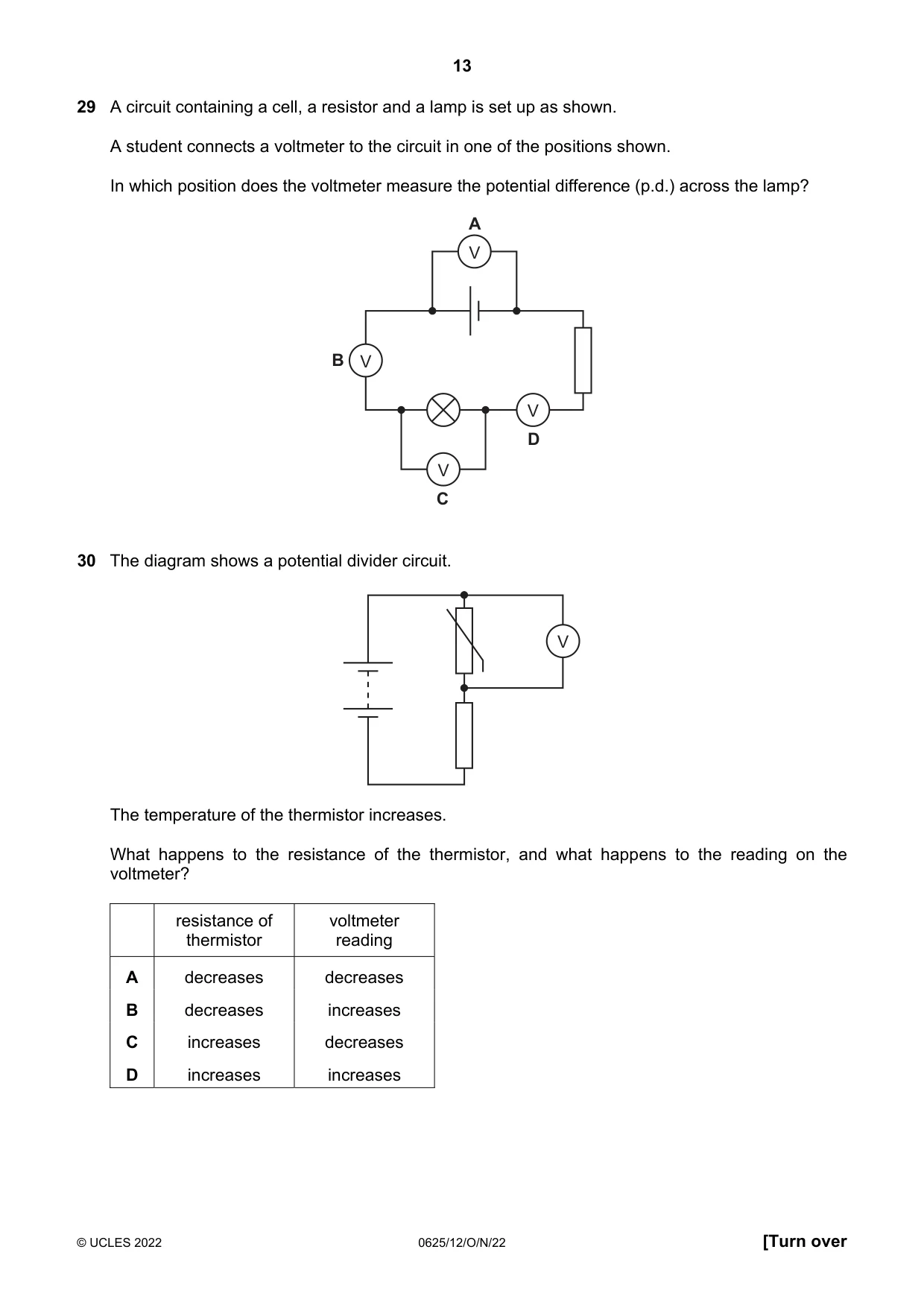
Q29 · A circuit containing a cell, a resistor and a lamp is set up as shown
29 A circuit containing a cell, a resistor and a lamp is set up as shown. A student connects a voltmeter to the circuit in one of the positions shown. In which position does the voltmeter measure the potential difference (p.d.) across the lamp? A V B V V D V C
Mark scheme: C
Q30 · The diagram shows a potential divider circuit
30 The diagram shows a potential divider circuit. V The temperature of the thermistor increases. What happens to the resistance of the thermistor, and what happens to the reading on the voltmeter? resistance of voltmeter thermistor reading A decreases decreases B decreases increases C increases decreases D increases increases
Mark scheme: A
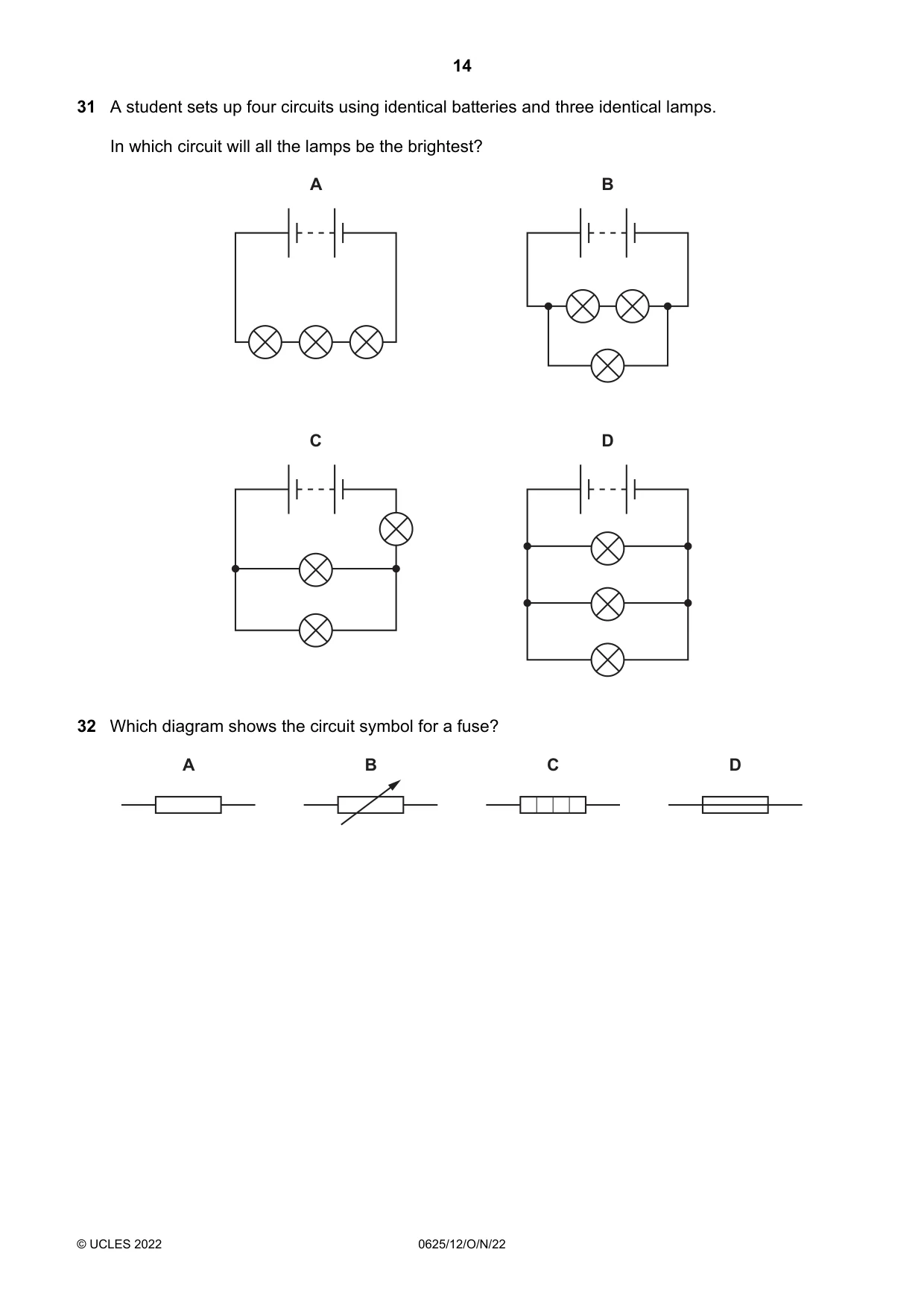
Q31 · A student sets up four circuits using identical batteries and three identical lamps
31 A student sets up four circuits using identical batteries and three identical lamps. In which circuit will all the lamps be the brightest? A B C D
Mark scheme: D
Q32 · Which diagram shows the circuit symbol for a fuse?
32 Which diagram shows the circuit symbol for a fuse? A B C D
Mark scheme: D
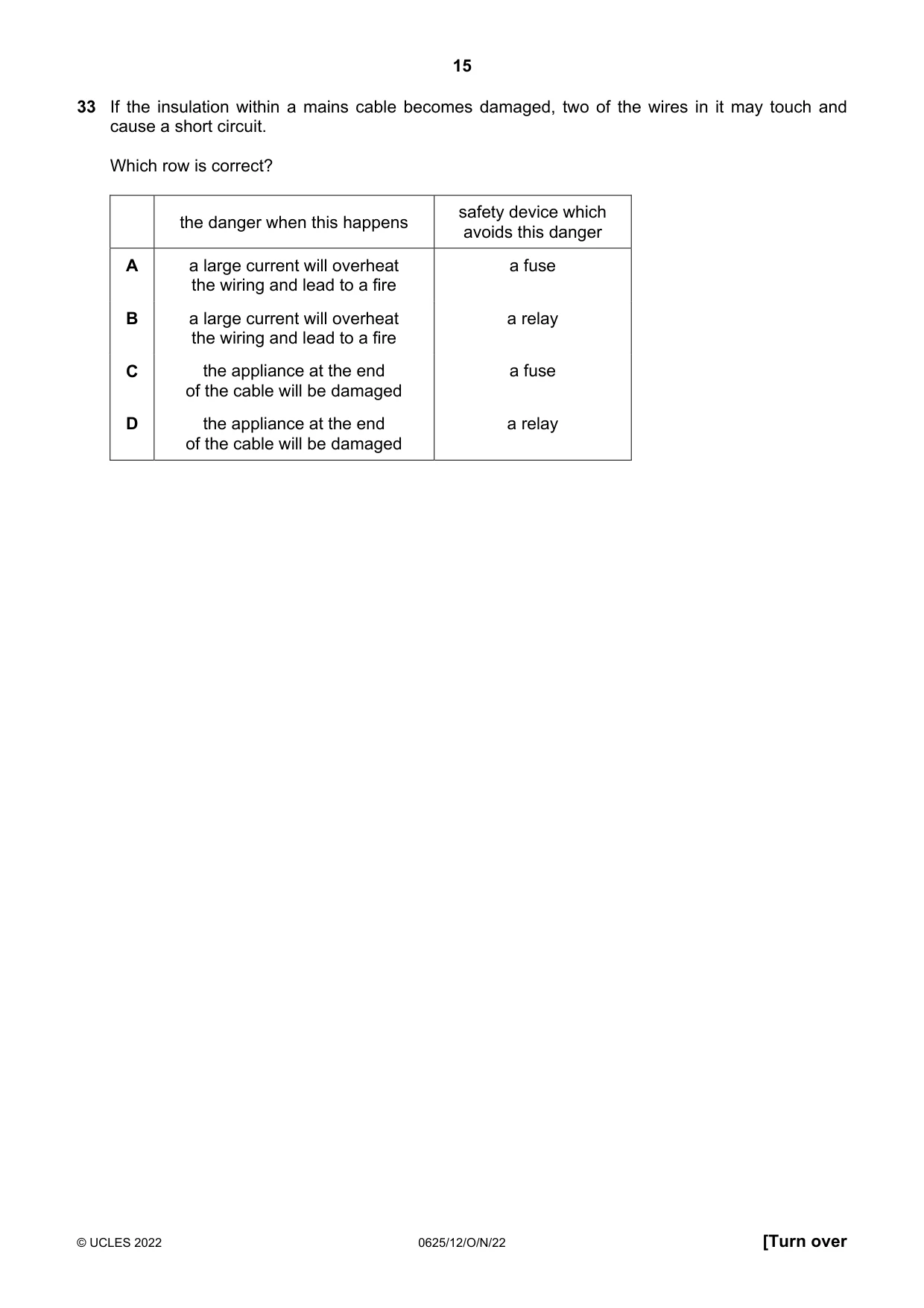
Q33 · If the insulation within a mains cable becomes damaged, two of the wires in it may touch…
33 If the insulation within a mains cable becomes damaged, two of the wires in it may touch and cause a short circuit. Which row is correct? safety device which the danger when this happens avoids this danger A a large current will overheat a fuse the wiring and lead to a fire B a large current will overheat a relay the wiring and lead to a fire C the appliance at the end a fuse of the cable will be damaged D the appliance at the end a relay of the cable will be damaged
Mark scheme: A
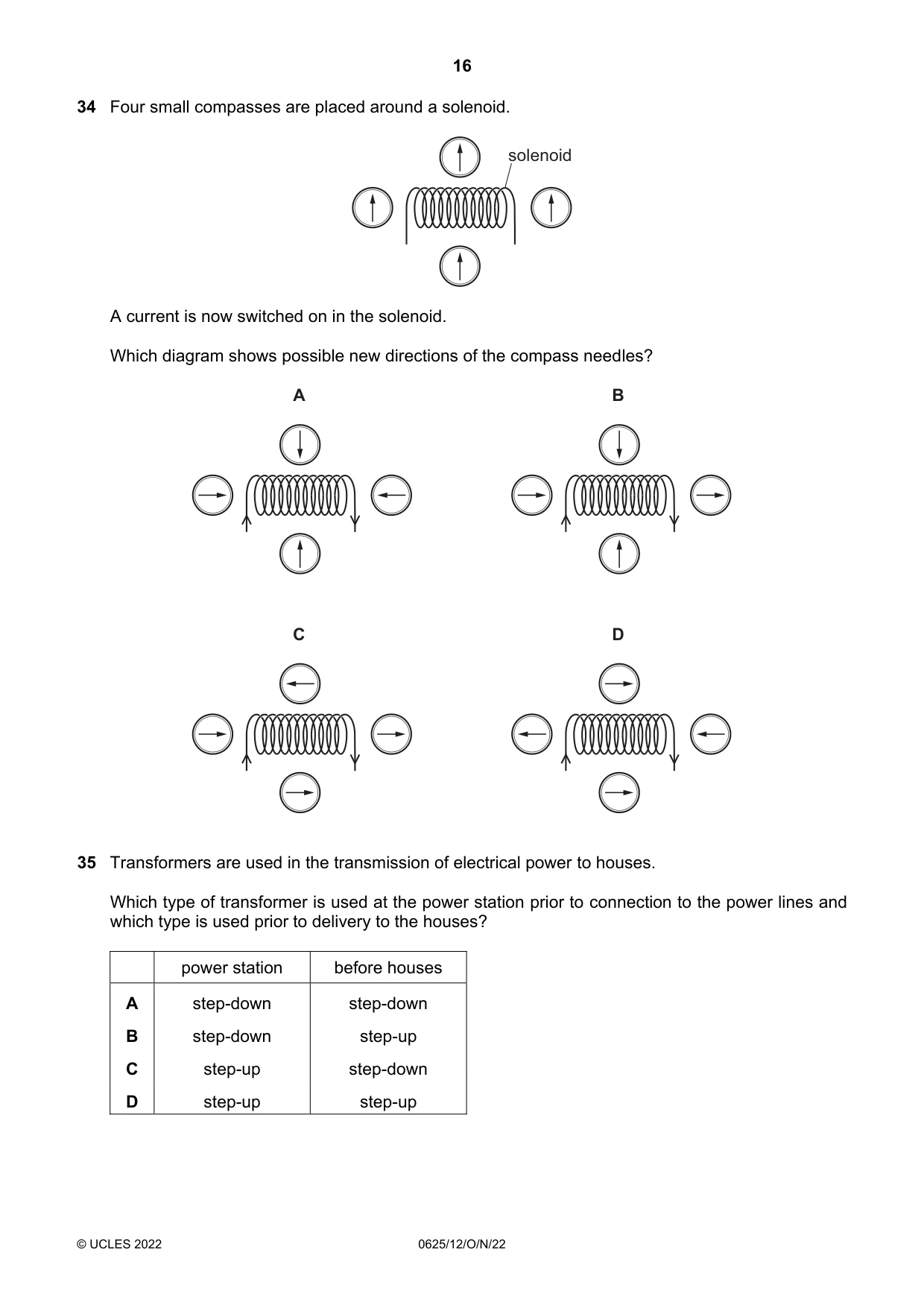
Q34 · Four small compasses are placed around a solenoid
34 Four small compasses are placed around a solenoid. solenoid A current is now switched on in the solenoid. Which diagram shows possible new directions of the compass needles? A B C D
Mark scheme: D
Q35 · Transformers are used in the transmission of electrical power to houses
35 Transformers are used in the transmission of electrical power to houses. Which type of transformer is used at the power station prior to connection to the power lines and which type is used prior to delivery to the houses? power station before houses A step-down step-down B step-down step-up C step-up step-down D step-up step-up
Mark scheme: C
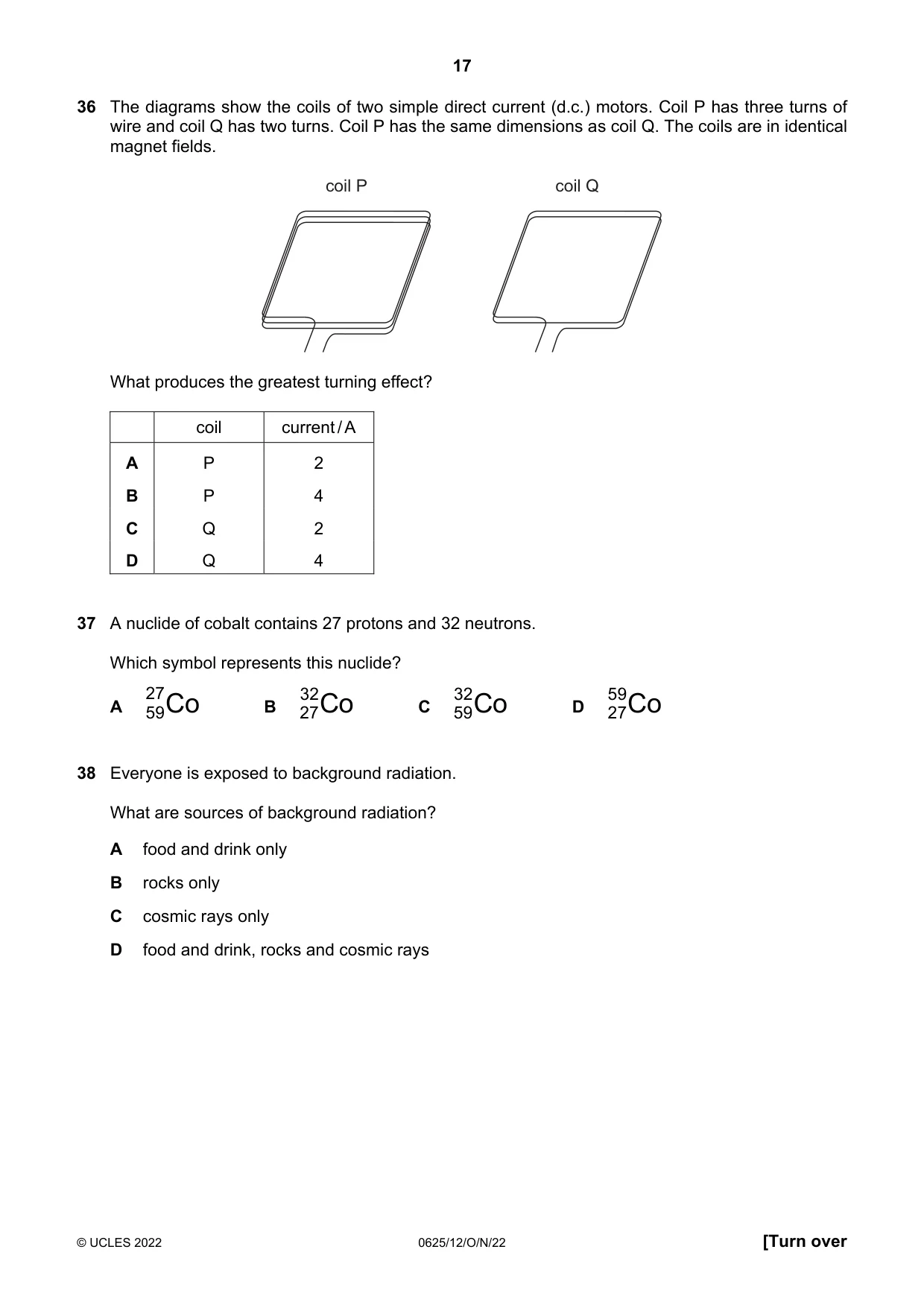
Q36 · The diagrams show the coils of two simple direct current (d.c.) motors
36 The diagrams show the coils of two simple direct current (d.c.) motors. Coil P has three turns of wire and coil Q has two turns. Coil P has the same dimensions as coil Q. The coils are in identical magnet fields. coil P coil Q What produces the greatest turning effect? coil current / A A P 2 B P 4 C Q 2 D Q 4
Mark scheme: B
Q37 · A nuclide of cobalt contains 27 protons and 32 neutrons
37 A nuclide of cobalt contains 27 protons and 32 neutrons. Which symbol represents this nuclide? 27 59Co 27Co 32 59Co 32 59 27Co A B C D
Mark scheme: D
Q38 · Everyone is exposed to background radiation
38 Everyone is exposed to background radiation. What are sources of background radiation? A food and drink only B rocks only C cosmic rays only D food and drink, rocks and cosmic rays
Mark scheme: D
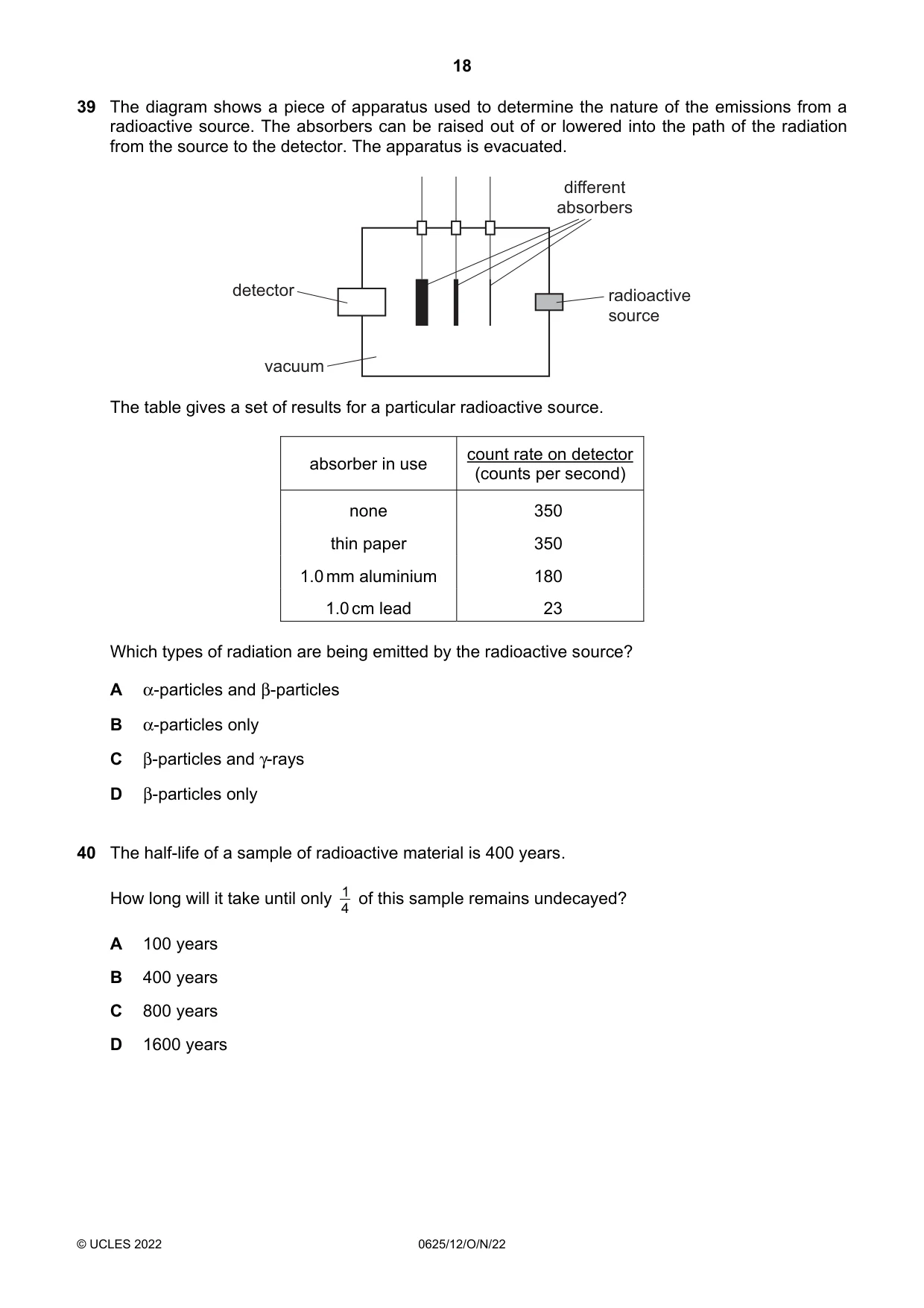
Q39 · The diagram shows a piece of apparatus used to determine the nature of the emissions from…
39 The diagram shows a piece of apparatus used to determine the nature of the emissions from a radioactive source. The absorbers can be raised out of or lowered into the path of the radiation from the source to the detector. The apparatus is evacuated. different absorbers detector radioactive source vacuum The table gives a set of results for a particular radioactive source. count rate on detector absorber in use (counts per second) none 350 thin paper 350 1.0 mm aluminium 180 1.0 cm lead 23 Which types of radiation are being emitted by the radioactive source? A α-particles and β-particles B α-particles only C β-particles and γ-rays D β-particles only
Mark scheme: C
Q40 · The half-life of a sample of radioactive material is 400 years
40 The half-life of a sample of radioactive material is 400 years. How long will it take until only 4 1 of this sample remains undecayed? A 100 years B 400 years C 800 years D 1600 years
Mark scheme: C
What was in this paper
The subtopics covered by these 40 questions, and how many questions each got. Open one in a new tab to see every Cambridge question on it.
4Electromagnetic spectrum3Energy, work and power3Forces3Light3Radioactivity3Electrical quantities2Electrical safety2Electromagnetic effects2Kinetic particle model of matter2Simple phenomena of magnetism2Thermal properties and temperature2Density1General properties of waves1Mass and weight1Motion1Physical quantities and measurement techniques1Pressure1Sound1The nuclear model of the atom1Transfer of thermal energy1What you needed in this session
Cambridge’s own grade thresholds for 2022 Oct/Nov, Paper 1 · Variant 2. A higher threshold means an easier paper — the bar moves with how the cohort did.