Cambridge IGCSE Physics 0625 — 2019 May/June Paper 1 · Variant 2
0625/12/M/J/19 · 40 questions · 40 marks · ≈45 min
The question paper and its mark scheme, free to read here and free to download. This is Cambridge’s own paper, exactly as it was sat.
Question paper20 pages
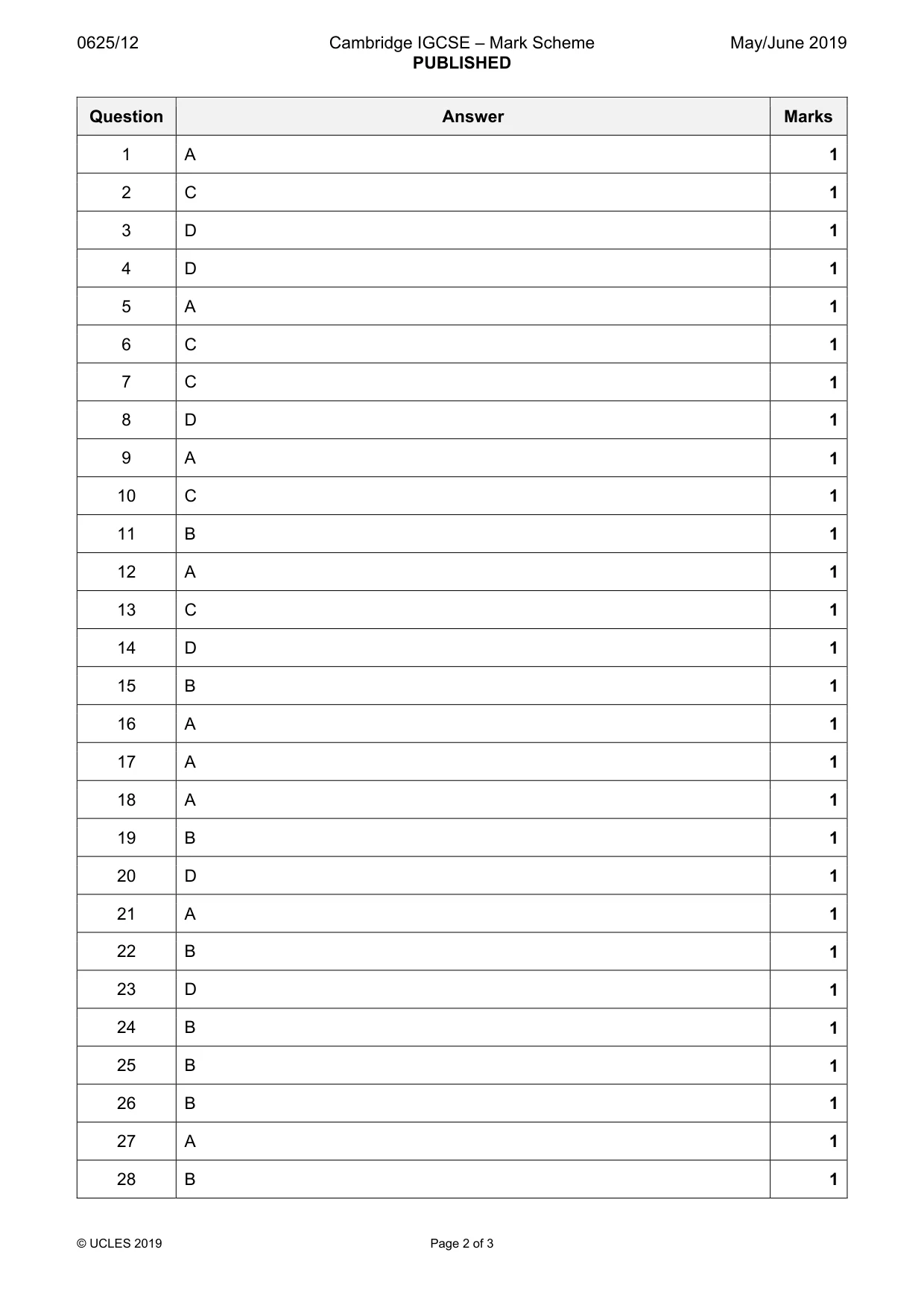
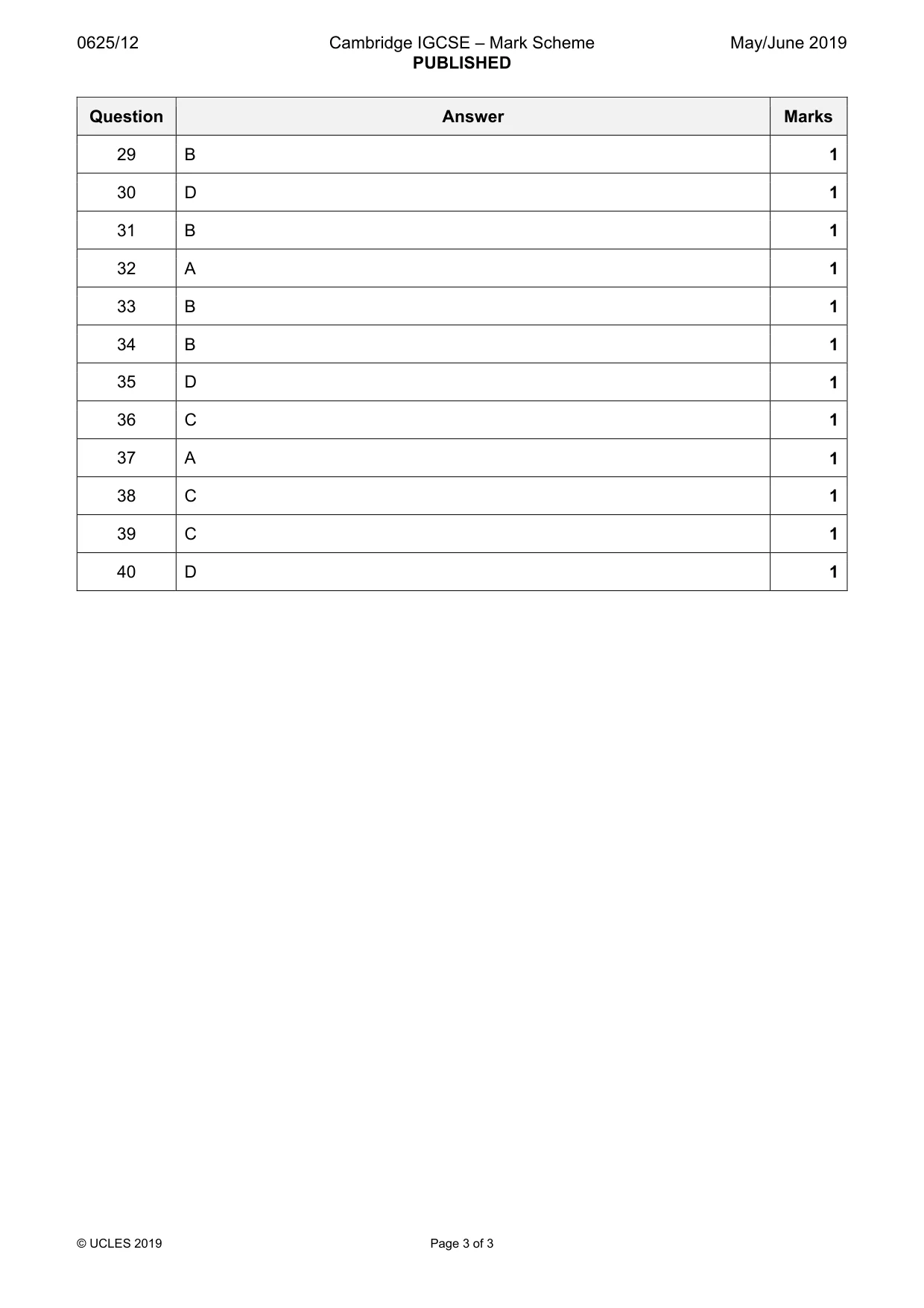
Mark scheme3 pages
Answers below. Sit the paper first if you are practising.
Questions as text
Q1 · A measuring cylinder containing water
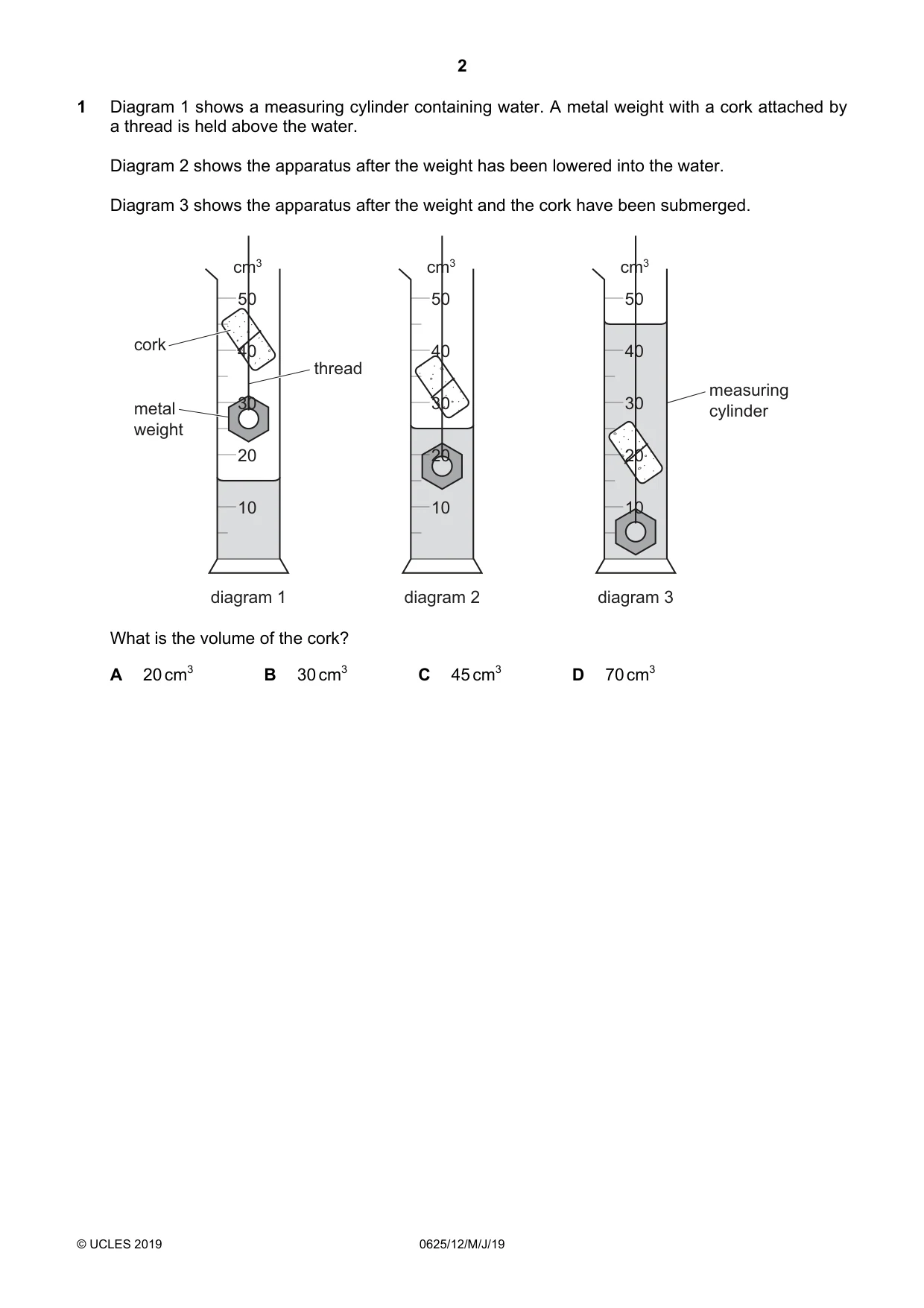
1 Diagram 1 shows a measuring cylinder containing water. A metal weight with a cork attached by a thread is held above the water. Diagram 2 shows the apparatus after the weight has been lowered into the water. Diagram 3 shows the apparatus after the weight and the cork have been submerged. cm3 cm3 cm3 50 50 50 cork 40 40 40 thread measuring metal 30 30 30 cylinder weight 20 20 20 10 10 10 diagram 1 diagram 2 diagram 3 What is the volume of the cork? A 20 cm3 B 30 cm3 C 45 cm3 D 70 cm3
Mark scheme: A
Q2 · A car travels at constant speed
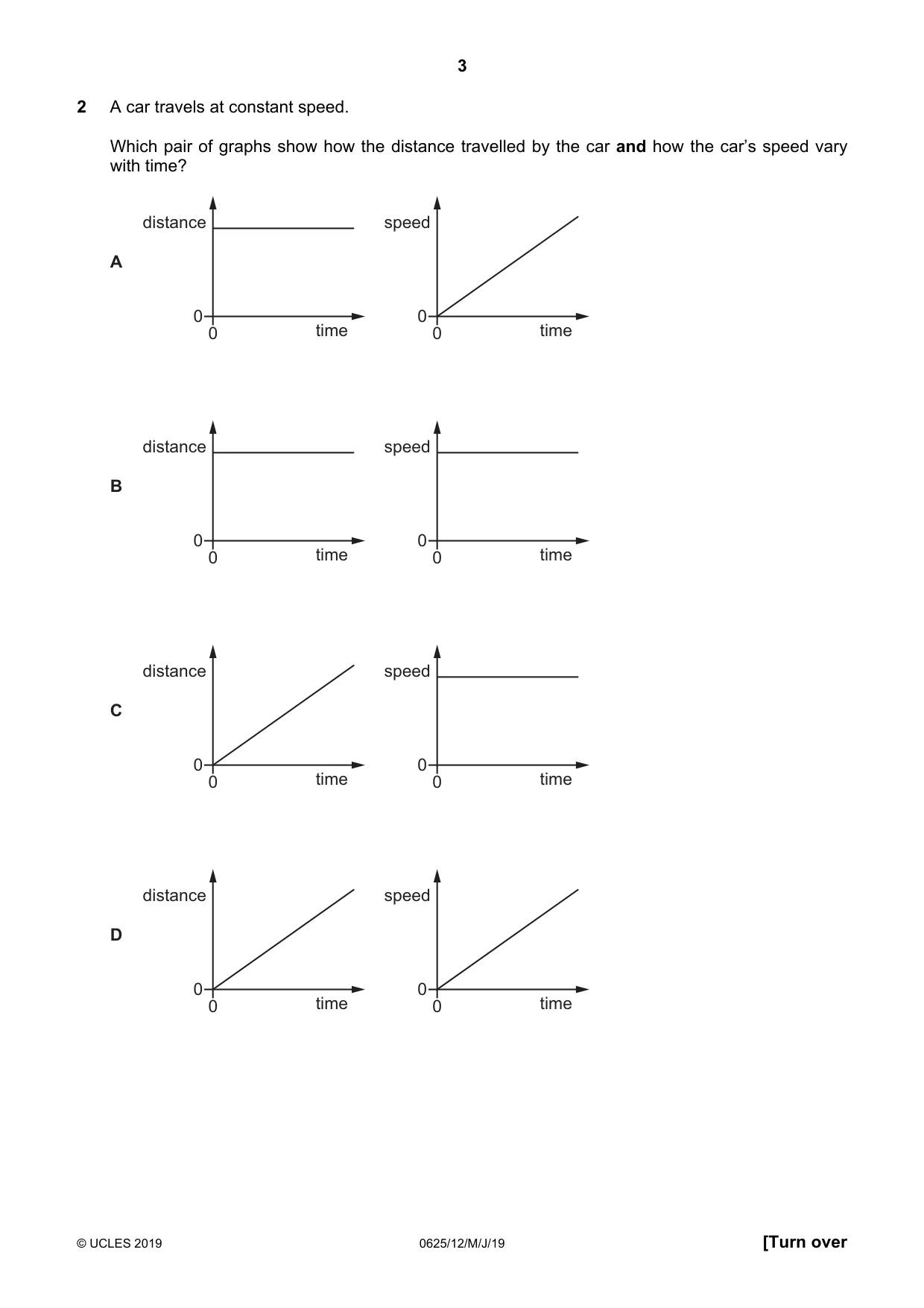
2 A car travels at constant speed. Which pair of graphs show how the distance travelled by the car and how the car’s speed vary with time? distance speed A 0 0 0 time 0 time distance speed B 0 0 0 time 0 time distance speed C 0 0 0 time 0 time distance speed D 0 0 0 time 0 time
Mark scheme: C
Q3 · A heavy metal ball falls vertically downwards through air past four equally spaced levels…
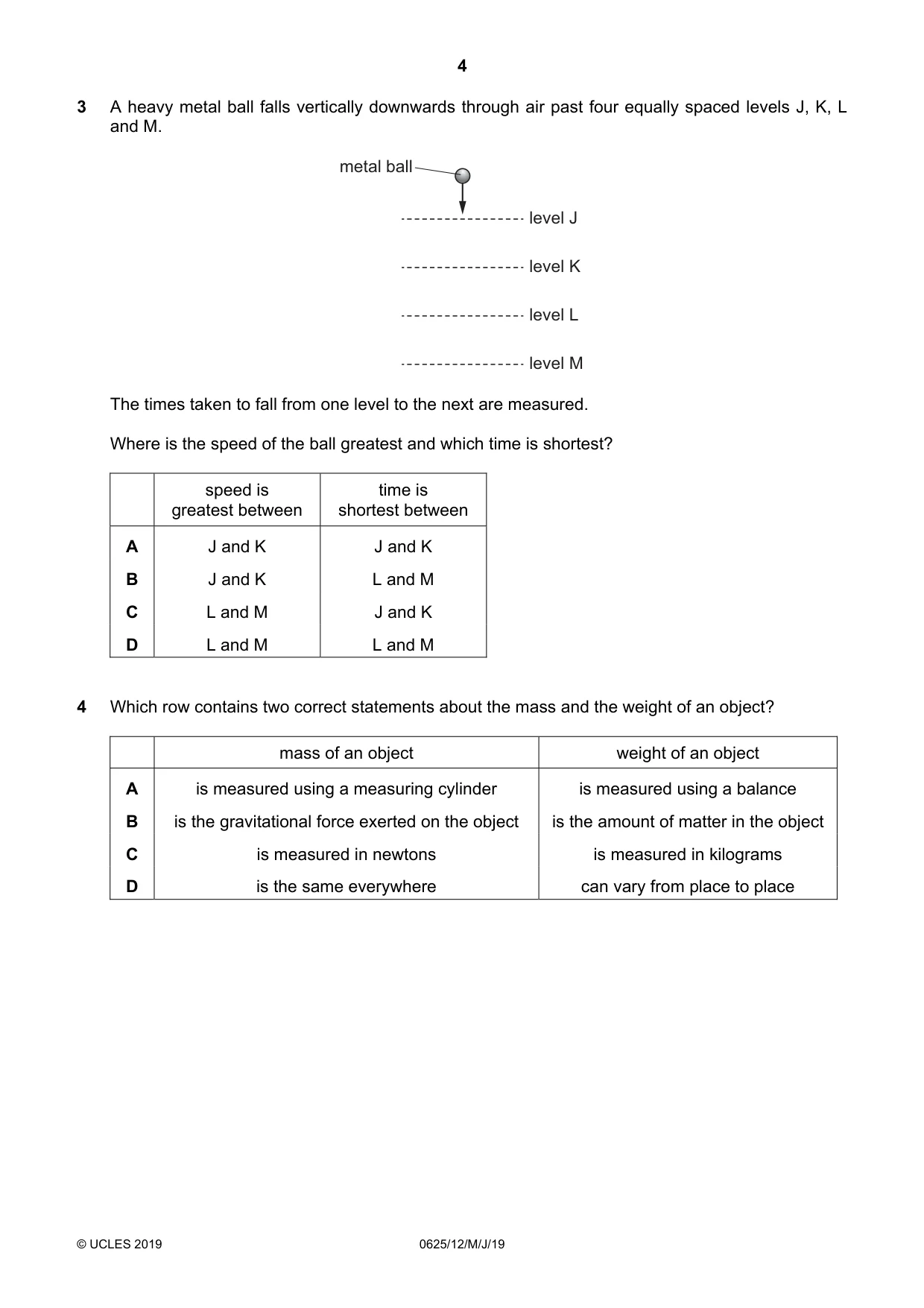
3 A heavy metal ball falls vertically downwards through air past four equally spaced levels J, K, L and M. metal ball level J level K level L level M The times taken to fall from one level to the next are measured. Where is the speed of the ball greatest and which time is shortest? speed is time is greatest between shortest between A J and K J and K B J and K L and M C L and M J and K D L and M L and M
Mark scheme: D
Q4 · Which row contains two correct statements about the mass and the weight of an object?
4 Which row contains two correct statements about the mass and the weight of an object? mass of an object weight of an object A is measured using a measuring cylinder is measured using a balance B is the gravitational force exerted on the object is the amount of matter in the object C is measured in newtons is measured in kilograms D is the same everywhere can vary from place to place
Mark scheme: D
Q5 · The table gives approximate values of the acceleration due to gravity and the atmospheric…
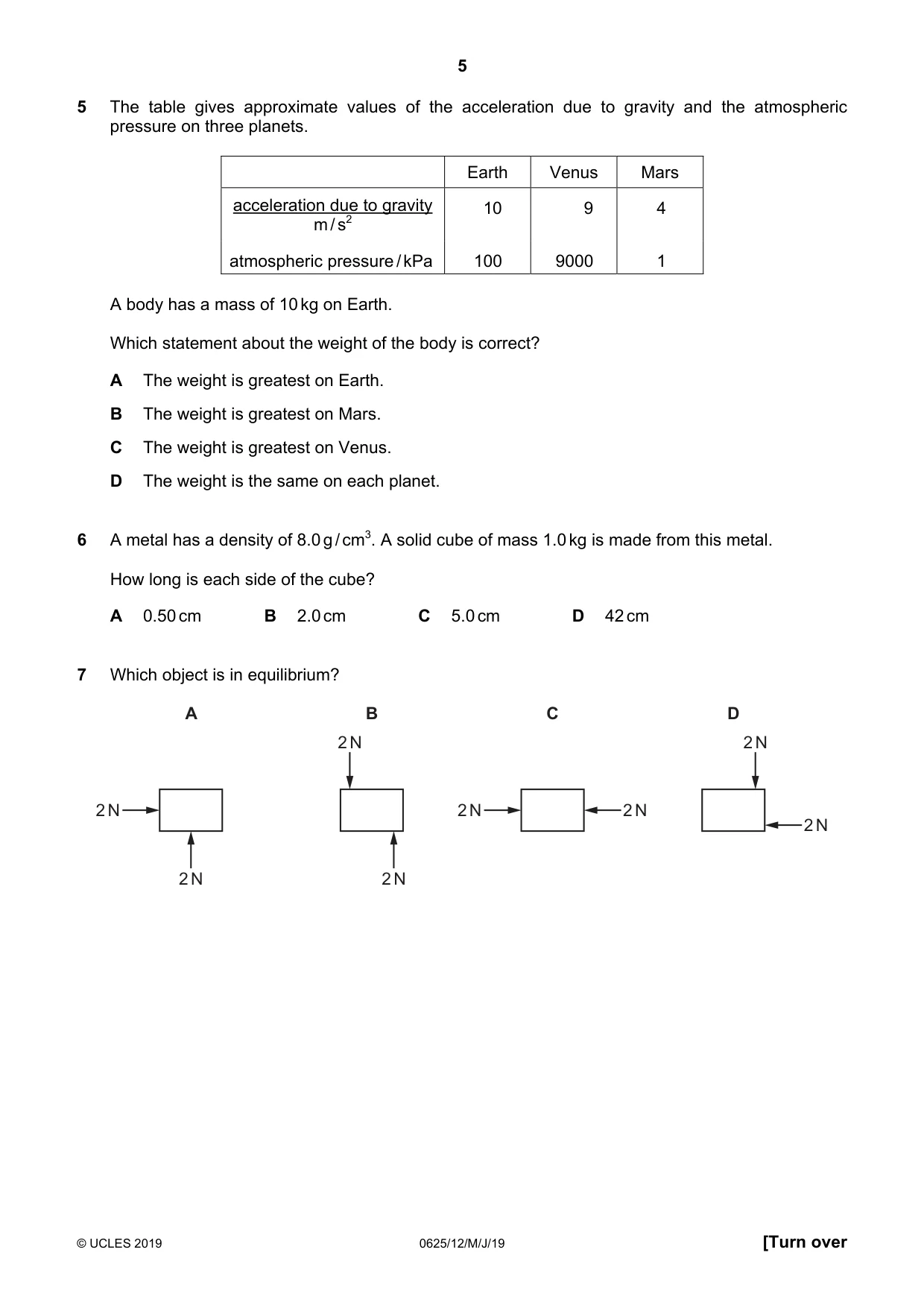
5 The table gives approximate values of the acceleration due to gravity and the atmospheric pressure on three planets. Earth Venus Mars acceleration due to gravity 10 9 4 m / s2 atmospheric pressure / kPa 100 9000 1 A body has a mass of 10 kg on Earth. Which statement about the weight of the body is correct? A The weight is greatest on Earth. B The weight is greatest on Mars. C The weight is greatest on Venus. D The weight is the same on each planet.
Mark scheme: A
Q6 · A metal has a density of 8.0 g / cm3
6 A metal has a density of 8.0 g / cm3. A solid cube of mass 1.0 kg is made from this metal. How long is each side of the cube? A 0.50 cm B 2.0 cm C 5.0 cm D 42 cm
Mark scheme: C
Q7 · Which object is in equilibrium?
7 Which object is in equilibrium? A B C D 2 N 2 N 2 N 2 N 2 N 2 N 2 N 2 N
Mark scheme: C
Q8 · A spring is suspended from a stand
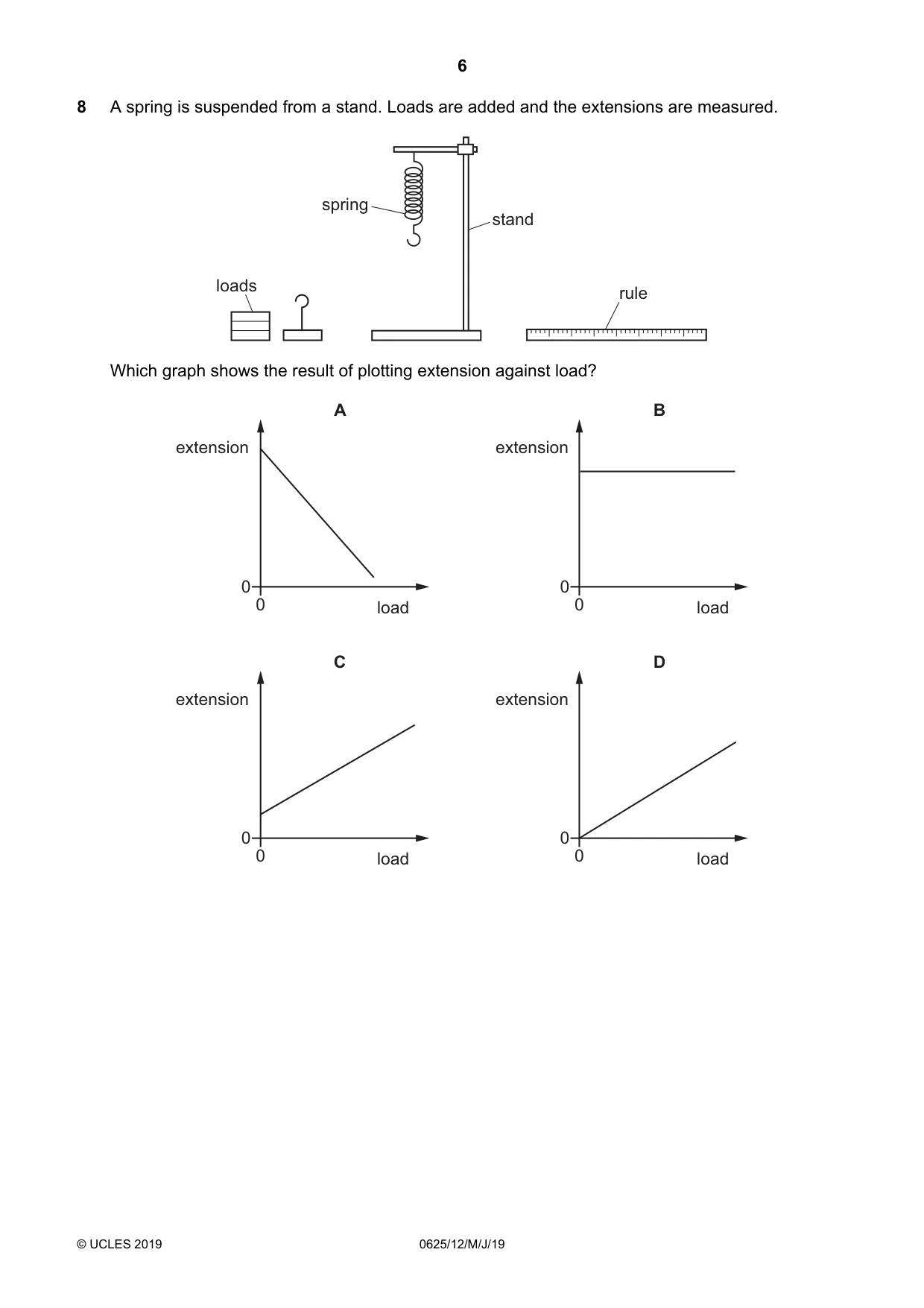
8 A spring is suspended from a stand. Loads are added and the extensions are measured. spring stand loads rule Which graph shows the result of plotting extension against load? A B extension extension 0 0 0 load 0 load C D extension extension 0 0 0 load 0 load
Mark scheme: D
Q9 · A wooden bar is pivoted at its centre so that it can rotate freely
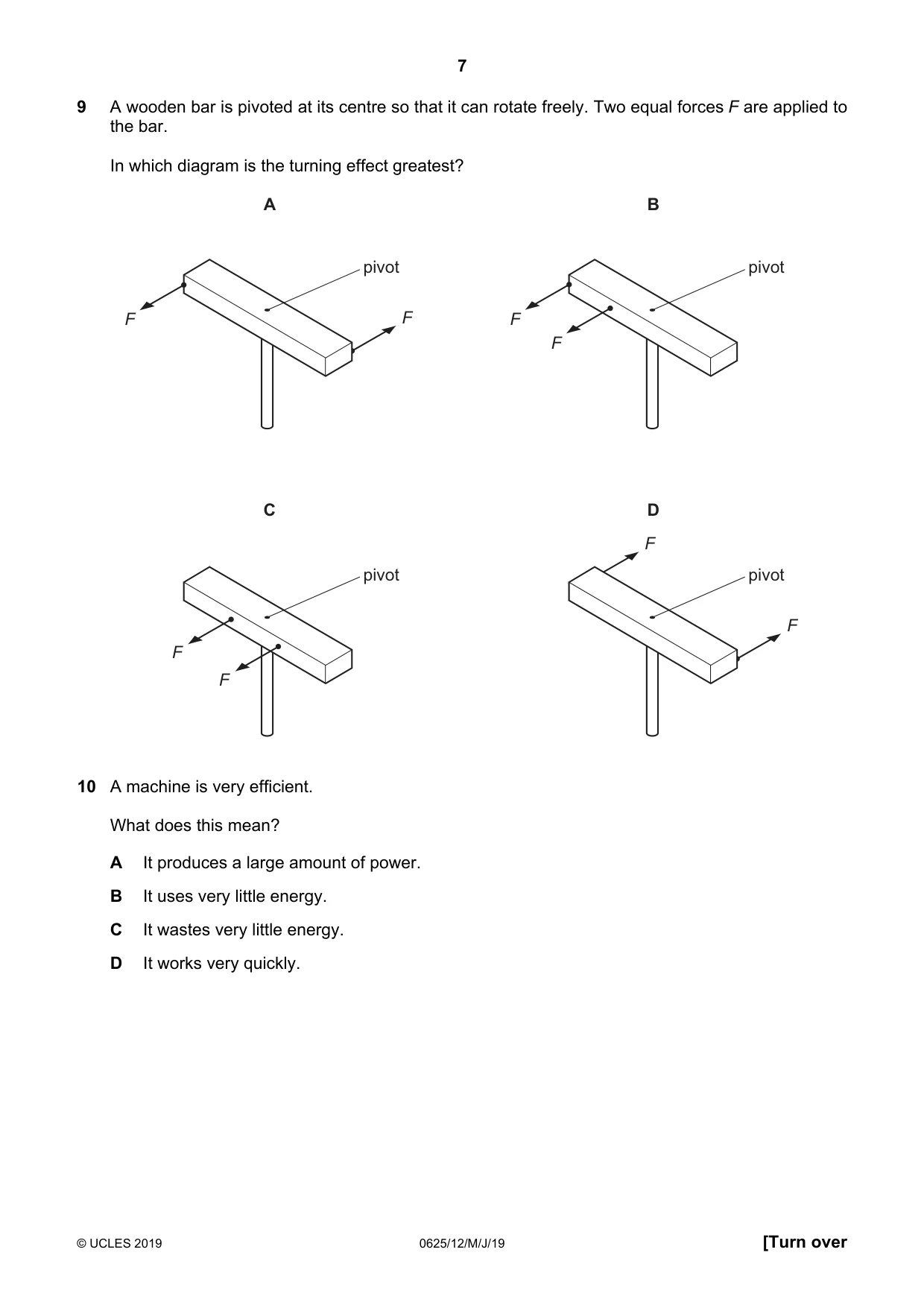
9 A wooden bar is pivoted at its centre so that it can rotate freely. Two equal forces F are applied to the bar. In which diagram is the turning effect greatest? A B pivot pivot F F F F C D F pivot pivot F F F
Mark scheme: A
Q10 · A machine is very efficient
10 A machine is very efficient. What does this mean? A It produces a large amount of power. B It uses very little energy. C It wastes very little energy. D It works very quickly.
Mark scheme: C
Q11 · An object falls under gravity
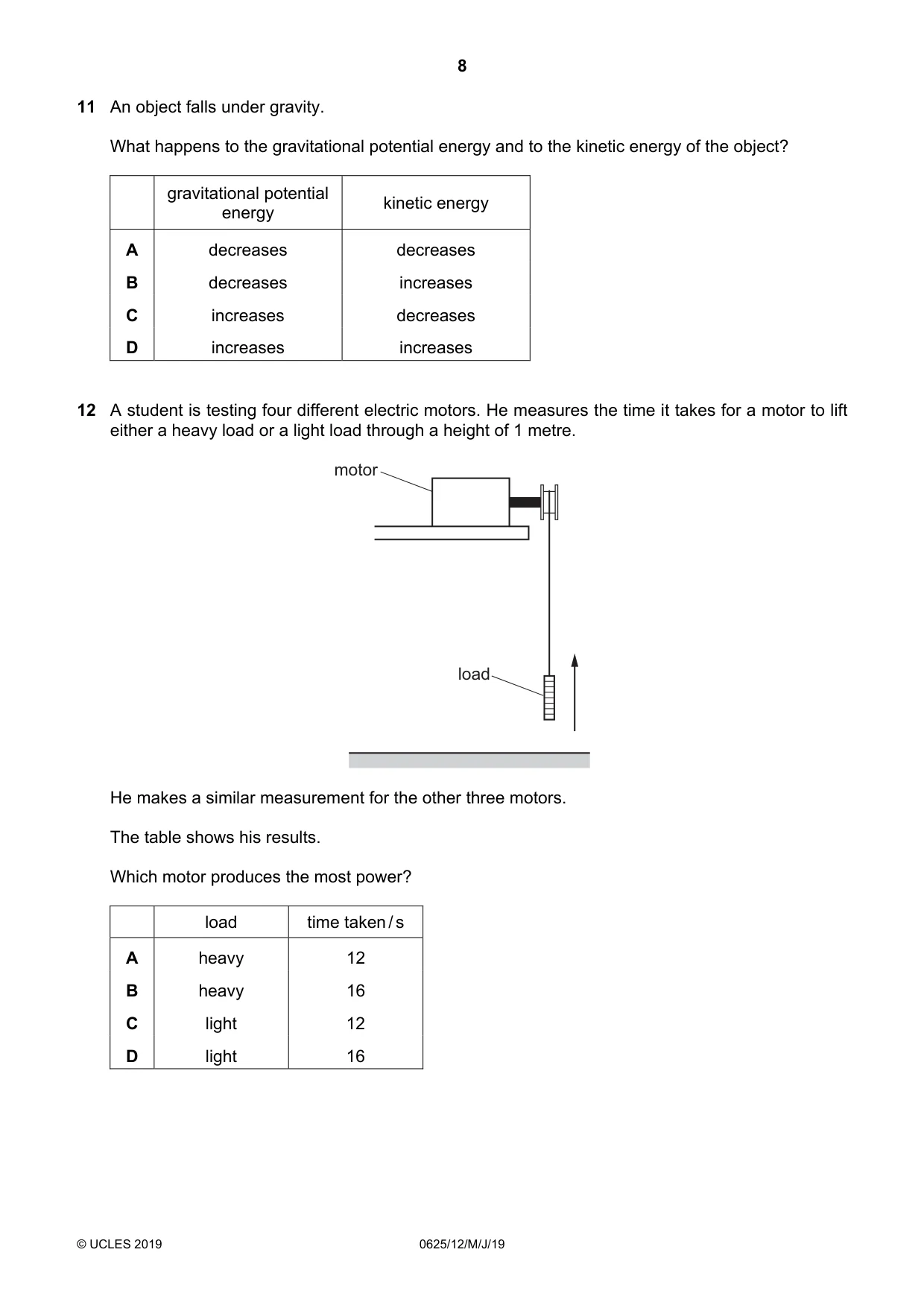
11 An object falls under gravity. What happens to the gravitational potential energy and to the kinetic energy of the object? gravitational potential kinetic energy energy A decreases decreases B decreases increases C increases decreases D increases increases
Mark scheme: B
Q12 · A student is testing four different electric motors
12 A student is testing four different electric motors. He measures the time it takes for a motor to lift either a heavy load or a light load through a height of 1 metre. motor load He makes a similar measurement for the other three motors. The table shows his results. Which motor produces the most power? load time taken / s A heavy 12 B heavy 16 C light 12 D light 16
Mark scheme: A
Q13 · The diagram shows a stone suspended on a string under the surface of a liquid
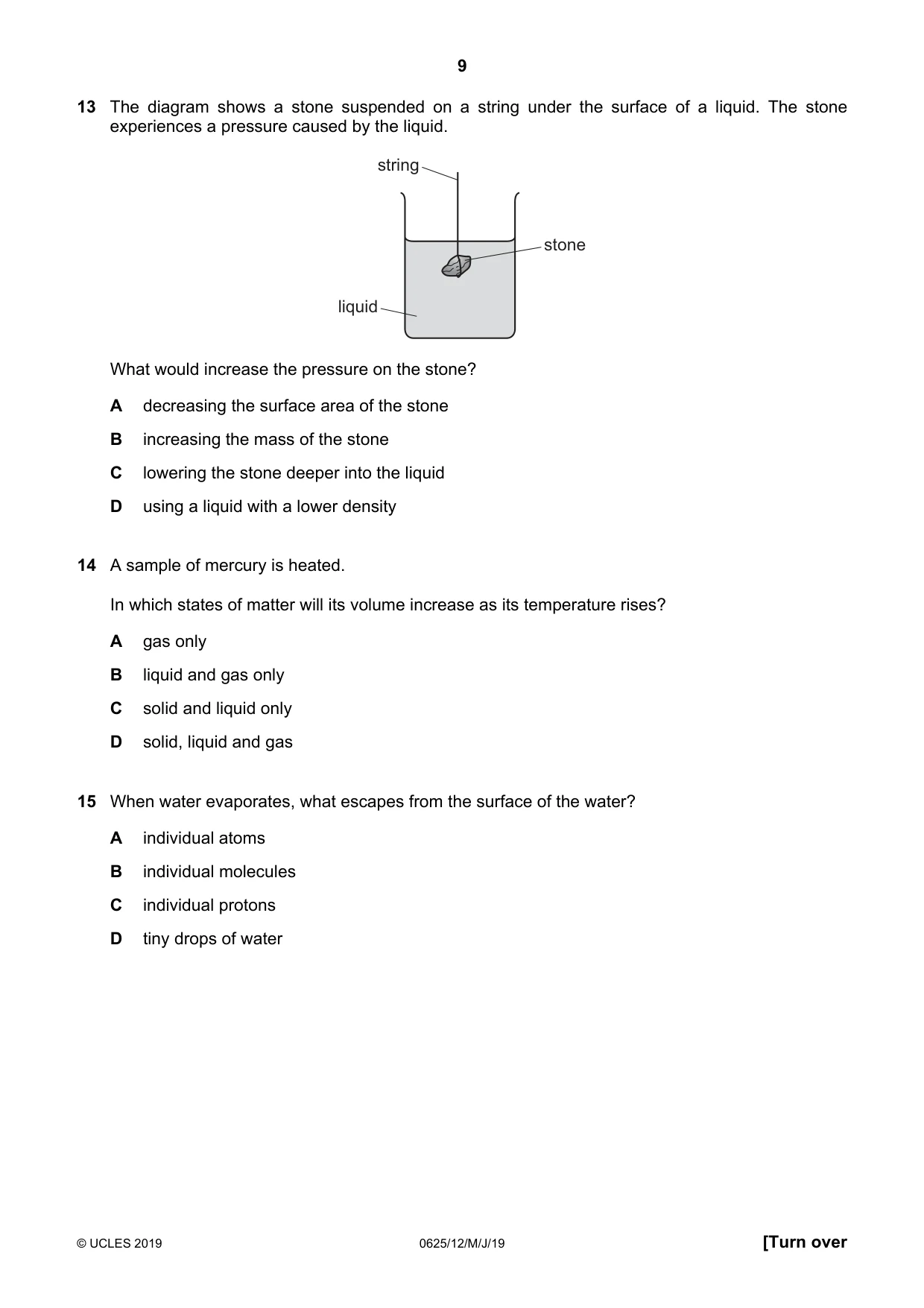
13 The diagram shows a stone suspended on a string under the surface of a liquid. The stone experiences a pressure caused by the liquid. string stone liquid What would increase the pressure on the stone? A decreasing the surface area of the stone B increasing the mass of the stone C lowering the stone deeper into the liquid D using a liquid with a lower density
Mark scheme: C
Q14 · A sample of mercury is heated
14 A sample of mercury is heated. In which states of matter will its volume increase as its temperature rises? A gas only B liquid and gas only C solid and liquid only D solid, liquid and gas
Mark scheme: D
Q15 · When water evaporates, what escapes from the surface of the water?
15 When water evaporates, what escapes from the surface of the water? A individual atoms B individual molecules C individual protons D tiny drops of water
Mark scheme: B
Q16 · The resistance of a resistor varies linearly with temperature as shown on the graph
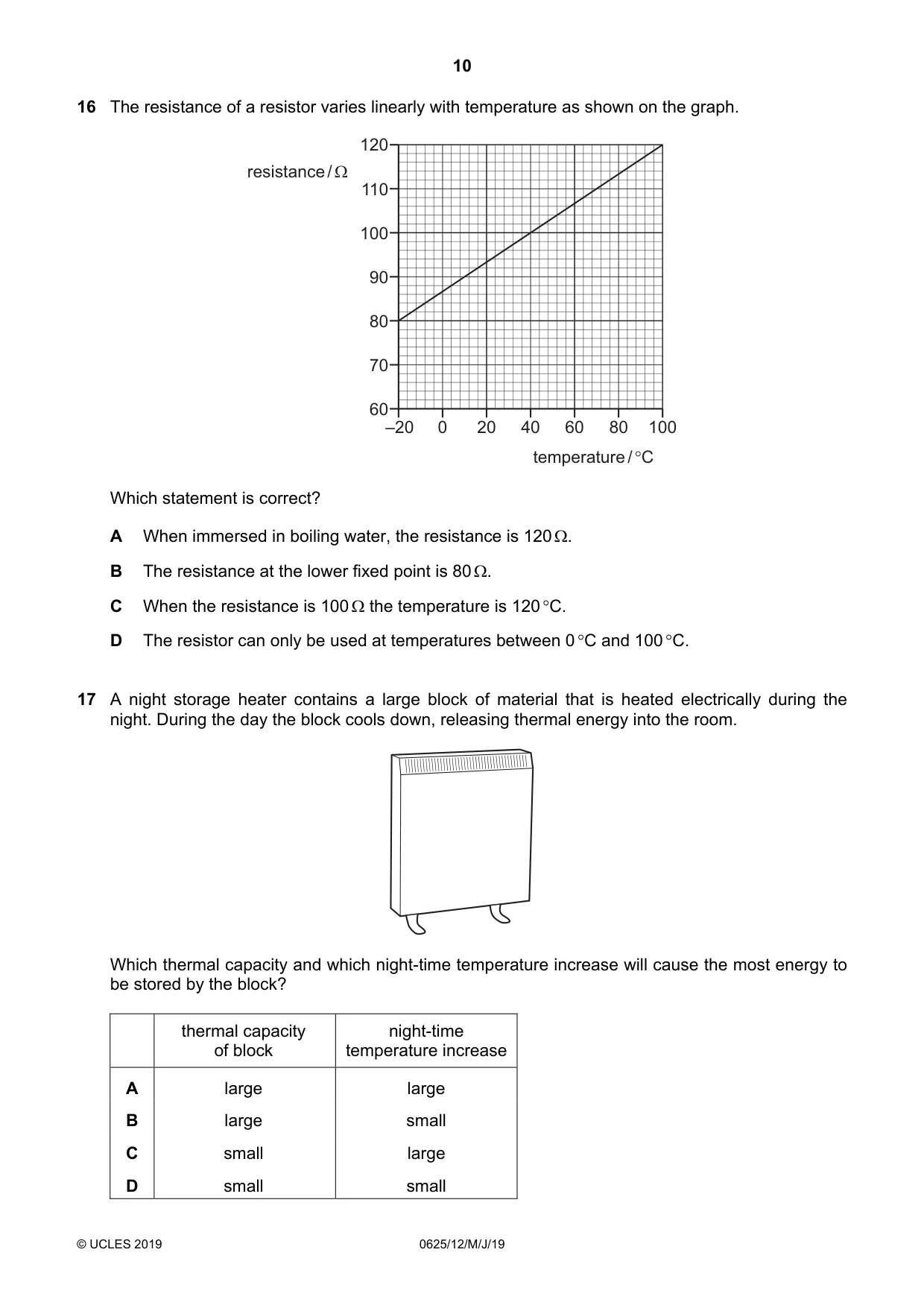
16 The resistance of a resistor varies linearly with temperature as shown on the graph. 120 resistance / Ω 110 100 90 80 70 60 –20 0 20 40 60 80 100 temperature / °C Which statement is correct? A When immersed in boiling water, the resistance is 120 Ω. B The resistance at the lower fixed point is 80 Ω. C When the resistance is 100 Ω the temperature is 120 °C. D The resistor can only be used at temperatures between 0 °C and 100 °C.
Mark scheme: A
Q17 · A night storage heater contains a large block of material that is heated electrically…
17 A night storage heater contains a large block of material that is heated electrically during the night. During the day the block cools down, releasing thermal energy into the room. Which thermal capacity and which night-time temperature increase will cause the most energy to be stored by the block? thermal capacity night-time of block temperature increase A large large B large small C small large D small small
Mark scheme: A
Q18 · Which row describes the process of condensation?
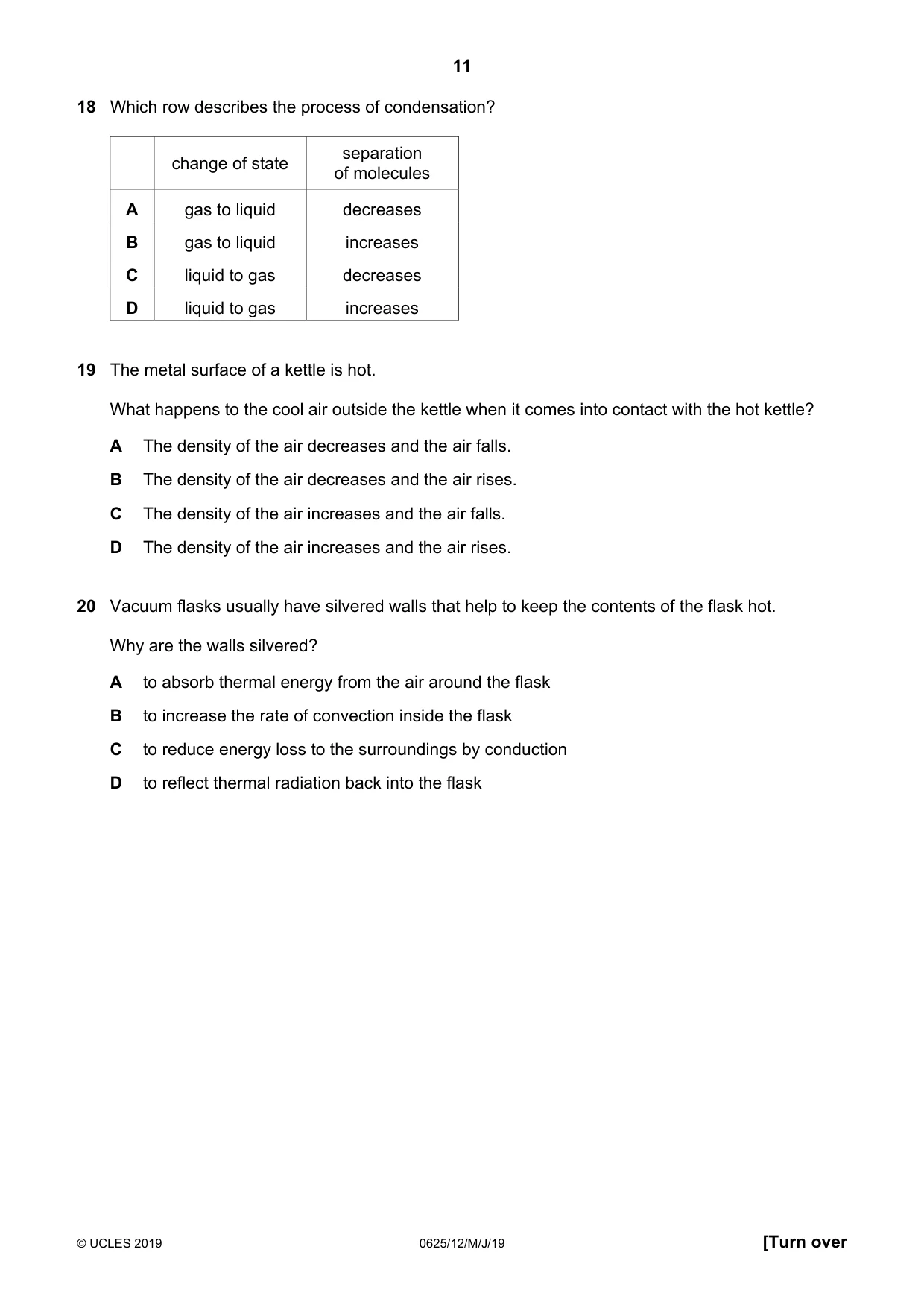
18 Which row describes the process of condensation? separation change of state of molecules A gas to liquid decreases B gas to liquid increases C liquid to gas decreases D liquid to gas increases
Mark scheme: A
Q19 · The metal surface of a kettle is hot
19 The metal surface of a kettle is hot. What happens to the cool air outside the kettle when it comes into contact with the hot kettle? A The density of the air decreases and the air falls. B The density of the air decreases and the air rises. C The density of the air increases and the air falls. D The density of the air increases and the air rises.
Mark scheme: B
Q20 · Vacuum flasks usually have silvered walls that help to keep the contents of the flask hot
20 Vacuum flasks usually have silvered walls that help to keep the contents of the flask hot. Why are the walls silvered? A to absorb thermal energy from the air around the flask B to increase the rate of convection inside the flask C to reduce energy loss to the surroundings by conduction D to reflect thermal radiation back into the flask
Mark scheme: D
Q21 · The diagrams show graphs of displacement against time for four waves
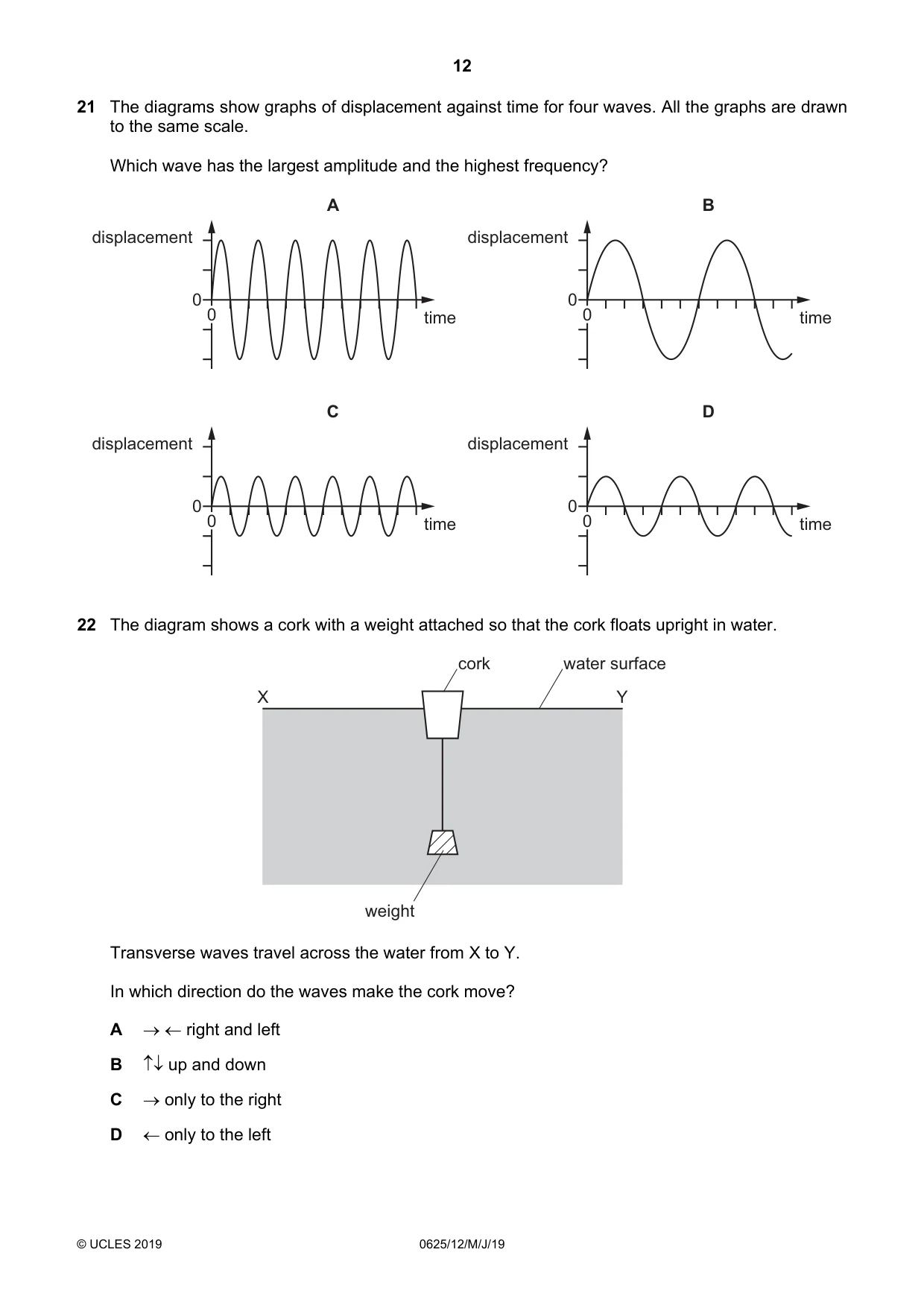
21 The diagrams show graphs of displacement against time for four waves. All the graphs are drawn to the same scale. Which wave has the largest amplitude and the highest frequency? A B displacement displacement 0 0 0 time 0 time C D displacement displacement 0 0 0 time 0 time
Mark scheme: A
Q22 · The diagram shows a cork with a weight attached so that the cork floats upright in water
22 The diagram shows a cork with a weight attached so that the cork floats upright in water. cork water surface X Y weight Transverse waves travel across the water from X to Y. In which direction do the waves make the cork move? A → ← right and left B ↑↓ up and down C → only to the right D ← only to the left
Mark scheme: B
Q23 · Which conditions are necessary for light to be totally internally reflected?
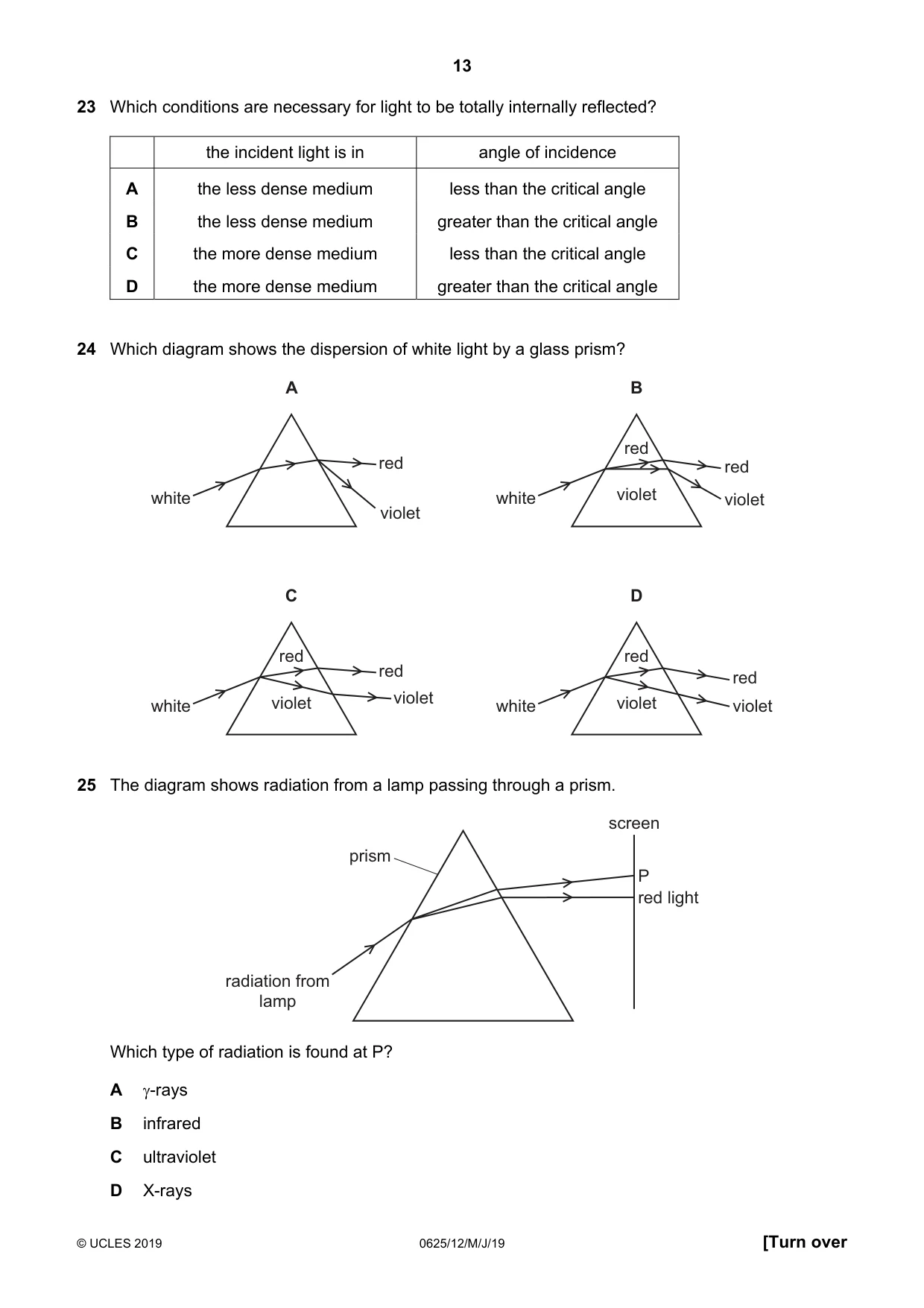
23 Which conditions are necessary for light to be totally internally reflected? the incident light is in angle of incidence A the less dense medium less than the critical angle B the less dense medium greater than the critical angle C the more dense medium less than the critical angle D the more dense medium greater than the critical angle
Mark scheme: D
Q24 · Which diagram shows the dispersion of white light by a glass prism?
24 Which diagram shows the dispersion of white light by a glass prism? A B red red red white white violet violet violet C D red red red red white violet violet white violet violet
Mark scheme: B
Q25 · The diagram shows radiation from a lamp passing through a prism
25 The diagram shows radiation from a lamp passing through a prism. screen prism P red light radiation from lamp Which type of radiation is found at P? A γ-rays B infrared C ultraviolet D X-rays
Mark scheme: B
Q26 · A pulse of sound is produced at the bottom of a boat
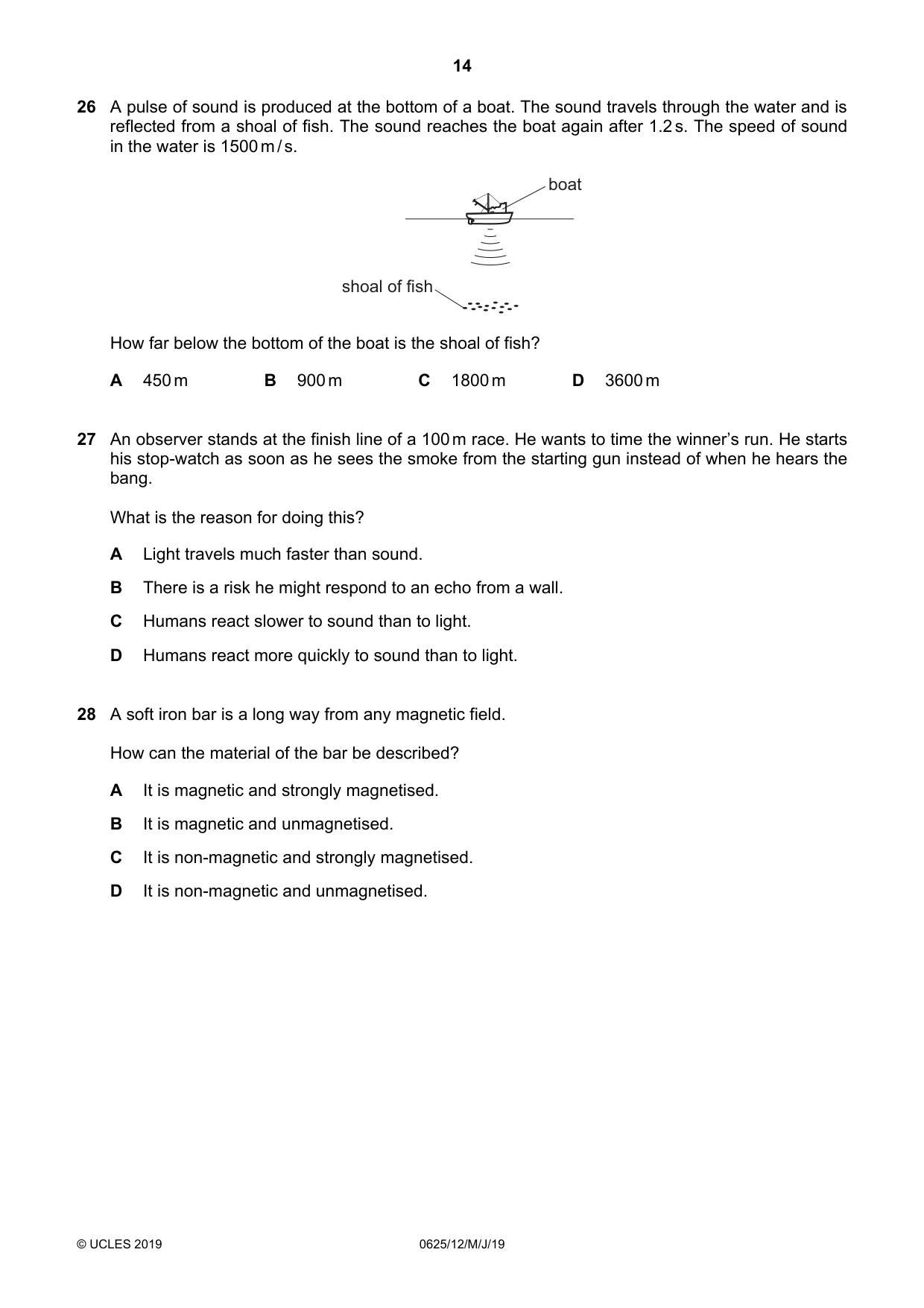
26 A pulse of sound is produced at the bottom of a boat. The sound travels through the water and is reflected from a shoal of fish. The sound reaches the boat again after 1.2 s. The speed of sound in the water is 1500 m / s. boat shoal of fish How far below the bottom of the boat is the shoal of fish? A 450 m B 900 m C 1800 m D 3600 m
Mark scheme: B
Q27 · An observer stands at the finish line of a 100 m race
27 An observer stands at the finish line of a 100 m race. He wants to time the winner’s run. He starts his stop-watch as soon as he sees the smoke from the starting gun instead of when he hears the bang. What is the reason for doing this? A Light travels much faster than sound. B There is a risk he might respond to an echo from a wall. C Humans react slower to sound than to light. D Humans react more quickly to sound than to light.
Mark scheme: A
Q28 · A soft iron bar is a long way from any magnetic field
28 A soft iron bar is a long way from any magnetic field. How can the material of the bar be described? A It is magnetic and strongly magnetised. B It is magnetic and unmagnetised. C It is non-magnetic and strongly magnetised. D It is non-magnetic and unmagnetised.
Mark scheme: B
Q29 · An iron ball on a horizontal wooden table rolls near the north pole of a bar magnet which…
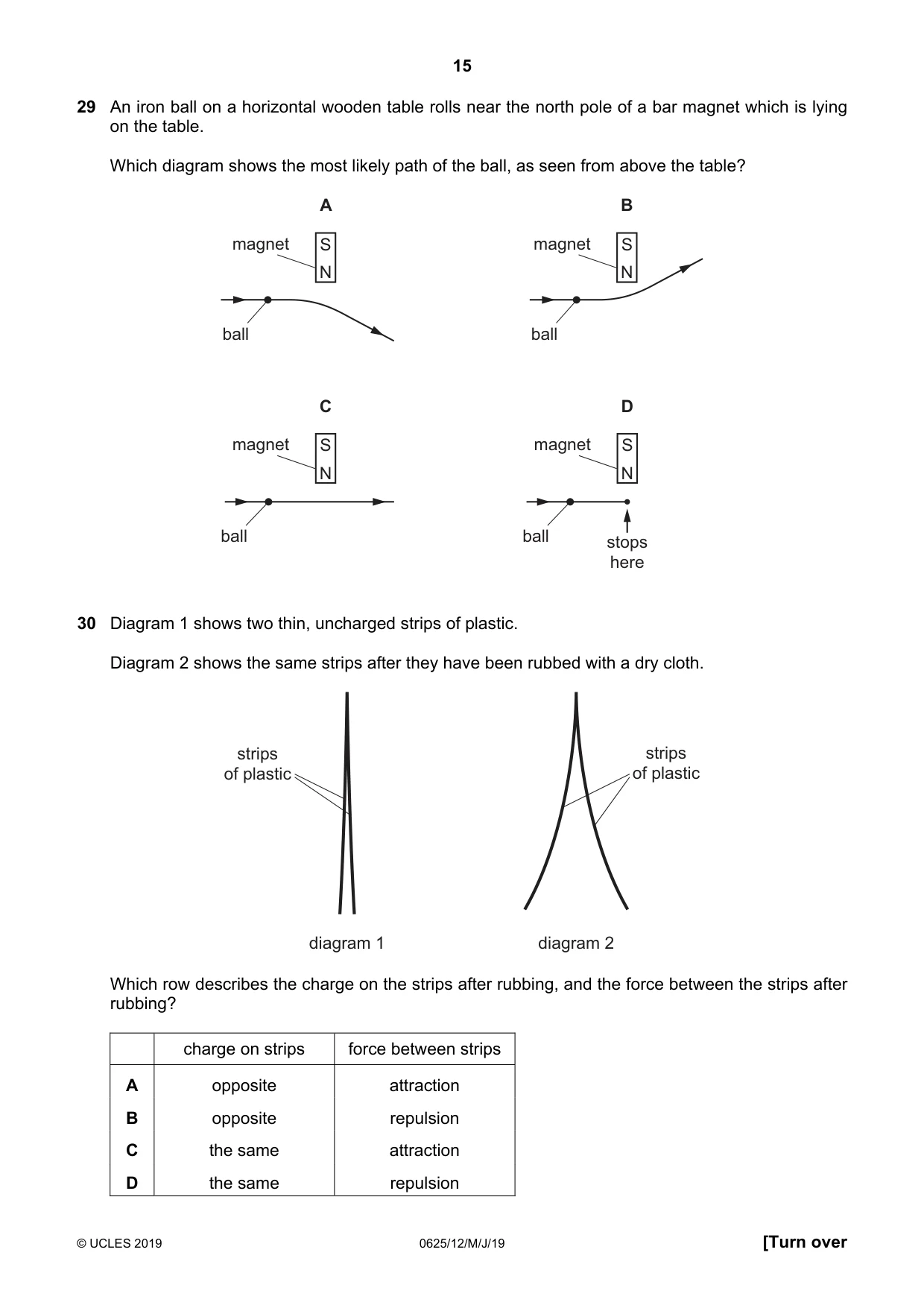
29 An iron ball on a horizontal wooden table rolls near the north pole of a bar magnet which is lying on the table. Which diagram shows the most likely path of the ball, as seen from above the table? A B magnet S magnet S N N ball ball C D magnet S magnet S N N ball ball stops here
Mark scheme: B
Q30 · Two thin, uncharged strips of plastic
30 Diagram 1 shows two thin, uncharged strips of plastic. Diagram 2 shows the same strips after they have been rubbed with a dry cloth. strips strips of plastic of plastic diagram 1 diagram 2 Which row describes the charge on the strips after rubbing, and the force between the strips after rubbing? charge on strips force between strips A opposite attraction B opposite repulsion C the same attraction D the same repulsion
Mark scheme: D
Q31 · An ammeter and a voltmeter are used to determine the resistance of a resistor
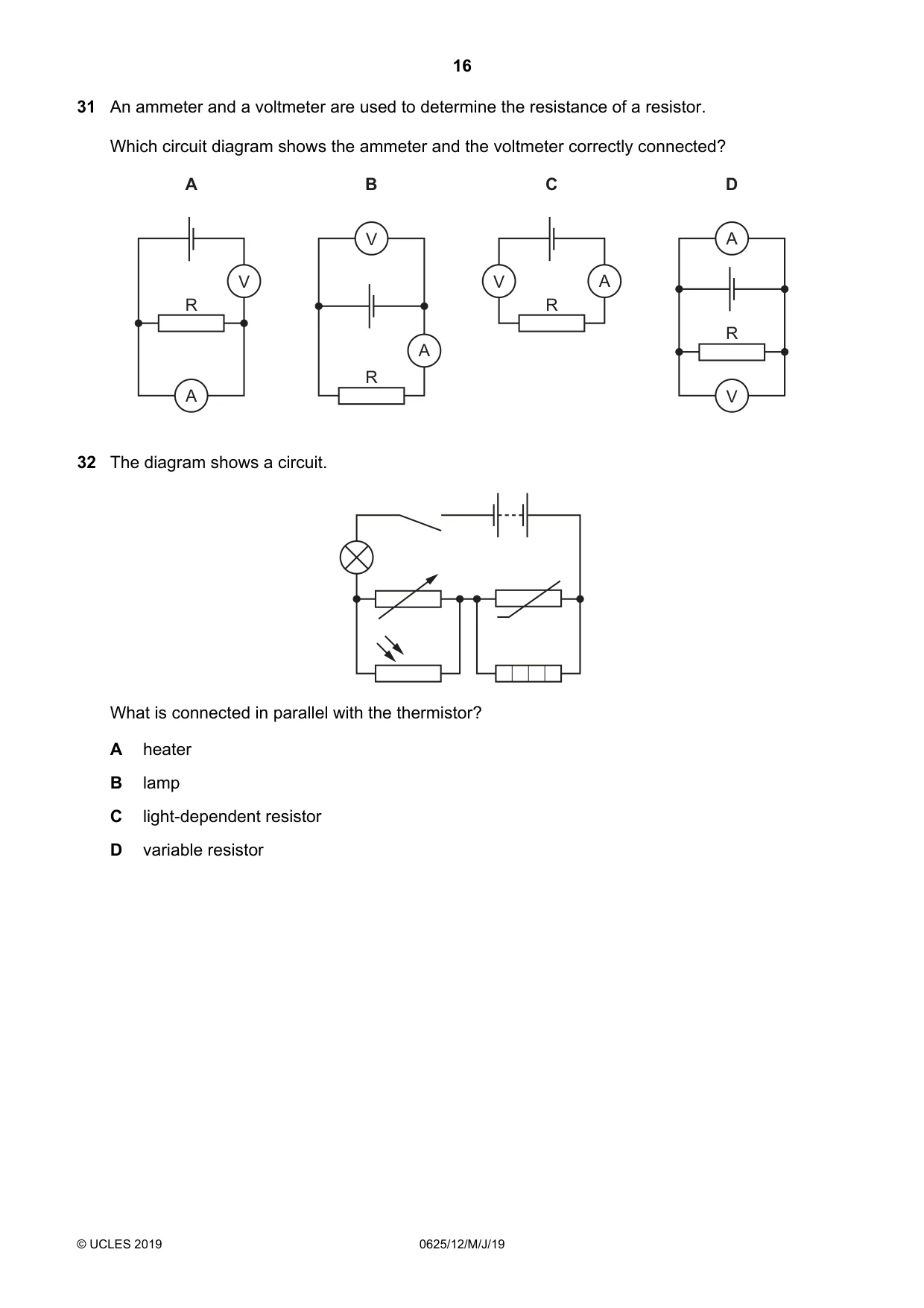
31 An ammeter and a voltmeter are used to determine the resistance of a resistor. Which circuit diagram shows the ammeter and the voltmeter correctly connected? A B C D V A V V A R R R A R A V
Mark scheme: B
Q32 · The diagram shows a circuit
32 The diagram shows a circuit. What is connected in parallel with the thermistor? A heater B lamp C light-dependent resistor D variable resistor
Mark scheme: A
Q33 · The circuit shows a relay being used to operate a mains lamp
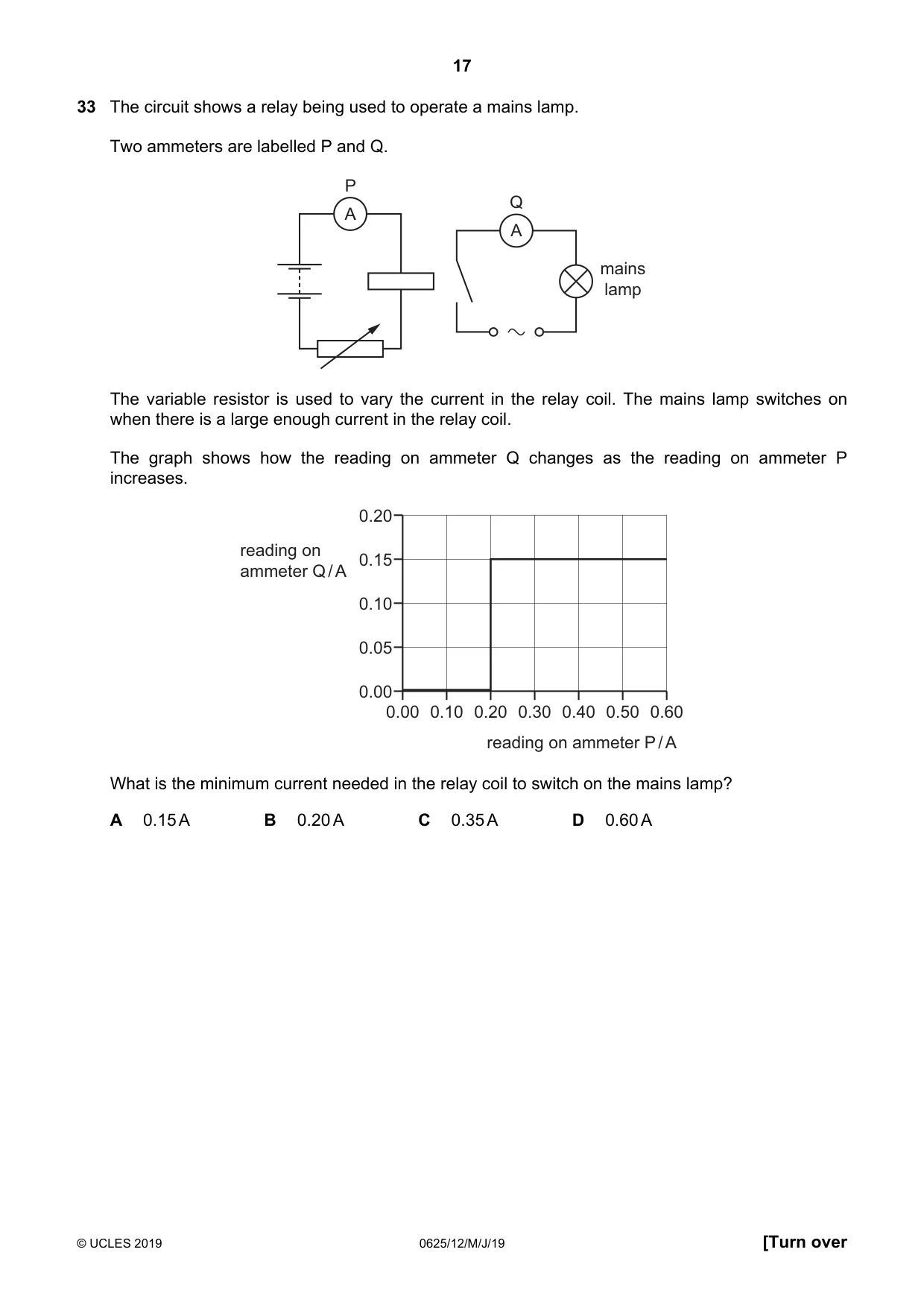
33 The circuit shows a relay being used to operate a mains lamp. Two ammeters are labelled P and Q. P Q A A mains lamp The variable resistor is used to vary the current in the relay coil. The mains lamp switches on when there is a large enough current in the relay coil. The graph shows how the reading on ammeter Q changes as the reading on ammeter P increases. 0.20 reading on 0.15 ammeter Q / A 0.10 0.05 0.00 0.00 0.10 0.20 0.30 0.40 0.50 0.60 reading on ammeter P / A What is the minimum current needed in the relay coil to switch on the mains lamp? A 0.15 A B 0.20 A C 0.35 A D 0.60 A
Mark scheme: B
Q34 · A lamp is to be connected in a circuit so that the potential difference (p.d.) across it…
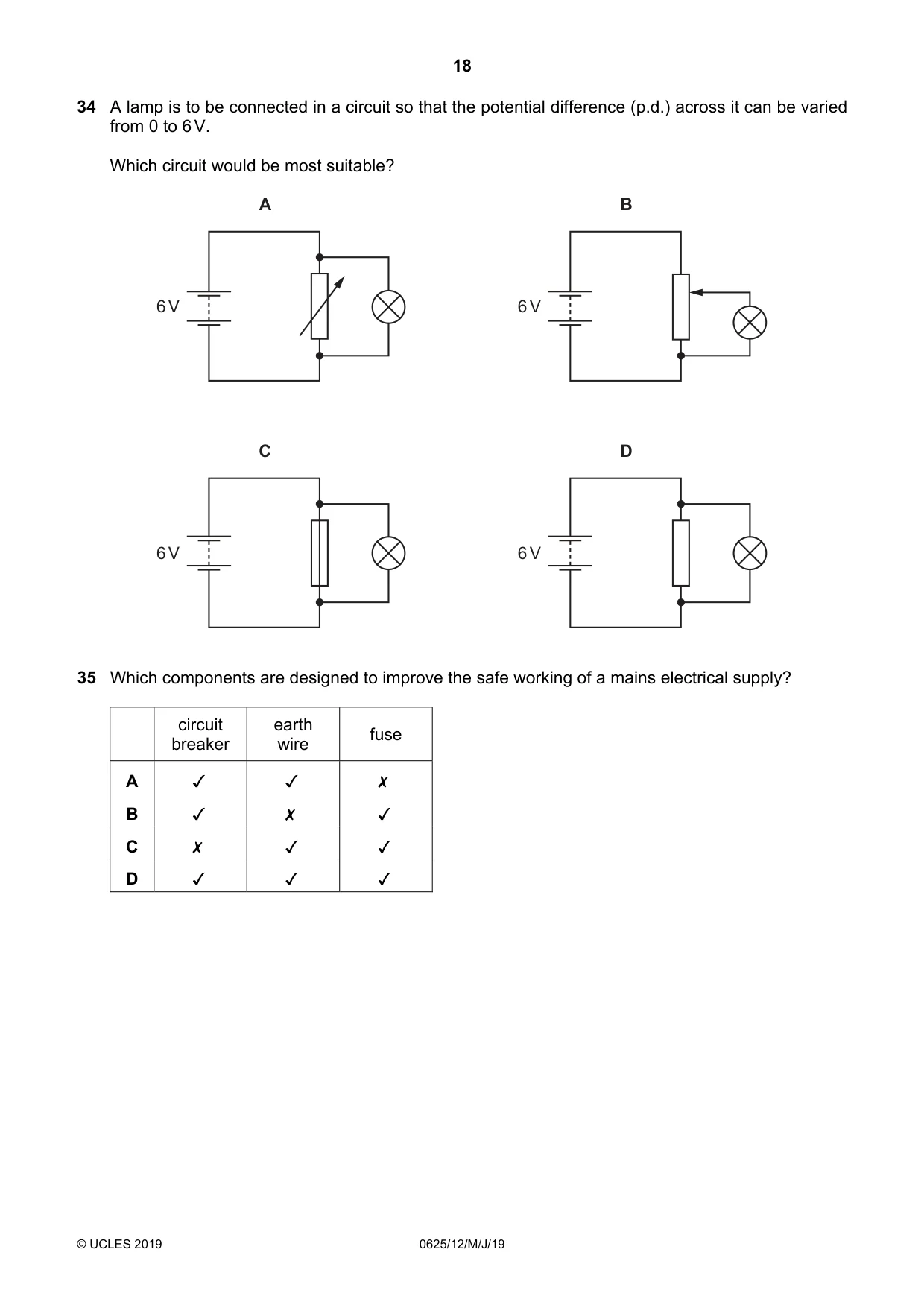
34 A lamp is to be connected in a circuit so that the potential difference (p.d.) across it can be varied from 0 to 6 V. Which circuit would be most suitable? A B 6 V 6 V C D 6 V 6 V
Mark scheme: B
Q35 · Which components are designed to improve the safe working of a mains electrical supply?
35 Which components are designed to improve the safe working of a mains electrical supply? circuit earth breaker wire fuse
Mark scheme: D
Q36 · A bar magnet is held near a solenoid
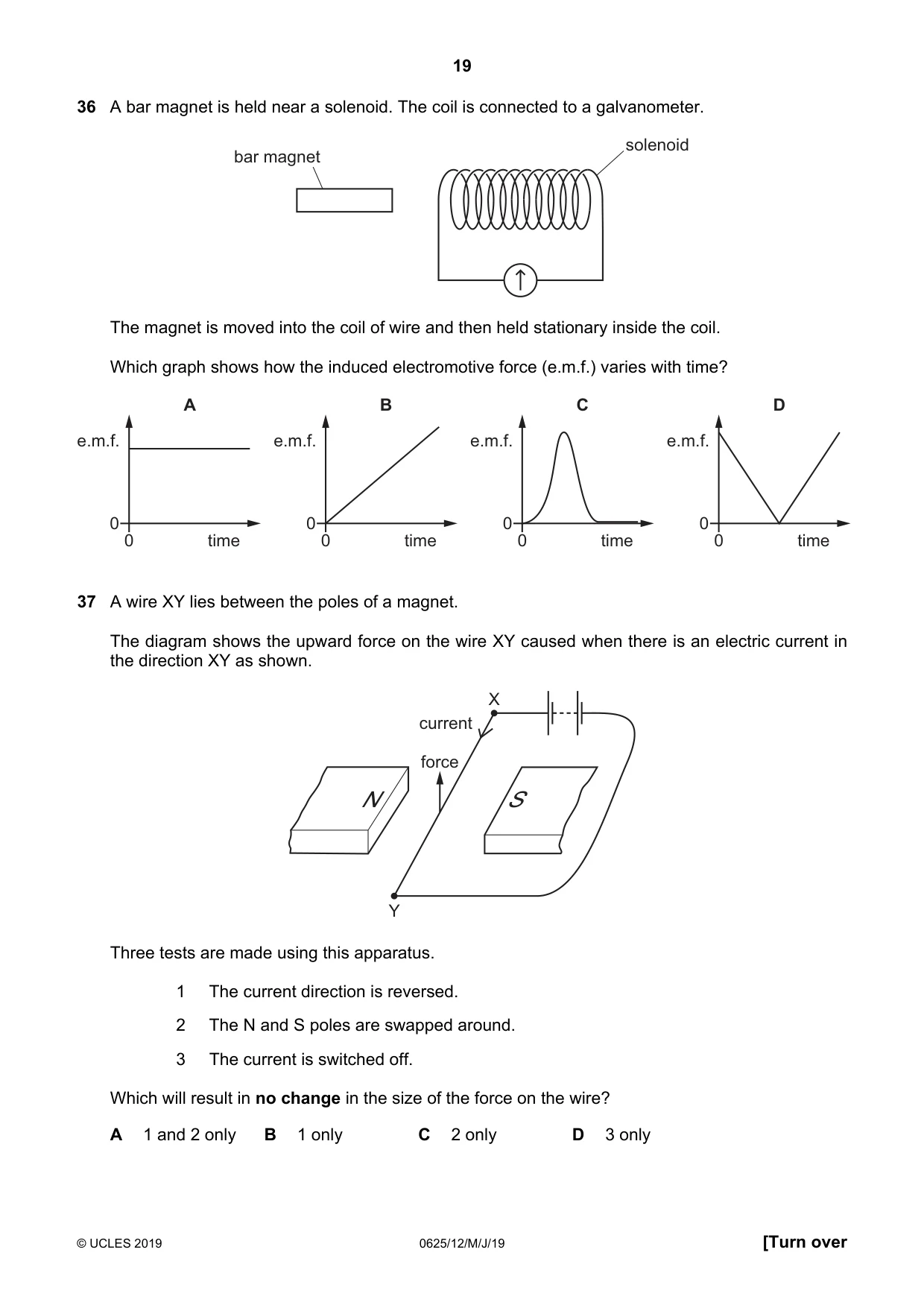
36 A bar magnet is held near a solenoid. The coil is connected to a galvanometer. solenoid bar magnet The magnet is moved into the coil of wire and then held stationary inside the coil. Which graph shows how the induced electromotive force (e.m.f.) varies with time? A B C D e.m.f. e.m.f. e.m.f. e.m.f. 0 0 0 0 0 time 0 time 0 time 0 time
Mark scheme: C
Q37 · A wire XY lies between the poles of a magnet
37 A wire XY lies between the poles of a magnet. The diagram shows the upward force on the wire XY caused when there is an electric current in the direction XY as shown. X current force N S Y Three tests are made using this apparatus. 1 The current direction is reversed. 2 The N and S poles are swapped around. 3 The current is switched off. Which will result in no change in the size of the force on the wire? A 1 and 2 only B 1 only C 2 only D 3 only
Mark scheme: A
Q38 · A simple model of the atom consists of small particles orbiting a central nucleus
38 A simple model of the atom consists of small particles orbiting a central nucleus. Which row is correct? charge on charge on nucleus orbiting particles A negative negative B negative positive C positive negative D positive positive
Mark scheme: C
Q39 · Which statement explains the meaning of the half-life of a radioactive isotope?
39 Which statement explains the meaning of the half-life of a radioactive isotope? A half the time taken for one nucleus of the isotope to decay B half the time taken for the isotope to decay completely C the time taken for half of the nuclei of the isotope to decay D the time taken for one nucleus of the isotope to split in half
Mark scheme: C
Q40 · The diagram shows a lead-lined box used for storing radioactive sources
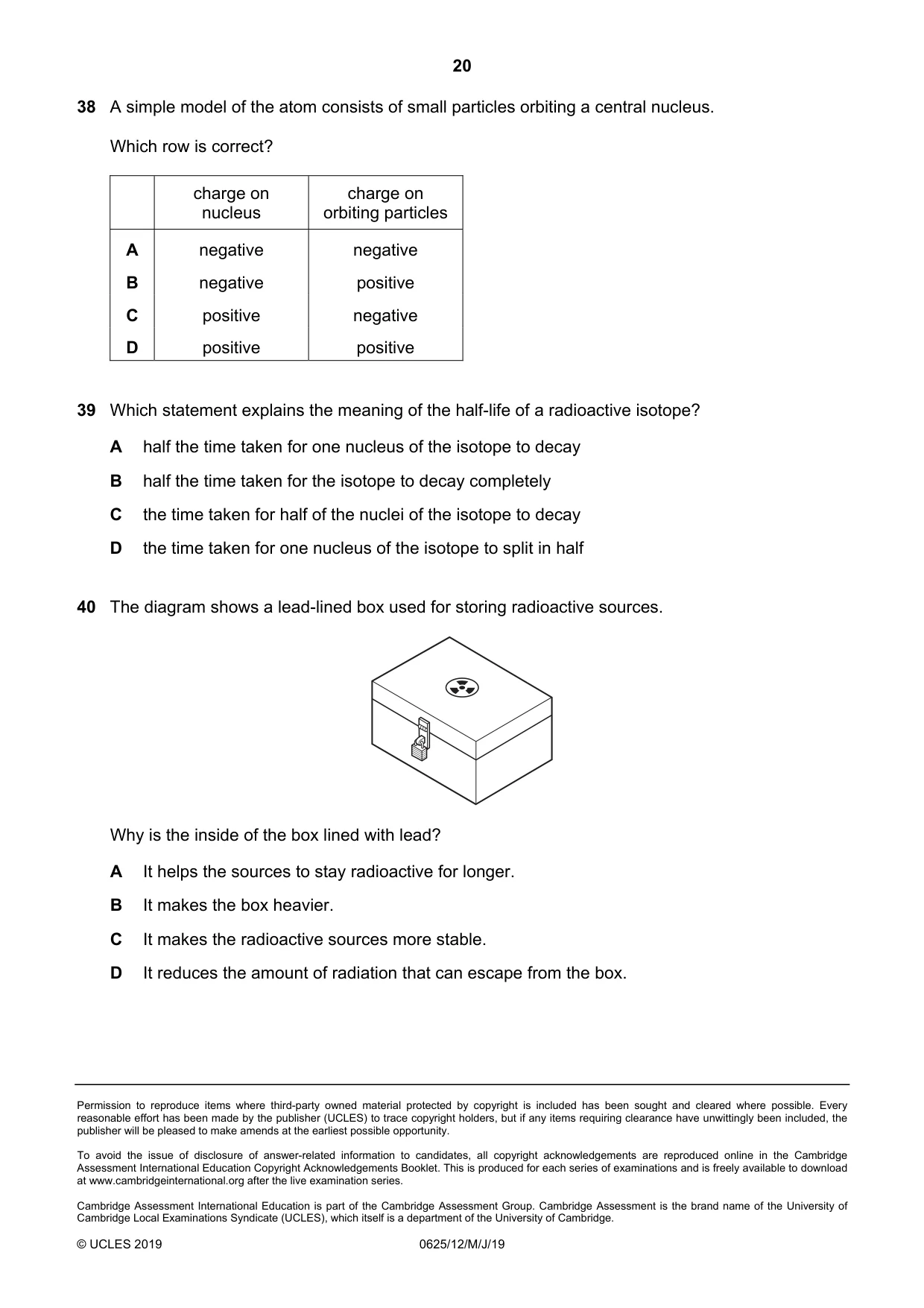
40 The diagram shows a lead-lined box used for storing radioactive sources. Why is the inside of the box lined with lead? A It helps the sources to stay radioactive for longer. B It makes the box heavier. C It makes the radioactive sources more stable. D It reduces the amount of radiation that can escape from the box.
Mark scheme: D
What was in this paper
The subtopics covered by these 40 questions, and how many questions each got. Open one in a new tab to see every Cambridge question on it.
4Energy, work and power3Forces3Kinetic particle model of matter3Density2Electromagnetic effects2General properties of waves2Light2Mass and weight2Motion2Radioactivity2Simple phenomena of magnetism2Sound2Thermal properties and temperature2Transfer of thermal energy2Electrical quantities1Electrical safety1Electromagnetic spectrum1Pressure1The nuclear model of the atom1What you needed in this session
Cambridge’s own grade thresholds for 2019 May/June, Paper 1 · Variant 2. A higher threshold means an easier paper — the bar moves with how the cohort did.