Cambridge IGCSE Physics 0625 — 2018 May/June Paper 1 · Variant 2
0625/12/M/J/18 · 40 questions · 40 marks · ≈45 min
The question paper and its mark scheme, free to read here and free to download. This is Cambridge’s own paper, exactly as it was sat.
Question paper16 pages
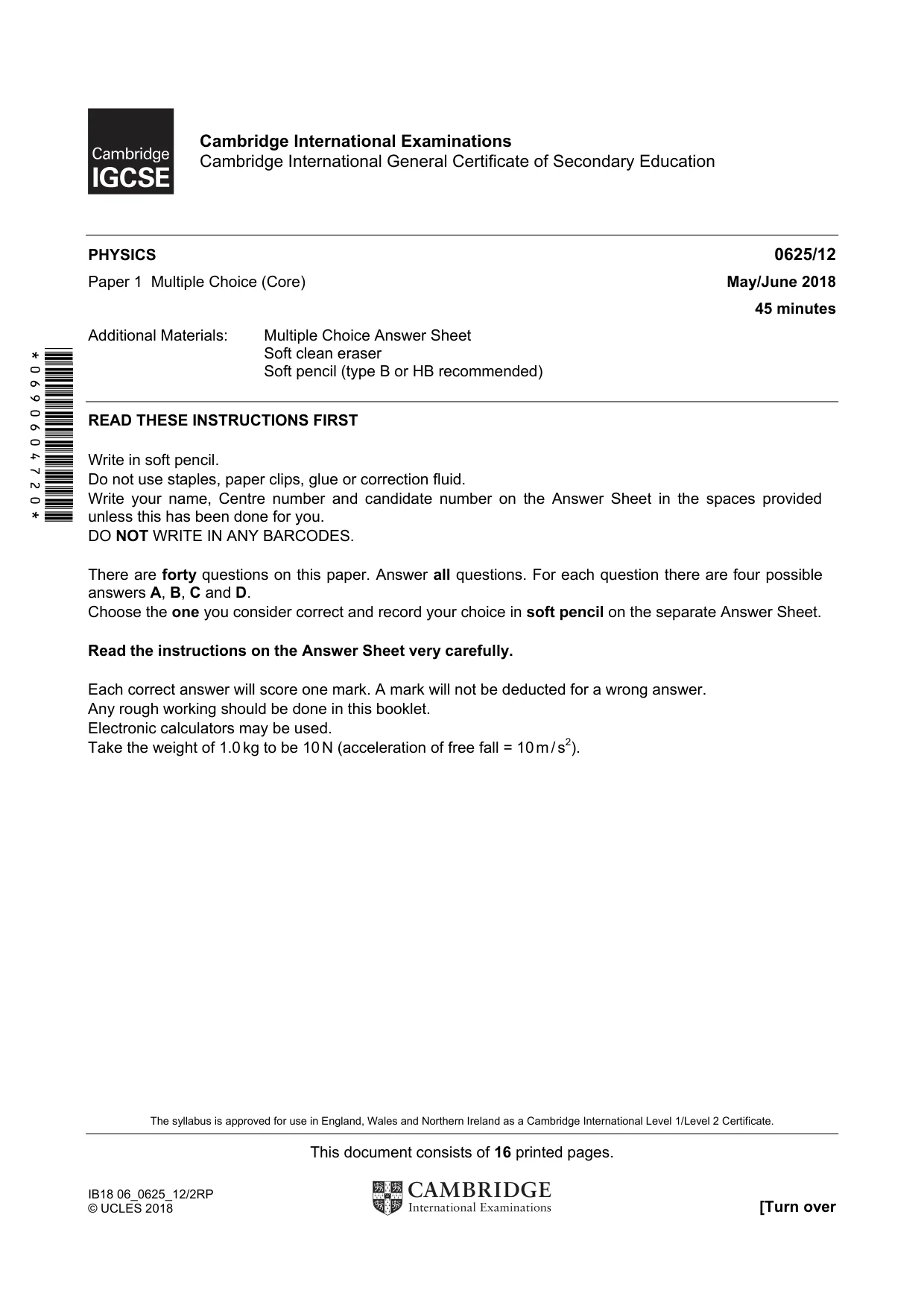
Mark scheme3 pages
Answers below. Sit the paper first if you are practising.
Questions as text
Q1 · A length of cotton is measured between two points on a ruler
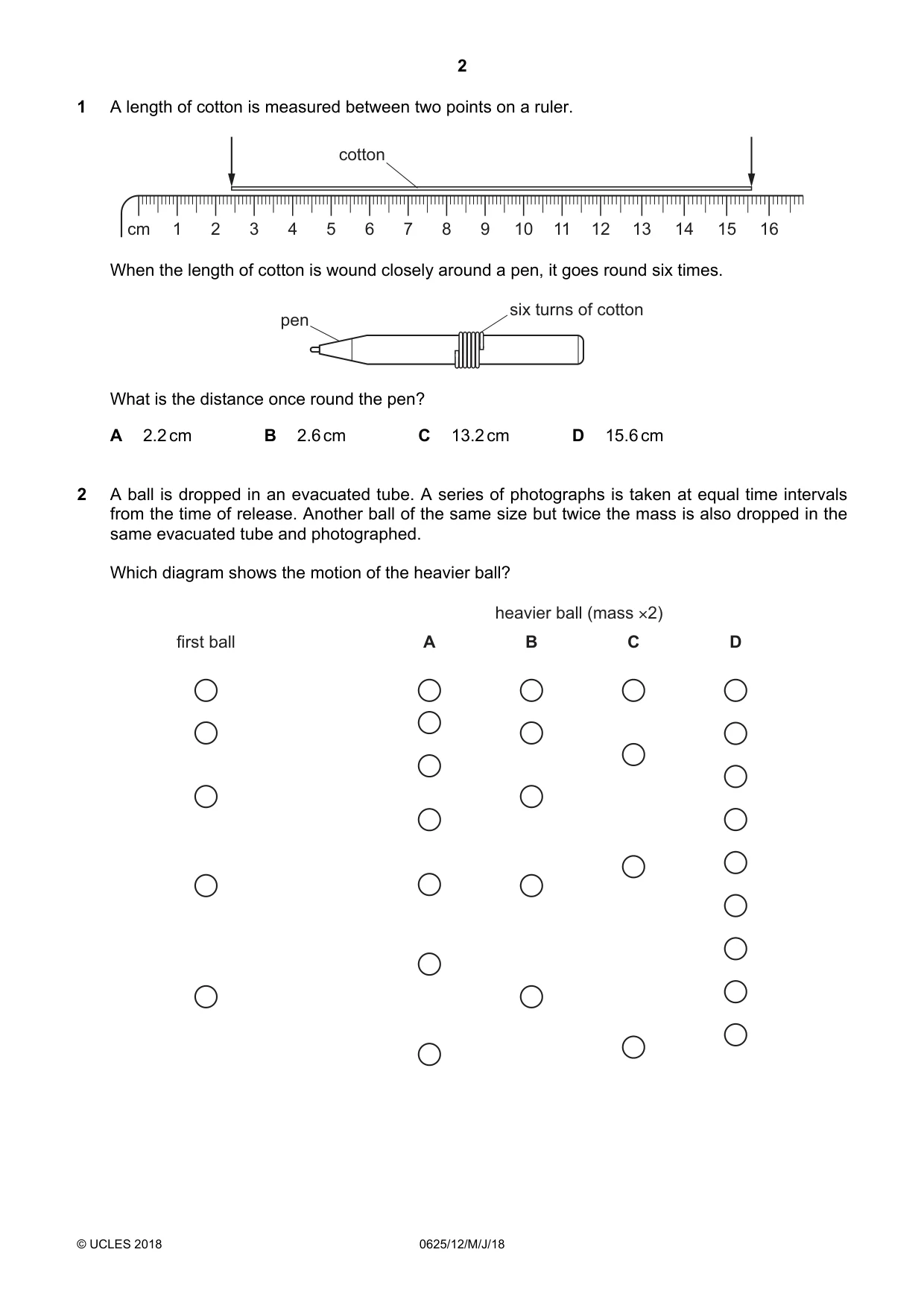
1 A length of cotton is measured between two points on a ruler. cotton cm 1 2 3 4 5 6 7 8 9 10 11 12 13 14 15 16 When the length of cotton is wound closely around a pen, it goes round six times. six turns of cotton pen What is the distance once round the pen? A 2.2 cm B 2.6 cm C 13.2 cm D 15.6 cm
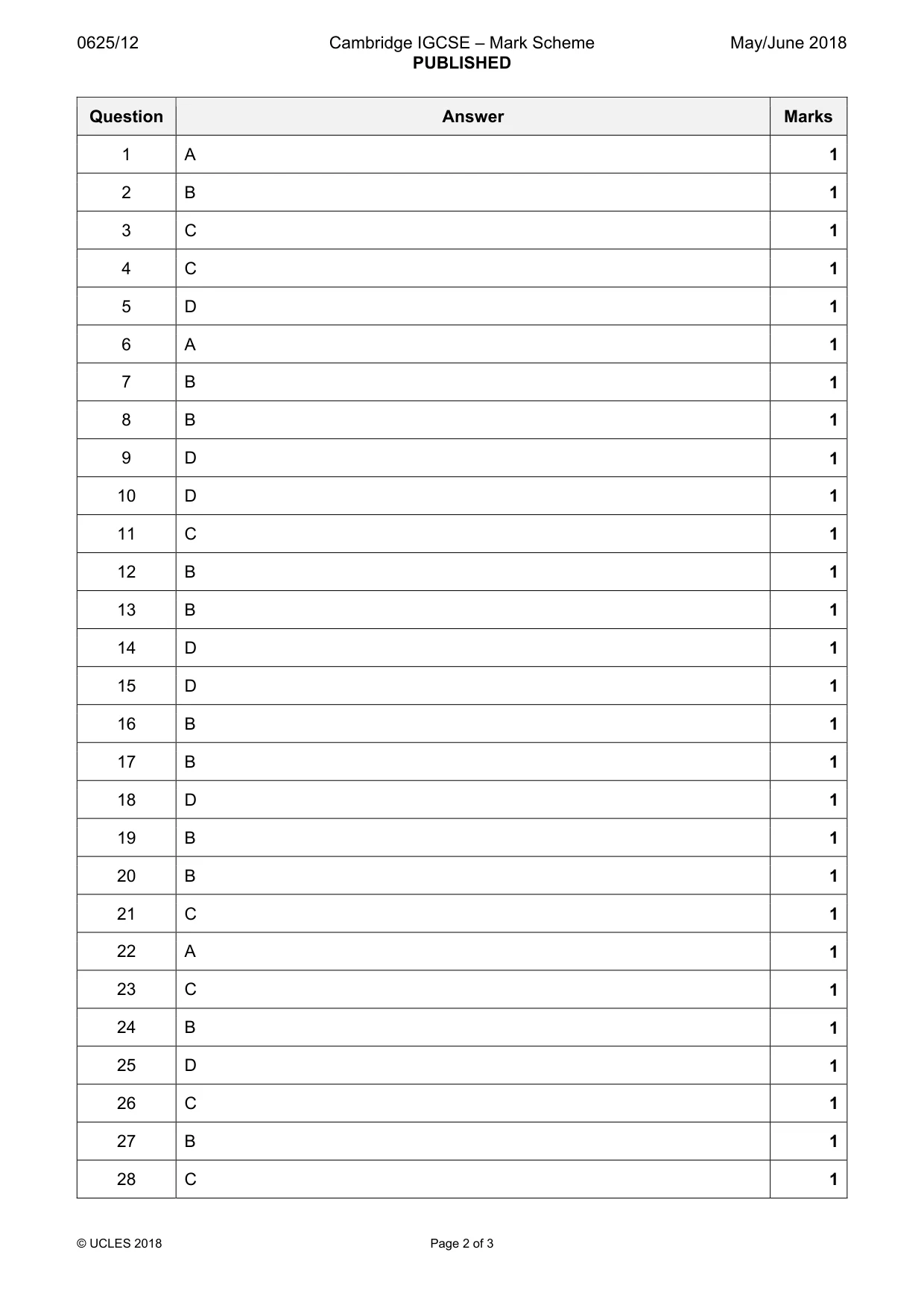
Mark scheme: A
More questions on Physical quantities and measurement techniques
Q2 · A ball is dropped in an evacuated tube
2 A ball is dropped in an evacuated tube. A series of photographs is taken at equal time intervals from the time of release. Another ball of the same size but twice the mass is also dropped in the same evacuated tube and photographed. Which diagram shows the motion of the heavier ball? heavier ball (mass ×2) first ball A B C D
Mark scheme: B
Q3 · A car takes 15 minutes to travel along a road that is 20 km long
3 A car takes 15 minutes to travel along a road that is 20 km long. What is the average speed of the car? A 0.75 km / h B 5.0 km / h C 80 km / h D 300 km / h
Mark scheme: C
Q4 · Which statement about the mass and the weight of an object is correct?
4 Which statement about the mass and the weight of an object is correct? A They are both affected by changes in the acceleration of free fall. B They are both forces. C They have different units. D Weight is calculated by dividing mass by the acceleration of free fall.
Mark scheme: C
Q5 · Two objects P and Q are placed in a beaker containing a liquid
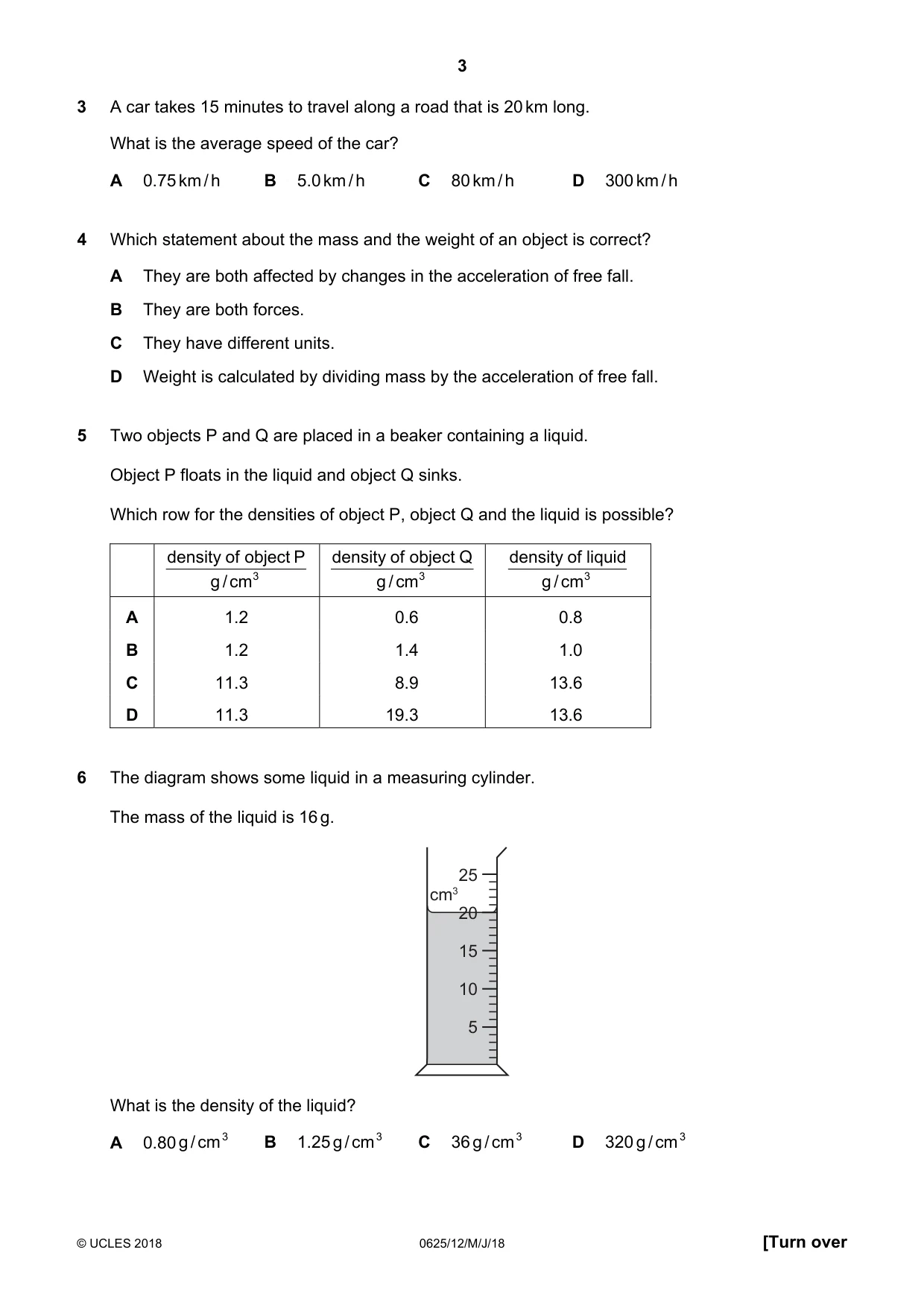
5 Two objects P and Q are placed in a beaker containing a liquid. Object P floats in the liquid and object Q sinks. Which row for the densities of object P, object Q and the liquid is possible? density of object P density of object Q density of liquid g / cm 3 g / cm 3 g / cm 3 A 1.2 0.6 0.8 B 1.2 1.4 1.0 C 11.3 8.9 13.6 D 11.3 19.3 13.6
Mark scheme: D
Q6 · The diagram shows some liquid in a measuring cylinder
6 The diagram shows some liquid in a measuring cylinder. The mass of the liquid is 16 g. 25 cm3 20 15 10 5 What is the density of the liquid? A 0.80 g / cm 3 B 1.25 g / cm 3 C 36 g / cm 3 D 320 g / cm 3
Mark scheme: A
Q7 · A spacecraft is travelling in space with no resultant force and no resultant moment…
7 A spacecraft is travelling in space with no resultant force and no resultant moment acting on it. Which statement about the spacecraft is correct? A Its direction is changing. B It is in equilibrium. C Its speed is decreasing. D Its speed is increasing.
Mark scheme: B
Q8 · A man holds a short ladder in four different positions
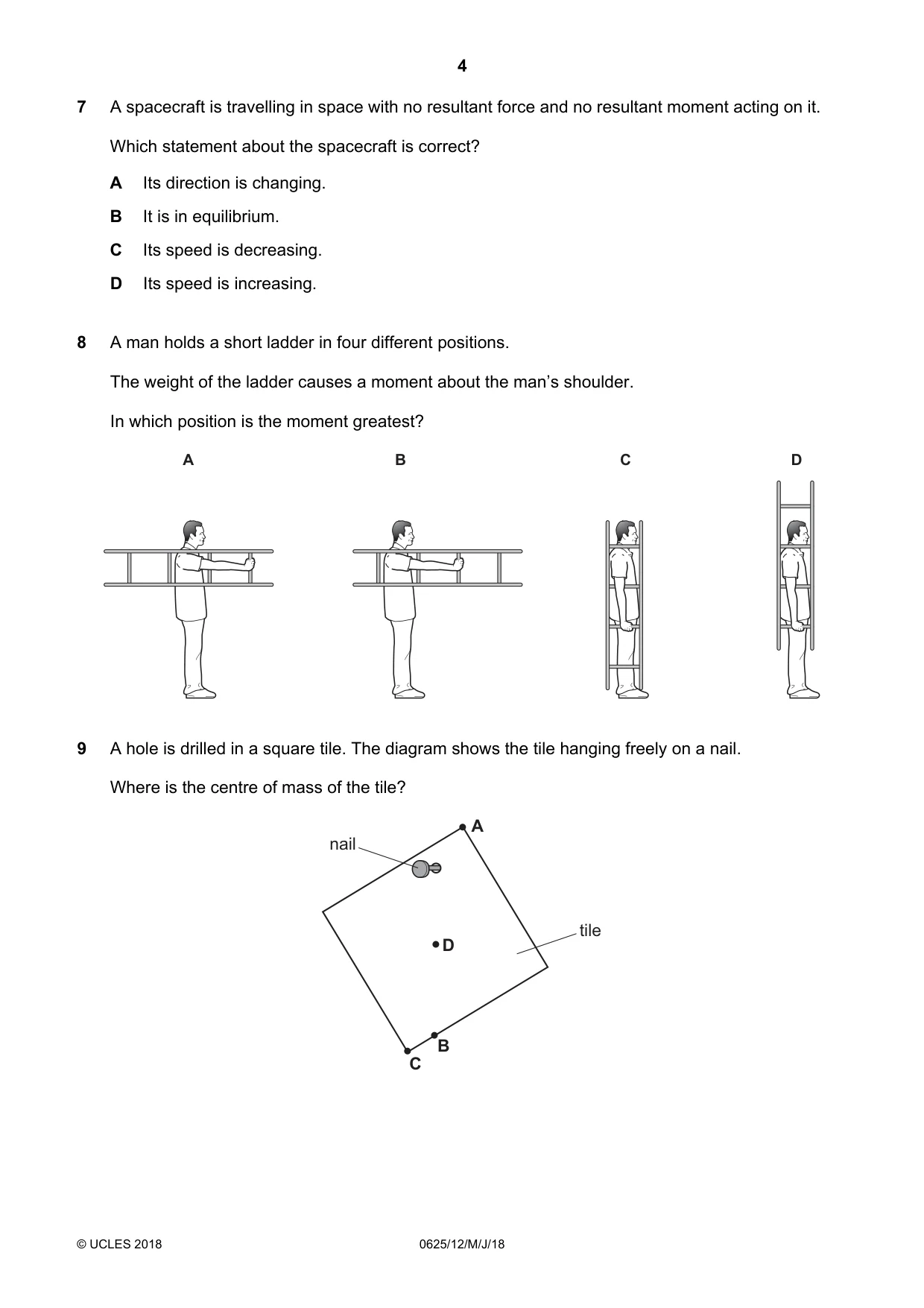
8 A man holds a short ladder in four different positions. The weight of the ladder causes a moment about the man’s shoulder. In which position is the moment greatest? A B C D
Mark scheme: B
Q9 · A hole is drilled in a square tile
9 A hole is drilled in a square tile. The diagram shows the tile hanging freely on a nail. Where is the centre of mass of the tile? A nail tile D B C
Mark scheme: D
Q10 · Which source of energy is renewable?
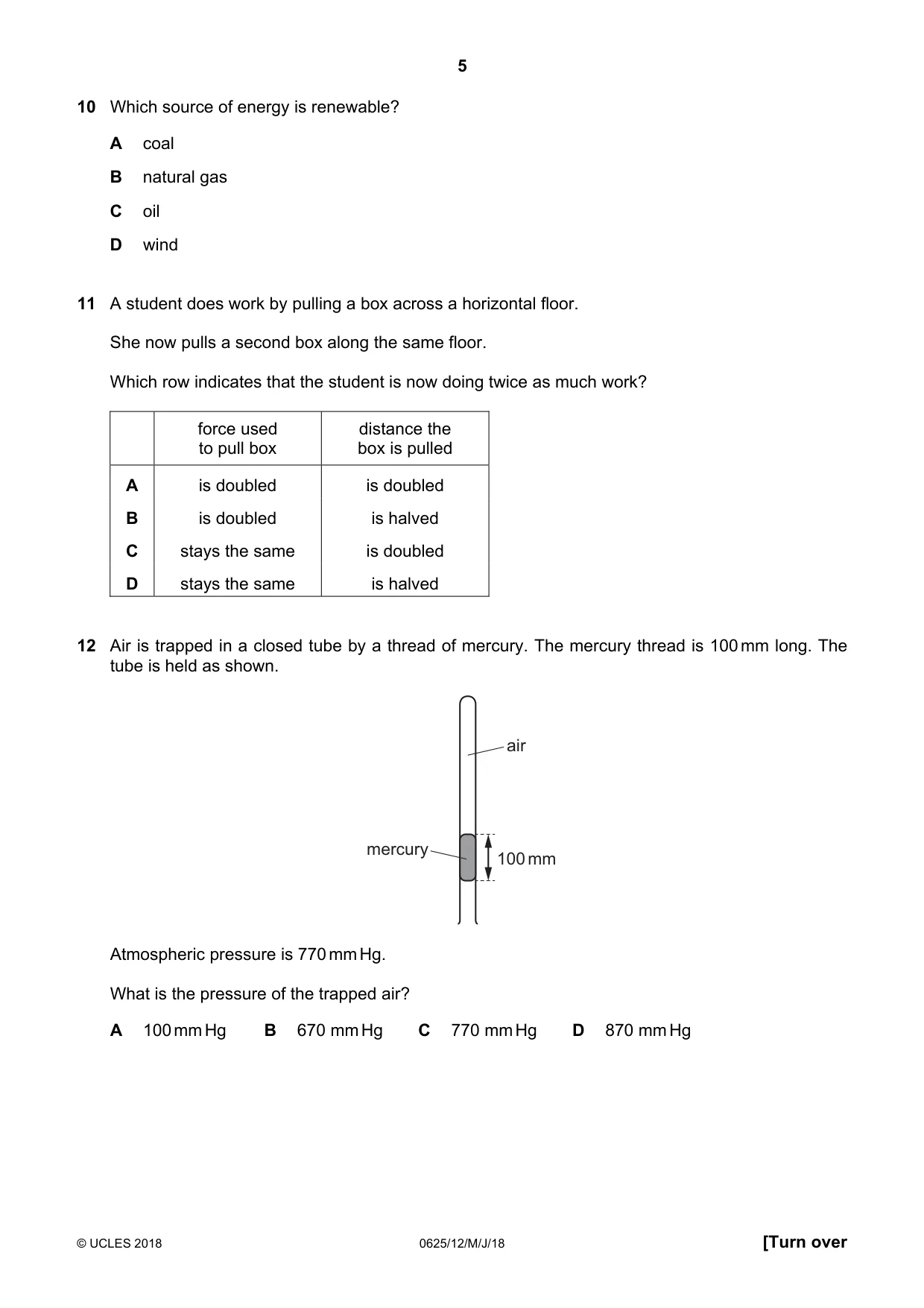
10 Which source of energy is renewable? A coal B natural gas C oil D wind
Mark scheme: D
Q11 · A student does work by pulling a box across a horizontal floor
11 A student does work by pulling a box across a horizontal floor. She now pulls a second box along the same floor. Which row indicates that the student is now doing twice as much work? force used distance the to pull box box is pulled A is doubled is doubled B is doubled is halved C stays the same is doubled D stays the same is halved
Mark scheme: C
Q12 · Air is trapped in a closed tube by a thread of mercury
12 Air is trapped in a closed tube by a thread of mercury. The mercury thread is 100 mm long. The tube is held as shown. air mercury 100 mm Atmospheric pressure is 770 mm Hg. What is the pressure of the trapped air? A 100 mm Hg B 670 mm Hg C 770 mm Hg D 870 mm Hg
Mark scheme: B
Q13 · Brownian motion is the random motion of particles due to molecular bombardment
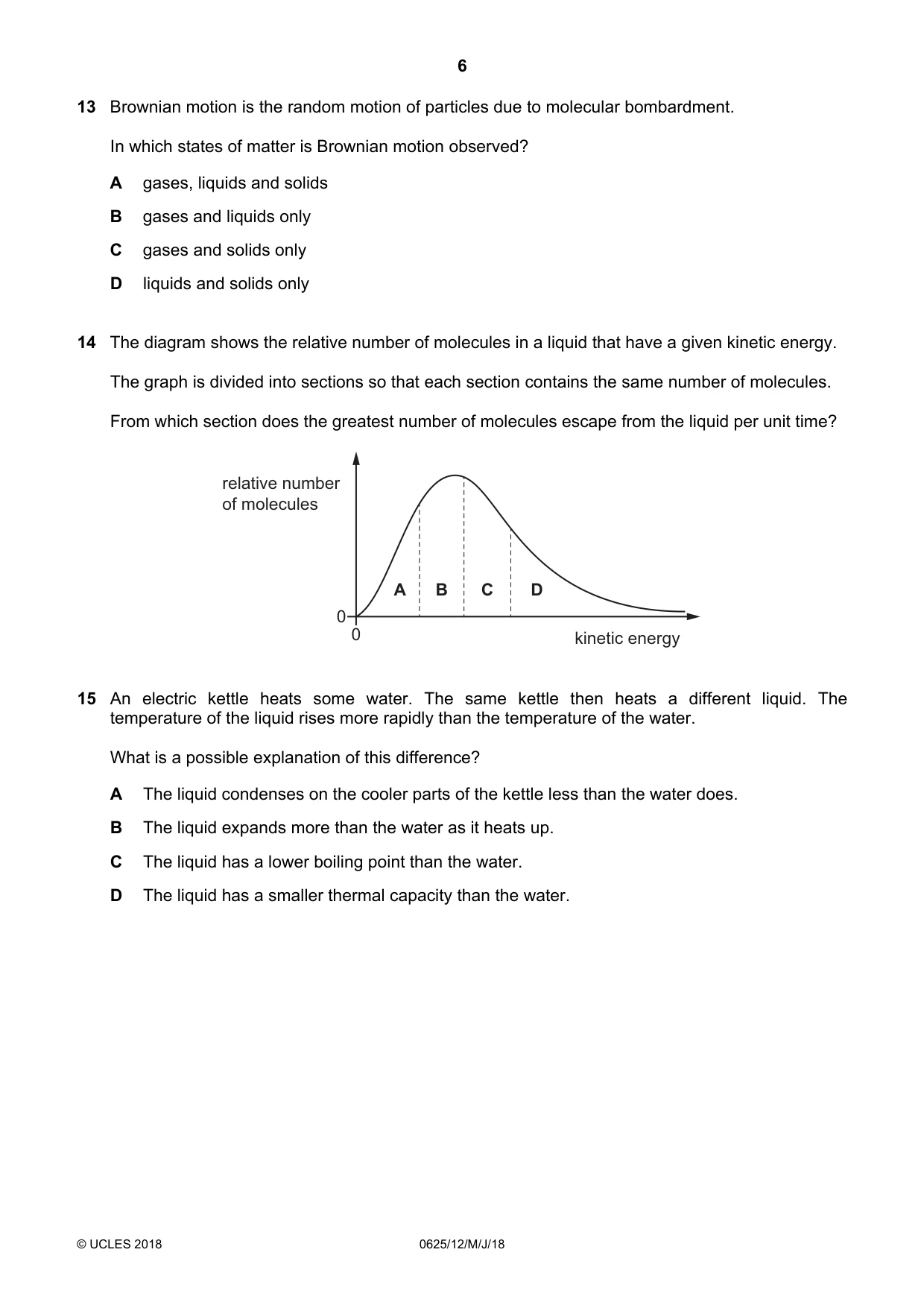
13 Brownian motion is the random motion of particles due to molecular bombardment. In which states of matter is Brownian motion observed? A gases, liquids and solids B gases and liquids only C gases and solids only D liquids and solids only
Mark scheme: B
Q14 · The diagram shows the relative number of molecules in a liquid that have a given kinetic…
14 The diagram shows the relative number of molecules in a liquid that have a given kinetic energy. The graph is divided into sections so that each section contains the same number of molecules. From which section does the greatest number of molecules escape from the liquid per unit time? relative number of molecules A B C D 0 0 kinetic energy
Mark scheme: D
Q15 · An electric kettle heats some water
15 An electric kettle heats some water. The same kettle then heats a different liquid. The temperature of the liquid rises more rapidly than the temperature of the water. What is a possible explanation of this difference? A The liquid condenses on the cooler parts of the kettle less than the water does. B The liquid expands more than the water as it heats up. C The liquid has a lower boiling point than the water. D The liquid has a smaller thermal capacity than the water.
Mark scheme: D
Q16 · A wooden wheel can be strengthened by putting a tight circle of iron around it
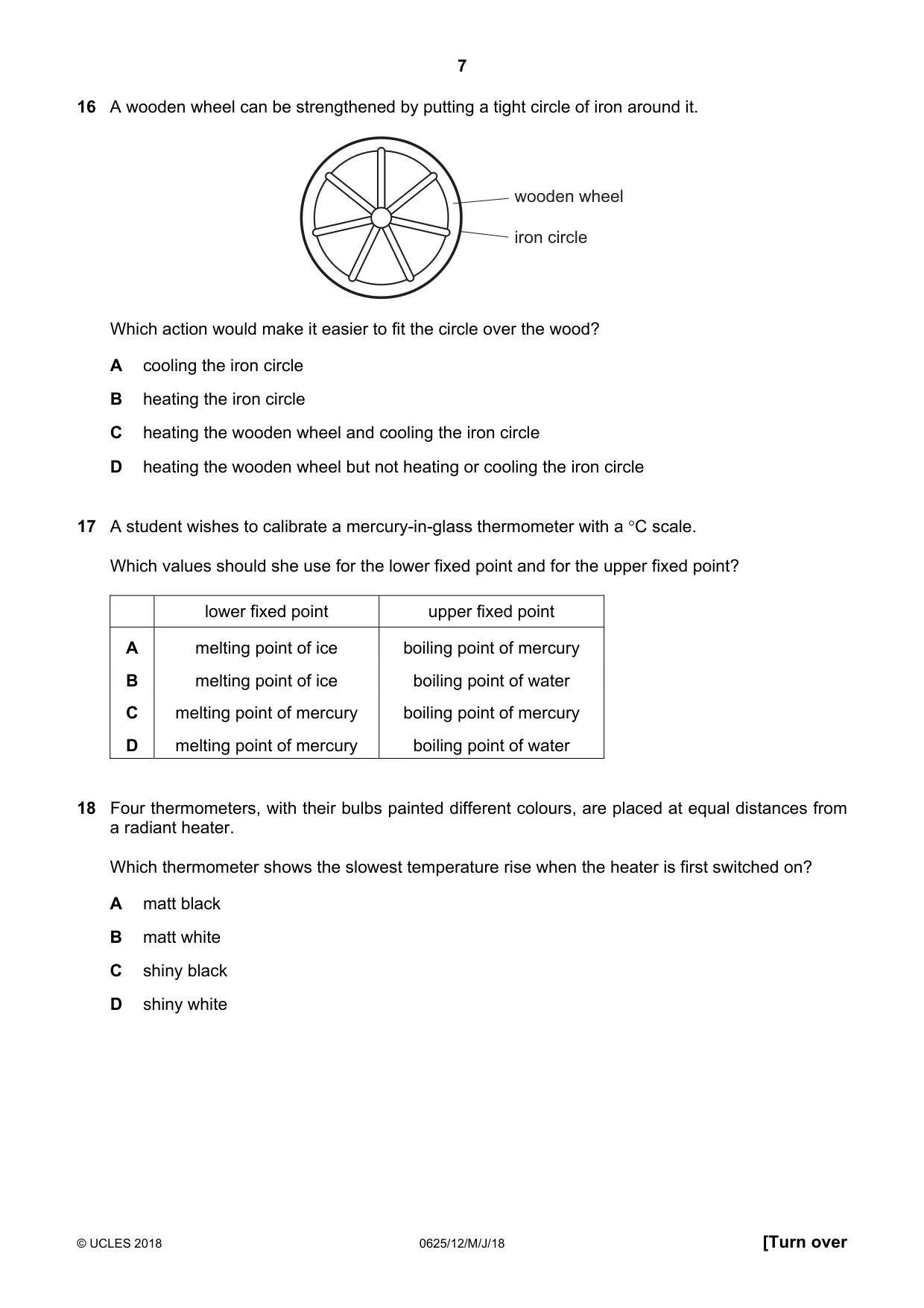
16 A wooden wheel can be strengthened by putting a tight circle of iron around it. wooden wheel iron circle Which action would make it easier to fit the circle over the wood? A cooling the iron circle B heating the iron circle C heating the wooden wheel and cooling the iron circle D heating the wooden wheel but not heating or cooling the iron circle
Mark scheme: B
Q17 · A student wishes to calibrate a mercury-in-glass thermometer with a °C scale
17 A student wishes to calibrate a mercury-in-glass thermometer with a °C scale. Which values should she use for the lower fixed point and for the upper fixed point? lower fixed point upper fixed point A melting point of ice boiling point of mercury B melting point of ice boiling point of water C melting point of mercury boiling point of mercury D melting point of mercury boiling point of water
Mark scheme: B
Q18 · Four thermometers, with their bulbs painted different colours, are placed at equal…
18 Four thermometers, with their bulbs painted different colours, are placed at equal distances from a radiant heater. Which thermometer shows the slowest temperature rise when the heater is first switched on? A matt black B matt white C shiny black D shiny white
Mark scheme: D
Q19 · A tank contains water
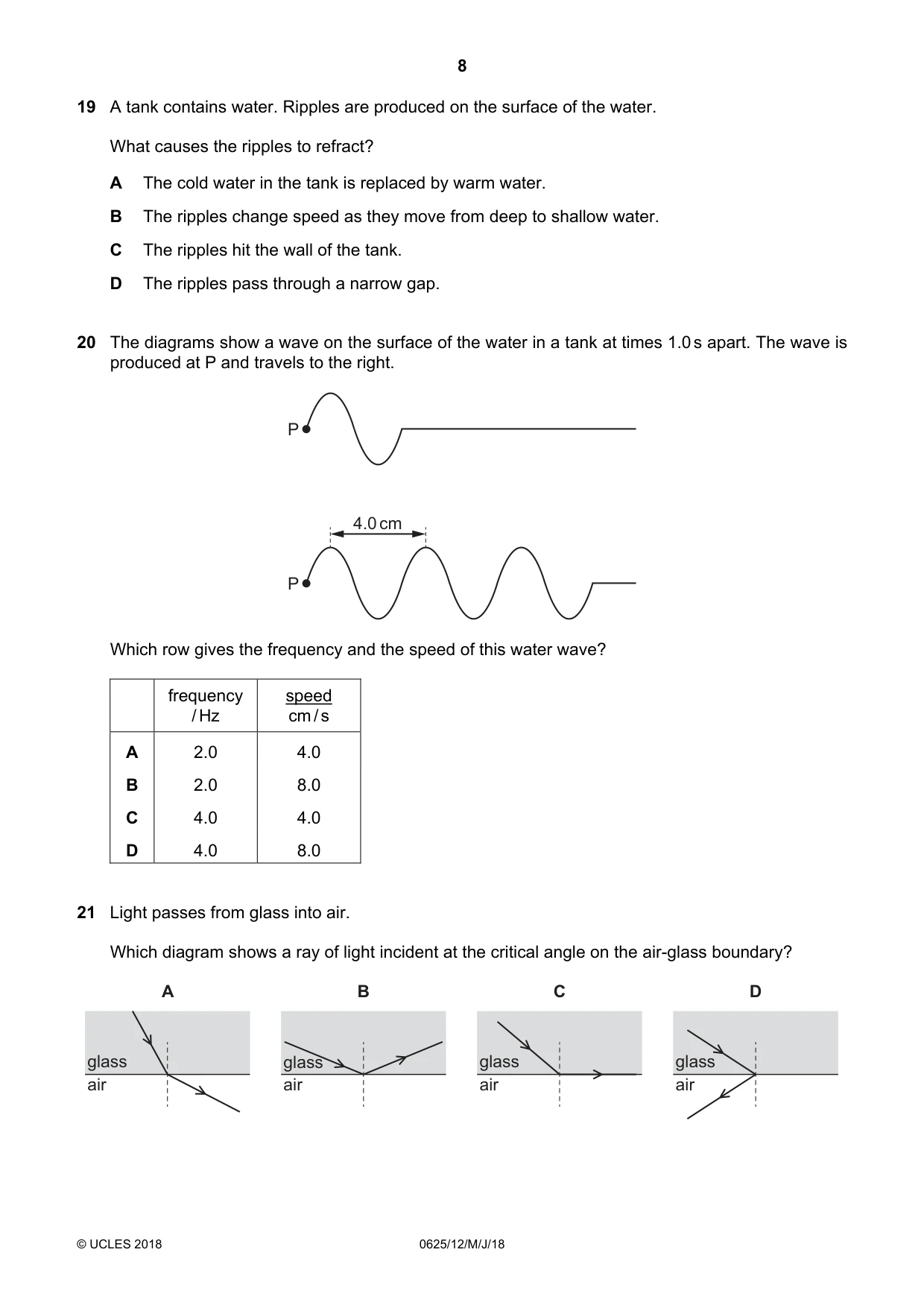
19 A tank contains water. Ripples are produced on the surface of the water. What causes the ripples to refract? A The cold water in the tank is replaced by warm water. B The ripples change speed as they move from deep to shallow water. C The ripples hit the wall of the tank. D The ripples pass through a narrow gap.
Mark scheme: B
Q20 · The diagrams show a wave on the surface of the water in a tank at times 1.0 s apart
20 The diagrams show a wave on the surface of the water in a tank at times 1.0 s apart. The wave is produced at P and travels to the right. P 4.0 cm P Which row gives the frequency and the speed of this water wave? frequency speed / Hz cm / s A 2.0 4.0 B 2.0 8.0 C 4.0 4.0 D 4.0 8.0
Mark scheme: B
Q21 · Light passes from glass into air
21 Light passes from glass into air. Which diagram shows a ray of light incident at the critical angle on the air-glass boundary? A B C D glass glass glass glass air air air air
Mark scheme: C
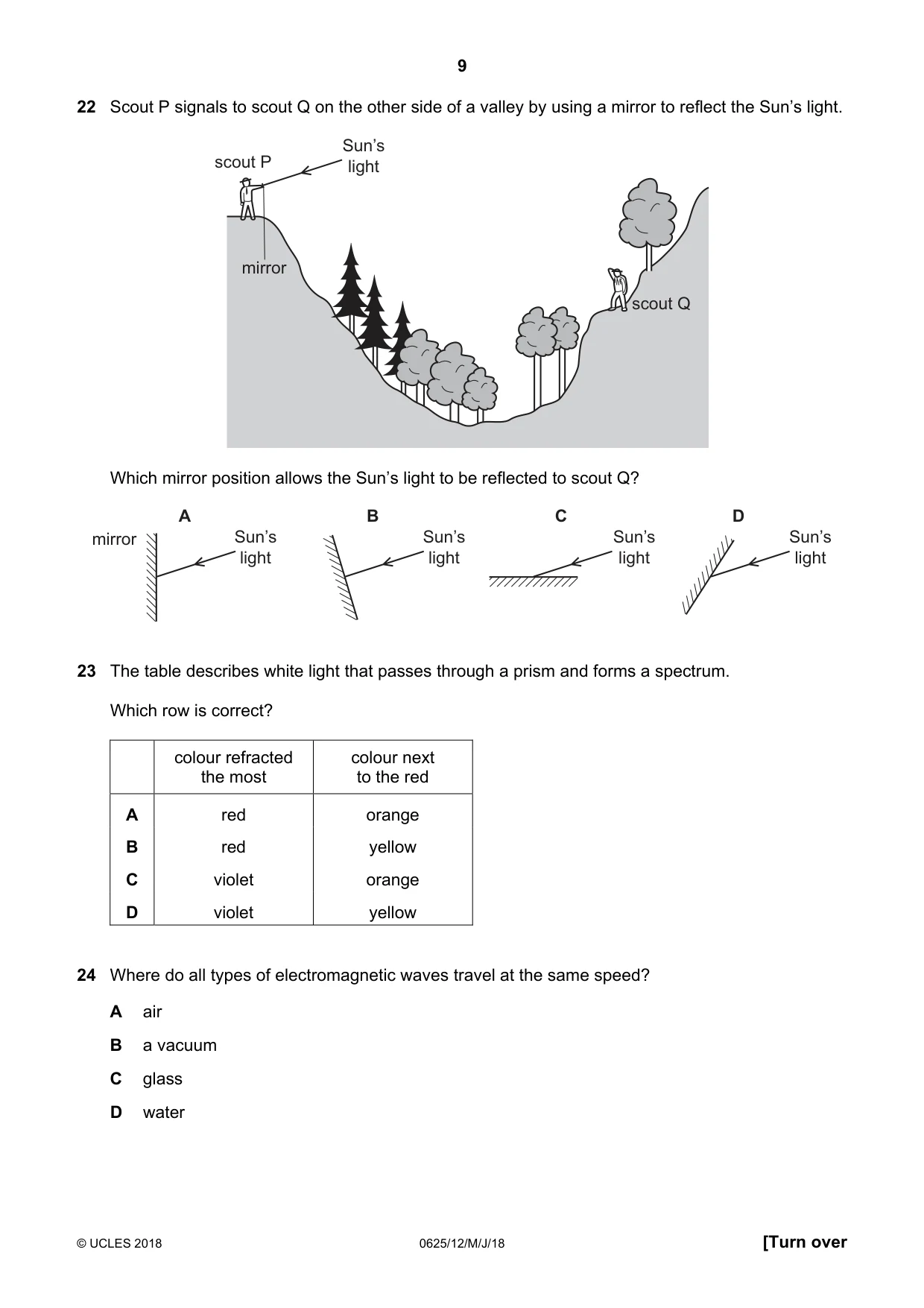
Q22 · Scout P signals to scout Q on the other side of a valley by using a mirror to reflect the…
22 Scout P signals to scout Q on the other side of a valley by using a mirror to reflect the Sun’s light. Sun’s scout P light mirror scout Q Which mirror position allows the Sun’s light to be reflected to scout Q? A B C D mirror Sun’s Sun’s Sun’s Sun’s light light light light
Mark scheme: A
Q23 · The table describes white light that passes through a prism and forms a spectrum
23 The table describes white light that passes through a prism and forms a spectrum. Which row is correct? colour refracted colour next the most to the red A red orange B red yellow C violet orange D violet yellow
Mark scheme: C
Q24 · Where do all types of electromagnetic waves travel at the same speed?
24 Where do all types of electromagnetic waves travel at the same speed? A air B a vacuum C glass D water
Mark scheme: B
Q25 · A siren is emitting a sound
25 A siren is emitting a sound. As time passes, the sound becomes louder and higher pitched. What is happening to the amplitude and to the frequency of the emitted sound wave? amplitude frequency A decreasing decreasing B decreasing increasing C increasing decreasing D increasing increasing
Mark scheme: D
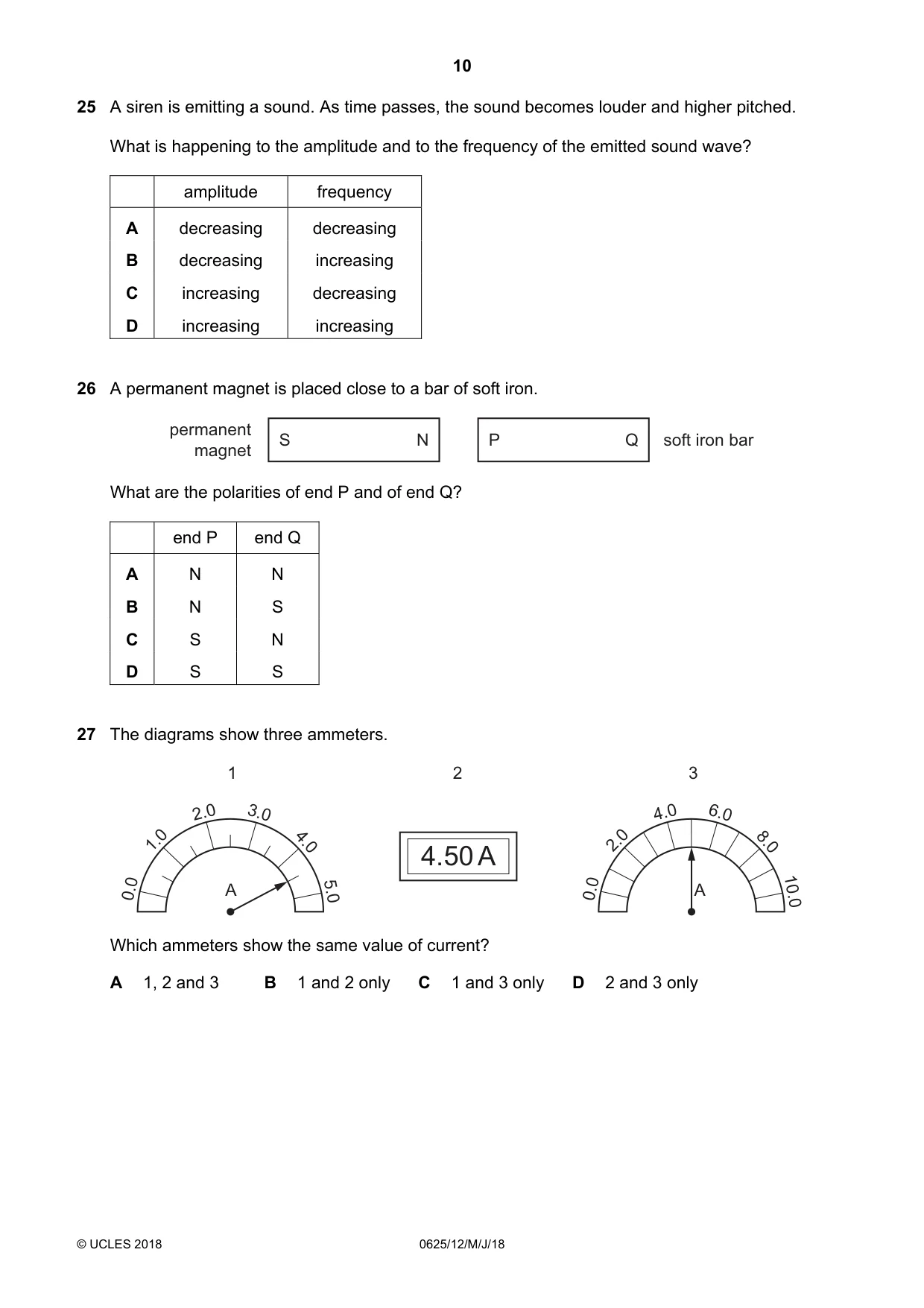
Q26 · A permanent magnet is placed close to a bar of soft iron
26 A permanent magnet is placed close to a bar of soft iron. permanent S N P Q soft iron bar magnet What are the polarities of end P and of end Q? end P end Q A N N B N S C S N D S S
Mark scheme: C
Q27 · The diagrams show three ammeters
27 The diagrams show three ammeters. 1 2 3 2.0 3.0 4.0 6.0 1.0 4.0 2.0 8.0 4.50 A 0.0 5.0 0.0 10.0 A A Which ammeters show the same value of current? A 1, 2 and 3 B 1 and 2 only C 1 and 3 only D 2 and 3 only
Mark scheme: B
Q28 · A student measures the potential difference across a device and the current in the device
28 A student measures the potential difference across a device and the current in the device. Which calculation gives the resistance of the device? A current + potential difference B current ÷ potential difference C potential difference ÷ current D potential difference × current
Mark scheme: C
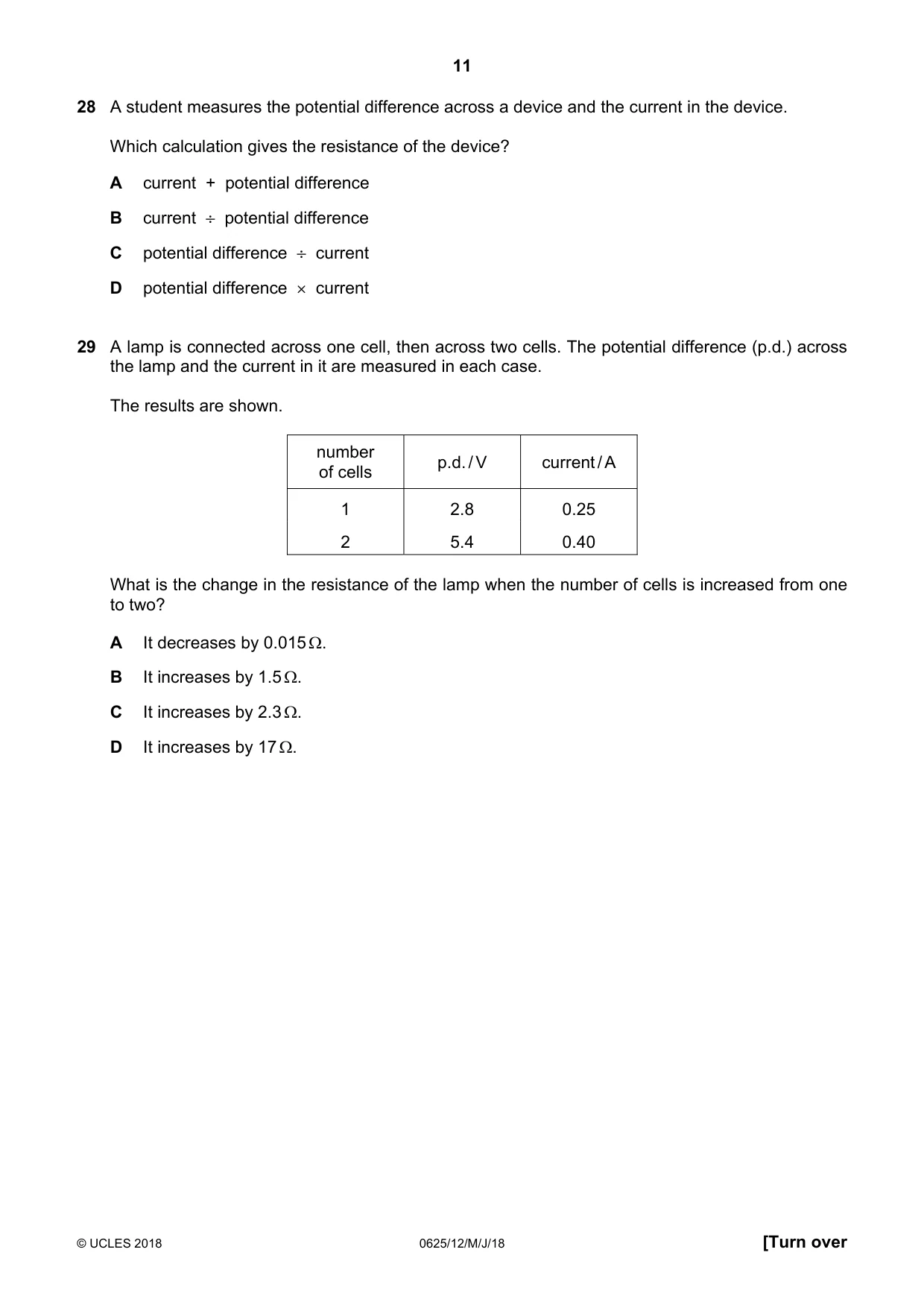
Q29 · A lamp is connected across one cell, then across two cells
29 A lamp is connected across one cell, then across two cells. The potential difference (p.d.) across the lamp and the current in it are measured in each case. The results are shown. number p.d. / V current / A of cells 1 2.8 0.25 2 5.4 0.40 What is the change in the resistance of the lamp when the number of cells is increased from one to two? A It decreases by 0.015 Ω. B It increases by 1.5 Ω. C It increases by 2.3 Ω. D It increases by 17 Ω.
Mark scheme: C
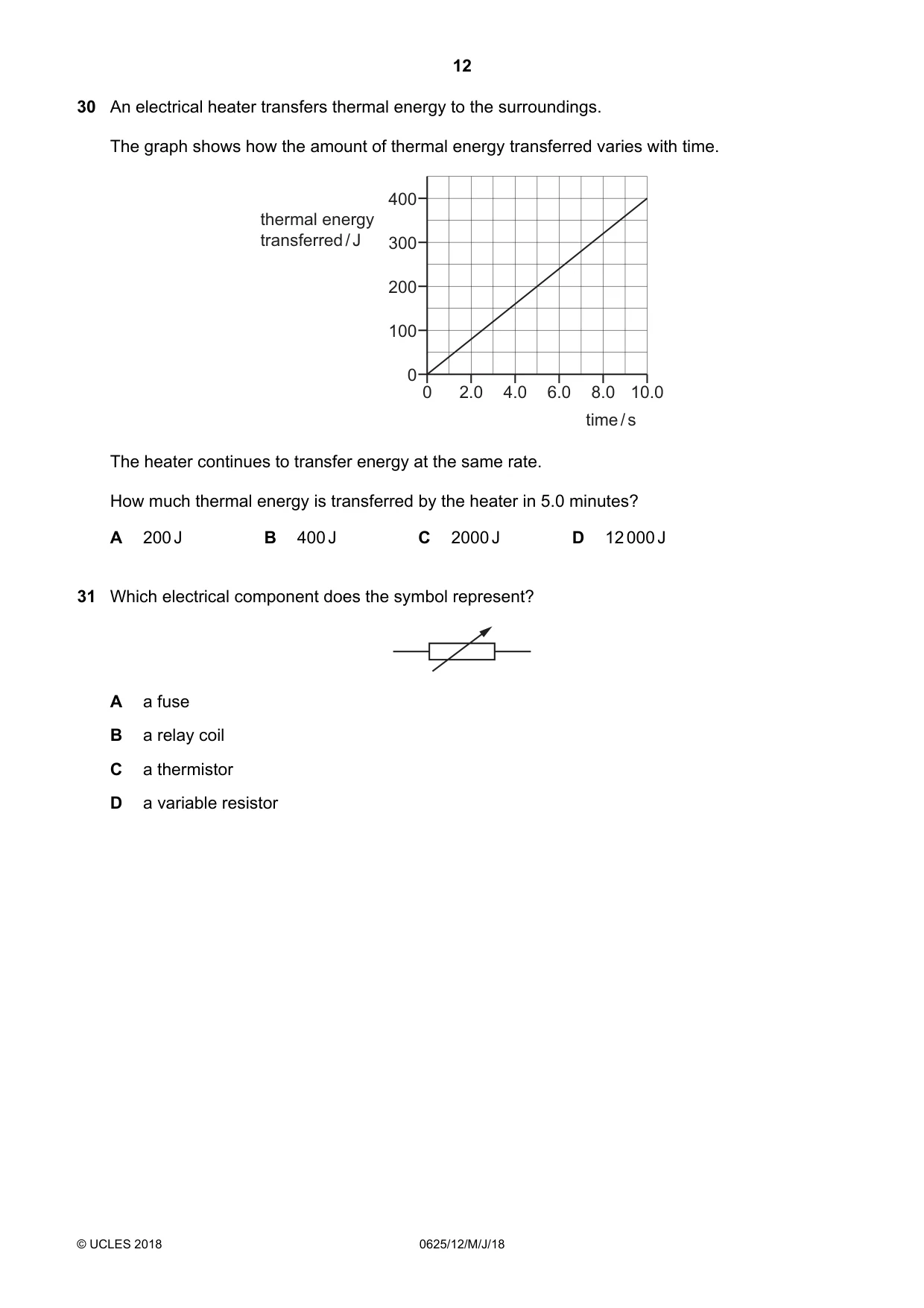
Q30 · An electrical heater transfers thermal energy to the surroundings
30 An electrical heater transfers thermal energy to the surroundings. The graph shows how the amount of thermal energy transferred varies with time. 400 thermal energy transferred / J 300 200 100 0 0 2.0 4.0 6.0 8.0 10.0 time / s The heater continues to transfer energy at the same rate. How much thermal energy is transferred by the heater in 5.0 minutes? A 200 J B 400 J C 2000 J D 12 000 J
Mark scheme: D
Q31 · Which electrical component does the symbol represent?
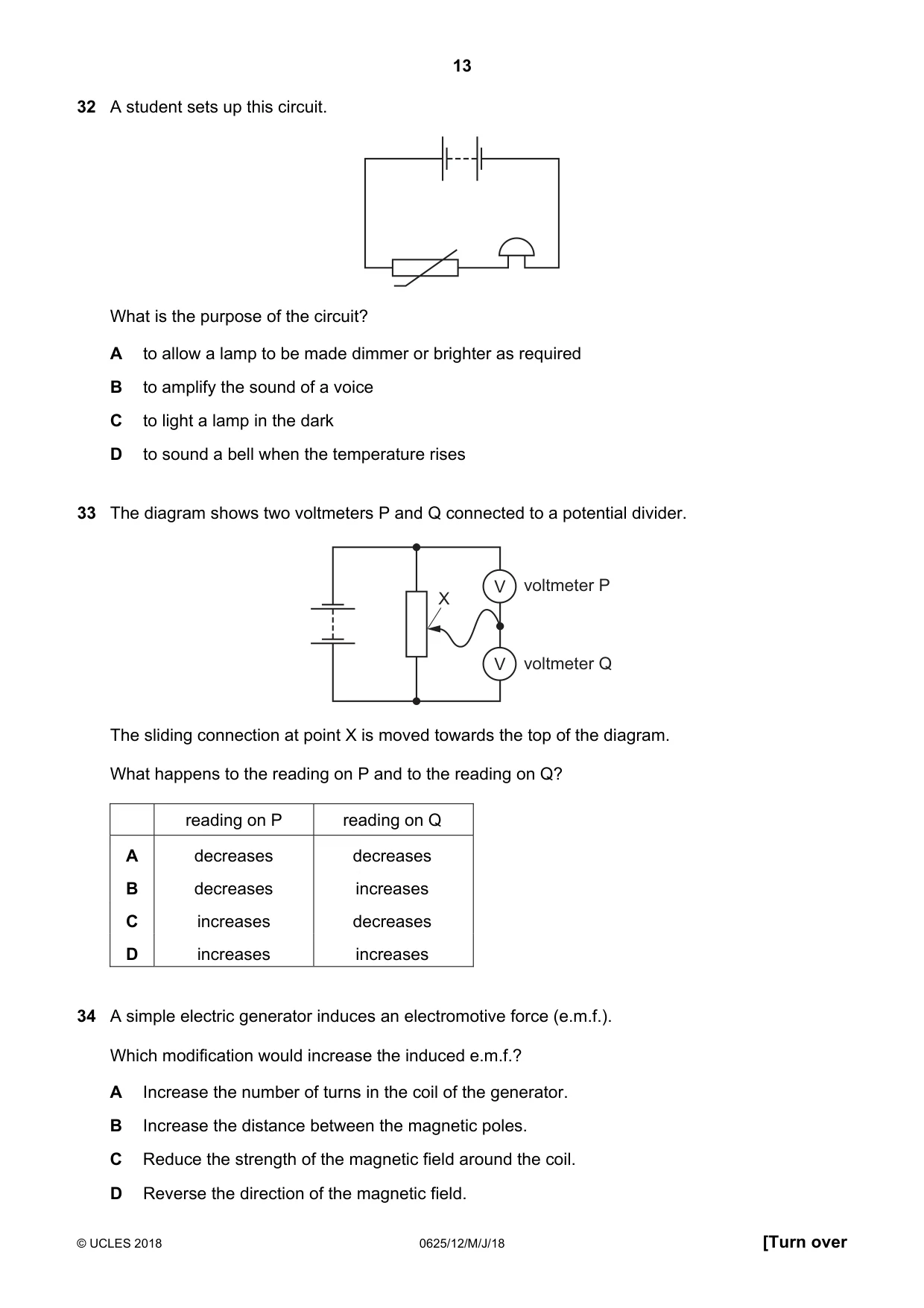
31 Which electrical component does the symbol represent? A a fuse B a relay coil C a thermistor D a variable resistor
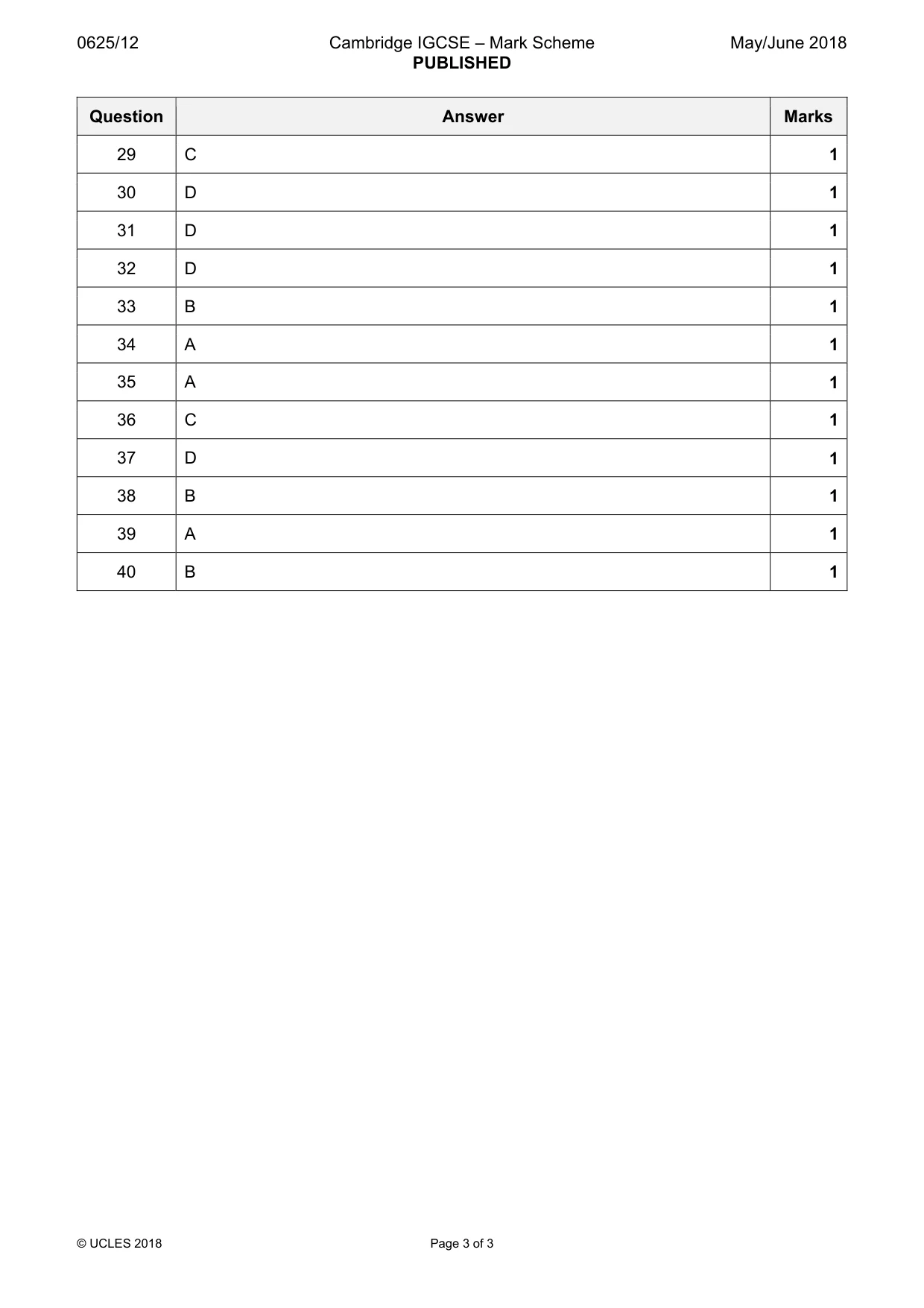
Mark scheme: D
Q32 · A student sets up this circuit
32 A student sets up this circuit. What is the purpose of the circuit? A to allow a lamp to be made dimmer or brighter as required B to amplify the sound of a voice C to light a lamp in the dark D to sound a bell when the temperature rises
Mark scheme: D
Q33 · The diagram shows two voltmeters P and Q connected to a potential divider
33 The diagram shows two voltmeters P and Q connected to a potential divider. V voltmeter P X V voltmeter Q The sliding connection at point X is moved towards the top of the diagram. What happens to the reading on P and to the reading on Q? reading on P reading on Q A decreases decreases B decreases increases C increases decreases D increases increases
Mark scheme: B
Q34 · A simple electric generator induces an electromotive force (e.m.f.)
34 A simple electric generator induces an electromotive force (e.m.f.). Which modification would increase the induced e.m.f.? A Increase the number of turns in the coil of the generator. B Increase the distance between the magnetic poles. C Reduce the strength of the magnetic field around the coil. D Reverse the direction of the magnetic field.
Mark scheme: A
Q35 · A transformer has Np turns in the primary coil and Ns turns in the secondary coil
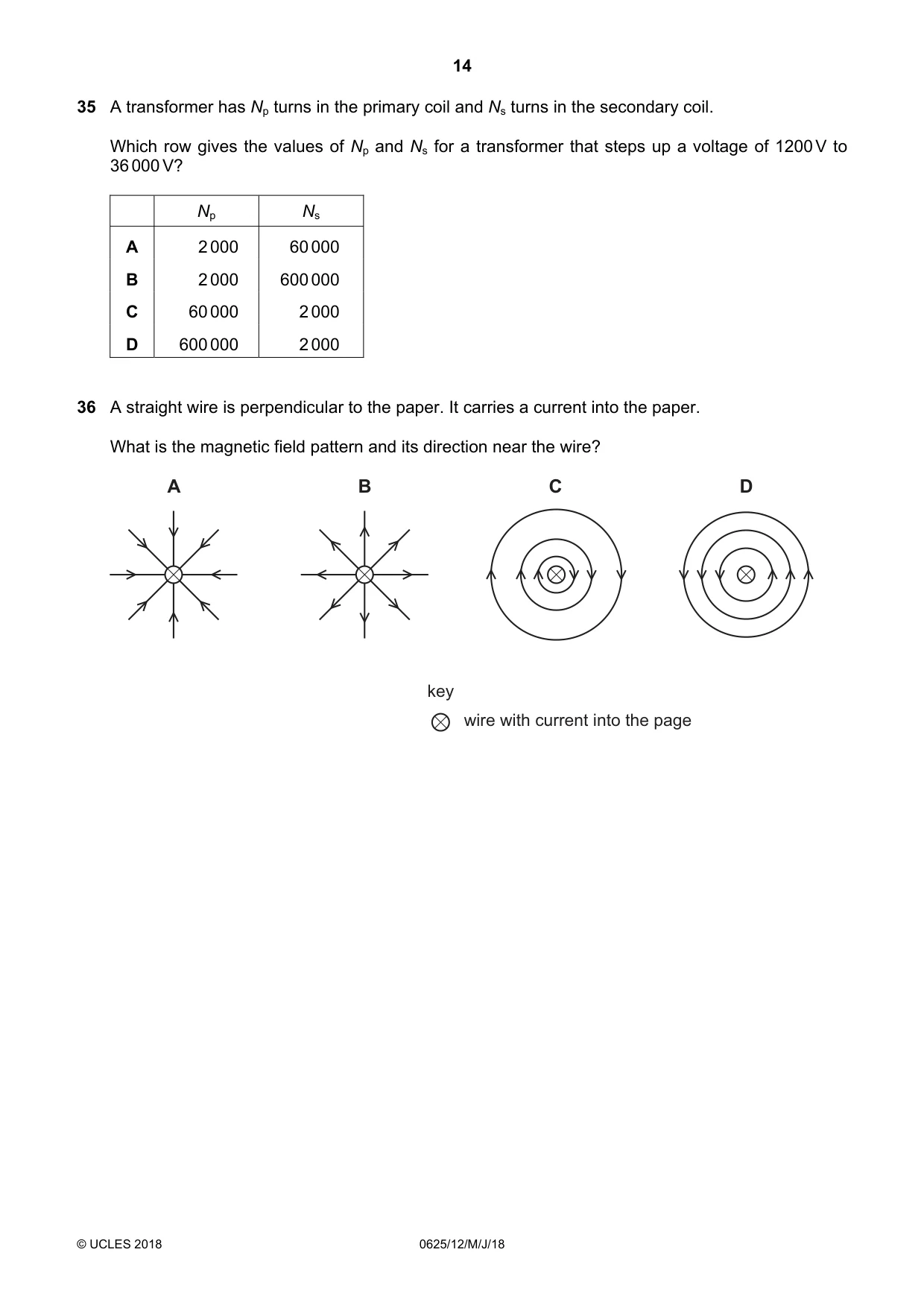
35 A transformer has Np turns in the primary coil and Ns turns in the secondary coil. Which row gives the values of Np and Ns for a transformer that steps up a voltage of 1200 V to 36 000 V? Np Ns A 2 000 60 000 B 2 000 600 000 C 60 000 2 000 D 600 000 2 000
Mark scheme: A
Q36 · A straight wire is perpendicular to the paper
36 A straight wire is perpendicular to the paper. It carries a current into the paper. What is the magnetic field pattern and its direction near the wire? A B C D key wire with current into the page
Mark scheme: C
Q37 · In the atomic model, an atom consists of a central mass, orbited by much smaller particles
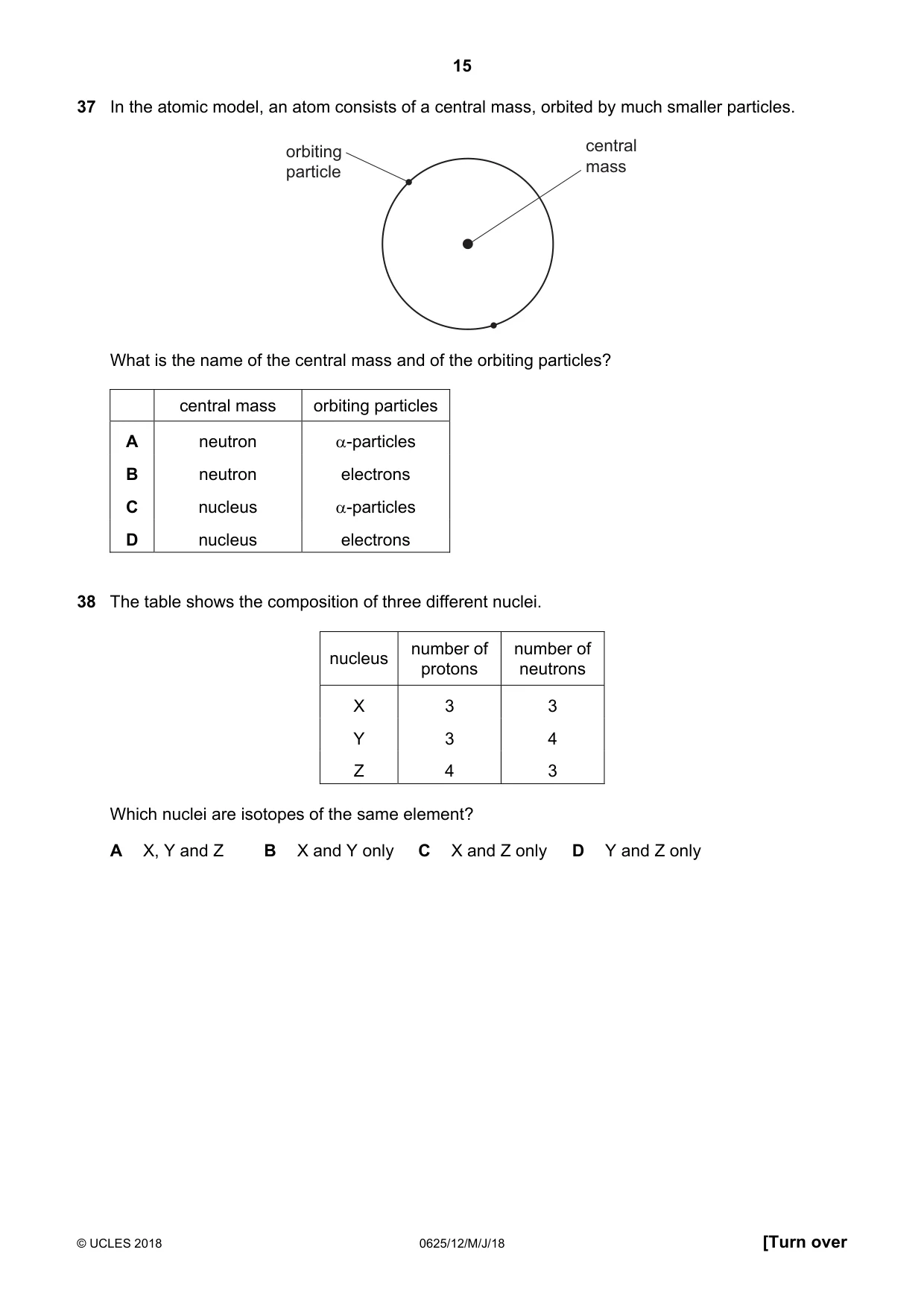
37 In the atomic model, an atom consists of a central mass, orbited by much smaller particles. orbiting central particle mass What is the name of the central mass and of the orbiting particles? central mass orbiting particles A neutron α-particles B neutron electrons C nucleus α-particles D nucleus electrons
Mark scheme: D
Q38 · The table shows the composition of three different nuclei
38 The table shows the composition of three different nuclei. number of number of nucleus protons neutrons X 3 3 Y 3 4 Z 4 3 Which nuclei are isotopes of the same element? A X, Y and Z B X and Y only C X and Z only D Y and Z only
Mark scheme: B
Q39 · The table compares the penetrating abilities and ionising effects of α-radiation and of…
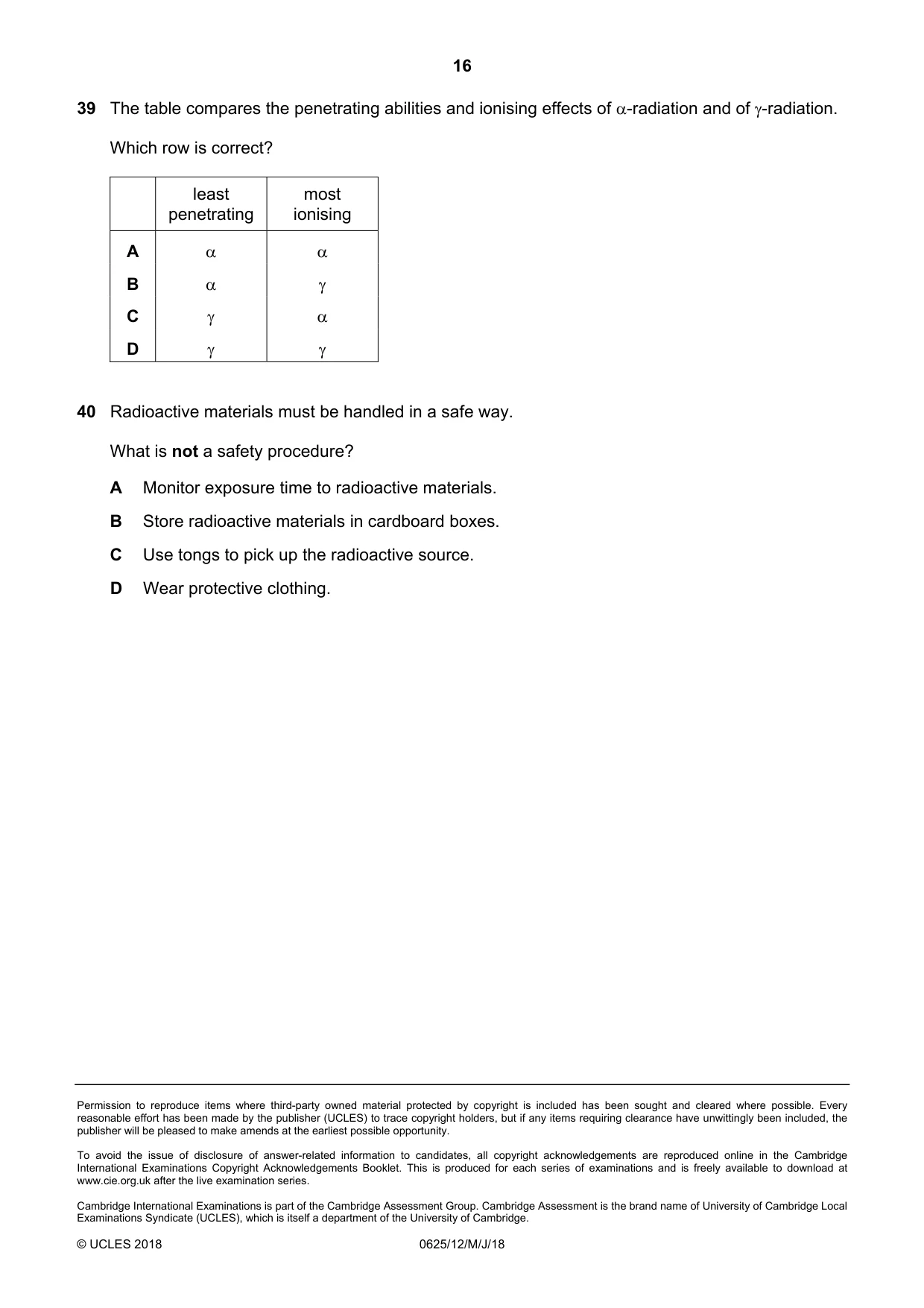
39 The table compares the penetrating abilities and ionising effects of α-radiation and of γ-radiation. Which row is correct? least most penetrating ionising A α α B α γ C γ α D γ γ
Mark scheme: A
Q40 · Radioactive materials must be handled in a safe way
40 Radioactive materials must be handled in a safe way. What is not a safety procedure? A Monitor exposure time to radioactive materials. B Store radioactive materials in cardboard boxes. C Use tongs to pick up the radioactive source. D Wear protective clothing.
Mark scheme: B
What was in this paper
The subtopics covered by these 40 questions, and how many questions each got. Open one in a new tab to see every Cambridge question on it.
3Electrical quantities3Electromagnetic effects3Energy, work and power3Forces3Light3Thermal properties and temperature3Density2General properties of waves2Kinetic particle model of matter2Motion2Radioactivity2The nuclear model of the atom2Electromagnetic spectrum1Mass and weight1Physical quantities and measurement techniques1Pressure1Simple phenomena of magnetism1Sound1Transfer of thermal energy1What you needed in this session
Cambridge’s own grade thresholds for 2018 May/June, Paper 1 · Variant 2. A higher threshold means an easier paper — the bar moves with how the cohort did.