Cambridge IGCSE Physics 0625 — 2023 Feb/March Paper 1 · Variant 2
0625/12/F/M/23 · 40 questions · 40 marks · ≈45 min
The question paper and its mark scheme, free to read here and free to download. This is Cambridge’s own paper, exactly as it was sat.
Question paper16 pages
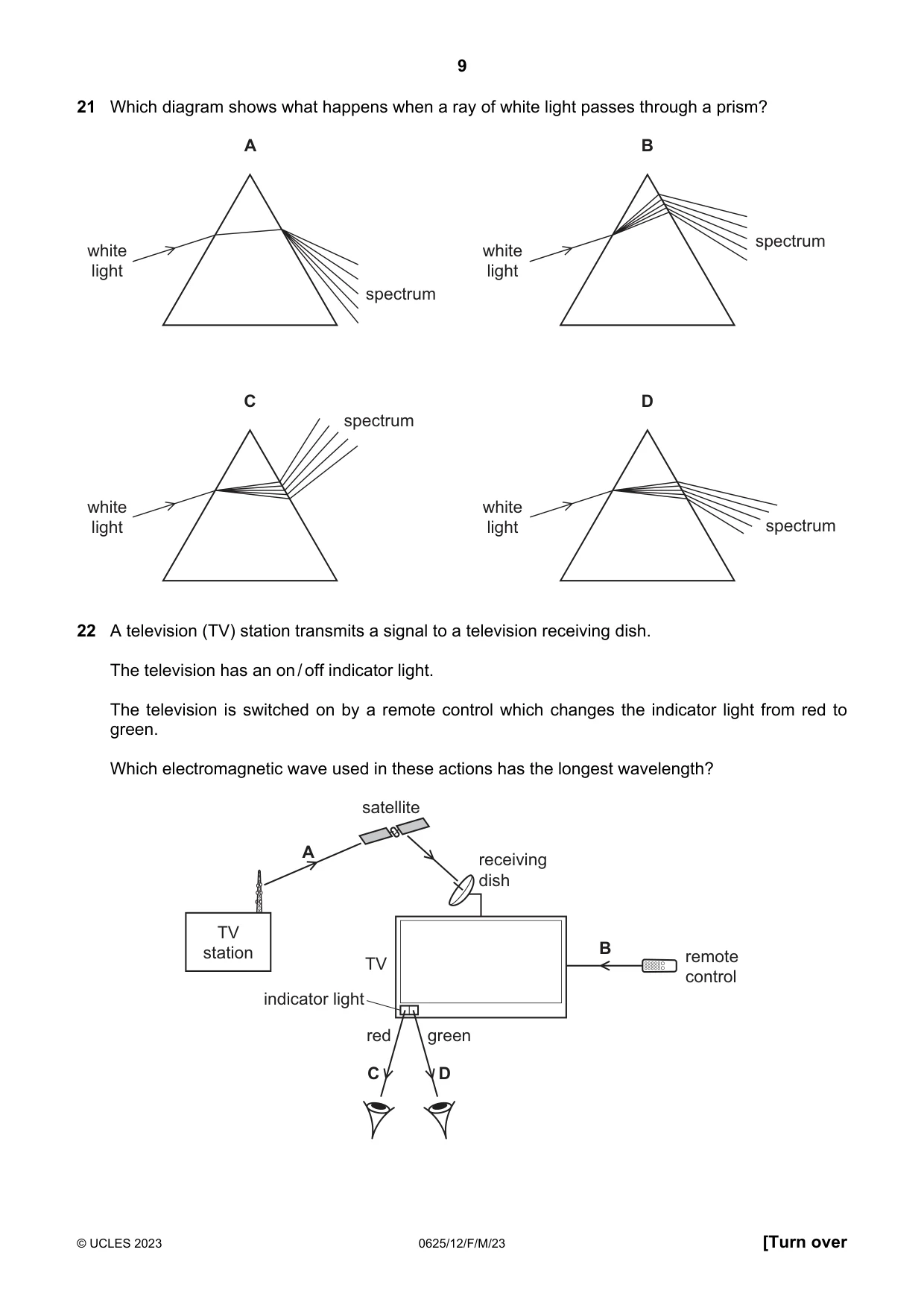
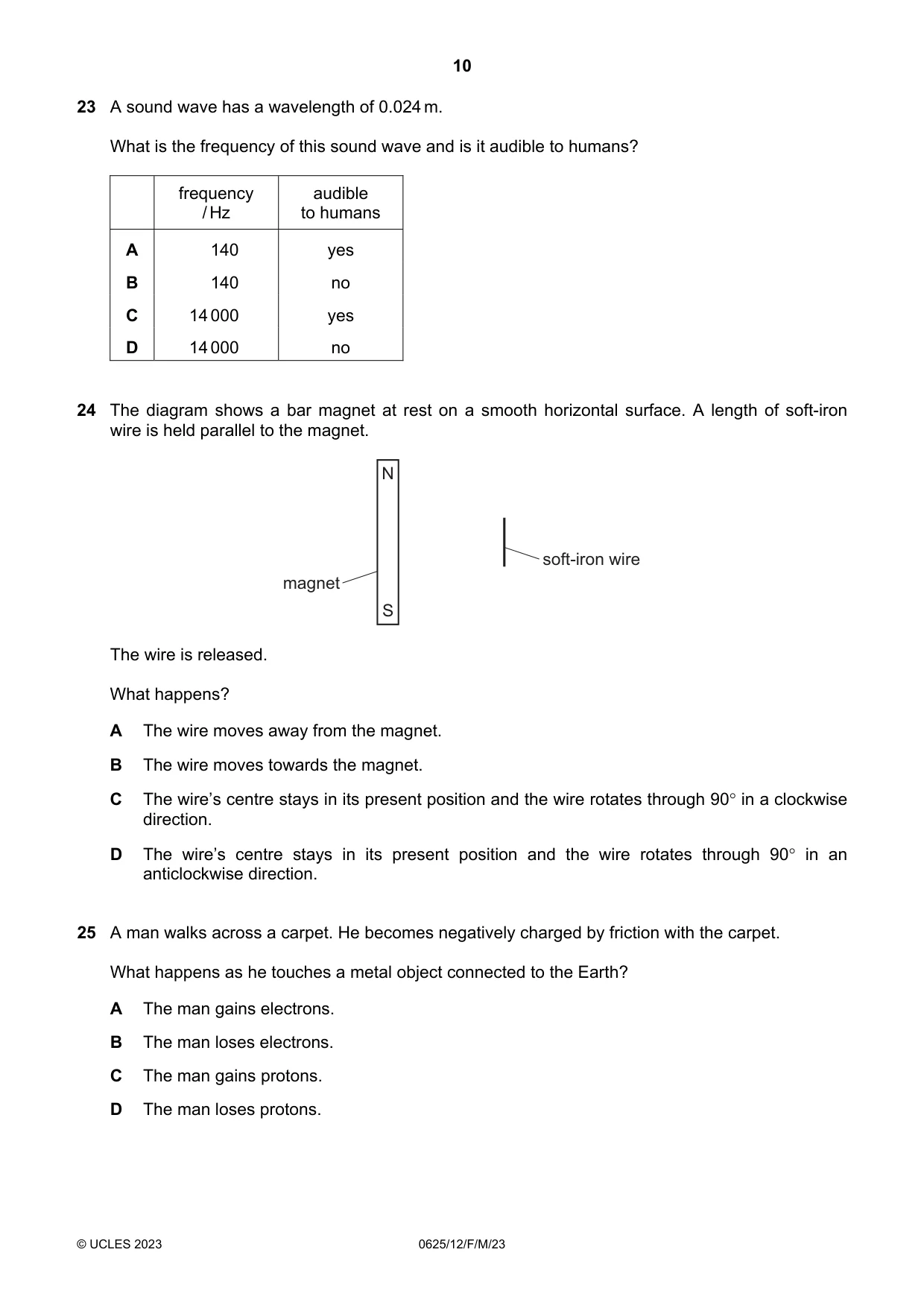
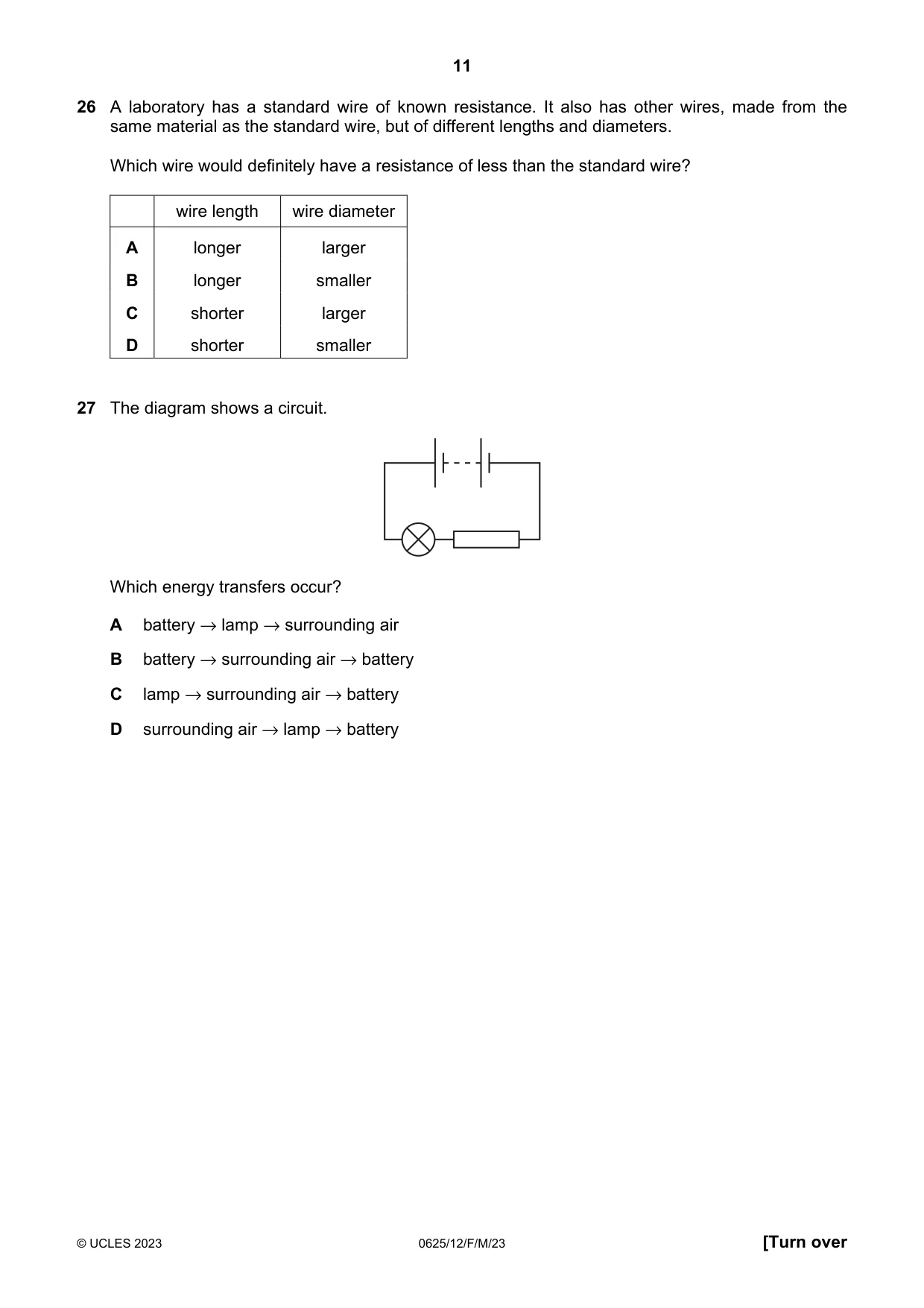
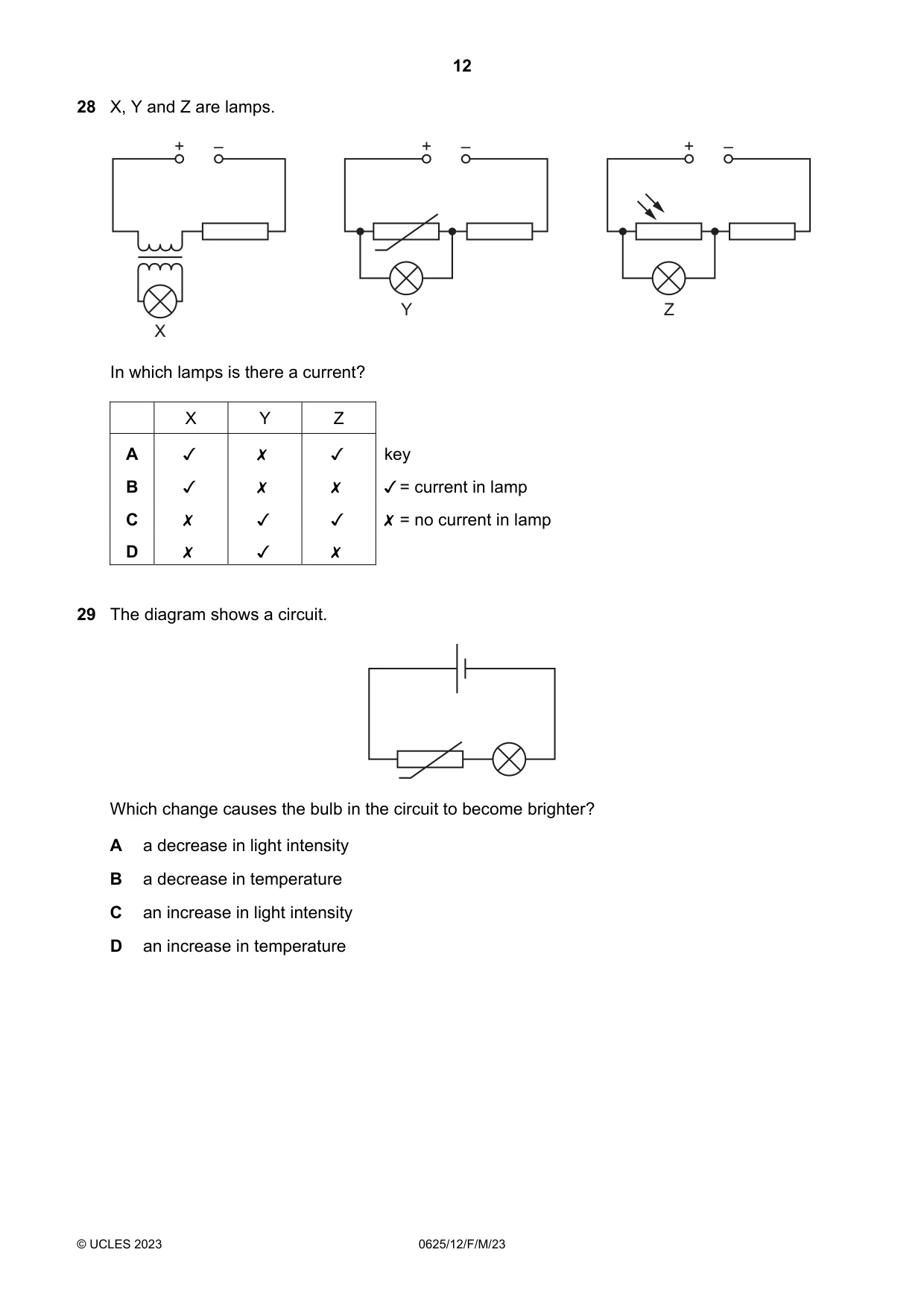
Mark scheme3 pages
Answers below. Sit the paper first if you are practising.
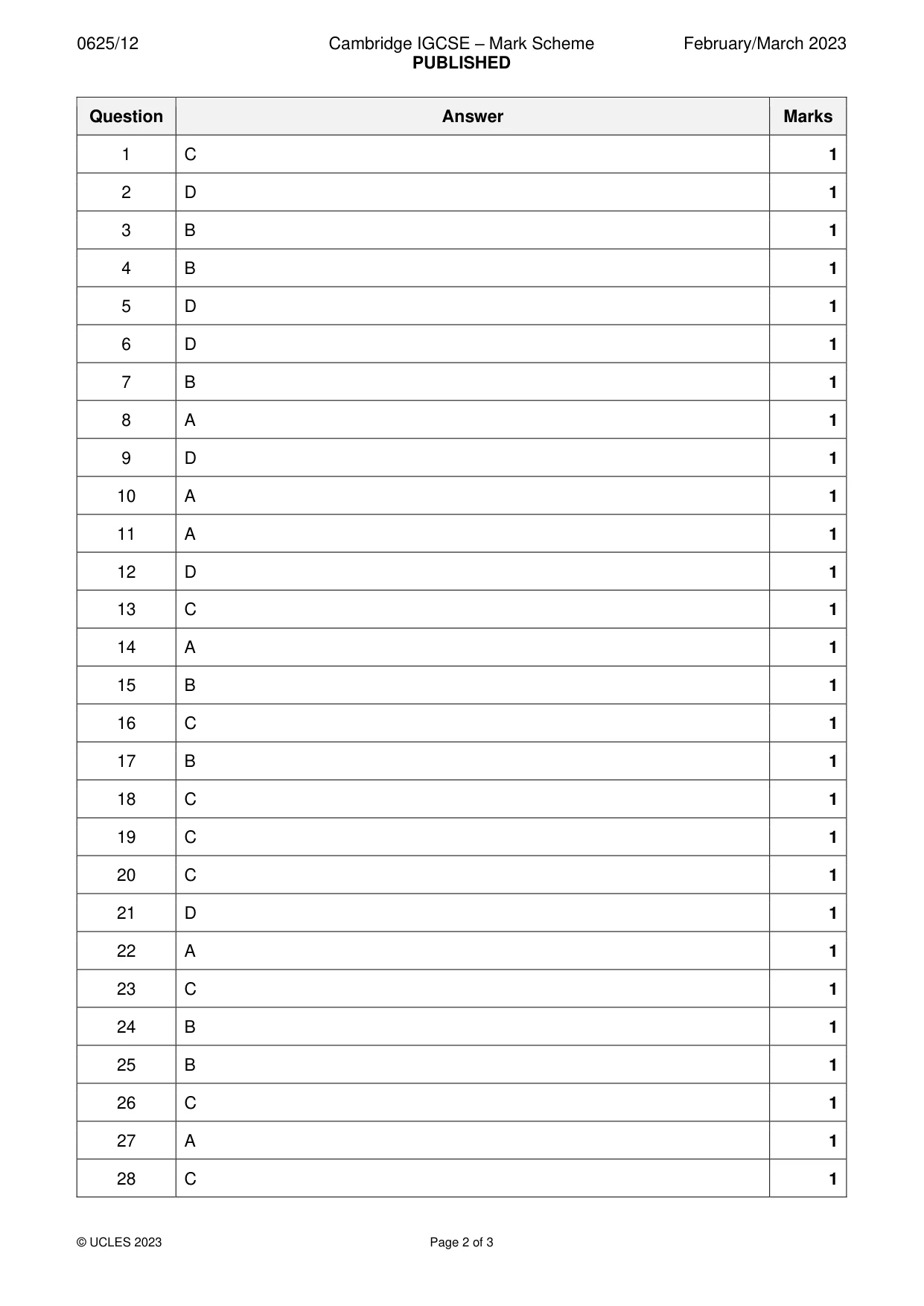
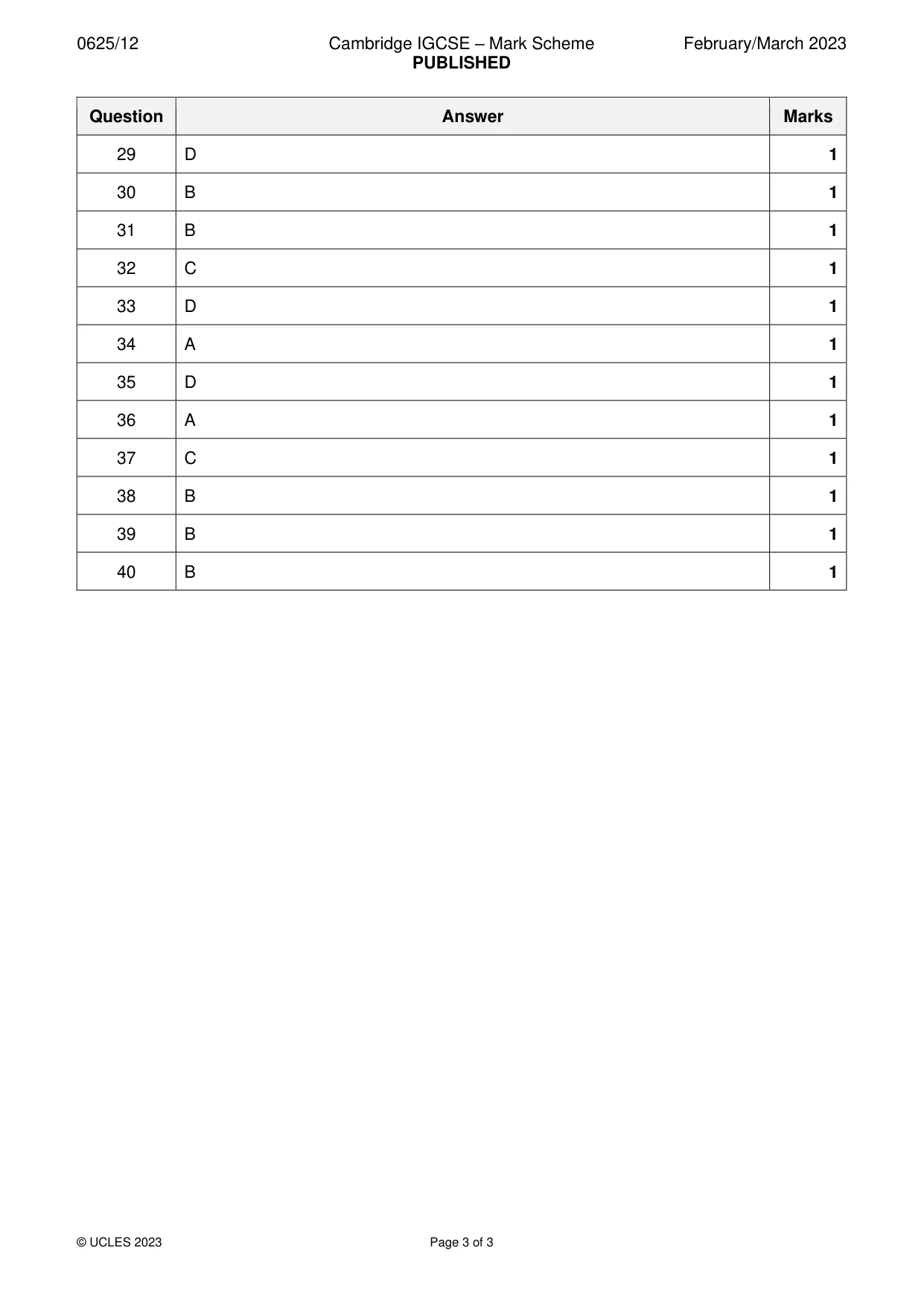
Questions as text
Q1 · A measuring cylinder contains water
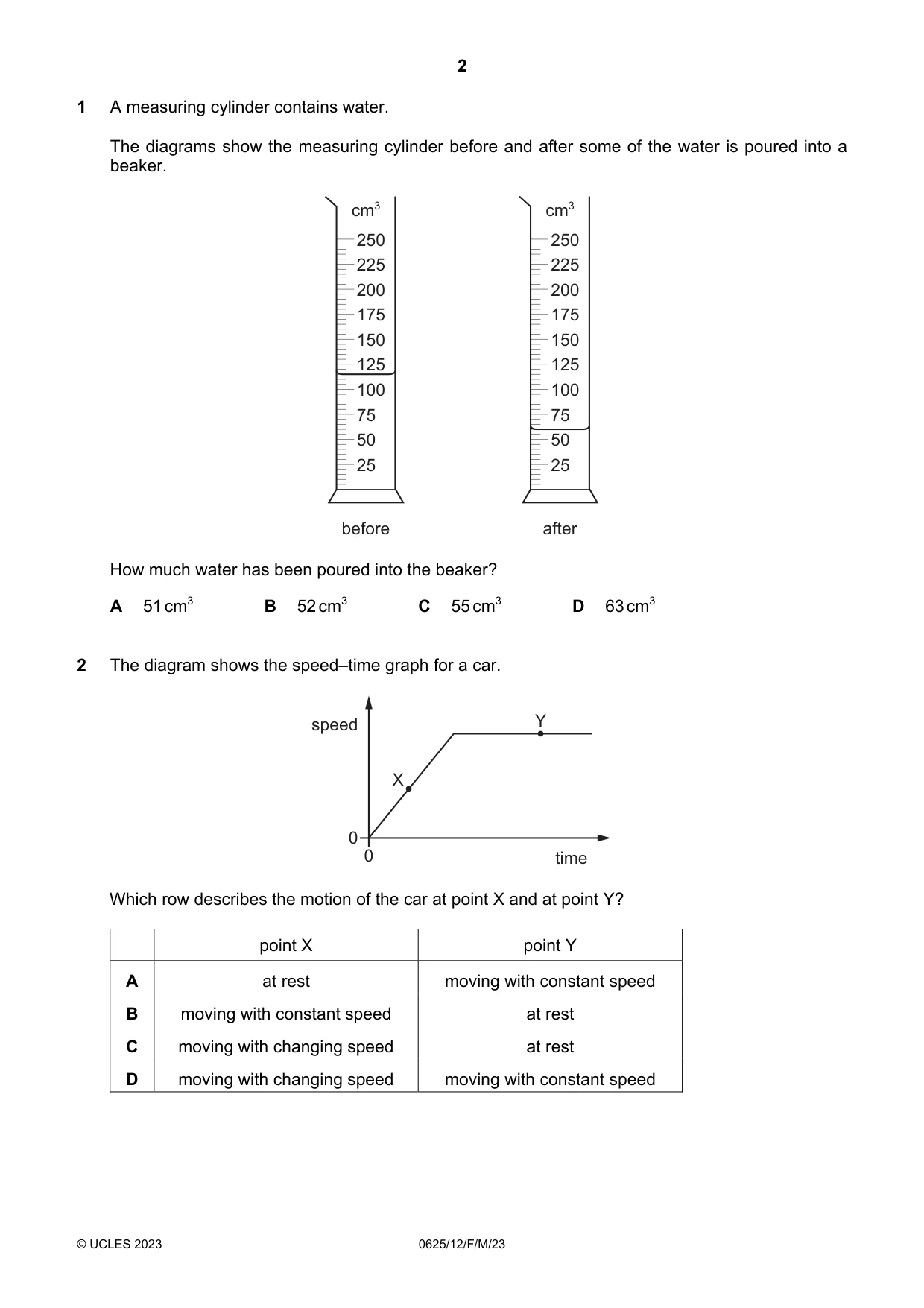
1 A measuring cylinder contains water. The diagrams show the measuring cylinder before and after some of the water is poured into a beaker. cm3 cm3 250 250 225 225 200 200 175 175 150 150 125 125 100 100 75 75 50 50 25 25 before after How much water has been poured into the beaker? A 51 cm3 B 52 cm3 C 55 cm3 D 63 cm3
Mark scheme: C
More questions on Physical quantities and measurement techniques
Q2 · The diagram shows the speed–time graph for a car
2 The diagram shows the speed–time graph for a car. speed Y X 0 0 time Which row describes the motion of the car at point X and at point Y? point X point Y A at rest moving with constant speed B moving with constant speed at rest C moving with changing speed at rest D moving with changing speed moving with constant speed
Mark scheme: D
Q3 · A ball is dropped in a vacuum from a height of 4.0 m above the surface of Mars
3 A ball is dropped in a vacuum from a height of 4.0 m above the surface of Mars. The acceleration of the ball at a height of 2.0 m is 3.8 m / s2. What is the acceleration of the ball at a height of 1.0 m above the surface of Mars? A 1.9 m / s2 B 3.8 m / s2 C 5.7 m / s2 D 7.6 m / s2
Mark scheme: B
Q4 · Two objects are placed on a balance, one on each side, as shown
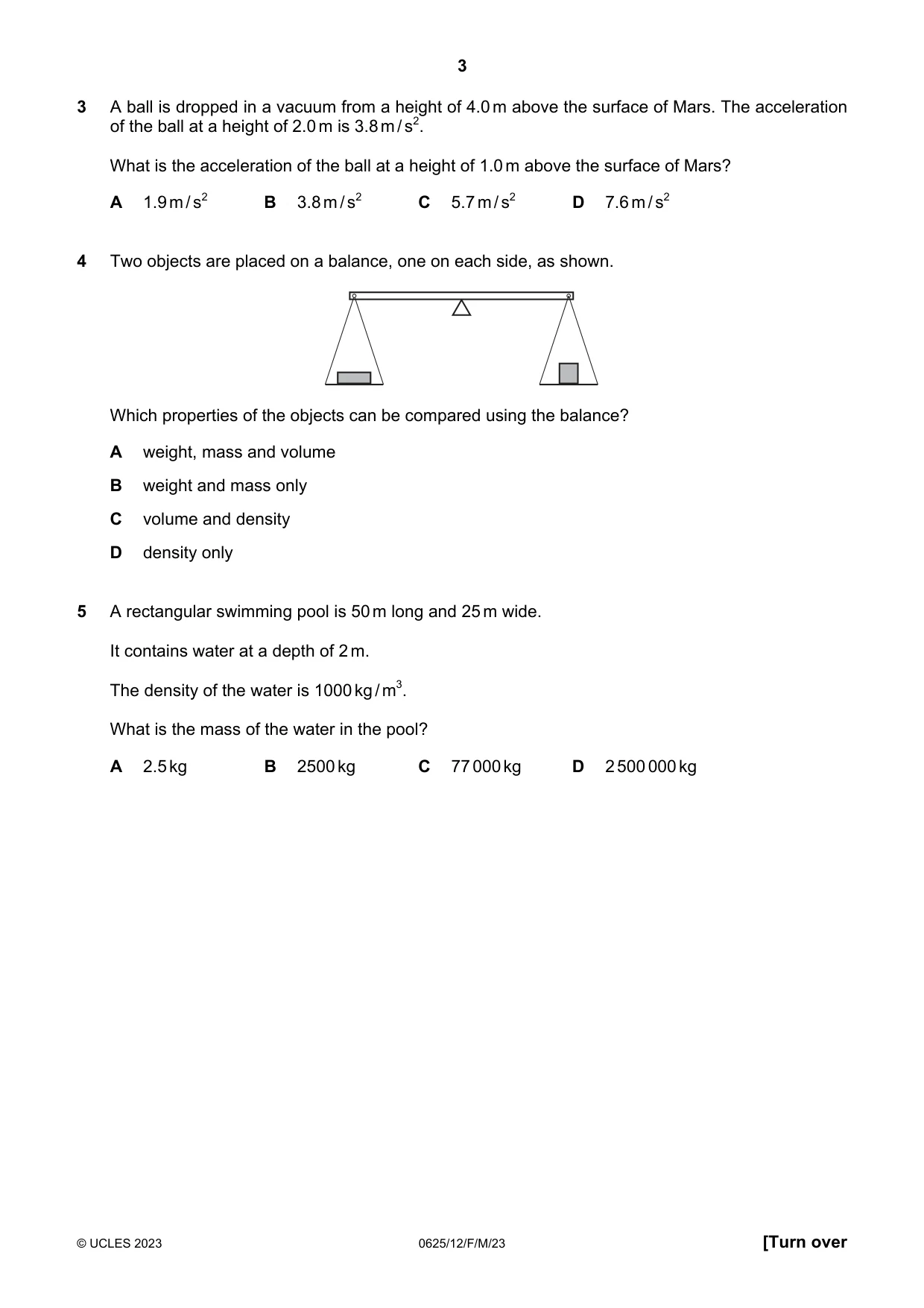
4 Two objects are placed on a balance, one on each side, as shown. Which properties of the objects can be compared using the balance? A weight, mass and volume B weight and mass only C volume and density D density only
Mark scheme: B
Q5 · A rectangular swimming pool is 50 m long and 25 m wide
5 A rectangular swimming pool is 50 m long and 25 m wide. It contains water at a depth of 2 m. The density of the water is 1000 kg / m3. What is the mass of the water in the pool? A 2.5 kg B 2500 kg C 77 000 kg D 2 500 000 kg
Mark scheme: D
Q6 · An object is rising vertically at constant speed through water
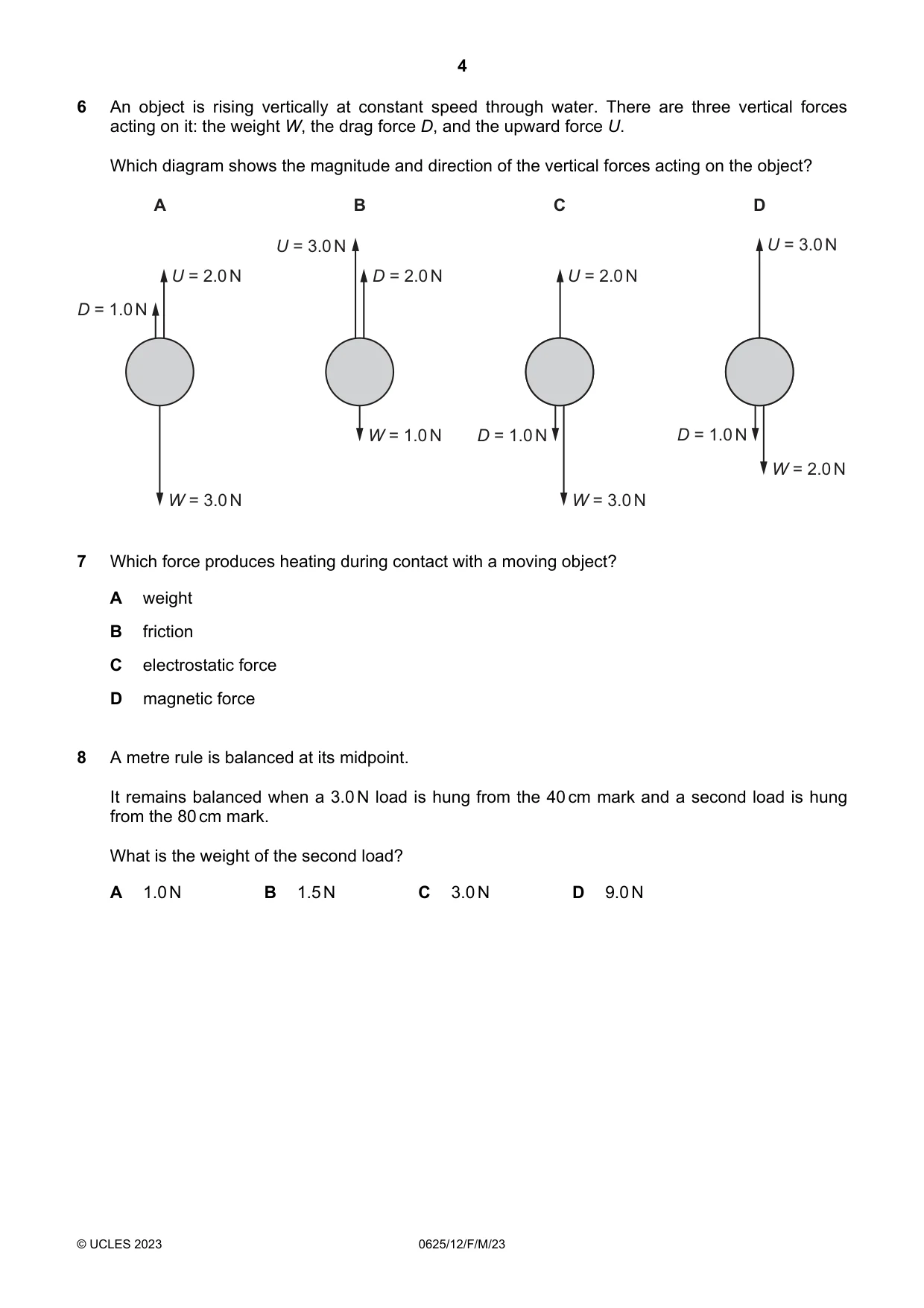
6 An object is rising vertically at constant speed through water. There are three vertical forces acting on it: the weight W, the drag force D, and the upward force U. Which diagram shows the magnitude and direction of the vertical forces acting on the object? A B C D U = 3.0 N U = 3.0 N U = 2.0 N D = 2.0 N U = 2.0 N D = 1.0 N W = 1.0 N D = 1.0 N D = 1.0 N W = 2.0 N W = 3.0 N W = 3.0 N
Mark scheme: D
Q7 · Which force produces heating during contact with a moving object?
7 Which force produces heating during contact with a moving object? A weight B friction C electrostatic force D magnetic force
Mark scheme: B
Q8 · A metre rule is balanced at its midpoint
8 A metre rule is balanced at its midpoint. It remains balanced when a 3.0 N load is hung from the 40 cm mark and a second load is hung from the 80 cm mark. What is the weight of the second load? A 1.0 N B 1.5 N C 3.0 N D 9.0 N
Mark scheme: A
Q9 · A student measures the length of a spring
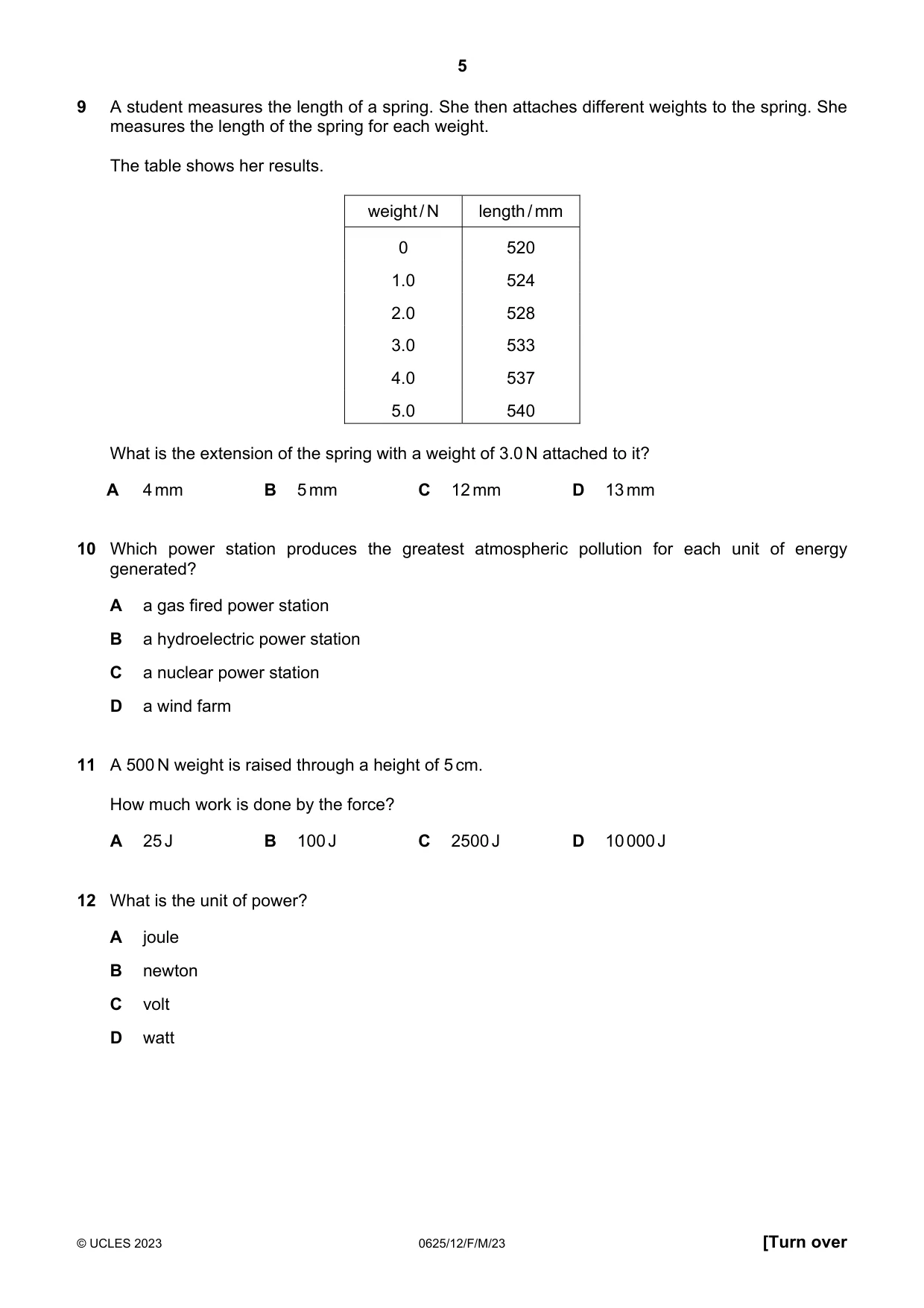
9 A student measures the length of a spring. She then attaches different weights to the spring. She measures the length of the spring for each weight. The table shows her results. weight / N length / mm 0 520 1.0 524 2.0 528 3.0 533 4.0 537 5.0 540 What is the extension of the spring with a weight of 3.0 N attached to it? A 4 mm B 5 mm C 12 mm D 13 mm
Mark scheme: D
Q10 · Which power station produces the greatest atmospheric pollution for each unit of energy…
10 Which power station produces the greatest atmospheric pollution for each unit of energy generated? A a gas fired power station B a hydroelectric power station C a nuclear power station D a wind farm
Mark scheme: A
Q11 · A 500 N weight is raised through a height of 5 cm
11 A 500 N weight is raised through a height of 5 cm. How much work is done by the force? A 25 J B 100 J C 2500 J D 10 000 J
Mark scheme: A
Q12 · What is the unit of power?
12 What is the unit of power? A joule B newton C volt D watt
Mark scheme: D
Q13 · The diagram shows a rectangular block of weight 16 N
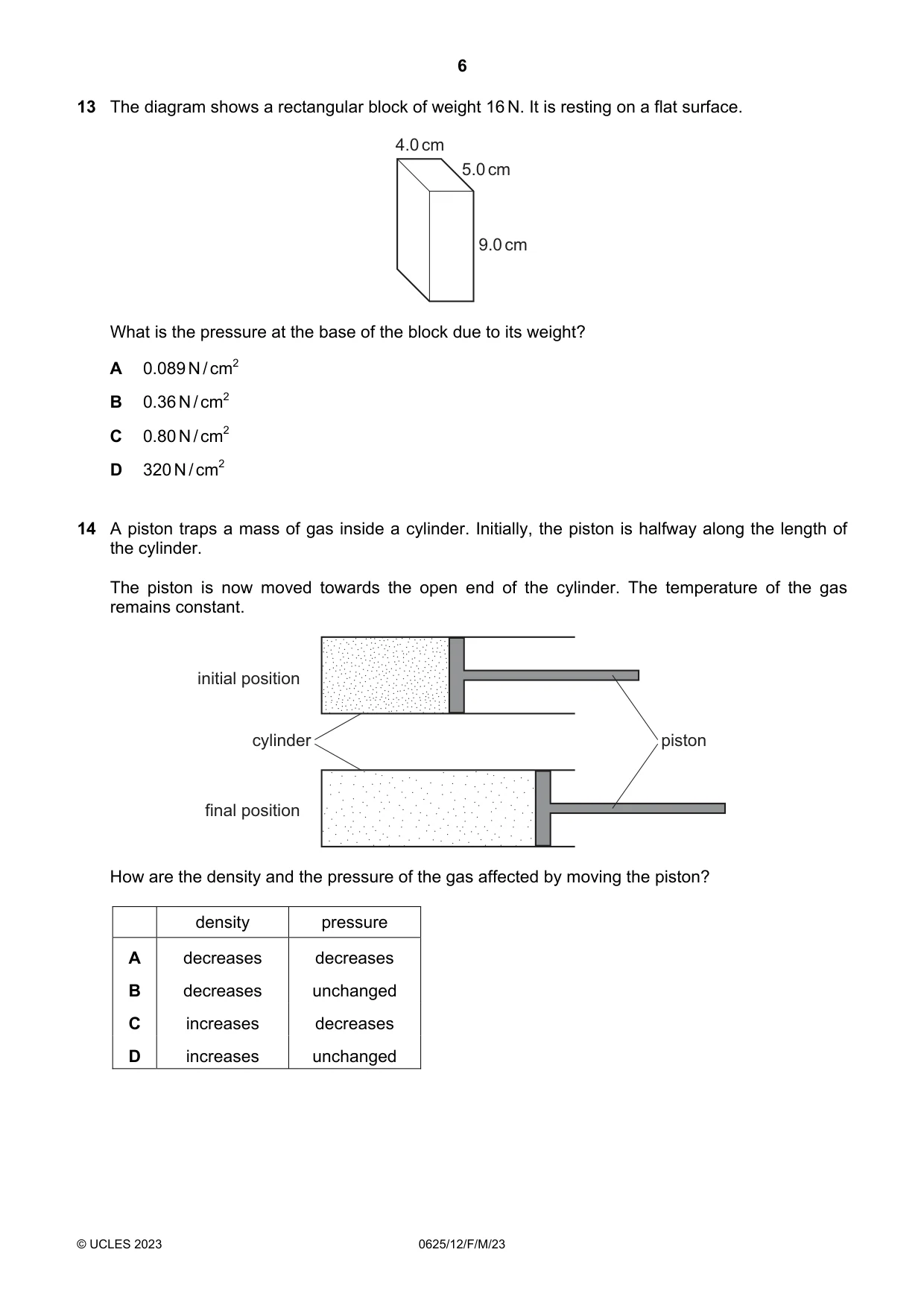
13 The diagram shows a rectangular block of weight 16 N. It is resting on a flat surface. 4.0 cm 5.0 cm 9.0 cm What is the pressure at the base of the block due to its weight? A 0.089 N / cm2 B 0.36 N / cm2 C 0.80 N / cm2 D 320 N / cm2
Mark scheme: C
Q14 · A piston traps a mass of gas inside a cylinder
14 A piston traps a mass of gas inside a cylinder. Initially, the piston is halfway along the length of the cylinder. The piston is now moved towards the open end of the cylinder. The temperature of the gas remains constant. initial position cylinder piston final position How are the density and the pressure of the gas affected by moving the piston? density pressure A decreases decreases B decreases unchanged C increases decreases D increases unchanged
Mark scheme: A
Q15 · Which statement describes what happens to air particles when the air is heated?
15 Which statement describes what happens to air particles when the air is heated? A The particles move more slowly. B The particles move more quickly. C The particles move closer together. D The particles vibrate faster.
Mark scheme: B
Q16 · What happens when the temperature of a liquid increases?
16 What happens when the temperature of a liquid increases? A The mass of the liquid increases, making the liquid less dense. B The mass of the liquid increases, making the liquid more dense. C The volume of the liquid increases, making the liquid less dense. D The volume of the liquid increases, making the liquid more dense.
Mark scheme: C
Q17 · In which states of matter can thermal energy be transferred by convection?
17 In which states of matter can thermal energy be transferred by convection? A in gases, liquids and solids B in gases and liquids only C in gases and solids only D in liquids only
Mark scheme: B
Q18 · A transverse wave moves along a rope
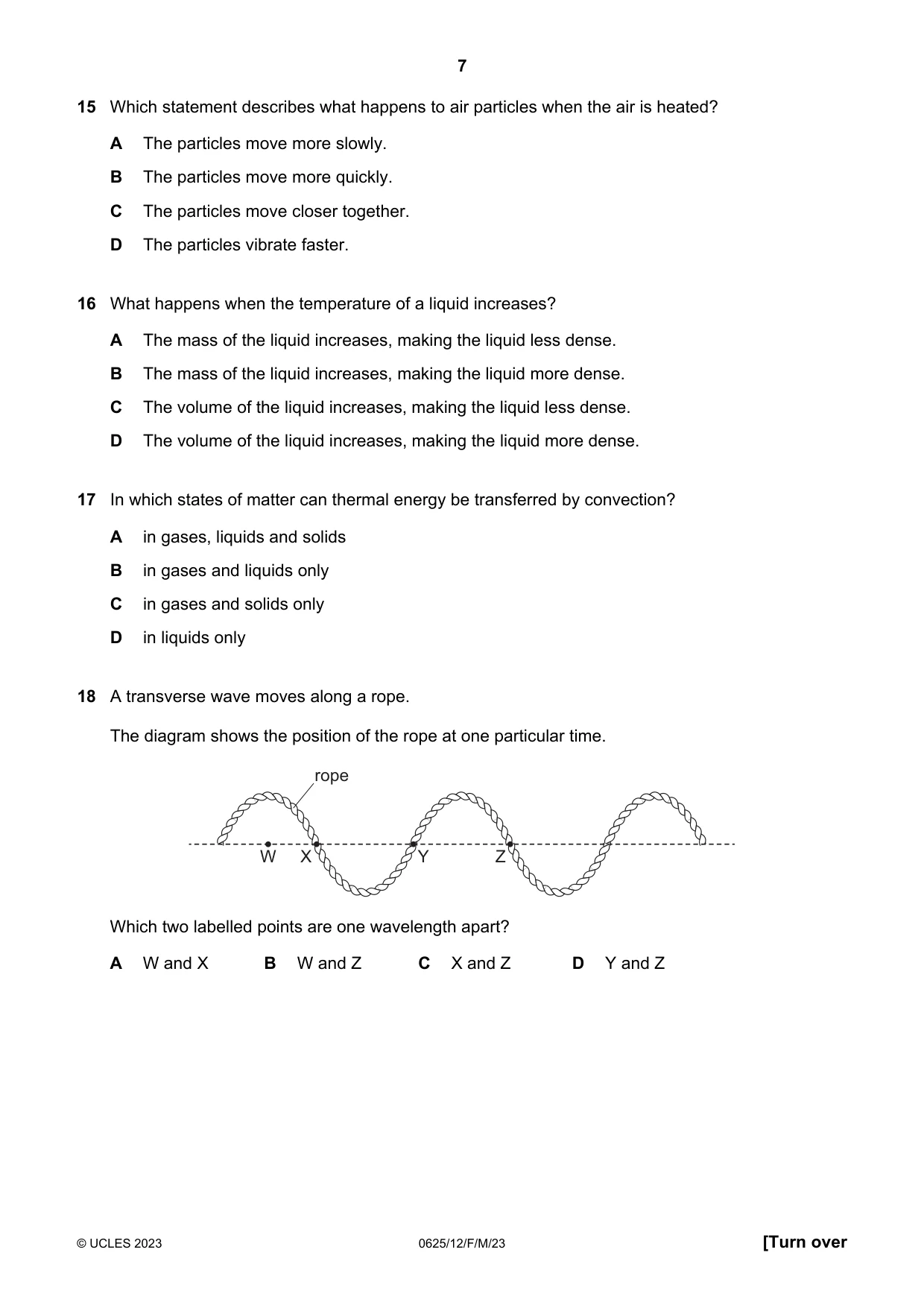
18 A transverse wave moves along a rope. The diagram shows the position of the rope at one particular time. rope W X Y Z Which two labelled points are one wavelength apart? A W and X B W and Z C X and Z D Y and Z
Mark scheme: C
Q19 · The diagram shows a ray of light being reflected from a plane mirror
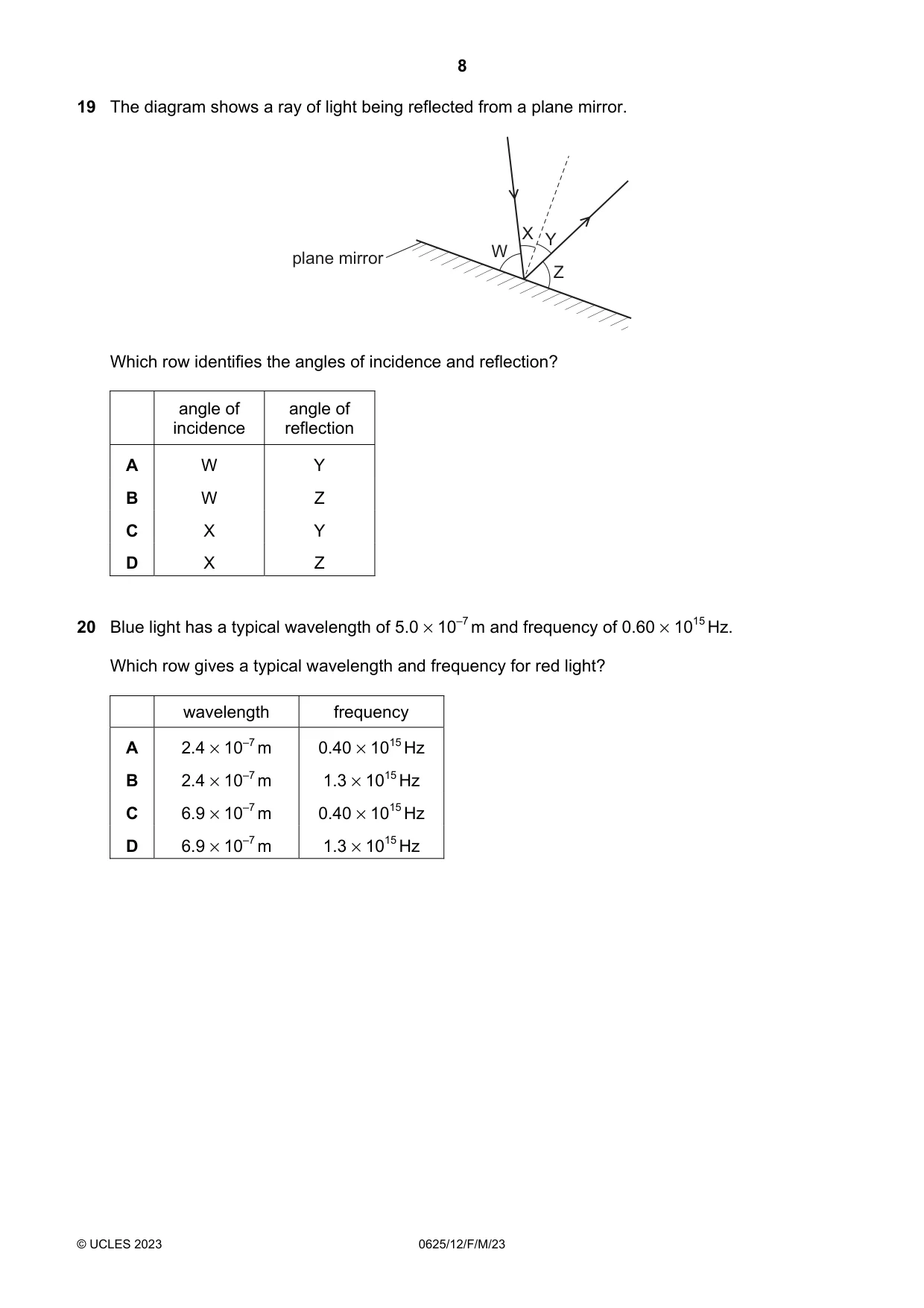
19 The diagram shows a ray of light being reflected from a plane mirror. X Y plane mirror W Z Which row identifies the angles of incidence and reflection? angle of angle of incidence reflection A W Y B W Z C X Y D X Z
Mark scheme: C
Q20 · Blue light has a typical wavelength of 5.0 × 10⁻⁷ m and frequency of 0.60 × 10¹⁵ Hz
20 Blue light has a typical wavelength of 5.0 × 10⁻⁷ m and frequency of 0.60 × 10¹⁵ Hz. Which row gives a typical wavelength and frequency for red light? wavelength frequency A 2.4 × 10⁻⁷ m 0.40 × 10¹⁵ Hz B 2.4 × 10⁻⁷ m 1.3 × 10¹⁵ Hz C 6.9 × 10⁻⁷ m 0.40 × 10¹⁵ Hz D 6.9 × 10⁻⁷ m 1.3 × 10¹⁵ Hz
Mark scheme: C
Q21 · Which diagram shows what happens when a ray of white light passes through a prism?
21 Which diagram shows what happens when a ray of white light passes through a prism? A B spectrum white white light light spectrum C D spectrum white white light light spectrum
Mark scheme: D
Q22 · A television (TV) station transmits a signal to a television receiving dish
22 A television (TV) station transmits a signal to a television receiving dish. The television has an on / off indicator light. The television is switched on by a remote control which changes the indicator light from red to green. Which electromagnetic wave used in these actions has the longest wavelength? satellite A receiving dish TV station B TV remote control indicator light red green C D
Mark scheme: A
Q23 · A sound wave has a wavelength of 0.024 m
23 A sound wave has a wavelength of 0.024 m. What is the frequency of this sound wave and is it audible to humans? frequency audible / Hz to humans A 140 yes B 140 no C 14 000 yes D 14 000 no
Mark scheme: C
Q24 · The diagram shows a bar magnet at rest on a smooth horizontal surface
24 The diagram shows a bar magnet at rest on a smooth horizontal surface. A length of soft-iron wire is held parallel to the magnet. N soft-iron wire magnet S The wire is released. What happens? A The wire moves away from the magnet. B The wire moves towards the magnet. C The wire’s centre stays in its present position and the wire rotates through 90° in a clockwise direction. D The wire’s centre stays in its present position and the wire rotates through 90° in an anticlockwise direction.
Mark scheme: B
Q25 · A man walks across a carpet
25 A man walks across a carpet. He becomes negatively charged by friction with the carpet. What happens as he touches a metal object connected to the Earth? A The man gains electrons. B The man loses electrons. C The man gains protons. D The man loses protons.
Mark scheme: B
Q26 · A laboratory has a standard wire of known resistance
26 A laboratory has a standard wire of known resistance. It also has other wires, made from the same material as the standard wire, but of different lengths and diameters. Which wire would definitely have a resistance of less than the standard wire? wire length wire diameter A longer larger B longer smaller C shorter larger D shorter smaller
Mark scheme: C
Q27 · The diagram shows a circuit
27 The diagram shows a circuit. Which energy transfers occur? A battery → lamp → surrounding air B battery → surrounding air → battery C lamp → surrounding air → battery D surrounding air → lamp → battery
Mark scheme: A
Q28 · X, Y and Z are lamps
28 X, Y and Z are lamps. + 8 + = 2 Y Z X In which lamps is there a current? key ¥ = current in lamp X = no current in lamp \ \ *& x |X ~* { & SIN 0 OW D> ~*~ * QL A] x
Mark scheme: C
Q29 · The diagram shows a circuit
29 The diagram shows a circuit. Which change causes the bulb in the circuit to become brighter? A a decrease in light intensity B a decrease in temperature C an increase in light intensity D an increase in temperature
Mark scheme: D
Q30 · The current in a kettle is 10 A and the kettle is protected by a 13 A fuse
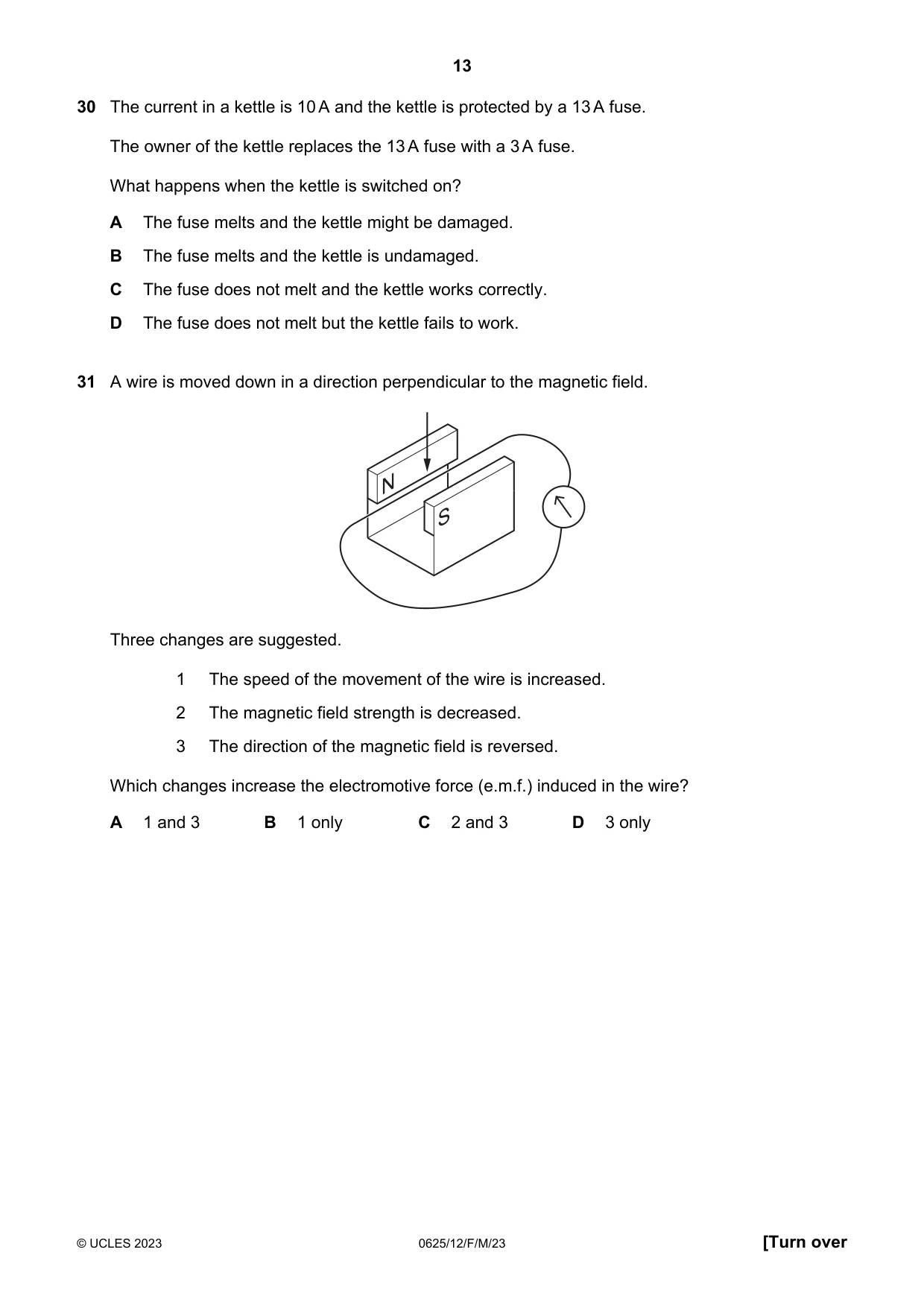
30 The current in a kettle is 10 A and the kettle is protected by a 13 A fuse. The owner of the kettle replaces the 13 A fuse with a 3 A fuse. What happens when the kettle is switched on? A The fuse melts and the kettle might be damaged. B The fuse melts and the kettle is undamaged. C The fuse does not melt and the kettle works correctly. D The fuse does not melt but the kettle fails to work.
Mark scheme: B
Q31 · A wire is moved down in a direction perpendicular to the magnetic field
31 A wire is moved down in a direction perpendicular to the magnetic field. N S Three changes are suggested. 1 The speed of the movement of the wire is increased. 2 The magnetic field strength is decreased. 3 The direction of the magnetic field is reversed. Which changes increase the electromotive force (e.m.f.) induced in the wire? A 1 and 3 B 1 only C 2 and 3 D 3 only
Mark scheme: B
Q32 · In an experiment, a wire is held above a compass needle as shown
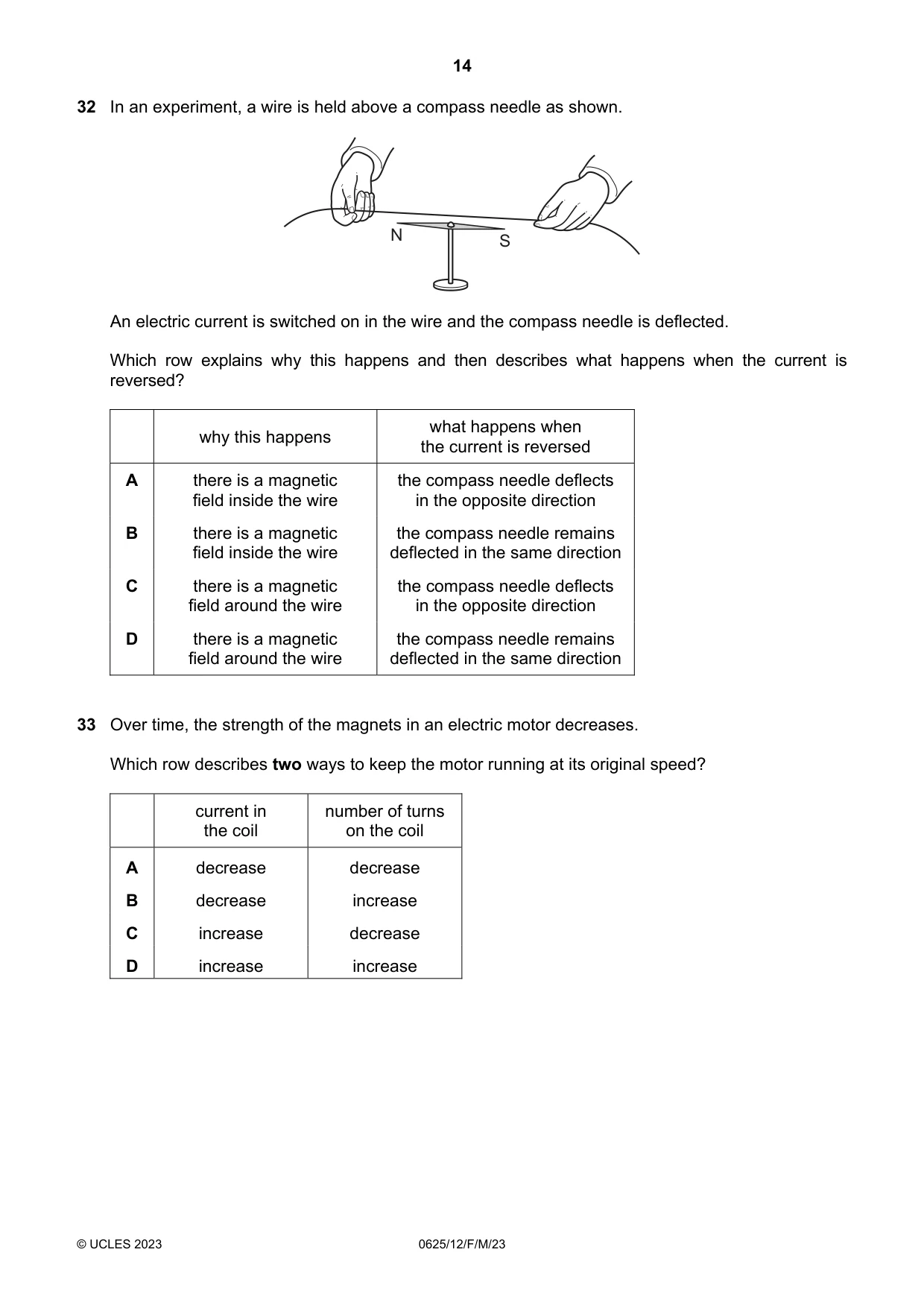
32 In an experiment, a wire is held above a compass needle as shown. N S An electric current is switched on in the wire and the compass needle is deflected. Which row explains why this happens and then describes what happens when the current is reversed? what happens when why this happens the current is reversed A there is a magnetic the compass needle deflects field inside the wire in the opposite direction B there is a magnetic the compass needle remains field inside the wire deflected in the same direction C there is a magnetic the compass needle deflects field around the wire in the opposite direction D there is a magnetic the compass needle remains field around the wire deflected in the same direction
Mark scheme: C
Q33 · Over time, the strength of the magnets in an electric motor decreases
33 Over time, the strength of the magnets in an electric motor decreases. Which row describes two ways to keep the motor running at its original speed? current in number of turns the coil on the coil A decrease decrease B decrease increase C increase decrease D increase increase
Mark scheme: D
Q34 · A rechargeable battery contains lithium
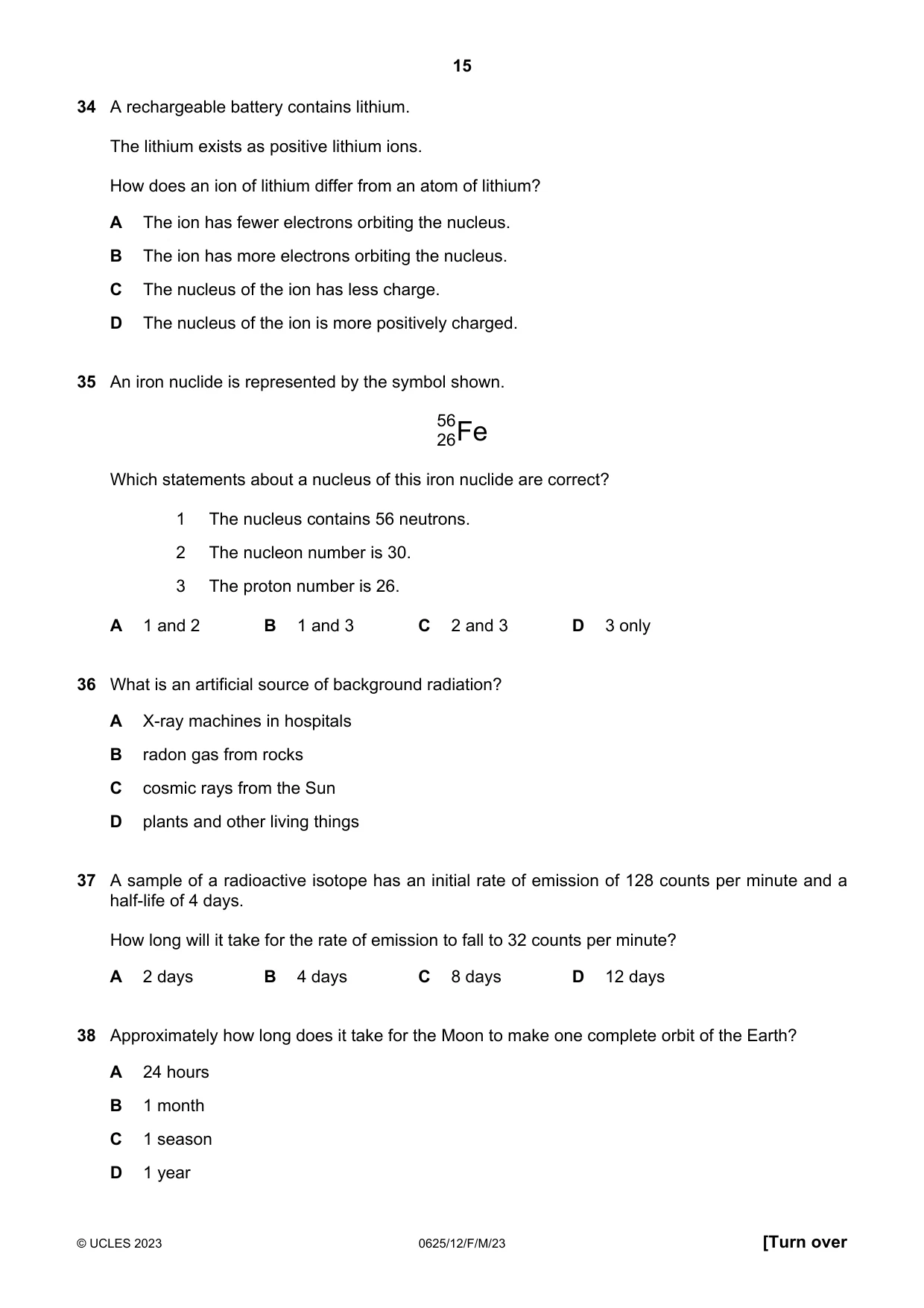
34 A rechargeable battery contains lithium. The lithium exists as positive lithium ions. How does an ion of lithium differ from an atom of lithium? A The ion has fewer electrons orbiting the nucleus. B The ion has more electrons orbiting the nucleus. C The nucleus of the ion has less charge. D The nucleus of the ion is more positively charged.
Mark scheme: A
Q35 · An iron nuclide is represented by the symbol shown
35 An iron nuclide is represented by the symbol shown. 56 26Fe Which statements about a nucleus of this iron nuclide are correct? 1 The nucleus contains 56 neutrons. 2 The nucleon number is 30. 3 The proton number is 26. A 1 and 2 B 1 and 3 C 2 and 3 D 3 only
Mark scheme: D
Q36 · What is an artificial source of background radiation?
36 What is an artificial source of background radiation? A X-ray machines in hospitals B radon gas from rocks C cosmic rays from the Sun D plants and other living things
Mark scheme: A
Q37 · A sample of a radioactive isotope has an initial rate of emission of 128 counts per…
37 A sample of a radioactive isotope has an initial rate of emission of 128 counts per minute and a half-life of 4 days. How long will it take for the rate of emission to fall to 32 counts per minute? A 2 days B 4 days C 8 days D 12 days
Mark scheme: C
Q38 · Approximately how long does it take for the Moon to make one complete orbit of the Earth?
38 Approximately how long does it take for the Moon to make one complete orbit of the Earth? A 24 hours B 1 month C 1 season D 1 year
Mark scheme: B
Q39 · The Sun has a mass of 2.0 × 1030 kg
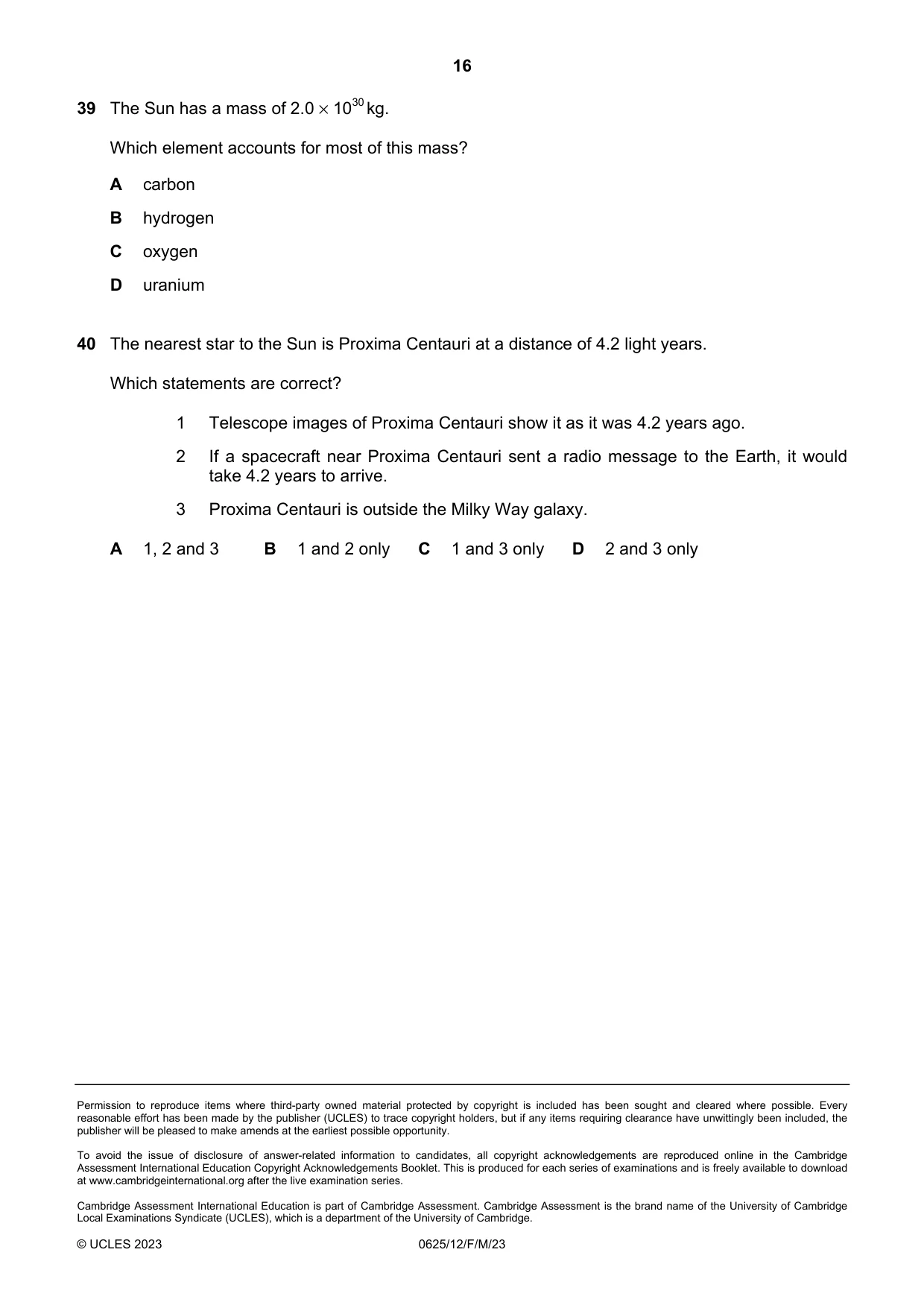
39 The Sun has a mass of 2.0 × 1030 kg. Which element accounts for most of this mass? A carbon B hydrogen C oxygen D uranium
Mark scheme: B
Q40 · The nearest star to the Sun is Proxima Centauri at a distance of 4.2 light years
40 The nearest star to the Sun is Proxima Centauri at a distance of 4.2 light years. Which statements are correct? 1 Telescope images of Proxima Centauri show it as it was 4.2 years ago. 2 If a spacecraft near Proxima Centauri sent a radio message to the Earth, it would take 4.2 years to arrive. 3 Proxima Centauri is outside the Milky Way galaxy. A 1, 2 and 3 B 1 and 2 only C 1 and 3 only D 2 and 3 only
Mark scheme: B
What was in this paper
The subtopics covered by these 40 questions, and how many questions each got. Open one in a new tab to see every Cambridge question on it.
4Electric circuits3Electromagnetic effects3Energy, work and power3Electromagnetic spectrum2Light2Motion2Pressure2Radioactivity2Simple phenomena of magnetism2Stars and the Universe2The nuclear model of the atom2Density1Electrical quantities1Electrical safety1General properties of waves1Kinetic particle model of matter1Mass and weight1Physical quantities and measurement techniques1Sound1The Earth and the Solar System1Thermal properties and temperature1Transfer of thermal energy1What you needed in this session
Cambridge’s own grade thresholds for 2023 Feb/March, Paper 1 · Variant 2. A higher threshold means an easier paper — the bar moves with how the cohort did.