Cambridge IGCSE Physics 0625 — 2014 Oct/Nov Paper 1 · Variant 3
0625/13/O/N/14 · 40 questions · 40 marks · ≈45 min
The question paper and its mark scheme, free to read here and free to download. This is Cambridge’s own paper, exactly as it was sat.
Question paper20 pages

Mark scheme2 pages
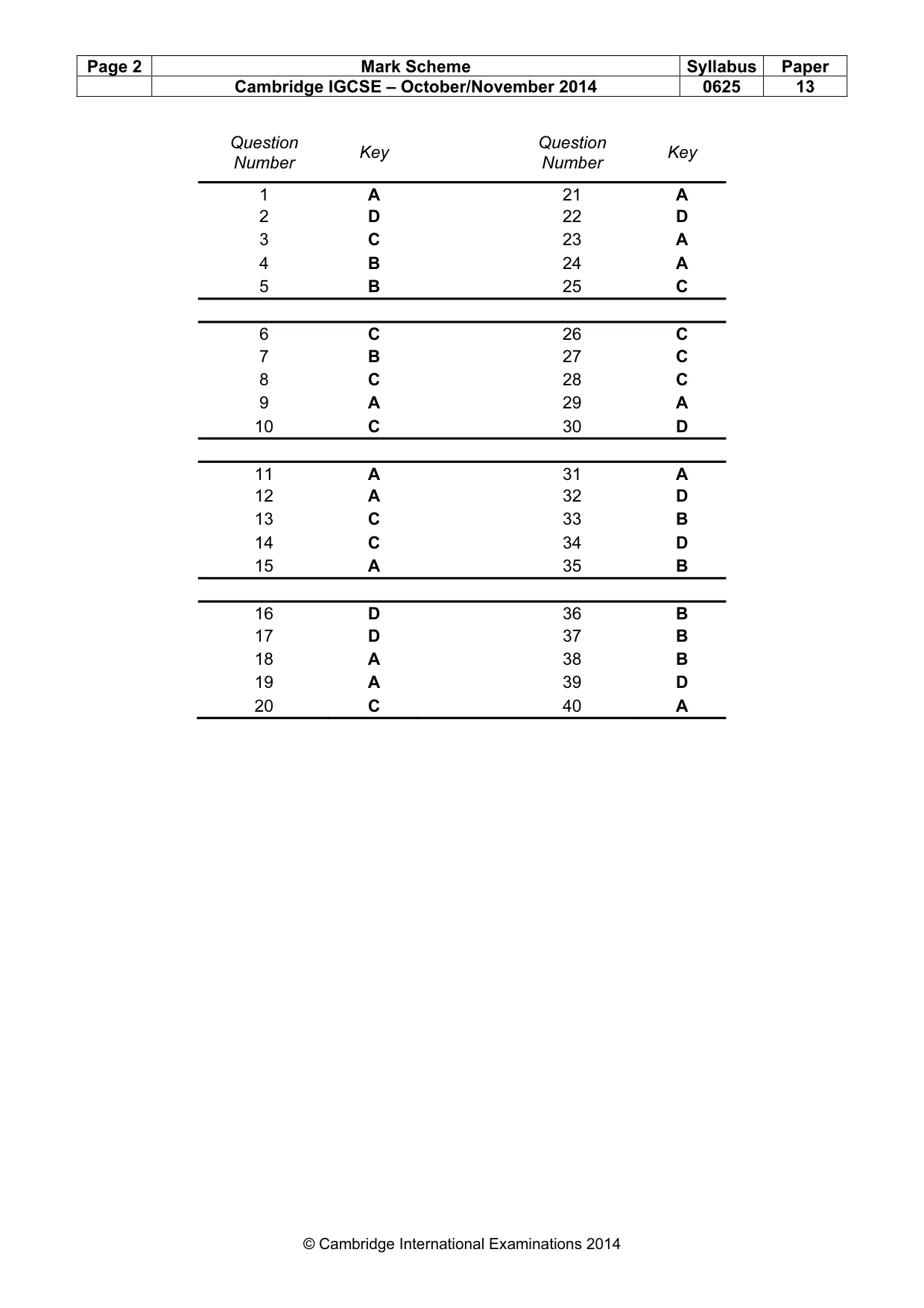
Answers below. Sit the paper first if you are practising.
Questions as text
Q1 · A stopwatch is used to time a runner in a race
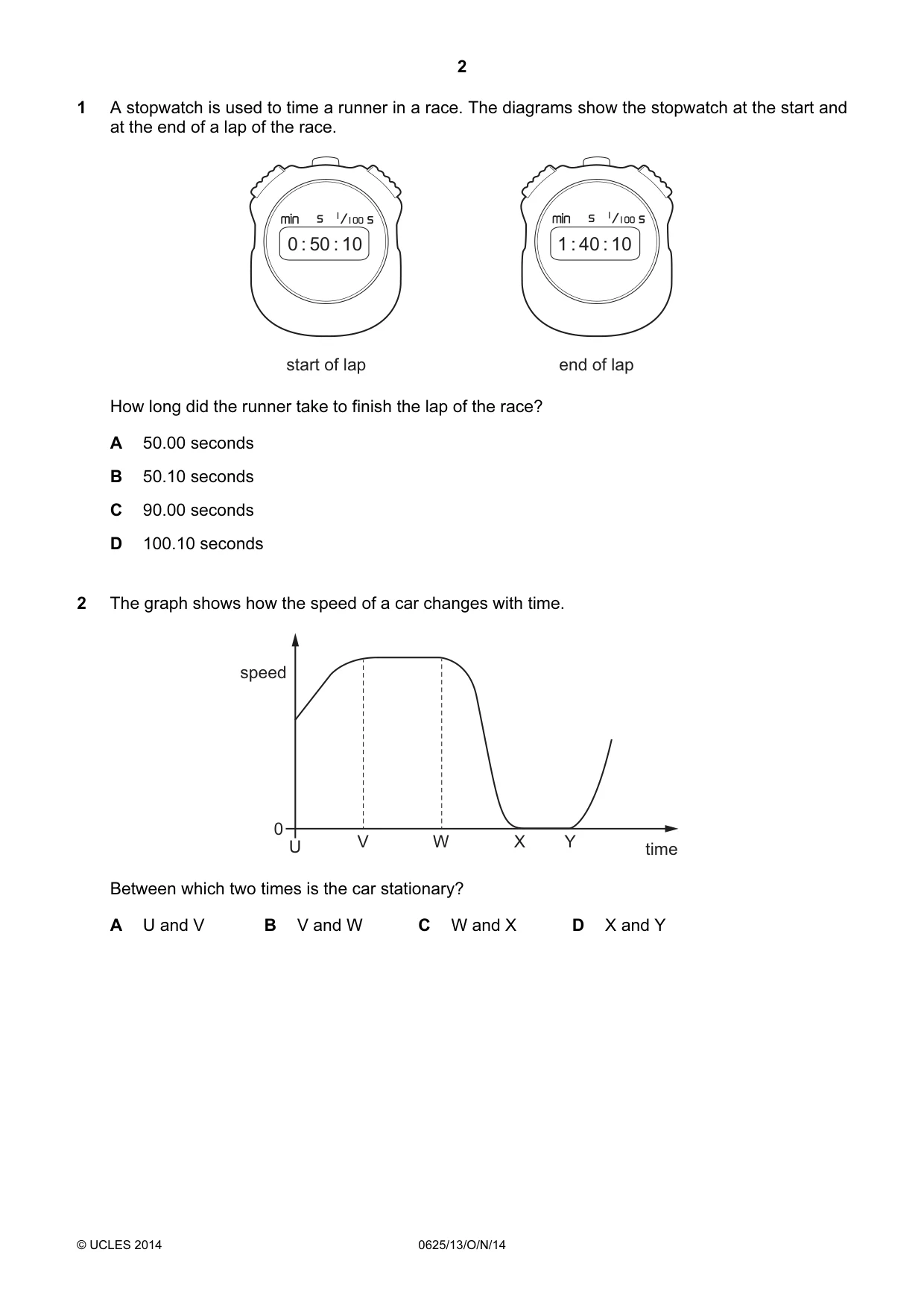
1 A stopwatch is used to time a runner in a race. The diagrams show the stopwatch at the start and at the end of a lap of the race. 0 : 50 : 10 1 : 40 : 10 start of lap end of lap How long did the runner take to finish the lap of the race? A 50.00 seconds B 50.10 seconds C 90.00 seconds D 100.10 seconds
Mark scheme: A
More questions on Physical quantities and measurement techniques
Q2 · The graph shows how the speed of a car changes with time
2 The graph shows how the speed of a car changes with time. speed 0 U V W X Y time Between which two times is the car stationary? A U and V B V and W C W and X D X and Y
Mark scheme: D
Q3 · An aeroplane flies from town X to town Z, stopping for 1 hour at town Y to pick up more…
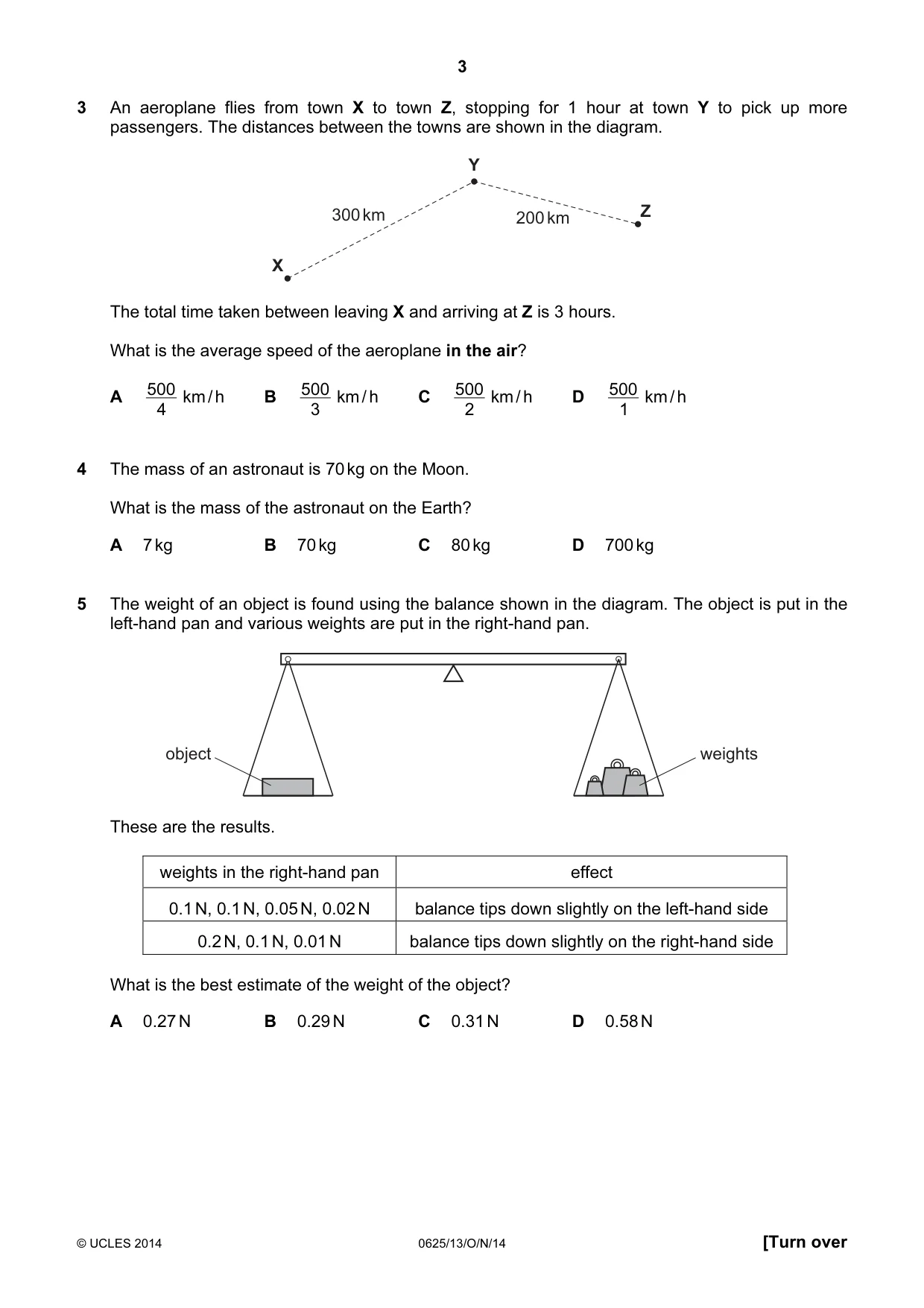
3 An aeroplane flies from town X to town Z, stopping for 1 hour at town Y to pick up more passengers. The distances between the towns are shown in the diagram. Y 300 km 200 km Z X The total time taken between leaving X and arriving at Z is 3 hours. What is the average speed of the aeroplane in the air? A 500 B 500 C 500 D 500 km / h km / h km / h km / h 4 3 2 1
Mark scheme: C
Q4 · The mass of an astronaut is 70 kg on the Moon
4 The mass of an astronaut is 70 kg on the Moon. What is the mass of the astronaut on the Earth? A 7 kg B 70 kg C 80 kg D 700 kg
Mark scheme: B
Q5 · The weight of an object is found using the balance shown in the diagram
5 The weight of an object is found using the balance shown in the diagram. The object is put in the left-hand pan and various weights are put in the right-hand pan. object weights These are the results. weights in the right-hand pan effect 0.1 N, 0.1 N, 0.05 N, 0.02 N balance tips down slightly on the left-hand side 0.2 N, 0.1 N, 0.01 N balance tips down slightly on the right-hand side What is the best estimate of the weight of the object? A 0.27 N B 0.29 N C 0.31 N D 0.58 N
Mark scheme: B
Q6 · An empty measuring cylinder on a balance
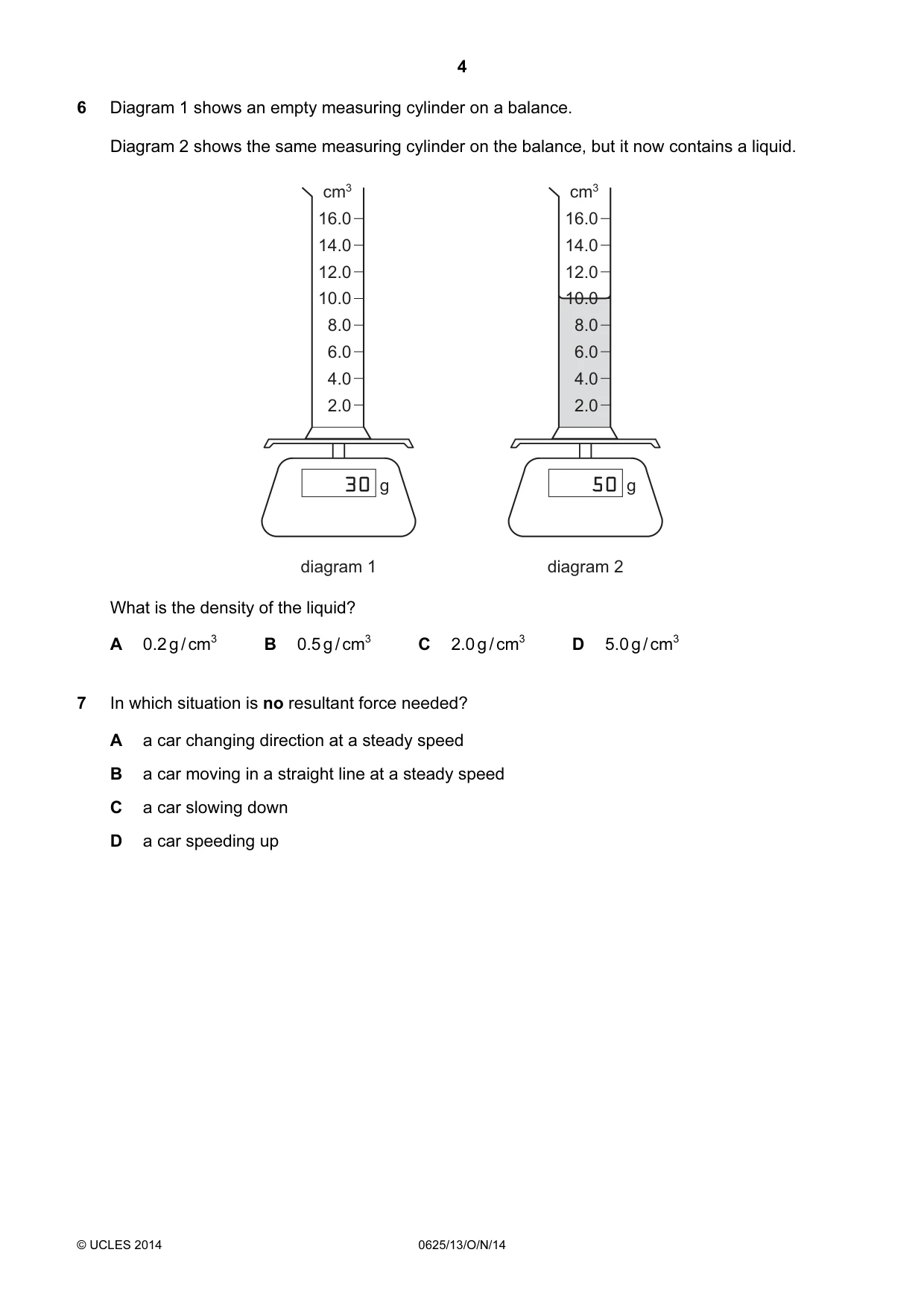
6 Diagram 1 shows an empty measuring cylinder on a balance. Diagram 2 shows the same measuring cylinder on the balance, but it now contains a liquid. cm3 cm3 16.0 16.0 14.0 14.0 12.0 12.0 10.0 10.0 8.0 8.0 6.0 6.0 4.0 4.0 2.0 2.0 g g diagram 1 diagram 2 What is the density of the liquid? A 0.2 g / cm3 B 0.5 g / cm3 C 2.0 g / cm3 D 5.0 g / cm3
Mark scheme: C
Q7 · In which situation is no resultant force needed?
7 In which situation is no resultant force needed? A a car changing direction at a steady speed B a car moving in a straight line at a steady speed C a car slowing down D a car speeding up
Mark scheme: B
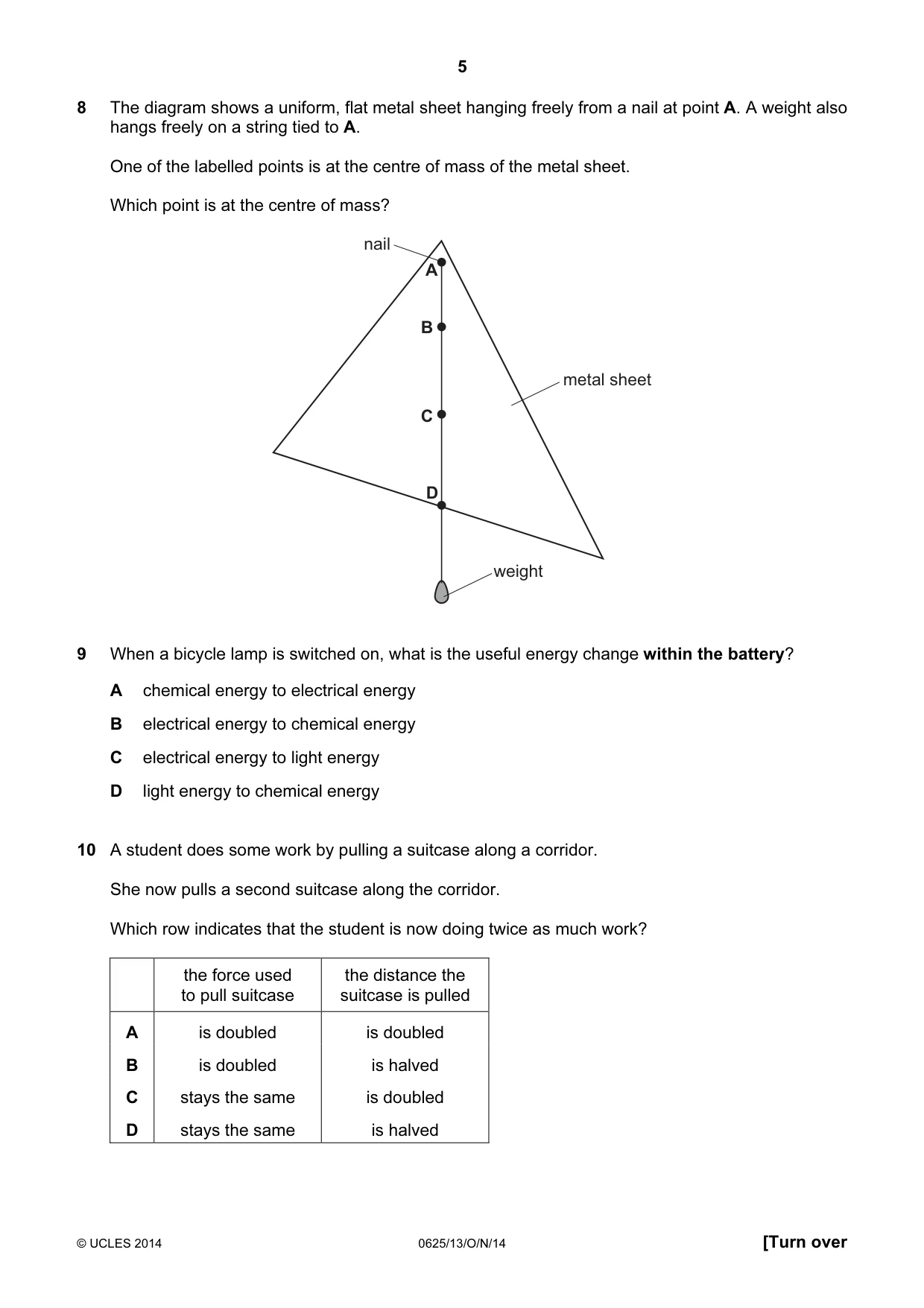
Q8 · The diagram shows a uniform, flat metal sheet hanging freely from a nail at point A
8 The diagram shows a uniform, flat metal sheet hanging freely from a nail at point A. A weight also hangs freely on a string tied to A. One of the labelled points is at the centre of mass of the metal sheet. Which point is at the centre of mass? nail A B metal sheet C D weight
Mark scheme: C
Q9 · When a bicycle lamp is switched on, what is the useful energy change within the battery?
9 When a bicycle lamp is switched on, what is the useful energy change within the battery? A chemical energy to electrical energy B electrical energy to chemical energy C electrical energy to light energy D light energy to chemical energy
Mark scheme: A
Q10 · A student does some work by pulling a suitcase along a corridor
10 A student does some work by pulling a suitcase along a corridor. She now pulls a second suitcase along the corridor. Which row indicates that the student is now doing twice as much work? the force used the distance the to pull suitcase suitcase is pulled A is doubled is doubled B is doubled is halved C stays the same is doubled D stays the same is halved
Mark scheme: C
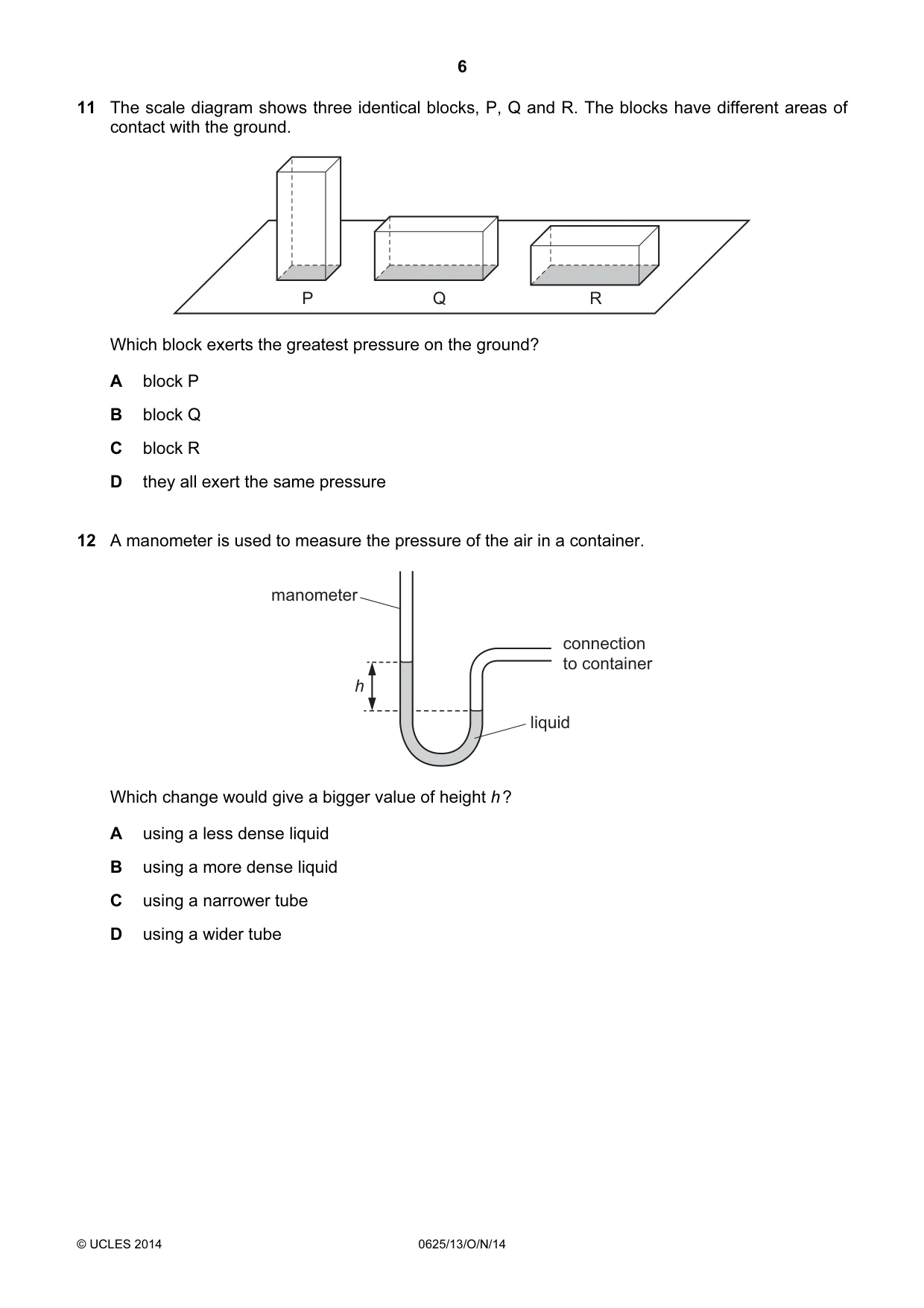
Q11 · The scale diagram shows three identical blocks, P, Q and R
11 The scale diagram shows three identical blocks, P, Q and R. The blocks have different areas of contact with the ground. P Q R Which block exerts the greatest pressure on the ground? A block P B block Q C block R D they all exert the same pressure
Mark scheme: A
Q12 · A manometer is used to measure the pressure of the air in a container
12 A manometer is used to measure the pressure of the air in a container. manometer connection to container h liquid Which change would give a bigger value of height h ? A using a less dense liquid B using a more dense liquid C using a narrower tube D using a wider tube
Mark scheme: A
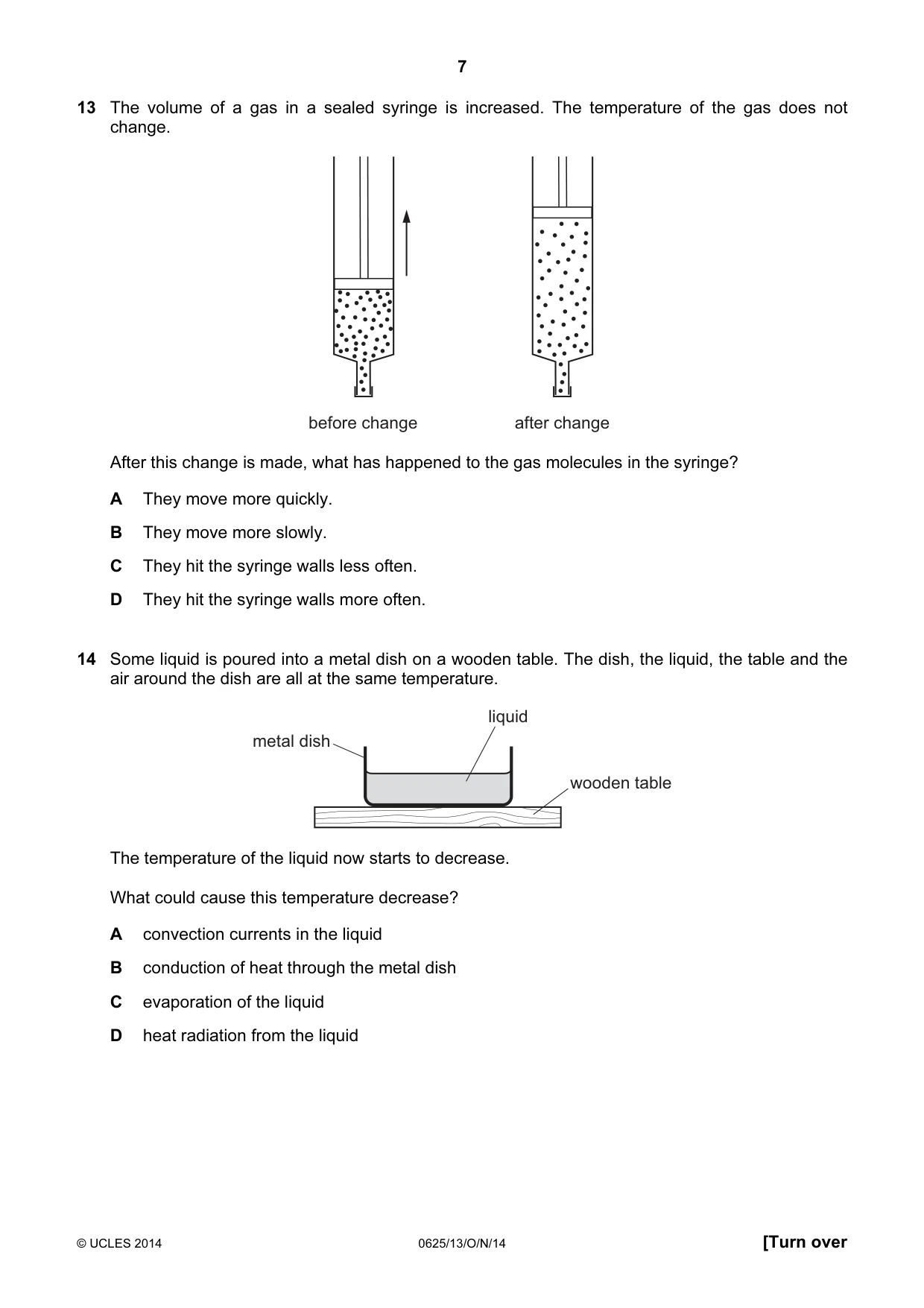
Q13 · The volume of a gas in a sealed syringe is increased
13 The volume of a gas in a sealed syringe is increased. The temperature of the gas does not change. before change after change After this change is made, what has happened to the gas molecules in the syringe? A They move more quickly. B They move more slowly. C They hit the syringe walls less often. D They hit the syringe walls more often.
Mark scheme: C
Q14 · Some liquid is poured into a metal dish on a wooden table
14 Some liquid is poured into a metal dish on a wooden table. The dish, the liquid, the table and the air around the dish are all at the same temperature. liquid metal dish wooden table The temperature of the liquid now starts to decrease. What could cause this temperature decrease? A convection currents in the liquid B conduction of heat through the metal dish C evaporation of the liquid D heat radiation from the liquid
Mark scheme: C
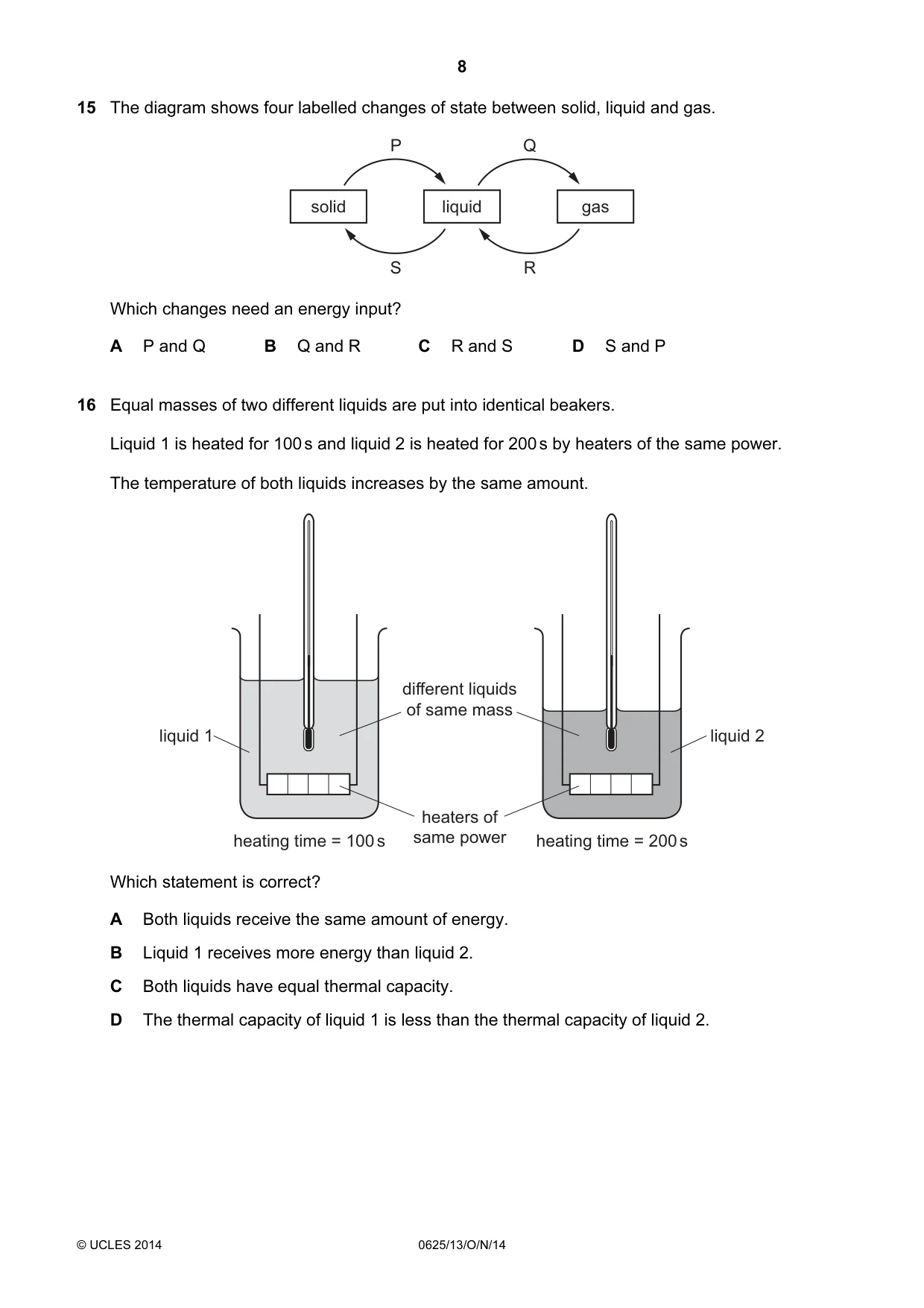
Q15 · The diagram shows four labelled changes of state between solid, liquid and gas
15 The diagram shows four labelled changes of state between solid, liquid and gas. P Q solid liquid gas S R Which changes need an energy input? A P and Q B Q and R C R and S D S and P
Mark scheme: A
Q16 · Equal masses of two different liquids are put into identical beakers
16 Equal masses of two different liquids are put into identical beakers. Liquid 1 is heated for 100 s and liquid 2 is heated for 200 s by heaters of the same power. The temperature of both liquids increases by the same amount. different liquids of same mass liquid 1 liquid 2 heaters of heating time = 100 s same power heating time = 200 s Which statement is correct? A Both liquids receive the same amount of energy. B Liquid 1 receives more energy than liquid 2. C Both liquids have equal thermal capacity. D The thermal capacity of liquid 1 is less than the thermal capacity of liquid 2.
Mark scheme: D
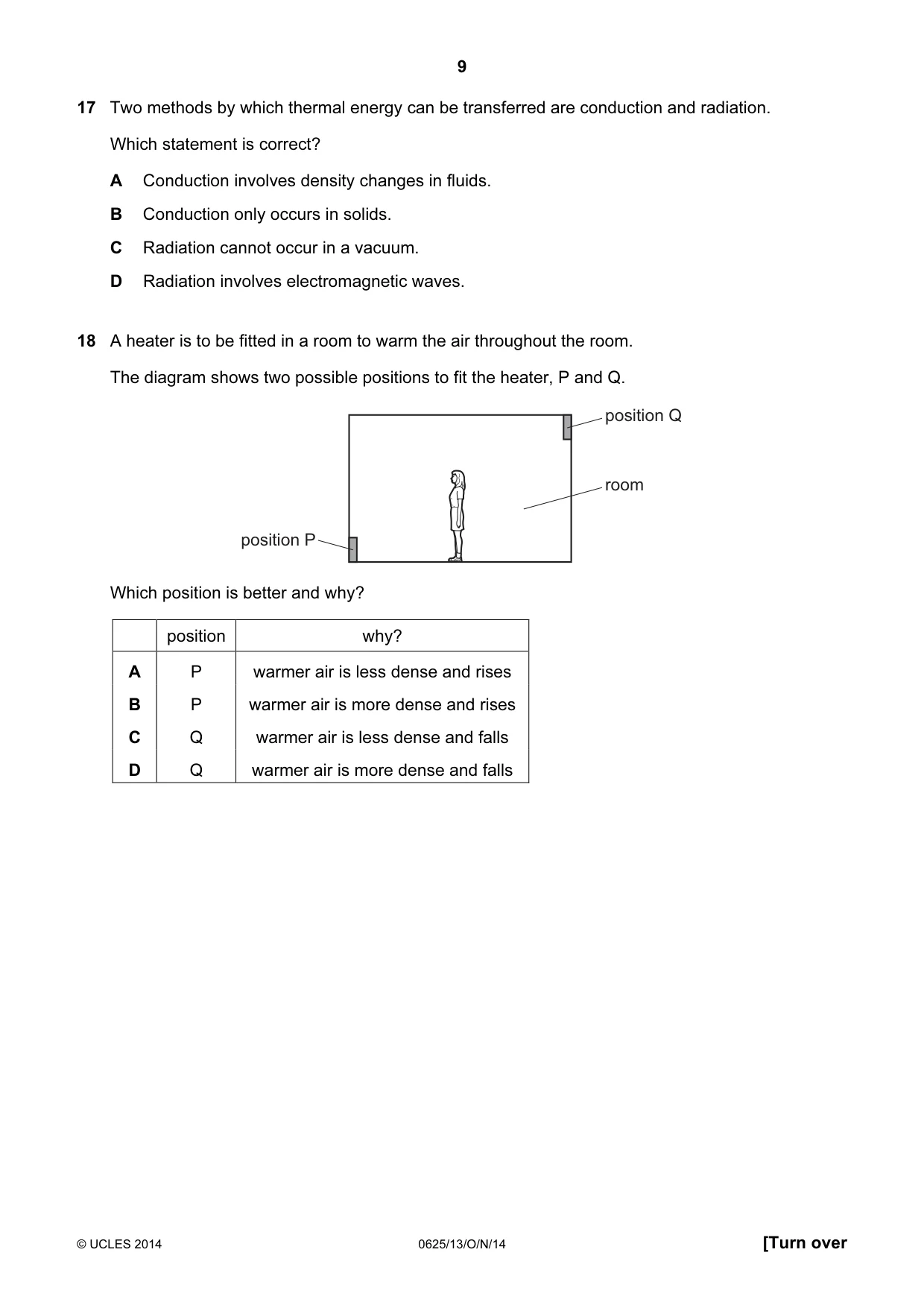
Q17 · Two methods by which thermal energy can be transferred are conduction and radiation
17 Two methods by which thermal energy can be transferred are conduction and radiation. Which statement is correct? A Conduction involves density changes in fluids. B Conduction only occurs in solids. C Radiation cannot occur in a vacuum. D Radiation involves electromagnetic waves.
Mark scheme: D
Q18 · A heater is to be fitted in a room to warm the air throughout the room
18 A heater is to be fitted in a room to warm the air throughout the room. The diagram shows two possible positions to fit the heater, P and Q. position Q room position P Which position is better and why? position why? A P warmer air is less dense and rises B P warmer air is more dense and rises C Q warmer air is less dense and falls D Q warmer air is more dense and falls
Mark scheme: A
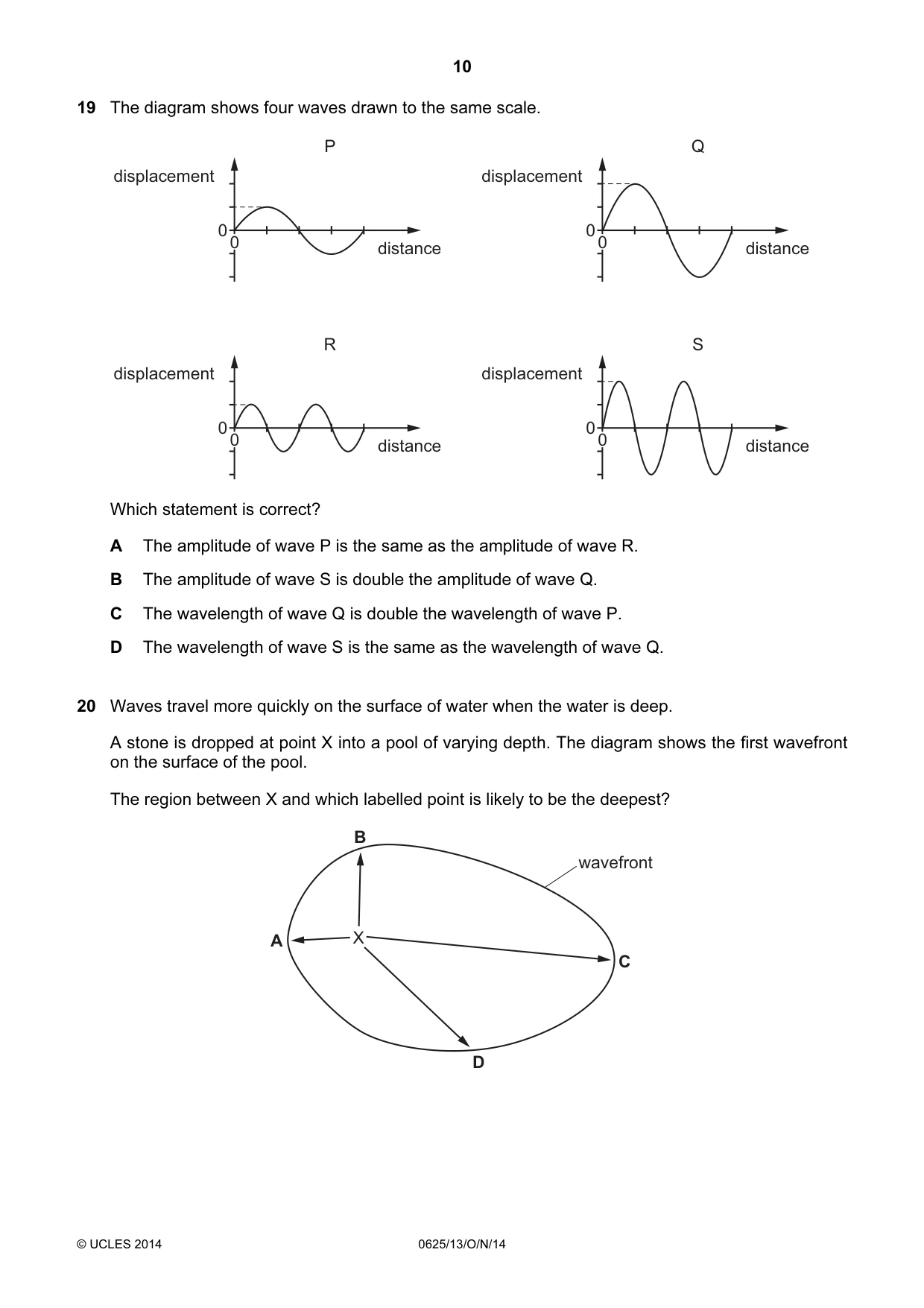
Q19 · The diagram shows four waves drawn to the same scale
19 The diagram shows four waves drawn to the same scale. P Q displacement displacement 00 00 distance distance R S displacement displacement 00 00 distance distance Which statement is correct? A The amplitude of wave P is the same as the amplitude of wave R. B The amplitude of wave S is double the amplitude of wave Q. C The wavelength of wave Q is double the wavelength of wave P. D The wavelength of wave S is the same as the wavelength of wave Q.
Mark scheme: A
Q20 · Waves travel more quickly on the surface of water when the water is deep
20 Waves travel more quickly on the surface of water when the water is deep. A stone is dropped at point X into a pool of varying depth. The diagram shows the first wavefront on the surface of the pool. The region between X and which labelled point is likely to be the deepest? B wavefront A X C D
Mark scheme: C
Q21 · An intruder alarm sensor detects that a human is warmer than his surroundings
21 An intruder alarm sensor detects that a human is warmer than his surroundings. Which type of electromagnetic wave does the sensor detect? A infra-red B radio C ultraviolet D visible light
Mark scheme: A
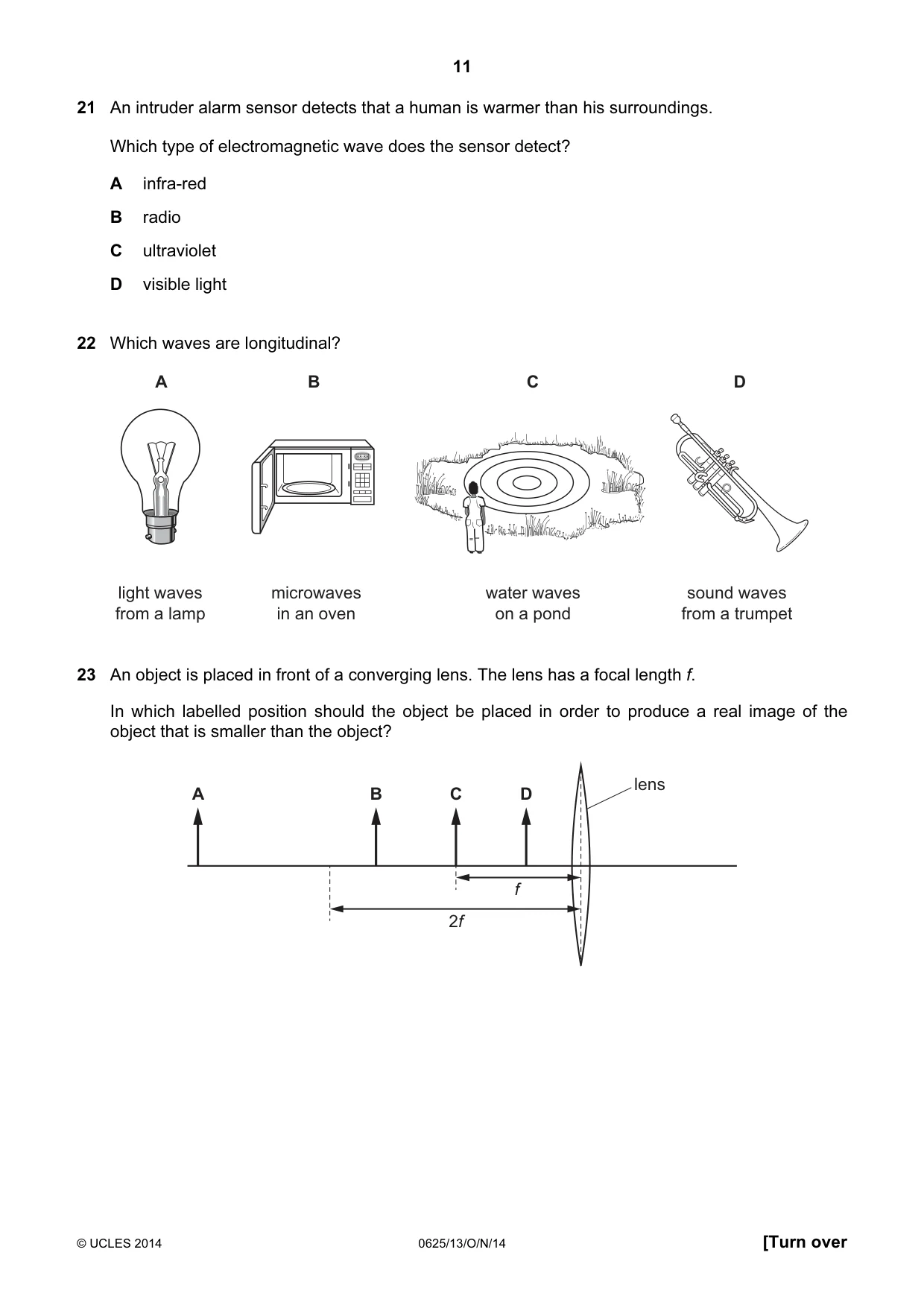
Q22 · Which waves are longitudinal?
22 Which waves are longitudinal? A B C D 88:88 light waves microwaves water waves sound waves from a lamp in an oven on a pond from a trumpet
Mark scheme: D
Q23 · An object is placed in front of a converging lens
23 An object is placed in front of a converging lens. The lens has a focal length f. In which labelled position should the object be placed in order to produce a real image of the object that is smaller than the object? lens A B C D f 2f
Mark scheme: A
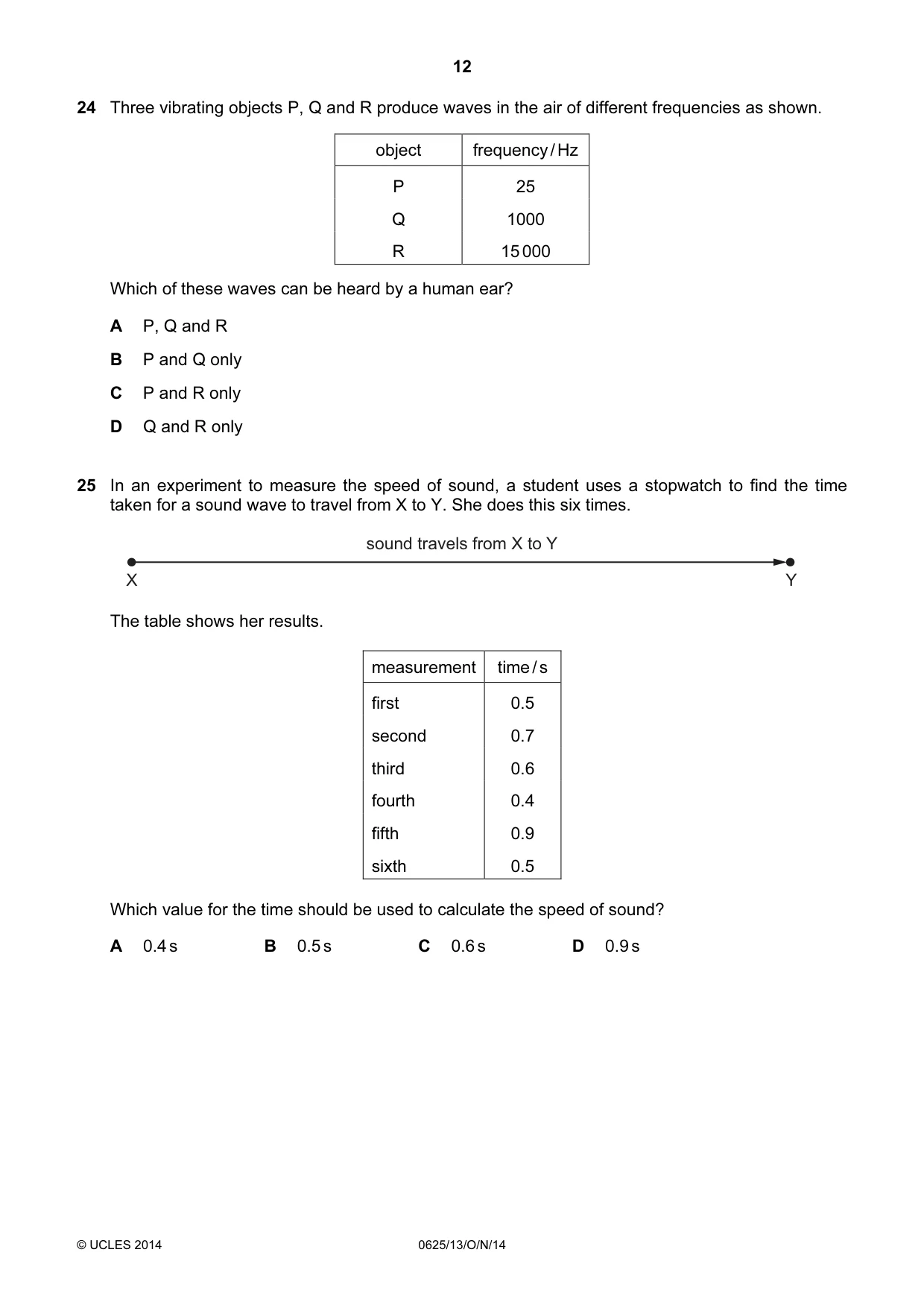
Q24 · Three vibrating objects P, Q and R produce waves in the air of different frequencies as…
24 Three vibrating objects P, Q and R produce waves in the air of different frequencies as shown. object frequency / Hz P 25 Q 1000 R 15 000 Which of these waves can be heard by a human ear? A P, Q and R B P and Q only C P and R only D Q and R only
Mark scheme: A
Q25 · In an experiment to measure the speed of sound, a student uses a stopwatch to find the…
25 In an experiment to measure the speed of sound, a student uses a stopwatch to find the time taken for a sound wave to travel from X to Y. She does this six times. sound travels from X to Y X Y The table shows her results. measurement time / s first 0.5 second 0.7 third 0.6 fourth 0.4 fifth 0.9 sixth 0.5 Which value for the time should be used to calculate the speed of sound? A 0.4 s B 0.5 s C 0.6 s D 0.9 s
Mark scheme: C
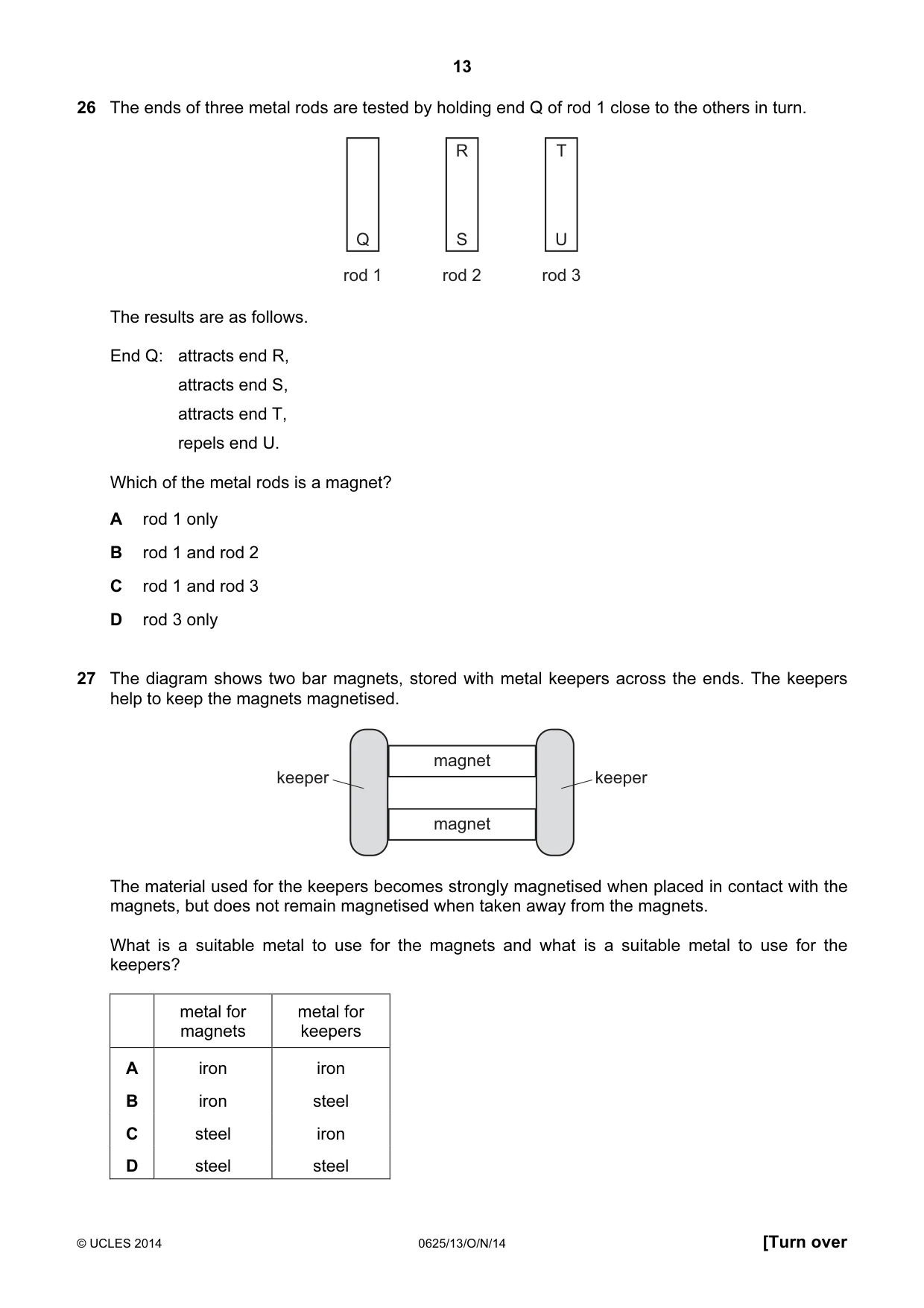
Q26 · The ends of three metal rods are tested by holding end Q of rod 1 close to the others in…
26 The ends of three metal rods are tested by holding end Q of rod 1 close to the others in turn. R T Q S U rod 1 rod 2 rod 3 The results are as follows. End Q: attracts end R, attracts end S, attracts end T, repels end U. Which of the metal rods is a magnet? A rod 1 only B rod 1 and rod 2 C rod 1 and rod 3 D rod 3 only
Mark scheme: C
Q27 · The diagram shows two bar magnets, stored with metal keepers across the ends
27 The diagram shows two bar magnets, stored with metal keepers across the ends. The keepers help to keep the magnets magnetised. magnet keeper keeper magnet The material used for the keepers becomes strongly magnetised when placed in contact with the magnets, but does not remain magnetised when taken away from the magnets. What is a suitable metal to use for the magnets and what is a suitable metal to use for the keepers? metal for metal for magnets keepers A iron iron B iron steel C steel iron D steel steel
Mark scheme: C
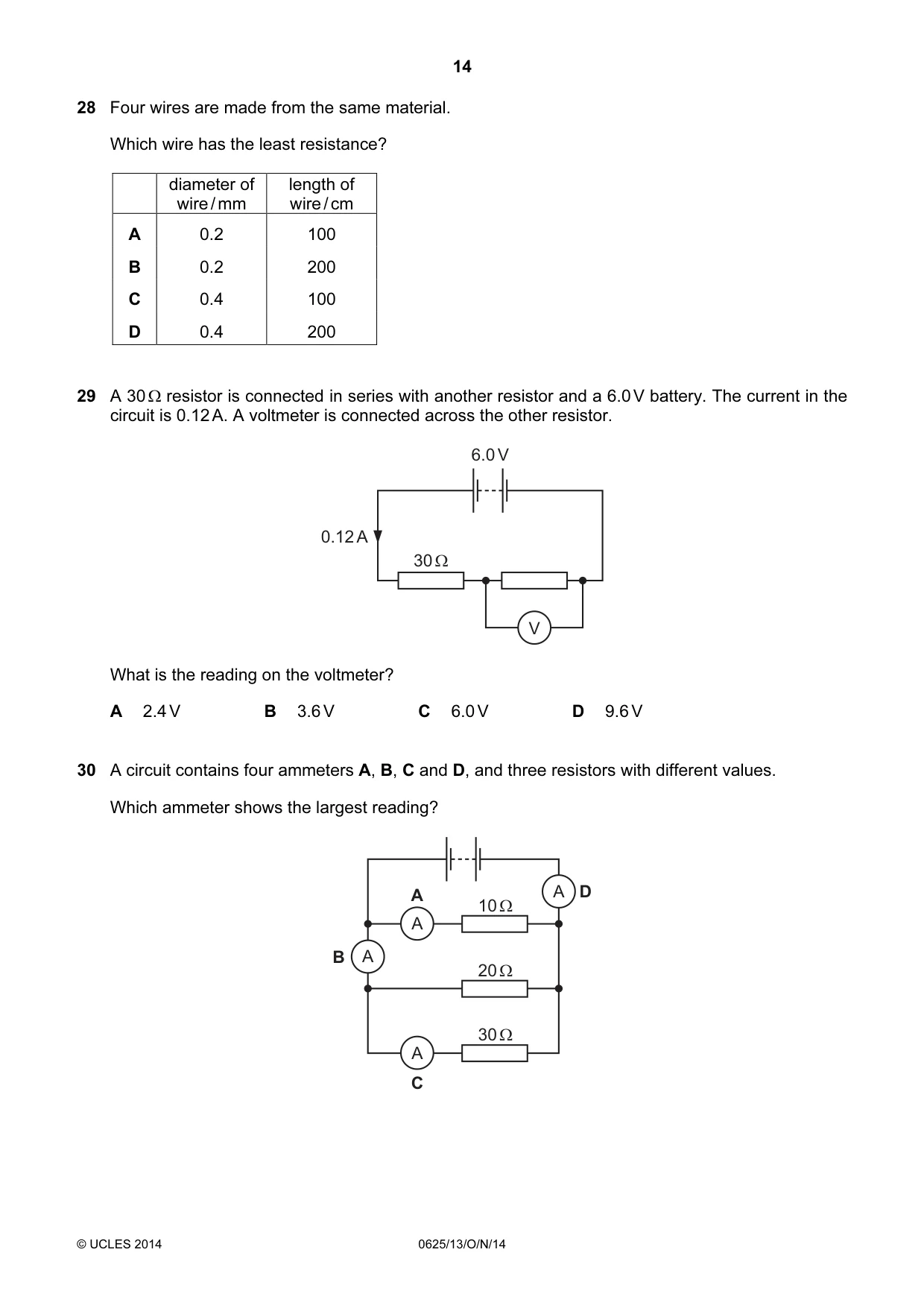
Q28 · Four wires are made from the same material
28 Four wires are made from the same material. Which wire has the least resistance? diameter of length of wire / mm wire / cm A 0.2 100 B 0.2 200 C 0.4 100 D 0.4 200
Mark scheme: C
Q29 · A 30 Ω resistor is connected in series with another resistor and a 6.0 V battery
29 A 30 Ω resistor is connected in series with another resistor and a 6.0 V battery. The current in the circuit is 0.12 A. A voltmeter is connected across the other resistor. 6.0 V 0.12 A 30 Ω V What is the reading on the voltmeter? A 2.4 V B 3.6 V C 6.0 V D 9.6 V
Mark scheme: A
Q30 · A circuit contains four ammeters A, B, C and D, and three resistors with different values
30 A circuit contains four ammeters A, B, C and D, and three resistors with different values. Which ammeter shows the largest reading? A A D 10 Ω A B A 20 Ω 30 Ω A C
Mark scheme: D
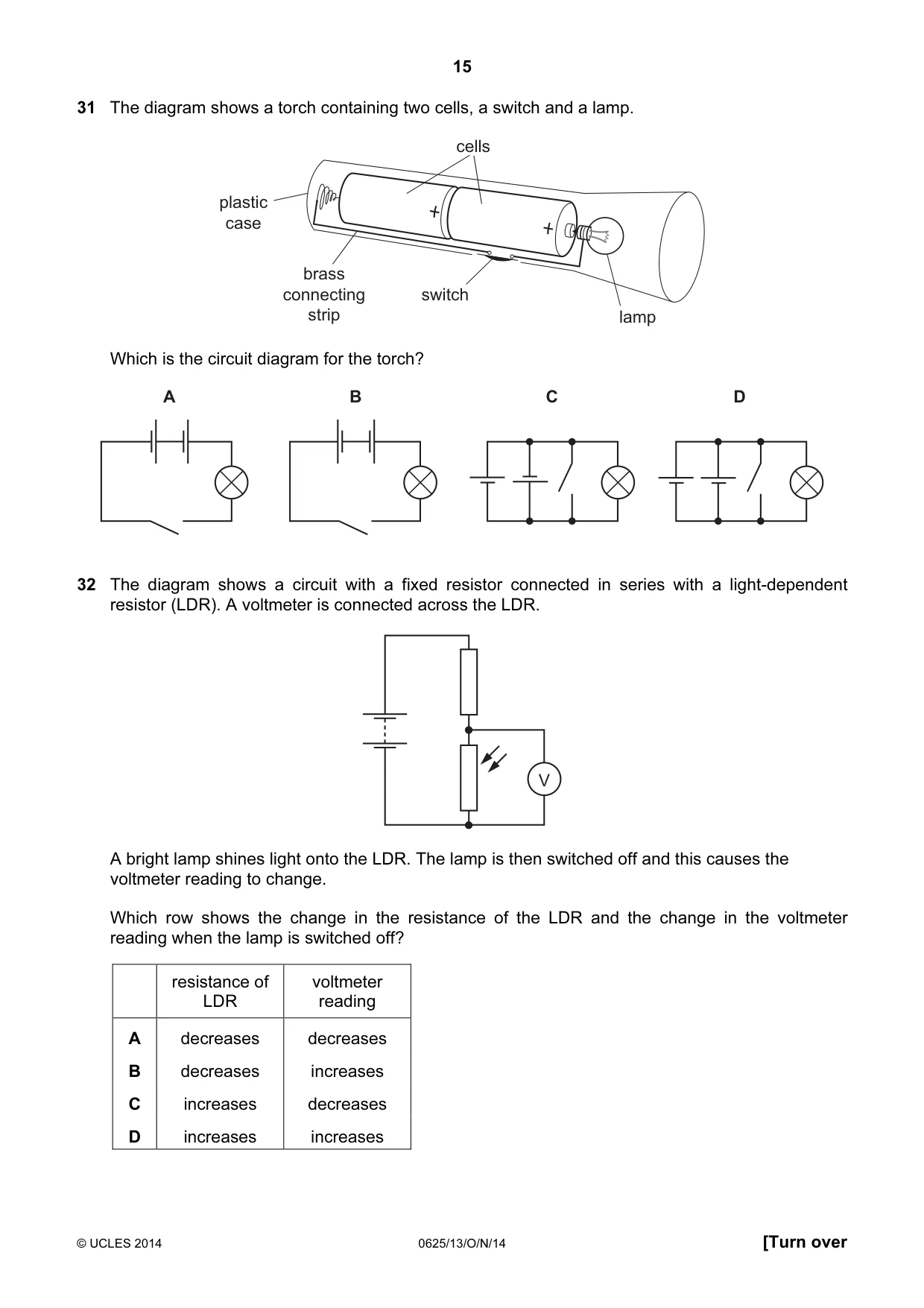
Q31 · The diagram shows a torch containing two cells, a switch and a lamp
31 The diagram shows a torch containing two cells, a switch and a lamp. cells plastic case brass connecting switch strip lamp Which is the circuit diagram for the torch? A B C D
Mark scheme: A
Q32 · The diagram shows a circuit with a fixed resistor connected in series with a…
32 The diagram shows a circuit with a fixed resistor connected in series with a light-dependent resistor (LDR). A voltmeter is connected across the LDR. V A bright lamp shines light onto the LDR. The lamp is then switched off and this causes the voltmeter reading to change. Which row shows the change in the resistance of the LDR and the change in the voltmeter reading when the lamp is switched off? resistance of voltmeter LDR reading A decreases decreases B decreases increases C increases decreases D increases increases
Mark scheme: D
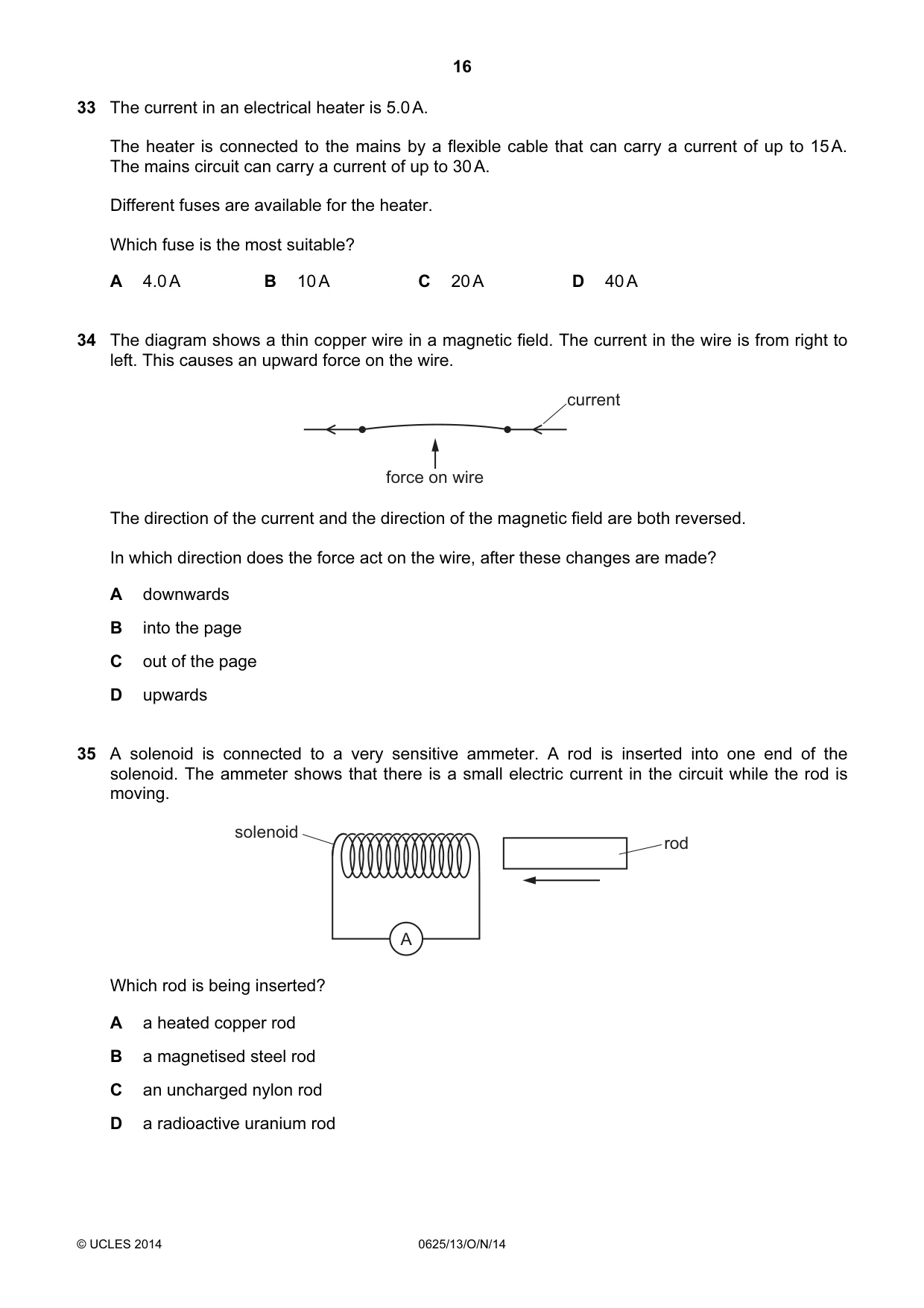
Q33 · The current in an electrical heater is 5.0 A
33 The current in an electrical heater is 5.0 A. The heater is connected to the mains by a flexible cable that can carry a current of up to 15 A. The mains circuit can carry a current of up to 30 A. Different fuses are available for the heater. Which fuse is the most suitable? A 4.0 A B 10 A C 20 A D 40 A
Mark scheme: B
Q34 · The diagram shows a thin copper wire in a magnetic field
34 The diagram shows a thin copper wire in a magnetic field. The current in the wire is from right to left. This causes an upward force on the wire. current force on wire The direction of the current and the direction of the magnetic field are both reversed. In which direction does the force act on the wire, after these changes are made? A downwards B into the page C out of the page D upwards
Mark scheme: D
Q35 · A solenoid is connected to a very sensitive ammeter
35 A solenoid is connected to a very sensitive ammeter. A rod is inserted into one end of the solenoid. The ammeter shows that there is a small electric current in the circuit while the rod is moving. solenoid rod A Which rod is being inserted? A a heated copper rod B a magnetised steel rod C an uncharged nylon rod D a radioactive uranium rod
Mark scheme: B
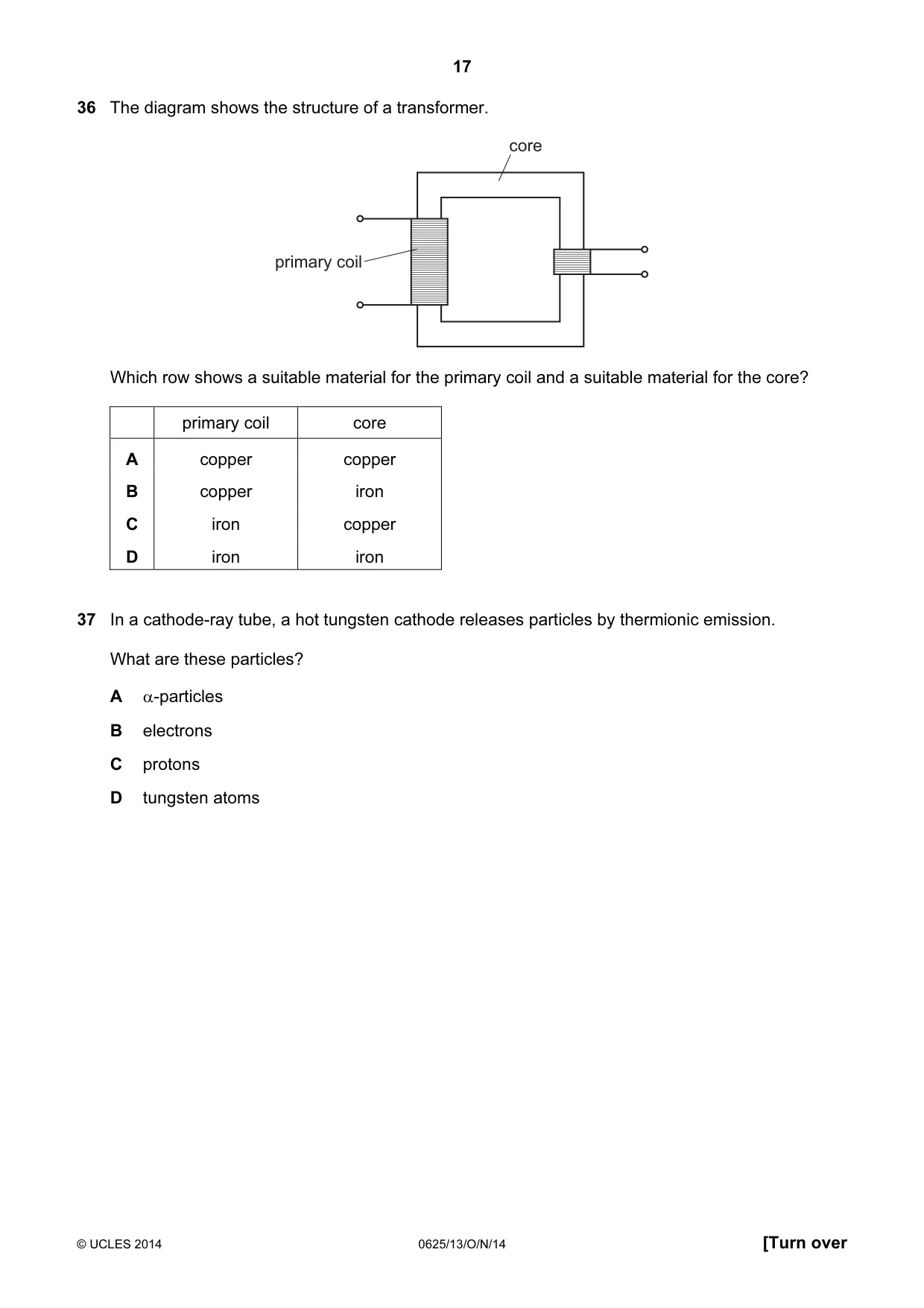
Q36 · The diagram shows the structure of a transformer
36 The diagram shows the structure of a transformer. core primary coil Which row shows a suitable material for the primary coil and a suitable material for the core? primary coil core A copper copper B copper iron C iron copper D iron iron
Mark scheme: B
Q37 · In a cathode-ray tube, a hot tungsten cathode releases particles by thermionic emission
37 In a cathode-ray tube, a hot tungsten cathode releases particles by thermionic emission. What are these particles? A α-particles B electrons C protons D tungsten atoms
Mark scheme: B
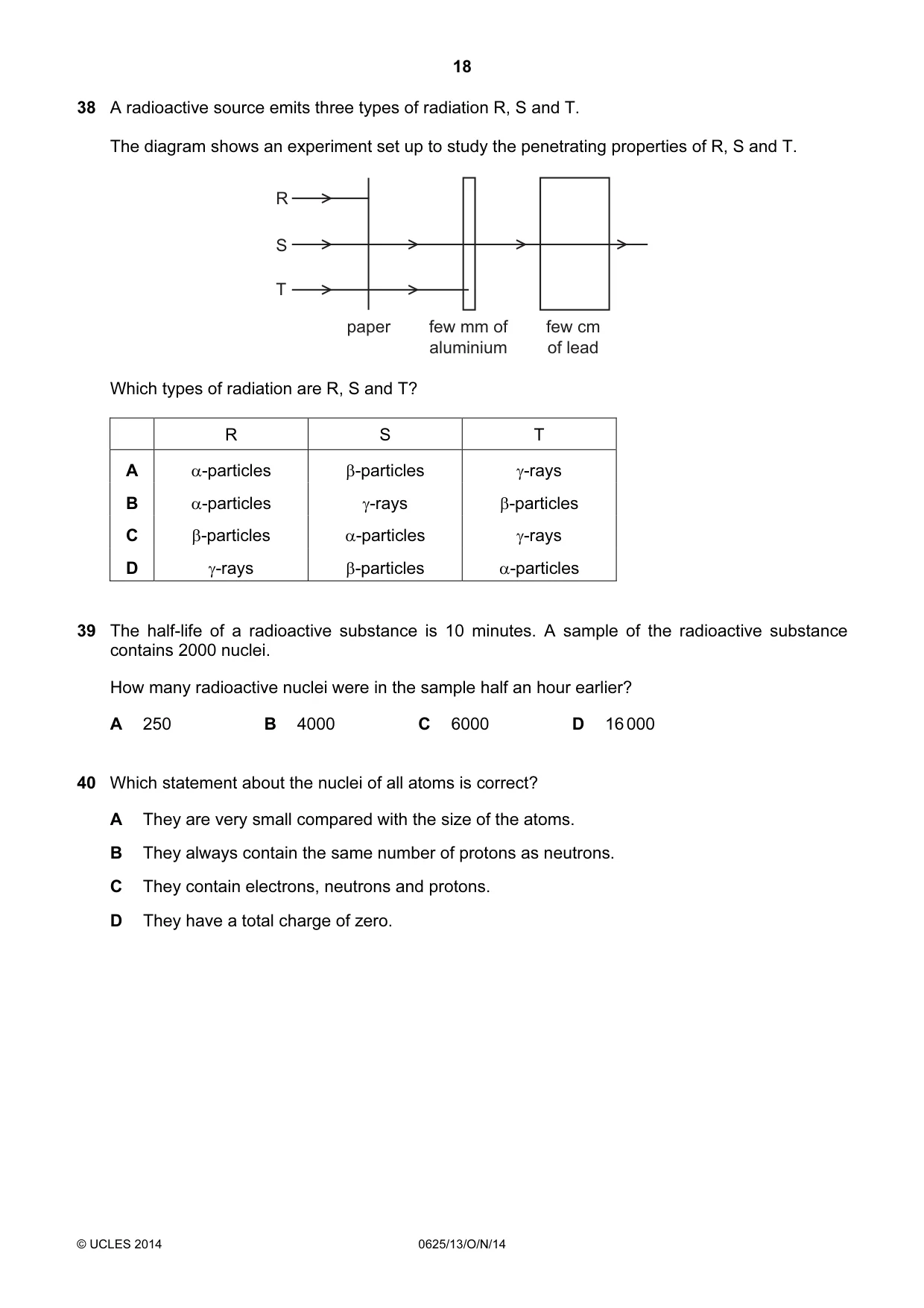
Q38 · A radioactive source emits three types of radiation R, S and T
38 A radioactive source emits three types of radiation R, S and T. The diagram shows an experiment set up to study the penetrating properties of R, S and T. R S T paper few mm of few cm aluminium of lead Which types of radiation are R, S and T? R S T A α-particles β-particles γ-rays B α-particles γ-rays β-particles C β-particles α-particles γ-rays D γ-rays β-particles α-particles
Mark scheme: B
Q39 · The half-life of a radioactive substance is 10 minutes
39 The half-life of a radioactive substance is 10 minutes. A sample of the radioactive substance contains 2000 nuclei. How many radioactive nuclei were in the sample half an hour earlier? A 250 B 4000 C 6000 D 16 000
Mark scheme: D
Q40 · Which statement about the nuclei of all atoms is correct?
40 Which statement about the nuclei of all atoms is correct? A They are very small compared with the size of the atoms. B They always contain the same number of protons as neutrons. C They contain electrons, neutrons and protons. D They have a total charge of zero.
Mark scheme: A
What was in this paper
The subtopics covered by these 40 questions, and how many questions each got. Open one in a new tab to see every Cambridge question on it.
4Electromagnetic effects3Sound3Thermal properties and temperature3Energy, work and power2Forces2General properties of waves2Mass and weight2Motion2Pressure2Radioactivity2Simple phenomena of magnetism2The nuclear model of the atom2Transfer of thermal energy2Density1Electrical quantities1Electrical safety1Electromagnetic spectrum1Kinetic particle model of matter1Light1Physical quantities and measurement techniques1What you needed in this session
Cambridge’s own grade thresholds for 2014 Oct/Nov, Paper 1 · Variant 3. A higher threshold means an easier paper — the bar moves with how the cohort did.