Cambridge IGCSE Physics 0625 — 2015 Oct/Nov Paper 1 · Variant 3
0625/13/O/N/15 · 40 questions · 40 marks · ≈45 min
The question paper and its mark scheme, free to read here and free to download. This is Cambridge’s own paper, exactly as it was sat.
Question paper16 pages
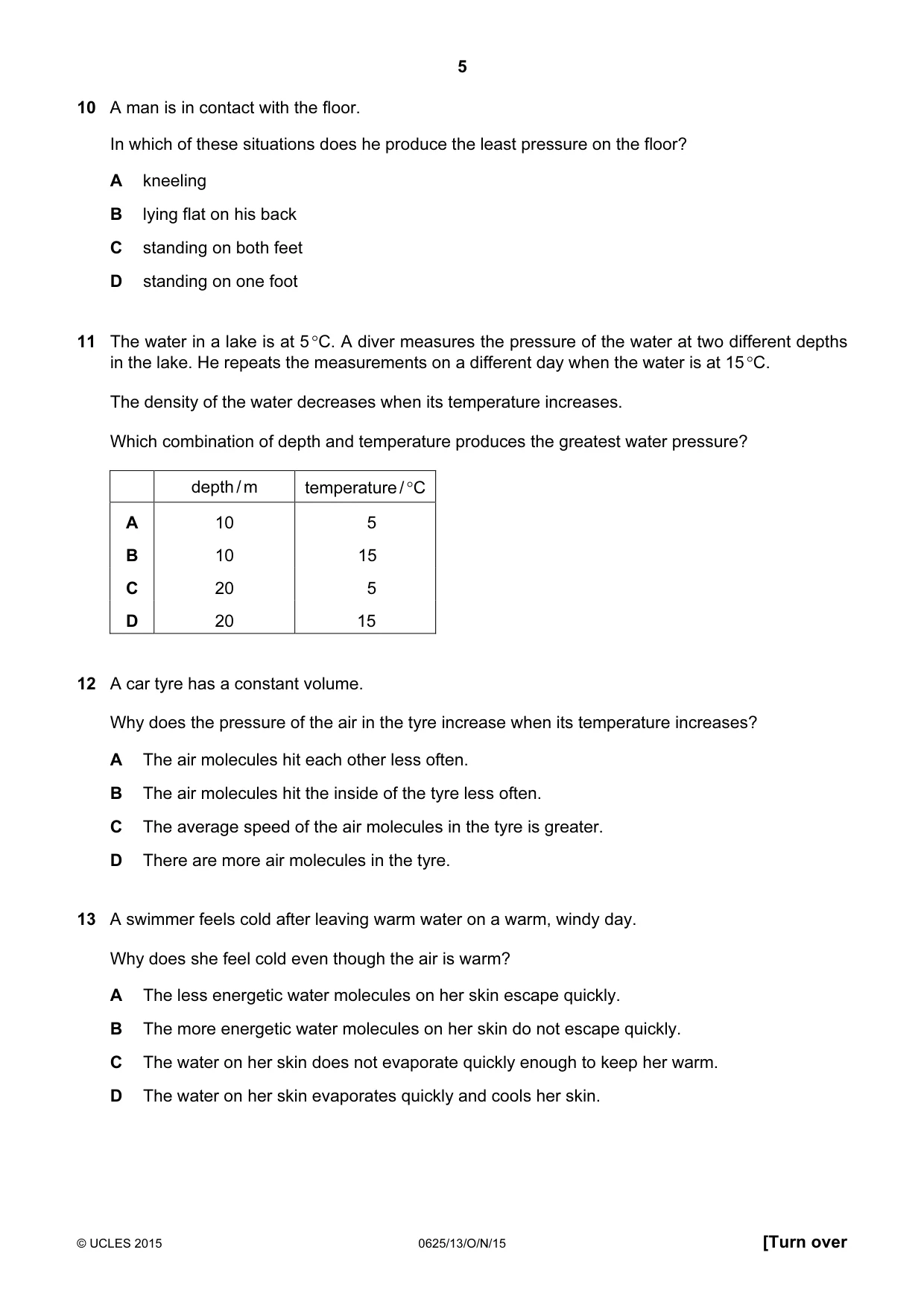
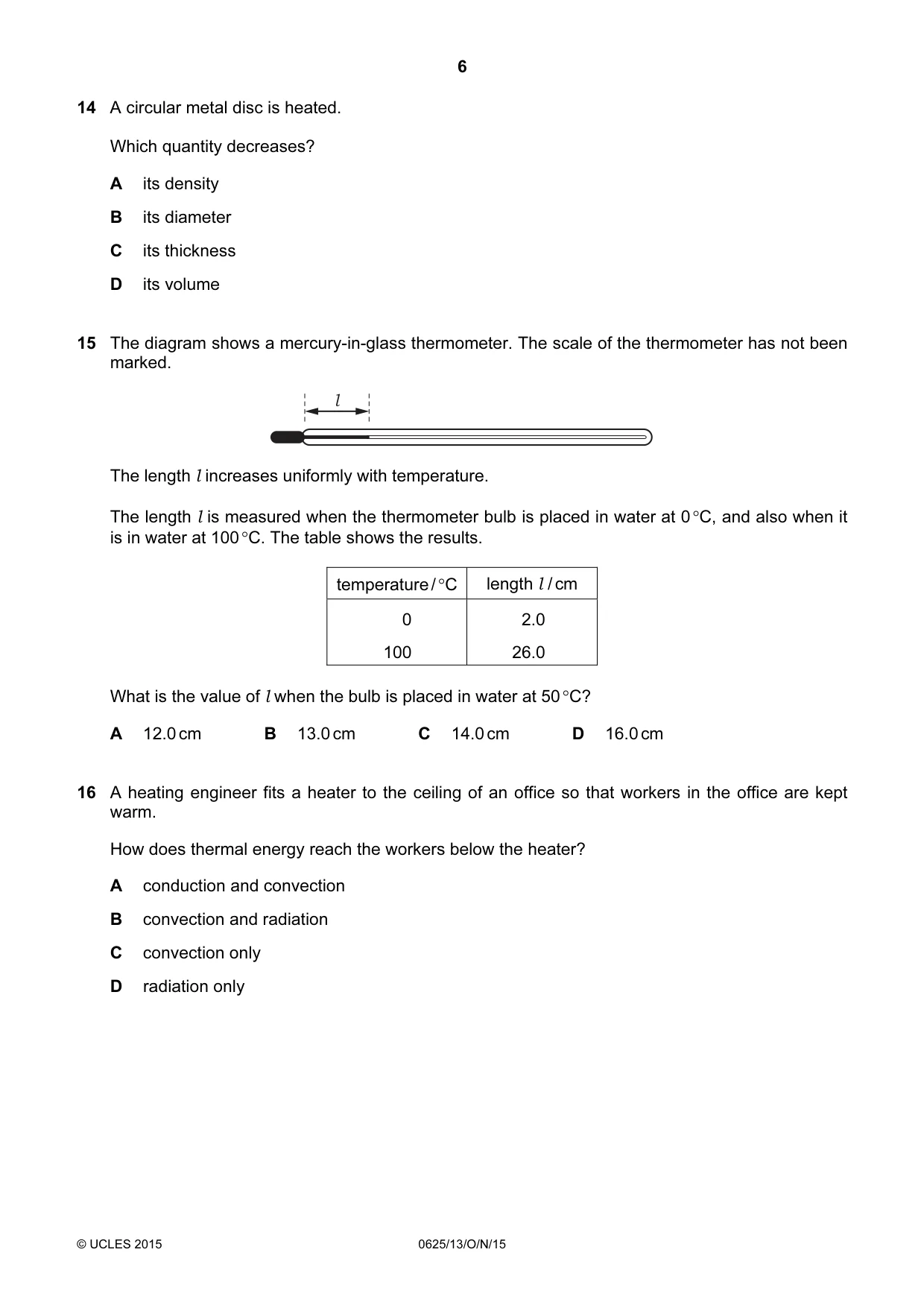
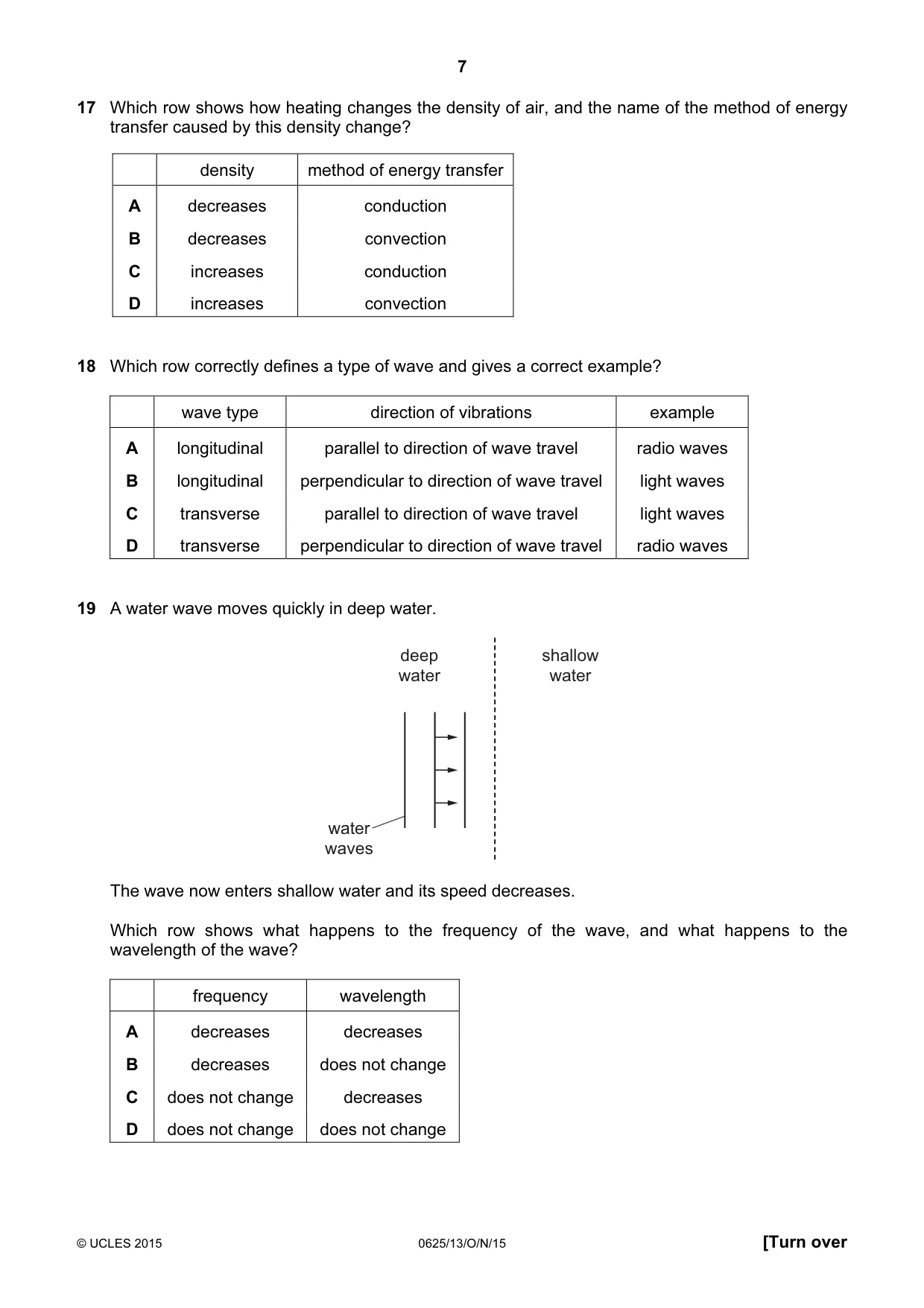
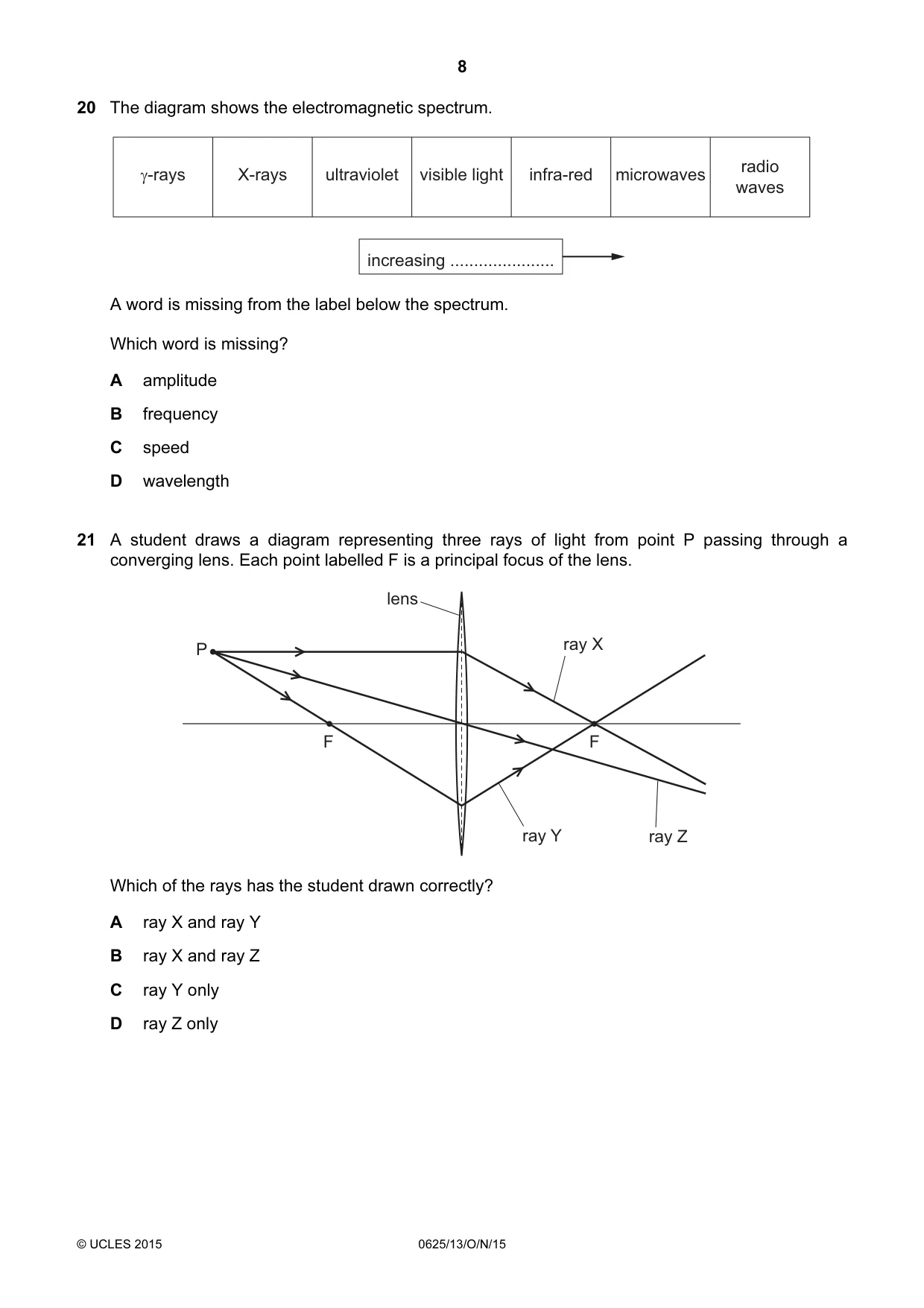
Mark scheme2 pages
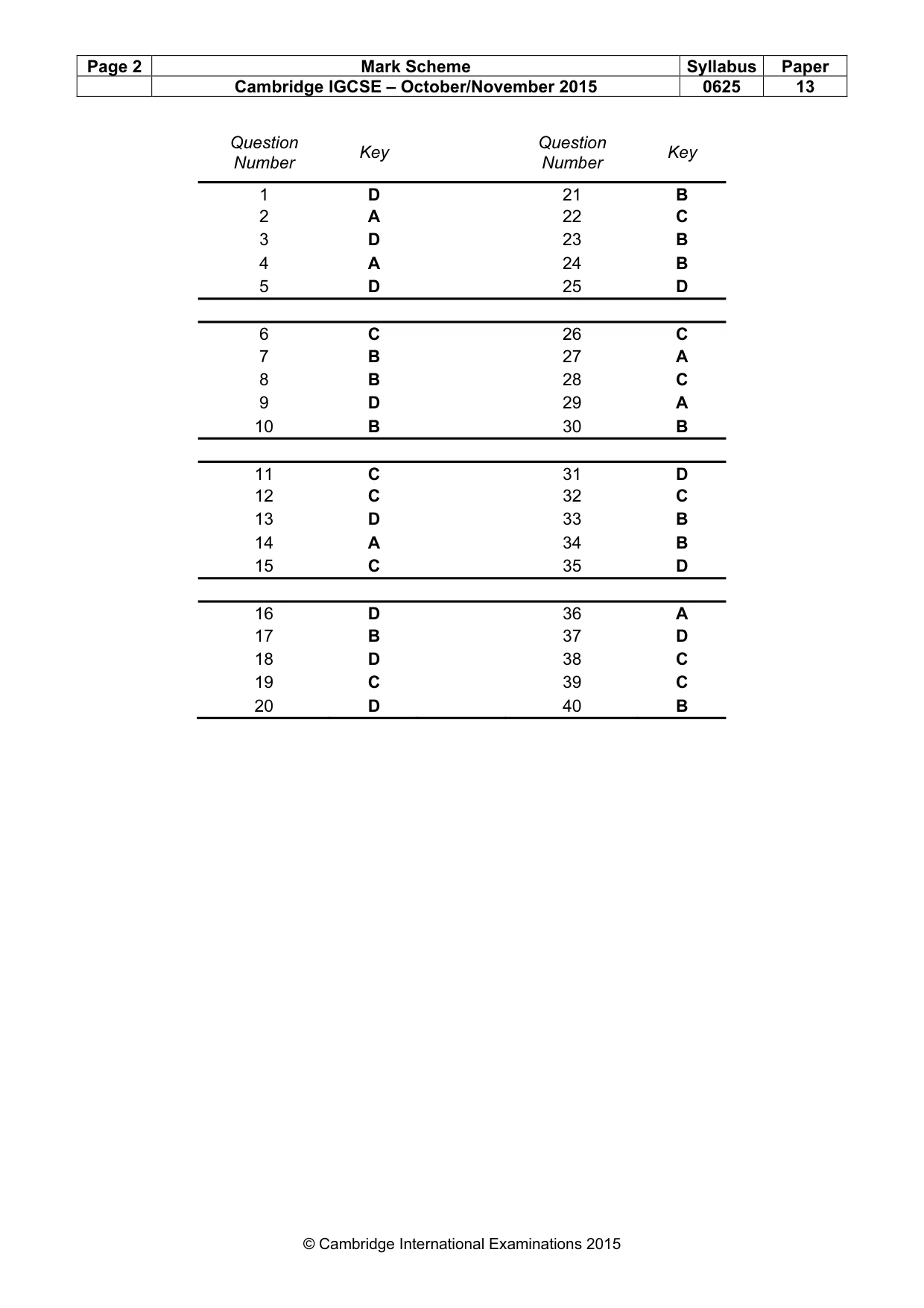
Answers below. Sit the paper first if you are practising.
Questions as text
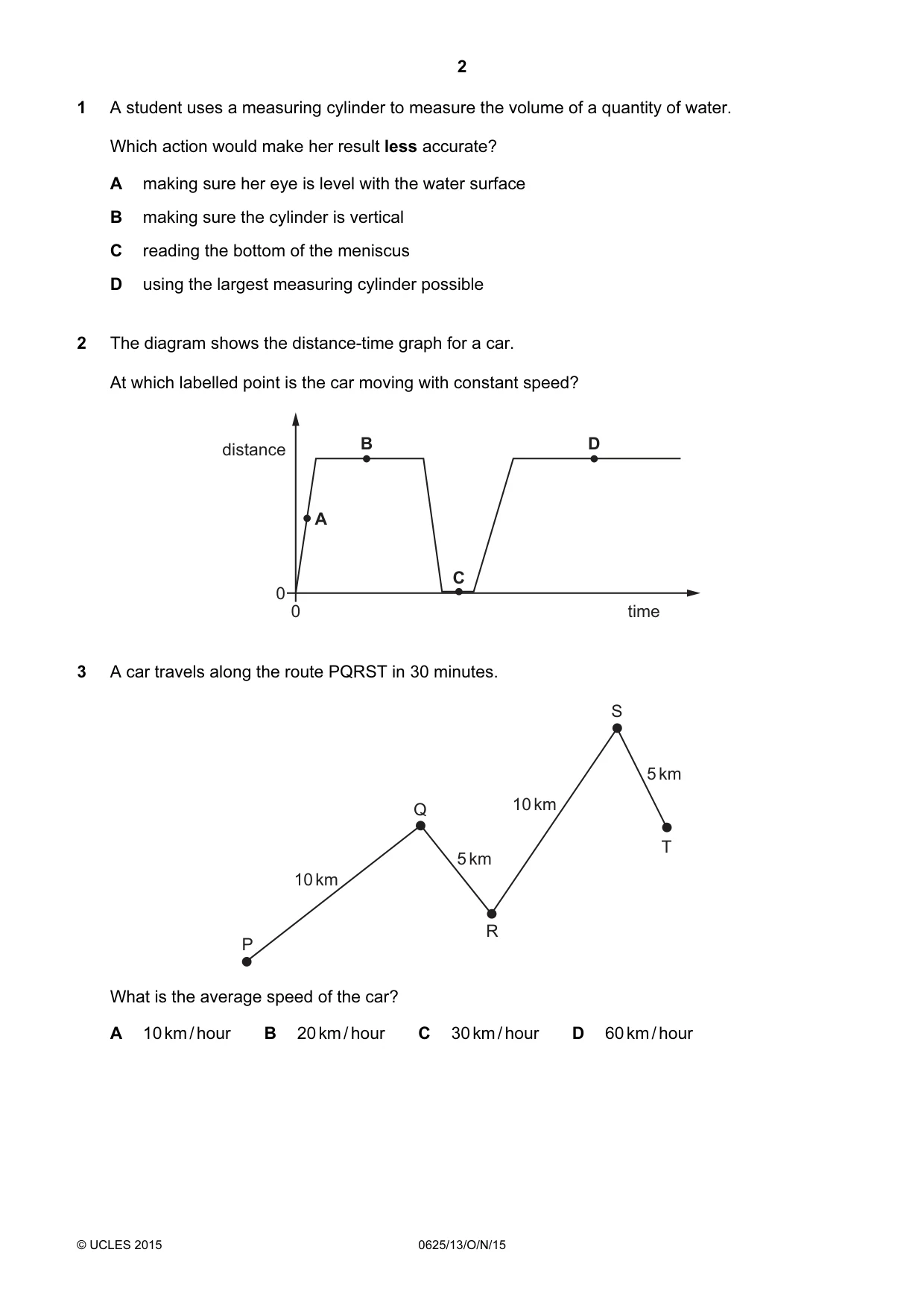
Q1 · A student uses a measuring cylinder to measure the volume of a quantity of water
1 A student uses a measuring cylinder to measure the volume of a quantity of water. Which action would make her result less accurate? A making sure her eye is level with the water surface B making sure the cylinder is vertical C reading the bottom of the meniscus D using the largest measuring cylinder possible
Mark scheme: D
More questions on Physical quantities and measurement techniques
Q2 · The diagram shows the distance-time graph for a car
2 The diagram shows the distance-time graph for a car. At which labelled point is the car moving with constant speed? distance B D A C 0 0 time
Mark scheme: A
Q3 · A car travels along the route PQRST in 30 minutes
3 A car travels along the route PQRST in 30 minutes. S 5 km Q 10 km T 5 km 10 km R P What is the average speed of the car? A 10 km / hour B 20 km / hour C 30 km / hour D 60 km / hour
Mark scheme: D
Q4 · What is the weight of an object?
4 What is the weight of an object? A the force of gravity on the object B the gravitational potential energy of the object C the internal energy of the object D the mass of the object
Mark scheme: A
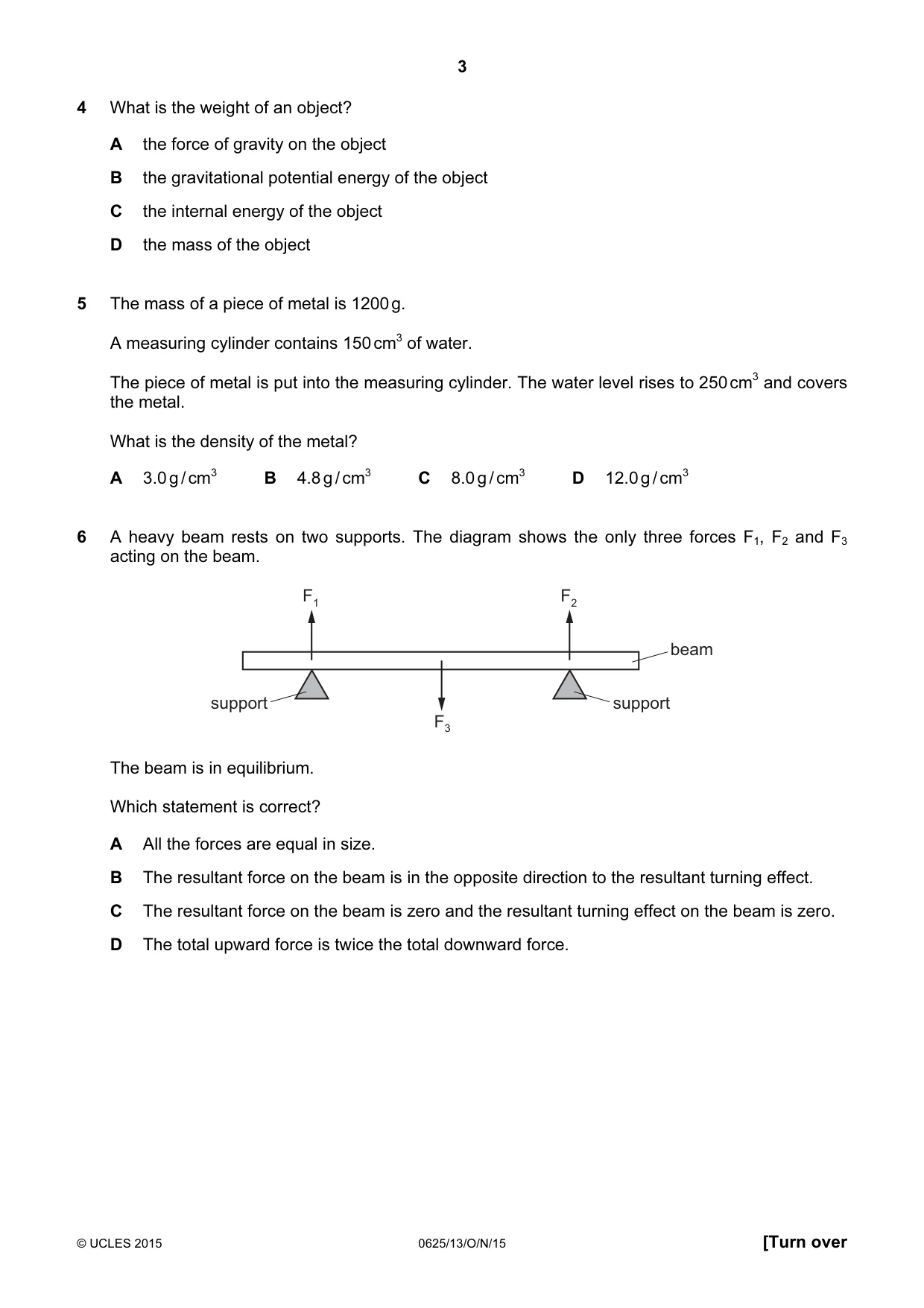
Q5 · The mass of a piece of metal is 1200 g
5 The mass of a piece of metal is 1200 g. A measuring cylinder contains 150 cm3 of water. The piece of metal is put into the measuring cylinder. The water level rises to 250 cm3 and covers the metal. What is the density of the metal? A 3.0 g / cm3 B 4.8 g / cm3 C 8.0 g / cm3 D 12.0 g / cm3
Mark scheme: D
Q6 · A heavy beam rests on two supports
6 A heavy beam rests on two supports. The diagram shows the only three forces F1, F2 and F3 acting on the beam. F1 F2 beam support support F3 The beam is in equilibrium. Which statement is correct? A All the forces are equal in size. B The resultant force on the beam is in the opposite direction to the resultant turning effect. C The resultant force on the beam is zero and the resultant turning effect on the beam is zero. D The total upward force is twice the total downward force.
Mark scheme: C
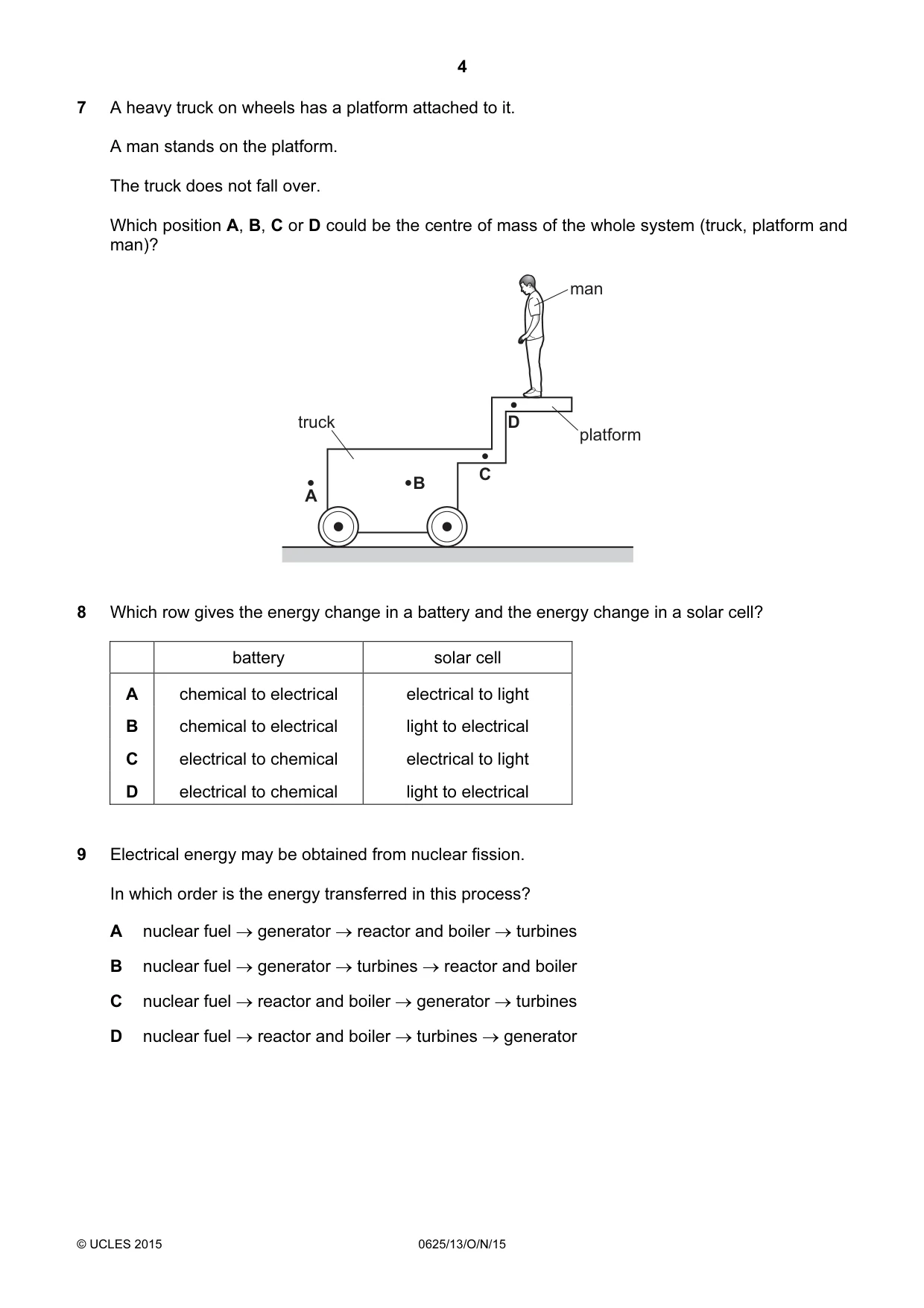
Q7 · A heavy truck on wheels has a platform attached to it
7 A heavy truck on wheels has a platform attached to it. A man stands on the platform. The truck does not fall over. Which position A, B, C or D could be the centre of mass of the whole system (truck, platform and man)? man truck D platform C B A
Mark scheme: B
Q8 · Which row gives the energy change in a battery and the energy change in a solar cell?
8 Which row gives the energy change in a battery and the energy change in a solar cell? battery solar cell A chemical to electrical electrical to light B chemical to electrical light to electrical C electrical to chemical electrical to light D electrical to chemical light to electrical
Mark scheme: B
Q9 · Electrical energy may be obtained from nuclear fission
9 Electrical energy may be obtained from nuclear fission. In which order is the energy transferred in this process? A nuclear fuel → generator → reactor and boiler → turbines B nuclear fuel → generator → turbines → reactor and boiler C nuclear fuel → reactor and boiler → generator → turbines D nuclear fuel → reactor and boiler → turbines → generator
Mark scheme: D
Q10 · A man is in contact with the floor
10 A man is in contact with the floor. In which of these situations does he produce the least pressure on the floor? A kneeling B lying flat on his back C standing on both feet D standing on one foot
Mark scheme: B
Q11 · The water in a lake is at 5 °C
11 The water in a lake is at 5 °C. A diver measures the pressure of the water at two different depths in the lake. He repeats the measurements on a different day when the water is at 15 °C. The density of the water decreases when its temperature increases. Which combination of depth and temperature produces the greatest water pressure? depth / m temperature / °C A 10 5 B 10 15 C 20 5 D 20 15
Mark scheme: C
Q12 · A car tyre has a constant volume
12 A car tyre has a constant volume. Why does the pressure of the air in the tyre increase when its temperature increases? A The air molecules hit each other less often. B The air molecules hit the inside of the tyre less often. C The average speed of the air molecules in the tyre is greater. D There are more air molecules in the tyre.
Mark scheme: C
Q13 · A swimmer feels cold after leaving warm water on a warm, windy day
13 A swimmer feels cold after leaving warm water on a warm, windy day. Why does she feel cold even though the air is warm? A The less energetic water molecules on her skin escape quickly. B The more energetic water molecules on her skin do not escape quickly. C The water on her skin does not evaporate quickly enough to keep her warm. D The water on her skin evaporates quickly and cools her skin.
Mark scheme: D
Q14 · A circular metal disc is heated
14 A circular metal disc is heated. Which quantity decreases? A its density B its diameter C its thickness D its volume
Mark scheme: A
Q15 · The diagram shows a mercury-in-glass thermometer
15 The diagram shows a mercury-in-glass thermometer. The scale of the thermometer has not been marked. l The length l increases uniformly with temperature. The length l is measured when the thermometer bulb is placed in water at 0 °C, and also when it is in water at 100 °C. The table shows the results. temperature / °C length l / cm 0 2.0 100 26.0 What is the value of l when the bulb is placed in water at 50 °C? A 12.0 cm B 13.0 cm C 14.0 cm D 16.0 cm
Mark scheme: C
Q16 · A heating engineer fits a heater to the ceiling of an office so that workers in the…
16 A heating engineer fits a heater to the ceiling of an office so that workers in the office are kept warm. How does thermal energy reach the workers below the heater? A conduction and convection B convection and radiation C convection only D radiation only
Mark scheme: D
Q17 · Which row shows how heating changes the density of air, and the name of the method of…
17 Which row shows how heating changes the density of air, and the name of the method of energy transfer caused by this density change? density method of energy transfer A decreases conduction B decreases convection C increases conduction D increases convection
Mark scheme: B
Q18 · Which row correctly defines a type of wave and gives a correct example?
18 Which row correctly defines a type of wave and gives a correct example? wave type direction of vibrations example A longitudinal parallel to direction of wave travel radio waves B longitudinal perpendicular to direction of wave travel light waves C transverse parallel to direction of wave travel light waves D transverse perpendicular to direction of wave travel radio waves
Mark scheme: D
Q19 · A water wave moves quickly in deep water
19 A water wave moves quickly in deep water. deep shallow water water water waves The wave now enters shallow water and its speed decreases. Which row shows what happens to the frequency of the wave, and what happens to the wavelength of the wave? frequency wavelength A decreases decreases B decreases does not change C does not change decreases D does not change does not change
Mark scheme: C
Q20 · The diagram shows the electromagnetic spectrum
20 The diagram shows the electromagnetic spectrum. γ-rays radio X-rays ultraviolet visible light infra-red microwaves waves increasing ...................... A word is missing from the label below the spectrum. Which word is missing? A amplitude B frequency C speed D wavelength
Mark scheme: D
Q21 · A student draws a diagram representing three rays of light from point P passing through a…
21 A student draws a diagram representing three rays of light from point P passing through a converging lens. Each point labelled F is a principal focus of the lens. lens P ray X F F ray Y ray Z Which of the rays has the student drawn correctly? A ray X and ray Y B ray X and ray Z C ray Y only D ray Z only
Mark scheme: B
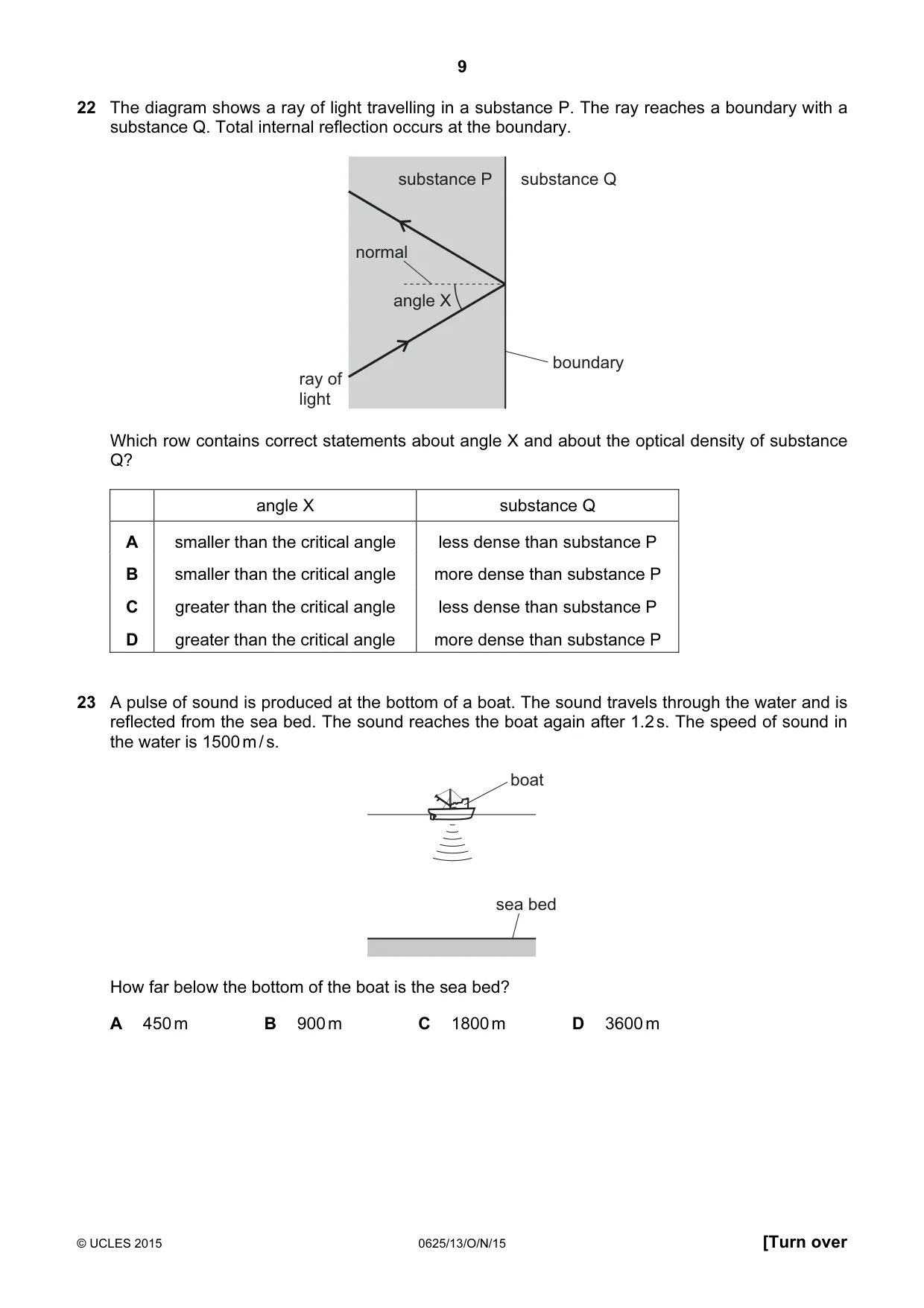
Q22 · The diagram shows a ray of light travelling in a substance P
22 The diagram shows a ray of light travelling in a substance P. The ray reaches a boundary with a substance Q. Total internal reflection occurs at the boundary. substance P substance Q normal angle X boundary ray of light Which row contains correct statements about angle X and about the optical density of substance Q? angle X substance Q A smaller than the critical angle less dense than substance P B smaller than the critical angle more dense than substance P C greater than the critical angle less dense than substance P D greater than the critical angle more dense than substance P
Mark scheme: C
Q23 · A pulse of sound is produced at the bottom of a boat
23 A pulse of sound is produced at the bottom of a boat. The sound travels through the water and is reflected from the sea bed. The sound reaches the boat again after 1.2 s. The speed of sound in the water is 1500 m / s. boat sea bed How far below the bottom of the boat is the sea bed? A 450 m B 900 m C 1800 m D 3600 m
Mark scheme: B
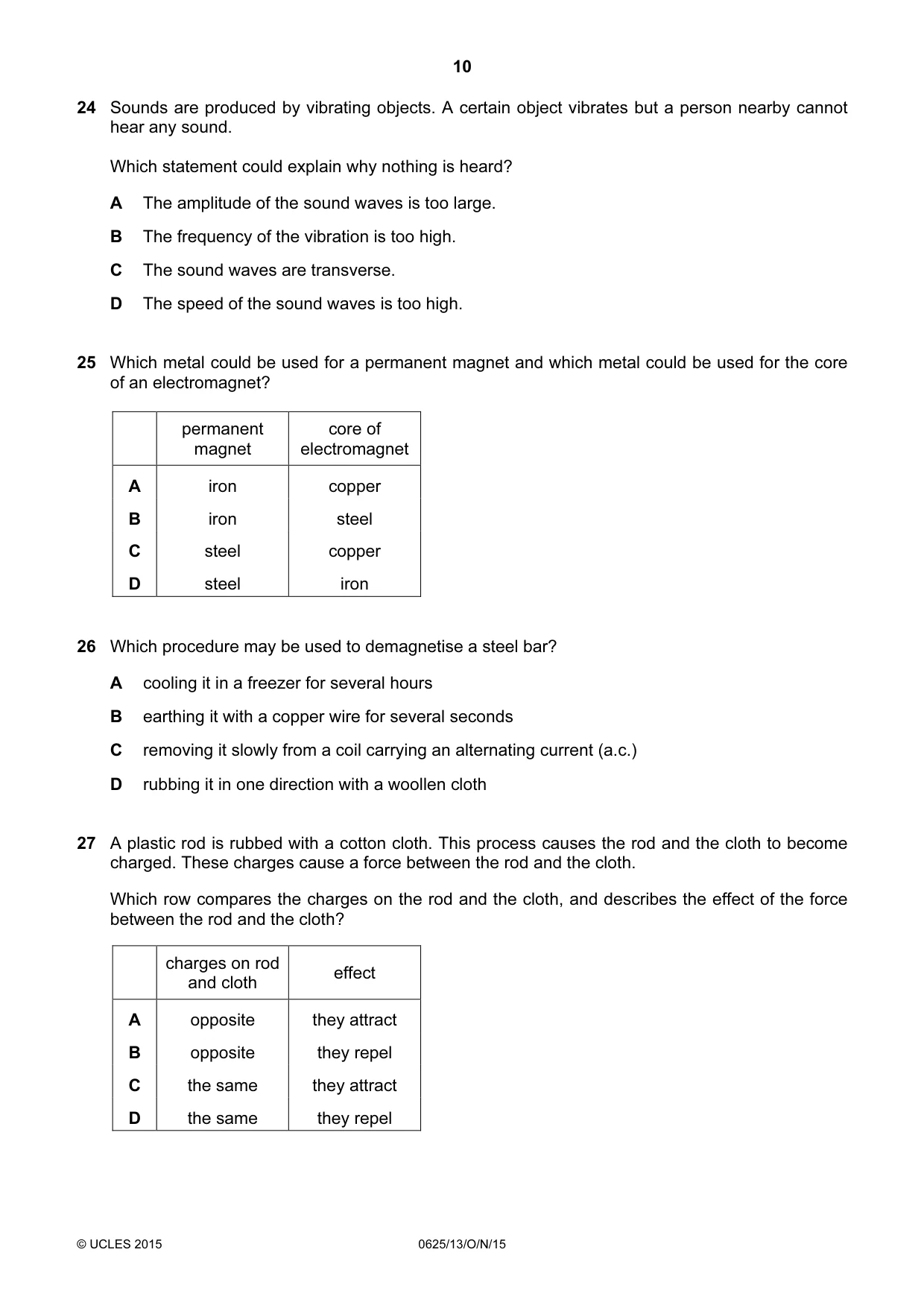
Q24 · Sounds are produced by vibrating objects
24 Sounds are produced by vibrating objects. A certain object vibrates but a person nearby cannot hear any sound. Which statement could explain why nothing is heard? A The amplitude of the sound waves is too large. B The frequency of the vibration is too high. C The sound waves are transverse. D The speed of the sound waves is too high.
Mark scheme: B
Q25 · Which metal could be used for a permanent magnet and which metal could be used for the…
25 Which metal could be used for a permanent magnet and which metal could be used for the core of an electromagnet? permanent core of magnet electromagnet A iron copper B iron steel C steel copper D steel iron
Mark scheme: D
Q26 · Which procedure may be used to demagnetise a steel bar?
26 Which procedure may be used to demagnetise a steel bar? A cooling it in a freezer for several hours B earthing it with a copper wire for several seconds C removing it slowly from a coil carrying an alternating current (a.c.) D rubbing it in one direction with a woollen cloth
Mark scheme: C
Q27 · A plastic rod is rubbed with a cotton cloth
27 A plastic rod is rubbed with a cotton cloth. This process causes the rod and the cloth to become charged. These charges cause a force between the rod and the cloth. Which row compares the charges on the rod and the cloth, and describes the effect of the force between the rod and the cloth? charges on rod effect and cloth A opposite they attract B opposite they repel C the same they attract D the same they repel
Mark scheme: A
Q28 · A metal wire of circular cross-section has diameter d and length l
28 A metal wire of circular cross-section has diameter d and length l. current wire l d Which pair of changes, if both are carried out, must increase the resistance of the wire? A decrease l and decrease d B decrease l and increase d C increase l and decrease d D increase l and increase d
Mark scheme: C
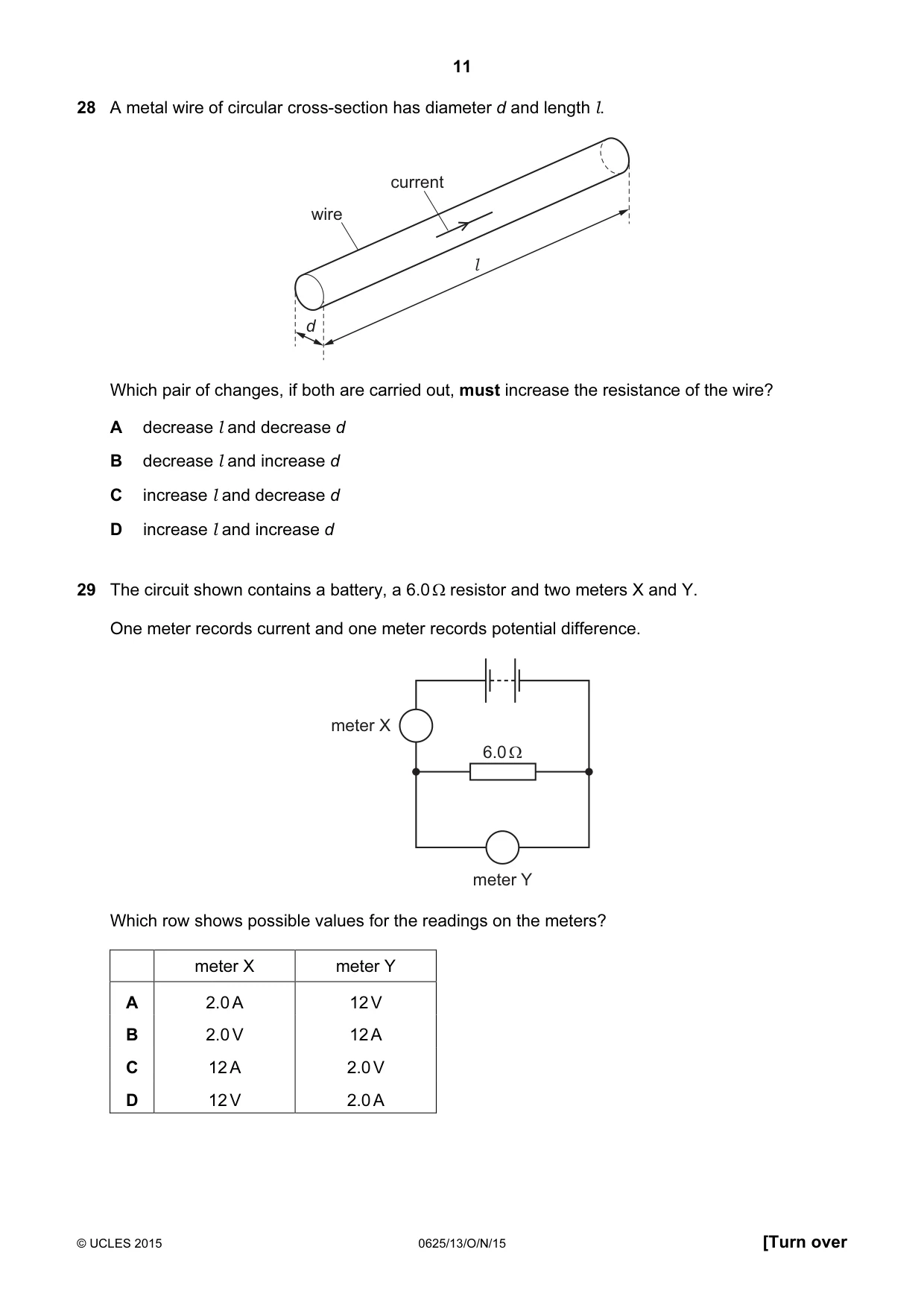
Q29 · The circuit shown contains a battery, a 6.0 Ω resistor and two meters X and Y
29 The circuit shown contains a battery, a 6.0 Ω resistor and two meters X and Y. One meter records current and one meter records potential difference. meter X 6.0 Ω meter Y Which row shows possible values for the readings on the meters? meter X meter Y A 2.0 A 12 V B 2.0 V 12 A C 12 A 2.0 V D 12 V 2.0 A
Mark scheme: A
Q30 · A student designs a circuit to switch on a lamp after a time delay
30 A student designs a circuit to switch on a lamp after a time delay. Which components are used in a time-delay circuit? A a light-dependent resistor and a relay B a resistor and a capacitor C a resistor and a transformer D a thermistor and a variable resistor
Mark scheme: B
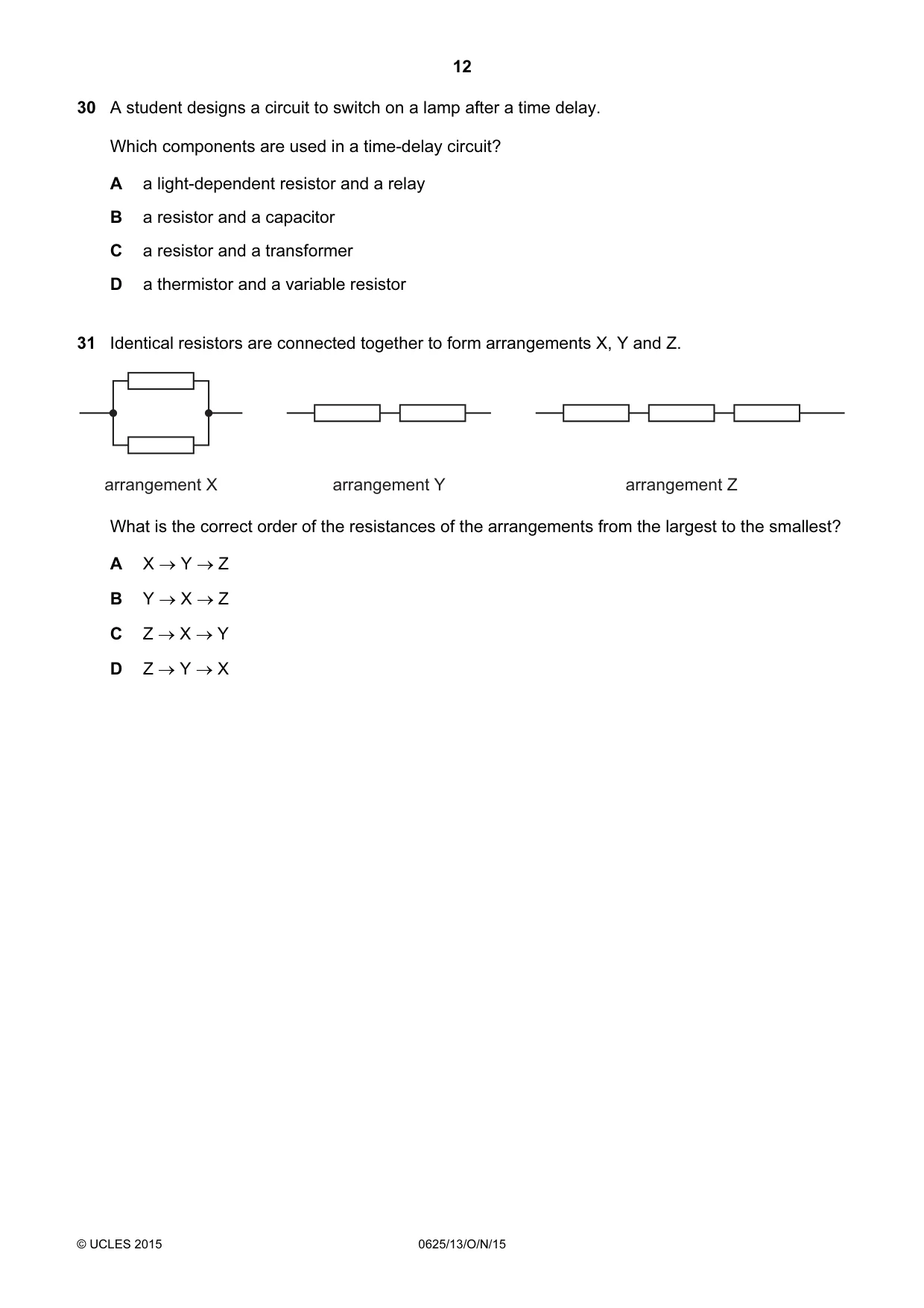
Q31 · Identical resistors are connected together to form arrangements X, Y and Z
31 Identical resistors are connected together to form arrangements X, Y and Z. arrangement X arrangement Y arrangement Z What is the correct order of the resistances of the arrangements from the largest to the smallest? A X → Y → Z B Y → X → Z C Z → X → Y D Z → Y → X
Mark scheme: D
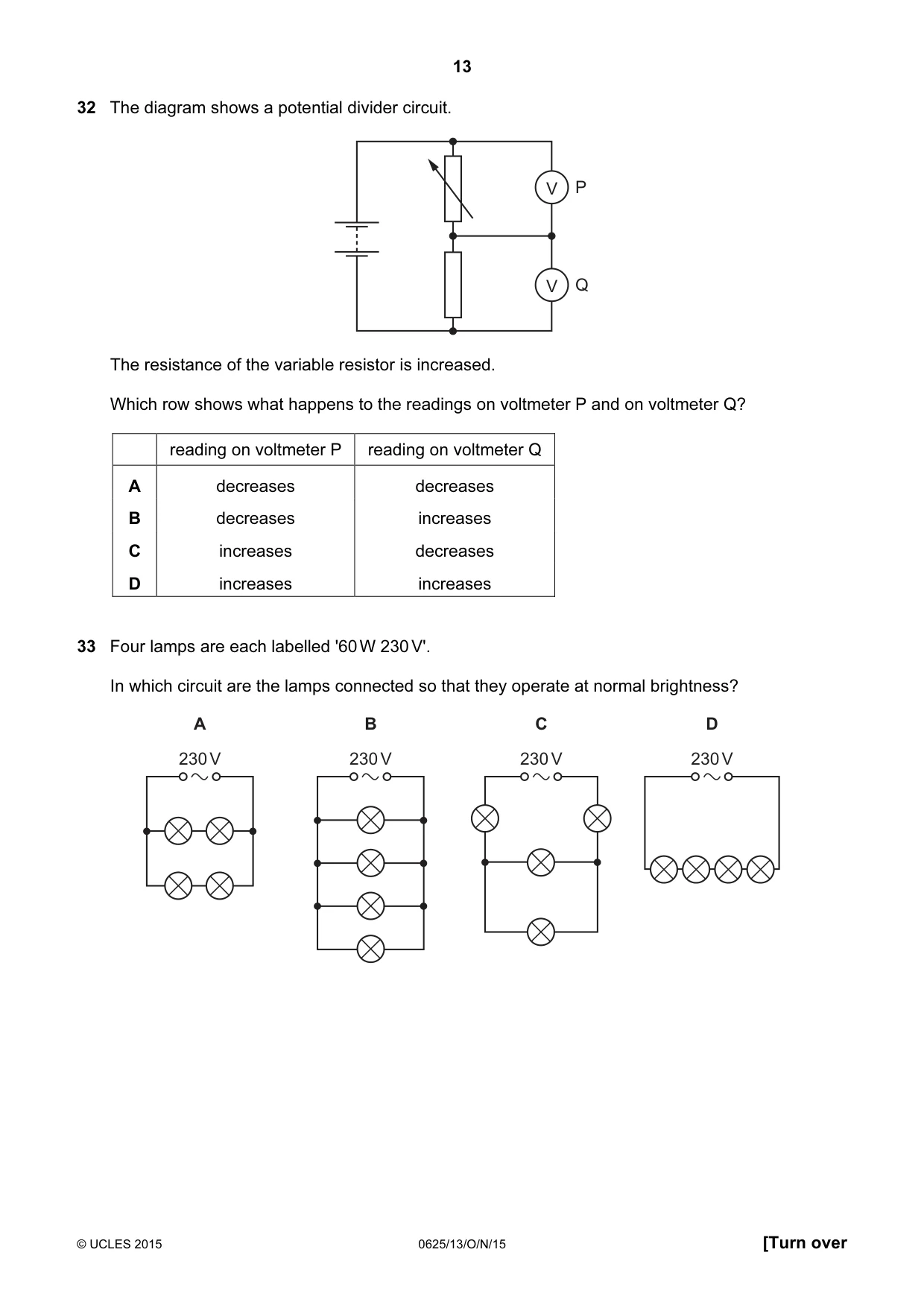
Q32 · The diagram shows a potential divider circuit
32 The diagram shows a potential divider circuit. V P V Q The resistance of the variable resistor is increased. Which row shows what happens to the readings on voltmeter P and on voltmeter Q? reading on voltmeter P reading on voltmeter Q A decreases decreases B decreases increases C increases decreases D increases increases
Mark scheme: C
Q33 · Four lamps are each labelled '60 W 230 V'
33 Four lamps are each labelled '60 W 230 V'. In which circuit are the lamps connected so that they operate at normal brightness? A B C D 230 V 230 V 230 V 230 V
Mark scheme: B
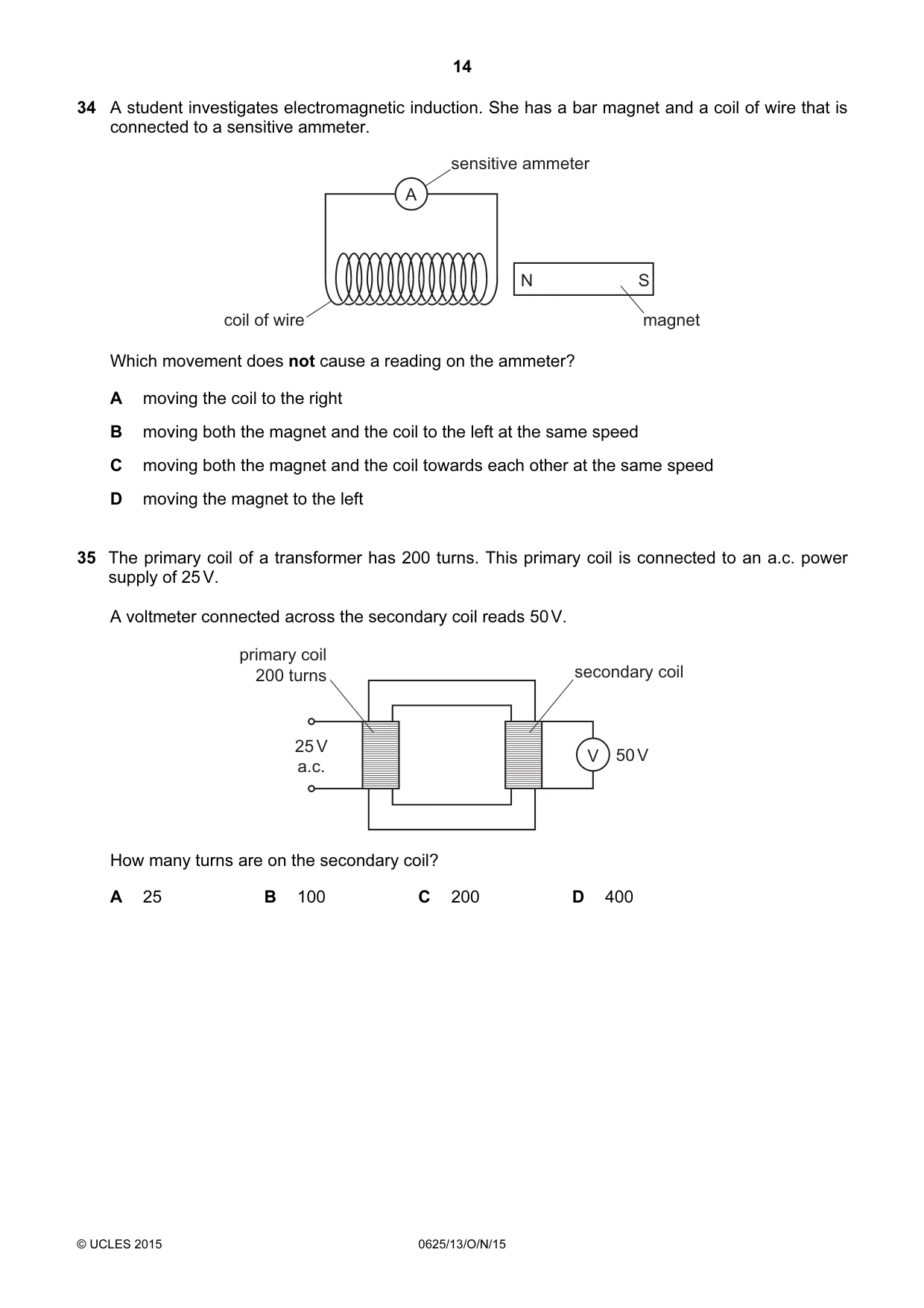
Q34 · A student investigates electromagnetic induction
34 A student investigates electromagnetic induction. She has a bar magnet and a coil of wire that is connected to a sensitive ammeter. sensitive ammeter A N S coil of wire magnet Which movement does not cause a reading on the ammeter? A moving the coil to the right B moving both the magnet and the coil to the left at the same speed C moving both the magnet and the coil towards each other at the same speed D moving the magnet to the left
Mark scheme: B
Q35 · The primary coil of a transformer has 200 turns
35 The primary coil of a transformer has 200 turns. This primary coil is connected to an a.c. power supply of 25 V. A voltmeter connected across the secondary coil reads 50 V. primary coil 200 turns secondary coil 25 V V 50 V a.c. How many turns are on the secondary coil? A 25 B 100 C 200 D 400
Mark scheme: D
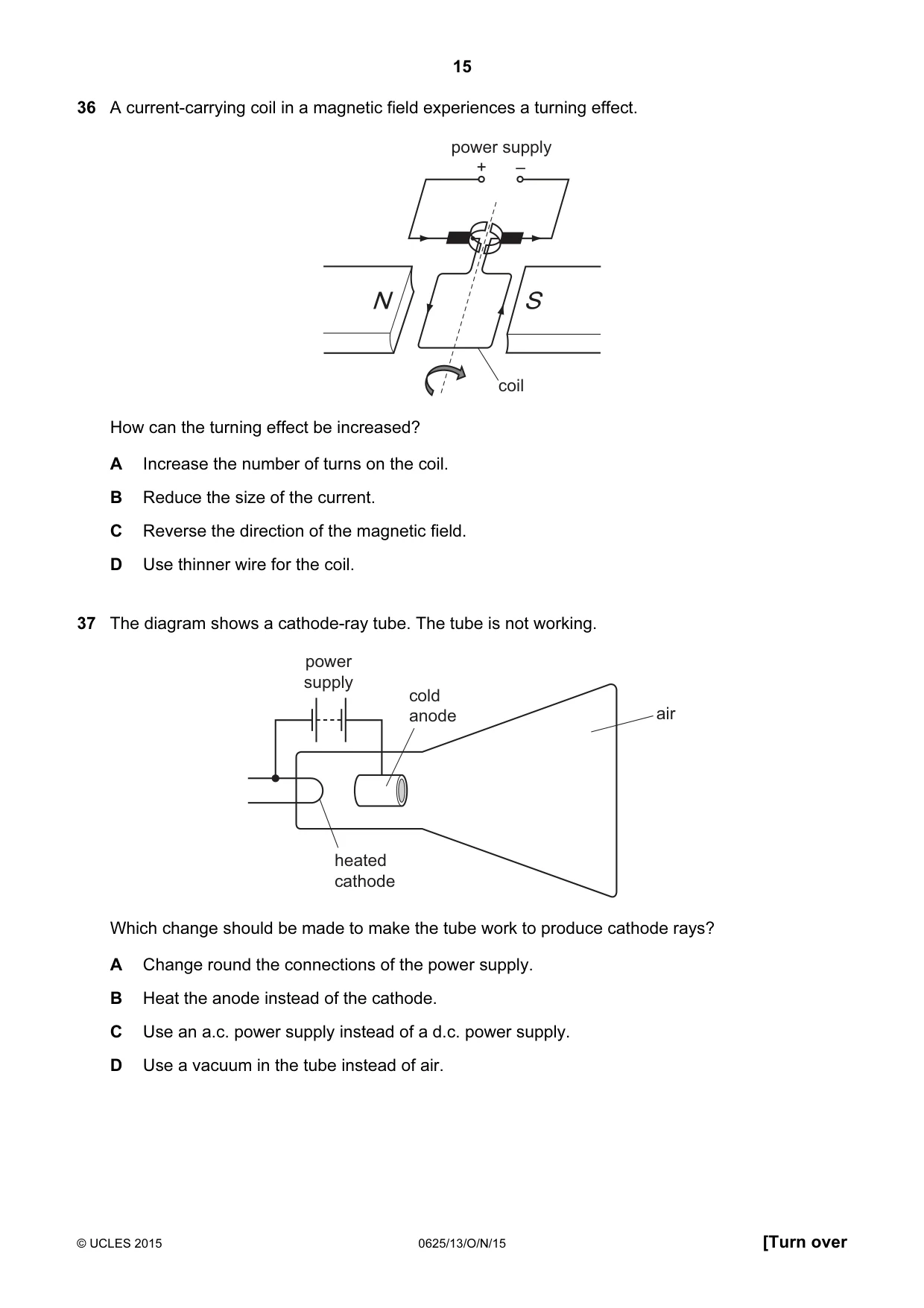
Q36 · A current-carrying coil in a magnetic field experiences a turning effect
36 A current-carrying coil in a magnetic field experiences a turning effect. power supply + – N S coil How can the turning effect be increased? A Increase the number of turns on the coil. B Reduce the size of the current. C Reverse the direction of the magnetic field. D Use thinner wire for the coil.
Mark scheme: A
Q37 · The diagram shows a cathode-ray tube
37 The diagram shows a cathode-ray tube. The tube is not working. power supply cold anode air heated cathode Which change should be made to make the tube work to produce cathode rays? A Change round the connections of the power supply. B Heat the anode instead of the cathode. C Use an a.c. power supply instead of a d.c. power supply. D Use a vacuum in the tube instead of air.
Mark scheme: D
Q38 · A radioactive nucleus contains 128 nucleons
38 A radioactive nucleus contains 128 nucleons. It emits a β-particle. How many nucleons are now in the nucleus? A 124 B 127 C 128 D 129
Mark scheme: C
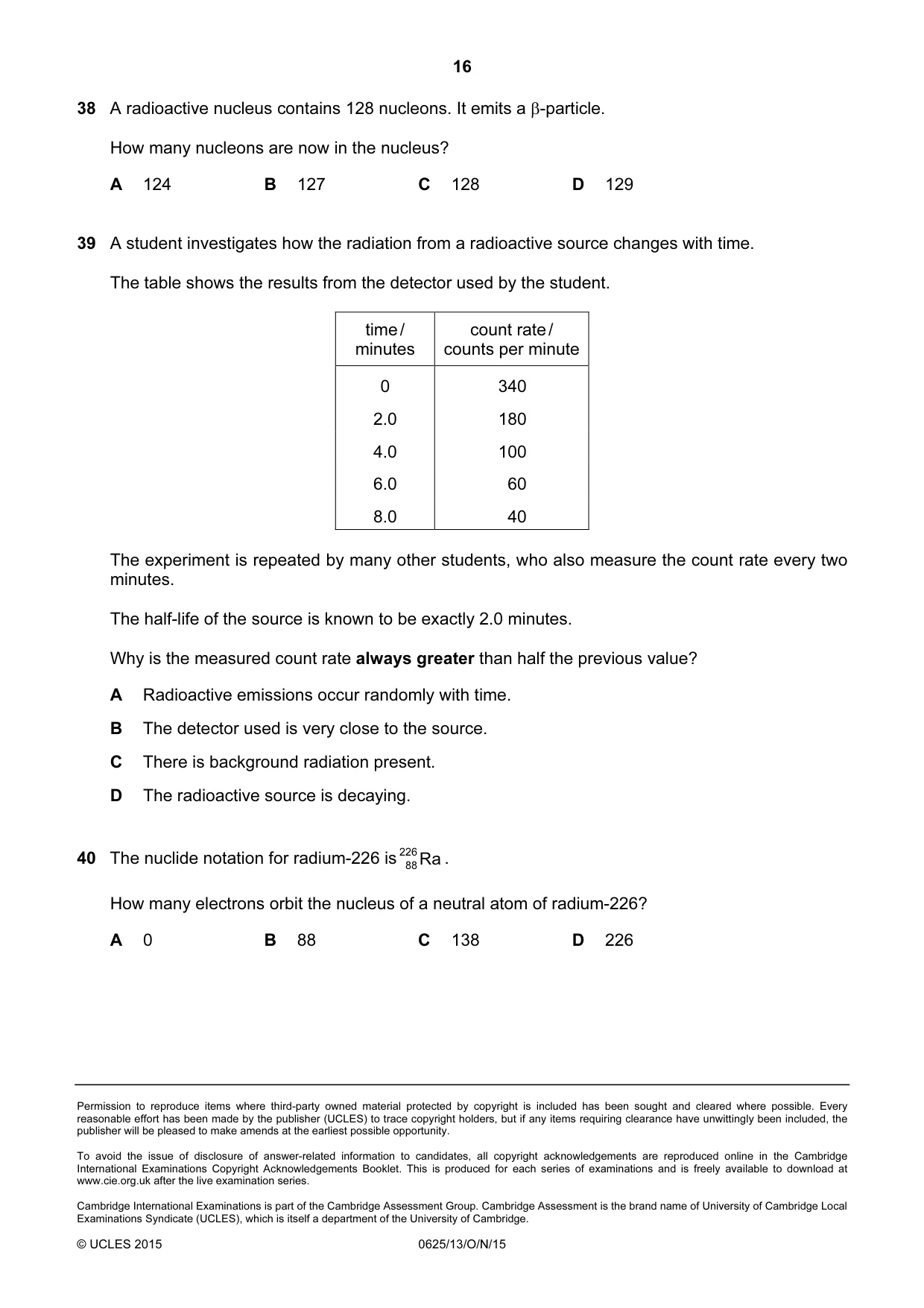
Q39 · A student investigates how the radiation from a radioactive source changes with time
39 A student investigates how the radiation from a radioactive source changes with time. The table shows the results from the detector used by the student. time / count rate / minutes counts per minute 0 340 2.0 180 4.0 100 6.0 60 8.0 40 The experiment is repeated by many other students, who also measure the count rate every two minutes. The half-life of the source is known to be exactly 2.0 minutes. Why is the measured count rate always greater than half the previous value? A Radioactive emissions occur randomly with time. B The detector used is very close to the source. C There is background radiation present. D The radioactive source is decaying.
Mark scheme: C
Q40 · The nuclide notation for radium-226 is 226 Ra
40 The nuclide notation for radium-226 is 226 Ra . 88 How many electrons orbit the nucleus of a neutral atom of radium-226? A 0 B 88 C 138 D 226
Mark scheme: B
What was in this paper
The subtopics covered by these 40 questions, and how many questions each got. Open one in a new tab to see every Cambridge question on it.
5Electromagnetic effects3Electrical quantities2Energy, work and power2Forces2General properties of waves2Kinetic particle model of matter2Light2Motion2Pressure2Radioactivity2Simple phenomena of magnetism2Sound2The nuclear model of the atom2Thermal properties and temperature2Transfer of thermal energy2Density1Electromagnetic spectrum1Mass and weight1Physical quantities and measurement techniques1What you needed in this session
Cambridge’s own grade thresholds for 2015 Oct/Nov, Paper 1 · Variant 3. A higher threshold means an easier paper — the bar moves with how the cohort did.