Cambridge IGCSE Physics 0625 — 2014 May/June Paper 1 · Variant 1
0625/11/M/J/14 · 40 questions · 40 marks · ≈45 min
The question paper and its mark scheme, free to read here and free to download. This is Cambridge’s own paper, exactly as it was sat.
Question paper20 pages

Mark scheme2 pages
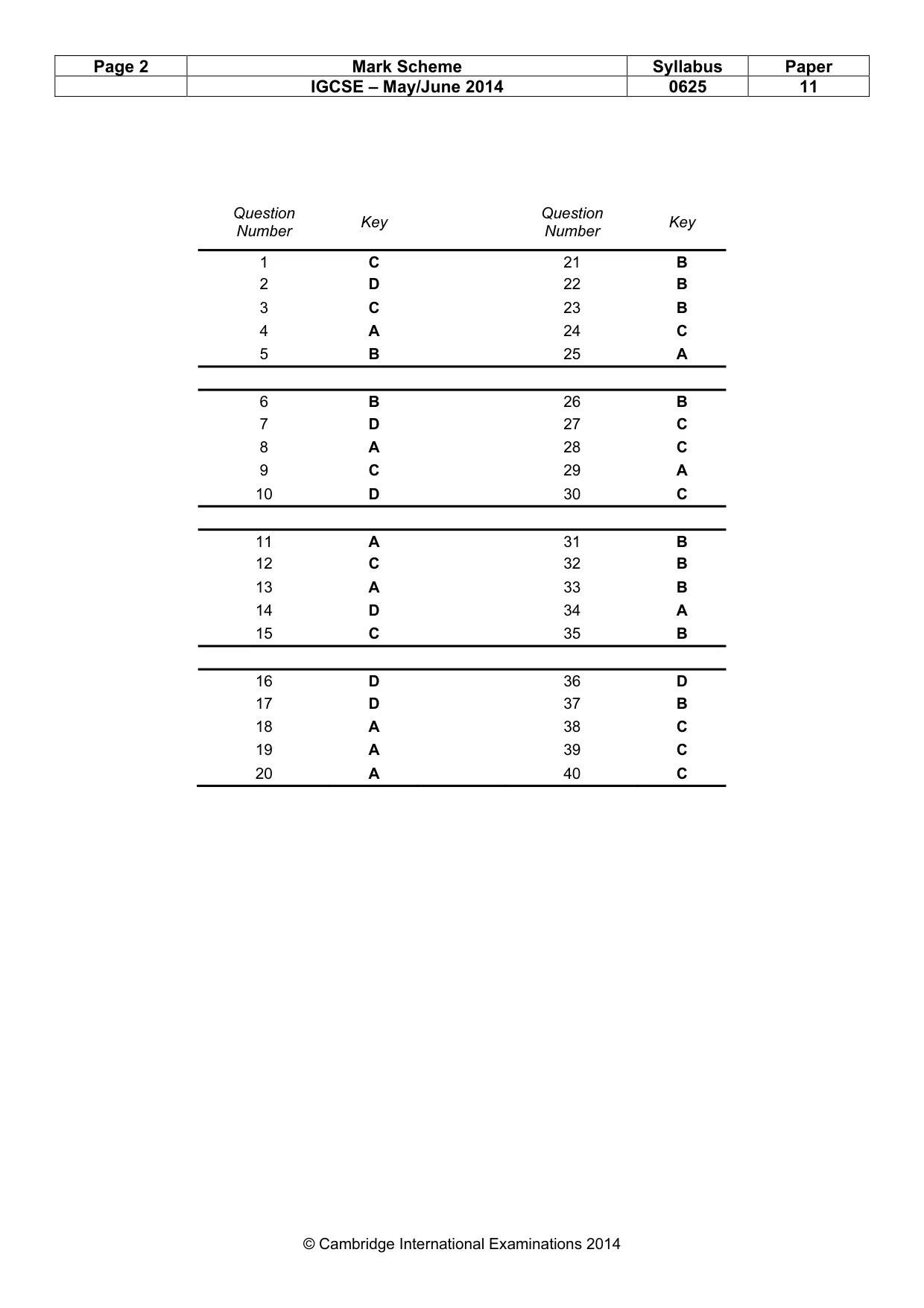
Answers below. Sit the paper first if you are practising.
Questions as text
Q1 · A student wishes to measure accurately the volume of approximately 40 cm3 of water
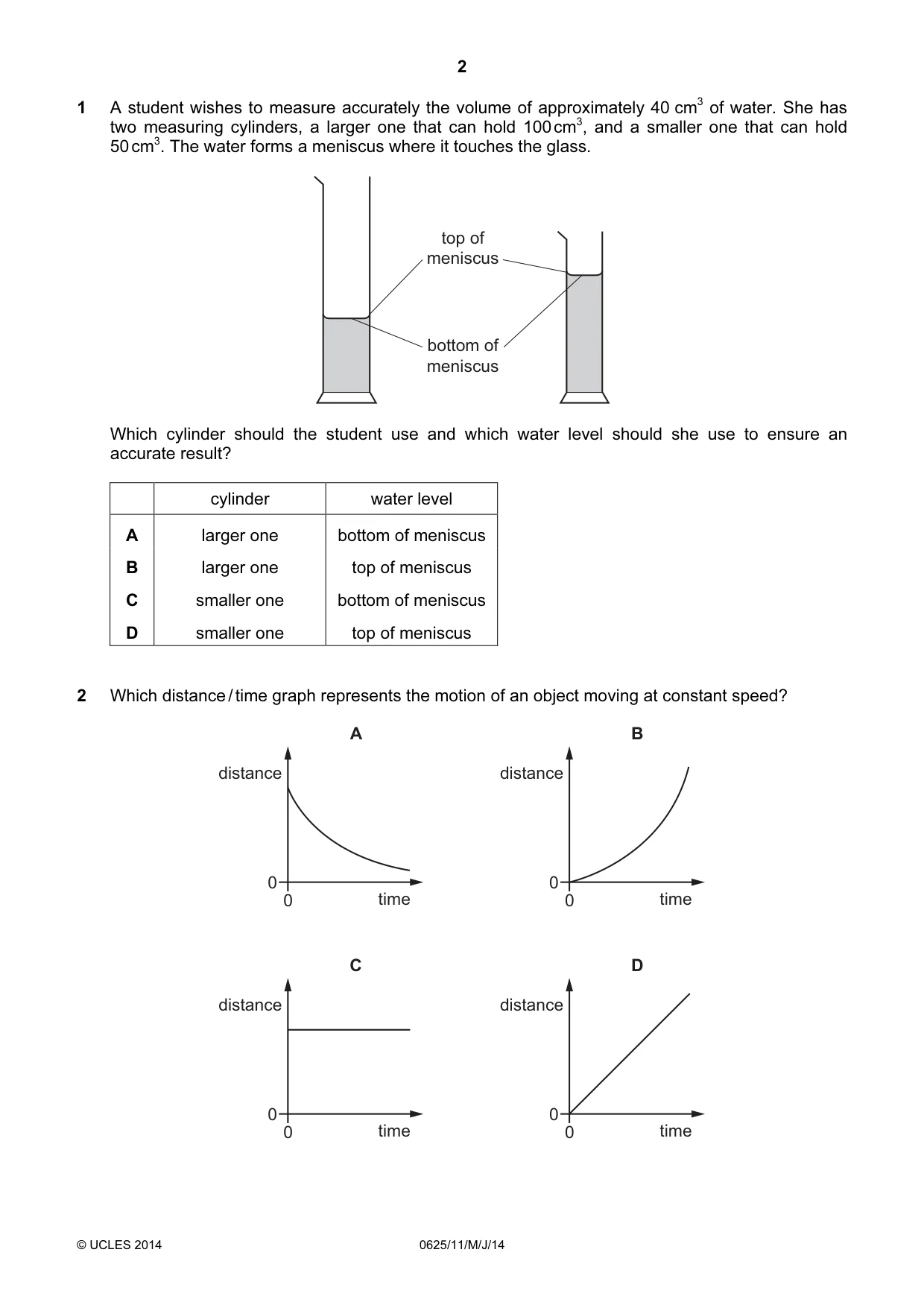
1 A student wishes to measure accurately the volume of approximately 40 cm3 of water. She has two measuring cylinders, a larger one that can hold 100 cm3, and a smaller one that can hold 50 cm3. The water forms a meniscus where it touches the glass. top of meniscus bottom of meniscus Which cylinder should the student use and which water level should she use to ensure an accurate result? cylinder water level A larger one bottom of meniscus B larger one top of meniscus C smaller one bottom of meniscus D smaller one top of meniscus
Mark scheme: C
More questions on Physical quantities and measurement techniques
Q2 · Which distance / time graph represents the motion of an object moving at constant speed?
2 Which distance / time graph represents the motion of an object moving at constant speed? A B distance distance 0 0 0 time 0 time C D distance distance 0 0 0 time 0 time
Mark scheme: D
Q3 · The graph shows how the speed of a car changes with time
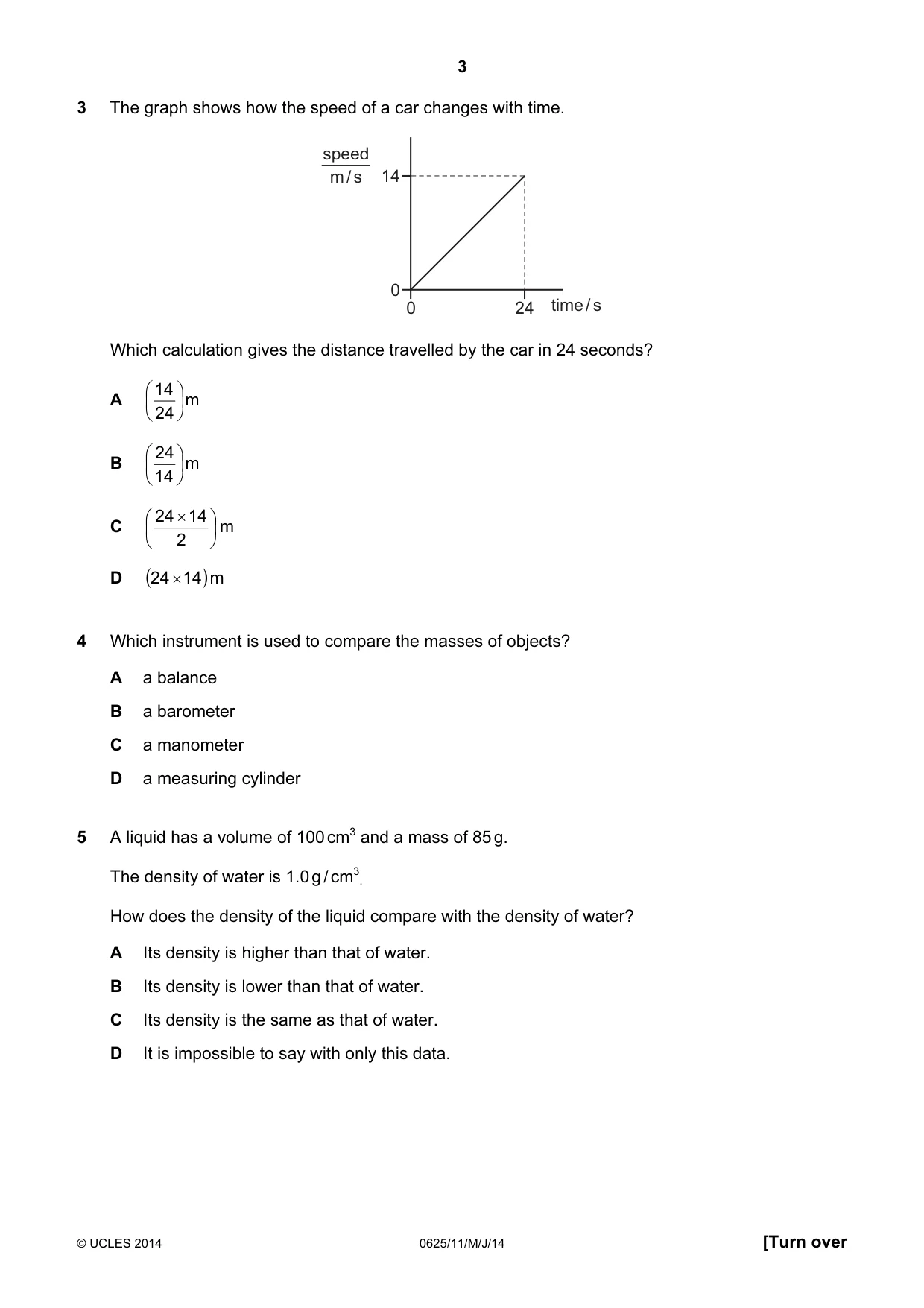
3 The graph shows how the speed of a car changes with time. speed m / s 14 0 0 24 time / s Which calculation gives the distance travelled by the car in 24 seconds? 14 A m 24 24 B m 14 24 × 14 C m 2 D ( 24 × 14 ) m
Mark scheme: C
Q4 · Which instrument is used to compare the masses of objects?
4 Which instrument is used to compare the masses of objects? A a balance B a barometer C a manometer D a measuring cylinder
Mark scheme: A
Q5 · A liquid has a volume of 100 cm3 and a mass of 85 g
5 A liquid has a volume of 100 cm3 and a mass of 85 g. The density of water is 1.0 g / cm3 . How does the density of the liquid compare with the density of water? A Its density is higher than that of water. B Its density is lower than that of water. C Its density is the same as that of water. D It is impossible to say with only this data.
Mark scheme: B
Q6 · A plane lamina with centre of mass X touches the ground at point P
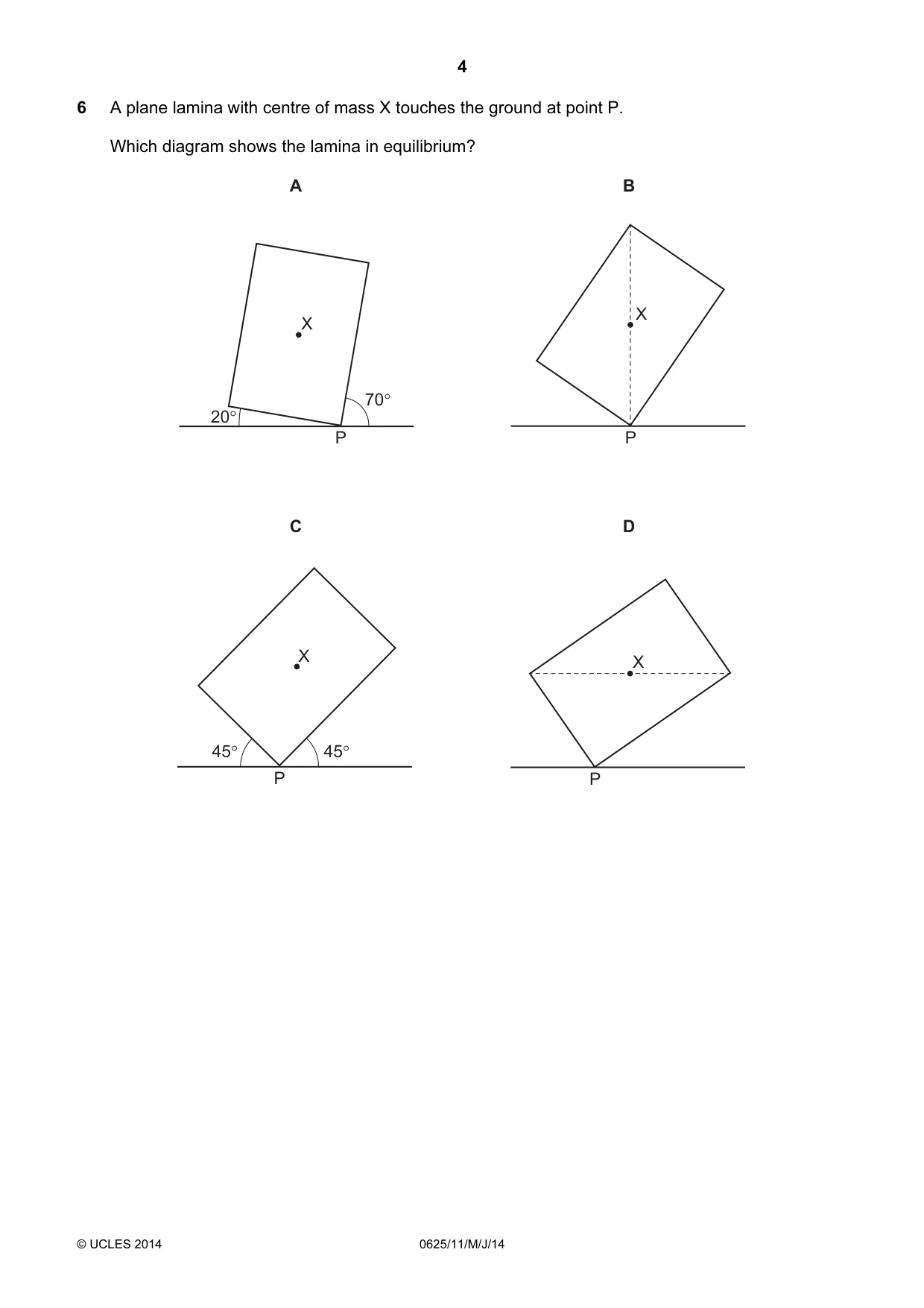
6 A plane lamina with centre of mass X touches the ground at point P. Which diagram shows the lamina in equilibrium? A B X X 70° 20° P P C D X X 45° 45° P P
Mark scheme: B
Q7 · A student adds weights to an elastic cord
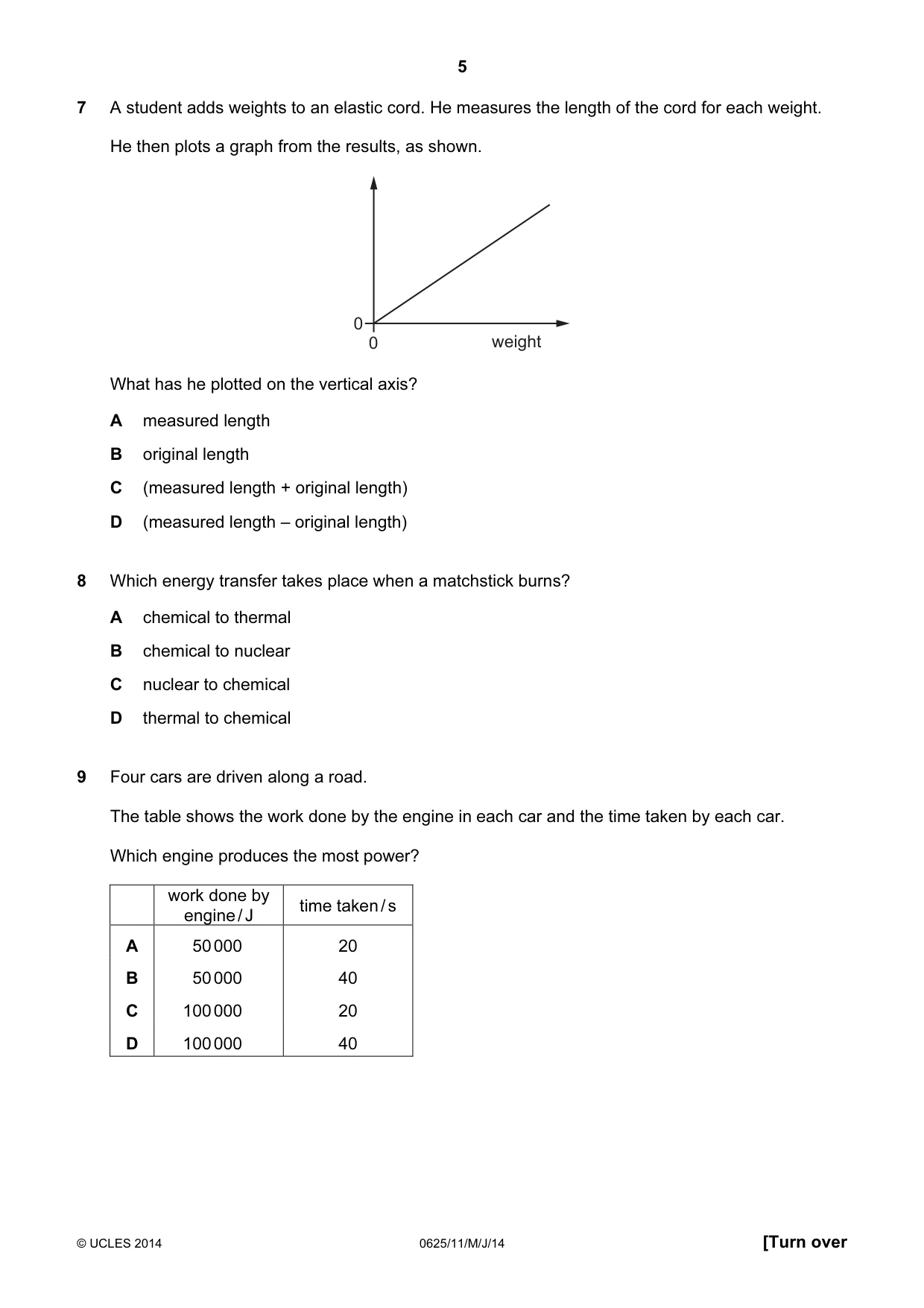
7 A student adds weights to an elastic cord. He measures the length of the cord for each weight. He then plots a graph from the results, as shown. 0 0 weight What has he plotted on the vertical axis? A measured length B original length C (measured length + original length) D (measured length – original length)
Mark scheme: D
Q8 · Which energy transfer takes place when a matchstick burns?
8 Which energy transfer takes place when a matchstick burns? A chemical to thermal B chemical to nuclear C nuclear to chemical D thermal to chemical
Mark scheme: A
Q9 · Four cars are driven along a road
9 Four cars are driven along a road. The table shows the work done by the engine in each car and the time taken by each car. Which engine produces the most power? work done by time taken / s engine / J A 50 000 20 B 50 000 40 C 100 000 20 D 100 000 40
Mark scheme: C
Q10 · Which situation is an example of a force acting over a large area to produce a small…
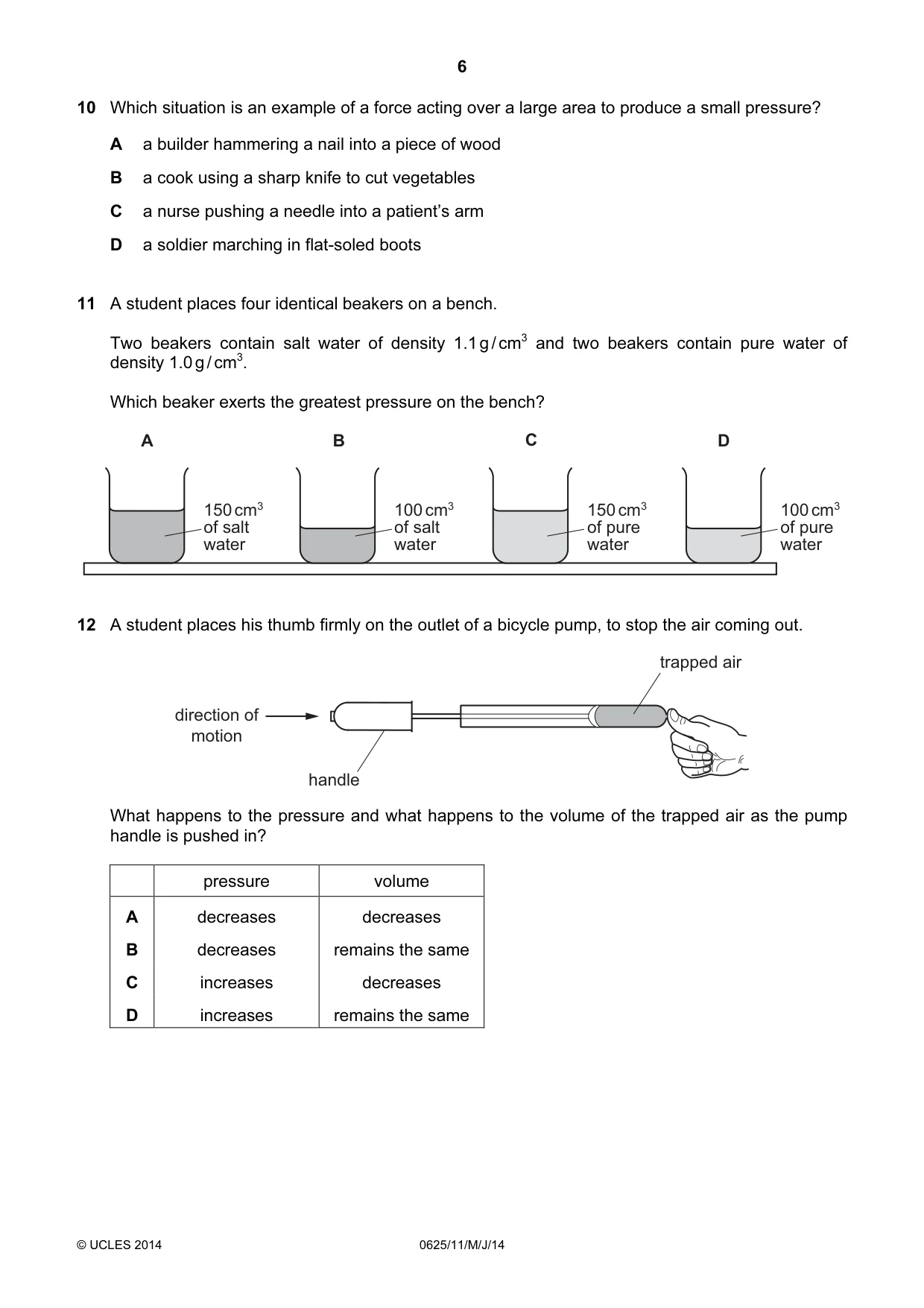
10 Which situation is an example of a force acting over a large area to produce a small pressure? A a builder hammering a nail into a piece of wood B a cook using a sharp knife to cut vegetables C a nurse pushing a needle into a patient’s arm D a soldier marching in flat-soled boots
Mark scheme: D
Q11 · A student places four identical beakers on a bench
11 A student places four identical beakers on a bench. Two beakers contain salt water of density 1.1 g / cm3 and two beakers contain pure water of density 1.0 g / cm3. Which beaker exerts the greatest pressure on the bench? A B C D 150 cm3 100 cm3 150 cm3 100 cm3 of salt of salt of pure of pure water water water water
Mark scheme: A
Q12 · A student places his thumb firmly on the outlet of a bicycle pump, to stop the air coming…
12 A student places his thumb firmly on the outlet of a bicycle pump, to stop the air coming out. trapped air direction of motion handle What happens to the pressure and what happens to the volume of the trapped air as the pump handle is pushed in? pressure volume A decreases decreases B decreases remains the same C increases decreases D increases remains the same
Mark scheme: C
Q13 · During evaporation, molecules escape rapidly from the surface of a liquid
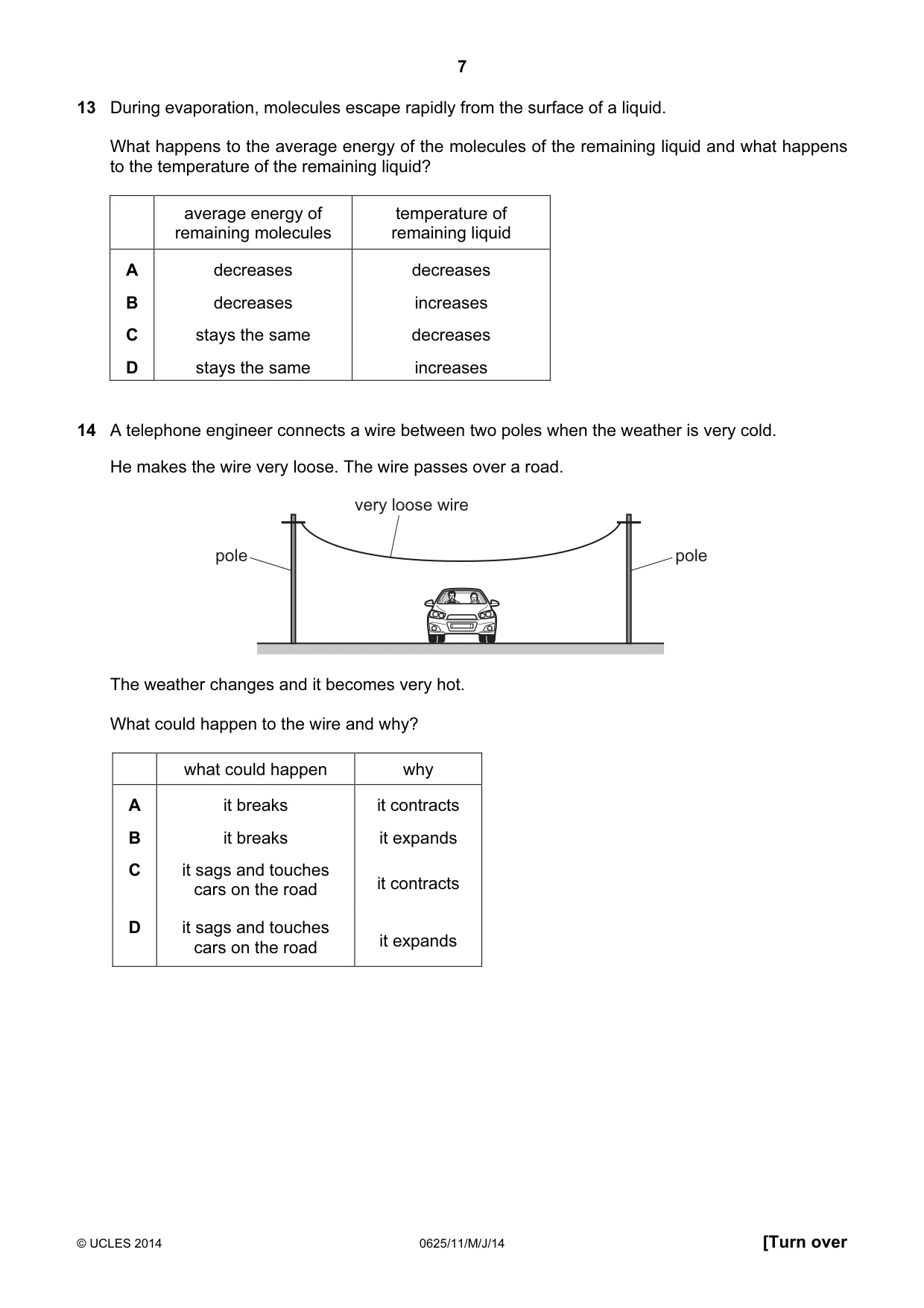
13 During evaporation, molecules escape rapidly from the surface of a liquid. What happens to the average energy of the molecules of the remaining liquid and what happens to the temperature of the remaining liquid? average energy of temperature of remaining molecules remaining liquid A decreases decreases B decreases increases C stays the same decreases D stays the same increases
Mark scheme: A
Q14 · A telephone engineer connects a wire between two poles when the weather is very cold
14 A telephone engineer connects a wire between two poles when the weather is very cold. He makes the wire very loose. The wire passes over a road. very loose wire pole pole The weather changes and it becomes very hot. What could happen to the wire and why? what could happen why A it breaks it contracts B it breaks it expands C it sags and touches cars on the road it contracts D it sags and touches cars on the road it expands
Mark scheme: D
Q15 · In an experiment, a thermometer is placed in a test-tube of hot liquid
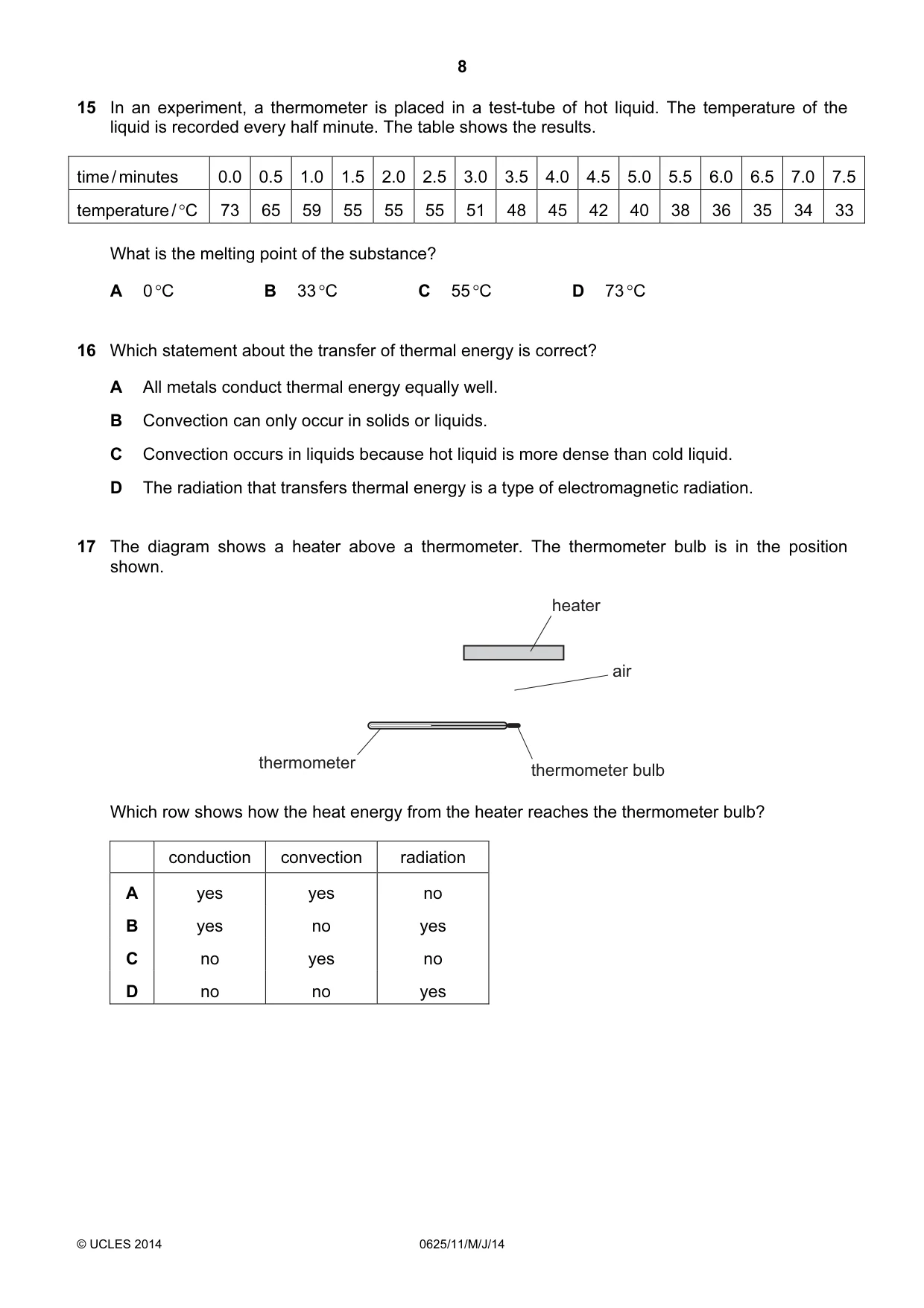
15 In an experiment, a thermometer is placed in a test-tube of hot liquid. The temperature of the liquid is recorded every half minute. The table shows the results. time / minutes 0.0 0.5 1.0 1.5 2.0 2.5 3.0 3.5 4.0 4.5 5.0 5.5 6.0 6.5 7.0 7.5 temperature / °C 73 65 59 55 55 55 51 48 45 42 40 38 36 35 34 33 What is the melting point of the substance? A 0 °C B 33 °C C 55 °C D 73 °C
Mark scheme: C
Q16 · Which statement about the transfer of thermal energy is correct?
16 Which statement about the transfer of thermal energy is correct? A All metals conduct thermal energy equally well. B Convection can only occur in solids or liquids. C Convection occurs in liquids because hot liquid is more dense than cold liquid. D The radiation that transfers thermal energy is a type of electromagnetic radiation.
Mark scheme: D
Q17 · The diagram shows a heater above a thermometer
17 The diagram shows a heater above a thermometer. The thermometer bulb is in the position shown. heater air thermometer thermometer bulb Which row shows how the heat energy from the heater reaches the thermometer bulb? conduction convection radiation A yes yes no B yes no yes C no yes no D no no yes
Mark scheme: D
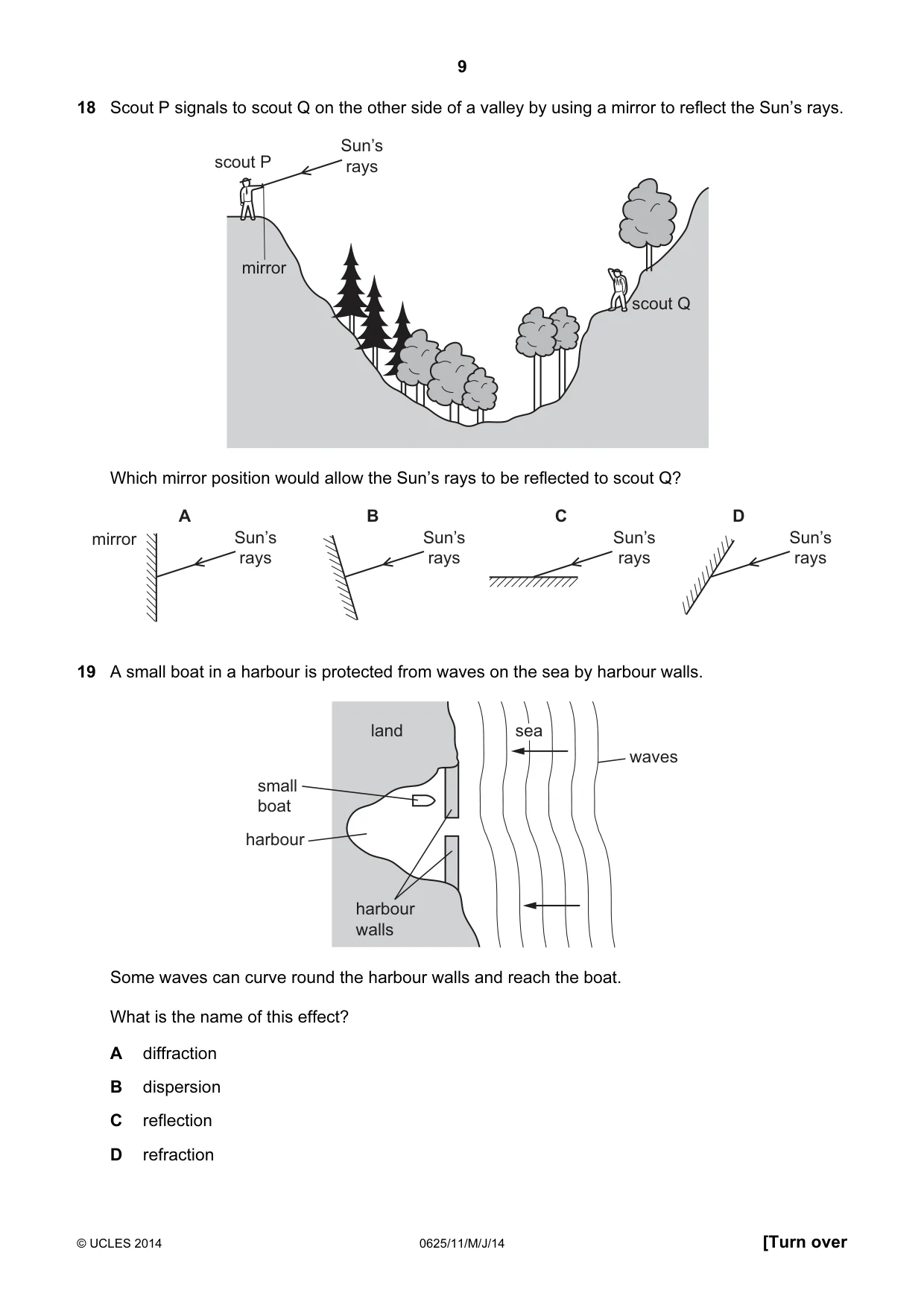
Q18 · Scout P signals to scout Q on the other side of a valley by using a mirror to reflect the…
18 Scout P signals to scout Q on the other side of a valley by using a mirror to reflect the Sun’s rays. Sun’s scout P rays mirror scout Q Which mirror position would allow the Sun’s rays to be reflected to scout Q? A B C D mirror Sun’s Sun’s Sun’s Sun’s rays rays rays rays
Mark scheme: A
Q19 · A small boat in a harbour is protected from waves on the sea by harbour walls
19 A small boat in a harbour is protected from waves on the sea by harbour walls. land sea sea sea waves small boat harbour harbour walls Some waves can curve round the harbour walls and reach the boat. What is the name of this effect? A diffraction B dispersion C reflection D refraction
Mark scheme: A
Q20 · Which list shows electromagnetic waves in order of increasing frequency?
20 Which list shows electromagnetic waves in order of increasing frequency? A visible light, X-rays, γ-rays B visible light, γ-rays, X-rays C X-rays, γ-rays, visible light D γ-rays, X-rays, visible light
Mark scheme: A
Q21 · Which statement about a converging lens is not correct?
21 Which statement about a converging lens is not correct? A A ray parallel to the principal axis of the lens is refracted through the principal focus. B All rays of light refracted by the lens pass through the principal focus. C The distance between the centre of the lens and the principal focus is the focal length. D The principal focus of the lens is a point on the principal axis.
Mark scheme: B
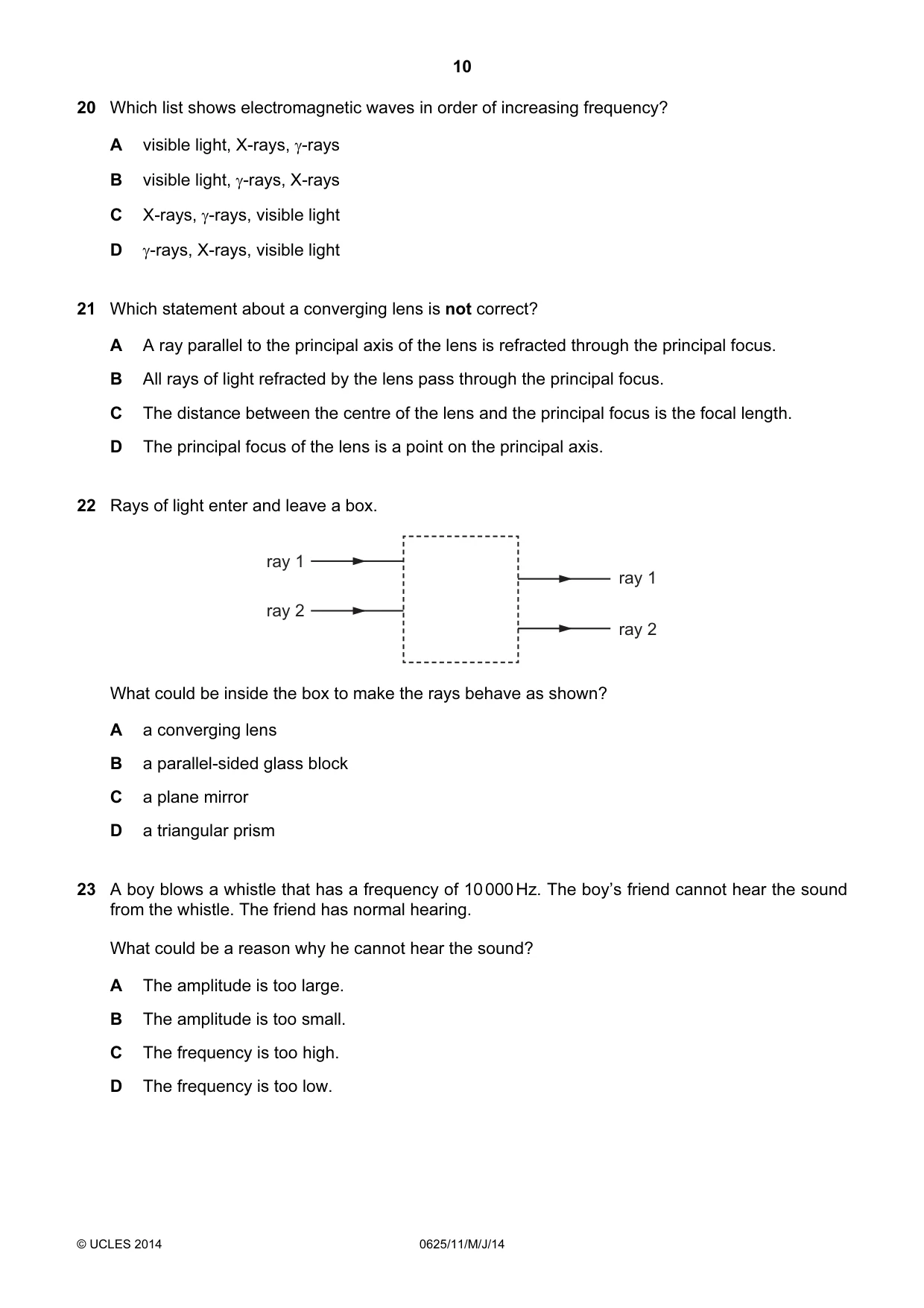
Q22 · Rays of light enter and leave a box
22 Rays of light enter and leave a box. ray 1 ray 1 ray 2 ray 2 What could be inside the box to make the rays behave as shown? A a converging lens B a parallel-sided glass block C a plane mirror D a triangular prism
Mark scheme: B
Q23 · A boy blows a whistle that has a frequency of 10 000 Hz
23 A boy blows a whistle that has a frequency of 10 000 Hz. The boy’s friend cannot hear the sound from the whistle. The friend has normal hearing. What could be a reason why he cannot hear the sound? A The amplitude is too large. B The amplitude is too small. C The frequency is too high. D The frequency is too low.
Mark scheme: B
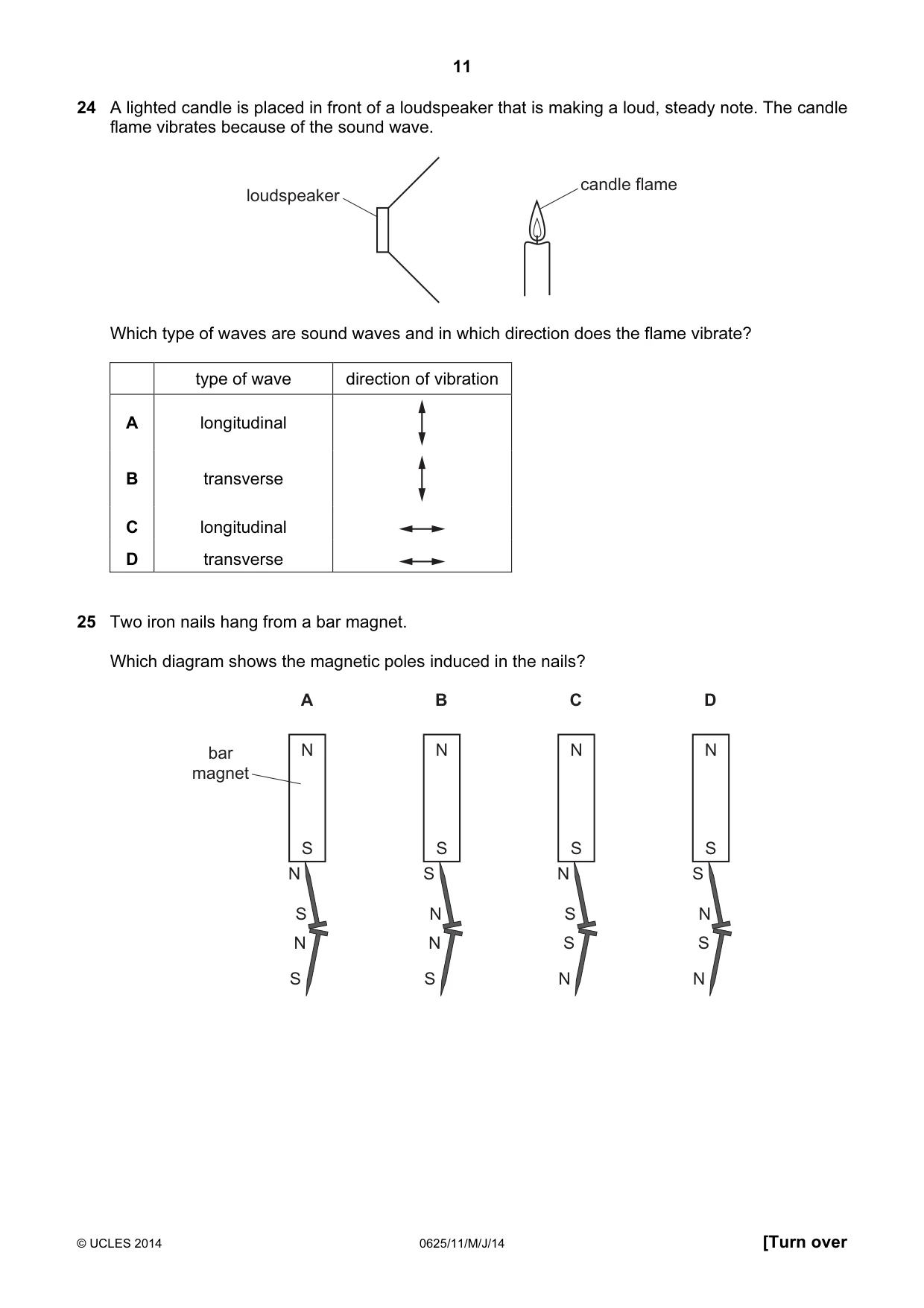
Q24 · A lighted candle is placed in front of a loudspeaker that is making a loud, steady note
24 A lighted candle is placed in front of a loudspeaker that is making a loud, steady note. The candle flame vibrates because of the sound wave. candle flame loudspeaker Which type of waves are sound waves and in which direction does the flame vibrate? type of wave direction of vibration A longitudinal B transverse C longitudinal D transverse
Mark scheme: C
Q25 · Two iron nails hang from a bar magnet
25 Two iron nails hang from a bar magnet. Which diagram shows the magnetic poles induced in the nails? A B C D bar N N N N magnet S S S S N S N S S N S N N N S S S S N N
Mark scheme: A
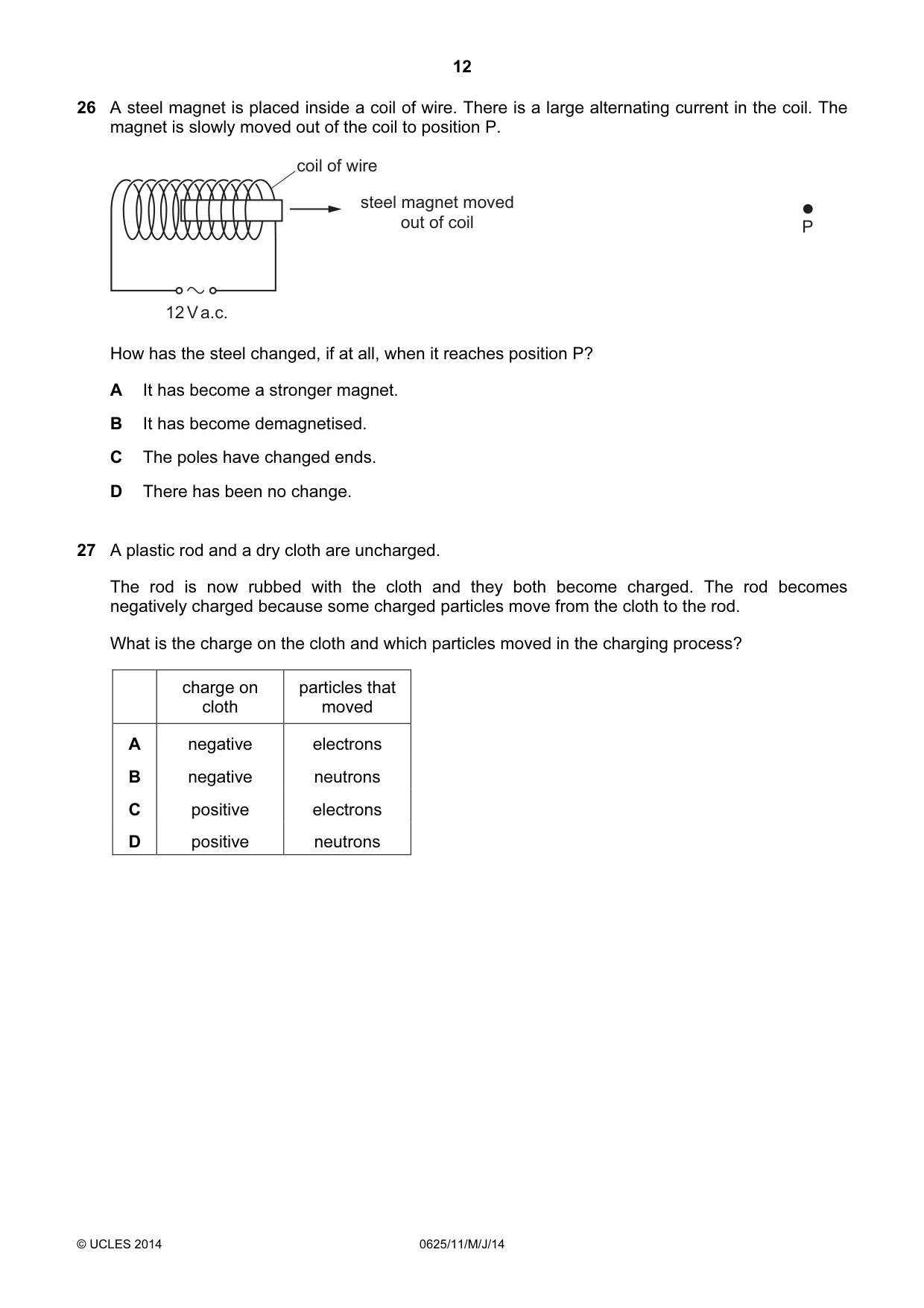
Q26 · A steel magnet is placed inside a coil of wire
26 A steel magnet is placed inside a coil of wire. There is a large alternating current in the coil. The magnet is slowly moved out of the coil to position P. coil of wire steel magnet moved out of coil P 12 V a.c. How has the steel changed, if at all, when it reaches position P? A It has become a stronger magnet. B It has become demagnetised. C The poles have changed ends. D There has been no change.
Mark scheme: B
Q27 · A plastic rod and a dry cloth are uncharged
27 A plastic rod and a dry cloth are uncharged. The rod is now rubbed with the cloth and they both become charged. The rod becomes negatively charged because some charged particles move from the cloth to the rod. What is the charge on the cloth and which particles moved in the charging process? charge on particles that cloth moved A negative electrons B negative neutrons C positive electrons D positive neutrons
Mark scheme: C
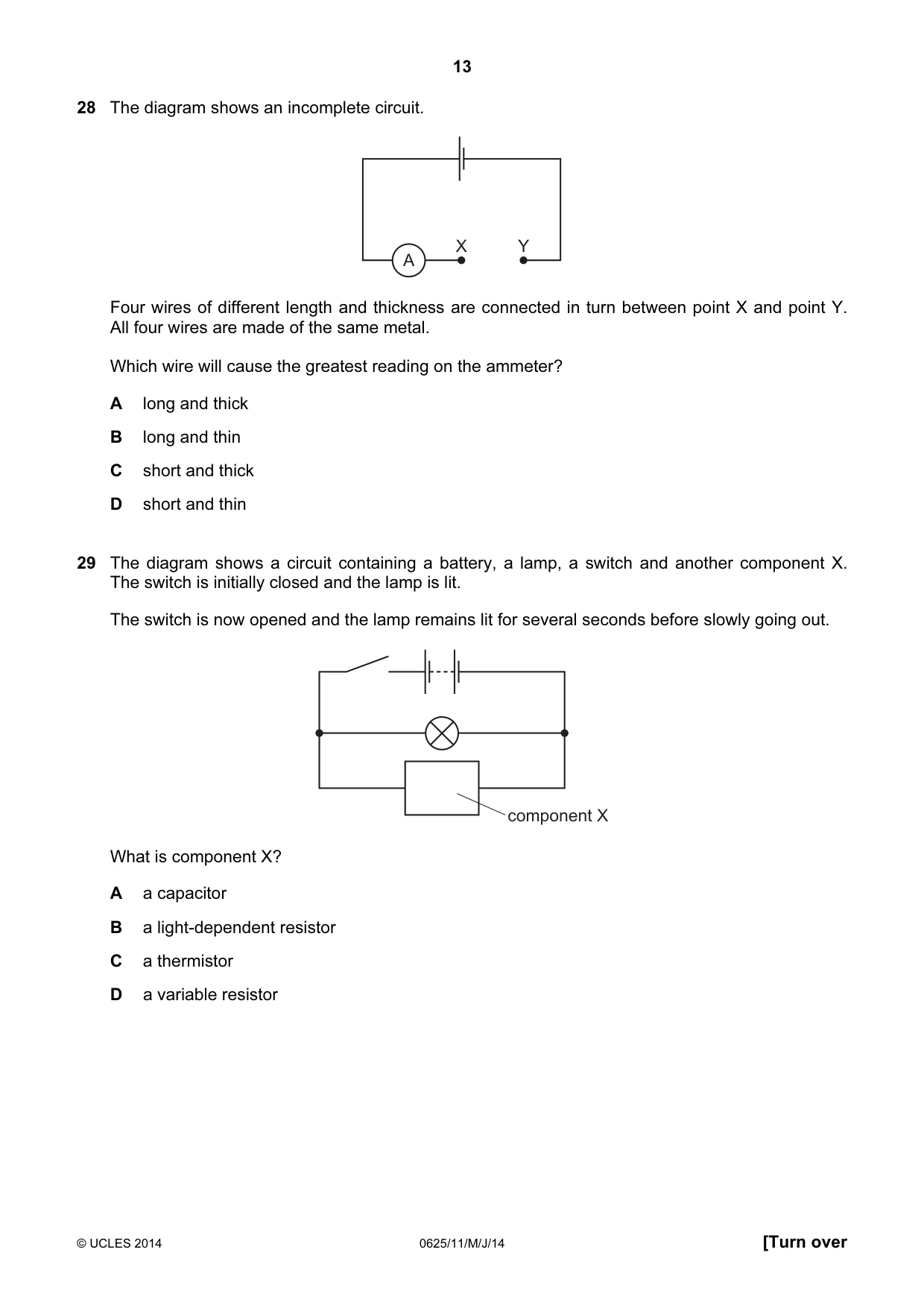
Q28 · The diagram shows an incomplete circuit
28 The diagram shows an incomplete circuit. X Y A Four wires of different length and thickness are connected in turn between point X and point Y. All four wires are made of the same metal. Which wire will cause the greatest reading on the ammeter? A long and thick B long and thin C short and thick D short and thin
Mark scheme: C
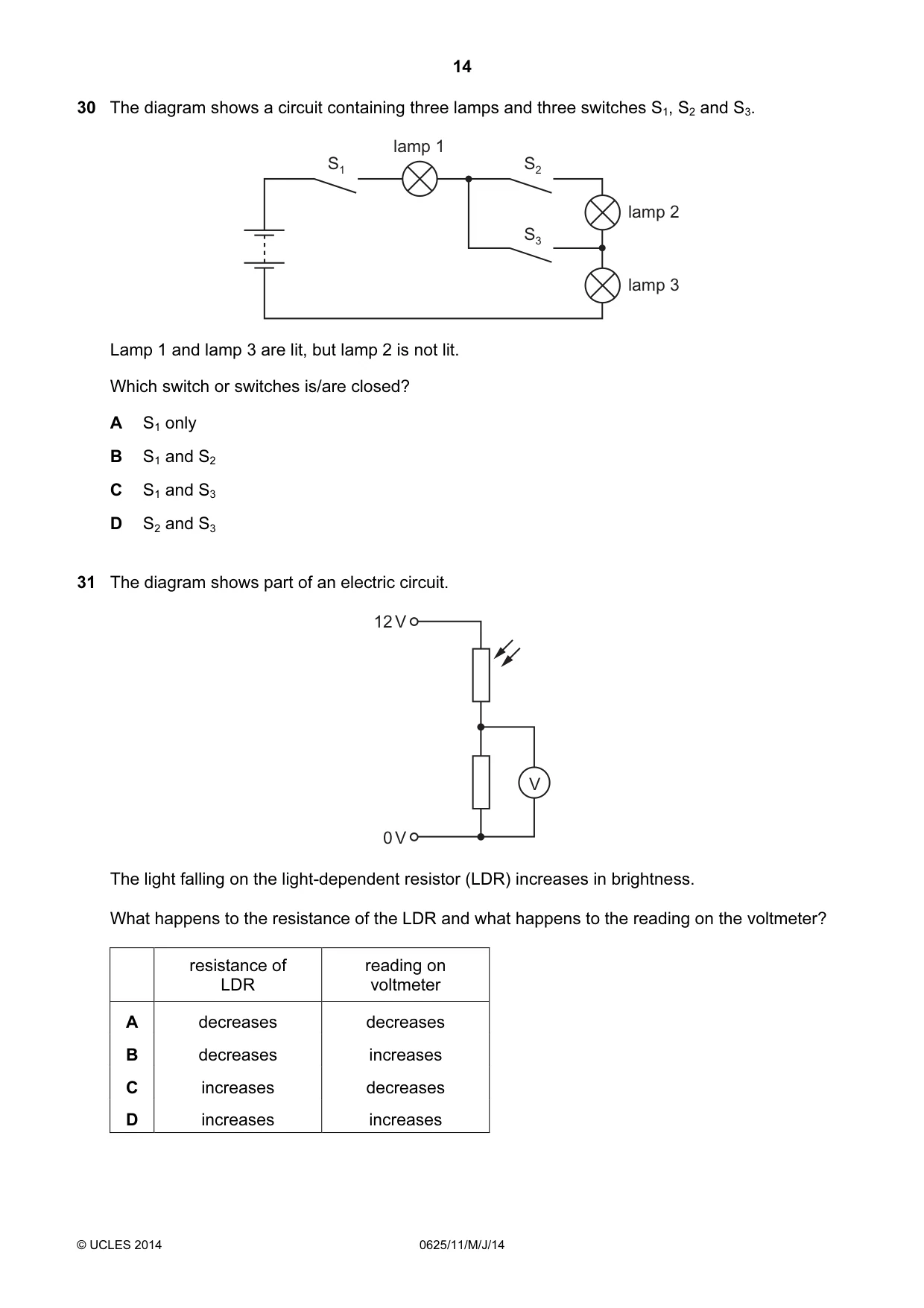
Q29 · The diagram shows a circuit containing a battery, a lamp, a switch and another component X
29 The diagram shows a circuit containing a battery, a lamp, a switch and another component X. The switch is initially closed and the lamp is lit. The switch is now opened and the lamp remains lit for several seconds before slowly going out. component X What is component X? A a capacitor B a light-dependent resistor C a thermistor D a variable resistor
Mark scheme: A
Q30 · The diagram shows a circuit containing three lamps and three switches S1, S2 and S3
30 The diagram shows a circuit containing three lamps and three switches S1, S2 and S3. lamp 1 S1 S2 lamp 2 S3 lamp 3 Lamp 1 and lamp 3 are lit, but lamp 2 is not lit. Which switch or switches is/are closed? A S1 only B S1 and S2 C S1 and S3 D S2 and S3
Mark scheme: C
Q31 · The diagram shows part of an electric circuit
31 The diagram shows part of an electric circuit. 12 V V 0 V The light falling on the light-dependent resistor (LDR) increases in brightness. What happens to the resistance of the LDR and what happens to the reading on the voltmeter? resistance of reading on LDR voltmeter A decreases decreases B decreases increases C increases decreases D increases increases
Mark scheme: B
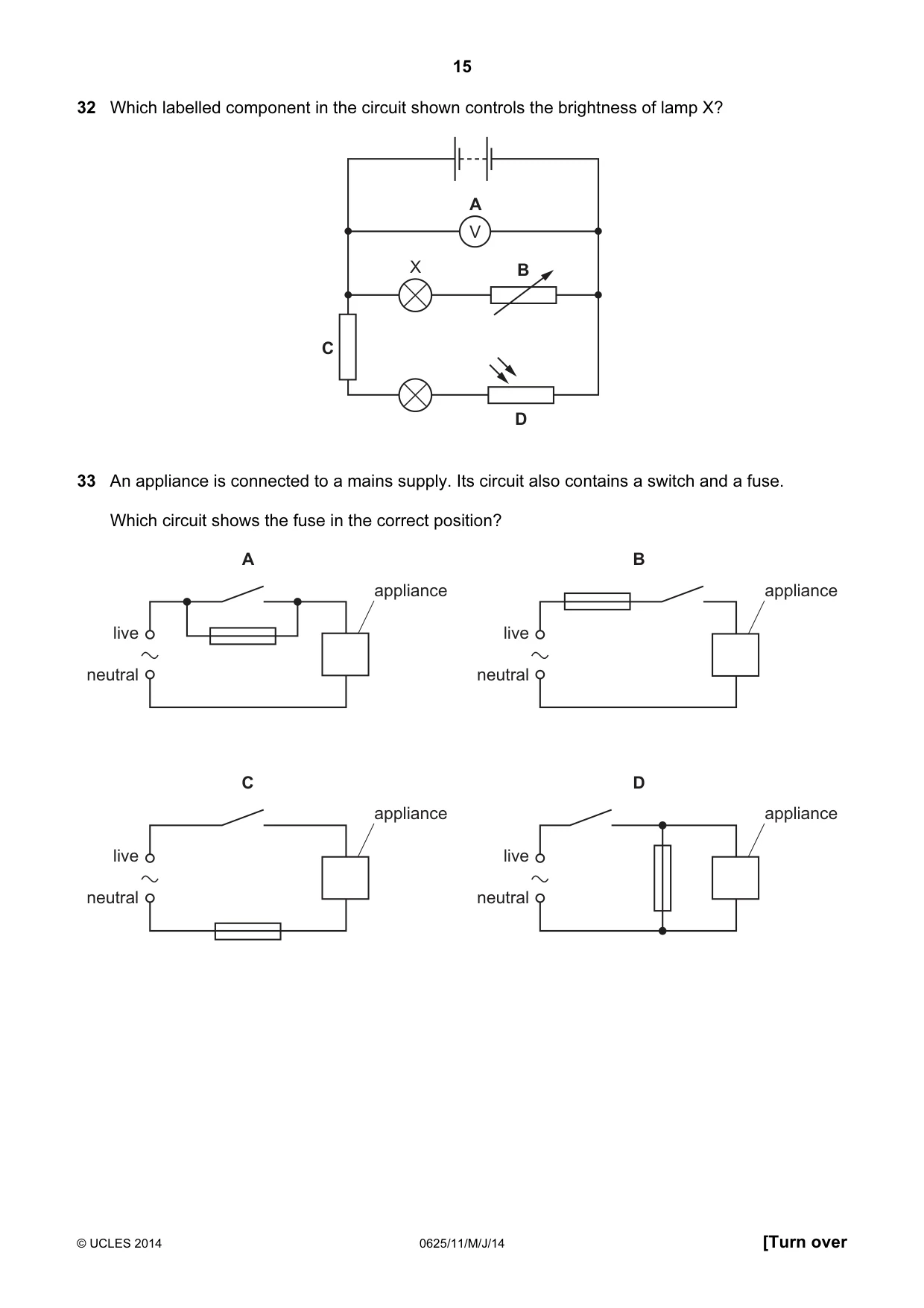
Q32 · Which labelled component in the circuit shown controls the brightness of lamp X?
32 Which labelled component in the circuit shown controls the brightness of lamp X? A V X B C D
Mark scheme: B
Q33 · An appliance is connected to a mains supply
33 An appliance is connected to a mains supply. Its circuit also contains a switch and a fuse. Which circuit shows the fuse in the correct position? A B appliance appliance live live neutral neutral C D appliance appliance live live neutral neutral
Mark scheme: B
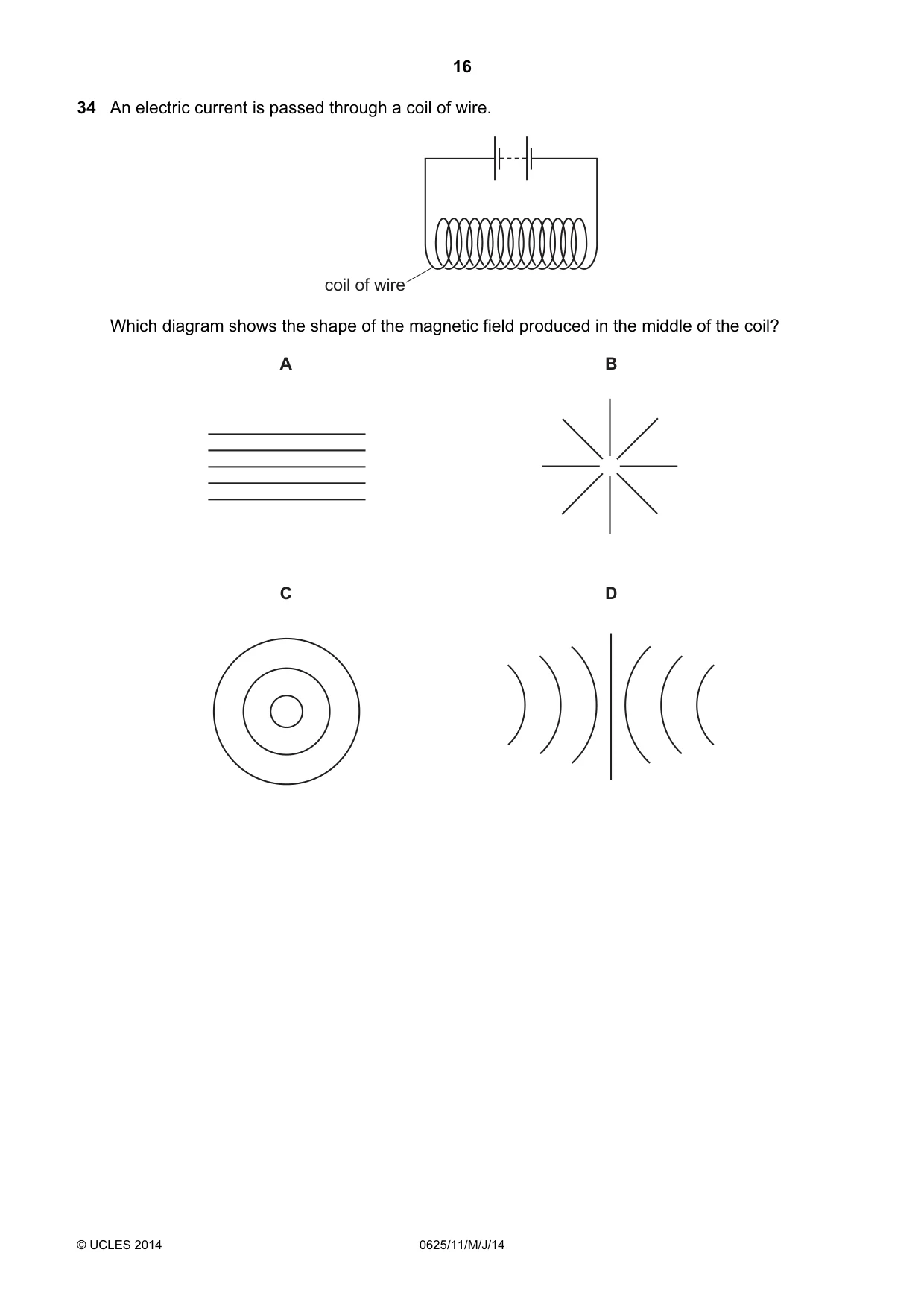
Q34 · An electric current is passed through a coil of wire
34 An electric current is passed through a coil of wire. coil of wire Which diagram shows the shape of the magnetic field produced in the middle of the coil? A B C D
Mark scheme: A
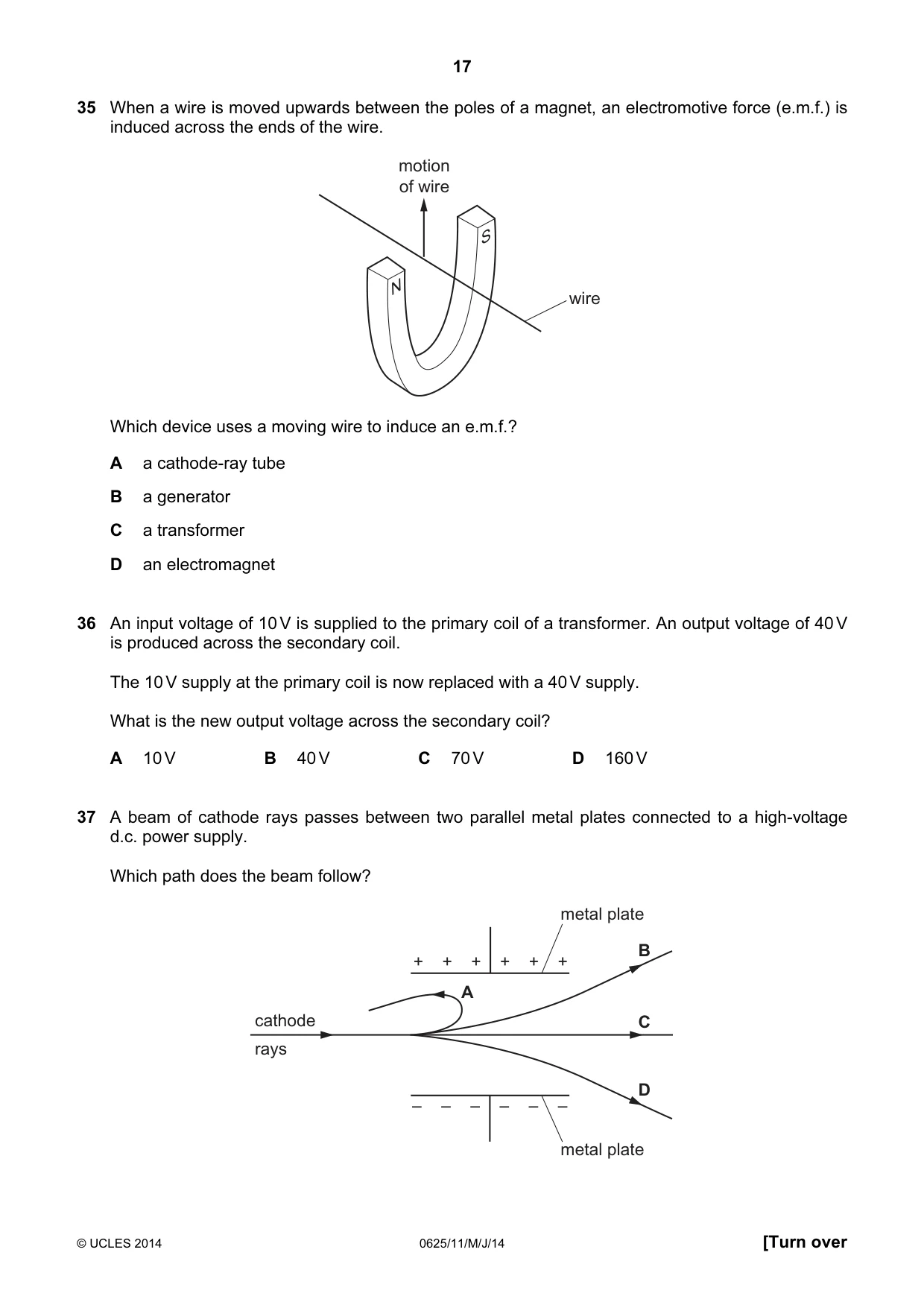
Q35 · When a wire is moved upwards between the poles of a magnet, an electromotive force…
35 When a wire is moved upwards between the poles of a magnet, an electromotive force (e.m.f.) is induced across the ends of the wire. motion of wire S N wire Which device uses a moving wire to induce an e.m.f.? A a cathode-ray tube B a generator C a transformer D an electromagnet
Mark scheme: B
Q36 · An input voltage of 10 V is supplied to the primary coil of a transformer
36 An input voltage of 10 V is supplied to the primary coil of a transformer. An output voltage of 40 V is produced across the secondary coil. The 10 V supply at the primary coil is now replaced with a 40 V supply. What is the new output voltage across the secondary coil? A 10 V B 40 V C 70 V D 160 V
Mark scheme: D
Q37 · A beam of cathode rays passes between two parallel metal plates connected to a…
37 A beam of cathode rays passes between two parallel metal plates connected to a high-voltage d.c. power supply. Which path does the beam follow? metal plate B + + + + + + A cathode C rays D metal plate
Mark scheme: B
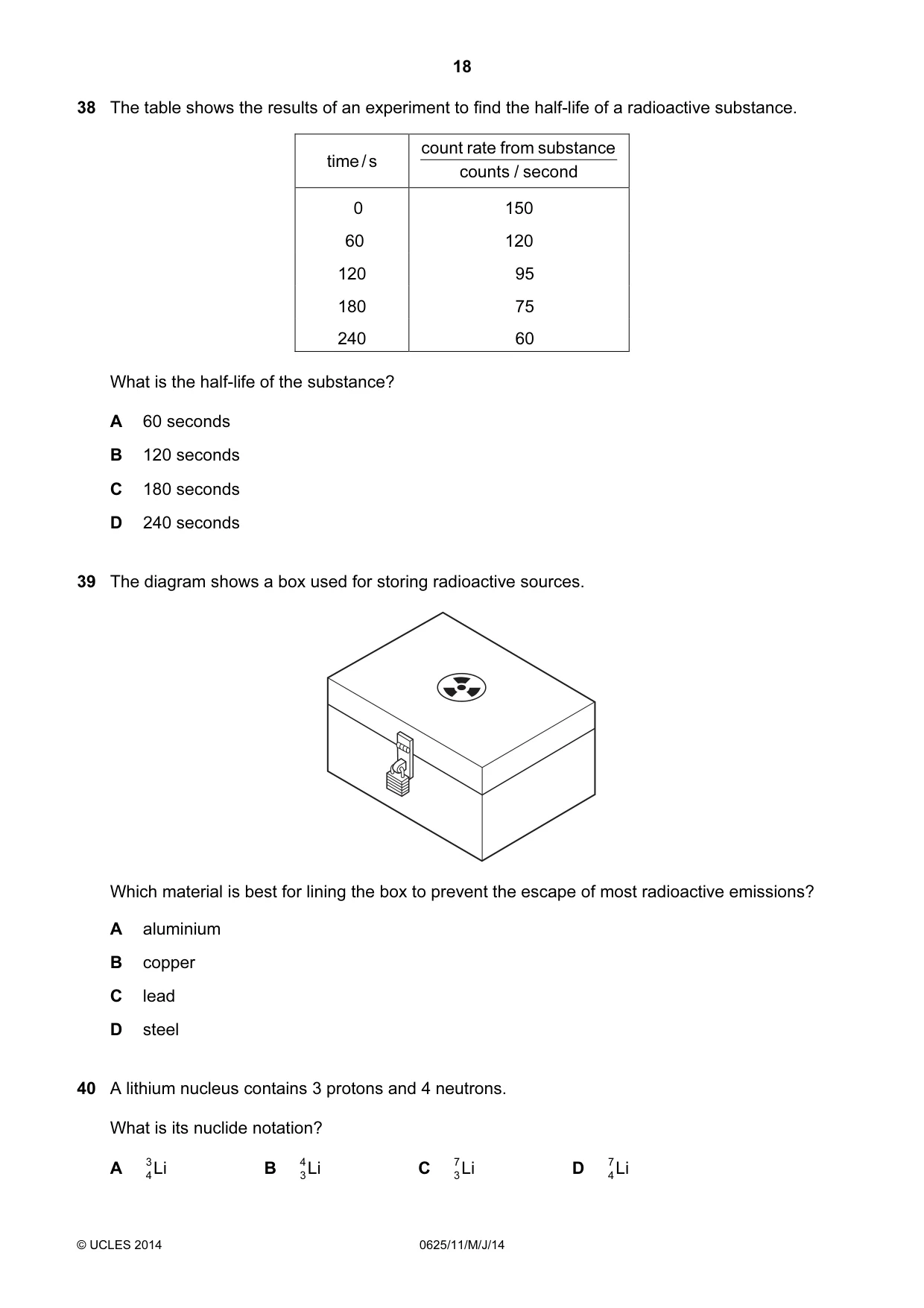
Q38 · The table shows the results of an experiment to find the half-life of a radioactive…
38 The table shows the results of an experiment to find the half-life of a radioactive substance. count rate from substance time / s counts / second 0 150 60 120 120 95 180 75 240 60 What is the half-life of the substance? A 60 seconds B 120 seconds C 180 seconds D 240 seconds
Mark scheme: C
Q39 · The diagram shows a box used for storing radioactive sources
39 The diagram shows a box used for storing radioactive sources. Which material is best for lining the box to prevent the escape of most radioactive emissions? A aluminium B copper C lead D steel
Mark scheme: C
Q40 · A lithium nucleus contains 3 protons and 4 neutrons
40 A lithium nucleus contains 3 protons and 4 neutrons. What is its nuclide notation? A 3 Li B 4 Li C 7 Li D 7 Li 4 3 3 4
Mark scheme: C
What was in this paper
The subtopics covered by these 40 questions, and how many questions each got. Open one in a new tab to see every Cambridge question on it.
4Electrical quantities3Electromagnetic effects3Light3Energy, work and power2Forces2Kinetic particle model of matter2Motion2Pressure2Radioactivity2Simple phenomena of magnetism2Sound2Thermal properties and temperature2Transfer of thermal energy2Density1Electrical safety1Electromagnetic spectrum1General properties of waves1Mass and weight1Physical quantities and measurement techniques1The nuclear model of the atom1What you needed in this session
Cambridge’s own grade thresholds for 2014 May/June, Paper 1 · Variant 1. A higher threshold means an easier paper — the bar moves with how the cohort did.