Cambridge IGCSE Physics 0625 — 2013 Oct/Nov Paper 1 · Variant 1
0625/11/O/N/13 · 40 questions · 40 marks · ≈45 min
The question paper and its mark scheme, free to read here and free to download. This is Cambridge’s own paper, exactly as it was sat.
Question paper16 pages
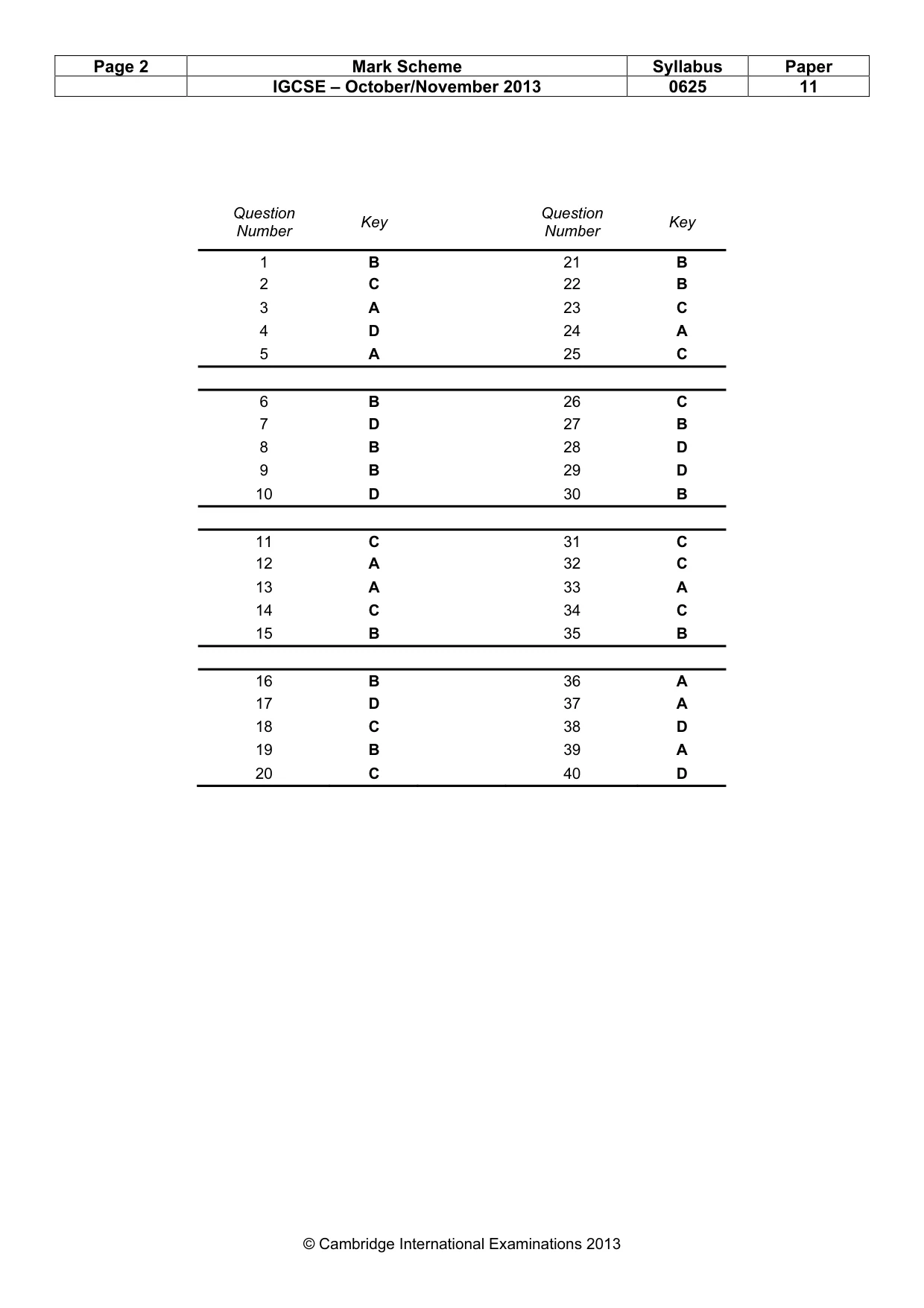
Mark scheme2 pages
Answers below. Sit the paper first if you are practising.
Questions as text
Q1 · A student uses a ruler to measure the length and the width of a small rectangular metal…
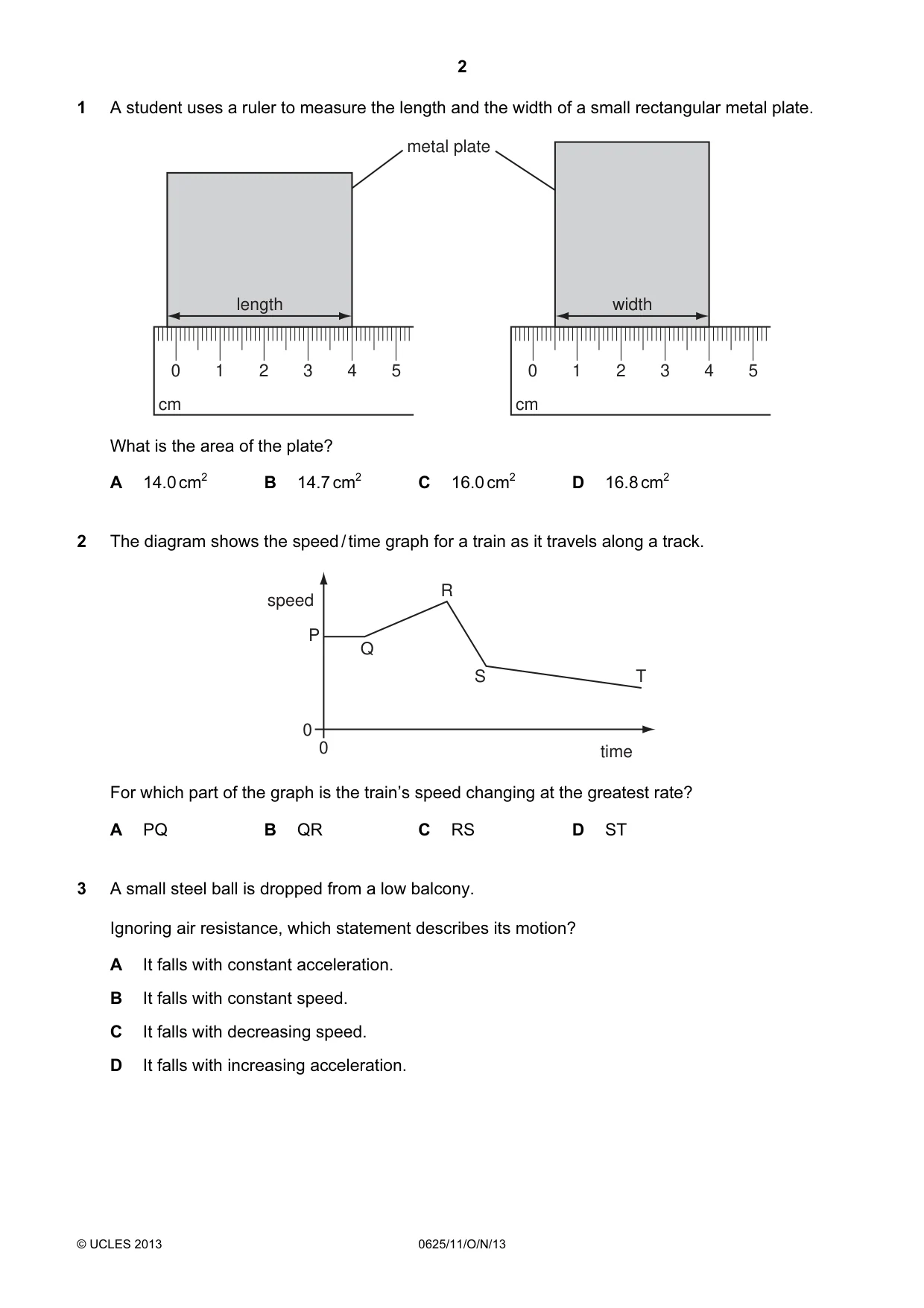
1 A student uses a ruler to measure the length and the width of a small rectangular metal plate. metal plate length width 0 1 2 3 4 5 0 1 2 3 4 5 cm cm What is the area of the plate? A 14.0 cm2 B 14.7 cm2 C 16.0 cm2 D 16.8 cm2
Mark scheme: B
More questions on Physical quantities and measurement techniques
Q2 · The diagram shows the speed / time graph for a train as it travels along a track
2 The diagram shows the speed / time graph for a train as it travels along a track. R speed P Q S T 0 0 time For which part of the graph is the train’s speed changing at the greatest rate? A PQ B QR C RS D ST
Mark scheme: C
Q3 · A small steel ball is dropped from a low balcony
3 A small steel ball is dropped from a low balcony. Ignoring air resistance, which statement describes its motion? A It falls with constant acceleration. B It falls with constant speed. C It falls with decreasing speed. D It falls with increasing acceleration.
Mark scheme: A
Q4 · Which is the unit for force and which is the unit for weight?
4 Which is the unit for force and which is the unit for weight? force weight A kg kg B kg N C N kg D N N
Mark scheme: D
Q5 · A cup contains hot liquid
5 A cup contains hot liquid. Some of the liquid evaporates. What happens to the mass and to the weight of the liquid in the cup? mass weight A decreases decreases B decreases stays the same C stays the same decreases D stays the same stays the same
Mark scheme: A
Q6 · Four rectangular blocks, P, Q, R and S are shown
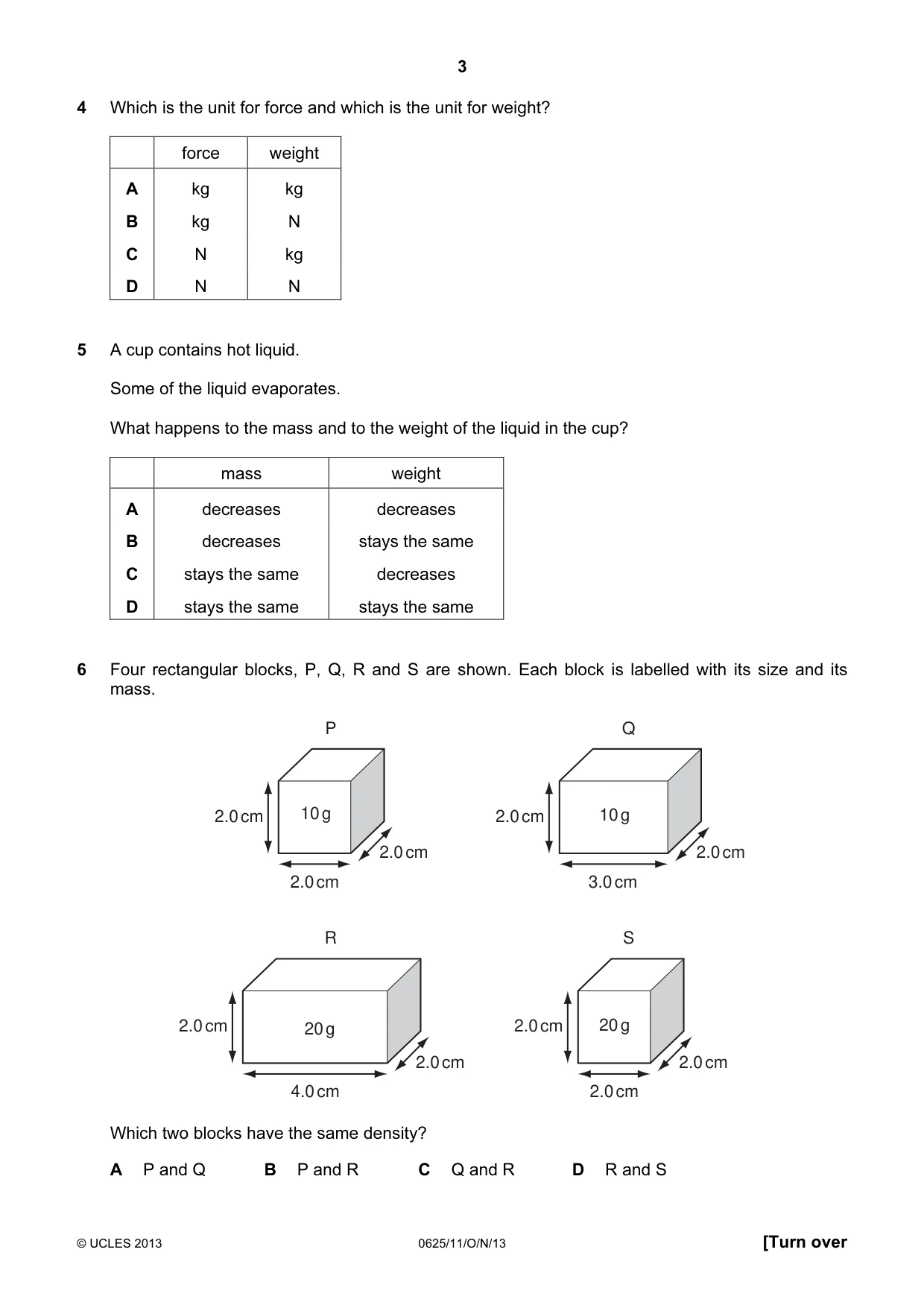
6 Four rectangular blocks, P, Q, R and S are shown. Each block is labelled with its size and its mass. P Q 2.0 cm 10 g 2.0 cm 10 g 2.0 cm 2.0 cm 2.0 cm 3.0 cm R S 2.0 cm 20 g 2.0 cm 20 g 2.0 cm 2.0 cm 4.0 cm 2.0 cm Which two blocks have the same density? A P and Q B P and R C Q and R D R and S
Mark scheme: B
Q7 · A force acting on an object causes some properties of the object to change
7 A force acting on an object causes some properties of the object to change. Which list contains only properties that can be changed by the action of the force? A mass, motion and shape B mass, motion and size C mass, shape and size D motion, shape and size
Mark scheme: D
Q8 · A box is being moved by a fork-lift truck
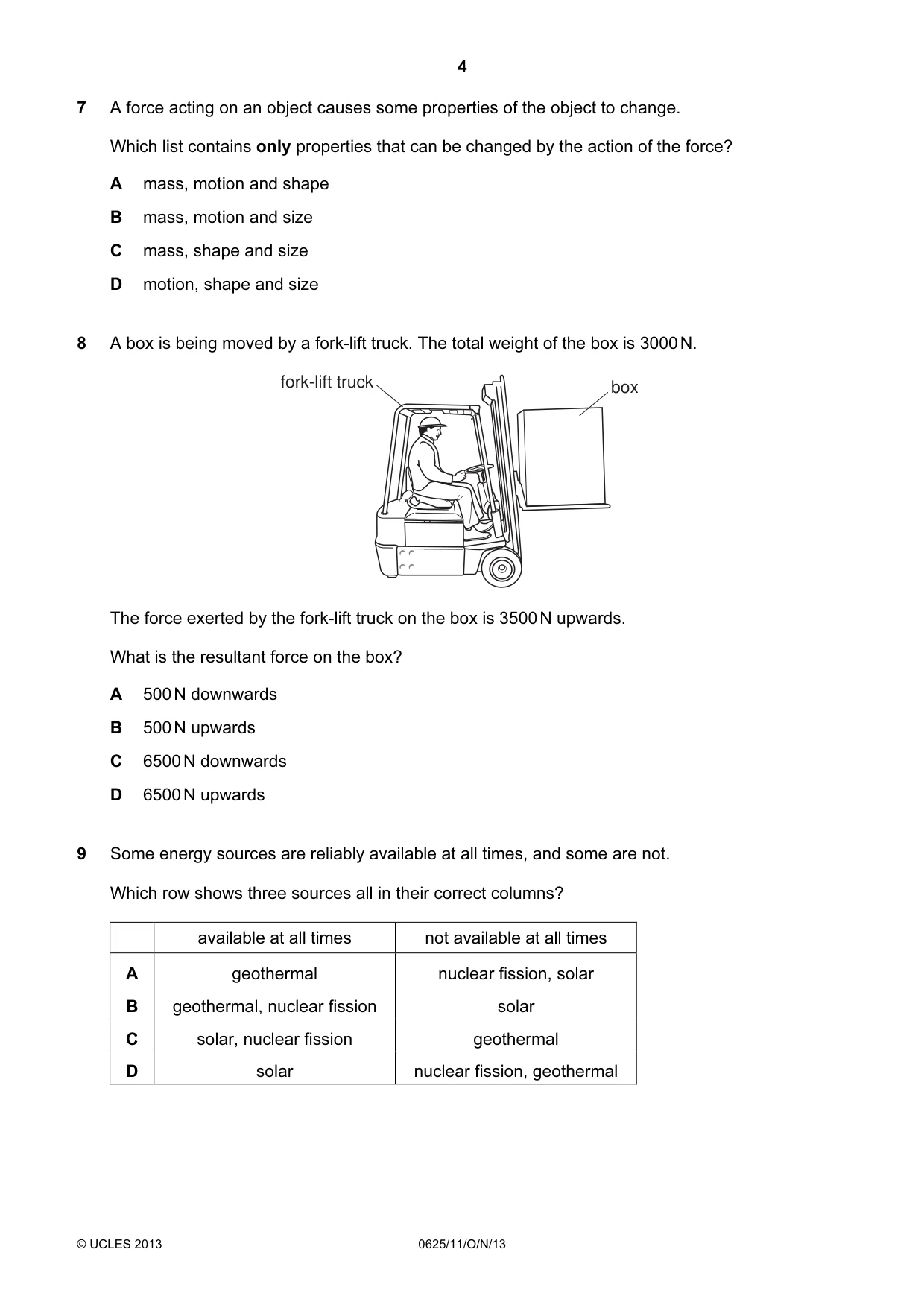
8 A box is being moved by a fork-lift truck. The total weight of the box is 3000 N. fork-lift truck box The force exerted by the fork-lift truck on the box is 3500 N upwards. What is the resultant force on the box? A 500 N downwards B 500 N upwards C 6500 N downwards D 6500 N upwards
Mark scheme: B
Q9 · Some energy sources are reliably available at all times, and some are not
9 Some energy sources are reliably available at all times, and some are not. Which row shows three sources all in their correct columns? available at all times not available at all times A geothermal nuclear fission, solar B geothermal, nuclear fission solar C solar, nuclear fission geothermal D solar nuclear fission, geothermal
Mark scheme: B
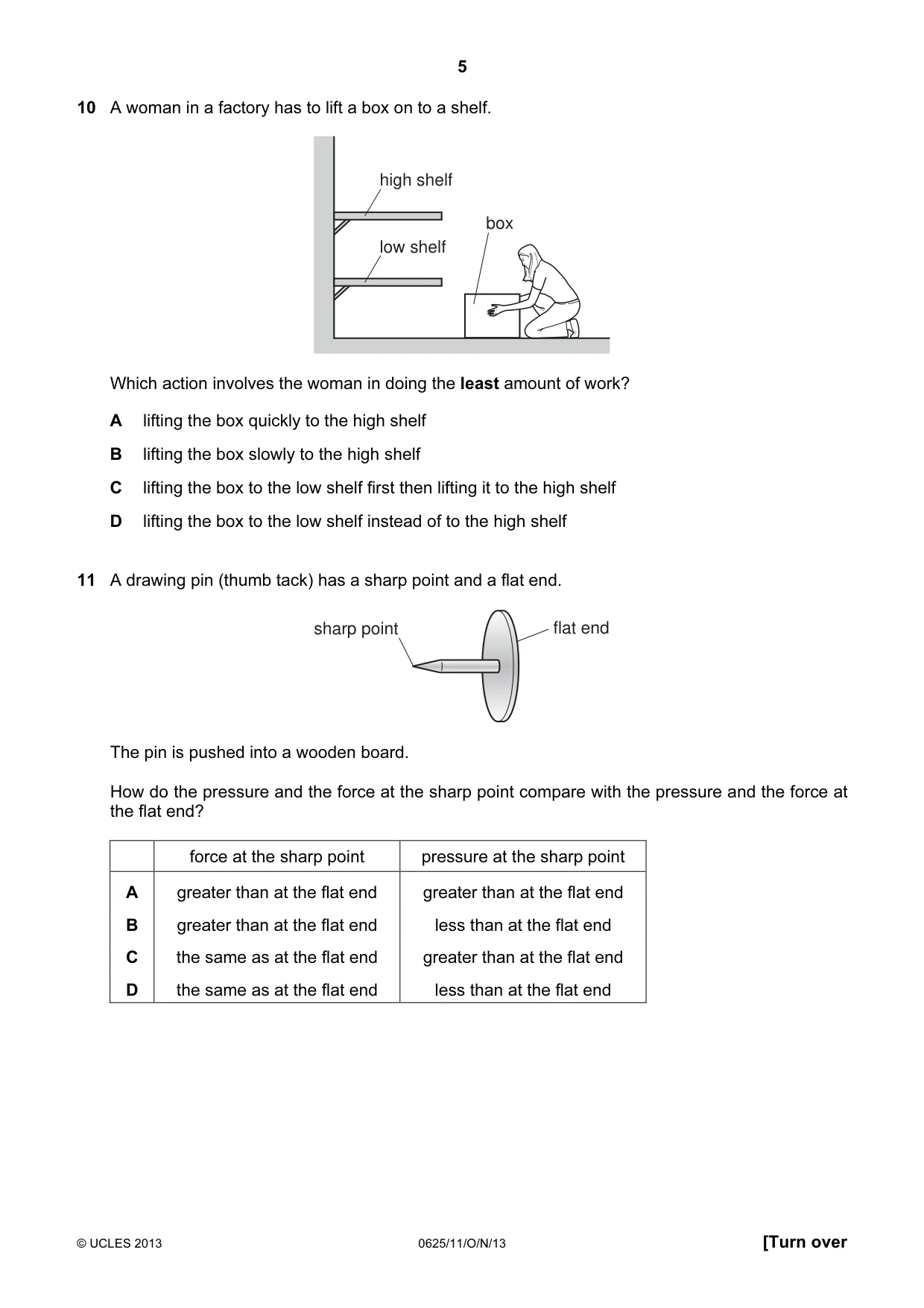
Q10 · A woman in a factory has to lift a box on to a shelf
10 A woman in a factory has to lift a box on to a shelf. high shelf box low shelf Which action involves the woman in doing the least amount of work? A lifting the box quickly to the high shelf B lifting the box slowly to the high shelf C lifting the box to the low shelf first then lifting it to the high shelf D lifting the box to the low shelf instead of to the high shelf
Mark scheme: D
Q11 · A drawing pin (thumb tack) has a sharp point and a flat end
11 A drawing pin (thumb tack) has a sharp point and a flat end. sharp point flat end The pin is pushed into a wooden board. How do the pressure and the force at the sharp point compare with the pressure and the force at the flat end? force at the sharp point pressure at the sharp point A greater than at the flat end greater than at the flat end B greater than at the flat end less than at the flat end C the same as at the flat end greater than at the flat end D the same as at the flat end less than at the flat end
Mark scheme: C
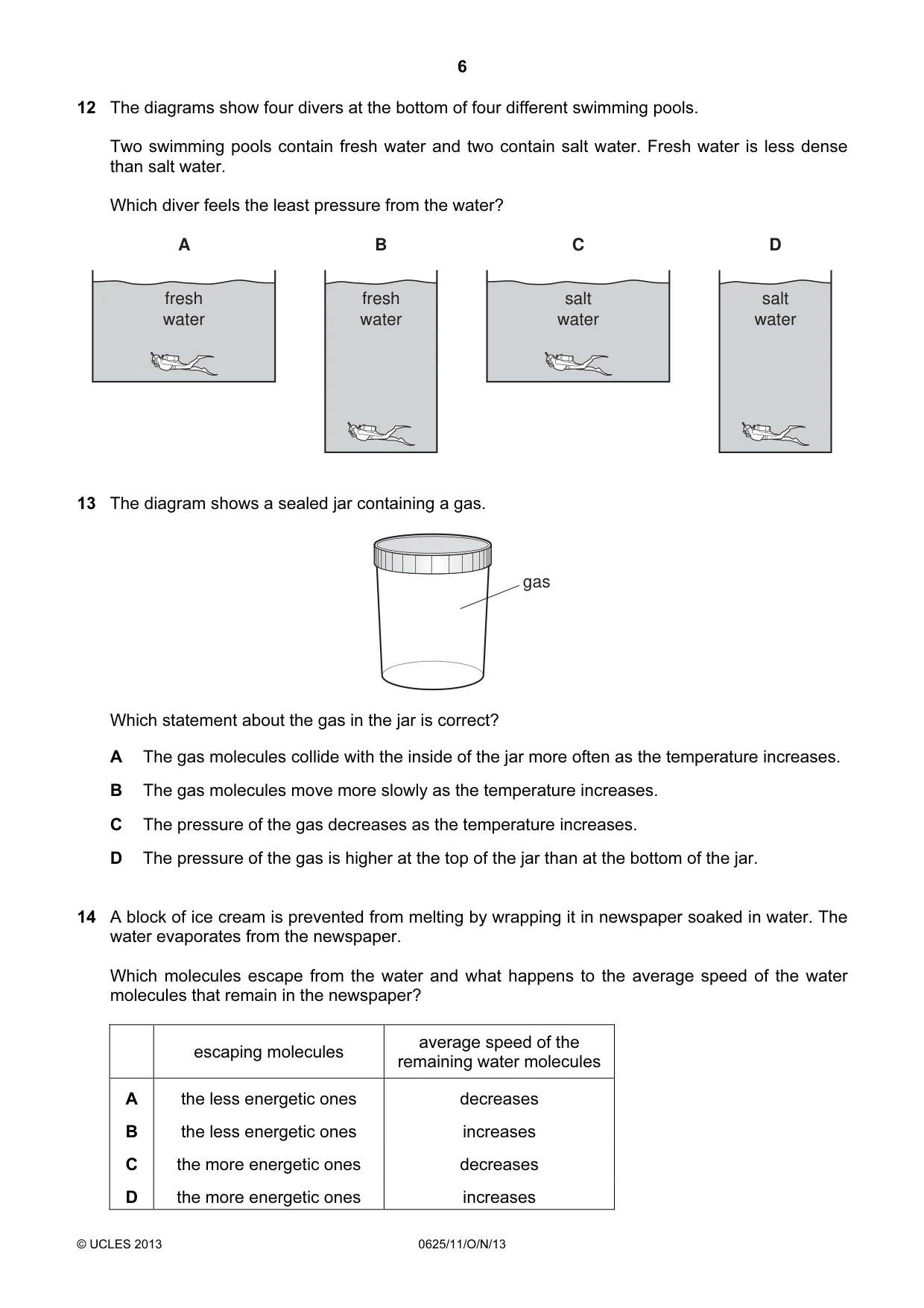
Q12 · The diagrams show four divers at the bottom of four different swimming pools
12 The diagrams show four divers at the bottom of four different swimming pools. Two swimming pools contain fresh water and two contain salt water. Fresh water is less dense than salt water. Which diver feels the least pressure from the water? A B C D fresh fresh salt salt water water water water
Mark scheme: A
Q13 · The diagram shows a sealed jar containing a gas
13 The diagram shows a sealed jar containing a gas. gas Which statement about the gas in the jar is correct? A The gas molecules collide with the inside of the jar more often as the temperature increases. B The gas molecules move more slowly as the temperature increases. C The pressure of the gas decreases as the temperature increases. D The pressure of the gas is higher at the top of the jar than at the bottom of the jar.
Mark scheme: A
Q14 · A block of ice cream is prevented from melting by wrapping it in newspaper soaked in water
14 A block of ice cream is prevented from melting by wrapping it in newspaper soaked in water. The water evaporates from the newspaper. Which molecules escape from the water and what happens to the average speed of the water molecules that remain in the newspaper? average speed of the escaping molecules remaining water molecules A the less energetic ones decreases B the less energetic ones increases C the more energetic ones decreases D the more energetic ones increases
Mark scheme: C
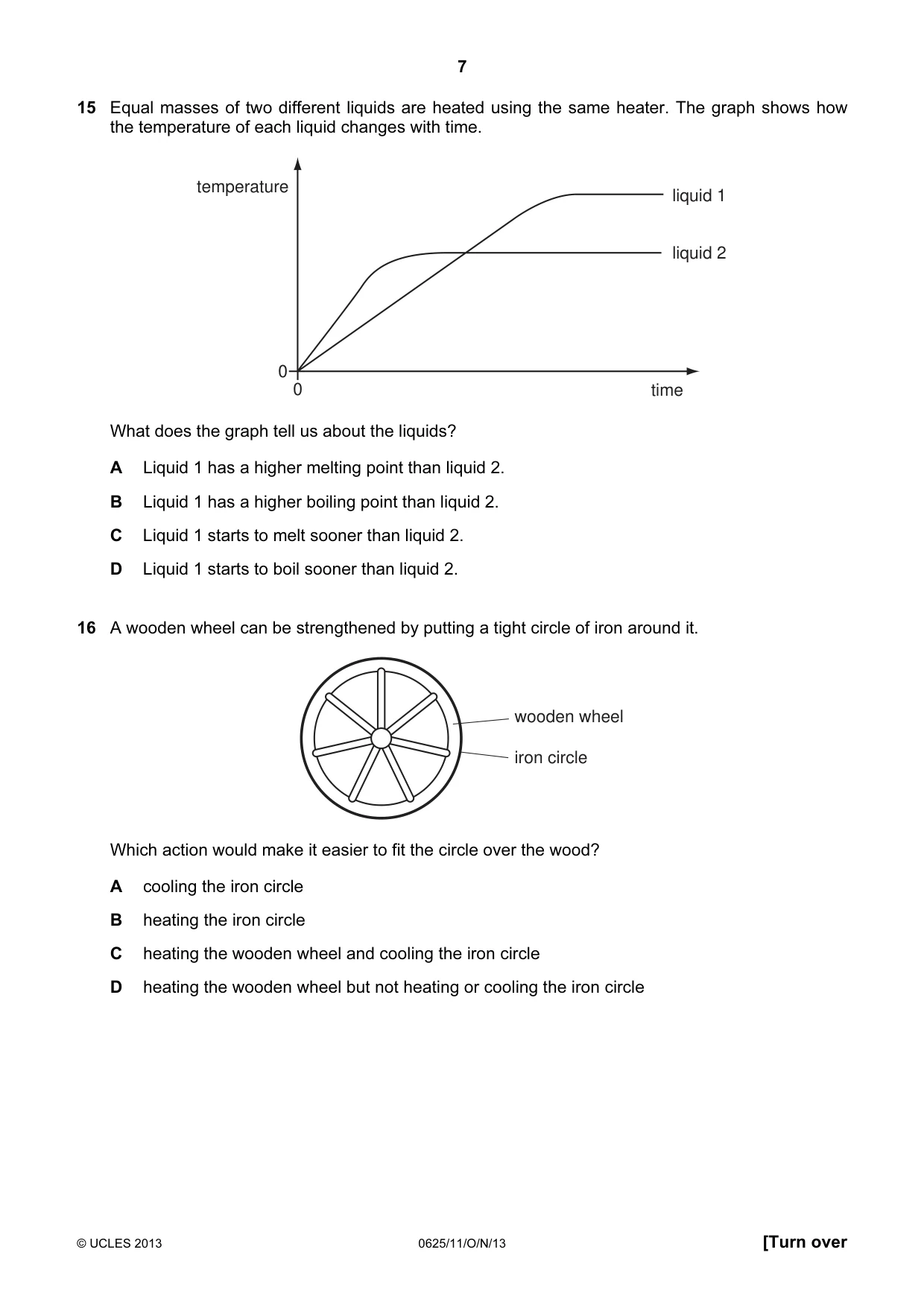
Q15 · Equal masses of two different liquids are heated using the same heater
15 Equal masses of two different liquids are heated using the same heater. The graph shows how the temperature of each liquid changes with time. temperature liquid 1 liquid 2 0 0 time What does the graph tell us about the liquids? A Liquid 1 has a higher melting point than liquid 2. B Liquid 1 has a higher boiling point than liquid 2. C Liquid 1 starts to melt sooner than liquid 2. D Liquid 1 starts to boil sooner than liquid 2.
Mark scheme: B
Q16 · A wooden wheel can be strengthened by putting a tight circle of iron around it
16 A wooden wheel can be strengthened by putting a tight circle of iron around it. wooden wheel iron circle Which action would make it easier to fit the circle over the wood? A cooling the iron circle B heating the iron circle C heating the wooden wheel and cooling the iron circle D heating the wooden wheel but not heating or cooling the iron circle
Mark scheme: B
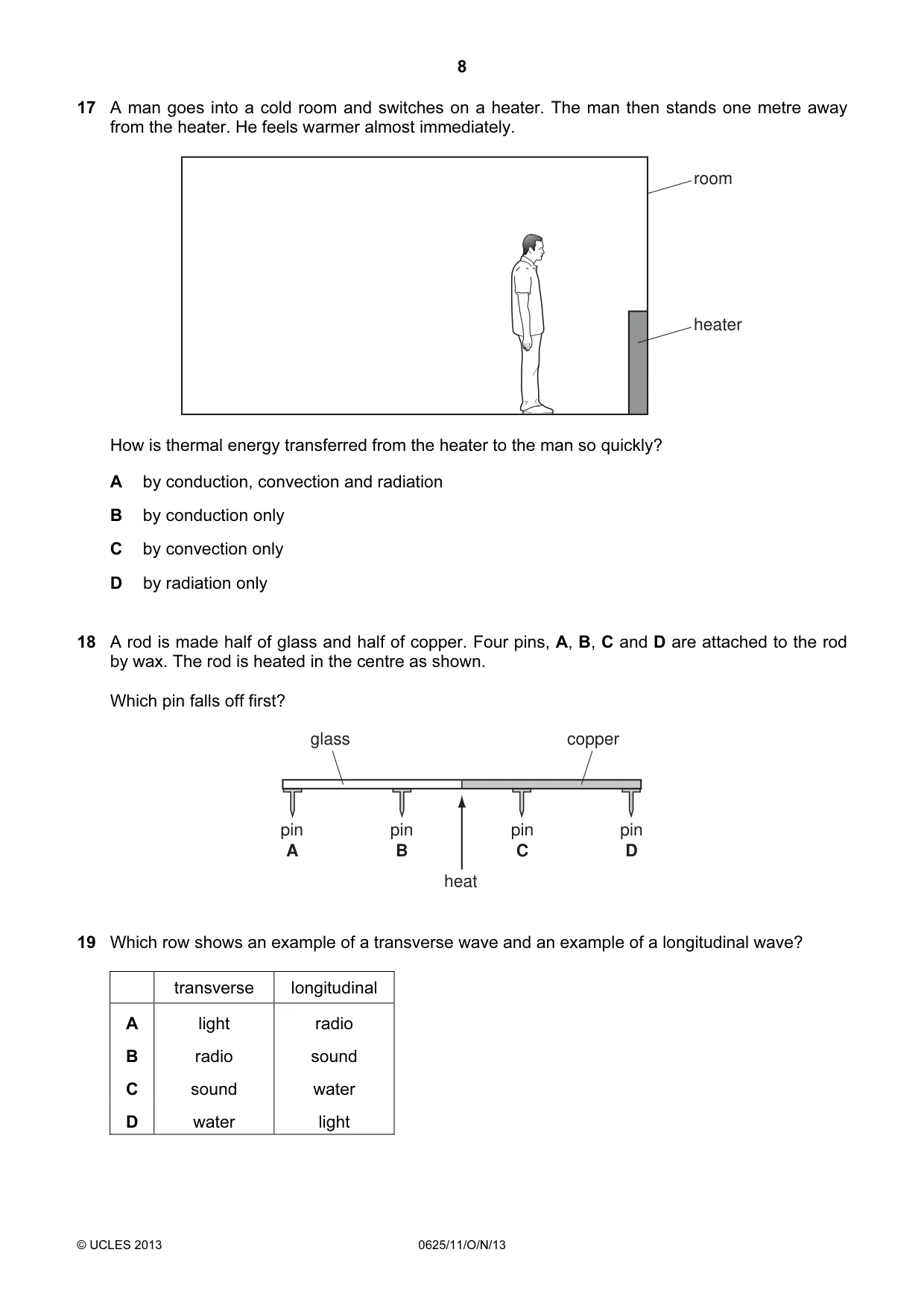
Q17 · A man goes into a cold room and switches on a heater
17 A man goes into a cold room and switches on a heater. The man then stands one metre away from the heater. He feels warmer almost immediately. room heater How is thermal energy transferred from the heater to the man so quickly? A by conduction, convection and radiation B by conduction only C by convection only D by radiation only
Mark scheme: D
Q18 · A rod is made half of glass and half of copper
18 A rod is made half of glass and half of copper. Four pins, A, B, C and D are attached to the rod by wax. The rod is heated in the centre as shown. Which pin falls off first? glass copper pin pin pin pin A B C D heat
Mark scheme: C
Q19 · Which row shows an example of a transverse wave and an example of a longitudinal wave?
19 Which row shows an example of a transverse wave and an example of a longitudinal wave? transverse longitudinal A light radio B radio sound C sound water D water light
Mark scheme: B
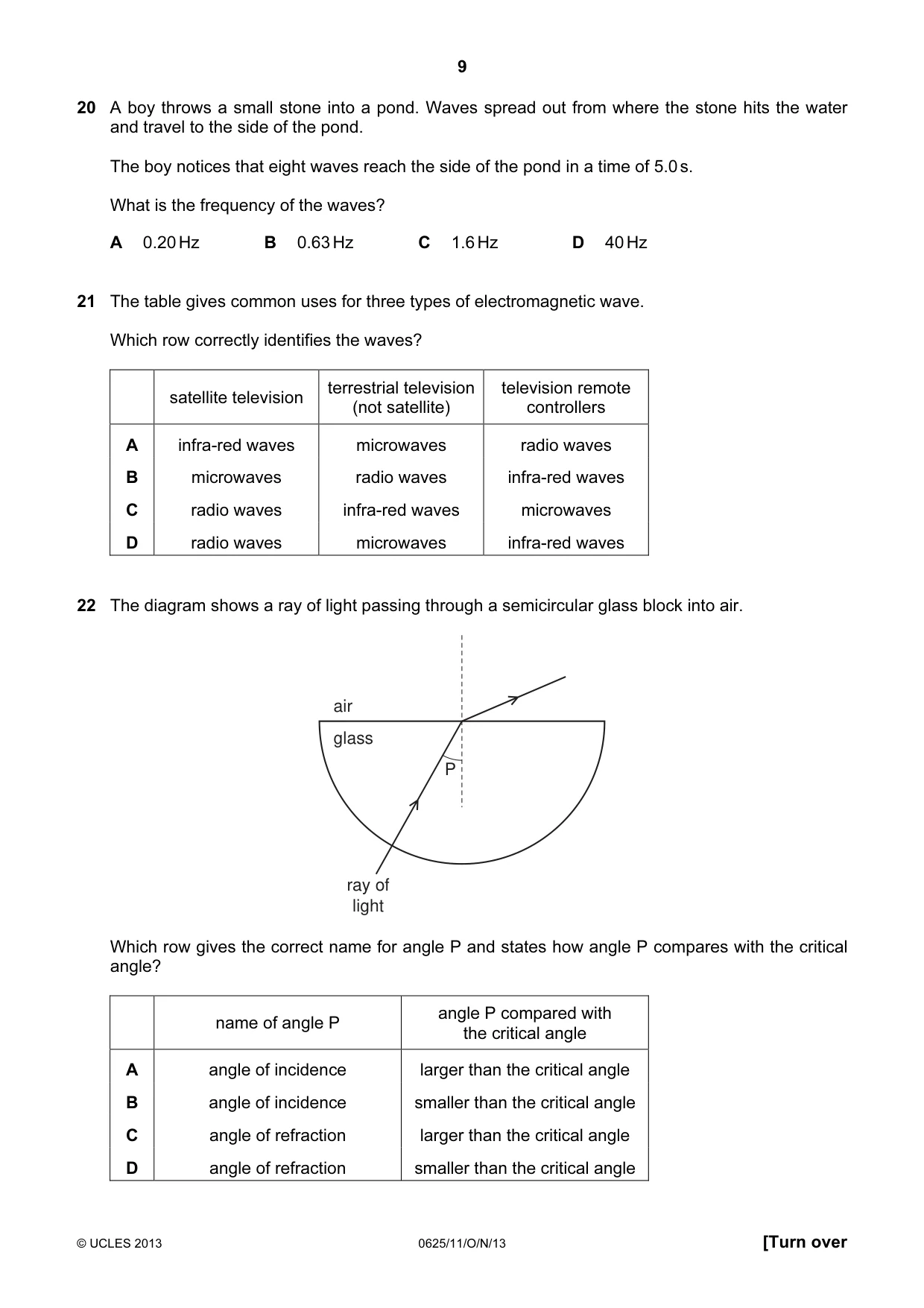
Q20 · A boy throws a small stone into a pond
20 A boy throws a small stone into a pond. Waves spread out from where the stone hits the water and travel to the side of the pond. The boy notices that eight waves reach the side of the pond in a time of 5.0 s. What is the frequency of the waves? A 0.20 Hz B 0.63 Hz C 1.6 Hz D 40 Hz
Mark scheme: C
Q21 · The table gives common uses for three types of electromagnetic wave
21 The table gives common uses for three types of electromagnetic wave. Which row correctly identifies the waves? terrestrial television television remote satellite television (not satellite) controllers A infra-red waves microwaves radio waves B microwaves radio waves infra-red waves C radio waves infra-red waves microwaves D radio waves microwaves infra-red waves
Mark scheme: B
Q22 · The diagram shows a ray of light passing through a semicircular glass block into air
22 The diagram shows a ray of light passing through a semicircular glass block into air. air glass P ray of light Which row gives the correct name for angle P and states how angle P compares with the critical angle? angle P compared with name of angle P the critical angle A angle of incidence larger than the critical angle B angle of incidence smaller than the critical angle C angle of refraction larger than the critical angle D angle of refraction smaller than the critical angle
Mark scheme: B
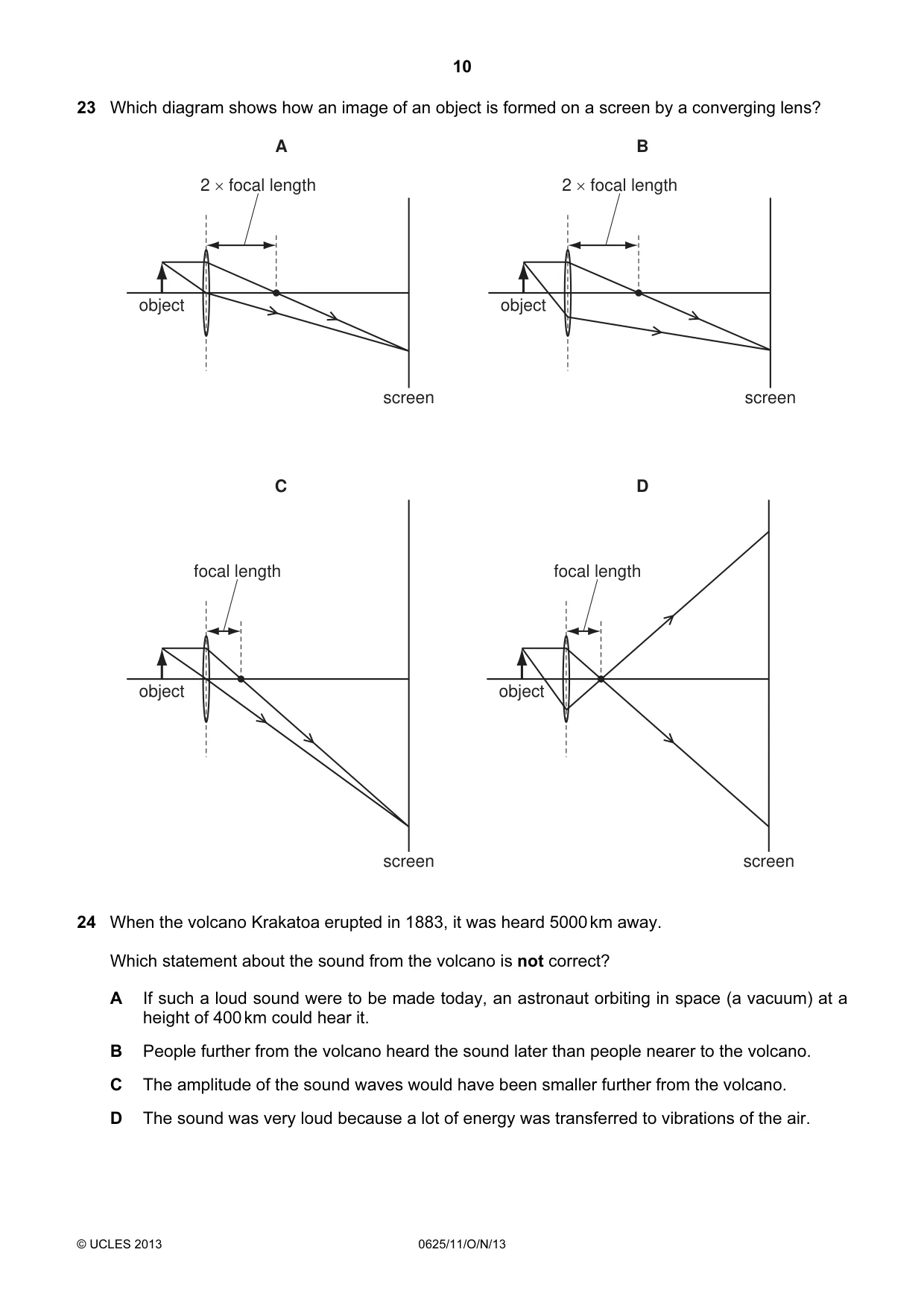
Q23 · Which diagram shows how an image of an object is formed on a screen by a converging lens?
23 Which diagram shows how an image of an object is formed on a screen by a converging lens? A B 2 × focal length 2 × focal length object object screen screen C D focal length focal length object object screen screen
Mark scheme: C
Q24 · When the volcano Krakatoa erupted in 1883, it was heard 5000 km away
24 When the volcano Krakatoa erupted in 1883, it was heard 5000 km away. Which statement about the sound from the volcano is not correct? A If such a loud sound were to be made today, an astronaut orbiting in space (a vacuum) at a height of 400 km could hear it. B People further from the volcano heard the sound later than people nearer to the volcano. C The amplitude of the sound waves would have been smaller further from the volcano. D The sound was very loud because a lot of energy was transferred to vibrations of the air.
Mark scheme: A
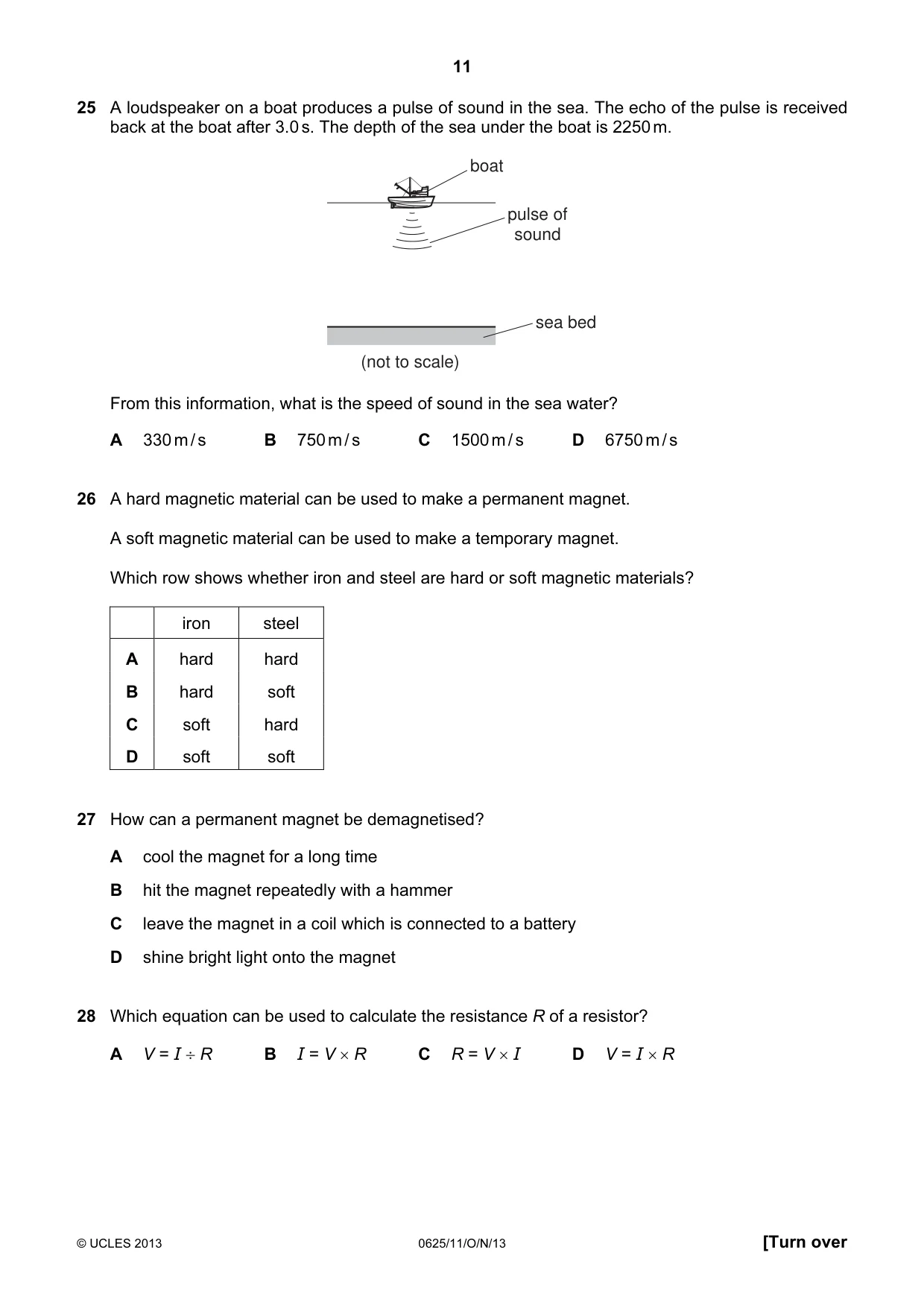
Q25 · A loudspeaker on a boat produces a pulse of sound in the sea
25 A loudspeaker on a boat produces a pulse of sound in the sea. The echo of the pulse is received back at the boat after 3.0 s. The depth of the sea under the boat is 2250 m. boat pulse of sound sea bed (not to scale) From this information, what is the speed of sound in the sea water? A 330 m / s B 750 m / s C 1500 m / s D 6750 m / s
Mark scheme: C
Q26 · A hard magnetic material can be used to make a permanent magnet
26 A hard magnetic material can be used to make a permanent magnet. A soft magnetic material can be used to make a temporary magnet. Which row shows whether iron and steel are hard or soft magnetic materials? iron steel A hard hard B hard soft C soft hard D soft soft
Mark scheme: C
Q27 · How can a permanent magnet be demagnetised?
27 How can a permanent magnet be demagnetised? A cool the magnet for a long time B hit the magnet repeatedly with a hammer C leave the magnet in a coil which is connected to a battery D shine bright light onto the magnet
Mark scheme: B
Q28 · Which equation can be used to calculate the resistance R of a resistor?
28 Which equation can be used to calculate the resistance R of a resistor? A V = I ÷ R B I = V × R C R = V × I D V = I × R
Mark scheme: D
Q29 · A student wishes to measure first the electromotive force (e.m.f.) of a battery, and then…
29 A student wishes to measure first the electromotive force (e.m.f.) of a battery, and then the potential difference (p.d.) across a resistor. She has the resistor, the battery and some connecting wires. What else does she need? A a force meter (newton meter) and a voltmeter B an ammeter and a voltmeter C an ammeter only D a voltmeter only
Mark scheme: D
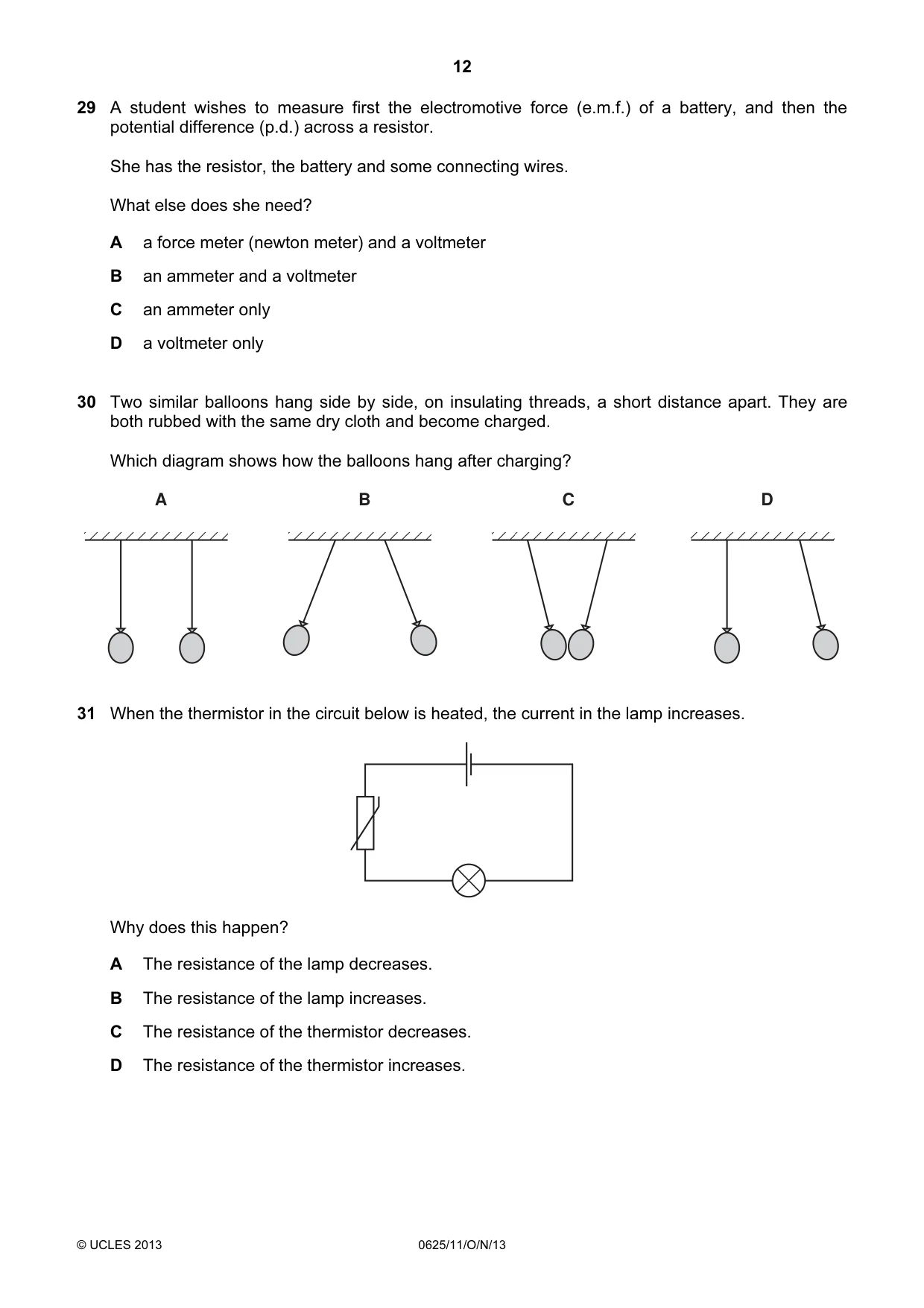
Q30 · Two similar balloons hang side by side, on insulating threads, a short distance apart
30 Two similar balloons hang side by side, on insulating threads, a short distance apart. They are both rubbed with the same dry cloth and become charged. Which diagram shows how the balloons hang after charging? A B C D
Mark scheme: B
Q31 · When the thermistor in the circuit below is heated, the current in the lamp increases
31 When the thermistor in the circuit below is heated, the current in the lamp increases. Why does this happen? A The resistance of the lamp decreases. B The resistance of the lamp increases. C The resistance of the thermistor decreases. D The resistance of the thermistor increases.
Mark scheme: C
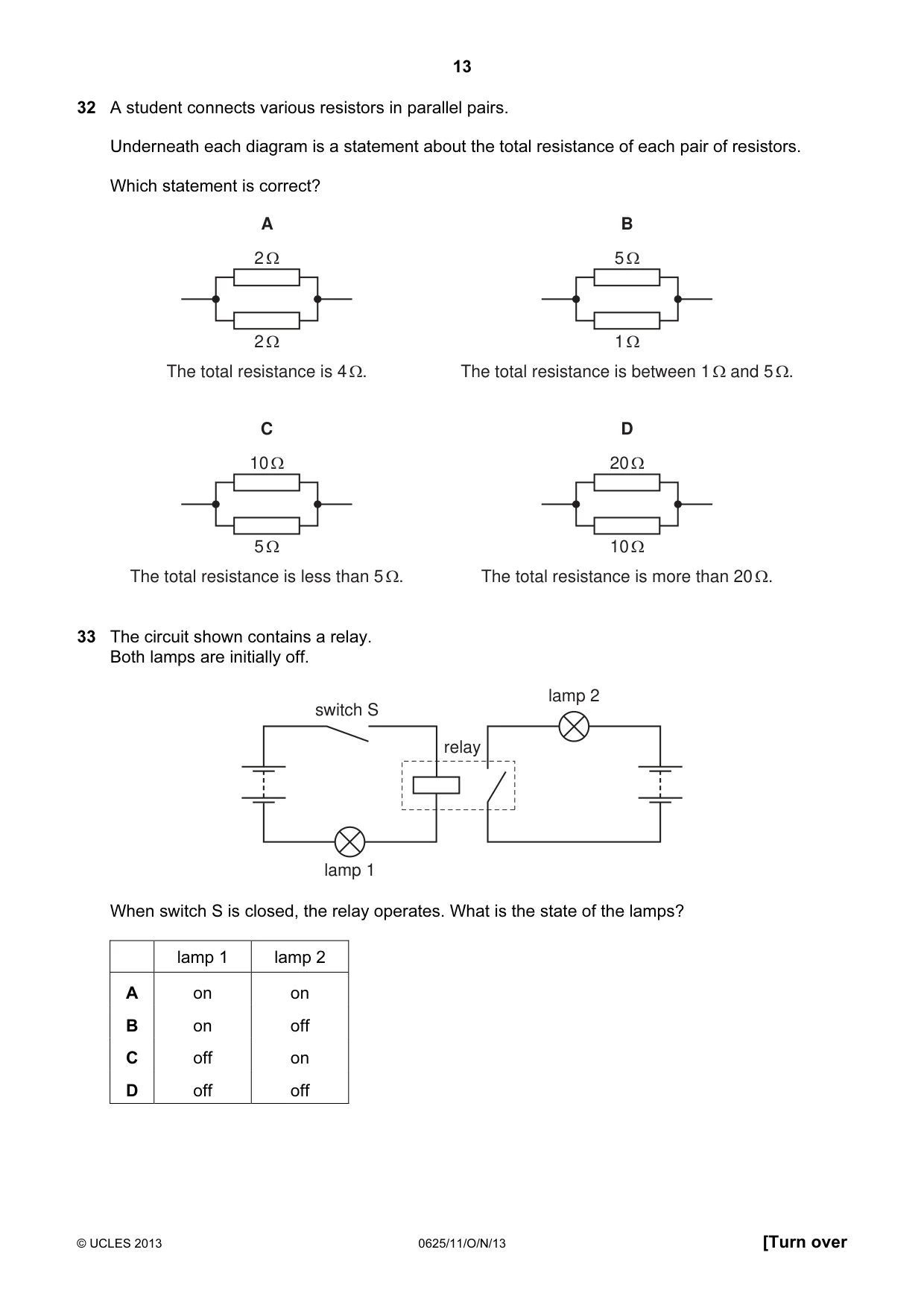
Q32 · A student connects various resistors in parallel pairs
32 A student connects various resistors in parallel pairs. Underneath each diagram is a statement about the total resistance of each pair of resistors. Which statement is correct? A B 2 Ω 5 Ω 2 Ω 1 Ω The total resistance is 4 Ω. The total resistance is between 1 Ω and 5 Ω. C D 10 Ω 20 Ω 5 Ω 10 Ω The total resistance is less than 5 Ω. The total resistance is more than 20 Ω.
Mark scheme: C
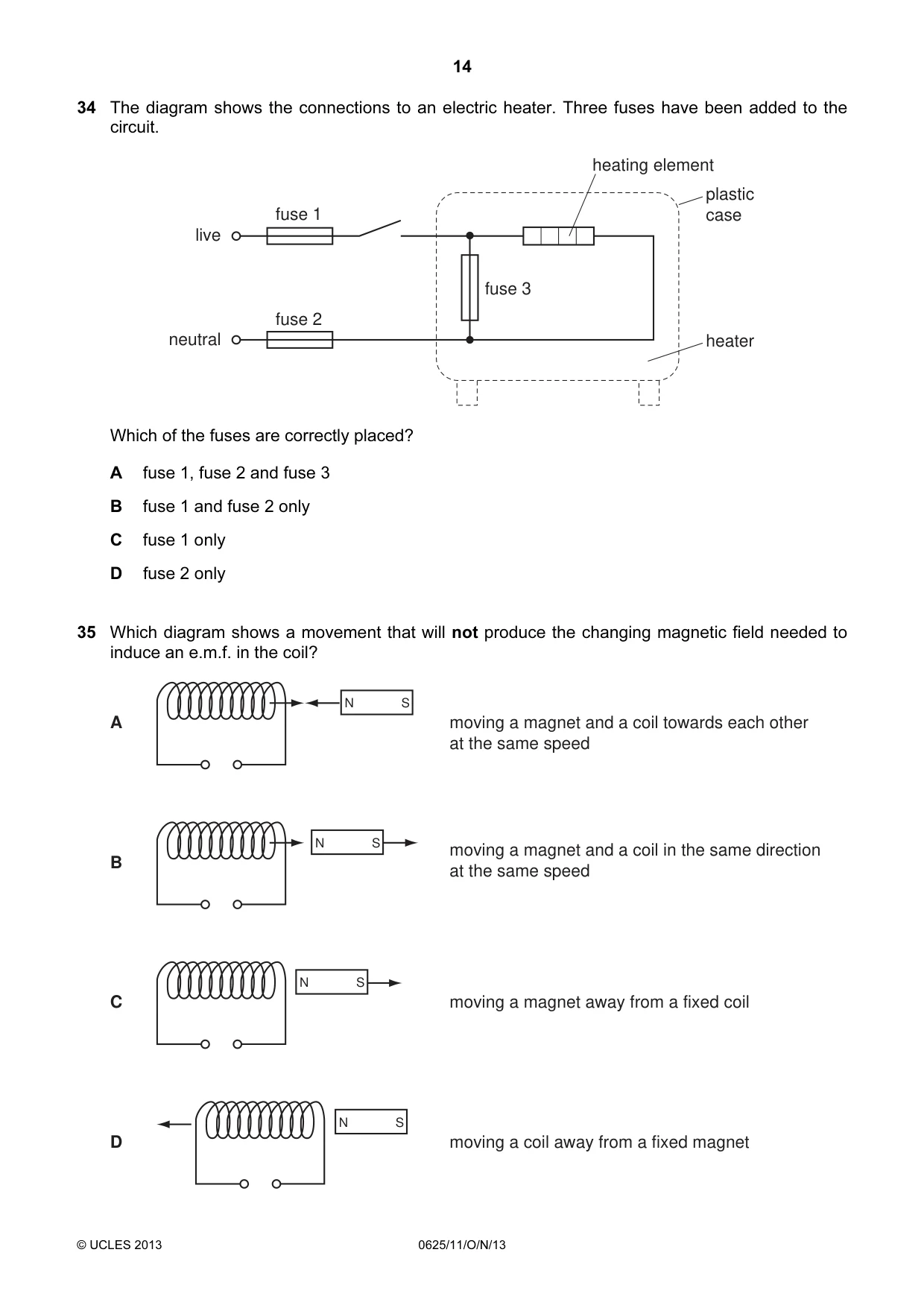
Q33 · The circuit shown contains a relay
33 The circuit shown contains a relay. Both lamps are initially off. lamp 2 switch S relay lamp 1 When switch S is closed, the relay operates. What is the state of the lamps? lamp 1 lamp 2 A on on B on off C off on D off off
Mark scheme: A
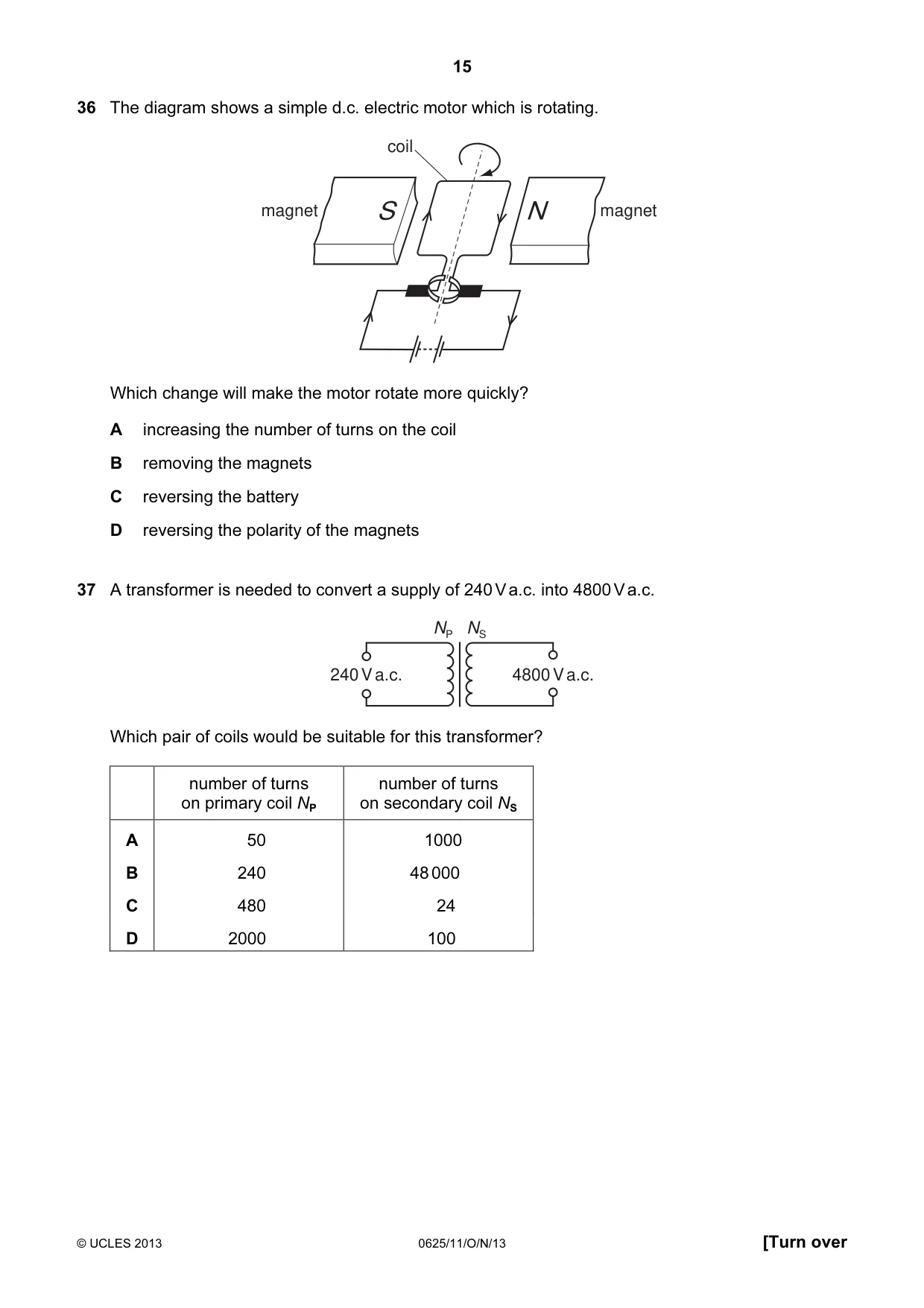
Q34 · The diagram shows the connections to an electric heater
34 The diagram shows the connections to an electric heater. Three fuses have been added to the circuit. heating element plastic fuse 1 case live fuse 3 fuse 2 neutral heater Which of the fuses are correctly placed? A fuse 1, fuse 2 and fuse 3 B fuse 1 and fuse 2 only C fuse 1 only D fuse 2 only
Mark scheme: C
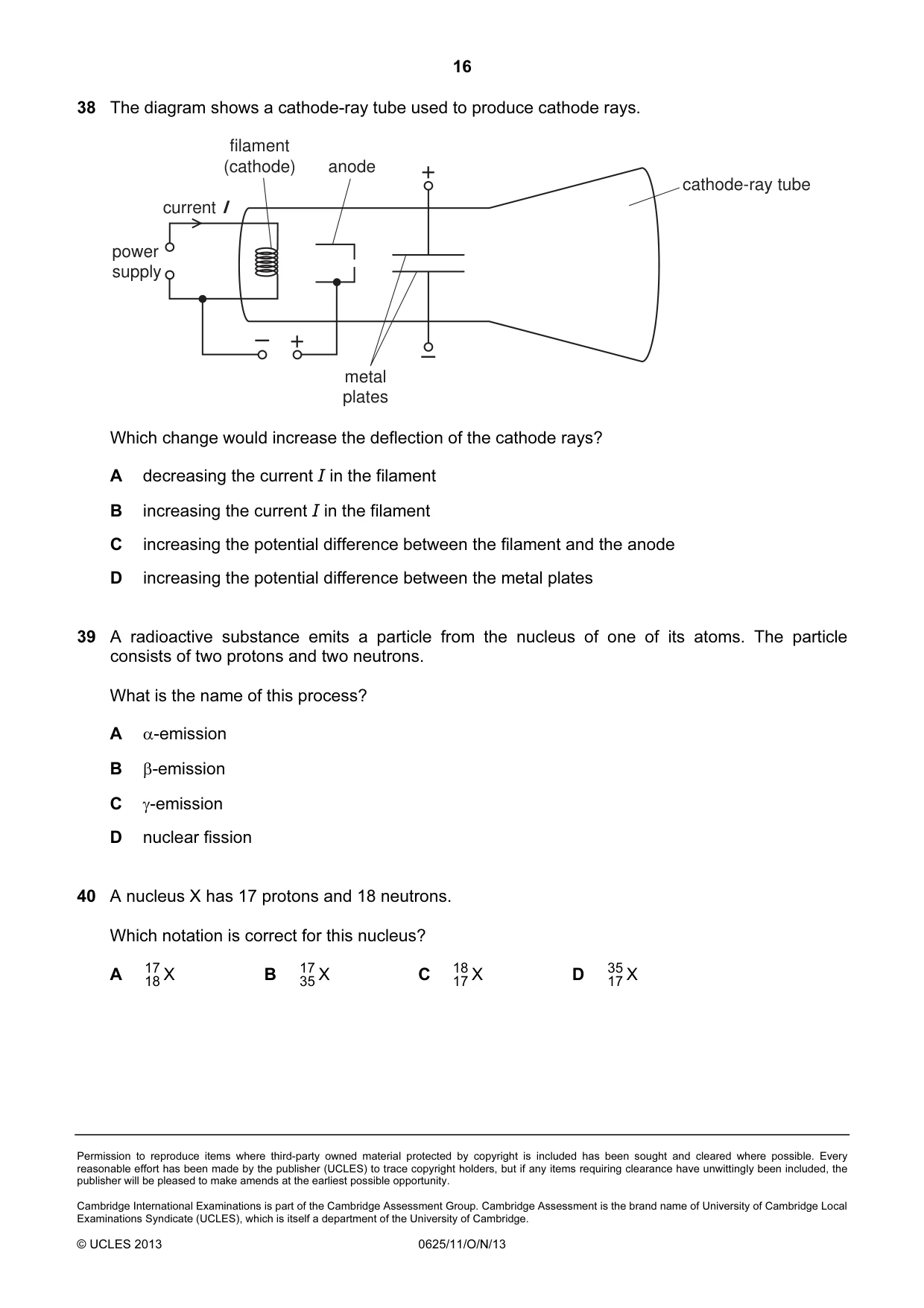
Q35 · Which diagram shows a movement that will not produce the changing magnetic field needed…
35 Which diagram shows a movement that will not produce the changing magnetic field needed to induce an e.m.f. in the coil? N S A moving a magnet and a coil towards each other at the same speed N S moving a magnet and a coil in the same direction B at the same speed N S C moving a magnet away from a fixed coil N S D moving a coil away from a fixed magnet
Mark scheme: B
Q36 · The diagram shows a simple d.c
36 The diagram shows a simple d.c. electric motor which is rotating. coil magnet S N magnet Which change will make the motor rotate more quickly? A increasing the number of turns on the coil B removing the magnets C reversing the battery D reversing the polarity of the magnets
Mark scheme: A
Q37 · A transformer is needed to convert a supply of 240 V a.c
37 A transformer is needed to convert a supply of 240 V a.c. into 4800 V a.c. NP NS 240 V a.c. 4800 V a.c. Which pair of coils would be suitable for this transformer? number of turns number of turns on primary coil NP on secondary coil NS A 50 1000 B 240 48 000 C 480 24 D 2000 100
Mark scheme: A
Q38 · The diagram shows a cathode-ray tube used to produce cathode rays
38 The diagram shows a cathode-ray tube used to produce cathode rays. filament (cathode) anode + cathode-ray tube current I power supply – + – metal plates Which change would increase the deflection of the cathode rays? A decreasing the current I in the filament B increasing the current I in the filament C increasing the potential difference between the filament and the anode D increasing the potential difference between the metal plates
Mark scheme: D
Q39 · A radioactive substance emits a particle from the nucleus of one of its atoms
39 A radioactive substance emits a particle from the nucleus of one of its atoms. The particle consists of two protons and two neutrons. What is the name of this process? A α-emission B β-emission C γ-emission D nuclear fission
Mark scheme: A
Q40 · A nucleus X has 17 protons and 18 neutrons
40 A nucleus X has 17 protons and 18 neutrons. Which notation is correct for this nucleus? A 17 X B 17 X C 18 X D 35 X 18 35 17 17
Mark scheme: D
What was in this paper
The subtopics covered by these 40 questions, and how many questions each got. Open one in a new tab to see every Cambridge question on it.
4Electric circuits3Electromagnetic effects3Energy, work and power2Forces2General properties of waves2Kinetic particle model of matter2Light2Mass and weight2Motion2Pressure2Simple phenomena of magnetism2Sound2Thermal properties and temperature2Transfer of thermal energy2Density1Electrical safety1Electromagnetic spectrum1Physical quantities and measurement techniques1Radioactivity1The nuclear model of the atom1What you needed in this session
Cambridge’s own grade thresholds for 2013 Oct/Nov, Paper 1 · Variant 1. A higher threshold means an easier paper — the bar moves with how the cohort did.