Cambridge IGCSE Physics 0625 — 2008 Oct/Nov Paper 1 · Variant 1
0625/11/O/N/08 · 40 questions · 40 marks · ≈45 min
The question paper and its mark scheme, free to read here and free to download. This is Cambridge’s own paper, exactly as it was sat.
Question paper20 pages
Mark scheme2 pages
Answers below. Sit the paper first if you are practising.
Questions as text
Q1 · Two digital stopwatches X and Y, which record in minutes and seconds, are used to time a…
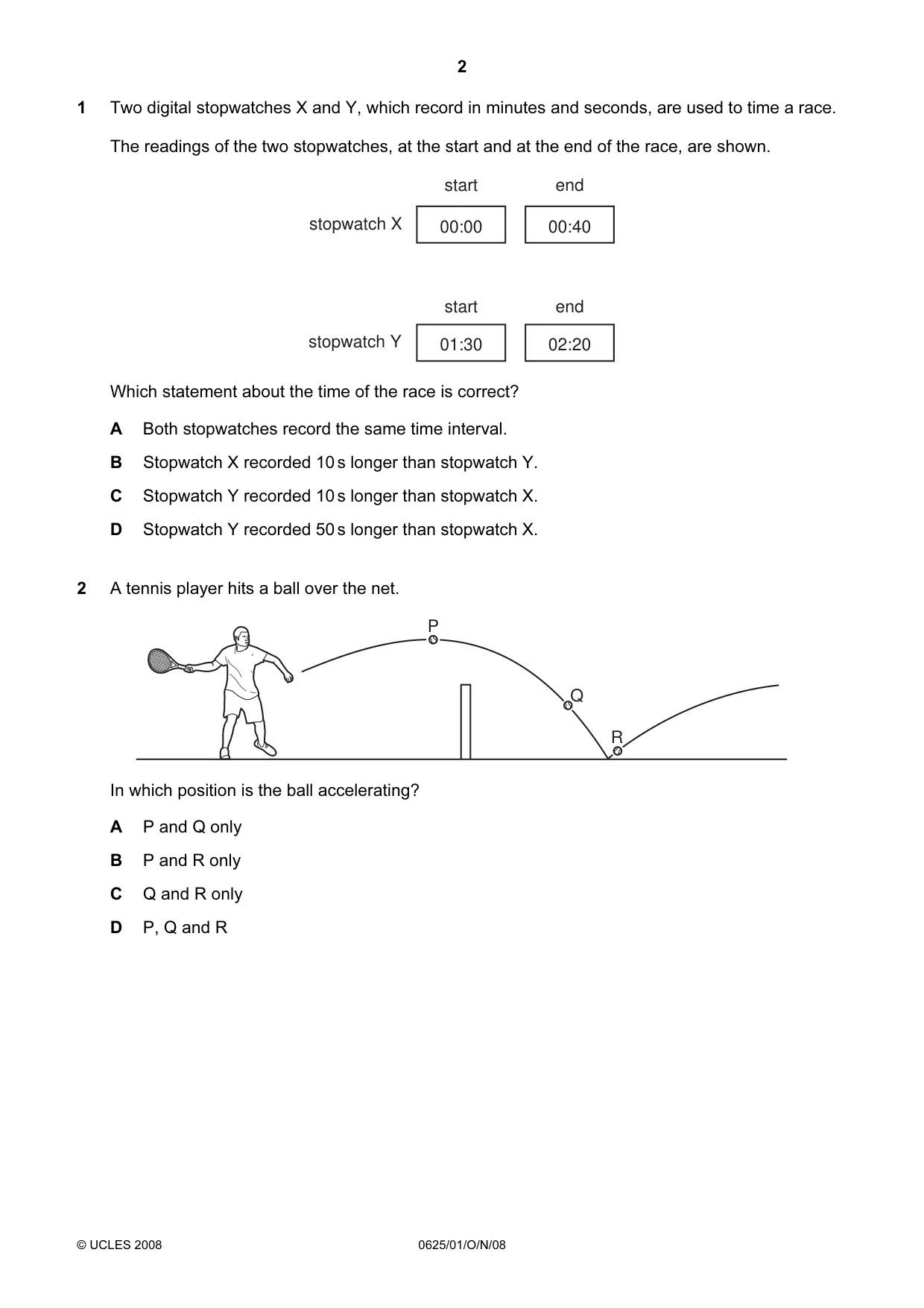
1 Two digital stopwatches X and Y, which record in minutes and seconds, are used to time a race. The readings of the two stopwatches, at the start and at the end of the race, are shown. start end stopwatch X 00:00 00:40 start end stopwatch Y 01:30 02:20 Which statement about the time of the race is correct? A Both stopwatches record the same time interval. B Stopwatch X recorded 10 s longer than stopwatch Y. C Stopwatch Y recorded 10 s longer than stopwatch X. D Stopwatch Y recorded 50 s longer than stopwatch X.
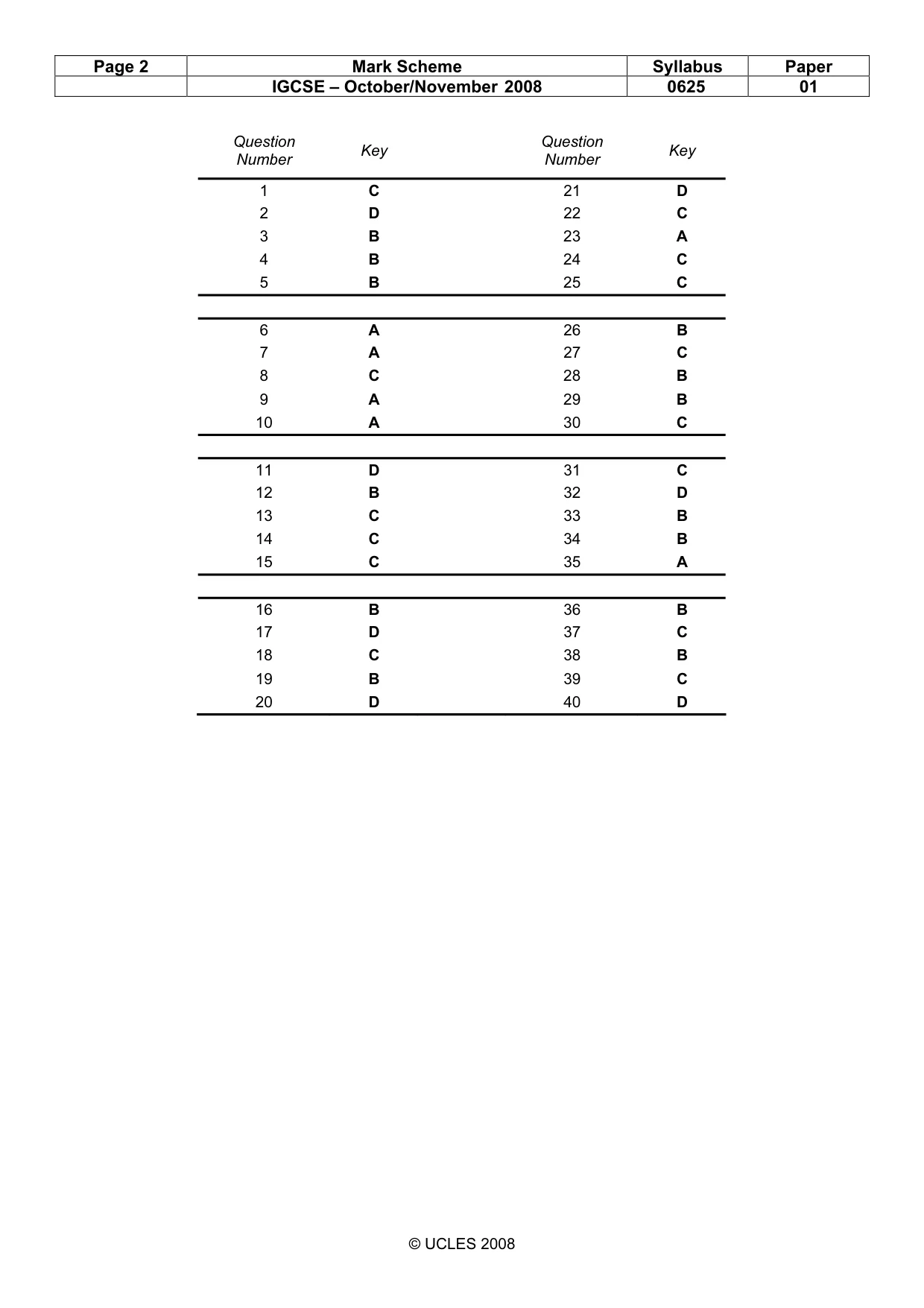
Mark scheme: C
More questions on Physical quantities and measurement techniques
Q2 · A tennis player hits a ball over the net
2 A tennis player hits a ball over the net. P Q R In which position is the ball accelerating? A P and Q only B P and R only C Q and R only D P, Q and R
Mark scheme: D
Q3 · A car travels at various speeds during a short journey
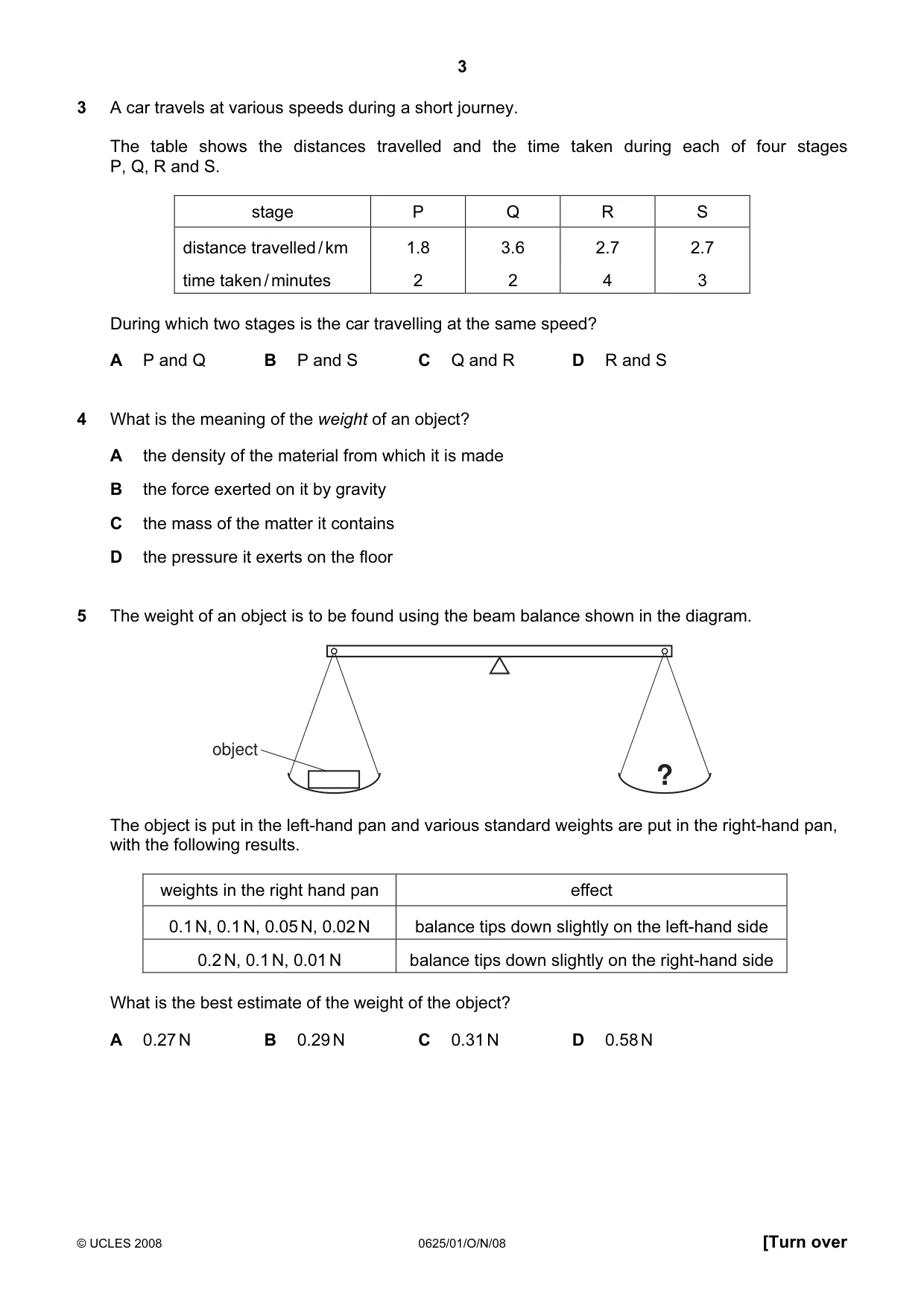
3 A car travels at various speeds during a short journey. The table shows the distances travelled and the time taken during each of four stages P, Q, R and S. stage P Q R S distance travelled / km 1.8 3.6 2.7 2.7 time taken / minutes 2 2 4 3 During which two stages is the car travelling at the same speed? A P and Q B P and S C Q and R D R and S
Mark scheme: B
Q4 · What is the meaning of the weight of an object?
4 What is the meaning of the weight of an object? A the density of the material from which it is made B the force exerted on it by gravity C the mass of the matter it contains D the pressure it exerts on the floor
Mark scheme: B
Q5 · The weight of an object is to be found using the beam balance shown in the diagram
5 The weight of an object is to be found using the beam balance shown in the diagram. object ? The object is put in the left-hand pan and various standard weights are put in the right-hand pan, with the following results. weights in the right hand pan effect 0.1 N, 0.1 N, 0.05 N, 0.02 N balance tips down slightly on the left-hand side 0.2 N, 0.1 N, 0.01 N balance tips down slightly on the right-hand side What is the best estimate of the weight of the object? A 0.27 N B 0.29 N C 0.31 N D 0.58 N
Mark scheme: B
More questions on Physical quantities and measurement techniques
Q6 · A student needs to find the density of a cubic block of wood
6 A student needs to find the density of a cubic block of wood. Which two pieces of apparatus should she use? A balance and metre rule B balance and thermometer C measuring cylinder and metre rule D measuring cylinder and thermometer
Mark scheme: A
Q7 · Two identical measuring cylinders containing different liquids are placed on a simple…
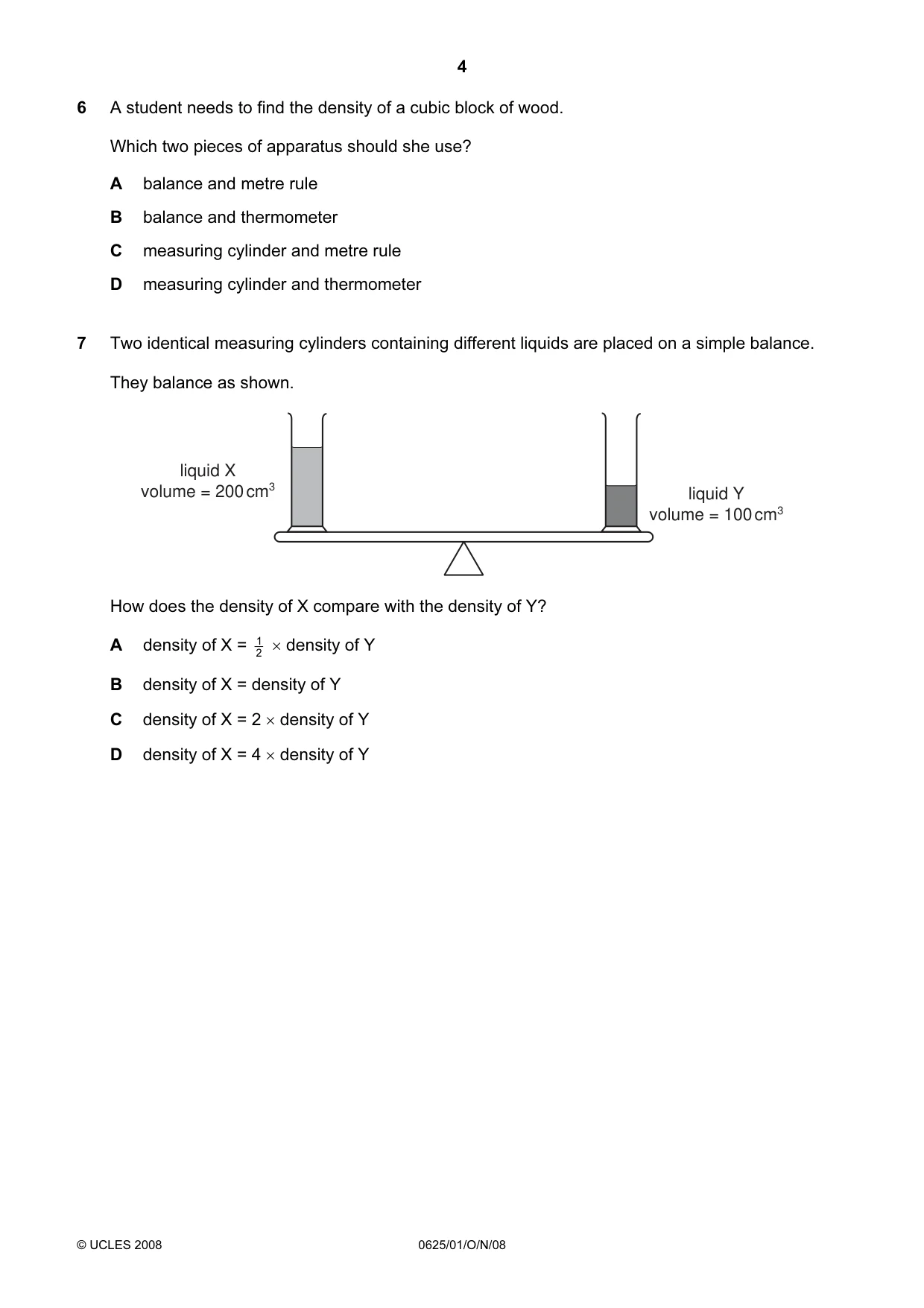
7 Two identical measuring cylinders containing different liquids are placed on a simple balance. They balance as shown. liquid X volume = 200 cm3 liquid Y volume = 100 cm3 How does the density of X compare with the density of Y? A density of X = 2 1 × density of Y B density of X = density of Y C density of X = 2 × density of Y D density of X = 4 × density of Y
Mark scheme: A
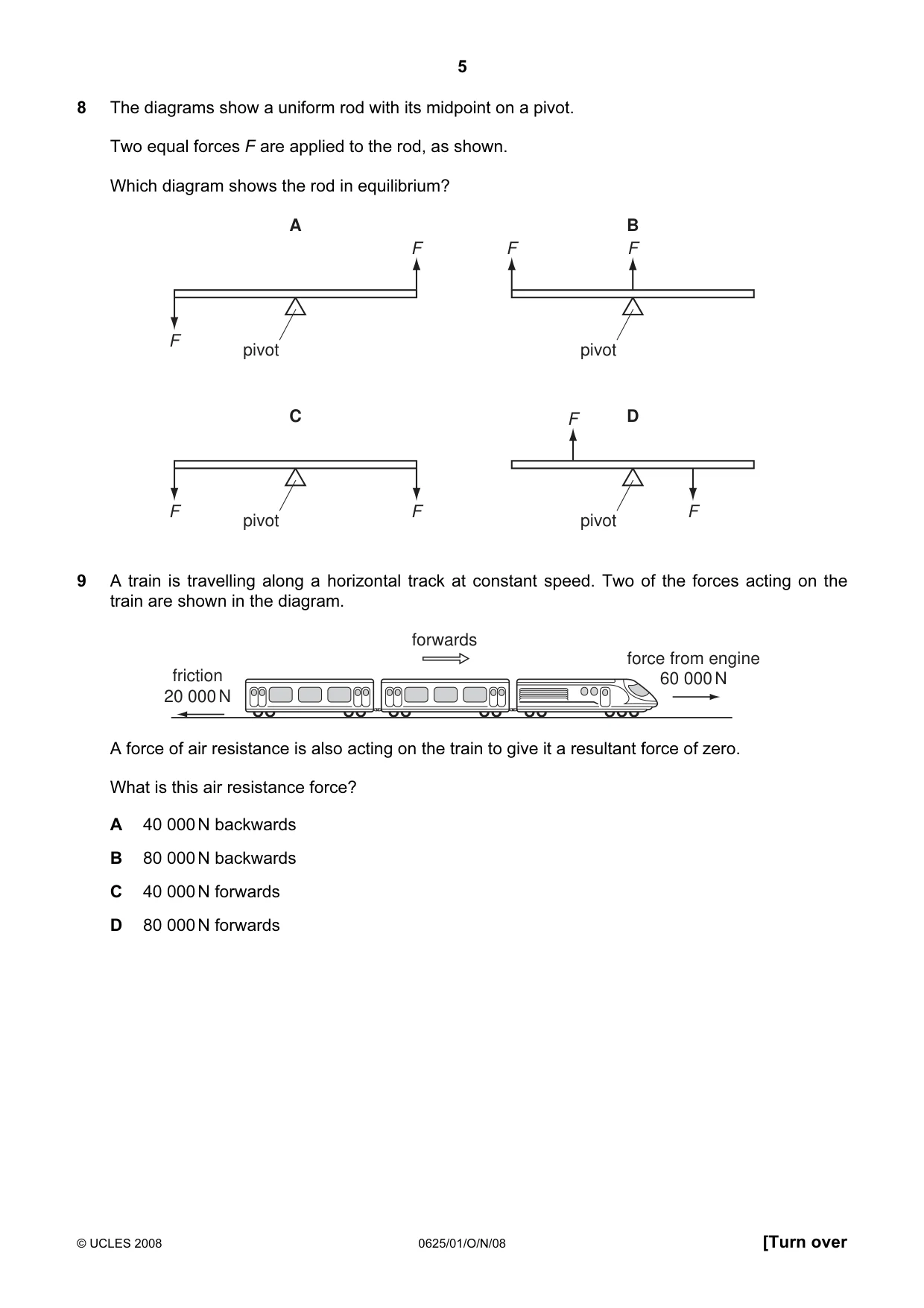
Q8 · The diagrams show a uniform rod with its midpoint on a pivot
8 The diagrams show a uniform rod with its midpoint on a pivot. Two equal forces F are applied to the rod, as shown. Which diagram shows the rod in equilibrium? A B F F F F pivot pivot C F D F F F pivot pivot
Mark scheme: C
Q9 · A train is travelling along a horizontal track at constant speed
9 A train is travelling along a horizontal track at constant speed. Two of the forces acting on the train are shown in the diagram. forwards force from engine friction 60 000 N 20 000 N A force of air resistance is also acting on the train to give it a resultant force of zero. What is this air resistance force? A 40 000 N backwards B 80 000 N backwards C 40 000 N forwards D 80 000 N forwards
Mark scheme: A
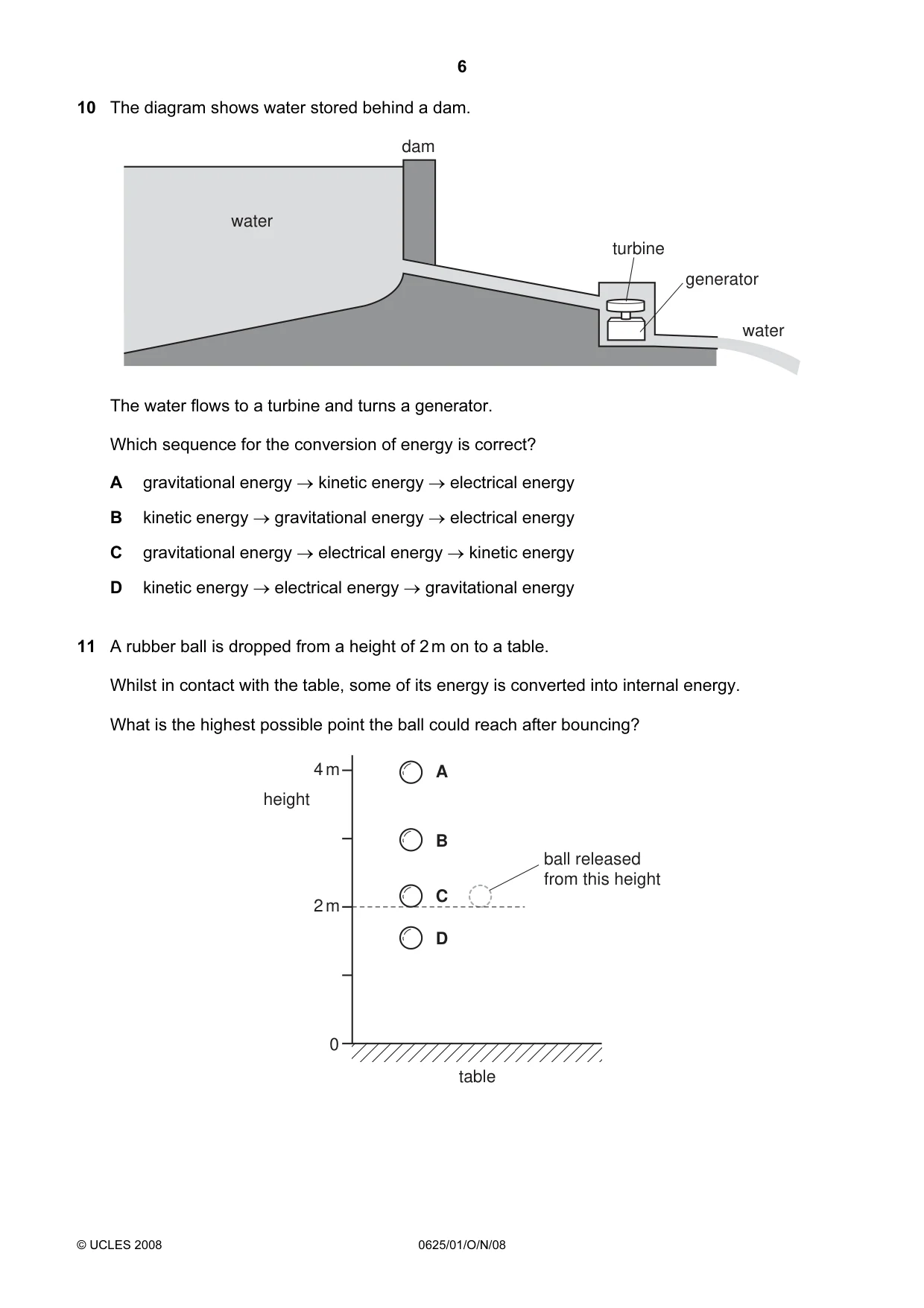
Q10 · The diagram shows water stored behind a dam
10 The diagram shows water stored behind a dam. dam water turbine generator water The water flows to a turbine and turns a generator. Which sequence for the conversion of energy is correct? A gravitational energy → kinetic energy → electrical energy B kinetic energy → gravitational energy → electrical energy C gravitational energy → electrical energy → kinetic energy D kinetic energy → electrical energy → gravitational energy
Mark scheme: A
Q11 · A rubber ball is dropped from a height of 2 m on to a table
11 A rubber ball is dropped from a height of 2 m on to a table. Whilst in contact with the table, some of its energy is converted into internal energy. What is the highest possible point the ball could reach after bouncing? 4 m A height B ball released from this height C 2 m D 0 table
Mark scheme: D
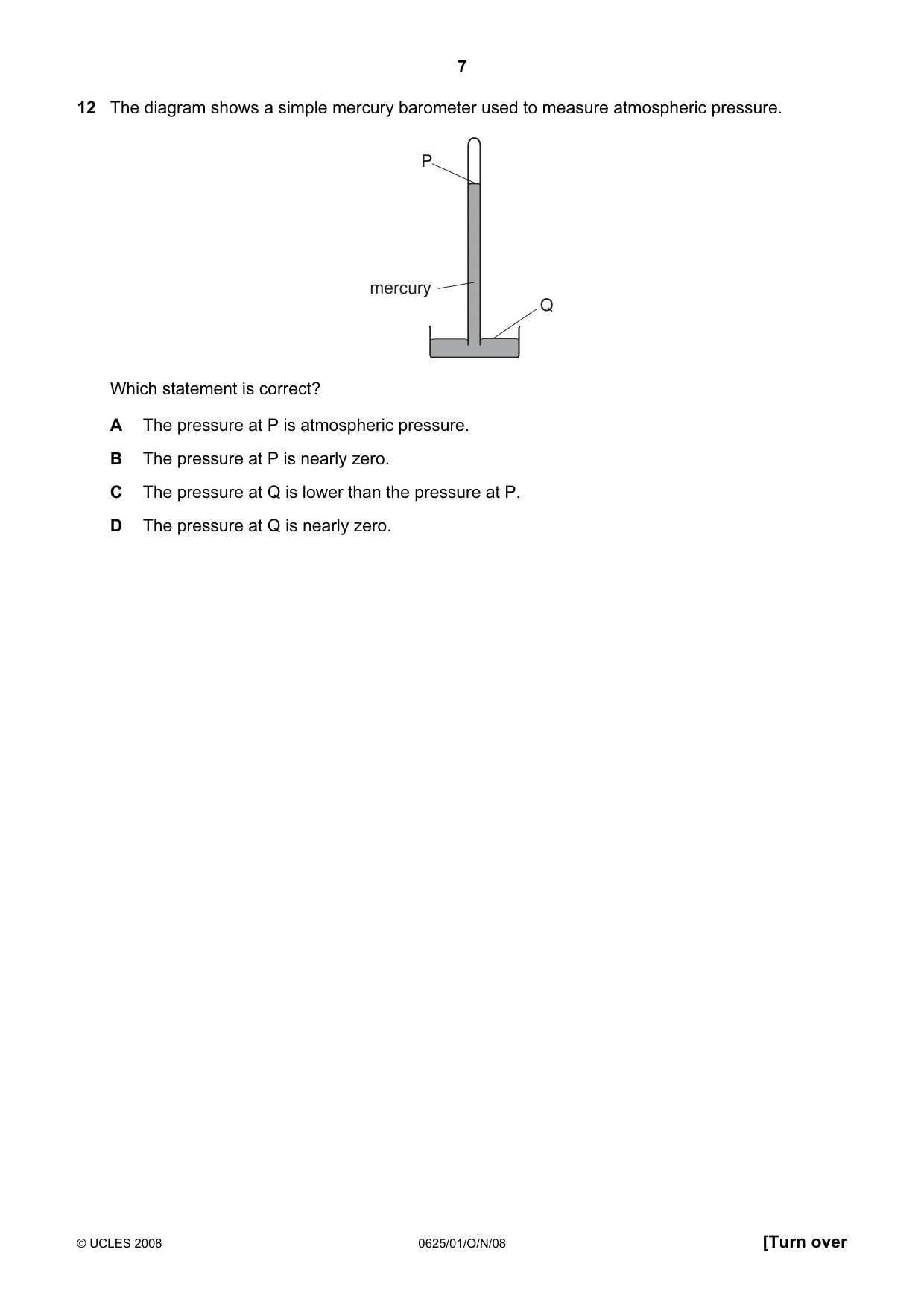
Q12 · The diagram shows a simple mercury barometer used to measure atmospheric pressure
12 The diagram shows a simple mercury barometer used to measure atmospheric pressure. P mercury Q Which statement is correct? A The pressure at P is atmospheric pressure. B The pressure at P is nearly zero. C The pressure at Q is lower than the pressure at P. D The pressure at Q is nearly zero.
Mark scheme: B
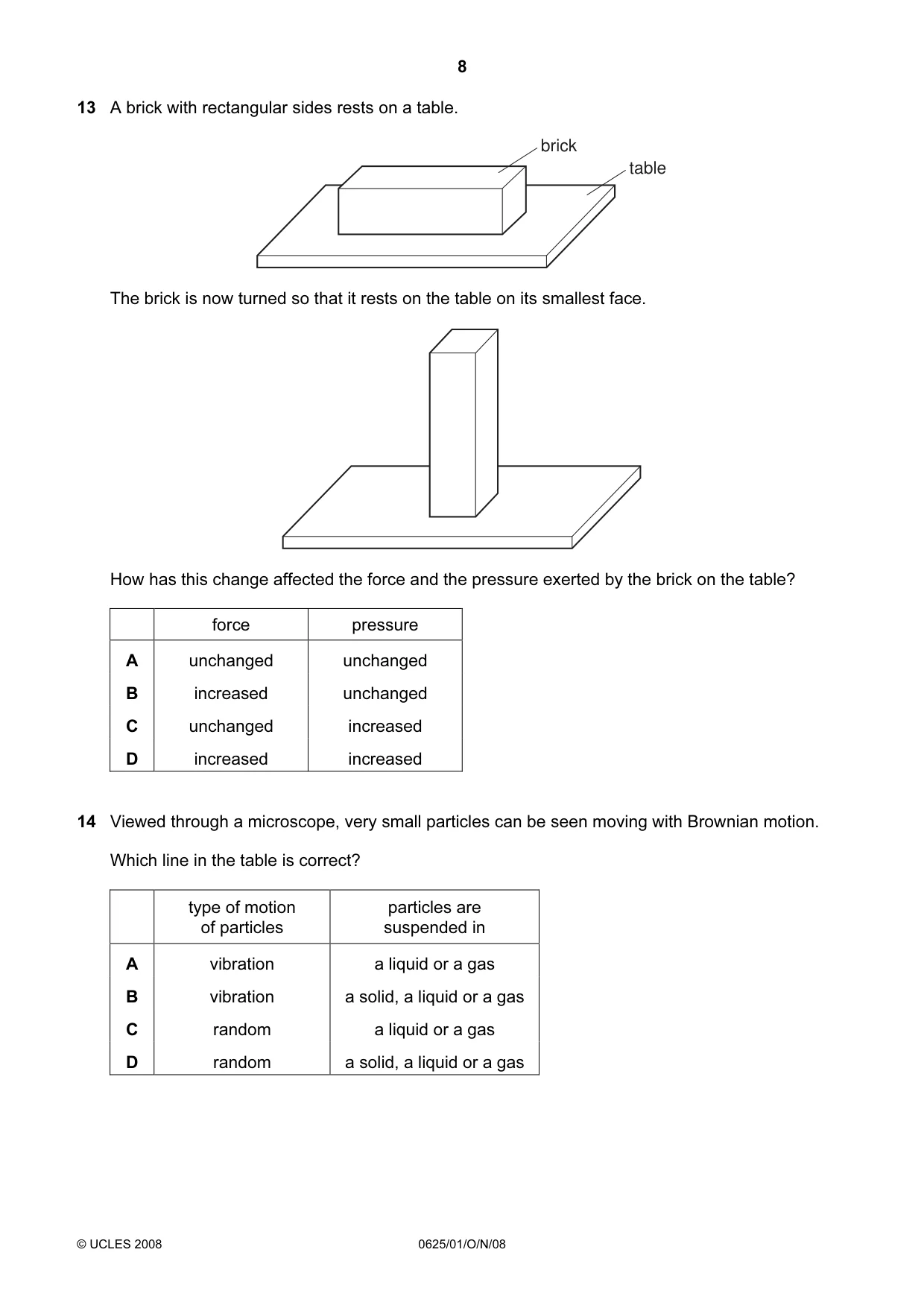
Q13 · A brick with rectangular sides rests on a table
13 A brick with rectangular sides rests on a table. brick table The brick is now turned so that it rests on the table on its smallest face. How has this change affected the force and the pressure exerted by the brick on the table? force pressure A unchanged unchanged B increased unchanged C unchanged increased D increased increased
Mark scheme: C
Q14 · Viewed through a microscope, very small particles can be seen moving with Brownian motion
14 Viewed through a microscope, very small particles can be seen moving with Brownian motion. Which line in the table is correct? type of motion particles are of particles suspended in A vibration a liquid or a gas B vibration a solid, a liquid or a gas C random a liquid or a gas D random a solid, a liquid or a gas
Mark scheme: C
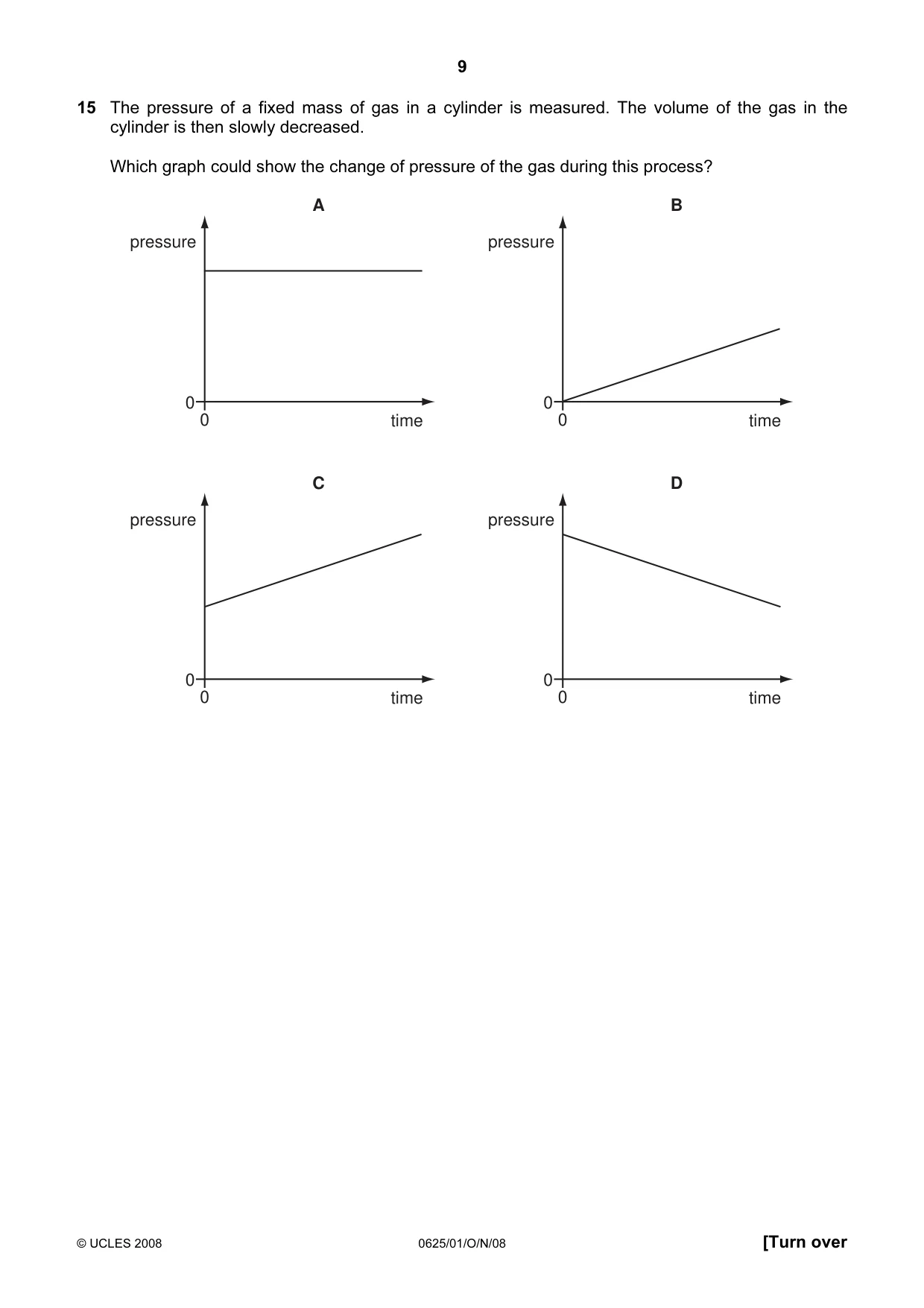
Q15 · The pressure of a fixed mass of gas in a cylinder is measured
15 The pressure of a fixed mass of gas in a cylinder is measured. The volume of the gas in the cylinder is then slowly decreased. Which graph could show the change of pressure of the gas during this process? A B pressure pressure 0 0 0 time 0 time C D pressure pressure 0 0 0 time 0 time
Mark scheme: C
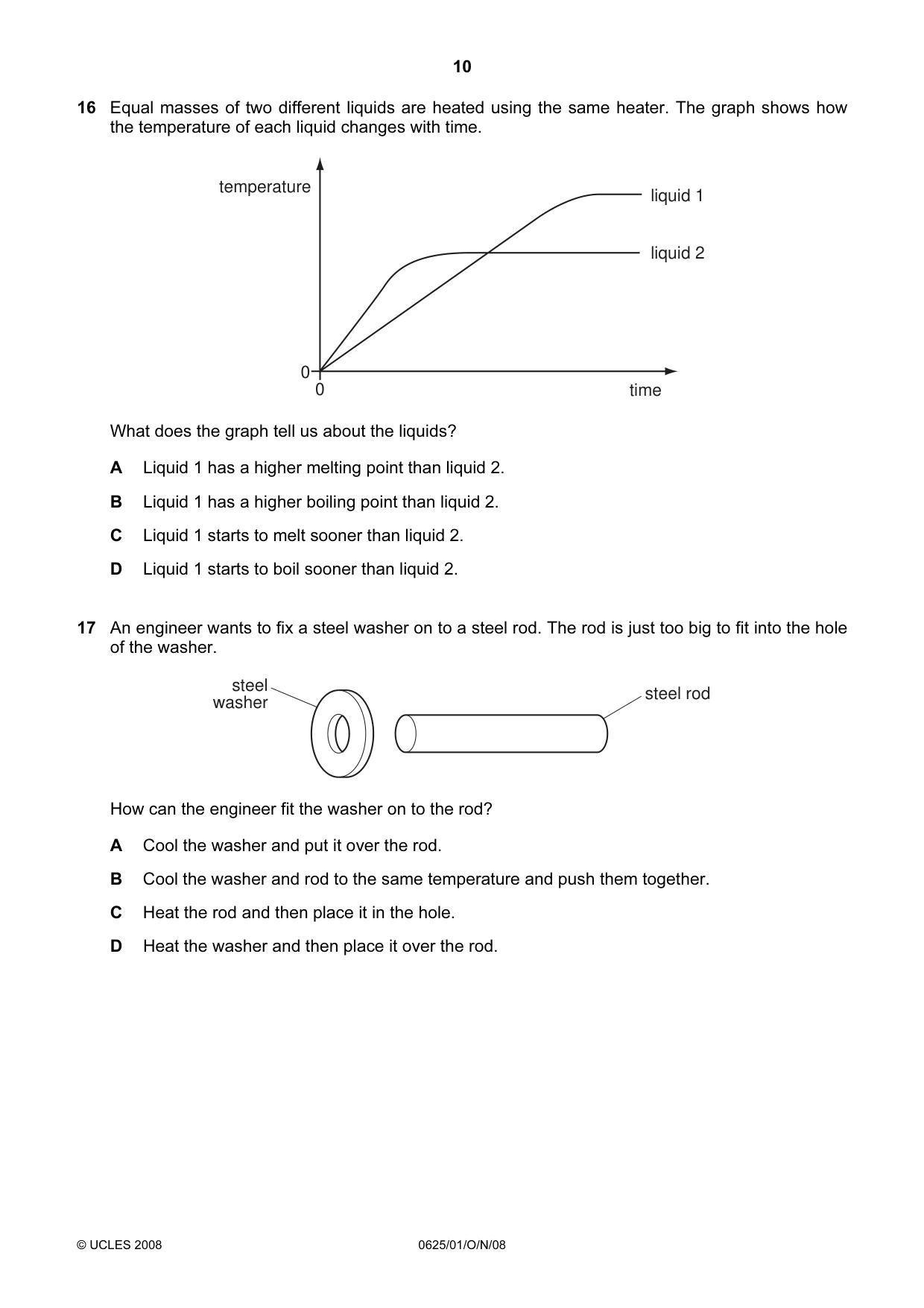
Q16 · Equal masses of two different liquids are heated using the same heater
16 Equal masses of two different liquids are heated using the same heater. The graph shows how the temperature of each liquid changes with time. temperature liquid 1 liquid 2 0 0 time What does the graph tell us about the liquids? A Liquid 1 has a higher melting point than liquid 2. B Liquid 1 has a higher boiling point than liquid 2. C Liquid 1 starts to melt sooner than liquid 2. D Liquid 1 starts to boil sooner than liquid 2.
Mark scheme: B
Q17 · An engineer wants to fix a steel washer on to a steel rod
17 An engineer wants to fix a steel washer on to a steel rod. The rod is just too big to fit into the hole of the washer. steel steel rod washer How can the engineer fit the washer on to the rod? A Cool the washer and put it over the rod. B Cool the washer and rod to the same temperature and push them together. C Heat the rod and then place it in the hole. D Heat the washer and then place it over the rod.
Mark scheme: D
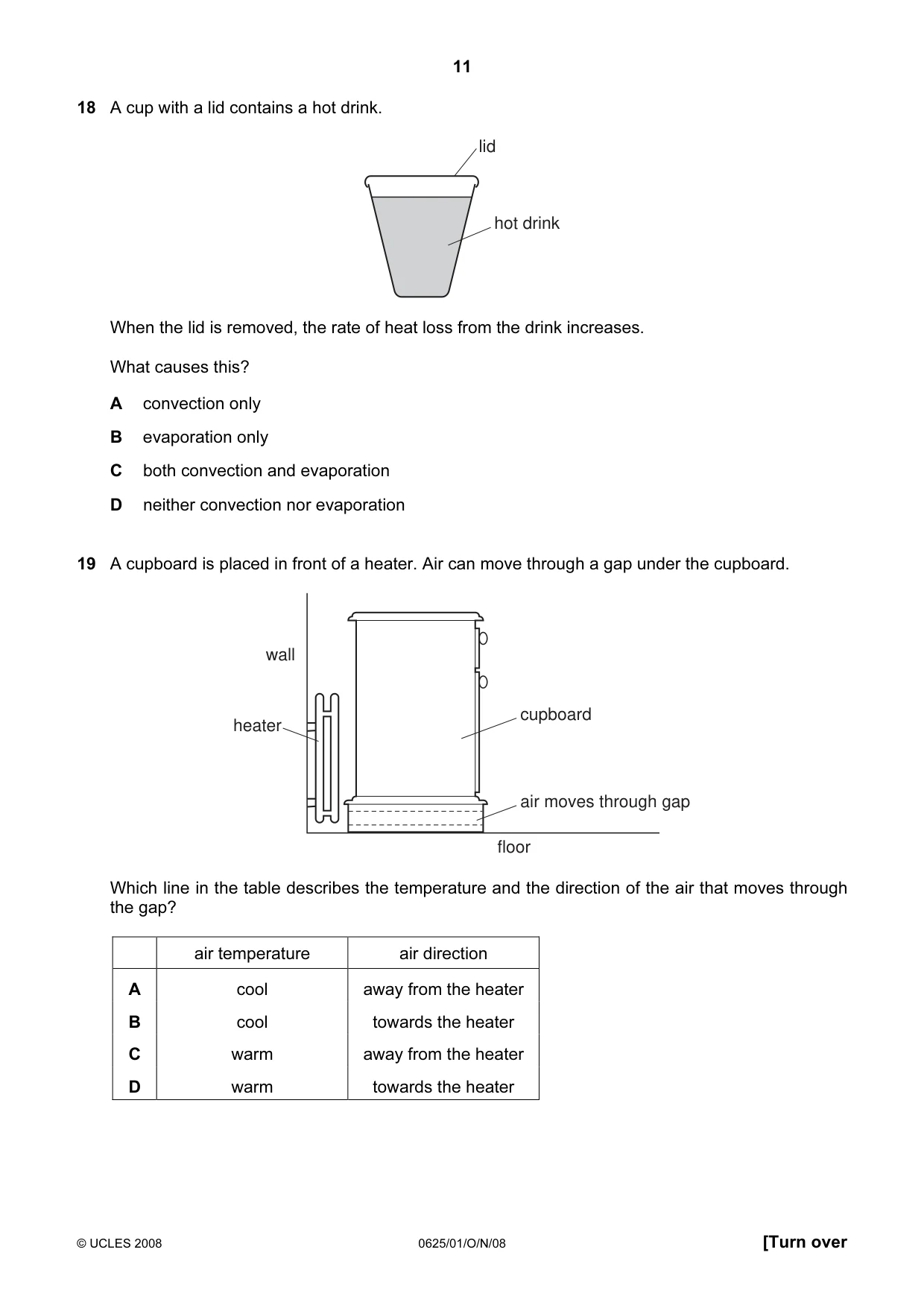
Q18 · A cup with a lid contains a hot drink
18 A cup with a lid contains a hot drink. lid hot drink When the lid is removed, the rate of heat loss from the drink increases. What causes this? A convection only B evaporation only C both convection and evaporation D neither convection nor evaporation
Mark scheme: C
Q19 · A cupboard is placed in front of a heater
19 A cupboard is placed in front of a heater. Air can move through a gap under the cupboard. wall cupboard heater air moves through gap floor Which line in the table describes the temperature and the direction of the air that moves through the gap? air temperature air direction A cool away from the heater B cool towards the heater C warm away from the heater D warm towards the heater
Mark scheme: B
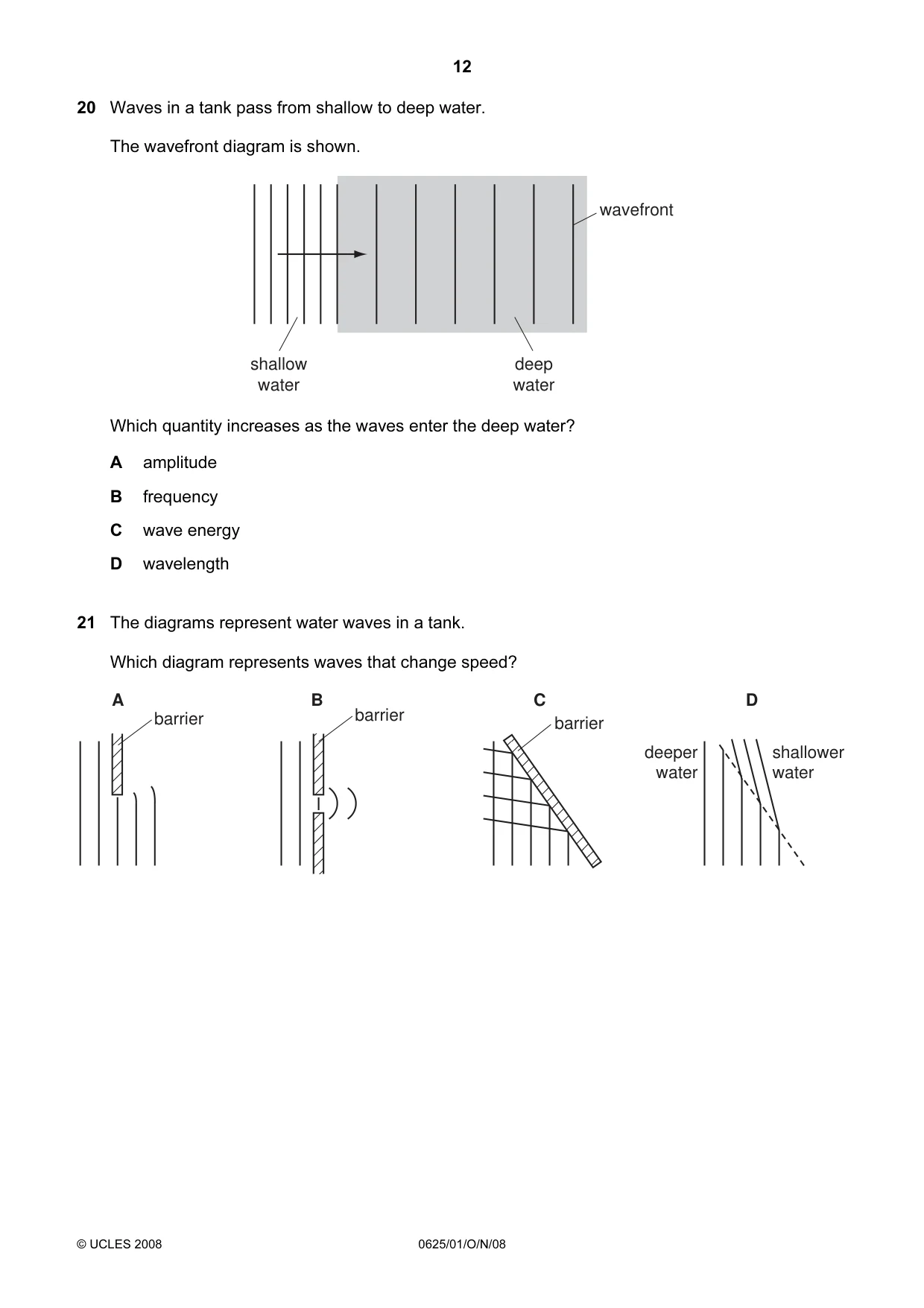
Q20 · Waves in a tank pass from shallow to deep water
20 Waves in a tank pass from shallow to deep water. The wavefront diagram is shown. wavefront shallow deep water water Which quantity increases as the waves enter the deep water? A amplitude B frequency C wave energy D wavelength
Mark scheme: D
Q21 · The diagrams represent water waves in a tank
21 The diagrams represent water waves in a tank. Which diagram represents waves that change speed? A B C D barrier barrier barrier deeper shallower water water
Mark scheme: D
Q22 · Which diagram shows the dispersion of white light?
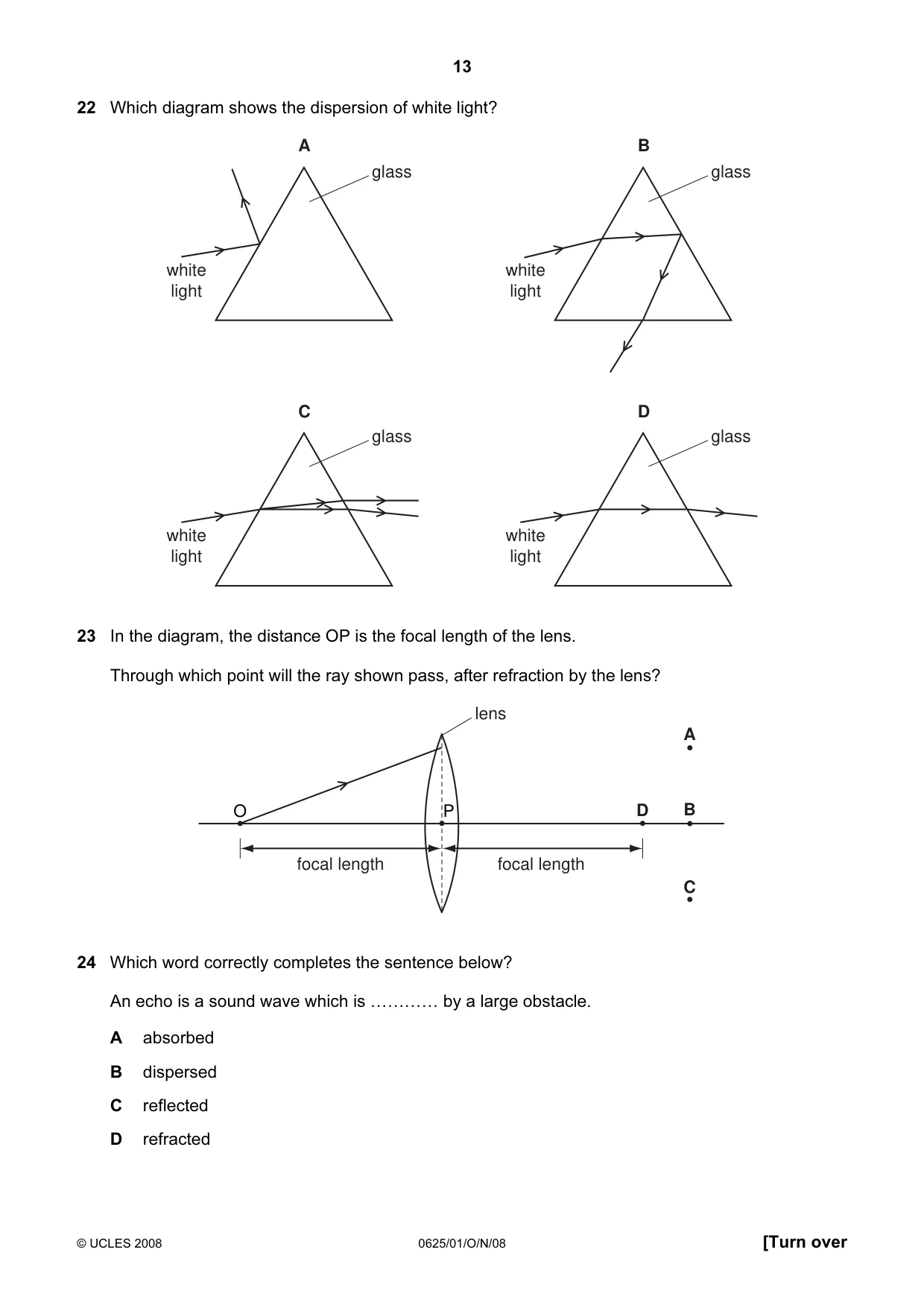
22 Which diagram shows the dispersion of white light? A B glass glass white white light light C D glass glass white white light light
Mark scheme: C
Q23 · In the diagram, the distance OP is the focal length of the lens
23 In the diagram, the distance OP is the focal length of the lens. Through which point will the ray shown pass, after refraction by the lens? lens A O P D B focal length focal length C
Mark scheme: A
Q24 · Which word correctly completes the sentence below?
24 Which word correctly completes the sentence below? An echo is a sound wave which is ………… by a large obstacle. A absorbed B dispersed C reflected D refracted
Mark scheme: C
Q25 · In an experiment to measure the speed of sound, a student uses a stopwatch to find how…
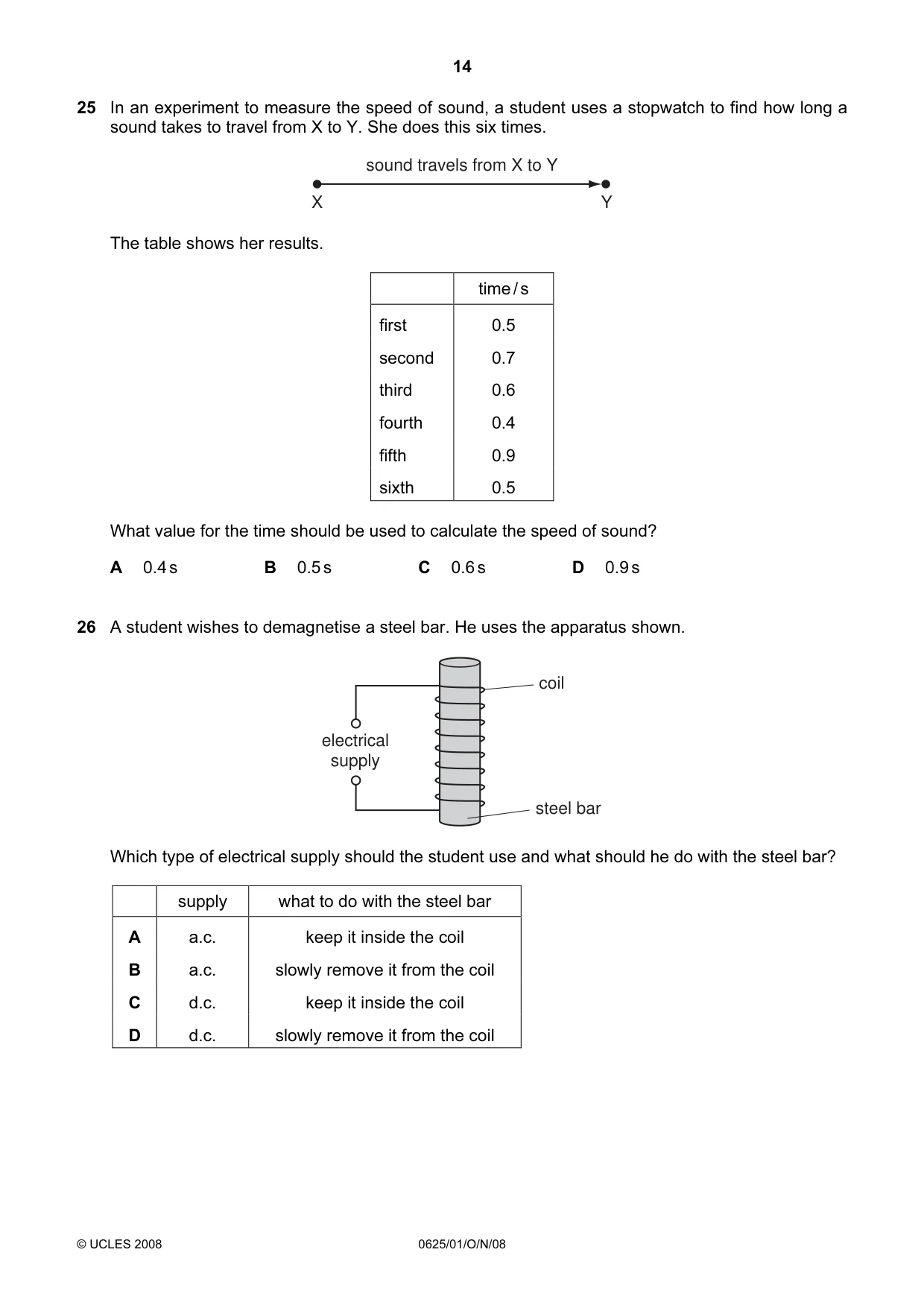
25 In an experiment to measure the speed of sound, a student uses a stopwatch to find how long a sound takes to travel from X to Y. She does this six times. sound travels from X to Y X Y The table shows her results. time / s first 0.5 second 0.7 third 0.6 fourth 0.4 fifth 0.9 sixth 0.5 What value for the time should be used to calculate the speed of sound? A 0.4 s B 0.5 s C 0.6 s D 0.9 s
Mark scheme: C
Q26 · A student wishes to demagnetise a steel bar
26 A student wishes to demagnetise a steel bar. He uses the apparatus shown. coil electrical supply steel bar Which type of electrical supply should the student use and what should he do with the steel bar? supply what to do with the steel bar A a.c. keep it inside the coil B a.c. slowly remove it from the coil C d.c. keep it inside the coil D d.c. slowly remove it from the coil
Mark scheme: B
Q27 · Two metal bars are held together
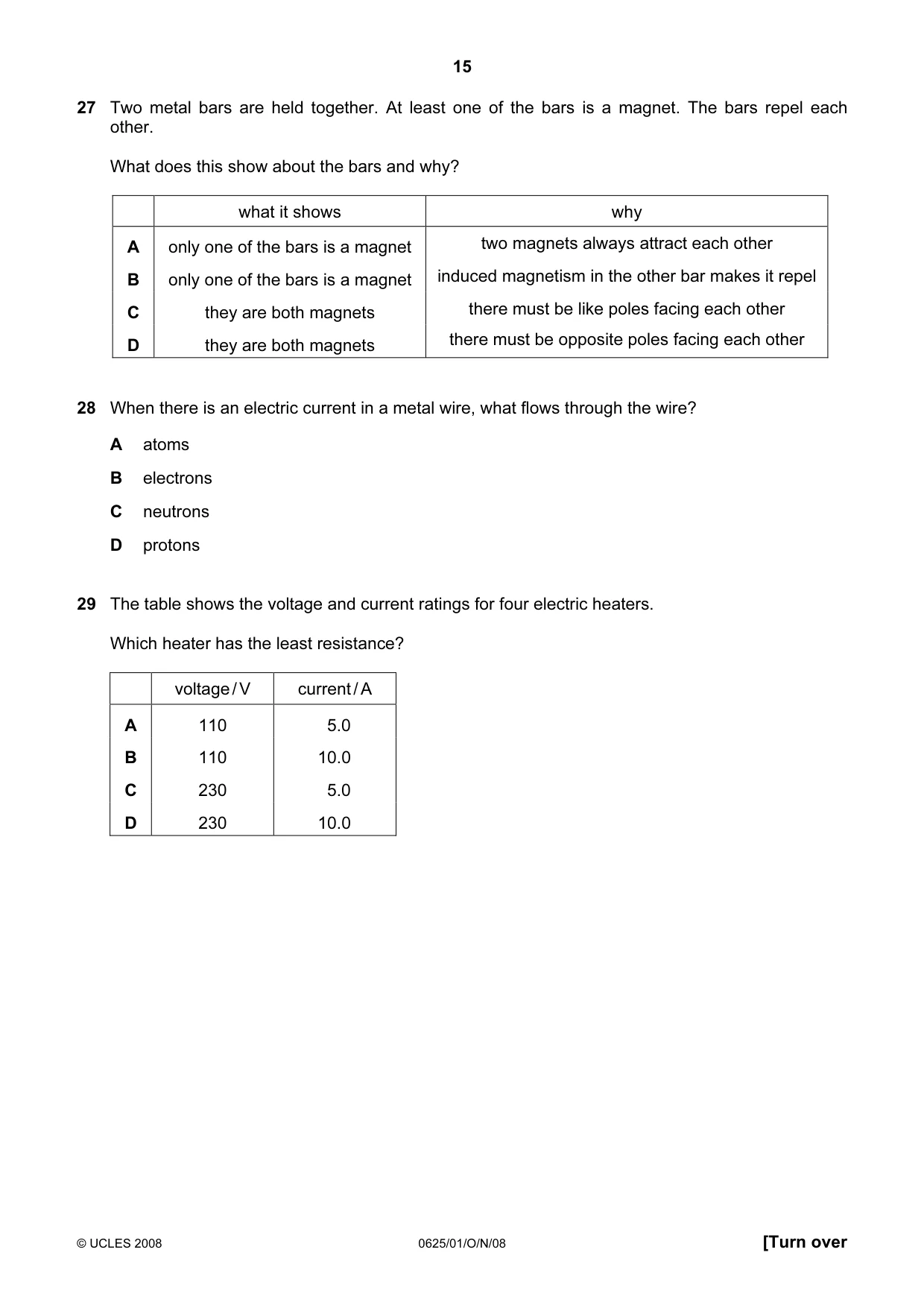
27 Two metal bars are held together. At least one of the bars is a magnet. The bars repel each other. What does this show about the bars and why? what it shows why A only one of the bars is a magnet two magnets always attract each other B only one of the bars is a magnet induced magnetism in the other bar makes it repel C they are both magnets there must be like poles facing each other D they are both magnets there must be opposite poles facing each other
Mark scheme: C
Q28 · When there is an electric current in a metal wire, what flows through the wire?
28 When there is an electric current in a metal wire, what flows through the wire? A atoms B electrons C neutrons D protons
Mark scheme: B
Q29 · The table shows the voltage and current ratings for four electric heaters
29 The table shows the voltage and current ratings for four electric heaters. Which heater has the least resistance? voltage / V current / A A 110 5.0 B 110 10.0 C 230 5.0 D 230 10.0
Mark scheme: B
Q30 · In the circuit below, X and Y are identical 6 V lamps
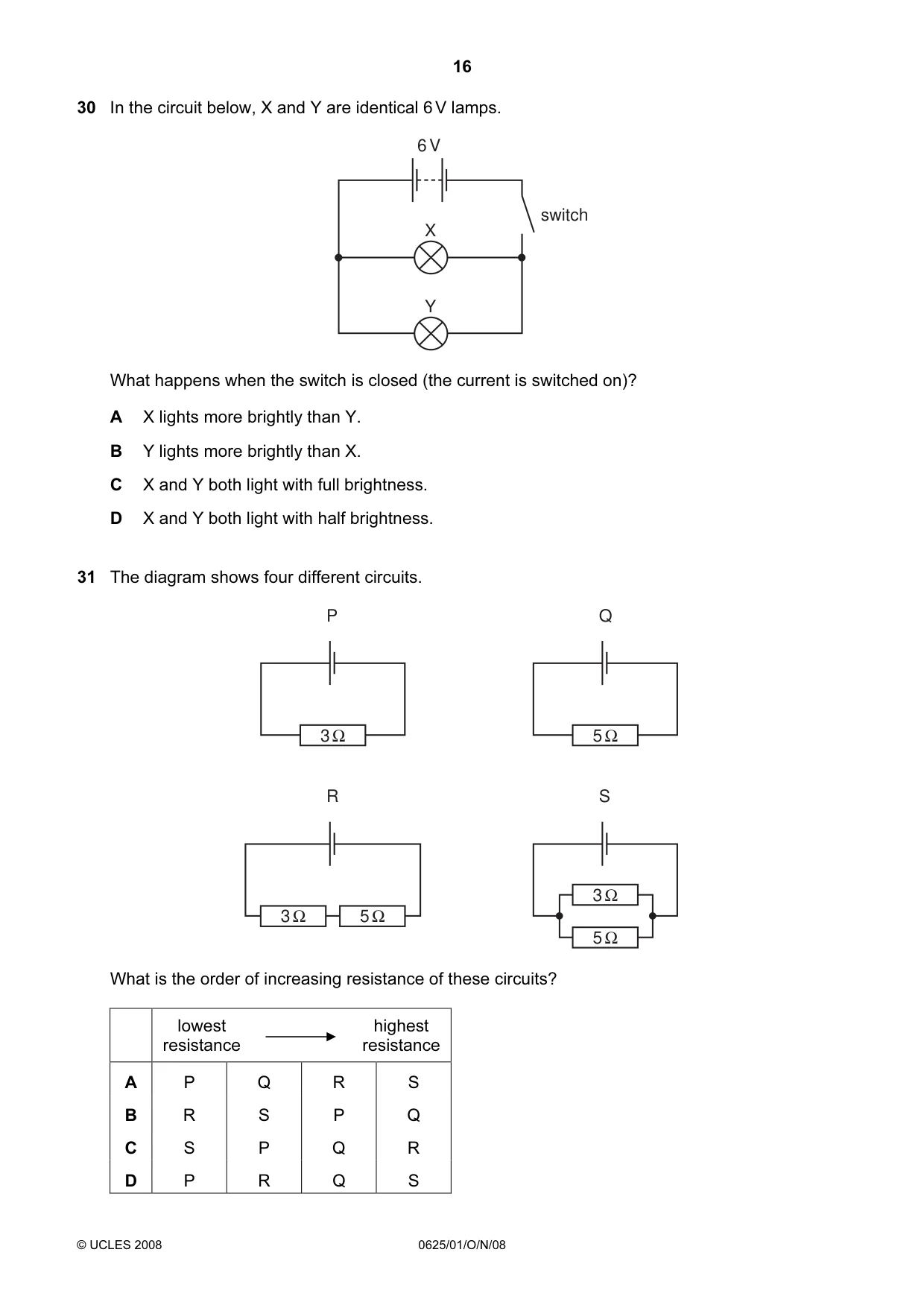
30 In the circuit below, X and Y are identical 6 V lamps. 6 V switch X Y What happens when the switch is closed (the current is switched on)? A X lights more brightly than Y. B Y lights more brightly than X. C X and Y both light with full brightness. D X and Y both light with half brightness.
Mark scheme: C
Q31 · The diagram shows four different circuits
31 The diagram shows four different circuits. P Q 3 Ω 5 Ω R S 3 Ω 3 Ω 5 Ω 5 Ω What is the order of increasing resistance of these circuits? lowest highest resistance resistance A P Q R S B R S P Q C S P Q R D P R Q S
Mark scheme: C
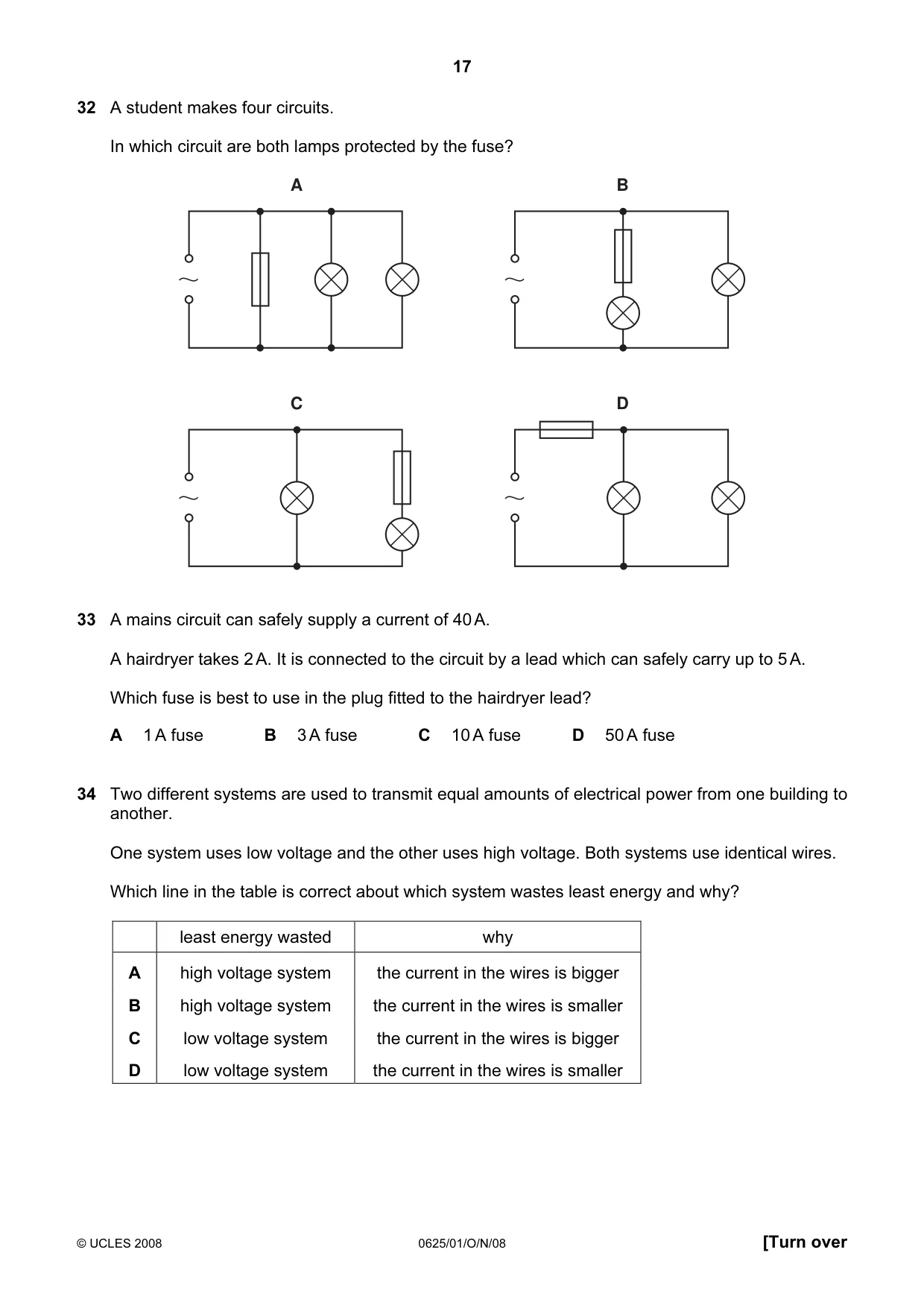
Q32 · A student makes four circuits
32 A student makes four circuits. In which circuit are both lamps protected by the fuse? A B C D
Mark scheme: D
Q33 · A mains circuit can safely supply a current of 40 A
33 A mains circuit can safely supply a current of 40 A. A hairdryer takes 2 A. It is connected to the circuit by a lead which can safely carry up to 5 A. Which fuse is best to use in the plug fitted to the hairdryer lead? A 1 A fuse B 3 A fuse C 10 A fuse D 50 A fuse
Mark scheme: B
Q34 · Two different systems are used to transmit equal amounts of electrical power from one…
34 Two different systems are used to transmit equal amounts of electrical power from one building to another. One system uses low voltage and the other uses high voltage. Both systems use identical wires. Which line in the table is correct about which system wastes least energy and why? least energy wasted why A high voltage system the current in the wires is bigger B high voltage system the current in the wires is smaller C low voltage system the current in the wires is bigger D low voltage system the current in the wires is smaller
Mark scheme: B
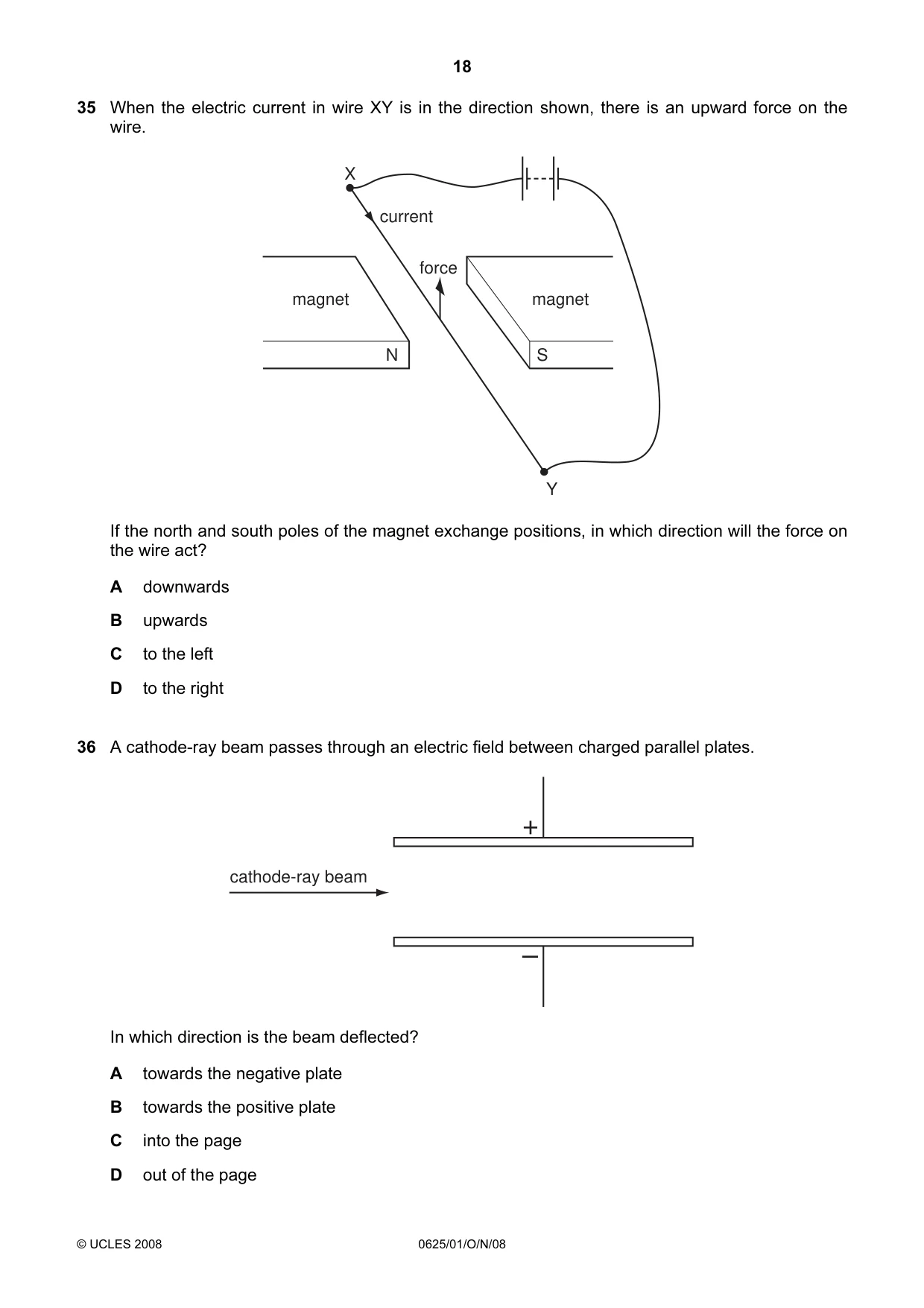
Q35 · When the electric current in wire XY is in the direction shown, there is an upward force…
35 When the electric current in wire XY is in the direction shown, there is an upward force on the wire. X current force magnet magnet N S Y If the north and south poles of the magnet exchange positions, in which direction will the force on the wire act? A downwards B upwards C to the left D to the right
Mark scheme: A
Q36 · A cathode-ray beam passes through an electric field between charged parallel plates
36 A cathode-ray beam passes through an electric field between charged parallel plates. + cathode-ray beam – In which direction is the beam deflected? A towards the negative plate B towards the positive plate C into the page D out of the page
Mark scheme: B
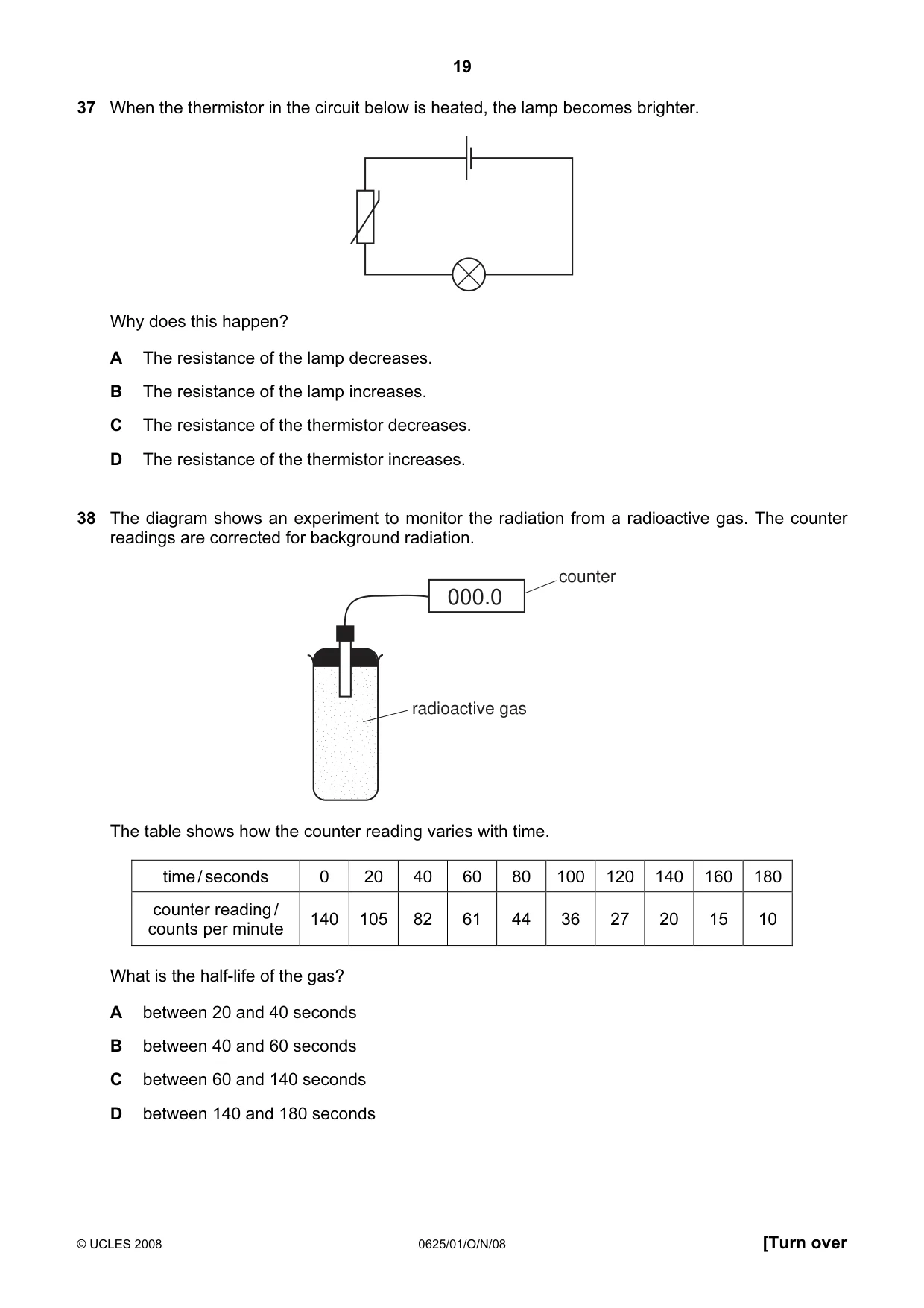
Q37 · When the thermistor in the circuit below is heated, the lamp becomes brighter
37 When the thermistor in the circuit below is heated, the lamp becomes brighter. Why does this happen? A The resistance of the lamp decreases. B The resistance of the lamp increases. C The resistance of the thermistor decreases. D The resistance of the thermistor increases.
Mark scheme: C
Q38 · The diagram shows an experiment to monitor the radiation from a radioactive gas
38 The diagram shows an experiment to monitor the radiation from a radioactive gas. The counter readings are corrected for background radiation. counter 000.0 radioactive gas The table shows how the counter reading varies with time. time / seconds 0 20 40 60 80 100 120 140 160 180 counter reading / 140 105 82 61 44 36 27 20 15 10 counts per minute What is the half-life of the gas? A between 20 and 40 seconds B between 40 and 60 seconds C between 60 and 140 seconds D between 140 and 180 seconds
Mark scheme: B
Q39 · Which material is commonly used as a lining for a box for storing radioactive samples?
39 Which material is commonly used as a lining for a box for storing radioactive samples? A aluminium B copper C lead D uranium
Mark scheme: C
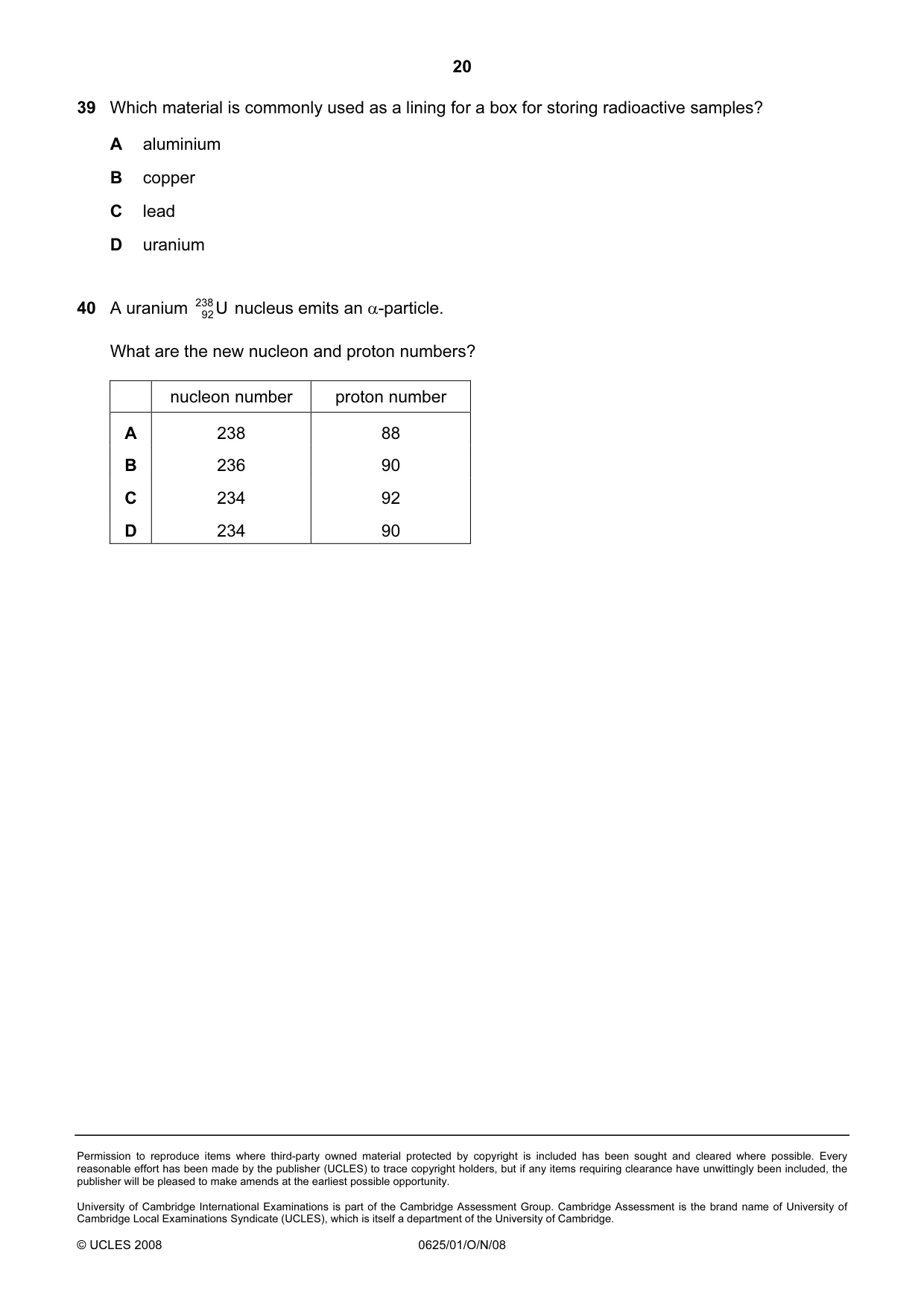
Q40 · A uranium 238 U nucleus emits an α-particle
40 A uranium 238 U nucleus emits an α-particle. 92 What are the new nucleon and proton numbers? nucleon number proton number A 238 88 B 236 90 C 234 92 D 234 90
Mark scheme: D
What was in this paper
The subtopics covered by these 40 questions, and how many questions each got. Open one in a new tab to see every Cambridge question on it.
3Electrical quantities3Radioactivity3Density2Electrical safety2Electromagnetic effects2Energy, work and power2Forces2General properties of waves2Kinetic particle model of matter2Light2Motion2Physical quantities and measurement techniques2Pressure2Simple phenomena of magnetism2Sound2Thermal properties and temperature2Transfer of thermal energy2Mass and weight1What you needed in this session
Cambridge’s own grade thresholds for 2008 Oct/Nov, Paper 1 · Variant 1. A higher threshold means an easier paper — the bar moves with how the cohort did.