Cambridge IGCSE Physics 0625 — 2016 May/June Paper 1 · Variant 2
0625/12/M/J/16 · 40 questions · 40 marks · ≈45 min
The question paper and its mark scheme, free to read here and free to download. This is Cambridge’s own paper, exactly as it was sat.
Question paper16 pages
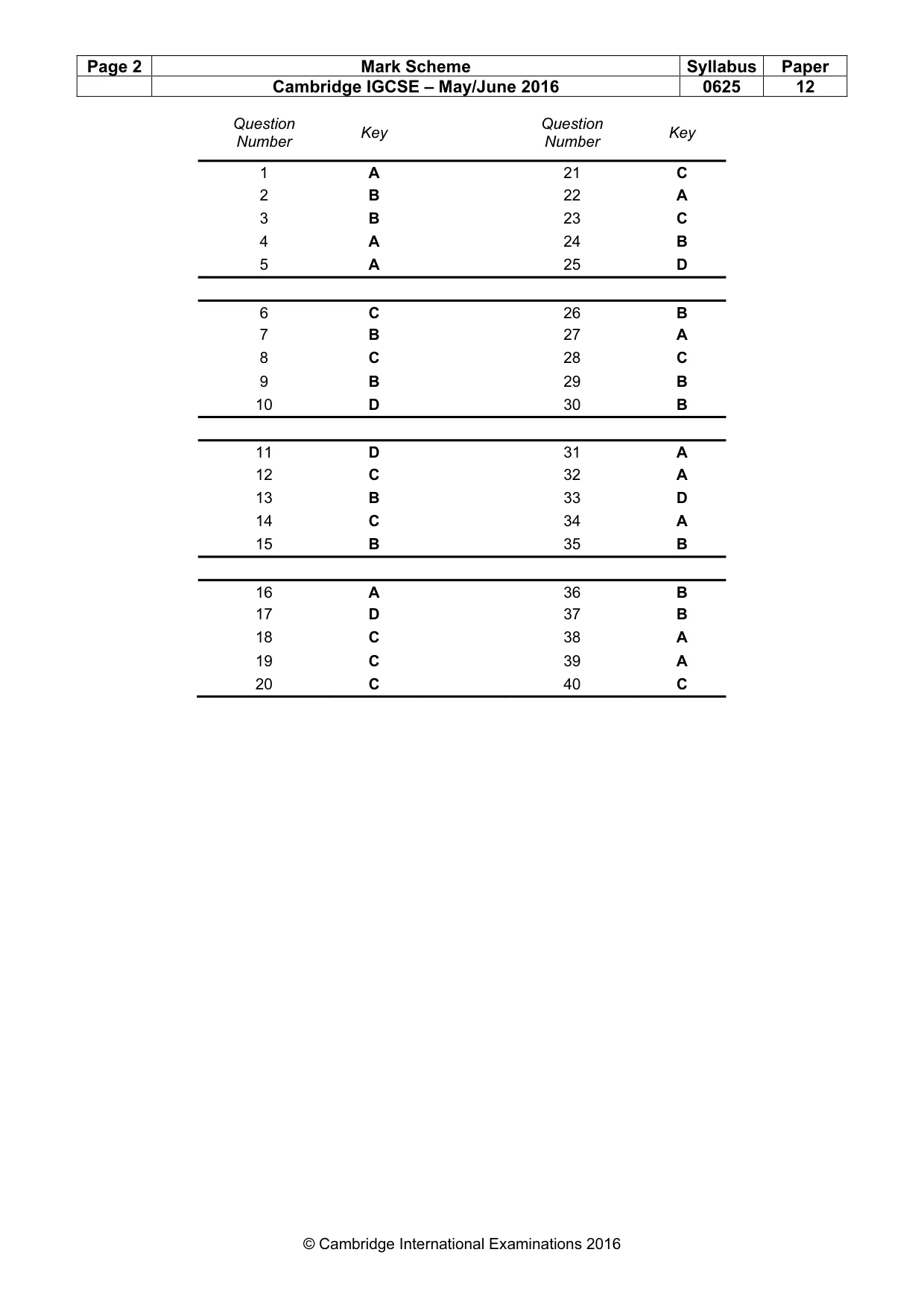
Mark scheme2 pages
Answers below. Sit the paper first if you are practising.
Questions as text
Q1 · The diagram shows an enlarged drawing of the end of a metre rule
1 The diagram shows an enlarged drawing of the end of a metre rule. It is being used to measure the length of a small feather. 1 0 2 0 3 0 mm cm 1 2 3 What is the length of the feather? A 19 mm B 29 mm C 19 cm D 29 cm
Mark scheme: A
More questions on Physical quantities and measurement techniques
Q2 · The graph shows how the speed of a van changes with time for part of its journey
2 The graph shows how the speed of a van changes with time for part of its journey. In which labelled section is the van decelerating? speed 0 0 A B C D time
Mark scheme: B
Q3 · A large stone is dropped from a bridge into a river
3 A large stone is dropped from a bridge into a river. Air resistance can be ignored. Which row describes the acceleration and the speed of the stone as it falls? acceleration speed of of the stone the stone A constant constant B constant increasing C increasing constant D increasing increasing
Mark scheme: B
Q4 · A cup contains hot liquid
4 A cup contains hot liquid. Some of the liquid evaporates. What happens to the mass and what happens to the weight of the liquid in the cup? mass weight A decreases decreases B decreases stays the same C stays the same decreases D stays the same stays the same
Mark scheme: A
Q5 · A boy throws a stone
5 A boy throws a stone. The stone leaves the boy’s hand and moves vertically upwards. Air resistance can be ignored. How should the force on the stone be described just after the stone leaves the boy’s hand? A downwards and constant B downwards and increasing C upwards and constant D upwards and decreasing
Mark scheme: A
Q6 · The diagrams show the dimensions and masses of four regular solid objects
6 The diagrams show the dimensions and masses of four regular solid objects. The objects are made from different metals. Which metal has the greatest density? A B C D 2.0 cm 1.0 cm 2.0 cm 1.0 cm 2.0 cm 2.0 cm 2.0 cm 2.0 cm 1.0 cm 1.0 cm 1.0 cm 1.0 cm mass = 20 g mass = 6.0 g mass = 14 g mass = 32 g
Mark scheme: C
Q7 · A car travels along a straight road
7 A car travels along a straight road. The speed-time graph for this journey is shown. During which labelled part of the journey is the resultant force on the car zero? speed C B D A 0 0 time
Mark scheme: B
Q8 · The diagrams show four objects A, B, C and D
8 The diagrams show four objects A, B, C and D. The centre of mass M of each object is marked on the diagrams. Which object is not in equilibrium? A B C D M M M M
Mark scheme: C
Q9 · A skier walks from the bottom of a ski slope to the top and gains 10 000 J of…
9 A skier walks from the bottom of a ski slope to the top and gains 10 000 J of gravitational potential energy. She skis down the slope. At the bottom of the slope, her kinetic energy is 2000 J. How much energy is dissipated in overcoming friction and air resistance as the skier moves down the slope? A 2000 J B 8000 J C 10 000 J D 12 000 J
Mark scheme: B
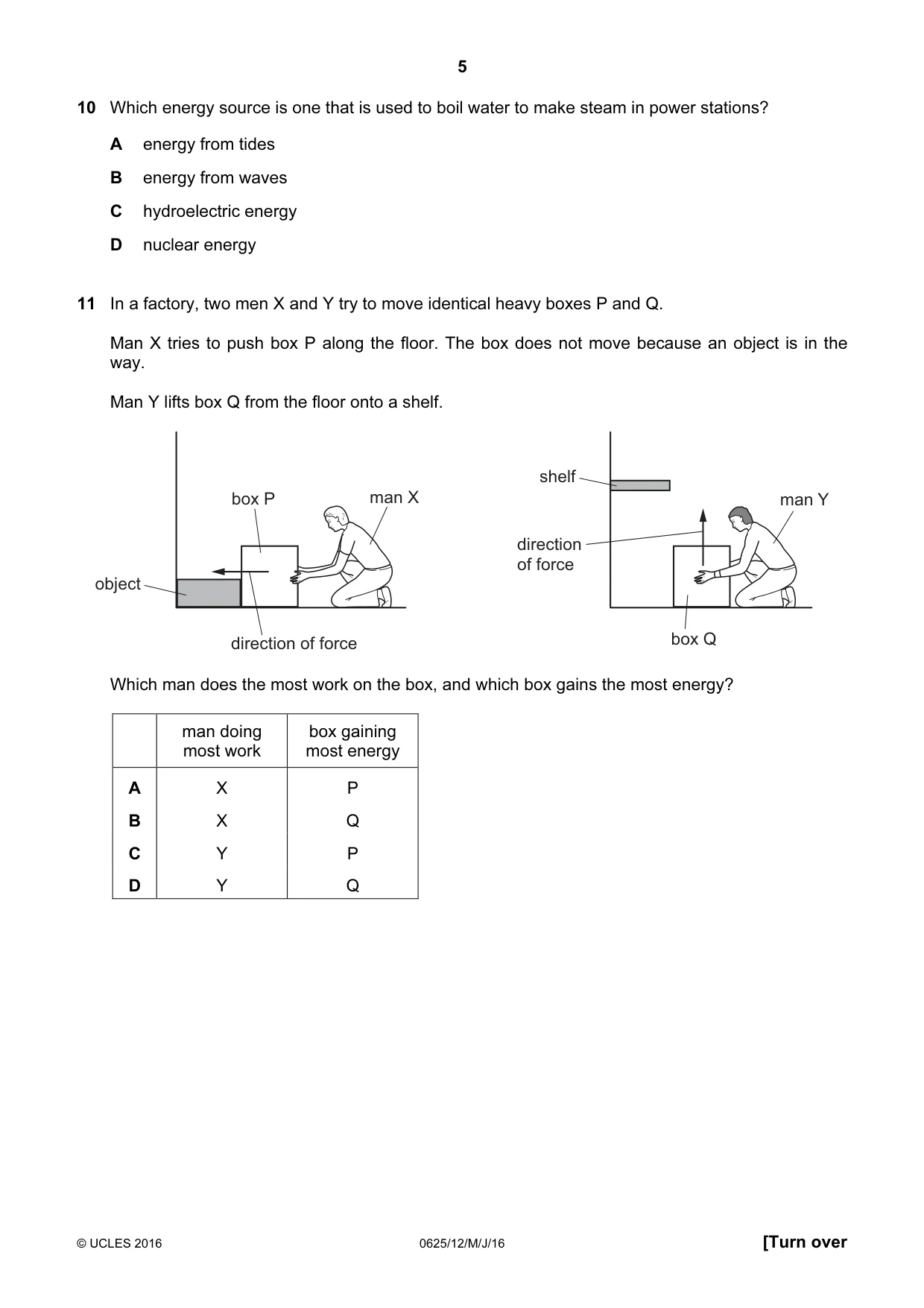
Q10 · Which energy source is one that is used to boil water to make steam in power stations?
10 Which energy source is one that is used to boil water to make steam in power stations? A energy from tides B energy from waves C hydroelectric energy D nuclear energy
Mark scheme: D
Q11 · In a factory, two men X and Y try to move identical heavy boxes P and Q
11 In a factory, two men X and Y try to move identical heavy boxes P and Q. Man X tries to push box P along the floor. The box does not move because an object is in the way. Man Y lifts box Q from the floor onto a shelf. shelf box P man X man Y direction of force object direction of force box Q Which man does the most work on the box, and which box gains the most energy? man doing box gaining most work most energy A X P B X Q C Y P D Y Q
Mark scheme: D
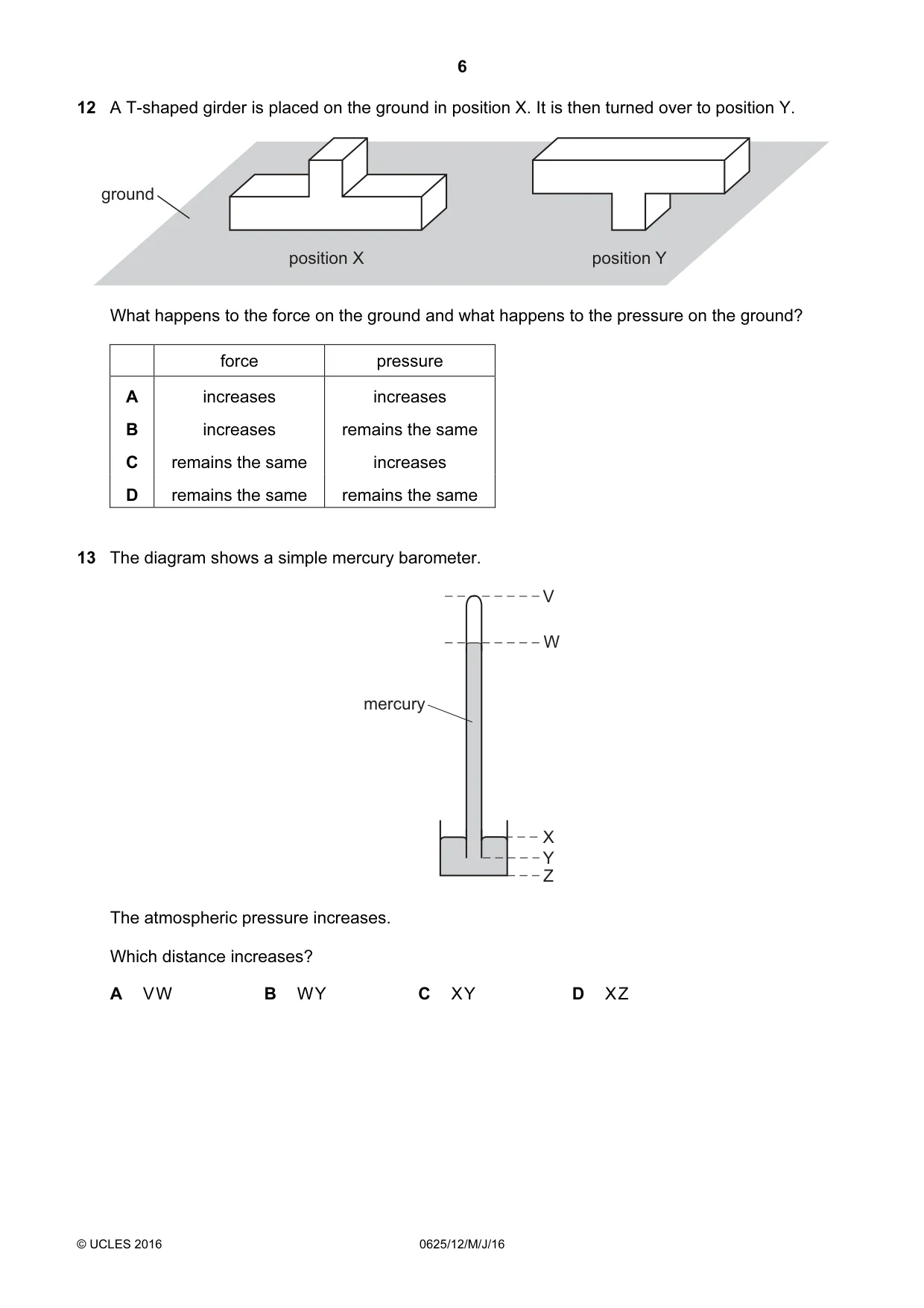
Q12 · A T-shaped girder is placed on the ground in position X
12 A T-shaped girder is placed on the ground in position X. It is then turned over to position Y. ground position X position Y What happens to the force on the ground and what happens to the pressure on the ground? force pressure A increases increases B increases remains the same C remains the same increases D remains the same remains the same
Mark scheme: C
Q13 · The diagram shows a simple mercury barometer
13 The diagram shows a simple mercury barometer. V W mercury X Y Z The atmospheric pressure increases. Which distance increases? A VW B WY C XY D XZ
Mark scheme: B
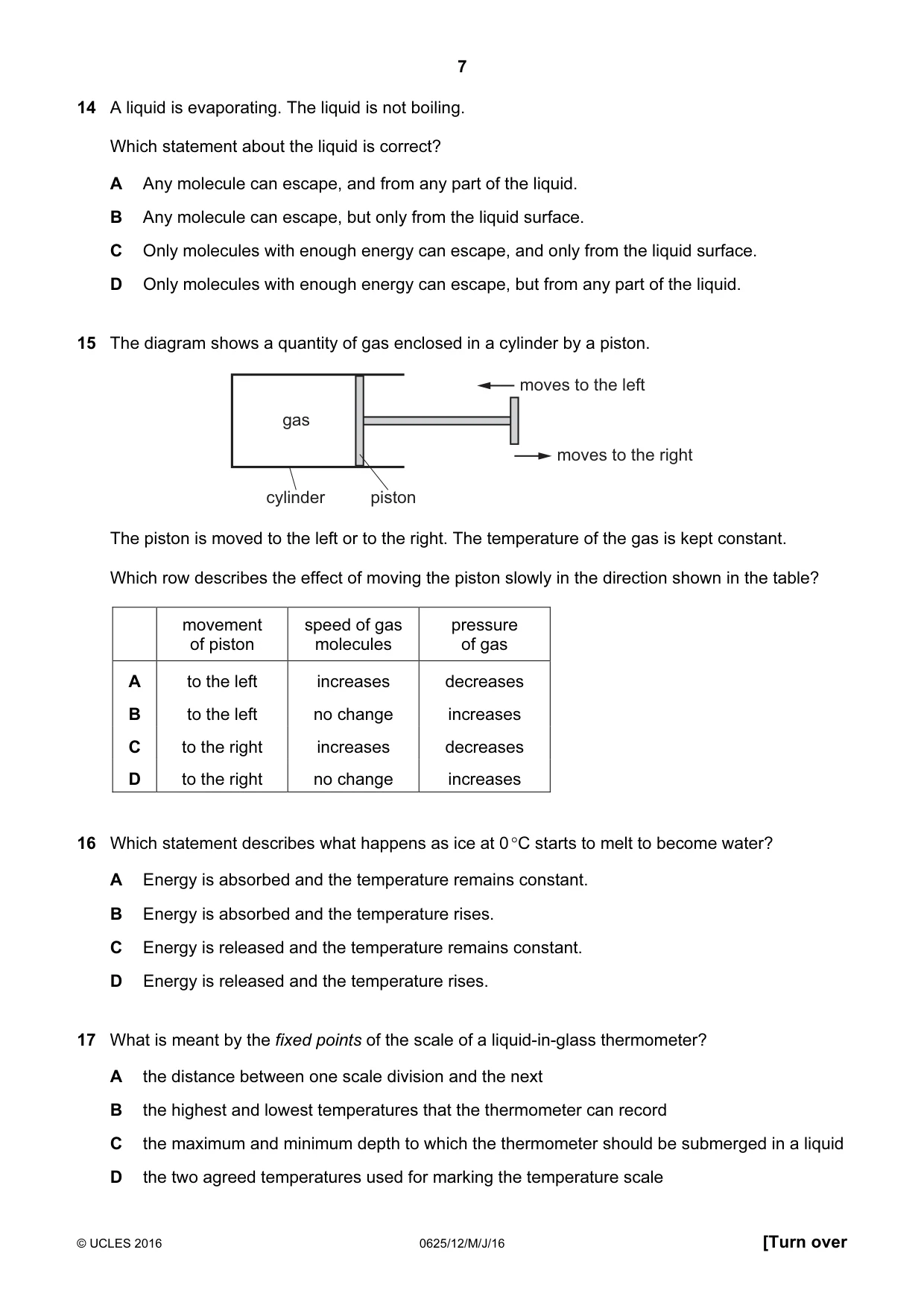
Q14 · A liquid is evaporating
14 A liquid is evaporating. The liquid is not boiling. Which statement about the liquid is correct? A Any molecule can escape, and from any part of the liquid. B Any molecule can escape, but only from the liquid surface. C Only molecules with enough energy can escape, and only from the liquid surface. D Only molecules with enough energy can escape, but from any part of the liquid.
Mark scheme: C
Q15 · The diagram shows a quantity of gas enclosed in a cylinder by a piston
15 The diagram shows a quantity of gas enclosed in a cylinder by a piston. moves to the left gas moves to the right cylinder piston The piston is moved to the left or to the right. The temperature of the gas is kept constant. Which row describes the effect of moving the piston slowly in the direction shown in the table? movement speed of gas pressure of piston molecules of gas A to the left increases decreases B to the left no change increases C to the right increases decreases D to the right no change increases
Mark scheme: B
Q16 · Which statement describes what happens as ice at 0 °C starts to melt to become water?
16 Which statement describes what happens as ice at 0 °C starts to melt to become water? A Energy is absorbed and the temperature remains constant. B Energy is absorbed and the temperature rises. C Energy is released and the temperature remains constant. D Energy is released and the temperature rises.
Mark scheme: A
Q17 · What is meant by the fixed points of the scale of a liquid-in-glass thermometer?
17 What is meant by the fixed points of the scale of a liquid-in-glass thermometer? A the distance between one scale division and the next B the highest and lowest temperatures that the thermometer can record C the maximum and minimum depth to which the thermometer should be submerged in a liquid D the two agreed temperatures used for marking the temperature scale
Mark scheme: D
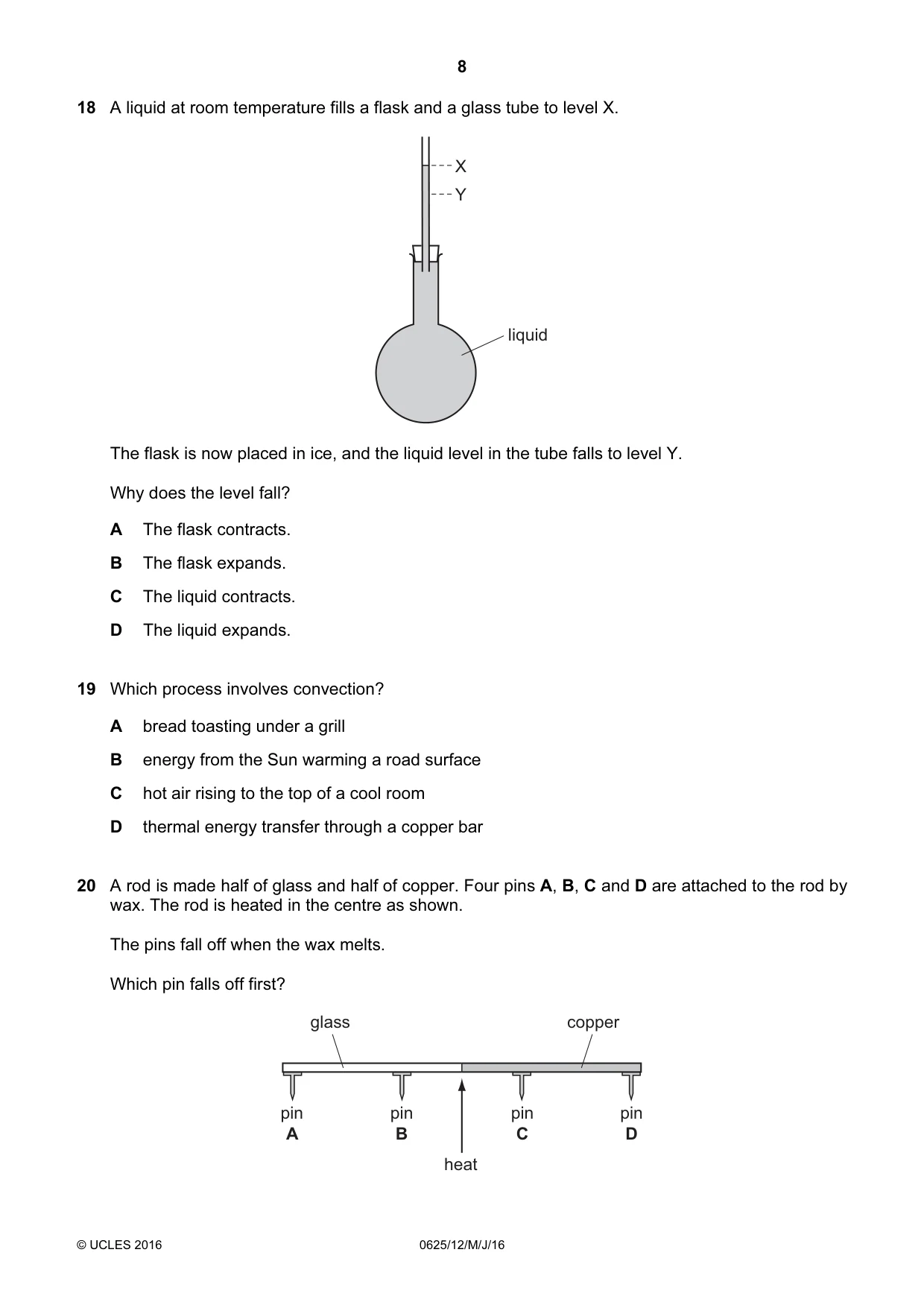
Q18 · A liquid at room temperature fills a flask and a glass tube to level X
18 A liquid at room temperature fills a flask and a glass tube to level X. X Y liquid The flask is now placed in ice, and the liquid level in the tube falls to level Y. Why does the level fall? A The flask contracts. B The flask expands. C The liquid contracts. D The liquid expands.
Mark scheme: C
Q19 · Which process involves convection?
19 Which process involves convection? A bread toasting under a grill B energy from the Sun warming a road surface C hot air rising to the top of a cool room D thermal energy transfer through a copper bar
Mark scheme: C
Q20 · A rod is made half of glass and half of copper
20 A rod is made half of glass and half of copper. Four pins A, B, C and D are attached to the rod by wax. The rod is heated in the centre as shown. The pins fall off when the wax melts. Which pin falls off first? glass copper pin pin pin pin A B C D heat
Mark scheme: C
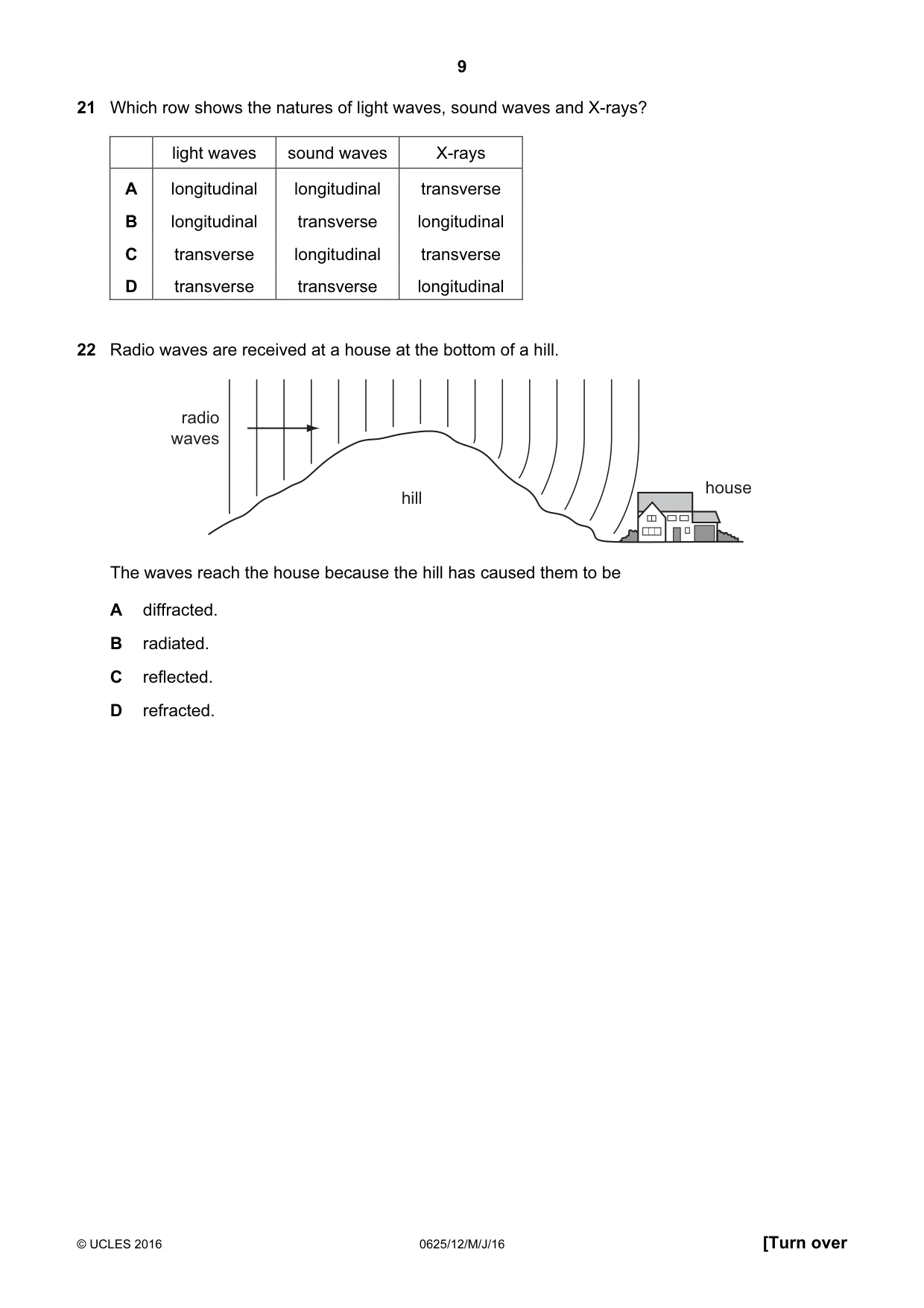
Q21 · Which row shows the natures of light waves, sound waves and X-rays?
21 Which row shows the natures of light waves, sound waves and X-rays? light waves sound waves X-rays A longitudinal longitudinal transverse B longitudinal transverse longitudinal C transverse longitudinal transverse D transverse transverse longitudinal
Mark scheme: C
Q22 · Radio waves are received at a house at the bottom of a hill
22 Radio waves are received at a house at the bottom of a hill. radio waves house hill The waves reach the house because the hill has caused them to be A diffracted. B radiated. C reflected. D refracted.
Mark scheme: A
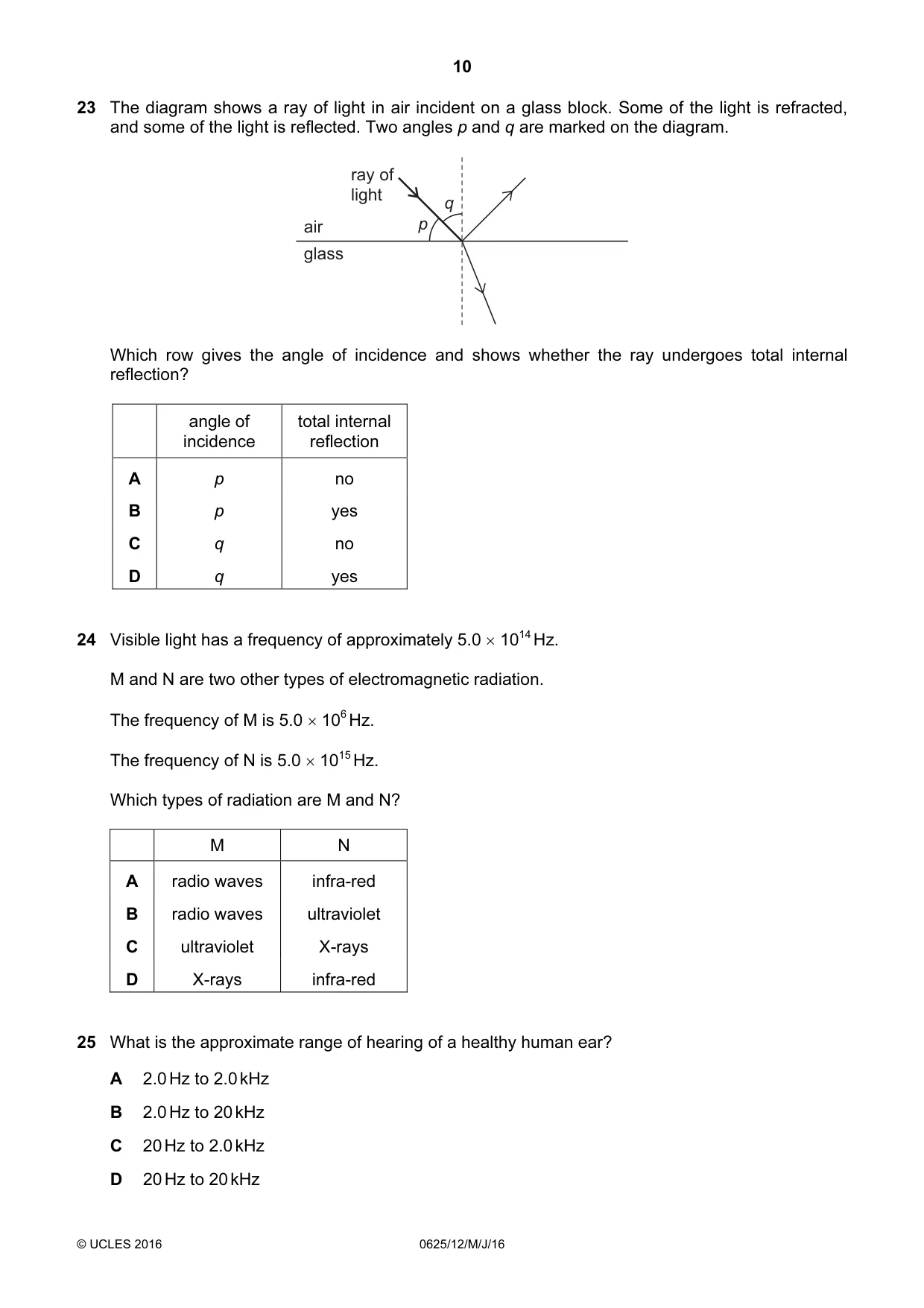
Q23 · The diagram shows a ray of light in air incident on a glass block
23 The diagram shows a ray of light in air incident on a glass block. Some of the light is refracted, and some of the light is reflected. Two angles p and q are marked on the diagram. ray of light q air p glass Which row gives the angle of incidence and shows whether the ray undergoes total internal reflection? angle of total internal incidence reflection A p no B p yes C q no D q yes
Mark scheme: C
Q24 · Visible light has a frequency of approximately 5.0 × 10¹⁴ Hz
24 Visible light has a frequency of approximately 5.0 × 10¹⁴ Hz. M and N are two other types of electromagnetic radiation. The frequency of M is 5.0 × 10⁶ Hz. The frequency of N is 5.0 × 10¹⁵ Hz. Which types of radiation are M and N? M N A radio waves infra-red B radio waves ultraviolet C ultraviolet X-rays D X-rays infra-red
Mark scheme: B
Q25 · What is the approximate range of hearing of a healthy human ear?
25 What is the approximate range of hearing of a healthy human ear? A 2.0 Hz to 2.0 kHz B 2.0 Hz to 20 kHz C 20 Hz to 2.0 kHz D 20 Hz to 20 kHz
Mark scheme: D
Q26 · A singer sings two notes
26 A singer sings two notes. The first note is louder and lower in pitch than the second note. Which statement about the two notes is correct? A The first note has a larger amplitude and a larger frequency than the second note. B The first note has a larger amplitude and a smaller frequency than the second note. C The first note has a smaller amplitude and a larger frequency than the second note. D The first note has a smaller amplitude and a smaller frequency than the second note.
Mark scheme: B
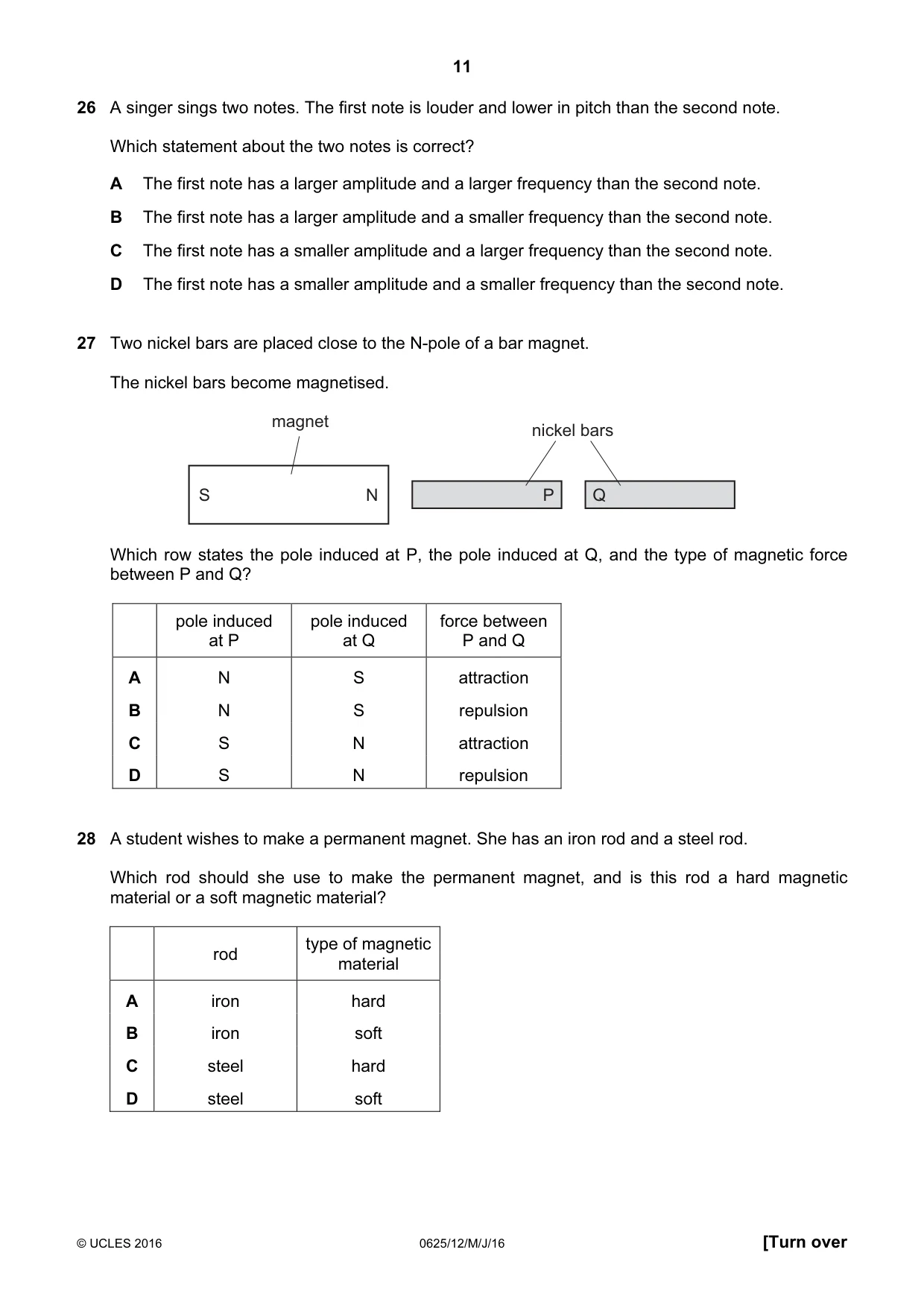
Q27 · Two nickel bars are placed close to the N-pole of a bar magnet
27 Two nickel bars are placed close to the N-pole of a bar magnet. The nickel bars become magnetised. magnet nickel bars S N P Q Which row states the pole induced at P, the pole induced at Q, and the type of magnetic force between P and Q? pole induced pole induced force between at P at Q P and Q A N S attraction B N S repulsion C S N attraction D S N repulsion
Mark scheme: A
Q28 · A student wishes to make a permanent magnet
28 A student wishes to make a permanent magnet. She has an iron rod and a steel rod. Which rod should she use to make the permanent magnet, and is this rod a hard magnetic material or a soft magnetic material? type of magnetic rod material A iron hard B iron soft C steel hard D steel soft
Mark scheme: C
Q29 · Two meters are connected in a circuit to measure the current in a component and the…
29 Two meters are connected in a circuit to measure the current in a component and the potential difference across the component. Which meters are used and how are they connected to the component? A an ammeter in parallel for current, a voltmeter in series for potential difference B an ammeter in series for current, a voltmeter in parallel for potential difference C a voltmeter in parallel for current, an ammeter in series for potential difference D a voltmeter in series for current, an ammeter in parallel for potential difference
Mark scheme: B
Q30 · A wire has a certain electrical resistance
30 A wire has a certain electrical resistance. The diameter and length of the wire may be changed. Which pair of changes must cause the resistance of the wire to increase? change of change of diameter length A decrease decrease B decrease increase C increase decrease D increase increase
Mark scheme: B
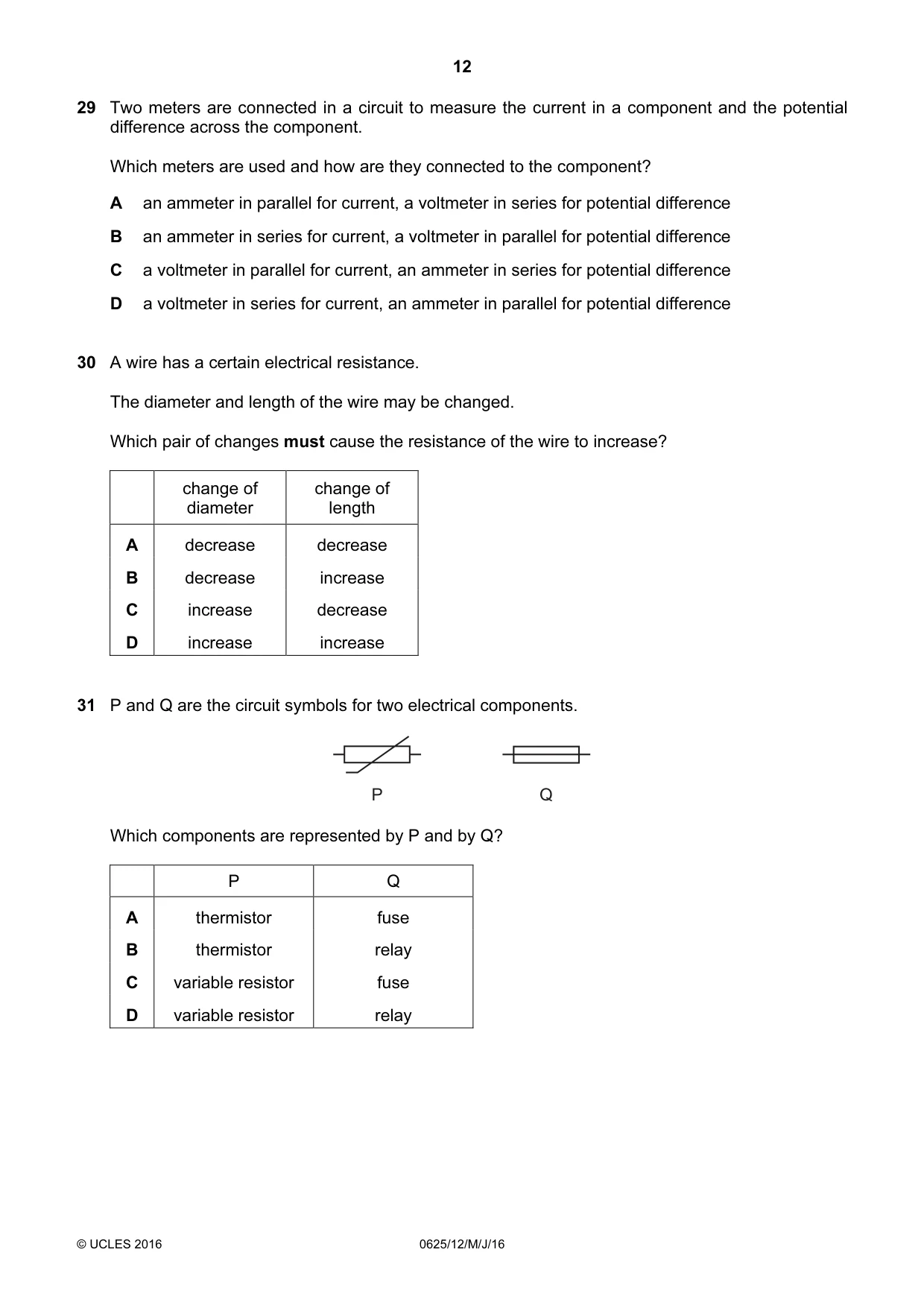
Q31 · P and Q are the circuit symbols for two electrical components
31 P and Q are the circuit symbols for two electrical components. P Q Which components are represented by P and by Q? P Q A thermistor fuse B thermistor relay C variable resistor fuse D variable resistor relay
Mark scheme: A
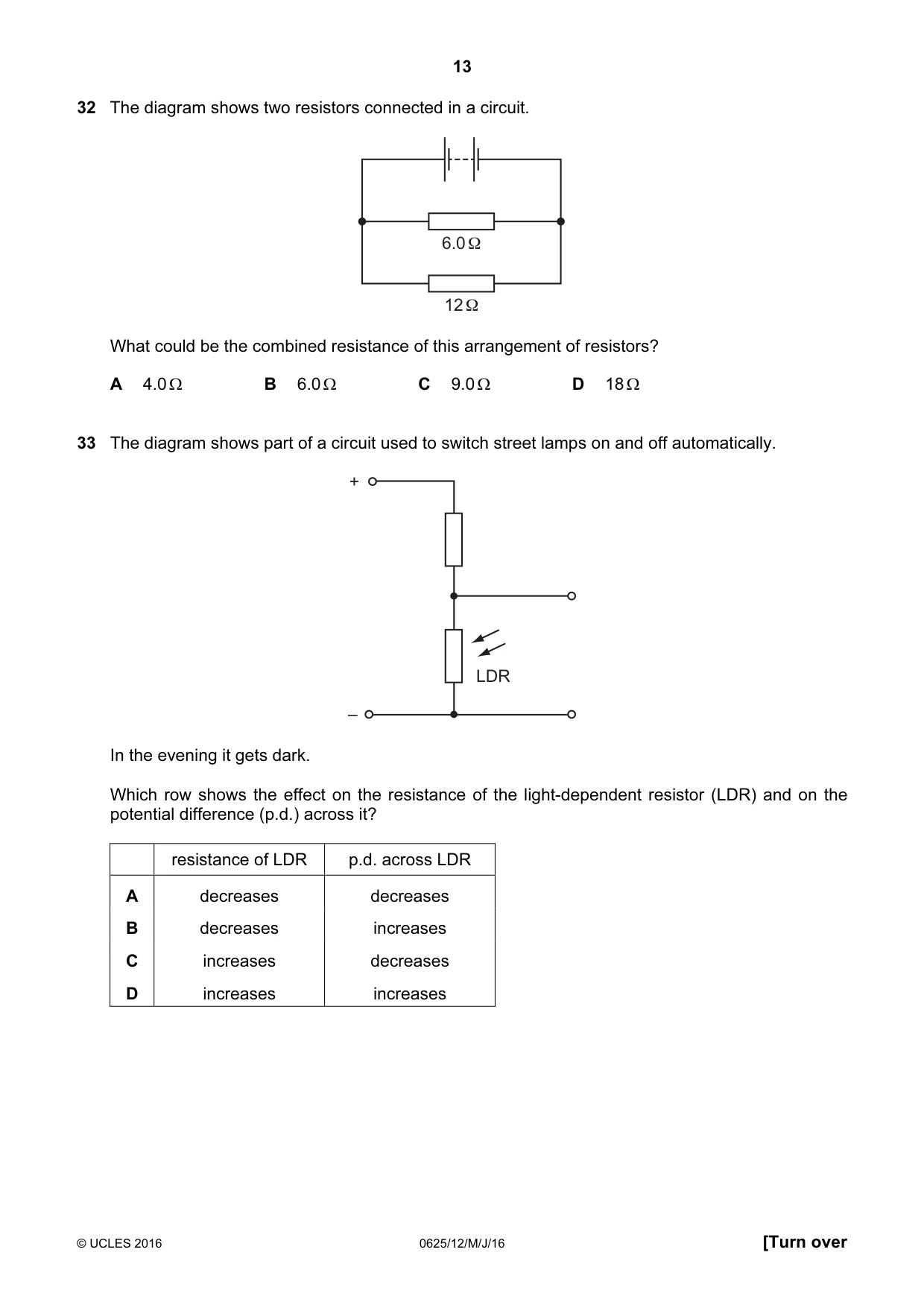
Q32 · The diagram shows two resistors connected in a circuit
32 The diagram shows two resistors connected in a circuit. 6.0 Ω 12 Ω What could be the combined resistance of this arrangement of resistors? A 4.0 Ω B 6.0 Ω C 9.0 Ω D 18 Ω
Mark scheme: A
Q33 · The diagram shows part of a circuit used to switch street lamps on and off automatically
33 The diagram shows part of a circuit used to switch street lamps on and off automatically. + LDR – In the evening it gets dark. Which row shows the effect on the resistance of the light-dependent resistor (LDR) and on the potential difference (p.d.) across it? resistance of LDR p.d. across LDR A decreases decreases B decreases increases C increases decreases D increases increases
Mark scheme: D
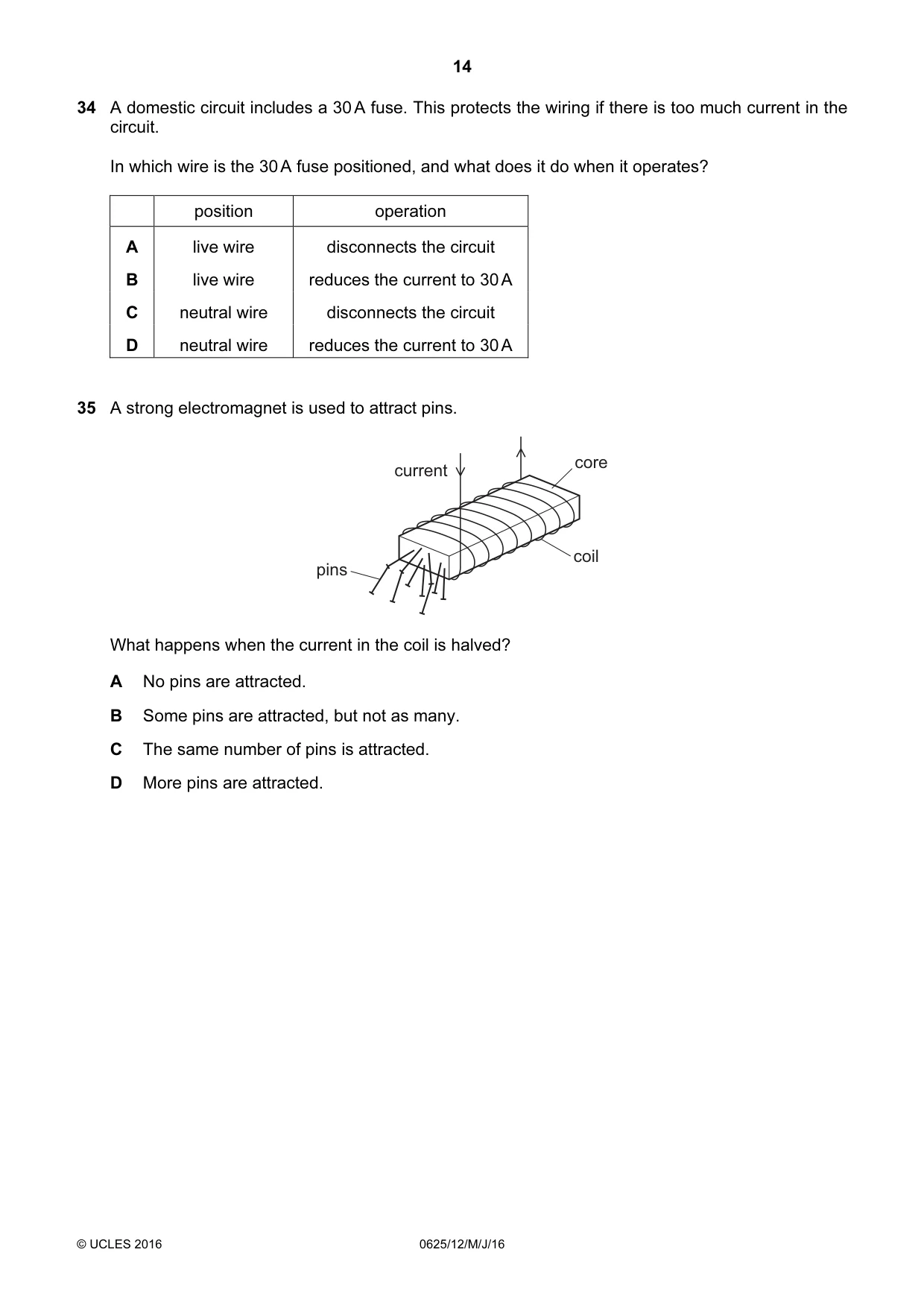
Q34 · A domestic circuit includes a 30 A fuse
34 A domestic circuit includes a 30 A fuse. This protects the wiring if there is too much current in the circuit. In which wire is the 30 A fuse positioned, and what does it do when it operates? position operation A live wire disconnects the circuit B live wire reduces the current to 30 A C neutral wire disconnects the circuit D neutral wire reduces the current to 30 A
Mark scheme: A
Q35 · A strong electromagnet is used to attract pins
35 A strong electromagnet is used to attract pins. core current coil pins What happens when the current in the coil is halved? A No pins are attracted. B Some pins are attracted, but not as many. C The same number of pins is attracted. D More pins are attracted.
Mark scheme: B
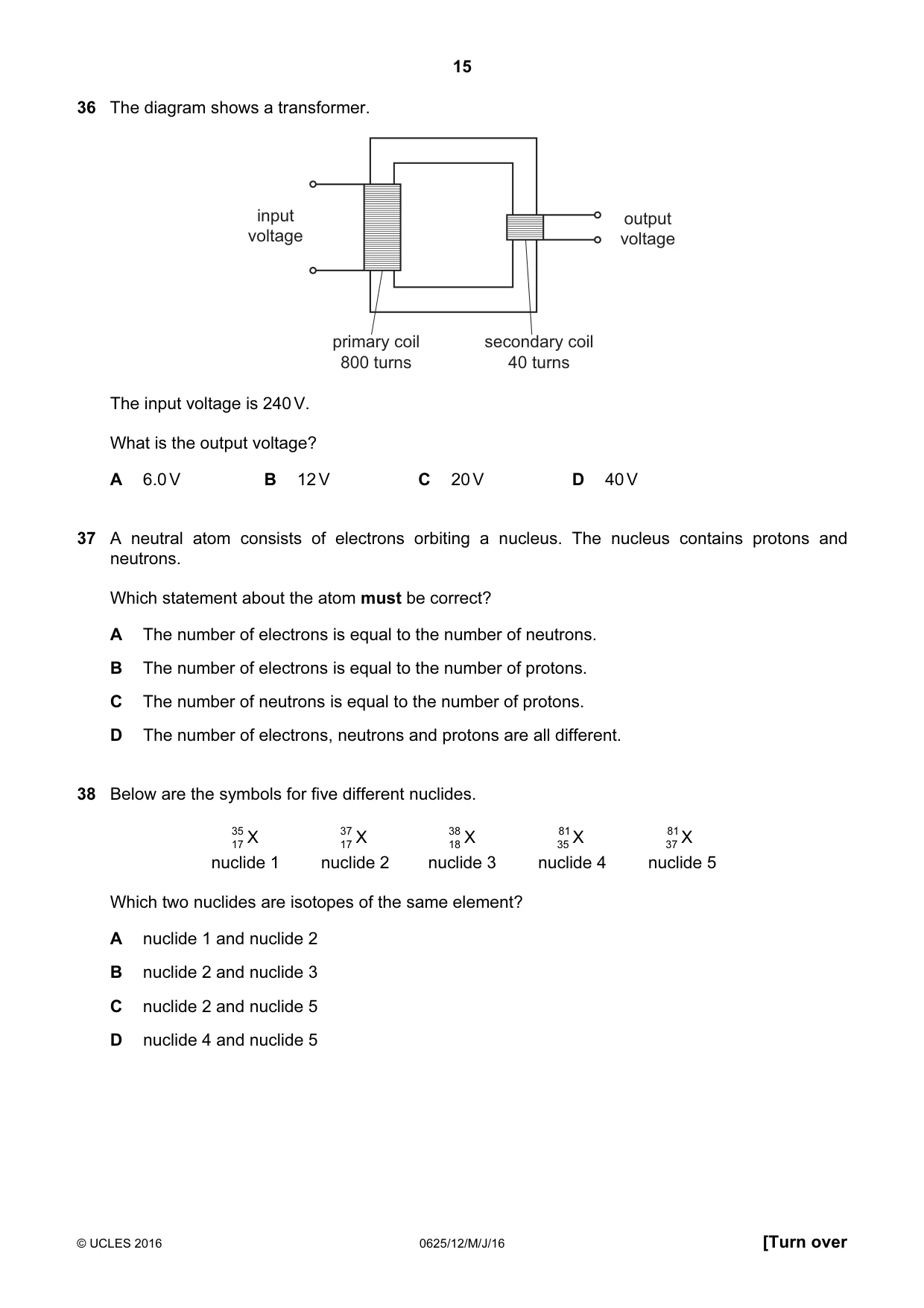
Q36 · The diagram shows a transformer
36 The diagram shows a transformer. input output voltage voltage primary coil secondary coil 800 turns 40 turns The input voltage is 240 V. What is the output voltage? A 6.0 V B 12 V C 20 V D 40 V
Mark scheme: B
Q37 · A neutral atom consists of electrons orbiting a nucleus
37 A neutral atom consists of electrons orbiting a nucleus. The nucleus contains protons and neutrons. Which statement about the atom must be correct? A The number of electrons is equal to the number of neutrons. B The number of electrons is equal to the number of protons. C The number of neutrons is equal to the number of protons. D The number of electrons, neutrons and protons are all different.
Mark scheme: B
Q38 · Below are the symbols for five different nuclides
38 Below are the symbols for five different nuclides. 35 X 37 X 38 X 81 X 81 X 17 17 18 35 37 nuclide 1 nuclide 2 nuclide 3 nuclide 4 nuclide 5 Which two nuclides are isotopes of the same element? A nuclide 1 and nuclide 2 B nuclide 2 and nuclide 3 C nuclide 2 and nuclide 5 D nuclide 4 and nuclide 5
Mark scheme: A
Q39 · Which row describes the nature and a property of all β-particles?
39 Which row describes the nature and a property of all β-particles? nature property A electrons can travel through a vacuum B electrons stopped by a thin sheet of paper C helium nuclei can travel through a vacuum D helium nuclei stopped by a thin sheet of paper
Mark scheme: A
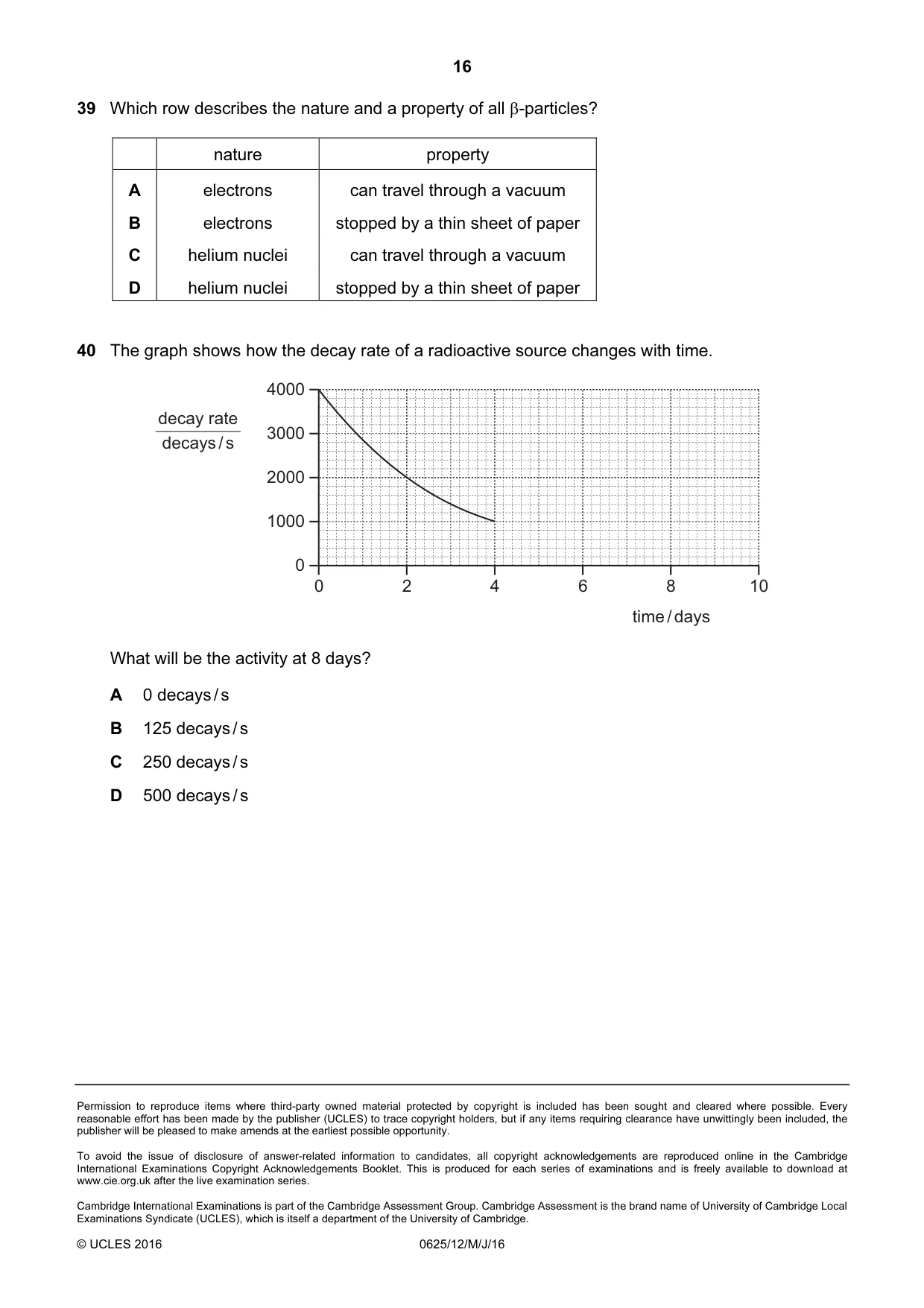
Q40 · The graph shows how the decay rate of a radioactive source changes with time
40 The graph shows how the decay rate of a radioactive source changes with time. 4000 decay rate 3000 decays / s 2000 1000 0 0 2 4 6 8 10 time / days What will be the activity at 8 days? A 0 decays / s B 125 decays / s C 250 decays / s D 500 decays / s
Mark scheme: C
What was in this paper
The subtopics covered by these 40 questions, and how many questions each got. Open one in a new tab to see every Cambridge question on it.
3Energy, work and power3Forces3Thermal properties and temperature3Electrical quantities2Electromagnetic effects2General properties of waves2Kinetic particle model of matter2Motion2Pressure2Radioactivity2Simple phenomena of magnetism2Sound2The nuclear model of the atom2Transfer of thermal energy2Density1Electrical safety1Electromagnetic spectrum1Light1Mass and weight1Physical quantities and measurement techniques1What you needed in this session
Cambridge’s own grade thresholds for 2016 May/June, Paper 1 · Variant 2. A higher threshold means an easier paper — the bar moves with how the cohort did.