Cambridge IGCSE Physics 0625 — 2019 Oct/Nov Paper 1 · Variant 1
0625/11/O/N/19 · 40 questions · 40 marks · ≈45 min
The question paper and its mark scheme, free to read here and free to download. This is Cambridge’s own paper, exactly as it was sat.
Question paper16 pages
Mark scheme3 pages
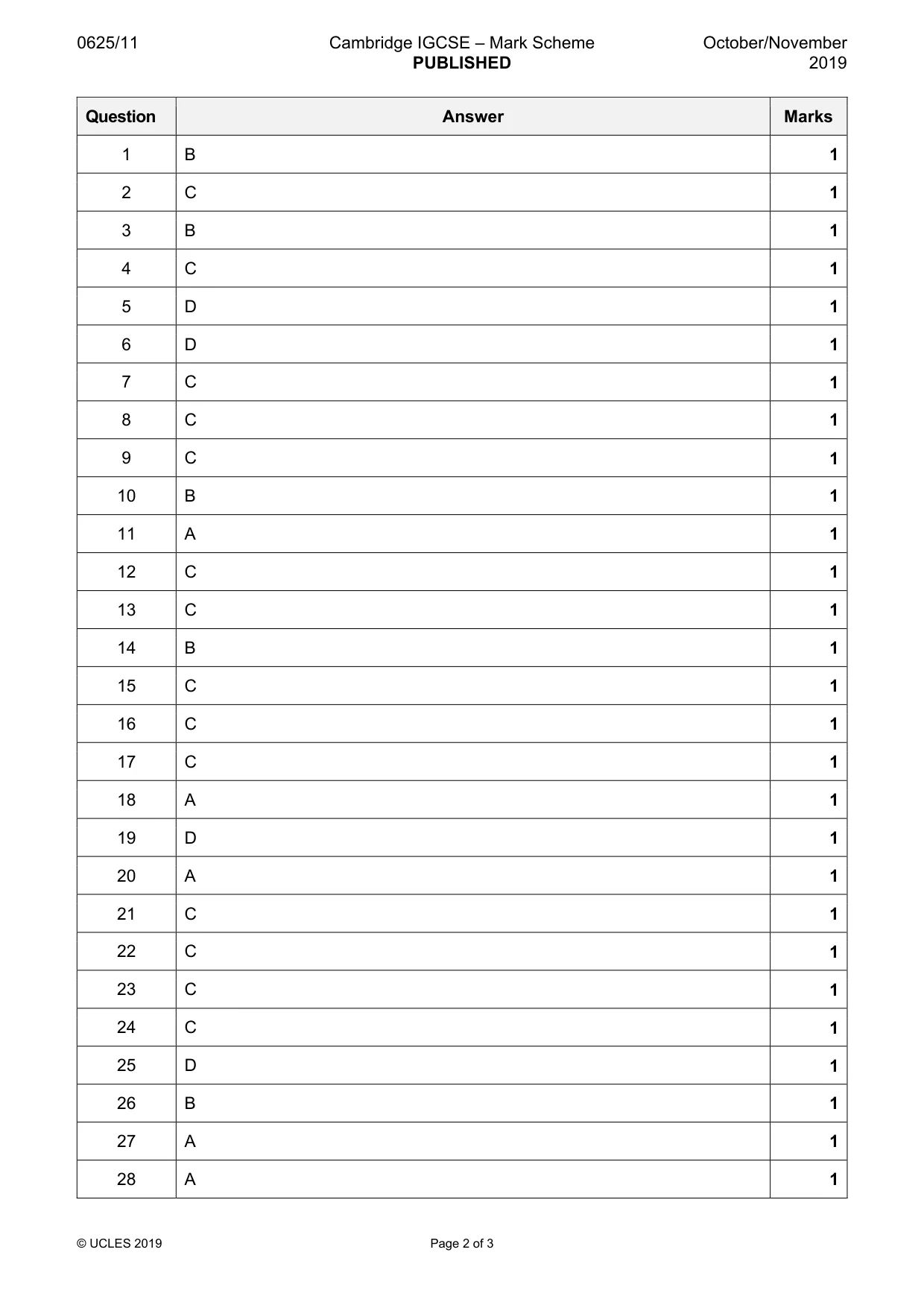
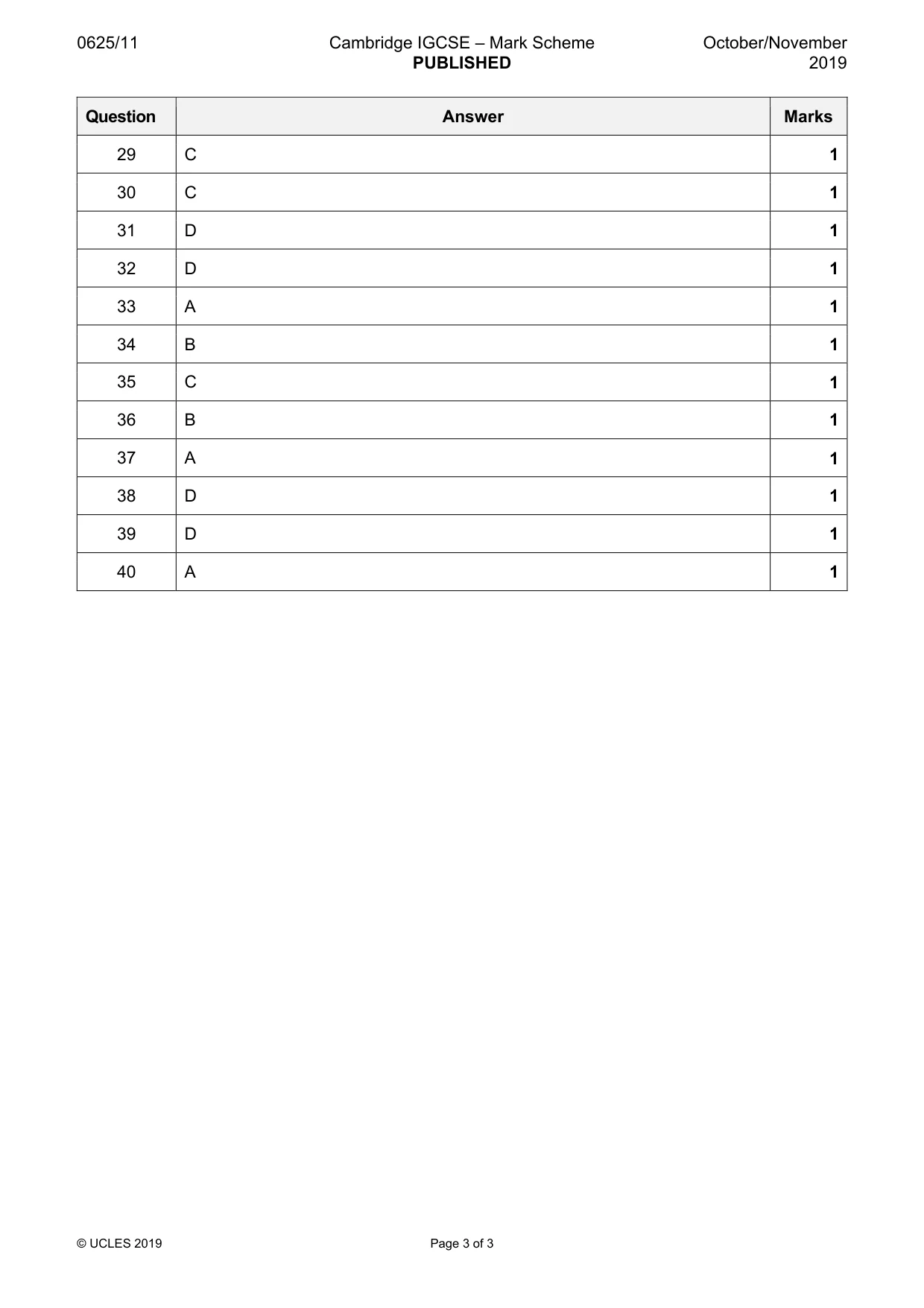
Answers below. Sit the paper first if you are practising.
Questions as text
Q1 · A student measures the volume of a small irregularly-shaped stone
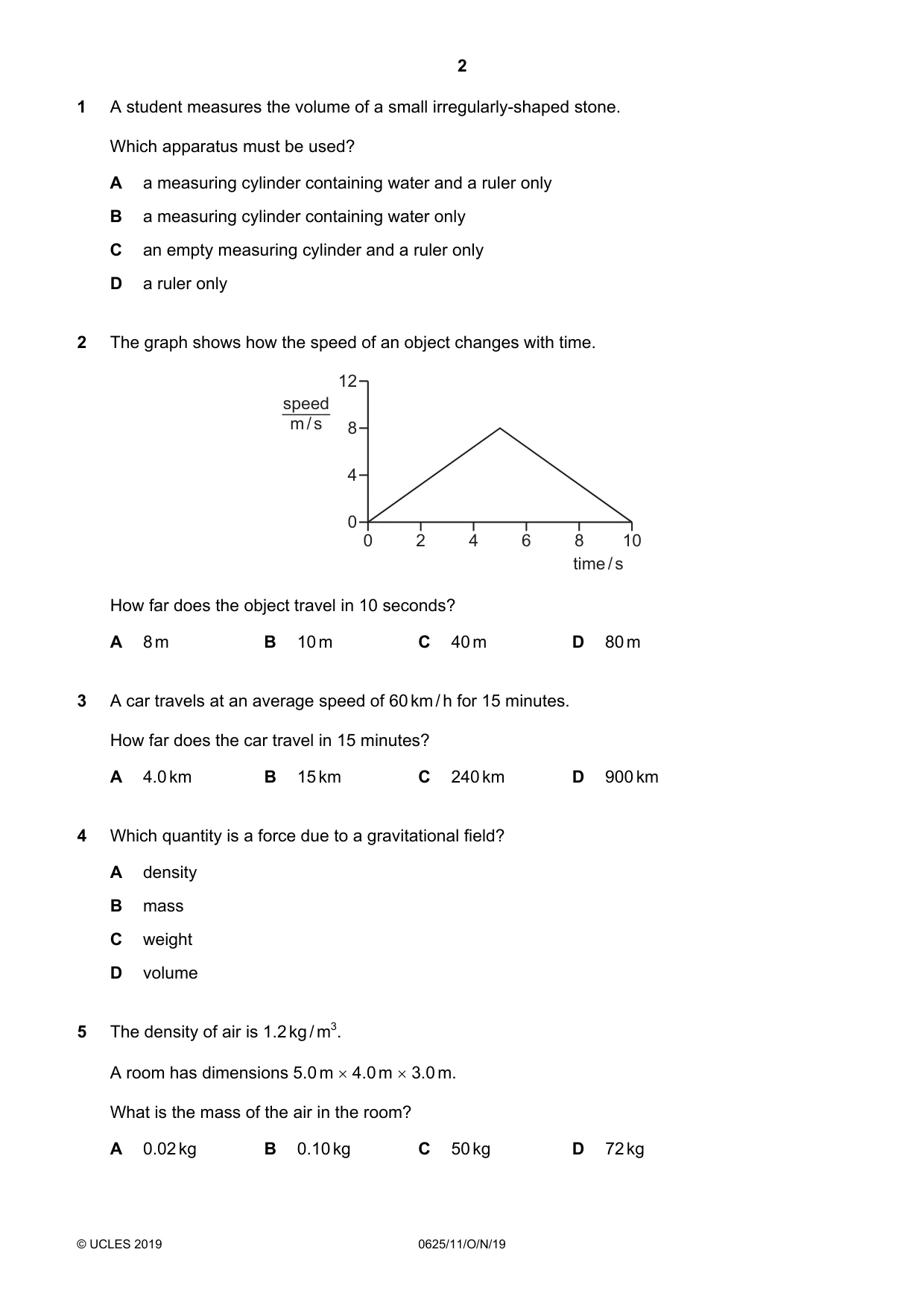
1 A student measures the volume of a small irregularly-shaped stone. Which apparatus must be used? A a measuring cylinder containing water and a ruler only B a measuring cylinder containing water only C an empty measuring cylinder and a ruler only D a ruler only
Mark scheme: B
More questions on Physical quantities and measurement techniques
Q2 · The graph shows how the speed of an object changes with time
2 The graph shows how the speed of an object changes with time. 12 speed m / s 8 4 0 0 2 4 6 8 10 time / s How far does the object travel in 10 seconds? A 8 m B 10 m C 40 m D 80 m
Mark scheme: C
Q3 · A car travels at an average speed of 60 km / h for 15 minutes
3 A car travels at an average speed of 60 km / h for 15 minutes. How far does the car travel in 15 minutes? A 4.0 km B 15 km C 240 km D 900 km
Mark scheme: B
Q4 · Which quantity is a force due to a gravitational field?
4 Which quantity is a force due to a gravitational field? A density B mass C weight D volume
Mark scheme: C
Q5 · The density of air is 1.2 kg / m3
5 The density of air is 1.2 kg / m3. A room has dimensions 5.0 m × 4.0 m × 3.0 m. What is the mass of the air in the room? A 0.02 kg B 0.10 kg C 50 kg D 72 kg
Mark scheme: D
Q6 · A student measures the length of a spring
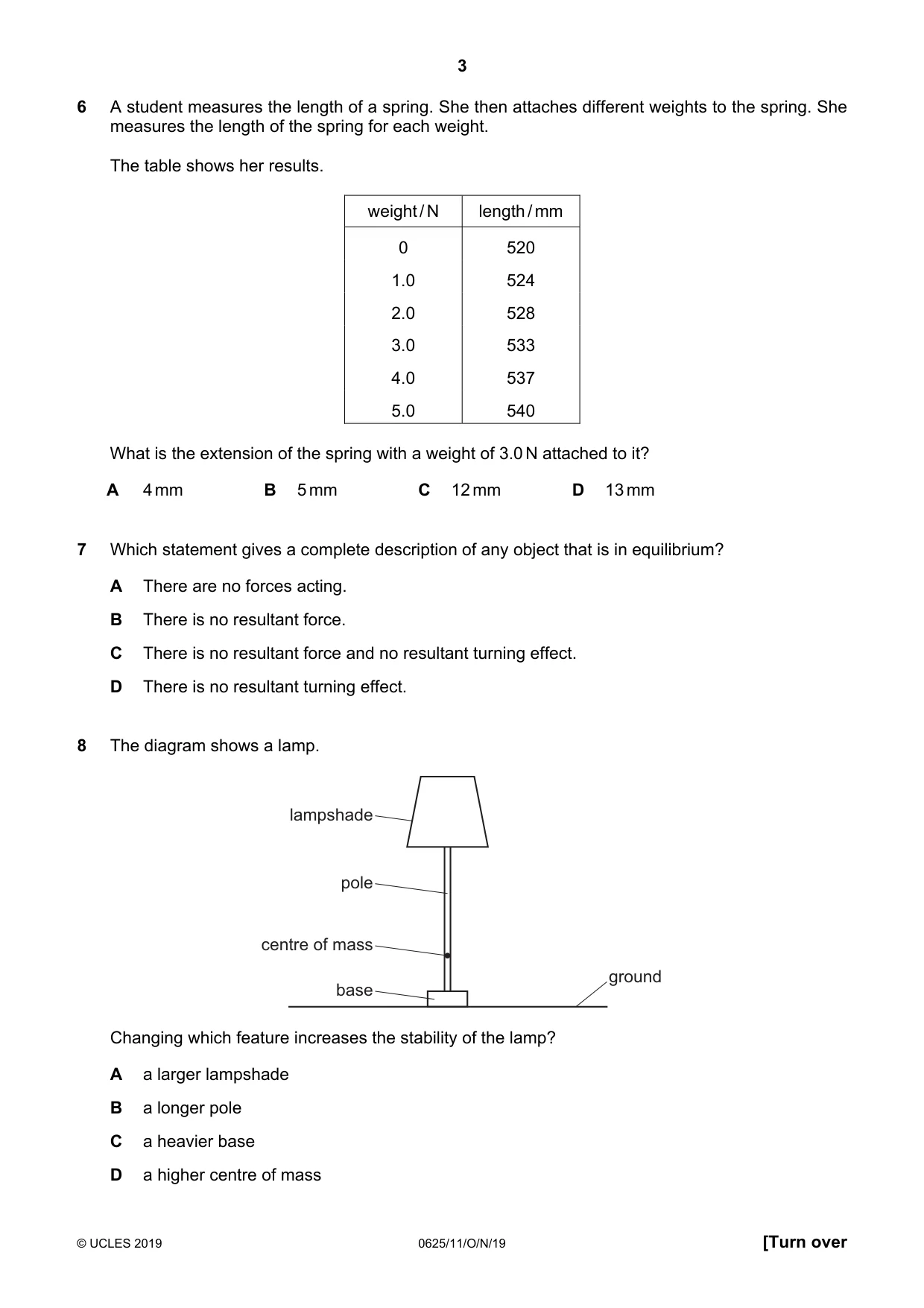
6 A student measures the length of a spring. She then attaches different weights to the spring. She measures the length of the spring for each weight. The table shows her results. weight / N length / mm 0 520 1.0 524 2.0 528 3.0 533 4.0 537 5.0 540 What is the extension of the spring with a weight of 3.0 N attached to it? A 4 mm B 5 mm C 12 mm D 13 mm
Mark scheme: D
Q7 · Which statement gives a complete description of any object that is in equilibrium?
7 Which statement gives a complete description of any object that is in equilibrium? A There are no forces acting. B There is no resultant force. C There is no resultant force and no resultant turning effect. D There is no resultant turning effect.
Mark scheme: C
Q8 · The diagram shows a lamp
8 The diagram shows a lamp. lampshade pole centre of mass ground base Changing which feature increases the stability of the lamp? A a larger lampshade B a longer pole C a heavier base D a higher centre of mass
Mark scheme: C
Q9 · Brakes are used to slow down a moving car
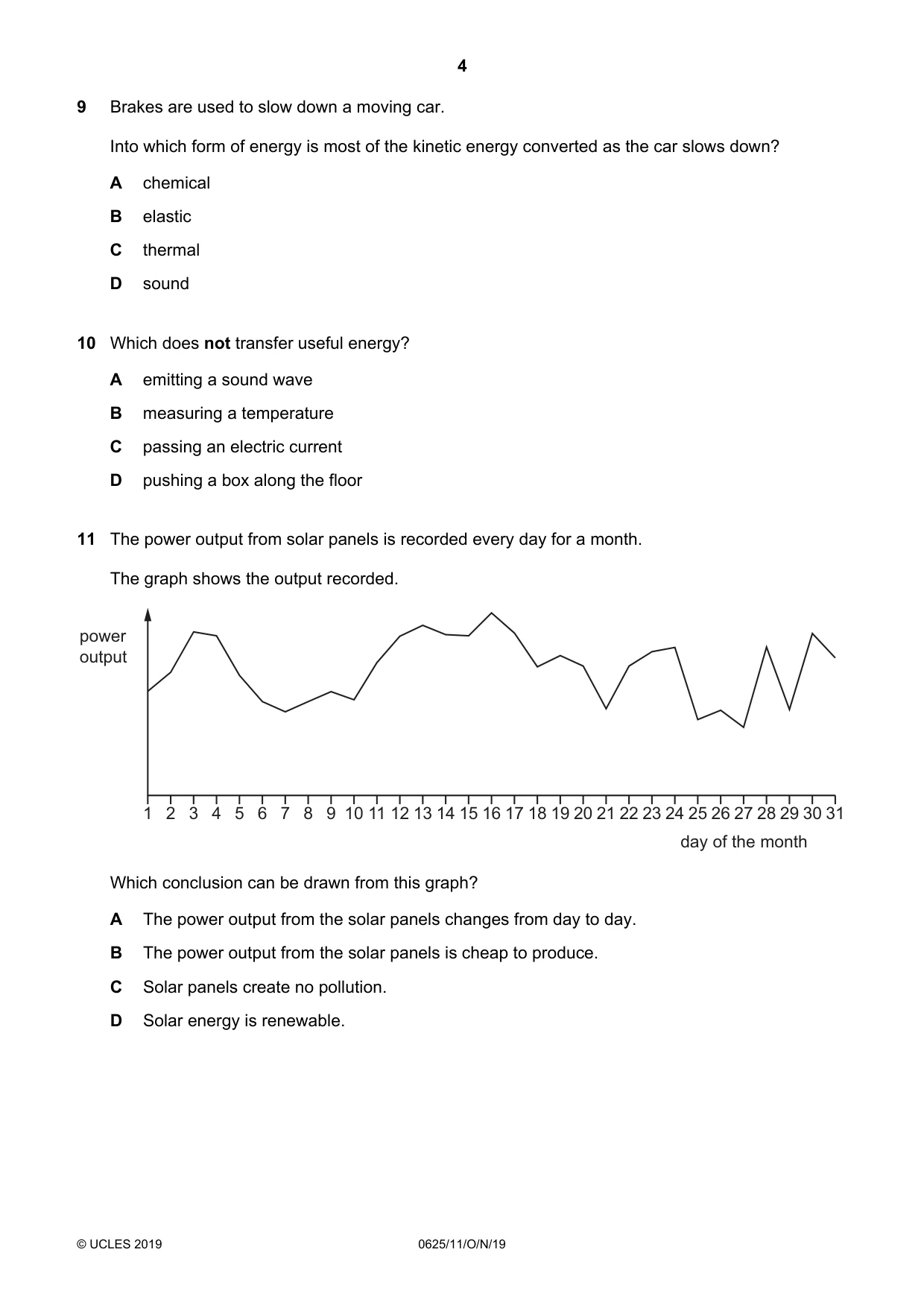
9 Brakes are used to slow down a moving car. Into which form of energy is most of the kinetic energy converted as the car slows down? A chemical B elastic C thermal D sound
Mark scheme: C
Q10 · Which does not transfer useful energy?
10 Which does not transfer useful energy? A emitting a sound wave B measuring a temperature C passing an electric current D pushing a box along the floor
Mark scheme: B
Q11 · The power output from solar panels is recorded every day for a month
11 The power output from solar panels is recorded every day for a month. The graph shows the output recorded. power output 1 2 3 4 5 6 7 8 9 10 11 12 13 14 15 16 17 18 19 20 21 22 23 24 25 26 27 28 29 30 31 day of the month Which conclusion can be drawn from this graph? A The power output from the solar panels changes from day to day. B The power output from the solar panels is cheap to produce. C Solar panels create no pollution. D Solar energy is renewable.
Mark scheme: A
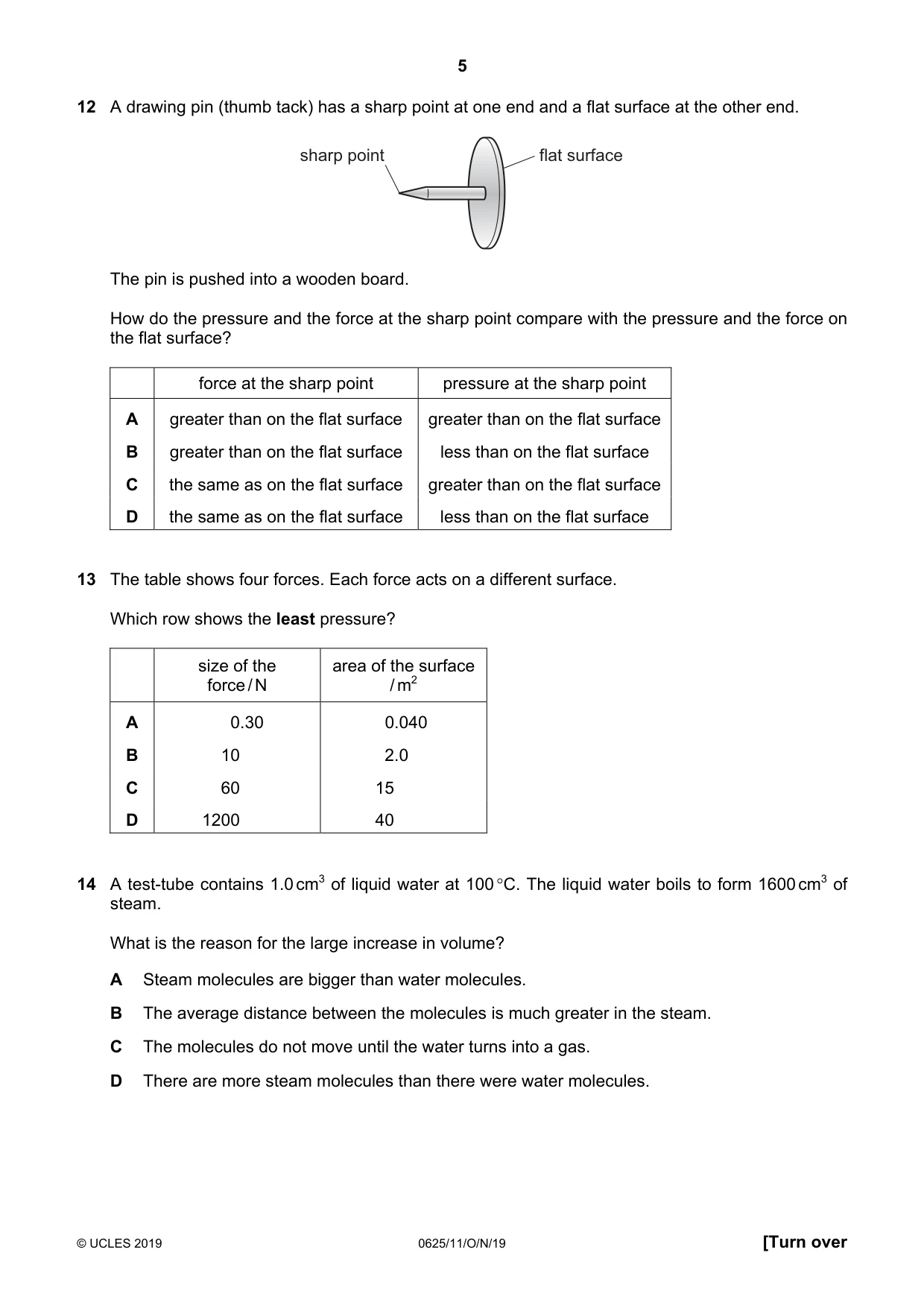
Q12 · A drawing pin (thumb tack) has a sharp point at one end and a flat surface at the other…
12 A drawing pin (thumb tack) has a sharp point at one end and a flat surface at the other end. sharp point flat surface The pin is pushed into a wooden board. How do the pressure and the force at the sharp point compare with the pressure and the force on the flat surface? force at the sharp point pressure at the sharp point A greater than on the flat surface greater than on the flat surface B greater than on the flat surface less than on the flat surface C the same as on the flat surface greater than on the flat surface D the same as on the flat surface less than on the flat surface
Mark scheme: C
Q13 · The table shows four forces
13 The table shows four forces. Each force acts on a different surface. Which row shows the least pressure? size of the area of the surface force / N / m2 A 0.30 0.040 B 10 2.0 C 60 15 D 1200 40
Mark scheme: C
Q14 · A test-tube contains 1.0 cm3 of liquid water at 100 °C
14 A test-tube contains 1.0 cm3 of liquid water at 100 °C. The liquid water boils to form 1600 cm3 of steam. What is the reason for the large increase in volume? A Steam molecules are bigger than water molecules. B The average distance between the molecules is much greater in the steam. C The molecules do not move until the water turns into a gas. D There are more steam molecules than there were water molecules.
Mark scheme: B
Q15 · Which statement about the evaporation of a liquid is correct?
15 Which statement about the evaporation of a liquid is correct? A The least energetic molecules escape from the surface and the temperature of the liquid decreases. B The least energetic molecules escape from the surface and the temperature of the liquid increases. C The most energetic molecules escape from the surface and the temperature of the liquid decreases. D The most energetic molecules escape from the surface and the temperature of the liquid increases.
Mark scheme: C
Q16 · Which effect is caused by thermal expansion?
16 Which effect is caused by thermal expansion? A a metal surface heating up in direct sunlight B ice-cream melting on a hot day C a railway track buckling on a hot day D ice forming on a pond on a cold day
Mark scheme: C
Q17 · A liquid-in-glass thermometer uses a change in a property of a liquid to measure…
17 A liquid-in-glass thermometer uses a change in a property of a liquid to measure temperature. Which property is used? A mass B thermal capacity C volume D weight
Mark scheme: C
Q18 · The diagram shows four labelled changes of state between solid, liquid and gas
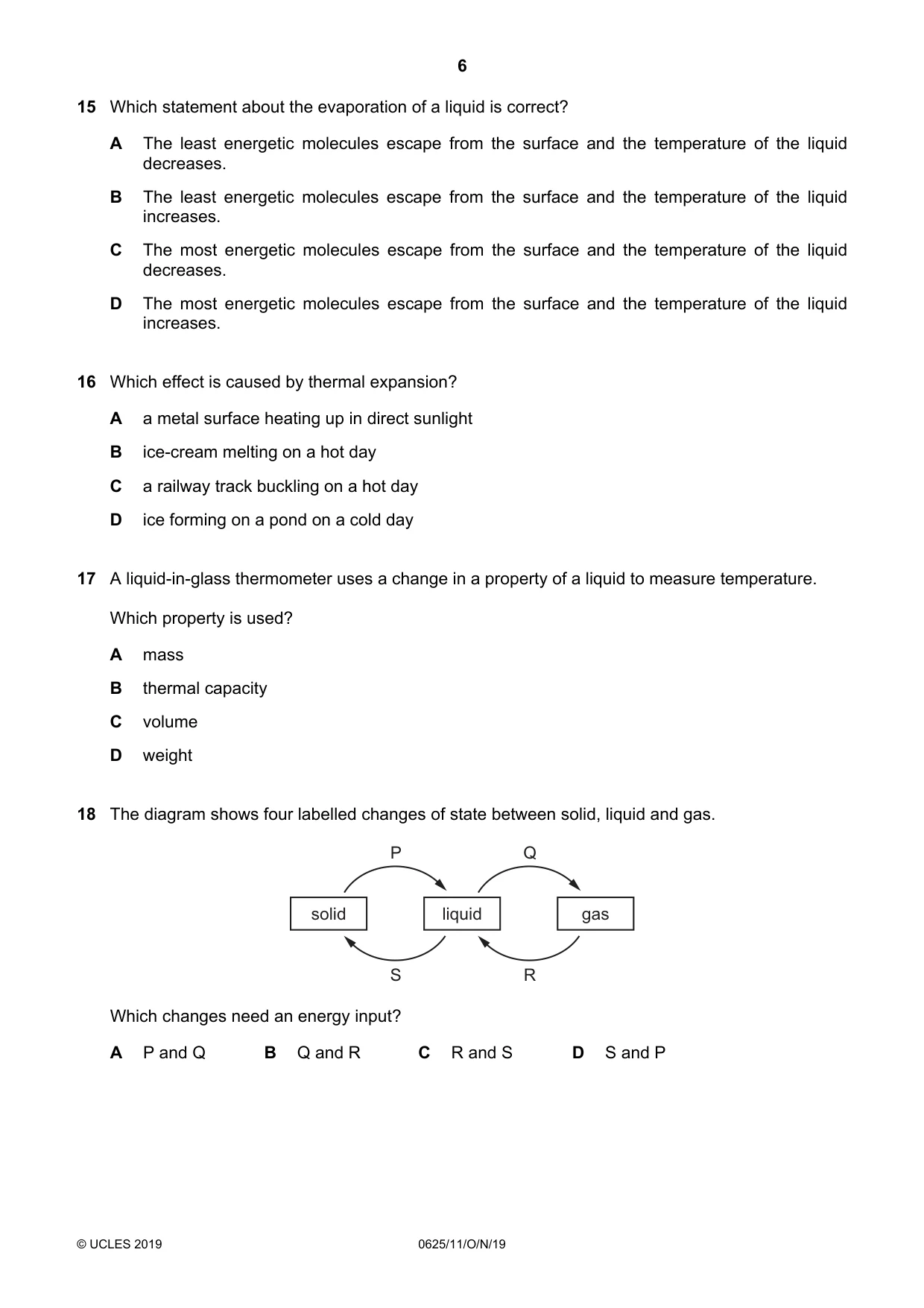
18 The diagram shows four labelled changes of state between solid, liquid and gas. P Q solid liquid gas S R Which changes need an energy input? A P and Q B Q and R C R and S D S and P
Mark scheme: A
Q19 · A glass test-tube containing water is heated at the top
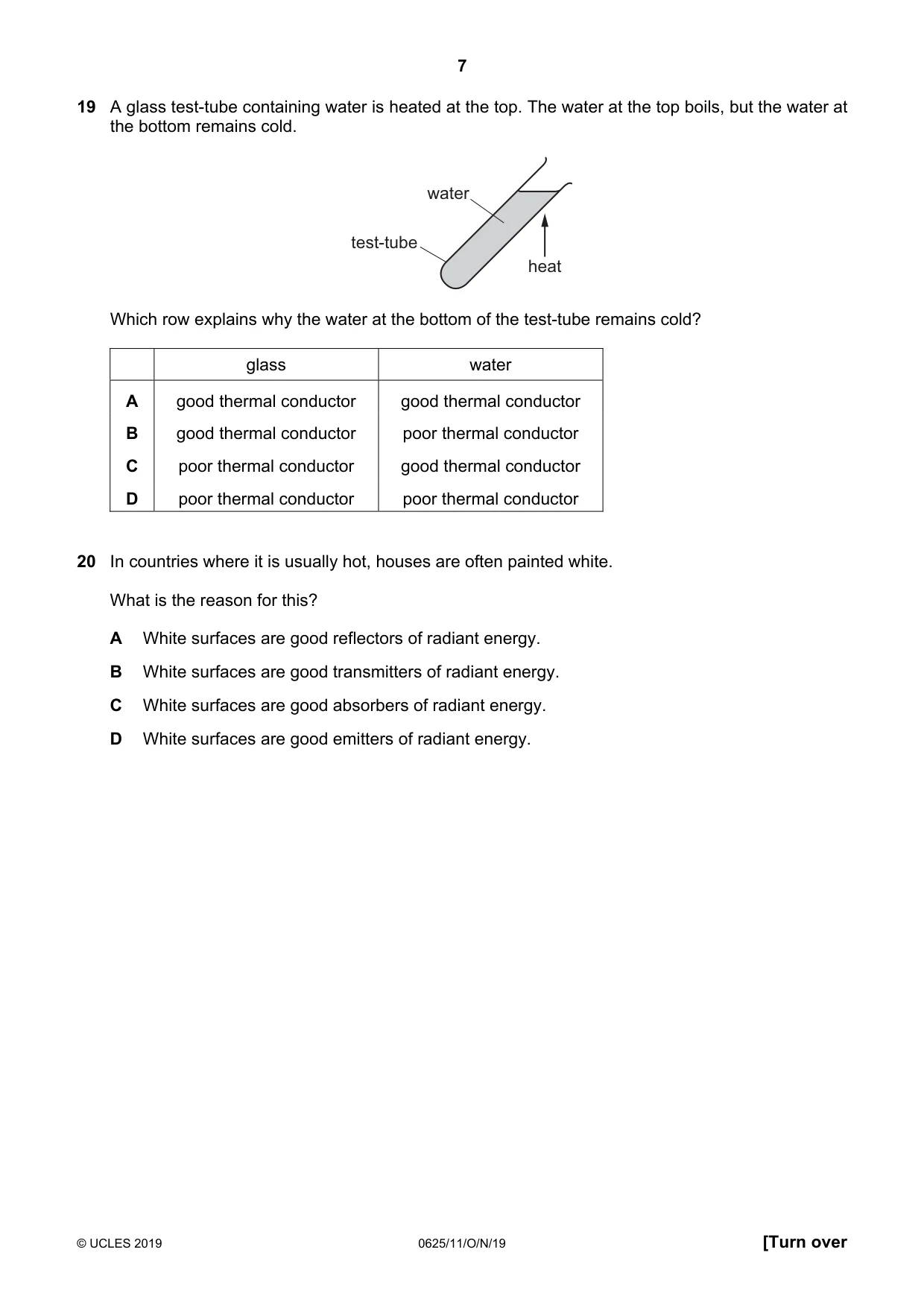
19 A glass test-tube containing water is heated at the top. The water at the top boils, but the water at the bottom remains cold. water test-tube heat Which row explains why the water at the bottom of the test-tube remains cold? glass water A good thermal conductor good thermal conductor B good thermal conductor poor thermal conductor C poor thermal conductor good thermal conductor D poor thermal conductor poor thermal conductor
Mark scheme: D
Q20 · In countries where it is usually hot, houses are often painted white
20 In countries where it is usually hot, houses are often painted white. What is the reason for this? A White surfaces are good reflectors of radiant energy. B White surfaces are good transmitters of radiant energy. C White surfaces are good absorbers of radiant energy. D White surfaces are good emitters of radiant energy.
Mark scheme: A
Q21 · The diagram shows wavefronts on the surface of water, viewed from above
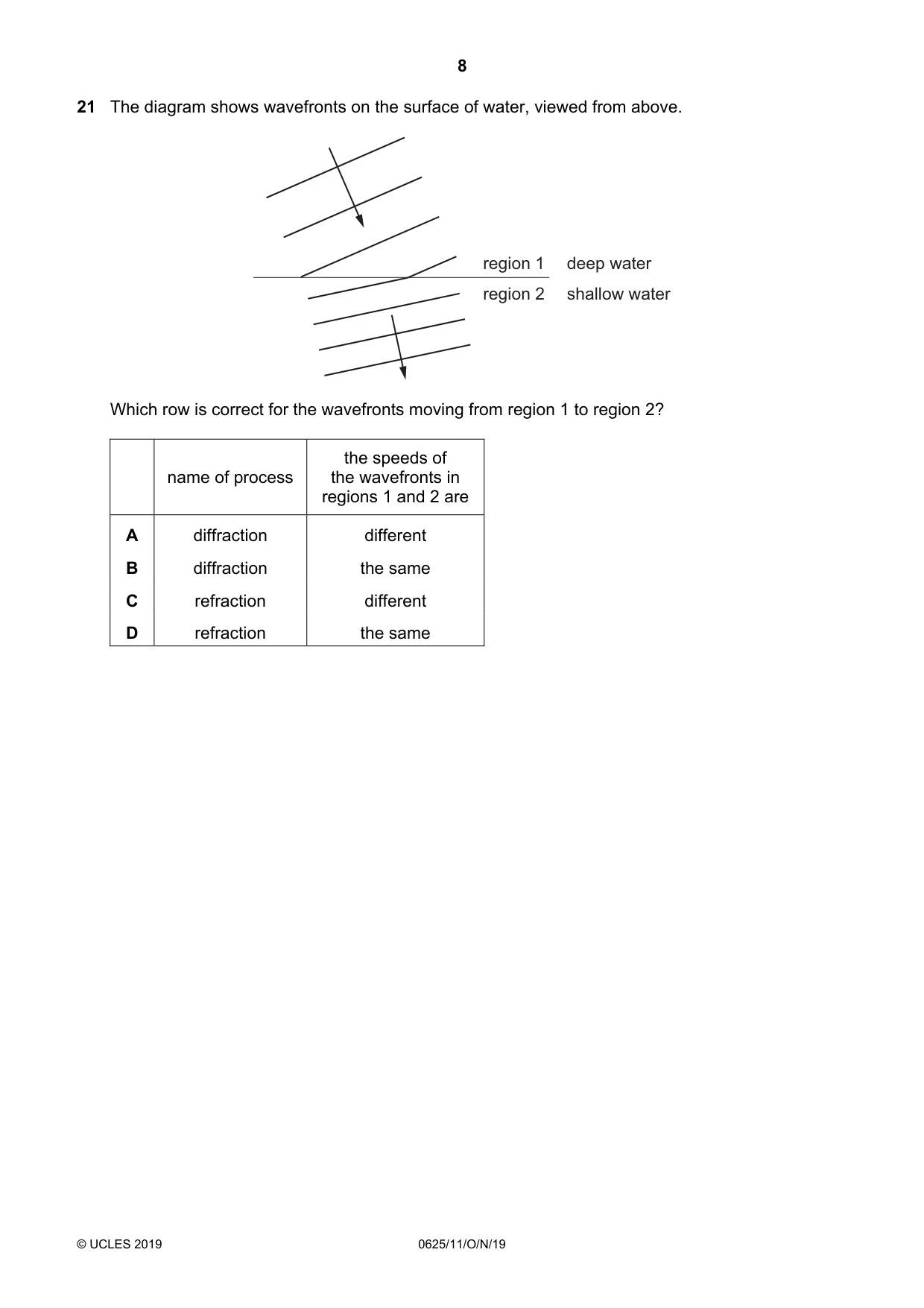
21 The diagram shows wavefronts on the surface of water, viewed from above. region 1 deep water region 2 shallow water Which row is correct for the wavefronts moving from region 1 to region 2? the speeds of name of process the wavefronts in regions 1 and 2 are A diffraction different B diffraction the same C refraction different D refraction the same
Mark scheme: C
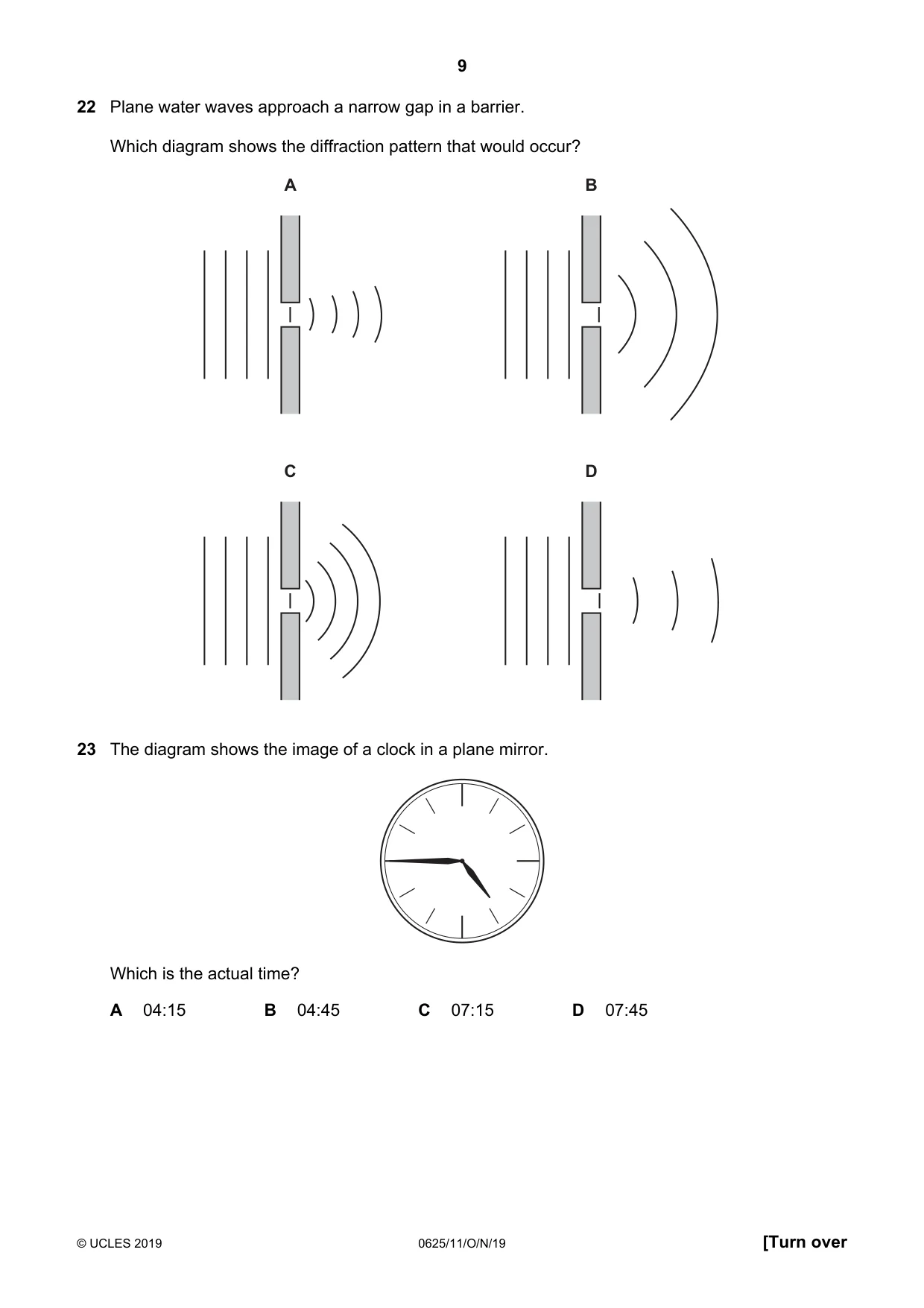
Q22 · Plane water waves approach a narrow gap in a barrier
22 Plane water waves approach a narrow gap in a barrier. Which diagram shows the diffraction pattern that would occur? A B C D
Mark scheme: C
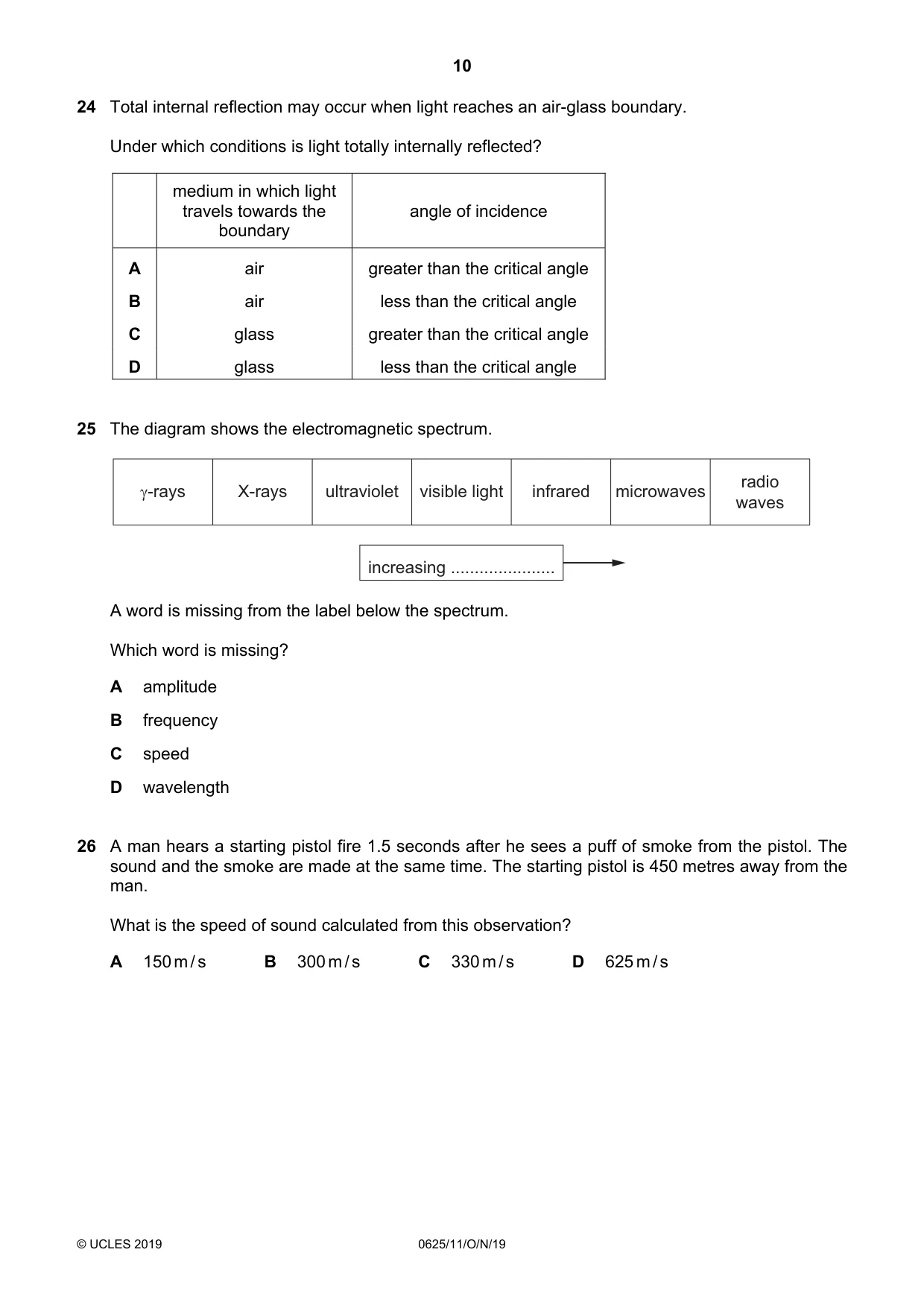
Q23 · The diagram shows the image of a clock in a plane mirror
23 The diagram shows the image of a clock in a plane mirror. Which is the actual time? A 04:15 B 04:45 C 07:15 D 07:45
Mark scheme: C
Q24 · Total internal reflection may occur when light reaches an air-glass boundary
24 Total internal reflection may occur when light reaches an air-glass boundary. Under which conditions is light totally internally reflected? medium in which light travels towards the angle of incidence boundary A air greater than the critical angle B air less than the critical angle C glass greater than the critical angle D glass less than the critical angle
Mark scheme: C
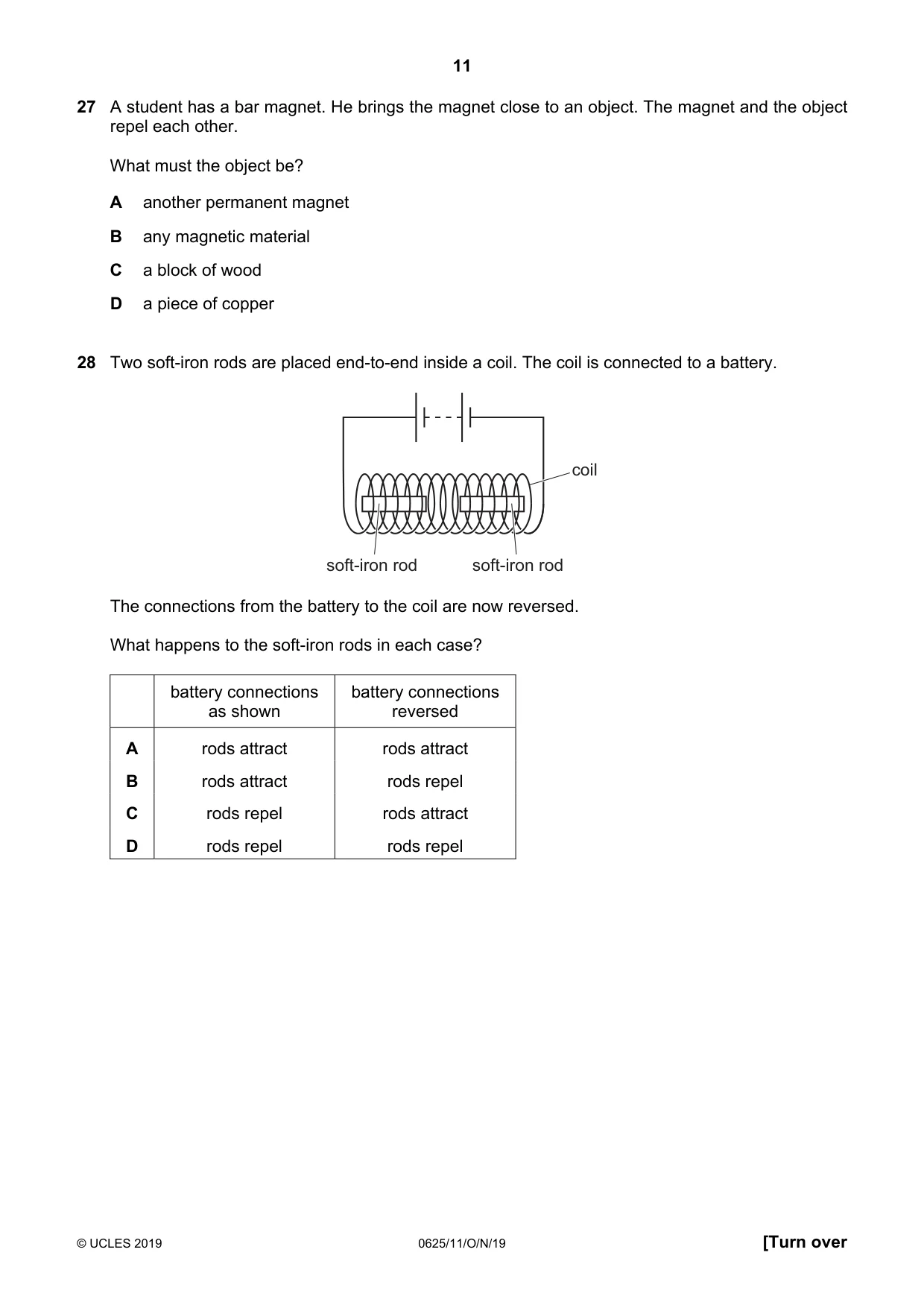
Q25 · The diagram shows the electromagnetic spectrum
25 The diagram shows the electromagnetic spectrum. radio γ-rays X-rays ultraviolet visible light infrared microwaves waves increasing ...................... A word is missing from the label below the spectrum. Which word is missing? A amplitude B frequency C speed D wavelength
Mark scheme: D
Q26 · A man hears a starting pistol fire 1.5 seconds after he sees a puff of smoke from the…
26 A man hears a starting pistol fire 1.5 seconds after he sees a puff of smoke from the pistol. The sound and the smoke are made at the same time. The starting pistol is 450 metres away from the man. What is the speed of sound calculated from this observation? A 150 m / s B 300 m / s C 330 m / s D 625 m / s
Mark scheme: B
Q27 · A student has a bar magnet
27 A student has a bar magnet. He brings the magnet close to an object. The magnet and the object repel each other. What must the object be? A another permanent magnet B any magnetic material C a block of wood D a piece of copper
Mark scheme: A
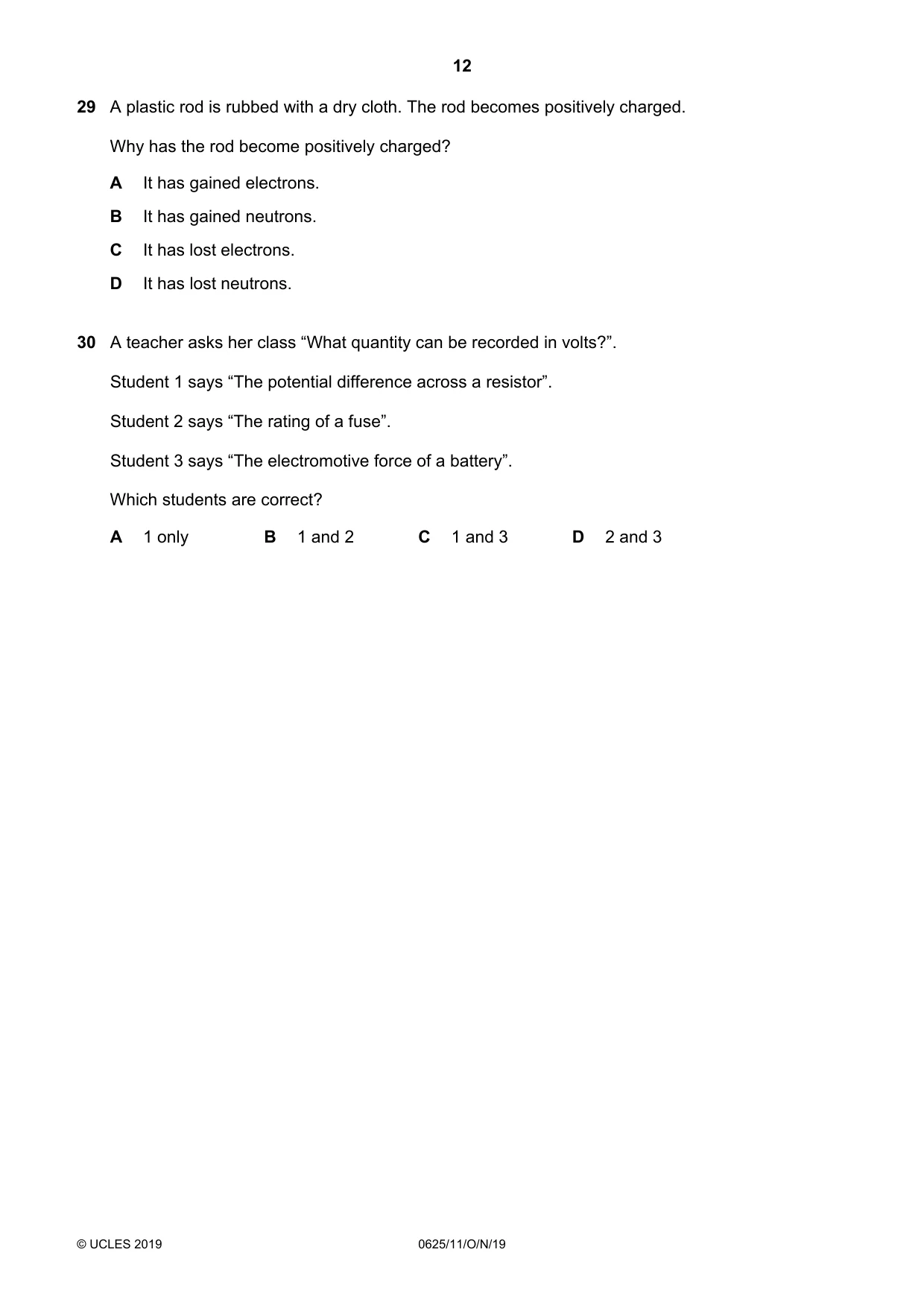
Q28 · Two soft-iron rods are placed end-to-end inside a coil
28 Two soft-iron rods are placed end-to-end inside a coil. The coil is connected to a battery. coil soft-iron rod soft-iron rod The connections from the battery to the coil are now reversed. What happens to the soft-iron rods in each case? battery connections battery connections as shown reversed A rods attract rods attract B rods attract rods repel C rods repel rods attract D rods repel rods repel
Mark scheme: A
Q29 · A plastic rod is rubbed with a dry cloth
29 A plastic rod is rubbed with a dry cloth. The rod becomes positively charged. Why has the rod become positively charged? A It has gained electrons. B It has gained neutrons. C It has lost electrons. D It has lost neutrons.
Mark scheme: C
Q30 · A teacher asks her class “What quantity can be recorded in volts?”
30 A teacher asks her class “What quantity can be recorded in volts?”. Student 1 says “The potential difference across a resistor”. Student 2 says “The rating of a fuse”. Student 3 says “The electromotive force of a battery”. Which students are correct? A 1 only B 1 and 2 C 1 and 3 D 2 and 3
Mark scheme: C
Q31 · The circuit shows two lamps connected to a d.c
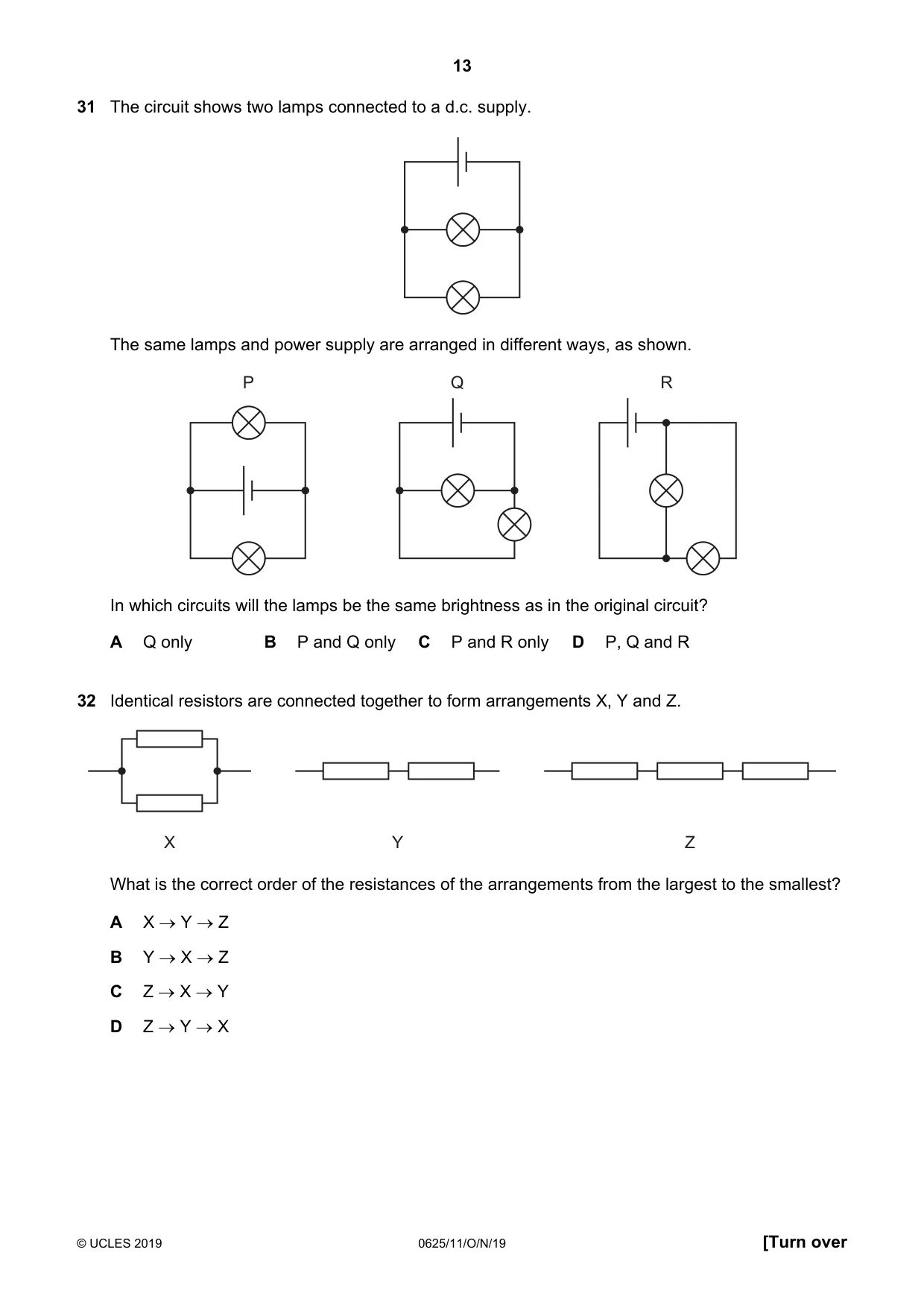
31 The circuit shows two lamps connected to a d.c. supply. The same lamps and power supply are arranged in different ways, as shown. P Q R In which circuits will the lamps be the same brightness as in the original circuit? A Q only B P and Q only C P and R only D P, Q and R
Mark scheme: D
Q32 · Identical resistors are connected together to form arrangements X, Y and Z
32 Identical resistors are connected together to form arrangements X, Y and Z. X Y Z What is the correct order of the resistances of the arrangements from the largest to the smallest? A X → Y → Z B Y → X → Z C Z → X → Y D Z → Y → X
Mark scheme: D
Q33 · A student uses 100 cm of resistance wire XY in a circuit to make a potential divider
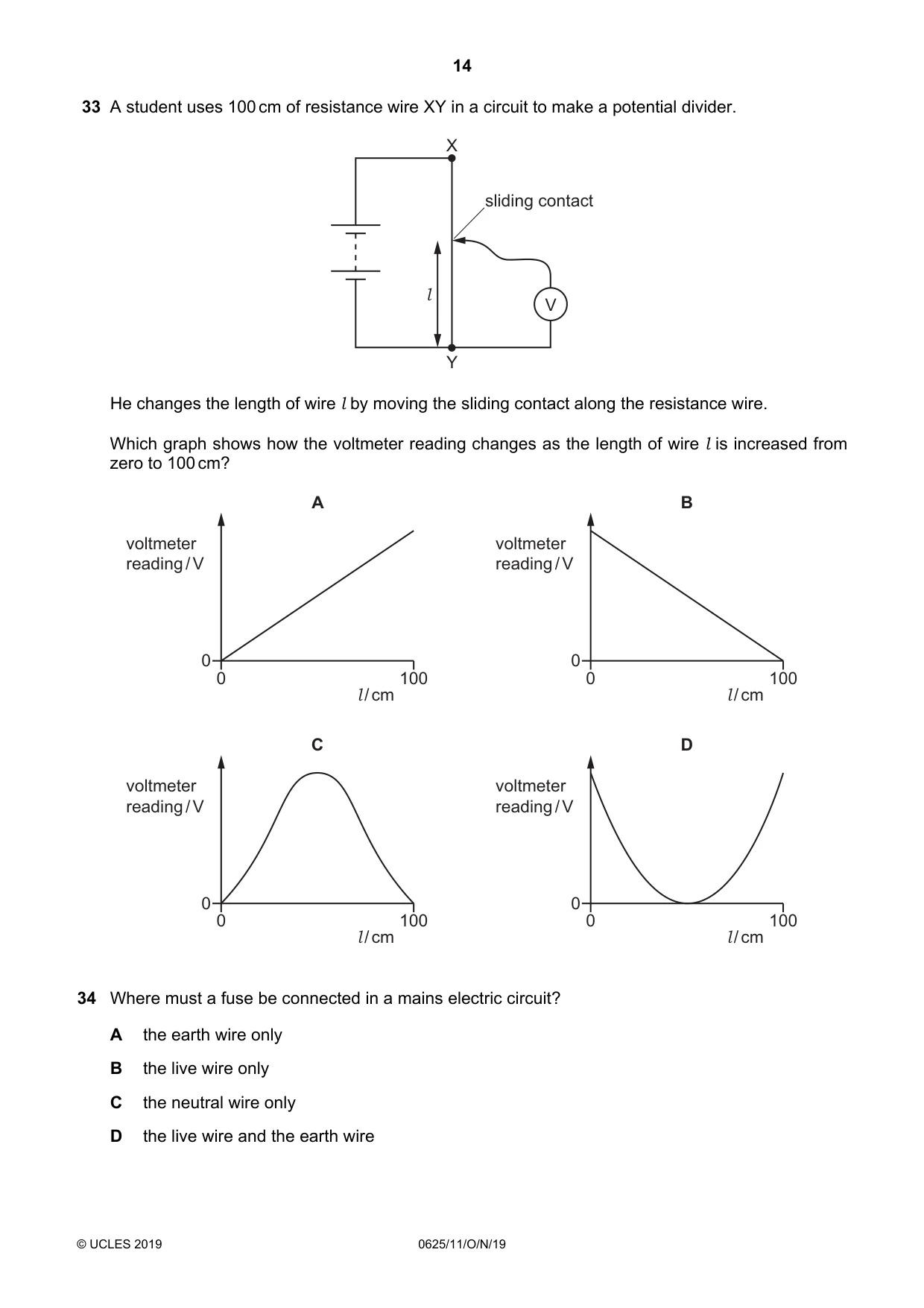
33 A student uses 100 cm of resistance wire XY in a circuit to make a potential divider. X sliding contact l V Y He changes the length of wire l by moving the sliding contact along the resistance wire. Which graph shows how the voltmeter reading changes as the length of wire l is increased from zero to 100 cm? A B voltmeter voltmeter reading / V reading / V 0 0 0 100 0 100 l / cm l / cm C D voltmeter voltmeter reading / V reading / V 0 0 0 100 0 100 l / cm l / cm
Mark scheme: A
Q34 · Where must a fuse be connected in a mains electric circuit?
34 Where must a fuse be connected in a mains electric circuit? A the earth wire only B the live wire only C the neutral wire only D the live wire and the earth wire
Mark scheme: B
Q35 · A student investigates the output voltage induced across a coil of wire by a bar magnet
35 A student investigates the output voltage induced across a coil of wire by a bar magnet. When will the induced voltage have the greatest value? A The student slowly moves the bar magnet into the coil of wire. B The student leaves the bar magnet stationary in the coil of wire. C The student quickly removes the bar magnet from the coil of wire. D The student places the bar magnet at rest outside the coil of wire.
Mark scheme: C
Q36 · There is a current in a wire
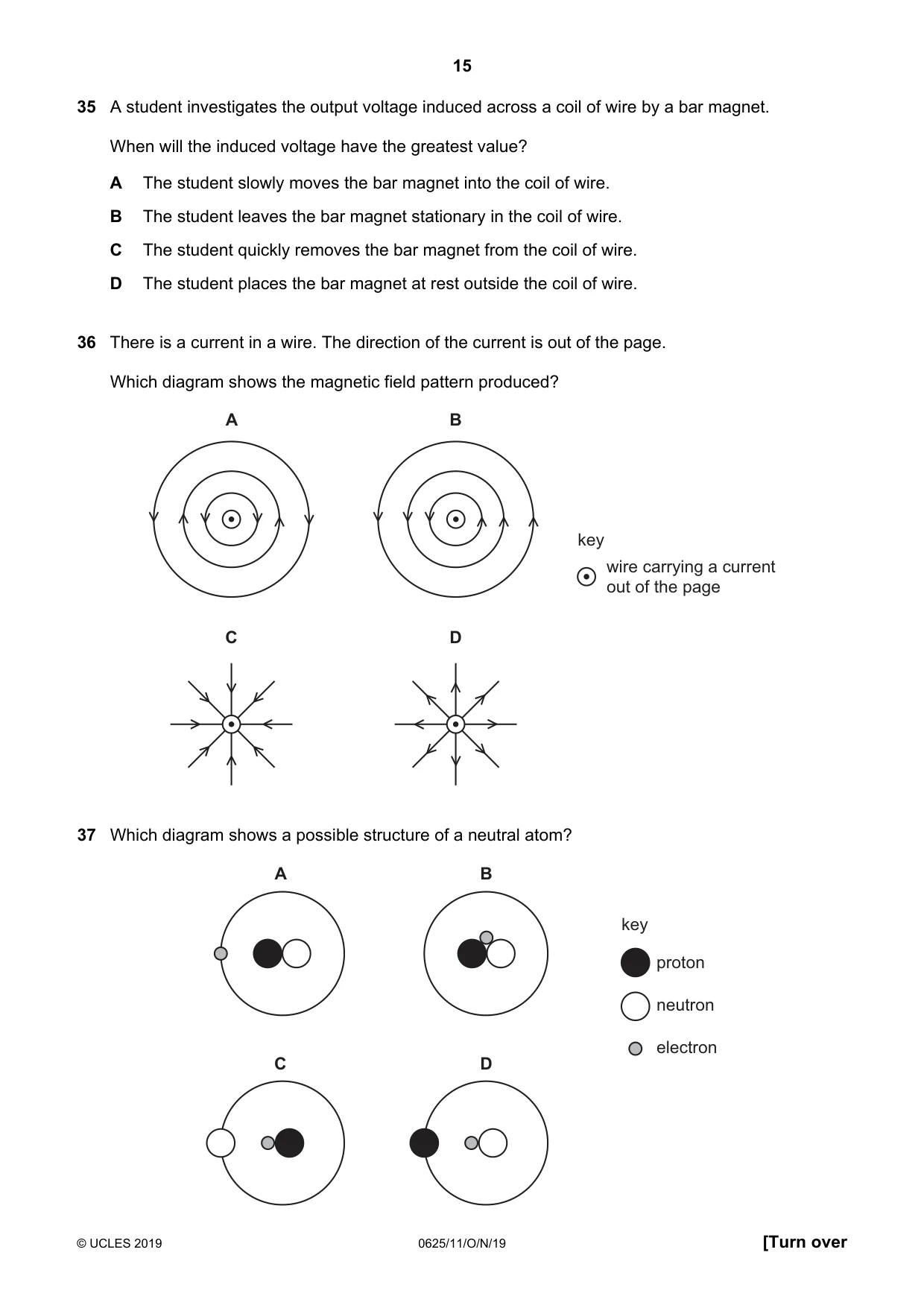
36 There is a current in a wire. The direction of the current is out of the page. Which diagram shows the magnetic field pattern produced? A B key wire carrying a current out of the page C D
Mark scheme: B
Q37 · Which diagram shows a possible structure of a neutral atom?
37 Which diagram shows a possible structure of a neutral atom? A B key proton neutron electron C D
Mark scheme: A
Q38 · A nuclide of cobalt contains 27 protons and 32 neutrons
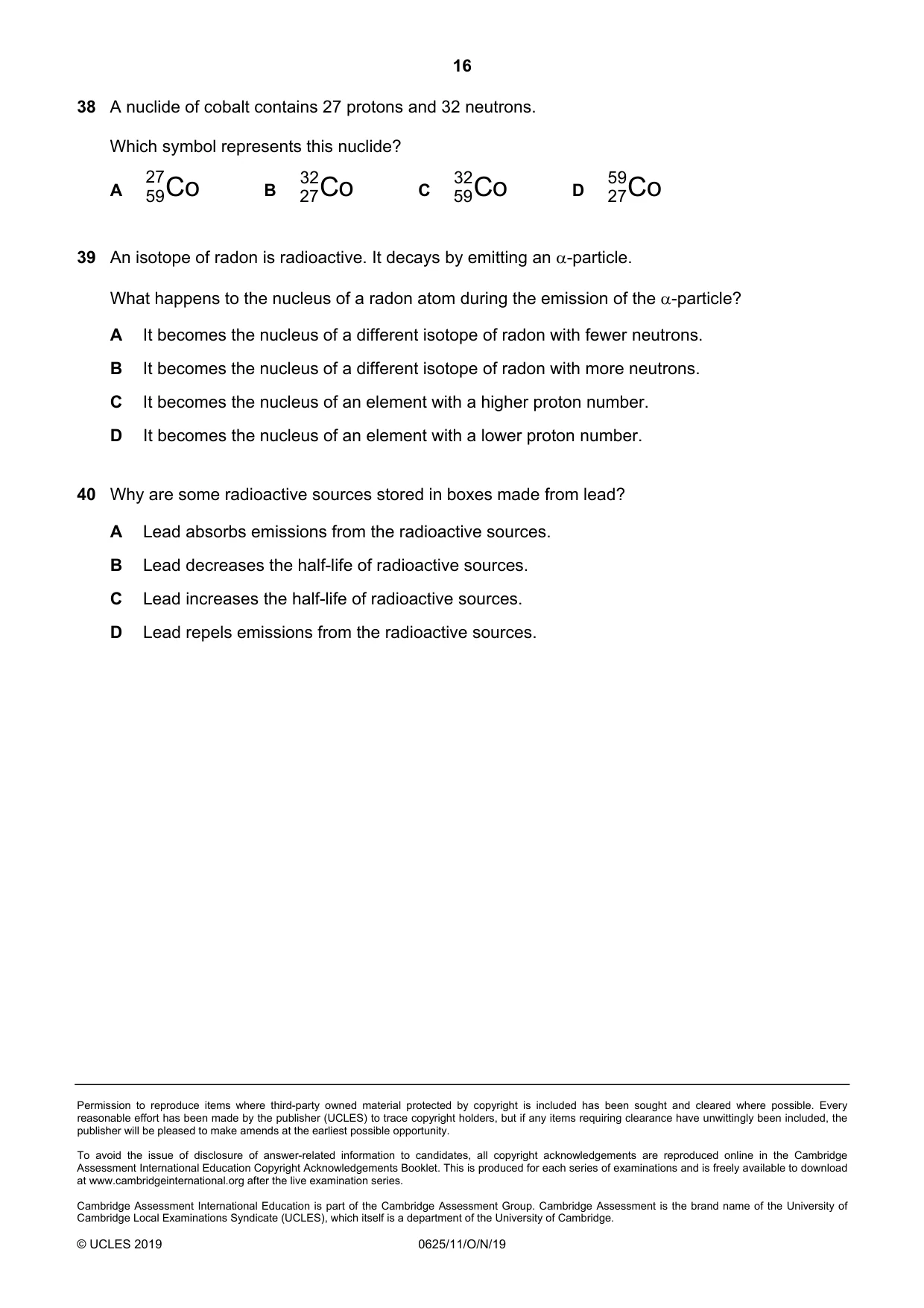
38 A nuclide of cobalt contains 27 protons and 32 neutrons. Which symbol represents this nuclide? 27 59Co 27Co 32 59Co 32 59 27Co A B C D
Mark scheme: D
Q39 · An isotope of radon is radioactive
39 An isotope of radon is radioactive. It decays by emitting an α-particle. What happens to the nucleus of a radon atom during the emission of the α-particle? A It becomes the nucleus of a different isotope of radon with fewer neutrons. B It becomes the nucleus of a different isotope of radon with more neutrons. C It becomes the nucleus of an element with a higher proton number. D It becomes the nucleus of an element with a lower proton number.
Mark scheme: D
Q40 · Why are some radioactive sources stored in boxes made from lead?
40 Why are some radioactive sources stored in boxes made from lead? A Lead absorbs emissions from the radioactive sources. B Lead decreases the half-life of radioactive sources. C Lead increases the half-life of radioactive sources. D Lead repels emissions from the radioactive sources.
Mark scheme: A
What was in this paper
The subtopics covered by these 40 questions, and how many questions each got. Open one in a new tab to see every Cambridge question on it.
3Energy, work and power3Forces3Thermal properties and temperature3Electrical quantities2Electromagnetic effects2General properties of waves2Kinetic particle model of matter2Light2Motion2Pressure2Radioactivity2Simple phenomena of magnetism2The nuclear model of the atom2Transfer of thermal energy2Density1Electrical safety1Electromagnetic spectrum1Mass and weight1Physical quantities and measurement techniques1Sound1What you needed in this session
Cambridge’s own grade thresholds for 2019 Oct/Nov, Paper 1 · Variant 1. A higher threshold means an easier paper — the bar moves with how the cohort did.