Cambridge IGCSE Physics 0625 — 2025 May/June Paper 1 · Variant 1
0625/11/M/J/25 · 40 questions · 40 marks · ≈45 min
The question paper and its mark scheme, free to read here and free to download. This is Cambridge’s own paper, exactly as it was sat.
Question paper16 pages
Mark scheme3 pages
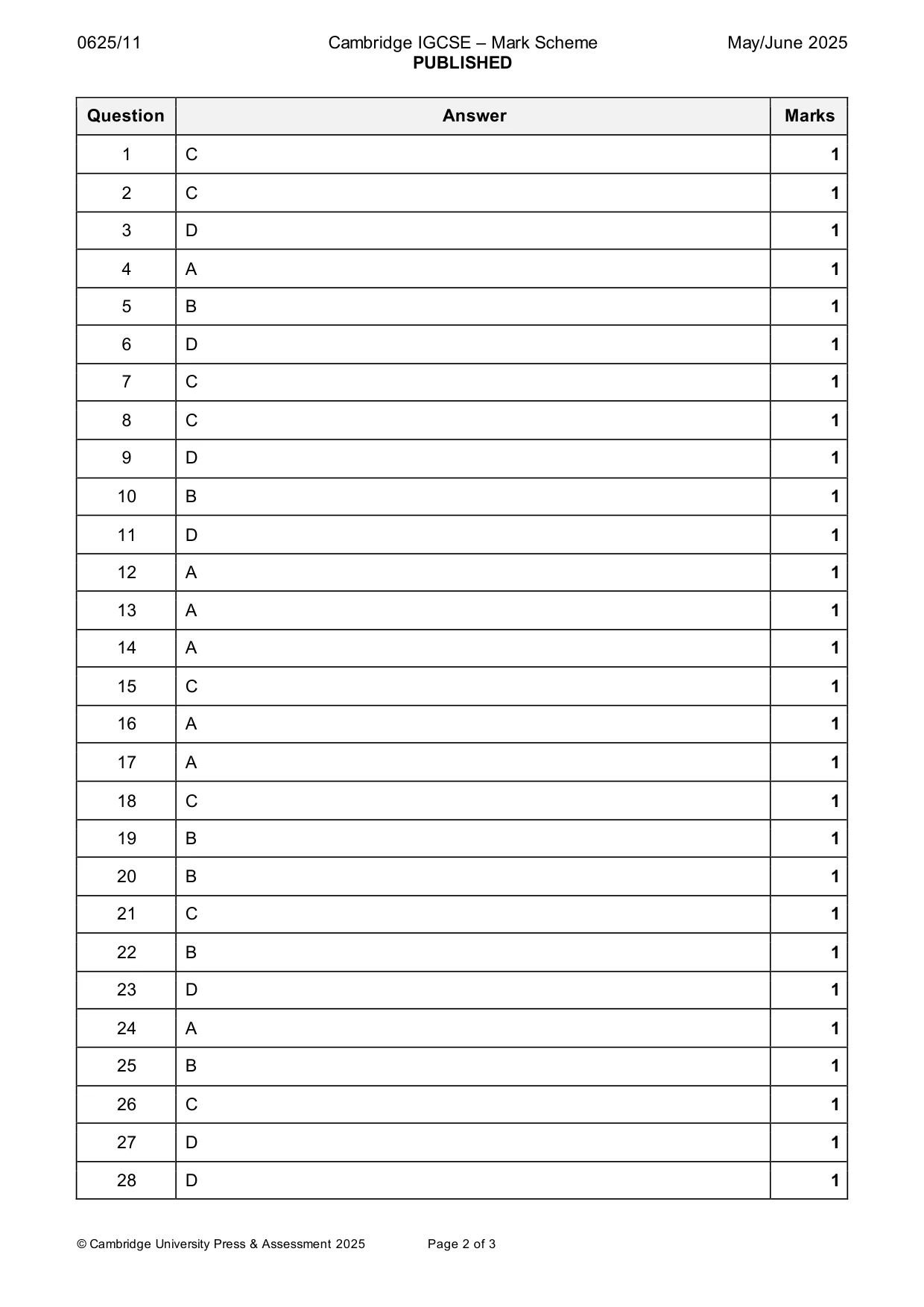
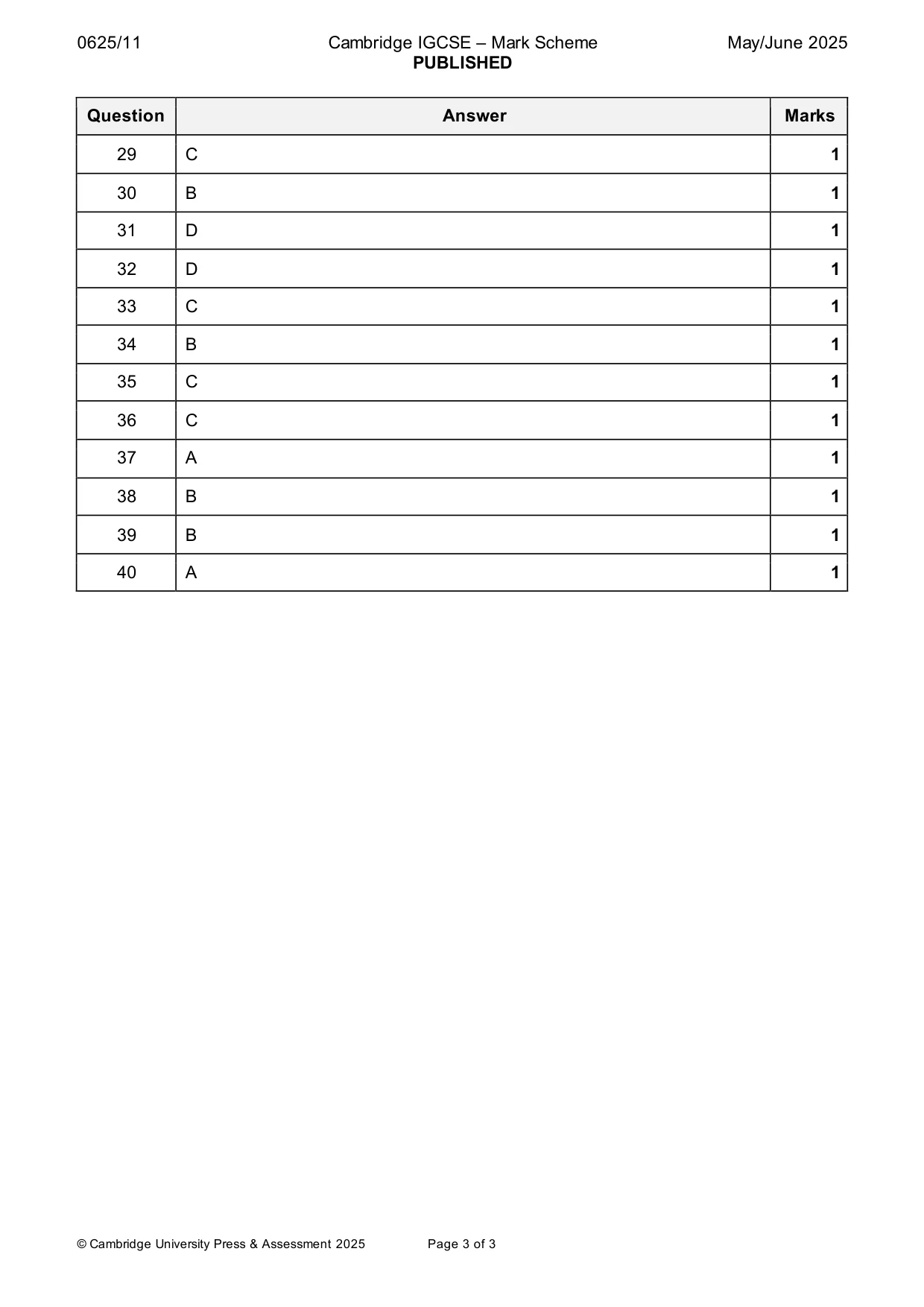
Answers below. Sit the paper first if you are practising.
Questions as text
Q1 · The diagram shows a measuring cylinder containing liquid
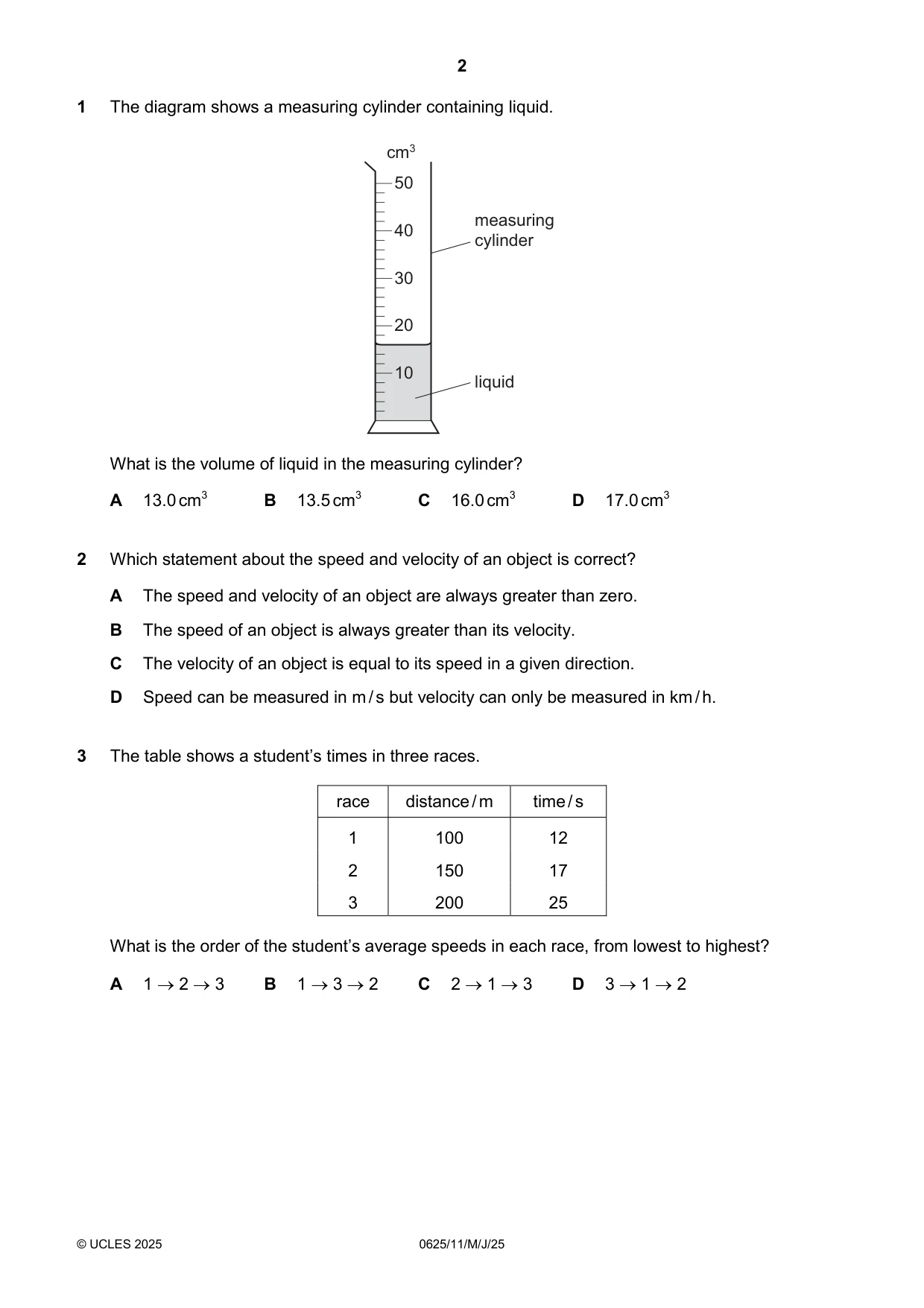
1 The diagram shows a measuring cylinder containing liquid. cm3 50 measuring 40 cylinder 30 20 10 liquid What is the volume of liquid in the measuring cylinder? A 13.0 cm3 B 13.5 cm3 C 16.0 cm3 D 17.0 cm3
Mark scheme: C
More questions on Physical quantities and measurement techniques
Q2 · Which statement about the speed and velocity of an object is correct?
2 Which statement about the speed and velocity of an object is correct? A The speed and velocity of an object are always greater than zero. B The speed of an object is always greater than its velocity. C The velocity of an object is equal to its speed in a given direction. D Speed can be measured in m / s but velocity can only be measured in km / h.
Mark scheme: C
Q3 · The table shows a student’s times in three races
3 The table shows a student’s times in three races. race distance / m time / s 1 100 12 2 150 17 3 200 25 What is the order of the student’s average speeds in each race, from lowest to highest? A 1 2 3 B 1 3 2 C 2 1 3 D 3 1 2
Mark scheme: D
Q4 · Which row gives the correct weight for the mass shown when it is at the Earth’s surface?
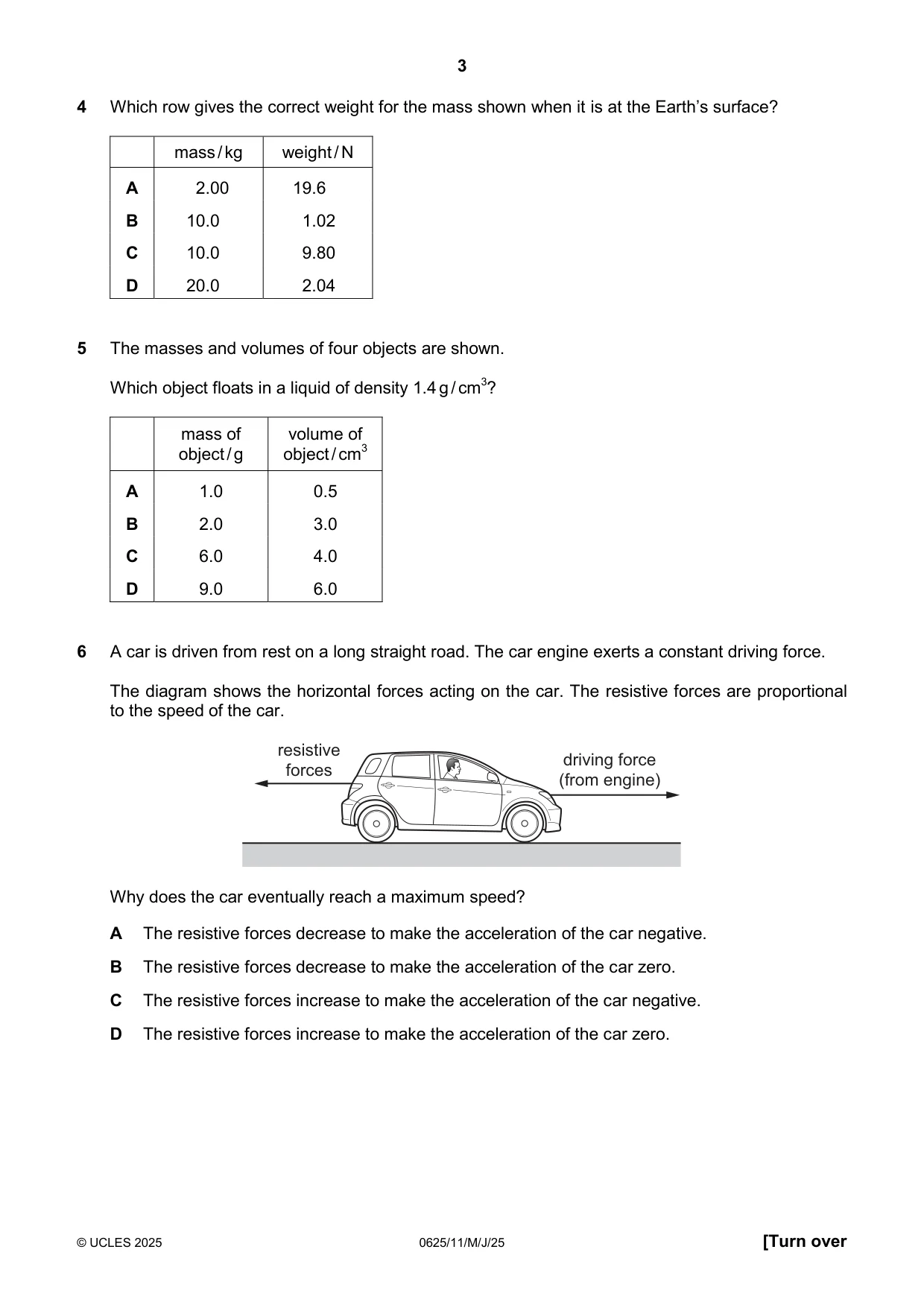
4 Which row gives the correct weight for the mass shown when it is at the Earth’s surface? mass / kg weight / N A 2.00 19.6 B 10.0 1.02 C 10.0 9.80 D 20.0 2.04
Mark scheme: A
Q5 · The masses and volumes of four objects are shown
5 The masses and volumes of four objects are shown. Which object floats in a liquid of density 1.4 g / cm3? mass of volume of object / g object / cm3 A 1.0 0.5 B 2.0 3.0 C 6.0 4.0 D 9.0 6.0
Mark scheme: B
Q6 · A car is driven from rest on a long straight road
6 A car is driven from rest on a long straight road. The car engine exerts a constant driving force. The diagram shows the horizontal forces acting on the car. The resistive forces are proportional to the speed of the car. resistive driving force forces (from engine) Why does the car eventually reach a maximum speed? A The resistive forces decrease to make the acceleration of the car negative. B The resistive forces decrease to make the acceleration of the car zero. C The resistive forces increase to make the acceleration of the car negative. D The resistive forces increase to make the acceleration of the car zero.
Mark scheme: D
Q7 · A mattress placed on a bed contains many compression springs
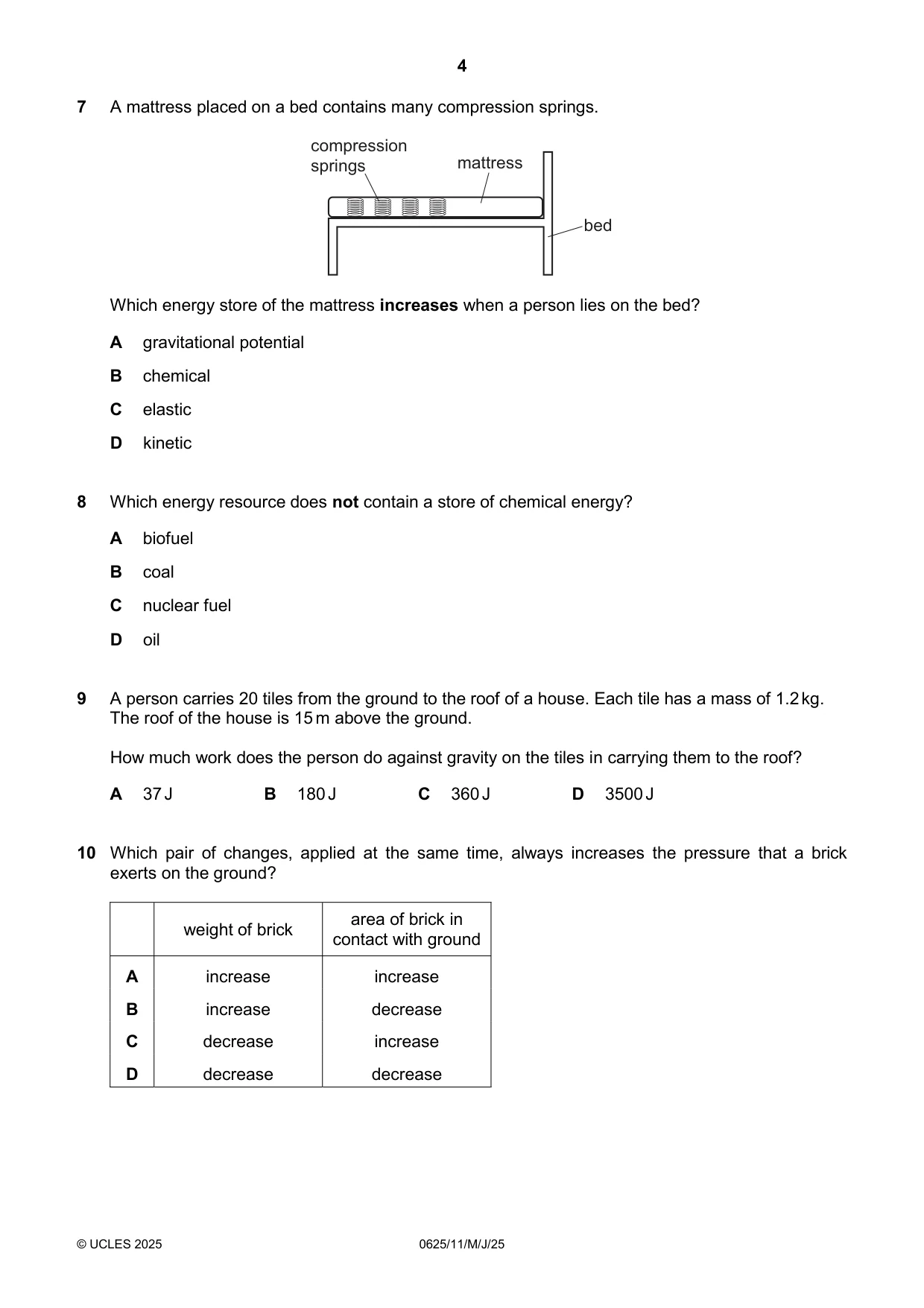
7 A mattress placed on a bed contains many compression springs. compression springs mattress bed Which energy store of the mattress increases when a person lies on the bed? A gravitational potential B chemical C elastic D kinetic
Mark scheme: C
Q8 · Which energy resource does not contain a store of chemical energy?
8 Which energy resource does not contain a store of chemical energy? A biofuel B coal C nuclear fuel D oil
Mark scheme: C
Q9 · A person carries 20 tiles from the ground to the roof of a house
9 A person carries 20 tiles from the ground to the roof of a house. Each tile has a mass of 1.2 kg. The roof of the house is 15 m above the ground. How much work does the person do against gravity on the tiles in carrying them to the roof? A 37 J B 180 J C 360 J D 3500 J
Mark scheme: D
Q10 · Which pair of changes, applied at the same time, always increases the pressure that a…
10 Which pair of changes, applied at the same time, always increases the pressure that a brick exerts on the ground? area of brick in weight of brick contact with ground A increase increase B increase decrease C decrease increase D decrease decrease
Mark scheme: B
Q11 · Two different pure substances, X and Y, are heated
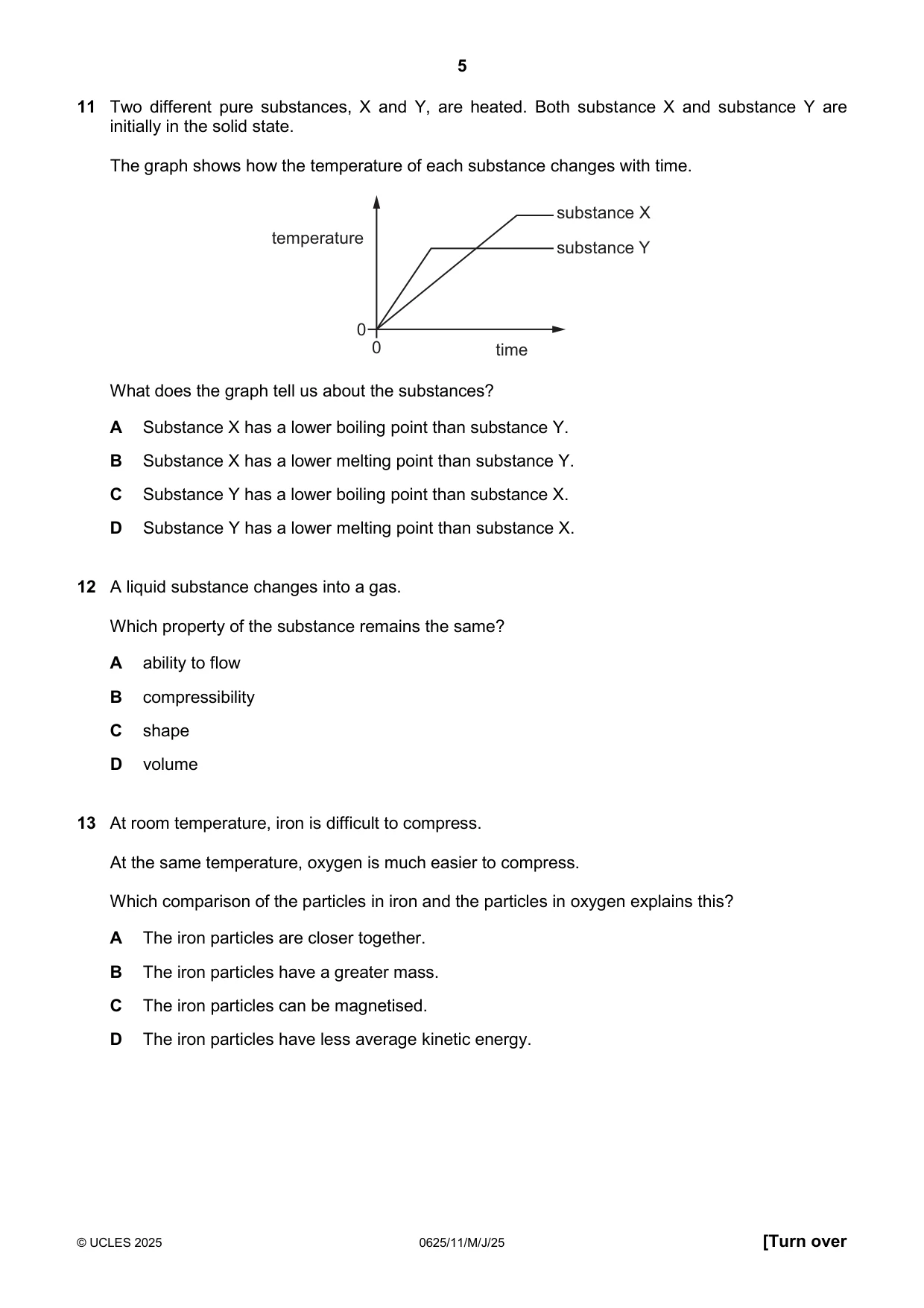
11 Two different pure substances, X and Y, are heated. Both substance X and substance Y are initially in the solid state. The graph shows how the temperature of each substance changes with time. substance X temperature substance Y 0 0 time What does the graph tell us about the substances? A Substance X has a lower boiling point than substance Y. B Substance X has a lower melting point than substance Y. C Substance Y has a lower boiling point than substance X. D Substance Y has a lower melting point than substance X.
Mark scheme: D
Q12 · A liquid substance changes into a gas
12 A liquid substance changes into a gas. Which property of the substance remains the same? A ability to flow B compressibility C shape D volume
Mark scheme: A
Q13 · At room temperature, iron is difficult to compress
13 At room temperature, iron is difficult to compress. At the same temperature, oxygen is much easier to compress. Which comparison of the particles in iron and the particles in oxygen explains this? A The iron particles are closer together. B The iron particles have a greater mass. C The iron particles can be magnetised. D The iron particles have less average kinetic energy.
Mark scheme: A
Q14 · A teacher has a gas in a sealed syringe with a movable plunger
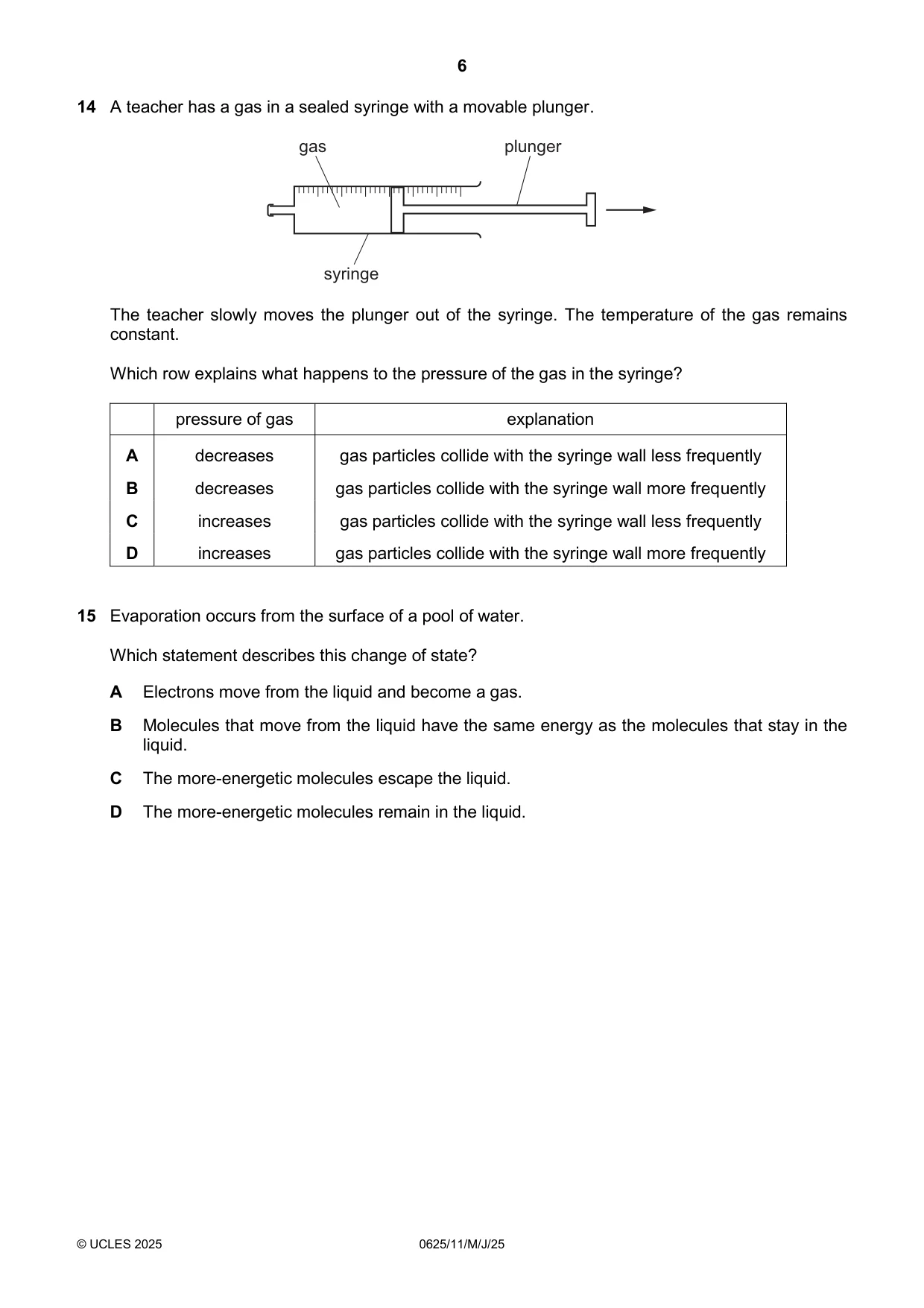
14 A teacher has a gas in a sealed syringe with a movable plunger. gas plunger syringe The teacher slowly moves the plunger out of the syringe. The temperature of the gas remains constant. Which row explains what happens to the pressure of the gas in the syringe? pressure of gas explanation A decreases gas particles collide with the syringe wall less frequently B decreases gas particles collide with the syringe wall more frequently C increases gas particles collide with the syringe wall less frequently D increases gas particles collide with the syringe wall more frequently
Mark scheme: A
Q15 · Evaporation occurs from the surface of a pool of water
15 Evaporation occurs from the surface of a pool of water. Which statement describes this change of state? A Electrons move from the liquid and become a gas. B Molecules that move from the liquid have the same energy as the molecules that stay in the liquid. C The more-energetic molecules escape the liquid. D The more-energetic molecules remain in the liquid.
Mark scheme: C
Q16 · Students test four rods of different materials, W, X, Y and Z, to compare how well the…
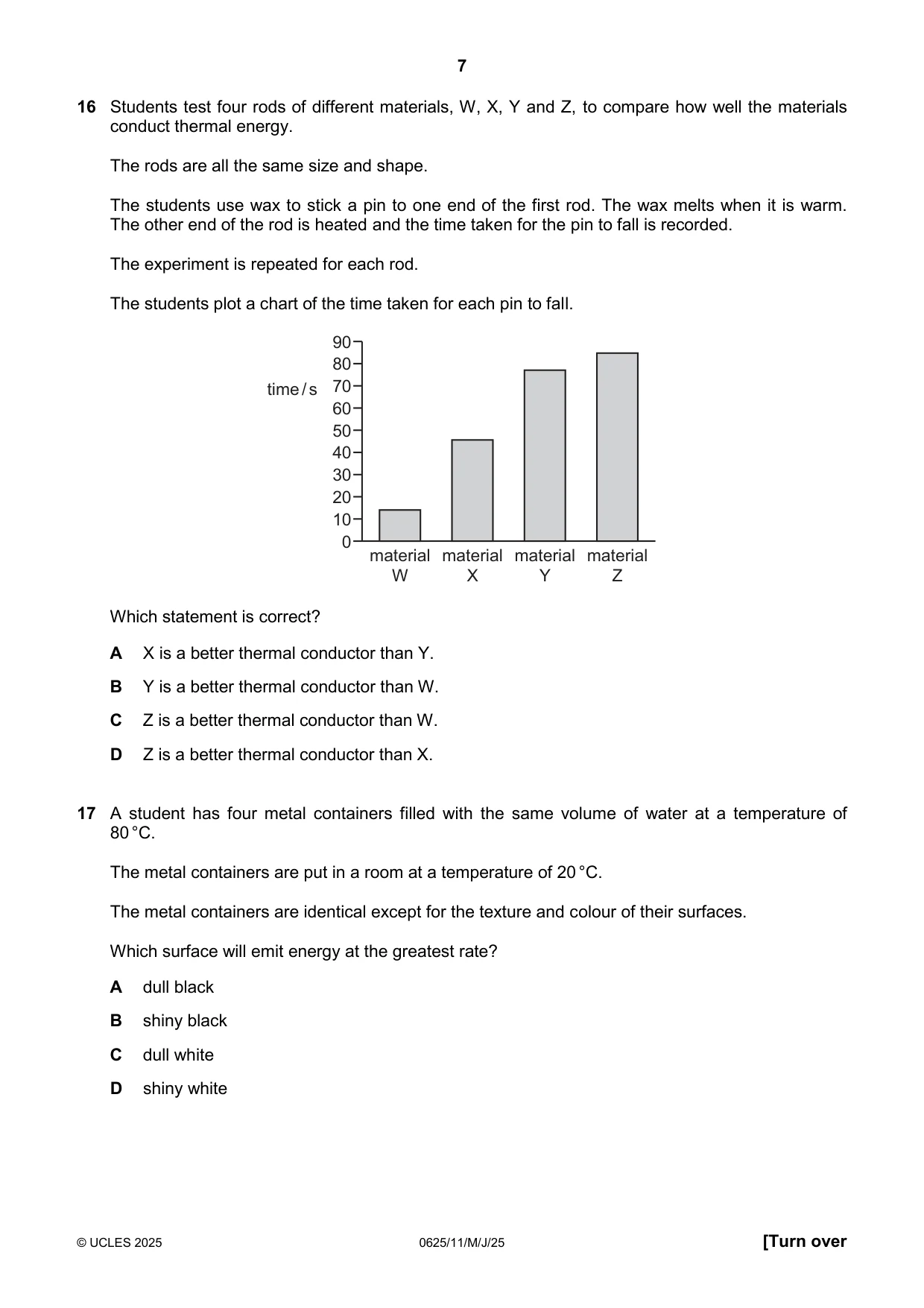
16 Students test four rods of different materials, W, X, Y and Z, to compare how well the materials conduct thermal energy. The rods are all the same size and shape. The students use wax to stick a pin to one end of the first rod. The wax melts when it is warm. The other end of the rod is heated and the time taken for the pin to fall is recorded. The experiment is repeated for each rod. The students plot a chart of the time taken for each pin to fall. 90 80 time / s 70 60 50 40 30 20 10 0 material material material material W X Y Z Which statement is correct? A X is a better thermal conductor than Y. B Y is a better thermal conductor than W. C Z is a better thermal conductor than W. D Z is a better thermal conductor than X.
Mark scheme: A
Q17 · A student has four metal containers filled with the same volume of water at a temperature…
17 A student has four metal containers filled with the same volume of water at a temperature of 80 °C. The metal containers are put in a room at a temperature of 20 °C. The metal containers are identical except for the texture and colour of their surfaces. Which surface will emit energy at the greatest rate? A dull black B shiny black C dull white D shiny white
Mark scheme: A
Q18 · A water wave has a speed of 2.0 m / s
18 A water wave has a speed of 2.0 m / s. 4.0 complete waves pass a point every 10 seconds. What is the wavelength of the wave? A 0.50 m B 0.80 m C 5.0 m D 8.0 m
Mark scheme: C
Q19 · Which row correctly describes the vibrations of a transverse wave and also gives a…
19 Which row correctly describes the vibrations of a transverse wave and also gives a correct example of a transverse wave? example of a description of vibrations transverse wave A at right angles to the wave direction sound B at right angles to the wave direction water wave C parallel to the wave direction sound D parallel to the wave direction water wave
Mark scheme: B
Q20 · The diagram shows a view from above of waves on the surface of a pond after the water has…
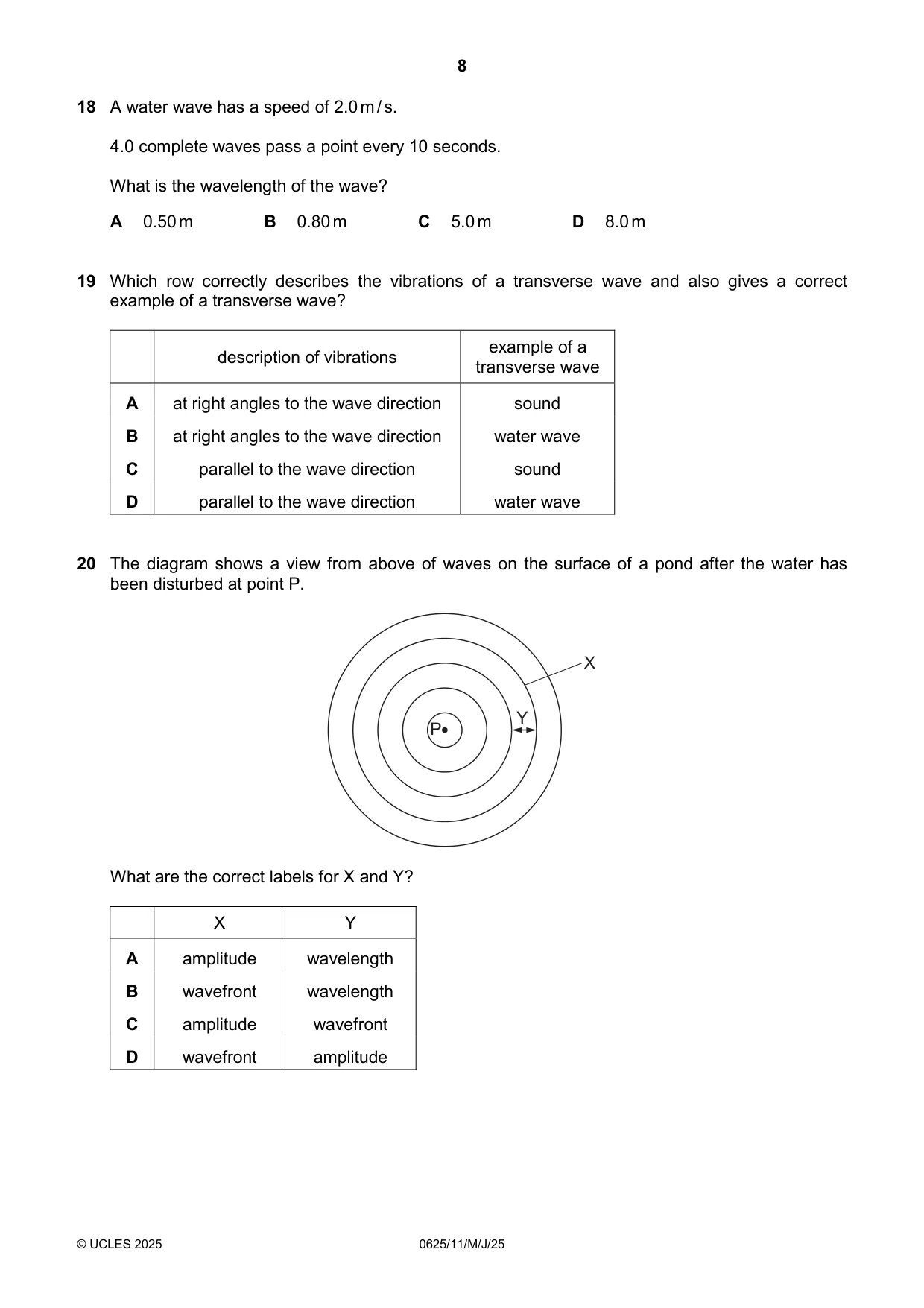
20 The diagram shows a view from above of waves on the surface of a pond after the water has been disturbed at point P. X Y P What are the correct labels for X and Y? X Y A amplitude wavelength B wavefront wavelength C amplitude wavefront D wavefront amplitude
Mark scheme: B
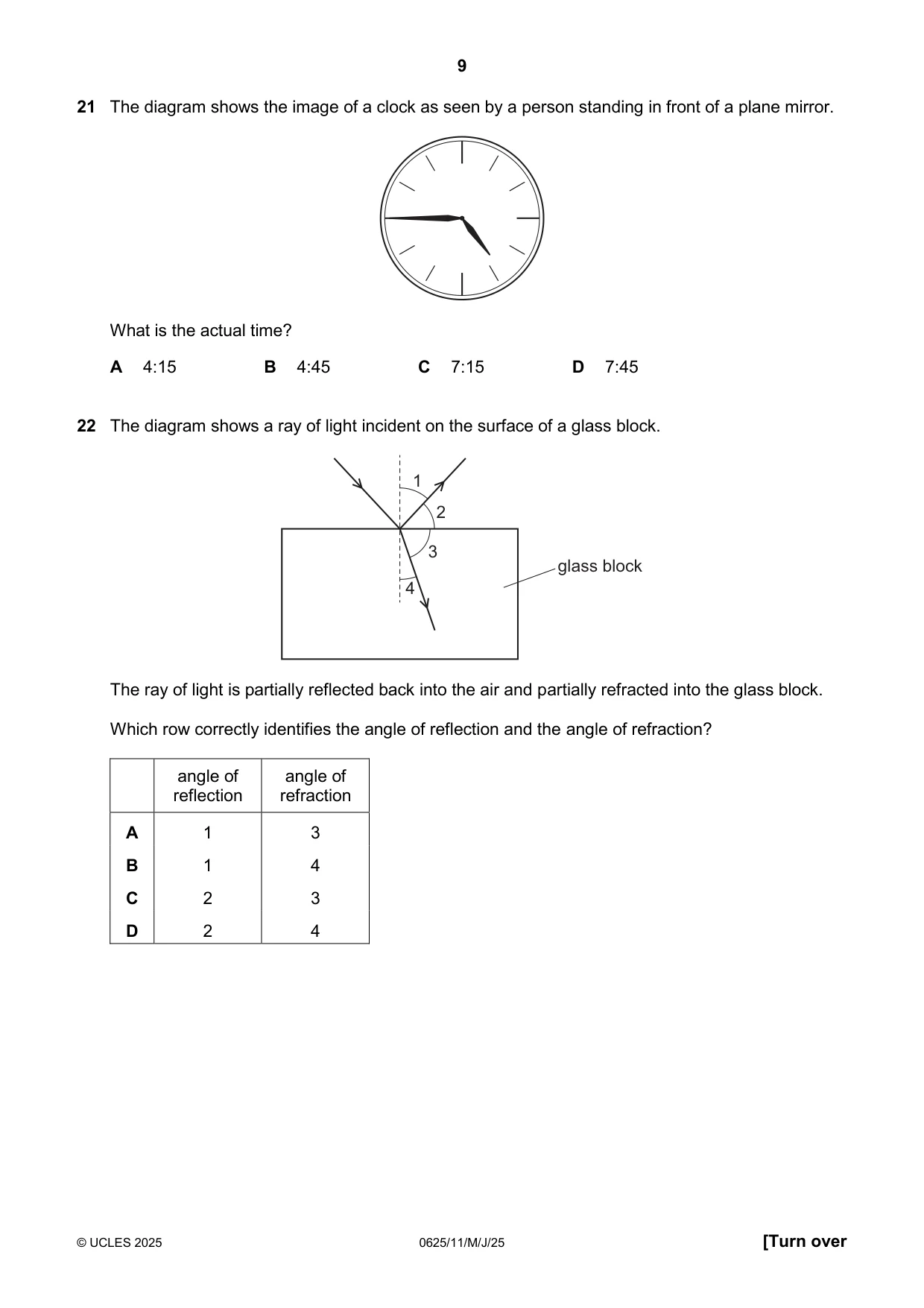
Q21 · The diagram shows the image of a clock as seen by a person standing in front of a plane…
21 The diagram shows the image of a clock as seen by a person standing in front of a plane mirror. What is the actual time? A 4:15 B 4:45 C 7:15 D 7:45
Mark scheme: C
Q22 · The diagram shows a ray of light incident on the surface of a glass block
22 The diagram shows a ray of light incident on the surface of a glass block. 1 2 3 glass block 4 The ray of light is partially reflected back into the air and partially refracted into the glass block. Which row correctly identifies the angle of reflection and the angle of refraction? angle of angle of reflection refraction A 1 3 B 1 4 C 2 3 D 2 4
Mark scheme: B
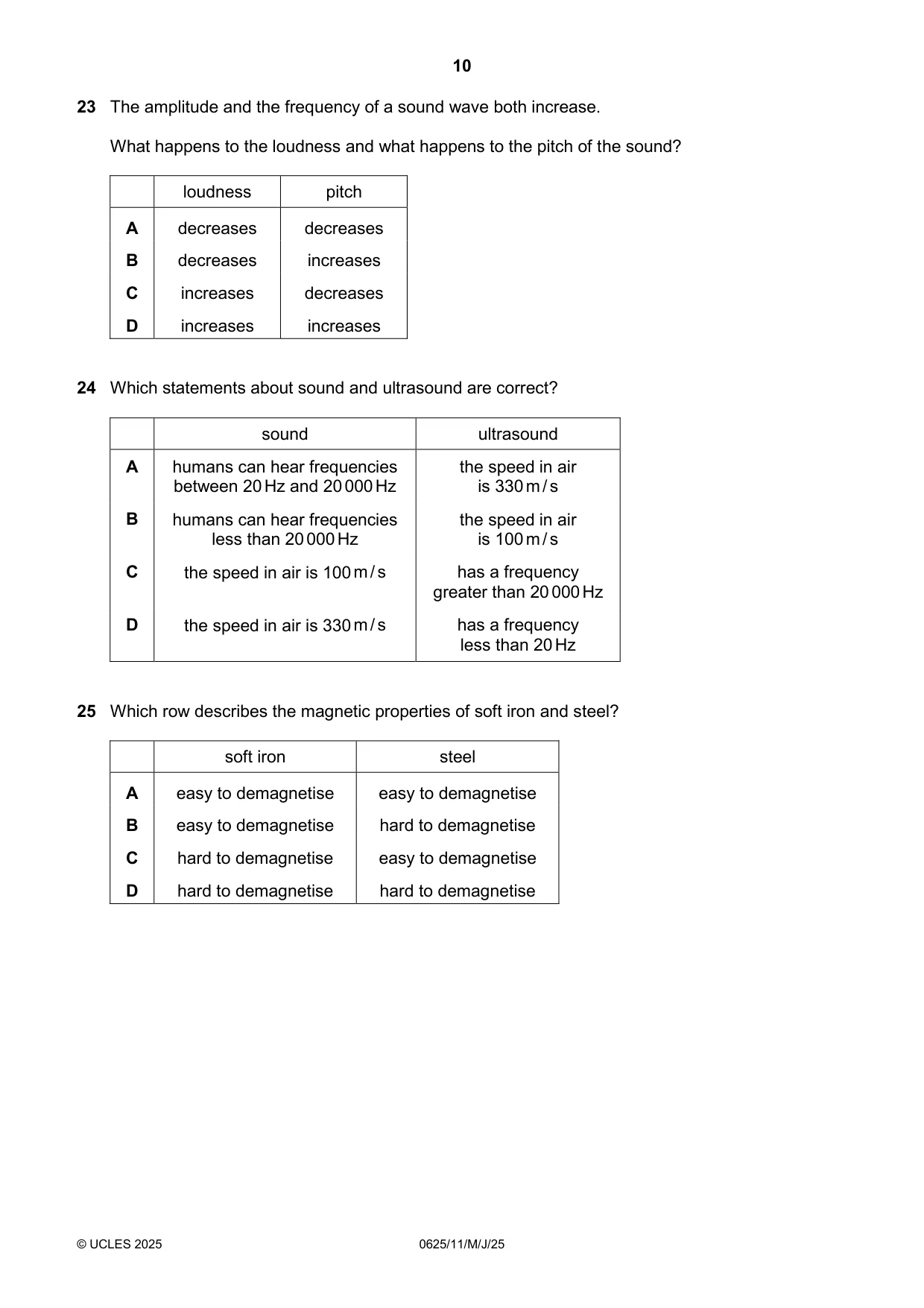
Q23 · The amplitude and the frequency of a sound wave both increase
23 The amplitude and the frequency of a sound wave both increase. What happens to the loudness and what happens to the pitch of the sound? loudness pitch A decreases decreases B decreases increases C increases decreases D increases increases
Mark scheme: D
Q24 · Which statements about sound and ultrasound are correct?
24 Which statements about sound and ultrasound are correct? sound ultrasound A humans can hear frequencies the speed in air between 20 Hz and 20 000 Hz is 330 m / s B humans can hear frequencies the speed in air less than 20 000 Hz is 100 m / s C the speed in air is 100 m / s has a frequency greater than 20 000 Hz D the speed in air is 330 m / s has a frequency less than 20 Hz
Mark scheme: A
Q25 · Which row describes the magnetic properties of soft iron and steel?
25 Which row describes the magnetic properties of soft iron and steel? soft iron steel A easy to demagnetise easy to demagnetise B easy to demagnetise hard to demagnetise C hard to demagnetise easy to demagnetise D hard to demagnetise hard to demagnetise
Mark scheme: B
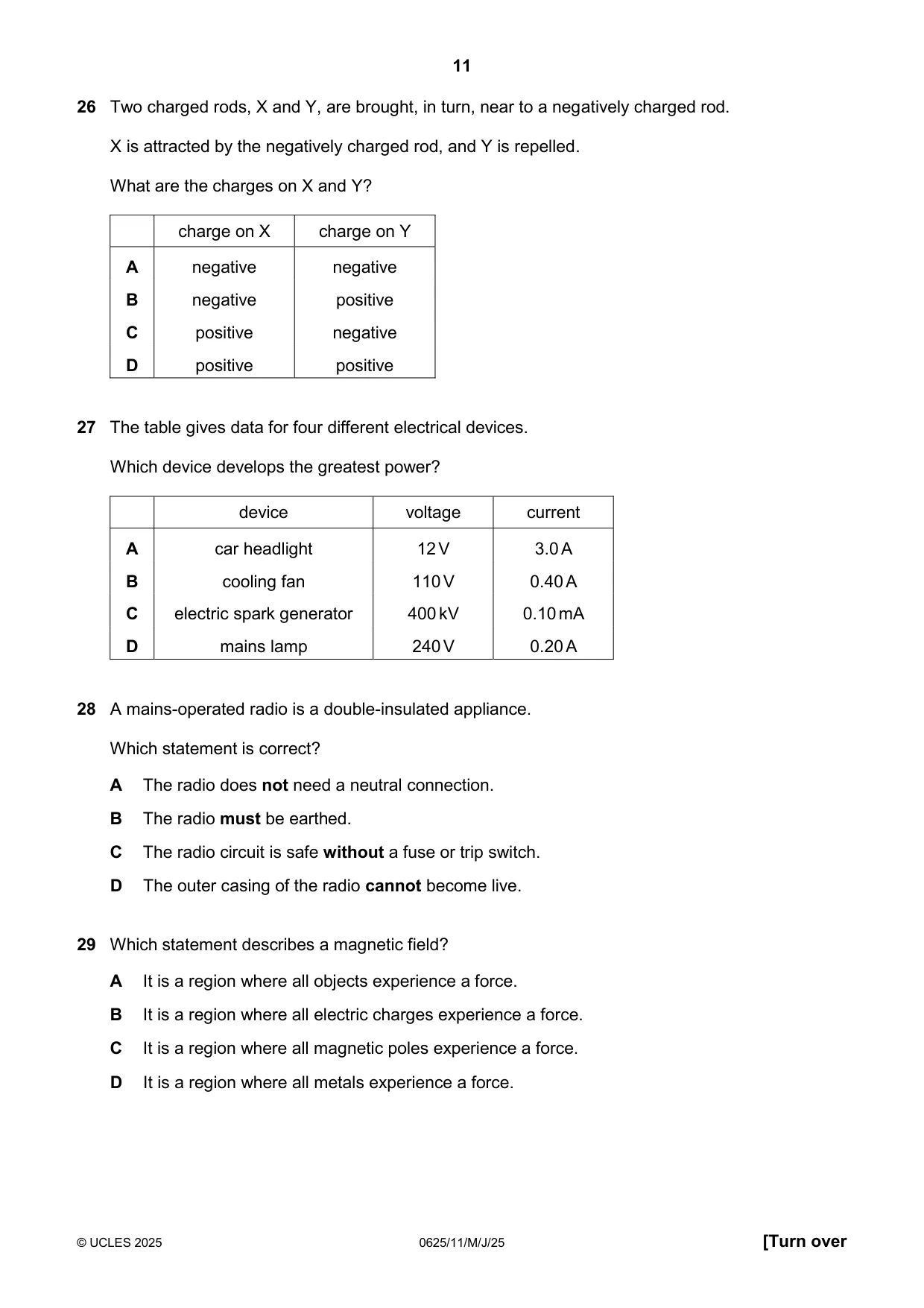
Q26 · Two charged rods, X and Y, are brought, in turn, near to a negatively charged rod
26 Two charged rods, X and Y, are brought, in turn, near to a negatively charged rod. X is attracted by the negatively charged rod, and Y is repelled. What are the charges on X and Y? charge on X charge on Y A negative negative B negative positive C positive negative D positive positive
Mark scheme: C
Q27 · The table gives data for four different electrical devices
27 The table gives data for four different electrical devices. Which device develops the greatest power? device voltage current A car headlight 12 V 3.0 A B cooling fan 110 V 0.40 A C electric spark generator 400 kV 0.10 mA D mains lamp 240 V 0.20 A
Mark scheme: D
Q28 · A mains-operated radio is a double-insulated appliance
28 A mains-operated radio is a double-insulated appliance. Which statement is correct? A The radio does not need a neutral connection. B The radio must be earthed. C The radio circuit is safe without a fuse or trip switch. D The outer casing of the radio cannot become live.
Mark scheme: D
Q29 · Which statement describes a magnetic field?
29 Which statement describes a magnetic field? A It is a region where all objects experience a force. B It is a region where all electric charges experience a force. C It is a region where all magnetic poles experience a force. D It is a region where all metals experience a force.
Mark scheme: C
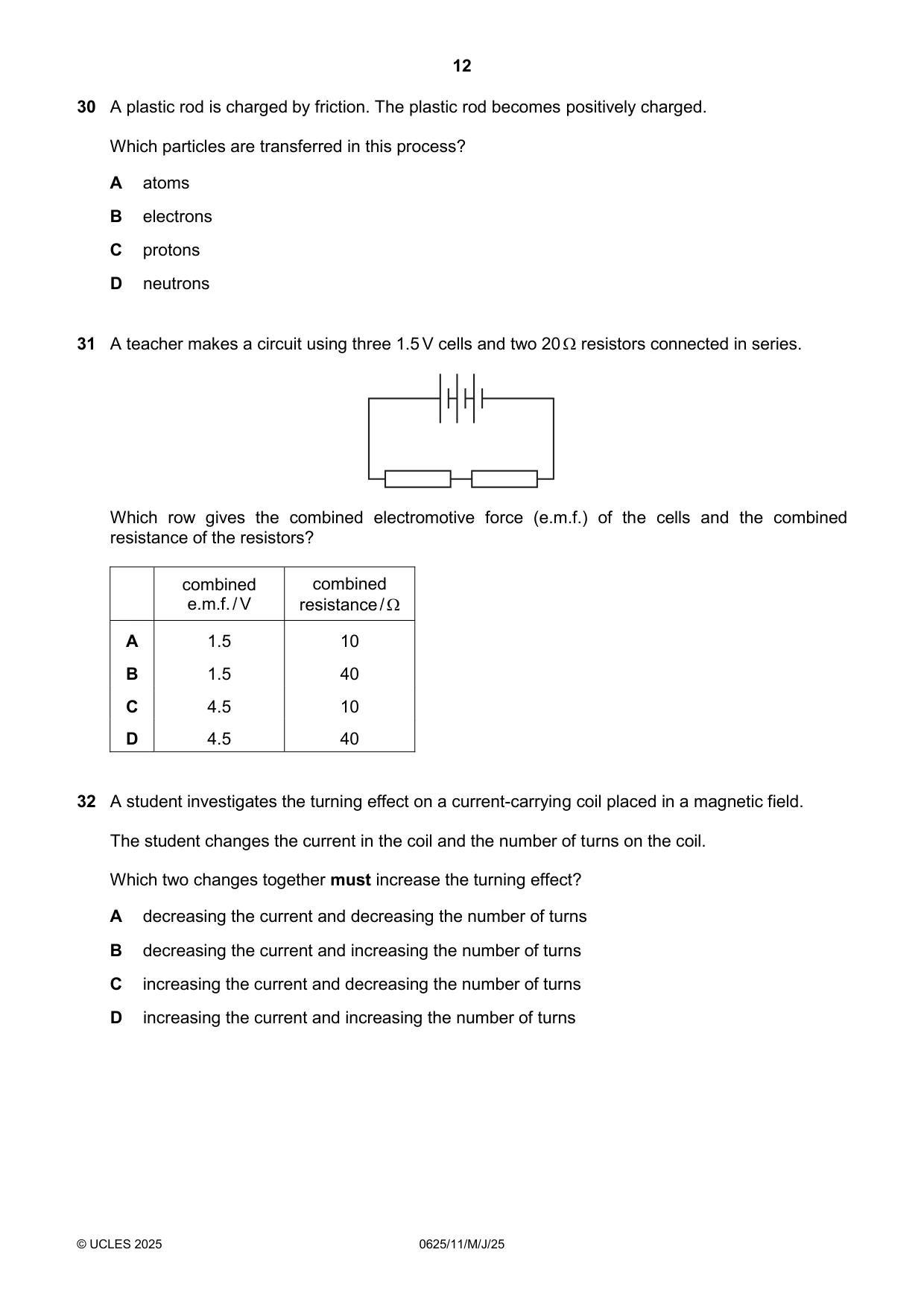
Q30 · A plastic rod is charged by friction
30 A plastic rod is charged by friction. The plastic rod becomes positively charged. Which particles are transferred in this process? A atoms B electrons C protons D neutrons
Mark scheme: B
Q31 · A teacher makes a circuit using three 1.5 V cells and two 20 resistors connected in…
31 A teacher makes a circuit using three 1.5 V cells and two 20 resistors connected in series. Which row gives the combined electromotive force (e.m.f.) of the cells and the combined resistance of the resistors? combined combined e.m.f. / V resistance / A 1.5 10 B 1.5 40 C 4.5 10 D 4.5 40
Mark scheme: D
Q32 · A student investigates the turning effect on a current-carrying coil placed in a magnetic…
32 A student investigates the turning effect on a current-carrying coil placed in a magnetic field. The student changes the current in the coil and the number of turns on the coil. Which two changes together must increase the turning effect? A decreasing the current and decreasing the number of turns B decreasing the current and increasing the number of turns C increasing the current and decreasing the number of turns D increasing the current and increasing the number of turns
Mark scheme: D
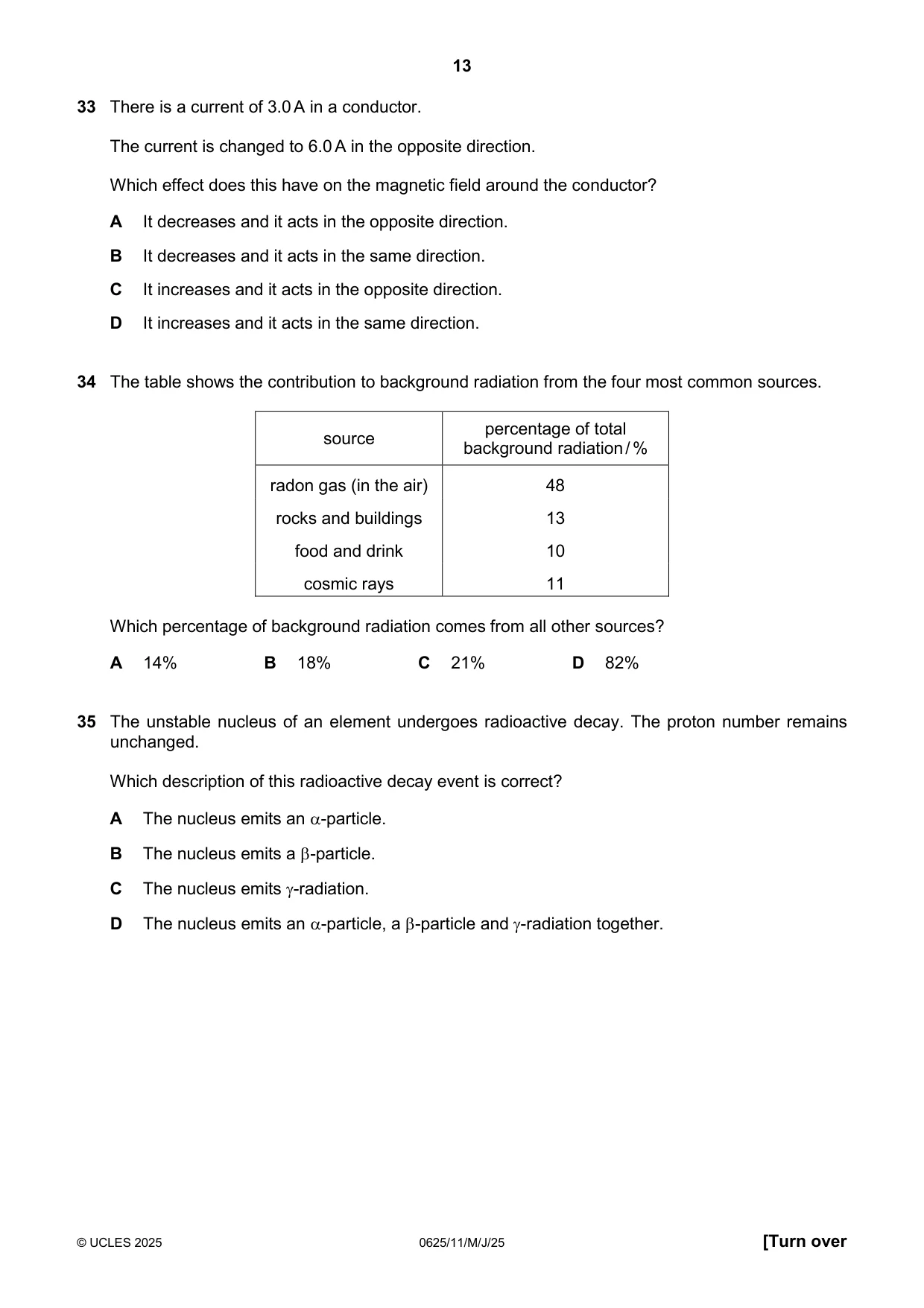
Q33 · There is a current of 3.0 A in a conductor
33 There is a current of 3.0 A in a conductor. The current is changed to 6.0 A in the opposite direction. Which effect does this have on the magnetic field around the conductor? A It decreases and it acts in the opposite direction. B It decreases and it acts in the same direction. C It increases and it acts in the opposite direction. D It increases and it acts in the same direction.
Mark scheme: C
Q34 · The table shows the contribution to background radiation from the four most common sources
34 The table shows the contribution to background radiation from the four most common sources. percentage of total source background radiation / % radon gas (in the air) 48 rocks and buildings 13 food and drink 10 cosmic rays 11 Which percentage of background radiation comes from all other sources? A 14% B 18% C 21% D 82%
Mark scheme: B
Q35 · The unstable nucleus of an element undergoes radioactive decay
35 The unstable nucleus of an element undergoes radioactive decay. The proton number remains unchanged. Which description of this radioactive decay event is correct? A The nucleus emits an -particle. B The nucleus emits a -particle. C The nucleus emits -radiation. D The nucleus emits an -particle, a -particle and -radiation together.
Mark scheme: C
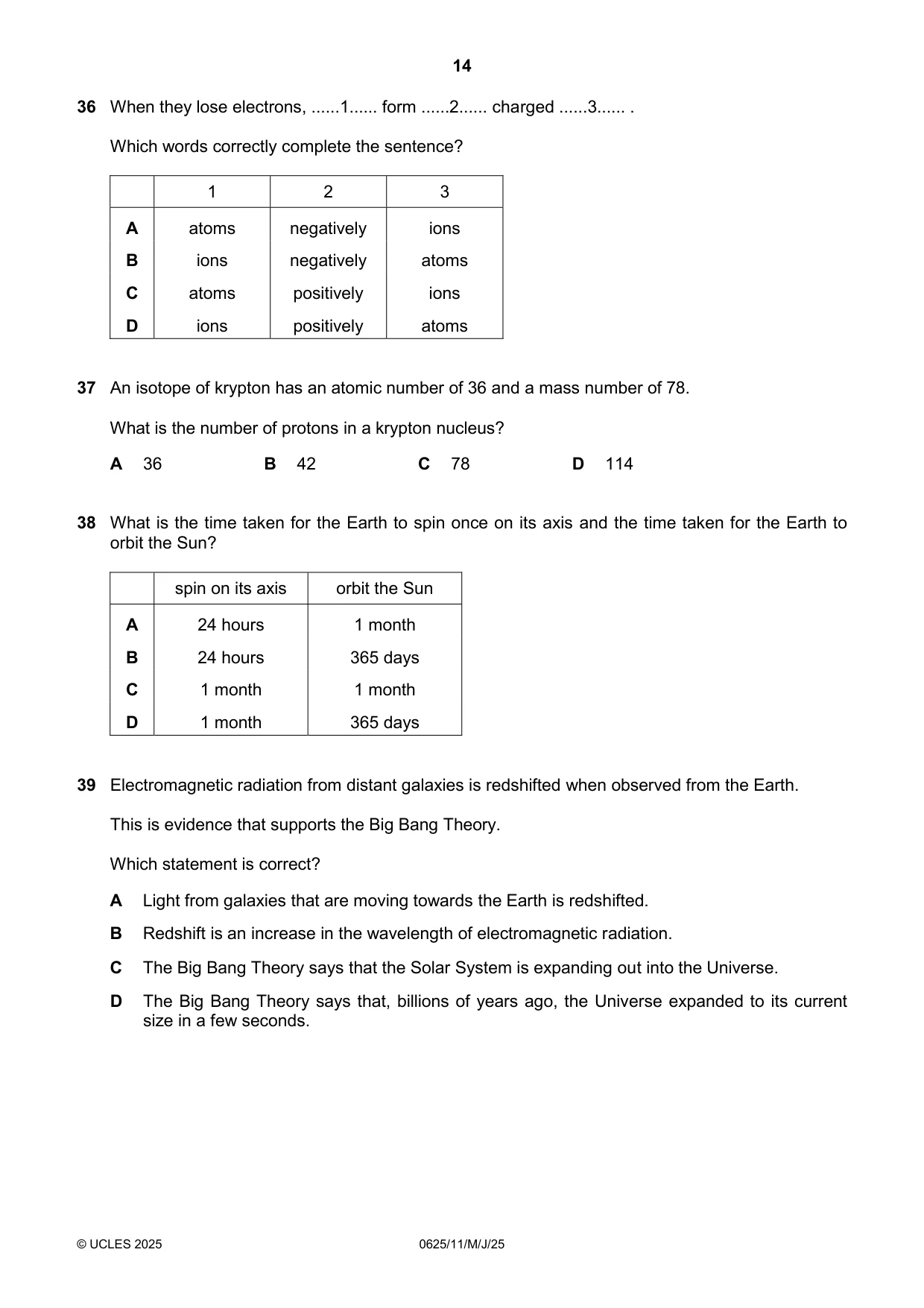
Q36 · When they lose electrons, ......1.....
36 When they lose electrons, ......1...... form ......2...... charged ......3...... . Which words correctly complete the sentence? 1 2 3 A atoms negatively ions B ions negatively atoms C atoms positively ions D ions positively atoms
Mark scheme: C
Q37 · An isotope of krypton has an atomic number of 36 and a mass number of 78
37 An isotope of krypton has an atomic number of 36 and a mass number of 78. What is the number of protons in a krypton nucleus? A 36 B 42 C 78 D 114
Mark scheme: A
Q38 · What is the time taken for the Earth to spin once on its axis and the time taken for the…
38 What is the time taken for the Earth to spin once on its axis and the time taken for the Earth to orbit the Sun? spin on its axis orbit the Sun A 24 hours 1 month B 24 hours 365 days C 1 month 1 month D 1 month 365 days
Mark scheme: B
Q39 · Electromagnetic radiation from distant galaxies is redshifted when observed from the Earth
39 Electromagnetic radiation from distant galaxies is redshifted when observed from the Earth. This is evidence that supports the Big Bang Theory. Which statement is correct? A Light from galaxies that are moving towards the Earth is redshifted. B Redshift is an increase in the wavelength of electromagnetic radiation. C The Big Bang Theory says that the Solar System is expanding out into the Universe. D The Big Bang Theory says that, billions of years ago, the Universe expanded to its current size in a few seconds.
Mark scheme: B
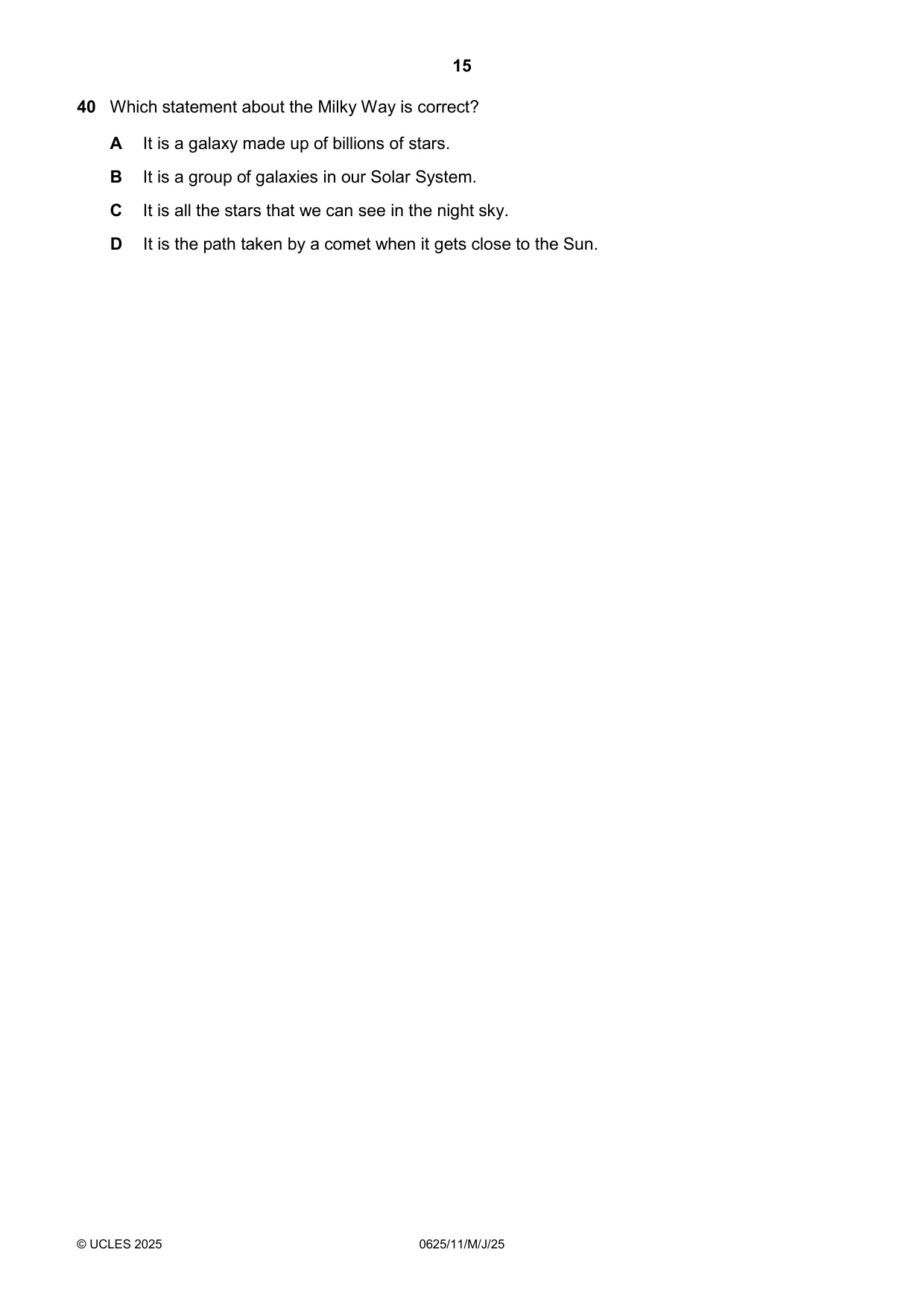
Q40 · Which statement about the Milky Way is correct?
40 Which statement about the Milky Way is correct? A It is a galaxy made up of billions of stars. B It is a group of galaxies in our Solar System. C It is all the stars that we can see in the night sky. D It is the path taken by a comet when it gets close to the Sun.
Mark scheme: A
What was in this paper
The subtopics covered by these 40 questions, and how many questions each got. Open one in a new tab to see every Cambridge question on it.
4Energy, work and power3General properties of waves3Simple phenomena of magnetism3Electrical quantities2Electromagnetic effects2Light2Motion2Radioactivity2Sound2Stars and the Universe2The nuclear model of the atom2Transfer of thermal energy2Density1Electric circuits1Electrical safety1Forces1Mass and weight1Physical quantities and measurement techniques1Pressure1The Earth and the Solar System1Thermal properties and temperature1What you needed in this session
Cambridge’s own grade thresholds for 2025 May/June, Paper 1 · Variant 1. A higher threshold means an easier paper — the bar moves with how the cohort did.