Cambridge IGCSE Physics 0625 — 2009 May/June Paper 1 · Variant 1
0625/11/M/J/09 · 40 questions · 40 marks · ≈45 min
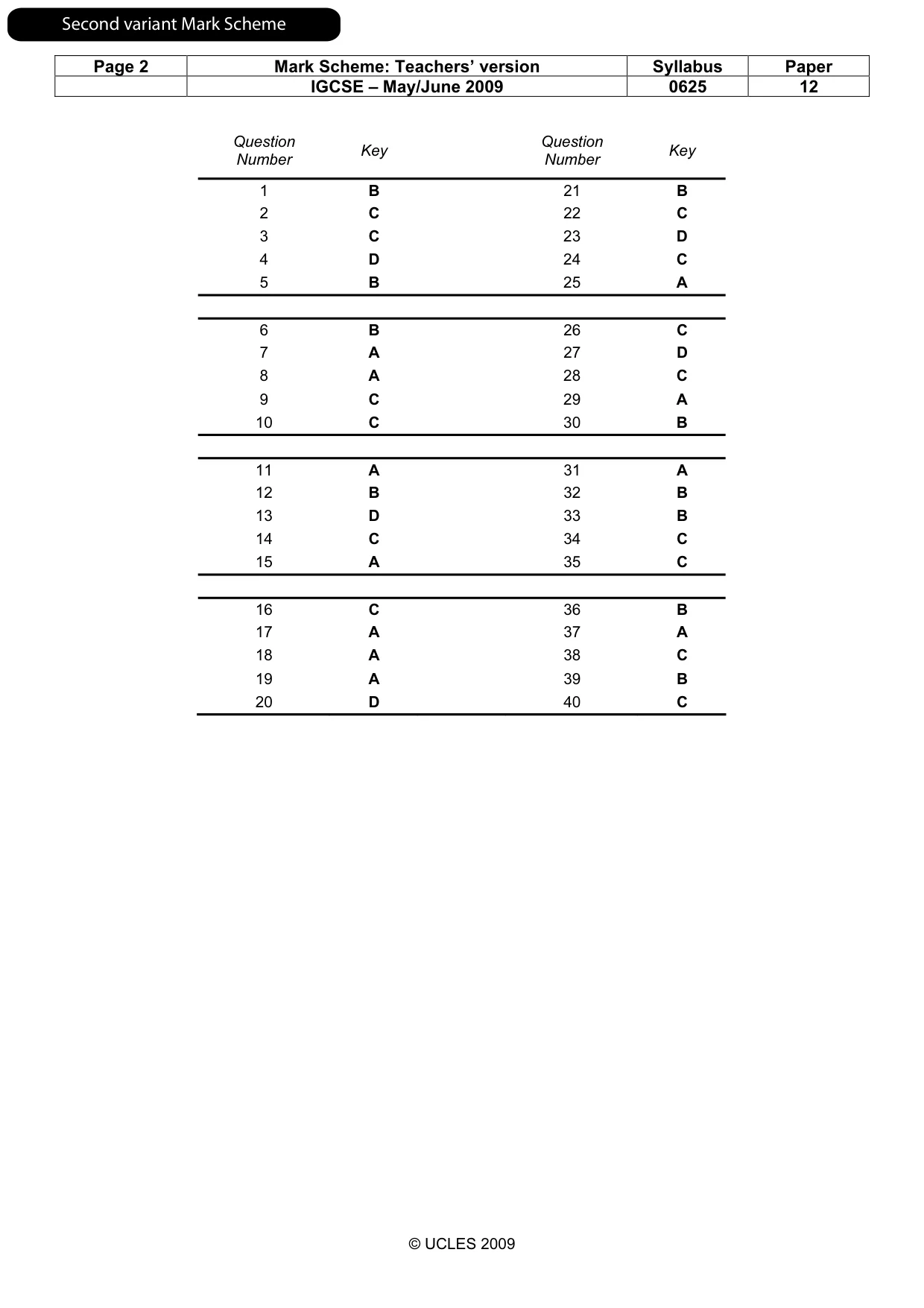
The question paper and its mark scheme, free to read here and free to download. This is Cambridge’s own paper, exactly as it was sat.
Question paper41 pages
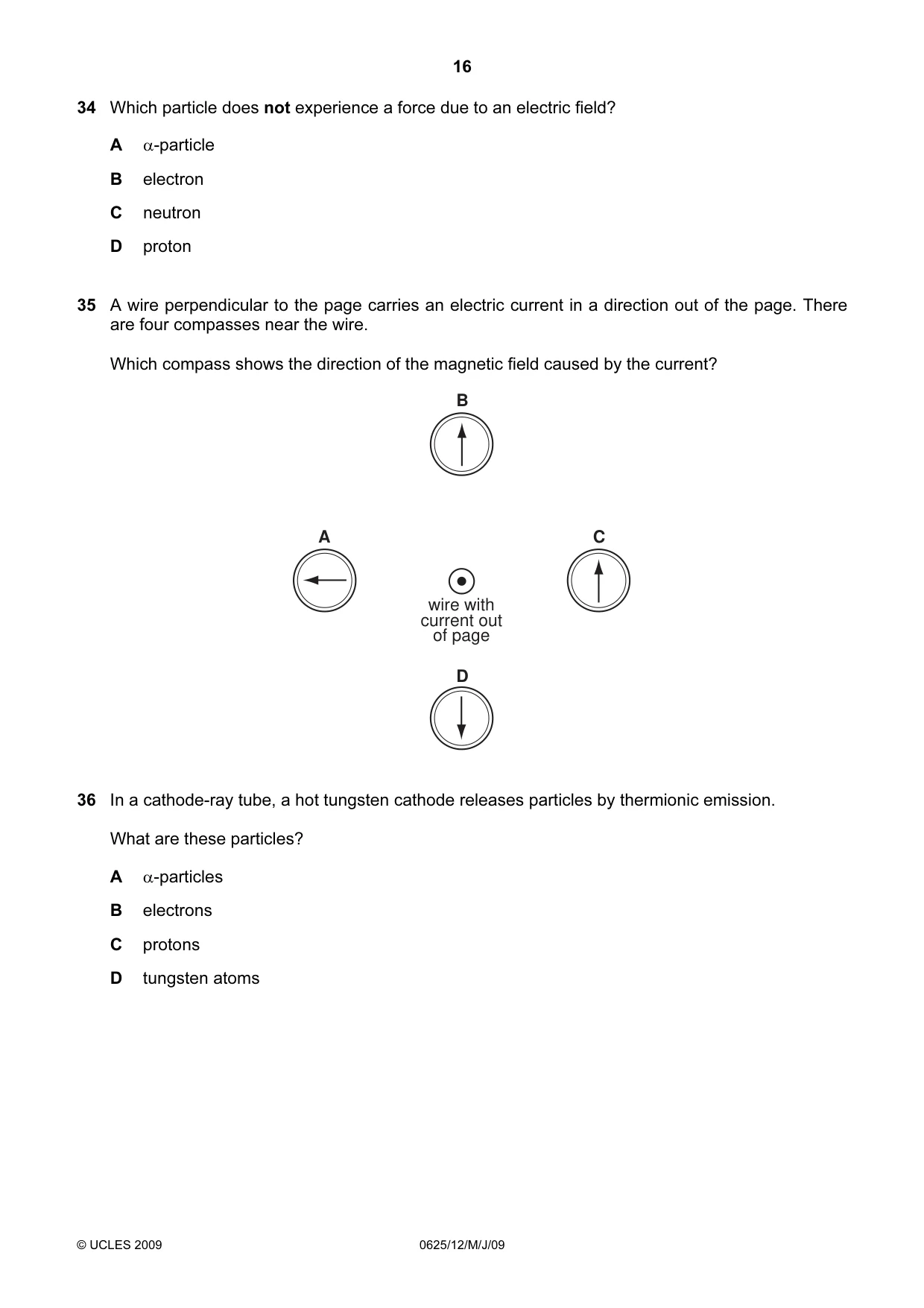
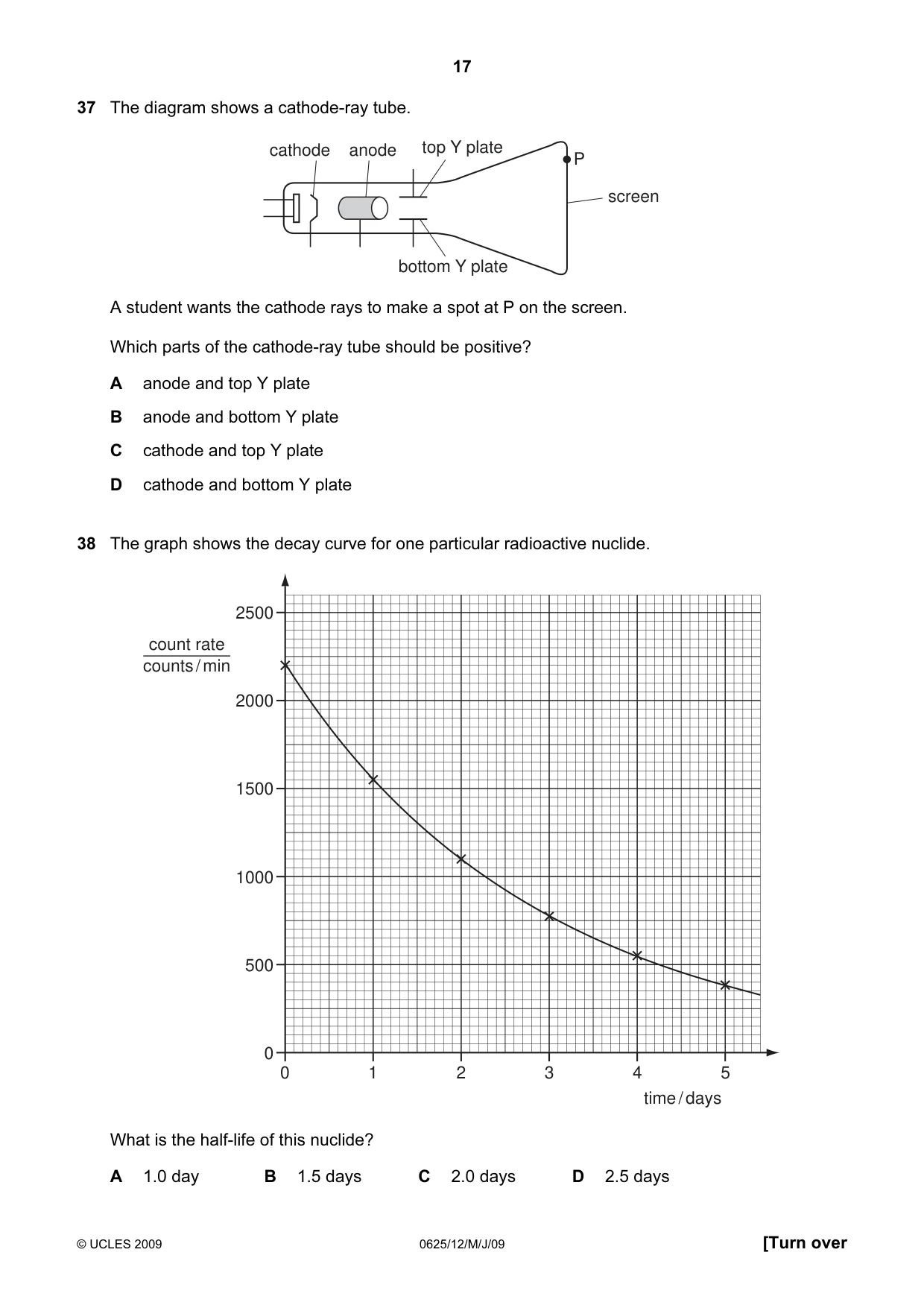
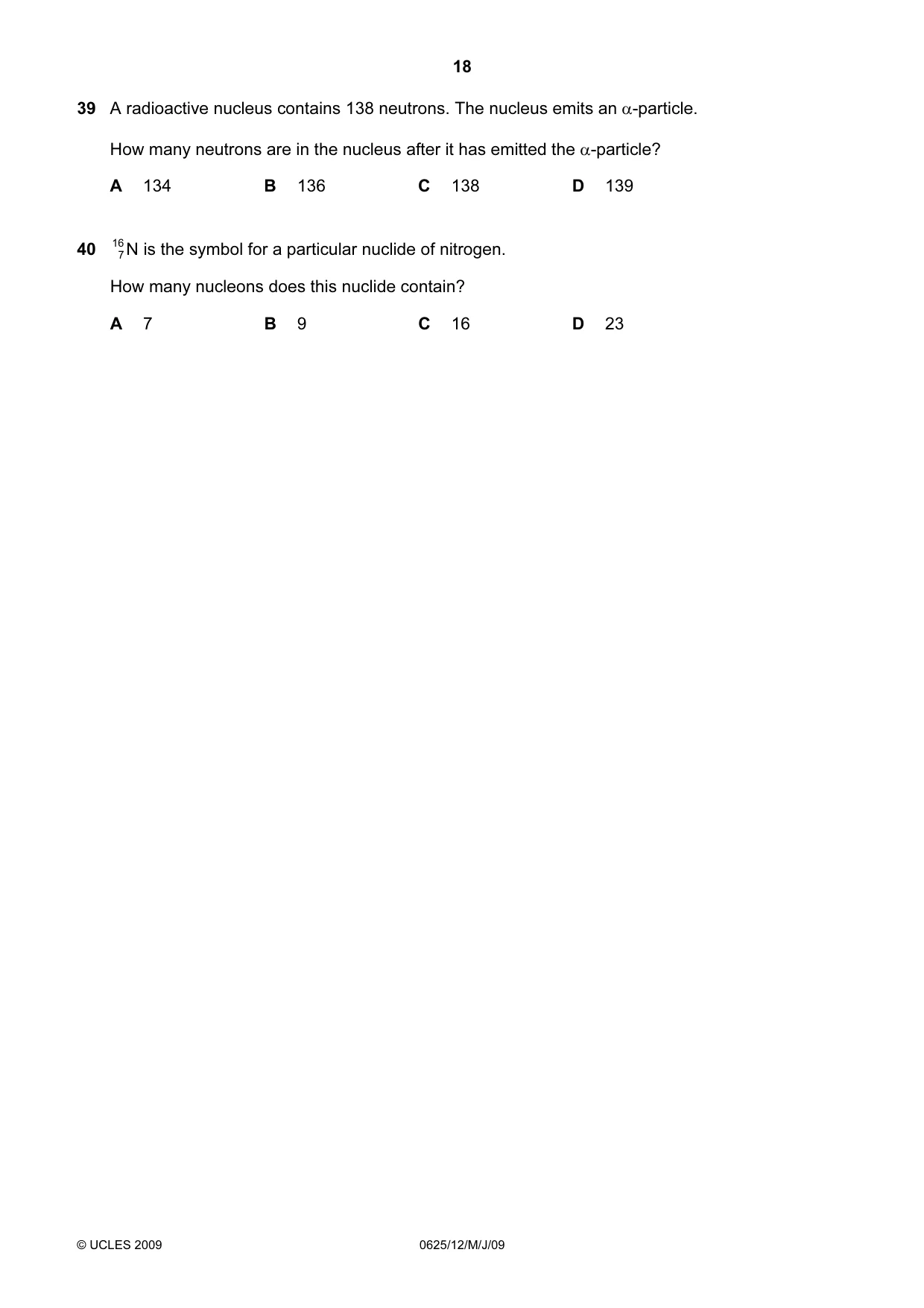

Mark scheme5 pages
Answers below. Sit the paper first if you are practising.
Questions as text
Q1 · A metre rule is used to measure a length
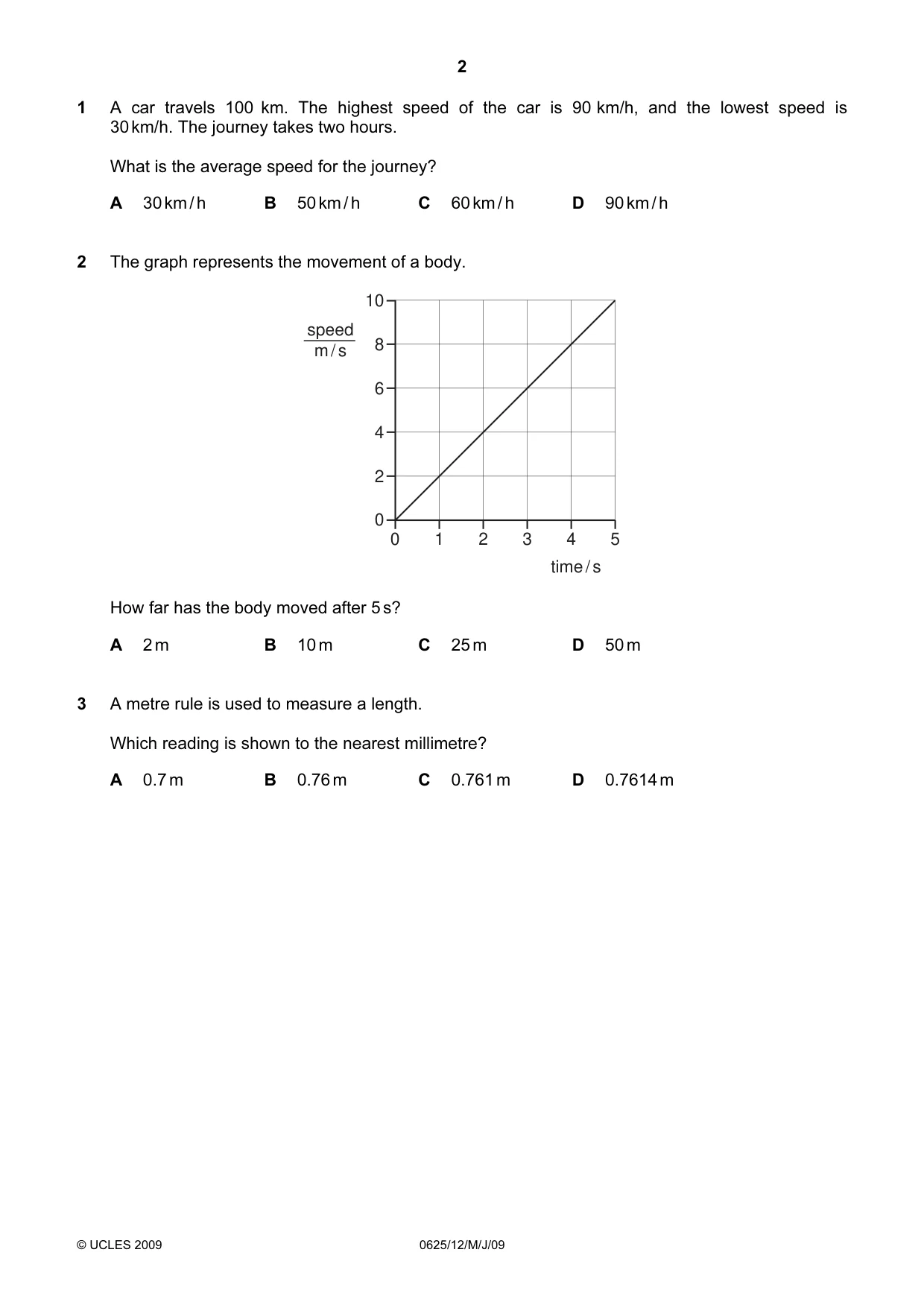
1 A metre rule is used to measure a length. Which reading is shown to the nearest millimetre? A 0.7 m B 0.76 m C 0.761 m D 0.7614 m
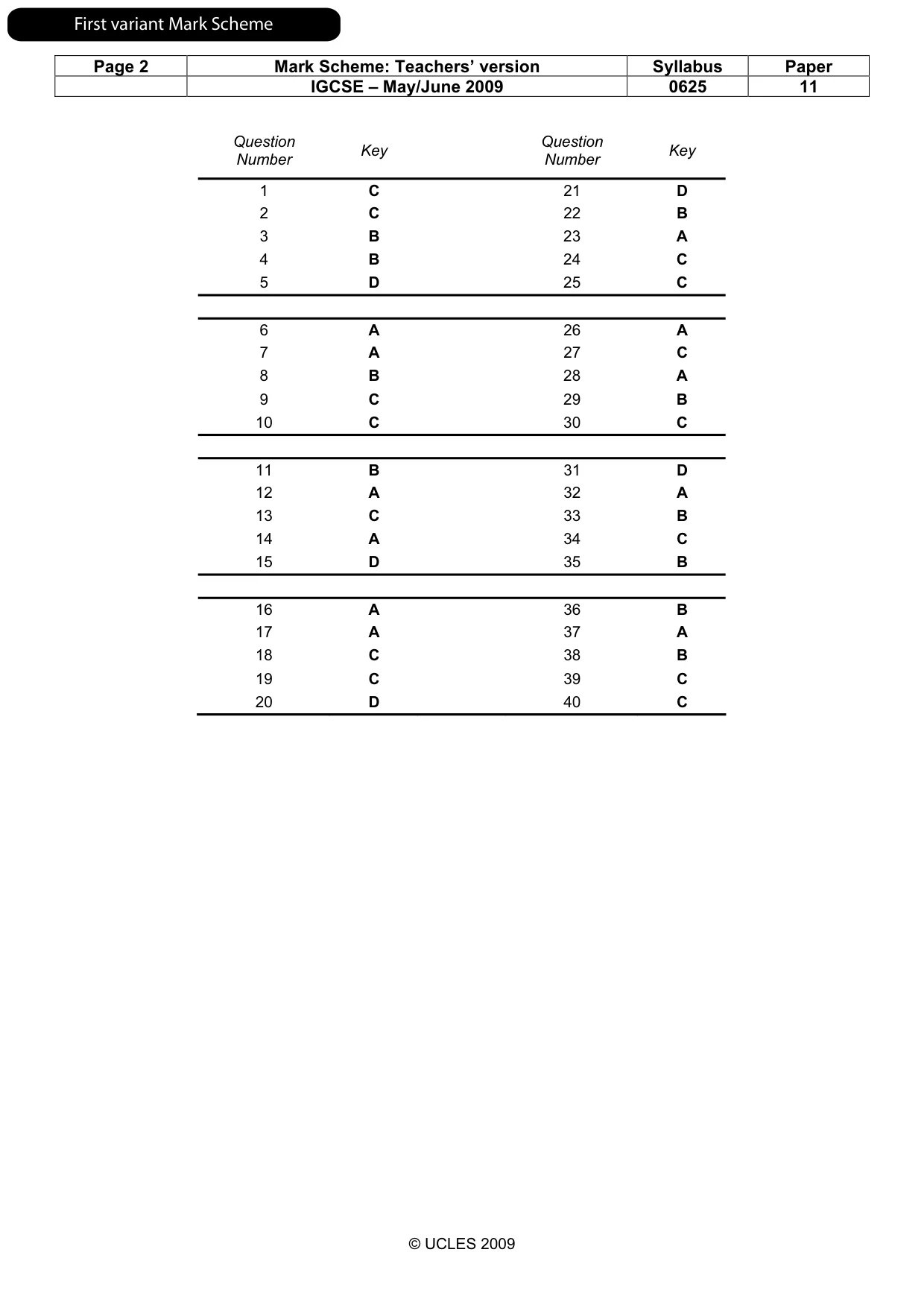
Mark scheme: C
More questions on Physical quantities and measurement techniques
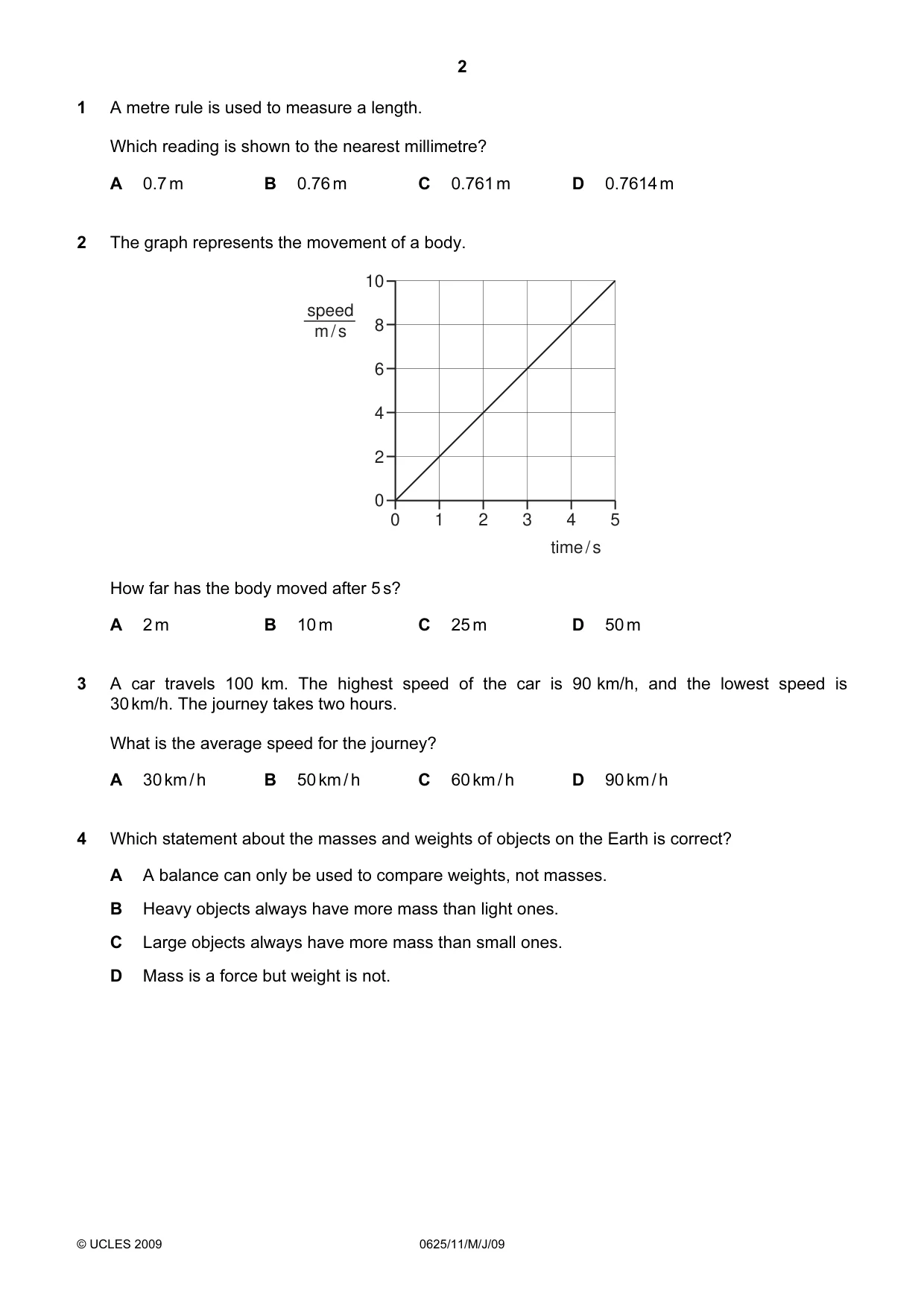
Q2 · The graph represents the movement of a body
2 The graph represents the movement of a body. 10 speed m / s 8 6 4 2 0 0 1 2 3 4 5 time / s How far has the body moved after 5 s? A 2 m B 10 m C 25 m D 50 m
Mark scheme: C
Q3 · A car travels 100 km
3 A car travels 100 km. The highest speed of the car is 90 km/h, and the lowest speed is 30 km/h. The journey takes two hours. What is the average speed for the journey? A 30 km / h B 50 km / h C 60 km / h D 90 km / h
Mark scheme: B
Q4 · Which statement about the masses and weights of objects on the Earth is correct?
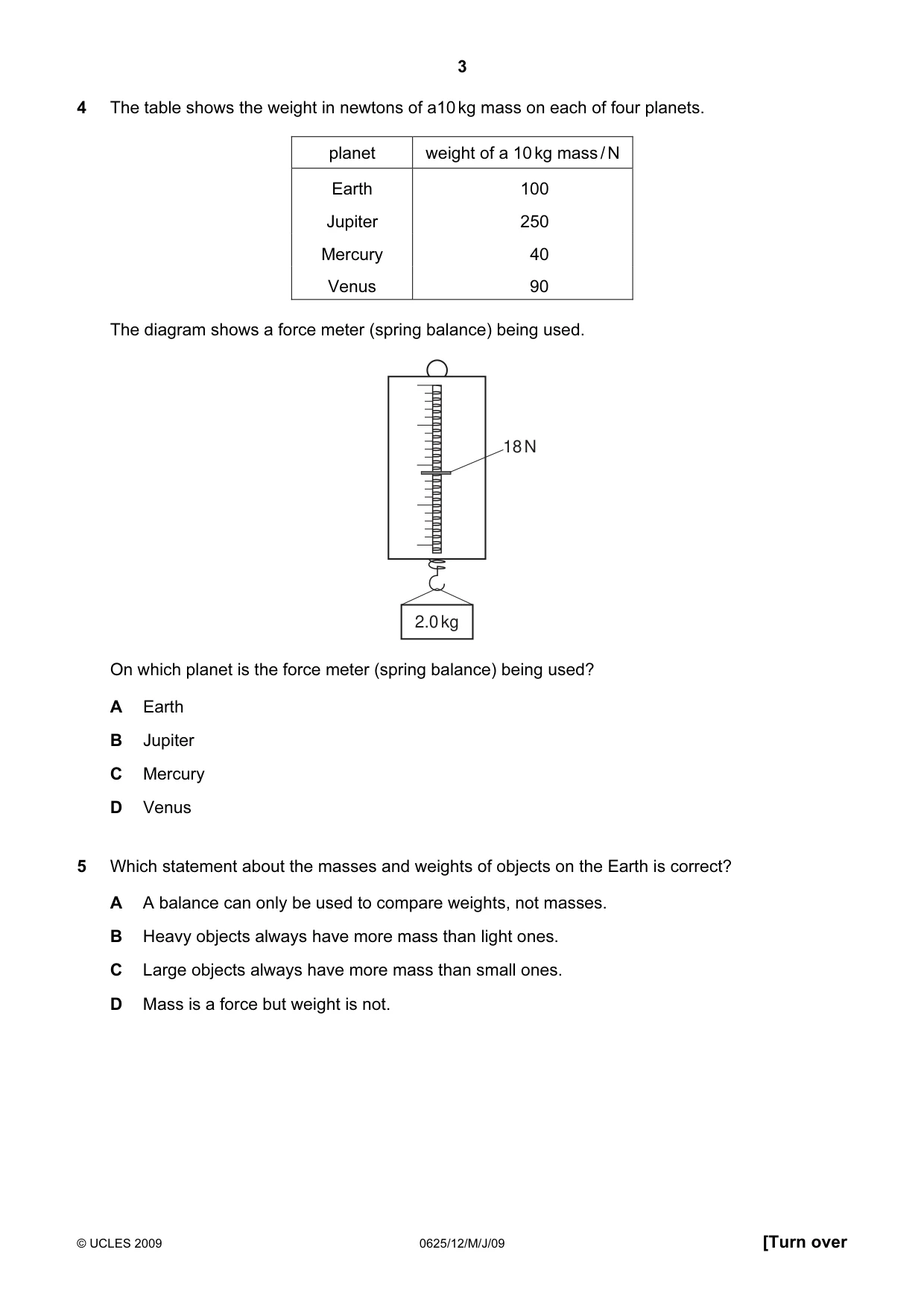
4 Which statement about the masses and weights of objects on the Earth is correct? A A balance can only be used to compare weights, not masses. B Heavy objects always have more mass than light ones. C Large objects always have more mass than small ones. D Mass is a force but weight is not.
Mark scheme: B
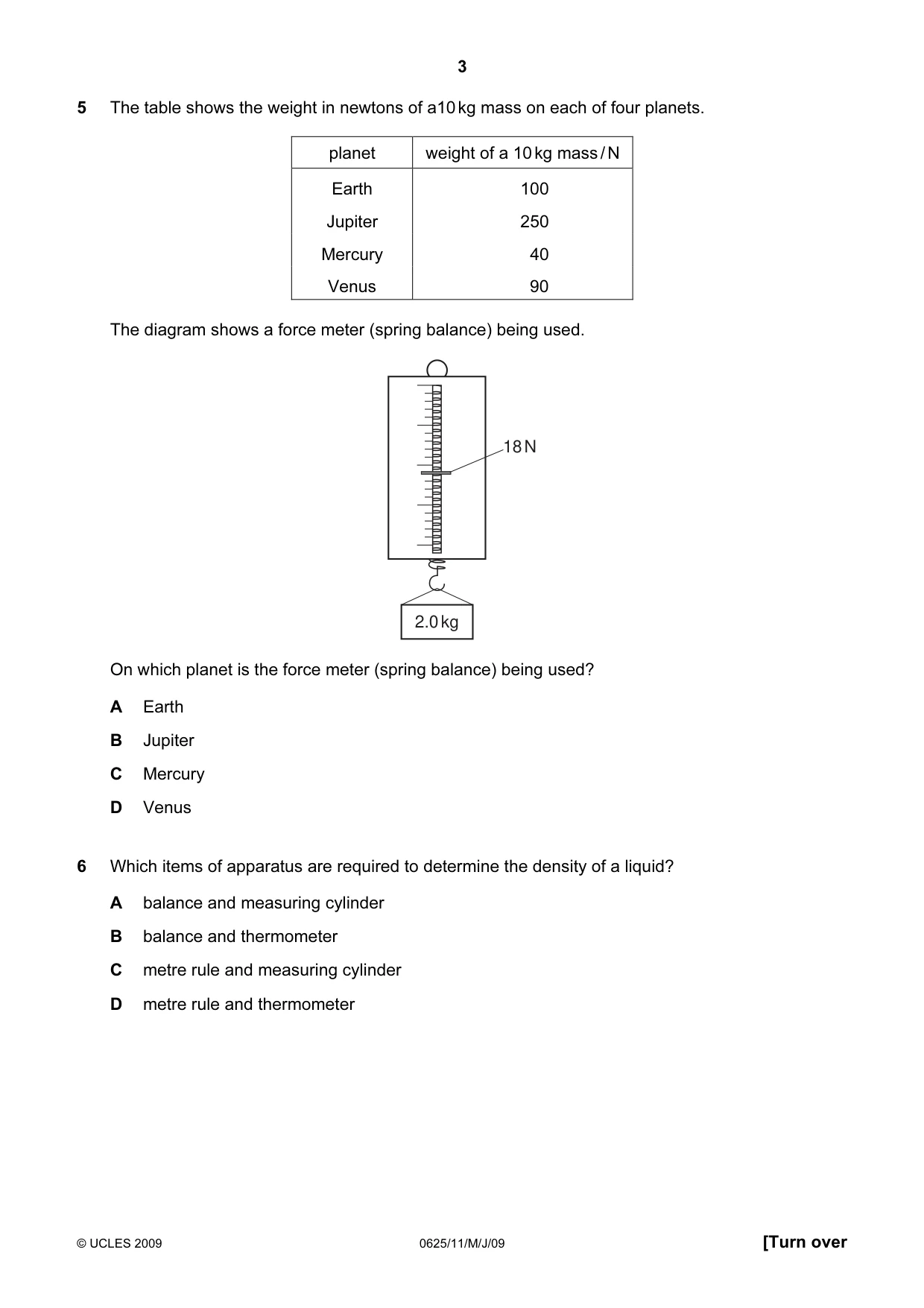
Q5 · The table shows the weight in newtons of a10 kg mass on each of four planets
5 The table shows the weight in newtons of a10 kg mass on each of four planets. planet weight of a 10 kg mass / N Earth 100 Jupiter 250 Mercury 40 Venus 90 The diagram shows a force meter (spring balance) being used. 18 N 2.0 kg On which planet is the force meter (spring balance) being used? A Earth B Jupiter C Mercury D Venus
Mark scheme: D
Q6 · Which items of apparatus are required to determine the density of a liquid?
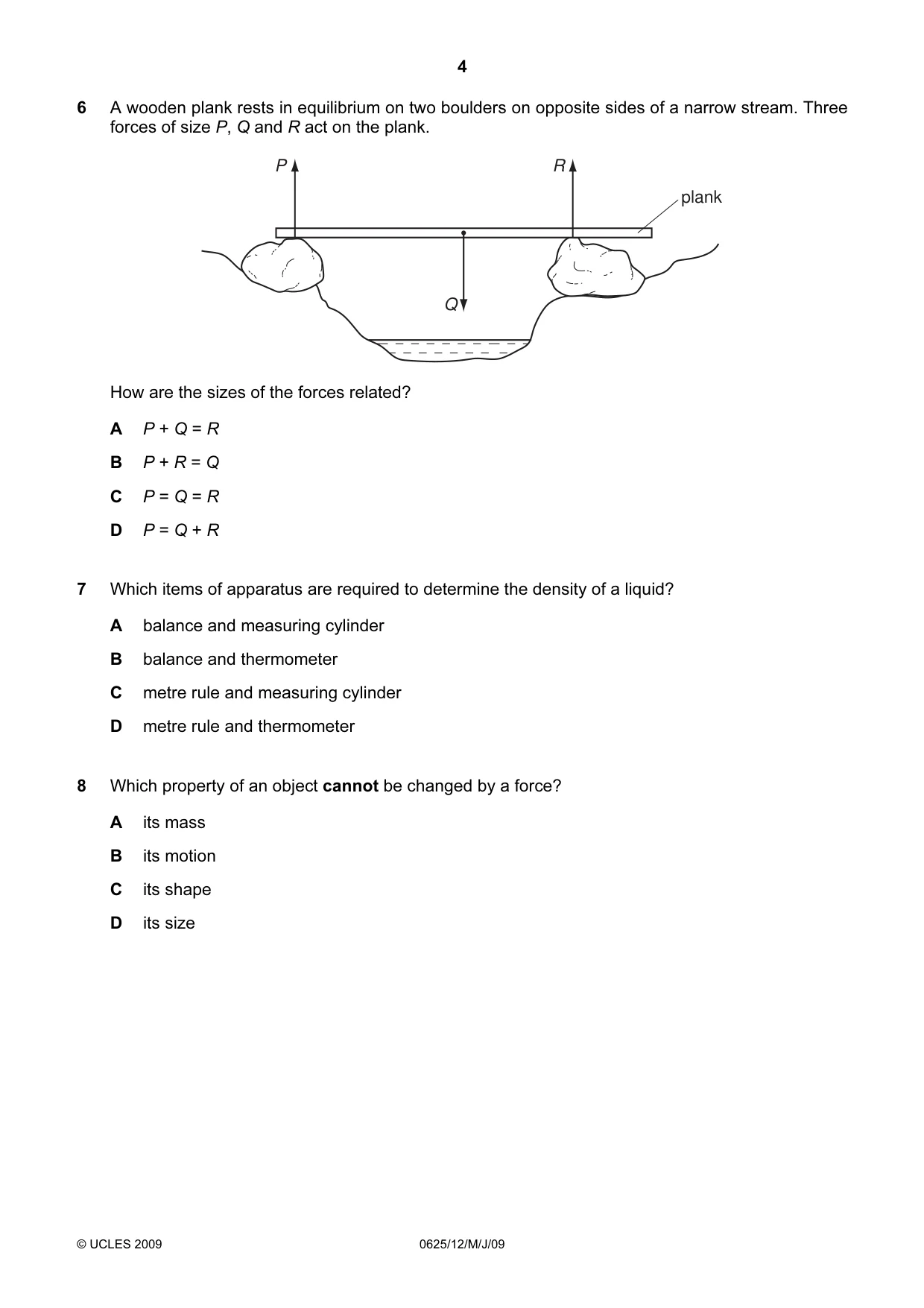
6 Which items of apparatus are required to determine the density of a liquid? A balance and measuring cylinder B balance and thermometer C metre rule and measuring cylinder D metre rule and thermometer
Mark scheme: A
Q7 · Which property of an object cannot be changed by a force?
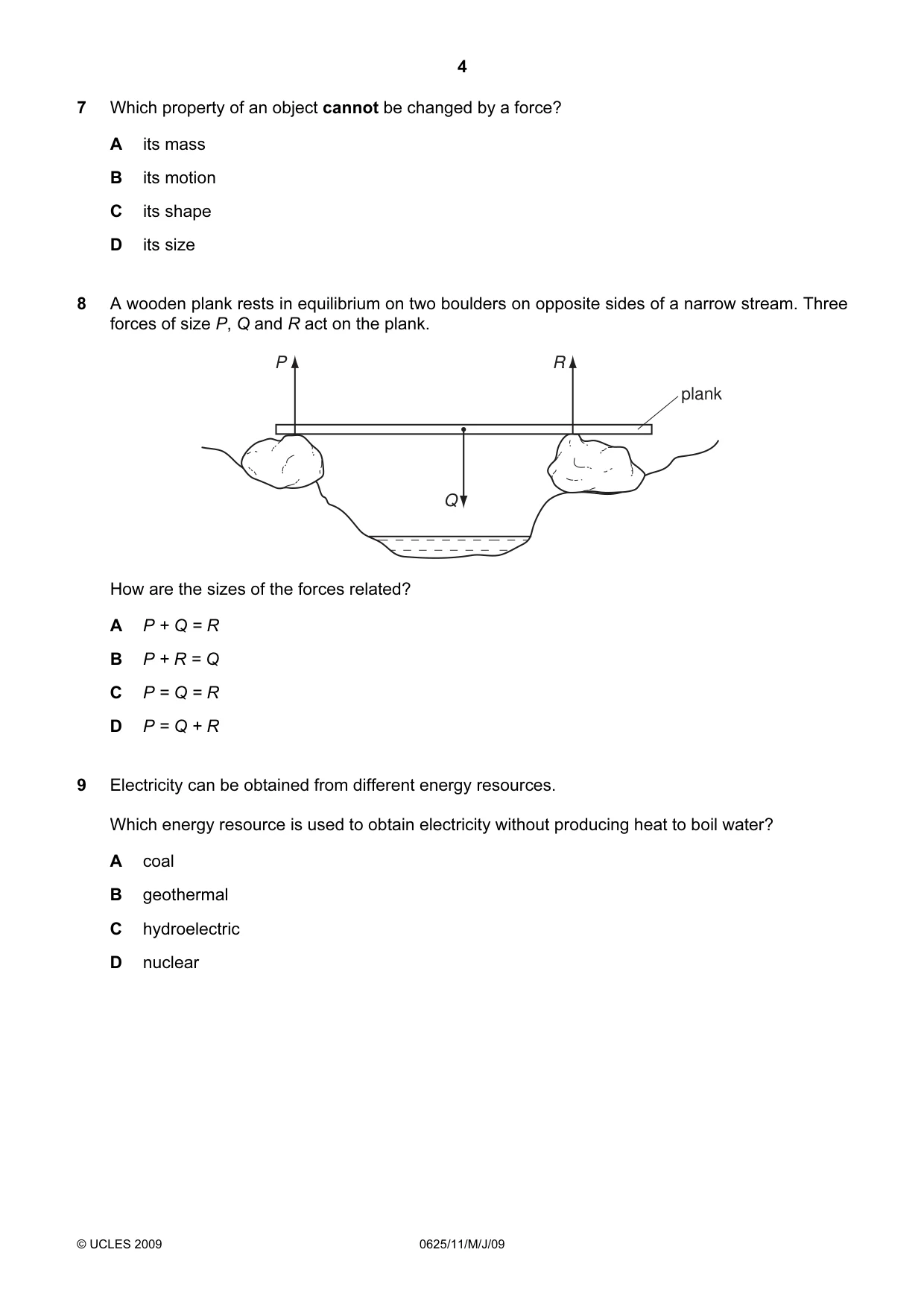
7 Which property of an object cannot be changed by a force? A its mass B its motion C its shape D its size
Mark scheme: A
Q8 · A wooden plank rests in equilibrium on two boulders on opposite sides of a narrow stream
8 A wooden plank rests in equilibrium on two boulders on opposite sides of a narrow stream. Three forces of size P, Q and R act on the plank. P R plank Q How are the sizes of the forces related? A P + Q = R B P + R = Q C P = Q = R D P = Q + R
Mark scheme: B
Q9 · Electricity can be obtained from different energy resources
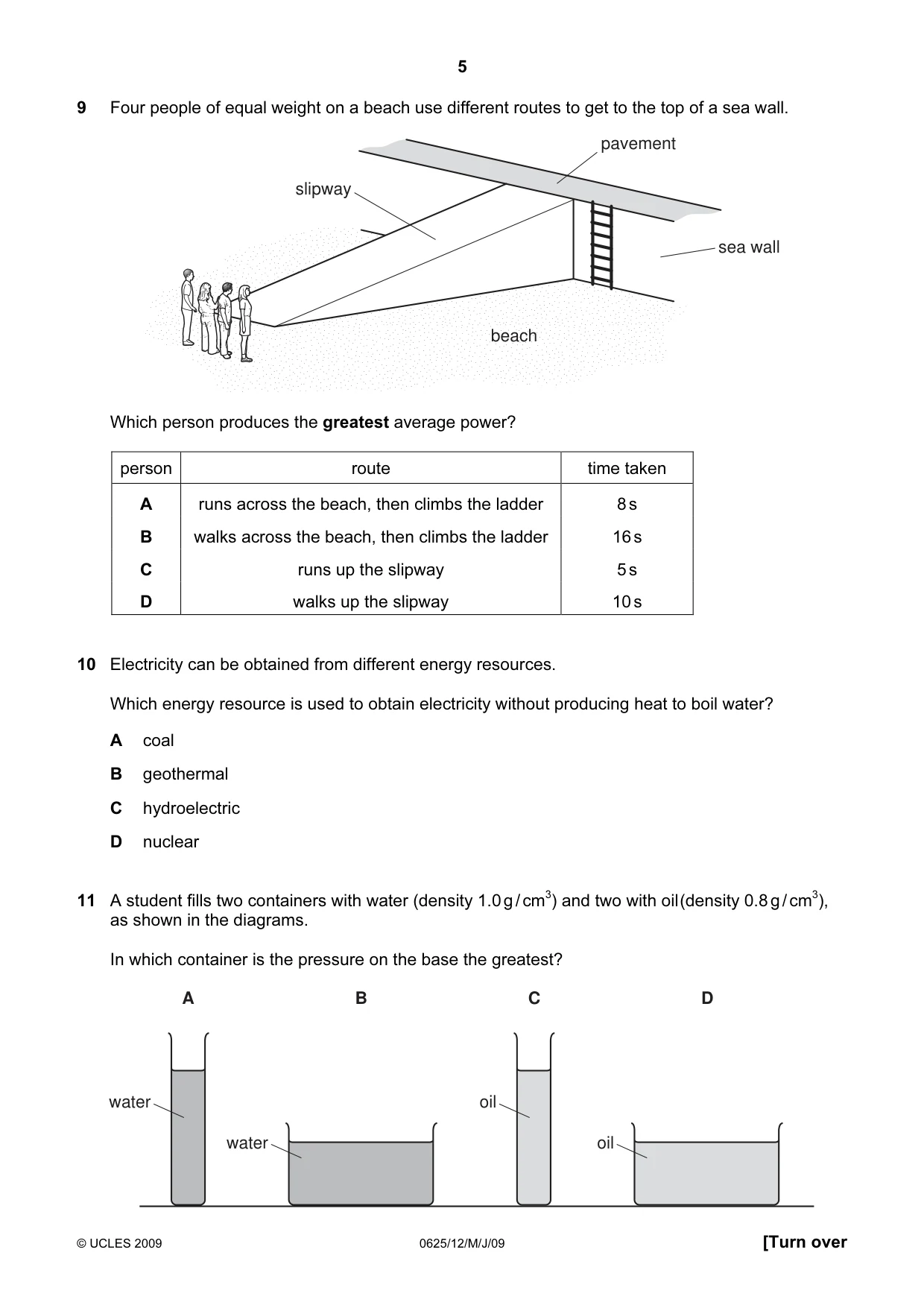
9 Electricity can be obtained from different energy resources. Which energy resource is used to obtain electricity without producing heat to boil water? A coal B geothermal C hydroelectric D nuclear
Mark scheme: C
Q10 · Four people of equal weight on a beach use different routes to get to the top of a sea…
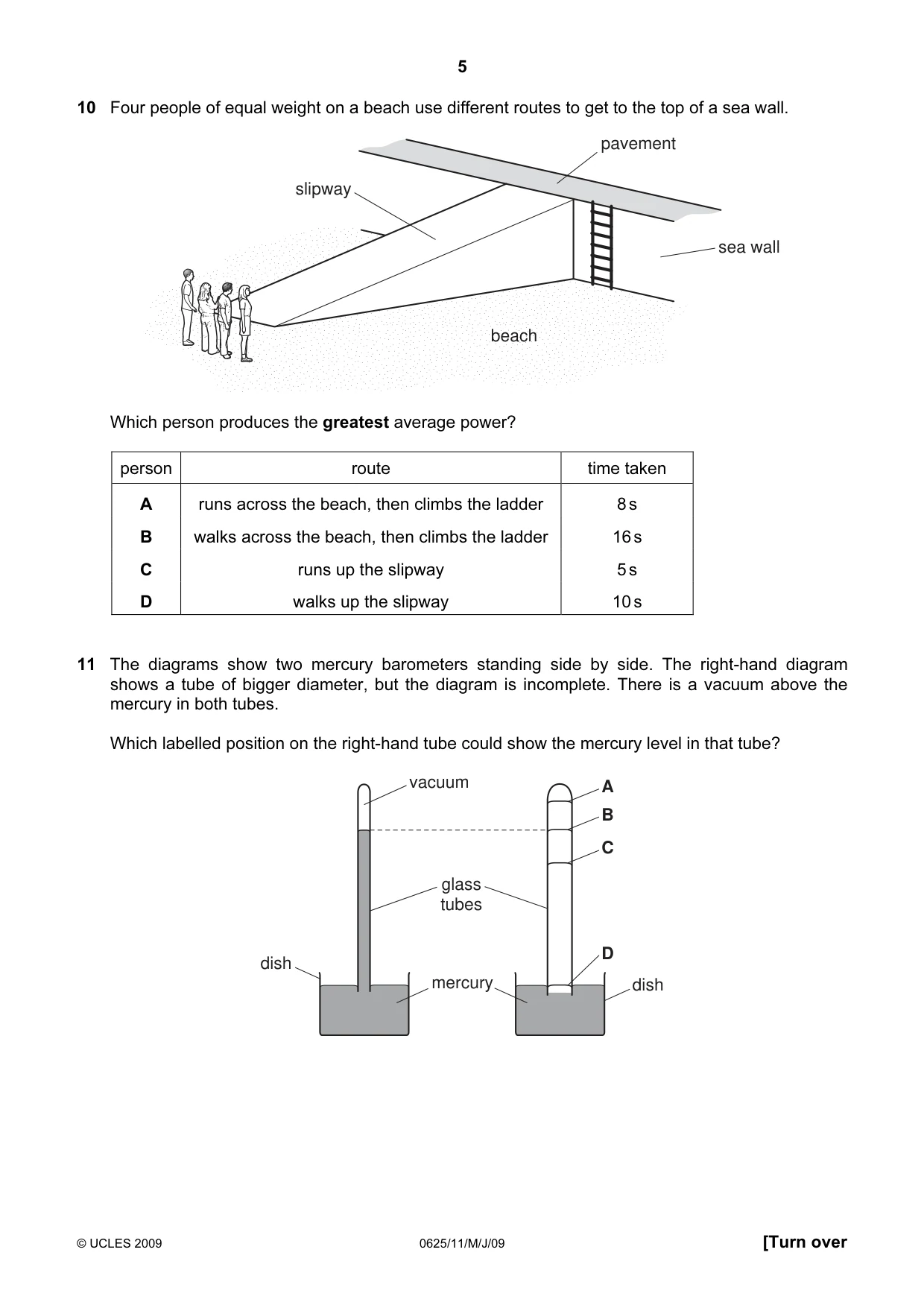
10 Four people of equal weight on a beach use different routes to get to the top of a sea wall. pavement slipway sea wall beach Which person produces the greatest average power? person route time taken A runs across the beach, then climbs the ladder 8 s B walks across the beach, then climbs the ladder 16 s C runs up the slipway 5 s D walks up the slipway 10 s
Mark scheme: C
Q11 · The diagrams show two mercury barometers standing side by side
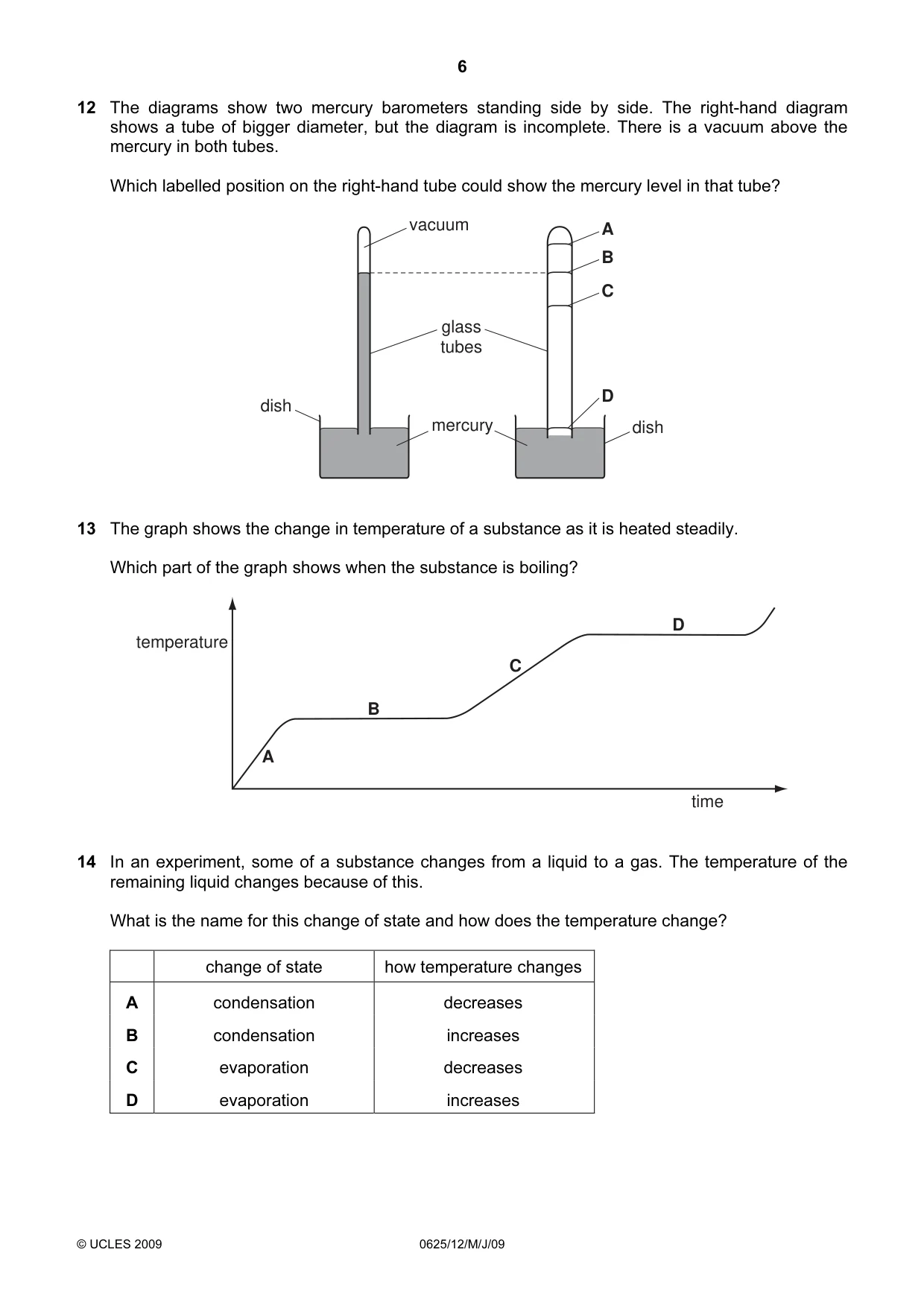
11 The diagrams show two mercury barometers standing side by side. The right-hand diagram shows a tube of bigger diameter, but the diagram is incomplete. There is a vacuum above the mercury in both tubes. Which labelled position on the right-hand tube could show the mercury level in that tube? vacuum A B C glass tubes D dish mercury dish
Mark scheme: B
Q12 · A student fills two containers with water (density 1.0 g / cm3) and two with oil (density…
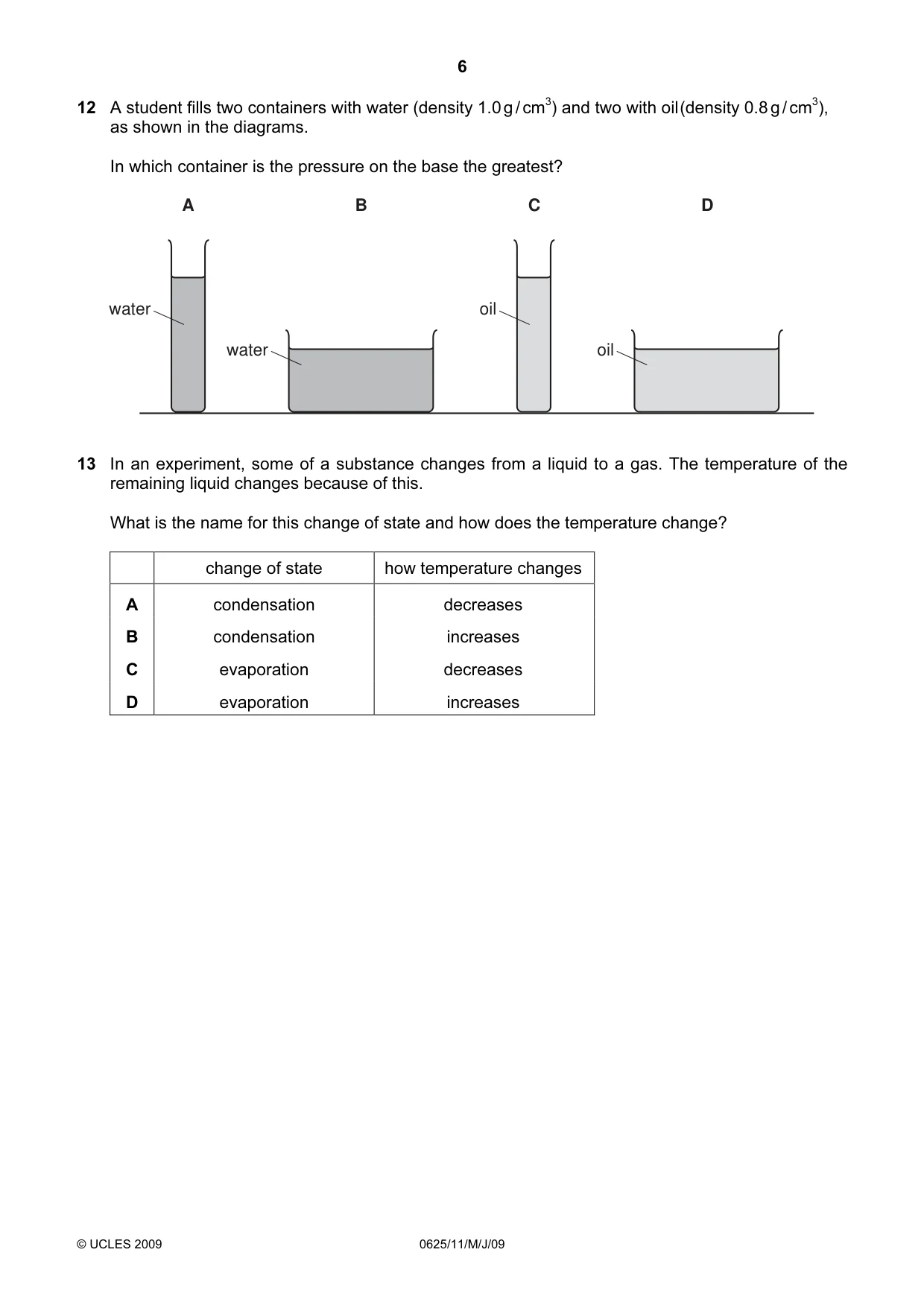
12 A student fills two containers with water (density 1.0 g / cm3) and two with oil (density 0.8 g / cm3), as shown in the diagrams. In which container is the pressure on the base the greatest? A B C D water oil water oil
Mark scheme: A
Q13 · In an experiment, some of a substance changes from a liquid to a gas
13 In an experiment, some of a substance changes from a liquid to a gas. The temperature of the remaining liquid changes because of this. What is the name for this change of state and how does the temperature change? change of state how temperature changes A condensation decreases B condensation increases C evaporation decreases D evaporation increases
Mark scheme: C
Q14 · A piston traps a certain mass of gas inside a cylinder
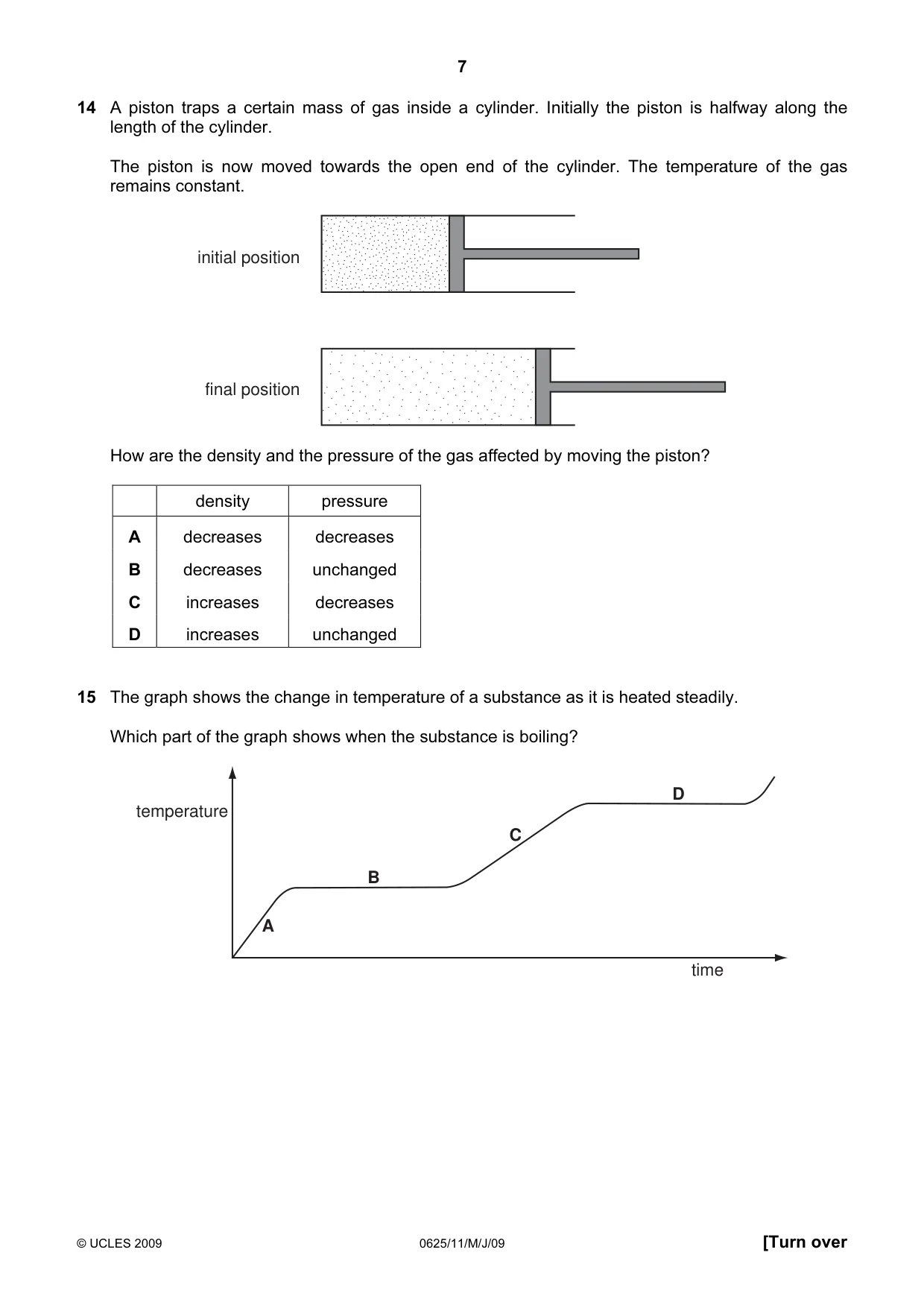
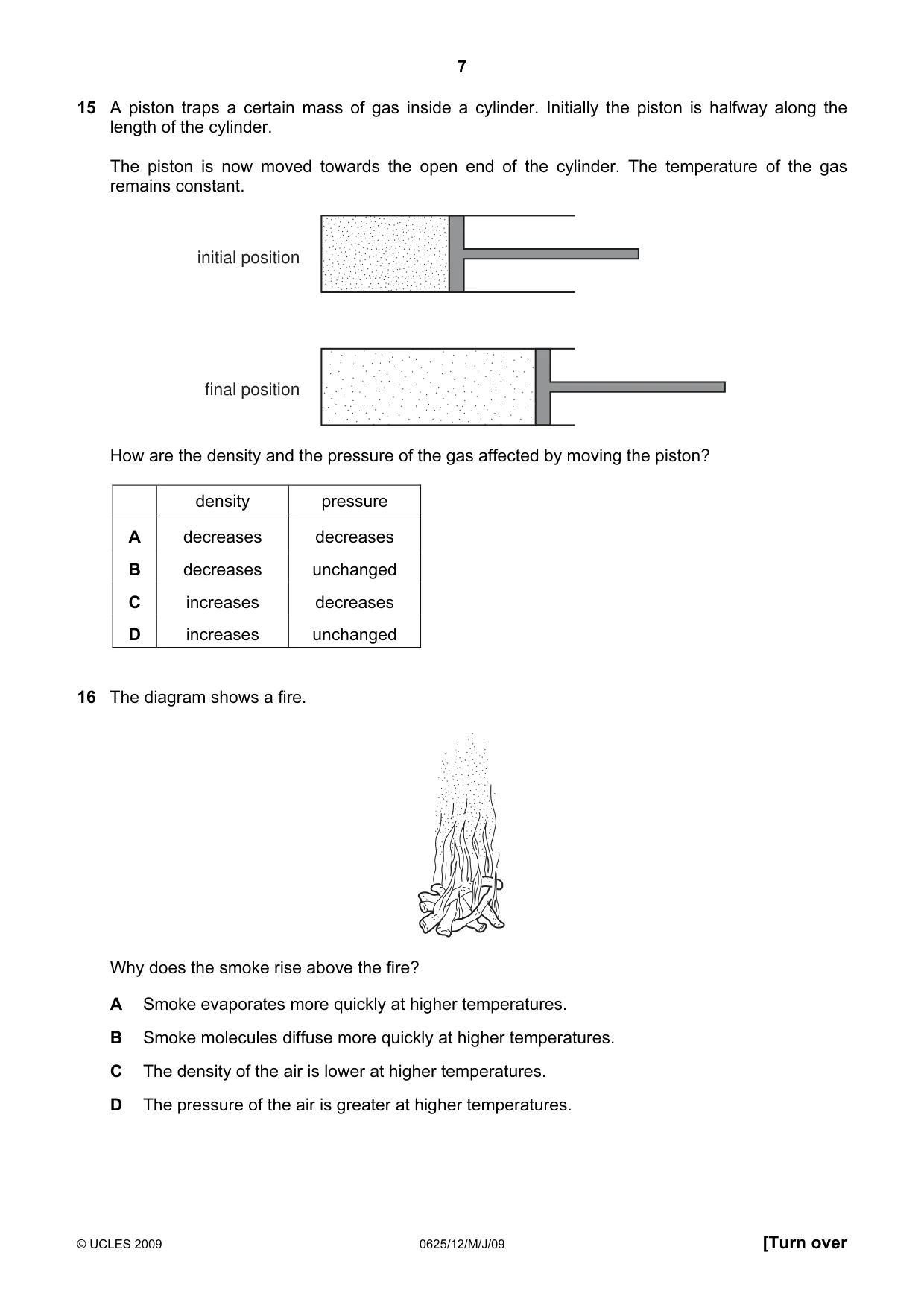
14 A piston traps a certain mass of gas inside a cylinder. Initially the piston is halfway along the length of the cylinder. The piston is now moved towards the open end of the cylinder. The temperature of the gas remains constant. initial position final position How are the density and the pressure of the gas affected by moving the piston? density pressure A decreases decreases B decreases unchanged C increases decreases D increases unchanged
Mark scheme: A
Q15 · The graph shows the change in temperature of a substance as it is heated steadily
15 The graph shows the change in temperature of a substance as it is heated steadily. Which part of the graph shows when the substance is boiling? D temperature C B A time
Mark scheme: D
Q16 · Four blocks, made of different materials, are each given the same quantity of internal…
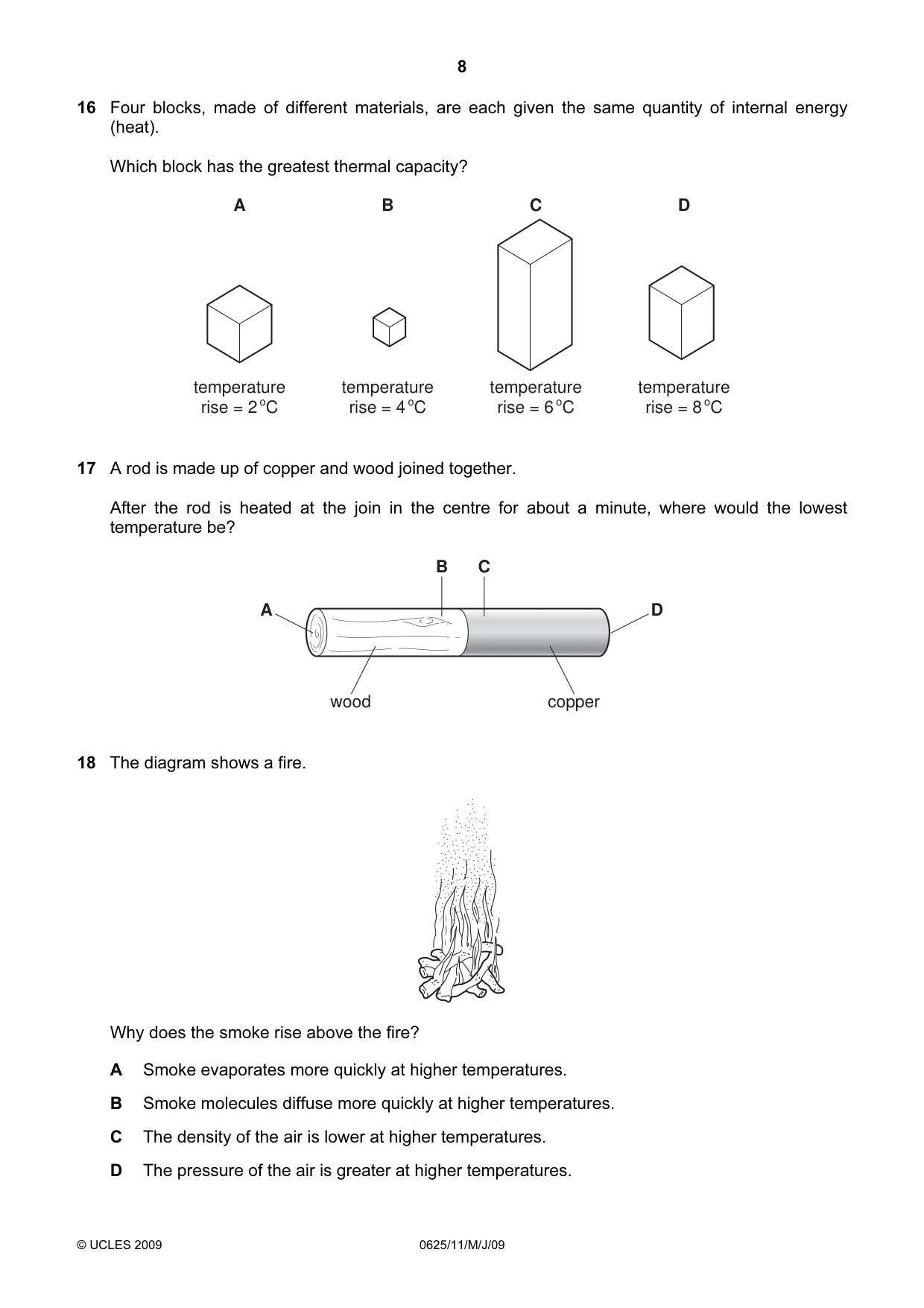
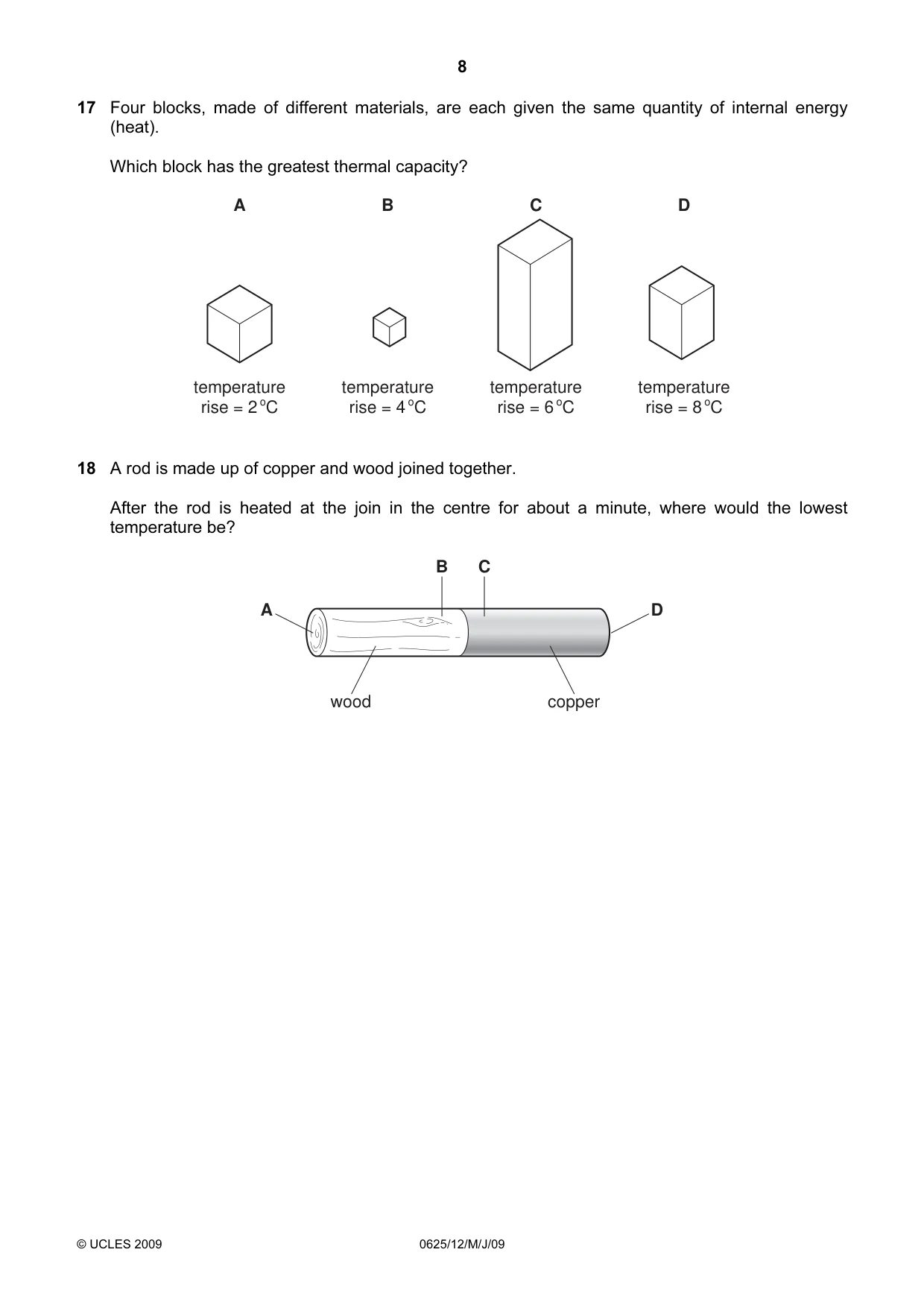
16 Four blocks, made of different materials, are each given the same quantity of internal energy (heat). Which block has the greatest thermal capacity? A B C D temperature temperature temperature temperature rise = 2 oC rise = 4 oC rise = 6 oC rise = 8 oC
Mark scheme: A
Q17 · A rod is made up of copper and wood joined together
17 A rod is made up of copper and wood joined together. After the rod is heated at the join in the centre for about a minute, where would the lowest temperature be? B C A D wood copper
Mark scheme: A
Q18 · The diagram shows a fire
18 The diagram shows a fire. Why does the smoke rise above the fire? A Smoke evaporates more quickly at higher temperatures. B Smoke molecules diffuse more quickly at higher temperatures. C The density of the air is lower at higher temperatures. D The pressure of the air is greater at higher temperatures.
Mark scheme: C
Q19 · The diagrams show water waves that move more slowly after passing into shallow water at…
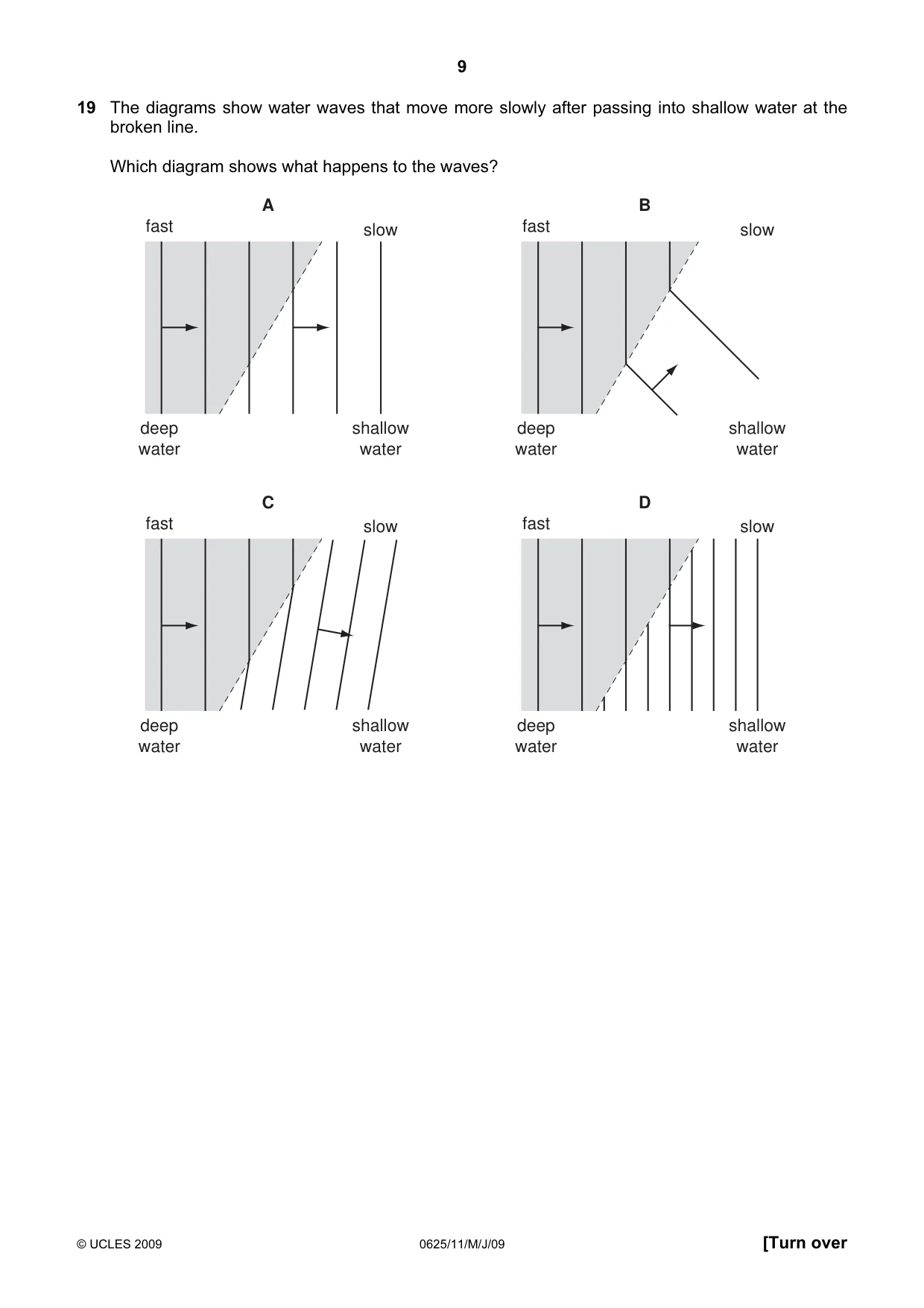
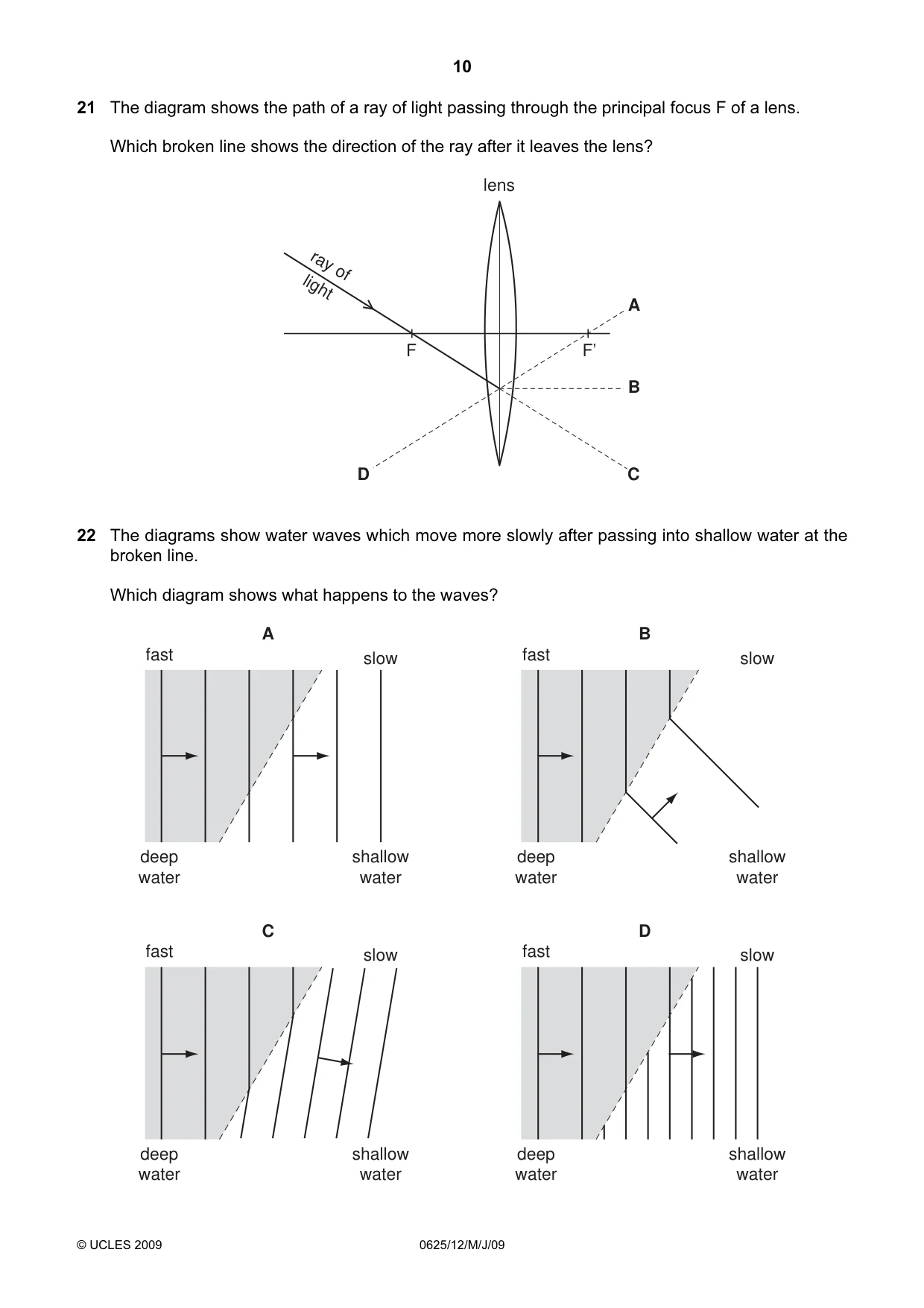
19 The diagrams show water waves that move more slowly after passing into shallow water at the broken line. Which diagram shows what happens to the waves? A B fast slow fast slow deep shallow deep shallow water water water water C D fast slow fast slow deep shallow deep shallow water water water water
Mark scheme: C
Q20 · The diagrams show examples of wave motion
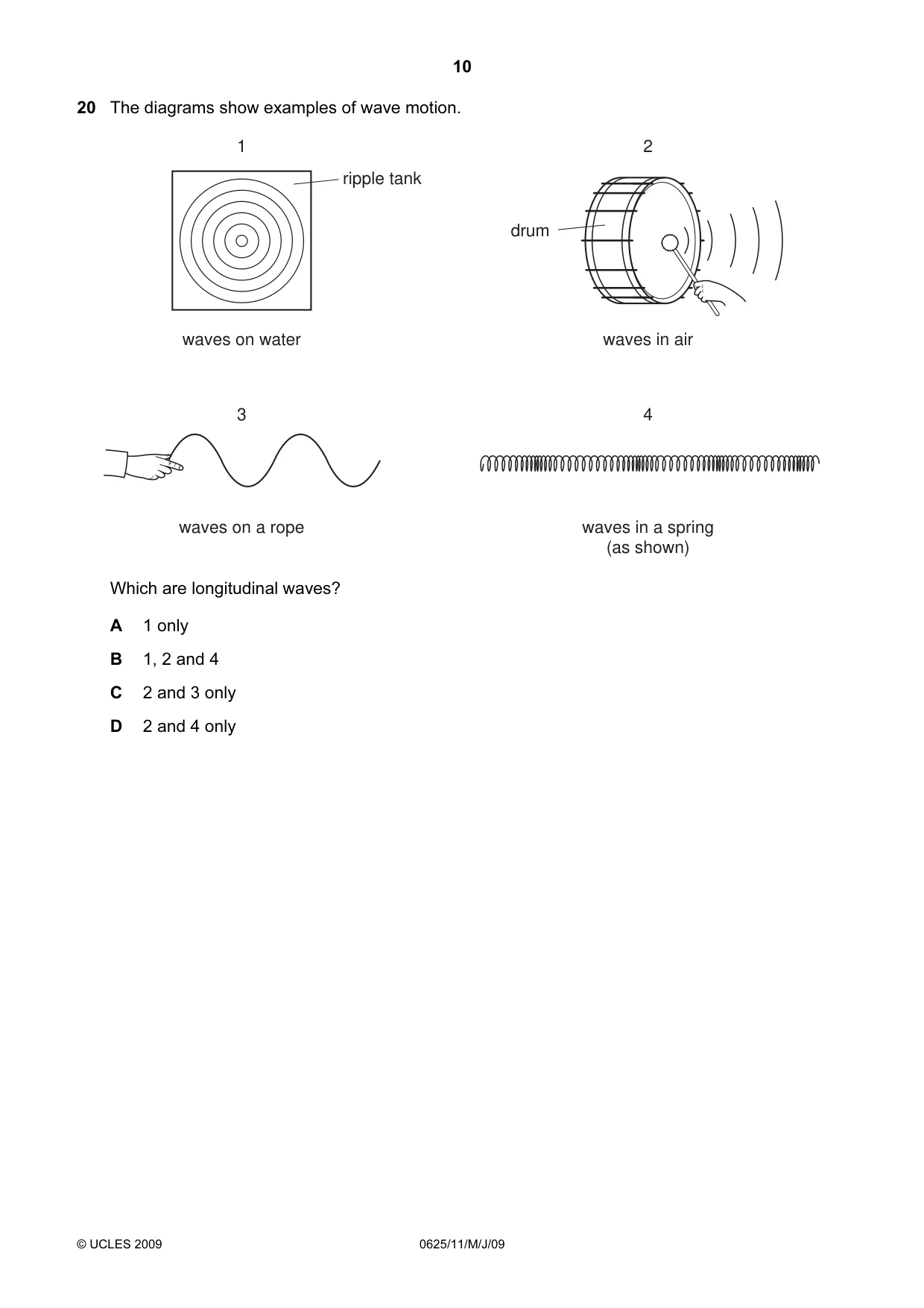
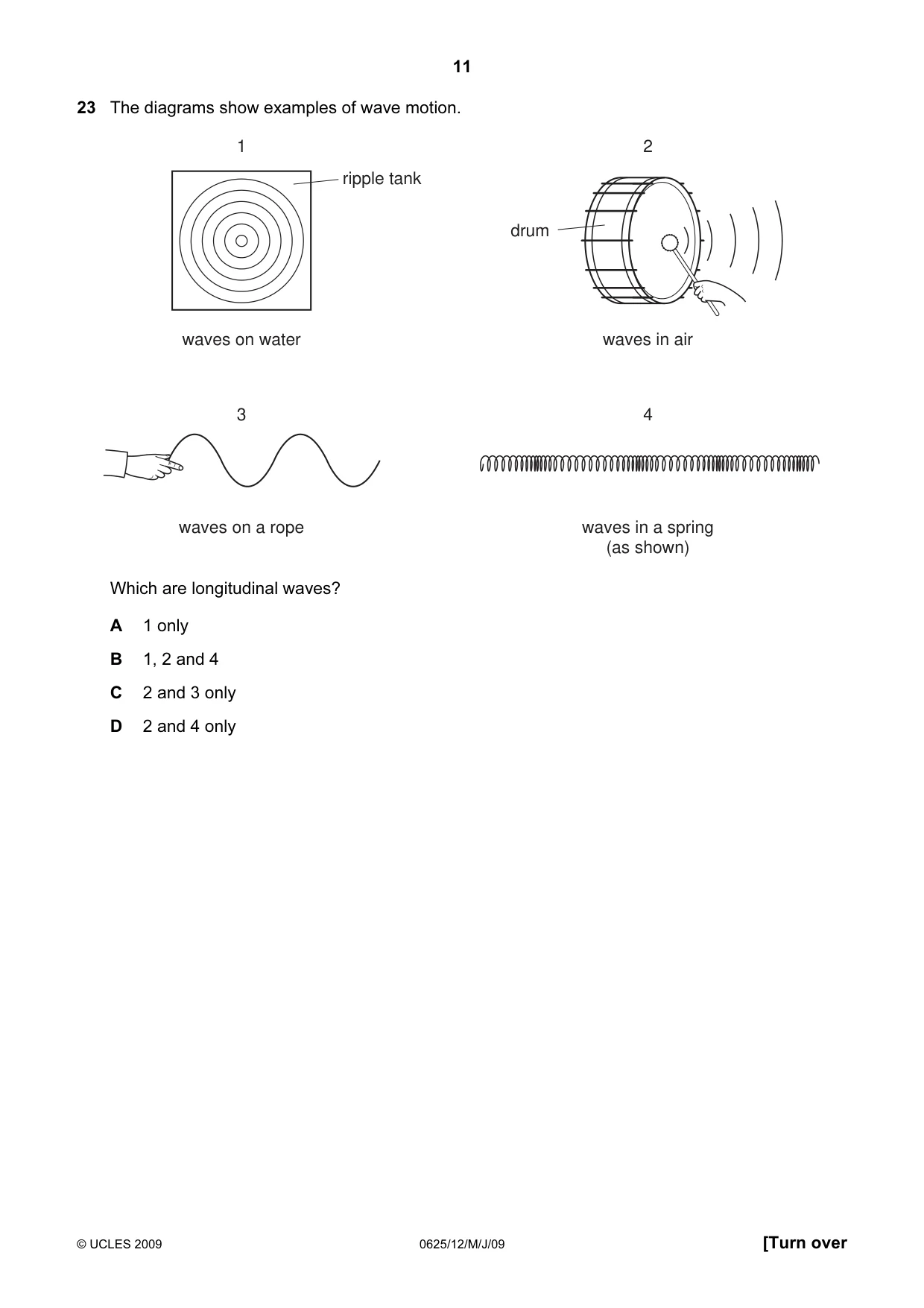
20 The diagrams show examples of wave motion. 1 2 ripple tank drum waves on water waves in air 3 4 waves on a rope waves in a spring (as shown) Which are longitudinal waves? A 1 only B 1, 2 and 4 C 2 and 3 only D 2 and 4 only
Mark scheme: D
Q21 · Which diagram shows what happens when a ray of white light passes through a prism?
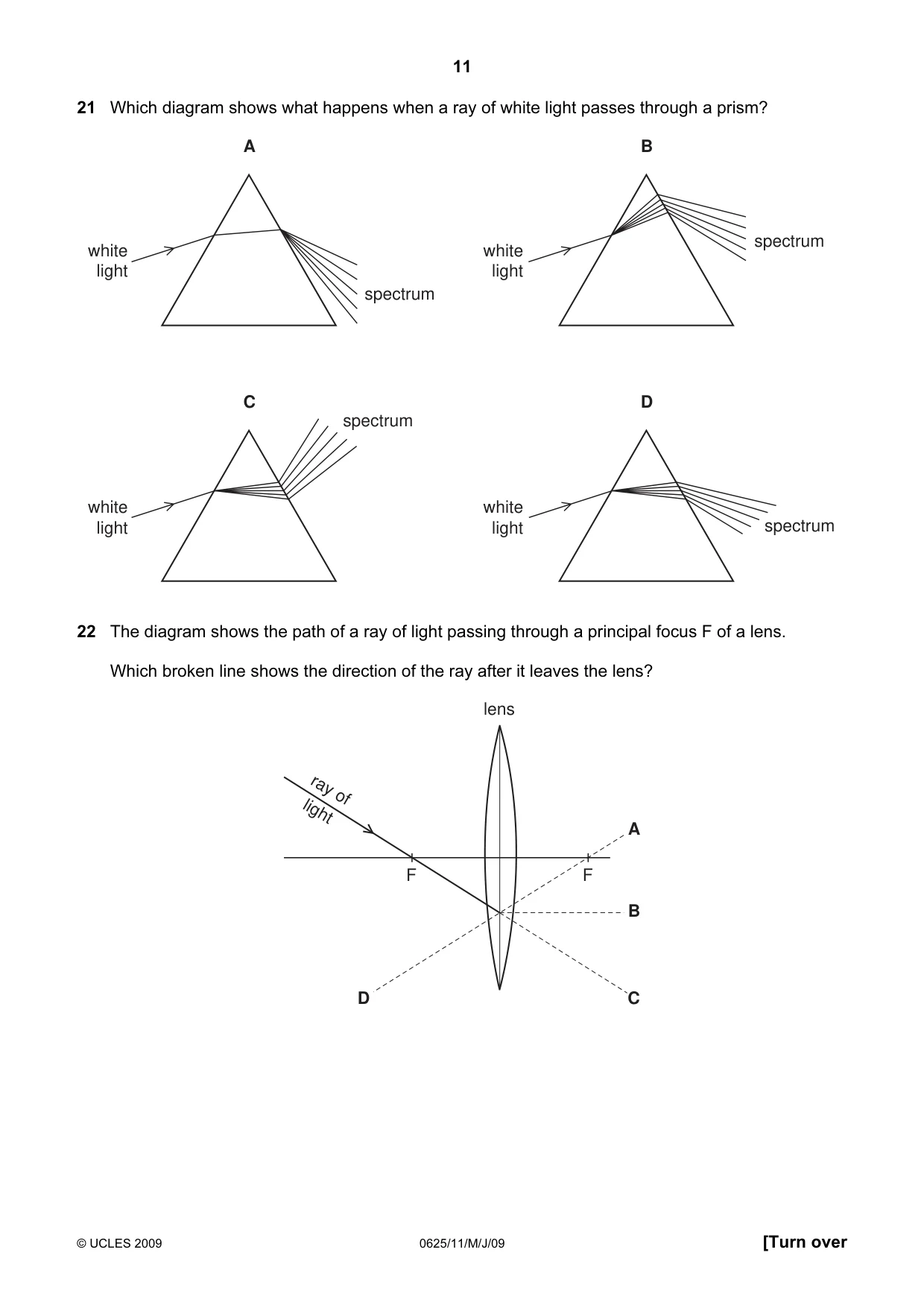
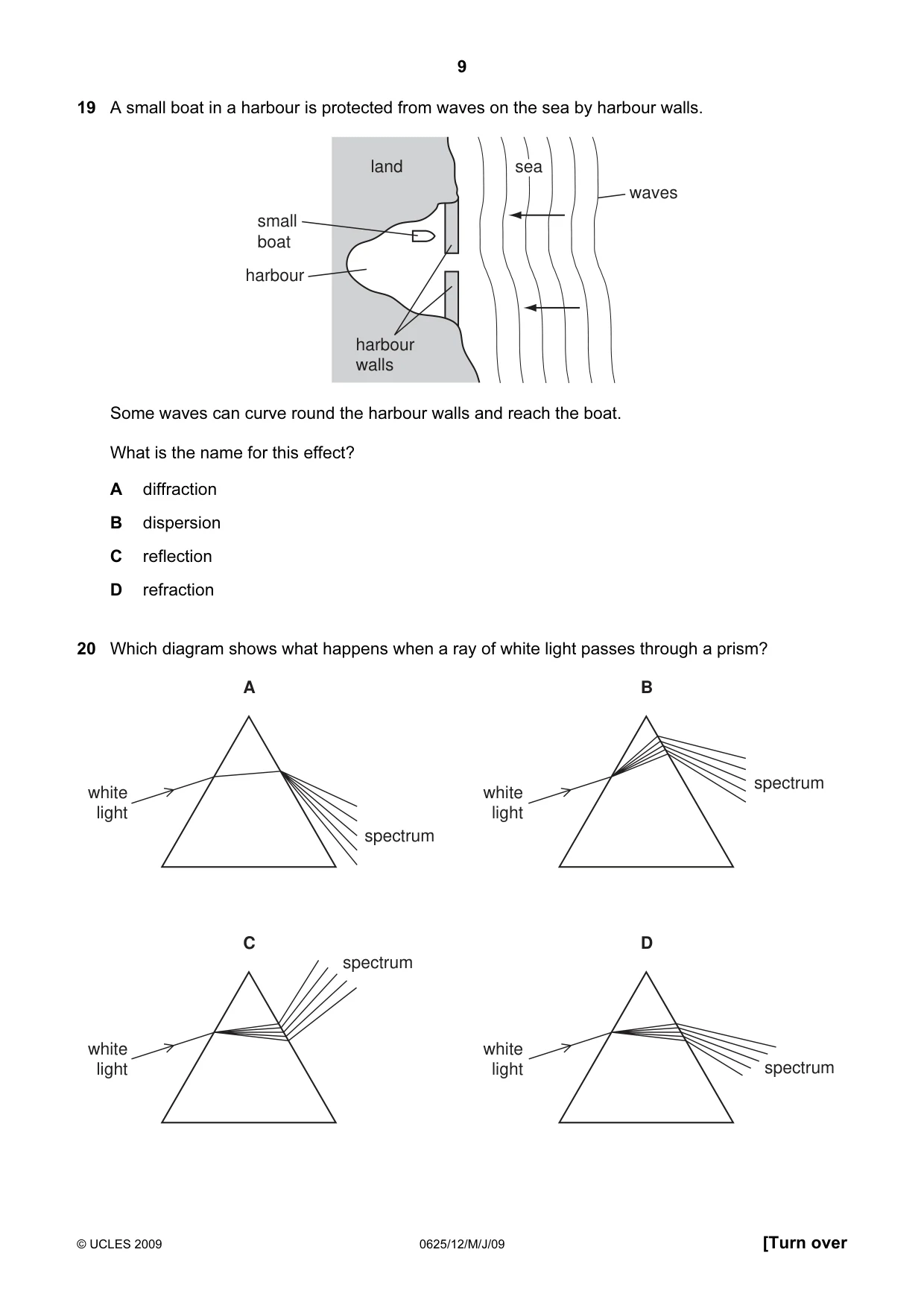
21 Which diagram shows what happens when a ray of white light passes through a prism? A B spectrum white white light light spectrum C D spectrum white white light light spectrum
Mark scheme: D
Q22 · The diagram shows the path of a ray of light passing through a principal focus F of a lens
22 The diagram shows the path of a ray of light passing through a principal focus F of a lens. Which broken line shows the direction of the ray after it leaves the lens? lens ray of light A F F’ B D C
Mark scheme: B
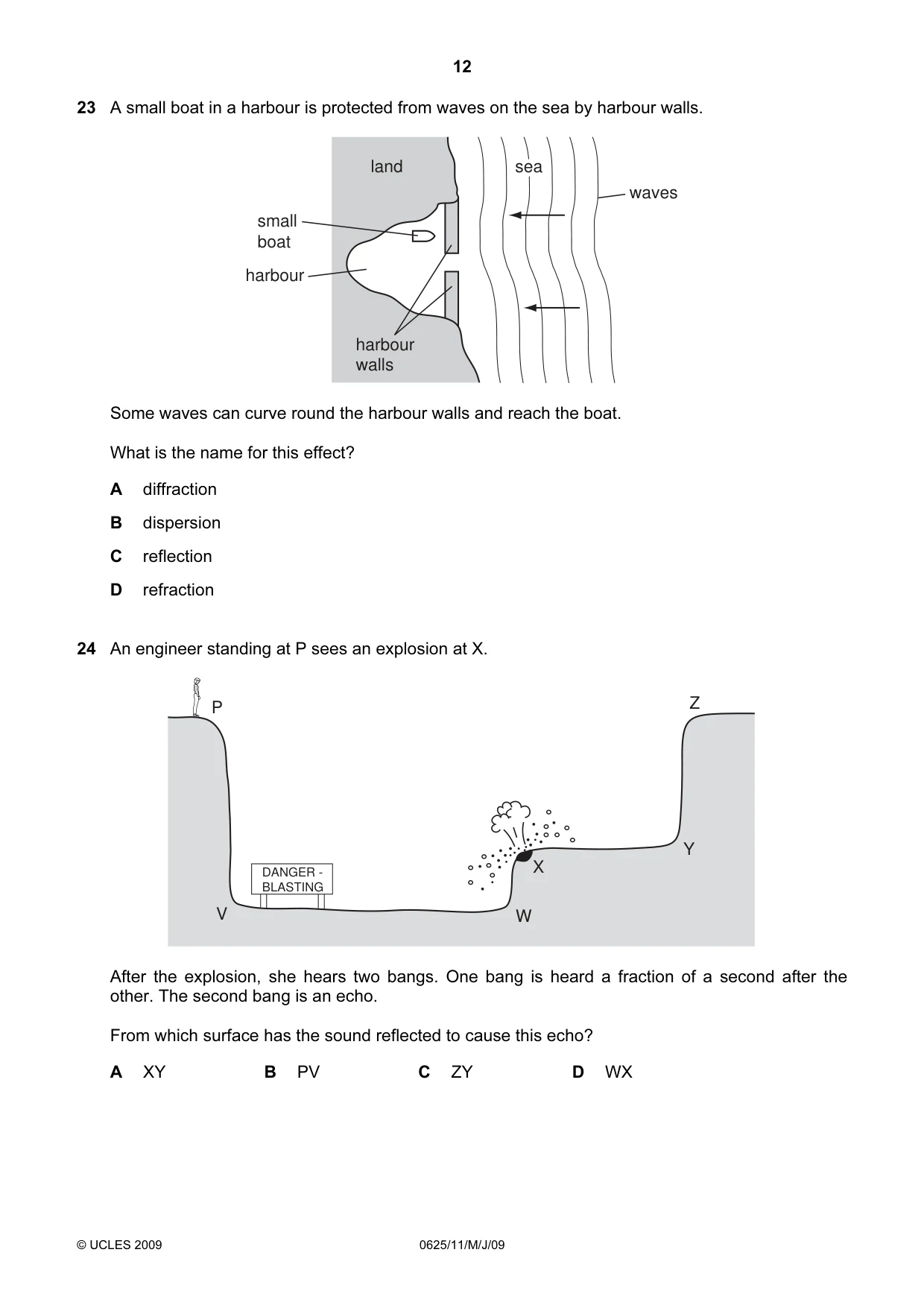
Q23 · A small boat in a harbour is protected from waves on the sea by harbour walls
23 A small boat in a harbour is protected from waves on the sea by harbour walls. land sea sea sea waves small boat harbour harbour walls Some waves can curve round the harbour walls and reach the boat. What is the name for this effect? A diffraction B dispersion C reflection D refraction
Mark scheme: A
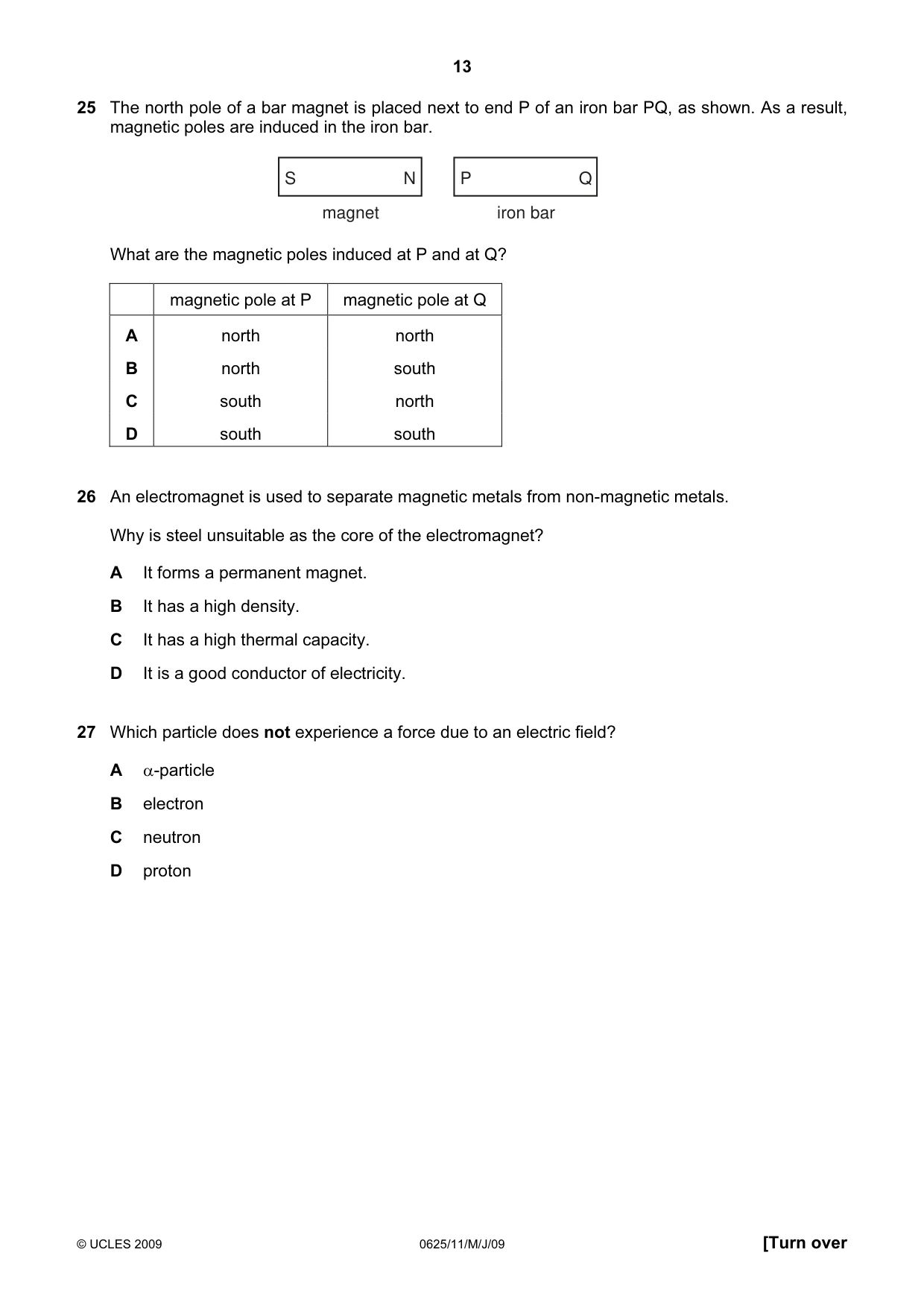
Q24 · An engineer standing at P sees an explosion at X
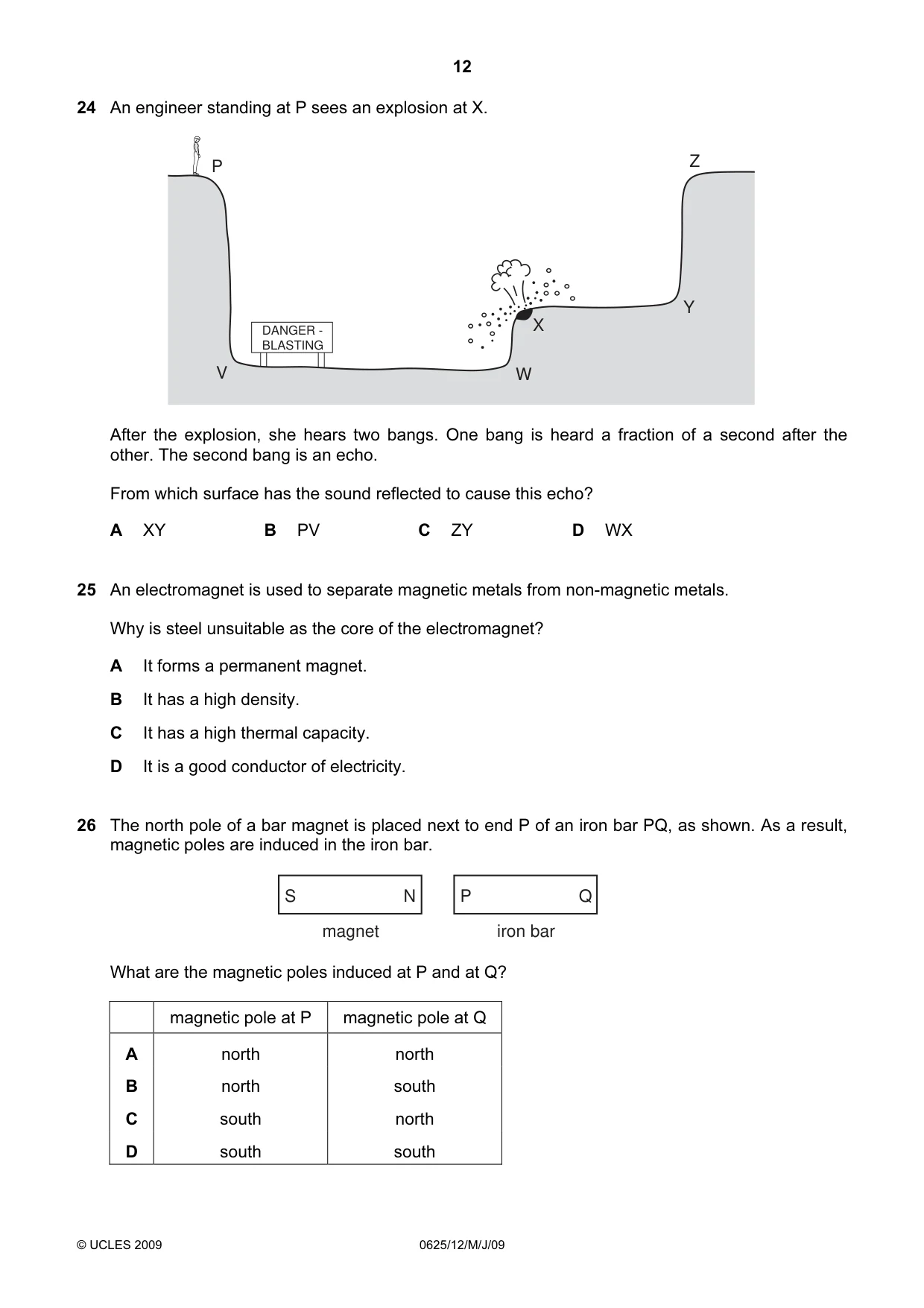
24 An engineer standing at P sees an explosion at X. P Z Y DANGER - X BLASTING V W After the explosion, she hears two bangs. One bang is heard a fraction of a second after the other. The second bang is an echo. From which surface has the sound reflected to cause this echo? A XY B PV C ZY D WX
Mark scheme: C
Q25 · The north pole of a bar magnet is placed next to end P of an iron bar PQ, as shown
25 The north pole of a bar magnet is placed next to end P of an iron bar PQ, as shown. As a result, magnetic poles are induced in the iron bar. S N P Q magnet iron bar What are the magnetic poles induced at P and at Q? magnetic pole at P magnetic pole at Q A north north B north south C south north D south south
Mark scheme: C
Q26 · An electromagnet is used to separate magnetic metals from non-magnetic metals
26 An electromagnet is used to separate magnetic metals from non-magnetic metals. Why is steel unsuitable as the core of the electromagnet? A It forms a permanent magnet. B It has a high density. C It has a high thermal capacity. D It is a good conductor of electricity.
Mark scheme: A
Q27 · Which particle does not experience a force due to an electric field?
27 Which particle does not experience a force due to an electric field? A α-particle B electron C neutron D proton
Mark scheme: C
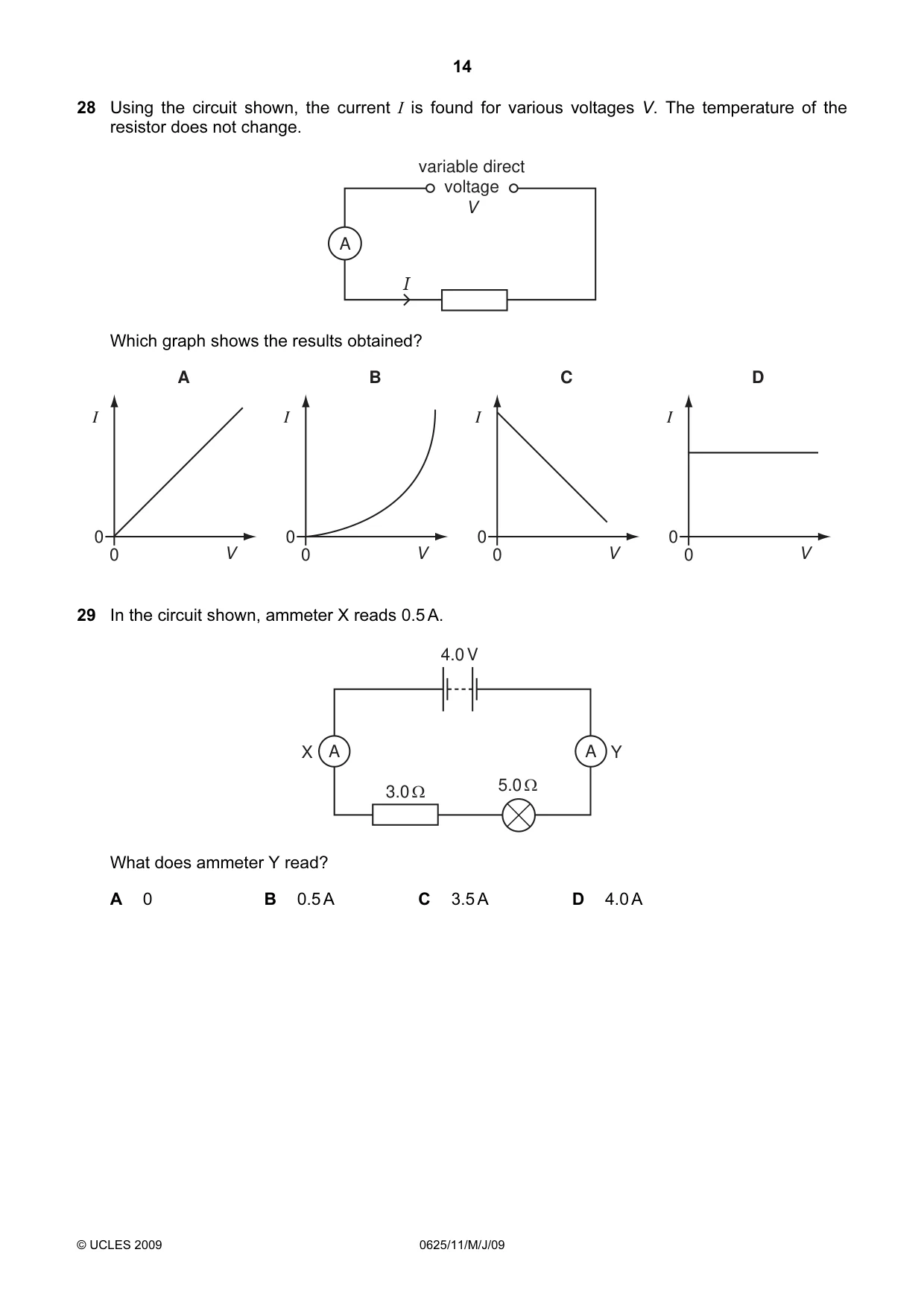
Q28 · Using the circuit shown, the current I is found for various voltages V
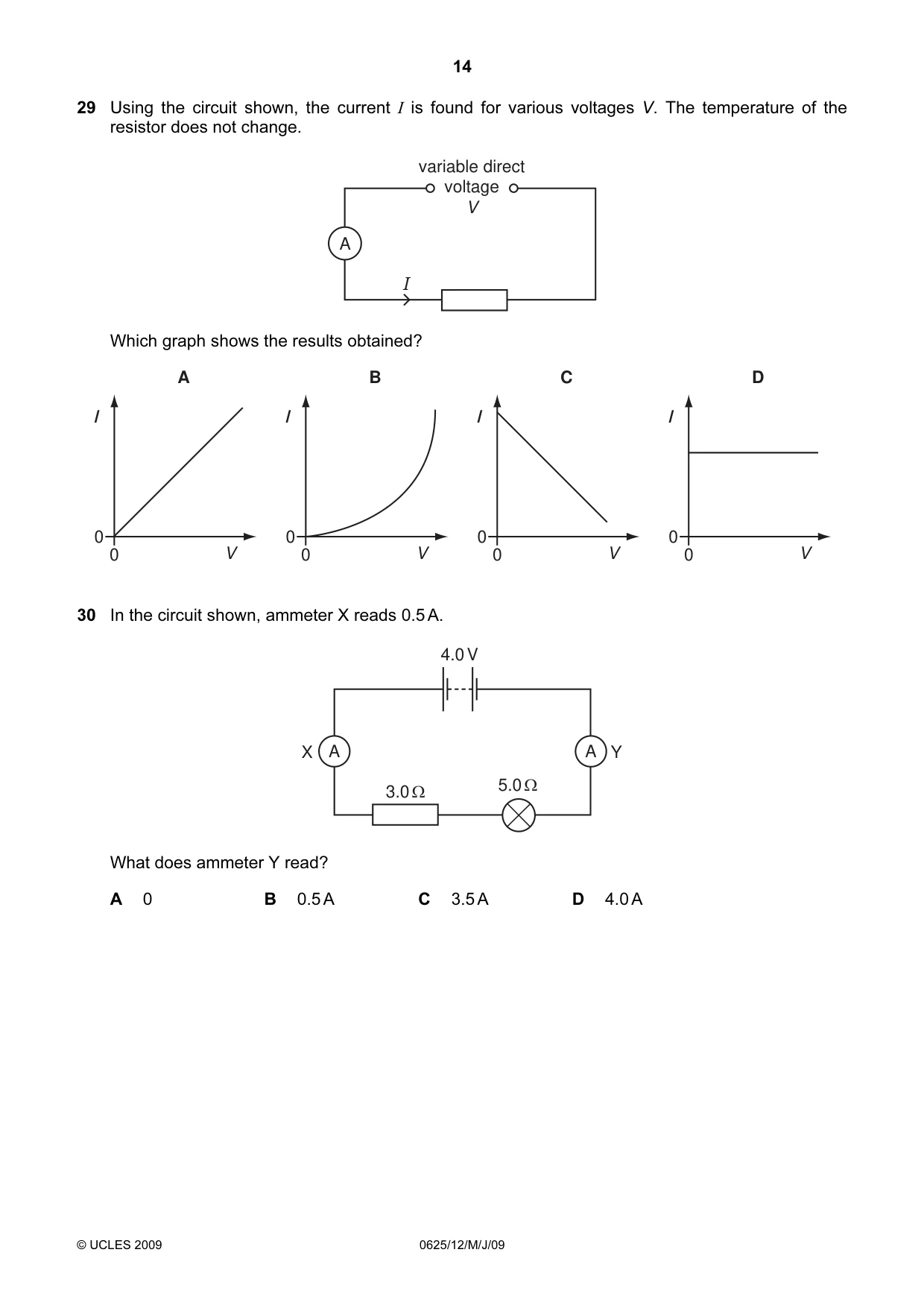
28 Using the circuit shown, the current I is found for various voltages V. The temperature of the resistor does not change. variable direct voltage V A I Which graph shows the results obtained? A B C D I I I I 0 0 0 0 0 V 0 V 0 V 0 V
Mark scheme: A
Q29 · In the circuit shown, ammeter X reads 0.5 A
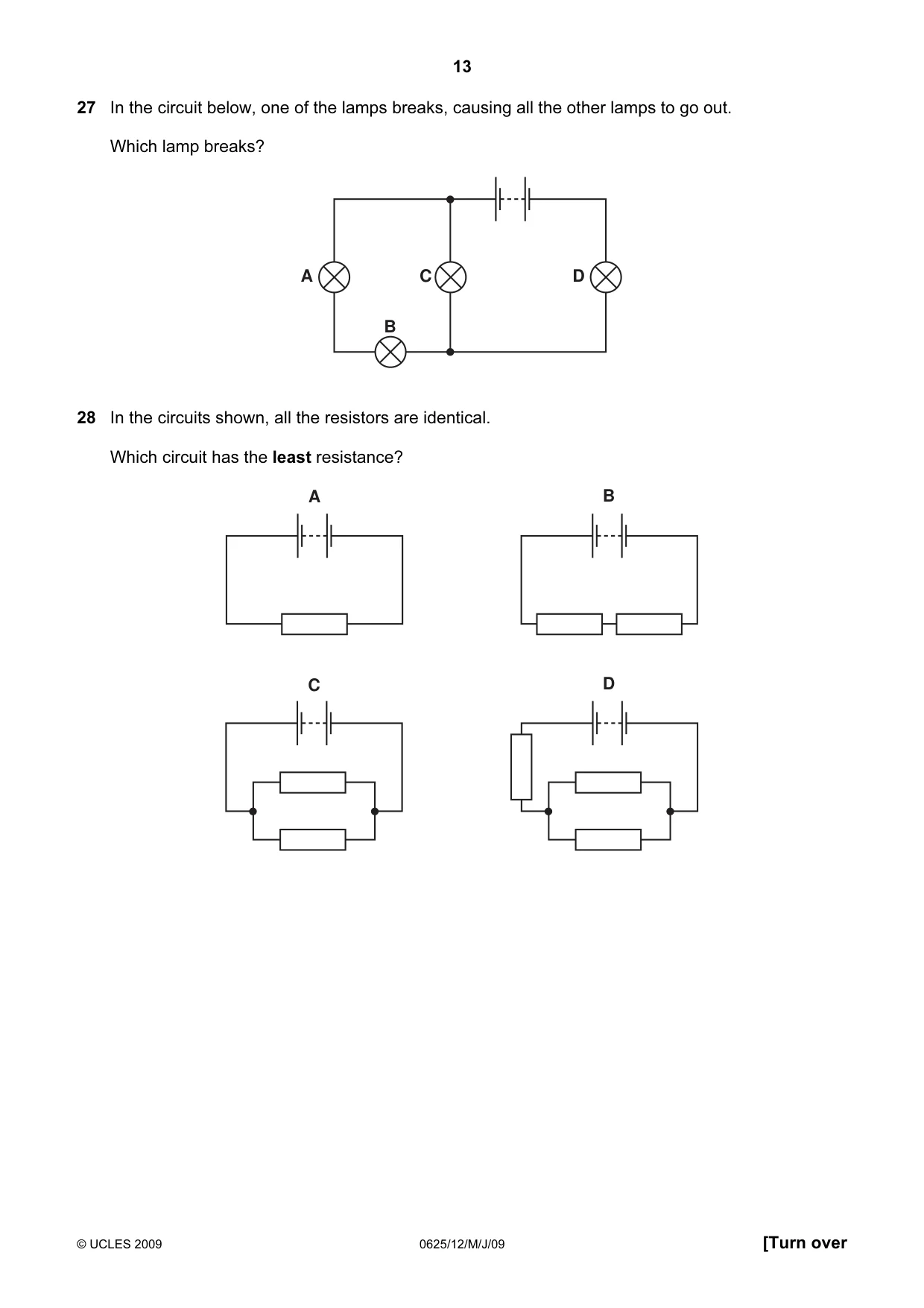
29 In the circuit shown, ammeter X reads 0.5 A. 4.0 V X A A Y 3.0 Ω 5.0 Ω What does ammeter Y read? A 0 B 0.5 A C 3.5 A D 4.0 A
Mark scheme: B
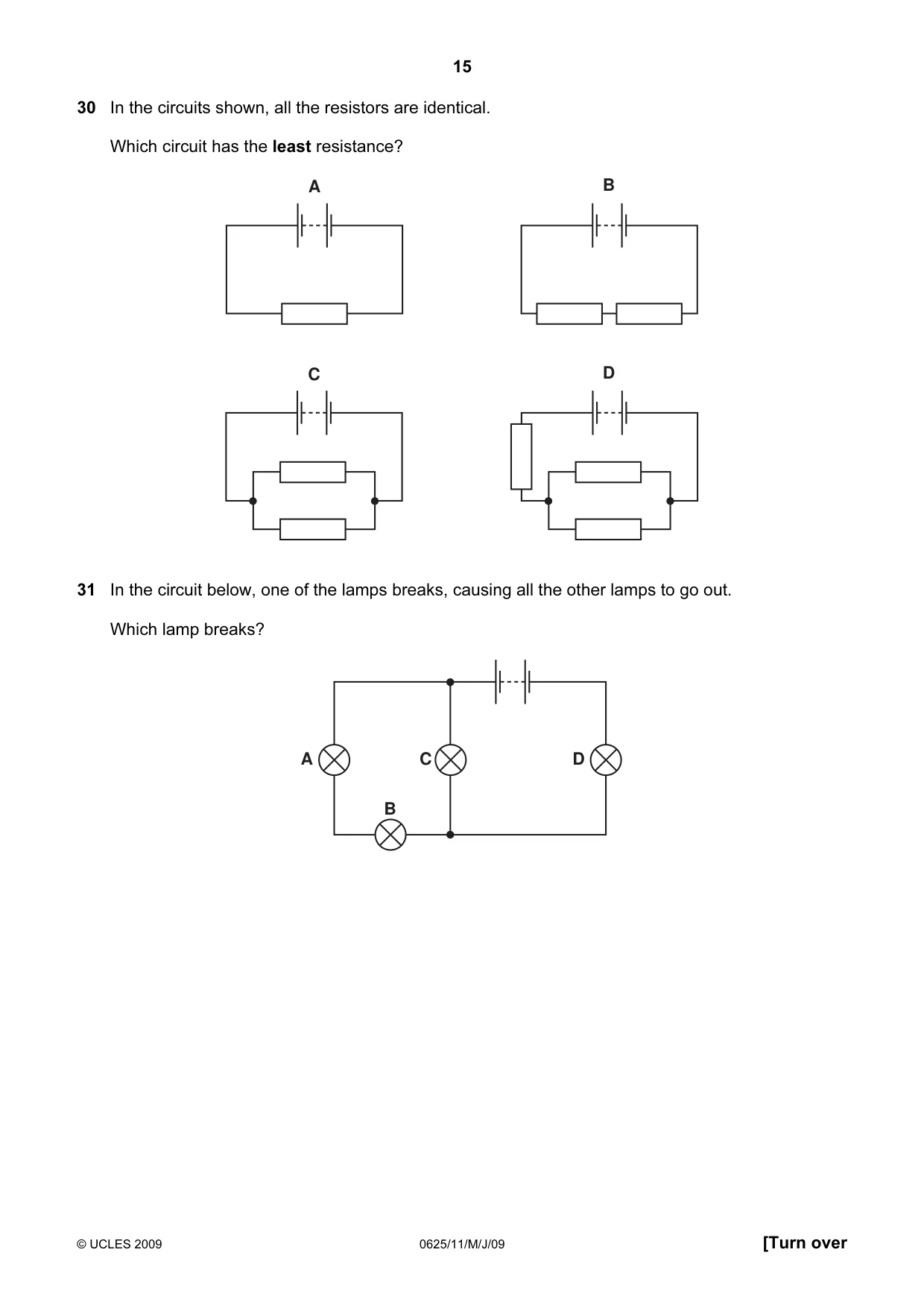
Q30 · In the circuits shown, all the resistors are identical
30 In the circuits shown, all the resistors are identical. Which circuit has the least resistance? A B C D
Mark scheme: C
Q31 · In the circuit below, one of the lamps breaks, causing all the other lamps to go out
31 In the circuit below, one of the lamps breaks, causing all the other lamps to go out. Which lamp breaks? A C D B
Mark scheme: D
Q32 · Either a fuse or a circuit-breaker can be used to protect electrical cables from large…
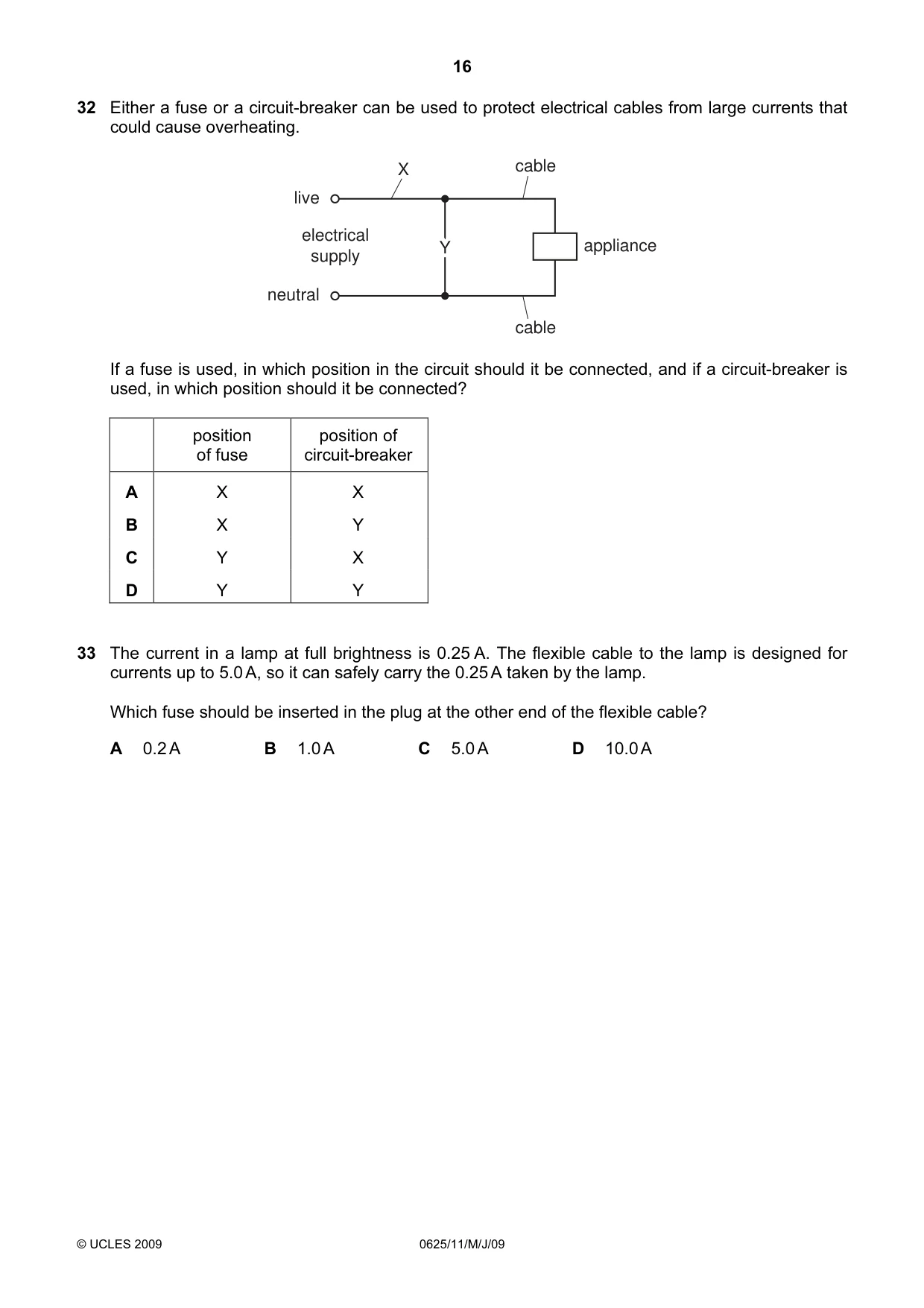
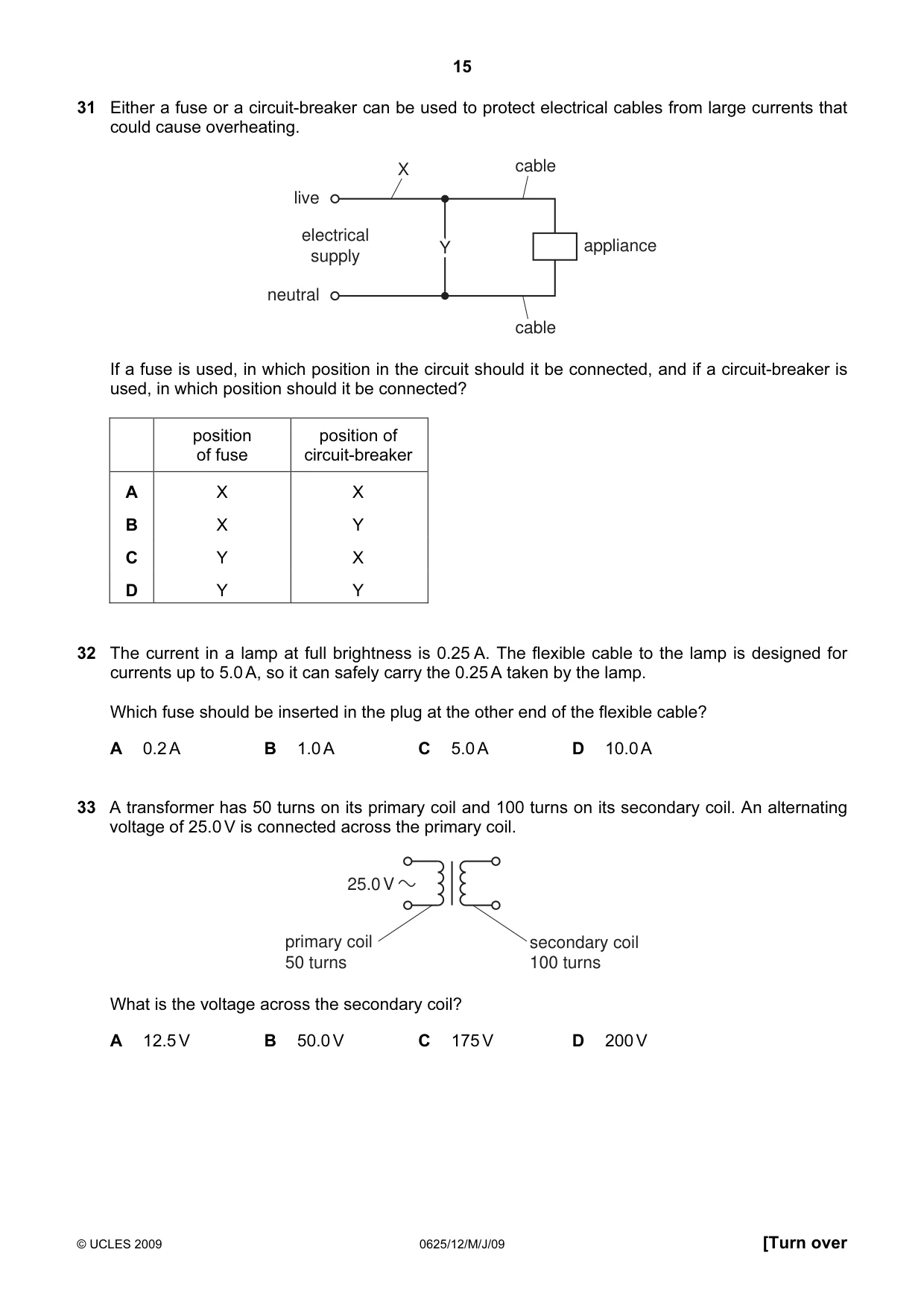
32 Either a fuse or a circuit-breaker can be used to protect electrical cables from large currents that could cause overheating. X cable live electrical Y Y Y appliance supply neutral cable If a fuse is used, in which position in the circuit should it be connected, and if a circuit-breaker is used, in which position should it be connected? position position of of fuse circuit-breaker A X X B X Y C Y X D Y Y
Mark scheme: A
Q33 · The current in a lamp at full brightness is 0.25 A
33 The current in a lamp at full brightness is 0.25 A. The flexible cable to the lamp is designed for currents up to 5.0 A, so it can safely carry the 0.25 A taken by the lamp. Which fuse should be inserted in the plug at the other end of the flexible cable? A 0.2 A B 1.0 A C 5.0 A D 10.0 A
Mark scheme: B
Q34 · A wire perpendicular to the page carries an electric current in a direction out of the…
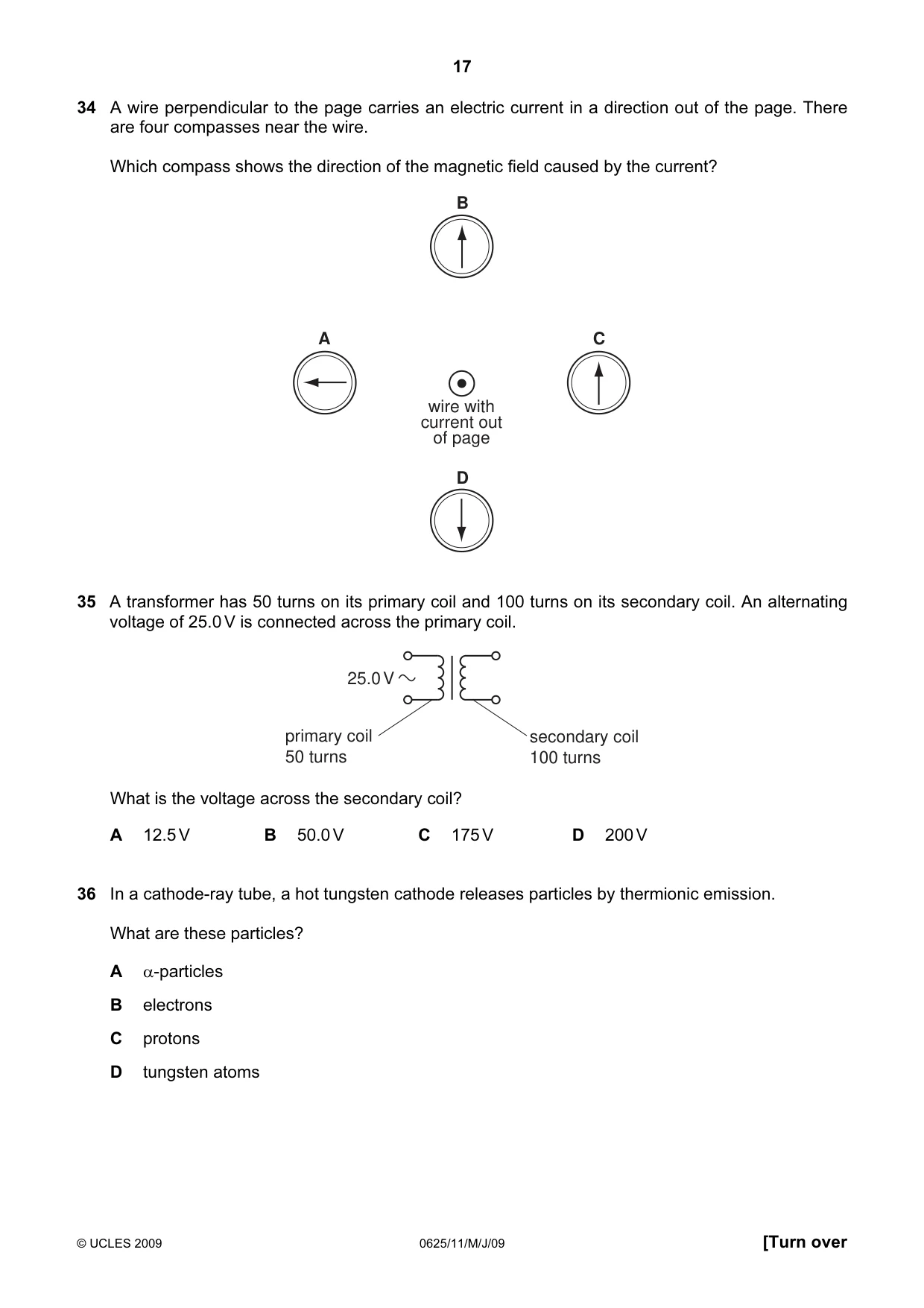
34 A wire perpendicular to the page carries an electric current in a direction out of the page. There are four compasses near the wire. Which compass shows the direction of the magnetic field caused by the current? B A C wire with current out of page D
Mark scheme: C
Q35 · A transformer has 50 turns on its primary coil and 100 turns on its secondary coil
35 A transformer has 50 turns on its primary coil and 100 turns on its secondary coil. An alternating voltage of 25.0 V is connected across the primary coil. 25.0 V primary coil secondary coil 50 turns 100 turns What is the voltage across the secondary coil? A 12.5 V B 50.0 V C 175 V D 200 V
Mark scheme: B
Q36 · In a cathode-ray tube, a hot tungsten cathode releases particles by thermionic emission
36 In a cathode-ray tube, a hot tungsten cathode releases particles by thermionic emission. What are these particles? A α-particles B electrons C protons D tungsten atoms
Mark scheme: B
Q37 · The diagram shows a cathode-ray tube
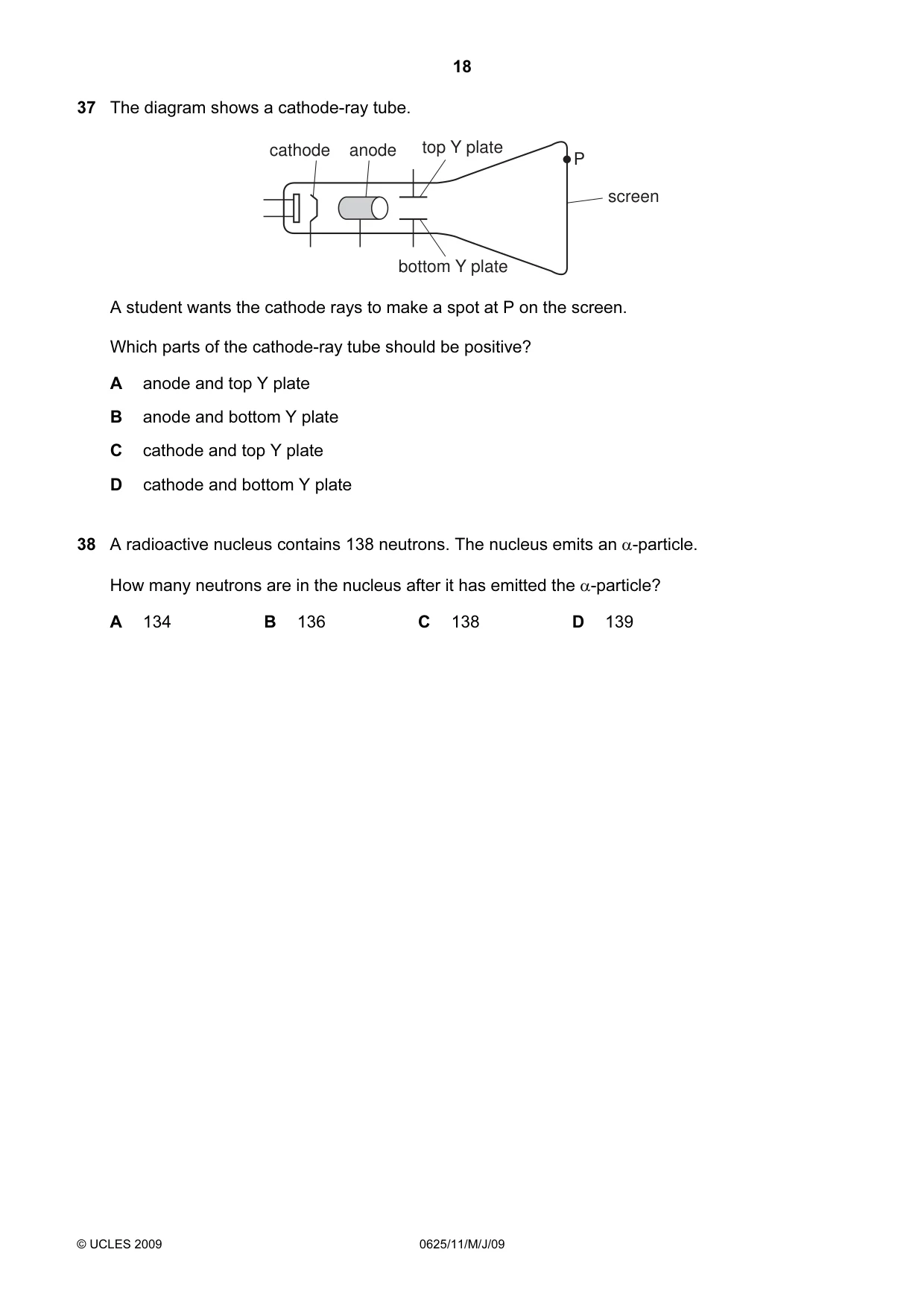
37 The diagram shows a cathode-ray tube. cathode anode top Y plate P screen bottom Y plate A student wants the cathode rays to make a spot at P on the screen. Which parts of the cathode-ray tube should be positive? A anode and top Y plate B anode and bottom Y plate C cathode and top Y plate D cathode and bottom Y plate
Mark scheme: A
Q38 · A radioactive nucleus contains 138 neutrons
38 A radioactive nucleus contains 138 neutrons. The nucleus emits an α-particle. How many neutrons are in the nucleus after it has emitted the α-particle? A 134 B 136 C 138 D 139
Mark scheme: B
Q39 · The graph shows the decay curve for one particular radioactive nuclide
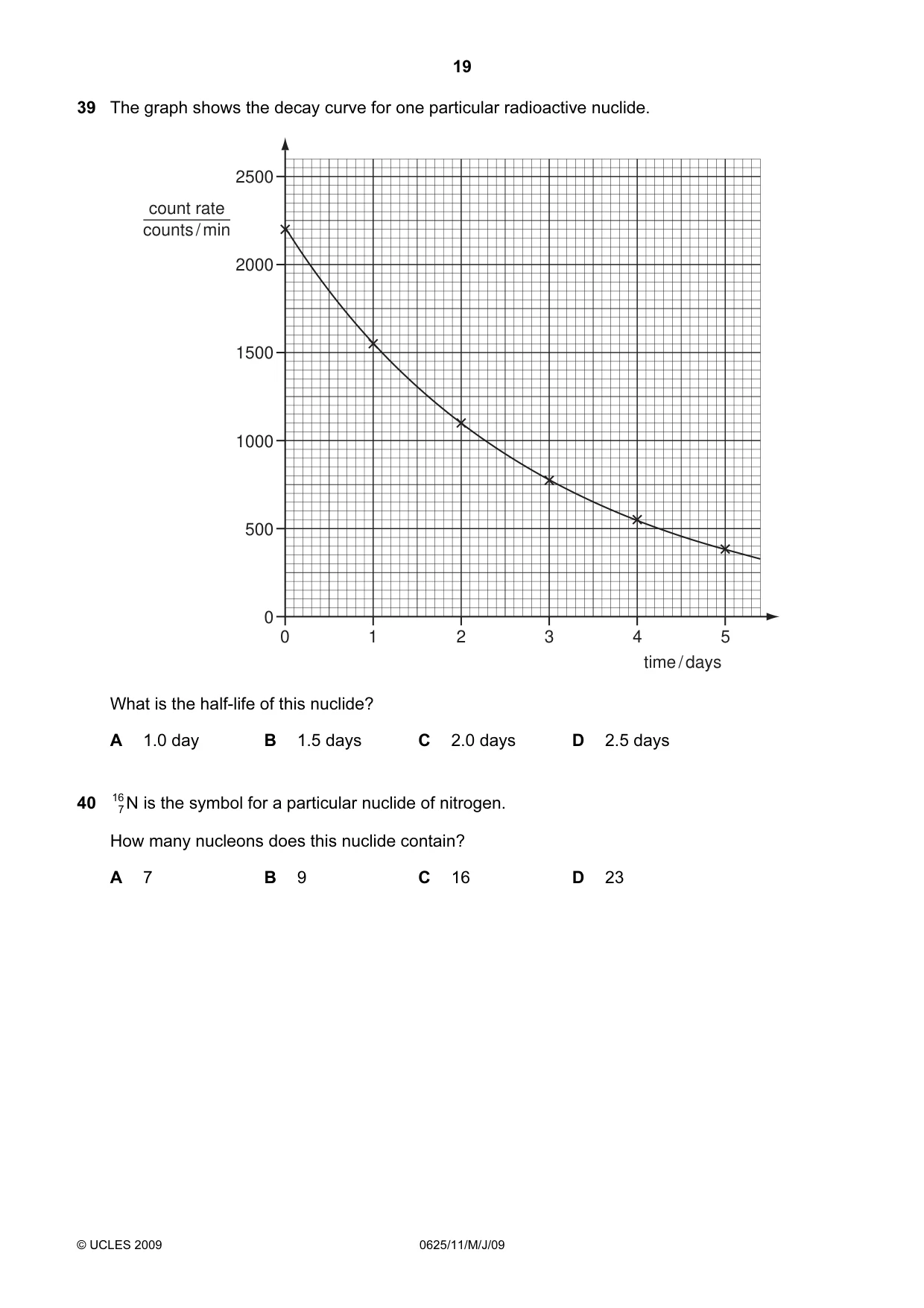
39 The graph shows the decay curve for one particular radioactive nuclide. 2500 count rate counts / min 2000 1500 1000 500 0 0 1 2 3 4 5 time / days What is the half-life of this nuclide? A 1.0 day B 1.5 days C 2.0 days D 2.5 days
Mark scheme: C
Q40 · 16 N is the symbol for a particular nuclide of nitrogen
40 16 N is the symbol for a particular nuclide of nitrogen. 7 How many nucleons does this nuclide contain? A 7 B 9 C 16 D 23
Mark scheme: C
What was in this paper
The subtopics covered by these 40 questions, and how many questions each got. Open one in a new tab to see every Cambridge question on it.
4Electric circuits3General properties of waves3Electrical quantities2Electrical safety2Energy, work and power2Forces2Kinetic particle model of matter2Light2Mass and weight2Motion2Pressure2Radioactivity2Simple phenomena of magnetism2Thermal properties and temperature2Transfer of thermal energy2Density1Physical quantities and measurement techniques1Sound1The nuclear model of the atom1